From deepfakes to DNA: the science of watermarking AI
Google DeepMind
AI-assisted summary of From deepfakes to DNA: the science of watermarking AI — original source. Check the original for full context.
Source published:
Key ideas
- Google DeepMind has expanded its SynthID watermarking technology from text, images, and video into synthetic biology with SynthID Bio, targeting AI-designed protein sequences and 3D biomolecular structures. (19:30)
- In a first-of-its-kind breakthrough, DeepMind completed in vitro wet-lab validation proving that watermarked synthetic proteins maintain binding hit rates and functional affinity identical to natural controls. (27:30)
- SynthID Biosequence leverages the open-source SynthID Text architecture alongside ProteinMPNN to swap synonymous amino acids during generation without compromising physical folding. (25:00)
- The biosecurity initiative aims to provide commercial DNA synthesis providers with verifiable cryptographic provenance to screen out AI-engineered pathogen designs that evade legacy sequence-matching filters. (20:00)
Detailed notes
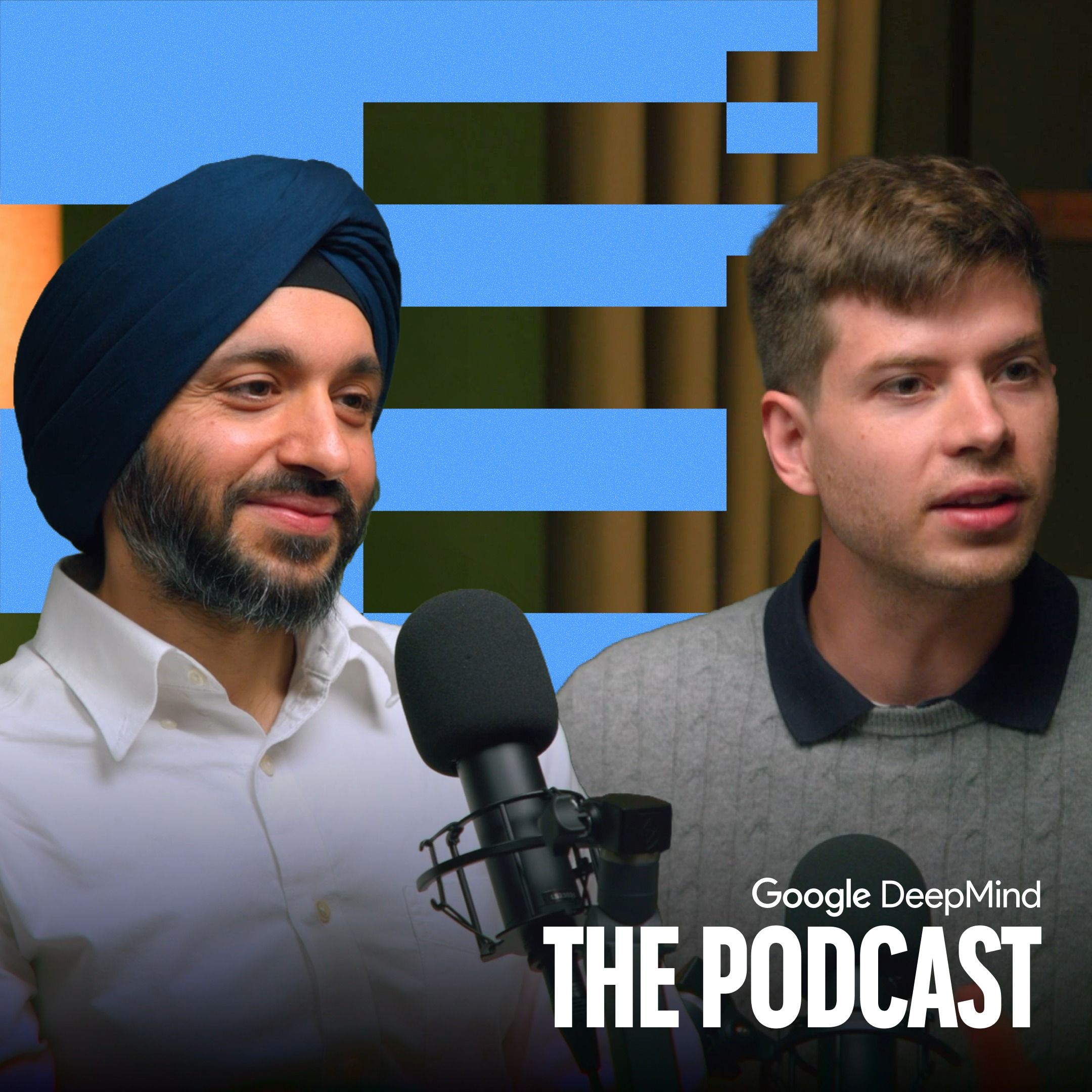
## Background Published by Google DeepMind on October 1, 2026, via web and podcast platforms, this episode features host Professor Hannah Fry exploring the challenge of distinguishing authentic content from machine-generated media. According to the show description, Fry sits down with Pushmeet Kohli, VP of Science, and biosecurity researcher Jeremy Ratcliffe to examine SynthID, a watermarking technology scaling from text, images, and video directly into biology.
## TL;DR DeepMind leaders Pushmeet Kohli and Jeremy Ratcliffe explain the mechanics of SynthID, detailing how active statistical watermarking replaced failing passive detection across images, video, and text generation. The conversation centers on the breakthrough transition into synthetic biology via SynthID Bio, which embeds imperceptible mathematical marks into both 3D protein structures and linear amino acid sequences without corrupting molecular stability. Backed by successful wet-lab validation, the researchers demonstrate that watermarked proteins retain their original biological function and binding affinities. This open-source framework serves as a cornerstone for commercial DNA synthesis screening and DeepMind's broader bioresilience doctrine, aiming to disincentivize malicious biological threats before physical synthesis can occur.
## Atmosphere & style The dialogue is intellectually brisk, lucid, and grounded, driven by Hannah Fry's sharp curiosity and accessible analogies that demystify high-level probability math and structural biology. Pushmeet Kohli provides calm, institutional authority regarding generative AI safety architectures, while Jeremy Ratcliffe offers a thoughtful, cautious counterweight rooted in biosecurity realism. The emotional arc moves steadily from everyday digital concerns like deepfakes and school essays to the unsettling stakes of synthetic pathogen synthesis, leaving the listener with a feeling of quiet scientific urgency and proactive defense.
## Bulletin - `19:30` Google DeepMind has expanded its SynthID watermarking technology from text, images, and video into synthetic biology with SynthID Bio, targeting AI-designed protein sequences and 3D biomolecular structures. - `27:30` In a first-of-its-kind breakthrough, DeepMind completed in vitro wet-lab validation proving that watermarked synthetic proteins maintain binding hit rates and functional affinity identical to natural controls. - `25:00` SynthID Biosequence leverages the open-source SynthID Text architecture alongside ProteinMPNN to swap synonymous amino acids during generation without compromising physical folding. - `20:00` The biosecurity initiative aims to provide commercial DNA synthesis providers with verifiable cryptographic provenance to screen out AI-engineered pathogen designs that evade legacy sequence-matching filters.
## Key takeaways - `04:47` Passive forensic detection tools hit a theoretical limit as generative AI improved, necessitating active in-generation watermarking to preserve trust and provenance. - `02:35` Viable watermarking frameworks rely on three non-negotiable principles: imperceptibility and quality preservation, robustness against modifications or scrubbing attacks, and scalability with low latency. - `06:21` While high-dimensional images provide millions of continuous values to conceal patterns, low-dimensional discrete text requires subtle mathematical shifts in next-token probability distributions. - `10:00` Text watermarking requires generative optionality; highly constrained or single-word factual responses cannot be watermarked without degrading generation quality. - `13:10` Unrestricted public access to watermark detectors creates an adversarial security vulnerability, enabling bad actors to reverse-engineer keys and design evasion attacks. - `15:00` Image and video watermarking uses co-trained adversarial neural networks where a generator and detector are iteratively tested against common real-world transformations. - `17:00` SynthID detection operates cross-platform across frontier labs via shared cryptographic key federation within centralized verification portals. - `20:00` Commercial DNA synthesis providers face critical vulnerabilities from generative models that can design sequences looking completely benign in legacy screening databases while folding into hazardous pathogens. - `20:00` SynthID Bio applies two distinct approaches: subtly adjusting atomic coordinates in 3D structures (AlphaFold 3) or substituting functionally equivalent amino acids in linear sequences (SynthID Biosequence). - `25:00` Sequence watermarking integrates with inverse protein design tools like ProteinMPNN, treating amino acid ribbons analogously to transformer token generation. - `27:30` Wet-lab experimental validation confirmed that watermarked synthetic protein binders preserve binding efficiency and folded stability without functional loss. - `30:00` Deploying biological verification at scale requires automated key-exchange protocols and mutual trust between generative model developers and physical DNA synthesis foundries. - `32:00` SynthID Bio operationalizes DeepMind and Isomorphic Labs' broader bioresilience strategy, structured across three pillars: prevent, detect, and respond. - `32:00` The core theory of biological defense change rests on drastically reducing the utility of biological weapons and raising the technical barrier to entry to disincentivize malicious actors. - `34:25` Unlike easily strippable file metadata, SynthID binds the watermark directly into functional sequence choices so that attempting to scrub the mark disrupts tertiary folding and destroys protein function.
## Detailed walkthrough ### `00:00` The Provocation: Distinguishing Real from Machine
Hannah Fry opens the podcast by setting a familiar digital scene: scrolling through social media feeds and encountering staggering footage—such as a slow-motion volcanic eruption, a tornado ripping through a village, or dramatic protest footage. In these moments, viewers reflexively wonder whether what they are seeing is real or generated by an algorithm. As artificial intelligence advances across text, imagery, audio, and video, finding the answer grows increasingly difficult. The stakes become far higher as AI enters the realm of biology, designing novel biological molecules, enzymes, and structures that never existed in nature—some of which could potentially be designed to cause harm. Fry highlights the central question: how can dangerous biological designs be stopped before they are ever synthesized?
The emerging safeguard is not a crude, visible logo like a stock photo stamp, but an embedded, subtle mathematical signature: a digital watermark. Fry introduces her guests from Google DeepMind: Pushmeet Kohli, VP of Science and one of the principal architects of the SynthID watermarking system, and Jeremy Ratcliffe, a biosecurity researcher whose team is translating this foundational technology into biological engineering.
Jeremy Ratcliffe explains that the primary motivation in biological applications is provenance—establishing an auditable trail of where a specific sequence originated. The core objective is distinguishing natural sequences found in the living world from synthetic sequences produced by generative models, particularly when an AI-generated sequence exhibits dangerous properties that cannot be diagnosed merely by reading the raw sequence itself. When Fry asks what defines an effective watermark, comparing it colloquially to banknotes or passports, Ratcliffe stresses human imperceptibility:
> “I think for us, in particular, human imperceptibility is one. So making it very difficult for someone to be able to tell what portion of data has been watermarked. Because otherwise it would be really easy to erase.”
Beyond imperceptibility, Ratcliffe emphasizes high-confidence automated detection and generalizability—building an adaptable foundational watermarking technique capable of operating across diverse data types rather than engineering fragile, bespoke systems for every individual medium.
`02:35` The Three Core Pillars of Watermarking
Pushmeet Kohli traces DeepMind’s watermarking initiative back nearly eight years, well before generative media reached the cultural mainstream. A decade ago, it was difficult to envision an era where neural networks could synthesize photorealistic images, lifelike video, convincing audio, coherent prose, and functional enzymes indistinguishable from natural counterparts. The fundamental mission of watermarking is to preserve trust and provide users with reliable provenance so they can believe what they encounter.
Kohli outlines the three non-negotiable criteria required for any viable watermarking architecture:
```mermaid flowchart TD accTitle: Three Core Properties of Watermarking accDescr: Diagram illustrating the three foundational design requirements for modern AI watermarking systems: Imperceptibility, Robustness, and Scalability. subgraph Requirements["SynthID Design Principles"] Q["1. Imperceptibility & Quality<br/>Does not degrade fidelity or change semantic meaning"] R["2. Robustness to Attack<br/>Persists through edits, crops, and transformations"] S["3. Scalability & Ease of Use<br/>Seamless integration at generation and rapid detection"] end ```
1. **Imperceptibility and Quality Preservation**: The watermark must not degrade the signal quality or distort semantic meaning; if quality is compromised, creators and end-users simply will not adopt the model. 2. **Robustness Against Transformations and Attacks**: The embedded signal must persist even if an adversary intentionally attempts to scrub it or subjects the file to downstream modifications, compression, cropping, or filtering. 3. **Scalability and Ease of Use**: The marking mechanism must integrate natively into the generation pipeline with negligible latency, while enabling downstream systems to verify the presence of the mark reliably and quickly.
Kohli emphasizes that these three principles—imperceptibility, robustness, and scalability—give users transparent insight and agency over the content they consume or design.
`04:47` Why Detection Failed and Watermarking Succeeded
Hannah Fry presses Kohli on why watermarking suddenly captured global attention, pointing out that public generative models have circulated for several years. Kohli details the historical shift from passive forensic detection to active watermarking. In the earlier days of digital image manipulation, forensic software could identify subtle artifacts and pixel-level inconsistencies left behind by tampering tools. However, as generative deep learning models matured, those telltale statistical artifacts vanished entirely.
When generative models became capable of synthesizing media indistinguishable from raw camera captures or human-written prose, passive detection hit a theoretical wall. This sparked the realization that forensic analysis alone was no longer viable:
> “The way to sort of make sure that humans always have the ability to understand the origin of where some signal came from is by injecting a signal within it.”
By intentionally embedding an imperceptible statistical bias into the generation process itself, DeepMind ensured that the identity of the source model survives even when the raw output appears completely indistinguishable from organic reality.
`06:21` From Dense Pixels to Sparse Text and Biological Sequences
Kohli recalls that the DeepMind team tackled image generation first. High-resolution imagery offered a forgiving canvas: a one-megapixel image contains between one million and three million numerical values depending on color encoding, providing an enormous state space in which to conceal mathematical patterns without corrupting visual quality. Text presented a vastly steeper hurdle. Written text is low-dimensional, highly discrete, and brittle; altering words or tokens risks immediately distorting factual meaning, grammatical coherence, or tone. DeepMind had to devise entirely distinct statistical algorithms for text, embedding marks through subtle shifts in token sampling probability distributions rather than perturbing continuous values.
The conversation turns to international governance and industry deployment. Fry notes that watermarking has moved into hard law, with regulatory frameworks such as the European Union’s AI Act requiring generative content to carry origin markings. Kohli points out that SynthID’s watermarking frameworks have seen broad cross-industry adoption:
> “I think what regulators and countries around the world have recognized that they want to give users this information as to the origins of the content that they are consuming. And one sort of key technology that is seen as a robust solution for it that can scale is watermarking, which is why not only have we seen a take-up of this idea across the industry, the fact that SynthID is used by NVIDIA, is used by other partners like with OpenAI and so on, it's a remarkable sort of thing that many of our partners in the generative AI space have adopted this technology.”
Ratcliffe notes that biological sequences (such as amino acid or nucleotide strings) resemble text more than images. Because biological sequences are discrete strings of letters representing structural building blocks, his team directly leveraged DeepMind’s open-source SynthID Text library. Rather than creating a biological watermarking platform from scratch, they took the existing codebase and adapted it to the constraints of synthetic biology. Fry concludes the segment marveling at the underlying mechanism: the mark relies neither on crude visual modifications nor on trivial hidden whitespace or punctuation, but hides mathematically within the generated sequence itself.
- **Historical timeline**: DeepMind began developing internal watermarking methods roughly eight years prior (circa 2018). - **Signal capacity contrast**: High-dimensional media (images, audio, video) contain millions of continuous data points for embedding, whereas low-dimensional text requires delicate manipulation of discrete token probabilities to protect the underlying message. - **Biosecurity synergy**: The open-source SynthID Text library provided the foundational software foundation for watermarking machine-generated biological sequences.
`10:00` How Text Watermarking Exploits Next-Token Probability
Existing online tools that claim to detect AI-generated text rely on standard machine learning classifiers trained on large datasets. Pushmeet Kohli explains that while early conversational models had obvious stylistic tells—such as recurring phrasing patterns or overusing certain words—modern models have grown far more sophisticated:
> “And so if you have this machine learning classifier which is trying to distinguish, the classifier's accuracy goes down over time as the generative AI models become better at replicating what they are targeted to achieve.”
Instead of post-hoc classification, SynthID text watermarking intervenes directly during the generative process. When a large language model generates a sentence token by token, it produces a probability distribution over potential next words. Pushmeet illustrates this optionality using a conversational example: if asked what someone ate for breakfast, the model could equally well begin with “I...” or address the questioner by name with “Pushmeet...”. SynthID introduces a secret pseudo-random key at inference time that subtly biases the sampling selection among these equally plausible candidate tokens.
```mermaid flowchart LR accTitle: Text Watermarking Selection Flow accDescr: Shows how an LLM's probability distribution is biased by a secret key to form identifiable token patterns without degrading generation quality.
subgraph Gen ["Token Generation"] A["Input Prompt"] --> B["LLM Probability Distribution"] K["Secret Watermark Key"] --> C["Biased Sampling Layer"] B --> C C --> D["Generated Token Chain"] end
subgraph Det ["Detection Phase"] D --> E["SynthID Detector"] K --> E E --> F["AI Attribution Result"] end ```
The system does not rely on repeatedly forcing specific odd words into the response, which would degrade text quality. Instead, the detector looks across extended passages for mathematical patterns and correlations in how those biased token chains link together. Because the watermark relies on statistical bias across several word choices, highly constrained or short responses cannot be watermarked. If a prompt has only one deterministic answer—such as asking for the capital of France, where the answer is simply “Paris”—the model has zero optionality, and watermarking is impossible.
- Machine learning classifier accuracy steadily degrades as generative models improve at replicating human output. - Text watermarking relies on the model having "optionality" (multiple valid next-token choices). - A secret key introduces subtle biases into the sampling distribution without harming readability. - Multi-model attribution is possible: different models or organizations can apply distinct secret keys to trace provenance back to a specific engine. - Extremely short or strictly factual snippets (e.g., "Paris" as the capital of France) cannot carry a watermark.
---
`13:10` The Realities of Essay Cheating and Detector Evasion
Hannah Fry asks whether this implies students can no longer cheat on essays and whether AI generation is now universally detectable. Jeremy Ratcliffe cautions against viewing any tool as a silver bullet. While the industry is broadly converging toward watermarking standards, deploying public detectors poses an inherent security trade-off:
> “Were a detector publicly available and you could just query it over and over and over again, you might be able to work back to making something that gets around that specific configuration of keys that is presented in the public detector.”
If bad actors have unrestricted access to a detector endpoint, they can execute model-extraction or black-box adversarial attacks, querying the detector repeatedly to reverse-engineer key configurations and learn the exact threshold boundaries to bypass identification. Thus, while watermarking represents a massive leap beyond heuristic classifiers, it does not guarantee a permanent, cast-iron catch-all under every public deployment condition.
- Other frontier AI labs have announced moves toward watermarking implementations. - Open-access public detectors create an adversarial incentive, enabling users to probe the detector and develop evasion techniques. - Watermarking provides high-confidence attribution, but maintaining key security and access controls remains necessary to prevent circumvention.
---
`15:00` Image and Video Watermarking via Adversarial Neural Networks
Image and video watermarking operates on an entirely different technical paradigm than text generation. Rather than biasing next-token sampling tables, image watermarking uses a pair of neural networks trained jointly in an adversarial game. An unwatermarked image is passed to a generator network that embeds a subtle, imperceptible signal into the pixel structure.
```mermaid flowchart TD accTitle: Co-Trained Adversarial Image Watermarking accDescr: An unwatermarked image is injected with a signal, passed through simulated adversarial transformations, and verified by a co-trained detector.
subgraph Embed ["Embedding Pipeline"] I["Original Image"] --> G["Watermark Generator Network"] G -->|"Injects imperceptible signal"| W["Watermarked Image"] end
subgraph Attack ["Adversarial Distortions"] W --> A["Adversarial Agent: Crop, Zoom, Rotate, Add Noise, Compress"] end
subgraph Detect ["Attribution"] A --> D["Co-Trained Detector Network"] D --> R["Detection Confidence"] end ```
To guarantee that the watermark survives real-world editing, the generator and detector are trained against an intermediate adversarial module. This adversary subjects the watermarked image to common digital manipulations: - Resizing, zooming, and extreme cropping - Geometric rotations - Lossy compression, contrast adjustments, and noise injection
The generator learns to place the signal where it cannot be easily stripped by these transformations, while the detector learns to recognize the signal despite severe visual distortions, all while keeping the mark invisible so as not to degrade visual fidelity.
---
`17:00` Tackling Misinformation and Cross-Platform Detection Portals
Pushmeet reflects on the real-world impact of SynthID in journalism and media verification. High-profile incidents—such as synthetic images of miraculously untouched homes amidst California wildfires or faked depictions of military conflict in Iran—have been debunked by newsrooms running SynthID. Pushmeet highlights this operational success:
> “And SynthID being used to actually tackle misinformation in real time and at scale.”
Detection capabilities have been directly integrated into consumer products, including the Gemini app. Users can upload an image and ask whether it was produced by Google's generative models; Gemini then calls the SynthID detection service to verify provenance.
```mermaid flowchart TD accTitle: Partner Key Federation in SynthID Portal accDescr: Displays how external organizations can share secret keys to allow a centralized portal to identify AI provenance.
A["External Image / Content"] --> P["SynthID Detection Portal"] K1["Google Internal Keys"] --> P K2["Partner Institution Key A"] --> P K3["Partner Institution Key B"] --> P P --> R["Attribution: Generated by Partner A / Google / Unverified"] ```
When asked whether SynthID can identify images generated by competing models, Pushmeet explains the trust federation model: detection relies on knowing the secret key. If external companies and partner institutions adopt the framework and securely register their keys with the central SynthID portal, the detector can attribute content generated by their systems as well. If an external lab refuses to share its keys, third parties cannot verify that lab's watermarks.
- SynthID detection is natively exposed in Google products like the Gemini app for direct user verification. - Detection operates cross-platform via partner key-sharing agreements. - Unregistered, non-partner models remain undetectable by design if their underlying keys are kept proprietary.
---
`19:30` Expanding Watermarking into Biology: SynthID Bio
Hannah Fry shifts the conversation to biological applications, introducing Jeremy Ratcliffe to discuss SynthID Bio. This proof-of-concept technology expands watermarking beyond human-facing communication modalities—text, audio, and video—into synthetic biology, targeting AI-designed protein sequences and 3D biomolecular structures.
Jeremy notes that their release and upcoming research publication specifically detail SynthID Bio Structure, which addresses the challenges of watermarking the spatial coordinates of 3D biomolecules without disrupting their delicate biological and chemical functions.
`20:00` Watermarking Biology: Predicted Structures vs. Biosequences
The team breaks down two distinct ways watermarking applies to biological data. The first technique targets predicted protein structures generated from an input sequence, building directly on AlphaFold 3. In that case, the watermark is embedded by making minute adjustments to the positions of individual atoms—subtly shifting the distance or angle between two atoms while keeping the overall structure intact. The second technology, SynthID Biosequence, operates directly on the protein sequence itself: the actual string of amino acids. As Jeremy Ratcliffe explains, “Well, for structure, it's still the same atoms. They're just maybe in a slightly different configuration. Well, for sequence, we're actually changing the content of the body, but maybe not the actual functional meaning of that content.”
```mermaid flowchart TD accTitle: SynthID Biological Watermarking Approaches accDescr: Comparison of watermarking 3D protein structures versus linear amino acid sequences
subgraph Structure["AlphaFold 3: Structure Watermarking"] S1["Predict 3D Atomic Structure"] S2["Slightly alter atomic distances and angles"] S3["Same atoms, tweaked spatial coordinates"] S1 --> S2 --> S3 end
subgraph Sequence["SynthID Biosequence: Sequence Watermarking"] B1["Predict Linear Biosequence"] B2["Swap select amino acids for similar alternatives"] B3["Changed sequence, identical folded function"] B1 --> B2 --> B3 end ```
Hannah Fry asks why this is necessary in practice, and Jeremy points out the realities of the commercial DNA synthesis pipeline. Laypeople often do not realize that anyone can effectively order custom genetic material from commercial synthesis providers—what Hannah terms DNA “printers.” A major biosecurity hazard is whether someone could evade regulatory oversight to order DNA that enables them to synthesize dangerous biological agents in a physical lab. Jeremy notes that an actor could attempt to recreate “an extinct pandemic, like extinct influenza,” prompting Hannah to emphasize that such an outcome would be “overall bad.” While commercial DNA providers check customer affiliations to prevent synthesis requests from unauthorized individuals, an emerging risk is that AI tools could design functional pathogens using amino acid sequences that look entirely benign to legacy screening systems.
- **Structure vs. Sequence**: Structure watermarking nudges 3D atomic coordinates; biosequence watermarking selects synonymous or functionally equivalent amino acids along the ribbon. - **DNA Screening Vulnerability**: Existing DNA synthesis screening checks order sequences against databases of known regulated pathogens. - **The AI Evasion Threat**: AI protein generators can design sequences that are drastically different in sequence space from regulated pathogens yet fold into the identical hazardous, functional shape. - **Fragment Splicing**: A bad actor could potentially order a disguised, AI-designed harmless-looking sequence fragment, cut and paste it into a gene order, and assemble the active pathogen independently inside a wet lab.
---
`25:00` ProteinMPNN and the Analogy to Generative Text
Embedding a watermark into a biosequence relies on an architecture remarkably similar to large language models. The researchers use ProteinMPNN, a third-party, open-source tool developed outside Google that functions essentially as the inverse of AlphaFold: rather than taking a sequence and predicting its 3D folded structure, it takes a targeted 3D structure and designs an amino acid sequence that will fold into that shape. Because a folded protein is assembled from a linear ribbon of amino acids, the token generation process in ProteinMPNN mirrors how transformer models produce sequences of text token by token.
```mermaid flowchart LR accTitle: Inverse Protein Design Pipeline accDescr: Contrast between AlphaFold and ProteinMPNN workflows
subgraph AlphaFold["AlphaFold"] A1["Amino Acid Sequence"] -->|"Predicts fold"| A2["3D Folded Structure"] end
subgraph ProteinMPNN["ProteinMPNN + SynthID"] B1["Target 3D Structure"] -->|"Inverse design"| B2["Watermarked Biosequence"] end ```
When designing sequences to fit a target geometry, the model encounters positions where it can freely substitute chemically similar amino acids—such as swapping leucine for isoleucine—without disrupting the resulting shape. SynthID Biosequence guides these choices during sampling to embed an invisible watermark. Addressing Hannah's skepticism about whether altering amino acids degrades molecular behavior, Pushmeet Kohli and Jeremy explain that the whole point was to prove real-world biological viability: “And that's what is very cool about it, that we have now in existence watermarked proteins. These are real things. This is not in simulation. These are real things which do stuff, but which are watermarked and will always be detectable.”
- **Structural Synonyms**: Certain amino acids share near-identical physical and chemical traits (e.g., leucine and isoleucine), letting the model make substitutions that preserve folded stability. - **Functional Invariance**: In wet-lab validation, watermarked protein designs achieved binding hit rates and quantitative binding affinities near-identical to unwatermarked controls. - **Laboratory Surprise**: Jeremy admits that prior to receiving the experimental wet-lab data, he was skeptical about whether biological systems would tolerate the alterations, remarking that how easily it worked “blew all of our minds.”
---
`27:30` Wet-Lab Validation, Open Source, and Ecosystem Adoption
To make biological watermarking an effective biosecurity safeguard, detection cannot remain proprietary or confined to simulated models. Google DeepMind physically manufactured synthetic watermarked protein binders in a wet lab across two distinct watermarking schemes to confirm they retained their binding efficiency without functional loss. Having established proof of concept, the team is open-sourcing the technology so that academic researchers, model developers, and commercial gene foundries can integrate the watermarking and verification pipeline directly into their infrastructure.
To operationalize detection across the industry, synthesis companies and AI developers must coordinate on shared security primitives. If a third-party laboratory or DNA vendor receives an order, they can verify the presence of the watermark provided they have access to the model provider's key and context-length settings. Because Google does not operate a commercial DNA synthesis service or a proprietary end-to-end protein manufacturing pipeline, the focus has shifted toward building partnerships across the broader biotechnology ecosystem.
- **Universal Key Verification**: To confirm a watermark in a biosequence, a synthesizer needs the specific generator key and the preceding context length used during sequence generation. - **Engineering Headroom**: DeepMind notes there is ongoing technical headroom to make biological watermarks even more robust, easier to embed, and simpler to detect. - **Ecosystem Coordination**: Deploying biosequence watermarking at scale requires mutual trust and automated key-exchange protocols between generative model creators and physical DNA synthesis providers.
`30:00` Industry Reception and Gene Synthesis Screening
When discussing how to roll out biological watermarking in practice, Jeremy Ratcliffe makes it clear that Google DeepMind does not view itself as the arbiter that will dictate industry-wide synthesis standards. Because DeepMind is not an entity that fulfills DNA or protein printing orders directly, its goal is to act as a catalyst—opening up the conversation and demonstrating how providers can implement watermarking verification into their existing gene synthesis pipelines. When Hannah Fry asks about the reaction from the commercial providers actually manufacturing these physical molecules, Ratcliffe admits his own personal disposition made him brace for pushback: “I'm generally quite skeptical of things. Like, that's just sort of in my nature.” Instead, the industry reception caught the team off guard in the best way possible. Commercial synthesis providers have shown an overwhelming appetite for the tool, which Ratcliffe describes as deeply galvanizing as the team navigates the final deployment steps.
Pushmeet Kohli points out that the biotechnology sector is unusually proactive compared to other industries when it comes to anticipating emerging risks. DNA and protein synthesis providers already operate screening filters to flag dangerous pathogens or dual-use toxins in incoming customer orders. However, these providers are acutely aware that their current screening mechanisms are far from bulletproof and will face unprecedented strain as generative design models mature. Synthesis providers know firsthand that catching malicious orders will only grow harder, making them eager to collaborate across the field on robust, verifiable safeguards.
- DeepMind sees its role as catalyzing implementation across commercial gene synthesis providers rather than unilaterally establishing industry standards. - Synthesis providers currently rely on screening filters to intercept hazardous orders, but openly acknowledge that existing tools are imperfect against sophisticated, novel designs. - Pushmeet Kohli emphasized this proactive mindset: “So, I mean, one thing I found very remarkable about the bio community is how cognizant they are of not just the threats today, but the threats of tomorrow.”
`32:00` DeepMind's Bioresilience Strategy and Theory of Change
Expanding beyond individual protein designs, Ratcliffe explains how SynthID Bio fits into a wider institutional strategy. Approximately two months earlier, Google DeepMind and Isomorphic Labs published a memo detailing their overarching vision for bioresilience. Drawing directly from traditional security doctrine, their framework is organized across three foundational pillars: prevent, detect, and respond. Under this architecture, the lab divides its efforts between mitigating naturally occurring biological threats (such as emergent pandemics) and addressing AI-augmented or AI-designed synthetic threats. SynthID Bio falls squarely into the AI-augmented threat category, giving biosecurity screeners the forensic tools needed to detect generative pathogen designs before they reach a synthesis machine.
Ratcliffe highlights the team's underlying theory of change: by drastically raising the barrier to entry and eroding the utility of biological weapons, malicious actors are disincentivized from pursuing them at all. Building robust early-warning mechanisms for epidemiologists or hardening the public health infrastructure diminishes the strategic viability of engineered outbreaks. Kohli agrees, noting that while generative models and companies like Isomorphic Labs are already transforming drug discovery and biomedical research, safety controls must develop in lockstep. As Kohli frames it: “And we need all the controls and all the sort of measures that we can place to make sure that those tasks are difficult or become infeasible.”
```mermaid flowchart TD accTitle: DeepMind Bioresilience Strategy Framework accDescr: Overview of DeepMind and Isomorphic Labs bioresilience pillars addressing natural and AI threats.
subgraph Pillars ["Bioresilience Security Pillars"] P1["Prevent"] P2["Detect"] P3["Respond"] end
subgraph Threats ["Threat Landscape"] T1["Natural Biological Threats"] T2["AI-Augmented Biological Threats"] end
subgraph Implementations ["Strategic Efforts"] I1["SynthID Bio Provenance & Screening"] I2["Epidemiological Outbreak Detection"] I3["Public Health Resilience Infrastructure"] end
T2 --> P1 I1 --> P1 I1 --> P2 T1 --> P2 I2 --> P2 I3 --> P3 ```
- DeepMind and Isomorphic Labs structure biological defense around three core security pillars: prevent, detect, and respond. - The dual-track approach targets both natural pathogens and AI-generated biological threats. - Jeremy Ratcliffe articulated the foundational theory of change: “So sort of our theory of change is that if you make biology less useful for someone who's trying to use something malicious, then that in and of itself can prevent them from using it in the first case.” - Pushmeet Kohli affirmed the vast scientific upside of generative biology while stressing the necessity of friction: “And I think AI will have immense positive impacts in human health and understanding of biology at large.”
`34:25` Provenance Standards and the Adversarial Cat-and-Mouse Game
Turning back to digital media, Fry asks whether the broader tech sector will ever converge on a single, centralized verification platform that can conclusively determine whether a piece of content is synthetic. Kohli observes that the broader industry is actively aligning around provenance standards that attach audit trails and metadata alongside generated media. However, metadata alone is fragile because an adversary can easily strip it from a file. This vulnerability is precisely why watermarking is essential: it creates an unbreakable cryptographic binding directly inside the underlying signal. While achieving a universal consensus standard across different industry players will take time, combining metadata with robust watermarking is the only path that provides resilient verification.
Fry then questions whether this dynamic sparks an inevitable cat-and-mouse escalation: if biological watermarking algorithms become open industry standards, won't malicious actors simply design tools to identify and strip the watermark out? Kohli explains that SynthID avoids this pitfall by utilizing secret cryptographic keys embedded directly into the physical sequence data. Crucially, the mathematical objective of the watermark is to bind imperceptibly with the protein's core biological function. The watermark is woven so deeply into the sequence that an attacker cannot alter or erase the statistical signal without corrupting the underlying tertiary structure and rendering the protein completely non-functional.
```mermaid flowchart TD accTitle: Watermark Binding versus Fragile Metadata accDescr: Flowchart demonstrating why embedding watermarks directly into biological signals resists stripping attempts compared to metadata.
subgraph FragileMetadata ["Standard File Metadata"] M1["AI Sequence / Media"] --> M2["Attached Metadata Tag"] M2 -->|"Adversary Strips Tag"| M3["Unverified File"] end
subgraph BoundWatermark ["SynthID Signal-Level Binding"] S1["Generative Protein Sequence"] --> S2["Embed Watermark via Secret Key"] S2 --> S3["Functionally Bound Sequence"] S3 -->|"Adversarial Attempt to Strip Signal"| S4{"Alters Protein Structure?"} S4 -->|"Yes"| S5["Function Destroyed / Biologically Inactive"] S4 -->|"No"| S6["Watermark Detected by Screening"] end ```
- Industry provenance initiatives often depend on metadata, which can be trivially stripped unless tightly coupled to in-signal watermarks. - Biological sequence watermarking relies on secret keys so unauthorized parties cannot invert or scrub the embedded pattern. - Pushmeet Kohli framed the ultimate defense against adversarial scrubbing: “Like the ideal situation will be hard to take away to an extent that if you want to get rid of the detection signal, that you have to change the function, right, and destroy the original sort of capability of the task that you had designed the thing for.”
`36:30` Proof of Concept in the Wet Lab and Final Reflections
Fry marvels at the realization that a microscopic biological entity can now carry the provenance of its computational origins encoded directly inside its physical structure. While biological watermarking concepts have existed conceptually, Ratcliffe underlines the breakthrough that sets DeepMind's work apart: they are the first to empirically demonstrate watermark imperceptibility alongside complete biological function preservation, verified directly through wet-lab *in vitro* testing. Prior theoretical approaches often degraded protein stability or folded shape; SynthID Bio preserves functional performance while embedding verifiable traceability into the genetic code.
In her closing remarks, Fry reflects on the cultural shift represented by this research. Safety and guardrails are terms frequently brandished as corporate platitudes across Silicon Valley, but she argues that SynthID represents a rare instance of a laboratory putting its resources behind preemptive defense. Rather than waiting for synthetic biology threats to manifest in the wild or pausing after establishing digital watermarks for consumer imagery, DeepMind developed the mathematical and biological foundations before these tools could be abused. As generative capabilities continue to blur the line between organic nature and algorithmic generation, establishing immutable verification early ensures society stays ahead of emerging hazards.
- SynthID Bio is the first watermarking mechanism demonstrated to preserve biological function and imperceptibility while being verified through wet-lab, *in vitro* results. - Jeremy Ratcliffe summarized their milestone: “And I guess I would say we're not the first ones to do watermarks, but we're the first ones to our knowledge to both show imperceptibility and function preservation and including in vitro and sort of lab based results.” - Hannah Fry concluded the episode by looking ahead to the future of AI governance: “The future, as it turns out, will come with the certificate of authenticity.”
## Notable quotes > `36:30` The future, as it turns out, will come with the certificate of authenticity. — Hannah Fry
> `04:47` The way to sort of make sure that humans always have the ability to understand the origin of where some signal came from is by injecting a signal within it. — Pushmeet Kohli
> `32:00` if you make biology less useful for someone who's trying to use something malicious, then that in and of itself can prevent them from using it in the first case. — Jeremy Ratcliffe
> `30:00` one thing I found very remarkable about the bio community is how cognizant they are of not just the threats today, but the threats of tomorrow. — Pushmeet Kohli
## Mentioned Google DeepMind, SynthID, SynthID Text, SynthID Bio, SynthID Bio Structure, SynthID Biosequence, Hannah Fry, Pushmeet Kohli, Jeremy Ratcliffe, AlphaFold 3, ProteinMPNN, Gemini, Isomorphic Labs, European Union AI Act, NVIDIA, OpenAI
## Video description How do you know if what you're seeing is real? Professor Hannah Fry sits down with Pushmeet Kohli (VP of Science) and Jeremy Ratcliffe (RS) to break down SynthID, the watermarking technology expanding from text, images, and video straight into biology.
[Source](https://afp-920373-injected.calisto.simplecastaudio.com/36cf10bf-f6dd-4a98-96a9-8eda9f59db4f/episodes/83783c09-9840-410b-8653-84a9a446ea98/audio/128/default.mp3?aid=rss_feed&awCollectionId=36cf10bf-f6dd-4a98-96a9-8eda9f59db4f&awEpisodeId=83783c09-9840-410b-8653-84a9a446ea98&feed=JT6pbPkg)