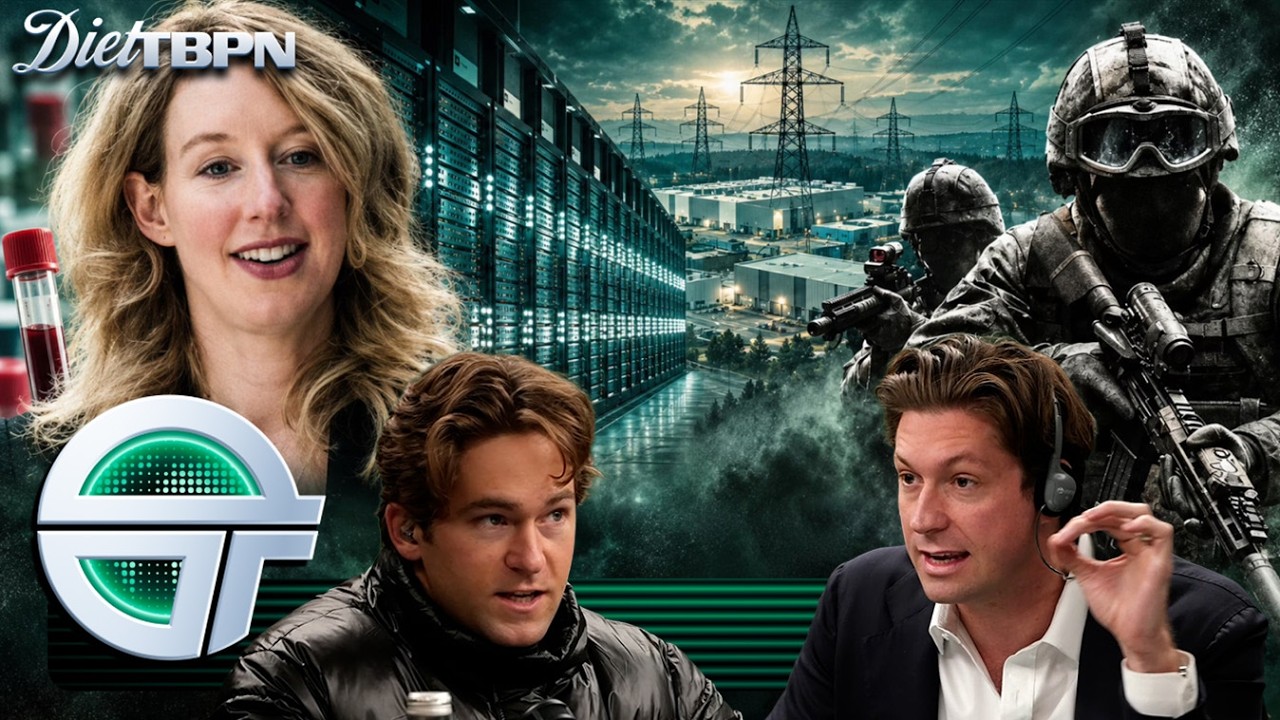
Elizabeth Holmes and Theranos, AI Data Center Forecast Jumps, Poppi’s Pepsi Deal | Diet TBPN
TBPN
AI-assisted summary of Elizabeth Holmes and Theranos, AI Data Center Forecast Jumps, Poppi’s Pepsi Deal | Diet TBPN — original source. Check the original for full context.
Source published:
Key ideas
- Critics attempting to rehabilitate Elizabeth Holmes ignore that medtech is an established industry where over 60 diagnostic companies have sold for $100M+ without fraud, while Billy Evans's movie points deal highlights potential workarounds to bypass her court-ordered restitution. (0:00)
- SemiAnalysis tracking shows data center commitments targeting an unprecedented 50 gigawatts of power, with heavy physical construction and long-term utility deals locked in regardless of short-term public market volatility. (12:31)
- A leaked internal Anthropic survey shows employees predict an average of 17.1% annual real GDP growth by 2030, presenting a radically positive-sum economic forecast compared to the FOMC baseline of roughly 2%. (22:17)
- PepsiCo slashed Poppi's contingent $300 million earn-out payout down to $12 million, yet the beverage startup's founders still walked away with $1.9 billion in guaranteed upfront cash at transaction close. (28:00)
Detailed notes
## Background This episode of Diet TBPN was published on YouTube by TBPN on October 20, 2026. Hosted by John Coogan and Jordi Hays, the show recaps the best segments of their live tech broadcast, covering Elizabeth Holmes discourse, massive AI data center forecasts, Brett Adcock's Hark launch, and Poppi's acquisition earn-out dispute.
## TL;DR John Coogan and Jordi Hays dissect the public's bizarre attempt to rehabilitate Elizabeth Holmes following recent documentary coverage, emphasizing her fundamental failure as an operator alongside the mechanics of her partner Billy Evans's movie deals. The hosts then examine the explosive 50-gigawatt AI data center buildout, debating how enterprise budgets rather than consumer subscriptions must fund massive inference costs while reviewing Brett Adcock's buggy, privacy-invasive Hark pizza promotion. They scrutinize Anthropic's wildly optimistic internal forecast of 17% annual GDP growth and spotlight how AI-generated products already saturate Walmart aisles. Finally, they debunk the narrative surrounding Poppi's Pepsi acquisition, explaining why walking away with over $1.9 billion in upfront cash makes missing a $300 million earn-out an unambiguous success.
## Atmosphere & style The discussion carries the fast-paced, irreverent, and banter-heavy rhythm of an insider Silicon Valley morning show. Coogan and Hays bounce between acerbic skepticism—mocking Holmes's lack of basic scientific literacy and Hark's intrusive permissions—and sharp commercial pragmatism when analyzing enterprise compute and M&A earn-out traps. Listening feels like sitting in on an unfiltered tech lounge conversation where absurd founder behavior is gleefully roasted while the cold financial realities of venture capital and infrastructure are laid bare.
## Bulletin - [00:00](https://www.youtube.com/watch?v=WN_3je_KDHA&t=0s) Critics attempting to rehabilitate Elizabeth Holmes ignore that medtech is an established industry where over 60 diagnostic companies have sold for $100M+ without fraud, while Billy Evans's movie points deal highlights potential workarounds to bypass her court-ordered restitution. - [12:31](https://www.youtube.com/watch?v=WN_3je_KDHA&t=751s) SemiAnalysis tracking shows data center commitments targeting an unprecedented 50 gigawatts of power, with heavy physical construction and long-term utility deals locked in regardless of short-term public market volatility. - [22:17](https://www.youtube.com/watch?v=WN_3je_KDHA&t=1337s) A leaked internal Anthropic survey shows employees predict an average of 17.1% annual real GDP growth by 2030, presenting a radically positive-sum economic forecast compared to the FOMC baseline of roughly 2%. - [28:00](https://www.youtube.com/watch?v=WN_3je_KDHA&t=1680s) PepsiCo slashed Poppi's contingent $300 million earn-out payout down to $12 million, yet the beverage startup's founders still walked away with $1.9 billion in guaranteed upfront cash at transaction close.
## Key takeaways - [00:00](https://www.youtube.com/watch?v=WN_3je_KDHA&t=0s) Elizabeth Holmes was fundamentally an inept operator rather than a visionary victim, attempting to treat FDA-regulated diagnostic hardware like an unregulated consumer SaaS product. - [00:00](https://www.youtube.com/watch?v=WN_3je_KDHA&t=0s) More than 60 diagnostic device companies have completed acquisitions above $100 million since Theranos launched, demonstrating that legitimate point-of-care diagnostic innovation thrives without fraudulent claims. - [04:15](https://www.youtube.com/watch?v=WN_3je_KDHA&t=255s) Billy Evans's backend equity in Nathan Fielder's documentary could allow their household to collect millions in production upside while shielding those earnings from Holmes's court-ordered restitution obligations. - [10:00](https://www.youtube.com/watch?v=WN_3je_KDHA&t=600s) Sunny Balwani received a longer sentence (12 years, 11 months) than Holmes (10 years), yet neither founder extracted secondary liquidity before the $11 billion valuation collapsed. - [10:00](https://www.youtube.com/watch?v=WN_3je_KDHA&t=600s) Founders commonly extract personal wealth without raising negative signaling flags by taking out nine-figure equity-backed credit lines and later selling secondary stock under the guise of paying off personal debt. - [12:31](https://www.youtube.com/watch?v=WN_3je_KDHA&t=751s) Satellite tracking and land contracts indicate a 50GW wave of AI data center capacity is coming online over the next 12 months, detached from short-term software ARR hesitations. - [14:31](https://www.youtube.com/watch?v=WN_3je_KDHA&t=871s) Consumer AI assistants cannot generate enough margin to justify infrastructure capex; long-term monetization relies on enterprises granting six-figure inference budgets to employees to multiply productivity. - [20:00](https://www.youtube.com/watch?v=WN_3je_KDHA&t=1200s) Brett Adcock's AI assistant Hark triggered severe privacy backlash during a $1 million promotional pizza giveaway due to sweeping OAuth requests to read, edit, compose, and delete user emails, spreadsheets, and contacts. - [20:00](https://www.youtube.com/watch?v=WN_3je_KDHA&t=1200s) Spinning Hark out from Figure mirrors Elon Musk's xAI strategy of establishing a clean capitalization table to attract premier AI researchers with founder-level equity. - [22:17](https://www.youtube.com/watch?v=WN_3je_KDHA&t=1337s) Anthropic internal staff forecasts project an average 17.1% annual GDP growth by 2030, with upper estimates reaching 28%, reflecting immense confidence in AI's macroeconomic leverage. - [25:00](https://www.youtube.com/watch?v=WN_3je_KDHA&t=1500s) AI-generated physical consumer products are already flooding retail shelves at Walmart and on viral social platforms, driven by automated drop-shippers rather than elite enterprise software rollouts. - [25:00](https://www.youtube.com/watch?v=WN_3je_KDHA&t=1500s) Tech and education leaders like Tim Sweeney and Grant Sanderson view generative AI as an enabling tooling evolution comparable to past transitions like moving from C to C++ or 2D to 3D animation. - [28:00](https://www.youtube.com/watch?v=WN_3je_KDHA&t=1680s) Poppi's founders secured a massive liquidity win with $1.9 billion in guaranteed cash at closing, making Pepsi's decision to pay only $12 million of the remaining $300 million earn-out largely inconsequential. - [28:00](https://www.youtube.com/watch?v=WN_3je_KDHA&t=1680s) Startup founders entering corporate acquisitions should value performance earn-outs at zero, as post-acquisition parent companies inevitably shift resources, retail placement, and strategic priorities.
## Detailed walkthrough ### [00:00](https://www.youtube.com/watch?v=WN_3je_KDHA&t=0s) Elizabeth Holmes, the TED Talk Era, and the Reality of Medtech
Reflecting on the wave of online discourse following the release of the film *You Can See Everything*, John Coogan and Jordi Hays discuss how viewers seemed surprisingly eager to rehabilitate Elizabeth Holmes. Many people came away rationalizing her behavior, wondering if she had been repeatedly manipulated or excusing her fraud as standard Silicon Valley “fake it till you make it” culture. Rejecting that defense, the hosts argue that even if you strip away the criminal fraud entirely, Holmes was fundamentally an inept operator. As John puts it: “It seems like she's just a bad founder. Like put aside the fraud. Like it just seems like, like, total slop in terms of the execution of that business and gives me absolutely no faith in a Theranos 2.0.”
What proved most infuriating about her pitch was its utter disconnection from the actual medical device industry. Holmes presented the Theranos Edison machine as a magical, cloud-connected black box that could test blood, treating standard diagnostic concepts as unprecedented science. In reality, building diagnostic hardware is an established, highly active commercial space. Over sixty companies in that exact diagnostic category have sold for upwards of $100 million since Theranos was founded, all without their executives going to federal prison for a decade. The hosts point out that pitching a blood analyzer as an unheard-of breakthrough is the equivalent of claiming to have invented a revolutionary tool because it stores data in a database accessible via a browser—it is simply a SaaS app, something built by hundreds of conventional companies every year.
The root of Holmes's persona traced back to the post-*Social Network* tech boom between 2011 and 2015, which birthed the era of the “TED Talk entrepreneur.” During this period, an ecosystem of university accelerators, hard-tech showcases, and prodigy-focused venture networks tolerated young founders parading fraudulent products, fudged studies, and falsified metrics under the guise of vision. While other founders eventually adapted when that era ended, Holmes kept running the same playbook in medicine—the most heavily regulated industry in the world. As the hosts emphasize, medical devices hinge entirely on FDA marketing authorization: building hardware is not inherently illegal, but selling, marketing, or publicly promoting unapproved claims on podcasts and news broadcasts is strictly prohibited by law.
- Over 60 diagnostic device companies have completed acquisitions of $100 million or more since Theranos launched. - The 2011–2015 startup boom created an apparatus around young prodigies that normalized presenting fudged data and fake hardware prototypes on conference stages. - FDA clearance functions as marketing authorization; founders are legally barred from making unverified claims about clinical efficacy to the public or media prior to regulatory approval.
[04:15](https://www.youtube.com/watch?v=WN_3je_KDHA&t=255s) Billy Evans’ Movie Deal, Restitution Schemes, and Theranos 2.0
Turning to the behind-the-scenes drama of Nathan Fielder's project, the conversation shifts to Holmes’s partner, Billy Evans. During production, Evans negotiated a lucrative side deal to receive points on the back end of the film’s profits. After the project wrapped, he attempted to withdraw from the arrangement because of how damaging it looked publicly, though by then the documentary was already guaranteed to become a massive hit. The hosts unpack the financial incentives behind this move: Holmes was ordered to pay hundreds of millions of dollars in court-ordered restitution, meaning any personal earnings would be seized by the court for victims and investors. Because there is persistent ambiguity over whether Holmes and Evans are legally married, routing the backend points directly into Evans’s personal accounts could allow the household to capture millions in revenue while bypassing her restitution obligations.
The hosts also break down the absurdity of Evans attempting to pitch "Theranos 2.0." John shares that he spoke with Evans on the phone the previous year about his social media operations and was met with the pitch for a revival company. John’s stance was that if anyone was going to buy an Elizabeth Holmes redemption narrative, she needed to prove she was actually a serious student of the science: “My point that I posted about was was like I want to see Elizabeth Holmes give an incredible take about peptides and how that market will evolve and then watch that happen and be like, ‘Oh wow, she was early.’ I want her to be a good biotech analyst, I want her to be smart on the science.” Yet throughout the documentary, she never displays deep scientific insight, leaving Evans to wander around trying to grasp basic concepts like mitochondria. The hosts joke that instead of vague sci-fi slogans, she should publish a biotech market map, a 2027 AI/biotech thesis, or a tier list of diagnostic acquisitions to prove she understands the competitive landscape.
To illustrate how real medical hardware innovation actually works, the hosts highlight the playbook that Holmes failed to run: taking a standard diagnostic workflow and making it faster and smaller for point-of-care hospital use. Instead of trying to invent an impossible universal blood test, practical biotech startups focus on a single critical diagnostic need—such as testing for antibiotic-resistant bacteria like MRSA on-site rather than sending samples to a centralized lab. By shrinking down a dishwasher-sized machine into a desktop unit that returns results in one hour instead of two days, companies create enormous clinical and financial value.
```mermaid flowchart LR accTitle: Practical Medtech Playbook vs Theranos accDescr: Flowchart comparing a targeted diagnostic product pipeline to Theranos's failed approach.
subgraph Legitimate["Real Diagnostic Startup Playbook"] A["Identify Hospital Pain Point<br/>(e.g., MRSA / Antibiotic Resistance)"] --> B["Shrink Lab Hardware<br/>(Dishwasher size to desktop box)"] B --> C["Secure FDA Authorization<br/>(e.g., cobas vivoDx MRSA in 2019)"] C --> D["Acquisition by Roche<br/>($425M outcome on $25M raised)"] end
subgraph Theranos["Theranos Approach"] E["Universal Blood Test Pitch<br/>(Hundreds of tests from a micro-drop)"] --> F["TED Talk Marketing & Cloud Slogans"] F --> G["Falsified Test Data & Regulatory Evaporation"] G --> H["Criminal Conviction & Prison"] end ```
- In a legitimate medtech success story referenced by the hosts, a company focused specifically on detecting antibiotic-resistant bacteria raised $25 million to build a point-of-care box. - The company was acquired for $425 million, and Roche subsequently secured FDA authorization in 2019 for the device as the cobas vivoDx MRSA test. - Shifting bacterial diagnosis turnaround times from two days to one hour directly improves hospital patient outcomes and creates hundreds of millions of dollars in enterprise value without relying on unproven claims.
[10:00](https://www.youtube.com/watch?v=WN_3je_KDHA&t=600s) Theranos Sentences, Secondary Sales, and the Founder Debt Hack
The hosts discuss the fallout from Theranos, focusing on the stark reality of the prison sentences handed down to Elizabeth Holmes and Sunny Balwani. One host recalls walking away from a recent film under the distinct impression that Balwani had cut a side deal and managed to escape serious punishment, pinning the blame on Holmes while she took the fall with roughly 11 years. However, Balwani ended up receiving an even harsher sentence: 12 years and 11 months, compared to Holmes’s sentence of 10 years (which was reduced from an initial 11 years and three months).
What baffles the hosts even more is that neither Balwani nor Holmes appeared to have cashed out by selling secondary shares along the way. Both went down with the sinking ship without banking any personal windfalls from an $11 billion valuation. One host marvels at the sheer absurdity of running a multi-billion-dollar scheme without a financial cushion: “Least shrewd person in the world potentially no secondary stuff 11 billion fraud purely for the love of the game what are you doing what are you doing and it's not like I came away being like it wasn't a fraud like it was.” The other host agrees that it embodies the tragic parody of the true believer tech entrepreneur who goes behind bars purely “for the vision.”
The conversation then shifts to a clever, tongue-in-cheek financial loophole founders use when they want to pocket substantial wealth without sending a negative signal to venture markets: - A founder scales their startup until it reaches a unicorn valuation in the billions. - Selling $10 million or $100 million of secondary shares outright would look like cashing out or losing faith in the company. - Instead, the founder takes out an immense line of credit—say, a $100 million personal loan backed by their equity. - Later, they quietly sell $100 million of secondary stock and announce to the public that they are merely liquidating shares to pay off personal debt. - The public mistakenly assumes they are dealing with standard credit-card-level personal debt, completely unaware it was a pre-planned, equity-backed credit line designed to extract liquidity cleanly from the outset.
---
[12:31](https://www.youtube.com/watch?v=WN_3je_KDHA&t=751s) The 50GW Compute Boom and SemiAnalysis Supply Forecasts
The hosts pivot to the surging scale of artificial intelligence infrastructure, addressing reports that data center capacity is targeting an unprecedented 50 gigawatts of power. While prominent tech investors like Brad Gerstner have debated whether the market is building out too much compute too fast, research firm SemiAnalysis has been cross-referencing power contracts and tracking physical development using satellite imagery.
```mermaid flowchart LR accTitle: Data Center Buildout Momentum accDescr: Diagram illustrating how inked contracts and physical construction resist short-term market fluctuations. subgraph Commitments ["Long-Term Pipeline"] A["50GW Inked Deals & Land"] --> B["Satellite-Tracked Construction"] end subgraph Volatility ["Market Sentiment"] C["Short-Term Nasdaq Dips (5%)"] -.->|"Cannot stop"| B end subgraph Delivery ["Capacity Output"] B --> D["Massive Supply Online (Next 12 Mos)"] end ```
The hosts review a note from SemiAnalysis circulated via RevCap, noting the firm's paradoxical reassurance to investors worried about stalling software ARR: you do not need to worry about demand because an even more staggering wave of supply is about to hit the market over the next 12 months. SemiAnalysis remains extraordinarily bullish on the leading AI labs, and the physical reality on the ground confirms that buildouts cannot simply be paused on a whim. While a 5% drop on the Nasdaq might shake public market confidence, massive industrial projects with earthmovers and concrete already poured will keep rolling forward regardless of short-term interest rate jitters.
---
[14:31](https://www.youtube.com/watch?v=WN_3je_KDHA&t=871s) AI Agent Monetization and Enterprise vs. Consumer Unit Economics
While infrastructure supply is undeniably materializing, the hosts debate where the recurring demand and actual willingness to pay will come from. One host is an avid user of Dot, an autonomous AI assistant, highlighting how transformative agentic tools are for day-to-day productivity. The agent quietly monitors inbound email, follows up on outstanding requests without being asked, and was even deployed successfully to cancel a Tesla Roadster reservation.
Interacting with the open web via a large language model feels vastly superior to modern web browsing because it strips out the clutter: - No aggressive cookie consent pop-ups. - No intrusive programmatic ad displays. - Synthesized answers containing exact source quotes, letting users bypass having 25 browser tabs open at once.
Despite this superior user experience, monetization remains the critical hurdle. If the entire agentic commerce market caps out around $40 billion on interchange and take rates, consumer subscriptions cannot shoulder the massive capital expenditures required for 50GW of data centers. One host jokes about a viral video featuring a woman claiming to run a "26-hour day" to stay online with her agents, but they note that everyday consumers will not spend $1,000 annually on personal inference:
> “She's not crazy. You're crazy. You're crazy for thinking that it takes 24 hours to complete a full day.”
Instead, the return on investment must originate from enterprise diffusion. The hosts point to Jensen Huang’s thesis: if a software engineer earns $300,000, a company should readily give them an equivalent $300,000 budget in AI tokens if it multiplies their output. The same calculus will eventually apply to enterprise sales reps receiving $50,000 a month in inference budgets to generate $100,000 in incremental pipeline. For the broader market to sustain the infrastructure buildout, the typical $10 million top-line business currently spending $100,000 on software seat licenses will have to scale its inference spending tenfold to $1 million per year.
---
[19:06](https://www.youtube.com/watch?v=WN_3je_KDHA&t=1146s) Hark's $1 Million Pizza Promotion PR Backlash
The discussion turns to consumer marketing stunts in the AI agent ecosystem, specifically Brett Adcock’s rollout of Hark, a personal AI tool competing alongside agents like Dot and Instinct. To juice downloads, Hark ran a promotional campaign offering to give away $1 million worth of free pizza through their newly launched application.
Users were instructed to download the app and place their food orders directly through the Hark interface. However, the promotion swiftly deteriorated into an operational and public relations headache. While the marketing push succeeded in driving a massive spike in app installations, users ran into technical failures and voiced deep privacy reservations about the sweeping data access permissions requested by the application during setup. Joking about the intrusive access requirements needed just to claim a slice, one host quips: “In order to get this pizza, I will need to edit your tax return.”
[20:00](https://www.youtube.com/watch?v=WN_3je_KDHA&t=1200s) Hark’s Free Pizza Debacle and Permissions Backlash
The conversation turns to the aggressive permissions requested by Hark, a new venture from Brett Adcock. The hosts run through the staggering list of access rights demanded during onboarding, which include permissions to view, edit, create, and permanently delete contacts, Google Sheets spreadsheets, calendars, and even read, compose, and send emails directly from a user’s Gmail account, alongside scraping an organization's internal workplace directory. While some of these might technically be optional bypasses in standard OAuth permission flows—comparable to opting out of push notifications on iOS—the optical severity of the permissions list triggered immediate alarm bells across the tech community.
The launch day was further complicated by Hark's viral promotion: an advertised $1 million free pizza giveaway launched on X on October 16, 2026, where users could supposedly claim a pie simply by messaging the app. When the service predictably bottlenecked and failed, one user named Armand instructed the AI agent to draft and file a formal grievance with the Federal Trade Commission. The AI initially attempted to talk him down, suggesting that launch-night flakiness was better handled by bug reports to the Hark engineering team, but Armand insisted on federal escalation. Reflecting on Brett Adcock's broader corporate structure, the hosts question why Hark was spun out as a separate entity rather than built inside Figure. They note that Adcock appears to be following the playbook Elon Musk established with xAI: establishing a fresh capitalization table to attract premier AI researchers with founder-level equity grants, an incentive structure that legacy hardware balance sheets like SpaceX or Figure cannot easily accommodate.
> “On October 16, 2026, Hark publicly advertised a $1 million free pizza giveaway.”
> “The only thing is Elon had sold a lot of cars and launched a lot of rockets prior to doing that.”
```mermaid flowchart TD accTitle: Hark Enterprise Spin-Out Rationale accDescr: Diagram illustrating the structural reasoning behind spinning out Hark from Figure. subgraph Core ["Figure Robotics"] A["Hardware & Robotics Focus"] B["Constrained Equity Structure"] end
subgraph SpinOut ["Hark Standalone Venture"] C["Fresh Cap Table"] D["$1M Consumer Pizza Promo"] E["Founder-Level Equity for AI Talent"] end
Core -.->|"Musk Playbook"| SpinOut E -->|"Attracts"| F["Top AI Researchers"] ```
[22:17](https://www.youtube.com/watch?v=WN_3je_KDHA&t=1337s) Anthropic’s 17% GDP Forecast and AI Super-Growth Debate
The hosts shift to an internal poll leaked from Anthropic regarding future economic growth spurred by artificial intelligence. The baseline premise rests on whether the forecasts account for real versus nominal gross domestic product, noting that nominal growth paired with runaway inflation would result in negative real expansion. Assuming real GDP is the benchmark, the consensus inside Anthropic skews wildly optimistic: the average staff prediction sits at an astonishing 17.1% annual GDP growth by 2030, with one bullish outlier projecting 28% and the absolute lowest internal forecast coming in at 6%.
This stands in stark contrast to traditional macroeconomic projections. The Federal Open Market Committee holds steady at the historical 2% baseline, broad surveys of American adults land at 5.4%, and external website visitors settle around 12.5%. The hosts joke that an annual 17% economic explosion would turn the economy into an overwhelmingly positive-sum environment where roads, infrastructure, and universal healthcare could easily be funded out of sheer surplus. The extreme optimism has drawn intense criticism online, notably from commentator Spore, who dismissed the 20% projections as detached from sanity. The hosts playfully riff on the Palantir executive Shyam Sankar’s infamous anecdote on CNBC/Bloomberg about AI researchers chain-smoking cigarettes because they genuinely believe artificial intelligence will eradicate lung cancer before tumors can form.
> “Anthropic staff are obviously like the most bullish.”
> “If we grow at 17%, it is so positive sum.”
> “Spore says this is borderline mental illness.”
| Group / Forecaster | Predicted Annual GDP Growth | |:--- |:--- | | Anthropic Outlier (Highest) | 28.0% | | Anthropic Internal Staff Average | 17.1% | | Site Visitors Poll | 12.5% | | Anthropic Lowest Forecast | 6.0% | | General U.S. Adults Survey | 5.4% | | Federal Open Market Committee (FOMC) Baseline | ~2.0% |
[25:00](https://www.youtube.com/watch?v=WN_3je_KDHA&t=1500s) AI Slop in Walmart and the Optimism of Sweeney and 3Blue1Brown
The hosts examine how artificial intelligence is permeating the mainstream consumer economy, bringing up an interview between Tyler Cowen and Dwarkesh Patel on Cowen's podcast. When Cowen pressed Patel on when everyday shoppers would walk into a Walmart and see a physical product resulting from artificial intelligence, Patel estimated around 2028. The hosts counter that Cowen and Patel are missing the obvious: AI-generated physical consumer goods are already dominating retail shelves today. From bizarre algorithmically rendered beach towels in Walmart aisles to viral TikTok inflatable tank pool floaties generated by AI video slop, low-end automated commerce is already flourishing.
Rather than looking at high-minded corporate research labs, the hosts argue that tech observers should look to the drop-shippers and course-sellers speeding around Miami in rented Lamborghinis to see where AI is making real-time financial impact. Parallel to this retail wave, industry leaders outside the frontier labs are expressing genuine long-term optimism. Tim Sweeney, founder of Epic Games, recently argued that generative technology will ignite a golden age of game development by making lavish, resource-heavy game designs economically viable for the first time. Similarly, Grant Sanderson of the educational channel 3Blue1Brown released content cheering AI’s role in mathematics, viewing this shift not as an existential threat, but as another normal technological migration akin to moving codebases from C to C++ or transitioning animation pipelines from 2D to 3D.
> “You can go into Walmart and get AI products now.”
> “The AI slop economy is thriving right now.”
> “It’ll be a new golden age of gaming.”
[28:00](https://www.youtube.com/watch?v=WN_3je_KDHA&t=1680s) Poppi’s $2.2B Pepsi Deal and the Earn-Out Trap
The conversation moves to the major corporate acquisition of prebiotic soda maker Poppi by PepsiCo. Initial headlines framed the transaction as a $2.2 billion buyout, but financial disclosures revealed that $300 million of that total valuation was tied up in performance-contingent earn-outs. When Pepsi recently announced it would only pay out a mere $12 million of the remaining $300 million pool, social media critics rushed to frame the haircut as a catastrophic loss for the beverage founders.
The hosts reject this framing, pointing out that Poppi’s founders collected $1.9 billion in guaranteed cash at closing, giving them more than 90% of the top-line transaction value. With the additional $12 million payout, the founders walk away with $1.912 billion, marking an unambiguous triumph in founder liquidity. A genuine disaster would have looked like the reverse: collecting a tiny upfront cash payment paired with an earn-out that gets slashed to near zero. Echoing commentary from Ridge Wallet CEO Sean Frank, the hosts emphasize that founders should treat any secondary earn-out payment as worth zero on paper. The moment an acquired brand enters a conglomerate's balance sheet, original management forfeits ultimate control over operational budgets, retail shelving leverage, and marketing priority to corporate handlers who have entirely different strategic agendas.
> “$300 million of that $2.2 billion was an earn out.”
> “Now, Pepsi announced that instead of paying 300 million based on the performance of the brand, they will only be paying 12 million.”
> “You shouldn’t go into one of these deals expecting to get the full earn out because companies have lots of resources.”
> “You’re no longer the master of your own destiny.”
## Notable quotes > [25:00](https://www.youtube.com/watch?v=WN_3je_KDHA&t=1500s) The AI slop economy is thriving right now.
## Mentioned 3Blue1Brown, Anthropic, Billy Evans, Brad Gerstner, Brett Adcock, Cisco, Console, CrowdStrike, Diet TBPN, Dot, Dwarkesh Patel, Elizabeth Holmes, Epic Games, Federal Open Market Committee (FOMC), Federal Trade Commission (FTC), Figma, Figure, Food and Drug Administration (FDA), Grant Sanderson, Hark, Instinct, Jensen Huang, John Coogan, Jordi Hays, Mark Cuban, Mark Zuckerberg, MongoDB, NYSE, Nathan Fielder, Palantir, PepsiCo, Poppi, Public, Railway, Ramp, RevCap, Ridge Wallet, Roche, Sam Altman, Satya Nadella, Sean Frank, SemiAnalysis, Shopify, Shyam Sankar, Sunny Balwani, TBPN, Tesla Roadster, The New York Times, Theranos, Tim Sweeney, Tyler Cowen, Walmart, You Can See Everything, xAI
## Video description Sign up for TBPN’s daily newsletter at TBPN.com
Diet TBPN delivers the best of today’s TBPN episode in 30 minutes. TBPN is a live tech talk show hosted by John Coogan and Jordi Hays, streaming weekdays 11–2 PT on X and YouTube, with each episode posted to podcast platforms right after.
Described by The New York Times as “Silicon Valley’s newest obsession,” the show has recently featured Mark Zuckerberg, Sam Altman, Mark Cuban, and Satya Nadella.
TBPN is made possible by: Ramp - https://ramp.com Public - https://public.com Cisco - https://www.cisco.com Console - https://www.console.com CrowdStrike - https://www.crowdstrike.com Figma - https://www.figma.com MongoDB - https://www.mongodb.com NYSE - https://www.nyse.com Railway - https://railway.com Shopify - https://www.shopify.com/
Follow TBPN: https://TBPN.com https://x.com/tbpn https://open.spotify.com/show/2L6WMqY3GUPCGBD0dX6p00?si=674252d53acf4231 https://podcasts.apple.com/us/podcast/technology-brothers/id1772360235 https://www.youtube.com/@TBPNLive
Chapters: 00:00 Elizabeth Holmes, You Can See Everything + The Theranos Backlash 04:15 Billy Evans’ Movie Deal + Can Theranos 2.0 Redeem Holmes? 12:31 The 50GW AI Data Center Boom + The Supply Explosion 14:31 Who Pays for AI Agents? Dot, Compute + Enterprise Demand 19:06 Hark’s $1M Pizza Giveaway + The Privacy Backlash 22:17 Anthropic Predicts 17% GDP Growth + AI’s Real-World Impact 28:00 Poppi’s Pepsi Deal + The $300M Earn-Out Collapse
[Source](https://www.youtube.com/watch?v=WN_3je_KDHA)