## Detailed walkthrough
### [00:00](https://www.bilibili.com/video/BV1cgJZ6nE6n?t=0s) Earnings Season Ramps Up and Growing AI Anxiety
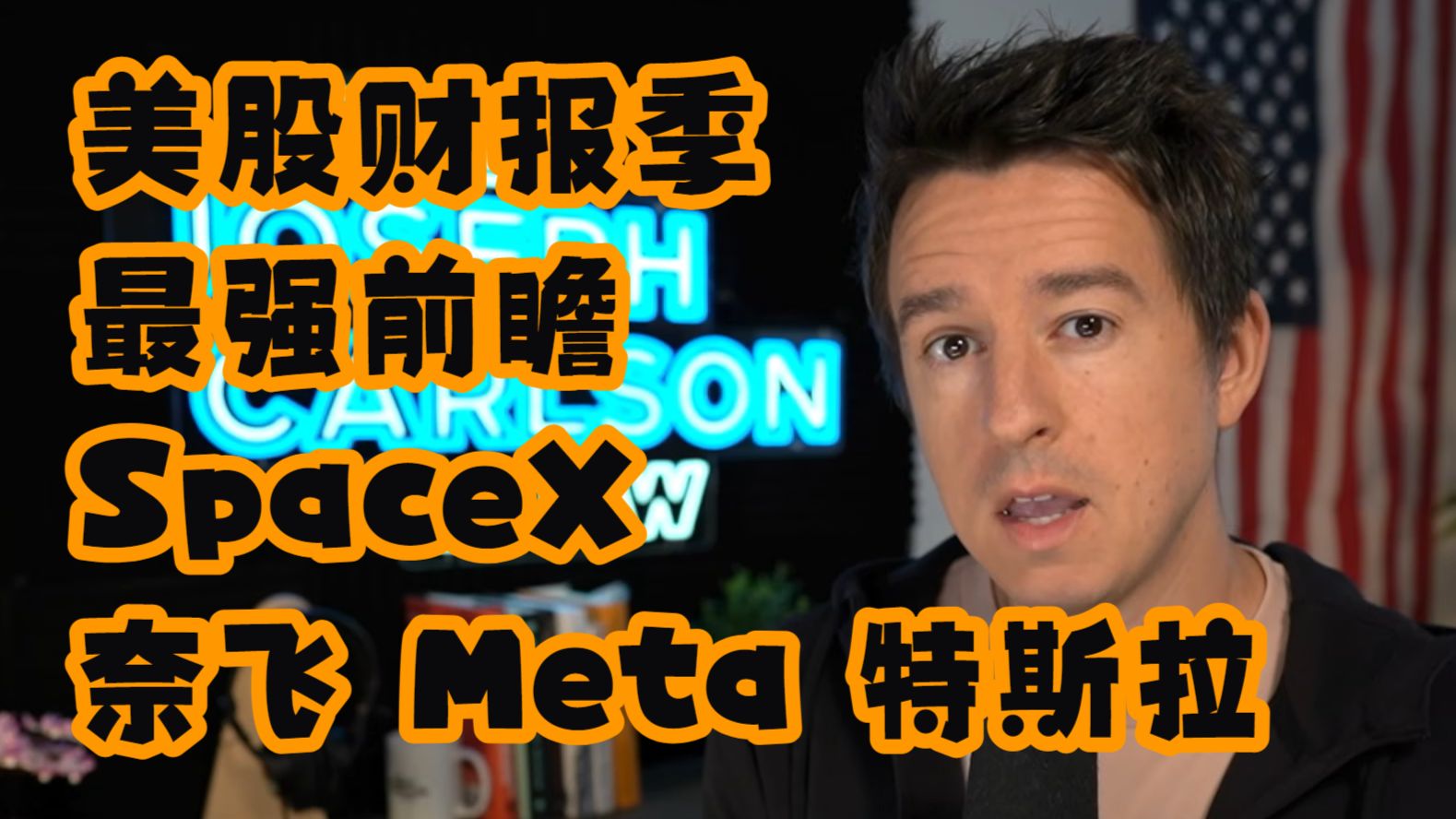
The second week of earnings season marks a major acceleration in market action, headlined by marquee reports from SpaceX, Netflix, Meta, and Tesla, alongside other prominent names like GE, Spotify, Lockheed Martin, and Bloom Energy. This slate arrives right as investor sentiment around the artificial intelligence buildout reaches a tense, critical juncture. Market chatter heading into Monday was rife with speculation about whether stocks were on the brink of an AI-induced "Black Monday" sell-off. While that crash did not materialize immediately, genuine anxiety is mounting over the sustainability of the AI bubble, the viability of specialized neocloud infrastructure providers like CoreWeave, and the timing of an eventual reckoning.
Even committed AI insiders are quietly de-risking. High-profile venture capitalist and outspoken AI evangelist Brad Gerstner has noticeably trimmed his exposure, choosing to protect client profits in light of specific macro and operational concerns. In addition to these tech heavyweights and Wall Street sentiment shifts, the lineup features this week's corporate "fail of the week": ESPN, where an award-winning reporter resigned in protest after refusing to have what she termed "blood on her hands" regarding the sports network's controversial business compromises.
- **Upcoming Earnings Highlights**: SpaceX, Netflix, Meta, Tesla, General Electric (GE), Spotify, Lockheed Martin, Bloom Energy.
- **Market Atmosphere**: Lingering dread around the peak CapEx cycle for artificial intelligence and potential systemic stress points across specialized AI infrastructure.
- **Featured Critique**: Brad Gerstner's public praise versus backstage risk mitigation; ESPN's editorial and ethical compromises.
---
[02:29](https://www.bilibili.com/video/BV1cgJZ6nE6n?t=149s) SpaceX Business Breakdown: Connectivity, Space, and AI
SpaceX presents an intricate business model conceptually, but its operational fundamentals can be distilled into three core reporting segments: Connectivity (Starlink), Space (transportation and launches), and AI (the integrated xAI platform). Having only recently transitioned to public reporting, the company provides just four quarters of historical segment data to evaluate.
```mermaid
flowchart TD
accTitle: SpaceX Revenue Segmentation and Ecosystem Synergy
accDescr: Diagram illustrating SpaceX's three core business segments and how the Space launch business directly supports Connectivity.
subgraph SpaceLaunch["Launch Business"]
direction TB
Space["Space Division ('Uber for Space')<br/>Satellite payload launches for commercial clients and government"]
end
Space -->|"Enables low-cost satellite deployment"| Conn
```
Of these divisions, Connectivity represents the clearest standalone operational success, delivering 65% year-over-year revenue growth. Powered by low Earth orbit (LEO) satellite constellations, Starlink bypasses traditional legacy cable and telecom monopolies, delivering plug-and-play, high-speed, low-latency broadband anywhere with an unobstructed view of the sky in ten minutes or less. In addition to serving off-grid consumers, it has unlocked enterprise-scale momentum through major commercial airline in-flight Wi-Fi partnerships. Although Amazon's Project Kuiper aims to compete in LEO internet, SpaceX enjoys a massive first-mover advantage in this massive, unpenetrated total addressable market.
The Space launch segment functions essentially as an "Uber for space," providing fee-based rideshare and dedicated orbital deployments for both commercial clients (including rivals like Amazon) and government entities. Crucially, launch capabilities are not just an isolated revenue stream; they provide SpaceX with cheap internal launch logistics to rapidly deploy its own Starlink constellation. The third segment, AI—encompassing the xAI platform—operates as a specialized neocloud, leasing high-performance GPU compute capacity to developers and foundational model builders such as Google and Anthropic.
> "Out of these three businesses, I believe the connectivity is actually the best business." — Joseph Carlson
- **Connectivity (Starlink)**: Up 65% year-over-year; directly disintermediates traditional telecommunications carriers and opens untapped remote and in-flight transit markets.
- **Space Launch**: Dual-purpose transportation platform serving external clients while acting as the operational deployment backbone for Starlink.
- **AI (xAI)**: Neocloud infrastructure play capitalizing on the acute industry-wide shortage of compute resources.
---
[05:00](https://www.bilibili.com/video/BV1cgJZ6nE6n?t=300s) SpaceX vs. Amazon: The $2.5 Trillion Valuation and Opportunity Cost
The AI division of SpaceX commands enormous near-term pricing power by offering flexible, uncommitted access to cutting-edge compute clusters. Instead of binding clients to rigid five-year enterprise master service agreements, xAI predominantly closes flexible 90-day contracts. Because compute capacity remains so constrained, hyperscalers and startups happily pay premium, above-market rates for this elasticity rather than walking away when their terms expire. While this setup yields rapid short-term cash generation, its long-term stability is uncertain compared to sticky multi-year enterprise contracts.
The primary hesitation with SpaceX lies in opportunity cost when weighed against alternative mega-cap investments—specifically Amazon. With SpaceX commanding a market capitalization of $2.56 trillion against trailing twelve-month revenue of $12 billion (and medium-term forward projections of $40 billion to $50 billion), investors are paying a staggering multiple for future growth. By comparison, Amazon trades at roughly the same overall size—$2.83 trillion—while generating a staggering $775 billion in trailing twelve-month revenue.
Amazon Web Services (AWS) alone has generated $148 billion in trailing revenue. That standalone enterprise cloud business is triple the total projected forward revenue of all of SpaceX combined, yet AWS represents only a minority portion of Amazon's enterprise base. Stacking SpaceX's entire top-line on top of Amazon's produces a barely discernible sliver of incremental volume.
Heading into its earnings report, traditional valuation yardsticks like price-to-earnings or price-to-sales will take a back seat for SpaceX. Wall Street will focus primarily on Elon Musk's narrative updates: commercial deal velocity for Starlink, connectivity pipeline growth, and xAI's ability to ink revenue-accretive contracts capable of matching its towering capital expenditures.
Concurrently, Netflix heads into its post-market earnings drop in an intriguing valuation spot. Having endured a punishing 45% drawdown, Netflix now sits as Carlson's eighth-largest portfolio position. Its valuation has compressed to just 19 times forward earnings—strikingly close to the depressed 17x multiple it traded at in the depths of its 2022 market trough.
> "The contracts that the AI category is signing are mostly 90 days. So Google or whoever could get out of these contracts relatively fast. And Elon with SpaceX knows the demand is so huge right now, these guys are not going to cancel their contracts." — Joseph Carlson
> "And we have this opportunity to buy SpaceX at a $2.5 trillion valuation, and it's at $40 billion in revenue. Or we have Amazon. Amazon is another opportunity that investors could consider that is a very similar company at its core." — Joseph Carlson
```mermaid
flowchart LR
accTitle: 奈飞叙事转变逻辑
accDescr: 展示奈飞从高增长叙事跌入参与度危机叙事的恶性循环流程。
subgraph S1["估值历史起伏"]
A["2022年大跌70% (PE约17倍)"] --> B["打击密码共享+广告层级 (PE飙升至约50-60倍)"]
end
subgraph S2["叙事框架锁定"]
B --> C["华纳收购未果"]
C --> D["形成'参与度危机'负面叙事"]
end
subgraph S3["负面解读循环"]
D --> E["减少公布时长 = 掩盖问题"]
D --> F["裁员千人 = 穷途末路"]
E --> G["估值杀回19倍PE历史低位"]
F --> G
end
```
主讲人严谨地指出,严格意义上这不应被称为传统的“定价权(Pricing Power)”,因为 Meta 并不像独立 SaaS 软件公司那样能直接单方面给客户开出发票定价;它本质上是广告主在竞价系统中相互竞逐的结果。因此,主讲人将其定义为更胜一筹的“变现能力(Monetization Power)”:
> “Even though they're not directly raising prices, Meta is creating an environment where they get more money from more of their customers while selling more inventory at the same time.”
Meta 通过利用智能代理(Agentic Tools)工具协助广告主生成高精准定向广告、利用卓越的推荐算法使内容更具吸引力,从而使用户在应用上停留更长时间。用户停留越久、看广告越多,其转化率与广告投资回报率(ROAS)就越高,进而促使广告主心甘情愿投入更高的预算参与竞价。这种精巧的生态让 Meta 在不断扩充广告库存的同时,还能持续抽取更高的单价利润。
[20:00](https://www.bilibili.com/video/BV1cgJZ6nE6n?t=1200s) Meta 的变现能力全景与资本开支隐忧
Meta 并不是在利用垄断地位单纯地逐季提升广告单价,而是全方位提升了其产品生态、广告服务质量和推荐体验。平台在向用户展示更多广告的同时,广告主依然心甘情愿支付更高的单价。从核心运营指标来看,Meta 的日常活跃用户数(DAP)持续攀升,广告展示量(Ad Impressions)每季度都在稳健扩张,甚至在 2025 年呈现出加速增长的态势。无论是在哪一个大洲或地域,只要有互联网覆盖的角落,Meta 旗下的产品线都在强劲渗透与变现。
```mermaid
flowchart TD
accTitle: Meta Growth and CapEx Dilemma
accDescr: Shows the interplay between Meta's ad monetization growth and investor concerns over rising AI CapEx guidance.
subgraph Monetization ["变现核心引擎"]
A["产品与算法升级"] --> B["广告展示量增长 (Ad Impressions)"]
A --> C["广告单价提升 (Ad Pricing)"]
B & C --> D["全球各地区营收全面扩张"]
end
subgraph Dilemma ["财报博弈焦点"]
D --> E{"超预期业绩表现"}
E --> F["市场认可商业模式"]
E --> G["资本开支 (CapEx) 预期上调"]
G --> H["引发投资者短期恐慌与纠结"]
end
```
然而在靓丽的业绩表象之下,投资者即将聚焦的核心痛点依然是资本开支(CapEx)。主讲人预计管理层极有可能在本次财报中再次上调资本开支指引,这可能会在短期内吓退一部分投资者,让大家再度抓耳挠腮、质疑 Mark Zuckerberg 是否在 AI 算力基建上过度挥霍。但对于长期投资者而言,主讲人强调:“And for me, I think this one is well worth holding through the CapEx cycle.” 凭借其深厚的商业护城河与现金流创造能力,Meta 完全值得在整个算力扩张周期中坚定持有。
- 日常活跃用户数(Daily Active People)与广告展示量(Ad Impressions)在全球各地区同步实现环比与同比稳健提升。
- 广告主并未流失,反而在更高的展示基数下自愿支付更高溢价,展现出顶级的商业定价权。
- 财报核心不确定性并非来自营收端,而是持续扩大的 AI 基础设施投入对利润率指引的压制。
---
[21:12](https://www.bilibili.com/video/BV1cgJZ6nE6n?t=1272s) 特斯拉估值迷思:154倍 PE 与 SpaceX 的护城河对比
紧随 Meta 之后,特斯拉也将在盘后公布财报。特斯拉拥有大量狂热拥趸,其核心驱动力很大程度上来源于对 Elon Musk 本人的个人崇拜。然而主讲人直言,尽管自己认可特斯拉在工业设计上的成就并认为其打造了非常棒的汽车,但自己对投资这家公司缺乏兴趣,其最根本的拦路虎就是估值。目前特斯拉的动态市盈率高达 154 倍,但其底层基本面却极不匹配:过去两年公司整体营收基本持平,汽车交付量下滑,净利润大幅萎缩,自由现金流同样停滞不前。在这样的财务表现下,其估值倍数居然达到奈飞的四到五倍,显得非常脱离实际。
对于特斯拉近期发布的 Roadster 翻滚起跳、吸附墙面飞驰等惊艳特技演示,主讲人虽然感叹其视觉效果极为震撼,但强调这种酷炫并不等同于投资价值。演示发布后特斯拉股价反而下跌了 3% 至 4%,关键原因在于缺乏短期的商业化落地路径,地方监管法规绝不可能允许具有这种潜在危险特性的车辆上路:“I can't just buy stocks of stuff I think is cool. I have to buy ones that I think I'm going to make money.” 本季度的特斯拉财报依然会是一场以宏大叙事掩盖平庸财务基本面的表演。
```mermaid
flowchart LR
accTitle: Brad Gerstner Narrative vs Action
accDescr: Highlights the disconnect between Brad Gerstner's public bullish statements and his fund's actual aggressive de-risking actions.
subgraph PublicNarrative ["公开言论 (CNBC 专访)"]
P1["反驳唱空者"]
P2["Anthropic 等 AI 营收爆发"]
P3["高呼 AI 叙事远未见顶"]
end
subgraph ActualActions ["实际操作 (旗帜基金调仓)"]
A1["仓位降至 Medium / Small"]
A2["AI 敞口下调至 3 年来最低"]
A3["频繁按下卖出按钮套现"]
end
主讲人对此提出了极其尖锐的批评。首先,电视主持人当时并非询问“5 年后 AI 会走向何方”,而是直截了当地询问“当下市场对短期波动的担忧是否合理”,Gerstner 当时给出了极具误导性的全盘乐观回答。其次,Gerstner 暗示两个世界各占一半,但资金规模的数据撕下了这层伪装:其旗舰对冲基金 Altimeter Partners Fund 规模高达约 90 亿美元,而只做多基金 Altimeter Long Opportunities Fund 仅有 5.93 亿美元。这意味着正在大规模抛售的对冲基金占据了他管理总资产的 90% 以上(规模是只做多基金的 15 倍),长线多头仓位仅仅是一个不起眼的零头。
更为讽刺的是,Gerstner 在采访中将自己大幅砍仓的行为轻描淡写为“市场波动(Chop)与盘整”,并宣称自己看到价格回落后“在未来几周可能会开始买入、逐步靠拢”。主讲人直言,公众打开电视不是为了看被公关滤镜过滤后的“温水”,而是想了解机构大佬真实的资金动向和内心预判。如果 Gerstner 坦承“长期看好 AI 但短期估值过高因此减仓避险”,这完全合情合理且无可厚非;但他一边在全美电视直播中极力鼓吹看多,背地里却在自己体量最大的基金里大举减持,这种“言行分裂”的做法在主讲人看来极其不可取。
> “You see, Brad lives in two worlds. There's the one world where he's on TV he's kind of more of like a spokesperson saying that everything's good. The AI trade is on track. The doubters have been wrong before, and there's still so much demand. Look how fast Anthropic is growing. That's the one world he lives in. Then there's the other world where he's actually managing money and his positions where he's hitting sell, sell, sell, sell, sell. And he's doing that for his hedge funds.” —— Joseph Carlson
>
> “He calls selling in his largest portfolio, reducing his positions and exposure dramatically as chop. That's just a little chop. Market goes up and down. You know, why is that important to mention to the millions of people that I'm talking to on national television? Well, Brad, we're investors. We're wanting to see what your actual thoughts are.” —— Joseph Carlson
>
> “Now, I think it's fine if Brad went onto TV and said that even though I'm bullish in the long term, I've reduced my exposure because I believe the valuations are getting a little bit more difficult in the short term. That'd be completely acceptable. But going on to national this big bullish viewpoint and saying that you're leaning bullish while you're actively selling is super lame.” —— Joseph Carlson
- **旗舰对冲基金规模**:Altimeter Partners Fund 资产管理规模约为 90 亿美元,主导了实际操作,近几个月持续大幅减持 AI 与科技板块敞口。
- **长线多头基金规模**:Altimeter Long Opportunities Fund 规模仅 5.93 亿美元,不到对冲基金规模的十五分之一。
- **话术修饰**:将超过 90% 资产管理敞口的主动砍仓操作,在电视采访中美化为正常的短期“Chop”(颠簸/震荡整理)。
---
[33:59](https://www.bilibili.com/video/BV1cgJZ6nE6n?t=2039s) 本周暴雷(Fail of the Week):ESPN 全面沦陷博彩广告与媒体公信力崩塌
节目进入“本周翻车/暴雷盘点”(Fail of the Week),主讲人将这一称号颁给了迪士尼旗下的体育媒体巨头 ESPN。导火索是曾屡获殊荣的资深调查制片人 Nicole Noren 愤然辞职。多年来,迪士尼一直坚守“家庭友好”的品牌护城河,对赌博行业持有极度谨慎甚至抵制的态度,认为赌博是摧毁家庭、破坏社会财务稳定的“堕落恶习”。然而,随着博彩资本的大举渗透,ESPN 彻底放弃了曾经严格划定的红线,全面拥抱在线体育博彩,甚至将博彩赔率、投注引导深植于赛事转播中。
> “ESPN went from a company that was owned by Disney and had a very skeptical and even resistant outlook to ever endorsing or allowing gambling on their platforms. They looked at gambling as overall degenerate behavior that destroyed families and caused financial havoc on society, and so Disney did not want to align their brand with such a destructive activity.” —— Joseph Carlson
>
> “And that is the fact that when an entire industry is paying every advertiser huge amounts of money to advertise, it naturally shields them from all journalism and criticism. The only people who can really speak out on this right now are independent journalists.” —— Joseph Carlson
>
> “Kalshi has tried. My inbox is literally full of Kalshi and Polymarket contacting me, asking me to get on board. Even after I'm critical of them, like I did this big takedown, highly critical of them, they still want to advertise. They still want to pay me to change my mind and promote their product. They are relentless.” —— Joseph Carlson
>
> “And you have to realize, if a Disney-owned brand, supposed to be family-friendly, can accept gambling in the manner that ESPN has, fully embracing it, then literally any company can. That is why they are the fail of the week.” —— Joseph Carlson
## Notable quotes
> [18:18](https://www.bilibili.com/video/BV1cgJZ6nE6n?t=1098s) Even though they're not directly raising prices, Meta is creating an environment where they get more money from more of their customers while selling more inventory at the same time. — Joseph Carlson
> [21:12](https://www.bilibili.com/video/BV1cgJZ6nE6n?t=1272s) I can't just buy stocks of stuff I think is cool. I have to buy ones that I think I'm going to make money. — Joseph Carlson
> [33:59](https://www.bilibili.com/video/BV1cgJZ6nE6n?t=2039s) And you have to realize, if a Disney-owned brand, supposed to be family-friendly, can accept gambling in the manner that ESPN has, fully embracing it, then literally any company can. — Joseph Carlson
Meta的财报基本面则展现出极其恐怖的变现能力(Monetization Power)。最新数据显示,平台广告单价(Average Ad Price)同比上涨12%,广告展示量(Ad Impressions)同比上涨14%,整体广告收入强劲增长27%。Meta通过更强的推荐算法和Agent工具,让广告主愿意支付更高的竞价。尽管市场担忧其持续扩大的AI资本开支,但其核心社交商业的盈利表现无可挑剔。
[18:18] Joseph Carlson: Even though they're not directly raising prices, Meta is creating an environment where they get more money from more of their customers while selling more inventory at the same time.
[21:12] Joseph Carlson: I can't just buy stocks of stuff I think is cool. I have to buy ones that I think I'm going to make money.
[33:59] Joseph Carlson: And you have to realize, if a Disney-owned brand, supposed to be family-friendly, can accept gambling in the manner that ESPN has, fully embracing it, then literally any company can.
Original transcript
[0:00] Today on the Joseph Carlson Show, we get into the second week of earnings season, and this is where things really start to ramp up. For example, we have companies like SpaceX and Netflix and Meta and Tesla all reporting over the next couple of days, plus a lot of other ones. We have GE and Spotify, Lockheed Martin, we have Bloom Energy, and many other interesting companies reporting this week. Now, I'll be going through giving you my thoughts on what's going to happen. What's going to happen with SpaceX or Netflix? What I think investors should be expecting this week? week because we have many investors that are becoming a little concerned about the AI build out. This is where it seems to be hitting some type of critical peak. Like just on Friday, there's a lot of people talking about how this is going to devolve into Black Monday, a big sell-off today. It doesn't look like that's happening, but there are growing concerns about the AI bubble, when things will finally start to break, what's going on with CoreWeave. Even some of the biggest promoters of the AI wave, people like Brad Gerstner that are on the inside, has taken a lot off the table. He's reduced his exposure for specific concerns in protecting his clients' gains. We'll be looking at an interview where he explains why he's doing this. So we have all of that to get into, plus the fail of the week, which in this case is ESPN. A decorated ESPN reporter recently quit because she doesn't want, quote, blood on her hands. We'll be looking at what ESPN has done to compromise its own values in the fail of the week. So this is going to be Qualtrum.com. The Qualtrum membership, I believe, is the best value membership on the market today. Not only do you get access to Qualtrum.com and the entire stock analysis suite, after building the software layer of Qualtrum, I didn't stop there. I also built a custom Netflix-like library for exclusive content. For example, the most recent exclusive video here is a full October portfolio update. It's about an hour and a half long. I go into an entire thesis overlooking the markets. Before that, I have an hour-long deep dive on the machine behind Wall Street, an incredible And in addition to all of that, included in the membership price is a moderated Discord community that I own and I'm in every single day discussing stocks. So you also get access to that. When I list off the things that this membership includes, most people assume it will cost around $40-$50 a month. It's $10 a month with a seven-day free trial, cancel any time, or you can get an annual plan for around $8.50 a month. Try it out now, risk-free, and I'll see you on the Discord. Now, to start things off, I want to jump into some of the biggest companies reporting earnings this week. And I'll start off with tomorrow aftermarket close. That's where we get into SpaceX and Netflix. Now, let's first go ahead and jump into SpaceX. SpaceX is conceptually one of the most complicated companies on planet Earth, but if we look at the actual numbers, we can try to simplify things here. Avenue by segment. There's only four bars here because there's literally only four quarters worth of data that we have. It's a brand new IPO, but we can look at the data here. We have three different categories, connectivity, space, and AI. Out of these three businesses, I believe the connectivity is actually the best business. This is where you get into them providing internet access with low orbit satellites all across planet earth. I have two Starlinks. I have the Roam and then I have the plug them into USB or into a power outlet. And then in 10 minutes, you have high speed internet connection. enough to stream movies, play games, do whatever you want. It's incredibly reliable. It's easy to use. You just need to have a clear view of the sky. Starlink is the real deal, and that is their connectivity. This has massive implications because up until now, there's been a couple of big cable telecom companies that have really controlled that category, and Starlink presents a brand new risk to them, a brand new growth avenue. It's also going to offer internet to places that just could not get internet before. It wasn't feasible. And they also have massive with lots of airliners to have high speed internet in commercial airplanes and so on. And you're gonna see massive growth there because it's just a huge untapped market. Amazon is a competitor in Starlink. They have their Leo. It's not really as proven as Starlink yet, but they are well on their way. So it's not gonna be a complete monopoly. This is going to be a shared market, but it's still a very strong one for SpaceX, and they have the huge lead here. So I would say out of these three categories, I'm the most bullish on SpaceX. connectivity. Now connectivity is this bottom dark blue part, 65% revenue growth year over year. So super fast revenue growth. The next one that we get to is space. Think of this as like the Uber for space. They're just taking rides and letting people use it to launch satellites, whether or not it's a private company like Amazon or whether or not it's a government entity, they're going to allow for transportation and take a fee for doing that. But I wouldn't look at this as an isolated category because what they're doing really helps out with their connectivity business. So these are Then you have AI, which is the XAI platform. It's now part of the company. They have essentially a neocloud business, allowing companies like Anthropic and Google to rent space on their clouds and infrastructure that they've built out
[5:00] The reason they're making so much money is they're not tying their customers into five-year agreements or even long-term contracts. The contracts that the AI category is signing are mostly 90 days. So Google or whoever could get out of these contracts relatively fast. And Elon with SpaceX knows the demand is so huge right now, these guys are not going to cancel their contracts. They're not going to say, hey, our 90 days are up. We want to get out. They're just going to keep paying and they're paying far above market rates for the ability to cancel. So this is a very lucrative business. When I look at this business overall, the AI business is going to be the fastest growing by far. But it's also the one that's the most questionable long term. settle down a bit. Again, they aren't really tied to these long-term multi-year contracts. But in any case, in the next couple of years, it's going to make a fortune. When I look at the business, my biggest complaint about SpaceX is just the opportunity cost. For example, when we look at the market cap, it's at a $2.56 trillion market cap. It's around $2.5 trillion. In the last 12 months, the company did $12 billion of revenue. Now that's going to go up fast. It'll go up to $40 billion or $50 billion. But even if we round up a lot, let's say to $50 billion, I can buy whatever investment I want. And we have this opportunity to buy SpaceX at a $2.5 trillion valuation, and it's at $40 billion in revenue. Or we have Amazon. another opportunity that investors could consider that is a very similar company at its core. Amazon also trades at roughly the same valuation. All right, it's a couple hundred billion dollars more, but it's at 2.83. So you have 2.56 versus 2.83. Amazon is slightly more expensive in total market cap. But when you look at the amount of revenue that Amazon's doing, Amazon's not doing 40 or 50 billion. Amazon is climbing towards a trillion. In the trailing 12 months, they've done $775 billion in revenue. Now you may say that's low margin retail, but it's really not. A lot of that revenue comes from higher margin businesses, service-oriented, or even ones that are more technology-focused, subscriptions, things just like SpaceX's Starlink, and things just like SpaceX's AI. Again, a lot of the revenue from SpaceX is coming from renting out servers. Well, Amazon has a pretty big business in renting out servers as well with Amazon Web Services. And if we look at just AWS, this company has done $148 billion. So even taking away everything else, all the retail, all the ads, all the logistics, AWS alone, which is like XAI, but I would say it has even a bigger mode because AWS is not a neocloud. It is IT infrastructure that companies build their entire business upon. Just this business alone is three times the value of SpaceX's $40 or $50 billion hypothetical revenue growth over the next year. And again, this is just a portion of Amazon. It's actually a minority of their total revenue. Now, maybe that doesn't bother you, but I think it's important to really understand this. So I made a visual just to illustrate the differences in the level of revenue these two companies currently generate. We have it right here. The best way that I could visualize this is actually just stacking SpaceX's revenue on top of Amazon's. so that you can see just by comparison where it would fit. So if Amazon was to acquire Amazon, SpaceX, let's say they were to buy the company somehow, even though they couldn't because valuation is so high. But if they could, this is how much revenue SpaceX would add to Amazon. That charcoal sliver there, that's what Amazon would technically gain in revenue if they acquired SpaceX. Now, I understand SpaceX is growing really fast, much faster than Amazon overall. And SpaceX has a lot of opportunities to grow into. But a lot of that growth is currently being priced into the market cap to the extent that when I look at these two different opportunities, I actually think it's the real deal. I think it's a great company. I still prefer my dollar going towards Amazon. Going into this week, I don't believe anybody's going to judge SpaceX on specifically what valuation metric it trades at. I don't think anybody's looking at the P.E. ratio or the price to sales. They're looking at commentary of whether or not Elon Musk is growing and its connectivity, whether they're closing commercial deals, whether XAI is signing more deals, growing revenue faster and enough to justify their huge CapEx expenses. is all going to be around the direction of the business. And so long as it continues going the way that it has, I think investors will be fine. Now, next we get to tomorrow aftermarket close, the same time as SpaceX. We're also going to have Netflix drop their earnings results. Now, Netflix is a company that I'm actively bullish on and invested in. I'll show you in the portfolio. We have it here as the eighth largest position. It was a larger position, but Netflix has gone through a 45% drawdown. Now, there's something very interesting going on with Netflix. If we company. It's trading at a 19 forward P.E. ratio. Now, this is getting strikingly close to the P.E. ratio that Netflix traded at back in 2022 after the major sell-downs.
[10:00] Remember the big drama? Netflix dropped 70%. They were losing subscribers. Bill Ackman sold out of the stock. YouTubers were making the rise and fall of Netflix videos. It was all very dramatic. So during this time period, Netflix got down to a price to earnings. of around 17. Okay, this was a price to earnings that at the time, I thought that about the worst case scenario was likely priced in the Netflix. There's already so much negative sentiment in the stock, so much skepticism about Netflix's future. Now the stock, of course, recovered. Netflix started to gain subscribers again, and they started to gain them fast. Their password crackdown was a massive success. And of course, they introduced an advertising tear that broadened the array of ways that Netflix can make their plans and monetize their platform. So Netflix stock went from around a 15 up to around a 50 PE ratio. And then we had a change in narrative. Netflix tried to buy Warner Brothers Discovery. It didn't work out. They canceled the deal. And that got investors thinking that maybe they have an engagement problem. A narrative, a story has taken over. The story goes like this. Netflix is a struggling company that needs engagement, that's being destroyed by YouTube. And every bit of evidence that we look at is interpreted through that lens. So everything you see in the news from Netflix, oh, is that an engagement problem? Is that an engagement problem? Everything is interpreted through the lens of Netflix is struggling. It needs engagement. So no matter what it does, That's a sign that it's lacking in engagement. For example, Netflix tried to buy Warner Brothers Discovery. Well, that wasn't to bolster their library and make it so that they have a more diverse content slate. That's to mask their problems with engagement. Netflix stopped reporting their watch time as frequently as before. That isn't because they're looking at quality of engagement and they're doing more live events and things that don't translate to as much watch time. No, that's not the reason why. The reason why is because they're trying to hide their engagement problems. This is what the market looks at. existing narrative. Everything is filtered and massaged until it fits in that narrative that is the engagement issue. And we've seen the stock valuation crumble, going from around a 60 PE ratio right back almost where it was in 2022. And this is where the market in some cases will give you really good opportunities. For example, there's another company that I really like. It's ASML. I'm a proud owner of ASML. It's one of my favorite companies that I own in my portfolio. One of the best return profiles I've had in my portfolio for the amount of time I've been invested in it. But part of the reason I had such particularly good returns on ASML was because I took advantage of another story. Another narrative about ASML. See, ASML about a year ago reported earnings and their earnings, from what I could tell, were rock solid. They were super good, but the stock fell 10 percent. Stocks fall 10 percent on great earnings only when there's some type of narrative that investors don't like. And that's exactly what happened here. ASML in July 16th, 2025, reported great numbers. I think they beat on their revenue and their earnings per share, but the management had more Thank you. the tone of the call, they said, "While ASML beat Q2 revenue and profit estimates, management cast doubt on 2026 growth visibility, stating they could not confirm growth for 2026 at this stage." Now, when management says we can't confirm growth, the market was like, "Whoa, hold up. We can't guarantee growth. They can't confirm it." Well, that's crazy. We're going to sell out of this stock. But if you actually look at what the management said, it wasn't even that bad. They're basically saying, we don't know what Trump's going to do. Maybe Trump will do something. We can't confirm it because we can't control... President Trump. We didn't know what's going to happen with the tariffs, with the export controls, with any type of geopolitical concern. This was during a time where tariffs were being slapped on and on. Tariffs that are 30% taken on one week and taken off the next. So management was just saying like under normal conditions, we're going to grow just fine, but we can't guarantee it because we don't know what's going to happen. That's all they were saying. That one line that management said caused a 10% sell-off in one of the best companies in the world on something that was completely short-term. And this is where you get opportunities. I bought the stock after that sell-off. It bolstered my gains in ASML. It was sub $700 share prices that we were buying at that time. Many people in the community reaped huge rewards by taking advantage of this one little mention from management that threw the entire stock off. Now, I don't believe these situations are identical, but I do believe they're similar. We have the same type of situation where management has said something that the media a severe engagement issue with Netflix. And this is the phrase right here. This is what's being talked about. Meaning in that world, all revenue is equal, all profit is equal, all engagement is equal. And all engagement is not equal. So we are, first and foremost, we are growing engagement.
[15:00] We're growing on 200 billion hours of watching. We grew 2%. in our last announcement. But 2% is not what people are hoping for out of you, right? They're used to double-digit growth, at least certainly in revenue, and to some extent even in viewership, they'd expect more. This is my... So here we have the setup for this line that the CEO of Netflix says that causes all of these issues. This is my point about the growth in general. Yes, overall, we're not growing as fast as I want us to. And we're working on making that move faster. We are... That's it. That's what he said. That's what all of these concerns recently have been based on. And remember the filter. Once there is a strong narrative like there is for Netflix, everything is filtered through the lens of that narrative. For example, Netflix recently announced that they're laying off 6% of their employee base, which is around 1,000 jobs. So this is a big cutbacks, right? 1,000 jobs is meaningful, enough to mention in the news. But how do investors interpret this? Well, of Netflix is desperate. They're losing engagement and now they're cutting back jobs. It's all viewed through a very negative term. Netflix is going down. So we have the valuation of the company going down. Now, what do most of them leave out? What the actual memo said when they did these layoffs. They sent this letter out to every employee in the company. Our business is strong and growing and we remain on track to deliver our full year forecast. So six days before this earnings, Netflix reaffirmed their guidance from management that they're going to meet their full year forecast. This should be positive news. Should be a good thing. Netflix management just said, we're still on track. We're still growing. Nothing has changed with our projections. But the market looks at this and goes, ah, they're laying off employees. That must be bad news. But is that really the case? Are layoffs really a terrible sign for a company? Sometimes, but not all the time. In fact, sometimes it really doesn't give us any signal at all. One of the times that Netflix did layoffs was in 2022. They laid off 450 employees. There's a good batch of employees at the time being laid off. And the stock proceeded to go up 400%. So in that case, layoffs may have been a good sign. Maybe it was a precursor to a massive rise in stock price. Now, looking at Netflix, I don't think all the concerns are completely invalid. In cases like this, they usually aren't. There is a level of confusion and uncertainty with this company, and I think that should be priced into some extent. The counter that I would give is that when you're looking at situations that are somewhat uncertain, like in the case of Netflix, there's a lot of uncertainty. I always come back to the valuation and try to ask myself how much of this is already priced into the stock. Netflix is at a 19 Ford PE. 3.8% free cash flow yield. When I go into this report with Netflix, I'm holding my full share of the company. I feel good about my position and I enter it with cautious optimism. I think it's going to be good, but with Netflix, there's no guarantees. It is a bit of a coin flip of how the market will react after earnings. There's always a chance it'll go down four to seven percent. That seems to be the territory of where Netflix trades. So it's a bit of a coin flip going in, but I believe it's only a matter of time until this one gets re-rated higher. I think Netflix is PE stock, not a 19. It may trade below a 20 for some time, but over time I believe that they're going to prove that they're profitable enough, they're secure enough of a business, they're a high enough margin business, and reliable enough that they deserve a mid-20 PE. Next we move on to Wednesday aftermarket close and we get into Meta and Tesla. Let's go ahead and take a look at Meta. Meta is an interesting company because you view it as more of an auction company, but they have real pricing power. The prices of advertising on Meta's products continually climb every single quarter. Here's the average ad price year over year in the past four quarters. It went from Q2 2025 plus 9%, then plus 10%, plus 6%, plus 12%. Last quarter, it was plus 12%. So Meta is getting more money per ad on their service. Now, this is not because they're showing fewer ads. In fact, the opposite is true. They're showing more ads. getting more money per ad while showing more ads. Ad impressions are up 14% year over year. The average ad price is up 12%. Total advertising revenue is up 27%. It's a very powerful mix when you have a product that the price is getting higher and you're selling more and more of them every single quarter. Now I would call this pricing power, but that gives you the impression that Meta is like raising prices, like they're the ones deciding, as if they're a software company, what advertisers will pay. It's just advertisers bidding against themselves. So instead of pricing power, I would refer to this as monetization power. Even though they're not directly raising prices, Meta is creating an environment where they get more money from more of their customers while selling more inventory at the same time. And they are doing that intentionally. They are doing it by making higher returns on their advertising, making it easier to advertise on their product, more gentic tools to create more targeted ads. They're making their service more entertaining. So people stay on them longer, watch more ads in the process, and those ads convert better. And I think in this case, monetization power is better than pricing power.
[20:00] because this isn't a situation where meta has a captive audience and they are just edging the price up quarter after quarter. No, they are making the entire environment better, their products better, their services better. They're showing more ads and people are willingly paying more money for it. The meta numbers are insane. Their daily active people growth continues to grow. Their advertising impression growth continues to grow every single quarter. You can even see it start to speed back up in 2025. These are all the different regions. The revenue by geography is So this company is growing in every quadrant of planet Earth. They're making money everywhere where people have internet connections. Meta is widely adopted with different products across the globe. All of this looks amazing. But with this quarter, I think investors are going to go, all right, the business is amazing. Muse is amazing. All of this looks good. But how much money are you spending on CapEx? I think they're going to raise their CapEx guidance again. I think it's going to potentially spook investors. That's the big calculation I make this quarter. but investors will be scratching their heads of whether or not Mark Zuckerberg is really spending too much on CapEx. And for me, I think this one is well worth holding through the CapEx cycle. Now, moving on from Meta, we have Tesla reporting Wednesday aftermarket at the same time. And Tesla is an interesting one. A lot of people love Tesla because they love Elon Musk. In my case, although I appreciate what Tesla's done and I think they design great cars, I'm not interested in the company. I've really never been interested in Tesla to a huge extent, mostly because of the valuation. That's been one thing that's kept me out. For example, right now, Tesla trades at a 154 Ford PE ratio, which is crazy considering the company has a revenue that's been flat for about two years. Their car deliveries have gone down. rebates. Their net income is down year over year to a huge extent. Their free cash flow also has been flat for a couple of years. None of these metrics look particularly good, but for some reason it trades at four or five times evaluation of Netflix. That doesn't make much sense to me. When I look at Tesla, it's all based around the RoboTaxi theme that again, the story here is so powerful. Tesla's will all turn into robotic vehicles that can safely pick up passengers and drop them off, and it will kill off Uber. Now, that's been promised for years. And what we're seeing is the actual rollout of RoboCaps. It's much slower, much more methodical, much more red tape than investors had anticipated previously. And I think that's to be expected. When I looked at Tesla, I did not think it was going to be one month where because Tesla's taken over. And I don't see that narrative happening today. So this quarter, I think, is going to be more of the same. It's going to be a heavy focus on narrative over fundamentals, people that are glued to the storyline. If it were me and I was going to pick between investing in Tesla and SpaceX, I would pick SpaceX. I think that the product is much more unique and defensible. I think it has a far bigger technological moat, and I think it's just less competitive. Tesla's having to deal with other car companies. Chinese companies, ones that are really good at making autonomous vehicles. Uber's already integrating multiple brands into their network. Waymo's already expanding into multiple cities. They're all over the place doing half a million rides per week. So this is already a highly competitive category that Tesla's operating in. So while Tesla's a cool company, I believe that SpaceX is a much more interesting investment, much more defensible than Tesla. I did, however, appreciate the Roadster demo. Thank you. It is insane to see a car jump up and do a kickflip and then land. It is just insane. Anybody that says that's not crazy, I think you're very biased because that is insane to see. Or to see one driving up a wall upside down. All of that is incredibly impressive. But I believe the reason the stock fell 3% or 4% after this presentation is because for it to be meaningful to investors, there needs to be some type of commercial application. Or even theoretically, commercial application in the future. And as much as I searched, I just don't see it. I don't think you're going to be able to buy cars that can jet up and potentially land and crush another vehicle anytime soon for street legal use. I think that local governments may have a few reservations before allowing that thing to be on the road, amongst a lot of other practical limitations. So while it's incredibly impressive, I personally enjoy these demonstrations a lot. I always look forward to Tesla and SpaceX demonstrations. It still doesn't convince me to buy the stock. I can't just buy stocks of stuff I think is cool. I have to buy ones that I think I'm going to make money. Ones where I think that the future isn't already priced into the stock and so on. With Tesla, I believe it's going to be more of the same. More of a heavily narrative driven quarter with little focus on the fundamentals. Now next, we have to talk about Moody's reporting Wednesday before market open. This one hasn't been an one of the best companies in the market. And I actually believe right now, that it's a particularly strong investment.
[25:00] When I look at Moody's, I just don't see the weaknesses that the market is concerned about. Moody's has proprietary unique data that they are They are integrating with enormous amounts of APIs in different businesses. The quality of their data is becoming paramount. They offer something unique, which is the trusted name of Moody's. When I look at this quarter, I think that Moody's is far more predictable than most companies reporting this week. I think it's more predictable than Netflix or Meta or Tesla. I also believe, looking out 10 years, that this company is still in a great position. It's likely going to have very attractive returns. So going along this week, we'll keep track of these earnings, seeing how they come in, because it's a precursor to next week, which is the biggest week in the market. While around 23 to 25% of my weighted holdings are reporting this week, around 55% are reporting next week. So that's also going to be huge. And this also is a time where investors are concerned about the AI trade. One of the investors that is seemingly concerned about the AI trade, even though he says he's kind of not concerned about it, is Brad Gerstner. Let's go ahead and take a look at this interview where he tries to outline what he thinks is important to pay attention to. We talked about this maybe a month ago, right? the AI revenues justify the CapEx build-out? I mean, frankly, it goes back to the conversation I had with Sam Altman on my podcast last October when I asked him the question, how can you make a trillion dollars of spending commitments when you have 13 billion in gap revenue? Well, what happened this year is revenues exploded higher, right? Remember, the forecast for Anthropic at the start of this year, $30 billion. Now, a lot of the reports have him doing at least $100 billion. We'll get into that. So far in this interview, Brad Gerstner is painting a very highlighting that the AI growth has been understated before. He's trying to say to the doubters that you've doubted before and look how much the revenue's grown. Painting this as really not slowing down, that the AI trade is continuing on. a little bit today. But the fact of the matter is AI revenues exploded higher this year. And now we're in this phase of consolidation. People are starting to worry is open source commoditizing the frontier labs or the revenue sustainable. And at the same time, then they're hearing in the marketplace that things may have slowed down. So that plus higher rates, plus some of the political stuff going on in the background, background has people scared. I will tell you, I'm on the I'm on the more positive side of this. But people are scared because of interest rates. around, but Brad is on the more positive side of this. I think it's good. We have this churn in the market. It avoids bubbles. OK, you're more positive. You're on the more positive side. But your actions suggest that you are getting more cautious, don't they? I mean, you've taken your exposure down. Yes. I mean, I did, you know, a presentation at the All In Summit about a month ago. I said I had taken my exposure down to medium, small. I think I had shared that with you just the week before then. He's bullish on the AI trade. He's trying to say to the doubters that they've doubted before and it's only grown faster, but then asked about his own positioning. And he said he's taken his positions down to medium small a month ago. And we continue on talking about what he's doing with his own positions. bit. And it turns out there were even more fears that came along, inflation rates, et cetera. So our exposures are the lowest they've been in three years, right? Over the course of the last couple of months. The lowest they've been in three years. How can you then profess how sort of positive you still are? Now, this is the issue I have with this interview. Brad goes on and without even talking about his own portfolio or his own exposure, paints this big positive picture about the AI trade. saying how things are moving in a great direction, how the doubters have been wrong before and that revenue has exploded higher in every case, how there's still so much demand and on and on and on. But then when the host here, which does a great job, the host asks him about his own exposure, what Brad is doing with Brad's portfolio. He goes, well, I'm actually at medium small exposure. And then later he says, well, I've actually taken my exposure down to the lowest in three years. So Brad is actively hitting the sell button on his hedge fund. Sell, sell, sell, exit this position, trade out of this stock, trade out of this one. I don't want to be in this one right now. But then he goes on to national television and he's like, ah, those doubters. They've always doubted these stocks before and they've always done great. The AI trade is booming. Everything's great. Right after, he says a month ago, he's lowered his exposure to the lowest in three years. Now, I'm glad that he was eventually transparent with his own trades after specifically asked about it. But you'd think that'd be the type of thing that you would start off with, what you're investors watching this. Now, Brad goes on trying to paint
[30:00] this artificial dichotomy. Remember, I live in two simultaneous but different worlds. One world is I manage money for people in a hedge fund. And so my job is to make sure I avoid some of the drawdown. In my long only fund and in my growth funds and venture funds, we're investing for the next five to 10 years. So I'm telling you, when I look at 27 and 28, I'm even more positive and we can get into why. You see, Brad lives in two worlds. There's the one world where he's on TV he's kind of more of like a spokesperson saying that everything's good. The AI trade is on track. The doubters have been wrong before, and there's still so much demand. Look how fast Anthropik is growing. That's the one world he lives in. Then there's the other world where he's actually managing money and his positions where he's hitting sell, sell, sell, sell, sell. And he's doing that for his hedge funds. Now, the hedge fund world seems to represent his actual thoughts He tries to say, well, you see, I'm managing money in two different time frames. In the short term, that's like hedge fund stuff. But in the long term, I'm bullish on the AI trade. The issue I have with this is, first of all, he's on here to talk about what he actually believes is going on. He was asked specifically about the short term. So the host didn't say, where do you think AI is going to be in five years? No, the host said, do you think the concerns the market has today are valid about the short term concerns? So Brad was asked specifically about the short term environment, and he gave an answer that was glowingly positive. downs. The other issue that I have is that when we look at the size of capital that Brad's managing, this is the relationship here. The Altimeter Partners Fund, which is their flagship hedge fund, has about $9 billion in it. The Altimeter Long Opportunities Fund, which is long only, has $593 million in it. So his hedge fund, where he's been selling, is 15 times the size as his long only fund that he's referencing here. But he's talking about them like they're interchangeable. Oh, I have some investments that I'm selling in, some that I'm long only. It's kind of like they're 50-50. No, the huge majority of his money is in these hedge funds where he's been selling. That's like literally 90% of his money. There is a fragment or a fraction of it that's in a long-only fund. So where Brad actually is managing the bulk of his business, what he's doing with his actual business decisions based on his outlook today is reducing his exposure in all of these AI companies. And I think that that should be what he portrays. But he continues to try to kind of explain away saying this in the interview, how it But you have to acknowledge that there's going to be chop along the way. So it doesn't surprise me at all that we've had some of that chop, some of that consolidation. Why am I getting more positive? Why am I leaning in and maybe start buying over the course of the next couple of weeks? Because I'm seeing prices come in and start to get enticing. Well, I mean, Josh, that's... So here we see Brad use a euphemism. He calls selling in his largest portfolio, reducing his positions and exposure dramatically as chop. That's just a little chop. Market goes up and down. You know, why is that important to mention to the millions of people that I'm talking to on national television? Well, Brad, we're investors. We're wanting to see what your actual thoughts are. We don't want to see some type of muddled down public version of it. We want to see what you're actually thinking, what you're doing with your money. That's why people view these shows. That's why they view interviews. Now, I think it's fine if Brad went onto TV and said that even though I'm bullish in the long term, I've reduced my exposure because I believe the valuations are getting a little bit more difficult in the short term. That'd be completely acceptable. But going on to national this big bullish viewpoint and saying that you're leaning bullish while you're actively selling is super lame. Now, moving on, we get to the fail of the week, which in this case is ESPN, which is owned by Disney. And the reason that I'm highlighting ESPN as a fail of the week is because of this story and the broader story playing out here. This is about someone named Nicole Norin, a decorated ESPN producer who just quit working at ESPN. Now, I don't know her work at all, but apparently she's won some awards reporting at ESPN. She does a good job. And she decided to step down specifically because of changes happening to ESPN. So what are those changes? Well, basically, ESPN went from a company that was owned by Disney and had a very skeptical and even resistant outlook to ever endorsing or allowing gambling on their platforms. They looked at gambling as overall degenerate behavior that destroyed families and caused financial havoc on society, and so Disney did not want to align their brand with such a destructive activity. But with enough she stepped down, she did an interview highlighting her concerns about these companies as big as ESPN fully embracing gambling online.
[35:00] And one of the big concerns is not only the direct effects of convincing millions of people to start gambling routinely. In and of itself, that's unbelievably destructive to society. To have tens of millions of new people get encouraged to gamble every single day, every single sporting event. It's like you can't watch any sporting event without being inundated with gambling ads. Major athletes are now signing agreements left and right. But even outside of that, there's a concern that's possibly even bigger. And that is the fact that when an entire industry is paying every advertiser huge amounts of money to advertise, it naturally shields them from all journalism and criticism. The only people who can really speak out on this right now are independent journalists. I empathize with people who work at large media companies. It's really risky in this landscape to speak out. growing movement of sports journalists, namely in the podcast space, who are not taking gambling advertising money. There are also people who are willfully blind right now. They care more about their 401k than they care about journalism. I've been working with a few partners to start a sports betting and gambling addiction content initiative. It's a collaboration amongst journalists, content creators, and non-profit health organizations to reach young audiences. So she's trying to do what she can to speak out against this issue. The fact that large companies are receiving enormous amounts companies. And anytime a company is receiving a large amount of sponsorship, they are far less inclined to have any type of truthful journalism that's critical of those sponsors. So, This is very similar to the type of problem we've seen with pharmaceutical companies. Pharmaceutical companies are some of the biggest advertisers on television. So you have this relationship. When pharmaceutical companies can spend billions of dollars advertising on the airways, paying journalists huge amounts of money, that means that they are far less likely to receive critical journalism of their products, even when they're damaging. And now we see the same thing playing out with gambling. Almost everyone, seemingly, is in the pocket of some type of gambling organization's sponsorships. Every one of them that doesn't have their own product. I have other ways of making money besides taking on Polymarket. But believe me, They've tried. Kalshi has tried. My inbox is literally full of Kalshi and Polymarket contacting me, asking me to get on board. Even after I'm critical of them, like I did this big takedown, highly critical of them, they still want to advertise. They still want to pay me to change my mind and promote their product. They are relentless. They have more money than other advertisers. So it makes sense why so many creators are picking them up as sponsors. That also creates this environment where nobody can say anything negative. You just don't want to be negative about the company paying the bills. And that's not good for society. Big organizations that have held skepticism towards gambling are now being convinced to fully embrace it. For many years, there was a really strict line in the sand when it came to sports betting. Then the tide slowly began turning internally. It was very troubling for me to see normalization of betting and ESPN's complete acceptance of that. in. It worried me. I knew what gambling addiction could do to families. My grandfather... My father and one of my brothers were pretty much destroyed by gambling addiction. And you have to realize, if a Disney-owned brand, supposed to be family-friendly, can accept gambling in the manner that ESPN has, fully embracing it, then literally any company can. That is why they are the fail of the week. That's it for this episode. Hope you enjoyed. See you in the next one.