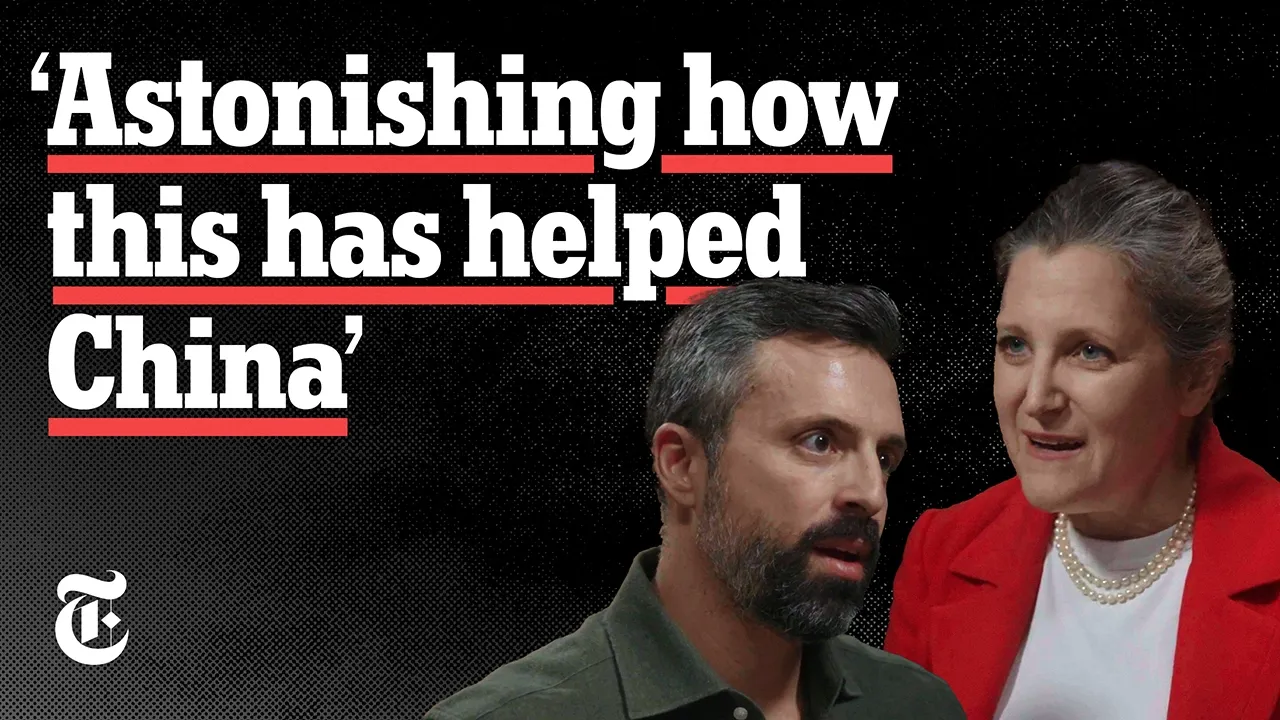
A Canadian poll indicates 41 percent of Canadians now view the United States as an enemy country, reflecting an unprecedented collapse in bilateral relations following coercive trade tactics and threats regarding Canadian sovereignty. (2:00)
Following U.S. tariff threats and demands of economic subjugation, Canadian Prime Minister Mark Carney walked away from bilateral trade negotiations, pushing Ottawa to pursue closer trade ties with China and explore associate membership in the European Union. (0:00)
The United States and Canada face a looming January 1 deadline that threatens sweeping new tariffs, while polling reveals American public approval for Canada's retaliatory measures outpaces support for Trump's initial tariffs. (18:21)
Former Canadian foreign minister Chrystia Freeland warns that the United States is drifting toward a rent-seeking kleptocracy where corporate success depends on presidential patronage rather than market competition. (48:03)
Detailed notes
## Background
Published on YouTube by The Ezra Klein Show on October 20, 2026, this episode examines how Donald Trump's coercive trade policies and threats toward Canada have strained bilateral relations. According to the show description, former Canadian Deputy Prime Minister and trade negotiator Chrystia Freeland joins Ezra Klein to discuss her book, "Unreliable Boyfriend," and explain why Canada's refusal to capitulate highlights the failures of Trump's foreign policy.
## TL;DR
Ezra Klein and Chrystia Freeland unpack the collapse of U.S.–Canada relations under Donald Trump's renewed tariff threats and rhetoric treating Canada like a subordinate state. Freeland explains Canada’s strategic counter-tariff playbook, noting how U.S. aggression unified Canadian public opinion and incentivized Ottawa to diversify trade ties toward Europe and China. They explore the institutional collapse and corporate capitulation marking Trump's second term, drawing historical parallels between Silicon Valley elites and 1990s Russian oligarchs who mistakenly believed they could manage an autocrat. To establish an off-ramp, Freeland calls on democratic allies to mount unified dollar-for-dollar retaliatory tariffs and rally domestic U.S. business interests against protectionist overreach.
## Atmosphere & style
The dialogue carries a calm, intellectually rigorous tone punctuated by candid, high-level diplomatic war stories and sharp historical analysis. Klein and Freeland maintain an engaging, peer-level rapport, moving fluidly from wry insider anecdotes—such as code-naming international trade actors after characters from The Lord of the Rings—to sober examinations of global democratic erosion. The atmosphere balances analytical detachment with an underlying sense of strategic urgency surrounding looming tariff deadlines and the fragility of post-war alliances.
## Bulletin
- [02:00](https://www.youtube.com/watch?v=pDZ7BaZDoe8&t=120s) A Canadian poll indicates 41 percent of Canadians now view the United States as an enemy country, reflecting an unprecedented collapse in bilateral relations following coercive trade tactics and threats regarding Canadian sovereignty.
- [00:00](https://www.youtube.com/watch?v=pDZ7BaZDoe8&t=0s) Following U.S. tariff threats and demands of economic subjugation, Canadian Prime Minister Mark Carney walked away from bilateral trade negotiations, pushing Ottawa to pursue closer trade ties with China and explore associate membership in the European Union.
- [18:21](https://www.youtube.com/watch?v=pDZ7BaZDoe8&t=1101s) The United States and Canada face a looming January 1 deadline that threatens sweeping new tariffs, while polling reveals American public approval for Canada's retaliatory measures outpaces support for Trump's initial tariffs.
- [48:03](https://www.youtube.com/watch?v=pDZ7BaZDoe8&t=2883s) Former Canadian foreign minister Chrystia Freeland warns that the United States is drifting toward a rent-seeking kleptocracy where corporate success depends on presidential patronage rather than market competition.
## Key takeaways
- [02:00](https://www.youtube.com/watch?v=pDZ7BaZDoe8&t=120s) Trump's coercive diplomacy and '51st state' rhetoric have completely inverted Canadian public sentiment, leading more Canadians to view China favorably than the United States.
- [04:54](https://www.youtube.com/watch?v=pDZ7BaZDoe8&t=294s) Canada's core diplomatic strategy during trade negotiations with Trump centers on a firm doctrine: 'We do not escalate and we do not back down.'
- [07:30](https://www.youtube.com/watch?v=pDZ7BaZDoe8&t=450s) Tariffs on Canadian intermediate goods, such as aluminum and softwood lumber, effectively act as a domestic tax on American manufacturing and power consumption.
- [11:38](https://www.youtube.com/watch?v=pDZ7BaZDoe8&t=698s) Canada's retaliatory trade strategy deliberately avoids intermediate inputs and surgically targets finished consumer goods in swing states and key congressional districts.
- [22:05](https://www.youtube.com/watch?v=pDZ7BaZDoe8&t=1325s) The Trump administration shifted from rules-based renegotiations in its first term toward demanding raw economic dominance and allied subjugation in its second term.
- [23:49](https://www.youtube.com/watch?v=pDZ7BaZDoe8&t=1429s) Trump's aggressive posture inadvertently unified Canadian politics, turning Mark Carney into one of the most popular modern prime ministers after he walked away from trade talks.
- [33:30](https://www.youtube.com/watch?v=pDZ7BaZDoe8&t=2010s) By treating long-standing allies as vassals rather than partners, the United States is committing what historian Timothy Snyder calls 'superpower suicide,' dismantling its own alliance architecture.
- [36:16](https://www.youtube.com/watch?v=pDZ7BaZDoe8&t=2176s) U.S. unpredictability has damaged its international reputation and indirectly bolstered Beijing, making China appear more stable despite its predatory economic practices.
- [48:03](https://www.youtube.com/watch?v=pDZ7BaZDoe8&t=2883s) The shift toward presidential tariff authority risks establishing a rent-seeking kleptocracy where business survival hinges on political loyalty rather than merit.
- [54:00](https://www.youtube.com/watch?v=pDZ7BaZDoe8&t=3240s) Silicon Valley elites aligned with Trump not out of ideological devotion, but as a transactional defense against progressive regulation, antitrust enforcement, and status diminishment.
- [50:41](https://www.youtube.com/watch?v=pDZ7BaZDoe8&t=3041s) Freeland draws historical parallels between American corporate leaders placating Trump and Russian oligarchs in the 1990s who backed Vladimir Putin under the mistaken belief they could control him.
- [01:02:01](https://www.youtube.com/watch?v=pDZ7BaZDoe8&t=3721s) Corporate appeasement may be reaching a limit as business leaders realize that personal loyalty fails to protect them from erratic governance and geopolitical instability.
- [01:09:34](https://www.youtube.com/watch?v=pDZ7BaZDoe8&t=4174s) A viable off-ramp before the January 1 deadline requires the U.S. to abandon punitive measures against allies in exchange for a united, multilateral trade stance toward China.
- [01:11:13](https://www.youtube.com/watch?v=pDZ7BaZDoe8&t=4273s) Freeland argues the global democratic bloc must present a coordinated front through reciprocal dollar-for-dollar retaliatory tariffs against unilateral American trade actions.
## Detailed walkthrough
### [00:00](https://www.youtube.com/watch?v=pDZ7BaZDoe8&t=0s) The Deterioration of U.S.–Canada Relations
Ezra Klein opens by observing that no country better illustrates how the world's perception of the United States has shifted from an ally and partner into a "bully and predator" than Canada. In late August, Canadian Prime Minister Mark Carney made the dramatic decision to walk away from trade negotiations with the Trump administration, fully aware that retaliatory measures could devastate the Canadian economy. Carney staked out a defiant position, declaring: “Canada is becoming stronger and less dependent on America. We are already giving ourselves more than they can take away and we are just getting started.”
Trump's coercive strategy has yielded consequences diametrically opposed to his stated goals. Rather than forcing Canada to capitulate and become what Trump envisioned as the "51st state"—boasting that "we don't need them, but they need us"—the confrontation has pushed Canada to explore associate membership in the European Union and negotiate bilateral agreements with other global partners, including China. This pivot directly undermines Trump's objective of isolating and weakening Beijing on the world stage. As a result, the United States and Canada are hurtling toward a January 1 deadline that threatens the implementation of sweeping, destructive tariffs. Klein introduces Chrystia Freeland—former Canadian Deputy Prime Minister, Minister of Finance, Minister of Foreign Affairs, and lead negotiator during the renegotiation of NAFTA—who has detailed this geopolitical rupture in her book, *Unreliable Boyfriend: An Insider’s View of Dealing With a Chaotic Superpower, Plutocrats, and Other Complicated People*.
[02:00](https://www.youtube.com/watch?v=pDZ7BaZDoe8&t=120s) How Did U.S.–Canada Relations Flip?
Klein highlights public opinion polling to underscore the depth of the fracture: a recent Canadian poll found that 41 percent of Canadians now view the United States as an enemy country, while a Pew poll revealed that more Canadians hold a favorable view of China than of the U.S. Freeland affirms the shock value of these numbers, noting that as recently as 2023, public sentiment was the exact opposite: the U.S. was broadly considered Canada's essential ally, while China was seen as an adversary. Explaining this rapid inversion, Freeland states: “And what's happened is Donald Trump and challenges to Canadian sovereignty and tariffs. That's what's happened.”
When Klein asks how Trump’s second administration differs from his first, Freeland argues that Trump himself has not changed at all. During his first term, he implemented Section 232 national-security tariffs on Canadian steel and aluminum, insulted European allies, and challenged international norms. To illustrate his longstanding disdain for diplomatic decorum, Freeland recounts an episode from a G7 summit hosted by Canada, where leaders attempted to convince Trump to endorse a standard, historically uncontroversial clause supporting the "rules-based international order." Trump balked at being the sole dissenter, and as he exited the room, he pulled candies out of his pocket and tossed them directly at German Chancellor Angela Merkel.
```mermaid
flowchart TD
accTitle: Public Opinion Inversion in Canada (2023 vs. 2026)
accDescr: Diagram illustrating how Canadian perceptions of the United States and China inverted between 2023 and 2026 due to Trump's tariffs and sovereignty threats.
[04:54](https://www.youtube.com/watch?v=pDZ7BaZDoe8&t=294s) Handling a Bully: Angela Merkel's Approach
Freeland praises Angela Merkel’s handling of Trump, attributing her skill to decades of dealing with Russian President Vladimir Putin, who frequently deployed psychological warfare to rattle her—including bringing large dogs into meetings despite knowing her fear of them. Merkel’s approach was what the French call *correct*: calm, rational, unyielding, and entirely devoid of sycophancy. In contrast, Freeland criticizes the approach taken by many foreign leaders who mistakenly believe they can outmaneuver Trump through extravagant flattery, luxury gifts, or superficial paper concessions:
> “I think that strategy is in part based oddly on underestimating Trump, right? I think there are a lot of leaders who think Trump is dumber than they are. And so they think, 'Well, I'll just sort of butter him up. I will outrageously flatter him and maybe I'll agree to some things he wants, but it'll just be on paper. It won't be real and it'll all be fine.' I don't think that's the right approach.”
Drawing from Canada's experience during the first Trump administration's NAFTA negotiations, Freeland emphasizes her guiding diplomatic mantra: “We do not escalate and we do not back down.” Maintaining a steady, non-reactive demeanor without raising the emotional register is the only reliable way to deal with a leader who relies on intimidation.
[07:30](https://www.youtube.com/watch?v=pDZ7BaZDoe8&t=450s) Canada's Trade War Strategy and Economic Asymmetry
Addressing the prospect of an all-out trade war, Freeland acknowledges that Canadians are clear-eyed about the asymmetric power dynamic between the two economies. While trade disruption inherently inflicts more pain on Canada due to its smaller size, Canadians are prepared to hold the line because national sovereignty and economic survival are at stake. Looking back at the first Trump administration's tariffs, Canada pursued a dollar-for-dollar retaliatory tariff strategy until the U.S. backed off.
Freeland argues that Trump's tariffs are fundamentally self-defeating for the American economy. A prime example is aluminum, which Freeland describes as "basically electricity in solid form" because it is produced in Quebec using cheap hydroelectric power. Imposing a 50 percent tariff on Canadian aluminum is effectively a self-imposed 50 percent tax on American electricity consumption. The aluminum Canada normally exports to the United States carries an energy equivalent exceeding 450 data centers or the output of half a dozen Hoover Dams.
Freeland outlines why Canadian exports pose a structural dilemma for American protectionism:
- The overwhelming majority of Canadian exports to the U.S. are intermediate goods rather than finished consumer products.
- Intermediate goods—such as aluminum and softwood lumber—are raw inputs required by American manufacturers and builders to produce their own goods.
- By imposing tariffs on intermediate inputs, American policies directly increase production costs for domestic businesses, creating an immediate, self-inflicted drag on the U.S. economy before any Canadian retaliation even takes effect.
[11:38](https://www.youtube.com/watch?v=pDZ7BaZDoe8&t=698s) Canada's Trade Leverage and Retaliation Strategy
Chrystia Freeland highlights how deeply integrated Canadian products are within American everyday life, pointing out that tariffs on basic commodities inevitably hit American consumers. She cites potash as a primary example: while farmers purchase it processed as fertilizer rather than in raw form, potash underpins agriculture, meaning everyone effectively relies on it because “we like to eat.” Freeland emphasizes that while Canada’s economy is smaller and far more trade-exposed than that of the United States, Canada represents America's largest export market—exceeding China, Japan, and the United Kingdom combined.
```mermaid
flowchart TD
accTitle: Canada Counter-Tariff Strategic Flowchart
accDescr: Diagram illustrating the two-pronged Canadian strategy for retaliatory tariffs against the United States.
subgraph Defense["1. Protect Domestic Economy"]
A["Avoid Tariffs on Intermediate Goods"] --> B["Prevent Harm to Canadian Manufacturers"]
C["Target Easily Substitutable Goods"] --> B
end
subgraph Offense["2. Maximize Pressure on U.S."]
D["Identify Influential Senators & House Members"] --> F["Target Politically Sensitive Constituencies"]
E["Pinpoint Vulnerable Swing States"] --> F
F --> G["Smucker's Jam (Ohio) & Canadian Beer Ads (Michigan)"]
end
```
When Ezra Klein asks about Canada targeting vulnerable pain points—similar to China restricting rare earth magnets—Freeland explains that Canada's retaliation follows basic trade policy principles rather than novel tactics. When forced to respond to “unjustified and illegal tariffs,” Canada pursues two main goals: minimizing internal self-harm and maximizing political pressure on the United States. To avoid damaging Canadian manufacturers, counter-tariffs bypass intermediate inputs and focus instead on easily substitutable consumer goods. Politically, Canada maps its countermeasures against the districts of influential congressional leaders and critical swing states to ensure the economic pain registers where the White House is most vulnerable.
- In 2018, Canada coordinated its retaliatory measures alongside the European Union and Mexico.
- Canada deliberately targeted Smucker’s jam, produced in Ohio, to exert pressure on Ohio Senator Sherrod Brown.
- When Senator Brown asked Freeland to ease up because the measures were harming his constituents, Freeland bluntly recalled her response: “Sherrod, with all due respect, that's the point. We want your constituents to be complaining to you, and we want you to go out and say, 'You guys might lose your job because of Trump's stupid trade war with Canada.'”
- Freeland notes that the strategy is visibly working in contemporary politics, citing a high-stakes Michigan Senate race where the Republican candidate ran an ad drinking a Labatt Canadian beer while watching the Detroit Red Wings, directly declaring: “Drinking a Labatt and watching the Red Wings. Man, it just doesn't get any more Michigan than that. And here in Michigan, we know that Canada is not our enemy. We need to end this tariff war now.”
---
[16:20](https://www.youtube.com/watch?v=pDZ7BaZDoe8&t=980s) Resolving the First Trump Trade War
Ezra Klein asks why the trade battles during Donald Trump's first administration did not deteriorate into the total rupture seen today. Freeland clarifies that the conflict came far closer to the edge than people remember. On the eve of Canada's retaliatory measures taking effect in 2018, Trump placed a direct call to Prime Minister Justin Trudeau, threatening to destroy the Canadian economy if Ottawa followed through. During that conversation, Trump insisted that Trudeau fire Freeland, labeling her a “nasty woman.” Trudeau refused to back down, and public unity across Canada helped sustain the government's stance.
Ultimately, Canada and the United States reached a comprehensive renegotiation—the USMCA—which Trump lauded as the best trade deal ever negotiated, and which garnered broad bipartisan backing from figures as disparate as House Speaker Nancy Pelosi and Senator Sherrod Brown. Freeland attributes that success to two critical stabilizing forces: influential Republican allies in Congress like John McCain and Chuck Grassley, and the trade expertise of United States Trade Representative Robert Lighthizer. Although Freeland experienced intense, difficult negotiations with Lighthizer, she found him to be a sophisticated, serious negotiator who understood that an enduring trade compact with Canada served vital American strategic interests.
> “So we had the fight and we had a positive conclusion.” — Chrystia Freeland
---
[18:21](https://www.youtube.com/watch?v=pDZ7BaZDoe8&t=1101s) Institutional Restraint vs. Second-Term Capitulation
Reflecting on the difference between administrations, Klein suggests that the first term featured independent Republican power bases like John McCain and Paul Ryan, alongside aides who sought to guide, moderate, or check the president's impulses rather than treat him as an infallible figure. Freeland agrees, observing that an advisor's duty to any leader is not only to advance their agenda but also “to stop you from doing dumb stuff.” She cites the war in Iran as a clear example of an avoidable war of choice that damaged Trump's effectiveness, arguing that aides who could have dissuaded him would have done him a great service.
However, Freeland turns the question back to Klein, observing a stark change across American society in the second term: an apparent, widespread capitulation to Trump across business and civic institutions that did not exist during his first term. This domestic acquiescence emboldens the White House and leaves American allies wondering whether Trump's behavior represents an isolated presidency or a systemic transformation of the entire country.
Klein pushes back slightly on the premise that civil society has surrendered completely, arguing that the early capitulation seen among some law firms and universities has begun to encounter resistance. Instead, Klein identifies the true point of institutional collapse as the Republican-controlled Congress. Under the American constitutional framework, the primary check on an executive is a legislative branch that jealously protects its own powers and safeguards the national interest; once that majority is captured and intimidated, the constitutional safeguards fail.
- A notable poll reveals that Canadian Prime Minister Mark Carney’s retaliatory tariffs enjoy higher approval among the American public than Donald Trump’s tariffs on Canada do.
- In public opinion surveys concerning the bilateral trade dispute, a majority of Americans actively side with Canada over their own administration.
---
[22:05](https://www.youtube.com/watch?v=pDZ7BaZDoe8&t=1325s) From Trade Policy to Demands for Subjugation
Klein argues that Freeland may still be understating how qualitatively different Trump’s second administration is from his first. The 2018 trade negotiations were ultimately practical disputes anchored in trade law, regulatory policy, and manufacturing rules—such as labor standards in automotive supply chains—and could be settled through traditional give-and-take. By contrast, the second term’s trade conflicts revolve around raw domination, demands for economic tribute, and Trump's personal offense that Canada refuses his rhetoric to become the “51st state.”
Freeland agrees, noting that while Trump's impulse toward total dominance was present in the first term, it was somewhat constrained; in the second term, that impulse has become explicit, unvarnished state policy. Washington now approaches international relations as a binary ultimatum, forcing sovereign nations to choose their posture entirely on Trump's terms.
> “Trump's Washington, you know, their offer to the rest of the world is you choose either to be a vassal or fight your way to being an equal.” — Chrystia Freeland
[23:49](https://www.youtube.com/watch?v=pDZ7BaZDoe8&t=1429s) The National Consensus on Canadian Sovereignty
Chrystia Freeland explains that when faced with coercive American pressure, Canada would never choose to act like Delcy Rodríguez and negotiate terms of submission. While Canada finds itself in a dreadful situation, determining the path forward has become clearer because the country’s actual sovereignty is being challenged. There is now a profound, cross-partisan national consensus that Canada must stand up for itself. Freeland recalls that in early 2025, when sovereignty issues first surfaced aggressively, former conservative Prime Minister Stephen Harper stated that Canada must be ready to endure whatever economic toll is necessary to defend its sovereignty. She expresses hope that Americans would adopt the exact same resolve if their own national integrity were put on the line.
Ezra Klein observes that Donald Trump has fundamentally misjudged human and national psychology. The Trump administration’s entire framework is strictly transactional: the larger party extracts more because it holds the raw leverage. In her book, Freeland recounts how former United States Trade Representative Robert Lighthizer bluntly made this case to her, arguing that because the United States economy is ten times larger than Canada's, he should prevail ten times as often. Yet Klein argues that human souls are not run like transactions. While conventional logic might expect Canadians to punish Prime Minister Mark Carney for walking away from talks under the threat of ruinous tariffs, the opposite occurred: Carney became the most popular prime minister in modern Canadian history. Trump’s threats unified and nationalized Canadian sentiment, rescuing the governing party at a moment when Canadian conservatives had been surging. When foreign policy relies on heavy-handed bullying that triggers deep spiritual resistance rather than concessions, it inherently collapses.
> “Canada should be prepared to pay whatever the economic price is if it is about defending our sovereignty.” — Stephen Harper, quoted by Chrystia Freeland
[26:59](https://www.youtube.com/watch?v=pDZ7BaZDoe8&t=1619s) The Failure of Appeasement and Unilateral Tariffs
Freeland wholeheartedly agrees with Klein’s assessment, adding that the Trump administration’s miscalculations were emboldened early on by the international community's initial capitulation. When unilateral tariffs were rolled out on what was dubbed “Liberation Day,” most countries around the globe responded with appeasement rather than pushback. Even Trump administration officials had originally assumed trading partners would impose retaliatory tariffs, yet the broader world largely failed to do so. The only two notable exceptions that met tariffs with immediate retaliation were Canada and China.
This early lack of resistance gave the Trump administration a false confidence that strong-arming allies would reliably yield submission. But Freeland emphasizes a deeper paradox: even if other nations had completely surrendered to American coercion, it would still represent a disastrous strategic outcome for the United States. Bullying allies into one-sided arrangements fundamentally destabilizes the relationships America relies on to project influence and maintain economic security.
> “And you know the Trump Trump administration officials themselves said as these tariffs were being proposed that they expected that other countries would retaliate and most of the world didn't.” — Chrystia Freeland
[29:07](https://www.youtube.com/watch?v=pDZ7BaZDoe8&t=1747s) Alliances Shift: Canada, China, and the European Union
Klein details how treating international relations as a raw balance-of-power calculation backfires on the hegemon. If the United States signals that its tenfold economic size and overwhelming military might justify constant dominance, it ceases to be a reliable protector and becomes an active, existential threat to everyone within reach. In realist international relations theory, weaker nations faced with an unchecked superpower will predictably band together to counterbalance and contain it. Over the prior two years, Canada responded to this shifting dynamic by striking trade agreements and forging significantly closer, public ties with China, while opening serious conversations about seeking associate membership in the European Union.
```mermaid
flowchart TD
accTitle: Realist Balancing Cycle
accDescr: Diagram showing how US economic coercion forces allies to balance against Washington via European integration and Chinese engagement.
subgraph US_Coercion["U.S. Coercion"]
A["Transactional Hegemon\n('America is 10x larger')"] --> B["Unilateral Tariffs &\nSovereignty Threats"]
end
subgraph Allied_Response["Allied Counter-Balancing"]
B --> C["Allies Perceive U.S.\nas an Active Threat"]
C --> D["Diversification &\nDefensive Coalitions"]
end
subgraph Strategic_Pivots["Canada's Strategic Pivots"]
D --> E["Deepen Economic\nTies with China"]
D --> F["Pursue Associate\nEU Membership"]
end
```
When Klein mentions his surprise at Canada exploring associate EU membership rather than accepting Trump's taunt of becoming the "51st state," Freeland reacts with visceral rejection: Canada will never become the 51st state, and Canadians do not view the suggestion as a joke. Freeland reveals that the EU track had actually begun as a "joking, not joking" fallback during the first Trump administration. Weeks before Trump’s first election victory in 2016, Freeland had served as lead negotiator in finalizing the Comprehensive Economic and Trade Agreement (CETA) between Canada and the EU. Because CETA opened up mutual government procurement, it established an even deeper legal integration on paper than the USMCA.
As Trump's initial tariffs began hammering Canada, Freeland established a close, dark-humored rapport with Cecilia Malmström, the Swedish liberal serving as the EU trade commissioner. The two developed a *Lord of the Rings* text-messaging code to discuss the hostile diplomatic environment:
- **Mordor:** Washington, D.C.
- **Sauron:** Donald Trump
- **Gandalf:** Angela Merkel (such as when Malmström texted, “Gandalf is going to Mordor next week”)
- **The Elves:** The European Union
- **The Hobbits / The Shire:** Canada (a label the petite, farm-raised Freeland happily embraced whenever she returned home from tense meetings in Washington)
> “Canada will not be the 51st state. Let me just be really clear. And we don't I I know you didn't mean it this way, but we do not treat it as a joke.” — Chrystia Freeland
[33:30](https://www.youtube.com/watch?v=pDZ7BaZDoe8&t=2010s) Superpower Suicide and the Post-War Order
Klein notes that by forcing traditional partners into a posture of self-defense, Washington encourages them to actively build mechanisms that undermine and weaken American influence over the long term. Freeland concurs, observing that the current American trajectory is inadvertently highlighting the brilliance of the post-World War II American architects. Following 1945, when the United States held unmatched global dominance, it consciously rejected the imperial model. Instead of treating foreign nations as vassals, Washington invested in the reconstruction of former adversaries like Germany and Japan and established alliances grounded in mutual enrichment.
While America was always the "first among equals"—and allies frequently grumbled behind closed doors—the post-war consensus operated on the foundational idea that the rising prosperity and strength of allies reinforced American security rather than compromising it. This shared-benefit structure was precisely what distinguished the United States from authoritarian regimes like the Soviet Union and China, which rely strictly on coerced vassal states. Citing historian Timothy Snyder, Freeland characterizes Washington's voluntary dismantling of its alliance architecture as "superpower suicide," driven by short-sighted leaders who implement coercive measures without considering the disastrous chain reaction that inevitably follows.
> “That is what made America different from the Soviet Union. The Soviet Union certainly did not have partners. It only had vassals. Same with China. That's how America was a distinctive superpower.” — Chrystia Freeland
[36:16](https://www.youtube.com/watch?v=pDZ7BaZDoe8&t=2176s) Disentangling from the U.S. and the Rise of China
Faced with an unpredictable and aggressive Washington, America's long-standing counterparties are reacting in two distinct ways: actively seeking alternatives to disentangle themselves from dependence on the U.S., particularly across economic and military domains, and reconsidering foundational defense commitments. Chrystia Freeland points out that countries will now deliberate seriously before purchasing another F-35 fighter jet controlled by the Pentagon, asking why any sovereign nation would want high-end military equipment subject to American operational control. Ezra Klein notes that Europe, Canada, and Ukraine are equally desperate to secure alternatives to Elon Musk's Starlink satellite network. This strategic decoupling deprives American firms of clients and revenue, directly stripping Washington of its international leverage.
Freeland finds the geopolitical fallout profoundly alarming, emphasizing that China emerges as the definitive victor. Generations-long American allies now look at global dynamics and perceive the United States as a more immediate danger than Xi Jinping’s increasingly authoritarian regime. “I find sort of a world where every country that is not the United States or China is engaged in a balancing act between these two predatory hegemons to be a really bad world,” Freeland observes. Klein bolsters this with data from the Democracy Perception Index surveying 98 nations, in which the United States ranked as the fifth-worst perceived country—landing just ahead of Iran and two spots behind Russia—while China maintained a net-favorable perception. Klein remarks that across competition over technology, AI, power, and manufacturing, “Trump has acted like a Manchurian agent,” inadvertently elevating Beijing's geopolitical standing.
```mermaid
flowchart TD
accTitle: Dynamics of Ally Decoupling Under Trump
accDescr: Visualizing how U.S. coercion pushes allies to decouple, eroding leverage and benefiting China.
subgraph Allied_Response["Allied Response to U.S. Volatility"]
A["Allies Seek Independence"] --> B["Military Alternatives<br/>(Reconsidering F-35 purchases)"]
A --> C["Tech Alternatives<br/>(Seeking alternatives to Starlink)"]
end
subgraph U.S_Impact["Direct Costs to U.S."]
B --> D["Loss of Revenue & Client Base"]
C --> D
D --> E["Erosion of U.S. Global Leverage"]
end
subgraph Geopolitical_Shift["Global Power Rebalancing"]
E --> F["Democratic Allies Drift Toward Hedging"]
F --> G["China Emerges as Preferred Counterparty"]
end
```
- A 98-country survey by the Democracy Perception Index ranked the U.S. as the fifth-least favorably perceived nation, placed just above Iran and behind Russia.
- Both Canada and European allies are aggressively seeking functional alternatives to the F-35 fighter jet and SpaceX's Starlink constellation.
---
[39:31](https://www.youtube.com/watch?v=pDZ7BaZDoe8&t=2371s) China’s Effective Coercion vs. Trumpian Volatility
Freeland agrees that no American leader has inadvertently benefited Beijing more than Donald Trump, recalling a notable *Economist* cover depicting Xi Jinping observing Trump under the famous adage: never interrupt your enemy when he is making a mistake. However, she warns against falling for Beijing's official rhetoric. China presents itself internationally as a harmless, rules-abiding defender of multilateralism while running a brutal domestic police state that oppresses Uyghurs and Tibetans and crushes civil liberties in Hong Kong. In reality, Freeland stresses, China subverted the global trading system through deliberate overcapacity and aggressive monopolization of supply chains, and its external posture is nakedly coercive.
Freeland characterizes China’s actual foreign policy as ruthlessly Thucydidean—an approach she compares to Stephen Miller's worldview that “the strong do what they will and the weak suffer what they must,” with the crucial distinction that Beijing executes it competently. When Norway awarded the Nobel Peace Prize to Liu Xiaobo, Beijing punished Oslo by freezing Norwegian salmon imports until the Norwegian government capitulated. When Lithuania permitted Taiwan to open a de facto embassy under its own name, Beijing slapped the country with secondary sanctions and severe trade bans. And after Canadian authorities honored a bilateral extradition treaty with the United States by detaining Huawei CFO Meng Wanzhou—holding her under house arrest in a $5 million Vancouver mansion—China retaliated by arresting two Canadians (Michael Kovrig and Michael Spavor) under conditions that human rights experts classified as torture.
- When the Nobel Peace Prize was awarded to a Chinese dissident, Beijing imposed an export ban on Norwegian salmon to force diplomatic submission.
- Lithuania faced economic embargoes for expanding diplomatic ties with Taiwan.
- Meng Wanzhou’s lawful house arrest in Vancouver led directly to Beijing taking two Canadian citizens hostage in conditions tantamount to torture.
---
[43:49](https://www.youtube.com/watch?v=pDZ7BaZDoe8&t=2629s) The Myth of the Rules-Based Order and the Rise of Predatory Hegemons
The discussion shifts to what "reliability" means in a post-rules-based world. Klein argues that nostalgia for a neutral, rules-based international system is misdirected because that architecture has effectively ceased to exist. When Klein labels Beijing predictable, he clarifies that he does not mean fair or benevolent, but rather that China operates as an understandable counterparty with transparent red lines: “So if you're Taiwan, you know what China wants from you. And to some degree, if you're Norway, you know what China wants from you.” Trump's Washington, by contrast, behaves as an erratic, unstable counterparty that lashes out arbitrarily at close partners.
“China is what an effective Trump administration would seek to become,” Freeland interjects, characterizing China as a 19th-century-style, mercantilist, rent-seeking kleptocratic superpower that excels at playing hardball. Klein notes that Beijing represents the ruthless, transactional state Trump promises to build but cannot properly operate. However, Freeland draws a firm line against treating China’s behavior as mere amoral transactionalism or economic efficiency. She points out that the systemic eradication of Uyghur and Tibetan cultural identities is rooted in an ideological drive to enforce Han monocultural solidarity. Both agree that an international arena fractured between an authoritarian Chinese superpower and a predatory, erratic United States traps all smaller states in an exceptionally dangerous reality.
> “China broke the global trading system through intentional overcapacity and through intentional and pretty vicious building of supply chain dominance.” — Chrystia Freeland
> “I don't think the rules-based international order is a concept that still has meaning.” — Ezra Klein
[48:03](https://www.youtube.com/watch?v=pDZ7BaZDoe8&t=2883s) The Threat of American Kleptocracy and the Global Impact on Democracy
Reflecting on what a second Trump administration means for both domestic prosperity and global stability, Chrystia Freeland describes an America that emerges less rich, less economically dynamic, and fundamentally less free. The core danger she identifies is a structural shift away from a rules-based market economy toward a kleptocracy rooted in rent-seeking, where corporate success depends on political favoritism rather than innovation or competitive merit. While securing special government carve-outs and privileges can enrich individual corporate rent-seekers, Freeland warns that this dynamic has historically proven disastrous for nations as a whole. Beyond domestic borders, the erosion of predictable, benign American power strips global democracies of an essential external backstop.
To illustrate how deeply foreign democracies rely on American institutional weight, Freeland recounts a conversation with an anti-Bolsonaro Brazilian progressive regarding Brazil's elections. The observer lamented that even if Jair Bolsonaro were defeated at the ballot box, there remained an acute danger that the votes would not be fairly counted—a threat that historically was mitigated by the pressure and oversight of a credible U.S. administration. Freeland stresses that America's shift toward transactional politics deprives the democratic world of that vital stabilizing influence at the margins, making the domestic struggle inside the United States the pivotal conflict for global governance. As Chrystia Freeland concludes, “The battleground for liberal democracy in the world is America.”
- Freeland argues that while rent-seeking delivers windfalls to specific well-connected actors, it systematically degrades the broader national economy.
- Historical precedent shows that U.S. diplomatic and institutional presence has served as an implicit guarantor of fair electoral processes in fragile democracies worldwide.
- The overarching premise of Freeland's book is that if liberal democracy falters within the United States, democratic institutions across the globe will be left in severe peril.
[50:41](https://www.youtube.com/watch?v=pDZ7BaZDoe8&t=3041s) Plutocrats, Russian Oligarchs, and the Illusion of Control
Ezra Klein turns to the domestic business community’s stark evolution between Donald Trump’s two terms. During Trump's first presidency, prominent tech figures like Jeff Bezos and Mark Zuckerberg stood firmly outside his political coalition, opposing his protectionism, his hostility toward immigration, and his overtly transactional pay-to-play governing style. By the second term, however, major segments of corporate leadership and Silicon Valley elite had moved into alignment with Trump, culminating in Elon Musk pouring an estimated $250 million into Republican efforts. Klein connects this shift to Freeland’s firsthand reporting in post-Soviet Moscow during the 1990s, where she chronicled the rise of the Russian oligarchs, asking why American business leaders have abandoned their earlier resistance to damaging policies like broad tariffs.
Freeland finds the parallels between 1990s Russia and contemporary American boardrooms chilling, even while acknowledging fundamental differences between a mature democracy and Russia’s aborted transition. In post-Soviet Russia, brilliant, highly educated entrepreneurs with doctorates in mathematics and physics realized that the fastest path to extreme wealth was not building competitive enterprises, but getting the state to hand over state assets like oil companies. These oligarchs initially backed Boris Yeltsin, and when Yeltsin faltered, they engineered Vladimir Putin’s ascent under the hubristic assumption that they could manipulate an unsophisticated former KGB agent. Freeland issues a direct warning based on that history, noting that once Putin took absolute control, he swiftly subordinated the very tycoons who thought they owned him. As Chrystia Freeland emphasizes, “And once he was firmly installed in power he showed them who was boss and that was him.”
```mermaid
flowchart TD
accTitle: The Oligarch Illusion and State Subordination
accDescr: Diagram illustrating how entrepreneurial elites shift to rent-seeking and attempt to install a political leader they believe they can control, only to be subordinated by that leader once power is consolidated.
subgraph Phase1 ["1. Pursuit of State Favors"]
A["Skilled Entrepreneurs & Technocrats"] -->|"Seek accelerated wealth"| B["Pivot to State Assets & Rent-Seeking"]
end
subgraph Phase2 ["2. Political Manipulation"]
B -->|"Finance & orchestrate succession"| C["Back Strongman (e.g., Putin / Trump)"]
C -->|"Assumption"| D["Belief: 'We are smarter and can control him'"]
end
subgraph Phase3 ["3. Subordination"]
D -->|"Consolidation of state authority"| E["Strongman Asserts Total Dominance"]
E -->|"Result"| F["Subjugation of Business Oligarchs"]
end
```
[54:00](https://www.youtube.com/watch?v=pDZ7BaZDoe8&t=3240s) The Mechanics of Capitulation and the Feedback Loop of Coercion
Klein pushes back slightly on the idea that figures like Elon Musk believe they can control Trump, suggesting instead that they simply see him as someone they can make deals with. Klein notes that Silicon Valley's rightward drift was fueled by intense fury at the Biden administration, which had snubbed, scrutinized, investigated, regulated, and threatened antitrust actions against them. When Trump survived an assassination attempt and swept back toward power, business leaders accepted the political environment as an unavoidable reality and adjusted their strategy accordingly. In this transactional framework, policies like tariffs function not merely as trade barriers, but as potent instruments of corruption and political patronage, rewarding loyalists while penalizing perceived enemies.
This dynamic creates what Klein describes as a vicious cycle of capitulation, reversing the virtuous cycle of collective action. If a firm like Anthropic, led by Dario Amodei, attempts to establish ethical boundaries on how its artificial intelligence systems are deployed by the Pentagon, it faces the immediate threat of being designated a supply chain risk and stripped of government contracts; meanwhile, competitors who pledge absolute fealty to the administration are rewarded with lucrative federal business. Freeland adds that this corporate realignment was also driven by business elites observing rising populist rage across America and seeking a figurehead who could channel working-class grievances away from corporate wealth, higher taxes, and antitrust enforcement. As Ezra Klein observes, “What I think they saw in Trump, though, wasn't somebody they can control so much as somebody they could do business with.”
- The Biden administration's aggressive regulatory stance and aggressive antitrust posture alienated Silicon Valley founders and venture capitalists far beyond the immediate economic impact of the policies.
- Tariffs and regulatory approvals operate as direct instruments of presidential patronage, creating immediate commercial incentives to appease executive power.
- Corporate resistance collapses when ethical or independent behavior is punished with regulatory exclusion, while total submission is rewarded with state contracts.
[58:09](https://www.youtube.com/watch?v=pDZ7BaZDoe8&t=3489s) Status Anxiety and the War Against Progressive Cultural Power
Klein offers a significant amendment to Freeland's interpretation of why tech titans sided with Trump, arguing that their primary motivation was never fear of working-class economic populism or laid-off manufacturing workers in the Rust Belt. Having observed how tech billionaires communicate among themselves on public platforms and private podcasts, Klein contends that their true grievance was cultural and social. The tech elite felt besieged by the progressive establishment—ranging from critical investigative journalism in *The New York Times* to internal revolts by their own employees on corporate Slack channels demanding public statements in support of Black Lives Matter or attempting to organize labor unions.
This conflict was fundamentally about authority, prestige, and social standing within elite American circles. Citing arguments articulated by venture capitalist Marc Andreessen in conversations with conservative columnist Ross Douthat, Klein explains that tech leaders felt their societal contributions were being actively denigrated by media and cultural gatekeepers who commanded real institutional power. Their alliance with Trump was not designed to placate industrial workers, but to dismantle the cultural and moral leverage that progressive activists, legacy media institutions, and internal corporate workforces held over Silicon Valley executive leadership. As Ezra Klein explains, “What they were trying to bring to heel, what they were trying to stop was this effort by like another part of society with actual power centers to not just regulate them, not just tax them, but to diminish their social status, to say that what they did was bad and it should change.”
[59:39](https://www.youtube.com/watch?v=pDZ7BaZDoe8&t=3579s) Fearing Progressivism, Not Populism
Ezra Klein and Chrystia Freeland debate what actually drove the business elite’s rightward pivot leading into the 2024 election. Klein suggests that the super-rich were not truly fearful of populism in its conventional sense, but rather worried about progressivism rising from alternative power centers in society. Freeland agrees with what she terms a “plus plus,” identifying two main drivers behind the hurt feelings of the ultra-wealthy. First is the psychological demand for high social status—a longing to maintain “main character energy” where society treats entrepreneurs and inventors as unquestioned heroes receiving garlands of flowers, recalling the techno-optimist eras of Ronald Reagan and Bill Clinton.
Yet Freeland stresses that psychological vanity alone does not prompt collective political mobilization; material self-interest remains paramount. Hostile commentary from a *New York Times* columnist is merely irritating until it threatens to translate into electoral victories for figures like Bernie Sanders or Elizabeth Warren, who promise to tax wealth, impose regulations, and break up dominant corporations. Klein chimes in that this dynamic manifested directly in the Biden administration through figures like Federal Trade Commission Chair Lina Khan, proving to billionaires that aggressive antitrust enforcement and tax policy were real, imminent threats rather than abstract political rhetoric.
[01:02:01](https://www.youtube.com/watch?v=pDZ7BaZDoe8&t=3721s) A Turning Tide Against Trump?
Freeland introduces a counter-thesis that she outlined in a recent piece for the *Financial Times*: society may be reaching a tipping point where corporate capitulation to Donald Trump begins to reverse. Business leaders who initially embraced appeasement are discovering that pacifying Trump only encourages more erratic governance, and doubts are mounting over whether he will sustain his political dominance. Freeland pinpoints a major indicator of this shift: a September 28 op-ed in *The Wall Street Journal* by JPMorgan Chase CEO Jamie Dimon. In the piece, Dimon championed a massive, “big, beautiful” trade and economic agreement between the United States and the European Union. While Dimon avoided any overt criticism of Donald Trump by name, the policy substance was a complete, 180-degree rejection of Trump’s economic nationalism and protectionism.
```mermaid
flowchart TD
accTitle: The Mechanics of the Elite Backlash Against Trump
accDescr: Diagram illustrating the initial motivations for business leaders appeasing Trump versus the escalating concerns prompting a turn against him.
subgraph AppeasementDrivers["Initial Appeasement Drivers"]
A["Material Self-Interest<br>(Fear of Warren, Sanders, Khan)"]
B["Status & Cultural Resentment<br>(Hate for 'Wokeness' & Scorn)"]
end
subgraph Disillusionment["Escalating Reality Under Trump"]
C["Erratic Protectionism<br>(Trade Wars on Allies)"]
D["Foreign Policy Volatility<br>(Siding with Putin, Iran Conflict)"]
E["Institutional Kleptocracy<br>& NATO Destabilization"]
end
According to Freeland, an extensive cadre of chief executives—including prominent donors to Trump's campaign—now feels genuine alarm over his agenda. These executives believe in open international trade among partners who share democratic values, support Ukraine’s defense against Russia, and consider trade wars with allies like Canada entirely destructive. Rather than pursuing goals shared by the American public, the administration's foreign policy has stoked anxiety over confrontations with Iran, open hostility toward NATO, and affinity for Vladimir Putin. Freeland notes that the decisive break will hinge on the ballot box: “I think what we've seen from American business is they're going to be on the side of power. But I think that if they see that President Trump and MAGA no longer deliver at the ballot box, you may start seeing some very different behavior.”
- On September 28, JPMorgan Chase CEO Jamie Dimon published an op-ed in *The Wall Street Journal* advocating an expansive US-EU trade pact, describing it as a “big, beautiful agreement.”
- Business donors are increasingly rattled by White House rhetoric treating Canada like an adversary or threatening to make it the “51st state.”
- Corporate executives' willingness to push back remains heavily contingent on whether Trump can preserve legislative majorities in upcoming midterm elections.
[01:05:22](https://www.youtube.com/watch?v=pDZ7BaZDoe8&t=3922s) Preference Cascades and Silent Grievance
Klein connects this dynamic to the sociology of “preference cascades”—phenomena where large numbers of people quietly harbor views they dare not express until social permission is granted, releasing a sudden surge of bottled-up pressure. In 2024, an elite preference cascade favored Trump once Elon Musk and Marc Andreessen normalized right-wing alignment, freeing executives who harbored deep resentments against progressivism, regulatory oversight, and cultural taboos from the fear of social ostracism at elite galas. Conversely, Klein argues, fear of Trump’s retributive power currently suppresses dissent among those same executives, leading them to mute their misgivings about corruption.
Klein views coded pushback like Dimon’s editorial as insufficient, arguing that polite policy disagreements set an unacceptably low bar. Freeland shares Klein's diagnosis, laughing wryly at the post-election corporate mood captured in a post-2024 *Financial Times* report, in which an anonymous top investment banker celebrated Trump's victory because Wall Street could finally use slurs again without fear of reprimand. Freeland highlights the absurdity of highly compensated professionals lamenting that their greatest hardship under Democratic rule was social constraints on derogatory speech. However, she asserts that below the surface, even deeply conservative executives are reaching the limits of what they will tolerate, recognizing that the administration's trajectory toward kleptocracy, the abandonment of Ukraine, and the rupture of NATO actively undermines American prosperity and national security.
Klein defines the exact threshold required to prove that the corporate dam of silence has genuinely broken:
> “Sure. But the thing that will tell me the dam has burst is when people say the thing that is true and say, ‘This guy is insanely corrupt and he is harming America's interests.’”
[01:09:34](https://www.youtube.com/watch?v=pDZ7BaZDoe8&t=4174s) Negotiating Out of an Impasse: A Common Front on China
Bringing the conversation back to the ticking January 1 deadline on cross-border tariffs between the U.S. and Canada, Klein asks what an off-ramp could look like that allows both nations to save face. Freeland explains that the two sides do not need to ratify a final, sweeping trade agreement prior to January 1; rather, they simply need an agreed framework to enter structured talks while implementing a mutual ceasefire on fresh tariffs.
Looking beyond Canada, Freeland outlines a workable blueprint for a multilateral settlement encompassing key democratic partners, including the United Kingdom and the European Union. In this scenario, Washington would reaffirm its core alliances, admitting that mutual trade between democratic nations delivers broad economic wealth and physical security. In return for removing punitive tariffs against historic allies, the United States could require these partners to join a unified, coordinated trade policy confronting the challenge of China. Crucially, Freeland argues, this alignment should not rely on identical, copy-pasted tariff schedules, but rather on a common, coordinated strategy with real structural teeth that stops treating traditional allies like economic adversaries.
[01:11:13](https://www.youtube.com/watch?v=pDZ7BaZDoe8&t=4273s) The Path Forward: Multilateral Retaliation and Domestic Pushback
Wrapping up her strategic vision for managing global trade tensions, Chrystia Freeland lays out the basic logic of an ideal deal: rather than simply reacting to China, democratic nations need to carve out a protected economic sphere where their own economies can flourish without succumbing to a dangerous dependence on Beijing. To make that vision a reality, she argues that two major shifts must occur.
First, Canada should not have to stand alone. Freeland urges the wider democratic world to move past mere verbal declarations of solidarity and actively join Canada in matching unilateral American tariffs dollar for dollar. A unified coalition—bringing together Canada, Mexico, the European Union, Japan, South Korea, and Australia—responding firmly, in sorrow rather than in anger, would create irresistible, constructive pressure on the United States. As Freeland puts it:
> “The first is the rest of the democratic world should join Canada in retaliating against US tariffs.”
Second, domestic voices within the United States need to organize and confront the White House just as they did during the first Trump administration. Freeland emphasizes that American business leaders, particularly in highly integrated sectors like the automotive industry, must speak up forcefully. She points back to the courage of Republican lawmakers like Senator Chuck Grassley, who stood up to the president during the prior trade war, warning that tariffs were a grave mistake. Pointing to public polling that reveals Americans actually support Canada’s counter-tariffs while opposing U.S. tariffs on Canada, Freeland notes that resisting executive overreach on trade is not only economically vital, but also a politically popular stance.
```mermaid
flowchart TD
accTitle: Dual Pressure Strategy Against Unilateral Tariffs
accDescr: Diagram illustrating how multilateral counter-tariffs and domestic US pushback combine to force policy renegotiation.
subgraph Internal["Domestic Pushback: US Stakeholders"]
C["US Business Leaders<br>(Auto Industry, Manufacturing)"] -->|"Lobbying & Public Advocacy"| B
D["Congressional Allies<br>(e.g., Grassley-style Republicans)"] -->|"Legislative Resistance"| B
E["American Public Opinion<br>(Opposes Tariffs on Canada)"] -->|"Midterm Electoral Pressure"| B
end
B --> F["Constructive Trade Negotiations<br>& Coordinated China Strategy"]
```
- **Allied Coalition Proposal:** Canada, Mexico, the EU, Japan, South Korea, and Australia uniting to issue dollar-for-dollar counter-tariffs against unilateral U.S. duties.
- **Domestic Resistance:** Mobilization of U.S. business interests, particularly the automotive supply chain that builds cross-border products jointly.
- **Congressional Precedent:** Recalling Senator Chuck Grassley’s willingness to tell Donald Trump directly that his tariff agenda was bad policy.
- **Public Opinion:** Referencing data showing that the American electorate supports Canadian retaliation while disapproving of Washington's initial tariffs against Canada.
---
[01:13:43](https://www.youtube.com/watch?v=pDZ7BaZDoe8&t=4423s) Book Recommendations: Sci-Fi Visions and Canadian Identity
Ezra Klein closes the conversation with his traditional final question, asking Freeland for three book recommendations. Freeland reveals that two of her selections are longtime sci-fi favorites that function almost like living companions in her life. Klein playfully notes her sci-fi credentials, prompting Freeland to confess that she has been an avid science fiction reader since childhood:
> “Oh, I totally am. I always have been. I I've read sci-fi like since I started to read.”
Freeland argues that science fiction is uniquely suited to our current historical moment. The rapid rise of artificial intelligence, alongside a battered geopolitical order and widespread economic anxieties, forces people to confront existential questions about what it truly means to be human. Literature that imagines alternate social systems and futures provides a vital lens for thinking through these disruptions.
Her third recommendation turns from speculative fiction to a grounded exploration of personal and national identity through Canadian literature, offering listeners a window into the cultural ethos of America's northern neighbor.
- **_The Dispossessed_ by Ursula K. Le Guin:** A foundational text for Freeland that resonates with contemporary dystopian anxieties while holding out hope through the story of a small, resilient band of individuals fighting for their core values.
- **_The Player of Games_ by Iain M. Banks:** A darker yet hopeful entry in Banks's Culture series that delves into strategy, mind games, and moral stakes within a complex technological civilization.
- **_Book of Lives_ by Margaret Atwood:** A memoir described by Freeland as wonderful and grounded. It depicts an extraordinary author who remains unpretentious, self-aware, and capable of laughing at her own foibles, while capturing the essence of the Canadian experience for an international audience newly fascinated by the country.
## Notable quotes
> [22:05](https://www.youtube.com/watch?v=pDZ7BaZDoe8&t=1325s) Trump's Washington, you know, their offer to the rest of the world is you choose either to be a vassal or fight your way to being an equal. — Chrystia Freeland
> [43:49](https://www.youtube.com/watch?v=pDZ7BaZDoe8&t=2629s) China broke the global trading system through intentional overcapacity and through intentional and pretty vicious building of supply chain dominance. — Chrystia Freeland
> [48:03](https://www.youtube.com/watch?v=pDZ7BaZDoe8&t=2883s) The battleground for liberal democracy in the world is America. — Chrystia Freeland
> [23:49](https://www.youtube.com/watch?v=pDZ7BaZDoe8&t=1429s) Canada should be prepared to pay whatever the economic price is if it is about defending our sovereignty. — Stephen Harper
> [43:49](https://www.youtube.com/watch?v=pDZ7BaZDoe8&t=2629s) I don't think the rules-based international order is a concept that still has meaning. — Ezra Klein
> [01:11:13](https://www.youtube.com/watch?v=pDZ7BaZDoe8&t=4273s) The rest of the democratic world should join Canada in retaliating against US tariffs. — Chrystia Freeland
> [00:00](https://www.youtube.com/watch?v=pDZ7BaZDoe8&t=0s) Canada is becoming stronger and less dependent on America. We are already giving ourselves more than they can take away and we are just getting started. — Mark Carney
## Mentioned
Anthropic, Angela Merkel, Bernie Sanders, Bill Clinton, Book of Lives, Boris Yeltsin, Cecilia Malmström, CETA, Chrystia Freeland, Chuck Grassley, Dario Amodei, Delcy Rodríguez, Democracy Perception Index, Detroit Red Wings, Donald Trump, Elizabeth Warren, Elon Musk, European Union, Ezra Klein, Federal Trade Commission, Financial Times, Iain M. Banks, J.M. Smucker Company, Jair Bolsonaro, Jamie Dimon, Jeff Bezos, Joe Biden, John McCain, JPMorgan Chase, Justin Trudeau, Labatt Brewing Company, Lina Khan, Liu Xiaobo, Lockheed Martin F-35 Lightning II, Marc Andreessen, Margaret Atwood, Mark Carney, Mark Zuckerberg, Meng Wanzhou, Michael Kovrig, Michael Spavor, NAFTA, NATO, Nancy Pelosi, Paul Ryan, Pentagon, Pew Research Center, Robert Lighthizer, Ronald Reagan, Ross Douthat, Sherrod Brown, Starlink, Stephen Harper, Stephen Miller, The Dispossessed, The Economist, The New York Times, The Player of Games, The Wall Street Journal, Timothy Snyder, Unreliable Boyfriend, Ursula K. Le Guin, USMCA, Vladimir Putin, Xi Jinping
## Video description
If you want to understand the ruins of President Trump’s foreign policy, look no further than Canada. Trump tried to strong-arm America’s trading partner and closest ally with punishing tariffs and threats of becoming the “51st state” in order to extract more concessions.
The result? A recent poll found that 41 percent of Canadians now consider the United States an enemy country. Prime Minister Mark Carney is pursuing closer trade ties with China and Europe in order to diversify away from the U.S. And in August, he walked away from trade talks with the Trump administration, barreling our two countries toward a Jan. 1 deadline when huge new tariffs will go into effect.
Trump’s theory of power appears to have failed here because Canada — even though it’s the weaker party — simply refused to capitulate. There’s a broader lesson in that.
Chrystia Freeland served in a number of senior roles in the Canadian government, including deputy prime minister, minister of finance, and minister of foreign affairs, where she was a lead negotiator for Canada in trade talks with the first Trump administration. She’s the author of a new book, “Unreliable Boyfriend: An Insider’s View of Dealing With a Chaotic Superpower, Plutocrats, and Other Complicated People.”
Read the full transcript here: https://www.nytimes.com/2026/10/20/opinion/ezra-klein-podcast-chrystia-freeland.html
[00:00:00] Intro
[00:02:00] How did U.S.-Canada relations flip?
[00:07:30] Canada's trade war strategy
[00:16:20] Resolving the first Trump trade war
[00:20:00] Trump's second term: less restraint
[00:29:00] Canada's new alliances
[00:33:30] How Trump helps China
[00:39:00] China's predatory approach
[00:42:50] Is the rules-based order dead?
[00:46:00] America's kleptocracy risk
[00:49:00] Impact on global democracy
[00:52:00] Business leaders' capitulation
[01:00:00] Fearing progressivism, not populism
[01:05:00] A turning tide against Trump?
[01:09:30] The need for allies to unite
[01:13:00] Book recommendations
Watch more on @EzraKleinShow
Thoughts? Guest suggestions? Email us at ezrakleinshow@nytimes.com.
You can find transcripts (posted midday) and more episodes of “The Ezra Klein Show” at nytimes.com/ezra-klein-podcast. Book recommendations from all our guests are listed at https://www.nytimes.com/article/ezra-klein-show-book-recs.html
In a conversation with Ezra Klein, former Canadian Deputy Prime Minister Chrystia Freeland argues that Donald Trump's coercive trade policies and sovereignty threats have backfired, fracturing traditional alliances, damaging the U.S. economy, and inadvertently bolstering China's geopolitical influence.
The Rupture in U.S.–Canada Relations (0:00)
Canada's relationship with the United States has degraded from a trusted partnership into severe antagonism following aggressive tariff threats and rhetoric treating Canada as a potential "51st state." Public opinion captures this inversion: a poll cited by Klein indicates that 41 percent of Canadians now view the U.S. as an enemy, while more Canadians hold a favorable view of China than of America. Freeland highlights that Canadian Prime Minister Mark Carney halted trade negotiations under threat of ruinous tariffs, sparking a cross-partisan domestic consensus to defend national sovereignty at all costs, echoing former conservative Prime Minister Stephen Harper's view that sovereignty takes precedence over economic fallout.
Economic Asymmetries and Retaliatory Strategy (7:30)
Freeland argues that broad American tariffs inflict self-harm because Canadian exports are primarily intermediate production inputs rather than finished goods. Canadian aluminum, for instance, represents cheap embodied hydroelectric energy from Quebec; taxing it functions like a direct tax on American electricity that supplies the equivalent output of over 450 data centers or half a dozen Hoover Dams. Canada is also the largest export market for the United States, buying more than China, Japan, and the United Kingdom combined.
To counter U.S. measures without self-inflicted damage, Canada deliberately exempts intermediate industrial inputs and targets easily substitutable American consumer products. By aligning retaliatory duties against politically sensitive districts and swing states—such as targeting Ohio-made Smucker's jam or prompting Michigan Senate candidates to openly oppose tariff disputes—Canada aims to maximize domestic political pressure on Washington while maintaining its posture of neither escalating nor backing down.
Allied Realignment and the Geopolitical Rise of China (29:07)
Washington's shift toward unilateral coercion forces democratic allies into defensive balancing rather than submission. To hedge against American unpredictability, Canada has explored associate membership in the European Union and negotiated closer trade arrangements with China. Klein notes that across 98 countries surveyed by the Democracy Perception Index, the U.S. was ranked the fifth-least favorably perceived nation, trailing Russia and barely surpassing Iran, while China retained net-positive sentiment.
Freeland emphasizes that Beijing is the ultimate beneficiary of Washington alienating its partners. However, she distinguishes China's competent, ruthlessly Thucydidean coercion from U.S. volatility. China presents itself internationally as a rules-based partner while operating an oppressive domestic police state, driving economic overcapacity, and executing aggressive foreign reprisals—such as halting Norwegian salmon imports over a Nobel Prize, embargoing Lithuania over Taiwan, and detaining two Canadian citizens under conditions tantamount to torture following the detention of Huawei CFO Meng Wanzhou.
Domestic Capitulation and the Mechanics of Business Resistance (50:41)
Freeland and Klein examine why corporate and civic leaders initially appeased Trump's second-term agenda. Freeland draws parallels to 1990s Russian oligarchs who believed they could manipulate Vladimir Putin, only to be subordinated once he consolidated power. Klein notes that Silicon Valley's shift toward Trump was partly driven by resentment against Biden-era regulatory actions, antitrust enforcement by FTC Chair Lina Khan, and perceived cultural hostility from progressive institutions.
Freeland contends that this acquiescence may be cracking as executives confront the realities of erratic protectionism, institutional kleptocracy, and the destabilization of NATO. She cites JPMorgan Chase CEO Jamie Dimon’s September 28 op-ed in The Wall Street Journal advocating an expansive U.S.–EU trade pact as a veiled rejection of Trump's trade isolationism. However, Klein cautions that true resistance requires corporate leaders to openly condemn political corruption rather than issuing indirect policy statements.
Strategic Off-Ramps and Democratic Coalitions (69:34)
Facing a looming tariff deadline, Freeland proposes an off-ramp built on a mutual ceasefire and structured negotiations rather than an immediate final treaty. She advocates for an allied trade coalition—encompassing Canada, Mexico, the European Union, Japan, South Korea, and Australia—that matches unilateral American tariffs dollar for dollar while demanding a coordinated, collective policy toward China.
Freeland insists that democratic stability requires both unified international pushback and domestic American resistance, pointing back to the first Trump term when congressional leaders like Senator Chuck Grassley and automotive executives actively checked protectionist impulses. A durable resolution requires treating historic democratic allies as collaborative partners in countering China rather than subjects of economic subjugation.
The dialogue underscores that treating international diplomacy as a purely transactional exercise squanders the foundational advantages of the post-war alliance system. Whether democratic allies can compel Washington to reconsider its unilateral trajectory depends on their willingness to coordinate economic countermeasures and the emergence of genuine domestic resistance within American political and business institutions.
## Background
该视频由 YouTube 频道《The Ezra Klein Show》于 2026 年 10 月 20 日发布。根据页面简介,节目围绕特朗普强权贸易政策对美加关系的破坏展开,聚焦加拿大总理马克·卡尼退出对美贸易谈判、加拿大民间将美国视作敌对国家的民意剧变,并邀请加拿大前副总理兼对美贸易谈判代表克里斯蒂娅·弗里兰深入拆解这场地缘危机。
## TL;DR
节目深入剖析了特朗普第二任期对盟友极限施压所引发的战略反噬。弗里兰结合自身一线谈判经历,指出加拿大通过精准打击美国摇摆州经济与中间品豁免策略坚守国家主权,并拒绝沦为美国的“第51个州”;与此同时,美国的霸凌外交不仅未能让盟友屈服,反而亲手摧毁了战后基于规则的国际秩序,迫使加拿大和欧洲等传统盟友加速“去美国化”,在客观上将巨大的地缘政治红利拱手让给了中国。此外,两人还尖锐探讨了美国国内商业精英对强权屈从背后的阶级与文化根源,呼吁全球民主盟友通过对等反制并激活美国内部制衡力量来共同扭转这一溃败危局。
## Atmosphere & style
整场对谈兼具地缘政治的冷峻交锋与政策内幕的知性回溯,弗里兰的讲述沉稳果决且不失机锋,不仅穿插了与默克尔、莱特希泽周旋的历史细节,还以“魔戒暗号”等幽默自嘲调剂沉重议题。Ezra Klein 的提问步步紧逼、直击宪政与意识形态深层困境,两人在理性剖析“盗贼统治”风险与全球秩序退化的同时,流露出对战后民主联盟瓦解的深切忧虑与痛心,让整期节目既有身处风暴眼的一线纪实感,又充满智性碰撞的肃穆底色。
## Bulletin
- [02:00](https://www.youtube.com/watch?v=pDZ7BaZDoe8&t=120s) 最新民调显示,高达41%的加拿大人如今将美国视为敌对国家,且对中国的好感度历史上首次反超美国,凸显出特朗普关税威胁与主权施压引发的严重民意反弹。
- [07:32](https://www.youtube.com/watch?v=pDZ7BaZDoe8&t=452s) 加拿大前副总理弗里兰指出,对加拿大铝材加税本质上是向美国本土工业的电力成本加税,因该类出口内含电能相当于450多座大型数据中心或6座胡佛水坝的全年发电量。
- [36:16](https://www.youtube.com/watch?v=pDZ7BaZDoe8&t=2176s) 全球98国民调显示美国的净好感度降至倒数第五,已落后于俄罗斯并逼近伊朗,反而使奉行掠夺性重商主义的中国成为地缘政治格局下的被动最大赢家。
- [01:11:13](https://www.youtube.com/watch?v=pDZ7BaZDoe8&t=4273s) 弗里兰呼吁盟友以“一美元对一美元”的精准对等关税展开联合反制,并警告若美国商界与国会放弃制衡,美国将面临从市场经济滑向寻租型盗贼统治国家的体制风险。
## Key takeaways
- [00:00](https://www.youtube.com/watch?v=pDZ7BaZDoe8&t=0s) 美加关系出现历史性破裂,加拿大总理马克·卡尼退出了与美贸易谈判,转向推动对欧洲和中国的经贸多元化以摆脱对美依赖。
- [02:00](https://www.youtube.com/watch?v=pDZ7BaZDoe8&t=120s) 民意调查呈现惊人翻转,41%的加拿大人将美国视为敌对国家,且对中国的好感度在历史上首次超过了对美国的好感度。
- [03:17](https://www.youtube.com/watch?v=pDZ7BaZDoe8&t=197s) 弗里兰回顾默克尔在G7峰会上应对特朗普摔糖果的经验,提出“不升级对抗,也绝不退缩”的克制理性原则,直言曲意逢迎只会招致更多霸凌。
- [07:32](https://www.youtube.com/watch?v=pDZ7BaZDoe8&t=452s) 加拿大对美出口大多为铝材、软木和钾肥等中间投入品,对加征收关税实质上等同于直接向美国本土制造商和建筑商征收生产税。
- [14:14](https://www.youtube.com/watch?v=pDZ7BaZDoe8&t=854s) 加拿大的贸易反制策略遵循避开自身制造业所需中间品、精准打击美国摇摆州与国会领袖选区(如俄亥俄州果酱)的政治施压逻辑。
- [18:21](https://www.youtube.com/watch?v=pDZ7BaZDoe8&t=1101s) 相比第一任期内存在莱特希泽、格拉斯利等能踩刹车的体制制衡力量,特朗普第二任期的权力生态陷入了白宫幕僚与国会普遍放弃说“不”的崩塌境地。
- [20:44](https://www.youtube.com/watch?v=pDZ7BaZDoe8&t=1244s) 特朗普二期的关税敲诈已从单纯的劳工与市场准入谈判,蜕化为逼迫盟友在“沦为封臣”与“通过斗争争取平等”之间选边的朝贡霸权诉求。
- [23:49](https://www.youtube.com/watch?v=pDZ7BaZDoe8&t=1429s) 面对沦为“第51个州”的吞并威胁,捍卫国家主权成为了加拿大跨党派的绝对共识,甚至推动总理卡尼创下了极高的国内民调支持率。
- [29:07](https://www.youtube.com/watch?v=pDZ7BaZDoe8&t=1747s) 美国对盟友极限施压的战略代价极其高昂,不仅促使加拿大认真探讨成为欧盟准成员国,更亲手瓦解了二战后建立的互利共赢同盟红利。
- [36:16](https://www.youtube.com/watch?v=pDZ7BaZDoe8&t=2176s) 盟友在防务设备(F-35)与战略通信(Starlink)上被迫启动“去美国化”,使美国企业失去收入并导致中国在地缘政治声誉上坐收渔利。
- [39:31](https://www.youtube.com/watch?v=pDZ7BaZDoe8&t=2371s) 中国的外交模式兼具高效的重商主义与残酷的强权属性(如挪威三文鱼禁运及扣押两名加拿大人质),展现出更具可预测性但同样具有掠夺性的霸权特征。
- [48:04](https://www.youtube.com/watch?v=pDZ7BaZDoe8&t=2884s) 美国国内面临滑向寻租型盗贼统治国家的危险,企业生存逻辑由市场创新转向政治权力输送,并削弱了其作为全球民主基石的外部保障作用。
- [50:41](https://www.youtube.com/watch?v=pDZ7BaZDoe8&t=3041s) 美国科技与商业巨头的集体软弱与俄罗斯寡头当年误以为能操纵普京如出一辙,其向特朗普靠拢的核心动力在于反扑国内进步主义监管与地位焦虑。
- [01:02:01](https://www.youtube.com/watch?v=pDZ7BaZDoe8&t=3721s) 戴蒙等商界代表开始显露对孤立主义政策的不满,但商业精英的噤声要真正被打破,仍取决于中期选举能否形成反噬特权与腐败的偏好级联。
- [01:09:34](https://www.youtube.com/watch?v=pDZ7BaZDoe8&t=4174s) 化解美加危机的可行框架是在暂缓加税的前提下,由民主同盟在平等协商机制下建立共同对华政策,而非任由美国单方面施加惩罚性关税。
- [01:11:13](https://www.youtube.com/watch?v=pDZ7BaZDoe8&t=4273s) 弗里兰呼吁包括日、韩、澳及欧盟在内的盟国实施统一的“对等关税反制”,并期待美国跨境汽车产业与国会内部重新激活纠偏机制。
## Detailed walkthrough
### [00:00](https://www.youtube.com/watch?v=pDZ7BaZDoe8&t=0s) 特朗普对外政策的破产与美加关系的剧变
主持人 Ezra Klein 指出,当前没有任何一个国家比加拿大更能清晰揭示全球对美国认知的根本转变:美国已经从昔日的盟友与合作伙伴,沦为了霸凌者与掠夺者。8月下旬,加拿大总理马克·卡尼(Mark Carney)断然退出了与特朗普政府的贸易谈判,公开宣称加拿大正在变得更加强大且更少依赖美国,加拿大所能自主创造的远多于美国所能夺走的。卡尼做出这一决定的同时,心里非常清楚美方的报复可能会对加拿大经济造成毁灭性打击,但这同样暴露了特朗普外交政策的彻底溃败——特朗普的所作所为根本没有为美国换来他预期的结果。特朗普曾公开叫嚣要让加拿大成为美国的“第51个州”,声称“他们最终会成为第51个州,因为那是唯一的出路。要知道,我们不需要他们,但他们需要我们”,然而现实却是加拿大转而考虑成为欧盟的准成员国;特朗普原本宣称要打压和削弱中国在全球的影响力,结果卡尼与加拿大政府如今正积极与包括中国在内的多国谈判经贸协议,全力推动对外贸易多元化以摆脱对美依赖。随着美加两国正滑向即将生效巨额新关税的1月1日截止期限,曾于2013年至今年初担任加拿大国会议员,并历任副总理、财政部长及外交部长的前首席对美贸易谈判代表克里斯蒂娅·弗里兰(Chrystia Freeland)携新书《Unreliable Boyfriend》做客节目,深入剖析这一地缘危机。
### [02:00](https://www.youtube.com/watch?v=pDZ7BaZDoe8&t=120s) 加拿大人眼中的“敌人”:民意翻转背后的主权危机
谈及美加两国现状,Ezra Klein 援引民调指出,高达41%的加拿大人如今将美国视为敌对国家,甚至皮尤研究中心(Pew Research Center)的调查显示,在加拿大人心中对中国持好感的人数已经超过了对美国的好感度。克里斯蒂娅·弗里兰对此表示,这是讨论此问题极佳的切入点,因为绝大多数美国人根本没有意识到北邻的民意发生了何等天翻地覆的剧变。在2023年时,加拿大人的立场还是理所当然地视美国为盟友、视中国为对手,如今这一态度彻底发生了颠倒。造成这一惊人翻转的根本原因,正是特朗普对加拿大主权的公然挑衅以及惩罚性关税的威胁。
- 41%的加拿大受访民众在最新民调中将美国定性为敌对国家(enemy country)。
- 皮尤民调显示加拿大人对中国的好感度历史上首次反超美国。
- 这一民意在2023年至当前极短时间内发生了彻底的攻守易位。
### [03:17](https://www.youtube.com/watch?v=pDZ7BaZDoe8&t=197s) 默克尔应对特朗普的智慧与“扔糖果”事件
面对 Ezra Klein 追问特朗普第一任期与当前有何不同时,克里斯蒂娅·弗里兰直言特朗普本人从未改变,他在首个任期内就曾对盟友挥舞关税大棒——依据232条款对加拿大及欧洲盟友征收钢铝关税,并不停对欧洲人和加拿大人出言不逊。弗里兰回忆了当时加拿大主办 G7 峰会时极富戏剧性的一幕:当时各国领导人试图说服美国签署一份在历史上完全属于老生常谈、人人都认可的声明条款,即共同维护“基于规则的国际秩序”,但特朗普极为抗拒,且非常不满自己成为全场唯一持反对意见的人。主持大局的时任德国总理安格拉·默克尔(Angela Merkel)坐在正中极力斡旋,而特朗普在离席离开时,竟然直接从口袋里掏出几颗糖果摔向了默克尔。
```mermaid
flowchart TD
accTitle: G7峰会冲突与默克尔应对策略
accDescr: 展示特朗普在G7峰会上的霸凌举动与默克尔基于应对普京经验发展出的克制策略
subgraph G7_Conflict["G7 峰会冲突"]
A["G7 领导人起草共识声明<br>(基于规则的国际秩序)"] --> B["特朗普拒绝签署且极度不满"]
B --> C["离席时向默克尔摔糖果"]
end
subgraph Merkel_Strategy["默克尔的应对逻辑"]
D["长期应对普京的心理战经验<br>(如利用默克尔怕狗进行恐吓)"] --> E["保持冷静理性 (French: correct)"]
E --> F["不谄媚讨好,也不激化矛盾"]
end
G7_Conflict -.-> Merkel_Strategy
```
弗里兰高度赞扬了默克尔应对特朗普的姿态,认为其堪称典范。默克尔的定力很大程度上源自她多年与弗拉基米尔·普京打交道的经验——普京惯于用羞辱和贬低的手段打乱对手阵脚,甚至明知默克尔怕狗而特意在会晤中带狗入场进行心理战。因此,默克尔非常清楚如何与霸凌者周旋。法语中用“correct”来形容这种态度最为贴切:冷静、理性、克制,既不卑躬屈膝、曲意逢迎,也不正面掀起骂战。弗里兰指出,许多国家领导人总幻想自己能用最耀眼的奖品、镶钻的金表或极端肉麻的奉承去“搞定”特朗普,但这种策略的底层逻辑实际上是对特朗普的轻视与低估,自以为比特朗普聪明、以为在纸面上虚与委蛇就能蒙混过关。弗里兰强调:
> “We do not escalate and we do not back down.”(我们不升级对抗,我们也绝不退缩。)
弗里兰指出,这句话她在初次北美自由贸易协定(NAFTA)谈判期间向公众重申了无数次;面对这位美国总统,既不能谄媚巴结,也不能被其霸凌吓倒,更不能任由情绪被对方牵着走,唯有保持这种坚韧沉稳的姿态才是正确的相处之道。
### [07:32](https://www.youtube.com/watch?v=pDZ7BaZDoe8&t=452s) 非对称贸易战的荒谬逻辑:加税铝制品等于加税电力
讨论转向若全面爆发贸易战加拿大的承受能力时,弗里兰坦言,加拿大人对这场对抗的高度非对称性有着清醒客观的认知,明白它对加拿大经济造成的痛苦必然更为深重。但正因关乎国运主权,加拿大人深知利害攸关,必定会咬牙坚守底线。在上一轮特朗普关税战中,时任部长的弗里兰主导了对美国的“一美元对一美元”同等规模精准报复,最终迫使美国撤回了关税。美方撤销关税的核心原因在于:对加拿大出口商品加税,实质上是在重创美国自身经济。
弗里兰用极度通俗且具技术性的视角剖析了美国对加征税的荒谬所在:
1. **铝的本质就是固态电力**:加拿大魁北克省之所以能够大规模生产铝,依托的是极其廉价充沛的水力发电。因此,美国对加拿大铝材征税,本质上就是对自己本土工业所需的电力征税。
2. **惊人的能源等量代换**:加拿大正常情况下向美国出口的铝,其内含的电能总量相当于450多座大型数据中心的耗电量,或者相当于半打(6座)胡佛水坝(Hoover Dam)的全年发电输出。美国政府自愿对这些铝材加征50%关税,等同于主动将本国工业至关重要的巨量电能成本推高50%。
3. **中间品(Intermediate Goods)的惩罚机制**:加拿大对美出口绝大多数不是直接摆在超市货架上的最终消费品,而是美国制造业赖以生产产成品的原材料与中间投入品。几乎没有普通消费者会跑进商店买一吨铝或大批建筑软木(Softwood Lumber),真正买入这些商品的是美国本土的制造企业与建筑商。特朗普宣称要惩罚加拿大,结果却是直接向美国本土的制造商加征生产税,导致美国企业生产成本剧增、丧失全球竞争力。
### [11:38](https://www.youtube.com/watch?v=pDZ7BaZDoe8&t=698s) 加拿大的反制底气与跨国供应链的现实
谈及关税对美国日常生活的实质冲击,克里斯蒂亚·弗里兰(Chrystia Freeland)以钾肥(potash)为例进行了生动拆解。她笑着调侃道,虽然自己在农场长大,深知农民购买的不是原始形态的钾矿,而是加工后的肥料,但归根结底全人类都要依赖钾肥,因为“我们都要吃饭”。对加拿大商品征收关税,首当其冲承受物价上涨压力的正是美国消费者。
尽管从宏观体量上看,加拿大经济规模远小于美国,对对外贸易的敞口和依赖度也明显更高,但两国贸易结构蕴含着巨大的非对称杀伤力。加拿大不仅是美国至关重要的供应链上游,更是美国极其庞大的出口目的地——其规模甚至超过了中国、日本和英国对美贸易总额的总和。埃兹拉·克莱恩(Ezra Klein)随即指出,正如中国利用稀土磁铁等核心制造部件卡美国脖子一样,加拿大如今也拥有在汽车制造等核心工业领域让美国承受巨大痛苦的能力。
```mermaid
flowchart TD
accTitle: Canada Retaliation Logic
accDescr: 展现加拿大在面对关税时采取的贸易反制策略逻辑
subgraph Defense["自我防护"]
A["避免对中间投入品征税"]
B["选择高替代性最终消费品"]
end
subgraph Offense["政治施压"]
C["瞄准关键摇摆州"]
D["锁定核心国会议员选区"]
end
Defense --> E["反制关税清单"]
Offense --> E
E --> F["引发美国选民不满"]
F --> G["倒逼华盛顿停止贸易战"]
```
弗里兰指出,这种应对策略完全属于“贸易政策初级常识”(trade policy 101),并非加拿大凭空发明,早在2018年特朗普发起上一轮钢铝关税冲突时,加拿大就与欧盟及墨西哥联合运用过这一套打法。报复性关税的核心逻辑在于两面平衡:一方面尽一切可能将自身痛苦降至最低,坚决不对制造业依赖的中间品加税,只选择极易在市场上找到替代品的商品;另一方面,则要对施加非法关税的对手造成最大程度的精准施压。
- 加拿大在2018年关税战中联合了欧盟(EU)和墨西哥一同对美进行协同反制。
- 加拿大是美国最大的出口市场,其吸收美国商品的体量超过了中国、日本和英国的总和。
- 反制关税必须避开工业中间投入品(intermediate goods),防止自身制造商的生产链遭到反噬。
---
### [14:14](https://www.youtube.com/watch?v=pDZ7BaZDoe8&t=854s) 斯马克果酱与密歇根啤酒:精准打击政治神经
为了让反制措施转化为华盛顿的决策压力,加拿大把关税火力网严密锚定在摇摆州和国会关键领袖的选区上。弗里兰回忆起2018年谈判中的一段经典交锋:当时加拿大把俄亥俄州生产的斯马克果酱(Smucker's Jam)列入了报复性关税清单。俄亥俄州民主党参议员谢罗德·布朗(Sherrod Brown)——一位长期支持本国工人的资深贸易政策大将——特意私下找到弗里兰,请求道:“你们能不能在斯马克果酱上高抬贵手?这真的伤到了我的选民。”
弗里兰当时毫不留情地当面回绝了这一请求,并阐明了关税战的冷酷政治逻辑:
> “谢罗德,恕我直言,这正是我们的目的所在。我们就是要让你的选民跑来向你抱怨,我们就是要让你走出去告诉他们:‘因为特朗普对加拿大发动的愚蠢贸易战,你们很可能会丢掉工作。’”
这种针对政治软肋的精准打击在当前的局势中再次奏效。弗里兰举例指出,在全美瞩目的密歇根州参议院选战中,原本隶属于关税倡导政党的共和党候选人,甚至在竞选广告中拍下了自己一边喝着加拿大拉巴特(Labatt)啤酒、一边看底特律红翼队冰球比赛的画面,直白地宣称“加拿大不是我们的敌人,必须立刻终止关税战”。面对切身利益受损的选民,即便是共和党政客也不得不公开打出视觉符号,向“加拿大队”靠拢求饶。
---
### [16:17](https://www.youtube.com/watch?v=pDZ7BaZDoe8&t=977s) 特朗普一期谈判复盘:深夜咆哮与制度防线
克莱恩提问,弗里兰在特朗普第一任期内是美加贸易谈判的核心推手,当时的情势为何没有彻底失控并最终达成了新版美墨加协定(USMCA)。弗里兰纠正道,当年的摩擦绝非风平浪静,事实上已经严重升级。在加拿大反制关税生效的前夜,特朗普曾亲自致电加拿大时任总理贾斯汀·特鲁多(Justin Trudeau),歇斯底里地威胁称如果加拿大胆敢实施报复,就要“摧毁加拿大经济”,甚至在电话中要求特鲁多解雇弗里兰,骂她是个“讨厌的女人”(nasty woman)。特鲁多顶住了压力,而加拿大民意也展现出了对政府捍卫底线的广泛支持。
那一轮贸易战最终之所以能够化险为夷,并在国会赢得多方支持,关键在于特朗普第一任期内存在强有力的党内与体制制衡力量:
> “最后连美国贸易代表罗伯特·莱特希泽(Robert Lighthizer)——一个我曾与他经历过无数剑拔弩张时刻的人——在一天结束时,也是一位非常非常聪明、极其老练的贸易谈判家,他深刻明白与加拿大达成贸易协定符合美国的切身利益。”
当时的华盛顿政界拥有能够独立于白宫行事的共和党重量级人物,包括约翰·麦凯恩(John McCain)、查克·格拉斯利(Chuck Grassley)以及保罗·瑞安(Paul Ryan)。这批议员拥有不可撼动的本土政治基本盘,坚定捍卫国会的宪法贸易特权,从而构筑了一道防止总统个人冲动滑向灾难的防火墙。
- 特朗普在2018年关税反制生效前夕曾致电特鲁多,以摧毁加拿大经济为要挟要求解雇弗里兰。
- 最终谈判达成的贸易协议获得了两党广泛认可,不仅特朗普自夸为“有史以来最好的贸易协议”,众议院议长南希·佩洛西(Nancy Pelosi)和参议员谢罗德·布朗也均投下了赞成票。
---
### [18:21](https://www.youtube.com/watch?v=pDZ7BaZDoe8&t=1101s) 特朗普二期的体制崩塌:当顾问放弃说“不”
克莱恩与弗里兰深入剖析了特朗普两个任期的结构性巨变。在第一个任期内,幕僚和内阁团队的定位即便支持其宏观目标,也依然承担着纠偏与踩刹车的职责。弗里兰以对外发动冲突(如对伊朗开战的冲动)为例指出,当一个国家的领导人被狂妄冲昏头脑时,身边幕僚最核心的职责除了帮助其实现政务抱负,更在于“阻止他干蠢事”,适时说“不”反而是对领导人最大的保护。
然而,在特朗普第二任期,白宫及其周边权力生态发生了质变:
> “我认为一个极其巨大的不同在于,全美范围内对总统的屈服逢迎,似乎比第一届特朗普政府时期要普遍得多。”
弗里兰感到极其不安的是,整个美国精英阶层与社会机构的这种广泛屈从,不仅极大地助长了白宫肆无忌惮的气焰,更让包括加拿大在内的全球盟友产生了一种根本性的幻灭与恐慌——大家不得不开始质疑,眼下这种混乱与背叛,究竟只是特朗普个人的性格缺陷,还是整个美国国家的制度性蜕变。
---
### [20:44](https://www.youtube.com/watch?v=pDZ7BaZDoe8&t=1244s) 沦陷的国会与二期的宗主野心:做封臣还是做平等者?
针对全美是否已经彻底屈服的观察,克莱恩提出了一层辨析。他认为大学、顶尖律师事务所和部分公民社会在执政初期的确表现出了令人错愕的软弱与跪迎,但在度过最初的大半年后,美国普通民众并未在精神上臣服。民调中出现了一个极具讽刺意味的现象:加拿大总理马克·卡尼(Mark Carney)针对特朗普关税所宣布的反制措施,在全美选民中的支持率竟然显著高于特朗普本人的对加关税方案。民调数字白纸黑字地表明,面对这场贸易争端,许多美国普通民众在情感与理智上其实站在加拿大一边。
克莱恩强调,最致命的溃败发生在宪政体制的核心:
> “如果国会被彻底俘获、被彻底恐吓,那就再也没有真正的制衡力量了。”
```mermaid
flowchart LR
accTitle: Trump Era Comparison
accDescr: 对比特朗普第一任期与第二任期贸易诉求的本质区别
subgraph FirstTerm["第一任期 (Trump 1)"]
direction TB
A1["贸易议题驱动"] --> B1["谈判汽车劳工标准与市场准入"]
B1 --> C1["达成妥协协议 (USMCA)"]
end
subgraph SecondTerm["第二任期 (Trump 2)"]
direction TB
A2["支配与朝贡驱动"] --> B2["威胁吞并为第51州 / 绝对效忠"]
B2 --> C2["逼迫盟友选边:封臣 vs 奋起反击"]
end
```
不仅制度约束全面瓦解,关税政策的本质也发生了恶性异化。克莱恩剖析道,特朗普第一任期的博弈说到底还是在打“贸易牌”,双方吵得再凶,最终仍能通过调整汽车制造业原产地规则、提高工人劳工标准等具体的经贸技术条款来化解。但第二任期的关税敲诈已经蜕化为一种赤裸裸的权力支配、索取朝贡,以及因加拿大断然拒绝沦为“美国第51个州”而引发的病态私怨。
弗里兰完全赞同这一诊断。她总结道,那种追求绝对主宰的冲动在特朗普身上从来不是潜在的,而在其第二任期内已经彻底公开化与极端化:
> “特朗普治下的华盛顿向世界其他国家开出的条件其实只有一个:你要么选择成为他的封臣,要么就通过斗争为自己争取平等的地位。”
### [23:49](https://www.youtube.com/watch?v=pDZ7BaZDoe8&t=1429s) 加拿大的主权底线与跨党派抵抗意志
克里斯蒂亚·弗里兰(Chrystia Freeland)指出,面对美国的极度施压,某些人或许会选择像委内瑞拉副总统德尔西·罗德里格斯(Delcy Rodríguez)那样去“谈判屈服的最优条件”,但这绝非加拿大可能选择的道路。虽然加拿大当前的处境极其艰难,但国内存在着深厚的国家共识:一旦国家主权遭到质疑,唯一的选择就是奋起捍卫自己。不仅当前的自由党政府持这一立场,就连长期执政的保守党前总理斯蒂芬·哈珀(Stephen Harper)早在 2025 年初主权问题首次引发关注时便明确表态:如果是为了捍卫国家主权,加拿大必须做好付出任何经济代价的准备。
埃兹拉·克莱恩(Ezra Klein)认为,唐纳德·特朗普(Donald Trump)在根本上低估并误判了他国公众的心理机制。特朗普政府的核心信条是纯粹的交易主义——认为美国体量庞大,就理应索取更多。弗里兰在书中披露,美国前贸易代表罗伯特·莱特希泽(Robert Lighthizer)曾在贸易谈判中对她说:“美国经济规模是加拿大的十倍,因此美国的要求应该有十次能达到目的,而你只有一次。”然而,人类灵魂的运作方式并不像特朗普那样交易化。
克莱恩指出,如果按照纯经济理性,当总理马克·卡尼(Mark Carney)面对毁灭性关税威胁而选择愤然离席时,本该引起国内反弹;但现实中,卡尼却跃升为加拿大历史上民调支持率最高的一位总理。正是特朗普对加拿大主权的威胁,促成了卡尼的当选并让整个国家空前团结。这种对外政策如果误解了人们的反应,不仅无法带来更多权力和财富,反而会在精神层面上将盟友彻底推向对立面。
弗里兰对此表示高度赞同,正如她所强调的那样:“欺负你的朋友并不能让他们屈服并按你的要求去做。”(“...beating up on your friends is actually not going to make them give in and do what you want.”)她进一步指出,这种强权施压从一开始之所以蔓延,是因为国际社会初期普遍采取了绥靖政策。当所谓的“解放日”(Liberation Day)关税出台时,特朗普政府官员原本预期会遭到报复,但多数国家选择默默承受,仅有加拿大和中国奋起反击。弗里兰认为,即便这种极限制裁的手段短期内能够迫使伙伴屈服,对美国自身而言最终也只会是一个灾难性的下场。
---
### [29:07](https://www.youtube.com/watch?v=pDZ7BaZDoe8&t=1747s) 战术压迫的战略代价:加拿大转向欧中与“魔戒”密语
克莱恩从现实主义国际关系理论的角度剖析道,当美国依仗其十倍于他国的经济和远超十倍的军事实力行事时,它就从保护者变成了随时随地笼罩在盟友头顶的巨大威胁。面对一个无差别威胁所有人的超级大国,周边国家即使在短期内与其达成妥协,暗地里也必然会联合起来以遏制其长期威胁。这正是加拿大近年来行动的底层逻辑:在特朗普扬言将其变为“第51个州”之后,加拿大不仅公开与中国建立更紧密的贸易关系,甚至开始实质性探讨成为欧盟准成员国(associate member)的可能性。
弗里兰极其严肃地声明:“加拿大绝不会成为第51个州,我们绝不把这当作玩笑。”随后,她披露了鲜为人知的内幕细节:早在特朗普第一任期当选前几周,她作为首席谈判代表,就已主导敲定了加拿大与欧盟的《综合经济与贸易协定》(CETA)。该协议在纸面深度上远超《美墨加协定》(USMCA),甚至相互开放了政府公共采购。在经历第一轮关税摩擦期间,她与时任欧盟贸易专员、瑞典自由派政客塞西莉亚·马尔姆斯特伦(Cecilia Malmström)经常私下半开玩笑半认真地商讨:如果《北美自由贸易协定》(NAFTA)彻底崩溃,欧洲是否愿意接纳加拿大成为成员。
在应对美国压力的过程中,弗里兰与马尔姆斯特伦甚至建立了一套《魔戒》(The Lord of the Rings)主题的暗号系统来互通声气:
```mermaid
flowchart TD
accTitle: 加拿大与欧盟高级官员私下使用的《魔戒》暗号映射
accDescr: 展示了弗里兰与马尔姆斯特伦在应对美国压力时所采用的托尔金奇幻暗号对照关系。
subgraph Roles["代号映射体系"]
Mordor["魔多 (Mordor)"] --- MordorDesc["华盛顿特区 / 白宫谈判场"]
Sauron["索伦 (Sauron)"] --- SauronDesc["唐纳德·特朗普"]
Gandalf["甘道夫 (Gandalf)"] --- GandalfDesc["安格拉·默克尔 (Angela Merkel)"]
Elves["精灵 (Elves)"] --- ElvesDesc["欧洲各方 (Europeans)"]
Hobbits["霍比特人 (Hobbits)"] --- HobbitsDesc["加拿大人 (Canadians)"]
Shire["夏尔 (The Shire)"] --- ShireDesc["安全返回加拿大渥太华"]
end
```
弗里兰风趣地自嘲,自己个子小、在农场长大,除了脚不大之外各方面都很像霍比特人;而每当离开华盛顿回到渥太华,心中升起的完全就是那种“平安回到夏尔”的如释重负感。
---
### [33:30](https://www.youtube.com/watch?v=pDZ7BaZDoe8&t=2010s) 二战后国际秩序的自毁与无远见的单边主义
克莱恩指出,这种迫使盟友将美国视为威胁并着手构建防御机制的做法,是典型的国际关系反冲现象——盟友在长期维度上最终会谋求削弱和瓦解美国的施压能力。弗里兰对这一判断完全认同,并直言特朗普政府的做法无意中反衬出二战后美国战略建制派的真正远见。
战后初期的美国处于无人匹敌的霸权巅峰,但它建立的同盟体系是基于“盟友越强大繁荣,美国自身就越有利”这一核心逻辑。为此,美国主动投资于战后德国与日本的经济重建。弗里兰回顾道,非美盟友在关起门来时虽免不了对美国抱怨几句,而且盟友关系也从未做到绝对平等——美国始终是“同侪之首”(first among equals)——但美国当时确实会倾听盟友的诉求。战后体制是由互利共赢的原则驱动的:彼此坚信伙伴的繁荣不仅不是威胁,反而能促进共同富裕,且彼此在国家安全上拥有深度的休戚与共。
弗里兰指出,这种胸襟正是历史上美国区别于苏联的核心所在。正如她总结历史教训时所说:“苏联绝没有任何伙伴,它只有附庸。中国也是如此。这就是美国曾经作为独特超级大国的原因所在。”(“The Soviet Union certainly did not have partners. It only had vassals. Same with China. That’s how America was a distinctive superpower.”)
历史学家蒂莫西·斯奈德(Timothy Snyder)将当前的轨迹称为“超级大国自杀”(superpower suicide),弗里兰认为这正是美国亲手摧毁战后制度红利的生动写照。之所以推行这种极其短视的方案,根本原因在于美国决策层完全没有思考过下一步棋:“如果真这么做了,后续引发的连锁反应究竟是什么”,根本无人预案。
### [36:16](https://www.youtube.com/watch?v=pDZ7BaZDoe8&t=2176s) 盟友的“去美国化”与中国的地缘政治红利
Ezra Klein 与 Chrystia Freeland 探讨了美国盟友在面对唐纳德·特朗普(Donald Trump)施压时的实际反应。Klein 指出,美国的各交易对手方目前正在采取两大举措:其一是竭尽全力摆脱对美国的依赖,在军事和经济层面上全面“解绑”。这种脱钩直接损害了美国的物质利益——例如各国在采购五角大楼掌控的 F-35 隐形战斗机时会三思而后行,不愿购买受制于华盛顿的战机;欧洲和加拿大乃至乌克兰都在极力寻找埃隆·马斯克的 Starlink(星链)替代方案。其结果是美国企业失去收入和客户,美国政府也随之丧失了外交筹码。
更为严峻的后果在于,这一局面的最大赢家是更加威权化的中国。Freeland 表达了强烈的震惊与担忧,指出曾历经数代人同盟关系的传统民主国家公民,如今竟然将美国视为比中国更大的威胁。Klein 援引《民主感知指数》(Democracy Perception Index)针对 98 个国家的民意调查指出:美国在形象最差的国家中名列倒数第五,仅略好于伊朗,甚至排在俄罗斯之后两位,而中国在这些国家中的净好感度却呈现为正向。这彻底击穿了特朗普政府在战略层面的预设——其核心诉求本应是在制造业产能、地缘影响力和人心争夺上同中国对抗,最终却反而成了中国的“意外推手”。
> “And the part about all of this that I find so it’s not just depressing but horrifying is the biggest winner is China because as with that poll that you cited at the beginning of our conversation Ezra, we are now in a world where citizens of democracies of countries that have been US allies for generations now believe the United States is a greater threat than China.” —— Chrystia Freeland
- **军事与战略脱敏**:盟友普遍担忧核心防务设备(如 F-35)及战略通信技术(如 Starlink)的技术主权与断供风险。
- **全球民意倒挂**:在多达 98 国的民调样本中,美国形象仅列倒数第五,与伊朗处于同等负面区间。
---
### [39:31](https://www.youtube.com/watch?v=pDZ7BaZDoe8&t=2371s) 拆解中国的多边主义话术与霸凌式外交
针对 Klein 提出中国在国际交往中表现得相对“稳定可预测”、宛如一个理性交易对手的说法,Freeland 明确提出了异议。她引用《经济学人》(The Economist)封面“当敌人犯错时切勿打断他”的典故,认同特朗普在客观上极大助力了中国,但警惕外界不要被中国的“多边主义”宣传所蒙蔽。她尖锐地指出,北京一方面在对内严密压制维吾尔族、西藏以及香港自由,另一方面却试图将自己包装为尊重国际规则、无扩张意图的负责任大国,甚至表现得宛如在说:“我可能在家殴打妻儿,但步入外部世界,我是一个信守诺言、支持多边体系的可靠伙伴。”
Freeland 强调,中国早在经济上就通过主动制造产能过剩和强力垄断供应链扭曲了全球贸易,这也正是引爆美国国内政治反弹的重要原因之一。更深层次的危险在于其实际奉行的霸权逻辑。在对外政策上,中国展现了极强的“史蒂芬·米勒(Stephen Miller)式”铁血色彩——“强者为所欲为,弱者逆来顺受”:
1. **挪威三文鱼禁运**:因挪威诺贝尔委员会将和平奖颁给中国异见作家,北京对挪威实施了长期的三文鱼贸易制裁,迫使奥斯陆方面极度低头退让。
2. **立陶宛外交降级**:因立陶宛允许设立驻立陶宛台湾代表处,中国随即对其施加了严酷的全面经济报复。
3. **“两个迈克尔”人质外交**:在加拿大依法履行引渡条约,将华为首席财务官孟晚舟置于温哥华豪宅实施司法保释审查后,中国迅速非法扣押两名加拿大公民,其关押条件被联合国及人权专家认定形同酷刑。
> “China has been pretty Steven Milleresque: the strong do what they will and the weak suffer what they must in its foreign policy.” —— Chrystia Freeland
---
### [43:49](https://www.youtube.com/watch?v=pDZ7BaZDoe8&t=2629s) 掠夺性霸权的双轨竞争:从规则秩序幻觉到权力退化
随后,Klein 与 Freeland 对“基于规则的国际秩序”(Rules-based International Order)的存废展开了辨析。Klein 坦言,该秩序或许作为一个理想概念仍能被理解,但在现实世界中已经彻底消亡;当下对该秩序的执念更像是一种脱离实际的怀旧。他阐释称,所谓中国的“可预测性”,绝非指其会坚守中立公正的多边规范,而是指在不平等的强权互动中,中国有着极其清晰、一贯的利益边界与战略红线,各方深知其底线何在。反观特朗普的行事方式,则充斥着无常与反复无常的掠夺性。
Freeland 赞同这种诊断,认为地缘政治正在整体倒退至十九世纪那种赤裸裸的权力博弈时代,而中国恰好代表了“一个卓有成效的特朗普政府所梦想达到的样子”——兼具冷酷的重商主义、严密的食租体系以及高效的权贵统治手段。Klein 补充强调,中国追求权力的根基在于一种通过强行消灭差异来实现全面社会整合的极权逻辑,这让全球面临被中美两大掠夺性强权夹击的险境。
```mermaid
flowchart TD
accTitle: Comparison between Trump's USA and China's Hegemonic Posture
accDescr: A flow diagram showing how both powers act as predatory hegemons, contrasting unpredictability with calculated mercantilism.
subgraph US["特朗普治下的美国"]
U1["放弃传统同盟与多边承诺"] --> U2["关税敲诈与反复无常"]
U2 --> U3["盟友被迫战略脱钩 / 寻求替代方案"]
end
subgraph CN["当代中国政权模式"]
C1["国内同质化控制 / 产能与供应链垄断"] --> C2["清晰且精准的惩罚性经济外交"]
C2 --> C3["自上而下的高效重商主义与食租体系"]
end
U3 --> R["全球退回19世纪赤裸权力博弈"]
C3 --> R
R --> D["中小国家被困于两大掠夺性霸权之间"]
```
> “China is what an effective Trump administration would seek to become... a predatory hegemon, but that’s good at it.” —— Chrystia Freeland
> “I think that a lot of the conversation is like caught on this nostalgia for thing that arguably has not existed for a while and definitely does not exist now.” —— Ezra Klein
### [48:04](https://www.youtube.com/watch?v=pDZ7BaZDoe8&t=2884s) 寻租经济与全球民主制度的危机
克里斯蒂亚·弗里兰(Chrystia Freeland)直言不讳地指出,一个由唐纳德·特朗普(Donald Trump)领导的美国所塑造的世界是令人恐惧的。在那个世界里,美国不仅财富缩水、经济表现下滑,社会的自由度也会大幅削弱。她强调,美国面临的核心危险在于从一个大致遵循规则的市场经济体蜕变为一个“盗贼统治国家”(kleptocracy)——在这样的体制下,“寻租行为”(rent seeking)成为企业繁荣的核心途径。历史反复证明,寻租对个体寻租者或许利润丰厚,但对整个国家而言永远是一场灾难。
这种国内制度的腐蚀还会直接波及全球民主秩序。弗里兰分享了她本周与一位巴西政界进步人士交流的亲身见闻。对方是一位坚定的反雅伊尔·博索纳罗(Jair Bolsonaro)人士,但即便如此,该人士仍悲观地预测博索纳罗可能正大光明地赢下大选;更可怕的是,对方表示“即便奇迹发生导致博索纳罗败选,也存在选票无法被公正计票的现实风险”。在以往,美国政府的存在客观上扮演了保障外国选举计票公正的外部威慑力量,而如今这种边际效应荡然无存。弗里兰总结道:“全球自由民主的主战场就在美国;如果自由民主在这里落败,它在世界其他地方的处境将极其艰难。”
- 寻租经济的特征:企业不再依靠市场创新与竞争获利,而是依赖政治关系与特权索取资源。
- 巴西选举的担忧:缺乏来自美国对民主程序的制度性背书与监督,外部权威缺失加剧了选举舞弊风险。
- 核心结论:“The danger for America that it shifts from being, you know, broadly, I don't want to, you know, romanticize pre-Trump America, but broadly a rules-based market economy to a kleptocracy where rent seeking is the way that businesses prosper.”(弗里兰指出,美国的危险在于从一个大体基于规则的市场经济,退化为以寻租作为企业繁荣之道的盗贼统治体系。)
### [50:41](https://www.youtube.com/watch?v=pDZ7BaZDoe8&t=3041s) 商业寡头的屈服:从莫斯科到硅谷的警世寓言
埃兹拉·克莱恩(Ezra Klein)梳理了商界巨头在特朗普两个任期内态度的巨大转变。在第一任期,杰夫·贝佐斯(Jeff Bezos)、马克·扎克伯格(Mark Zuckerberg)等商业领袖公开反对特朗普,反感他对民主体制的冲击、对移民的排斥以及那种赤裸裸的“花钱买影响力”(pay-to-play)交易模式。然而到了第二任期,大批商业领袖纷纷倒向特朗普,埃隆·马斯克(Elon Musk)甚至豪掷约 2.5 亿美元试图在期中选举中挽救共和党。克莱恩提到,弗里兰在新书中曾回忆苏联解体后在莫斯科亲眼目睹寡头崛起的往事,眼下的局势与当年颇有呼应;但令人费解的是,本应在关税等激进政策上强力劝阻特朗普的美国企业界,如今却集体失去了抵抗的意志。
弗里兰对此深表认同并感到脊背发凉。她指出,1990 年代俄罗斯的寡头们大多极其聪明,许多人拥有数学或物理学博士学位。如果换一种环境,他们可能会成为硅谷的创业先锋,但他们极快地算清了利益逻辑:在这个制度下,暴富的最快途径是让政府赏赐一家石油公司。叶利钦(Boris Yeltsin)时代晚期,这群自视甚高的寡头为了延续自身利益,自以为聪明地推选了看似不起眼的克格勃(KGB)官员普京(Vladimir Putin),深信自己可以操纵他。然而普京彻底巩固权力后,立刻让他们认清了谁才是真正的老板。弗里兰警告称,那些认为自己能驾驭和利用特朗普的美国精英,应当将俄罗斯寡头的覆灭视为前车之鉴。
```mermaid
flowchart TD
accTitle: 商业精英与强权政治关系的演变逻辑
accDescr: 对比俄罗斯寡头推选普京的惨痛教训与美国商界巨头倒向特朗普的利益博弈机制。
subgraph Russia["1990年代俄罗斯教训"]
R1["智力超群的寡头<br/>(数学/物理博士背景)"] -->|"通过政府特权获利<br/>(获取国有石油公司)"| R2["企图操纵国家政权<br/>(扶植普京取代叶利钦)"]
R2 -->|"强人巩固权力后的反噬"| R3["普京确立绝对统治<br/>寡头沦为附庸或被清洗"]
end
subgraph USA["当前美国商界生态"]
U1["科技与商业巨头<br/>(面临监管、税收与声誉压力)"] -->|"寻求确定性与利益倾斜<br/>(关税特豁、反垄断松绑)"| U2["放弃集体抵制与抗衡<br/>转向屈从与政治投机"]
U2 -->|"激励机制彻底变质"| U3["形成权力与屈从的恶性循环"]
end
```
- 俄罗斯寡头的盲区:以为商业智慧足以玩弄政治强人,最终遭遇政治权力的全面清算。
- 弗里兰的严肃警告:“That should be a cautionary tale for America's bureaucrats and I think they should be very careful about thinking that they can control President Trump.”(这应当成为美国官僚与精英阶层的警世寓言,他们若以为自己能够掌控特朗普总统,最好三思而后行。)
### [54:00](https://www.youtube.com/watch?v=pDZ7BaZDoe8&t=3240s) 竞相屈服的博弈困境与民粹怒火的转移
克莱恩对寡头“试图控制特朗普”的假设提出了修正。他认为马斯克等人并非自大到以为能操纵特朗普,而是认清了现实:特朗普已然是不可逆转的历史力量,商界巨头只是将其视为“可以做交易的对象”。此前,拜登政府在税收、反垄断诉讼、监管审查以及言论审核等方面对科技寡头施加了前所未有的压力,激起了商界严重不成比例的愤怒。当特朗普上台后,这套充满关税勒索与政治报复的交易型体系成型,遵守游戏规则反倒成了劣势;如果企业继续坚持原则,就会沦为政治惩罚的牺牲品。
克莱恩举例分析道:假设人工智能公司 Anthropic 及其创始人达里奥·阿莫代(Dario Amodei)试图出于伦理原则限制其 AI 系统在五角大楼的使用边界,就有可能立刻被扣上“供应链安全隐患”的帽子,进而被剥夺所有政府合同;相反,另一家完全唯命是从、表态“总统要什么我们就做什么”的竞品公司,则能包揽全部政府订单。这种残酷的倒错彻底击碎了集体行动的良性循环,演变成一种“竞相屈服的竞争逻辑”(competitive logic to further capitulation)。弗里兰进一步补充,部分大资本早在选前就倒向特朗普,深层动机是敏锐察觉到了全美蔓延的底层民粹怒火,由于极度恐惧这股怒火会清算排名前 0.1% 的超级富豪,他们便顺水推舟将特朗普视为安全阀——因为特朗普虽能驾驭底层怨气,却绝不会真正去拆分巨头、提高富人税,而是会将怒火引向别处。
- 逆向淘汰机制:坚守道德底线的企业遭受惩罚,无底线迎合权力的企业赢者通吃。
- 关税的本质:在克莱恩看来,关税不仅是一项经济工具,本质上更是促成政治腐败与利益输送的杠杆。
- 寡头的安全阀策略:“Here's a guy who can harness that rage... and the good news is he is not going to be a trustbuster. He's not going to break up our companies. He is not going to raise our taxes.”(弗里兰指出,商界看中的正是特朗普能收编民粹怒火,同时绝不会推行反垄断拆分或给富人加税。)
### [58:09](https://www.youtube.com/watch?v=pDZ7BaZDoe8&t=3489s) 硅谷精英的真正敌人:文化进步主义与地位焦虑
克莱恩对弗里兰关于“富豪畏惧底层民粹怒火”的分析提出了关键修正。他指出,硅谷巨头和商业领袖们真正恐惧和憎恶的,根本不是俄亥俄州下岗钢铁工人的愤怒,他们从不担心那群人会剥夺自己的财富。克莱恩强调,如今在播客和社交平台 X 上,百亿富豪们的真实对话随处可见,他们毫不掩饰自己的真实心声:他们痛恨的是《纽约时报》等主流媒体对科技行业的严厉审视,痛恨员工在 Slack 办公软件上自行组织工会,痛恨下属逼迫管理层签署“黑人的命也是命”(Black Lives Matter)等进步主义声明。
克莱恩引用著名风险投资家马克·安德森(Marc Andreessen)与罗斯·杜塔特(Ross Douthat)的访谈指出,硅谷富豪真正急于打压和驯服的,是社会中另一个同样掌握话语权力的阵营——那些不仅试图在制度上监管、征税,更在文化和道德层面贬低精英社会地位的进步主义势力。
- 斗争核心的转向:不是阶级冲突,而是文化与地位之争;富豪对被舆论定义为“社会负面力量”感到极度屈辱与抗拒。
- 内部撕裂的现实:硅谷高管对公司内部员工觉醒、工会化趋势的恐惧,远远超过了对传统蓝领民粹主义的防备。
- 政治动机的重塑:向特朗普靠拢的深层心理机制,是对体制内觉醒文化(woke culture)与进步主义精英发起的精准反扑。
### [59:39](https://www.youtube.com/watch?v=pDZ7BaZDoe8&t=3579s) 富豪阶层的“受害者心态”:社会地位还是经济利益?
埃兹拉·克莱恩(Ezra Klein)指出,商界精英所恐惧的其实并不是通常意义上的民粹主义,而是来自社会其他权力中心的进步主义。克里斯蒂娅·弗里兰(Chrystia Freeland)对此表示赞同并做出了进一步剖析。她认为超级富豪受挫的内心可以拆解为两部分:第一部分与社会地位密切相关,即他们是否依然享有社会中的“主角光环”(main character energy)。在里根时代、克林顿时代乃至后来的技术乐观主义浪潮中,企业家和发明家一直被社会奉为主流英雄,脚下理应铺满鲜花与赞誉;当社会不再无条件崇拜他们时,一种因“不再被视为好人”的怨恨油然而生。
然而弗里兰强调,绝不能忽视物质利益的驱动力。富豪们的焦虑不仅在于《纽约时报》专栏作家写了冒犯他们的刻薄文章,更在于这些舆论可能促成伯尼·桑德斯(Bernie Sanders)或伊丽莎白·沃伦(Elizabeth Warren)这类政客上台,进而通过征税、强化监管以及拆分公司来实质打击其利益。克莱恩补充道,这种压力后来在拜登政府时期具体化为莉娜·汗(Lina Khan)的反垄断行动以及实际的加税政策。弗里兰强调,这绝非单纯的面子问题,“这不仅仅是感情受到了伤害,部分原因确实是感情受伤,但更核心的是我的经济利益将遭到打击”(“Yeah. Like it's not just hurt feelings, it's partly hurt feelings, but it is also my economic interest is going to be hit.”)。
---
### [01:02:01](https://www.youtube.com/watch?v=pDZ7BaZDoe8&t=3721s) 商业精英转向:对特朗普绥靖政策的破裂
弗里兰抛出了一个新论点:商界对特朗普的态度可能正迎来临界点(tipping point)。她在为《金融时报》(FT)撰写的一篇专栏中指出,最初许多人认为采取绥靖策略最为稳妥,但现在越来越多的人意识到,绥靖只会让这位总统变得愈发不可理喻,而且商界也开始押注特朗普可能会输。在弗里兰看来,这一转折的标志性事件正是摩根大通首席执行官杰米·戴蒙(Jamie Dimon)于9月28日在《华尔街日报》发表的署名文章。戴蒙在文中呼吁达成一项规模庞大的美欧贸易与经济协定,甚至将其形容为一份“重大而美丽的协定”(big, beautiful agreement)。尽管戴蒙通篇未直接点名批评特朗普政府,但其主张与特朗普当前的孤立主义和保护主义关税政策完全背道而驰。
弗里兰指出,商界中存在一大批坚信全球贸易与盟友合作价值的首席执行官。他们认同跨大西洋联盟,支持乌克兰赢得俄乌战争,并认为与加拿大开打贸易战简直是荒谬至极。许多此前向特朗普竞选团队捐款的商界人士,如今对局势感到极度失望甚至恐慌——他们害怕伊朗战争的爆发,害怕特朗普公然站在普京一边而非乌克兰一边,害怕那些仅仅为了展示支配地位而发起的贸易战。美国普通民众既不希望加拿大变成美国的“第51个州”,也不想把盟友摧毁成敌人。弗里兰判断,商界的态度最终将取决于中期选举的结果;如果特朗普和 MAGA 阵营无法在选票上继续获胜,商界的行为模式将出现戏剧性转变。
- **9月28日关键文章**:杰米·戴蒙在《华尔街日报》呼吁美欧达成“重大而美丽”的贸易协定,释放商界分歧信号。
- **商界担忧的核心风险**:伊朗战争爆发、俄乌立场倒向普京、跨大西洋联盟瓦解,以及对加拿大无休止的惩罚性关税。
---
### [01:05:22](https://www.youtube.com/watch?v=pDZ7BaZDoe8&t=3922s) 偏好级联与商界噤声的真正打破
克莱恩引入了社会学中的“偏好级联”(preference cascades)概念,用以解释大众在某种环境突变下集体释放此前隐藏偏好的现象。他分析称,2024年商界和文化精英层曾出现过一次倒向特朗普的偏好级联:许多精英私下厌恶进步主义“觉醒文化”(wokeness)、厌恶拜登和莉娜·汗,但过去公开支持特朗普在社交圈内会遭人侧目;而当埃隆·马斯克(Elon Musk)和马克·安德森(Marc Andreessen)等人公开背书后,闸门瞬间被冲开。弗里兰也援引了《金融时报》在特朗普连任后的一篇报道,其中一位顶级银行家匿名感叹,特朗普当选后他们终于又可以公开说出侮辱性词汇了,这既讽刺又暴露出某些精英对过往政治正确的反弹是何其虚浮。
```mermaid
flowchart TD
accTitle: Elite Preference Cascades Cycle
accDescr: Diagram illustrating how business elites shifted towards Trump in 2024 and the emerging counter-cascade driven by economic and security risks.
subgraph 2024Cascade["2024年亲特朗普偏好级联"]
A["积聚怨气:厌恶监管、反垄断与觉醒文化"] --> B["关键背书:马斯克等人带头转向"]
B --> C["公开表态:商业精英集体倒向特朗普"]
end
subgraph NewReality["执政现实冲击"]
C --> D["现实恶果:滥用权力、外交乱局与对加关税"]
end
subgraph PotentialCascade["潜在的反向偏好级联"]
D --> E["隐性抗拒:商界暗中不满但畏惧政治报复"]
E --> F["打破沉默:公开抨击腐败与国家利益受损"]
end
```
然而,克莱恩认为目前商界的反弹还远未达到“大坝决堤”的程度。在特朗普执政的高压下,得罪总统的代价极为高昂,大多数商界领袖即使感到荒谬也选择保持沉默。克莱恩直言,杰米·戴蒙委婉倡导自由贸易的门槛实在太低,真正的转折点必须是有人站出来直斥其非:“真正能向我表明大坝已经决堤的标志,是有人站出来说出真相:‘这个家伙极度腐败,他正在损害美国的利益’”(“Sure. But the the thing that will tell me the dam has burst is when people say the thing that is true and say, ‘This guy is insanely corrupt and he is harming America’s interests.’”)。弗里兰表示认同,并补充说,越来越多的保守派商界人士开始清醒地认识到,本届政府的政策在经济和国家安全层面上全面损害了美国,他们绝不会甘心看到美国沦为一个与普京交好、肢解北约联盟的盗贼统治国家(kleptocracy)。
---
### [01:09:34](https://www.youtube.com/watch?v=pDZ7BaZDoe8&t=4174s) 突破关税死局:联盟框架下的对华共同政策
谈话回到迫在眉睫的美加关税僵局。面对即将到来的1月1日新关税生效大限,克莱恩询问双方是否可能在此之前达成协议,以及协议的核心要素可能是什么。弗里兰给出了务实的判断:在1月1日前并不一定非要达成一份最终协议,双方只需重启正式谈判,并在谈判期间宣布暂缓实施新关税、实行事实上的“停火”(ceasefire),这就已经是极为积极的进展。
关于谈判走向与潜在协议的轮廓,弗里兰认为这一框架不仅适用于美加双边,也适用于包括欧盟和英国在内的所有西方盟友。其核心逻辑在于美国必须重新确立盟友互利共赢的共识,向盟友表明彼此间的贸易能让各方更加繁荣与安全,同时将关切的核心转移到中国问题上。弗里兰提出,可行协议的基础应当是盟国与美国共同制定对华政策;这种“共同政策”并不意味着各国必须完全复制美国的关税税率,而是要在非惩罚性的合作框架下,建立一套具有实质约束力与针对性的多边应对机制。
### [01:11:13](https://www.youtube.com/watch?v=pDZ7BaZDoe8&t=4273s) 民主盟友的联合反击构想与美国国内阻力
克里斯蒂娅·弗里兰(Chrystia Freeland)阐述了盟友之间理应达成的贸易协议底层逻辑:其目的不应仅仅是为了针对中国,而是要创造一个让彼此经济共同繁荣的空间,同时摆脱对中国危险的经济依赖。为了扭转特朗普政府单边关税带来的恶劣影响,她呼吁发生两件关键的事。首先,民主世界绝不能只停留在口头支持,而必须采取实际行动。弗里兰指出:“口头上表达团结、说我们都是朋友固然很好,但当下真正需要发生的,是盟友们以一种‘悲伤多于愤怒’的态度团结起来做出回应,表明这种做法对我们来说是不可接受的。”如果包括加拿大、墨西哥、欧盟,再加上日本、韩国和澳大利亚在内的所有民主伙伴能够统一步调,对美国的单边关税展开“一美元对一美元”的对等报复,便能形成一股迫使美国朝正确方向修正的巨大实质压力,而不是让加拿大孤军奋战。
```mermaid
flowchart TD
accTitle: 应对美国单边关税的双重反击路径
accDescr: 展示民主盟友联合对等关税报复与美国国内商业政治力量共同施压白宫的机制
subgraph External["外部盟友联合报复"]
A["美国对盟友征收单边关税"] --> B["加拿大、墨西哥、欧盟"]
A --> C["日本、韩国、澳大利亚"]
B & C -->|"一美元对一美元报复"| D["形成实质外部经济压力"]
end
subgraph Internal["美国内部制衡机制"]
E["汽车产业等跨国商业界发声"] --> G["白宫面临政策阻力"]
F["国会共和党人(如查克·格拉斯利)制衡"] --> G
H["民意调查:反对对加征税"] --> G
end
D & G --> I["迫使美国政府回到谈判桌并取消关税"]
```
其次,弗里兰强调美国的内部纠偏机制必须重新被激活。在特朗普的第一任期内,正是美国本土的声音起到了刹车作用——许多人直接对白宫直言“这太疯狂了,必须立刻停下”。她呼吁美国商界(尤其是与加拿大有着深度跨境供应链融合的汽车产业)再次大声疾呼。同时,国会和中期选举的结果至关重要。弗里兰特别提到了爱荷华州参议员查克·格拉斯利(Chuck Grassley),称赞他在特朗普第一任期内展现了罕见的政治勇气,直接当面警告总统继续打贸易战绝不是好主意。民调数据显示,多数美国民众支持加拿大对美国加征报复性关税,却不支持美国政府主动对加拿大加税,这表明“反对加征单边关税、寻求理性贸易”在政治上本身就是一个能够赢得民心的立场。
- **对等关税倡议**:倡导盟国以“一美元对一美元”(dollar for dollar)的规模对美国单边关税实施联合反制。
- **潜在同盟成员**:加拿大、墨西哥、欧盟、日本、韩国、澳大利亚等全球主要民主经济体。
- **内部核心支柱**:跨境汽车产业联盟、国会关键共和党议员(如查克·格拉斯利)以及反对对加关税的美国主流民意。
---
### [01:13:43](https://www.youtube.com/watch?v=pDZ7BaZDoe8&t=4423s) 书单推荐:科幻寓言、地缘震荡与加拿大精神
访谈进入传统的书单推荐环节。埃兹拉·克莱恩(Ezra Klein)询问弗里兰会向听众推荐哪三本书。弗里兰笑称前两本是她生活中的“常青树”(golden oldies),对她而言就如同生活中的人物一般熟悉,同时也坐实了自己是个不折不扣的资深科幻迷(sci-fi head)。第一本是厄休拉·勒古恩(Ursula K. Le Guin)的经典科幻名作《一无所有》(*The Dispossessed*)。弗里兰认为这部作品对当下具有深刻的现实对照意义,书中不仅构建了一个发人深省的反乌托邦世界,更生动刻画了一小群坚韧勇敢的人为了坚守自身价值观而奋起抗争的希望。
第二本是伊恩·M·班克斯(Iain M. Banks)的“文明”(Culture)系列科幻小说《游戏玩家》(*The Player of Games*)。弗里兰表示这本书的色调虽然更加灰暗,但同样饱含光明与希望。她解释道,当今世界正经历前所未有的人工智能(AI)爆发,而全球地缘政治秩序又被彻底砸得粉碎,无论是经济冲击还是技术重塑,都促使人们重新审视“何以为人”这一根本哲学命题,而阅读硬核科幻正是探索和思考这些宏大命题的最佳途径。
弗里兰推荐的第三本书是加拿大国宝级女作家玛格丽特·阿特伍德(Margaret Atwood)的回忆录性质作品《生命之书》(*Book of Lives*)。弗里兰称赞阿特伍德不仅文笔惊艳,更在这部作品中展现了极富魅力的人格——她从不自以为是、绝不耽于自怜自艾,甚至能够幽默自嘲自身的弱点与过失。弗里兰最后感慨,随着特朗普引发的风波让全球突然重新聚焦加拿大,阿特伍德的一生正是最具代表性的加拿大故事;阅读阿特伍德的笔触与生命轨迹,便是理解加拿大及其民族特质的一把绝佳钥匙。
- **推荐书单**:
1. 《一无所有》(*The Dispossessed*),作者:厄休拉·勒古恩(Ursula K. Le Guin)。
2. 《游戏玩家》(*The Player of Games*),作者:伊恩·M·班克斯(Iain M. Banks)。
3. 《生命之书》(*Book of Lives*),作者:玛格丽特·阿特伍德(Margaret Atwood)。
## Notable quotes
> [03:17](https://www.youtube.com/watch?v=pDZ7BaZDoe8&t=197s) We do not escalate and we do not back down. — Chrystia Freeland
> [33:30](https://www.youtube.com/watch?v=pDZ7BaZDoe8&t=2010s) The Soviet Union certainly did not have partners. It only had vassals. Same with China. That’s how America was a distinctive superpower. — Chrystia Freeland
> [01:05:22](https://www.youtube.com/watch?v=pDZ7BaZDoe8&t=3922s) Sure. But the the thing that will tell me the dam has burst is when people say the thing that is true and say, ‘This guy is insanely corrupt and he is harming America’s interests. — Ezra Klein
> [50:41](https://www.youtube.com/watch?v=pDZ7BaZDoe8&t=3041s) That should be a cautionary tale for America's bureaucrats and I think they should be very careful about thinking that they can control President Trump. — Chrystia Freeland
> [43:49](https://www.youtube.com/watch?v=pDZ7BaZDoe8&t=2629s) China is what an effective Trump administration would seek to become... a predatory hegemon, but that’s good at it. — Chrystia Freeland
> [48:04](https://www.youtube.com/watch?v=pDZ7BaZDoe8&t=2884s) The danger for America that it shifts from being, you know, broadly, I don't want to, you know, romanticize pre-Trump America, but broadly a rules-based market economy to a kleptocracy where rent seeking is the way that businesses prosper. — Chrystia Freeland
> [39:31](https://www.youtube.com/watch?v=pDZ7BaZDoe8&t=2371s) China has been pretty Steven Milleresque: the strong do what they will and the weak suffer what they must in its foreign policy. — Chrystia Freeland
> [18:21](https://www.youtube.com/watch?v=pDZ7BaZDoe8&t=1101s) 我认为一个极其巨大的不同在于,全美范围内对总统的屈服逢迎,似乎比第一届特朗普政府时期要普遍得多。 — Chrystia Freeland
## Mentioned
特朗普 (Donald Trump), 马克·卡尼 (Mark Carney), 克里斯蒂娅·弗里兰 (Chrystia Freeland), 埃兹拉·克莱恩 (Ezra Klein), 安格拉·默克尔 (Angela Merkel), 弗拉基米尔·普京 (Vladimir Putin), 罗伯特·莱特希泽 (Robert Lighthizer), 谢罗德·布朗 (Sherrod Brown), 贾斯汀·特鲁多 (Justin Trudeau), 塞西莉亚·马尔姆斯特伦 (Cecilia Malmström), 史蒂芬·米勒 (Stephen Miller), 埃隆·马斯克 (Elon Musk), 杰米·戴蒙 (Jamie Dimon), 查克·格拉斯利 (Chuck Grassley), 厄休拉·勒古恩 (Ursula K. Le Guin), 伊恩·M·班克斯 (Iain M. Banks), 玛格丽特·阿特伍德 (Margaret Atwood), 《Unreliable Boyfriend》, 《一无所有》(The Dispossessed), 《游戏玩家》(The Player of Games), 《生命之书》(Book of Lives), 美墨加协定 (USMCA), 北美自由贸易协定 (NAFTA), 综合经济与贸易协定 (CETA), Starlink, Anthropic
## Video description
If you want to understand the ruins of President Trump’s foreign policy, look no further than Canada. Trump tried to strong-arm America’s trading partner and closest ally with punishing tariffs and threats of becoming the “51st state” in order to extract more concessions.
The result? A recent poll found that 41 percent of Canadians now consider the United States an enemy country. Prime Minister Mark Carney is pursuing closer trade ties with China and Europe in order to diversify away from the U.S. And in August, he walked away from trade talks with the Trump administration, barreling our two countries toward a Jan. 1 deadline when huge new tariffs will go into effect.
Trump’s theory of power appears to have failed here because Canada — even though it’s the weaker party — simply refused to capitulate. There’s a broader lesson in that.
Chrystia Freeland served in a number of senior roles in the Canadian government, including deputy prime minister, minister of finance, and minister of foreign affairs, where she was a lead negotiator for Canada in trade talks with the first Trump administration. She’s the author of a new book, “Unreliable Boyfriend: An Insider’s View of Dealing With a Chaotic Superpower, Plutocrats, and Other Complicated People.”
Read the full transcript here: https://www.nytimes.com/2026/10/20/opinion/ezra-klein-podcast-chrystia-freeland.html
[00:00:00] Intro
[00:02:00] How did U.S.-Canada relations flip?
[00:07:30] Canada's trade war strategy
[00:16:20] Resolving the first Trump trade war
[00:20:00] Trump's second term: less restraint
[00:29:00] Canada's new alliances
[00:33:30] How Trump helps China
[00:39:00] China's predatory approach
[00:42:50] Is the rules-based order dead?
[00:46:00] America's kleptocracy risk
[00:49:00] Impact on global democracy
[00:52:00] Business leaders' capitulation
[01:00:00] Fearing progressivism, not populism
[01:05:00] A turning tide against Trump?
[01:09:30] The need for allies to unite
[01:13:00] Book recommendations
Watch more on @EzraKleinShow
Thoughts? Guest suggestions? Email us at ezrakleinshow@nytimes.com.
You can find transcripts (posted midday) and more episodes of “The Ezra Klein Show” at nytimes.com/ezra-klein-podcast. Book recommendations from all our guests are listed at https://www.nytimes.com/article/ezra-klein-show-book-recs.html
[Source](https://www.youtube.com/watch?v=pDZ7BaZDoe8)
Source quotes
[3:17] Chrystia Freeland: We do not escalate and we do not back down.
[33:30] Chrystia Freeland: The Soviet Union certainly did not have partners. It only had vassals. Same with China. That’s how America was a distinctive superpower.
[65:22] Ezra Klein: Sure. But the the thing that will tell me the dam has burst is when people say the thing that is true and say, ‘This guy is insanely corrupt and he is harming America’s interests.
[50:41] Chrystia Freeland: That should be a cautionary tale for America's bureaucrats and I think they should be very careful about thinking that they can control President Trump.
[43:49] Chrystia Freeland: China is what an effective Trump administration would seek to become... a predatory hegemon, but that’s good at it.
[48:04] Chrystia Freeland: The danger for America that it shifts from being, you know, broadly, I don't want to, you know, romanticize pre-Trump America, but broadly a rules-based market economy to a kleptocracy where rent seeking is the way that businesses prosper.
[39:31] Chrystia Freeland: China has been pretty Steven Milleresque: the strong do what they will and the weak suffer what they must in its foreign policy.
[18:21] Chrystia Freeland: 我认为一个极其巨大的不同在于,全美范围内对总统的屈服逢迎,似乎比第一届特朗普政府时期要普遍得多。
Source quotes
[22:05] Chrystia Freeland: Trump's Washington, you know, their offer to the rest of the world is you choose either to be a vassal or fight your way to being an equal.
[43:49] Chrystia Freeland: China broke the global trading system through intentional overcapacity and through intentional and pretty vicious building of supply chain dominance.
[48:03] Chrystia Freeland: The battleground for liberal democracy in the world is America.
[23:49] Stephen Harper: Canada should be prepared to pay whatever the economic price is if it is about defending our sovereignty.
[43:49] Ezra Klein: I don't think the rules-based international order is a concept that still has meaning.
[71:13] Chrystia Freeland: The rest of the democratic world should join Canada in retaliating against US tariffs.
[0:00] Mark Carney: Canada is becoming stronger and less dependent on America. We are already giving ourselves more than they can take away and we are just getting started.
Original transcript
[0:00] No country right now better reveals the
[0:02] transformation of the way the world sees
[0:04] America. The way we've turned from ally
[0:07] and partner to bully and predator than
[0:10] Canada. [music]
[0:11] In late August, Canada's Prime Minister
[0:13] Mark Carney walked away walked away from
[0:16] trade talks with the Trump
[0:17] administration.
[0:18] >> Canada is becoming stronger and less
[0:20] dependent on America. We are already
[0:22] giving ourselves more than they can take
[0:24] away and we are just getting started. He
[0:28] did so knowing that the retaliation
[0:30] could be ruinous for the Canadian
[0:32] economy.
[0:34] But it's also ruinous and revealing
[0:36] about the shambles of Donald Trump's
[0:38] foreign policy. The the way that [music]
[0:40] what Trump is doing is not getting
[0:42] America what Trump wanted. I mean, Trump
[0:44] wanted Canada to be the 51st state.
[0:47] >> They'll end up being the 51st state cuz
[0:48] it's the only way it works. You know, we
[0:51] don't need them, but they need us.
[0:54] Instead, they might become an associate
[0:56] member of the European Union. Trump
[0:58] wanted to weaken China in the global
[1:02] sphere.
[1:02] >> You know, we're beating China. You know
[1:04] it. China knows it.
[1:05] >> Now, Carney and Canada are negotiating
[1:07] deals and agreements with all manner of
[1:09] other countries, but including China.
[1:11] Including China in an effort to
[1:14] diversify away from America. [music] And
[1:16] so now, America and Canada are hurdling
[1:18] towards this January deadline in which
[1:21] massive new tariffs will go into effect.
[1:24] So, who is this helping? And what does
[1:27] it mean not just for Canada, but for
[1:29] America, for our relationship with our
[1:31] neighbors, and for our relationship with
[1:33] the rest of the world? From 2013 till
[1:36] earlier this year, Christopher Freeland
[1:38] was a member of the Canadian Parliament.
[1:40] She served in a number of senior roles
[1:42] in the Canadian government, including
[1:43] Deputy Prime Minister, Minister of
[1:44] Finance, [music] and Minister of Foreign
[1:46] Affairs, where she was a lead negotiator
[1:48] for Canada in trade talks with the first
[1:50] Trump administration. And now she's the
[1:52] author of a new book, Unreliable
[1:54] Boyfriend: An Insiders View of Dealing
[1:56] with a Chaotic Superpower, Plutocrats
[1:58] and Other Complicated People. She joins
[2:01] me now.
[2:06] [music]
[2:07] Christian Freeland, welcome to the show.
[2:09] >> It is wonderful to be with you, Ezra.
[2:11] >> So, a recent Canadian poll found that
[2:14] 41% of Canadians consider the United
[2:16] States an enemy country. Enemy country.
[2:20] A Pew poll found more Canadians have a
[2:22] favorable impression of China than of
[2:25] the US. So I guess my question is how
[2:29] did we get here?
[2:32] >> That is a brilliant place to start and
[2:35] no it is and no like it really is
[2:38] because I don't think Americans fully
[2:41] realize what has happened and I'm
[2:44] familiar with both of those polls.
[2:47] [snorts] What is really interesting if
[2:48] you compare where we are today and where
[2:51] we were in 2023
[2:54] and in 2023
[2:56] obviously Canadians considered the
[2:59] United States to be an ally and
[3:02] considered China to be an adversary. And
[3:04] that position has actually flipped. And
[3:07] [clears throat] what's happened is
[3:09] Donald Trump and challenges to Canadian
[3:13] sovereignty and tariffs. That's what's
[3:16] happened.
[3:17] >> There was a Trump administration before
[3:19] this one. I'm reliably informed. I have
[3:21] dim memories.
[3:24] How is that different?
[3:26] >> So, I actually don't think President
[3:29] Trump is different. And I think it's
[3:33] important for people to remember he
[3:36] tried all this stuff in the first
[3:38] administration and he did a lot of it,
[3:40] right? He did impose tariffs on Canada
[3:43] and allies. the 232 steel and aluminum
[3:46] tariffs. He didn't threaten our
[3:48] sovereignty, but he said lots of mean
[3:50] things about us and about lots of
[3:52] Europeans. Um, remember he famously
[3:55] threw those candies at Angala Merkel at
[3:57] the G7 meeting. Yes, I was there.
[3:59] >> He threw candies at Angala Merkel. Yes.
[4:01] >> I don't remember this at all.
[4:02] >> Yeah. Yeah. No, no, he did. He did. It
[4:04] was at a G7 meeting that Canada was
[4:07] hosting and the G7 leaders were trying
[4:11] to convince the United States to
[4:14] [snorts] sign on to what was like a
[4:17] totally historically milktoast everyone
[4:20] agreed with it clause about, you know,
[4:22] we together agree in the on the
[4:24] rules-based international order. They
[4:27] could not get Trump to agree. [snorts]
[4:28] He really didn't like the fact that he
[4:31] was the only one disagreeing with the
[4:34] group. Angela Merkel, who I think was
[4:36] actually quite magnificent in how she
[4:39] handled Trump, um was the one sort of
[4:42] sitting in the middle and as he left, he
[4:45] took some candies out of his pocket and
[4:47] actually threw them at Angela
[4:48] [clears throat] Merkel.
[4:49] >> When you say she was when you say she
[4:51] was magnificent at how she handled
[4:53] Trump, how did she handle Trump?
[4:54] >> So, I think she got it right. Angl, the
[4:57] former chancellor of Germany for people
[5:00] who are less up on German politics.
[5:02] [laughter]
[5:04] >> Uh her view and I think this was shaped
[5:08] by the many years she spent dealing with
[5:10] Ligimeir Pukin [snorts] um who could be
[5:13] insulting and demeaning
[5:16] and really try to knock her off her
[5:19] game. He knew she was frightened of dogs
[5:21] and so he would bring in a dog sometimes
[5:23] in the meeting. [snorts] So she was kind
[5:25] of used to
[5:25] >> Yeah. Putin does a lot of psychological
[5:27] warfare kind of things.
[5:28] >> Yeah. Yeah. So she was kind of used to
[5:30] dealing with bullies and her approach I
[5:35] think shaped by that to President Trump
[5:37] was to be
[5:41] what you would say in French is correct.
[5:44] like to be just cool, calm, not to try
[5:49] to be sophantic, not to try to curry
[5:52] favor,
[5:54] not also to fight him, but just to be
[5:58] very clear, rational in her approach.
[6:01] And you know, I think there are leaders
[6:04] who have thought, I can win this guy
[6:07] over, you know, I can give him the
[6:10] shiniest prize. I can give him a gold,
[6:15] you know, a gold watch that's encrusted
[6:17] with diamonds. I [snorts] can give him
[6:19] the mo, you know, I can flatter him in
[6:21] the most outrageous way.
[6:23] >> Who's had that strategy?
[6:25] >> I think most people have tried it
[6:28] actually. And [snorts]
[6:30] I think that strategy is in part based
[6:35] oddly on underestimating Trump, right? I
[6:38] [snorts] think there are a lot of
[6:39] leaders who think Trump is dumber than
[6:43] they are. [snorts] And so they think,
[6:45] well, I'll just sort of butter him up. I
[6:48] will outrageously flatter him and maybe
[6:52] I'll agree to some things he wants, but
[6:54] it'll just be on paper. It won't be real
[6:56] and [snorts] it'll all be fine. I don't
[6:58] think that's the right approach. I think
[7:00] a sort of cool calm you know during
[7:03] [snorts] the first NAFTA negotiations
[7:06] our approach and you know a line I must
[7:10] have said a million times maybe not a
[7:13] million but many many in public was we
[7:16] do not escalate and we do not back down
[7:19] and I think that kind of steady I'm not
[7:22] going to suck up to you I'm not going to
[7:24] be bullied by you but also I'm not going
[7:28] to kind of raise the emot emotional
[7:29] register with you. I think that's the
[7:31] way to deal with the president.
[7:32] >> What does what what does the world in
[7:35] which this goes to full-on trade war or
[7:38] continues in full-on trade war look
[7:40] like? What can Canada's economy
[7:42] withstand what America is doing? And
[7:44] what is Canada's response
[7:47] to America given the size differential?
[7:51] The first thing I would say is I think
[7:52] Canadians are very realistic
[7:56] about the fact that this is an
[8:00] asymmetric
[8:04] standoff, shall we say, or this is an
[8:06] asymmetric confrontation and it means it
[8:09] will be more painful for Canada.
[8:11] Canadians recognize that. But Canadians
[8:14] also really recognize the stakes. it
[8:17] matters more for us and I am really
[8:22] confident that Canadians will hold the
[8:24] line. So
[8:27] we have been in a version of here before
[8:30] and the last time the United States
[8:34] imposed tariffs on Canada, we retaliated
[8:37] dollar for dollar. I was the minister
[8:41] responsible for that. And ultimately
[8:44] America dropped its tariffs. And the
[8:47] reason America dropped its tariffs was
[8:52] twofold. One, imposing tariffs on our
[8:56] exports to you actually hurt you. that
[9:01] that that's what is perverse about all
[9:03] of this is, you [snorts] know, the
[9:06] notion that somehow America is better
[9:09] off when it imposes tariffs on Canadian
[9:13] aluminum is just perverse. We're
[9:15] actually doing you a favor by getting
[9:18] you to drop those tariffs because
[9:20] tariffs on Canadian aluminum are a tax
[9:23] on electricity. You yourselves are
[9:26] choosing to make electricity more
[9:28] expensive and you're also
[9:30] >> explain the mechanism there.
[9:31] >> Well, aluminum is basically electricity
[9:34] in solid form. That's all it is. That's
[9:36] why Quebec produces a lot of aluminum
[9:38] because it has cheap hydroele
[9:40] electricity. And when you put a 50%
[9:42] tariff on aluminum, you're putting a 50%
[9:45] tariff on electricity. The aluminum that
[9:48] Canada normally exports to the United
[9:50] States contains the amount of
[9:53] electricity equivalent to [snorts] more
[9:56] than 450 data centers, equivalent to the
[9:59] output of half a dozen Hoover dams. It's
[10:02] a lot of power. And you are choosing
[10:05] voluntarily to say we're going to make
[10:07] that 50% more expensive. Like that's the
[10:12] whole absurdity of these tariff wars.
[10:14] When Trump says things we buy from
[10:15] Canada become more expensive, he's
[10:18] taxing things Americans buy. Right.
[10:19] >> That that's the literal
[10:21] >> that's like like that. Exactly. Like
[10:22] that's like the absurdity here is the
[10:25] initial thing that you want to do and
[10:28] you are seeking to do unopposed is
[10:30] actually bad for you.
[10:34] >> But it's also bad for you,
[10:35] >> right? For sure. For sure it is. Um but
[10:39] you are getting that pain. And one
[10:43] reason, and this is kind of a technical
[10:45] reason, Ezra, but I know that you're a
[10:47] wonky person. Um, one reason, one
[10:51] advantage Canada has in a trade fight
[10:54] with the United States. And one reason
[10:55] imposing tariffs on Canada is just so
[10:58] dumb is we mostly export intermediate
[11:02] goods to you. So the stuff that we sell
[11:06] you is mostly stuff you use to make
[11:09] stuff yourselves. And so by imposing
[11:12] tariffs on the stuff,
[11:13] >> give some examples of intermediate
[11:15] goods.
[11:15] >> So aluminum is an intermediate good.
[11:18] Very few people go to the store and say,
[11:19] "I'd like to buy a ton of aluminum." Um,
[11:22] aluminum is used by, you know, companies
[11:25] to build stuff. Um, another really good
[11:29] example is uh the softwood lumber that
[11:33] we export to you. Very few people just
[11:35] like buy the wood, but people maybe buy
[11:38] a house or buy a table. Pod [snorts]
[11:41] ash. Another great example. Um, farmers
[11:44] buy pod ash. I grew up on a farm, so um,
[11:47] but actually farmers don't even buy raw
[11:49] pod ash, but farmers buy pod ash turned
[11:51] into fertilizer. [snorts] Um, but
[11:54] everyone uses pod ash because we like to
[11:57] eat. So, you know, tariffs on Canadian
[12:02] goods make stuff in the United States
[12:05] more expensive. And then Canada's
[12:07] retaliation actually has an impact. It's
[12:10] true that the Canadian economy is
[12:12] smaller than the American one,
[12:14] obviously. It's true that Canada is more
[12:17] exposed to trade in general than the
[12:19] United States, obviously. [snorts] But
[12:22] we actually were your biggest market
[12:27] larger than China, Japan, and the UK
[12:29] combined.
[12:30] >> So, can you describe because I think
[12:32] it's more for Americans thinking about
[12:34] what it might mean for for our economy,
[12:37] much like China targeted
[12:41] essential parts of the American
[12:43] manufacturing process with, you know,
[12:45] rare earth magnets and things of that
[12:46] nature. There seems to be uh a view on
[12:50] Canada's part that it can cause outsized
[12:54] pain by focusing on, you know, things
[12:57] like auto manufacturing.
[13:00] >> Yeah. Look, this is trade policy 101.
[13:04] It's not something that Canada invented.
[13:06] It's what we did in 2018. And by the
[13:08] way, in 2018, we were joined by the EU,
[13:11] which was really important. And I would
[13:13] love if the EU came on board this time.
[13:16] [snorts] Um, in 2018 we were joined by
[13:18] the EU and by Mexico. Um,
[13:21] the way to retaliate is you try to do
[13:25] two things.
[13:27] Inflict maximum pain on your adversary.
[13:31] And I hate like even using those terms
[13:34] when it comes to the United States
[13:35] because Canadians like really do not
[13:37] wish Americans ill. They just want
[13:42] not to be the target of unjustified and
[13:45] illegal tariffs. But once you're in that
[13:47] situation, you want to inflict, let's
[13:51] say, maximum pressure on the other side
[13:54] and minimum pain on yourself. So the
[13:57] minimum pain on yourself is you try to
[14:00] avoid imposing tariffs on the
[14:02] intermediate goods. You don't want your
[14:05] own economy to suffer. You don't want
[14:07] your own manufacturers to suffer.
[14:09] you try to impose the counter tariffs on
[14:12] things that are easily substitutable.
[14:14] [snorts] Um, and then you try to target
[14:17] your retaliation
[14:18] so that it hits politically sensitive
[14:21] constituencies. So you look at who are
[14:24] the influential senators, who are the
[14:26] influential members of Congress, which
[14:29] are the swing states that the White
[14:31] House depends on, and you try to be sure
[14:34] that your retaliation is hitting there
[14:37] so that people recognize the tariffs are
[14:39] hurting them. So, Smucker's Jam. This
[14:41] was in 2018. Turned out to be a really
[14:44] great thing that we targeted made in
[14:47] Ohio. And I had a conversation with
[14:50] Shared Brown, who like you wouldn't have
[14:52] expected to be a defender of Trumpian
[14:54] trade policy. And I want to be clear, he
[14:57] was not. He is a great guy, was a great
[15:00] partner, and
[15:01] >> [snorts]
[15:01] >> ultimately supported uh our renegotiated
[15:04] deal. But at one point he said to me,
[15:06] "Could you guys ease off on Smucker's
[15:09] jam, please? It's like really hurting my
[15:11] constituents."
[15:12] And I said, "Shared, with all due
[15:15] respect, that's the point. We want your
[15:19] constituents to be complaining to you,
[15:21] and we want you to go out and say, "You
[15:24] guys might lose your job because of
[15:26] Trump's stupid trade war with Canada."
[15:29] And I'll give you one example of how
[15:33] this is starting to work. So, as you may
[15:36] have heard, there's a pretty important
[15:40] Senate race in Michigan.
[15:41] >> I have heard that.
[15:42] >> Yeah. Yeah. Um, the Republican candidate
[15:46] has done an ad where he is drinking
[15:49] Labbat's Canadian beer and he says how
[15:52] bad the tariffs are.
[15:54] >> Drinking a Labat and watching the Red
[15:55] Wings. Man, it just doesn't get any more
[15:57] Michigan than that. And here in
[15:59] Michigan, we know that Canada is not our
[16:01] enemy. We need to end this tariff war
[16:04] now.
[16:04] >> So the Republican guy who, you know, is
[16:08] part of a party that is imposing these
[16:10] tariffs is doing everything he can,
[16:13] including visual cues to say, "I'm on
[16:16] team Canada's side."
[16:17] >> So you were central in the trade
[16:19] negotiations between Canada and America
[16:21] in the first Trump term. How did that
[16:24] resolve? Why did that not escalate into
[16:29] what we're seeing now?
[16:30] >> Well, it did escalate actually,
[16:33] >> but not to where we are now.
[16:36] >> Not far off, actually.
[16:38] >> Uh the night before that trade
[16:42] retaliation went into force, President
[16:45] Trump called then Prime Minister Trudeau
[16:48] [snorts] and threatened him with the
[16:51] destruction of the Canadian economy if
[16:53] Canada went ahead. He told him he should
[16:56] fire me and called me a nasty woman. And
[16:59] [snorts] you know, I really give Justin
[17:01] Trudeau a lot of credit for holding his
[17:03] nerve. And you saw then what you're
[17:06] seeing now, which is that Canadians
[17:09] understood the stakes and Canadians
[17:12] supported that action. We did have, you
[17:15] know, an intense trade conflict and we
[17:19] got to a deal. and we got to a deal that
[17:21] Donald Trump said was the best trade
[17:23] deal ever that Nancy Pelosi supported
[17:26] too that Sherid Brown voted for. So we
[17:29] had the fight and we had a positive
[17:32] conclusion.
[17:34] One thing that really helped was we had
[17:37] Republican allies, you know, people like
[17:41] John McCain, people like Chuck Grassley.
[17:45] Even at the end of the day, Bob
[17:47] Lighheiser, who was the USR,
[17:50] um, and was someone with whom I had many
[17:54] tense moments, but at the end of the
[17:57] day, he is a very, very smart, very,
[18:02] very sophisticated trade negotiator
[18:05] [snorts] and he understood actually it
[18:08] is in the interests of the United States
[18:11] to have a trade agreement with Canada.
[18:14] And so I think for those reasons and
[18:17] with those voices on our side, we were
[18:20] able to get a deal.
[18:21] >> So is this what you mean when you say
[18:22] that Trump was not that different
[18:25] between the two terms, but in the first
[18:26] term he had it from your description of
[18:30] this less control over the Republican
[18:32] party. There were more independent
[18:34] voices, you know, who had their own
[18:35] power bases uh much more so than there
[18:38] are today. Think of John McCain. You
[18:39] think of Paul Ryan for part of that. Um,
[18:43] and then Trump's staff [snorts]
[18:46] did not treat him in the way they do now
[18:50] as this great man of history who cannot
[18:52] be questioned and in fact should have
[18:55] his impulses accelerated that that there
[18:57] were people there who were also trying
[18:59] to guide and restrain Trump even if they
[19:02] agreed with him on some dimensions of
[19:04] what he wanted to do.
[19:06] >> Yeah, I think that's right. And you know
[19:10] I think
[19:12] it's
[19:14] when you are the leader of a country or
[19:17] even a minister the job of the people
[19:20] around you is yes to help you accomplish
[19:24] the things you want to accomplish but
[19:28] also to stop you from doing dumb stuff.
[19:31] And sometimes the way to help you
[19:33] accomplish what you want to accomplish
[19:35] is to say no to you. You know, I would
[19:37] say the war in Iran is a great example.
[19:40] Um, President Trump would be much more
[19:43] effective had America not started that
[19:46] war of choice. And so people in his
[19:49] entourage
[19:51] uh had they managed to convince him not
[19:54] to wage that war, they would have been
[19:56] doing him a favor. And I think, you
[19:58] know, for sure there's less of that. But
[20:00] the other thing I would say, Ezra, that
[20:03] is a big difference, and you're
[20:06] American. I'm not. So maybe you can
[20:08] explain this difference to me. I think
[20:10] this a big big difference is
[20:14] the capitulation to the president
[20:18] seems across all of America seems much
[20:23] more widespread than it was in the first
[20:26] Trump administration.
[20:28] And you know, inevitably that does seem
[20:32] to embolden the president. And for
[20:34] America's friends and allies, it makes
[20:37] people ask, is this just about the
[20:41] president or is this about the whole
[20:43] country?
[20:44] >> I think that was truer in the first
[20:48] 8 months, 10 months broadly than it is
[20:50] now. I do think it happened.
[20:52] >> But you think the tide is starting to
[20:53] turn? I don't think that civil society,
[20:58] I don't think the Democratic Party, I
[21:01] don't think the country at large
[21:04] has been, you know, laying down before
[21:06] Trump in the way that much of it was
[21:08] what you saw with law firms and
[21:09] universities in in the first months. I
[21:12] do think the biggest problem is the
[21:15] Republican party is.
[21:17] And when President Trump has a
[21:20] Republican majority in Congress and you
[21:21] have a political system where the check
[21:24] on the president is first and foremost a
[21:27] Congress jealous of its own prerogatives
[21:30] and committed to the national interest.
[21:34] If Congress is captured,
[21:39] if it is intimidated,
[21:42] there's no real check. And so it's not
[21:45] like American society, as you know
[21:47] perfectly well, I think an amazing poll
[21:49] is that Prime Minister Mark Carney's
[21:52] tariff reprisals against Donald Trump
[21:54] are more popular with Americans than
[21:57] Donald Trump's tariffs on Canada are. I
[22:00] mean, literally in a trade war in polls,
[22:03] Americans are taking the Canadian side.
[22:05] The other thing though, this is where I
[22:07] think you're a little bit underelling
[22:09] how different Trump 2 is from Trump one.
[22:11] Because even in the story you tell in
[22:13] the book, the trade negotiations in
[22:15] Trump 1 feel like they are about trade
[22:18] and they're ultimately resolved through
[22:21] questions of trade. And that may may be
[22:22] true here,
[22:24] but the trade negotiations in Trump 2
[22:28] seem like they are about
[22:30] dominance,
[22:32] tribute,
[22:35] how affronted Trump is, that Canada does
[22:38] not want to become the 51st state
[22:40] in a way that has not been easily
[22:42] solvable through say higher labor
[22:46] standards on auto manufacturing.
[22:49] where that came from in Trump I think is
[22:50] an is an interesting question but that
[22:52] has been much more present in Trump 2
[22:55] than I think it was in Trump one.
[22:57] >> You're totally right. And I think that
[23:00] it was always there. I think that there
[23:02] was um always
[23:06] that
[23:08] I'm not even going to call it latent,
[23:10] but it was more than that. Um there was
[23:12] always that drive to domination.
[23:15] Um, but you're absolutely right that in
[23:19] this iteration it has become absolutely
[23:23] explicit and I do think that
[23:28] Trump's Washington, you know, their
[23:30] offer to the rest of the world is you
[23:34] choose either to be a vassel or fight
[23:39] your way to being an equal.
[23:41] >> [snorts]
[23:41] >> And for a country you kind of have to
[23:44] decide which lane are you going to pick.
[23:46] If you pick the vassel lane then I think
[23:49] be deli Rodriguez and you know negotiate
[23:53] the best possible terms of submission.
[23:57] Obviously that is never the lane that
[24:00] Canada would choose. And so you know you
[24:04] said Ezra it's harder to know what to
[24:08] do. In some ways, it's easier because
[24:11] although the situation Canada finds
[24:13] itself in is dreadful,
[24:17] there is a very deep national consensus
[24:21] that [snorts]
[24:22] given that our sovereignty is actually
[24:25] being questioned, the only thing for us
[24:27] to do is to stand up for ourselves. And
[24:31] you know, that's the view of the current
[24:35] liberal government. But Steven Harper,
[24:38] who was a very long-erving conservative
[24:40] prime minister, said [snorts] in early
[24:44] 2025, when the issue of sovereignty was
[24:47] first really being raised, um he said
[24:50] Canada should be prepared to pay
[24:54] whatever the economic price is if it is
[24:58] about defending our sovereignty. So, and
[25:01] I think I hope Americans would agree
[25:04] that if they were in that position,
[25:06] that's the view they would take, too.
[25:09] And maybe that poll you cited about the
[25:11] tariffs speaks to that. Well, this feels
[25:13] to me like a place where Donald Trump
[25:15] has in profound ways
[25:20] underestimated or misapprehended
[25:22] the psychology of other people and other
[25:25] places, which is the core of the Trump
[25:28] administration's
[25:31] case is transactional.
[25:34] America is bigger.
[25:36] We should get more. Um Bob Lighheiser,
[25:40] the the former trade representative said
[25:41] to you in a trade negotiation at some
[25:43] point uh you say this in the book that
[25:46] America has 10 times the Canadian
[25:48] economy. He should get his way 10 times
[25:49] as often as you do. And the thing is
[25:52] that people aren't governed as in their
[25:57] souls as transactionally as Trump is. So
[25:59] you might, it would, I think, be easy to
[26:01] imagine a world in which Prime Minister
[26:04] Carney walking away from the trade table
[26:07] with Trump threatening pretty ruinous
[26:10] levels of tariffs on the Canadian
[26:11] economy would be an unpopular move. By
[26:14] simple, he's now the most popular prime
[26:16] minister in Canadian history. Trump very
[26:18] arguably elected Carney in the first
[26:20] place with a sort of threat to Canadian
[26:22] sovereignty because the more
[26:24] conservative party in Canada had been
[26:25] surging before Trump sort of
[26:27] nationalized and united Canada against
[26:29] him. And I think this is really
[26:31] important because it gets to this
[26:33] question of whether or not Trumpian
[26:34] foreign policy will work, right? Whether
[26:37] or not it does what it says on the tin
[26:38] and gets America more power and more
[26:40] wealth. If you misunderstand the way
[26:43] people will react to you, if you think
[26:46] you're going to get them to accept a
[26:47] better deal and actually what you're
[26:49] going to do is turn them against you in
[26:51] a nontransactional way, like you're
[26:54] going to unite them spiritually against
[26:56] you, well then your foreign policy is
[26:58] going to fail.
[26:59] >> Yeah. Look, I think you are [snorts]
[27:01] 100% right. Uh and I would even go
[27:05] further. Like I think there is this huge
[27:10] miscalculation
[27:11] when [snorts] it comes to what will the
[27:13] impact on other countries be. I would
[27:15] say
[27:17] the world's capitulation contributed to
[27:21] this Trump administration thinking it
[27:23] would work because you know at the
[27:26] beginning it wasn't only Americans who
[27:29] were trying out appeasement. So did most
[27:32] of the rest of the world. So, it's I'm
[27:36] not going to say understandable, but it
[27:38] is easier to understand why, you know,
[27:42] when Liberation Day, quote unquote,
[27:44] Liberation Day was met with appeasement
[27:47] that,
[27:49] you know, the Trump team said, "Hey,
[27:51] this is working."
[27:52] >> Describe what you mean by appeasement.
[27:54] >> Well, countries accepting the the
[27:56] imposition of unilateral tariffs. Um,
[28:00] shocking really. And you know the Trump
[28:04] Trump administration officials
[28:05] themselves said as these tariffs were
[28:09] being proposed that they expected that
[28:12] other countries would retaliate and most
[28:15] of the world didn't. The exceptions were
[28:17] China and Canada. [snorts] That was a
[28:20] mistake. So I agree with your point that
[28:24] [snorts] beating up on your friends is
[28:27] actually not going to make them give in
[28:29] and do what you want. But I would add
[28:32] another twist to this, Ezra, which is
[28:36] even if this approach to trade were to
[28:42] quote unquote work and you were to have
[28:44] your partners really give in and accept
[28:47] [music]
[28:48] the approach that is being pushed on
[28:51] them by the United States, it would
[28:54] actually be a bad outcome for the United
[28:56] States. [music]
[29:07] So go back to that Lighheiser quote to
[29:10] you which I find very telling. America
[29:13] is 10 times your economy. We should get
[29:14] away 10 times as often.
[29:17] The correlary, the obvious
[29:20] international relations realist way of
[29:22] thinking about that relationship
[29:26] is a world in which America acts that
[29:28] way. If we are 10 times your economy and
[29:31] we are much more than 10 times your
[29:32] military, we are a tremendous threat to
[29:36] you at all times. And a world in which
[29:41] the western superpower
[29:43] is a threat to everybody in its reach
[29:46] which is everybody is a world in which
[29:49] all the other countries maybe cut deals
[29:52] with us in the short term but in the
[29:55] background are banding together to
[29:58] contain our threat in the long term. So
[30:00] in the last couple years, I mean two
[30:04] years,
[30:05] Canada has signed a trade deal with
[30:07] China.
[30:08] >> Not quite.
[30:10] >> How would you describe it? It's a
[30:11] >> it it like a trade deal is like a big
[30:14] thing, but Canada did a deal with China.
[30:16] How's that?
[30:17] >> China has begun forging closer trade
[30:19] ties with China and being very public
[30:21] about that.
[30:22] >> Yeah. Yeah. And yeah,
[30:23] >> Canada instead of becoming the 51st
[30:26] state has begun talking about becoming
[30:28] an associate member of the European
[30:30] Union, which I didn't quite expect that
[30:33] to happen.
[30:34] >> Really?
[30:35] >> Yes.
[30:36] >> Oh,
[30:39] I Canadians
[30:42] very much expected that to happen.
[30:44] >> Wait, so then tell me tell me more about
[30:45] that. Why? Why have Canadians wanted to
[30:48] be an associate member of the the EU
[30:50] rather than our proud 51st?
[30:53] >> Oh my god, Ezra, don't say that. We
[30:54] can't. Um, [snorts]
[30:56] [sighs]
[30:58] Canada
[31:00] will not be the 51st state. Let me just
[31:02] be really clear. And we don't I I know
[31:05] you didn't mean it this way, but we do
[31:07] not treat it as a joke. um on the EU.
[31:12] This is something that in a joking not
[31:15] joking way we started to talk about in
[31:17] the first Trump administration because
[31:19] just a couple of weeks before President
[31:23] Trump was elected for the first time,
[31:26] Canada concluded our free trade
[31:28] agreement with the EU. I was the lead
[31:30] negotiator. [snorts] And what is not
[31:33] widely appreciated is that deal is
[31:36] actually on paper a much deeper trade
[31:40] agreement than the USMCA because it
[31:43] includes government procurement. So
[31:45] Canada and the EU open up government
[31:47] procurement to each other. So we had
[31:49] that foundation and then when Trump was
[31:53] elected for the first time and for the
[31:55] first time started beating us up with
[31:57] tariffs,
[31:59] we had become friends with the
[32:01] negotiation of CEDA, our trade deal with
[32:04] Europe. And we talked in a kind of
[32:07] joking, not joking way pretty regularly
[32:10] with the EU about how if NAFTA fell
[32:13] apart, if our trade deal with the United
[32:16] States didn't work, would the Europeans
[32:18] let us be members? [snorts] And it even
[32:21] got to a point where Cecilia Malmstrom,
[32:25] she is a wonderful Swedish liberal, was
[32:28] the EU trade commissioner. She was
[32:30] dealing with the US. I was too. We would
[32:32] text each other and talk to each other
[32:34] and we developed this shortorthhand
[32:36] where um if you said I am in Mordor that
[32:42] meant I'm in Washington. [snorts] Um
[32:46] Cecilia once sent me a text uh saying
[32:50] Gandalf is going to Mordor next week.
[32:54] Obvious to me what that meant. Angela
[32:56] Merkel going to Washington. Um, in the
[32:59] short hand, the elves were the
[33:00] Europeans. Hobbits were Canadian. I
[33:04] didn't mind that. I'm very small. Um, I
[33:07] don't have huge feet, but in other
[33:09] respects, I'm not dissimilar to a
[33:11] hobbit. Grew up on a farm and stuff.
[33:13] [snorts]
[33:13] Um, and of course, I think you know who
[33:16] Sauron was.
[33:18] >> And so, were you constantly going back
[33:19] and forth from the Shire then?
[33:21] >> Yes. Oh, definitely. I I would say like
[33:24] safely back in the Shire [laughter] for
[33:26] sure. And by the way, I felt that way. I
[33:28] felt like that relief.
[33:30] >> That's the other side of that deal
[33:33] making strategy that you force people to
[33:36] begin treating you as a threat, which
[33:39] means figuring out how to create
[33:41] defenses against you and in the long
[33:43] run. This is classic IR theory, figuring
[33:46] out how to weaken and undermine you.
[33:49] >> 100% correct. I mean, I [snorts] think
[33:51] that the Trump administration is
[33:55] unintentionally revealing the genius of
[34:00] the post-war
[34:02] uh American establishment.
[34:04] And you know, it's actually remarkable
[34:07] what they did. Uh they created an
[34:11] alliance based on the idea that they
[34:14] would be better off if their allies were
[34:16] stronger and more prosperous. They
[34:19] actually invested in the post-war
[34:21] reconstruction of Germany and Japan.
[34:25] They actually, you know, America was in
[34:26] this position of unmatched dominance
[34:29] after the Second World War. [snorts]
[34:31] And it decided to build an alliance. And
[34:36] you know, from the position of a country
[34:38] that was not America,
[34:40] very easy to about that alliance.
[34:44] And by the way, when you guys are not in
[34:46] the room, we always have, right? And
[34:49] these were never truly equal
[34:52] partnerships. America was always first
[34:55] among equals. But America did actually
[35:00] listen to its allies. America was
[35:02] governed by this general idea
[35:06] that this is a win-win partnership that
[35:10] we will get rich together that the
[35:12] prosperity of one country far from
[35:14] within the group of allies far from
[35:17] being a threat is actually going to help
[35:19] us and that we have an interest in each
[35:21] other's security [snorts]
[35:24] and like wow such a great idea and a
[35:28] great idea for America like That is what
[35:32] made America different from the Soviet
[35:34] Union. The Soviet Union certainly did
[35:38] not have partners. It only had vassels.
[35:41] Same with China. That's how America was
[35:44] a distinctive superpower. [snorts] And
[35:46] when Tim Snyder talks about superpower
[35:48] suicide,
[35:50] what he means is America voluntarily
[35:55] wrecking that. And I think you're
[35:57] totally right. Like part of
[36:03] why
[36:04] this incredibly illconceived approach
[36:08] seems to have been pursued is no one
[36:11] thought about the next step. No one
[36:14] thought about okay if we do that what
[36:16] are our counterparties going to do and
[36:19] the counterparties are doing two things.
[36:22] >> [snorts]
[36:22] >> Um, one is try to become as
[36:28] not dependent on America as possible.
[36:31] Disentangle those ties as much as they
[36:34] can. [snorts] Um, particularly in the
[36:37] military space, but also economically.
[36:40] And that's bad for America materially.
[36:43] You know, [clears throat] countries are
[36:44] going to think really hard before they
[36:45] buy another F-35
[36:48] controlled by the Pentagon. Why would
[36:50] you want a jet that Americans control?
[36:52] >> Europe and Canada are obsessed with
[36:54] having an alternative to Starlink
[36:56] >> and so is Ukraine and rightly so, you
[36:59] know, so
[37:00] >> [snorts]
[37:00] >> um become less dependent. So American
[37:02] companies get less money, they have
[37:05] fewer clients, but then also America has
[37:08] less leverage.
[37:10] And the part about all of this that
[37:14] I find so it's not just depressing
[37:19] but horrifying
[37:21] is the biggest winner is China because
[37:25] as with that poll that you cited at the
[37:28] beginning of our conversation Ezra um we
[37:31] are now in a world where citizens of
[37:35] democracies of countries that have been
[37:37] US allies for generations ions now
[37:41] believe the United States is a greater
[37:42] threat than China. And this is she's
[37:45] China. This is a China which is more
[37:48] authoritarian
[37:49] than it has been in decades.
[37:52] So I I find sort of a world where
[37:59] every country that is not the United
[38:01] States or China is engaged in a
[38:03] balancing act between these two
[38:06] predatory hegeimons to be a really bad
[38:09] world.
[38:09] >> And just to add some data to that, the
[38:12] Democracy Perception Index put out a
[38:13] survey of 98 countries. The US was the
[38:17] fifth worst perceived country. We were
[38:20] just ahead of Iran. two spots behind
[38:22] Russia, China among these countries was
[38:26] net favorable.
[38:28] One of the again going back to the
[38:30] question of even instrumentally even
[38:32] from the Trump administration's promises
[38:33] and perspective is this working to the
[38:36] extent the the Trump administration had
[38:37] a coherent theory of the case it has
[38:40] [snorts] always been about American
[38:41] competition with China American
[38:43] competition for power American
[38:45] competition for manufacturing capacity
[38:47] American competition for geopolitical
[38:49] influence American competition at some
[38:51] level for hearts and minds.
[38:53] >> Even now for technology and AI.
[38:55] >> For technology and AI,
[38:58] Trump has acted like a manurian agent. I
[39:01] mean, he has put China in incredibly
[39:03] strong position compared to where it was
[39:05] even a couple of years ago. And one one
[39:08] way in which he has done that is what
[39:11] countries want above all from
[39:13] counterparties is predictability and
[39:15] reliability. China has a lot of
[39:18] problems. unreliable boyfriend.
[39:20] >> Unreliable boyfriend. What they are is
[39:23] fairly predictable and reliable.
[39:26] >> I'm You don't You wouldn't say that's
[39:29] true in deals people make with them.
[39:31] >> So, look, I think that I I totally agree
[39:35] with your observation that there has not
[39:40] been a president who has been more
[39:43] beneficial for China than Donald Trump.
[39:46] >> [snorts]
[39:46] >> Um, astonishing, astonishing how this
[39:50] has helped China. The Economist had a
[39:52] great cover. Um, it said, you know,
[39:55] don't interrupt your enemy when he's
[39:57] making a mistake. And I think that's
[39:58] like the Chinese
[39:59] >> Yeah. What is it? Wasn't it she looking
[40:01] at Trump?
[40:01] >> Yeah. Yeah. And, you know, kind uh, and
[40:04] I think that is 100% correct. [snorts]
[40:07] The only thing that I would take issue
[40:09] with a little bit is I would say let's
[40:12] not fall for the Chinese propaganda,
[40:15] right? The Chinese line is okay, you
[40:18] might not like us. You might think it's
[40:20] bad that we oppress weaguers and
[40:22] Tibetans and that we crushed liberties
[40:25] in Hong Kong, [snorts] but don't pay
[40:27] attention to that. Like, don't be like a
[40:29] nambi pami liberal. You can trust us as
[40:33] an international player because we play
[40:37] by the rules. We are not an we are not a
[40:41] power that seeks to expand. We're not a
[40:43] power that seeks to dominate. We
[40:46] actually believe in the rules-based
[40:47] international order. So, kind of,
[40:49] [snorts] you know, we might I might be
[40:51] beating up my wife and kids at home, but
[40:54] you know, when I'm outside in the world,
[40:56] I'm a trustworthy partner and [snorts] a
[40:58] partner who, and this is critical in
[41:02] what China is saying right now, a
[41:04] partner who is supportive of the
[41:06] rules-based international order and
[41:08] multilateralism.
[41:10] And I don't think that's quite true.
[41:13] And where I think it's not true is first
[41:17] of all in trade, China
[41:20] broke the global trading system through
[41:24] intentional overcapacity and through
[41:27] intentional and pretty vicious building
[41:31] of supply chain dominance.
[41:35] And that's one of the things that got
[41:38] Trump elected. Not the only thing, but
[41:39] one of the things. And that's an area
[41:41] where I think he has a point. And then
[41:43] the second thing is I think we should be
[41:45] careful about [snorts and clears throat]
[41:48] believing the Chinese assertions that
[41:51] you know they don't want to change us
[41:54] that they want, you know, the world just
[41:57] to kind of have be have rules-based
[42:00] multilateralism.
[42:02] China definitely wants to change Taiwan
[42:05] and China passed a law that gives it
[42:09] extr territorial authority
[42:13] as deemed by itself
[42:15] over political forces outside China that
[42:18] China deems to be acting against China's
[42:21] ethnic unity.
[42:23] And you know, final thing I would say is
[42:26] China has been
[42:30] pretty
[42:33] Steven Milleresque. Uh the strong do
[42:36] what they will and the weak suffer what
[42:38] they must in its foreign policy.
[42:41] >> The iron law of power.
[42:43] >> Right. Exactly. The only difference is
[42:45] China has done it effectively.
[42:47] >> [snorts]
[42:47] >> So when Norway granted uh a Nobel Prize
[42:52] to a Chinese writer, okay, like that's
[42:55] not something the Norwegian government
[42:56] is the boss of. But China punished
[42:59] Norway and China punished Norway by
[43:02] banning salmon exports and Norway had to
[43:05] gravel and cowtow to get them
[43:07] reinstated. When Lithuania wanted to
[43:10] have a relationship with Taiwan, China
[43:12] imposed economic punishment on
[43:14] Lithuania. when Canada honored our
[43:17] extradition treaty with the United
[43:19] States and arrested but like under
[43:23] pretty nice house arrest in a $5 million
[43:27] Vancouver mansion [snorts] the CFO of
[43:29] Huawei two Canadians were illegally
[43:33] arrested and detained um in conditions
[43:36] that experts said amounted to torture.
[43:38] [snorts] So, China is very good at
[43:42] imposing dominance and vasselage on
[43:45] countries that it thinks
[43:48] ought to obey.
[43:49] >> It's funny. I don't think I agree with
[43:50] you. I don't think we're saying
[43:52] something different, but I realize where
[43:54] the difference is when you were saying
[43:55] that.
[43:56] I don't think the rules-based
[43:58] international order is a concept that
[43:59] still has meaning.
[44:02] And so, when
[44:05] >> maybe it has meaning, but it doesn't
[44:06] exist.
[44:07] >> Yes. Uh yes, I I understand I understand
[44:10] linguistically what you are gesturing
[44:12] towards.
[44:12] >> Yeah. No, no, like like it could exist.
[44:14] You know what I mean? It's not um
[44:16] >> but but the the point I'm making about
[44:18] this is that I think that a lot of the
[44:22] conversation is like caught
[44:26] on this nostalgia for thing that
[44:27] arguably has not existed for a while and
[44:28] definitely does not exist now. And that
[44:32] what China is pointing the way towards
[44:34] when I say China is reliable. I don't
[44:37] mean they are reliable as a multilateral
[44:39] partner who upholds a fair and neutral
[44:42] rules-based order. They're obviously not
[44:43] reliable at that.
[44:44] >> But that's how they pitch themselves.
[44:45] >> I agree that's how they pitch
[44:46] themselves. I think that they are
[44:49] broadly speaking
[44:52] a predictable counterparty
[44:55] in in quite often very unequal
[44:57] relationships. Whereas Trump is an
[44:58] erratic counterpart,
[44:59] >> a predictable predatory hedgeon.
[45:01] >> So, so if you're Taiwan, you know what
[45:03] China wants from you. And to some
[45:05] degree, if you're Norway, you know what
[45:06] China wants from you. You know what
[45:07] their their red lines are going to be,
[45:09] right? This is a bad system to move
[45:11] towards, right? This system is a
[45:15] regression
[45:17] towards older forms of geopolitics
[45:20] that we moved past through a lot of
[45:22] blood. But this is the um tragedy.
[45:28] >> Yeah, fully agree. And I think another
[45:29] way of putting it might be China is what
[45:34] an effective Trump administration would
[45:36] seek to become.
[45:37] >> That's interesting,
[45:38] >> right? Like a predatory hegeimon, but
[45:41] that's good at it. And
[45:44] I would include that's good at
[45:46] mercantalism
[45:48] >> and that is good at running a
[45:51] rentseeking kleptocratic state.
[45:53] Um, so yeah, China I I agree with you.
[45:57] China is good at being
[46:02] a 19th century style totally immoral
[46:07] self
[46:09] >> dealing interested elite at the top
[46:11] [snorts] superpower and if you know
[46:15] >> a totally disable interested I don't
[46:18] even think you have to say totally
[46:19] immoral. They are some things they do
[46:21] are immoral, some things are amoral,
[46:22] some but they are extremely
[46:25] transactional in pursuit of their own
[46:27] power. It's why I think you're right
[46:29] when you say in some ways they are what
[46:31] Trump only promises to be.
[46:32] >> But I think there is some actual
[46:34] immorality there too. like um it's the
[46:39] difference between abusing your workers
[46:42] just to make money and wiping out the
[46:46] weaguers and the Tibetans because you
[46:49] believe there should be one Han people.
[46:52] >> Do you see what I mean? Like there like
[46:54] like the objective
[46:56] >> Yeah. I don't want to be here defending
[46:58] Chinese treatment of the weaguers.
[47:00] That's not
[47:00] >> what I'm saying is Yeah. I know it's
[47:02] not, but like the the abuse what I I
[47:04] guess what I'm trying to say here, which
[47:06] I think is an important distinction is
[47:09] it's not just like a ruthless pursuit of
[47:12] economic efficiency.
[47:14] >> There's
[47:16] power and and I think this is not a new
[47:18] thing.
[47:20] long-standing view of particularly large
[47:23] regimes is power comes from enforced
[47:26] social solidarity which can often mean
[47:29] the extinguishing of difference.
[47:32] >> Yes, correct.
[47:32] >> That is a scary thing. Right. I do not
[47:35] want to live in a world ruled by China.
[47:37] I don't want to live under Chinese rule.
[47:40] Um, this world where you're caught
[47:42] between China and America is a tough
[47:44] world for everybody who's not China and
[47:47] America and possibly a tough world for
[47:50] America, too.
[47:53] >> I 100% agree. And I the only sort of
[47:56] stipulation I would add is this world
[47:59] where you're caught between China and a
[48:02] predatory America,
[48:03] >> right?
[48:04] >> Um, [snorts] an America a Trump America.
[48:07] Um, it's a terrible world. I think that
[48:10] in that world, America is
[48:14] less rich. Uh, it does less well
[48:17] economically. And I think America is
[48:20] less free.
[48:22] you know, the danger for America that it
[48:26] shifts from being, you know, broadly, I
[48:29] don't want to, you know, romanticize
[48:31] pre-Trump America, but broadly a
[48:34] rules-based market economy to a
[48:38] kleptocracy where rent seeeking is the
[48:41] way that businesses prosper. And you
[48:45] know history is replete with examples of
[48:48] how when you flip to rent seeking it can
[48:52] be good for the individual rent seekers
[48:54] but it is always terrible for the
[48:56] country as a whole. So I think it's a
[48:58] it's a bad option for America and it's a
[49:01] really bad option for the world's
[49:03] democracies. I'll give you an example of
[49:06] the benefits of a benign America that I
[49:11] came across just this week. I was
[49:12] talking with a Brazilian
[49:16] uh about the Brazilian elections and
[49:18] this is a progressive um this is someone
[49:21] who is very much anti-bullsaro
[49:24] [snorts] and this person said you know
[49:27] the problem is even if a miracle happens
[49:29] and Bolsinaro doesn't win and by the way
[49:31] this person is predicting Bolsinaro will
[49:34] win fair and square but the person said
[49:37] even if a miracle happens and Bolsinaro
[49:39] doesn't win
[49:41] there's the real risk that the vote will
[49:44] not be fairly counted. And then what
[49:46] this person said is it would be
[49:49] different with a different US
[49:51] administration
[49:52] because in the past
[49:55] something that helped guarantee fair
[49:58] election counting was a US
[50:01] administration and we don't have that
[50:03] now. And I think that kind of impact at
[50:08] the margins is something that the
[50:11] world's democracies will really lose.
[50:13] And again, this is one of the reasons I
[50:15] wrote my book and kind of one of my big
[50:18] conclusions is the battleground for
[50:22] liberal democracy in the world is
[50:24] America. And [music] if liberal
[50:27] democracy loses here, it's going to be
[50:30] in tough shape in the rest of the world.
[50:32] [music]
[50:41] In the first term, if you looked at
[50:43] people like uh Jeff Bezos or Mark
[50:46] Zuckerberg, um a lot of people at the
[50:48] top of the economy, you know, they were
[50:51] very opposed to what Trump seemed to
[50:53] mean for how to do business in America,
[50:55] right? They didn't like what he meant
[50:56] for democracy. They didn't like what he
[50:58] meant for our openness to immigrants.
[50:59] They didn't like what he meant for our
[51:00] values. But they also didn't like this
[51:02] idea that you would have this
[51:04] transactional pay-to-play system and to
[51:07] you know they they were not in his
[51:10] coalition in the second term to varying
[51:13] degrees many of them have been you know
[51:15] going all the way up to Elon Musk who
[51:16] just dumped $250 million or something to
[51:19] try to save Republicans in the midterms.
[51:22] And it has a kind of anticedant in your
[51:24] book from your time in Moscow uh posts
[51:26] Soviet Union's crackup watching the the
[51:29] sort of oligarchs take over. And so I'd
[51:32] be curious how this has looked to you,
[51:33] played out to you because in some other
[51:35] world it's American business executives
[51:36] who are very very strong in talking
[51:39] Trump down from the tariffs, but I don't
[51:42] think they've been as strong as they
[51:43] would have been in the first term. Um,
[51:45] yeah, I totally agree with you, Ezra,
[51:48] and
[51:49] it's
[51:51] really frightening to me actually
[51:54] because of what I saw in Russia. I I I
[51:57] don't want to stretch it too far, right?
[51:59] Like, you know, Russia tried to become a
[52:01] democracy in the '90s, but never fully
[52:04] got there. Um, America [clears throat]
[52:08] is arguably the world's strongest
[52:10] democracy.
[52:11] >> Arguably.
[52:12] >> Arguably, arguably. And you know, Russia
[52:14] never fully um built a
[52:19] really freely functioning market
[52:21] economy. So many many differences, but
[52:24] parallels too. And you know what I saw
[52:26] in Russia in the '90s was
[52:30] uh the men who became oligarchs were
[52:33] broadly like really smart guys,
[52:35] innovative, entrepreneurial, you know,
[52:37] PhDs in math and physics.
[52:39] >> [snorts]
[52:39] >> um in a different environment. They
[52:41] might have become like a Silicon Valley
[52:44] founder, but they were smart enough to
[52:47] figure out the best way to get super
[52:49] rich is to get the government to give
[52:51] you an oil company. It is a way to get
[52:54] very rich very fast.
[52:56] But then as they sort of realized this,
[53:01] they decided that they could control the
[53:04] state. And it started with Yeltson.
[53:09] But then as Yelen was fading, they
[53:12] needed to put someone else in his place.
[53:15] And it was actually the oligarchs or at
[53:17] least one of the oligarchs who put Puin
[53:20] in place. And the thinking was
[53:24] he will be our guy and ultimately we
[53:26] will manipulate him. We're so much
[53:28] smarter than this guy. He's like a
[53:30] primitive KGB agent. We're like
[53:32] brilliant business entrepreneur guys.
[53:36] But of course he got the last laugh and
[53:38] once he was firmly installed in power he
[53:42] showed them who was boss and that was
[53:44] him.
[53:46] That should be a cautionary tale for
[53:50] America's bureaucrats and I think they
[53:53] should be very careful about thinking
[53:56] that they can control President Trump.
[54:00] >> Do you think they think they can control
[54:01] him? I don't actually think that's what
[54:03] they believe.
[54:05] >> Elon Musk.
[54:06] >> I don't think he thinks he can control
[54:08] him.
[54:08] >> Really?
[54:08] >> Yeah.
[54:09] >> Do you think he ever did?
[54:11] >> I don't know.
[54:13] Trump didn't come from where Putin did.
[54:15] Right. Trump was already president when
[54:17] they began had already been president
[54:19] once when they began moving towards him.
[54:21] Trump had be had developed particularly
[54:24] around the assassination attempt which
[54:26] is when Musk endorses him this somewhat
[54:29] force of history great men of history
[54:31] the these same people were very angry at
[54:33] the Biden administration. It had snubbed
[54:35] them. It had taxed them. It had
[54:36] regulated them. It had investigated
[54:38] them. It had spoken unkindly of them. It
[54:41] had moderated them. It had done all
[54:42] these things at their
[54:43] >> trustbusted them.
[54:44] >> Tresbusted them. So, in some cases,
[54:46] actually, for a lot of them, it hadn't
[54:47] actually, but we can put that to the
[54:50] side. Um, their level of fury often
[54:53] seemed to me quite outsized to whatever
[54:56] regulatory tax they're willing to pay.
[54:58] It's not like Biden actually did break
[54:59] up Facebook or something. Anyway,
[55:02] what I think they saw in Trump, though,
[55:05] wasn't somebody they can control so much
[55:07] as somebody they could do business with.
[55:09] I think they know they're not in control
[55:10] of him.
[55:12] But particularly now that he won,
[55:16] they take this system as it is.
[55:19] And this is the real danger of a system
[55:23] mutating into what our political system
[55:26] is mutating into. And the tariffs are
[55:27] part of this. Tariffs are among other
[55:28] things a tool of corruption.
[55:30] is that
[55:33] this is actually the way
[55:36] to
[55:38] prosper and attain power in the system
[55:40] that that in a world where the Trump
[55:43] administration will go after its enemies
[55:45] and give favorable decisions on mergers
[55:47] and other things to its friends that I
[55:50] think many of them convince themselves
[55:52] this is just how you do business. You're
[55:55] not doing anything wrong. it is what it
[55:57] is that it becomes a some of them are
[55:59] true believers. Musk has a very extreme
[56:02] form of politics. I don't think they're
[56:04] all true believers, but the thing that
[56:08] is very frightening about capitulation
[56:12] at the level we've seen and the kind of
[56:15] kleptocratic
[56:17] structure I think Trump is trying to to
[56:19] build both uh explicitly and intuitively
[56:22] is that there becomes a competitive
[56:24] logic to further capitulation. Right? If
[56:27] you
[56:28] >> it's it's the opposite of the virtue
[56:30] virtuous cycle of collective action.
[56:32] You're anthropic and Dario Amade. You
[56:35] try to put limits on what you know your
[56:37] system will do through the Pentagon and
[56:38] all of a sudden you're being potentially
[56:40] declared a supply chain risk and frozen
[56:42] out of all government contracts, right?
[56:45] Conversely, you're one of the other
[56:46] companies and you say, "We'll do what
[56:47] you want, Mr. President, and you get all
[56:49] the contracts." It changes the entire
[56:52] incentive structure
[56:55] in a way that creates this like feedback
[56:56] loop between power and capitulation. But
[56:59] what I also believe
[57:04] has happened, and this maybe came first,
[57:06] you know, the reason that you saw some
[57:09] big business interests get behind Trump
[57:11] before he was reelected [snorts] is a
[57:14] sense or maybe sense is too weak a word,
[57:18] an observation [snorts] that populist
[57:21] rage was rising in America, that there
[57:24] were a lot of people who felt left out
[57:28] and an anxiety that that rage could be
[57:33] pretty bad for the 0.1%.
[57:37] And from that
[57:40] comes the view, okay, here's a guy who
[57:45] can harness that rage. Here's a guy who
[57:47] can be the hero of people who are really
[57:51] unhappy with how things are going right
[57:53] now. And the good news is he is not
[57:57] going to be a trustbuster. He's not
[57:59] going to break up our companies. He is
[58:02] not going to raise our taxes. He's going
[58:04] to find a different direction in which
[58:07] to channel that anger.
[58:09] >> Here's the only amendment I would make
[58:11] to this.
[58:13] I don't think
[58:16] that what the
[58:19] business titans were describing here
[58:22] feared was populism in the country. I
[58:26] don't think they were worried about
[58:28] laid-off steel workers in Ohio. I don't
[58:30] think that's the kind of rage or power
[58:33] that they feared. I've talked to many of
[58:35] these people. I've heard many of them
[58:36] talk to each other. One of the wonderful
[58:38] things about the podcasting economy is
[58:40] you can listen to billionaires talk to
[58:41] each other and see them talk to each
[58:42] other on Twitter and elsewhere. X and
[58:47] what they hated like say in Silicon
[58:50] Valley was the way New York Times
[58:51] covered tech. What they hated was their
[58:55] employees organizing on Slack demanding
[58:59] they put out Black Lives Matter
[59:01] statements to say nothing of unionizing
[59:04] or you know other more um threatening
[59:07] things to to the business. And when I
[59:10] think of like what they were trying to
[59:11] bring to heal and many of them have
[59:12] talked about this very explicitly you
[59:14] know Mark Andre has talked about this
[59:16] when he did an interview with my former
[59:17] colleague Ross Douet is what they were
[59:20] trying to bring to heal what they were
[59:21] trying to stop was this effort by like
[59:26] another part of society with actual
[59:28] power centers
[59:30] to not just regulate them not just tax
[59:33] them but to diminish their social status
[59:35] to say that what they did was bad and it
[59:38] should change and they did not have the
[59:39] pull or the power that they currently
[59:43] have.
[59:45] But I don't think they were worried
[59:47] about populism as like normally
[59:50] understood. I think they were worried
[59:51] about progressivism that was coming from
[59:55] other kinds of power centers in society.
[59:58] >> Um I sort of agree but with a plus plus.
[60:05] So I think that there are kind of two
[60:08] parts to kind of the hurt feelings of
[60:11] the super rich. I think one part is
[60:14] exactly what you talk about. It's that
[60:16] [snorts] it's not quite status anxiety
[60:20] as it is
[60:24] what what is your social position? Um
[60:27] are you
[60:29] do you have the main character energy in
[60:32] the society?
[60:33] >> Should you be lauded and praised? Right.
[60:35] >> Should the garlands of flowers be thrown
[60:36] at your feet for like like are you the
[60:39] heroes cuz like you know there was um
[60:44] certainly in kind of Reagan then Clinton
[60:47] then you know
[60:49] techno optimism there was this moment of
[60:52] like yay entrepreneurs inventors the
[60:55] heroes and I think there is kind of
[60:59] understandably like everyone wants to be
[61:00] considered good by their society.
[61:03] [snorts] um a resentment at not being
[61:06] considered good. But I would not
[61:09] overlook Ezra the power of material
[61:14] self-interest
[61:15] and the anxiety being sure like [snorts]
[61:19] a New York Times columnist might write
[61:21] something mean about me but where that
[61:23] becomes really offensive sufficient to
[61:27] politically organize is [snorts]
[61:30] all of those mean columns end up
[61:33] electing a Bernie Sanders or an
[61:35] Elizabeth Warren who is going to tax us
[61:38] regulate us and break up our companies
[61:40] >> or they potentiate into a Biden
[61:41] administration that has Lena Khan,
[61:44] >> right?
[61:45] >> That is actually trying to tax them.
[61:47] >> Yeah. Like it's not just hurt feelings,
[61:49] it's partly hurt feelings, but it is
[61:53] also my economic interest is going to be
[61:56] hit. And I'm going to put to you
[62:01] a thesis [snorts] or a possibility which
[62:05] is the tide may be turning. Um I've
[62:09] actually just written a piece for the FT
[62:11] making this argument that I think we're
[62:15] get we're reaching a tipping point. Um
[62:17] and that you're going to see a lot less
[62:19] capitulation because I think there are a
[62:22] lot of people who decided appeasement
[62:24] was the right thing to do. And I think a
[62:27] lot of them are deciding first of all it
[62:30] actually has just encouraged the
[62:32] president to be even more even more
[62:36] unhinged.
[62:38] But second of all I think they think
[62:39] maybe he's going to lose.
[62:41] And if the tide does end up turning I'm
[62:46] going to say the moment that it started
[62:48] to turn was the Wall Street Journal
[62:51] piece that Jamie Diamond published on
[62:54] the 28th of September. So, just a few
[62:56] weeks ago, I don't know if you saw this,
[62:58] where he called for a massive US EU
[63:04] trade and economic deal. Um, and he even
[63:07] described it as a big, beautiful
[63:10] agreement and said, "This is what
[63:12] America should be doing." I see that as
[63:15] really significant because the piece
[63:17] that Jamie wrote says it contains no
[63:21] direct criticism of the Trump
[63:22] administration, but its actual content
[63:26] is 180 degrees different from the
[63:30] policies the Trump administration is
[63:32] pursuing. And
[63:35] there is also, I think, a really big
[63:38] group of CEOs who actually think
[63:45] global trade, particularly with value
[63:48] sharing partners is a good idea, who
[63:52] believe in the transatlantic alliance,
[63:54] who think Ukraine should win the war
[63:56] with Russia, who think it is nuts to be
[63:59] having a trade war with Canada. I think
[64:01] there are a lot of business leaders like
[64:04] that. Certainly, I talk to a lot of
[64:06] them. Now, I'm Canadian and also support
[64:09] Ukraine, so maybe I know more people
[64:11] like that, but you know, I talked to a
[64:14] lot of people like that. Many of whom
[64:17] actually donated to the Trump election
[64:19] campaign
[64:21] who are profoundly disappointed right
[64:24] now and even kind of scared by what they
[64:28] see happening. They're scared by the war
[64:29] in Iran. They are scared by Trump
[64:34] actually siding with Putin rather than
[64:37] Ukraine. They're scared by trade wars
[64:40] that seem about a sort of fight for
[64:44] dominance that
[64:46] Americans don't want. Like Americans
[64:48] don't actually want Canada to be the
[64:52] 51st state. They do not want to crush
[64:54] Canada or your enemy. So, I think that
[64:59] we may I think it will depend on the
[65:02] midterms because I think what we've seen
[65:04] from American business is they're going
[65:08] to be on the side of power. [snorts] But
[65:11] I think that if they see that President
[65:14] Trump and MAGA no longer deliver at the
[65:17] ballot box, you may start seeing some
[65:21] very different behavior.
[65:22] >> I think that might be right. I mean, so
[65:24] there's this idea of preference
[65:25] cascades, which are situations where a
[65:29] lot of people hold a preference that
[65:30] they don't yet feel comfortable voicing.
[65:32] And so something changes and then like
[65:35] everything spills out because there's
[65:37] been pressure building up behind a wall.
[65:39] So, so many people will make the
[65:40] argument that there was a preference
[65:43] cascade towards Trump in 2024. That many
[65:48] in the American business community and
[65:50] in the American sort of cultural elite
[65:52] and so on had actually become very at
[65:56] the very least against the Democrats,
[65:57] right? They hated wokeness. They hated
[65:59] Joe Biden. They hated Lena Khan. They
[66:01] hated, you know, the whole kind of
[66:03] situation. But supporting Trump had been
[66:07] culturally
[66:09] looked down upon. Maybe you wouldn't get
[66:11] invited back to your gaylas.
[66:13] >> Well, you might get invited, but people
[66:15] would think like
[66:16] >> think you're a jerk.
[66:17] >> Yeah. Yeah.
[66:18] >> So, people were sort of holding back.
[66:19] And it was once Musk did his endorsement
[66:22] and Andre kind of get and then things
[66:24] began all these people who had actually
[66:26] been quietly proTrump at least somewhat,
[66:29] there was this like rush towards it. And
[66:32] then in the Trump era, because there is
[66:35] a real punishment
[66:37] for getting on Trump's bad side, lots of
[66:41] people at different levels of society,
[66:43] but particularly in in the business
[66:44] community here, who actually can't stand
[66:46] this. They have the opinions they had in
[66:48] the first term. They think this is
[66:50] grotesque, but they're mostly quiet
[66:53] because it's a risk. Even something like
[66:56] the Jamie Diamond oped you're
[66:57] describing.
[66:58] Yes. If you know how to read trade
[67:00] debates, Diamond is disagreeing with
[67:03] Donald Trump, but as you say, it doesn't
[67:04] come out with a critique of Donald
[67:06] Trump.
[67:06] >> But it's a disagreement at a profound
[67:08] level, right?
[67:09] >> Sure. But the the thing that will tell
[67:11] me the dam has burst is when people say
[67:15] the thing that is true and say, "This
[67:19] guy is insanely corrupt and he is
[67:21] harming America's interests."
[67:24] And this is a like a grotesque way of
[67:27] using the Oval Office and it is against
[67:29] what we stand for both as a country and
[67:31] as citizens, right? That I agree. I'm
[67:36] glad Jamie Diamond is standing up for
[67:37] decent trade policy, but I see that as a
[67:41] fairly low bar to clear. Um
[67:45] >> I So look, I yeah, like [snorts] agreed.
[67:49] Um, and I would also just kind of going
[67:51] back to these preference cascades,
[67:54] um, I think part of what was kind of
[67:58] pent up, uh, was very well expressed in
[68:02] a great piece that the FT ran right
[68:04] after Trump's re-election where they
[68:07] quoted an anonymous top banker saying,
[68:10] "It's we can now say and
[68:13] again. It's great."
[68:14] >> Yeah, congratulations, guy. I mean,
[68:17] >> also that they quoted him anonymously is
[68:19] so [sighs]
[68:21] >> some of these people
[68:22] >> and it's so revealing that like, wow, we
[68:26] were so oppressed. We weren't allowed to
[68:28] call people or retards.
[68:30] Terrible. The oppression that we
[68:32] suffered under Democrats. But I think
[68:34] there there clearly was that. And I
[68:37] guess I do think that there is now
[68:41] [snorts]
[68:42] pent up among very privileged people
[68:47] [snorts] a pentup
[68:50] appreciation
[68:51] that the policies of this administration
[68:55] are bad for America. They are bad for
[68:58] the country as a whole. They are bad for
[69:01] the country economically. They are bad
[69:03] for the country in terms of security.
[69:05] uh and business leaders are starting to
[69:08] see that even people who describe
[69:10] themselves as very conservative who are
[69:13] quite sympathetic with some of the
[69:16] stated objectives but I don't think they
[69:19] ever were supportive of America turning
[69:22] into a kleptocracy that was Putin's best
[69:25] friend that was seeking for Ukraine to
[69:27] lose the war [snorts] and that was
[69:30] breaking up the NATO alliance and that's
[69:32] what's happening
[69:34] >> so I want to bring this in back to to
[69:35] the US and Canada.
[69:38] If before January 1st there is a deal,
[69:41] what do you think that deal will look
[69:44] like? What what do you think are the
[69:47] core issues that actually could be
[69:49] resolved such that both sides would say
[69:52] that's good enough. We can we can step
[69:54] back from this.
[69:56] >> So the first thing I would say is there
[69:57] doesn't have to be a deal before January
[69:59] 1st. there just has to be
[70:03] getting into a negotiation and sort of
[70:06] saying we're going to have a ceasefire
[70:08] on further tariffs while the negotiation
[70:11] happens. And I think that would be a
[70:14] good place to be in
[70:17] terms of where negotiation goes. What I
[70:21] think would definitely be the outlines
[70:24] of a plausible deal, and this is not
[70:27] just a deal with Canada actually. I
[70:29] think this could be a deal with the
[70:31] allies writ large. So including the EU
[70:34] and the UK um is America to say
[70:39] actually
[70:41] we want to be your friends. We want to
[70:44] be your trading partners. We actually
[70:46] recognize that trade between us is
[70:48] mutually beneficial. It makes us richer.
[70:51] It makes us safer. But we're concerned
[70:53] about China. And so what we would like
[70:56] to do is to have a common policy on
[70:58] China. I think and by common I don't
[71:02] mean you know exactly matched tariff
[71:06] policy but a common approach that has
[71:08] real teeth like I think it's important
[71:10] not to frame it as anything punitive
[71:13] towards China but to create a space
[71:17] where our economies can flourish as well
[71:21] [snorts] and where we do not have a
[71:23] dangerous dependence on China. That to
[71:25] me would be the basic logic of the kind
[71:30] of deal that you could have.
[71:32] What I would love to see happen, I'd
[71:35] love to see two things happen. The first
[71:38] is the rest of the democratic world
[71:42] should join Canada in retaliating
[71:44] against US tariffs. You know, it's great
[71:47] to have declarations of solidarity and
[71:49] say we're all friends, [snorts] but what
[71:51] should really happen right now is a kind
[71:54] of more in sorrow than in anger united
[71:58] response from the allies who say
[72:02] this is not acceptable to us. And we're
[72:05] happy to have negotiations. If there are
[72:07] elements of the trade relationship that
[72:08] you want us to work on, we're happy to
[72:10] do it. But we are not going to accept
[72:13] unilateral tariffs. And actually, we're
[72:15] going to match them dollar for dollar.
[72:17] [snorts] And if you had Canada, Mexico,
[72:20] the EU, I'll throw in Japan, South
[72:24] Korea, Australia, just for fun,
[72:26] basically America's [snorts] democratic
[72:28] partners all respond together, I think
[72:33] you would see real meaningful pressure
[72:36] on the United States in the right
[72:37] direction. So, I would love to see
[72:39] Canada not standing alone. [snorts] The
[72:42] second thing I would love, and this did
[72:44] happen in the first Trump
[72:45] administration, is Americans said to the
[72:50] White House, "This is nuts. You have to
[72:53] stop doing this." Um, you need to see
[72:55] American business speaking up a lot
[72:57] more. I would say starting with the auto
[73:00] industry. That's where we build things
[73:02] together. Um, I think the midterm
[73:07] results will be really, really
[73:10] important. You know, I would say Senator
[73:13] Grassly was someone who really had guts
[73:16] last time round and said to the
[73:19] president, "You have to stop this. This
[73:21] is not a good idea.
[73:23] There need to be more Republicans who
[73:26] say that." And you know the that poll
[73:30] that you cited showing that Americans
[73:33] support Canada's counter tariffs but
[73:35] don't support American tariffs against
[73:38] Canada. What that says to me is that
[73:40] would be a popular position.
[73:43] >> I think that is a good place to end.
[73:45] Always a final question. What are three
[73:46] books you'd recommend to the audience?
[73:48] >> Okay, so my books are there are two
[73:52] golden oldies which I reread often, but
[73:55] they're almost like characters in my
[73:57] life. Um, one is The Dispossessed by
[74:00] Ursula Ka. Do you know it? Mhm.
[74:03] >> So, I love this book and
[74:06] it's so it speaks so much to our time
[74:10] actually um when you think about both
[74:14] the dystopian universe that it describes
[74:17] but also
[74:19] uh the hope for a small hearty band of
[74:23] people standing for their values. So, I
[74:26] love that book. Um, the second one is
[74:30] The Player of Games by Ian M. Banks. Um,
[74:36] a
[74:36] >> you're a sci-fi head.
[74:37] >> Oh, I totally am. I always have been. I
[74:40] I've read sci-fi like since I started to
[74:42] read. [snorts] And, you know, I think
[74:45] that is darker.
[74:49] Um, but also has light and hope. And I
[74:54] recommend both of those books because I
[74:56] do think, you know, we haven't talked
[74:57] that much about AI, but the combination
[75:01] of AI
[75:03] and a geopolitical order which is all
[75:07] smashed up [snorts] and people having
[75:11] questions
[75:12] partly because of the economy, partly
[75:14] because the geopolitical order, partly
[75:17] because of AI about like what it means
[75:18] to be human. [snorts] Um, I think that
[75:22] reading sci-fi um is a really good way
[75:27] to sort of explore those issues. So
[75:28] anyway, those are two great books I
[75:30] highly recommend. And then my third pick
[75:33] is Book of Lives, a memoir of sorts by
[75:35] Margaret Atwood and it's really
[75:39] wonderful. Um, she's obviously a
[75:41] brilliant writer.
[75:43] >> [snorts]
[75:43] >> Um the book kind of reveals her to be a
[75:48] just amazing person. Um who doesn't take
[75:53] herself too seriously, who is able to
[75:58] laugh at her own weaknesses and
[76:00] failings, who is not self-indulgent.
[76:04] Um and since Ezra, we've been talking
[76:06] about how like suddenly people are kind
[76:10] of interested in Canada. Um, her life is
[76:13] a really Canadian story and [snorts]
[76:17] reading her account of parts of her life
[76:20] [music] tells you a lot about Canada.
[76:22] >> Christian Freeland, thank you very much.
[76:24] >> It has been wonderful. [music]
[76:33] [music]
[76:39] >> [music]