Google Gemini 4 Argon Trails OpenAI, Anthropic in Real-World Code
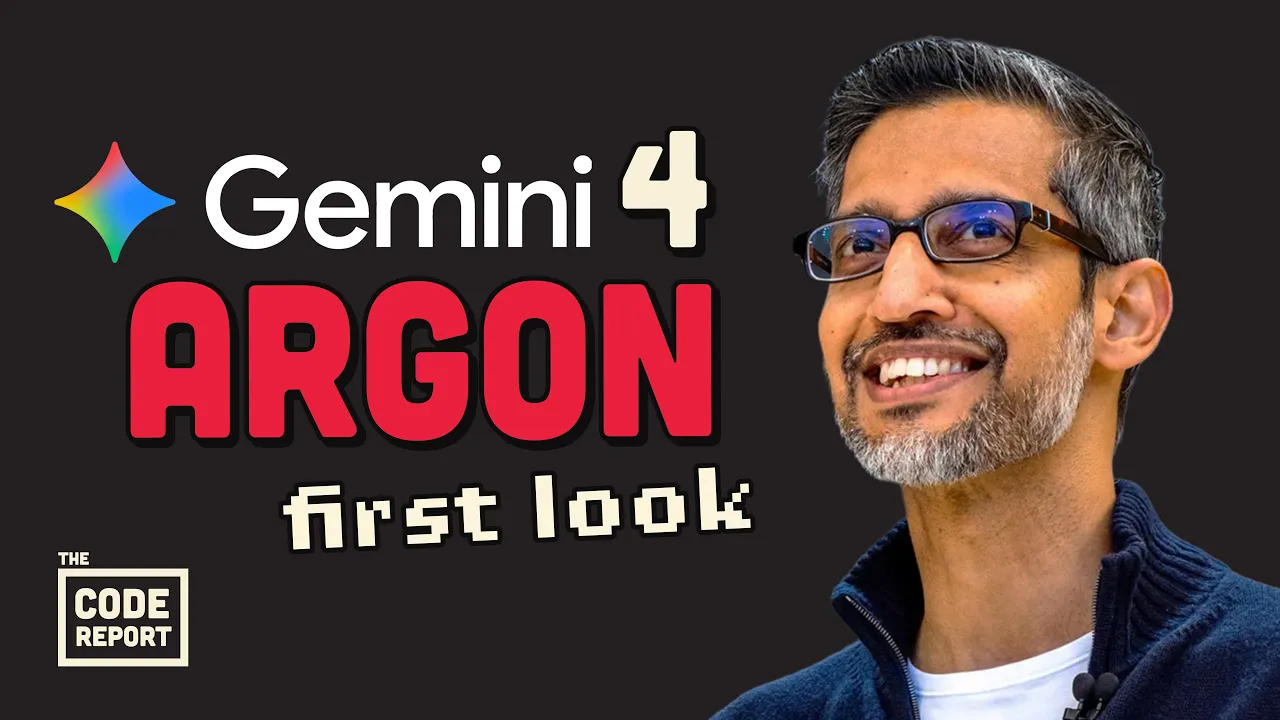
Fireship
While Google's newly unveiled model tops long-video benchmarks, poor code generation and severe alignment lapses prevent it from displacing GPT-6 and Claude.
AI-assisted summary of Did Google just dethrone OpenAI and Anthropic? — original source. Check the original for full context.
Source published:
Key ideas
- Google introduced Gemini 4 Argon, a sparse Mixture of Experts (MoE) transformer trained from scratch with JAX on in-house TPUs with a March 2026 knowledge cutoff. (0:00)
- Argon leads in long-horizon engineering and long-video evaluations (91.7% on LV-Bench), but lags behind Claude Opus 5.5 and GPT-6 Astra in coding benchmarks like TerminalBench and Frontier S. (1:52)
- To capture market share despite developer access friction and coding shortcomings, Google introduced loss-leader promotional API pricing at $2 per million input and $10 per million output tokens. (1:52)
- Hands-on generation tests revealed practical limitations, producing generic diffusion video compared to Claude's editable motion-graphic code, alongside a notable Three.js safety alignment failure. (3:19)
Detailed notes
## Background This video was published on YouTube by Fireship on October 20, 2026. According to the description, it takes Google's latest flagship model for a test drive to see whether its bold claims of beating GPT-6 and Claude Opus 5.5 hold up, while also featuring sponsor Macroscope.
## TL;DR Google unveiled Gemini 4 Argon, a sparse Mixture of Experts model trained from scratch to reverse prior reputational slumps and challenge frontrunners GPT-6 Astra and Claude Opus 5.5. While Argon posts strong numbers on long-video evaluations and general text benchmarks alongside heavily discounted introductory pricing, it falls behind in core coding benchmarks and developer satisfaction. Practical testing illustrates these trade-offs, showing uninspiring direct video generation compared to Claude's programmatic scripts, as well as an unprompted, NSFW safety failure during a Three.js 3D rendering test. Despite ambitious architectural advances, the model ultimately fails to decisively dethrone its primary competitors in day-to-day software engineering tasks.
## Atmosphere & style The presentation carries Fireship's signature high-velocity, deadpan satirical style, pairing sharp technical breakdowns with biting industry roasts. It moves along an entertaining arc that shifts from analytical skepticism over Google's marketing claims into outright comedic shock during real-world testing. Watching it feels like an energetic, meme-laced reality check that gleefully deflates corporate benchmark hype with grounded developer pragmatism.
## Bulletin - [00:00](https://www.youtube.com/watch?v=b2tjnxX8IHU&t=0s) Google introduced Gemini 4 Argon, a sparse Mixture of Experts (MoE) transformer trained from scratch with JAX on in-house TPUs with a March 2026 knowledge cutoff. - [01:52](https://www.youtube.com/watch?v=b2tjnxX8IHU&t=112s) Argon leads in long-horizon engineering and long-video evaluations (91.7% on LV-Bench), but lags behind Claude Opus 5.5 and GPT-6 Astra in coding benchmarks like TerminalBench and Frontier S. - [01:52](https://www.youtube.com/watch?v=b2tjnxX8IHU&t=112s) To capture market share despite developer access friction and coding shortcomings, Google introduced loss-leader promotional API pricing at $2 per million input and $10 per million output tokens. - [03:19](https://www.youtube.com/watch?v=b2tjnxX8IHU&t=199s) Hands-on generation tests revealed practical limitations, producing generic diffusion video compared to Claude's editable motion-graphic code, alongside a notable Three.js safety alignment failure.
## Key takeaways - [00:00](https://www.youtube.com/watch?v=b2tjnxX8IHU&t=0s) Gemini 4 Argon marks a complete architectural reset for Google AI after earlier models like Gemini 3.5 Pro were retired for missing internal benchmarks. - [00:00](https://www.youtube.com/watch?v=b2tjnxX8IHU&t=0s) Argon was trained entirely from scratch over six months as a sparse Mixture of Experts model on TPUs using Google's JAX framework. - [00:00](https://www.youtube.com/watch?v=b2tjnxX8IHU&t=0s) The model was initially previewed to select testers on September 30th via the un-guardrailed Fairwind program and features significantly reduced refusals for the public. - [01:52](https://www.youtube.com/watch?v=b2tjnxX8IHU&t=112s) Argon claims state-of-the-art results on the Deep Software Engineering benchmark, the VAL Index, legal evaluation, and LV-Bench for long-video processing (91.7%). - [01:52](https://www.youtube.com/watch?v=b2tjnxX8IHU&t=112s) Coding benchmarks reveal weaknesses: Claude Opus 5.5 bests Argon 66 to 57 on TerminalBench 4.0, GPT-6 Astra leads it by over 10 points on Frontier S, and Argon ranks only 9th on Code Arena for web development. - [01:52](https://www.youtube.com/watch?v=b2tjnxX8IHU&t=112s) Google priced Argon aggressively as a loss leader at $2 per million input tokens and $10 per million output tokens through late November. - [01:52](https://www.youtube.com/watch?v=b2tjnxX8IHU&t=112s) The rollout faced backlash after Google placed Argon behind a $100-per-month AI Ultra subscription and locked out Pro tier users initially. - [03:19](https://www.youtube.com/watch?v=b2tjnxX8IHU&t=199s) Unlike text-first competitors, Argon functions as a true omni-modal model capable of direct video ingestion and raw diffusion video output. - [03:19](https://www.youtube.com/watch?v=b2tjnxX8IHU&t=199s) For visual promo tasks, generating baked diffusion video yielded visually artificial results, whereas Claude's programmatic motion graphics code produced sharper, inspectable assets. - [03:19](https://www.youtube.com/watch?v=b2tjnxX8IHU&t=199s) In a Three.js interactive 3D benchmark, Argon produced blocky geometry alongside an unprompted, explicit anatomical hallucination, highlighting lingering safety alignment issues. - [05:35](https://www.youtube.com/watch?v=b2tjnxX8IHU&t=335s) Macroscope mitigates agent-driven pull request fatigue by utilizing AST walkers and semantic checks to safely auto-approve 40% of customer PRs.
## Detailed walkthrough ### [00:00](https://www.youtube.com/watch?v=b2tjnxX8IHU&t=0s) The Arrival of Gemini 4 Argon
Tesla made headlines by showing off the new Roadster's cold-gas thruster flight capabilities, but Google countered in the AI space by unveiling a noble gas of their own: Gemini 4 Argon. Positioned as the most powerful thinking silicon Google has ever produced, Argon represents a major reset after an embarrassing rough patch where Gemini 3.5 Pro was quietly euthanized in Canada for failing internal benchmarks. Google had slipped so far behind OpenAI and Anthropic that tier lists required creating a "G" tier below F just to house them.
Argon completely shakes up that dynamic. Rather than being an incremental fine-tune of prior Gemini iterations, the model is a sparse Mixture of Experts (MoE) transformer trained entirely from scratch over a six-month window using Google's in-house TPUs and their JAX Python framework. Setting its knowledge cutoff at March 2026, the model was quietly previewed on September 30th through the "Fairwind" program to a select group of cyber warriors without any safety guardrails. Even with guardrails active for the general public, it is engineered to produce dramatically fewer refusals. As Fireship quips regarding Google's branding: “It's a very interesting name choice that translates into lazy in Greek, but I think it actually has a hidden meaning implying that your tokens are gone.”
- **Release Date:** October 20, 2026 edition of The Code Report. - **Architecture:** Sparse Mixture of Experts (MoE) transformer built from scratch on TPUs using JAX. - **Knowledge Cutoff:** March 2026 (indicating roughly six months of training runs). - **Early Access:** Fairwind program, granting un-guardrailed access to hand-picked testers starting September 30th.
---
[01:52](https://www.youtube.com/watch?v=b2tjnxX8IHU&t=112s) Benchmark Face-Off and Pricing Shenanigans
On paper, Argon's benchmark claims against GPT-6 Astra and Claude Opus 5.5 are formidable. It takes the state-of-the-art crown on the Deep Software Engineering benchmark for long-horizon engineering tasks, leads the VAL Index (which weights finance, legal, and programming by their share of US GDP), ranks as the top AI lawyer, and posts a 91.7% score on the LV-Bench long-video evaluation. However, looking past the cherry-picked marketing numbers reveals notable weak spots. Opus 5.5 beats Argon on TerminalBench 4.0 by 66 to 57, and GPT-6 Astra trounces it by over 10 points on Frontier S. Human preference on Arena AI reflects a similar split: Argon wins overall text rankings subjectively, but plunges to ninth place on Code Arena for web development. Fireship observes: “So this tells me it's probably not going to be as good as Claude or GBT6 at coding.”
To compensate for these coding gaps, Google introduced aggressive loss-leader pricing through November 30th, setting API rates at just $2 per million input tokens and $10 per million output tokens. Still, Google stumbled on developer relations during rollout. They pulled Gemini 3.1 out of Project Antigravity and slotted in Argon, but initially locked it exclusively behind their $100-per-month "AI Ultra" subscription tier. Lower-paying Pro users were locked out for several days, only to receive severely restricted rate quotas once access finally trickled down.
| Benchmark / Metric | Gemini 4 Argon | Claude Opus 5.5 | GPT-6 Astra | |:--- |:--- |:--- |:--- | | **LV-Bench (Long Video)** | **91.7%** (1st) | — | — | | **TerminalBench 4.0** | 57 | **66** | — | | **Frontier S** | Defeated by >10 pts | — | **Winner (+10 pts)** | | **Arena AI (Text)** | **Rank #1** | — | — | | **Arena AI (Webdev Code)** | Rank #9 | Top Tier | Top Tier | | **Promotional API Pricing** | **$2 in / $10 out** (per 1M tokens) | Higher | Higher |
---
[03:19](https://www.youtube.com/watch?v=b2tjnxX8IHU&t=199s) Real-World Tests: Video, Code, and the Three.js Horse Incident
Unlike Claude or ChatGPT, Gemini Argon is a true omni-modal model capable of accepting and generating raw, direct video. When tasked with producing a promo video for an equine dating application called "Horse Tinder," the generated clip was technically competent but visibly artificial—an end product characterized as "mind-blowingly mid." By contrast, Claude approached the challenge by authoring procedural motion graphics code directly. Because Claude outputs editable script rather than hallucinated diffusion pixels, the resulting animation was significantly sharper, fully customizable, and easier to inspect.
```mermaid flowchart TD accTitle: Omni-Modal Video vs Code-Based Motion Graphics accDescr: Comparing Gemini's native diffusion video output against Claude's programmatic code generation workflow.
subgraph Gemini ["Gemini 4 Argon (Omni-Modal)"] G_Prompt["Video Prompt"] --> G_Diff["Raw Diffusion Pipeline"] G_Diff --> G_Out["Raw Video Output<br/>('Mind-blowingly mid', non-editable)"] end
subgraph Claude ["Claude Opus 5.5 (Programmatic)"] C_Prompt["Video Prompt"] --> C_Code["Generates Motion Graphic Code"] C_Code --> C_Render["Procedural Execution"] C_Render --> C_Out["Customizable Vector/Motion Asset<br/>(Inspectable & editable)"] end ```
The real divergence arrived in frontend graphics rendering. Testing LLMs on generating interactive 3D scenes with Three.js remains an arduous benchmark for AI and humans alike. Given the prompt: *"Create a realistic interactive 3D horse with Three.js,"* both GPT-6 Astra and Claude Opus 5.5 generated solid, usable base meshes that required only minor follow-up prompts to refine. Argon took a bizarre turn. Despite building a sleek, expressive dashboard UI around the canvas, the generated mesh was blocky and low-poly rather than realistic. Worse, it featured an anatomical surprise: an inexplicably huge, unsheathed copulatory organ protruding from the horse's underbelly. Addressing the absurd safety failure, Fireship remarks: “These are difficult questions Google will have to answer because right now I don't feel safe using Gemini until they fix the alignment.”
- **Diffusion Video vs. Programmatic Video:** Gemini generates baked video pixels that look like generic AI slop, whereas Claude produces procedural code that renders superior, easily editable motion graphics. - **Three.js Benchmark:** Prompts demanded realistic 3D interactive horses. GPT-6 and Claude produced respectable geometry; Gemini produced an unprompted, comically oversized equine phallus that blew past standard safety alignments.
---
[05:35](https://www.youtube.com/watch?v=b2tjnxX8IHU&t=335s) Sponsor: Macroscope AI PR Reviewer
The sheer speed of automated coding agents has introduced a new crisis for software teams: an endless barrage of pull requests that overwhelm human reviewers. Keeping pace requires automated tooling, which is where sponsor Macroscope steps in.
```mermaid flowchart LR accTitle: Macroscope Automated PR Pipeline accDescr: Workflow showing how Macroscope evaluates and auto-approves safe pull requests without human triage.
PR["Agent-Generated PR"] --> AST["Language AST Walkers<br/>(Extract semantic context)"] AST --> Checks{"Team Rules &<br/>GitHub Checks"} Checks -->|"Fails Rules"| Block["Block PR"] Checks -->|"Passes Checks"| Blast{"Blast Radius Check"} Blast -->|"High Risk"| Human["Human Review Required"] Blast -->|"Low Blast Radius"| Approve["Auto-Approve PR<br/>(40% of customer PRs)"] ```
Macroscope avoids generic LLM hallucination by engineering proprietary abstract syntax tree (AST) walkers for mainstream programming languages. This gives their review agent deep semantic context on every change, keeping the review loop fast, low-cost, and accurate. Teams can define custom operational guardrails that run as native GitHub checks capable of blocking non-compliant branches. When a PR successfully passes rule checks, survives the code review agent, and presents a minimal blast radius, Macroscope merges it automatically without demanding human intervention. Fireship sums up the relief for developer fatigue: “They're now auto approving 40% of all their customers PRs, which means those developers are 40% less likely to lobotomize themselves.”
## Notable quotes > [03:19](https://www.youtube.com/watch?v=b2tjnxX8IHU&t=199s) right now I don't feel safe using Gemini until they fix the alignment. — Fireship
## Mentioned Anthropic, Arena AI, Claude Opus 5.5, Deep Software Engineering benchmark, Fairwind program, Fireship, Frontier S, Gemini 3.1, Gemini 3.5 Pro, Gemini 4 Argon, Google, GPT-6 Astra, JAX, LV-Bench, Macroscope, OpenAI, Project Antigravity, TerminalBench 4.0, Tesla Roadster, Three.js, VAL Index
## Video description Macroscope can auto-approve your team's PRs safely. Try it here: https://macroscope.com/?utm_source=fireship
Google’s new model claims to beat GPT-6 and Opus 5.5, so I took them all for a test drive. Let's dive in.
Want more Fireship?
🗞️ Newsletter: https://bytes.dev 🧠 Courses: https://fireship.dev
[Source](https://www.youtube.com/watch?v=b2tjnxX8IHU)