Jay Leno Declares Late-Night Television Dead as Audiences Migrate
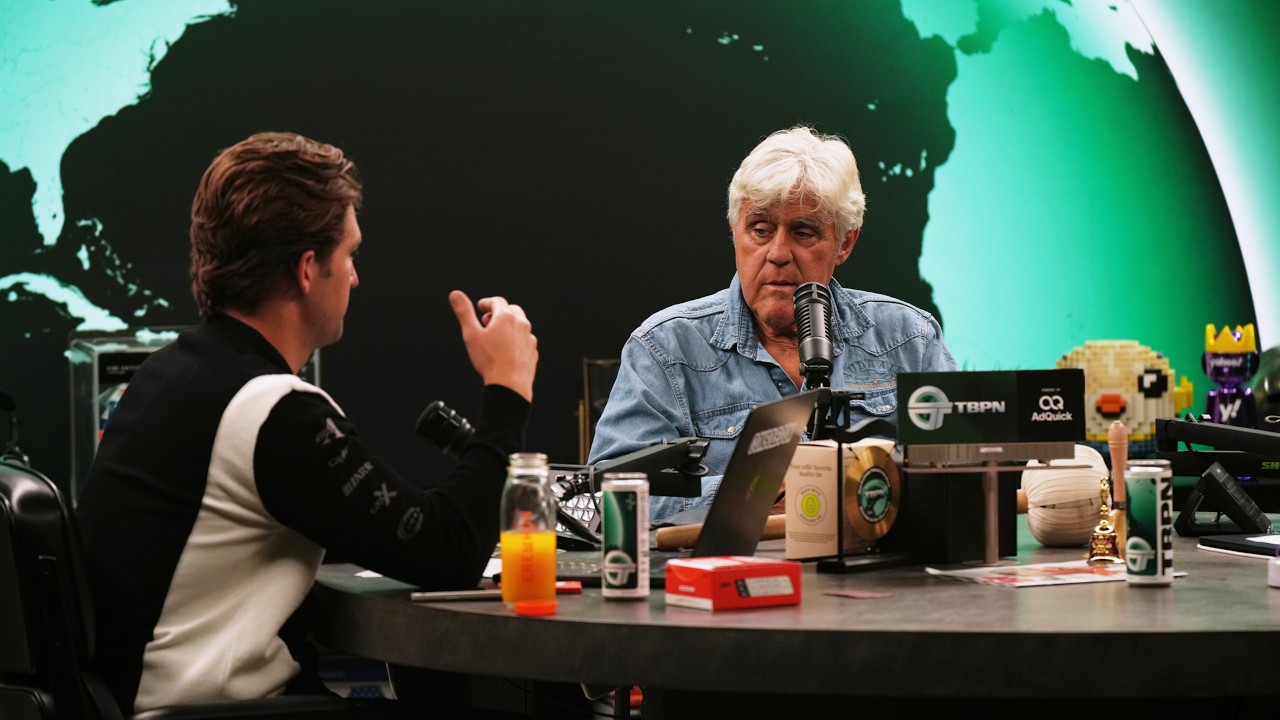
TBPN
Leno argues that late-night television has lost its cultural dominance due to excessive commercial blocks and audience fragmentation, making live stand-up touring the only way to receive genuine, unfiltered feedback.
AI-assisted summary of Jay Leno on Comedy, Supercars, and the State of Hollywood — original source. Check the original for full context.
Source published:
Key ideas
- Jay Leno warns that protectionist economic policies and tariffs threaten domestic competitiveness, arguing that cutting off access to global innovations will force the country to rely on outdated technology while foreign competitors advance. (50:00)
- Leno credits Detroit's automotive resurgence to post-bankruptcy restructuring that purged corporate marketing executives from home appliance companies and returned decision-making to practicing engineers. (5:20)
- Eliminating partisan political commentary from his stand-up routine produced an immediate 20% to 30% jump in ticket sales, reinforcing Johnny Carson's model of skewering both sides without alienating half the audience. (15:00)
- Escalating California location fees and production costs are accelerating an entertainment exodus, with companies like Mattel finding it cheaper to fly 175 crew members to Ireland for two months than shoot for two days in Leno's private Burbank garage. (17:28)
Detailed notes
## Background Published by TBPN on YouTube on October 20, 2026, this video features an in-depth interview with comedian and former Tonight Show host Jay Leno. According to the show description, the conversation explores what Leno learned from Johnny Carson, why late-night television is dying, how politics transformed comedy, why he refuses to retire from stand-up, his advice regarding AI, and what it takes to remain funny across decades in show business.
## TL;DR Jay Leno delivers an unvarnished assessment of comedy, the entertainment industry, and automotive culture, driven by a philosophy of continuous labor and self-skepticism. He details how commercial oversaturation, production costs, and political tribalism dismantled traditional late-night television, drawing contrasts with his balanced approach under Johnny Carson's guidance. Beyond television, Leno praises American automotive engineering while comparing electric hypercars to battery-powered quartz watches, arguing that true passion lies in mechanical tactile engagement. Rejecting vacations, endorsements, and the concept of retirement, he outlines why relentless road touring and hands-on garage restoration keep him sharp amid modern media fragmentation and technological shifts.
## Atmosphere & style The interview has the relaxed, unpretentious energy of a backstage greenroom or a mechanic's garage, kicking off with Leno good-naturedly roasting the hosts' DIY setup before rolling into rapid-fire anecdotes. Leno speaks with sharp, self-deprecating pragmatism, entirely devoid of Hollywood vanity and constantly deflating high-minded concepts into plainspoken, blue-collar analogies. The hosts maintain an engaged, admiring rhythm that lets Leno riff freely, transitioning smoothly from high-speed driving close-calls to the precise mechanics of joke construction and industrial history.
## Bulletin - [50:00](https://www.youtube.com/watch?v=cgM3ctXoSHE&t=3000s) Jay Leno warns that protectionist economic policies and tariffs threaten domestic competitiveness, arguing that cutting off access to global innovations will force the country to rely on outdated technology while foreign competitors advance. - [05:20](https://www.youtube.com/watch?v=cgM3ctXoSHE&t=320s) Leno credits Detroit's automotive resurgence to post-bankruptcy restructuring that purged corporate marketing executives from home appliance companies and returned decision-making to practicing engineers. - [15:00](https://www.youtube.com/watch?v=cgM3ctXoSHE&t=900s) Eliminating partisan political commentary from his stand-up routine produced an immediate 20% to 30% jump in ticket sales, reinforcing Johnny Carson's model of skewering both sides without alienating half the audience. - [17:28](https://www.youtube.com/watch?v=cgM3ctXoSHE&t=1048s) Escalating California location fees and production costs are accelerating an entertainment exodus, with companies like Mattel finding it cheaper to fly 175 crew members to Ireland for two months than shoot for two days in Leno's private Burbank garage.
## Key takeaways - [02:30](https://www.youtube.com/watch?v=cgM3ctXoSHE&t=150s) Leno credits his career longevity to self-skepticism and low self-esteem, demanding that crew members and junior interns openly critique his performance and veto stale or corny material. - [05:20](https://www.youtube.com/watch?v=cgM3ctXoSHE&t=320s) Detroit automakers achieved an engineering renaissance after bankruptcy removed consumer-goods marketing executives and empowered automotive engineers to build legitimate performance flagships like the Corvette ZR1. - [08:15](https://www.youtube.com/watch?v=cgM3ctXoSHE&t=495s) The automotive industry's EV transition mirrors the Swiss quartz crisis: electric vehicles will serve as utilitarian everyday appliances, while multi-cylinder combustion engines will survive as prized mechanical luxuries. - [10:00](https://www.youtube.com/watch?v=cgM3ctXoSHE&t=600s) The consumer landscape is polarizing into budget staples and ultra-luxury goods, hollowing out the middle class across hotels, sit-down dining, and sports cars. - [17:28](https://www.youtube.com/watch?v=cgM3ctXoSHE&t=1048s) Traditional network late-night television has collapsed under the weight of excessive commercial ad loads, on-demand streaming alternatives, and political tribalism. - [20:00](https://www.youtube.com/watch?v=cgM3ctXoSHE&t=1200s) Hostile partisan humor alienates audiences and ruins comedic timing, whereas light-touch ribbing of all political figures preserves rapport and broad appeal. - [20:00](https://www.youtube.com/watch?v=cgM3ctXoSHE&t=1200s) Continuous weekend stand-up touring served as Leno's reality check, preventing him from living inside an insular Hollywood studio bubble where reactions are cued by buttons. - [25:00](https://www.youtube.com/watch?v=cgM3ctXoSHE&t=1500s) Marketing concepts like the supercar 'Holy Trinity' are largely media-driven narratives, given that rapid engineering cycles allow modern base sports cars to match previous hypercars. - [30:00](https://www.youtube.com/watch?v=cgM3ctXoSHE&t=1800s) Leno avoided commercial spokesperson deals and distracting side businesses throughout his broadcast career to protect his credibility and master his core craft. - [30:00](https://www.youtube.com/watch?v=cgM3ctXoSHE&t=1800s) Live touring yields superior economics and protects comedy material compared to television specials, which burn through entire acts for a one-time flat payout. - [40:00](https://www.youtube.com/watch?v=cgM3ctXoSHE&t=2400s) Stand-up comedy is an unforgiving discipline requiring constant stage practice; stepping away erodes the timing and rhythm that make prepared material look spontaneous. - [45:00](https://www.youtube.com/watch?v=cgM3ctXoSHE&t=2700s) Modern media fragmentation has eroded shared national culture and created ideological echo chambers, while simultaneously shielding digital creators from intense mainstream celebrity. - [46:48](https://www.youtube.com/watch?v=cgM3ctXoSHE&t=2808s) Fears surrounding artificial intelligence mirror past industrial disruptions, such as Colt's mass manufacturing replacing local artisans, while modern digital tools preserve and democratize specialized technical knowledge. - [50:00](https://www.youtube.com/watch?v=cgM3ctXoSHE&t=3000s) Trade barriers and tariffs stifle technological progress by walling off access to foreign advancements, risking economic and technological stagnation.
## Detailed walkthrough ### [00:00](https://www.youtube.com/watch?v=cgM3ctXoSHE&t=0s) Studio Banter, McLarens, and the Fallacy of Race Driving
Jay Leno joins the show and immediately starts ribbing the hosts about their DIY production setup, cracking that it feels like they are "shooting porn" before explaining his detour getting there because his GPS misheard Cahuenga as Cochrane and routed him downtown. Asked what he drove over, Leno reveals he brought his 2012 McLaren MP4-12C, one of the earliest customer models produced. When the hosts ask how he responds to critics who label McLarens as just "the rich guy go fast car," Leno jokingly admits, “Well, I'm a rich guy and I go fast.”
Leno explains that his loyalty to McLaren stems from being involved from the company's inception and their exceptional, honest customer service. When he originally specced his car, he asked about carbon-fiber brakes, but the salesperson frankly advised against it upon learning it was for street use, saying he could save twenty grand. Six months later, the factory offered a power bump to 617 horsepower completely free of charge. Leno has since purchased a P1 and ordered the new W1 road car, declining the track-only variety because a tight leather racing suit is no longer flattering. He recounts a celebrity race where every driver was handed a Toyota Celica; Leno followed closely behind racing legend Dan Gurney, matching his braking and turn-in points until Gurney inexplicably disappeared from ahead, only to reappear in Leno's rearview mirror having completely lapped him. As Leno reflects on amateur drivers: “Driving is like sex. All men think they're good at it. They're not.”
- Driven car: 2012 McLaren (first-generation 12C platform). - Track vs. road: Leno prefers road specs over track-only models (like the track W1) because he considers himself an enthusiast mechanic rather than a racer. - Dan Gurney anecdote: Competing in identical Toyota Celicas, Gurney lapped Leno without Leno even realizing how he managed it.
---
[02:30](https://www.youtube.com/watch?v=cgM3ctXoSHE&t=150s) Formula 1, Work Ethic, and the Power of Low Self-Esteem
The discussion shifts to Formula 1's ongoing struggle for casual sports recognition. Unlike field or court athletes whose physical exertion and sweat are immediately visible, race car drivers make intense physical stress look effortless, leading casual viewers to dismiss it as mere circle driving. Leno ties this to modern life, where people inevitably assume everyone else's job is easy. On *The Tonight Show*, people assumed he worked twenty minutes a night reading three jokes, when in reality he arrived at 7:00 a.m. and left at midnight to screen films, read guest books, and conduct pre-interviews.
Leno attributes his entire career longevity to self-skepticism rather than supreme confidence, stating: “If you don't think you're the smartest person in the room, you just shut up and you pay attention.” Rather than surrounding himself with sycophants who sugarcoat poor output, he demanded staff who would openly critique him.
```mermaid flowchart TD accTitle: The Leno Production Feedback Philosophy accDescr: Diagram illustrating Jay Leno's approach to feedback on The Tonight Show driven by low self-esteem.
subgraph Mindset["Core Philosophy"] A["Low Self-Esteem Mindset"] --> B["Acknowledge you're not the smartest in the room"] end
subgraph Crew["Hiring Top Specialists"] B --> C["Best Director"] B --> D["Best Lighting Tech"] B --> E["Junior Interns"] end
subgraph Feedback["Actionable Critique"] C --> F["'Tell me when the show sucks'"] D --> F E --> G["'Stop the train' on dated/corny jokes"] F --> H["Iterate, fix, and improve material"] G --> H end ```
- Tonight Show schedule: Leno worked 7:00 a.m. to midnight daily instead of dropping in before tapings. - Production staffing rule: Surrounded himself with top directors and technicians specifically instructed to deliver unvarnished truths when material bombed.
---
[04:00](https://www.youtube.com/watch?v=cgM3ctXoSHE&t=240s) Rules of The Tonight Show and Generational Humor
The hosts bring up podcast rules, such as Joshua Citarella's rule against letting guests attack previous interviewees. Leno says guest-on-guest hostility was never an issue for him, but his cardinal rule gave anyone on staff license to halt a segment: “Well, the rule I had was anybody can pull a cord and stop the train.” He specifically relied on twenty-something interns to call out jokes that were corny, dated, or out-of-touch.
To illustrate, he recalls watching a television broadcast of The Rolling Stones on one of their endless comeback tours and commenting out loud that the band still looked fantastic. The production interns burst into laughter, pointing out that Mick Jagger and Keith Richards looked like decrepit old men playing guitars. Leno immediately accepted the note, realizing that from an objective, younger viewpoint, his reference point was hopelessly old.
- Core show policy: An open-door "stop the train" policy where interns had the authority to veto jokes for being stale or corny. - The Rolling Stones moment: Interns laughed at Leno's impression that the aging rock band looked youthful, forcing him to adapt his perspective.
---
[05:20](https://www.youtube.com/watch?v=cgM3ctXoSHE&t=320s) Detroit's Engineering Renaissance: Corvettes, Cadillacs, and Real Supercars
The conversation returns to performance cars, centering on the Corvette ZR1 and ZR1X. Leno crowns it the best performance bargain in automotive history, pointing out that for less than the sales tax on an exotic Italian supercar like a Ferrari, buyers get a vehicle with track performance that rivals dedicated race machinery. Furthermore, American supercars avoid the tech and regulatory pitfalls of ultra-boutique hypercars:
> “The nice thing about American supercars is... you get in with your phone or your devices and everything syncs up right away. You get in even McLaren or Koenigsegg, Bugatti. Hang on. Oh, my phone. I forgot about that. It doesn't quite work. And plus, you know, a lot of them don't meet emissions or don't crash standards. You do the phony Montana plate thing. Okay, now you're in jail.”
Leno argues that bankruptcy was the best thing that ever happened to Detroit because automakers cleared out corporate marketing executives who had crossed over from white-goods companies like Whirlpool and Maytag, handing the reins back to true engineers. As proof, GM President Mark Reuss tests vehicles at the Nürburgring every month, recently clocking 233 mph in the new Corvette. Cars like the ZR1 and the Le Mans-dominating Ford Mustang GTD sell out without advertising because legitimate motorsport bona fides sell vehicles organically, resurrecting the classic "race on Sunday, sell on Monday" ethos. Leno also highlights the Cadillac CT5-V Blackwing outside the studio, praising Cadillac for preserving manual gearboxes when Ferrari, BMW, and Lamborghini have largely abandoned them.
- Corvette ZR1 value: Delivers world-beating track capabilities for less than the sales tax charged on an exotic European hypercar. - Detroit leadership: Automotive engineers replaced corporate marketing personnel who treated cars like home appliances. - Executive speed: General Motors President Mark Reuss personally piloted a Corvette to 233 mph at the Nürburgring. - Cadillac stick-shift trivia: Cadillac offered no manual transmissions from 1948 until the modern V-Series/Blackwing models resurrected them.
---
[08:15](https://www.youtube.com/watch?v=cgM3ctXoSHE&t=495s) Synthetic Manuals, Modern Enthusiasts, and the Quartz Crisis
Asked for his opinion on simulated, manual-by-wire transmissions in performance EVs, Leno holds nothing back: “Well, it's the same thing I think of a blow-up doll. If you can't get a real girl, I guess it's okay. I mean, it's kind of embarrassing, and I hope nobody sees you.” While youths might encounter simulated manuals first, Leno observes that modern car enthusiasts are far more educated and technically capable than his peers were growing up. Decades ago, young men posed as motorheads purely to impress girls while knowing very little under the hood.
Today, YouTube tutorials and technical teardowns have cultivated serious, hands-on enthusiasts across genders. He mentions actress Sydney Sweeney, who worked as an apprentice fabricator for classic Porsche builder Rod Emory and knows how to weld and assemble machinery from the chassis up.
Finally, the hosts compare the auto industry's current transition to the Swiss watch industry's quartz crisis of the 1970s and 1980s. Leno agrees with the analogy: electric vehicles will serve as utilitarian everyday appliances—the quartz watches of mobility—while purely mechanical, internal-combustion vehicles will be preserved as high-end weekend recreational playthings, treated like vintage mechanical timepieces or snowmobiles where enthusiasts will obsess over valves, camshafts, and tactile engagement.
- Sim-manual critique: Leno views drive-by-wire or synthesized manual setups as an embarrassing substitute for physical gearboxes. - Sydney Sweeney: Emphasized as a real-world example of dedicated young enthusiasts, having apprenticed as a fabricator and welder under Rod Emory. - Quartz crisis comparison: Electric vehicles will occupy the role of reliable, appliance-like quartz watches, while high-cam, multi-valve mechanical ICE supercars will survive as hobbyist weekend recreational machinery.
[10:00](https://www.youtube.com/watch?v=cgM3ctXoSHE&t=600s) Mechanical Watches, Sports Cars, and the Disappearing Middle Class
The conversation begins with an analogy between wristwatches and manual sports cars. A quartz watch from Timex or Citizen that costs $50 is vastly more accurate than a mechanical timepiece because it is electronic, yet Jay Leno explains that the appeal lies in the tactile engagement of winding it and feeling the mechanism work. He connects that tactile sensation directly to automotive preferences: although his Dodge Demon or an automatic 10-speed Challenger will accelerate quicker, he prefers driving his six-speed manual Challenger because he enjoys operating a stick shift. He also mentions his appreciation for historic driver’s watches, noting that he owns a Vacheron Constantin Historiques 1921 and released an official Jay Leno watch that sold out across multiple production runs.
Turning to motorsports and track driving in an era of self-driving vehicles, Leno expresses deep concern that automotive culture is dividing sharply along wealth lines. He points out that Porsche appears to be adopting the Ferrari business model—producing fewer units for vastly more money sold to a smaller, wealthier clientele. In past decades, Ferraris were garage queens driven 800 miles while Porsches regularly racked up 60,000 miles, competing directly with Corvettes in performance shootouts. Today, Leno observes buyers purchasing a 911 GT3 only to lock it away as an investment. In contrast, he praises the Chevrolet Corvette as an accessible, aspirational achievement:
> “The great thing about Corvette is it's an aspirational car. If you're a guy with your own plumbing business, oh, you can aspire to own—yeah, it's over 100,000. But it's not a million. So at some point in your life, you can get one. And that's what I like about it.”
Leno sees this polarization across modern society as a whole, observing that everyday middle-tier staples are vanishing: - **Hotels:** Lodging has polarized into either basic budget motels like Motel 6 or ultra-luxury resorts like the Four Seasons. - **Dining:** The restaurant ecosystem has split between fast food and high-end dining, hollowing out casual family sit-down chains like Applebee's and Denny's. - **Automotive:** Sports cars are increasingly bifurcated between unobtainable supercars and everyday transport.
```mermaid flowchart LR accTitle: Hollowing out of the middle class accDescr: Diagram illustrating how intermediate options in hospitality, dining, and cars are being replaced by extreme bifurcations. subgraph Mass["Lower / Mass Tier"] M1["Motel 6"] M2["Fast Food"] M3["Commuter EVs / Base Cars"] end subgraph Vanishing["Vanishing Middle Tier"] V1["Mid-Scale Hotels"] V2["Applebee's / Denny's"] V3["Corvette / Usable Sports Cars"] end subgraph Luxury["Ultra-Luxury Tier"] L1["Four Seasons"] L2["High-End Fine Dining"] L3["Ferrari / Million-Dollar Exotics"] end Vanishing -.->|"Market Squeeze"| Mass Vanishing -.->|"Price Hikes"| Luxury ```
[12:35](https://www.youtube.com/watch?v=cgM3ctXoSHE&t=755s) Los Angeles Potholes and the Allure of Mechanical Supercars
The discussion turns to driving conditions in Southern California. Despite Los Angeles having consistently mild weather—unlike Detroit, where freeze-thaw cycles and frost heaves naturally break up asphalt—Leno and the hosts note that local roads remain notoriously degraded. Heavy modern electric vehicles suffer disproportionately; Leno notes he has personally suffered five tire blowouts from hitting deep street craters. The hosts laugh about drivers treating Mercedes G-Wagens like necessary off-road survival vehicles just to navigate city commutes, noting how one friend joked about filling potholes with dirt and flowers overnight as guerrilla performance art to shame the city.
Evaluating high-end electric performance vehicles like the Porsche Mission X concept and the Rimac Nevera, Leno equates electric hypercars to quartz watches. While an electric Porsche or Rimac is undeniably fast, it lacks the emotional tactile feedback that collectors crave. Leno notes that although the Rimac costs $2.5 million more than a Tesla Model S Plaid, it is only about a tenth of a second quicker in a straight line, offering no visceral gear shift or mechanical drama. He reflects on how the industry backed away from universal mandates to go fully electric by 2030, predicting that ultra-wealthy buyers will gravitate increasingly toward highly complex, multi-cylinder mechanical engines:
> “Now I think you'll have your high-end, extremely complicated mechanical cars, which is what people like. The more valves, the more pistons, more weather.”
[15:00](https://www.youtube.com/watch?v=cgM3ctXoSHE&t=900s) Tesla’s Shift, Late-Night Politics, and Carson's Golden Rule
When asked about Elon Musk’s demonstrations for the upcoming Tesla Roadster, including wild claims of rocket thrusters allowing the vehicle to hover or perform kick-flips, Leno interprets the spectacle as Tesla pivoting from being a standard car company into a space and autonomous-vehicle enterprise. Facing intense manufacturing competition from cheaper Chinese electric vehicles and blowback from Musk’s political involvement, Leno argues that vehicle manufacturing alone will struggle to maintain margins, prompting Tesla's focus toward robotics, autonomy, and space technology.
The conversation transitions to television and how Leno navigated political pressure during his decades as host of *The Tonight Show*. While contemporary late-night hosts are expected by their peers and partisan audiences to pick a political tribe, Leno adhered strictly to Johnny Carson’s philosophy of skewering both sides without taking personal stances. Leno recounts that performing in Hollywood guarantees applause for partisan jokes, but nationwide touring reveals an entirely different audience dynamic:
> “When both sides like you and hate you at the same time, well, then you know you're doing something right.”
He explains that after observing audience fatigue, he deliberately removed partisan political material from his stand-up routine, causing his ticket sales to jump 20 to 30 percent. He likens comedy fans to concertgoers: when someone buys a ticket to hear James Taylor sing *Sweet Baby James*, they came for the music, not an unprompted lecture about saving the rainforest.
[17:28](https://www.youtube.com/watch?v=cgM3ctXoSHE&t=1048s) The Death of the Talk Show Format and Hollywood Production Flight
Leno declares that the classic network late-night television format is effectively dead, with audiences migrating to podcasts. He dismisses nostalgic claims that he or David Letterman possessed unique magic, arguing they simply benefited from an era when broadcast television commanded undisputed national attention. The network model ultimately eroded itself through commercial greed: as late-night viewership declined, regulations relaxed to allow roughly eight extra minutes of advertisements per hour after 11:30 PM. Leno laments trying to sit through modern monologues that are interrupted by six-minute commercial pods packed with cinematic, high-budget 30-second spots.
Because modern audiences consume media on demand with targeted advertising, Leno notes that broad cultural touchstones—like iconic Super Bowl commercials, the Budweiser Clydesdales, or the Coca-Cola polar bears—no longer unify national conversations. The only live television formats retaining commercial clout are sports and breaking news.
Leno concludes by discussing how runaway production costs and regulatory fees are driving American entertainment offshore: - **Game show relocations:** American networks routinely fly entire production crews, contestants, and audience members to Ireland to film game shows because doing so remains cheaper than filming domestically. - **The Mattel Hot Wheels experience:** Leno recalls working on a Hot Wheels television program for Mattel. To cut expenses, he donated his own Burbank garage as a filming location in exchange for a charitable donation. Despite using a free private garage, Mattel determined it was cheaper to fly 175 crew members to Ireland, house them for two months, and pay their per diems than to shoot for two days in Leno's garage in California. - **Municipal fees in Los Angeles:** Municipal filming permit formulas penalize local productions, where turning from Cahuenga Boulevard onto an adjacent street triggers an immediate jump from $5,000 to $7,500 in added city location fees.
[20:00](https://www.youtube.com/watch?v=cgM3ctXoSHE&t=1200s) The Relentlessness of Show Business, Time Slots, and Staying Out of the Bubble
Jay Leno dismisses the idea that the grind of show business—working 7:00 a.m. to midnight—is truly relentless or unbearable compared to working a normal job. Having held "real jobs" that actually sucked, he points out that people like police officers and nurses face grueling days where they get beat up, injured, and make only $400 a week, whereas performers are compensated extraordinarily well for their trouble. Leno warns newcomers about the transactional nature of the entertainment industry, using an unsentimental analogy: “I always tell guys, don't fall in love with a hooker, because that's what show business is.” He explains that things will inevitably end badly, but if you handle it right, you walk away with a massive stack of cash. To illustrate the madness of wealth in Hollywood, Leno brings up his favorite joke about Charlie Sheen burning through $200 million: Sheen spent it on cocaine, gambling, and women, and simply wasted the rest.
The discussion shifts to how late-night time slots—such as 10:30 p.m., 11:30 p.m., or 12:30 a.m.—traditionally dictated comedy material and tone. Leno explains that demographics vary radically by the hour: late-night viewers skew toward college kids, the unemployed, or older viewers nursing ailments, which is why commercial blocks are filled with ads for Advil and other pain relievers. The hosts note that modern creators get instant validation or critique via text messages, live chat feeds, and reviews, while traditional TV hosts could easily end up isolated in an artificial studio bubble. Leno explains that he deliberately avoided that trap by touring stand-up comedy venues every single weekend: in a studio, someone presses a button to cue laughter and applause, but on the road, you immediately learn what people genuinely find funny, fair, or unfair.
```mermaid flowchart TD accTitle: Feedback Loops in Comedy accDescr: Contrasting studio audience reactions with real road stand-up testing.
subgraph Studio["Studio Environment (The Bubble)"] A["In-Studio Taping"] --> B["Cue Buttons / Studio Prompts"] B --> C["Guaranteed Applause & Laughs"] C --> D["Artificial Feedback"] end
subgraph Road["Weekend Stand-Up (Reality Check)"] E["Live Road Gigs"] --> F["Unfiltered General Public"] F --> G["Genuine Laughter or Silence"] G --> H["Refined, Pure Material"] end ```
When asked whether he misses being on television to cover Donald Trump, Leno responds negatively, emphasizing that comedy requires a light touch rather than deep personal contempt. He argues that genuine animosity ruins the humor: “When you truly dislike a guy, it's hard to be funny.” He draws a sharp contrast with how he approached George W. Bush: - Instead of calling a politician stupid or a jerk, Leno would subtly suggest, "I don't think President Bush quite understands," which gave the audience permission to giggle. - He compares overtly hostile political humor to a comic who recently went through a bitter divorce and angrily brings up his ex-wife on stage—the audience withdraws because the bitterness kills the laugh. - Regarding his relationships with real-world targets, Leno confirms he got along well with almost everyone he joked about or criticized on the air, noting that was simply the nature of the job.
[25:00](https://www.youtube.com/watch?v=cgM3ctXoSHE&t=1500s) Repeatable TV Bits, the Supercar "Holy Trinity," and Turning Down Endorsements
Leno and the hosts delve into the value of franchise comedy segments on late-night television. While David Letterman had the Top Ten List, *The Tonight Show with Jay Leno* leaned into recurring staples like "Headlines" and "Jaywalking." Leno emphasizes that they never used ringers or actors on the street; they would interview only about twenty real people a night and air sixteen of them. He highlights the hilarious, authentic ignorance they encountered—such as asking pedestrians how Mount Rushmore was formed and having someone earnestly answer "erosion," believing the wind and rain had miraculously carved five presidents in perfect order. He warns, however, that comics can be inherently lazy by clinging to a joke that worked in Denver two years ago; if a bit stops working, you either drop it or move to Denver.
Turning to automobiles, the hosts ask Leno whether the historic supercar "Holy Trinity" (the McLaren P1, Porsche 918 Spyder, and Ferrari LaFerrari) is about to be replaced by a new generation featuring the McLaren W1, Ferrari F80, and Porsche Mission X. Leno is skeptical of the concept altogether: - He argues that the label is largely an invention used to sell car magazines and give people tribal sports-like arguments over whether their dad preferred Ferrari or the color red. - Leno points out that automotive engineering evolves so fast that a modern standard Porsche 911 GT3 is already faster than the million-dollar Porsche 918 Spyder was. - He recalls past benchmarks, such as Carroll Shelby taping a $100 bill to the dashboard of a 427 Cobra and challenging passengers to grab it during hard acceleration (nobody ever could), or early Aston Martins hitting 0-60-0 mph in nine seconds—performance numbers that an everyday Nissan Altima can match today.
The conversation touches on the publishing world, where Leno remarks on the decline of magazines (aside from publications like *The Economist* or *The Financial Times*) and the curious boom in high-end coffee table books. He pokes fun at celebrity children's books, dismissing vanity projects with fifteen words and an illustrator as simple pamphlets or flashcards rather than actual books. Defending his own work, Leno mentions his successful, legitimate children's book, *If Roast Beef Could Fly*, which drew from a true childhood story and included an accompanying CD. Finally, Leno shares that he routinely turned down lucrative commercial offers at the peak of his career—including a $1 million offer to hold up a Budweiser beer can on television. Since he doesn't drink, he refused to promote beer to the public, concluding that when you are on television every night, you cannot afford to get greedy.
[30:00](https://www.youtube.com/watch?v=cgM3ctXoSHE&t=1800s) Staying in Your Lane: Commercials, Side Hustles, and the Pure Craft of Comedy
Jay Leno explains why he avoids acting as a commercial spokesperson, pointing out that seeing celebrities pitching products immediately makes him skeptical: “I don't need to be on TV when I'm in commercials in between when I'm on TV. To come off TV and go, hi, I'm Jay Leno. My favorite is, hi, I'm so-and-so. I'm here to tell you about, no, shut up. I don't care really what a celebrity has to say. It just makes me like, you don't know what you're talking about.” When asked about pursuing behind-the-scenes ventures—contrasting his approach with Johnny Carson’s apparel deals—Leno notes that he does run a car accessory business producing polishes and car care products with real shelf life, but he launched that venture only after his tenure on *The Tonight Show* ended. Throughout his career, people constantly pitched him half-baked ideas like "watermelon on a stick," but he always preferred to stick to what he excelled at: “I make money doing this. This seems to pay extremely well. I will stick with this.”
```mermaid flowchart TD accTitle: Leno's Focus on Core Competencies accDescr: Diagram illustrating the danger of distracting side hustles versus mastering your primary craft. subgraph Distractions["Distractions & Detours"] A["Optometrist"] -->|"Opens hot dog stands"| B["Loses optometry practice"] C["Barber"] -->|"Focuses on overnight AI project"| D["Neglects hair-cutting craft"] E["Comedian"] -->|"Wants to act, sing, or get serious"| F["Dilutes comedic impact"] end subgraph LenoApproach["Leno's Focus"] G["Stand-Up Comedy"] -->|"Write the joke & master the stage"| H["High earnings & career longevity"] end ```
To illustrate the danger of getting distracted by side ventures, Leno recalls an optometrist friend who dreamed of opening a hot dog stand. After opening a first location and then a second across town where foot traffic was higher, the friend ended up neglecting and losing his optometry business. Leno’s host shares a similar pet peeve: sitting in a barber’s chair with scissors snipping around his head while the barber pitches an overnight AI startup, when all the customer wants is for the barber to be obsessively focused on cutting hair. Leno agrees, lamenting that stand-up comics often try to pivot away from their core craft into acting, singing, or serious lectures: “In my business, it's nothing harder than writing a joke. I see comedians, 'Hi, I'm so-and-so, but I'm being serious now and I want to do a special on it.' Well, no, there are people that do this better than you. Write the joke, just that's what you do.”
- Leno and Jerry Seinfeld shared a running philosophy to avoid vacations entirely: “Seinfeld and I always used to say, what if we went on vacation and we liked it? Then we'd be screwed so we don't go on vacation.” - Stand-up comedy offers unmatched logistical simplicity compared to music or theater: no rehearsals, no backing band to replace if a musician gets drunk, just flying in, doing the set, and getting paid. - Leno points out the superior economics of touring versus taping a televised special: doing an HBO special pays a flat rate where you earn a fraction of a cent per viewer while burning your material, whereas playing 100 live dates earns double the money at $25 to $50 per ticket without giving the material away for free.
---
[35:00](https://www.youtube.com/watch?v=cgM3ctXoSHE&t=2100s) Touring Non-Stop, Depression-Era Work Ethic, and Why Retirement Means Having a Stroke
Leno describes his relentless touring rhythm, revealing that he is performing 200 dates this year alone. Even while hosting *The Tonight Show*, he booked around 140 dates annually by working weekends or flying out to Las Vegas for mid-week casino gigs right after taping the show. He travels exclusively by plane, avoiding tour buses entirely, and pairs his stage work with manual labor in the garage: “You know, that's that old saying that heart is healthy. That's where the head and the hands work together. You work all day or something. Oh, then you stand on stage and go, this is so much easier than putting a transmission in.” When writing, Leno relies entirely on his memory rather than notes because of his dyslexia, keeping jokes brief and punchy. He shares a favorite classic bit: a patient complains to his doctor that pressing his rib cage, forehead, cheekbone, and shoulder all cause excruciating pain, prompting the doctor to inform him that his finger is broken.
His compulsive drive to keep working stems directly from his upbringing: “I had Depression-era parents, yeah, and if I don't work this week, I think I'm broke.” Leno jokes that although he has a pool at his house, he hasn't gone swimming in it for 30 years because resting makes him feel guilty:
> “Every time I get near the pool, I hear, oh, is that what you do? You're a rich guy now? You sit in the pool? Okay. You're like, well, you got nothing broken here? All right. Yeah, I'm fine. You got the McLaren. You're the rich guy that goes fast. I go back. Well, the McLaren, I'm driving it to fix it. See, I justify. Sure, sure. There's no way to justify sitting in the pool. You got no time. The only time I did sit in the pool is when I went in to fix the light.”
Leno recounts taking his McLaren F1 or SLR out after doing a corporate show for McDonald's, where he was paid partly in a stack of Happy Meal coupons. Refusing to let them go to waste, he pulled into a drive-thru and ordered two Happy Meals, only for the worker to inform him of a strict policy limiting orders to one Happy Meal per customer. When the worker recognized him, the manager came out wearing a paper hat to offer a special exception, drawing a crowd of kids as the car's dihedral door swung up. Leno overheard another customer remark that Jay Leno was arguing over a Happy Meal, finding the entire surreal misunderstanding hilarious.
- Leno enjoys fame and interacting with the public, summarizing celebrity status as “like high school with money.” - While he likes chatting with everyday people, attending car events like the Pebble Beach Concours d'Elegance becomes overwhelming because every single attendee wants to talk cars, making it take four hours to walk a single mile. - Leno completely rejects the idea of retirement: “When you have the stroke, that's when you retire.” He questions what retirees actually do with their time—drink or gamble—arguing that if comedy is your passion and what you find funny, there is no reason to quit.
[40:00](https://www.youtube.com/watch?v=cgM3ctXoSHE&t=2400s) The Mechanics of Comedy, Evolving Tropes, and Audiences
Jay Leno explains why stand-up comedy is an unforgiving craft that cannot easily be paused and resumed. When an artist steps away from the stage, expectations compound: people expect a return to be far better, unaware of the hidden labor behind a routine. Audiences often assume a comic is speaking off the cuff, whereas in reality, every line has been honed and delivered a million times. Being on stage daily makes performing second nature; doing it only once a month leaves a comedian vulnerable to distraction. Leno mentions Eddie Murphy's long-discussed plan to return to stand-up, noting how difficult it is to find a low-stakes room to work out new material when every appearance becomes an event.
```mermaid flowchart TD accTitle: Stand-Up Routine Development vs Audience Perception accDescr: Chart contrasting audience assumptions about stand-up with the actual development cycle of stage practice and television delivery.
subgraph Perception["Audience Assumption"] P1["Spontaneous monologue off the top of comic's head"] P2["Tv material is brand-new on first delivery anywhere"] end
subgraph Reality["Actual Comedy Process"] R1["Nightly practice at clubs (e.g. Comedy & Magic Club)"] R2["Honing, rewriting, and rebuilding comedic muscle"] R3["First broadcast delivery on national television"] end
R1 --> R2 --> R3 Reality -.->|"Misunderstood as"| Perception ```
Leno recalls doing a national show like Jimmy Fallon's after running material at the Comedy & Magic Club, only for an audience member to complain that the jokes were not "new" because they had heard them two weeks prior. He clarifies that national TV is simply where material makes its public broadcast premiere, not where it is conceived. Despite shifting tastes, Leno rejects the idea that foundational humor changes: Buster Keaton, Charlie Chaplin, or a man in a tuxedo slipping into a mud puddle will always get laughs. While physical comedy and timeless setup-punchline gags endure, topical framing changes. Leno notes that right after World War II, Abbott and Costello could get away with an *Ebbets Field* joke comparing post-atomic Hiroshima to a trashed ballpark because anti-Japanese sentiment was rampant after five years of brutal conflict, but such a line would never work today. Cultural shifts naturally retire outdated premises—such as jokes about women drivers or news anchor Harry Reasoner once claiming people wouldn't accept female anchors or computers in their homes.
- Leno on the difficulty of stepping away from the craft: “So when you haven't done it and when you haven't done it for a long time, the stage is a strange place to be.” - Audiences still laugh at the fundamentals: “Funny is funny.”
[43:24](https://www.youtube.com/watch?v=cgM3ctXoSHE&t=2604s) Phone Bags, Stolen Material, and Fame
The conversation turns to modern venue policies, such as sealing smartphones in Yondr pouches during live stand-up sets. Leno admits he is indifferent to the practice. If someone steals a joke he told, he considers it flattering rather than an existential crisis: “You didn't pay anything for the joke. You just thought of that.” He draws a firm line between joke theft and pirating an entire feature film, expressing little interest in guarding minor intellectual property.
Leno feels similarly relaxed about autographs and memorabilia. While many celebrities refuse to sign items without a personalized dedication to keep them off eBay, or charge $300 for photo ops, Leno refuses to monetize fan interactions. If an autograph surfaces online for $50, he views it as a compliment rather than a loss. In his view, entertainers should maintain perspective about their good fortune instead of obsessing over minor slights.
- Leno's core career philosophy: “Be happy you don't have a real job. Because real jobs are horrible.”
[45:00](https://www.youtube.com/watch?v=cgM3ctXoSHE&t=2700s) Fractured Media, Lost Shared Culture, and Bubbles
The hosts reflect on their own path into media, noting that they find fulfillment in hosting daily conversations on camera even though they never originally pursued the spotlight. Leno responds by pointing out how much modern media fragmentation protects creators from overwhelming celebrity. Decades ago, appearing on *The Tonight Show* meant instant national recognition the next morning. Today, audience attention is splintered across streaming and niche platforms to the point where virtually no one is recognized in public unless they are a mainstream athlete or the latest pop-culture sensation.
Leno observes that this fragmentation destroys shared cultural baselines. When three major networks dominated broadcasting, watching the evening news exposed viewers to unfamiliar subjects and forced them to learn outside their interests. Now, algorithmic tailoring encourages consumers to isolate themselves inside partisan feeds—watching either curated conservative coverage or legacy networks—and stay trapped in echo chambers. For Leno, touring stand-up across the United States provides a crucial antidote, forcing him out of the bubble and into direct contact with everyday audiences.
- Leno on the anonymity of modern media figures: “No matter how much you're in media now, nobody knows who the hell you are.” - Leno on algorithmic echo chambers: “I just watch the news that I want to watch. So you watch either your Trump news or you watch your NBC.”
[46:48](https://www.youtube.com/watch?v=cgM3ctXoSHE&t=2808s) Technological Disruption, AI, and Craftsmanship
Asked what advice he would offer to workers anxious about artificial intelligence, Leno frames the disruption as the latest chapter in a long historical cycle. In his own garage, he maintains a working 1866 steam engine, pointing out that Luddites routinely broke into 19th-century factories to smash large mechanical power wheels that had suddenly displaced 125 manual laborers. He cites Simon Winchester's book *The Perfectionists: How Precision Engineers Created the Modern World* (referred to as *Precision*), detailing how local master gunsmiths who made two or three bespoke firearms per year were completely displaced when Samuel Colt introduced mass manufacturing. Colt's firearms may have been less meticulously finished, but mass production made them affordable and plentiful, reducing the town craftsman from a communal necessity to an occasional luxury.
```mermaid flowchart LR accTitle: Evolution of Craftsmanship and Mass Production accDescr: Flow diagram showing the shift from local artisanal production to industrial manufacturing and modern niche status.
subgraph ArtisanalEra["19th Century Town Economy"] A["Local Craftsman"] -->|"Handcrafted 2-3 items/year"| B["Scarce, Expensive Goods"] end
subgraph IndustrialShift["Mass Manufacturing"] C["Mechanization (Steam Engine / Colt)"] -->|"High volume, standardized"| D["Universal Access, Lower Cost"] end
subgraph ModernNiche["Current Resurgence"] E["Bespoke Hypercars & Corvette Blocks"] F["Internet-Enabled Watch Restoration"] end
ArtisanalEra --> IndustrialShift --> ModernNiche ```
While independent hypercar builders like Christian von Koenigsegg still practice extreme craftsmanship, Leno notes they are typically backed by immense wealth, catering to multimillion-dollar collectors rather than everyday needs. Even so, mainstream manufacturers have recognized the emotional appeal of personal craftsmanship: modern Chevrolet Corvettes now feature the engine builder's name stamped directly onto the block, which Leno experienced firsthand when he invited his Corvette's engine builder and family to visit the garage.
Leno remains an optimist about technological tools, highlighting how the internet democratizes specialized mechanical knowledge. When restoring an obscure 1873 pocket watch that winds automatically via the opening of its case—a model of which only three were ever made—a quick search instantly yielded its complete manufacturing history and exact stem dimensions. While the hosts acknowledge a certain nostalgia for spending hours hunting through dusty technical manuals and obscure web forums, Leno views instant digital retrieval as an extraordinary asset for dedicated niche enthusiasts.
- Leno on historical anxiety over industrial automation: “Luddites used to break in and smash it because with the big wheel it ran a thing and put 125 people out of work in a factory.” - Reference cited: Simon Winchester's book *The Perfectionists: How Precision Engineers Created the Modern World* (*Precision*). - Personal artifact mentioned: An 1866 industrial steam engine preserved in Leno's garage.
[50:00](https://www.youtube.com/watch?v=cgM3ctXoSHE&t=3000s) Libraries, Distractions, and the Threat of Technological Stagnation
The discussion turns to the changing role of public libraries and the broader impact of modern technology on access to knowledge. Jay Leno laments what is lost as traditional libraries recede from public life, pointing out that libraries once served as great equalizers: someone who couldn't afford a computer could walk in and immediately be on equal footing with everyone else because they shared access to the exact same information. While the hosts observe that nearly everyone carries a smartphone today, they acknowledge that smartphones are loaded with infinite distractions, whereas a physical library offered focused study. One host mentions that their family still relies heavily on their local branch, but Leno contrasts today’s quiet, sparsely populated spaces with his memories of childhood, when branches were packed. Leno quips that nowadays you just see a few people wandering around or someone using the public terminals for inappropriate browsing, prompting a joke from the hosts that modern technology at least offers devices like the Apple Vision Pro for private viewing.
```mermaid flowchart TD accTitle: Access to Information and Economic Progress Flowchart accDescr: Contrasts historical open access through libraries and trade against modern distractions and protectionist tariffs.
subgraph Libraries["Public Knowledge & Access"] L1["Public Libraries: Equal, distraction-free access"] L2["Smartphones: Universal access paired with endless distraction"] L1 -.->|"Shifted to"| L2 end
subgraph Trade["Economic & Technological Growth"] T1["Open Markets: Access to unrestricted global goods"] T2["Tariffs & Restrictions: Reliance on outdated technology"] T1 -->|"Risk of protectionism"| T2 end ```
Despite his nostalgia, Leno emphasizes that he does not oppose modern advancements, remarking that "It's you know, you can't stop progress." This leads him directly into a critique of protectionist economic policies and tariffs. He argues that the historical genius of the American economy was the frictionless ability to acquire innovative goods that were restricted or unavailable elsewhere, avoiding situations like the black-market jeans of the Soviet era. Leno warns that putting up economic barriers and imposing tariffs will only cause the country to fall behind while the rest of the world advances, asserting: “Now, oh no, we can't have that. We're going to build a wall. So we don't get the new technology. We'll live on the old technology. Meanwhile, everybody else is expanding.” The hosts agree, underscoring that open trade and avoiding protective walls were fundamental in building the nation's technological dominance.
[51:30](https://www.youtube.com/watch?v=cgM3ctXoSHE&t=3090s) The Bucket List and the Simple Routine of Stand-Up
When asked whether he maintains a bucket list of unfulfilled ambitions or exotic destinations, Leno dismisses the concept entirely. Instead of seeking out new adventures, he jokes that his primary goal at this stage in life is dodging extra obligations: “No, I'm trying to get out of doing stuff, actually.” He makes it clear that he has no desire to travel or take on elaborate projects, expressing total contentment with his day-to-day rhythm and staying right where he is.
Leno boils his entire philosophy and work ethic down to an uncomplicated, repetitive routine: “Right joke. Tell Joe. Get checked. Very simple. Very simple process.” The hosts praise the stripped-down, grounded nature of that outlook as the ultimate note on which to conclude the conversation. They thank Leno for spending time on the show, and he warmly returns the gratitude as they wrap up the broadcast together.
## Notable quotes > [20:00](https://www.youtube.com/watch?v=cgM3ctXoSHE&t=1200s) I always tell guys, don't fall in love with a hooker, because that's what show business is. — Jay Leno
> [15:00](https://www.youtube.com/watch?v=cgM3ctXoSHE&t=900s) When both sides like you and hate you at the same time, well, then you know you're doing something right. — Jay Leno
> [45:00](https://www.youtube.com/watch?v=cgM3ctXoSHE&t=2700s) No matter how much you're in media now, nobody knows who the hell you are. — Jay Leno
> [43:24](https://www.youtube.com/watch?v=cgM3ctXoSHE&t=2604s) Be happy you don't have a real job. Because real jobs are horrible. — Jay Leno
> [02:30](https://www.youtube.com/watch?v=cgM3ctXoSHE&t=150s) If you don't think you're the smartest person in the room, you just shut up and you pay attention. — Jay Leno
> [20:00](https://www.youtube.com/watch?v=cgM3ctXoSHE&t=1200s) When you truly dislike a guy, it's hard to be funny. — Jay Leno
> [00:00](https://www.youtube.com/watch?v=cgM3ctXoSHE&t=0s) Driving is like sex. All men think they're good at it. They're not. — Jay Leno
## Mentioned Jay Leno, Johnny Carson, David Letterman, Dan Gurney, Mark Reuss, Sydney Sweeney, Rod Emory, Elon Musk, Donald Trump, George W. Bush, James Taylor, Charlie Sheen, Jerry Seinfeld, Jimmy Fallon, Eddie Murphy, Buster Keaton, Charlie Chaplin, Abbott and Costello, Harry Reasoner, Samuel Colt, Christian von Koenigsegg, Simon Winchester, McLaren MP4-12C, McLaren P1, McLaren W1, McLaren F1, Toyota Celica, Chevrolet Corvette ZR1, Chevrolet Corvette ZR1X, Ford Mustang GTD, Cadillac CT5-V Blackwing, Dodge Demon, Dodge Challenger, Porsche 911 GT3, Porsche 918 Spyder, Porsche Mission X, Ferrari LaFerrari, Ferrari F80, Rimac Nevera, Tesla Model S Plaid, Tesla Roadster, Mercedes G-Wagen, Mercedes SLR McLaren, 427 Cobra, Vacheron Constantin Historiques 1921, Apple Vision Pro, The Tonight Show, Comedy & Magic Club, If Roast Beef Could Fly, The Perfectionists: How Precision Engineers Created the Modern World, Mattel, TBPN
## Video description This is our full interview with comedian and former Tonight Show host Jay Leno.
We discuss what he learned from Johnny Carson, why he thinks late-night television is dying, how politics changed comedy, why he refuses to retire from stand-up, his advice for people afraid of AI, and what it takes to stay funny after decades in show business.
TBPN is made possible by: Ramp - https://ramp.com Public - https://public.com Cisco - https://www.cisco.com Console - https://www.console.com CrowdStrike - https://www.crowdstrike.com Figma - https://www.figma.com MongoDB - https://www.mongodb.com NYSE - https://www.nyse.com Railway - https://railway.com Shopify - https://www.shopify.com/ Codex - http://openAI.com/codex
Sign up for TBPN’s daily newsletter at TBPN.com
Follow TBPN: https://TBPN.com https://x.com/tbpn https://open.spotify.com/show/2L6WMqY3GUPCGBD0dX6p00?si=674252d53acf4231 https://podcasts.apple.com/us/podcast/technology-brothers/id1772360235 https://www.youtube.com/@TBPNLive
[Source](https://www.youtube.com/watch?v=cgM3ctXoSHE)