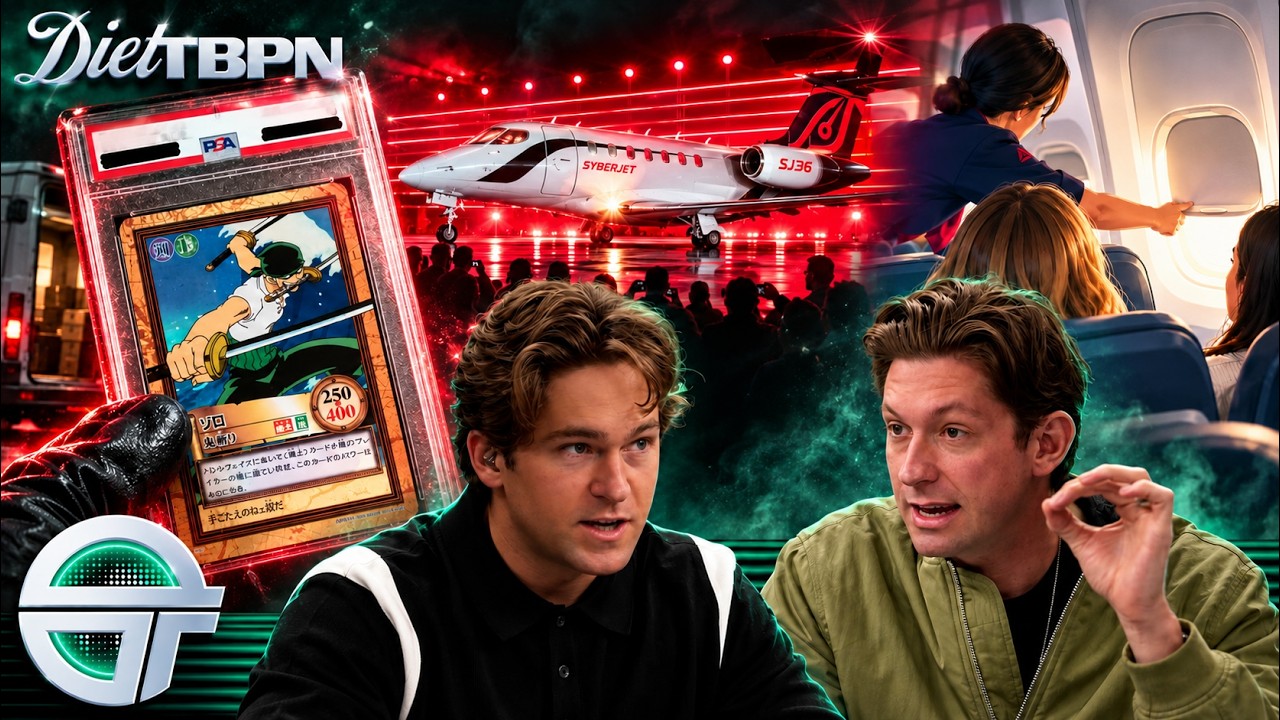
Thieves stole three pallets holding 250 packages of graded trading cards—including a One Piece card valued at $500,000—from an unattended FedEx truck parked outside PSA's Santa Ana headquarters, with losses exceeding $963,000 on the first two pallets alone. (0:02)
Pardoned former Nikola CEO Trevor Milton is returning to business with Cyberjet, pitching a resurrected SJ30 airframe outfitted with proprietary, in-house avionics and autonomous flight systems. (4:52)
Mercedes-Benz unveiled the 2028 AMG GT63 SUV with 1,153 horsepower and a 2.4-second 0-60 time, though market prospects face severe headwinds from luxury EV depreciation and range limitations on cold-weather trips. (26:13)
A candid viral postgame interview from an NHL goaltender highlights the sports flow state, explaining how deliberate conscious thinking slows physical reflexes compared to trained unconscious instinct. (30:10)
Detailed notes
## Background
This episode of Diet TBPN was published by TBPN on YouTube on October 21, 2026. Hosted by John Coogan and Jordi Hays, the show condenses the best segments from their daily tech talk program into a fast-paced 30-minute discussion covering major tech, business, and cultural headlines.
## TL;DR
John Coogan and Jordi Hays unpack a bizarre $1M heist of PSA-graded trading cards stolen from an unattended FedEx truck, scrutinizing the shipping liability rules that leave collectors exposed. They then examine disgraced Nikola founder Trevor Milton's private aviation comeback with the Cyberjet SJ36, casting heavy doubt on whether luxury buyers will trust his unproven in-house avionics. The conversation shifts to the deterioration of commercial flight etiquette, the politics of window shades, and airline entertainment rankings before critiquing Mercedes' 1,153-horsepower electric SUV amid broader luxury EV depreciation. They close by dissecting a viral postgame interview with an NHL goalie detailing how entering an unconscious flow state is essential for elite performance.
## Atmosphere & style
The episode is brisk, witty, and irreverent, driven by effortless banter and deadpan skepticism between Coogan and Hays. The dialogue moves rapidly from sharp corporate critique and disbelief at logistical blunders to relatable, comedic grievances about obnoxious seatmates on commercial flights. It feels like eavesdropping on a fast-paced, humorous breakdown among savvy friends that effortlessly pivots from business cynicism to genuine psychological curiosity.
## Bulletin
- [00:02](https://www.youtube.com/watch?v=6Wivk48y5aM&t=2s) Thieves stole three pallets holding 250 packages of graded trading cards—including a One Piece card valued at $500,000—from an unattended FedEx truck parked outside PSA's Santa Ana headquarters, with losses exceeding $963,000 on the first two pallets alone.
- [04:52](https://www.youtube.com/watch?v=6Wivk48y5aM&t=292s) Pardoned former Nikola CEO Trevor Milton is returning to business with Cyberjet, pitching a resurrected SJ30 airframe outfitted with proprietary, in-house avionics and autonomous flight systems.
- [26:13](https://www.youtube.com/watch?v=6Wivk48y5aM&t=1573s) Mercedes-Benz unveiled the 2028 AMG GT63 SUV with 1,153 horsepower and a 2.4-second 0-60 time, though market prospects face severe headwinds from luxury EV depreciation and range limitations on cold-weather trips.
- [30:10](https://www.youtube.com/watch?v=6Wivk48y5aM&t=1810s) A candid viral postgame interview from an NHL goaltender highlights the sports flow state, explaining how deliberate conscious thinking slows physical reflexes compared to trained unconscious instinct.
## Key takeaways
- [00:02](https://www.youtube.com/watch?v=6Wivk48y5aM&t=2s) Thieves broke into an unattended FedEx truck outside PSA headquarters and made off with three pallets containing 250 packages of high-value graded trading cards.
- [00:02](https://www.youtube.com/watch?v=6Wivk48y5aM&t=2s) PSA immediately deactivated unique certification numbers in its database to block open-market resales, though black-market fencing remains a concern.
- [03:32](https://www.youtube.com/watch?v=6Wivk48y5aM&t=212s) Relying on standard commercial couriers with a single driver rather than armored transport like Brinks is criticized given the extreme density and value of modern collectibles.
- [04:52](https://www.youtube.com/watch?v=6Wivk48y5aM&t=292s) Trevor Milton's Cyberjet relies on acquiring the pre-certified Ed Swearingen SJ30 airframe to avoid a multi-decade FAA certification timeline from scratch.
- [08:34](https://www.youtube.com/watch?v=6Wivk48y5aM&t=514s) Cyberjet's high-risk gamble is replacing proven Garmin or Honeywell avionics with proprietary, untested in-house cockpits in an unforgiving luxury aviation market.
- [10:26](https://www.youtube.com/watch?v=6Wivk48y5aM&t=626s) Unlike other controversial founders who secured prominent venture backing for comebacks, top-tier Silicon Valley firms are noticeably absent from Milton's aviation project.
- [14:32](https://www.youtube.com/watch?v=6Wivk48y5aM&t=872s) Andy Kessler's Wall Street Journal op-ed sparks debate over declining airplane cabin etiquette, including loud phone dictation and speaker-scrolling in cramped spaces.
- [18:12](https://www.youtube.com/watch?v=6Wivk48y5aM&t=1092s) United CEO Scott Kirby's operational pivot argues that passengers should pay a premium to avoid middle seats while investing heavily in Wi-Fi and seatback entertainment.
- [20:21](https://www.youtube.com/watch?v=6Wivk48y5aM&t=1221s) In-flight entertainment preferences strongly favor seatback displays over BYOD smartphone clips, with Delta ranked at the top tier for depth of art-house cinema.
- [22:02](https://www.youtube.com/watch?v=6Wivk48y5aM&t=1322s) Window-seat autonomy remains one of the last personal freedoms on commercial flights, prompting rejection of mandatory shade closures during daytime flights.
- [26:13](https://www.youtube.com/watch?v=6Wivk48y5aM&t=1573s) High-end luxury EV SUVs struggle commercially because buyers demand extreme cold-weather range and road-trip flexibility that current battery infrastructure cannot smoothly deliver.
- [29:13](https://www.youtube.com/watch?v=6Wivk48y5aM&t=1753s) Pricing will dictate whether the electric AMG GT63 competes reasonably at $130,000 or enters a difficult luxury performance dead zone against exotic super-SUVs at $220,000.
- [30:10](https://www.youtube.com/watch?v=6Wivk48y5aM&t=1810s) High-stakes athletic performance often requires emotional detachment, where overthinking shifts an athlete into conscious analysis that lags behind trained unconscious reflexes.
John Coogan and Jordi Hays kick off the show breaking down a brazen robbery at Professional Sports Authenticator (PSA) in Santa Ana, California. On October 13th, thieves broke into a FedEx truck parked right outside PSA’s grading center where cards are inspected and given official condition grades before shipping back to collectors. Coogan marvels that targeting a truck sitting right at the grading headquarters is essentially “shooting fish in a barrel,” comparing it to robbing the U.S. Mint because of how densely concentrated and valuable the inventory is. The theft occurred after the FedEx driver inexplicably left the delivery truck completely unattended for 60 to 90 minutes. When the driver returned, the lock was broken and three pallets loaded with already-graded cards were gone. Jordi immediately jokes that it was an “inside job,” while Coogan calls leaving the truck alone for that long an absolute “own goal.”
The scale of the theft is staggering: two of the stolen pallets contained roughly 100 packages each, while the third held about 50 packages, totaling 250 stolen packages. PSA estimated the value of the first two pallets alone at $963,000, while still tallying the loss on the third. The hosts note that PSA’s system has a built-in defense mechanism: because every graded card carries a unique certification number, PSA immediately deactivated the stolen certifications in their public database. If anyone attempts to sell them on legitimate markets, the system flags the SKU as stolen merchandise. Even so, Coogan doubts this will stop thieves from offloading them through illicit black markets.
The incident sparked a heated discussion about liability and shipping insurance. PSA announced it would compensate affected collectors based on fair market value, but strictly capped payouts at whatever insurance level the customer had selected during checkout. Coogan and Jordi criticize this setup, arguing that tick-box shipping insurance often feels like a scam. Jordi insists the grading company should bear the brunt of the fallout rather than passing the loss to customers who trusted them with rare collectibles: “I think PSA should take it up with FedEx.”
- Stolen cargo: 3 pallets containing 250 packages of PSA-graded trading cards.
- Estimated value: At least $963,000 across the first two pallets alone, with pallet three pending valuation.
- Security response: PSA deactivated the unique certification numbers for all stolen cards to prevent resale on open markets.
- Liability dispute: Customer reimbursements are capped by PSA based on the optional shipping insurance selected at checkout.
---
[03:32](https://www.youtube.com/watch?v=6Wivk48y5aM&t=212s) The $500,000 One Piece Card and Armored Transport Realities
Coogan reveals that the heist was even larger than initial headlines suggested because a single card inside the truck was reportedly worth $500,000: a 1999 first-stage Zoro card from the anime franchise *One Piece*. Pulling up an image of the card, Coogan presses Jordi for his personal valuation. Jordi remains utterly unimpressed by the speculative collectibles craze, stating flatly: “I would rather have $1 than this trading card.” Even when Coogan points out that the card could theoretically be flipped for hundreds of thousands of dollars, Jordi sticks to his guns, admitting he finds the entire trading card phenomenon completely baffling.
Beyond the eye-popping price tags, the conversation shifts to the absurdity of the logistics operation. Both hosts express bewilderment that a company handling millions of dollars in ultra-compact, easily transportable assets would rely on a standard commercial delivery service with a single driver. Jordi argues that when inventory reaches this tier of financial value, standard courier practices are grossly negligent: “If these cards are so valuable, why aren't you using Brinks?”
---
[04:52](https://www.youtube.com/watch?v=6Wivk48y5aM&t=292s) Trevor Milton's Comeback with Cyberjet's SJ36
The hosts pivot to former Nikola CEO Trevor Milton, who was convicted of fraud and subsequently pardoned by Donald Trump. Milton is making an audacious return to the business world as the CEO of a private aviation venture called Cyberjet. Aviation commentator Preston Holland reported from an unveiling event where Cyberjet introduced the SJ36—a light jet pitched to fly nonstop from New York to Los Angeles faster than any competitor in its class. Coogan initially assumed starting a brand-new aircraft manufacturer from scratch would take at least a decade or two given the brutal regulatory hurdles of FAA certification, but Cyberjet bypasses that timeline by acquiring an existing, already-certified platform.
```mermaid
flowchart TD
accTitle: History of the SJ30 Aircraft Program
accDescr: Timeline showing the development, certification, ownership changes, and rebirth of the SJ30 into Cyberjet.
subgraph Origin["1980s - 2005: Inception & Certification"]
A["Ed Swearingen invents SA30 / SJ30"] --> B["Over $700M spent in development"]
B --> C["FAA Type Certification achieved (Oct 2005)"]
end
subgraph Ownership["2006 - 2019: Turbulence & Bankruptcy"]
C --> D["First customer delivery (2006)"]
D --> E["Emivest Aerospace acquires control (2008)"]
E --> F["Bankruptcy after ~10 planes built (2010)"]
F --> G["Metalcraft holds type certificate; tests SJ30i (2019)"]
end
subgraph Rebirth["2024 - Present: Cyberjet"]
G --> H["Milton-led investor group buys program (2024)"]
H --> I["Unveils SJ36 with in-house avionics"]
end
```
The underlying plane traces back to aeronautical engineer Ed Swearingen, who designed the high-speed light jet (originally the SA30/SJ30) between 1986 and 1991 with early backing from Gulfstream. The program spent decades in development, chewing through over $700 million before finally securing FAA certification in October 2005. Only about ten aircraft were ever produced. Dubai investors took over in 2008 under the name Emivest Aerospace, but production collapsed and the firm entered bankruptcy in 2010. Metalcraft later held the type certificate and tooling, flying an upgraded SJ30i test aircraft in 2019 without ever achieving scaled deliveries. An investor group led by Milton acquired the assets in 2024, and Milton stepped out as CEO in 2025. Coogan and Jordi marvel at footage of the launch event, which features an elaborate arena production with pulsing lasers, an LED wall, and high theatricality reminiscent of a Tesla reveal. Coogan jokes: “If you were worried about buying a plane from Trevor Milton, don't be because the lasers are out of this world.”
---
[08:34](https://www.youtube.com/watch?v=6Wivk48y5aM&t=514s) In-House Avionics and Trusting Nikola’s Ex-CEO
What baffles the hosts most is not the resurrection of the proven SJ30 airframe, but Milton’s insistence on building his own proprietary systems. Rather than adopting industry-standard, trusted avionics suites from established vendors like Garmin or Honeywell, Milton is marketing Cyberjet as a futuristic aerospace platform featuring proprietary, in-house avionics and autonomous flight systems. Coogan points out that simply taking a certified airframe and manufacturing it reliably would have been the sensible play, yet Milton cannot resist pitching an unproven technological revolution.
Jordi emphasizes that the private jet market is completely unforgiving. Prospective jet buyers are among the most educated, detail-oriented, and safety-conscious consumers in the world because their lives directly depend on the machine's reliability. He doubts that anyone spending millions on a business jet will ignore Milton’s past conviction for exaggerating Nikola’s technology, especially when the cockpit itself is untested. Jordi questions the logic of complicating an already fragile comeback: “It doesn't seem obvious that you need to reinvent the cockpit while you're just trying to prove that anyone should fly in a vehicle that you create, right?”
[10:26](https://www.youtube.com/watch?v=6Wivk48y5aM&t=626s) Would You Trust a Jet From Trevor Milton?
The hosts dissect Trevor Milton’s comeback attempt in the private aviation market and debate whether there is any viable business strategy for selling the first production unit of a revamped jet at an estimated $14 million. The pitch around autonomous cockpit features falls flat; as one host notes, flying single-pilot versus using a two-pilot crew does not represent a material cost difference for wealthy buyers who log hundreds of flight hours a year. Furthermore, the skeptical view argues that unless a startup jet occupies an absolute monopoly in an empty niche, customers will not line up to buy a clean-sheet cockpit redesign from a disgraced founder. “I don't think buyers in this category are even that worried about like, oh, I want to have one pilot versus two,” one host explains.
```mermaid
flowchart TD
accTitle: Milton Jet Bull vs Bear Thesis
accDescr: Comparison between the bull arguments and bear concerns regarding Trevor Milton's jet revival.
subgraph Bull["Bull Thesis (The Contrarion View)"]
A1["Pre-certified airframe architecture saves R&D time"]
A2["Reputable supplier hardware (Williams engines)"]
A3["Massive unmet demand in private aviation"]
A4["Good value for cost-conscious flyers & adrenaline junkies"]
end
```
The counterargument rests on market efficiency and pre-existing certification. The aircraft uses an established Williams engine and a platform that already has FAA certification, meaning buyers avoid the long, risky regulatory pipeline typical of brand-new aerospace startups. Drawing a comparison to real estate and luxury asset purchases, one host brings up T-Pain buying a 2004 Gulfstream: it performs 90% of the function of a brand-new model at a tenth of the price, where the only visible difference is USB-A versus USB-C ports, since aviation progress usually manifests only in marginal comfort tweaks like heated seats, quieter cabins, or minor Wi-Fi upgrades. Still, the overwhelming bearish point remains the lack of institutional backing. Venture firms like Andreessen Horowitz backed controversial comeback founders like Adam Neumann after their public falls, but they are noticeably avoiding Milton. One host sums up the venture's ultimate prospects bluntly: “I think the company's up a creek without a paddle.”
- The aircraft concept relies on an FAA-certified airframe powered by Williams International engines.
- The theoretical target market is described jokingly as “private aviation for adrenaline junkies” who willingly trade away decades of operational excellence for lower cost and novelty.
- Sarcastic commentary highlights that venture capital backs “post-fall founders” whose charisma supposedly outweighs their flaws, yet no prominent Silicon Valley firm has backed this aircraft venture.
[14:32](https://www.youtube.com/watch?v=6Wivk48y5aM&t=872s) Is Airplane Etiquette Dead? + The Quiet Cabin Debate
The conversation pivots to commercial aviation manners following a fiery *Wall Street Journal* opinion piece by Andy Kessler titled on the decline of passenger courtesy. Kessler’s column details the agony of being trapped next to a passenger who spent the two hours before and during a flight loudly dictating text messages into her phone—dictating lines like, *“Can we split it into four lots question mark and don't forget to buy organic blueberries exclamation point.”* Despite Kessler putting on noise-canceling earbuds, glaring, and turning Metallica’s “The Unforgiven” up to maximum volume, the dictation cut straight through. Kessler lamented that flying has devolved into the equivalent of a Greyhound bus journey, plagued by barefoot passengers, unwashed travelers, and poor etiquette, and questioned whether airlines need dedicated quiet sections similar to quiet cars on commuter trains.
The TBPN hosts commiserate, recalling their own horrifying experiences jammed into crowded cabins with inconsiderate travelers, including a passenger scrolling through social media reels on maximum speaker volume across the aisle. However, they mock the premise that an op-ed will reform bad behavior. Sarcastic hope is offered that rude passengers will somehow stumble across the *Wall Street Journal* editorial board and change their ways: “A lot of these people that he's referencing, they have no manners. Yeah, they love reading the Wall Street Journal opinion section.” Ultimately, they conclude that the suffocating physical environment of commercial flights leaves passengers with zero tolerance for the slightest violation of common decency.
- Andy Kessler compared loud phone dictation inside a pressurized airplane cabin to eating a pungent enchilada whose odor lingers until the flight crosses Nebraska.
- The hosts note the modern irritation of passengers bypassing texting completely to shout instructions into speech-to-text engines or scroll TikTok/Instagram feeds at full volume.
- The hosts joke about installing a physical broadcast-style censor “beep button” on personal armrests so annoyed flyers can bleep out unruly seatmates in real time.
[18:12](https://www.youtube.com/watch?v=6Wivk48y5aM&t=1092s) United’s Middle-Seat Pricing Pitch + Airline Movie Rankings
The hosts turn to United Airlines CEO Scott Kirby, who publicly argued that flying is inherently expensive and that passengers should expect to pay a premium to avoid sitting in the middle seat. Kirby pointed out that airfares may need to rise across the board, capitalizing on moments where competitors like Delta suffered operational and Wi-Fi hiccups to push United's market dominance. Kirby, who took the helm during the depths of the COVID-19 pandemic—the industry’s worst existential crisis since September 11—has steered United stock up over 300% during his tenure, asserting that United has become the best airline overall.
As a father of seven, Kirby frames his operational upgrades—investing heavily in high-speed Wi-Fi, expanding the on-demand catalog of movies and TV shows, and polishing the smartphone app—as essential stress-reducers for families navigating cramped planes, delayed flights, and chaotic boarding. This leads into an in-studio debate over seatback in-flight entertainment (IFE) hardware:
- The TBPN team universally prefers built-in seatback screens over personal device streaming (BYOD), arguing that watching movies on a phone destroys the classic, immersive feeling of commercial flight.
- Budget carriers like Southwest are dinged for omitting seatback screens entirely, putting them at the bottom tier of passenger entertainment.
- The hosts reminisce about the early era of JetBlue pioneering individual headrest TVs, contrasting it with nostalgic memories of old planes where an entire cabin section had to crane their necks to share a single overhead cathode-ray screen playing the exact same film.
[20:21](https://www.youtube.com/watch?v=6Wivk48y5aM&t=1221s) The Era of Shared Cabin Screens vs. Modern Seatback In-Flight Entertainment
John Coogan and Jordi Hays reflect on the lost sense of community in older commercial air travel, when passengers would share ceiling-mounted screens instead of watching individual seatback displays. During that era of communal viewing, travelers would strike up polite conversations with strangers on either side, bonding over movies like *The Fugitive*. When one host mentions having four shared screens mounted along the aisle in the back of the plane, the other jokes about being too young or too sheltered to remember it, mockingly calling him a "Silver Spoon."
```mermaid
flowchart TD
accTitle: Evolution of In-Flight Entertainment
accDescr: Progression from communal ceiling-mounted screens to phone clips and individual airline seatback entertainment tiers.
subgraph Past["Legacy Communal Experience"]
A["Ceiling-Mounted Screens"] --> B["Shared Cabin Viewing<br/>(e.g., The Fugitive)"]
B --> C["Casual Small Talk & Manners"]
end
subgraph Modern["Modern Era IFE"]
D["Consolation Prize:<br/>Seatback Phone Clip"]
E["Seatback Touchscreens"]
F["Starlink High-Speed Wi-Fi<br/>(Stream Anything)"]
end
Past -.-> Modern
```
The hosts also evaluate the modern "consolation prize" found on planes without seatback monitors: the plastic clip or hook designed to prop up a passenger's smartphone. While agreeing it is better than nothing, seatback screens remain preferable, despite occasional frustrations with pairing Bluetooth headphones. Turning to airline movie libraries, Delta Air Lines is ranked in the top tier:
- **Delta Air Lines (S-Tier):** Praised as far and away the best in-flight entertainment selection, offering art-house titles and Criterion Collection selections; when challenged to name an art-house film on the spot, Ingmar Bergman's *The Seventh Seal* is cited as an example.
- **United Airlines (B-Tier):** Slotted behind Delta in raw catalog depth, though the addition of onboard Starlink Wi-Fi closes the gap by allowing passengers to stream any content from their own devices.
---
[22:02](https://www.youtube.com/watch?v=6Wivk48y5aM&t=1322s) The Window-Shade War and Seat Negotiation Politics
The discussion shifts to airplane cabin etiquette and the contentious debate over whether flight attendants should be permitted to force passengers to shut window shades on daytime flights. Both hosts firmly reject the idea of forced shade closures, arguing that passengers who purchase a window seat retain absolute sovereignty over it. One host emphasizes that in an environment where nearly all autonomy is stripped away, controlling the window is the last remaining personal freedom.
> “That's like the final freedom that you have on a plane, right? All your freedoms are taken away. But if you have the window to seat, you've got a little bit of power left.”
The hosts jokingly propose several ways to handle cabin light and seat assignments:
- **The Window Seat Diplomat:** Taking on the civic duty of interviewing your seatmate before takeoff about their light tolerance, sleepiness levels, and screen preferences, or even surveying the entire 10-person section to establish a communal shade schedule operated by an extendable marshmallow-roasting stick.
- **The Rugged Individualist Route:** Keeping the window shade fully open at all times; passengers wishing to sleep in darkness bear the personal responsibility to bring their own eye masks rather than expecting cabin-wide blackout.
- **Seat Trading Complexity:** Acknowledging the chaotic, delicate negotiations required when travel companions are split up across the plane, trying to orchestrate multi-passenger swaps to avoid the dreaded middle seat.
- **The Live Boarding Auction:** Half-joking that airlines should drop assigned seating in favor of a live, energetic cabin auction upon boarding—selling exit rows, extra legroom, $5 bags of peanuts, $6 eye masks, and JetBlue snack boxes to the highest bidder like an unruly financial pit.
---
[26:13](https://www.youtube.com/watch?v=6Wivk48y5aM&t=1573s) Mercedes-AMG GT63 Electric SUV vs. The Luxury EV Dilemma
The conversation turns to automotive news following Mercedes-Benz's unveiling of the 2028 AMG GT63 SUV, a high-performance electric vehicle boasting 1,153 horsepower and a 0-to-60 mph acceleration time of 2.4 seconds. Despite those paper specs, the hosts express deep skepticism about its commercial prospects. One host delivers an immediate review of silence and a sigh, noting that while the styling looks acceptable and the rear end faintly evokes the circular tail lamps of a Ferrari Luce, he would neither buy one nor recommend it to friends or family.
The hosts predict that this project—likely greenlit five or six years ago during the peak of electric vehicle enthusiasm—faces severe headwinds from aggressive luxury EV depreciation. While an SUV platform is generally a more practical shape for an EV than a sports car, buyers in this luxury price bracket treat these vehicles as daily drivers. In that segment, vehicles without advanced autonomous self-driving capabilities will struggle against competitors.
Comparing it to Porsche’s debate over electrifying sports platforms like the 718 Cayman, the hosts argue an electric Cayman would at least function as a thrilling "street-legal go-kart" with an enthusiast following. By contrast, a high-end luxury electric SUV suffers from practical consumer hesitations: buyers worry about taking the vehicle on cold mountain ski trips where winter temperatures throttle battery range and remote charging infrastructure remains sparse.
[29:13](https://www.youtube.com/watch?v=6Wivk48y5aM&t=1753s) The Luxury EV Dilemma: Road Presence and Pricing Pressures
The discussion turns to the friction points of high-end electric SUVs versus consumer lifestyle expectations. Buyers looking at premium utility vehicles often want the peace of mind to take off-grid trips, saying things like, "take this to Joshua Tree and be, you know, off the grid for a day and I want that flexibility," even when the vehicle ultimately serves as an everyday suburban runabout and comfortable daily driver. While electric powertrains face adoption hurdles in the utilitarian SUV space, sports car buyers present the opposite dilemma: they actively crave the tactile roar of an internal combustion engine.
Evaluating how Mercedes' new electric SUV will perform in the market leads to an immediate comparison with the BMW XM. When asked whether the road will see more of the new Mercedes or the BMW XM, the hosts agree the Mercedes will likely pull ahead, though largely because the XM has set such a low bar:
> "Probably more of these, but the XM has been a massive flop."
Success hinges almost entirely on pricing tiers:
- If priced around $130,000, the vehicle remains competitive and accessible to luxury SUV buyers.
- If the price reaches the $220,000 bracket, it enters direct competition with heavyweight exotic performance SUVs like the Lamborghini Urus and the upcoming McLaren SUV.
---
[30:10](https://www.youtube.com/watch?v=6Wivk48y5aM&t=1810s) Flow State and Conscious Brain: The Viral Goalie Postgame Interview
The hosts segue into what they consider "the best interview in pro sports right now," playing a postgame clip from an NHL goaltender reflecting on a 34-save performance. When asked what he felt and saw while looking out from the crease, the goalie gives an unusually candid, unscripted answer:
> "Yes. Uh I felt nothing. The the problem with me is that I have a lot of fun playing, but when I start having too much fun, it makes me into from an unconscious goalie to a conscious goalie. And my conscious brain is really bad at playing goalie."
```mermaid
flowchart TD
accTitle: Goalie Mental States Flowchart
accDescr: Diagram illustrating the shift between unconscious instinct and conscious distraction during an NHL hockey game.
subgraph Optimal["Unconscious Flow State"]
A["Focus on Game / 'Felt Nothing'"] --> B["Fast Reflexes & Pure Instinct"]
B --> C["High Save Percentage & 34 Saves"]
end
subgraph Disruption["Conscious Brain Interference"]
D["Smiling, Chatting & Too Much Fun"] --> E["Conscious Brain Takes Over"]
E --> F["Slowed Reaction Times & Behind the Play"]
F --> G["Giving Up Goals"]
end
subgraph Postgame["Regulation & Release"]
C --> H["Final Buzzer Sounds"]
H --> I["Massive Chemical Rush: Dopamine, Serotonin, Adrenaline"]
end
```
The goaltender explains that his unconscious mind reacts far faster to pucks than his deliberate, analytical thinking. If he starts chatting, smiling, or having too much fun during play, he shifts into conscious mode, lags behind the action, and ends up giving up goals. During TV timeouts and breaks between periods, he actively disciplines himself: "Don't smile. Don't talk to anyone. Just focus on your game. Let your unconscious brain do it." He admits he has no conscious memory of how he made individual saves because deliberate practice trains the unconscious brain to act on autopilot. Only when the final horn sounds does he allow his emotions to unlock, triggering an overwhelming physical rush of dopamine, serotonin, adrenaline, and goosebumps. He also humbly acknowledges the role of pure chance, noting he got lucky with three opposing shots hitting the posts and avoiding friendly-fire deflections off his own teammates.
The hosts draw parallels between this athletic flow state and extreme sports like surfing. One host notes that after catching a great wave, he will reach the end fully aware that he was hyper-present in the moment, yet have zero active memory of the physical mechanics of what his body did to ride it. They praise the interview for cutting cleanly through typical sports cliches—the rehearsed praise of team effort and grinding work—by providing genuine insight into the psychological tightrope of high-stakes performance.
- The goalie completed a 34-save game while maintaining complete emotional detachment during play.
- Luck played a noted factor, including three shots hitting the goalposts and zero accidental self-goals deflected by teammates.
- TBPN wraps up with the recurring mantra: "write joke, tell joke, get checked."
- Listeners are reminded to rate the show five stars on Apple Podcasts and Spotify, and to tune in weekdays at 11:00 AM Pacific.
## Notable quotes
> [08:34](https://www.youtube.com/watch?v=6Wivk48y5aM&t=514s) It doesn't seem obvious that you need to reinvent the cockpit while you're just trying to prove that anyone should fly in a vehicle that you create, right? — Jordi Hays
## Mentioned
Professional Sports Authenticator, FedEx, John Coogan, Jordi Hays, One Piece, Brinks, Trevor Milton, Nikola, Donald Trump, Cyberjet, Preston Holland, SJ36, Ed Swearingen, Gulfstream, Emivest Aerospace, Metalcraft, Garmin, Honeywell, Williams International, T-Pain, Andreessen Horowitz, Adam Neumann, Andy Kessler, The Wall Street Journal, Metallica, United Airlines, Scott Kirby, Delta Air Lines, Southwest Airlines, JetBlue, Starlink, Ingmar Bergman, Mercedes-Benz, AMG GT63 SUV, Ferrari Luce, Porsche, 718 Cayman, BMW XM, Lamborghini Urus, McLaren
## Video description
Sign up for TBPN’s daily newsletter at TBPN.com
Diet TBPN delivers the best of today’s TBPN episode in 30 minutes. TBPN is a live tech talk show hosted by John Coogan and Jordi Hays, streaming weekdays 11–2 PT on X and YouTube, with each episode posted to podcast platforms right after.
Described by The New York Times as “Silicon Valley’s newest obsession,” the show has recently featured Mark Zuckerberg, Sam Altman, Mark Cuban, and Satya Nadella.
TBPN is made possible by:
Ramp - https://ramp.com
Public - https://public.com
Cisco - https://www.cisco.com
Console - https://www.console.com
CrowdStrike - https://www.crowdstrike.com
Figma - https://www.figma.com
MongoDB - https://www.mongodb.com
NYSE - https://www.nyse.com
Railway - https://railway.com
Shopify - https://www.shopify.com/
Chapters:
00:00 PSA’s $1M Trading Card Heist + Who Pays?
04:52 Trevor Milton’s Private Jet Comeback
08:34 Would You Trust a Jet From Nikola’s Ex-CEO?
14:32 Is Airplane Etiquette Dead? + The Quiet Cabin Debate
18:12 United’s Middle-Seat Pricing Pitch + Airline Movie Rankings
22:02 The Window-Shade War + Airplane Seat Negotiations
26:13 Mercedes’ 1,153-HP Electric SUV + The Luxury EV Problem
30:10 “I Felt Nothing” + A Goalie Explains Playing on Instinct
Hosts John Coogan and Jordi Hays examine high-profile operational, business, and consumer challenges, ranging from security and liability failures in the trading card market to Trevor Milton's controversial private jet comeback and the broader erosion of travel etiquette.
Supply Chain Vulnerability and Collectibles Logistics (0:02)
A theft outside Professional Sports Authenticator (PSA) headquarters in Santa Ana, California, exposed significant operational vulnerabilities in high-value transport. Thieves broke into an unattended FedEx truck parked for 60 to 90 minutes, stealing three pallets containing roughly 250 packages of graded cards valued at nearly $1 million across the first two pallets alone, alongside an individual 1999 One Piece Zoro card reportedly valued at $500,000. While PSA deactivated the unique certification numbers in its database to curb open-market resales, the incident triggered sharp criticism regarding logistics choices.
Coogan and Hays argue that relying on single-driver commercial couriers rather than armored transport like Brinks is negligent given the concentration of compact, high-value assets. Furthermore, they criticize PSA's reimbursement policy, which caps collector payouts strictly to the optional shipping insurance selected at checkout, contending that the authentication and grading firm should assume liability rather than passing the financial risk onto customers.
Trevor Milton and Cyberjet's Credibility Hurdles (4:52)
Pardoned former Nikola CEO Trevor Milton is returning to commercial industry as CEO of Cyberjet, pitching the SJ36—a repurposed version of Ed Swearingen's FAA-certified SJ30 airframe powered by Williams International engines. While acquiring an already certified platform avoids decades of costly regulatory delays, Milton is complicating the offering by developing proprietary, in-house avionics and autonomous flight systems instead of relying on proven, trusted providers such as Honeywell or Garmin.
Industry skepticism centers on buyer psychology and Milton's past fraud conviction. The hosts note that corporate jet buyers are exceptionally safety-conscious and unlikely to risk flying in unproven cockpit systems for marginal operational savings, such as flying single-pilot. The venture also lacks major venture capital backing, leaving hosts doubtful that theatrical unveilings and lower target pricing can overcome substantial founder baggage.
Commercial Cabin Etiquette and Airline Tiering (14:32)
Prompted by a Wall Street Journal column by Andy Kessler regarding travelers loudly dictating text messages during flights, the discussion addresses the broader deterioration of passenger decorum. Confined cabin conditions amplify minor disruptions, such as loud phone dictations or social media audio played on speakerphone, leading to proposals ranging from quiet cabin sections to disputes over personal autonomy, like a passenger's unilateral right to control their window shade.
The friction over cabin amenities extends to airline operational strategies. While United Airlines CEO Scott Kirby has argued that flyers should pay premiums to avoid middle seats, airlines are differentiating on passenger experience through in-flight entertainment. The hosts rank Delta Air Lines top-tier due to extensive movie catalogs and Criterion Collection offerings, while noting that modern seatback screens remain vastly superior to personal-device streaming setups.
Luxury EV Headwinds and High-Performance Sports Psychology (26:13)
In evaluating automotive developments, the hosts question the commercial prospects of Mercedes-Benz's 1,153-horsepower electric AMG GT63 SUV. Luxury electric SUVs face steep depreciation, cold-weather range anxiety for ski trips, and lack of internal combustion sound. If priced above $200,000, it faces stiff competition from established exotic models like the Lamborghini Urus, though it may outperform previous market disappointments like the BMW XM at a lower price point.
Shifting to athletic performance, the episode highlights a viral postgame interview with an NHL goaltender following a 34-save performance. The goaltender described deliberately cultivating emotional detachment, explaining that entering an analytical, conscious mental state disrupts the automatic, rapid reflexes required during play. His performance relied on deliberate practice taking over on autopilot, delaying the emotional and neurochemical rush until the final buzzer.
Across high-end collectibles, private aviation, luxury electric vehicles, and commercial travel, the discussions underscore how unaddressed operational risks, eroded consumer trust, and strained personal etiquette directly determine market acceptance and consumer satisfaction.
## Background
该视频由科技脱口秀频道 TBPN 于 2026 年 10 月 21 日发布在 YouTube 平台。作为节目的精选剪辑版《Diet TBPN》,本期内容由主持人 John Coogan 与 Jordi Hays 共同主持,精选呈现了当天科技商业领域的焦点快讯与热点争议。
## TL;DR
本期节目首先深度复盘了评级巨头 PSA 价值近百万美元的球星卡在总部遭窃离奇大案,并探讨了 FedEx 与平台的赔偿责任归属;随后,两人尖锐评析了前 Nikola 首席执行官 Trevor Milton 携 Cyberjet 复出并自研机载航电系统的巨大商业风险。紧接着,话题转向民航出行痛点,涵盖机舱礼仪丧失、美联航 CEO 的涨价逻辑、机上影音评级以及极具讽刺意味的“座位现场拍卖”构想。最后,节目探讨了梅赛德斯 1,153 马力纯电 SUV 面临的豪华电车贬值困境,并以一段冰球门将关于“潜意识心流”的真诚赛后访谈作结。
## Atmosphere & style
整期节目洋溢着硅谷科技人特有的辛辣讽刺与机敏幽默,两位主持人在插科打诨中交替抛梗,把商业新闻解构成生动的荒诞喜剧。随着话题从耸人听闻的盗窃案逐步转向机舱内的微型社会学与运动员心流,讨论在嬉笑怒骂的犀利吐槽与严肃的本能反思之间自如切换。听众仿佛置身于一场语速飞快、信息量密集且毫无公关套话的午餐闲聊,既能感受到对商业骗局与行业乱象的无情拆解,又能体会到真实人性流露时的精神共鸣。
## Bulletin
- [00:02](https://www.youtube.com/watch?v=6Wivk48y5aM&t=2s) 球星卡评级巨头 PSA 圣安娜总部外发生离奇失窃案,FedEx 货车在无人看管的 60 至 90 分钟内被撬,3 个托盘共计 250 包评级卡片被盗,损失总额预估超过 100 万美元,单张被盗动漫卡估值高达 50 万美元。
- [04:52](https://www.youtube.com/watch?v=6Wivk48y5aM&t=292s) Nikola 创始人特雷弗·米尔顿(Trevor Milton)通过收购资产推出私人飞机品牌 Cyberjet,试图依托老旧机型认证并自研航电系统复出,但其过往商业欺诈背景引发了对其目标客户信任度与产品安全性的巨大质疑。
- [14:32](https://www.youtube.com/watch?v=6Wivk48y5aM&t=872s) 《华尔街日报》发文批评商业民航机舱礼仪全面倒退,大声语音听写与刷短视频现象泛滥,引发了客舱是否应设立“静音区”以及美联航推行中间座加价逻辑的广泛讨论。
- [26:13](https://www.youtube.com/watch?v=6Wivk48y5aM&t=1573s) 梅赛德斯-奔驰发布拥有 1,153 马力的 AMG GT 63 纯电 SUV,但因缺乏领先自动驾驶技术、折旧过快以及续航补能焦虑,被主持人认为在超豪华细分市场面临极高商业失败风险。
## Key takeaways
- [00:02](https://www.youtube.com/watch?v=6Wivk48y5aM&t=2s) PSA 遭遇严重失窃案,由于承运的 FedEx 司机擅离货车超过一小时导致车辆被撬,引发了高价值卡片为何不使用装甲押运(如 Brinks)的安保漏洞质疑。
- [00:02](https://www.youtube.com/watch?v=6Wivk48y5aM&t=2s) 尽管 PSA 迅速注销作废了被盗卡片的唯一认证编码以阻断公开流通,但按公允市场价值与保额上限赔偿的机制仍引发了责任归属争议。
- [04:52](https://www.youtube.com/watch?v=6Wivk48y5aM&t=292s) 特雷弗·米尔顿凭借特朗普的特赦重返商界,试图通过接盘耗资超 7 亿美元、历经近 40 年曲折但具备 FAA 认证的 SJ30 飞机资产实现快速重启。
- [08:34](https://www.youtube.com/watch?v=6Wivk48y5aM&t=514s) 米尔顿弃用 Garmin 等成熟航电供应商而坚持自研机载座舱系统,被视为致命战略误判,极难说服作风审慎的高净值公务机买家为其人身安全买单。
- [10:26](https://www.youtube.com/watch?v=6Wivk48y5aM&t=626s) 公务机买家对老旧机型有着类似于淘二手机的高性价比买点认知,但顶级风投机构(如 a16z)并未入局米尔顿的新项目,反映出资本对其长期运营能力的看空。
- [14:32](https://www.youtube.com/watch?v=6Wivk48y5aM&t=872s) 商业航班上利己主义现象加剧,乘客在客舱内大声语音输入短信与外放短视频等行为,促使舆论探讨在机舱划分“说话区”与“静音区”的必要性。
- [18:12](https://www.youtube.com/watch?v=6Wivk48y5aM&t=1092s) 美联航 CEO 斯科特·柯比直言航空运营成本高昂,乘客不想坐中间座就需额外付费,同时各家航司正通过机载 Wi-Fi 与 App 体验构筑竞争壁垒。
- [20:21](https://www.youtube.com/watch?v=6Wivk48y5aM&t=1221s) 达美航空凭借包括艺术电影在内的丰富片库获评机上娱乐“S Tier”,而取消独立屏幕改用简易手机支架的降级做法则遭到一致吐槽。
- [22:02](https://www.youtube.com/watch?v=6Wivk48y5aM&t=1322s) 靠窗座位是乘客在机舱内仅存的微小掌控权,面对日间航班遮阳板与换座纠纷,主持人打趣提议引入客舱现场竞价与拍卖机制以打破博弈僵局。
- [26:13](https://www.youtube.com/watch?v=6Wivk48y5aM&t=1573s) 梅赛德斯 2028 款纯电 AMG GT 63 SUV 虽坐拥 1,153 匹马力与 2.4 秒破百加速,但作为日常代步车时面临折旧惨重与补能不便的双重夹击。
- [29:13](https://www.youtube.com/watch?v=6Wivk48y5aM&t=1753s) 高端纯电 SUV 陷入产品定位困境:定价 13 万美元左右尚有生存空间,若推至 22 万美元以上则难敌兰博基尼 Urus 等成熟超跑 SUV 的竞争。
- [30:10](https://www.youtube.com/watch?v=6Wivk48y5aM&t=1810s) 冰球门将真实的赛后采访展现了潜意识掌控身体的神奇心流体验,通过克制显意识社交、全凭刻苦训练形成的身体直觉来完成高难度扑救,彻底击穿了传统体育采访的公关套话。
## Detailed walkthrough
### [00:02](https://www.youtube.com/watch?v=6Wivk48y5aM&t=2s) PSA 价值百万美元的球星卡抢劫案与责任归属争议
节目一开始,主持人 John Coogan 与 Jordi Hays 探讨了当天最重磅的新闻:球星卡评级巨头 PSA(Professional Sports Authenticator)遭遇离奇大劫案。10 月 13 日,窃贼潜入停在 PSA 位于加州圣安娜(Santa Ana)总部评级中心门外的一辆 FedEx 货车。当时卡片刚刚评完级,正准备寄回给客户。令人匪夷所思的是,FedEx 司机将货车无人看管地留在门外长达 60 到 90 分钟,回来时发现门锁已被撬开。Jordi Hays 忍不住讽刺这种在总部正门口蹲点的作案手法:“Wait, they were waiting outside of the headquarters. That's shooting fish in a barrel. That's crazy.” 接着他又半开玩笑地质疑这简直是送分低级失误甚至是内鬼作案:“No. Inside job.”
整个被盗过程中,窃贼搬走了整整 3 个托盘的评级卡片包裹,总计 250 包(前两个托盘各装约 100 包,第三个托盘装有 50 包)。仅前两个托盘的卡片市场预估价值就高达 96.3 万美元,第三个托盘的价值仍在核算中,整体损失直逼百万美元。尽管 PSA 宣布由于每张评级卡都有唯一的认证编号,他们已将所有被盗卡的编号作废注销,任何公开交易都会被标记为被盗品,但这也无法彻底阻止暗网与黑市的倒卖。
这一事件随即引发了关于赔偿责任的激烈争论。PSA 表示会根据卡片的公允市场价值(Fair Market Value)进行赔偿,但赔偿上限严格受限于客户在下单结算时购买的保额上限。John Coogan 与 Jordi Hays 探讨了究竟该由谁买单:很多运输保险勾选项往往形同虚设,但考虑到卡片本身极其昂贵,承运高价值物品本就是 PSA 的核心业务。Jordi Hays 尖锐地指出如果是如此价值连城的物品,根本不应该走普通快递:“If these cards are so valuable, why aren't you using Brinks? You're going to trust FedEx?”
- **案发时间与地点**:10 月 13 日,加州圣安娜 PSA 总部评级中心门外。
- **作案窗口**:FedEx 司机擅离货车 60 至 90 分钟,车锁被破坏。
- **被盗资产明细**:3 个托盘共计 250 个包裹;前两个托盘估值约 963,000 美元,总涉案金额预计超 100 万美元。
- **单卡极端案例**:涉案货物中包含一张 1999 年的一阶段索隆(Zoro)海贼王(One Piece)稀有卡片,单张估值高达 50 万美元。
- **持卡态度分歧**:面对这张 50 万美元的动漫卡,Jordi Hays 毫不掩饰他对卡牌收藏热潮的困惑与轻蔑,直言:“I would rather have $1 than this trading card.”
---
### [04:52](https://www.youtube.com/watch?v=6Wivk48y5aM&t=292s) 尼古拉(Nikola)前 CEO Trevor Milton 携私人飞机品牌 Cyberjet 卷土重来
讨论转入下一个充满荒诞色彩的商业话题:曾因欺诈罪名成立、随后获得唐纳德·特朗普(Donald Trump)特赦的电动卡车公司 Nikola 创始人兼前 CEO 特雷弗·米尔顿(Trevor Milton),宣布进军私人飞机领域。私人飞机博主 Preston Holland 透露,米尔顿执掌的 Cyberjet 当晚在极其奢华炫目、类似马戏团与特斯拉 Roadster 发布会般的激光秀舞台上,正式揭晓了其全新的轻型喷气机型号——SJ36。官方宣称该机型能以超越所有竞品的速度,实现纽约至洛杉矶的超远距离不经停直飞。
```mermaid
flowchart TD
accTitle: SJ30 飞机研发与产权流转历史
accDescr: 展示从 1986 年 Ed Swearingen 设计 SJ30 开始,历经破产与转手,最终落入 Trevor Milton 旗下的历史流程。
subgraph Origin["1. 原型研发与适航认证 (1986–2005)"]
A["Ed Swearingen 设计 SA30/SJ30<br>(获湾流早期支持)"] --> B["累计耗资超 7 亿美元<br>2005 年 10 月终获 FAA 认证"]
end
subgraph Transition["2. 量产停滞与破产拍卖 (2006–2019)"]
B --> C["2006 首架交付 / 迪拜投资方入主更名 Emivest<br>总共仅生产约 10 架,2010 破产"]
C --> D["Metalcraft 接管型号合格证<br>2019 年试飞更新版 SJ30i,但未能量产"]
end
subgraph Rebirth["3. Cyberjet 重启 (2024–至今)"]
D --> E["2024 年 Trevor Milton 牵头财团收购资产"]
E --> F["2025 年出任 CEO 推出 SJ34/SJ36<br>执意自研航电系统引发行业质疑"]
end
```
针对一家初创公司为何能跳过漫长复杂的航空审批、在极短时间内推出合规飞机的疑问,两位主持人梳理了其背后的技术遗留史。通常从零打造一家飞机制造商并取得 FAA 适航认证需要 10 到 20 年,但 Cyberjet 实际上是建立在一座“烧钱巨坑”的废墟之上:
- 传奇航空工程师 Ed Swearingen 于 1986 至 1991 年间立项设计该机型(早期称 SA30),曾获得湾流(Gulfstream)的早期资金支持。
- 研发历经多年机身拉长、部件重构,累计耗资超过 7 亿美元,最终于 2005 年 10 月艰难取得 FAA 适航认证,并于 2006 年完成首架交付。
- 2008 年迪拜投资者入主并将公司重命名为 Emivest Aerospace,但量产完全陷入停滞,整个项目历史累计仅造出约 10 架飞机;Emivest 随之于 2009 年停产并于 2010 年宣告破产。
- 此后 Metalcraft 接盘持有其型号合格证与产线模具,在 2019 年试飞了升级版的 SJ30i,但依然无法实现大规模商业化交付。
- 直到 2024 年,由米尔顿牵头的投资集团抄底收购了 Cyberjet,米尔顿在 2025 年正式公开以 CEO 身份全面接盘。
---
### [08:34](https://www.youtube.com/watch?v=6Wivk48y5aM&t=514s) 谁敢买特赦诈骗犯造的飞机?米尔顿自研航电系统的致命死穴
米尔顿这次不甘于单纯复活一架已获认证的飞机,而是野心勃勃地宣称要打造集 SJ34、SJ36 以及自主研发机载航电系统(In-house Avionics)于一体的未来航空生态平台。对此,John Coogan 与 Jordi Hays 认为这是极其盲目且自毁前程的策略。在轻型喷气机领域,最稳妥、可行的商业逻辑本应是沿用经过行业千锤百炼、被完全信赖的标准组件(如 Garmin 或 Honeywell 的成熟座舱系统),向客户兜售现成的飞行性能。
但米尔顿偏偏选择抛弃成熟座舱供应商,非要自己从头造轮子搞自动驾驶与自研航电系统。Jordi Hays 指出,私人喷气机买家绝非普通的网购散客,而是这个星球上预算最充足、调查最审慎且最具辨别力的高净值客户群。飞机的采购关乎生命安全,容不得半点造假瑕疵;只要买家对机型背景和 CEO 稍作背景调查,就会立刻查到米尔顿曾因虚假宣传电动卡车造假被定罪的黑历史。
在讨论米尔顿此举为何不可理喻时,Jordi Hays 一针见血地指出:“It is a massive purchase. Your life is dependent on the quality, reliability, all these things. And I would go out on a limb and say that every single person that is in the market to buy a midsize jet like this will do a little research on the company.” 面对这样一个靠把卡车推下斜坡伪装能自主行驶而声名狼藉的创始人,要说服富豪乘客把性命托付给一款连航电核心都由他亲自操刀的飞机,几乎是天方夜谭。
### [10:26](https://www.youtube.com/watch?v=6Wivk48y5aM&t=626s) 特雷弗·米尔顿重返私人飞机市场的可行性争论
主持人们继续对 Nikola 前首席执行官特雷弗·米尔顿(Trevor Milton)的公务机复出计划展开激烈推敲。其中一位提出质疑,认为米尔顿团队试图通过“重构驾驶舱”来做卖点根本行不通;另一位则疑惑 1400 万美元的售价与自动驾驶能力该如何对标——难道买家的设想是自己开飞机,然后再用自动驾驶在后座打个盹?对此,同伴直截了当地指出,这完全误判了该价格区间客户的心态:“我不认为这个级别的买家会在乎到底是一个飞行员还是两个飞行员,当你算上一整年的飞行开销和数百小时的空中时间,这笔开支根本不重要。”(“I don't think buyers in this category are even that worried about like, oh, I I want to have one pilot versus two. Like, it's just not that material.”)
```mermaid
flowchart TD
accTitle: 公务机复出业务逻辑争议
accDescr: 对比特雷弗·米尔顿公务机业务的看多与看空观点
subgraph Bull["看多与现实买点"]
B1["现成 FAA 认证与 Williams 发动机"]
B2["极高性价比以启动交付"]
B3["私人航空需求火爆且存在溢价"]
end
subgraph Bear["看空与致命硬伤"]
C1["a16z 等顶级风投未跟投"]
C2["缺乏数十年运营卓越与可靠性积累"]
C3["估值为零/商业模式如履薄冰"]
end
B1 --> Tradeoff{"市场接受度"}
B2 --> Tradeoff
B3 --> Tradeoff
C1 --> Tradeoff
C2 --> Tradeoff
C3 --> Tradeoff
```
两人的观点随后发生交锋:一方认为这款飞机最大的杀手锏是已经拿到了 FAA 认证,且搭载了 Williams 发动机,买家当前入手纯粹是在淘性价比,就像很多注重成本的买家买一架 2004 年的湾流(Gulfstream)一样——其机体本质与全新机几乎没差,价格便宜了 90%,差别仅仅是机上的接口还是 USB-A 而非 USB-C;另一方则极度看空,认为如果该项目真有前途、特雷弗不仅是个只会吹牛皮的骗子,硅谷风投巨头 Andreessen Horowitz(a16z)早就开着大卡车送钱来了,就像他们当初支持 WeWork 倒台后的亚当·诺依曼(Adam Neumann)一样。最后,主持人尖锐地嘲讽:“我想这叫专为极限运动狂人准备的私人航空,享受缺乏数十年运营卓越与可靠性的空中刺激。”(“Private aviation for adrenaline junkies. The thrill of not having decades of operational excellence.”)
- 飞机硬件依托成熟供应商:采用成熟的 Williams 发动机,核心安全指标与 FAA 适航认证早已具备,而非从零研发。
- 市场存在二手性价比认知:买家对微小的舒适细节(如座椅加热、降噪、Wi-Fi 或 USB 接口版本)逐步脱敏,更看重飞行器本身的取证和经济价值。
- 投资机构态度成风向标:知名风投 a16z 惯于资助跌落神坛但个人特质鲜明的连续创业者(如 Adam Neumann),但此次对特雷弗·米尔顿完全按兵不动,被看空方视作该业务估值“归零”的铁证。
---
### [14:32](https://www.youtube.com/watch?v=6Wivk48y5aM&t=872s) 《华尔街日报》专栏怒批航班礼仪丧失与“安静舱”构想
话题随后转向商业航空出行的普遍困境。《华尔街日报》专栏作家安迪·凯斯勒(Andy Kessler)在社论中对当下机舱礼仪的崩溃发起猛烈开火。凯斯勒痛陈当今社会深陷“我我我”的利己主义时代,连基本的客气与体面都荡然无存。他记录了自己在机舱里遭遇的折磨:前排一名女子在起飞前大声打电话,起飞后整整两小时依然不断大声向手机语音听写短信,高呼“能不能分成四份问号”以及“别忘了买有机蓝莓感叹号”。即便戴上降噪耳机、播放音乐,甚至把 Metallica 的名曲《The Unforgiven》音量拧到最大,也无法盖过她的声音,连瞪眼警告都毫无作用。
凯斯勒在文章中把飞机大声语音听写比作“吃散发恶臭的辣酱玉米饼(enchilada),气味一路飘过内布拉斯加州上空”。他感叹飞机正在沦为“长途灰狗巴士”,充斥着衣冠不整、不洗澡、喝得烂醉的乘客,甚至还有飞机一离地就光脚的奇葩。凯斯勒发问,随着星链(Starlink)网络和 AI 语音输入的普及,飞机是不是最终得像火车一样划分“说话区”与“静音区”。主持人对此感同身受并分享了经历:搭乘民航时隔壁座位的乘客竟然一路大音量刷短视频(Reels);但他们也用反讽的幽默调侃道,那些在飞机上毫无礼仪的人最爱看《华尔街日报》社论了,这位大声发语音的女士读完文章后一定会痛改前非,并在生活里彻底改变。
> “在最近的一次航班起飞前,我旁边的女士极其投入地打了好通电话。虽然很烦,但也算常见,但随后的空中两小时,她竟大声对着手机口述短信,包括‘能不能把它分成四份问号’以及‘别忘了买有机蓝莓感叹号’。” —— 安迪·凯斯勒(Andy Kessler)
---
### [18:12](https://www.youtube.com/watch?v=6Wivk48y5aM&t=1092s) 美联航首席执行官的加价逻辑与机上影音体验分级
主持人随后讨论了美联航(United Airlines)首席执行官斯科特·柯比(Scott Kirby)关于机票定价的争议言论。柯比直言,开飞机的运营成本极其昂贵,机票价格未来可能不得不进一步上涨,因此乘客“不想坐中间座就得多掏钱”。主持人打趣称,柯比简直是看准了达美航空(Delta)深陷大规模 Wi-Fi 危机的那一刻,立马跳出来宣布美联航要涨价。
面对延误、行李丢失、登机混乱和座椅狭窄等普遍痛点,作为七个孩子的父亲,柯比声称自己习惯从家长的视角审视出行体验,通过投资更好的车载 Wi-Fi、扩充影视内容库、打造友好的 App 来缓解乘客压力。现场嘉宾随后顺势对各航空公司的影音系统进行了评价:大家普遍认为座椅靠背配备自带屏幕是基础门槛,没有靠背屏幕的航空公司(如西南航空 Southwest)体验垫底;而捷蓝航空(JetBlue)则是早期率先在头枕上普及屏幕的先驱。主持人们甚至怀念起早期民航岁月,当时全客舱只能抬头盯着走道上方悬挂的一台电视机,所有人被迫看同一部影片。
- 美联航管理层业绩:斯科特·柯比在新冠疫情(美联航自 9/11 以来最严峻危机)期间接任,在其任期内美联航股价累计上涨超过 300%。
- 柯比的企业愿景:“长久以来我一直说,我们的目标是成为航空史上最优秀的公司。我认为我们已经做到了,虽然不是在每个方面都拔尖,但综合来看我们就是最好的。”(“For a long time, I said our goal is to be the best airline in the history of aviation. I think we become the best.”)
- 机上屏幕的体验分水岭:机载独立屏幕被视为维持飞行仪式感的重要标准,依靠乘客自带手机解决娱乐往往导致体验大幅降级。
### [20:21](https://www.youtube.com/watch?v=6Wivk48y5aM&t=1221s) 机上娱乐系统的演变与航空公司电影评级
两位主持人由衷感叹过去那种全机乘客共看同一块吊顶屏幕的集体观影氛围已不复存在。在那样的年代里,机舱内仿佛自带着一种真正的社区纽带与彼此关照的礼貌,左右互不相识的陌生人常常会因为头顶屏幕上正在放映的《亡命天涯》(The Fugitive)而相视一笑,共同沉浸在同一部电影的惊险桥段之中。如今每名乘客都缩在各自的小屏幕前,甚至某些机型连屏幕都彻底取消,只留给乘客一个夹住手机的廉价塑料支架作为“安慰奖”。虽然手机支架聊胜于无,但其体验与嵌入式屏幕相比仍然大打折扣,更不用提乘客在自带设备或机载屏幕上连接蓝牙耳机时频频遭遇的繁琐痛点。
谈及各大航空公司的机上电影片库质量时,两位主持人一致认为达美航空(Delta)稳居第一梯队。达美航空不仅电影更新迅速,甚至还破天荒地收录了大量 Criterion 收藏系列的艺术电影,比如英格玛·伯格曼(Ingmar Bergman)执导的经典名作《第七封印》(The Seventh Seal),这在商业航班的娱乐系统中极为罕见。美联航(United)则被评为次一级的 B 梯队,但由于美联航正在逐步铺设 Starlink 高速卫星网络,乘客可以随时流畅点播流媒体平台的任意内容,其实际体验也在迎头赶上。
- **达美航空(Delta)片库评级**:公认的“S Tier”(最高梯队),不仅涵盖主流大片,还罕见地提供《第七封印》等小众艺术院线与 Criterion 经典影片。
- **美联航(United)机上体验**:片库评为 B 梯队,但因全面引入 Starlink 卫星 Wi-Fi,使乘客拥有了随意观看全网内容的自由度。
- **硬件设施倒退争议**:用简易手机卡扣替代独立机上屏幕的做法被主持人戏称为降级式的“安慰奖”。
### [22:02](https://www.youtube.com/watch?v=6Wivk48y5aM&t=1322s) 舷窗遮阳板之争与机舱座位“实时竞拍”设想
关于日间航班上乘务员是否有权强制乘客拉下遮阳板的问题,两人展开了激烈的辩论。在个人空间被极度压缩的民航客机上,靠窗位是乘客仅存的最后一点“主权领地”。然而这种微小的控制权也伴随着社交责任:窗边乘客是应当独断专行,还是该根据时区、光照及邻座乘客的需求来理性协调?针对机舱内复杂的邻座动态,两人打趣地提出各种极端方案——例如一登机就对周围十位乘客展开深度调研,详细记录每个人的睡眠计划、维生素 D 缺乏状况、对邻座刷短视频的耐受度,甚至干脆带一根烤棉花糖的长签充当整个区域的“舷窗协调长”。当客舱环境逐渐滑向弱肉强食的境地时,与其被动接受,不如主动担当规则的主导者。
针对乘客之间为了不坐中间座而展开的种种复杂私下换座谈判,他们脑洞大开地构想了一套机舱“现场拍卖系统”。与其让乘客在登机后尴尬地四处求人换位,不如直接在登机口或客舱内引入专业拍卖师,现场高声唱标:“谁出20美元换大长腿空间?21美元?22美元!”甚至连免费的小吃和睡眠用品也可以一并竞价,花生米喊价5美元,眼罩喊价6美元。这种公开竞价不仅能彻底解决座位调换的博弈僵局,还能瞬间将死气沉沉的客舱氛围拉升至全新高潮。
> “That's like the final freedom that you have on a plane, right? All your freedoms are taken away. But if you have the window to seat, you've got a little bit of power left.” ——TBPN 主持人
> “You're saying that like commercial aviation is basically become Lord of the Flies. So you need to like embrace that fully.” ——TBPN 主持人
### [26:13](https://www.youtube.com/watch?v=6Wivk48y5aM&t=1573s) 梅赛德斯 1,153 马力纯电 SUV 与豪华电车困局
梅赛德斯-奔驰正式公布了预计于 2028 年推出的 AMG GT 63 纯电 SUV。这款纯电性能怪兽坐拥高达 1,153 匹马力的惊人输出,零百加速时间缩短至仅需 2.4 秒。车尾造型采用了神似法拉利(如 Ferrari Luce 风格)的多重圆形尾灯设计,外形虽然抢眼,但两位主持人对这款车型的商业前景却普遍持极其悲观的态度。他们直言,这款车很可能在五年甚至更早之前就已立项研发,但放到如今乃至未来的豪华电动车市场中,它极度尴尬的产品定位注定会让它在市场上遭遇惨败。
```mermaid
flowchart TD
accTitle: 豪华纯电SUV市场困境
accDescr: 图表展示了高马力纯电SUV在技术亮点与实际市场需求之间的割裂,最终导致市场前景暗淡。
subgraph Spec["车辆账面数据"]
A["2028 梅赛德斯 AMG GT 63 SUV"] --> B["1,153 匹马力"]
A --> C["0-60 mph 加速 2.4 秒"]
A --> D["法拉利风格环形尾灯"]
end
subgraph Problem["市场实际痛点"]
E["缺乏顶尖自动驾驶能力"]
F["豪华电车断崖式贬值"]
G["低温续航缩水与充电基建焦虑"]
end
Spec -.-> Problem
Problem --> H["日常代步买家流失 / 市场惨败预期"]
```
主持人们指出,购买这个级别 SUV 的消费者大多是将其作为日常代步车(Daily Driver)使用。然而面对恐怖的二手折旧率,以及在缺少绝对领先的自动驾驶辅助系统的前提下,它根本无法与同级别的竞品抗衡。在对比纯电高性能 SUV 与两座纯电跑车(如传闻中的保时捷纯电 Cayman)时,他们认为纯电跑车至少还能充当合法的“公路卡丁车”来吸引硬核玩车群体,而大型纯电 SUV 的买家即使日常只在城市通勤,潜意识里也始终保留着冬季去雪山滑雪、应对严寒电池掉电以及长途越野充电不便等顾虑。
> “This is going to absolutely bomb.” ——Jordi Hays
- **车型与核心数据**:2028 款梅赛德斯-AMG GT 63 SUV,拥有 1,153 匹马力,0 至 60 英里/小时加速仅需 2.4 秒。
- **外观与设计争议**:车尾环形尾灯带有类似法拉利的视觉元素,但整车定位在超豪华纯电领域显得过于笨重与突兀。
- **核心市场软肋**:严重依赖自动驾驶体验的日常代步群体不会买单,而豪华电动车普遍面临残酷的贬值速度与极端环境下的续航痛点。
### [29:13](https://www.youtube.com/watch?v=6Wivk48y5aM&t=1753s) 豪华电动 SUV 的市场困境与定价博弈
主持人探讨了高端电动 SUV 面临的消费者心理门槛。买家在选购一辆日常代步、适合郊区生活的舒适座驾时,即便平时只是通勤,心理上也往往希望拥有自驾前往约书亚树国家公园(Joshua Tree)且在野外脱网露营一整天的灵活性与续航底气。纯电动车在大型 SUV 细分市场中推行难度极大;然而如果是小型跑车,目标客群又往往对传统内燃机的排气声浪有着极强的执念,形成了两头尴尬的局面。
讨论随后转向了市场前景预测,对比了梅赛德斯全新的高性能电动 SUV 与宝马 XM(BMW XM)在路上的能见度:
- 宝马 XM 在商业表现上被评价为遭遇了惨败(“The XM has been a massive flop”)。
- 新车能否走量,核心关键取决于最终定价:如果该车型定价在 13 万美元左右,市场接受度会高得多;但如果售价高达 22 万美元,它将不得不直面兰博基尼 Urus(Lamborghini Urus)以及迈凯伦(McLaren)全新 SUV 的正面绞杀,处境将极其艰难。
---
### [30:10](https://www.youtube.com/watch?v=6Wivk48y5aM&t=1810s) “我当时毫无感觉”:职业门将的神奇心流采访
节目随后播放了一段被誉为“当前职业体育界最佳赛后采访”的冰球门将赛后发言。在整场比赛完成 34 次扑救后,记者询问这位守门员在球门区向外看时内心有何感受。该门将直言自己在比赛中“毫无感觉”(“I felt nothing”),并深入剖析了他在比赛中如何调动潜意识机制:
> “The problem with me is that I have a lot of fun playing, but when I start having too much fun, it makes me into from an unconscious goalie to a conscious goalie. And my conscious brain is really bad at playing goalie.”
他解释道,当自己在场上玩得太开心、开始微笑、与人交谈社交时,大脑就会切换到“显意识”主导的状态。然而人类的显意识在扑救门球时反应过于迟钝,会导致动作完全滞后于比赛节奏,进而直接被打进 7 个球;相反,潜意识的反应速度要敏锐得多。因此,他在比赛的官方暂停和间歇期会强迫自己不笑、不与任何人交谈,将身体全权交给日常刻苦训练打造出来的潜意识直觉。
比赛结束的蜂鸣器响起那一刻,抑制的情感才会全盘释放。伴随着多巴胺、血清素、肾上腺素的狂飙和浑身的鸡皮疙瘩,这种快感正是他热爱这项运动的最大动力。在采访末尾,他还坦率自嘲本场比赛运气极佳,不仅对手三次击中门柱,队友也没有意外把球碰进自家球门。
---
### [31:46](https://www.youtube.com/watch?v=6Wivk48y5aM&t=1906s) 真实感击穿陈词滥调与节目尾声
演播室的主持人对这段采访给出了极高的评价。其中一位主持人分享了自己的冲浪共鸣体验:有时冲完一道浪站在浪尾,自己完全回想不起刚刚做过了什么具体动作;在浪尖的那一瞬间整个人极度专注且活在当下,但事后却需要非常费力地去回忆细节,这完全就是潜意识在接管身体。
这种对话彻底击穿了传统体育采访中千篇一律的陈词滥调:
> “It's a good sports like postgame interview because it's not just like oh like thanks to the team we all did everything we could. We worked hard and it paid off. Like it's it's more real.”
相比于“感谢团队、全力以赴、付出终于得到回报”这类无趣的公关式套话,这种真诚、独特的表达展现了运动员真实的内心机制。
在节目的最后,主持人们总结了喜剧式的创作节奏——“写笑话、讲笑话、核实笑话”(“write joke, tell joke, get checked”),向做客嘉宾致谢,并呼吁观众在 Apple Podcasts 与 Spotify 平台上留下五星好评,相约太平洋时间次日上午 11 点继续收看直播。
## Notable quotes
> [30:10](https://www.youtube.com/watch?v=6Wivk48y5aM&t=1810s) The problem with me is that I have a lot of fun playing, but when I start having too much fun, it makes me into from an unconscious goalie to a conscious goalie. And my conscious brain is really bad at playing goalie. — 冰球门将
> [22:02](https://www.youtube.com/watch?v=6Wivk48y5aM&t=1322s) That's like the final freedom that you have on a plane, right? All your freedoms are taken away. But if you have the window to seat, you've got a little bit of power left. — TBPN 主持人
> [08:34](https://www.youtube.com/watch?v=6Wivk48y5aM&t=514s) It is a massive purchase. Your life is dependent on the quality, reliability, all these things. And I would go out on a limb and say that every single person that is in the market to buy a midsize jet like this will do a little research on the company. — Jordi Hays
## Mentioned
TBPN, John Coogan, Jordi Hays, PSA, FedEx, Brinks, Trevor Milton, Nikola, Donald Trump, Preston Holland, Cyberjet, SJ30, SJ34, SJ36, Ed Swearingen, Gulfstream, Emivest Aerospace, Metalcraft, Garmin, Honeywell, Williams 发动机, Andreessen Horowitz (a16z), Adam Neumann, Andy Kessler, The Wall Street Journal, Starlink, Scott Kirby, United Airlines, Delta Air Lines, Southwest Airlines, JetBlue, The Fugitive, The Seventh Seal, Ingmar Bergman, Criterion, 梅赛德斯-奔驰 (Mercedes-Benz), AMG GT 63 纯电 SUV, BMW XM, Lamborghini Urus, McLaren
## Video description
Sign up for TBPN’s daily newsletter at TBPN.com
Diet TBPN delivers the best of today’s TBPN episode in 30 minutes. TBPN is a live tech talk show hosted by John Coogan and Jordi Hays, streaming weekdays 11–2 PT on X and YouTube, with each episode posted to podcast platforms right after.
Described by The New York Times as “Silicon Valley’s newest obsession,” the show has recently featured Mark Zuckerberg, Sam Altman, Mark Cuban, and Satya Nadella.
TBPN is made possible by:
Ramp - https://ramp.com
Public - https://public.com
Cisco - https://www.cisco.com
Console - https://www.console.com
CrowdStrike - https://www.crowdstrike.com
Figma - https://www.figma.com
MongoDB - https://www.mongodb.com
NYSE - https://www.nyse.com
Railway - https://railway.com
Shopify - https://www.shopify.com/
Follow TBPN:
https://TBPN.com
https://x.com/tbpn
https://open.spotify.com/show/2L6WMqY3GUPCGBD0dX6p00?si=674252d53acf4231
https://podcasts.apple.com/us/podcast/technology-brothers/id1772360235
https://www.youtube.com/@TBPNLive
Chapters:
00:00 PSA’s $1M Trading Card Heist + Who Pays?
04:52 Trevor Milton’s Private Jet Comeback
08:34 Would You Trust a Jet From Nikola’s Ex-CEO?
14:32 Is Airplane Etiquette Dead? + The Quiet Cabin Debate
18:12 United’s Middle-Seat Pricing Pitch + Airline Movie Rankings
22:02 The Window-Shade War + Airplane Seat Negotiations
26:13 Mercedes’ 1,153-HP Electric SUV + The Luxury EV Problem
30:10 “I Felt Nothing” + A Goalie Explains Playing on Instinct
[Source](https://www.youtube.com/watch?v=6Wivk48y5aM)
Source quotes
[30:10] 冰球门将: The problem with me is that I have a lot of fun playing, but when I start having too much fun, it makes me into from an unconscious goalie to a conscious goalie. And my conscious brain is really bad at playing goalie.
[22:02] TBPN 主持人: That's like the final freedom that you have on a plane, right? All your freedoms are taken away. But if you have the window to seat, you've got a little bit of power left.
[8:34] Jordi Hays: It is a massive purchase. Your life is dependent on the quality, reliability, all these things. And I would go out on a limb and say that every single person that is in the market to buy a midsize jet like this will do a little research on the company.
Source quotes
[8:34] Jordi Hays: It doesn't seem obvious that you need to reinvent the cockpit while you're just trying to prove that anyone should fly in a vehicle that you create, right?
Original transcript
[0:02] What is the top story today?
[0:04] Thievery at PSA.
[0:08] On October 13th, thieves broke into a
[0:12] FedEx truck outside of PSA's California
[0:15] headquarters. Wait, they were waiting
[0:16] outside of the headquarters. That's
[0:19] shooting fish in a barrel. That's crazy.
[0:21] >> I mean, that seems pretty smart.
[0:22] >> That is smart. like the
[0:25] >> it's it's actually
[0:27] >> similar to money. Yeah. In the in in the
[0:30] sense of like how dense.
[0:31] >> Yeah. Go to the bank. Go to the mint.
[0:34] They basically rob the mint. So yeah,
[0:36] these are trading cards. Extremely
[0:37] valuable.
[0:38] >> A lot of people to some
[0:40] >> to the marketing
[0:43] uh to the market.
[0:45] >> Some people find them extremely
[0:46] valuable. So PSA, of course, grades the
[0:48] trading cards and uh the a FedEx truck
[0:51] outside of the California headquarters,
[0:53] uh was robbed and the thieves stole
[0:56] nearly $1 million of graded trading
[0:59] cards that were being shipped back to
[1:01] customers. Here are the facts. FedEx
[1:03] truck was parked right outside PSA's
[1:05] grading center, where they actually rate
[1:07] the cards for their quality in Santa Ana
[1:10] before it was broken into. The driver
[1:12] left the truck unattended for 60 to 90
[1:14] minutes and returned to find the truck.
[1:17] Yeah. Okay. This is kind of an own goal
[1:19] at this point.
[1:20] >> No. Inside job.
[1:21] >> Inside job. Okay. Maybe get the tin foil
[1:24] hat out.
[1:25] >> Inside job.
[1:26] >> So, uh, the truck driver left the truck
[1:29] attended for 60 to 90 minutes and
[1:31] returned. Oh no, they broke into my
[1:33] truck. The lock was broken. Three
[1:36] pallets were stolen from the truck full
[1:38] of already graded cards. Two pallets had
[1:40] around a 100 packages each in them and
[1:42] the third pallet had 50 packages
[1:45] totaling 250 packages of cards stolen.
[1:48] The value of the first two pallets is
[1:50] estimated to be around $963,000.
[1:53] >> That's to some people
[1:54] >> to some
[1:57] to some people
[2:00] >> like Dylan our president. He values
[2:01] trading cards
[2:02] >> potentially higher than this. Uh PSA is
[2:05] still figuring out the value of the
[2:06] third pallet.
[2:08] The one thing worked against the thieves
[2:10] is that every PSA graded card has a
[2:12] unique certification number and PSA has
[2:15] deactivated the certification numbers of
[2:16] the stolen cards. So if you go try to
[2:18] sell the cards, they'll say, "Oh, that
[2:20] particular skew has been stolen."
[2:21] >> They would say, "This card is
[2:22] worthless."
[2:23] >> Worthless. Yeah. Basically, it probably
[2:25] won't stop thieves from selling them on
[2:27] black markets. Who's buying black market
[2:29] trading cards? For the collectors that
[2:30] were affected, PSA says it's figuring
[2:33] out compensation based on the fair
[2:35] market value of the cards, but the
[2:37] payout is capped at the insurance limits
[2:38] the collectors chose at checkout. Uh,
[2:41] some of the aectors Oh, whoa. So, if you
[2:44] sent your cards into PSA, you got the
[2:46] insurance. I feel like
[2:47] >> PSA's got to got to this beat this one.
[2:50] >> Yeah, this happened like
[2:51] >> your driver was incompetent.
[2:52] >> No, no, it wasn't their driver. It was
[2:53] the FedEx driver.
[2:54] >> I know. But you you used a service that
[2:57] was completely incompetent. So you think
[2:59] PSA's on the hook.
[3:00] >> I think PSA should take it up with
[3:01] FedEx.
[3:02] >> Well, yeah. You would think that PSA's
[3:03] insurance
[3:05] check the box with the extra insurance.
[3:08] A lot like a lot of that stuff is a lot
[3:11] of those like check the box for
[3:13] insurance things are basically scams.
[3:15] >> It seems like they they they they
[3:17] designed this properly.
[3:18] >> I know. But they should ensure their job
[3:20] is to ship valuable trading cards.
[3:23] >> Yeah. valuable
[3:26] around the world
[3:28] >> in quotes.
[3:28] >> You every every shipment should be fully
[3:31] insured.
[3:32] >> What are we doing here? What is this?
[3:34] Okay, this is a One Piece character.
[3:36] It's from anime that was valued at
[3:38] $500,000
[3:40] in quotes.
[3:42] >> Some people are paying $500,000 for a
[3:44] one piece trading card. Not Jordan,
[3:46] though. Uh where's this Tortugo? The
[3:50] FedEx heist is bigger than we think.
[3:52] Just one card in the truck is valued at
[3:54] 500,000. You can see it here. Let me
[3:56] know, Jordy, how much would you pay for
[3:58] this card? I just added it to the
[4:01] timeline. This is a from 1999.
[4:04] It's a Zoro first stage. I want the fair
[4:06] market value from uh not PSA, but JLH.
[4:13] What you got? How much are you paying
[4:15] for this?
[4:16] >> Like, where do you even start? You start
[4:18] with a number, a dollar sign and then a
[4:21] number.
[4:22] >> What do you mean?
[4:22] >> I would rather have $1 than this trading
[4:24] card.
[4:25] >> Okay. So 99 cents and you're buyer.
[4:27] >> I don't even care that I could go and
[4:29] sell it for 500. I I I'd lean on the
[4:31] dollar.
[4:32] >> You're you're out of it. Okay. You have
[4:34] respect for the dollar anyway. Uh
[4:37] >> no, I just think I I I I'm so fascinated
[4:40] so fascinated by the hobby.
[4:43] >> Yeah.
[4:43] >> I do not understand it. If these cards
[4:45] are so valuable,
[4:47] >> yeah,
[4:48] >> why aren't you using Brinks?
[4:50] >> Oh, yeah. That's a good point.
[4:51] >> You're going to trust FedEx?
[4:52] >> They should be using Brinks. That's
[4:53] actually a good take. In other
[4:55] interesting news, former Nickeola CEO
[4:58] Trevor Milton is starting a private jet
[5:01] company. He was pardoned by Donald Trump
[5:03] last year after being convicted of
[5:05] fraud. Uh Preston Holland, the private
[5:07] jet guy, has a take here. He says,
[5:09] "Tonight, Cyberjet will unve un unveil
[5:12] their new light jet model, the SJ36.
[5:15] Supposed to do New York to Los Angeles
[5:17] non-stop in a light jet faster than any
[5:20] competitor. The CEO is Trevor Milton,
[5:22] formerly of Nicola, the electric truck
[5:24] startup. I'll be there tonight and he
[5:26] will make sure to get picks." Now, I was
[5:29] very confused about this because I was
[5:31] like,
[5:31] >> as you should be,
[5:32] >> I was like, "Okay, he was pardoned a
[5:34] year ago. Even if he wasn't, even if the
[5:36] fraud allegations and and conviction and
[5:39] uh and over or pardon didn't happen,
[5:42] like
[5:42] >> he's got a clean record.
[5:43] >> It just takes a decade to start a plane
[5:46] company. Often two two decades. It takes
[5:48] forever to get FA.
[5:49] >> Good news, John.
[5:50] >> Yes,
[5:51] >> cuz Cyberjet
[5:53] >> has been around has been FA certified
[5:56] for quite a long time.
[5:57] >> Yes. The uh the the history is
[6:00] fascinating. So um he basically bought
[6:03] the remains of a private jet program
[6:05] that had already consumed more than $700
[6:08] million in development spending and that
[6:10] company had achieved FAA certification.
[6:12] So uh Ed Swearingen swearing invents the
[6:18] airplane this particular airplane the
[6:20] cyberjet uh between 1986 and 1991. He
[6:24] was an experienced aviation engineer
[6:26] behind the Merlin and Metro Turbo props
[6:29] and he his his thesis was the same
[6:31] thesis that Trevor Milton is pitching
[6:33] today. An extremely fast private jet
[6:35] small initially called the SA30 with
[6:38] Gulfream providing early backing. Uh
[6:40] engineers stretch the fuselage, redesign
[6:43] components and spend years trying to
[6:44] certify.
[6:45] >> Look at the lasers, John. It's very
[6:47] >> If you were worried about buying a plane
[6:50] from Trevor Melton, don't be because the
[6:53] lasers are out of this world.
[6:54] >> This is actually a very design. How are
[6:57] they doing those lasers in front of the
[6:59] plane? The background looks like a uh
[7:01] LED wall of some sort, but what's going
[7:03] on in front? Do they have like LED wires
[7:06] throughout the crowd?
[7:07] >> Circus mode.
[7:08] >> This is a circus. Yeah, this is on akin
[7:11] to the Tesla Roadster launch. Very, very
[7:14] entertaining. So by 2008, cumulative
[7:18] spending reportedly exceeded $700
[7:20] million and the jet achieved FAA
[7:24] certification in October of 2005. So the
[7:27] first customer airplane was delivered in
[7:28] 2006. Dubai investors acquired a
[7:31] controlling interest in 2008, renaming
[7:34] the company Emmyst Aerospace, but
[7:36] production never scaled. They only built
[7:39] about 10 aircraft across the program.
[7:42] production ceased in um uh in 2009 and
[7:47] MEUvest filed for bankruptcy in 2010.
[7:50] Metalcraft had manufacturing expertise,
[7:52] tooling, and the aircraft's type
[7:54] certificate, but struggled to restart
[7:56] production despite years of promised
[7:58] upgrades. In 2019, an updated SJ30I test
[8:02] aircraft flew, but largecale commercial
[8:05] deliveries still didn't materialize.
[8:07] Then uh an investor group led by Milton
[8:10] acquired Cyberjet in 2024 which feels
[8:14] pre-parton. I don't remember when the
[8:16] part didn't the pardon happen in 2025.
[8:19] So he was out there doing this deal
[8:20] before. That's pretty crazy. Uh and his
[8:23] role as CEO became public in 2025. So he
[8:27] he began promoting the company as a
[8:28] broader aerospace platform with the
[8:30] SJ34, SJ36, in-house avionics, which is
[8:34] sort of
[8:34] >> This is the crazy thing. Yeah,
[8:36] >> this is the craziest thing to me
[8:37] >> that he wants.
[8:38] >> So, you could just go and say like,
[8:40] "Hey, we have this this plane that's
[8:42] already FAA certified and we're going to
[8:44] make them and we're going to sell them."
[8:46] >> Yeah.
[8:46] >> But instead, he's going for this sort of
[8:49] like autonomous
[8:50] >> vision. He's not going to use a Garmin
[8:53] cockpit or a Honeywell cockpit.
[8:56] >> He's like, I got to do it myself. Y
[8:58] >> and
[9:00] >> I could understand this a bit more
[9:03] >> if if the whole angle was like we're not
[9:05] here to reinvent the wheel.
[9:06] >> We just want to make we're just going to
[9:07] make and sell a plane.
[9:09] >> But what's the differentiator? Why would
[9:10] anyone buy this?
[9:12] >> Well, I don't So, so the thing is like
[9:15] if you were going to buy an aircraft
[9:17] >> Yeah.
[9:17] >> and you're going through that process,
[9:19] these are some of the most educated,
[9:21] discerning buyers, right? It is a
[9:23] massive purchase. Your life is dependent
[9:26] on the quality, reliability, all these
[9:29] things. And I would go out on a limb
[9:32] >> and say that every single person that is
[9:35] in the market to buy a midsize jet like
[9:37] this
[9:38] >> will do a little research on the
[9:41] company. They might do a little research
[9:43] on the CEO and realize that
[9:46] >> he was part.
[9:51] >> Yes. Uh technically
[9:53] >> due for a major comeback.
[9:55] >> Yeah. But but like the comeback could
[9:57] have been like Yeah. We're going to use
[10:00] >> we're going to use the technology that
[10:03] every other plane relies on.
[10:05] >> Yeah.
[10:06] >> And it the the specs are pretty solid.
[10:10] Like the performance seems good.
[10:11] >> Yeah.
[10:12] >> It doesn't seem obvious that you need to
[10:15] reinvent the cockpit and
[10:18] while you're just trying to prove that
[10:20] anyone should fly in a vehicle that you
[10:22] create, right? You're famous for
[10:24] creating a vehicle that you that you
[10:26] rolled downhill.
[10:27] >> So, what would be the strategy to sell
[10:28] the first unit? Just go really cheap,
[10:31] like low margin.
[10:32] >> I don't know. I just I just don't see I
[10:34] don't see it as a selling point of like
[10:35] we we're reinventing the cockpit.
[10:37] >> Yeah. Also, I wonder like how the
[10:41] autonomous features can actually
[10:43] benchmark. Is the idea that uh at 14
[10:45] million you can buy this and fly it
[10:47] yourself, but then use the autopilot to
[10:50] go take a nap in the back or something
[10:52] like
[10:52] >> I don't think buyers I don't think
[10:55] buyers in this category are even that
[10:56] worried about like, oh, I I want to have
[10:59] one pilot versus two. Like, it's just
[11:01] not that material. It's not that
[11:03] material of a cost when you think about
[11:05] flying over the course of a year and
[11:06] doing hundreds of hours in the air.
[11:08] >> Yeah.
[11:09] >> And so I just think it's like a pretty
[11:13] rough I think it's a rough rough rough
[11:15] pitch
[11:16] >> and uh I just again I don't I don't see
[11:20] why you would buy this product unless it
[11:23] was the only product in the category.
[11:26] >> Yeah. At the same time, I do like the
[11:29] idea of buying something that's already
[11:31] been certified, something that has a lot
[11:33] of
[11:34] >> Glad makes a good point. He is postfall
[11:36] >> sell you this plane. I think the I think
[11:38] the pitch is that it's it's already been
[11:41] certified. So all the safety concerns,
[11:43] does it have a real engine? Like it they
[11:44] have a partnership with Williams like
[11:46] it's a Williams engine. Like it's going
[11:48] to be FAA certified. And so you're
[11:50] basically the reason you buy right now
[11:53] is because it's going to be a good value
[11:57] because they have to get some planes
[11:59] delivered.
[11:59] >> Yeah, Dan is making my point. He says
[12:01] the quote costconcious private jet
[12:04] flyer.
[12:04] >> You'd be surprised. You'd be surprised.
[12:07] I don't know. I saw Tayane buying a 2004
[12:10] Gulfream and saying it's the exact same
[12:13] plane as the brand new one. It's 90%
[12:15] cheaper and the only difference is the
[12:17] USB ports are USBA instead of USBC. He's
[12:21] like, it's the same thing. A lot of
[12:22] people don't care because like the
[12:24] safety is the safety standard and that's
[12:25] not really where the progression
[12:27] happens. The progression happens on like
[12:30] slight comfort detail, slight like how
[12:33] quiet it is. Uh maybe the Wi-Fi like you
[12:37] can see what they're advertising. Heated
[12:39] and cooled seats like that. That's so
[12:40] minor. Um
[12:43] >> I don't know. Look, I'll tell you the
[12:45] most one of the most bearish
[12:47] >> Yeah.
[12:48] >> parts of this.
[12:49] >> What
[12:49] >> is that?
[12:50] >> I think if this had potential
[12:53] >> and if and if Trevor
[12:55] >> wasn't all had no cattle, Andre would be
[12:58] backing up
[13:01] crazy.
[13:01] >> Uh Andre would be backing up the truck,
[13:03] right? They did Adam Newman. they right
[13:07] these sort of like postfall founders
[13:09] that that
[13:11] >> that were they they all have their flaws
[13:14] but in in many ways like their strengths
[13:17] are so overpowering.
[13:20] >> Yeah.
[13:20] >> And I just don't see I I just can't see
[13:23] Andre getting involved here for a bunch
[13:26] of reasons.
[13:26] >> Uh I don't know if you see these flying
[13:28] around my total victory for him. He's
[13:31] certainly uh you know people love a
[13:33] comeback story. I do wonder what will
[13:34] happen.
[13:35] >> I think the company's up a creek without
[13:36] a paddle.
[13:37] >> Okay. I think this is just a boring jet
[13:41] sales business. He's got to actually
[13:43] make them and sell them. But the plane's
[13:46] already approved and
[13:46] >> it's a zero.
[13:47] >> It's a zero. Okay. We'll see. We'll see.
[13:51] Uh I I I think the demand is is really
[13:54] high for private aviation. And I think
[13:56] that uh it's not that unreasonable to
[13:59] revive another architecture, even if
[14:02] it's a little outdated, sell it at a
[14:05] reasonable price while there's, you
[14:07] know, increased demand for the other
[14:09] planes that are going to be trading
[14:11] above market. I don't know. It's for
[14:12] adrenaline junkies.
[14:15] >> That's That's the pitch. Robert has a
[14:17] pitch.
[14:18] >> Okay. I like it. Private aviation for
[14:20] adrenaline junkies.
[14:22] >> Yeah.
[14:22] >> The thrill of not having decades of
[14:27] operational excellence.
[14:28] >> Yeah.
[14:29] >> And reliability.
[14:30] >> Very rough. Well,
[14:31] >> in the skies.
[14:32] >> Andy Kesler
[14:34] went off in the Wall Street Journal
[14:36] opinion pages over commercial air
[14:39] travel. We'll see what you agree or
[14:41] disagree with. He says, "Have some
[14:43] manners, people. We're too deep in the
[14:45] era of me me to care about common
[14:48] decency and courtesy. Is politeness
[14:50] dead? Before takeoff on a recent flight,
[14:53] the woman next to me spoke with gusto on
[14:55] several phone calls. Annoying though
[14:58] common, but in then in the air for the
[15:01] next two hours. She loudly dictated text
[15:03] messages into her phone, including, "Can
[15:07] we split it into four lots question mark
[15:10] and don't forget to buy organic
[15:12] blueberries exclamation point." I put on
[15:15] noise cancelling earbuds. Didn't help.
[15:18] Then music. Still heard her. My normally
[15:21] potent stink eye glares failed. Then I
[15:24] cranked Metallica's The Unforgiven to
[15:26] 11. I could still hear her. Arg. I often
[15:30] encounter the expression polite society.
[15:32] I'm still searching. Yes, I should have
[15:35] said something. But I was seething so
[15:37] much it would have included many of
[15:39] George Carlin's seven words you can't
[15:41] say on television. And why should it be
[15:44] on me? I was taught to be polite, worry
[15:47] about others, hold doors, give up subway
[15:49] seats. I can't remember the last time
[15:50] someone held a door for me. Plain
[15:52] etiquette is long gone. But dictating
[15:55] out loud when she could hear uh when she
[15:58] could type is an irritating loophole.
[16:00] Dictating is on par with eating a smelly
[16:02] enchilada with a st with a stench that
[16:04] lingers until somewhere over Nebraska.
[16:07] Sadly, airplanes are the new Greyhound
[16:10] buses
[16:11] with apologies to Greyhound. People are
[16:14] often underdressed, unbathed, and over
[16:17] served. And anyone who gave permission
[16:19] to go barefoot once the plane takes off.
[16:22] And who gave anyone permission to go
[16:23] barefoot once the plane takes off? With
[16:25] Starlink Wi-Fi and artificial
[16:27] intelligence needing instructions is the
[16:29] endgame talking versus non-talking
[16:31] sections on planes like quiet cars on
[16:33] trains. How about common decency
[16:35] instead? What do you think? You want a
[16:37] quiet section on the plane?
[16:40] >> Like a train? Uh, one of my recent
[16:44] public flights, a guy,
[16:48] >> a guy was just a guy was just watching
[16:50] like scrolling reels the whole time.
[16:53] >> I was next to you and I was watching
[16:54] Nitro Circus Reels.
[16:56] >> Yeah, you were you were over here.
[16:57] >> Okay.
[16:58] >> But this other guy was to my left
[16:59] >> and he was just scrolling reels full
[17:02] volume.
[17:02] >> If it's a good feed,
[17:03] >> I wasn't paying that much attention.
[17:04] >> I like I like a little spy scroll. I
[17:06] like a little secondhand scroll. take a
[17:09] take a trip down someone else's
[17:11] >> someone else's algorithm.
[17:12] >> The exper like part of this is like the
[17:14] experience of of being jammed with with
[17:16] hundreds of people you don't know
[17:18] >> Yeah.
[17:18] >> in a little tube.
[17:20] >> Yeah.
[17:20] >> And then spending hours
[17:22] >> Yeah. Exactly. And then spending it's
[17:24] already so bad.
[17:25] >> Yeah.
[17:26] >> That when these other little things
[17:28] happen, it's like,
[17:29] >> you know, how much worse could it be?
[17:31] >> Well,
[17:32] >> absolutely going on.
[17:32] >> Good news, John.
[17:33] >> I love it.
[17:34] >> A lot of these people that he's
[17:36] referencing, they have no manners. Yeah,
[17:38] >> they love reading the Wall Street
[17:40] Journal opinion section. They'll be
[17:42] reading this article and they'll be
[17:44] reflecting.
[17:45] >> They'll be making changes in their life
[17:47] like in that that it's very possible
[17:48] that the next flight that woman's on
[17:50] where she's dictating into her phone and
[17:52] taking calls
[17:53] >> in between dictations,
[17:56] >> she flips open, she reads this article
[17:58] and and she never does it again.
[18:00] >> Yeah. I think we should make a physical
[18:02] button of the beep button like this, you
[18:04] know,
[18:05] >> instead of this. That's just the beep.
[18:08] >> Someone says something you don't like,
[18:10] you can beep without. I think that's the
[18:11] way.
[18:12] >> That's the way.
[18:12] >> Well, staying in the world of aviation,
[18:14] United CEO says it should cost more not
[18:18] to sit in the middle seat. Scott Kirby
[18:20] of United Airlines said it's it's
[18:21] expensive to fly airplanes and that
[18:23] airfares may have to rise further. So,
[18:27] you get a discount.
[18:28] >> So, this guy Yeah.
[18:29] >> waits for Delta to get an insane Wi-Fi
[18:32] crisis and just immediately is like,
[18:34] "Yep, we're raising prices. in prices.
[18:36] Yeah. For a long time, I said our goal
[18:38] is to be the best airline in the history
[18:41] of aviation. I think we become the best.
[18:43] Not at everything, but in totality, I
[18:45] think we're the best. He took over
[18:47] United during the CO9 pandemic, the
[18:49] worst crisis the airline had faced since
[18:51] 911. Things have largely turned around
[18:54] for the industry since then, and
[18:55] United's stock has risen more than 300%
[18:58] during Kirby's tenure. Pretty good.
[19:01] While things may be looking up for
[19:02] United, for many travelers, flying is
[19:04] miserable. Delays, lost luggage, chaotic
[19:07] boarding processes, and cramped seats
[19:09] and people talking, dictating next to
[19:11] you. As we heard from Andy Kesler, uh,
[19:14] it's United's job and his to take the
[19:16] stress away, Mr. Kirby said. As a father
[19:18] of seven children, whoa, gong worthy
[19:22] moment. Uh, Mr. Kirby often looks at air
[19:25] travel through a parent's eyes.
[19:27] Investing in better Wi-Fi, having more
[19:28] movies and TV shows available, and
[19:31] developing a user-friendly app, he said
[19:33] all help the reduce the stress of
[19:35] traveling, especially with children.
[19:36] Tyler, give me your uh airline movie
[19:40] tier list. You said that you have strong
[19:42] opinions about what movies are available
[19:44] on different airlines. Is that correct?
[19:46] >> Well, so I mean, a lot of them don't
[19:48] have screens at all. So, I think
[19:50] honestly, like I prefer the screen on
[19:52] the seat. It's a better experience. It
[19:54] just it's more like plain like it just
[19:56] feels like you're otherwise I'm just
[19:58] like watching movie on my phone. It's
[19:59] >> you
[20:02] already puts a lot of them kind of at
[20:03] the bottom. I think Southwest really has
[20:05] screens.
[20:07] >> Um
[20:07] >> I feel like JetBlue was early to the TV
[20:09] and the headrest.
[20:11] >> Sure. Yeah. Yeah. I completely forgot
[20:13] that we we used to live in a world where
[20:15] there would just be the TV like for a
[20:17] section.
[20:18] >> Oh, at the high and everyone watches the
[20:20] same thing.
[20:21] >> Yeah. a real sense of community. We
[20:22] don't know how to do that anymore. That
[20:24] was great.
[20:24] >> Yeah. And you'd look over again, this
[20:26] was the era where, you know, people had
[20:27] manners, too, and you'd look over to the
[20:30] stranger to the left and the right and
[20:32] crazy movie, right? Oh, yeah. We're
[20:34] watching The Fugitive or something.
[20:36] >> I never experienced that. There was
[20:37] there was one screen for the entire
[20:39] >> How?
[20:39] >> No, there would be there like in the in
[20:41] the in the back of the plane where uh
[20:45] where I always uh was uh there might
[20:48] have been like four screens. So you
[20:51] could think of like
[20:51] >> So they'd be mounted into the ceiling.
[20:53] >> Yeah.
[20:53] >> Did you ever fly?
[20:54] >> But there'd be you probably didn't
[20:56] >> never. Wow.
[20:57] >> I don't remember. Silver Spoon.
[21:00] >> Okay. But so so for me,
[21:01] >> wait really quickly. Consolation prize
[21:04] where they have the little grabber that
[21:06] holds your phone.
[21:08] >> How how much of a consolation prize is
[21:10] that for you? You know what I'm talking
[21:11] about, right? Where there's no screen,
[21:13] but there's a hook that you can mount
[21:15] your phone into.
[21:17] >> I mean, yeah. Obviously, it's better
[21:18] than nothing, but it's still I I think I
[21:20] I like the screen a lot. Although the
[21:22] screen sometimes bad because hard to
[21:23] connect your your headphones, but okay.
[21:25] So, for for actual movie selection, I
[21:27] think Delta is clearly
[21:29] >> S tier. They're far and away the best.
[21:32] They have uh a bunch of like kind of
[21:34] artouse criterion movies on there. They
[21:36] have a they have a good name one art
[21:38] house movie.
[21:39] >> Let's see. They they have a lot of like
[21:41] old They have some Ingmar Bergman movies
[21:43] on there,
[21:43] >> but name one movie. Seventh Seal. I
[21:46] believe that was on a
[21:47] >> That was good. That was good test. Good
[21:49] test. Many people would have passed.
[21:50] >> And then I would go I think United.
[21:53] >> Okay.
[21:54] >> Is behind. Yeah, probably Btier.
[21:56] >> But they got Starling now, so you can
[21:57] watch anything.
[21:58] >> That's true. Um and then after that it's
[22:01] kind of just toss up. I don't know.
[22:02] >> Do you think Delta flight attendants
[22:04] should be able to order passengers to
[22:07] close window shades on daytime flights?
[22:10] It's too bright in here for everyone.
[22:12] Even though you paid for the window
[22:13] seat, you probably paid extra. You don't
[22:15] absolutely not. So if you sit in the
[22:17] window seat, you're the master.
[22:19] >> That's like the final freedom that you
[22:20] have on a plane, right? All your
[22:22] freedoms are taken away. But if you have
[22:24] the window to seat,
[22:25] >> you've got a little bit of power left.
[22:27] >> But what if the person next to you
[22:28] >> and you should be just, right? You
[22:30] shouldn't you should be I think you
[22:31] should have managers.
[22:32] >> Oh, so you're saying it's a
[22:32] responsibility. So you need to you need
[22:34] to communicate with
[22:35] >> I think it's more like if you're you you
[22:37] should plan your
[22:39] >> Yeah. like you're you you should be
[22:42] planning how much light you're letting
[22:44] in based on like time zones.
[22:46] >> How much how much uh how much research
[22:48] should you do on your on your seatmate
[22:51] before you sit down? Like because you
[22:53] could sit down and have a whole
[22:54] conversation about, you know, what's
[22:56] your level of sleepiness? What's your
[22:58] level of interest in my personal
[23:00] Instagram reel feed? Maybe it would
[23:01] delight you to watch me scroll reels.
[23:04] maybe you want me to put on a movie
[23:05] because sometimes people put on a movie
[23:07] and it's too salacious next to you and
[23:09] even though they're on their phone or
[23:10] they're on their screen, I'm like, I
[23:11] don't want that there. I don't like
[23:13] that. But sometimes people pick a really
[23:15] good movie, not just a good movie that I
[23:17] want to watch, but a good movie that I
[23:18] want to glance at every once in a while,
[23:19] you know? Like if somebody's putting on
[23:21] The Dark Knight, I'm like, "Oh, I'm
[23:22] definitely going to, you know, glance
[23:24] over."
[23:25] >> Extended trailer.
[23:26] >> Exactly. Exactly.
[23:28] >> Pull it up yourself. So, so I think if
[23:29] you're being really really courteous,
[23:32] you should you should have a whole
[23:33] discussion with your seatmate and say,
[23:35] "Hey, look, I got the window seat."
[23:37] >> Yeah.
[23:37] >> But we need to have a negotiation here.
[23:38] We need to have a discussion about what
[23:40] are you trying to accomplish on this
[23:41] flight. Are you trying to sit? Are you
[23:43] trying to just enjoy the light? Maybe
[23:44] you low on vitamin D. Maybe you're
[23:46] trying to sleep. Let's have a
[23:48] discussion. Let's see what's what makes
[23:50] sense for everyone here.
[23:51] >> Yeah. Yeah. I would I would almost
[23:53] certainly take it a step further. Yeah.
[23:54] And maybe pick out whatever your section
[23:57] is. Maybe there's 10 or so people in
[23:59] your vicinity. Go actually be at once
[24:02] everybody's boarded.
[24:03] >> Convene a little conference.
[24:04] >> Yeah. But actually just go take notes on
[24:06] everyone's individual preferences when
[24:08] they're planning on napping.
[24:10] >> Okay.
[24:11] >> Things like that.
[24:12] >> And then figure out the right schedule
[24:14] and then
[24:15] >> actually take it upon yourself to just
[24:17] say, "I will be the window operator."
[24:18] >> Yeah.
[24:20] >> For this flight. And maybe you could get
[24:21] one like some some kind of like ex like
[24:24] um you know those like marshmallow
[24:26] roaster
[24:27] >> sticks if you could have something like
[24:28] that and you could go and you know use
[24:31] it to to open and close the windows on
[24:33] the schedule. That is a sort of
[24:35] predetermined.
[24:35] >> You're saying that like commercial
[24:36] aviation is basically become Lord of the
[24:38] Flies. So you need to like embrace that
[24:39] fully.
[24:40] >> You need to become a leader.
[24:41] >> You need to become a leader. What are
[24:42] you saying?
[24:42] >> I was going to say uh the window should
[24:44] always be open and I if you want to
[24:46] sleep
[24:47] >> Whoa. If you want to sleep, it's on you
[24:48] to bring an eye mask to like I think it
[24:51] should basically
[24:51] >> rugged individual not sovereign
[24:54] individual.
[24:57] >> You got to bring your own eye mask.
[24:58] Should the plane deliver free eye masks?
[25:01] I feel like they give headphones out.
[25:03] Why would
[25:03] >> bring your own eye mask?
[25:04] >> They have eye masks in first class, but
[25:06] if you're in coach, they don't they
[25:08] don't have any options, right? We've
[25:10] gone down this path a little bit when we
[25:12] get seated separately on a flight and
[25:14] then we start a negotiation to try to to
[25:16] try to
[25:17] >> do some trades.
[25:18] >> Yeah.
[25:18] >> Um and we've we've initiated some pretty
[25:20] complex trades. It doesn't always work
[25:22] out right.
[25:22] >> What was the most complex trade we we
[25:24] initiated?
[25:24] >> Sometimes you're like you're going to
[25:25] move here because you're
[25:27] >> you want to be
[25:29] >> you don't want to be in a middle seat,
[25:30] but we have a middle seat, but we have
[25:32] this other person who's willing to take
[25:34] a middle seat.
[25:37] >> Yeah. Yeah. It should all be just open
[25:39] auction. There should be uh everyone
[25:42] should board the plane and one at a time
[25:44] all the seats get auctioned off live
[25:45] with a with an auctioneer going do I do
[25:48] I have $20 for a long for a long leg
[25:50] room $20 $20 for a long leg room $21 for
[25:53] for XOX row $21 20 $22 XO
[25:58] think auctioneer that would really that
[26:00] would really up that level of energy on
[26:02] a on a commercial flight I think
[26:04] >> I got peanuts so much more sense you
[26:06] need peanuts $5 for peanuts peanuts $5
[26:08] eye mask $6 $6 eyeask the stakes on
[26:11] JetBlue. You definitely be able to sell
[26:13] those.
[26:13] >> Mercedes has announced the 2028 AMG GT63
[26:17] SUV. It's a it's it's an 1153
[26:22] horsepower electric powerhouse. And
[26:25] we're getting a review from Jordy. What
[26:27] are you thinking?
[26:33] >> That's my review.
[26:36] >> That's all I got.
[26:37] >> You like a You like a Mercedes SUV. You
[26:39] like a G Wagon?
[26:41] >> Yeah, I do. I actually think it looks
[26:42] fine.
[26:43] >> It's from the same company.
[26:44] >> I think it looks fine.
[26:46] >> Would I buy it? No.
[26:47] >> Why not?
[26:48] >> Would I recommend a friend or family
[26:50] member buy it? No.
[26:52] >> But
[26:53] >> 0 to 60 in in 2.4 seconds.
[26:56] >> No, the rear end actually looks
[26:59] pretty okay.
[27:00] >> The rear end it reminds me of the
[27:02] Ferrari Luche. those circular multiple
[27:05] circular tail lights like that uh with
[27:08] that rim there. Something about that
[27:10] looks uh looks luche to me. But I don't
[27:16] know these these super SUVs, especially
[27:18] in the electric configuration, are just
[27:20] odd to me. I think it's going to be a
[27:22] tough tough market with the depreciation
[27:24] and all this stuff.
[27:26] >> Yeah. This is going to absolutely bomb.
[27:29] >> You think so?
[27:30] >> Yeah.
[27:31] >> Yeah.
[27:32] >> Yeah. You think this is something that
[27:33] they started working on like five years
[27:34] ago?
[27:36] >> Yeah, almost certainly.
[27:38] >> Yeah.
[27:39] >> Well,
[27:39] >> no, it's going to be it's going to be
[27:40] rough out there.
[27:41] >> It's going to be rough out there.
[27:42] >> It's it's one of those things where it's
[27:43] like an impressive piece of technology.
[27:46] >> Yeah.
[27:46] >> But this buyer is buying this kind of
[27:49] car as a daily.
[27:51] >> Yeah.
[27:51] >> And I just don't think it can stand up
[27:54] against other products in the class. You
[27:57] know, I would I would think that uh
[27:59] electric would do better in an SUV
[28:01] package like this than in a sports car.
[28:06] Like uh the the Porsche CEO was
[28:08] discussing the taking the Cayman
[28:11] platform entirely electric and are you
[28:16] more optimistic about this or the
[28:19] electric Cayman?
[28:20] >> I thought they canceled the Cayman.
[28:21] >> He was talking about it. He was talking
[28:23] about electric sports car like
[28:25] two-seater small electric sports car or
[28:29] fiveseater big electric SUV. Which one
[28:33] of those are you taking?
[28:35] >> Electric SUVs make sense, but this car
[28:37] cannot drive itself.
[28:39] >> Yeah.
[28:39] >> And it's just going to get destroyed.
[28:41] >> But assume neither of them can drive
[28:42] themselves. Which one?
[28:43] >> Yeah. So obviously the Cayman, it just
[28:45] becomes like a street legal go-kart.
[28:47] >> Oh, you think Cayman will sell?
[28:48] >> There's there's going to be some there's
[28:50] going to be some buyer there. Hm.
[28:52] >> Um,
[28:53] >> yeah. I wonder I wonder with the SUV, a
[28:55] lot of people still think, "Yes, it has
[28:56] 400 miles of range, but maybe I want to
[28:58] take it to the snow. Maybe I want to
[29:00] take it to somewhere where it's cold and
[29:01] the battery won't warm up or there won't
[29:03] be a great uh there won't be a great
[29:06] electric charging network." Not that
[29:08] this is an off-road SUV, but I think the
[29:10] SUV buyer, they still have in the back
[29:11] of their mind like, "Yeah, maybe I will
[29:13] take this to Joshua Tree and be, you
[29:16] know, off the grid for a day and I want
[29:18] that flexibility." Um, even this even if
[29:21] this is just a an everyday suburban
[29:23] getar around daily driver comfy car. Um,
[29:27] and it feels like electric might be
[29:29] harder in the SUV segment. At the same
[29:31] time, someone who's buying like a small
[29:32] sports car, they seem so much more
[29:34] inclined to want to hear the the sound
[29:37] of an of an engine, but I don't know.
[29:40] We'll see. We'll have to see if we see
[29:41] these on the road. Do you think you'll
[29:42] see more of these on the road or the BMW
[29:44] XM?
[29:45] >> Probably more of these, but the XM has
[29:47] been a massive flop.
[29:48] >> Yeah, but you said this might be a
[29:49] massive flop. So, which one?
[29:50] >> Yeah, but this isn't this is going to be
[29:52] I think quite a bit less expensive. Oh,
[29:54] really? The
[29:54] >> XM. Okay. Yeah. If it comes in at 130,
[29:56] that's more that's more doable. But if
[29:58] it's up at like 220 and it's going up
[30:00] against Urus and the new McLaren uh SUV,
[30:05] uh could have a hard time. But you don't
[30:07] know. You don't know. Uh we'll see.
[30:09] We'll see.
[30:10] >> Yeah.
[30:10] >> We have to watch a the best interview in
[30:13] pro sports right now.
[30:15] >> Wonder about 34 saves in your night.
[30:17] just how you felt uh and what you saw as
[30:19] you looked out from your crease.
[30:20] >> Yes. Uh I felt nothing. The the problem
[30:25] with me is that I have a lot of fun
[30:27] playing, but when I start having too
[30:29] much fun, it makes me into from an
[30:33] unconscious goalie to a conscious
[30:34] goalie. And my conscious brain is really
[30:36] bad at playing goalie. So I have to like
[30:39] let my unconscious brain do the work
[30:40] because it reacts a lot quicker. When
[30:42] I'm having too much fun and I'm smiling
[30:43] and I'm talking to everybody and I'm
[30:45] hanging out, what happens is that shifts
[30:46] me into more conscious brain goalie and
[30:49] then I can't react in time and then I'm
[30:51] slow, I'm behind the play and then I
[30:53] give up seven goals, you know. But today
[30:55] it was just unconscious like don't think
[30:57] about anything, you know. If you ask me
[30:58] how I made a save, I'd be like, I have
[31:00] no idea. Just my unconscious brain does
[31:01] it and uh that's what you work and
[31:03] practice for, you know. Well, you felt
[31:05] nothing during the game, but I wonder
[31:06] what you felt like after when you're
[31:08] doing the three stars and you hear the
[31:09] crowd and uh
[31:10] >> when the buzzer went, that's when I was
[31:12] like, "Okay, now you can let it all go."
[31:13] So, you get a huge rush of like dopamine
[31:16] and serotonin and adrenaline and just
[31:18] like goosebumps. It's the best feeling
[31:20] in the world. It's like the biggest
[31:21] reason why I love to play. And uh yeah,
[31:23] then you can just let it all out. Now I
[31:24] can smile and enjoy myself. But yeah,
[31:26] like TV timeouts in between prayer, I'm
[31:28] like, "Don't smile. Don't talk to
[31:30] anyone. Just focus on your game. Let
[31:32] your unconscious brain do it." And uh it
[31:34] was great. It worked.
[31:35] >> It worked. Congrats on everything and
[31:37] feel all of it.
[31:38] >> I also got pretty lucky too. Like three
[31:39] posts, you know, no goals off my own
[31:42] team. So that's, you know, hopefully
[31:44] that luck continues and I can continue
[31:45] mixing. Keep it roll.
[31:46] >> I love this guy.
[31:49] >> Why?
[31:50] >> Oh, he's just like this is incredibly
[31:52] fun to listen to.
[31:53] >> I realize I've gone through that that
[31:54] that same experience. Not always, but
[31:57] sometimes I'll surf a wave and I get to
[31:59] the end and I have no I can't remember
[32:01] anything that happened.
[32:02] >> Yeah. But in the moment I was like
[32:04] incredibly
[32:05] >> like I was incredibly present. Yeah.
[32:07] >> But I had no I'll have no memory of like
[32:09] what I actually did and I have to like
[32:10] think like actually really hard. Yeah.
[32:13] >> What actually happened there?
[32:14] >> I think it's a better Yeah. It's a good
[32:16] sports like postgame interview because
[32:19] it's not just like oh like thanks to the
[32:22] team we all did everything we could. We
[32:24] worked hard and it paid off. Like it's
[32:26] it's it's more real.
[32:27] >> It was like a very real unique
[32:29] >> it cuts through the normal normal
[32:31] interview. So I yeah I I understand it
[32:33] now. I saw that on the timeline but I
[32:34] didn't actually watch it. So I I get it
[32:36] now.
[32:37] >> Well,
[32:38] >> write joke, tell joke, get checked.
[32:41] >> Simply simple process.
[32:43] >> I love it. That's a great philosophy.
[32:44] Well, that's a fantastic place to end
[32:46] it. Thank you so much for
[32:47] >> Well, thank you, gentlemen. I appreciate
[32:48] it. Thanks you guys.
[32:49] >> Thank you. We'll close out the show with
[32:50] you. You can just hang out.
[32:51] >> Thank you very much.
[32:52] >> Leave us five stars in Apple Podcast and
[32:53] Spotify. We'll see you tomorrow at 11:00
[32:56] a.m. Pacific.
[32:58] >> It makes all the lights in the studio go
[33:00] very bright.