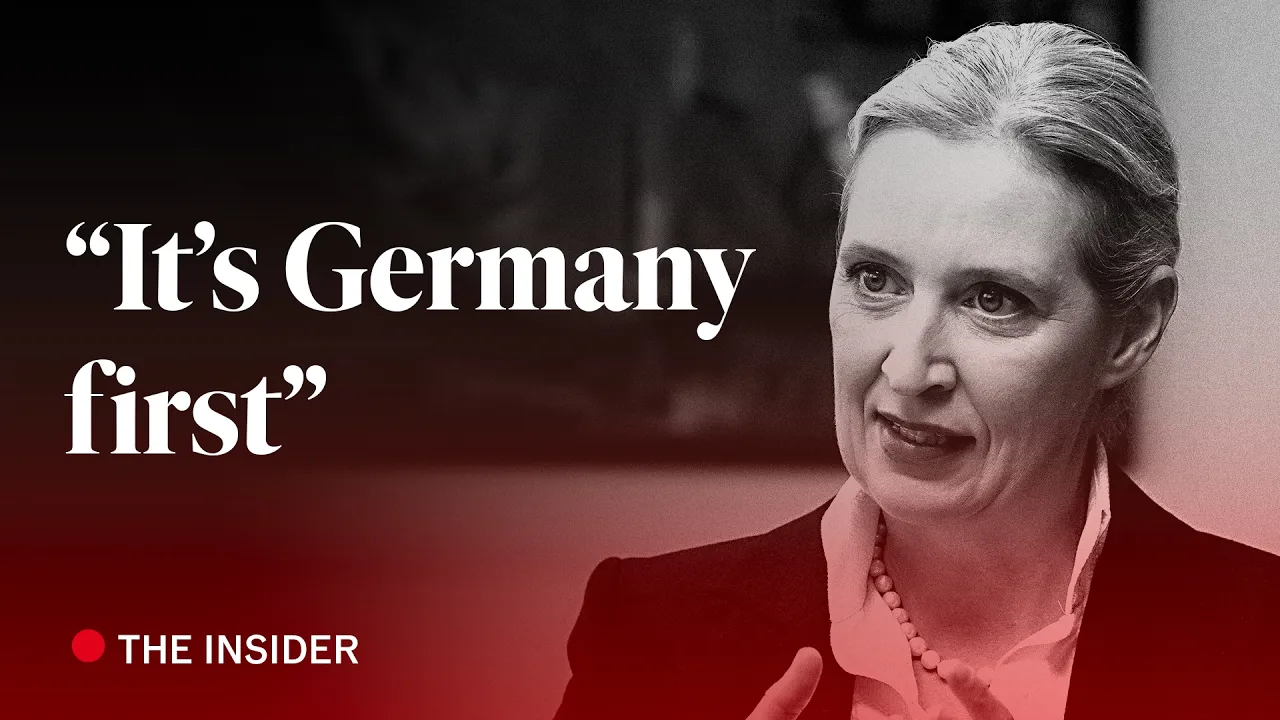
AfD's Weidel Rules Out Coalition Compromise, Warns CDU Will Perish
The Economist
AfD co-leader Alice Weidel vows to halt aid to Ukraine, restore Russian energy ties, and deport millions of refugees, insisting mainstream conservatives must adopt her platform rather than demand concessions.
AfD co-leader Alice Weidel diagnoses Germany as being in a deep crisis driven by the Energiewende, noting the shutdown of 19 nuclear reactors and warning that federal debt interest will surge from €40 billion to over €80 billion within three years. (12:50)
Weidel advocates an immediate halt to all German financial and military aid to Ukraine, framing it under an explicit 'Germany first' policy and demanding recognition of Russian security concerns alongside an immediate ceasefire. (25:46)
Expanding on 'remigration,' Weidel asserts that between four and five million people must leave Germany, including 100% of Syrian refugees whose war has concluded, Afghan evacuees, and Ukrainian refugees once hostilities end. (33:18)
Regarding parliamentary strategy, Weidel refuses to compromise on core economic, immigration, or foreign policy positions to form a government, arguing the CDU must abandon the Brandmauer firewall or face political extinction. (56:59)
Detailed notes
## Background
Published by The Economist on YouTube on October 21, 2026, this interview features AfD co-leader Alice Weidel in conversation with editor-in-chief Zanny Minton Beddoes at the Bundestag in Berlin. According to the video description, the program examines Weidel's alternative vision for Germany, exploring the AfD's economic blueprint, its policies regarding Russia and Ukraine, immigration, and whether she recognizes extremist elements within her party.
## TL;DR
Alice Weidel outlines the AfD's core platform, calling for a total overhaul of Germany's economy through the revival of nuclear energy, broad tax cuts, and steep reductions in social spending such as Bürgergeld. On foreign policy, she argues for an uncompromising 'Germany first' stance that would immediately halt military and financial aid to Ukraine, seek pragmatic peace negotiations acknowledging Russian security interests, and restore access to cheap Russian energy. Turning to immigration, she defends the concept of 'remigration,' demanding the expulsion of millions of Syrian, Afghan, and Ukrainian refugees whose protection status she argues has expired, while asserting that skilled legal immigrants are deterred by crime and excessive taxation. Concurrently, Weidel dismisses allegations that the AfD harbors neo-Nazi elements, rejects progressive gender policies, and insists her party will make zero compromises with mainstream rivals to breach the political firewall.
## Atmosphere & style
The exchange is taut, intellectually combative, and intensely adversarial from the outset, crackling with palpable ideological friction inside the Bundestag. Minton Beddoes presses Weidel with forensic precision, countering her economic math, querying Russian aggression, and highlighting controversial passages from state party manifestos, while Weidel responds with crisp, defiant, and at times visibly irritated pushback. The conversation shifts between clinical policy debates and sharp personal friction, producing an uncompromising clash over Germany's national identity, historical memory, and political future.
## Bulletin
- [12:50](https://www.youtube.com/watch?v=_cGGDu8sgXY&t=770s) AfD co-leader Alice Weidel diagnoses Germany as being in a deep crisis driven by the Energiewende, noting the shutdown of 19 nuclear reactors and warning that federal debt interest will surge from €40 billion to over €80 billion within three years.
- [25:46](https://www.youtube.com/watch?v=_cGGDu8sgXY&t=1546s) Weidel advocates an immediate halt to all German financial and military aid to Ukraine, framing it under an explicit 'Germany first' policy and demanding recognition of Russian security concerns alongside an immediate ceasefire.
- [33:18](https://www.youtube.com/watch?v=_cGGDu8sgXY&t=1998s) Expanding on 'remigration,' Weidel asserts that between four and five million people must leave Germany, including 100% of Syrian refugees whose war has concluded, Afghan evacuees, and Ukrainian refugees once hostilities end.
- [56:59](https://www.youtube.com/watch?v=_cGGDu8sgXY&t=3419s) Regarding parliamentary strategy, Weidel refuses to compromise on core economic, immigration, or foreign policy positions to form a government, arguing the CDU must abandon the Brandmauer firewall or face political extinction.
## Key takeaways
- [00:00](https://www.youtube.com/watch?v=_cGGDu8sgXY&t=0s) Germany's industrial decline and high energy costs stem directly from the phaseout of 19 nuclear power plants and over-reliance on intermittent solar and wind during Dunkelflaute periods.
- [04:20](https://www.youtube.com/watch?v=_cGGDu8sgXY&t=260s) The AfD advocates dismantling European Union supranational overreach, seeking to reform the bloc back into a loose free-trade confederation of sovereign states under the principle of subsidiarity rather than an immediate, unilateral exit.
- [09:12](https://www.youtube.com/watch?v=_cGGDu8sgXY&t=552s) The eurozone is fundamentally misaligned with optimal currency area criteria, and skyrocketing state debt across France, Southern Europe, and Germany will trigger a severe sovereign bond market crisis.
- [14:20](https://www.youtube.com/watch?v=_cGGDu8sgXY&t=860s) The AfD plans to fund wide-ranging tax cuts by terminating €50 billion in Bürgergeld welfare spending, cutting foreign development aid, ending green energy subsidies, and slashing costs tied to illegal migration.
- [14:20](https://www.youtube.com/watch?v=_cGGDu8sgXY&t=860s) Pension reform should preserve the three-pillar architecture by making occupational and private pensions fully tax-deductible while introducing capital-funded investment accounts into the pay-as-you-go system.
- [18:05](https://www.youtube.com/watch?v=_cGGDu8sgXY&t=1085s) German military spending should be restricted strictly to domestic territorial defense rather than foreign proxy commitments, rejecting the role of primary European financier for Ukraine.
- [20:33](https://www.youtube.com/watch?v=_cGGDu8sgXY&t=1233s) The Nord Stream pipeline sabotage constituted a €30 billion act of state terrorism against German critical infrastructure that the political establishment has deliberately overlooked.
- [24:28](https://www.youtube.com/watch?v=_cGGDu8sgXY&t=1468s) Ukraine's democratic credentials are questionable due to the suspension of presidential elections under martial law, and prolonged financing of the war imposes unacceptable economic and security risks on Germany.
- [29:05](https://www.youtube.com/watch?v=_cGGDu8sgXY&t=1745s) A sustainable peace settlement requires addressing historical Russian security concerns, particularly Western missile installations and two decades of NATO expansion.
- [33:18](https://www.youtube.com/watch?v=_cGGDu8sgXY&t=1998s) The legal concept of remigration must expand beyond rejected asylum seekers to encompass the return of entire refugee populations, totaling four to five million people, while reversing five-year fast-track naturalization rules.
- [38:53](https://www.youtube.com/watch?v=_cGGDu8sgXY&t=2333s) The asylum system must be clearly separated from skilled labor recruitment; qualified taxpaying professionals are welcome, but Germany currently suffers a brain drain due to punishing tax rates, excessive bureaucracy, and declining public safety.
- [43:13](https://www.youtube.com/watch?v=_cGGDu8sgXY&t=2593s) Immigration policy should be strictly merit-based and blind to ethnicity or skin color, but requires uncompromising adherence to German legal order, language proficiency, and gender equality.
- [46:57](https://www.youtube.com/watch?v=_cGGDu8sgXY&t=2817s) School curricula should prioritize classical figures such as Goethe, Schiller, and Bismarck rather than focusing exclusively on the Third Reich, while the traditional nuclear family must remain the core social standard.
- [51:27](https://www.youtube.com/watch?v=_cGGDu8sgXY&t=3087s) State-mandated progressive gender reforms, including annual legal gender reclassifications, are irrational and harmful to adolescent development.
- [53:15](https://www.youtube.com/watch?v=_cGGDu8sgXY&t=3195s) Accusations of neo-Nazism within AfD state branches and critiques of slogans like 'Everything for Germany' are unfounded smear tactics aimed at halting the party's democratic momentum.
- [56:59](https://www.youtube.com/watch?v=_cGGDu8sgXY&t=3419s) The Brandmauer firewall is an undemocratic mechanism keeping left-leaning policies in power, and the AfD will make no policy compromises to join a coalition, demanding that the CDU adjust its stance instead.
## Detailed walkthrough
### [00:00](https://www.youtube.com/watch?v=_cGGDu8sgXY&t=0s) The State of the German Economy and the "Energiewende"
Zanny Minton Beddoes opens the conversation by noting that the Alternative for Germany (AfD) is riding high in national polling, having won top positions in state elections and standing as the largest opposition group in the Bundestag. While acknowledging Alice Weidel's ability to channel voters' deep frustration with the status quo, Minton Beddoes asks for concrete policy specifics: if the German economy were a car, does it just need a few minor repairs, or an entirely new model? Weidel responds bluntly that the vehicle requires a complete overhaul from the ground up: “Actually, to be in your picture, you need to restructure and rebuild the entire car because the car parts are also broken.”
```mermaid
flowchart TD
accTitle: AfD Critique of German Economic Model
accDescr: Diagram tracing the AfD's view of how energy and regulatory policies drive industrial decline.
subgraph Energy["Energy Policy Failures"]
A["Shutdown of 19 Nuclear Plants"] --> C["Over-reliance on Wind & Solar"]
B["Dunkelflaute (Power Deficits)"] --> C
C --> D["Costly Emergency Energy Imports"]
end
subgraph Impact["Industrial Consequences"]
D --> E["Highest Energy Costs Worldwide"]
F["Excessive EU Bureaucracy"] --> G["Loss of Global Competitiveness"]
E --> G
G --> H["Skyrocketing Bankruptcies & Corporate Flight"]
end
```
Weidel diagnoses Germany as being trapped in a multifaceted, deep crisis. The primary driver, in her view, is the self-inflicted destruction of the nation's energy grid under the *Energiewende* (energy transition) policy initiated under Angela Merkel and sustained by subsequent administrations. Germany systematically shut down and in some cases detonated its fleet of 19 modern nuclear power plants, reducing domestic nuclear capacity to zero while attempting to rely almost exclusively on weather-dependent wind and solar power.
This intermittent generation produces the phenomenon of *Dunkelflaute* (dark doldrums), where a lack of sun and wind forces the country to import electricity from neighbors at exorbitant prices. Consequently, German businesses and households face what Weidel identifies as the highest energy prices in the world, gutting competitiveness, accelerating corporate bankruptcies, driving heavy industry abroad, and compounding the burdens of domestic bureaucracy.
- **Status of nuclear energy:** Germany previously operated 19 modern nuclear reactors; today, zero are operational following decommissioning and demolitions.
- **Root causes of industrial distress:** Grid instability during *Dunkelflaute*, soaring wholesale and retail electricity rates, and high regulatory overhead.
- **Core quote:** “So um I think um Germany has the stupidest and most dumbest or dumbest um energy policy worldwide and it continues.” — *Alice Weidel*
---
[04:20](https://www.youtube.com/watch?v=_cGGDu8sgXY&t=260s) Reforming the European Union vs. Exiting the Euro
Addressing the AfD’s broader economic platform, Minton Beddoes concedes that excessive red tape and high power bills are real issues, but questions the party's platform calling for Germany to abandon the euro, an outcome most economists predict would cause catastrophic economic disruption. Weidel pushes back against what she characterizes as a political caricature, maintaining that the AfD does not seek an automatic departure from the EU or the euro, but rather an urgent structural dismantling of European overreach. She argues the European Union must return to its founding vision as a loose confederation of sovereign nation-states linked by an open free-trade area.
Weidel attacks the European Commission as an un-elected, planned-economy apparatus that micromanages citizens' lives, dictates what goods manufacturers must produce, and issues paternalistic mandates to consumers. Invoking classical political philosophy, she insists that authority must be dispersed horizontally and vertically under the principle of subsidiarity, meaning power belongs at the lowest possible tier of representative governance where voters exercise direct accountability. When pressed on whether her actual leverage strategy mirrors David Cameron’s high-stakes gamble prior to the Brexit referendum, Weidel defends the approach of demanding strict institutional rollbacks as the only means of protecting national wealth.
- **The AfD's target model:** A decentralized European free-trade area built around sovereign nation-states without supranational executive dominance.
- **Critique of the European Commission:** Functioning like a Soviet-style planned economy lacking proper checks and balances.
- **Core quote:** “Our program states that we would like to reform firstly the European Union. We think that the European Union should be a community of sovereign states um with a free trade area.” — *Alice Weidel*
---
[09:12](https://www.youtube.com/watch?v=_cGGDu8sgXY&t=552s) Currency Instability and Impending Sovereign Debt Crises
Turning specifically to monetary policy, Minton Beddoes presses for a direct answer on whether an AfD-led Germany would ultimately withdraw from the single currency. Weidel frames the eurozone as a fundamentally flawed construct, reiterating Robert Mundell’s economic doctrine that the member states never met the criteria for an optimal currency area. She argues that the German public was misled during the currency's inception by broken political pledges promising that Germany would never underwrite or assume the sovereign liabilities of other European nations.
| Diverging Fiscal Visions | Alice Weidel (AfD / Germany) | Marine Le Pen (National Rally / France) |
|:--- |:--- |:--- |
| **Monetary Approach** | Return to strict, rules-based limits; halt ECB balance-sheet expansion | Leverage ECB balance sheet to fund national infrastructure |
| **Financial Philosophy** | Restrict cross-border debt liabilities; preserve currency stability | Expand cheap debt financing to ease domestic budgetary strain |
| **National Role in EU** | Primary net financier carrying unsustainable foreign obligations | Major net recipient seeking relief from high market yields |
The conversation turns to the widening divide between European populist leaders, highlighted by Marine Le Pen’s demands that the European Central Bank finance major infrastructure through balance-sheet expansion. Weidel acknowledges that while Le Pen is pursuing French national interests, France’s escalating debt crisis and surging bond yields expose the structural fractures in the eurozone.
Weidel warns that Germany’s own escalating federal debt—driven by the current government's borrowing program—means both core and peripheral economies are sleepwalking toward a sovereign bond crisis. She emphasizes that with German interest obligations surging toward €80 billion to €82 billion over the coming three-year budget cycle, compounding yields will soon destabilize European capital markets.
- **Eurozone structural critique:** The bloc lacks the fiscal and structural symmetry required for an optimal currency area, leading to an over-inflated money supply.
- **German borrowing projections:** Rising sovereign debt will lift capital-market interest costs toward an estimated €80–82 billion over the next three years.
- **Core quote:** “Oh, certainly certainly we're going to have a bond market crisis. So with such a high state debt and it's not only France, it's also Italy, Spain, Portugal and it's also Germany.” — *Alice Weidel*
[12:50](https://www.youtube.com/watch?v=_cGGDu8sgXY&t=770s) The Exploding Interest Burden and the AfD's Fiscal Math
Alice Weidel warns that Germany is teetering on the edge of a severe sovereign debt trap. Although Zanny Minton Beddoes points out that Germany's borrowing rates remain among the lowest in Europe, Weidel insists that an inevitable risk premium will soon drive debt servicing costs through the roof. She projects that Germany’s annual interest bill will double from roughly €40 billion today to more than €80 billion within just three years, an escalation she describes as wholly unbearable and entirely self-inflicted by the political establishment. In her view, the federal government has been recklessly throwing away taxpayers' money on ideological ventures such as the green energy transition, pulling the country into a structural financial emergency. To avert disaster, she insists that Berlin must urgently restore fiscal discipline, resilience, and fundamental seriousness to its public accounts.
Beddoes presses Weidel on the apparent contradictions within the AfD’s own economic manifesto, noting that her party simultaneously proposes sweeping tax cuts and increased pension spending—a combination that traditional economists argue would dramatically widen the deficit. When Beddoes suggests that the AfD platform looks far from fiscally frugal, Weidel stands her ground, countering that the arithmetic works out cleanly once government priorities are radically overhauled.
> “And this has been self-inflicted by stupid policies like throwing out the taxpayers' money like with for ridiculous projects like the climate transition and I could sum out so many things right now but Germany and this is my point is also in a deep financial crisis and we need to go back to financial resilience and seriousness.” — Alice Weidel
- Current German federal interest bill: approximately €40 billion annually.
- Projected interest burden within three years: over €80 billion annually.
- Criticized outlays: climate transition investments, foreign development aid, and high structural subsidies.
---
[14:20](https://www.youtube.com/watch?v=_cGGDu8sgXY&t=860s) Cutting Social Spending, Scrapping Subsidies, and the Three-Pillar Pension Plan
To finance the party's proposed tax cuts without exploding the debt, Weidel outlines steep spending cuts across three major budgetary targets: social welfare, foreign development aid, and energy subsidies. She singles out Bürgergeld, arguing that social welfare payments adding up to €50 billion—which she claims flow primarily to foreigners—represent an unsustainable drain on public finances. Furthermore, she calls for an immediate end to the multi-billion-euro subsidy regime backing the green energy transition, asserting that current renewable energy plans simply cannot power an industrial powerhouse like Germany. In addition, she points to the uncalculated economic costs and public-order disruptions generated by uncontrolled illegal mass migration across open borders.
Addressing pensions, Weidel insists an AfD government would not spend more state money on the public pension system. Instead, she outlines a structural overhaul of Germany’s traditional three-pillar model. The first pillar (*Umlageverfahren*, or pay-as-you-go) would be bolstered by introducing individual, capital-funded investment accounts. For the second (occupational/company pensions) and third (private pensions) pillars, she proposes making contributions completely tax-free and tax-deductible to incentivize private wealth generation. When Beddoes observes that granting extensive tax deductions would inevitably drain public revenue, Weidel responds that German workers already shoulder the highest taxes and social security charges in the developed world, making substantial tax relief essential to revive individual productivity.
> “So therefore we need to lower the taxes but also on the other hand we need to cut these huge expenditures by our state and also like I would like to talk about the huge cost of a illegal out of control mass migration in our country.” — Alice Weidel
```mermaid
flowchart TD
accTitle: AfD Proposed Budgetary Reallocation
accDescr: Flowchart illustrating expenditure cuts used to fund tax deductions and pension reforms.
subgraph BudgetSavings["Fiscal Savings Pool"]
E["Restoration of Fiscal Resilience<br/>& Deficit Reduction"]
end
subgraph PolicyRelief["Targeted Tax Relief & Pension Reform"]
F["Broad Worker Tax Cuts"]
G["Tax-Deductible Company Pensions"]
H["Tax-Free Private Pension Accounts"]
I["Capital-Funded Additions to Pillar 1"]
end
A --> E
B --> E
C --> E
D --> E
E --> F
E --> G
E --> H
E --> I
```
---
[18:05](https://www.youtube.com/watch?v=_cGGDu8sgXY&t=1085s) German Defense Spending and Opposition to Aiding Ukraine
The discussion pivots from domestic budgeting to defense spending. Beddoes recalls Weidel's earlier characterization of the political establishment’s borrowing as an "orgy of debt," noting that one primary justification for suspending the constitutional debt brake (*Schuldenbremse*) was to fund a historic military upgrade and meet NATO commitments. When asked whether the AfD supports raising defense spending to the proposed NATO target of 3.5% of GDP by 2029, Weidel concedes that Germany historically neglected its armed forces, falling well short of even the 2% benchmark at around 1.0% to 1.2%. While acknowledging that the Bundeswehr requires modernization, she stresses that military expenditure must be restricted strictly to domestic territorial defense rather than foreign proxy conflicts.
Weidel harshly criticizes Berlin for stepping into the role of Ukraine's primary European financier and weapons supplier. With Donald Trump moving away from funding Kyiv and other European partners scaling back their commitments, she argues that the German government has left the country isolated in maintaining an unsustainable war effort. Continuing this policy, she contends, endangers German and European national security, depletes vital domestic munitions reserves, and risks dragging Germany into open confrontation. As a result, the AfD demands an immediate halt to unilateral military transfers in favor of pushing for immediate peace negotiations.
> “We think and this is our opinion that this policy being undertaken by the German government right now is very harmful for the national security of Germany and also for the other European states. Therefore proposing that we need to go immediately that we need to force peace talks to end this terrible war in the Ukraine.” — Alice Weidel
- Historic German defense spending: approximately 1.0% to 1.2% of GDP.
- Proposed future NATO spending target under discussion: 3.5% of GDP by 2029.
- Cumulative German aid and expenditures associated with the Ukraine war cited by Weidel: over €100 billion.
---
[20:33](https://www.youtube.com/watch?v=_cGGDu8sgXY&t=1233s) Russian Energy, the War in Ukraine, and the Nord Stream Attack
Beddoes presses Weidel on whether she views Russia as an existential threat to European democracies and NATO members. Weidel rejects the framing, asserting that foreign policy should not be judged through abstract moral categories of "threat or not being a threat," but solely through the cold lens of German national interest. She contends that cutting off economic ties with Moscow has crippled Germany’s industrial competitiveness. Pointing across the Atlantic, she notes that Donald Trump routinely communicates with Vladimir Putin regarding crude oil, diesel, and gas supplies, arguing that Germany should adopt an equally pragmatic stance to lower soaring domestic energy costs. She insists that while any peace deal must respect Ukrainian interests, it must also satisfy Russian security concerns, repeating firmly: "It is not our war."
The exchange grows heated when Beddoes mentions suspected Russian hybrid operations inside Germany, including a foiled sabotage plot targeting Leipzig Airport. Weidel dismisses the report as unverified hearsay that lacks parliamentary proof, pivoting immediately to what she labels the true act of state terrorism: the destruction of the Nord Stream pipelines in the Baltic Sea. Costing upwards of €30 billion, the severed pipeline network cut Germany and Europe off from cheap Russian natural gas. Weidel accuses Berlin’s ruling politicians of deliberately ignoring the hard forensic facts of the Nord Stream bombing while exaggerating unsubstantiated Russian threats.
> “Well, we would like to have the same thing for Germany because we need to lower our energy cost. So therefore we are very pragmatic. We would like to have a peace that also serves the interest of the Ukrainians and also the security interest of Russia. But it is and this is our stance. It is not our war and it's very dangerous and it's very costly especially for us.” — Alice Weidel
> “And what we have in the sea is we have destroyed Nord Stream pipelines and that was a state terror attack on the German infrastructure being very harmful for Germany for us like destroying like an energy infrastructure being worth like almost 30 billion euros.” — Alice Weidel
---
[24:28](https://www.youtube.com/watch?v=_cGGDu8sgXY&t=1468s) Clashing over Aggression and Ukrainian Democracy
Beddoes strongly objects to Weidel’s moral equivalence, reminding her of the fundamental geopolitical facts: in February 2022, Russia launched an unprovoked, full-scale invasion of Ukraine, and has subjected Ukrainian towns and infrastructure to relentless barrages of Iranian-designed Shahed drones and ballistic missiles ever since. Drawing on her own recent reporting trip to Kyiv, Beddoes asks whether Germany and democratic Western European nations do not have a clear moral obligation to support a sovereign democracy fighting for its survival against outright external aggression.
Weidel openly challenges the premise that Ukraine functions as a genuine democracy. She points to the suspension of presidential elections and claims that even Donald Trump has questioned Volodymyr Zelensky's political legitimacy, suggesting that Zelensky is no longer the right leader to achieve peace. When Beddoes interjects to remind her that elections were suspended under martial law precisely because the country is fighting an existential war of survival under daily bombardment, Weidel remains entirely unmoved, questioning the democratic credentials of the government in Kyiv.
> “Do you not think it is appropriate for Germany and for other West European countries to support a country that is a democratic country trying to defend itself against this outright aggression?” — Zanny Minton Beddoes
> “Well, it's as democratic as it is. They have no elections anymore of a new president. That's the reason why the American president he claims new elections for the president because he thinks that Zelensky is not the right person at the right time.” — Alice Weidel
[25:46](https://www.youtube.com/watch?v=_cGGDu8sgXY&t=1546s) The War in Ukraine and "Germany First"
Alice Weidel makes it clear that while the AfD criticized Russia’s invasion of Ukraine on the grounds that Ukraine is a sovereign nation, she regards the conflict in its current state as completely unsustainable. She points to the devastating human toll—soldiers dying, families mourning their sons—alongside the destruction of key energy infrastructure, soaring diesel prices, and severe national security risks across Europe. From her perspective as a German lawmaker, foreign policy must be assessed strictly through the lens of domestic welfare, which leads her to advocate ending all financial and military assistance to Kyiv. She argues that Berlin is pouring public funds into a conflict that Ukraine cannot win against Russia. When Zanny Minton Beddoes presses her on whether that means accepting the destruction of Ukraine as an independent state, Weidel counters that prolonging the fighting guarantees no peace. Beddoes challenges her directly, asking for a single piece of evidence that Vladimir Putin has any genuine interest in a negotiated settlement. Weidel fires back, demanding evidence of Volodymyr Zelensky’s willingness to compromise. Beddoes notes that Ukraine has proposed energy ceasefires and held talks in Florida, whereas Putin continues to bombard Ukrainian civilian and energy infrastructure ahead of winter.
Weidel remains unmoved, framing her stance around an explicit “Germany first” foreign policy that rejects footing the bill for a prolonged war. She underscores that Germany has already spent massive sums that it cannot afford given its own national debt. In her view, diplomatic negotiations are doomed to fail unless they address the deeper historical backdrop that preceded the Russian invasion.
> “The prolongation and the measures being taken by the German governments right now impose a huge risk on our country and we think I think it is wrong to continue with a prolongation of a financing of a already lost war.” — Alice Weidel
- Germany’s committed spending on the conflict has exceeded €100 billion, an expenditure level Weidel argues outstrips other European nations despite Germany’s own heavy debt.
- Weidel insists Ukraine is inherently too small to achieve a military victory over Russia.
---
[29:05](https://www.youtube.com/watch?v=_cGGDu8sgXY&t=1745s) NATO Encroachment, Russia's Security Interests, and the Escalation Risk
Weidel argues that any durable settlement must account for Russian security concerns dating back two decades, explicitly citing NATO expansion toward Russia's borders. She maintains that Western powers made a critical strategic mistake by ignoring Moscow's repeated warnings about missile deployments in neighboring states, pointing to missile defense installations such as the Aegis system in Romania capable of carrying nuclear payloads. Beddoes pushes back, arguing that cutting off Western aid would virtually guarantee Ukraine's destruction and that Putin’s historical ambitions extend beyond Ukraine to reconstituting the sphere of influence of the former Soviet Union, posing a direct threat to the Baltic states and NATO members.
Weidel dismisses Beddoes's warnings of an impending attack on NATO, asserting instead that Ukraine’s military tactics represent the real escalation danger. She sharply criticizes deep Ukrainian strikes using drones against oil refineries, industrial hinterlands, and targets near Moscow. Launching attacks deep inside the territory of a nuclear-armed power, Weidel warns, is inherently reckless and puts all of Europe at risk. While the United States remains insulated across the Atlantic, European nations face the direct fallout, which she argues gives Germany an urgent national imperative to pressure the Ukrainian leadership to negotiate.
> “In order to have a peace in the Ukraine we need to take not only Ukraine security interest into account but also Russia security interest into account and this was in the past and this is and this has been the major mistake like the 20 years before to not acknowledging the security concerns of Russia.” — Alice Weidel
```mermaid
flowchart TD
accTitle: AfD Critique of Western Strategy in Ukraine
accDescr: Diagram illustrating Weidel's critique of the current Western policy toward the war in Ukraine versus her proposed policy.
subgraph Current["Current Western Policy (AfD Critique)"]
A["Military & Financial Aid"] --> B["Deep Drone Strikes into Russia"]
B --> C["Escalation Risk with Nuclear Power"]
C --> D["Direct Threat to European Security"]
end
subgraph Proposed["AfD Proposed Approach"]
E["Halt All German & EU Funding"] --> F["Acknowledge Russian Security Concerns"]
F --> G["Pressure Kyiv to Negotiate"]
G --> H["Immediate Ceasefire & Peace Deal"]
end
```
---
[33:18](https://www.youtube.com/watch?v=_cGGDu8sgXY&t=1998s) Defining "Remigration" and the Expulsion of Refugees
The discussion turns to domestic immigration policy and the AfD's prominent use of the term "remigration." Beddoes asks Weidel to clarify precisely what the concept entails, given widespread anxiety among immigrant communities and naturalized citizens. Weidel initially defines remigration in legalistic terms: the rigorous enforcement of existing immigration statutes, resulting in the deportation of individuals who entered Germany illegally, asylum seekers whose applications have been formally denied, and foreign nationals who have committed crimes. Beddoes notes that this strictly legal definition applies to roughly 260,000 individuals, but asks Weidel whether she disavows statements by other figures in her party who call for remigrating millions of people, including foreign-born naturalized Germans.
Weidel refuses to disavow broader deportations, expanding her definition significantly beyond the 260,000 figure to encompass entire nationalities whose original grounds for refuge she claims no longer apply. Focusing on Syrian and Afghan refugees, Weidel asserts that because the Syrian war has concluded, all Syrian citizens must leave, accusing the German government of inaction. She claims that Syrians and Afghans are disproportionately responsible for severe violent offenses (*Rohheitsdelikte*), including rapes and murders, since the 2015 border opening, and demands the detention and deportation of criminals and Islamist extremists to prevent a "caliphate." She extends this deportation demand to Ukrainian refugees once their war concludes, calculating that the total number of individuals required to leave Germany reaches between four and five million people, while sharply condemning the government’s policy of granting German citizenship after five years of residence.
> “100% of the Syrians because the war ended in Syria, 100% of the Syrian citizens have to go back to their country as well as the Afghans which our government decided to actually fly into our country.” — Alice Weidel
| Category of Migrants | Current Legal/Official Status | Alice Weidel / AfD Position |
|:--- |:--- |:--- |
| **Rejected Asylum Seekers & Illegal Entrants** | Legally obligated to leave (~260,000 individuals) | Demand immediate and uncompromising law enforcement and deportation. |
| **Syrian Nationals** | Protected under humanitarian/asylum provisions | 100% must return to Syria; argues original grounds for asylum have expired. |
| **Afghan Evacuees / Asylum Seekers** | Resettled/granted status following Taliban takeover | Must be deported; cites rising violent crime (*Rohheitsdelikte*) and extremist risks. |
| **Ukrainian Refugees** | Protected under EU temporary protection directives | Must leave Germany entirely once the war reaches an end. |
| **Naturalization Policy** | Reformed path to German citizenship after five years | Strongly opposed; describes it as the government "throwing away" the German passport. |
[38:53](https://www.youtube.com/watch?v=_cGGDu8sgXY&t=2333s) Distinguishing Asylum from Skilled Immigration and the Brain Drain
Alice Weidel insists that any foreigner is welcome in Germany provided they arrive with a work visa, hold proper qualifications, pay taxes, and respect the legal order. Addressing Zanny Minton Beddoes’s challenge that Germany faces an acute medical shortage—where around 100,000 German doctors are over 60 years old and Syrians represent the single largest contingent of foreign-born physicians—Weidel contends that critics deliberately conflate the asylum apparatus with skilled labor immigration. She emphasizes that she has no desire to expel qualified professionals like Syrian doctors, admitting that Germany’s unfavorable demographic curve necessitates recruiting talent abroad. However, she argues that Germany currently fails to attract high-caliber professionals because open borders have allowed foreign criminals to undermine public safety and overburden welfare infrastructure, all while taxes remain punishingly high and bureaucracy suffocates enterprise.
Beyond deterring incoming talent, Weidel stresses that these conditions are triggering a massive domestic brain drain of qualified Germans fleeing to Switzerland or the United States. She recounts that German families can no longer afford to buy homes or raise children on their post-tax earnings, while public safety has deteriorated to the point where parents fear sending their children to school or letting them ride public transit. In her view, classroom disorder driven by youth violence has pushed productive citizens out, compounding an already severe demographic deficit.
> “I think in this discussion, which is very important, we shouldn't mix up the asylum system on one hand and then people coming to Germany with a working visa, with a qualification, being a professional, paying taxes.” — Alice Weidel
- Beddoes points out that roughly 100,000 German doctors (about a quarter of the total workforce) are above age 60 and nearing retirement.
- Syrians constitute the largest individual group among foreign-born medical practitioners in Germany.
- Weidel identifies high marginal taxes, administrative bureaucracy, and deteriorating street safety as the primary deterrents for foreign talent and the drivers of domestic emigration to Switzerland and the US.
---
[43:13](https://www.youtube.com/watch?v=_cGGDu8sgXY&t=2593s) The “Culturally Alien” Controversy and Integration Expectations
Beddoes confronts Weidel with a passage from the AfD Saxony-Anhalt state election manifesto warning that Germany should not rely on “culturally alien skilled workers,” characterizing the term as an exclusionary dog whistle aimed directly at Muslim professionals. Weidel rejects the characterization, defending the phrase as an expression of practical friction in workplaces where fundamental societal norms—such as gender equality—are rejected. She cites instances from the Berlin police department where male officers of Muslim descent refused to shake hands with female colleagues or participate in pool exercises because women had swum in the water beforehand, arguing that equal rights between men and women remain non-negotiable.
When asked whether this implies Germany should simply reduce its population of Muslim descent, Weidel dismisses any demographic quota or blanket exclusion. She asserts that skin color and ethnicity are completely irrelevant, referencing her own marriage to a woman of color to emphasize that the party evaluates individuals strictly on merit rather than race or identity quotas. The fundamental crisis, she argues, is that the sheer volume of arrivals has exceeded the country’s integration capacity, causing harm not only to native citizens but also to well-integrated Muslims who respect German laws and shared values.
> “What counts is merit: we need to have a merit-based system and not a quota and anti-discrimination quota.” — Alice Weidel
```mermaid
flowchart TD
accTitle: Criteria for German Integration
accDescr: Diagram illustrating Weidel's contrast between rejected immigration factors and required civic expectations.
subgraph Irrelevant["Irrelevant Factors"]
A["Skin Color / Race"]
B["Faith / Ethnic Heritage"]
end
subgraph Essential["Core Requirements for Entry & Residence"]
C["Merit & Qualifications"]
D["Respect for Equality Between Men and Women"]
E["Language Competence"]
F["Compliance with Public Order & Law"]
end
Irrelevant -.->|"Should not determine policy"| G["AfD Policy Standard"]
Essential -->|"Determines acceptance"| G
```
---
[46:57](https://www.youtube.com/watch?v=_cGGDu8sgXY&t=2817s) The Saxony-Anhalt Manifesto and Far-Right Framing
Beddoes questions how Weidel squares her self-described "libertarian conservative" philosophy with the 252-page Saxony-Anhalt AfD manifesto, which proposes illiberal measures such as segregating disabled children and the children of refugees from regular classrooms, introducing *Heimatkunde* (homeland studies), prioritizing Otto von Bismarck over Adolf Hitler in history curricula, and penalizing insults against the German state. Weidel embraces the cultural rebalancing toward German literary figures like Johann Wolfgang von Goethe and Friedrich Schiller, alongside historical figures like Bismarck, arguing that Germany must remember its long, rich history rather than dwelling exclusively on the Nazi era.
Weidel firmly rejects the labels of "hard right," "far right," or "extremist," characterizing her party's agenda as mere common sense aimed at restoring order, secure borders, safe schools, affordable family housing, and protected energy infrastructure. When Beddoes quotes the Saxony-Anhalt manifesto’s assertion that an intact family consisting strictly of a father, mother, and children provides the optimal environment for child development—pointing out the irony that Weidel lives in a same-sex relationship in Switzerland raising two children with her Sri Lankan-born Swiss partner—Weidel deflects with humor. She insists that living outside the traditional model does not disqualify her from defending the traditional nuclear family, noting that it remains the statistical standard and foundational pillar for the overwhelming majority of society.
> “Why is it far right, hard right, extremist right to be an advocate for secure borders against illegal migration, being against the destruction of our energy infrastructure?” — Alice Weidel
- The Saxony-Anhalt state manifesto, comprising 252 pages, generated controversy over curriculum shifts, state-insult penalties, and educational segregation.
- Weidel highlights that the AfD secured roughly 45% of the vote in the relevant electoral region, interpreting the result as a democratic mandate for standard conservative order.
- In response to questions about her personal household, Weidel notes that her wife holds Swiss citizenship and clarifies that her personal life does not prevent her from endorsing the traditional nuclear model for society as a whole.
[51:27](https://www.youtube.com/watch?v=_cGGDu8sgXY&t=3087s) Traditional Family Models, Gender Laws, and Lifestyle Freedoms
Alice Weidel continues discussing family structures, pointing out that over 90% of children grow up in traditional family environments. While stating that she supports that model and has signed onto it, she emphasizes that the party “completely tolerates a model like me.” Weidel characterizes herself as socially liberal when it comes to personal lifestyles, insisting that everyone should be free to live their own life without the state meddling in every personal decision.
However, Weidel draws a firm line against gender ideology and progressive social initiatives. She vehemently rejects state-sponsored gender measures, arguing that introducing constructs such as social genders to replace biological reality is deeply confusing to adolescents. She singles out the recent legislation passed under the coalition government allowing individuals to legally change their gender once a year, calling the policy completely irrational and harmful. When Zanny Minton Beddoes asks whether she feels entirely secure that the AfD will preserve the rights and freedoms of diverse families like her own, Weidel answers with unwavering confidence.
“And we need to go back to a normal policy and not uh uh having constructions like uh social genders and not having biological genders.” — Alice Weidel
- **Core stance on personal freedom**: Strong support for individual lifestyles free from state intervention.
- **Opposition to gender reform**: Critical condemnation of the law permitting yearly legal gender transitions starting at a young age.
- **Family model assurance**: Confirms her absolute trust that the AfD will uphold the freedoms of alternative family structures.
---
[53:15](https://www.youtube.com/watch?v=_cGGDu8sgXY&t=3195s) Denying Neo-Nazi Elements and Rejecting the "Third Reich" Framing
The conversation pivots sharply when Zanny Minton Beddoes presses Weidel on the existence of extremist, neo-Nazi factions within the AfD. Minton Beddoes points specifically to Björn Höcke, who was convicted and fined for using forbidden Nazi slogans, as well as recent revelations concerning advisers to the party leader in Saxony-Anhalt who belonged to a banned neo-Nazi youth organization. Visibly perturbed by the direction of the interview, Weidel dismisses the allegations as entirely groundless and bristles at the premise, asking why the interviewer is fixated on the topic.
Minton Beddoes counters that these concerns are central to how the public views the AfD, noting that as someone with German family heritage, she understands why voters worry about echoes of the 1930s. Weidel rejects the guilt-by-association framing, asserting that Höcke’s utterance of “Everything for Germany” (Alles für Deutschland) is merely an expression of a “Germany first” sentiment rather than actual Nazism. She maintains that linking the AfD to the atrocities of the Third Reich is simply a malicious, calculated effort by political opponents to inflict reputational damage on the party.
“Well we had that before that the framing of farright extremist um um is unfunded.” — Alice Weidel
“Everything for Germany is a Nazi slogan. It's ridiculous. Germany first. This is what he said. Do you think it's a Nazi slogan? I don't think so.” — Alice Weidel
- **Höcke slogan defense**: Claims the slogan Björn Höcke was fined for translates philosophically to putting the country first rather than endorsing fascism.
- **Saxony-Anhalt & Thuringia**: Denies that party branches harbor proto-Nazi or fascist tendencies.
- **Public anxiety**: Refuses to validate external demonstrations and fears, labeling accusations of extremism an outdated, ineffective smear tactic.
---
[56:59](https://www.youtube.com/watch?v=_cGGDu8sgXY&t=3419s) Breaking the *Brandmauer* and Why the AfD Refuses to Compromise
Turning to the AfD's electoral ambitions, Minton Beddoes asks about Weidel’s goal of exceeding 40% of the vote and whether the party is prepared to compromise to break the *Brandmauer* (the political firewall erected by mainstream parties against cooperating with the AfD). Weidel argues that the firewall is counterproductive and fundamentally undemocratic. She contends that the cordon sanitaire only hurts the governing parties, noting that the Chancellor’s party (the SPD) has plunged below 18% in the polls, while the AfD has surged past the CDU at the federal level. In her eyes, the firewall perversely cements left-wing rule, high taxes, and destructive policies in Berlin against the democratic wishes of the electorate.
When asked whether the AfD would compromise on core policy positions to enter a governing coalition if the firewall were to crumble, Weidel firmly rejects the notion. She states that the AfD's key demands—particularly regarding the economy, immigration, and foreign policy—are non-negotiable because the German populace deserves straightforward, common-sense solutions. Instead of the AfD moderating its stance, Weidel insists that the Christian Democratic Union (CDU) must bend and adapt to the AfD's agenda, warning that failing to do so will result in the CDU's political demise.
“I think on our main points that I've laid out in our interview, there are no compromises to be made because our country and our people, they deserve it.” — Alice Weidel
“And I think the CDU has to move first and if the CDU doesn't move very quickly, they perish very soon.” — Alice Weidel
```mermaid
flowchart TD
accTitle: AfD Coalition and Firewall Dynamics
accDescr: Diagram illustrating Alice Weidel's critique of the Brandmauer firewall and her expectations for the CDU.
subgraph Problem["The Status Quo: Brandmauer"]
A["Establishment Firewall\n('Brandmauer')"] --> B["Empowers Left-Wing Coalition\n& High Tax Policies"]
A --> C["SPD Poll Numbers Crash\n(Below 18%)"]
end
subgraph Alternative["AfD Electoral Strategy"]
D["AfD Surges Past CDU\n(Exceeding 30% Federally)"]
D --> E{"CDU Strategic Choice"}
E -->|"Refuses to Move"| F["CDU Extinction / 'Perish Very Soon'"]
E -->|"Breaks Firewall"| G["Coalition on AfD Terms\n(Zero Compromises on Main Policies)"]
end
```
- **Poll numbers**: Claims the AfD has surpassed 30% federally, opening up a 12-to-13-point lead over the Chancellor’s party.
- **Firewall critique**: Characterizes the *Brandmauer* as an undemocratic shield keeping left-wing blocs in power.
- **Ultimatum to the CDU**: Categorically rules out ideological concessions, stating the CDU must yield first or face elimination.
## Notable quotes
> [46:57](https://www.youtube.com/watch?v=_cGGDu8sgXY&t=2817s) Why is it far right, hard right, extremist right to be an advocate for secure borders against illegal migration, being against the destruction of our energy infrastructure? — Alice Weidel
> [43:13](https://www.youtube.com/watch?v=_cGGDu8sgXY&t=2593s) What counts is merit: we need to have a merit-based system and not a quota and anti-discrimination quota. — Alice Weidel
## Mentioned
Alice Weidel, Zanny Minton Beddoes, The Economist, Alternative for Germany (AfD), Bundestag, Angela Merkel, European Union, European Commission, David Cameron, Robert Mundell, Marine Le Pen, National Rally, European Central Bank, Donald Trump, NATO, Bundeswehr, Vladimir Putin, Volodymyr Zelensky, Aegis, Björn Höcke, Christian Democratic Union (CDU), Social Democratic Party of Germany (SPD), Johann Wolfgang von Goethe, Friedrich Schiller, Otto von Bismarck, Adolf Hitler
## Video description
Alice Weidel is one of the most important politicians in Europe today. She is the co-leader of the Alternative for Germany (AfD), the right-wing populist party which is leading in Germany’s national polls and came top in two recent state elections. Ms Weidel is skilled at voicing Germans’ frustrations with mainstream political parties. Less clear is her alternative vision for the country. What does she really believe in? And how would she govern?
In conversation with Zanny Minton Beddoes, The Economist’s editor-in-chief, in the Bundestag in Berlin, Ms Weidel discusses the AfD’s economic plan, its stance on Russia and Ukraine, and whether she supports—or even recognises—the extreme elements in her party.
#germany #afd #putin #europe #ukraine
00:00:00 — Introduction
00:01:15 — How Alice Weidel would fix Germany’s economy
00:18:12 — “Germany should stop supporting Ukraine”
00:33:18 — Why the AfD wants to send refugees back to their countries
00:47:04 — Is the Alternative for Germany an extremist far-right party?
00:56:59 — The German firewall and why the AfD won’t compromise
We are starting to publish select Insider interviews in full on YouTube, with a delay. Meanwhile, subscribers to The Economist can enjoy interviews and the rest of our Insider shows on our app or website as soon as they are released: https://www.economist.com/insider
Sign up to the Insider newsletter: https://econ.st/4nOyzIb
Subscribe to our channel: https://www.youtube.com/@TheEconomist?sub_confirmation=1
Subscribe to The Economist: https://www.economist.com/subscribe
Download our app: https://www.economist.com/get-the-app
Follow The Economist on Instagram: https://www.instagram.com/theeconomist/
Follow The Economist on Facebook: https://www.facebook.com/TheEconomist
Follow The Economist on X: https://x.com/TheEconomist
Alice Weidel, co-leader of the Alternative for Germany (AfD), argues that Germany is trapped in a multifaceted economic and security crisis driven by reckless energy policies, uncontrolled immigration, and costly foreign commitments. She asserts that restoring national stability requires an uncompromising "Germany first" restructuring of public finances, the immediate end of support for Ukraine, and the departure of millions of migrants.
Energy Transition and Fiscal Overhaul (0:00)
Weidel diagnoses the German economy as requiring an overhaul from the ground up, blaming industrial distress directly on the Energiewende. Following the closure and demolition of Germany's 19 nuclear reactors, she asserts that over-reliance on intermittent wind and solar triggers power deficits (Dunkelflaute), resulting in the highest electricity prices worldwide, corporate flight, and mounting bankruptcies. Concurrently, Weidel warns that escalating federal debt will cause a sovereign bond crisis, projecting Germany's annual interest obligations will double from approximately €40 billion to over €80 billion within three years.
To finance tax relief for workers without increasing borrowing, Weidel outlines steep spending reductions. She calls for ending multi-billion-euro renewable energy subsidies, cutting foreign development aid, and eliminating roughly €50 billion in Bürgergeld welfare outlays, which she claims flow largely to foreigners. For pensions, Weidel rejects spending more state funds, proposing instead to add capital-funded accounts to the pay-as-you-go system while making occupational and private pension contributions fully tax-deductible.
Ending Ukraine Aid and Engaging Russia (25:46)
Framing foreign policy strictly around domestic economic interest, Weidel demands an immediate end to military and financial aid to Kyiv, characterizing the war as an "already lost" effort that has cost Germany over €100 billion. She contends that Berlin's role as Ukraine's primary European backer leaves the country isolated, depletes domestic munitions, and increases escalation risks. She questions the democratic legitimacy of Volodymyr Zelensky due to suspended presidential elections under martial law, while criticizing Ukrainian drone strikes deep inside Russian territory as reckless provocations against a nuclear power.
Weidel argues that lasting peace requires addressing Russian security concerns, citing twenty years of NATO expansion and missile defense deployments near Russian borders. Viewing trade pragmatic rather than moralistic, she urges the resumption of Russian energy imports to lower industrial operating costs. She identifies the destruction of the Nord Stream pipelines—infrastructure valued at roughly €30 billion—as a state terror attack against Germany that political leaders deliberately minimize.
Defining Remigration and Skilled Labor Policy (33:18)
Addressing the AfD's concept of "remigration," Weidel expands the definition well beyond the approximately 260,000 individuals legally obligated to leave Germany. Asserting that original grounds for asylum have expired, she argues that 100% of Syrian refugees must return, along with Afghan evacuees and, ultimately, Ukrainian refugees once hostilities end—estimating the total number required to leave between four and five million people. She blames post-2015 arrivals for rising violent offenses (Rohheitsdelikte) and strongly opposes policies granting citizenship after five years of residence.
In contrast, Weidel emphasizes that the AfD welcomes qualified foreigners arriving on work visas, paying taxes, and abiding by the legal order, including gender equality. Acknowledging that roughly 100,000 German doctors are over 60 and that Syrians represent the largest cohort of foreign physicians, she denies seeking to expel productive professionals. However, she argues that excessive marginal taxation, heavy bureaucracy, and deteriorating public and school safety repel foreign talent while accelerating a brain drain of skilled Germans to Switzerland and the United States.
Political Extremism and the Brandmauer Firewall (56:59)
Weidel rejects accusations that the AfD harbors extremist or neo-Nazi elements, dismissing them as an unfounded political smear tactic. She defends Thuringia party leader Björn Höcke’s use of the forbidden phrase "Alles für Deutschland," claiming it reflects a standard "Germany first" sentiment rather than fascism. Defending state manifestos that prioritize traditional nuclear families, Weidel asserts that her own household—a same-sex relationship with a Sri Lankan-born Swiss partner—is fully tolerated within the party, while she vigorously opposes progressive legislation that allows individuals to legally change their gender once a year.
Looking to future elections, Weidel refuses to make programmatic compromises to breach the Brandmauer (the mainstream firewall against governing with the AfD). Highlighting federal polls putting the AfD above 30% and the Chancellor's SPD below 18%, she criticizes the firewall as undemocratic and counterproductive. Weidel maintains that the Christian Democratic Union (CDU) must adapt to the AfD's core agenda or face political irrelevance.
The interview outlines the AfD's hardline alternative to Germany's economic, immigration, and foreign policy consensus. It leaves open the question of how the party would resolve the practical friction between deporting millions of residents and addressing severe domestic skilled labor shortages, as well as whether its refusal to compromise will compel the CDU to break the political firewall or cement the AfD's exclusion from governing coalitions.
[46:57] Alice Weidel: Why is it far right, hard right, extremist right to be an advocate for secure borders against illegal migration, being against the destruction of our energy infrastructure?
[43:13] Alice Weidel: What counts is merit: we need to have a merit-based system and not a quota and anti-discrimination quota.
Original transcript
[0:00] Alice Vital, thank you for joining me on
[0:01] the insider.
[0:02] >> Thank you for having me.
[0:04] >> So the party you co-lead, the
[0:05] alternative for Germany is riding high.
[0:08] You came top in two recent state
[0:10] elections, Saxon Anhart and Meckllinburg
[0:13] for Pomon. You're the biggest opposition
[0:16] group in the Bundesag and you come
[0:18] consistently absolutely at the top of
[0:20] the polls nationally. And I think your
[0:23] success, your rise is reflecting a deep
[0:25] frustration amongst many Germans with
[0:28] the status quo. and you're very good at
[0:30] articulating that frustration, but I
[0:32] think people have less idea of exactly
[0:35] what the AFD would and would not do. And
[0:38] that's what I wanted to focus this
[0:40] conversation on today to help me and to
[0:42] help our viewers understand what kind of
[0:45] a Germany you would like to create. So I
[0:47] wanted to start with the economy. You
[0:49] are an economist. Um if you were to
[0:53] let's imagine the German economy is a
[0:55] car. Um, is it in need of a few repairs
[1:00] or is it does it need a whole new
[1:02] economic model? How big is the challenge
[1:04] for the German economy?
[1:06] >> Actually to to be in your picture
[1:11] um you need to restructure and rebuild
[1:14] the entire car because uh the car parts
[1:18] are also broken. And I am going to
[1:21] explain you why that is the case in
[1:24] Germany.
[1:26] Um I think Germany um just looking at
[1:30] the data at the economic data is in a
[1:34] deep crisis and this crisis is uh
[1:39] multifaceted.
[1:41] Um firstly um one major cause is the
[1:47] destroying of our energy infrastructure
[1:50] by the so-called vendor. So, inagi
[1:53] vendor um is the energy transition um
[1:57] policy that was self-inflicted
[2:01] and introduced firstly by the Miracle uh
[2:05] government and then um has been
[2:09] continued by the following governments
[2:12] until now. And these energy policies
[2:16] comprise the um the um um destruction of
[2:22] our infrastructure just like destroying
[2:25] our nuclear power plants. You have to
[2:28] imagine Germany in the past had 19 power
[2:32] plants power plants most most modern
[2:36] ones. So they were just switched off and
[2:39] some uh got some explosive so that they
[2:43] uh that they are basically destroyed,
[2:45] right? Um and now Germany has zero um
[2:50] nuclear power plants. So um I think um
[2:54] Germany has the stupidest and most
[2:57] dumbest or dumbest um energy policy
[3:00] worldwide and it continues. We have the
[3:03] energy transition basing our energy
[3:06] supply solely on wind power and solar
[3:10] power. So when the wind doesn't blow and
[3:13] the sun doesn't shine, we have the
[3:15] so-called don I don't know the English
[3:18] word. So it is like when you have no
[3:20] power supply basically then we are
[3:23] dependent um on our neighbors importing
[3:28] um energy um for um actually like for
[3:33] tremendously high prices and um all of
[3:37] this leading to the situation in which
[3:41] the energy cost for our companies for
[3:44] the German companies and also for the
[3:47] Germans s are too high. They're the
[3:49] highest in the world. So therefore, we
[3:51] are not competitive in the uh anymore in
[3:54] the world market and um we face right
[3:58] now skyrocketing
[4:00] bankruptcy rates by uh German companies.
[4:04] Either they go bankrupt
[4:06] or they go abroad. And this is and this
[4:10] is basically the situation here. And I
[4:13] haven't mentioned yet the high
[4:16] bureaucracy burden by the companies and
[4:19] um and uh
[4:20] >> so it's interesting that you mentioned
[4:21] both of both of those I think you have
[4:24] some very good points. Germany does have
[4:26] incredibly high energy costs. I think
[4:27] with hindsight many people in the
[4:30] government might agree that shutting
[4:31] down the nuclear reactors did not make
[4:33] sense. Um and you are also and your
[4:35] manifesto last year made very clear you
[4:37] want to cut red tape. both progrowth
[4:40] sensible policies. But your manifesto
[4:42] last year also said that you should that
[4:45] Germany should leave the euro. And this
[4:47] is a policy that really has me
[4:50] scratching my head because most
[4:52] economists would agree that for Germany
[4:54] allowed to leave the euro would be
[4:56] catastrophic for its growth. Now in the
[4:58] last few days there have been some
[5:00] reports that your party may be
[5:03] rethinking its policy towards the euro.
[5:05] So I wonder if you could just state
[5:06] quite clearly should Germany leave the
[5:09] euro.
[5:10] >> Thank you very much for the question and
[5:12] giving me the opportunity to clarify
[5:15] something. Um there is this myth in the
[5:19] um also um stemming from the framing of
[5:23] our party that uh we want to leave the
[5:27] EU and that we want to leave the euro.
[5:30] It's wrong. Our program states that we
[5:33] would like to reform firstly the
[5:36] European Union. We think that the
[5:38] European Union should be a community of
[5:41] sovereign states
[5:44] um with a free trade area. This is where
[5:48] we came from. What we don't want is a EU
[5:53] European Union bureaucratic commission
[5:56] with a lot of bureaucrats like a Soviet
[5:58] Union like uh something that um that
[6:02] interferes into your privacy into um
[6:07] into companies telling them what to
[6:10] produce having notches um I would say
[6:15] like um like laws um um bureaucr
[6:18] democracy and also telling the consumers
[6:22] what to buy or what to install. We think
[6:25] that this is very harmful to to a free
[6:29] uh free economy and to a free market
[6:32] system. We also see a um a democratic
[6:37] deficit like the check and balances. So
[6:40] we know all from the political
[6:42] philosophies that we need to have the
[6:44] system of checks and balances on one
[6:46] hand or horizontally but also
[6:49] vertically. So decision should be made
[6:52] by the lowest level of decision making
[6:55] because there you can have control. You
[6:58] can you can um you can make things
[7:01] better uh because you have u the
[7:05] knowledge of decision but not a planned
[7:08] economy like commission that is not
[7:11] elected and the people have no idea how
[7:13] free market system work. You're watching
[7:16] an interview from the economist. To get
[7:18] early access to our upcoming interviews
[7:20] and watch others from our archive,
[7:23] subscribe to The Economist by clicking
[7:24] the link above. Now, back to the
[7:26] interview. Is your goal to reform the
[7:30] European Union, to reform the
[7:32] commission, to reform the whole
[7:34] structure from within or is your goal to
[7:37] threaten to leave or to leave?
[7:39] >> Well, um I think Cameron did it. So, he
[7:42] said like Cameron did it once. So he
[7:45] said like look um we need to have these
[7:47] reforms like one two three uh otherwise
[7:50] we're going to leave the country so uh
[7:53] then you got the Brexit uh decision in
[7:56] Great Britain.
[7:57] >> Not so clear that was such a great thing
[7:58] for us.
[8:00] >> Well well
[8:01] this is open for this uh discussion. I
[8:04] think Great Britain has different
[8:06] problems now. But let's stay um um at
[8:10] Germany because we are in the European
[8:12] Union and we are the main financer
[8:15] financer right f financeier um of the
[8:19] European Union. We think we need to
[8:22] build back the European Union and um
[8:26] have the competencies in the sovereign
[8:28] nation states while having a free trade
[8:32] area. Therefore um this would guarantee
[8:36] actually the welfare of all nation
[8:39] states which we had in the past. We
[8:41] think the development we had also after
[8:45] the introduction of the euro um has been
[8:48] quite harmful for the European Union
[8:50] because
[8:52] um through the uh or by the means of
[8:55] introducing the euro and the for
[8:57] instance the German people were promised
[9:01] that Germany would never take the debt
[9:03] of other countries. There was a promise
[9:06] to the Germans. The Germans were never
[9:09] asked of introducing the euro.
[9:12] >> I want to get to the sort of bottom line
[9:13] of this which is we are where we are.
[9:16] >> Given where we are now, should Germany
[9:19] leave or should it not the euro? We
[9:22] believe that the euro
[9:25] the euro area is not or the euro is not
[9:29] a stable currency unfortunately because
[9:33] a lot of mistakes have been made due to
[9:35] the fact that the nation states are not
[9:38] a so-called optimal currency area and
[9:42] the policy maker should have known that
[9:44] right from the beginning. So therefore
[9:47] wait it is very important because we
[9:50] have a highly inflated currency. We are
[9:53] we are we are coming from a German
[9:55] Deutsche mark world. Uh we we always had
[10:00] a relatively stable currency and for the
[10:04] German economy it is quite something
[10:07] like the introduction of the euro. We
[10:09] need to go back to a stable currency and
[10:12] this is what we propose that we need to
[10:14] stick these institution that have been
[10:17] implemented um above the national uh
[10:20] currencies they have to stick to the
[10:23] rules it should be a rulesbased what
[10:25] they do and shouldn't inflate the the
[10:28] balance sheet an interview has come out
[10:30] with Marine Le Pen and she is arguing
[10:33] for more ECB financing of infrastructure
[10:37] >> of course
[10:37] >> projects and so forth and So cheap for
[10:39] France.
[10:40] >> You have she is likely she is leading in
[10:43] the polls too. She may well become
[10:45] president of France. What is a Europe
[10:47] going to look like if you're leading it
[10:50] with your views and Marine Le Pen is
[10:52] leading it with her views? Well, the
[10:55] explanation is very simple.
[10:58] Germany is the main financeier of the EU
[11:02] and France receives the money as well as
[11:05] other countries. Of course, she wants to
[11:08] from her perspective, I would do the
[11:10] same thing. She she wants to do the best
[11:13] thing for a country. She wants to have
[11:15] free debt financing even though um
[11:19] France is already in a huge uh um debt
[11:22] crisis like with skyrocketing interest
[11:25] rates. I don't know what they're going
[11:26] to do at the capital markets, right? But
[11:29] Germany already is in the same
[11:31] situation, almost in the same situation.
[11:34] Our state debt is skyrocketing. You
[11:36] describe very very clearly the different
[11:38] perspectives that you and Marine Le Pen
[11:40] have. Isn't there a risk that as
[11:43] financial markets digest what you're
[11:45] saying and what she's saying that Europe
[11:47] really does have a bond market crisis?
[11:49] Oh, certainly certainly we're going to
[11:52] have a bond market crisis. So with such
[11:55] a high state debt and it's not only
[11:57] France, it's also Italy, Spain, Portugal
[12:00] and it's also Germany. So with these uh
[12:03] new uh debt program um of Germany, we
[12:08] already have rising interest rates at
[12:11] the capital market and um we are also a
[12:15] indebted country and with this high debt
[12:20] over the next three years of this
[12:23] Friat's government
[12:26] um we are I think we
[12:30] um we are at 80 we climb up to 82
[12:35] billion. So I'm a number person. So
[12:38] sorry for bothering you with all these
[12:41] stuff.
[12:41] >> I'm a number person too. It's okay
[12:43] numbers.
[12:44] >> We pay the um Germany pays right now
[12:48] interest rates the capital market
[12:50] roughly um 40 billion 40 billion. We
[12:54] climb up the interest bill the interest
[12:57] bill. Yes. the
[12:59] >> rates are of course amongst the lowest
[13:01] in Europe. Your interest rate.
[13:02] >> Yes. But uh with the risk prime that
[13:05] will certainly come um we have exploding
[13:09] um um interest rate burden which we have
[13:11] to handle from today um 40 billion up to
[13:16] in three years time up to over 80
[13:19] billion. And this is this is a number
[13:22] this is not bearable anymore. And this
[13:25] has been um self-inflicted by stupid
[13:28] policies like throwing out the taxpayers
[13:30] money like with uh for ridiculous
[13:33] projects like the climate transition um
[13:36] and I could sum out so many things right
[13:39] now but um but um Germany and this is my
[13:43] point is also in a deep financial crisis
[13:46] and we need to go back um to financial
[13:50] um resilience and um um seriousness.
[13:54] business stability
[13:55] >> that you you make that point very
[13:57] powerfully. Um but when I look at your
[13:59] manifesto of last year, you proposed
[14:03] increased pension spending and you pro
[14:05] proposed a considerable number of tax
[14:07] cuts, both of which would add to the
[14:10] deficit. So when I and I read your
[14:13] program carefully, it really didn't seem
[14:16] to me like a particularly fiscally
[14:18] frugal program. Well, the numbers add up
[14:20] um if you uh set careful priorities. So,
[14:25] for instance, um we have Bergate and FA
[14:28] um like
[14:29] >> social money. So, yeah, the the payments
[14:32] for social welfare.
[14:32] >> Yes. Social welfare um um mainly for
[14:36] foreigners adding up to 50 billion. And
[14:39] then um we have development aid like in
[14:42] billions. And then we have the cost for
[14:46] climate so-called climate and energy
[14:48] transition. This is really important
[14:52] because cutting the um the transition
[14:54] cost for the energy. So this implies
[14:58] cutting subsidies. There are also
[15:01] billions of subsidies um of a energy
[15:04] transition plan that doesn't work for a
[15:08] um for a industrial c uh uh country such
[15:11] as Germany. So um and mentioning the
[15:15] pension plan for us um a a proper
[15:21] pension system should be vested in three
[15:25] pillars like uh one is um um umlaga fun
[15:30] like the redistribution scheme and then
[15:32] the second pillar is u the company's um
[15:36] pension uh pension plan and then the
[15:38] third pillar is a private pension plans
[15:41] by every indiv individual and uh we
[15:44] calculated it through because right now
[15:47] the second and the third pillar they're
[15:49] not sustainable and um and um also the
[15:54] first pillar we should add individual
[15:56] accounts like of capital financed um um
[16:00] um devices which is not existent right
[16:03] now. And if you diversify the pension
[16:06] system like this, like our reform
[16:08] agenda, you can reach complete different
[16:12] numbers of um um pension what is it?
[16:16] Replacement rate.
[16:16] >> So just to be clear, you would not spend
[16:19] more public money on pensions.
[16:22] >> What do you mean
[16:23] >> state money? The state pension would not
[16:25] become more costly under the AFD or
[16:28] >> No, absolutely not. Because because we
[16:31] would we would lift and especially for
[16:34] the second and for the third pillar for
[16:37] the private pension scheme we would lift
[16:39] the taxes so it's taxfree so it's tax
[16:42] deductible that's add to the deficit
[16:45] right that makes it more costly I I'm
[16:47] trying to work out the fiscal nose no
[16:50] because we have the highest taxes we
[16:52] have the highest taxes and social
[16:55] security ex um expenditures and this and
[16:58] this is all um um on the disadvantage of
[17:03] the individual worker. So therefore we
[17:05] need to lower the taxes but also on the
[17:08] other hand we need to cut these huge
[17:12] expenditures by our state and also like
[17:16] I would like to talk about the huge cost
[17:19] of a illegal outofcontrol mass migration
[17:22] in our country. We still have open
[17:24] borders and this is very costly and not
[17:28] having mentioned um the disturbances for
[17:31] our public order. You're watching an
[17:34] interview from the economist. If you
[17:36] want to watch our other interviews,
[17:37] including with Mark Carney and Dario
[17:39] Amade, subscribe to The Economist by
[17:42] clicking the link above. Now, back to
[17:44] the interview. I think people have
[17:46] trouble when they look at your plans
[17:49] working out how the numbers add up. Um,
[17:51] and I think that will be something and
[17:53] you've you've explained the logic, but
[17:56] it is hard to see how lower taxes,
[18:00] higher pension spending equals a smaller
[18:03] debt and deficit. But but let's leave
[18:05] that um and let's just talk about
[18:07] defense because one of the reasons we
[18:08] have and you I love the phrase you use.
[18:10] As you say, Chancellor Math has an orgy
[18:12] of debt, but one of the reasons
[18:15] Germany's debt break was lifted was to
[18:17] enable a big increase in defense
[18:19] spending, which is the country has just
[18:21] started. Do you support that increase?
[18:24] And specifically, do you support Germany
[18:26] reaching the target, the NATO target of
[18:28] three and a half% of GDP on hard defense
[18:31] by 2029, which is what the MZ government
[18:33] has said it will do. Well, Germany
[18:37] hasn't spent um even 2%age to the um
[18:42] NATO uh budget in the past. So, we have
[18:45] been lacking quite behind I think at 1%
[18:48] or something 1.2. So therefore um we
[18:52] need to spend more um um but I think um
[18:57] military spending um and defense
[19:00] spending as the word says it should be
[19:03] um vested um in our own uh defense
[19:08] capacities. And now I'm coming to this
[19:10] topic that Germany is in the position
[19:12] right now to be the main financeier
[19:17] um and also um giving away our munition
[19:20] and everything to the Ukraine. So we are
[19:24] the h finance main uh main finance of
[19:27] the Ukraine right now. Um the other
[19:29] European states are pulling back. Uh
[19:32] Trump is out already. So therefore our
[19:35] government in our point of view forces a
[19:40] policy which is not only harmful for
[19:43] Germany because it um it um it touches
[19:49] our national security interest um but
[19:53] also um the other European nation
[19:57] states. We think and this is our um our
[20:01] our opinion that this policy being
[20:05] undertaking uh undertaken by the German
[20:08] government right now is very harmful for
[20:11] the national security of Germany and
[20:14] also for the other European states.
[20:16] therefore proposing that we need to go
[20:19] immediately that we need to force um
[20:22] peace talks to end this terrible war in
[20:25] the Ukraine.
[20:27] >> I think everyone would like the war in
[20:30] Ukraine to end. Let's unpack what you're
[20:32] saying here. Firstly,
[20:33] >> not our government actually.
[20:34] >> Well, let's unpack this. One of the main
[20:37] reasons for the increase in NATO
[20:39] spending and for Germany's is that many
[20:43] countries in Europe and many people in
[20:44] this country see Russia as a threat. Do
[20:47] you see Russia as a threat beyond
[20:50] Ukraine? Do you think it is a threat to
[20:52] European countries to NATO members?
[20:55] >> I think it's not a question about threat
[20:57] or not being a threat. I think German
[21:01] foreign or Germany's foreign policy
[21:04] should be um evaluated by um by the
[21:08] criterion if it serves our national
[21:10] interest or not and um being um or
[21:16] acting like this as our government uh
[21:19] currently
[21:21] um it leads to a situation that is very
[21:23] harmful um for us. Um I haven't
[21:27] mentioned the sanctions. Well, while we
[21:30] impose like one sanctioned package after
[21:33] the other, Donald Trump talks with uh
[21:36] Vladimir Putin about um the uh delivery
[21:41] of further diesel and also about um um
[21:45] um oil and gas, right? Well, we would
[21:50] like to have the same thing for Germany
[21:52] because we need to lower our energy
[21:54] cost. So therefore we are very
[21:56] pragmatic. We would like to have a peace
[22:00] um that also serves the uh interest of
[22:04] the Ukrainians
[22:05] and also the uh security interest of
[22:09] Russia. But it is and this is our
[22:12] stance. It is not our war and it's very
[22:15] dangerous and it's very costly
[22:17] especially for us. Germany has spent you
[22:19] have to uh um um um imagine this number.
[22:23] Germany has been spent over hundred
[22:26] billion of euros for the war in Ukraine
[22:31] and this is quite dangerous and also
[22:34] endangers um Germany as a state because
[22:38] right now um we could be already a
[22:40] target.
[22:42] >> So therefore
[22:42] >> there was there was a a foiled luckily
[22:46] attack on Leipzig airport from the
[22:47] Russians. Well, to be honest, I'm not so
[22:52] I'm not a eyewitness of that and I'm not
[22:54] an advocate for for pro- Ukrainian or
[22:59] pro-Russian policy. For me, it is
[23:02] relevant. What evidences do we have?
[23:04] >> Well, let's for the No, no, because now
[23:07] it is very important like with this uh
[23:10] so-called drone or attempted drone
[23:13] attack. Well, we haven't seen any
[23:15] evidence in the parliament. I was just
[23:17] said, but what we have in the um in the
[23:21] um um um in the sea is we have destroyed
[23:26] Nordstream pipelines and that was a
[23:30] state terror attack on the German
[23:34] infrastructure being very harmful for
[23:36] Germany for us like destroying like like
[23:39] an energy infrastructure being being
[23:43] like worth like I don't know like over
[23:45] like almost 30 billion euros and um like
[23:50] cutting off the entire Europe um cutting
[23:53] off um Europe and especially Germany
[23:57] from Russian uh gas and uh gas
[24:00] especially. And I think like we need to
[24:04] we need to follow the facts and we see
[24:08] that um the um um that the facts like
[24:13] with a terror attacks on
[24:16] uh north stream they are ignored by our
[24:20] politicians
[24:22] and yes please
[24:24] >> and the other one there is evidence
[24:26] missing. So we ask for evidence and
[24:28] there's no evidence. C can we just step
[24:29] back? I agree with you the importance of
[24:31] following the facts and the facts are
[24:34] that in February 2022, Russia attacked
[24:37] Ukraine and Russia has since then been
[24:40] attacking Ukraine. And you say that you
[24:42] want a peace that is good for Ukraine. I
[24:44] think many people want a piece that is
[24:46] good for Ukraine. Ukraine is under
[24:48] constant bombardment. I was in Kiev just
[24:50] a few weeks ago. I was there for a week
[24:51] in Ukraine. I have witnessed it myself.
[24:53] the constant bombardment from Russian
[24:56] drone shads, from Russian ballistic
[24:57] missiles. Ukraine is trying to defend
[25:00] itself against an aggressor. Do you not
[25:03] think it is appropriate for Germany and
[25:06] for other West European countries to
[25:08] support a country that is a democratic
[25:10] country trying to defend itself against
[25:12] this outright aggression?
[25:14] >> Well, um it's as democratic um um as it
[25:18] is. Um they have no elections anymore of
[25:22] a new president. That's the reason why
[25:24] the American president he claims uh new
[25:28] elections to uh to um for the um
[25:32] president because he thinks that
[25:34] Silinski is not the right uh person at
[25:37] the right time. Um and um so like the
[25:43] frame
[25:43] >> they don't have elections right now
[25:45] because it's in the war and there's
[25:46] >> but it's still but it's still when we
[25:49] talk about um a aggressor and someone
[25:54] not being a aggressor. We also
[25:56] criticized the Russian attack on Ukraine
[26:00] because Ukraine is a sovereign country.
[26:03] Full stop. There's no discussion about
[26:05] it. But now as you said before we are in
[26:09] the state status quo right now and the
[26:12] status quo is terrible not only for the
[26:16] people dying and for the families losing
[26:19] their sons and the damaging of
[26:22] infrastructures
[26:23] refineries with skyrocketing uh uh
[26:27] diesel prices um and um incredibly high
[26:32] security risk for all countries
[26:35] especially especially European
[26:36] countries. So therefore, we need to put
[26:39] this to an end. And this is in this is
[26:42] in our because I'm a German politician.
[26:44] I have to judge every foreign policy of
[26:48] Germany. Is it in our national interest
[26:50] or is it not? The prolongation and the
[26:54] measures being taken by the German
[26:57] governments right now impose a huge risk
[27:00] on our country and we think I think it
[27:04] is wrong to continue with a prolongation
[27:07] of a financing of a already lost war.
[27:10] The Ukraine unfortunately
[27:13] you can say really like the Ukraine is
[27:16] too small. The Ukraine cannot win
[27:19] against Russia.
[27:21] It is impossible. So when you say what
[27:23] are we doing already lost war? Yes.
[27:26] >> Does that mean that you would be
[27:28] comfortable with Ukraine ceasing to
[27:30] exist as an independent country? Of
[27:32] course. So if you if Ukraine should
[27:36] exist as an independent country, it will
[27:38] need support to do that.
[27:40] >> Do you agree with that?
[27:41] >> Well, um you cannot you you cannot come
[27:44] to a peace agreement if you if you um if
[27:49] you prolong this war. But but Vladimir
[27:51] Putin has no interest in peace. The
[27:54] Ukrainians say they would have a
[27:55] ceasefire. He refuses to have a cease.
[27:59] >> Can you give me one piece of evidence
[28:01] that he is interested in peace?
[28:03] >> Can you give me one piece of evidence
[28:05] that Silinski is interested in peace?
[28:06] >> He's constant. He's offered a an energy
[28:09] ceasefire. Now they are they were in um
[28:12] Florida talking about peace deals. The
[28:13] Ukrainians are absolutely willing to
[28:15] start talking about peace. It is
[28:16] Vladimir Putin who is not interested in
[28:18] the peace deal because he thinks that he
[28:20] can pulverize Ukrainian cities over the
[28:22] winter as he is now doing. And it seems
[28:24] to me that what you are suggesting and I
[28:27] just want to make sure I've understood
[28:28] this. You are suggesting stopping all
[28:31] German financial and military support,
[28:34] all European support. Is that right? Is
[28:36] that your preferred policy? We already
[28:38] spent over 100 billion. No other country
[28:41] spent that much and we are highly
[28:43] indebted. Yeah. I have the interests of
[28:46] my country first. It's Germany first.
[28:49] And this war is not in our interest. And
[28:52] it's very it's very dangerous for our
[28:56] national security. And I am repeating
[28:58] myself. If diplomacy sits at the table,
[29:02] there's always history sitting at the
[29:05] table as well. So we need to view the
[29:09] development not only on the single event
[29:12] of February um 2022 and this is not a
[29:17] justification
[29:18] of u the attack um on the Ukraine. It is
[29:23] not a justification.
[29:25] What I'm trying to say is that there's
[29:27] history about the encroachment of NATO
[29:31] to the Russian border. Russia um uh
[29:35] emphasis this problem like several
[29:38] times. So why nobody listened to the
[29:42] Russian concerns
[29:44] uh when there were like rocket system
[29:47] being put at the borders especially at
[29:49] Romania and then um um like um being
[29:53] able to to carry nuclear um um devices
[29:57] such as the AGIS u rocket system um I
[30:01] don't know the English word um but um
[30:04] there there what I'm trying to to say is
[30:09] that there's a lot of history I
[30:12] >> in order to have a peace in the Ukraine
[30:16] we need to take not only Ukraine
[30:20] security interest into account but also
[30:22] Russia security interest into account
[30:25] and this was in the past and this is and
[30:28] this has been the major mistake like the
[30:31] 20 years before to not acknowledging the
[30:36] security concerns of Russia Russia. I
[30:39] agree that Ukraine and Russia's security
[30:42] and concerns need to be taken into
[30:44] account, but I would argue that if, as
[30:46] you are suggesting, you cut off military
[30:49] and financial support to Ukraine, it
[30:52] will be impossible for Ukraine to
[30:53] survive. But more importantly, I agree
[30:56] with you that history matters, but the
[30:59] history and Vladimir Putin is a big
[31:01] student of history and and Vladimir
[31:04] Putin has shown no signs of
[31:07] acknowledging Ukraine's right to exist.
[31:09] And more broadly, he would like to
[31:10] recreate the former Soviet Union. And so
[31:13] I think the real threat that you you you
[31:16] seem to gloss over is that there is a
[31:18] threat beyond Ukraine, a threat to the
[31:21] Baltics, a threat to countries inside
[31:24] NATO. Do you are you absolutely
[31:26] confident that there is no risk of that?
[31:30] Well, prolonging the war and shooting
[31:34] drones like into the hinterland of
[31:37] Russia, destroying refineries,
[31:40] destroying also um um housings and
[31:44] buildings near Moscow. It is a huge
[31:47] provocation and this goes look look no
[31:53] >> every night it's risky and and ballistic
[31:56] missiles drained down rain down on
[31:58] >> very risky the strategy and we have been
[32:01] criticizing this strategy we want to end
[32:05] this war and it doesn't help if a
[32:08] country um um goes for drone attacks um
[32:13] um against a a country that have nuclear
[32:18] weapons. It doesn't make sense. I'm
[32:21] sorry to say and it's very risky and
[32:23] it's very stupid and I I just I keep
[32:28] repeating myself. We need to end this
[32:31] and we need to actually
[32:34] put pressure on the Ukrainian president
[32:38] to have the willingness to end the dying
[32:42] and this very risky strategy for entire
[32:45] Europe. Like the US for instance, they
[32:47] have the Atlantic in between. It's not
[32:51] so so it's not in their security
[32:54] interest. Not at all. we are affected as
[32:57] Europeans and therefore we should have
[33:01] um we should have the major interest to
[33:04] end this war.
[33:06] You've made your position very clear. I
[33:08] understand it now. I I think as you can
[33:09] tell I don't agree with it but that
[33:10] doesn't matter. I I completely
[33:12] understand it. Let me let me turn to
[33:13] another subject that you mentioned
[33:15] briefly earlier where I think people are
[33:17] trying to understand exactly what your
[33:19] party stands for. You mentioned what you
[33:21] call mass migration and you increasingly
[33:24] use this word remigration. You say you
[33:28] are in favor of remigration.
[33:30] Can you explain to me exactly what
[33:32] remigration means?
[33:35] Yes, absolutely.
[33:37] Remigration
[33:39] for us
[33:41] um is the consequent implementation and
[33:46] execution of existing law. Therefore,
[33:50] illegal people who crossed our borders
[33:55] illegally
[33:57] um having
[34:00] no right to stay in our country
[34:04] um whose asylum um um seeking has been
[34:08] rejected. People who um commit crime.
[34:13] These people
[34:15] they are um um obliged to leave our
[34:18] country
[34:19] and we only want this law enforcement
[34:23] which is already in place but there is
[34:25] no execution by the existing government.
[34:28] >> That's very clear. This is yes and uh
[34:31] this is our definition of remigration.
[34:33] >> That's very clear and just
[34:34] >> nothing more nothing less. So that is
[34:35] along the order of 260,000 people who a
[34:39] size but it is not because there aren't
[34:40] people in your party who talk about
[34:43] millions of people being migrated
[34:45] million and mus millions of people do
[34:48] you disavow that because they must
[34:50] include foreignb born naturalized
[34:52] Germans they must include people who are
[34:54] hit can you categorically say because I
[34:57] think there are many people of foreign
[34:59] background who are very frightened by
[35:00] the AFD in this country so it would be
[35:02] helpful I think for you to be very clear
[35:04] on
[35:05] people who are here legally, whether
[35:07] they are Syrian or Afghani or whatever,
[35:10] they can and are w they can stay here
[35:12] and they are welcome by you. Well, to be
[35:15] honest, our law states, our asylum law
[35:19] states that um in the case that the
[35:24] reason
[35:25] um for coming to our country like
[35:28] especially for the Syrians uh let's stay
[35:31] at that example because you mentioned
[35:33] that um that the reason is gone, right?
[35:38] um for being here because they are
[35:41] refugees, asylum seekers, they need
[35:43] shelter here. They get tons of money uh
[35:46] from the state. Um but it doesn't matter
[35:48] right now. Um they have to go back to
[35:52] their country. They have to leave our
[35:54] country. What is our government doing?
[35:58] the government's doing nothing to uh
[36:02] send this people Syrians back to Syria
[36:07] because the Syrian I think foreign
[36:09] minister he already said like look of
[36:12] course we are not taking back our Syrian
[36:15] citizens because they are a strategic
[36:19] asset in Germany so and this says
[36:23] everything right our chancellor he just
[36:26] talks and doesn't do anything, no
[36:29] reform, nothing. He said like, "Oh, we
[36:31] need to send back 80% of the Syrians.
[36:33] It's Chancellor Frizz. No one has been
[36:36] sent back because the strategic asset
[36:39] has to stay here. Therefore, the law
[36:42] enforcement is very clear in Germany.
[36:44] 100% of the Syrians because the war
[36:48] ended in Syria, 100% of the Syrian
[36:51] citizens have to go back to their
[36:54] country as well as the Afghans which our
[36:57] government decided to actually fly into
[37:01] our country. I don't know like how you
[37:04] uh would uh possibly come to this uh
[37:07] obnoxious policy to fly in Afghans out
[37:10] of Afghanistan because our crime rate
[37:14] has been skyrocketing since 2015 since
[37:18] the border opening and the main group of
[37:22] the of the worst crimes like raping like
[37:27] killing people Rohites dea it's called
[37:30] Rohites dea
[37:32] Um so uh the main category are Syrians
[37:36] and Afghans. So we need to send these
[37:40] people back and we need to detain
[37:45] um um criminals and also um religious um
[37:50] extremist leaders. We don't want a
[37:54] khalifhat in our country. So um and of
[37:58] course the um the Syrian president for
[38:01] instance um he maybe wants to have that
[38:04] otherwise his foreign minister wouldn't
[38:06] talk about a um a foreign um asset like
[38:11] a strategic asset in Germany like
[38:13] keeping the people here. So therefore we
[38:17] we are having severe problems of
[38:21] integrating these people and I haven't
[38:23] mentioned um the Ukrainians also the
[38:27] Ukrainians have to leave our country um
[38:31] when this war um um will be ended. So,
[38:36] and this is this is a sum of millions of
[38:39] people because it adds up to four to
[38:41] five million four roughly and they have
[38:45] to leave our country. But our government
[38:47] does the opposite. They throw away our
[38:49] German passport after five years of
[38:52] staying in our country. You get our
[38:53] passport automatically. Why? You need to
[38:57] Everyone with a um migration background.
[39:01] Every foreigner is welcome in Germany.
[39:04] We embrace uh people, professionals who
[39:09] want to work here, um who make their
[39:13] contribution to our welfare system, to
[39:15] our society, being nice, not committing
[39:18] uh crimes. Everyone is welcome. I love
[39:20] it. Everyone loves it in my party. And
[39:23] uh we would like to to really to um to
[39:28] send these people back and uh and um
[39:33] execute existing law that have
[39:35] >> Can I just play two of those back?
[39:37] You've said that you want to send all
[39:39] Syrians back, all Afghans back, all
[39:41] Ukrainians as soon as the war is over,
[39:42] which you want you you've told me you
[39:44] want to finish very soon. Uh you've also
[39:46] said everybody who is skilled is welcome
[39:49] here. Um, you just said, uh, Syrians are
[39:52] the biggest group of foreignb born
[39:54] doctors in Germany. There are, I think,
[39:57] a 100,000 German doctors over the age of
[40:00] 60. It's about a quarter of the total.
[40:02] They're going to retire very soon. You
[40:04] have a huge shortage of doctors coming.
[40:07] You already have one. Are you really
[40:09] saying it is a sensible policy to throw
[40:11] out Syrian doctors and send them back
[40:14] given the shortage? I use that as a
[40:15] concrete example, but it's true across
[40:17] many aspects of Germany because you have
[40:19] a rapidly aging population and a serious
[40:22] shortage of workers.
[40:24] I think in this discussion, which is
[40:26] very important, we shouldn't mix up um
[40:28] the asylum system on one hand and then
[40:32] our um um um and then uh people coming
[40:37] to Germany with a working visa, with a
[40:41] qualification, being a professional,
[40:43] paying taxes. these people are welcome
[40:45] so therefore we shouldn't mix it up. I
[40:47] talked about people that are still
[40:51] unrightful here because law is not
[40:53] implemented. I didn't talk about the
[40:56] professionals like the professional
[40:58] Syrian for instance or uh other
[41:01] qualified foreigners. I didn't talk
[41:03] about them. We need them of course
[41:06] because because we have disadvantages
[41:10] um um demographics like other countries
[41:13] as well. So therefore we need to attract
[41:15] professionals but we cannot attract
[41:19] professionals if we leave criminals
[41:23] um who actually foreign criminals who
[41:27] distort our public order who distort our
[41:30] welfare system um leaving um our borders
[41:34] open. uh we cannot attract these people
[41:37] anymore because they say like look um
[41:39] it's very dangerous being on German
[41:41] streets right and the taxes are very
[41:44] high and the bureaucracy is ridiculous
[41:47] these professionals we are not able to
[41:50] attract anymore the people don't want to
[41:53] come to Germany to work and also we have
[41:57] a different effect
[41:59] thousands of qualified Germans they
[42:02] leave our country now we have we have a
[42:05] huge brain drain because the reason is
[42:08] always the same. They say like look the
[42:11] taxes are too high. We cannot finance um
[42:14] our family. We cannot finance to buy a
[42:17] house. Um and then we don't know if we
[42:20] are secure in our public transportation
[42:22] system. What's about the educational
[42:24] system for our children? Are they safe
[42:27] like coming like being safe in school?
[42:29] because we have a lot of violence in
[42:32] schools being imposed by I'm very sorry
[42:34] to say but we have to talk about it by
[42:37] children of um of um u Muslim descent um
[42:42] like beating up our children in school.
[42:45] So therefore the people are very afraid
[42:47] and they say like look we have to leave
[42:49] our country because uh something um went
[42:53] into disorder and uh they they rather
[42:56] work in the US or in Switzerland or
[42:59] somewhere else but not in Germany
[43:01] anymore and we need to be attractive. So
[43:02] I just to make sure I understand you you
[43:04] want those who are here illegally and
[43:07] those who who have failed asylum
[43:09] applications need to go and and you but
[43:12] you welcome
[43:13] >> professional skilled support. But then
[43:15] your colleagues in the state of Saxony
[43:18] Anhad in their recent manifesto wrote
[43:21] that Germany should not rely on quote
[43:24] culturally alien skilled workers.
[43:30] That was a bad idea. They said that
[43:33] phrase which is really a dog whistle for
[43:37] Muslim doctors for skilled workers from
[43:39] Muslim countries is one that I think is
[43:42] very very scary for many people. It is
[43:45] an extreme phrase. Do you disavow that
[43:48] phrase or do you also agree that Germany
[43:51] should not have culturally alien skilled
[43:54] workers?
[43:56] >> Good question. Thank you very much for
[43:57] asking me. Um and I would like to
[44:00] clarify the sentence which is not that
[44:03] um scary to me. Um we have indeed
[44:09] um examples
[44:12] that um for instance um in a
[44:15] professional work women are not
[44:17] accepted. So um we have here in Berlin,
[44:21] huh wonderful Berlin um in the police um
[44:27] um of Berlin um we had like a couple of
[44:30] years ago the case that um policemen
[44:35] um of Muslim descent.
[44:38] They didn't shake uh uh the hands of
[44:42] their female co-workers. They didn't do
[44:45] practices in the swimming pool, swimming
[44:47] practices because women were uh in the
[44:51] water before. Um then um we have
[44:54] language difficulties. Um um it is it is
[44:58] very important that a doctor understands
[45:01] the patient right and also shakes a
[45:04] hands and doesn't think that um a woman
[45:08] is inferior to a man. And I think uh um
[45:12] this is what my colleagues meant by this
[45:14] and this is common sense. It cannot be
[45:17] um a case in a freedom loving society in
[45:21] which uh men and women should be equal.
[45:23] Right.
[45:24] >> Does that mean then you think Germany
[45:25] should have fewer people of Muslim
[45:27] descent?
[45:30] >> No, I'm not saying that. I I just named
[45:34] some examples
[45:35] uh where it doesn't work, right? Um and
[45:39] um I wouldn't put a quot because there
[45:42] are there are many Muslims
[45:45] um who suffer um um um under this
[45:50] situation or uh suffer in this situation
[45:53] and there are well integrated
[45:56] um people who work in our country um who
[46:02] also think that something went wrong in
[46:05] our um integration policy. Y because
[46:08] there are unfortunately too many people
[46:11] um and this country is not able to
[46:13] integrate all of them unfortunately.
[46:15] >> So it's a question of integration and
[46:17] behavior not of faith skin color. It's
[46:20] it's you are happy for people who are
[46:22] integrated. You are concerned about
[46:25] people who are not. Is is that right?
[46:28] >> Thank you for mentioning the skin color.
[46:30] um the skin color um it doesn't matter
[46:34] and it shouldn't be because otherwise
[46:36] there is a racist argument about it
[46:38] right for us it we don't care I don't
[46:41] care if somebody is dark colored um like
[46:44] my wife um or uh white colored um what
[46:50] what counts is merit we need to have a
[46:52] merit-based system and not a quot and
[46:55] anti-discrimination
[46:57] quarter
[46:57] >> when you speak and in our conversation
[46:59] you you've You've described yourself as
[47:01] a libertarian conservative and I
[47:02] sometimes scratch my head about what a
[47:04] libertarian conservative is, but I I but
[47:06] you you focus on personal freedom, but
[47:09] when I read and I read the I think it's
[47:11] all 252 pages of the manifesto of your
[47:14] colleagues in Saxonhut, and I understand
[47:16] it's a state manifesto. It's not the
[47:18] formal party's federal manifesto, but
[47:21] there are a number of things in there
[47:23] that do not sound very libertarian to me
[47:26] that sound really very extreme. And I'm
[47:28] asking this because as you know many
[47:30] people worry that you are an extreme
[47:33] hardright far-right party. I know you
[47:35] deny it but that is what and when when I
[47:38] read this manifesto I thought I can
[47:40] understand why people worry about it.
[47:42] The manifesto calls for removing the
[47:45] children of refugees and disabled
[47:46] children from school classrooms. It
[47:49] calls for Himat Kunda a study of you
[47:52] know the the country's history. It wants
[47:54] more Bismar less Hitler in the
[47:56] curriculum. a punishment for offending
[47:58] the German state. It seems to me that
[48:01] this is a manifesto for a party that
[48:03] wants to actively use the state to
[48:06] create a particular kind of Germany.
[48:08] That's not libertarian. That's much more
[48:10] like what most people call the far
[48:12] right.
[48:12] >> Well, for us, we
[48:16] actually some examples um I like like
[48:19] for instance Himat Kund and more Bismar
[48:21] and G and Chilla and lesser.
[48:25] Yeah. would be good. Yeah. Um um because
[48:28] uh people forget our history, our long
[48:31] history and um but I don't want to talk
[48:35] about that. Um I just want to explain uh
[48:38] the position of my colleagues in Zaxon
[48:40] Anal who won actually 45% of the votes
[48:43] there. Um that they want to have um a
[48:48] Germany that is an order. We have a
[48:51] positive vision of Germany. We want to
[48:53] have secure borders. We want to have
[48:56] families
[48:58] um who are able to uh afford a house,
[49:02] who are able to afford a family and
[49:05] having sec secure streets, secure
[49:08] schools. And uh I think it's common
[49:11] sense and I'm very sorry. Um this entire
[49:15] framing of being hard, right, far right
[49:18] um um it's not true. Why should it be
[49:21] the case? Why is it far right, hard
[49:24] right, extremist right to uh to to be a
[49:29] advocate for secure borders against
[49:33] illegal migration being um against the
[49:36] um the destruction of our energy
[49:39] infrastructure. It is from my
[49:41] perspective common sense and therefore
[49:44] we would like to preserve the positive
[49:46] values of our countries and extrapolated
[49:49] in the future. And we want a country
[49:52] that is normal and in order and being uh
[49:56] on a level playing field with our
[49:58] European partners um and also uh um
[50:03] being a partner um to uh to Great
[50:06] Britain, to the US, to Russia and um I
[50:09] think um we are on a wrong path but not
[50:13] only in Germany, also in Great Britain
[50:15] um and in our uh and in other countries.
[50:18] We talked about it and I think what uh
[50:21] we are lacking is normal policies for
[50:24] the people and that is the reason um why
[50:28] why we advocate for common sense policy
[50:31] and I wouldn't call it far or far right
[50:34] or extremist.
[50:36] >> So let me just
[50:36] >> it's very normal actually. Let me just
[50:38] quote you one more one which says quote
[50:40] an intact family consisting of mother,
[50:42] father and children is proven to be the
[50:45] best prerequisite for good and healthy
[50:47] child development. That is what it says
[50:49] in the manifesto. You mentioned your
[50:52] wife. You and your wife are raising two
[50:54] children in Switzerland. She is Sri
[50:55] Lankan born. You clearly do not follow
[50:59] this uh description. Well, I don't need
[51:03] to. Well, I don't need to because
[51:05] because uh actually my wife is Swiss.
[51:07] That's the reason why and it's u always
[51:10] um a fun fact. But anyway, I can
[51:14] advocate for a family comprising
[51:18] um of a man of a woman and children
[51:23] because this is a model in which over
[51:27] over 90% of the children grow up. I can
[51:31] I can I can be for this model and I also
[51:35] signed this um and the party for
[51:38] instance completely tolerates a model
[51:42] like me um and um it but it may be also
[51:47] the fact I'm I'm very liberal um about
[51:51] lifestyles. I think I think e everyone
[51:54] should live his own life. Um and the
[51:58] state should not interfere in every
[52:00] aspect of life. And I'm completely
[52:03] opposing the queer um um policy and
[52:07] gender stuff. I think this really
[52:10] distorts people especially when they are
[52:12] young. For instance, in Germany, they
[52:14] got this law in the last government that
[52:18] young people um can change their uh not
[52:22] on young people but starting at the
[52:24] young age that people can change their
[52:26] gender once a year. I'm sorry. And this
[52:30] is ve this is this is ridiculous and
[52:33] very disturbing and irritating
[52:36] especially for young people for
[52:38] teenagers. And we need to go back to a
[52:40] normal policy and not uh uh having
[52:43] constructions like uh social genders and
[52:47] not having biological genders. I think
[52:50] uh it is a wrong way and really distorts
[52:53] uh especially young people. I understand
[52:55] that. But just to be clear, you're
[52:57] confident that your party would respect
[52:59] the rights and freedoms of families like
[53:01] yours.
[53:02] >> Absolutely. You're watching an interview
[53:04] from The Economist. If you want to watch
[53:06] our other interviews, including with
[53:08] Mark Carney and Dario Amade, subscribe
[53:11] to The Economist by clicking the link
[53:12] above. Now, back to the interview. You
[53:15] describe yourself as a as a libertarian,
[53:18] and I actually I'm pretty sure you are,
[53:20] but there are in your party very clearly
[53:23] small, but clear, frankly, neo-Nazi
[53:27] elements. There are no
[53:29] >> I mean completely unfunded
[53:32] >> twice guilt found guilty and fined for
[53:34] using Nazi slogans just recently these
[53:36] reports about four advisers in your
[53:38] Saxon to your leader in Saxon an unhut
[53:41] they were part of the banned new
[53:43] neo-Nazi youth movement are you denying
[53:46] that there are there is you're saying
[53:48] there's nobody in the AFD with any
[53:51] protofascist tendency
[53:53] >> oh my goodness this interview has been
[53:55] going very well I will it's important
[53:57] Yes. Yes. It's really important.
[53:59] >> But it's uh but it's completely these
[54:01] accusations are completely unfunded.
[54:03] >> Okay. Then then categorically tell me
[54:05] that that is not the case and and if
[54:06] there were, you would throw them out.
[54:08] >> Well, absolutely. This is not the case.
[54:11] The accusations are unfunded.
[54:13] >> So, Bjon Hooker, he has been found
[54:16] guilty and fined for using Nazi slogans.
[54:19] >> Everything for Germany is a Nazi slogan.
[54:21] It's ridiculous.
[54:23] >> Okay.
[54:23] >> Germany first. This is what he said. Do
[54:26] you think it's a Nazi slogan? I don't
[54:27] think so. And
[54:28] >> so you don't think there is anybody in
[54:31] you know the party in Saxon Anhard in
[54:33] Turing who has any Nazi protonazi
[54:37] tendencies?
[54:39] >> The framing is very uh severe and uh we
[54:43] have nothing to do with that. And um why
[54:46] are you asking me this question?
[54:47] >> I'm asking you because it is honestly
[54:49] probably the single most important
[54:51] question that people ask about the AFD.
[54:53] They say the AFD is an extreme right
[54:56] party and they worry understandably
[54:58] given Germany's history that there are
[55:01] people in your party who have sort of
[55:04] echoes of the 1930s. I don't think you
[55:06] know you know my mother is German. I'm I
[55:08] am you know I grew up spend part of my
[55:10] time here. I am not at all surprised
[55:12] that people are really worried about
[55:14] this.
[55:15] >> Well we had that before that the framing
[55:18] of farright extremist um um is unfunded.
[55:23] I think that we stand for a common sense
[55:26] policy um that I laid out in this
[55:29] interview um and um that the framing of
[55:34] the horrible time of the third r um
[55:38] because you've been mentioning this now
[55:40] several times that the framing and
[55:43] putting the alter alternative deand in a
[55:48] continuation of these horrible terrible
[55:50] times of the third rife.
[55:53] um it's just used against us um to uh to
[55:58] harm our reputation and uh nothing can
[56:02] be more untrue to be honest.
[56:04] >> Okay, that's interesting. But do you
[56:06] agree that there are many people people
[56:09] who take part in demonstrations against
[56:11] you who worry about the extreme elements
[56:14] in your party and what could you do as
[56:16] you you know you are continuing to grow
[56:18] in popularity. Do you think it's a
[56:21] priority to reassure those people that
[56:24] they have nothing to worry about?
[56:25] >> Well, you know, we don't have extremists
[56:28] in our party. We are not an extreme
[56:30] party. It's a uh unserious framing to be
[56:34] very harmful to our reputation. It
[56:37] doesn't work anymore. We reached as I
[56:39] mentioned right at the beginning we
[56:40] reached over 30% on a federal level
[56:45] putting the chancellor's party at below
[56:48] 18% already having a delta of 12 to 13%
[56:52] already and uh the people also the
[56:55] German voters they don't believe this
[56:57] anymore.
[56:59] you you I think you said last year that
[57:01] your your goal is to get over 40%. Um uh
[57:04] which would be an impressive but still
[57:06] not enough to govern by yourselves and
[57:08] right now as you know Germany has the
[57:10] firewall the brunt mau no one will deal
[57:12] with you but do you think first of all
[57:14] that that will go and secondly do you
[57:18] think you are prepared to make some
[57:21] compromises to work with others in order
[57:23] to be in power? Um you know I think um
[57:27] the brand mau the firewall um is very
[57:31] harmful for the chancellor's party um
[57:33] that um slipped below uh 20% now at 17%
[57:39] you have to imagine this chancellor's
[57:40] party um and um it's very harmful for
[57:44] them and it's also very harmful for our
[57:46] country because the voters keep voting
[57:48] for uh for a coalition of um CDU and AFD
[57:54] or AFD right now and CDU because we are
[57:57] the we are we are much stronger right
[57:59] now. how we overtook the CDU and um I
[58:02] think our country deserves it um to have
[58:05] common sense uh um good policies for our
[58:08] country and um yeah having a
[58:12] undemocratic tool such as um such as a
[58:16] firewall it manifests um the the hard
[58:22] left
[58:23] parties like imposing um um very um
[58:28] severe as you can see here in Berlin uh
[58:31] we may have a a leftish government uh
[58:34] and making them stronger. So therefore
[58:36] the entire strategy of a firewall like
[58:38] strengthens
[58:40] um the leftish block parties and
[58:42] imposing such as high taxes and also and
[58:48] um and um yeah let's let's see what's
[58:51] going on.
[58:51] >> But if it were to go would you make
[58:53] compromises to work with others?
[58:56] >> Why should we? because politics is often
[58:58] about compromise. I think on our main
[59:02] points that I've laid out in our
[59:04] interview, there are no compromises to
[59:06] be made because our country and our
[59:09] people, they deserve it. And I think the
[59:12] CDU has to move first and if the CDU
[59:17] doesn't move very quickly, they perish
[59:20] very soon.
[59:22] That is a very strong note on which to
[59:24] end. Alice Vital, thank you very much
[59:26] for joining me. Thank you very much for
[59:28] having me.