```mermaid
flowchart TD
accTitle: 朱镕基自我剖析三大不足
accDescr: 朱镕基在竞选上海市长时坦陈自身在基层经验、地方治理及性格作风三方面的短板。
subgraph 弱点剖析
A["缺乏基层经验<br/>(长年在中央部委,缺少厂长/县长阅历)"]
B["缺乏地方治理经验<br/>(事务繁重复杂,精神高度紧绷)"]
C["性情急躁偏激<br/>(批评下属过于严厉尖锐)"]
end
subgraph 应对与承诺
D["警惕虚高预期<br/>坚决杜绝短期政绩冲动"]
E["施政誓言:廉洁高效政府<br/>全心全意为人民服务"]
end
A --> D
B --> D
C --> E
D --> E
```
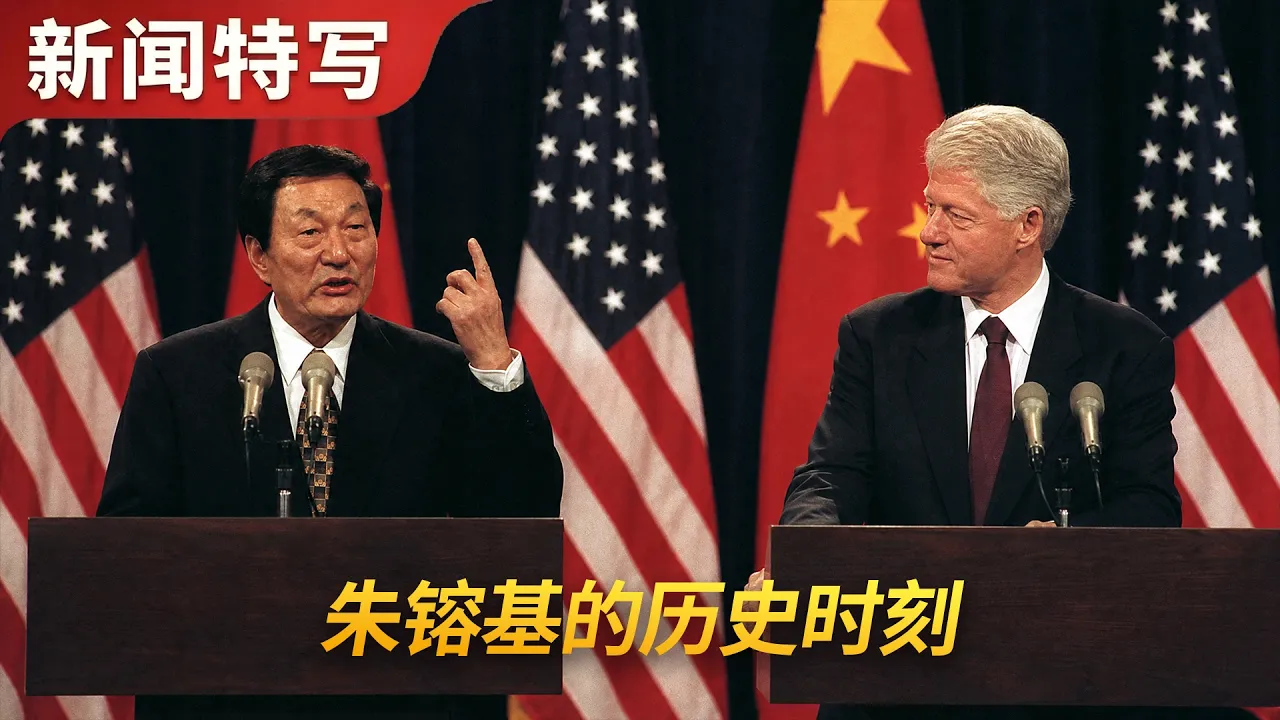
在随后的参访与交流中,朱镕基回应了诸多美中关系间的尖锐议题。针对部分国会议员对反华氛围的担忧,朱镕基回忆曾接见托马斯(William M. Thomas)等人率领的20人两院代表团,议员们当面向他表达欢迎并打趣称“我们喜欢你的面孔”。谈及台湾问题时,朱镕基重申中国坚持和平统一,但绝不能放弃使用武力:“如果放弃了,台湾就会永远从中国分离出去。”他特别提到在克林顿办公室看到了林肯总统的肖像,并指出林肯当年为了维护联邦统一、反对分裂,毫不犹豫地动用了武力,“我们应当向他学习”。
朱镕基回忆当天上午造访联合国大楼时,途经东河(East River)望见两岸林立的高楼大厦,不由得联想起上海,并感叹上海确实是“中国的纽约”。谈及这次访美之旅,他评价代表团的访问非常成功。行前代表团的每位成员其实都做好了在美国“碰一鼻子灰”(battered and bruised)的心理准备。朱镕基曾专门向中国驻美大使请教如何才能避免灰头土脸,大使给出的建议是“必须时刻保持微笑”。朱镕基风趣地自嘲道,自己的脾气不好,硬要他堆出笑脸实在是做不到;但即便没有刻意挂着笑脸,依然受到了美国人民的热情欢迎。
[01:02:26](https://www.youtube.com/watch?v=SKUw826EVR8&t=3746s) Western Development Strategy: Infrastructure and Ecology
Premier Zhu Rongji outlines the strategic priorities for the Great Western Development campaign, highlighting two fundamental pillars: infrastructure construction and ecological protection. Addressing the western region’s vast geographical span and historically underdeveloped transportation network, he explains that the central government has begun shifting substantial national investment toward the west. A premier example is the West-to-East Gas Pipeline project, designed to tap into the massive natural gas reserves recently discovered in Xinjiang’s Tarim Basin. The planned 4,200-kilometer pipeline will traverse eight provinces and municipalities to deliver natural gas directly to Shanghai, fundamentally transforming regional markets and energy dynamics. Zhu emphasizes that the initiative requires immense capital and openly invites domestic and foreign investors to participate through direct investment, shareholding, and operational management, predicting the project will yield significant financial returns.
On the environmental front, Zhu emphasizes that because China has resolved its historical food shortages and now enjoys a grain surplus, the government can reverse past practices of deforesting mountain slopes for subsistence agriculture. Instead, the state can provide free grain to farmers so they can convert steep and marginal agricultural land back into natural habitats. This policy—returning farmland to forests, grasslands, and lakes—aims to rehabilitate the western ecology and make the region aesthetically and economically appealing to outside capital. Zhu adds that preferential opening-up policies comparable to those in eastern coastal zones will be applied to the west, welcoming foreign financial institutions in banking, securities, and insurance. While construction on key transportation and energy links can advance rapidly—noting that the 4,200-kilometer pipeline could be laid within two years via sectional construction, and major infrastructure in areas like Sichuan's Aba Prefecture within eight to ten years—Zhu tempers expectations regarding overall development, stating: “True development of the western region will likely take one, two, or even several generations.”
- **West-to-East Gas Pipeline**: 4,200 kilometers running from the Tarim Basin in Xinjiang across eight provinces/municipalities to Shanghai.
- **Ecological Strategy**: Subsidizing farmers with state surplus grain to execute policies of returning cultivated land to forest, grassland, and wetland/lake reserves.
- **Financial Opening**: Extending preferential terms to foreign banks, insurers, and securities firms investing in the western interior.
---
[01:06:12](https://www.youtube.com/watch?v=SKUw826EVR8&t=3972s) The Taiwan Question and the Looming 2000 Election
Turning to cross-strait relations, Zhu reiterates Beijing’s steadfast stance on peaceful reunification under the "One Country, Two Systems" framework, while reaffirming that China will never renounce the option to use force. He explains that Beijing is prepared to negotiate with any group upholding the One-China principle, emphasizing that compromises can be made among fellow Chinese, but issues a stark warning to pro-independence factions. Recalling modern Chinese history since the 1840 Opium War—marked by foreign aggression and imperial Japanese colonial rule over Taiwan—Zhu grows visibly emotional as he recounts his youth. At age nine, amidst extreme poverty and national humiliation, he sang patriotic national salvation songs, recalling the lyric "Arise, those who refuse to be slaves!" and remembering the tears and unyielding determination to sacrifice his life for the motherland that the anthem evoked.
Zhu sharply criticizes overseas military analysts who attempt to calculate whether Beijing would intervene based on tallies of naval vessels and missiles. Rebutting assertions that China dares not or will not fight, Zhu counters: “By your logic, Hitler would have already conquered the whole world. You do not understand Chinese history; you do not know that the Chinese people will surely defend the motherland's unity and national dignity with their blood and lives.” Observing the volatile campaigning underway just three days before Taiwan's presidential election, he points out that political maneuvers reveal clear separatist ambitions—likening them to the idiom "Sima Zhao’s intent is known to all." He cites a recent 617-point crash in Taiwan's stock market as tangible evidence of the Taiwanese electorate's deep anxiety that pro-independence forces might provoke a cross-strait conflict. Urging voters across the strait not to make an impulsive decision they might later regret, Zhu appeals directly to their political wisdom to preserve peace.
- **Historical Precedent Cited**: Modern resistance from the 1840 Opium War through the end of Japanese colonial rule over Taiwan.
- **Market Reaction**: A 617-point single-day decline in the Taiwan stock index viewed as a barometer of local fear regarding cross-strait instability.
- **Direct Admonition**: Warning Taiwanese voters with three days remaining before polling not to let separatist sentiment dictate the outcome.
---
[01:12:05](https://www.youtube.com/watch?v=SKUw826EVR8&t=4325s) Anti-Corruption, Judicial Accountability, and Financial Rectification
Addressing domestic governance and corruption, Zhu acknowledges that public dissatisfaction remains palpable, pointing directly to the National People's Congress voting results that very day. When the annual work reports of the Supreme People's Court and the Supreme People's Procuratorate were submitted to the approximately 2,700 attending deputies, both received over 700 dissenting votes or abstentions. Zhu frames these critical tallies as clear proof that the administration and judiciary still fall short of public expectations, though he insists substantial progress is being achieved under the rule of law. He points specifically to massive customs anti-smuggling crackdowns in Jiangmen and Xiamen, which curbed illicit trade so effectively that national customs revenue doubled within a single year. These recovered revenues directly enabled the central government to finance wage increases for 84 million low-income workers.
Rejecting the argument that official corruption is an inevitable consequence of a one-party system or that multiparty systems are immune to it, Zhu asserts that the real remedy lies in legal institutionalization and uncompromising enforcement. He acknowledges that public media disclosure of graft cases has lagged behind actual investigative work due to practical hurdles, but promises that media transparency will increase so that citizens can supervise judicial proceedings. Referring to his designation of the current year as the "Year of Management" (管理年) at the initial State Council plenary meeting, Zhu stresses rigorous oversight across all sectors, with a special emphasis on cleaning up the banking and financial system.
- **NPC Voting Pushback**: More than 700 deputies out of approximately 2,700 voted against or abstained on the Supreme Court and Supreme Procuratorate reports.
- **Customs Crackdowns**: Enforcement operations targeting smuggling syndicates in Jiangmen and Xiamen doubled year-over-year customs revenue, funding pay hikes for 84 million lower-income citizens.
- **Financial Sector Purge**: Over 5,000 financial criminal cases handled and more than 50 branch presidents removed from office over the preceding two years.
---
[01:16:21](https://www.youtube.com/watch?v=SKUw826EVR8&t=4581s) Political Reform, Personal Legacy, and WTO Accession
Discussing political reform, Zhu welcomes external praise for China’s village-level direct democratic elections and expresses his personal hope that grassroots democratic practices can be elevated to higher administrative tiers as expeditiously as feasible. As he reflects on reaching the midpoint of his five-year term as Premier, he notes that with less than three years remaining, he will continue pushing his agenda forward under the leadership of the CCP Central Committee with Jiang Zemin at the core. Zhu strikes an unusually introspective, self-deprecating tone regarding his legacy, dismissing grand ambitions and focusing instead on public integrity.
```mermaid
flowchart LR
accTitle: Sino-US WTO and PNTR Approval Pathway
accDescr: Diagram illustrating the steps from bilateral negotiations to WTO accession via congressional PNTR approval.
subgraph Negotiations ["13-Year Negotiations"]
A["Bilateral Deal Reached<br/>(Jiang & Clinton)"]
end
subgraph Approval ["Legislative Formalization"]
B["China Approves Accord<br/>(NPC/State Council)"]
C["US Congress PNTR Vote<br/>(Pending Approval)"]
end
subgraph Final ["Multilateral Integration"]
D["Entry into WTO"]
end
A --> B
A --> C
B & C --> D
```
Expressing his personal philosophy on public office, Zhu delivers one of his most memorable reflections: “I only hope that after I step down, the people of the country can say that he was an honest official, not a corrupt one; then I would... If, in addition, they say, 'Zhu Rongji did manage to accomplish a few practical things,' then, oh, I would thank heaven and earth.” Moving to international economic matters, Zhu addresses the United States' granting of Permanent Normal Trade Relations (PNTR) status to China. He underscores that PNTR is not a unilateral concession but the indispensable prerequisite and contractual cornerstone of the bilateral WTO agreement signed after 13 grueling years of talks overseen by President Jiang Zemin and President Bill Clinton. Emphasizing that China has fulfilled its commitments and cleared all legislative requirements domestically, Zhu states that Washington carries the sole remaining obligation to pass the measure through Congress and enact it into law.
- **Grassroots Democracy**: Endorsement of expanding competitive village direct elections to higher administrative levels.
- **Tenure Benchmark**: Approaching the final three years of his term as Premier of the State Council.
- **WTO Bilateral Terms**: The China–US trade pact concluded after 13 years of negotiations, resting upon US congressional passage of unconditional PNTR status.
[01:47:04](https://www.youtube.com/watch?v=SKUw826EVR8&t=6424s) High-Quality Assets, Economic Kung Fu, and the "Proactive Premier" Moniker
Reflecting on the scale of national investment, Premier Zhu Rongji emphasizes that the government's heavy expenditures yielded concrete, durable infrastructure rather than mere liabilities. Across the preceding four years, China upgraded more than 10,000 kilometers of infrastructure, built 95 million kilowatts in power generation capacity, completely overhauled rural power grids, and oversaw an increase of 320 million mobile and fixed-line telephone connections. Addressing critics who voiced anxiety over the mounting deficit, Zhu clarifies that the state was not burdening future leadership with unpaid bills, but instead handing over 2.5 trillion yuan in premium assets that would continue producing long-term economic dividends. The 510 billion yuan in special treasury bonds, together with the commercial bank credit it catalyzed, expanded overall industrial production, propelled rapid national growth, and steadily lifted fiscal revenues. This expanded fiscal space enabled the government to double workers' wages in recent years, inject substantial funding into a newly formed social safety net, and witness household savings expand consistently by 700 to 800 billion yuan every year.
Defending his macroeconomic strategy against domestic and international skepticism, Zhu argues that without aggressive public expenditure combined with prudent monetary controls, the Chinese economy would have risked an outright collapse in the wake of the Asian financial crisis. Instead, headline prices stayed remarkably stable over four years, fluctuating within an exceptionally narrow band of one percent. With typical dry humor, he credits this delicate balance to Beijing's economic discipline: “Clearly, China's 'kung fu' is quite good.” When pressed on the honorary label given to him by observers, he flatly demurs: “So I am sorry, I cannot accept the honorary title of 'Proactive Premier.' I return it to you.” For Zhu, proactive fiscal policy was not a personal vanity project, but the single viable mechanism that turned regional financial headwinds into an unprecedented domestic growth engine.
```mermaid
flowchart TD
accTitle: Multiplier Effect of Proactive Fiscal Policy
accDescr: Flowchart illustrating how 510 billion yuan in national debt catalyzed bank loans and turned into 2.5 trillion yuan in assets.
subgraph Investment["Capital Mobilization"]
Debt["510 Billion Yuan National Debt"] --> Loans["Commercial Bank Leverage"]
end
subgraph Assets["Physical & Social Assets"]
Loans --> Infra["10,000+ km Upgrades & Power Grids"]
Loans --> Telecom["320M New Phone Lines"]
Loans --> SafetyNet["Social Security & Wage Doubling"]
end
subgraph Outcome["Economic Dividends"]
Infra --> AssetVal["2.5 Trillion Yuan in Quality Assets"]
Telecom --> AssetVal
SafetyNet --> Stability["Near-Zero Inflation & 700-800B Annual Savings"]
end
```
- Infrastructure gains: Upgraded over 10,000 kilometers, constructed 95 million kilowatts of power plant capacity, and renovated rural electricity grids nationwide.
- Telecommunications expansion: Total mobile and landline telephone subscriptions increased by 320 million over four years.
- Balance sheet output: Left behind 2.5 trillion yuan in high-performing state assets against 510 billion yuan in bond debt.
- Household wealth: Urban wages roughly doubled; household bank deposits expanded at a clip of 700 to 800 billion yuan annually.
- Inflation control: Prices fluctuated within a narrow margin of less than one percent over the four-year cycle.
[01:50:10](https://www.youtube.com/watch?v=SKUw826EVR8&t=6610s) Sino-Japanese Relations and Confronting the Widening Wealth Gap
Turning to foreign affairs, Zhu marks the 30th anniversary of the normalization of diplomatic ties between China and Japan. Recalling his summit with Prime Minister Junichiro Koizumi the previous year, he highlights that the two nations designated the anniversary as the Year of China-Japan Friendship, planning cultural exchanges including a Japan Culture Year in China and a China Culture Year in Japan. Zhu also reaffirms China’s long-standing diplomatic push to host the Japanese Crown Prince and Crown Princess, expressing confidence that such a high-level visit will eventually materialize.
On the domestic front, Zhu speaks candidly about the deepening wealth disparity and polarization within Chinese society. Rather than downplaying the issue, he openly admits its reality, grounding it in Deng Xiaoping’s early reform philosophy: “I believe you likely remember Mr. Deng Xiaoping saying that we should let some people get rich first, and so naturally, there are some who have not yet become rich.” He notes that income stratification is an unavoidable consequence of a specific transitional historical phase, but stresses that state policy continuously counters this imbalance. Lifting rural incomes and aiding vulnerable groups had become a centerpiece of his annual government work report, alongside targeted fiscal transfers and social insurance support for laid-off state workers, the unemployed, and retirees. Zhu argues that the tax code remains the executive’s most powerful corrective lever to redistribute wealth and assist those left behind, expressing confidence that targeted taxation and structural reform will resolve the wealth gap over time.
- Diplomatic milestone: Celebrated 30 years of normalized relations with Japan through reciprocal cultural years.
- Imperial invitation: Confirmed ongoing efforts to arrange a formal visit of the Japanese Crown Prince and Crown Princess to Beijing.
- Structural inequality: Acknowledged income polarization as a transitional byproduct of the policy allowing some to prosper first.
- Targeted remedies: Prioritized rural earnings growth, urban social safety nets for laid-off laborers, and progressive tax enforcement as primary policy tools.
[01:53:06](https://www.youtube.com/watch?v=SKUw826EVR8&t=6786s) Scorecard on "One Guarantee and Three Achievements" and Five Major Reforms
Reviewing the sweeping reform agenda he unveiled upon taking office in 1998, Zhu systematically audits the "One Guarantee and Three Achievements" program. The sole guarantee was maintaining an 8 percent annual economic growth rate while keeping the renminbi stable. While the currency held firm without devaluation, GDP expansion came in at 7.8 percent—just shy of the target. Zhu reminds his audience of the extraordinary headwinds of 1998, when catastrophic domestic flooding converged with the peak of the Asian financial turmoil. Despite this minor numerical shortfall, he considers the core commitments fulfilled.
The "Three Achievements" similarly saw major execution. Large and medium-sized state-owned enterprises (SOEs) met their target of reversing systemic operational deficits within three years, turning a profit and delivering tax receipts that grew at more than double the rate of national GDP. In the financial sector, commercial banking underwent deep structural separation; drawing directly from the playbook of the United States' Resolution Trust Corporation (RTC), China established dedicated asset management companies to hive off non-performing loans, successfully curbing toxic asset ratios on bank balance sheets. In government administration, the State Council completed its radical restructuring within the first year, cutting its personnel roster by 50 percent before cascading the downsizing program downward to provincial, municipal, and county bureaucracies. Beyond these, Zhu notes progress across five ancillary systemic reforms: grain marketing, public investment, commercial housing, healthcare, and fiscal taxation. Refusing complacency, Zhu looks back on his term with quiet resolve: “I think we can say we have a clear conscience, but there is still a lot of work left undone.”
- GDP and currency outcome: Growth reached 7.8 percent against an 8.0 percent target amidst historic 1998 floods; renminbi exchange rate remained fully stabilized.
- SOE profitability: Majority of large and medium loss-making state enterprises turned profitable within the three-year timeline, doubling fiscal tax generation.
- Banking cleanup: Adopted the US RTC model to carve out non-performing loans into asset management companies, dropping the overall ratio of bad bank debt.
- Bureaucratic downsizing: Halved central State Council staff in year one, later extending personnel cuts into regional and local tiers.
- Legislative backing: Government work reports consistently secured broad endorsements exceeding 70 percent approval in the National People's Congress.
[01:55:59](https://www.youtube.com/watch?v=SKUw826EVR8&t=6959s) Personal Demeanor, Confronting Corrupt Cadres, and Hong Kong’s Future
Addressing press inquiries into his famously combative public persona, Zhu displays characteristic wit regarding his media portrayal. He marvels at the relentless inquisitiveness of the press corps before brushing aside attempts to lionize his leadership style. Commenting on sensationalized reports in the Hong Kong press claiming he regularly screamed, pounded tables, slammed benches, and stared down underlings, Zhu sets the record straight with sharp comedic timing. He concedes that he has indeed slammed conference tables and stared people down—quipping that if he were unable to glare, he would be a vegetable—but draws the line at furniture abuse, joking that pounding a wooden bench would simply hurt his own hands. Turning stern, he rejects the notion that his fierce demeanor was ever aimed downward: “I never intimidate the common people; I only intimidate corrupt officials.”
Concluding his remarks on the special administrative region, Zhu reassures reporters regarding Hong Kong’s continuing relevance as an international financial and cultural capital. Dismissing pessimistic claims that the territory has lost its competitive edge, he honors Hong Kong’s indispensable role as the catalyst for mainland China’s initial reform and opening throughout the 1970s and 1980s. While noting that shifts in global trade demand an ongoing adjustment of Hong Kong’s economic positioning, he maintains that no mainland city can step into its shoes: “As I have already said, no similar city can replace Hong Kong in the near future.” Closing the press conference, Zhu frames his legacy around administrative integrity and selfless public service: “I am determined to make the next government a clean, efficient administration that serves the people wholeheartedly.”
- Media rumors debunked: Acknowledged table-slamming and glaring, but mocked reports of bench-pounding as painful physical nonsense.
- Focus of executive ire: Insisted his sharp temper was exclusively directed at corrupt bureaucrats, never ordinary citizens.
- Hong Kong’s standing: Reaffirmed that no mainland center can supplant Hong Kong's role as a leading global financial hub in the near term.
- Closing pledge: Reasserted an unyielding dedication to building an uncorrupt, streamlined, and citizen-focused state administration.
[34:55] 朱镕基: 我们可能存在不同看法,只有能讲出不同看法的才是最好的朋友,才是真正的朋友。
[115:59] 朱镕基: I never intimidate the common people; I only intimidate corrupt officials.
[27:02] 朱镕基: 我们是在共产党的领导下,一直在同独裁和反动统治作斗争来争取人权的,我们今天怎么可能反过来去镇压人权呢?
Original transcript
[0:00] Official mayoral candidate Zhu Rongji
[0:02] says,
[0:04] According to the assembly's
[0:05] arrangements, I am to introduce myself.
[0:13] I may exceed the time limit set by the
[0:15] assembly, because I feel that if I
[0:17] don't speak, I won't be able to get
[0:19] past this hurdle. During the Great
[0:30] Mingming [rectification] period,
[0:32] comrades demanded that since I was the
[0:34] secretary to the top leader of the
[0:36] Party group, if you don't offer
[0:38] opinions to the Party group, then who
[0:40] will? They insisted that I provide them
[0:43] . So, I spoke at that bureau meeting
[0:46] for no more than three minutes.
[0:51] Unexpectedly, by October, they told me
[0:53] —even though before October they felt
[0:56] my opinions were quite good—that
[0:58] after October, they said I needed to
[1:00] reconsider those opinions. By January
[1:06] of 1958, I was labeled a Rightist.
[1:14] However, their treatment of me was
[1:16] still very lenient, because I believe
[1:18] the leaders and comrades at the State
[1:20] Planning Commission knew me very well.
[1:24] There was absolutely no other issue.
[1:29] Therefore, besides being removed from
[1:31] my position and demoted by two grades,
[1:33] I was expelled from the Party. But I
[1:38] still remained at the State Planning
[1:40] Commission. By the later stages of the
[1:44] Cultural Revolution, almost all cadres
[1:46] of the Planning Commission, except for
[1:48] a few dozen in an office group, were
[1:50] sent down to farms to perform labor. I
[1:54] performed labor on a farm for five
[1:56] years. Those five years were a
[1:58] tremendous education for me. Yes,
[2:01] indeed. Even though we were a
[2:05] collective farm and still cadres of the
[2:07] State Planning Commission, being in the
[2:09] countryside gave me an understanding of
[2:11] rural life and an appreciation for
[2:13] labor. In those five years, I learned
[2:22] to do everything: growing wheat, cotton
[2:25] , and rice, herding cattle and sheep,
[2:27] raising pigs, and working as a
[2:29] purchasing agent—I've done it all.
[2:36] Now, this, I am still...I think a
[2:45] characteristic of mine, my creed, is
[2:48] independent thinking; I feel I should
[2:50] speak exactly what is on my mind. I am
[2:55] an orphan. My parents died very early;
[2:59] I never met my father, and I have no
[3:01] siblings. So, I found the Party in 1947
[3:06] , and the Party is my mother. Therefore
[3:10] , I wholeheartedly treat the Party as
[3:12] my mother. That is why I have no
[3:15] reservations about what I say; if I
[3:17] believe something is beneficial to the
[3:20] Party, I will say it. As for the
[3:22] consequences, I do not care. Even
[3:25] though I was wrongly handled, the Third
[3:27] Plenary Session of the 11th Central
[3:29] Committee restored my political life.
[3:32] At the same time, one could say it also
[3:34] rejuvenated my political youth. I don't
[3:39] think I am the best candidate for Mayor
[3:41] of Shanghai. I have many shortcomings.
[3:49] In many respects, I lag far behind my
[3:51] predecessors, especially Comrade Jiang
[3:54] Zemin. I will state three points. First
[3:59] , I only have experience working in
[4:01] leading organizations, not at the
[4:03] grassroots level. As I said, I spent 25
[4:07] years at the State Planning Commission.
[4:11] Basically, including very short stints
[4:13] in other departments, ten years were at
[4:15] the State Economic Commission. My
[4:18] grassroots experience, as I just
[4:20] mentioned, was only for a very short
[4:22] period in a local district. I have
[4:25] never served as a head of a factory,
[4:27] nor as a leader of a county or district
[4:30] . Comrade Jiang Zemin was a factory
[4:33] director very early on, and a big
[4:35] factory at that. I didn't come up from
[4:39] the rural grassroots, so I lack much
[4:41] knowledge about the hardships of the
[4:43] people; this is a significant weakness
[4:45] of mine. I fear I may still make some
[4:48] decision-making mistakes in these areas
[4:50] in the future. Second, I only have
[4:52] experience with central government
[4:54] agencies and no experience working in
[4:56] local government. I have never worked
[4:58] at the local level. I have always been
[5:04] based in Beijing, so since coming to
[5:06] Shanghai, I have truly had more gray
[5:08] hair in these three months than ever
[5:10] before. Comrade Jiang Zemin predicted
[5:15] that all my hair would turn white
[5:17] within a year. That is his personal
[5:20] experience, and I am already feeling
[5:22] that threat. This work is truly complex
[5:26] and truly difficult to do. Comrade
[5:29] Zemin once said his nerves were always
[5:31] in a state of tension, and now I truly
[5:33] understand that. Third, I am very
[5:38] impatient. This shows a lack of
[5:43] leadership talent and character. I am
[5:47] too anxious for quick success in my
[5:49] work. I am too demanding of
[5:51] subordinates and too harsh in my
[5:53] criticisms. On this point, I should
[5:58] learn well from Comrade Zemin; I am
[6:00] quite similar to you. I am similar to
[6:04] Comrade Rong; we both have this
[6:05] temperament.
[6:08] You are much better than me. Neither of
[6:15] us has bad intentions, but we can be
[6:17] sharp when speaking to officials. I
[6:24] hope you have one—Comrade Song Ping
[6:29] had a talk with me before I came here.
[6:31] He said that being strict with
[6:33] officials is not a shortcoming.
[6:37] But when you criticize people, do not
[6:39] hurt them. Do not be too cutting in
[6:43] your speech.
[6:45] This was all earnest advice regarding
[6:47] my shortcomings, suggesting I should
[6:49] learn from Comrade Zhou Enlai. So that
[6:53] after criticizing comrades, they feel
[6:55] they deserved the criticism. And feel
[6:57] that it comes from your care for them.
[7:01] I truly lack that kind of leadership
[7:03] quality, and of course, I hope comrades
[7:05] will supervise me. I want to reform,
[7:11] but to be honest, it is hard to change
[7:13] one's nature. It is not easy to change
[7:21] my shortcomings, but I am determined to
[7:23] correct them well. I think the most
[7:29] important thing for Shanghai right now
[7:31] is to implement things in a
[7:32] down-to-earth manner. We must practice
[7:37] what we preach, instead of just
[7:39] proposing many new goals and
[7:40] requirements; we already have enough of
[7:43] those. Right, the priority now is to
[7:48] work in a practical and solid way.
[7:51] Setting expectations too high leads to
[7:53] disappointment, and once morale is lost
[7:56] , it’s hard to build it up again.
[7:58] Because when expectations are too high,
[8:00] they are often hard to achieve, and we
[8:02] must consider the objective conditions.
[8:04] It is very difficult to achieve
[8:06] everything all at once. So, comrades,
[8:09] looking at recent reports, the
[8:11] expectations are indeed a bit too high.
[8:17] Honestly, I haven't been able to sleep
[8:19] at night; for many nights I've been
[8:21] sleepless, feeling the weight of this
[8:23] responsibility. Therefore, what I want
[8:29] to say is that Shanghai cannot promote
[8:31] short-termism. We cannot encourage
[8:35] short-term behavior. We will eventually
[8:38] suffer for it if we do. To avoid losses
[8:41] , we must have a long-term view, so I
[8:43] think the goals proposed in Comrade
[8:45] Zemin's report are realistic. It is
[8:48] possible for us to achieve them, or
[8:50] even achieve them ahead of schedule. If
[8:52] they are set too high, we won't be able
[8:54] to reach them. Next, I would like to
[8:57] make a few points. First of all, to be
[8:59] clear, I have only been here for three
[9:01] months; I am neither Zhuge Liang, nor
[9:03] can I emerge from my hermitage like he
[9:06] did. Because the Wenhui Bao once had a
[9:09] requirement that a mayoral candidate
[9:11] must be able to "pass five passes and
[9:13] kill six generals,""capture the city,"
[9:15] and "emerge from the thatched cottage."
[9:20] In three months, I cannot emerge from
[9:22] the thatched cottage. If I were elected
[9:27] mayor, the first thing is, I am
[9:28] determined to make the next government
[9:30] a brand-new one that serves the people
[9:33] wholeheartedly, stays clean, and is
[9:35] highly efficient. This is my pledge. I
[9:59] saw the latest issue of Time magazine
[10:01] yesterday, which featured my photo on
[10:03] the cover; compared to the Newsweek
[10:05] cover that also used my photo, the Time
[10:07] photo looks a bit better, and I am
[10:09] grateful for that. But I don't mean to
[10:20] complain at all, because I have never
[10:21] been particularly handsome to begin
[10:23] with. Regarding the question you raised
[10:27] about democratic elections, I, of
[10:29] course, support it. I believe an
[10:37] American foundation has already come to
[10:39] China to investigate this kind of
[10:41] village democracy and has published a
[10:43] very positive opinion. Moreover, this
[10:50] democratic system is now being
[10:52] implemented not only in rural areas but
[10:54] also in enterprises—for instance,
[10:56] democratic evaluation of factory
[10:58] directors, democratic auditing of
[11:00] financial accounts, and democratic
[11:02] election of leaders are being practiced
[11:04] in many firms. I believe this "
[11:09] three-pronged democracy" is a very good
[11:11] direction to move in. Of course,
[11:16] conducting democratic elections in
[11:18] government institutions, including
[11:20] electing premiers and chairmen, is a
[11:22] matter of political structural reform.
[11:27] I believe this must be carried out
[11:29] through certain legal procedures. The
[11:32] procedures for such democratic
[11:34] elections are different in China
[11:36] compared to foreign countries. They are
[11:39] also different between the East and the
[11:40] West. I think this issue requires
[11:43] further study. As for when such
[11:47] elections might be realized, it is
[11:48] difficult for me to predict now. Thank
[11:51] you.
[11:52] I am a reporter from China Central
[11:54] Television. First, I would like to
[11:55] congratulate the newly appointed
[11:57] Premier and Vice Premiers. My question
[11:59] is: regarding China's reform and
[12:01] development, the next five years are
[12:02] critical. As the new Premier, what do
[12:06] you think is the most urgent problem
[12:08] that needs to be solved? What is the
[12:11] most challenging issue? Some public
[12:15] opinion suggests your work style is
[12:17] bold and stern; do you agree, and how
[12:19] would you describe your own work style?
[12:22] Thank you.
[12:25] Your question is asking for my policy
[12:27] platform, but I don't know if everyone
[12:29] present has the patience to hear me out
[12:31] . Actually, the tasks for this
[12:36] government were already clearly stated
[12:38] in President Jiang Zemin's report at
[12:40] the 15th National Congress of the
[12:41] Communist Party of China last year. The
[12:47] speeches just delivered by President
[12:48] Jiang Zemin and Chairman Li Peng have
[12:50] also laid out specific provisions for
[12:52] this government's tasks. If you want me
[13:03] to be more specific, I can summarize
[13:05] the things this government currently
[13:06] faces into one guarantee, three
[13:08] requirements, and five reforms. One
[13:25] guarantee is that, because we currently
[13:28] face the Southeast Asian financial
[13:30] crisis and China faces serious
[13:32] challenges, we must ensure China's
[13:34] growth rate reaches 8%this year,
[13:35] inflation stays below 3%, and the RMB
[13:38] does not depreciate. This must be
[13:51] achieved, as it concerns not only
[13:52] China's development but also the
[13:54] prosperity and stability of Asia. This
[13:58] government believes Revitalizing the
[14:04] country through science and education
[14:06] is this government's greatest task.
[14:13] President Jiang Zemin attaches great
[14:15] importance to revitalizing the country
[14:17] through science and education and has
[14:18] repeatedly clarified its importance,
[14:20] but why haven't we implemented it well?
[14:27] Where did the money go? Well, first,
[14:33] our government institutions are bloated
[14:35] , consuming the budget and eating up
[14:36] all the money. Second, under government
[14:47] intervention, many blind and redundant
[14:49] projects were built; projects worth
[14:51] billions or tens of billions found no
[14:53] market after completion, instead
[14:55] dragging down existing enterprises.
[15:05] This is why the central treasury,
[15:07] including our banks, cannot pull out
[15:09] money to support science and education
[15:11] to revitalize the country; the money
[15:13] has been wasted. Therefore, this
[15:20] administration is determined to
[15:21] streamline government agencies by
[15:23] cutting staff by half, while further
[15:25] implementing the policy of halting
[15:27] redundant construction; we will not
[15:28] allow duplicate projects, and by saving
[15:30] that money, the strategy of
[15:32] rejuvenating the country through
[15:33] science and education can be realized.
[15:40] Rejuvenating the country through
[15:41] science and education. The difficulties
[15:47] facing China have been greatly
[15:49] exaggerated. When we speak of the
[15:52] loss-making proportion of China's
[15:54] state-owned enterprises being over 40%,
[15:56] it is calculated based on the number of
[15:58] individual firms. There are 79,000
[16:02] industrial enterprises in China. You
[16:07] see, some of these are very small, with
[16:09] only a few dozen people; when using
[16:11] this number for statistics, the scale
[16:13] of losses is naturally high, but I ask
[16:15] you to take note. Among them, 500
[16:27] extra-large state-owned enterprises
[16:29] account for 85%of the total tax revenue
[16:31] and profits generated by all state
[16:33] enterprises, and the loss rate for
[16:35] these five hundred extra-large firms is
[16:38] only 10%, which is about 50 enterprises
[16:40] . Therefore, we believe that, overall,
[16:51] three years will be enough for
[16:53] loss-making state-owned enterprises to
[16:55] overcome their difficulties. The
[17:01] Chinese government speaks highly of the
[17:03] policies adopted by the Hong Kong
[17:05] government; we do not believe they have
[17:07] encountered insurmountable difficulties
[17:09] . However, if under specific
[17:25] circumstances the Hong Kong government
[17:27] needs the help of the Central People's
[17:28] Government, as long as the Hong Kong
[17:30] SAR government makes a request to the
[17:32] Central Government, the Central
[17:33] Government will spare no cost to
[17:35] maintain Hong Kong's prosperity and
[17:37] stability and protect its linked
[17:38] exchange rate system. Whether the
[17:55] outside world calls me "China's
[17:57] Gorbachev,""economic tsar," or whatever
[17:59] else they want, I am not pleased by any
[18:01] of it. Currently, my thoughts. Since
[18:18] the people's representatives have
[18:20] entrusted me with this heavy
[18:21] responsibility at this National
[18:23] People's Congress, I personally feel
[18:25] the weight of this task and am very
[18:26] anxious, fearing that I might fail the
[18:28] expectations of the people. But.
[18:45] Regardless of whether there are
[18:46] landmines or deep abysses ahead, I will
[18:48] forge ahead courageously and without
[18:50] hesitation, dedicating myself fully
[18:52] until my last breath. Although I carry
[19:03] a heavy mental burden, I still have
[19:05] great confidence, provided we hold high
[19:07] the banner of Deng Xiaoping Theory.
[19:17] Under the leadership of the Party
[19:19] Central Committee with Comrade Jiang
[19:20] Zemin at its core, and by relying
[19:22] closely on the people across the
[19:24] country, I believe this administration
[19:25] will be invincible. Thank. You. I will
[19:40] leave this time for the reporters to
[19:42] ask questions. I will say only one
[19:45] sentence. You are all welcome to ask me
[19:48] any questions; there are no
[19:49] restrictions at all. Can the Renminbi
[19:53] become a world currency? This question
[19:59] should not be answered by me, and it is
[20:01] too early to say, but I can say one
[20:03] thing: the Renminbi is very firm and
[20:05] will not devalue. Thank you. Over the
[20:12] past year, I have felt it was very
[20:14] difficult. These difficulties exceeded
[20:18] my expectations. The first is due to
[20:23] the impact of the Asian financial
[20:24] crisis. Yes, I originally did not
[20:28] expect it to be this severe. The second
[20:34] is a historic and exceptionally severe
[20:36] flood disaster, which also exceeded my
[20:38] expectations. However, what satisfies
[20:46] me is that under the leadership of the
[20:48] Party Central Committee with Jiang
[20:50] Zemin at its core, and by relying on
[20:51] the efforts of the people nationwide,
[20:53] we have weathered these two
[20:55] difficulties. We have made it through.
[21:05] This has not been easy. Therefore, in
[21:10] my government work report, I said that
[21:12] "this has not been easily won." What I
[21:18] am dissatisfied with is that my own
[21:19] work has not been done well enough. But
[21:24] I also feel that there are certain
[21:25] departments and regions, or perhaps
[21:27] individual departments and regions,
[21:29] that have not strictly......followed
[21:35] the policies of the Central Committee
[21:37] and the State Council. What moved me
[21:46] the most was when I visited the front
[21:47] lines of flood defense, seeing our
[21:49] People's Liberation Army disregarding
[21:51] all dangers to protect our people,
[21:53] using their own bodies to reinforce the
[21:55] levees; I could not help but feel moved
[21:57] . Thank you. Since the mutual visits of
[22:15] the heads of state of China and the
[22:17] U.S., our two nations have begun
[22:18] striving to build a constructive
[22:20] strategic partnership. The development
[22:35] trend was originally very good, but for
[22:37] various reasons—which you know
[22:39] without me saying—a trend of opposing
[22:41] China has emerged in the United States,
[22:43] which makes us feel very uneasy. I do
[22:55] not believe that my visit to the United
[22:56] States will be...However, it is true
[23:04] that I will encounter a great deal of
[23:06] hostility or an unfriendly atmosphere.
[23:14] On February 22nd, BusinessWeek
[23:16] published an article titled "China:
[23:18] What's going wrong?" This article......
[23:27] is extremely...It suggests that China
[23:33] is already facing disaster and
[23:34] bankruptcy. As if China were already
[23:38] facing an imminent catastrophe. I have
[23:42] never before seen an American magazine
[23:44] publish such an article. I think the
[23:51] appearance of such an article reflects
[23:53] the current trend in the U.S., which is
[23:55] actually a result of internal U.S.
[23:57] political struggles, using China-U.S.
[24:03] relations as a sacrificial lamb. I have
[24:10] also become a victim, as they printed
[24:12] my photo on the cover of that magazine,
[24:14] and I look like a dead person. Under
[24:20] this kind of atmosphere......my
[24:24] upcoming visit to the United States is,
[24:27] of course, a very difficult task. Many
[24:33] media outlets have predicted that my
[24:35] visit cannot succeed, that it is
[24:36] impossible for it to be a success. But
[24:44] I am still going, because since you are
[24:46] angry, I will go to clear the air with
[24:47] you. China's policy of strengthening
[24:59] macroeconomic regulation began in 1993,
[25:01] at a time when China was intensifying
[25:03] its reform and opening-up and had
[25:05] achieved tremendous results, but at the
[25:07] same time, a certain degree of
[25:08] overheating had occurred, particularly
[25:10] in real estate development zones and
[25:12] the stock market. This......kind of
[25:24] overheating led to the inflation in the
[25:26] following year, 1994, reaching 21.7
[25:29] percent. At that time, Mr. Deng
[25:32] Xiaoping was still with us. With his
[25:36] support, the Party Central Committee,
[25:38] with Comrade Jiang Zemin at its core,
[25:40] decided to strengthen macroeconomic
[25:42] regulation and control. We adopted 16
[25:45] measures, 13 of which were economic
[25:48] measures. Among those 13, 11 were
[25:55] related to banking and financial
[25:57] policies. Thanks to the implementation
[26:10] of these 16 measures to strengthen
[26:12] macro-control, China resolved the issue
[26:14] of economic overheating in just over
[26:16] two years, restored its original
[26:18] development momentum, and achieved
[26:19] great success in socialist construction
[26:21] . I believe the reason China was able
[26:33] to avoid the impact of the Asian
[26:35] financial crisis last year......is that
[26:37] we had already experienced a similar
[26:39] financial crisis in 1993. Fortunately,
[26:47] we curbed it before it could spread,
[26:49] and having gained that experience in
[26:51] macro-control is exactly why we could
[26:53] stand firm during last year's financial
[26:55] crisis. Mr. Zhou Fei just mentioned the
[27:02] issue of human rights; I think many
[27:04] reporters present here are also
[27:06] thinking of asking me this question.
[27:10] Well. Almost every foreign guest who
[27:17] meets with our Chinese leaders brings
[27:18] up the human rights issue, as if they
[27:20] couldn't explain themselves back home
[27:22] if they didn't discuss China's human
[27:23] rights. Therefore, after I have
[27:30] repeated myself so many times on this
[27:32] issue, today I really...I only want to
[27:45] mention one thing: when U.S. Secretary
[27:47] of State Albright recently met with me
[27:49] during her visit to China, I told her,
[27:51] "My history of participating in the
[27:52] movement to strive for and safeguard
[27:54] human rights is much longer than yours.
[27:56] " She said, "Really?" Meaning she
[28:08] disagreed with my point, she asked, "
[28:10] Really?" I said, "Yes." Is it......not
[28:18] true? I said I am ten years older than
[28:24] you. When I was risking my life
[28:33] participating in the struggle against
[28:34] the Kuomintang regime to safeguard
[28:36] human rights and strive for democracy,
[28:38] freedom, and human rights in China...
[28:40] ...you were still studying in middle
[28:41] school when I was involved in this
[28:43] movement. I said that we actually share
[28:52] many views on human rights. In middle
[29:00] school, I studied French literature and
[29:02] learned about the social contract
[29:03] theory from textbooks, ah! And
[29:13] Rousseau's works; so, the concepts of
[29:15] human equality and human rights were
[29:17] things I knew long ago. We were
[29:26] influenced by China's May Fourth
[29:27] Movement, a movement that fought for
[29:29] democracy and science. Therefore, under
[29:41] the leadership of the Communist Party,
[29:43] we have always been struggling against
[29:45] dictatorship and reactionary regimes to
[29:47] advocate for human rights. How could we
[29:58] possibly turn around and suppress those
[29:59] human rights today? And only we know
[30:07] how to realize the protection of human
[30:09] rights in China. Of course, it's not
[30:14] that we don't have shortcomings on the
[30:16] issue of human rights. It's impossible
[30:19] to have no shortcomings, because China
[30:21] has been a feudal and dictatorial
[30:23] society for thousands of years. Add to
[30:26] that the colonial mentality. It's
[30:30] impossible to have no shortcomings. The
[30:34] People's Republic of China has only
[30:36] been established for 50 years; compared
[30:38] to thousands of years, how could we
[30:39] have solved all the problems? But we
[30:43] are willing to listen to opinions from
[30:45] all sides, especially the opinions of
[30:47] our own people. We are looking at our
[30:50] people every day. On how to satisfy
[30:54] their wishes and realize their demands,
[30:56] we are also willing to listen to
[30:57] international friends; therefore, we
[30:59] have many channels for dialogue. We
[31:03] have channels for human rights dialogue
[31:05] with the United States, the European
[31:07] Union, and Australia. Our work on human
[31:13] rights is ongoing every day. I meet
[31:21] many international friends; as soon as
[31:23] we meet, they pull out a list and read
[31:25] these names to me, asking how many
[31:26] people you have detained? Will you
[31:30] release them? These are pro-democracy
[31:33] activists. I say, we have 1.25 billion
[31:36] people, we have criminals every day, I
[31:38] am catching people every day, I don't
[31:40] know who you are talking about, give me
[31:43] the list, I will go back and check,
[31:45] okay? Is that alright? The National
[31:55] People's Congress that just concluded
[31:57] passed amendments to the constitution,
[31:59] adding content about governing the
[32:00] country according to law and realizing
[32:02] socialist rule of law; we are
[32:04] legislating every day, the NPC Standing
[32:06] Committee is legislating, and our State
[32:08] Council is also legislating every day;
[32:10] the State Council's legislation is
[32:12] called administrative regulations. We
[32:19] are strengthening our rule of law every
[32:21] day to protect the human rights of all
[32:23] our people. We will continue to do so.
[32:31] We welcome foreign friends to criticize
[32:33] our work. But you shouldn't be too
[32:35] impatient. I am more impatient than you
[32:38] are. You shouldn't support those
[32:42] pro-democracy activists, should you? If
[32:46] you let those people return, China will
[32:48] have no rule of law and no democracy;
[32:50] it is not as you imagine. I can share a
[32:55] secret with everyone. That is, I was
[32:59] indeed treated very well in Russia. You
[33:10] saw on TV when President Yeltsin met
[33:12] with me, he took my hand and placed it
[33:14] on his chest; do you know what he was
[33:16] saying? He said, Chairman Jiang Zemin
[33:23] is my best friend, and you are also my
[33:25] best friend. Chinese people value
[33:34] courtesy, so I quickly placed his hand
[33:36] on my chest and said, we are friends
[33:38] worthy of trust. There is another thing
[33:45] you didn't see because the reporters
[33:46] had already left. That is, when our
[33:54] talks ended, President Yeltsin came
[33:56] over and hugged me tightly, and the two
[33:58] of us cheek-to-cheek. I think this
[34:06] simply shows that we are sincere
[34:08] friends. I believe that this visit to
[34:13] the United States will also be met with
[34:15] a similar result, a warm welcome,
[34:16] rather than a minefield. Of course,
[34:27] perhaps President Clinton and I might
[34:29] not embrace, but we may shake hands a
[34:31] bit more firmly. Mr. President, Mrs.
[34:55] Clinton, ladies and gentlemen. In this
[35:06] season of spring, the delegation of the
[35:08] People's Republic of China, at the
[35:09] invitation of President Clinton, has
[35:11] come to your beautiful country for an
[35:13] official friendly visit, and I feel
[35:15] extremely......very happy. Entrusted by
[35:25] President Jiang Zemin, I bring the best
[35:27] wishes and sincere greetings from 1.25
[35:29] billion Chinese people to the great
[35:31] American people. Over the past 18
[35:40] months, President Jiang Zemin and
[35:41] President Clinton have achieved
[35:43] successful mutual visits. They decided
[35:49] to establish a constructive strategic
[35:51] partnership. This friendly and
[35:58] cooperative relationship is in the
[36:00] interests of the peoples of China and
[36:02] the U.S., in the interests of the
[36:03] people of the world, and in the
[36:04] interests of world peace and
[36:06] international cooperation. The Chinese
[36:15] people will work tirelessly for
[36:16] generations to unswervingly consolidate
[36:18] and develop this relationship. The
[36:27] United States is the largest developed
[36:28] country in the world, and China is the
[36:30] largest developing country. We are both
[36:37] members of the United Nations Security
[36:38] Council. The close cooperation between
[36:45] our two countries lays a solid
[36:47] foundation for world peace and the
[36:49] prevention of conflicts. The United
[36:57] States is a nation that loves freedom,
[37:00] is open, self-reliant, and full of
[37:02] vitality. China is a nation that loves
[37:09] peace, is industrious, wise, honest,
[37:12] and self-respecting. The friendship
[37:21] between our two countries, built on the
[37:23] foundation of the three joint
[37:24] communiqués, joint government
[37:26] statements, and solemn mutual
[37:27] commitments, is unbreakable and cannot
[37:29] be sown with discord by anyone. Between
[37:38] China and the United States, there is
[37:40] no issue that cannot be resolved
[37:42] through friendly consultation. We may
[37:51] have different opinions; only friends
[37:53] who can speak their different opinions
[37:55] are the best friends; only true friends
[37:57] are true friends. Ladies and gentlemen,
[38:07] spring is a season for sowing seeds, a
[38:10] season of hope. When we arrived in your
[38:18] "Sunshine City" of L.A., it was raining
[38:20] , but when we left, the rain had
[38:22] stopped and the sky was clear; when we
[38:24] arrived in Washington, it was......
[38:32] Ladies and gentlemen.
[38:34] As we sow the seeds of China-U.S.
[38:40] friendship once again in this beautiful
[38:42] and fertile land, I cannot help but
[38:44] remember the pioneers who forged
[38:46] China-U.S. friendly and cooperative
[38:54] relations—both the Chinese and
[38:56] American pioneers; some have passed
[38:58] away. Some are still with us. I must
[39:09] express my highest respect and deepest
[39:11] nostalgia for their historical vision,
[39:13] wise and resolute decisions, and
[39:15] persistent dedication. I love the
[39:23] Chinese people. I love the American
[39:27] people. Thank you. I have met with two
[39:41] U.S. congressional delegations, one led
[39:43] by Mr. Thomas, and one by Mr. R. The
[39:46] delegation they led consisted of 20
[39:48] senators and representatives. I told
[39:56] them at the time, "The political
[39:58] atmosphere there is so anti-China that
[40:00] I dare not visit." The congressmen told
[40:09] me, "You should still come; we welcome
[40:11] you, and we like your face." Regarding
[40:19] the unification of Taiwan, the Chinese
[40:21] government has repeatedly stated that
[40:23] we will try our best to use peaceful
[40:25] means, but we have never renounced the
[40:27] use of force, because if we were to do
[40:29] so, Taiwan would be separated from
[40:31] China forever. I just saw a portrait of
[40:38] President Abraham Lincoln in President
[40:40] Clinton's office. Back in the day, to
[40:46] preserve the integrity of the United
[40:48] States and oppose independence and
[40:49] secession, President Lincoln did not
[40:51] hesitate to use force; we should learn
[40:53] from him. The earliest pioneer of our
[40:59] missile technology was Mr. Qian Xuesen,
[41:01] who returned from the United States;
[41:03] the pioneer of our nuclear technology
[41:05] was Mr. Qian Sanqiang, who returned
[41:07] from Madame Curie's laboratory in
[41:09] France. But I can assure you that when
[41:15] they returned, they didn't take a
[41:16] single piece of paper with them, just
[41:18] their knowledge. At a press conference
[41:28] in March, I said: please do not
[41:29] underestimate your own security and
[41:31] confidentiality capabilities, and do
[41:33] not underestimate the Chinese people's
[41:35] ability to develop military technology
[41:37] themselves. When I was in Los Angeles,
[41:46] the mayor's wife asked me over dinner,
[41:48] "How do you plan to celebrate the 50th
[41:50] National Day?" I said we are going to
[41:54] hold a grand military parade. At that
[41:59] parade, we will display China's most
[42:01] advanced weapons. And these weapons
[42:05] were all developed by China itself, not
[42:07] stolen from the United States. I think
[42:13] this reflects that some of you look
[42:15] down on us too much. If political
[42:21] contributions could really be effective
[42:24] , I have 146 billion dollars in foreign
[42:26] exchange reserves, so I could at least
[42:28] use 10 billion to do this work; why
[42:30] would I only use 300,000 dollars?
[42:35] It’s too stupid. I have heard that
[42:40] some people here are engaged in
[42:41] lobbying work and have spent a lot of
[42:43] money, but I have never believed this
[42:45] rumor; I believe we should reach a
[42:46] consensus through mutual discussion and
[42:48] even debate. This is beneficial to the
[42:53] people of both China and the United
[42:55] States, and it is good for both of us.
[42:58] I think regarding the concept of human
[43:00] rights, the Chinese philosopher Mencius
[43:02] said, "The people are the most
[43:03] important, the state comes next, and
[43:05] the ruler is the least important." He
[43:09] talked about human rights much earlier
[43:10] than Rousseau in France or the American
[43:12] Declaration of Human Rights. I think
[43:16] that not only does the concept of human
[43:18] rights have a historical development,
[43:20] but every country also has different
[43:21] circumstances. For instance, the gap in
[43:29] per capita national income between us
[43:31] and the United States is twenty-fold,
[43:33] and the proportion of university
[43:34] students in China is much smaller
[43:36] compared to the proportion of
[43:37] university students—and even primary
[43:39] school students—in the United States.
[43:48] With such different levels of education
[43:50] and national income, I believe their
[43:51] concepts of human rights are also
[43:53] different. If you talk about direct
[43:59] elections to people who are very
[44:00] impoverished, I am afraid they are more
[44:02] concerned with other aspects of human
[44:04] rights, such as the right to education,
[44:06] the right to survival and development,
[44:08] and the right to enjoy culture,
[44:09] entertainment, and healthcare. I think
[44:14] human rights should encompass all these
[44:16] aspects. Every country has its own way
[44:20] of improving human rights. Being
[44:22] anxious won't help; to be honest, I am
[44:24] much more anxious than you are about
[44:26] how to improve the human rights
[44:28] situation in China. Third, I admit that
[44:31] there are shortcomings in our human
[44:33] rights work. Because you have to
[44:36] consider that China has thousands of
[44:38] years of feudal shackles, and people's
[44:40] mindsets are very hard to change. The
[44:48] educational level of our legal
[44:50] personnel and their ability to judge
[44:52] cases are also limited; under such
[44:54] circumstances, it is unrealistic to
[44:56] expect human rights work to be
[44:57] perfectly flawless. We have already
[45:10] visited five US cities, from Los
[45:11] Angeles to Washington D.C. to Chicago,
[45:13] and arrived in New York last night.
[45:25] When I was interviewed by CNN this
[45:26] afternoon, the reporter asked me, "
[45:28] Which city do you like the most?" I
[45:36] replied that I liked them all, and she
[45:38] said, "You are a diplomat." But today I
[45:42] can say here—though don't spread it
[45:44] outside—that I like New York the most
[45:46] . I. Saying this comes from the bottom
[46:02] of my heart, because when I visited the
[46:04] UN this morning, I passed by the East
[46:05] River and saw the high-rise buildings,
[46:07] which reminded me of...So I think it is
[46:24] really the New York of China. We
[46:28] consider this visit to be very
[46:29] successful. Although every member of
[46:34] our delegation was prepared to be
[46:36] battered and bruised in the United
[46:38] States. I sought advice from our
[46:44] Ambassador. How can I avoid getting
[46:49] battered and bruised? He said, "You
[46:53] have to always keep a smiling face."
[46:57] But I have a bad temper; if you ask me
[46:59] to put on a smiling face, I just can't
[47:01] do it. However, even without putting on
[47:05] a smiling face, I was still
[47:06] well-received by the American people.
[47:11] Therefore, I feel that the friendship
[47:13] between the people of China and the
[47:15] United States has a very deep
[47:16] historical and popular foundation.
[47:22] Because of the friendly relations
[47:24] between the peoples of China and the
[47:25] United States, this policy is the
[47:27] consistent policy of both American
[47:29] parties, the Republican and the
[47:30] Democratic. Although our bilateral
[47:38] relations are currently facing some
[47:40] difficulties and setbacks, I firmly
[47:42] believe that these setbacks and
[47:44] difficulties are just a tiny episode in
[47:46] the long history of China-US friendly
[47:47] relations. We hope this small dark
[47:57] cloud will pass, and that the bright
[47:59] sunshine of China-US friendly relations
[48:01] will return. During this visit, our
[48:16] government delegation had a very
[48:17] friendly and candid conversation with
[48:19] President Clinton in Washington, and I
[48:21] believe we have achieved constructive
[48:23] results. Regarding the issue of the WTO
[48:30] , we believe we have also made
[48:32] significant...I believe that we are
[48:38] both nearing the completion of our
[48:40] negotiations on China's accession to
[48:42] the WTO. According to some in the US,
[48:48] 95%has been completed; in my view, 99%
[48:51] has already been completed. Today at
[49:03] noon, I had lunch with American bankers
[49:05] , and at this meeting, I spoke with my
[49:07] old friend, Mr. Greenberg. I told him
[49:23] that when I was Mayor of Shanghai, I
[49:24] allowed AIG to establish its branch in
[49:26] Shanghai, and at that time, I was once
[49:28] accused by a certain official of being
[49:30] a traitor. However, since AIG entered
[49:46] China, not only has AIG developed very
[49:48] well in China, but our own insurance
[49:50] companies have learned many management
[49:52] methods from AIG. But letting them set
[50:07] up branches in other parts of China
[50:08] still encountered many obstacles. Even
[50:18] though I was already Vice Premier, I
[50:20] still could not satisfy Mr. Greenberg's
[50:21] request, so he said he had gone from
[50:23] being a young girl to now being an old
[50:25] woman. How much longer must we wait?
[50:44] However, we have now approved AIG to
[50:47] establish branches not only in Shanghai
[50:49] and Guangzhou, but also in Shenzhen and
[50:51] Foshan. I told him to wait a little
[51:03] longer, and it won't be long—at least
[51:05] before you retire, you will be able to
[51:07] have your branches anywhere in China.
[51:16] Please do not misunderstand, I am
[51:17] talking about AIG, but actually, I am
[51:19] talking about all American companies.
[51:34] Therefore, I feel that there is no such
[51:36] thing as a "China threat theory," and
[51:38] it should now be renamed. What kind of
[51:50] threat could China possibly pose to the
[51:52] United States? According to President
[51:56] Clinton, the US has 6,000 nuclear
[51:58] weapons, while China has only a few
[52:00] dozen. I do not know how President
[52:06] Clinton knows that China only has a few
[52:08] dozen. I truly do not know how many
[52:18] nuclear weapons China has, but I
[52:19] completely agree with his opinion. You
[52:22] have many nuclear weapons, while we
[52:24] have very few. Therefore, we cannot
[52:27] possibly pose any danger to the United
[52:29] States. China's per capita GNP is
[52:37] dozens of times lower than that of the
[52:40] U.S. Even in 30, 40, or 50 years, we
[52:42] will still be far behind the U.S., so
[52:44] we will always be a market for the U.S.
[52:46] We are definitely not your potential
[52:48] rival, let alone your enemy; we are
[52:51] friends you can trust. I am very glad
[53:00] you raised this question. I will indeed
[53:07] face difficulties in China, so I tell
[53:09] everyone here that we have made the
[53:10] greatest concessions, which cannot be
[53:12] talked about back home. Our Chinese
[53:20] newspapers won't publish it, but Hong
[53:22] Kong newspapers said that my coming to
[53:24] the U.S. is just to bring a big gift to
[53:26] President Clinton. I told them, "Please
[53:30] do not say that anymore; if this
[53:32] continues, it will be very unfavorable
[53:34] for President Clinton. This is a
[53:36] political contribution." But honestly
[53:50] speaking, we have indeed made
[53:52] concessions, and very significant ones
[53:54] at that. Is it that we must join the
[53:58] WTO, and we wouldn't be able to survive
[54:00] without it? That is not the case. We
[54:05] have negotiated for 13 years, and
[54:07] during these 13 years, China has not
[54:09] only survived but thrived. If we cannot
[54:13] reach an agreement, we can still wait.
[54:17] Then why did we make such large
[54:18] concessions? First, we are acting from
[54:21] the overall perspective of friendly and
[54:24] cooperative China-U.S. relations. At a
[54:29] time when there is unhappiness toward
[54:30] China in the U.S., we hope that by
[54:32] reaching this agreement, we can promote
[54:34] the development of China-U.S. friendly
[54:42] cooperation and further advance the
[54:43] constructive strategic partnership
[54:45] established by President Clinton and
[54:47] President Jiang Zemin. Second, because
[54:57] of the success of the reform and
[54:59] opening-up policy established by Mr.
[55:01] Deng Xiaoping, China has developed to a
[55:03] point where our ability to withstand
[55:05] the impact that WTO accession will have
[55:07] on our state-owned enterprises,
[55:09] economic structure, and market
[55:10] competition has been greatly
[55:12] strengthened. At the same time, the
[55:20] awareness of the Chinese people has
[55:22] also greatly improved. They have begun
[55:27] to realize that only by introducing
[55:29] such competitive mechanisms can we
[55:30] better promote the development of our
[55:32] own state-owned enterprises and foster
[55:34] a healthier and faster development of
[55:36] our national economy. I can tell you a
[55:46] story: when I invited Mr. John Fisher
[55:48] and his KLA-Tencor Corporation to
[55:50] cooperate in China years ago, I was
[55:52] once again labeled a traitor by a
[55:53] certain person in authority. But over
[56:04] these two years, Intel's significant
[56:06] investment in China has boosted the
[56:08] development of China's chip industry.
[56:15] That person who called me a traitor
[56:17] recently came to me during the Spring
[56:19] Festival and said, "I was wrong before.
[56:20] " I believe I will not be called a
[56:26] traitor for a third time in the future.
[56:28] Therefore, I believe this kind of
[56:30] concession is beneficial to both China
[56:32] and the United States. Thank you. I.
[56:38] Believe that building a nation under
[56:40] the rule of law is an urgent task for
[56:42] China. So, in the most recent session
[56:51] of the Standing Committee of the
[56:52] National People's Congress, which is
[56:54] like your Congress, we passed an
[56:55] important amendment to China's
[56:57] constitution, specifically emphasizing
[56:59] governing the country according to law,
[57:01] to build China into a nation under the
[57:03] rule of law. When I was in the United
[57:10] States, many friends asked me about the
[57:12] issue of human rights in China. I first
[57:16] told them that human rights in China
[57:18] have made unprecedented progress in
[57:20] history. At the same time, I also admit
[57:24] that there are still many shortcomings
[57:26] in our work on human rights. We are
[57:28] willing to listen to the opinions of
[57:30] our friends to improve the human rights
[57:32] situation in China. Everyone knows that
[57:38] President Jiang Zemin and China's
[57:40] leaders, including myself, have long
[57:42] been engaged since our youth in
[57:43] striving for democracy, freedom, human
[57:45] rights, and the rule of law for the
[57:47] Chinese people. How could we, who have
[57:54] done this, turn around today to
[57:55] infringe upon or suppress human rights?
[58:00] Please understand that China is
[58:01] different from the United States. China
[58:04] has 2,000 years of feudal history,
[58:06] while the People's Republic of China
[58:08] has only been established for 50 years.
[58:12] Our people's living standards are
[58:14] dozens of times lower than yours, and
[58:16] our people's level of education is also
[58:18] dozens of times lower than yours. In a
[58:22] country like this, adopting your form
[58:25] of democracy entirely is impossible. To
[58:31] implement the rule of law, we must have
[58:33] a strong judicial team and a
[58:34] sufficiently large number of qualified
[58:36] judges. We also need many qualified
[58:43] lawyers, though unfortunately, you have
[58:45] too many lawyers in the United States.
[58:51] I. So, it is not that we fear democracy
[59:00] , nor that we are unwilling to
[59:02] implement the rule of law, and
[59:03] certainly not that we want to infringe
[59:05] upon human rights. We must gradually
[59:11] improve based on China's conditions,
[59:13] and gradually make China a...Human
[59:24] rights in China are improving every day
[59:26] , and the human rights enjoyed by the
[59:28] Chinese people today are unprecedented
[59:30] in history. We still have shortcomings,
[59:37] and we are constantly improving. Our
[59:42] Congress, the National People's
[59:44] Congress, recently amended our
[59:46] constitution. In it, it specifically
[59:51] stipulates that China will build a
[59:53] nation under the rule of law and govern
[59:55] the country according to law. We are
[59:59] committed to this. Regarding the other
[60:04] incident you mentioned, I don't want to
[60:05] argue with you further here. I have
[60:11] twice declared that revitalizing the
[60:12] country through science and education
[60:14] is the most important task of this
[60:16] administration. But I don't have the
[60:22] time today to go into detail about
[60:23] where this money is spent. However, I
[60:28] believe the foundation of science and
[60:30] education lies in education. In this
[60:35] WTO negotiation with the US side, the
[60:37] lady undoubtedly played a key role. I
[60:41] know that Americans always struggle to
[60:43] understand what a "State Councilor" is
[60:45] or what kind of position it is. I can
[60:48] now tell everyone that it is a Vice
[60:49] Premier. But in China, we are very
[61:04] particular about titles. Their title, "
[61:08] State Councilor," is ranked after the "
[61:10] Premier." Chinese are concerned about
[61:13] titles.
[61:20] But in the middle of this negotiation,
[61:22] she was the Premier and I was the Vice
[61:24] Premier. I also want to tell you a
[61:42] secret. I can also share a little
[61:45] secret with you.
[61:47] At home, I am totally obedient to my
[61:49] wife. I am a totally obedient servant
[61:53] of my wife.
[61:57] I don't have a single penny in my
[61:59] pocket; I have turned it all over to
[62:00] her. I don't have a penny in her. We
[62:24] need to find new markets, and the
[62:26] development of the western region is
[62:27] also urgent. I will mainly cover two
[62:34] aspects of this development. The first
[62:38] is infrastructure construction. In
[62:42] other words, the western region has a
[62:44] vast territory, and transportation is
[62:46] underdeveloped. Right now, the priority
[62:49] is to carry out infrastructure
[62:50] construction. Currently, we have
[62:54] already shifted a large amount of
[62:55] national investment toward the western
[62:57] region. For example, we recently
[63:02] announced the "West-to-East Gas
[63:04] Pipeline" project, which means we have
[63:06] discovered vast amounts of natural gas
[63:08] in the Tarim Basin in Xinjiang. We have
[63:13] decided to build a 4,200-kilometer
[63:15] pipeline from Xinjiang directly to
[63:17] Shanghai, passing through eight
[63:19] provinces and cities. This will cause
[63:23] major changes in the regional
[63:25] population and market structure, and it
[63:27] requires significant capital. We
[63:31] welcome domestic and international
[63:33] investors, especially foreign investors
[63:35] , to participate in the construction.
[63:40] You can invest, you can hold shares,
[63:42] and you can manage. I believe this
[63:47] pipeline will be very profitable and
[63:48] have a high rate of return. Second, the
[63:53] improvement of the ecological
[63:55] environment. It can be said that China
[64:01] has now solved the food problem, and
[64:02] there is even a surplus of grain.
[64:10] Therefore, in the past, when food was
[64:12] scarce, we cut down forests on the
[64:14] mountains to plant crops. Now that we
[64:21] have abundant grain, we can fully
[64:23] provide free food to farmers, allowing
[64:25] them to retire their farmland and plant
[64:27] trees or grass instead. This means
[64:33] returning farmland to forests,
[64:35] returning farmland to grasslands, and
[64:37] returning farmland to lakes. This will
[64:45] improve the ecological environment in
[64:46] the West, giving the region a beautiful
[64:48] environment and making it a good place
[64:50] to attract foreign investment. At the
[64:57] same time, in order to accelerate
[64:58] development in the western region, we
[65:00] will implement preferential policies
[65:02] for opening up similar to those in the
[65:04] east. We welcome foreign investors in
[65:08] securities, banking, and insurance; you
[65:11] are all welcome to develop in the west.
[65:14] When will it become effective? I think
[65:17] infrastructure construction is already
[65:19] underway. The Chinese are experts at
[65:22] building railways and highways. For
[65:26] this 4,200-kilometer pipeline, I
[65:28] believe it can be built in two years by
[65:30] working in sections. Some say it will
[65:37] take longer, but I have personally
[65:39] inspected the Aba Prefecture in Sichuan
[65:41] , and I believe it can be completed in
[65:43] 8 to 10 years. Therefore, I believe the
[65:51] development of the western region could
[65:53] be quite rapid, but of course, this is
[65:55] a very arduous task that cannot be
[65:56] completed by one generation. True
[66:02] development of the western region will
[66:04] likely take one, two, or even several
[66:06] generations. Thank you, everyone. Our
[66:12] consistent policy for resolving the
[66:14] Taiwan issue. Is peaceful reunification
[66:17] . One or two times. However, we will
[66:23] never commit to renouncing. The use of
[66:33] Whoever supports the one-China
[66:35] principle, we will support them; we
[66:36] will talk to them. Any issue can be
[66:44] discussed, and we can make concessions
[66:46] —concessions to the Chinese people.
[66:51] Whoever engages in Taiwan independence
[66:54] will face no good End, because you lack
[67:04] popular support. You go against the
[67:08] will of the Chinese people on both
[67:10] sides of the strait, and you also go
[67:12] against the will of ethnic Chinese
[67:13] overseas. We. All Chinese people
[67:23] remember that since the Opium War of
[67:25] 1840, China's modern history has been
[67:27] one of being bullied and humiliated by
[67:29] foreign aggressors. Tai-Wan was also
[67:41] under the rule of Japanese militarists
[67:43] for many years. Looking back at those
[67:53] days, China was so poor and weak, yet
[67:55] we still shouted, "Arise, those who
[67:57] refuse to be slaves!" And for this, we
[68:06] waged persistent and heroic struggles.
[68:11] I remember those songs of national
[68:13] salvation clearly. I was only nine
[68:19] years old then, and even now, every
[68:21] time I sing them, tears come to my eyes
[68:23] , filled with the resolve to sacrifice
[68:25] my life for the motherland. Then. Today
[68:35] , the Chinese people have already stood
[68:38] up. Can we allow Taiwan, a territory
[68:43] that has belonged to China since
[68:44] ancient times, to be split from the
[68:46] country? Ab-So-Lute-Ly not. Now, some
[68:59] people are counting how many warships
[69:01] and missiles China has. Their
[69:08] conclusion is that the Chinese dare not
[69:10] fight and will not fight. By your logic
[69:19] , Hitler would have already conquered
[69:21] the whole world. You do not understand
[69:31] Chinese history; you do not know that
[69:33] the Chinese people will surely defend
[69:34] the motherland's unity and national
[69:36] dignity with their blood and lives. In
[69:45] recent days, Taiwan's election
[69:47] situation has been volatile and
[69:48] dramatic, with all sorts of schemes
[69:50] employed. As the saying goes, "Sima
[69:58] Zhao’s intent is known to all"—
[70:00] isn't it obvious that some want to let
[70:02] pro-independence forces...The other day
[70:20] , the Taiwan stock market plunged 617
[70:22] points, which is a concentrated
[70:24] reflection of the Taiwanese people's
[70:26] anxiety over the arrogance of
[70:27] pro-independence forces. They are
[70:38] worried that the rise of
[70:39] pro-independence forces will provoke
[70:41] cross-strait war and destroy
[70:43] cross-strait peace. We believe this
[70:52] worry and anxiety is a logical
[70:54] necessity, and it concerns every single
[70:56] ...The people of Taiwan are now facing
[71:12] a critical historical moment—where
[71:14] should they go from here? Do not act on
[71:23] impulse, so as to avoid future regrets.
[71:28] However, We trust the political wisdom
[71:38] of the Taiwanese people; we believe our
[71:40] Taiwan compatriots will make a wise
[71:42] historical decision. But with only
[71:51] three days left, keep a close watch,
[71:53] Taiwan compatriots, you must...Thank
[72:05] you...The Chinese government and the
[72:13] Chinese judicial system handle
[72:15] corruption and bribery cases with the
[72:17] utmost severity. Of course, this is
[72:24] done in accordance with the law.
[72:28] Naturally, we are not entirely
[72:30] satisfied with this work. The reports
[72:40] of the Supreme People's Procuratorate
[72:42] and the Supreme People's Court, just
[72:44] passed today, each received over 700
[72:46] votes—out of 2,700 attendees, over
[72:48] 700 votes were against or abstentions,
[72:50] which means the people are not yet very
[72:52] satisfied with our work. But you must
[73:03] see the significant achievements we
[73:04] have made in anti-corruption. For
[73:12] example, in our crackdown on smuggling,
[73:14] the cases we uncovered in the Jiangmen
[73:16] Customs and Xiamen Customs were dealt
[73:18] with severely, which caused our customs
[73:20] tax revenue to double last year
[73:21] compared to the year before. Therefore,
[73:31] we used this money to increase the
[73:33] wages of 84 million low-income people;
[73:35] isn't that a great result? I don't see
[73:46] this anti-corruption issue......as
[73:48] having much to do with one-party rule
[73:50] versus multi-party rule. Isn't there
[73:56] also corruption in places where there
[73:58] is multi-party rule? The key is the
[74:03] rule of law. And it must be firmly
[74:06] implemented; China has already made
[74:08] great achievements in this regard. We
[74:12] must continue to improve our rule of
[74:14] law. Of course, our news transparency
[74:20] in this area is lagging behind the
[74:21] progress of our anti-corruption work.
[74:27] But there are practical difficulties in
[74:28] this. However, we are improving, and
[74:35] you will see more cases published in
[74:37] the newspapers in the future, subject
[74:39] to the supervision of the masses. As
[74:49] for the problem of how to solve it,
[74:51] does it require a performance? I said
[74:57] eight characters; you helped me spell
[74:59] them out. I haven't finished speaking,
[75:03] and I haven't said enough. At the first
[75:10] State Council meeting this year, I
[75:11] proposed that this year is the "Year of
[75:13] Management," meaning we must
[75:14] comprehensively strengthen management.
[75:20] How to strengthen management? It means
[75:23] to legislate and to have the rule of
[75:25] law. We are strengthening the rule of
[75:33] law on this front, and I am
[75:34] particularly concerned about the
[75:36] financial sector. I can tell you that
[75:48] in the last two years, we have handled
[75:50] over 5,000 financial cases and removed
[75:52] more than 50 branch heads. Comrades,
[75:59] friends, friends, my friends. This year
[76:09] is just the beginning, and I hope this
[76:11] promise can be carried through to the
[76:13] end. Thank you for your favorable
[76:21] evaluation of our village-level direct
[76:23] elections. As for when it can be
[76:35] promoted to higher levels, or to what
[76:37] level, I hope it will be as soon as
[76:39] possible. My term has indeed passed the
[76:50] halfway point. In the remaining less
[77:01] than three years, I will do my utmost
[77:03] and strive hard so as not to betray the
[77:05] people's trust in me. I have been
[77:13] conducting my work under the leadership
[77:15] of the Party Central Committee with
[77:16] Comrade Jiang Zemin at its core and
[77:18] with the help of all my colleagues in
[77:20] the State Council. The work I have done
[77:24] myself is limited. I only hope that
[77:35] after I step down, the people of the
[77:37] country can say that he was an honest
[77:39] official, not a corrupt one; then I
[77:40] would...If, in addition, they say, "Zhu
[77:51] Rongji did manage to accomplish a few
[77:54] practical things," then, oh, I would
[77:56] thank heaven and earth. Regarding the
[78:04] issue of PNTR, it is the foundation of
[78:06] the bilateral agreement reached between
[78:08] China and the US on China's accession
[78:10] to the WTO. And a prerequisite. This
[78:26] bilateral agreement was hard-won; it is
[78:28] a win-win agreement reached after 13
[78:30] years of negotiations and under the
[78:31] personal leadership of President Jiang
[78:33] Zemin and President Clinton. This is a
[78:43] solemn intergovernmental agreement.
[78:46] Both of our governments have a
[78:48] responsibility. To ensure it receives
[78:54] congressional approval and becomes law.
[79:01] The Chinese government has already done
[79:02] its part. There are no longer any
[79:07] issues within China's parliament, the
[79:09] National People's Congress. President
[79:17] Clinton has promised, and is indeed
[79:19] working on it. It is for the US
[79:27] Congress to pass PNTR, that is, this
[79:39] President Clinton once said, "If we
[79:41] don't approve this PNTR now, I fear we
[79:44] will regret it for 20" years. I can add
[79:56] one sentence: it won't just be 20 years
[79:58] of regret; I fear that hundreds or
[80:00] thousands of years later, when
[80:02] Americans look back at this history,
[80:03] they will inevitably regret it, asking
[80:05] why they made such a mistake at that
[80:07] time. Short-sighted and regrettable.
[80:20] Therefore, I have full confidence in
[80:22] the wisdom and rationality of US
[80:24] Congress members; PNTR will definitely
[80:26] ...The Asian financial crisis occurred
[80:42] in 1997, and China also faced great
[80:45] difficulties. One was the sharp decline
[80:56] in foreign trade exports; in 1997
[80:58] China's exports grew by 20%, but by
[81:00] 1998, China's export growth fell to
[81:02] zero or even negative growth; China's
[81:05] small and medium-sized financial
[81:07] institutions also experienced crises or
[81:09] defaults. Ten million workers in
[81:18] China's state-owned enterprises were
[81:20] laid off due to insufficient demand and
[81:21] inadequate production capacity. The
[81:26] production capacity for major
[81:28] industrial and agricultural products
[81:29] exceeded demand. Faced with such great
[81:34] difficulties, what strategies should we
[81:36] adopt? There were various suggestions,
[81:41] for example, that the Chinese Renminbi
[81:43] should be devalued to boost exports.
[81:47] There was another idea that we should
[81:49] sell off state-owned assets to overcome
[81:51] this crisis. However, the Central
[81:56] Committee and the State Council
[81:58] decisively made the decision to adopt
[81:59] an active fiscal policy and a prudent
[82:01] monetary policy. The fact that this
[82:07] decision has been implemented for three
[82:08] years proves it was correct. Why do we
[82:13] say it is correct? Because the
[82:16] historical conditions at the time were
[82:18] that China was not lacking in manpower
[82:20] or capital. By capital, I mean banks;
[82:28] the public's savings deposits were very
[82:30] substantial. However, due to the
[82:36] overcapacity in industrial processing,
[82:38] there were no longer any profitable
[82:40] projects to lend the bank deposits out
[82:42] to, yet the banks still had to pay
[82:44] interest. If these state-owned bank
[82:49] funds could not be put to use, they
[82:51] would become a very heavy burden on the
[82:52] national treasury. Therefore, we
[82:55] adopted the form of the national
[82:57] treasury issuing bonds to banks. ...in
[83:02] the form of issuing national bonds, to
[83:04] put the bank funds to use. On the other
[83:10] hand, our state-owned enterprises had
[83:12] serious overcapacity; only by engaging
[83:14] in construction and development could
[83:16] we utilize this excess production
[83:18] capacity. But there were many
[83:25] unemployed workers, so under these
[83:27] circumstances, we issued national bonds
[83:29] over three years. Under the condition
[83:36] of 360 billion, we carried out 1.5
[83:38] trillion in infrastructure construction
[83:40] , which drove and revitalized the
[83:42] entire national economy. The current
[83:50] achievements are very obvious. First,
[83:57] these funds were all invested in
[83:58] infrastructure construction. In these
[84:02] three years, we built 170,000
[84:04] kilometers of roads, of which 10,000
[84:06] kilometers were expressways. 10,000
[84:11] kilometers of newly built, renovated,
[84:14] and electrified railways, and thousands
[84:16] of kilometers of river embankments have
[84:18] largely reached flood-prevention
[84:20] standards, so we are no longer afraid
[84:22] of floods like in 1998. Various
[84:29] infrastructure projects in cities,
[84:30] including sewage treatment and
[84:32] environmental improvement, have greatly
[84:34] improved the national ecology and
[84:36] environmental protection; the benefits
[84:38] are clearly visible to everyone.
[84:47] Secondly, this infrastructure
[84:48] construction spurred industrial
[84:50] production, helping state-owned
[84:51] enterprises emerge from their
[84:53] predicament within three years. Taxes
[85:02] and their own profits, in turn, led to
[85:04] a significant increase in national
[85:06] fiscal revenue. So from last year,
[85:16] which is the third year of implementing
[85:18] the active fiscal policy, we have
[85:19] already seen this effect: the result of
[85:21] stimulating the national economy led to
[85:23] a massive increase in fiscal revenue.
[85:32] Last year's national fiscal revenue was
[85:35] 1.388 trillion, an increase of 160
[85:37] billion over 1999. We have taken a
[85:44] major step forward in our ability to
[85:45] repay debt. Yes, China's fiscal deficit
[85:54] has increased, and quite significantly,
[85:56] but all of this deficit is being used
[85:58] for infrastructure construction. We
[86:07] have the capability to repay this
[86:09] national debt, and I believe there is
[86:10] no risk at all. Last year, I met with
[86:19] the former U.S. Treasury Secretary in
[86:21] Xinjiang, and I asked him, "China is
[86:23] currently implementing a prudent yet
[86:25] proactive fiscal policy.""What is your
[86:31] opinion on this?" He asked, "What is
[86:32] the current balance of your national
[86:34] debt?" I said, "1.2 trillion. This
[86:36] includes the national debt from
[86:38] previous years, totaling 1.2 trillion."
[86:41] "Which has not yet been repaid.""It
[86:43] accounts for 14%of our GDP." He was
[86:48] very direct, stating that there is no
[86:50] risk, and it is still far from the
[86:52] generally accepted warning level of 20%
[86:54] . Of course, it is not just because he
[86:58] said that that I felt reassured. I base
[87:01] it on last year's figures. That is to
[87:06] say, fiscal revenue increased by 196
[87:08] billion in one year. I have money in my
[87:11] hands; the actual silver and gold have
[87:13] come back. Therefore, I felt reassured.
[87:22] The National People's Congress has
[87:24] approved the State Council to issue
[87:26] another 150 billion in national debt
[87:28] this year, to be used for the
[87:29] construction of existing projects and
[87:31] new projects for the development of the
[87:33] western region. I estimate that we may
[87:39] need to issue another 150 billion next
[87:41] year. I estimate that after these two
[87:49] years, once the existing projects are
[87:51] completed and the western development
[87:53] has taken initial shape, due to the
[87:55] virtuous cycle of the economy, the
[87:57] increase in fiscal tax revenue, and the
[87:59] opening of social funding channels, I
[88:00] believe there will be no need to issue
[88:02] so much national debt in the future.
[88:11] Perhaps there will be no need to issue
[88:12] this kind of constructive national debt
[88:14] at all. Let's wait and see. However, I
[88:18] have another kind of concern. If we
[88:23] issue less, nowadays the public hears
[88:24] that national debt is being issued and
[88:26] they get up in the middle of the night
[88:28] to queue in front of the banks; it all
[88:30] sells out in one morning. If we don't
[88:35] issue national debt in the future, the
[88:37] public might have complaints about us.
[88:41] Of course, the reason is very simple;
[88:44] currently, the one-year bank savings
[88:46] interest rate is only 2.25%, while the
[88:49] three-year national debt rate is 2.87%,
[88:51] and the five-year rate is 3.07%. There
[88:57] is a bit of a difference. I might add
[89:03] that even though we issued national
[89:05] debt, bank savings have not decreased.
[89:10] Even after the introduction of interest
[89:12] income tax, they are still increasing.
[89:16] The Chinese people still have
[89:17] confidence in us. I. Think that the
[89:29] relationship between China and Japan,
[89:31] when President Jiang Zemin visited
[89:33] Japan in 1998, jointly established a
[89:35] partnership dedicated to peace and
[89:37] development, a friendly cooperative
[89:39] partnership. The relationship between
[89:45] China and Japan has greatly improved.
[89:52] When I visited Japan that year, in
[89:53] accordance with the spirit of "looking
[89:55] at history and looking toward the
[89:57] future" proposed by President Jiang
[89:59] Zemin, I held friendly talks with
[90:01] Japanese government leaders. We held
[90:07] discussions, and I also engaged in some
[90:09] sincere and practical work with people
[90:11] from various circles. I believe the
[90:17] main issue in China-Japan relations
[90:19] right now is the textbook issue, which
[90:21] is not just a problem between our two
[90:23] countries. It is a problem for Japan
[90:30] and all the related countries and
[90:32] peoples of Asia. If one denies the
[90:39] historical fact that Japanese
[90:40] militarists launched a war of
[90:42] aggression and distorts history, that
[90:44] does not just hurt the feelings of the
[90:45] Chinese people; it hurts the feelings
[90:47] of all the people in Asia. These
[90:53] textbooks must be approved by the
[90:55] Japanese government and the Japanese
[90:57] Ministry of Education; therefore, the
[90:59] Japanese government bears an
[91:00] unshirkable responsibility. They must
[91:03] take action regarding these matters.
[91:08] They cannot use the excuse of freedom
[91:10] of speech or opinion to shirk this
[91:16] responsibility. I am aware and have
[91:20] heard that some revisions have been
[91:22] made, but based on the reactions of
[91:23] people from various Asian countries,
[91:25] these revisions are not enough. I do
[91:33] not believe anyone is trying to
[91:34] interfere in Japan's internal affairs;
[91:36] rather, it is a question of whether
[91:38] Japan, the Japanese people, and the
[91:40] peoples of Asia, including China, can
[91:42] maintain friendship from generation to
[91:44] generation, and it is also in the
[91:46] interest of the Japanese people. Of
[91:52] course, I do not believe this issue
[91:54] will affect the exchanges between China
[91:56] and Japan, including high-level
[91:57] exchanges. I reiterate my invitation
[92:02] for Prime Minister Yoshiro Mori to
[92:04] visit China this year. Last year, I
[92:08] accepted his invitation—actually, I
[92:10] was invited by the late former Prime
[92:12] Minister Keizo Obuchi to visit Japan,
[92:14] but sadly he has passed away, for which
[92:17] we express our condolences; later,
[92:19] Prime Minister Mori invited me to visit
[92:21] Japan. I feel that I had very good
[92:26] communication with the Japanese people,
[92:29] which I still find hard to forget;
[92:30] therefore, I reiterate my welcome and
[92:32] invitation for Prime Minister Mori to
[92:34] visit China. I believe the
[92:41] institutional reform of this government
[92:42] has been successful. Since 1998, we
[92:47] have achieved, in a very short time,
[92:49] the reduction of the staff in the State
[92:51] Council system from 30,000 to over
[92:53] 16,000, meaning we have cut the staff
[92:56] by half. There was no instability
[93:00] whatsoever. Currently, our provincial
[93:07] and municipal government agencies have
[93:09] also conducted downsizing according to
[93:11] a certain proportion, and this year we
[93:13] have decided to reduce the city and
[93:15] county level agencies by 20%, with all
[93:17] excess personnel being retired. I think
[93:25] these government institutional reforms
[93:27] are very beneficial for improving
[93:29] government efficiency and transforming
[93:30] functions. I can say now that the
[93:36] efficiency of the State Council
[93:37] government agencies has greatly
[93:39] improved. Of course, there are things I
[93:48] am not satisfied with, namely that the
[93:49] transformation of our government
[93:51] functions is not yet complete, and our
[93:53] officials are accustomed to working
[93:54] under a planned economy and are not
[93:56] very clear about the government's role
[93:58] under a socialist market economy. As a
[94:07] result, they have done some things they
[94:09] should not have done; I call this a
[94:11] displacement of their roles. Therefore,
[94:17] we are still undergoing reforms. Last
[94:21] year, we dealt with ten state bureaus,
[94:23] which were equivalent to the ten former
[94:25] industrial ministries. We abolished
[94:30] nine of them and reformed one. This is
[94:34] a very significant change. At the same
[94:38] time, we need to strengthen certain
[94:40] departments that should adapt to the
[94:42] requirements of a socialist market
[94:43] economy. For example, the State
[94:50] Administration for Industry and
[94:51] Commerce, the State Bureau of Quality
[94:53] and Technical Supervision, and the
[94:55] State Administration of Import and
[94:56] Export Inspection—we need to
[94:58] strengthen and upgrade these
[94:59] departments, meaning they were
[95:01] originally deputy-ministerial level,
[95:03] but now they will become ministerial
[95:04] level. Right. Naturally, the
[95:13] transformation of government functions
[95:15] is not an easy task; it takes time, and
[95:17] we will continue to work hard. Thank
[95:21] you. Regarding the issue of the large
[95:27] gap in income distribution, we are
[95:28] paying serious attention to it, but I
[95:30] believe it has not yet reached a
[95:32] critical level. According to a 1999
[95:39] survey in China, the Gini coefficient
[95:42] calculated according to international
[95:44] standards is 0.39, which is close to
[95:46] the level internationally recognized as
[95:48] a warning line. However, I believe that
[95:55] for the following reasons, the problem
[95:57] is not yet that serious. First, it is
[96:02] due to historical reasons; the
[96:07] urban-rural gap and the income gap are
[96:09] very large. Because of the current
[96:14] relative surplus of grain and falling
[96:16] grain prices, farmers 'incomes—mainly
[96:19] in the major producing areas—are
[96:20] declining. The Central Committee and
[96:29] the State Council attach great
[96:31] importance to this problem and have
[96:32] placed increasing farmers' incomes as
[96:34] the top priority in current economic
[96:36] work. We will introduce a series of
[96:43] measures to solve this problem. Second,
[96:50] among urban residents, because the
[96:52] reform of state-owned enterprises is
[96:54] not yet complete, the number of
[96:55] laid-off and unemployed workers is
[96:57] still relatively high, so the income
[96:59] gap between employed workers and those
[97:01] who are laid-off or unemployed is also
[97:02] widening. We will solve this problem by
[97:11] improving and establishing a
[97:12] standardized social security system and
[97:14] improving re-employment work. Third,
[97:23] due to historical reasons or monopoly
[97:25] advantages in certain industries or
[97:27] sectors, their incomes are too high. I
[97:35] can recite a popular saying to identify
[97:37] which industries have incomes that are
[97:39] too high. It is called "Bank plus
[97:43] Securities and Insurance." Banking,
[97:47] securities, and insurance are the three
[97:49] , plus two powers and one tobacco. The
[97:54] two powers are power and
[97:55] telecommunications. And one tobacco is
[98:00] tobacco. Third, the third point
[98:03] concerns oil and petrochemicals,
[98:05] specifically the China National
[98:07] Petroleum Corporation and the China
[98:08] Petrochemical Corporation. The fourth
[98:12] point involves even those who are
[98:14] sweeping the floors there. We are about
[98:22] to carry out structural reforms in
[98:24] these monopolistic industries,
[98:25] including electricity,
[98:26] telecommunications, railways, and civil
[98:29] aviation. To eliminate their monopolies
[98:33] . Of course, we will also use tax
[98:42] measures to narrow the income gap; for
[98:44] example, our individual income tax
[98:46] system requires the highest bracket to
[98:48] pay 45%, meaning half of their income
[98:50] should go to the state. In these areas,
[98:58] our implementation has not been very
[99:00] good. We need to better improve and
[99:04] collect this tax according to the law.
[99:09] In short, three points are worth noting
[99:11] . It is not very serious. It is being
[99:16] resolved. Did I appear tired in 1998? I
[99:35] don’t know how you all here would
[99:37] comment, but I think four years have
[99:39] passed, and people do age, right?
[99:51] However, I believe that over these four
[99:53] years, I have never dared to slack off
[99:55] in carrying out my government work. I
[100:08] think this administration has
[100:09] accomplished a lot in these four years,
[100:11] especially in overcoming the Asian
[100:13] financial crisis and using that
[100:15] opportunity to develop ourselves; but
[100:16] of course, I still have many things
[100:18] left undone. You ask what gives me the
[100:27] most headaches? I have a headache all
[100:30] day long. If, if you ask what is the
[100:34] most headache-inducing? I think at
[100:39] present, it is mainly about increasing
[100:41] farmers 'income. Because in these four
[100:48] years, the wages of state civil
[100:50] servants have nearly doubled, while
[100:52] prices have not risen. Furthermore,
[100:57] state-owned enterprises have turned
[100:59] around in these three years, and the
[101:00] wages of many employees in these
[101:02] enterprises have also increased
[101:04] significantly. Also, retired employees,
[101:08] thanks to the improvement of our social
[101:11] security system, have had their
[101:12] benefits increased, and I think they
[101:14] are all very happy. But by comparison,
[101:21] it is the farmers—eight hundred
[101:22] million farmers—whose income has not
[101:24] increased quickly, and in some
[101:26] individual places, it has even declined
[101:28] . Regarding this problem, the Chinese
[101:35] government has made tremendous efforts,
[101:36] and I have also devoted a large portion
[101:38] of my government work report to it. But
[101:43] solving this problem is not easy. The
[101:47] most fundamental measure is to rely on
[101:49] the adjustment of agricultural planting
[101:51] or the industrial structure. Because
[101:55] China now has a surplus of grain. There
[102:00] are more and more agricultural products
[102:02] ; whatever is planted in abundance, the
[102:04] price cannot go up, and farmers' income
[102:06] cannot increase. Especially after China
[102:11] joins the WTO, your American
[102:13] agricultural products will continue to
[102:15] enter China in large quantities. If the
[102:18] prices of my agricultural products fall
[102:19] further, won't the farmers be in great
[102:21] difficulty? This is also a matter that
[102:24] gives me a headache. Do you know that
[102:29] U.S. soybean exports to China already
[102:31] equal 15 million tons, which is China's
[102:33] total domestic production? When we
[102:43] wanted to adopt a management policy for
[102:45] genetically modified agricultural
[102:47] products—a practice followed by many
[102:49] countries internationally—your U.S.
[102:51] leaders came to talk to me about the
[102:52] soybean issue, saying, "Our 1 billion
[102:54] dollars in U.S. exports, you must be
[102:56] very cautious." But for the steel
[103:08] products you import from China, you
[103:09] announced a tariff increase of 8%to 30%
[103:12] , which prevents 350 million dollars '
[103:13] worth of Chinese steel from being
[103:15] exported to the U.S. So, may I be just
[103:17] as concerned about my own country's
[103:19] exports as your leaders are about those
[103:21] soybeans? I also want to...I...let's
[103:36] return to this headache of a problem;
[103:38] although it is a headache, I believe it
[103:40] will be solved. Because China currently
[103:44] has grain reserves of 500 billion
[103:46] catties, I can open up supplies. We are
[103:52] implementing policies to return
[103:53] farmland to forests, to grazing land,
[103:55] and to lakes, allowing farmers' incomes
[103:58] to increase; at the same time, we are
[104:00] carrying out a tax-for-fee reform in
[104:02] rural areas to reduce the burden on
[104:04] farmers. Therefore, I believe these
[104:09] measures can alleviate the current
[104:10] difficult situation for farmers. After
[104:16] a period of time, with the adjustment
[104:18] of the agricultural industrial
[104:19] structure, farmers 'incomes will
[104:21] increase, although it will require some
[104:23] ...Time. The other day, I saw a Hong
[104:33] Kong newspaper grant me an honorary
[104:35] title, calling me...The Self Premier.
[104:45] I. Have never accepted honorary titles
[104:47] or honorary degrees, so I need to
[104:48] clarify this matter. I. Checked the
[104:57] available data, and I looked at over 20
[104:58] countries; in 2000, 19 of them had
[104:59] deficits, including some major
[105:00] developed nations. Therefore, the issue
[105:01] is not whether you have a fiscal
[105:01] deficit, but whether your deficit level
[105:02] is within a sustainable range.
[105:10] Especially regarding what this deficit
[105:12] is used for, and where you are spending
[105:14] it; China's budget deficit this year is
[105:17] 98 billion RMB. This is equivalent to
[105:37] about 3%of the annual GDP. The total
[105:49] balance of issued national debt is 2.56
[105:52] trillion, accounting for 16%of the GDP.
[105:59] Both of these figures are within the
[106:01] recognized international warning lines,
[106:03] and are still very far from them. The
[106:09] important thing is that this deficit of
[106:11] mine is not used to cover routine
[106:13] budget expenditures; it hasn't been "
[106:15] eaten up," but is used for
[106:16] infrastructure construction. This
[106:22] current administration has issued 510
[106:24] billion in national debt, which has
[106:26] mobilized bank funds and other capital
[106:28] channels to complete a total of 2
[106:30] trillion in projects. These 2 trillion
[106:38] in projects include 100,000 kilometers
[106:40] of roads, of which 13,000 kilometers
[106:42] are expressways. This, I believe, is a
[106:49] solid foundation. Over 5,000 kilometers
[107:00] of trunk railway lines, or if including
[107:02] electrification and double-tracking
[107:04] upgrades, over 10,000 kilometers; we
[107:06] also built 95 million kilowatts of
[107:08] power stations and fully renovated
[107:10] rural power grids. The number of mobile
[107:18] and fixed-line telephones in China has
[107:20] increased by 320 million over these
[107:22] four years, and these are all tangible
[107:24] achievements. Therefore, what I am
[107:32] leaving to the next administration is
[107:34] not just debt, but 2.5 trillion yuan in
[107:36] high-quality assets. In China's future
[107:44] economic development, these will
[107:46] continue to generate massive economic
[107:47] benefits for a long time. Moreover.
[107:56] What is more important is that this 510
[107:58] billion yuan in national debt, along
[108:00] with the bank loans it leveraged, has
[108:02] spurred total industrial production and
[108:04] driven the high-speed growth of the
[108:06] entire national economy. With fiscal
[108:13] revenue increasing significantly each
[108:15] year, this has enabled us to greatly
[108:16] improve the welfare of our workers. In
[108:21] recent years, workers' wages have
[108:23] nearly doubled. It has allowed us to
[108:30] build a relatively sound social
[108:32] security system and invest substantial
[108:34] funds. Into it. At the same time, the
[108:47] public's bank savings have continued to
[108:49] rise in recent years, maintaining an
[108:51] annual increase of 700 to 800 billion
[108:54] yuan. In other words, if we had not
[109:05] adopted this proactive fiscal policy
[109:07] and prudent monetary policy, the
[109:09] Chinese economy might have collapsed.
[109:19] Therefore, we can see from this that
[109:21] the intensity of this proactive fiscal
[109:23] policy was perfectly measured. You see,
[109:29] over these four years, prices haven't
[109:31] risen at all. And they haven't fallen
[109:34] much, either. They fluctuated within
[109:36] one percent. It was just right. Clearly
[109:43] , China's "kung fu" is quite good. So I
[109:49] am sorry, I cannot accept the honorary
[109:51] title of "Proactive Premier." I return
[109:55] it to you. Because our country was able
[110:00] to implement a proactive fiscal policy,
[110:02] not only overcoming the impact of the
[110:04] Asian financial crisis but also using
[110:06] that opportunity to develop China's
[110:08] national economy at an unprecedented
[110:10] pace, I feel...This year is. The 30th
[110:17] anniversary of the normalization of
[110:19] China-Japan diplomatic relations. When
[110:26] I met with Prime Minister Koizumi last
[110:28] year, we designated this as the Year of
[110:30] China-Japan Friendship and will hold a
[110:32] series of events to celebrate,
[110:33] including strengthening communication
[110:35] and exchanges, hosting a Japan Culture
[110:37] Year in China, and a China Culture Year
[110:39] in Japan. Regarding the invitation for
[110:46] the Crown Prince and Crown Princess to
[110:48] visit China, we have long been working
[110:50] to promote it. We certainly hope they
[110:54] can accept the invitation to visit
[110:56] China, and I believe they will surely
[110:58] ...In the future. Regarding your point
[111:09] about polarization in China, or the
[111:11] existence of a widening gap between the
[111:13] rich and the poor, I agree that such a
[111:15] phenomenon exists. I believe you likely
[111:24] remember Mr. Deng Xiaoping saying that
[111:26] we should let some people get rich
[111:28] first, and so naturally, there are some
[111:29] who have not yet become rich. Therefore
[111:36] , the widening gap between the rich and
[111:38] the poor may be inevitable during a
[111:40] certain historical period. However,
[111:47] while implementing the policy of
[111:49] allowing some people to get rich first,
[111:51] we are constantly supporting low-income
[111:53] or disadvantaged groups. For instance,
[112:01] increasing farmers 'income occupies a
[112:03] large part of my government work report
[112:05] , and it can be said to have become a
[112:07] central task. We are also promoting the
[112:18] importance of the social security
[112:20] system to support laid-off, unemployed,
[112:22] and retired workers; these are all our
[112:24] priorities. Besides using the fiscal
[112:34] budget to narrow this wealth gap, the
[112:36] most important means for our government
[112:38] is taxation. We use tax policies and
[112:46] tax reforms to support those among the
[112:48] public who have not yet become affluent
[112:50] . I believe that after a period of time
[112:57] , this phenomenon of a large wealth gap
[112:59] will eventually be resolved. I think
[113:06] the "one guarantee and three
[113:07] achievements" reforms I proposed in
[113:09] 1998......have been basically completed
[113:12] over these four years. The "one
[113:17] guarantee" was to ensure that year's 8%
[113:19] growth rate. And that the Renminbi
[113:21] would not depreciate. The Renminbi did
[113:24] not depreciate, and the growth rate was
[113:27] 7.8%, slightly less than the 8%I
[113:29] mentioned. As everyone knows, in 1998,
[113:33] China suffered from unprecedented
[113:35] floods, coupled with the impact of the
[113:37] Asian financial crisis, so it fell a
[113:39] little short. The "three achievements,"
[113:44] first, was for the majority of
[113:46] state-owned enterprises to achieve
[113:47] profitability within three years. The
[113:54] goal for large and medium-sized
[113:56] enterprises to turn losses into profits
[113:58] was already achieved within three years
[114:00] . If these state-owned enterprises had
[114:08] not paid taxes to the government,
[114:09] China's fiscal situation could not be
[114:11] this good, nor could it be growing
[114:13] every year at a rate more than double
[114:15] that of the GDP. As for financial
[114:21] reform, we have already carried out
[114:23] major reforms on commercial banks. We
[114:27] drew on the experience of the U.S. RTC
[114:29] to separate non-performing loans and
[114:31] establish asset management companies.
[114:34] This has brought about a significant
[114:36] transformation in the operations of
[114:38] commercial banks. Last year alone, the
[114:40] ratio of non-performing loans decreased
[114:43] . As for streamlining the State Council
[114:47] agencies, that was completed that same
[114:49] year, reducing the staff by half. And
[114:54] this time, the streamlining is now
[114:56] being pushed down to provincial,
[114:58] municipal, and county governments, and
[115:00] is currently underway.
[115:06] Regarding the other five reforms: grain
[115:08] distribution system reform, investment
[115:11] system reform......housing system
[115:13] reform, medical system reform, and
[115:15] fiscal and tax system reform; I can say
[115:18] that some of these five reforms are
[115:20] completed, and some are ongoing. I am
[115:24] still satisfied with the progress of
[115:26] these reforms. Therefore, I believe
[115:33] that this government has fulfilled its
[115:35] commitments to the people of the
[115:37] country and the National People's
[115:39] Congress; otherwise, why would every
[115:41] government work report be passed by a
[115:43] large majority of over 70%? I think we
[115:49] can say we have a clear conscience, but
[115:51] there is still a lot of work left
[115:53] undone. We must continue to do a good
[115:56] job. Thank you.
[115:59] I truly admire the persistence and
[116:00] dedication of you journalists. You
[116:04] always insist on getting to the bottom
[116:05] of the matter. But as I just said, even
[116:11] I don't know the answer, so how can I
[116:13] answer you? As for me, apart from the
[116:22] fact that I am truly buried in my work,
[116:24] I have no particular merits. I hope no
[116:33] one learns from me, especially the "
[116:35] skills" a certain Hong Kong newspaper
[116:37] attributed to me—like slamming the
[116:38] table, pounding the bench, and glaring.
[116:45] Please, don't learn that. However, what
[116:48] that newspaper said isn't entirely
[116:50] wrong. I have slammed the table, and I
[116:54] have glared—if I couldn't glare,
[116:56] wouldn't I be a vegetable? But I have
[117:01] absolutely never pounded a bench; that
[117:03] would be very painful. As for the claim
[117:10] that I do this to intimidate the common
[117:12] people, I don't think anyone believes
[117:13] that. I never intimidate the common
[117:18] people; I only intimidate corrupt
[117:20] officials. None. Hong Kong once served
[117:30] as a financial hub for Asia, and it is
[117:32] also a civilized international city in
[117:34] many other respects. I don't think this
[117:42] advantage has been lost, especially
[117:44] considering the contribution Hong Kong
[117:46] made to China's reform and opening up
[117:48] in the 70s and 80s. With the
[117:56] development of the world economy, I
[117:57] think Hong Kong's position should be
[117:59] adjusted. All of Hong Kong's elite are
[118:07] exploring this issue, and we are
[118:09] willing to join the SAR government and
[118:10] the people of Hong Kong to discuss it.
[118:18] But I firmly believe that its
[118:20] advantages have yet to be fully
[118:21] realized, and its future potential is
[118:23] limitless. As I have already said, no
[118:29] similar city can replace Hong Kong in
[118:31] the near future. I hope we all have the
[118:39] confidence that our goals can certainly
[118:41] be achieved. Alright. Today's press
[118:53] conference ends here. I am determined
[119:22] to make the next government a clean,
[119:24] efficient administration that serves
[119:25] the people wholeheartedly. This is my
[119:29] determination.