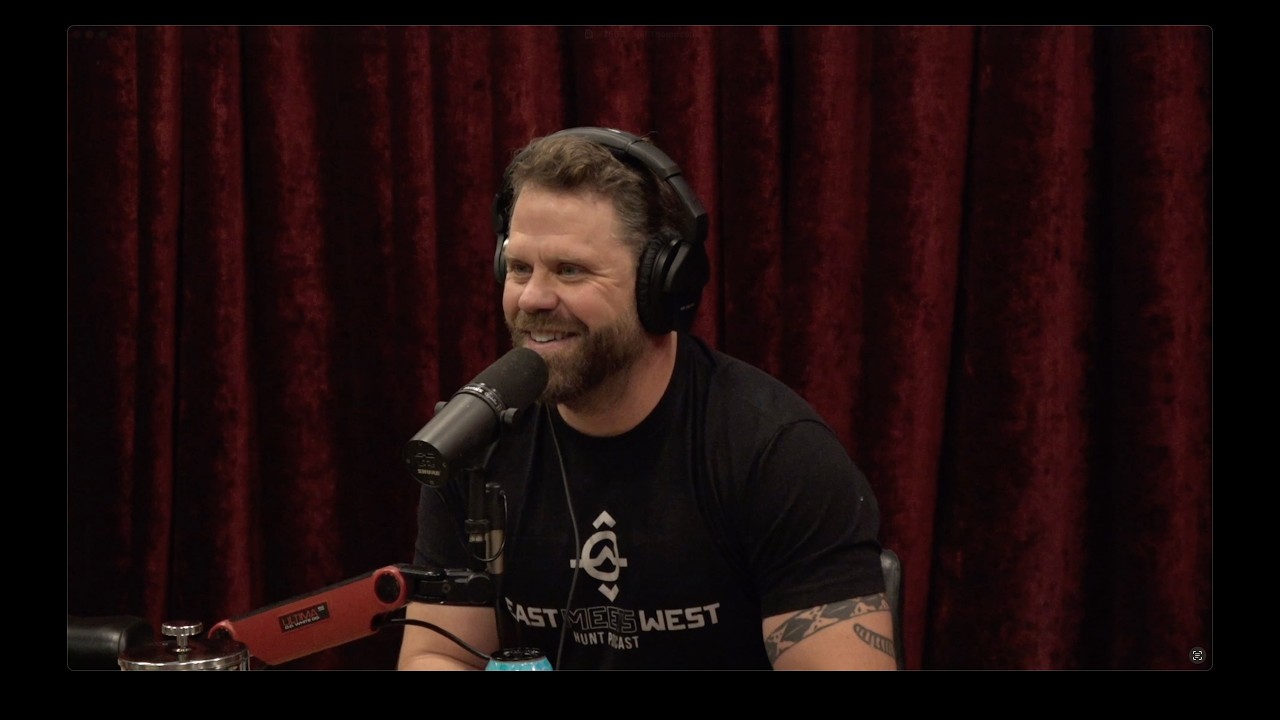
Spartan Forge CEO Sees AI Saturation Fueling Demand for Human Craft
PowerfulJRE
Widespread saturation of synthetic digital media will trigger consumer fatigue, driving premium economic value back toward physical artisanal goods and live human experiences.
Spartan Forge founder Bill Thompson applies predictive AI and micro-terrain modeling to hunting, simulating how scent currents funnel through drainages and ridges based on canopy cover, elevation, and solar heating. (40:18)
Within a projected 10-year horizon for massive AI-driven workforce displacement, Thompson and Rogan anticipate algorithmic fatigue will drive a premium on authentic, human-made goods, bespoke craftsmanship, and live performance. (157:53)
Top compound archers and tactical marksmen increasingly utilize command shooting over traditional surprise releases, relying on stress inoculation and closed-loop internal dialogue to control shots under extreme adrenaline. (12:19)
Political discourse is heavily distorted by multi-billion-dollar bot networks and algorithmic micro-targeting, underscoring the role of unscripted, multi-hour podcasts in exposing candidate fitness and dissolving curated talking points. (150:44)
Detailed notes
## Background
Published on YouTube by PowerfulJRE on October 21, 2026, this episode features host Joe Rogan sitting down with Bill Thompson, a retired U.S. Army chief warrant officer and the founder and CEO of Spartan Forge, an AI-powered mapping and predictive analytics platform for hunters.
## TL;DR
Bill Thompson and Joe Rogan explore the intersection of military discipline, high-risk tactical driving, survival evasion, and the mental composure required for command shooting in archery. Thompson explains how Spartan Forge models mountain thermals and animal behavior using AI, drawing parallels between predictive targeting algorithms, Jungian psychology, and ancestral evolutionary instincts. The discussion transitions through family battles with addiction, pool hall gambling culture, and the rapid technical evolution of mixed martial arts. They close by debating the societal impact of automated bots and predicting how artificial intelligence will transform labor while driving renewed appreciation for artisanal crafts, physical resilience, and family-centered hunting traditions.
## Atmosphere & style
The conversation carries an intense, grounded, and cerebral tone, shifting smoothly between gritty operational military memories and deep psychological introspection. Rogan and Thompson display an easy, respectful rapport built on mutual passions for bowhunting, martial arts, and personal accountability, trading analytical observations with dry humor. Vulnerable personal reflections on family loss and extreme duress in survival training give the episode an earnest, contemplative weight, making the dialogue feel like a candid, wide-ranging masterclass on mental resilience and human nature.
## Bulletin
- [40:18](https://www.youtube.com/watch?v=vamsa0e8y4Y&t=2418s) Spartan Forge founder Bill Thompson applies predictive AI and micro-terrain modeling to hunting, simulating how scent currents funnel through drainages and ridges based on canopy cover, elevation, and solar heating.
- [02:37:53](https://www.youtube.com/watch?v=vamsa0e8y4Y&t=9473s) Within a projected 10-year horizon for massive AI-driven workforce displacement, Thompson and Rogan anticipate algorithmic fatigue will drive a premium on authentic, human-made goods, bespoke craftsmanship, and live performance.
- [12:19](https://www.youtube.com/watch?v=vamsa0e8y4Y&t=739s) Top compound archers and tactical marksmen increasingly utilize command shooting over traditional surprise releases, relying on stress inoculation and closed-loop internal dialogue to control shots under extreme adrenaline.
- [02:30:44](https://www.youtube.com/watch?v=vamsa0e8y4Y&t=9044s) Political discourse is heavily distorted by multi-billion-dollar bot networks and algorithmic micro-targeting, underscoring the role of unscripted, multi-hour podcasts in exposing candidate fitness and dissolving curated talking points.
## Key takeaways
- [00:01](https://www.youtube.com/watch?v=vamsa0e8y4Y&t=1s) Active aerodynamic downforce, such as the underbody fan system in the McMurtry Spéirling, yields superior handling and track performance compared to heavy electric road cars focused purely on straight-line acceleration.
- [09:09](https://www.youtube.com/watch?v=vamsa0e8y4Y&t=549s) High-risk tactical evasive driving requires counter-intuitive mechanics like trail braking and hand-to-hand feeding, paralleling technical sports like golf where intuitive impulses often cause control failure.
- [12:19](https://www.youtube.com/watch?v=vamsa0e8y4Y&t=739s) Elite compound archers demonstrate that command shooting under deliberate mental control can outperform textbook surprise releases, with target panic reflecting psychological stress failure rather than mechanical fault.
- [21:36](https://www.youtube.com/watch?v=vamsa0e8y4Y&t=1296s) Evolutionary neurological circuits explain why foraging and hunting deliver profound personal fulfillment, whereas crowd dynamics and street riots tap into primitive, destructive tribal warfare instincts.
- [26:38](https://www.youtube.com/watch?v=vamsa0e8y4Y&t=1598s) Maintaining a continuous internal dialogue during shooting establishes closed-loop motor control, enabling marksmen to consciously regulate shot execution under severe adrenaline rushes.
- [30:05](https://www.youtube.com/watch?v=vamsa0e8y4Y&t=1805s) The Serenity Prayer provides an operational psychological baseline in high-stakes military environments by cultivating emotional detachment from outcomes outside one's direct control.
- [40:18](https://www.youtube.com/watch?v=vamsa0e8y4Y&t=2418s) Spartan Forge models mountain thermals by simulating solar exposure and canopy density to reveal how scent currents drift through terrain pinch points and funnel toward mature game.
- [55:08](https://www.youtube.com/watch?v=vamsa0e8y4Y&t=3308s) Extended sensory deprivation, severe caloric restriction, and evasion stress in SERE pipelines degrade memory consolidation and trigger vivid perceptual hallucinations.
- [01:04:44](https://www.youtube.com/watch?v=vamsa0e8y4Y&t=3884s) Mythological motifs and classic cinema resonate universally because storytellers unconsciously reflect archetypal patterns of descent, sacrifice, and rebirth rooted in the human unconscious.
- [01:34:26](https://www.youtube.com/watch?v=vamsa0e8y4Y&t=5666s) The compulsive drive behind substance abuse shares deep evolutionary roots with the obsessive focus required to achieve elite mastery in hunting, sports, and technical crafts.
- [01:43:57](https://www.youtube.com/watch?v=vamsa0e8y4Y&t=6237s) Mixed martial arts underwent rapid evolution after adopting systematic, first-principles instruction exemplified by coaches like John Danaher, vastly accelerating past centuries of traditional combat doctrine.
- [02:09:32](https://www.youtube.com/watch?v=vamsa0e8y4Y&t=7772s) Entering a pure athletic flow state requires disengaging conscious analytical thought, which operates too slowly to match unconscious motor reactions in fast-paced disciplines like goaltending and archery.
- [02:26:21](https://www.youtube.com/watch?v=vamsa0e8y4Y&t=8781s) Extemporaneous, three-hour podcast conversations dissolve curated political narratives, providing the only reliable medium to assess a candidate's true principles and temperament.
- [02:30:44](https://www.youtube.com/watch?v=vamsa0e8y4Y&t=9044s) Algorithmic echo chambers and automated astroturfing campaigns exploit finite human mental bandwidth, making digital citizens uniquely vulnerable to manufactured public outrage.
- [02:40:32](https://www.youtube.com/watch?v=vamsa0e8y4Y&t=9632s) Synthetic AI media and automated supply chains are expected to trigger mass digital fatigue, driving cultural value and economic premiums back toward tangible, human-crafted goods and live communal gatherings.
## Detailed walkthrough
### [00:01](https://www.youtube.com/watch?v=vamsa0e8y4Y&t=1s) Debating the New Tesla Roadster and McMurtry Fan Tech
The conversation opens right as Joe Rogan reminds Bill Thompson to position the microphone directly in front of his face. Thompson immediately brings up online skepticism surrounding recent demonstrations of the Tesla Roadster, noting that people are questioning whether the feats being shown are real. Rogan confirms it is genuine, remarking that he knows someone who was actually present. However, both discuss whether such a vehicle could ever realistically hit the streets for the everyday public. Rogan wonders how it could ever be legal to drive a consumer car capable of hovering or clearing other vehicles during a traffic stop. Rogan notes Elon Musk’s pattern with product delays, pointing out that numerous buyers dropped $250,000 on deposits back in 2017 expecting one design, only to see a radically overhauled machine emerge years later featuring dramatic Lamborghini-style scissor doors and hovering capabilities. Looking at Musk's boundary-pushing wealth, Rogan observes: “He's so out of his mind. He's got too much money. He just does whatever the fuck he wants.”
Rogan brushes aside speculation that the floating car demo was staged using wires and cranes, referencing existing hypercars that manipulate downforce in mind-bending ways. He calls up footage of a compact single-seat electric vehicle—the McMurtry Spéirling—which uses a massive underbody fan system to generate active downforce like a vacuum seal. This intense suction glues the car to the pavement, allowing it to smash lap records across racing circuits and run upside down along inverted surfaces. Rogan estimates the McMurtry weighs around 2,000 pounds, highlighting that electric drivetrains carry significant battery and motor heft compared to ultra-light stripped-down combustion racers. By comparison, he points to boutique vintage Porsche restomods, such as a stripped 1969 911 built with fiberglass panels that reached roughly 1,800 pounds to deliver an unadulterated, analog connection to the road.
- Many prospective buyers put down $250,000 reservations for the Tesla Roadster as early as 2017.
- The McMurtry Spéirling utilizes dedicated underbody suction fans to generate enough downforce to stick to surfaces regardless of ground speed.
- Specialized vintage Porsche builds can weigh as little as 1,800 pounds through extreme chassis stripping and fiberglass body panels.
- Modern road-going electric cars routinely weigh upwards of 4,000 pounds due to battery density, with heavy pickups pushing significantly further.
---
[04:00](https://www.youtube.com/watch?v=vamsa0e8y4Y&t=240s) Cybertruck Realities and Muscle Car Nostalgia
Examining heavier electric platforms, Thompson asks whether the Tesla Cybertruck reaches seven to eight thousand pounds. Rogan, who drives a Model S, notes the Cybertruck relies on heavy cold-rolled stainless steel. Thompson admits he originally ordered a Cybertruck because the design made him smile every time he saw it, despite having driven a Ford Tremor for years. His wife questioned the purchase, and after hearing early adopters report production flaws—such as body trim and exterior panels held on with adhesives—he backed out of his reservation. Rogan explains that first-generation builds inevitably face teething issues and that Tesla has since addressed those assembly problems. Reviewing new images of the redesigned Roadster hovering in the air, both men agree the 2017 prototype looked significantly better, resembling an aggressive modern supercar rather than the newer shape, which looks like an angular 1990s Lamborghini Countach blended with a Cybertruck.
```mermaid
flowchart TD
accTitle: Roadster and Cybertruck Discussion
accDescr: Flowchart illustrating the evolution of Tesla vehicles discussed and the mechanical trade-offs between raw speed and driving engagement.
The conversation shifts to the extreme performance metrics being promised for the Roadster, including sub-second 0 to 60 mph times and projected top speeds exceeding 300 miles per hour—roughly half the speed of sound. While staggering, Rogan insists that outright top speed has become meaningless bench-racing for everyone except professional race drivers. For him, the actual character and mechanical tactility matter far more, calling the Ford Mustang GT the ultimate accessible performance bargain. Thompson reminisces about his favorite car: a 1971 Ford Mustang Mach 1 that his sister and brother-in-law campaigned. Over time, that car was rebuilt into an alcohol-fueled Super Comp dragster where only the rear shell remained original. Rogan shares how driving vintage, heavy-steering cars feels like operating an immersive theme-park attraction, comparing it to hands-on interactive track rides at Disneyland where physical feedback matters more than sheer speed.
- The Tesla Roadster concept aims for a 0–60 mph sprint below one second (tested around 0.89 seconds) and claimed top speeds exceeding 300 mph (approaching roughly 360–380 mph, around Mach 0.5).
- Early production Cybertrucks had reported issues with body panel adhesion that have since been rectified in subsequent manufacturing runs.
- Thompson's passion for domestic muscle stems from an alcohol-fueled '71 Mustang Mach 1 Super Comp drag racer he watched compete since he was eight years old.
Bill Thompson transitions into how he acquired his own performance driving skills during his military career. As part of a high-risk officer pipeline designed for service members at elevated risk of capture or ambush behind hostile lines, he underwent an intensive series of tactical schools. Thompson likens the overall pipeline to standard survival, evasion, resistance, and escape training taken to an extreme: “It's like SERE school on steroids.”
A week and a half of this training was dedicated entirely to high-speed evasive maneuvering. Professional rally drivers were brought in as primary instructors to train students on both paved roads and unpaved off-road terrain. The syllabus drilled car control fundamentals, vehicle dynamics, slide recovery, and aggressive maneuvers like the J-turn or trail-braking flick. Instructors placed trainees into disorienting, high-stress scenarios designed to simulate sudden ambushes or illegal roadblocks, including exercises where students were transported to vehicle checkpoints with black hoods over their heads before being suddenly forced to assess the danger and drive their way out.
- The driving curriculum spanned roughly a week and a half under the instruction of professional rally drivers.
- Pipeline training prepared high-risk personnel to handle vehicular ambushes, escape illegal checkpoints, and operate vehicles under sensory deprivation and extreme surprise.
[09:09](https://www.youtube.com/watch?v=vamsa0e8y4Y&t=549s) Tactical Driving Under Fire and Counter-Intuitive Skills
Bill Thompson recounts a high-stress scenario from an advanced tactical driving course. Instructors placed a bag over his head before dropping him into an operational drill: “When we take the bag off of your head, react to the situation like it's an operational scenario and you can employ whatever you need to do.” In his scenario, Thompson was sitting in a vehicle at a simulated checkpoint when the role-playing guards began panicking and firing blank rounds. The exercise forced students to perform precise vehicle mechanics while under fire: planting the left foot, bracing back against the seat, looking behind, and steering in reverse through a serpentine obstacle course to escape danger. Thompson notes how enjoyable the courses were and how they revealed that mastering elite skills often contradicts natural human instinct.
He draws a direct parallel between high-performance driving and learning golf. Having previously played rugby, Thompson took up golf out of pure spite when his father-in-law dismissed him, saying, “You're not a golfer. You're a large blunt instrument. Like go keep playing rugby.” When he tried to fix his slice, he initially thought he needed to strengthen his grip or try to lift the ball, only to learn that solid contact requires swinging from inside-to-out, properly transferring weight, and hitting down on the ball to make it climb.
Driving presented the exact same counter-intuitive reality. In the course, they trained in Chevrolet Impala Interceptors, where frontloaded weight required applying the brakes into corners rather than relying on movie tropes. While popular culture and the *Fast & Furious* movies make people think drifting with squealing, sliding tires is fast, actual racing demands keeping tire rubber planted against the asphalt as much as possible. Instructors strictly forbade crossed-arm oversteering:
> “If you have to put one hand over the other, you're failing. Feed the wheel from one hand to the other and take a trail turn.”
- **Vehicle Dynamics**: Driving instructors emphasized drawing a straight line through courses, steering as little as possible, and avoiding breaking tire traction.
- **Braking**: Applying the brakes shifts the vehicle's weight forward onto the front tires of the front-heavy Impalas, increasing grip to navigate turns cleanly and quickly.
---
[12:19](https://www.youtube.com/watch?v=vamsa0e8y4Y&t=739s) Surprise Release vs. Command Shooting Under Pressure
Thompson observes that learning any skill at an elite level usually requires fighting natural instincts. In rifle marksmanship and compound archery, the gut reaction is to slap or jerk the trigger, whereas the cleanest shot is achieved by applying slow, steady pressure until the break surprises the shooter. Triggering a shot without anticipating the exact moment it fires prevents flinching or bracing for recoil.
Joe Rogan adds a crucial nuance: top tournament archers frequently rely on command shooting rather than pure surprise shots. While traditional wisdom teaches that surprise releases using hinge releases or back-tension thumb buttons eliminate target panic, elite competitors like James Lutz, Kyle Douglas, and Tim Gillingham deliberately command their shots. They achieve immense stability, hold massive back pressure against the bow's wall, place their aiming pin dead center on the target, and pull the trigger right when they decide to fire. Rogan cites James Lutz shooting a 719 out of a possible 720 in a 72-arrow round—dropping only a single point from the 10-ring—to prove that command shooting can operate at the absolute peak of the sport.
Rogan argues that target panic is primarily a psychological collapse under competitive stress rather than a mechanical failure of the release. Most beginners shoot well until the pressure mounts and the fear of missing invades their thinking. To handle extreme moments—such as stepping up to an arrow in a tournament or facing a bugling bull elk screaming at 40 yards—individuals must build a deep history of experiencing and surviving high-pressure environments. Those accustomed to pressure adapt far more rapidly than people who have only shot in stress-free practice settings.
```mermaid
flowchart TD
accTitle: High-Pressure Shooting Responses
accDescr: Flowchart illustrating the paths between target panic, surprise release, command shooting, and pressure inoculation.
A["Target Pressure / High Stakes"] --> B{"Shooter Experience"}
B -->|"Unfamiliar with Pressure"| C["Target Panic & Anticipation"]
B -->|"Experienced with Pressure"| D["Execution Discipline"]
C -->|"Mechanical Fix"| E["Surprise Shot / Back Tension"]
D -->|"Extreme Hold Stability"| F["Command Shooting"]
E --> G["Mitigate Flinching"]
F --> H["Accurate on Demand"]
```
---
[16:35](https://www.youtube.com/watch?v=vamsa0e8y4Y&t=995s) The Spartan Forge Archery Shootout: Evan Freed vs. Levi Morgan
Thompson illustrates Rogan's point about pressure performance by sharing a story from his company, Spartan Forge. Renowned tournament champion and bowhunter Levi Morgan serves as an ambassador and product consultant for the company. During a company archery tournament with roughly 20 participants, the field was steadily eliminated until only two shooters remained in the final round: Levi Morgan and Spartan Forge engineer Evan Freed.
To everyone's shock, Freed defeated Morgan in the final showdown. Rogan jokes that Freed must possess “weaponized autism,” while Thompson describes the engineer as an unflinching, stone-cold competitor. Even though Morgan would beat almost any archer in the world nine or ten times out of ten, Freed managed to hold his composure in that specific moment and take down the top shooter in the sport. Thompson recalls that the entire team treated Freed like “John freaking Wick” for the remainder of the weekend after he stepped up to the undisputed king of archery and did not flinch. Rogan remarks on the rare feat, concluding that “for one moment, he was Prometheus.”
[17:58](https://www.youtube.com/watch?v=vamsa0e8y4Y&t=1078s) Mental Rules, Heuristics, and Cameron Hanes' Command Shot
The conversation begins with an examination of the psychological barriers and artificial limitations people place upon themselves in performance disciplines. Joe Rogan points out that many established standards are merely mental constructs: “A lot of times people invent rules to sort of to kind of rationalize or deal with their own struggles, right?” Bill Thompson connects this tendency to heuristics—mental shortcuts where individuals settle on an approach that is merely good enough for their specific circumstances, even if it fails to apply universally to everyone else.
This leads directly into an analysis of Cameron Hanes’ distinct archery style. While conventional archery coaching often preaches a surprise release, Rogan and Thompson note that Hanes employs a deliberate, highly executed command shot. Rogan explains that Hanes' unconventional method functions because of his immense capacity to manage extreme physiological and mental stress, proven by his participation in 200- to 300-mile ultramarathons, coupled with four decades of continuous bowhunting repetitions. Thompson emphasizes that technical mechanics ultimately bow to sheer volume, noting that high repetition under pressure forms an instinctual foundation that override textbook theories.
- **Heuristic thinking:** Rogan and Thompson describe how humans standardize personal coping mechanisms into rigid technical rules for everyone else.
- **Cameron Hanes' shooting style:** Hanes relies on a controlled, slow pull that culminates in an intentional command shot rather than a passive surprise break.
- **The role of stress inoculation:** Decades of pulling triggers on big game and running extreme endurance races insulate veterans like Hanes from the panic that ruins less experienced archers.
---
[20:48](https://www.youtube.com/watch?v=vamsa0e8y4Y&t=1248s) The Adrenaline Dump, Recent Reps, and Target Panic
Rogan and Thompson stress that archery mastery is not solely a function of total career repetitions, but specifically *recent* repetitions. When months pass between live-game opportunities, even seasoned hunters face severe nervous system shocks. Thompson shares his personal protocol for white-tailed deer season, explaining that he deliberately tries to harvest two or three does early in the year before turning his sights toward a trophy buck. This practice ensures his muscle memory and nervous system recalibrate under live conditions after a six- to nine-month off-season layoff.
Thompson reflects on his own physiological response, stating, “I’ve been hunting for 25 years and I’ll still freak out or get the adrenaline drop afterwards.” He notes that while he stays composed before and during the shot sequence, an intense adrenaline crash invariably hits him the moment the arrow is loosed. Rogan observes that keeping composed until the release is a vital distinction, pointing out that many popular hunting influencers on YouTube shake uncontrollably at full draw even after decades in the field.
- **Pre-season calibration:** Thompson uses early-season doe harvests as live-fire repetitions to shake off target panic before pursuing mature bucks.
- **Timing of the adrenaline surge:** While novice shooters break down during the draw cycle or aiming process, veteran shooters typically defer the nervous collapse until after arrow flight.
- **Influencer target panic:** Rogan notes that despite decades in the outdoor industry, many high-profile video creators still visibly tremble while anchoring their bows on camera.
---
[21:36](https://www.youtube.com/watch?v=vamsa0e8y4Y&t=1296s) Evolutionary Circuits: The Dopamine of Foraging vs. The Mob Mentality of War
The discussion broadens into evolutionary biology and why ancient survival behaviors still trigger overpowering neurochemical cascades in modern humans. Rogan and Thompson observe that hunting and fishing are deeply hardwired into ancestral DNA because collective hunting parties were vital to the tribe's survival. When a person catches a fish or harvests game, their brain rewards them with an overwhelming rush of endorphins and dopamine tied directly to feeding their kin. Thompson recalls seeing this primal reaction in his five-year-old daughter the very first time she landed a fish.
Rogan contrasts this nurturing hunting instinct with the darker evolutionary circuitry behind tribal warfare and street riots. He argues that modern political protests and riots tap directly into the ancient machinery of armed inter-tribal conflict. In a mob, individuals adopt destructive behaviors they would never contemplate in isolation—such as taking a traffic cone to smash a storefront window. Rogan remarks on this collective hysteria: “Smashing someone's car window while you're by yourself. Walking up to Starbucks with a a fucking traffic cone and breaking the window and diving in and throwing things off the shelves. You would never do that while you're by yourself. Why are you doing it with this giant group of people? It's the war thing.” Thompson agrees that these two ancient survival circuits—the foraging drive and the tribal warfare instinct—continue to govern human behavior in modern society.
```mermaid
flowchart TD
accTitle: Evolutionary Survival Drives in Modern Behavior
accDescr: Contrasting the primitive survival circuits of tribal hunting and tribal warfare in modern expressions.
subgraph Foraging["Primitive Hunting & Foraging Circuit"]
A["Hunting / Fishing Experience"] --> B["Ancestral Survival Feedback"]
B --> C["Endorphin & Dopamine Reward"]
C --> D["Nourishment & Family Survival"]
end
subgraph Warfare["Primitive Tribal Warfare Circuit"]
E["Mass Gathering / Protests"] --> F["De-individuation / Mob Mentality"]
F --> G["Adrenaline & Us-vs-Them Threat Response"]
G --> H["Collective Violence & Destructive Behavior"]
end
```
- **Ancestral foraging circuit:** Capturing fish or game immediately floods the human brain with primal satisfaction because it directly mimics life-saving tribal food acquisition.
- **The psychology of riots:** Collective chanting and marching simulate tribal raiding parties, overriding individual moral restraint and inducing collective violence.
- **Intensity of big game pursuit:** Rogan notes that if catching a simple fish triggers an innate high, hunting bugling elk with archery equipment amplifies that chemical experience a thousandfold.
---
[24:26](https://www.youtube.com/watch?v=vamsa0e8y4Y&t=1466s) Stalking "The Monarch": A 12-Year-Old Public Land Whitetail
Thompson recounts a defining hunt on public land in north-central Pennsylvania, east of the Allegheny region, where he targeted a legendary white-tailed buck known locally as "The Monarch." The deer was estimated to be 12 years old and had previously grown antlers scoring around 170 inches—an extraordinary size class for heavily pressured Appalachian public land. Thompson had spent three seasons monitoring the buck, investing an immense amount of scouting time into learning its travel patterns during the rut.
On the day of the encounter, Thompson detected an unfavorable thermal wind shift: the morning thermal draft was continuing to rise up the mountain rather than falling as expected, threatening to blow his scent straight toward the buck's traditional corridor. Rather than forcing the bad setup, Thompson rerouted to the front side of the ridge to gain thermal advantage. While still on foot before setting up a tree stand, he crossed paths with the buck aggressively pushing a doe into a drainage ditch. Recognizing the animal instantly, Thompson brought up his bow and made a 35-yard double-lung shot from the ground.
The aftermath triggered a profound physiological collapse:
> “I double-lunged him at like 35 yards, and I had like an adrenaline drop for like 25 minutes afterwards. I couldn’t even call my buddy to come and help me drag him cause I was freaking out so bad.”
Thompson explains that this prolonged physical crash was the culmination of three years of relentless pursuit suddenly materializing within seconds. To settle his nerves before taking the shot, he relied on an operational focus acronym he had developed and practiced during his years of precision shooting in the military.
- **The target:** "The Monarch," a 12-year-old, roughly 170-inch wild buck hunted by numerous local hunters across north-central Pennsylvania public ground.
- **Thermal wind adaptation:** Thompson aborted his planned ambush upon noticing rising mountain thermals that would betray his approach, pivoting to a secondary face where wind currents worked in his favor.
- **Ground encounter:** The shot presented itself at 35 yards while Thompson was still standing on the forest floor, driving a fatal double-lung arrow through the animal as it herded a doe.
- **Physical aftermath:** The shock of completing a three-year pursuit left Thompson completely incapacitated by an adrenaline crash for roughly 25 minutes, unable to dial his phone to coordinate recovery.
[26:38](https://www.youtube.com/watch?v=vamsa0e8y4Y&t=1598s) Shot Execution and Closed-Loop Psychology
Bill Thompson reflects on the shooting checklist he ingrained during his military service, reciting the rifle marksmanship fundamentals: steady position, aiming, breathing, and trigger squeeze. Whenever he draws back his bow, he runs through this mental sequence in complete silence, holding at full draw and timing the release to the natural respiratory pause. By taking a deep breath and exhaling until empty before initiating a slow squeeze, the sudden surge of adrenaline and physical panic dissolves into the procedural task at hand. Joe Rogan notes that this exact discipline mirrors the mental management system developed by Joel Turner. Turner, a former SWAT sniper and firearms instructor who studied psychological shot control, trains archers to speak to themselves consciously throughout the execution of a shot to create a closed-loop system rather than an open-loop one.
```mermaid
flowchart LR
accTitle: Open-Loop vs Closed-Loop Motor Execution
accDescr: A diagram contrasting open-loop athletic actions like swinging a bat with closed-loop shot execution systems that can be paused.
subgraph OpenLoop["Open-Loop Execution"]
A["Initiate Action\n(e.g., baseball swing)"] --> B["Uninterruptible Momentum"]
B --> C["Panic / Flinch / Target Miss"]
end
subgraph ClosedLoop["Closed-Loop Execution"]
D["Conscious Internal Dialogue\n(Joel Turner System)"] --> E["Controlled Step\n(Aim & Squeeze)"]
E --> F{"Hold or Abort?"}
F -->|"Continue"| G["Controlled Release"]
F -->|"Distracted"| H["Halt Shot / Reset"]
end
```
Rogan explains the fundamental difference between the two systems: an open-loop movement behaves like swinging a baseball bat—once set in motion, the momentum cannot be recalled—whereas a closed-loop action behaves like writing with a pen, allowing the person to freeze or stop the movement at any millisecond. When an archer allows their draw and release to become open-loop, subconscious anticipation takes over, causing the shooter to jerk or flinch and throw the arrow wide of the target. Rogan stresses that high-stress hostage rescue scenarios demand that an operator actively suppress cognitive runaway trains through internal dialogue. When individuals lack structured mental mitigation strategies, an initial spike in anxiety snowballs, turning into physical panic attacks or unforced mechanical failures.
- Shot process checklist: Steady position, aiming, breathing, and slow trigger squeeze.
- Joel Turner’s system: Using continuous self-talk during high-stress shot execution to preserve closed-loop motor control.
- Open-loop: Motor actions that cannot be interrupted once initiated (e.g., swinging a bat).
- Closed-loop: Consciously monitored motor actions that can be aborted at any micro-step (e.g., writing with a pen).
- “And so what you're doing is instigating closed loop thinking by talking to yourself the entire time,” Rogan emphasizes regarding shot control.
---
[30:05](https://www.youtube.com/watch?v=vamsa0e8y4Y&t=1805s) The Serenity Prayer as an Operational Superpower
Thompson connects this structured mental control to his broader temperament, bringing up how his close friend Andy Stumpf jokingly mocked him on Rogan's show as the “Captain America of autism.” Thompson explains that while his wife tends to worry incessantly about matters outside her control, he defaults to not worrying about anything unless it directly touches his core duties or the reputation of his family. He credits this emotional detachment to his childhood, when his mother, an alcoholic, dragged him along to Alcoholics Anonymous meetings in Missouri. Sitting in church basements at nine years old, listening to adults confess to week-long benders where they woke up in Las Vegas, young Thompson memorized the Serenity Prayer recited at the start of every meeting: *“God grant me the serenity to accept the things I cannot change, courage to change the things I can, and wisdom to know the difference.”*
That early exposure cemented a cognitive heuristic that has anchored him ever since. Thompson recently shared the prayer with his teenage daughter to help her navigate standard adolescent distress, reminding her to discard anything she cannot directly affect. That same detachment kept him levelheaded through chaotic combat environments across the globe, whether he was pinned down or managing tactical communications in Iraq, Afghanistan, the Philippines, or Africa. Instead of spiraling into panic when a situation went sideways, he methodically focused on tangible tasks, like working the radio.
- Early exposure: Attending AA meetings in Missouri at age nine, absorbing the Serenity Prayer alongside adult confessionals.
- Tactical deployments mentioned: Iraq, Afghanistan, the Philippines, and Africa.
- Thompson summarizes his mindset: “I would say if I had one superpower it's my ability to just not care when I can't affect the outcome.”
---
[32:54](https://www.youtube.com/watch?v=vamsa0e8y4Y&t=1974s) Resilience, Physical Conflict, and the Permanence of the Internet
Rogan underscores that weathering severe, unpredictable crises is the only way an individual's character gets galvanized, pointing out that modern society shields most people from the high-pressure situations necessary to develop actual resilience. Without baseline friction, men often mistake bravado for capability. Rogan points to viral street-fight videos where untrained men talk themselves into brawls believing they can handle business, only to end up unconscious on pavement.
Thompson and Rogan contrast the modern social media landscape with growing up in rural America. Thompson recalls growing up in a North Dakota farm community where schoolyard and local brawls were routine biweekly events, serving as the main entertainment for the town. Win or lose, the fight blew over quickly because ten more occurred the following month, and nobody kept a permanent record. Today, getting knocked out—such as getting clocked with a convenience store can—is immediately captured on a smartphone camera and uploaded for millions to mock. The humiliation lasts forever, turning the loser into a meme and following them through their personal and professional life. Thompson recalls mentioning on Stumpf’s podcast that without deliberately forcing hardship into modern existence, human resilience completely atrophies.
- Rural culture: Growing up in small farm towns in North Dakota where physical fights were ordinary, low-stakes occurrences without long-term social ruin.
- Digital age contrast: Viral video fights where losses are preserved permanently online as social media memes.
- “And I think you need a certain amount of very high pressure situations in your life in order to kind of to galvanize your character,” Rogan argues.
[35:13](https://www.youtube.com/watch?v=vamsa0e8y4Y&t=2113s) Fasted Hunts and Primal Dopamine
Bill Thompson explains that people need to voluntarily place themselves in difficult situations to discover who they truly are, whether through Brazilian jiu-jitsu or demanding outdoor pursuits. In jiu-jitsu, stepping onto the mats and getting humbled repeatedly breaks through false confidence and shows a person that there is a wealth of knowledge to pursue over decades. Thompson shares a personal tradition he undertakes with friends: fasted hunting trips. They pack a Yeti cooler with food, drinks, and accompaniments, lock it with a combination lock, and entrust the passcode to one of their wives. The group is only given the unlock code once someone successfully harvests an animal and texts a photo of a downed doe or buck.
During these trips, the hunters consume only saltwater while pursuing game across the landscape. Fasting while actively hiking and hunting burns through energy reserves far quicker than standard sedentary fasting. While Thompson regularly practices quarterly fasts lasting anywhere from two to seven days, he notes that by day three in the field, the physical toll is intense. When someone finally harvests an animal—usually after thirty-six hours to three or four days—the emotional release and camaraderie around the campfire are overwhelming. Joe Rogan points out that humans are hardwired for this exact survival loop, explaining why modern audiences are drawn to survival footage and subsistence cultures. Thompson observes that digital substitutes fall completely flat compared to evolutionary achievements: “I think it's because that those human reward systems are the strongest purveyors of happiness that we have currently available to us.”
- Fasted hunting rules: Food and drinks remain locked in a Yeti cooler until a hunter texts proof of a harvest to the lock-keeper.
- Fasting duration on hunts typically ranges from thirty-six hours up to four days for a group of five or six hunters.
- Thompson regularly maintains personal quarterly fasts lasting between two to seven days.
- Rogan notes that watching an elk drop at sixty yards delivers a profound, visceral fulfillment coded into human DNA that cannot be replicated by scrolling social media.
---
[38:12](https://www.youtube.com/watch?v=vamsa0e8y4Y&t=2292s) Physical Labor, Tech Burnout, and Closure
Thompson emphasizes that individuals must deliberately adopt challenging paths—such as rigorous training, hunting, disciplined nutrition, or difficult academic degrees—lest nature and idle comfort take their toll. Rogan adds that people who avoid hard challenges tend to suffer from heightened anxiety over minor daily friction, whereas those tested by physical hardship handle everyday stressors with ease. Thompson notes that his wife manages anxiety by channeling energy into hands-on creative projects like painting, drawing, or building. In contrast, modern careers in tech leave workers without a sense of closure because software development is an endless, iterative cycle where projects are never truly finished.
To find tangible satisfaction, Thompson historically used vacation days to travel back home to North Dakota to work twelve-hour shifts during the harvest, driving sugar beet trucks alongside loaders. Completing physical acreage offered a concrete, finished objective that white-collar knowledge work lacks, and he frequently donated his harvest wages to his church. Rogan connects this yearning for concrete stakes to the massive cultural popularity of shows like *Yellowstone* and stories of Siberian mountain trappers, where survival depends entirely on direct, physical outcomes.
```mermaid
flowchart TD
accTitle: Modern Tech Burnout vs Tangible Physical Labor
accDescr: A comparison showing how endless digital work leads to open-ended anxiety while physical labor provides a definitive sense of accomplishment.
subgraph ModernTech["Modern Tech & Knowledge Work"]
T1["Abstract screen work"] --> T2["Endless development cycles"]
T2 --> T3["Work is never finished"]
T3 --> T4["Unresolved anxiety & lack of grounding"]
end
subgraph PhysicalLabor["Physical Endeavors & Primal Tasks"]
P1["Hunting, farming, or martial arts"] --> P2["Exhausting bodily labor"]
P2 --> P3["Concrete milestone reached (e.g. field harvested / deer down)"]
P3 --> P4["Neurological closure & deep satisfaction"]
end
```
---
[40:18](https://www.youtube.com/watch?v=vamsa0e8y4Y&t=2418s) Spartan Forge and AI Thermal Mapping
While Thompson acknowledges the irony of developing software while advocating for outdoor immersion, he explains that Spartan Forge exists to give people their time back so they can actually hunt. Since modern hunters face severe schedule constraints, digital scouting allows them to analyze mountain topography and plan routes from home before stepping foot in the field. Thompson approaches app development with a strict design philosophy centered on ergonomics and speed: “So the less time that I have to interact with an app in order to get more information, I've increased bandwidth, right? So less buttons, less time, just let's just get them the information they need and get them focused on the woods.”
Spartan Forge's latest feature addresses mountain wind thermals, one of the primary reasons hunts fail. Rogan explains the mechanics of thermals for listeners: early in the morning, cold air pushes down the slopes, meaning hunters must approach game from below to avoid blowing their scent into the bedding area; as the sun warms the terrain, the airflow reverses and drafts upward. Thompson's platform integrates historical weather data, terrain elevation, wind speed, and temperature to simulate how scent disperses across specific drainages and ridges. Highlighting an animal's olfactory capabilities, Thompson recalls a friend in New York who owned a deer pen three-quarters of a mile from a mountain; whenever the captive does came into estrus, wild bucks would gather along the bottom fence line, having detected the scent drifting across the entire valley. The thermal engine lets hunters model these exact atmospheric shifts on their computers before ever leaving home, keeping their phones tucked away once they step into the wild.
- Spartan Forge is designed to minimize screen time in the field so hunters can keep their phones stowed away in their bino harnesses or chest rigs.
- The web-first thermal mapping engine models real-time and historical wind, temperature, and terrain elevation.
- Whitetail bucks were observed scent-tracking does in estrus from a distance of three-quarters of a mile across open mountain air currents.
[43:39](https://www.youtube.com/watch?v=vamsa0e8y4Y&t=2619s) AI Modeling of Mountain Thermals and Animal Behavior
Joe Rogan asks Bill Thompson whether thermal wind currents vary significantly between east-facing and west-facing mountain slopes, noting that an east-facing slope should cause thermals to rise much earlier in the morning due to the morning sun. Thompson affirms this, explaining that to accurately capture these dynamics, Spartan Forge had to integrate an extremely high-resolution topographic layer into their computational engine, along with detailed canopy cover data. The movement of air modulates drastically depending on whether game animals are out on an open hillside, shielded by hemlocks, or moving through an aspen grove.
Thompson describes testing this predictive model on his own mountain spots for hunting whitetail deer. Older bucks possess an uncanny, instinctive understanding of thermal air currents, knowing precisely how prevailing winds and topography channel scent. Running the model revealed that several of his best hunting spots were situated where winds funneled air from roughly 320 degrees directly into a single pinch point. A mature buck positions himself in such terrain because he can smell an entire mountain before ever setting foot on it—detecting an estrus doe, human hunters, or any other presence across massive distances.
```mermaid
flowchart TD
accTitle: Environmental Inputs into Thermal Airflow Prediction
accDescr: High-resolution terrain, solar incidence, and canopy cover feed an AI engine to predict mountain thermals and scent funnels.
subgraph Inputs["Environmental Variables"]
A["High-Resolution Topography Layer"]
B["Solar Incidence (East vs. West Slopes)"]
C["Canopy Cover (Open, Aspens, Hemlocks)"]
end
subgraph Engine["Predictive AI Model"]
D["Thermal Flow Engine"]
end
subgraph AnimalOutcome["Animal Behavioral Advantage"]
E["Scent Funnels (e.g., 320° Coverage)"]
F["Buck Detects Hunters & Does Remotely"]
end
A --> D
B --> D
C --> D
D --> E
E --> F
```
- High-resolution topography, sun incidence angles, and canopy cover modulate thermal airflow models.
- An older whitetail buck leverages natural funnels where thermals pull scent from hundreds of degrees across the mountain.
- Whitetail deer remain the single most hunted big game animal in North America.
[44:37](https://www.youtube.com/watch?v=vamsa0e8y4Y&t=2677s) The Complexity of Hunting and Levels of Mastery
Rogan and Thompson discuss public misconceptions about hunting, particularly the false idea that rifle hunting is effortless compared to archery. Rogan points out that while a rifle allows an ethical shot from 300 yards away, navigating vast, unforgiving mountain terrain remains grueling. Rogan compares minimizing rifle hunting's difficulty to claiming boxing is easy just because mixed martial arts incorporates more disciplines: “Boxing is not easy. Shut the fuck up.” Reflecting on his first hunt in 2012 for mule deer alongside Steven Rinella, Rogan recalls being humbled instantly:
> “Immediately I was like, oh my god, this is so much more difficult and there's so much more to learn than I ever understood.”
Rogan evaluates his own hunting expertise using Brazilian jiu-jitsu belt ranks, describing himself as a high purple belt or brown belt who performs well because of physical fitness, mental composure under pressure, and guidance from world-class hunters. In contrast, he views Cameron Hanes as a "sixth-degree black belt" who constantly reveals new layers of animal behavior and strategy even after twelve years of hunting together. Thompson and Rogan agree that hunting becomes an all-consuming obsession every year, occupying their minds from June onward as they eagerly anticipate the September seasons and watch the leaves begin to turn.
- Rogan began hunting in 2012 on a mule deer hunt guided by Steven Rinella.
- Rogan rates his personal hunting skill as a jiu-jitsu purple or brown belt, contrasting it with Cameron Hanes's elite "sixth-degree black belt" mastery.
- Both men note that hunting preparations and mental focus begin taking over their daily lives by June of each year.
[47:32](https://www.youtube.com/watch?v=vamsa0e8y4Y&t=2852s) Rites of Passage and Physical Testing
Thompson highlights the cultural necessity of introducing young people—particularly young men—to hunting as a meaningful rite of passage. In modern society, formal coming-of-age ceremonies (such as those practiced by Native American tribes or Norse cultures) have largely disappeared, leaving many young people without a defined transition into adulthood. Thompson notes that his own coming of age was essentially outsourced to the military.
Rogan agrees, pointing out that individuals who are never truly tested live under a persistent cloud of self-doubt. Rogan credits his intense focus on martial arts at age 15 with reshaping his entire mindset, teaching him that struggle, pressure, and failure are blessings that reveal one's capacity to expand personal boundaries. Thompson connects this to classical philosophy, noting that Plato (whose name derived from the Greek word for broad or broad-shouldered) was an accomplished wrestler. Plato famously argued that it is a profound tragedy for an individual to go through life without ever discovering the full physical potential of the human body, or learning who they truly become when facing severe adversity.
> “There's a lot of people who are never truly tested and they live their life with this just cloud of uncertainty constantly hanging over them...” — Joe Rogan
[50:27](https://www.youtube.com/watch?v=vamsa0e8y4Y&t=3027s) High-Risk SERE Training and Appalachian Evasion
Thompson details the military SERE pipeline (Survival, Evasion, Resistance, and Escape). While basic SERE courses teach wilderness survival, evading capture, and resisting interrogation techniques primarily for pilots and flight crews, advanced courses—such as those designed for high-risk officers or JSOC units—are far more grueling and realistic. Thompson completed an advanced course lasting several weeks that pushed students to their absolute limits.
The course combined two intensive weeks of tradecraft training with a realistic evasion exercise:
- Lock-picking handcuffs and escaping from locked rooms or car trunks.
- Field expedient weapons manufacturing, such as improvising shotguns.
- Field dressing and consuming small game like squirrels.
- Appearance modification or "conducting polish" to evade active police lookouts (APBs) by rapidly altering clothing and visual profiles.
Following the instructional phase, students were dropped into a live operational scenario in the Appalachian Mountains, hunted across rough terrain by professional trackers and special operators. Thompson describes undertaking a grueling 12- to 13-mile evasion route across multiple days, sleeping directly on the cold ground with minimal food, pushing his body to the edge of exhaustion.
[52:21](https://www.youtube.com/watch?v=vamsa0e8y4Y&t=3141s) SERE Evasion Tactics and the Phantom Hikers on the Trail
Bill Thompson describes the evasion phase of military survival training, detailing tactical movement techniques and escape protocols. Students are taught never to walk directly down a trail, as doing so makes one an easy target; instead, they "serpentine snake" the route to maintain their orientation without exposing themselves on the open path. The training scenario begins abruptly: candidates are placed in the trunk of an older automobile while wearing a painter's outfit, bound in handcuffs and zip ties. They must pick the locks, break through restraints like duct tape, and mechanically defeat the trunk latch from the inside on vehicles that lack modern emergency escape releases. Once freed, the student must evade active pursuers, including local law enforcement officers who participate in the exercise. To avoid detection, students modify their clothing—either by scavenging replacements from Walmart donation drop boxes or improvising camouflage. Thompson recalls submerging his lower body into a muddy puddle so his bright white painter's pants would appear dark in the night.
```mermaid
flowchart TD
accTitle: SERE Evasion and Detention Phase Progression
accDescr: Flowchart showing the sequence from captive trunk escape through wilderness evasion to sensory deprivation detention.
subgraph Escape ["Escape & Infiltration"]
A["Trunk of vehicle in painter's outfit"] --> B["Defeat cuffs, zip ties & trunk latch"]
B --> C["Camouflage & alter clothing"]
end
subgraph Evasion ["Wilderness Evasion"]
C --> D["Serpentine navigation along trail"]
D --> E["Sleep deprivation & food exhaustion"]
E --> F["Encounter with phantom hikers at shelter"]
end
subgraph Detention ["Capture & Sensory Deprivation"]
F --> G["Detention in 5.5-ft cement box"]
G --> H["Violin noise loop & visual hallucinations"]
H --> I["Medical debrief & GPS log analysis"]
end
```
By the third day of continuous evasion on the Appalachian Trail, severe food deprivation and physical exhaustion began altering Thompson's perception. In the middle of the night around 2:00 a.m., he stumbled across what appeared to be hikers sitting on a log outside an open-faced trail lean-to. Thompson spoke with them briefly using an assigned cover story before they turned in. He built a fire and went to sleep on the bare ground nearby. When he woke up around 5:00 or 5:30 a.m., the hikers were gone, and daylight revealed that the dirt was entirely undisturbed. There were no human footprints, and the log he remembered seeing them sit on was completely nonexistent.
- Candidates wear painter's coveralls and are restrained with cuffs and zip ties inside vehicle trunks lacking internal release mechanisms.
- Evasion doctrine emphasizes avoiding established footpaths by paralleling them in a serpentine pattern.
- Thompson soaked the lower half of his white suit in mud to simulate dark denim in the dark.
- The phantom encounter occurred along the Appalachian Trail after roughly three days without food.
---
[55:08](https://www.youtube.com/watch?v=vamsa0e8y4Y&t=3308s) The Confinement Cell and Hallucinations Under Duress
After being captured, students enter the detention phase of the exercise, where physical and psychological stressors escalate. Thompson was locked inside a concrete isolation cell measuring only about five and a half feet tall. The cramped dimensions made it impossible either to stand fully upright or to lie flat on the floor, effectively creating a state of physical sensory deprivation. Behind his head, interrogators blasted a jarring, repetitive audio track of discordant violin music for approximately eight hours straight. The combined toll of extreme dehydration, starvation, and physical containment triggered vivid waking hallucinations of worms and snakes crawling across the enclosed space.
During the medical debrief that followed, the staff physician assured Thompson that such experiences are routine during survival training. Thompson learned that students are tracked via safety GPS devices carried in fanny packs so instructors can intervene in genuine medical emergencies or vehicle collisions. The debriefing doctor reported having evaluated at least fifteen candidates who reported nearly identical phenomena, including individuals fully convinced they had navigated to entirely different municipalities or held conversations with nonexistent people while on the run. Thompson reflects that even years later, he cannot definitively determine whether the hikers were a sleep-deprived waking hallucination, a dream, or real people whose tracks somehow vanished.
> “When you're not eating for a while, you've got the stress of being chased by people who do this for a living. You haven't had any water, no reliable meals, you're stressed out, and you've been running for three or four days. Like you your mind starts doing things to you.” — Bill Thompson
- Detention cells are roughly 5.5 feet tall, preventing inmates from either standing straight or stretching out horizontally.
- Auditory torment included discordant violin music piped behind candidates' heads for eight-hour stretches.
- GPS units carried in waist packs serve exclusively for emergency tracking, not for active tracking by the hunter teams.
- Medical staff routinely see evaders develop geographic disorientation and visual hallucinations due to caloric depletion.
---
[58:05](https://www.youtube.com/watch?v=vamsa0e8y4Y&t=3485s) Perceptual Illusions and the Purpose of Hallucinations
The conversation shifts from extreme physical exhaustion to speculative theories regarding perception, alien encounters, and evolutionary biology. Rogan and Thompson joke about the concept of interdimensional entities walking among humans. Rogan points out that any civilization possessing interstellar propulsion or gravity drives capable of crossing galaxies would easily have the capability to alter human visual cortex processing or craft synthetic human disguises rather than looking like classic extraterrestrial archetypes.
They explore the fragility of human perception, citing optical illusions such as Rubin's vase and the Cornsweet illusion, which demonstrate how easily the central nervous system can be fooled. Rogan wonders why the human brain experiences hallucinations when severely fatigued. Thompson notes that dreams and REM stages are critical for memory consolidation, which explains why memory rapidly deteriorates during prolonged sleep deprivation:
> “So one of the things that happens when you're not sleeping for a long time is your memory is one of the first things to go because you need those stages of sleep in order to remember things.” — Bill Thompson
- The Cornsweet illusion demonstrates how adjacent shading manipulates the human eye's perception of identical gray shades.
- Rogan argues an advanced civilization with interstellar travel would find projecting human-like forms or hacking human perception trivially simple.
- Thompson highlights that memory degradation is one of the earliest cognitive breakdowns under sleep deprivation due to the disruption of memory consolidation.
[01:00:44](https://www.youtube.com/watch?v=vamsa0e8y4Y&t=3644s) The Collective Unconscious, Instincts, and Carl Jung
Bill Thompson reflects on how deeply he believes in dreams, noting that while it might sound unusual coming from an engineer, he sees human consciousness as resting on deep ancestral layers. He argues that the collective unconscious and individual unconscious are built on millions of years of learned lessons that humans cannot be born with consciously. Instead, those lessons surface as intuitive gut reactions or heuristics—such as immediately getting the "ick" around someone without being able to articulate why. In Bill's view, that warning signal has likely played out across ten million ancestral encounters, preserved over hundreds of thousands or millions of years of human evolution.
```mermaid
flowchart TD
accTitle: Ancestral Heuristics and Conscious Experience
accDescr: Flow diagram showing ancestral experiences filtering through the collective unconscious into conscious heuristics and dreams.
subgraph Ancestry["Deep Evolutionary Past"]
A["Millions of Years of Learned Lessons"]
B["Repeated Human Experiences"]
end
subgraph Subconscious["The Substrate"]
C["Collective Unconscious"]
D["Individual Unconscious"]
end
subgraph Manifestation["Conscious Awareness"]
E["Intuitive Gut Feelings / 'The Ick'"]
F["Dreams with Evolutionary Function"]
end
A --> C
B --> C
C --> D
D --> E
D --> F
```
Bill recalls trying to impress his now-wife when they first met. She was an exceptionally gifted mathematician from Johns Hopkins University, well outside the standard distribution. While noting how few female mathematicians he encounters compared to men, Bill jokes defensively about anticipating backlash, explaining that after his first appearance on Joe Rogan's podcast, he received an influx of hate messages in his direct messages rather than public comments. Joe advises him to simply close his DMs and stay away from them altogether.
To connect with his wife's interest in chaos theory, Bill searched YouTube for videos on the topic. Instead of strict mathematics, he stumbled across an early Jordan Peterson lecture on chaos and order before Peterson blew up online. Driven by an obsessive personality, Bill followed Peterson's references down a deep rabbit hole into Carl Jung, devouring everything from Jung's work on the collective unconscious to *The Red Book*. Years later, while dealing with a depressive period, he deliberately sought out a Jungian therapist to analyze and document his dreams. Bill remains convinced that dreams are not merely evolutionary "fuzz like a TV screen," but purposeful tools that guide waking life, whether one labels the source the collective unconscious, transcendent reality, or the Holy Spirit.
- Bill's wife studied mathematics at Johns Hopkins University.
- Bill's introduction to Carl Jung originated from seeking chaos theory videos to impress his wife, leading him to early YouTube lectures by Jordan Peterson.
- Bill previously hired a Jungian psychologist to document and decipher the meaning of his dreams during a depressive period.
[01:04:44](https://www.youtube.com/watch?v=vamsa0e8y4Y&t=3884s) Archetypal Storytelling and *The Shawshank Redemption*
Bill explains that our unconscious mind frequently recognizes profound evolutionary lessons in art long before our conscious minds understand why we are captivated. To illustrate this archetypal resonance, Bill shares a story structure he often pitches to people: an innocent man is convicted of a crime and sentenced to death, gathers disciples, teaches them deep appreciation for reality, dies, is reborn, passes into the world through a womb, and acts as a fisher of men. While listeners predictably assume he is recounting the biblical story of Jesus Christ, Bill reveals that he is actually describing *The Shawshank Redemption*.
Bill argues that Frank Darabont’s film—often ranked as the greatest movie of all time on IMDb and Rotten Tomatoes—works not because Stephen King intentionally set out to rewrite the Gospels, but because it taps into a fundamental mythic pattern. The arc of the perfect, innocent man enduring unjust suffering, surviving a metaphorical death, and being reborn mirrors the internal calibration every human must undergo. In life, people experience failures where their mental models collapse, forcing them to endure an ego death, adapt to reality, and emerge transformed. “What I'm saying is that story is a very base story, a story of the complete perfect man who's innocent of a crime, who's tried and killed for that crime, but reborn,” Bill remarks, noting that great creators often act as conduits for the unconscious rather than deliberate masterminds.
- *The Shawshank Redemption* is cited as an archetype of the innocent martyr undergoing death, baptism/rebirth, and redemption, mirroring the Christ narrative.
- Bill highlights that Stephen King did not necessarily set out to consciously rewrite the Gospel story; the archetypal narrative compelled him from the unconscious.
[01:07:06](https://www.youtube.com/watch?v=vamsa0e8y4Y&t=4026s) Substance-Fueled Creation and the Hypnagogic State
Joe and Bill discuss how artists often produce their most iconic work when their analytical ego gets out of the way. Joe brings up Stephen King’s notorious substance abuse during the late 1970s and 1980s, pointing out that King wrote entire classic novels in blackout states. King famously detailed in his memoir *On Writing* that he has almost no recollection of writing *Cujo*, and churned out masterpieces like *The Shining*, *Pet Sematary*, and *The Tommyknockers* while consuming staggering amounts of cocaine, alcohol, prescription sedatives, marijuana, and even mouthwash. At his lowest points, King had to plug his nostrils with cotton swabs to keep cocaine-induced nosebleeds from ruining the paper in his typewriter. Joe and Bill liken this destructive habit to an artist descending into unconsciousness like a mythological hero, only to return with a story.
The conversation turns to other methods of bypassing conscious filters, specifically the hypnagogic state—the twilight zone between wakefulness and sleep. Bill mentions that figures like Salvador Dalí leveraged this threshold for creative inspiration. Joe connects this to his days starring on the sitcom *News Radio*, recalling how the show's writing staff used extreme sleep deprivation rather than drugs to access that uninhibited creative zone. The writers would deliberately stay awake until 3:00 a.m. to start drafting scripts, working in a delirious state until 6:00 or 7:00 in the morning right before the morning table reads with the cast.
- Stephen King wrote *Cujo* (published in 1981) during a period of heavy cocaine and alcohol addiction, later admitting he had no memory of writing the manuscript.
- Additional King works written during his addiction peak include *The Shining*, *Pet Sematary*, and *The Tommyknockers*, accompanied by use of Valium, Xanax, and mouthwash.
- Salvador Dalí utilized hypnagogic techniques (semi-conscious micro-naps) to capture surreal imagery.
- Joe recalls the writers on the NBC sitcom *NewsRadio* staying awake past 3:00 a.m. to draft scripts in a sleep-deprived delirium before morning table reads.
[01:09:30](https://www.youtube.com/watch?v=vamsa0e8y4Y&t=4170s) The Hero's Journey into the Unconscious and Jungian Dream Theory
Joe Rogan and Bill Thompson reflect on the deliberate use of extreme conditions, like sleep deprivation, to bypass ordinary cognitive filters and tap into raw, absurd creativity. Thompson draws a direct parallel between entering that altered mental state and the archetypal hero's journey into the unconscious. In mythology and scripture, diving deep into the abyss or descending into unsavory conditions is the necessary trial required to pull out something enduring and transformative. Whether it is Christ telling his disciples he will make them "fishers of men," Luke Skywalker training in the swamps of Dagobah, or Thor being cast into the gladiator arena on Sakaar in *Thor: Ragnarok*, the hero must endure humiliation and chaos before returning to restore cosmic order.
```mermaid
flowchart LR
accTitle: The Heroic Unconscious Cycle
accDescr: A circular path showing the hero departing order into chaos and returning transformed.
subgraph Descent["1. The Descent"]
A["Conscious Order Broken"] --> B["Abyss / The Swamp"]
end
subgraph Trial["2. The Transformation"]
B --> C["Archetypal Confrontation"]
end
subgraph Return["3. Integration"]
C --> D["Return with Insight"]
D --> A
end
```
Thompson turns to Carl Jung's perspective on dreams, observing that dreams do not merely address solitary anxieties; they stack multiple unconscious tensions on top of one another. He argues that as a person becomes more integrated and acts in alignment with corrective feedback from the unconscious, their need for dreams diminishes:
> “The dreams are there to provide you input and corrective measures and to let you know the the the archetype that you're acting out.”
- Thompson notes: “That's the hero story par excellence is um people going into unsavory conditions making sense of an unknowable environment recalibrating themselves and then returning.”
- He describes the theological metaphor of fishing: “Christ said I'll make you fishers of men and that means I'm going to dive into the water to the abyss I'm going to pull out something of value and everyone gets to eat and be happy.”
- Rogan questions whether Jung's thesis—that disciplined self-realization decreases dream frequency—is scientifically verifiable or purely based on personal, clinical anecdote rather than systematic studies.
- Jamie pulls up Jungian text explaining that dreams provide spontaneous self-portrayals of psychic equilibrium, supplying vulnerable or emotional counterweights when the conscious ego becomes overly rigid, hyper-rational, or arrogant.
- Thompson readily concedes that Jung operated far outside the modern consensus of Cognitive Behavioral Therapy (CBT), viewing Jung's framework not as peer-reviewed dogma, but as a practical, working heuristic that provides profound personal utility.
---
[01:14:40](https://www.youtube.com/watch?v=vamsa0e8y4Y&t=4480s) Thompson’s Train Dream and the Jiu-Jitsu Archetype
Thompson recounts a vivid, detailed dream he had following an exhausting two-year legal battle that had reached a bittersweet resolution. Going to bed frustrated, he awoke at 4:00 AM compelled to document the narrative immediately before the memory faded. In the dream, he found himself trapped aboard a moving train inhabited by rough, intimidating figures who mocked his authority and challenged his right to exist there. When unexplained gunfire raked the exterior of the train cars, Thompson shielded an unknown woman with his own body. In return for his protection, she agreed to act as an anima guide to help him navigate the rules of the hostile landscape.
The challenge culminated when another man named Bill—an older, grizzled biker figure representing a split shadow self—stepped forward to fight him hand-to-hand. Relying on his Brazilian Jiu-Jitsu training, Thompson locked his opponent in an Americana, applying enough pressure to compound-fracture the man's elbow. When Rogan questions whether higher belts would ever get trapped in an Americana, Thompson clarifies his point while Rogan pushes back:
> “Well, Andy would guys that Gordon would or high level black belt.”
>
> “People get caught in Americanas all the time.”
Despite the catastrophic break, the opponent refused to quit. The guide warned Thompson that physical victory was insufficient: "Not only does he have to say, uncle, you have to accept that he's submitted before it's over." The opponent tackled Thompson into guard, where Thompson transitioned smoothly into an armbar and snapped his other arm. Only after breaking both limbs did the adversary verbally surrender, prompting Thompson to formally declare, "I accept your submission."
- After exiting the train cars, Thompson encountered his real-world wife standing on the platform, preparing to board the dangerous locomotive to test herself.
- He pleaded desperately with her not to board: “Baby, don't like don't do that. Don't get on the train. Like, it's not a good place to be. It's it's horrible. Don't do it.”
- Upon waking, Thompson instantly recognized the symbolic architecture: the train represented the adversarial legal system, the combatant reflected his own internal aggression, and the submission ritual signified the psychological necessity of consciously closing open conflicts.
[01:18:01](https://www.youtube.com/watch?v=vamsa0e8y4Y&t=4681s) Jungian Dream Analysis and Anima Integration
Bill Thompson continues dissecting a vivid dream that placed him inside an uncontrollable runaway subway train under heavy gunfire. He draws a direct parallel between the train's relentless inertia and the legal system: in both, ordinary people find themselves trapped in an unfamiliar apparatus governed by judges, lawyers, and alien terminology where they exert zero control over the outcome. In the dream, Thompson encounters a female guide—a sharp lawyer who comprehends this bewildering environment. Applying Carl Jung’s model of the psyche, Thompson frames her as an anima figure serving a compensatory psychological role. He explains that a man must first build and harden his masculine foundation—learning to be disagreeable, test his physical limits, and stand his ground—before he can mature into an elder who can integrate softer, nurturing qualities, such as holding a granddaughter on his lap or truly empathizing with his partner.
In his dream, Thompson has to protect this woman from incoming rounds before she can explain the rules of the environment to him. The real revelation of the nightmare, however, was that his opponent was not an external adversary or opposing litigant, but his own stubborn shadow. In the dream's physical struggle, an unyielding version of himself was prepared to fight to the bitter end—enduring broken arms, Americanas, and ankle locks without ever yielding. Joe Rogan interjects that pursuing such stubborn conflicts in the real world can completely consume a person's life and drain millions of dollars. Thompson recognizes that the dream served as an internal alarm bell, cautioning him that stubbornly fighting an institutional war without adapting would lead to mutual destruction. As Bill Thompson reflects on the revelation, “The fight's not against the other guy. The fight's actually about your against yourself.”
```mermaid
flowchart TD
accTitle: Jungian Archetypal Journey in Dream and Myth
accDescr: A flowchart depicting the stages of masculine development, anima integration, and confronting the shadow self based on Bill Thompson's analysis.
subgraph Masculine["Phase 1: Masculine Hardening"]
A["Develop Masculine Edge"] --> B["Endure Physical Trials & Conflict"]
end
subgraph Integration["Phase 2: Anima Integration"]
B --> C["Encounter Anima Figure"]
C --> D["Adopt Logos & New Understanding"]
end
subgraph Confrontation["Phase 3: The Shadow & Transformation"]
D --> E["Confront Feral Shadow Self"]
E --> F["Metaphorical Death & Renewal"]
end
```
[01:21:40](https://www.youtube.com/watch?v=vamsa0e8y4Y&t=4900s) Archetypal Storytelling: *Logan* and the Shadow Self
Thompson maps his dream onto modern cinema and ancient mythological structures, focusing on the film *Logan*. In the movie, an aging Wolverine travels from the chaotic desert wasteland south of the border up toward North Dakota alongside Laura (X-23), a young female clone of himself who initially cannot speak. Thompson views her as Logan's anima, someone initially deprived of *logos* (speech and articulated reason) who gradually learns to express herself as they bond. To save the children, Logan must eventually confront his own feral, mindless shadow self—another clone that embodies pure, speechless violence.
Thompson points out how this modern blockbuster, which earned over a billion dollars, mirrors the biblical journey of Moses ascending the mountain to secure the law, culminating in a sacrificial death on a tree that allows the redeemed next generation to cross over into Canada. For Thompson, these ancient narrative motifs of crucifixion, death, and rebirth endure because they describe how the human spirit survives crisis. Even though his primary background is grounded in hard engineering, military discipline, and empirical science, Thompson confesses that he cannot ignore the enduring psychological insights found in the works of Carl Jung, Erich Neumann, Sigmund Freud, and Alfred Adler. As Bill Thompson explains his fascination with these psychological models, “And even as engineering minded as I am and as scientifically minded as I am, I can't dispense with something when it's as useful as it is, um there's just something there that keeps scratching at me and I can't let it go.”
- Thompson draws comparisons between Moses delivering his people out of the wilderness and Logan sacrificing himself so the mutant youth can reach safety.
- Rogan notes that the dream state remains deeply mysterious and undefinable, adding that while he does not dismiss dreams, he remains skeptical of anyone claiming to map the subconscious territory with absolute certainty.
[01:24:25](https://www.youtube.com/watch?v=vamsa0e8y4Y&t=5065s) Psychedelics, High-Strung Focus, and Nicotine as a Nootropic
The discussion turns to altered states of consciousness and mental endurance. Thompson reveals that, outside of a single teenage experience at age 16 when friends gave him psilocybin mushrooms, he has never used illicit drugs. That youthful trip drastically altered his perspective and forced an internal update of his sense of identity, but he avoided psychedelics entirely throughout his adult life to protect his military career and high-level security clearances. Rogan jokingly points out that Thompson is technically doing drugs during the podcast by using nicotine, prompting Thompson to reflect on how substances affect his brain.
Thompson notes that while many veterans seek out plant medicine like ayahuasca retreats in South America to purge trauma—often allowing them to discard handfuls of psychiatric medications—such journeys carry real psychological risks of "overcooking the goose" when descending into the subconscious realm. Because he possesses an obsessive, naturally intense personality and is consumed with engineering Spartan Forge, Thompson deliberately avoids powerful stimulants such as cocaine or Adderall, fearing they would overdrive his nervous system. Instead, he uses nicotine purely as a cognitive tool rather than a recreational buzz, treating it as a functional nootropic when he needs to block out distractions and attack complex problems. As Bill Thompson describes his relationship with the substance, “I do nicotine because it helps me think. It's the only thing that can make me focus.” Rogan agrees, noting that nicotine acts as a genuine nootropic that sharpens mental clarity.
[01:26:51](https://www.youtube.com/watch?v=vamsa0e8y4Y&t=5211s) Convoy Dipping, Nicotine Pouches, and Kratom Experimentation
Bill Thompson recounts picking up a dipping habit during his second military deployment to Iraq. Facing endless six-hour convoys in Humvees without Bluetooth speakers or Turtleboxes to pass the time, he started using Mint Skoal to stay awake and occupied. He eventually quit dipping after noticing it was physically eroding his gumline, but jumped at modern nicotine pouches as soon as they hit the market because they delivered the same chemical hit without chewing up his gums. Thompson mentions that he cycles off nicotine every few weeks by swapping to non-nicotine pouches packed with nootropics, noting that while the first day off can make him disagreeable, he does not experience extreme withdrawal. Joe Rogan observes that nicotine dependence seems fundamentally biological: he regularly takes ten-day breaks on vacations or pauses for several days without irritation, whereas others become hopelessly dependent.
```mermaid
flowchart TD
accTitle: Substance Effects and Dosages Described by Rogan
accDescr: Flowchart illustrating the divergent effects of kratom depending on dosage as observed by Joe Rogan.
subgraph Kratom["Kratom Consumption & Effects"]
A["Low Dose: 1–2 Pills"] --> B["Mild Stimulant Effect<br>(Similar to caffeine)"]
C["High Dose: 10 Pills"] --> D["Heavy Opiate-Like High"]
D --> E["Motor skills & cardio intact<br>(Workout, lifting, pool unaffected)"]
D --> F["Loss of sobriety & high addiction risk"]
end
```
The conversation pivots to substances sold over the counter, particularly kratom, which Rogan notes is marketed in gas stations and health-conscious juice shops in products like "Feel Free" tonic drinks. Rogan warns that many consumers mistake these products for harmless herbal wellness supplements until they end up violently ill or hooked on an opioid-like high. Rogan recalls an acquaintance in recovery from opioids who recommended kratom, claiming it functioned like a light stimulant at low doses and a relaxant at higher doses. Rogan tried two capsules before a podcast and felt a mild caffeine-like boost. However, when the acquaintance admitted to taking ten capsules before working out, Rogan decided to test that dosage himself before hitting the gym and playing pool. While his physical stamina, lifting ability, and fine motor skills remained intact, the mental effect was undeniable:
> “You're getting high. This is—you're not sober. Like, this is not a sober thing... I'm high as fuck right now.”
Rogan expresses concern that former opioid addicts frequently lean on kratom without realizing it reactivates the exact same addiction pathways, noting he has friends consuming up to six bottled extracts daily who are unable to stop.
---
[01:31:34](https://www.youtube.com/watch?v=vamsa0e8y4Y&t=5494s) Family Tragedy, Methamphetamine Addiction, and Safe Supply Facilities
Thompson admits to having an intense fear of drugs, explaining that he comes from a family deeply afflicted by severe alcoholism and substance abuse. Having avoided jail and rehab, he is an outlier among his siblings: his brother committed suicide, and two of his sisters died from drug overdoses. He reflects on his sister Heather, with whom he shared a close bond growing up in North Dakota because both possessed the drive to venture out and see the world. After marrying into a supportive family, Heather went on antidepressants; coming off the medication proved devastatingly difficult, eventually spiraling into a severe methamphetamine addiction. She abandoned her family and spent seven years in Fort McMurray, Alberta, largely estranged from her relatives.
While staying at a Canadian facility, Heather was enrolled in a program that provided patients with methamphetamine once a week under the rationale of harm reduction and safe supply. Thompson explains that Heather either stockpiled her weekly doses or acquired extra supplies from another resident, resulting in a fatal overdose right inside the facility. Thompson strongly rejects the philosophy behind giving illicit substances to addicts:
> “And I'm like, how about we just get them off of that shit? Like, can we all agree that's bad?”
Rogan points out that this harm-reduction strategy is widespread across the Pacific Northwest and West Coast cities, where municipal programs distribute clean needles, pipes, cash, and regulated substances under the premise of preventing street-level overdoses, even as grieving families see the policy as institutional facilitation of lethal habits.
---
[01:34:26](https://www.youtube.com/watch?v=vamsa0e8y4Y&t=5666s) The Evolutionary Double-Edged Sword of Addiction
Rogan reflects on addiction as an inescapable component of human nature, arguing that it likely evolved as a functional survival mechanism. In Rogan’s view, the same neurobiological obsessiveness that makes an individual prone to substance abuse or compulsive gambling is precisely what enables someone to master a difficult, demanding craft:
> “I think addiction is a normal part of human behavior. And I think there's probably an evolutionary aspect to that. I think addiction is what allows people to get very focused on certain things like... to become a good hunter.”
- **The Hyper-Focus Trap:** The extreme fixation necessary to track game or excel at elite sports mirrors the compulsive neurological loops found in chemical dependency.
- **The World-Class Pool Player:** Rogan shares the tragedy of an elite pool player he knew who suffered a back injury in an automobile accident and became hopelessly addicted to prescription painkillers.
- Rogan recounts his friend Tommy summarizing the pool player's fatal spiral: “He said the same thing that made him great at pool made him addicted to those fucking pills.” The player ultimately suffered a fatal overdose at a young age because he directed the exact same obsessive drive that made him a champion into consuming narcotics.
[01:35:32](https://www.youtube.com/watch?v=vamsa0e8y4Y&t=5732s) Obsessive Focus and the Addiction to Mastery
Bill Thompson discusses how an obsessive focus can easily turn into an addiction, noting that certain people have this personality trait in spades. He shares that he previously channeled this trait into golf, purely driven by spite after someone told him he was "too much of a fucking gorilla" to ever be good at the game. Determined to prove them wrong, Thompson completely devoted his life to practicing while living in Hawaii until he whittled his handicap down to a six and shot rounds at par or one to two over. However, once he reached that level of mastery and was outplaying most people he ran into, he lost all interest and walked away from the sport almost entirely.
Joe Rogan points out that this tendency often stems from an innate desire to experience the learning process from scratch again. Thompson agrees, remarking that embracing the "white belt" beginner mindset is deeply beneficial because facing something you are terrible at reveals an enormous sea of unexplored knowledge. In contrast, returning to an old discipline merely involves fine-tuning and slow, incremental adjustments. While Thompson felt he reached a point in golf where hitting the ball straight was enough to satisfy him and move on, he notes that disciplines like bow hunting and technology are pursuits he has never been able to exhaust.
- Bill Thompson reached a six handicap in golf and shot par rounds after being told he was too uncoordinated to play well.
- Rogan mentions a friend or acquaintance, Jimmy, who plays at about a 14 or 15 handicap, while Thompson recently shot 12 over after months away from the game.
- “It’s happened to me a couple of times in life where I would go down a road of addiction. It just fortunately the addictions were in like positive kind of, you know, positive control loops where I would get into something hard and then once I felt like I had a certain level of mastery, I’d move on to something else,” Thompson explains.
---
[01:38:03](https://www.youtube.com/watch?v=vamsa0e8y4Y&t=5883s) The Chaos of Bow Hunting vs. Target Archery
Rogan explains that bow hunting retains its hold over people because it is completely chaotic and unpredictable compared to static archery. If every shot were set at twenty yards with an animal standing completely still, the pursuit would quickly become monotonous. In the wild, the quarry does not even know what game is being played; while the hunter is trying to maneuver into an ethical shooting position, the animal operates purely on survival instincts to detect predators. Furthermore, Rogan and Thompson reflect on how quickly archery skills decay. Taking even a few days off makes the first few arrows feel slightly shaky, and a gap of a couple of months completely destroys the confidence needed to make a high-stakes, seventy-yard shot on an elk.
Archery splits into two distinctly extreme disciplines: target archery, which presents an immense mental challenge on a static bullseye, and bow hunting, which takes place in an ever-shifting environment. Bow hunting introduces unpredictable variables including steep elevation changes, wind currents, and immense live targets moving across dynamic terrain. Because of this complexity, true absolute mastery is impossible; hunters can only hope to become more effective over time.
- Rogan emphasizes that despite having shot thousands of arrows into lethal zones at 70 yards, he would refuse an elk shot at that distance if he had been away from his bow for two months.
- Target archery demands extreme psychological discipline under static conditions, whereas bow hunting demands constant adaptation to animal movement, thermals, and unpredictable cover.
- “There’s a lot of things happening that you never can master it. There’s no mastery. You can get more effective than you used to be,” Rogan observes.
---
[01:40:24](https://www.youtube.com/watch?v=vamsa0e8y4Y&t=6024s) Analytical Systems vs. Pure Instinct in Hunting and Martial Arts
Thompson contrasts his own hyper-analytical approach to hunting with the purely intuitive style of his friend Johnny Stewart. While Thompson meticulously plans his hunts around morning and evening thermals, scrape lines, doe bedding locations, and access points to avoid contaminating the area with his scent, Stewart simply scouts by feel. Despite relying on an unexplainable instinct that an area just "feels like a place where there are deer," Stewart consistently harvests two or three mature bucks every season without articulating any rigid system.
Rogan draws an exact parallel to martial arts striking, noting that some world-class fighters operate from clear, step-by-step systems they can easily break down and teach, while others rely entirely on instinctual reads, varying tempos, and rhythm manipulation that cannot be passed on. Thompson reflects on spending a week bear hunting with UFC legend Georges St-Pierre. Thompson practiced military combatives for seven to eight years—a system centered on practical basics that quickly transition to stabbing or breaking contact—and realized while rolling and talking with fighters like St-Pierre or Gordon Ryan that the gulf in skill is insurmountable. Even when a master like Ryan explains the exact mechanics of escaping a position, an average practitioner lacks the deep foundational context to execute it. Rogan highlights that Ryan's technical dominance is the direct result of John Danaher's systematic approach to jiu-jitsu, which deconstructs martial arts into highly refined, repeatable mechanics.
- Thompson's analytical checklist includes tracking when mountain thermals switch (often around 8:30 a.m.) to prevent scent trails from drifting across the mountain face.
- Bill Thompson spent a week bear hunting with Georges St-Pierre, contrasting sport grappling with the weapon-oriented combatives taught in the military.
- “So, I want to wait for the thermal switch before I get into my stand. Otherwise, my scent is going to paint this side of the mountain and he’s just like, ‘This looks good,’” Thompson notes about the contrast between himself and Johnny Stewart.
- “Like Donaher, John Danaher, was I think the great mastermind of jiu-jitsu. He has a very specific systems and he breaks things down,” Rogan states.
[01:43:57](https://www.youtube.com/watch?v=vamsa0e8y4Y&t=6237s) The Philosophy of John Danaher and the Concept of Kaizen
Joe Rogan and Bill Thompson discuss the intellectual and technical revolution in Brazilian Jiu-Jitsu, pointing to Gordon Ryan’s mastery as both a competitor and an educator who earns a massive portion of his income selling detailed instructional videos. Thompson observes that Ryan's legendary coach, John Danaher, approaches grappling almost purely from first principles, dissecting movements down to their most elemental purposes: what Jiu-Jitsu actually is, what a practitioner is attempting to establish, and why each lever works. Thompson notes that Danaher's unique framework stems from an academic background in philosophy, having arrived in New York from New Zealand in 1991 to pursue a PhD at Columbia University. While working as a nightclub bouncer in Manhattan to support himself, Danaher decided he needed to learn how to fight, walked into Renzo Gracie’s academy, and became totally consumed—eventually sleeping on the gym mats and coaching classes while Renzo traveled for fights.
Rogan and Thompson marvel at Danaher's eccentric persona, joking that he feels like an exaggerated cinematic character or a Bond villain who famously wears a rash guard everywhere he goes, including formal weddings. Beyond his idiosyncratic lifestyle, Rogan highlights that Danaher embodies the Japanese philosophy of *Kaizen*—the discipline of continuous, relentless incremental improvement. Rogan draws a parallel to Japanese automotive engineering, specifically citing the Nissan GT-R: an all-wheel-drive platform whose core geometry, silhouette, and concept remained virtually unchanged for over two decades, yet was constantly refined year after year until it became an exquisitely tuned machine.
- **John Danaher's Background**: Sixth-degree black belt; holds a master's degree in philosophy and pursued a PhD at Columbia University before dedicating his life to grappling.
- **Eclectic History**: Former rugby player, powerlifter, and Manhattan nightclub bouncer who transitioned into arguably the most influential coach in modern submission grappling.
- **The Nissan GT-R Parallel**: Maintained the same platform from the 2000s through the end of its production run (circa 2025/2026), serving as an engineering showcase of *Kaizen* through endless minor refinements.
> “Kaizen is you continue to improve on one thing constantly where it's this neverending cycle of improvement.” — Joe Rogan
---
[01:47:50](https://www.youtube.com/watch?v=vamsa0e8y4Y&t=6470s) The Exponential Evolution of Mixed Martial Arts
Applying *Kaizen* to the broader sport of mixed martial arts, Rogan reflects on how combat sports transitioned from chaotic, clash-of-styles spectacles—where a pure brawler took on a grappler looking to execute basic ground-and-pound—into a deeply sophisticated science. Rogan points out that fighters currently competing on *Dana White's Contender Series* who have not even entered the UFC roster yet possess skill sets that would have easily crowned them world champions in 1994. The talent pool has exploded globally, expanding to hundreds of thousands of gym-trained athletes and elite martial artists across the world.
Rogan emphasizes that martial arts have developed at an unprecedented pace over the last three decades, arguing that the sport has evolved more since the UFC’s inception in 1993 than in the previous 33,000 years combined. While Brazilian pioneers like Hélio Gracie in the 1940s and 1950s and Rickson Gracie in his teenage years established the foundational proof of Vale Tudo by defeating significantly larger opponents, modern cross-training and global information sharing have compressed centuries of tactical discovery into mere decades.
> “Martial arts have evolved more in the last 33 years than they have in the last 33,000 years.” — Joe Rogan
---
[01:50:23](https://www.youtube.com/watch?v=vamsa0e8y4Y&t=6623s) Watershed Moments and the Modern Size of Welterweights
The conversation moves to pivotal historical turning points that triggered massive influxes of fans and talent into the sport. Rogan identifies the April 2005 *The Ultimate Fighter* Season 1 Finale between Forrest Griffin and Stephan Bonnar on Spike TV as the defining watershed moment in MMA history. As Griffin and Bonnar engaged in a relentless brawl, viewership ratings spiked in real time as fans called their friends urging them to turn on the television, fundamentally altering the UFC's financial and cultural destiny. Thompson shares that his personal watershed moment as a fan occurred in 2017 when Georges St-Pierre returned after a four-year hiatus to move up in weight and claim Michael Bisping’s middleweight title.
Analyzing St-Pierre's physical stature, Rogan emphasizes just how drastically weight-cutting and athlete sizing have shifted since St-Pierre's welterweight reign. While St-Pierre hovered around the high 190s in his prime before cutting to 170 pounds, Rogan notes that by today’s standards, GSP would be considered roughly the size of a modern 155-pound lightweight. Rogan points to surging contemporary contenders like Ecuadorian welterweight Michael Morales, an imposing fighter who reportedly walks around well over 220 pounds before cutting down to make the 170-pound welterweight limit.
- **The Spike TV Boom (2005)**: The Forrest Griffin vs. Stephan Bonnar fight shattered network records and established mixed martial arts in the mainstream American sports consciousness.
- **GSP vs. Bisping (UFC 217, 2017)**: Georges St-Pierre captured the UFC Middleweight Championship by submitting Michael Bisping after moving up from 170 lbs.
- **Weight Cut Discrepancies**: Modern welterweights (170 lbs) such as Michael Morales carry walking weights exceeding 220 lbs, dwarfing the frame of historic welterweight champions like St-Pierre.
> “And they were watching it and it it changed the entire course of martial arts forever.” — Joe Rogan
[01:52:46](https://www.youtube.com/watch?v=vamsa0e8y4Y&t=6766s) Extreme Weight Cuts and the Physical Demands of Wrestling
Joe Rogan and Bill Thompson discuss the brutal physical toll of extreme weight cuts in MMA, focusing on undefeated welterweight contender Michael Morales. Rogan explains that cutting massive amounts of water weight slowly and rehydrating right before entering the Octagon is devastating to an athlete's body, remarking: “You're getting to death's door 24 hours before you have to fight in a cage and then you're rehydrating yourself and replenishing yourself.” Morales walks around close to 220 pounds and appears the size of a light heavyweight or large middleweight on fight night, yet somehow makes 170 pounds. Despite possessing high-level wrestling and judo backgrounds, Morales rarely relies on grappling, choosing instead to knock opponents out.
Thompson notes that this mirrors Justin Gaethje, who was a decorated wrestler but rarely shoots for takedowns in his fights. Rogan explains that explosive shots and grappling exhaust fighters faster than almost any other facet of combat sports, because hoisting another elite human's body weight and slamming them to the mat depletes energy rapidly. Rogan highlights bantamweight champion Merab Dvalishvili as a total anomaly whose endless pace against high-level opponents like Umar Nurmagomedov is astonishing: “His cardio should be studied in a fucking laboratory cuz he's a real freak.” Rogan observes that even dominant wrestlers like Khabib Nurmagomedov had to take tactical breaks on the feet—such as during the third round against Conor McGregor—simply to let their bodies recover after expending massive energy on takedowns in the opening rounds.
- Morales cuts down from approximately 220 lbs to make the 170-lb welterweight limit.
- Rogan notes that wrestling requires exploding through shots, leveraging strength against an opponent's full resistance, and lifting heavy bodies, making sustained takedowns one of MMA's most energy-taxing elements.
- Khabib Nurmagomedov chose to stand for an entire round against Conor McGregor to let his body recover rather than burn out his stamina.
---
[01:55:45](https://www.youtube.com/watch?v=vamsa0e8y4Y&t=6945s) Justin Gaethje’s Durability and Thompson’s Lucky Betting Streak
Thompson recounts watching fights from a secluded cabin in North Dakota that once belonged to his father, which he bought back into the family four years prior and completely rebuilt. He recalls tuning in to fight previews where Ilia Topuria claimed he would easily decimate Gaethje. Rogan recalls how comedian Ari Shaffir accused him of just hyping up an underdog, but Rogan maintained that Gaethje was always dangerous because of his durability and experience surviving deep, hellish wars against the likes of Dustin Poirier and Max Holloway.
Thompson then shares an improbable gambling run. While in Las Vegas for a Gaethje fight alongside his friend Tyler from Archery Country—an event Rogan had invited him to—Thompson sat down at a three-card poker table with just $100 in his pocket. He ran the $100 up to $1,000 before deciding to walk away. Prompted by Tyler, Thompson deposited his winnings onto a sports betting app and placed $500 on Gaethje, who entered the bout as a noticeable betting underdog against Paddy Pimblett. Gaethje won, netting Thompson around $1,500. Later, while back at his cabin, Thompson decided to roll the entire $1,500 over onto Gaethje as an underdog against Topuria. That bet paid off as well, running Thompson's original $100 stake into roughly $6,000. Thompson cashed out immediately to pay for home renovations, joking that he literally built the second floor of his home off Justin Gaethje's fists.
```mermaid
flowchart LR
accTitle: Bill Thompson's Betting Progression
accDescr: Diagram tracing Bill Thompson's initial 100 dollar bet turning into roughly 6,000 dollars through poker and two underdog bets on Justin Gaethje.
subgraph Casino["Vegas Casino"]
A["Initial $100 Buy-in"] --> B["Three-Card Poker Win ($1,000)"]
end
subgraph Bets["DraftKings Underdog Wagers"]
B --> C["$500 on Gaethje vs. Pimblett"]
C --> D["$1,500 Payout"]
D --> E["$1,500 Rollover on Gaethje vs. Topuria"]
E --> F["~$6,000 Total Return"]
end
subgraph Outcome["House Renovation"]
F --> G["Paid for Upstairs Cabin Flooring"]
end
```
- Thompson turned $100 into $1,000 playing three-card poker in Las Vegas.
- Despite Gaethje's championship pedigree, oddsmakers opened Pimblett as a heavy favorite (around -238) and Gaethje as the underdog.
- Thompson reinvested his $1,500 payout entirely onto Gaethje's subsequent bout, walking away with $6,000 to finance the flooring for his cabin's second story.
---
[01:59:38](https://www.youtube.com/watch?v=vamsa0e8y4Y&t=7178s) Addiction, Self-Control, and Personal Responsibility
Thompson's successful walkaway from sports betting leads into a broader conversation on the psychology of gambling and personal discipline. Thompson emphasizes that he knew to quit while ahead, terming it a healthy one-time run that he would not repeat. Rogan reflects on his own exposure to compulsive gambling growing up in competitive pool halls, where the environment was saturated with action: players regularly visited off-track horse betting before noon, lost their stakes, and spent the remainder of the day trying to chase action through card games like gin rummy, poker, or money matches on elevated tables above the pool room.
Despite witnessing the destructive nature of addiction up close, Rogan questions whether vice should be blamed on the activity itself or a failure of individual boundaries. Drawing a comparison to alcohol, Rogan explains: “Isn't it like recognizing what's detrimental to you and what's positive? Isn't that a bunch of aspects of life? Like I'm pro-alcohol, too, but I recognize that people could become alcoholics, right?” Rogan concludes that while compulsive behaviors ruin lives, the core issue comes down to self-awareness and self-mastery—knowing one's personal limits rather than condemning pastimes that many adults enjoy responsibly.
[02:01:04](https://www.youtube.com/watch?v=vamsa0e8y4Y&t=7264s) The Gambling Origins of Pocket Billiards
Joe and Bill discuss modern attitudes toward sports betting and gambling apps. Joe notes that he has several friends who are vehemently anti-gambling, arguing that mobile sportsbooks and casinos are destructive and ought to be outlawed entirely. Bill pushes back on prohibition, noting, “You just shove it underground.” Joe agrees, emphasizing that gambling has been an enduring human pastime since antiquity. Drawing from his own background immersed in the pool world, Joe explains that wagering is fundamentally interwoven with mastering the sport: “One of the things about pool is stakes. Like you know the term pool it comes from pooling money together to gamble.”
Joe explains that the game most people call pool is formally named pocket billiards. The older, traditional discipline—still widely popular across South Korea and Latin America—is three-cushion billiards, played on a pocketless table with three balls. In three-cushion billiards, players rely on advanced geometry, spin, and rail rebound physics; the cue ball must strike one ball and hit at least three cushions before striking the remaining ball. Pocket billiards, by contrast, emerged as the six-pocket format designed around sinking balls. The word "pool" simply stuck because players and spectators pooled their money into a collective pot to place wagers on pocket billiard matches.
- Three-cushion billiards uses three balls on a table without pockets, requiring the player's ball to make contact with three rail cushions while connecting with the other balls.
- Pocket billiards features six pockets and formed the basis for modern American pool.
- The term "pool" originated directly from pooling stakes for gambling halls.
---
[02:03:00](https://www.youtube.com/watch?v=vamsa0e8y4Y&t=7380s) Mid-Century Pool Hall Culture and "Water Dog"
Joe describes the historic subculture of New York City pool halls at the turn of the 20th century, noting there were over a thousand venues operating across the city. By the 1940s, these rooms served as a haven for demobilized World War II veterans who lacked families and chose not to assimilate into conventional society. As Joe recounts, “They didn't want to be a part of society anymore. They just wanted to, you know, just unplug and be a part of this world of men where men got together and they gambled and they smoked and they talk shit and they engaged in a lot of vice.” Joe entered that subculture around the age of 23 or 24, which was also where he first encountered hard drugs.
It was during this time that Joe watched a legendary, world-class player known by the nicknames "Buffalo Bill" and "Water Dog." The player was a heavy heroin addict who would disappear into the pool hall bathroom, shoot up, and return to sit motionless on an elevated, arm-rested billiard chair for roughly twenty minutes. Once his nod wore off, he would step up to the table with dilated pupils—what Joe remembers as looking like dark "gerbil eyes" or "shark eyes"—and execute shots with pinpoint precision.
Joe recalls watching Water Dog play a $10,000 match at Executive Billiards in White Plains, New York. They played on "Table One," a notorious gambling table customized with tight, unforgiving pockets cut just under four inches wide so that two balls could not pass through simultaneously. Despite the brutal table setup and the vocal heckling of his opponent, a famous gambler known as George the Greek—who tried rattling him by shouting, “This fucker he can't play without his shit. He's got to take that fucking shit”—Water Dog played completely effortlessly.
- At the turn of the 20th century, New York City was home to over 1,000 dedicated pool and gambling halls.
- Executive Billiards in White Plains featured custom "gaffy" table pockets under 4 inches wide to heighten the difficulty of high-stakes money games.
- Water Dog could run out tables while high on heroin, maintaining hyper-focus despite aggressive table talk and heavy financial stakes.
---
[02:05:55](https://www.youtube.com/watch?v=vamsa0e8y4Y&t=7555s) Hard Times Billiards and the Supra Turbo Dilemma
Around 1995 or 1996, after Joe moved to California, he frequented Hard Times Billiards in Bellflower—a storied venue considered the epicenter of West Coast pool, known for high-stakes action, visiting elite Filipino champions, and its open Sunday tournaments. While Joe often entered the tournament just to test himself against world-class talent, he unexpectedly ran into Water Dog, who had traveled from New York to get in on the California action.
Water Dog admitted he was broke and asked Joe to front his entry fee, which was roughly $20 or $25. Joe agreed, but Water Dog immediately followed up by asking Joe to drive him into the neighborhood to buy heroin so he could perform. Having recently bought his first nice vehicle—a Toyota Supra Turbo—Joe refused to risk having his car seized in a drug bust: “I was like, I can't drive. They'll confiscate my car.” Water Dog refused to accept the denial gracefully and was forced to compete completely sober. Without his drug fix, he played erratically, grew furious, and crashed out early from a tournament he had the skill to win.
- Hard Times Billiards in Bellflower, California, was renowned as the premier gambling and tournament hall on the West Coast.
- Tournament entry fees for the Sunday events were roughly $20 to $25, open to both amateurs and visiting world champions.
- Joe drove a third-generation Toyota Supra Turbo at the time and refused to act as a wheelman for a heroin pickup.
---
[02:07:36](https://www.youtube.com/watch?v=vamsa0e8y4Y&t=7656s) Grant Fuhr, Cocaine in the NHL, and Growing Up in Plum Coulee
The discussion of playing high transitions to professional sports when Bill recalls reading about an elite NHL goaltender who took drugs prior to games because it seemed to slow his perception of time. Jamie pulls up the history of Hockey Hall of Famer Grant Fuhr, the star netminder for the 1980s Edmonton Oilers dynasty, who publicly admitted in 1990 to using cocaine for seven years. Reading the report's framing of substance abuse, Joe jokes about Fuhr’s legendary performance: “Why is he abusing? He used it correctly.” Bill notes how Fuhr felt the stimulant dilated his processing speed: “And he said it was like the puck became like catching a beach ball or something like that.”
```mermaid
flowchart TD
accTitle: Grant Fuhr Cocaine Perception Flow
accDescr: Flowchart illustrating Grant Fuhr's reported perception shift under the influence of cocaine during NHL play.
subgraph Substance["Substance Use"]
A["Pre-Game Cocaine Use"]
end
subgraph Perception["Perceptual Shift"]
B["Heightened Visual Processing"]
C["Game Appears Slower"]
end
Bill reflects on his childhood in Canada around that era. Moving to the tiny town of Plum Coulee, Manitoba (a community of roughly 300 people east of Winkler) in the second grade, he was initially only familiar with American football. When his school coach told him that everyone in the region played hockey, Bill explained that his family was poor and could not afford the equipment. In response, the local kids and coach gathered an entire hockey bag full of donated gear and delivered it to his house, telling him, "You play hockey now," immersing him in the pervasive culture of *Hockey Night in Canada* and junior sports.
- Grant Fuhr, Hall of Fame goaltender for the Edmonton Oilers, was suspended by the NHL after admitting to regular cocaine use during the team's 1980s Stanley Cup runs.
- A 1986 *Sports Illustrated* investigation previously detailed widespread cocaine culture among high-profile players during that NHL era.
- Bill Thompson spent several childhood years in Plum Coulee, Manitoba, where the small community pooled donated gear to teach him how to skate and play hockey.
[02:09:32](https://www.youtube.com/watch?v=vamsa0e8y4Y&t=7772s) The Flow State and the Unconscious Goalie
The conversation reflects on the intense sports culture of Canada, where hockey is treated like "total religion." Joe Rogan notes how strange it is that elite performers often reach peak execution only when slipping into an altered mental state. Rogan brings up a social media post shared by Ariel Helwani highlighting an introspective NHL goalie who broke down the psychological mechanics of playing the position. Rogan compares it to playing pool: as soon as he starts chatting, laughing, and socializing with friends, his game falls apart because the conscious mind interferes with motor execution.
They pull up the clip of the goalie, Devon Levi, giving a postgame interview after a 34-save performance. Levi explains that in order to stop pucks, he must remain completely unconscious:
> "The problem with me is that I have a lot of fun playing, but when I start having too much fun, it makes me into from an unconscious goalie to a conscious goalie. And my conscious brain is really bad at playing goalie."
Levi emphasizes that his conscious mind reacts too slowly, causing him to fall behind the play and concede goals, whereas his unconscious mind relies purely on muscle memory built in practice. During commercial breaks and intermissions, he deliberately forbids himself from smiling or conversing with teammates so he does not drop out of that state. Once the final horn sounds, he finally allows himself to feel the massive surge of dopamine, serotonin, and adrenaline. Rogan connects Levi’s experience directly to archery and hunting, where a shooter has to remain in a detached, hyper-focused state throughout the shot sequence, only acknowledging the overwhelming emotion after the arrow has landed.
[02:12:45](https://www.youtube.com/watch?v=vamsa0e8y4Y&t=7965s) Military Intelligence, "Blood and Treasure," and Spartan Forge
Bill Thompson recognizes the exact same flow state from his career in military intelligence, where operations required up to six months of meticulous target planning. Rogan picks up on Thompson's phrasing when he describes working with "blood and treasure on the line," prompting Thompson to explain what that phrase meant to him as a planner. Because he was not an operator with a Special Forces tab—describing himself as "the nerd for the cool guys"—Thompson operated with extreme gravity:
> "Those were always the stakes that I kept foremost in my mind is that collect this like blood and treasures on the line. Like our country's money and the taxpayer that has to labor every day to pay these fucking taxes and the blood of the people, your brothers that you love are the ones that are going into this."
Watching operations unfold from a hilltop, a helicopter, or a Humvee based on his target analysis produced an intense, addictive flow state. When Thompson prepared to retire from the Army, the uncertainty of how to replace that feeling caused him deep stress. He eventually realized he could replicate that exact target-analysis process in the private sector by helping hunters solve targeting problems using predictive AI with Spartan Forge, finding the same mental absorption that once supported Rangers, JSOC elements, and conventional forces.
[02:14:41](https://www.youtube.com/watch?v=vamsa0e8y4Y&t=8081s) The Four Stages of Competence and the Bonfire of Knowledge
Young Jamie pulls up a psychological learning model: the Four Stages of Competence. They review the four phases of skill acquisition:
```mermaid
flowchart LR
accTitle: Four Stages of Competence
accDescr: A progressive sequence showing the four stages of learning from unconscious incompetence to unconscious competence.
A["1. Unconscious Incompetence<br/>(Unaware of lack of skill)"] --> B["2. Conscious Incompetence<br/>(Aware of lack of skill)"]
B --> C["3. Conscious Competence<br/>(Skilled, but requires effort)"]
C --> D["4. Unconscious Competence<br/>(Mastery, effortless execution)"]
```
Rogan observes that reaching unconscious competence allows a skill to become fully integrated, but restarting the cycle on a new endeavor is essential. Without continually taking on difficult new pursuits like bow hunting, Brazilian jiu-jitsu, yoga, or golf, the brain atrophies in the same manner as an unexercised muscle. Thompson adds that entering new disciplines is healthy for the ego: when an individual gets skilled at something, they uncover how vast the discipline actually is, comparing it to climbing what looks like a summit only to realize it was merely a false peak obscuring a massive mountain beyond.
Rogan recalls a related quote from Terence McKenna (initially attributing it to Dennis McKenna), noting how learning exposes the scale of one's ignorance:
> "As the bonfire of knowledge grows brighter, the more the darkness is revealed to our startled eyes."
- **Devon Levi’s distinction**: The conscious mind calculates and converses; the unconscious mind reacts instantaneously based on thousands of hours of repetition.
- **The Four Stages of Competence**: Unconscious incompetence (blind ignorance), conscious incompetence (awareness of deficit), conscious competence (deliberate execution), and unconscious competence (instinctive mastery).
- **The humility of mastery**: Advanced expertise illuminates the boundaries of what remains unknown, making individuals who claim to know everything particularly dangerous.
[02:17:43](https://www.youtube.com/watch?v=vamsa0e8y4Y&t=8263s) "Be Good for Goodness' Sake" and the Paradox of Generosity
Reflecting on Dennis and Terence McKenna, Bill Thompson notes how true wisdom mirrors a yin-yang balance: keeping one foot anchored in learned competence and the other in the unconscious incompetence of what remains unknown. Thompson shares that as he grows older, he frequently revisits the pearls of wisdom passed down by his grandmother, who raised him for a significant period of his childhood. Whenever he misbehaved, she would tell him, "Be good for goodness' sake." While he initially dismissed the phrase as nothing more than a lyric from a Santa Claus song, he eventually realized she had planted a seed in him—placing a can of food in the pantry of his mind to be opened later in life. In adulthood, he strives to embody that principle by doing good deeds purely for goodness' sake rather than seeking validation or rewards.
Thompson illustrates this with a recurring habit: whenever he takes his family through a McDonald's drive-thru to treat his kids, he pays for the car behind them. On one particular occasion, the cashier asked him if he was sure, warning him that the bill for the vehicle behind them was going to run around $170. Despite his wife looking over quizzically, Thompson told himself that a principle ceases to be a principle if you abandon it when it becomes difficult or expensive, and he paid the entire bill. Pulling away, he watched a van full of kids go wild with excitement. However, Thompson reflects critically on why he did it:
> “I would often engage in those types of things because it made me feel good. And that's probably the wrong reason to be gracious.”
Joe Rogan pushes back, pointing out that feeling good while doing something genuinely beneficial is natural, though he concedes, “There's something selfish about being generous.” Thompson explains that he now aims to practice meaningful generosity with complete anonymity, ensuring the recipients never know who helped them. His goal is simply for people to believe that unseen benevolence exists in the world, unburdened by ego or the desire to brag.
---
[02:21:03](https://www.youtube.com/watch?v=vamsa0e8y4Y&t=8463s) Epigenetics, Caterpillar Memory, and Morphic Resonance
The conversation shifts toward inherent knowledge and how instincts or memories might be encoded beyond conventional learning. Rogan brings up an experiment conducted on moths during their caterpillar stage. During metamorphosis inside a cocoon, a caterpillar breaks down metabolically into a soup-like mush before rebuilding itself into an adult winged insect. In the study, caterpillars were exposed to a specific scent paired with an uncomfortable electrical vibration, conditioning them to avoid that odor. Remarkably, after undergoing complete bodily liquefaction and emerging as adult moths, they still retained the conditioned aversion to the scent—and even passed that avoidance behavior down to their offspring.
Thompson and Rogan discuss how this aligns with epigenetics, as well as classic conditioning studies by B. F. Skinner involving rats exposed to cat scents. Rogan connects this to Rupert Sheldrake's theory of morphic resonance:
> “So, this is one of the things they've shown is that if you teach rats on the East Coast how to navigate a maze, rats on the West Coast can navigate that maze quicker.”
They reflect on how human perception remains narrowly constrained by what can be weighed or measured with a ruler. Rogan notes that intuitive human reactions—such as instantly getting an "ick" or bad feeling from someone—may stem from deep, subconscious pattern recognition. Thompson likens these invisible currents to the way ancient Greeks viewed the gods: they spoke of the spirit of war not as a literal monster flying through the sky, but as a persistent psychological force across humanity. It acts like a god because humans do not possess it; rather, it possesses them, manifesting collectively in riots, protests, and mob mentality.
```mermaid
flowchart TD
accTitle: Transgenerational Memory and Information Flow
accDescr: Diagram illustrating how memory persists through insect metamorphosis and across rat populations via morphic resonance.
subgraph Metamorphosis ["Insect Transformation"]
A["Caterpillar conditioned to scent + vibration"] --> B["Cocoon stage: breakdown into cellular mush"]
B --> C["Adult Moth emerges retaining learned aversion"]
C --> D["Offspring inherit scent aversion via epigenetics"]
end
subgraph Resonance ["Collective Information"]
E["East Coast rats trained on maze layout"] --> F["Morphic Resonance field updated"]
F --> G["West Coast rats navigate identical maze faster"]
end
```
---
[02:24:47](https://www.youtube.com/watch?v=vamsa0e8y4Y&t=8687s) Shared Lexicons, JD Vance, and the Power of Three-Hour Conversations
Thompson explains that he draws very little operational distinction between the concept of God, Carl Jung's collective unconscious, or transcendent reality; all three represent an abyss of the unknown that people occasionally manage to tap into. He references Rogan's interview with JD Vance, pointing out a moment where Vance spoke about demons while Rogan discussed extraterrestrials. Thompson observes that the disagreement was merely an impedance mismatch caused by vocabulary rather than a fundamental difference in substance:
> “I think you guys could be talking about the same thing, but you're using a regionally accepted formal lexicon to describe it.”
Rogan clarifies that his questioning of Vance was deliberate. He suspected Vance's rhetoric about demons was a targeted signal designed to appeal to deeply religious voting blocs. Thompson agrees with the political nuance, but expresses frustration over the public backlash Rogan faced merely for hosting the vice presidential candidate.
Thompson emphasizes that whether dealing with Donald Trump, JD Vance, or Kamala Harris, the long-form podcast format is invaluable. In a three-hour unscripted setting, talking points inevitably crumble under the sheer duration of the discussion, forcing political figures to reveal who they actually are regardless of their rehearsed messaging.
[02:26:21](https://www.youtube.com/watch?v=vamsa0e8y4Y&t=8781s) Long-Form Podcasts vs. Political Constructs
Joe Rogan and Bill Thompson reflect on the unique power of the long-form podcast format, particularly when it comes to evaluating public figures and political leaders. Thompson emphasizes that over the course of three uninterrupted hours, any carefully rehearsed persona falls away and a guest's true character inevitably surfaces. For this reason, he believes voters should demand that any major candidate running for high office—whether Bernie Sanders, JD Vance, Donald Trump, or Kamala Harris—sit down in this setting rather than relying on brief, controlled television appearances. As Thompson puts it: “If you can't sit there and talk about your principles and your organizing criteria of how you the way you metabolize the world and why you think you're the one who's fit to change it, if you can't talk extemporaneously about that, I don't want you in high office because you're not revealing yourself.”
Rogan agrees, noting that politicians who refuse long-form formats are almost certainly political constructs who are peddling a curated image that does not reflect reality. On cable news networks like Fox News, a politician can easily read talking points for a fifteen-minute segment without providing any genuine understanding of who they are. Rogan also pushes back against the modern urge to de-platform controversial guests, arguing that listeners already know these figures exist, and hearing them in a relaxed, non-combative environment reveals far more truth than binary corporate media coverage, which typically oscillates between partisan flattery and pulling quotes out of context.
- Thompson argues that refusing an invitation to the world's largest podcast should disqualify any high-office candidate in the eyes of voters.
- Rogan notes that Trump's extended conversation provided a rare view of him speaking outside the extremes of cable media worship or relentless bad-faith editing.
---
[02:28:24](https://www.youtube.com/watch?v=vamsa0e8y4Y&t=8904s) Thompson’s “C++” Grade for Trump and Meeting Him Backstage
Thompson recounts the heavy backlash he received after previously rating Donald Trump's performance as a "C++," sharing that his inbox was immediately flooded with defensive messages claiming he simply failed to comprehend Trump’s "4D chess." Thompson explains that while he initially supported Trump, he grew alienated when outcomes became erratic and unpredictable, leaving him frustrated that out of five key promises he wanted to see addressed, only one was delivered. While Thompson doubts an extended podcast with Kamala Harris would have converted entrenched partisans, Rogan points out that appearing on the show was still a massive missed opportunity to connect with undecided voters in the middle.
Turning to Trump's personal demeanor, Thompson recounts an interaction he had while sharing a stage with Trump at an event in North Carolina. After shaking his hand, Trump quickly sized him up, questioning whether someone with Thompson's military background truly fit the profile of an artificial intelligence founder: “Soldier, I could see you being central casting. AI? I don't think so.” Thompson admired how swiftly Trump took his measure and acknowledged his rare comedic timing, though he remains clear that disagreeing with a president's policies is a natural part of a free country. Rogan adds that the American system was deliberately engineered with Congress and the Senate so that no individual executive wields unchecked authority.
```mermaid
flowchart TD
accTitle: Political Evaluation vs Perception
accDescr: Contrasting long-form conversational vetting against curated media narratives and algorithmic micro-targeting.
subgraph LongForm["Long-Form Vetting (3+ Hours)"]
A["Extemporaneous Dialogue"] --> B["Reveals Underlying Character"]
B --> C["Exposes Flaws & Strengths"]
end
subgraph CuratedMedia["Controlled Media Environment"]
D["15-Minute TV Soundbites"] --> E["Curated Talking Points"]
F["Algorithmic Micro-Targeting"] --> G["Feeds Only Agreeable 10%"]
end
C --> H["Voter Sees Whole Person"]
E --> I["Constructed Public Image"]
G --> I
```
---
[02:30:44](https://www.youtube.com/watch?v=vamsa0e8y4Y&t=9044s) Manufactured Narratives, Bot Farms, and Algorithmic Manipulation
Rogan and Thompson turn to future presidential contenders, with Rogan dismissing the idea of California Governor Gavin Newsom being viable due to the sheer volume of political baggage attached to him. Instead, Rogan expects party strategists to introduce an untainted figure, highlighting how quickly public perception can be manufactured—pointing out how Kamala Harris was swiftly rebranded from a deeply unpopular vice president into an electoral savior. Both men emphasize how easily modern public sentiment is shaped by bot farms, engagement-bait monetization schemes, and coordinated digital propaganda.
Having analyzed bot networks directly, Thompson explains that astroturfing operations represent a massive, multi-billion-dollar industry funded through obscure pipelines, made visible only through data leaks and mandatory campaign finance filings. Rogan argues that coordinated bot campaigns—whether run by corporations, intelligence agencies, or foreign powers—fundamentally poison democratic culture and should be made outright illegal: “I think you should have to be a person post for yourself.” Thompson adds that social media algorithms exacerbate the problem through micro-targeting, presenting users with only the ten percent of a politician's platform they already support while completely filtering out the ninety percent they would oppose.
- Rogan and Thompson note that monetary incentives on platforms like X reward sensationalism and engagement farming over factual accuracy.
- Thompson observed how bot operations are systematically structured, funded, and deployed to sway national discourse.
- Algorithmic micro-targeting prevents voters from understanding a candidate’s full platform unless they actively spend time pulling the thread themselves.
[02:34:40](https://www.youtube.com/watch?v=vamsa0e8y4Y&t=9280s) Echo Chambers, Algorithmic Traps, and the Value of Attention
Joe Rogan and Bill Thompson examine how modern information ecosystems trap people in self-reinforcing loops, monetizing outrage while distorting reality. Thompson notes that ordinary people trying to provide for their families are fed single-sided narratives designed purely for engagement and monetization, calling the phenomenon dangerous. Rogan agrees, remarking that modern society is more vulnerable to propaganda than any civilization in history. Even possessing technical awareness offers no protection; both acknowledge that algorithmic echo chambers relentlessly bombard individuals with confirming biases until they drown in negativity.
To protect his mental bandwidth, Rogan explains that he has completely stopped seeking out news or scrolling platforms organically. He only views material sent directly to him by trusted friends, refusing to surrender his waking hours to hostile online discourse. Thompson points out how easily people drown in this manufactured noise, while Rogan emphasizes that modern media consumption acts as a catastrophic drain on finite mental reserves.
> “It’s like there’s never been a better time to use propaganda on a society than today.” — Joe Rogan
- Modern algorithms create hermetic echo chambers that reinforce single-sided narratives for ad revenue.
- Awareness of propaganda does not confer immunity against algorithmic manipulation.
- Rogan exclusively consumes external information that is directly forwarded to him by acquaintances to avoid algorithmic rabbit holes.
---
[02:35:49](https://www.youtube.com/watch?v=vamsa0e8y4Y&t=9349s) Treating Attention and Money as Units of Finite Time
The conversation shifts to time management and the mental framing of daily energy. Rogan describes visualizing each day as an endowment of 100 discrete energy units; allocating 30 of those units to internet nonsense or manufactured anger permanently burns 30 irreplaceable assets. Thompson connects this concept directly to his aversion to gambling and financial waste. He bills his personal time at approximately $100 per hour, meaning losing $100 at a casino feels like voluntarily surrendering an entire hour of his mortal life.
Rogan admits he would likely bet on mixed martial arts if he were not an active UFC commentator, joking about the intense emotional roller coaster of having money on a fighter like Justin Gaethje against Ilia Topuria. Thompson recalls feeling nervous even after winning $3,000, constantly calculating the labor hours represented by that cash. Both reflect on the cruel velocity of time—how spending an afternoon binge-watching YouTube documentaries makes five hours vanish instantly, and how the entire COVID-19 pandemic already feels like yesterday.
> “And you said it as units. I would say money, units, it doesn't matter because time ultimately in the final analysis is the only thing we can't make more of.” — Bill Thompson
- **Rogan's Attention Budget**: Viewing personal daily focus as 100 finite units that must not be squandered on irrelevant controversies.
- **Thompson's Valuation Metric**: Calculating personal time at $100 per hour to evaluate whether spending or gambling is worth the associated labor.
- **Perception of Time**: The alarming speed at which leisure rabbit holes consume half a day, underscoring the ancient adage to use time wisely.
---
[02:37:53](https://www.youtube.com/watch?v=vamsa0e8y4Y&t=9473s) AI's Ten-Year Horizon and the Hunger for Real Human Connection
Rogan warns that humanity stands at an unprecedented historical inflection point driven by the exponential acceleration of artificial intelligence. When Thompson asks for specifics, Rogan predicts that within a maximum window of ten years, AI will eliminate a staggering percentage of human jobs, leaving society completely unrecognizable. However, Rogan rejects the idea that all human labor will disappear. He contends that people harbor an irreducible biological need for genuine connection: live sports, live music, and live stand-up comedy will remain impervious to digital substitution.
```mermaid
flowchart TD
accTitle: Impact of AI Automation on Human Industries
accDescr: Chart categorizing automated white-collar jobs versus resilient human experiences.
subgraph Automation["Vulnerable to AI (10-Year Horizon)"]
A["Routine Corporate & Knowledge Work"]
B["Synthetic Media & Digital Assets"]
C["Regulatory & Legal Administrative Tasks"]
end
subgraph Resilient["Resilient Human Connection"]
D["Live Stand-Up Comedy"]
E["In-Person Live Sports"]
F["Artisanal & Handmade Goods"]
end
Automation -->|"Drives Demand For"| Resilient
```
Reflecting on the decline of communal entertainment, Rogan laments how mainstream film studios abandoned comedy movies, arguing that ideological constraints ruined the genre. Thompson compares Rogan's comedy club, the Comedy Mothership, to stepping straight back into 1996. By requiring patrons to lock their smartphones in pouches before entering, the venue eliminates the pervasive anxiety of being recorded or the modern habit of couples staring silently at screens during dinner, restoring unfiltered shit-talking and communal laughter.
> “In 10 years, the world's going to be unrecognizable. That's what I think.” — Joe Rogan
- Rogan sets a hard ten-year maximum ceiling for artificial intelligence to fundamentally disrupt global employment.
- Communal, unscripted live events (comedy, sports, live theater) are projected to appreciate in emotional value as synthetic alternatives multiply.
- Phone-free venues recreate pre-digital social dynamics, freeing performers and patrons from viral surveillance culture.
---
[02:40:32](https://www.youtube.com/watch?v=vamsa0e8y4Y&t=9632s) Deflation, Algorithmic Fatigue, and the Rebirth of Artisanal Craft
Thompson details his thesis on how consumer behavior will adapt once artificial intelligence fully saturates creative and industrial production. He points out the shifting cultural landscape: while massive digital CGI spectacles like *Avengers: Infinity War* and *Avengers: Endgame* dominated the box office years ago, independent, low-budget productions made by former internet video creators have yielded unprecedented returns per dollar spent. He predicts that once AI allows anyone to generate a photorealistic two-hour blockbuster on a simple text prompt—such as a custom *Avengers* movie starring Rogan, Ari Shaffir, and Shane Gillis—the public will rapidly burn out on hyper-stylized digital media.
Instead of dystopia, Thompson foresees a massive deflationary wave aligning with Elon Musk's predictions: automated supply chains will make physical essentials and furniture drastically cheaper, enabling people to live comfortably on very modest incomes. Simultaneously, AI will dissolve the bureaucratic red tape and $30,000 to $100,000 in legal friction historically required to establish an LLC. This collapse in overhead will spark a Renaissance of local businesses, regional theaters, live holiday traditions like *The Nutcracker* at the National Theatre, and hand-crafted goods. Just as wealthy individuals currently prize vintage, non-computerized automobiles and bespoke woodworking, society at large will pivot toward authentic, human-made artifacts once digital perfection becomes cheap and endless.
> “I think the market is going to get flooded because people are going to be so sick of highly stylized AI making thing everything look awesome.” — Bill Thompson
- **Synthetic Saturation**: Instantaneous generation of custom feature films will devalue algorithmic and CGI entertainment through sheer overabundance.
- **Deflationary Consumer Goods**: Extreme drops in production costs could allow everyday items, like tables, to sell for single-digit dollars on platforms like Amazon.
- **Administrative Streamlining**: AI elimination of regulatory compliance costs enables lower-income entrepreneurs to spin up independent businesses with minimal seed capital.
- **Artisanal Rebound**: Broad cultural fatigue with synthetic assets will drive premium valuation toward physical craft, regional live theater, and human-made goods.
[02:43:01](https://www.youtube.com/watch?v=vamsa0e8y4Y&t=9781s) AI as a Household Utility and the Resurgence of Human Creativity
Continuing a thought on the cultural shifts driven by artificial intelligence, Bill Thompson suggests that while high-end live productions like *Hamlet* might initially be patronized by the wealthy, theater houses and grassroots creative endeavors will flourish as people reclaim their creative drives. In his view, the ideal trajectory for AI is to function like a local utility in the home rather than relying entirely on massive centralized cloud providers. He envisions open-weight models running on consumer hardware tucked away in basements, managing daily household chores without compromising user privacy.
```mermaid
flowchart TD
accTitle: Decentralized Home AI Utility Flow
accDescr: Diagram illustrating local home GPUs running open-weight models to handle daily household tasks securely.
subgraph Home_Environment["Home Environment"]
A["Open-Weight AI Models"] --> B["Local Household GPU (Basement)"]
B --> C["Personal Banking & Bill Pay"]
B --> D["Daily Administrative Doldrums"]
B --> E["Personal Model Fine-Tuning"]
end
B -.->|"Data Never Leaves"| F["Big Tech Cloud Providers"]
style F stroke-dasharray: 5 5
```
Joe Rogan notes that this sounds like a "very rose-colored glasses view," though he concedes that human-made goods and arts will inevitably climb in value in such a future. Thompson believes that even without high economic output, people will be able to live comfortably—provided humanity avoids catastrophic scenarios. When Rogan jokes, “we'll see if we don't get killed by the robots,” Thompson responds that in its current state, he sees no technical pathway for AI to achieve sentience. Both agree to save that deeper philosophical debate for an upcoming third podcast appearance.
- “A good output for AI is it becomes a water heater in your house.” — Bill Thompson
- “Human-created stuff is going to be more valuable. That's the best possible best-case scenario.” — Joe Rogan
- “I just I don't see a path to sentience with AI in its current form today, I guess, is my big—” — Bill Thompson
---
[02:44:47](https://www.youtube.com/watch?v=vamsa0e8y4Y&t=9887s) Spartan Forge Updates, Documentaries, and the Core Purpose of Hunting
Thompson wraps up the episode by outlining recent developments at Spartan Forge. The company has rolled out two Hunt Plus updates, overhauled its user interface and user experience, integrated Apple CarPlay, and prepared a new thermal mapping feature for release. Alongside software development, Spartan Forge is producing short films on its YouTube channel, including *Old Soul*—a piece centered on an engineer at the company who works as a gunsmith—and an upcoming documentary about Thompson buying back his father’s cabin, where he plans to host veterans and raise charitable funds.
The film projects are backed by sponsors like Hoyt, Asio Gear, and VPA Archery. Thompson and Rogan enthusiastically praise VPA broadheads for their structural integrity. Thompson remarks, “I've been aiming for shoulder blades with those things on does and bucks cuz you can just double shoulder blade an animal and drop it.”
Ultimately, Thompson stresses that the goal of both the app and the films is to reconnect modern hunters with the deeper, ancient motivations for being outdoors. Despite the apparent paradox of using cutting-edge smartphone algorithms to return to primal roots, he insists that the true reward lies in family, tribe, and shared meals:
- “It's not about blood lust or killing. It's about the joy of having a backstrap with your kids at the table.” — Bill Thompson
- “It's also just reminding hunters why we hunt. It's not just about the big racks and the blood lust. Um it's about food and tribe and shared heritage.” — Bill Thompson
## Notable quotes
> [01:47:50](https://www.youtube.com/watch?v=vamsa0e8y4Y&t=6470s) Martial arts have evolved more in the last 33 years than they have in the last 33,000 years. — Joe Rogan
> [02:44:47](https://www.youtube.com/watch?v=vamsa0e8y4Y&t=9887s) It's not about blood lust or killing. It's about the joy of having a backstrap with your kids at the table. — Bill Thompson
> [30:05](https://www.youtube.com/watch?v=vamsa0e8y4Y&t=1805s) I would say if I had one superpower it's my ability to just not care when I can't affect the outcome. — Bill Thompson
> [01:34:26](https://www.youtube.com/watch?v=vamsa0e8y4Y&t=5666s) I think addiction is a normal part of human behavior. And I think there's probably an evolutionary aspect to that. — Joe Rogan
> [02:43:01](https://www.youtube.com/watch?v=vamsa0e8y4Y&t=9781s) Human-created stuff is going to be more valuable. — Joe Rogan
> [02:34:40](https://www.youtube.com/watch?v=vamsa0e8y4Y&t=9280s) It’s like there’s never been a better time to use propaganda on a society than today. — Joe Rogan
> [02:37:53](https://www.youtube.com/watch?v=vamsa0e8y4Y&t=9473s) In 10 years, the world's going to be unrecognizable. — Joe Rogan
## Mentioned
Alcoholics Anonymous, Alfred Adler, Amazon, Andy Stumpf, Apple CarPlay, Archery Country, Ariel Helwani, Ari Shaffir, Asio Gear, Avengers: Endgame, Avengers: Infinity War, B. F. Skinner, Bernie Sanders, Bill Thompson, Cameron Hanes, Carl Jung, Chevrolet Impala Interceptor, Columbia University, Comedy Mothership, Conor McGregor, Cujo, Dana White's Contender Series, Dennis McKenna, Devon Levi, Donald Trump, DraftKings, Dustin Poirier, Edmonton Oilers, Elon Musk, Erich Neumann, Evan Freed, Executive Billiards, Feel Free, Ford Mustang GT, Ford Mustang Mach 1, Ford Tremor, Forrest Griffin, Fox News, Frank Darabont, Gavin Newsom, George the Greek, Georges St-Pierre, Gordon Ryan, Grant Fuhr, Hard Times Billiards, Hélio Gracie, Hockey Night in Canada, Hoyt, Ilia Topuria, James Lutz, Jamie Vernon, JD Vance, Joe Rogan, Joel Turner, John Danaher, Johns Hopkins University, Johnny Stewart, Jordan Peterson, JSOC, Justin Gaethje, Kamala Harris, Khabib Nurmagomedov, Kyle Douglas, Lamborghini Countach, Levi Morgan, Logan, Max Holloway, McMurtry Spéirling, Merab Dvalishvili, Michael Bisping, Michael Morales, Mint Skoal, National Theatre, NewsRadio, Nissan GT-R, Old Soul, On Writing, Paddy Pimblett, Pet Sematary, Plato, Plum Coulee, Renzo Gracie, Rickson Gracie, Rupert Sheldrake, Salvador Dalí, SERE, Shane Gillis, Sigmund Freud, Spartan Forge, Sports Illustrated, Star Wars, Stephan Bonnar, Stephen King, Steven Rinella, Terence McKenna, Tesla Cybertruck, Tesla Model S, Tesla Roadster, The Nutcracker, The Red Book, The Shawshank Redemption, The Shining, The Tommyknockers, The Ultimate Fighter, Thor: Ragnarok, Tim Gillingham, Toyota Supra Turbo, UFC, Umar Nurmagomedov, VPA Archery, Water Dog, X, Yeti
## Video description
Bill Thompson is a retired U.S. Army chief warrant officer and the founder and CEO of Spartan Forge, a company that develops AI-powered mapping and predictive tools for hunting.
Perplexity: Download the app or ask Perplexity anything at https://pplx.ai/rogan.
Don’t miss out on all the action this week at DraftKings! Download the DraftKings app today! Sign-up using https://dkng.co/rogan or through my promo code ROGAN.
https://ketone.com/Rogan for 30% OFF, or find Ketone-IQ at Target nationwide.
Former military intelligence officer and Spartan Forge founder Bill Thompson joins Joe Rogan to examine how primal survival circuits, structured mental discipline, and elite performance mechanics translate across tactical operations, bowhunting, and modern technology. They argue that voluntary physical friction and genuine human connection remain essential counterweights to algorithmic manipulation and rapid artificial intelligence development.
Mental Models, Flow States, and Elite Performance (9:09)
Thompson and Rogan discuss how operating at an elite level—whether in combat driving, martial arts striking, or professional sports—requires bypassing conscious thought in favor of instinctual heuristics and deep repetition. Thompson recalls how military tactical driving and SERE evasion courses drilled counter-intuitive mechanics until motor control became automatic under simulated fire. Drawing a parallel to athletics, Rogan points to NHL goalie Devon Levi, who deliberately avoids smiling or conversing during games because conscious analysis slows reaction times compared to practice-ingrained muscle memory. The speakers argue that when high-pressure performance relies on technical theories alone, it fails; instinctual foundations forged through high-volume repetition are required to execute complex tasks consistently.
Primal Pursuits Versus White-Collar Tech Burnout (38:12)
The dialogue contrasts the tangible fulfillment derived from physical trials against the open-ended fatigue of modern knowledge work. Thompson argues that software engineering lacks closure because digital iterations are never truly finished, prompting him to voluntarily seek out grounded labor, such as twelve-hour shifts driving sugar beet harvest trucks in North Dakota. Similarly, he undertakes fasted multi-day hunts with friends, locking their food in a cooler until game is harvested to tap into ancestral neurochemical reward circuits. Rogan and Thompson observe that individuals who avoid voluntary friction often struggle with everyday anxiety, whereas physically demanding pursuits like bowhunting, field dressing game, and martial arts anchor practitioners in objective realities governed by direct consequences.
Translating Military Targeting to Predictive Hunting AI (43:39)
Thompson explains that after leaving the Army, where he planned missions with JSOC and conventional units knowing 'blood and treasure' were at stake, he transferred that same analytical obsession into his outdoor tech company, Spartan Forge. By integrating high-resolution topography, solar incidence, and canopy data into predictive models, the software maps microclimatic wind and thermal drafts along ridges. Thompson notes that mature white-tailed bucks instinctively navigate these funnel points, detecting scent corridors across mountains before moving. Despite applying advanced computation to hunting, Thompson insists the goal is not technical supremacy or killing for sport, but rather providing sustenance, cultivating family camaraderie around harvested meals, and reconnecting users to ancestral wilderness skills.
Addiction, Obsessive Mastery, and Behavioral Limits (94:26)
Rogan and Thompson assess addiction as an evolutionary double-edged sword, arguing that the obsessive neurological loop that ruins lives through chemical dependency is identical to the hyper-focus required to master demanding crafts. Rogan shares the cautionary example of a world-class pool champion who redirected his obsessive talent into an addiction to painkillers following a car accident, ultimately suffering a fatal overdose. Thompson admits that his own intense focus led him to achieve a six handicap in golf purely to prove critics wrong, only to completely abandon the sport once competence was attained. Reflecting on gambling and vice, the speakers conclude that avoiding destructive loops hinges on personal boundaries, self-awareness, and embracing the humility of a beginner's mindset across unending pursuits.
Information Warfare, Long-Form Dialogue, and AI
Addressing modern information ecosystems, Rogan and Thompson identify corporate and political bot networks, algorithmic engagement traps, and micro-targeted digital narratives as significant threats to democratic culture. Rogan advocates for outlawing coordinated bot networks and notes that he avoids organic social media feeds to protect his mental focus. In contrast to controlled fifteen-minute cable news segments, both view three-hour unscripted podcasts as the most reliable metric for evaluating public figures, arguing that rehearsed political messaging inevitably breaks down over extended conversation. Rogan forecasts that AI will automate a large share of corporate and knowledge-work jobs within ten years, while Thompson predicts that public fatigue with synthetic media will spark a cultural renaissance in hand-crafted goods, local commerce, and live human performances.
While Rogan and Thompson predict that accelerating automation will drastically disrupt conventional labor within a decade, they leave open whether broad cultural fatigue with synthetic media will arrive fast enough to revitalize local artisanal economies and restore genuine human community before institutional knowledge work collapses.
精炼阅读摘要
退役军人兼科技创业者 Bill Thompson 与 Joe Rogan 探讨了高压特种训练与现代心理调试的内在联系,指出通过克服生理直觉、拥抱高难度自愿挑战,人类能够重拾古老的生存韧性与精神秩序。
逆直觉训练与高压下的心智控制 (8:19)
Thompson 回顾了军旅生涯中为高风险军官设计的规避驾驶与 SERE(生存、规避、抵制、逃脱)训练。在战术驾驶中,学员要在被蒙头后突然遭遇空包弹伏击的环境下倒车避障,这要求驾驶员克服恐慌、反直觉操作;而在阿巴拉契亚山脉的规避演练中,学员需在受限拘禁与多日饥寒疲惫中逃脱追踪。Thompson 将这种心理机制与高尔夫挥杆及心理调节工具“宁静祷文”(Serenity Prayer)相提并论,指出高阶竞技往往与人类最初的直觉本能相悖,只有通过大量机械化重复并学会主动剥离无法控制的外界变量,才能在极限压力下保持冷静决断。
打猎本能、科技赋能与具象反馈的价值 (43:39)
结合创办 Spartan Forge 的经历,Thompson 分析了如何将复杂的微气象学与山地热气流数据整合进 AI 预测模型,帮助猎人掌握成年雄鹿利用风向与地形感知危险的规律。Rogan 与 Thompson 强调,狩猎与捕鱼不仅触发古老的族群多巴胺奖励回路,还提供了白领技术工作所缺乏的闭环反馈。现代知识工作往往陷入无止境的迭代而带来焦虑,相比之下,像干旱季节收割甜菜这类具象且可量化的重体力劳动,或者在野外开展仅饮盐水的断食狩猎,能让个体在真实的艰辛与收获中重新获得踏实的心灵满足。
潜意识整合、成瘾驱动与心流状态 (78:01)
对话探讨了荣格心理学中的集体无意识、阴影与阿尼玛(Anima)意象。Thompson 结合自己在经历两年轻历诉讼后记录下的梦境,指出人必须先锤炼出坚韧的阳刚内核,而后才能整合内心的阴影与柔和特质。双方进一步辨析了成瘾机制的双刃剑属性:Rogan 认为成瘾本质上是一种进化的专注力回路,既能让顶级台球选手或猎人登峰造极,也可在生活失衡时导致毁灭性药物滥用。无论是在特种情报部门规划行动、NHL 守门员 Devon Levi 的防守瞬间,还是台球桌上的精准击球,顶尖表现都需要抑制分析性显意识的干扰,沉浸在纯粹的潜意识心流中。
算法操纵、长音频对话与手作文明的回归 (146:21)
针对数字化社会的信息生态,双方抨击了政治机器人网络(bot farms)、算法诱导与极化信息茧房对公众注意力的侵蚀。Thompson 与 Rogan 主张,三小时不设脚本的长音频播客是戳穿政客公关包装的必要滤网,唯有在长时间对话中真实的价值观才无法掩饰。面向未来,Rogan 预测十年内 AI 将替代大量例行认知型岗位;Thompson 则提出,随着 AI 饱和生产数字内容引发公众审美疲劳,以及自动化供应链大幅降低基础生活成本,社会将迎来对真实人际联结、现场表演(如脱口秀、体育赛事)以及小微手工艺的文艺复兴。
本期对话展现了现代技术构建与原始生存本能之间的张力。尽管科技手段能够以算法解析自然规律并提高效率,但发言者一致认为,人类深层的精神秩序依然依赖于面对面的社群联结、严酷自愿的体能淬炼,以及对自身局限的主动接纳。
Source quotes
[107:50] Joe Rogan: Martial arts have evolved more in the last 33 years than they have in the last 33,000 years.
[164:47] Bill Thompson: It's not about blood lust or killing. It's about the joy of having a backstrap with your kids at the table.
[30:05] Bill Thompson: I would say if I had one superpower it's my ability to just not care when I can't affect the outcome.
[94:26] Joe Rogan: I think addiction is a normal part of human behavior. And I think there's probably an evolutionary aspect to that.
[163:01] Joe Rogan: Human-created stuff is going to be more valuable.
[154:40] Joe Rogan: It’s like there’s never been a better time to use propaganda on a society than today.
[157:53] Joe Rogan: In 10 years, the world's going to be unrecognizable.
Original transcript
[0:01] Joe Rogan podcast. Check it out.
[0:03] >> The Joe Rogan Experience.
[0:06] >> TRAIN BY DAY. JOE ROGAN PODCAST BY
[0:08] NIGHT. All day.
[0:14] >> Put the microphone in front of your face
[0:16] so we can use this. What are you saying?
[0:17] >> Some people think the stuff about the
[0:19] Roadster online was like, you know, it's
[0:20] not real.
[0:21] >> It's 100% real.
[0:22] >> My friend was there.
[0:23] >> No, no. I so I'm even like words are
[0:27] tough to you have to you have to use
[0:28] your words very carefully you know
[0:30] >> well here's the thing will it be
[0:31] available in the general public
[0:33] >> right probably not
[0:34] >> no how could you use it how could you
[0:37] make that legal where you have a car
[0:38] that can fly over other cars if there's
[0:40] a traffic stop
[0:41] >> uh like uh I'm trying to I guess what
[0:43] some people are saying it's like you
[0:44] know the a test model car like it this
[0:48] will not this is the version concept car
[0:50] yeah
[0:51] >> well there first of all it probably
[0:52] won't be released anywhere where near
[0:54] when they say it's going to be released
[0:56] just based on what he's done in the
[0:57] past. I mean, the Roadster, there's a
[0:59] lot of people that paid $250,000 for the
[1:02] Roadster in 2017.
[1:03] >> I know a guy who did that.
[1:04] >> Yeah, I know a guy who did that, too.
[1:06] And like, imagine you did that back then
[1:09] and you were expecting that car. You got
[1:11] a completely different design.
[1:13] >> Yep.
[1:13] >> I mean, completely different looking
[1:15] car. Now, it has the [ __ ] Lamborghini
[1:17] doors
[1:18] >> and it flies.
[1:21] >> What? This guy's nuts. I would. He's
[1:24] insane.
[1:24] >> He's so out of his mind. He's got too
[1:26] much money. He just does whatever the
[1:27] [ __ ] he wants.
[1:29] >> People saying it's fake with wires and
[1:30] stuff. Some people said that there was
[1:32] wires on cranes and Yeah. I don't I'm
[1:34] not buying that.
[1:34] >> No. Well, there is already a car that
[1:36] does that trick where it can go upside
[1:38] down. There's this uh there's this race
[1:41] car uh god, I forget the name of it, but
[1:44] it actually has a fan underneath the
[1:47] bottom of the car that acts as a
[1:48] suction. And this car does insane lap
[1:51] times because it's absolutely glued to
[1:54] the ground.
[1:54] >> Perfect handling.
[1:55] >> Yeah, perfect handling. And it's only a
[1:57] one-seater car.
[1:58] >> McMur
[2:01] um
[2:02] >> try to find a video.
[2:02] >> Put some headphones on. [ __ ] Watch this
[2:04] thing. Put it See if you can find It's a
[2:07] It's a hyper. Yeah. See, that's it. It
[2:09] goes upside down. This thing is
[2:11] literally crazy. It it blows away all of
[2:15] the lap times on every single racetrack
[2:18] because first of all, it's really light,
[2:20] really tiny, has insane power because
[2:23] it's all electric, and it has so much
[2:26] suction at the bottom that it can go
[2:27] upside down. So, they were the first
[2:29] ones to at least demo this type of tech.
[2:32] And they did it on this car. Like, this
[2:34] car literally has so much suction. Give
[2:36] me some volume so you could hear this.
[2:40] So, this is a literal suction cup
[2:42] underneath the engine that's allowing
[2:44] this thing to hold its entire body
[2:47] weight, which has got to be like I I
[2:49] would imagine at least close to 2,000
[2:51] lb.
[2:52] >> Wonder if it's one of those carbon fiber
[2:54] bodies. Carbon fiber.
[2:55] >> Even if it is with the engines and the
[2:57] batteries. So, if it was a a a
[3:01] combustion engine car, maybe it could be
[3:04] under 2,000 lb. Like there's a few
[3:06] Porsches, like they make some really old
[3:09] like uh restood Porsches from like the
[3:12] 1960s and early 1970s that can get under
[3:16] 2,000 lbs. They like there's this guy
[3:19] that worked for
[3:22] God, I think he worked for Bugatti or
[3:24] something like that. One of those crazy
[3:26] high-tech car companies and he built a
[3:28] car that was completely the opposite. He
[3:31] built a car where he stripped everything
[3:32] out of it. He made like a 1969 Porsche,
[3:35] stripped everything out of it, made all
[3:37] of the panels fiberglass, and he got it
[3:39] to like 1,800 lb.
[3:41] >> Wow.
[3:42] >> And the idea is like that is like the
[3:44] most um visceral driving experience, the
[3:48] most connected you are to a car, the
[3:50] lighter they are. The heavier they are,
[3:52] they can get really crazy with
[3:54] performance. Like my Tesla is probably
[3:57] like 4,000 lbs, but it just if it's like
[3:59] a time machine,
[4:00] >> isn't the Cybertruck like seven or eight
[4:01] or something like that? It's even
[4:03] bigger, right? I have the Model S, but
[4:05] the Cybert truck is all it's all cold
[4:08] stamp steel. I think that's the the type
[4:10] of steel that you But it's incredibly
[4:12] heavy. I ordered one of those and then I
[4:14] ended up pulling out. I regret it. I
[4:16] don't know. I just
[4:17] >> I wanted one. I loved it. I just like
[4:19] the idea of it. It's very seldom that I
[4:20] would look at a car and just smile every
[4:22] time I looked at a car. And every time I
[4:24] looked at that Cybert truck, I just
[4:26] smiled. So, I was like, I kind of want
[4:27] one of those. And then I put the money
[4:28] down. My wife was like, "What are you
[4:30] doing?" And I was like, I want one. Like
[4:33] I I've always been a Ford guy, so I've
[4:34] got like a Ford Tremor,
[4:36] >> which I love that truck. And uh so I put
[4:39] the money down and then I started
[4:40] hearing like other guys got them and
[4:42] they're like, "Oh, there's some issues
[4:43] and bugs being worked out." So I was a
[4:44] coward and I pulled out. I shouldn't
[4:45] have done it, but I did.
[4:46] >> Well, you can get one now.
[4:48] >> Yeah. Yeah.
[4:49] >> They're making I'm sure they make them
[4:50] better now. I'm sure they're Oh, yeah.
[4:52] They figured out whatever the kinks
[4:53] were.
[4:54] >> Any other thing with the first
[4:55] generation, it's going to have kinks
[4:57] that have to be worked out.
[4:57] >> Yeah. There's some issues where people
[4:59] like pulling the panels off and some of
[5:00] the panels were like literally glued on,
[5:02] but they fixed all that stuff now. So,
[5:05] this is the thing in the air. Honestly
[5:07] though, I completely honestly I like the
[5:10] look of the original model better.
[5:12] >> I do too. That's That's
[5:13] >> I think it looked cooler. The original
[5:15] Roadster, it looked more like a modern
[5:18] supercar. And that looks more like a
[5:21] Lamborghini.
[5:22] >> Looks like a Lamborghini had a baby with
[5:23] a Cybert truck,
[5:24] >> right?
[5:25] >> Yeah.
[5:25] >> And not even like a new Lamborghini.
[5:27] like a Lamborghini from the '9s.
[5:29] >> Yeah.
[5:30] >> Which are cool.
[5:30] >> Like a Countach.
[5:32] >> Yeah. It's just like it like that one is
[5:34] sick.
[5:35] >> That's slick.
[5:36] >> That's That thing's sick. That looks
[5:39] amazing. That's the I mean, maybe they
[5:41] could redo that. I don't know.
[5:45] >> I don't know.
[5:46] >> Crazy world.
[5:47] >> It's These things are weird. It's weird
[5:49] that you can get a car that goes 0 to
[5:50] 60. That is going to be real. It's going
[5:52] to go 0 to 60 in under a second. That's
[5:55] [ __ ]
[5:55] >> Well, at that test it was 08.9 seconds
[5:57] or something like that.
[5:58] >> That's crazy.
[5:59] >> That's that's like you're going to
[6:00] liquefy your inside. You go any faster.
[6:02] >> Well, it's half the speed of sound,
[6:04] >> right? I mean, it's it's full top speed,
[6:08] rather. It's top speed is uh half the
[6:10] speed of sound, which is just insane. I
[6:12] think it's like top speed is over 300
[6:14] miles an hour.
[6:15] >> What is half the speed of sound? Is it
[6:16] like 380 or something?
[6:18] >> Said 360.
[6:19] >> 360. That's insane.
[6:21] >> That's [ __ ] insane.
[6:24] I mean, I like going fast, but I don't
[6:26] know if I want to go that fast.
[6:27] >> I I like uh I like going fast, but what
[6:32] I really like is the feeling of a car.
[6:35] That's what Unless you're a race car
[6:38] driver, all the how fast you go is all
[6:40] horseshit. They're all fast. Every car
[6:41] is fast. You can get a get a if you want
[6:43] like the bargain, this is like the
[6:46] absolute best cool car bargain. Get a
[6:49] Ford Mustang GT. my my favorite car of
[6:52] all time and I've been saying this for
[6:53] years and I've never bought one but my
[6:54] sister and her husband used to race um
[6:57] Mustangs and he had a 71 Ford Mach 1
[7:01] >> with the big big back end
[7:03] >> and uh he eventually turned it into like
[7:05] what they call a supercom funny car so
[7:07] it became alcohol fueled and the only
[7:09] thing that was original was like the
[7:10] back end but everything else got
[7:12] replaced over time it was a funny car
[7:13] essentially but I've been in love with
[7:15] that car since I was like 8 years old
[7:16] like I just look at that and I think to
[7:18] myself that is like that is muscle are
[7:20] par excellence. Like it's the perfect
[7:23] >> Yeah. And those cars aren't the best to
[7:25] drive. They don't handle that good. But
[7:27] it's the feeling that you get when
[7:28] you're driving them. It's like you're
[7:30] driving a ride. Like when my kids were
[7:32] little, they used to love this one ride
[7:34] at Disneyland.
[7:35] >> God, what is it called? It's It's based
[7:37] on the movie Cars. It's like you get in
[7:40] a car and you're kind of steering and
[7:42] you're going on It's like you're on
[7:44] tracks and you're going around
[7:45] >> like the Lightning McQueen car type of
[7:47] thing.
[7:48] >> Yeah. I forget. There's two car rides.
[7:50] There's one car ride where you're not
[7:51] steering. You're just in a car. It's
[7:53] like a roller coaster and there's a car
[7:54] next to you and you're supposedly
[7:56] racing. This one's different. This one
[7:58] you you get in these little cars. You
[7:59] actually do kind of steer them.
[8:00] >> Huh.
[8:01] >> And they're they're fun and it's not
[8:03] fast. It's like but it's like loud and
[8:06] you feel the steering in the engine.
[8:08] Like that's what I like. I like cars
[8:10] that engage you. Like they there's a
[8:14] visceral connection. There's like
[8:15] there's some sort of a mechanical
[8:17] connection. You feel it. That's what I
[8:19] like.
[8:19] >> Yeah, I did driving courses while in the
[8:21] military. Um, we had like what you would
[8:24] call I guess it was called at the time
[8:26] like a high-risisk officer pipeline.
[8:28] >> So the I guess like the expectation
[8:30] would be at some point you might be
[8:31] caught or captured. So there's all these
[8:33] different courses that they send you
[8:34] through
[8:35] >> in order to, you know,
[8:37] >> Sure.
[8:38] >> It's like Sears school on steroids. But
[8:40] one of the courses was um for like a
[8:43] week and a half all you do is learn how
[8:44] to drive per like they have um rally car
[8:49] drive instructors come and teach you how
[8:51] to drive and like how to do trail turns
[8:53] and
[8:54] >> how to uh you know navigate course and
[8:57] then you do onroad off-road and like
[9:00] they put you in all kinds of crazy
[9:01] scenarios. Like at one point they drive
[9:03] you up to a checkpoint and you've got a
[9:04] bag over your head and they put you at
[9:07] the checkpoint and they say, "All right,
[9:09] we're going to take this bag off. When
[9:10] we take the bag off of your head, uh
[9:13] react to the situation like it's an
[9:14] operational scenario and you can employ
[9:16] whatever you need to do." Like they
[9:18] basically just want to see how you do
[9:19] under pressure, but it's part of the car
[9:21] course. So, you're at this checkpoint
[9:24] and you know, for me it was, you know,
[9:26] the guard started freaking out and then
[9:28] they're shooting blanks and stuff and
[9:29] basically they just want to see because
[9:31] they teach you exactly how to do it.
[9:33] Like you plant your left foot or you
[9:34] Yeah, you plant your left foot, you
[9:36] stand up, you get behind yourself and
[9:38] then steering backwards and like how can
[9:40] you
[9:41] >> navigate a serpentine
[9:43] >> uh in reverse in a car while under fire
[9:46] and get out of a situation. It was a lot
[9:48] of fun. The courses were a ton of fun
[9:50] and you learn like from the best drivers
[9:51] in the world. And uh like everything in
[9:54] life, you think you have a conception of
[9:58] how these things will be before you get
[9:59] into them. It's like golf. Like I really
[10:02] I got into golf years ago cuz I I was
[10:04] told I would suck at it and cuz I was a
[10:06] rugby player at the time and it was my
[10:08] you know father-in-law said you're not a
[10:10] golfer. You're you're a large blunt
[10:13] instrument. Like go keep playing rugby.
[10:16] And so I was like [ __ ] this guy. I'm
[10:18] gonna [ __ ] be as good as golf as I
[10:20] can. So, um, you know, at first I was
[10:23] trying to lift the ball or I was trying
[10:25] to overcorrect and and prevent a slice
[10:28] by really strengthening my grip. It was
[10:31] actually no, you got to hit from the
[10:32] inside to the out. You got to transfer
[10:34] your weight here. Um, you actually, if
[10:36] you want the ball to go high, you need
[10:37] to hit down on it. And it was the same
[10:39] thing with cars. If you want to drive
[10:41] fast, keep your tires in contact with
[10:43] the road as much as possible. Use the
[10:45] brake to frontload the weight. because
[10:47] we were driving um Interceptor Impala's
[10:50] >> in the course. So, it's like most of the
[10:51] weight's in the front. So, you want to
[10:53] apply brakes through the corners.
[10:55] >> People think fast and furious is like
[10:57] the fastest way to drive a car. You
[10:59] know, the I should say the public
[11:00] consciousness. Obviously, anyone who's
[11:02] ever been around a race car driver or
[11:03] watches race cars knows you need the
[11:05] wheels in contact with the road as much
[11:07] as possible. You you try to draw a
[11:09] straight line through the course and
[11:11] navigate that straight line. So if
[11:13] you're cutting corners and stuff like
[11:15] that to keep the cars as straight a line
[11:16] as possible, steer as little as
[11:18] possible. Don't over steer like you
[11:20] always see in the movies like people are
[11:22] over steering like the car. And it's
[11:24] like no. Like the guy in the course was
[11:25] like never over steer. If you have to
[11:27] put one hand over the other, you're
[11:29] failing. Feed one hand, feed the wheel
[11:32] from one hand to the other
[11:34] >> and and take a trail turn. And if you
[11:36] over steer, you're going to lose contact
[11:37] with the ground and you're going to be
[11:38] slower.
[11:39] >> So it was all these opposites. I guess
[11:42] the point is
[11:43] >> opposites of perception. You mean?
[11:44] >> Yeah. You have a perception going in
[11:46] that this is like a fast like when I get
[11:48] really good at this course, I'm going to
[11:49] be,
[11:50] >> you know, uh, what do they call it like
[11:51] in Fast and Furious when they're, you
[11:53] know,
[11:54] >> taking a really tight corner and their
[11:56] back end swings out and it the car it's
[11:59] squealing. I don't remember this.
[12:00] Drifting. Drifting.
[12:01] >> Drifting. Like you think like, you know,
[12:04] 25, 30-year-old me at the time was like,
[12:05] "This is what I'm going to be doing by
[12:06] the end of the course." Like, "No, apply
[12:08] the brake and take the turn.
[12:10] >> Turn it correctly. keep the wheels on
[12:12] the ground.
[12:13] >> Yeah, that's the key is knowing the
[12:14] limitations of the car and being able to
[12:16] avoid doing that.
[12:17] >> Yeah, but it's been around quicker.
[12:19] >> It's been the case for me in life.
[12:20] Anytime I learn something at a very high
[12:22] level,
[12:23] >> um like even with archery, like the
[12:26] slower you can pull the trigger on the
[12:28] release and and and and
[12:31] you my instinct would be like snap slap
[12:33] it and some people slap it and do fine,
[12:35] but for me it's the same with long
[12:36] distance shooting. Like when I take a
[12:38] long distance shooting course, pull that
[12:40] trigger. So you almost can't even
[12:41] anticipate where the where the um uh
[12:45] where it's going to fire, at what point
[12:46] it's going to fire, like manipulate the
[12:48] play and pull the trigger as slow as
[12:50] possible, and that will be the most
[12:52] accurate shot you're going to take. If
[12:53] the shot surprises you, nine times out
[12:55] of 10, it's going to be more accurate
[12:56] than a shot that you've anticipated,
[12:58] >> right? Because you're anticipating
[12:59] recoil.
[13:00] >> Yeah,
[13:00] >> there's there's a caveat to that. Um the
[13:03] the caveat to that is there's some very
[13:06] high level archers that win a lot of big
[13:08] tournaments that do what they call
[13:10] command trigger
[13:12] >> for sure.
[13:12] >> And I think what's going on there is
[13:15] those guys learned how to shoot a
[13:17] surprise shot first.
[13:19] >> And th those guys almost all those guys
[13:21] those target guys they use a hinge.
[13:23] >> Y
[13:23] >> and or at least sometimes they use a
[13:26] hinge. A lot of them use thumb buttons
[13:27] now but and they use a thumb button like
[13:29] a hitch. They just load it up with back
[13:30] pressure until it goes off. Yeah. in a
[13:32] surprise shot. But there's there's guys
[13:35] like James Lutz and there's a few of
[13:38] these Kyle Douglas, Tim Gillingham.
[13:40] These guys win giant tournaments and
[13:42] they command shoot.
[13:44] >> Yeah.
[13:44] >> So they shoot. What they do is they put
[13:46] the pin over the and they know how to
[13:48] stay stable.
[13:49] >> Yeah.
[13:49] >> And they've done it for so long and they
[13:51] have tremendous back pressure on the
[13:53] trigger or on the uh the bow they're
[13:56] pulling and then they hit the trigger
[13:57] when they want it to go.
[13:58] >> Yeah. they can keep their [ __ ] together
[14:00] and I think it's it's a mental thing.
[14:02] The real problem with people in target
[14:04] panic is two things. One
[14:06] >> if you're in a tournament like when
[14:07] you're shooting if you're getting target
[14:09] like those guys are shooting if people
[14:11] have never seen a Vegas round. So what a
[14:14] Vegas round is you have three targets
[14:17] and you're shooting at 20 meters and
[14:19] you're shooting you're trying to hit a
[14:22] dime at 20 meters 30 times.
[14:26] >> And so that's how you get a 300 score.
[14:28] Yep.
[14:28] >> This guy Lutz just shot 719.
[14:33] So he out of 720. 720 is possible. So
[14:38] out of 72 arrows, this [ __ ] only
[14:41] got a nine once and he's command
[14:43] shooting.
[14:44] >> Yeah.
[14:44] >> This is the thing. It's like so it's not
[14:47] it's not a steadfast rule. Yeah,
[14:49] >> but to overcome the pressure of that
[14:52] anticipation and flinching,
[14:55] that's when people turn to a surprise
[14:58] shot. I think the pressure is the
[15:01] problem. It's not the technique of
[15:02] releasing. Because if you show someone
[15:05] how to shoot a bow and they put the
[15:07] target uh they put the pin over the
[15:09] target, they hit the trigger for a
[15:11] while, they're good at it, right? So,
[15:13] what happens? What what what makes them
[15:15] not be good anymore? Well, it's clearly
[15:18] their mind. It's clearly the pressure.
[15:20] >> Yeah.
[15:21] >> And so I think maybe you can be just as
[15:25] accurate, if not more accurate, using a
[15:27] command shot, but you need to understand
[15:30] how your mind is working and you need to
[15:32] understand how to mitigate pressure
[15:34] >> and and how to stay calm.
[15:36] >> Yeah.
[15:36] >> And I think there's only a few ways to
[15:38] do that. There's there's strategies that
[15:40] you can use. You can learn techniques,
[15:41] but the reality is when a mo a big
[15:44] moment hits you, you're going to freak
[15:45] out. So I think the strategy might be
[15:48] just have a bunch of big moments, have
[15:50] more big moments in your life, more
[15:53] instances in your life where you have to
[15:55] deal with pressure. And that kind of
[15:57] tracks with everything else in life. The
[15:59] people that have dealt with pressure,
[16:01] that understand pressure and and and
[16:04] know how to perform, they can kind of do
[16:06] anything. You can kind of go from that
[16:08] and be involved in all sorts of other
[16:10] things that involve pressure. But if you
[16:12] don't know pressure at all and then all
[16:14] of a sudden there's a screaming bull elk
[16:16] in front of you at 40 yards and all
[16:18] you've been shooting at is a target.
[16:20] >> Yeah.
[16:21] >> You're going to panic. Especially if
[16:23] you're not a pressure person.
[16:24] >> Now if you are a pressure person,
[16:26] >> you're probably still going to freak out
[16:28] the first couple of times, but
[16:29] eventually you'll figure it out.
[16:31] >> Yeah. Your road to figuring out would be
[16:32] a lot quicker.
[16:33] >> Yeah.
[16:34] >> If you've dealt with pressure in the
[16:35] past.
[16:35] >> That's what I think. I I on our with
[16:37] Spartan Forge um we have a guy on the on
[16:40] our ambassadors I guess you'd call them.
[16:42] I don't like any of the terms. He's a
[16:43] guy that we trust to consult for us on
[16:45] features in the app and then he'll talk
[16:47] about the app. It's his name is Levi
[16:49] Morgan.
[16:50] >> He's a fantastic archer. Um and just
[16:53] spending time around those guys. They
[16:54] they definitely have a way of because we
[16:57] had an archery competition a couple of
[16:58] years ago. Everyone in the company and
[17:00] he was part of it. What's funny is this
[17:02] now if we were to do this nine times out
[17:04] of 10 this guy wouldn't win. But one of
[17:05] my engineers is this killer named Evan
[17:08] uh Freed. And he and Levi were in the
[17:11] final. Like 20 guys started this archery
[17:13] competition. It was the two of them at
[17:15] the very end. And Evan beat him.
[17:17] >> Oh my god.
[17:18] >> I couldn't believe it.
[17:19] >> Weaponized autism.
[17:21] >> He's one of them. He's one of them. He I
[17:23] mean he absolutely was a stone cold
[17:25] killer. And then we did it with these
[17:27] other guys at an attack event like a
[17:29] total archery challenge. We went u
[17:31] >> How much did he beat Levi Morgan by?
[17:33] >> I mean he won. I don't remember exactly
[17:35] what the Delta was, but he won.
[17:37] >> That's crazy.
[17:38] >> And nobody could believe it. Like,
[17:39] everyone looked at him like John
[17:40] freaking Wick for the last for the rest
[17:42] of the weekend. Like, who is this guy
[17:44] that just went and shot at the king and
[17:46] didn't miss? Um, and Levi's the best in
[17:48] the world. And like I said, if they had
[17:49] done that nine times more, right?
[17:51] >> Right. Levi would have won the next
[17:53] nine. But for one moment, maybe
[17:55] >> for one moment, he was Prometheus.
[17:58] >> I don't know about See, there's the
[18:00] We're going back to the mind again. If
[18:01] he can do it once, why can't he keep
[18:03] doing it? Yeah, maybe. I mean, there you
[18:04] go, Evan. Maybe you should quit as an
[18:06] engineer for me and go and be a
[18:08] professional archer.
[18:09] >> There's a lot of these rules that people
[18:11] have for things. And I'm like, well, who
[18:12] invents these rules? Other people. And a
[18:15] lot of times people invent rules to sort
[18:17] of
[18:19] >> to kind of rationalize or deal with
[18:22] their own struggles, right? So, they
[18:24] invent rules of like what you can and
[18:26] can't do, what you can and can't get
[18:28] away with, what works and what doesn't
[18:30] work. You only know what works if you
[18:32] try it and it works.
[18:34] >> Yeah.
[18:34] >> Think DraftKings isn't available in your
[18:36] state? Think again. The cage is set and
[18:39] DraftKings keeps the full card at your
[18:41] fingertips in one sports app live in all
[18:44] 50 states. Once the cage door closes,
[18:47] everybody has a pick. DraftKings keeps
[18:49] you close to the pay-per-view card from
[18:51] the first walk out to the final horn.
[18:53] Make your calls as the card unfolds.
[18:56] Download the DraftKings Sports app and
[18:59] use the code Rogan. New customers can
[19:01] spend five and get 200 in bonuses within
[19:05] 21 days. That's code Rogan. Spend five,
[19:08] get 200 in bonuses. In partnership with
[19:10] DraftKings, the crown is yours. Gambling
[19:13] problem? Call 1800 gambler 1800 my
[19:15] reset. Connecticut, call 8887897777
[19:19] or visit ccpg.org. On behalf of boothill
[19:22] casino in Kansas, bet tax pass through
[19:23] may apply in Illinois 21 and over. Void
[19:25] in Canada. Event contract trading with
[19:27] DraftKings predictions involves risk of
[19:28] loss. Availability varies. Predictions
[19:30] offer void in New York. Bet to get bonus
[19:32] bets that expire in 7 days. Trade to get
[19:34] predictions dollars that expire in one
[19:36] year. $50 in rewards issued every 7 days
[19:38] via click to claim for 21 days. One
[19:40] non-withdrawable reward redeemable terms
[19:42] at dk&ng.co/offer.
[19:44] Limited time offer nationwide based on
[19:45] sportsbook predictions and free-to-play
[19:47] sports contest availability. Varies by
[19:48] state. A her it's a that's the a
[19:50] heruristic which is something I talk
[19:52] about all the time is people come up
[19:54] with a good enough way to do something
[19:55] that works for them.
[19:56] >> Yeah.
[19:57] >> And it might not work for everyone.
[19:58] Well, another example of this would be
[20:01] um Cam Haynes. He doesn't he really slap
[20:04] the
[20:05] >> whenever he fires?
[20:06] >> Well, he he kind of pulls it slowly
[20:08] back, but he it's a definitely a command
[20:10] shot.
[20:10] >> Yeah.
[20:11] >> But then again, look at first of all his
[20:14] ability to deal with pressure, right? He
[20:15] runs 300 mile races. He does all this
[20:17] crazy [ __ ] On top of that, he's been a
[20:20] hunter for 30 years plus,
[20:22] >> probably more, probably 40 now, right?
[20:24] So, he's been hunting most of his life
[20:27] and he's had so much experience pulling
[20:29] the trigger on animals.
[20:31] >> Yeah. Yeah. And that reps, it's all
[20:32] about reps.
[20:33] >> It's all about reps with everything in
[20:34] life. And it's all about, it's not just
[20:36] reps, it's recent reps, you know? It's
[20:39] like having the amount of repetitions
[20:42] like recently to the point where it's a
[20:44] normal natural part of your psychology,
[20:46] the way your mind works.
[20:48] >> I'll do that with white tail hunting is
[20:49] I always make sure I try to kill two or
[20:51] three dough
[20:52] >> before I really start zeroing in on
[20:53] going for a buck
[20:54] >> because if a buck's the first thing I'm
[20:56] looking at and it's been nine months
[20:57] since I've hunted or 6 months or
[20:58] whatever since I've hunted, I'll still
[21:00] get it. I've been hunting for 25 years
[21:02] and I'll still freak out or get the
[21:04] adrenaline drop afterwards. I don't
[21:06] usually get the I've never really gotten
[21:08] the adrenaline drop when it's happening,
[21:09] but as soon as that arrow is loosed,
[21:11] then I'm like like I'm just like
[21:13] freaking out like I don't even know what
[21:15] happened.
[21:15] >> Well, at least you can keep it together
[21:16] before the arrows loose because that's
[21:18] where most people fall apart. I mean,
[21:20] I've seen professional, you know, I
[21:22] don't want to call them professional
[21:23] hunters, but people that make their
[21:24] living as hunting influencers and they
[21:26] have these videos and you can watch them
[21:28] on YouTube and they're shaking like a
[21:30] leaf when they're drawing back their bow
[21:31] and they're like, "Wow, this guy's been
[21:32] hunting for 40 years." Yeah. and he
[21:34] still gets jazzed up.
[21:36] >> Yeah, there's something about that. Um I
[21:38] think it's why we all want to keep
[21:39] hunting, right? Because it's probably
[21:41] wired. Well, it's hard to do for sure,
[21:44] but it's wired into our, you know,
[21:47] whatever, however we evolve, however we
[21:49] established over time. One thing is true
[21:50] is that we were able to stick around and
[21:52] have success because we had these groups
[21:54] of hunters that would go out and hunt
[21:55] for the tribe. Yes.
[21:56] >> So there's wiring in us
[21:58] >> 100%
[21:58] >> that that hunting might be the only way
[22:01] or one of the few ways to tap into that
[22:04] in in a way that your body immediately
[22:06] understands.
[22:07] >> Fishing is too.
[22:07] >> Yeah, fishing.
[22:08] >> I always bring Well, I I I have these
[22:10] comparisons that I do. It's one of the
[22:12] reasons why I say I never go to protests
[22:14] cuz protests are like fishing. This is
[22:16] why like fishing is a part of your DNA.
[22:19] Like you get a little kid. When my
[22:20] daughter was five was like the first
[22:22] time I took her fishing. When she caught
[22:23] a fish, she was like so excited like Oh,
[22:26] it's in you. It's in you. You know that
[22:29] catching this thing means you're your
[22:31] your your body's rewarding you with all
[22:33] these good feelings and good endorphins
[22:35] because now you're going to eat. You're
[22:36] going to be able to feed your family.
[22:37] You're going to be able to survive.
[22:39] >> When you're protesting and everyone's
[22:42] walking down the street chanting and
[22:43] cheering, that's too much like war.
[22:46] >> Yeah.
[22:47] >> That excites the part of the brain that
[22:49] thinks we're supposed to smash Starbucks
[22:52] to crush the patriarchy or whatever the
[22:54] [ __ ] you want to do.
[22:56] When you see people behaving with, you
[22:58] know, air quotes, mob mentality, what is
[23:01] that? I'll tell you what that is. That's
[23:03] war. That's your body's ability to
[23:06] recognize that it's you with a bunch of
[23:09] other people that are supposedly on your
[23:11] side. You're in a life ordeath situation
[23:13] and you're against another team and
[23:15] you're marching and chanting and
[23:17] screaming and everybody's hyped up and
[23:20] next thing you know, violence breaks off
[23:22] and everybody gives into that feeling.
[23:24] giving into the kind of behavior that
[23:26] would be almost impossible to imagine if
[23:29] you were by yourself. Yeah. Smashing
[23:31] someone's car window while you're by
[23:32] yourself. Walking up to Starbucks with a
[23:35] a [ __ ] traffic cone and breaking the
[23:37] window and diving in and throwing things
[23:39] off the shelves. You would never do that
[23:40] while you're by yourself. Why are you
[23:42] doing it with this giant group of
[23:43] people? Yeah.
[23:44] >> It's it's the war thing. It's just like
[23:46] the fishing thing.
[23:47] >> Yeah.
[23:47] >> You know, like the it's in you. Let's
[23:50] go. You start black lives matter.
[23:52] Whatever it is, whatever it is, you
[23:54] know, no kings, whatever it is, you
[23:56] start marching down the street, free
[23:58] Palestine. You, these [ __ ] buildings
[24:00] are keeping us from freeing Palestine.
[24:01] You want to light them on fire. And
[24:03] that's what people do. It's it's a
[24:05] normal part of us that allowed us to
[24:08] survive to 2026 with tribal warfare.
[24:12] >> Yep. That we needed that circuitry
[24:14] >> and that feeling that you get from uh
[24:16] catching a fish,
[24:18] >> multiply that times a thousand for
[24:20] archery, elk hunting.
[24:22] >> Yeah. It's it's off the charts, the
[24:24] highs and the lows.
[24:26] >> There was a um a deer I was chasing. I'm
[24:29] more of a white tail hunter. I've only
[24:30] been elk hunting twice. Um I I want to
[24:32] do it more. I just haven't had the time
[24:33] and I lived on the eastern seabboard.
[24:35] Most of my career I was in the military.
[24:36] So the option of going west and elk
[24:38] hunting wasn't in the cards for me. So I
[24:40] mostly whitetail hunted. But a couple
[24:42] years ago I was hunting a um a public
[24:44] land buck in the Alagany that was 12
[24:47] years old.
[24:48] >> Where's the Alagany? Uh um well it was
[24:51] actually wasn't actually the Alagany. It
[24:53] was east of there but it's uh north it
[24:55] was north central Pennsylvania would
[24:57] have been the better way to say it but I
[24:58] just say Alagany because that's near
[25:00] there. It's farther it's farther east of
[25:01] there. It's actually a couple hours east
[25:02] of there.
[25:03] >> But um anyway uh I was hunting up there
[25:06] and uh there's buck everyone had knew
[25:08] about and he was old and huge and at one
[25:10] point he was like 170 in and that's
[25:13] pretty big for a public land whitetail
[25:15] buck. It's
[25:15] >> huge. and everyone knew about it. And I
[25:18] was going up into this area to hunt
[25:20] where there he had been historically
[25:22] during the rut. Thermals were wrong in
[25:25] the area. Thermal draw was pulling and
[25:27] or it was rising still and it should
[25:29] have been pulling at this point. So I
[25:30] was like, "This is a bad spot." Like
[25:31] where where he's at, he's going to smell
[25:32] me coming in. So I'm just going to walk
[25:34] to a different part. So I walked to the
[25:35] front of the mountain and just went up
[25:37] there where I knew the thermals would be
[25:39] better. And he was on a dough and I was
[25:42] still on the ground. I hadn't even
[25:43] climbed a tree yet. I was on the ground
[25:45] and he was pushing a dough into like a
[25:47] ditch and then he popped out and when I
[25:48] saw him I was like holy crap that's him
[25:50] like that's the monarch. Everyone called
[25:52] him the monarch and I was like like I'm
[25:54] still like freaking out. Anyway, I
[25:57] pulled back and put it right in like
[25:59] double lunged him at like 35 yards and
[26:02] uh I had like an adrenaline drop for
[26:04] like 25 minutes afterwards. I couldn't
[26:06] even call my buddy to come and help me
[26:08] drag him cuz I was so I was freaking out
[26:11] so bad. And uh it was it was a
[26:14] consequence of like 3 years of knowing
[26:15] this buck existed or that he was in the
[26:17] area. And then you put all this time in,
[26:20] like way more time than you should to
[26:21] chase this animal. And you you have this
[26:23] goal and then all of a sudden it's in
[26:25] front of you and you're like, I can't
[26:26] believe this is happening. This is
[26:27] happening. And then I always say the
[26:29] same thing I used to say in the military
[26:30] when I was shooting, which was to kind
[26:33] of get into my zoning out mode. We I had
[26:36] this acronym I learned in the military
[26:38] which was stab, steady position, trigger
[26:40] squeeze, aiming and breathing. So every
[26:42] time I'm at full draw, I say to myself
[26:44] very silently. I'm just like steady
[26:46] position,
[26:47] >> slow trigger squeeze, aim, breathe. And
[26:49] then I always breathe at the parige of
[26:51] my breath. So I'll take a big breath in.
[26:53] >> I'll breathe all the way out so there's
[26:55] no air in my body. And then slow pull.
[26:57] And I when I say that when I remember to
[26:59] say that to myself, then it's kind of
[27:01] like
[27:02] >> any panic or anything kind of falls away
[27:04] and I'm just focused on the task of
[27:06] steady position, trigger, squeeze,
[27:07] aiming, breathing. But it happened for
[27:08] like 25 minutes afterwards. Dude, I was
[27:10] >> Have you studied any of Joel Turner
[27:12] stuff?
[27:12] >> Uh-uh. I know who he is. Um, we've
[27:15] talked on Instagram a couple of times.
[27:17] I've I mean, I've watched some videos,
[27:18] but to say I've studied him or I know
[27:20] the whole story, I would that would be
[27:21] inaccurate. Well, his strategy is
[27:23] essentially what you just outlined just
[27:25] with different words, but the same the
[27:27] same thing. He he says you should talk
[27:29] to yourself through the entire shot. So
[27:32] that you make this a closed loop thing.
[27:34] >> Yeah.
[27:35] >> Instead of an openloop thing. And so
[27:36] what that means is an openloop thing is
[27:38] like swinging a baseball bat. Once you
[27:40] start to swing it, you're swinging it.
[27:41] Yeah. Right. It's going.
[27:42] >> Yeah.
[27:43] >> And a closed loop thing is something you
[27:46] could stop at any moment. Like writing.
[27:47] When you're writing something down, you
[27:49] could just stop that pen at any moment.
[27:51] It's not like it gets away from you,
[27:53] right? So, the thing about an archery
[27:54] shot is it can kind of get away from you
[27:56] and that's when you flinch and that's
[27:57] when you're six inches off the mark.
[27:59] >> Yeah.
[27:59] >> At 20 yards and you don't understand
[28:00] what happened. And it's that's what he
[28:04] teaches people to avoid. and he was a a
[28:07] SWAT team member and he he would teach
[28:10] people proper techniques in order to I
[28:12] mean he learned psychology and he
[28:14] learned like what's going on in the mind
[28:16] in order to be able to execute in those
[28:18] situations that are extremely high
[28:20] stress hostage situations like you had
[28:22] to shoot somebody that was holding
[28:24] someone hostage
[28:25] >> right he's been in those things and he
[28:28] realizes that that's a life ordeath
[28:30] situation that can be mitigated by a
[28:32] certain amount of understanding of
[28:34] what's happening in the mind and what
[28:36] causes openloop or closed loop thinking.
[28:39] >> And so what you're doing is instigating
[28:42] closed loop thinking by talking to
[28:43] yourself the entire time.
[28:45] >> So by having every moment controlled and
[28:49] every moment calm and you have a system
[28:51] and you're actually saying that system
[28:53] through your head, that's what keeps you
[28:55] in the present, in the moment instead of
[28:57] just panicking like a lot of people do.
[29:00] We've all seen it. People just freak
[29:01] out.
[29:02] >> Yes. And some people don't understand
[29:04] what is happening in their mind. So they
[29:06] just repeat these things over and over
[29:07] again. And they have good days and bad
[29:09] days and they don't understand where the
[29:10] bad days are coming from. And what is
[29:12] it? Well, what it is is your mind got
[29:14] away from you. And sometimes the mind
[29:16] can just run a muck.
[29:18] >> Yeah.
[29:18] >> It can just take like that's why people
[29:20] have anxiety attacks. I mean maybe some
[29:22] of the reasons why people
[29:24] >> I don't want to say but I don't know why
[29:26] people have anxiety attacks but some
[29:28] people have anxiety attacks because they
[29:30] start thinking about some something and
[29:32] dreading it and then it builds up in
[29:34] their mind and then all of a sudden it's
[29:35] just a runaway train inside their brain
[29:38] and they haven't developed personal
[29:41] methods for stopping that and mitigating
[29:44] that kind of stress and and recognizing
[29:46] what's happening while it's happening
[29:48] and then talking yourself down off the
[29:50] ledge and just peace of mind, getting
[29:53] getting yourself to a a peaceful place.
[29:55] >> Some people don't have those strategies.
[29:58] So, the moment something goes sideways,
[30:00] especially if they're not used to
[30:01] pressure, the moment something goes
[30:03] sideways, it just runs away from them.
[30:05] >> Yeah. I So, lots of people say lots of
[30:08] things about me. I I remember Andy on
[30:10] here talking smack about me being
[30:11] Captain America of autism. Uh that's the
[30:14] first thing that comes to mind. Andy's
[30:16] the best. He's I mean, I talk to Andy
[30:18] almost every day. He's become one of my
[30:19] closest like I shouldn't say closest
[30:21] friends, I should say someone I
[30:23] regularly talk to and he's good for me
[30:26] because he's kind of the opposite of me
[30:28] in ways like he like like my wife and I
[30:30] are good for each other in the way that
[30:32] she worries about everything. She's
[30:34] worried right now. She's sitting outside
[30:36] worried out of her mind right now about
[30:38] something probably something she hasn't
[30:40] even talked to me about. I almost worry
[30:42] about nothing until it becomes something
[30:45] that's important to me. like if someone
[30:47] asks me to do some work or something
[30:49] that's particularly important um then I
[30:52] care about like okay this work will
[30:54] represent me I got to do it as
[30:55] diligently as I can um my my
[30:58] representation reflects on my family so
[31:00] then things I start caring about things
[31:02] but if I do have a superpower I would
[31:04] say it was imposed on me in a weird way
[31:06] by my mother was a alcoholic and um
[31:10] would go to AA meetings and drag me
[31:12] along like when I was really young and
[31:15] uh she there to say their serenity
[31:17] prayer at the beginning of every um
[31:19] alcoholic synonymous meeting which was
[31:21] God grant me the serenity to accept the
[31:23] things I cannot change courage courage
[31:25] to change the things I can and wisdom
[31:26] know the difference so I'd be standing
[31:27] here and watching these people tell
[31:29] these insane stories like I went on a
[31:31] 7-day bender I'm from Missouri I woke up
[31:34] in Las Vegas and I just be like what am
[31:35] I doing here I'm like 9 years old like
[31:37] what is what is happening but that did
[31:40] stick with me and um I would say that's
[31:43] one of my superpowers is if I can't
[31:46] affect something, I don't worry about
[31:47] it. Like if there's nothing I can do
[31:49] about it, like I just had a conversation
[31:50] with my daughter about this last night
[31:52] who's worried about teenager things. I
[31:54] was like, "Look, you know, I've told you
[31:55] the serenity prayer, your Elma, my my
[31:58] mother used to tell you tell me like try
[32:00] to just live by that." And that kind of
[32:02] goes to the things we're talking about
[32:03] with shooting is let's just focus on the
[32:06] things we control
[32:07] >> and let's develop a heristic or a way to
[32:09] get through this closed loop system that
[32:11] you're talking about. And for me it was
[32:13] a heristic because it was just something
[32:14] the military taught me that worked
[32:15] particularly well. I didn't know all the
[32:17] psychology or stuff that you were
[32:18] talking about it there. But um I would
[32:20] say if I had one superpower it's my
[32:22] ability to just not care when I can't
[32:24] affect the outcome.
[32:25] >> Well, that's very wise.
[32:26] >> I wouldn't say Yeah. And I would
[32:28] wouldn't say it's my wisdom. It's
[32:29] something I adopted from someone else.
[32:31] But it served me particularly well in
[32:33] life cuz whether it was in Iraq or
[32:35] Afghanistan or the Philippines or Africa
[32:37] or anywhere else I was in like a shady
[32:40] situation. is like, "Okay, this is going
[32:42] horribly. What can I focus on? I can get
[32:44] on the radio. I can do this. I can do
[32:46] that. Like, let's do those things and
[32:48] let's get out of here." Um, and so it's
[32:51] it's served me really well. Um, so,
[32:54] >> well, I think that's the proper strategy
[32:57] for navigating life correctly. I I I
[33:00] think the opposite like just freaking
[33:02] out about everything every time it
[33:03] happens, that just doesn't it doesn't
[33:06] serve you. I think what we're talking
[33:09] about earlier is an issue too. Like
[33:10] think about all the things you just
[33:11] said, all the different places you were
[33:13] where things went sideways. Like most
[33:16] people don't have those experiences. And
[33:18] that's one of the reasons why most
[33:19] people are not resilient. And I think
[33:21] you need a certain amount of very high
[33:23] pressure situations in your life in
[33:26] order to kind of to galvanize your
[33:30] character.
[33:31] >> Yeah.
[33:31] >> You know,
[33:32] >> find out who you are when the chips are
[33:33] down.
[33:33] >> You don't know who you are. Like we've
[33:35] all seen these guys that get in fist
[33:38] fights online um and they these videos
[33:40] online and they don't know how to fight
[33:42] and yet they talk themselves into this
[33:44] fight. They cuz it's almost like they
[33:46] want to believe and they want to
[33:49] convince this other person they know how
[33:50] to fight and then they think they're
[33:52] going to be able to do it and everyone's
[33:54] watching. I'm just going to hit this guy
[33:55] and it doesn't work out. No.
[33:57] >> And they wind up a highlight reel and
[33:59] everyone makes fun of them and then
[34:00] their life is literally ruined. Now,
[34:03] when I was a kid, if you got your ass
[34:04] kicked, no one knew but you and the guys
[34:06] who kicked your ass.
[34:07] >> Yeah. And it happened all the time for
[34:08] me. It was like every two or three
[34:10] weeks, somebody would get in a fight.
[34:11] >> Yeah.
[34:11] >> Fighting was so common for me growing up
[34:13] in like in a farm town in the middle of
[34:15] North Dakota. I'm sure
[34:15] >> it was the highlight of our month.
[34:17] >> Nothing else to do.
[34:18] >> If the school bully and someone else
[34:19] threw down or whatever and that guy won
[34:21] or like
[34:21] >> it was just like this is awesome.
[34:23] >> But everybody got over it after a while
[34:25] and you forgot about the fight because
[34:27] there had been 10 other fights since
[34:28] then and life moved on. Yeah. Now, if
[34:31] you get your ass [ __ ] up in a if you
[34:34] you go to talk some [ __ ] to some dude in
[34:35] a convenience store in front of his
[34:37] girlfriend, he KO's you
[34:38] >> with a can of something like
[34:39] >> and someone's got the thing in your face
[34:41] like, "Oh [ __ ]
[34:43] >> got knocked the [ __ ] out."
[34:44] >> The internet remembers.
[34:45] >> They remember forever and all your
[34:47] friends remember. All all the people
[34:49] that hate you remember.
[34:50] >> You become a meme.
[34:51] >> Yeah. It's a way more difficult time to
[34:54] [ __ ] up than ever in the past. It's one
[34:57] of those things too where I I I said
[34:59] this while I just did Andy's podcast
[35:00] like three weeks ago. Um but it it's
[35:04] like essentially we can ch if you don't
[35:06] force
[35:07] you said talked about resilience, but if
[35:09] you don't force um the the harshness of
[35:13] nature upon you, like if you don't adopt
[35:15] it and try to put yourself in situations
[35:17] where things will get hard so you can
[35:19] find out who you are. And you can do
[35:20] this in a multitude of ways, right? You
[35:22] can do it with jiu-jitsu. You can go to
[35:23] a jiu-jitsu gym and get your ass handed
[35:25] to you time after time and just
[35:27] understand like, okay, I'm not the
[35:28] badass I thought I was. And there's a
[35:30] whole wealth of things that I can learn
[35:31] for the next 50 years. And so, you're
[35:33] adopting something or like hunting. My I
[35:36] have friends that I do, we do fasted
[35:37] hunts together. We were going to do this
[35:38] one this year, but Spartan Forge kept me
[35:40] from
[35:40] >> Fasted.
[35:41] >> Fasted. So what we do is we take a
[35:44] cooler, we pack it with drinks and food
[35:47] and a cuchimon like salads and stuff
[35:50] like that and then we get a a Yeti and
[35:52] we lock it and then one of the wives has
[35:55] the code for the Yeti and she doesn't
[35:57] give us the code for the Yeti until we
[35:59] kill something. So we have to send her a
[36:01] picture of a dough or send a picture of
[36:02] a buck or something like that. And so
[36:04] we'll just have salt water and we'll
[36:06] fast for 2 or three days and then you
[36:09] know somebody kills a dough finally.
[36:10] Like there's in the past when we'd do it
[36:12] there'd be five or six of us. So
[36:13] someone's going to kill in the first few
[36:15] couple of days. The shortest time was
[36:16] ever like 36 hours. The longest time I
[36:18] think we went 4 days and you're just
[36:20] hunting fasted and uh it's the best
[36:24] feeling in the world when someone texts
[36:26] and says like dough down. It's like when
[36:28] you're 3 days into like and I'm a heavy
[36:31] guy so I can go a long time without
[36:32] food. Like I usually do a quarterly fast
[36:34] where I'll go the shortest is usually
[36:36] two or three days and the longest I'll
[36:38] do is 7 days. But isn't that different
[36:41] when you're out hunting? Like you're
[36:43] burning off a lot quicker.
[36:44] >> It wears it down a lot quicker.
[36:45] >> Yeah. So like by day three you're
[36:47] hurting. And so we we we
[36:50] have always killed within was except for
[36:52] one time we've always killed within 3
[36:53] days. But the sense of community and we
[36:56] talked about the wiring that it taps
[36:58] into. Like when you're sitting around a
[36:59] fire with like five, six people and
[37:02] nobody's eaten and now you're texting
[37:04] the photo and you're opening the cooler
[37:05] and like you want to you want to cry
[37:07] almost and you're like, "Oh man, you're
[37:09] the best. I just I can't believe you did
[37:11] this. This is the best day ever. Oh my
[37:13] god." Like you're just you're feeling
[37:14] like you're on top of the world and uh
[37:17] it's you just killed a dough.
[37:19] >> I know. But that's what we're wired for
[37:21] and we're missing that. I mean, this is
[37:22] one of the reasons why people are so
[37:24] attracted to like these videos of people
[37:27] who survive or v videos of subsistence
[37:31] cultures in the frame. Yeah. All that
[37:34] stuff. There's a reason why we're attach
[37:37] attached to those things.
[37:39] >> I think it's because that those human
[37:41] reward systems are the strongest
[37:43] purveyors of happiness that we have
[37:45] currently available to us.
[37:46] >> Yeah. Cuz we're not really wired to get
[37:48] happy from an Instagram video. It
[37:49] happens. Like we get happy laugh a
[37:52] little, but it's different. It's not the
[37:53] same happiness. It's a very temporary h.
[37:56] It's not a body happiness.
[37:58] >> Like you shoot an elk at 60 yards and
[38:00] double lung it and watch it tip over.
[38:02] That kind of happiness is there's
[38:04] nothing like that. There's nothing like
[38:06] that. That's a different thing. That's a
[38:07] survival thing. It's built into your
[38:09] DNA. But the point I was making was if
[38:12] you don't choose something
[38:14] like choose to eat well, choose to
[38:16] train, choose to hunt or choose to do
[38:18] jiu-jitsu or choose just to get a degree
[38:20] in something really difficult. If you
[38:22] don't adopt those things, then like
[38:24] nature, reality will judge you and
[38:26] you're going to get fat and old or have
[38:28] no meaning.
[38:28] >> You're also going to get anxiety over
[38:30] anything, almost anything and
[38:32] everything. The people that I know that
[38:33] freak out the most about things don't do
[38:36] anything difficult,
[38:37] >> right? and they're the ones that are
[38:38] freaked out all the time about things
[38:40] that I'm like, just walk it off. You're
[38:42] going to be fine.
[38:43] >> One of the things that works really well
[38:44] for my wife is I'll tell her to do
[38:46] something creative when she's feeling
[38:47] the anxiety. She'll like paint or
[38:50] >> draw or build something or do something.
[38:53] Um, and that seems to be a good way to
[38:55] get like the creative juices flowing and
[38:57] just like complete something because I
[38:59] think one of the other problems is that
[39:00] we work, both of us work in the tech
[39:02] industry. Um, and the job's never done.
[39:06] Like when you're building software or
[39:08] you're building things, like it almost
[39:09] never gets finished,
[39:11] >> right?
[39:11] >> It's always like, we're done with this
[39:12] thing, it's on to the next thing. So,
[39:14] you don't get that sense of like, you
[39:16] know, North I would go back to North
[39:18] Dakota every year and just farm and
[39:20] drive beet trucks for like two weeks.
[39:22] I'd take vacation to go and farm and
[39:24] drive beat trucks, like do harvest
[39:26] because I just liked it being done.
[39:28] >> And most times I donated the money to my
[39:30] church. So, I just go home and drive
[39:31] trucks for two days, 12 hours a day.
[39:33] Beat trucks where I'm following a
[39:35] loader, putting beats into the back of
[39:37] the truck and driving it there just
[39:39] because I was like, I did three fields
[39:40] this week. I feel awesome.
[39:41] >> Yeah. You worked.
[39:42] >> Yeah, I worked and I did physical labor
[39:44] and it's finished. That's the best part
[39:45] about it is the work's done.
[39:47] >> Well, there's something about that stuff
[39:48] that's very appealing to people. That's
[39:50] why Yellowstone's appealing, right?
[39:52] These people, they they have to run
[39:53] these cows or they're going to not
[39:55] survive. I mean, there's
[39:57] >> that's why we like, you know, these
[40:00] people that live as trappers and they
[40:01] live the the [ __ ] Siberian mountains.
[40:04] >> Yeah.
[40:05] >> There's something about that stuff
[40:06] that's just built into us.
[40:07] >> I think we're probably more evolved for
[40:09] that than we are for what is going on
[40:12] today. So, it's it's satisfying the same
[40:14] circuitry we talked about before.
[40:16] >> Yeah.
[40:16] >> Which is really what we're made for.
[40:18] >> Which is interesting because like you
[40:19] recognize this yet you're in tech and
[40:22] you have an awesome application for
[40:25] phones. Yes, but the goal of it is to
[40:27] get people out. I always That's true.
[40:31] Your your tech is actually
[40:32] >> very good for people that are outside
[40:34] and it actually helps you.
[40:35] >> And because people have less time, they
[40:38] can scout at home or like when they
[40:39] really want to get out into the woods
[40:40] or, you know, September 13th and they
[40:42] fly in two days. It's like or I can go
[40:44] scout this mountain digitally, find out
[40:46] places I want to go and look at and then
[40:48] mark them and then get on the app. But I
[40:50] always tell people when we're developing
[40:51] the app too like there's a bandwidth
[40:54] between the brain, the thumbs and a
[40:56] phone. And the amount of I'm trying
[40:59] always trying to maximize that
[41:00] bandwidth.
[41:01] >> So the less time that I have to interact
[41:03] with an app in order to get more
[41:05] information. I've increased bandwidth,
[41:07] >> right?
[41:07] >> So less buttons, less time, just let's
[41:11] just get them the information they need
[41:12] and get them focused on the woods.
[41:14] Because if I had my way about it, they
[41:16] wouldn't pick the phone up once they're
[41:17] in the woods. it goes in their chest
[41:19] pocket or their rig or whatever and then
[41:20] they're hunting. Um that this is the
[41:23] apps that I'm building like we're just
[41:25] about to implement an awesome thermals
[41:27] feature that we've been building for a
[41:29] long time and we can now accurately map
[41:32] thermals. So when you're elk hunting and
[41:33] you see like a you know I'm waiting for
[41:35] these thermals to switch because where
[41:36] these elk are at where these elk are at
[41:39] um the sun is hitting the side of this
[41:41] mountain thermals are rising from the
[41:42] bottom and the wind is coming from the
[41:44] top. So there's no way to get to these
[41:46] elk. So, I need to wait for the thermal
[41:47] switch. So, with this um update we're
[41:50] going to put out first on the web, you
[41:52] can pick a day, time of the year. You
[41:54] can go historical and look up historical
[41:56] weather. So, you can say these elk were
[41:57] in this area. I dropped this pin. Now,
[41:59] I'm going to place this marker here and
[42:01] I want to see how the thermals are
[42:02] acting in the area. This is what kills
[42:04] most hunters is not understanding how
[42:06] thermals work,
[42:07] >> especially white tails and elk hunters.
[42:09] they don't know how the thermals work or
[42:10] they don't understand it or they've
[42:12] never gone in the offseason like
[42:13] >> what we're talking about with pe for
[42:14] people that don't know what the [ __ ]
[42:15] we're talking about when the morning is
[42:18] happening when it's cold and early in
[42:19] the morning all the wind is going down
[42:22] the mountain when it gets hot then all
[42:24] of a sudden the ground heats up and then
[42:26] the wind starts going up the mountain so
[42:28] when these animals
[42:30] >> are below you as you're coming down the
[42:33] mountain they're going to smell you
[42:34] immediately because all the smell is
[42:36] coming down so you have to approach them
[42:37] from the bottom Yeah.
[42:43] >> And you got to get above them or they'll
[42:45] blow out.
[42:46] >> They'll blow out of there. They'll they
[42:47] could smell you from forever away. I've
[42:49] seen animals smell me from a hundred
[42:51] yards away. It's wild.
[42:52] >> I I've seen I've seen um good data on
[42:55] studies and a buddy of mine, he used to
[42:57] take a friend of mine, he died in 2017,
[42:59] but he's a prolific whitetail photo. Uh
[43:02] he took photos of whitetails. He had a
[43:04] deer pen and there was a mountain that
[43:07] was a threequarter mile away from his
[43:08] property in New York. And when those
[43:10] doe's came into heat, all of the bucks
[43:12] would gather at the base of this fence
[43:15] to smell the wind coming off of this
[43:17] mountain of these doe's that were 3/4
[43:18] mile away.
[43:19] >> So you think about that, like how well
[43:21] they can smell.
[43:22] >> And uh so yeah, we we're putting this
[43:24] thermal feature out, but the thermal
[43:25] feature, the reason I bring that up is
[43:27] because it's designed to be used at
[43:28] home. So you can map the thermals for an
[43:31] area, you can put in the temperature,
[43:32] you can put in the wind speed, and this
[43:35] engine beautifully maps exactly how the
[43:37] scent is going to move around on this
[43:38] mountain side.
[43:39] >> Can I ask you this? Does it vary
[43:41] depending on east or west slope? Because
[43:43] if it's east slope, it the thermals will
[43:45] rise quicker, right?
[43:46] >> Yes. And yes, because the sun and the
[43:48] incidence of the sun cuz what we had to
[43:50] build into this was an extremely high
[43:53] resolution topographic layer. We had to
[43:56] um have this engine, but then we also
[43:58] had to put like canopy cover into this.
[44:00] >> Oh wow.
[44:01] >> So it it modulates differently based on
[44:03] the type of canopy that it's in. Whether
[44:04] it's elk on the side of a hill or it's
[44:06] in in the open air or it's elk inside of
[44:09] a bunch of hemlocks or not hemlocks but
[44:11] aspens or something like that. Um it's
[44:14] going to change how those thermals work.
[44:16] And uh I've been using it um just the
[44:18] other day I've got these spots with
[44:20] whitetail. It's a little different
[44:21] because the bucks know where these
[44:23] thermals are. as bucks get older and
[44:25] we'll get off the white tail deer. I
[44:26] apologize, but you got me hyped up on
[44:28] hunting.
[44:28] >> No, I love white tail deer. Uh
[44:30] >> it's number one most hunted big game
[44:32] animal.
[44:32] >> Yeah. No, I just mean hunting rit large.
[44:34] People I doubt mo most people want to
[44:36] hear me talk about hunting.
[44:37] >> I think people like hearing people talk
[44:40] about things that are very fascinating
[44:41] to them. And I think people that don't
[44:44] understand hunting, especially people
[44:46] that think it's easy, you really don't
[44:49] understand what it is. You really don't
[44:51] understand how complicated it is.
[44:52] particularly bow hunting, but even think
[44:55] rifle hunting is easy. Good [ __ ]
[44:56] luck. Rifle hunting rifle hunting is not
[44:58] easy. It's not e that there's so much
[45:01] territory. You have no idea how big the
[45:03] mountains are. When you get out there,
[45:04] it is insanely hard. It's all hard.
[45:06] Yeah. Yeah. It's a little easier than
[45:08] archery in that you can be 300 yards
[45:11] away and accurately shoot. Okay. Still
[45:14] not easy. Not by That's like saying that
[45:17] boxing is slightly easier than MMA.
[45:19] Boxing is not easy. Shut the [ __ ] up.
[45:21] It's they're hard things to do and
[45:23] especially to do them well and to
[45:25] understand all these different like when
[45:27] I first started hunting when Steve
[45:29] Vanella took me that's that mu deer that
[45:30] I got right there 2012 that's when I
[45:32] first started hunting
[45:34] >> immediately I was like oh my god
[45:36] >> this is so much more difficult and
[45:38] there's so much more to learn than I
[45:39] ever understood
[45:40] >> there's layer upon layer it's so complex
[45:44] >> especially to be good at it
[45:46] >> and I'm not that good at it I mean I'm
[45:48] successful at it but it's also a lot of
[45:49] it cuz I these really good guides and
[45:51] people help me and I'm and I can handle
[45:54] pressure so and I'm in shape. So there's
[45:56] those things, but I'm learning things
[45:58] all the time. I'd say like if I was a
[45:59] hunter, if it was like a jiu-jitsu belt,
[46:01] I'd be like a
[46:02] >> a highle purple belt, maybe a brown
[46:04] belt, you know, but I'm not a black
[46:05] belt. I know the difference. There's
[46:07] like when I hunt with Cam Haynes, I'm
[46:09] like, "Oh, okay.
[46:09] >> Yeah, I don't know anything."
[46:10] >> He's a sixth degree black belt. He take
[46:12] he he shows me things all every time
[46:14] I've known that guy for 12 [ __ ] years
[46:16] and every time we hunt together, he
[46:17] shows me something new and I learn
[46:19] something new. some new approach, some
[46:21] new way to handle a situation. This is
[46:23] what's going on. They're going to do
[46:24] this. This is why they're going to do
[46:26] this. You got to know that we got to get
[46:28] ahead of them. Like there's things he
[46:30] knows that I I don't know. And I I that
[46:33] you only learn with time and with
[46:35] studying and when it becomes the primary
[46:37] focus of your life. And for me, it takes
[46:39] over my life around June. Around June,
[46:42] it just takes over my mind. Yes.
[46:43] >> I do other things, but I'm thinking
[46:45] about September.
[46:46] >> Same thing. I was when I was driving
[46:47] yesterday, I was telling my family, I'm
[46:49] like, I'm watching the leaves change.
[46:50] All I can think about is I want to be in
[46:52] those trees right now. It's like it's
[46:54] there's something about Well, anyway, to
[46:55] finish the point on the thermals, I
[46:57] marked some of using this model, I
[46:59] marked some of my best white tail
[47:00] hunting spots in the mountains.
[47:02] >> And then I w I mapped the thermals and
[47:04] looked at the thermals and it was it
[47:06] became apparent why deer were using
[47:08] these routes because an old wise
[47:10] whitetail buck knows he's getting
[47:12] thermals from like 320 degrees are
[47:14] funneling into this one spot based on
[47:16] the predominant wind for the area. all
[47:18] these things that the app can tell you
[47:20] and it's like, oh, that's why he's
[47:21] always been in this spot because he
[47:23] knows the whole mountain before he ever
[47:24] steps a foot on it. He knows he knows if
[47:26] there's a hot dough on that mountain. He
[47:28] knows if there's hunters on that
[47:29] mountain. He knows if there's anything
[47:30] on that mountain. He can smell it.
[47:32] >> And it really has opened my eyes like I
[47:34] can't wait to get this feature out so
[47:35] people can see it. But the goal to put
[47:38] put a bow on this is to get people out
[47:40] and experiencing it because uh I think
[47:42] it's a great mechanism for like coming
[47:45] of age for young kids like hey you know
[47:48] you're you're 14 or 15 or whatever I'm
[47:50] going to treat you like a man from today
[47:51] we're going to go out and kill an animal
[47:53] and eat it together and get a bunch of
[47:54] guys together. for men. I think it works
[47:57] for women as well, but I'm saying
[47:58] particularly for young men, we've kind
[48:00] of lost coming of age um rights or we've
[48:04] kind like, you know, Native American
[48:06] tribes you study or Viking or all these
[48:09] other they had a time and place where
[48:10] it's like now you're a man. I'm going to
[48:11] treat you like a man. No more excuses,
[48:13] >> right? And we've kind of put that off
[48:15] and we kind of spoke about this last
[48:16] time, but it's something that I think we
[48:19] desperately need for young men because
[48:21] and for adults even who haven't really
[48:23] chosen to start acting like men and I
[48:25] can say I act like a child all the time
[48:27] so I'm not a perfect dude but um I the
[48:30] military was that for me. So mine got
[48:32] kind of outsourced. Um but it's I think
[48:35] it leads to a lot of problems that we
[48:37] have in society today like things my
[48:39] grandpa used to [ __ ] at me about when I
[48:41] was a kid. 100%. There's a lot of people
[48:43] who are never truly tested
[48:45] >> and they live their life with this just
[48:49] cloud of uncertainty constantly hanging
[48:51] over them and this
[48:52] >> not this lack of understanding of their
[48:55] capabilities and how they can expand
[48:57] those capabilities. That's the thing
[48:59] about being tested is that you realize
[49:01] like, oh, I fell short. I'm I suck at
[49:03] this. This is not my thing. I got to
[49:05] learn how to do it. And then you learn
[49:07] and and then you realize, oh, I can
[49:09] expand my potential in all things.
[49:12] >> I learned it from martial arts. That's
[49:14] what that's what happened with me when I
[49:15] was young. I got into martial arts when
[49:17] I was 15, like really heavily. And that
[49:19] it became my whole focus. And it changed
[49:21] my whole the whole way I approached
[49:23] life. I realized like that pressure and
[49:26] big moments and things that are
[49:28] difficult are good for you. They're
[49:29] blessings. Yeah.
[49:30] >> And you you learn about yourself from
[49:32] those things.
[49:33] >> Yeah. I think it I talked about this
[49:35] with Andy, but um I think it was Plato
[49:38] um was not only known for his great
[49:40] thinking, but known for his excessively
[49:42] good wrestling ability.
[49:44] >> Really?
[49:44] >> Plato uh means broad or broad shoulders.
[49:48] That's what his name meant. Um and he
[49:51] said it's one of the worst things in
[49:53] life to go through life and not
[49:54] understand the full potential of the
[49:56] human body. like to not push yourself
[49:58] physically to a place where a you
[50:01] understand the actual capability of your
[50:03] body to make it through a situation. Um
[50:05] and then b to understand what type of
[50:08] person you regress to when the chips are
[50:10] down which was another thing the
[50:12] military gave me. It wasn't like
[50:13] something I had this profoundity and I
[50:15] went out and searched for it. It's like
[50:17] I'm in a SEIR course where I'm being
[50:19] pursued by, you know, operators and you
[50:22] because there's there's a regular SEIER
[50:23] courses in the military and then there's
[50:24] graduate level SER courses and that was
[50:26] kind of
[50:27] >> what is a steer course? How do you
[50:28] >> survive, evade, resist, escape? Okay.
[50:30] So, in the initial one, which is kind of
[50:33] more for pilots and aircraft crew
[50:36] members, they teach you how to survive
[50:38] in the wild, how to evade, capture, like
[50:41] if you're being pursued, and then if
[50:43] you're caught, how to resist torture,
[50:45] enhanced interrogation methods, that
[50:47] type of thing, and then how to escape.
[50:49] So, you get kind of like a watered down
[50:51] version that a lot of people go to. But
[50:53] then this high-risisk officer pipeline
[50:55] or um if you're in JC and other
[50:57] organizations, they put you through like
[50:59] a real deal Holyfield one. The one I
[51:02] went to was like 3 weeks and they teach
[51:04] you picking handcuffs, how to escape
[51:06] from a trunk, how to escape from a
[51:08] house, how to improvise, like make
[51:10] firearms, shotguns, how to uh you know
[51:13] dress a squirrel and eat it. But they
[51:15] put you through like like a week, I
[51:18] think it was actually six weeks, maybe
[51:20] not four weeks, but you do two weeks of
[51:22] training where it's like you just sit in
[51:23] a place and you're picking handcuffs.
[51:25] You sit in a place and you're learning
[51:26] how to get out of a trunk. You sit in a
[51:28] place and you learn how to like conduct
[51:30] polish on what you're wearing. So if you
[51:32] have to if you're spotted by a policeman
[51:33] and you need to change how you look, how
[51:35] do you polish yourself so you change
[51:37] your appearance? So if they've got an
[51:38] APB out for a guy in a gray shirt and a
[51:41] black pants, how do you change that
[51:42] quickly? Um then after they teach you
[51:45] all that stuff, they throw you into an
[51:46] operational scenario where you're just
[51:47] being pursued by a bunch of people who
[51:49] do this for a living. And um you know,
[51:52] my evasion was like I think like 12 or
[51:54] 13 miles through the Appalachian
[51:56] Mountains and you're sleeping on the
[51:57] ground at night. And I actually had a
[51:59] crazy. It's the only thing that ever
[52:02] happened to me. So I was in an invasion.
[52:06] People are going to make fun of me for
[52:07] the story, but it's fine. Um, I was in
[52:10] the Appalachian and I was like on day
[52:15] two or three or maybe four or something
[52:16] like that and I had I had eaten very
[52:18] little um before I left the town that I
[52:21] was in to get up on the and they teach
[52:24] you like how not to just walk a trail.
[52:26] You basically serpentine snake a trail
[52:28] and so you know where the trail is. You
[52:30] can still orient yourself but you're not
[52:31] following the trail because that's going
[52:32] to make you easily caught. So, you're
[52:35] running and when they started the the
[52:38] operational scenario, you're put in a
[52:41] trunk of a car with a painting outfit
[52:43] on. You're handcuffed and you're zip
[52:45] tied. So, you have to first defeat all
[52:47] of those restraints. So, you're learning
[52:49] you learned how to pick the cuffs. You
[52:51] learned how to get out of duct tape or
[52:52] or these other things. And then you
[52:54] learn how to pop the trunk um from the
[52:56] inside whenever it's not built to be
[52:58] popped from the inside. Now, they have
[52:59] all those latches that you can pull just
[53:01] jump out, but they'll put you in like an
[53:03] older vehicle. and then you have to
[53:05] evade. So now you're running from people
[53:07] who are chasing you and the local
[53:08] authorities know that you're part of
[53:10] this course and they're also if they see
[53:11] you, they'll also um pursue you. So you
[53:15] quickly learn how to change what you're
[53:16] wearing, whether that's going to like a
[53:18] Walmart donation point and reaching in
[53:20] and grabbing clothes or, you know, one
[53:23] at one point in the course I just put my
[53:24] whole bottom half in a mud puddle so my
[53:27] white outfit now looked like I had black
[53:29] jeans on in the dark. Um, so you learn
[53:31] all these like, you know, little things
[53:33] to do and then you do the evasion part.
[53:35] Well, during like day three of the
[53:36] evasion part and I still don't know if
[53:38] this is a dream or if this happened. I'm
[53:41] pretty sure it happened. I'm 80% sure it
[53:43] happened, but I hadn't eaten for a few
[53:45] days. And I thought I ran into hikers on
[53:48] the Appalachian Trail. So, I came to an
[53:51] area and there were these people sitting
[53:53] on a log. And again, I don't know if
[53:55] this was a dream. I don't know if this
[53:56] is because I hadn't eaten for days or
[53:58] cuz I was being tracked or I was under a
[53:59] lot of pressure, but I had like a quick
[54:01] conversation with them and they're like,
[54:02] "Well, we're going to go to sleep." And
[54:03] I was like, "Okay." Like, and they had
[54:05] along the trail, they had these like
[54:07] little openfaced cabins,
[54:09] >> right?
[54:09] >> And so I saw them go into this openfaced
[54:12] cabin and uh and um go to sleep. And
[54:15] then I started a fire and uh
[54:20] slept on the ground next to the fire.
[54:21] And I just told them, "Oh, I'm just, you
[54:23] know, they give you a cover so you can
[54:25] just tell people what your cover is
[54:27] while you're in there when you inter
[54:28] when you interact with people." Um, and
[54:31] uh, so I did all that. I started a fire.
[54:33] I'm sleeping um, by this campfire. I
[54:36] wake up in the morning and it was a big
[54:38] dirt area. So I wake up in the morning
[54:40] and I looked over there like 3 hours
[54:41] later. This was like 2:00 a.m. when I
[54:43] got there and it's like 5 or 5:30 now.
[54:45] And I look up and I'm like, "Oh, they're
[54:46] gone already." I'm like, "That's weird."
[54:48] So, um, like I start the fire again,
[54:51] quickly warm myself up to keep evading.
[54:54] And, uh, then I looked at the ground,
[54:55] there were no footprints anywhere. So, I
[54:58] was like, wait, did I see people here
[54:59] last night or not? Like, did this happen
[55:01] or not? And I'm like freaking out. I'm
[55:02] like, I'm not seeing like there should
[55:04] have been dirt. Like, I thought they
[55:05] were sitting on a log. There's no log
[55:06] here. So when I was debriefing after the
[55:08] course, I told the you do a debrief with
[55:11] like a with a doctor um who's monitoring
[55:14] everyone because at one point you're
[55:15] being slapped around or you're locked in
[55:17] these cages or you're locked in like at
[55:19] one point the government detention part
[55:21] I'm locked in a cement block like you're
[55:23] in a cement room where you can't stand
[55:24] up, you can't sit down, it's too thin
[55:26] for you to like get on the ground and
[55:28] they're playing this horrible freaking
[55:30] music at the top behind your head. It's
[55:32] like violins that make no sense and
[55:35] you're in there for like eight hours and
[55:37] so you really start getting like Have
[55:39] you ever done like a like a a dunk tank
[55:41] or like a tank where it's dark?
[55:43] >> Yeah. Sensory deprivation.
[55:44] >> Yeah. So this is what this is. It's
[55:45] sensory deprivational. You can't lay
[55:47] down. You can't stand up. You can't get
[55:48] comfortable because it's only like 5 and
[55:50] 1/2 ft tall. Um it's too thin for you to
[55:53] lay on the ground. They're playing this
[55:54] music in the back of your head. And this
[55:56] is after you've been evading. So you've
[55:58] been captured. So you're dehydrated. You
[56:00] haven't eaten. And I was like seeing
[56:01] worms everywhere and I was like I kept
[56:03] telling myself like you're hallucinating
[56:05] like I was seeing like all these snakes
[56:06] inside of there like all this awful [ __ ]
[56:08] is happening to you. And so I talked to
[56:10] the doc afterwards he's like oh no I've
[56:12] heard this story like 15 times.
[56:15] >> Did he hear the story of people meeting
[56:17] people that weren't there? people
[56:18] meeting people that weren't there or
[56:19] having an experience or being in a place
[56:22] because they do have you with a GPS
[56:24] sensor in like a um in a fanny pack
[56:27] >> so that if you get lost or you get
[56:29] turned up or hit by a car or something
[56:30] like that um they know where you are. Um
[56:32] but they don't use that to chase you or
[56:34] they're not supposed to. Um and so he
[56:37] he's like, "Yeah, I had to brief guys
[56:38] who thought they were in like different
[56:39] parts of the city or they were thought
[56:41] they were at a different area
[56:42] altogether. Um or they get lost and turn
[56:45] around, they're dehydrated. It's like
[56:46] when you're not eating for a while,
[56:47] you've got the stress of being chased by
[56:49] people who do this for a living. You
[56:51] haven't had any water, no reliable
[56:52] meals, you're stressed out, and you've
[56:54] been running for three or four days.
[56:55] Like you your mind starts doing things
[56:57] to you. So, I still to this day don't
[56:59] know if a that was a dream, b I
[57:01] hallucinated those people, or c they
[57:03] were there and just like the dirt was
[57:04] gone in the morning.
[57:05] >> Guys, you know, I'm into ketones and I
[57:07] rock with ketone IQ. But here's
[57:09] something that blew my mind. Throughout
[57:11] history, you see all these civilizations
[57:14] talking about fasting and how good it
[57:16] can be for your body and brain. I
[57:18] honestly feel sharper when I do it.
[57:19] That's because when you fast, your body
[57:22] starts making its backup fuel, ketones.
[57:25] They burn clean, last long, feel
[57:27] amazing, and they help you with focus
[57:29] and mental clarity. But fasting is
[57:31] really hard. So, when I need to stay
[57:33] sharp, I take Ketone IQ. It delivers the
[57:36] same superfuel your body naturally makes
[57:39] when fasting right to your brain. They
[57:42] help me drop into laser-like focus when
[57:44] I want to stay locked in and think
[57:45] clearly, and that's the beauty of it.
[57:47] You get the benefits of ketones without
[57:49] having to fast. Finally, you can pick it
[57:51] up at CVS nationwide, and your first
[57:54] shot of Ketone IQ is always free. So,
[57:56] head to your local CVS and try one for
[57:59] yourself or go to ketone.com/rogan
[58:02] for 30% off your subscription order. But
[58:05] >> maybe they're interdimensional
[58:06] travelers.
[58:07] >> Maybe they're interdimensional. It's
[58:09] it's possible.
[58:10] >> If you're an interdimensional traveler,
[58:12] why do you have to look like an alien,
[58:13] you know?
[58:14] >> Yeah.
[58:14] >> If you've got the ability to come here
[58:16] from another dimension, I think you
[58:19] probably have the ability to look like
[58:20] Elon Musk.
[58:22] >> I think it's highly likely that Elon
[58:23] Musk is an interdimensional traveler,
[58:25] but
[58:25] >> something along those lines.
[58:27] >> He's something.
[58:27] >> Yeah, there's But that's my thought
[58:29] about aliens in general. Like I think if
[58:32] they were amongst us, there's no way we
[58:34] would ever know.
[58:36] >> If they have the technology to do the
[58:37] things that we think that they're doing,
[58:39] we are woefully inept to try to
[58:42] comprehend or understand what it is
[58:43] they're doing or who they are or what
[58:44] they're doing,
[58:44] >> right? And why wouldn't they be able to
[58:46] imitate us? We're simple. And there's
[58:48] also so many different models of us to
[58:50] choose from. There's so many different
[58:52] versions of us that you could draw from
[58:54] and create a compilation and, you know,
[58:57] make an artificial person or an image of
[58:59] a person or just affect someone's visual
[59:02] cortex to the point where they don't see
[59:04] you for what you really look like.
[59:06] >> Yeah, for sure.
[59:06] >> That seems like simple compared to
[59:08] traveling interdimensionally
[59:10] >> or traveling interstellar.
[59:12] >> Yeah.
[59:12] >> If they really do have these gravity
[59:14] drives that can instantaneously
[59:16] transport you from one galaxy to
[59:17] another,
[59:18] >> I think they could probably pretend
[59:20] they're a person. Yeah. I mean, we we we
[59:22] can screw with our own perception all
[59:24] the time and then people explain it to
[59:26] you and you're like, "Holy crap, I
[59:27] didn't even realize that." But like the
[59:29] two faces looking together with the vase
[59:31] or there's a there's one on the line
[59:33] where it's like it's a block with like a
[59:35] black bar in the middle.
[59:36] >> Uhhuh. Yeah. We did that the other day.
[59:38] Yeah.
[59:38] >> On Oh, you Okay. Well, I won't retell
[59:40] the story.
[59:41] >> Oh, we've done it twice. It's It's
[59:42] incredible.
[59:43] >> So, what is that called again?
[59:45] >> Cornsweet.
[59:46] >> Yeah. Yeah. So you can your perception
[59:48] can be messed with and if you think
[59:50] >> that's that one's nuts.
[59:51] >> Yeah. If you think you're in control of
[59:52] your faculties, you rest on a limbic
[59:55] system and a central nervous system
[59:56] that's been around for a long time and
[59:59] it's very patterned the way that it met
[60:01] metabolizes reality and our ability to
[60:03] mess with that is
[60:04] >> I wonder what evolutionary advantage, if
[60:07] any, there is in being able to
[60:09] hallucinate
[60:11] when you're tired. I think there's
[60:13] probably something to do with well what
[60:16] I am not an expert on this but I know
[60:18] that dreaming is particularly important
[60:20] when it comes to that stage of sleep
[60:22] cycle is where you store memories. So
[60:26] one of the things that happens when
[60:27] you're not sleeping for a long time is
[60:28] your memory is one of the first things
[60:29] to go
[60:30] >> um because you need those stages of
[60:33] sleep in order to remember things.
[60:35] >> No that makes sense because when I'm
[60:36] sleep deprived my memory sucks.
[60:38] >> Yeah. I mean I think dreams have
[60:40] tremendous amount of function. I myself
[60:42] am a huge belie it's probably one of the
[60:44] things I believe in most is dreams and
[60:47] this is going to sound crazy coming from
[60:49] somebody who makes this living doing
[60:50] engineering but I do think that the
[60:53] collective subconscious
[60:56] and the individual unconscious
[60:59] um we we're resting on millions of years
[61:02] of learned lessons that we can't
[61:04] possibly be born with. Um, and so they
[61:08] pop up out of this collective
[61:09] subconscious. Like you see a person, you
[61:11] just get the ick. You're like, I don't
[61:13] know what I like this guy. I don't like
[61:14] this guy.
[61:15] >> Right?
[61:15] >> That lesson's probably happened to your
[61:17] ancestors 10 million times. And
[61:20] something is popping out of that
[61:22] substrate that you don't have full
[61:24] access to and is telling you that
[61:26] because it's a heruristic that has been
[61:28] adopted over a million years of
[61:30] evolution or 300,000 years or whatever
[61:32] you think humans have been around for.
[61:34] That story's been told a million times
[61:36] and I think dreams it doesn't make sense
[61:38] to me and again I I'm not the expert on
[61:40] this but it's stuff that I think about
[61:41] all the time. Actually, I was um back in
[61:46] the day, I was trying to impress my now
[61:47] wife and she's a mathematician and she
[61:50] uh you know went to John's Hopkins,
[61:52] super smart, like just outside of the
[61:55] normal distribution of people,
[61:57] especially um you know, a woman who's
[62:00] really into mathematics. It's just not
[62:02] normal. Um or it's not, you know, as
[62:05] there's far more many men. I'm going to
[62:07] get [ __ ] on for this. I meet way more
[62:09] men mathematicians than I do with women.
[62:11] And I'm sorry I don't control the fabric
[62:12] of reality, but it seems to be the case.
[62:14] I'm just observing things. I'm observing
[62:16] patterns. Anyway, she's a mathematician.
[62:18] >> What are you covering all your bases?
[62:19] >> Yeah.
[62:21] >> Well, dude, doing your podcast the first
[62:23] time. So much hate.
[62:25] >> Yeah, you got to stay out of the
[62:26] comments.
[62:27] >> I don't know. I don't go to I didn't
[62:28] read your comments.
[62:28] >> Where you getting the hate?
[62:29] >> DMs.
[62:30] >> Oh, well, stay out of the DMs.
[62:31] >> Yeah. Well, I will now.
[62:33] >> Should close those off anyway.
[62:34] >> Yeah. Um, but uh
[62:38] what? Oh, yes. So um dreams um I will
[62:42] have a problem in my life and so the
[62:46] reason I was talking about impressing my
[62:47] wife um I she was into chaos theory and
[62:50] she's reading all these books on chaos
[62:51] theory
[62:52] >> and uh so I went on YouTube to watch
[62:54] some videos about chaos theory and I
[62:57] actually this is an origin story for me
[62:59] of types of of a type. I actually saw a
[63:02] Jordan Peterson video, but it was not
[63:04] about chaos theory. It was about chaos
[63:06] and order. Like it was like, you know,
[63:08] it was one of those, but I didn't know.
[63:10] So, I clicked the video. And this is
[63:11] before he blew up. This was like um, you
[63:14] know, when he was just posting stuff on
[63:16] YouTube. So, I watched this video and my
[63:19] goal of watching the video was to get
[63:21] into understanding chaos theory. But
[63:22] what I ended up doing was getting into
[63:24] Carl Jung because I watched one of these
[63:26] first videos. So, I have a very
[63:28] addictive personality. So I read it
[63:30] started reading every Carl Jung book I
[63:33] could like the everything about the
[63:35] collective unconscious uh the red books
[63:37] everything that he wrote um and and and
[63:41] really got into to dreams and this might
[63:44] be a self-fulfilling prophecy it doesn't
[63:46] matter because it's particularly useful
[63:47] to me but I'll have dreams where and I
[63:51] used to you know have a psychologist
[63:53] that I talked to when I was in a kind of
[63:55] a depressive state years ago and he was
[63:57] I made sure to hire one who was the
[63:59] union. So, I would document my dreams
[64:02] and say, "Here's what I had a dream
[64:03] about." And um it would just became
[64:07] astonishing to me that my dreams were
[64:09] trying to tell me things. And from an
[64:11] evolutionary standpoint, it made sense
[64:13] to me that your body wouldn't just
[64:16] present you fuzz like a TV screen. That
[64:19] dreams would have an evolutionary
[64:21] function where you're able to draw on
[64:22] the lessons of the past. And you could
[64:24] call that the collective unconscious.
[64:26] You could call that the Holy Spirit of
[64:28] God. You could call that transcendent
[64:29] reality. It doesn't matter. But there
[64:31] seems to be something to dreams. I'm
[64:34] convinced of it because I still document
[64:35] my dreams to this day. And when things
[64:38] are happening in my life, the dream will
[64:40] be telling me like, "Here's where you're
[64:42] at. This is what you need to do." And
[64:44] then we watch these dreams manifested in
[64:46] reality through a particularly good book
[64:49] or a particularly good movie. And it's t
[64:51] it's tugging on that same string where
[64:55] we're watching something and people have
[64:56] done this better than me, but you're
[64:58] watching something and you're not
[64:59] understanding what you're watching, but
[65:00] you know that you love it
[65:02] >> and you want to keep watching it. And
[65:04] it's because your unconscious is telling
[65:06] you there's a lesson here for you. And
[65:08] I'm going to make you keep watching this
[65:10] until you understand what the lesson is.
[65:12] And the example I always give people is
[65:14] let me tell you a story. And the story
[65:16] is about a guy who's innocent, but he's
[65:19] sentenced to death. And um he had a
[65:22] collection of disciples that followed
[65:24] him around. And he taught them beautiful
[65:26] things about the world and the fabric of
[65:28] reality and gave them appreciation for
[65:30] life. He w he he died and was reborn or
[65:34] raised from the dead. Um and but also
[65:37] passed through to this world um through
[65:40] a woman's womb. And uh he's a fisher of
[65:44] men. So I'll tell people that story and
[65:46] I'll be like, "What story am I telling
[65:46] you?" They're like, "Well, you're
[65:47] telling me the story of Christ." I was
[65:48] like, "No, I'm telling you the Sha Shank
[65:50] Redemption.
[65:51] It's the greatest movie of all time per,
[65:54] you know, IMDb, per Rotten Tomatoes.
[65:57] It's a perfect movie." I'm not saying
[65:59] Stephen King wrote that book to retell
[66:00] the Christ story. What I'm saying is
[66:02] that story is a very base story, a story
[66:06] of the complete perfect man who's
[66:09] innocent of a crime, who's tried and
[66:10] killed for that crime, but reborn. And
[66:12] that's because in the collective
[66:14] unconscious and in our lives, we need to
[66:16] undergo those same things. Like I talked
[66:18] about before, you have to force nature
[66:19] and reality onto you and adapt to them
[66:22] and suffer a little death like a even an
[66:25] ego death. Like you had a system, the
[66:27] system failed, now it's time for you to
[66:28] recalibrate that system and then be
[66:31] reborn into the world. And so I think
[66:34] all of those things are tightly coupled
[66:35] when it comes to dreams, when it comes
[66:37] to media that we consume, stories that
[66:39] hit with us and we don't understand why.
[66:42] And I'm and great art is art that's made
[66:44] and the and the artist doesn't even know
[66:46] the story that he's telling. He just is
[66:48] con is is just has a compulsion to tell
[66:50] the story and so they write it down and
[66:53] we don't know like Stephen King is great
[66:56] author. I love consuming his his his
[66:58] stuff but he's more of a vessel to the
[67:01] unconscious than he is somebody who just
[67:04] thinks up great stories.
[67:06] >> Well, he wrote a lot of his stuff
[67:07] basically unconscious. Yeah.
[67:09] >> You know, some of his great work.
[67:10] >> What do you mean by that? Well, he
[67:12] doesn't even remember writing Kujo.
[67:15] >> Great movie.
[67:16] >> Yeah. Great. Great book. The book is
[67:18] fantastic. Well, he was
[67:20] >> heavily drinking and doing drugs. Yeah.
[67:23] Back in those days and he would just get
[67:26] blacked out and write these books.
[67:28] >> Yeah.
[67:28] >> And I think it was Carrie too, right?
[67:32] I'm not sure
[67:32] >> what he's got a a bunch of his books
[67:35] where
[67:37] >> you know some of the best ones where he
[67:39] was just obliterated when he wrote that
[67:41] and that was the way into he's tapping
[67:44] into that get away from himself get out
[67:46] of his own way and tap into that thing
[67:48] cuz that's one of the things that
[67:49] creative people always talk about is
[67:51] getting out of your own way
[67:52] >> and you know finding that that zone
[67:58] >> drunk is super cocaine
[67:59] >> deuce have Have you ever seen the movie
[68:01] Maximum Overdrive?
[68:03] >> No memory of writing the book at all.
[68:04] Yeah, I did.
[68:05] >> Oh, great book.
[68:05] >> King wrote it between 81 and 85 while
[68:08] deeply dependent on alcohol and cocaine.
[68:10] One of the best books. Uh he also wrote
[68:13] books like The Shining, Pet Cemetery,
[68:15] and The Top Tommy Knockers during that
[68:16] era while regularly consuming alcohol,
[68:19] cocaine, Valium, Xanax, marijuana, and
[68:21] even mouthwash. He's openly shared in
[68:24] his on writing. Yeah, it's in the book.
[68:26] Um, he often had to stuff cotton swabs
[68:28] in his nose stop cocaine induced nose
[68:30] bleeds from dripping onto his
[68:31] typewriter.
[68:32] >> [ __ ] yeah.
[68:33] >> Geez. Meanwhile, some of his best stuff.
[68:36] >> Diving into unconsciousness and then
[68:38] like a hero coming back with something a
[68:41] story.
[68:41] >> Have you ever heard of the hypnogogic
[68:43] state?
[68:44] >> No.
[68:45] >> Yes, I have, but I don't remember what
[68:46] that term is. Well, I have a perplexity
[68:48] describing Salvador Dolly's use of it
[68:50] because I found a few people that did
[68:52] it. But I was getting really into dreams
[68:53] too and was having some weird sleepd
[68:55] deprived visions and I found that this
[68:58] is a thing that
[68:59] >> smart people I guess have tapped into h
[69:03] being half awake and sleepd deprived.
[69:04] Well, I told you about the news radio
[69:07] writers.
[69:08] >> I've told you that before. Yeah. And so
[69:10] the the writers on news radio, they
[69:12] didn't do drugs, but they would stay
[69:14] awake. So they'd stay awake till like
[69:16] 3:00 in the morning and then start
[69:17] writing the scripts.
[69:18] >> Wow.
[69:18] >> Yeah. And everybody was just like
[69:20] delirious. And they would write till
[69:23] like 600 7 in the morning. We would show
[69:25] up to do the table read and these guys
[69:26] were still awake from the night before.
[69:28] So they written the ENT and
[69:30] >> hilarious [ __ ] because they were just
[69:33] like it's like they were high but they
[69:35] weren't high
[69:36] >> and they would write these ridiculous
[69:39] absurd scenarios and really hilarious
[69:41] lines and they were do they were
[69:44] purposely doing it under sleep
[69:46] deprivation to induce that state.
[69:48] >> Yeah. And that that I think is a you
[69:50] know it's gonna sound paradoxical to say
[69:52] it but that's a heroic action right like
[69:55] going into going into the unconscious a
[69:58] place where you're either depriving
[70:00] yourself hurting yourself but you're
[70:02] you're you're diving into the mud the
[70:04] the the the water and you're pulling out
[70:06] something great like it goes to what you
[70:08] said about fishing like Christ said I'll
[70:09] make you fishers of men and that means
[70:11] I'm going to dive into the water to the
[70:13] abyss I'm going to pull out something of
[70:15] value and everyone gets to eat and be
[70:16] happy and that's the That's the hero
[70:19] story par excalance is um people going
[70:22] into unsavory conditions making sense of
[70:25] an unknowable environment recalibrating
[70:28] themselves and then returning. That's
[70:29] always the story in the book, right? The
[70:31] hero gets defeated in the beginning.
[70:33] >> Um, he has to go through some type of
[70:35] transformational period which often like
[70:37] Star Wars, he's in the swamp or Thor
[70:39] Ragnarok, he goes to this upside down
[70:41] world where he has to fight the Hulk
[70:42] who's his friend or um any of these
[70:45] movies, they have that and then there
[70:47] there's the return of the king where he
[70:49] sets order and makes everything right.
[70:51] And uh dreams I just it's one of the
[70:54] most valuable things to me and one of
[70:56] the things that kind of sucks about it
[70:58] is is And Jung talks about this is once
[71:01] you start to really learn and live like
[71:04] you try to become a better version of
[71:06] yourself, you'll actually end up
[71:07] dreaming less. But when you do dream,
[71:09] the dream will be more um dense
[71:13] >> and but the layers of the dream get more
[71:16] um the dream is never just to solve one
[71:19] problem. It's usually it's many problems
[71:21] stacked on top of themselves.
[71:22] >> So say that again. When you learn more
[71:24] about yourself,
[71:25] >> when you start listening to the dreams
[71:26] and you start living like you dream
[71:28] less.
[71:29] >> Well, not not necessarily. The the
[71:32] better lesson is if you start listening
[71:34] to your dreams and you start orienting
[71:35] yourself based on the feedback that
[71:37] you're getting from the collective
[71:38] unconscious or the word of God or the
[71:40] voice of God and you start setting your
[71:42] life in order and you start acting like
[71:44] a better person, the need for dreams is
[71:47] not as profound.
[71:48] >> Well, how does he make this
[71:49] determination? Does he do is he running
[71:51] a study?
[71:52] >> Like how many people is he looking at?
[71:53] Is he dealing with his own personal
[71:55] experiences? So, I read this and I think
[71:57] it's called um uh I think this was in
[72:00] the red book, but I'm not sure or it
[72:02] might be I can't remember which might be
[72:05] man and his symbols. It doesn't matter.
[72:07] But what what what he's basically saying
[72:09] is the dreams are there to provide you
[72:11] input and corrective measures and to let
[72:14] you know the the the archetype that
[72:16] you're acting out. And then once you
[72:18] start setting yourself in order, um a
[72:21] good marker is you're no longer
[72:22] dreaming. In other words, you're doing
[72:24] the right thing now. So your dreams
[72:25] don't now have to keep giving you this
[72:27] feedback.
[72:28] >> Um Jamie can pressure test me because I
[72:30] might be wrong and I don't want to say
[72:31] something wrong on this podcast of all.
[72:33] >> Well, it's also it's like
[72:34] >> this statement this is taken from
[72:36] something he said. It's almost like that
[72:38] but it's not.
[72:38] >> Dreams balance the conscious mind. If
[72:40] your waking mind is overly rigid,
[72:43] hyperrational or arrogant, the dream
[72:45] will supply emotional, vulnerable or
[72:47] contradictory imagery to restore
[72:50] equilibrium. Interesting. Self-prayal of
[72:52] the psyche. Young saw that a dream was a
[72:56] spontaneous self- betrayal in symbolic
[72:59] form and of the actual situation in the
[73:02] unconscious. They show you where you
[73:04] truly stand psychologically without the
[73:07] ego's filters.
[73:09] >> Yeah. Dreams to um drive towards um
[73:11] wholeness and self-realization. So what
[73:13] I got from Yung was the more you start
[73:15] to become more of a whole person and you
[73:18] engage in the self-realization, the less
[73:20] utility the dreams will have and
[73:22] therefore you'll have less of them. So,
[73:23] in other words, if you're doing well by
[73:24] yourself,
[73:25] >> I understand this, but I don't
[73:27] understand how you'd be able to study
[73:28] this unless it's all completely
[73:31] anecdotal from an individual because
[73:33] you're one person and your thought
[73:35] process, especially as a psychologist
[73:37] and a psychoanalyst, is going to be very
[73:39] different than most people. It's like to
[73:41] say that
[73:42] >> it's got to be people that always dream
[73:44] like there's people that have very vivid
[73:46] lucid dreams and they're they're able to
[73:48] cultivate those.
[73:49] >> Yeah. And I would also say what Jung
[73:52] falls out of the distribution of today
[73:54] what most people engage in is cognitive
[73:56] behavioral therapy or CBT
[73:58] >> is not what Jung was doing. Like Ying
[74:00] was far more radical and I wouldn't say
[74:02] the most pre-reviewed guy in the world.
[74:04] Um so it just it it and it could be like
[74:07] anything else in life a heristic that
[74:09] doesn't necessarily the the right way.
[74:11] And the reason I say that is because
[74:12] heristic is something that's not the
[74:14] right way to do something but it works
[74:15] for you. It's the right way to do things
[74:16] for you. Mhm.
[74:17] >> Um and it just might be a useful
[74:19] heristic to me, but it it certainly um I
[74:22] can think of just, you know, a dream
[74:24] even I had last week where I wrote it
[74:26] down and went back to it the next day
[74:28] cuz I woke up at like 4 in the morning.
[74:30] I wrote it all down. Woke up the next
[74:32] day and looked at it and it was like
[74:33] smacking me in the face like what the
[74:35] dream was telling me. Um
[74:37] >> what was that?
[74:39] >> It
[74:39] >> is it personal?
[74:40] >> Uh I mean I I can talk at it at a high
[74:42] general level, but it is personal. um uh
[74:46] uh problems with legal with uh some
[74:49] legal stuff and um uh you know I'm
[74:52] almost through it but uh it's taken a
[74:55] toll on me for about a couple of years
[74:57] and we got some resolution that was some
[74:59] of what I wanted to see and some of what
[75:01] I didn't want to see and that night I
[75:04] went to bed pretty angry and then I had
[75:05] a dream where I was on a train and there
[75:09] were these people that were like
[75:11] rendevous people all over the train And
[75:14] they were like, you know, biker looking
[75:15] guys, kind of rough. And uh they were
[75:18] making fun of me or they were telling me
[75:19] I wasn't [ __ ] And then some of them
[75:21] would challenge me to things. And then
[75:23] in the dream, I met a woman and I was
[75:25] like, "Hey, I really don't know what's
[75:27] going on in this dream." Like, or not in
[75:29] this dream, in this in this place. Like,
[75:30] can you help me out? And she was like,
[75:32] "Well, you kind of have to learn what's
[75:34] going on here on your own." Like, and so
[75:36] at one point a bunch of gunshots came
[75:38] from the outside of the train. And I
[75:41] grabbed her like as the guns were
[75:42] shooting and I put myself in between her
[75:45] and the gunshots where they were coming
[75:46] from. And then she said when we got up
[75:49] and like the gun stopped firing. She's
[75:51] like, "Okay, I can help you out some
[75:53] here." Um, and she started telling me
[75:55] things about this this this train world
[75:58] that I was in. And then a guy came and
[76:00] challenged me whose name was also Bill,
[76:02] but he looked like old like an old
[76:04] bearded guy, like an old like biker
[76:06] beard guy. And uh we started fighting
[76:09] and I put him in an Americana and which
[76:12] you know you anybody who knows how to
[76:14] fight shouldn't succumb to an Americana.
[76:16] >> What are you talking about?
[76:18] >> Well, I'm saying like a you know if I'm
[76:19] fighting like a blue belt and I try to
[76:21] hit him with a you know a basic
[76:23] jiu-jitsu move, he's going to [ __ ] my
[76:25] world up.
[76:25] >> Oh, I don't know about that.
[76:27] >> Well, Andy would guys that Gordon would
[76:30] or high level black belt.
[76:32] >> Well, I don't know. It just seems like
[76:34] >> people get caught in Americanas all the
[76:35] time. Maybe I don't you know more about
[76:38] this than I do, but I put him in an
[76:39] Americana and I ended up not not that
[76:42] this is possible, but I ended up
[76:43] compound fracturing his elbow.
[76:45] >> It happens all the time.
[76:46] >> And um he didn't quit. And the woman
[76:49] told me as I was fighting, she's like,
[76:51] "Not only does he have to say, uncle,
[76:53] you have to accept that he's submitted
[76:55] before it's over." And so he's like,
[76:57] "I'm not done." And I was like, "Oh my
[76:59] god." So, we keep rolling and I he
[77:02] tackles me and I get into a guard and I
[77:05] and I put him in an arm bar and I break
[77:07] his arm with an arm bar, his other arm.
[77:09] And then he's like, "Okay, I submit."
[77:11] And then she's like, "Now tell him you
[77:13] accept his submission." And so I was
[77:15] like, "I accept your submission." And
[77:17] then and then later in the dream, like I
[77:20] get off this train.
[77:21] >> This is a crazy [ __ ] dream.
[77:22] >> Yeah. And I wrote it all down. I can
[77:24] show you it on my phone when we get out
[77:25] of here cuz I woke up at 4:00 a.m. and
[77:26] wrote it all down. And then I got out of
[77:28] the dream and I ran into my wife and my
[77:30] wife said, "Um, I'm going to get on the
[77:33] train as well." And I I feel like I need
[77:37] to um go and test myself or get into the
[77:40] world. And I was like, "Baby, don't like
[77:41] don't do that. Don't get on the train.
[77:43] Like, it's not a good place to be. It's
[77:45] it's horrible. Don't do it." And she's
[77:46] like, "Oh, I feel like I need to do it."
[77:48] And then I woke up. So the dream like I
[77:52] immediately knew just from like the
[77:54] self-study and and reading these things
[77:56] the train was a framework for the legal
[77:59] system. In other words, there are these
[78:01] we there are these people that speak
[78:03] terms you don't understand. Um it's got
[78:06] a it's got its own um direction and
[78:08] inertia and gravity and you don't
[78:11] control where the d train goes just like
[78:12] you don't control where a courtroom or a
[78:14] judge or the justice system goes. you
[78:17] are subject to everything that's
[78:18] happening in that train and they're
[78:19] going to say and do things um that um
[78:24] don't make sense to you and that you're
[78:26] going to need someone else and like it
[78:28] said up there a compensatory a
[78:29] compensatory function for men is usually
[78:32] an animma character and anima relation
[78:35] is you know you I've heard you talk
[78:38] about this and what you're describing
[78:39] isma integration but essentially men
[78:41] need to first become men and once men
[78:44] become men then they can start
[78:46] integrating
[78:47] and what what a way easy way to say this
[78:50] is a grandfather or a man needs to grow
[78:53] up and become hard. He needs to be
[78:54] disagreeable. He needs to fight. He
[78:56] needs to learn how to push himself and
[78:58] test himself and instill these masculine
[79:00] features into him. Once he's done that,
[79:02] then he can be the old grandfather
[79:04] that's got like a granddaughter on his
[79:06] lap. Um or or he's emotional with a
[79:09] grandchild or he's starting to learn
[79:11] really more about his wife, but he first
[79:13] needs to learn himself. So he has to
[79:15] harden his masculine um his his um his
[79:19] masculine features before he integrates
[79:22] features. But anima features in movies
[79:24] um or in books or in all of these things
[79:27] it's usually a character like if you
[79:29] watch the movie Wolverine um or not
[79:31] Wolverine if you watch the Logan movie
[79:33] he's got a young version of himself
[79:35] who's a woman who has no ability to
[79:38] speak. So she lacks logos she lacks um
[79:41] an ability to express herself in the
[79:43] world. And as she starts to integrate
[79:45] and get closer to uh to Logan, um who's
[79:48] this masculine character, she finally
[79:50] adopts Logos and starts to speak towards
[79:52] the end of the movie and even starts
[79:53] speaking English. And so, and because
[79:56] they're the same person, she's a clone
[79:57] of him, you Jung would say that's thema
[80:00] part of Logan that he needs to integrate
[80:02] before he can defeat the bad guy in the
[80:04] end of the movie. So, this anime
[80:06] character on this train who is is, you
[80:08] know, a particularly good lawyer or
[80:10] someone who understands this world that
[80:12] I don't understand. Um, and I need to
[80:16] show them something like protecting her
[80:19] from the gunfire before she starts
[80:20] telling me about this world and how it
[80:22] works. In other words, I have to I have
[80:24] to use that compensatory relating
[80:26] function in order to understand this
[80:28] train that I'm on that I've got really
[80:30] no control over. and that the stakes of
[80:32] this fight were far bigger than I ever
[80:34] thought they were. And that the person
[80:37] that I'm fighting, which is not the
[80:39] person I'm fighting in court or not the
[80:40] person that I'm fighting in life, was
[80:42] actually me. And there's a part of me
[80:45] that I was experiencing that dream who's
[80:46] not willing to give the fight up. He
[80:48] will fight until his he's gotten a
[80:51] Americana, until he's got a broken arm,
[80:53] until he's got a ankle lock and he can't
[80:55] walk anymore. My dream was warning me
[80:57] about taking this to the end. And if you
[81:00] take this to the end, it could be bad or
[81:02] it could be good. We don't know.
[81:04] >> Well, it can consume your life.
[81:05] >> It could be important. Yes. And consume
[81:07] millions of dollars and consume
[81:09] everything else.
[81:10] >> And so my dream was readying me and
[81:12] saying, "Look, you're at a threshold
[81:14] where you have to where you have to open
[81:16] yourself up to parts and really learn
[81:18] the justice system and really learn
[81:20] these things um or you're not going to
[81:22] be ready for the fight." And the fight's
[81:24] not against the other guy. The fight's
[81:25] actually about your against yourself.
[81:28] Um, and and so that that that that's the
[81:31] c that's the nexus of the dream. And the
[81:33] dream is not telling me about the
[81:34] future. It's telling me where I am at
[81:36] this point in time. So it's it's very
[81:38] useful to me these things. Um, and we
[81:40] see them reflected in media. Like I
[81:42] said, um, in that Logan movie I talked
[81:44] about, he actually fights himself and
[81:46] that himself that he fights, the clone,
[81:48] have you seen the movie?
[81:49] >> No.
[81:50] >> He's got no logos. He can't speak. And
[81:52] he and this daughter or this clone of
[81:55] him has no logos and he cannot speak.
[81:56] And they're moving from south of the
[81:58] border um which is this like chaotic
[82:01] desert wasteland up into North Dakota
[82:03] actually in the movie which is this like
[82:06] garden of Eden type of place and it's
[82:08] there it's this like buddy travel story
[82:10] across this place where he has to
[82:11] integrate these parts of himself in
[82:13] order to finally defeat his shadow self
[82:15] which is a yian thing which is this
[82:17] other wolverine with no ability to speak
[82:20] who's this anim animalistic version of
[82:21] himself and only then in the end of the
[82:24] movie he's you know it's really the
[82:26] story of Moses, but in the end of the
[82:28] movie, he's literally hung on a tree and
[82:30] killed by his own shadow self, and then
[82:32] only then can this new version of him,
[82:34] this animate integrated version of him,
[82:37] um, go north into Canada and live
[82:40] freely. So, it's it's
[82:42] >> one of the highest grossing Marvel
[82:44] movies of all time. I think it made over
[82:47] a billion dollars, but it's telling a
[82:49] very old story. And that old story that
[82:50] it's telling is an ascent of a mountain
[82:52] like Moses to go up and get the new law,
[82:54] but it's also an ascent of the mountain
[82:56] to that that will ultimately lead to
[82:58] your crucifixion, but it will save
[83:00] everyone else that you love. It's like,
[83:02] you know, the the Jews in the wasteland.
[83:04] Um uh it's this death and rebirth story
[83:07] that um it speaks to a very deep level
[83:10] in people. And even as engineering
[83:12] minded as I am and as scientifically
[83:14] minded as I am, I can't dispense with
[83:17] something when it's as useful as it is,
[83:20] um there's just something there that
[83:22] keeps scratching at me and I can't let
[83:24] it go. And it's part of my addictive
[83:26] personality. Like I said, I've consumed
[83:28] so like Eric Noyman and Carl Jung and
[83:31] Freud and Adler and all of these great
[83:34] authors who wrote about all of this, the
[83:36] perseverance of the human soul under
[83:38] extraordinary circumstances.
[83:40] um you can't dispatch with these things
[83:42] because it got these people to where we
[83:44] are today and there seems to be some
[83:46] truth there. So,
[83:47] >> well, it's undefinable and it's very
[83:50] strange. Whatever the dream state is,
[83:52] it's there's something going on there
[83:54] that's very odd. Very very odd. And um I
[83:57] I don't dismiss it. I don't understand
[84:00] it. I don't dismiss it. But I'm very
[84:03] wary of people who are clearly defining
[84:05] it like mapping the territory.
[84:07] >> Yeah. I don't I don't I don't know if
[84:09] you have the ability to do that and I
[84:11] don't you know I think people want to
[84:13] define things that are undefinable
[84:15] because it gives them comfort
[84:17] >> for sure that there's a structure to
[84:18] things that you know they can they can
[84:21] say oh I get it now I don't know if
[84:24] you're ever going to get it
[84:25] >> I think it's the same thing that you get
[84:26] when you hear from people when I was 16
[84:28] is the only time I've ever done drugs in
[84:30] my whole entire life and I can now say
[84:31] this that I'm out of the military
[84:32] >> that's outrageous
[84:33] >> I've never done anything but when I was
[84:35] a child Um,
[84:37] >> meanwhile, you're doing drugs right now,
[84:38] >> right? Nicotine. When I was a child, um,
[84:41] some friends some friends gave me
[84:42] mushrooms when I was like 16
[84:46] >> and it was crazy experience.
[84:48] >> Um, and uh, it it also I won't tell the
[84:53] story because we've already done this
[84:54] once, but it also led me to an updating
[84:57] of my system and an understanding of who
[84:58] I am.
[84:59] >> How come you never did it again? Mil
[85:01] >> I was in the military. How come you
[85:02] don't do it now?
[85:03] >> Security clearance. Um, I don't know. I
[85:05] just uh I'm not saying I wouldn't. All
[85:08] I'm saying is I'm so hyperfocused on
[85:11] what I'm doing now that I don't I don't
[85:14] there'll be a time and a utility for it.
[85:15] There'll be a time and place for it. And
[85:16] I do think I've talked to lots of
[85:18] veterans um other guys um who have done
[85:22] like the uh um what they go to South
[85:26] America and they do.
[85:27] >> I Yeah. Um, and you know, I talked to
[85:30] one guy, um, who said, you know, he had
[85:32] a ton of anti-depressants and medication
[85:34] and stuff, and he went down there and
[85:36] did that, and when he got back, he threw
[85:37] it all away, and he was better
[85:39] afterwards. Um, so there's definitely
[85:41] value there, but again, that's that d
[85:44] that's that that pattern of diving into
[85:45] unconsciousness and diving into these
[85:48] this world that will judge you. Um, and
[85:52] some people come back better, some
[85:54] people come back broken, some people
[85:55] overcook the goose. I'm not sure. I'm I
[85:58] think I would probably do it. I I one
[86:01] day. Um I'm just so busy building. I I
[86:05] would worry I also worry about my mind.
[86:08] Like I also know I would never do like a
[86:10] cocaine or I would never do like some of
[86:13] these other drugs because I'm really
[86:14] already highly strong and I'm already
[86:16] hyperfocused on things.
[86:18] >> Yeah. That's why I've avoided aderall
[86:20] even though it's very interesting to me.
[86:22] >> I would never be able to get near I mean
[86:24] I do nicotine.
[86:25] >> Try it once. I do nicotine because it
[86:27] helps me think. It's the only thing that
[86:28] can make me focus. Like when I I don't
[86:30] do too many a day, but when I do them,
[86:33] it's usually when I'm trying to think
[86:34] about a problem or like zero in on
[86:35] something.
[86:36] >> Whereas other people, it like makes them
[86:38] feel like giddy or high or whatever. I
[86:40] get no feeling from this other than like
[86:43] it just
[86:45] >> Yeah. It's a It's a definite neutropic.
[86:47] >> Makes the world focus in. Um, and I had
[86:51] it, you know, when I was in Iraq on my
[86:53] second tour to Iraq, I started doing
[86:55] like mint skull because we'd convoy like
[86:57] a long ways and there wasn't anything to
[87:00] do. It's not like we had a turtle box or
[87:01] a Bluetooth speaker in the Humvey.
[87:04] >> You just had six hours of driving in
[87:05] front of you. So, I'm going to throw a
[87:07] skull in just like dip mint skull. And
[87:10] but then I started brushing my gums
[87:12] away. So, I quit. And then when this
[87:14] stuff came out, I was like, "Oh, I get
[87:16] to get the nicotine without the without
[87:18] brushing my gums away. Sign me up.
[87:20] >> Right. Yeah. It's very addictive to
[87:22] people. It's interesting. It's uh it's
[87:25] this stuff. These pouches have come out
[87:27] of nowhere.
[87:28] >> I get off of them every once in a while.
[87:30] Like I'll switch to um there's this one
[87:32] that I use um that's got no nicotine in
[87:35] it.
[87:35] >> Ultras.
[87:36] >> Ultras. Yeah. So, I'll just do like that
[87:38] for like two or three weeks. Um
[87:41] >> Yeah. Those are great.
[87:42] >> And then
[87:42] >> and that's just neutropics.
[87:44] >> Yeah. And so I'm not, you know, wired up
[87:46] like the first day is always like this
[87:48] kind of sucks. like I want one. I don't
[87:50] have like the come down that most people
[87:51] have where I'm like I'm going to kill
[87:53] someone if I don't one right now.
[87:55] >> But I do get
[87:56] >> I do get um disagreeable.
[87:59] >> I don't I think it's biological, man. I
[88:02] I I can just stop taking them. I took
[88:04] them uh like uh when I was on vacation,
[88:07] I took off 10 days and no problem at
[88:10] all. And I do that all the time. I take
[88:12] three 4 days off. Doesn't irritate me.
[88:14] But I think that's biological. I think
[88:16] some people have that weird thing and
[88:18] some people don't and some people they
[88:21] it gets in their system to the point
[88:23] where they need it all the time and some
[88:25] people don't. I've heard horror stories
[88:27] of people. Um I've also heard horror
[88:30] stories of people with other stuff that
[88:32] I I find really troubling like
[88:36] is a big one that I'm sorry.
[88:38] >> That's that weird [ __ ] It's kind of
[88:40] an opiate and it's everywhere. It's in
[88:43] those live free drinks and those there's
[88:46] a lot of different like they banned the
[88:48] synthetic version of it from gas
[88:50] stations now. People are buying this
[88:52] stuff in convenience stores and weird
[88:55] sketchy stores.
[88:55] >> Opiate.
[88:56] >> Yeah, man.
[88:57] >> That you can buy in a grocery store or a
[88:58] convenience store.
[88:59] >> You can get it from a leaf, right? It's
[89:01] from a plant called theratomratum
[89:04] leaf. I don't know what the plant is,
[89:05] but this stuff has become very popular.
[89:09] And uh I've heard horror stories of
[89:11] people going to like you know a quote
[89:13] unquote health food store like a juice
[89:16] shop and they have these little live
[89:18] free drinks and they go oh this must be
[89:20] healthy. It's in this place and you
[89:21] drink it and you're [ __ ] vomiting and
[89:23] it's like you feel like you're on
[89:25] opiates.
[89:26] >> Wow. I've not even ever heard of this.
[89:28] >> Yeah. It's interesting because uh there
[89:31] was a guy that uh he had some real
[89:34] problems with opiates and then he
[89:36] started telling me that well he got off
[89:38] opiates got clean and then he was
[89:41] telling me aboutratom that he takes
[89:45] and I say what is this stuff and he said
[89:46] well at low doses it acts almost like a
[89:48] stimulant like caffeine and then at
[89:51] higher doses it's uh it it's it more
[89:53] relaxes you and I'm like okay like how
[89:56] much do you take? So he told me, "Well,
[89:58] you know, if you want to take a couple
[89:59] of them, like before a podcast or
[90:01] something, try it." And I did. I was
[90:02] like, "This is kind of interesting."
[90:04] Took a couple pills. I was like, "It is.
[90:06] It's kind of like a little stimulant. No
[90:07] big deal." And then I said, "How much do
[90:09] you take?" And uh he said, "Well, before
[90:12] I wake out, work out, I take 10."
[90:15] So I said, "What?" I go, "You take 10."
[90:17] I go, "What does that feel like?" He
[90:19] goes, "I don't have a problem with it at
[90:20] all." So I took 10. And uh I called him
[90:24] up and I said, "Hey, man." And I go,
[90:26] "You're high." I go, "You're getting
[90:28] high. This is You're not sober. Like,
[90:30] this is not a sober thing. You're this
[90:33] I'm high as [ __ ] right now." It was a
[90:35] weird high because it was a high that
[90:37] didn't seem to affect my motor skills.
[90:40] So, uh uh it was at the studio I did it.
[90:43] So, I worked out. Have no problem
[90:44] working out. It didn't affect my cardio.
[90:47] It didn't affect my ability to lift
[90:48] weights. It didn't affect anything. And
[90:50] then I was playing pool. It didn't
[90:52] affect my ability to play pool either.
[90:53] It didn't like uh [ __ ] with my motor
[90:55] skills like alcohol will.
[90:57] >> What do you feel like when you're on it?
[90:58] Like what are you feeling?
[90:59] >> It's so it's weird. It's a weird high. U
[91:03] but whatever it is, it's a high. I was
[91:05] like, "Dude, you're high as [ __ ] if
[91:06] you're taking 10 of these." Like, you're
[91:08] not sober. And you know, I think there's
[91:12] a bunch of people that have had problems
[91:14] with opiates that don't recognize that
[91:16] this takes them down that same road. And
[91:18] then I know a lot of people that are
[91:21] heavily addicted toratum and can't get
[91:23] off of it.
[91:24] >> Wow.
[91:25] >> Like friends, I have one good friend who
[91:27] takes it every day. He's taking he
[91:29] drinks bottles of these things and he's
[91:31] drinking like six a day. I was like,
[91:32] "Fuck, dude. That's crazy."
[91:34] >> I I I I'm so afraid of drugs. Um just
[91:37] because I come from a family of not to
[91:39] smite my own. I love my family, but just
[91:42] drug addicts and alcoholics.
[91:43] >> Many people do. I mean, it's it's not
[91:45] nothing to be ashamed of. It's normal. I
[91:47] think I'm the only one who's not been to
[91:49] jail or
[91:50] >> rehab.
[91:50] >> That's crazy.
[91:51] >> And then, you know, I've got two sisters
[91:53] that died from overdoses and a brother
[91:54] that killed himself.
[91:55] >> Oh god.
[91:56] >> Um I just [ __ ]
[91:57] >> Yeah. Two years ago or three years ago,
[91:59] my sister Jenny died,
[92:01] >> maybe even longer, four years ago. And
[92:02] then my sister Heather,
[92:04] >> who was the most like me in the family.
[92:07] In other words, like we both wanted to
[92:08] get out of North Dakota. And um she
[92:12] married into a great family, like one of
[92:13] the best families I've ever seen, and
[92:15] then got on anti-depressants. And then I
[92:18] believe when she got off the
[92:19] anti-depressants, it was really rough,
[92:22] like a really rough time for her. And
[92:23] she got addicted to methamphetamines.
[92:25] >> And then ended up leaving her family and
[92:28] going up to like Fort McMurray, Alberta,
[92:31] and she was up there for like seven
[92:33] years and wouldn't talk to any of us.
[92:35] And her and I were very close growing
[92:37] up. We were the most alike. and that we
[92:39] just wanted to leave North Dakota and
[92:41] see the world and do things. And um and
[92:45] so while she was up there, she was at
[92:47] like a rehab facility and in this wacky
[92:51] [ __ ] Canadian America's Top Hat
[92:54] place. Um they would give them meth once
[92:58] a week.
[92:58] >> What?
[92:59] >> At the facility. Yeah. And so she either
[93:03] stored up her meth like didn't do it one
[93:06] week and kept it and faked it or got
[93:09] some from someone else but did like a
[93:11] critical amount of meth and killed
[93:13] herself at the facility and and um
[93:17] >> they would give you meth. they were
[93:19] giving it. I mean,
[93:20] >> why were they giving it?
[93:20] >> Jamie, you can look this up, but there's
[93:22] a term for it, and I don't remember what
[93:23] it was cuz I asked the same question cuz
[93:25] her brother or my brother, ex-roin-law,
[93:28] her husband, Rick, told me. And I was
[93:30] like, why are they giving it to people?
[93:32] And he's like, well, they wanted them
[93:33] doing it like in a clean, safe
[93:35] environment instead of like out on the
[93:37] streets.
[93:38] >> And I'm like, how about we just get them
[93:39] off of that [ __ ] Like, can we all agree
[93:41] that's bad?
[93:42] >> Yeah. What a strange strategy.
[93:44] >> Um, this is the strategy that they
[93:45] employ in a lot of these cities, right?
[93:47] where they give people access to drugs
[93:49] that are safe and they also give them
[93:51] clean needles and crack pipes. This is
[93:54] something that you see particularly on
[93:56] the West Coast. It's a very common thing
[93:58] in the Pacific Northwest. There's a
[94:00] bunch of these places that will give
[94:02] people they give them money, they'll
[94:04] give you you drugs and they'll give you
[94:06] needles. And uh the idea is that you're
[94:09] providing them with safe access.
[94:12] >> Well, it killed my sister. Um, well, she
[94:14] killed herself, but I'm I'm saying, you
[94:16] know, my family's just the story, not
[94:19] the story of it. There's good people in
[94:20] my family, very good people that I love
[94:22] very much. So, I'm not trying to smite
[94:23] my own, but we have a problem with
[94:25] addiction. Um,
[94:26] >> dude, a lot of people have a problem
[94:28] with addiction, whether they believe it
[94:30] or not. You know, I think addiction is a
[94:32] normal part of human behavior. And I I
[94:35] think there's probably uh an
[94:38] evolutionary aspect to that. I think um
[94:42] addiction is what allows people to get
[94:45] very focused on certain things like uh
[94:48] like to become a good hunter. What do
[94:50] you have to do? Well, you have to be
[94:51] very addicted to the idea of hunting.
[94:53] >> Yeah.
[94:54] >> You know, and I think that same sort of
[94:57] pathway can be very destructive. And it
[95:00] can be very destructive like you can get
[95:02] addicted to gambling, which I've seen a
[95:04] lot of people get addicted to gambling,
[95:06] or you can get addicted to drugs and
[95:08] alcohol. You know, there's this guy that
[95:09] I knew that was a world-class pool
[95:12] player, like one of the best in the
[95:13] world. And uh he hurt his back in a car
[95:16] accident and then become addicted to
[95:17] pills. And my friend Tommy said this
[95:19] best. He said the same thing that made
[95:21] him great at pool made him addicted to
[95:23] those [ __ ] pills. Like he couldn't
[95:24] put them down. He he was just invested
[95:27] in those pills. He wanted to take them
[95:28] all the time. And he died of a drug
[95:30] overdose young. And this was a guy that
[95:32] never drank, never smoked, was clean and
[95:35] sober, and was just his number one focus
[95:37] was just being the best pool player in
[95:39] the world. And um I think that thing
[95:43] that we all have, especially some people
[95:46] have uh in in spades, I have it is I
[95:50] become very addicted to things.
[95:51] >> Yeah, me too. It's
[95:53] >> very focused on things where it consumes
[95:56] me.
[95:56] >> Golf did that to me. I don't golf
[95:58] anymore, but I got to where I was like a
[96:00] six handicap, which is a fairly good
[96:02] golfer.
[96:03] >> What are you, Jimmy?
[96:03] >> That's better than me.
[96:05] >> Um
[96:05] >> about a
[96:08] 14, 15.
[96:09] >> So, I just shot a play I had played for
[96:11] the first time in a few months the other
[96:13] day and just shot like 12 over, which is
[96:15] like a good golfer. But there was a
[96:17] point when I lived in Hawaii that I was
[96:18] like, you know, I shot a couple of par
[96:21] rounds, like one or two over. And I did
[96:23] this solely because somebody told me I
[96:25] was too much of a [ __ ] gorilla and
[96:26] I'd never be good at it. That was the
[96:28] sole reason. Every time I was
[96:29] practicing, I'm like, I'm going to show
[96:30] that [ __ ] I'm going to show
[96:32] him. I'm going to show them.
[96:33] >> That's so ridiculous.
[96:34] >> I'm I'm going to beat. And I like
[96:35] devoted my whole life to it. And then
[96:37] when I got really good and I was better
[96:38] than most people I ran into, I lost all
[96:40] interest. I hardly ever do it now.
[96:43] >> Really?
[96:43] >> Hardly ever do it. It's how am I? It's
[96:45] that's that's a really weird It's
[96:47] happened to me a couple of times in life
[96:49] where I would go down a road of
[96:52] addiction. It just fortunately the
[96:53] addictions were in like positive kind
[96:55] of, you know, positive control loops um
[97:00] where I would get into something hard
[97:03] and then once I felt like I had a
[97:05] certain level of mastery, I'd move on to
[97:07] something else.
[97:08] >> Well, that's probably the part of you
[97:10] that wants to learn something from
[97:11] scratch again to go through that same
[97:13] process. Yeah,
[97:14] >> which is that's the most important part.
[97:16] I think the most difficult part is the
[97:18] beginning. The becoming a beginner at
[97:21] things I think is very beneficial to the
[97:23] white belt.
[97:23] >> Yeah. It's very beneficial to you to
[97:25] learn that there's something that oh my
[97:27] god I know nothing about this. I'm
[97:29] terrible at this. I have so much room to
[97:31] grow.
[97:32] >> Yeah.
[97:32] >> Whereas something that you've been do
[97:34] doing for a long long time. It it you
[97:37] know it's it becomes more of like
[97:39] fine-tuning.
[97:40] >> Yeah. and these slow incremental
[97:42] improvements rather than understanding
[97:44] there's this like enormous sea of
[97:47] information that you're not you don't
[97:48] have access to yet.
[97:49] >> Yeah, with golf I was like I'm hitting
[97:50] the ball straight.
[97:53] >> Moving on.
[97:54] >> That's nuts.
[97:55] >> Uh like next thing. Um bow hunting is
[97:58] though is something I haven't exhausted
[98:01] and obviously technology is something I
[98:02] haven't exhausted.
[98:03] >> Well, I think bow hunting is so variable
[98:06] too. There's so many different thing. If
[98:08] every shot was 20 yards and every animal
[98:10] stood still, it would be boring. You'd
[98:12] get bored of it. Well, I don't think
[98:14] you'd get bored of it, but it wouldn't
[98:15] have the same appeal that it has where
[98:18] there it's completely chaotic.
[98:21] >> One of you doesn't even know the game
[98:23] you're playing. That's the animal. You
[98:24] know, it's it's playing a different
[98:26] game. Its game is survival. It's looking
[98:27] for predators and you are a predator,
[98:29] but it doesn't understand how you're
[98:31] doing it. and your your your thing is
[98:34] like to get to a position where you can
[98:36] execute execute a shot
[98:38] >> and do it right. And then the amount of
[98:40] time that you have to put into it I
[98:42] think is the real thing for me. It's
[98:44] like the understanding that look if I
[98:47] take a few days off of archery and I go
[98:50] and shoot my first few shots are a
[98:52] little shaky. Like a lot of times I'll
[98:54] still, you know, hit the 10 ring at 60
[98:56] yards with, you know, a few days off,
[98:59] >> but it feels a little odd. It feels
[99:02] doesn't feel 100% locked in. And then I
[99:06] have to do it again till I'm locked in.
[99:08] And if I had to shoot an animal like
[99:10] that, like if I had to shoot if I had a
[99:12] very difficult shot on an elk at like 70
[99:14] yards and I hadn't shot a bow in two
[99:17] months, I would not take it. I wouldn't
[99:18] be able to, right?
[99:20] >> Which is nuts, right? I've I've shot
[99:22] thousands of arrows at 70 yards
[99:25] effectively in a lethal zone. Yeah.
[99:28] >> And yet
[99:29] >> I wouldn't be confident that I could do
[99:31] it where there's a lot of other things
[99:33] that I would be very confident that I
[99:35] could do if I hadn't done in months.
[99:37] Right.
[99:37] >> It's weird.
[99:38] >> It is weird. And I think because of
[99:40] that, because it's such an engrossing
[99:43] and involving process, the process of
[99:46] archery in particular, and then bow
[99:48] hunting at the extreme level of it. I
[99:51] think there's two different extreme
[99:52] levels of archery. There's target
[99:54] archery, which I think is extreme
[99:55] mentally, but it's still a stable static
[99:57] shot, a static uh target versus bow
[100:00] hunting, which is non-static, moving
[100:03] enormous animals and all their senses
[100:05] and all the different things that are
[100:06] involved, wind, all the all the factors,
[100:09] elevation changes. There's a lot of
[100:11] stuff going on. They're moving. There's
[100:14] a lot of things happening that you never
[100:16] can master it. There's no mastery. You
[100:19] can get more effective than you used to
[100:21] be. And there's different ways to do it.
[100:24] >> Like I've got like I'm a very
[100:25] analytically minded bow hunter. I like
[100:28] breaking everything down, understanding
[100:29] the thermals, rise and fall of the sun,
[100:31] first light, last light. What are these
[100:33] thermals going to do on this hill?
[100:34] Where's this buck coming from? Where's
[100:35] the dough betting? Where are the scrapes
[100:37] outside of that dough bedding? How do I
[100:38] get downwind of them? How do I avoid the
[100:40] parking lots? How do I do all of these
[100:42] things? Then I've got this other buddy,
[100:43] his name is Johnny Stewart, who is just
[100:45] a deer. Like I'll go scouting with him.
[100:48] This guy kills two or three big bucks
[100:50] every year and you would think this guy
[100:53] must have like a system and he's just
[100:56] like this feels like a place where there
[100:57] are deer. I'm like well John what are
[100:59] you talking about right now? He's like I
[101:00] don't know Bill but like just the way
[101:03] this place looks to me pattern
[101:04] recognition too.
[101:06] >> But yeah, but he's pulling it from a
[101:07] place where he he can't sight to you
[101:10] what's going on. Whereas when I walk
[101:11] into a spot I'm like well I've got three
[101:13] intersecting trails that come here.
[101:15] There's you know dough bedding over
[101:16] here. I've got two scrapes here. the
[101:18] thermals come up at 8:30. So, I want to
[101:19] be I want to wait for the thermal switch
[101:21] before I get into my stand. Otherwise,
[101:23] my scent is going to paint this side of
[101:24] the mountain and he's just like, "This
[101:26] looks good."
[101:28] >> It's interesting that there's there's
[101:29] people that are systemoriented and then
[101:32] there's other people that are
[101:33] instinctive.
[101:34] >> Yeah.
[101:34] >> That that's a a big factor in striking.
[101:38] So, in striking, one of the things that
[101:40] I find interesting is some people who
[101:42] are great strikers, and by strikers, I'm
[101:44] talking about martial arts. Yeah. Uh,
[101:46] some people have a system and they're
[101:48] really good at like sh showing their
[101:51] system and teaching their system and
[101:53] other people can't quite tell you what
[101:55] they're doing,
[101:56] >> right?
[101:56] >> They just know how to do it. They know
[101:58] how to they know how to like do
[102:00] something at varying speeds in order to
[102:03] [ __ ] with someone's perceptions, their
[102:05] timing and reads.
[102:06] >> Yeah.
[102:06] >> And they just do it instinctively and
[102:08] it's just they've done it they've done
[102:10] it so many times they just know what
[102:13] they're doing but they can't teach it.
[102:15] Yeah. Yeah. It's It's so strange,
[102:17] especially when you talk to people who
[102:19] are at that very high level. Like I I
[102:21] think you know, but I've become pretty
[102:22] good friends with George St. Pierre
[102:24] >> and when you him and I bear hunted last
[102:27] year together and I spent basically a
[102:29] week with him and I didn't do jiu-jitsu.
[102:33] I did it mixed martial arts in the milit
[102:35] or I did combives we called it in the
[102:37] military for like seven, eight years.
[102:38] So, it was a little different. Like, you
[102:40] would learn the basics, but then it
[102:41] would get into, all right, now that
[102:43] you've got him in this position, you can
[102:44] stab him or now that you're in this
[102:46] position, you can break contact or like
[102:48] so there was a combat nexus to it
[102:50] >> that wasn't strictly jiu-jitsu. There
[102:53] was more to it. And um
[102:55] >> but like talking to him and then just
[102:57] like messing around or seeing like how
[102:59] he applies pressure or what he's doing
[103:01] or h how he's a great wrestler and how
[103:04] he integrates these other things. It's
[103:06] just when you deal with these people or
[103:08] like with Gordon, it's like you're at a
[103:09] level that's just I couldn't ever get
[103:12] there even if I hoped to and even if you
[103:15] could explain to me what's like in other
[103:17] words Gordon could pin me in a position
[103:19] and say here's what you got to do, I
[103:20] still can't do it.
[103:21] >> You know what I'm saying? Like to him
[103:23] >> to him.
[103:24] >> Um and so they're just at such a level
[103:26] that even if they are able to articulate
[103:28] it to you, you're still not getting
[103:29] there because you don't have everything
[103:31] that it takes to bridge the gap from
[103:32] here to there. Well, Gordon's very
[103:35] systematic, you know, and it comes from
[103:37] his uh teaching under Donaher. Like
[103:40] Donaher, John Donaher, was I think the
[103:42] great mastermind of jiu-jitsu.
[103:45] He has a very specific systems and he
[103:48] breaks things down. Like they're very
[103:49] technique oriented. And then there's
[103:52] there's things that you just learn from
[103:54] over the course of training. There's the
[103:57] flow of it all. Yeah. That you learn
[103:59] from it. But Gordon is like a great
[104:00] example of someone who's an amazing
[104:02] teacher as well as an amazing jiu-jitsu
[104:05] competitor because like his um a big
[104:08] part of his income comes from his
[104:11] instructionals, selling instructionals
[104:13] cuz they're so good.
[104:14] >> Yeah. He I mean the thing that that's
[104:18] interesting to me about Donner is like
[104:19] he's almost like a first principles
[104:21] jiu-jitsu guy. Like when you hear him
[104:23] talk like he breaks things down to like
[104:24] very elemental levels where it's like
[104:27] what is the point of jiu-jitsu? what are
[104:29] you doing with jiu-jitsu? Like what are
[104:30] you trying to establish? And it's like
[104:32] I'm not even thinking about these
[104:33] things, but he's like because I think
[104:35] his background is in philosophy, right?
[104:36] Or something like that.
[104:38] >> Colia. Yeah.
[104:39] >> He was he was a professor.
[104:41] >> That's so that's crazy to that
[104:42] transition to
[104:43] >> or at least was he a professor or was he
[104:45] was definitely was a PhD I believe and
[104:48] then uh started doing jiu-jitsu because
[104:50] he was a bouncer and um wanted to learn
[104:53] how to fight. It's like I probably
[104:54] should learn how to fight cuz he was a
[104:55] powerlifter at one point in time and a
[104:57] rugby player also
[104:58] >> and then became obsessed
[105:00] >> and you know became the greatest coach
[105:03] of all time and
[105:04] >> he's like a character from a film.
[105:06] >> Yeah.
[105:06] >> Really doesn't he doesn't exist in real
[105:08] life because he's a guy who wears a rash
[105:10] guard every day
[105:11] >> everywhere he goes. I saw pictures of
[105:12] him at a wedding. You just took the
[105:14] words out of your mouth.
[105:15] >> He's I mean but he's a real eccentric.
[105:17] It's not like he's trying to be
[105:18] eccentric.
[105:19] >> It's like he's either this or he's a bad
[105:21] guy in a Bond movie.
[105:22] >> Okay. So is sixth degree black belt. Uh
[105:25] arrived in the United States in ' 91 to
[105:26] study at Columbia University's
[105:27] philosophy PhD program. After arriving
[105:30] in New York, Doner was introduced to
[105:31] Brazilian jiu-jitsu. Continued training
[105:33] at the academy became teaching classes
[105:36] as well while Gracie uh Henzo Gracie was
[105:39] uh traveling for competition. So did he
[105:42] finish his education and did he start
[105:44] teaching PhD master's degree in
[105:47] philosophy and was pursuing a PhD
[105:51] and so that's when he became obsessed
[105:53] and so while he was attending the
[105:54] university he worked as a bouncer in
[105:56] various Manhattan nightclubs so I've
[105:58] elevated his education but a little bit
[106:00] I thought he was teaching but he uh when
[106:03] he started teaching jiu-jitsu he's like
[106:04] sleeping on the mats like he's mean he
[106:07] was there all day long every day
[106:09] >> another addictive personality Not just
[106:11] that, but a man who is obsessed with uh
[106:14] Do you know the Japanese term Kaizen?
[106:16] >> I've heard you talk about it.
[106:17] >> Yeah. Kaizen is you continue to improve
[106:21] on one thing constantly where it's this
[106:25] neverending cycle of improvement. And
[106:28] this is his philosophy that he applies
[106:29] to jiu-jitsu. This this continual cycle
[106:32] of improvement. You know there's uh
[106:35] there's certain applications that people
[106:37] have seen like the the application of
[106:39] Kaizen in engineering for example like
[106:42] uh a good example is like they take a
[106:44] specific platform and continue to work
[106:47] on like a good example is the Nissan GTR
[106:51] are you aware of the Nissan GTR? Yes.
[106:53] Okay. So Nissan GTR is one of the best
[106:55] examples of that where it is essentially
[106:57] the same car for 20 plus years
[107:00] >> and they they don't change the body
[107:02] shape. They don't change the geometry.
[107:04] They don't change the way it's a
[107:06] all-wheel drive sports car. But what
[107:09] they do is continue to refine it to the
[107:11] point where it was just [ __ ] dialed
[107:14] in tweaking it.
[107:15] >> Just constantly improving it and just
[107:17] dialing it in, dialing it in further,
[107:19] further, further, further, further. And
[107:21] if you get like a 2025, I think it was
[107:24] 2025 or 2026 was the last year they made
[107:27] the GTR. And you compare it to like a
[107:30] one that was released in the 19 God,
[107:32] when was the first GTR? Was it 2000s?
[107:36] Was it
[107:37] >> I think it was late late 90s, I thought,
[107:40] but maybe early 2000s.
[107:41] >> It might be early 2000s. I think it's in
[107:43] the 2000s, but it it almost looks the
[107:45] same, but they're so much better. And
[107:48] that's that's the same with everything.
[107:50] I mean, Kaizen as applied to mixed
[107:52] martial arts as a whole, like if you
[107:55] looked at mixed martial arts as a whole,
[107:58] all these individuals that are competing
[107:59] in it and all these individuals that are
[108:01] pursuing it and teaching it and and
[108:03] studying it, they're essentially doing
[108:05] that. They're uh taking this thing that
[108:08] used to be this chaotic thing where uh
[108:12] you know, there was certain strategies
[108:14] that people had. You know, one guy was a
[108:16] brawler, the other guy was a grappler.
[108:18] get you down on the ground, punch you in
[108:19] the face a bunch of times, and then
[108:21] they're expanding the possibilities to
[108:24] this like insane level where you're
[108:27] seeing people now that are like on the
[108:28] Dana White Contender Series that would
[108:30] be absolute world champions in 1994,
[108:34] >> right?
[108:35] >> And these guys haven't even entered the
[108:36] UFC yet,
[108:37] >> right? you know, because the level of
[108:39] the game, this constant pursuit of
[108:41] excellence
[108:42] >> and then this competition, this boiling
[108:45] pot of competition where you have I
[108:48] mean, how many MMA athletes are there
[108:50] worldwide now? My god,
[108:51] >> who knows? H it's got to be in the
[108:53] hundreds of thousands of elite MMA
[108:55] athletes world. When I say elite, I mean
[108:58] like guys who can fight professionally.
[109:00] I would I would say there's pro they
[109:02] might not all be fighting professionally
[109:04] yet, but they're at that level. When you
[109:06] introduce amateurs and you think about
[109:08] how many thousands and thousands and
[109:11] thousands of gyms there are and out of
[109:13] those gyms, how many people have like
[109:14] people that are at a very high level.
[109:17] [ __ ] it's crazy. So, this is a new
[109:20] thing. Like I I say this all the time,
[109:22] but it really is accurate. Martial arts
[109:25] have evolved more in the last 33 years
[109:28] than they have in the last 33,000 years.
[109:31] And that is true because from the time
[109:33] the UFC came about in 1993, I mean the
[109:36] Brazilians were way ahead. The
[109:38] Brazilians were way, the Gracie family
[109:40] in particular were way ahead of the
[109:42] curve. They were pursuing this and
[109:45] looking into this in the 1940s and 50s.
[109:48] like Ilio Gracie was having mixed
[109:50] martial arts competitions in the 1940s.
[109:53] >> You know, they were having what they
[109:54] called it valley tudo was anything goes
[109:56] and they were having fights in the ring
[109:58] in front of large groups of people long
[110:01] before the UFC was ever around.
[110:03] >> You know, Hicks and Gracie famously had
[110:05] them when he was 18 years old, when he
[110:07] became the champion of the family. I
[110:08] mean, he was he was defeating much
[110:10] larger people when he was 18.
[110:13] >> Yeah, I remember watching that back in
[110:14] the day, too. Like peak UFC, not peak,
[110:17] but it's big now. I still go to it now,
[110:18] but watching like GSP in his heyday back
[110:21] in the day and stuff like that is just
[110:22] we get
[110:23] >> Well, that was Peak Emergence.
[110:24] >> Peak Emergence, right?
[110:25] >> Yeah. Peak Emergence was like 2005 on.
[110:28] So, 2005 was the Ultimate Fighter. And
[110:31] uh it's very rare when one moment really
[110:34] sort of defines the growth of a sport,
[110:36] but you can find that in MMA. And in
[110:39] that one moment was the Stefan Bonner
[110:41] Forest Griffin fight in the finals of
[110:44] The Ultimate Fighter on Spike TV. got
[110:47] millions and millions of people watching
[110:48] it, like more than anything anybody had
[110:50] ever watched on Spike TV before. And it
[110:52] was just because it was so good. It was
[110:53] so crazy. And you see the rise of people
[110:56] watching it. They could they could track
[110:58] the ratings in real time. So people were
[111:00] calling their friends going, "Dude, you
[111:02] got to [ __ ] watch this. Turn on Spike
[111:04] TV. This is crazy." And they were
[111:06] watching it and it it changed the entire
[111:09] course of martial arts forever.
[111:12] >> That that one fight.
[111:14] >> Yeah. I mean, for me, the one my
[111:16] watershed moment was like GSP bisping,
[111:18] like watching um uh when GSP went up a
[111:23] weight class
[111:24] >> and what year was that? Um 2017 or
[111:27] something.
[111:28] >> Somewhere around there. Yeah. Went up to
[111:29] middleweight.
[111:30] >> I can't even. But for me, it was just
[111:32] like, okay, now I'm obsessed because
[111:34] this guy's just done so like I thought I
[111:36] love GSP. I know him, but I didn't think
[111:38] at I didn't know him at the time. I just
[111:39] thought, I don't know, this is going to
[111:41] be tough. Um, and just to watch somebody
[111:43] go up another weight class and go and
[111:45] win in this like
[111:47] >> I just it was amazing. It was
[111:49] >> By the way, GSP is not even a big
[111:50] welterweight. You know, GSP when you
[111:53] look at welterweights today, GSP is the
[111:55] size of a large middleweight or excuse
[111:57] me, a large lightweight today. A large
[111:59] 155 pounder today.
[112:01] >> I think he walks around like 160 right
[112:02] now or something.
[112:03] >> Well, that's light. I think he's heavier
[112:05] than that. I think he's in the 80s.
[112:07] Maybe in the maybe even in the 90s.
[112:08] Well, depending on how much he's
[112:10] weightlifting and what he's doing.
[112:12] >> I thought he was less, but
[112:13] >> he's definitely heavier than that, but
[112:15] in his prime, he would hover around the
[112:17] the high 190s and then cut down to 170.
[112:19] >> Yeah, but he was a beast in that fight,
[112:21] too. He looked like
[112:21] >> There's guys now like do you do you
[112:24] follow closely like top contenders?
[112:27] >> Not closely. Not like I should. No, not
[112:29] as closely as I should. I mean, I like I
[112:30] watch the big events or like you know,
[112:32] >> there's this cat, Michael Morales. He's
[112:34] one of the scariest guys in the 170lb
[112:35] division. He's a [ __ ] monster. like a
[112:38] really really dangerous guy and he's
[112:40] enormous. He gets well over 220. Well
[112:44] over 220 and gets down to 170
[112:46] >> and just cuts at the last minute.
[112:48] >> No, he he cuts it slowly over time but
[112:51] then he rehydrates and reinflates and
[112:53] when you see him inside the octagon
[112:55] you're like how the [ __ ] And I don't
[112:57] know how many times he can do that. So
[112:59] that is essenti
[113:02] brutal on the kidneys. It is uh
[113:04] essentially a uh a death's door event.
[113:08] You're getting to death's door. You're
[113:10] getting to death's door 24 hours before
[113:12] you have to fight in a cage and then
[113:14] you're rehydrating yourself and
[113:16] replenishing yourself. Not to 100%, by
[113:18] the way.
[113:18] >> No, you can't.
[113:19] >> You're not. Yeah,
[113:20] >> there's no way.
[113:21] >> So, this is how big Morales is. He's
[113:24] [ __ ] enormous, dude. And he's so
[113:26] powerful. He's absolutely huge for the
[113:28] weight class. When you see him, he looks
[113:30] like a light heavyweight. He really does
[113:32] because he is I mean he's basically like
[113:34] 220 pounds now. He looks like a big
[113:36] middleweight when he's in there. But yet
[113:38] somehow or another he makes it to 170
[113:40] and he's undefeated and not just
[113:42] undefeated in the UFC. He's starching
[113:44] people and he's a wrestler who very
[113:47] rarely wrestles and has a judo
[113:50] background very rarely uses that.
[113:52] >> It's kind of like uh Gacha, right?
[113:54] >> Gatechi Justin Gatechi. Yeah, he does
[113:56] >> in a way. But this guy is much bigger
[113:58] and uh just a real seek and destroy
[114:01] welterweight and one of the absolute top
[114:04] contenders. Terrifying human.
[114:05] >> Yeah. I just mentioned that GA was a
[114:07] really good wrestler and you hardly ever
[114:10] see him wrestling.
[114:11] >> Right. Right. Well, it takes a lot of
[114:13] energy to wrestle people. That's part of
[114:14] the problem. In order to grapple and
[114:16] constantly shoot and taking people down,
[114:18] it's one of the most energy intensive
[114:20] aspects of MMA.
[114:21] >> Like shooting on someone, you're
[114:23] exploding. a lot of energy
[114:24] >> and then you're wrestling with them. So,
[114:26] you're you're grappling with all their
[114:28] strength using technique and leverage
[114:30] and then you have to hoist their body up
[114:32] in the air and slam them to the ground,
[114:34] >> get that take down.
[114:35] >> And you can only do that so many times,
[114:37] which is one of the reasons why Morab is
[114:39] so [ __ ] extraordinary is the fact
[114:42] that that guy can do that full blast for
[114:44] five rounds. It's insane. His his cardio
[114:48] should be studied in a [ __ ]
[114:50] laboratory cuz he's a real freak. Yeah,
[114:53] >> he's a real freak. But very few people
[114:56] have that ability. He breaks world class
[114:58] fighters
[114:59] >> like you know Umar Numov like when he
[115:02] fought him like it's like he you almost
[115:04] like couldn't believe this guy was still
[115:06] doing this like deep into the fifth
[115:08] round like it was just so crazy his his
[115:10] his work output and most people don't
[115:14] have that. So most people when they're
[115:15] really good grapplers, they develop a
[115:18] style that's like a mix of grappling and
[115:20] striking because there's time even Kabib
[115:22] like one of the rounds with Conor
[115:24] McGregor, he never shot for a takedown.
[115:26] Yeah.
[115:26] >> It's the round that Connor won
[115:28] >> and it's because he just chose to stand
[115:30] because he had to like realize like,
[115:32] okay, I burned so much energy in the
[115:34] first couple rounds going after this
[115:36] guy, taking him down, smashing him. Like
[115:38] I can't keep this up. I have to take a
[115:40] round where I don't burn off as much
[115:42] energy and let my body recover a bit.
[115:45] >> Yeah, that the White House fight. I
[115:47] watched that from my cabin out in North
[115:48] Dakota. The event at the White So I was
[115:51] alone. I've I've shown you pictures
[115:53] cabin out in the middle of nowhere. It
[115:54] was my father's cabin um that I I I
[115:57] bought back in the family like four
[115:58] years ago. Rebuilt it from the ground up
[116:01] >> and I was like, I'm in the perfect place
[116:02] to watch this fight. I was so hyped up
[116:05] like watching the whole thing. Like my
[116:07] son was coming downstairs. I was like,
[116:08] not now. Watch the fight. like, "Leave
[116:09] me alone. Watch the fight." I was
[116:11] cheering. It was crazy. I just remember
[116:13] watching Ilia talk. I think he was on
[116:15] your podcast, wasn't he? Saying he was
[116:17] just gonna decimate Kchi.
[116:18] >> Yeah.
[116:19] >> And uh that it was he thought it was
[116:22] going to be easy. And I said, "Man, I
[116:24] don't know how you could think it." And
[116:25] a lot of people were saying to me, like
[116:27] when I was saying, "Justin has a huge
[116:29] chance." And they were go, "Oh, you're
[116:30] hyping this fight up. I know what you
[116:32] do." Like Ari Shafir accused me of that.
[116:34] He's like, "Oh, I know what you're
[116:35] doing. The guy who's going to lose,
[116:36] you're you're saying he has a chance." I
[116:37] go, "No, he has a real [ __ ] chance.
[116:40] He's insanely durable. He's extremely
[116:42] experienced in very high level
[116:43] competition against world class
[116:45] fighters." And he's been in the deep
[116:48] trenches where you're in hell. Like if
[116:51] you're in a war like the wars that he
[116:53] had like with Dustin Porier, he had a
[116:55] war. He had that war with Max Holloway.
[116:57] He's been in those trench wars where
[117:00] it's four and five rounds. You've been
[117:02] beaten up for [ __ ] three rounds. Your
[117:04] body is broken and you're exhausted and
[117:07] yet you have to persevere and press on.
[117:09] >> He's a freak of nature.
[117:10] >> He's amazing.
[117:11] >> So Tyler from archery country uh is good
[117:14] friend of mine. We were in Vegas for the
[117:16] Patty fight with
[117:17] >> GA
[117:19] >> um that you were gracious enough to
[117:20] invite me to and um we we I don't gamble
[117:24] and but we were leaving a casino. We
[117:27] were there for some reason and I think I
[117:29] had like a hundred bucks in my pocket.
[117:31] So Tyler and I were like, we're gonna go
[117:33] back or go we're gonna go to the fight,
[117:35] I think. Actually, we're going to the
[117:37] fight. So I sat down at like a three-
[117:39] card poker table. And I was like, it's
[117:40] an easy game. Let's just play. Like I
[117:42] got a hundred bucks. Let's just do this.
[117:43] So I ended up getting up to like $1,000
[117:46] at this three card poker table with
[117:48] Tyler. So I was like, "Dude, like let's
[117:51] just leave. Like we've got the money.
[117:52] Like let's just get out of here." So
[117:53] we're walking out of the casino and he
[117:55] says, "Hey, why don't we put money on
[117:57] the um Gea fight tonight against
[117:59] Pimpblelet?" And I was like, "Okay." So,
[118:02] I had to like download an app and we
[118:03] went to the thing and like placed the
[118:05] bet at the place and we both were like,
[118:07] "We got to bet on Justin." Like, "It's
[118:08] got to go this way." It's like, you
[118:10] know, because And he was the underdog.
[118:12] >> He was?
[118:13] >> Yeah, he was the underdog for sure cuz I
[118:14] got paid I put down 500 or something
[118:18] like that.
[118:18] >> Wow. That's crazy.
[118:19] >> Can you certify that? But I'm 99% sure
[118:21] because I got a big payday on it. I made
[118:23] like I think I got 2,000 bucks. Um or or
[118:28] maybe 1,500 or something like that. I do
[118:29] not know why he would be the underdog.
[118:31] >> Yeah, there it is.
[118:32] >> Patty Pimbo is a favorite and Justin
[118:33] Gage is the underdog. Wow.
[118:35] >> So, we put
[118:36] >> minus 238. That's crazy.
[118:38] >> So, we we put that 500 a piece that we
[118:42] won playing three card that I won
[118:44] playing three card poker on Justin.
[118:46] >> Wow.
[118:46] >> And then we got paid and it was in like
[118:48] my DraftKings account or whatever.
[118:50] Whatever the wherever the money got
[118:51] deposited. I didn't even know how to get
[118:53] to the money. I just had 1,500 bucks
[118:55] there. So, at the at the White House
[118:56] fight, I called Tyler that night, that
[118:59] day of, and I said, "Dude, I'm just
[119:00] going to put all of this money back on
[119:01] Justin again." And he's like, "Ah, I
[119:03] already took my money out. I should have
[119:05] done that." And I was like, I mean, it
[119:06] it was a hundred bucks and now it's
[119:08] 1,500 bucks. So, I put it all on the And
[119:11] he was the underdog again for the Ilia
[119:13] fight.
[119:14] >> Yeah.
[119:14] >> So, it ended up being like 6K.
[119:16] >> Wow.
[119:17] >> That I turned from $100 into like 6K and
[119:19] then I took it out and used it to
[119:20] rebuild my house.
[119:23] So Justin, I owe Justin my my upstairs.
[119:26] I paid for all the flooring upstairs
[119:28] from Justin's fists.
[119:30] >> That's a good way to gamble.
[119:32] >> Yeah, that's good. That's good. Healthy
[119:33] gambling.
[119:34] >> Never do it again. But uh it was
[119:36] awesome. I mean, I had one run.
[119:38] >> Yeah. I'm very conflicted about gambling
[119:40] because I've met a lot of gambling
[119:42] addicts. I know a lot of g because I
[119:44] come from the pool world, you know, and
[119:45] the pool world was filled with gambling
[119:47] addicts. That was my first real exposure
[119:50] to people that were addicted. They would
[119:51] go to offtrack betting before they ever
[119:53] got to the pool hall. Then they'd show
[119:54] up at the pool hall during the day.
[119:56] They'd have stories, the [ __ ] horse,
[119:58] I I bet on this horse, he didn't come
[120:00] in. They were all addicts. And then they
[120:01] would all be looking for action. They'd
[120:03] either go
[120:04] >> they play Jin. There's guys that would
[120:06] play Jin or they would play poker. Uh
[120:08] there was like a whole like elevated
[120:10] level where was like seating and stuff
[120:12] where it was like above the pool tables
[120:14] where guys would hang out and have card
[120:15] games and then they would gamble on pool
[120:17] games and everybody was just in action.
[120:20] It was in everyone was in action. And
[120:22] part of me is like, oh, you know,
[120:24] gambling can be destructive, right? But
[120:26] it wasn't for me. So why is that? So
[120:29] isn't it like isn't it a a personal
[120:33] control thing? Like isn't it like
[120:35] recognizing what's detrimental to you
[120:37] and what's positive? Isn't that a bunch
[120:39] of aspects of life? Like I'm pro-
[120:41] alcohol, too, but I recognize that
[120:44] people could become alcoholics, right?
[120:45] But isn't that also like a personal
[120:47] control thing?
[120:48] >> Yeah. Like should you shouldn't you know
[120:50] what you you can do and what you can't
[120:52] do and isn't the real thing learning how
[120:55] to control yourself?
[120:56] >> I mean so I don't have any problem with
[120:59] gambling at all and I know way too many
[121:00] people who enjoy it to ever like come
[121:02] out against gambling. But yet I have
[121:04] friends that are staunchly anti-gambling
[121:07] and they think that these gambling apps
[121:09] are terrible and think these casinos are
[121:11] terrible and that we should outlaw all
[121:13] of it. And I'm like man
[121:15] >> you just shove it underground.
[121:16] >> Yeah. It's also people have enjoyed that
[121:18] since the beginning of time and then
[121:20] also coming from the world that I come
[121:22] from coming from the pool world gambling
[121:24] is a huge part of how you get good at
[121:26] pool. One of the things about pool is
[121:29] stakes. Like you know the term pool it
[121:32] comes from pooling money together to
[121:33] gamble.
[121:34] >> No, I did not know that.
[121:35] >> Yeah. It's not called pool. It's called
[121:36] pocket billiards.
[121:38] >> So the original the original billiards
[121:40] game well there's a game that is uh also
[121:43] still played in a lot of Latin American
[121:44] countries. South Korea, they're really
[121:46] big on it. And it's called Three Cushion
[121:48] Billiards. And Three Cushion Billiards
[121:50] is a game that you play on a table that
[121:51] doesn't have any pockets. And what it is
[121:54] is you have three balls. And the key is
[121:57] understanding um geometry and force and
[122:01] spin and how it affects the rails. So
[122:04] the rails are all these rubber rails.
[122:06] And in three cushion billiards, you
[122:08] contact one ball and then you have to go
[122:12] three cushions, contact the second ball,
[122:16] and then the the the original ball. So,
[122:19] you're contacting these these three
[122:21] balls, but also hitting three cushions.
[122:23] >> Huh.
[122:24] >> Yeah. Or two the two balls, but also
[122:26] hitting uh hitting three cushions. So,
[122:29] you can't just hit one ball into another
[122:31] ball. There's a there's a there is an
[122:33] old billiard game where they did that
[122:35] but it's a very boring game. But this
[122:36] three cushion game is a much more
[122:38] dynamic form of it. So that's billiards
[122:41] and then there's pocket billiards. So
[122:44] pocket billiards is what people think of
[122:45] as pool is where you're shooting a ball
[122:47] into a hole and there's six holes on the
[122:49] table.
[122:50] >> So pool comes from the term of pooling
[122:53] money together to gamble on pocket
[122:55] billiards. Yeah. So when you go to a
[122:57] pool hall that's a gambling hall. That's
[123:00] what they were. And so in New York City
[123:03] at the turn of the century, the turn of
[123:04] the 20th century, I think there was some
[123:08] insane number of pool halls just in New
[123:10] York City. I think it was over a
[123:11] thousand.
[123:13] >> Wow. Yep. And it was a lot of these
[123:16] guys, especially in the 1940s and guys
[123:19] coming home from the war, they didn't
[123:21] have families and it was a bachelor
[123:23] culture. And these guys, they didn't
[123:24] want to be a part of society anymore.
[123:26] They just wanted to, you know, just
[123:29] unplug and be a part of this world of
[123:32] men where men got together and they
[123:34] gambled and they smoked and they talk
[123:36] [ __ ] and they and Sounds fun.
[123:38] >> engaged in a lot of vice. You know,
[123:40] there's And that was also when I was
[123:42] exposed to drugs, like a lot of drugs.
[123:45] >> How old were you at this time?
[123:46] >> 23.
[123:48] >> Yeah, about 23, maybe 24 when I really
[123:51] started playing a lot. Um and uh a lot
[123:55] of these guys that was the first time I
[123:56] ever saw anybody do heroin.
[123:58] Yeah. There it was a guy who was a
[124:01] worldclass pool player. Uh he had two
[124:03] nicknames. One of them was Buffalo Bill
[124:05] and the other one was water dog. And
[124:07] this guy um he was a worldclass pool
[124:10] player who was also a heroin addict. And
[124:12] what he would do is he would go into the
[124:14] bathroom and everybody knew what was
[124:15] going on. He would go into the bathroom,
[124:17] lock the door, shoot up, and then he
[124:18] would come out and he would sit on one
[124:20] of those billiard chairs. So he'd sit on
[124:22] like it's like a big bar stool with like
[124:24] arms on it. He'd sit there like this
[124:27] >> and just pass out.
[124:28] >> No, just just zone down for like 20
[124:30] minutes just high as [ __ ] on heroin
[124:33] >> and then come back and then when he's
[124:35] back he was ready to play and his eyes
[124:37] his [ __ ] pupils were huge. That's
[124:38] what I remember. He was like he had
[124:40] gerbble eyes like shark eyes and he
[124:43] couldn't miss. I mean it was insane
[124:45] watching him play. We're playing.
[124:47] There's a table in Executive Billyards
[124:49] in White Plains, New York, where I used
[124:51] to play. Table one had these tiny little
[124:53] pockets because it was the gambling
[124:55] table. So the t the pockets were just
[124:57] just shy of 4 in. So you couldn't fit
[125:01] two balls in them. And they were very
[125:02] gaffy. Meaning like the way the angles
[125:04] were cut like it was like
[125:07] >> the way it was made was kind of
[125:09] halfhazard. The way they wedge these
[125:11] things in there to make the pockets
[125:12] tighter. It wasn't perfect. Like if you
[125:15] would hit the point a little bit, it
[125:16] would bobble out. It wasn't It was very
[125:19] difficult to be accurate on this table.
[125:22] And this [ __ ] guy couldn't miss. He
[125:24] was playing for $10,000. And I was
[125:26] watching this guy play.
[125:27] >> That stresses me out.
[125:28] >> I was watching this guy play for
[125:29] $10,000. And he, the other guy, the guy
[125:32] he was playing is this guy George the
[125:33] Greek, who was a famous gambler. And
[125:35] George would be yelling at him, "This
[125:36] [ __ ] he can't play without his
[125:38] [ __ ] He's got to take that [ __ ]
[125:40] shit." So he's trying to distract him
[125:41] while he's playing. And this guy just
[125:44] he just couldn't miss. Just moving
[125:46] around the table, seeing all the angles.
[125:47] It's like to him the game was simple and
[125:50] it was just when he was on heroin and he
[125:52] had to do heroin and uh I ran into him
[125:55] years later. So I knew him in New York
[125:57] and then I moved to California and this
[126:00] was like 95 96 I was playing in this
[126:04] tournament in uh Bellflower, California.
[126:06] There's this legendary pool hall that
[126:08] used to exist there. There's still one
[126:09] in Sacramento, but there's one in um
[126:11] Bellflower that was called Hard Times.
[126:14] And Hard Times was the mecca. When I was
[126:16] playing pool in New York, everybody was
[126:18] talking about Hard Times. Hard Times was
[126:19] where all the gambling was. And all the
[126:21] great players, the Filipino players
[126:23] would go there and they had this big
[126:25] Sunday tournament. And so I would go and
[126:27] play in the Sunday tournament because
[126:28] anybody could play. I just get killed
[126:29] every week. But I'd go anyway just to be
[126:31] able to play like world class players
[126:32] and to watch and just have fun. and uh
[126:36] Water Dog was there and I go, "Hey man,
[126:37] what are you doing out here?" And he's
[126:39] like, "Yeah, I I took a trip. I took a
[126:41] trip to California, you know, just tried
[126:43] to get get in some action." He goes, "I
[126:45] want to get in the tournament, but I
[126:46] don't have any money." I go, "I'll put
[126:47] you in." So it was only like I don't
[126:49] remember it was 20 bucks, 25 bucks to
[126:51] get in the tournament.
[126:51] >> Oh, no.
[126:52] >> And uh so I said, "I'll put you in." He
[126:53] goes, "Oh, but I got to go get my shit."
[126:55] And I was like, "What?"
[126:57] >> I go, "Well, well, go get your shit." He
[126:58] goes, "I need a ride." I go, "I'm not
[127:00] driving you." And he goes, "Come on." He
[127:02] goes, "You got to give me a ride. It's
[127:03] fine. Don't worry." And but I had a nice
[127:05] car at the time. My first nice car. I
[127:07] had a Toyota Supra Turbo. Nice.
[127:09] >> I loved it.
[127:10] >> I was like and I was like I can't drive.
[127:12] They'll confiscate my car.
[127:15] >> Highline.
[127:16] >> You can you can get in real trouble. And
[127:18] he wouldn't he wouldn't play like or he
[127:21] he wouldn't accept that I wouldn't take
[127:23] him there. So I put him in anyway. He
[127:25] played sober and he played terrible. He
[127:27] like he was angry like wasn't playing
[127:29] good. Like rotten like you you could
[127:32] tell it was a mess. And you just guy
[127:34] could have won the tournament. He was
[127:35] that good.
[127:36] >> I I grew up in Canada for a few years,
[127:39] like three years. And I remember reading
[127:41] and I don't know who this is and I hope
[127:42] Jamie can look it up for me, Jamie, if
[127:43] you don't mind, but there was a story of
[127:45] a goalender that would play on drugs.
[127:48] And I want to say it was something
[127:50] crazy. Maybe it was something simple
[127:52] like cocaine, but he would take the
[127:54] drugs before a hockey match because it
[127:56] made the world look slower.
[127:59] >> Oh.
[127:59] >> And it made him a better goalender. Mhm.
[128:01] >> And he said it was like the ball the
[128:03] puck became like catching a beach ball
[128:05] or something like that. Grant Fer,
[128:07] that's him.
[128:07] >> Edmonton Oilers and Hockey Hall of Fame
[128:10] goender. So he publicly admitted to
[128:12] abusing cocaine for about seven years or
[128:15] using it correctly. Why is he abusing?
[128:18] He used it correctly. Rumors and reports
[128:21] circulated about cocaine use involving
[128:22] several members of the powerhouse
[128:24] Edmonton Oilers dynasty, including a
[128:26] well-known 1986 Sports Illustrated
[128:28] report. though Furer was the most
[128:31] high-profile player to face official
[128:33] league discipline regarding well
[128:35] probably because he admitted it
[128:37] >> right I mean I remember hearing him say
[128:39] like
[128:39] >> yeah 1990 he admitted it publicly
[128:41] >> yeah and I was a child then so I'd have
[128:43] been eight at that time but I was living
[128:45] in Canada where everything was hockey
[128:47] >> like you were not it was hockey night in
[128:49] Canada it was Molson Lebat blue and the
[128:52] whole like when I moved there I was in
[128:53] second grade and I only knew football
[128:56] and the coach was like uh yeah We we
[128:59] only play hockey here. And I was like,
[129:00] I've never played hockey. He's like,
[129:01] well, you do now. And I was like, well,
[129:02] we're my mom. We're poor. We don't have
[129:04] any money. This is like an
[129:05] >> spoilers on cocaine. Look at that.
[129:09] >> Look at the hockey news.
[129:11] >> Wow.
[129:12] >> Oh [ __ ] But all I did was watch hockey.
[129:15] They made you and I told them I was
[129:16] like, "We can't afford hockey gear." All
[129:18] of the kids on the team donated a hockey
[129:20] bag full of gear. The coach brought it
[129:22] to my house. This is like in a little
[129:23] town called Plumcoolie, Manitoba, like
[129:25] east of Winkler. Small town, 300 people.
[129:28] And they're like, "You play hockey now."
[129:29] And I started learning to skate and did
[129:32] that for like three years. And it was
[129:34] just all everything was hockey. There
[129:35] was no choice in it. It was it was
[129:38] crazy.
[129:38] >> It's religion up there.
[129:39] >> It was total religion. Yeah.
[129:41] >> And uh it was I remember hearing that
[129:43] story about that guy and it made me
[129:45] think of that when you were saying that.
[129:46] And that's strange. That's so strange
[129:48] that people get better when they're in
[129:49] these altered states. Well, Ariel
[129:51] Helwani posted something on Twitter
[129:54] today that someone sent me because it
[129:55] was pretty interesting. And it was about
[129:57] this guy who's a goalie. See if you can
[130:00] find it. He was talking about how
[130:01] interesting and introspective this guy
[130:03] is and a fascinating thinker. And this
[130:06] guy's very intelligent. I don't know his
[130:08] name. I don't follow hockey
[130:09] unfortunately, but he was talking about
[130:11] how he has to be in an unconscious state
[130:15] to play uh a goalie and that as a when
[130:19] he's in his conscious state, like he's
[130:21] joking around and talking to people and
[130:23] laughing and having fun with his
[130:24] teammates, then he's conscious and he's
[130:26] thinking he's thinking too much. So, he
[130:28] has to achieve this unconscious state in
[130:30] order to just react as to be a better
[130:32] goalie. But it was see if you can find
[130:34] it
[130:35] >> like a flow state almost.
[130:36] >> Yeah. And the way he described it was
[130:38] really interesting because I was like, I
[130:40] get that. I understand what he's saying
[130:41] because you you get that with
[130:43] everything. Like I cannot talk and play
[130:45] pool. If I talk and play pool, I'll play
[130:47] like [ __ ] Like I'm talking to my
[130:48] buddies and having fun. I get
[130:50] frustrated. I'm like I got to stop
[130:51] talking cuz if I'm talking I can't like
[130:53] listen. Yeah. This is the guy. Listen to
[130:54] this
[130:58] >> about uh 34 saves in your night. Just
[131:00] how you felt uh and what you saw as you
[131:02] looked out from your crease.
[131:03] >> Yes. Uh I felt nothing. The the problem
[131:07] with me is that I have a lot of fun
[131:09] playing, but when I start having too
[131:12] much fun, it makes me into from an
[131:15] unconscious goalie to a conscious
[131:17] goalie. And my conscious brain is really
[131:19] bad at playing goalie. So, I have to
[131:21] like let my unconscious brain do the
[131:23] work because it reacts a lot quicker.
[131:24] When I'm having too much fun and I'm
[131:26] smiling and I'm talking to everybody and
[131:27] I'm hanging out, what happens is that
[131:29] shifts me into more conscious brain
[131:31] goalie and then I can't react in time
[131:33] and then I'm slow. I'm behind the play
[131:35] and then I give up seven goals, you
[131:36] know. But today it was just unconscious
[131:39] like don't think about anything, you
[131:40] know. If you asked me how I made a save,
[131:42] I'd be like, I have no idea. Just my
[131:43] unconscious brain does it. And uh that's
[131:45] what you work in practice for, you know.
[131:47] >> Well, you felt nothing during the game,
[131:48] but I wonder what you felt like after
[131:50] when you're doing the three stars and
[131:51] you hear the crowd and uh
[131:52] >> when the buzz when the buzzer went,
[131:54] that's when I was like, "Okay, now you
[131:55] can let it all go." So, you get a huge
[131:57] rush of like dopamine and serotonin and
[132:00] adrenaline and just like goosebumps.
[132:02] It's the best feeling in the world.
[132:03] That's like the biggest reason why I
[132:04] love to play. And uh yeah, then you can
[132:06] just let it all out. Now I can smile and
[132:08] enjoy myself. But yeah, like TV timeouts
[132:10] in between period. I'm like, don't
[132:11] smile. Don't talk to anyone. Just focus
[132:13] on your game. Let your unconscious brain
[132:15] do it. And uh it was great. It worked.
[132:18] >> What is this guy's name? Jamie. Does it
[132:20] say in Ariel's uh
[132:24] >> Okay.
[132:25] >> I don't follow cocky anymore.
[132:26] >> But it's the same as you were talking
[132:28] about with archery when you're shooting
[132:29] a deer, right? Like you're going through
[132:30] this process. You're thinking, you're
[132:32] going through it, but it's like you're
[132:34] just trying to stay focused. Then after
[132:35] it's over, you're like, "Oh, now you can
[132:37] be conscious and aware of this moment."
[132:39] Like, "Wow, this is insane."
[132:40] >> Yeah. It's a flow state.
[132:42] >> [ __ ]
[132:43] >> Devon [ __ ] Amazing.
[132:45] >> The only other place that I ever
[132:46] experienced that was in the military.
[132:48] Like we would plan for 6 months for an
[132:50] operation and do all this intelligence
[132:51] gathering going into an operation where
[132:53] blood and treasures on the line. Um, one
[132:56] of the operations.
[132:56] >> Blood and treasure. I like how you put
[132:58] that. Yeah. Well, that that's the always
[133:01] the stake when I was collecting
[133:02] intelligence. Those were always the
[133:03] stakes that I kept foremost in my mind
[133:06] is that collect this like blood and
[133:08] treasures on the line. Like our
[133:09] country's
[133:11] money and the taxpayer that has to labor
[133:14] every day to pay these [ __ ] taxes and
[133:17] the blood of the people, your brothers
[133:19] that you love are the ones that are
[133:21] going into this. Because I was, like I
[133:22] said before, I'm not the longtabber. I'm
[133:24] not the cool guy. I was the nerd for the
[133:26] cool guys. So, I treated it like it was
[133:28] like the like the outcome of the entire
[133:31] operation depended on me is always what
[133:34] went through my brain. That was the only
[133:35] way that I went into this. And if I
[133:37] wasn't totally locked in, but when the
[133:39] when I would be on a hill or in a
[133:41] helicopter or in a Humvey watching an
[133:43] operation go down based off of my
[133:44] intelligence work, I would get into that
[133:47] same flow state I get with bow hunting.
[133:48] Bow hunting. When I was retiring from
[133:50] the military, I was so stressed out
[133:51] because I had no idea what I was going
[133:53] to do that was going to replicate rep uh
[133:55] replicate this experience. I was like,
[133:57] where where am I going to get this flow
[133:58] state from? And it dawned on me while I
[134:01] was in the military that helping hunters
[134:03] in the same way solve targeting problems
[134:06] as helping, you know, JC guys or Rangers
[134:09] or or Green Army guys. um that sense of
[134:14] completion that I would get at the end
[134:15] like when bad guys were dead or arrested
[134:17] or you know a terrorist operation was
[134:19] sunk um based off of all that work was
[134:22] just like the most addictive feeling in
[134:24] the is a very addictive feeling and that
[134:26] flow state that I would get into when I
[134:28] was doing work that was particularly
[134:30] meaningful is such a hard thing to
[134:32] replicate. It's like a place you have to
[134:33] find yourself in. It's not a place you
[134:35] can put yourself in. M
[134:36] >> you have to get there like start doing
[134:38] the work, start putting things together,
[134:40] start thinking.
[134:41] >> Here is what do we got here? Jamie,
[134:42] >> this thing I friend of mine taught me
[134:44] this a long time ago. I don't I think
[134:45] you probably learned it in college
[134:46] somewhere but
[134:47] >> Oh, I've seen this. Yes.
[134:48] >> Four stages of competence.
[134:49] >> Yes. Unconscious incompetence, conscious
[134:52] incompetence, unconscious competence,
[134:55] and conscious completion. Competence.
[134:59] >> Unconscious competence is the last one.
[135:00] >> The last one.
[135:01] >> Okay. So the idea is that you start from
[135:04] ignorance and we're all aware of a lack
[135:07] of knowledge of skill exists and then
[135:10] you go into conscious incompetence.
[135:12] We're aware that a lack of knowledge and
[135:14] a skill exists. We're unaware initially
[135:17] and then you go to we are able to use
[135:21] the new skill with effort. So that's
[135:23] conscious competence and then mastery.
[135:25] We're able to use the skill easily
[135:27] without effort.
[135:28] >> Yeah. It gets integrated into
[135:31] >> and then it starts all over again when
[135:32] you learn something new.
[135:33] >> Yeah. And that's why people are addicted
[135:35] to learning things new.
[135:36] >> Yeah.
[135:36] >> From the the beginning beginner stage is
[135:38] very important. Very very good for the
[135:40] mind and and becoming a beginner at new
[135:43] things I think is one of the best things
[135:44] a person can do. Especially a new
[135:46] difficult thing like bow hunting or like
[135:48] jiu-jitsu or like golf or like anything
[135:51] or yoga. Anything that's hard to do like
[135:54] learning it in the beginning it's very
[135:55] exciting and very good for the mind. And
[135:57] I think one of the things that happens
[135:59] to people is they stop doing that and
[136:01] then their brain atrophies. Their brain
[136:03] atrophies the same way your muscles
[136:05] atrophy when you no longer use it. And
[136:07] that skill of or the the the experience
[136:10] rather of learning a new skill, learning
[136:12] learning a new world, a new universe
[136:15] that you are now uh engrossed in. Very
[136:18] very beneficial.
[136:19] >> It's so good for your ego too. Yeah.
[136:21] like um just I the thing as I get better
[136:24] at anything whether it's um building
[136:26] apps, military operations,
[136:29] um my limited time and doing things like
[136:31] jiu-jitsu like I just rejoined or was
[136:33] trying attempting to rejoin a gym but
[136:34] I'm going to find a different one. Um
[136:37] just knowing there there's a thing in
[136:40] life like when I when you get really
[136:42] good at something, you actually start to
[136:44] learn how much you don't know,
[136:45] >> right?
[136:46] >> It's like you've just uncovered a new
[136:47] world of like, holy [ __ ] I really don't
[136:49] know anything. I thought I was getting
[136:50] towards the top and this was a false
[136:52] mountain and now the big like I looked
[136:54] at a mountain, I started to climb, I got
[136:56] to the top and I'm like, "Oh [ __ ] this
[136:57] isn't even the mountain I was looking
[136:58] at. That's over there."
[136:59] >> Dennis McKenna had a great expression
[137:02] about this. He said, and I'm going to
[137:04] [ __ ] this up, but it's essentially, I'm
[137:06] paraphrasing it, that as you expand the
[137:11] bonfire
[137:13] of knowledge, it highlights the surface
[137:17] area of ignorance.
[137:20] That's pretty good.
[137:20] >> Yeah. And that the more you learn and
[137:23] the more it expands this this
[137:25] understanding that you have of the world
[137:27] you live in, the more it highlights how
[137:28] much you don't know.
[137:30] >> And that's why people that pretend they
[137:31] know it all are so [ __ ] dangerous. As
[137:34] the bonfire of knowledge grows brighter,
[137:36] the more the darkness is revealed to our
[137:38] startled eyes.
[137:40] >> That's Terrence. I think his brother was
[137:43] the original. I think that's someone's
[137:44] paraphrasing that. I think they're
[137:46] attributing that to Terrence when it's
[137:48] Dennis. I think because I'm pretty I
[137:50] might be wrong, but I'm pretty sure that
[137:52] Terrence is quoting Dennis.
[137:55] Um, either way, both brilliant guys.
[137:58] >> Yeah, it's like the it's like the
[137:59] yin-yang thing, like have one foot in
[138:02] the competence of what you've learned
[138:04] and then another foot in the unconscious
[138:06] >> incompetence of what you don't know or
[138:08] what you know you don't know. And it's
[138:10] like one of those things too is like as
[138:12] you begin to learn these things, you
[138:13] realize I almost become ashamed. Um when
[138:16] I see how great I can be in certain like
[138:19] how good one of the things my
[138:21] grandmother taught me all of these
[138:23] pearls of wisdom that I come back to now
[138:25] because there's a significant amount of
[138:26] time where I was being raised by my
[138:28] grandparents. My grandmother used to say
[138:30] be good for goodness sakes.
[138:32] >> And as a kid I was always like whatever
[138:34] grandma.
[138:34] >> Isn't that like Santa Claus to be good?
[138:36] >> Good. I think it's from that song. I
[138:38] think that's right. I think that's
[138:39] right. But she would always say like
[138:41] when I was [ __ ] up, she like, "Be
[138:42] good for goodness sakes." Like just be
[138:44] good. And I threw that away. But she
[138:47] like put a seed.
[138:48] >> I think Andy said I I put that can of
[138:50] food on the on the in the pantry of my
[138:53] mind to come back to it later because
[138:55] now in my adulthood, it's like um I'm
[138:58] I'm always trying to um you know, be
[139:01] good, but also for no reward in itself.
[139:04] Like one of the things, a funny story I
[139:06] always tell is when my wife and kids
[139:07] when I go to poison my children at
[139:09] McDonald's every once in a while um I
[139:12] always pay for the vehicle behind me. So
[139:14] we'll go through and you know we have
[139:16] this thing and my kids are always like
[139:18] looking at the vehicle behind because I
[139:19] always tell the person at McDonald's
[139:20] like I'm paying for the person behind
[139:21] me. I do this in other places in my life
[139:24] much more meaningfully but this is a
[139:25] good example. And this one time uh the
[139:28] lady's like are you sure you want to pay
[139:29] for the people behind you? And like my
[139:30] wife looks at me and she's like, uh, you
[139:33] know, what's the problem? And she's
[139:34] like, it's going to be like 170 bucks or
[139:36] something. And I was like, well, it's
[139:38] not a principle if I don't do it right
[139:39] now, so I'm going to pay for them. And
[139:42] then as we're pulling away, just like
[139:43] big group of like, you know, a bunch of
[139:45] kids just going nuts that their food was
[139:46] paid for. Um, but I would often engage
[139:49] in those types of things because it made
[139:51] me feel good. And that's probably the
[139:54] wrong reason to be gracious. And as I've
[139:57] gotten older,
[139:58] >> why is it bad to feel good, though? Oh,
[140:00] >> you're doing a good thing and you feel
[140:01] good doing a good thing.
[140:02] >> There's something self-centric about it.
[140:04] There's self centered. And
[140:05] >> I say that all the time that there's
[140:07] something selfish about being generous.
[140:09] >> Yeah. And so now I try to do it with no
[140:12] expectation that the person will ever
[140:13] know who did it. And my hope is that
[140:16] they'll walk around saying there are
[140:17] angels in the world or good people in
[140:19] the world that do like I'll never know
[140:21] who this person is. So now I try to do
[140:23] big meaningful with things in that way.
[140:25] But that was the pearl that my
[140:26] grandmother dropped me was be good for
[140:27] goodness sakes. Like I'm just being good
[140:28] for goodness sakes. Not doing it because
[140:30] it's going to inflate my ego. I'm not
[140:32] doing it because I'm going to go tell
[140:33] people what I've done. Like I'll never
[140:35] tell people these things. I only use the
[140:37] McDonald's analogy because it's easy
[140:38] one. That's not like I'm not this
[140:40] benevolent guy. But trying to do it in
[140:42] that way. It's just, you know, these old
[140:44] ways of doing things and these old
[140:46] sayings that people have start to come
[140:48] full circle and you realize there's a
[140:50] ton of freaking profoundity in these
[140:52] things that we can leverage and try to
[140:54] make ourselves better people by doing
[140:56] it.
[140:57] >> Yeah. It's interesting that idea that
[140:59] there's knowledge that's in us that we
[141:03] don't know and that we've been given
[141:08] whether I guess it's through genetics or
[141:10] for lack of a better term or through
[141:13] >> whatever soul transmission. But you know
[141:16] if you're aware that there's a a young
[141:19] Chinese kid who did an experiment with
[141:23] moths and he ran this experiment with
[141:27] moths in the caterpillar stage and he
[141:30] found out that through the
[141:32] transformation from a moth to a
[141:35] caterpillar, you know, they essentially
[141:36] become like mush and then reemerge as a
[141:39] caterpillar once they go into the
[141:40] cocoon. like this is like very intense
[141:43] metabolic transformation where their
[141:45] body is like broken down to this mush
[141:47] and then becomes a butterfly.
[141:50] >> Um that or a moth that this
[141:54] >> knowledge is transmitted through that
[141:56] process and not just that but it's also
[141:59] transmitted to their offspring somehow
[142:01] or another. Epig proven this
[142:03] >> epigenetics I think it's called.
[142:04] >> Yeah. But this kid proved this like
[142:07] physically with these animals with these
[142:09] insects. See if we can find that.
[142:11] >> I've only found a video saying it and
[142:13] they don't have a link on the
[142:15] >> It is something to do with lavender.
[142:18] They used a scent and the scent um when
[142:21] they encountered the scent they they
[142:23] developed this like they they had
[142:26] something where there was like a
[142:28] vibration and when they encountered the
[142:30] scent there was an uncomfortable
[142:31] vibration they experienced. So they
[142:33] avoided that scent and they he could
[142:36] prove that the moths had trans that it
[142:39] had gone from the caterpillar stage and
[142:41] the moths still retain that memory and
[142:43] then also it had been transmitted to
[142:46] their offspring.
[142:46] >> I believe BF Skinner also did this with
[142:48] rats,
[142:49] >> right? With mazes, right?
[142:50] >> Yeah. Yeah. And with the smell of cats,
[142:53] >> right?
[142:53] >> Something along those lines.
[142:54] >> Well, the rat thing is really
[142:56] interesting too because this puts it
[142:58] right Skinner, right? This also puts it
[143:00] into the um the principle of morphic
[143:02] resonance. You know, like the idea is
[143:05] that your So, this is one one of the
[143:08] things they've shown is that if you
[143:10] teach rats on the east coast how to
[143:12] navigate a maze, rats on the west coast
[143:14] can navigate that maze quicker.
[143:16] >> Yeah.
[143:16] >> Yeah. This is Rupert Sheldrick's work.
[143:19] >> Yeah. Strange. very weird stuff because
[143:21] I think we're very um
[143:26] we have this narrow-minded perception of
[143:28] what knowledge is and what information
[143:30] is and where it is and where it's coming
[143:31] from. It's like that thing that you said
[143:33] when you see someone you get the ick
[143:35] >> like well I don't know what you're
[143:37] getting like maybe you're getting
[143:39] there's maybe it's pattern recognition
[143:41] maybe it's not maybe there's like a
[143:43] there's a sense that we have that's
[143:45] undefined
[143:47] >> that you can't put a ruler to or you
[143:48] can't put on a scale but there's
[143:50] something there that we're not totally
[143:52] aware of that allows us to stay safe and
[143:55] has been inside of us forever. I think
[143:57] it's like a framing problem because like
[144:00] the Greeks would say the spirit of war
[144:04] and they I don't think they meant like a
[144:07] flying demon or something or like you
[144:09] know they didn't mean that there's this
[144:11] god of war and he's a physical entity. I
[144:14] think they mean this is a persistent
[144:15] thing ac across all classes of humans
[144:18] that no matter who they are, this is
[144:20] inside of them. And so it's like a god
[144:23] to us. It's a god it's a god because it
[144:25] rules us. We don't it doesn't have we
[144:27] don't have it. It has us.
[144:28] >> Well, it's that spirit that comes out
[144:30] when I was talking about with protests.
[144:31] >> Yes. Exactly. Yeah. And so
[144:33] >> there's a the mob mentality thing. It's
[144:35] this thing that happens to us.
[144:37] >> Yeah. And so if that's why I say I don't
[144:39] make a lot of distinction between God,
[144:42] the collective unconscious or
[144:44] transcendent reality. It's this abyss of
[144:47] unknowing that we are fortunate to tap
[144:50] into every once in a while
[144:52] >> and pull something out of it. And like
[144:55] it was interesting. I watched your
[144:57] interview with JD Vance and you guys
[144:59] were talking about the difference
[145:00] between like what he conceptualizes as a
[145:02] demon and what you conceptualize as an
[145:04] alien. And I just think that was a
[145:06] mismatch impedance. I think you guys
[145:08] could be talking about the same thing,
[145:10] but you're using a regionally accepted
[145:13] formal lexicon to describe it. But
[145:16] you're but you could be saying the same
[145:17] thing. So
[145:19] >> perhaps but I had a purpose to why I was
[145:22] questioning him on that. Yeah. My
[145:23] purpose is that my p my perception was
[145:26] that he was signaling to uh a certain
[145:28] group of very religious voters.
[145:31] >> Yes, I know.
[145:32] >> You know what I mean?
[145:33] >> Yeah. No, I I and I know that's why I
[145:35] was so I don't know if I messaged you
[145:37] about this or not. I believe I did, but
[145:39] it blew my mind that people were talking
[145:41] [ __ ] that you had him on. It's like why
[145:43] wouldn't you want the vice president on?
[145:45] Like there are a bunch of comments like,
[145:46] "Oh, so and so's here. Big freaking
[145:49] deal." Blah blah blah. Like, look, we're
[145:50] in a hot war and there's a lot of [ __ ]
[145:53] going on in the world. And even if Joe's
[145:54] been told he can't ask about certain
[145:56] things, like you talked about with
[145:57] Camala, I still want the guy talking for
[145:59] 3 hours.
[146:01] >> Any requests from him about saying even
[146:04] if that happened, I still want those
[146:06] people talking for 3 hours because you
[146:07] can't sit for 3 hours and talk and not
[146:10] reveal yourself, right?
[146:11] >> Like I I He thinks Doth protests too
[146:13] much. Like you will talk about the
[146:15] things that are going on even if you
[146:17] don't want to. just get the person
[146:19] talking. And that's what I think is the
[146:21] beauty of this podcast for a a myriad
[146:23] reasons. One of them is everyone can
[146:26] come on here and just talk and people
[146:28] will reveal themselves in those three
[146:30] hours. You will get to the nexus of who
[146:32] someone is. Um over that three hours.
[146:35] And that's why I I want Bernie on here
[146:37] or I want JD on here, I want Trump on
[146:39] here, Camala. And when someone won't
[146:41] come on to the biggest podcast in the
[146:43] world who's running for high office,
[146:46] then we should dispatch with that
[146:47] person. And it wouldn't matter if it was
[146:49] this podcast or another one. The biggest
[146:51] if you can't sit there and talk about
[146:53] your principles and your organizing um
[146:56] criteria of how you the way you
[146:58] metabolize the world and why you think
[147:01] you're the one who's fit to change it.
[147:02] If you can't talk um extemporaneously
[147:05] about that, I don't want you in high
[147:07] office because you're not revealing
[147:09] yourself,
[147:09] >> right? You're not revealing yourself.
[147:11] You're probably a construct. Yes. You're
[147:13] probably you probably have this thing
[147:15] that you're promoting,
[147:17] >> this this image that you're pursuing and
[147:20] that you're you're trying to get the
[147:21] general public to accept. That's not
[147:24] totally real.
[147:25] >> Yeah. This isn't Fox News for 15 minutes
[147:27] where you get to read the talking
[147:28] points,
[147:29] >> right? That's that's the issue with
[147:30] those things. is just not enough of an
[147:33] understanding of who that person is. And
[147:35] in a long form podcast, you do get that
[147:37] understanding. I get why people have
[147:40] that sense you shouldn't platform
[147:42] people. I think that instinct is
[147:44] incorrect.
[147:44] >> If I didn't like someone, I want them
[147:46] platformed.
[147:46] >> No. Well, not only that, that you
[147:48] already know them. Like they're already
[147:50] out there. You're not going to make them
[147:52] more popular. They are who they are,
[147:54] right? But like there's certain times
[147:56] like the Trump interview was a good one
[147:59] where you never got a chance to see that
[148:02] guy talk that way in in really a
[148:06] non-combative situation because almost
[148:08] all media that he did is either kissing
[148:10] his ass like on Fox News or trying to
[148:14] take everything he said out of context.
[148:15] >> It was binary.
[148:16] >> Yeah. And so you know and you get a
[148:20] chance to see someone communicate for a
[148:22] long period of time. I got so much [ __ ]
[148:24] about Trump after the podcast with you
[148:26] when I gave him like a C++ or something.
[148:29] >> That was a majority of my messages were
[148:31] >> were they mad or
[148:32] >> you don't understand Trump and what he's
[148:33] doing. There's 4D chess here and you're
[148:35] not getting it. I was like
[148:36] >> the 4D chess one is great.
[148:37] >> And I was like okay um please elucidate
[148:40] me on what's going on right now because
[148:41] I'm not getting it. Um, but because I
[148:44] was for him in the beginning and then
[148:46] when everything started going teps
[148:48] topsyturvy and I wasn't able to, you
[148:50] know, rationally predict what the next
[148:52] step was going to be, now I'm the bad
[148:54] guy. It's like, look, I just wanted like
[148:56] these five things and I'm not getting
[148:57] them. I'm getting one of them.
[148:59] >> Yeah.
[148:59] >> Uh, can we have a discussion about the
[149:01] other four? Um, and so just it's like
[149:04] you said, people aren't going to get
[149:05] changed.
[149:07] There's no one's gonna listen to your
[149:09] podcast with Camala and say, "You know
[149:10] what? I was a right-wing guy, you know,
[149:13] before this podcast, but now I think I
[149:15] might vote for Camala."
[149:16] >> But the thing is, there are a bunch of
[149:18] people that she could have reached that
[149:19] are in the middle.
[149:20] >> For sure. Yes.
[149:21] >> And that's where I think there was a
[149:23] missed opportunity. And I think a lot of
[149:25] people agree to that
[149:26] >> or who want to know more about her. Like
[149:28] the one thing I'll say, I'll say a good
[149:30] thing about Trump. I've met him a few
[149:31] times. I was on stage with him in North
[149:33] Carolina. He's really good at like
[149:35] summing one up and summing one up.
[149:37] Summing someone up quickly. Like when I
[149:40] first met him, I like shook his hand.
[149:41] He's like, "So you're like the AI guy.
[149:43] You're the AI guy. You do AI?" And I was
[149:46] like, "Uh, well, yeah. I mean, I was a
[149:48] soldier in the military. I kind of
[149:49] learned it while I was there." And he's
[149:50] like, "Soldier, I could see you being
[149:53] central casting AI? I don't think so."
[149:55] And and that was our conversation. And I
[149:57] was like, "This guy's like he just
[150:00] summed me up in like a second." Like,
[150:01] uh, cuz I, you know, I'm more soldier
[150:04] than I am that. And, uh, he said some
[150:07] other things, but that was about it. And
[150:08] I just stood behind him on stage for a
[150:10] couple of hours. But, um, uh, you know,
[150:13] it's he's got a ability. He's got this
[150:16] comedic timing, which I think is like
[150:18] unheard of. Um, pretty good. Um, but,
[150:22] uh, there's other things I just disagree
[150:23] with, and that's it's a free world. I
[150:25] have to disagree. It's very clear that
[150:28] um you don't have ultimate power as a
[150:30] president. No,
[150:31] >> you can't just do things. It's
[150:33] >> and thank God for it.
[150:34] >> Yeah, absolutely. Yeah. I mean, that's
[150:36] what the whole process is supposed to be
[150:37] about. That's that's the reason why we
[150:40] have
[150:41] Congress and the Senate. It's the reason
[150:43] why all that stuff exists.
[150:44] >> What What do you think What do you Are
[150:46] you think we're looking at Gavin
[150:47] Newsome?
[150:48] >> No.
[150:48] >> And
[150:49] >> I don't think so.
[150:50] >> Or someone like that?
[150:50] >> I don't I think he's too much of a
[150:52] liability. I don't think they're going
[150:53] to There's There's too much going on
[150:55] with them. just I mean unless they were
[150:58] severely desperate. I think it's
[151:00] probably going to be someone who's not
[151:01] tainted in the public eye. Um someone
[151:04] you know because we buy narrative so
[151:07] quickly. We we hated or I don't say we a
[151:10] lot of people hated Kla Harris as a vice
[151:12] president and then all a sudden she was
[151:14] our savior. Yeah.
[151:14] >> And they did that quickly. You know,
[151:16] there's there's a way that they can
[151:18] promote things, especially now through
[151:21] bots and social media. And social media
[151:24] is infested with nonsense.
[151:26] >> It's infested with bots. It's infested
[151:28] with completely fake stories. There's so
[151:30] many stories that I read, like national
[151:32] news stories that are absolutely fake on
[151:34] X and that people just put up there. And
[151:37] I think they're trying to discourage
[151:39] that somehow.
[151:41] I think, you know, like you you don't
[151:44] get as much money from do because
[151:46] there's the thing is like you get money
[151:47] from posting on X. I don't, but some
[151:50] people do. Like you you sign up and you
[151:52] It's people that make their living.
[151:54] >> I knew they had that on Facebook. Oh
[151:56] yeah, they have it on X. Yeah. Okay.
[151:57] >> People make their living with
[151:59] engagement,
[152:00] >> but the bots are a real thing. Um I can
[152:02] speak personally to that. like I've
[152:04] pulled the string on the bot stuff,
[152:05] looking at how they get funded, where
[152:07] they're ran out of, the people that are
[152:08] behind them, why they do them how they
[152:10] do them. Um, and it's such a real thing.
[152:13] Um, to a degree that people just don't
[152:15] understand how they're being being
[152:17] manipulated by these things.
[152:18] >> It's enormous.
[152:19] >> It's it's an enormous market, billions,
[152:22] and it's it's funded in ways that I
[152:26] think would surprise people. Um, and
[152:28] thank God for things like data links,
[152:30] leaks, and things like it. um where we
[152:32] can get to this information or just the
[152:34] fact that there's campaign finance laws
[152:36] and that money has to be routed and
[152:38] accounted for and these types of things
[152:40] to so that people can pull the string on
[152:42] it and understand how things are being
[152:43] manipulated in the public
[152:45] >> should be illegal. It really should be.
[152:47] I I am all for people being able to
[152:49] express their opinions, but it should be
[152:50] an individual's opinions or the opinions
[152:53] of an individual that represents an
[152:55] organization. If you're a spokesperson
[152:56] for an organization, you want to tweet
[152:58] something, okay, no problem with that.
[153:01] But I think that organized campaigns
[153:03] where you know let's let's say in
[153:05] particular like um there's some sort of
[153:08] big social issue some some some some
[153:10] thing that's going on in the world or
[153:12] some thing that involves our
[153:13] civilization our culture and then you
[153:15] have either a foreign country or you
[153:18] have an intelligence agency or you have
[153:21] a corporation that's funding uh this
[153:24] propaganda narrative this fake viewpoint
[153:27] and making it look like people are in
[153:29] lock step with this. And then you've got
[153:31] a lot of people that if that whatever
[153:33] that narrative is is attached to the
[153:35] ideology they identify with whether it's
[153:37] leftwing or rightwing then those people
[153:39] will start paring those points and
[153:42] you'll see it you see this like
[153:43] sheeplike behavior with people and it
[153:46] has a tremendous effect on how we view
[153:48] things as a culture and I think it
[153:50] should be illegal. I think you should
[153:53] have to be a person post for yourself.
[153:56] >> Yeah. Even if you post, even if you're
[153:58] not named, you should have to
[153:59] authenticate some way if you're going to
[154:01] enter the zeitgeist of public any of
[154:04] these types of things because I mean the
[154:07] other thing about Facebook and social
[154:09] media and these other things that people
[154:10] don't realize is they can feed you the
[154:12] narrative and put it on the vector that
[154:14] helps you metabolize it in the best way.
[154:16] In other words, if a public person is
[154:18] running for office and you might only
[154:20] agree with 10% of what this public
[154:22] person thinks, um there are ways to
[154:24] manipulate the algorithm. So, you're
[154:26] only fed that 10%. Right?
[154:27] >> So, you only understand this. You're
[154:29] only getting what you agree with with
[154:31] this particular politician. And there
[154:32] might be 10 other things you don't agree
[154:34] with that you're not going to see unless
[154:35] you pull the thread yourself.
[154:36] >> And unfortunately, is just a lot of
[154:38] people don't pull the thread themselves
[154:39] because they're busy, they have to make
[154:40] money, they have families, and so
[154:42] they're only getting one side of the
[154:44] story. Um, and then it's being
[154:46] monetized, which is also really gross.
[154:48] Um, it's just super dangerous. It's
[154:50] super dangerous.
[154:52] >> It's so super dangerous and it's super
[154:53] easy to manipulate us. It's It's like
[154:56] there's never been a better time to use
[154:58] propaganda on a society than today.
[155:01] >> Yeah. And I watch the ways I've been in
[155:03] the past how it's happened to me. So,
[155:05] it's like I'm not immune to this even
[155:06] though I understand a lot of it and how
[155:08] it's happening.
[155:08] >> None of us are. And you're certainly not
[155:10] immune to your algorithm. your algorithm
[155:12] and the echo chamber that you exist in,
[155:14] they just constantly bombard you with
[155:16] one-sided opinions.
[155:17] >> Yeah.
[155:18] >> Yeah. It's it's a weird time in terms of
[155:20] truth and you know, and everyone has to
[155:22] figure out what's the best way for them
[155:24] to engage with that. And my the way that
[155:28] I do it, I only look at things that
[155:30] people send me. Someone has to send me
[155:32] something interesting. I'm not seeking
[155:33] anything out anymore. It's just too
[155:35] much. It's too negative.
[155:37] >> Yeah. And you'll drown in it.
[155:38] >> You you'll drown in it. And it also
[155:40] takes away from your time. It it's uh
[155:43] it's such a time suck and such an
[155:45] attention suck and it will wasted it's
[155:47] wasted energy.
[155:49] >> And I I always try to explain it to
[155:51] people in terms of uh I try to look at
[155:53] my attention and my energy of the day as
[155:56] units.
[155:56] >> Yes,
[155:57] >> I have a 100 units and if I spend 30 of
[156:00] those units concentrating on nonsense
[156:02] and horseshit, I've wasted 30 units.
[156:04] Very precious units. It's only a certain
[156:06] amount of days in a year and a certain
[156:08] amount of years in your life.
[156:09] >> I was going to say that about gambling.
[156:11] The reason I don't like gambling is
[156:13] because if I throw down $100, that's an
[156:16] hour of my time and it makes me worried.
[156:19] Like I only have so much time. I'm like
[156:21] I I'm I'm throwing an hour away. Yeah.
[156:24] >> I just threw an hour to this casino.
[156:25] >> I think I would gamble on fights if I
[156:27] wasn't involved in the UFC. I think I
[156:29] would do that because I think I'm pretty
[156:30] good at it.
[156:31] >> It gets you into the fight.
[156:32] >> Yeah, 100%. If you got money on Gachi
[156:34] and he starts to knock down Ilia Tapori,
[156:36] you're like, "Oh, shit."
[156:37] >> I was doing cartwheels in my living
[156:38] room. But um it it it I just think about
[156:41] things as time. And so when I had that
[156:43] three grand, I'm like, "Well, this is
[156:44] what would take me." I think of my
[156:45] personal time. I bill it about a hundred
[156:47] bucks an hour is about how I look at my
[156:49] personal time. So that's that that's
[156:52] time I can't get back or I've just
[156:53] gained a bunch of time by getting that
[156:54] 3,000 bucks. So I get nervous when I
[156:56] think about getting rid of it. Like I
[156:57] don't like to spend like that. I I want
[156:59] to be able to pull the thread. And you
[157:01] said it as units. I would say money,
[157:02] units, it doesn't matter because time
[157:05] ultimately in the final analysis is the
[157:06] only thing we can't make more of.
[157:08] >> Right? And I think to live a better
[157:10] life, use your time wisely. And that is
[157:13] an old age-old expression.
[157:15] >> Yeah. Another one of those pearls of
[157:17] wisdom that seems to come back.
[157:18] >> Use your time wisely.
[157:19] >> Only so much of it.
[157:20] >> Yeah. It's so finite.
[157:23] >> I mean, it's so funny when I I have days
[157:25] where I do nothing on purpose, where I
[157:28] just I'm burnt out. I've done too much
[157:30] and I just like to veg date. I just like
[157:32] to hang out in front of the TV and watch
[157:34] cool [ __ ] I just want to be
[157:35] entertained. Yeah.
[157:36] >> But I'm amazed at how much time flies
[157:38] by. It's like sometimes I'll I'll be
[157:40] watching just YouTube documentaries and
[157:43] it's 5 hours later. I'm like [ __ ]
[157:45] >> Yeah. Co feels like yesterday,
[157:47] >> right? It does.
[157:48] >> It does.
[157:48] >> It does. It does. It really does. It's
[157:51] It's nuts.
[157:53] It's nuts. We live in a a very unique
[157:56] moment in history. And I think about to
[157:59] become even more unique. And
[158:01] >> in which ways?
[158:02] >> With AI.
[158:03] >> Yeah.
[158:04] >> I think the way AI is going to transform
[158:05] society is going to be uh unlike
[158:08] anything that's ever happened before.
[158:10] >> How do you think it's going to transform
[158:13] society?
[158:13] >> Well, I think jobs are going to be
[158:14] eliminated. That's a big one.
[158:16] >> Eliminated.
[158:16] >> Eliminated. I think there's going to be
[158:18] no use for people for a lot of things
[158:20] that people do right now.
[158:21] >> What time scale are we talking?
[158:23] >> 10 years maximum.
[158:24] >> Maximum.
[158:25] >> Yeah. Maximum. In 10 years, the world's
[158:26] going to be unrecognizable. That's what
[158:28] I think.
[158:30] >> Um, so how do you feel you think this
[158:34] will happen? Do you think we're on that
[158:35] course already?
[158:36] >> Yes.
[158:37] >> And that it
[158:39] that um all jobs will be subsumed.
[158:42] >> No, not all jobs. I think creative
[158:44] endeavors are always going to exist.
[158:46] There's always going to be human beings
[158:48] are always going to have the need for
[158:49] human connection. We're always going to
[158:51] want to see live sports. We're always
[158:52] going to see want to see live music.
[158:54] Live comedy is always going to exist. Uh
[158:57] I think going to the movies is a great
[158:59] like sort of a community experience. I
[159:01] used to love going to comedy movies.
[159:03] Comedy movies when they used to make
[159:04] them cuz [ __ ]
[159:06] >> garbage.
[159:07] >> Woke killed comedy movies.
[159:09] >> We used to be able to go and you're
[159:11] laughing really hard with a whole group
[159:13] of people that you don't know. Just like
[159:14] going to a comedy club. It's very
[159:16] similar in a lot of ways. I was telling
[159:17] my wife about your comedy club and I
[159:19] said, "It's the closest thing to 1996
[159:22] that I can get to." And she's like,
[159:24] "Well, what are you talking about?" I'm
[159:25] like, "Well, you lock your phone away.
[159:27] You go in there. There's no worry about
[159:29] someone recording something. People get
[159:31] to go on stage and talk [ __ ] And you're
[159:34] just you just feel like you're back in a
[159:36] place. Like no one's sitting there
[159:38] scroll. I hate watching like people at
[159:39] dinner and both of them are scrolling
[159:41] their phones and you don't see any of
[159:43] that. It is just shit-talking and fun
[159:46] and you're with your buddies and you're
[159:48] laughing and it's just a great
[159:51] experience and and so I have a theory
[159:53] about AI with when it comes to what you
[159:55] just talked about. So, I think we're in
[159:57] agreement in at least one thing. And I
[159:59] think what's going to I think what's
[160:00] going to happen is if you look at like
[160:02] the number one movie in 2020 or 2019 was
[160:06] like Avengers Endgame or Avengers
[160:08] Infinity War, those two movies, highly
[160:11] digitized, uh, tons of CGI, everything's
[160:14] getting done in front of a green screen.
[160:16] Um, and it made, you know, $2 billion or
[160:19] over a billion, I don't remember exactly
[160:20] what the number was. And then you look
[160:22] at this last year and the biggest movie
[160:25] per dollar spent was Obsession which was
[160:27] made by a YouTube creator um who was
[160:30] doing stuff out of his basement a few
[160:31] years earlier.
[160:32] >> So I think your to your point about
[160:35] people wanting genuine human
[160:36] interaction. My theory as it pertains to
[160:40] AI is AI will become ubiquitous in
[160:43] certain ways. It will it will eventually
[160:45] unfort fortunately or unfortunately run
[160:48] massive parts of the economy. Um, it
[160:50] will run a lot of things, but what but
[160:54] what will happen with people will get
[160:57] sick and in a few years your daughters
[160:59] are going to be able to send you an
[161:00] Avengers movie where it's you, Ari,
[161:03] Shane,
[161:04] >> right now.
[161:05] >> Well, I'm saying like a they'll with a
[161:06] prompt they'll make a two-hour movie and
[161:08] it'll just be the Avengers movie and it
[161:10] will look un indistinguishable from
[161:12] another movie and you'll get sick of
[161:15] that quick. And and then people I think
[161:18] things like regional theater houses, my
[161:20] wife and I's favorite thing to do is to
[161:22] go to um the Nutcracker at Christmas
[161:24] time and DC at the National Theater.
[161:28] Those things will start springing up and
[161:30] they'll be easier to spring up because
[161:31] to start a business, to start an LLC, if
[161:33] you have a novel idea, you're looking at
[161:35] 30 to $100,000 of negotiating red tape
[161:38] and government in order to start a
[161:39] business. AI is going to make that super
[161:42] easy. And I think in a few years we're
[161:44] going to see theaters. I think we're
[161:46] going to see I I agree with Elon and
[161:48] that prices are going to get way cheaper
[161:50] to make something production scale-wise.
[161:53] Amazon's going to be you'll be able be
[161:54] able to buy a coffee table for a dollar
[161:56] or $2, $3. I think there will be a large
[161:59] deflationary effect where products are
[162:01] going to get cheaper and the quality of
[162:03] life will go up because more people will
[162:04] be able to buy cheaper things. And if
[162:07] you're living for at on $10,000 a year,
[162:09] you're going to be able to live really
[162:10] well in the coming years because of AI.
[162:13] But because people will be able to set
[162:15] up businesses easier like craft tables,
[162:18] handmade things, people setting up
[162:20] businesses, it will allow a rejuvenation
[162:23] of creative endeavors. And people with
[162:26] money or people who are making money in
[162:28] the middle income and above, middle
[162:30] class income and above will yearn for
[162:32] handmade things. And because it's so
[162:34] easy to start these businesses, we're
[162:36] going to it's it's the same thing with
[162:37] people who have money now. All my
[162:39] friends who have money now have classic
[162:41] cars. A lot of them have lots of classic
[162:43] cars. They have handmade things,
[162:44] handmade furniture, all of these things
[162:46] there. I think the market is going to
[162:48] get flooded because people are going to
[162:49] be so sick of highly stylized AI making
[162:52] thing everything look awesome. I think
[162:54] it's much more likely that in 10 years
[162:56] if you and your wife and myself and my
[162:59] wife are going to go out, we're going to
[163:00] go to a regional theater house and watch
[163:01] Hamlet or some play or something like
[163:03] that. Yes, that will start with people
[163:05] with more money, but as more theater
[163:07] houses pop up and more creative
[163:09] endeavors, I think people are going to
[163:10] be able to get creatively back into
[163:12] things and AI in my estimation will
[163:14] exist as like a utility in your house.
[163:17] Um, they're trying to not do that in
[163:19] ways that we've talked about, but um, a
[163:23] good output for AI is it becomes a water
[163:25] heater in your house. You have your own
[163:27] personal GPU that you do your own
[163:29] training or your own things on or it
[163:30] does your bills for you. It takes care
[163:32] of the doldrums of life and it can do
[163:34] all of these things for you. It's ran
[163:36] locally. It's not something that you go
[163:37] to open AI for or you go to um a large
[163:41] company. Name your large AI company. Um
[163:44] a good output from AI would would be we
[163:47] have these openw weighted systems that
[163:49] are available to everyone. You buy your
[163:51] GPUs. It goes in your basement. Your
[163:53] data never leaves your home. You're not
[163:55] out training some other company's AI. It
[163:58] all gets done regionally and it handles
[164:00] your bills for you. It does your bank
[164:01] account. It does all of these things.
[164:02] >> It's a very rosecolored glasses view.
[164:04] >> It is. It is. Um,
[164:06] >> but I I see where they're the the the
[164:08] human thing like human created stuff is
[164:11] going to be more valuable. That's the
[164:13] best possible best case scenario
[164:14] >> and people will be able to afford
[164:16] things. If you're not making a lot of
[164:17] money and you don't have a lot of
[164:19] economic output, you're going to be able
[164:21] to live very well. I think
[164:23] >> we'll see if we don't get killed by the
[164:24] robots.
[164:25] >> If we don't get killed by the robots. I
[164:26] mean, I just I don't see a path to
[164:28] sentience with AI in its current form
[164:30] today, I guess, is my big um
[164:33] >> that's another conversation that we're
[164:34] going to have to have when we have more
[164:36] time. That's a long one.
[164:37] >> I didn't think there'd be a second time.
[164:39] So, now I believe that there's a third
[164:41] time. Let's definitely do it again.
[164:43] >> I I really appreciate you having me.
[164:44] >> Pleasure, brother. It's always great to
[164:45] talk to you. You're a fascinating guy.
[164:47] If I can do the um obligatory um um so
[164:51] Spartan Forge, my company, we've
[164:53] released two Hunt Plus updates, tons of
[164:56] UI updates, UX, tons of features. We're
[164:59] about to release that thermal thing that
[165:00] I just talked about before. We've got
[165:02] CarPlay. We've done a lot of things.
[165:04] We've grown a ton and uh there's so too
[165:07] many features for me to uh go into
[165:09] there. But there's we just produced a
[165:11] film on YouTube about a engineer in our
[165:14] company who's also a gunsmith called um
[165:16] Old Soul. We're doing a third one about
[165:18] my cabin um that I purchased back um and
[165:21] having my family out there and we're
[165:23] going to have some veterans out there
[165:24] and raise some money.
[165:25] >> The Spartan Forge YouTube channel.
[165:26] >> Yeah, on the Spartan Forge YouTube
[165:27] channel. And so we're going to do one
[165:28] about my dad's cabin coming up here. And
[165:30] we've got some great companies. Hoy is
[165:32] sponsoring it. Um VPA Archery, which
[165:34] Have you shot VPAs before? If you
[165:36] haven't. Oh, you have?
[165:37] >> Yeah. Yeah.
[165:38] >> Best broadhead. I love those broadheads.
[165:40] >> That's the arch. They make the Archery
[165:41] Country broadhead. The whole bunch.
[165:42] >> Oh my god, dude. I've been aiming for
[165:44] shoulder blades with those things on
[165:47] doese's and bucks cuz you can just
[165:49] double shoulder blade an animal and drop
[165:50] it. It's a great broadhead.
[165:51] >> It's a great broadhead. So VPA um uh
[165:55] Azio Camo is another one and my buddy
[165:57] Joe um is runs Azio Camo. These
[166:00] companies are sponsoring us um to
[166:02] produce these films and we're going to
[166:04] do a coffee table book with it. But
[166:06] we're trying to get into reminding
[166:08] people why we hunt and why we're out
[166:10] here doing these crazy things. And it's
[166:12] not about blood lust or killing. It's
[166:13] it's about the joy of having a backstrap
[166:16] with your kids at the table. Like, you
[166:18] know, up until we run out of deer meat,
[166:20] most of my kids has died. It's deer
[166:21] meat. And it's about that coming of age
[166:24] and getting back to our roots and
[166:25] engaging that circuitry that we talked
[166:27] about before. And as paradoxical as it
[166:29] sounds, I'm hoping to help people do
[166:30] that through an application. But, um,
[166:32] yeah, we're producing a lot of stuff.
[166:34] And uh it's also just reminding hunters
[166:36] why we hunt. It's not just about the big
[166:38] racks and the blood lust. Um it's about
[166:40] food and tribe and
[166:42] >> beautiful
[166:43] >> shared heritage. So thank you again.
[166:45] >> Beautiful. My pleasure, brother.
[166:46] >> Thank you. Good to see you. Bye
[166:48] everybody.