America's Most Illegal Military Base
Wendover Productions
AI-assisted summary of America's Most Illegal Military Base — original source. Check the original for full context.
Source published:
Key ideas
- The British Indian Ocean Territory operates under Article 9 of its constitution, which explicitly denies anyone the right of abode to prevent local democratic representation and maintain Diego Garcia as an uninhibited military hub. (0:00)
- A planned treaty to transfer sovereignty of the Chagos Archipelago to Mauritius—including a 99-year, $130+ million annual lease for the base—was abruptly paused after US President Donald Trump publicly condemned the agreement in January 2026. (17:50)
- A British court quashed Section 9 of the 2004 Constitutional Order after displaced Chagossians landed on Île du Coin, ruling that decades of Foreign Office claims portraying the original population as temporary contract labor was a manufactured fiction. (19:37)
- The UK faces a self-determination dilemma: international rulings demand returning the islands to Mauritius, but British constitutional norms prevent transferring sovereignty without the consent of the recognized native Chagossian population. (21:40)
Detailed notes
## Background Published on YouTube by Wendover Productions on October 21, 2026, this video investigates the contested sovereignty and legal fictions surrounding the US military installation on Diego Garcia. The accompanying page description details production credits, channel contacts, and a sponsorship promotion offering an exclusive discount on an Incogni data privacy plan.
## TL;DR The video examines how the British government fabricated a legal fiction depicting the Chagos Archipelago as devoid of an indigenous population, forcibly expelling the Chagossians between 1968 and 1973 to construct a secretive, strategically vital US military base on Diego Garcia. Despite the installation's critical role in hosting B-2 stealth bombers and projecting American power, international bodies and the International Court of Justice have condemned the UK's ongoing administration as illegal. An agreed diplomatic handover to Mauritius collapsed after unexpected opposition from Donald Trump, while a direct resettlement action on Île du Coin led a British court to invalidate the territory's core residency ban, trapping the UK in a complex self-determination paradox before the surviving native population dies out.
## Atmosphere & style The presentation adopts a sober, investigative tone, combining clinical geopolitical breakdowns with a striking exposure of bureaucratic deceit. Sam Denby's measured, analytical delivery contrasts the clinical language of declassified colonial memos with the grim human reality of forced deportations and the destruction of islanders' homes. The narrative feels rigorous yet quietly indignant, building toward a tense diplomatic deadlock where legal technicalities collide with an urgent, expiring humanitarian timeline.
## Bulletin - [00:00](https://www.youtube.com/watch?v=vIGub9r4a2o&t=0s) The British Indian Ocean Territory operates under Article 9 of its constitution, which explicitly denies anyone the right of abode to prevent local democratic representation and maintain Diego Garcia as an uninhibited military hub. - [17:50](https://www.youtube.com/watch?v=vIGub9r4a2o&t=1070s) A planned treaty to transfer sovereignty of the Chagos Archipelago to Mauritius—including a 99-year, $130+ million annual lease for the base—was abruptly paused after US President Donald Trump publicly condemned the agreement in January 2026. - [19:37](https://www.youtube.com/watch?v=vIGub9r4a2o&t=1177s) A British court quashed Section 9 of the 2004 Constitutional Order after displaced Chagossians landed on Île du Coin, ruling that decades of Foreign Office claims portraying the original population as temporary contract labor was a manufactured fiction. - [21:40](https://www.youtube.com/watch?v=vIGub9r4a2o&t=1300s) The UK faces a self-determination dilemma: international rulings demand returning the islands to Mauritius, but British constitutional norms prevent transferring sovereignty without the consent of the recognized native Chagossian population.
## Key takeaways - [00:00](https://www.youtube.com/watch?v=vIGub9r4a2o&t=0s) Despite nominal British sovereignty administered from London by a Foreign Office commissioner, Diego Garcia functions entirely as an American military outpost with US currency, domestic postal codes, and 110V power outlets. - [02:39](https://www.youtube.com/watch?v=vIGub9r4a2o&t=159s) The on-island British military presence, Naval Party 1002, holds narrow constabulary jurisdiction limited largely to third-country contractors, while American personnel are governed exclusively under the UCMJ. - [03:20](https://www.youtube.com/watch?v=vIGub9r4a2o&t=200s) Britain's historic withdrawal 'East of Suez' was prompted by economic and operational strain, as far-flung garrisons consumed more defense resources defending their perimeters than projecting British influence. - [05:01](https://www.youtube.com/watch?v=vIGub9r4a2o&t=301s) To satisfy Pentagon demands for an uninhibited staging ground, Britain detached the Chagos Archipelago from colonial Mauritius in 1965 for £3 million, deliberately intending to purge the local population. - [06:35](https://www.youtube.com/watch?v=vIGub9r4a2o&t=395s) Between 1968 and 1973, the UK carried out the forced expulsion of the entire Chagossian population, misrepresenting them as transient copra plantation contract laborers rather than an indigenous community. - [08:47](https://www.youtube.com/watch?v=vIGub9r4a2o&t=527s) Diego Garcia serves as a vital forward staging hub featuring specialized climate-controlled hangars for B-2 Spirit stealth bombers, capable of striking Middle Eastern targets within four to five hours. - [10:32](https://www.youtube.com/watch?v=vIGub9r4a2o&t=632s) Declassified records prove British Foreign Office advisers knowingly fabricated legal pretexts in 1966–1970 to sidestep the United Nations Committee on Decolonization and bypass self-determination obligations. - [12:17](https://www.youtube.com/watch?v=vIGub9r4a2o&t=737s) Mauritian consent for the detachment of Chagos was extracted under direct duress in 1965, violating Article 73 of the UN Charter by dismembering colonial territory prior to independence. - [15:14](https://www.youtube.com/watch?v=vIGub9r4a2o&t=914s) In 2019, the International Court of Justice delivered an advisory opinion ruling that the decolonization of Mauritius was unlawfully completed and that the UK was obligated to end its administration. - [17:50](https://www.youtube.com/watch?v=vIGub9r4a2o&t=1070s) The UK opened direct sovereignty negotiations with Mauritius in 2022 to settle international boundary disputes, culminating in a draft treaty granting a 99-year lease for Diego Garcia. - [19:37](https://www.youtube.com/watch?v=vIGub9r4a2o&t=1177s) Following a Reform UK-backed landing on Île du Coin, a UK judicial review declared the prohibition against native right of abode unlawful because outer-island resettlement poses no security risk to the base. - [21:40](https://www.youtube.com/watch?v=vIGub9r4a2o&t=1300s) The window for restorative justice is rapidly closing, as the remaining population of island-born Chagossians has dwindled to only a few hundred individuals.
## Detailed walkthrough ### [00:00](https://www.youtube.com/watch?v=vIGub9r4a2o&t=0s) The Legal Fiction and American Reality of Diego Garcia
The British Indian Ocean Territory (BIOT) exists under a carefully crafted legal fiction maintained by the British government. While outwardly grouped into the same category as self-governing British Overseas Territories like Bermuda or the Cayman Islands, this isolated assortment of Indian Ocean atolls was organized strictly to serve the geopolitical interests of the United Kingdom and its allies. The defining clause of its legal existence leaves no room for ambiguity: as Sam Denby explains, “Paramount above all, Article 9 of the territory's constitution says in no uncertain terms, quote, 'No person has right of abode in this territory.'” Because the territory is deliberately deprived of a permanent civilian population, there is no local constituency to demand representative governance or self-determination, leaving absolute executive control in the hands of the British Crown.
```mermaid flowchart TD accTitle: Diego Garcia Governance and Control Structure accDescr: Diagram illustrating the administrative and operational division of control on Diego Garcia. subgraph UK["United Kingdom Administration"] FCO["Foreign Office (London)<br/>BIOT Commissioner: Nishi Dholakia"] NP["Naval Party 1002<br/>(Diego Garcia)"] FCO --> NP end
subgraph US["United States Military Presence"] USMil["US Armed Forces<br/>Base Command"] USLaw["US Military Police & UCMJ Law"] USMil --> USLaw end
subgraph Pop["Populations on Island"] Civ["Contractors (Mauritius / Philippines)<br/>Subject to BIOT Law"] Troops["Thousands of US Personnel<br/>Subject to US Law"] end
NP -->|"Civilian policing & immigration"| Civ USLaw --> Troops ```
That absolute control serves a single objective: hosting a sprawling military installation. Yet despite the territory’s name, the facility is functionally an American base. At any given moment, only a couple dozen British personnel reside across the entire archipelago, while thousands of American service members establish the day-to-day culture. Life on Diego Garcia conforms entirely to American standards: vehicles drive on the right side of the road, retail facilities transact exclusively in US dollars, mail arrives via the US Postal Service with a standard domestic zip code, the power grid delivers 110-volt current through Type A American wall outlets, and personnel play on an on-base baseball field.
Access to the territory is almost completely gatekept by the Pentagon, limited to military personnel and civilian defense contractors. The general public has historically had only one narrow, highly restricted route to visit: sailing to the archipelago on a private vessel after securing permits weeks in advance. Even under those conditions, private visitors were forbidden from setting foot on Diego Garcia itself, confined exclusively to the uninhabited outer atolls where the only official amenities were two designated campfire pits. That door has since slammed shut completely; as of March 31, 2026, the BIOT administration ceased issuing private yacht permits altogether, making unauthorized non-military entry impossible. The territory’s supreme executive authority, the BIOT Commissioner—a career diplomat post currently held by Nishi Dholakia—does not even reside in the Indian Ocean, administering the atolls from an office inside the UK Foreign, Commonwealth & Development Office in London, right beside 10 Downing Street.
- **Constitutional Abode:** Article 9 of the BIOT Constitution explicitly denies any person the right of permanent residence. - **American Infrastructure:** The base operates on 110V/Type A electrical outlets, drives on the right, trades in USD, and uses US zip codes. - **Visitor Ban:** As of March 31, 2026, all permits for private civilian mariners were discontinued, entirely closing the archipelago to the public.
---
[02:39](https://www.youtube.com/watch?v=vIGub9r4a2o&t=159s) On-the-Ground Administration and Britain's Post-Imperial Retreat
On the ground in Diego Garcia, the operational British footprint consists of a specialized Royal Navy contingent designated as Naval Party 1002. This small group carries out the ceremonial and administrative functions required to project British sovereignty over territory operated by a foreign military. A detachment of these troops functions as civilian police, though their day-to-day legal jurisdiction is remarkably narrow. American military service members fall squarely under the authority of the Uniform Code of Military Justice, enforced by American military police. Consequently, British constabulary powers apply almost entirely to third-country civilian contractors, primarily imported from Mauritius and the Philippines to provide base support services. Royal Navy personnel also handle immigration duties—a role that gained prominence when dozens of Sri Lankan asylum seekers arrived by boat—and serve as diplomatic liaisons to the American command structure.
From London's perspective, this arrangement was never intended as an admission of weakness or vassalage, but as a pragmatic strategic pivot. By the mid-1960s, the post-World War II decolonization wave had dismantled the British Empire, dropping the overseas population subject to British imperial rule from 700 million to barely 5 million in roughly two decades. Despite this collapse, Britain continued to exhaust its fragile domestic economy trying to sustain a chain of garrison outposts across the globe. Bases like RAF Gan in the Maldives or outposts near the mouth of the Red Sea in Aden consumed immense military resources simply defending their own perimeters from hostile regional forces rather than projecting meaningful power. As Denby summarizes:
> “That's to say, here and elsewhere, the UK government started to recognize that its military was stretched so thin that it was primarily consumed with maintaining its presence rather than serving British interests.”
This economic and operational exhaustion culminated in the historic decision to withdraw British military commitments "East of Suez." The British government announced plans to pull tens of thousands of troops out of military garrisons in Malaysia, Singapore, the Persian Gulf, and South Arabia, concentrating its depleted defense resources closer to the European mainland.
---
[05:01](https://www.youtube.com/watch?v=vIGub9r4a2o&t=301s) The Genesis of the "Population-Free" Atoll and the Official Narrative
Watching the British retreat with rising alarm, policymakers in Washington realized that allied operational footholds in the Indian Ocean and Eastern Hemisphere were rapidly vanishing. To insulate future military operations from the political pressures of local decolonization movements, American defense planners devised a radical requirement: a strategic territory completely devoid of an indigenous civilian population. Without a native populace, there would be no local demands for democratic representation, no civil protests, and no path toward national sovereignty to disrupt secret military maneuvers. The Chagos Archipelago, an administrative dependency of the soon-to-be-independent British Crown Colony of Mauritius, was chosen to fulfill this criteria.
To justify emptying the archipelago, the British government constructed a historical narrative depicting the islands as an purely industrial worksite rather than an authentic homeland. As Denby notes, quoting the official UK narrative:
> “The islands of the Chagos Archipelago were uninhabited until the late 18th century, when the French established copra plantations using slave labor in 1793.”
Because the islands were ceded to Britain along with Mauritius and Seychelles in 1814 under the Treaty of Paris, the British asserted that Chagos was tied to Mauritius solely as a bureaucratic convenience rather than through genuine historical or geographic union. The islands had been developed primarily to export copra—first for coconut oil to fuel lamps, and later as raw fat for industrial margarine and soap production.
Following the abolition of slavery, formerly enslaved workers and incoming laborers brought from Mauritius and Seychelles operated the coconut estates as contract employees. The official British stance relied heavily on this status to deny the islanders' territorial rights, maintaining:
> “As for the population of the islands after emancipation, some slaves became contract employees. The population changing over time by import of contract labor from Mauritius, and in the 1950s from Seychelles, so that by the late 1960s, those living on the islands were contract employees of the copra plantations. Neither they, nor those permitted by the plantation owners to remain, owned land or houses. They had licenses to reside there at the discretion of the owners and moved from island to island as work required.”
To clear the land for the Pentagon, the British government paid Mauritius £3 million in compensation to detach the Chagos Archipelago prior to granting Mauritian independence. The Crown subsequently purchased all the failing private copra plantations across the atolls and methodically shut them down. Between 1968 and 1973, the resident Chagossians and their families were treated by the UK as transient contract laborers whose residency rights had lapsed with the closure of the estates, and they were forcibly removed to Mauritius and Seychelles to create an empty, sanitized military zone.
- **Mauritian Severance Payment:** The British government paid £3 million to the colonial administration of Mauritius in exchange for detaching the Chagos Islands. - **Forced Depopulation Window:** The systematic expulsion of Chagossians to Mauritius and Seychelles was executed between 1968 and 1973. - **Colonial Justification:** London classified the multi-generational inhabitants not as an indigenous community, but as temporary agricultural contract labor holding no claim to land title or legal residency.
---
[07:56](https://www.youtube.com/watch?v=vIGub9r4a2o&t=476s) Diego Garcia's Modern Strategic Apex
Decades after its establishment, Diego Garcia has evolved into what Denby characterizes as the “crown jewel in America's military infrastructure.” Positioned in deep isolation in the central Indian Ocean, the base affords the United States military an uninhibited, heavily secured platform for covert staging and long-range bomber deployments located just a four-to-five-hour flight from the Middle East.
The base's defensive durability and geographic insulation were underscored during military escalations with Iran following strikes ordered by the Trump administration. While Iran demonstrated the capacity to saturate and penetrate US regional air defenses across the Persian Gulf using vast stockpiles of short- and medium-range ballistic missiles and loitering drones, Diego Garcia remained far beyond the envelope of standard regional strike assets. To threaten the island, Iranian forces were forced to expend two of their scarce, advanced Khorramshahr-4 long-range ballistic missiles in what was assessed as the longest-range operational strike attempt in Iranian history. One missile suffered an in-flight malfunction, while the second was intercepted by base defenses, illustrating the formidable defensive buffer provided by the base's extreme geographic isolation.
[08:47](https://www.youtube.com/watch?v=vIGub9r4a2o&t=527s) Strategic Asset: B-2 Stealth Hangars on Diego Garcia
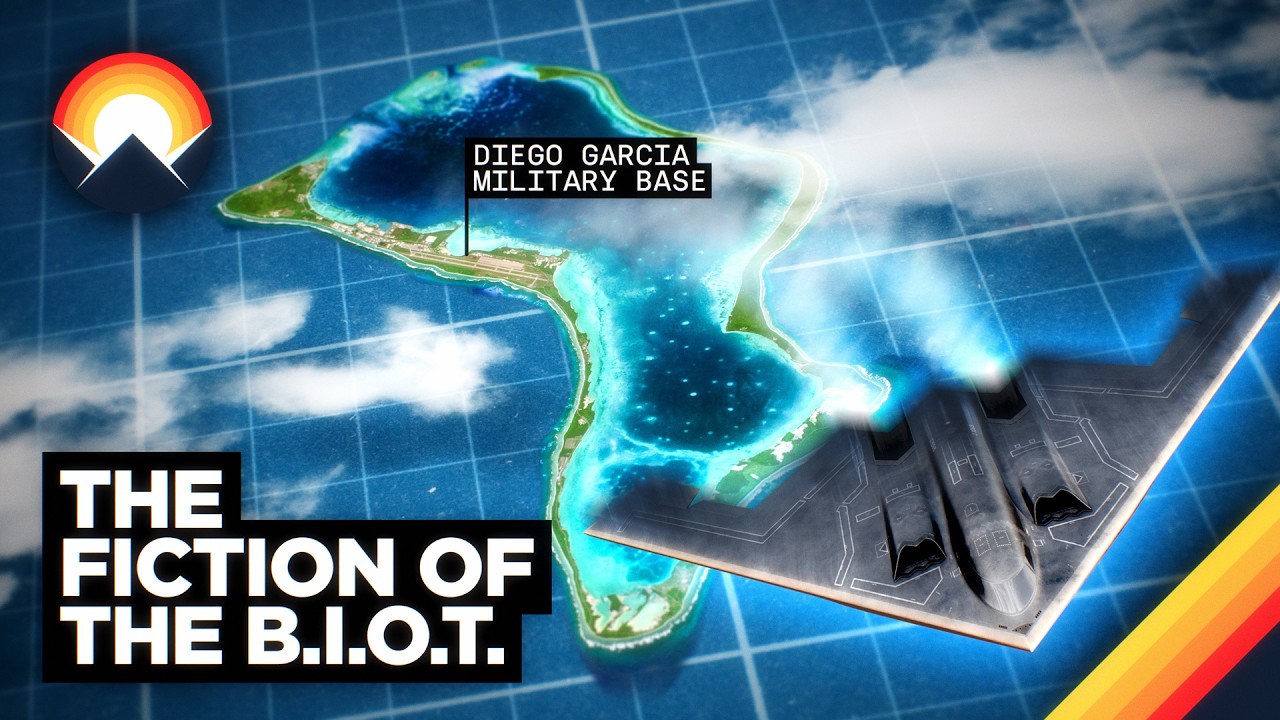
Diego Garcia is considered an untouchable, premier military asset, distinguished by one of the rarest features found across American installations overseas: four specialized $5 million hangars. These climate-controlled structures were engineered specifically to service and protect the fragile stealth coating of the United States Air Force's $2 billion B-2 Spirit bombers. Outside of their primary home base at Whiteman Air Force Base in Missouri, facilities capable of sustaining operational B-2 combat sorties exist in only three places worldwide: Andersen Air Force Base on Guam, RAF Fairford in the United Kingdom, and Diego Garcia. Because the B-2 stands as the most advanced operational bomber on Earth, Diego Garcia occupies an indispensable position among forward-deployed American bases.
Yet beneath its technological and military supremacy lies a critical flaw: the installation stands on territory acquired through systematic deception. Official British narratives long insisted that the Chagos Archipelago never supported an indigenous community, portraying the islands instead as merely an employment outpost for transient contract laborers. In reality, the islands hosted a vibrant, permanent society spanning generations. Church records reveal that approximately 60 percent of the archipelago's population had been born on the islands, with lineages tracing back six to eight generations. The Chagossians spoke a distinct French-based Creole, developed their own musical traditions and cuisine, constructed homes passed down through familial lines, and sustained themselves through agriculture and fishing. Alongside plantation workers, the community relied on a functioning societal division of labor that included carpenters, mechanics, boat builders, and bakers. As Sam Denby observes:
> “The B-2 bomber is the most capable operational bomber on Earth, meaning Diego Garcia is clearly in a small grouping of the absolute most strategically relevant overseas bases for the most powerful military on Earth.”
[10:32](https://www.youtube.com/watch?v=vIGub9r4a2o&t=632s) The British Fiction and the Decolonization Evasion
British authorities were entirely conscious of the reality on the ground and systematically worked to erase it. The most overt evidence appears in the written feedback of a UK Foreign Office legal adviser responding to a draft British Indian Ocean Territory (BIOT) immigration ordinance in 1970. The adviser set forth the strategy plainly, noting that the purpose of the ordinance was to authorize forced deportations, prohibit entry, and uphold the administrative fiction that the Chagossians were not a settled population. Two years earlier, that same legal adviser conceded that under international law Britain was essentially improvising rules to dispossess the population, declaring that the government could treat the inhabitants as lacking any legal connection to the land.
This legal maneuvering was designed to evade the scrutiny of the United Nations. In an internal Foreign Office minute from 1966, officials were explicitly warned against using the term "permanent inhabitants" when discussing the territory. Acknowledging a settled populace would grant the Chagossians democratic protections and trigger the oversight of the United Nations Special Committee on Decolonization (the Committee of 24). Under the UN Charter, colonial powers were obligated to guide non-self-governing territories toward self-determination. By fabricating the narrative that the BIOT had no indigenous inhabitants, Britain aimed to place the archipelago outside the committee's purview and clear the land without international interference.
```mermaid flowchart TD accTitle: British Legal Evasion Strategy accDescr: Diagram illustrating how the UK avoided the UN Decolonization Committee by inventing the fiction of a transient population.
subgraph Strategy["UK Colonial Strategy"] A["Establish BIOT (1965)"] --> B["Deny Existence of Permanent Population"] B --> C["Prevent UN Committee of 24 Purview"] end
subgraph Action["Administrative Execution"] C --> D["1970/1971 Immigration Ordinances"] D --> E["Denial of Re-entry & Forced Expulsion"] E --> F["Total Depopulation of Chagos Islands"] end ```
- In 1970, a Foreign Office legal adviser explicitly outlined the ordinance's goal: “A, to provide legal power to deport people who will not leave voluntarily. B, to prevent people from entering. And C, to maintain the fiction that the inhabitants of Chagos are not a permanent or semi-permanent population.” - In 1968, the same adviser wrote: “In this respect, we are able to make up the rules as we go along and treat the inhabitants of BIOT as not belonging to it in any sense.” - A 1966 Foreign Office minute cautioned staff to avoid the phrase "permanent inhabitants": “to recognize that there are permanent inhabitants will imply that there is a population whose democratic rights will have to be safeguarded, and which will therefore be deemed by the UN Committee of 24 to come within its purview.”
[12:17](https://www.youtube.com/watch?v=vIGub9r4a2o&t=737s) Forced Evictions and the Coercion of Mauritius
With an administrative rationale in place, Britain initiated the depopulation of the archipelago in 1967. The initial phase relied on attrition: any resident who departed the islands for medical care, commerce, or travel was barred from returning. Because land titles were technically registered to the plantations—which the British Crown had bought out—the state asserted formal ownership over family homes that had stood for generations. In 1971, Britain instituted an ordinance requiring residence permits, rendering the presence of all remaining Chagossians criminal overnight. On Diego Garcia, officials shuttered the copra plantation, systematically rounded up and gassed the islanders' pet dogs, and forced the population onto cargo vessels bound for outlying islands. Within a few years, the entire archipelago was emptied, leaving evicted families abandoned in Mauritius and the Seychelles with virtually no housing, financial compensation, or government assistance.
Britain insisted that Mauritius had consented to the excision of the Chagos Archipelago during pre-independence negotiations in London in 1965, when Mauritian Premier Sir Seewoosagur Ramgoolam agreed to the detachment. However, declassified records reveal this agreement was secured under duress. A briefing delivered to British Prime Minister Harold Wilson the morning before the meeting outlined a strategy of intimidation:
> “The object is to frighten him with hope. Hope that he might get independence, fright lest he might not unless he is sensible about the detachment of the Chagos Archipelago.”
Beyond the coercion documented in Wilson’s brief, Mauritius argued that Ramgoolam lacked the constitutional authority as a colonial premier to alienate territory. Moreover, under Article 73 of the UN Charter, colonial powers were forbidden from dismembering territories before independence without the genuine, democratic consent of the population. As Denby summarizes:
> “Taken together, Mauritius argues that the very formation of the BIOT was invalid and illegal.”
[15:14](https://www.youtube.com/watch?v=vIGub9r4a2o&t=914s) The ICJ Advisory Opinion and Diplomatic Fallout
Challenging the detachment in court proved difficult because the International Court of Justice (ICJ) operates on mutual consent. While both the UK and Mauritius recognized ICJ jurisdiction, Britain had entered a reservation exempting disputes with fellow Commonwealth members. Mauritius bypassed this obstacle via a procedural mechanism: the United Nations General Assembly could vote to request an advisory opinion from the ICJ, which does not require the consent of the targeted state. After years of diplomatic campaigning, backed by the African Union and taking advantage of Britain's diminished diplomatic influence in the wake of the Brexit referendum, the General Assembly passed the referral resolution in 2017. Most former colonies backed Mauritius, while European nations largely abstained.
The ICJ reviewed historical archives, analyzed UN records, and heard direct testimony from displaced Chagossians before issuing an advisory opinion in 2019 that thoroughly rejected the British position. The court determined that the detachment of the Chagos Archipelago violated international law and concluded:
> “Having regard to international law, the process of decolonization of Mauritius was not lawfully completed when that country acceded to independence in 1968 following the separation of the Chagos Archipelago.”
The court held that the United Kingdom remained under an active obligation to end its administration of the islands as rapidly as possible. Although advisory opinions are non-binding, the ruling triggered immediate diplomatic consequences. The UN General Assembly voted overwhelmingly to affirm Mauritian sovereignty, the UN Secretariat altered its official world maps to depict the Chagos Archipelago as Mauritian territory, and the Universal Postal Union voted to stop recognizing British postage stamps issued for the British Indian Ocean Territory.
[17:50](https://www.youtube.com/watch?v=vIGub9r4a2o&t=1070s) The Mauritian Handover Deal and Trump's Reversal
Following rulings against the United Kingdom, international bodies increasingly bypassed British claims over the British Indian Ocean Territory (BIOT). The Food and Agriculture Organization (FAO) concluded that the UK no longer possessed an Indian Ocean coastline, significantly degrading British fishing rights within an FAO-managed multinational tuna fishing regulatory body. Across the United Nations system, whenever the matter arose, the Chagos Islands were treated as Mauritian territory. Faced with international diplomatic pressure at its peak, the UK government resolved in 2022 that its least damaging path forward was to open direct sovereignty negotiations with Mauritius.
The diplomatic process spanned multiple British administrations amidst intense domestic political turnover. After cycling through two prime ministers, a formal agreement was finally hammered out. Under the proposed treaty, the United Kingdom would cede sovereignty over the Chagos Archipelago to Mauritius. In exchange, the UK secured a 99-year lease agreement specifically for Diego Garcia at an annual cost exceeding $130 million. This arrangement preserved the operational status quo of the joint military base while empowering Mauritius to authorize the return of displaced Chagossians to the outer islands—everywhere except Diego Garcia itself.
The agreement appeared settled on the global stage, having secured verbal backing from American President Donald Trump alongside formal diplomatic endorsement from the US State Department. All that remained was final ratification by both nations' parliaments to implement the territorial handover. However, in January 2026, the entire process was abruptly upended when Trump publicly reversed his stance, stating: “Shockingly, our brilliant NATO ally, the United Kingdom, is currently planning to give away the island of Diego Garcia, the site of a vital US military base, to Mauritius, and to do so for no reason whatsoever. The UK giving away extremely important land is an act of great stupidity.” Whether motivated by escalating tensions and potential military conflict with Iran—where Diego Garcia would serve as a critical staging ground—or other geopolitical factors, Trump's sudden public opposition forced the UK government to immediately pause the treaty.
- **Lease terms**: 99-year British lease of Diego Garcia costing over $130 million annually. - **Resettlement framework**: Mauritius granted legal power to resettle Chagossians on outer islands, while Diego Garcia remained strictly off-limits. - **US position shift**: Moved from formal State Department and presidential approval to unilateral public condemnation in January 2026.
---
[19:37](https://www.youtube.com/watch?v=vIGub9r4a2o&t=1177s) The Île du Coin Resettlement and Legal Bombshell
Back in the United Kingdom, the paused treaty ignited fierce domestic partisan battles. The Conservative opposition and the right-wing Reform UK party seized upon the handover, attacking the ruling Labour government for what they characterized as an outright national surrender—conveniently glossing over the fact that the vast majority of the diplomatic negotiations had taken place under previous Conservative prime ministers. In an unexpected tactical shift, Reform UK began championing specific resettlement rights for Chagossians as a weapon to undermine the Labour-brokered treaty.
Financed by a prominent Reform UK donor, an expedition was organized: a boat was purchased in Thailand, allowing a group of British-national Chagossians to sail into the archipelago without official clearance. The group landed and established an unauthorized settlement on Île du Coin in the Peros Banhos atoll, asserting their fundamental right to reside on the islands permanently. When BIOT colonial authorities responded by issuing formal eviction and removal notices, the group organized themselves into the Chagosian Interim Government and challenged the expulsion orders in court.
```mermaid flowchart TD accTitle: The Île du Coin Legal Challenge Flow accDescr: Flowchart showing how unauthorized resettlement on Île du Coin led to a British court invalidating Section 9 of the BIOT Constitutional Order.
subgraph Action["Direct Action"] A["Reform UK donor funds vessel in Thailand"] --> B["Chagossians land on Île du Coin"] B --> C["BIOT authorities issue removal notices"] end
subgraph Legal["Legal Challenge"] C --> D["Settlers form 'Chagosian Interim Government'"] D --> E["Judicial review in British court"] E --> F["Judge invalidates Section 9 of 2004 Order"] end
subgraph Dilemma["Handover Impasse"] F --> G["Resettlement recognized as non-threatening to base security"] G --> H["Handover to Mauritius paused pending appeal"] end ```
The resulting judicial ruling, delivered just one month later by a British judge interpreting British law, sent shockwaves through the legal and diplomatic establishment. In a scathing decision rebuking decades of Crown policy, the judge held: “By the 1960s, it is clear there was a settled population in the Chagos Islands. The Foreign and Commonwealth Office has for many years sought to perpetuate the fiction that there was no settled or permanent population on the islands at the time. There was a forced exile of the entire population. I quash and will declare that section 9 of the Constitutional Order 2004 is unlawful.” Section 9 had been the linchpin of BIOT's administrative authority, explicitly stating that “no person has the right of abode in the territory.” The court reasoned that because the UK's draft treaty with Mauritius conceded that outer-island resettlement posed no military security risk to Diego Garcia, prohibiting native resettlement could no longer be legally justified on security grounds.
- **Vessel acquisition**: Funded in Thailand by a major Reform UK political donor. - **Target site**: Île du Coin, an island within the Chagos Archipelago. - **Contested clause**: Section 9 of the British Indian Ocean Territory Constitutional Order 2004 (“No person has the right of abode in the territory”). - **Legal status**: Under appeal by the Crown, leaving Section 9 temporarily in effect while the unauthorized settlement remains intact.
---
[21:40](https://www.youtube.com/watch?v=vIGub9r4a2o&t=1300s) The Self-Determination Paradox and Closing Window
The ongoing appeal over the Île du Coin settlement has locked the British government into an extraordinary international paradox. If a permanent native population is legally recognized as existing within the Chagos Archipelago, British constitutional norms require that the UK obtain the local population's explicit democratic consent prior to transferring sovereignty to a foreign power like Mauritius. Thus, the British Indian Ocean Territory finds itself entrapped by conflicting legal mandates: Britain is compelled under international law to relinquish the territory to Mauritius because it violated territorial integrity and self-determination when detaching the islands in 1965, yet it may now be legally restrained from handing them over because doing so without local Chagossian consent would violate that exact same principle of self-determination today.
This legal quagmire leaves the British Indian Ocean Territory on deeply unstable legal terrain while clouding the future of any transfer to Mauritius. Meanwhile, the human timeline is running out. The total living population of native island-born Chagossians has dwindled to only the low hundreds. With each passing day that the administrative territory persists and Chagossians remain barred from their ancestral lands, the window to rectify Britain’s historic displacement closes, compounding the consequences of decades of official deceit.
---
[22:30](https://www.youtube.com/watch?v=vIGub9r4a2o&t=1350s) Sponsor: Incogni Data Privacy
Turning away from geopolitical disputes to personal digital footprint management, searching one's own name online often yields alarming quantities of sensitive personal details scraped and monetized by data brokers, scam operations, and identity aggregators. While people-finder websites are theoretically subject to statutory data removal requests, submitting manual removal notices to individual brokers is a tedious and practically insurmountable task when hundreds of discrete platforms maintain duplicate profiles.
The episode sponsor, Incogni, addresses this issue by automating the entire erasure lifecycle: scanning data brokers, automatically issuing legally binding takedown demands on the user's behalf, and routinely monitoring databases to ensure personal records are not quietly reinstated. Incogni stands as the first automated data removal service to have its operating procedures and claims independently verified by Deloitte, backed by a 30-day money-back guarantee. Viewers can obtain an exclusive 60% discount on an annual subscription by visiting the promotional link and entering the discount code `WENDOVER`.
## Notable quotes > [08:47](https://www.youtube.com/watch?v=vIGub9r4a2o&t=527s) The B-2 bomber is the most capable operational bomber on Earth, meaning Diego Garcia is clearly in a small grouping of the absolute most strategically relevant overseas bases for the most powerful military on Earth. — Sam Denby
> [17:50](https://www.youtube.com/watch?v=vIGub9r4a2o&t=1070s) The UK giving away extremely important land is an act of great stupidity. — Donald Trump
## Mentioned Diego Garcia, British Indian Ocean Territory, United Kingdom, United States, Mauritius, Sam Denby, Nishi Dholakia, Naval Party 1002, Seychelles, B-2 Spirit, Donald Trump, Harold Wilson, Sir Seewoosagur Ramgoolam, International Court of Justice, United Nations, United Nations General Assembly, United Nations Special Committee on Decolonization, Food and Agriculture Organization, Universal Postal Union, Reform UK, Labour Party, Conservative Party, Île du Coin, Peros Banhos, Incogni, Deloitte
## Video description Use code "WENDOVER" at the link below to get an exclusive 60% off an annual Incogni plan: https://incogni.com/wendover
Youtube: http://www.YouTube.com/WendoverProductions Instagram: http://Instagram.com/sam.from.wendover Twitter: http://www.Twitter.com/WendoverPro Sponsorship Enquiries: wendover@standard.tv Other emails: sam@wendover.productions Reddit: http://Reddit.com/r/WendoverProductions
Writing by Sam Denby, Tristan Purdy, and Christine Benedetti Editing by Alexander Williard Animation by Sara Stoltman, Gabriel Ferreras, Austin Glass, and Kate Ermolenkko Sound by Manni Simon and Dony Bullen Thumbnail by Simon Buckmaster
[Source](https://www.youtube.com/watch?v=vIGub9r4a2o)