Musk Targets $1T SpaceX Revenue as AI Model Audits Expose PHP Flaw
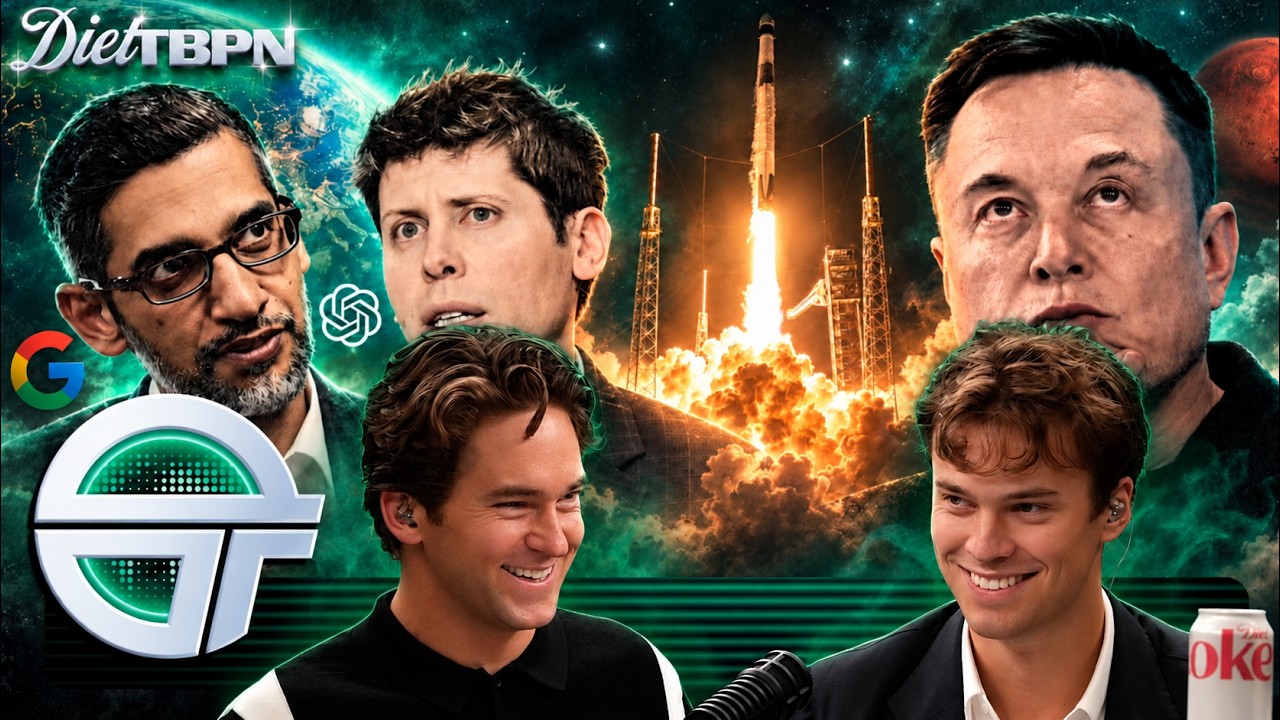
TBPN
SpaceX's explosive compute push positions it to monetize rising intelligence value per watt while systemic software vulnerabilities across legacy PHP servers trigger emergency global patching.
AI-assisted summary of Cybersecurity Red Alert, SpaceX Earnings, OpenAI Strikes Google Deal | Diet TBPN — original source. Check the original for full context.
Source published:
Key ideas
- A critical memory flaw dubbed 'PHP 2 Shell', discovered via AI code audits, affects software powering roughly 70% of the web, prompting secret coordination and precautionary service shutdowns across several European nations. (2:27)
- SpaceX reported massive compute and space milestones during its Q3 update, projecting between $500 billion and $1 trillion in annual recurring revenue by late 2027 while planning up to 20 gigawatts of data center infrastructure. (16:42)
- Early reviews of Apple's iPhone Duo flag severe third-party app scaling issues and low-quality under-display selfie cameras, balanced against an uninterrupted inner canvas. (13:05)
- OpenAI expanded its multi-cloud footprint by bringing GPT-6, Astra, and Codex to Google Cloud Marketplace, and acquired life sciences orchestration platform Orchestra Bio. (27:30)
Detailed notes
## Background This video was published on YouTube by the tech news channel TBPN on October 21, 2026. Part of the "Diet TBPN" daily series hosted by John Coogan and Jordi Hays, the episode delivers a 30-minute recap of breaking technology stories spanning cybersecurity, AI platform deals, and space exploration.
## TL;DR With regular co-host John out sick, guest host Tyler joins Jordi to break down a critical AI-discovered PHP memory flaw dubbed "PHP 2 Shell" that sparked an emergency worldwide patching effort. The hosts examine rough launch reviews for Apple's iPhone Duo and poke fun at Trevor Milton's new jet venture featuring showroom wings propped up on posts. They also analyze SpaceX's massive Q3 earnings call—focusing on Starship's scaling lift capacity, Elon Musk's staggering $500B–$1T ARR projection, and rumors of a Tesla merger—before wrapping up with OpenAI's expansion onto Google Cloud Marketplace and Whop's $200 million Series D funding round.
## Atmosphere & style The broadcast carries an energetic, playful morning-show vibe that balances high-stakes industry analysis with deadpan humor. Tyler wearing John's oversized suit sets an immediate comedic, self-deprecating baseline that carries into running jokes about awkward tech demonstrations and social faux pas. As the conversation moves from critical cybersecurity threats to multi-trillion-dollar corporate projections, the dynamic remains brisk, colloquial, and sharply observant.
## Bulletin - [02:27](https://www.youtube.com/watch?v=aojgN8IyR54&t=147s) A critical memory flaw dubbed 'PHP 2 Shell', discovered via AI code audits, affects software powering roughly 70% of the web, prompting secret coordination and precautionary service shutdowns across several European nations. - [16:42](https://www.youtube.com/watch?v=aojgN8IyR54&t=1002s) SpaceX reported massive compute and space milestones during its Q3 update, projecting between $500 billion and $1 trillion in annual recurring revenue by late 2027 while planning up to 20 gigawatts of data center infrastructure. - [13:05](https://www.youtube.com/watch?v=aojgN8IyR54&t=785s) Early reviews of Apple's iPhone Duo flag severe third-party app scaling issues and low-quality under-display selfie cameras, balanced against an uninterrupted inner canvas. - [27:30](https://www.youtube.com/watch?v=aojgN8IyR54&t=1650s) OpenAI expanded its multi-cloud footprint by bringing GPT-6, Astra, and Codex to Google Cloud Marketplace, and acquired life sciences orchestration platform Orchestra Bio.
## Key takeaways - [02:27](https://www.youtube.com/watch?v=aojgN8IyR54&t=147s) A severe vulnerability named 'PHP 2 Shell' was identified using frontier AI models, exposing decade-old memory flaws in server software running roughly 70% of websites. - [05:00](https://www.youtube.com/watch?v=aojgN8IyR54&t=300s) Defenders faced a narrow window to patch 10,000+ lines of code across 200 files before public disclosure and automated exploit generation by malicious actors. - [05:00](https://www.youtube.com/watch?v=aojgN8IyR54&t=300s) Greg Brockman suggested future internet defense may require authorized entities, including governments, to scan and remotely patch critical vulnerabilities across the web. - [10:00](https://www.youtube.com/watch?v=aojgN8IyR54&t=600s) A security audit at eMudhra revealed an absurdly trivial TLS private key consisting of the single digit 'four' that remained unexploited online for 18 months. - [11:15](https://www.youtube.com/watch?v=aojgN8IyR54&t=675s) Pardoned Nikola founder Trevor Milton drew ridicule after unveiling a private jet whose static demonstration model featured wings visibly propped up with posts. - [13:05](https://www.youtube.com/watch?v=aojgN8IyR54&t=785s) Initial reviews of Apple's iPhone Duo were weighed down by poor aspect-ratio optimization across key apps like Spotify and Google Calendar despite developers having over a month of advance access. - [13:05](https://www.youtube.com/watch?v=aojgN8IyR54&t=785s) Apple accepted poor under-display selfie camera fidelity to provide an uninterrupted interior screen free of notches or cutouts. - [16:42](https://www.youtube.com/watch?v=aojgN8IyR54&t=1002s) SpaceX revealed that a single non-full Starship mission matched the payload capacity of ten Falcon 9 Starlink launches as the firm pushes for rapid reusability. - [16:42](https://www.youtube.com/watch?v=aojgN8IyR54&t=1002s) Elon Musk challenged cloud incumbents by outlining plans for 2.5 to 3 GW of SpaceX compute capacity by year-end, scaling toward a 10 to 20 GW pipeline. - [20:00](https://www.youtube.com/watch?v=aojgN8IyR54&t=1200s) Musk argued that compute per watt appreciates over time as models improve, allowing SpaceX to leverage short-term compute contracts with rolling price hikes before migrating capacity to Grok. - [23:34](https://www.youtube.com/watch?v=aojgN8IyR54&t=1414s) Analysts and investors evaluated a potential SpaceX and Tesla merger that could theoretically create the first $10 trillion company, balancing orbital compute against robotics. - [27:30](https://www.youtube.com/watch?v=aojgN8IyR54&t=1650s) OpenAI deepened its distribution by offering frontier models on Google Cloud Marketplace to let enterprise clients draw down cloud commitments. - [27:30](https://www.youtube.com/watch?v=aojgN8IyR54&t=1650s) Ken Griffin characterized the current artificial intelligence cycle as a bubble that will nevertheless trigger a golden age of entrepreneurship. - [29:52](https://www.youtube.com/watch?v=aojgN8IyR54&t=1792s) Whop raised a $200 million Series D backed by Sequoia and Shopify, solidifying its position as digital commerce infrastructure for creator communities and internet products.
## Detailed walkthrough ### [00:00](https://www.youtube.com/watch?v=aojgN8IyR54&t=0s) John’s Out Sick + The Show Must Go On
The show opens with an immediate update for viewers: co-host John Coogan is absent due to illness. The hosts share that they almost never take sick days, noting, “Normally when we're sick, we just keep going. But John is really down and out.” Feeling “like a ship without a sail” and “a lighthouse without a light,” guest host Tyler steps into the studio wearing John’s entire suit. The hosts joke about how the oversized outfit looks like something out of a Nathan Fielder bit, though it surprisingly manages to look reasonably normal. They reassure everyone that it isn't an injury from working out, just peak flu season.
Despite running behind the console with technical hiccups as they fiddle with sound effects and ad drops, they emphasize that keeping the broadcast running is an art form. The hosts run through a busy upcoming lineup, previewing an appearance by Nikesh Arora, CEO of Palo Alto Networks, to unpack the breaking security news, as well as an interview with Aidan Gomez of Cohere following their massive new $800 million funding round. Before transitioning to the day's tech headlines, they deliver an ad read for Ramp, highlighting its corporate cards, bill payments, and accounting tools, and briefly laugh over a recent video clip of John before he fell ill.
[02:27](https://www.youtube.com/watch?v=aojgN8IyR54&t=147s) AI Finds a Major PHP Flaw + The Race to Patch the Internet
The discussion pivots to a massive vulnerability shaking the web: PHP, the server-side language powering roughly 70% of all websites, has suffered a critical security flaw dubbed "PHP 2 Shell." The flaw was originally uncovered in August during source code audits assisted by frontier AI models. For the past two months, security researchers, public companies, and foundation engineers worked in secret to prepare patches before public disclosure. While enterprise networks and major platforms were briefed in advance, the hosts express severe concern for the unmanaged long tail of the web.
```mermaid flowchart TD accTitle: Discovery and Race to Patch PHP 2 Shell accDescr: Process flow showing AI vulnerability discovery leading to coordinated defense and patching efforts. subgraph Discovery ["1. AI-Driven Discovery"] A["Auditing PHP Source Code<br/>(OpenAI-funded initiative)"] --> B["Identified 'PHP 2 Shell'<br/>Critical memory management flaw"] end subgraph Exploitation ["2. Exploit Risk Profile"] B --> C["Few dozen requests control memory"] C --> D["Fast compromise:<br/>Seconds (simple) to hours (complex)"] end subgraph Defense ["3. Secret Global Response"] D --> E["Working Group Formed<br/>(Calif, Wiz, OpenAI, PHP Project)"] E --> F["Patch Engineering:<br/>~200 files, 10,000+ lines of code"] F --> G["Release Race:<br/>Defenders patch vs. AI-armed attackers"] end ```
The hosts worry deeply about legacy servers, local municipal infrastructure, and regional businesses running unattended machines that hold sensitive user data such as Social Security numbers. As word of the exploit spread, several European countries, including Finland, the Netherlands, and France, took select government and public internet services offline temporarily as a precautionary shield until updates could be safely deployed. Security engineer Volker from the nonprofit foundation that manages PHP likened the scale of the threat to Heartbleed, the infamous OpenSSL vulnerability that triggered a global remediation race over a decade ago.
- PHP runs on approximately 70% of all websites across the global internet. - "PHP 2 Shell" stems from memory management flaws that allow attackers to execute unauthorized code on unpatched web servers. - The exploit can execute in seconds on basic servers, and takes up to several hours on complex infrastructure with as few as several dozen targeted requests.
[05:00](https://www.youtube.com/watch?v=aojgN8IyR54&t=300s) The Mechanics of the Breach and the Coordinated Defense
Explaining how the bug surfaced, the hosts detail how security firm Calif discovered the flaw with assistance from advanced AI systems during an OpenAI-funded open source security audit. The underlying memory management defect had lurked inside PHP's codebase for decades, previously flagged by researchers but dismissed as practically impossible to weaponize until AI demonstrated an attack path. When the severity became clear, an informal working group formed across Calif, Wiz cybersecurity researchers, OpenAI, and PHP's leadership to coordinate a fix before black-hat hackers could automate the attack. Ami Lutwak, Wiz's co-founder, highlighted that “PHP 2 Shell is the most severe AI vulnerability that was ever found, and one that was likely too complex to have been discovered without AI.”
The race between software defenders and automated exploit generators underscores a dangerous new reality for internet infrastructure. Addressing this shift, Ty, the chief executive of Calif, warned: “Some dude on Twitter could take the patches and run AI against it and post some exploit script... All hell will break loose.” The repair required an enormous engineering overhaul spanning nearly 200 files and over 10,000 lines of code.
Although the coordinated patch release was initially scheduled for October 22nd, details leaked early via Hacker News, forcing rapid emergency disclosures. OpenAI's Greg Brockman argued online that defense must evolve, writing, “As vulnerability discovery ramps we will need new defense solutions potentially including authorized defenders such as government, scanning the Internet for vulnerable hosts and either notifying or, in extreme cases, patching those systems remotely.”
International leaders also sounded the alarm. The Prime Minister of Japan posted an urgent public plea warning website operators of two critical vulnerabilities and recommending that operators temporarily take down their services if they could not immediately install the patch. Demonstrating the casual disconnect still present across industry IT, the hosts share a story posted by indie developer Pieter Levels (Levels.io): when Levels messaged a friend at a major tech company whose entire infrastructure relies on PHP, the employee nonchalantly replied, “thanks, I'll try to patch it in a few days as I'm out of office now.”
[10:00](https://www.youtube.com/watch?v=aojgN8IyR54&t=600s) Web Vulnerabilities: PHP Exploits and Trivial TLS Keys
The discussion continues on the fallout of critical internet security vulnerabilities, focusing on traditional companies running legacy PHP installations. Because enterprise update cycles are notoriously slow, unpatched systems will remain sitting ducks once public patches reveal how to reverse engineer the exploit. The hosts anticipate widespread website breaches and user data exposure as automated scans target lagging infrastructure. Meanwhile, an equally alarming issue emerged from eMudhra regarding TLS certificates—the cryptographic backbone behind the browser security padlock. Certain private keys were shockingly weak, with one reported to be a single digit rather than the standard hundreds of digits required for modern public-key cryptography.
The hosts find dark humor in the absurdity of the blunder, joking that a private key of "four" is so blatantly insecure that nobody would ever guess it, turning an outright failure into an inadvertent "white pill" since it apparently sat undetected online for a year and a half without catastrophic consequences. To counter emerging software bugs, AI companies are stepping in with autonomous remediation tooling. OpenAI shipped a Codex skill linked to a dedicated GitHub repository designed to automatically walk developers through auditing and securing their codebases against the flaw.
- Traditional enterprise patch delays mean malicious actors can easily reverse engineer security updates to exploit exposed sites. - An eMudhra vulnerability surfaced involving absurdly trivial TLS private keys—including an instance where a private key was literally the single number four. - The single-digit key had been live online for roughly 18 months before remediation, seemingly without widespread malicious exploitation. - “OpenAI released a Codex skill to help check whether your website is affected,” providing an automated workflow through a public GitHub repository.
[11:15](https://www.youtube.com/watch?v=aojgN8IyR54&t=675s) Trevor Milton’s Aviation Venture and Propped-Up Wings
Attention turns to Trevor Milton, the controversial founder of Nikola who was recently pardoned, and his return to business with a private jet company. While technically building on top of a corporate entity that has existed for decades, Milton’s re-emergence into high-end aviation draws extreme skepticism. Private aviation caters to ultra-wealthy, discerning clients who demand absolute safety and reliability, making Milton’s fraught public reputation a brutal liability. The hosts joke about whether an investor could exploit a "stigma discount" on the aircraft, buying in while others are fearful, before conceding that Warren Buffett's maxim applies to capital allocation—not placing your life inside a dubious physical machine.
```mermaid flowchart TD accTitle: Trevor Milton Aviation Skepticism accDescr: Diagram showing the skepticism around Trevor Milton's new aircraft reveal given his past history. subgraph Past["Historical Reputation"] A["Nikola Truck Scandal<br>('Push the truck down the hill')"] B["Presidential Pardon<br>(Free to operate legally)"] end subgraph Present["New Jet Venture"] C["Target: Discerning Private Jet Buyers"] D["Demo Aircraft Reveal"] E["Wings Held Up by Support Posts"] end A --> B B --> C C --> D D --> E ```
The skepticism hits peak hilarity when discussing photos from the launch event attended by friend-of-the-show Preston Holland. Attendees noticed that the wings of the static demonstration aircraft were visibly propped up from underneath by vertical support posts. For an aircraft whose wings are meant to withstand structural aerodynamic loads in mid-air, relying on manual props on a showroom floor looks absurd. As the hosts put it:
> “Considering they're meant to support the entire plane in the air, but coming from the 'push the truck down the hill' guy, I can't say I'm that surprised.”
[13:05](https://www.youtube.com/watch?v=aojgN8IyR54&t=785s) iPhone Duo Reviews: App Optimization and the Compromised Selfie Cam
The conversation shifts to initial consumer and reviewer impressions of the iPhone Duo as review units land in the wild ahead of its official Friday launch. Early feedback has been harsh, dominated by severe app optimization issues. Popular applications like Instagram, Google Calendar, Spotify, and Rivian are displaying poorly calibrated interfaces, frequently wasting space with giant awkward sidebars rather than taking advantage of the expanded screen estate. While Bloomberg’s Mark Gurman observed that these are some of the most brutal initial reviews for an Apple flagship since the Vision Pro, he reminded readers that early transitions like the iPhone 5, 6 Plus, and iPhone X suffered through similar growing pains that were remedied within weeks. The hosts note a crucial difference: third-party developers had over a month of hands-on device access this time around, leaving some wondering whether companies like Meta and Google are simply slow or secretly bearish on the form factor.
Turning to Marques Brownlee’s (MKBHD) hardware impressions, the hosts inspect the radical design trade-offs Apple chose for the interior display. To deliver a seamless, unbroken inner screen without a notch or punch-hole cutout, Apple tucked the front-facing camera completely underneath the display panel. The resulting selfie photo quality is downright "trash"—reminiscent of very early first-generation hardware—though it holds up slightly better during live FaceTime video feeds. Despite the terrible photo fidelity, the host defends the decision as a logical engineering compromise, appreciating that the camera remains completely invisible to the eye:
> “Apple clearly has done the math. Like they've assumed people won't use this camera very much and they've accepted the trade-off of image quality versus having this big, dramatic, uninterrupted inner display.”
- Early iPhone Duo reviews highlight massive wasted screen space and poor scaling across major apps like Spotify and Google Calendar. - Apple previously gave developers as little as a single week to adapt to new aspect ratios; for the Duo, top developers had over a month of hands-on access. - Under-display front camera optics deliver terrible still-photo clarity, but succeed in maintaining an uninterrupted visual canvas. - The hosts joke about the social penalties of adopting the foldable device in public, teasing that cracking the device open causes a "massive aura loss" and insisting co-host John Coogan should be the one to carry it.
[16:42](https://www.youtube.com/watch?v=aojgN8IyR54&t=1002s) SpaceX Q3 Earnings: Starship Scale and Compute Power Play
The show moves to SpaceX’s Q3 earnings call, which resembled a cinematic space event complete with high-production countdowns that show why the company's valuation often detaches from conventional business fundamentals. The biggest operational revelation centered on the sheer lift capacity of Starship: in a single mission where the vehicle wasn't even entirely filled to capacity, it deployed a payload equivalent to ten separate Falcon 9 launches of Starlink satellites. The company emphasized that its top strategic priority remains pushing as aggressively as possible toward rapid reusability.
Beyond space operations, SpaceX shocked observers with the sheer magnitude of its terrestrial compute ambitions. Elon Musk directly targeted legacy and emerging neo-cloud providers, boasting that SpaceX's data center engineering operation is like “the New York Yankees playing in the Little League.” SpaceX is planning to bring 2.5 to 3 gigawatts of power capacity online by the end of the year, with a pipeline targeting 10 gigawatts next year, and potential infrastructure prep scaling all the way to 20 gigawatts. Musk also dropped teasing remarks about an eventual corporate tie-up or merger between SpaceX and Tesla, while expounding on why hardware like older Nvidia H100s continues to appreciate rather than depreciate in rental markets:
> “Our belief is that the value of compute per watt will increase over time, not decrease... As you improve the AI software, as the models get better and better, you get more useful intelligence per watt, and the value of that compute is proportionate to the useful intelligence per watt.”
[20:00](https://www.youtube.com/watch?v=aojgN8IyR54&t=1200s) Superintelligence Compute Shortages and Elon Musk's Massive ARR Projections
The hosts examine Elon Musk’s strategy regarding compute infrastructure and why he favors short-term agreements over long-term commitments. Drawing an analogy to the famous Monty Python "Cheese Shop" sketch—where a customer attempts to buy various cheeses only to discover the shop possesses none—Musk illustrates that when customers attempt to offload AI training, they discover compute capacity simply is not there. The hosts note that this shortage explains why short-term contracts, such as those with Anthropic, make tactical sense. While bears initially argued that these arrangements were merely stopgaps for compute-starved firms like Anthropic and Google that would soon roll off, Musk views the dynamic intentionally: raising prices year after year as the expected value of compute escalates, while reserving future capacity for internal Grok models and GrokBot.
```mermaid flowchart LR accTitle: Compute Capacity Allocation Strategy accDescr: Diagram illustrating how short-term contracts allow rolling pricing hikes until internal Grok demand consumes capacity. A["Compute Shortage"] --> B["Short-Term Contracts<br>(Anthropic, Google)"] B --> C["Annual Price Hikes<br>(Rising Value/Watt)"] C --> D["Internal Migration<br>(Grok Models & GrokBot)"] ```
The hosts review Musk’s striking projection right before handing the presentation over to Gwynne Shotwell: “In a nutshell, what this implies for SpaceX annual recurring revenue by the end of '27 is somewhere between 500 billion and a trillion.” While corporate leaders typically cite annualized run rates rather than pure recurring revenue, the hosts suggest it could truly become recurring as deals continue stacking. Commentators remarked that Musk effectively resurrected the NeoCloud trade with the assertion: “Our belief is that the value of compute per watt will increase over time, not decrease.”
- SemiAnalysis has long maintained the position that compute pricing per watt would trend higher. - Elon expects the bulk of long-term compute capacity to be absorbed directly by GrokBot.
[23:34](https://www.youtube.com/watch?v=aojgN8IyR54&t=1414s) The SpaceX–Tesla Merger Debate and Bull Cases
The conversation turns to mounting speculation regarding a merger between SpaceX and Tesla, an outcome ARK Invest’s Brett Winton and others view as increasingly probable. Operating both as separate public equities forces management to balance investor appetite across two entities rather than concentrating market enthusiasm into a single flagship asset. Given that both businesses derive immense value from forward-looking potential, combining them could realistically produce the world's first $10 trillion company.
The hosts highlight Brett Winton’s framework contrasting the components of each business: - **Starlink vs. Robotaxi:** Robotaxi presents a larger addressable opportunity than Starlink. - **Robotaxi vs. Orbital Compute:** Orbital compute dwarfs Robotaxi. - **Execution Timelines:** Optimus demands significantly more developmental "baking time" than orbital compute. - **Core Dependency:** “Optimus's success is predicated on access to gobsmacking amounts of superintelligence.”
The hosts chuckle at the resurgence of the word "gobsmacking" while cringing at how the tech sector has forced the term "superintelligence" into everyday parlance. Musk’s terse reply—"interesting"—is identified as his classic method of spotlighting an idea without making a legally binding endorsement. Financial incentives also play a role: because Musk holds a substantially larger equity stake in SpaceX than in Tesla, he would logically benefit from SpaceX securing the highest possible relative valuation at the moment of any merger.
Pushback from skeptics is acknowledged: bear commentator Hero Onoda compared the forward-looking hype to Oracle in September 2025, warning of low-quality future revenues and an enterprise about to become recklessly leveraged. Nonetheless, the hosts point out that even if Musk misses his aggressive projections by five years, historical returns suggest long-term investors still tend to perform exceptionally well.
[27:30](https://www.youtube.com/watch?v=aojgN8IyR54&t=1650s) American Capital Markets and OpenAI’s Expanding Alliances
The discussion highlights the extraordinary capacity of American capital markets, citing Matthew Zeitlin quoting *The Economist* on how public and private markets absorbed historic transaction volume over a single year. These included: - SpaceX’s record initial public offering - Google’s equity raise - SK Hynix’s overseas capital raise - OpenAI’s private venture financing round - Broadcom’s private debt package - Amazon’s record bond issuance - Vanguard’s launch of the first $1 trillion ETF - Berkshire Hathaway’s historic cash reserves - NVIDIA’s massive share repurchase program - The completion of EA’s record leveraged buyout
Against this macro backdrop, OpenAI announced that its frontier models—including GPT-6, Astra, and Codex—are arriving on Google Cloud Marketplace, permitting enterprise clients to draw down existing cloud commitments. Following OpenAI’s earlier expansion to AWS after the conclusion of its exclusive Microsoft distribution deal, Google and OpenAI have officially settled into a "frenemies" relationship. OpenAI also acquired Orchestra Bio, an orchestration platform designed to streamline complex biopharmaceutical drug development pipelines.
Market sentiment on artificial intelligence remains nuanced. Citadel’s Ken Griffin observed that while we are almost certainly navigating an AI bubble, he framed the cycle positively, arguing that it signals a pending “golden age of entrepreneurship.” On the lighter side of tech culture, tech entrepreneur Bryan Johnson posted a spoof claiming he built an AI agent to profile online detractors, trace their social connections, and blast their emails to everyone they know—only to clarify he was merely joking about weaponizing automated retaliation.
[29:52](https://www.youtube.com/watch?v=aojgN8IyR54&t=1792s) YouTube vs. Netflix and Wop's $200M Series D
The episode closes by evaluating consumer entertainment value. Reacting to a Pucco Capital post expressing surprise that Netflix maintains a $275 billion valuation despite forgotten logins, the host confesses to paying for Netflix while virtually never opening it. By contrast, user utility has tipped decisively toward creator-driven video: “My willingness to pay for YouTube would probably be in the thousands of dollars a year, and I would probably take $1,000 in exchange for never being able to use Netflix ever again.” The fragmentation of streaming libraries and recurring subscription management have eroded the convenience traditional entertainment platforms once offered.
Attention shifts to creator infrastructure, specifically Whop securing $200 million in Series D funding backed by Sequoia Capital and Shopify. Bringing Shopify on board as a strategic investor cements Whop's status as the commercial operating system for modern internet knowledge, communities, and digital services:
> “In many ways Whop is the Shopify for a whole new category of work on the internet.”
The hosts praise founder Steven and the executive team as consistently underestimated operators who demonstrated nimble execution as creator monetization shifted across clipping, community memberships, and educational courses.
Wrapping up the broadcast, the hosts joke that co-host John has officially burned his one permitted sick day for the entire year just as flu season approaches: “That's John's last sick day for the year. So as we head into flu season, just remember, John, you already used your day up.” Reminding listeners of their 64-day milestone, they sign off with their customary calls to review and subscribe across Apple Podcasts, Spotify, and YouTube.
## Notable quotes > [05:00](https://www.youtube.com/watch?v=aojgN8IyR54&t=300s) PHP 2 Shell is the most severe AI vulnerability that was ever found, and one that was likely too complex to have been discovered without AI. — Ami Lutwak
> [05:00](https://www.youtube.com/watch?v=aojgN8IyR54&t=300s) As vulnerability discovery ramps we will need new defense solutions potentially including authorized defenders such as government, scanning the Internet for vulnerable hosts and either notifying or, in extreme cases, patching those systems remotely. — Greg Brockman
> [23:34](https://www.youtube.com/watch?v=aojgN8IyR54&t=1414s) Optimus's success is predicated on access to gobsmacking amounts of superintelligence. — Brett Winton
> [16:42](https://www.youtube.com/watch?v=aojgN8IyR54&t=1002s) As you improve the AI software, as the models get better and better, you get more useful intelligence per watt, and the value of that compute is proportionate to the useful intelligence per watt. — Elon Musk
## Mentioned TBPN, John Coogan, Jordi Hays, Tyler, Nikesh Arora, Palo Alto Networks, Aidan Gomez, Cohere, Ramp, PHP, PHP 2 Shell, OpenAI, Calif, Wiz, Heartbleed, OpenSSL, Ami Lutwak, Ty, Greg Brockman, Hacker News, Pieter Levels, eMudhra, Codex, GitHub, Trevor Milton, Nikola, Preston Holland, Warren Buffett, iPhone Duo, Mark Gurman, Vision Pro, Marques Brownlee (MKBHD), Instagram, Google Calendar, Spotify, Rivian, SpaceX, Tesla, Starship, Starlink, Falcon 9, Elon Musk, Gwynne Shotwell, Anthropic, Google, Grok, GrokBot, Nvidia, SemiAnalysis, ARK Invest, Brett Winton, Robotaxi, Optimus, Hero Onoda, Oracle, Matthew Zeitlin, The Economist, SK Hynix, Broadcom, Amazon, Vanguard, Berkshire Hathaway, Electronic Arts (EA), GPT-6, Astra, Google Cloud Marketplace, AWS, Microsoft, Orchestra Bio, Citadel, Ken Griffin, Bryan Johnson, Pucco Capital, Netflix, YouTube, Whop, Sequoia Capital, Shopify, Steven
## Video description Sign up for TBPN’s daily newsletter at TBPN.com
Diet TBPN delivers the best of today’s TBPN episode in 30 minutes. TBPN is a live tech talk show hosted by John Coogan and Jordi Hays, streaming weekdays 11–2 PT on X and YouTube, with each episode posted to podcast platforms right after.
Described by The New York Times as “Silicon Valley’s newest obsession,” the show has recently featured Mark Zuckerberg, Sam Altman, Mark Cuban, and Satya Nadella.
TBPN is made possible by: Ramp - https://ramp.com Public - https://public.com Cisco - https://www.cisco.com Console - https://www.console.com CrowdStrike - https://www.crowdstrike.com Figma - https://www.figma.com MongoDB - https://www.mongodb.com NYSE - https://www.nyse.com Railway - https://railway.com Shopify - https://www.shopify.com/
Follow TBPN: https://TBPN.com https://x.com/tbpn https://open.spotify.com/show/2L6WMqY3GUPCGBD0dX6p00?si=674252d53acf4231 https://podcasts.apple.com/us/podcast/technology-brothers/id1772360235 https://www.youtube.com/@TBPNLive
Chapters: 00:00 John’s Out Sick + The Show Must Go On 02:27 AI Finds a Major PHP Flaw + The Race to Patch the Internet 11:15 Trevor Milton’s Jet Reveal + Why Are the Wings Propped Up? 13:05 iPhone Duo’s Rough Reviews + Apps & Camera Trade-Offs 16:42 SpaceX Earnings + Elon’s $500B–$1T Revenue Prediction 23:34 SpaceX–Tesla Merger Talk + The $10T Bull Case 27:30 OpenAI’s Google Cloud Deal + AI Bubble Talk 29:52 YouTube vs. Netflix + The Creator Economy
[Source](https://www.youtube.com/watch?v=aojgN8IyR54)