President Zelenskyy: Peace Is A Huge Compromise, The Horrific Atrocities Of Russian War Crimes!
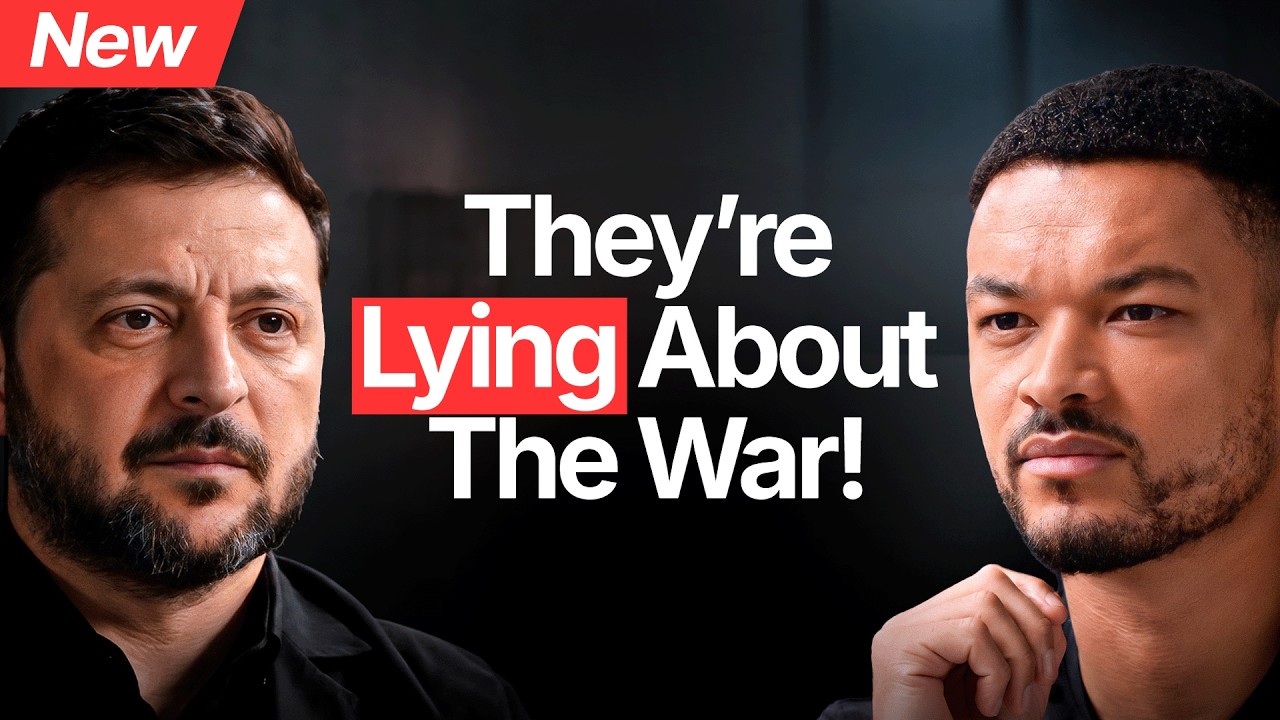
The Diary Of A CEO
AI-assisted summary of President Zelenskyy: Peace Is A Huge Compromise, The Horrific Atrocities Of Russian War Crimes! — original source. Check the original for full context.
Source published:
Key ideas
- President Volodymyr Zelenskyy rejected Western evacuation offers at the onset of Russia's full-scale invasion, choosing to direct defenses from Kyiv while domestic volunteer mobilization rapidly expanded Ukraine's military from 200,000 to approximately 800,000 personnel. (0:00)
- Russia currently occupies an estimated 18 to 19 percent of Ukrainian territory, with ongoing peace demands from Moscow insisting on the surrender of uncaptured defensive bastions like Sloviansk, Kramatorsk, and Druzhkivka. (93:06)
- Zelenskyy firmly rejects calls for quick concessions or frozen frontlines, framing any unconditioned ceasefire as an immense compromise following widespread civilian massacres and torture uncovered in liberated cities like Bucha. (79:50)
- Ukraine's retaliatory strikes against Russian oil refineries are defensive measures against electrical grid destruction, with Zelenskyy noting he previously proposed a reciprocal energy ceasefire that Moscow rejected. (100:00)
Detailed notes
## Background This interview was published on October 22, 2026, on the YouTube channel The Diary Of A CEO, hosted by Steven Bartlett, following an interview recorded on October 16, 2026. The episode features Ukrainian President Volodymyr Zelenskyy discussing the personal psychological toll of wartime leadership, the strategic miscalculations behind Russia's full-scale invasion, and the geopolitical realities of pursuing peace without compromising accountability.
## TL;DR President Volodymyr Zelenskyy reflects on his path from Soviet-era childhood and comedy acting to steering Ukraine through full-scale invasion, detailing his decision to remain in Kyiv and reject foreign evacuation offers. He recounts the early military battles for Hostomel and the capital, the severe trauma of discovering Russian atrocities in Bucha, and the daily grind of coordinating air defenses on fragmented sleep. Addressing current geopolitical pressures, Zelenskyy analyzes Vladimir Putin's imperial ambitions, refutes Donald Trump's claims regarding Ukrainian refinery strikes and battle tactics, and explains why territorial concessions without ironclad security guarantees invite further aggression. Throughout, he emphasizes that a ceasefire is already a profound compromise that must be paired with genuine justice for war crimes.
## Atmosphere & style The dialogue carries a somber, intimate, and emotionally intense weight, stripping away conventional political polish to reveal an exhausted yet resolute leader. Zelenskyy speaks with raw candor, shifting between visceral outrage over murdered civilians and quiet vulnerability when describing his family, his mother's persistent calls, and the profound loneliness of wartime command. Steven Bartlett adopts a measured, listening posture that allows long silences and heavy reflections to settle, creating an atmosphere that feels less like a standard geopolitical press briefing and more like an unfiltered human reckoning with existential survival.
## Bulletin - [00:00](https://www.youtube.com/watch?v=5x9dkYIRb58&t=0s) President Volodymyr Zelenskyy rejected Western evacuation offers at the onset of Russia's full-scale invasion, choosing to direct defenses from Kyiv while domestic volunteer mobilization rapidly expanded Ukraine's military from 200,000 to approximately 800,000 personnel. - [01:33:06](https://www.youtube.com/watch?v=5x9dkYIRb58&t=5586s) Russia currently occupies an estimated 18 to 19 percent of Ukrainian territory, with ongoing peace demands from Moscow insisting on the surrender of uncaptured defensive bastions like Sloviansk, Kramatorsk, and Druzhkivka. - [01:19:50](https://www.youtube.com/watch?v=5x9dkYIRb58&t=4790s) Zelenskyy firmly rejects calls for quick concessions or frozen frontlines, framing any unconditioned ceasefire as an immense compromise following widespread civilian massacres and torture uncovered in liberated cities like Bucha. - [01:40:00](https://www.youtube.com/watch?v=5x9dkYIRb58&t=6000s) Ukraine's retaliatory strikes against Russian oil refineries are defensive measures against electrical grid destruction, with Zelenskyy noting he previously proposed a reciprocal energy ceasefire that Moscow rejected.
## Key takeaways - [02:07](https://www.youtube.com/watch?v=5x9dkYIRb58&t=127s) The psychological toll on Ukrainian families who have suffered the violent loss of children and relatives far exceeds the executive burdens of wartime leadership. - [17:21](https://www.youtube.com/watch?v=5x9dkYIRb58&t=1041s) Zelenskyy's transition from satirical television to the presidency was driven by public disillusionment and personal anger over Russia's 2014 annexation of Crimea and aggression in Donbas. - [27:30](https://www.youtube.com/watch?v=5x9dkYIRb58&t=1650s) Modern Russian aggression stems from Vladimir Putin's imperial nostalgia for the Soviet Union, viewing independent Ukraine as an existential ideological threat to his autocracy. - [40:00](https://www.youtube.com/watch?v=5x9dkYIRb58&t=2400s) Pre-invasion Western policy fell short by relying on post-factum sanctions rather than delivering preemptive deterrence and defensive armaments requested by Kyiv. - [55:00](https://www.youtube.com/watch?v=5x9dkYIRb58&t=3300s) Refusing foreign evacuation was critical to prevent nationwide collapse, panic, and a constitutional vacuum during the opening assaults on Kyiv. - [01:05:07](https://www.youtube.com/watch?v=5x9dkYIRb58&t=3907s) Russia's 72-hour blitzkrieg strategy failed because Moscow miscalculated Ukrainian national identity and expected nonexistent public submission, even packing formal parade uniforms. - [01:12:27](https://www.youtube.com/watch?v=5x9dkYIRb58&t=4347s) The successful Ukrainian defense of Antonov Airport in Hostomel prevented Russian airborne forces from establishing an air bridge to decapitate Kyiv. - [01:14:51](https://www.youtube.com/watch?v=5x9dkYIRb58&t=4491s) The discovery of systematic war crimes and mass graves in Bucha fundamentally changed the conflict, making moral forgiveness or unprincipled compromise impossible. - [01:23:43](https://www.youtube.com/watch?v=5x9dkYIRb58&t=5023s) A sustainable end to the war requires a 'just peace' rooted in legal accountability and trials for perpetrators rather than appeasement or frozen borders. - [01:37:02](https://www.youtube.com/watch?v=5x9dkYIRb58&t=5822s) Territorial concessions in Donetsk Oblast would fatally compromise the industrial heartland of Dnipropetrovsk Oblast without binding security guarantees such as NATO membership. - [01:39:24](https://www.youtube.com/watch?v=5x9dkYIRb58&t=5964s) Russian nuclear weapon deployment remains strategically improbable because it would permanently isolate Moscow from essential global trade partners and normalize atomic warfare globally. - [01:40:00](https://www.youtube.com/watch?v=5x9dkYIRb58&t=6000s) Domestic fuel price fluctuations in the United States stem from Middle East turmoil rather than targeted Ukrainian retaliatory strikes on Russian oil refineries. - [01:45:00](https://www.youtube.com/watch?v=5x9dkYIRb58&t=6300s) American leadership could accelerate peace negotiations by directing the same uncompromising public pressure against Vladimir Putin as is applied to democratic allies.
## Detailed walkthrough ### [00:00](https://www.youtube.com/watch?v=5x9dkYIRb58&t=0s) Intro: Surviving the Invasion and the Cost of Compromise
The conversation opens with an intense montage reflecting on the existential crisis Ukraine has faced since February 24, 2022. When the full-scale Russian invasion began, President Volodymyr Zelenskyy recalled telling his wife to let the children know that war had broken out, saying his goodbyes with a hurried promise to call before rushing into action. As satellite imagery captured a massive 64-kilometer Russian military convoy descending toward Kyiv and roughly 200,000 enemy troops advanced across the borders, defending the capital seemed nearly impossible while missiles rained down continuously. Zelenskyy worked from a bunker built directly inside his office, facing immense international pressure. When United States President Joe Biden called offering to evacuate him, Zelenskyy famously refused, declaring that he needed ammunition rather than a ride. The Russian leadership had banked on the Ukrainian government fleeing in panic, but Zelenskyy stayed put, inspiring a surge of domestic volunteers that expanded Ukraine’s armed forces from 200,000 to roughly 800,000 personnel.
Reflecting on the darkest days of the conflict, Zelenskyy points to the horrific human cost revealed in liberated areas such as Bucha. He recounts witnessing streets littered with the bodies of butchered children, adults, and the elderly—victims with hands tied, bearing marks of torture before being dumped into mass graves. Contrasting Ukraine's reality with the Western perspective on diplomacy, he explains why calls for quick territorial or moral concessions fail to grasp the depth of the atrocity. Confronting the prospect of mass graves containing hundreds of tortured civilians, Zelenskyy insists that normal forgiveness is impossible:
> “And that’s why when President Trump says we need to find a compromise, well, you can’t just forgive everything like that.”
[02:07](https://www.youtube.com/watch?v=5x9dkYIRb58&t=127s) "How Are You Doing?": Surviving with Optimism and Hope
Steven Bartlett moves past conventional pleasantries to ask Zelenskyy how he is truly coping on a raw, personal level. Zelenskyy pauses, acknowledging that his daily existence is defined by the ongoing collective survival of the Ukrainian people, where every dawn brings an existential question of whether tomorrow will come at all. He explains that his identity is inextricably tied to his family, his loved ones, and the country as a whole, meaning he cannot separate his private emotional state from the nation's struggle. Despite the overwhelming weight, he chooses to approach this grueling reality with love and persistent hope, anchored in a fundamental conviction that good ultimately defeats evil.
When Bartlett asks if his emotional state fluctuates like a rollercoaster with varying degrees of hope, Zelenskyy emphasizes that hope is the only thing that keeps human beings alive. While acknowledging the deep internal fracturing caused by wartime trauma—particularly for families who have lost a child, spouse, or parent—Zelenskyy remains humble about his own position. He stresses that whatever he carries as president pales in comparison to the agony borne by ordinary citizens grieving the violent loss of their closest relatives:
> “It’s much harder for them, I believe, just so much harder than it is for me, with all these challenges.”
[03:45](https://www.youtube.com/watch?v=5x9dkYIRb58&t=225s) The Horror of Missile Strikes on Children and Families
Looking through photographs brought by Bartlett, Zelenskyy stops on an image documenting the immediate aftermath of a Russian strike on a residential neighborhood. He recounts the harrowing details of a missile that slammed directly into a children's playground. Because of the weapon's extreme velocity, air raid sirens provided virtually no advance warning; within mere seconds of detection, the strike detonated among families playing outside and passersby who were simply out for an afternoon walk. Both children and nearby adults were killed instantly on the pavement.
Nearby apartment complexes directly overlooked the playground, forcing parents to witness the slaughter of their own children through their living room windows. Zelenskyy recalls visiting the blast site, where local residents observed the solemn Ukrainian tradition of laying flowers for deceased adults and toys for slain children. He reflects on the tragic reality of an entire generation of Ukrainian youth who have never known what peaceful life feels like, having spent their entire conscious lives running into subterranean bomb shelters night after night under screaming sirens. Expressing his grief, Zelenskyy remarks:
> “Do you understand what it’s like to see through a window one of your children just torn apart?”
[06:15](https://www.youtube.com/watch?v=5x9dkYIRb58&t=375s) "I Don't Sleep": Nightly Military Duty and the Agony of Bereaved Parents
Bartlett notes Zelenskyy’s earlier remark in the war that he felt he had not yet earned the right to sleep, asking about the physiological and psychological toll of four to five years of non-stop crisis. Zelenskyy admits candidly that restful sleep remains an impossibility. Every single night, he maintains active, real-time messaging channels with Ukraine’s air defense operators, constantly coordinating resource allocations and shifting protective assets from one region to another to counter incoming Russian drone and missile barrages. Operating without the standard eight hours of sleep has become his baseline reality, though he refuses to frame it as a complaint.
When pressed on the heaviest emotional burden of his office, Zelenskyy singles out the solemn state ceremonies where he must personally bestow the Hero of Ukraine—the country's highest military honor—posthumously to the parents of fallen soldiers. In those moments, he feels his own ego completely vanish into their bottomless grief. He describes powerful, physically imposing fathers whose hands tremble as they grip his, quietly asking for a simple hug because their world has shattered. While these parents understood their sons and daughters were soldiers facing lethal risks on the front line, intellectual awareness does nothing to dull the catastrophic pain of actual loss. Seeing tears in Zelenskyy's eyes, Bartlett highlights his vulnerability, prompting Zelenskyy to explain:
> “I’m a human being. I’m not ashamed to be who I am. I’m not the strongest man in the world. I try to set an example, but I’m definitely not a perfect person.”
[09:53](https://www.youtube.com/watch?v=5x9dkYIRb58&t=593s) What Keeps Him Going: Setting an Example for His Children
Bartlett asks what keeps the president resilient amidst such relentless emotional trauma and isolation. Zelenskyy answers without hesitation that his children are his primary anchor and motivation. He feels a profound parental duty to model strength, courage, and integrity, showing them how to navigate immense adversity without hardening his heart or concealing his authentic emotions. He rejects the notion that a wartime leader must appear emotionless, arguing that denying one's suffering is a denial of life itself. In his view, human sensitivity is paradoxically where genuine endurance originates:
> “Because human beings, by nature, they’re alive, and that’s their weakness, but it’s also where a person’s strength lies.”
[11:24](https://www.youtube.com/watch?v=5x9dkYIRb58&t=684s) Growing Up in Soviet Ukraine and Values from Kryvyi Rih
Shifting back into his origins, Bartlett presents photographs of Zelenskyy’s youth and his mother, exploring the formative environments that shaped his moral compass. Zelenskyy reflects on belonging to a transitional generation that straddled two entirely different epochs: he was born while Ukraine was absorbed within the Soviet Union, but he reached adulthood in an independent, sovereign nation. He notes that while his own generation had to navigate ideological contradictions and Soviet ambiguities, his children have grown up with clear patriotic certainty, viewing their Ukrainian national identity in unambiguous, black-and-white terms.
Zelenskyy grew up in the industrial city of Kryvyi Rih in a modest, hardworking household. His father was a professor, though he notes that working in academia within the Soviet system carried none of the financial wealth or prestige typical of Western academic institutions. Despite their limited material means, his parents instilled rigorous personal integrity, provided him with a solid education, and surrounded him with steadfast love. For Zelenskyy, these fundamentals laid the foundation for his entire worldview:
> “I got an education and I got raised right, and my parents' love—I think those three things are enough to be grateful to your parents.”
[13:38](https://www.youtube.com/watch?v=5x9dkYIRb58&t=818s) From Law School to Writing, Comedy, and Television
When Bartlett asks what his childhood aspirations were, Zelenskyy admits his career goals were constantly shifting like the wind. At various points in his youth, he dreamed of becoming a diplomat or serving his country as a border guard. He ultimately enrolled in law school and graduated with a law degree. However, during the course of his legal studies, he realized his true creative passions lay within media and storytelling.
By age 17, Zelenskyy had thrown himself into comedy, joining performance troupes where he spent years writing scripts and performing as an actor. He continued this artistic journey through his early twenties, focusing heavily on scriptwriting while taking on acting roles. By the time he turned 26, he leveraged his creative and business experience to establish his own independent media and television production company. Bartlett also highlights the eclectic nature of his pre-political public career, noting that at age 28, Zelenskyy competed in and won Ukraine’s inaugural season of *Dancing with the Stars*.
- Ambitions in childhood shifted between foreign diplomacy and military border guard service. - Earned a formal law degree before pivoting completely to creative media production. - Acted, wrote scripts, and performed in comedy troupes from age 17 to 26. - Founded his own media production company at age 26. - Won the Ukrainian edition of *Dancing with the Stars* at age 28.
[15:00](https://www.youtube.com/watch?v=5x9dkYIRb58&t=900s) From Voicing Paddington Bear to Starring in *Servant of the People*
The conversation turns to Volodymyr Zelenskyy’s earlier career in performance and entertainment, starting with lighthearted questions about whether he can dance and his voice-acting role as Paddington Bear in the Ukrainian-language release. Zelenskyy reflects fondly on voicing the character, noting that while many consider it children's entertainment, the character resonated deeply with him on a personal level. Even after he was elected president, producers reached out to gauge his interest in returning to voice another installment, but his presidential duties made that impossible.
Between the ages of 34 and 37, Zelenskyy appeared in numerous feature films before landing the defining satirical role of his creative career: playing Vasily Petrovych Goloborodko, a high school history teacher who unexpectedly becomes president in the television series *Servant of the People*. The host points out the bizarre, almost unbelievable irony that Zelenskyy played an ordinary citizen accidentally propelled into the presidency, only to experience that exact trajectory in real life. Zelenskyy confirms that he never anticipated entering politics while creating the show:
> “The person from the people, without any history, without any political background, becomes president.”
Zelenskyy explains that the underlying premise had actually lived with him for 10 to 12 years. He felt the world and Ukrainian society were shifting in a direction where an outsider story would resonate strongly with the public.
```mermaid flowchart LR accTitle: Zelenskyy's Trajectory from Entertainment to Politics accDescr: Chart illustrating the transition from television and media projects to the political realm following geopolitical disruption.
subgraph Media ["Creative & Satirical Projects"] A["Voice acting & film roles<br/>(Paddington Bear)"] --> B["Political satire projects<br/>& media production"] B --> C["'Servant of the People'<br/>(History teacher elected President)"] end
subgraph Disruption ["Geopolitical Catalysts"] D["2014 Annexation of Crimea<br/>& Donbas War"] E["Severing business ties with Russia<br/>& sense of betrayal"] end
subgraph Governance ["Political Entry"] F["Registration of 'Servant of the People' party"] G["2019 Presidential Victory"] end
C --> D D --> E E --> F F --> G ```
[17:21](https://www.youtube.com/watch?v=5x9dkYIRb58&t=1041s) Why Zelenskyy Left Entertainment for Politics
Addressing speculation that *Servant of the People* was a calculated, pre-planned stepping stone to launch a real-world political party, Zelenskyy rejects the idea of a master strategy. He had already established a firm grasp on politics through long-running political satire shows that predated the television series. Instead, the true catalyst was the geopolitical upheaval of 2014—specifically Russia's annexation of Crimea and the military conflict in the Donbas.
Prior to 2014, Zelenskyy’s media business operated across the region, maintaining offices and production sets in Belarus, Kazakhstan, and Russia. The sudden Russian aggression and the resulting sense of betrayal led him to abandon those ventures entirely. As his own priorities shifted, the broader Ukrainian public began seeking fresh leadership outside the traditional political class:
> “It coincided: the mood in society coincided with my inner mood and with my determination and desire, so it's a coincidence of many things.”
- *Servant of the People* emerged as an artistic response to societal dissatisfaction rather than a premeditated campaign vehicle. - Zelenskyy's production company severed ties with Russian projects following the initial 2014 aggression. - Four years after the annexation of Crimea, Zelenskyy formally announced his candidacy for the Ukrainian presidency.
[20:24](https://www.youtube.com/watch?v=5x9dkYIRb58&t=1224s) When Did the Russia-Ukraine War Really Begin?
When asked when the war truly started—whether centuries ago during the era of Kyivan Rus, in 2014, or with the full-scale invasion in 2022—Zelenskyy points squarely to 2014 for modern, independent Ukraine:
> “Our mistake was not pushing them back. And of course, if there had been an order to defend the country, I'm sure that, I think a full-scale war in the form it has today wouldn't have happened.”
Zelenskyy describes the 2014 annexation of Crimea as a slow, "creeping occupation." Russian forces deliberately concealed their involvement using unmarked troops widely referred to as "little green men," allowing Moscow to deny state culpability. At the time, Ukrainian leadership failed to issue clear orders to defend state borders by force. Because Ukraine did not confront the initial incursions militarily, the early phase of the conflict did not resemble a conventional war to outside observers, creating an opening that ultimately emboldened Moscow to pursue a full-scale invasion years later.
[22:15](https://www.youtube.com/watch?v=5x9dkYIRb58&t=1335s) Family History in World War II and the "Nazi" Disinformation
The discussion shifts to Zelenskyy's ancestry and the loss of his relatives during World War II. Zelenskyy’s grandfather fought against Nazi Germany from the start to the finish of the war; his grandfather’s brothers and his great-grandfather were all murdered by the Nazis. Because of the Holocaust and fascist atrocities, very few relatives survived on either his father's or his mother's side.
Given his family's personal trauma and Ukraine's collective history, Zelenskyy forcefully condemns Vladimir Putin's rhetoric claiming that modern Ukraine is governed by fascists or requires "denazification":
> “That's why all of our people in Ukraine saw it, well, you know, as barbaric and an outrage when Putin attacked us and said we have fascism and he's liberating Ukraine from fascists.”
Zelenskyy stresses key historical realities that counter Russian propaganda: - Ukraine was 100% occupied by Nazi Germany during World War II, bearing immense civilian and military casualties alongside Belarus. - Russia's territory was not fully occupied in the same way, whereas Ukrainian soil saw relentless devastation on the front lines. - Having sacrificed millions of lives to defeat Nazi fascism, the notion that modern Ukrainian society embraces fascism is both absurd and offensive to the memory of those who liberated Europe.
[25:00](https://www.youtube.com/watch?v=5x9dkYIRb58&t=1500s) The Nature of Empires and the Collapse of the Fish Tank
The host asks President Volodymyr Zelenskyy to explain the entire conflict in the simplest possible terms, as if speaking to an inquisitive 16-year-old with zero geopolitical background: why did Vladimir Putin invade Crimea, what is driving his worldview, and why does he believe he has the right to conquer Ukraine? Zelenskyy accepts the framing and strips the geopolitical jargon away, beginning with the universal life cycle of all empires. Throughout human history, he explains, vast empires hold disparate peoples and territories together strictly through autocratic force, tyranny, feudalism, and slavery—never through freedom. The moment liberty or awareness enters the system, an empire is doomed to collapse because human beings naturally look beyond their borders, comparing their daily lives to free societies where people can choose their own clothing, listen to any music, dye their hair any color, and pick whatever partners they wish.
```mermaid flowchart TD accTitle: The Mechanics of Imperial Control vs. Freedom accDescr: Diagram illustrating how imperial information control fails once citizens experience freedom and diversity.
subgraph EmpireControl["Imperial Control Mechanism"] A["Autocracy & Tyranny"] --> B["Iron Curtain & Censorship"] B --> C["'Fish Tank' Reality"] end
subgraph Breakdown["Breakdown & Identity"] C --> D["Desire for Freedom & Outside Awareness"] D --> E["Collapse of the Empire"] E --> F["Independent Nations & Cultural Identity"] end ```
Zelenskyy illustrates life behind the Soviet Union's Iron Curtain with the vivid metaphor of a fish tank. By sealing off the outside world, banning the internet, and maintaining an absolute monopoly on television broadcasts, an imperial regime keeps its populace trapped in an artificial information vacuum. While North Korea represents a small fish tank, the Soviet Union was simply a colossal one, yet still an enclosure where people lived like captive fish unable to witness life in the United States, Britain, Western Europe, or Asia. When that tank shattered, nations broke away in relief to reclaim their distinct identities, languages, and cultures, mirroring the rich global diversity that travelers celebrate when visiting places like Thailand or Japan.
* “Empires don't survive on freedom.” — Volodymyr Zelenskyy * “The fish tank can be massive like the Soviet Union, but it's still a fish tank.” — Volodymyr Zelenskyy
[27:30](https://www.youtube.com/watch?v=5x9dkYIRb58&t=1650s) Putin’s Soviet Nostalgia and Ukraine as the "Forge of Talent"
While newly independent nations celebrated their autonomy, deep imperial nostalgia lingered among former regime operatives, most notably Vladimir Putin. Characterizing Putin as a “purely Soviet man” shaped by his years as a KGB intelligence officer stationed in East Germany, Zelenskyy points to Putin's well-known declaration that the collapse of the Soviet Union was the greatest geopolitical catastrophe of the 20th century. In Putin’s worldview, Russia on its own was never enough; he harbored an obsessive ambition to resurrect the fallen empire and exact revenge on the United States, whom he blamed for orchestrating the Soviet downfall during the Cold War.
To rebuild that empire, reabsorbing Ukraine was an absolute existential requirement. Within the Soviet hierarchy, Ukraine was universally recognized as "country number two" and revered as the imperial "forge of talent." It was the intellectual powerhouse and industrial backbone of the USSR, supplying the union with its premier scientists, engineers, ministers, elite universities, and intelligentsia. Ukraine manufactured the Soviet Union's largest rockets and was the custodian of a massive nuclear arsenal before voluntarily surrendering it. Putin recognized that if Ukraine permanently integrated into the European Union and embraced Western democratic values, the modern Russian Federation—an unstable federation of distinct ethnic and religious groups—would face internal reckoning and eventual disintegration.
* “He said... And this is his very famous phrase, that the greatest collapse of the 20th century in the world was the fall of the Soviet Union.” — Volodymyr Zelenskyy * “That's what they said, that for the Soviet Union, Ukraine was the forge of talent.” — Volodymyr Zelenskyy
[30:30](https://www.youtube.com/watch?v=5x9dkYIRb58&t=1830s) The Chechnya Blueprint and the Weaponization of Language
Zelenskyy explains that Putin’s campaign to reconstruct the Soviet sphere followed a ruthless blueprint first tested in Chechnya. Russia pulverized the small republic, obliterating entire cities until no standing buildings remained and killing vast numbers of civilians. Zelenskyy points out that the exact same Russian military commanders who orchestrated the total destruction of Chechnya were later deployed to wage war in eastern Ukraine.
To execute an imperial land grab, an autocrat invariably requires a manufactured pretext, and Putin chose to weaponize language. In 2014, Moscow launched its initial incursions into Crimea and the Donbas under the cynical guise of "protecting" Russian-speaking citizens. Zelenskyy condemns this tactic as utterly despicable and dishonest, noting that no one's rights had been infringed upon. In Crimea, this narrative erased the reality of a multi-ethnic peninsula and ignored the historical trauma of the indigenous Crimean Tatars, who had endured repeated mass deportations. By dividing society along linguistic lines, Putin created a convenient, localized justification to slice away territory directly bordering the Russian Federation.
* “Everything that's happening in eastern Ukraine, it's... The very same commanders, military commanders who fought in Chechnya, who destroyed Chechnya completely.” — Volodymyr Zelenskyy * “And when you want to divide society, it's totally unfair. It's totally despicable toward the people. You start bringing up the language issue.” — Volodymyr Zelenskyy
[32:00](https://www.youtube.com/watch?v=5x9dkYIRb58&t=1920s) Refuting Putin's Revisionist History with Kyivan Rus
The host brings up the televised speech Putin delivered just prior to the full-scale invasion of February 24, 2022, where the Russian leader claimed that modern Ukraine was an artificial construct entirely invented by Bolshevik communist Russia and Vladimir Lenin, alleging that Ukraine possessed no authentic historical tradition of independent statehood. The host asks Zelenskyy why, after taking Crimea in 2014, Putin ultimately decided on February 24 to send his armies across the border to subjugate the entire nation.
Zelenskyy scoffs at Putin’s historical fabrications, calling the idea that a nation’s history arbitrarily began in 1917 plainly ridiculous. He points out that Ukraine is the direct historical heir to Kyivan Rus, an advanced European civilization boasting a distinct culture, traditions, and masterfully painted churches that have stood for over a thousand years. By the time Kyivan Rus was flourishing as a recognized European power, Moscow and the Russian state were not even close to existing.
* “In Ukraine, there are churches, everyone knows, we have very beautiful churches that are a thousand years old.” — Volodymyr Zelenskyy * “Russia wasn't even close to existing. Russia came after Ukraine already existing.” — Volodymyr Zelenskyy
[35:00](https://www.youtube.com/watch?v=5x9dkYIRb58&t=2100s) Soviet Nostalgia and the Launch of the Full-Scale Invasion
Volodymyr Zelenskyy explains that Vladimir Putin deliberately distorts history by starting his narrative with the October Revolution of 1917 rather than the genuine history of Russia or Ukraine. By framing history strictly through the prism of the Soviet Union, Putin aims to indoctrinate Russian schoolchildren with the idea that their true national identity belongs to that bygone era and that re-establishing the Soviet empire is where they are heading.
When the full-scale invasion was launched on February 24, 2022, missile barrages immediately struck Ukrainian territory from multiple directions. Ground forces pushed across borders simultaneously, including from Belarus along the shortest geographical corridor directly toward Kyiv. Zelenskyy outlines that Moscow's overarching strategic objective was the swift capture of the capital, relying on both Russian conventional forces and separatist elements already entrenched in the occupied Donbas.
Addressing whether perceived weakness from President Joe Biden created an opening for the attack—a frequent political claim—Zelenskyy looks back to the 2021 Biden–Putin summit. Following that meeting, intelligence and rumors of a potential Russian military escalation mounted. Ukraine pressed American officials for months: if severe risks existed, Ukraine needed defensive weaponry immediately. Yet Ukrainian leadership could not conceive that Russia would unleash an unprovoked, overnight missile blitz across the entire country, expecting instead an expansion similar to the 2014 localized conflicts in Crimea and the Donbas.
```mermaid flowchart TD accTitle: Russia's Multi-Axis Initial Invasion Vector accDescr: Diagram illustrating Russian invasion routes targeting Kyiv, Donbas, and nationwide missile strikes in February 2022. subgraph Staging["Invasion Staging Areas"] BY["Belarus (Northern Route)"] RU["Russian Federation (Eastern / Multi-axis)"] Donbas["Occupied Donbas & Crimea"] end
subgraph Assault["Initial Assault Mechanisms"] Missiles["Mass Pre-dawn Missile Strikes Nationwide"] GroundNorth["Rapid Mechanized Advance on Kyiv"] GroundEast["Eastern Offensive Anchoring Ukrainian Troops"] end
subgraph Objective["Primary Strategic Objective"] Capital["Encircle and Seize Kyiv"] end
BY --> GroundNorth RU --> Missiles RU --> GroundEast Donbas --> GroundEast GroundNorth --> Capital Missiles --> Capital ```
- At approximately 4:00 AM on February 24, 2022, Russian missiles rained down nationwide, triggering mass panic and chaos before Ukraine developed its later capability to down thousands of incoming drones and missiles. - In the initial days of the assault, President Biden offered to assist in evacuating Zelenskyy from Kyiv, an offer the Ukrainian leader rejected, demanding defensive weapons instead: “I said, give us weapons, help us defend the country.” - Zelenskyy emphasizes that Western allies harbored doubts about Ukraine's ability to survive: “The United States back then, I don't know, maybe they did consider that it could turn out that there'd be a conflict and we might be occupied, but nobody counted on us holding out for sure.” - Just one day prior to the assault, European leaders held conversations with Putin, who outright lied and promised no military offensive would occur.
---
[40:00](https://www.youtube.com/watch?v=5x9dkYIRb58&t=2400s) Western Warnings, Preemptive Sanctions, and the Intelligence Disconnect
Zelenskyy clarifies that Western intelligence was never delivered as an exact, day-and-hour operational itinerary for a total war. Instead, warnings arrived via cautious diplomatic signals. The mounting geopolitical dread took an immediate toll on Ukraine’s stability, devaluing the national currency and shaking the economy. In response, Kyiv persistently asked Washington for two concrete deterrents: immediate defensive weapon shipments and preemptive sanctions.
The Biden administration, however, maintained that sanctions would only be triggered *post factum*—after Russian troops crossed the border. Zelenskyy views this policy as a critical strategic misjudgment: “I asked President Biden, impose sanctions on Russia now, preemptively... But President Biden said, we'll impose sanctions if there's an invasion. Post factum, not preemptive sanctions, but post factum. I'm not God to judge a president, but I believe that was a mistake in my view.”
The host reviews the documented timeline of declassified warnings leading to the invasion: - **October 2021:** Director of National Intelligence and the CIA Director briefed US leadership and top NATO allies on concrete Russian plans for a multi-front invasion, accompanied by satellite imagery of 100,000 troops, tanks, and field hospitals. - **November 2021:** The CIA Director traveled directly to Moscow to caution Putin against an offensive; declassified intelligence maps subsequently outlined a planned strike force of up to 175,000 personnel. - **Late January / Early February 2022:** The US National Security Advisor issued public alerts that an invasion could begin at any moment, advising foreign citizens to evacuate.
Despite these warnings, Zelenskyy explains why European capitals and Ukrainian leadership remained skeptical of a total war. Russian troops were engaged in what were framed as routine joint military exercises in Belarus, where even the Ukrainian Minister of Defense had been invited to observe. Many interpreted the troop build-up as coercive diplomacy—saber-rattling intended to force Ukraine into conceding Donbas and Crimea under the Minsk agreements. Zelenskyy acknowledges that he did not anticipate a multi-front assault aimed at total subjugation because unprovoked, full-scale imperial conquest seemed completely irrational in the modern era.
---
[45:00](https://www.youtube.com/watch?v=5x9dkYIRb58&t=2700s) The Morning the World Changed: “Wake Up Quickly, the War Has Started”
When the invasion began, Russian mechanized forces advanced toward Kyiv with relentless speed, described by Zelenskyy as an "avalanche." He recalls the intimate, abrupt rupture in his personal life the morning the strikes began. Woken during the night by incoming missile detonations, he received a phone call from his presidential office confirming the worst.
He dressed immediately, awakened his family, and delivered the reality in a matter of seconds. Recalling his parting words to his wife, Olena, he remembers the rush: “I told my wife, wake up quickly, the war has started. I love you, I'll call you, and... ran out.” He arrived at the presidential offices as one of the first two people in the building, summoning his staff to begin what he describes as a terrible first workday of full-scale war. He affirms that from that single morning forward, life altered completely and irreversibly.
---
[46:48](https://www.youtube.com/watch?v=5x9dkYIRb58&t=2808s) Would the War Have Happened Under Trump?
The conversation turns to the claim made by Donald Trump that the 2022 full-scale invasion never would have occurred under his administration. Zelenskyy weighs the argument carefully, taking a heavy sigh before noting the immutable timeline: the invasion happened under Joe Biden, and it did not happen under Donald Trump. He suggests Trump’s personal rapport with the Russian leader might have delayed or temporarily averted a full-scale clash: “Maybe it really is possible that Trump being on friendly terms with Putin could have prevented a full-scale invasion.”
However, Zelenskyy underscores the deeper systemic reality: national leaders are temporary, whereas Putin’s revanchist goals are permanent. Even if an administration had postponed open hostilities for a few years, Putin’s obsession with dominating Ukraine remained unchanged: “Neither I nor Trump, we're not eternal in these presidential seats. And so either way... Trump's presidency would have ended and Putin still wouldn't have been able to change his main goal: the occupation of Ukraine. So I think that honestly, it doesn't matter who the president is, as long as Putin is there.”
---
[48:53](https://www.youtube.com/watch?v=5x9dkYIRb58&t=2933s) Russian Troop Numbers and the Drive on Kyiv
The host highlights the scale of the Russian force, noting reports of 150,000 to 200,000 troops assembled along the borders—a figure roughly equal to Ukraine's entire active-duty standing military at the time—including massive columns of armor, such as the infamous 65-kilometer-long convoy advancing on Kyiv.
Zelenskyy details the structural challenge Ukraine faced on day one. Moscow was fully aware of the deployment of Ukraine’s best combat units: the vast majority of Kyiv’s seasoned, active-duty forces were entrenched in the East, defending the contact lines across Donetsk and Luhansk against Russian-backed proxy forces. Russia sought to exploit this eastern troop concentration by launching a direct northern strike out of Belarus to seize the capital before Ukraine could reposition its defenses.
[50:00](https://www.youtube.com/watch?v=5x9dkYIRb58&t=3000s) The Defense Imbalance and the 40-Mile Russian Convoy
President Volodymyr Zelenskyy outlines the troop distributions prior to the full-scale invasion, noting that Ukraine’s strongest forces were entrenched facing the occupied Donbas region. Because Donetsk was held by heavily equipped Russian forces alongside local separatists who viewed the region as their homeland, Ukraine’s elite units were committed there to prevent a breakthrough. Consequently, the northern border along Belarus was left sparsely defended because a direct assault on the capital from that direction was completely unexpected.
```mermaid flowchart TD accTitle: Force Disparity and Defense Flow accDescr: Russian northern thrust on Kyiv faced small Ukrainian units before mobilization shifted the balance.
subgraph PreInvasion ["Pre-Invasion Troop Disparity"] A["Ukrainian Pre-War Army<br>(~200k–250k)"] B["Russian Invasion Force<br>(~700k across all axes)"] A -.->|"Elite units committed"| C["Donbas Defense Line"] B -->|"Unexpected axis via Belarus"| D["Kyiv Northern Axis"] end
subgraph CrisisAndResponse ["Mobilization & Northern Counter-Offensive"] D --> E["Siege & Blockade of Kyiv<br>(40-Mile Convoy, Chornobyl occupied)"] E --> F["Rapid Mobilization<br>(Army expands to ~800,000)"] F --> G["Pushback & Liberation<br>(Kyiv & Chernihiv fully restored)"] end ```
Zelenskyy explains that Ukraine simply lacked the military size at the time to guard all borders simultaneously. Although he had earlier amended legislation to expand the armed forces from 200,000 to 250,000, facing an onslaught of roughly 700,000 Russian troops across all operational directions made an initial defense near Kyiv exceptionally difficult. Russia initially capitalized on this deficit, occupying the Chornobyl nuclear plant and advancing a 40-mile (64-kilometer) armored convoy down a highway toward the capital. However, Russia soon encountered the inverse problem: they lacked the manpower required to capture and hold a hostile metropolitan center. As citizens queued up at recruitment centers, the Ukrainian army surged to 800,000 volunteers and mobilized personnel, enabling Ukrainian forces to sever Russian logistics, beat back the convoy, and fully liberate the Kyiv and Chernihiv regions.
- Ukraine’s pre-war army stood around 200,000 to 250,000 soldiers, while Russia deployed approximately 700,000 troops across all operational axes into Ukraine. - Popular wartime mobilization swelled the Ukrainian military from roughly 200,000 to an estimated 800,000 personnel. - The 64-kilometer (40-mile) armored column backed up along the single highway leading toward Kyiv was visually terrifying, yet it became unsustainable once Ukrainian forces targeted its flanks and logistical support. - Russian forces succeeded in blockading access routes, capturing Chornobyl, and severing water and food supplies, prompting some internal intermediaries to urge capitulation. - Regarding those who advised surrendering the capital, President Volodymyr Zelenskyy recalls: “Naturally, I told those people where to go. Let's put it that way.”
---
[55:00](https://www.youtube.com/watch?v=5x9dkYIRb58&t=3300s) Refusing Evacuation: "I Need Ammunition"
As Kyiv was being surrounded and gunfire echoed directly outside the presidential office, international partners reached out with urgent evacuation plans. United States President Joe Biden was the first to offer assistance to fly Zelenskyy and his family out of the country, an offer soon repeated by several European heads of state and suggested by voices within domestic political circles. Zelenskyy rejected every proposal, delivering his well-known reply: “I need ammunition.”
His family was relocated by state security to a separate, undisclosed safe location, while Zelenskyy descended into the fortified, deep underground bunker beneath Bankova Street. From this bunker—guarded above by snipers and special operations units—he conducted critical video calls with European leaders, successfully imploring them to unite and deliver military support. Simultaneously, the Kremlin unleashed a fierce disinformation campaign alleging that the Ukrainian president had fled the country or was spotted at the border. To dismantle these claims, Zelenskyy made a deliberate command decision to leave the bunker multiple times every day to film himself on the streets of Kyiv, proving to both citizens and the armed forces that their leadership had stayed put.
> “I couldn't abandon Kyiv, the office, the people. It's just impossible. That would be betrayal. Betrayal of my human decency and the constitution of Ukraine.” — Volodymyr Zelenskyy
- President Joe Biden was the very first foreign leader to phone Zelenskyy with an offer to evacuate him and his family from the surrounded capital. - Armed clashes and gunfire took place in the immediate vicinity of the presidential office during the opening hours of the assault. - Zelenskyy established his operational center in the deep bunker beneath the presidential administration, orchestrating emergency diplomacy and coordinating military defense from underground. - Ukrainian soldiers later confided to Zelenskyy that seeing their Commander-in-Chief on the streets of the capital was the primary moral catalyst that inspired them to stand firm and defend Kyiv. - Dismissing any notion of personal heroism, President Volodymyr Zelenskyy insists: “It was my duty. I don't see it as some kind of very special choice of mine. I believe that this was the only way I could act.”
---
[01:00:00](https://www.youtube.com/watch?v=5x9dkYIRb58&t=3600s) Crisis Mode, Fifteen-Minute Sleep, and Realization of War
Asked whether he was gripped by terror when confronting a massive nuclear power advancing on his doorstep, Zelenskyy explains that fear was entirely displaced by extreme, hyper-focused adrenaline. Faced with colleagues and advisors paralyzed by initial shock, his immediate instinct was to take charge and enforce relentless operational momentum. He describes sprinting through the presidential corridors, making dozens of high-stakes phone calls every hour, coordinating the immediate opening of besieged supply corridors for food and water, and stabilizing essential civilian infrastructure.
```mermaid flowchart LR accTitle: Early War Crisis Management Priorities accDescr: The four urgent operational pillars handled simultaneously during the first 20 days.
subgraph Pillars ["First 20 Days: Crisis Management"] direction TB P1["Logistics & Arms<br>(Night calls to Poland / Andrzej Duda)"] P2["Civilian Systems<br>(Food, water, banking & digital cards)"] P3["Information Warfare<br>(Street videos shattering Russian claims)"] P4["Tactical Military Ops<br>(Unblocking supply roads around Kyiv)"] end ```
During those initial weeks, rest was virtually nonexistent; Zelenskyy slept in sporadic bursts of roughly 15 minutes before plunging back into diplomacy and logistical crises. He would call foreign counterparts at all hours of the night, including Polish President Andrzej Duda, waking leaders up directly to coordinate cross-border weapons shipments through Polish warehouses. Beyond military hardware, the administration worked frantically to protect Ukraine’s digital and civilian backbone, ensuring supermarket food supplies, emergency water networks, and electronic banking cards continued to operate smoothly across partially severed cities. It was only after approximately 20 days—when the initial push on Kyiv was shattered, Russian disinformation was contained, and operational routines stabilized—that the sheer speed slowed down enough for him to fully process the catastrophic grief and human toll of the war.
- In the opening phase, Zelenskyy slept in fragmented increments of roughly 15 minutes because round-the-clock international negotiations and logistical decisions were continuous. - Emergency supply chains were established in real-time, with midnight phone calls placed to leaders like Poland's President Andrzej Duda to clear cross-border weapons transfers. - Digital infrastructure and banking systems were maintained under intense strain so ordinary citizens cut off in threatened towns could still purchase food and essentials using their cards. - The psychological defense mechanism took over completely in the opening weeks; President Volodymyr Zelenskyy reflects: “I only realized it all about 20 days into the war. I just realized that something happened, something terrible and and the speed, you know, when the speed slightly began to shift, you started to realize, my God, well, this is war.”
[01:05:07](https://www.youtube.com/watch?v=5x9dkYIRb58&t=3907s) Russia's Big Mistake: Parade Uniforms and the Three-Day Illusion
Steven Bartlett brings up the widely reported fact that Vladimir Putin expected Ukraine to collapse almost instantly. Russian assault units crossed the border carrying only three to ten days of combat rations, alongside formal dress uniforms tailored for a triumphant military parade, while Russian state media even accidentally published a pre-scheduled victory declaration on the third day of the invasion. Asked what the Kremlin fundamentally underestimated, Volodymyr Zelenskyy answers that it all stems from a refusal to accept reality: “That's his problem, refusing to recognize a separate nation, refusing to recognize a separate country.” In Putin’s imperial mindset, Ukraine was simply a regional extension of Russia. He assumed that an intimidating mass of hundreds of thousands of troops, accompanied by a heavy fist slammed on the table, would send Ukraine’s leadership packing, force the civilian population into hiding, and allow Russian tricolors to replace Ukrainian flags in seventy-two hours.
Zelenskyy confirms the bizarre reality of what Ukrainian defenders encountered when ambushing the vanguard forces. Inside tanks and infantry fighting vehicles, Ukrainian soldiers found actual dress uniforms meant for a staged celebration on Khreshchatyk and Independence Square (Maidan Nezalezhnosti). The Russian high command genuinely believed their soldiers would be marching in a ceremonial display rather than engaging in a grinding, bloody battle for survival. Because Putin refused to acknowledge that Ukrainians are a distinct people with an unyielding will of their own, the entire invasion was predicated on a delusional political fantasy.
```mermaid flowchart TD accTitle: Russia Blitzkrieg Plan vs Reality accDescr: Russian initial assumptions for taking Kyiv compared to the ground reality of Ukrainian resistance.
subgraph Plan["Russian Plan"] A["Airmobile Assault & Encirclement"] --> B["Capture Airports & TV Towers"] B --> C["Flight of Leadership & Swift Surrender"] C --> D["Victory Parade on Khreshchatyk"] end
subgraph Reality["Ground Reality"] E["Hostomel Airport Contested & Runway Destroyed"] --> F["Towns Resist: Armor Burned by Civilians & Military"] F --> G["Russian Troops Require 300k–400k to Occupy"] G --> H["Catastrophic Supply & Combat Failure"] end
Plan -.->|"Collapses against"| Reality ```
---
[01:07:15](https://www.youtube.com/watch?v=5x9dkYIRb58&t=4035s) Debunking Donald Trump’s "Mud and Wrong Turn" Theory
Bartlett points out that only twelve hours prior to their conversation, Donald Trump offered his own explanation for why Russia failed to seize the capital. Trump claimed that Russian tank columns were speeding along a concrete highway directly into Kyiv when an incompetent general ordered a fateful right turn into surrounding farmland soaked by the heaviest rains in a decade, bogging down the tanks in mud like quicksand. According to Trump, had the convoy stayed on the highway, the war would have concluded in a single day.
Zelenskyy dismisses this theory as disconnected from the facts on the ground, explaining that the outcome had nothing to do with a single navigational mishap or an idiot commander taking a wrong turn. Russian armor actually reached the outskirts and several vehicles even breached the streets of the capital itself. Furthermore, Russian forces systematically surrounded Kyiv, attempted to bypass settlements that mounted ferocious defenses, and occupied towns across the northern approaches. Instead of rolling unopposed along highways, Russian forces were ambushed at every bottleneck, with ordinary local residents hurling incendiary mixtures and burning debris onto Russian armor from their doorsteps.
Zelenskyy stresses that the Kremlin’s operational math was fundamentally flawed from day one: - **Manpower requirements:** Capturing and holding a hostile city of millions, while securing the towns along the supply corridor, would have required a occupying force of 300,000 to 400,000 troops—at least double what Russia deployed. - **The cost of civilian resistance:** An invading force can bypass garrisons only if the occupied population remains passive; the moment citizens actively fight back, every single town demands an entire garrison to suppress rebellion. - As Zelenskyy puts it bluntly: “They didn't even realize there would be resistance. That's it. That was their mistake.”
---
[01:10:00](https://www.youtube.com/watch?v=5x9dkYIRb58&t=4200s) The Lesson of Crimea 2014: Why Putin Expected No Fight
Reflecting on the psychological origins of Putin’s miscalculation, Zelenskyy traces it back to the illegal annexation of Crimea in 2014. In Crimea, a region with two to three million inhabitants, the Kremlin deployed only dozens or at most hundreds of masked soldiers without insignia—the so-called "little green men"—and seized control virtually without firing a shot because nobody mounted an armed defense. This easy takeover taught Putin the dangerous, false lesson that Ukraine would never stand up to armed aggression.
Zelenskyy notes a point of genuine agreement with Donald Trump regarding the handling of the 2014 invasion. He explains that had Ukraine and the international community struck back with decisive force when those first Russian soldiers appeared, the full-scale invasion of 2022 might never have materialized. Zelenskyy states: “On this, I agree with President Trump. Not because I'm blaming anyone, no. It's just that dozens of people went into Crimea, dozens. For a country like this, that's zero, that's nothing.” Because Russia faced no military resistance back then—even while brazenly claiming the operatives were not Russian soldiers—Putin convinced himself that capturing Kyiv in 2022 would be equally trivial, entirely unprepared for a nation that met invading columns with total resistance.
---
[01:12:27](https://www.youtube.com/watch?v=5x9dkYIRb58&t=4347s) The Pivotal Battle for Antonov Airport in Hostomel
Bartlett turns to what many military analysts consider the true turning point in the defense of Kyiv: the ferocious battle for Antonov Airport in Hostomel. Zelenskyy outlines the classic decapitation strategy the Russians attempted to execute. The objective was to paralyze the capital by blockading road access, taking down television broadcasting towers to shut down information flow, and capturing key airfields near the city so that heavy transport aircraft could rapidly land massive echelons of elite airborne troops, weapons, and heavy armor right on Kyiv's doorstep.
Hostomel became the center of this clash when elite Russian airborne forces (VDV) conducted a daring helicopter assault and initially seized the runway. Ukrainian National Guard units and special operations forces responded immediately with brutal, relentless counterattacks. The airfield changed hands repeatedly in close-quarters combat. Crucially, Ukrainian defenders deliberately shelled and demolished their own runway while air defense units brought down several Russian transport helicopters, rendering the airfield unusable for heavy Il-76 transport planes carrying reinforcements. Asked how the war would have unfolded had Russia retained the airfield, Zelenskyy does not sugarcoat the stakes: “They could, likely, they could have, they could have taken most of the capital. They could have broken through and captured it. That's true. That was an utterly heroic battle.”
[01:15:00](https://www.youtube.com/watch?v=5x9dkYIRb58&t=4500s) The Battle for the Towns Around Kyiv and the Horrors of Bucha
Volodymyr Zelenskyy reflects on the early, pivotal clashes in the small towns encircling Kyiv—Hostomel, Moshchun, and adjacent settlements—where Ukrainian forces engaged in a desperate fight for survival. Because regular army formations could not immediately cover every axis, units of the National Guard stepped into the breach, holding off advancing Russian columns in an utterly heroic effort until reinforcements arrived. Yet the true horror of the invasion became undeniable in Bucha. Once the Russian forces occupied the town, they unleashed systematic terror and genocide. Ukrainian forces later uncovered mass graves containing approximately 500 tortured civilians with their hands tied behind their backs, buried in shallow pits.
Beyond the executions, Zelenskyy emphasizes the barbaric nature of the occupation forces, whom he describes as scavengers driven by pure looting. Russian soldiers broke into private residences, murdered residents, and stripped homes of household appliances, hauling away refrigerators, microwaves, and television sets. Widespread sexual violence accompanied systematic torture. Upon the liberation of these towns, Zelenskyy made the deliberate decision not to touch the crime scenes until international journalists arrived, insisting that the entire world witness the dead bodies of children, adults, and the elderly lying abandoned on the pavements.
The president recounts an encounter with an elderly man who had lived through the Nazi occupation of Bucha during World War II. The survivor noted a chilling contrast: while the German forces were brutal occupiers, they had not subjected local civilians to the senseless, sadistic hunting sprees and torture inflicted by modern Russian troops, who shot civilians and household animals from armored vehicles for amusement. Witnessing these atrocities permanently altered Ukrainian society:
> “People understood what this war was and what Putin did personally when we found those mass graves.”
[01:19:50](https://www.youtube.com/watch?v=5x9dkYIRb58&t=4790s) Why a Ceasefire and Negotiations Are a "Huge Compromise"
Zelenskyy addresses rhetoric from international politicians, including former U.S. President Donald Trump, who insist that Ukraine must sit down and find a compromise. For Ukrainians who lived through the terror of occupation, simply agreeing to a ceasefire or freezing the frontline is an agonizingly bitter sacrifice. The deep hatred felt toward the Russian military is not an abstract political emotion; it stems directly from parents having to bury tortured children and entire families being wiped out.
No outside leader or government can compel a population that has endured such atrocities to forgive their abusers. While political leaders may discuss lines on a map, real peace cannot be achieved without time, accountability, and genuine justice. Zelenskyy explains that he has repeatedly tried to convey this reality to American leadership:
> “A ceasefire and sitting down at the negotiating table, there's a huge compromise.”
[01:21:08](https://www.youtube.com/watch?v=5x9dkYIRb58&t=4868s) The Hardest Day: Standing in Bucha and Feeling Pure Revenge
When asked to name his single hardest day throughout the years of full-scale war, Zelenskyy points without hesitation to his first visit to newly liberated Bucha. He had spent his entire life in a civilian world where people made mistakes and conflicts were resolved through reason or forgiveness. Seeing human bodies scattered across streets and dumped in pits—mutilated like butchered meat—shattered that worldview entirely.
Facing that level of demonic cruelty triggered a primal response he had never experienced before: a visceral desire for vengeance. Standing over the bodies of murdered civilians, the urge to personally track down the perpetrators and kill them eclipsed everything else. Yet as a head of state, he is forced to govern that rage, compose himself, and adopt a diplomatic posture. He rejects the cynical notion that the international community can simply forgive Moscow, normalize relations, and resume trading in oil and natural gas:
> “I mean, I had never wanted to kill a single human being. I had never felt anything like that... pure revenge.”
[01:23:43](https://www.youtube.com/watch?v=5x9dkYIRb58&t=5023s) Irreversible Change, the Meaning of "Just Peace," and Loneliness in Leadership
The trauma of leading a country through wartime atrocities irreversibly alters a person's inner life. Zelenskyy observes that his prior life and his current existence are two entirely distinct worlds governed by fundamentally different values. He stresses that an end to the war is meaningless without a "just peace"—one where the perpetrators are formally brought to trial and punished. Without legal and moral justice, the void left in families whose loved ones were murdered will never heal, inevitably fueling uncontrolled personal vendettas and future violence.
```mermaid flowchart TD accTitle: The Cycle from Atrocity to Sustainable Peace accDescr: Diagram illustrating how accountability and justice are required to prevent personal revenge and achieve genuine peace.
subgraph Atrocity["Wartime Reality"] A["Liberation of Atrocity Sites<br/>(Bucha Mass Graves)"] --> B["Deep Trauma &<br/>Visceral Urge for Revenge"] end
subgraph FlawedPath["False Resolution"] B --> C["Premature Ceasefire &<br/>Business as Usual"] C --> D["Unhealed Wounds &<br/>Cycles of Retaliation"] end
subgraph JustPath["True Resolution"] B --> E["Accountability & Trials<br/>('Just Peace')"] E --> F["Moral Solace for Families"] F --> G["Long-term Stability &<br/>Authentic Peace"] end ```
On a personal level, the war has brought profound loneliness. While his pre-war life was surrounded by friends, colleagues, business, and normal social connections, wartime leadership isolates him behind the crushing weight of existential responsibility. When asked what his wife, First Lady Olena Zelenska, would say about how he has changed, he admits she often reminds him of how deeply altered he is. Even when his family is physically present, the ingrained habit of relentless work and hyper-focus on the war makes it difficult to mentally step away:
> “Even when they're near, I miss them sometimes, meaning... I chose my own path. And of course, I didn't choose the war, but I chose this path.”
[01:27:18](https://www.youtube.com/watch?v=5x9dkYIRb58&t=5238s) Fatherhood, Stolen Childhoods, and Staying Connected
Zelenskyy laments that an entire generation of Ukrainian youth, including his own children, has been forced to grow up overnight. His daughter is no longer a child but a grown young woman, and he notes with a trace of humor that her English has surpassed his own. He considers her a close friend, yet feels a deep sadness that her formative adolescent years were defined by air raid sirens, destruction, and separation.
Despite the constant pressures of statecraft, he attempts to preserve connections with his children through phone calls, video chats, and brief meetings whenever time allows. While building businesses in his earlier life often created distance from loved ones, attempting to maintain genuine emotional presence as a father while defending an invaded nation represents an entirely incomparable burden. Nevertheless, he insists that his core faith in the future remains unshaken:
> “And all the children of Ukraine, and it's true, I've said this, the children of Ukraine grew up during the war.”
[01:30:00](https://www.youtube.com/watch?v=5x9dkYIRb58&t=5400s) Realizing What Matters: Family and Marriage Under Wartime Strain
Reflecting on how personal priorities shift during a crisis, Volodymyr Zelenskyy discusses the illusion of being constantly consumed by work versus true, meaningful presence. Having worked intensely since he was 18, he acknowledges that in business and public life, personal relationships often get pushed into the background as professional ambitions swallow everything whole. However, the visceral horrors of war and the constant threat to survival have completely overturned that outlook. The brutal imagery of the conflict forced an immediate reevaluation: career accomplishments, business, and politics all pale in comparison to human life and the loved ones who remain by your side.
When asked about his wife, Olena Zelenska, Zelenskyy describes her as a steady anchor throughout the chaos of wartime leadership. Their bond is grounded not in superficial public roles, but in deep mutual respect, enduring affection, and an authentic intellectual connection. In his view, the essential foundation of any enduring partnership is that both partners never stop being genuinely intrigued and stimulated by each other.
> “And this reevaluation from this war and these images and these horrific moments definitely shows me that business is secondary. Everything is secondary. These people right here, that's what matters most.” — Volodymyr Zelenskyy
> “I think that's the most important thing, people need to find each other interesting. And we find each other very interesting.” — Volodymyr Zelenskyy
[01:32:10](https://www.youtube.com/watch?v=5x9dkYIRb58&t=5530s) Daily Check-ins: Twelve Missed Calls from His Mother
Zelenskyy shares an affectionate, relatable window into his family dynamic, noting that his parents remain in Ukraine and that his mother reaches out with relentless regularity. Regardless of the geopolitical gravity of his schedule, she calls him practically every single day, refusing to stop dialing until he finally answers the phone. Whenever he glances down at his screen during a packed schedule of war briefings and diplomatic negotiations, he frequently discovers up to a dozen missed calls waiting for him.
When he finally answers, her opening line is not about military strategy, but sheer surprise that her son actually picked up. Beneath the persistent pestering lies an anxious mother worried sick about his well-being, his children, and the impossible weight resting on his shoulders. Her conversations always circle back to the same urgent, heartfelt maternal inquiries about how he is holding up and when the invasion will finally be brought to an end.
> “She'll call you all day long until I pick up. So we make sure to speak once a day. She asks, 'How I'm feeling?' And is she worried about you? Oh, yeah.” — Volodymyr Zelenskyy
> “Mom, I'm working. I tell her 12 calls. How can you call someone so many times?” — Volodymyr Zelenskyy
- His mother calls continuously throughout the day until he answers, regularly leaving as many as 12 missed calls. - Her routine questions focus on his health, his fatigue, the welfare of the grandchildren, and when Vladimir Putin will end the war. - Zelenskyy's standard response to comfort her remains: “Mom, we're doing everything we can.”
[01:33:06](https://www.youtube.com/watch?v=5x9dkYIRb58&t=5586s) The Frontline Map: 18 to 19 Percent Under Occupation
Attempting to provide a clear picture of the situation on the ground for an international audience, Zelenskyy sketches out a map illustrating the occupied territories across the south and east. Russia seized Crimea in 2014 and proceeded to annex coastal areas during the full-scale invasion, effectively converting the Sea of Azov into a Russian inland sea by capturing Mariupol and Berdyansk, while cutting off Kerch. He highlights the humanitarian crisis in occupied towns like Oleshky on the left bank of the Dnipro River, where around 2,500 civilians and children were left trapped without access to food, isolated by Russian forces blocking humanitarian corridors.
Tracing the frontlines through Kherson and Zaporizhzhia, he explains that while Ukrainian forces successfully fought back and liberated the city of Kherson, the front remains divided by the Dnipro River, exposing residents on the Ukrainian-controlled side to constant, deadly artillery barrages from Russian positions on the opposite bank. In aggregate, the territories under Russian control—encompassing Crimea, swaths of the Donbas (Donetsk and Luhansk oblasts), and southern defense corridors—amount to approximately 18 to 19 percent of Ukraine's total sovereign landmass.
> “All of this is roughly 18 to 19 percent of our territory. That's roughly, roughly it.” — Volodymyr Zelenskyy
```mermaid flowchart TD accTitle: Territorial control and frontlines in southern and eastern Ukraine accDescr: Diagram illustrating Russian-controlled areas, contested boundary lines, and key liberated Ukrainian hubs.
subgraph Occupied["Russian-Controlled (18-19% of Territory)"] direction TB CR["Crimea"] AZ["Sea of Azov Coastline<br/>(Mariupol & Berdyansk)"] LU["Luhansk & Donetsk Oblasts<br/>(Parts of the Donbas)"] OL["Oleshky<br/>(Left bank: 2,500 civilians trapped)"] end
subgraph Frontline["The Dividing Line (Dnipro River & Contact Line)"] direction TB DNP["Dnipro River Division<br/>(Heavy artillery shelling across banks)"] end
subgraph Liberated["Ukrainian-Controlled Frontline Hubs"] direction TB KH["Kherson City<br/>(Liberated major regional capital)"] ZP["Zaporizhzhia City<br/>(Under Ukrainian control)"] end
Occupied -.-> DNP DNP -.-> Liberated ```
[01:35:59](https://www.youtube.com/watch?v=5x9dkYIRb58&t=5759s) Nationwide Missile Strikes and Strategic Targets
Beyond the active trenches and static contact lines, Russia continuously wages an aerial campaign using long-range cruise missiles, ballistic missiles, and suicide drones against civilian and infrastructure targets far behind the front. Zelenskyy points out strikes in western regions such as Lutsk, along with consistent bombardments of Kyiv, Zhytomyr, and Odesa. He recounts visiting the aftermath of a devastating strike alongside a British secretary, where 23 people were killed in an instant.
While western cities like Rivne and Lviv experience comparatively fewer massive barrages due to their geographic distance from the Russian border and the contact line, nowhere in the country remains entirely immune. Russia’s overarching operational aim behind targeting ports like Odesa and southern cities like Mykolaiv is to degrade Ukraine's economy, terrorize civilian populations, and coerce the Ukrainian military into pulling back completely from the fortified defense networks in the east.
> “Well, honestly, you could point everywhere here. They've already started today. Right here, they kill people in Lutsk. That's the western part of our country. Right here, a missile struck and they're hitting Kyiv.” — Volodymyr Zelenskyy
[01:37:02](https://www.youtube.com/watch?v=5x9dkYIRb58&t=5822s) What Putin Demands and the Peril of Concessions
Dissecting Moscow's actual territorial ambitions, Zelenskyy underscores that Russian negotiators and backchannels demand full Ukrainian capitulation across the eastern region. Russia's strategic sights are locked onto the heavily fortified belt of Sloviansk, Kramatorsk, and Druzhkivka. These fortified strongholds serve as the gateway directly into the Dnipropetrovsk region—threatening industrial and engineering centers like Pavlohrad, Dnipro, Nikopol, and Zelenskyy's hometown of Kryvyi Rih, which represent the beating heart of Ukraine's domestic manufacturing economy.
Handing over these deeply fortified defense lines in exchange for an unverified pause in fighting would invite total catastrophe. A ceasefire under current conditions is already the maximum compromise Ukraine could ever contemplate after absorbing hundreds of thousands of casualties. Surrendering fortified positions without ironclad security guarantees—such as full NATO integration—would simply leave the nation undefended when Moscow decides to launch its next offensive.
> “And if we hand these cities of ours over to them, then the risk is huge. If he wants to keep going, he could seize everything.” — Volodymyr Zelenskyy
> “On top of that, like I told you, the biggest compromise with so many dead, the biggest compromise we're already making is a ceasefire. Let's just stop this war. But they want us to pull out even further. And if we pull out, where are the security guarantees?” — Volodymyr Zelenskyy
- Russia specifically demands the handover of Sloviansk, Kramatorsk, and Druzhkivka in the Donbas. - Ceding these fortresses opens a direct military vector into Dnipropetrovsk Oblast, jeopardizing key manufacturing centers like Pavlohrad, Nikopol, and Kryvyi Rih. - Zelenskyy insists that without firm security guarantees like NATO membership, any territorial withdrawal would be an invitation to further invasion.
[01:39:24](https://www.youtube.com/watch?v=5x9dkYIRb58&t=5964s) Assessing the Risk of Russian Nuclear Escalation
Addressing whether Moscow's brutality might culminate in the deployment of tactical or strategic nuclear weapons, Zelenskyy concedes that Russian atrocities force everyone to contemplate the worst possible outcomes. The demonstrated disregard for human life and international law creates perpetual unease about what weapons the Kremlin might turn to if conventional methods stall.
Nevertheless, based on present intelligence and strategic calculations, he evaluates the probability of Russia deploying nuclear weapons as unlikely. Crossing the nuclear threshold would permanently alienate the few remaining diplomatic partners and neutral nations that Moscow relies upon for economic survival, completely shattering any remaining global alliances and leaving the Russian regime entirely isolated.
> “Well, it crosses everyone's mind after what they've done that they might do something worse. But as of today, well, I don't think they'll take the risk of using nuclear weapons, because then I think they won't definitely, I'm sure they won't have any allies left.” — Volodymyr Zelenskyy
[01:40:00](https://www.youtube.com/watch?v=5x9dkYIRb58&t=6000s) Nuclear Deterrence, Russian Power, and Trump's Diesel Accusations
Addressing whether Vladimir Putin would ever risk using nuclear weapons, Volodymyr Zelenskyy explains that the danger extends far beyond the immediate region to global nuclear powers like the United States and China. If any nation normalizes the operational use of a nuclear weapon, it breaks an absolute taboo, signaling to the rest of the world—whether in the Middle East or across another theater—that such weapons can be deployed repeatedly. For this reason, Zelenskyy argues Putin will not take that risk. However, the fundamental problem remains the nature of the Russian regime itself: a system inextricably bound to one man. Zelenskyy observes that Putin will retain absolute control until his dying breath, insisting that only physical death will compel him to leave the Kremlin or allow any natural transfer of power.
The discussion shifts abruptly to recent developments involving Donald Trump, energy markets, and direct pressure placed on Kyiv. Steven plays a clip of Trump criticizing Zelenskyy, claiming that the war could have been avoided or settled, that Russia supplies crucial diesel globally, and that Ukraine's strikes on Russian refineries are directly hurting American farmers and ranchers. In the clip, Trump warns that Zelenskyy had "better damn well stop" and suggests Ukraine needs a new president.
```mermaid flowchart TD accTitle: Energy Strike and Retaliation Dynamics accDescr: Diagram illustrating the cycle of Russian strikes on Ukraine's grid, Ukrainian retaliation against diesel refineries, and diplomatic friction. subgraph RussiaAction["Russian Assault"] A["Strikes Ukrainian Grid"] --> B["Ukrainian Civilians Lose Electricity"] end subgraph UkraineResponse["Ukrainian Response"] B --> C["Retaliatory Strikes on Russian Refineries"] C --> D["Impairs Russian Diesel Revenue used for Weapons"] end subgraph DiplomaticFallout["Geopolitical Blame"] D --> E["Trump Blames Ukraine for Global Diesel Costs"] E --> F["Refusal of Energy Ceasefire & Air Defense Misallocation"] end ```
Zelenskyy forcefully dismantles this narrative. He stresses that the volume of Russian diesel exports has virtually no bearing on domestic fuel prices within the United States, calling the claim completely false. Ukraine's strikes on refineries are not wanton economic sabotage; they are strictly retaliatory:
> “It makes no sense for us to strike Russia's energy infrastructure. We retaliate because they strike our energy infrastructure.”
Russia targets Ukraine’s electrical grid, leaving civilians in the dark and cold, while selling diesel to finance weapons of war. Zelenskyy recounts repeatedly proposing a bilateral energy ceasefire to Trump—urging him to broker a deal where both sides halt attacks on energy infrastructure entirely to give ordinary people light. Yet because Putin refused to accept an energy truce, Trump deflected the failure onto Kyiv instead. Zelenskyy notes the unfairness of the situation, particularly given the disruption in the Middle East and the Strait of Hormuz, where the true global energy bottlenecks lie.
- Russian diesel export volumes are negligible relative to US domestic pricing dynamics. - Ukrainian strikes on refineries directly target the revenue streams Russia converts into munitions. - A proposed energy ceasefire would have halted strikes on both sides, but Putin rejected it. - Global fuel pressures stem heavily from Iranian disruptions and the blocked Strait of Hormuz, not Ukrainian defense actions.
---
[01:45:00](https://www.youtube.com/watch?v=5x9dkYIRb58&t=6300s) Air Defense Inequities and the Path to Ending the War
Zelenskyy outlines the double standard Ukraine faces regarding defense supplies. Having offered to stop hitting Russian refineries if Ukraine were provided adequate air defense missiles to protect its own power grid, he notes that Ukraine was not even asking for them as charity: European allies had agreed to fund the purchases. Instead, Ukraine was told the systems were unavailable, while massive shipments of Patriot missile batteries were routed to the Middle East. Describing the absurdity of being told not to retaliate while being denied the tools to defend against aerial bombardment, Zelenskyy points out that domestic surveys indicate roughly 76% of Ukrainians oppose holding elections during wartime, rejecting external suggestions that the country simply needs new leadership.
When asked whether a realistic path to ending the war exists, Zelenskyy insists that Trump holds the leverage to bring Putin to the negotiating table swiftly—provided he changes his posture:
> “Trump can bring Putin to the negotiating table very easily. Because he needs to—the way he talks about me, President Trump—he needs to adopt that kind of rhetoric about Putin.”
Zelenskyy reflects on why this has not happened, noting that while Congress voted for severe sanctions that sit ready on Trump's desk, Trump has chosen not to wield them with that intensity. While Steven speculates that upcoming midterm elections and domestic fuel prices might dictate American posture, Zelenskyy reiterates that US energy companies operate privately and export without presidential bans, meaning domestic prices are governed by broader market realities rather than Russian export levels. Convinced that truth and transparency prevail over political maneuvering, Zelenskyy notes that time remains on the side of those who fight openly and honestly.
- Around 76% of Ukrainian citizens surveyed oppose holding national elections during active wartime conditions. - Congressional sanctions packages remain fully available for executive deployment against Russia. - Patriot missile allocations have heavily prioritized Middle Eastern security requirements over Ukrainian grid defense.
---
[01:48:09](https://www.youtube.com/watch?v=5x9dkYIRb58&t=6489s) Final Message to America and Reflections on Global Turmoil
Asked for his final thoughts to an audience where roughly half the viewers reside in the United States, Zelenskyy quips that he hopes these are only his "last words for today" rather than the end of his life. Turning serious, he expresses deep empathy for the American people during an era of global volatility:
> “I wish America, which finds itself in a very tough situation, I believe because the world has gone crazy... I wish America would stay a great nation, be strong, be peaceful, have the chance—someone works, someone wants to be home with the kids, pray, have a family dinner. I wish America tranquility, peace, and we're grateful for everything America has done for Ukraine. We won't forget this.”
Steven concludes the conversation by acknowledging the immense strain under which the interview occurred, citing the difficult week of military developments, technical disruptions involving Starlink, and internet connectivity hurdles. Both express mutual gratitude for an open, substantive dialogue amid ongoing adversity.
## Notable quotes > [25:00](https://www.youtube.com/watch?v=5x9dkYIRb58&t=1500s) Empires don't survive on freedom. — Volodymyr Zelenskyy
> [46:48](https://www.youtube.com/watch?v=5x9dkYIRb58&t=2808s) Trump's presidency would have ended and Putin still wouldn't have been able to change his main goal: the occupation of Ukraine. So I think that honestly, it doesn't matter who the president is, as long as Putin is there. — Volodymyr Zelenskyy
> [25:00](https://www.youtube.com/watch?v=5x9dkYIRb58&t=1500s) The fish tank can be massive like the Soviet Union, but it's still a fish tank. — Volodymyr Zelenskyy
## Mentioned Volodymyr Zelenskyy, Steven Bartlett, Vladimir Putin, Donald Trump, Joe Biden, Olena Zelenska, Andrzej Duda, Vladimir Lenin, Servant of the People, Paddington Bear, Dancing with the Stars, Hero of Ukraine, Kyivan Rus, Soviet Union, KGB, CIA, NATO, Patriot missile system, Starlink, United States Congress, National Guard of Ukraine, Russian Airborne Forces (VDV), Bucha, Hostomel, Antonov Airport, Moshchun, Kyiv, Khreshchatyk, Independence Square (Maidan Nezalezhnosti), Chornobyl, Crimea, Donbas, Chechnya, Sea of Azov, Mariupol, Berdyansk, Oleshky, Dnipro River, Kherson, Zaporizhzhia, Lutsk, Zhytomyr, Odesa, Rivne, Lviv, Mykolaiv, Sloviansk, Kramatorsk, Druzhkivka, Pavlohrad, Dnipro, Nikopol, Kryvyi Rih, Dnipropetrovsk Oblast, Strait of Hormuz
## Video description What does it truly cost a human being to lead a nation through an existential war while the world watches from afar? President Volodymyr Zelenskyy reveals the psychological toll of continuous survival, the grim realities of geopolitical negotiation, and what keeps him still standing.
Volodymyr Zelenskyy is the President of Ukraine, having led the nation through its darkest historical hours following the full-scale Russian invasion in 2022. A former lawyer, comedian, and actor turned wartime leader, he transitioned from satirical television to the global stage. His current administration focuses on securing Ukraine's sovereignty, managing international diplomacy, and defending democratic freedom against imperial aggression.
In this episode, he explains: ■ The Burden of Command: How constant psychological pressure and nightly military briefings push his endurance to its limits under relentless wartime pressure. ■ The Fatal Miscalculation: Why Russia's catastrophic military mistake came from a failure to recognize Ukrainians as a distinct people willing to fight for their freedom. ■ The Turning Point of Atrocity: How witnessing the aftermath of war in liberated towns transformed a political conflict into deeply personal tragedy where easy forgiveness became impossible. ■ The Cost of Staying: Why the refusal to evacuate Kyiv was driven by the absolute need to remain visible and prevent the nation from surrendering out of fear. ■ The Geopolitical Reality: How true diplomatic peace requires holding aggressive regimes fully accountable for their crimes rather than shifting the blame onto global energy markets.
This episode was recorded on October 16, 2026.
00:00 Intro 02:07 How Is Zelensky Really Doing? 06:15 "I Don't Sleep": The Human Cost of War 09:53 What Keeps Zelensky Going 11:24 Growing Up in Soviet Ukraine 13:18 His Family Killed by the Nazis 13:38 From Law Student to Comedian 15:50 He Played a President on TV, Then Became One 17:21 Why Zelensky Left Comedy for Politics 20:24 When Did the Russia-Ukraine War Really Start? 24:59 Putin's Plan to Rebuild the Soviet Union 33:19 Why Putin Invaded in 2022 36:34 Did Biden's Weakness Let Putin Invade? 40:00 The Warnings Before the Invasion 41:46 Where Zelensky Was When Russia Invaded 46:48 Would This Have Happened Under Trump? 48:53 How Russia Planned to Take Kyiv 53:19 The 40-Mile Convoy: Why Russia Failed 55:13 Biden's Evacuation Offer: "I Need Ammunition" 59:38 Was Zelensky Scared? 1:02:24 The Moment the War Became Real 1:05:07 Russia's Big Mistake: Parade Uniforms 1:12:27 The Battle for Hostomel Airport 1:14:51 What Happened in Bucha 1:21:08 His Hardest Day: "I Wanted Revenge" 1:23:43 How the War Has Changed Him 1:29:02 Being a Father During the War 1:32:10 His Mum's Daily Phone Calls 1:33:06 Map: What Russia Occupies Now 1:35:59 Russia's Strikes Across Ukraine 1:37:02 What Putin Really Wants 1:39:24 Will Putin Use Nuclear Weapons? 1:40:56 Trump Says Ukraine Needs a New President 1:45:48 How This War Ends: Trump, Putin & a Ceasefire 1:48:09 Zelensky's Message to America
Follow President Volodymyr Zelenskyy:
The Diary Of A CEO: ◼ Join DOAC circle here - https://doaccircle.com/ ◼ Buy The Diary Of A CEO book here - https://link.thediaryofaceo.com/BWjLTZK ◼ Shop The Diary Of A CEO collection: https://thediary.com/collections/shop ◼ Get email updates - https://link.thediaryofaceo.com/5IB1H6E ◼ Follow Steven - https://link.thediaryofaceo.com/AGU9QP4
SYNCID MB01M4DAH6EHQX0
[Source](https://www.youtube.com/watch?v=5x9dkYIRb58)