Donorbox operates a high-volume fundraising platform processing 188 million non-asset requests a month on an average of just 2.5 Heroku web dynos behind Cloudflare edge caching, demonstrating that standard Rails monoliths scale effectively for typical business loads without microservices. (25:29)
The engineering team migrated its CI pipeline from CircleCI back to developers' local machines using an internal Rake tool, slashing test runtime from an hour down to under 8 minutes, eliminating race conditions, and lifting test coverage from 86% to 100%. (44:52)
Donorbox preserves strict Rails defaults by avoiding a top-level app/services directory, encapsulating third-party integrations inside lib/, and deliberately phasing out Slim view templates in favor of standard Rails ERB. (61:01)
The team directs AI coding tools like Claude and Cursor through a centralized AGENTS.md file and an internal Model Context Protocol (MCP) server that provides AI models direct access to the design system component library. (81:27)
Detailed notes
## Background
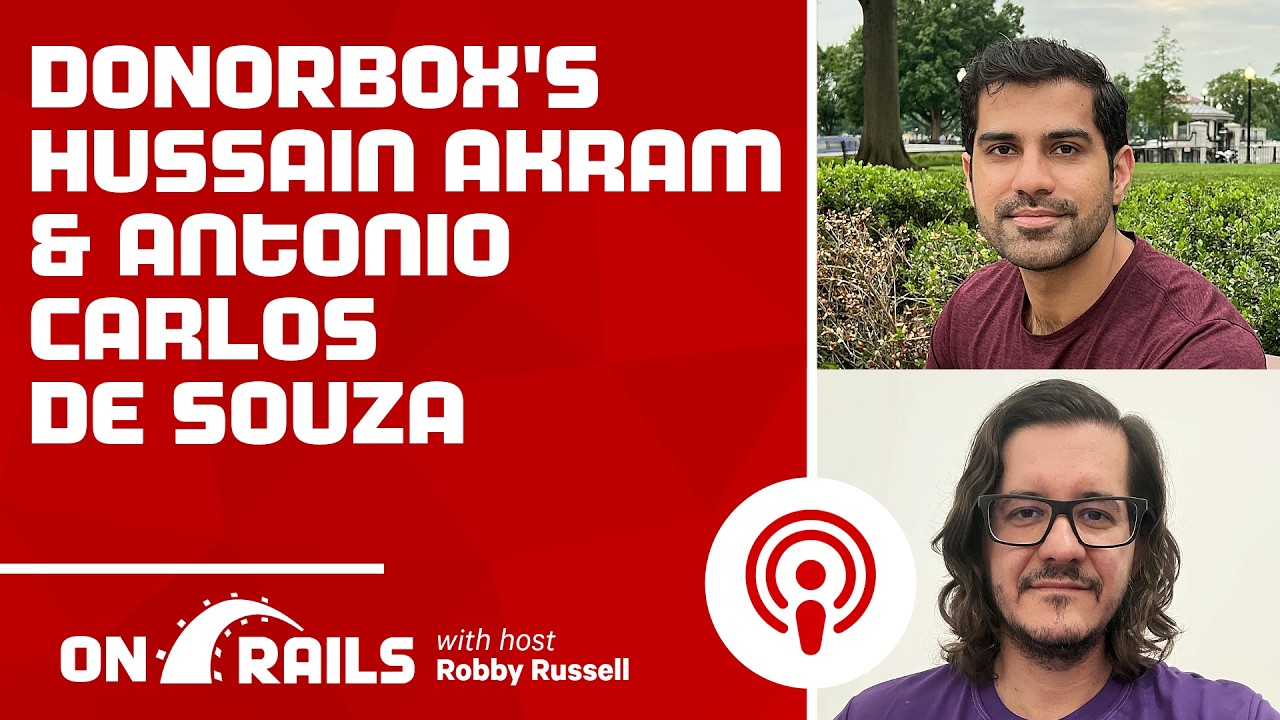
Published on YouTube by the Ruby on Rails channel on October 22, 2026, this episode of the 'On Rails' podcast is hosted by Robby Russell of Planet Argon. The conversation features Donorbox engineering manager Hussain Akram and chief architect Antonio Carlos de Souza (A.C.) discussing how their decade-old fundraising platform handles massive donation volumes with deliberately boring infrastructure, local CI workflows, and a steady return to vanilla Rails defaults.
## TL;DR
Donorbox powers hundreds of millions of requests and peak donation spikes using a straightforward Heroku, Cloudflare, and PostgreSQL architecture that minimizes hot-path database contention. To maintain velocity and eliminate deployment bottlenecks, the team moved testing from remote CircleCI pipelines directly onto developer machines via custom local tooling, accelerating merge cycles and driving test coverage to 100%. The architects also share their disciplined commitment to core Rails patterns—such as dismantling Slim templates in favor of standard ERB, avoiding arbitrary service object folders, and leveraging ActiveModel for complex search forms. Finally, they describe their practical approach to developer tooling, using AGENTS.md documentation and Model Context Protocol servers to steer AI assistants without abandoning human architectural oversight.
## Atmosphere & style
The discussion is refreshingly candid, pragmatic, and grounded in hard-earned engineering maturity. Host Robby Russell guides the dialogue with seasoned familiarity, while Hussain provides structured operational insights and A.C. delivers witty, battle-tested architectural opinions forged from decades of enterprise fatigue. It feels like an unvarnished post-mortem among veteran engineers who have entirely outgrown resume-driven complexity and take genuine pride in keeping systems simple, reliable, and boring.
## Bulletin
- [25:29](https://www.youtube.com/watch?v=3Y42uiA4tdE&t=1529s) Donorbox operates a high-volume fundraising platform processing 188 million non-asset requests a month on an average of just 2.5 Heroku web dynos behind Cloudflare edge caching, demonstrating that standard Rails monoliths scale effectively for typical business loads without microservices.
- [44:52](https://www.youtube.com/watch?v=3Y42uiA4tdE&t=2692s) The engineering team migrated its CI pipeline from CircleCI back to developers' local machines using an internal Rake tool, slashing test runtime from an hour down to under 8 minutes, eliminating race conditions, and lifting test coverage from 86% to 100%.
- [01:01:01](https://www.youtube.com/watch?v=3Y42uiA4tdE&t=3661s) Donorbox preserves strict Rails defaults by avoiding a top-level app/services directory, encapsulating third-party integrations inside lib/, and deliberately phasing out Slim view templates in favor of standard Rails ERB.
- [01:21:27](https://www.youtube.com/watch?v=3Y42uiA4tdE&t=4887s) The team directs AI coding tools like Claude and Cursor through a centralized AGENTS.md file and an internal Model Context Protocol (MCP) server that provides AI models direct access to the design system component library.
## Key takeaways
- [07:54](https://www.youtube.com/watch?v=3Y42uiA4tdE&t=474s) Rails' greatest strength is its pervasive convention over configuration, which establishes a baseline mental model across projects and teams while solving roughly 99% of common web business problems out of the box.
- [17:54](https://www.youtube.com/watch?v=3Y42uiA4tdE&t=1074s) Adhering to standard Rails conventions and simple git pull request approval workflows significantly simplifies compliance audits such as PCI and SOC compared to complex bespoke automation.
- [23:04](https://www.youtube.com/watch?v=3Y42uiA4tdE&t=1384s) Rapidly launching MVP features by accepting deliberate technical debt is a valid strategy if followed by disciplined refactoring and dedicated ownership once product-market fit is proven.
- [30:22](https://www.youtube.com/watch?v=3Y42uiA4tdE&t=1822s) The donation intake hot path maintains high database throughput by reducing initial processing to a single-table insert, offloading complex validations, counter caches, and third-party notifications to background jobs.
- [33:55](https://www.youtube.com/watch?v=3Y42uiA4tdE&t=2035s) Cascading touch updates on counter caches caused lock contention during high-volume spikes, showing how subtle relational database bottlenecks often prompt premature microservice adoption.
- [37:26](https://www.youtube.com/watch?v=3Y42uiA4tdE&t=2246s) Testing Rails 8 Solid Queue revealed operational advantages over Sidekiq, notably avoiding forced job termination and arbitrary retries during Heroku platform deployments.
- [52:50](https://www.youtube.com/watch?v=3Y42uiA4tdE&t=3170s) Running CI locally on developer workstations reframes automated tests as a direct developer safeguard against production bugs rather than a slow compliance checklist.
- [01:01:01](https://www.youtube.com/watch?v=3Y42uiA4tdE&t=3661s) Migrating from Slim back to ERB removed parsing friction and rendering overhead while reinforcing adherence to core Rails framework defaults as a shared organizational commitment.
- [01:13:00](https://www.youtube.com/watch?v=3Y42uiA4tdE&t=4380s) Non-persisted ActiveModel classes provide a clean, declarative alternative to handling complex search and filter validations compared to catching exceptions in controllers.
- [01:21:27](https://www.youtube.com/watch?v=3Y42uiA4tdE&t=4887s) AI coding assistants amplify both developer knowledge and developer ignorance; maintaining project-specific agent documentation prevents models from introducing architectural anti-patterns.
- [01:29:36](https://www.youtube.com/watch?v=3Y42uiA4tdE&t=5376s) Donorbox deliberately avoids a generic app/services directory, keeping core business logic in app/models while placing external API wrappers in lib/ as anti-corruption layers.
- [01:40:24](https://www.youtube.com/watch?v=3Y42uiA4tdE&t=6024s) Decoupling identity authentication from multi-tenant user roles offers a cleaner architectural pattern than overloading a single monolithic User model across distinct organizations.
Robby Russell opens the episode of *On Rails*, noting his perspective as the leader of Planet Argon, a consultancy that has spent over 21 years helping teams maintain and modernize long-lived Ruby on Rails applications. He introduces guests Hussain Akram, engineering manager at Donorbox joining from Virginia, and Antonio Carlos de Souza (better known as A.C.), chief architect at Donorbox joining from Brazil.
Donorbox is an online and in-person fundraising platform used by nonprofits worldwide, backed by a core Rails application that has been actively running and evolving for more than a decade. Robby sets the stage for the conversation: exploring how the engineering team preserves simplicity while handling high-volume traffic, how they lean into standard Rails conventions, and how they intentionally guide legacy code back toward clean, idiomatic patterns.
[01:05](https://www.youtube.com/watch?v=3Y42uiA4tdE&t=65s) What Keeps Hussain and A.C. on Rails
Robby begins by asking what keeps both engineers anchored to Rails after all these years. Hussain traces his experience back to his university days around 2018. While in his third or fourth semester of his bachelor's program, he was already juggling demanding foundational courses—assembly language, C, data structures, and object-oriented programming. Picking up Rails allowed him to bypass endless infrastructure decisions and deliver academic term projects rapidly through convention over configuration:
> “It's so easy for me to solve hard problems rather than solving the infrastructure problems if that makes sense.”
Hussain targeted Rails companies specifically when graduating in mid-2018 (working primarily on Rails 3 or 4 at the time). He landed a role before completing his final semester because the hiring team was impressed that he was already proficient with the framework; his initial onboarding and training lasted just two weeks before he began pushing production code.
A.C. brings a longer perspective, having started his career in 2002. Coming up through the Java enterprise ecosystem, he dealt with desktop rollouts before falling in love with the immediacy of the web. In the early 2000s, building web applications meant navigating technologies like Macromedia Flash, Java Struts, and endless architectural deliberations. He recalls exhausting team debates over non-essential tooling, citing an infamous argument over which logging framework to adopt (such as Apache Commons Logging vs. Log4j vs. the default Java logging utility), which proved doubly futile because third-party dependencies inevitably required all of them anyway:
> “The thing is you need all of them because you have dependencies and those dependencies will depend on them so even yeah even the discussion is pointless.”
```mermaid
flowchart TD
accTitle: Evolution of Web Tech Choices
accDescr: Journey from early Java enterprise bikeshedding to Rails convention over configuration.
subgraph PythonExperiment["2009: Exploration"]
D["TurboGears"]
E["Django"]
end
subgraph RailsAdoption["Rails Convention"]
F["Ruby on Rails"]
G["Default Architectural Decisions"]
H["Focus on Delivering Features"]
end
C --> PythonExperiment
PythonExperiment --> RailsAdoption
F --> G --> H
```
Seeking an environment free from repetitive bikeshedding, A.C. evaluated Python frameworks like TurboGears and Django around 2009 before encountering Rails. The built-in conventions immediately eliminated entire categories of pointless architectural debates, allowing developers to focus entirely on building software.
[07:54](https://www.youtube.com/watch?v=3Y42uiA4tdE&t=474s) What Good Rails Looks Like
The discussion turns to how prior platform experiences shape an engineer's instincts for evaluating good versus bad Rails design. Robby notes that in pre-Rails ecosystems, every new project felt like an ungrounded experiment in architectural taste, compounded by the mid-2000s obsession with GoF (Gang of Four) design patterns where teams blindly built rigid UML models for hypothetical problems they didn't actually have.
A.C. emphasizes that the true superpower of Rails is the immediate baseline of familiarity it establishes across teams and companies:
> “The Rails build unless you're not paying attention at Oh, what are you doing? It builds rails building in you a sense of familiarity.”
When developers jump between codebases, they can almost instinctively predict where code lives and what shapes it takes. For A.C., bad Rails manifests when organizations actively fight the framework:
> “I working on companies that they are constantly fighting Rails as I got to a point at asking why exactly you pick Rails again because every single decision Rails has they try a way to change it.”
He suspects developers sometimes reject defaults out of boredom, or from an ego-driven desire to feel ownership over fundamental design choices. Yet ironically, Rails is so forgiving and productive that teams manage to ship software despite fighting the platform every step of the way.
Hussain agrees, noting that difficult codebases almost always stem from developers attempting to reinvent the wheel. Given the maturity of the Rails ecosystem, nearly every standard business requirement has an established, clean solution:
> “Most probably 99% this problem specific problem is already solved by a simplest way.”
When teams respect Rails defaults, complex architectures melt away into assembling straightforward pieces in their conventional places.
[11:32](https://www.youtube.com/watch?v=3Y42uiA4tdE&t=692s) Inside Donorbox: Teams, Kiosks, and Offline Payments
The Donorbox engineering department is structured into five or six specialized teams, totaling approximately 50 engineers. Each team is cross-functional, consisting of a project manager, a designer, and a QA specialist. Hussain Akram explains that these teams are organized around specific aspects of the nonprofit services they provide. For instance, Hussain leads the in-person fundraising team, which manages live kiosks (one of which is visible in his home office), ticketing events, and text-to-give features. Other teams include the online fundraising team—which maintains the core donation form—the core experience team, the platform team, and the integrations team, which connects Donorbox to external platforms like Salesforce and HubSpot. Additionally, Donorbox has a dedicated support engineering team that handles high-level debugging and pushes quick fixes directly to production.
Robby Russell asks about the unique challenges of managing in-person fundraising events, particularly when dealing with unstable internet connections at venues like churches or mosques. Hussain shares that they solved this issue by leveraging Stripe's offline transaction processing capabilities. The Donorbox kiosk application stores transaction data locally on the device when the connection drops. Once the device detects that it is back online, it automatically syncs and processes those stored transactions through the server.
```mermaid
flowchart TD
accTitle: Offline Kiosk Transaction Flow
accDescr: Shows how a Donorbox kiosk handles payments when internet connection is lost and then restored.
A["Donor Swipes Card"] --> B{"Internet Online?"}
B -->|No| C["Store Transaction in Local Storage"]
B -->|Yes| D["Process via Stripe Immediately"]
C --> E["Wait for Connection"]
E --> F["Device Reconnects"]
F --> G["Send Stored Transactions to Server"]
G --> D
```
- **Engineering Team Size:** Approximately 50 engineers split across 5–6 specialized teams.
- **Support Team Autonomy:** Support engineers perform high-level debugging and can push hotfixes directly. As Hussain notes, "If they can understand fix a bug and then just push it without disturbing the you know relative team."
- **Offline Processing:** Kiosks utilize local storage to queue Stripe transactions during network outages and sync them when connectivity is restored.
---
[15:02](https://www.youtube.com/watch?v=3Y42uiA4tdE&t=902s) A Monolith with Support Ships
Donorbox is built primarily as a Ruby on Rails monolith, but it is supported by a few smaller, specialized repositories. For example, the kiosk application runs on separate iOS and Android repositories, and the integrations team maintains a dedicated repository to handle communication with third-party platforms like Salesforce. This integration app communicates with the main monolith via an internal API. Antonio Carlos de Souza (A.C.) describes this architectural setup using a maritime metaphor: "Yeah you can think about this as a we have this mother ship and some support ships around it."
When deciding whether to carve out a new service from the monolith, A.C. applies a simple but rigorous business test. He asks: "can I delete this whole application if some business change can delete this whole application without anyone noticing." If a service has no user interface of its own and acts purely as a background job mapping Donorbox data to a third-party API, it is a prime candidate to live in a separate repository. This separation keeps the core monolith clean and prevents external integrations from cluttering the main codebase.
---
[17:54](https://www.youtube.com/watch?v=3Y42uiA4tdE&t=1074s) Auditing, Compliance, and Architectural Choices
Compliance requirements, such as PCI and SOC certifications, play a surprisingly significant role in Donorbox's architectural and process decisions. Because they handle financial transactions, Donorbox must undergo rigorous audits that require strict development double-checks. A.C. explains that they often choose simpler, more standard workflows specifically because they are easier to explain to external auditors. For example, requiring a pull request to be approved by someone other than the author before merging is an incredibly straightforward rule for an auditor to verify.
If the team instead implemented a complex, homebrew automated integration process that ran cryptographic checks before a PR was even shared, it would require the auditor to deeply understand the custom tooling. This would inevitably make the audit process much longer, more complicated, and more expensive. A.C. emphasizes that they constantly balance daily process efficiency against audit friction, concluding that "We found out during our time that the auditor is way harder than just ask for someone that is already working with you to approve this pull request." This pragmatic approach allows Donorbox to accommodate strict compliance standards without grinding daily development to a halt.
---
[19:38](https://www.youtube.com/watch?v=3Y42uiA4tdE&t=1178s) A Founder Who Learned Rails to Build the Company
The history of Donorbox is a classic bootstrapping success story. When A.C. joined the company in 2019, the founder was still actively deploying product updates. The founder was not a software engineer by trade; he learned Ruby on Rails simply because it was the popular, highly recommended framework of the era. He became a programmer out of sheer necessity to bring his product idea to life, long before modern AI coding assistants like Claude were available to write code for him.
Rails provided a clear, structured learning path that allowed a non-technical founder to build a secure, functional, and highly successful web application from scratch. He managed early development by teaching himself the basics and outsourcing specific tasks to freelancers on Upwork. Robby points out that this is a powerful testament to the Rails framework, which enables entrepreneurs to bootstrap viable businesses and scale them to the point where they can hire experienced engineering teams to take over. Reflecting on this journey, A.C. highlights how Rails democratizes software creation: "So rails literally enable the company to be built by someone passionated about what they're trying to achieve and who wants to actually do something that is not only useful but secure and manageable by one person."
[23:04](https://www.youtube.com/watch?v=3Y42uiA4tdE&t=1384s) Shipping Fast and Paying Down the Debt Later
Robby Russell asks about the technical debt that naturally emerges when founders or developers build their first major, mature Rails application, wondering how engineering leadership strategizes refactoring and iterating forward. Hussain Akram responds with the story of Donorbox’s events product, explaining that most codebases he encounters are built rapidly because the owner or co-founder needs to solve an urgent customer problem immediately. Nonprofits urgently needed a tool to organize events for their major fundraising drives and galas, and Rails gave the team the speed to assemble and ship that experimental feature in just three to four months.
Shipping at that speed inevitably created technical debt and a backlog of refactoring work. However, Hussain explains that taking on that debt was the right call: the product immediately succeeded in the real world, generated substantial revenue for the company, and proved its value before anyone spent time over-optimizing it. Once its success was proven, Donorbox invested back into the codebase, gradually refactoring the architecture and forming an entire dedicated in-person team of four to five developers to maintain events and related tools. Reflecting on this pattern across both side products and core Rails apps, Hussain notes: “I don’t think there’s any shame like following that path.”
[25:29](https://www.youtube.com/watch?v=3Y42uiA4tdE&t=1529s) Request Volume and Running on Heroku
When Robby asks for concrete numbers to illustrate the scale of Donorbox, Antonio Carlos de Souza (A.C.) walks through the platform's traffic metrics from the edge to the database. Over a 30-day period, the application handled 188 million requests—a count that strictly measures application traffic, having filtered out all static assets, favicons, JavaScript, CSS, and images.
Despite handling roughly 120 to 188 million raw dynamic hits a month, the team does not run complex multi-region AWS infrastructure. Instead, they run entirely on Heroku dynos, embracing standard conventions because they do not have a dedicated infrastructure operations team. A.C. highlights the resilience of this setup by pointing to a quiet spike on July 15: “In the last 60 days, we have a spike of 200 donations—204 donations made in 1 minute in July 15 and no one knows.” Hussain laughs and adds that A.C. regularly drops Cloudflare traffic graphs into Slack to show the engineering team massive traffic spikes that occurred completely unnoticed while everyone was asleep.
- **Dynamic monthly requests:** 188 million requests (excluding static assets, favicons, JS, CSS, and images).
- **Peak transaction volume:** 204 donations processed in a single minute on July 15 with zero platform degradation or manual intervention.
- **Hosting infrastructure:** Hosted on Heroku dynos behind Cloudflare edge caching, intentionally avoiding a bespoke infrastructure engineering team.
[28:19](https://www.youtube.com/watch?v=3Y42uiA4tdE&t=1699s) Payment Providers and Donations Around the World
Addressing the payment ecosystem, Robby asks how Donorbox handles regional processing requirements, alternative payment methods, and international payment rails. A.C. explains that while around 60% of their donation volume originates in the United States, roughly 40% comes from international markets, led by Europe, the United Kingdom, and India. This geographic diversity requires supporting payment flows far beyond standard US credit cards, including European SEPA direct debit and specialized local rails.
To manage these variations, Donorbox integrates across multiple specialized providers:
- **Stripe:** Used for core credit card transactions, digital wallets, and region-specific direct debit mechanisms.
- **PayPal:** Integrated for global donors who prefer digital wallet checkouts over entering card details.
- **The Giving Block:** Integrated as a strategic partner to process non-cash contributions, specifically stock donations and cryptocurrencies.
*(A mid-roll parody sponsor message airs for "Callback Insurance," playfully mocking Rails applications where calling `.save` triggers unexpected cascades of `before_save`, `after_commit`, and hidden concern hooks that unexpectedly cancel subscriptions or send rogue emails).*
[30:22](https://www.youtube.com/watch?v=3Y42uiA4tdE&t=1822s) Keeping the Hot Path Fast
```mermaid
flowchart TD
accTitle: The Life of a Donation Request
accDescr: Flow diagram showing a donation request passing from Cloudflare through browser tokenization to Heroku database insertion and asynchronous worker jobs.
A.C. details the exact lifecycle of a donation request, tracing how Donorbox keeps its most critical path lean and performant. The flow begins at Cloudflare, which serves cached versions of either the hosted donation page or the embedded widget form. When a donor submits their details, the client browser communicates directly with the payment provider (such as Stripe or PayPal) to obtain an exchange token representing the payment method. Only this token—never raw card data—is submitted to Donorbox’s servers.
Once that payload hits the Heroku dynos, the app treats the donation write as the absolute hottest path in the system:
1. **Single-Table Insert:** The incoming record is written via a single `INSERT` into a single table. This minimizes row locks and avoids holding database transactions open while resolving associated data.
2. **Asynchronous Record Extraction:** Secondary domain logic—such as determining whether the donor already exists in the database, updating customer records, creating subscriptions, or firing notifications—is offloaded into background jobs.
3. **Pragmatic Scaling:** Rather than adhering strictly to standard Rails patterns that create multiple associated ActiveRecord objects in a single synchronous controller action, Donorbox stripped the intake down to the bare minimum.
A.C. points out that the platform was originally built around a simple domain concept—one individual donor making one donation to an organization. As the business expanded to corporate matching and institutional donors, the domain model became stretched. By measuring production bottlenecks over several years, they discovered that keeping the hot path reduced to a simple insert protected database concurrency. As A.C. summarizes their engineering philosophy: “And by the way, we’re not Shopify, okay? So, we’re not scale for human beings, for the rest of us.”
[33:55](https://www.youtube.com/watch?v=3Y42uiA4tdE&t=2035s) Microservices vs. Rails Scaling and the Danger of Counter Caches
A.C. pushes back against the persistent industry narrative that Rails cannot scale, recounting past debates with incredulity. The vast majority of applications do not need complex architectures, but rather careful attention to how database interactions are designed. Donorbox ran into its own self-inflicted scaling bottlenecks when excessive usage of ActiveRecord's `touch` triggered widespread cascading updates.
> “And I was like, dude, you have more microservices in your application than customers. What are you talking about?” — Antonio Carlos de Souza
When processing high-velocity donation streams, keeping database writes clean and sequential is critical. Instead of pure inserts, Donorbox was inadvertently modifying counter caches across multiple related models with every donation, creating lock contention and leading to internal out-of-database errors.
```mermaid
flowchart LR
accTitle: Database bottleneck from cascading touch calls
accDescr: Incoming donations queue rapid inserts while counter cache touches cascade across models, causing write contention.
subgraph Ingestion["Hot Path Writes"]
D1["Incoming Donation"] -->|"fast append"| DB[("Primary DB Table")]
end
subgraph Cascade["Contention Bottleneck"]
D1 -.->|"touch & update"| CC["Counter Caches"]
CC -.->|"lock & update"| Rel["Related Tables"]
Rel -.->|"causes out-of-DB errors"| DB
end
```
- When supporting 100 organizations, inefficient database operations like touching related records go completely unnoticed.
- At 1,000 organizations, database strain surfaces as intermittent latency spikes in application logs.
- Donorbox currently supports more than 30,000 active organizations against a single primary write database.
[35:31](https://www.youtube.com/watch?v=3Y42uiA4tdE&t=2131s) The Ingestion Hot Path and Political Campaign Edge Cases
Robby Russell compares Donorbox's ingestion pipeline to e-commerce checkout platforms like Shopify. While retail stores must block transactions on inventory checks and stock allocations, a donation platform generally benefits from accepting as much volume as possible while pushing downstream accounting, auditing, and reconciliation to asynchronous workers.
A.C. and Hussain Akram explain that while generic donations are straightforward, specific regulatory scenarios disrupt this ideal pipeline. Political fundraising campaigns require explicit compliance data that must be validated synchronously before taking funds and acknowledging the donor.
```mermaid
flowchart TD
accTitle: Standard vs political donation validation flow
accDescr: Standard donations pass fraud detection and queue directly, while political campaigns require pre-authorization validation.
A["Donation Submission"] --> B{"Campaign Type?"}
B -->|"Standard 501(c)(3)"| C["Fraud Detection Filter"]
C -->|"Pass"| D["Queue Background Job"]
D --> E["Insert into Core Tables"]
B -->|"Political Campaign"| F["Strict Pre-Validation"]
F -->|"Valid"| D
F -->|"Missing Required Data"| G["Reject & Report to Donor"]
```
- Standard nonprofit organizations undergo initial compliance checks to verify valid 501(c)(3) status, making their donor traffic safer to trust by default.
- Automated fraud detection runs continuously to block bad actors who attempt to automate or tamper with web donation forms.
- For ordinary donations, the client simply submits a JSON payload, the application enqueues a processing job, and writes to a small handful of database tables.
[37:26](https://www.youtube.com/watch?v=3Y42uiA4tdE&t=2246s) Testing Solid Queue and Downsizing Dyno Bloat
Donorbox currently relies on Sidekiq backed by Redis for background job execution, but the engineering team has started testing Rails 8's Solid Queue. To mitigate risk, they are avoiding the central monolithic application initially, testing Solid Queue in smaller satellite applications (“support ships”) operated by the communication and integration teams.
```mermaid
flowchart LR
accTitle: Incremental Solid Queue adoption strategy
accDescr: Sidekiq powers the main monolith while Solid Queue is battle-tested in isolated satellite services.
subgraph Core["Core Monolith"]
M["Primary Rails App"] --> S["Sidekiq + Redis"]
end
subgraph Satellites["Support Ships (Solid Queue Trials)"]
C["Communication App"] --> SQ1["Solid Queue"]
I["Integration App"] --> SQ2["Solid Queue"]
end
```
A.C. highlights that scaling Redis on Heroku becomes cost-prohibitive, and querying job metadata in a key-value store is far more painful than querying structured records in a relational database. Hussain adds that Sidekiq forces all in-flight jobs to terminate and retry whenever a Heroku deployment restarts the application dynos, whereas Solid Queue supports clean job continuation.
> “His name is Zakarias... our server shepherd.” — Hussain Akram & Antonio Carlos de Souza
Zakarias, Donorbox's dedicated infrastructure engineer, proactively monitors database behavior, tracing any query that runs longer than 30 seconds, bypasses cache layers, or loads excessive datasets into memory. Through this rigorous observability, Zakarias downgraded the team's Sidekiq worker dynos from 15 GB of RAM down to 2.5 GB without any loss in performance.
- Heroku Redis instances become exponentially expensive as memory quotas are scaled up for job queues.
- Relational databases provide significantly superior tooling for inspecting, filtering, and debugging queued and failed jobs.
- The vast majority of background jobs at Donorbox finish processing within one to two seconds.
- Donorbox operates its primary web traffic on an average of only 2.5 web dynos across an entire month.
- Deployment rollouts temporarily invalidate caches, triggering Heroku's autoscaler to spin up a third dyno for roughly 15 minutes before dropping back down to two.
[42:28](https://www.youtube.com/watch?v=3Y42uiA4tdE&t=2548s) Boring Deployments, Heroku Review Apps, and Testing Embeds
When rolling out updates across a service that powers embedded donation forms on external websites, predictability and consistency are essential. Robby Russell queries how the engineering team verifies client-facing embeds like iframes and JavaScript snippets across environments where traffic cannot be forecasted.
Hussain explains that Donorbox avoids over-complicated deployment automation, relying instead on Heroku review apps tied to pull requests. Each team manages dedicated review environments, allowing quality assurance engineers to manually test new form configurations directly against sample third-party hosts.
> “Our deployment process is very simple and classic in terms of we raise a PR and then like we have Jira columns, every team has their own Heroku review app where you can deploy and notify your QA to test it out.” — Hussain Akram
- The test suite maintains nearly 100% test coverage, using Rails system tests to automate matrix checks against different form settings and embed wrappers.
- QA specialists take review builds and embed them into actual external platforms, such as WordPress sites, to verify rendering and styling integrity.
- Production releases to the core donation form remain infrequent and deliberate; major updates, such as the newly redesigned "Omni" donation form, receive extensive multi-team regression testing before rollout.
[44:52](https://www.youtube.com/watch?v=3Y42uiA4tdE&t=2692s) Moving from CircleCI to Local CI
Hussain Akram explains the streamlined deployment flow Donorbox uses: an engineer runs a command that executes all tests, pushes the green result back to GitHub, and then triggers an internal shell command—reminiscent of Capistrano—that deploys the code straight to the main demo/staging server and production. It is intentionally simple, quick, and boring. Robby Russell brings up how teams wrestle between offloading CI to hosted services like GitHub Actions (which occasionally suffers outages) versus running it locally, and asks what internal tooling Donorbox built around this philosophy.
Hussain shares that the company previously relied on CircleCI, but ran into frustrating race conditions. When two pull requests were merged in close succession, the merged main branch would experience minuscule fractional drops in code coverage. This sparked friction and Slack arguments between teammates when subsequent pull requests were blocked from deployment. Around that time, David Heinemeier Hansson (DHH) published a blog post outlining 37signals' move back to running CI on developers' local machines. Taking inspiration from this, Donorbox built an internal Rake gem that runs Brakeman, linters, and the test suite locally before pushing verified results back to the GitHub PR. This process ensures only one PR merges at a time, completely eliminating the sporadic drops in coverage.
```mermaid
flowchart LR
accTitle: Local CI Integration Flow
accDescr: Developer machine runs local checks before pushing green status to GitHub and deploying.
subgraph LOCAL["Developer Machine"]
A["Rake Gem Runner"] --> B["RuboCop & Brakeman"]
B --> C["Drop/Recreate DB & Run Migrations"]
C --> D["Execute Test Suite"]
end
subgraph REMOTE["Remote Services"]
D -->|"Report Green"| E["GitHub PR"]
E -->|"Internal Shell Command"| F["Deploy (Staging & Production)"]
end
```
[46:49](https://www.youtube.com/watch?v=3Y42uiA4tdE&t=2809s) DORA Metrics, Migration Testing, and Fixtures
Antonio Carlos de Souza (A.C.) adds concrete context around Donorbox's engineering throughput by highlighting Google's DORA metrics, noting that their interdependent nature makes them difficult to game. Despite having a lean team of 15 developers, Donorbox achieves roughly 10 deployments a day. A.C. confesses that he was the instigator behind pushing CI back to local environments: under their old outsourced CircleCI pipeline, a test run alone took approximately an hour. He wanted engineers to feel immediate ownership of the friction they caused:
> “I was the person pushing to run the tests locally so that the person doing the thing experience the problems they are creating. Another way and less sad way of seeing this is that is that I'm giving you back the feedback you lost when you put that on a Circle CI...”
The local tool goes far beyond simply executing tests. It performs static analysis to enforce strict Rails directory compliance across the 15-person team, runs RuboCop and Brakeman, verifies that the branch is up to date, checks `bundle install` hygiene, and explicitly tests migrations. Instead of using `db:test:prepare` or `db:setup`, the script deliberately drops the developer's local database and migrates it from scratch to verify real-world upgrades. When engineers initially pushed back that their local test databases were being wiped out, A.C. responded with humor:
> “The first thing people complain was about well you dropped my database. I lost my test environment, my local test environment... My first question is hey sir do you have time to listen to our lord and savior fixtures?”
A.C. explains that fixtures are not merely test utilities; using `fixtures:all` or loading fixture data establishes stable, known database scenarios so developers do not have to recreate complex application state by hand—even if backporting that mindset into a 10-year-old codebase requires significant catch-up work. Hussain notes that running the suite locally created strong peer motivation: developers proactively hunted down slow tests, shared optimizations across teams, cut suite execution time from over 20 minutes down to roughly 7–8 minutes, and began spotting deprecation warnings directly in their consoles instead of ignoring them on an outsourced CI runner.
- **Team size and velocity**: ~10 deployments per day across 15 engineers tracked via DORA metrics.
- **Suite run time reduction**: Dropped from an hour on CircleCI down to 20 minutes locally, and eventually tuned to 7–8 minutes.
[52:50](https://www.youtube.com/watch?v=3Y42uiA4tdE&t=3170s) Tests as a Developer Tool and What Coverage Really Measures
Robby reflects on the historical pendulum swing of testing practices. In earlier software cycles, developers ran tests on their workstations out of necessity before central tools like Jenkins, CircleCI, or GitHub Actions gave managers confidence with automated green checkmarks. However, waiting an hour on an external service creates a bottleneck where pull requests sit unreviewed, turning automated testing into a detached compliance hoop rather than an active development aid.
A.C. argues that when test suites run too slowly, engineers stop viewing them as an essential instrument:
> “Because the tests are taking so long, they became a check mark you add to the thing, not a developing tool. So bringing back the CIs to the developers reminds the developers that hey guys that's for you... The customers completely don't care about automated tests... writing test doesn't make your PM lives easier. It doesn't make your manager life easier. It makes your life easier because you are the person that's not waking up to fix a bug that end up in production and no one have no idea how.”
Discussing their pursuit of high test coverage, A.C. points out that Hussain was the primary driver who pushed the suite to 100% coverage. However, A.C. explains that raw coverage percentages can be misleading: 100% is often just noise, whereas the real signal is the inverted list of code paths that lack automated checks. A line being marked as covered does not guarantee semantic perfection, but it does guarantee that a test passed through that branch. If code still breaks after touching a thoroughly exercised path, it reveals that something fundamental is missing from the test assumptions. Robby then asks how the engineering organization leveled up everyone's skills—whether through team workshops, pair programming, or organic adoption—to get every developer comfortable maintaining fixtures, managing local database resets, and optimizing the local test workflow.
[56:27](https://www.youtube.com/watch?v=3Y42uiA4tdE&t=3387s) Moving Test Runs to Local Machines and the Coverage Spike
Reflecting on the transition from running test suites on a remote CI service to executing them locally, Hussain and A.C. detail how the change was adopted across Donorbox. Hussain explains that getting the team on board was remarkably smooth because A.C. created a shell tool hosted on GitHub and opened it up for everyone to critique and shape. Instead of waiting idly for CI to report back, developers run a single command locally. While there were initial hiccups—such as a developer running a local development server in another terminal, triggering conflicts that occasionally dropped the database—Hussain points out that these moments served as a diagnostic: “That's a signal that you need to fix something rather than just replacing the whole process.” Over time, those edge cases vanished.
Running the test signals locally fundamentally shifted developer engagement. Rather than viewing CI as a detached external barrier, developers became motivated to keep the suite fast and clean. Hussain highlights a stark quantitative metric that followed the shift: when he joined Donorbox, test coverage had hovered around 86% for a long time, but within six to eight months of shifting tests from remote CI to developers' machines, coverage spiked to 100%. Even though it introduced some initial local friction, it radically altered engineering accountability.
```mermaid
flowchart TD
accTitle: Transition from Remote CI to Local Test Execution
accDescr: Diagram contrasting slow, detached remote CI runs with fast local feedback that raised coverage to 100 percent.
subgraph Remote["Legacy CI Workflow"]
R1["Push Git Branch"] --> R2["Remote CI Pipeline"]
R2 --> R3["Wait for Long Async Results"]
R3 --> R4["Stagnant ~86% Coverage"]
end
subgraph Local["Donorbox Local Execution"]
L1["Run Integrated Box Command"] --> L2["Fast Local Signal & Automated Fixes"]
L2 --> L3["Developer Directly Accountable"]
L3 --> L4["Coverage Rose to 100% in 6-8 Months"]
end
```
[58:01](https://www.youtube.com/watch?v=3Y42uiA4tdE&t=3481s) "Integrated Box" and Restoring Ownership to Automated Tests
Robby asks what this unified command actually executes and whether it mirrors a `bin/ci` script running linters like Brakeman and RuboCop. A.C. shares that the tool carries the deliberately straightforward name `integrated_box` and bundles 12 sequential validation steps into a standard Rake task. It runs RuboCop with standard auto-fixes applied, and after extensive past debates over stylistic rules, Donorbox now runs the full "Omakase" RuboCop configuration without excessive custom rules. It executes test suites and other checks, keeping the Rake task plain and pragmatic rather than overengineered.
A key mechanical detail is the verification hook: developers must have the GitHub CLI or GitHub app installed locally. Once the 12 steps pass successfully on a developer's workstation, the tool authenticates with GitHub to mark the pull request as verified, satisfying a mandatory merge requirement. A.C. explains the philosophical justification he pitched to Donorbox's engineering managers: “Some developers are getting way too close to see the tests as a check mark for someone else checklist to run this test again in your machine. It reminds you that you are the responsible one for that not somebody else.” Because the full test run originally took about an hour, A.C. had to request explicit dedicated time from leadership so engineers had the room to commit to running and optimizing the suite locally.
- The local workflow runs through a Rake task called `integrated_box` comprising 12 sequential checks.
- Donorbox runs standard Omakase RuboCop rules with automated autocorrecting enabled.
- GitHub CLI integration authenticates the local run and posts the required status check directly to the PR to allow merging.
[01:01:01](https://www.youtube.com/watch?v=3Y42uiA4tdE&t=3661s) Phasing Out Slim to Return to Pure Rails Defaults
The conversation turns to another major refactoring initiative inside Donorbox: migrating view templates from Slim back to standard Rails ERB. Hussain explains that this forms part of a company-wide effort to align strictly with default Rails conventions. As the engineering team grew, Slim introduced recurring headaches around formatting and white-space indentation rules across different editor configurations. More importantly, Slim introduced an extra layer of abstraction that rendered slower than ERB and added friction when onboarding new engineers: “So slim files was just adding another complexity and it was also slower than ERB. So there was no point of having this extra pretty layer on top of what we already have with Rails.”
A.C. reinforces that returning to defaults is an active engineering principle rather than an empty slogan: “We're not saying that you should commit to Rails defaults as a rhetorical commitment, but this is our efforts for making this commitment more tangible for everyone.” Robby reflects on the historical trend where developers adopted Slim or Haml to avoid writing raw HTML, even though developers still needed to understand HTML to structure their pages properly. Hussain agrees, noting that using standard ERB lets code in the editor mirror the exact structural hierarchy rendered in the browser without fighting editor plugins that strip trailing whitespace.
- Slim templates proved slower to render in production compared to native Rails ERB.
- Sensitive parts of the UI require developer testing and manual QA verification after conversion, making bulk automated conversion scripts too risky.
- Both Robby and Hussain praise Marco Roth for his community work on tooling like Herb, referencing his presentation in Amsterdam.
[01:05:58](https://www.youtube.com/watch?v=3Y42uiA4tdE&t=3958s) Collective Ownership and Company-Level Backing for Migrations
Addressing how a long-running migration like template conversion stays on track without demoralizing engineers, A.C. explains that he purposefully structured it as an exercise in team culture and collective ownership. Instead of offloading the migration onto a single engineer or treating it as unauthorized "skunkworks" refactoring, A.C. worked with executive management to classify the migration as an official departmental goal (or departmental OKR) visible to the entire company.
The operational rule is straightforward and incremental: whenever an engineer touches a feature that uses a Slim file, they convert that file to ERB first, test it thoroughly, and then proceed with their feature work. Because company leadership explicitly announced that engineering would reserve time for this effort, developers have peace of mind knowing that tidying up technical debt is an officially recognized part of their job. As A.C. emphasizes, this shared protocol reinforces the realization that they are working together as a cohesive unit rather than as isolated individuals coding in silos.
[01:07:11](https://www.youtube.com/watch?v=3Y42uiA4tdE&t=4031s) Gentle Accountability in a Remote-First Migration
Antonio Carlos de Souza (A.C.) explains how Donorbox keeps long-running codebase modernizations moving across a globally distributed team. As a remote-first company with engineers spanning time zones from California to Cambodia, with Pakistan being one of the largest hubs, top-down enforcement does not work. Instead of treating code conversions like a punitive mandate, A.C. posted weekly reminders in the engineering Slack channel detailing how many files had been migrated over the previous week and highlighting files that were edited without being converted.
Rather than confronting engineers aggressively, A.C. approached them individually with offers to help if they lacked the time. In the first few weeks, developers frequently touched legacy files without converting them, but personal outreach steadily shifted team habits. Once engineers saw the support available, resistance dissolved and the entire team adopted the practice. As A.C. observes:
> “That's the thing with behavior like once you change you don't even remember why you're not doing that in the first place.”
- **Global reach**: The team spans from California to Cambodia, with Pakistan representing the most heavily populated engineering hub.
- **Weekly metrics**: Regular channel summaries highlighted both migrated files and missed migration opportunities.
- **Support over blame**: Reaching out to offer pairing or bandwidth turned reluctant developers into willing participants.
---
[01:08:46](https://www.youtube.com/watch?v=3Y42uiA4tdE&t=4126s) The Frontend Treadmill vs. Rails Conventions
Robby Russell highlights how critical an internal champion is when nudging an engineering organization through gradual migrations. Migrating back to ERB serves as a tangible example of resolving generational layers in a mature Rails application. He notes that many teams grapple with frontend fatigue caused by chasing whatever JavaScript framework was popular at the moment a particular feature was built. Because Rails itself has changed its stance on frontend tooling over time, applications accumulate competing paradigms.
Most companies cannot afford to scrap and rewrite their core applications every few years the way 37signals does. Given that reality, Robby asks Hussain Akram whether pulling Donorbox back toward standard Rails conventions has made hiring and onboarding easier.
```mermaid
flowchart TD
accTitle: Codebase Migration vs Frontend Churn
accDescr: Contrasting continuous adoption of JavaScript trends with returning to standard Rails conventions.
subgraph S1["Frontend Treadmill"]
A["Adopt Hot JS Framework"] --> B["Rails Shifts Strategy"]
B --> C["Accumulated Technical Debt"]
end
subgraph S2["Convention Path"]
D["Migrate to ERB & Rails Defaults"] --> E["Standard Architecture"]
E --> F["Smoother Onboarding"]
end
```
---
[01:10:40](https://www.youtube.com/watch?v=3Y42uiA4tdE&t=4240s) Hiring and Onboarding with Rails Conventions
Hussain emphasizes that the hiring and onboarding benefits of Rails are often overlooked when teams evaluate technology stacks. Because Rails enforces strong conventions across the ecosystem, an engineer with two to three years of experience arrives with a clear, shared mental model of how an application is organized and behaves.
> “Hiring is also a kind of underrated feature of Rails. It makes a lot easier for you to set the expectations because the guy with like three, four or two or three years of experience, you already know that he knows the basics conventions and everything.”
At Donorbox, onboarding relies on a concise internal guide that takes only six to eight minutes to read, explaining how the team applies standard Rails patterns. Within one to two weeks, a new hire can navigate the codebase confidently. Hussain contrasts this experience with ecosystems like Node.js, where every project establishes its own idiosyncratic structure, forcing newcomers to spend weeks deciphering how the original author configured basic plumbing. Robby draws a parallel to A.C.’s earlier recollections of the Java ecosystem, where an application might require three separate logging libraries simply to satisfy conflicting dependencies.
- **Baseline predictability**: Two to three years of Rails experience guarantees immediate familiarity with project structure.
- **Rapid onboarding**: A six-to-eight-minute overview document enables developers to work effectively within one to two weeks.
- **Ecosystem contrast**: Avoids the configuration sprawl common in Node.js or historical Java environments.
---
[01:13:00](https://www.youtube.com/watch?v=3Y42uiA4tdE&t=4380s) Refactoring Complex Search Filters with ActiveModel
A.C. turns to an architectural challenge Donorbox faced with search and filter pages used for donor segmentation. Nonprofits need to slice their donor lists along complex criteria, but users could easily produce contradictory parameters—such as asking for donors with more than five donations and fewer than two donations. To protect against impossible queries or errant mouse scrolls over increment inputs, the original implementers attempted to validate the input parameters inside the controller.
Because they wanted to display user-facing error messages explaining the conflict, the developers raised runtime exceptions and caught them to populate Rails flash messages. A.C. noticed they were effectively using exception handling to control standard user flow. Sharing links to Rails guides and documentation on ActiveModel failed to convince them to change their approach, so A.C. scheduled a dedicated three-hour pairing session with the two engineers.
> “I'm not saying it's better. I'm not saying I like more mine. I'm just trying to say that this is different of what you did. I want you to judge the merger button is yours. You do whatever you want with that. But I need to give you this three hours.”
```mermaid
flowchart LR
accTitle: Controller Flow Refactoring
accDescr: Moving from exception-driven controller logic to ActiveModel form objects.
subgraph Old["Old Implementation"]
direction TB
C1["Controller receives params"] --> C2["Validation fails"]
C2 --> C3["Raise Exception"]
C3 --> C4["Catch in Flash message"]
end
subgraph New["ActiveModel Refactoring"]
direction TB
A1["SearchDonors Form Object"] --> A2["ActiveModel Validations"]
A2 --> A3["Inline Form Errors"]
A3 --> A4["Clean Controller Action"]
end
```
To demonstrate the alternative clearly, A.C. took a dramatic step: he deleted the custom validation and rescue logic straight out of the controllers, grabbing the engineers' full attention. He introduced a plain Ruby class named `SearchDonors` and included ActiveModel to leverage standard Rails validations without involving a database table. He walked them through a date-range filter first, adding declarative validations for start and end dates.
When the engineers saw error messages render directly adjacent to the form fields automatically through standard Rails form helpers—without any custom exception raising or controller acrobatics—the value of the pattern clicked immediately. Over the remainder of the three-hour session, they converted the rest of the segmentation filters into the ActiveModel object, reducing controller complexity and giving the engineers firsthand ownership of standard Rails patterns.
[01:18:05](https://www.youtube.com/watch?v=3Y42uiA4tdE&t=4685s) The Underrated Power of ActiveModel and Revisiting "Working" Code
Reflecting on refactoring search and filter logic, Antonio Carlos de Souza shares a telling interaction with a colleague who initially wondered why anyone would touch code that was already functioning in production. The colleague eventually came around, realizing that if a standard feature feels agonizingly difficult or slow to build in Rails, the developer is usually swimming against the stream. As Antonio Carlos puts it: “Because it's not possible that in more than 20 years of Rails, I am the first person with this problem.” If an engineer finds themselves wrestling with an unnatural implementation, Rails has almost certainly solved that exact pattern years ago. Hussain Akram agrees, pointing out that developers routinely overlook the core toolkit: “The power that ActiveModel and ActiveSupport has, it's super underrated.”
Robby Russell observes that messy search implementations are an almost universal trait across the hundreds of Rails applications he has inspected. Teams routinely pile sprawling conditional logic into controller actions or invent idiosyncratic, brittle service abstractions that end up throwing sporadic `nil` exceptions whenever web spiders or malicious crawlers hit the endpoint with bizarre parameters. Because the code technically functions for real users, teams often write off those intermittent errors and let the debt linger. Robby commends Donorbox's engineering culture for intentionally setting aside fear, revisiting functional-yet-clunky code, and demonstrating that a cleaner reimplementation using built-in Rails patterns might only take three hours while permanently simplifying the architecture.
[01:20:26](https://www.youtube.com/watch?v=3Y42uiA4tdE&t=4826s) The Evolving Onboarding Guide and Engineering Principles
When asked about the concise internal guide mentioned earlier in the discussion, Hussain explains that Donorbox maintains an onboarding document designed to take only six to eight minutes to read. While standard commands for booting the application are kept in the repository's README, this central document focuses on high-level operational context: how the various product teams are structured, how the application's major modules interact, and practical operational guardrails—such as database-level performance rules and the exact conventions required when adding new database columns in production.
Crucially, the document is treated as a living artifact rather than static text that rots in a wiki. Whenever a newly hired engineer encounters an ambiguous problem or asks a question in Slack, Hussain checks whether the onboarding guide already covers it. If it does, he shares the direct link; if it does not, the team updates the document to address the gap. This continuous feedback loop keeps the guide sharp and ensures that subsequent engineers experience a smooth, low-friction onboarding ramp.
[01:21:27](https://www.youtube.com/watch?v=3Y42uiA4tdE&t=4887s) Integrating AI Agents: Cursor, Claude, and an MCP-Powered Design System
Robby shifts the conversation to modern developer workflows, asking how Donorbox integrates AI coding tools, large language models, and agentic workflows into their development setup. Hussain explains that the team has enthusiastically embraced AI tools, with developers gravitating toward either Claude or Cursor. To guide these tools, Antonio Carlos introduced repository-level markdown instruction files, such as `AGENTS.md`, which set baseline constraints before an agent writes a single line of code—instructing the models on architecture, domain rules, and even commit message formatting.
The workflow received an even larger boost from Donorbox's Org Experience team, who built an internal Ruby gem containing UI design components coupled to a Model Context Protocol (MCP) server. Instead of backend developers burning hours writing custom frontend markup or stitching together inconsistent legacy screens, their AI agents query the MCP server directly to ask how to instantiate a modal, a button, or a form element. Hussain notes that while previous iterations of the app suffered from an inconsistent patchwork of old and new frontend styles, the design gem and MCP setup have leveled the playing field. Developers can review a Figma design, map out the required ActiveRecord associations and domain models in their heads, and leave the front-end layout assembly largely to the tooling.
```mermaid
flowchart TD
accTitle: Donorbox AI-Assisted Development Workflow
accDescr: Flow diagram showing how developer prompts interact with context files and MCP servers to produce consistent code.
DEV --> AI
DOCS -->|"injects rules & deprecation warnings"| AI
AI <-->|"queries component schemas"| MCP
AI --> BE
AI --> FE
```
- **Tooling preferences:** Engineers across Donorbox primarily standardize on Cursor and Claude for day-to-day coding and refactoring.
- **`AGENTS.md` configuration:** Specialized markdown files inject repo-specific guidelines into the agent's context window before generation, including Git commit formatting conventions.
- **MCP design integration:** An internal gem supported by an MCP server allows coding agents to fetch and insert compliant frontend design components autonomously.
- **Shift to domain modeling:** Front-end implementation overhead has dropped to the point where backend engineers spend their design reviews almost entirely on database schema, domain boundaries, and model associations.
[01:23:33](https://www.youtube.com/watch?v=3Y42uiA4tdE&t=5013s) Steering Agents Away from Legacy Patterns and Amplifying Knowledge
Because Donorbox is a decade-old monolith, it naturally contains multiple competing historical implementations for similar tasks. Robby asks how the team prevents AI agents from scraping the codebase, latching onto a legacy pattern, and propagating outdated code into new pull requests. Hussain explains that they prioritize readable, domain-driven code above all else. When it comes to non-negotiable patterns, they spell them out explicitly inside the agent documentation. If an engineer asks an agent to review or generate code that violates those conventions, the agent reads the documentation and flags a soft warning—prompting the engineer to reconsider whether they really want to proceed down the old path.
Antonio Carlos elaborates that Donorbox actively catalogs anti-patterns in their agent documentation so the models know which historical styles are strictly deprecated. Rather than forming a slow, bureaucratic architecture committee to dictate these rules, Antonio Carlos identifies diverging patterns in the codebase, consults directly with the engineers working in that specific domain, and issues a lightweight request for comments (RFC). He views AI agents not as infallible arbiters of code, but as tools that mirror the engineer using them: “I see the LLM agents as a amplifier of yourself. So it will amplify your knowledge and also amplifies your lack of knowledge.” By embedding team consensus and architectural context into markdown files, the agent documentation acts as an institutional backstop whenever an individual developer lacks historical context.
Robby jokes that Antonio Carlos's name seems to appear on every single documentation commit—prompting playful banter about whether the process is truly democratic or if Robby needs to check with Hussain privately. Nevertheless, Robby agrees that using documentation to define clear boundaries is the most practical way engineering teams can stop AI agents from resurrecting deprecated code patterns.
[01:27:32](https://www.youtube.com/watch?v=3Y42uiA4tdE&t=5252s) Guiding AI Agents with Markdown Files and Symlinks
Robby Russell opens by asking whether Donorbox has built guardrails into their tooling to prompt developers when editing legacy patterns—such as asking whether a Slim template should first be migrated to ERB. Antonio Carlos de Souza (A.C.) notes with a touch of regret that they did not have Claude back when they were actively executing that transition: “The sad story here is that we didn't have Claude when implementing we're moving from Slim files to ERB, which kind of sad because it helps so much.” Instead, Donorbox structures context for agents by maintaining detailed Markdown files describing different parts of the architecture.
A.C. explains that he keeps a master `AGENTS.md` file (and symlinks it for Claude), which humorous side effects when the assistant tries to edit its own instruction file. The document contains foundational operational commands—running tests, booting servers, and navigating the tech stack—as well as documentation for custom Donorbox components and application directory structure.
```mermaid
flowchart TD
accTitle: Agent Context Loading via AGENTS.md
accDescr: Workflow showing how master instructions and symlinks pass codebase conventions and tooling instructions into LLM agent sessions.
subgraph Config ["Configuration Layer"]
A["AGENTS.md (Master Instructions)"]
B["Symlink: CLAUDE.md"]
A --> B
end
subgraph Context ["Core Context Provided to LLM"]
C["Server & Test Commands (bin/rails s, rails test)"]
D["Donorbox Components Gems & UX Guide"]
E["App Directory Structure & File Conventions"]
end
- A.C. symlinks `CLAUDE.md` to `AGENTS.md`, which sometimes confuses Claude when the model attempts to write back to the symlink and reports that the file does not exist, though reading works seamlessly.
- Because Donorbox sticks closely to Rails defaults, instructions on how to test or boot the application remain straightforward: `rails test` and `rails server`.
- The instructions explicitly cover the `donorbox_components` gem to ensure that whenever an AI agent builds user interfaces, it references the shared design system.
---
[01:29:36](https://www.youtube.com/watch?v=3Y42uiA4tdE&t=5376s) Preserving Conventional Rails: No Services Folder and Wrapper Libs
When Robby inquires whether Donorbox deviates from standard Rails folder structures, Hussain Akram points out that they intentionally avoid introducing custom top-level abstractions: “For example we don't have services folder, you know, so that's one example. We want every class that you want to required, it can be if it's associated with the business logic, it can stay in the models directory so no need to add another directory in app folder.” While logic is namespaced where appropriate, it remains rooted in standard directories like `app/models`, `app/views`, and `app/helpers`.
```mermaid
flowchart LR
accTitle: Third-Party Isolation via the Lib Directory
accDescr: Donorbox isolates Cloudflare and Plivo inside lib wrappers so vendor details do not leak into business models.
subgraph AppDomain ["app/models Domain Logic"]
Campaign["Campaign / Form Update"]
Donation["Donation Flow"]
end
For third-party external integrations, Donorbox relies strictly on the `lib/` directory to act as an anti-corruption wrapper. A.C. highlights Cloudflare cache management as a primary example. Because Donorbox serves hosted pages and embedded forms that are heavily cached at the edge, any campaign edit triggers cache invalidation. Code inside `app/` calls an expressive abstraction—such as purging a specific form slug—while the `lib/` wrapper handles translating Donorbox form identifiers into raw Cloudflare API endpoints and cache URLs. “The Cloudflare details didn't leak inside of the Donorbox code,” A.C. explains, ensuring vendor-specific logic never muddies core business logic. Similarly, SMS workflows handled via Plivo reside in `lib/`, strictly facilitating donor-initiated text interactions (such as requesting a campaign form or repeating a prior donation) rather than outbound marketing.
---
[01:32:37](https://www.youtube.com/watch?v=3Y42uiA4tdE&t=5557s) Constraining UI Drift and the Engineering Feature Cycle
Donorbox also uses agent documentation to restrict front-end sprawl by discouraging models from introducing new styling files. Hussain notes that instructions actively discourage agents from creating new `.css` files; the system expects engineers to use existing UI components, keeping any rare, bespoke styles scoped directly within the corresponding template. If a design requirement cannot be satisfied by the component library, developers are expected to sync with design rather than silently accumulating arbitrary CSS overrides.
Hussain outlines how a feature moves from inception to implementation:
1. **R&D & Design Alignment:** Designers conduct preliminary meetings to scope goals and identify potential simplifications before finalizing designs.
2. **Dedicated Developer Review:** A developer motivated by the feature reviews the design mockups for 2 to 3 hours to evaluate technical feasibility, system constraints, and deadlines.
3. **Architecture Sync:** The engineering manager and developer hold a focused 30-minute sync to align on data migrations and high-level architectural strategy.
4. **Implementation:** Mid-to-senior engineers execute the plan with clear scope and minimal oversight.
---
[01:35:06](https://www.youtube.com/watch?v=3Y42uiA4tdE&t=5706s) AI Pragmatism, Code Reviews, and Cross-Team Visibility
Addressing how closely teams are to autonomous "ticket-to-PR" agent workflows, Hussain expresses satisfaction that the engineering culture remains grounded: “No, I think we are blessed in in this regard that developers at Donorbox, they are not trusting too much on their agents for now at least.” While Hussain uses Claude to assist during code reviews, he refuses to blindly forward raw AI commentary to developers. Instead, he reviews the suggestions himself, verifies the feedback against team conventions, and updates `AGENTS.md` when the agent misinterprets architectural standards.
When Robby asks if increased AI usage has caused pull-request bottlenecks, Hussain explains that the primary value has been cross-boundary codebase comprehension rather than sheer volume generation. In an enterprise Rails monolith, engineers frequently need to interact with features maintained by other squads—such as invoicing, background scheduling, or payment processing. Instead of interrupting other developers with lengthy informational meetings, engineers query AI agents to map out interactions across unfamiliar domain modules. Robby ponders whether this shift toward consulting models instead of peers might gradually change team dynamics and interpersonal check-ins over the coming years.
- Developers use AI models to understand how distinct subsystems (e.g., invoices, recurring payments) interact before modifying shared models.
- When an AI review raises a false positive or misses a Donorbox idiom, Hussain uses that failure to refine the core agent prompt instructions.
[01:38:08](https://www.youtube.com/watch?v=3Y42uiA4tdE&t=5888s) The Limits of AI Context and Human Institutional Knowledge
Robby Russell brings up a subtle cultural side effect of developers relying heavily on AI coding assistants like Claude or Cursor. When engineers can immediately ask a chatbot how things were done historically rather than asking teammates, casual internal conversations start to dry up. Robby wonders whether this shift might alter team cohesion in unexpected ways. Hussain Akram points out that AI is far from capable of replacing human institutional memory. While an AI tool can inspect code, scan past commit messages, and read pull requests, it completely misses the debates, edge-case trade-offs, and constraints under which original decisions were reached. Hussain gives a concrete example from Donorbox: their events feature was implemented in a very specific, idiosyncratic way that diverges from standard Rails conventions, and only a tiny handful of veteran engineers understand the historical reasons why. Unless that context is deliberately documented in a Markdown file for the agent, the AI cannot know the real story.
Antonio Carlos de Souza (A.C.) looks at AI agents through a practical lens, arguing they should be treated like an enhanced version of a search engine rather than an oracle. In everyday work, a developer does not tap a coworker on the shoulder just to recall the exact Rails validator syntax for positive integers; they search for it. In the same way, engineers should use AI to do preliminary research and locate the relevant areas of a codebase before talking to a teammate. That way, the human conversation focuses on high-level reasoning rather than trivial discovery. As A.C. puts it: “You can start the conversation with the AI and get the information you need to actually have a conversation with a human being and use that as a ‘Oh, now I did my homework, this is what I found, can you help me understanding what the hell you did here, why is this way, what are you trying to prevent?’ Because these are the information that the AI doesn't have.”
[01:40:24](https://www.youtube.com/watch?v=3Y42uiA4tdE&t=6024s) Next Experiments: Lexxy, Solid Queue, and Fizzy's Identity Architecture
When Robby asks what upcoming tools or patterns in the Ruby on Rails ecosystem they are eager to experiment with, A.C. mentions Lexxy, the rich-text editor recently released by the 37signals / Rails ecosystem. A.C. appreciates its philosophy of embracing native browser JavaScript rather than relying on heavy TypeScript abstractions or trying to recreate non-JS behaviors the way older solutions attempted.
Hussain is particularly enthusiastic about Solid Queue—specifically its support for job continuations—and mentions that he has been spending time reading through the newly open-sourced Fizzy codebase. What stood out to Hussain in Fizzy is its clean separation of authentication and roles through an `Identity` model, where an identity essentially represents an email address while a associated `user` record defines the specific role and permissions. Rather than overloading a monolithic `User` model using Devise-style patterns, Fizzy cleanly decouples who you are from what you can do.
```mermaid
flowchart TD
accTitle: Fizzy Identity Architecture Analogy
accDescr: An analogy comparing building security authentication to entering roles in an application.
subgraph AuthLayer ["Authentication Layer"]
A["Visitor arrives at building"] --> B["Security Guard verifies ID badge"]
B --> C["Identity (Email / Credentials) verified"]
end
subgraph RoleLayer ["Authorization & Domain Contexts"]
C --> D["User Role: Organization Admin"]
C --> E["User Role: Fundraiser"]
C --> F["User Role: Individual Donor"]
end
```
Hussain uses a real-world security guard metaphor to explain why this approach is so appealing: “It's just like an analogy of entering a building. There's a security guy. He just wants to check your ID. Doesn't care about who you are, where you work, and he just let you in. And then there's different types of areas in the building that you can go in, you know.”
This conversation prompts Robby to ask how Donorbox handles multi-tenant identity when a single person donates to ten different organizations. A.C. laughs and explains that in Donorbox, a donor record is scoped as a contact within a specific organization's agenda; therefore, donating to ten different organizations creates ten separate donor records. However, because Donorbox links them through donor credentials, the donor can log in to a unified interface to view all their contributions across distinct organizations, while each individual organization can only see the context relevant to them. Hussain clarifies that Donorbox does not actually use Devise today, but Fizzy's clean modeling showed him an elegant alternative to the standard Rails habit of packing all session, authentication, and role logic directly into a single `User` model.
[01:44:44](https://www.youtube.com/watch?v=3Y42uiA4tdE&t=6284s) Essential Engineering Books and Farewell
Robby wraps up by asking both guests for their top software and programming book recommendations. Hussain highlights three foundational texts that shaped his career:
- *Agile Web Development with Rails* (which he refers to as the classic “bible” for Rails developers)
- *Eloquent Ruby* by Russ Olsen
- *Practical Object-Oriented Design in Ruby* (POODR) by Sandi Metz
A.C. enthusiastically endorses Hussain's choices, noting that Hussain stole his answers, and adds his own timeless recommendation: *The Pragmatic Programmer: From Journeyman to Master* by Andrew Hunt and David Thomas. A.C. explains that the book emphasizes evaluating trade-offs across every single professional engineering choice, constantly reminding developers that code is merely a means to an end. As A.C. explains: “The discussions in this book is about everything you do in a programming environment professionally. You need to weigh pros and cons. And they give you a thousand examples of that through the book. But the way they describe it is programming is a tool for achieving something you want to do.”
Before signing off, A.C. asks Robby if he will be attending Rails World in Austin. Robby confirms he will be there, noting that he was just scheduled to speak at the end of day one. Robby thanks Hussain and A.C. for sharing their architectural journey at Donorbox, shares podcast review reminders, and closes the episode.
## Notable quotes
> [01:21:00](https://www.youtube.com/watch?v=3Y42uiA4tdE&t=4860s) I see the LLM agents as a amplifier of yourself. So it will amplify your knowledge and also amplifies your lack of knowledge. — Antonio Carlos de Souza
> [01:13:00](https://www.youtube.com/watch?v=3Y42uiA4tdE&t=4380s) The power that ActiveModel and ActiveSupport has, it's super underrated. — Hussain Akram
## Mentioned
Hussain Akram, Antonio Carlos de Souza, Robby Russell, Donorbox, Planet Argon, Ruby on Rails, Heroku, Cloudflare, Stripe, PayPal, The Giving Block, Sidekiq, Solid Queue, CircleCI, GitHub Actions, RuboCop, Brakeman, Zakarias, David Heinemeier Hansson, 37signals, TurboGears, Django, Salesforce, HubSpot, WordPress, GitHub CLI, Slim, ERB, Haml, Marco Roth, Herb, ActiveModel, ActiveSupport, ActiveRecord, Cursor, Claude, Model Context Protocol, Figma, Plivo, Lexxy, Fizzy, Devise, Agile Web Development with Rails, Eloquent Ruby, Russ Olsen, Practical Object-Oriented Design in Ruby, Sandi Metz, The Pragmatic Programmer, Andrew Hunt, David Thomas, Rails World
## Video description
Hussain Akram is an engineering manager at Donorbox and Antonio Carlos de Souza (A.C.) is its chief architect, working on a Rails app that has helped nonprofits raise money online and in person for more than a decade.
Robby, Hussain, and A.C. get into how Donorbox handles serious traffic with a deliberately boring setup, why the team moved CI back onto developers' machines, and how they're pulling older parts of the app back toward Rails defaults. They also talk about how they use agent docs to steer AI tools toward the patterns they want the codebase to follow.
Links:
Donorbox - https://donorbox.org
#rails #rubyonrails #technology
On Rails is a podcast focused on real-world technical decision-making, exploring how teams are scaling, architecting, and solving complex challenges with Rails.
On Rails is brought to you by The Rails Foundation, and hosted by Robby Russell of Planet Argon, a consultancy that helps teams improve and modernize their existing Ruby on Rails apps
[00:00:00] - Introduction
[00:01:05] - What keeps Hussain and A.C. on Rails
[00:07:54] - What good Rails looks like
[00:11:33] - Inside Donorbox: teams, kiosks, and offline payments
[00:15:02] - A monolith with a few support ships
[00:19:38] - A founder who learned Rails to build the company
[00:22:56] - Shipping fast and paying down the debt later
[00:25:29] - Request volume and running on Heroku
[00:28:19] - Payment providers and donations around the world
[00:30:22] - The life of a donation request
[00:31:57] - Keeping the hot path fast
[00:37:27] - Sidekiq today, Solid Queue tests, and right-sizing dynos
[00:43:33] - Review apps, QA, and a boring deploy process
[00:45:54] - Moving from CircleCI to local CI
[00:48:22] - Testing migrations and the case for fixtures
[00:52:50] - Tests as a developer tool and what coverage tells you
[01:01:24] - Moving from Slim back to ERB
[01:05:58] - Keeping a long-running migration on track
[01:10:40] - Hiring and onboarding with Rails conventions
[01:12:46] - Refactoring search filters with ActiveModel
[01:21:27] - AI agents, agent docs, and an MCP-powered design system
[01:29:36] - No services folder and wrapping integrations in lib
[01:36:50] - Using AI to understand other teams' code
[01:40:24] - What they want to try next
[01:44:44] - Book recommendations
Hussain Akram 与 Antonio Carlos de Souza:面向大众的 Rails 可扩展性实践
Donorbox 依托由 Heroku、Cloudflare 和 PostgreSQL 构成的简单架构,有效减少热路径上的数据库争用,承载了数亿次请求与高峰捐赠流量。为保持研发效率并消除部署瓶颈,团队通过定制的本地工具,将测试从远程 CircleCI 流水线迁回开发者本地设备,加速了代码合并周期,并将测试覆盖率提升至 100%。这两位架构师还分享了他们对原生 Rails 模式的严格恪守——例如放弃 Slim 模板回归标准 ERB、避免随意设立 service 对象目录,以及借助 ActiveModel 处理复杂的搜索表单。最后,他们介绍了务实的开发者工具使用方式,即通过 AGENTS.md 文档与 Model Context Protocol 服务引导 AI 助手,同时未放弃人工对系统架构的把控。
Donorbox 运营着一个高流量筹款平台,在 Cloudflare 边缘缓存的协助下,仅靠平均 2.5 个 Heroku web dyno 即可每月处理 1.88 亿次非静态资源请求,证明了标准 Rails 单体架构无需微服务也能有效支撑常规业务负载。 (25:29)
工程团队借助内部 Rake 工具将 CI 流水线从 CircleCI 迁回开发者的本地机器,使测试运行时间从一小时大幅缩短至 8 分钟以内,消除了竞态条件,并将测试覆盖率从 86% 提高到 100%。 (44:52)
Donorbox 恪守严格的 Rails 默认规范,不设立顶层的 app/services 目录,将第三方集成封装在 lib/ 内部,并特意逐步淘汰 Slim 视图模板以回归标准 Rails ERB。 (61:01)
该团队通过集中的 AGENTS.md 文件以及内部 Model Context Protocol (MCP) 服务器来引导 Claude 和 Cursor 等 AI 编程工具,使 AI 模型能够直接访问设计系统组件库。 (81:27)
Source quotes
[81:00] Antonio Carlos de Souza: I see the LLM agents as a amplifier of yourself. So it will amplify your knowledge and also amplifies your lack of knowledge.
[73:00] Hussain Akram: The power that ActiveModel and ActiveSupport has, it's super underrated.
Original transcript
[0:00] [music]
[0:04] Welcome to On Rails, the podcast where
[0:06] we dig into the technical decisions
[0:07] behind building [music] and maintaining
[0:08] production Ruby on Rails apps. I'm your
[0:10] host, Robbie Russell, and I run Planet
[0:12] Argon. And for over 21 years, we've
[0:14] helped teams maintain and evolve their
[0:15] long live Rails apps. So, I tend to
[0:17] approach these conversations through
[0:18] that lens. In this episode, I'm joined
[0:21] by Hussein Aram, an engineering manager
[0:23] at Donorbox, and Antonio Carlos Duza,
[0:25] Donorbox's chief architect. Donorbox
[0:27] helps nonprofit organizations raise
[0:29] money online and in person. And behind
[0:31] that platform is a Rails application
[0:33] that has been evolving for more than a
[0:34] decade. We'll dig into how their team
[0:36] keeps that application relatively simple
[0:38] while handling serious traffic. How they
[0:40] think about Rails conventions and code
[0:42] design and some of the ways that they're
[0:43] pulling older parts of their application
[0:45] towards patterns they want the rest of
[0:47] their team to follow. Hussein joins us
[0:49] from Virginia and AC joins us from
[0:51] Brazil. [music] All right, check for
[0:53] your belongings. All aboard.
[0:57] Hussein and AC welcome to on rails.
[1:00] >> Hi Robbie. Thanks for having us.
[1:02] >> Hey thanks for having me.
[1:05] >> So let's get things off to start. I'm
[1:07] going to start with you Hussein first.
[1:08] What keeps you on rails?
[1:11] >> I would say typical conventions over
[1:13] configuration stuff because I started
[1:15] working with Rails when I was in my
[1:17] third or fourth semester in my
[1:19] bachelors. So it was very easy for me to
[1:22] just follow the conventions rather than
[1:24] going deeper into the stuff because I
[1:27] was still uh studying the other courses
[1:30] in parallel like object-oriented
[1:32] programming, data structures, assembly,
[1:35] C language. So it was so easy for me to
[1:38] build stuff so quicker for my term
[1:40] projects. So that's where I fall in love
[1:43] with this framework and kept using it.
[1:45] It's so easy for me to solve hard
[1:49] problems rather than solving the
[1:51] infrastructure problems if that makes
[1:53] sense. So if I have some problem, I
[1:57] don't have to think about how I'm going
[1:59] to go about it infrastructure wise. So
[2:02] it's just having a mental model and just
[2:05] solving it using Ruby code which is so
[2:08] much easy to read and write, you know.
[2:10] So yeah, those those would be the most
[2:12] prominent things that I love about Rails
[2:15] and that keeps me using it.
[2:17] >> Going through uh the educational process
[2:19] of that and and learning to be a
[2:20] software engineer. Did you know you
[2:21] wanted to primarily work in the web
[2:23] space or were you kind of just
[2:25] interested in software engineering in
[2:26] general?
[2:27] >> Yeah, I was very picky uh on selecting
[2:30] my first job after my bachelors. So I
[2:32] searched around what are the companies
[2:34] that are using Rails and the guy who
[2:37] interviewed me was super impressed. uh
[2:40] you know by the knowledge that I already
[2:42] have about rails and and it was smooth
[2:45] experience for onboarding because I
[2:47] already knew the framework. So training
[2:49] was like two weeks and then I just
[2:51] jumped right into the project. Yeah.
[2:53] >> Wow. And and just to provide some
[2:56] context for how long ago was that like
[2:59] what what version of Rails do you recall
[3:01] that was?
[3:02] >> It was Rails 3 or four. I it was in 2018
[3:06] when I graduated and I got the job even
[3:09] before my last semester so mid 2018.
[3:13] Yeah,
[3:14] >> that's great. That's it's great to hear
[3:16] people be able to graduate and then and
[3:18] land a job getting to use Ruby on Rails
[3:20] right out of school. Uh what about you
[3:23] AC? What keeps you on Rails?
[3:26] >> Uh by far the convention. I was a little
[3:29] bit older than Hussein. So I started
[3:32] working in 2002
[3:35] and at the time I was working with Java
[3:37] and for the web. I really enjoyed those
[3:42] information systems in the grad school.
[3:45] I was more like uh trying to get what I
[3:48] can learn and one thing that always
[3:51] struggles with me was the roll out
[3:54] process of non web applications and I
[3:58] was always wondering how people do that
[4:00] in real life. So at some point in life
[4:03] my life I got to know about the web and
[4:06] how it works. So, it's kind of a
[4:11] I got in love
[4:15] and what happened is I was looking
[4:17] around on things to use for the web. I
[4:20] work with flash. I don't know if you you
[4:22] know ask your parents what it means
[4:25] >> and
[4:27] I use a Java I struts and his it's for
[4:32] action. So it's a long time and one
[4:37] thing that happens in the Java world is
[4:39] that we have infinite discussions about
[4:42] how to build the same thing. The most
[4:46] extreme and I got was when we were
[4:51] discussing which logging framework we
[4:54] should be using.
[4:56] The problem for this conversation is
[5:00] well there are three main competitors in
[5:02] the Java landscape at the time commerce
[5:05] login log forj and something
[5:07] [clears throat] else I think it's the
[5:09] default login for the Java uh itself the
[5:14] thing is you need all of them because
[5:16] you have dependencies and those
[5:18] dependencies
[5:20] >> will depend on them so even yeah even
[5:23] the discussion is pointless
[5:26] And and what happened is in 2009
[5:31] I guess
[5:34] uh I was looking for a platform that I
[5:37] don't have those kind of pointless
[5:39] discussions so that I can actually do
[5:42] something and that's when I met Rails.
[5:46] Uh at that point I was learning about
[5:50] two different things that I don't know
[5:51] if ever heard about it. the Tobu's gears
[5:55] and jungle both from Python
[5:59] and I learned about raves
[6:02] and guess what they have a ton of
[6:05] conventions like you don't need to
[6:07] discuss that anymore
[6:09] >> it's kind of a blessing and of having
[6:13] those conversations I read saddle for
[6:16] this particular
[6:19] environment where I work so it's more
[6:21] like a Yeah, I finally found it, you
[6:24] know, and I keep on that since then.
[6:30] >> That's great. I think about, you know,
[6:32] that like AC like my story is probably
[6:34] more similar to yours. I wasn't doing
[6:36] much Java at the time, but like there
[6:38] was a lot of these other it felt like
[6:40] every project it was like, all right,
[6:41] what are we doing on this project? What
[6:42] do we want to try this time? Because
[6:44] maybe we weren't happy with the choices
[6:46] the last time or someone was super
[6:48] curious or like you didn't work on a
[6:50] project someone else built. like what
[6:51] what decisions did they make? And it was
[6:53] always trying to put together this
[6:55] puzzle of like, all right, well, okay, I
[6:57] kind of understand how these things work
[6:58] together and then like
[7:00] >> next time I start a new project, I'm
[7:01] going to do it this way and like and it
[7:04] felt like every project was an
[7:05] experiment a little bit and and in taste
[7:08] and that's
[7:10] >> Yeah, absolutely. I I
[7:11] >> and I don't know if you you got this as
[7:15] well but in 2008ish
[7:20] the Java world is getting a lot of the
[7:23] design patterns debates.
[7:26] >> So instead of reading the design
[7:29] patterns and understanding the concept
[7:31] of well if you have this problem you can
[7:34] implement the solution and this are the
[7:37] cons for using that solution.
[7:41] people jumped directly to the UML models
[7:46] and said, "Well, we need to implement
[7:48] that."
[7:49] >> Yeah.
[7:49] >> You [clears throat] don't even have this
[7:50] problem. Why are you doing that to you?
[7:54] And
[7:55] >> that's that's wild. Do you think you
[7:57] both generally agree on what good Rails
[8:02] looks like when you when it comes to
[8:05] looking at I don't know how many
[8:06] different applications you each worked
[8:07] on and we'll talk in a moment about
[8:09] donor box as well but just like in terms
[8:11] of like knowing that you both kind of
[8:13] like found Rails in very different paths
[8:16] and you know AC you come from this
[8:17] background of like working with
[8:18] different platforms and for a several
[8:20] years not that you weren't Hussein but
[8:22] it just like in that you were in that in
[8:24] the I'm air quoting the real world for
[8:25] audio listeners here of like you're
[8:27] working on different projects and you're
[8:28] like okay was there also a moment of
[8:30] like once you started working with Ruby
[8:32] on Rails you saw like you removed some
[8:34] of the decisions but then as you work on
[8:37] across different Ruby on Rails code
[8:39] bases are you getting a sense of like oh
[8:41] this is like a good approach to building
[8:44] and scaling a Ruby on Rails application
[8:47] versus what doesn't look like a good
[8:49] approach to that with Ruby on Rails
[8:52] >> the Rails build unless you're not paying
[8:55] attention at Oh, what are you doing? It
[8:58] builds rails building in you a sense of
[9:01] familiarity.
[9:03] So when you jump from one application to
[9:05] another, even in different teams or even
[9:08] different companies, you kind of can
[9:12] guess where things are for the shape you
[9:16] expect them to be.
[9:18] And
[9:20] this feeling kind of it's what guides me
[9:23] to the that's a good approach. So using
[9:26] Rails that's a weird approach. I working
[9:30] on companies that they are constantly
[9:32] fighting Rails as I got to a point at
[9:35] asking why exactly you pick Rails again
[9:39] because every single decision Rails has
[9:42] they try a way to change it.
[9:47] I love people get bored because well you
[9:51] know like you don't actually have those
[9:52] problems anymore so you just need to you
[9:56] know actually deliver something
[9:59] or if something like they
[10:02] they keep saying that they need to build
[10:04] the the application
[10:07] and has this feeling of they built it
[10:10] you know like they took the decisions
[10:12] >> people problem maybe or
[10:16] who who knows I I get that sense.
[10:18] >> But that's the amazing thing. This
[10:21] problem only exists
[10:23] because hers allow you to actually
[10:25] deliver in the end of the day.
[10:28] >> So even after that you end up is still
[10:32] delivering somehow.
[10:35] >> What about you? Yeah, I would just say
[10:38] if you're using RS, I think try not to
[10:41] reinvent the wheel every time you solve
[10:43] a problem and just go around and see the
[10:46] community, talk to the other the person
[10:48] who are using Rails or just go search
[10:50] online and see how people solve the
[10:52] issue. Most probably 99% this problem
[10:56] specific problem is already solved by a
[10:57] simplest way. So the code bases I have
[11:00] struggled with. This is the issue that I
[11:03] saw in the codebase. they were just
[11:04] reinventing the the stuff and it just
[11:07] made codebase so complex which is hard
[11:10] to if you just using the conventions
[11:13] that Rails provides. Yeah, it's very
[11:16] hard to you know diverge from that line
[11:20] if you're using Rails because everything
[11:22] is in front of you. You just need to put
[11:24] the pieces in right place and you're
[11:26] done you know. So yeah that that's
[11:28] that's a main uh point I wanted to
[11:32] mention here. Yeah, I'm sure we'll
[11:34] probably get to dig into some more maybe
[11:36] some tangible examples in a little bit,
[11:37] but I think for provide some context for
[11:40] our listeners whose maybe you can give
[11:42] us a kind of a quick highle tour of
[11:44] donor box from a engineering perspective
[11:47] and what does the rails application
[11:49] actually have to support day in and day
[11:51] out at this point in time.
[11:53] >> Sure. So our engineering team is divided
[11:56] into five or six teams and those teams
[11:58] surround and have responsibilities on
[12:02] particular aspect of service that we
[12:04] provide to nonprofit organizations. For
[12:06] example, my team is um in-person
[12:09] fundraising team which is basically uh
[12:11] includes everything that has to do with
[12:13] inerson. It can be live kiosk right in
[12:16] and on my back. uh it can be uh
[12:18] ticketing events um text to give and all
[12:22] that stuff. Other teams are online
[12:24] fundraising team. They handle online
[12:27] fundraising form our main donation form
[12:29] and then we have or experience team that
[12:32] handles and provides best tools for us
[12:35] for other teams to use and then we have
[12:37] platform team integrations team for
[12:39] Salesforce and HubSpot and all other
[12:41] stuff. So this is how uh we have divided
[12:44] our teams and each team has one project
[12:46] manager, designer and QA.
[12:49] >> So in person literally means like being
[12:51] at a real live event for people. So so
[12:54] online you know we can talk about donor
[12:57] and in the intro I provided a little bit
[12:58] of an overview of what donor box is. But
[13:00] I I think about so you've got online
[13:02] donations. I think people can wrap their
[13:03] head around it. But then you've got you
[13:05] pointed it behind you for our listeners.
[13:08] There's a kiosk in the back corner
[13:09] behind Hussein in the in his in his home
[13:11] office there. Um, so it's like
[13:13] facilitating that. Does that have to do
[13:15] anything like maybe get into the weeds
[13:17] of some of the fun details, but I've
[13:19] worked on some like event management
[13:21] tools in the past and with some some of
[13:23] different clients. Some of those require
[13:25] having to work around maybe unreliable
[13:27] internet and at times in those spaces do
[13:30] you have to do any sort of like offline
[13:32] processing or anything like that or at
[13:34] this point? We also had a similar issue
[13:37] where because uh kiosk are being used by
[13:40] mosques and churches across the US and
[13:43] some of the places they don't have a
[13:45] stable connection. So we ran into this
[13:48] uh and stripe does provide a way to
[13:51] process transactions in an offline mode.
[13:53] So our kiosk also handles those
[13:56] transactions in an offline mode. So
[13:58] basically we use um devices uh local
[14:02] storage uh store them and then when the
[14:04] device gets online we start processing
[14:07] uh those transactions and just sends
[14:09] them to the server to process.
[14:11] >> Nice.
[14:12] >> Yeah.
[14:12] >> And uh you mentioned like five or six
[14:14] teams approximately how many people I
[14:16] don't know if you remind did you say
[14:17] that how many approximately how many
[14:19] engineers are part of that team right
[14:21] now?
[14:21] >> AC I think port 50
[14:25] >> 50 I guess.
[14:26] >> Yeah. Okay. I I didn't mention the sport
[14:28] team. Amazing sport team. Uh they they
[14:30] serve our customers very closely. So
[14:34] yeah, they
[14:35] >> was sport team.
[14:37] >> Yeah. So sport agents they are also
[14:39] engineers uh and they kind of do um high
[14:44] level debugging on stuff.
[14:46] [clears throat] So if they can
[14:47] understand fix a bug and then just push
[14:49] it without disturbing the you know uh
[14:51] relative team. Um but yeah if if if the
[14:55] issue is so big or needs a team
[14:57] collaboration then obviously they
[14:59] escalate it to the respective team
[15:02] >> and is this primarily a like monolith
[15:05] rails app or do you have is this broken
[15:07] up into multiple things or is that a
[15:10] touch
[15:10] >> it's a monolith monolith app but we do
[15:14] have some small repos for example for
[15:16] our kiosk is has um code on Android and
[15:20] iOS repos and then our integr ations
[15:22] team they have their own repo because
[15:25] you know they have to communicate with
[15:26] Salesforce and all other stuff. So they
[15:28] have a very simple uh repo which
[15:30] communicates through the main monolith
[15:32] using a our internal API.
[15:34] >> Yeah you can think about this as a we
[15:37] have this model ship and some support
[15:40] ships around it.
[15:43] The live kiosk we have the integrations
[15:45] application that is also separated. So
[15:48] it's essentially a background job for
[15:51] different integrations.
[15:53] This thing lives aside.
[15:57] >> And how do you think about maybe AC on
[16:00] your side like how when you zoom out
[16:01] across the different product areas, what
[16:03] has this allowed you to remain primarily
[16:05] in like the one Rails application and
[16:07] when you how do you think about when
[16:09] you're going to carve off say like
[16:10] something like this integrations
[16:13] part of it?
[16:15] Uh it's essentially a can I
[16:20] delete this whole application if some
[16:23] business change can delete this whole
[16:26] application without anyone noticing.
[16:28] >> It's essentially this is the question
[16:32] >> is that a have you ever needed to delete
[16:34] anything like that?
[16:36] >> Uh in a way yes
[16:38] it's not common behavior. So the the
[16:41] default answer for this is uh no. We
[16:44] probably if that happens we probably
[16:48] need to delete the team as well because
[16:50] it will be a huge business change
[16:55] >> and
[16:57] and what happened is this thing
[16:59] especially the the integration app for
[17:01] example it's essentially a background
[17:03] job. So something happens in the
[17:07] platform
[17:08] and this something needs to be
[17:10] communicated to a third party tool that
[17:13] our customers log in there to do
[17:16] something. There's no
[17:19] UX essentially besides mapping what
[17:23] happens on Donbox to a third party to
[17:25] integration.
[17:27] Those are the cases that we think about
[17:30] okay maybe this can live in a different
[17:32] application because Dbox has a ton of
[17:37] PCI sock and whatever certificates we
[17:41] require it's required from us
[17:44] and because of those certifications
[17:47] our process needs some double checks
[17:54] >> that prevent us to walk faster.
[17:57] The easier example we have is for the
[18:01] it's very easy to explain to to an
[18:03] auditor
[18:05] that we create a pull request. We
[18:09] require someone else that not the author
[18:11] of the pull request to approve that pull
[18:12] request before merging.
[18:15] That's unbelievable easy to explain to
[18:17] the auditor.
[18:19] If I tell the auditor that well we do
[18:22] have this home brew integration process
[18:26] that runs a ton of sha against the your
[18:29] pull request even before you share it
[18:32] with someone else.
[18:34] It requires the auditor to understand
[18:37] what you're talking about. It makes the
[18:39] audit process way more complicated or
[18:42] longer.
[18:43] balance between wasting time in audit
[18:47] wasting time on the process daily. We
[18:51] found out during our time that the
[18:56] auditor is way harder than just ask for
[18:59] someone that is already working with you
[19:00] to approve this pull request.
[19:02] >> That's interesting. So you're needing
[19:05] there are some scenarios where you're
[19:07] making architectural choices just to
[19:09] make it simpler to work through the
[19:12] auditing process.
[19:15] >> Yes. Dobbot has this problem of not
[19:19] following the the full and expected path
[19:23] for a startup. Instead of breaking and
[19:26] vanishing the sand of time, we're
[19:28] striving. So we need to accommodate old
[19:32] habits into a new set of requirements
[19:35] that was unexpected.
[19:38] >> How has Rails been part of that growth
[19:42] story? Do you feel like Rails has helped
[19:44] enable you or is it been able to stay
[19:46] out of the way so to speak? So as your I
[19:48] know when we were prepping for this
[19:49] conversation like it started off with
[19:51] one thing and you've been adding all
[19:52] these other approaches to fundraising
[19:55] and handling donations and things like
[19:57] that through your platform whereas rail
[20:00] has been really beneficial to you there
[20:03] leave over to you AC to start with that
[20:05] >> we fall back to the story lessons that
[20:08] it was usually QT on the box I've been
[20:11] box since 2019
[20:14] so I end up getting a lot of context of
[20:18] how things happens in the past. What
[20:21] happened is Dunbox was built by its own
[20:24] founder. He learned Braos because it's
[20:27] sexy at the time and that's the cool
[20:31] kids are using.
[20:33] The thing is he's not as a a programmer
[20:36] by trade. He became a programmer by
[20:40] necessity
[20:42] before Claude, which is a big
[20:44] difference. And the thing is, Rails has
[20:49] a learning path, a clear learning path
[20:52] for someone that never done a web
[20:55] application before, but is willing to
[20:58] learn and he walked his path. So he
[21:03] managed to build a company through
[21:08] essentially upworks tasks that he
[21:12] managed himself while he's wasn't able
[21:15] to build the the stuff. When I joined
[21:18] the company the founder and owner of the
[21:21] company is still doing product
[21:23] deployments.
[21:25] So rails literally enable the company to
[21:28] be built by someone passionated about
[21:33] what they're trying to achieve
[21:36] and who wants to actually do something
[21:38] that is not only useful but
[21:42] secure
[21:44] and manageable by one person.
[21:48] >> That's great. So they the folks building
[21:51] the application weren't historically
[21:54] super experienced software engineers
[21:56] were able to build the initial versions
[21:58] get this thing bootstrapped pick ruban
[22:01] rails because that was what the cool
[22:02] kids were using or at least the other
[22:04] people that they saw were being
[22:05] successful is probably another way to
[22:06] frame that like oh those people are
[22:07] doing that I'll just I'll just follow in
[22:09] their footsteps. I meet a lot of people
[22:11] over the years who were like musicians
[22:13] like I was a musician you know musician
[22:15] myself as well but I think about like
[22:17] people that didn't have a super deep
[22:20] resume of like architecture planning
[22:22] building startups necessarily like but
[22:24] they had an idea
[22:26] looked and saw what people were using
[22:27] pick Ruby Rails off the shelf and be
[22:29] like all right I'll pick this up as I go
[22:31] and then you know not every product like
[22:33] that ends up being successful you know
[22:35] that that's okay but then the journey
[22:38] was that eventually they realized like
[22:40] it was kind of outgrowing them and like
[22:41] maybe we should hire
[22:43] >> some people that have even more
[22:44] experience who can continue moving this
[22:46] thing forward, improve it, make it more
[22:49] stable and help it scale with as as a as
[22:52] an organization which is I think a great
[22:54] testament to Ruben Rails that it can do
[22:56] that. Was that a interesting transition?
[22:58] You know, we talked a little bit about
[22:59] what was good Rails or not. I I'm not
[23:01] saying you need to like complain about
[23:03] like with the state of the codebase
[23:04] because I'm sure every codebase has
[23:06] their problems and if it's someone's
[23:08] first major mature Rails app that
[23:10] they're building, I'm sure there's going
[23:11] to be some like things you maybe maybe
[23:13] not want to uh not be super proud of
[23:16] necessarily in retrospect, but you learn
[23:18] from that and I think that's okay, too.
[23:20] But what were some of the types the
[23:22] types of things that you were like
[23:23] coming in and being like okay this is
[23:25] how we're going to strategize on an
[23:26] iterating from this point forward that
[23:29] you can recall?
[23:30] >> Well a couple of them uh Hussein I
[23:33] actually have a very good story on that.
[23:36] So basically most of the code bases that
[23:38] I have interacted uh they were built in
[23:41] a rapid fashion because the owner or
[23:43] co-founder wanted to solve the problem
[23:45] as soon as possible and rails gives you
[23:48] that power to you know just build and
[23:51] worry about the optimizations and all
[23:54] the other stuff later. So one of the
[23:56] fine example was our events product
[23:59] which was a kind of experimental feature
[24:01] at that time. So our founder wanted to
[24:04] give it a try because he heard a lot of
[24:06] nonprofit organizations they want to
[24:08] organize events for their main
[24:10] fundraisers and this also relates to our
[24:14] you know fundraising goal and providing
[24:16] services around that area. So events
[24:19] product was built in a very rapid
[24:21] fashion but it was I think built within
[24:24] three or four months and that came with
[24:28] uh this cost of you know doing
[24:31] refactoring and code that and everything
[24:33] but still we we were able to solve that
[24:37] issue gradually because we knew that the
[24:39] events product is serving the nonprofit
[24:42] very well. it's generating a good amount
[24:45] of revenue for the company and now we
[24:47] can invest on the optimizations but
[24:50] still I would say it's a like positive
[24:52] side of Rails that it still gave you
[24:54] tools to build something cool in a very
[24:56] small amount of time before like a gala
[24:58] season and then it performed very well
[25:00] and then we built like whole team around
[25:03] this so you know now we have inerson
[25:05] team of like four or five developers
[25:08] which are managing other stuff along
[25:09] with events so this happened with the
[25:13] product and I have seen it even with the
[25:15] main projects which was built a very in
[25:18] a very fast fashion and then the owner
[25:21] or the founder wanted to invest in
[25:22] optimizations later on. I I I don't
[25:25] think there's any shame uh like
[25:27] following that path.
[25:29] >> That's great. And then out of curiosity,
[25:31] do you have any approximate stats you
[25:33] can share with us on like how many
[25:35] >> Yes. like donations are getting
[25:37] processed like on an annual or maybe
[25:39] even daily basis just to pro provide
[25:41] some context for listeners.
[25:43] >> Sure. Uh I'll start from the edge until
[25:48] the donations. So
[25:49] >> okay,
[25:50] >> two very interesting numbers. We
[25:53] processed in the last 30 days
[25:57] 188 million requests.
[26:00] >> Okay.
[26:02] >> Filter out any assets. No fave icons.
[26:07] >> Yes. No fave icon, no JavaScript,
[26:08] [snorts]
[26:09] no CSS, no image.
[26:12] That's our volume of requests in a
[26:14] month.
[26:15] >> Okay. So about 120 almost 120 million.
[26:20] >> Yes.
[26:21] >> 30 days. Okay. How big of a platform are
[26:23] you hosting this on? Is this like spread
[26:25] out across several AWS data centers or
[26:29] >> Yeah, it's kind of sad because you only
[26:32] we use Heroku for the same reason we use
[26:35] Rails
[26:36] >> conventions.
[26:38] They're already there and working.
[26:40] >> You know the story about uh Heroku being
[26:43] very expensive and stuff but well we
[26:46] don't have a dedicated infrastructure
[26:48] team to keep that thing running. In the
[26:52] last 60 days, we have a spike of 200
[26:57] donations. 204 donations
[27:01] made in 1 minute in July 15
[27:04] >> and no one knows. Literally, no one's
[27:08] noticed. It's not a particular day for
[27:11] anyone in the company. It's just
[27:13] happened.
[27:14] >> Yeah. AC keeps sharing this information
[27:16] in our Slack channel. there would be
[27:18] like a big spikes and nobody you know
[27:21] noticed and he would show the cloudflare
[27:24] stats that while you were sleeping this
[27:27] this is what happened on our server
[27:30] >> exactly
[27:31] >> so you've got your Heroku dinos and then
[27:33] you've you mentioned background jobs
[27:35] what is that actually request like life
[27:37] cycle look like so maybe from the web
[27:38] request someone makes a donation is that
[27:40] then immediately hitting a stripe thing
[27:43] or something or is that and are you also
[27:46] integrating with several different
[27:47] payment payment processors as well to
[27:49] make that work. I mean, I'm not sure
[27:51] where your your target customer base is.
[27:54] Is that very regional and like do you
[27:56] have to have set up separate things in
[27:57] different countries because not
[27:58] everybody has a credit card everywhere
[28:00] or is that primarily are you primarily
[28:02] focused in environments? I only bring
[28:03] that up because I know that some people
[28:04] might integrate with Stripe in some
[28:06] places, but not everybody has a credit
[28:08] card in all places and it's not as
[28:10] accessible and they might need to use
[28:12] PayPal or some other sort of payment
[28:14] methods or I'm assuming that kind of
[28:16] complexity might show up in this kind of
[28:18] platform, right?
[28:19] >> Absolutely. So, we do have both PayPal
[28:24] and a partner call it the giving block.
[28:27] The gaming vlog help us with the stock
[28:29] donations and cryptocurrencies.
[28:33] And of course, Stripe has more than
[28:35] credit card
[28:37] like way more than that.
[28:39] >> Yeah. Yeah. ACA only. [laughter]
[28:42] >> What it do is
[28:44] a majority of our donations came through
[28:47] the US
[28:49] but
[28:51] we have around 40% outside of the US
[28:55] Europe, United Kingdom, India, we have a
[28:59] lot of donations. Besides
[29:02] the majority of the nations came through
[29:05] the United States, we do have a global
[29:08] presence and Europe being the second
[29:12] most and their own payment methods like
[29:16] sea and it's not a they call it is ax
[29:20] debit or something close to that. I see
[29:23] [music]
[29:25] you've worked hard to build your Rails
[29:26] app, but have you thought about what
[29:28] happens after you call [music] dossave?
[29:30] An email gets sent, a job gets cued,
[29:32] three other records update, and
[29:34] somewhere a web hook fires for reasons
[29:35] nobody remembers. That's why there's
[29:37] call back insurance. Callback insurance
[29:40] protects your team from unexpected side
[29:41] effects caused by before save, after
[29:44] commit, and the dreaded after save
[29:46] inside a concern. So when someone asks
[29:48] why did changing their address cancel
[29:50] their subscription, you can rest easy
[29:52] knowing you're covered. Call back
[29:54] insurance because you shouldn't have to
[29:55] know what happens after save. Coverage
[29:57] [music] does not include recursive
[29:59] callbacks, callbacks added by gems or
[30:00] anything described in the code as
[30:01] temporary. Existing condition may apply.
[30:05] >> Back to that other part of my question
[30:06] there was I was running around. So if
[30:08] someone makes a web request, how does
[30:10] that like that life cycle kind of look
[30:12] like right now? Is that from there and
[30:14] then maybe we can talk about from
[30:15] Hussein your perspective like what
[30:16] happens on the kiosk you mentioned like
[30:18] things might be later sync when does
[30:20] that all kind of connect to from both
[30:21] sides.
[30:22] >> Sure. So the request is started on
[30:24] Cloudflare because we have it in front
[30:26] of us and Cloudflare delivers the the
[30:31] form [snorts] itself. It's either an
[30:32] embedded form or the hosted forms that
[30:35] you have a kind of a web page for the
[30:37] forms. Most of the time you sketch it.
[30:40] By the way, those are not counted in the
[30:41] previous numbers. The user fulfilled the
[30:44] information, send the request for make
[30:46] the payment from the user perspective.
[30:50] But for the user browser,
[30:52] we request a stripe for a tokenized a
[30:55] token of the payment method. And this is
[30:58] the thing that lands on the box
[31:01] infrastructure. So we essentially only
[31:03] have the tokens from Stripe or PayPal.
[31:06] From this moment on it's essentially
[31:08] Heroku writing down in a post and that's
[31:12] it you know like can't be more simple
[31:16] than that. We do have background jobs
[31:19] for the things that happens after the
[31:20] donation like we try to create the
[31:23] donation as a one insert in a one table
[31:27] >> and it makes it faster because it's less
[31:31] locks to create during this process. And
[31:35] what happen is after the donation is
[31:38] created, we create background jobs to
[31:41] extract from the donation informations
[31:44] like the donor. Do we already have this
[31:47] don in our database or is a new one? So
[31:50] if it's a new one, create it. Those are
[31:53] what those background jobs does.
[31:57] >> I see. That's interesting. That feels
[31:59] like if you were starting to build the
[32:01] app up kind of incrementally, you might
[32:04] not think to do it that way initially,
[32:06] right? If someone were to say, "Hey,
[32:08] we're going to be we're going to be
[32:10] building a thing. We're going to like I
[32:11] don't know, maybe you have one big table
[32:13] with a lot of columns and then you
[32:14] insert that and that feels a little
[32:17] atypical from like a the Rails way. You
[32:19] might have
[32:20] >> you might try to do that stuff in and in
[32:22] in your initial create statement and
[32:24] then
[32:25] >> it might go off and create a couple
[32:26] different objects or something like
[32:27] that. Save other data in different
[32:28] tables. So you have this relational
[32:30] thing. Was that something that you were
[32:31] just seeing as a scaling thing and like
[32:33] that's where we're going to iterate from
[32:34] and we evolved it that way or was that
[32:36] an upfront plan because I think that's
[32:38] where people start to maybe they
[32:40] prematurely do that and think that like
[32:41] well we're going to deviate from Rails
[32:43] conventions in that way but how do you
[32:46] wrap your head around that part of thing
[32:47] if anyone listening to be like well
[32:48] that's that doesn't smell like a typical
[32:50] Rails thing but maybe that actually is a
[32:51] really good use case if there's a high
[32:53] velocity of of throughput. The
[32:56] domination is our hottest path
[33:00] by far.
[33:03] >> And what happened is
[33:06] the the application was built having in
[33:09] mind one individual making one donation
[33:14] to an organization. Through time what
[33:17] happened is this concept of one
[33:19] individual we started to getting
[33:21] stretched
[33:22] for yeah if it's a company make a
[33:25] donation is that does it count as an
[33:27] individual is still a donor the system
[33:30] start grew around this concept of one
[33:35] person making one donation and what we
[33:37] measured
[33:39] way later on like years before that is
[33:42] that keeping things this Okay. Help us
[33:47] on the scale. And by the way, we're not
[33:50] Shopify, okay? So, we're not
[33:52] >> Yeah.
[33:53] >> scale for human beings for for the rest
[33:55] of us. And I I was in way too many
[33:59] discussions where people studying by
[34:02] Rails doesn't scale. And I was like,
[34:06] dude, you have more microservices in
[34:08] your application than customers. What
[34:12] are you talking about? [laughter]
[34:14] Yeah,
[34:15] >> those conversations are really hard and
[34:19] and for the majority of cases
[34:23] ra scale really well and you don't need
[34:25] to do anything. You just need to pay
[34:27] attention. So we got an issue on scale
[34:32] because we use touch everywhere like you
[34:37] create a donation we starting touch the
[34:38] whole database. Why are you doing that?
[34:41] because we are trying to update the
[34:44] counter caches.
[34:46] >> What is the problem?
[34:48] When you have a really hot path that
[34:51] needs to keep the database inserting
[34:55] one donation after the other, if you
[34:58] stack up a lot of updates, your database
[35:02] is starting to complain. We have a lot
[35:04] of out of the DOS because we created
[35:08] this problem for ourselves. When you
[35:11] have, I don't know, 100 customers,
[35:14] that's fine. You don't even notice. You
[35:16] have a thousand customers,
[35:19] you see some spikes. If you're really
[35:22] paying attention in your logs, don't box
[35:25] right now have more than 30,000 one
[35:29] database for writing.
[35:31] >> Oh, wow. This is interesting. I think um
[35:34] I think about that that path and I think
[35:35] maybe for people listening I think you
[35:37] know you mentioned you have like this
[35:39] really hot path where you need to keep
[35:41] the inserts as streamlined as possible.
[35:44] Maybe you have this benefit of like
[35:46] maybe if you bring up something like a
[35:47] Shopify where a lot of things have to
[35:49] happen because you have to double check
[35:50] is there inventory,
[35:52] you know, of the product, right? And
[35:54] maybe in a donation thing, it's like I
[35:56] don't know if there's like campaign type
[35:58] things where there's some specific rules
[36:00] like, well, we can't have this many
[36:01] donations of this tier or if it's just
[36:04] like, no, no, the more donations the
[36:05] better. So, let's let's just make sure
[36:07] money can come in as smooth as possible
[36:09] and we'll make sure that we audit this
[36:11] thing and we can track where it came
[36:12] from so we can properly map this later
[36:15] and like the the point is make it easy
[36:17] to get money to the organizations you
[36:19] want to help out and so like we'll
[36:20] figure the rest of the stuff in the
[36:22] post-processing phase of that. Yeah, we
[36:25] are in the the more the donations the
[36:28] better, but we do have very specific
[36:30] campaigns like political ones that
[36:32] require you some information that maybe
[36:36] is not there
[36:38] >> and those are more tricky in the sense
[36:40] of well we need to run a validation
[36:42] before actually accepting the donation
[36:44] and report back to the the donor.
[36:47] >> That makes sense. Those are the most
[36:49] complicated cases in this for this
[36:52] >> and part of the this validation is
[36:54] already been done on the organization
[36:56] level if the organization is valid and
[36:59] they are compliant with 501c nonprofit
[37:02] organization. So it's easy to assume
[37:04] that their donors will also be legit but
[37:07] we do have fraud prevention in place
[37:10] that's working fine. It can easily block
[37:12] donors who are just you know messing
[37:14] with the donation form. There's not much
[37:16] of validation that we need to do. So
[37:18] it's just very simple. You send the JSON
[37:21] parameters, incue the donation job and
[37:23] yeah just write in couple of database
[37:26] tables. Yeah.
[37:26] >> What are you all using for background
[37:28] job processing at this point?
[37:30] >> We're using sidekick in revits for now.
[37:34] >> Okay.
[37:34] >> We do have plans to migrate to to the
[37:38] froze rails
[37:39] >> solid cube.
[37:40] >> Yeah, solid cube. Thanks. Uh we have two
[37:44] tests with solid Q on the D box right
[37:46] now. One for the communication team and
[37:51] we do have one test in the integration
[37:54] team. So essentially the idea is we have
[37:57] those supports ships around the mother
[38:00] the mother ship and
[38:03] >> we try there first. while you're
[38:06] thinking about and running those tests
[38:07] right now or is there anything that
[38:08] you're encountering when it comes to
[38:10] like using Reddus or Sidekick that's
[38:12] like kind of like well is it that you're
[38:13] just like let's just get on board with
[38:15] what the general Rails conventions like
[38:17] this is what's getting shipped by
[38:18] default or is is there anything that
[38:20] you're like some limitations or some
[38:21] tooling that you kind of aren't seeing
[38:24] or benefits if that you're you're
[38:25] looking at.
[38:26] >> Uh one of the main benefits is space for
[38:30] the jobs.
[38:32] the thing that happens. keep nudging
[38:35] your head on that thing like hey think
[38:38] about next time you need to do this and
[38:42] increasing radius is okay in this site
[38:44] especially on Heroku is really expensive
[38:48] >> while having a proper database and I'm
[38:51] not bashing on radius here proper
[38:54] database I mean a relational database
[38:56] that's all not judging anyone
[38:59] >> the thing is
[39:02] having a relational database to do that
[39:04] is way easier especially when you're
[39:07] starting to
[39:09] to query the jobs that run.
[39:13] >> Yeah,
[39:14] >> one of the other pain point was the job
[39:16] continuations. I think solid Q solves
[39:19] that issue. Um so yeah that's a one
[39:23] motivation because currently if we
[39:25] restart the server make a new deployment
[39:27] all the jobs have to stop and rerun
[39:30] again. There are very few jobs that take
[39:33] a lot of time but most of the jobs they
[39:35] get processed within a second or two.
[39:37] Some jobs get stuck and then we have an
[39:40] amazing guy as an infrastructure person.
[39:43] So he solves these kind of issues and
[39:46] notifies the team. His name is Akrias.
[39:48] >> Thank you for your service.
[39:50] >> Yeah, sir. Mhm.
[39:53] >> So yeah, he recently mentioned that we
[39:55] also downgraded our sidekicks dyno from
[39:59] using 15 gigs of RAM to 2.5 gigs of RAM
[40:02] because we weren't utilizing anything on
[40:06] that scale.
[40:08] Is that one of those types of things
[40:09] where just like somebody slid the thing
[40:11] up at one point like this seems safe and
[40:13] nobody complained about it and someone
[40:15] was able to start gradually moving that
[40:17] down and be like let's see what breaks
[40:18] or or they felt like they were confident
[40:20] enough to slide it way down to two and a
[40:22] half like no no based off of what we're
[40:24] seeing you know you mentioned you don't
[40:26] have like a dedicated DevOps team
[40:28] necessarily there but it sounds like you
[40:30] do have at least one person there that
[40:32] maybe knows a little bit more and solves
[40:34] the day a little bit here and there.
[40:35] What was that that workflow look like?
[40:37] >> Uh we were talking about Zakarius. He's
[40:40] our sever
[40:43] shepherd.
[40:44] Essentially what happened is Zakarius is
[40:47] really really good on infrastructure
[40:49] like he likes this.
[40:52] So what happened is that he keep an eye
[40:56] on what's happening on the database like
[40:59] do you have any queries
[41:01] running for more than 30 seconds? Do you
[41:04] have queries, I don't know, not hitting
[41:08] the the caches? Do we have queries that
[41:13] loads half of the database to the memory
[41:16] before trying to do something? He do
[41:18] that because he actually likes it.
[41:20] >> Yeah.
[41:20] >> So what happened is the whole
[41:23] infrastructure run by its own song. What
[41:26] Sakaras does is making sure we're not
[41:30] over reaching of this capabilities
[41:34] and we can actually been using I have
[41:38] the number for the last week for the
[41:40] last month of our medium usage of web
[41:44] dinos was two and a half.
[41:46] >> Oh okay. For the majority of the month,
[41:50] we go from two dinos because I'm too
[41:52] paranoid to have only one to three dinos
[41:55] and back to two. Most of the time you
[41:58] see the shards. Heroku increase the
[42:00] dinos when you make a production
[42:02] deployment. So you made a production
[42:06] deployment, all the cash is invalidated.
[42:08] Heroku thinks you getting a huge spike
[42:12] of requests. They add you one more dyno
[42:16] 15 minutes later. Oh, okay. Sorry,
[42:18] overreacting. They get back to two.
[42:21] That's how we got to two and a half
[42:22] dinos.
[42:24] >> So, it's your deploys are triggering
[42:26] that more than anything.
[42:27] >> Yeah.
[42:28] >> You know, when I when you think about
[42:30] your your hosting infrastructure there,
[42:32] how are you does your team what's your
[42:34] what's your deployment process look like
[42:36] right now? Are you before you deploy
[42:38] something to production, are you doing a
[42:39] lot of things in like a QA environment?
[42:41] you have like a dedicated team that are
[42:42] testing. You mentioned earlier I think
[42:44] it was AC talked about your platform
[42:46] allows your customers to like embed like
[42:49] a form in their website. So maybe like a
[42:51] nonprofit maybe you can put a embed a
[42:53] form so they can kind of it feels like
[42:55] it's part of their website but it's an
[42:57] embed maybe it's I don't know are these
[42:58] like iframes are these JS snip maybe a
[43:02] couple different versions of those that
[43:03] you might be doing. you can't really
[43:05] predict how much traffic those places
[43:07] are going to get, right? And then
[43:08] necessarily because and that's that's
[43:10] great that you're not having to think
[43:11] about it that much, but I'm curious
[43:12] about what's that QA workflow look like
[43:14] when you're dealing with like these
[43:16] forms elsewhere and like are you using
[43:18] like Heroku preview environments or
[43:20] something like that for that or is
[43:21] relying a lot of just internal testing
[43:23] there? How how do things get shipped
[43:25] from a new feature or a new button
[43:28] getting added and getting shipped to
[43:29] production?
[43:30] >> Hussein, that's all yours.
[43:32] >> Yeah. [laughter] So our deployment
[43:34] process is very simple uh and classic in
[43:37] terms of we raise a PR and then like we
[43:41] have JR columns every team has their own
[43:44] Heroku review app where you can deploy
[43:46] and notify the your QA to test it out.
[43:49] Um and then we have really good close to
[43:53] 100 I think 100% code coverage and some
[43:55] of the tests that we have written are
[43:57] system tests that actually test your
[44:00] embed versions different type of
[44:01] configurations and all that stuff. Um
[44:04] and QA does another excellent job to
[44:06] retest it uh re-mbbed it in different
[44:09] like WordPress website or some other
[44:11] places to see if it all works well. They
[44:14] are not like frequent moments when we
[44:17] make uh changes on our donation farm. It
[44:20] happens like very rarely like when we
[44:22] are like pushing major features to the
[44:24] donation farm. For example, we re
[44:26] launched a new version of donation farm
[44:29] which was omni uh which needed uh
[44:32] thorough testing from QAS and other
[44:35] teams to make sure that everything works
[44:38] fine on different versions of embedded
[44:41] you know versions. After the QA is done,
[44:43] we do code reviews. Every team is, you
[44:46] know, is welcome to review the code of
[44:48] their peers and then we have one command
[44:52] which runs all the tests and pushes the
[44:55] results to GitHub all green. You make
[44:58] run another command deploy similar to
[45:01] capestrano that we used to do. So it's
[45:03] like internal shell command that we just
[45:06] run and it deploys to our main staging
[45:09] server which is used for demo purposes
[45:10] and on our production very quick very
[45:13] simple and boring.
[45:15] >> You mentioned keeping it kind of boring.
[45:18] What do you think that allows you to
[45:20] focus?
[45:21] You know, I think some teams are
[45:23] struggling or maybe not struggling, but
[45:25] they're kind of weighing up like how
[45:27] much they're relying on their local CI
[45:30] versus like doing like all the CI and
[45:33] say on GitHub or stuff like that, GitHub
[45:34] actions or GitHub actions has had its
[45:37] reliability issues in recently and
[45:39] hopefully by the time this airs they'll
[45:40] have solved a lot of that. But you know
[45:42] what it is what it is and are there any
[45:44] other interesting tooling that your team
[45:45] has built internally you feel like as a
[45:48] as a result that because you've kind of
[45:50] kept your infrastructure relatively
[45:52] boring? Uh yeah, so we were using circle
[45:55] CI before using local CI. With CircleCI,
[45:59] we used to run into this issue where the
[46:02] code coverage would drop if the two PRs
[46:04] get merged simultaneously and when the
[46:06] code is accumulated on the main branch,
[46:08] the coverage would drop on in fractions
[46:12] and people would be fighting with each
[46:14] other like on slack that I'm unable to
[46:16] you know deploy the next PR. at the
[46:18] during the same time DHH posted this
[46:21] post that he also shifted onto local CI.
[46:25] So that was a big blessing for us to an
[46:28] excellent idea for us to use that and
[46:30] then we developed this rake gem which
[46:34] basically runs the linting breakman runs
[46:37] the test and everything and pushes the
[46:39] results to GitHub PR. Now only one P can
[46:42] be merged at one time and they we didn't
[46:45] have any issue related to code coverage
[46:46] dropage after that.
[46:48] >> Interesting.
[46:49] >> I have a couple of numbers about this
[46:51] that maybe sound interesting. Uh
[46:55] we keep track of the durometrics in dab
[46:58] box. Durometrics is the effort from
[47:00] Google for measuring the devops teams
[47:04] inside Google. Because are for metrics
[47:07] and they are depending on each other.
[47:09] they are less capable of being cheated
[47:12] or gified. One of the the metrics is the
[47:17] deployment frequency. Last week we are
[47:20] around 10 deployments a day considering
[47:24] 15 developers. It's kind of nice. this
[47:27] integration process that Hussein
[47:29] mentioned. I have a slightly different
[47:32] view on that because I was guilty for
[47:35] introducing the this process. What we
[47:37] had before, as Hassan already explained,
[47:40] was a outsourced CI and it took around
[47:44] one hour to run the the tests
[47:48] >> and only run the tests and I have a
[47:51] different view because I was the person
[47:54] pushing to run the tests locally
[47:58] so that the person doing the thing
[48:01] experience the problems they are
[48:03] creating. Another way and less sad way
[48:08] of seeing this is that is that I'm
[48:10] giving you back the feedback you lost
[48:13] when you put that on a Circle CI and
[48:16] this integration steps is pretty funny
[48:19] because they are a little bit more than
[48:21] just run the tests. We run the
[48:23] statistics analysis. So we enforcing the
[48:26] Ruby on Rails directory compliance.
[48:29] So that's how we can have 15 people
[48:32] without exploding different design code
[48:35] designs.
[48:37] We run Robocop breakman. We make sure
[48:40] that feature branch is updated bundle
[48:44] style because you know things happens
[48:46] and then we test the migrations.
[48:50] We drop the developer database and
[48:53] recreate it running the migrations from
[48:55] scratch. Why doing that instead of just
[48:57] using setup? So that we check if the
[49:00] migrations are actually working in the
[49:02] process of migrating from a previous
[49:05] version 21. Funny thing is the first
[49:08] [snorts] version did exactly that. They
[49:11] dropped the database and recreed.
[49:16] The first thing people complain
[49:19] was about well you dropped my database.
[49:23] I lost my test environment, my local
[49:27] test environment.
[49:28] >> Yeah, happened a lot. My first question
[49:32] is hey sir do you have time to listen to
[49:35] our lord and saber fixtures
[49:39] and it's pretty funny because people
[49:42] didn't understand that fixtures is not
[49:44] only about running tests is having a set
[49:48] of known
[49:51] situations scenarios for a database I
[49:55] could convince people that features and
[49:58] fixers load
[49:59] is a way better solution that every
[50:03] single person need to learn about this
[50:05] new scenario and create the scenario
[50:08] locally. The problem is that I have this
[50:11] conversation like 10 years after the
[50:13] application was built. So we kind of
[50:15] need to catch up fixing the features.
[50:19] >> I I would also admit that after doing it
[50:22] locally, it also motivated developers to
[50:25] re-evaluate the data tests. So because
[50:28] initially the tests were taking more
[50:30] than 20 minutes and with that time every
[50:33] developer thanks to all the developers
[50:35] at Donbox every developer was kind of
[50:38] proactively working through the slow
[50:41] test and the they were like optimizing
[50:43] it sharing it with peers and doing it
[50:45] across the project and now we reduce the
[50:49] time to have still we are continuously
[50:52] uh working on improving the time to you
[50:55] know run the the whole test if there are
[50:58] any warnings or any deprecation warnings
[51:00] developers because you are running the
[51:02] test on your machine so it's easier for
[51:04] you to just see and ping the relative
[51:06] developer or can you check if there are
[51:08] deprecation warnings should we upgrade
[51:09] this gem or something like that rather
[51:11] than just outsourcing to CI and just
[51:14] continuing on your work
[51:16] >> what's always interesting about hearing
[51:17] these these types of stories is like
[51:19] that's how we used to do it and then you
[51:22] know we used to run it all locally and
[51:24] then there was like oh great GitHub
[51:26] provided us a way to run it on their
[51:28] servers or we had CircleCI or Jenkins or
[51:32] and it was also another way to like be
[51:34] another backup thing like well we assume
[51:36] people are running their test. We didn't
[51:37] have I think enough confidence to time
[51:41] that our peers were actually running
[51:43] their tests before they would push a
[51:45] change up. And so it would require the
[51:49] piece of like if you're doing like a P
[51:51] before we had PR requests even you know
[51:53] before we had pull requests uh when you
[51:55] get a patch or whatever whatever the
[51:56] process what I can't even remember
[51:58] exactly how we used to do it but you
[52:00] would have to pull down the changes you
[52:02] run your tests locally and you you were
[52:03] assuming that everybody was running
[52:05] through the steps before they deployed
[52:07] things and that wasn't always true that
[52:09] was that wasn't always true and so there
[52:11] were definitely times like well I just
[52:13] we shipped this out really quickly
[52:14] because there was a quick bug and then
[52:15] that starts to degrade or that that
[52:17] consistency kind of goes away. So, it
[52:20] was nice to have a nice little green
[52:21] check mark on GitHub to be like, well,
[52:23] this thing says it's it's happening. We
[52:25] didn't break anything hopefully. But
[52:27] then you're saying it was taking an hour
[52:28] to run your test and then maybe locally
[52:31] it was taking 20 25 whatever minutes and
[52:33] then maybe you cut that down even more
[52:34] 10 minutes or so. Is that
[52:36] >> Yeah, eight eight minutes. Seven to
[52:37] eight.
[52:38] >> Eight minutes.
[52:38] >> Okay. And you would have to wait an hour
[52:40] before for CI to do that.
[52:42] >> Yeah. So, does that even mean that if
[52:44] you're running it, like if you sent a PR
[52:46] for somebody, then you're waiting at
[52:48] least an hour before someone's going to
[52:49] review it?
[52:50] >> That that's exactly the problem.
[52:52] >> Because the tests are taking so long,
[52:55] they became uh
[52:59] check mark you add to the thing, not a
[53:03] developing tool.
[53:06] So bringing back the CIS to the
[53:09] developers
[53:11] reminds the developers that hey guys
[53:15] that's for you you know like the
[53:17] customers completely don't care about
[53:20] automated tests this feature the the
[53:24] company because I worked on companies
[53:26] that I need to fight for writing
[53:27] automated tests
[53:30] >> I'm not that old okay just happens to be
[53:32] there
[53:34] And
[53:36] the thing is people forgot
[53:40] that the automated tests are a tool for
[53:44] developments and for developers and more
[53:47] than that
[53:49] they didn't saw that tool as they see
[53:53] their food editor for example and this
[53:57] is the main analogy I keep doing over
[54:01] and over like dude you have tool that
[54:04] the company not only allows you to to
[54:07] create, they demand you to create just
[54:11] to make your life easier.
[54:13] Writing test doesn't make your PM lives
[54:16] easier. It doesn't make your manager
[54:19] life easier. It makes your life easier
[54:23] because you are the person that's not
[54:24] waking up to fix a bug that end up in
[54:28] production and no one have no idea how.
[54:31] We mentioned the task cover version
[54:33] earlier that we reached 100%. First
[54:37] guess who pushed this this number up of
[54:40] course was because he is the person that
[54:43] in the whole team care the most about
[54:45] those details and the way you see the
[54:48] test coverage is the information is not
[54:52] the coverage itself but what's not
[54:56] coverage. So 100% test cover is more
[54:59] noise than signal. The signal is the
[55:02] list of things that if you change it
[55:07] don't have any way to automatically
[55:10] check if that thing breaks.
[55:13] That's the way we using this
[55:15] measurement. Not if you're reaching
[55:17] 100%. But if the list of things that
[55:21] breaks if you change something and you
[55:24] don't have an automated test for
[55:26] checking it out and the reason for
[55:29] reaching this 100% is well I cannot
[55:32] [clears throat] guarantee the test will
[55:35] exercise that thing but I can guarantee
[55:38] that one of the tests pass it through
[55:42] that path. So if even this is breaking,
[55:47] something's really odd in the tests.
[55:50] >> I'm curious about when you when your
[55:52] team was putting more of an effort to
[55:54] and and and kind of making everybody run
[55:56] their tests themselves locally and
[55:58] having to live with that and learned
[56:00] that like it's going to blow away your
[56:01] database. So you need your fixtures or
[56:04] your seeds or whatever your team is
[56:06] using locally to make that optimize that
[56:08] workflow. Did your team have to go
[56:09] through any training together or like
[56:12] like was there like here follow what AC
[56:15] is doing with this type approach that
[56:16] seems to be the right path or is there
[56:18] like workshops that you were doing to
[56:20] get everybody kind of on the same page
[56:21] or did everybody kind of pick it up over
[56:23] time and at their own pace? What would
[56:26] you replicate and what would you maybe
[56:27] do differently next time?
[56:29] >> I think you'd love to see the different
[56:31] perspectives on this. So Hussein, if
[56:33] you'd like to go yours please. at Donald
[56:36] Box. It was like like getting everybody
[56:39] on board on this was very easy because
[56:41] we or AC built this shell tool on GitHub
[56:45] shared it with everybody to share their
[56:48] opinions. If there were any suggestions
[56:50] those were addressed and there was just
[56:52] one single command that we asked rather
[56:54] than expecting CI to response to you.
[56:57] You just run this command and then it
[57:00] will respond to. Yes, there were some
[57:02] instances where it was frustrating uh
[57:05] because if there is another server
[57:07] running on another terminal, it would
[57:10] create a conflict and sometimes drop the
[57:12] database. But it doesn't happen every
[57:13] time you run the test. Now mostly I I
[57:16] don't encounter this issue at all.
[57:18] That's a signal uh that you need to fix
[57:21] something rather than just replacing the
[57:22] whole process,
[57:24] >> you know. So that happened initially
[57:26] tests were slow and with the time
[57:29] developers were motivated I think we
[57:32] wouldn't have this time without moving
[57:35] the signals test to local if we were
[57:36] just doing onci so now our tests are
[57:39] faster we improved our coverage and when
[57:42] I joined donbox the coverage stayed I
[57:45] think at 86% for a while but I saw the
[57:50] spike to 100% very quickly within I
[57:52] think 6 to 8 months when I shifted it
[57:54] from CI to local. So that's like a
[57:57] positive thing, but it came with some
[57:58] cost, you know.
[58:00] >> Yeah.
[58:01] >> Tell me more about this one shell
[58:02] command. So you mentioned is it just
[58:04] running a bunch of these different tools
[58:06] at that point or what what else is in
[58:08] there? AC you mentioned breakman and
[58:11] rubocop and things like that. Is it is
[58:12] is it running all those types of things?
[58:14] Is it kind of is it similar to the bin
[58:16] CI script but just like some other
[58:18] >> exe? What happened is that we have that
[58:21] very creative name of integrated box and
[58:25] what happened is we have 12 different
[58:28] steps
[58:30] before you share your code. So
[58:34] run rubocop they fix the things for you.
[58:36] You don't need to worry too much. We
[58:38] don't have crazy requirements on
[58:40] rubocop. We're running the the full
[58:42] Omakazi rubocop version right now after
[58:46] a lot of dispute on what you should run.
[58:49] We run the test uh rig task. We add a
[58:53] bunch of steps there and we keep
[58:56] evolving this task but only when we
[58:59] actually have a requirement for that. We
[59:01] don't spend too much time on that to
[59:04] create the first version. It takes some
[59:06] time to list the things you want to do,
[59:09] but it's a Rick task. Very
[59:11] straightforward,
[59:12] not fancy. The things first thing you do
[59:15] here is requiring the GitHub app
[59:20] installed in your computer. It could be
[59:22] the CLI because we do the the
[59:25] authentication to add a mark on the P
[59:28] request that someone run this and we use
[59:31] this as a requirement for the for the
[59:33] merge. For the process of doing that, I
[59:37] presented to the engineering managers of
[59:39] this idea
[59:41] and my main argument is people are
[59:46] losing track of why you write automated
[59:50] tests. Some developers are getting way
[59:53] too close to see the tests
[59:56] as a check mark for someone else
[59:59] checklist to run this test again in your
[60:03] machine. It reminds you that you are the
[60:08] responsible one for that not somebody
[60:11] else.
[60:12] And what I have to do was
[60:18] first
[60:20] convince the engineering managers
[60:22] of having faith and try to see what
[60:26] happens.
[60:28] But again, the test runs takes one hour.
[60:31] It's really really hard to convince
[60:33] someone of doing that. And I worked with
[60:37] the company management of requesting
[60:40] time for them to do that. So if you're
[60:44] not there yet in the my
[60:47] test which takes one hour to run, it's
[60:50] easier if you get to this point is
[60:53] doable. You just need to commit
[60:56] yourself. No,
[60:57] >> I appreciate that perspective. So, I
[60:59] want to pivot the conversation a little
[61:01] bit. And one of the things I've been
[61:02] thinking about was in our prep
[61:04] conversation, I think Hussein, you
[61:05] mentioned that you're in the process of
[61:08] moving parts of donor box from slim
[61:12] templates back to using ERB. Uh so why
[61:17] out of curiosity, what what's kind of
[61:19] motivating that to start off and then
[61:21] maybe like what's that process look like
[61:23] over on your end? Yeah. So this is also
[61:26] uh our kind of effort to go with pure
[61:31] rails defaults. Also we started seeing
[61:34] issues with slim files uh related to
[61:36] formatting and everything. So we want
[61:38] our new developers or when we scale our
[61:41] development team to make it easier for
[61:43] them to just onboard them with pure
[61:47] rails defaults easy to convey that this
[61:50] is this is how we work. So slim files
[61:53] was just adding another complexity and
[61:55] it was also slower than ERB. So there
[61:58] was no point of uh having this extra
[62:01] pretty layer on top of what we already
[62:04] have with Rails. That was a kind of main
[62:06] thought behind it in my opinion. AC do
[62:09] you want to add anything into it?
[62:11] >> It also was an effort from the
[62:14] engineering department perspective.
[62:18] Yeah. We're not saying that you should
[62:20] commit to raise the f as a rhetorical
[62:24] commitment,
[62:26] but
[62:27] this is our efforts for making this
[62:30] commitment more tangible for everyone.
[62:33] If you need to change a link file,
[62:35] convert that to ERB first and at some
[62:39] point we could finally remove this ling
[62:43] gem. Again, it's not about this ling
[62:46] itself. is [clears throat] that on
[62:48] donoxy wasn't necessary. were around
[62:51] when they just started using slim or was
[62:53] that just a decision that was made very
[62:54] early on and like well that was was it
[62:56] just a choice like well that's what the
[62:58] cool kids are doing so I'll just use
[62:59] slim because that seems to be what my
[63:01] peers are using or I think about like
[63:03] that whole HTML templating abstractions
[63:06] that we've we've gone through it back
[63:08] and forth a couple times and I was
[63:09] always a little personally a little like
[63:11] I don't what are we doing here because I
[63:12] always felt like it was easy for for me
[63:14] as someone that hires software engineers
[63:16] and front-end developers in particular
[63:17] what we used to call front-end
[63:18] developers before as much of the
[63:21] JavaScript side of things came into
[63:22] play. But people that could take designs
[63:24] and make HTML and CSS out of that and
[63:26] like great well now I let's also then
[63:28] introduce now you need to learn this
[63:31] Ruby code to generate the thing that you
[63:32] already know how to work with. It always
[63:33] felt a little like I felt like it was a
[63:35] developer solving a problem of them not
[63:37] wanting to write HTML even though you
[63:39] needed to understand HTML to to use it.
[63:41] So it just felt like an extra layer of
[63:43] not saying complexity but it maybe it
[63:45] look cleaner in your when you're looking
[63:47] at it. I guess some people might be
[63:49] listening be like, well, it's slower,
[63:50] but is it maybe it actually looks
[63:53] cleaner to them? I I don't know. It's a
[63:55] some guy can argue that it's easier. It
[63:58] makes it easier for a developer to write
[64:00] it and understand it. But at the same
[64:02] point, I would argue that we need to
[64:05] replicate everything that we show and
[64:07] render on on the browser in our code
[64:10] editor. So it's easier to see the
[64:12] structure with all the indentation and
[64:13] everything rather than configuring
[64:16] different settings for the slim in your
[64:18] code editor to not remove the spaces at
[64:21] the end and all that stuff. So yeah,
[64:23] that was kind of another pain that you
[64:25] need to go through.
[64:26] >> Is that not something that you can just
[64:28] run through some sort of like conversion
[64:31] script and just call it a day? The
[64:33] workflow right now is just if you're
[64:35] going to have to make changes in your
[64:36] slim file, let's convert it first and
[64:38] then make sure things will look okay.
[64:40] You do you feel like the automatic
[64:43] conversion through would be kind of a
[64:44] little too risky? Yeah, I would say that
[64:47] because some parts of the app were very
[64:49] delicate and we had to involve QA or at
[64:52] least a developer to test it before
[64:55] doing anything or trusting too much on
[64:57] online convers converter [clears throat]
[64:58] tools or uh there are some gems as well
[65:01] to convert the slim files to ERP but
[65:04] sometimes they make mistakes. It was
[65:06] always a good idea to test it after you
[65:09] convert the slip file. Has your team
[65:11] started uh playing with any of uh
[65:14] Marco's
[65:16] um Marco Roth's like herb at all or
[65:19] anything to
[65:20] >> Yes. Yes. I I've been using it. I really
[65:22] really appreciate his efforts on herb.
[65:25] It's amazing. Uh I really enjoyed his
[65:27] talk last year in Amsterdam. He's doing
[65:30] amazing job at that.
[65:32] >> Thank you Marco on behalf of all of us.
[65:35] >> Yes. I'm curious about like this is like
[65:37] a particular project that your team's
[65:38] working on a migration and so it's it's
[65:40] happening over a period of time and
[65:42] presumably it'll get done. How does your
[65:43] team stay motivated to keep working on
[65:45] that? Do you like is there someone that
[65:47] kind of owns that on your team and like
[65:48] reports like hey we're 60% of the way
[65:50] there or what's that kind of like look
[65:52] like from a team culture perspective of
[65:55] like how you champion these types of
[65:56] things?
[65:58] >> This particular migration I wanted to
[66:00] use as a team building process. So I
[66:05] don't want to affect the things you want
[66:07] to you need to deliver but I do want
[66:10] that to be a collective ownership
[66:14] of what you do. So what I did
[66:19] is requesting the management to add this
[66:23] as a departmental PR for the rest of the
[66:25] company. the information that the team
[66:28] the the department as a whole is looking
[66:31] for doing this as a internal requirement
[66:36] for the team. It gives them the piece of
[66:39] mind that they're not doing something
[66:41] else not connected to the company.
[66:44] So you're doing your job by doing this.
[66:46] We announce it to the whole company like
[66:48] yeah the team will reserve some of their
[66:52] time to do this. If they need to change
[66:54] something on the link file they convert
[66:57] to ERB first. The purpose of doing that
[67:01] is remember that we are one team
[67:04] not different people working in their
[67:07] own home because Dirtbox has this very
[67:11] specific characteristic of being a
[67:14] remote first company. We have people
[67:17] from
[67:19] California
[67:21] up to Cambodia
[67:23] and very other layers in between and
[67:27] very other different time zones in the
[67:28] between being Pakistan the most famous
[67:32] one of them or most populated at this
[67:35] point. The point of those those link
[67:38] files was is more about the guys we
[67:41] working together here and the way of
[67:43] motivating people is
[67:46] a weekly reminder of how many link files
[67:50] were migrated the last week how many
[67:53] would change without the migration. I'm
[67:55] not trying to build that as a a knife on
[67:59] people's neck but uh as a if you need
[68:03] time let me know. It's pretty
[68:05] interesting how it worked because in the
[68:09] couple in first weeks when I started to
[68:12] post that on the dev's channel would
[68:14] have people that needs to change his own
[68:16] files without converting them and
[68:21] I reach out try to help after a couple
[68:25] of weeks
[68:28] this behavior was gone and people do
[68:31] bought the the idea of let's
[68:35] update them and that's it. That's the
[68:38] thing with behavior like once you change
[68:42] you don't even remember why you're not
[68:43] doing that in the first place.
[68:46] >> It's useful p perspective there. I think
[68:48] about how teams try to
[68:51] like all right we're going to make this
[68:52] we're going to start working through
[68:53] this migration or you kind of will it in
[68:56] way or like sometimes like well that
[68:58] team require like an owner or someone
[68:59] championing it like and maybe in this
[69:01] scenario like if you're personally
[69:02] reaching out to people and be like hey I
[69:04] noticed you did something and like do
[69:05] you have any I'm happy to help provide a
[69:07] little bit of a see if there's something
[69:09] we can do to make that easier in the
[69:11] future you know what have you and then
[69:12] like that starts to remind people of
[69:14] that that process and stuff like that I
[69:16] think it's helpful to hear like these
[69:17] different perspectives how teams
[69:18] approach these types of things because I
[69:20] would imagine like if an application's
[69:21] been around for a while like seems like
[69:23] a a good good tangible example we can
[69:25] wrap our head around migrating back to
[69:27] ERB or maybe just to ERB maybe there
[69:29] wasn't an ERB before maybe it's not a
[69:31] migration back but but a lot of us deal
[69:33] with a lot of interesting challenges on
[69:35] the front end and our Rails apps because
[69:36] of just the generational things of when
[69:40] what was the new hot cool thing of the
[69:42] JavaScript framework at the time or you
[69:44] built one part of thing and you're like
[69:45] we're going to build some new thing
[69:46] we're going to maybe use a new
[69:47] JavaScript framework for this thing to
[69:49] experiment. Maybe that's going to make
[69:50] things better. And the Rails doesn't
[69:52] always get those it it's changed its
[69:54] minds, right? And so we we all can't
[69:56] keep up maybe as fast as uh as Rails
[69:59] would like us to at times or or at least
[70:01] it was like this is where we're going.
[70:02] And so not everybody's rebuilding their
[70:05] their app every couple years like 37
[70:07] signals and they take a new approach and
[70:09] we get to benefit from seeing that in
[70:12] how they're approaching things. I'm
[70:14] curious like when you're looking and
[70:17] maybe the question for you Hussein
[70:18] initially is uh the more the donor boxes
[70:20] application can be more Rails like or
[70:23] following Rails conventions does that
[70:25] make it easier for you to bring on new
[70:27] engineers into your teams to be like and
[70:29] look at other comparison projects be
[70:31] like look let's see how they're doing
[70:33] that as there's open source projects or
[70:35] things like that and or other projects
[70:36] you've worked on to to to weigh that up.
[70:40] Yeah, hiring is also a kind of
[70:43] underrated feature of Rails. It makes a
[70:46] lot easier for you to uh set the
[70:48] expectations because the guy with like
[70:51] three, four or two or three years of
[70:53] experience, you already know that he
[70:54] knows the basics uh conventions and
[70:57] everything. So, and onboard Yeah. Yeah.
[71:00] [laughter]
[71:00] And onboarding goes very smoothly like
[71:03] in terms of you just need to pass some
[71:05] type of u documentation how we work. We
[71:08] do have like our own document. It's like
[71:10] a I think six to eight minutes read that
[71:14] you can go through that this is how we
[71:16] work and considering that it only takes
[71:20] like one or two weeks for a person to
[71:23] get an overall idea how donor box how
[71:25] developers are using rails and donobox
[71:28] you know so for me at least it it it
[71:31] made so much easier to onboard a new
[71:33] person to the team they already have the
[71:36] basics because I have heard stories from
[71:38] different people using different
[71:40] frameworks that it takes a lot of time
[71:42] because take an example of NodeJS.
[71:44] Everybody has their own way of building
[71:47] a project. So for I think first few
[71:50] weeks you will be just juggling around
[71:53] to get an idea the founder of this
[71:55] project how he was thinking why he did
[71:57] this configuration particularly we don't
[71:59] have this issue on rails we should be
[72:01] thankful for that you know
[72:03] >> very similar to what AC was describing
[72:05] in the the Java land before he got
[72:07] introduced to rails and we just have to
[72:09] make all these decisions like or your
[72:11] app needs three log logging libraries
[72:14] because of the dependencies they they
[72:17] depend on different logging
[72:18] tooling and rails has removed a lot of
[72:22] those decisions for us. Something else
[72:23] that I wanted to make sure you know with
[72:25] and being mindful of time is you know
[72:28] one of the things we had talked about
[72:29] prior to this conversation was I think
[72:31] there was something related to was it
[72:33] like search and filter pages
[72:35] >> in your in your application and was that
[72:39] >> yes
[72:39] >> tell us more about this like I think
[72:41] what what were you dealing what sort of
[72:43] challenges were you having with that
[72:44] over at donor box? uh data box requires
[72:47] a lot of filtering for da segmentation.
[72:51] The people working on that particular
[72:54] feature, they're trying to create the
[72:59] the filters and creating some ways of
[73:04] preventing a a user
[73:08] to creating possible filters. like we
[73:11] have a filter for the amount of
[73:13] donations you receive it. The amount of
[73:16] donations a donor made. So I want to see
[73:21] all the donors that donated more than
[73:24] five donations
[73:26] and less than two. This kind of logical
[73:30] >> complex.
[73:31] >> Yeah. You know, but but do you see that
[73:33] there is a logical failure here? Like
[73:35] more than five and less than two.
[73:38] [clears throat]
[73:38] >> Yep. You need some way for preventing
[73:41] this
[73:44] mistakes because someone you you don't
[73:47] necessarily need trying to doing
[73:49] something wrong. Maybe you're just
[73:51] writing things down. You rule out your
[73:54] mouse over the the increment decrement
[73:57] stuff. So to avoid those problems, we're
[74:00] trying to create a self validation of
[74:05] the futures. The thing is the way it was
[74:08] created,
[74:10] we're trying to use the flash message to
[74:14] explain what went wrong.
[74:15] >> Oh, I see.
[74:16] >> To do that, you rise an error.
[74:20] So essentially they are controlling the
[74:23] flow of the user by rising exceptions. I
[74:27] tried a couple of times sharing rails
[74:31] guides, sharing the thing about the
[74:34] active model and it didn't work. So what
[74:38] I did is
[74:40] I would like to ask you for three hours
[74:44] of [clears throat] your time today. I
[74:46] sit down with you and try to show you an
[74:49] alternative way of implementing the same
[74:53] set of filters.
[74:56] But I need you to do a leap of faith
[75:01] because it will sounds unbelievable
[75:04] tedious and you have the urge to keeping
[75:07] asking me but it's already working why
[75:09] why you're doing that and I was like
[75:11] yeah it's not only working it's deploy
[75:13] it you know like you already delivered
[75:16] the value I just want to show you there
[75:19] is another way I never managed to do
[75:22] that in a huge audience every time it
[75:25] worked for me is was when I sit down
[75:28] with the person and I say I got what he
[75:31] did. Let me show you another way of
[75:34] doing that. I'm not saying it's better.
[75:36] I'm not saying I like more mine. I'm
[75:39] just trying to say that this is
[75:40] different of what you did. I want you to
[75:42] judge the merger button is yours. You do
[75:45] whatever you want with that. But I need
[75:47] to give you this three hours.
[75:51] So I sit down deleted the whole code
[75:54] from the controllers.
[75:57] It kind of calls the attention when you
[75:59] do that. You like people wait a minute.
[76:03] And what I did was implementing the
[76:06] whole filters as one active method with
[76:10] a very creative name of search donors
[76:13] because you know like I'm very creative
[76:15] of those names. So given your searching
[76:18] donors that's the name of the filter.
[76:21] plain Ruby class and I created a method.
[76:27] I don't remember exactly what was the
[76:29] name of the method. I don't know if it's
[76:30] all operator or something like that. But
[76:32] the thing is I added the first very very
[76:36] simple method of
[76:39] filtering by dates and you add the first
[76:42] date and the last date of the donation
[76:44] and you filter your donors by that.
[76:47] So it feels kind of awkward in the
[76:50] beginning of the exercise
[76:52] but I asked them how do you implement
[76:54] the validation of this and oh you can
[76:58] throw an arrow yada yada and I was yeah
[77:00] yeah you also have this rails feature
[77:03] called active model active model is
[77:07] every nice stuff you have on active
[77:09] record without the database so let's
[77:12] start with the validations so I create a
[77:14] validation using
[77:17] And when they saw
[77:20] the errors appears in the form itself
[77:24] without requiring them to do anything,
[77:28] it landed different, you know, like it's
[77:31] like, oh, wait a minute.
[77:33] How did that do anything? I just follow
[77:36] the results,
[77:39] you know, like it's way less effort
[77:44] and I keep doing that until I
[77:45] implemented all the filters.
[77:48] The thing is, and it took me three
[77:50] hours. And what happened is during this
[77:53] process, I saw people having the same
[77:57] because it's two guys, they have the
[78:00] same feeling that people keep having
[78:02] when I do that this way.
[78:05] One of them get back to me and said,
[78:08] "You're right." I was actually through
[78:11] the whole process thinking that why are
[78:13] you doing that? It's already working.
[78:15] But you gave me this feeling that if
[78:18] it's taking too long or it's too hard,
[78:21] maybe I'm doing something wrong.
[78:23] >> Yeah.
[78:24] >> Because it's not possible that in more
[78:26] than 20 years of Rails, I am the first
[78:29] person with this problem.
[78:33] So maybe Ry has already thought about
[78:35] that
[78:37] you know this feeling
[78:39] >> the power that uh active model and
[78:41] active sport has it's it's super
[78:43] underrated. So yeah you can do a lot of
[78:46] stuff using those two modules.
[78:49] >> I think that's probably a common thing
[78:51] that a lot of teams struggle with is
[78:53] like you might have there's already a
[78:55] lot of complexity maybe in a controller
[78:58] action somewhere. Um, I think search is
[79:00] like a really good example of that where
[79:02] probably the one of the most common
[79:03] things I' I've seen hundreds and
[79:04] hundreds of Ruby on Rails applications
[79:06] and those really big controller method
[79:08] and sometimes people abstract that a
[79:10] little bit and and come up with some way
[79:12] to approach that and it's not always
[79:14] super consistent but uh but seems to be
[79:17] like a little tricky. It ends up they
[79:18] can be a little fickle and complicated
[79:20] to debug like why am I getting this
[79:21] weird issue or uh you end up with a lot
[79:24] of weird like nil messages showing up.
[79:26] One of the probably most common things I
[79:28] see when it comes to like uh weird
[79:30] things that people like, well, it's
[79:31] probably an issue, but maybe not an
[79:32] issue. I'm not going to look into that
[79:33] particular error today, but uh we'll
[79:36] look at that at some point. It's
[79:37] probably it could it could be like
[79:38] someone just crawling the website, you
[79:39] know, and hitting a search page or
[79:41] something and then it triggers some
[79:42] weird error messages because uh it's a
[79:44] bot or something. But knowing when to
[79:46] leverage Rails for these types of things
[79:48] and if the code is already seemingly
[79:49] working and has already, as you said,
[79:51] provided the value, when do you come
[79:52] back and revisit these things? And so I
[79:54] I appreciate donor box has like a an
[79:57] approach like in your culture there of
[79:59] let's go back and revisit these things
[80:00] like we it's okay we don't have to be
[80:02] scared to redde this and like
[80:04] reimplement this in three hours that
[80:06] could be you know and that could unlock
[80:08] things in people's minds. I'm curious,
[80:11] you know, I think maybe Hussein was
[80:13] mentioning like that you have like a
[80:14] thing that takes like six to eight
[80:15] minutes to read. What's and how your
[80:17] donor box approaches are these like your
[80:20] team's engineering principles and like
[80:21] when to reach for things in like does
[80:23] Rails even mention to that or
[80:26] >> Yes, basically it handles everything uh
[80:28] for a new hire to let them
[80:31] >> Yeah. onboarding guide. It mentions the
[80:33] commands that you need to run basically
[80:35] there those are all already mentioned on
[80:37] the GitHub repo as well. But overall
[80:39] idea how the teams are structured, how
[80:42] the code works, what are the main parts
[80:43] of the app, some tips and tricks for
[80:46] adding new columns in the database uh
[80:48] like how to do any kind of optimizations
[80:50] on database levels. A lot of those and
[80:53] we kind of try to evolve this document
[80:55] uh with the time. So we revisit it
[80:57] sometimes even uh it's been like two
[80:59] years one not sure but I I still revisit
[81:03] the same document whenever I'm you know
[81:05] having any issues. Maybe there's a new
[81:07] developer who raised us some questions.
[81:09] I try to see if if it has been answered
[81:12] already in our onboarding guide or not
[81:14] and then just I just link that share the
[81:16] link to that part of the document to
[81:18] this person. So this way we keep
[81:20] evolving this document and it makes
[81:22] easier for us to onboard a new guy like
[81:24] frictional way. I'm curious like given
[81:29] that we're having this conversation in
[81:31] it's August 2026 and the uh this episode
[81:37] will probably come out like in the next
[81:38] month or so, but I I'm curious about
[81:41] does this tooling also that you've been
[81:44] investing in? Are you bringing on agents
[81:47] into your development workflow? Are you
[81:48] using any LM AI agentic development in
[81:51] your like locally in your to help you
[81:54] and your engineers work on this? And how
[81:56] is these tooling and the onboarding
[81:58] documentation part of that?
[82:00] >> Yeah, so we we we have put similar
[82:02] efforts into the agent side as well. So
[82:04] we do have cloud and cursor. Some people
[82:07] prefer cursor uh in their development
[82:09] flow and some some people are using
[82:11] cloud. And then we have thanks to AC we
[82:14] added agent empty and another couple of
[82:17] files for overall view for agent before
[82:21] writing anything and how to comment how
[82:23] to write comment messages and all that
[82:25] stuff. Um and thanks to our orc
[82:29] experience team we do have our internal
[82:30] jam for adding design components which
[82:33] is powered by MCP server. So your agent
[82:35] can ask questions how to add a new
[82:38] button, how to add a model, uh you know
[82:40] these type of questions and then it it
[82:42] will make easier for you to not spend
[82:45] too much time on the front end and just
[82:47] solve the main problem on the back end
[82:49] you know. So with the design components
[82:51] it it has made huge difference in saving
[82:53] so much time and making all the products
[82:57] of the same nature. Previously they were
[83:00] like a mixture of pages like using old
[83:02] design and new design and now it feels
[83:05] very easy for to add a new feature.
[83:08] Right now I'm my team is at the level
[83:10] that when we are going through Figma
[83:12] design we are just thinking and modeling
[83:15] in our mind okay I need to add this
[83:17] model this connection association and
[83:19] that's it you know and it doesn't take
[83:22] much time to develop as well. So because
[83:25] you have design components in place, you
[83:27] just need to put them in right place and
[83:29] just focus on the backend strategy and
[83:31] structure and you're done. Do you have
[83:33] much tooling that or come up with any
[83:36] ways to like say like that you're to to
[83:39] feel pretty confident that someone is uh
[83:42] that like maybe not someone but the
[83:44] agent or the PR is using the the ideal
[83:48] path going forward because maybe they're
[83:50] you know a lot of code bases have three
[83:52] or four equally plausible historical
[83:55] ways of approaching similar things and
[83:56] you might be like as a team being like
[83:58] we're going to start moving more in this
[83:59] direction but the agents might be like
[84:02] getting to source just a lot of things.
[84:03] How are you wrestling with that right
[84:05] now?
[84:05] >> Personally, I would uh prefer your first
[84:10] thing as a readable code and it should
[84:12] be domain driven driven way because it's
[84:15] a legacy project and most of the code is
[84:18] built in this way. So those are the two
[84:20] things I want my agent or anybody's
[84:22] agent to focus on that code should be
[84:25] readable and it should follow domain
[84:27] driven design pattern. But there there
[84:30] could be different ways. The ways that
[84:32] we can't compromise they are already
[84:34] mentioned in MD files. So that will give
[84:37] you if you are asking your agent to do a
[84:39] quick quick review. It will ask you okay
[84:42] this is what is mentioned on your MD
[84:44] file. Do you want still want me to write
[84:46] it this way or we should rethink about
[84:49] it? You know that's like a soft
[84:50] warnings.
[84:51] >> Sure. Sure.
[84:52] >> Yeah. What happened is we're documenting
[84:55] the things we don't want to follow
[84:57] anymore for the agents.
[84:59] >> Is that just something that you're kind
[85:01] of as things pop up you're like oh yeah
[85:03] we should add it to the list of things
[85:05] to stop following in that direction.
[85:07] >> Who's deciding that? Uh
[85:10] >> maybe that's a complicated question but
[85:12] >> I don't know if everyone will have this
[85:14] view that it is collective
[85:17] because there is one particular name
[85:19] that keep popping up every time you see
[85:22] the commit messages.
[85:27] But what happened is that
[85:30] I reach out for people before changing
[85:33] this documents. Instead of creating a
[85:35] big
[85:37] committee of what are the the decisions
[85:40] we should take for this particular
[85:41] thing, I reach out for the people that
[85:43] is actually working on that and request
[85:46] for comments like we're doing this way
[85:50] in this particular side of the of the
[85:52] code. We have this other way of doing
[85:55] it. What do you think about requesting
[85:58] the LLM agents to every time we stump on
[86:02] that? Help us to move to this other
[86:05] direction we're looking for. I see the
[86:08] LLM agents as a amplifier of yourself.
[86:13] So it will amplify your knowledge and
[86:16] also amplifies your lack of knowledge.
[86:18] What we're trying to do is having a
[86:20] place for the lack of knowledge or lack
[86:24] of context of one individual
[86:28] has a backup in an agent document. So
[86:33] that's the overall idea on how this is
[86:36] being built. It's helpful to hear how
[86:38] different teams are navigating that
[86:40] right now because I I I hear you on the
[86:42] uh it's a collective thing and we're all
[86:44] participating but that you know maybe
[86:46] there is one person that's being a
[86:47] little bit more vocal or being like hey
[86:49] what do you think and you're it sounds
[86:50] like you have a very you're inviting
[86:53] people you're not you're not uh you're
[86:55] not dictating this is how we're going to
[86:57] do our things now this is AC's way
[86:59] everybody follow along maybe I can have
[87:01] a side conversation with Hussein later
[87:03] and he can tell me otherwise but I
[87:04] assume that take that take that for uh
[87:06] we'll just trust that That's that's
[87:07] actually the case there. But uh I
[87:11] believe you there. But uh you know I'm
[87:12] thinking about as team do you have any
[87:14] recommendations for teams right now that
[87:16] are that haven't quite figured out is it
[87:20] just as simple as like hey in your
[87:22] agents MDs like there's some you're
[87:24] annotate annotating certain types of
[87:26] patterns like hey we've done it like
[87:27] this and so when the agents are looking
[87:29] at things here's how to avoid
[87:32] here at least to ask the soft question
[87:34] like are you sure you want us to maybe
[87:36] as a better tangible example do you have
[87:39] something in there for like the slim and
[87:40] erb thing and they're If if a slim file
[87:42] is being modified, raise the question in
[87:45] the chat with like maybe we should
[87:48] should we convert first.
[87:51] The sad story here is that we didn't
[87:54] have quad when implementing we're moving
[87:57] from Z files to GRB which kind of sad
[88:01] because it helps so much and what you're
[88:06] doing here on the agents is trying to
[88:09] describe the pieces of the puzzle in
[88:13] their own MD files. I do have a big
[88:16] agent MD and for those who use claude,
[88:20] you can always create a aim symbolic
[88:24] link which is pretty funny when you need
[88:27] to update the your cla MD file because
[88:30] air quotes because claude tries to
[88:34] update the file. He said, "Oh, wait a
[88:36] minute. This file doesn't exist. It's a
[88:38] symbolic link. Yeah, sorry about that."
[88:41] But for reading, he didn't notice. So
[88:45] what I do is having in the agent MD file
[88:48] the core things that you need to to use
[88:52] in every question you make about the the
[88:55] the codebase itself. So how do I run a
[88:58] test? How do I run the the servers? In
[89:02] our case it's pretty boring because it's
[89:04] a rails test rail server. So yeah, you
[89:07] got it.
[89:09] And we keep the the text tag. So it
[89:12] helps on the building the context for
[89:14] the LLMs. We added the donbox components
[89:18] gems and how you update them because it
[89:22] helps when they're creating something
[89:24] that requires UX. In the same file we
[89:28] have the application structure like how
[89:32] our directories looks like and what is
[89:35] there
[89:36] >> is there a lot of interesting things
[89:38] that are different than a I'm going say
[89:40] a typical Rails app that you've done
[89:42] differently in your Rails directory
[89:44] structure anything for our listeners
[89:46] that's stands out kind of interesting
[89:48] >> for example we don't have services
[89:50] folder you know so that's one example we
[89:54] want every class that you want to
[89:56] required it can be if it's associated
[89:58] with the business logic it can stay in
[90:00] the models directory so no need to add
[90:02] another directory uh in app folder you
[90:06] know so
[90:07] >> do you name space those at all or
[90:09] >> yeah we do but it it is still in the
[90:11] models directory so it's just uh
[90:14] conventional stuff like app models views
[90:17] helpers and those defaults
[90:20] >> anything interesting in your lib
[90:22] directory or
[90:23] >> we have a lot of different integrations
[90:26] for example uh Cloudflare because
[90:29] Cloudflare maintains the cached forms
[90:33] and hosted pages. So every time user
[90:38] uh in our case an organization our dire
[90:41] customers they update their form we need
[90:44] to invalidate the cache. We use the lib
[90:47] as a wrapper around those
[90:51] integrations.
[90:53] So we literally have a code like
[90:55] Cloudflare cache purge
[91:00] this form right here this campaign form
[91:04] and the translations happens from
[91:08] donabox
[91:09] language to cloudflare language happens
[91:12] in this call of I tell you the name of
[91:16] the form
[91:18] and by this this name the cloudflare
[91:22] cache purge
[91:23] knows how to get that URL. The cool
[91:26] thing about this is when you're reading
[91:27] the code inside the box where there's
[91:30] this code. It sounds that that
[91:32] Cloudflare is just another library that
[91:34] you're using, you know, like when you
[91:37] have the update of the form, you have a
[91:39] Cloudflare cache version with the name
[91:42] of the of that form. So, we usually call
[91:46] it a slug because you have a
[91:48] dropbox.orglug org/lug
[91:50] of the hosted page or embed is lug to
[91:54] get the embedded version. The cloudflare
[91:58] details
[92:00] didn't leak inside of the box code and
[92:04] we have a couple of examples like this.
[92:06] The other one is pleo because we send
[92:08] text message for donations and we don't
[92:12] send text message for requesting
[92:14] donations. We do have this feature of
[92:19] your text donor box asking for a form.
[92:24] If you already made animation in that
[92:25] form, you can make another one through
[92:27] text. But it's always a donor initiated
[92:31] process not a
[92:32] >> I see any other fun interesting things
[92:34] in your in your rails directory
[92:36] structure there or
[92:37] >> also we we I wanted to mention we do
[92:39] have one thing uh that we are kind of
[92:42] demotivating agents to do is adding any
[92:45] new CSS files. So the whole point of
[92:49] having design components is to
[92:53] not write or at least uh write minimal
[92:57] CSS and that CSS should live in the same
[93:00] HTML file. So there shouldn't be like a
[93:02] directory or pathway of all the CSS
[93:05] files. So if there's something missing
[93:07] in design components then this is a good
[93:09] point to reach out to the team that I
[93:12] I'm using this design component but it's
[93:14] not supporting and designer built it
[93:16] this way. So it's just like a 15 minutes
[93:19] talk with you all three and then uh you
[93:23] make a decision okay we need to evolve
[93:24] our design component or we need to ditch
[93:26] this new requirement.
[93:28] >> That's interesting. Is that typically
[93:29] coming up when you're working on some
[93:30] new feature request or something? You're
[93:32] like like how do we
[93:33] >> mostly new features
[93:35] >> you mentioned you're using Jira out of
[93:36] curiosity when the when a developer gets
[93:38] a ticket the engineering team has a
[93:41] ticket is it already kind of determined
[93:44] like you should be pointing to this in
[93:45] our design library or is that something
[93:48] the developer is figuring out as they
[93:50] start working on the ticket. So
[93:51] basically in the start of the task uh we
[93:54] do like a R&D phase where designer would
[93:58] do like a schedule couple of meetings to
[94:01] get an overall idea what we want to
[94:02] achieve what we need to skim before we
[94:05] actually start the design process and
[94:08] after the design process is done I
[94:10] involve one developer who is motivated
[94:13] to work on that feature or product and
[94:15] then we would set up a meeting and then
[94:18] ask any questions. So this developer
[94:20] would take like two or three hours to go
[94:22] through the design see if there are any
[94:25] limitations if this is doable if we need
[94:28] to skim seeing the deadline and
[94:30] everything and put it in perspective uh
[94:33] if it will be done uh before that if all
[94:35] good he has answers to all his questions
[94:38] then I would do another meeting with him
[94:40] just to deise a development plan it's
[94:43] not a long meeting like 3 hours but it
[94:45] it's like a 30 minutes meeting we would
[94:47] just quickly go through
[94:49] This is the migration that we need to
[94:50] add like overall idea because engineers
[94:52] are also like mid to senior level
[94:54] engineers at Donov. So you just need to
[94:57] give an overall idea that this is my
[94:59] approach. If you have ideas then we
[95:02] share it with each other and get to
[95:04] work.
[95:04] >> I see.
[95:05] >> Yeah.
[95:06] >> And how much do you feel like you how
[95:08] far away do you feel like you are right
[95:09] now? Maybe we think about Hussein on
[95:12] your on your side where you have your
[95:15] linear or your Jira ticket or whatever
[95:16] your team is using and be able to be
[95:18] like all right a developer takes that
[95:21] pops it into their cloud or cursor and
[95:23] be like all right implement this and not
[95:26] needing to do a lot of code review
[95:29] themselves like how far away do you feel
[95:30] like you are right now with that
[95:32] culturally at the moment or personally
[95:34] maybe as well? Uh no I think uh we are
[95:38] blessed in in this regard that
[95:40] developers at Donboxer they are not
[95:42] trusting too much uh on their agents
[95:46] for now at least. So I'm not very uh
[95:50] cautious about uh this particular issue.
[95:53] Uh I do use it for code reviews and all
[95:55] that stuff but I become hesitant just
[95:58] sharing that review from claw to you
[96:01] know uh the developer. I need to go
[96:03] through it ask questions. why did you
[96:05] post this and maybe update the MD file
[96:09] so the next time it doesn't make that
[96:11] mistake and it consider yeah it
[96:14] considers the convention that we are
[96:16] following or the direction that we are
[96:18] following in terms of uh code quality or
[96:20] code debt or anything like that. So yeah
[96:22] I'm I'm I'm I'm not much worried about
[96:26] uh this particular issue. Do you feel
[96:28] like you're seeing a lot of throughput
[96:32] improve like you're able to get through
[96:33] more as a team at this point or is it I
[96:36] feel like talking to different people on
[96:38] their podcast and some people like oh
[96:39] yeah we're like the number of PRs has
[96:41] drastically increased and we have other
[96:43] issues now as a result but uh now we
[96:46] have more PRs to review or something
[96:47] like that. Is that is that showing up
[96:49] yet or
[96:50] >> I think the biggest advantage for us
[96:53] that we have got so far is because the
[96:56] donor box uh project is very big. So it
[96:59] has made and empowered you so much to
[97:02] know what other teams are doing just by
[97:04] asking AI rather than pinging other
[97:07] devs. You can just have a conversation
[97:09] with it how the payments are working,
[97:10] how we are charging the invoices, how we
[97:13] are you know scheduling everything.
[97:15] those have empowered you to understand
[97:18] how other team if if your code or
[97:20] feature is related is touching some
[97:23] parts of their code. So rather than
[97:25] having a long meetings uh when AI
[97:28] >> something I I I'm curious about with
[97:30] that do you foresee like fast forward
[97:32] this progression a couple years
[97:35] regardless of whether or not we're going
[97:36] to get to a point where we can just
[97:38] assign an agent to task and be like
[97:39] great and then ship start sends TED PRs
[97:42] where you're not even looking at
[97:43] anything. But if if your developers are
[97:45] maybe spending a little less time in
[97:47] those maybe longer meetings, do you see
[97:49] there potentially be any interesting
[97:51] things culturally where your team's not
[97:54] checking in with each other more but
[97:56] themselves and they're just asking the
[97:58] AI for information on what their peers
[97:59] are doing? And do you feel like that
[98:00] could cause any interesting maybe not a
[98:03] good or bad thing, but just more of like
[98:04] something I'm I'm always curious about
[98:06] when people are like I'm not I'm not
[98:08] needing to ask my co-workers for their
[98:11] input like how how have we done this in
[98:12] the past because I can just ask Claude
[98:14] or Curser or whatever. And if that those
[98:17] conversations start to get reduced and I
[98:20] feel like there's got to be some sort of
[98:21] like interesting unexpected consequence
[98:24] of that. Maybe not a bad or a good
[98:25] thing, but it's just it'll be different.
[98:27] Like maybe we don't ask maybe will it
[98:29] feel like a cohesive team in the same
[98:31] way or maybe it'll just it'll feel
[98:33] different.
[98:33] >> Yeah, I think we haven't gotten to that
[98:35] point that AI would can answer every
[98:38] question because there were so many
[98:39] decisions that people made considering
[98:42] the limitations at that time. So AI
[98:44] doesn't have that information. It it can
[98:46] go to the comment and PR and all that
[98:48] stuff but not at the discussion what was
[98:51] made. For example, why events had a
[98:54] different way of uh you know using
[98:56] rails? Why it was so much different? So
[98:59] only a handful of people at Don Box know
[99:01] this story. So AI can't so unless you
[99:04] feed it into the MD file, AI can't know
[99:09] that why it was built this way. So this
[99:11] is kind of a contextual history. I think
[99:13] you need to fade it and you can't trust
[99:15] it too much with everything. So but you
[99:17] can ask it like what this class do or
[99:20] you know trivial stuff and which which
[99:22] takes time for human to understand.
[99:25] >> Any thoughts on that AC?
[99:26] >> Yeah the the agents are are
[99:31] very enhanced Google search.
[99:35] So the same way you don't approach to a
[99:40] to a colleague to ask for uh what is the
[99:44] name exact of that validation for
[99:46] numeric values that is positive and only
[99:49] integers you just search for that
[99:52] looking into the future questions like
[99:55] okay where should I looking for some
[99:58] information
[100:00] you can start the conversation with the
[100:01] AI and get the information you need to
[100:05] actually have a conversation with a
[100:06] human being and use that as a oh now I I
[100:10] did my homework this is what I found can
[100:14] you help me understanding what the hell
[100:16] you did here why is this way what are
[100:18] you trying to prevent because this is
[100:21] are the information that the AI doesn't
[100:22] have
[100:24] >> is there anything that you're kind of
[100:25] like you've you you've maybe for each of
[100:28] you that you've yet to be able to
[100:30] experiment with that you're would love
[100:33] to be able to get an opportunity at some
[100:34] point to like you're something like kind
[100:35] of coming down the road or something
[100:37] that's been introduced that you're like
[100:38] well we haven't been able to start doing
[100:39] that donor box but maybe at some point
[100:41] it would be kind of I'd be really
[100:43] interested to be able to have a chance
[100:44] to play with that something in the in
[100:46] the Ruby or Ruby on Rails ecosystem and
[100:48] maybe we'll start with you and AC
[100:50] >> uh right now we were using this this FA
[100:54] editor and I really interested in the MD
[100:59] editor that was released recently
[101:03] as recently as possible. But you got the
[101:06] point. It sounds interesting to check it
[101:09] out. And it's a a move back to the well
[101:13] if if you're going to write JavaScript,
[101:15] just run JavaScript. Don't try to
[101:17] recreate JavaScript in another language
[101:19] behavior that the tricks didn't have. It
[101:22] was a that TypeScript stuff. I would
[101:25] love to have the opportunity to test
[101:27] that because it sounds very interesting.
[101:30] >> That's Lexi.
[101:32] >> Yeah. Yeah. What about you, Hussein?
[101:35] >> I think I'm excited to use Solid Q in
[101:38] our code base very much, especially the
[101:41] job continuations.
[101:43] It's been a while since Fizzy released
[101:45] their code base online. So, it's just so
[101:48] much fun for me to casually read the
[101:51] codebase. And another thing I noticed
[101:54] was how they are using the identity. So,
[101:58] identity is basically is equal to email.
[102:01] And if you do identity current to your
[102:03] user, you know, and if you do identity
[102:05] do user, it tells you your role.
[102:08] Basically, this this was very
[102:09] unconventional for me to absorb and
[102:11] digest because coming from the
[102:13] background using device and session
[102:15] controllers and all that stuff and I
[102:18] think this can play very well at Donald
[102:21] terms of logging in can be done from
[102:24] different roles. You can be a
[102:25] fundraiser, you can be or get me on
[102:28] behalf of organization, you can be a
[102:29] donor. Implementing this would uh would
[102:32] be fun for me and I would raise my hand
[102:35] to do this. Out of curiosity, I I didn't
[102:39] want to go too far down the weeds there
[102:40] into your platform there, but if if like
[102:43] a single person like let's say Robbie
[102:46] Russellgmail.com
[102:47] is a is a donor to one organization
[102:52] um but I've donated to like 10 different
[102:54] organizations, 10 different customers
[102:55] there. Is that linked at all in your
[102:57] system or are those treated as separate
[102:59] donors per customer type of scenario?
[103:02] >> I think you're going to laugh for the in
[103:04] the for my answer, but the answer is
[103:06] yes.
[103:07] The thing [laughter]
[103:09] >> the thing is
[103:12] a from a don perspective a donor is a
[103:15] contact of a person
[103:19] and that organization agenda
[103:23] the person itself is another thing
[103:26] >> I see
[103:27] >> if donated to 10 different organizations
[103:30] you have 10 different donors to
[103:32] represent yourself
[103:35] but the cool thing is You can manage all
[103:38] those donations through your donor
[103:43] credentials.
[103:44] >> So you can see all of them,
[103:47] but they can only see their own context
[103:50] for you.
[103:51] >> Yeah. Yeah. Okay. And there's no Okay,
[103:53] that that's helpful. I was kind of
[103:55] curious about that, but Hussein, do you
[103:57] feel like if if you there's a there's a
[103:59] scenario where you might look to migrate
[104:03] away from something like a device?
[104:05] Um we're not using device ad. I just
[104:08] gave an example because typically on
[104:11] device or any you try to use everything
[104:15] in the user model like authentication
[104:17] pairs and everything but fizzy gave a
[104:20] very different uh perspective on how
[104:23] they solve this issue. Yeah.
[104:25] >> Using identity you know so that was
[104:27] interesting. It's just like an analogy
[104:31] of entering a building. There's a
[104:33] security guy. He's he just wants to
[104:34] check your ID. Doesn't care about who
[104:36] you are, where you work, and he just let
[104:39] you in. And then there's different types
[104:41] of areas in the building that you can go
[104:43] in, you know.
[104:44] >> Yeah. All right. So, before I let you
[104:46] both go, here's a question that
[104:47] hopefully is a little less complicated.
[104:49] Uh I'll start with you, Hussein. Uh is
[104:52] there a programming or software book
[104:53] that you find yourself recommending to
[104:55] other engineers?
[104:58] I would just recommend the old bible for
[105:01] rails developers is uh agile web
[105:04] development. Uh that's a good one. Uh I
[105:07] I loved eloquent ruby and practical
[105:11] objectoriented programming by Sandy I
[105:14] think.
[105:14] >> Sandy. Great. What about you AC?
[105:17] >> Well, Hussein stole all my
[105:20] recommendations. So plus one.
[105:22] [clears throat]
[105:24] Uh I goes with the the pragmatic
[105:27] programmers from journeyman to master.
[105:29] It's not a a new book. It's kind of old
[105:33] from Andrew Hunt and David Thomas. Uh
[105:36] you probably heard about Davids before.
[105:39] The discussions in this book is about
[105:43] everything you do in a programming
[105:45] environment professionally. You need to
[105:49] weigh pros and cons. And they give you a
[105:52] thousand examples of that through the
[105:54] book. But the way they they describe it
[105:57] is programming is a tool for achieving
[106:01] something you want to do. Sometimes the
[106:03] the the your goal is the journey of
[106:06] programming itself and that's fair but
[106:10] they call your attention to things that
[106:12] you just take for granted. So that would
[106:15] be the reason around my my book
[106:18] recommendation. That's a good addition
[106:21] to that. Well, I'll definitely include
[106:22] links to all of those in the show notes
[106:23] for listeners. And with that, I want to
[106:26] thank you both, AC and Hussein, for
[106:28] stopping by to talk shop with us on
[106:30] Rails. It's been a delight getting to
[106:31] chat with both of you about all the fun
[106:33] stuff you're doing at Donor Box and
[106:34] hopefully we'll get to chat again some
[106:36] point and maybe at a conference or
[106:37] something.
[106:38] >> Sure. It's been a pleasure.
[106:41] >> By the way, will you be on the real
[106:43] world in Austin?
[106:45] >> Yeah, good.
[106:46] >> We we'll look forward to Yeah. getting
[106:48] catch up there. U I'm speaking at the
[106:50] end of day one I just learned. So um
[106:52] well thank you so much both of you.
[106:54] Thank you again for stopping by and for
[106:55] joining us on Rails.
[106:57] >> Thank you so much.
[106:59] >> That's it for this episode of On Rails.
[107:02] This podcast is produced by the Rails
[107:04] Foundation with support from its core
[107:05] and contributing members. If you enjoyed
[107:08] the ride, leave a quick review on Apple
[107:09] Podcast, Spotify, or YouTube. It helps
[107:12] more folks find the show. Again, I'm
[107:14] Robbie Russell. Thanks for writing
[107:16] along. See you next time.