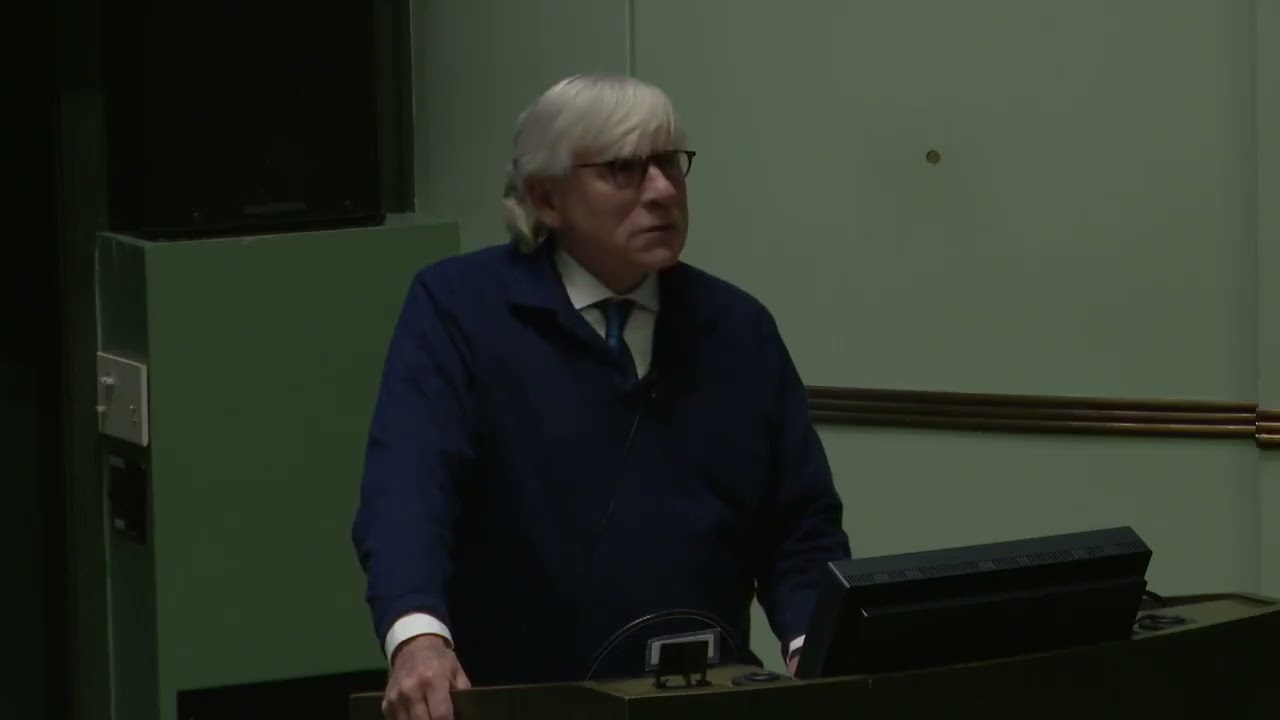
Bollinger Urges US Colleges to Form NATO-Style Defense Alliance
University of Michigan
Universities must unite under a collective defense charter because isolated campuses cannot survive coordinated authoritarian political assaults, Lee Bollinger argues.
Lee C. Bollinger warns that American universities face an unprecedented, coordinated authoritarian assault from governmental actors targeting admissions, hiring, curricula, and institutional funding. (12:16)
Bollinger proposes that higher education institutions establish a mutual defense charter modeled directly on NATO's Article V, treating an attack on one university's autonomy as an attack on all. (25:42)
Drawing on First Amendment doctrine, Bollinger argues universities should be recognized as a 'fifth branch of government' alongside the press, sharing a vital public truth-seeking mandate. (18:29)
Bollinger critiques rigid interpretations of institutional neutrality, differentiating between corporate board restraint, public leadership from university presidents, and the complete academic freedom of faculty. (46:13)
Detailed notes
## Background
Published on YouTube by the University of Michigan on October 22, 2026, this event is part of the speaker series "How to Speak Your Mind / How to Change Your Mind: The University Edition." The program features President Emeritus Lee C. Bollinger drawing from his book, "University: A Reckoning," to present a defense of higher education as an indispensable engine of truth-seeking in a diverse democratic society amidst rising political hostility.
## TL;DR
Lee C. Bollinger delivers a spirited defense of the American research university, highlighting its immense scientific, economic, and intellectual achievements while warning against unprecedented authoritarian political attacks seeking to dismantle academic autonomy. Framing higher education as a vital 'fifth branch of government,' Bollinger explains how the institution's core power lies in the 'scholarly temperament'—a disciplined, self-critical pursuit of truth and evidence-based reasoning. Drawing on his experience leading the historic Supreme Court defense of affirmative action, he urges universities to form a unified, Article V-style mutual defense coalition against outside political pressure. In an extended conversation moderated by Demetri Morgan, Bollinger also clarifies the practical distinctions between protected campus speech and harassment, critiques rigid interpretations of institutional neutrality, and advises scholars to ask consequential, big-picture questions.
## Atmosphere & style
The gathering feels deeply collegiate, principled, and intellectually urgent, balancing a celebratory homecoming for Bollinger with a sober assessment of existential threats to higher education. Bollinger speaks with measured gravitas and seasoned authority, interspersing dense constitutional insights with warm personal nostalgia and disarming, self-deprecating humor. The moderated exchange with Demetri Morgan fosters an engaged, interactive pedagogical dynamic that connects high-level legal doctrines to the immediate realities of campus life and student discourse.
## Bulletin
- [12:16](https://www.youtube.com/watch?v=oNrKKRsHbL0&t=736s) Lee C. Bollinger warns that American universities face an unprecedented, coordinated authoritarian assault from governmental actors targeting admissions, hiring, curricula, and institutional funding.
- [25:42](https://www.youtube.com/watch?v=oNrKKRsHbL0&t=1542s) Bollinger proposes that higher education institutions establish a mutual defense charter modeled directly on NATO's Article V, treating an attack on one university's autonomy as an attack on all.
- [18:29](https://www.youtube.com/watch?v=oNrKKRsHbL0&t=1109s) Drawing on First Amendment doctrine, Bollinger argues universities should be recognized as a 'fifth branch of government' alongside the press, sharing a vital public truth-seeking mandate.
- [46:13](https://www.youtube.com/watch?v=oNrKKRsHbL0&t=2773s) Bollinger critiques rigid interpretations of institutional neutrality, differentiating between corporate board restraint, public leadership from university presidents, and the complete academic freedom of faculty.
## Key takeaways
- [00:07](https://www.youtube.com/watch?v=oNrKKRsHbL0&t=7s) Free expression and academic freedom function as the indispensable conditions and foundational matrix that allow the modern research university to fulfill its truth-seeking mission.
- [03:59](https://www.youtube.com/watch?v=oNrKKRsHbL0&t=239s) The measurable achievements of American higher education over the past century—including technological patents, health advancements, Nobel Prizes, and economic growth—demonstrate unmatched institutional value.
- [12:16](https://www.youtube.com/watch?v=oNrKKRsHbL0&t=736s) Current political attacks use institutional flaws as a pretext to impose partisan control over academic disciplines, governance, and campus free speech.
- [13:38](https://www.youtube.com/watch?v=oNrKKRsHbL0&t=818s) First Amendment jurisprudence, established under Justice Oliver Wendell Holmes Jr. in 1919, recognizes that truth emerges through an open marketplace of ideas rather than the natural human impulse to suppress opposition.
- [18:29](https://www.youtube.com/watch?v=oNrKKRsHbL0&t=1109s) Universities and the press share an institutional duty to check authoritarian overreach and must form a mutual defense pact to safeguard democratic society.
- [20:56](https://www.youtube.com/watch?v=oNrKKRsHbL0&t=1256s) Higher education's core strength lies in the 'scholarly temperament,' an intellectual disposition prioritizing rigorous evidence, neutral observation, and an ongoing willingness to revise one's convictions.
- [25:42](https://www.youtube.com/watch?v=oNrKKRsHbL0&t=1542s) Universities must acknowledge the natural tension between incoming students' passionate activism and the institution's primary mandate for open-ended, objective exploration.
- [29:14](https://www.youtube.com/watch?v=oNrKKRsHbL0&t=1754s) The successful 2003 Supreme Court defense of affirmative action demonstrated that higher education can prevail when forging broad cross-sector coalitions with business and the military.
- [41:00](https://www.youtube.com/watch?v=oNrKKRsHbL0&t=2460s) Framing contentious campus dialogue around complexity rather than dogmatic certainty provides essential conversational space for students to disagree constructively.
- [46:13](https://www.youtube.com/watch?v=oNrKKRsHbL0&t=2773s) Institutional neutrality based on the 1967 Kalven Report has become overly rigid; governing boards must exercise restraint, but presidents should articulate core democratic values within their expertise.
- [55:55](https://www.youtube.com/watch?v=oNrKKRsHbL0&t=3355s) University trustees and regents must focus on fiscal oversight and general governance while refraining from micromanaging core academic decisions, which belong exclusively to faculty.
- [01:00:05](https://www.youtube.com/watch?v=oNrKKRsHbL0&t=3605s) A clear legal and operational line exists between protected offensive public protest and actionable, unprotected harassment when conduct singles out and targets an individual student in close proximity.
- [01:03:49](https://www.youtube.com/watch?v=oNrKKRsHbL0&t=3829s) Ideological imbalances among faculty cannot be corrected through government-mandated political hiring quotas, but require individual scholars to maintain pedagogical fairness in the classroom.
- [01:08:24](https://www.youtube.com/watch?v=oNrKKRsHbL0&t=4104s) Non-faculty administrative leaders and university staff hold immense structural influence in guiding institutional change and advancing student well-being.
- [01:14:43](https://www.youtube.com/watch?v=oNrKKRsHbL0&t=4483s) Early-career academics must resist the structural incentives of excessive hyper-specialization and instead ask broad, consequential research questions that significantly advance human understanding.
## Detailed walkthrough
### [00:07](https://www.youtube.com/watch?v=oNrKKRsHbL0&t=7s) Introduction: Academic Freedom, Free Expression, and the University Mission
Martha Pollack introduces the speaker series, *How to Speak Your Mind / How to Change Your Mind*, explaining that it launched the prior year alongside *Talking Maize and Blue*—an initiative designed to introduce incoming first-year University of Michigan students to the critical value of open inquiry. The event is sponsored by several groups: the Life Changing Education theme semester, Access and Opportunity, the University of Michigan Alumni Association, and Maize and Blue Courage, a dedicated volunteer organization of alumni and allies focused on defending institutional autonomy and academic freedom.
Pollack anchors the foundation of the gathering in a historical legal standard, invoking Supreme Court Justice Benjamin N. Cardozo's insight from nearly nine decades earlier. Cardozo characterized freedom of expression as the matrix and indispensable condition underlying almost every other freedom, meaning that without it, citizens lack the tool required to safeguard any other right. Pollack bridges this principle directly to the modern academy:
> “And free expression and the related notion of academic freedom are also the indispensable conditions of a true university.” — Martha Pollack
She stresses that universities exist to foster truth-seeking and learning both inside classrooms and across research labs, pursuits that become impossible if the freedom to explore all ideas is compromised. Yet, she observes, protecting free speech inside academia has always been difficult, and today the authority, autonomy, and values of the university confront unprecedented hostility.
- **Foundational principle**: Justice Benjamin N. Cardozo described freedom of expression as the indispensable matrix of all liberty.
- **Series background**: Launched in tandem with the *Talking Maize and Blue* first-year program to promote civil dialogue and rigorous questioning.
- **Key organizers and sponsors**: Life Changing Education theme semester, Access and Opportunity, U-M Alumni Association, and Maize and Blue Courage.
[01:50](https://www.youtube.com/watch?v=oNrKKRsHbL0&t=110s) Lee C. Bollinger's Academic Career and Introduction
Pollack introduces Lee C. Bollinger as one of the country's preeminent scholars of the First Amendment, having studied, written about, and taught free speech law for four decades at both Michigan Law and Columbia Law School. Beyond legal scholarship, Bollinger spent decades leading major institutions: Dean of the University of Michigan Law School (1987–1994), Provost of Dartmouth College (1994–1997), 12th President of the University of Michigan (1997–2001), and 19th President of Columbia University (2002–2023). These roles inform his book, *University: A Reckoning*, which sets the foundation for his address. Following the lecture, a moderated question-and-answer session is led by Demetri Morgan, Associate Professor of Education at the Marsal Family School of Education and affiliate faculty in Organizational Studies, whose scholarly work examines higher education’s responsibility in sustaining a diverse democracy.
Pollack closes with a personal reflection, recalling that while their tenures did not overlap during her first year and his final year at Michigan, they connected shortly after she became a university president herself. She notes that Bollinger was consistently accessible, generous with counsel, and welcoming:
> “I never walked away from a conversation with Lee without feeling more informed and better prepared to grapple with the difficult issues of free expression and of higher education in general.” — Martha Pollack
[03:59](https://www.youtube.com/watch?v=oNrKKRsHbL0&t=239s) Returning to Michigan and Affirming the Greatness of Higher Education
Taking the lectern, Bollinger reflects on his deep emotional and professional ties to Ann Arbor. He and his wife, Jean—an artist and co-founder of the Ann Arbor Hands-On Museum—arrived at the university when Bollinger was 27 to take up an assistant professorship at the law school. Over the course of 26 years on campus, he developed as a scholar, became an academic leader, and raised two children. Acknowledging Provost Laurie McCauley, Vice Provost Angela Dillard, and Martha Pollack, he notes that his lecture builds upon reflections he has pursued for decades, including an address previously delivered in the very same Rackham room, and captures the core thesis of *University: A Reckoning*.
Before addressing the contemporary crises, Bollinger lays out two overarching observations: an affirmation of what American universities have accomplished, followed by a sober warning regarding direct political attacks against them. He acknowledges that while universities are imperfect and require reform, critics cannot be permitted to use those weaknesses as a pretext:
> “Universities have many flaws, and there is plenty of room for improvement. But it is vital that we not allow those who would destroy universities to exaggerate our defects and misrepresent us to justify their improper ends.” — Lee C. Bollinger
Bollinger argues that any critique must begin by recognizing the extraordinary achievements of the American higher education system over the past century. Measurable evidence abounds:
- Contributions to national GDP and the creation of technologies that power modern life.
- Substantial commercial patents, scientific innovations, and Nobel Prizes awarded to university faculty and affiliates.
- Extended life expectancies and advancements in human health stemming directly from academic research.
- Enormous global demand from domestic and international students seeking access to American college classrooms.
- Significant lifetime earnings premiums achieved by college graduates.
[09:19](https://www.youtube.com/watch?v=oNrKKRsHbL0&t=559s) The Real Campus Experience vs. Sectors Beyond Higher Education
While quantitative indicators like GDP, patents, and income gains demonstrate success, Bollinger argues that the most compelling proof of higher education's worth is found simply by walking across a campus and engaging with the community:
> “Go up to any faculty member and ask them to talk about their field, and you will quickly be dazzled by the depth of their knowledge and their desire to share it.” — Lee C. Bollinger
He describes the sense of intellectual excitement one encounters when visiting laboratories, libraries, classrooms, and faculty offices, noting that students consistently describe their university years as transformative. This intellectual ecosystem did not occur by accident; it was built over a century of democratizing access, formalizing disciplines, securing research funding, and establishing a serious truth-seeking mission. Having spent over 60 years in higher education—progressing from undergraduate to professor, dean, provost, university president, and finally back to a faculty chair—Bollinger compares academia to other professional arenas he has encountered, including corporate business, government, media, politics, and religious institutions. He asserts that no other sector rivals the American university system in sheer creative capacity, mission-driven dedication, and day-to-day institutional integrity.
```mermaid
flowchart TD
accTitle: Evolution and Impacts of the American University System
accDescr: Diagram tracing the historical development of higher education to its measurable outcomes and campus culture.
subgraph Evolution["Centurylong Development"]
A["Democratization of Admissions"] --> B["Formal Academic Disciplines"]
B --> C["Federally & Privately Funded Research"]
end
subgraph Measurable["Concrete Outputs"]
C --> D["Economic Growth & Patents"]
C --> E["Nobel Prizes & Health Breakthroughs"]
C --> F["Student Social Mobility & Lifetime Earnings"]
end
subgraph Experience["The Campus Environment"]
D & E & F --> G["Active Labs, Classrooms & Libraries"]
G --> H["Unmatched Dedication, Talent & Integrity"]
end
```
[12:16](https://www.youtube.com/watch?v=oNrKKRsHbL0&t=736s) Political Interference and the Authoritarian Threat to Universities
Bollinger transitions directly to his second observation: higher education is facing an existential political assault from within the United States government itself. He warns that universities are being targeted with coercive levers designed to strip away their independence and subordinate them to partisan control. These interventions bypass established academic norms, targeting faculty hiring, departmental organization, admissions standards, disciplinary codes, curricular content, and campus diversity policies.
Bollinger describes how governmental pressure is being brought to bear:
- Initiating unfounded investigations and baseless legal actions against academic institutions.
- Threatening deportation proceedings against international students and faculty members for exercising protected free speech.
- Leveraging the power of the purse by threatening or enacting the withdrawal of federal funding for student financial aid, scholarships, and medical and scientific research.
He cautions that higher education is not being targeted in a vacuum. Similar pressures to control and silence independent judgment are simultaneously confronting the press, independent federal agencies, philanthropic foundations, the legal profession, and private business. In his assessment, these coordinated efforts represent an unmistakable shift toward an authoritarian governing style.
[13:38](https://www.youtube.com/watch?v=oNrKKRsHbL0&t=818s) Defending the University and the Constitutional Framework of Free Speech
Lee C. Bollinger warns of an ongoing assault on civil society's basic laws, norms, and institutions, with universities serving as a primary target of political campaigns aimed at discrediting hard-won academic achievements. While the ultimate outcome of these efforts to control and chill speech remains uncertain, the crisis forces higher education to define its role and mission with far greater clarity and force. Bollinger explains that this imperative drove him to write his book, *University: A Reckoning*, tracing the answers through constitutional history and the protections of freedom of speech and the press found in the First Amendment.
The modern Supreme Court jurisprudence on free speech began in 1919, coinciding directly with the birth of the modern American research university and the emergence of academic freedom. Justice Oliver Wendell Holmes Jr. laid out this framework, identifying two core forces: the search for truth and humanity's natural drive toward intolerance. Reading Holmes's famous dissent, Bollinger quotes: “Persecution for the expression of opinions seems to me perfectly logical. If you have no doubt of your premises or your power and you want a certain result with all of your heart, you naturally express your wishes in law and sweep away all opposition.” Holmes warned that suppressing views one hates is a natural instinct, but our constitutional experiment rests on a different premise: that the best test of truth is its ability to get accepted in the open competition of the market of ideas.
```mermaid
flowchart TD
accTitle: Holmes Free Speech Framework
accDescr: Chart showing how the human impulse to suppress opposition contrasts with constitutional truth-seeking.
subgraph NaturalImpulse["Human Natural Impulse"]
A["Conviction of Premises & Power"] --> B["Logic of Persecution & Censorship"]
B --> C["Suppression of Disfavored Views"]
end
subgraph ConstitutionalModel["Constitutional Truth-Seeking"]
D["Recognition of Fallibility"] --> E["Free Trade in Ideas / Market Competition"]
E --> F["Discovery of Truth & Knowledge"]
end
```
- In Holmes's view, allowing speech that opposes one's cherished goals can look like weakness or doubt, but history shows that time frequently upsets deep-seated "fighting faiths."
- The United States is founded without a state catechism, crown, or cult; it relies instead on independent-minded citizens navigating a complex, exhausting world of ideas to determine how they want to live.
[18:29](https://www.youtube.com/watch?v=oNrKKRsHbL0&t=1109s) Universities as the Fifth Branch of Government
Pursuing truth across an entire society requires scale, a unique intellectual mindset, and the collective strength to resist state repression. Bollinger points out that the Supreme Court recognized the press as an institution with a special First Amendment standing—often called the "Fourth Branch of Government"—because it adheres to professional standards of objectivity and possesses the institutional weight necessary to confront government overreach. He argues that universities serve a parallel purpose and deserve equal status as a fifth branch.
Both the press and the university exist to advance public understanding under the First Amendment principles outlined by Holmes. Because their societal mandates are aligned, they must form a mutual defense pact: when the press is attacked for reporting the truth, universities must stand up for it, and when universities face political interference, the press must actively defend academic inquiry. Bollinger summarized this institutional parity clearly: “If the press is deserving of having a special standing under the First Amendment as the fourth branch of government, so too should universities be regarded as the fifth.”
[20:56](https://www.youtube.com/watch?v=oNrKKRsHbL0&t=1256s) Four Pillars of University Success and the Scholarly Temperament
Bollinger identifies four distinct elements that account for the extraordinary success of American higher education. First, universities developed an organizational structure that seems completely irrational by standard corporate management theory, yet thrives through lifetime tenure, disciplinary specialization, and globally connected communities of scholars. Second is the continual infusion of young minds encountering the life of the mind for the first time. Third is the shared imperative that all scholars, students and faculty alike, must work to actively add to the inherited body of knowledge.
The fourth factor is what Bollinger terms higher education's "superpower": the scholarly temperament. This mindset is anchored by an uncompromising internal voice that continuously asks, *“but is it true?”* It demands neutral observation, fidelity to texts, rigorous reasoning, and a readiness to change one's mind whenever compelling arguments appear. This temperament does not prevent scholars from reaching strong conclusions or participating in public debates; rather, it provides a disciplined method of inquiry designed specifically for uncovering truth. Bollinger emphasizes: “To me, the scholarly temperament is our superpower. It is the special intellectual character that defines us.”
- Conventional organizational structures prioritize top-down control, whereas universities rely on decentralized faculty autonomy and tenure to foster long-term discovery.
- The scholarly temperament functions as a specialized, "mannerist" professional ethic: it is crucial for rigorous academic research, but it is not intended to serve as a comprehensive blueprint for the entirety of human emotional and moral life.
[25:42](https://www.youtube.com/watch?v=oNrKKRsHbL0&t=1542s) The Idealism of Youth and an Article V Defense Pact
Preserving the scholarly temperament is challenging when welcoming undergraduate students who are at a pivotal moment in identity formation. Seeing widespread real-world injustices, young people naturally feel an urgent pull toward social causes. Bollinger notes that while this passion is understandable—something he felt deeply in his own youth—it creates an inherent tension with the institution's primary purpose. Universities are not designed to serve as activist organizations taking on political causes; they are built for open-ended exploration. As Bollinger put it: “We are not, as a university, built to take on causes. We are explorers.”
To confront rising governmental hostility and external political pressure, institutions of higher education must abandon excessive campus isolationism in favor of unified solidarity. Bollinger proposes that universities establish a mutual defense charter modeled directly on NATO's Article V. Under this pact, an attack on the autonomy or academic freedom of one university would be treated as an attack on all. Bollinger concluded by introducing a landmark moment in this struggle at the University of Michigan: “In 1997, this university was sued over its long standing affirmative action policies and commitments.”
- Bollinger stresses that universities must openly acknowledge the tension between youthful activism and open-ended scholarly inquiry the moment students arrive on campus.
- While individual institutions zealously protect their local autonomy, Bollinger warns that institutional fragmentation leaves higher education vulnerable to coordinated political intimidation.
[29:14](https://www.youtube.com/watch?v=oNrKKRsHbL0&t=1754s) Defending Affirmative Action at the Supreme Court
Lee Bollinger concludes his opening lecture by revisiting the landmark legal battle fought over the University of Michigan's admissions policies. When a claim was filed arguing that these policies violated the Equal Protection Clause of the Fourteenth Amendment, it arrived at a time when such initiatives were under bitter, nationwide attack. Rather than settling or conceding ground, the university chose to mount an uncompromising defense of the principles and values at stake.
Bollinger recounts how Michigan rallied institutions from across society—building an unprecedented coalition that drew together other universities, major corporate businesses, the press, and the military:
> “The university won that case in 2003 in the United States Supreme Court.”
This legal triumph sustained the practice of affirmative action in American higher education for another quarter of a century. Beyond preserving that specific policy, Bollinger emphasizes that the institution demonstrated the vital lesson that diverse communities stand stronger when united, cementing the University of Michigan’s standing as an enduring model for the nation.
[31:00](https://www.youtube.com/watch?v=oNrKKRsHbL0&t=1860s) Framing the Dialogue: Prompts and Pedagogical Tools
Following a round of applause, Associate Professor Demetri Morgan takes the podium to open the discussion. Morgan introduces himself as a faculty member in the Marsal Family School of Education and the faculty director of Life-Changing Education, an initiative connected to the university's Look to Michigan campaign. Acknowledging that Bollinger’s address was conceptually deep and needed a moment to absorb, Morgan shifts the room into an interactive pedagogical exercise designed around two colored cards distributed to the audience:
- **Maize Card:** Prompts attendees to answer a reflective personal prompt: *“What is something that you once believed but now see differently? What changed your perspective?”* Responses are collected by team members in maize lanyards to seed discussions at the subsequent reception.
- **Blue Card:** Used by in-person attendees to submit written questions for Bollinger during the moderated Q&A.
- **Virtual QR Code:** Displayed on-screen so the live-streamed audience can submit questions directly to the moderators.
Morgan welcomes attendees—including his own introductory higher education class sitting in the audience—and praises Bollinger’s sustained advocacy for academic freedom and diversity, emphasizing his belief in “giving people their flowers while they're still here with us.”
[34:29](https://www.youtube.com/watch?v=oNrKKRsHbL0&t=2069s) The Demands of the Scholarly Temperament
Morgan directs the opening question to Bollinger’s treatment of the "scholarly temperament" in his book, *University: A Reckoning*. Reading directly from the text, Morgan highlights Bollinger's formulation of academic rigor: scholars cannot simply assert beliefs; they must grasp prior knowledge, explain where their work fits, credit intellectual forebears, confront counterarguments with genuine recognition of their merit, honestly entertain that they might be mistaken, and change their minds when the evidence requires it.
Morgan challenges Bollinger with a counter-position common in contemporary discourse:
> “So how would you respond to somebody who says everything you just shared with us is for a bygone era.”
Bollinger meets the prompt with immediate comedic timing, exclaiming, “I'm right, goddammit,” drawing laughter from the auditorium before offering an extended analytical response.
```mermaid
flowchart TD
accTitle: Critiques of the Scholarly Temperament
accDescr: Diagram contrasting external and internal critiques of scholarly neutrality with the academic ideal.
subgraph Critiques["Contemporary Challenges"]
EXT["External Critique: Humanities/Social Sciences have become partisan/ideological"]
INT["Internal Critique: Objectivity is an illusion; all work is inherently political"]
end
subgraph Ideal["The Scholarly Temperament"]
PR["Evidence-based reasoning and acknowledging prior scholarship"]
REV["Openness to error and willingness to change mind"]
end
EXT --> Ideal
INT --> Ideal
```
Bollinger acknowledges that the university faces sustained pressure from both outside and inside its walls:
- **External Critiques:** Accusations that fields like the humanities and social sciences have abandoned true scholarly inquiry to advance partisan, liberal ideological agendas.
- **Internal Critiques:** Arguments from within academia asserting that intellectual neutrality is antiquated or mythical, arguing scholars should frankly embrace overt ideological stances, a debate Bollinger notes is equally prevalent in journalism.
Bollinger defends the traditional academic ethos as a living standard rather than a dead ritual. While acknowledging human flaws—such as departments in physics or economics settling into ideological orthodoxies—he stresses that scholarly legitimacy still requires providing verifiable reasons, evidence, and recognition of alternative views. In a humorous aside, Bollinger points out that the true test of this ethos is becoming a university president: in administrative and public life, one realizes they can deflect questions without offering intellectual justification, a practice that feels strangely liberating after decades of faculty life spent exhausting oneself by having to ground every single claim in reason.
[41:00](https://www.youtube.com/watch?v=oNrKKRsHbL0&t=2460s) Advice for Navigating Controversial Campus Speech
Turning to audience submissions, Morgan reads a question addressing campus discourse: how students can voice controversial viewpoints without shutting down dialogue in environments marked by strong, divergent opinions.
Bollinger asserts that the entire outcome hinges on conversational tone and intellectual humility:
> “I frequently encourage students in my class to begin with the classic academic way to answer a question, and that is to start by saying it's complex.”
Framing an issue as "complex" forces the speaker to examine competing layers of an issue and leaves open space for conversational partners to disagree without escalating into confrontation. Bollinger argues that declaring absolute conclusions upfront naturally closes inquiry. Because standard human instinct defaults to dogmatic assertion, he underscores that engaging in open, receptive dialogue is an acquired academic skill that universities have an explicit duty to teach students.
[42:55](https://www.youtube.com/watch?v=oNrKKRsHbL0&t=2575s) Free Speech as Counterintuitive and the Rising Assault on Truth
Demetri Morgan turns the conversation toward Bollinger’s decades of leadership, asking him to reflect on how universities approach free expression today compared to twenty years ago during his presidencies at Michigan and Columbia. Bollinger begins by noting that free speech is never an abstract, static doctrine—he finds fresh hypotheticals for his classes literally every single morning by checking the news. Yet its fundamental difficulty remains unchanged because embracing free speech runs contrary to basic human instinct. Invoking Oliver Wendell Holmes Jr., Bollinger emphasizes that tolerating speech we despise requires disciplined, unnatural restraint: “We don’t naturally embrace freedom of speech.” Every incoming class of students must be educated in this counterintuitive principle, just as faculty and leaders must continually teach themselves to protect it.
While the internal difficulty of defending free speech has remained constant throughout his career as a dean and president, Bollinger identifies one stark, alarming change in the contemporary climate: the direct weaponization of government power to penalize specific viewpoints and dictate intellectual inquiry. Pointing to growing political intrusion into independent agencies and academic freedom, Bollinger warns that the current hostility toward the objective pursuit of knowledge is unprecedented in modern history. “We do believe in the university world, and that is more serious than anything in my lifetime,” Bollinger observes regarding this external assault.
[46:13](https://www.youtube.com/watch?v=oNrKKRsHbL0&t=2773s) Institutional Neutrality: Deconstructing the Kalven Report
Morgan connects higher education’s truth-seeking mandate to the fractured media landscape, where universities are increasingly viewed as a crucial fourth branch of civic defense. In this polarized environment, debates over institutional neutrality have erupted: should academic leaders issue official statements on major global and political crises, or does doing so silence campus discourse? Bollinger responds directly: “It's gone way overboard, this whole thing of institutional neutrality.” Tracing the concept back to the 1967 Kalven Committee at the University of Chicago—led by First Amendment scholar Harry Kalven Jr. amid protests over the Vietnam War—Bollinger notes that the original report was merely a concise, few-page memo concluding that universities should not take institutional stances because doing so chills the essential debates of students and faculty.
```mermaid
flowchart TD
accTitle: Three Tiers of University Expression
accDescr: Diagram illustrating Bollinger's distinction between institutional governance, university presidents, and individual faculty members regarding public stances.
subgraph Institutional ["The University as an Institution"]
A["Governing Boards & Central Admin"] -->|"Strict restraint"| B["Avoid policy endorsements\n(e.g., tax policy, Middle East conflicts)"]
A -->|"Rare, vital exceptions"| C["Fundamental moral/academic issues\n(e.g., South African apartheid, climate deceit)"]
end
subgraph Leadership ["The University President"]
D["Presidential Voice"] -->|"Exercise expertise"| E["Public defense of free expression & press"]
D -->|"Reaffirm societal values"| F["Speaking out on systemic racism\n(e.g., murder of George Floyd)"]
end
subgraph Faculty ["Faculty & Academics"]
G["Scholars & Researchers"] -->|"Uninhibited public positions"| H["Engage controversial public debates\n(e.g., constitutional law, reproductive rights)"]
H -->|"Requirement"| I["Maintain scholarly temperament"]
end
```
Bollinger argues that modern discourse has flattened this issue by failing to disaggregate universities into distinct actors:
- **The Institution (Regents, Trustees, and Central Administration):** As a corporate entity, the university must remain strictly restrained. Regents and provosts should not endorse specific political outcomes, such as a two-state solution in the Middle East or specific tax policies on billionaires. However, absolute neutrality is a myth; universities have historically—and appropriately—taken moral stances on grave issues such as divestment from apartheid in South Africa, private prisons, and corporate deceit surrounding climate science.
- **The President:** Decades ago, critics complained that university presidents had been reduced to bureaucratic technicians rather than public intellectuals. Bollinger maintains that presidents should speak out within their areas of expertise—such as free speech and civil rights—and articulate broad consensus values. For instance, following the murder of George Floyd, Bollinger felt obligated to speak to the enduring 300-year reality of systemic racism without prejudging specific legal proceedings.
- **The Faculty:** Faculty members must enjoy complete freedom to take public stances on contentious issues, whether debating *Roe v. Wade* or government policy, provided they engage with rigorous scholarly temperament and reasoned argument.
[50:40](https://www.youtube.com/watch?v=oNrKKRsHbL0&t=3040s) Affirmative Action and Building Collective Action Across Civil Society
Morgan asks Bollinger to bridge the gap between institutional restraint and collective action, referencing Bollinger’s reflections in his book about organizing a nationwide coalition to defend affirmative action alongside figures like former President Gerald Ford. Bollinger recalls arriving as president of Michigan in 1997, only to be notified within months that legal groups opposed to race-conscious admissions intended to sue the university. With California having enacted Proposition 209 and the Fifth Circuit striking down affirmative action in Texas (*Hopwood v. Texas*), an aggressive anti-affirmative action wave was sweeping the nation.
```mermaid
flowchart LR
accTitle: The Michigan Affirmative Action Defense Coalition
accDescr: Flowchart showing the diverse societal sectors Bollinger assembled to defend affirmative action in the Supreme Court.
subgraph Defense ["University of Michigan Defense"]
UM["University of Michigan\n(Refusal to settle on core principle)"]
end
subgraph Coalition ["Broad Civil Society Coalition"]
HE["Higher Education\n(Public and private universities)"]
CORP["Corporate Sector\n(50–60 Fortune 500 corporations)"]
MIL["Military Leadership\n(Retired military leaders & academies)"]
CIV["Bipartisan Civic Figures\n(Former President Gerald Ford)"]
end
UM --- HE
UM --- CORP
UM --- MIL
UM --- CIV
Coalition --> SCOTUS["U.S. Supreme Court\n(Grutter v. Bollinger)"]
```
Bollinger made the deliberate choice not to settle, viewing affirmative action as a direct imperative flowing from *Brown v. Board of Education*. After two decades of desegregation efforts following *Brown*, higher education institutions in the early 1970s had recognized that their classrooms remained almost entirely white and male, prompting voluntary efforts to build diverse student bodies. Understanding that a loss under the Equal Protection Clause of the Fourteenth Amendment or Title VI of the Civil Rights Act of 1964 would dismantle diversity across both public and private universities nationwide, Bollinger recognized that Michigan could not stand alone: “And I knew as president, and because this is my field and so on, I knew if this were just left to be a University of Michigan case, we would be dead.”
Building the defense required overcoming deep institutional reluctance:
- **Higher Education Alliances:** Universities naturally resisted attaching themselves to a high-profile defendant, requiring intense persuasion to convince peers that the litigation posed an existential threat to all of higher education.
- **Corporate Amicus Briefs:** Michigan organized an unprecedented coalition of fifty to sixty major American corporations that filed amicus briefs arguing that modern global commerce requires racially and culturally diverse leadership.
- **The Military Strategy:** While vacationing on Nantucket, Bollinger had lunch with author David Halberstam, who noted that senior leaders connected to the military academies recognized that the armed forces could not function effectively without a diverse officer corps. This insight led to a pivotal amicus brief from high-ranking retired military leaders.
Bollinger emphasizes that this historical battle offers a vital roadmap for the present day. When democratic norms face authoritarian pressure, political science teaches that isolated sectors cannot survive on their own. Resistance succeeds only when business, the military, academia, and civil society transcend their private silos to form a united front and declare that enough is enough.
[55:55](https://www.youtube.com/watch?v=oNrKKRsHbL0&t=3355s) Governing Boards, Institutional Flaws, and State Interference
Moderator Demetri Morgan transitions from the previous discussion of coalition-building across sectors to an audience question submitted online. The question challenges the notion of placing sole blame on the government for campus speech controversies: “blaming the government solely for what's happening in universities seems somewhat contrived. Many limits of free expression on campus predate the current federal government. How do you explain that? What role do boards or regents have to play? Is there a way to restore balance?” Morgan emphasizes that while he did not write the question himself, the inquiry into the governing role of boards and regents is urgent.
Lee Bollinger acknowledges the multifaceted nature of the question, readily granting that universities possess deep institutional flaws. He notes that he is often “right at the front of the line in criticizing universities,” yet insists that these self-inflicted shortcomings must not be leveraged as an excuse for external encroachment: “Big problem is that I'm not going to accept the criticisms of universities as a justification to allow what's happening.” While conceding that universities have indeed suppressed free expression in the past, he points out that political interference extends far beyond the federal level into state politics, calling the actions taken against universities in Texas—particularly Texas A&M—and Florida “shocking.”
Turning to governing bodies, Bollinger describes the role of university trustees and regents as a delicate, high-stakes balance. While boards must manage fiscal propriety and institutional governance, core academic decisions must remain insulated within faculty governance:
- Academic boundaries: Fundamental determinations—such as admissions standards, scholarly agendas, and departmental structures—are deliberately vested in the faculty and individual schools rather than the governing board.
- Trustee overreach: Drawing on his own extensive service on various boards, Bollinger observes a recurring, dangerous impulse where a trustee reasons, “boy, I'm ultimately responsible for this institution,” leading to micromanagement. As Bollinger emphasizes, “And that tendency to get overinvolved is really powerful sometimes and really bad in an academic community.”
---
[01:00:05](https://www.youtube.com/watch?v=oNrKKRsHbL0&t=3605s) Drawing the Line: Protected Speech, Harassment, and "Fighting Words"
Morgan moves to another central topic raised by attendees: where to draw the boundary between constitutionally protected expression and conduct that deteriorates into harassment, disruption, or the targeted abuse of marginalized and minoritized groups. Bollinger lights up at the question, noting that he has taught an undergraduate class on the First Amendment every year—including throughout his entire tenure as president—and that this exact puzzle is where his current syllabus sits.
To illuminate the legal and operational boundaries, Bollinger invokes a campus hypothetical set on the University of Michigan Diag. In his scenario, a protest is met by counter-protesters, and demonstrators exchange harsh, vitriolic insults across the lawn, shouting things like “we're going to get you, or you're awful.” Bollinger explains that as harsh and offensive as that collective exchange may be, it remains constitutionally protected speech. The dynamic shifts fundamentally, however, when a demonstrator singles out an individual student peacefully walking across campus carrying books, closes in, and screams offensive language directly into their face. At that juncture, the conduct ceases to be protected discourse and becomes actionable harassment and “fighting words.”
Bollinger argues that while these legal boundaries are difficult and nuanced, university administrations must invest the effort to draw and enforce them:
```mermaid
flowchart TD
accTitle: Free Speech versus Harassment Spectrum
accDescr: Diagram illustrating the shift from constitutionally protected group expression on campus to unprotected targeted harassment.
subgraph Protected["Protected Public Discourse"]
P1["Diag demonstrations"]
P2["Counter-protest exchanges"]
P3["Offensive or vitriolic group rhetoric"]
end
subgraph Shift["Threshold of Action"]
T["Targeting a solitary individual in close proximity"]
end
subgraph Unprotected["Unprotected Conduct"]
U1["Personalized harassment"]
U2["Fighting words"]
U3["Incitement to violence"]
end
Protected --> T --> Unprotected
```
Bollinger stresses that upholding these principles requires university leadership to provide absolute transparency about the rules and maintain an unflinching disciplinary mechanism for violations: “And that I think has been lacking on a lot of campuses. And that creates just enormous, bigger problems.”
---
[01:03:49](https://www.youtube.com/watch?v=oNrKKRsHbL0&t=3829s) Political Diversity, Conservative Voices, and the Limits of Mandated Reform
Morgan reads an inquiry from an undergraduate studying political science who notices an absence of conservative professors, guest speakers, and campus forums, asking how institutions can recruit more ideologically diverse voices so that students' views can be rigorously tested and refined. Bollinger validates the critique, calling it both legitimate and extraordinarily complex. He concedes that faculty representation in numerous academic departments and professional schools leans overwhelmingly toward Liberal Democrats.
However, Bollinger contends that ideological asymmetry among faculty is not, by itself, proof of pedagogical failure. The critical analytical question is whether an instructor's personal politics improperly skews their teaching and research. He shares his own pedagogical code: in his First Amendment courses, he considers it an absolute duty to rigorously lay out every perspective, from global counter-models—such as what he calls the “China view” or “Singapore view” that rejects free expression—to international prohibitions against hate speech, an area where the United States stands virtually alone.
While Bollinger notes that departments and law schools have actively sought qualified conservative scholars, he forcefully rejects proposed state mandates and compacts that seek to force political hiring quotas or ban campus criticism:
> “Well, I mean, come on. Have you ever heard of free speech? And we're not going to have a law on the campus that says no [disparaging] thing critical of conservative ideas. So the remedies that are being proposed for what may be a serious problem and is sometimes [real] are completely out of whack with the problem.”
Bollinger insists that academic standards cannot be compromised to manufacture balance: hiring must always be rooted in genuine scholarship and teaching capability rather than ideological identity.
---
[01:07:06](https://www.youtube.com/watch?v=oNrKKRsHbL0&t=4026s) Staff Roles: Navigating Social Justice Within Institutional Constraints
Morgan pivots the dialogue from faculty and executive administrators to the broad segment of university staff. He asks what advice Bollinger has for staff members who are passionate about social justice efforts but must operate within institutional limits. When Bollinger asks for clarification on what specific dynamic the questioner is pointing toward, Morgan elaborates on the vulnerable structural position that staff occupy within the higher education hierarchy:
- Staff members—such as hall directors in residence halls, study abroad coordinators, and academic advisors—do not enjoy the procedural protections of faculty tenure.
- Unlike upper-level executive administrators, staff are not the primary architects bound to official institutional neutrality, yet they face organizational boundaries while striving to advance equity and student support.
- Many university staff members enter higher education explicitly inspired by the institutional mission, finding themselves caught between personal social justice commitments and the operational limits of the institution.
[01:08:24](https://www.youtube.com/watch?v=oNrKKRsHbL0&t=4104s) The Vital Role of University Staff in Institutional Change
Demetri Morgan relays an audience question asking about potential limits universities place on staff members who seek to pursue social justice within their roles, asking Lee Bollinger what that tension looks like from leadership's vantage point. Bollinger begins by noting that he is trying to uncover what underlies the question, confessing that he dislikes the term "staff" because he views them as full "people in the community who are other than faculty." Drawing on his decades as a law school dean and university president, Bollinger explains that he spent an enormous amount of time collaborating with non-faculty administrative leaders—such as deans of students, admissions officers, and communications teams—and emphasizes the massive imprint they leave on an institution.
Bollinger asserts that if an individual holds a clear vision for institutional reform or social change, working in university administration is a powerful and viable path to enact it. While acknowledging that he does not know of specific rules barring staff from expressing viewpoints without concrete examples in hand, he underlines the profound value of administrative roles. As Bollinger puts it, “I do want to affirm that people who are in roles in the administration of the institution can have a very important effect on the course of that university and universities generally.”
[01:10:21](https://www.youtube.com/watch?v=oNrKKRsHbL0&t=4221s) The Greatest Lesson: The Thrill and Love of Ideas
Turning toward reflective leadership questions, Morgan asks Bollinger to name the single greatest lesson he took away from his lifelong career in education. Bollinger pauses thoughtfully before pinpointing it not as a management tactic, but as a deep, enduring intellectual joy: the pure love of ideas, understanding, and the sensation of learning something novel about the world. He calls that feeling an “unbelievable part of life,” explaining that universities are unique because they are constantly saturated with those moments of discovery.
Recalling his own career milestones, Bollinger describes the visceral excitement of discovering a fresh insight that made him think, "wow, wow," immediately wanting to share the realization with his wife and colleagues. That sensation, he explains, never fades—even after decades of teaching, every single class reveals an angle or nuance on a topic that he had never noticed before. He stresses that for anyone who cherishes intellectual discovery, the university setting remains an unmatched and thrilling environment.
[01:12:06](https://www.youtube.com/watch?v=oNrKKRsHbL0&t=4326s) Resisting Hyper-Specialization and Career Regrets
Morgan follows up by asking what Bollinger wishes he had spent more time focusing on throughout a career that spanned from student to two-time university president. Bollinger points directly to the hazard of hyper-specialization, an institutional force that academia heavily demands and incentivizes. He recalls hitting an intellectual wall around the age of 40, realizing he was continuously turning over the exact same legal questions in his mind. Seeking a way to retain his core intellectual interests while tackling broader real-world challenges, he pursued a deanship, finding administrative leadership to be the perfect counterweight to scholarly stagnation.
Bollinger reflects on how difficult it is for mid-career academics—at age 50 or 60—to branch out into completely new domains, noting that while academic freedom permits it in theory, the structural pressures to remain an established expert in a narrow subfield are immense. Looking back outside of academia, Bollinger notes one concrete regret: he wishes he had stepped away for a couple of years to serve in government, viewing external public service as a valuable experience that would have enriched his perspective.
```mermaid
flowchart TD
accTitle: Academic Specialization Dilemma
accDescr: The trade-offs between narrow academic specialization and branching out into leadership or outside service.
A["Academic Specialization"] -->|"Intense Institutional Pressure"| B["Deep Subfield Expertise"]
B -->|"Risk at Mid-Career (~Age 40+)"| C["Intellectual Repetition"]
C --> D["Branching Paths"]
D -->|"Administrative Leadership"| E["Deanship / Presidency (Broad Impact)"]
D -->|"External Public Service"| F["Government Experience (Bollinger's Wish)"]
D -->|"Intellectual Pivots"| G["New Fields (High Resistance/Bravery Needed)"]
```
[01:14:43](https://www.youtube.com/watch?v=oNrKKRsHbL0&t=4483s) Advice for Emerging Scholars: Asking the Big Questions
For the final question of the dialogue, Morgan asks Bollinger what advice he would offer to early-career scholars and practitioner-stewards seeking to shape the future of higher education. Bollinger references an observation from his book, *University: A Reckoning*, concerning the psychological trap of tenure. He warns that when a scholar earns tenure and finally achieves total academic freedom, it becomes a perilous moment because they suddenly face the daunting responsibility of deciding what truly matters and what is genuinely creative.
While narrow specialization undeniably advances human knowledge brick by brick, Bollinger urges emerging scholars not to get trapped in comfortable obscurity. Early in his career, a mentor told him that the specific question a scholar decides to investigate is the single most defining choice of their academic life. Therefore, researchers must continually step back, evaluate the broader significance of their inquiries, and ask whether they are pursuing issues of substantial consequence. As Bollinger puts it: “And somebody said to me early on, the question you ask is probably the most important step in your academic career.”
[01:16:32](https://www.youtube.com/watch?v=oNrKKRsHbL0&t=4592s) Closing Remarks by Vice Provost Angela Dillard
Morgan concludes the session by inviting the audience to applaud Bollinger, then turns the lectern over to Angela Dillard, Vice Provost for Undergraduate Education and Interim Vice Provost for Access and Opportunity, for official closing remarks. Dillard thanks both Bollinger and Morgan on behalf of the event's co-sponsors and expresses gratitude to the national online audience, noting the university's partnership with alumni across the country who tuned in via livestream.
Dillard invites the in-person attendees across the hall to Rackham's reception area for refreshments and dialogue, highlighting a public display of cards where participants wrote down things they had changed their minds about and the conditions that prompted their shifts. Finally, Dillard previews the next installment in the *How to Speak Your Mind / How to Change Your Mind* initiative: a student-centered event scheduled for the following week featuring FIRE (the Foundation for Individual Rights and Expression), organized in partnership with campus Open Inquiry Student Fellows across undergraduate and graduate cohorts. Dillard directs attendees to the Happening @ Michigan calendar for details before closing the evening.
- **Upcoming Event:** A student-oriented discussion hosted by the *How to Speak Your Mind / How to Change Your Mind* series alongside FIRE (Foundation for Individual Rights and Expression) and Open Inquiry Student Fellows.
- **Post-Event Activity:** A reception across the hall featuring refreshments and a visual display of attendee-submitted reflection cards exploring what led individuals to change their minds.
## Notable quotes
> [18:29](https://www.youtube.com/watch?v=oNrKKRsHbL0&t=1109s) If the press is deserving of having a special standing under the First Amendment as the fourth branch of government, so too should universities be regarded as the fifth. — Lee C. Bollinger
> [03:59](https://www.youtube.com/watch?v=oNrKKRsHbL0&t=239s) Universities have many flaws, and there is plenty of room for improvement. But it is vital that we not allow those who would destroy universities to exaggerate our defects and misrepresent us to justify their improper ends. — Lee C. Bollinger
> [25:42](https://www.youtube.com/watch?v=oNrKKRsHbL0&t=1542s) We are not, as a university, built to take on causes. We are explorers. — Lee C. Bollinger
> [20:56](https://www.youtube.com/watch?v=oNrKKRsHbL0&t=1256s) To me, the scholarly temperament is our superpower. It is the special intellectual character that defines us. — Lee C. Bollinger
> [00:07](https://www.youtube.com/watch?v=oNrKKRsHbL0&t=7s) free expression and the related notion of academic freedom are also the indispensable conditions of a true university. — Martha Pollack
> [01:14:43](https://www.youtube.com/watch?v=oNrKKRsHbL0&t=4483s) the question you ask is probably the most important step in your academic career. — Lee C. Bollinger
## Mentioned
University of Michigan, Lee C. Bollinger, Martha Pollack, Demetri Morgan, Angela Dillard, Laurie McCauley, Jean Bollinger, Benjamin N. Cardozo, Oliver Wendell Holmes Jr., Harry Kalven Jr., Gerald Ford, David Halberstam, University: A Reckoning, Supreme Court of the United States, Columbia University, Dartmouth College, Cornell University, Marsal Family School of Education, Ann Arbor Hands-On Museum, Kalven Committee, Foundation for Individual Rights and Expression
## Video description
How to Speak Your Mind / How to Change Your Mind: The University Edition with President Emeritus Lee C. Bollinger
This speaker series is designed to encourage the campus community to think – and talk with one another – about what it means to develop an informed opinion and stand your ground when challenged; and about changing your mind in light of new evidence, different perspectives, and serious reflection. In our Fall 2026 installment we take up the topic of the university itself at a time when its value and values have come under attack amidst calls for reform.
In University: A Reckoning, Lee C. Bollinger, president emeritus of the University of Michigan and Columbia University, offers a bold defense of institutions of higher education as an essential source of truth-seeking in diverse democratic societies. "The university must be defended," he argues, "if the American experiment is to continue." Drawing from his new book and from decades as an academic leader Bollinger will explore the challenges facing higher education today and what universities can and should do to insure the conditions necessary for open inquiry and meaningful intellectual exchange.
Demetri Morgan, associate professor in the Marsal Family School and Faculty Director for the Life Changing Education Theme Year will serve as moderator; the event will be introduced by Martha Pollack, former president of Cornell and former provost and executive vice president for academic affairs at the U-M.
October 8, 2026
Rackham Amphitheater
A version of this video without audio descriptions is available here: https://www.youtube.com/watch?v=7LSDZBUV7eA
Former University of Michigan and Columbia University president Lee C. Bollinger argues that American universities represent an indispensable engine of knowledge and democracy, yet they now confront an unprecedented authoritarian assault that requires cross-sector collective defense.
Academic Accomplishments and the Scholarly Temperament (3:59)
Bollinger anchors his defense of higher education in its century-long record of measurable contributions, including national GDP growth, commercial patents, Nobel Prizes, increased life expectancy, and significant graduate earnings premiums. Beyond economic and scientific metrics, he describes the campus environment as an unmatched ecosystem of mission-driven integrity, sustained by an organizational design that pairs lifetime tenure and disciplinary specialization with the continuous infusion of incoming students.
Authoritarian Threats and Political Encroachment (12:16)
Bollinger warns that universities face direct political interference from within government that threatens academic independence. These pressures include baseless investigations, threats of deportation against international scholars for exercising protected speech, and proposed revocations of federal research and financial aid funding. Pointing to interventions across state systems such as Texas and Florida, Bollinger contends that attempts to dictate hiring, curriculum, and admissions reflect a broader authoritarian shift that mirrors pressures placed on the press, the judiciary, and private enterprise.
First Amendment Jurisprudence and Institutional Standing (13:38)
Grounding his analysis in Oliver Wendell Holmes Jr.'s 1919 free speech opinions, Bollinger highlights the constitutional insight that truth emerges through an open market of ideas rather than the natural human impulse to persecute opposing views. Because the press holds special First Amendment standing as a fourth branch of government checking state overreach, Bollinger argues that research universities function as a fifth branch dedicated to public understanding, requiring both sectors to form a mutual defense pact.
Dismantling Absolute Neutrality and Disaggregating Expression (46:13)
Addressing campus neutrality debates stemming from the 1967 Kalven Report, Bollinger argues that contemporary discourse has gone overboard by failing to separate the university into distinct components. Governing boards and central administrations must exercise strict restraint regarding public policy debates, stepping in only on core moral or institutional issues such as apartheid divestment or climate deceit. Conversely, university presidents should use their expertise to speak on foundational values, while faculty must retain total freedom to take controversial public stances through rigorous, reasoned argument.
Defending Free Speech, Governance, and Diversity (50:40)
Drawing legal distinctions on campus discourse, Bollinger emphasizes that harsh or vitriolic protest rhetoric remains constitutionally protected, whereas singling out an individual student in close proximity becomes actionable harassment and fighting words. Regarding affirmative action, he cites Michigan's 2003 Supreme Court victory—won by forging coalitions with Fortune 500 corporations and retired military leadership—as proof that higher education cannot defend its autonomy in isolation and must build broad alliances across civil society.
Bollinger urges universities to abandon campus isolationism and establish an Article V-style mutual defense pact against external political intimidation. While acknowledging internal challenges such as ideological imbalances among faculty and the risks of hyper-specialization, he maintains that academic standards and governance must remain anchored in scholarly inquiry rather than government-imposed mandates.
[18:29] Lee C. Bollinger: If the press is deserving of having a special standing under the First Amendment as the fourth branch of government, so too should universities be regarded as the fifth.
[3:59] Lee C. Bollinger: Universities have many flaws, and there is plenty of room for improvement. But it is vital that we not allow those who would destroy universities to exaggerate our defects and misrepresent us to justify their improper ends.
[25:42] Lee C. Bollinger: We are not, as a university, built to take on causes. We are explorers.
[20:56] Lee C. Bollinger: To me, the scholarly temperament is our superpower. It is the special intellectual character that defines us.
[0:07] Martha Pollack: free expression and the related notion of academic freedom are also the indispensable conditions of a true university.
[74:43] Lee C. Bollinger: the question you ask is probably the most important step in your academic career.
Original transcript
[0:07] MARTHA POLLACK: I am really
delighted and really honored
[0:10] to introduce today's
speaker in this series,
[0:12] How To Speak Your Mind, How
To Change Your Mind, which
[0:15] was launched last year in
conjunction with Talking Maize
[0:18] and Blue, a program that
introduces all first year
[0:21] students here at
Michigan to the idea
[0:23] and the importance
of open inquiry.
[0:26] Sponsors of this series include
the life-changing education
[0:29] theme semester, access and
opportunity, the University
[0:33] of Michigan Alumni
Association, and Maize
[0:36] and Blue Courage, a
volunteer organization
[0:39] of the University of Michigan.
[0:43] Alumni and allies dedicated
to defending academic freedom
[0:47] and institutional autonomy.
[0:49] We are so pleased to
have them here with us
[0:51] for today's conversation
about free expression.
[0:55] Nearly 90 years ago, Supreme
Court Justice Benjamin Cardoso
[1:00] famously wrote that
freedom of expression
[1:03] is the matrix, the indispensable
condition of nearly
[1:07] every other form of freedom.
[1:09] And his point, of course, was
that without free expression,
[1:12] citizens cannot effectively
defend their other rights.
[1:17] And free expression
and the related notion
[1:19] of academic freedom are also
the indispensable conditions
[1:23] of a true university.
[1:24] Without them, universities
cannot fulfill their central
[1:27] mission of learning
and truth-seeking,
[1:30] whether in the classroom
or in research,
[1:32] because learning and
truth-seeking require
[1:34] the ability to
explore all ideas.
[1:37] But upholding free expression
in the academy has always
[1:40] been difficult. And
today, that core value,
[1:43] and with it, the autonomy and
authority of the university,
[1:47] are facing
unprecedented attacks.
[1:50] I can think of no
one who is better
[1:52] suited to speak to these
issues than Lee Bollinger.
[1:56] Lee is one of the country's most
prominent and most thoughtful
[1:59] voices on free expression, a
topic he has studied and written
[2:02] about for four decades.
[2:05] He has also taught
first Amendment law,
[2:07] both here at the
University of Michigan
[2:09] and at Columbia Law School.
[2:11] And he's had a long and
distinguished career
[2:13] as a University Administrator,
Dean of the Law School here
[2:16] at Michigan from 1987 to 1994,
Provost at Dartmouth from 1994
[2:21] to 1997, the 12th President of
the University of Michigan from
[2:25] 1997 to 2001, and then finally
19th President of Columbia
[2:30] University from 2002 to 2023.
[2:35] These experiences
have provided him
[2:37] with a particularly rich
perspective on free expression
[2:40] in the university, the
subject of his recent book,
[2:43] University, A Reckoning,
and of today's lecture,
[2:47] which will be followed by
a conversation and open Q&A
[2:50] session moderated
by Demetri Morgan.
[2:53] Professor Morgan is
Associate Professor
[2:56] of Education at the University
of Michigan's Marcell Family
[2:59] School of Education in
the Center for the Study
[3:01] of Postsecondary
and Higher Education
[3:03] and is also an
affiliate faculty member
[3:05] in organizational studies.
[3:10] His research focuses
on the critical role
[3:12] that higher education
institutions
[3:14] play in fostering a
diverse democracy.
[3:20] Before I turn the podium
over to Lee Bollinger,
[3:22] I'd like to add a personal note.
[3:24] I've known Lee
for quite a while.
[3:26] Although we never met in what
was his last and my first year
[3:29] here at Michigan, I
was introduced to him
[3:32] shortly after I became
a university president.
[3:34] And I deeply
appreciated the fact
[3:36] that he was genuinely welcoming,
always willing to listen, always
[3:40] willing to provide guidance.
[3:42] I never walked away
from a conversation
[3:44] with Lee without feeling
more informed and better
[3:47] prepared to grapple with
the difficult issues
[3:50] of free expression and of
higher education in general.
[3:53] Please join me in
welcoming Lee Bollinger.
[3:56] [APPLAUSE]
[3:59] LEE BOLLINGER:
Thank you, Martha.
[4:09] It is a very, very
great pleasure for me
[4:12] to be with you this afternoon.
[4:16] This means more to me
than you would know.
[4:20] The University of
Michigan is where
[4:22] I began my career
in academia, and it
[4:26] is where I matured into a
scholar and an academic leader.
[4:32] It is where my wife, Jean,
an artist, who was also
[4:36] a founder of the Ann
Arbor Hands-On Museum,
[4:40] and I raised our two children.
[4:44] It has accordingly
an irreplaceable hold
[4:48] on my professional
and personal life.
[4:51] Just about everything
I will say to you today
[4:54] has its roots in the formative
experiences of the decades
[5:00] I spent here.
[5:03] Let me acknowledge Provost
Laurie McCauley, Vice Provost
[5:07] for Undergraduate Graduate
Education Dr. Angela Dillard,
[5:12] and my good friend and
colleague Martha Pollack.
[5:16] And Demetri, I look forward
to our conversation.
[5:21] Let me turn to the
substance of my remarks.
[5:24] I know you are thinking
here about the very special
[5:28] intellectual character of
academic life, about what it is
[5:32] and about how to preserve it.
[5:34] I too have been
spending a lot of time
[5:37] reflecting on those questions.
[5:40] So what I have to offer for
you to think about today
[5:43] is the best I can do.
[5:46] Much of it is contained in the
short book I recently published,
[5:49] University, A Reckoning.
[5:54] This lecture
significantly tracks
[5:56] the arguments advanced
there, but for me, the ideas
[6:00] date back many
decades, including
[6:02] with a lecture I delivered
here in this very room.
[6:08] In many respects,
this is the sum
[6:10] of what I have been thinking
about for a long time.
[6:15] So that we don't miss
the forest for the trees,
[6:18] I would like to begin with
two large observations.
[6:23] The first being a general
view of universities
[6:26] in America and the
second being a warning
[6:30] about the state of
the world today,
[6:33] especially in the governmental
attacks on these institutions.
[6:39] Universities have many
flaws, and there is
[6:43] plenty of room for improvement.
[6:46] But it is vital
that we not allow
[6:48] those who would destroy
universities to exaggerate
[6:54] our defects and misrepresent us
to justify their improper ends.
[7:02] I think we should start with a
clear and forceful affirmation
[7:06] of the greatness of our system
of colleges and universities.
[7:12] Every one of us is
very, very fortunate
[7:16] to be involved with
this or any University,
[7:21] whether that be as a
faculty member or a student
[7:24] or administrator,
staff, regents, alums,
[7:28] or close friends.
[7:31] These are tremendously
successful institutions,
[7:34] especially when considered
as a whole, as a system.
[7:39] They have been brilliantly
successful at fulfilling
[7:41] their basic mission,
and they are
[7:44] profoundly worthy of our
dedication and protection.
[7:50] There are many ways to
support this proposition.
[7:53] You might look at
the innumerable ways
[7:56] the work within the Academy has
contributed to and brought to us
[8:02] a greater GDP.
[8:05] You might think about how they
have made much of modern life
[8:10] possible.
[8:12] You might cite the ways in
which scholarship has enhanced
[8:17] the number of patents
issued to academic research
[8:20] or the number of commercial
products yielded.
[8:24] You might count the number
of Nobel Prizes awarded
[8:27] to members of our communities.
[8:31] You might explain how our
health and our lifespans
[8:35] have been improved
by our scholarship.
[8:39] You might point to
the incredible demand
[8:42] all over the world, from
young people in this nation
[8:46] and beyond, who
ardently seek to spend
[8:49] a significant portion
of their lives
[8:52] receiving the
education we offer.
[8:56] Or you might estimate and
extol the increase in salaries
[9:01] over a lifetime that these
students will receive
[9:05] because of their degrees.
[9:07] In short, the success of the
American higher education
[9:12] experiment can be
measured and proven
[9:15] with concrete data
from many sources.
[9:19] But for me, the most persuasive
proof is not in the data,
[9:23] but in the simple
experience of being present
[9:26] on a campus such as this.
[9:30] Of walking around and seeing
with your own eyes and ears
[9:34] what is happening in
research laboratories,
[9:37] in libraries, in faculty
offices, and in classrooms.
[9:42] The range of earnest and serious
investigation into the mysteries
[9:47] of life and the natural
world is simply astonishing,
[9:51] and it is exhilarating
to be in its midst.
[9:55] Any visitor who spends a
little time must tell you this.
[10:00] Go up to any faculty
member and ask
[10:02] them to talk about
their field, yield,
[10:04] and you will quickly be dazzled
by the depth of their knowledge
[10:08] and their desire to share it.
[10:14] Go into any classroom or lab and
you will see and feel the same.
[10:18] Go up to any student
and ask him or her
[10:21] how their lives have
been transformed
[10:24] by being in this environment.
[10:26] And you will go away impressed.
[10:29] This is what we have created
approximately over a century.
[10:34] As the research mission
became a serious endeavor,
[10:39] as disciplines of study
emerged, as funding undergirded
[10:44] the enterprise and as
educational opportunities
[10:48] were democratized.
[10:51] I have spent virtually
all of my adult life
[10:53] within universities,
first as a student,
[10:56] then a professor, then a
dean, then a provost, then
[10:58] a president, and now is a very
happy professor once again.
[11:05] Astonishingly, this adds
up to over six decades,
[11:10] of which some 26 were spent
right here at the University
[11:13] of Michigan, where as
I said, my wife jean,
[11:17] and I arrived at age 27,
and I joined the law school
[11:22] as an assistant professor.
[11:25] In all of these
years, I have never
[11:27] once regretted that decision.
[11:31] And I have to add that
I have now in my life
[11:35] met and worked with people from
just about every other sector
[11:39] of American life, from
government, business, the press
[11:44] and media, politics, civil
society, religion, and beyond.
[11:50] And I can say, I
feel with confidence,
[11:53] of all those experiences, that
there is no other sector that
[11:58] has more talent,
more creativity, more
[12:02] dedication to its mission or
more integrity in its behavior
[12:07] than in the system of
American higher education.
[12:12] So let's start there.
[12:16] Now, to the second point.
[12:19] And yet, shockingly, our
system of higher education
[12:23] is now under attack
by our own government.
[12:27] The Trump administration has
employed multiple sources
[12:31] of leverage to
bring universities
[12:33] under political control, opening
unfounded investigations,
[12:40] initiating baseless lawsuits,
bringing deportation proceedings
[12:45] against faculty and students
for exercising their free speech
[12:50] rights, and most potently,
withholding public funds
[12:55] for scholarships and for
scientific and medical research.
[13:01] The administration is seeking to
impose its will on universities
[13:06] intervening in basic academic
decisions about faculty
[13:09] hiring, departments,
admissions, curriculum,
[13:13] student discipline, and
policies involving diversity.
[13:20] Unfortunately, what is happening
with universities is also
[13:23] occurring with other sectors
with the press and media,
[13:27] with law firms,
businesses, foundations,
[13:30] and independent
government agencies.
[13:34] We are experiencing, in a
word, an authoritarian style
[13:38] assault on the
basic laws, norms,
[13:41] and institutions
of civil society,
[13:44] with universities
being a leading target.
[13:48] All of this goes hand in
hand with the campaign
[13:51] within the political right
to discredit our universities
[13:56] and the achievements that
have been so hard won.
[14:01] Where these efforts to control,
dominate, subdue, and chill
[14:05] will end is unclear, but they
are most definitely ongoing.
[14:12] This is a national tragedy,
but it has for sure
[14:16] made us feel the need to
define our role in society.
[14:20] Our rights and responsibilities,
and the special character
[14:24] inherent in our mission
with greater sharpness
[14:28] and forcefulness.
[14:30] That is what has
become my primary task
[14:33] and the reason I
wrote University.
[14:37] For me, the answers to
these questions of identity
[14:40] are best traced through
our constitutional history
[14:43] and especially the
First Amendment.
[14:46] And it's appropriately
widely heralded protections
[14:50] of freedom of speech and press.
[14:53] The thesis is complicated, to be
sure, but here is the essence.
[14:58] The Supreme Court's
interpretation of the First
[15:00] Amendment opens in 1919.
[15:04] Why so late in our history
is a story unto itself.
[15:09] In 1919, at about the same
moment when the modern research
[15:13] university is founded
and when the principle
[15:17] of academic freedom
is conceived.
[15:21] Justice Oliver Wendell Holmes
Jr. set forth brilliantly
[15:26] the framework for free speech.
[15:29] It has two components.
[15:32] The first is what we
seek, namely truth,
[15:35] and the second is what
we need to watch out for,
[15:38] namely our natural
inclination to be intolerant.
[15:44] Here is what he said.
[15:46] Quote, persecution for
the expression of opinions
[15:51] seems to me perfectly logical.
[15:55] If you have no doubt of
your premises or your power
[15:58] and you want a certain result
with all of your heart,
[16:02] you naturally express your
wishes in law and sweep
[16:05] away all opposition.
[16:08] To allow opposition
by speech seems
[16:11] to indicate that you
think the speech impotent,
[16:15] or that you do not care
wholeheartedly for the result,
[16:19] or that you doubt either
your power or your premises.
[16:24] But when men have realized that
time has upset many fighting
[16:28] faiths, they may come to believe
that the ultimate good desired
[16:34] is better reached by
free trade in ideas
[16:38] that the best test of truth,
is the power of a thought
[16:42] to get itself accepted in the
competition of the market.
[16:47] And that truth is
the only ground
[16:50] upon which their wishes
safely can be carried out.
[16:54] That, at any rate, he said, is
the theory of our Constitution.
[16:59] It is an experiment, as
all life is an experiment.
[17:05] And so in this eloquent
and seminal summary,
[17:09] Holmes linked free speech
with our interest in truth,
[17:13] with knowledge, with
understanding, with learning,
[17:18] and warned us to be wary of
our inclinations, our logic
[17:24] to suppress and censor, and
persecute opinions we disagree
[17:29] with and even loathe.
[17:32] Holmes, by inference,
also made it clear
[17:35] what we are not as a nation.
[17:38] We are not a people adhering
to a single ideology,
[17:43] whether political or
religious or social.
[17:47] We have no Catechism
to memorize.
[17:51] No crown to whom we must learn
to submit or to be obedient.
[17:58] No cult to sign on to unto.
[18:01] We are an independent
minded people
[18:03] ready to engage with the
difficult and complex, sometimes
[18:08] even frightening and
certainly always exhausting
[18:12] process of finding our way
through a world of many ideas
[18:21] in order to try
to decide what is
[18:23] the knowledge we will take to
let us live the lives we want.
[18:29] This is our quest,
and in this quest,
[18:34] we need the help of institutions
that are organized and dedicated
[18:40] to this mission.
[18:42] This is for many reasons,
but it is primarily
[18:46] because large institutions
bring the scale needed to seek
[18:51] knowledge more effectively.
[18:54] They bring the ability to
create a special culture
[18:59] or intellectual mindset
required to pursue the mission.
[19:06] And institutions give
us a power needed
[19:09] to fight back when
the state becomes
[19:12] repressive and intolerant.
[19:16] In the United States,
we and the Supreme Court
[19:20] in particular, have come
to recognize the press
[19:24] as such an institution.
[19:27] At its best, the press
follows a special mindset.
[19:32] Professional standards
of objectivity
[19:34] and a commitment to informing
the public about information
[19:39] and ideas they need,
along with the size
[19:44] equal to the task of
standing up to the state.
[19:49] Less well recognized but
worthy of the same standing
[19:54] is our system of universities.
[19:57] Both institutions are committed
to enhancing our understanding
[20:01] of the world, consistent with
the goals of the First Amendment
[20:05] as laid out by the court in
the opinion that Holmes wrote.
[20:12] If the press is
deserving of having
[20:14] a special standing under
the First Amendment
[20:17] as the fourth branch
of government,
[20:22] so too should universities
be regarded as the fifth.
[20:28] And just as the
press has claimed,
[20:30] that special role in shield,
so should universities.
[20:36] And we should together in common
defense, when the press is
[20:41] attacked just for
performing its role,
[20:46] universities should
come to its defense.
[20:49] And the same is true when
it is the other way around.
[20:56] Focusing now on
universities, I think
[20:59] there are four
points worth noting
[21:02] to account for why our
network of universities
[21:06] has been so successful.
[21:09] The first is that universities
have achieved enormous success
[21:13] by evolving into a
structure that uniquely
[21:17] serves its basic mission.
[21:22] The structure is not
rational under conventional
[21:26] organizational theories.
[21:29] Quite the opposite.
[21:31] And yet, it works.
[21:34] A combination of
factors knit together
[21:37] and create an
environment in which
[21:40] some of the most talented
people of every generation
[21:44] seek to spend their lives
pursuing knowledge within it.
[21:50] Lifetime tenure for faculty
in specialized fields
[21:55] within a community
of unity of scholars
[21:57] spread across the nation and
in many cases, the world.
[22:01] Each within supportive
institutions,
[22:05] these are key ingredients.
[22:09] The second source of
success is the presence
[22:12] of young people just
beginning to experience
[22:16] the life of the mind.
[22:20] The third is the insistence that
everyone, faculty and students
[22:25] alike, do their utmost to add
to the vast bodies of knowledge
[22:32] that we inherit.
[22:35] And the fourth is
the expectation
[22:39] that we all abide by
the precepts of what I
[22:44] call the scholarly temperament.
[22:47] To me, the scholarly
temperament is our superpower.
[22:51] It is the special intellectual
character that defines us.
[22:55] It is specifically tailored
to the search for knowledge.
[23:00] Like any mentality, it
is difficult to define.
[23:05] But its general
traits are clear.
[23:08] At its core is a continual
voice of challenge,
[23:14] a constant voice in your mind
always saying, but is it true?
[23:23] That question never rests.
[23:26] It demands that
what we think must
[23:30] be tested by
neutral observation,
[23:34] by fidelity to texts.
[23:37] The deployment of
reason wherever
[23:39] possible and an
unflinching commitment
[23:42] to alter your views
whenever other ways
[23:46] of looking at a problem present
themselves compellingly.
[23:53] The scholarly
temperament does not
[23:54] preclude belief or a
conclusion or a judgment.
[23:58] On the contrary, we
expect that of each of us
[24:02] as a necessary element of
the ever ongoing search.
[24:07] Nor does it forbid engagement
with controversial issues
[24:11] in the public sphere.
[24:13] On the contrary, it is the
responsibility of the scholar
[24:17] to be engaged with the broader
public, which when the public is
[24:22] in the right frame of mind,
welcomes all views, including
[24:27] those of scholars.
[24:30] The scholarly temperament
is critical to our mission
[24:33] and therefore
critical to preserve.
[24:36] It's what has helped make
the American university so
[24:40] great over the last century.
[24:45] Yet given human nature, that
is the logic of intolerance.
[24:51] But also the fact that the
scholarly temperament is not
[24:56] a single guide for all of
life, it is difficult to keep.
[25:02] Like other professional
mentalities,
[25:06] the scholarly
temperament is uniquely
[25:08] suited to a single goal.
[25:10] Not all life is contained
within that one goal.
[25:17] The extreme openness of
the scholarly temperament,
[25:21] like the extreme openness
demanded of the First Amendment,
[25:24] we protect the most abhorrent
ideas, is, in a word,
[25:30] mannerist but for a
good, limited purpose.
[25:35] We should not think
of it as an ideal
[25:38] by which to live a full life.
[25:42] Finally, a few words on
youth in the university.
[25:49] It can be especially
difficult sometimes
[25:51] to keep this
intellectual character,
[25:54] the scholarly temperament,
with the presence of youth.
[25:59] The typical student joins
the academic community
[26:03] at just the point in
life where forming
[26:06] beliefs is often a
strongly felt need when
[26:11] on the path to creating
a mature identity.
[26:16] And because the world unhappily
is always filled with injustices
[26:21] and is always obviously
in need of improvement,
[26:25] and because youth tend to
feel the gap more intensely,
[26:30] there is a natural
tendency to become
[26:32] committed to a cause,
often a very just cause.
[26:36] I felt that when I was young.
[26:38] I suspect others of you did too.
[26:41] Of course, we must respect
this, but we must also
[26:45] understand how that tendency can
be in conflict with the mission
[26:50] of the university.
[26:53] We are not, as a university,
built to take on causes.
[26:59] We are explorers.
[27:01] Not homesteaders or stakeholders
at the point in life
[27:08] where we are trying to
achieve some beliefs.
[27:12] We are explorers.
[27:15] It would be good to
acknowledge this tension
[27:18] and to speak of it always
but especially at the outset
[27:22] when students join us.
[27:26] I begin by asserting that our
world class universities are now
[27:31] under assault from
our own government.
[27:36] Let me close with a
few recommendations.
[27:40] As we better understand
who we are as universities
[27:44] and make the case more forcibly
to ourselves and to others,
[27:48] the relationship
of each institution
[27:51] in regards to the whole, to
the system in which each is
[27:57] a part becomes more critical.
[28:00] In the face of the assaults
we are witnessing now
[28:04] and are likely to
face in the future,
[28:07] we need to build the capacity to
act with more collective action.
[28:14] Each university favors its
own identity and autonomy,
[28:19] but we are weaker for
that when under attack.
[28:24] At the very least, we
need our own charter
[28:27] like NATO and Article V.
A charter to which we all
[28:32] sign that when one
institution is attacked,
[28:37] we are all attacked and
will rally to its defense.
[28:42] We need to proclaim the
freedom of the University,
[28:46] just as the press is quick to
defend the freedom of the press,
[28:52] and to join together in
the defense of the freedom
[28:56] of the university.
[28:59] These are our biggest
challenges at the moment.
[29:03] In 1997, this
university was sued
[29:06] over its long standing
affirmative action policies
[29:11] and commitments.
[29:14] The claim was made against
the University of Michigan,
[29:18] that this violated the Equal
Protection Clause of the 14th
[29:22] Amendment.
[29:24] The university, in a period
in which such policies were
[29:28] under bitter attack
and successful attack
[29:32] all across the nation,
stood up for the values
[29:36] at stake, for the
values of being
[29:39] able to create those values,
and refused to settle.
[29:45] Then the university rallied all
universities and institutions
[29:52] from every other
sector of society,
[29:55] from business, the
press, and the military,
[29:59] to defend its principles.
[30:02] The University won
that case in 2003
[30:07] in the United States
Supreme Court.
[30:10] And that sustained affirmative
action in universities
[30:13] across the country
for another 25 years.
[30:19] In doing so, the university
not only successfully
[30:23] defended a basic value, but
the University of Michigan
[30:27] also showed that we stand
stronger when we stand together.
[30:37] The University of Michigan
is in so many ways
[30:39] a model for America.
[30:42] My hope and
expectation is that it
[30:44] will continue to be so for
a long time into the future.
[30:49] Thank you very much.
[30:50] [APPLAUSE]
[31:00] DEMETRI MORGAN: Thank you.
[31:01] Thank you so much.
[31:03] President Bollinger.
[31:05] Good afternoon, everyone.
[31:06] Good evening.
[31:07] My name is Demetri Morgan.
[31:10] As Dr. Pollock mentioned,
I am a faculty member
[31:13] in the Marcell Family
School of Education
[31:15] and also have the
wonderful privilege
[31:17] of serving as the faculty
director of Life-Changing
[31:20] Education, which is one
of our theme initiatives
[31:23] that are connected to our
Look to Michigan campaign.
[31:35] And in a second here, I'm going
to have the awesome opportunity
[31:38] to engage President
Bollinger in a Q&A.
[31:41] But I have a little pause in
the program for us for a second.
[31:46] That was deep.
[31:47] That was a lot.
[31:48] And I think we all need
a second to take it in.
[31:52] And so being good pedagogues
from the School of Education,
[31:57] on your way in, hopefully
you received two cards.
[32:00] One in maize and one blue.
[32:04] And on the maize card, we
have a question for you
[32:06] all that we want you
all to think with us.
[32:09] And this is actually going to
seed an activity that we'll
[32:11] do during the reception.
[32:13] So the question is
simply what is something
[32:15] that you once believed
but now see differently?
[32:18] What changed your perspective?
[32:21] And as you listen
to the Q&A, I want
[32:22] you to be thinking
about that question,
[32:24] and we would love for you
to fill it in and hand it
[32:26] to one of our awesome
LCE team members
[32:29] who are wearing
the maize lanyards,
[32:32] and we'll come around
and grab it for you.
[32:34] We also are going to do
a Q&A. So your blue card
[32:38] is your opportunity
to write a question.
[32:43] And again, one of our student
staff will come and grab it,
[32:45] and we'll try to get through
as many questions as possible.
[32:49] I also want to direct.
[32:50] We have a bunch of
people who are online.
[32:53] So if you're
online, and you want
[32:55] to join us in asking questions
for President Bollinger.
[32:57] You can scan the QR code,
and that will allow you
[33:01] to type in a question that
our team will get to us,
[33:04] so we can engage
in conversation.
[33:27] And after following the
Q&A, we invite you all
[33:30] to join us for a reception
to continue the conversation,
[33:33] because this is ultimately
a part of our series
[33:36] how to speak your mind,
how to change your mind.
[33:40] So I am going to move and
join President Bollinger.
[33:48] All right.
[33:50] I want to start off,
one, saying thank you.
[33:57] I am a higher education
nerd, and I actually
[34:02] have my class here, my
Intro to Higher Education.
[34:04] Raise your hand, Intro
to Higher Ed class.
[34:07] Of future oncoming higher
education professionals.
[34:11] And so I love everything
about higher education.
[34:13] And I'm really
inspired by your word.
[34:15] So thank you.
[34:16] And also thank you
for the work you
[34:17] did on the affirmative action
cases and just your leadership
[34:20] in the higher education sector.
[34:22] I'm just big on giving
people their flowers
[34:24] while they're
still here with us.
[34:25] So thank you for everything
that you've done.
[34:29] I want to, as a sort of
form of personal privilege,
[34:33] bring us back to this
scholarly temperament,
[34:35] because there was
a lot of things
[34:36] that I really enjoyed
about your book.
[34:38] We were chatting earlier.
[34:39] I studied governing boards.
[34:40] You talk a lot about
governing boards in the book.
[34:43] But this idea of
scholarly temperament
[34:45] connected to our topic tonight,
I think, is really important.
[34:48] So I'm actually going to read a
passage because you summarized
[34:51] it for us, but I think this is
a good place for us to start.
[34:54] So you say, in mastering
your field or advocating
[34:56] for the ideas about the field,
you cannot just declare that you
[35:00] believe what you are saying
is true and leave it at that.
[35:04] On the contrary,
you must demonstrate
[35:07] that you have grasped all
that has come before you,
[35:10] and you must explain in detail
how what you are proposing
[35:14] fits into the body of thought.
[35:24] You must give reasons
why your ideas
[35:25] are different and
important for others
[35:28] to hear and think through.
[35:30] If anyone else has
contributed to your thinking,
[35:32] you must openly and fully
acknowledge and credit
[35:35] that contribution.
[35:37] Most important, you must
confront opposing perspectives
[35:41] and show genuine recognition
for their merit when it is due.
[35:45] You must entertain, really
entertain the possibility
[35:48] that you are wrong.
[35:49] And finally, you must be
willing to change your mind
[35:53] if the evidence calls for it.
[35:57] That's powerful.
[35:58] And so my first
question for you is
[36:00] you write early in the
book that University,
[36:03] A Reckoning is ideal.
[36:05] So how would you
respond to somebody
[36:06] who says everything
you just shared
[36:08] with us is for a bygone era.
[36:11] We're not that type
of university anymore.
[36:14] How do you entertain
the possibility
[36:17] that your thesis might be wrong,
and how would you respond?
[36:23] LEE BOLLINGER: I'm
right, goddammit.
[36:29] I mean, I take it, Demetri--
[36:32] first of all, thank
you very much.
[36:34] And thank you for
calling it deep.
[36:36] I really appreciate that.
[36:41] There is a critique of
the American university
[36:44] now from outside, that certain
parts of the university,
[36:49] mostly in the humanities,
maybe in the social sciences,
[36:53] some departments, have lost
the kind of scholarly idea.
[36:58] They don't use the
scholarly temperament,
[36:59] but they become partisan and
ideological and really promoting
[37:06] a liberal agenda with
students and so on.
[37:09] So that's a common critique of
the university, and I take it.
[37:15] And insofar as that's
true, it's inconsistent
[37:18] with the scholarly
temperament as I see it.
[37:22] Although one has to be really
subtle and nuanced about what
[37:27] we're talking about.
[37:28] There's also, I
think, a critique
[37:29] from within the
university world that
[37:32] says that the scholarly
temperament is antiquated
[37:36] or it doesn't exist.
[37:38] Everybody is
promoting their ideas.
[37:40] Let's acknowledge that,
and let's get on with it.
[37:43] We're supposed to be
ideological and partisan.
[37:51] That kind of debate goes
on in other fields too.
[37:54] I've encountered
it in journalism.
[37:56] The idea that journalists are
impartial and objective and
[38:00] non-partisan.
[38:02] It's just not true.
[38:03] And it's all a matter of how
much you pretend, that you've
[38:10] got a neutral perspective.
[38:12] Everybody's got.
[38:13] So I think that debate is
really important to have.
[38:17] And it's very complex
when you start
[38:20] to really be serious about it.
[38:24] I really do think that the
things that, the passage you
[38:31] read, refers to things that--
[38:34] I mean, I think most scholars
abide by those things.
[38:40] You know you present a paper.
[38:43] It's ridiculous if you just
say, oh, that's what I believe,
[38:46] and you don't try to give
arguments and reasons,
[38:50] and you don't try to root
it in evidence and so on.
[38:54] So I think absolutely accurate.
[38:59] I think it's also
true that you need
[39:02] to demonstrate to people
that you have looked at what
[39:06] everybody else has said, really
absorbed it, really thought
[39:10] about it and decided you've
come to a different conclusion
[39:14] for the following reasons.
[39:18] We're all humans.
[39:19] So I know many people who
have been in academic life.
[39:24] I know departments who have
been accused of just following
[39:29] a single kind of perspective
in physics or in economics
[39:35] and so on.
[39:36] So we're human.
[39:37] But we do have, I
think, still an ideal
[39:40] about how to think
about knowledge
[39:42] within an academic community.
[39:44] If you want to test
whether or it's true,
[39:48] I suggest you become a
university president.
[39:52] And the reason is, the reason
is you start to realize,
[39:57] I don't have to give
reasons for what I believe.
[40:01] I'm in an interview.
[40:02] I'll answer the question I want.
[40:06] I mean, that's the way a
lot of public life is done.
[40:11] And you quickly say,
wow, that's liberating.
[40:14] All these years I spent as
a faculty member thinking I
[40:19] had to give reasons
for everything.
[40:21] And at some point,
reasons run out.
[40:24] It's very frustrating.
[40:25] And so there just is
a different culture.
[40:30] And I love it.
[40:31] I think it's great.
[40:37] I do think that the formation
of beliefs is also part of this,
[40:43] as I try to say in my
remarks and in this.
[40:46] But it also comes with
that I will change
[40:49] my mind if the beliefs are--
[40:52] I mean, the evidence
is contrary.
[40:54] So that's my best attempt at
that and I appreciate that.
[41:00] DEMETRI MORGAN: So I'm going
to jump into our questions
[41:02] and please keep them
coming as you have them.
[41:14] So this question is,
in a campus environment
[41:18] with so many strong,
diverse perspectives,
[41:21] what is one piece
of practical advice
[41:24] you have for students
who want to express
[41:26] controversial ideas without
shutting down the conversation?
[41:30] I appreciate the nuance
in that question.
[41:31] LEE BOLLINGER: No, I think it's
all in the tone in which you
[41:35] present things.
[41:37] I frequently encourage
students in my class
[41:43] to begin with the
classic academic way
[41:48] to answer a
question, and that is
[41:51] to start by saying it's complex.
[41:55] DEMETRI MORGAN: Always
the right answer.
[41:57] LEE BOLLINGER: Yeah.
[41:57] I mean, because that puts
you in a mindset of saying,
[42:01] why is it complex?
[42:03] Because you might think and
that you might think and so.
[42:10] But I think that
also leaves room
[42:14] for the people you're talking
to, to say, wait a minute,
[42:16] I see it differently.
[42:18] If you just come at a question
like this is what I believe,
[42:22] pretty well shuts
down conversation.
[42:26] There has to be some
sense of openness
[42:30] to wanting to hear what
other people have to say.
[42:32] So in terms of having
discussions on the campus,
[42:35] I think it's a skill.
[42:38] And it's a skill we need
to help teach students.
[42:42] Because actually believing and
saying this is what I believe
[42:44] is the more normal
way to interact.
[42:48] So I think that's one thing
I would say to students.
[42:53] DEMETRI MORGAN: I
would just add that I
[42:55] think the opportunity to
practice that in the university
[42:58] environment, which you speak
to a lot, is really important.
[43:03] LEE BOLLINGER: And I also think
inviting the other person, what
[43:06] do you think.
[43:08] And be serious about listening.
[43:11] DEMETRI MORGAN: All right.
[43:12] Next one.
[43:13] Looking back at your
time as president,
[43:15] I know you mentioned enjoying
faculty life again, but thinking
[43:19] back to your time
as president here
[43:20] at Michigan and
at Columbia, what
[43:22] has changed the most about
how universities approach
[43:26] free expression today
compared to 20 years ago?
[43:36] LEE BOLLINGER: Free speech is
something that it's just alive.
[43:44] I mean, I am never without
hypotheticals in my classes.
[43:49] Current ones.
[43:49] I mean, from the day, from
this morning, every single day,
[43:53] you pick up--
[43:55] I mean, you look at online.
[43:58] You see news, and there are
free speech questions always.
[44:03] It's always-- but free
speech is, as I like to say,
[44:08] counterintuitive.
[44:10] That was the point of Holmes.
[44:12] That's many people
have made this point.
[44:14] We don't naturally
embrace freedom of speech.
[44:20] We don't naturally-- we weren't
born believing in free speech.
[44:26] It's hard to do so.
[44:29] It was hard when I was here.
[44:32] It was hard when I was a dean.
[44:34] It was hard when I was
the president here.
[44:35] It's hard when I was the
president of Columbia.
[44:38] I just feel like this
is-- new students come in.
[44:44] They have to be taught.
[44:46] We all have to teach ourselves.
[44:47] We have to preserve what
we think is important.
[44:53] I think that on this
one, I don't really
[44:58] see any difference, except we
are in an environment where
[45:06] there is the use
of government power
[45:09] to try to impose a particular
objecting to particular ways
[45:17] of thinking.
[45:21] So I think the level of
censorship that is going on,
[45:27] the level of intrusion into
objective pursuit of knowledge
[45:32] and so on or even in
independent agencies,
[45:37] I think this is an assault
on the very thing we're
[45:43] supposed to believe in.
[45:44] We do believe in the
university world,
[45:46] and that is more serious
than anything in my lifetime.
[45:50] DEMETRI MORGAN: So this
is a good segue into,
[45:53] because you alluded to it
a little bit about higher
[45:56] education being the fourth
branch of government
[45:58] after media.
[45:59] But you also, you didn't get
into it too much in your talk.
[46:02] But you also call out
media a little bit
[46:04] in a fractured ecosystem
that maybe media is not
[46:08] doing what it used to do.
[46:09] And so higher ed is now
this important role.
[46:13] So it connects to this question,
in today's polarized media
[46:15] ecosystem,
institutional neutrality
[46:18] has become a central debate.
[46:20] Should university leaders
take official stances
[46:23] on major global or
political events,
[46:26] or does doing so inherently
stifle open inquiry
[46:30] among students and faculty.
[46:32] LEE BOLLINGER: Yeah, yeah.
[46:34] So this is a big subject.
[46:36] And if I may say
so, very complex.
[46:38] And here's my very quick but
thoughtful, I hope, answer.
[46:49] It's gone way overboard.
[46:51] This whole thing of
institutional neutrality.
[46:53] This came up in the 1960s.
[46:57] Should universities
institutionally
[46:59] condemn the war in Vietnam.
[47:02] Group was set up.
[47:03] Harry Calvin, the great
First Amendment scholar
[47:05] of that period, whom I
admired tremendously,
[47:07] what a great figure he
was, had a committee.
[47:10] They said there should be,
at University of Chicago,
[47:12] there should be
institutional neutrality.
[47:15] We're not going to take
positions on the war in Vietnam.
[47:18] And the reason not is
because it would chill debate
[47:20] on campus faculty, and
students need to debate.
[47:23] Fantastic.
[47:25] It's a couple of pages.
[47:26] It's not an in-depth
analysis of the idea
[47:29] of neutrality in the
way a lot of people
[47:31] are talking about it now.
[47:33] You need to separate the
institution from the president,
[47:38] from the deans, from the
provost, the academic leaders,
[47:43] and the faculty,
and the students,
[47:45] all different analyzes.
[47:47] With the institution,
yes, of course.
[47:50] I mean, the University of
Michigan regents and president,
[47:55] provost should not take
an institutional position
[47:58] that they favor a two-state
solution in the Middle East.
[48:02] Or that they regard
taxing billionaires
[48:05] as the right policy.
[48:06] It's just not the interest of
the university in doing that.
[48:10] On the other hand,
universities, all of them
[48:12] have taken positions
on apartheid
[48:14] in South Africa at
certain points in time.
[48:17] I mean, in the 1980s,
on private prisons,
[48:21] on energy companies and deceit
about science and climate.
[48:26] I mean, universities
have taken positions.
[48:29] But it should be very,
very contained and so on.
[48:33] Then there's the president.
[48:35] So in my lifetime,
for a long time, when
[48:38] I was a faculty
member and a dean,
[48:40] the whole thing in
the public debate was,
[48:43] where are all the great
university presidents
[48:45] who used to give us the
benefit of their views
[48:47] and so on and so on?
[48:49] And now, they're just
a bunch of technicians
[48:51] who manage institutions.
[48:52] And then-- what's that?
[48:54] DEMETRI MORGAN: Better not me.
[48:55] LEE BOLLINGER: Yeah, right.
[48:57] And then in my time, I
think university presidents
[49:00] were much more outspoken.
[49:02] And I tried to keep
my comments to things
[49:06] that I was an expert on.
[49:08] I mean, should I not be able
to talk about free speech,
[49:11] free press when I'm a dean
or a president and so on.
[49:16] George Floyd event, incident.
[49:20] And I made a comment about the
problem of racism remaining
[49:26] across the society.
[49:27] Is that a really
bad thing to do.
[49:30] I mean, I think there
should be a consensus
[49:33] that the society
still has a long way
[49:35] to go to overcome racism,
that discrimination that
[49:40] has been part of the
country for 300 years.
[49:44] And not to say, I
did not say anything
[49:46] about what happened in that
particular make a judgment about
[49:49] just that it evoked that.
[49:53] Then there faculty.
[49:58] Faculty are taking positions on
public and controversial issues
[50:03] all the time, and that's great.
[50:07] I think a society,
a good society,
[50:10] wants lots of points of view.
[50:11] And I think as long as it's done
with the scholarly temperament,
[50:16] we should welcome that.
[50:17] I mean, certainly
that is the reality.
[50:19] If you're a scholar
of constitutional law,
[50:21] you may take a position on
Roe versus Wade on abortion.
[50:31] But you defend it
and participate
[50:35] with the right
scholarly temperament.
[50:37] So big and complicated question.
[50:40] DEMETRI MORGAN: Can you talk
a little bit-- in the book,
[50:43] you talk about in the
upswing of starting
[50:46] to respond to affirmative
action and reaching out
[50:50] to President Gerald Ford,
who was a Republican.
[50:53] And you used that to go
into collective action.
[50:55] So talk to us a little bit about
how we get to collective action
[50:59] when, based on your response
with institutional neutrality,
[51:02] we also have to be thoughtful
about the positions we
[51:05] take stances on.
[51:05] So how do you square
those two between--
[51:08] LEE BOLLINGER: A very
interesting question to me.
[51:11] All these are
interesting questions.
[51:12] And so wonderful that you're
pursuing the field you are.
[51:19] So to me, this was a
life changing experience.
[51:23] I become president here in
1997 within a matter of months.
[51:27] I'm informed that
the groups that
[51:30] are opposed to
affirmative action
[51:32] are going to sue the
University of Michigan.
[51:35] So you better get ready.
[51:36] And there's Prop 209.
[51:40] I'm forgetting which one it
was in California that had
[51:43] voted down affirmative action.
[51:44] And Texas had a Court
of Appeals decision
[51:48] that had declared
it unconstitutional.
[51:51] And so the wave was
going around the country,
[51:54] and it was coming
right at Michigan.
[51:56] And everybody knew this
was a big, big moment.
[52:02] We made a decision we were
not going to just settle this.
[52:06] This is a deep principle.
[52:08] Where was the deep principle?
[52:10] It was from Brown versus
Board of Education.
[52:13] The society had decided, through
the Supreme Court decision
[52:18] in Brown, that the
discrimination that
[52:21] had been in slavery
and Jim Crow and so on
[52:25] was no longer going
to be permissible
[52:28] under the Constitution.
[52:29] And that led to a
society grappling
[52:33] with, appropriately, how to
deal with discrimination.
[52:38] Civil Rights
movement, et cetera,
[52:40] at the beginning of the
1970s, every university looked
[52:43] at itself after 20 years of
Brown and saw only White male
[52:49] faces in classroom
after classroom.
[52:52] And university said, we need
to do something about this.
[52:55] I mean, we see people from
different parts of the country,
[52:57] from around the world.
[52:58] We say we believe in
diversity and so on.
[53:01] We should have more
racial, ethnic,
[53:04] and we should have more
women and universities.
[53:06] Every one of them
set out to do that.
[53:10] We had Bakke.
[53:13] I could go into that.
[53:14] And then we had
the Michigan case.
[53:18] And I knew as president,
and because this is my field
[53:23] and so on, I knew
if this were just
[53:27] left to be a University of
Michigan case, we would be dead.
[53:31] And so it had to be, all
universities had to realize that
[53:35] a decision by the Supreme
Court that we were in violation
[53:39] of the 14th would affect
everybody and privates
[53:42] because of the Civil Rights Act.
[53:46] Would go into that.
[53:47] But in fact, every university.
[53:50] It took a lot of work to
convince other universities
[53:54] to sign on for
Michigan's defense.
[53:59] Nobody likes to be connected
with somebody who's a defendant.
[54:04] I mean, that's just
the reality of life.
[54:08] I'll just stand back.
[54:10] I won't-- And so that
took a lot of work.
[54:13] And then I realized
that this was not
[54:15] going to be successful unless
other sectors of society
[54:20] joined in.
[54:21] There was work on getting
businesses to join in.
[54:24] Fantastic efforts.
[54:25] And I forget we had 50
or 60 major corporations.
[54:31] Other amicus briefs from others.
[54:34] And then the military.
[54:35] I was having lunch
with David Halberstam.
[54:39] Jean and I were vacationing in
a little house on Nantucket.
[54:45] And I explained this
to him, and he said,
[54:49] my friend, I'm forgetting his
name right at this moment.
[54:52] But he is on the board of the
Military Academy, Naval Academy.
[54:57] And they have
affirmative action.
[55:00] You can't have a military
in the United States,
[55:04] given the racial
ethnic composition of,
[55:06] unless you have an officer
corps that is diverse.
[55:10] And so then I realized that,
boy, that could be powerful.
[55:14] And it turned out
to be very powerful.
[55:18] So we worked on that.
[55:19] The joining together.
[55:21] If you ask any political
scientist, when you're
[55:24] in a moment like today of
authoritarian sort of assault,
[55:30] what is needed to resist?
[55:34] And the answer is civil
society joining together
[55:38] and saying enough is enough.
[55:40] We're not there yet.
[55:41] We're still in our
own kind of sectors.
[55:44] And within those sectors,
there's still some go along,
[55:48] some don't.
[55:49] Nobody--
[55:50] So the great thing
is I tried to say
[55:52] in my remarks about the
University of Michigan
[55:55] in this-- it made a decision.
[55:57] This was a core
principle about how
[55:59] we think education
works best and our role
[56:03] as a university and universities
in a society that has made
[56:09] this basic value commitment.
[56:12] But it was also a great moment
because it showed that you could
[56:16] bring in other sectors too.
[56:19] That's great.
[56:20] DEMETRI MORGAN: And thank
you for going into that,
[56:22] because I think learning that
history of how you brought,
[56:25] you and many others
brought lots of people
[56:27] together to work on that
is instructive for today.
[56:33] So this question asks,
blaming the government
[56:37] solely for what's
happening in universities
[56:39] seems somewhat contrived.
[56:41] Many limits of free
expression on campus
[56:44] predate the current
federal government.
[56:46] How do you explain that?
[56:47] What role do boards or
regents have to play?
[56:50] I didn't write this question.
[56:52] But what role do boards
or regents have to play?
[56:55] Is there a way to
restore balance?
[56:59] LEE BOLLINGER: Well, so there
are many parts of that question.
[57:02] DEMETRI MORGAN: That
was an online question.
[57:04] LEE BOLLINGER: Yeah.
[57:05] I think that universities,
as I tried to say,
[57:08] because I only
have so much time.
[57:10] Yes, we have flaws.
[57:12] I mean, I'm, as I like to say,
right at the front of the line
[57:17] in criticizing universities.
[57:28] Big problem is
that I'm not going
[57:30] to accept the criticisms
of universities
[57:33] as a justification to
allow what's happening.
[57:38] We really have to separate
out all of those things.
[57:44] Have universities been involved
in censoring free speech
[57:48] before all of this happened?
[57:52] We'd have to talk about
the specific things that
[57:55] are being raised.
[57:57] I mean, the answer,
of course, is yes,
[58:02] because I can give you my
own instances of universities
[58:06] suppressing speech.
[58:06] And it's not only the
federal government.
[58:09] There's also a lot of
states that are doing this.
[58:11] I mean, what Texas is
doing to Texas A&M,
[58:15] I mean, it's just shocking.
[58:18] And what Florida has
done with universities.
[58:22] So there's a lot going on.
[58:25] And universities themselves
sometimes lose their way.
[58:28] And I could give again
all kinds of examples.
[58:33] Boards, very difficult subject.
[58:37] I think boards have a
really, really important role
[58:41] to play, of course,
in overseeing
[58:43] the institution and the
things that need to be done.
[58:46] It's got to be run
with principles,
[58:50] and it's got to be run
with budgetary propriety
[58:54] and lots of things.
[58:59] And those are all
very, very serious.
[59:02] But the academic mission
lodges the decision
[59:09] making about basic things.
[59:11] I mean, who gets admitted?
[59:12] What the scholarship
is all about?
[59:14] What kind of
departments do we have?
[59:16] And so it lodges all of that
in the layer of the faculty
[59:20] and in schools.
[59:29] Most boards, I think,
learn to respect that.
[59:34] Sometimes, they don't.
[59:36] And there is a
feeling I know I've
[59:40] been a board member in
many different contexts.
[59:44] And I know that
feeling where you say,
[59:47] boy, I'm ultimately responsible
for this institution.
[59:51] I'm on the board of directors.
[59:54] And therefore, I've
got to get involved in.
[59:56] And that tendency
to get overinvolved
[59:59] is really powerful
sometimes and really bad
[60:02] in an academic community.
[60:05] DEMETRI MORGAN: So I want to--
there's so many great questions.
[60:07] I'm going to try to speed us up
and get through a good number.
[60:11] So this is a classic
question, but I
[60:13] think it is important
to always revisit,
[60:16] especially in some
of the arguments
[60:17] you make in university.
[60:19] So where do you draw the line
between protected free speech
[60:22] on campus and speech
or conduct that crosses
[60:25] into harassment or disruption?
[60:27] And there was another
version of a question
[60:30] that targets marginalized
or minoritized groups.
[60:34] So I'm going to make
sure I get this.
[60:37] Say the question.
[60:38] Where do you draw the line
between protected free speech
[60:40] on campus and speech
or conduct that crosses
[60:43] into harassment or disruption?
[60:46] So I teach a class
to undergraduates
[60:49] every single year,
and I did it here
[60:52] to the whole time
I was president.
[60:54] I just love this.
[60:56] And this is exactly where I
am with my undergraduate class
[61:01] right now.
[61:03] And the hypotheticals
I would use
[61:05] would be things like
there's a protest.
[61:12] And it's right in the diag.
[61:14] And there are people who are
opposed, counter-protesters,
[61:18] and some of the
protesters yell at some
[61:23] of the counter-protesters
and say awful things to them.
[61:26] I mean, we're going to
get you, or you're awful.
[61:36] They use all kinds of words
and language and so on.
[61:38] All that's protected.
[61:40] It's all protected.
[61:42] But if that person runs up to
somebody, a single individual
[61:47] walking along, just carrying
their books, and going
[61:50] and starts yelling in the
face of that person, some kind
[61:53] of offensive, highly
offensive language,
[61:57] that turns into harassment.
[61:59] That turns into fighting words.
[62:01] That turns into speech
that is not protected.
[62:04] And these are always hard lines.
[62:08] They're lines worth drawing,
even though they're hard,
[62:10] because we really
value free speech,
[62:12] but we only value it
for certain reasons.
[62:16] And there are lots of
ways in which speech
[62:18] can be used that are highly
destructive of other values we
[62:23] care about.
[62:25] And we use words to describe
those lines, like harassment
[62:29] or something like incitement.
[62:33] And then there are
all these cases
[62:35] over the last
century that take us
[62:37] into the complexities of that.
[62:40] And what about lies and
falsehoods and so on and so on?
[62:45] Take a First Amendment
course and get
[62:47] into the wonderful
intricacies of all of this.
[62:51] But realize that
there are differences.
[62:55] It is the role of
a university leader
[62:58] to constantly make this clear.
[63:02] The reasons why we protect
really awful speech
[63:08] and that there are limits
and that those limits
[63:12] have a good disciplinary
process to deal
[63:15] with people who cross the lines
of free speech and into those.
[63:19] And that I think has been
lacking on a lot of campuses.
[63:24] And that creates just
enormous, bigger problems.
[63:28] We're always going
to have problems.
[63:30] But when you don't have
clarity about what it
[63:33] is we're trying to
do, the lines that
[63:36] are involved, even
though they're vague,
[63:38] even though they're
difficult to define,
[63:39] if you don't have at
least clarity on that,
[63:42] you're going to have
much bigger issues.
[63:49] DEMETRI MORGAN: Which
leads to this question.
[63:51] So it reads, I'm a political
science undergrad student,
[63:54] and I am noticing a lack
of conservative voices
[63:56] on campus, professors,
guest speakers, forums.
[64:00] How can universities bring
more diverse viewpoints
[64:03] and challenges
beliefs, so that they
[64:04] can be strengthened or changed?
[64:06] LEE BOLLINGER: Yeah.
[64:07] So I think this
is something that
[64:09] is a legitimate criticism, a
legitimate issue, and hard.
[64:18] I think in certain departments,
at certain schools,
[64:24] if you look at the overall sort
of are they Democrat, are they
[64:31] Liberal Democrats,
are they Republicans,
[64:34] you'll find overwhelming
Liberal Democrats.
[64:39] And you've got to say more than
just that, that that's bad.
[64:45] You've got to say,
how does that fact
[64:49] that their political
perspectives are that way
[64:54] and that concentrated affect the
scholarship and the teaching?
[64:59] Because they may not.
[65:03] I mean, when I go
into teach a class,
[65:06] I view it as my
responsibility to present
[65:10] every other point of view
that's within the bounds
[65:14] of the discussion
of the discipline.
[65:16] I don't know whether they're
conservative or liberal,
[65:18] but they would
certainly include.
[65:21] Including maybe this
whole idea of free speech
[65:24] is crazy, which I call the China
view or the Singapore view.
[65:29] Or even on hate speech.
[65:31] I mean, we're the only
country in the world
[65:34] that protects hate speech.
[65:38] So you have to look at really
how the political perspectives
[65:43] of people translates into their
scholarship and into their--
[65:47] That said, sometimes,
there are viewpoints,
[65:51] major viewpoints that
are missing, even
[65:54] with all the efforts of people.
[66:00] I mean, all the departments,
like in law schools and so on,
[66:03] they were looking
for people who have
[66:07] come from conservative
perspectives
[66:09] and want to be
scholars and so on.
[66:13] But you have to be a scholar.
[66:14] I mean, so one of the things
the administration is doing
[66:16] with the compact and
so on is saying you
[66:20] have to hire conservative,
but we're about scholarship
[66:26] and about teaching.
[66:27] And those are certain things.
[66:30] And we don't just hire people
who have different views.
[66:33] They have to be scholars.
[66:37] They say you can't
belittle ideas on campus.
[66:41] Well, I mean, come on.
[66:43] Have you ever heard
of free speech?
[66:45] And we're not going to have
a law on the campus that
[66:50] says no [INAUDIBLE] thing
critical of conservative ideas.
[66:55] So the remedies that
are being proposed
[66:58] for what may be a serious
problem and is sometimes
[67:02] [INAUDIBLE] are completely
out of whack with the problem.
[67:06] DEMETRI MORGAN: So we've
talked a lot tonight so far
[67:08] about faculty and
administrators and presidents.
[67:11] But this question asks,
what are your suggestions
[67:14] for future and
current educators,
[67:16] maybe those that work
on college campuses
[67:18] but not as faculty or not as
administrators, who are trying
[67:21] to maybe toe the line between
what they are describing
[67:24] as social justice efforts
and institutional limits.
[67:27] It's almost in conversation
with your last response
[67:30] as well about different ideas.
[67:32] So the question
is what advice do
[67:34] you have for people
who are trying
[67:36] to pursue their version
of social justice
[67:38] but understanding the
institutional limits,
[67:40] as you've outlined?
[67:41] LEE BOLLINGER: I'm
not sure, Demetri.
[67:43] Say more about that.
[67:47] What do you think that's asking?
[67:48] DEMETRI MORGAN: Yeah.
[67:49] So I think staff are differently
protected than exactly what you
[67:54] talk about tenure in your book.
[67:56] Administrators kind of have
the institutional neutrality
[67:59] tensions.
[68:00] But you have staff
members who kind of sit
[68:02] in this that are they're not
students, they're not faculty,
[68:05] but they staff our
residence halls.
[68:08] They work in the study abroad.
[68:12] They're academic advisors.
[68:13] And they might be
pursuing higher education
[68:16] and want to commit
to the shared mission
[68:18] that you talk
about in your book.
[68:20] So for me at least,
the question,
[68:22] and sorry if I'm
misinterpreting it,
[68:24] is that there might be limits
that the university places
[68:28] on how one might want
to pursue social justice
[68:31] within their staff role.
[68:38] And so what does that look like
from your vantage point as a--
[68:41] LEE BOLLINGER: Yeah.
[68:42] So I'm trying to
think about this
[68:44] and to get behind what is really
in the mind of the person asking
[68:49] the question.
[68:51] I think staff, and I don't
like the term, staff.
[68:55] I mean, people in
the community who
[68:58] are other than
faculty, whatever, they
[69:01] play a big role in my mind.
[69:12] I mean, I've spent, in my
time as a dean and president,
[69:17] a lot of time with people who
are dean of students, dean
[69:21] of admissions, or
they're working
[69:23] in those departments, or people
who are in communications.
[69:28] And I think you have a huge
impact on an institution.
[69:36] And so I think if you
have a particular view
[69:41] that universities
need to do this
[69:44] or that, being a staff
person should be a route
[69:50] that you should follow.
[69:53] But I don't know
of particular are
[69:56] rules that may have
come up where staff have
[69:59] been told not to say things.
[70:01] But we'd have to get
more specific about that.
[70:03] But I do want to
affirm that people
[70:07] who are in roles in
the administration
[70:09] of the institution can have
a very important effect
[70:12] on the course of that university
and universities generally.
[70:17] It's a great and important role.
[70:20] We should all recognize it.
[70:21] DEMETRI MORGAN: I have
just a few more questions.
[70:23] These are a little bit
more about your experiences
[70:25] as a leader.
[70:26] What's the greatest lesson
you learned during your time
[70:29] in education?
[70:30] That's a big one.
[70:34] Your greatest lesson.
[70:44] LEE BOLLINGER: I think
just the love of ideas.
[70:48] The love of understanding.
[70:52] The freedom that you feel
and the accomplishment
[70:59] when you are just learning
new things or seeing something
[71:06] about the world that
you didn't know before.
[71:11] It's just an unbelievable
part of life.
[71:16] And the university is
just filled with that.
[71:21] And there's so many points in my
life when I just felt wow, wow.
[71:28] That is just the best insight.
[71:30] And I want to share
it with my wife,
[71:34] and I want to share
it with other people.
[71:37] And I mean, every
time I teach a class,
[71:40] I am learning something
new about the subject every
[71:44] single time I didn't
see that before.
[71:49] And so if you value
that kind of life,
[71:57] then that's what's so
thrilling about a university.
[72:01] And that's what I've learned
as the most important thing.
[72:06] DEMETRI MORGAN: I'm
like nerding out inside.
[72:07] This one is, you mentioned for
decades, in higher education,
[72:13] from student all the way
to two-time president.
[72:16] What's one thing you wish
you would have had more time
[72:19] to focus on during your career?
[72:21] That's interesting.
[72:22] LEE BOLLINGER: Yeah.
[72:23] I mean, there's a way
in which you specialize,
[72:32] and the university world
almost insists on it
[72:36] or certainly encourages it.
[72:39] And there's a point in
life, it happened to me.
[72:47] It was at 40.
[72:49] And I realized I'm just
thinking about the same thing
[72:53] over and over and over again.
[72:54] I'm thinking, I mean, but
it's about the same thing.
[72:58] I think I'd like to
be a dean, you know?
[73:01] Because I'll still
think about them.
[73:04] But I'll be better
doing some other things.
[73:09] So for me, it was a
perfect combination.
[73:12] Continue thinking about what I
love thinking about but doing
[73:16] something else.
[73:20] There's a lesson in that
about also at some point,
[73:25] saying to yourself, if the
deanship is not open to you,
[73:31] you got to do something else.
[73:32] Because you do
have this tendency
[73:36] to just keep following
what you're doing.
[73:40] And then there is the
pressure to be an expert.
[73:47] And if you say,
at age 50 or 60, I
[73:51] think I'd like to
explore another area,
[73:54] you've got the freedom
to do it as an academic.
[73:58] But the pressures against it
are really, really strong.
[74:03] And I kind of wish I took the
academic leader route in a way,
[74:12] but there are other things.
[74:15] The field I have is rich.
[74:17] It continues to
nourish me in my mind.
[74:20] So to me, it's been a good life.
[74:22] But it's that problem
of I'd like to expand
[74:27] what I'm thinking about.
[74:29] Do I have the bravery to do it?
[74:32] Related to that is just
having other experiences.
[74:35] I wish I had taken two years out
and worked in the government,
[74:38] for example.
[74:39] That would have been
a good thing for me.
[74:43] DEMETRI MORGAN: So
our last question,
[74:44] and you started to go there.
[74:46] So it will give you a good
way to reflect on just
[74:50] what's coming up for you.
[74:52] So the question reads,
as a young scholar
[74:54] entering the realm
of higher education
[74:57] and learning to
become a good scholar
[74:59] practitioner and a steward
shaping the future of higher
[75:03] education, what advice
would you provide
[75:05] for young higher
education scholars?
[75:15] There's this thing I write
about in the book when
[75:20] I try to describe to
be a faculty member.
[75:23] And you get tenure.
[75:25] And then you say, well,
now I've got freedom.
[75:28] I mean, that's really
a dangerous thing.
[75:32] Because now, I
really, really have
[75:34] to decide what I'm going
to do and what's creative.
[75:38] I think this problem
of specialization
[75:44] again, of just finding your
little niche and pursuing it,
[75:51] it's great.
[75:52] It actually advances
knowledge as a whole.
[75:55] But you constantly have to say,
what is worth thinking about?
[76:02] And somebody said
to me early on,
[76:04] the question you ask is
probably the most important step
[76:09] in your academic career.
[76:11] And so reflecting on, am I
asking the big enough questions?
[76:16] Am I asking important
enough questions?
[76:19] And being prepared
to always step
[76:22] back and ask, what is the
contribution I'm really
[76:28] making here?
[76:29] I think is the best advice I
would give a young scholar.
[76:32] DEMETRI MORGAN:
Great please join me
[76:34] in thanking President
Bollinger for an amazing time.
[76:41] I'm now going to invite Vice
Provost Dillard for some closing
[76:44] remarks.
[76:55] ANGELA DILLARD: Hi.
[76:55] I'm Angela Dillard, I'm Vice
Provost for Undergraduate
[76:58] Education and
Interim Vice Provost
[77:01] for Access and Opportunity.
[77:03] On behalf of all of the
co-sponsors for this event,
[77:06] join me once again in thanking
both Doctors Bollinger
[77:10] and Morgan for such a
wonderful conversation.
[77:14] [APPLAUSE]
[77:18] I also want to say thank
you on behalf of all of us
[77:21] to our online audience,
especially members of our alumni
[77:24] community.
[77:24] It was really wonderful
to partner with them
[77:27] for this event and to
make the online option
[77:31] available for alums
across the country.
[77:34] And of course, our thanks
to all of you here.
[77:37] I hope you'll join
us across the hall
[77:39] to continue our conversations,
and for a display of your cards
[77:44] about what you changed your mind
on and under what conditions.
[77:50] As we try and continue
the conversation
[77:54] and continue as much dialogue
as we can all possibly
[77:57] stand together across the
hall, along with treats.
[78:02] Finally, we're happy to
let you know that the How
[78:05] To Speak Your Mind, How
To Change Your Mind series
[78:07] will be welcoming FIRE, the
Foundation for Individual Rights
[78:11] and Expression, to campus for a
student-oriented event next week
[78:16] with our open inquiry
student fellows and others
[78:19] across the undergraduate
population,
[78:22] and graduate population,
don't want to leave them out.
[78:25] You can find details about
it on Happening @ Michigan,
[78:28] and we hope that
you'll encourage
[78:30] students who you know, the
students in your life to attend.
[78:33] We're really excited
about the event.
[78:36] And thank you again
for being here.
[78:38] For those of you
joining us online,
[78:41] we're wishing you
a good evening.
[78:42] And for everyone else, we'll
see you across the hall.
[78:45] Thank you again.
[78:53] LEE BOLLINGER: Thanks, Angela.