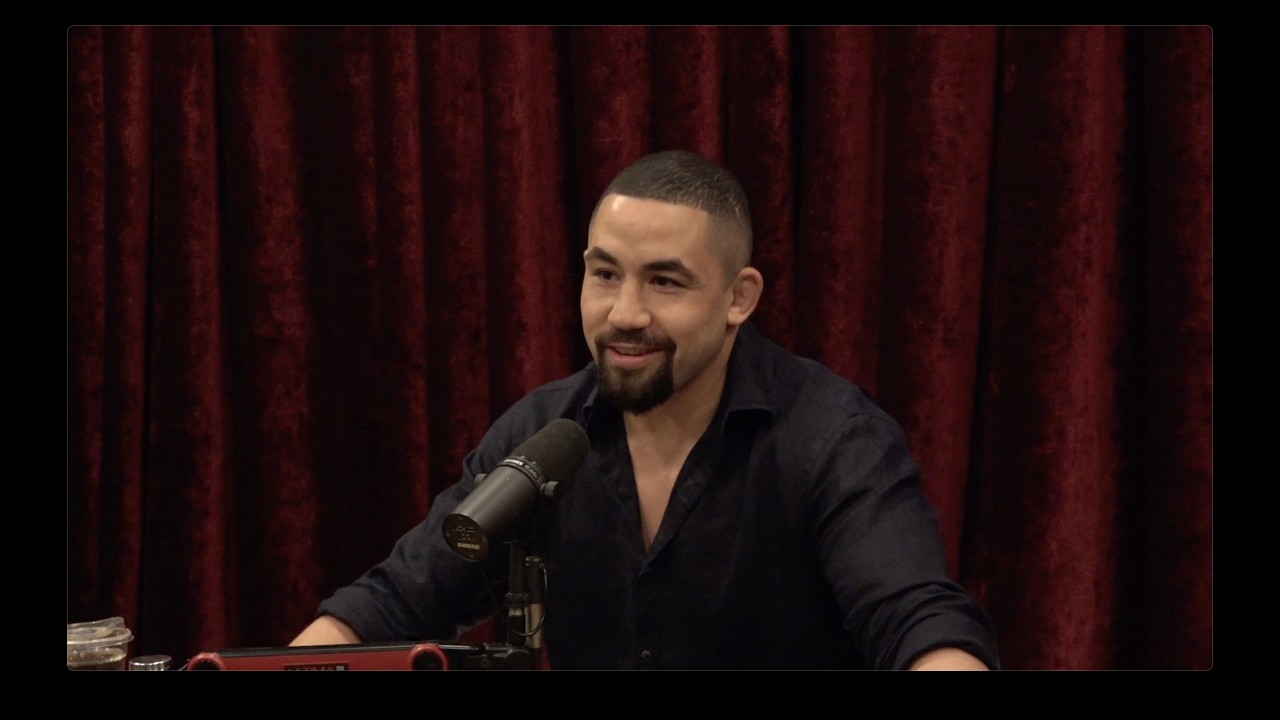
Robert Whittaker details his transition to light heavyweight, noting that eliminating the brutal cut to 185 pounds allowed him to eat carbohydrates during camp and cut just 15 pounds of water via hot baths from a fight-week weight of 220 pounds. (98:55)
Joe Rogan and Robert Whittaker debate MMA judging and roster cuts, with Rogan strongly criticizing promotions for releasing undefeated, grapple-heavy fighters like Farid Basharat simply because their control styles do not produce crowd-pleasing brawls. (34:04)
Whittaker highlights how the UFC's traditional 50/50 show-and-win purse structure economically forces fighters into conservative, risk-averse strategies inside the Octagon to ensure their income. (36:22)
Rogan and Whittaker discuss why point-fighting karate remains an underutilized tool in MMA, noting its unique ability to close vast distances quickly and land decisive blows in four-ounce gloves without winding up. (2:03)
Detailed notes
## Background
Published on YouTube by PowerfulJRE on October 22, 2026, JRE MMA Show #187 features Joe Rogan sitting down with former UFC champion Robert Whittaker. According to the episode description, the conversation highlights Whittaker's career competing in the UFC's light heavyweight division, his life outside the Octagon, and his work hosting the 'MMArcade' podcast.
## TL;DR
Robert Whittaker and Joe Rogan dive into Whittaker's move up to light heavyweight, exploring how moving away from punishing weight cuts revitalized his camp energy while introducing the omnipresent knockout power of 205-pound combat. They break down striking and grappling dynamics across eras, analyzing stance switching, point-karate footwork, wrestling control, and standout fighters such as Alex Pereira, Carlos Prates, and Khamzat Chimaev. Alongside tactical fight talk, Whittaker candidly shares the realities of aging, managing micro-injuries while raising six children, and the physical wear and tear that drives his focus on modern recovery science and business ventures like Ascend Fitness.
## Atmosphere & style
The conversation carries a relaxed, peer-level warmth that blends technical fight analysis with good-natured, self-deprecating banter. Whittaker brings a grounded, humble perspective as a veteran family man, laughing off mundane domestic injuries and the harsh realities of the fight game, while Rogan matches him with intense martial arts curiosity and storytelling. It feels like an authentic, easygoing clubhouse chat between two battle-tested fight enthusiasts who appreciate both the brutal mechanics of combat and the comedy of everyday life.
## Bulletin
- [01:38:55](https://www.youtube.com/watch?v=n4x-n8bNYhA&t=5935s) Robert Whittaker details his transition to light heavyweight, noting that eliminating the brutal cut to 185 pounds allowed him to eat carbohydrates during camp and cut just 15 pounds of water via hot baths from a fight-week weight of 220 pounds.
- [34:04](https://www.youtube.com/watch?v=n4x-n8bNYhA&t=2044s) Joe Rogan and Robert Whittaker debate MMA judging and roster cuts, with Rogan strongly criticizing promotions for releasing undefeated, grapple-heavy fighters like Farid Basharat simply because their control styles do not produce crowd-pleasing brawls.
- [36:22](https://www.youtube.com/watch?v=n4x-n8bNYhA&t=2182s) Whittaker highlights how the UFC's traditional 50/50 show-and-win purse structure economically forces fighters into conservative, risk-averse strategies inside the Octagon to ensure their income.
- [02:03](https://www.youtube.com/watch?v=n4x-n8bNYhA&t=123s) Rogan and Whittaker discuss why point-fighting karate remains an underutilized tool in MMA, noting its unique ability to close vast distances quickly and land decisive blows in four-ounce gloves without winding up.
## Key takeaways
- [02:03](https://www.youtube.com/watch?v=n4x-n8bNYhA&t=123s) Point-fighting karate provides fighters with exceptional distance management and timing, allowing them to blitz effectively and score stoppages with four-ounce gloves using minimal windup.
- [10:41](https://www.youtube.com/watch?v=n4x-n8bNYhA&t=641s) Moving up to light heavyweight brings immense risk because nearly every competitor at 205 pounds carries lethal, one-shot knockout power.
- [31:35](https://www.youtube.com/watch?v=n4x-n8bNYhA&t=1895s) Accumulated injuries cause aging fighters to subconsciously hesitate during wrestling scrambles, often forcing them to accept bottom positions to protect damaged joints.
- [36:22](https://www.youtube.com/watch?v=n4x-n8bNYhA&t=2182s) UFC 50/50 pay structures compel fighters to prioritize risk-averse, grapple-heavy strategies to guarantee their win bonus rather than entertaining crowds.
- [01:05:53](https://www.youtube.com/watch?v=n4x-n8bNYhA&t=3953s) High-intensity strength and conditioning should be sequenced after skill work, as scientific consensus indicates extreme fatigue degrades neural pathways and motor learning.
- [01:13:38](https://www.youtube.com/watch?v=n4x-n8bNYhA&t=4418s) Traditional gi training disciplines grappling positioning and reduces reliance on raw athleticism compared to no-gi training.
- [01:16:32](https://www.youtube.com/watch?v=n4x-n8bNYhA&t=4592s) Clean strangles remain superior to joint locks in high-stakes competition because elite fighters will endure popped ligaments, but cannot fight through cerebral blood flow deprivation.
- [01:29:15](https://www.youtube.com/watch?v=n4x-n8bNYhA&t=5355s) Whittaker transitioned from an electrical apprenticeship to full-time mixed martial arts after winning The Ultimate Fighter: The Smashes while on annual leave.
- [01:43:25](https://www.youtube.com/watch?v=n4x-n8bNYhA&t=6205s) Eliminating extreme weight cutting in MMA remains practically unfeasible due to the immense administrative burden of continuous year-round testing across expanded weight classes.
- [01:56:40](https://www.youtube.com/watch?v=n4x-n8bNYhA&t=7000s) Switching stances has become an essential modern skillset, resetting opponent reads, taking away targeted lead legs from wrestlers, and mitigating damage from calf kicks.
- [02:18:22](https://www.youtube.com/watch?v=n4x-n8bNYhA&t=8302s) Whittaker moved up to light heavyweight primarily to overcome burnout, revitalizing his career by eating carbs and cutting 15 pounds of water via hot baths instead of harsh saunas.
- [02:26:11](https://www.youtube.com/watch?v=n4x-n8bNYhA&t=8771s) Casual online 'fraud check' culture fails to account for the extreme vulnerability and thin margins inherent to professional cage fighting at the elite level.
## Detailed walkthrough
### [00:01](https://www.youtube.com/watch?v=n4x-n8bNYhA&t=1s) Balancing Family, Business, and Longevity in MMA
Robert Whittaker joins Joe Rogan in the studio, opening the conversation by thanking Rogan for hosting him at a comedy club the night before. Robert notes that it was his very first time visiting a comedy club, despite great venues back home such as the Comics Lounge in Sydney, explaining that he simply never finds the spare time to go out. Rogan is amazed by how active UFC fighters manage to balance their demanding careers with normal living, highlighting Robert’s personal life and growing commercial ventures:
> “From when I started like 20, I had no kids to when I'm now married with six kids and mortgages and life, you know, you kind of juggle it around just balancing act.”
Robert reflects on the psychological drive behind remaining constantly busy with ventures like his Musashi supplement line and his podcast. In elite performance athletics, inactivity feels risky because the threat of decline is perpetual: “It's like idle hands... the guillotine's kind of always over your head, right? So, you kind of always got to stay busy, keep moving. It's like a shark, otherwise you just kind of drown.” Rogan agrees, stressing that an athlete's prime is narrow and that true outliers who fight at a championship caliber well into their forties are extremely rare.
[02:03](https://www.youtube.com/watch?v=n4x-n8bNYhA&t=123s) Outliers of the Sport: Jared Cannonier and Point-Fighting Styles
The conversation turns to Jared Cannonier, whom Rogan cites as an exceptional physical outlier competing at age 42. Cannonier remains shredded, works out like a demon, has elite cardio, and consistently wins gritty wars in the trenches, such as rallying after taking damage in the opening round against Gregory Rodrigues (RoboCop). Robert and Rogan recall his grueling match-ups—briefly debating his controversial stoppage loss against Nassourdine Imavov—and note the unique stylistic matchup Cannonier faced against Michael "Venom" Page (MVP).
```mermaid
flowchart TD
accTitle: Evolution of Point Fighting in MMA
accDescr: Visual breakdown of how point fighting karate transitions into high-level MMA success.
subgraph Fundamentals["Core Movement Mechanics"]
A["Bladed, Wide Stance"] --> B["Rapid Distance Coverage & Blitzing"]
B --> C["Evasive Timing & Angle Shifts"]
end
subgraph Execution["MMA Application"]
C --> D["Single-Shot Touch with 4oz Gloves"]
D --> E["Flowing Combinations Off First Contact"]
end
Fundamentals --> Execution
```
Discussing Page leads into an analysis of point-fighting karate styles in modern mixed martial arts. Rogan argues that pure point fighting remains an underappreciated missing link in MMA:
> “I've always said I said it from early on that I think that that's a missing link in MMA is point fighting. These guys who really know how to do that style and then learn the other things because that style is so it it it's you cover so much distance so quickly and they're so good at avoiding shots and then leaping in and they're so good at timing and scoring.”
Robert agrees, emphasizing that with four-ounce gloves, fighters do not need heavy windups to hurt opponents: “A touch can stop you... and that's kind of been my approach with how I my fight style is just to be be fast.” Rogan points out that Robert implements a very similar karate-based dynamic, bouncing on the outside, blitzing in with combinations, and darting back out, avoiding the sustained pocket brawling that shortens careers.
- **Jared Cannonier's longevity**: Competing at age 42 while maintaining elite conditioning, knockout power, and winning deep in the trenches.
- **Michael "Venom" Page's dynamics**: High-speed, elusive point striking at 170 and 185 pounds, vulnerable primarily when faced with committed grappling (such as his bout with Ian Machado Garry).
- **Point fighting translation**: Leaping in, scoring with precision first touches, and rolling those entries directly into multi-strike combinations.
[05:50](https://www.youtube.com/watch?v=n4x-n8bNYhA&t=350s) Fighting Psychology: From King Green to Carlos Prates
The two discuss other veteran outliers who rely on evasion rather than absorbing damage, highlighting King Green (formerly Bobby Green) competing at age 40. Rather than fading into obscurity, Green rebranded, started finishing opponents with TKOs, and baffled rivals with his shoulder-roll defense and nonstop mid-fight banter. Robert admits he cannot fathom fighters who joke or talk during a bout, referencing Kevin Holland once chatting about scheduling a basketball game while mid-fight: “I don't know how you can get in that head space cuz when I'm in there I'm on the roller coaster of pain... I'm just angry.”
They contrast this tense, high-pressure mindset with fighters who look relaxed and completely disconnected from the fight-or-flight adrenaline surge. Rogan recalls their discussion from the night before about Carlos Prates, who logged roughly 100 Muay Thai and kickboxing bouts while living in Thailand for six years. That extensive ring mileage stripped away any panic response, allowing Prates to stay remarkably loose in the Octagon:
> “Everybody that doesn't drink and smoke before a fight is waiting for it to catch up with him so they can justify why they don't drink and smoke, right? Cuz I guarantee if I started drinking and smoking before a fight, I'm gone. Like within seconds within seconds I'm gassing on the walk out and then and then like I'll wake up in the ER.”
Prates’ infamous habits—smoking cigarettes on fight day and candidly stating he only stopped drinking alcohol two weeks before competing—leave UFC staff bewildered. Robert and Rogan weigh the biological trade-offs, questioning whether the physiological cost of smoking and partying is offset by the psychological edge of remaining carefree and loose inside a sport that is entirely different from purely measured athletic events like sprinting.
[09:22](https://www.youtube.com/watch?v=n4x-n8bNYhA&t=562s) The Volatility of MMA and "Touch of Death" Power
Robert Whittaker and Joe Rogan reflect on how unpredictable mixed martial arts can be, particularly when raw power overrides technical mastery. Whittaker laments the frustration of putting in endless gym work only to see unconditioned fighters succeed purely because they possess devastating power. As Whittaker points out:
> “There is there's so many variables working against you and like how many times have we seen just nobodies out of shape dudes just come in but know how to throw a punch and just win by starching people.”
Rogan agrees that “ignorance is bliss” for certain fighters who enter the cage completely unbothered, winging wild haymakers that have no business landing, only to knock their opponents out cold. Whittaker notes that while he is sweating and grinding to sharpen every skill, some athletes simply step in with a natural "touch of death." Rogan observes that while Whittaker himself possesses legitimate power behind his punches and kicks, other fighters possess an almost anomalous, supernatural power. They cite examples like Alex Pereira, Francis Ngannou, and Damián Piñeiro, who generate fight-ending force without appearing to wind up.
[10:41](https://www.youtube.com/watch?v=n4x-n8bNYhA&t=641s) Carlos Ulberg vs. Jiří Procházka and the Danger of Light Heavyweights
The conversation shifts to Jiří Procházka’s bout against Carlos Ulberg, analyzing Procházka’s mentality and Ulberg’s lethal counter-punching. Procházka’s unbridled warrior mindset drew mixed amusement and concern from both men. Rogan argues that Procházka desperately needs a strategist in his corner:
> “He needs someone to talk to him and say, 'We have to have strategies.' Okay, you you're a seek and kill fighter. When a guy's hurt, you can't be upset that he's hurt and then try to give him some concessions.”
Whittaker jokes that Procházka fought as though he were trapped inside an anime epic, imagining rain and thunder in his own head instead of reading the room. Rogan highlights the turning point where Ulberg blew out his leg—specifically his right ACL. Despite the debilitating injury that caused his knee to visibly buckle under pressure, Ulberg possessed a whip-like left hook. Rogan explains the mechanics: because his right leg was compromised, pivoting off the lead side into that vicious left hook was practically the only strike Ulberg could throw with maximum torque. Procházka, sensing weakness, pressured forward carelessly right into Ulberg's single lethal weapon. Whittaker explains that this extreme danger was a massive consideration when moving up from middleweight:
> “Like the power of light heavyweights and that's that was my headsp space moving in from middleweight. It's like everyone's got touch of death, right?”
Whittaker emphasizes that 205-pound fighters are fast enough to land while carrying immense weight behind their shots, meaning defensive lapses are instantly punished.
[13:34](https://www.youtube.com/watch?v=n4x-n8bNYhA&t=814s) Moving to 205: Azamat Murzakanov, Paulo Costa, and Surviving the Wheel Kick
Rogan and Whittaker discuss how different body types navigate the light heavyweight division. Rogan brings up Azamat Murzakanov as a rare standout who thrives despite being undersized:
> “There's only a few guys that are like smaller, light, like Makonov is a good example of a guy who's been real successful as a light heavyweight, as a smaller guy.”
Even though Murzakanov stands around 5'10" and lacks a shredded physique, Rogan and Whittaker praise his slick striking and aggressive shooting, noting his upcoming matchup against Dominick Reyes. They also analyze Paulo Costa, who previously struggled with brutal weight cuts at middleweight and looked far more natural when fighting at 205. Whittaker jokes that Costa finally found his footing and peak cardio just in time to fight him, leading to their back-and-forth war. Whittaker looks back on eating Costa’s spinning heel kick during their bout:
> “I remember being in there and seeing him start to do that that turn and there's that one split second cuz I've never seen it before where I'm like what's going on and then my legs are gone doing funny funny things.”
Rogan highlights that almost no one survives getting nailed cleanly by a heel kick from a power puncher like Costa, but Whittaker managed to stay in the fight despite his equilibrium briefly betraying him.
[15:30](https://www.youtube.com/watch?v=n4x-n8bNYhA&t=930s) Acrobatic Strikes and Galore Bofando’s Front-Flip Axe Kick
The discussion turns to unorthodox, impossible-to-replicate techniques inside the gym. Rogan recalls a story told by Michael "Venom" Page about an exceptionally athletic training partner who could perform video-game-like moves that seemed superhuman. While producer Jamie Martin pulls up footage, Rogan describes how the martial artist could execute an airborne front flip directly into an axe kick on a heavy bag and in live sparring, forcing MVP to block it purely on raw reaction. Whittaker laughs at the sheer absurdity of trying to prepare for or defend such acrobatics:
> “I guarantee you if someone does this kick to me, I'm taking it straight between the eyes.”
They identify the fighter as Galore Bofando. Watching the clip of Bofando flipping and driving his heel straight down onto the heavy bag, Rogan and Whittaker marvel at how he sticks the landing on both feet like a cat and instantly glides back into a fight stance. Whittaker jokes that his knees hurt just watching the impact and is thankful no 205-pounders are pulling off gymnastic moves like that. Rogan commiserates on aging joints, laughing that despite smashing the bag and doing 20 minutes in the sauna earlier that day, he ended up throwing his back out simply standing in the shower.
[18:29](https://www.youtube.com/watch?v=n4x-n8bNYhA&t=1109s) Age, Micro-Injuries, and Sprinting with Kids
Joe Rogan and Robert Whittaker bond over how humiliating it is for elite combat athletes to get hurt doing everyday household activities. Rogan laughs about having a great workout where he felt strong, only to tweak a muscle between his shoulder blades while simply washing himself in the shower right before the podcast. Whittaker relates immediately, recalling how he felt a sharp twinge in his lat just lifting one of his children, marveling at how Father Time catches up even when you are at the pinnacle of your athletic career: “Like I'm gunning for the title still. And I picked up I picked up one of my kids and I felt like a twinge in my lap and I'm like, 'Oh, that's you just age age creeps up on you.'”
Rogan attributes these random spasms to accumulated micro-injuries that go unnoticed during hard sessions—noting that he had been throwing heavy left hooks and switch kicks earlier that day, leaving his left side primed to seize up over the slightest mundane movement. Whittaker points out that once an athlete crosses the mid-30s mark, sudden explosive movements without a proper ramp-up are an invitation for disaster. He explains that he can no longer launch into a dead sprint from a standstill without a thirty-minute hamstring warmup, which becomes a comedic dilemma whenever his children dare him to a footrace. Rogan admits that he tore his hamstring while racing his fifteen-year-old daughter in Italy, pointing out that once kids hit their teens, their speed and light frame force parents to sprint at maximum effort if they refuse to lose.
- Whittaker remarks that his sons are all under the age of eleven, which still affords him enough of an edge to hobble along and win without needing a full thirty-minute warm-up routine.
- Rogan notes how embarrassing it is to conquer an intense combat training session only to end up injured from washing soap off your back.
---
[21:46](https://www.youtube.com/watch?v=n4x-n8bNYhA&t=1306s) Warm-Up Routines and Manny Pacquiao's Multitasking World
The discussion shifts to how high-level fighters prepare their bodies, with Rogan recalling that Muhammad Ali famously warmed up for an entire hour before throwing a single punch in training. Rogan reminisces about working with comedian Daniel Tosh for a segment on *Tosh.0* where Tosh trained to take a punch to the body from Manny Pacquiao. While Pacquiao was gentle and pulled his punch, Rogan was captivated watching the boxing legend prepare in the gym. Pacquiao's warmup was an extensive, methodical system of resistance band work, dynamic stretching, and endless core conditioning. Whittaker notes that Pacquiao's abdominal routine seems to never stop, though he personally caps his crunches at ten because an unprotected liver shot will drop anyone regardless of abdominal strength.
Rogan describes Pacquiao as an absolute outlier with bizarrely hyperactive hobbies, most notably his world-class proficiency at billiards. Billiards is massive in the Philippines, and Pacquiao maintains a massive private pool hall on his residential compound featuring around fifteen tables with constant high-stakes gambling. Rogan describes the chaotic atmosphere where Pacquiao juggles three demanding tasks simultaneously: while his opponent takes a shot on the pool table, Pacquiao walks over to play moves on an active chessboard, all while continuously signing stacks of boxing gloves and memorabilia brought in by associates to sell. Rogan remarks on the wild contrast between Pacquiao still pursuing world-class championship boxing fights in his late forties and peers like Floyd Mayweather Jr., who stick to lucrative exhibition bouts against MMA fighters and social media influencers.
```mermaid
flowchart TD
accTitle: Manny Pacquiao Compound Multitasking
accDescr: Diagram illustrating Manny Pacquiao cycling between playing pool, making chess moves, and signing fan memorabilia.
subgraph Sports["Athletic & Skill Focus"]
A["Billiards Match<br/>(Runs balls on compound table)"]
B["Chess Game<br/>(Tactical moves between turns)"]
end
subgraph OffTable["Intermittent Actions"]
C["Autograph Signing<br/>(Gloves, posters, cues)"]
D["Active Elite Boxing Career<br/>(Targeting top title contenders)"]
end
A -->|"Opponent's turn"| B
B -->|"Between moves"| C
C -->|"Called back to table"| A
Sports -.->|"Underpinned by"| D
```
- Rogan emphasizes that Pacquiao is not just a casual pool hobbyist, but plays at a legitimate professional caliber, showing exceptional cue-ball positioning and cue control.
- While Mayweather transitioned to exhibitions against non-traditional opponents, Pacquiao continues to hunt legitimate, high-level boxing title bouts late into his forties.
---
[25:35](https://www.youtube.com/watch?v=n4x-n8bNYhA&t=1535s) Chess, Fighter Stereotypes, and Intellectual Giants
Whittaker expresses surprise at how widespread chess has become among combat athletes. He observes that many training partners at the gym appear to be absolute bruisers in the cage, yet spend their resting hours playing high-elo competitive online chess. Whittaker shares that he once considered diving into chess strategy himself, but became overwhelmed by the immense depth of study required, particularly realizing that players at decent ratings have the first twenty opening moves completely memorized before the board even diverges into improvisation. Rogan agrees that chess is an endless rabbit hole capable of consuming all of an athlete's spare time due to the convenience of playing apps on mobile phones.
Whittaker points out how quickly people misjudge fighters based on appearances, laughing at the disconnect between training partners who look like hulking brutes and their sharp strategic minds: “I saw you open a can of spam for lunch. What are you doing? And it just it just surprises me. You can't always tell like judge a book by its cover, right?” Rogan agrees and brings up former UFC heavyweight champion Josh Barnett as the prime example of defying the dumb-fighter stereotype. Despite his menacing appearance as an imposing catch wrestler, Rogan highlights Barnett as one of the sharpest minds in sports, capable of quoting Fyodor Dostoevsky and esoteric warrior philosophy effortlessly from memory.
[27:29](https://www.youtube.com/watch?v=n4x-n8bNYhA&t=1649s) The Hidden Toll of Professional Wrestling and Spinal Trauma
Joe Rogan and Robert Whittaker discuss the brutal physical realities of professional wrestling. Rogan points out that while casual observers view it purely as entertainment, the performers are elite athletes who absorb staggering amounts of punishment on the road hundreds of days a year. Whittaker agrees that without that level of athleticism, the performers would literally kill themselves. Rogan emphasizes that the constant body slams take a severe toll, leading to concussions, chronic traumatic encephalopathy (CTE), and permanent bodily damage that leaves nearly every retired veteran with a limp or severe mobility issues.
The conversation shifts to Hulk Hogan, who has experienced severe bodily shrinkage over decades of wear and tear. Rogan recalls encountering Hogan outside a Beverly Hills cigar bar years ago when he was truly massive, then noticing him get progressively smaller when interviewing him for Spike TV and later hosting him on the podcast. Rogan explains that the dramatic loss in stature stems from multiple spinal fusions caused by disc compression and degenerative disc disease. Hogan’s signature leg drop, in which his 300-plus-pound frame came crashing down directly onto his tailbone night after night, drove intense impact through his entire spine until his whole back essentially had to be fused into a single rod. Whittaker winces at the thought, joking about falling unprepared onto one's backside and feeling the shockwave reverberate all the way up to the base of the skull. Rogan notes that Kurt Angle underwent similar spinal fusions, leaving his entire neck as one solid mass.
[30:17](https://www.youtube.com/watch?v=n4x-n8bNYhA&t=1817s) Yoel Romero’s Inhuman Physiology and Darren Till’s Career Evolution
Turning from fused wrestlers to mixed martial arts outliers, Whittaker brings up Yoel Romero, whose neck is similarly fused. Rogan recalls Whittaker once telling him that calf-kicking Romero felt like kicking solid metal. Whittaker laughs and confirms that kicking Romero's lower leg was an immediate mistake: “I've never thrown a calf kick and come off second best. Like, I calf-kicked him and that was the last calf kick I did. He didn't check it; it just hurt.” Whittaker marvels at how Romero's body is simply built differently, noting that at 49 years old, Romero competed in a bare-knuckle boxing match against Darren Till.
Both give heavy credit to Till for having the courage to face Romero bare-knuckle, even after getting dropped during the bout. They praise Till's pivot to pure boxing, with Rogan analyzing that chronic knee injuries had severely compromised Till's ability to grapple effectively in MMA. In boxing, Till's elite movement and striking can shine without having to worry about defending takedowns or taking kicks to damaged joints.
[31:35](https://www.youtube.com/watch?v=n4x-n8bNYhA&t=1895s) Aging Joints, Wrestling Instincts, and Jon Jones
Whittaker reflects on why older fighters who managed to avoid being outwrestled early in their careers suddenly begin getting grounded, controlled, and submitted as they age. While hard work takes an athlete far, genetics and inherent talent remain deciding factors. When Rogan names Jon Jones as the pinnacle of physical gifts, Whittaker heartily concurs: “If you were going to build someone in a lab, he'd come out with Jon Jones, man, because talent, intelligence, and genes—it's like all those together. He's the perfect fighter.”
The conversation explores how aging changes defensive reactions on the mat. Decades of wear, torn menisci, and ACL reconstructions force older fighters to protect their joints, whereas younger athletes explode and scramble without a second thought. Whittaker explains that the critical window in any wrestling exchange is the very first second of engagement. As fighters age, that instinctive fire to scramble dims, and the subconscious hesitation to protect injured knees makes them concede takedowns. Rather than risking a joint blowout, older fighters often choose to accept being on their backs to catch their breath, only to find themselves pinned and losing rounds.
```mermaid
flowchart TD
accTitle: Impact of Aging and Joint Wear on Wrestling Defense
accDescr: Diagram illustrating how accumulated joint injuries lead to subconscious hesitation and ground control losses in MMA fighters.
subgraph Young["Youth & Scramble Reaction"]
Y1["Intact Joints & Peak Mat Time"] --> Y2["Explosive First-Second Scrambles"]
Y2 --> Y3["Immediate Escapes / Standing Back Up"]
end
subgraph Aging["Accumulated Wear & Aging"]
A1["Surgeries & Cartilage Loss"] --> A2["Hesitation to Explode"]
A2 --> A3["Decision to Rest on Back"]
end
A3 --> Outcome["Held Down / Loses Round to Younger Wrestlers"]
```
[34:04](https://www.youtube.com/watch?v=n4x-n8bNYhA&t=2044s) Khamzat Chimaev's Dominance and Promotional Double Standards
Whittaker and Rogan examine the striking wrestling disparity on display when Khamzat Chimaev dismantled Dricus du Plessis. Whittaker notes how rare it is to see someone hold down a powerful fighter of Du Plessis's caliber in a championship setting. Rogan highlights the sheer technical disrespect of putting an opponent into a mounted crucifix three separate times in a title defense: “When was the last time you saw someone in a championship fight defending their world title get put in the crucifix three fucking times? Never. It's such a hard move to get a guy in in the first place.” Whittaker adds that executing it deep into the fight, when both men are slick with sweat and exhausted, is mind-boggling, contrasting it with how difficult it is to secure a crucifix even in a training gi.
Finally, Rogan laments that modern audiences and promotional brass prioritize chaotic brawls and blood over technical grappling. He brings up undefeated fighter Farid Basharat, noting his frustration over promotions letting skilled fighters go simply because their dominant grappling styles do not fit a specific entertainment mold. Rogan recalls speaking to Basharat inside the Octagon and feeling confident he would be re-signed, only to see him released despite maintaining an unblemished record.
- Farid Basharat and his brother Javid Basharat are recognized as high-level, technically refined fighters whose grapple-heavy style clashed with promoter preferences for wild brawling.
[36:22](https://www.youtube.com/watch?v=n4x-n8bNYhA&t=2182s) Fighter Contracts and the Expectation of Entertainment
Joe Rogan expresses his frustration with UFC matchmakers—noting he is speaking without insider knowledge from Dana White, Sean Shelby, or Mick Maynard—over the promotion parting ways with winning fighters purely because their style is perceived as unexciting. He argues that if matchmakers find an undefeated athlete boring, their job should be to test them against high-pressure, exciting opponents rather than casting them aside. Rogan points out that surviving and winning at the elite level is already an immense challenge, and fighters should not be penalized for prioritizing their health, managing their gas tank, and fighting intelligently.
Robert Whittaker agrees, pointing out that fighter pay structures inherently encourage conservative, victory-first strategies because the purse is split between show money and a win bonus. Whittaker jokes that he would happily resort to the ugliest tactics imaginable if it guaranteed a victory, admitting that he often envies dominant wrestlers who absorb zero damage and control opponents on the mat. Rogan and Whittaker note that while dominant grappling can extend an athlete's career longevity, wrestlers often eventually hit a physical wall where accumulated injuries prevent them from securing takedowns, forcing them into dangerous stand-up battles late in their careers.
> “I don't like when a guy gets cut that wants to keep fighting in the UFC, he's undefeated just because you think he's boring.” — Joe Rogan
> “If I could toe stomp my way to victory, I would.” — Robert Whittaker
- Rogan criticizes the philosophy that fighters must take unnecessary brain damage just to put on a spectacle rather than fighting to their strategic strengths.
- Whittaker explains that the financial incentive of the UFC win bonus directly drives athletes to prioritize winning over reckless entertainment.
---
[38:36](https://www.youtube.com/watch?v=n4x-n8bNYhA&t=2316s) Weight Bullies, Weaponized Physiques, and Roman Kopylov
The conversation moves to recent standout performances and the physical extremes of weight cutting. Rogan brings up Mike Malott's impressive victory, marveling at the fact that Malott originally began his career down at featherweight—where Hakeem Dawodu once stopped him—despite now appearing massive in the welterweight division. Whittaker points out that while Malott looks huge, someone like Michael Morales represents a completely different level of physical advantage at 170 pounds. Whittaker describes Morales as an exceptional outlier who combines elite genetic gifts, ferocious hunger, and a willingness to brawl or wrestle.
Rogan brings up another notable size discrepancy, citing a middleweight who cut down from 231 pounds before getting finished in the first round by Roman Kopylov. Rogan praises analyst Jack Slack for breaking down Kopylov’s slick striking, ring craft, and the precise left hook that shut down his much larger opponent. Whittaker observes that Kopylov does not look physically intimidating—resembling an everyday "desk jockey" who has been in a few bar fights, complete with a heavily damaged nose—yet possesses high-level technical boxing that completely dismantled a physically imposing powerhouse.
> “He is the perfect example of weaponized physique.” — Robert Whittaker
- Mike Malott's physical transformation from featherweight to a sizable welterweight is highlighted following his recent finish.
- Whittaker describes Michael Morales as a young genetic freak who leverages his immense size and well-rounded skill set to make fights ugly and overwhelming.
- Roman Kopylov is highlighted as proof that technical striking, setup shots, and spatial awareness can easily neutralize a massive weight advantage.
---
[41:12](https://www.youtube.com/watch?v=n4x-n8bNYhA&t=2472s) The Fall of Paulo Costa and Adesanya’s Iconic Celebrations
Rogan and Whittaker discuss Paulo Costa's career trajectory, noting how effective Costa looked when attacking the body and finding his rhythm in recent outings. However, Rogan reflects on the severe mental and emotional toll Costa suffered after his middleweight title loss against Israel Adesanya. Rogan speculates that the immense pressure of the title spotlight overwhelmed Costa, pointing out that Costa even entered the cage with visible cupping suction marks on his calf—an obvious target that an elite striker like Adesanya immediately exploited with kicks.
Costa was stopped cleanly, followed by Adesanya's infamous post-fight celebration humping Costa on the canvas, which Rogan and Whittaker describe as hilarious, ruthless, and deeply humiliating. The discussion shifts to Adesanya’s greatest moments, specifically his UFC 287 knockout of Alex Pereira. Whittaker and Rogan consider Adesanya's celebratory three-arrow taunt over the fallen Pereira to be one of the greatest post-fight celebrations in combat sports history, particularly given that Pereira had defeated him three times across kickboxing and MMA and had severely damaged Adesanya's lead leg moments before the knockout. Whittaker laughs about Adesanya’s eccentric personality, recalling how he wore a dog collar and leash throughout fight week before taking it off in the Octagon.
> “I think the pressure of fighting for the title, I'm just speculating, overwhelmed him.” — Joe Rogan
> “He's such a weeb sometimes.” — Robert Whittaker
- Rogan points out that stepping into the Octagon with visible cupping marks on a calf is a critical tactical mistake against a precise striker like Adesanya.
- Adesanya’s iconic bow-and-arrow celebration against Alex Pereira is praised for its theatricality and emotional weight after suffering two previous knockout defeats to him.
- Whittaker chuckles at Adesanya's anime-inspired antics, such as walking around on a literal leash during fight week to symbolize being unleashed in the cage.
---
[43:04](https://www.youtube.com/watch?v=n4x-n8bNYhA&t=2584s) Whittaker vs. Adesanya 2 and Fighting Off the Back
Rogan asks Whittaker about the psychology of rebounding from a knockout loss to push Adesanya to the absolute brink in their championship rematch. Whittaker reflects on the closely contested decision, noting that had modern judging valued takedowns the way judges did in older eras of MMA, he likely would have had his hand raised. Rogan agrees that modern judging criteria heavily de-emphasize top position unless the fighter inflicts meaningful damage or actively threatens submissions, noting that fighters can now comfortably win rounds from the bottom if the top fighter stalls.
The two reflect on classic and unusual examples of offense from the bottom guard, beginning with Bas Rutten winning the UFC heavyweight championship against Kevin Randleman by lacerating Randleman with elbows and punches from underneath. Whittaker also highlights Kevin Holland’s shocking knockout of Ronaldo "Jacaré" Souza directly from his back. Whittaker jokes self-deprecatingly about his own bottom game, admitting that whenever he winds up on his back and tries to scramble up, he absorbs punches, burns through his gas tank, and ends up stuck on the canvas for the rest of the round. The segment closes with Rogan marveling at the unpredictability of mixed martial arts, referencing historic betting upsets where heavy -2400 favorites have been knocked out cold in a matter of seconds.
> “I feel like if they scored takedowns like they used to back in the day, I might have got my hand raised, but yeah, takedowns don't mean as much anymore unless you do something with them.” — Robert Whittaker
> “Every time I'm on my back and I'm trying to fight up, I get fed and then I gas and then that's where I'm staying for the next 4 minutes or whatever.” — Robert Whittaker
- Whittaker reflects on his narrow rematch against Israel Adesanya and how shifting judging criteria prioritize active damage over mere takedowns.
- Bas Rutten’s historic heavyweight title victory over Kevin Randleman is cited as the foundational example of scoring damage from the bottom guard.
- Kevin Holland’s stunning knockout of world-class grappler Jacaré Souza from the seated guard is highlighted as an example of shocking strikes generated from compromised positions.
[45:20](https://www.youtube.com/watch?v=n4x-n8bNYhA&t=2720s) Kevin Holland’s Mid-Fight Trash Talk and Finishes
Joe Rogan and Robert Whittaker discuss fighters who stay loose and chat right in the middle of chaotic exchanges. The conversation turns to Kevin Holland, with Rogan and Whittaker noting how he can crack heavyweights or light heavyweights while carrying on a full conversation inside the cage. While watching footage of Holland's knockout of Ronaldo "Jacaré" Souza from his back, Rogan notes Holland's bizarre habit of talking to his opponents as he hits them, even whispering or yelling absurd one-liners.
Whittaker points out that while fighters like Khabib Nurmagomedov speak in low, deliberate tones when dominating opponents on the canvas, Holland is practically shouting mid-exchange. Rogan laughs recalling Holland’s knockout of Joaquin Buckley: “Well, he said to Buckley, he goes, 'You got a booger on your nose.' And then he knocked him out.” Whittaker admits he would be thrown off by that level of chatter: “I don’t know what I’d do if someone was talking that much to me in a fight.”
- Kevin Holland fought Jacaré Souza from his guard, catching him with a concussive shot off his back while mid-sentence.
- Holland landed a clean straight right on Joaquin Buckley immediately after joking about a booger on his nose.
---
[47:01](https://www.youtube.com/watch?v=n4x-n8bNYhA&t=2821s) Nick Diaz’s Volume Boxing and Trash-Talking Frank Shamrock
The discussion shifts from Holland to Nick Diaz, the pioneer of in-fight psychological warfare and relentless volume striking. Rogan brings up Diaz’s bout with MMA icon Frank Shamrock in Strikeforce. Shamrock, a pioneer from the early Pancrase and UFC eras, was completely thrown off by Diaz's relentless disrespect and constant chatter inside the cage.
Whittaker notes how iconic Diaz's relaxed posturing was, particularly dropping his hands all the way down to his hips. Rogan explains that Diaz’s unique boxing style never relied on maximum effort; instead, he threw punches at roughly fifty percent power, which allowed him to maintain an unending assault until opponents drowned under the volume. Whittaker remarks on how effortless Diaz made it look, adding, “I've always been the biggest fan of his style.” Rogan breaks down the mechanical reality of the Stockton style: “He’s relaxed. Like even while he’s doing this, he’s never straining. Like all of his punches are like 50%. Everything’s 50%. But because of that, he can throw them for days.”
- Frank Shamrock, despite being a seasoned Pancrase and UFC champion, found Diaz’s mid-fight barrage of insults genuinely jarring.
- Diaz’s signature posture involved dropping his hands to his waist and slapping or touching opponents with volume rather than loaded-up power shots.
---
[48:20](https://www.youtube.com/watch?v=n4x-n8bNYhA&t=2900s) Nick Diaz vs. Paul Daley and Natural Knockout Power
Rogan calls Nick Diaz versus Paul "Semtex" Daley in Strikeforce his favorite Diaz fight of all time. Daley possessed some of the most terrifying, one-punch knockout power in welterweight history, armed with a devastating left hook and uppercut capable of launching opponents into orbit. In that wild one-round war, Daley dropped Diaz early, but Diaz quickly dragged him into a breathless sprint that overwhelmed the British power-puncher within minutes.
Whittaker points out that Daley suffered a complete “lactic overload,” gassing out under the unrelenting pace until Diaz put him away against the fence. This prompts a debate about natural punching power. Rogan argues that while conditioning can enhance explosiveness, absolute concussive power is purely genetic: “You got a gift from God. God gave you a gift to put people into orbit.”
```mermaid
flowchart TD
accTitle: Diaz vs Daley Fight Dynamics
accDescr: Flowchart illustrating how Paul Daley's explosive power clashed with Nick Diaz's volume and cardio pace.
subgraph Daley["Paul 'Semtex' Daley"]
D1["Terrifying One-Punch Power"] --> D2["Drops Diaz Early with Left Hook"]
D2 --> D3["Forced into 100% Sprint"]
D3 --> D4["Lactic Overload & Gas Out"]
end
subgraph Diaz["Nick Diaz"]
N1["Iron Chin & High Recovery"] --> N2["Survives Early Knockdown"]
N2 --> N3["Relentless 50% Volume"]
N3 --> N4["TKO Finish Against Fence"]
end
D2 -.-> N1
N3 -.-> D3
D4 -.-> N4
```
- Paul Daley possessed elite natural power comparable to Thomas "The Hitman" Hearns or Deontay Wilder.
- Diaz weathered Daley’s power shots and forced an unsustainable pace, finishing Daley with seconds remaining in round one.
---
[49:41](https://www.youtube.com/watch?v=n4x-n8bNYhA&t=2981s) Triathlon Cardio, Career Mileage, and Wars
Whittaker and Rogan explore why Nick Diaz could sustain a pace that broke world-class athletes. Rogan mentions that Diaz has completed the swim back from Alcatraz multiple times and lives the lifestyle of a triathlete, drawing a parallel to modern bantamweight standout Merab Dvalishvili. Whittaker notes: “You can't get this or sustain this level of cardio unless cardio is your lifestyle.” Whittaker wonders aloud if grinding through fights that required cooking opponents for twenty minutes contributed to Diaz eventually burning out.
Rogan argues that Diaz’s decline was less about fight pace and more about cumulative ring mileage. Rogan, producer Jamie Vernon, and Whittaker review Diaz’s extensive record:
- Diaz made his professional debut on August 31, 2001, for IFC Warriors.
- He entered the UFC at UFC 44 on September 26, 2003, against Jeremy Jackson, whom he submitted with an armbar after having fought him twice previously.
- He famously knocked out Robbie Lawler at UFC 47 in 2004 when Diaz was only twenty years old.
Rogan notes that having over two decades of high-level wars, combined with relentless hard sparring sessions against professional boxers, takes a heavy, unavoidable toll on the brain and body.
---
[52:42](https://www.youtube.com/watch?v=n4x-n8bNYhA&t=3162s) The Anderson Silva Fight and Evaluating Legends at Their Peak
The conversation shifts to Diaz’s bizarre 2015 super-fight against Anderson "The Spider" Silva. Frustrated by Silva's refusal to initiate offense and reliance on counter-strikes along the cage, Diaz famously lay flat on his back on the canvas and rested his head on his arm. Whittaker laughs at the memory, noting that only Nick Diaz possessed the audacity to pull a stunt like that against the middleweight GOAT.
Whittaker points out that once opponents realized Silva wouldn't lead, his output dropped significantly. However, Rogan emphasizes that fans must remember Silva in his untouchable prime before age, tape study, and the horrific broken leg caught up with him. In his peak years, Silva operated in "The Matrix," pulling off historic moments like the front kick knockout of Vitor Belfort. Rogan insists that legendary fighters should always be judged at their absolute best rather than during their late-career decline: “You have to look at elite fighters in their absolute prime. You can't look at them like BJ Penn later.” Rogan points out that judging BJ Penn by his later skid instead of his peak performances against Sean Sherk and Joe "Daddy" Stevenson distorts history, just as judging Silva after his broken leg ignores his prime dominance.
- Diaz mocked Silva’s counter-punching strategy by lying down on the canvas during their UFC 183 headliner.
- Rogan stresses evaluating all-time greats at their peak—such as prime Anderson Silva and lightweight BJ Penn—rather than judging them by the fights that took place past their athletic prime.
[54:26](https://www.youtube.com/watch?v=n4x-n8bNYhA&t=3266s) Anderson Silva's Cold-Blooded Domination and the Abu Dhabi Elements
The conversation turns to fighters who make championship bouts look effortlessly easy and genuinely enjoy themselves inside the cage. Robert Whittaker and Joe Rogan reflect on Anderson Silva’s prime, specifically his iconic finish of Forrest Griffin where Silva casually stepped back, slipped punches, and dropped Griffin with a single crisp right hand while mockingly dancing around. Rogan describes that ruthless demeanor as pure cold-bloodedness. Whittaker recalls Silva getting thoroughly reprimanded by Dana White and UFC brass for excessive clowning, pointing to the infamous Demian Maia title defense at UFC 112.
Rogan explains that there were severe environmental factors during that fight in Abu Dhabi that spectators often overlook. The event was held outdoors in brutal desert heat, plagued by bizarre, colossal flying insects. Rogan recalls watching massive Middle Eastern bugs swarm the cage, remarking that they were "the size of a horse." Silva exploded out of the gate in the opening round, attempting to blast Maia out of the cage, but Maia survived the initial onslaught. Depleted by the oppressive heat, Silva emptied his tank and spent the subsequent rounds coasting, dancing out of range, and doing just enough to secure a points decision, leaving UFC president Dana White furious at the lack of action in a premier showcase event.
[55:46](https://www.youtube.com/watch?v=n4x-n8bNYhA&t=3346s) The Argument for Controlled Environments and Outdoor Fight Variables
Rogan makes an emphatic case against hosting major combat sports cards outdoors. While open-air events—like the White House-adjacent or outdoor stadium shows—create an electric spectacle, he argues that the sport loses its competitive purity when weather disrupts the baseline. Rogan insists that world championship contests require standardized, climate-controlled conditions to eliminate arbitrary variables. Whittaker agrees, noting that fans watching at home rarely perceive the hidden environmental obstacles the fighters endure.
Rogan points out that during recent outdoor fights, severe thunderstorms hovered around the venue. The schedule was threatened with massive delays until the storm miraculously bypassed the arena. Rogan jokes that someone may have deployed weather-manipulation technology to save the broadcast. Even without direct rain, Justin Gaethje reported feeling the heavy, suffocating humidity right from the opening round. Rogan emphasizes that fighting in the 70s with extreme humidity drains a combatant’s gas tank far faster than normal:
> “A world championship fight should be fought in a controlled environment. It should be an air-conditioned building. It should be all it should be a controlled environment that everyone fights in a world championship fight at the same way.”
- Joe Rogan notes that outdoor cards introduce humidity and storm delays that fundamentally alter athlete endurance.
- Justin Gaethje specifically remarked on feeling the dense air drain him during the first round of his outdoor bout.
- Extreme outdoor conditions force fighters to sweat profusely, leaving them exhausted far earlier than in standard indoor arenas.
[58:16](https://www.youtube.com/watch?v=n4x-n8bNYhA&t=3496s) Gaethje’s No-Water Rule, Heavy Sweating, and Hagler vs. Prates Archetypes
Whittaker admits that he is an extraordinarily heavy sweater, which makes training in Australia’s relentless humidity a constant battle. During heavy sparring camps, high heat can leave him completely dehydrated and physically "cooked" by the second round. Rogan shares a bizarre habit of Justin Gaethje’s: Gaethje refuses to drink a single drop of water during his training sessions, waiting until the entire workout is completely finished because he believes the deprivation toughens his mind and body. Whittaker laughs at the extreme mentality, questioning whether adopting Gaethje's drought protocol would make him tough or simply kill him.
The discussion shifts to the two polar opposite archetypes of championship-level fighters. On one end stands the ascetic warrior epitomized by boxing legend Marvelous Marvin Hagler, who would rise at 5:00 a.m. in the dead of winter on Cape Cod, screaming "WAR!" as he charged up snowy sand dunes in combat boots. On the other end is the effortless natural prodigy like Carlos Prates, who drinks, smokes Marlboro cigarettes, dances, and still steps into the cage to clinically dismantle top contenders. Whittaker and Rogan marvel at how both extremes can produce elite killers, though Prates’ laid-back dominance is particularly terrifying to behold.
[01:00:00](https://www.youtube.com/watch?v=n4x-n8bNYhA&t=3600s) The Lethal Range of Carlos Prates
Rogan and Whittaker discuss Carlos Prates’ terrifying run in the welterweight division, reflecting on his clinical beatdown of Jack Della Maddalena. As a patriotic Australian and a personal friend of Della Maddalena, Whittaker found the fight agonizing to watch. Both admire Jack's elite boxing, but Rogan notes that Prates performed like a coldblooded executioner. Prates constantly disguises his attacks, mixing in a brutal step-in liver knee from the left side and presenting feints that scramble his opponents' reads.
Whittaker notes that Prates maintains an illusion of proximity: he appears to be directly in his opponent's face, yet when they fire back, he effortlessly leans his head inches out of harm's way, leaving them hitting thin air. Rogan references a comment from Daniel Cormier, who remarked that Prates is built like an "elite killer mosquito"—all long, wiry limbs and deceptive levers. That reach allows him to lean out of range, crack opponents with fight-ending power from across the canvas, and chop their legs with calf kicks on his exit.
```mermaid
flowchart TD
accTitle: Carlos Prates striking dynamics
accDescr: Flowchart illustrating how Carlos Prates uses range, head movement, and counter-strikes to dismantle opponents.
subgraph RangeManagement["Range & Deception"]
A["Fights right in opponent's face"] --> B["Feints and disguises attacks"]
B --> C["Step-in liver knee from left side"]
end
subgraph DefenseCounter["Evasion & Countering"]
D["Opponent steps in to strike"] --> E["Leans upper body out of pocket"]
E --> F["Counter left hand across the cage"]
F --> G["Exit calf kick on the way out"]
end
RangeManagement --> D
```
[01:01:49](https://www.youtube.com/watch?v=n4x-n8bNYhA&t=3709s) Arman Tsarukyan, Wealthy Fighters, and Sam Calavitta's Conditioning
The conversation transitions to dangerous, rangy strikers and the lightweight elite, touching on how fighters manage extreme reach before focusing on Arman Tsarukyan. Whittaker and Rogan break down Tsarukyan's ability to execute flawless game plans against high-threat strikers—driving them against the fence, securing the single leg, and raining down vicious elbows. Rogan recalls Tsarukyan knocking an opponent out cold against the cage while holding him upright just to land a second devastating blow.
Whittaker brings up a humorous frustration regarding Tsarukyan: the fact that Tsarukyan comes from immense family wealth. Traditional combat sports lore holds that fighters must come from poverty to possess the grit required to become world champions. Tsarukyan defies the trope by fighting like a savage who grew up in the trenches or was engineered in a lab as a super soldier. Whittaker vents about the irony of someone choosing cage fighting as a hobby while others fight to feed their families:
> “My life sport, my lifeblood on this earth for my family is his hobby and it annoys me.”
Whittaker jokes that midway through brutal training camps, he finds himself hoping his business ventures take off so he can walk away:
> “There are too many moments during camp I'm like f*** this. I need this app to go well.”
Rogan observes that Tsarukyan’s legendary conditioning and work ethic stem from genuine love for the game, pointing to his grueling training under elite strength and conditioning coach Sam Calavitta. Calavitta, who comes from a high-performance cycling background, has built the relentless gas tanks of champions and contenders like TJ Dillashaw, Aaron Pico, and Khamzat Chimaev. Rogan and Whittaker conclude that when someone with limitless financial resources willingly subjects themselves to Calavitta’s torturous training regimens, it proves their drive is completely authentic.
[01:03:37](https://www.youtube.com/watch?v=n4x-n8bNYhA&t=3817s) Training at "The Garage" and Extreme Conditioning
Joe Rogan brings up a notorious strength and conditioning setup in California known simply as "The Garage." Operated out of a middle-class residential neighborhood, the trainer opens up his garage door onto the driveway, where elite MMA fighters—including Arman Tsarukyan, Khamzat Chimaev, and Juan Archuleta—perform brutal workouts involving whipping chains and heavy medicine balls. While the facility attracts high-level talent, Rogan notes that veteran fighter Cub Swanson had a critical perspective on training there: Swanson felt he turned in some of his worst career performances after those camps because the sessions took far too much out of him and crossed the line of productive fatigue.
```mermaid
flowchart TD
accTitle: Garage Training Philosophy vs MMA Demands
accDescr: Flowchart contrasting pure conditioning breakdown with the technical demands of MMA.
B -.->|"Risk of Over-Fatigue (e.g., Cub Swanson)"| D
Conditioning -->|"Must Balance With"| MMADemands
```
- Rogan points out that while pure cardio sports like cycling rely heavily on raw power and steady technique, MMA is completely open-ended and improvisational, meaning fighters cannot rely solely on cardiovascular endurance at the expense of razor-sharp skill execution.
- Swanson’s feedback highlights the fine line in conditioning camps: “He goes the guy just breaks you down too much.”
---
[01:05:53](https://www.youtube.com/watch?v=n4x-n8bNYhA&t=3953s) Skill Work vs. Fatigue: Ordering the Training Session
Rogan reflects on his past training at Carlson Gracie's academy, where students were put through grueling conditioning circuits prior to drilling technique. He questions the utility of learning complex maneuvers while completely drained, arguing that efficiency prevents gassing out far better than simply slogging through exhaustion. Whittaker firmly agrees, stating that high-stress cardio before skill work impairs mental focus and creates bad habits. They search Perplexity on screen to check the scientific consensus, finding that while exercising fatigued can help athletes test execution under pressure, fatigue universally degrades the motor control and neural sharpness required for acquiring technique.
> “I think if you're going to do strength and conditioning like that, it should be after your skill work. This is my personal opinion. I think skill work should be done when you're not tired.” — Joe Rogan
- Whittaker highlights the mental toll of extreme cardio, explaining that when an athlete reaches total exhaustion, their mind tries to escape the moment, making true learning or technical presence impossible.
- Rogan stresses the value of low-impact technical practice like flow rolling and light shadow sparring to reinforce neural pathways, balancing that with separate sessions intended to push the cardiovascular machine to its redline.
---
[01:09:09](https://www.youtube.com/watch?v=n4x-n8bNYhA&t=4149s) Sport-Specific Conditioning and Late-Career Adjustments
Whittaker contends that if an athlete wants to build conditioning that withstands the rigors of combat, the work must be done inside the craft itself: to build wrestling or grappling endurance, one must wrestle and grapple to fatigue rather than purely grind on machines. Rogan references Georges St-Pierre, who largely dropped conventional strength and conditioning later in his career in favor of hard bag work, live sparring rounds, and drilling. Whittaker recalls tearing his calf muscle in previous fight camps and having to finish his preparation solely on Concept2 machines and assault bikes, which he found mentally exhausting and inferior to contact-based training.
> “If you want to see where your skills take you under fatigue, you have to wrestle to fatigue. You have to grapple to fatigue, you know, like—” — Robert Whittaker
- Rogan contrasts this with BJ Penn's prime under coach Marv Marinovich, who operated under the premise that Penn already mastered fighting and only needed plyometrics, box jumps, and cardio to compete with total physical freedom.
- Whittaker explains that entering the later stage of his career at light heavyweight, his philosophy mirrors that veteran mindset: “Either I got it by now or I'm not going to get it.”
- Instead of grinding through excessive wear and tear, Whittaker prioritizes pad work, technical revisions, light shadow sparring, and positional rolling in the gi, noting that while moving from gi to no-gi is a natural transition, doing the reverse is far more difficult.
[01:12:25](https://www.youtube.com/watch?v=n4x-n8bNYhA&t=4345s) The Cult of the Gi, Eddie Bravo, and the Leg Lock Taboo
Joe Rogan and Robert Whittaker discuss the almost religious reverence Brazilian practitioners historically had for the traditional kimono. Rogan recalls how early Brazilian jiu-jitsu figures insisted that practitioners must never abandon the gi. When Whittaker mentions that he only transitioned into mixed martial arts around 2015, Rogan explains just how hostile the grappling world was around 2000 to 2002 when no-gi first began picking up steam. Traditional Brazilian masters viewed abandoning the jacket and pants as borderline sacrilege. That cultural rift peaked when Eddie Bravo launched 10th Planet Jiu-Jitsu in 2003, creating a pure no-gi system that infuriated traditionalists.
Along with hostility toward no-gi came a massive taboo surrounding lower-body submissions. Rogan remembers that if a competitor dared to attack a leg lock in an early tournament—even when the rules technically permitted it—the entire crowd would boo relentlessly, and the offending grappler risked getting jumped or beaten up in the parking lot afterward. Heel hooks, in particular, provoked intense anger from orthodox academies. Today, that stigma has largely evaporated, with modern Brazilian competitors dominating no-gi competition and fully embracing modern leg entanglements.
- Joe Rogan on the historical backlash to no-gi: “So when Eddie Bravo branched off and started 10th Planet, which was 2003, it was very controversial.”
- Joe Rogan on the early tournament culture: “If you did a leg lock back then in a tournament, even though it was legal, everybody would boo.”
---
[01:13:38](https://www.youtube.com/watch?v=n4x-n8bNYhA&t=4418s) Why the Gi Punishes Mistakes and Jean Jacques Machado's Grip System
Whittaker explains that training in the gi offers huge technical dividends for mixed martial arts because fabric grips eliminate shortcuts. In no-gi, high-level athleticism, explosion, and sweat allow fighters to squirm out of bad spots or muscle their way to safety; Whittaker shares that even when jumping into beginner classes, an athletic, muscular newcomer can sometimes bench-press him off mount or out of half guard simply through raw strength. In a gi, however, that explosive escape is impossible once grips are established, meaning bad decisions are immediately penalized and positioning must be flawless.
Rogan points to coral belt legend Jean Jacques Machado as the ultimate example of bridging the gap between both worlds. Because Machado was born with amniotic band syndrome that left him with only a thumb on his left hand, he could never rely on traditional collar ties or sleeve cuffs. Instead, he engineered an entire grappling system around overhooks, underhooks, and wrestling pummeling. When Machado competed at ADCC in Abu Dhabi, his game translated effortlessly to no-gi because it had never depended on cloth grips in the first place. Rogan adopted this exact method when cross-training between 10th Planet and Machado’s academy, eschewing cloth grips almost entirely—with one single exception. Rogan admits he can never pass up a sneaky collar-assisted clock choke, which he calls a pure ninja move. Whittaker agrees with keeping gi work fundamentally simple, noting that his coaches train him to hunt standard wrestling head-and-arm ties and rear-naked chokes rather than complex lapel configurations.
- Robert Whittaker on the unforgiving nature of gi training: “You can't make as many mistakes in the gi.”
- Robert Whittaker on positional discipline: “It makes your positioning and your decision making so much more vital because let's be honest, if you're an athletic guy, you can get pretty far in no-gi.”
---
[01:16:32](https://www.youtube.com/watch?v=n4x-n8bNYhA&t=4592s) The Inevitability of Chokes and Marcelo Garcia’s Philosophy
The conversation shifts to submission selection and why chokes reign supreme over joint manipulations in real combat. Whittaker and Rogan emphasize that elite fighters will willingly let their joints hyperextend or pop in order to survive an armbar or heel hook. Rogan points to Cory Sandhagen, who blew his knee out during a bout and kept fighting right through the injury. Joint locks damage structural integrity, but adrenaline and pain tolerance can keep an athlete in the fight until the final bell; a clean strangle, however, leaves zero room for debate because cutting off cerebral blood flow forces the brain to shut down unconditionally.
Rogan illustrates this mindset through legendary multi-time world champion Marcelo Garcia. Aside from an upset heel hook against heavyweight champion Ricco Rodriguez in the ADCC Absolute division, virtually all of Garcia’s elite submission finishes were clean strangles. Garcia famously avoided kimuras, dismissing the shoulder lock as a "strong man move" that depended far too heavily on raw muscular leverage. Instead, Garcia devoted his technical genius exclusively to seizing the neck, developing devastating variations of the high-elbow guillotine, the rear-naked choke, arm triangles, and his signature north-south choke to consistently put opponents to sleep.
- Robert Whittaker on the reality of fighting through joint locks: “Well, chokes can't be defended.”
- Joe Rogan on Garcia's submission approach: “Marcelo, almost all of his victories by submission came from chokes.”
---
[01:18:04](https://www.youtube.com/watch?v=n4x-n8bNYhA&t=4684s) Craig Jones, Gordon Ryan, and Rickson Gracie's Zero-to-Three Rule
Rogan and Whittaker discuss the generational talent of Craig Jones, whom Whittaker regards as an absolute grappling freak who approaches jiu-jitsu like a high-level intellectual game of chess and trap-setting. Beyond his mat skills, Rogan considers Jones the funniest personality in combat sports, asserting that Jones could easily succeed as a professional stand-up comic if he ever stepped away from competing. They laugh over his comedic exhibition bout with Gabi Garcia—including his antics when he kissed her at the ceremonial face-offs—noting that his humor works as a deceptive front for a vicious grappler. Whittaker recalls what it feels like to spar with Jones in person, describing the experience as the suffocating sensation of drowning while helplessly wondering which submission Jones will choose to finish you with.
```mermaid
flowchart LR
accTitle: Rickson Gracie's Positional Rule
accDescr: A directional progression illustrating Rickson Gracie's concept of never retreating position once initiated.
subgraph PositionalProgression["Rickson's Positional Ratchet"]
direction LR
P0["Zero: Neutral Position"] --> P1["One: First Advantage"]
P1 --> P2["Two: Advanced Control"]
P2 --> P3["Three: Dominant Submission Finish"]
end
```
The terrifying aspect of modern grappling, Rogan notes, is that Gordon Ryan does to Craig Jones what Jones does to the rest of the world. Ryan's dominance does not stem from speed or dynamic explosiveness; by his own admission, Ryan is unathletic and moves deliberately, relying on pure, crushing positional control from which nobody escapes once caught.
Rogan connects Ryan's methodical pressure to an intimate memory at Rickson Gracie’s home. Rogan was sitting with Rickson and his son Kron Gracie reviewing fight tapes—specifically analyzing a Mario Sperry match—as Rickson broke down the precise micro-mistakes competitors make when allowing their opponents to recover ground. Rickson articulated a fundamental law of grappling that permanently stuck with Rogan: every match begins at a neutral score of zero, and whenever you advance to position one, you must lock the door behind you, moving forward to two and three without ever sliding backward.
- Robert Whittaker on the experience of sparring with Craig Jones: “It's like I've rolled with him and it's like you're drowning.”
- Joe Rogan recounting Rickson Gracie’s positional philosophy: “And he goes, 'We all start at a neutral position. We all start at zero. And once I go to one, I'm not going back to zero. I'm going to two. I'm going to three.'”
[01:20:43](https://www.youtube.com/watch?v=n4x-n8bNYhA&t=4843s) Rickson Gracie’s Pioneering Training and the Warrior Mentality
Joe Rogan and Robert Whittaker marvel at the mindset of elite martial artists like Rickson Gracie, comparing their deliberate, inescapable approach to modern samurai following the way of the warrior. Rogan recalls Rickson explaining how each positional advancement in jiu-jitsu is an absolute, unavoidable step toward checkmate. Beyond his mentality, Rogan highlights Rickson as a true pioneer in strength and conditioning who was decades ahead of his time. Long before modern athletic science caught up, Rickson incorporated yoga, extreme flexibility, and cold plunges into glacial Japanese rivers prior to his Vale Tudo bouts. He devised unique neck-strengthening routines using resistance bands anchored to trees or stairs, and practiced standing splits on narrow balance beams.
Whittaker emphasizes that balance and instability training are indispensable for mixed martial arts because fighters never operate in static, controlled positions. In the cage, an athlete must constantly react to an unpredictable external variable—an opponent actively trying to off-balance and damage them. Strengthening stabilizing muscles through asymmetrical and balance-intensive exercises provides the foundation needed to generate power from awkward angles. Both agree that gymnastics serves as the ultimate physical baseline for combat sports, giving athletes freakish relative strength, spatial awareness, and the ability to control their bodies through high-impact movement.
- Rickson Gracie engaged in cold plunges in freezing Japanese glacial rivers well before his Japan Vale Tudo matches.
- Rickson developed bespoke neck exercises using bands attached to trees and performed standing splits on balance beams.
- Whittaker highlights the chaos of MMA: “There is no controlled position, right? Like cuz you're constantly moving with like obviously the external variable is the opponent who's trying to do things to you.”
---
[01:22:56](https://www.youtube.com/watch?v=n4x-n8bNYhA&t=4976s) How Gymnastics and Breakdancing Translate to Jiu-Jitsu
Rogan explains how 10th Planet Jiu-Jitsu founder Eddie Bravo discovered the martial arts value of unconventional movement through breakdancing. When elite breakdancers Geo and Richie Martinez joined the gym, Bravo was stunned by their body control, watching them hop on one hand, press into handstands, and effortlessly drop into the lotus position without using their hands. Bravo realized their extreme kinetic awareness and isometric strength translated directly to grappling. Known for his open mind, Bravo would halt entire classes to deconstruct novel techniques, and he even began learning breakdancing movements to integrate their strength mechanics into his jiu-jitsu curriculum.
Whittaker reflects on his own career, noting that he was fortunate to meet his wife early on, before the internet and AI made modern training science universally accessible. His wife came from an elite gymnastics background and held a degree in health and sports science. Whittaker describes elite gymnasts as absolute animals whose entire lives resemble an unbroken training camp due to strict weight and performance demands. Early in his fighting career, when he was just an underfunded fighter trying to find his way, she served as his nutritionist and strength coach, teaching him how fundamental core stability is to every dynamic movement in mixed martial arts.
- Eddie Bravo incorporated breakdancers Geo and Richie Martinez into 10th Planet after noticing their hand balance and hip mobility directly enhanced submission grappling.
- Robert Whittaker crediting his wife: “I was super lucky to meet my wife as early as I did cuz her background is elite gymnastics. And elite gymnastics, like they're animals. Their whole life is one long camp.”
- Whittaker’s wife helped build his athletic foundation: “And I was just a poor kid that could fight.”
---
[01:25:33](https://www.youtube.com/watch?v=n4x-n8bNYhA&t=5133s) Rotational Core Work, Asymmetries, and Hanging Toes-to-Bar
Rogan and Whittaker agree that athletes frequently overlook authentic, rotational core training. Rogan shares that he ignored rotational core exercises for decades until chronic lower back tendinitis forced his hand. The injury stemmed from his obsessive archery practice, where pulling back a heavy bow hundreds of times a day overdeveloped one side of his torso while leaving the opposing stabilizers unworked. A physical therapist prescribed heavy cable and kettlebell rotations, which immediately resolved the imbalance and left Rogan wondering why he had not made rotational work a cornerstone of his routine years earlier. Whittaker points out that without deep core strength, an athlete's physical potential remains capped at around eighty percent, while a solid core prevents everyday injuries like pulling muscles or popping hernias when lifting kids.
```mermaid
flowchart TD
accTitle: Impact of Rotational Core Work on Asymmetry
accDescr: Flowchart illustrating how Rogan developed an imbalance from archery and fixed it with rotational core training.
subgraph Problem["Repetitive Asymmetry"]
A["Repeated Bow Draws (Right Side Only)"] --> B["Unilateral Torso Stabilizer Overuse"]
B --> C["Lower Back Tendinitis & Structural Imbalance"]
end
subgraph Solution["Targeted Rehabilitation"]
C --> D["Physical Therapy Assessment"]
D --> E["Rotational Cable & Kettlebell Work"]
end
subgraph Result["Athletic Breakthrough"]
E --> F["Full-Body Stabilization & Pain Relief"]
F --> G["Uncapped Athletic Potential"]
end
```
The conversation shifts to the single most effective core exercise for athletes: the strict hanging toes-to-bar. Rogan points out that performing the movement from a dead hang with zero momentum—pulling the toes all the way to touch the bar and stabilizing at the bottom between reps—builds compound strength that translates directly into heavier deadlifts, stronger cleans, and effortless pull-ups. They marvel at calisthenics athletes who execute air-walking levers and human flags for hours, noting that such feats require an exceptionally low body fat percentage alongside dense, pound-for-pound muscle.
- Rogan’s archery-induced back tendinitis came from pulling a bow 100 times a day with no balancing exercises on the opposite side.
- Rogan on discovering rotational cable and kettlebell work: “Why wasn't I doing this my whole life? This is so stupid. I'm such a moron.”
- Rogan highlights the strict hanging toes-to-bar: “Just a hanging foot to bar, that improves your deadlift, that improves your clean and press, that improves the strength of your chin-ups. It improves everything. Just that one move.”
---
[01:28:28](https://www.youtube.com/watch?v=n4x-n8bNYhA&t=5308s) Crazy Calisthenics Feats and Power Line Stunts
Watching recent viral calisthenics videos, Rogan and Whittaker react with a mix of awe and horror. They first examine a clip of an athlete bouncing across a pull-up bar using only fingertips, with Rogan speculating the man must possess the freakish grip strength of a high-level rock climber. The tone turns to disbelief when footage appears of a person hanging and performing pull-ups directly on outdoor high-voltage electrical wires. Rogan immediately warns the audience never to attempt such reckless behavior, while Whittaker jokes that perhaps the man timed his stunt to a blackout or somehow attempted to ground himself. Rogan scoffs at the idea, recounting the terrifying, audible electrical hum heard by linemen who service live power grids.
- Whittaker’s reaction to the high-voltage stunt: “Hey bro, are you trying to die? Do you understand electricity?”
- Rogan strongly cautions viewers against copying social media daredevils: “Kids at home, don't do that. No, that is terrible.”
[01:29:15](https://www.youtube.com/watch?v=n4x-n8bNYhA&t=5355s) Robert Whittaker's Past as an Electrician
The conversation turns to the sheer terrifying power of electricity, prompting Robert Whittaker to reveal that before his fight career took off, he was on track to become an electrician. While competing professionally on the local Australian mixed martial arts circuit, Whittaker was already a fourth-year apprentice preparing for his capstone—the final comprehensive exam required to complete his trade qualifications. When the UFC called to invite him onto *The Ultimate Fighter: The Smashes*, Whittaker applied for annual leave from work, went onto the show, won the tournament, and simply never looked back, laughing that he wonders if his old job is still waiting for him.
Joe Rogan and Whittaker reflect on the unforgiving and unpredictable nature of electrical accidents. Rogan recalls an incident relayed by his friend Jimmy Dilio back in Boston, where a coworker had his entire face scorched and disfigured after getting caught in a massive high-power flashover. Whittaker observes how strange electrical shocks are: some people take massive charges and walk away unharmed, while others are killed instantly.
- Whittaker was in his fourth year of an electrical apprenticeship when he received the call for *The Ultimate Fighter*.
- He took standard annual leave from his employer to film the reality show and never returned to the trade.
---
[01:30:27](https://www.youtube.com/watch?v=n4x-n8bNYhA&t=5427s) Lightning Strikes and Current vs. Voltage
Rogan shares that his friend Remy was struck directly by lightning while in high school, surviving the ordeal after waking up knocked out on the ground. Whittaker asks whether surviving a lightning strike should be considered a good or bad omen. Rogan rejects the idea that being struck can ever be considered good luck: “Good luck would be the lightning lands 5ft away from you and you’re like, 'Fuck, let’s get off this mountain.' Bad luck is you get hit by lightning. But worst luck is you die.”
Whittaker wonders why lightning can blow massive trees cleanly in half yet occasionally spare human beings, theorizing about the differences between high voltage and high current. Although Whittaker notes that current is generally the lethal component in electrical shocks, he admits with a laugh that he has been out of the electrical trade too long to break down the exact physics on the spot. They discuss how high-voltage jolts essentially short-circuit the body’s electrical system, triggering cardiac arrest or, conversely, acting like an extreme defibrillator.
---
[01:32:05](https://www.youtube.com/watch?v=n4x-n8bNYhA&t=5525s) The Man Struck Twice: Viral Video Banter
The discussion shifts to viral internet clips of lightning strikes, specifically an older security camera clip of a man in his driveway who gets knocked flat by a strike, stumbles back to his feet, and is immediately hit by a second bolt. Whittaker is skeptical, joking about the astronomical odds and quipping that anyone struck twice must have built up terrible karmic debt by committing tax fraud or kicking a cat when nobody was looking.
```mermaid
flowchart TD
accTitle: Lightning Strike Debate
accDescr: Flowchart showing the skepticism and banter over a viral video of a man struck twice by lightning.
subgraph Video["Viral Driveway Clip"]
A["Man Walking Down Driveway"] --> B["Struck by Lightning & Knocked Out"]
B --> C["Regains Consciousness & Stands"]
C --> D["Struck a Second Time"]
end
subgraph Banter["Studio Reactions"]
D --> E["Whittaker: Karma / Tax Fraud / Low Odds"]
D --> F["Jamie: Calls Video Fake"]
D --> G["Rogan: Insists Video Is Genuine"]
end
```
When producer Young Jamie questions the clip's authenticity, arguing that staged security camera footage is rampant online, Rogan playfully pushes back, defending the old video against claims that it is CGI: “Bro, that’s real. That’s as real as the baby Jesus.” The pair riff on the absurdity of the video, joking that surviving two strikes is fine for comedy, but actually being incinerated is one of the worst ways to go.
---
[01:34:37](https://www.youtube.com/watch?v=n4x-n8bNYhA&t=5677s) Tasers, Pain Tolerance, and Defying the Current
The effects of electrical shocks naturally lead the two to talk about police tasers. Rogan brings up videos of enraged or intoxicated suspects who disregard taser prongs, rip the wires out of their skin, and terrorize officers. While many people's muscles seize up completely—sending them straight to the ground stiff as a board—both men agree they would never volunteer to find out how they react. Rogan mentions an episode of *Dana White: Lookin' for a Fight* where Dana White and his co-hosts voluntarily took taser shocks, but Rogan insists he has zero desire to try it due to the risk of induced heart complications: “Not interested in getting fucking tased. That seems ridiculous. That doesn't seem fun at all.”
Jamie pulls up footage of a massive, barefoot man—purportedly a military veteran experiencing a mental health crisis—confronting several police officers. Unfazed by the deployed taser darts, the man holds his phone and taunts the officers, daring them to keep shocking him because he loves pain. Rogan expresses genuine astonishment at the footage, admitting that his previous assumption was that neuromuscular incapacitation from a taser operates purely mechanically and cannot be overcome by willpower or physical size alone.
- Whittaker jokes that his own instinct in an arrest situation would be total compliance: “Don't tase me. I'm happy to comply.”
- Rogan notes his previous belief that tasers override all conscious muscle control, making individuals who walk through them an unnerving physiological anomaly.
[01:36:56](https://www.youtube.com/watch?v=n4x-n8bNYhA&t=5816s) Giant Suspects, Stefan Struve, and Semmy Schilt
Reviewing footage of an encounter where a massive suspect shrugs off a taser, Joe Rogan and Robert Whittaker marvel at the man's sheer size and reckless defiance. After the officer orders him to get down, the man bluntly answers “negative,” prompting Rogan to note the extreme risk involved when relying on police restraint: “Well, he should definitely care about that cuz I don’t care how tough you are. Guy unloads his magazine into you, you’re going to be dead.” Whittaker remarks that the man is simply too large to be acting so unhinged, comparing his towering presence to former UFC heavyweight Stefan Struve.
This leads Rogan to bring up Dutch kickboxing legend Semmy Schilt, the seven-foot K-1 champion known for obliterating opponents with devastating front kicks. Whittaker jokes that he always felt he could have been an incredible tall fighter if genetics had simply granted him an extra inch or foot of reach.
- Semmy Schilt stood seven feet tall and utilized a punishing front kick to dominate K-1 and openweight mixed martial arts bouts.
- Whittaker noted the suspect's physical profile gave him immediate Stefan Struve vibes due to his unusual height and frame.
---
[01:38:55](https://www.youtube.com/watch?v=n4x-n8bNYhA&t=5935s) The Brutal Reality of Weight Cutting: From 170 to 205 Pounds
The conversation pivots to Whittaker’s history with weight cutting, beginning with his early career at welterweight. Whittaker started competing at 170 pounds as an eighteen-year-old and stayed in the division until roughly age twenty-three or twenty-four. As he matured, his naturally thick frame made making welterweight agonizing. For his final welterweight bout, he was forced to cut 7.4 kilograms—roughly 16 to 17 pounds of water—on the morning of the weigh-in alone, while walking around between 92 and 94 kilograms (close to 200 pounds). Rogan points out that while Whittaker had promising performances at 170, moving up to middleweight at 185 pounds allowed him to truly realize his potential and become the fighter the world knows.
Whittaker explains that across a fifteen-year UFC career with dozens of camps, the cumulative exhaustion of cutting massive amounts of weight takes a deep toll. While fighting at middleweight was an improvement, the later camps became a grinding misery of fatigue, restriction, and irritability, particularly while trying to raise six children at home. When discussing his move up to light heavyweight, Whittaker describes an immediate transformation in camp quality: “So that that was one of the biggest things I noticed moving up to light heavyweight was the camps were just so much better cuz I can just eat I can eat carbs.” Being able to properly fuel his body with carbohydrates meant better strength, faster recovery, and vastly improved day-to-day energy.
Whittaker also shares an amusing yet deeply frustrating realization that pushed him away from continuous extreme cutting: his wardrobe. Because all of his suits and nice clothes had been tailored while he was completely lean and dehydrated for fight week, none of his clothes fit when walking around at a normal weight. “It’s like at the end of this career that I’ve had, like I’ve been in the UFC for 15 years, end of my career, I’m going to have no clothes,” Whittaker recalls thinking, admitting that while it sounded petty, looking into an empty closet of wearable clothes made him genuinely upset.
- **Welterweight Cut Details:** Whittaker walked around at 92–94 kg (~198–207 lbs) while making 170 lbs, dropping nearly 30 pounds per camp and up to 7.4 kg on the day of weigh-ins.
- **Divisional Weight Gaps:** Rogan emphasizes that MMA weight gaps are unusually severe compared to boxing, with a 15-pound jump between welterweight and middleweight, and an even wider 20-pound jump from middleweight (185 lbs) to light heavyweight (205 lbs).
---
[01:43:25](https://www.youtube.com/watch?v=n4x-n8bNYhA&t=6205s) The Debate Over Eliminating Weight Cutting in MMA
Rogan questions whether mixed martial arts would be fundamentally better if weight cutting could be eliminated entirely, forcing athletes to compete at their true, healthy walking weights. Under this concept, fighters would enter bouts fully fueled, hydrated, and sitting at an athletic, natural body fat percentage around 10%. Whittaker points out that implementing such a rule would necessitate introducing many more weight classes to accommodate natural sizes, alongside an invasive monitoring protocol similar to USADA or Drug Free Sport International, where officials show up unannounced to weigh athletes on the spot.
When Whittaker questions whether surprise weigh-ins would strip fighters of their personal agency, Rogan counters that athletes can always intentionally alter their body composition through training and conditioning, pointing to actor Dave Bautista leaning out from his massive pro-wrestling bulk to pursue diverse dramatic roles. Whittaker counters with the everyday reality of being a professional athlete who wants to take a family cruise without spending the entire holiday trapped at the salad bar. Ultimately, both men acknowledge that despite weight cutting being a persistent dilemma across combat sports, finding an enforceable, foolproof system remains virtually impossible.
Whittaker summarizes the practical roadblock facing any proposed overhaul: “Yeah, I guess in a perfect world I like I have zero idea on how you would implement something like that.”
[01:45:29](https://www.youtube.com/watch?v=n4x-n8bNYhA&t=6329s) The Evolution of Weight Classes, "Ubereem," and the Golden Age of Pride FC
Reflecting on weight cutting, Robert Whittaker observes that human nature always drives competitors to push the envelope. Joe Rogan points out that mixed martial arts has been predicated on severe weight cuts since the beginning, largely because the sport sprouted in America and inherited the aggressive weight-cutting culture and mentality of collegiate wrestling. Whittaker notes that as you climb higher into the heavier weight divisions, fighters naturally settle closer to their true walking-around weights. By light heavyweight and heavyweight, fighters are simply big men competing naturally, though heavyweights come in radically different shapes and physiques—ranging from shredded behemoths to regular-looking heavyweights.
This prompts Rogan to bring up Alistair Overeem in his peak physical era. “The Uber dude is the best argument for keeping steroids in sports,” Rogan laughs, recalling how magnificent the spectacle was. Rogan and Whittaker reminisce about the legendary heavyweight roster of Pride Fighting Championships, which Rogan argues was the greatest heavyweight lineup in the history of mixed martial arts. Rogan shares that Pride actively encouraged fighters to move up in weight. When Jason Chambers from Eddie Bravo’s gym went to fight in Japan, the promotion told him he should be fighting at 185 pounds; when Chambers told them he did not weigh that much, they flatly told him he should get on steroids to bulk up. Rogan recalls that when Enson Inoue appeared on the podcast, Inoue revealed that his Pride contracts explicitly stated in capital letters: “WE DO NOT TEST FOR STEROIDS.”
- Fighters in Pride were actively incentivized to bulk up into higher weight classes to satisfy the Japanese audience's hunger for heavyweight matchups.
- Rogan recalls Enson Inoue's confirmation that Pride contracts explicitly guaranteed an absence of anabolic steroid testing.
- The Pride heavyweight roster featured icons at their absolute peaks, including Fedor Emelianenko, Mirko Cro Cop, and Antônio Rodrigo Nogueira.
[01:48:08](https://www.youtube.com/watch?v=n4x-n8bNYhA&t=6488s) The Heavyweight Giants: Cro Cop, Gonzaga, and Mark Hunt's Legendary Chin
Rogan and Whittaker marvel at how Pride matched elite fighters regardless of strict weight disparities, such as when middleweight terror Wanderlei Silva took on 265-pound Mark Hunt. Facing Hunt at any weight was terrifying, but Whittaker points out that absorbing heavy punches from him while weighing around 185 to 205 pounds was pure madness. They recall Cro Cop folding Wanderlei with a devastating head kick, only for fate to deliver one of the sport's greatest ironic shocks when Gabriel Gonzaga—a decorated Brazilian jiu-jitsu black belt whom nobody expected to strike with the Croatian striker—knocked out Cro Cop with Cro Cop’s own trademark high head kick. “You can’t Cro Cop Cro Cop,” Rogan remarks, remembering how vicious Gonzaga was in his prime.
Turning to Mark Hunt, Rogan highlights Hunt’s virtually indestructible chin. During his Pride days, Hunt absorbed a flush head kick from Cro Cop—delivered while Cro Cop was wearing wrestling shoes—and simply shook it off as a good shot and stood right back up. Beyond his chin, Hunt possessed the legendary "touch of death" with his punches and revolutionized the art of the walk-off knockout. Whittaker and Rogan laugh at Hunt’s habit of landing a heavy shot, immediately deciding the bout was finished, and strolling away without throwing follow-up punches. Often, the referee would step in to halt the bout primarily because Hunt had already turned his back and declared it over himself.
- Wanderlei Silva routinely moved up to clash with genuine heavyweight giants, including a grueling battle against Mark Hunt.
- Mark Hunt famously walked away from Cro Cop's devastating head kick undamaged, highlighting an unprecedented level of durability.
- Hunt turned the walk-off knockout into his personal trademark, forcing referees into stoppage calls through sheer body language.
[01:49:58](https://www.youtube.com/watch?v=n4x-n8bNYhA&t=6598s) The Illusion of the Walk-Off KO and Anderson Silva vs. Michael Bisping
While walk-off knockouts look spectacular, Whittaker and Rogan debate the hidden dangers of walking away before an official stoppage. Whittaker observes that when a fighter knocks someone down and doesn't finish them, the opponent often recovers from the shock of the impact, while the attacker risks burning energy and being dragged into a brutal war for four more rounds. Rogan points to the bout between Anderson Silva and Michael Bisping in London as the quintessential warning against premature celebrations. In the closing seconds of the third round, Bisping lost his mouthpiece and tried to point it out to referee Herb Dean; Silva seized the distraction and landed a flying knee that dropped Bisping hard against the canvas.
Silva immediately assumed the bout was over, threw his hands up, took his mouthpiece out, climbed the cage, and began celebrating. However, Herb Dean had not stopped the contest; the round-ending horn had sounded almost simultaneously with the knockdown. Rogan points out the emotional Whiplash: the euphoria of thinking you have won a world-class fight, followed by the crushing realization from your corner that the bout must continue. Bisping rallied from the knockdown, fought through blood and exhaustion for the final two rounds, and went on to win a historic unanimous decision on the judges' scorecards.
```mermaid
flowchart TD
accTitle: The Sequence of Silva vs Bisping Round Three Knockdown
accDescr: Diagram illustrating how Anderson Silva dropped Michael Bisping and prematurely celebrated before Bisping rallied to win.
subgraph RoundThree["End of Round 3"]
A["Bisping loses mouthpiece & gestures to ref"] --> B["Silva lands devastating flying knee"]
B --> C["Bisping drops to the canvas"]
C --> D["Round buzzer sounds simultaneously"]
end
subgraph PrematureCelebration["Premature Celebration"]
D --> E["Silva leaps onto the cage to celebrate"]
E --> F["Herb Dean clarifies the fight was never waved off"]
end
subgraph TheComeback["The Comeback"]
F --> G["Silva forced to reset mentally"]
G --> H["Bisping battles through rounds 4 and 5"]
H --> I["Bisping wins unanimous decision"]
end
```
[01:51:47](https://www.youtube.com/watch?v=n4x-n8bNYhA&t=6707s) Michael Bisping’s One-Eyed Run and Memorizing the Eye Chart
The conversation turns to Michael Bisping's legendary resilience and mental fortitude. Rogan describes Bisping as perhaps the most mentally tough fighter to ever step into the Octagon, noting that he fought eleven UFC bouts with essentially one functioning eye without alerting athletic commissions. Whittaker and Rogan recount how Bisping lost vision in his right eye following a devastating head kick from Vitor Belfort in 2013, which caused a detached retina and led to multiple invasive surgeries.
Rogan recalls running into Bisping backstage after an early surgery, where doctors had injected specialized silicone oil into his eyeball to maintain its shape, leaving his eye looking bizarre and damaged. To bypass official pre-fight medical exams and maintain his athletic license, Bisping famously waited until the examining physician stepped out of the examination room, slipped over to the wall, and memorized the Snellen eye chart row by row so he could recite it flawlessly while covering his good eye. Both men marvel at the sheer will it takes to step into a cage against elite world champions knowing that any strike could permanently rob you of sight in your remaining healthy eye.
- Michael Bisping competed in eleven professional bouts with a completely compromised, blind eye, ultimately winning the UFC middleweight championship.
- The injury originated from a head kick landed by Vitor Belfort in January 2013, leading to retinal detachment.
- Rogan confirmed an anecdote discussed on Reddit: Bisping actively cheated pre-fight commission vision tests by memorizing the wall chart while the doctor was outside the room.
[01:53:38](https://www.youtube.com/watch?v=n4x-n8bNYhA&t=6818s) Fighting Blind in One Eye and the MVP Contract Situation
Joe Rogan and Robert Whittaker discuss Shara Magomedov ("Shara Bullet") and how he is scheduled to fight in the Middle East—likely Doha or Abu Dhabi—because athletic commissions in the United States generally will not license a fighter who is blind in one eye. Rogan marvels at how incredible it is that someone can beat world-class competition with only one working eye.
The conversation pivots to fighters with tricky styles, specifically Michael "Venom" Page (MVP). Whittaker jokes about how frustrating and annoying MVP looks to deal with, remarking that while he takes pride in fighting anyone, facing Page is something he would gladly skip: “Yeah, there’s other guys. I’m going this—I only want to fight guys...” Rogan brings up the surprising fact that the UFC decided not to re-sign Page despite him winning his previous bout, noting his only promotional loss came against Ian Machado Garry. Whittaker is shocked to learn MVP is gone, labeling his style as point sparring. Rogan pushes back on the promotion cutting point-style fighters, arguing that the sport should reward whatever works inside the cage.
> “My take is that like we have to be purists about this. Fighting is fighting. And if someone has a style like that, it's up to someone else to figure out how to beat it.” — Joe Rogan
- Shara Bullet's limited US licensing is attributed to athletic commissions barring fighters with severe vision impairment in one eye.
- Rogan references Douglas Lima solving MVP’s elusive style in Bellator by chopping down his legs before landing a knockout punch, and repeating the win in their rematch.
---
[01:55:01](https://www.youtube.com/watch?v=n4x-n8bNYhA&t=6901s) The Brutality of Calf Kicks
Whittaker notes that whenever he dissected elusive, agile strikers during his time at middleweight, the blueprint always centered on leg kicks. Rogan agrees that against mobile opponents with slick footwork, chopping down the tree is mandatory. Both men discuss the deceptive nature of leg damage: casual viewers see a fighter moving around and think they are fine, but in reality, their mobility is completely destroyed. Whittaker points out how one hard blow to the lower leg puts a fighter at risk of fracturing the fibula and completely deadens the limb. Once a leg is hobbled, the fighter cannot defend subsequent calf kicks and ends up putting all their weight on the rear leg, desperately faking movement.
Whittaker brings up Pedro Munhoz's fight against Jack Shore, remembering Shore in his corner groaning from the agonizing pain. Shore was warned by his corner not to verbalize his pain, but Whittaker sympathized, admitting he was wincing just watching it from home. They note Shore came from a traditional, heavy boxing stance resting hard on the lead leg, making him prime target practice.
---
[01:56:40](https://www.youtube.com/watch?v=n4x-n8bNYhA&t=7000s) The Power and Tactics of Stance Switching
Rogan and Whittaker transition into discussing how critical stance switching has become in modern mixed martial arts. A fighter anchored strictly to orthodox or southpaw becomes only 50% of themselves once their lead leg is deadened. Rogan points to masters of the craft like TJ Dillashaw and Cory Sandhagen, who switch stances seamlessly and attack without missing a beat.
Whittaker admits how jarring stance switching is to experience firsthand in the Octagon. He recalls Israel Adesanya tagging him in their rematch with a sharp switch-left straight down the pipe, and Dricus du Plessis utilizing stance switches effectively to disrupt his reads. He explains that switching forces an opponent to discard their active game plan in a split second and mentally boot up a completely separate strategy for the new stance, all while defending totally different angles. While Whittaker can fight southpaw, he admits his defense remains significantly better from orthodox. Rogan highlights boxing great Terence Crawford as the pinnacle of switch hitting, recalling how Crawford ignored early coaches who told him to stick strictly to one stance:
> “Well, that's one of the reasons why Terence Crawford is so great is that, you know, his coaches told him, ‘Hey, man, stop fucking around with southpaw. Just stick to one side.’ He's like, ‘What? Fuck you. Figure it out.’ And so he got to a point where he's like, he's the best switch hitter since Marvin Hagler.” — Joe Rogan
- Switching stances neutralizes wrestlers by taking away the lead leg they drill shots on.
- Whittaker observes that the next generation of MMA prospects are learning both stances from day one, rather than adapting later in their careers.
```mermaid
flowchart TD
accTitle: Mental and Strategic Impact of Stance Switching in MMA
accDescr: Flowchart illustrating how a fighter switching stances forces their opponent to reset their defensive and offensive reads.
subgraph Attacker["Stance Switch Execution"]
A["Fighter Shifts from Orthodox to Southpaw"]
end
subgraph Opponent_Reaction["Opponent Processing Lag"]
B["Lead Target Leg Disappears"]
C["Punch Angles & Sightlines Invert"]
D["Strategic Reset Required"]
end
subgraph Fight_Impact["Combat Consequences"]
E["Takedown Shots Disrupted"]
F["Defensive Gaps Exposed Down the Pipe"]
end
A --> B
A --> C
A --> D
B --> E
C --> F
D --> F
```
---
[01:59:46](https://www.youtube.com/watch?v=n4x-n8bNYhA&t=7186s) Alex Pereira's Single Stance and Height Advantages
While both agree switch-hitting provides massive upside, Rogan and Whittaker acknowledge that some fighters reach championship heights by mastering a single stance and perfecting their fundamentals, checks, and power. Alex Pereira stands out as the ultimate example: he rarely switches stances, preferring to keep a rigid, tall posture while launching his devastating left hook and signature calf kick.
Whittaker and Rogan break down the biomechanics of Pereira’s leg kick. Rather than swinging a wide roundhouse with his shin, Pereira uses long levers to flick the side of his foot and the hard knuckle of his big toe straight into the calf like a hammer jab. Because his body positioning never telegraphs the shot, opponents absorb crushing blows without him ever breaking posture or closing distance.
This leads to a discussion about height and reach advantages. Rogan points out that fighting taller opponents creates an awkward spatial gap where they can hit you while remaining out of range. Whittaker laughs and remarks that he has never lost to an opponent shorter than him in his career. He jokes that moving to light heavyweight made sense because middleweights were already taller than him anyway.
[02:01:28](https://www.youtube.com/watch?v=n4x-n8bNYhA&t=7288s) Sizing Up Opponents and the Rise of Yousri Belgaroui
Robert Whittaker reflects on how his opponents have consistently towered over him throughout his career. Looking across matchups against fighters like Israel Adesanya and Dricus du Plessis, he notes that they are generally around 6'2" or 6'4", meaning fighting larger athletes is nothing new—they are simply heavier and a bit slower. Joe Rogan points out an extreme physical outlier entering the mix: Yousri Belgaroui. Rogan struggles briefly with the pronunciation, prompting Whittaker to joke about how difficult UFC fighter names have become to keep straight because so many competitors share surnames like Silva, Oliveira, and the increasingly common Nurmagomedov. Rogan confirms Belgaroui's background as an elite kickboxer standing around 6'6" who cuts down to middleweight (185 pounds), drawing immediate comparisons to Alex Pereira's imposing frame.
```mermaid
flowchart LR
accTitle: The Teixeira Training Pipeline
accDescr: Flowchart showing how Glover Teixeira shared skills mutually with Alex Pereira and developed Yousri Belgaroui.
subgraph Camp["Teixeira MMA & Fitness"]
G["Glover Teixeira\n(BJJ & Wrestling)"]
P["Alex Pereira\n(Elite Striking)"]
B["Yousri Belgaroui\n(6'6'' Kickboxer)"]
end
G <-->|"Sharpened striking /\nTightened grappling"| P
G -->|"Takedown defense &\nAnti-grappling"| B
P -->|"Striking partner"| B
```
Rogan explains the pivotal role Glover Teixeira played in shaping both Pereira and Belgaroui. Rogan recalls that long before Teixeira entered the UFC, he was a mythic figure in the sport:
> “Before he even got to the UFC, for six years, Glover Teixeira was the boogeyman.”
Stuck fighting in Brazil due to visa issues, Teixeira was already seen by top-tier fighters as one of the most terrifying athletes alive, dating back to his early days sparring with Chuck Liddell under John Hackleman at The Pit. Though Teixeira arrived in the UFC in his mid-to-late thirties and captured the light heavyweight championship in his forties against Jan Błachowicz, he possessed phenomenal wrestling, sharp boxing, and an aggressively violent top game—as seen in his brutal stoppage of Anthony Smith. Whittaker observes that Teixeira and Pereira effectively “filled each other's holes,” combining world-class grappling defense with championship-level kickboxing, a pipeline that now benefits Belgaroui.
- Yousri Belgaroui stands at 6'6", cutting down to compete in the 185-pound division.
- Belgaroui and Alex Pereira share a extensive history, having fought three times in kickboxing, where Belgaroui secured a victory and Pereira also knocked him out cold.
- Glover Teixeira fought in Brazil for roughly six years unable to obtain a U.S. visa before making his delayed UFC run in his late 30s.
---
[02:05:02](https://www.youtube.com/watch?v=n4x-n8bNYhA&t=7502s) Striking Leverage, Wrestling Transitions, and Instincts Under Fatigue
Rogan and Whittaker review footage of Belgaroui’s dominant victory over the previously undefeated wrestling prospect Mansour Abdul-Malik. Rogan highlights Belgaroui’s disciplined takedown defense, clean hip frame, and rapid get-ups, which directly reflect his work with Teixeira. Once on the feet, Belgaroui used his massive reach to dismantle Abdul-Malik with punishing knees and tight hooks. Rogan compares the mechanics of tall, long-levered fighters to boxing great Thomas Hearns, explaining how wide shoulders and long arms build devastating leverage and acceleration into punches.
The sustained beating took a heavy toll on Abdul-Malik, who was remarkably tough but took far too much damage before losing again quickly in his subsequent outing. Rogan and Whittaker dissect what happens when an athlete from a wrestling base faces an elite lifetime striker. While a wrestler who picks up striking later in life can become formidable, the deep nuances and microscopic openings become glaring under stress. Fatigue strips away conscious technique:
> “If you if you you're going to you're going to go back to the roots, so what got you to where you are, right?”
Whittaker explains that extreme exhaustion forces a fighter into instinctual “sleepwalking,” where technique defaults to muscle memory. While seasoned strikers preserve compact combinations and guard integrity when exhausted, fighters lacking a native striking foundation get loose, expose technical gaps, and leave openings that elite opponents exploit immediately.
---
[02:08:16](https://www.youtube.com/watch?v=n4x-n8bNYhA&t=7696s) Sean Strickland’s Sparring Obsession and Market Value
The conversation shifts to Sean Strickland, whom Rogan notes defies the typical rules of fatigued striking. When Strickland gets tired, he starts throwing sweeping windmill punches directly from his lead hand, yet maintains an uncanny ability to evade serious punishment. Both marvel at how Strickland spends immense amounts of time sparring hard in the gym, as seen across his social media feeds, yet absorbs remarkably little head trauma in comparison to the partners he batters. Rogan jokingly suggests that while Strickland thrives on the routine, his sparring partners probably should not be sparring that frequently.
Whittaker and Rogan discuss Strickland’s ongoing friction with the UFC, his claims of losing passion for MMA, and his public desire to chase big-money crossover boxing matches with Jake Paul. Whittaker points out that despite the wild claims Strickland makes, his gambles bizarrely pan out:
> “Like when he said, 'I'm just going to sit out until I get my title shot.' Everyone's like, 'Ah, you're an idiot. What are you doing? What are you doing?' Lo and behold, two years later, he's fighting for the belt, right?”
Ultimately, they agree that Strickland’s status as an unvarnished fan favorite gives him enormous leverage. The UFC constantly needs fighters who can market pay-per-views, and against an opponent like Khamzat Chimaev, Rogan laughs that Strickland is guaranteed to generate massive interest simply because he will talk extreme, unhinged, and borderline racist trash that forces the public to tune in.
[02:10:09](https://www.youtube.com/watch?v=n4x-n8bNYhA&t=7809s) Khamzat Chimaev's Weight Cuts, Dominance, and the Ground Control Debate
The conversation turns to Khamzat Chimaev, his recent fights, and the intense controversy that always seems to follow him. Robert Whittaker and Joe Rogan reflect on Chimaev's performance against Sean Strickland and discuss what went wrong, with Rogan noting rumors that Chimaev had originally planned to move up to light heavyweight to pursue a belt at 205 pounds before taking the Strickland matchup on relatively short notice. For an athlete as massive as Chimaev, stripping down to 185 pounds on an abbreviated timeline creates severe physical diminishing returns. Whittaker agrees, remarking, “That makes more sense to me than Strickland having the perfect anti-Chimaev game.” Rogan brings up Chimaev’s infamous eight-pound weight miss against Nate Diaz at UFC 279, emphasizing how absurd his weight fluctuations have been ever since his breakout stretch on Fight Island, where he fought at welterweight and middleweight back-to-back.
Despite the controversy, Rogan emphasizes just how terrifying Chimaev looks when he is firing on all cylinders, recalling the sheer spectacle of him carrying Li Jingliang across the Octagon to speak to Dana White mid-fight. Whittaker connects that display of suffocating physical dominance to Chimaev’s clash with Dricus du Plessis, noting how unreal it was to see someone impose that level of control over the champion. Whittaker points out that even in the tightly contested fifth round, the referee repeatedly stood them up and gifted du Plessis opportunities to reset, prompting Rogan and Whittaker to debate the fundamental nature of wrestling and top control in modern mixed martial arts. Whittaker asks Rogan where the boundary lies between fighting and simply holding someone down. Rogan takes an uncompromising, purist stance on wrestling dominance:
> “I am a purist and I believe if someone could hold you down like Ben Askren used to do in Bellator and just beat you up by the rules for five rounds, that's it. Like, and if you want to get up, figure out a way to get up. And if you can't get up, well, you're definitely losing.”
- **Chimaev's Size and Schedule**: Rogan heard Chimaev had essentially abandoned middleweight to prepare for 205 pounds before taking a late-notice fight with Strickland, leaving insufficient time to cut weight cleanly.
- **Wrestling Purism vs. Entertainment**: While acknowledging fans will boo when fights lack explosive striking, Rogan maintains that complete positional dominance and control are authentic combat, comparing prolonged top control to Gabriel Gonzaga's shocking knockout of Mirko Cro Cop as equally legitimate forms of winning.
---
[02:13:09](https://www.youtube.com/watch?v=n4x-n8bNYhA&t=7989s) Fan Fickleness, Knockout Records, and Johnny Walker's Division Jump
The discussion broadens to crowd reactions, spectator expectations, and how fickle MMA fandom can be. Rogan reflects on a chaotic event featuring an extraordinary string of first-round stoppages, noting that on an action-packed night filled with sudden finishes, a grind-heavy wrestling clinic makes fans react with intense hostility. Whittaker laughs at how quickly fight fans turn on elite athletes the moment a performance is grueling or a single fight goes poorly:
> “They are like the best and worst of them. Like they jump ship so quickly. It's like you have one hard fight and you've been fighting for any amount of time and you're washed.”
They highlight a card that set a promotional record with 11 knockouts, surpassing previous records, which also marked Johnny Walker’s move to the heavyweight division. Whittaker admits that when he saw Walker competing at heavyweight, it momentarily made him second-guess his own considerations about weight classes. Rogan points out that Walker had hit a severe point of diminishing returns trying to cut down to 205 pounds, arguing that the extreme dehydration left his chin compromised—exemplified by Jamahal Hill knocking him out with a single right hand to the forehead. Both agree that Walker’s transition made complete sense because his natural punching power carried up, and the gap in finishing power between 205 pounds and heavyweight is negligible. Above light heavyweight, Whittaker observes, nearly every fighter possesses the "touch of death."
---
[02:16:18](https://www.youtube.com/watch?v=n4x-n8bNYhA&t=8178s) Whittaker’s Mindset Shift: Moving Up and Rekindling the Fire
After a brief break, Rogan asks Whittaker how dealing with that division-wide knockout power has altered his technical approach and mental preparation. Whittaker explains that the catalyst for his move up to light heavyweight began during his camp for his final middleweight bout. He realized the passion had evaporated; the exhausting 12-week fight camps had turned into a joyless drag, and the fire that had fueled his championship career had flickered out. People had spent years telling him he should move up because he carries a naturally thick, heavy build, but Whittaker knew that simply switching weight classes would not be enough if his mindset remained stagnant.
To bring back his love for the sport, Whittaker made a conscious decision to give himself more personal freedom and balance. Rather than letting fighting become a hyper-focused, all-consuming obsession that dictated every hour of his life, he pulled back slightly to appreciate life outside the gym—such as attending his children's soccer games instead of running brutal sand hills. That mental reset renewed his enthusiasm and directly reshaped his tactical philosophy inside the gym. Knowing that every light heavyweight carries devastating power, his primary training directive has become total evasiveness, technical precision, and avoiding damage at all costs. Whittaker explains why he feels confident facing the heavier division:
> “Let's not play around with that. Let's not roll the dice. Let's try to be as evasive and as technical as I can cuz that's where I see me having [an edge over] everyone else in the division. I think my skill set is higher holistically across the board.”
[02:18:42](https://www.youtube.com/watch?v=n4x-n8bNYhA&t=8322s) Moving to Light Heavyweight and Managing Post-Camp Weight
Robert Whittaker reflects on the psychological relief of fighting at light heavyweight. Coming off two losses and making the jump in weight class carried intense personal pressure and internal doubt, but he emphasizes that the transition was ultimately a massive positive. The entire training camp was markedly more enjoyable without the brutal demands of making 185 pounds. However, he admits the hardest part is now managing the post-fight period. Because he can eat more without the looming threat of the middleweight limit, food becomes a dangerous indulgence. He jokes about being a glutton, explaining that at 185 pounds he had to keep himself somewhat restrained, whereas at 205 pounds he feels like he can eat whatever he wants.
Whittaker walks around at roughly 106 kilograms (around 232 pounds) when out of competition. While he can still train at that size, he prefers not to enter an actual fight camp carrying that much weight, considering it too heavy to perform well. His goal before starting camp is to dial it down to around 103 kilograms (about 225 to 227 pounds), effectively trimming off roughly seven pounds of excess "beer gut" before serious preparation begins. During fight week itself, Whittaker targets getting down to 220 pounds before initiating his final water cut, leaving him with a 15-pound drop to reach the 205-pound light heavyweight limit.
- Whittaker walks around at approximately 106 kg (~232 lbs) outside of camp.
- He aims to start fight camps around 103 kg (~225–227 lbs) to avoid feeling sluggish.
- During fight week, he relies on cutting the final 15 pounds directly down from 220 lbs.
---
[02:20:51](https://www.youtube.com/watch?v=n4x-n8bNYhA&t=8451s) Weight Cutting Evolution: Baths, Saunas, and Water Loading
Because he naturally sweats easily, Whittaker can shed those final 15 pounds in about an hour and a half simply by lying in a hot bath. When he first started fighting, accessible information on safe weight-cutting was virtually nonexistent; fighters simply followed old-school wrestling methods, putting on heavy sweatsuits and grinding through 15-mile runs. Whittaker eventually transitioned to using saunas, but he abandoned them because breathing the extremely hot, dry air would scorch and dehydrate his esophagus, causing a painful burning sensation. Rogan mentions speaking with Ethan Ewing about sauna protocols, noting that science supports using lower temperatures—around 165 degrees Fahrenheit—because excessively high heat breaks down the body unnecessarily rather than just inducing sweat.
Whittaker prefers the hot bath because it allows him to conserve vital energy before fight day. Instead of running, hitting mitts, or exhausting muscles that lack hydration, he can lie back in warm water, listen to music, and relax. When Rogan asks about water loading protocols—where athletes drink gallons of water before sharply cutting intake—Whittaker admits he is skeptical of whether it genuinely works or if the weight loss is merely from dietary changes. Different coaches prescribe wildly contradictory water-loading regimens, leading Whittaker to treat the ritual almost like a fighter's superstition. He keeps doing it simply because he is terrified of what would happen if it actually worked and he skipped it, leaving him stuck cutting 20 pounds in the tub.
> “That's kind of why I do bath because you you just put it you put it warm, you hop in, lay down, you're resting, you know?” — Robert Whittaker
---
[02:23:55](https://www.youtube.com/watch?v=n4x-n8bNYhA&t=8635s) Science vs. Primal Grit in Modern MMA
Rogan asks if Whittaker has ever hired high-level weight-cutting nutritionists who micromanage sodium and fluid intake down to the milligram. Whittaker hasn't, questioning aloud whether hyper-scientific approaches end up diluting what mixed martial arts is at its core. He compares combat sports to primitive man swinging sticks and rocks, arguing that over-intellectualizing the sport can strip away the raw toughness needed to win. Rogan notes that while elite fighting requires high-level skill, having that unrelenting "dog" inside—the willingness to push further into misery than an opponent—remains indispensable. Whittaker observes that many modern prospects grow up in sterile, hyper-technical academies from childhood, whereas legendary champions often built their foundations by simply throwing down in garages.
```mermaid
flowchart TD
accTitle: Science vs Dog in Modern Combat
accDescr: A comparison showing the tension between technical science and raw grit in mixed martial arts.
subgraph Approaches["Training Philosophies"]
Sci["Scientific Approach<br/>• Precision nutrition & cuts<br/>• Elite youth academies<br/>• Technical drills"]
Grit["Primal Approach<br/>• Garage brawls & hard sparring<br/>• Raw toughness ('The Dog')<br/>• Instinctive brawling"]
end
They bring up Sean Strickland as the ultimate counter-example to modern sports science. Strickland largely ignores modern periodization, choosing instead to engage in relentless, hard sparring every single day while trash-talking his partners. As Whittaker points out, Strickland can get away with it because he is the one dealing the damage rather than absorbing head trauma. Rogan highlights Strickland's unique, awkward upright stance, heavy teep kicks, and remarkable takedown defense. This posture is largely adapted around his right leg, which was mangled in a catastrophic motorcycle accident that tore away a significant portion of his quad.
- Sean Strickland's unorthodox stand-up style was heavily shaped by a severe motorcycle accident that permanently damaged his right leg and quadriceps.
- Rogan stresses that despite Strickland's eccentric public persona, he fights with remarkable strategic discipline in the cage.
---
[02:26:11](https://www.youtube.com/watch?v=n4x-n8bNYhA&t=8771s) "Fraud Check" Culture and Casual Online Critics
Rogan and Whittaker discuss Strickland's dominant dismantling of Anthony "Fluffy" Hernandez, pointing out how Strickland completely shut down Hernandez's momentum and "beat the brakes off of him." Whittaker expresses immense frustration with combat sports fans and online culture, particularly the immediate rush to label any fighter who loses a "fraud check." He condemns casual critics who farm engagement by mocking professional fighters who come up short.
Whittaker points out the profound vulnerability required to step into a cage. Two individuals lay their physical well-being, reputations, and souls on the line, risking getting knocked unconscious in front of their friends, family, and millions of global viewers solely for the public's entertainment. Having armchair critics turn around and backstab those athletes the moment they suffer defeat strikes him as cowardly and cruel, with Rogan concluding that the loudest, most vicious voices online are almost always the biggest cowards.
> “And fighting is like it is the most primal vulnerable position two men can be in... like these are two guys out there putting their souls on the line with the consequence of getting knocked out in front of their friends and family and the world.” — Robert Whittaker
[02:27:18](https://www.youtube.com/watch?v=n4x-n8bNYhA&t=8838s) Payton Talbott’s Resurgence and Bantamweight Matchups
Joe Rogan and Robert Whittaker discuss the rapid rise and evolution of UFC bantamweight Payton Talbott. Rogan recalls how critics quickly yelled "fraud check" after Talbott’s early career stumble against Raoni Barcelos, ignoring that young fighters simply uncover holes they need to patch. Rogan points out how brilliantly Talbott adjusted, coming back to completely dominate and take down former Olympic gold medalist and two-division champion Henry Cejudo. Rogan exclaims, “When he took Cejudo down, I was like, 'This is madness.' Like this kid is special.” Whittaker agrees that Talbott was being “cheeky” by initiating offensive wrestling against Cejudo and observes that Talbott is in an undeniable flow state where he simply loves the craft of fighting.
```mermaid
flowchart TD
accTitle: Bantamweight Matchup Dynamics
accDescr: Flowchart illustrating the potential paths for Sean O'Malley, Payton Talbott, Petr Yan, and Merab Dvalishvili.
subgraph Future_Scenarios["Title & Contender Fights"]
C -->|"If Yan Wins"| E["Sean O'Malley Rematch"]
E -->|"Highest money & fan interest"| F["Massive 5-Round Pay-Per-View"]
A -.->|"High risk / Lower financial reward"| E
end
```
The conversation shifts to potential matchups for Sean O'Malley. While fans would love to see O'Malley face Talbott, Rogan argues that taking that fight right now makes little business sense for O'Malley. With Petr Yan and Merab Dvalishvili squaring off, a Yan victory immediately sets up a massive, lucrative rematch with O'Malley following their razor-thin three-round split decision. Whittaker agrees that while Talbott would jump at the chance, bantamweight (135 lbs) is currently an absolute shark tank packed with elite talent, alongside 145, 155, and 170 pounds.
---
[02:29:49](https://www.youtube.com/watch?v=n4x-n8bNYhA&t=8989s) The Lightweight Title Picture and Arman Tsarukyan
The discussion turns to the stacked lightweight (155 lb) division and the lingering question of what happens next depending on Justin Gaethje's decisions. Whittaker asks Rogan who Gaethje should fight next, and Rogan immediately names Arman Tsarukyan: “I think Arman's the fight. The big fight is Arman.” Rogan emphasizes how Tsarukyan has looked virtually indestructible, particularly after his demolition of Dan Hooker. Rogan and Whittaker reflect on Tsarukyan's UFC debut, where on extremely short notice he pushed Islam Makhachev to an extraordinarily close decision.
Rogan notes that while a Gaethje rematch with Charles Oliveira for both the lightweight and BMF belts would be a spectacle if Oliveira wins his next bout, skipping Tsarukyan feels unjust: “It seems like you're denying Arman what he's deserved. Arman deserves a title.” They also touch on Michael Chandler's recent punishing defeat against Hooker at the White House card, acknowledging that Chandler’s explosive, shorter frame struggles against long, rangy, elite strikers—especially now that Chandler is approaching 40.
---
[02:31:42](https://www.youtube.com/watch?v=n4x-n8bNYhA&t=9102s) Longevity in MMA, Modern Sports Science, and Ascend Fitness
Reflecting on older fighters like Gaethje and Chandler thriving at the highest levels, Whittaker marvels that he often feels like one of the younger guys in his division despite his lengthy tenure. Rogan explains that athletic primes are extending dramatically due to modern recovery modalities: hyperbaric oxygen chambers, red light therapy, saunas, cold plunges, targeted soft tissue therapy, scientific conditioning, and dialed-in nutrition.
Whittaker shares that prioritizing long-term health led him and his wife Sofia to launch their own training app, **Ascend Fitness by Rob**:
- **Foundational Purpose:** Built entirely around the sports science, conditioning, and longevity habits that have sustained Whittaker's decade-plus career at the UFC's elite level.
- **Wife's Influence:** Whittaker credits his wife as the driving force behind his fitness lifestyle and wanted to build the business together.
- **Community Element:** Features monthly live Q&As with Whittaker to maintain a genuine human connection, gather real-time feedback, and help members sustain a positive, resilient mental state.
---
[02:34:17](https://www.youtube.com/watch?v=n4x-n8bNYhA&t=9257s) Sports Psychology and the Value of Men Talking
After Rogan battles a painful sneeze to protect his ailing back, he asks Whittaker if he has ever utilized a sports psychologist. Whittaker confirms he has spoken to one over the course of his career, but shares his personal philosophy on why casual conversation often serves athletes far better than clinical sessions. He explains that historically, pub culture served an essential therapeutic function for men by lowering inhibitions and allowing them to drop their guard.
Whittaker explains that open conversations—much like their podcast dialogue—give men a safe outlet to vent vulnerabilities and work through doubts. He stresses that sometimes a man doesn't need formal counseling; he just needs an honest peer to ground him: “I think guys sometimes just need to talk, like just fucking talk, you know?” Whittaker adds that hearing a friend say “Nah, you're a pussy” can be the exact push someone needs to shake off hesitation, while other times hearing “Nah, it'll be right” brings relief. Rogan agrees that externalizing thoughts is critical to stop internal mental loops from spiraling out of control.
[02:35:41](https://www.youtube.com/watch?v=n4x-n8bNYhA&t=9341s) Fighter Psychology, Gym Brotherhood, and Adesanya’s Departure
Robert Whittaker and Joe Rogan reflect on the internal psychology of fighters and men, discussing how certain heavy or absurd thoughts can only be voiced among other men who understand that distinct reality. Rogan emphasizes that having trusted friends, family, and training partners is crucial, as they provide a safe outlet where someone can simply nod and say they get it. This dynamic makes running afoul of one's home gym and having to leave especially devastating. Rogan observes that the bond formed between teammates who bleed and sweat together every day is akin to family, often making fighters far more nervous when watching their friends step into the cage than when they fight themselves.
Whittaker completely agrees, noting that watching his own teammates compete takes an immense emotional toll on him. Even with gym partners he might not socialize with outside training, an unspoken loyalty remains. Whittaker illustrates this brotherhood by explaining that if any teammate called him saying they were getting jumped, he would already be in the car on his way. Rogan brings up Israel Adesanya leaving City Kickboxing (CKB), calling it a massive shock given how integral head coach Eugene Bareman has been as an elite tactical mastermind in the sport. Whittaker notes that leaving such a foundational family is deeply taxing psychologically, adding that he had just trained at CKB himself. Whittaker plans to keep visiting CKB due to his great relationship with the team and the opportunity to spar with high-level Kiwi light heavyweights like Navajo Stirling, Carlos Ulberg, and Tyson Pedro—especially since Auckland is merely a three-hour flight from Australia.
> “Like guys you've bled and sweat with in the gym for any amount of time, like you build a connection there.” — Robert Whittaker
---
[02:38:31](https://www.youtube.com/watch?v=n4x-n8bNYhA&t=9511s) The Isolation of Australia and Deadly Wildlife
The conversation shifts to the extreme geography of Australia. Whittaker laments how far the continent is from the rest of the world, having spent roughly 29 to 30 combined flight hours just traveling to Austin, Texas. Rogan jokes that this geographic isolation is precisely why paranoid tech billionaires purchase and construct doomsday bunkers in Australia and New Zealand. Rogan points out that Australia possesses the population of the Los Angeles metro area spread across a landmass comparable to the entire continental United States. Beyond the emptiness, Rogan brings up the sheer volume of dangerous predators native to the country, particularly saltwater crocodiles.
Rogan expresses utter disbelief that Australia legally protects man-eating crocodiles rather than culling them, insisting that humans at the top of the food chain should eradicate predators that threaten their families. Whittaker pushes back with dry Australian humor, arguing that locals simply need the common sense not to swim in murky rivers where they cannot see the bottom. Rogan contrasts crocodiles with alligators, noting how alligators seem sluggish and docile by comparison, referencing a Florida facility where aggressive Nile crocodiles literally trample over alligators' heads to steal food during feedings.
> “If I live in a place, and I'm a human, anything else that lives in the place that wants to kill me should be dead.” — Joe Rogan
```mermaid
flowchart TD
accTitle: Geographic Isolation and Wildlife Perceptions
accDescr: Chart outlining the logistics of Australian travel alongside perceptions of its wildlife.
subgraph Travel ["Travel Realities"]
A["Australia"] -->|"~29–30 hours flight time"| B["Austin, Texas"]
A -->|"~3 hours flight time"| C["Auckland, New Zealand (CKB)"]
end
subgraph Wildlife ["Fauna & Safety Dynamic"]
D["Apex Predators (Crocodiles, Snakes)"] --> E{"Public Perception"}
E -->|"Rogan's View"| F["Should be culled to protect people"]
E -->|"Whittaker's View"| G["Avoid murky water and hot bushes"]
end
```
---
[02:41:26](https://www.youtube.com/watch?v=n4x-n8bNYhA&t=9686s) Snakes, Spiders, and Comedy Culture
Addressing other lethal creatures, Whittaker admits that brown snakes bother him because he has children, though he minimizes the danger by noting they rarely invade living spaces unless someone recklessly tramples through hot bushes. He adds similar advice for venomous funnel-web spiders, joking that people simply should avoid shoving their hands into wet holes. Rogan shares an anecdote about his Australian bowhunting friend, Adam Greentree, who was recently bitten by a venomous spider while camping and nearly died after slapping it, causing its fangs to partially pierce his skin. Whittaker jokingly rationalizes that the terrifying wildlife might actually be a deliberate national strategy to keep tourists and population growth under control.
Despite the hazards, Rogan expresses genuine admiration for Australian culture, praising the people's infectious humor, high spirits, and great drinking culture. Whittaker laughs that Australians might love drinking a bit too much, but agrees that the lively social atmosphere makes for an incredible audience. Having attended a live show at Rogan's comedy club, the Comedy Mothership, the previous evening, Whittaker mentions how energized he felt, which ignited his desire to check out the comedy scene back home in Sydney. Rogan recommends Australian comedian James McCann, who previously spent time performing in Austin, highlighting him as one of the funniest rising comics in the world.
- **Adam Greentree Spider Incident**: Rogan’s hunter friend survived a near-fatal spider bite while camping in Australia after a reflex slap caused the fangs to penetrate just enough to inject venom.
- **Wildlife Safety Rules**: Whittaker summarizes Australian survival wisdom as avoiding murky river water, staying out of hot bushes, and never putting hands into damp crevices.
- **Comedic Talent**: Rogan singles out Australian stand-up James McCann as one of the absolute best up-and-coming comedians in the international circuit.
[02:43:47](https://www.youtube.com/watch?v=n4x-n8bNYhA&t=9827s) The Collective Energy of Comedy Clubs
Joe Rogan and Robert Whittaker wrap up their conversation by touching on stand-up comedy and its communal energy. Joe mentions a comic whose wife had a new baby and returned to Australia for family help, though he plans to come back to America. Joe urges Rob to see him on his upcoming Australian tour hitting Perth, Adelaide, Sydney, and Brisbane in November, remarking how hilarious the performer is. Rob admits that attending comedy recently gave him "the itch," describing the pure, relaxed atmosphere where hundreds of people gather with the single shared goal of laughing. Rob emphasizes how attuned he is to people's energy, pointing out that comedy clubs are rare sanctuaries where audiences arrive without emotional baggage or divergent expectations.
Joe agrees, explaining that after being open for a few years, a comedy venue absorbs that positive spirit into its very structure. He compares it to The Comedy Store in Los Angeles, where decades of laughter, excitement, and history feel literally baked into the walls and concrete. Rob agrees with that physical sensation, saying you can distinctly feel the heaviness and culture when walking through a historic venue. Joe expresses his gratitude for Whittaker coming on the show, having admired his fight interviews for years and anticipating that he would make an engaging guest.
[02:45:34](https://www.youtube.com/watch?v=n4x-n8bNYhA&t=9934s) Podcasting, Demetrious Johnson, and Flyweight Speed
When Joe suggests that Rob start his own podcast, Whittaker explains that he already hosts the *MMArcade Podcast* on YouTube, where they talk about fights and video games. Joe brings up Demetrious "Mighty Mouse" Johnson, asking if Rob has done his show. Rob shares that he has been on multiple times, praising Mighty Mouse's vibrant energy and genuine connection during interviews: “And it's not rocket science. You just have to be invested in the person you're talking to.” Joe commends Rob's natural ability, while Rob compliments Joe as the maestro of the craft for making hours fly by effortlessly. Joe notes his personal philosophy: “That way you never have to fake it.”
```mermaid
flowchart TD
accTitle: The Flyweight Standard of Excellence
accDescr: Charting Demetrious Johnson's technical benchmarks and the modern flyweight evolution.
subgraph MM ["The Master: Demetrious Johnson"]
A["Mighty Mouse Technical Standard"] --> B["Signature Chain: Suplex-to-Flying-Armbar"]
A --> C["Reaction Speed: Lightning Counter-Knees"]
end
subgraph Gen ["The Modern Flyweight Division"]
D["Joshua Van"] --> E["Constant Evolution Between Fights"]
F["Alexandre Pantoja & Tatsuro Taira"] --> G["Championship Caliber & Adaptation Speed"]
end
MM -.->|"Sets benchmark for"| Gen
```
Their conversation turns to Mighty Mouse's legacy as one of the ultimate pinnacles of mixed martial arts technique. They marvel over his iconic suplex-to-flying-armbar transition, noting how he executes moves that look like they belong in a video game. Joe recalls a playful encounter at a UFC event where he grabbed Mighty Mouse from behind to say hello; Johnson spun around and tapped him with two reflex body knees so blisteringly fast that Joe's brain could not process what happened in real time.
- Mighty Mouse executed his legendary mid-air suplex transition straight into an armbar during competition.
- Joe illustrates Johnson's superhuman hand-and-foot speed through personal experience, recalling how his brain lagged behind Johnson's double body knees.
- The two fighters highlight the speed of the flyweight division, referencing the thrilling dynamic when Alexandre Pantoja fought Joshua Van.
- Rob praises Joshua Van's rapid elevation and his high-level battle against Tatsuro Taira, marveling at how today's younger crop of fighters—such as Van and Payton Talbott—evolve drastically from bout to bout.
[02:48:07](https://www.youtube.com/watch?v=n4x-n8bNYhA&t=10087s) Wrapping Up and Outro
Rob jokes that seeing the rapid growth and terrifying talent of the new generation is precisely why he is preparing his business ventures outside the Octagon: “That's why those younger generation is why I'm developing an app.” Joe wishes Whittaker the best with his future bouts and his fitness enterprise before having him plug his platforms. Rob confirms his social media handle across Instagram and X (formerly Twitter) is @robwhittakermma, and notes his fitness app website at ascendfitnessbyrob.com, offering 50% off the first month for new members. The two exchange warm thanks and close out the show.
## Notable quotes
> [52:42](https://www.youtube.com/watch?v=n4x-n8bNYhA&t=3162s) You have to look at elite fighters in their absolute prime. You can't look at them like BJ Penn later. — Joe Rogan
> [55:46](https://www.youtube.com/watch?v=n4x-n8bNYhA&t=3346s) A world championship fight should be fought in a controlled environment. It should be an air-conditioned building. — Joe Rogan
> [01:25:33](https://www.youtube.com/watch?v=n4x-n8bNYhA&t=5133s) Just a hanging foot to bar, that improves your deadlift, that improves your clean and press, that improves the strength of your chin-ups. It improves everything. Just that one move. — Joe Rogan
## Mentioned
10th Planet Jiu-Jitsu, Aaron Pico, ADCC, Adam Greentree, Alex Pereira, Alexandre Pantoja, Alistair Overeem, Anderson Silva, Anthony 'Fluffy' Hernandez, Anthony Smith, Antônio Rodrigo Nogueira, Arman Tsarukyan, Ascend Fitness by Rob, Azamat Murzakanov, Bas Rutten, Bellator, Ben Askren, BJ Penn, Carlos Prates, Carlos Ulberg, Carlson Gracie, Charles Oliveira, Chuck Liddell, City Kickboxing (CKB), Comedy Mothership, Comics Lounge, Concept2, Cory Sandhagen, Craig Jones, Cub Swanson, Damián Piñeiro, Dan Hooker, Dana White, Dana White: Lookin' for a Fight, Daniel Cormier, Daniel Tosh, Darren Till, Dave Bautista, Demetrious 'Mighty Mouse' Johnson, Demian Maia, Deontay Wilder, Dominick Reyes, Douglas Lima, Dricus du Plessis, Drug Free Sport International, Eddie Bravo, Enson Inoue, Ethan Ewing, Eugene Bareman, Farid Basharat, Fedor Emelianenko, Floyd Mayweather Jr., Forrest Griffin, Frank Shamrock, Fyodor Dostoevsky, Gabi Garcia, Gabriel Gonzaga, Galore Bofando, Geo Martinez, Georges St-Pierre, Glover Teixeira, Gordon Ryan, Gregory Rodrigues, Hakeem Dawodu, Henry Cejudo, Herb Dean, Hulk Hogan, Ian Machado Garry, Islam Makhachev, Israel Adesanya, Jack Della Maddalena, Jack Shore, Jack Slack, Jake Paul, Jamahal Hill, James McCann, Jamie Martin, Jamie Vernon, Jan Błachowicz, Jared Cannonier, Jason Chambers, Javid Basharat, Jean Jacques Machado, Jeremy Jackson, Jiří Procházka, Joaquin Buckley, Joe 'Daddy' Stevenson, Joe Rogan, John Hackleman, Johnny Walker, Jon Jones, Josh Barnett, Joshua Van, Juan Archuleta, Justin Gaethje, Kevin Holland, Kevin Randleman, Khabib Nurmagomedov, Khamzat Chimaev, King Green, Kron Gracie, Kurt Angle, Li Jingliang, Manny Pacquiao, Mansour Abdul-Malik, Marcelo Garcia, Mario Sperry, Mark Hunt, Marv Marinovich, Marvelous Marvin Hagler, Merab Dvalishvili, Michael 'Venom' Page, Michael Bisping, Michael Chandler, Michael Morales, Mick Maynard, Mike Malott, Mirko Cro Cop, MMArcade Podcast, Muhammad Ali, Musashi, Nassourdine Imavov, Nate Diaz, Navajo Stirling, Nick Diaz, Paul Daley, Paulo Costa, Payton Talbott, Pedro Munhoz, Perplexity, Petr Yan, Pride Fighting Championships, Raoni Barcelos, Ricco Rodriguez, Richie Martinez, Rickson Gracie, Robbie Lawler, Robert Whittaker, Roman Kopylov, Ronaldo 'Jacaré' Souza, Sam Calavitta, Sean O'Malley, Sean Shelby, Sean Sherk, Sean Strickland, Semmy Schilt, Shara Magomedov, Sofia Whittaker, Spike TV, Stefan Struve, Strikeforce, Tatsuro Taira, Teixeira MMA & Fitness, Terence Crawford, The Comedy Store, The Pit, The Ultimate Fighter: The Smashes, Thomas 'The Hitman' Hearns, TJ Dillashaw, Tosh.0, Tyson Pedro, UFC, UFC 287, USADA, Vitor Belfort, Wanderlei Silva, Yoel Romero, Yousri Belgaroui
## Video description
Joe sits down with Robert Whittaker, a professional mixed martial artist currently competing in the UFC's light heavyweight division and host of the "MMArcade" podcast.
Perplexity: Download the app or ask Perplexity anything at https://pplx.ai/rogan.
Don’t miss out on all the action this week at DraftKings! Download the DraftKings app today! Sign-up using https://dkng.co/rogan or through my promo code ROGAN.
Sign up at https://Foxnation.com/RAF to stream RAF 14 LIVE on October 23 at 9p EST
JRE MMA Show 第187期:对话 Robert Whittaker
Robert Whittaker 与 Joe Rogan 深入探讨了他升至轻重量级的决定,剖析了摆脱残酷减重过程如何让他在训练营中重获充沛精力,同时也带来了205磅量级中随时可能发生的重击KO威力。两人解析了不同时代的站立打击与缠斗动态,分析了正反架切换、积分空手道步法、摔跤控制,以及 Alex Pereira、Carlos Prates 和 Khamzat Chimaev 等顶尖选手。在战术分析之余,Whittaker 还坦诚分享了随年龄增长面临的身体现实、在抚养六个孩子的同时应对轻微伤病,以及推动他关注现代康复科学和拓展 Ascend Fitness 等商业项目的身体磨损。
Robert Whittaker 详细讲述了他升入轻重量级的过渡过程,指出免去降至185磅的残酷减重让他得以在训练营期间摄入碳水化合物,并在比赛周从220磅的体重仅通过热水浴脱去15磅水分。 (98:55)
Joe Rogan 与 Robert Whittaker 探讨了综合格斗裁判打分及选手解雇问题;Rogan 强烈批评赛事方仅仅因为控制型选手的打法无法带来迎合观众的激烈对攻,就解雇了像 Farid Basharat 这样保持不败、以缠斗为主的选手。 (34:04)
Whittaker 指出 UFC 传统的出场费与赢球奖各占50%(50/50)的薪酬结构,如何在经济层面迫使选手在八角笼内采取保守、规避风险的打法以确保收入。 (36:22)
Rogan 和 Whittaker 探讨了为何积分制空手道在综合格斗中仍是一项未被充分利用的技术,指出其具备快速拉近大跨度距离、且无需蓄力即可在4盎司分指手套下打出决定性一击的独特能力。 (2:03)
Reading summary
Former UFC champion Robert Whittaker and Joe Rogan analyze the changing landscape of mixed martial arts, focusing on how technical evolution, career longevity, and weight management intersect with the physical realities of aging. Whittaker highlights the necessity of balancing high-level competition and commercial ventures while shifting away from uncalculated gym attrition toward sport-specific longevity.
Aging, Recovery, and Sport-Specific Conditioning (69:09)
Both Rogan and Whittaker observe that elite combat athletes face severe bodily wear, noting how accumulated micro-injuries often surface embarrassingly during mundane domestic tasks like showering or lifting children. To survive prolonged careers, Whittaker argues that conditioning must be integrated directly into combat craft—such as wrestling to fatigue rather than purely grinding on cardiovascular machines. They contrast this with extreme regimens like California's 'The Garage,' where excessive conditioning circuits reportedly left veteran fighters like Cub Swanson depleted rather than fight-ready.
While modern recovery modalities such as hyperbaric chambers, cold plunges, saunas, and targeted soft-tissue work have extended championship primes well into a fighter's late thirties, Whittaker emphasizes that late-career adjustments require prioritizing pad work, technical revisions, and sparring over raw wear and tear. This focus on sustainable training and recovery also drove Whittaker and his wife to launch Ascend Fitness, translating long-term performance science into accessible athletic habits.
Striking Mechanics, Damage, and Positional Control (116:40)
The dialogue highlights subtle tactical mechanics that dictate modern bouts, particularly the devastating efficacy of calf kicks. Whittaker explains that an unmitigated strike to the lower leg deadens the limb and risks fibular fractures, forcing fighters to shift their weight to the rear leg and drastically hampering their movement. Consequently, stance switching has become a mandatory offensive and defensive adaptation; Rogan notes that fighters confined to a single stance lose half their capabilities once their lead leg is compromised, praising switch-hitters like Cory Sandhagen, TJ Dillashaw, and Terence Crawford.
Contrasting striking approaches are also explored, from Carlos Prates' deceptive range management and relaxed composure to Nick Diaz’s historic Stockton-style volume boxing thrown at fifty percent power. On the mat, Whittaker underscores the value of traditional gi training, arguing that fabric grips eliminate explosive, athletic shortcuts and punish positional errors. Rogan cites coral belt Jean Jacques Machado, who adapted to physical limitations by designing an overhook and pummeling system that translated seamlessly to no-gi competition.
The Weight-Cut Dilemma and Division Transitions (103:25)
Rogan and Whittaker evaluate whether mixed martial arts would benefit from banning severe weight cuts and requiring athletes to compete near their natural walking weights at roughly ten percent body fat. Whittaker cautions that practical enforcement would demand extensive new weight classes and an invasive monitoring program comparable to anti-doping testing. He argues that unexpected check-ins would infringe upon normal personal life, making an enforceable system virtually impossible to execute cleanly across the sport.
Discussing his own move from middleweight up to light heavyweight, Whittaker describes the psychological and physical relief of avoiding the punishing cut down to 185 pounds. While walking around at approximately 106 kilograms (232 pounds) during off-seasons, Whittaker targets entering camp around 225 to 227 pounds and cutting from 220 pounds during fight week down to the 205-pound limit. Rogan notes that moving up similarly preserved Johnny Walker's durability and chin by removing the debilitating dehydration of cutting to lower divisions.
Primal Grit, Stereotypes, and Mental Health (143:55)
Despite the rise of hyper-scientific conditioning and micromanaged nutrition, Whittaker questions whether over-intellectualizing fighting dilutes the primal core of combat. Rogan agrees that possessing intrinsic 'dog'—an internal tolerance for misery—remains irreplaceable when technical systems break down. Simultaneously, Whittaker dispels dumb-fighter stereotypes, observing that many physical brawlers are avid online chess tacticians, while Rogan points to intellectual figures like former heavyweight champion Josh Barnett.
Addressing psychological well-being, Whittaker suggests that informal male camaraderie and transparent discussions with peers often provide better grounding than formal sports psychology sessions. He argues that open exchanges allow fighters to air doubts, receive unvarnished accountability, and alleviate the intense pressure that comes with elite competition.
Rogan and Whittaker conclude that while modern sports science and technical refinement extend competitive longevity, elite fighting remains governed by an irreducible, chaotic core where physical durability and primal grit ultimately decide outcomes.
## Detailed walkthrough
### [00:01](https://www.youtube.com/watch?v=n4x-n8bNYhA&t=1s) 喜剧俱乐部初体验与家庭生活的平衡术
节目伊始,罗伯特·惠特克(Robert Whittaker)对乔·罗根(Joe Rogan)前一晚的热情招待表达了感谢,提到自己生平第一次走进脱口秀喜剧俱乐部观演,当晚的演出让他震撼不已。罗根赞同地提到澳大利亚悉尼也有像 Comics Lounge 这样绝佳的脱口秀场所,惠特克坦言自己虽有耳闻,却始终分身乏术。两人随即聊到了职业拳手的生活管理——罗根感叹许多拳手除了擂台毫无个人生活,而惠特克不仅结了婚,还抚养着六个孩子,同时还要打理房贷和诸如与 Musashi 合作的营养补剂品牌等多项副业,很难想象他是如何应对如此繁重负荷的。
惠特克感慨,从二十岁初出茅庐时无拘无束、只顾上台拼杀的单身汉,到如今人到中年、家庭与事业缠身,这种多面平衡恰恰是生活必然经历的蜕变。他坦言自己对那些能在格斗界长青多年的人抱有极高的敬意,因为人生的风雨与责任从不会因为你要备战而停滞不前。在惠特克看来,竞技体育尤其是职业格斗的残酷之处在于“断头台始终悬在头顶”,运动员必须像鲨鱼一样不断游动、保持忙碌,否则稍有懈怠就会被生活的重压与淘汰的浪潮淹没。
- 惠特克的生活转变:20岁单身进入格斗界,如今已婚并育有6个孩子,同时背负房贷并经营个人事业。
- 商业合作:惠特克目前与补剂品牌 Musashi 合作推出了自己的补剂产品线。
- 关于坚持与平衡,惠特克由衷感慨道:“That's why I have nothing but respect for the guys that hang in there and fight for any long amount of years is because life goes on around it.”
---
### [01:52](https://www.youtube.com/watch?v=n4x-n8bNYhA&t=112s) 格斗界的常青异类与点式风格的威力
罗根指出,格斗运动是一项受时间窗口极度限制的项目,但在顶尖阵营中依然存在一些令人瞠目的“异类”(outliers),其中最典型的代表就是已经42岁却依然一身腱子肉的贾里德·坎农尼尔(Jared Cannonier)。坎农尼尔至今保持着魔鬼般的训练强度、充沛的心肺耐力和在缠斗苦战中终结对手的能力。两人谈到了他近期绝地反击战胜“机械战警”格雷戈里·罗德里格斯(Gregory Rodriguez)的比赛,以及此前对阵纳苏尔丁·伊马沃夫(Nassourdine Imavov)时出现的争议性叫停。
随后话题转向了同样年近四十的迈克尔·“毒液”·佩奇(Michael "Venom" Page)。罗根认为佩奇是整个格斗界最令人头疼的对手之一,在170磅次中量级时几乎没人能摸得到他,即便升到185磅中量级也仅有伊恩·加里(Ian Garry)通过地面摔柔才战胜了他。罗根深入剖析了佩奇这种传统空手道/踢拳“点数打法”(point fighting)在现代综合格斗中的战略盲区与巨大潜力:这类拳手擅长利用大范围步法高速拉近与退出距离,精准捕捉时机完成单发得分;而如果能将这种一触即发的单发击中能力与后续的组合拳连击融合起来,在分指小拳套的加持下便具备一击定乾坤的杀伤力。
- 贾里德·坎农尼尔在42岁的高龄依然保持顶尖体型与输出,曾在首回合遭遇重击的不利局面下在硬碰硬对攻中终结罗德里格斯。
- 罗根强调了点斗风格与组合进攻结合的破坏力,断言:“If you develop that style on top of that original point fighting style, a touch can stop you.”
---
### [05:08](https://www.youtube.com/watch?v=n4x-n8bNYhA&t=308s) 闪击步法与赛场心态:从金·格林到凯文·霍兰德
惠特克对此深表认同,指出自己在八角笼中的核心哲学就是极致的“速度”,利用宽站姿和迅捷的突进、后撤闪击(blitzing)来快速落拳,从而避免陷入阵地战对轰。罗根肯定了惠特克的打法在规避重击损耗方面的智慧,但两人也承认,确实有少数选手天生就享受站在近距离炮火中血拼。谈及赛场异类,惠特克提到了轻量级老将金·格林(King Green,原名鲍比·格林)。格林在职业生涯看似走下坡路时改名换姓,却在近40岁的年纪凭借极具欺骗性的垂手站姿、诡异的出拳角度和卓越的闪避能力重回巅峰,甚至打出多次TKO终结。
除了格林在比赛中喋喋不休喷垃圾话的特质,罗根还提到了以爱在笼内聊天著称的凯文·霍兰德(Kevin Holland)。惠特克对此感到不可思议,他分享说自己曾看到霍兰德在激烈对决的间隙居然还在跟对手约赛后一起去打篮球。惠特克坦言自己完全无法理解这种心态,因为当他踏入八角笼时,内心充斥着怒火与直面痛苦过山车的紧绷感;而罗根则指出,霍兰德这类人纯粹是将残酷的搏杀当作了一场好玩的游戏。
- 金·格林在接近40岁时通过独特的低手防守和闪避反击接连击败强敌,完成生涯第二春。
- 惠特克对霍兰德边打比赛边约篮球局的心态大为惊叹,坦白道:“I don't know how you can get in that head space cuz when I'm in there I'm on the roller coaster of pain like I'm just angry.”
---
### [07:01](https://www.youtube.com/watch?v=n4x-n8bNYhA&t=421s) 卡洛斯·普拉特斯的松弛哲学与生理代价
罗根顺势提到了前一晚两人探讨过的话题——一个开心的惠特克才是最具破坏力的惠特克。两人以近期风头正劲的次中量级新星卡洛斯·普拉特斯(Carlos Prates)为例,分析了“八角笼内的松弛感”。普拉特斯曾在泰国旅居六年,期间打了上百场泰拳与踢拳比赛,正是这种高频次、高摧毁性的擂台洗礼,彻底抹去了他在八角笼内的“战斗或逃跑”(fight or flight)应激反应,使他无论面对何种危险局面都能保持惊人的从容与舒展。
然而,更具争议的是普拉特斯离经叛道的生活方式。惠特克调侃称,拳馆里那些严格自律、滴酒不沾的选手们,甚至都在暗暗等待普拉特斯这种备战期间照样抽烟喝酒的习惯什么时候会“暴雷”,借此验证严格自律的意义。传闻普拉特斯在比赛当天甚至还在更衣室里抽烟,把赛事工作人员惊得目瞪口呆,而他甚至在赛后采访中宣称自己“为了这场比赛拼尽全力备战,已经戒酒整整两周了”。罗根与惠特克探讨了这种心态上的绝对放松与身体受损之间的平衡点:虽然烟酒无疑对身体机能有害,但如果能够换取百分之百免除焦虑、冷酷自信的心理优势,格斗这项不同于纯体能田径赛事的非线性运动,或许真会产生意想不到的“化学反应”。
- 卡洛斯·普拉特斯在泰国历练期间完成了约100场泰拳和踢拳赛事,建立了极强的擂台适应力与松弛感。
- 惠特克调侃自己如果效仿普拉特斯的生活习惯,后果将不堪设想:“Cuz I guarantee if I started drinking and smoking before a fight, I'm gone. Within seconds I'm gassing on the walk out and then like I'll wake up in the ER.”
- 两人深入讨论了纯粹体能损耗与心理松弛之间的博弈,认为格斗并非单纯比拼生理指标的冲刺跑,选手的精神状态往往能在实战中扭转体能上的不利影响。
### [09:22](https://www.youtube.com/watch?v=n4x-n8bNYhA&t=562s) 疯狂的格斗运动与“死神之触”般的怪力
Joe Rogan 和 Robert Whittaker 探讨了综合格斗(MMA)中不可预测的本质。Whittaker 指出,在比赛中要发挥出最佳状态极其困难,因为有太多不利变量在暗中作祟;拳迷们屡见不鲜的是,有些看起来身材走样、名不见经传的选手,仅仅凭借一手重拳就能直接把对手击晕(starching people)。Rogan 附和表示,有时候“无知反而是福”(ignorance is bliss),有些选手根本不害怕,甚至都不知道自己该害怕,抡起毫无章法的狂野摆拳,本不该打中却偏偏命中了,一瞬间对手倒地不起,全场都在惊呼到底发生了什么。Whittaker 无奈笑道,自己每天挥汗如雨、拼命苦练想要精进技术,结果有些家伙一出场就能自带“死神之触”(touch of death)把人直接带走。
```mermaid
flowchart LR
accTitle: MMA不可预测性与怪力对比
accDescr: 展示选手的科学苦练与天赋怪力在格斗中的奇妙碰撞
subgraph WORK["技术与训练"]
A["日复一日严苛苦练"] --> B["精细战术与技术打磨"]
end
subgraph CHAOS["不可控变量"]
C["小拳套带来的高容错杀伤"]
D["无知者无畏的狂野摆拳"]
end
subgraph POWER["天赋异禀的怪力"]
E["亚历克斯·佩雷拉<br/>(Alex Pereira)"]
F["弗朗西斯·纳干诺<br/>(Francis Ngannou)"]
end
WORK -.->|"面对"| CHAOS
CHAOS --> G["一击必杀 / 逆转战局"]
POWER --> G
```
Rogan 提到 Whittaker 本身也是个力量型打击者,拥有沉重的拳腿力量,但拳坛里确实存在极少数拥有“诡异怪力”的人,比如 Alex Pereira 和 Francis Ngannou,甚至不需要太大的动作幅度就能打出毁灭性伤害。Whittaker 补充提到了 Damian Penev 等选手的恐怖力量。
- “It's a crazy sport. And sometimes if you're not worried even though you should be worried that's a good thing.” —— Joe Rogan 评价选手的心理状态时如此说道。
---
### [10:41](https://www.youtube.com/watch?v=n4x-n8bNYhA&t=641s) 普罗哈兹卡的心态与乌尔伯格的致命左勾拳
两人将话题转向了 Carlos Ulberg 与 Jiří Procházka 的比赛(注:对话中讨论了 Ulberg 腿部严重受伤后的表现,并提及了 Procházka 的独特比赛心理)。Rogan 调侃 Procházka 简直需要看心理医生,因为作为一名“搜寻并歼灭型”(seek and kill)的拳手,当对手受伤时,绝不能感情用事去同情或给对方喘息让步。Whittaker 笑着形容 Procházka 比赛时宛如活在自己的动漫世界里,脑海中伴随着雷鸣和暴雨,整个人根本不在现实的维度。
```mermaid
flowchart TD
accTitle: 严重腿伤下的单一武器逆转逻辑
accDescr: 说明前十字韧带断裂后身体受限如何导致仅剩左勾拳致命一击
subgraph INJURY["右腿严重受创 (疑似韧带撕裂)"]
A["丧失多角度防守移动能力"]
B["受低扫踢时身体震颤失衡"]
end
subgraph EXECUTION["单一绝杀路线"]
C["以受损右腿为轴心进行转体"]
D["唯一可用重击武器: 致命左勾拳 (鞭打发力)"]
end
subgraph RESULT["战术破局"]
E["对手大意压迫进入击打范围"]
F["一拳定音实现逆转 KO"]
end
INJURY --> C
C --> D
D --> F
E --> F
```
Rogan 和 Whittaker 深入复盘了 Ulberg 腿部重创时的细节。Ulberg 在膝盖(疑似前十字韧带 ACL)受重伤后,腿部在被踢中时出现肉眼可见的剧烈颤抖,彻底失去了在混乱防守中自如变向的能力。然而不可思议的是,右腿的重伤反而锁死了他的攻击手段,让他只剩下一招可用——以右腿为轴全力甩出的左勾拳。Rogan 形容这记左勾拳就像一记致命的皮鞭。Whittaker 直言,Ulberg 拥有一击将人打挺的威力,面对这种重炮手,对手哪怕占尽优势也绝不能掉以轻心、盲目冒进。
- “You can't throw caution to the wind with a guy like Carlos because Carlos Ulberg could just starch you with one punch.” —— Robert Whittaker 在分析轻重量级重击能力时做出警告。
---
### [13:07](https://www.youtube.com/watch?v=n4x-n8bNYhA&t=787s) 轻重量级的生存法则与保罗·科斯塔的对决回忆
谈及次重量级与轻重量级(Light Heavyweight)的区别,Whittaker 透露了自己升重的心理预期:轻重量级几乎人人都有“死神之触”,虽然体型更大,但速度依然非常快,容不得半点失误。Rogan 提到了体型较小却极度成功的轻重量级选手,例如即将对阵 Dominick Reyes 的 Azamat Murzakanov。Murzakanov 虽仅有 5 英尺 10 英寸(约 178 厘米)左右,体型也不如一般选手那般肌肉分明,但技术极其精湛、击打突进极具侵略性。
两人随后聊到了 Paulo Costa。Costa 过去在次中/中量级受尽严酷减重之苦、屡次超重,直到升入轻重量级才彻底展现出原本该有的体格优势。Whittaker 调侃道,Costa 过去花了很长时间寻找状态,结果偏偏在跟自己交手时把状态找回来了,不仅体能充沛,而且速度惊人。那场比赛中 Whittaker 硬吃了一记极其凶狠的转身后摆踢(spinning heel kick),连 Rogan 都惊叹极少有人挨了这记重踢还能撑住。Whittaker 笑言那种踢击很难在备战中实操模拟,因为训练馆里队友不可能全力真踢,自己当时看到 Costa 转身的瞬间还在纳闷“这是要干嘛”,下一秒双腿就已经失去控制、开始发软了。
- “There's that one split second cuz I've never seen it before where I'm like what's going on, and then my legs are gone doing funny funny things.” —— Robert Whittaker 幽默回忆被 Costa 转身后摆踢命中瞬间的生理反应。
---
### [15:30](https://www.youtube.com/watch?v=n4x-n8bNYhA&t=930s) 迈克尔·佩奇的怪才队友与前空翻下压踢
Rogan 分享了 Michael "Venom" Page(MVP)曾向他提及的一位神级实战搭档——Galore Bofando。此人在馆内对抗中属于顶尖精英级别,虽未能把惊人天赋完全兑现在八角笼内,但身体素质极其夸张。在一次对练中,MVP 突然看见对方腾空,本能地抬手格挡,才意识到对方居然做出了一记“前空翻接下压踢”(front flip axe kick)。
```mermaid
flowchart LR
accTitle: Galore Bofando 前空翻下压踢动作拆解
accDescr: 展现非传统特技动作在格斗训练中的爆发与落地还原
A["原地腾空向前空翻"] --> B["空中延展腿部化为下压斧刃踢"]
B --> C["沉重命中沙袋 / 对手抱架"]
C --> D["如猫般双脚平稳着地"]
D --> E["瞬间滑步切回标准格斗站姿"]
```
Joe Rogan 让制作人 Jamie 调出社交媒体上的训练视频。视频中,Bofando 在沙袋上直接使出了干净利落的前空翻下压踢,不仅力量巨大、速度奇快,而且落地时像猫一样轻巧平衡,随后瞬间滑步归位,重回教科书般的格斗站姿。Whittaker 惊呼这简直就像格斗游戏《街头霸王》(Street Fighter)里的超现实招式,并开玩笑说自己要是尝试做这个动作,两条腘绳肌当场就得全部撕裂;如果是对手在比赛里对自己使出这招,自己肯定会被直接踢中眉心。随着两人调侃体操运动员在格斗中的协调性潜力,Rogan 苦笑感叹岁月不饶人,自己光是看视频膝盖都在隐隐作痛,甚至当天做完大负荷击打训练、蒸完 20 分钟桑拿拉伸后,居然在洗澡时把背给扭伤了。
- “I guarantee you if someone does this kick to me, I'm taking it straight between the eyes.” —— Robert Whittaker 看着 Galore Bofando 惊世骇俗的杂技式下压踢视频打趣道。
### [18:29](https://www.youtube.com/watch?v=n4x-n8bNYhA&t=1109s) 荒唐的日常拉伤与热身的重要性
Joe Rogan 分享了自己节目录制前遇到的尴尬经历:在经历了一次感觉极棒的高强度训练后,他走进浴室冲凉,结果就在洗澡洗到肩胛骨中间位置时,背部突然莫名其妙地抽痛扭伤。Robert Whittaker 听后深有同感并大笑起来,直言随着年龄增长,衰老往往就是这样悄然降临的。即使自己仍是顶尖的现役职业格斗选手、依然在全力冲击 UFC 冠军头衔,但有时仅仅是顺手抱起自己的小孩,背阔肌(lat)就会突然传来一阵刺痛。“I picked up one of my kids and I felt like a twinge in my lap and I'm like, 'Oh, that's you just age age creeps up on you.'” Whittaker 这样感慨道。
两人探讨了这种伤病的本质:在日常生活中看似轻微的动作,其实是触发了训练中未被察觉的微小损伤(micro injuries)。Joe 解释说自己当天打了很多左平勾拳并进行了大量的左换步扫踢(left switch kicks),导致身体左侧负荷过载,结果在浴室里一个微小的动作就成了压垮骆驼的最后一根稻草。Whittaker 也坦言,一旦过了 35 岁,身体就彻底告别了“零热身即刻冲刺”的阶段,只要和孩子们玩耍就很容易受这种荒唐的轻伤。如果不做足 30 分钟的热身、把腘绳肌彻底拉伸开,绝对不能从静止状态直接起跑。Joe 也回忆起自己在意大利和 15 岁的女儿赛跑时当场拉爆腘绳肌的惨痛经历。
- Joe Rogan 在剧烈击打训练后,仅因在淋浴间清洗背部就导致肩胛骨区域肌肉拉伤。
- 35 岁以上的运动员从静止状态进入全速冲刺前,普遍需要至少 30 分钟针对腘绳肌等部位的系统性热身。
- 父母在面对孩子的赛跑挑战时(尤其是男孩或青少年),往往会因好胜心而忽视肌肉未热透的危险。
---
### [21:46](https://www.youtube.com/watch?v=n4x-n8bNYhA&t=1306s) 传奇拳手的热身习惯与 Manny Pacquiao 的多任务奇观
两人的话题随后转向传奇拳击手的训练准备体系。Joe 提到穆罕默德·阿里(Muhammad Ali)在每次高强度实战前,都会一丝不苟地进行整整一个小时的热身。随后 Joe 谈起自己曾与喜剧演员 Daniel Tosh 合作录制电视节目的往事:当时他负责指导 Tosh 去挨曼尼·帕奎奥(Manny Pacquiao)一拳。在拳馆里,Joe 亲眼见证了帕奎奥极其繁琐而系统的热身流程——包括海量的弹力带训练、专业的被动拉伸以及逐步唤醒身体的慢速活动,这与许多人想象中直接猛烈挥拳的场景截然不同。此外,帕奎奥近乎永无止境的腹肌核心训练更是令人叹为观止。
除了拳台上的惊人造诣,帕奎奥在台球和多任务处理上的神级天赋也让两人大为惊叹。台球在菲律宾是一项全民狂热的超级运动,而帕奎奥不仅打到了职业水准,还在自己的私人大宅里修建了一座拥有约 15 张球桌的大型台球厅。Joe 绘声绘色地描述了帕奎奥令人眼花缭乱的日常场景:球厅里挤满了各色赌客与朋友,而帕奎奥竟能一边和对手进行高水准的九球对局,一边利用对手击球的间隙走回座位下国际象棋,期间还能随手给蜂拥而上的随从和商贩签拳击手套、球杆与海报。Whittaker 听后感叹这种信息处理节奏简直让人“看一眼都会产生焦虑”(anxiety watching)。
```mermaid
flowchart TD
accTitle: Manny Pacquiao 的多任务处理流程
accDescr: 展示曼尼·帕奎奥在个人台球厅中同时进行台球、国际象棋和商业签名的流转循环
subgraph Games["多重竞技同步"]
Pool["台球对局<br>(职业水准走位与击球)"]
Chess["国际象棋棋局<br>(与对手交替走子)"]
end
subgraph FanInteraction["商业与随从互动"]
Sign["连续签名批注<br>(拳套、球杆、海报)"]
end
Pool -->|"等待对手出杆间隙"| Chess
Chess -->|"等待对手走棋间隙"| Sign
Sign -->|"轮到自己击球"| Pool
```
- 穆罕默德·阿里在正式训练前需进行长达 60 分钟的系统热身。
- 曼尼·帕奎奥拥有职业级的台球技巧,并在其菲律宾豪宅中自建了配备约 15 张球桌的台球馆。
- 帕奎奥在近 50 岁高龄时依然保持全职训练,与梅威瑟选择对抗网红或 MMA 选手的表演赛路线不同,帕奎奥仍试图与世界顶尖职业拳手争夺拳王头衔。
---
### [25:35](https://www.youtube.com/watch?v=n4x-n8bNYhA&t=1535s) 格斗选手的智力反差:国际象棋与“不能以貌取人”
从帕奎奥的下棋习惯切入,Whittaker 表达了他对格斗界普遍盛行国际象棋风气的惊讶。他笑称,自己在拳馆里接触到的许多队友平时戴上拳套时粗野得就像食人魔(ogres),吃午饭时甚至连开一罐午餐肉都显得笨手笨脚,但在训练间隙的休息时间,这些人却会掏出手机在 Chess.com 等平台上对弈,而且往往拥有极高的天梯排位。这打破了大众对格斗选手的刻板印象。Whittaker 曾尝试深入研究棋道与战略体系,但当发现高手们早把前 20 步的标准开局(book moves)背得滚瓜烂熟后,便因其巨大的学习成本而望而却步。
Joe Rogan 赞同这个观点,指出网络对弈极容易吞噬时间,同时提醒人们永远不要根据外表低估一个格斗选手的智商。Joe 举出了前 UFC 重量级冠军乔什·巴内特(Josh Barnett)作为典型例子:“One of the smartest people I've ever met. Super smart. Quotes Dostoevsky.”表面上看巴内特是一个体型庞大、凶狠威猛的纯粹战士,但私底下他极其博学,不仅熟读古代战争史,还能随口大段背诵陀思妥耶夫斯基等文学巨匠的经典名句。格斗这项强调纯粹战略与心智博弈的运动,其深层往往汇聚了思维极其缜密的人群。
- Whittaker 指出业余棋手若想达到较高水平,前 20 步棋的定式推演几乎成了固定必修课。
- 现代格斗选手的休闲娱乐高度数字化,在线下棋成为许多职业选手在高强度对抗后的主要解压手段。
- 乔什·巴内特(Josh Barnett)兼具前 UFC 重量级冠军的身躯与深厚的人文素养,能随口引用陀思妥耶夫斯基的文学原典。
### [27:29](https://www.youtube.com/watch?v=n4x-n8bNYhA&t=1649s) 职业摔角手身体所承受的严酷代价与脊柱融合手术
乔·罗根与罗伯特·惠特克(Robert Whittaker)谈及职业摔角手超乎常人的身体负荷。许多人只看到摔角的表演性质,却忽略了这些选手本质上是顶尖的精英运动员。罗根指出,这些摔角手一年有数百天奔波在路上,在各个地方场馆连续巡回表演,承受着外人难以想象的撞击与暗伤。每一次被狠狠抱摔在擂台上,都伴随着脑震荡以及慢性创伤性脑病(CTE)的巨大风险。老一辈的摔角名宿退役后无一例外落下一身伤病,几乎每个人走路都在一瘸一拐。
罗根以霍克·霍根(Hulk Hogan)为例,回忆自己早年在比佛利山庄一家雪茄吧外遇到他时,霍根的身躯极为庞大;后来在 Spike TV 采访他时稍有缩水;而等到霍根做客罗根的播客时,整个人已经明显变小了一大圈。造成这种现象的根源在于脊柱椎间盘退行性病变和极端的椎间盘压缩,随着一次次手术,霍根的整根脊柱最终几乎被一整根金属棒固定融合。霍根职业生涯的招牌招式是高高跃起后用臀部重重砸向擂台地面,罗根感慨道:“So, all that weight, 300 plusb, boom, on his ass every night. Boom. His whole spine just going... And so he had to get his whole back his whole back was one rod.”(所以那超过三百磅的体重,每天晚上轰然砸在屁股上,整根脊柱不断承受冲击,导致他整个后背都融合成了整整一根金属棒。)惠特克对此深有体会,表示如今要是冷不丁一屁股摔在地上,震荡感会一路顺着脊柱直冲后脑勺,难以想象职业摔角手经年累月承受这种震荡带来的不可逆损伤。
- 柯特·安格(Kurt Angle)的整个颈椎也已完全融合为一体。
- 举重运动员与大体重摔角手常年承受巨大轴向压力,椎间隙严重变窄,导致老年时期身高出现明显萎缩。
---
### [30:17](https://www.youtube.com/watch?v=n4x-n8bNYhA&t=1817s) 尤尔·罗梅罗的非人骨骼与达伦·提尔的拳击转型
话题转向综合格斗界的异类尤尔·罗梅罗(Yoel Romero),他的颈椎同样进行了融合手术。惠特克回忆起当年与罗梅罗的五回合恶战,直言踢在罗梅罗身上的感觉完全就像踢在钢板上。惠特克表示自己职业生涯踢过无数记小腿低扫(calf kick),唯独踢罗梅罗那一次吃了大亏:“I calf kicked him and that was the last calf kick I did. He didn't check it. It just hurt. He's just he's built different.”(我扫了他一记小腿低扫,那也是我整场比赛踢出的最后一记。他甚至都没去格挡防守,可我的腿就是剧痛无比。他天生骨架结构就异于常人。)
```mermaid
flowchart TD
accTitle: Darren Till Transition Logic
accDescr: Flowchart explaining Darren Till's strategic shift from MMA grappling to pure boxing due to knee injuries.
subgraph Injuries["伤病累积"]
K1["严重的膝关节历史损伤"]
K2["缠斗与防摔受限"]
K3["不敢硬抗地面翻滚与下肢攻击"]
end
subgraph Transition["打法与项目转型"]
T1["脱离摔跤与缠斗纠缠"]
T2["避免遭受膝部低扫打击"]
T3["转战职业拳击 / 站立赛场"]
end
Injuries --> Transition
```
罗梅罗即便已经 49 岁高龄,依然在无拳套裸拳拳击(BKFC)中出战达伦·提尔(Darren Till),两人对此都由衷佩服提尔接下这场恶战的勇气。罗根与惠特克谈到达伦·提尔的竞技状态,一致认为拳击非常契合提尔的技术风格。提尔早年击警“牛仔”唐纳德·塞罗尼(Donald Cerrone)时展现了顶级的站立打击和流畅移动,但这些年长期的膝盖伤病严重拖累了他的缠斗与地面能力。转战拳击后,提尔不仅不必担心被对手摔倒压制,也不用承受下肢遭受低扫破坏的风险,得以充分释放他出色的拳法。
---
### [31:35](https://www.youtube.com/watch?v=n4x-n8bNYhA&t=1895s) 年龄老化对摔跤防守的侵蚀:从身体机能到心理保护
惠特克深入剖析了老将为何往往在生涯后期被摔跤手频繁拖入地面并压制输掉比赛。年轻选手在被对手抱摔的瞬间,第一反应是不计后果地剧烈爆发、疯狂翻滚挣扎(scramble)并迅速起身;然而随着年龄增长,选手经历多次半月板修复或前交叉韧带(ACL)重建手术后,身体在潜意识里会形成自我保护机制。惠特克指出:“Whereas you get a few surgeries, you get a few blown out joints. You start protecting yourself. And then there's these certain moments where you're like, 'Look, I could explode, but I might not get the best out of it. Let me take a break here. Let me go to my back and try to work myself back into position to stand up again.'”(当你做过几次手术、关节爆掉过几次之后,你就会开始下意识保护自己。在某些瞬间你会想:‘虽然我能强行爆发,但不一定能占到便宜,不如先缓口气,躺在下位寻找机会慢慢爬起来。’)
这种一瞬间的停顿与松懈往往是致命的,不仅会让对手彻底巩固上位压制,还会丢掉整个回合。此外,关节退化让老将无法维持高强度的摔跤垫上训练时间(mat time),导致临场对摔跤对抗的肌肉记忆和反应迟钝。罗根与惠特克也感叹天赋与基因在顶尖层面的决定性作用:
- 刻苦训练能让人走得很远,但若要达到极致,天赋和基因不可或缺。
- 乔恩·琼斯(Jon Jones)被两人誉为“天赋、球商与基因的终极融合”,惠特克甚至直言:“If you were going to build someone in a lab he'd come out with Jon Jones man, because talent, intelligence and genes... he's the perfect fighter.”(如果你要在实验室里制造一个人造人,造出来的绝对就是乔恩·琼斯,集才华、智慧与顶级基因于一体,他就是无可挑剔的终极拳手。)
---
### [34:04](https://www.youtube.com/watch?v=n4x-n8bNYhA&t=2044s) 奇马耶夫对杜普莱西斯的地面压制与拳手风格偏见
两人回顾了德里克斯·杜普莱西斯(Dricus Du Plessis)与哈姆扎特·奇马耶夫(Khamzat Chimaev)的对决,探讨了顶尖摔跤手在八角笼内形成的降维打击。奇马耶夫在那场冠军级对决中展现出的缠斗压制力令人震撼,面对力量巨大、形同斗牛犬的杜普莱西斯,奇马耶夫不仅将其牢牢锁死在地面,更在整场比赛中不可思议地连续三次将卫冕冠军锁入十字固压制(crucifix)位置。
罗根表示,在冠军卫冕战中有人能被连续三次关入十字固压制,这在 MMA 历史上绝无仅有。即便在身穿道服的柔术训练中,想要把一个同体型的对手锁进十字固都极其困难,而在汗水浸透、体能消耗严重的无道服顶尖综合格斗擂台上,奇马耶夫却能反复完成这一统治级动作。
谈及赛事的评判标准,罗根批评了当前部分赛事和拳迷只想要“混乱与血腥”而忽视纯粹格斗技术的偏激取向。他提到了未尝败绩却因打法观赏性不足而被赛事方放弃的法里德·巴沙拉特(Farid Basharat,与其兄弟贾维德·巴沙拉特同样以细腻技术著称)。罗根对这类“拳手必须时刻打得极度狂暴刺激才能保住合同”的思维模式表示强烈不满,认为真正懂行的人应当学会欣赏高级别缠斗与战术掌控所带来的技术美感。
### [36:22](https://www.youtube.com/watch?v=n4x-n8bNYhA&t=2182s) 胜负与观赏性:UFC裁员标准与摔跤选手的战术现实
Joe Rogan 谈及近期有不败战绩的选手仅仅因为打法被认为“无聊”就遭遇裁员或未获续约的情况,并明确表达了自己的反对态度。他坦言自己并没有直接向 Dana White、Sean Shelby 或 Mick Maynard 打听内幕,但这种做法让他非常难以接受。在 Rogan 看来,如果一名选手一心想留在 UFC 并且一直在赢,赛事方不该单纯因为观赏性欠佳就将其扫地出门;倘若想要精彩的场面,大可以为他安排风格激进、擅长施压的对手来逼出对攻。Robert Whittaker 也补充提到,有的选手即便通过 Dana White's Contender Series(白大拿挑战者系列赛)打进 UFC 并在比赛中获胜,同样会在合同期满后面临无法续约的窘境。
两位拳手深入探讨了职业格斗中“观赏性”与“胜负欲”之间的现实矛盾。Rogan 尖锐地批评了那种要求拳手放弃战术本能、纯粹为了取悦观众而硬拼的观念。Joe Rogan 直言:“这种认为你必须只顾着取悦观众、拿自己的大脑冒险并彻底忽视自身技能体系的想法,简直荒谬。”他强调,顶尖选手的技能体系本质上就是规避伤害、聪明地作战、清楚何时该交火、何时体能见底需要通过移动游走来喘息恢复。Whittaker 也从拳手生存的角度予以呼应,指出比赛合同本身就严格区分了出场费与赢拳奖金(Show Money / Win Bonus),选手赢了才能拿到翻倍的收入,因此追求胜利才是首要目标。Whittaker 甚至开玩笑说,如果靠踩脚趾就能稳稳赢下比赛,他也绝不会犹豫。两人还聊到像 Khamzat Chimaev 这种具备毁灭性压制摔跤能力的拳手,他们能在几乎不承受击打伤害的情况下终结对手,这种打法往往能延长职业寿命;但摔跤手同样面临伤病累积的隐患,许多摔跤手职业生涯后期仿佛遭遇了“摔跤诅咒”,一旦伤病累积导致抱摔失灵,就很难再重现统治力。
---
### [38:51](https://www.youtube.com/watch?v=n4x-n8bNYhA&t=2331s) 极端体型与纯粹技术的较量:从次中量级怪兽到科皮洛夫的精确打击
话题转向次中量级近期的几位焦点人物与体格优势。Joe Rogan 和 Whittaker 盛赞了 Mike Malott 不久前的冷酷终结表现,并对 Joaquin Buckley 当下的危险战力表示认可。当聊到 Malott 的体格在次中量级显得十分魁梧时,两人感叹他早年竟然是从羽量级起步的(曾被 Hakeem Dawodu 终结)。然而,提到体型怪物,Michael Morales 则被他们视作无法以常理衡量的特例。Whittaker 形容 Morales 拥有“被武器化了的肉体”,年轻、饥渴、兼具怪物般的基因天赋,不仅能摔能拼,还愿意为了压缩进次中量级做出极端牺牲,在量级内堪称体格维度的巨大异类。
随后两人对比了另一场震撼的以巧破力之战:在中量级,Ateba Gautier 在减重前的体重竟然高达 231 磅,但他降到 185 磅对战 Roman Kopylov 时,却在第一回合就被直接终结。Rogan 提到了知名格斗分析师 Jack Slack 在社交媒体上对这场比赛的精妙复盘,详细剖析了 Kopylov 如何通过站位牵引对手并埋下伏笔,最终以一记精准的左摆拳一锤定音。Whittaker 感叹 Kopylov 展现了极其高超的技术,用纯粹的拳法拆解了一个体格极其庞大的肌肉猛兽。Rogan 更是打趣道,Kopylov 外表看起来完全不像个具有威慑力的杀手,反倒像个普通的“办公室文员”,唯一的破绽就是他那只仿佛跟熊搏斗过、彻底变形报废的歪鼻子。
---
### [41:00](https://www.youtube.com/watch?v=n4x-n8bNYhA&t=2460s) 保罗·科斯塔的起落与阿迪萨亚的心理战术
从身体打击的精妙过渡到 Paulo Costa 的状态起伏,Whittaker 观察到 Costa 在经过调整后逐步找回了节奏,尤其擅长利用重拳撕扯对手的躯干。但 Rogan 回顾了 Costa 挑战 Israel Adesanya 冠军头衔后的心理重创。在 Rogan 看来,冠军战的巨大压力与不当的身体准备彻底击垮了 Costa。当时 Costa 带着满小腿通红的拔罐印记走入八角笼,这在 Rogan 眼中是极其致命的战术漏洞——面对 Adesanya 这种极其精明的打击大师,暴露伤病无异于自寻死路,Adesanya 果然在比赛中持续摧毁 Costa 的小腿并完成终结。比赛结束瞬间 Adesanya 极具侮辱性的“打桩”嘲讽动作,更让 Costa 在赛后很长一段时间里陷入了深度的心理阴影。
谈及 Adesanya 的名场面,两人由衷赞叹他在二番战 KO Alex Pereira 之后的表现。面对此前曾两次终结自己的苦主,Adesanya 在小腿已被低扫重创、形势极其不利的情况下绝地反击打出残暴 KO,随后做出的“三箭穿心”拉弓庆祝被 Rogan 誉为格斗史上最伟大的庆祝动作之一。Whittaker 还爆料了 Adesanya 身上浓厚的动漫“死宅”(weeb)气质:在对阵 Pereira 的整个备战训练营和采访期间,Adesanya 一直在脖子上套着一条狗链,直到踏入八角笼前最后一刻才摘下,以此象征自己彻底“挣脱束缚”。虽然 Whittaker 笑着调侃阿迪萨亚有时候确实很中二,但也承认如今两人私下已是关系不错的好友。
---
### [43:05](https://www.youtube.com/watch?v=n4x-n8bNYhA&t=2585s) 地面下位的反杀艺术与不可预测的爆冷时刻
话题转回到 Whittaker 与 Adesanya 之间激战至最后一刻的二番战。Rogan 提及那场判定的极度接近,Whittaker 笑着表示如果当年的裁判判分标准像过去那样高度看重抱摔控制,胜利的天平或许就会倾向自己。Rogan 借此分析了现代综合格斗规则的演变:如今单纯将对手按在地上而没有实质进攻很难得分,反而在下位主动制造杀伤的拳手完全可以赢下回合。例如远古时期 Bas Rutten 击败 Kevin Randleman 夺冠的那场争议之战,尽管 Randleman 频繁抱摔成功,但处于底层的 Rutten 却用疯狂的肘击在下位直接撕碎了对手的面部。
两人还津津乐道于在下位打出直接 KO 的离奇场面。Whittaker 提到了 Kevin Holland 在处于防守下位时,竟硬生生靠着单手发力向上挥出一记重炮右手摆拳,直接将顶级的巴西柔术大师“鳄鱼”Jacaré Souza 当场击昏。Whittaker 调侃道,普通人躺在垫子上拼命往上打往往毫无杀伤力,反而会迅速耗尽体能,然后被按在地上暴打整整四分钟。此外,他们还聊到了近期以 -2400 极限赔率爆出的超级大冷门(Sean Sharaf 对阵 Gable Steveson 的比赛),下注者仅仅花 10 美元就大赚一笔。这种仅仅耗时 11 秒、第一拳就彻底颠覆常理的反转,正是所有拳迷深爱综合格斗这项充满未知与野性的运动的原因所在。
- **减重极端案例**:中量级选手 Ateba Gautier 训练营起始体重高达 231 磅,降至 185 磅后在首回合被 Roman Kopylov 左摆拳终结。
- **经典下位反杀与冷门数据**:
- Kevin Holland 曾在处于防守底层时挥动右勾拳 KO Jacaré Souza。
- Bas Rutten 曾在下位通过持续肘击 Randleman 赢得重量级世界冠军。
- 极端赔率爆冷事件中,-2400 的压倒性热门在开场仅 11 秒便遭到一拳终结。
### [45:20](https://www.youtube.com/watch?v=n4x-n8bNYhA&t=2720s) 凯文·霍兰德的八角笼垃圾话与击倒名场面
乔·罗根与罗伯特·惠特克回顾了重量级与次中量级比赛中的精彩瞬间。惠特克指出,一些体型庞大的大级别选手在进攻时显得过于鲁莽,而在重量级这种“人人自带一击毙命属性”的量级,这种莽撞非常危险。罗根提到某些选手虽然称重达到 240 磅左右,但体格上完全能减到 205 磅的轻重量级。
两人随即谈起凯文·霍兰德(Kevin Holland)在比赛中一边挥拳一边疯狂说话的怪异习惯。罗根调侃霍兰德总是忍不住在笼子里跟对手聊天。在霍兰德对阵“鳄鱼”罗纳尔多·索萨(Ronaldo Souza)时,霍兰德甚至躺在地面上对着对手大喊:“我 17 岁时就做过这个梦”,随后反手一记重拳直接将索萨击昏。罗根让制作人杰米调大耳机音量,亲自重温了那段对话。在对阵华金·巴克利(Joaquin Buckley)时,霍兰德更是在出拳前提醒对方:“嘿,哥们,你鼻子里有鼻涕”,紧接着一记后手直拳将巴克利击倒。
惠特克坦言,如果自己在比赛中遇到一个嘴里说个不停的对手,自己都不知道该如何应对。罗根则对比了霍兰德与哈比卜·努尔马戈梅多夫(Khabib Nurmagomedov)的垃圾话风格:哈比卜在压制对手时语调冷静低沉,而霍兰德在场上几乎是在尖叫,极具戏剧性。
### [47:01](https://www.youtube.com/watch?v=n4x-n8bNYhA&t=2821s) 尼克·迪亚兹的“消耗战”哲学与弗兰克·沙姆洛克之战
罗根回忆起弗兰克·沙姆洛克(Frank Shamrock)在 Strikeforce 与尼克·迪亚兹(Nick Diaz)交手后的感受。作为前 UFC 冠军和综合格斗早期先驱,沙姆洛克打过泛克拉辛(Pancrase)的开掌掌击时代,是一位全能传奇。但面对迪亚兹时,迪亚兹一边连续出拳一边当面羞辱他,让沙姆洛克十分抓狂。
惠特克表示自己一直是迪亚兹风格的忠实粉丝,那种把双手垂在髋部两侧、看似极其放松的打法赏心悦目。罗根深度剖析了迪亚兹的拳击战术:他的出拳力量通常只有 50% 左右,绝不盲目发死力,因此他能不知疲倦地连续狂轰滥炸,直到对手因体能耗尽而窒息崩溃。
> “Like all of his punches are like 50%. Everything's 50%. But because of that, he can throw them for days.” —— 乔·罗根
### [48:20](https://www.youtube.com/watch?v=n4x-n8bNYhA&t=2900s) 尼克·迪亚兹 vs 保罗·戴利:纯粹体能与天赋神力的终极对决
谈到尼克·迪亚兹的职业生涯巅峰,罗根直言自己在 Strikeforce 最爱的一场比赛就是迪亚兹对决“英国轰炸机”保罗·戴利(Paul Daley)。戴利拥有该量级历史上最恐怖的天赋重拳,其左勾拳和左摆拳曾多次把对手“打飞到轨道上”。比赛开局戴利一度击倒迪亚兹,但迪亚兹硬生生将戴利拖入了一场长达五分钟的高速无氧冲刺战中。
惠特克与罗根探讨了重拳力量的本质,惠特克认为那种恐怖的击倒力量是骨子里天生的,根本不是靠健身房做爆发力训练能练出来的。罗根深表赞同,并将戴利与拳坛传奇托马斯·赫恩斯(Thomas Hearns)、德昂泰·维尔德(Deontay Wilder)相提并论,称这种力量是“上帝赐予的礼物”。
此外,两人对迪亚兹非人类般的体能储备赞叹不已:
- 尼克·迪亚兹曾七次以上成功横渡恶魔岛(Alcatraz)游泳。
- 他在整个备战训练营甚至日常生活中都极度热衷于铁人三项。
- 惠特克与罗根一致认为,除非把体能训练当成日常生活方式和个人爱好(如同梅拉布·德瓦利什维利一样),否则绝不可能维持如此恐怖的心肺耐力。
- 迪亚兹从不指望一拳终结对手,而是像“文火慢炖”一样把对手带入无法承受的节奏中生生烤干。
### [50:37](https://www.youtube.com/watch?v=n4x-n8bNYhA&t=3037s) 征战岁月的代价与生涯累积伤害
惠特克好奇迪亚兹后来产生职业倦怠,是否是因为每场比赛都要硬抗二三十分钟把对手“烤干”所带来的巨大心理消耗。罗根指出,除了心理因素,更致命的是迪亚兹在擂台上承受的漫长打击岁月。
制作人杰米现场核对了数据,梳理了迪亚兹早期的职业征战节点:
- 迪亚兹的第一场职业比赛是 2001 年 8 月 31 日在 IFC Warriors 赛事。
- 罗根解说迪亚兹的 UFC 首秀是在 2003 年 9 月 26 日的 UFC 44,当时迪亚兹对阵曾击败过自己的拳击好手杰里米·杰克逊(Jeremy Jackson)。
- 2004 年,年仅 20 岁出头的迪亚兹又在经典大战中迎战罗比·劳勒(Robbie Lawler)。
罗根强调,迪亚兹的擂台生涯超过 20 年,加之其打法崇尚正面迎击、愿意“挨一拳还四拳”,并且长期与职业拳击手进行极高强度的实战对轰,这让他在脑部和身体上积累了极大的损耗。
### [52:42](https://www.youtube.com/watch?v=n4x-n8bNYhA&t=3162s) 评判选手的黄金法则:必须看巅峰时期的“黑客帝国”状态
话题转向迪亚兹对阵“蜘蛛”安德森·席尔瓦(Anderson Silva)的经典一战。当时席尔瓦背靠铁笼等待反击,迪亚兹见场面沉闷,索性当场平躺在八角笼地面上,一手托头挑衅席尔瓦,引发全场爆笑。惠特克分析道,迪亚兹很清楚席尔瓦极度依赖后撤防守反击,只要自己不主动冒进,席尔瓦就会陷入僵局;后来几位选手也看穿了席尔瓦这一特点——“只要你不先动手,席尔瓦就不会动”。
罗根指出,在席尔瓦的统治初期,没有足够的比赛录像供对手分析,加上席尔瓦当时拥有无法匹敌的身体机能,他在八角笼里就如同身处《黑客帝国》(The Matrix)中一般,比如当年一记看似毫无预警的正蹬直击维托·贝尔福特(Vitor Belfort)的面门完成 KO。罗根总结了一条评价传奇拳手的重要准则:绝不能以选手的生涯暮年来定义其实力。
> “You have to look at elite fighters in their absolute prime. You can't look at them like BJ Penn later.” —— 乔·罗根
罗根指出,评价 B.J. 彭(BJ Penn)不能看他生涯后期对阵弗兰基·埃德加(Frankie Edgar)的表现,而要看他巅峰期横扫肖恩·谢克(Sean Sherk)和乔·史蒂文森(Joe Stevenson)的统治力;评价席尔瓦同样如此,不能看他断腿之后的比赛,必须看他断腿之前让所有对手望尘莫及、宛如神祇般的巅峰统治期。
### [54:26](https://www.youtube.com/watch?v=n4x-n8bNYhA&t=3266s) 安德森·席尔瓦的戏耍风格与阿布扎比户外之夜
乔·罗根与罗伯特·惠特克回顾了安德森·席尔瓦(Anderson Silva)当年在八角笼内的统治级表现。席尔瓦不仅能轻松终结对手,甚至在世界冠军争夺战中展现出近乎玩弄对手的心态。罗根提到了席尔瓦对阵福雷斯特·格里芬(Forrest Griffin)的经典对决,直言席尔瓦在笼子里简直是在享受乐趣,轻描淡写地后撤一步便用一记右手拳将对手击倒,惠特克也感叹这种冷酷无情的打法甚至带有一种残酷的“下作”感(dirty)。随后惠特克提到席尔瓦曾在比赛中因过度戏耍对手而遭到严厉训斥,罗根随即指出那是发生在阿布扎比对阵德米安·玛雅(Demian Maia)的比赛。
罗根回忆道,那场对阵玛雅的比赛背后有一个极具决定性的环境因素——那是在阿布扎比室外搭建的场地进行的。现场天气酷热难耐,甚至空中盘旋着许多“体型大如马匹的怪异中东飞虫”。席尔瓦在第一回合气势汹汹地猛攻,试图迅速将玛雅终结出局,但未能成功;随后席尔瓦体力严重透支,不得不选择划水拖延,在后半程不断绕圈躲闪玛雅的追击,仅做最底线的防守以确保点数获胜。这场比赛让白大拿(Dana White)怒不可遏,因为这原本是一场面向全球的重大门面赛事。
- 席尔瓦对阵格里芬时边跳舞边后撤终结对手,被惠特克形容为极度冷血的残忍时刻。
- UFC 在阿布扎比举办的室外赛不仅面临高温高湿,罗根坐在解说席上甚至被从未见过的巨型飞虫震惊。
- 席尔瓦因首回合未能迅速终结玛雅导致体能耗尽,随后选择消极游走,引发 UFC 高层极大不满。
---
### [55:51](https://www.youtube.com/watch?v=n4x-n8bNYhA&t=3351s) 冠军赛的受控环境与极端湿度的折磨
罗根强调,无论户外办赛在视觉上多么震撼或有趣,顶级格斗比赛绝对不应该放在户外进行。他认为任何一场世界冠军头衔战都必须在一个严格受控的环境中举行——场地必须配备空调,所有参数保持一致,确保每一位争夺金腰带的挑战者与卫冕者都在完全相同的物理条件下竞争。罗根回忆道,在另一次室外赛事中,赛场周边雷暴环伺,比赛甚至一度险些推迟至深夜十点半,虽然后来风暴奇迹般地绕过了场地上空,但空气湿度极高。正如贾斯汀·盖奇(Justin Gaethje)在首回合后所感叹的那样,现场空气沉重得令人窒息;即便气温只有华氏70多度(约摄氏21-26度),但配合极高湿度,运动员的高强度对抗会变得异常煎熬。
“A world championship fight should be fought in a controlled environment.” 罗根严肃地指出,冠军战必须排除非竞技变数。惠特克深有同感地透露,自己本身是一个出汗量极大的选手。在澳大利亚的高湿度气候下,他如果在炎热天气里进行高强度的实战训练,往往到了第二回合身体就会陷入脱水状态,整个人彻底被“煮熟”(cooked)。
当罗根提到盖奇在日常训练中坚持不喝水、企图以此来磨练自己的意志时,惠特克忍不住大笑并自嘲起来。惠特克表示盖奇确实硬朗无比,但这套方法如果用在自己身上,自己可能不仅练不出硬汉意志,反而会直接脱水暴毙。
- 冠军赛环境标准:恒温、空调覆盖的室内封闭场馆,杜绝湿度和降雨等外部天气不可控变量。
- 高湿度对心肺与体能消耗具有毁灭性打击,盖奇曾亲身体验过空气凝重带来的窒息感。
- 惠特克自曝体质极易大量出汗,高湿度实战两回合就会面临严重脱水脱力。
---
### [59:19](https://www.youtube.com/watch?v=n4x-n8bNYhA&t=3559s) 两种极端武者:哈格勒的苦修与普拉特斯的潇洒
两人深入探讨了格斗界两种截然相反的运动员形态:一种是近乎自虐的军人式苦行僧,另一种则是生活放荡不羁却天资卓绝的“杀手”。罗根以传奇拳王马文·哈格勒(Marvin Hagler)为例,哈格勒会在科德角刺骨的寒冬清晨五点爬起来,脚蹬军靴大喊着“战斗”在沙丘上狂奔苦练;而综合格斗界如今却有像卡洛斯·普拉特斯(Carlos Prates)这样的怪才,平日里抽烟喝酒跳舞,踏进八角笼却能轻描淡写地将对手彻底拆解。
谈及普拉特斯在八角笼内的统治力,惠特克坦言看他的比赛令人震撼,那种高效与冷酷就如同行刑者一般。罗根分析道,普拉特斯的左侧垫步顶膝直击肝脏技术极为凶狠,而且他的距离感堪称一绝——他看似就贴在你的脸上,但当你尝试反击扑上去时,他只是微微后仰便彻底消失在你的打击范围之外,紧接着从八角笼另一端精准点刺,退出时再补上一记刁钻的低扫砍腿。丹尼尔·科米尔(Daniel Cormier)曾形容普拉特斯的身材像一只“精英杀手蚊子”(elite killer mosquito),全是修长的四肢,却能在长距离突进中爆发出极度恐怖的致命重拳。
“DC said he's built like a mosquito.” 罗根引述科米尔的比喻,生动刻画了普拉特斯手长脚长却一击致命的独特骨骼天赋与精准杀伤力。
---
### [01:01:17](https://www.youtube.com/watch?v=n4x-n8bNYhA&t=3677s) 豪门出身的八角笼恶徒与卡拉维塔的高原体能
话题随后转向轻量级顶尖高手阿尔曼·萨鲁基安(Arman Tsarukyan)。两人感叹萨鲁基安的战术执行力与凶狠作风,无论是贴笼肘击还是抱单腿摔跤中的连续重击都极具毁灭性。然而,真正让惠特克哭笑不得的是萨鲁基安的家境背景。萨鲁基安出身极其富有,在优渥的环境中长大,但踏入赛场后的打法却凶悍得宛如来自贫民窟的暴徒或冷酷的超级战士。
惠特克半开玩笑地抱怨道,自己视作身家性命、用来养家糊口的综合格斗生涯,在身家巨富的萨鲁基安眼里竟然只是一项“兴趣爱好”,这简直让人抓狂。惠特克坦言,在备战训练营的痛苦磨难中,自己无数次在心底暗骂并盼着自己的商业项目或 App 赶紧赚大钱好让自己解脱;而萨鲁基安坐拥数不尽的财富,却依然愿意忍受严苛的训练营折磨并拿出最残暴的表现,证明他是真心热爱这项残酷的运动。
“My life sport, my lifeblood on this earth for my family is his hobby and it annoys me.” 惠特克幽默地感叹道,对于富家子弟萨鲁基安能展现出如此恐怖的战斗渴望感到不可思议。
罗根接着提到了萨鲁基安惊人体能背后的秘密武器——著名体能教练山姆·卡拉维塔(Sam Calavitta)。卡拉维塔拥有深厚的自行车运动体能训练背景,曾帮助 TJ·迪拉肖(TJ Dillashaw)打造出闻名业界的无限体能油箱,目前亚伦·皮科(Aaron Pico)以及坎扎特·奇马耶夫(Khamzat Chimaev)也都投身其门下接受严苛的科学体能淬炼。
### [01:03:37](https://www.youtube.com/watch?v=n4x-n8bNYhA&t=3817s) 加州车库里的地狱体能训练与卡布·斯旺森的反思
Joe Rogan 谈到了加州一个以科学方法著称的著名体能训练场所——“The Garage”(车库)。在加州一个普通的中产阶级居民区里,一位教练拉开卷帘门,车库里塞满了各种新旧体能与力量器械。邻居们走在路上,就能看到顶级格斗家们在车道上挥舞铁链、疯狂砸药球。包括阿尔曼·萨鲁基安(Arman Tsarukyan)、坎扎特·奇马耶夫(Khamzat Chimaev)以及胡安·阿尔切莱塔(Juan Archuleta)等一众精英 MMA 选手都曾在这里集训,萨鲁基安的 YouTube 频道也记录了这些画面。Rogan 直言那里的训练看起来简直就是“人间地狱”(complete holy hell)。
然而,老将卡布·斯旺森(Cub Swanson)对这种极端体能训练提出了截然不同的看法。斯旺森也曾在那里受训,但他感觉自己在那里完成体能周期后的比赛表现反而是最差的。斯旺森认为这种训练从选手的身体里抽走了太多能量,教练把选手消耗得太彻底了。Rogan 总结道:“He goes there's like a fine line and I think he he passes that line.”(他说那之间有一道微妙的界限,而他觉得那个教练越界了。)
### [01:05:08](https://www.youtube.com/watch?v=n4x-n8bNYhA&t=3908s) 力量体能与技术磨砺的先后顺序之争
Rogan 指出,MMA 与自行车等纯耐力运动完全不同。自行车运动固然需要体能和技术,但它不是 MMA 这种开放式、充满即兴应变和攻防互动的运动。拳手不仅需要心肺耐力,更需要将所有动作技术打磨得锋利无比。如果身体被极端的力量与体能训练彻底拖垮,再去练技术时动作就会变形走样。Rogan 回忆起自己在卡尔森·格雷西(Carlson Gracie)拳馆训练的经历,他坦言自己当时最不喜欢的一点,就是拳馆总是在练技术之前安排极其折磨人的体能训练:
> “And I was like, why would you want to be exhausted when you're learning something? I I think it's a good thing if you're trying just trying to get in shape and have a real hard workout and yeah, you should know what it feels like to wrestle tired, but also, shouldn't you learn all this stuff when you're fresh?” —— Joe Rogan
Robert Whittaker 完全同意这一观点,指出体能不衰竭的核心在于动作效率(efficiency)。Rogan 强调,如果要在同一天进行高强度体能和技术训练,体能训练必须放在技术课之后。当一个人精疲力竭、腹肌酸痛、颈部僵硬时,神经系统根本无法建立清晰敏锐的神经回路。如果在疲惫中练习导致动作变形,拳手就会对自己产生怀疑,比赛中就会慢上零点几秒。Whittaker 也补充道,选手固然要适应疲劳状态,但绝不能习惯让自己带着疲惫开始训练。
制作人 Jimmy 随即用 Perplexity 搜索了“高强度耐力训练是否应放在技术练习之前”。AI 的解答证实了他们的观点:疲劳通常会降低专项动作技术的质量,尽管在疲劳状态下执行已掌握的技术有一定实战价值,但如果要学习新技能,疲劳状态极为不利。
```mermaid
flowchart TD
accTitle: 训练顺序对神经适应与技术表现的影响
accDescr: 对比先体能后技术与先技术后体能两种训练模式带来的不同神经与竞技结果
subgraph WrongOrder["先体能后技术(不推荐)"]
A["高强度极端体能 / 消耗殆尽"] --> B["神经系统疲劳 / 动作变形"]
B --> C["神经通路模糊 / 反应迟钝 / 丧失信心"]
end
subgraph RightOrder["先技术后体能(推荐)"]
D["精力充沛 / 专注度饱满"] --> E["高精度技术雕琢 / 建立敏锐神经回路"]
E --> F["专项摔跤对练至疲劳 / 或课后体能冲刺"]
end
```
### [01:08:14](https://www.youtube.com/watch?v=n4x-n8bNYhA&t=4094s) 专项疲劳训练与不同时期的备战哲学(GSP 与 BJ 佩恩)
Whittaker 深入剖析了高强度体能对精神专注度的损耗。他指出人类的心理专注力并非无限,每个人都经历过心肺被推到极限时大脑试图“逃离躯体”的感觉,那种状态下根本无法吸收任何技术细节:“I think though if you want to break yourself doing something, it needs to be in the craft you're doing. Like if you want to get fitter wrestling, you have to wrestle.”(我认为如果你想通过某件事把自己逼到崩溃极限,那必须是在你从事的这项专项技艺中。比如你想在摔跤中获得更好的体能,你就必须去摔跤。)
Rogan 举了两位 UFC 传奇选手的例子来印证两种截然不同的顶尖逻辑:
- **乔治·圣皮埃尔(Georges St-Pierre, GSP)**:职业生涯后期基本放弃了传统的体能举铁,完全依靠专项训练(打沙袋、硬碰硬实战、高强度对抗打磨)来构建格斗所需的体能与硬度。
- **BJ 佩恩(BJ Penn)巅峰期**:佩恩在马里诺维奇兄弟(Marinovich brothers)手下备战时,完全反其道而行。教练的哲学是“你已经会打拳了,我们要做的就是给你装上最恐怖的体能油箱”。佩恩在集训营里几乎不做实战或打靶,整整 6 到 8 周全是疯狂的增强式训练(plyometrics)和跳箱,每天把身体推到红线。结果佩恩登台时体脂极低、肌肉线条分明,宛如恶魔,依靠无限的体能随心所欲地发挥技术。
Whittaker 谈到自己如今升至轻量级(及轻重量级考量)并在职业生涯后期时的调整:他更倾向于享受训练过程,认为到了这个阶段,“我已经知道该怎么打拳了,如果现在还不会,那我就彻底完蛋了”。因此他减少了高强度硬碰硬消耗,转而大量进行打靶、轻击实战(touch sparring)、步伐移动、空击以及穿道服(Gi)的柔术位置攻防。当 Rogan 惊讶于他备战 MMA 竟然还会练道服柔术时,Whittaker 坚定地表示道服柔术是理解柔术机理的基础,穿道服出身的选手转型无道服(No-Gi)非常轻松,但反过来却极难。
### [01:12:25](https://www.youtube.com/watch?v=n4x-n8bNYhA&t=4345s) 道服(Gi)的传统争议与防守价值
对话从巴西柔术中穿道服(Gi)训练的必要性展开。Joe Rogan 指出,许多巴西老派柔术家对道服的执念犹如一种宗教信仰,强调“必须穿道服,绝不能放弃道服”。当 Rogan 询问 Robert Whittaker 何时开始综合格斗训练时,Whittaker 回忆大约是在 2015 年。Rogan 解释称,早在 2000 至 2002 年左右无道服(No-Gi)开始兴起时,许多巴西人对此极为反感。2003 年 Eddie Bravo 创立第十行星(10th Planet Jiu-Jitsu)并彻底摒弃道服,在当时引发了巨大的争议与批评。同样在当年,足跟勾(Heel hooks)等腿部锁技被视为禁忌,即便在赛事规则允许范围内使出腿锁,全场观众也会报以嘘声,甚至赛后可能遭到群殴。
随着现代无道服技术的发展,巴西顶尖选手也逐渐接纳了无道服和腿锁体系。Whittaker 分析了道服在柔术及 MMA 转化层面的核心优势:在道服规则下,选手犯错的空间被极度压缩。在无道服比赛中,极具运动爆发力的选手往往能强行挣脱困境,甚至在初学者训练课上,身强力壮的新手也能靠纯蛮力推开骑乘位(Mount)或半防守(Half Guard);然而一旦抓紧道服,纯粹的力量爆发便无从施展。Whittaker 指出:“在道服里你不能犯错,因为一旦犯错就会被对手抓住破绽陷入劣势,接着你就必须在恶劣的位置上艰难应付”,错误会受到更严厉的惩罚。
- 2000年代初:无道服柔术兴起,遭到传统巴西柔术界强烈抵触。
- 2003年:Eddie Bravo 创立 10th Planet,因彻底放弃道服而引发行业争议。
- 腿锁观念演变:早年即便合法使用足跟勾也会被全场观众狂嘘,如今已被高水平选手全面采用。
- 道服的技术惩罚机制:剥离纯爆发力逃脱可能,强制选手注重位置控制与决策精准度。
---
### [01:14:39](https://www.youtube.com/watch?v=n4x-n8bNYhA&t=4479s) 摔跤式抓把与“只绞不锁”的降服哲学
Rogan 分享了传奇大师 Jean Jacques Machado 的独特技术流派。Machado 天生左手只有拇指,无法像常人那样抓握衣领或袖口进行绞杀,因此他的整套体系完全建立在过肩勾(Overhooks)和下位勾(Underhooks)等摔跤式抓把上。当 Machado 出战阿布扎比(ADCC)时,他的技术完全无缝切换到无道服比赛中。Rogan 曾在 Jean Jacques 门下练道服、在 Eddie Bravo 门下练无道服,因此他也全面采纳了 Machado 的理念:利用道服锻炼无懈可击的防守与位置,而在进攻端则忽略道服抓把、坚持摔跤抓法——唯一的例外是钟绞(Clock Choke),Rogan 坦言这是他绝不会错过的“忍者式杀招”。
Whittaker 表示自己的教练也是这样施教的,哪怕穿道服也主要使用手臂三角绞(Head and arm choke)和裸绞(Rear naked choke)等纯粹的基础招式。Rogan 随即以 Marcelo Garcia 为例说明:Marcelo 几乎所有降服胜利都来自于绞杀(除了在 ADCC 无差级用足跟勾击溃 Ricco Rodriguez 之外),极少看到他使用十字固(Armbar),更拒绝使用木村锁(Kimura),因为 Marcelo 认为木村锁是属于壮汉的蛮力动作。Whittaker 补充强调,关节锁在最高水平格斗中往往不能直接终结比赛,强悍的拳手宁可让韧带撕裂、手臂或膝盖折断也会继续打下去(如 Cory Sandhagen 在比赛中打烂膝盖依然坚持),“但遇到绞杀你根本无法抗拒,人会直接昏过去,比赛当场结束”。
```mermaid
flowchart TD
accTitle: 降服技术的防守抵抗力差异
accDescr: 展示关节锁与绞技在顶级比赛中面对不同身体对抗时的最终走向
subgraph JointLocks ["关节锁 (如十字固 / 足跟勾 / 木村锁)"]
A["施加关节破坏力"] --> B{"选手意志力与骨骼韧性"}
B -->|"硬扛损伤 / 韧带撕裂"| C["战斗可能继续 (如 Cory Sandhagen 坚持打完)"]
B -->|"拍垫认输"| D["比赛结束"]
end
subgraph Chokes ["颈部绞杀 (如裸绞 / 断头台 / 手臂三角绞)"]
E["截断大脑供血供氧"] --> F["不可抗拒的生理昏迷机制"]
F --> G["失去意识,比赛彻底终结"]
end
```
- Jean Jacques Machado 身体特征:左手仅有拇指,倒逼其开发出依赖 Overhooks/Underhooks 的无缝体系。
- Marcelo Garcia 的战术理念:偏爱断头台(High-elbow guillotine)、裸绞、南北绞(North-south choke),认为绞杀对任何人一视同仁。
- 终结效率对比:顶级选手可能硬扛关节断裂继续比赛,但绞杀造成的脑缺氧昏迷是不可逆且无法硬撑的。
---
### [01:18:03](https://www.youtube.com/watch?v=n4x-n8bNYhA&t=4683s) Craig Jones 的幽默面具与 Gordon Ryan 的精密控制
话题转向当代柔术界的代表性人物 Craig Jones。Whittaker 与 Rogan 盛赞 Jones 不仅拥有天生的格斗天赋与极高智商,能在赛场上布下各种精妙陷阱,而且他对待这项运动始终充满乐趣。Rogan 直言:“他是柔术界迄今为止最搞笑的家伙,完全是职业单口喜剧演员的水准;如果他不参赛了,去当全职脱口秀演员绝对没问题。”两人谈及 Jones 与 Gabi Garcia 的那场跨性别表演赛,Jones 在赛前偷亲 Garcia 导致对方发火的搞怪名场面。然而,这种滑稽嬉闹不过是一层伪装,底下隐藏着顶级刺客的实力。Whittaker 透露自己曾与 Jones 实战对抗:“跟他实战就像整个人在溺水,你脑子里唯一的念头就是这到底该怎么收场、他到底打算用什么招式把你降服掉。”
令两人更为震撼的是,Gordon Ryan 能够在赛场上对 Craig Jones 以及所有顶尖选手施加同样的绝对压制。Whittaker 感叹如果自己对上他们,首要策略就是竭尽所能绝不让对方抓到哪怕一下,因为一旦被拖入深渊就彻底完蛋。Rogan 指出,Gordon 的可怕之处在于他完全不依赖身体爆发力,Gordon 本人也多次强调自己并非爆发型运动员、动作并不快,所有技术都基于无情的精密位置控制。
- Craig Jones 风格特质:高智商陷阱布局、松弛享乐的心态与极具个人特色的喜剧幽默感。
- 实战体验:Whittaker 用“溺水”(Drowning)形容与 Craig Jones 对练时的绝望感。
- Gordon Ryan 的核心法则:完全剥离速度与爆发力,凭借无懈可击的位置控制彻底剥夺对手的防守空间。
---
### [01:20:03](https://www.youtube.com/watch?v=n4x-n8bNYhA&t=4803s) Rickson Gracie 的“不可逆”位置递进哲学
谈及对身体的极致控制,Rogan 回忆起自己与柔术传奇 Rickson Gracie 之间一次难忘的私下谈话。当时 Rogan 与 Rickson 及其儿子 Kron Gracie 一起在 Rickson 家中观看比赛录像(包括 Mario Sperry 的比赛复盘)。Rickson 一边看录像,一边向 Rogan 剖析场上选手为何会丢失关键位置。
Rickson 阐述了他核心的格斗控制哲学:“我们所有人都是从一个中立位置开始的,大家最初都处于零点。而一旦我推进到了第一步(位置 1),我就绝不会退回到零点;接下来我要去往第二步(位置 2),然后再推进到第三步(位置 3)。”这种步步为营、绝不给对手留出逆转空间的控制哲学,正是古典 Gracie 柔术与顶级控制流大师在垫上令人窒息的根源所在。
- 对话背景:Joe Rogan 与 Rickson Gracie 及其子 Kron 在家中观看 Mario Sperry 等选手的录像复盘。
- Rickson Gracie 名言:“我们所有人都是从一个中立位置开始的,大家最初都处于零点。而一旦我推进到了第一步,我就绝不会退回到零点。我要去往第二步,我要去往第三步。”(“We all start at a neutral position. We all start at zero. And once I go to one, I'm not going back to zero. I'm going to two. I'm going to three.”)
### [01:20:43](https://www.youtube.com/watch?v=n4x-n8bNYhA&t=4843s) 现代武士精神与雷克森·格雷西超前的体能训练
对谈延续着对格雷西家族格斗哲学的赞叹。当谈到将对手逼入绝境如同“将死(checkmate)”时,那种语气沉着而冰冷,完全是一种无法动摇的事实陈述。罗根对此感叹道:“这些人就像当今时代的武士,他们拥有的那种心态正是真正的武士之道(These guys are like samuris of today... that mentality they have that that is the the way of the warrior)。”
罗根特别提到雷克森·格雷西(Rickson Gracie)在体能训练(S&C)方面是一位真正的先驱。雷克森是第一批将极致柔韧性、瑜伽和冷水浸泡(cold plunge)引入柔术的选手。早在参加日本无限制格斗(Vale Tudo Japan)之前,雷克森就跳进日本刺骨的冰川河流中泡冷水澡。此外,他当时就利用阻力带绑在树上或走楼梯,设计专门控制和强化颈部肌肉的训练方法,甚至在平衡木上练习站立一字马。惠特克深表赞同,指出雷克森的体能理念领先了整个时代好多年。在综合格斗(MMA)中,由于对手施加的外力干预,身体永远处于不平衡、失控的动态中,这种针对单侧肌群、平衡与控制力的训练至关重要。惠特克顺势提到,体操(gymnastics)正是所有运动的最佳基石。
- 雷克森·格雷西极早将冷水浴、瑜伽拉伸与平衡木训练融入格斗备战。
- 雷克森自创利用阻力带连接树木强化颈椎抗击打能力的专项动作。
- MMA 运动的本质是动态不平衡,需要应对外部对抗变数,单侧发力与平衡训练必不可少。
---
### [01:22:56](https://www.youtube.com/watch?v=n4x-n8bNYhA&t=4976s) 地板舞与格斗的相通性:10th Planet 柔术的跨界探索
罗根以空翻接摔和街舞的例子印证了顶尖身体控制力的迁移能力。在 10th Planet 柔术体系中,埃迪·布拉沃(Eddie Bravo)引进了吉奥·马丁内斯(Geo Martinez)和里奇·马丁内斯(Richie Martinez)兄弟。这两位选手原本是顶尖的地板舞者(breakdancers),能单手支撑倒立、双腿不着地便盘成莲花座。埃迪·布拉沃敏锐地察觉到街舞对核心与躯干的极致掌控力能直接无缝迁移到柔术垫上,甚至自己也尝试去学跳地板舞来辅助柔术教学。
罗根评价埃迪·布拉沃极其开明、求知欲旺盛,只要在垫子上看到有人做出不可思议的动作,会立刻叫停整堂课程,让对方详细拆解动作发力与应对反制的逻辑。惠特克开玩笑问埃迪自己到底学会跳地板舞没有,罗根笑着表示虽然不知道他跳得如何,但他确实把这些动作当成体能素质训练来钻研。
```mermaid
flowchart LR
accTitle: 身体控制力的运动迁移
accDescr: 展示从体操、街舞等专项身体控制训练向巴西柔术与综合格斗竞技能力的迁移路径。
subgraph Foundation["基础身体控制训练"]
direction TB
A["体操训练<br>(Gymnastics)"]
B["地板舞控制力<br>(Breakdancing)"]
end
subgraph Mechanism["核心身体素质"]
direction TB
C["极强核心力量与平衡稳定性"]
D["非对称/旋转肌群动态募集"]
end
subgraph Application["实战格斗应用"]
direction TB
E["10th Planet 柔术地面变向"]
F["MMA 动态对抗与伤病预防"]
end
Foundation --> Mechanism
Mechanism --> Application
```
---
### [01:24:06](https://www.youtube.com/watch?v=n4x-n8bNYhA&t=5046s) 妻子的体操背景与核心训练的顿悟
惠特克回忆起自己职业生涯早期的幸运经历。当时 MMA 还处于发展初期,信息远不如现在发达(如今借助 AI 可以随意获取详尽的训练方案)。惠特克非常年轻时就遇到了自己的妻子索菲娅(Sofia),而她拥有精英体操运动员以及健康科学和运动科学的专业背景。惠特克形容精英体操选手是一群“野兽”,一辈子都处于漫长且高强度的备战期,时刻需要维持体重与竞技表现。正是妻子将高标准的训练哲学带给了他,惠特克打趣道:“她懂健康科学和运动科学,而我只是个很能打架的穷小子(she had like the health science background and sports science background and... I was just a poor kid that could fight)。”
妻子在早期兼任惠特克的营养师和体能教练,不仅试图教他体操,更让他彻底领悟到核心肌群对 MMA 这种动态发力运动的核心价值。惠特克感慨道:“你的核心就是一切……就像你其他所有的身体机能都会被卡在 80% 的上限,而拥有强大的核心能打破这层封印,让你整个人都变得更强壮(Your core is everything... all your other physical capabilities get capped at like 80%. And that having that strong core just unlocks that and it just makes your whole body stronger)。”拥有一副强健的核心,甚至让日常生活中抱孩子都不用担心得疝气。
---
### [01:25:36](https://www.youtube.com/watch?v=n4x-n8bNYhA&t=5136s) 旋转核心训练、悬垂触杠与街头健身怪象
罗根也深有体会地指出,许多人忽视了真正的“旋转核心训练(rotational core work)”。罗根早年因为长期练习射箭,每天单臂拉弓上百次,导致身体单侧过度紧张锁死、另一侧缺乏对抗训练,右下背部患上了反复发作的肌腱炎。在理疗师建议下开始进行大重量绳索与壶铃旋转训练后,顽疾迅速好转。
两人讨论起最纯粹、最高效的核心动作。罗根指出,格斗教练与运动员们推崇的头号必练动作是“悬垂脚触杠(hanging toes-to-bar)”——在引体向上单杠上完全悬挂,在没有借力和身体摆动的情况下,仅靠核心发力将双脚抬起触碰单杠,底部停顿稳定后再重复。这一个动作就能全面提升硬拉、翻站挺举以及引体向上的力量表现。
话题随后转向网络上的街头健身(Bar-kings)达人。惠特克感叹那些人能在半空做完全伸展的悬垂漫步,肌肉线条极为清晰,仿佛光靠单杠就能消耗难以置信的热量。罗根调侃说肌肉量大本身就会大幅拉高代谢,但体重一旦过重又根本做不出这些自重动作。看着屏幕上各种离谱的极限视频,两人目瞪口呆地看到一名奇人仅用手指抓杠弹跳,甚至有人爬上高压电线杆做动作。罗根忍不住惊呼:“兄弟,你这是想送命吗?你到底懂不懂电?(Hey bro, are you trying to die? Do you understand electricity?)”并严正警告屏幕前的观众千万不要模仿,现场甚至聊起高压电线维修工日常耳边那令人毛骨悚然的电流滋滋声。
- 射箭等单侧重复性运动容易导致身体核心力量失衡,需靠旋转拉力与壶铃对抗训练进行代偿。
- 无借力静态“悬垂脚触杠”被多位顶尖体能教练视为衡量运动员核心基准力量的必测动作。
- 街头极限健身者对体重/功率比要求苛刻,任何多余的体重都会对单杠控制力产生巨大阻碍。
### [01:29:15](https://www.youtube.com/watch?v=n4x-n8bNYhA&t=5355s) 罗伯特的电工学徒生涯与电击的恐惧
对话从电力那种令人毛骨悚然的破坏力展开。罗伯特·惠特克(Robert Whittaker)直言“电真的很吓人”,并透露自己在职业生涯早期曾做过电工。当时他一边在本土赛事打职业 MMA 比赛,一边干电工活。当他终于收到《终极斗士》(The Ultimate Fighter, TUF)节目的选拔通知时,他便向公司请了年假去参赛,之后就再也没有回去上班。他笑着调侃不知道自己的工位现在还在不在。
惠特克进一步解释,他当时已经是一名四年级学徒,正准备参加名为“Capstone”的最终结业考核。就在临门一脚之际,《终极斗士》叫他过去试训,他果断请假走人,从此彻底走上了职业综合格斗的道路。乔·罗根(Joe Rogan)顺势提到了自己在波士顿的老友吉米·迪利奥(Jimmy Dilio)认识的一个同行:那人遭遇了极可怕的严重触电事故,整张脸的皮肤都被彻底烧焦毁容。惠特克感叹电力的诡异之处在于伤害的不可预测性,有些人被电击后安然无恙,而有的人则瞬间毙命。
- 惠特克在被 TUF 选中时已是四年级电工学徒,正准备参加最后的 Capstone 结业考试。
- 惠特克回忆当时向电工公司请了年假去录制节目,之后便彻底告别了电工行业:“I applied for annual leave. Never went back.”
### [01:30:27](https://www.youtube.com/watch?v=n4x-n8bNYhA&t=5427s) 雷击幸存者的奇闻与科学讨论
罗根谈到自己的朋友雷米(Remy)在高中的年轻时期曾被雷劈中,当时整个人直接被击倒昏迷在地上,醒来后才意识到发生了什么。惠特克好奇被雷劈中且幸存到底算好兆头还是坏兆头。罗根笑着分析,被雷劈中肯定谈不上好运,但活下来总比直接被劈成焦炭要好;真正的好运气应该是雷电落在五英尺外,让人吓得赶紧下山逃命。
谈到雷击为何能有人幸存时,两人探讨了电压与电流的区别。惠特克指出真正致死的是电流,罗根接着询问其中的原由,惠特克打趣说自己离开电工行当太久,一时半会儿解释不清细节。罗根推测雷击通常是通过让心脏骤停(心脏病发作)以及严重灼伤致人死亡,那种瞬时高能量会直接让整个人体系统短路;惠特克赞同并指出除颤器(AED)在医学上的原理其实也是试图通过电击让停跳的心脏“短路重启”。
- 罗根的朋友雷米曾在高中时期被雷击中并昏迷,最终幸存。
- 两人辩论雷击生还的运气逻辑,罗根总结道:“Bad luck is you get hit by lightning. But worst luck is you die.”
### [01:32:05](https://www.youtube.com/watch?v=n4x-n8bNYhA&t=5525s) 网传“被雷劈两次”的监控视频真伪辩论
罗根随后向惠特克和制作人杰米(Young Jamie)描述了一段著名的老网络视频:一名男子在自家车道上行走时被雷击中倒地,晕过去后醒来刚站起身继续走,紧接着又被雷劈了第二次。惠特克调侃说能连续被雷劈两次,概率低到近乎不可能,“你绝对是惹毛了什么人,比如偷税漏税或者背地里踢了猫”。
随着杰米在屏幕上调出视频,几个人开始激烈讨论视频的真实性。杰米怀疑这类视频很多都是后期伪造的特效,罗根则坚称这是一个老监控录像,绝不是现代 AI 生成的。屏幕上展示的画面中人物身上甚至有焦痕,惠特克调侃那些焦痕看着像“自制假特效”,罗根则坚持为视频辩护,开玩笑让杰米“闭嘴,别毁了气氛”,并坚信那人挨了两次雷击。无论视频真假,两人都一致认同被雷电击中是一种极其可怕、痛苦的死法。
- 惠特克对连续遭雷劈开玩笑道:“You cheated on your taxes. You did something... You did some fraud.”
- 罗根对杰米的质疑反唇相讥,力挺视频真实性:“Bro, that's real. That's as real as the baby Jesus.”
### [01:34:37](https://www.youtube.com/watch?v=n4x-n8bNYhA&t=5677s) 电击枪(Taser)的威力与无视电击的猛人
话题从雷电自然转向了警用电击枪(Taser)。罗根提到有些狂暴的人被电击枪打中后,不仅没有倒地,反而进入“绿巨人浩克(Hulk)”般的暴怒状态,一边尖叫一边硬生生把刺入体内的电极探头拔出来,把围攻的警察看得目瞪口呆;但绝大多数普通人被电击时则是肌肉瞬间收缩,笔直地像块木板一样直接栽倒在地。惠特克笑称虽然在幻想中自己能像猛男一样随手扯掉电线,但现实中自己肯定第一秒就认怂举手投降,绝不想挨电。
罗根表示自己也完全不想尝试被电击的感觉,生怕引发心脏病,尽管达纳·怀特(Dana White)在节目《Looking for a Fight》中曾和团队一起体验过被电击枪击中。随后杰米调出了一段网络疯传的执法视频:一名体格壮硕、疑似患有 PTSD 的退伍退役军人光脚站在地上,四名女警试图用电击枪制服他。然而电击枪打在他身上完全无效,男子甚至手握手机面不改色,对警察放话称“随便电,我热爱痛苦”。罗根原本以为电击枪是纯粹的神经肌肉失能武器,不管意志多么顽强肌肉都会强制痉挛倒地,看到这个完全不闪避的壮汉后大感震惊,甚至回头反思刚才那个“被雷劈两次”的视频也许真是假的,而眼前这个壮汉硬抗电击枪才是真正的奇观。
- 达纳·怀特(Dana White)曾在《Looking for a Fight》节目中亲自体验过被电击枪电击。
- 罗根分享了自己对电击枪机制的认知转变:“My original ignorant thought was once they tase you, you get zapped. No matter how tough you are, contracting, you go, everything you just fall down.”
### [01:36:56](https://www.youtube.com/watch?v=n4x-n8bNYhA&t=5816s) 执法视频引发的讨论与体型庞大的格斗选手
二人观看并讨论了一段执法录像,画面中一名高大强壮的男子在面对警察的电击枪(Taser)时表现出极强的耐受力,甚至在被击中时剧烈抽搐了一下却依然抗拒命令。当警察喝令其趴在地上时,该男子直接回绝:“不行”(Negative)。乔·罗根(Joe Rogan)指出,无论一个人自认为多强硬,在面对枪械时如果不配合就是极其危险的:“我不管你有多强硬,要是有人把一个弹夹的子弹打进你身体里,你必死无疑”(“I don't care how tough you are. Guy unloads his magazine into you, you're going to be dead.”)。罗根推测对方可能遇到了不合理的盘查从而情绪失控,但从外表和行为来看确实有点精神失常。
罗伯特·惠特克(Robert Whittaker)打趣道,这个人的体型实在太大,以至于失控时显得格外吓人,甚至让他联想到了前 UFC 著名超高重量级选手斯特凡·斯特鲁夫(Stefan Struve)。这引发了二人对 UFC 历史上身材极高选手的回忆。罗根提到了荷兰 K-1 冠军、身高达到 7 英尺(约 213 厘米)的顶级踢拳手赛米·希尔特(Semmy Schilt),称赞他那毁灭性的前踢。惠特克笑着感叹,自己要是能多出几英寸甚至一英尺的身高,肯定能成为一个极其出色的高个子拳手。
- 录像中的嫌疑人在被电击枪击中中途试图逃跑,但依然硬抗电击拒绝趴下。
- 罗伯特·惠特克开玩笑称对方给自己一种强烈的“斯特凡·斯特鲁夫视感”。
- 赛米·希尔特(Semmy Schilt)作为身高 2.13 米的踢拳名将,其前踢技术在重量级极具破坏力。
---
### [01:38:55](https://www.youtube.com/watch?v=n4x-n8bNYhA&t=5935s) 降重地狱:从次中量级、中量级到轻重量级的生活巨变
话题随即转入惠特克早年的减重历程。惠特克回忆,他在 18 岁到 23 岁左右征战次中量级(170 磅),随着年龄增长和身体自然发育,降重变得像一场噩梦。他在 170 磅的最后一场比赛,称重当天早晨需要减掉整整 7.4 公斤(约 16 至 17 磅)的水分。罗根指出,MMA 级别之间的跨度太大,比如 170 磅到 185 磅跨度达 15 磅,而 185 磅到 205 磅更是跨越了 20 磅,这在拳击中足以细分出三到四个量级。
升入 185 磅(中量级)后,惠特克打出了真正的代表作并夺得冠军,但他平时走动体重接近 92 至 94 公斤(约 200 磅左右),常年维持严苛的备战饮食让他倍感折磨。随着年龄增长和家中 6 个孩子的陪伴需求,极度疲劳与饥饿使他苦不堪言。更令他难受的一件小事是,他发现衣柜里的衣服没有一件合身,因为他所有定制的西装和短裤都是在脱水脱脂的极限状态下量身定做的,这让他感到无比沮丧。如今升入轻重量级(205 磅),他终于可以在备战训练营里摄入碳水化合物、充分补充能量并维持身体力量,恢复状况得到质的飞跃。
> “在升到轻重量级之后,我注意到的最大改变之一就是备战训练营变得太棒了,因为我能吃东西,我能吃碳水化合物。我可以用碳水给身体提供能量,你在训练营里身体更强壮,精力也更充沛。” —— 罗伯特·惠特克(“So that that was one of the biggest things I noticed moving up to to light heavyweight was the camps were just so much better cuz I can just eat I can eat carbs. I can eat carbs. I can just fuel my body, you know, and like my body was stronger during the camp. I had more energy during the camps.”)
- 惠特克在 24 岁打次中量级时,最后一次比赛当天早上需硬减 7.4 公斤(约 16-17 磅)。
- 在次中量级时期,惠特克的非赛期常态体重已达到 92 至 94 公斤(约 198 至 207 磅),减重幅度接近 30 磅。
- 极限减重带来的长期饥饿和疲倦严重影响了他的家庭生活,甚至导致他在日常生活中没有合身的常服可穿。
---
### [01:43:25](https://www.youtube.com/watch?v=n4x-n8bNYhA&t=6205s) 根除脱水减重的设想与现实困境
罗根与惠特克深入探讨了格斗运动是否应该彻底取缔脱水减重。罗根提议,理想的竞技状态应当是选手在体脂率约 10%、营养均衡、水分充足的状态下参加比赛。为了防止选手脱水作弊,罗根建议引入类似反兴奋剂机构(USADA 或 Drug Free Sport)的随机突击飞行药检机制,采用“突击称重”方式监管选手,确保选手不在虚假级别竞争。
惠特克则指出这一设想在执行层面极其复杂。他认为这会剥夺选手的自主权(Free Agency),因为在非赛季期间选手很难维持绝对严苛的生活方式,比如在家庭度假或邮轮旅行时无法享受正常食物。罗根回应称,选手完全可以通过长期的有氧训练和科学饮食改变体质基础(例如戴夫·巴蒂斯塔 Dave Bautista 从庞大体格减重到精悍身材以便接演更复杂的电影角色),但关键是不应为了称重而将身体逼入极度脱水的危险境地。惠特克坦言,虽然在完美世界中大家都希望彻底解决这一顽疾,但如何在全行业切实推行这一机制,至今仍是整个格斗界无解的难题。
> “如果每个人都能在体形良好、摄入充足食物以维持训练的状态下比赛——每顿饭都吃饱,摄入水果,补充碳水,大量喝水,绝不脱水,以 10% 体脂这种自然健康的状态走上擂台,那该多好。所有人都应该这样去打比赛。” —— 乔·罗根(“if everybody just fought at the weight they are when they're in shape and eating the adequate amount of food to to fuel you like a real full meal like full meals every session, eating fruit, getting in your carbs, drinking tons of water, never being dehydrated, but this is what you weigh with, you know, 10% body fat natural healthy fit. What is that? That should be how everybody fights.”)
### [01:45:29](https://www.youtube.com/watch?v=n4x-n8bNYhA&t=6329s) 减重文化与 Pride 黄金时代的重量级怪兽
罗伯特·惠特克(Robert Whittaker)与乔·罗根(Joe Rogan)从选手的减重极限谈起。惠特克指出,不断挑战极限是人类的天性,而这项运动早期深受摔跤理念的影响,继承了极度严苛的减重传统。不过越往大级别走,选手的体型就越接近自然状态,轻重量级和重量级选手基本上都是天生的大块头。罗根调侃道,巅峰期肌肉暴涨的“毁灭之锤”阿里斯泰尔·欧沃瑞姆(Alistair Overeem,即“Ubereem”)简直是体坛保留类固醇的最佳论据,“Ubereem 绝对是支持体育运动保留类固醇的最强论据。”(“The Uber dude is the best argument for keeping steroids in sports.”)两人随即深情回顾了日本赛事 Pride 巅峰期的重量级盛况。
罗根感叹那段时期汇聚了综合格斗史上最顶级的重量级阵容。在 Pride 赛场,主办方不仅不限制选手体型,反而积极鼓励选手增重。例如来自埃迪·布拉沃(Eddie Bravo)拳馆的杰森·钱伯斯(Jason Chambers)去日本打比赛时,主办方直接建议他增重到 185 磅并服用类固醇。恩森·井上(Enson Inoue)曾向罗根透露,当年 Pride 的选手合同上甚至用大写字母明明白白写着“我们不检测类固醇”。在完全不设防的黄金年代,米尔科·克罗·科普(Mirko Cro Cop)、菲多·艾米连科(Fedor Emelianenko)以及安东尼奥·罗德里戈·诺盖拉(Minotauro Nogueira)等人奉献了格斗史上最震撼人心的对决。
- 摔跤体系奠定了综合格斗早期严苛的极限减重文化与量级划分。
- 恩森·井上在播客中亲口证实,Pride 合同中明确标注不做类固醇药检。
- 当年原本属于中量级的万德雷·席尔瓦(Wanderlei Silva)甚至升重挑战过重达 265 磅的马克·亨特(Mark Hunt),场面极其震撼。
---
### [01:48:08](https://www.youtube.com/watch?v=n4x-n8bNYhA&t=6488s) 命运的反转:战警被高扫与马克·亨特的离场 KO 艺术
聊到当年 Pride 的招牌选手,席尔瓦曾惨遭战警克罗·科普的招牌左高扫折叠 KO。然而命运充满了戏剧性反转,以终极杀招高扫踢闻名天下的克罗·科普,后来在 UFC 赛场却被巴西柔术黑带选手加布里埃尔·冈萨加(Gabriel Gonzaga)以一记惊世骇俗的爆头高扫狠狠 KO,令人唏嘘不已。两人接着谈到被称为“超级萨摩亚人”的马克·亨特,亨特的抗击打能力宛如重型坦克,即使被克罗·科普(甚至是穿着摔跤鞋时)迎面高扫命中,他也仅仅是晃晃脑袋说了句“打得漂亮”就爬起来继续战斗。
除了无解的下巴,亨特更以“一击必杀”后潇洒转身离场的 Walk-off KO 闻名。他重拳命中对手后从不补刀,认定对手已经失去意识便径直掉头走开,甚至逼得裁判只能当场叫停比赛。罗根和惠特克笑着指出,这种离场虽然霸气,但其实冒着极大的风险——有时候被击倒的选手在受到额外击打前其实只是暂时断电,若进攻方不及时压制补刀,对手很可能会清醒过来甚至绝地反击,而进攻者则可能白白消耗了体能,不得不被拖入接下来的数个回合。
- 冈萨加当年击败克罗·科普的高扫冷门震撼了整个格斗界。
- 马克·亨特在 265 磅时拥有令人胆寒的“毁灭之触”(Touch of Death)与硬汉下巴。
- 惠特克指出,过早判定对手出局而放弃补刀,常常会让陷入昏迷但未完全失去意识的对手得到喘息机会。
---
### [01:50:03](https://www.youtube.com/watch?v=n4x-n8bNYhA&t=6603s) 席尔瓦对阵比斯平的提前庆祝与独眼冠军的硬汉传奇
提到提前庆祝差点翻车的典型案例,罗根和惠特克立刻想到了安德森·席尔瓦(Anderson Silva)与迈克尔·比斯平(Michael Bisping)的经典一战。当时比斯平向裁判示意牙套脱落,分神瞬间被席尔瓦飞膝击倒。席尔瓦以为比赛已经结束,吐出牙套直接跳上八角笼铁丝网狂喜庆祝,然而主裁判赫伯·迪恩(Herb Dean)并未终止比赛。那一击恰好卡在回合结束的钟声前后,席尔瓦以为大局已定,下擂台的心理准备都做好了,却突然被告知战斗必须继续。
```mermaid
flowchart TD
accTitle: 席尔瓦飞膝与比斯平逆转胜过程
accDescr: 展示席尔瓦飞膝击倒比斯平后误以为比赛结束,而比斯平凭借极强意志逆转获胜的事件脉络。
subgraph Round3["第三回合末突发事件"]
A["比斯平牙套脱落并分神"] --> B["席尔瓦飞膝命中压哨击倒"]
B --> C["席尔瓦爬上笼顶提前疯狂庆祝"]
C --> D["赫伯·迪恩判定比赛未结束 / 回合到时"]
end
subgraph Round4_5["意志力逆转"]
D --> E["席尔瓦狂喜过后心理受挫"]
E --> F["比斯平凭借单眼视力咬牙坚持"]
F --> G["比斯平最终通过判定战胜席尔瓦"]
end
```
从生理到心理上的巨大落差对席尔瓦造成了沉重打击,而比斯平硬是在满脸鲜血的绝境中挺过接下来的回合,最终通过判定拿下了胜利。罗根感叹比斯平可能是这项运动历史上精神意志最顽强的硬汉——在被维托尔·贝尔福特(Vitor Belfort)高扫踢伤导致视网膜脱落后,他瞒着所有人、仅靠一只眼睛的视力打了整整 11 场顶级 UFC 比赛,甚至最终夺得了中量级世界冠军。
- 比斯平在视网膜脱落后经历多次手术,眼球内曾注入硅油维持形态。
- 为了通过体检,比斯平在医生离开诊室的空隙偷偷将视力表上的字母全背了下来。
- 罗根强调,在明知可能彻底失明的情况下依然坚持登上八角笼,比斯平展现出了常人无法想象的钢铁意志。
### [01:53:38](https://www.youtube.com/watch?v=n4x-n8bNYhA&t=6818s) 沙拉布丁的单眼奇迹与 MVP 的离职风波
两人由沙拉布丁·马戈梅多夫(Sharabutdin "Shara Bullet" Magomedov)对阵伊斯瑞尔·阿迪萨亚(Israel Adesanya)的比赛切入。罗根提到这场比赛可能安排在多哈,并指出沙拉布丁由于一只眼睛失明,很可能无法在美国本土通过运动委员会的体检获批参赛;但令人惊叹的是,他竟然顶着一只失明的眼睛击败了众多顶尖高手。随后罗根提及迈克尔·“毒液”·佩奇(Michael "Venom" Page,简称 MVP),惠特克笑着感叹 MVP 极难对付。作为一名以“来者不拒、谁都敢打”为傲的拳手,惠特克打趣道,唯独提到 MVP 时自己会忍不住想去挑挑别的对手。
紧接着罗根透露,MVP 在赢下最近一场比赛后,UFC 居然没有为他提供续约合同,直接放他走人。惠特克对此感到十分意外。罗根解释道,MVP 在 UFC 仅输过一场给伊恩·加里(Ian Garry),但赛事方似乎对那种高度规避风险、依靠点数控制的点式站立(point fighting)失去了兴趣。不过罗根表达了自己的纯粹格斗观,认为格斗就是格斗,破解风格是对手的责任:“Fighting is fighting. Yeah. And if someone has a style like that, it's up to someone else to figure out how to beat it.”(罗根指出格斗就是格斗,如果有人就是这种风格,那就得由对手去想办法击败他)。他以道格拉斯·利马(Douglas Lima)在 Bellator 的比赛为例,利马正是通过凶狠的低扫踢倒 MVP 并完成 KO,并在二番战中再次取胜。
- 沙拉布丁·马戈梅多夫由于一只眼睛失明,难以在美国受严格监管的州参赛,多在海外(如中东)出战。
- 迈克尔·佩奇在 UFC 战绩优异、仅负于伊恩·加里,但因点数打法未获续约。
- 道格拉斯·利马曾用低扫踢瓦解 MVP 的灵动步伐并终结比赛。
---
### [01:55:08](https://www.youtube.com/watch?v=n4x-n8bNYhA&t=6908s) 小腿低扫的毁灭性打击与架势转换优势
惠特克十分认同针对敏捷型选手的低扫战术。他表示自己还在中量级时,解构这类选手的核心思路永远是“砍树先砍根”,必须用腿法废掉对方的移动步伐。很多观众在看比赛时只觉得拳手还在正常移动,但实际上挨上一两记结实的小腿低扫(calf kick)后,整条腿的功能就已经被严重破坏。惠特克指出小腿低扫非常容易造成腓骨损伤,一旦前腿受损,拳手不仅行动受阻、只能强装镇定把重心压在后腿上,而且更难对后续的扫踢做出有效防守。两人还回忆起杰克·德拉·马达莱纳(Jack Della Maddalena)在比赛中前腿挨踢后回台角时忍不住痛呼的场景,指出杰克深重的拳击风格导致前腿重心过沉,成为容易被攻击的漏洞。
随后话题转向了“换架”(switch stances)的战术价值。罗根指出,像 TJ·迪拉肖(TJ Dillashaw)和科里·桑德哈根(Cory Sandhagen)这种在正架与反架之间无缝切换的选手占据着巨大优势。如果一名选手只能固定在一个架势,前腿一旦被踢废,战力立刻腰斩 50%。惠特克深有体会地回顾了自己与阿迪萨亚的二番战,阿迪萨亚正是通过换架打出一记精准的左直拳重创了他;德里克斯·杜普莱西斯(Dricus du Plessis)也频繁利用换架打破节奏。惠特克强调,当对手突然换架时,防守方必须在瞬间切换整个应对策略:“It is such a powerful maneuver, an ability to do cuz for that split second when you see them switch, you have to you have to like take your strategy and then move over to your southpaw strategy, right? Instantaneously.”(惠特克认为这是一种极具威力的技巧,因为在看到对方换架的刹那,你必须在一瞬间将防守策略全面调整为应对反架的模式)。
```mermaid
flowchart TD
accTitle: 小腿扫踢对站立格斗的影响与换架应对机制
accDescr: 展示小腿扫踢造成的肢体受损过程,以及具备换架能力如何化解单一前腿受损的劣势。
subgraph Damage ["低扫破坏机制"]
A["遭受小腿扫踢 (Calf Kick)"] --> B["前腿神经/骨骼功能受损"]
B --> C["重心被迫后移,移动受阻"]
C --> D["防守动作变形,暴露更多空当"]
end
subgraph StanceSwitch ["换架战术应对"]
D -.->|"单一架势拳手"| E["整体战力削减50%"]
B -->|"具备换架能力"| F["切换正反架 (Switch Stance)"]
F --> G["保护受创前腿并重置攻防距离与打击角度"]
end
```
- 小腿扫踢不仅带来剧烈疼痛,更直接破坏神经传导与腓骨承重能力。
- 杰克·德拉·马达莱纳的拳击重架导致其前腿极易成为小腿低扫的目标。
- 换架高手迫使对手在微秒间重新计算攻击角度与摔跤防守站位。
---
### [01:58:07](https://www.youtube.com/watch?v=n4x-n8bNYhA&t=7087s) 双架掌控的难度与佩雷拉的单一架势极致
罗根与惠特克进一步探讨了换架在综合格斗与拳击中的广泛应用。惠特克坦言,虽然自己也能换到反架战斗,但反架下的防守能力远不如习惯的正架扎实。罗根提到拳击界顶级大师特伦斯·克劳福德(Terence Crawford),当年教练曾试图制止他频繁换架,克劳福德却不予理睬,最终练成了自马文·哈格勒(Marvin Hagler)以来最强大的双架切换能力,能在比赛中随时转换并打出流畅组合拳。惠特克指出,正架与反架的攻防距离、打击窗口完全不同,尤其在摔跤极度关键的 MMA 赛场,当一名习惯正架抓引前腿的摔跤手突然面对反架站位时,抱腿摔的节奏会被完全打乱。
尽管现在年轻一代 MMA 选手几乎都在从头苦练双架切换,但罗根提出,将单一架势锤炼到极致同样是一条成功路径。他以亚历克斯·佩雷拉(Alex Pereira)为例:佩雷拉极少切换架势,但凭借如同大铁锤般的左勾拳、毁灭性的后手拳,以及怪异的小腿踢击制霸擂台。惠特克调侃佩雷拉的小腿踢极其诡异,他甚至不需要改变身体姿态或大幅拉近距离,凭借又高又长的身材和巨大的脚趾结构,就像打刺拳一样直接用脚掌边缘凿击对手小腿。身材修长、臂展占优在格斗中拥有天然特权,他们能在远距离安全输出而对手却难以触碰。惠特克随即幽默地宣称:“I've never lost to someone shorter than me.”(惠特克笑着表示自己从未输给过比自己矮的人),并透露这也是他下定决心升入轻重量级的原因之一——反正他在中量级时遇到的对手也个个都比他高。
- 特伦斯·克劳福德通过违抗教练指令、坚持双架训练,成为现代拳击界最具不可预测性的换架大师。
- 面对反架站位时,正架选手的常规抱腿摔角度与进攻时机需要被彻底重构。
- 亚历克斯·佩雷拉几乎不换架,凭借高大身架、不露破绽的身体姿态和独特的脚部结构施展毁灭性的小腿低扫。
- 惠特克幽默指出自己从未输给过矮个选手,在中量级面对全员身高的劣势是他升入轻重量级的动机之一。
### [02:01:28](https://www.youtube.com/watch?v=n4x-n8bNYhA&t=7288s) 庞大体型的优势与踢拳怪兽尤斯里·贝尔加鲁伊
罗伯特·惠特克(Robert Whittaker)谈到自己升重或面对大体量选手时的感受,指出过去的对手如伊斯利·阿迪萨亚(Israel Adesanya)、德里克斯·杜·普莱西斯(Dricus du Plessis)等人身材都很高大(身高在 6 英尺 2 英寸到 6 英尺 4 英寸之间),因此在体型上并没有感到特别剧烈的落差,唯一的明显区别是轻重量级的对手更壮、更重,但相对也更慢。乔·罗根(Joe Rogan)随即指出,中量级真正的“体型怪物”是尤斯里·贝尔加鲁伊(Yousri Belgaroui)——这位来自踢拳界的超高选手。
两人顺势吐槽起 UFC 中选手的名字实在太多且容易混淆,尤其是名字里充斥着大量的“席尔瓦”(Silva)、“奥利维拉”(Oliveira)以及一大串念起来像绕口令的“努尔马戈梅多夫”(Nurmagomedov)。罗根特别强调了贝尔加鲁伊的惊人硬件:身高足足有 6 英尺 6 英寸(约 198 厘米),却降重在 185 磅(中量级)比赛,就像当年的亚历克斯·佩雷拉(Alex Pereira)一样巨大。他不仅身材修长,而且是一位站立水平极其顶尖、动作极度丝滑的踢拳高手。
- 对手身材对比:阿迪萨亚、杜·普莱西斯等选手的身高均在 6 英尺 2 英寸至 6 英尺 4 英寸,而贝尔加鲁伊以 6 英尺 6 英寸的身高出战 185 磅级别。
- 选手背景:贝尔加鲁伊曾是佩雷拉的踢拳老对手兼训练伙伴,两人在踢拳擂台上有过三次交手,互有胜负(贝尔加鲁伊曾击败过佩雷拉,佩雷拉也曾击倒过他)。
### [02:03:00](https://www.youtube.com/watch?v=n4x-n8bNYhA&t=7380s) 格洛弗·特谢拉的传奇背景与拳馆的互补训练
对于贝尔加鲁伊从踢拳跨界 MMA 的前景,罗根持相当乐观的态度,因为他正与佩雷拉一起在格洛弗·特谢拉(Glover Teixeira)的拳馆训练。罗根回顾了特谢拉鲜为人知的早期历史:在正式进入 UFC 之前的整整六年时间里,特谢拉就是 MMA 界的“怪物”(Boogeyman)。当时业界顶尖选手私下讨论未签约 UFC 的最强狠角色时,答案永远是特谢拉。但他因为美国签证问题一直滞留在巴西比赛,直到三十多岁才踏入 UFC,并在 40 多岁高龄击败扬·布拉霍维奇(Jan Błachowicz)夺得 UFC 轻重量级冠军。
特谢拉早期曾是查克·利德尔(Chuck Liddell)在 John Hackleman 的“The Pit”拳馆时期的训练伙伴。他拥有顶级的巴西柔术黑带造诣、惊人的摔跤能力和凶狠的地面砸击(Ground and Pound),比如他当年对阵安东尼·史密斯(Anthony Smith)时的无情摧毁。罗根与惠特克分析指出,佩雷拉、贝尔加鲁伊与特谢拉的组合形成了完美的互补:特谢拉的站立打击因踢拳世界冠军的加入而更加精湛,而两位踢拳巨汉则在特谢拉的调教下大幅强化了防摔和地面缠斗防守,“互补了彼此的技术短板”。
```mermaid
flowchart TD
accTitle: 特谢拉拳馆的技术互补架构
accDescr: 展示格洛弗·特谢拉与佩雷拉、贝尔加鲁伊之间在摔柔与站立打击上的双向技术促进。
subgraph EliteGrappling["摔柔与地面控制体系"]
GT["格洛弗·特谢拉<br/>(顶尖摔跤 & 毁灭性地面砸击)"]
end
subgraph StrikingMonsters["站立踢拳打击体系"]
AP["亚历克斯·佩雷拉<br/>(前 Glory 双冠王 / UFC 冠军)"]
YB["尤斯里·贝尔加鲁伊<br/>(6'6 身高 / 精准打击与杠杆力)"]
end
GT -->|"传授防摔、起身技巧与地面防守"| AP
GT -->|"防摔战术与缠斗适应"| YB
AP -->|"打磨高水平站立打击与对攻节奏"| GT
YB -->|"提供修长身型对抗模拟与站立技术"| GT
```
### [02:05:02](https://www.youtube.com/watch?v=n4x-n8bNYhA&t=7502s) 贝尔加鲁伊的技术展现与站立格斗的杠杆威力
罗根与惠特克一起回顾了贝尔加鲁伊对阵曼苏尔·阿卜杜勒-马利克(Mansur Abdul-Malik)的比赛录像。阿卜杜勒-马利克此前保持全胜,摔跤底子极佳、极具爆发力且身体素质惊人,但在比赛中完全被贝尔加鲁伊在站立层面“上课”。贝尔加鲁伊凭借特训展现了极高的防摔效率,能迅速防住下潜并在被压迫时迅速弹回站立状态并拉开距离。
当比赛保持在站立状态时,贝尔加鲁伊展现出了托马斯·赫恩斯(Tommy Hearns)式的杠杆威力。惠特克赞叹道:“当你的身高达到那种程度时,你能释放出极大的力量,因为你拥有如此修长的力臂。”贝尔加鲁伊利用宽阔的肩膀与修长手臂的加速距离,送出连环膝撞和精准的左勾拳。罗根指出,阿卜杜勒-马利克太硬朗了,反而承受了远超负荷的毁灭性打击,甚至在下一场比赛中匆忙复出并再次落败。罗根由此总结了纯粹摔跤手面对资深打击者时的残酷差距:“如果你是一名摔跤手,28岁才开始练站立,你确实可以练得相当不错,但在漫长的消耗战中,交换打击时你会不自觉暴露出自己根本意识不到的空当,而经验老到的站立高手能立刻抓住这些破绽。”惠特克也补充,疲劳会让人凭本能行事,往往会退回自己最初的底色。
### [02:08:16](https://www.youtube.com/watch?v=n4x-n8bNYhA&t=7696s) 肖恩·斯特里克兰的狂乱打法与流量密码
聊到疲劳时的技术表现,两人将话题转向了肖恩·斯特里克兰(Sean Strickland)。普通的职业站立选手在疲劳时依然会保持紧凑的组合拳,而斯特里克兰一旦精疲力竭,反而会挥舞起类似“大风车”(windmill punches)般的狂乱重拳。惠特克和罗根笑着指出,他在社交媒体上发布的实战对练视频里也是这副模样:边喘粗气边挥出狂野炸弹,而且他几乎把每天实战当成了主要的训练方式。
不过惠特克也指出,斯特里克兰的防守风格(提肩防守、小幅度格挡)让他在实战中其实很少受到沉重的头部创伤,反而是他的实战靶子们承受了绝大多数脑震荡伤害。最后,两人谈及斯特里克兰近期与 UFC 的纷争,以及他声称对综合格斗失去热情、想转去打杰克·保罗(Jake Paul)的言论。罗根认为斯特里克兰是个异类,虽然经常语出惊人甚至显得愚蠢,但很多离奇的要求最终竟然都被他实现了。
惠特克分析道:“归根结底,他是拳迷的最爱,这是一个巨大的考量因素。”对于赛事推广方来说,像哈姆扎特·奇马耶夫(Khamzat Chimaev)这样的冠军需要票房对决时,没有人比斯特里克兰更能炒热气氛。惠特克打趣道:“他会疯狂喷垃圾话,而且绝对会带点种族主义色彩——你知道这一定会吸引所有人来看。”
### [02:10:09](https://www.youtube.com/watch?v=n4x-n8bNYhA&t=7809s) 奇马耶夫的减重困境与摔控统治力
两人由奇马耶夫(Khamzat Chimaev)制造争议的话题切入,谈及他在八角笼内的惊人表现与场外波折。乔·罗根(Joe Rogan)推测,奇马耶夫在某些比赛中表现反常是因为减重过度;他听说奇马耶夫原本已放弃 185 磅的中量级,正积极准备升至 205 磅轻重量级去争夺金腰带,但 UFC 突然开出对阵肖恩·斯特里克兰(Sean Strickland)的大合同,他在准备时间不足的情况下硬生生降重。罗根指出,奇马耶夫平时体型极大,想要降回 185 磅需要非常充裕的周期,“这比所谓的斯特里克兰掌握了完美的‘反奇马耶夫打法’要合理得多。”罗伯特·惠特克(Robert Whittaker)对此表示赞同,并提及奇马耶夫当初与内特·迪亚兹(Nate Diaz)比赛时超重达 8 磅的荒唐往事。
惠特克感慨奇马耶夫职业生涯初期的反差:他最初在 UFC“格斗岛”以次中量级出道,十天内连打次中和中量级两场比赛一战成名,随后却因各种变故淡出公众视野一阵子。尽管奇马耶夫性格争议巨大,但罗根盛赞其巅峰期那种近乎残暴的赛场统治力——比如当年一把扛起“吸血鬼”李景亮,一边走向场边向达纳·怀特(Dana White)喷垃圾话,一边彻底碾压对手。惠特克随后提到了德里库斯·杜·普莱西斯(Dricus du Plessis)的那场比赛,直言能对现役冠军施加那种级别的压制简直不可思议。两人还回顾了该场对决的第五回合,惠特克指出就连局面最胶着的最后一轮,裁判还主动介入强行分开双方,好似在给杜·普莱西斯创造机会;罗根也打趣说当时的裁判就像在说:“控制够了,赶紧起来,我们想看点动作!”
- 奇马耶夫曾尝试升重至 205 磅轻重量级训练,临时接下 185 磅比赛导致极端减重。
- 奇马耶夫曾因超重约 8 磅导致与内特·迪亚兹的原定比赛泡汤。
- 奇马耶夫曾扛着李景亮在场边对达纳·怀特叫嚣并完成降服。
---
### [02:12:08](https://www.youtube.com/watch?v=n4x-n8bNYhA&t=7928s) 纯粹主义与地面控制:摔跤压制是否算真正的格斗?
惠特克向罗根抛出了一个格斗哲学上的核心疑问:纯粹依靠力量和体重将对手压制在地上的“压制控场打法”(pressure hold game),其界限究竟在哪里?惠特克打了个比方:“如果有人闯进你家,把你按在地上 15 分钟,无论如何你都有大麻烦了;但到底在哪个节点上,这种行为就不再算是‘格斗’,而仅仅是‘控制’了?”
罗根坦承自己是一个格斗纯粹主义者。在他看来,只要在规则允许的范围内,控制就是格斗的核心组成部分:“我是一个纯粹主义者,我相信如果有人能像本·阿斯科伦(Ben Askren)以前在 Bellator 那样,在规则范围内连续压制你五个回合,事实就是如此;如果你想起来,你就得自己想办法爬起来,如果你爬不起来,那毫无疑问你就是输了。”罗根认为,哪怕这种场面不如加布里埃尔·冈萨加(Gabriel Gonzaga)爆头击倒米尔科·克罗科普(Mirko Cro Cop)那样具有毁灭性,被压制的一方也确确实实在输掉比赛。
罗根进一步驳斥了“地面控制会导致拳迷流失”的商业顾虑,他认为绝大多数选手根本打不出那种极致的控制流,观众就算喝倒彩也无所谓,因为“这本身就是格斗的本质”。惠特克则笑着调侃现场观众本来就像动物一样,无论场上发生什么都总能找到借口去喝倒彩。
---
### [02:13:09](https://www.youtube.com/watch?v=n4x-n8bNYhA&t=7989s) 疯狂的终结之夜与拳迷的苛刻变脸
为了说明观众反应的极端性,罗根提到了近期盐湖城站的比赛。那场赛事的副赛及主赛前半段堪称彻底的疯狂与混乱:包括佩顿·塔尔博特(Payton Talbott)终结德维森·菲格雷多(Deiveson Figueiredo)、罗曼·科皮洛夫(Roman Kopylov)KO 考特·麦吉(Court McGee)、以及罗伯托·索尔迪奇(Roberto Soldić)等人的恶战,整张战卡打破了 UFC 单场赛事最多首回合终结与最多 KO 纪录(共 11 次 KO)。罗根直言,在全场经历了一连串首回合爆炸性终结之后,如果突然塞进一场乏味的“压在地上挠头皮”式的控制战,哪怕压制方技术再完美,现场观众也绝对会当场发狂送上震天嘘声。
惠特克感叹综合格斗拳迷群体的极端与善变,既是这项运动最好的一部分,也是最糟糕的一部分:“他们跳船的速度太快了。只要你经历了一场艰苦的比赛,不管你之前打了多久,在他们眼里你瞬间就‘废了’(washed)。”
---
### [02:14:44](https://www.youtube.com/watch?v=n4x-n8bNYhA&t=8084s) 约翰尼·沃克的升重与轻重量级的“死亡之触”
两人谈及打破 UFC KO 纪录的该场赛事时,注意到了约翰尼·沃克(Johnny Walker)的重量级首秀。惠特克坦言,看到沃克出现在重量级时,自己第一反应是心里直犯嘀咕——原本升到轻重量级的自己,甚至一度怀疑是不是该退回中量级去避开这些巨汉,直到确认沃克打的是重量级才松了口气。罗根分析指出,沃克之前打 205 磅轻重量级时减重过多,已经到了“收益递减”的临界点,严重脱水导致脑部缺乏保护,根本承受不住打击;就像当初贾马哈尔·希尔(Jamahal Hill)一记右手直拳打在前额,沃克就应声直挺挺倒地。
升入重量级后,沃克不仅抗击打表现有所回升,击打力量也完全带了上去。罗根与惠特克一致认为,一旦体重超过 205 磅,体格差异对重击力量的影响就变得极其微弱。惠特克总结道:
> “一旦你超过了 205 磅,几乎每个人都拥有‘死亡之触’;我现在就是以这种心态来对待训练的。”
- 盐湖城战卡以 11 次 KO 打破 UFC 历史单场赛事最多 KO 纪录(超越了此前纳苏尔丁·伊马沃夫对阵卡约·博哈略那期的纪录)。
- 贾马哈尔·希尔曾以一记前额迎击直拳严重击晕处于极限脱水状态的约翰尼·沃克。
- 超过 205 磅轻重量级门槛后,绝大多数选手的单拳杀伤力都具备一击致命的终结属性。
---
### [02:16:18](https://www.youtube.com/watch?v=n4x-n8bNYhA&t=8178s) 惠特克升重的心态蜕变:逃离枯燥与追求全面技术
罗根询问惠特克在面对轻重量级这群重炮手时,备战和比赛思路是否发生了根本转变。惠特克借机中途去了一趟洗手间,回来后详细剖析了自己升重背后的心路历程。惠特克透露,转折点发生在自己中量级的最后一战对阵德里库斯·杜·普莱西斯时。在那次备战训练营和比赛中,他完全感受不到任何乐趣,“心中的那团火焰、那种激情彻底熄灭了”。周而复始的 12 周高压训练营变成了纯粹的折磨与心理负担,让他不得不反思自己的职业生涯。
多年来身边一直有人劝骨架偏大的惠特克升到 205 磅,但惠特克意识到,仅仅改变量级是不够的,他必须找回对格斗的热爱。他开始让自己活得更自由,学会从格斗的极端专注中适度抽离:不再把生活填满枯燥的沙丘冲刺跑,而是把时间分给家人,去现场看孩子们的足球比赛。这种在严苛备战与享受生活之间建立的平衡,让他在精神状态上获得了彻底的新生。
这种心态也直接重塑了他的馆内战术。惠特克清楚轻重量级对手人人手握“死亡之触”,因此绝不能去和对手拼运气、掷骰子。他的核心策略变成了利用顶级技术做到极致的规避与防守,通过全面的技术储备去瓦解强敌:
> “在训练房里,最重要的原则就是‘别挨打,尽量完全不要挨打’;这些家伙都是庞然大物,他们每个人都拥有死亡之触,我们不能拿这个开玩笑,绝不能去掷骰子。”
惠特克坚信,若论整体技术体系的精湛与全面性,自己在整个轻重量级依然处于领先地位。
```mermaid
flowchart TD
accTitle: 惠特克职业心态与量级转换示意图
accDescr: 展示惠特克在中量级迷失后通过升重与心态调整重拾竞技状态的逻辑链条
subgraph MidState ["中量级末期的困境"]
A["对阵杜·普莱西斯前后的倦怠"] --> B["12周高压训练营沦为心理折磨"]
B --> C["内心格斗热情熄灭"]
end
subgraph Transition ["生活与量级的调整"]
C --> D["升入 205 磅轻重量级"]
D --> E["平衡生活:陪伴家人与看孩子踢球"]
E --> F["重获快乐与自由心态"]
end
subgraph TacticalShift ["轻重量级战术转型"]
F --> G["正视大级别'死亡之触'杀伤力"]
G --> H["彻底放弃拼拳赌博"]
H --> I["强化闪避防守 + 发挥全方位技术优势"]
end
```
### [02:18:42](https://www.youtube.com/watch?v=n4x-n8bNYhA&t=8322s) 升重轻重量级后的饮食控制与降重方案
罗伯特·惠特克(Robert Whittaker)谈及升入轻重量级(Light Heavyweight)后的状态,坦言在经历了两场连败后选择升级,内心其实顶着巨大的心魔与紧张情绪,但从心理和身体层面上看,这一决定完全是朝更好的方向发展。整个训练营的体验比以往愉快得多,不过他也面临着全新的挑战——赛后饮食管理。由于体型变大、能吃得更多,赛后的暴饮暴食就成了一条“危险的下坡路”。过去打中量级(185磅)时,就算发胖也得时刻克制,因为心里清楚早晚要压回85公斤左右;而到了轻重量级,感觉什么都能敞开吃。
目前惠特克日常行走体重约为106公斤(约232磅),他认为这个体重对于开启备战训练营来说有些过重,因此通常会在进营前先自然减掉一点“啤酒肚”,降到103公斤(约225到227磅左右)。到了比赛周,他进浴缸开始脱水时的体重维持在220磅,这意味着他最后仅需纯脱水15磅。惠特克表示自己属于极易出汗的体质,这15磅水分在热水中泡一个半小时就能完全排出。
- 惠特克当前非备战期日常体重:约 106 kg(232 磅)。
- 理想的进营备战体重:约 103 kg(约 225 磅)。
- 比赛周最终纯水份减重:从 220 磅通过热水浴减去 15 磅达到 205 磅标准线,耗时仅需约 1.5 小时。
---
### [02:21:01](https://www.youtube.com/watch?v=n4x-n8bNYhA&t=8461s) 减重手段的演变:从穿暴汗服狂奔到热水浴与桑拿的取舍
回顾起职业生涯早期的降重经历,惠特克感慨当年网络还不发达,根本无法在 Google 上直接搜索科学的减重方法,大家只能照搬老派摔跤队的硬核土办法——套上厚厚的暴汗服跑上15英里,几乎每个人都是这么起步的。后来他尝试过蒸桑拿,但发现如果温度过高且待得太久,食道会被热气烤得极其干燥甚至产生灼烧感。
乔·罗根(Joe Rogan)提到自己曾与冲浪选手伊桑·尤因(Ethan Ewing)探讨过桑拿脱水。尤因认为根本不需要将桑拿房升到极高温度,设定在华氏165度(约74摄氏度)左右就完全足够出汗,超高温只会过度破坏身体机能、白白折磨自己。惠特克非常赞同这种理念,这也正是他如今偏爱热水浴(Hot Bath)的原因:放好热水直接躺平休息,既不用像脱水跑步或打靶那样在肌肉极度缺水时透支体能,还能放着音乐放松身心。至于赛前“水负荷”(Water Loading)灌水法,惠特克坦言自己也是半信半疑,不同教练的说法完全相反,他如今照做更多是出于一种运动员的迷信心理,生怕万一有用而自己没做,最后就得在浴缸里多脱20磅。
“The problem with the sauna is if I stay too long in there, my esophagus dries out sometimes and like I it like burns if if if it's hot enough.”(桑拿的问题在于,如果我在里面待太久,食道有时候会变干,温度够高的话甚至会有灼烧感。)—— 罗伯特·惠特克
---
### [02:23:35](https://www.youtube.com/watch?v=n4x-n8bNYhA&t=8615s) 科学训练 vs 街头斗性:肖恩·斯特里克兰的独特风格
惠特克提出了一个耐人寻味的疑问:现代综合格斗是否在某种程度上被“科学”过度稀释了?格斗的底层逻辑本质上就是原始人用棍棒和石头肉搏。罗根回应称,现代格斗确实是精湛技术与原始暴力的结合体,但那种愿意比对手走得更远、更豁得出去的“恶犬斗性(that dog in him)”是无法被科学替代的。惠特克指出,现在很多年轻选手从小按照精英体系训练、吃精准配比的营养餐,往往陷入过度技术化的泥潭,而很多真正的冠军最初不过是在车库里对抡出来的。
两人随即聊到了肖恩·斯特里克兰(Sean Strickland)这个典型特例。斯特里克兰几乎不遵循任何传统意义上的科学训练,他的日常就是不断实战对轰并在此期间疯狂喷垃圾话。尽管日常言论狂放不羁,斯特里克兰的擂台智商却极高:他站姿笔挺、防摔极佳,擅长身体正蹬,并且在遭遇严重摩托车事故、股四头肌缺失一大块的情况下,依然靠着独特难以捉摸的打法东山再起。例如在对阵状态火热的“毛绒绒”安东尼·埃尔南德斯(Anthony "Fluffy" Hernandez)时,斯特里克兰几乎兵不血刃地将对手彻底摧毁。
```mermaid
flowchart TD
accTitle: 格斗风格与训练路径对比
accDescr: 对比现代精英科学派体系与老派野性实战派体系的特征及代表人物
subgraph Elite["现代学院科学派"]
A["自幼精英项目训练"] --> B["严苛营养与技术配比"]
B --> C["过度陷入战术理论"]
end
subgraph Primal["老派街头野性派"]
D["车库对轰与原始狠劲"] --> E["高频实战对打(如斯特里克兰)"]
E --> F["极端逆境下的心理韧性与狗斗本能"]
end
Elite -.->|"擂台实战融合"| G["顶尖冠军底色"]
Primal -.->|"擂台实战融合"| G
```
---
### [02:26:24](https://www.youtube.com/watch?v=n4x-n8bNYhA&t=8784s) 键盘侠与网络恶评:“验水货”文化的残酷本质
在谈到埃尔南德斯输给斯特里克兰后网络舆论的反应时,罗根与惠特克对拳迷群体中盛行的“验水货(Fraud checked)”文化表达了强烈的厌恶。惠特克直言,很多所谓的泛粉丝不仅不懂格斗,甚至纯粹怀揣恶意,为了博取网络互动量而发表极其恶毒刻薄的言论,还自以为显得很聪明。
惠特克强调,走上擂台肉搏是两个男人所能处于的最原始、最脆弱的境地。拳手们是将自己的灵魂置于险境,冒着在亲朋好友和全世界注视下被当场击倒昏迷的巨大风险,纯粹为了观众的娱乐而献出一切。然而某些坐在键盘后面的看客转头就会落井下石,这种背刺行为令人作呕。罗根也随之附和,网络上叫嚣得最大声的人,往往是现实中最懦弱无能的懦夫。
“And fighting is like it is the most primal vulnerable position two men can be in.”(格斗是两个男人所能身处的最原始、最毫无防备的脆弱境地。)—— 罗伯特·惠特克
### [02:27:18](https://www.youtube.com/watch?v=n4x-n8bNYhA&t=8838s) 雏量级风云:佩顿·塔尔博特与奥马利的对局权衡
谈及雏量级(135磅)的新星佩顿·塔尔博特(Payton Talbott),乔·罗根与罗伯特·惠特克回顾了他在面对劳尼·巴塞洛斯(Raoni Barcelos)时的失利与外界反应。罗根指出,当时网络上充斥着所谓的“水货检验”(fraud check)论调,但真正的顶级选手在遭遇挫折后会立刻查漏补缺,塔尔博特随后便彻底补强了技术短板。当他重返赛场面对前双冠王亨利·塞胡多(Henry Cejudo)时,竟然主动将摔跤施加在塞胡多身上,并在地面将其摔倒,这种自信与统治力让罗根大呼疯狂。惠特克赞叹塔尔博特目前的势头正处于不可阻挡的“心流状态”(flow state),在八角笼里展现出纯粹的比赛热爱。
关于未来的对决,罗根非常渴望看到塔尔博特对战“蜜糖”肖恩·奥马利(Sean O'Malley),但他也站在选手的商业与竞技角度表示,如果自己是奥马利,现阶段绝对不会接这场比赛。因为彼得·严(Petr Yan)与梅拉布·德瓦利什维利(Merab Dvalishvili)的二番战即将上演,一旦严再次获胜,奥马利与严的二番战才是市场价值最高、拳迷最期待的五回合超级大战。正如乔·罗根所言:“佩顿·塔尔博特对拳迷来说确实是一场精彩的较量,但对现在的奥马利而言并不是明智的比赛选择。”两人一致认同,如今的雏量级人才济济,几乎每一场对阵都极具观赏性。
- 佩顿·塔尔博特在经历战术挫折后,通过对阵亨利·塞胡多的比赛展现了顶级摔跤应变能力。
- 肖恩·奥马利与彼得·严此前曾打过一场极其接近的三回合判定比赛,若打满五回合将具备巨大的吸金号召力。
- UFC 135磅雏量级目前处于技术大融合期,各路高手的对决深度极高。
---
### [02:29:28](https://www.youtube.com/watch?v=n4x-n8bNYhA&t=8968s) 轻量级冠军格局:萨鲁基安的统治力与老将的长青秘诀
讨论延伸至155磅轻量级与170磅次中量级,罗根与惠特克一致认为轻量级如今竞争异常残酷,而核心悬念在于贾斯汀·盖奇(Justin Gaethje)的下一步动向。在罗根看来,头号理所应当的挑战者是阿尔曼·萨鲁基安(Arman Tsarukyan)。阿尔曼在面对丹·霍克(Dan Hooker)时展现了摧枯拉朽的宰制力,而且他早在UFC首秀对阵伊斯兰·马哈切夫(Islam Makhachev)时就打出了极其接近的分歧判定。尽管盖奇若与查尔斯·奥利维拉(Charles Oliveira)进行BMF与轻量级金腰带的双料重赛极具票房,但乔·罗根强调:“阿尔曼绝对配得上冠军战。”
话题随后转向高龄选手在八角笼内的表现。谈到40岁的老将迈克尔·钱德勒(Michael Chandler)面对身材修长、站立顶级的对手时所面临的身体困境,惠特克不禁感叹如今许多主力选手的年龄都在不断上升,自己甚至常是分区里相对年轻的一个。罗根解释道,现代运动科学极大地延长了格斗寿命,包括高压氧舱、红光疗法、冷水浸泡、桑拿、专业筋膜按摩以及基于数据的科学心肺与营养训练,让选手不仅能避免伤病,还能在生涯后期保持巅峰状态。
```mermaid
flowchart TD
accTitle: 现代格斗选手的生涯延长体系
accDescr: 展示运动科学手段如何延长综合格斗运动员巅峰期的系统流程
subgraph ScienceRecovery ["先进恢复技术"]
A["高压氧舱与红光理疗"]
B["冷水浴与桑拿排毒"]
end
subgraph PhysicalTraining ["科学训练与营养"]
C["针对性结缔组织强化"]
D["精准化心肺与能量补给"]
end
subgraph Outcome ["终极竞技表现"]
E["伤病率大幅下降"]
F["职业生涯寿命显著延长"]
end
ScienceRecovery --> E
PhysicalTraining --> E
E --> F
```
---
### [02:32:26](https://www.youtube.com/watch?v=n4x-n8bNYhA&t=9146s) 惠特克的健身应用与男性倾诉的力量
结合对运动长寿(Longevity)的深刻体会,惠特克透露自己与妻子共同推出了一款名为“Ascend Fitness by Rob”的健身健康应用。他表示,在自己未处于高强度冠军冲刺周期的那段时间,便开始构思这套体系。UFC选手的迭代淘汰率极高,能够在顶级舞台长期立足全靠细致入微的机能调理。惠特克希望通过这一平台建立社群,并提供每月的线上答疑,将这些维持高水平竞技与日常健康身心状态的方法分享给大众。他坚信无论训练何其科学,始终离不开“人”的温度与心理连接。
其间,罗根因受背部隐痛影响险些打喷嚏,惠特克幽默地提醒他“赶紧绷紧核心”。当罗根询问惠特克职业生涯中是否与运动心理学家合作过时,惠特克分享了自己独特的见解。他认为男性在心理上往往不需要高深复杂的说教,最迫切的其实只是坦率交流。罗根也赞同这种倾诉能够理清脑海中打转的思绪。正如罗伯特·惠特克总结道:“我觉得男人们有时候只是需要说话,痛痛快快地把话说出来。”过去经典的酒馆文化(pub culture)之所以重要,就是因为男人们能够放下防备、袒露脆弱与压力,在彼此的真实反馈中获得释怀并重新找到前行的动力。
### [02:35:41](https://www.youtube.com/watch?v=n4x-n8bNYhA&t=9341s) 拳馆兄弟情与阿迪萨亚离开 CKB 的震动
罗伯特·惠特克与乔·罗根首先聊起了男性与格斗选手的心理排解机制。惠特克笑着坦言,有些脑子里的古怪念头根本不能跟妻子聊,因为男人懂男人的蠢心思,只需找一个能看着你说“兄弟,我懂你”的同道中人倾诉,这也是为什么支持圈子、亲友和拳馆伙伴至关重要。两人随即谈到选手一旦与原拳馆闹翻、不得不离开时的巨大心理创伤。罗根指出,格斗选手看队友比赛甚至比自己上场还要紧张几百倍;惠特克深表赞同,表示自己甚至不敢去现场看队友打比赛,“那简直会杀了我”。惠特克解释道,在拳馆里一起流血流汗建立起来的纽带超越了普通的交情:“哪怕我和拳馆里某些人平时没那么热络,但如果他半夜打电话说‘我被人围殴了需要帮忙’,我二话不说已经坐进车里发动引擎了。这就是兄弟情义。”
正因如此,当听说伊斯瑞尔·阿迪萨亚(Israel Adesanya)离开新西兰的 City Kickboxing(CKB)时,两人都感到不可思议。罗根感叹尤金·巴曼(Eugene Bareman)是阿迪萨亚整个职业生涯的基石,也是格斗界屈指可数真正的战术大师,离开这样如同家庭般的团队在心理层面打击极大。惠特克提到自己不久前还刚在 CKB 和阿迪萨亚一起训练过,完全没想到会发生变故。不过惠特克表示自己未来还是会去 CKB 交流,因为双方关系很好,而且能给他的训练带来极高价值。
```mermaid
flowchart TD
accTitle: Gym Brotherhood Dynamic
accDescr: 拳馆队友通过共同流血流汗建立超越普通友谊的血盟关系
subgraph TrainingBond["日常实战与苦练"]
A["日复一日的对练与流血"] --> B["建立超越私交的信任与默契"]
end
subgraph EmotionalImpact["心理与情感纽带"]
B --> C["看队友出战比自己登台更揪心"]
B --> D["危急时刻无条件鼎力相助"]
end
subgraph GymSplit["离开拳馆的心理代价"]
E["离开原拳馆与核心教练"] --> F["剥离如家庭般的情感依托与心理重创"]
end
```
### [02:38:31](https://www.youtube.com/watch?v=n4x-n8bNYhA&t=9511s) 澳洲的地理隔离与亿万富翁的末日地堡
话题从新西兰转向了澳洲的偏远地理位置。惠特克吐槽从澳洲飞到德州奥斯汀竟然花了长达 17 个半小时的飞行时间,直呼澳洲简直处于“世界的尽头”。正因远离大陆纷争,罗根打趣说这也是为什么那些忧心世界末日的亿万富豪们都热衷于跑去新西兰或澳洲修建地下避难所。对惠特克而言,新西兰则是绝佳的实战对练基地——那里有纳瓦霍·斯特林(Navajo Stirling)、卡洛斯·乌伯格(Carlos Ulberg)和泰森·佩德罗(Tyson Pedro)等高大强壮的毛利与岛民选手,而从澳洲飞过去仅仅需要两三个小时。
两人顺势调侃起澳洲地广人稀的独特生态。罗根指出,澳洲拥有整整一个美国本土那么大的陆地面积,人口却仅仅相当于一个洛杉矶大都会区。惠特克反驳说很多地方都是不毛沙漠,并笑着求罗根别用那种“居高临下看小可爱”的口吻形容澳洲;罗根则极力称赞澳洲人极其友善有趣、文化充满活力,但唯一让人头皮发麻的就是那片土地的大自然似乎时时刻刻想取人性命。
- 惠特克从澳洲飞赴美国奥斯汀录制节目的纯飞行时间长达 17.5 小时。
- 惠特克偏好赴新西兰训练的原因在于飞行仅需约 2 到 3 小时,且拥有高水准的大级别对练伙伴(如 Navajo Stirling、Carlos Ulberg 等)。
- 罗根对比了澳洲与美国的土地与人口反差,强调其“美国大小的国土却只有洛杉矶级别的人口规模”。
### [02:40:00](https://www.youtube.com/watch?v=n4x-n8bNYhA&t=9600s) 凶残鳄鱼、致命毒物与澳洲的生存哲学
关于澳洲的野生动物,罗根对澳洲立法保护鳄鱼表示极其不解,甚至半开玩笑地呼吁恢复合法捕杀鳄鱼,直言放任食人猛兽繁衍是疯了:“如果我生活在一个地方,作为人类,任何生活在这里想杀我的东西都得死。这是我的地盘,我才是有大脑、有对生拇指、手里还拿着枪的物种。”惠特克对此不以为然,反驳称只要一个人不是蠢到跑去那些一眼望不到底的浑水河流里游泳,根本就不会被鳄鱼吃掉。两人聊起短吻鳄与咸水鳄的差距,罗根用佛罗里达将鳄鱼混养的园区为例,形容真正的凶猛咸水鳄开饭时直接踩着笨拙短吻鳄的脑袋抢食,两者差距就像斗牛犬对比金毛寻回犬。
惠特克坦言,比起鳄鱼,自己更警惕的是家周围的东部棕蛇(Brown snake),因为自己有小孩,而棕蛇剧毒无比。但他总结的澳洲户外生存黄金法则是“别往晒得滚烫的灌木丛里钻,也别把手伸进潮湿的树洞或地洞里”。罗根提到自己的猎人好友亚当·格林特里(Adam Greentree)两个月前在澳洲露营时被某种绿色蜘蛛咬伤,拍打时毒针刺入险些丧命。惠特克随即打趣称,保留这些致命生物其实是一项精明的“防移民国策”——正因为全美都流传着“澳洲到处都是想弄死你的怪物”,才成功把大批外人挡在门外,维持了低人口和低麻烦。
> “如果我生活在一个地方,作为人类,任何生活在这里想杀我的东西都得死。去你的,这是我的地盘,我才是有大脑、有对生拇指、手里还拿着枪的人。去你的,如果你们想吃我的孩子,我就把你们杀得一干二净,一个不留,只在动物园留几只让我们隔着玻璃看,永远去你的。” —— 乔·罗根
### [02:43:08](https://www.youtube.com/watch?v=n4x-n8bNYhA&t=9788s) 喜剧俱乐部巡礼与澳洲的酒文化
最后,两人从澳洲危险的自然环境聊回了其独特的风土人情。罗根称赞澳洲人骨子里非常爱玩、擅长找乐子,因此澳洲是单口喜剧(Stand-up comedy)极佳的演出市场,同时也孕育了极其狂热的饮酒文化。惠特克也承认澳洲人或许“爱酒爱得有点过头了”,但那份乐天派的氛围无可替代。
惠特克兴奋地分享道,自己前一晚去了奥斯汀著名的喜剧俱乐部“喜剧母舰”(Comedy Mothership),那里的现场能量与绝佳氛围彻底震撼了他,甚至激发了他回国后多去悉尼本地脱口秀俱乐部的热情。罗根随即向他力荐曾在奥斯汀生活、现已搬回澳洲发展的单口喜剧演员詹姆斯·麦肯(James McCann),称赞麦肯是目前全世界最顶尖、最搞笑的新生代澳洲脱口秀演员之一。
### [02:43:47](https://www.youtube.com/watch?v=n4x-n8bNYhA&t=9827s) 喜剧演出的独特能量与场地记忆
Joe Rogan 与 Robert Whittaker 谈及一位刚当上父亲的澳大利亚喜剧演员。对方因为妻子刚生了新宝宝,希望能回到澳洲获得家人的支持与照料,因此返回了澳大利亚,但未来仍有计划重返美国。Joe Rogan 查阅后提到,该演员即将在 11 月前往珀斯(Perth)、阿德莱德(Adelaide)、悉尼(Sydney)和布里斯班(Brisbane)进行巡演,强烈推荐 Whittaker 去现场观看。Whittaker 兴奋地表示自己已经“上瘾了”(got the itch),直言现场看脱口秀是一段极佳的体验,整个场馆氛围轻松,所有人都在大笑。Whittaker 强调自己对人与人之间的“气场与能量”极其敏感,脱口秀现场最特别的地方在于,它是世界上极少数所有人毫无包袱、怀揣完全相同的目标聚集在一起的地方。
Joe Rogan 对此深表赞同,认为大家来到现场都怀着善意,唯一的目的就是享受快乐。这种长年累月的欢笑与激情,仿佛已经深深烙印在建筑物的灵魂之中。Joe Rogan 以洛杉矶著名的 The Comedy Store 为例,指出那种能量仿佛已经渗透进了水泥墙体里。Whittaker 也感叹,当你走在这样的场馆中,确实能感受到一种文化积淀下来的“厚重感”。
- 巡演城市排期:11 月于澳大利亚珀斯、阿德莱德、悉尼及布里斯班巡回演出。
- 线下喜剧氛围:全场观众没有任何心理包袱与预设立场,唯一的目标就是享受开心的时光。
- 场馆能量积淀:Joe Rogan 认为像 The Comedy Store 或自己经营的俱乐部,多年的欢笑与激情已经渗入到建筑的水泥墙体之中。
> Robert Whittaker:“Exactly. And that's it's one of the few places in the world really where everyone comes with like no baggage, right?”(一点没错。那真的是世界上极少数几个所有人来的时候都不带任何包袱的地方,对吧?)
---
### [02:45:22](https://www.youtube.com/watch?v=n4x-n8bNYhA&t=9922s) 播客对谈的艺术与“大力鼠”狄米崔斯·约翰逊
Joe Rogan 表达了对 Whittaker 的长期欣赏,称自己一直是他的粉丝,每次听他在赛后和媒体采访中讲话,就觉得他会是一个极好的播客嘉宾。Joe Rogan 建议 Whittaker 应该开办自己的播客,Whittaker 则笑着透露自己其实在 YouTube 上已经运营着一档名为《MMArcade》的播客,内容主要围绕综合格斗比赛和电子游戏展开。
这随即引出了他们对“大力鼠”狄米崔斯·约翰逊(Demetrious Johnson)的讨论。Whittaker 多次做客约翰逊的节目,称赞约翰逊身上同样散发着极其积极且契合的能量。Whittaker 认为做好对谈的秘诀其实并不深奥,关键在于你必须全心投入到眼前正在交流的那个人身上。Joe Rogan 则指出,做播客能保持轻松自如的唯一法则,就是只邀请自己真正想聊的人,这样永远不需要伪装。两人由衷赞叹约翰逊在擂台上的非凡技艺,特别是他在比赛中完成的经典“过顶摔接凌空十字固”(suplex-to-armbar),称其表现简直就像在现实中操作电子游戏角色一般不可思议。
Joe Rogan 还分享了一则与约翰逊之间的趣事:有一次在 UFC 活动后台,Joe Rogan 想跟约翰逊开个玩笑打招呼,便从背后一把抱住了他。结果约翰逊在电光石火间转身对着 Joe Rogan 的腹部连续顶了两记膝击。尽管没有发力伤人,但速度快到 Joe Rogan 的大脑完全来不及反应。Joe Rogan 感叹,只有亲身体会过那种击打扑面而来的瞬间,才能真正理解蝇量级顶尖选手所处的竞技速度。
- Whittaker 的个人播客:《MMArcade》,专注于格斗赛事与电子游戏。
- 播客交流的核心心法:全身心投入到谈话对象中,且只与自己真正感兴趣的人交流。
- 约翰逊的封神瞬间:在 UFC 冠军卫冕战中施展的标志性过顶摔顺势接空中十字固。
> Joe Rogan:“You know, it's just that the key is only talk to people you actually want to talk to. That way you never have to fake it.”(你知道的,关键就在于只跟那些你真正想交谈的人聊,这样你永远都不需要去伪装。)
---
### [02:47:24](https://www.youtube.com/watch?v=n4x-n8bNYhA&t=10044s) 蝇量级新星、新一代格斗选手的进化与节目尾声
谈到蝇量级令人窒息的竞技速度,Joe Rogan 联想到了近期潘托哈(Alexandre Pantoja)与约书亚·范(Joshua Van)等人的精彩对碰,称赞这种高速对抗的混乱场面极具观赏性。Whittaker 赞扬约书亚·范在擂台上的飞速成长,认为他在面对平良达郎(Tatsuro Taira)等高手时展现出了极高水准。两人共同探讨了当代新生代综合格斗选手(包括佩顿·塔尔伯特 Payton Talbott 等人)的共性:他们不仅技术全面,而且在每一场比赛之间的学习、适应与进化速度极其惊人,为这项运动注入了前所未有的活力。Whittaker 随即开玩笑说,正是因为看到这群年轻一代选手的飞速崛起和冲击,自己才抓紧去开发上线了专属的健身应用程序。
在节目的尾声,Joe Rogan 祝愿 Whittaker 在未来的职业生涯以及商业项目中一切顺利,感谢他的到访。Whittaker 留下了自己的社交媒体账号(统一为 @RobWhittakerMMA),并推广了自己的健身应用网站 ascendfitnessbyrob.com(首月提供半价优惠),在一片轻松欢快的道别声中结束了本次录制。
- 新生代选手的进化特征:在两场比赛的间隙能够极快地修正技术、适应环境并完成实力跃升。
- Whittaker 官方账号与项目:
- 社交平台(Instagram / X):@RobWhittakerMMA
- 健身应用网站:ascendfitnessbyrob.com(首月 50% 折扣)
> Robert Whittaker:“That's why those younger generation is why I'm developing an app. That's why I brought out a fitness app.”(这就是为什么——正是因为那帮年轻一代,我才去开发 App,才推出了健身 App。)
## Video description
Joe sits down with Robert Whittaker, a professional mixed martial artist currently competing in the UFC's light heavyweight division and host of the "MMArcade" podcast.
https://www.ascendfitnessbyrob.com/
https://www.musashi.com/pages/reaper-range
https://www.patreon.com/cw/MMArcadePodcast
https://www.youtube.com/@MMArcadePodcast
https://www.robwhittaker.co
Perplexity: Download the app or ask Perplexity anything at https://pplx.ai/rogan.
Don’t miss out on all the action this week at DraftKings! Download the DraftKings app today! Sign-up using https://dkng.co/rogan or through my promo code ROGAN.
Sign up at https://Foxnation.com/RAF to stream RAF 14 LIVE on October 23 at 9p EST
[Source](https://www.youtube.com/watch?v=n4x-n8bNYhA)
Source quotes
[52:42] Joe Rogan: You have to look at elite fighters in their absolute prime. You can't look at them like BJ Penn later.
[55:46] Joe Rogan: A world championship fight should be fought in a controlled environment. It should be an air-conditioned building.
[85:33] Joe Rogan: Just a hanging foot to bar, that improves your deadlift, that improves your clean and press, that improves the strength of your chin-ups. It improves everything. Just that one move.
Original transcript
[0:01] Joe Rogan podcast. Check it out.
[0:03] >> The Joe Rogan Experience.
[0:06] >> Train by day. Joe Rogan podcast by
[0:08] night. All day.
[0:12] >> All right. What's up, Robert? Good to
[0:14] see you, brother. What's happening?
[0:16] >> Thank you so much for having me. And I
[0:17] want to thank you for last night, you
[0:19] know.
[0:19] >> Oh, my pleasure. Glad you had a good
[0:21] time.
[0:21] >> Seeing the show was just unbelievable.
[0:23] It's my first time at a comedy club
[0:24] >> ever.
[0:25] >> Ever.
[0:25] >> Oh, wow.
[0:26] >> And um yeah, it blew my mind. [snorts]
[0:28] There's some good comedy clubs in
[0:30] Australia. In Sydney, they have the
[0:31] Comics Lounge. That's a great spot.
[0:33] >> Yeah, I know. I've I've heard of them. I
[0:34] just never found the time to
[0:36] >> Yeah. Oh, I get it.
[0:37] >> Try and juggle it.
[0:38] >> I don't know how the [ __ ] you guys have
[0:39] time for anything,
[0:40] >> you know? And you have a bunch of kids,
[0:42] married, like an actual life outside of
[0:45] fighting.
[0:46] >> Like, I don't know how you have any
[0:47] time. Like,
[0:48] >> that's kind of the balancing act, isn't
[0:50] it? It's like that's why you see that's
[0:51] why I have nothing but respect for the
[0:53] guys that that hang in there and and
[0:55] fight for any long amount of years is
[0:58] because
[0:59] >> life goes on around it. And from when I
[1:02] started like 20, I had no kids to when
[1:04] I'm now married with six kids and
[1:06] mortgages and life, you know, you kind
[1:09] of juggle it around just balancing act.
[1:11] >> What a big shift. 20 single wild man
[1:15] just out there fighting [laughter] and
[1:17] now here you are six kids mortgage
[1:21] >> businesses like you got this supplement
[1:22] thing you're doing now with Mousashi you
[1:24] got your own supplement line
[1:26] >> so it's a lot of work man it's a lot a
[1:28] lot of activity a lot of things going on
[1:30] a lot of balls juggling [laughter]
[1:32] >> you got to got to stay busy though right
[1:35] there it's like idle hands especially
[1:37] someone
[1:38] >> and you get this like when I guess like
[1:41] with performance performance performance
[1:43] sports and like the the guillotine's
[1:45] kind of always over your head, right?
[1:47] So, you kind of always got to stay busy,
[1:49] keep moving. It's like a shark,
[1:50] otherwise you just kind of drown.
[1:52] >> Oh, for sure. Especially in combat
[1:54] sports, especially when you consider the
[1:55] fact that even in the the the outlier
[1:59] end, you only have a certain amount of
[2:01] time. Like true outliers in the sport, I
[2:03] think one of the true outliers in the
[2:05] sport right now is Jared Canineer. He's
[2:08] one of the outliers because that dude is
[2:11] how old is he now? 41 42
[2:14] >> somewhere. How old is Jared Cananeer?
[2:17] Young Jamie
[2:20] >> 42.
[2:20] >> 42. Yeah.
[2:21] >> Still shredded.
[2:23] >> Like like anybody's business.
[2:25] >> Still shredded. Still works out like a
[2:27] [ __ ] demon. Still has insane cardio
[2:29] and drive. Still wins fights in the
[2:32] trenches.
[2:33] >> Yeah.
[2:33] >> Like that fight with Gregory Rodriguez.
[2:35] He was getting blasted in that first
[2:37] round. It looked bad. Comes on, wins it
[2:40] in the trenches and stops him.
[2:41] >> Even when he loses, it's not like
[2:44] >> not by much.
[2:44] >> Yeah, it's not by much at all. Like when
[2:47] he lost to to Robo RoboCop. Um
[2:51] >> it it was like
[2:52] >> when did he lose to him? Did he lose to
[2:53] him? Cuz he just beat him recently.
[2:55] >> Did he Who did he lose to then?
[2:57] >> Cuz Gregory Rodriguez is Robocop. So he
[3:00] just stopped him recently. He was
[3:01] getting beaten up in the first round.
[3:04] And Robocop is one of those guys that
[3:06] >> it was like a kind of kind of
[3:07] controversial stoppage. I forget who it
[3:09] was.
[3:12] >> Oh, I know who you're talking about. It
[3:14] wasn't him. It was
[3:17] God. What was the
[3:19] >> What was the one that I think it was
[3:21] Iamov?
[3:23] >> Maybe. Maybe.
[3:24] >> I think I was the Go back to that place.
[3:26] >> Look at the amount of fights he's had
[3:27] since then. That's the one that's in my
[3:29] head fresh.
[3:30] >> Yeah. I don't remember the one that was
[3:33] a controversial stoppage. I'm pretty
[3:35] sure it was Imov.
[3:38] >> 90% sure.
[3:39] >> Michael Paige is a bad fight [snorts]
[3:40] for him. [laughter]
[3:43] >> Yeah, that was a bad fight for him.
[3:45] >> Michael, that's it. Seems like it's the
[3:47] off the most annoying guy to fight ever.
[3:49] >> Oh, dude. Well, first of all, when he
[3:53] was at one I think 170 is really his
[3:55] weight class. And he's also another guy
[3:57] that's like he's 40 now or 39. you know,
[4:00] when he was at 170. [ __ ] good luck.
[4:04] Good luck even touching that guy.
[4:06] >> Too fast at 185, too.
[4:09] >> Yeah, he did. Well, the I think the
[4:11] thing about 185 though is the grapplers.
[4:14] >> Yeah.
[4:14] >> If they get a hold of him, it's just a
[4:16] different world, you know, cuz that's
[4:18] the only guy that ever beat him in the
[4:19] UFC was Ian Garry. And the way he did it
[4:22] was by grappling.
[4:23] >> Yeah.
[4:23] >> You know,
[4:24] >> and just counter striking, setting up
[4:26] his shots a little bit. He's just I've
[4:29] always said I said it from early on that
[4:30] I think that that's a missing link in
[4:32] MMA is point fighting. These guys who
[4:35] really know how to do that style and
[4:38] then learn the other things because that
[4:40] style is so it it it's you cover so much
[4:43] distance so quickly and they're so good
[4:46] at avoiding shots and then leaping in
[4:48] and they're so good at timing and
[4:50] scoring. And if you could score with one
[4:52] shot like those guys do, they leap in
[4:54] and score with one. If you're a good
[4:56] combination fighter, once you connect
[4:59] once, then the other shots can flow from
[5:01] that. If you develop that style on top
[5:04] of that original point fighting style,
[5:06] >> 100%. And
[5:08] >> like the the the huge factor in all this
[5:10] is like they're such small gloves.
[5:12] >> A touch can stop you. Y
[5:14] >> like that's all you need. And that's
[5:15] kind of been my approach with how I my
[5:18] fight style is just to be be fast.
[5:20] >> Be fast. Just get just land my hands.
[5:22] >> Well, you have a very similar style in a
[5:24] lot of ways. like a very wide stance.
[5:26] You have a lot of you blitz a lot. You
[5:28] leap in and leap out. Very fast and
[5:30] agile.
[5:31] >> Yeah.
[5:32] >> I feel like that's a great style also to
[5:34] like avoid the like some of these fight
[5:36] some guys like you see these fights
[5:38] where they just like [ __ ] stand right
[5:40] in front of each other and
[5:41] >> some guys thrive on it, you know? It's
[5:44] like that's that's their thing. They
[5:45] like to just stand in the pocket and
[5:47] blast it out.
[5:48] >> But for how long?
[5:49] >> I know.
[5:50] >> You know who and tell me if you think
[5:52] he's an he's an outlier as well. Is that
[5:53] King Green? Oh god.
[5:56] >> Super outlier.
[5:57] >> Because like I wasn't on his wagon, but
[6:00] then then he changed his name. He's like
[6:01] he started going downhill and like
[6:02] everyone was just like, "Okay, he's
[6:03] going to just fade into obscurity, you
[6:05] know? Let's leave it as that." Changes
[6:07] his name. Starts piecing people up.
[6:09] Starts winning by TKO's. You're like,
[6:11] "He's back. I'm so bad."
[6:12] >> 40.
[6:13] >> Yeah, [laughter]
[6:14] >> I know. He's Well, he just has a real
[6:16] love of the game. He really does love
[6:18] fighting
[6:19] >> again. Evasion fighter.
[6:21] >> Mhm.
[6:21] >> Right. and weird style, hands down. And
[6:24] you think he's there and the punches are
[6:26] coming at weird angles.
[6:27] >> He's popping you from all sorts of and
[6:29] talking [ __ ] the entire time. Like, I
[6:31] can't believe this guy's talking [ __ ] to
[6:32] me.
[6:33] >> I've never understood guys that that can
[6:35] do that. Like Holland, [laughter]
[6:38] >> one of the best. I remember I was
[6:40] watching he was doing some research for
[6:42] the for the next card and he was setting
[6:44] up a basketball game with [laughter]
[6:46] with one of the guys one of the guys he
[6:49] was fighting like [laughter]
[6:51] it was it just blows my mind. I don't
[6:53] know how you can get in that head space
[6:54] cuz when I'm in there I'm on the roller
[6:56] coaster of pain like
[6:58] >> I'm just angry like
[6:59] >> well he's having fun.
[7:01] >> Yeah.
[7:01] >> And you know you said something
[7:03] interesting last night. You said like a
[7:05] happy Robert is [ __ ] dangerous
[7:06] Robert. Yeah, we were we were talking
[7:08] about Carlos Proz and how Carlos Proz
[7:11] looks like he's always having fun in
[7:13] there. He's so relaxed and we were
[7:15] talking about his time in Thailand when
[7:17] he moved there and he he essentially had
[7:20] over the course of like something like
[7:21] six years he had 100 Muay Thai fights
[7:23] and kickboxing fights which is crazy.
[7:26] >> Yeah, that's wild because Muay Thai is
[7:28] so damaging on the body.
[7:29] >> Oh, as hell. [laughter] Yeah.
[7:32] Yeah.
[7:33] >> But because of that, he developed this
[7:35] very loose
[7:37] >> like relaxed style, like very
[7:39] aggressive, but also just very
[7:42] comfortable inside of the octagon.
[7:43] >> Yeah. Like he doesn't he doesn't get
[7:45] that kind of fight or flight response
[7:47] anymore. He just he just turns up
[7:49] >> and he's just accustomed to it. He lives
[7:51] in that in that space. But cuz
[7:54] everyone's waiting,
[7:55] >> I guess not everyone. It's like
[7:57] everybody that I don't know how to
[7:59] phrase it. It's like everybody
[8:01] [laughter] everybody that doesn't drink
[8:02] and smoke before a fight is waiting for
[8:04] it to catch up with him so they
[8:06] [laughter] can justify why they don't
[8:07] drink and smoke, right? Cuz I guarantee
[8:10] if I started drinking and smoking before
[8:12] a fight, I'm gone. Like [laughter]
[8:15] within seconds within seconds I'm
[8:17] gassing on the walk out and then and
[8:19] then like I'll wake up in the ER. Like
[8:21] that's just this.
[8:22] >> Yeah, that guy parties.
[8:24] >> I mean he's smoking cigarettes the day
[8:25] of the fight.
[8:26] >> The locker room. People are like, "You
[8:28] can't smoke [laughter] back here."
[8:31] That's crazy. It's that's a crazy like
[8:34] this UFC staff must bewildered like just
[8:38] to see. And he's like, I think he said
[8:40] in one of his interviews, I trained
[8:41] really hard for this fight. I haven't
[8:43] drank for two weeks or something like
[8:44] that. [laughter] I was like, "Yeah, good
[8:46] effort, man. Commitment."
[8:48] >> I wonder how much of an edge that takes
[8:51] off of you physically versus what it
[8:53] gives you psychologically to just be
[8:55] able to chill out every night. Yeah. And
[8:57] I guess that's the what we were
[8:59] discussing last night. What's the
[9:00] balance the tipping point for that?
[9:02] Because
[9:03] >> it's like whilst he's happy and he's
[9:05] loose and limber and you know he feels
[9:08] invincible
[9:09] >> like there are detrimental effects of
[9:12] all this stuff he's he's doing. I don't
[9:14] but but then fighting is a funny sport,
[9:17] isn't it though? Because it's like it's
[9:19] not like sprinting where you build up
[9:21] this machine
[9:22] >> to to run at your maximum. There is
[9:25] there's so many variables working
[9:27] against you and like how many times have
[9:29] we seen just nobodies out of shape dudes
[9:32] just come in but know how to throw a
[9:34] punch and just win by starching people.
[9:37] It's like
[9:38] >> there Yeah. It's just a funny sport.
[9:40] >> It's a crazy sport. And sometimes if
[9:42] you're not worried even though you
[9:44] should be worried that's a good thing.
[9:46] >> Yeah.
[9:47] >> Like there's guys that it's like
[9:48] ignorance is bliss. They come in just
[9:51] [ __ ] wild hay makers that shouldn't
[9:54] land and they do land and all a sudden
[9:56] the guy's out and they got their arms up
[9:57] in the air and everybody's like, "What
[9:58] the [ __ ] just happened?"
[10:00] >> That's crazy.
[10:01] >> It happens. It happens too too often.
[10:03] >> Yeah. [laughter]
[10:05] >> Too often.
[10:06] >> Especially with the little gloves.
[10:07] >> Yeah. And I'm like then I'm sweating and
[10:09] grinding away trying to get better and
[10:11] you get these guys that can just turn up
[10:13] and just just touch of death people.
[10:16] >> Yeah. Well, there's that too. That's
[10:17] That's interesting because you're a
[10:18] power puncher, you're a power kicker,
[10:21] >> but there's like there's people that
[10:23] have a weird power, right? It's like it
[10:25] doesn't even like Pereira
[10:26] >> Nano power.
[10:27] >> Yeah. Ninganu or um you know uh there's
[10:31] uh uh Damian Penas, you know that dude?
[10:34] Yeah.
[10:34] >> Jesus Christ. [laughter]
[10:35] >> Yes. Yes.
[10:36] >> That guy that's
[10:37] >> Yeah. crazy power. Crazy power. Yeah.
[10:41] >> That Yuri fight. That that last Yuri
[10:43] fight
[10:43] >> blown out leg.
[10:44] >> Oh my goodness. And Yuri like,
[10:47] [laughter]
[10:48] >> oh my goodness,
[10:49] >> Yuri needs a psychologist.
[10:50] >> He needs someone to talk to him and say,
[10:52] "We have to have strategies." Okay, you
[10:54] you're a seek and kill fighter. When a
[10:56] guy's hurt, you can't be upset that he's
[10:59] hurt and then try to give him some
[11:01] concessions.
[11:02] >> It was like he was part of an anime. I
[11:04] don't think he was he was in his own
[11:05] show of like and there was rain in the
[11:08] background in his [laughter] head.
[11:09] There's like rain in the background and
[11:11] there's mud and it's wet
[11:13] >> thunder. He wasn't He wasn't He wasn't
[11:16] there. And then he and then he like
[11:18] [snorts] hit him with that touch of
[11:19] death that he's got from that left hook,
[11:21] man. And
[11:21] >> that left hook is a whip.
[11:23] >> Yes.
[11:23] >> Such a whip, man. And what's really
[11:25] crazy is that is the only punch that's
[11:28] available if your other leg is blown
[11:30] out. [laughter]
[11:30] >> Yeah.
[11:31] >> It's the only punch cuz you can pivot
[11:32] off that leg.
[11:34] >> I mean, it's kind of crazy if you really
[11:35] think about it.
[11:36] >> He's got one option.
[11:38] Yeah, he's got he's got one option and
[11:41] he just
[11:42] >> so he's still moving around pretty
[11:44] decent even with a [ __ ] up leg. But
[11:47] then you see it like as he gets leg
[11:49] kicked, he stumbles back. He just can't
[11:51] move when he want like when he wants to
[11:54] move and he can control it, he's fine.
[11:56] But it's like chaotic defensive
[11:58] movements back and forth where you're,
[12:00] you know, you're shifting oddly on your
[12:02] legs. That's where a blown out ACL
[12:04] really [ __ ] you. Was it his right leg
[12:06] or his left leg that was [ __ ] up in
[12:08] that fight?
[12:08] >> I want to think say his leg.
[12:10] >> I think it's his right because that
[12:12] would make sense why he could throw the
[12:14] left hook.
[12:14] >> Yes. Yes.
[12:15] >> Because he could still pivot off that
[12:16] leg.
[12:18] >> Right here.
[12:19] >> Yes. Oh, you said it's his right leg.
[12:22] You see,
[12:23] >> but then like even when Yuri backs into
[12:25] the fence like
[12:27] >> Carlos has one punch there.
[12:29] >> Yeah, that's just the left hook.
[12:31] [laughter]
[12:31] >> One one punch. Like right here, you can
[12:34] see like Yuri's
[12:35] >> and Yuri's still in that space.
[12:38] >> Oh, there it is. Well, Yuri in that like
[12:41] maybe I'm thinking about it differently
[12:44] because in that moment, so that's post
[12:46] the injury when Yuri realized he had the
[12:48] injury, but in that moment it did look
[12:50] like Yuri was moving in for the kill.
[12:52] But you just you can't throw caution to
[12:54] the wind with a guy like Carlos because
[12:56] Carlos Hullberg could just start you
[12:58] with one P. Yeah, that's where he blew
[13:00] his leg out. You see, you see it go like
[13:03] wobble like
[13:04] >> you see it like vibration through it.
[13:06] That's horrible.
[13:07] >> That's especially I think very like it
[13:11] super vital as a light heavyweight as
[13:14] well.
[13:15] >> Like the power of light heavyweights and
[13:17] that's that was my headsp space moving
[13:18] in from middleweight. It's like
[13:21] everyone's got touch of death,
[13:22] >> right?
[13:22] >> That's why the fights like a lot of
[13:24] light heavyweight fights are out because
[13:25] they're still fast. still fast enough to
[13:27] land, but they're just heavier guys,
[13:29] bigger punches, and you just can't play
[13:33] games like that.
[13:34] >> There's only a few guys that are like
[13:36] smaller, light, like Makonov is a good
[13:38] example of a guy who's been real
[13:39] successful as a light heavyweight, as a
[13:42] smaller guy.
[13:43] >> Azamat. Yeah. Azamat.
[13:44] >> Yes. Yes. Yes. The guy that lost to
[13:46] Costa. He's fighting actually this
[13:47] weekend.
[13:48] >> He is. Yeah.
[13:49] >> Against Reyes.
[13:50] >> Is he really 510?
[13:52] >> Yeah. He's [laughter] small for a light
[13:54] heavyweight and and doesn't look ripped
[13:56] like he carries Lana but so skillful.
[13:59] >> Yes.
[14:00] >> He's so slick, man.
[14:01] >> Aggressive with his shots.
[14:03] >> When when you see Paul Costa fight him
[14:05] at light heavyweight, you're like,
[14:06] Jesus, how come Paul Costa wasn't a
[14:08] light heavyweight the whole time?
[14:09] >> Yeah.
[14:09] >> That's a guy where it just completely
[14:11] made sense where he went up to light
[14:12] heavyweight like you look like a light
[14:14] heavyweight man.
[14:14] >> Especially with his like the few times
[14:16] he lost he missed weight and was
[14:19] struggling for weight cuts and and
[14:21] stuff. I feel like for a long period
[14:22] there, he was kind of finding his feet
[14:24] >> and then then he found his feet just in
[14:26] time to to fight me [laughter]
[14:29] >> and he came out like with super cardio
[14:31] and like super quick. [laughter]
[14:34] >> Yeah, that was a great fight.
[14:35] >> Yeah, that was a lot of fun. I got
[14:36] spinning heel kicked.
[14:37] >> That was great. But you you were one of
[14:38] the few dudes that I've ever seen get
[14:40] spinning heel kicked and survive it,
[14:42] >> you know? Like that's a crazy kick to
[14:44] get cracked with.
[14:45] >> Oh yeah, I'll take it. [laughter] I'll
[14:48] take that cuz uh yeah, [snorts] that's
[14:50] that's a funny kick too cuz like it's so
[14:54] hard to prepare for cuz it's not a kick
[14:56] you can for it's not a it's not a kick
[14:58] he throws very often,
[14:59] >> right?
[15:00] >> You know, and and it's not one you can
[15:02] really train in in the workroom,
[15:05] >> right?
[15:05] >> It's like
[15:06] >> cuz you can't train it full clip. You
[15:07] can't pull it.
[15:08] >> Yeah. And how you going to you can't pat
[15:09] it up or anything like that with boots,
[15:11] right? But um yeah, it's and even I
[15:14] remember I remember being in there and
[15:17] seeing him start to do that that turn
[15:19] and there's that one split second cuz
[15:22] I've never seen it before where I'm like
[15:24] what's going on [laughter]
[15:26] and then my legs are gone doing funny
[15:28] funny things. So [laughter]
[15:30] >> there's a a moment where Michael Venom
[15:32] Page was talking about this crazy
[15:34] training partner that he has. this guy
[15:36] who was like elite in the gym but never
[15:38] quite could put it together in the cage
[15:41] and he's in he's sparring with him and
[15:44] there's this weird moment where he's
[15:45] like what is he doing and he realized
[15:48] he's doing a front flip to an axe kick
[15:51] and as he's realizing it he just
[15:55] instinctively does that and blocks it
[15:59] but it just completely on instinct like
[16:01] how why would you be expecting a guy to
[16:04] do a front flip to It's like a rolling
[16:06] thunder, isn't it,
[16:07] >> dude? But it's it's cra No, that's like
[16:09] a wheel kick, but it's similar. But what
[16:10] this guy does it, he does it to a heavy
[16:12] bag. Do you remember that guy's name,
[16:14] Jamie?
[16:15] >> Um, he's got a video of someone not I
[16:17] don't, but
[16:17] >> there's a video of him doing it. Well,
[16:20] that's that's similar. That's Miguel
[16:22] Torres early in his UFC. That's who that
[16:25] is, right?
[16:26] >> I I guarantee you if someone does this
[16:28] kick to me, I'm taking it straight
[16:29] between the eyes. [laughter]
[16:32] >> But this guy didn't do it with a roll.
[16:34] He did it. That's it. Michael Ven Page
[16:36] was talking about that guy that this guy
[16:39] did the way he could do it. He could do
[16:41] it on the bag and like hit the bag with
[16:45] a front flip axe kick. And I mean, who
[16:49] who the [ __ ] can do that, man?
[16:51] >> Like I'm I'm blowing out both hand both
[16:54] hamstrings trying to do this.
[16:56] >> Is [laughter] this not available?
[16:57] >> Facebook's video thing sucks.
[16:59] >> Yeah, it does.
[17:02] Yeah,
[17:02] >> there's a video that he should There it
[17:04] is. There's the guy.
[17:05] >> He lands on his feet.
[17:06] >> Yes, dude. Watch that.
[17:08] >> It's like a Street Fighter move.
[17:10] >> It's doesn't seem like it's a real move.
[17:13] It doesn't seem like anybody could do
[17:14] it.
[17:14] >> And it's fast.
[17:15] >> Fast as [ __ ] dude.
[17:16] >> Dude,
[17:17] >> fast as [ __ ] And the dude lands it.
[17:19] Look at that.
[17:20] >> It lands it as an axe kick.
[17:23] >> Yeah.
[17:23] >> And he he practices it on the back.
[17:25] >> I'm taking that straight between your
[17:26] eyes. [laughter]
[17:27] There is there is no way. Luckily for
[17:30] me, I don't think anyone in the light
[17:32] heavyweight division is going to be
[17:33] doing that stuff.
[17:34] >> There there's the dude's name. Galore
[17:36] Bofando. Well, watch this guy. He's so
[17:39] [ __ ] athletic, man. This is literally
[17:41] crazy. Wow. He actually he he Oh god,
[17:45] these [ __ ] popups.
[17:46] >> He
[17:48] [laughter] [ __ ] off with your pop-ups. I
[17:50] mean, I I There's levels, right? Like
[17:53] I've always said that if you can get
[17:55] someone who's a gymnast and teach them
[17:57] There he is right there. You can see it
[17:58] again. Watch Watch how he does this,
[18:00] man. This [ __ ] crazy.
[18:04] >> Yeah,
[18:04] >> that is so crazy.
[18:05] >> But it what what's crazy is like he
[18:08] lands and still lands on his feet.
[18:10] >> Oh, yeah. Like a cat.
[18:11] >> Yeah.
[18:11] >> Lands perfectly and then slides back
[18:13] into a perfect stance.
[18:14] >> Yeah.
[18:14] >> It's nuts.
[18:15] >> Like my knees are hurting watching him.
[18:17] [laughter]
[18:18] >> I know, dude. I hurt my back in the
[18:20] shower today.
[18:22] >> I worked [laughter] out. I worked out. I
[18:24] hit the bag. I punched the bag. Kicked
[18:26] the bag. Had this great workout in. Got
[18:27] in a sauna for 20 minutes, stretched
[18:29] out, feeling great. Got in the shower,
[18:32] taking a shower before the podcast,
[18:34] went, "Ah, [laughter]
[18:37] >> it happened."
[18:37] >> Doing something like in between my
[18:39] shoulder blades, doing nothing. Just
[18:42] [ __ ] washing myself [laughter]
[18:45] a creep. I'm picked I'm And I I'm still
[18:49] a professional athlete. [laughter] Like,
[18:51] I'm still I'm still I'm gunning for that
[18:53] title. Like Like I'm gunning for the
[18:55] title still. And I picked up I picked up
[18:56] one of my kids and I felt like a twinge
[18:58] in my lap and I'm like, "Oh, [laughter]
[19:00] that's you just age age creeps up on
[19:03] you." Think DraftKings isn't available
[19:05] in your state? Think again. The cage is
[19:07] set and DraftKings keeps the full card
[19:10] at your fingertips in one sports app
[19:12] live in all 50 states. Once the cage
[19:15] door closes, everybody has a pick.
[19:17] DraftKings keeps you close to the
[19:19] pay-per-view card from the first walk
[19:21] out to the final horn. Make your calls
[19:23] as the card unfolds. Download the
[19:26] DraftKings Sports app and use the code
[19:28] Rogan. New customers can spend five and
[19:31] get 200 in bonuses within 21 days.
[19:35] That's code Rogan. Spend five, get 200
[19:37] in bonuses in partnership with
[19:39] DraftKings. The crown is yours. Gambling
[19:42] problem? Call 1800 gambler. 1800 my
[19:44] reset. Connecticut, call 888-789-777
[19:48] or visit ccpg.org. on behalf of Bootill
[19:51] Casino in Kansas. Bet tax pass through
[19:52] may apply in Illinois. 21 and over. Void
[19:54] in Canada. Event contract trading with
[19:56] DraftKings. Predictions involves risk of
[19:58] loss. Availability varies. Predictions
[19:59] offer Void in New York. Bet to get bonus
[20:01] bets that expire in 7 days. Trade to get
[20:03] predictions dollars that expire in one
[20:05] year. $50 in rewards issued every 7 days
[20:07] via click to claim for 21 days. One
[20:09] non-withdrawable reward redeemable.
[20:10] Terms at dk&ng.co/offer.
[20:13] Limited time offer. Nationwide based on
[20:14] sportsbook predictions and free-to-play
[20:16] sports contest availability. Varies by
[20:18] state.
[20:18] >> Well, it's also this. I think there's
[20:20] these little micro injuries that you're
[20:21] not totally aware of and then you do
[20:24] something and they just give which makes
[20:26] sense cuz I was throwing a lot of left
[20:27] hooks today and a lot of left switch
[20:29] kicks. So I was like I I think I was
[20:32] just a lot on that side. It was a lot of
[20:34] that side and so just washing I went
[20:37] [laughter] just like it was this draw
[20:39] this draw that it's just so embarrassing
[20:41] to have a great hard workout. Feel real
[20:44] good about yourself. [laughter] Got it
[20:45] in today.
[20:46] >> Strong as hell. hurt myself washing hurt
[20:49] myself washing myself.
[20:50] >> That's usually the way though. Like I I
[20:53] pick up so many silly injuries just
[20:55] trying to either play with the kids for
[20:57] one cuz I think once you're over that
[21:00] 35, you can't go into a dead sprint
[21:03] [laughter]
[21:04] like a from a start from a stopped
[21:06] position,
[21:06] >> right?
[21:07] >> Without a 30-minute warmup. [laughter] I
[21:10] need to warm up my hamstrings and
[21:11] everything before I'm doing this cuz a
[21:13] when I'm And if [clears throat] your
[21:14] kids rate challenge you to a race,
[21:17] >> especially if you got boys, you got to
[21:18] you got to beat them, right?
[21:19] >> You can't let your boys beat you in.
[21:22] >> Last time I blew out my hamstring was
[21:23] racing with my 15-year-old daughter in
[21:25] Italy. I blew [laughter] my hamstring.
[21:28] >> 15's getting a bit old, too. Like,
[21:30] they're getting fast. [laughter]
[21:31] >> I know.
[21:33] She's light.
[21:34] >> My boys are all under 11 still, so I can
[21:37] hobble [laughter] along. I don't need
[21:39] the full warm up, you know, but it's
[21:41] Yeah, I that's I need a full hamstring
[21:44] warm-up stretch out before.
[21:46] >> I remember reading that Muhammad Ali
[21:48] would he would warm up for a full hour
[21:51] before his workouts.
[21:52] >> He had a whole system that he did and
[21:55] one time I did this thing with Daniel
[21:58] Tosh for his TV show where uh I like
[22:00] trained him to take a punch from Manny
[22:02] Pacquiao.
[22:03] >> Manny was being nice. He didn't really
[22:04] hit him. He kind of like just gave a
[22:06] little thump. But anyway, we're in in
[22:09] the boxing gym and I got to see Matty
[22:10] work out.
[22:11] >> Yeah.
[22:11] >> And he spends a crazy amount of time
[22:13] warming up.
[22:14] >> There's all these like band workouts
[22:15] that he does.
[22:17] >> Everything is like very systematic.
[22:19] They're stretching him and moving him.
[22:21] He doesn't just get out there.
[22:22] [screaming]
[22:23] He starts real slow, gets everything
[22:26] warmed up. And
[22:27] >> I think I've seen like you can get me
[22:28] mesmerized watching his warmup.
[22:30] >> And then I think also his his ab
[22:33] program. If you see his appro, it never
[22:36] stops.
[22:37] >> I'm like a 10 crunches and I'm all right
[22:39] because
[22:40] >> cuz if I'm getting body shot and I'm not
[22:42] wearing, it doesn't matter how strong
[22:43] your abs are, you're going down,
[22:45] >> bro. He's a very unusual guy.
[22:47] >> He's an outlier as well.
[22:48] >> Yeah. In a lot of ways, you know, he's a
[22:50] really good pool player,
[22:51] >> is he?
[22:52] >> Oh yeah. Like a professional level
[22:54] player.
[22:55] >> Quirky like super talents people have
[22:57] that you you don't pick up on.
[22:59] >> Pool is gigantic in the Philippines.
[23:01] Yeah. Yeah.
[23:02] >> And you know, I mean, it is way bigger
[23:04] than it is in America. It's everywhere.
[23:06] And he has his own pool hall in his
[23:09] compound. So, he has a compound in his
[23:11] home. I mean, a full pool hall with like
[23:13] 15 tables and all these people running
[23:16] around and everyone's playing and
[23:17] they're gambling all over the place.
[23:18] Everyone's gambling.
[23:20] >> They're all gambling. And while he's
[23:21] playing, this is so crazy. So, he's
[23:23] playing pool and while he's playing,
[23:25] while his opponent's shooting, he's
[23:27] signing autographs. He has people just
[23:29] bring him [ __ ] to sign so they could
[23:30] sell it. It's like boxing gloves, pool
[23:32] pool cues, posters. He's signing things.
[23:35] It's your shot, Manny. Oh, he goes over
[23:36] and plays. And then he's playing a game
[23:38] of chess. So, he's got a game of chess
[23:41] going on. He's sitting down playing
[23:43] chess. He makes his move. His opponent
[23:45] makes his move, runs over, runs a few
[23:47] balls, runs over in between that,
[23:49] signing things down. This is exactly his
[23:51] room. So, look, he's got his chess board
[23:54] that's right by the pool table. Then
[23:56] he's making shots and then he goes and
[23:59] sits down and then in the middle of that
[24:01] he's signing things. It the it's [ __ ]
[24:04] insane to watch.
[24:06] >> Anxiety watching.
[24:07] >> He's just constantly
[24:10] moving and the pool room is just filled
[24:12] with people. They're all moving around.
[24:14] But he plays real good. Like real good.
[24:16] Like
[24:16] >> you know if he's turning up with a glove
[24:18] [laughter]
[24:19] don't bet on that table.
[24:20] >> But it's like he knows how to play. It's
[24:22] not just like pocketing balls. Like he
[24:24] gets excellent position. But like I
[24:26] said, pool in the Philippines is
[24:28] gigantic. It's like it's a huge sport
[24:31] and he's, you know, deeply involved in
[24:33] it. Like he has his own pool hall that's
[24:36] in the Philippines, like a huge place.
[24:39] And, you know, they they do a big pool
[24:40] tournament with him every year.
[24:42] >> And
[24:43] >> where does he get the time? And then and
[24:44] then he still works out full time.
[24:46] >> Yeah.
[24:47] >> He still works out. Like he's still
[24:48] trying to fight.
[24:49] >> I think he boxed this year, didn't he?
[24:51] >> He did. Yeah. And he's trying to fight
[24:53] someone like world class right now. He's
[24:54] trying to get like a real like world
[24:57] class fight instead of like fighting.
[24:59] You know, you think when a guy gets into
[25:00] his late 40s probably, you know, have
[25:03] some like like Mayweather's doing.
[25:04] >> Yeah.
[25:05] >> Yeah. He fights influencers, MMA
[25:07] fighters, [ __ ] like that.
[25:09] >> Not Manny. Mann Manny's looking to get
[25:11] another world tighter fight.
[25:12] >> Yeah.
[25:13] >> How?
[25:15] >> Like, why not?
[25:16] >> I guess. [laughter] Yeah. I mean, I
[25:18] guess he just never lost whatever it is.
[25:20] You're playing pool and chess at the
[25:21] same time. [laughter]
[25:23] >> That is that guy's brain.
[25:24] >> It's not a stretch. Like
[25:27] >> and is super accommodating. Like signing
[25:29] all these autographs for people. Like
[25:30] everybody's running over to him with
[25:32] boxes of [ __ ] for him to sign so they
[25:34] could go sell it.
[25:35] >> I'm so I was I'm surprised at how many
[25:37] fighters in general like chess. I know
[25:39] it's a tactical, it's a strategy game,
[25:42] >> but it's just it surprises me like the
[25:44] the guys like I I'll go
[25:45] >> like I'll go to the gym and I'll train
[25:47] with some of the boys and they are just
[25:49] they they are ogres with gloves on,
[25:51] [laughter] right?
[25:52] >> Like they're just you know what I mean,
[25:54] right?
[25:54] >> But then but then in then in the in
[25:56] their downtime they're just playing
[25:57] online chess and they're they're ranked
[25:59] like high
[26:00] >> really
[26:00] >> and I'm like [laughter] dude you're
[26:02] you're a knucklehead. What are you I saw
[26:05] you open a can of spam for [laughter]
[26:07] lunch. What are you doing? And it just
[26:10] it just surprises me. You can't always
[26:13] tell like judge a book by its cover,
[26:14] right?
[26:15] >> Absolutely.
[26:15] >> And so I've thought about getting Do you
[26:17] play chess?
[26:18] >> No, I don't.
[26:18] >> Okay. Yeah. I thought about getting into
[26:20] it and then I went on like a deep rabbit
[26:22] hole of like the game of chess and the
[26:24] art of strategy and all of that. And
[26:26] then I realized like there's just too
[26:28] much to learn, right?
[26:29] >> It's like the first 20 moves or
[26:30] something like that are already like in
[26:33] motion. Like everyone knows at a decent
[26:35] decent clip. Everyone knows the first 20
[26:36] moves cuz that's what you're supposed to
[26:38] do,
[26:38] >> right?
[26:39] >> And then everyone starts going off on
[26:40] different things and I'm just like, it's
[26:41] too much for me.
[26:42] >> It's a long road. And uh if you get
[26:46] addicted to it, that's going to suck up
[26:48] all your time cuz you could just hop
[26:49] online and play people at or your phone
[26:53] any time of the day. You could play the
[26:54] computer. You could play real people. So
[26:57] it's just too nuts.
[26:58] >> Yeah. Yeah. But
[26:59] >> it's there. But I get it. I really do
[27:02] get it. I understand it. And you could
[27:03] like really underestimate someone's
[27:06] intelligence just based on what they
[27:08] look like. They just look like a giant
[27:09] brute. Like you ever talk to Josh
[27:11] Barnett?
[27:12] >> No, I haven't.
[27:13] >> Former heavyweight champion. One of the
[27:15] smartest people I've ever met. Super
[27:17] smart. Quotes doski. [laughter] Like
[27:20] he's like off the top of his head. He's
[27:23] he's he's quoting these uh great works
[27:26] of literature and studies warriors and
[27:29] Yeah. studies history, knows a lot about
[27:31] whiskey, makes his own whiskey. Like
[27:33] brilliant guy.
[27:34] >> Yeah.
[27:35] >> And you know, you look at him, he's this
[27:36] is [ __ ] brute. Who's really into pro
[27:38] wrestling? [laughter]
[27:39] >> Oh, really?
[27:40] >> Well, the the athletic side of that
[27:43] sport is just
[27:44] >> Oh, nuts.
[27:45] >> Unbelievable. [clears throat] Like these
[27:46] these guys are elite athletes, right?
[27:49] >> Like cuz you have to be otherwise you'd
[27:51] kill yourself. And those guys are taking
[27:53] a pounding that people don't recognize
[27:56] because they're on the road, you know,
[27:58] hundreds of days a year doing these
[27:59] shows in these local stadiums. So these
[28:02] people come out to see them and they're
[28:03] doing these big pro wrestling shows, but
[28:05] you don't no one thinks about the fact
[28:07] like that's real damage. You're getting
[28:10] body slammed. You're getting a
[28:11] concussion probably. You're definitely
[28:13] getting some CTE 100 fucking%.
[28:16] >> Yeah. And then they hop on the bus and
[28:18] they go to the next state and do it
[28:20] again. Right over Do it again.
[28:21] >> Right over the [ __ ] bridge. Back
[28:23] [laughter] at it.
[28:24] >> It's crazy. It's so hard on the body.
[28:27] All the old school pro wrestlers that
[28:29] I've brought in here to talk to, they're
[28:31] all [ __ ] up. Everyone's limps and
[28:33] stuff.
[28:34] >> Yeah. Well, before he died, Hulk Hogan,
[28:36] I met him once years ago. Like, I didn't
[28:39] meet him, but I said hi to him outside
[28:41] of a cigar bar in Beverly Hills. He was
[28:43] [ __ ] gigantic. He was huge.
[28:45] >> I met him again when he did my Well, I
[28:47] met him another time when I interviewed
[28:48] him for Spike TV. He was only slightly
[28:50] smaller then and then I met him again
[28:52] when he did my podcast. He was
[28:54] significantly smaller cuz he keeps
[28:56] getting these fusions on his back,
[28:58] right? So he's had like
[29:00] >> it's not funny. It's sad. It's
[29:02] [laughter] [ __ ] up.
[29:03] >> I'm just picturing him like every time
[29:04] you meet him, he's just like
[29:05] >> Well, it's cuz think about the space.
[29:08] That's why old men shrink. You know the
[29:11] one of the reasons why you shrink is
[29:12] you're losing disc space. That's why
[29:15] I've gotten over the years. Yeah. you
[29:18] get disc decomp or compression. You
[29:21] know, it's called uh disc degeneration
[29:24] disease, but what it really is is just
[29:26] pressure. It's just all that weight.
[29:28] Especially for weightlifters, they all
[29:29] have disc compression. So, his thing was
[29:32] he would jump up in the air and drop
[29:35] down on his ass. He would land on his
[29:37] ass and elbow you. So, all that weight,
[29:40] 300 plusb, boom, on his ass every night.
[29:44] Boom. His whole spine just going
[29:46] >> Yeah.
[29:48] And so he had to get his whole back his
[29:50] whole back was one rod.
[29:52] >> In in recent years, have you fallen to
[29:54] your ass at any point like unprepared
[29:57] and like [laughter] I like I lay there
[29:59] for a while. [snorts] My I I feel it all
[30:01] the way up to the top of my base of my
[30:03] skull.
[30:03] >> Yeah. It's not good.
[30:04] >> I I can't imagine what sort of damage
[30:06] Well, I can imagine. You can see it.
[30:08] >> Those guys all get fused up.
[30:10] >> Yeah.
[30:10] >> Yeah. They all do. It's just there's
[30:13] there's no getting around. Kurt Angle
[30:14] was here. His whole neck is just one.
[30:16] Yes.
[30:17] >> Yo Romero. Yo Romero's neck is fused to
[30:20] his outlier.
[30:22] >> Another outlier. Dude, you told me that
[30:24] when you fought him that you said it was
[30:25] like kicking metal.
[30:26] >> It's I've never felt that way. I've
[30:28] never thrown a calf kick and come off
[30:29] second best. Like [laughter]
[30:31] like I I calf kicked him and that was
[30:34] the last calf kick I did. He didn't
[30:36] check it. Like [laughter]
[30:38] it just hurt. It just hurt. He's just
[30:40] he's built different. He's just built
[30:43] different. His body is just built
[30:45] different. That's why he's How old is
[30:46] he? 40.
[30:48] >> 49.
[30:48] >> 49. He just had a bare knuckle fight
[30:50] with Darren Till
[30:51] >> and he should have won.
[30:51] >> Props to Darren Till for
[30:53] >> Props Darren Till for taking that fight.
[30:54] [laughter] Bare knuckling Yo Romero
[30:57] >> and he got dropped too.
[30:59] >> Yeah. Just
[31:00] >> Yeah.
[31:01] >> Big fan of Till. Big fan of Till. I
[31:03] think
[31:03] >> he's doing great in box.
[31:04] >> I think he's found his niche.
[31:05] >> I think he's had knee issues like
[31:08] significant knee issues over the years
[31:09] that have really [ __ ] with him when it
[31:10] comes to grappling. Yeah. And uh I think
[31:13] you know what we got to see in his best
[31:16] in the UFC like the Cowboy Cerrone fight
[31:19] is his striking. His striking is very
[31:22] elite.
[31:23] >> He moves really well. And I think
[31:25] because of the knee issues, boxing is
[31:27] just a way better choice. You don't have
[31:29] to take into account the grappling.
[31:30] You're not getting kicked in the knees,
[31:32] you know? It's just I I just think his
[31:33] knees are pretty [ __ ] up. I think
[31:35] that's why you see a lot of like the
[31:36] older guys that that weren't really
[31:39] taken advantage of wrestling wise
[31:41] earlier in their career, but as they get
[31:43] older, they start like they start
[31:45] getting taken down, held down, beaten by
[31:48] decision or take taken put on their back
[31:50] and kind of submitted there or kept
[31:51] there. And I think that's because I I I
[31:54] know this firsthand. I I can still do it
[31:56] >> because I've just been lucky really. But
[32:00] and genetically like that that's a thing
[32:02] people don't realize like hard work hard
[32:05] work is [clears throat]
[32:06] >> will get you very very far but there is
[32:08] like talent and genetics are a factor
[32:11] huge factor
[32:12] >> Jon Jones is the ultimate merging of
[32:13] talent and genetics
[32:14] >> like yeah exactly like you can't if you
[32:17] were going to build someone in a lab
[32:19] he'd come out with Jon Jones [laughter]
[32:20] man because
[32:22] >> talent intelligence and genes it's like
[32:25] all those together
[32:26] >> he he's he's the perfect fighter like
[32:28] the perfect fighter
[32:29] But u but yeah, I think as like as you
[32:32] get older, you your knees, your joints
[32:33] start hurting, injuries are more
[32:35] prevalent. You can't wrestle on the mats
[32:37] anymore as much as you used to. You
[32:38] don't have that mat time.
[32:40] >> So that when you get in there with these
[32:41] younger guys and they take you down or
[32:43] they start pushing on the wrestling,
[32:45] >> you just you're just not there for it.
[32:47] You know what I mean? And I think I also
[32:49] think
[32:49] >> that
[32:50] >> a big part of wrestling is what you do
[32:52] in the first second of the engagement
[32:55] [snorts] of the takedown. It's like how
[32:57] that fighting like that that that fight.
[32:59] That's why you see a lot of young
[33:00] fighters that aren't don't have a huge
[33:02] pedigree in wrestling, but they get out
[33:04] of positions, they keep fighting, they
[33:06] work their way back up cuz they're
[33:07] fighting and fighting and fighting,
[33:08] which is another thing that kind of dims
[33:10] a little bit as you get older.
[33:12] >> Yes.
[33:12] >> You know what I mean?
[33:13] >> I think there's also the protecting of
[33:16] your joints,
[33:17] >> right? Whereas you're young, you just
[33:19] explode into things. When you're older,
[33:21] if you've had a few meniscus surgeries
[33:23] or an ACL reconstruction, you don't
[33:26] explode into things half-hazardly
[33:28] anymore. You think you think about it.
[33:30] Yeah. [laughter] You think about it. You
[33:32] position yourself before you push off.
[33:33] Even just instinctively, you don't trust
[33:35] your knee
[33:35] >> subconsciously.
[33:36] >> Whereas you're young, you're just
[33:37] [ __ ] moving. You're not even thinking
[33:39] about your knees. You're just
[33:40] scrambling. You're trying to get up.
[33:41] You're you're [ __ ] you're not
[33:43] thinking of ever protecting yourself.
[33:45] Whereas you get a few surgeries, you get
[33:47] a few blown out joints. You start
[33:48] protecting yourself. Yeah. And then
[33:50] there's these certain moments where
[33:51] you're like, "Look, I could explode, but
[33:52] I might not get the best out of it. Let
[33:54] me take a break here. [laughter] Let me
[33:56] go to my back and try to work myself
[33:57] back into position to stand up again."
[33:59] >> Yeah. And that's where the problems
[34:00] come. Like that's that's how you get
[34:02] held down for the rest of the round and
[34:03] lose that round or whatever.
[34:04] >> Drius Drius and Hamzot. Yeah. Nice.
[34:07] >> Like that was one of the crazy examples
[34:09] of the gap in wrestling like was
[34:12] gigantic and Hamza was the the absolute
[34:15] like worst case scenario opponent for
[34:18] him. I I
[34:21] people don't give it that fight and what
[34:25] what what what Shamay did to Drius
[34:28] enough like thought or space because
[34:32] that was unbelievable in a championship
[34:34] level fight to hold down someone like
[34:36] Drius who who couldn't do anything.
[34:39] >> He couldn't do anything and he's a big
[34:41] strong guy. At the worst case, you just
[34:43] flop around and push someone like, but
[34:45] he just got kept getting put in that
[34:47] crucifix and held down like taken
[34:49] advantage of. It was wild.
[34:51] >> When was the last time you saw someone
[34:52] in a championship fight defending their
[34:54] world title get put in the crucifix
[34:56] three [ __ ] times? [laughter]
[34:58] >> Never. Never. It's a It's such a hard
[35:01] move to get a guy in in the first place.
[35:02] To get a guy in three times and a guy
[35:04] who's a [ __ ] bulldog like Trickus,
[35:07] that guy's huge.
[35:08] >> And it's not even It wasn't like it was
[35:10] just in the first round. I just kept
[35:11] doing it [laughter] like throughout the
[35:13] whole fight. The things are getting
[35:14] sweaty. People are getting tired and he
[35:16] still just kept getting put I can't I
[35:18] can barely hold people in a crucifix and
[35:20] a ghee. [laughter]
[35:22] >> Right. It's like
[35:24] >> to do it at that like [snorts] there
[35:26] then that's
[35:27] >> I know. It's like people want everything
[35:29] to be chaos and blood.
[35:31] >> Yes.
[35:32] >> Like you know that dude who just got
[35:34] cut, Fared Bashroat.
[35:35] >> Yes.
[35:36] >> Undefeated.
[35:37] >> Yeah. Yes.
[35:37] >> Undefeated. Got cut. And last time I
[35:40] talked to him was inside the octagon. It
[35:41] was the last fight of his career. He's
[35:42] like, you know, when I was like, I'm
[35:44] sure you got to get another contract.
[35:46] Like I think I said that to him in the
[35:48] octagon cuz he was saying it's his last
[35:49] fight. He's undefeated.
[35:51] >> Didn't age.
[35:52] >> I [laughter]
[35:52] I don't like that. I don't like that
[35:55] thinking that you have to be uber
[35:58] excited.
[35:58] >> He's got a brother as well, right?
[36:00] >> I believe. And I'm not sure.
[36:03] >> Is that Fared Bash? See if he has a
[36:04] brother.
[36:05] >> He's got a brother as well. if [snorts]
[36:07] that's the
[36:08] >> the guy's very skillful. Obviously, he's
[36:10] undefeated and they just decided that
[36:13] they didn't like his style
[36:15] >> that
[36:15] >> Yeah.
[36:18] >> Oh, he's a PFL fighter. Okay, that's
[36:19] why. Um, they just decided I don't Okay,
[36:22] I'm talking out of school. I didn't talk
[36:24] to Dana or Shawn Shelby or Mcnard. I
[36:27] don't know what happened. I I don't
[36:28] know. Um, but I didn't like it. I don't
[36:32] like when a guy gets cut that wants to
[36:34] keep fighting in the UFC. he's
[36:36] undefeated just because you think he's
[36:38] boring. Well, put him in with someone
[36:40] who's [ __ ] exciting. Put him in with
[36:42] someone who pushes him and makes it a
[36:44] crazy fight. Like, if a guy's fighting
[36:46] and winning, you keep fighting and you
[36:48] keep winning. Like, are we saying that
[36:50] Hamzach can't fight in the UFC anymore
[36:52] because of the Drius fight where he won
[36:54] the title, which a lot of people thought
[36:56] was boring?
[36:57] >> I didn't think it was boring, but a lot
[36:58] of people thought it was boring.
[36:59] >> Yeah.
[36:59] >> His brother had the wasn't undefeated, I
[37:02] don't think, but had the same issue in
[37:03] February. won in contract
[37:05] >> with the UFC.
[37:06] >> Yeah, with the UFC,
[37:07] >> maybe.
[37:07] >> So, he had one fight.
[37:08] >> I don't know how many fights.
[37:09] >> I think he had a few in the UFC.
[37:11] >> Yeah, he won through Dana White's
[37:12] Contender Series and had a [snorts] few
[37:13] fights.
[37:14] >> Man, I don't like that.
[37:17] >> I don't like guys not getting offered
[37:20] contracts because they don't like their
[37:22] style. You're Everyone's trying to win.
[37:25] You're trying to win a fight. Fights are
[37:27] [ __ ] complicated. And this idea that
[37:30] you're supposed to just be entertaining
[37:32] and put your brain on the line and
[37:35] ignore your skill set. Ignore your skill
[37:38] set, which is to avoid damage and to
[37:39] fight intelligently. Know when to
[37:41] engage. Know when your gas tank is on E
[37:43] and you got to play it off a little bit
[37:45] and move around a little bit. Let your
[37:47] body recover. Like this is what the game
[37:50] is. It's winning.
[37:52] >> If you look at your contracts as well,
[37:53] it's like that to show and to win bonus.
[37:55] Like you you get more money winning,
[37:57] >> right?
[37:58] >> Right. Like great example. Good point.
[38:00] Very good point. That's the whole thing.
[38:01] If I could toe stomp my way to victory,
[38:03] I would [laughter] I would like
[38:07] if I could if I could do what Chamay
[38:09] does. Like I'm Sometimes I'm jealous of
[38:11] these guys that just can just wrestle
[38:13] >> and just cuz they take no damage. No
[38:15] damage. and they just take people down
[38:18] and destroy them there and then and the
[38:21] longevity of that is much longer until
[38:24] like that that curse hits them where
[38:26] they can't get a takedown and then they
[38:28] never get a takedown again.
[38:29] >> Yeah, I think that curse is probably
[38:31] what we're talking about too. Like a
[38:32] buildup of injuries and all these
[38:34] different things over time
[38:35] >> like man,
[38:36] >> right?
[38:36] >> He's a guy that that stopped taking
[38:38] downs. Good example of injuries as well.
[38:40] >> Very good example of injuries. However,
[38:43] he did beat Wim Buckley.
[38:45] >> He did. And we Buckley [ __ ] dangerous
[38:48] as hell, man. And especially then and we
[38:51] was on the rise. Did you see the Mike
[38:53] Malot victory this last week? Holy [ __ ]
[38:56] man.
[38:56] >> That was cold.
[38:57] >> Holy [ __ ]
[38:58] >> that was cold.
[38:59] >> Malot looks good, dude. [laughter]
[39:01] >> He looks It's crazy that that dude
[39:03] started his career at featherweight.
[39:04] >> Really?
[39:05] >> Yeah.
[39:06] >> Wow.
[39:06] >> Yeah, he was a featherweight. I think
[39:10] I think Hakee Dawadu stopped him.
[39:12] >> He looked bigger than Wim.
[39:14] >> He did.
[39:15] >> Yeah. Yeah, he did. He's big and you
[39:18] know he looks like a real Vel. Well,
[39:20] until you look at guys like Michael
[39:21] Morales and you're like, okay, like
[39:23] what's
[39:24] this size?
[39:25] >> He's not he's not the means. He's like a
[39:27] special case. He's just like he is the
[39:31] perfect example of weaponized physique.
[39:33] >> Yeah.
[39:34] >> Like he's just he's young, he's hungry,
[39:37] he's he's a genetic freak. You can see
[39:39] it. He makes the sacrifices to get to
[39:41] the weight division. He likes to fight.
[39:44] He can bang, he can wrestle, he can, you
[39:46] know what I mean? He just He's just
[39:48] there to scrap. It's a That's an ugly
[39:50] fight.
[39:50] >> And he's the biggest outlier in terms of
[39:52] weight
[39:53] >> in terms of size. Well, another one was
[39:56] uh Ate Goautier. He's another one that
[39:58] weighs 230.
[40:00] >> 231 was what he weighed before he
[40:03] started his weight cut and he got down
[40:04] to 185, but he fought Roman Copilov and
[40:07] Copelov stopped him in the first round.
[40:10] >> He's got good hands.
[40:10] >> [ __ ] good, dude.
[40:12] He's he's slick. Jack Slack, who's a
[40:15] great MMA analyst on uh Instagram and
[40:17] YouTube and all that, he did a great
[40:19] breakdown of uh the the positioning and
[40:23] you know how um Roman Copilof was
[40:25] leading him into it and setting up shots
[40:27] and set up that left hook. There's a few
[40:29] guys who've done some great breakdowns,
[40:30] but it's so skillful, man. Yeah.
[40:32] >> And that was like a good example of like
[40:34] a super powerhouse enormous guy who's
[40:36] gigantic for the weight class just gets
[40:39] pieced up by a guy who's just slicker.
[40:41] Yeah. And then Copel's not like a
[40:43] physically intimidating dude,
[40:45] >> right?
[40:45] >> Like he kind of looks like a desk
[40:47] jockey.
[40:48] >> I know. Well, except for his nose.
[40:50] [laughter]
[40:50] >> His nose looks like he had a fight with
[40:52] a bear.
[40:52] >> Yeah. A desk jockey that visits the bar
[40:55] overnight.
[40:56] >> Bro, his [laughter] nose is destroyed.
[40:58] But I mean, that's just that's
[40:59] >> it was it was that it was that fight
[41:01] with um
[41:02] >> with uh Costa that I saw Cost and I was
[41:06] like Costa's found his feet like
[41:08] >> Yes.
[41:08] >> Like he was just working that body.
[41:10] Yeah,
[41:10] >> pieced him up. Such a good
[41:12] >> When Costa is on, he's a [ __ ] I
[41:15] think he went through a dark time after
[41:17] the Izzy fight.
[41:19] >> I think the pressure of fighting for the
[41:21] title,
[41:22] >> I'm just speculating, overwhelmed him.
[41:25] Obviously, he had some injuries, too,
[41:26] because he had red suction marks all
[41:28] over his calf, which is a real bad thing
[41:31] to go into the octagon with. I mean, put
[41:33] some makeup on that [ __ ] cuz Izzy sees
[41:35] that, he's going to immediately kick
[41:36] that spot
[41:37] >> cuz Izzy's a smart guy.
[41:38] >> Yeah. He's going to go, "Oh, you got a
[41:39] problem with your calf." Like, nobody
[41:41] gets the suction marks on the calf.
[41:43] [laughter]
[41:44] And he just got pieced up so bad in that
[41:46] fight and stopped. And then Izzy dry
[41:48] humped him, which was hilarious.
[41:51] >> And after that, I think he was mind
[41:53] [ __ ] for a while.
[41:54] >> Yeah, it was hilarious. But it was also
[41:56] Oh, dude, it's so dirty.
[41:57] >> So dirty.
[41:58] >> So dirty. It's like [laughter] this.
[42:00] It's It's It was cold, man.
[42:03] >> Cold blooded.
[42:04] >> Yeah, like too cold. I can't I can't be
[42:07] bad. I can't BM him that bad that that
[42:09] much. Like that's crazy. And
[42:12] >> like he's just had a couple good ones
[42:14] like the the Pereira when he knocked out
[42:15] Pereira that second time.
[42:16] >> Oh yeah, man.
[42:17] >> And then the arrow. That's got to be one
[42:18] of the coolest
[42:19] >> one of the I think the greatest fight
[42:22] celebration of all time. Especially when
[42:24] you consider what just happened. That
[42:26] [clears throat] that dude had knocked
[42:27] him out two fights in a row. Yeah.
[42:29] >> Two fights in a row. And that he finally
[42:31] got him in a fight where he was getting
[42:33] [ __ ] up. His leg was getting [ __ ]
[42:35] up.
[42:35] >> Yeah. Yeah. Yeah. He was not winning.
[42:37] >> His calf was getting destroyed. He's
[42:39] like, "This [ __ ] already got
[42:40] me." He's I was thinking to myself,
[42:41] "Damn, this [ __ ] already got my
[42:43] leg."
[42:43] >> He did He did that thing where he was
[42:45] wearing that leash for the for the for
[42:47] the whole camp. Remember before the
[42:49] interviews, he had that leash on him.
[42:51] >> Did he really?
[42:52] >> Yeah, dude. [laughter]
[42:54] And then he took it off just before he
[42:56] fought like
[42:57] >> Oh, that's Oh, he's off the leash.
[42:58] [laughter]
[42:59] >> He's such a weeb sometimes. I love the
[43:00] guy now. Like, we're good friends, but
[43:02] he's a weeb sometimes. What was it like
[43:05] losing to him by knockout and then
[43:08] coming back and taking him to the limit?
[43:11] Cuz we were talking about this last
[43:12] night. Your second fight, was it a split
[43:14] decision?
[43:16] >> I'm not sure. I'm not too sure.
[43:18] >> It was a very close fight.
[43:19] >> It was very close.
[43:20] >> It was very close fight.
[43:21] >> I feel like if they scored takedowns
[43:23] like they used to back back in the day,
[43:25] [laughter] I might have got my hand
[43:27] raised, but
[43:28] >> yeah, takedowns don't mean as much
[43:30] anymore unless you do something with
[43:31] them. You can win off your back if you
[43:33] the guy on top doesn't do anything.
[43:35] >> That's how Boss Rutin won the world
[43:37] title.
[43:38] >> When he beat Kevin Randleman, Kevin
[43:39] Randman took him down, but Boss was
[43:41] [ __ ] him up from his back. Just
[43:43] elbowing him, blasting him from his
[43:44] back.
[43:45] >> It was very controversial because
[43:47] everybody's like, "No, the guy on top,
[43:48] he's winning." But Boss Root was doing
[43:50] mad damage from the bottom.
[43:52] >> Yeah. Like it's And you also see like
[43:56] some guys can generate like what about
[43:57] when Holland knocked out Jac off the
[43:59] back?
[43:59] >> Oh yeah,
[44:00] >> that was wild. reached up and hit him
[44:02] with a [ __ ] right hook.
[44:03] >> Like, how how do you get generate enough
[44:05] power? [laughter]
[44:07] >> I know.
[44:08] >> Every time I'm on my back and I'm trying
[44:10] to fight up, I get fed. [laughter]
[44:12] >> I think I get fed and then I gas and
[44:15] then then that's where I'm staying for
[44:16] the next 4 minutes or whatever.
[44:18] >> I've seen someone else knock someone out
[44:20] from their back too with a hook. God, I
[44:23] forget who it was, but he was in he was
[44:25] on top of someone or or uh someone was
[44:28] on top of him. Uh, I don't remember if
[44:30] it's his guard or if he was mounted
[44:32] >> and he throws a right hook and the guy
[44:34] just like sinks and falls on top of him.
[44:37] Like it is possible.
[44:38] >> Yeah, I've seen weird things are
[44:40] possible.
[44:40] >> Yeah. That's why everyone loves this
[44:43] sport is because crazy stuff happens.
[44:46] >> Oh yeah. Like it is just it is just a
[44:48] melting pot of a [laughter] athletes
[44:51] >> like when Sean Sherro just knocked out
[44:53] Gable Stefson
[44:54] >> like in the first round with the first
[44:56] punch like a 2400 to1 underdog
[44:59] >> minus 2400 underdog. Yeah,
[45:01] >> that's crazy.
[45:02] >> Crazy.
[45:02] >> Like that would have been And you know
[45:04] there were punters that put 10 bucks on
[45:06] like just threw 10 bucks on [laughter]
[45:09] >> and they're just laughing. Absolutely.
[45:11] He made a lot of people's days but
[45:13] >> minus 2400 is crazy. And then he loses
[45:15] in 11 seconds.
[45:17] >> I was I was thinking after I saw him
[45:20] fight the fight before like he was a bit
[45:22] reckless with his ability to go in like
[45:24] and and especially in such like the big
[45:27] boys division.
[45:28] >> Yeah.
[45:28] >> Like everyone's got touch of death
[45:30] there. Well, he's also a guy who I know
[45:32] he is a heavyweight. He I know he weighs
[45:35] like 240 or whatever he weighs, but you
[45:37] look at him and you're like that guy can
[45:38] make 205 like 100%. 205 is not outside
[45:42] of his wheelhouse.
[45:43] >> You know, I think cuz he's he's
[45:45] >> he's late.
[45:46] >> Yeah. This is Kevin.
[45:46] >> This was a this was also a hook. It's
[45:48] only when I can find he's talking to him
[45:49] while it's happening.
[45:50] >> Always. He's [laughter] always talking
[45:51] to people.
[45:52] >> He's saying, "I had this dream when I
[45:53] was 17." And then throws a hook and
[45:55] knocks him out.
[45:56] >> Is that what he said? I had a dream when
[45:57] I was 17. I'll
[45:58] >> see if [laughter] you can hear it. Is it
[46:00] on right now?
[46:00] >> You can hear it. Yeah. Let me hear it.
[46:02] Put Put the headphones on.
[46:06] >> He said that was nice. [laughter]
[46:08] It's nice.
[46:11] >> I had a dream about this.
[46:16] >> I was probably like cage. You know what
[46:18] I mean?
[46:20] >> Talk like that in the middle of the
[46:21] fight.
[46:23] >> Even Habim talking. He talks a lot lower
[46:25] than that. Kevin Holland's almost
[46:26] screaming. Jock is he was already badly
[46:29] hurt there.
[46:33] >> That's the only fine when I was that
[46:34] finish was
[46:35] >> crazy. It was the first punch had him
[46:38] [ __ ] up.
[46:38] >> Yeah. He and he didn't recover cuz he
[46:40] was he was there for for a minute. So
[46:42] kind of hanging up. I hurt him bad.
[46:43] Yeah.
[46:44] >> But then then that the rest of it was
[46:45] terrible to watch.
[46:46] >> Well, he [laughter] said to Buckley, he
[46:48] goes, "You got a booger on your nose."
[46:50] And then he knocked him out. He's like,
[46:52] "Hey, man. You got a booger on your
[46:53] nose." And then blah, he hits him with a
[46:55] straight ride and knocks him out.
[46:56] >> Yeah. I I don't know what I'd do if
[46:58] someone was talking that much to me in a
[47:00] fight.
[47:01] >> Well, Frank Shamrock had a fight with
[47:02] Nick Diaz in Strike Force and he said
[47:05] after the fight, he goes, "It's so
[47:06] [ __ ] up because this guy is talking
[47:08] [ __ ] to you." And you're like, "I can't
[47:10] believe he's doing this. I can't believe
[47:12] he's talking [ __ ] to me." Cuz he's
[47:14] >> he's Frank Shamrock. He's a legend. He
[47:16] was a former UFC champion. Like a real
[47:18] pioneer in terms of like a complete
[47:20] martial artist. He was like one of the
[47:22] very first like boots on.
[47:24] >> Yeah, man. I mean, he did the pancre
[47:26] style when you're open [laughter] slaps.
[47:28] I mean, he was a real pioneer. So, for
[47:30] him and Nick D's like, "What, [ __ ]
[47:32] What [ __ ] What you going to do,
[47:33] bitch?" He's just popping him and
[47:35] talking to him there. You don't get to
[47:36] breathe cuz he's not hitting you full
[47:39] blast. He like, "Here, put some put
[47:40] some."
[47:42] >> I love how he used to put put his hands
[47:44] down by his by his hips.
[47:47] >> He's just talking to him constantly.
[47:49] Nick's boxing skills I think are good.
[47:52] >> I I've always been the biggest fan of
[47:54] his style.
[47:55] >> Oh, Nick has a crazy style.
[47:56] >> It just looks so much
[47:59] >> fun. It [laughter] looks fun. He's
[48:01] relaxed. Like even while he's doing
[48:03] this, he's never straining. Like all of
[48:05] his punches are like 50%. Everything's
[48:07] 50%. But because of that, he can throw
[48:10] them for days. For days. And then and
[48:13] then he gets to that point where he's
[48:15] not even breathing and he's just he's
[48:17] just beating on a ghast guy.
[48:19] >> Yes. [laughter]
[48:20] >> You know my favorite my favorite fight
[48:22] of him ever is Paul Seek Daily.
[48:24] >> Oh yeah.
[48:25] >> Yeah. In Strikeforce. Seek had maybe the
[48:29] craziest power in the history of the
[48:31] division. SEX would just put people into
[48:34] orbit. He [laughter] had like crazy
[48:36] knockouts and these dudes just went to
[48:38] war and he dropped Nick a couple of
[48:40] times. But Nick brought him into a pace
[48:43] where he was going to have to sprint for
[48:45] the entire five minutes and by the end
[48:47] of like 3 minutes in you see he's like
[48:48] st he's like I can't do this anymore and
[48:50] then Nick just overwhelms him and stops
[48:52] him.
[48:52] >> Gactic overload.
[48:53] >> Yeah. See if you can find that he's
[48:55] >> he had some he had some
[48:58] Bring us up earlier in the fight.
[49:00] >> They were wrestling a little bit.
[49:02] >> Yeah. In the beginning, it's like you
[49:04] see the power of seex like crazy left
[49:06] hook. Left hook and a left uppercut
[49:09] would just put people into orbit. Just
[49:11] terrifying power. And
[49:13] >> he's just one of those guys with power.
[49:15] >> That's what we were saying, but like you
[49:16] like you're born with it. I I swear
[49:18] you're born with it. It's not like he's
[49:19] doing a gym workout like explosiveness
[49:22] routine to get power.
[49:24] >> Enhance your power. But I think the type
[49:27] of power that like Paul Daly has or you
[49:29] know like a Thomas Hitman's Hearn type
[49:32] power or Deontay Wilder, he's the best
[49:34] example. You're just born with that.
[49:37] That's you. You got a gift from God. God
[49:39] gave you a gift to put people [laughter]
[49:40] into orbit.
[49:41] >> And this fight just is just this crazy
[49:44] example of his cardio. You know, Nick
[49:47] Diaz has swam back from Alcatraz, I
[49:51] think seven times. It might be more now.
[49:53] I remember seeing that like he's really
[49:55] big even during camps like really big in
[49:57] a triathlon. So like that's why how he
[49:59] stays fit like cuz you you can't
[50:02] >> you can't get this or sustain this level
[50:04] of cardio unless cardio is your
[50:06] lifestyle.
[50:06] >> Yes.
[50:06] >> Like this is this this at this point
[50:09] cardio is your hobby.
[50:10] >> Yeah. It's a different thing, right?
[50:11] >> Just like Morab.
[50:12] >> So he's not trying to blitz people ever.
[50:15] He's not trying to hit you with one big
[50:16] bomb and trying to He's just cooking
[50:18] you. Yeah. And he's he's bringing you up
[50:21] to a pace that he knows that you can't
[50:23] sustain, but he does every day.
[50:24] >> Do you reckon that's what burnt him out?
[50:26] Because I swear it's got to be like
[50:28] >> if if every fight you turn up and you're
[50:30] like, "All right, four rounds to go
[50:33] before [laughter] before I got you."
[50:34] Like, you know, you got 20 minutes of
[50:36] cooking a guy. You know what I mean?
[50:37] >> Well, it could be that, but it's also
[50:39] you got to take into consideration all
[50:41] the years that he's been fighting. Yeah.
[50:43] >> So, I've called Nick's first fight in
[50:47] the UFC in 199 No, 200
[50:52] >> one, I think.
[50:54] >> 2001. I'm pretty sure it was 2001. I'm
[50:56] pretty sure that was the first time I
[50:58] worked for the UFC in the new era. You
[51:00] know, it was 97. I worked for the old
[51:02] era before Zufa and then it was him
[51:05] versus Robbie Lawler
[51:07] >> and he was like 20 years old.
[51:08] >> Yeah, that was so good. Such good. He
[51:11] had he had some wars. He just got
[51:12] dropped in so bad.
[51:14] >> It was 2003. Okay, that's 23 years ago.
[51:20] >> That's crazy. That is a long time to be
[51:23] getting punched in the head. And I think
[51:25] that is a giant factor,
[51:27] >> especially with his style. His style was
[51:28] very much in your face. He's going to
[51:30] eat a couple, but he's going to give you
[51:32] four for every every one you land.
[51:34] >> Yeah. And he did a lot of sparring with
[51:36] What's that, J?
[51:36] >> I take that back. That was just the UFC.
[51:38] He did uh his first fight was August
[51:41] 31st, 2001 uh for IFC Warriors.
[51:45] >> And was 2003, what event was that?
[51:50] >> Uh Jeremy Jackson.
[51:51] >> No. What was the number? UFC
[51:54] >> weird. That's wrong.
[51:55] >> Does it say it?
[51:56] >> I would have swore it was
[51:58] >> UFC 44.
[51:59] >> UFC 44. And what?
[52:01] >> July 19th, 200 or sorry, September 26,
[52:04] 2003.
[52:05] >> Okay. So that's his and that's Robbie
[52:07] Lawler.
[52:08] >> No, Jeremy Jackson.
[52:09] >> That was his first one.
[52:10] >> Lawler was his next one. 2004.
[52:11] >> Oh, interesting. So Jeremy Jackson was a
[52:14] guy who stopped him earlier in his
[52:15] career.
[52:16] >> Yeah.
[52:16] >> Who was a really good boxer?
[52:19] >> Yeah. This is the end of it. Paul just
[52:21] he just couldn't take it anymore. And
[52:23] the pace is just [ __ ] insane
[52:25] >> because it doesn't stop. It doesn't slow
[52:26] down.
[52:27] >> Yeah. But I think, you know, at a
[52:29] certain point in time, everybody's time
[52:31] is up. And if you've been sparring with
[52:33] pro boxers for years and sparring hard
[52:36] for years and training hard and fighting
[52:38] and getting in these crazy wars, the
[52:40] >> type of fights. Yeah. The type of fights
[52:41] that you're in.
[52:42] >> Remember when he fought Anderson Silva
[52:44] and he was getting bored so he just laid
[52:45] down and put his hands on his head like
[52:47] this.
[52:48] [laughter]
[52:49] >> Like only only he could do that.
[52:51] >> It was awesome.
[52:52] >> Only he could do that.
[52:53] >> It was amazing. I mean it was like even
[52:55] though he lost the fight, I was I I was
[52:58] like that was [ __ ] great. It was so
[52:59] entertaining.
[53:00] >> Yeah. Yeah. this like because he he knew
[53:03] Anderson just wanted to counter strike
[53:05] and just walk back on the fence. So he
[53:06] just didn't engage, right?
[53:08] >> And then nothing was happening.
[53:10] >> I know. There was a few guys who figured
[53:11] that out with Anderson that if you don't
[53:13] do anything, he doesn't do anything.
[53:15] Yeah.
[53:15] >> Yeah. Which is crazy.
[53:17] >> Yeah. And cuz cuz he during his prime he
[53:20] was running through people before people
[53:22] worked it out before there was like a
[53:23] ton of tape on him. before they they
[53:25] found that and before also Anderson's
[53:27] age and the amount of fights he had
[53:28] caught up with him, he was untouchable.
[53:30] >> Unstoppable.
[53:32] >> Anderson in his prime was in the Matrix.
[53:34] He was doing things to people. You're
[53:35] like, this is how is he doing it? And it
[53:37] was like there he'd pull these
[53:39] spectacular techniques out of nowhere
[53:40] like Vtor that front kick to the face.
[53:43] >> It was just like my lord. [laughter]
[53:46] >> He was in the Matrix. He just saw things
[53:48] that other [clears throat] people
[53:48] couldn't see. There was a time and I'
[53:51] always say that you have to look at
[53:53] elite fighters in their absolute prime.
[53:56] You can't look at them like BJ Penn
[53:58] later. He's my best example that you
[54:00] can't look at the BJ Penny Edgar fight
[54:02] and say that's BJ Penn. No, you got to
[54:05] look at I mean later in his career, you
[54:06] know, you got to look at BJ Penn when he
[54:08] fought Sean Sherk. You Joe Daddy
[54:10] Stevenson BJ Penn when he was in his
[54:13] prime, you got to look at that. And I
[54:15] feel like that's the same thing with
[54:16] Anderson. Don't look at him past the
[54:18] broken leg. Look at him before that when
[54:21] he was just starching everybody. Yeah.
[54:22] Look at him before that when no one
[54:23] could even touch him
[54:24] >> and making it look easy.
[54:26] >> Easy.
[54:26] >> Like championship fights.
[54:28] >> Like finishing people easily.
[54:30] >> Yeah. And having fun.
[54:32] >> Yeah.
[54:32] >> Like having the Forest Griffin fight.
[54:34] Like he was having a good time.
[54:35] >> Yeah. It's like he That was almost
[54:37] dirty, too.
[54:37] >> That was dirty. [laughter]
[54:39] That was another dirty moment. Some Some
[54:41] guys are just cold blooded.
[54:42] >> Cold blooded. [laughter] Yeah. Just
[54:44] stepped back and popped him with the
[54:46] right hand.
[54:46] >> Yeah. and just like like kind of kind of
[54:49] mockingly like dancing around. Didn't he
[54:52] get told off once cuz he was he was
[54:53] mocking around that much.
[54:55] >> That was the Damen Mia fight.
[54:56] >> Yeah. Yeah.
[54:57] >> And the Damian Maya fight. Well, I think
[54:59] there's another factor in that fight.
[55:00] So, that fight was outside in uh Abu
[55:04] Dhabi and it was hot and there was
[55:08] [ __ ] bugs that were flying around the
[55:10] size of a horse.
[55:11] >> Was it?
[55:11] >> I didn't know that cuz I can't imagine
[55:13] how annoying that would be.
[55:14] >> It was weird. you guys get these weird
[55:17] uh Middle Eastern bugs like that you
[55:19] never saw before flying around like whoa
[55:21] look at the size of that thing. I was
[55:23] like this is crazy and it was outside.
[55:25] So uh Anderson comes out hot in the
[55:28] first round like putting it to Maya
[55:30] trying to put Maya away but he doesn't
[55:32] wind up putting him away. Yeah. And so I
[55:34] think he got really [ __ ] tired and I
[55:36] think he just decided to coast and then
[55:38] Maya was like kind of chasing after him
[55:40] and he was just getting out of the way
[55:41] and just doing enough to win a decision.
[55:43] Yeah. And Dana White was pissed. Yeah,
[55:46] >> they got real because this is like a big
[55:48] showcase fight. They're fight. First of
[55:50] all,
[55:51] >> even though the White House card was
[55:52] awesome. It was a lot of fun. It was
[55:54] great night. Don't have fights outside.
[55:57] >> A world championship fight should be
[55:59] fought in a controlled environment. It
[56:01] should be an airond conditioned
[56:03] building. It should be all It should be
[56:06] a controlled environment that everyone
[56:08] fights in a world championship fight at
[56:10] the same way.
[56:11] >> It's a control.
[56:12] >> Yes.
[56:12] >> Yeah. What was What were some variables?
[56:14] I wasn't there. You were. You were.
[56:16] [laughter] What are some variables we
[56:18] didn't see?
[56:19] >> Well, one of them was humidity and GI
[56:21] talked about that. So, there was
[56:23] thunderstorms all around us. The fight
[56:25] got delayed. Yes. The the the fights got
[56:27] delayed and they thought they were going
[56:29] to get delayed way later to like 10:30
[56:31] p.m., but it wound up passing over us
[56:34] like literally like miraculously like
[56:36] literally circled around like
[56:38] >> they might have done something.
[56:40] [laughter]
[56:41] Start the engine. hit the thing in the
[56:43] sky.
[56:44] >> He He might have done something. But
[56:46] [laughter]
[56:46] it's a good time to do something.
[56:48] >> Yeah.
[56:48] >> If you really can manipulate the
[56:50] weather, that would be a good time. So,
[56:52] um there was that. And Justin said that
[56:54] in the first round, he felt it. He's
[56:56] like you could feel the air was heavy.
[56:58] >> Yeah,
[56:58] >> that's a factor. It wasn't that hot like
[57:01] when they're fighting is in the 70s, I
[57:03] believe. But 70s with humidity when
[57:05] you're going at it.
[57:06] >> Oh, yeah.
[57:07] >> That's not how it's supposed to be. air
[57:08] conditioned environment should be the
[57:10] same way for every fight. And that Abu
[57:13] Dhabi fight, it was not. It was hot. I
[57:15] remember sweating in my shirt and we
[57:16] were outside and I was like, "These boys
[57:18] must be [ __ ] tired." This episode is
[57:22] brought to you by RAF, Real American
[57:25] Freestyle Wrestling, exclusively on Fox
[57:28] Nation. Every month you get every feud,
[57:31] every match, every belt. If you love
[57:33] UFC, wrestling is where it all began.
[57:36] And now RAF heads to Sin City for
[57:40] another massive night of action. RAF 14.
[57:44] And this one is all attitude. RAF's bad
[57:48] boys Arman Sarukian and Dylan Danis step
[57:51] onto the mat to find out who's the
[57:54] baddest. Plus a loaded card featuring
[57:56] the world's best wrestlers and some of
[57:58] the biggest names in combat sports. No
[58:01] cages, no gloves, no excuses, just
[58:04] wrestling at its best. RAF14 live from
[58:08] Las Vegas Friday, October 23rd,
[58:11] streaming exclusively on Fox Nation. Go
[58:14] to foxnation.com
[58:16] and sign up today. I'm like I'm like a
[58:18] I'm like a heavy sweater. Like heavy
[58:21] heavy sweater. Like so whenever I do
[58:25] like a hard session, like if if I have a
[58:26] big sparring day and I do some rounds
[58:28] and it's hot because in Australia
[58:30] humidity's we live in it, right? Um, if
[58:33] it's like a hot day and it's humid by
[58:36] the second round, I'll be dehydrated.
[58:38] Like
[58:39] >> that's crazy.
[58:40] >> I'll be cooked. Like cooked.
[58:42] >> You know, Gi doesn't drink water when he
[58:44] trains.
[58:44] >> Really?
[58:45] >> Yeah. He won't drink any water until
[58:47] after his training session's over.
[58:49] >> Why?
[58:51] >> He thinks it toughens him up.
[58:53] >> That's just how he's always done it.
[58:55] >> He is super tough.
[58:56] >> He's [laughter] tough as
[58:58] an adorable [ __ ] I don't I
[59:00] don't know if that'll work for me. Like
[59:02] [laughter] I stop drinking water. Will
[59:04] it make me tougher
[59:07] or will I just die? [laughter]
[59:09] >> I don't know if But it's like what we
[59:12] were talking about earlier that there's
[59:13] this balance between like drinking and
[59:15] smoking and having fun and being like
[59:17] [ __ ] a marine.
[59:18] >> Yes.
[59:19] >> I don't know, man.
[59:20] >> Yeah. Fighters fighters are special
[59:22] beast say like special animals. Like
[59:25] it's almost like I wish there was a
[59:27] Marvin Haggler in MMA. At the same time
[59:30] there's a Carlos protest. So let's see
[59:32] which way works best.
[59:33] >> Yes.
[59:34] >> You know, you got two guys that are
[59:36] special athletes, but one of them gets
[59:38] up at 5:00 in the morning and screaming
[59:40] war and running up sand dunes [laughter]
[59:42] with combat boots on in the middle of
[59:43] the winter in Cape Cod. That's Marvin
[59:46] Haggler. And he has Carlos Pro. He's
[59:48] [ __ ] dancing. He's drinking. He's got
[59:49] a [laughter] Marro and he's just going
[59:51] in there and [ __ ] tuning people up. I
[59:54] don't know
[59:55] >> like and easily
[59:57] >> that last fight was rough to watch
[59:59] >> the Jack Delalina fight.
[60:00] >> Yes. Yes. As a
[60:01] >> as a patriotic [laughter] Australian
[60:04] sitting there and watching that fight
[60:06] was rough.
[60:06] >> Well, as a fan of Jacks, it's hard to
[60:09] watch. He's a great guy and he's an
[60:11] elite fighter. But my goodness, what
[60:14] Protesz did to him, like you said it
[60:16] best, it was dirty.
[60:17] >> It was just dirty.
[60:18] >> It was cold. He was just It was like an
[60:20] executioner at that point.
[60:22] He's got that step in knee to the left
[60:25] side or from his left side into the
[60:27] liver. God, that's so nasty. He does
[60:30] that so well. He's giving you all these
[60:32] different reads
[60:33] >> and he gets so much range on like it's
[60:36] he he's like he fights almost in your
[60:38] face, but he's not there,
[60:40] >> right?
[60:41] >> He's not there. And
[60:42] >> you go to come to him and he just leans
[60:44] back and he's gone.
[60:45] >> Yeah. And pops you from across the cage
[60:47] [laughter]
[60:47] >> and then calf kicks you on the way out.
[60:49] >> DC said it best. We were talking about
[60:50] this last night. DC said he's built like
[60:52] a mosquito. [laughter]
[60:55] >> Just all legs.
[60:56] >> Like an elite killer mosquito.
[60:58] [laughter]
[60:59] >> All limbs. Long limbs. But the power.
[61:02] Yes.
[61:03] >> The Leon Edwards left hand. My goodness.
[61:05] >> Oh, that left him cold.
[61:07] >> And the way he covered distance with
[61:09] that shot, too.
[61:10] >> He's so good, man.
[61:12] >> Yeah, he is. And he's so so exciting to
[61:14] watch. Just like just like Hoofy.
[61:17] >> Yeah.
[61:17] >> Huffy. He's like, I know he lost to
[61:19] Armon, but did you see that one [snorts]
[61:20] shot he threw from across the cage? Like
[61:22] he covered like 2 m.
[61:24] >> Hit him in the eye. His eye blew up
[61:26] straight away. It was so
[61:28] >> No, Huff is dangerous. He's dangerous
[61:30] and long. It's just like Armen had the
[61:32] perfect strategy. The perfect strategy.
[61:35] just get him up against the cage, land
[61:37] elbows,
[61:38] >> and and the way he like went for the
[61:39] single, you know, and then, you know,
[61:41] he's like defending his head straight up
[61:42] in the air and boom, catch him with
[61:44] [clears throat]
[61:44] >> caught him with one and he was like out
[61:46] cold and held him up to hit him with the
[61:48] second one.
[61:49] >> Yeah. Almond's Almond's a base
[61:52] >> and rich.
[61:53] >> I hate [laughter] that.
[61:54] >> No sense.
[61:56] >> Grew up really rich.
[61:58] >> I don't know why. like he's just he's
[62:00] he's he's my my life my life sport my
[62:04] lifeblood on [laughter] this earth for
[62:05] my family is his hobby and it and it
[62:09] annoys me. [laughter]
[62:11] It's like it just turns up at the
[62:14] highest level to play and it doesn't
[62:18] have to
[62:18] >> it kills me.
[62:19] >> And you there's just always this this
[62:21] narrative that we were told that like
[62:23] rich people can't fight you. The rich
[62:25] guy's son is never going to be the
[62:27] toughest guy. It's always the poor guys.
[62:28] Yeah, we Yeah.
[62:30] >> He fights like he's poor. [laughter]
[62:32] >> That's what's great. He fights like he
[62:33] grew up in the ghetto.
[62:34] >> Yeah. Or he he fights like he grew up a
[62:37] super soldier,
[62:39] >> right?
[62:39] >> You know, maybe he's on the other side
[62:41] of the spectrum. Maybe
[62:42] >> Well, maybe Yeah. He got really good
[62:44] training very early on.
[62:45] >> Yeah.
[62:46] >> And but also the thing is it's like in
[62:49] him. He loves it. Yes. There's no way
[62:52] you could have the kind of money that
[62:53] that guy has and fight that way unless
[62:56] you really love it
[62:57] >> and get through a camp,
[62:59] >> right?
[62:59] >> Like there are too many moments during
[63:01] camp I'm like f this. I need this app to
[63:03] go well, [laughter]
[63:08] you know, [laughter] I'm like halfway
[63:11] there. It's just
[63:13] >> Well, it's also it's like he does those
[63:15] Sam Civito workouts. Do you know those?
[63:17] Do you know what I'm talking about?
[63:18] Okay. So there's this guy who uh TJ
[63:21] Dillshaw credits with a lot of his
[63:23] strength and conditioning and the the
[63:24] reason why he had such a crazy gas tank.
[63:26] And Aaron Pico, he trains with him.
[63:28] Hamza trains with him. He started Hamzot
[63:30] started training with him fairly
[63:32] recently. But Sam Kivvida, he comes from
[63:35] a cycling background and you know like
[63:37] real scientific approach to cardio. And
[63:40] these guys do these [ __ ] insane
[63:43] cardio strength and conditioning
[63:45] workouts in a garage in California. So
[63:48] you got all these elite fighters in
[63:50] this, you know, middle class residential
[63:52] neighborhood guy [ __ ] lifts up his
[63:53] garage door and you got these assassins
[63:55] on your [ __ ] driveway do doing like
[63:58] whipping chains and [ __ ] and doing all
[64:00] these crazy medicine ball workouts and
[64:02] see if you could find some of that.
[64:05] >> They call it the garage. That's just
[64:06] what it's called, the garage. And this
[64:08] garage is just filled
[64:10] >> with strength and cardio equipment. So
[64:13] they're all talking about it here.
[64:15] >> Yeah.
[64:16] Let me see if he could show some of the
[64:18] workouts. Is he going to show it?
[64:20] >> These guys are old cardio machines.
[64:21] >> Yeah. And it's all in his Okay, they're
[64:24] not That's not good. But I know uh from
[64:27] Armen's YouTube channel, he had a bunch
[64:29] of it where he was training with Hamzot
[64:32] at uh at Kvita's place. Yes.
[64:34] >> Along with a bunch of uh Juan Archeletta
[64:37] was there, one bunch of like elite MMA
[64:40] fighters are there training and
[64:43] >> it looks like hell. It looks like just
[64:45] complete holy hell. Cub Swanson had an
[64:47] interesting take on it though because
[64:49] Cub worked out there too and he said he
[64:52] feels like he had some of his worst
[64:53] performances when he did his cardio
[64:55] sessions there and he thinks because he
[64:58] just takes too much out of you. He goes
[65:00] the guy just breaks you down too much.
[65:03] Yeah.
[65:03] >> He goes there's like a fine line and I
[65:05] think he he passes that line. [snorts]
[65:08] >> So these things just just in the street.
[65:10] I think the thing is though, if you're
[65:13] just doing a cardiobased
[65:16] sport like cycling, yeah, you know,
[65:18] obviously it's power and there's some
[65:20] technique to it, but it's not the same
[65:22] sort of give and take completely
[65:24] open-ended,
[65:26] you know, uh, improv improvising thing
[65:29] that MMA is.
[65:30] >> So, you can't just have cardio. You also
[65:34] have the you have to have the ability to
[65:36] have all of those movements
[65:39] just [snorts] razor sharp honed. Yeah.
[65:41] All your skills razor sharp. And
[65:44] sometimes when you're broken down from
[65:46] strength and conditioning, when you go
[65:47] to do your skills, your skills feel
[65:50] sloppier. They don't feel the same way.
[65:53] You know, like I I know like when I used
[65:55] to work out at at Carlson Graciey's
[65:56] place, one of the things that I didn't
[65:58] like, no disrespect, but one of the
[65:59] things that I didn't like is they put
[66:00] you through this grueling strength and
[66:03] conditioning thing before you would do
[66:05] your skills.
[66:06] >> And I was like, why would you want to be
[66:09] exhausted when you're learning
[66:11] something? I I think it's a good thing
[66:13] if you're trying just trying to get in
[66:14] shape and have a real hard workout and
[66:16] yeah, you should know what it feels like
[66:17] to wrestle tired, but also, shouldn't
[66:20] you learn all this stuff when you're
[66:22] fresh? Yeah, because the idea is not to
[66:24] gas, right? And that comes from
[66:26] efficiency.
[66:26] >> Yes. I think if you're going to do
[66:29] strength and conditioning like that, it
[66:30] should be after your skill work. This is
[66:32] my personal opinion. I think skill work
[66:35] should be done when you're not tired.
[66:38] >> Definitely.
[66:38] >> You should learn all those sharp
[66:40] movements, all the counters, all the
[66:42] things. It should be sharp. If you're
[66:44] exhausted and your abs are [ __ ]
[66:46] killing you and your neck is stiff and
[66:48] you're like it's like you're a little
[66:50] more labored with stuff, you you you
[66:53] don't you don't have the confidence and
[66:54] you don't have the like the the neural
[66:56] pathways of the sharpness. You know how
[66:58] sometimes you learn a move and then you
[67:01] get it and you finally get it and then
[67:03] you're hitting pads or something just
[67:05] you just get it. It's like it's there
[67:07] and now it's in your head like, "Oh, I
[67:09] know that path. I know that path." If
[67:12] all of a sudden that path gets sloppy,
[67:14] then you start thinking, do I know it?
[67:16] Do I know it the way I think I know it?
[67:18] Can I land this at will? If I see the
[67:20] opening, can I go or will be I will I be
[67:23] a fraction of a second slow? Will I be a
[67:25] little off?
[67:26] >> And you don't want like if you go into
[67:28] these sessions tired, you don't want to
[67:30] get used to being tired. I I know I know
[67:33] they they say you got to train for when
[67:35] you're tired, but you don't want to get
[67:36] used to being tired,
[67:37] >> right?
[67:38] >> So, I feel like that starts you off at
[67:40] like a funny level. You know, and and
[67:42] like another thing is what did you just
[67:44] pull up there, Jimmy?
[67:45] >> I asked per Flexi if there's any
[67:46] benefits to hard or athletic training,
[67:49] hard cardio before skill work. And
[67:51] >> and it says yes, let me see that. Let me
[67:53] see. It says that scroll. Yes, there can
[67:54] be benefits, but it depends on whether
[67:56] you're trying to learn a skill or
[67:57] execute and establish one under fatigue.
[67:59] Yeah, that's true. But the thing is
[68:01] you're always learning. That's the thing
[68:02] about like technique in terms of MMA.
[68:04] It's like so comprehensive. Hard cardio
[68:07] isn't automatically better preparation
[68:08] for skill work. fatigue commonly reduces
[68:10] the quality of sports specific
[68:12] technique. That's exactly what we're
[68:13] talking about.
[68:14] >> And your mental focus though, that's
[68:16] that's not limitless. Like
[68:19] >> it's if I if I there everyone's done a
[68:22] cardio session where it's so hard you
[68:25] start to like your your own brain starts
[68:27] to try to escape on you, you know, you
[68:29] find it hard to be in the moment where
[68:32] you are. Yes. Because you just you're
[68:34] tired. You're tired. If you you take you
[68:36] take that into a skill session, you're
[68:39] not going to I personally I can't I
[68:41] can't work under like that because
[68:43] >> Yeah. You I think skill is for fresh
[68:46] people.
[68:46] >> Yeah.
[68:47] >> And and I think there's a there's a real
[68:49] benefit to like flow rolling. There's a
[68:51] real benefit to like like shadow
[68:54] sparring where you're just touching and
[68:56] moving and it's just you're just
[68:57] building pathways in your mind. But then
[69:00] there's also like a giant benefit to
[69:02] just breaking down the machine and
[69:03] pushing the [ __ ] machine to its red
[69:05] line and forcing it to recover and build
[69:08] a stronger base.
[69:09] >> And it's a balance though. I don't think
[69:12] like whilst it has a place and I do it
[69:14] as well. I use the assault bikes and and
[69:15] and treadmills and everything else.
[69:17] >> I I think though if you want to break
[69:20] yourself doing something, it needs to be
[69:22] in the craft you're doing. Like if you
[69:24] want to get fitter wrestling, you have
[69:25] to wrestle.
[69:26] >> You have to be put in those positions.
[69:28] If you want to see where your skills
[69:29] take you under fatigue, you have to
[69:31] wrestle to fatigue. You have to grapple
[69:33] to fatigue, you know, like
[69:35] >> Well, that's GSP's approach.
[69:36] >> Yeah.
[69:37] >> Later in his career, later in his
[69:39] career, he essentially abandoned all the
[69:40] strength and conditioning and just did
[69:42] sports specific training. Just did hard
[69:44] rounds in the bag, hard round sparring,
[69:46] hard rounds drilling.
[69:48] >> Cuz that that's also what makes your
[69:49] body hard. Like you need to you need to
[69:52] be used to contact and stuff. There's
[69:54] been heaps of camps where I've like torn
[69:57] a calf muscle. So, I've done like the
[69:59] back end of it just on like treadmills
[70:02] and assault like treadmills, concept 2s,
[70:04] that sort of stuff. Not treadmills,
[70:05] sorry. Concept 2, assault bikes. Too
[70:07] many skis
[70:10] have ended this way and it just takes a
[70:12] mental toll on you having to push
[70:14] yourself to red line,
[70:16] >> right,
[70:17] >> in those sessions. It's just
[70:18] >> Well, you know, that brings me to BJ
[70:20] Penn's prime because one of the things
[70:22] that I've talked about a bunch of times
[70:23] was he didn't really
[70:26] do much sports specific training in his
[70:29] prime for for camps. He would do the
[70:31] camps with Marinovich and Marinovich who
[70:34] was a he's his philosophy was you
[70:37] already know how to fight. What we're
[70:38] going to do is give you the most insane
[70:40] gas tank and then you're going to go in
[70:42] there free as a bird because you're
[70:44] never going to think about cardio.
[70:45] You're just going to be able to perform.
[70:47] And so it was all plyometrics, like
[70:49] crazy plyometrics and all these weird
[70:51] box jumps and all this different [ __ ]
[70:53] And every day just getting broken down,
[70:56] broken down every day. But he would show
[71:00] up shredded and just just looking like
[71:03] an absolute demon. And he had been doing
[71:05] very little in terms of like sparring,
[71:08] very little MIT training. And the the
[71:10] philosophy was you already know how to
[71:12] fight. Yeah. like take that thought and
[71:14] just throw it into this six, eight week
[71:16] camp of insane cardio and plyometrics.
[71:20] >> And I think that's where I've kind of
[71:22] pushed my own training in this in in in
[71:24] light heavyweight in the later end of my
[71:26] career. It's just it's like being happy,
[71:29] enjoying the process cuz I by this stage
[71:32] I know how to fight or I'm in trouble.
[71:35] [laughter]
[71:36] Either I got it by now or I'm not going
[71:39] to get it.
[71:40] >> [laughter]
[71:41] >> So it's it's it's like we don't need to
[71:43] work skills as much as review, revise,
[71:47] and just practice. So it's like I do a
[71:49] lot of MIT work. I do a lot of like
[71:51] >> light sparring, movement, shadow
[71:53] sparring sort of work. Do a lot of do a
[71:55] lot of rounds on in in the ghee and and
[71:58] and different position work.
[71:59] >> Really? What is the benefit you think in
[72:02] the ghee? Oh,
[72:03] >> for MMA training,
[72:06] >> uh, it's if you want to learn jiu-jitsu,
[72:07] it's I'm a big believer in in in ghee.
[72:10] I'm a big believer in ghee. It's uh,
[72:12] obviously it's different, but you can
[72:14] trans a lot of ghee guys can transition
[72:16] can transition from ghee to no ghee.
[72:18] >> Mhm.
[72:19] >> It's very hard the other way around.
[72:21] >> Yes.
[72:21] >> You know, so it's and I think Damian was
[72:25] a big believer in in in ghee work.
[72:26] >> Well, a lot of the Brazilians are. Yeah.
[72:28] >> It's a religion.
[72:29] >> Yeah. [laughter]
[72:30] >> They they the geese for good reason. Ju
[72:32] was all about the ghee, my friend. You
[72:34] need the ghee. Don't abandon the ghee.
[72:36] Like people got real mad. I don't know.
[72:37] You weren't around back then. The early
[72:39] days of ghee, no ghee, right? The early
[72:42] days. Like when when did you start
[72:43] training?
[72:44] >> Um what would it would have been 200
[72:48] like for MMA?
[72:49] >> Yeah.
[72:49] >> It would have been like 2015,
[72:52] >> right? So in like 2001, 2002, 2000ish
[72:57] was when people started doing no ghee
[73:01] and a lot of the Brazilians did not like
[73:05] >> a lot of us still don't like it.
[73:06] >> Loyalty to the ghee that was crazy. So
[73:09] when Eddie Bravo branched off and
[73:11] started 10th Planet, which was 2003, it
[73:14] was very controversial. Like what is
[73:16] this guy? This guy abandoned the ghee.
[73:18] [laughter] It was like it was a real
[73:20] problem, man. That sounds crazy now
[73:22] because there's so many elite Brazilians
[73:24] that are in no ghee. They've kind of
[73:26] just like they abandoned the idea that
[73:27] leg locks are bad.
[73:28] >> Yeah.
[73:29] >> If you did a leg lock back then in a
[73:31] tournament, even though it was legal,
[73:33] everybody would boo.
[73:33] >> Yeah. And you're getting beat up
[73:34] afterward probably,
[73:35] >> right? [laughter] Heel hooks, people
[73:36] would be furious at you.
[73:38] >> You know what's great about the ghee in
[73:39] terms of in terms of like a jiu-jitsu
[73:42] side of things, especially like in trans
[73:44] like for MMA as well, is that you can't
[73:47] make as many mistakes in the ghee.
[73:49] >> Yes.
[73:49] >> You can't. It makes your positioning and
[73:51] your decision making so much more vital
[73:54] because let's be honest, if you're an
[73:56] athletic guy, you can you can get pretty
[74:00] far in no gear.
[74:01] >> You can explode out of
[74:02] >> you can explode a lot of things. I've
[74:04] I've I've jumped into beginner classes
[74:06] and a really strong guy will still like
[74:09] shove me from from mount or from Zafgard
[74:12] cuz I'm just not ready for him to just
[74:14] bench press me. You know what I mean?
[74:15] Right.
[74:16] >> It's just like these crazy beginner sort
[74:19] of
[74:19] >> but if you're grabbing a hold of his
[74:20] ghee, he's not doing any of that.
[74:22] >> Yeah. Well, and you can't make mistakes
[74:24] cuz if you get if you make a mistake,
[74:25] you they get gets capitalized on and you
[74:28] get get into a bad position. Then you're
[74:29] working from that bad position.
[74:31] >> Like you're actually punished for
[74:33] errors. I feel like a lot more. So
[74:35] obviously in no gay there's there's
[74:37] plenty of that as well, especially at
[74:38] the highest level.
[74:39] >> I think there's definitely something to
[74:40] it. Um, John Jac Machado's approach was
[74:43] very interesting because, you know, John
[74:45] Jacques was born with uh only a thumb on
[74:48] his left hand. So, he has a a right hand
[74:50] that's a full hand, but he was born with
[74:52] just a thumb. So, Jeanjac never relied
[74:55] on collar chokes and and grabbing cuffs.
[74:58] His technique was over hooks and under
[75:00] hooks. So, when he went to Abu Dhabi,
[75:03] >> his technique right into no ghee
[75:05] immediately translated because he was
[75:07] using wrestling based holds. Yeah,
[75:10] >> he was a lot of it was over hooks and
[75:11] under hooks.
[75:12] >> Yes, same system. So when I learned from
[75:14] him, I did that. I I did his style and
[75:18] that I was like cuz I'm still going to
[75:19] do no ghee with Eddie. So I was doing no
[75:21] ghee at 10th planet and I was doing ghee
[75:23] at John Jacques. So I just decided to do
[75:25] it John Jacques style. John style was
[75:28] like
[75:29] >> the ghee is great defensively because
[75:31] you have to have excellent position and
[75:32] you have to have good defense. You have
[75:34] to make sure that you're doing the right
[75:35] thing because you're not going to just
[75:36] yank yourself out of an arm bar. It's
[75:38] not like when you're sweaty and you can
[75:39] just kind of explode out of things and
[75:41] squirm and move real quick. You can't do
[75:43] any of that [ __ ] You're trapped. So,
[75:45] defensively, I felt like it was very,
[75:46] but I also felt like offensively,
[75:49] >> I should just do all the things that I
[75:51] do no ghee and ignore the ghee and just
[75:54] except a clock choke. I can't pass up on
[75:56] a clock choke. If I can get that, if I
[75:58] can get that grip inside and I get that
[76:00] hand out of the under, I can spin under.
[76:02] Oh, I love that. That's [laughter]
[76:04] That's a ninja move, man. I love me a
[76:07] clock joke. But other than that, I felt
[76:09] like offensively in terms of like
[76:11] controlling people, I was going to
[76:13] ignore the ghee. I was just going to
[76:15] only use grips that were wrestling based
[76:18] grips. And so that's how I
[76:20] >> I'm very much the same. And and my coach
[76:22] gives me like kind of teaches that way
[76:23] as well. Like all my chokes in the ghee
[76:25] even still just head and arm rear ear
[76:27] naked chokes like just like real the
[76:30] real simple ones.
[76:31] >> Yeah. The basics.
[76:32] >> Yeah.
[76:32] >> Well, look at Marcelo Garcia. He's like
[76:34] my favorite example. Like Marcelo,
[76:36] almost all of his victories by
[76:39] submission came from chokes. Almost all
[76:42] of them. He beat Rico Rodriguez in uh
[76:44] Absolute in Abu Dhabi with a heel hook,
[76:46] which was crazy.
[76:47] >> Yeah.
[76:48] >> But in all the other fights that he had,
[76:52] every one of those submissions, I think,
[76:54] was a choke. I don't think I ever seen
[76:56] him get anybody in an armbar. I'm sure
[76:57] he has, but I I've never seen it.
[77:00] >> Well, chokes can't be defended.
[77:01] >> Right.
[77:02] >> Right. Like in in a lot of a lot of high
[77:04] level guys, you'll see let their knees
[77:06] go. Let their arms go. Like especially
[77:08] in fighting, especially in MMA, how many
[77:10] times have you seen like an arm like
[77:13] bust out or like heel hook in the knees?
[77:16] >> Cory Sanhagen blew his knee apart in his
[77:19] last fight.
[77:19] >> And then doesn't stop the fight though.
[77:21] If you're good, like you're good.
[77:23] >> Yeah. And
[77:24] >> until it's over,
[77:25] >> but choking right like you're not
[77:27] >> you go out.
[77:27] >> Yeah. You're gone. That's it. It's over.
[77:29] >> That was Marcel's approach. No kamuras.
[77:31] You said kamura was a strong man move.
[77:33] You have to [laughter] be strong to pull
[77:34] that off.
[77:35] >> Yes, you do.
[77:35] >> So his just whole thing was just get a
[77:37] hold of the necks. High high elbow
[77:39] guillotine, rear naked choke, anything
[77:41] you can do. Head and arm choke, you
[77:43] know, whatever he could do is just get a
[77:44] hold of the neck, you know. Um he had a
[77:47] crazy north south choke, his north child
[77:49] south choke is excellent. Just he just
[77:51] figured out how to be like a master neck
[77:53] squeezer.
[77:53] >> Yeah. Yeah. And just find those right
[77:55] positioning. Some guys are just good at
[77:57] it though. Like same saying just just
[77:59] like MMA, there are guys that that are
[78:01] born gifted and talented for for the
[78:03] craft. Like Craig Jones a freak.
[78:05] >> Oh yeah, he's a freak. [laughter]
[78:08] >> But he's also a guy who loves jiu-jitsu.
[78:12] >> He loves the game and being skillful and
[78:14] setting traps and catching people for
[78:16] it. He just he loves seeing the
[78:18] different things, what works, what
[78:20] doesn't work. like he has he has his
[78:22] approach to it is so intellectual, but
[78:24] he's good enough to be able to implement
[78:26] it and he's always having a good time,
[78:30] >> mate. [laughter]
[78:31] >> He's that's the thing, right?
[78:32] >> He always looks like he's having a good
[78:33] time.
[78:33] >> He's having a blast.
[78:35] >> He is the funniest [ __ ] guy in
[78:37] jiu-jitsu by a long shot. Like there's
[78:39] no one like he's like a professional
[78:40] comedian. Like he easily, if he retired
[78:43] from competing, could become a
[78:45] professional comic. I really believe
[78:46] that. The dude's hilarious.
[78:48] >> Yeah. when he had that intergender fight
[78:50] with Gabby Garcia and [laughter] he
[78:52] kissed her and she got mad at him.
[78:57] >> He's so silly. [laughter]
[78:59] >> He's so silly. But that silliness
[79:02] is like a mask that covers up this
[79:05] assassin. Yeah. Like when you start
[79:07] training with him and and do and like
[79:08] you watch him train with like elite guys
[79:10] and he catches them and stuff, you're
[79:11] like, "Oh, [ __ ] man. That's slick."
[79:14] >> It's it's it's like I've so I've rolled
[79:16] with him and it's like you're drowning.
[79:18] It's just you're just wondering how this
[79:20] ends like [laughter]
[79:22] what he's gonna finish you with.
[79:24] >> Now, what's crazy is imagine Gordon can
[79:26] do that to him.
[79:27] >> That's
[79:28] >> that's what's crazy. Well, Gordon could
[79:29] do that to everybody.
[79:31] >> That's what's crazy.
[79:31] >> I've thought about this. I've thought
[79:32] like like how would I go about fighting
[79:34] those dudes and I' I'd be like I'm doing
[79:38] everything in my power to not get like
[79:40] grabbed at all cuz it's over once once
[79:43] once you get sucked into it. You can't
[79:45] play safe with these guys. Well,
[79:46] especially with Gordon, he's so good at
[79:49] controlling people because he doesn't
[79:50] have an athletic based style at all.
[79:52] Like he talks about it. He says, "I'm
[79:54] not an athletic guy. I don't move fast.
[79:56] So, all of my jiu-jitsu is control
[79:58] based."
[79:58] >> And it's also when he gets a hold of
[80:00] you, that's it.
[80:02] >> It's over. Yeah.
[80:03] >> Hicks and Gracie said this to me once.
[80:04] It was like the the dopest [ __ ]
[80:06] conversation I ever had with him. I've
[80:08] had a few with him that are pretty cool,
[80:09] but we're over his house and we're
[80:12] watching some fight tapes. It was me and
[80:14] him and his son Cone. And we're sitting
[80:17] there and we're watching these uh these
[80:19] fight tapes and he's explaining what
[80:22] these guys are doing wrong. He was
[80:23] watching this like Mario Sperry fight.
[80:25] >> That'd be so cool.
[80:25] >> It was the dopest [ __ ] ever. That'd be
[80:27] so cool.
[80:28] >> And he said and he was talking about how
[80:29] these guys are losing position. And he
[80:31] goes, "We all start at a neutral
[80:33] position. We all start at zero." And he
[80:36] goes, "And once I go to one, I'm not
[80:38] going back to zero. I'm going to two.
[80:41] I'm going to three. I'm going to
[80:43] checkmate. And it was like so intense
[80:45] when he was saying it. It was like but
[80:47] it was like this is a fact.
[80:49] >> Yeah.
[80:50] >> If I get you in a position, you're not
[80:52] getting out of it and I'm advancing to
[80:54] the next spot and I'm advancing to the
[80:56] next spot and then check me.
[80:59] >> And what [laughter] he was saying, I was
[81:01] like, "Oh shit."
[81:02] >> It was the dopest conversation.
[81:04] >> These guys are like samuris of today. Oh
[81:06] yeah.
[81:07] >> Like that that that mentality they have
[81:09] that that is the the way of the warrior.
[81:12] Hixon was a true pioneer too with
[81:15] physical training. So Hixon was like the
[81:17] first jiu-jitsu guy to adopt extreme
[81:20] flexibility, yoga, cold plunges. He was
[81:24] doing these cold plunges in the river,
[81:26] glacial rivers in Japan before he fought
[81:28] in Japan Valley Tudo.
[81:30] >> It's in the video. You can see there's
[81:32] [ __ ] freezing cold water and he's in
[81:34] there just [ __ ]
[81:36] [laughter]
[81:37] it's amazing. He was doing neck
[81:40] exercises with like bands where he was
[81:42] like going up stair or pulling against a
[81:44] tree with a [ __ ] a thing to control
[81:46] his neck muscles and strengthen his neck
[81:48] muscles. He was doing [ __ ] that nobody
[81:50] was nobody had figured out.
[81:51] >> SNC years ahead of the game.
[81:52] >> Way ahead of the game. Balance work, the
[81:55] balance beam stuff where he's doing a
[81:57] standing split on a balance beam.
[81:59] >> Yeah. Well, you know, and that that sort
[82:01] of stuff is so vital for MMA because you
[82:04] just there is no controlled position,
[82:07] >> right? like cuz you're constantly moving
[82:09] with like obviously the external
[82:11] variable is the opponent who's trying to
[82:14] do things to you and you're kind of
[82:15] working with that whilst trying to do
[82:17] your own things and you're never in a
[82:20] position where your body's controlled
[82:22] like it's very imbalanced. So doing a
[82:24] lot of these imbalanced sort of
[82:26] exercises and balance exercises where
[82:28] you're strengthening one one muscle or
[82:30] flexing one muscle or turning one on
[82:32] it's just they're so important. That's
[82:34] why I think I think you mentioned it or
[82:36] we started to just beforehand.
[82:38] Gymnastics as a baseline for
[82:41] >> Yes.
[82:41] >> anything.
[82:43] >> Anything is just
[82:46] >> the best.
[82:47] >> Yeah. Gymnastics are so physically
[82:48] strong to be able to throw yourself in
[82:50] the air and land on your feet and move
[82:52] around like that like that dude who did
[82:53] the front flip to the a.
[82:55] >> Yeah.
[82:56] >> We found out with break dancing. So,
[82:58] what one of the things that happened
[83:00] with uh the uh with Tent Planet was um
[83:04] they they started bringing in break
[83:06] dancers and Eddie Bravo realized like,
[83:09] oh my god, Gio Martinez and Richie
[83:11] Martinez, these two guys were excellent
[83:13] break dancers. They do all this crazy
[83:14] [ __ ] like hop on one hand and do like a
[83:17] handstand and do a lotus with your legs
[83:20] without even touching your feet. Crazy
[83:22] stuff. Yeah. But that ability to control
[83:24] your body, we realize translates
[83:26] directly to jiu-jitsu.
[83:28] >> Yeah, it does.
[83:28] >> So Eddie started like learning break
[83:31] dancing to like help jiu-jitsu. Eddie's
[83:34] super open-minded. He'll try anything.
[83:36] And he sees someone that's really good.
[83:37] He's like, "What are you doing? How do
[83:38] you do that?" Like if someone does
[83:39] something in a class, he'll stop the
[83:41] whole class. Is that Did you make that
[83:42] up? Did you invent that? Show us how you
[83:44] do it. And he'll have everybody go
[83:46] through, "Well, I do this." But I find
[83:47] that they counted that. So I'm holding
[83:49] it like this now. And everybody's like,
[83:50] "Oh." Oh, and then they'll study it and
[83:52] break it down. So, he saw these guys
[83:54] break dance. He's like, "Wait, wait. Why
[83:55] the [ __ ] are you so strong? Like, what's
[83:57] going on here?
[83:58] >> So, can Eddie break dance?"
[83:59] >> I don't know if he [laughter] really got
[84:00] good at it, but I know he was definitely
[84:02] learning some of the stuff
[84:04] >> just as a strength and conditioning
[84:05] routine.
[84:06] >> Yeah. Well, I was I was super lucky. So,
[84:08] early on in my career,
[84:09] >> like most MMA was still very new.
[84:12] >> So, I the the information wasn't out
[84:15] there today. Like today, you can get a
[84:16] full information plan of AI and just and
[84:20] just find out anything you want. But I
[84:22] was super lucky to meet my wife as early
[84:24] as I did cuz her background is elite
[84:26] gymnastics.
[84:27] >> And elite gymnastics like they're
[84:29] animals.
[84:30] >> Oh yeah.
[84:30] >> They they their whole life is one long
[84:32] camp
[84:33] >> cuz they can't stop cuz they can't put
[84:35] on weight. They can't do it. Like it's
[84:37] just they're just in it forever until
[84:40] they're not. It is wild. like every day
[84:42] is performance-based. It's like long
[84:44] hours. So, her mentality
[84:48] really kind of led me in in in into my
[84:51] my craft and me in my early days when
[84:54] >> did she teach you gymnastics?
[84:56] >> She tried. She tried [laughter] she
[84:58] tried like and there's a like she was
[85:01] the one that made me realize how
[85:04] important a strong core is. like a
[85:06] strong core. Your core is everything
[85:08] like as a person like just being able to
[85:10] move and walk around and especially with
[85:11] the dynamic movements of MMA and
[85:14] fighting. It's like
[85:15] >> so but she was actually the one that
[85:16] like she was my nutritionist. She was
[85:18] like my strength and conditioning coach
[85:20] at one point. She
[85:21] >> cuz she had like the health science
[85:24] background and sports science background
[85:26] and
[85:26] >> Oh, how convenient.
[85:27] >> And I was just a poor kid that could
[85:29] fight. [laughter]
[85:31] >> That's awesome though. What a great
[85:33] combination.
[85:33] >> Lucky. Super lucky. Yeah, I I think a
[85:36] lot of people neglect core work, like
[85:38] real core work, like rotational core
[85:40] work. I know I did for a long time and I
[85:43] just started doing it a few years ago,
[85:44] like really getting into rotational
[85:46] work, like a lot of like heavy cable
[85:48] rotational work and kettle bell
[85:50] rotational work.
[85:51] >> Man, it just I was doing it out of
[85:52] necessity because I kept getting
[85:54] injured. I was getting certain certain
[85:56] lower back injuries that were like a
[85:58] repetitive use injury. And uh I said I
[86:01] think there's an imbalance, you know, so
[86:03] a lot of it I was getting from archery.
[86:05] So I was getting this tendinitis on my
[86:07] lower right side. And what it is is
[86:09] because I'm pulling back with one arm
[86:12] >> like a hundred times a day. Yeah. And
[86:14] I'm not doing anything on the other
[86:15] side. So all my stability is on this
[86:18] side. I'm like pulling back on that side
[86:20] and I'm locking myself in place. And it
[86:22] started to [ __ ] with me. And so I went
[86:24] to a physical therapist and he started
[86:25] recommending some and one of them was
[86:27] rotational [ __ ] And then as soon as I
[86:29] started doing it, I was like, "Why
[86:30] wasn't I doing this my whole life? This
[86:32] is so stupid. I'm such a moron."
[86:34] >> Yeah. Yeah. It's It's like It's so
[86:36] vital. It's like It's like all your
[86:38] other physical capabilities get capped
[86:40] at like 80%. And that that having that
[86:43] strong core just unlocks that and it
[86:46] just makes your whole body stronger. And
[86:48] just like living is better. Pick up your
[86:50] kids without pulling a like popping a
[86:52] hernia.
[86:53] >> Yeah. It improves everything. It really
[86:55] does. They say that like if you do those
[86:58] uh you know those hanging foot tob bar
[87:01] moves just a hanging foot to bar that
[87:04] improves your deadlift that improves
[87:07] your clean and and and press that
[87:09] improves the strength of your chin-ups.
[87:12] It improves everything. Just that one
[87:14] move.
[87:14] >> That's Donna's number one move. He said
[87:17] the one move that he says is a must a
[87:19] mandatory for all athletes. You have to
[87:21] be able to do that.
[87:22] >> What what what move is this? You're
[87:24] hanging chin-up bar. You're hanging and
[87:26] then you lift your feet up and touch the
[87:28] bar with no momentum. So, you have to be
[87:30] you have to stabilize it at the bottom
[87:32] and then pull it all up and stabilize it
[87:35] at the bottom. Pull it off. That one
[87:36] movement because it's so core intensive.
[87:39] That movement right there.
[87:41] >> Yeah.
[87:41] >> So, that right there
[87:42] >> that's like it's it's like what that's
[87:44] why I have so much respect. You see
[87:45] those guys that like barkings?
[87:48] >> Oh, yeah. Those guys are crazy.
[87:49] >> They're like holding out full extension
[87:51] walking on air. [laughter]
[87:54] man.
[87:54] >> And just jacked. He jacked [laughter]
[87:58] like they they must only eat salad. Like
[88:04] like it doesn't look like you could burn
[88:05] a stupid amount of calories just on
[88:08] bars.
[88:09] >> But you are, right? Because you're
[88:10] building muscle and the muscle requires
[88:12] more calories and you're you're
[88:14] essentially like lifting your own body
[88:16] weight all day. Those guys do it for
[88:18] hours and hours at a time. And I guess
[88:20] like it I guess like having any extra
[88:23] weight would affect this the performance
[88:26] of all this stuff by a great degree.
[88:28] >> What is this guy doing?
[88:29] >> I don't know. I just went to their most
[88:31] recent video they put up.
[88:32] >> He's just got this bar.
[88:33] >> He's just using his fingers but to
[88:35] bounce.
[88:35] >> He must be some kind of a rock climber.
[88:38] That's freakish.
[88:40] >> Yeah. Some of these What is this dude
[88:41] doing? [laughter]
[88:42] >> Hey bro, are you trying to die?
[88:46] >> Are you trying to die? Do you understand
[88:47] electricity? This this video, [laughter]
[88:51] >> don't do that.
[88:53] >> Kids at home, don't do that.
[88:54] >> No, that is terrible.
[88:55] >> How can you do that and not die? Are
[88:57] those not power lines? Maybe the power's
[88:59] out. He took a chance. Now's my
[89:00] [laughter] time.
[89:01] >> Maybe he did it properly and grounded
[89:03] himself and then went up there for the
[89:05] video.
[89:05] >> How the [ __ ] do you ground yourself?
[89:07] [laughter] Holding on to those. Just the
[89:09] You ever heard like what it sounds like
[89:10] for those guys that have to work on
[89:12] those power lines?
[89:13] >> You can just hear the
[89:14] >> You hear the
[89:15] >> Yeah. And you just imagine the kind of
[89:18] power that's going through those [ __ ]
[89:19] things.
[89:20] >> Electricity is scary, isn't it?
[89:21] >> Terrifying.
[89:22] >> Like I was an electrician for a little
[89:23] bit.
[89:24] >> Were you really?
[89:24] >> Yeah. Yeah. That's why how I started. I
[89:26] was an electrician. I was electrician as
[89:28] I was like kind of fighting on the local
[89:30] scenes. Professional still, but on the
[89:31] local scenes. And then I got the call up
[89:33] for Ultimate Fighter and I said, I'm
[89:35] going to take some annual leave. Went on
[89:37] the Ultimate Fighter.
[89:38] >> So, did you go through an
[89:38] apprenticeship?
[89:39] >> Yeah. Yeah. I was a fourth year
[89:40] apprentice. So, I was I was supposed to
[89:42] uh I was doing my capstone, which is the
[89:44] end test, and I was going to do that,
[89:46] and then the Ultimate Fighter said, "All
[89:48] right, come in. Let's go try you out." I
[89:50] went on the show. I applied for annual
[89:52] leave. Never
[89:54] >> never went back.
[89:54] >> Never went back. Maybe. I wonder if my
[89:56] job's still there. [laughter]
[89:58] >> I have a buddy of mine, my friend, shout
[90:00] out to Jimmy Dilio, back home in uh
[90:02] Boston. He he worked with this guy who
[90:05] lost his face. He just had just some
[90:08] crazy power thing and just scorched his
[90:10] skin all over his whole face. Just got
[90:12] zapped. Just got electrocuted.
[90:14] >> Yeah.
[90:15] >> Something went wrong.
[90:16] >> That's crazy. Like Yeah. Electricity is
[90:18] just And because it's not like the
[90:20] damage you get like there are heaps of
[90:21] people that can get electrocuted and be
[90:23] fine and then there's heaps that just
[90:25] die straight away.
[90:26] >> Yeah.
[90:27] >> My buddy Remy got hit by lightning.
[90:29] >> No. Really?
[90:30] >> Yeah. Yeah. When he was young. He was I
[90:31] think he was in high school.
[90:32] >> Wow. Yeah, he lived but uh he got [ __ ]
[90:35] up and he woke up on the ground and
[90:38] realized eventually what happened.
[90:40] >> Yeah. Wow.
[90:40] >> Yeah,
[90:42] >> that's good.
[90:42] >> That's [ __ ] terrifying.
[90:43] >> Do you reckon that's a good omen or a
[90:45] bad omen?
[90:46] >> Neither. [laughter]
[90:48] >> If you had to look at it,
[90:49] >> it's not good cuz you got hit by
[90:51] lightning. It's not good luck,
[90:52] >> but you lived.
[90:53] >> Good luck would be the lightning lands
[90:55] 5t away from you and you're like, "Fuck,
[90:57] let's get off this mountain." Bad luck
[90:59] is you get hit by lightning. But worst
[91:01] luck is you die.
[91:03] >> Yeah. I think bad luck would be turning
[91:05] into some charcoal.
[91:06] >> Yeah.
[91:07] >> I wonder like is it just like sometimes
[91:09] you live because like sometimes you
[91:11] won't get a full bl like one of them
[91:12] blast that like cuts a tree in half.
[91:14] You've seen those.
[91:15] >> Yeah. Yeah.
[91:17] >> I guess that kills you. That seems like
[91:19] that would kill you. I think I think I
[91:22] think [laughter]
[91:22] I think the
[91:25] lightning has a lot of voltage not a lot
[91:28] of current
[91:30] >> or it can electrician you can illuminate
[91:33] us.
[91:33] >> It's the current that kills you.
[91:35] >> Oh interesting. What's the difference?
[91:37] What's the difference?
[91:38] >> Um
[91:41] I can't I can't tell you right now.
[91:43] >> Well, you're looking pretty smart five
[91:44] minutes ago. [laughter]
[91:46] >> I've been been out of the game for a
[91:48] little bit.
[91:50] I I
[91:50] >> for a hot minute.
[91:51] >> I think it's probably you have a heart
[91:53] attack. That's probably what it does to
[91:55] a lot of people
[91:55] >> and it burns you obviously.
[91:56] >> Obviously.
[91:57] >> Yeah. I think it probably just short
[91:59] circuits your entire system just
[92:01] >> Yeah. Well, that's what a defib is,
[92:02] right? It's like literally trying to
[92:04] short circuit your heart back.
[92:05] >> Have you ever seen the video? There's
[92:06] this one guy. He's I think he's in his
[92:09] driveway. He's walking down the
[92:11] driveway. He gets hit by lightning,
[92:13] falls to the ground, goes out, wakes up,
[92:16] starts walking again, gets hit again.
[92:18] [laughter]
[92:19] Two gets hit twice. Like, what are the
[92:22] [ __ ] odds? I hope it's real. I
[92:25] >> want you say what are the odds? The odds
[92:26] are very low, Joe. I think it's not
[92:28] real. But
[92:29] >> well, it's a old video. The only reason
[92:30] why I don't think it's AI. It could be
[92:32] fake.
[92:33] >> You pissed someone off to get hit by
[92:35] twice.
[92:36] >> He did something bad.
[92:37] >> You cheated on your taxes. [laughter]
[92:39] You did something.
[92:40] >> You're not joking.
[92:40] >> You did some fraud.
[92:41] >> You're not going straight to confession
[92:43] afterwards.
[92:43] >> Yeah, you stole something. You did
[92:45] [laughter] something, man. You kicked a
[92:47] cat when no one was watching. Like
[92:50] >> the two strikes and catching it on video
[92:52] are like impossible.
[92:53] >> But I thought it was a security camera.
[92:55] I thought it was in his driveway.
[92:56] >> People fake that all the time.
[92:57] >> No, no, no. Those are all real. No,
[92:58] those are all real, Jamie.
[93:00] >> Shut the [ __ ] up, Jamie.
[93:01] >> See, look. He got back up and I was
[93:02] about to get hit again.
[93:02] >> I don't think that's the guy.
[93:03] >> No, this People fake this all the time.
[93:05] That's
[93:05] >> Bro, you can kill that guy with a
[93:06] balloon. That guy is not getting hit by
[93:08] lightning and living. [laughter]
[93:10] >> He's got scorch marks.
[93:12] >> Oh, [ __ ]
[93:12] >> Look at the homemade. Look at the
[93:13] homemade scorch marks.
[93:14] >> Scorch marks. Look at the home
[93:16] [laughter] screen.
[93:17] >> I he falls down too. [ __ ] ass face.
[93:19] >> This one actually is not getting hit
[93:20] twice. This is a more recent one. But
[93:22] >> that probably is real. I'm just kidding.
[93:23] >> When I uh
[93:24] >> I get sucked into these videos all the
[93:26] time.
[93:26] >> I'm sorry, sir. If you got hit by
[93:27] lightning and I'm mocking you. We're
[93:29] just having fun. It's all love.
[93:30] >> I'm sorry.
[93:31] >> We're just joking around, sir. That
[93:33] really [laughter] was I hope he really
[93:35] didn't get hit by lightning. I hope he
[93:36] faked it cuz it's not funny. Getting hit
[93:38] by lightning is not funny.
[93:39] >> If you live, it's all right. I guess
[93:41] [laughter]
[93:43] >> if he if he died it would be bad.
[93:45] >> This is the guy.
[93:46] >> Yeah, that's
[93:47] >> Shut up, Jamie. [laughter] This is real.
[93:49] You don't know [ __ ] Jamie. This is
[93:52] real. So, the guy gets up and he starts
[93:55] walking. Now, watch this. He gets hit
[93:58] again. I'm pretty sure this is real.
[94:00] Jamie
[94:00] >> is having the unluckiest day of his
[94:02] life. [laughter]
[94:04] >> Bro, that's real. That's as real as the
[94:07] baby Jesus.
[94:07] >> He's been struck twice. It's real.
[94:10] [laughter]
[94:11] >> Jamie,
[94:11] >> watch him get struck a third time.
[94:13] >> Come on, Jamie.
[94:14] >> Tune in next week.
[94:16] >> Shut up. Why are you ruining everything,
[94:19] >> dude? [laughter]
[94:21] >> I think that one's real.
[94:22] >> Yeah, that one's real.
[94:25] [laughter]
[94:30] >> Only time.
[94:30] >> Oh my goodness.
[94:31] >> It's a [ __ ] up way to go. It's a
[94:33] [ __ ] up way to go.
[94:35] >> Yeah. Pair of smoking shoes.
[94:37] >> That's why tasers are wild. Like you
[94:39] ever seen like a dude who's like me up
[94:40] and gets tased and he just starts
[94:42] screaming and pulls the things out of
[94:43] his body?
[94:43] >> Yeah. How come?
[94:44] >> There's like six six cops and they're
[94:46] just like
[94:48] [laughter]
[94:51] a [ __ ]
[94:52] >> He's in that Hulk rage moment like
[94:54] >> Yeah. But some people they just
[94:56] [laughter]
[94:57] >> shut off and go straight down to the
[94:59] ground.
[94:59] >> I want in in in my head cannon. I'm that
[95:02] like I just rip it off. I take it. I'm
[95:04] probably just like
[95:05] >> I'm pretty sure I fall down. I'm sure it
[95:07] fall down as a board. I fall down
[95:08] immediately. [laughter]
[95:11] >> It's, you know, it's not even getting
[95:13] that far. I'm putting my hands up
[95:14] straight away. Like, what am I doing?
[95:16] >> Yeah. Don't tase me. I'm happy to
[95:18] comply. [laughter]
[95:20] >> [ __ ]
[95:20] >> Yeah. It's just like some people like
[95:22] Dana White on his show, uh, Dana White's
[95:25] looking for a fight. They all got tased
[95:26] once.
[95:27] >> Oh,
[95:27] >> yeah. It was him.
[95:28] >> I was going to ask if you have done it
[95:29] cuz No.
[95:30] >> Seems like a crazy thing.
[95:31] >> No, I'm not [laughter] interested. Not
[95:33] interested in getting [ __ ] tased.
[95:34] That seems ridiculous. That doesn't seem
[95:37] fun at all. It's just like I don't want
[95:38] to have a heart attack either. Like what
[95:39] what if you get a heart attack?
[95:40] >> Because it can happen.
[95:41] >> I think this is a tough situation. This
[95:43] guy is not complying.
[95:45] >> He's pretty jacked, too.
[95:47] >> Dude, look at the size. Oh, no. He's
[95:48] He's ex Army. I think I've seen this.
[95:50] He's like ex Navy Seals or something.
[95:52] >> Try to tase him.
[95:52] >> And he's got like PTSD.
[95:54] >> Yeah, he's having a problem. And he's
[95:56] barefoot.
[95:57] >> Yeah, he's earthing.
[96:00] >> It doesn't work. You better run.
[96:02] >> And And you know what's crazy? Like he's
[96:04] a big unit, too.
[96:05] >> Yeah, he's a big [ __ ] And why why did
[96:07] they send four women cops to deal with?
[96:09] >> I like how he's still holding his phone,
[96:11] too.
[96:11] >> Did you see what he just said?
[96:12] [laughter]
[96:13] >> What'd he say?
[96:13] >> Tas me all day. I love pain.
[96:15] >> Oh, fine.
[96:16] >> Some people have just built
[96:18] >> Yeah, I don't understand that. So, is it
[96:20] some people's b? Because I thought it
[96:23] didn't m until I saw a few of these guys
[96:24] online. My original ignorant thought was
[96:28] once they tase you, you get zapped. No
[96:30] matter how tough you are,
[96:31] >> contracting, you go,
[96:32] >> everything you just fall down. That's
[96:33] it. No, apparently not. Saw people like,
[96:36] "Fuck this." That guy didn't even seem
[96:39] bothered by it.
[96:40] >> No, didn't didn't flinch.
[96:42] >> That's great. Let me see that again. Let
[96:44] me see him get taste.
[96:45] >> Trying to figure it out. [laughter]
[96:46] >> You sure that's real? I think the
[96:48] lightning is real and that one's fake.
[96:50] Jamie,
[96:50] >> I think you're right.
[96:51] >> How [laughter] about that?
[96:52] >> I want to see this guy get struck by
[96:54] lightning.
[96:56] >> I don't It's called pain tolerance. He
[96:57] said
[96:59] >> I don't reckon he takes a knee if he
[97:00] gets struck by
[97:01] >> tased him yet.
[97:02] >> At that point, they did.
[97:03] >> Where did they? Let me see.
[97:06] >> You can hear it.
[97:06] >> Oh yeah. Oh, you can see him spaz out
[97:08] and react.
[97:09] >> You know what is funny? When when
[97:11] >> they might not have gone in until that
[97:13] was also the thing cuz if you pull it
[97:14] out that easy
[97:15] >> when the guys like try to make a leg for
[97:16] it. They try to try to make a bolt for
[97:18] it and [laughter] they get hit
[97:20] midstride.
[97:21] >> Yeah, that's fun. Those are fun. It says
[97:24] uh he said get down on the ground. He
[97:26] goes negative.
[97:27] >> That's not good. [laughter] That's not
[97:29] good. He's he's being salted.
[97:31] >> I'm calling this in. I'm like I'm going
[97:33] to need to back up. Well, he's just
[97:35] depending upon them not shooting him.
[97:37] That's the problem. It's like
[97:38] >> I don't think he cares either.
[97:40] >> Well, he should definitely care about
[97:42] [laughter] that cuz I don't care how
[97:43] tough you are. Guy unloads his magazine
[97:46] into you, you're going to be dead.
[97:47] >> Yes.
[97:48] >> Yeah. I mean, I don't
[97:49] >> He's depending on them. Well, who knows
[97:52] what the [ __ ] scenario was. I don't
[97:53] know. Maybe he's right. Who [ __ ]
[97:55] knows? Sometimes people get pulled over
[97:57] for [ __ ] reasons and they're they're
[97:59] right to get pissed off. I don't know
[98:00] what happened there, but from my own
[98:04] observation, looks like the man's a tad
[98:06] unhinged. [laughter]
[98:08] >> Yeah. And he's he's too big to be
[98:10] unhinged.
[98:11] >> Yeah. Like he's a monster of a man.
[98:14] Yeah.
[98:14] >> He looks he I was getting real Stru
[98:16] vibes. Stephan Stru. [laughter]
[98:18] >> Right. Right. Right.
[98:19] >> Stru vibes from that guy.
[98:20] >> Stephan Stw forgot about him.
[98:22] >> Yeah. There's a few of those guys that
[98:24] fought in the UFC that was just so
[98:25] [ __ ] tall. Remember Semi Schultt?
[98:28] >> No. Semi Schill, elite kickboxer, K1
[98:30] champion from Holland. Nasty front kick,
[98:33] seven feet tall.
[98:35] >> He was so big. He was just ridiculously
[98:38] tall. And he just would step forward and
[98:40] throw these front kicks and [ __ ] you up
[98:42] with them.
[98:43] >> Yeah, that's I feel like I would have
[98:45] been such a good tall fighter. I
[98:47] [laughter] just got, you know what I
[98:48] mean? If I just had like an extra foot
[98:51] or just give me an extra inch, I reckon
[98:53] I could have could have did some really
[98:55] cool things. for you to stay at 170?
[98:57] Like what was your 170 cut like?
[99:00] >> Oh, it was nightmarish. It would start
[99:02] off at the sort of thing [gasps]
[99:05] >> obviously when I started when I was at
[99:06] 170 I was I started when I was a
[99:08] teenager. So I started at 18 and then I
[99:12] went I was think I was 170 until about
[99:14] 23
[99:16] and it was just getting harder and
[99:18] harder you know as as you age you just
[99:19] get bigger and bigger and I've always
[99:21] been like a naturally he heavy guy,
[99:22] heavy set guy. These are my moldy jeans.
[99:26] The
[99:27] >> And the last weight cut I did was 7.4
[99:32] kilos on the day.
[99:33] >> Oo.
[99:34] >> So that's how many pounds?
[99:36] >> 16 lbs. 17 pounds. What is that?
[99:38] >> Yeah.
[99:39] >> Yeah.
[99:39] >> That's a lot in [clears throat] one day.
[99:41] >> Yeah. Like morning of it.
[99:43] >> So that was what year was this?
[99:46] >> I would have been 24.
[99:49] 24. So what? 2000. So you had like
[99:52] >> great performances at welterweight, like
[99:55] really promising performances, but
[99:57] >> for sure when you went up to 85, that's
[100:00] when you became Robert Whitaker. That's
[100:02] when you really became for
[100:04] >> certain.
[100:04] >> Yeah. [clears throat] It's like you had
[100:06] found the sweet spot.
[100:07] >> Yeah.
[100:07] >> And some people
[100:09] >> there's that the gaps are so enormous
[100:11] between weight classes, which I think is
[100:13] a real problem.
[100:14] >> Yep.
[100:14] >> 15 pounds is a lot of weight.
[100:16] >> Yeah.
[100:16] >> In boxing that would be three or four
[100:18] weight classes, whereas in MMA it's one.
[100:20] And the 70 to 85 gap is big, but the 85
[100:23] to 205 gap is bananas.
[100:25] >> Yeah. Yeah. Yeah. No, it is. It is. But
[100:27] I was I was always kind of cutting down
[100:29] from a 205 285. And it just get it just
[100:33] got harder and harder. You know what I
[100:35] mean? And especially with because I've
[100:37] been I've been fortunate and blessed
[100:38] enough to fight for a long career. And
[100:41] I've had I've been able to have a ton of
[100:43] fights. So to
[100:44] >> you just kind of get sick of cutting
[100:47] weight constantly. you get sick of and
[100:49] and and the camps themselves are tricky
[100:51] because like you're you're trying to
[100:53] fuel yourself for the sessions,
[100:55] >> but you can't eat too much,
[100:57] >> right?
[100:57] >> And food is a direct link to like
[101:00] recovery and performance.
[101:02] >> So that that was one of the biggest
[101:04] things
[101:05] >> I noticed moving up to to light
[101:07] heavyweight was the camps were just so
[101:08] much better cuz I can just eat I can eat
[101:10] carbs. I can eat carbs. I can just fuel
[101:13] my body, you know, and uh like my body
[101:15] was stronger during the camp. I had more
[101:17] energy during the camps. Like I didn't
[101:19] really I the weight cuts were kind of
[101:21] the same cuz I still wanted to have some
[101:23] size and have some weight behind me. So
[101:25] I still I still made the weight cut.
[101:27] It's not like I just walked in there.
[101:28] >> But your body is more or less filling
[101:30] into its natural state. Yes.
[101:32] >> Rather than staying in this constantly
[101:33] depleted state.
[101:34] >> Exactly.
[101:35] >> Like especially at like at 170 what did
[101:37] you walk around at?
[101:38] >> I want to say it would have been like
[101:41] 94ish
[101:43] kilos. 92ish kilos. What is that Jamie?
[101:48] >> 90 what? 90. We're about 198 something.
[101:52] >> 198. So close close to 200 lb. So close
[101:54] to 30 lbs of cutting.
[101:56] >> Yeah.
[101:57] >> That's a lot.
[101:58] >> Yeah. And and then as well as because
[102:01] I've been in the game for so long and
[102:03] you understand better than most like
[102:05] there's life going on around you. I
[102:07] don't know what it was because the the
[102:09] last the last few middleweight camps I
[102:11] had did not enjoy them. the the cut, the
[102:14] diet, the the the training, fatigue. I
[102:17] got a bunch of kids at home trying to
[102:19] hang out with six kids when I'm this
[102:22] fatigue, starving. It was just
[102:25] >> you kind of get sick of it. You get
[102:26] burnt out a little bit from from from
[102:28] that style thing. And one one one of the
[102:30] big things that I don't know why it
[102:32] seems like a small thing, but one of the
[102:34] big things that made me like sad was
[102:37] that I went I went to my cupboard and
[102:39] nothing fits because like I get I get
[102:42] fitted for suits when I'm like trim,
[102:44] when I'm lean, when I my shorts are in.
[102:47] So like if I'm walking around my normal
[102:48] weight, I don't have clothes. [laughter]
[102:52] And I know how stupid that sounds, how
[102:55] little that is. But it made me sad. It's
[102:57] like at the end of this career that I've
[102:59] had, like I've been in the UFC for 15
[103:01] years, end of my career, I'm going to
[103:03] have no clothes [laughter]
[103:07] and it made me I was like I was upset. I
[103:10] was like,
[103:10] >> that's hilarious,
[103:11] >> man. It was just It doesn't really make
[103:14] sense, but it it it made sense to me. It
[103:16] made me upset. That's why that was
[103:18] another thing where I was like, I got to
[103:19] I want to go I want to walk around and
[103:21] have clothes. I want I [laughter] want I
[103:23] want something to show for this. What
[103:25] don't you think that MMA would
[103:26] [clears throat] be better in general if
[103:28] there was a way to stop weight cutting?
[103:30] Just avoid it. And then you fight at
[103:33] what you actually weigh when you're at
[103:34] your healthiest.
[103:36] >> You'd have to have way more options for
[103:37] weight losses for sure. And there would
[103:39] have to be some way to monitor to make
[103:41] sure that people aren't dehydrating
[103:43] themselves. Almost like you know how
[103:44] we're talking about how drug-free sport
[103:46] or USADA
[103:47] >> could just randomly drug test you. They
[103:49] show up and drug. They should be able to
[103:51] randomly weigh you.
[103:52] >> Just show up. just here. Get down in
[103:54] your underwear. Get on a scale.
[103:56] >> Oh, you're fighting at 170, but you
[103:58] weigh 208.
[103:59] >> That's not right.
[104:00] >> But then
[104:01] >> you should be fighting at 205.
[104:03] >> But then that takes away a lot of free
[104:05] agency from the athlete.
[104:07] >> Like,
[104:08] >> does it though? Because you could change
[104:09] your body weight if you so choose,
[104:12] right? Like you see a lot of these like
[104:14] um
[104:15] >> you know D like Dave Bautista, the the
[104:17] wrestler who's enormous at one point in
[104:19] time. Now he's slimming down and getting
[104:21] shredded. So he could take on more
[104:23] roles, more complex acting roles.
[104:25] >> That could be done. Like you could do
[104:27] that as a professional fighter as well.
[104:29] You could do a lot more cardio and get
[104:31] your body down to a healthy level of
[104:33] whatever it is, whatever whatever weight
[104:35] class you're at your best.
[104:36] >> But when then when you jump on that
[104:38] family holiday, that family cruise, and
[104:40] you're at the salad bar the entire time,
[104:42] >> that doesn't sound super fun.
[104:44] >> That doesn't sound super fun. But I
[104:45] mean, I don't think I don't advocate
[104:47] that. I'm saying be healthy and eat
[104:50] food. Yeah. But be at a weight that's a
[104:52] real like
[104:53] >> if everybody just fought at the weight
[104:56] they are when they're in shape and
[104:58] eating the adequate amount of food to to
[105:00] fuel you like a real full meal like full
[105:03] meals every session, eating fruit,
[105:05] getting in your carbs, drinking tons of
[105:08] water, never being dehydrated, but this
[105:09] is what you weigh with, you know, 10%
[105:11] body fat natural healthy fit.
[105:14] >> What is that? That should be how
[105:15] everybody fights.
[105:16] >> Yeah. Yeah, I guess in a perfect world I
[105:18] like I have zero idea on how you would
[105:20] implement something like that. I don't
[105:21] either like [laughter] like no answers
[105:23] and I've thought of
[105:24] >> thought about obviously this has been a
[105:25] question in the MMA world for the
[105:27] longest time in in all sports with
[105:28] weight divisions really
[105:29] >> of course
[105:30] >> but it's just it's just you also then
[105:32] look at human nature and it's just our
[105:36] tendency to push the envelope.
[105:37] >> Well, especially in a sport that has
[105:39] been predicated on that.
[105:41] >> Yeah.
[105:41] >> People have been doing that forever.
[105:42] They've been cutting massive amounts of
[105:44] weight forever.
[105:45] >> Yeah. Well, I guess maybe because the
[105:46] the sport um sprouted here, right? It's
[105:50] just it's taken a lot of the wrestling
[105:52] mentality.
[105:53] >> Exactly.
[105:53] >> And weight cuts and weight divisions and
[105:55] and and all that into into the sport
[105:57] itself. But I definitely feel like
[106:00] >> you see more of that like that dichotomy
[106:03] of of [snorts]
[106:04] that that kind of scenario of more
[106:06] natural weight classes the higher up you
[106:09] go in the weight divisions. So you see
[106:11] more in light heavyweights where guys
[106:12] are their more normal weight class or
[106:16] especially in heavyweight. They're all
[106:17] they're all just big boys.
[106:18] >> Right. Right.
[106:19] >> You know what I mean?
[106:20] >> Yeah.
[106:20] >> And some look like over him [laughter]
[106:23] >> and some look like
[106:25] >> I don't know Pat.
[106:26] >> He's the best
[106:29] Uber. The Uber dude is the best argument
[106:32] for keeping steroids in sports.
[106:34] [laughter]
[106:34] >> It's like come on. Don't you want to see
[106:36] that again? Like what are we doing? Like
[106:38] the Pride, we [laughter] were talking
[106:39] about this last night at the club. The
[106:41] Pride Days.
[106:42] >> Yeah,
[106:42] >> the Pride Heavyweight Days was the
[106:44] greatest heavyweight lineup in the
[106:45] history of the [ __ ] sport.
[106:47] >> It doesn't seem like everyone was a
[106:48] heavyweight. [laughter]
[106:49] >> There were so many heavyweights, man.
[106:51] Well, first of all, they would encourage
[106:52] you to gain weight.
[106:53] >> Yeah.
[106:54] >> Like, uh, one of the guys from Eddie's
[106:56] gym, Jason Chambers, fought over there,
[106:58] and when he fought over there, they're
[107:00] like, "You should be 185." And he's
[107:02] like, "I don't I'm not 185." They're
[107:04] like, "You should get on steroids." like
[107:06] [laughter]
[107:07] >> tell it like we can make you we can we
[107:11] can
[107:12] ensenu when he did the podcast he told
[107:15] me very specifically that in the
[107:17] contract it said in capital letters we
[107:19] do not test for steroids
[107:22] like in capital letters like [laughter]
[107:25] >> we're all good
[107:26] >> rock and roll yeah and you saw those
[107:29] fights that were amazing amazing
[107:32] >> mental and the greatest heavyweight
[107:34] division
[107:35] that has ever been assembled. Merco
[107:38] Crowop in his prime. Fedor in his prime.
[107:40] Noa in his prime.
[107:42] >> Vanderlay.
[107:43] >> Van well Vanderlay was really shouldn't
[107:45] have been fighting at heavyweight but he
[107:46] did. He fought Mark Hunt. Remember that
[107:47] fight? Oh Jesus. He fought Mark Hunt. It
[107:50] was like oh my god getting hit by Mark
[107:52] Hunt
[107:53] >> when you're 185 pounder. That is crazy.
[107:56] >> Fedor
[107:57] >> bro. Fedor. Jeez.
[107:58] >> Oh my goodness.
[107:59] >> When he got knocked out by Crocop when
[108:00] he got head kicked when Vanderly got
[108:02] headcord.
[108:03] Yeah, it got folded. It was uh Kro's
[108:06] headkicks was just insane.
[108:08] >> Brutal. But what a what a twist of fate
[108:11] the way that he got head kicked
[108:12] >> by Gonzaga.
[108:13] >> Yeah.
[108:14] >> Like it was such a it was such a thing
[108:16] because that's his thing.
[108:18] >> He got crocop.
[108:18] >> You can't you can't croc cop crocop.
[108:20] >> I know. And by a Brazilian jiu-jitsu
[108:23] black belt with nobody expected him to
[108:25] win that [clears throat] way.
[108:26] >> Yeah, it was it was wild.
[108:27] >> A lot of people forget about Gonzaga.
[108:29] Gonzaga was a [ __ ] beast, man. He was
[108:31] a beast. That's that's the answer to
[108:33] weight divisions. Absolute,
[108:36] >> right? But some guys can't do it, you
[108:38] know. TJ Dillshaw can't fight absolute,
[108:41] but he could be a one of the elite of
[108:42] all time at bantamweight, you know.
[108:45] Yeah. Here's Mark Hunt and Vanderlay,
[108:46] bro. Mark Hunt was so big.
[108:49] >> He was 265 and Vanderlay was fighting
[108:52] 185 at the or 205. And it's Mark Hunt
[108:55] like he just he's not a fun fight ever.
[108:58] >> No. Well, first of all, almost
[108:59] impossible to hurt cuz that guy got head
[109:01] kicked by Crowop and just went, "Well,
[109:03] good shot." Got [laughter] back up.
[109:05] >> Good one. Good one.
[109:05] >> Got back up. He was fine.
[109:07] >> Good one.
[109:08] >> And I think he got head kicked with
[109:10] shoes on [laughter]
[109:11] >> back when they they were wearing
[109:12] wrestling shoes, you know, and still was
[109:14] fine,
[109:15] >> bro. He was a tank. He could eat them.
[109:18] He could eat those shots.
[109:19] >> And he had Touch of Death.
[109:20] >> Touch of death. And the one of the
[109:21] greatest walk-offs in the history of
[109:23] sport. He would KO you and just go, "Oh,
[109:25] you're gone." and just turn around. Even
[109:28] if you weren't going, he'd still just
[109:29] walk away. [laughter]
[109:30] >> And the referee would stop it cuz he'd
[109:32] be on your back going, "Where's he
[109:33] going?" And the ref would be like,
[109:34] "That's it." Like,
[109:35] >> no, you're you're dead.
[109:36] >> He called the He called the fight.
[109:39] >> Yeah. Yeah.
[109:40] >> There's some of those walk-offs you're
[109:41] like, "I don't know if that's a real
[109:42] KO."
[109:43] >> Yeah.
[109:44] >> Like maybe that guy could have if he got
[109:45] on top and kept going and just covering
[109:47] up, it might have he might have lasted
[109:49] to the end of the round. There are
[109:50] plenty of times I see a walk-off KO and
[109:54] you're exactly that. Like they come, you
[109:55] know how sometimes guys come back?
[109:58] >> Yes.
[109:58] >> After getting hit a couple more times,
[110:00] so they come back and then then you've
[110:02] gassed yourself and then you're in for
[110:03] another four rounds.
[110:03] >> You know what the best example of that
[110:04] is?
[110:05] >> Anderson Silva, Michael Bisping.
[110:08] >> Yes.
[110:08] >> He hits him with a flying knee.
[110:10] >> It looks like he's KO'ed. It looks like
[110:13] the fight is over. But Herb Dean did not
[110:16] stop the fight. I think it was Herb
[110:17] Dean. And then Anderson hops up on top
[110:19] of the cage and is celebrating.
[110:21] >> Yeah. He's like Yeah. He's ready to hit
[110:23] the shower.
[110:23] >> Bisping comes back in the next round and
[110:25] wins it and wins the decision.
[110:26] >> Yeah. With one [ __ ] eyeball
[110:29] [laughter]
[110:30] >> animal. How How does that mess you up
[110:33] mentally if Cuz I know the the feeling
[110:36] of winning.
[110:37] >> Here it is. She lost his mouthpiece.
[110:38] Boom. He gets KO'ed and Anderson walks
[110:40] off like that's it. And Herb Dean said,
[110:44] "No, it's not over."
[110:46] So Anderson takes his mouthpiece out.
[110:48] >> Oh, he's doing his thing.
[110:50] >> Yeah, he's doing his thing. He thinks
[110:51] it's over.
[110:54] >> How does that How does he need to
[110:57] protect himself?
[110:57] >> How does that affect you if like you're
[111:01] if you're if you're there? Because the
[111:02] feeling you get look at this. He hops up
[111:05] in the cage. He thinks it's over.
[111:06] [clears throat]
[111:07] >> He thinks it's over. The feeling you
[111:09] get, the high you get when you win a
[111:11] fight is ridiculous. So if he's if he's
[111:15] feeling that now, well, he obviously is.
[111:17] He's sitting on a cage, [laughter]
[111:18] >> right? They're telling him and he's
[111:19] saying it's not over. Look, he goes,
[111:21] "Fuck." He realizes it right now. It's
[111:22] not over. Which is crazy cuz if he just
[111:25] followed up with one or two shots, 100%
[111:28] it would have been over.
[111:28] >> Yeah. But didn't didn't the bell buzzer
[111:30] go when he landed that knee?
[111:32] >> Maybe. Yeah, I think you're right. I
[111:33] think it was like right there.
[111:35] >> I think he landed the knee and then the
[111:36] the buzzer went off like right
[111:38] afterwards.
[111:39] >> Mark Hunt's walk-offs were like, "I've
[111:41] had enough of this." Yeah, uppercuts.
[111:43] >> It's like it's like he's called it over.
[111:45] It's like [laughter] it's like this is
[111:47] over.
[111:47] >> Crazy, man. Crazy. But it's been [ __ ]
[111:50] what a [ __ ] animal. Maybe the like
[111:52] most mentally tough guy that's ever
[111:53] fought in the sport
[111:55] >> to just to be able to do that with one
[111:57] eye. He fought 11 fights with one eye.
[111:59] >> Yeah.
[112:00] >> And didn't tell anybody. Memorize the
[112:02] eye chart.
[112:03] >> Really?
[112:04] >> Yeah.
[112:05] >> I guess you have to
[112:06] >> memorize the eye chart so you could do
[112:07] it with his [clears throat] eye closed.
[112:08] >> I guess you have to. But no, don't they
[112:10] don't they randomize what kind of
[112:12] >> I don't know.
[112:14] >> Well, maybe just like
[112:15] >> maybe they don't.
[112:16] >> Yeah.
[112:17] >> I mean, I don't know. Do they randomize
[112:18] eye charts? Who what kind of an [ __ ]
[112:21] [laughter]
[112:22] is going to memorize where you're
[112:24] >> I bet they don't. I bet they don't think
[112:26] anyone's going to try to cheat it. I bet
[112:27] [laughter] they just have an eye chart
[112:29] and he [ __ ] memorized
[112:32] it from last time.
[112:32] >> Yeah. Yeah, I guess.
[112:35] >> Maybe. I mean, but I think he memorized.
[112:36] But just the will to do that. Well,
[112:38] you've already lost sight in one of your
[112:40] eyes
[112:41] >> and to continue to fight and know
[112:43] potentially you could lose sight in the
[112:44] other eye,
[112:45] >> you know. That's
[112:46] >> So, did he lose his vision from
[112:47] >> he's gone?
[112:48] >> No, like from from a shot. Yes. Was it
[112:50] an eye poke or a punch?
[112:51] >> Vtor. Vtor. He got head kicked.
[112:54] >> Yes, that'll do it.
[112:54] >> Yeah, he got head kicked and it was the
[112:56] first of many eye surgeries. So, uh I
[112:59] remember he was uh I I met him uh
[113:03] backstage after one of those fights when
[113:06] he had had like one of his first
[113:08] surgeries and he had like oil in his
[113:10] eye. They had injected something in his
[113:12] eye to protect his eyeball. It was
[113:15] crazy. Like his eye looked really
[113:16] strange. I was like, "What's going on
[113:18] with your eye?" And he was explaining to
[113:19] me he had this surgery and to protect
[113:21] his eye. I think by that time he had
[113:24] already gotten uh lost a lot of his
[113:27] vision
[113:28] >> according to a comment in a Reddit but
[113:30] >> he said the doctor was out of the office
[113:32] bisping went right up to it and
[113:33] memorized the eye chart.
[113:35] >> Yeah, I think that's what he did.
[113:36] >> If it's on If it's on Reddit,
[113:38] >> you can take that.
[113:39] >> How about Sher Bullet?
[113:40] >> Sh Bullet who's fighting Izzy. He's only
[113:42] got one eye, too.
[113:44] >> Yeah. When when's that is that Doha?
[113:46] >> I think so. Well, he has to fight over
[113:48] there. I don't think he's allowed to
[113:50] fight over here. I think if you fight
[113:52] over here, you're blind in one eye. They
[113:54] won't let you fight.
[113:55] >> Yeah. Yeah. Yeah.
[113:56] >> He's beaten like top level guys.
[113:58] >> Yes.
[113:59] >> With one [ __ ] eyeball.
[114:00] >> Yep.
[114:01] >> Here's another guy who got tuned up by
[114:02] Michael Venom Page.
[114:04] >> Yeah. [laughter]
[114:06] Michael Venom Page just looks so
[114:08] >> annoying to fight because like obviously
[114:11] I I it's a point of pride that I'll
[114:13] fight everyone and anyone. But then
[114:15] people like like what about Michael Ven
[114:16] Page? I'm like yeah there's other guys.
[114:18] I'm going this I only want to fight guys
[114:21] [laughter]
[114:22] >> MVP is another guy that they didn't
[114:24] offer a contract to. Same thing. He won
[114:26] his last fight.
[114:27] >> Oh no. Really?
[114:28] >> Yeah. He he I mean he only lost once in
[114:30] the UFC and that was to Ian Garry.
[114:33] >> Yeah.
[114:34] >> And they didn't offer him a contract.
[114:36] He's gone.
[114:37] >> Is he?
[114:38] >> Yeah. He's gone.
[114:39] >> I did not know that.
[114:40] >> Same kind of deal.
[114:41] >> Yeah. Just point sparring.
[114:42] >> They just decided that they don't want
[114:43] to see that
[114:44] >> point fighting,
[114:45] >> you know. But my take is
[114:46] >> What do you do? My take is that like we
[114:49] have to be purists about this. Fighting
[114:51] is fighting. Yeah. And if someone has a
[114:53] style like that, it's up to someone else
[114:54] to figure out how to beat it. Douglas
[114:56] Lima figured out how to beat it in
[114:57] Bellator. He leg kicked him and KO'ed
[115:00] him and then he beat him in a rematch as
[115:01] well.
[115:01] >> Yes. That's that's always been my take
[115:03] like if if I had to look to dissect him
[115:05] cuz when I was a middleweight obviously
[115:07] I'm doing that with most of them.
[115:08] >> It's it's this leg kicks. Agile guys.
[115:11] Agile guys, good footwork. You got to
[115:13] chop the tree down at the like. You
[115:16] You've got to. It's the only way. You
[115:17] got to slow those feet.
[115:18] >> And most people don't realize when
[115:20] you're watching it because the guys are
[115:22] moving around, they look normal.
[115:23] >> They're so compromised.
[115:25] >> Like one or two hard calf kicks and
[115:27] you're so compromised.
[115:28] >> Calf kicks are the worst, aren't they?
[115:30] >> Crazy.
[115:31] >> Like one good calf kick, not not only do
[115:33] you run the risk of like breaking that
[115:35] what is it? Fibia. I don't know what it
[115:37] is, but that
[115:38] >> fibula,
[115:39] >> one of them.
[115:39] >> Yeah. you are like cuz that's like
[115:42] breaking that's real.
[115:43] >> Yeah.
[115:44] >> Like breaking that's real but it hurts
[115:46] and it just it just stuffs you up
[115:49] >> and your your leg doesn't work right.
[115:51] You see that all the time where guys
[115:52] just their leg doesn't work right right
[115:53] now. They're trying to move around and
[115:55] it's just not responding correctly. So
[115:57] the most of their weight is on their
[115:58] other leg and they're faking it. They're
[116:00] like faking their movement.
[116:01] >> Yeah. And once once that leg's
[116:03] compromised, it opens you up to more leg
[116:05] kicks.
[116:06] >> Yeah.
[116:06] >> Like it it's harder to defend the next
[116:08] calf kick. protest did to Jack.
[116:12] >> My god. When when Jack went back to the
[116:13] corner and he yelled at the end of the
[116:15] round like, "Hey, don't [ __ ] yell."
[116:16] Like, "No, ah, don't say ah when he
[116:19] kicks you, don't do that."
[116:20] >> Yeah.
[116:21] >> But it was so much pain that he couldn't
[116:23] help. I was watching it and saying, "Ah,
[116:25] like [laughter] that it was just
[116:28] punishing that."
[116:29] >> Punishing them.
[116:30] >> And uh that was always
[116:32] >> like a hole Jack had to fill. M very
[116:35] boxing style boxing heavy heavy on the
[116:38] front leg
[116:38] >> and he just Yeah.
[116:40] >> The thing too is like those guys who are
[116:42] really good at switching stances have a
[116:44] giant advantage.
[116:45] >> If you're one of those guys that must
[116:46] stand orthodox or must stand southpaw
[116:48] and you get that front leg compromise
[116:50] and now all of a sudden you're in a bad
[116:52] position. You're 50% of what you really
[116:54] are.
[116:54] >> Yes.
[116:55] >> And guys like TJ Dillashaw, they're
[116:57] constantly switching. Guys like Cory
[116:59] Sanhagen constantly switching. So
[117:01] they're comfortable from any stance.
[117:03] That is such an advantage. It
[117:04] >> it's it's such a huge part of the game.
[117:06] You know who in that second fight with
[117:08] Izzy that's he he got me with a switched
[117:12] switch left straight down the left
[117:14] straight down the pipe and the switching
[117:17] put me off. I think Drius did it a few
[117:18] times as well. He switches pretty well.
[117:20] Um just it it you're exactly right. It
[117:23] is such a powerful maneuver, an ability
[117:26] to do cuz for that split second when you
[117:28] see them switch, you have to you have to
[117:30] like take your strategy and then move
[117:32] over to your southpaw strategy,
[117:34] >> right? Instantaneously. And then take it
[117:37] into consideration that all these
[117:38] punches are coming at totally different
[117:39] angles now.
[117:40] >> Yeah. Exactly. Exactly.
[117:41] >> And all your attacks come at totally
[117:43] different angles now, too, because
[117:44] you're dealing with a completely
[117:45] different defensive position.
[117:46] >> Exactly. And and then how fast you make
[117:49] that adjustment is obviously where fight
[117:51] IQ and everything else comes into it.
[117:52] It's just it's make or break and it's
[117:54] like and it it seems to be really
[117:56] popular right now. I feel like guys
[117:59] coming into MMA are like really big
[118:01] switch hitters. Like they're starting it
[118:03] because it takes a while. It takes years
[118:04] of practice to get comfortable in both
[118:06] sides.
[118:07] >> So I can I can I can fight in Southpaw
[118:09] but my defensive game isn't anywhere
[118:12] near as good as my orthodox side,
[118:14] >> you know, and that's kind of where what
[118:16] you need [laughter] when when you're
[118:18] when you're standing in the different
[118:19] stance. Well, that's one of the reasons
[118:20] why Terrence Crawford is so great is
[118:22] that, you know, his coaches told him,
[118:24] "Hey, man, stop [ __ ] around with
[118:26] Southpaw. Just stick to one side." He's
[118:28] like, "What? [ __ ] you. [laughter]
[118:31] Figure it out." And so he got to a point
[118:34] where he's like, he's the best switch
[118:35] hitter since Marvin Haggler. Yeah. Like
[118:37] he could switch up with and so you don't
[118:39] know what's coming. Like he'll start off
[118:41] a fight southpaw and you're like, "Oh,
[118:42] he's he's fighting Southpaw." And then
[118:44] all a sudden he's Orthodox and he stuns
[118:45] you. Now it's Southpaw again. Now he's
[118:47] Orthodox again. He's just switching back
[118:48] and forth and combinations are coming
[118:50] freely from both sides. Like it's such
[118:52] an advantage
[118:53] >> cuz it's like fighting southpaws and
[118:56] fighting Orthodox fighters. They're like
[118:57] two different strategy sets. Like a
[119:00] Southpole game and an Orthodox game,
[119:02] they're very different. Very different
[119:05] shots, very different openings, like
[119:07] very different opportunities. And
[119:09] especially in MMA where wrestling is
[119:12] obviously prevalent. So having that lead
[119:15] leg not there,
[119:16] >> like if if if you're a if you're an
[119:18] orthodox guy and you're used to shooting
[119:20] on that orthodox side, that lead leg,
[119:22] that lead left leg, and they switch it,
[119:25] your takedown games are off. And if
[119:26] you're a wrestler, that [laughter]
[119:28] >> Yeah,
[119:28] >> that's a that's tough.
[119:30] >> Yeah. I would feel like if if you're a
[119:32] young fighter and you're just learning
[119:34] right now, my god, start switching.
[119:36] Yeah.
[119:37] >> There's no reason to not do it.
[119:38] >> I think that that's what they're all
[119:39] doing.
[119:40] >> I think they have to. There's a lot of
[119:41] like orthodox like right-handed kids
[119:43] that are just learning starting in
[119:45] Southpole now.
[119:46] >> Yeah. But then part of me says, "But
[119:48] what if you just developed such an elite
[119:51] style with one stance like that? There's
[119:53] something to that, too." Yes.
[119:55] >> Just getting so good at checking kicks
[119:57] and so rock solid in one stance.
[119:59] >> Yeah. Like Pereira, he doesn't he
[120:01] doesn't switch.
[120:02] >> No. Very rarely. Yeah.
[120:03] >> Very rarely. If he does, it's just like
[120:05] while he's throwing combinations, he'll
[120:07] switch a little bit, but it's generally
[120:09] that left hook. Yeah.
[120:10] >> It's coming out of nowhere. And that
[120:12] right hand and the that calf kick.
[120:14] That's so weird. He's hitting you with
[120:16] like
[120:16] >> his big toe.
[120:17] >> Yeah,
[120:17] >> cuz his big toe is like this big.
[120:19] [laughter]
[120:20] >> He's seen the size of your feet, man.
[120:23] >> He's like digging the side of his foot
[120:25] into your calf.
[120:26] >> Yeah. And that that protrusion of like
[120:28] where his toe
[120:31] man.
[120:31] >> Yeah.
[120:31] >> He's got hard as a rock.
[120:33] >> He's got like a foot built for that kid.
[120:35] >> He's got like a little hammer. He's like
[120:37] tagging your your calf muscle. His
[120:39] posture doesn't break at all cuz he's
[120:40] got long long legs. He's tall obviously
[120:41] and he he can just chip away to like a
[120:44] jab. He doesn't need a doesn't need
[120:45] close distance. Doesn't need to back
[120:47] away. Body posture, body positioning
[120:49] doesn't change
[120:50] >> for striking. The tall long stance is
[120:53] such an advantage.
[120:54] >> Yes,
[120:54] >> it's a giant advantage. And you can
[120:56] speak to that because like you've been
[120:57] in situations where you've had a spar
[120:59] and and when you're or fight people that
[121:02] are much taller than you, it's such a
[121:03] weird thing. They're so far away from
[121:05] you and they can hit you and you can't
[121:07] hit them. So, you have to do all these
[121:09] things to try to get in and and get
[121:11] reads out of them.
[121:12] >> I've never lost to someone shorter than
[121:13] me. [laughter]
[121:16] >> Can you look that up?
[121:19] [laughter]
[121:19] >> But
[121:20] >> it's such an advantage.
[121:22] >> That's [clears throat] one of the things
[121:22] why I moved up to light heavyweight is
[121:24] because in middleweight I was fighting,
[121:26] everyone was taller than me anyway. Like
[121:28] Derrida, Izzy, Drius, Jama, they're all
[121:32] taller than me. They're all 6'2, 6'4.
[121:35] So, there wasn't much change. There
[121:36] wasn't much difference. These guys are
[121:37] just bigger, obviously heavier and
[121:40] slower.
[121:41] >> Well, the freak of the division is
[121:42] Bulgaras.
[121:44] Usy Bulgaras. You know, that really tall
[121:47] dude from is a kickboxer.
[121:49] >> Oh, yes. Yes, yes, yes. Come over.
[121:51] >> How do I Am I pronouncing his name
[121:53] incorrectly?
[121:56] There's so many names in the UFC that I
[121:58] [ __ ] all of them up. I combine them all
[122:00] together, even ones that I know, just so
[122:02] my my brain doesn't recognize it. It's
[122:04] because there's also like a ton of the
[122:06] same names in there. Yeah. But there's
[122:08] that many silvers and olive veras.
[122:11] >> There's a lot of silvers, a lot of
[122:12] Oliviveras. There's a lot of Nurmagamed
[122:14] offs now, which is a mouthful.
[122:16] [laughter]
[122:16] >> Mega medals.
[122:18] >> Oh my goodness.
[122:19] >> You'll see Buri Bulgari. That's how you
[122:22] say his name. I'm pretty sure he is the
[122:25] the really tall uh kickboxer. That's
[122:28] Alex Pereira's training partner.
[122:29] >> Yes. Yes. Yes. Yes. So he's like 66 and
[122:33] he's fighting at 185.
[122:35] >> Yeah. Just like Pereira was.
[122:37] >> Exactly. Just [ __ ] gigantic. He's so
[122:41] [ __ ] tall for that weight class. And
[122:44] he's elite elite kickboxer. Just so
[122:47] smooth.
[122:48] >> You How do you do you think he'll he'll
[122:51] >> be able to cuz Pereira is an anomaly
[122:54] >> for this? like what how do you think his
[122:59] transition will be?
[123:00] >> Well, fortunately, he's training with
[123:02] Pereira. Yeah. Right. And they both were
[123:04] training with Glover, which I think was
[123:06] a big thing, big part of it cuz Glover
[123:08] Tara for like six years. People don't
[123:11] realize this. Before he even got to the
[123:12] UFC, for six years, Glover Tara was the
[123:15] boogeyman. Yes. He was the guy that
[123:16] everyone was terrified of, but he
[123:18] couldn't get out of Brazil. So, he
[123:19] couldn't get a visa to come to America
[123:21] for whatever reason. So, he couldn't
[123:23] fight in America. So he was just
[123:24] training and fighting in Brazil and
[123:26] everybody would talk about when you
[123:28] would talk to the highle guys like who's
[123:29] the scariest guy that's not in the UFC?
[123:31] Oh, Glover. Glover is a [ __ ] monster.
[123:33] And by the time he got to the UFC, he
[123:34] was already in his mid to late 30s.
[123:37] >> So he had already and he won the title
[123:39] in his 40s. Yeah.
[123:40] >> Right. So he he had already passed his
[123:43] prime probably,
[123:45] >> you know, and he is so knowledgeable. He
[123:49] obviously elite Brazilian jiu-jitsu
[123:51] black belt, phenomenal wrestling. and
[123:53] then great striking as well and knows
[123:55] how to combine the two of them together.
[123:56] And so with him working with Alex, I
[123:59] think it really sharpened his striking
[124:01] skills. Yeah. And that's when he won the
[124:03] title. And then on top of that, like
[124:05] when he beat Yambohovich, and then on
[124:07] top of that, him working with Alex
[124:10] really tightened up Alex's takedown
[124:11] defense, really tightened up his
[124:13] grappling game,
[124:13] >> filled each other's holes.
[124:14] >> Yes. And they're both like super elite
[124:17] at what they do and both jiu-jitsu top
[124:21] game was
[124:22] >> crazy. He'd take you down and he's and
[124:24] he's not like a lay prey sort of guy. He
[124:27] gets you down and he's going to beat you
[124:28] up.
[124:29] >> Yeah. He was mauling people
[124:30] >> like that that Anthony Smith fight.
[124:33] >> Oh god. Yeah. And again, he was a guy
[124:35] that was uh Chuck Liddell's training
[124:37] partner way back in the day. That's
[124:40] where I first heard about him. old head
[124:42] from the pit days with John Hackleman
[124:45] way back in the day.
[124:46] >> So I had heard about Glover way back
[124:48] then and they were like, "Dude, this
[124:49] guy's a [ __ ] man."
[124:50] >> And it took forever for him to get to
[124:52] the UFC.
[124:53] >> Yeah. Yeah.
[124:53] >> And so him training So Bulgar's training
[124:57] with
[124:58] >> Pereira and Glover, I think, is a giant.
[125:00] Am I I'm saying his name right?
[125:02] >> I think so. Put it pull pull up uh pull
[125:05] up his last fight because he um
[125:10] I'm trying I can't remember the dude's
[125:11] name. He uh
[125:14] here. Yeah, that's it. Mansour Abdul
[125:16] Malik and Abdul Yorsi Bulgari and uh
[125:20] Abdul Malik is super talented and
[125:23] massive potential and Bulgare just tuned
[125:27] him up, man. Just tuned him up. It's
[125:29] just the difference in striking was so
[125:31] different. I mean, he has a victory over
[125:33] Pereira in kickboxing.
[125:35] Pereira stopped him in one of the
[125:37] fights. Knocked him out cold, but they
[125:39] fought three times, but he's that good.
[125:42] So, he's that elite on his feet, and
[125:44] he's super tall. And because of all the
[125:46] training that he's had with Glover, like
[125:48] look at this takedown defense.
[125:50] Phenomenal. Get back up to his feet
[125:52] quickly. Separates.
[125:53] >> He's fighting it well.
[125:54] >> And Malik is an excellent wrestler. He's
[125:58] really good and really strong and super
[126:00] athletic and and had up until this point
[126:02] been undefeated, was mauling people
[126:04] inside the UFC, but Usi just put it to
[126:08] him, man. And it was a bad one, too, cuz
[126:11] uh Abdul Malik is so tough that he
[126:14] endured maybe more punishment than he
[126:16] should have and really got badly beaten
[126:18] up in this fight.
[126:19] >> When when you're that tall as well, you
[126:21] can get such power.
[126:22] >> Look at these [ __ ] knees, man.
[126:24] >> You got such big levers.
[126:25] >> Yes. like Tommy Hearns, you know, that
[126:28] that like you're getting all that
[126:30] leverage behind those shots. This the
[126:32] wide shoulders and the length of the
[126:34] arms and it's all like accelerating to
[126:37] the target and all your weights. Look at
[126:38] that left hook. Oh my goodness. So, it's
[126:40] just a matter of time. He just keeps
[126:43] getting touched over and over and over
[126:45] again. And Bulgari's just doing it so
[126:46] slick
[126:48] >> and it was a it was just a brutal brutal
[126:51] beatd down. And then he came back uh
[126:54] Abdul Malik came back. I think a little
[126:56] too soon in his next fight and lost
[126:59] again. Just didn't seem like the same
[127:02] guy. He was just get and survived too
[127:04] many of these, man. Too many of these
[127:06] moments where he was getting just
[127:07] destroyed.
[127:09] >> Yeah.
[127:09] >> And now he's screaming at him while he's
[127:11] down. Oh Jesus.
[127:12] >> I think he was saying he was out.
[127:13] [snorts]
[127:13] >> I think that might have been the end of
[127:15] the round.
[127:15] >> No, it was. But I think he was also
[127:17] saying he was out.
[127:18] >> Yeah. Wasn't calling it.
[127:19] >> I think he was round. He certainly was
[127:21] close to it. And then he got beat up
[127:22] again the next round.
[127:23] >> Tight kickboxing hook. Exactly. Like
[127:26] >> it's just when you know, and you could
[127:28] speak to this, when you're fighting a
[127:29] guy who's not a a that's not his base,
[127:32] you can get so good. If you're a
[127:34] wrestler and you start striking when
[127:35] you're 28, you can get pretty good. But
[127:37] there's stuff that happens in a long
[127:40] prolonged fight where these series of
[127:42] exchanges where there's openings that
[127:44] you're going to leave that you're not
[127:45] aware of and then a striker, a seasoned
[127:47] striker is going to be able to
[127:48] capitalize. And you you throw you throw
[127:50] in fatigue as well when when you start
[127:52] relying on instincts and things
[127:55] >> like you start like sleepwalking almost,
[127:57] you [laughter] know, you get that tired
[127:59] >> like
[127:59] >> Yeah. If you if you you're going to
[128:01] you're going to go back to the roots. So
[128:03] what got you to where you are,
[128:05] >> right? Right. Right. Especially when
[128:06] you're tired. And when a guy is tired
[128:08] but he's very efficient at striking, you
[128:11] could still throw tight combinations.
[128:13] You still you don't get wild and loose.
[128:15] >> Yeah. Yeah,
[128:16] >> which is one of the craziest things
[128:17] about Strickland. Like when he's tired,
[128:19] he gets wild and loose.
[128:22] >> Just like literally like windmill
[128:24] punches out of the lead.
[128:26] >> And it looks like from all the like from
[128:28] the clips and his his Instagram, he he
[128:30] spars like that, too.
[128:31] >> Like he just he's just like gassed and
[128:33] throwing bombs like [laughter] like And
[128:37] he's always sparring.
[128:38] >> I know. Always.
[128:39] >> Always sparring. That's a main part of
[128:42] his training as far as
[128:43] >> like if you have his style, you can spar
[128:44] more than others, right? You're not
[128:46] taking the head trauma that his partners
[128:48] are. [laughter]
[128:49] >> That's true. That's one of the things
[128:50] that he spoke to. He said he spars more
[128:52] than anybody and he gets hit less than
[128:54] anybody.
[128:54] >> Yeah. Yeah. And I Yeah, that's
[128:57] >> there's something beneficial.
[128:58] >> I think his sparring partners probably
[129:00] shouldn't be sparring as much,
[129:02] [laughter]
[129:03] >> but I mean, look, if you could train
[129:05] with that guy, you you're going to learn
[129:07] some stuff.
[129:07] >> Yeah. That guy that's like battle
[129:10] tested. He's been in so many [ __ ]
[129:12] wars. He's going through some thing with
[129:14] the UFC right now
[129:15] >> where like he says his heart isn't in
[129:16] MMA anymore. He wants to get out. He
[129:18] wants to be able to box Jake Paul.
[129:20] [sighs]
[129:20] >> I don't know. I don't know. He's like
[129:22] he's the one guy that he's he says some
[129:25] wild crap, [clears throat] but some a
[129:28] lot of it happens. He gets away with it.
[129:30] Like
[129:31] >> like like when he said, "I'm just going
[129:33] to sit out until I get my title shot."
[129:35] Everyone's like, "Ah, you're an idiot.
[129:36] What are you doing? what are you doing?
[129:37] Lo and behold, two years later, he's
[129:40] fighting for the belt,
[129:40] >> right? [laughter]
[129:42] >> Like straight straight up. I don't know.
[129:44] >> At the end of the day, he's a fan
[129:45] favorite. And that's a big factor. If
[129:47] you're trying to sell a fight
[129:49] >> in the UFC needs to sell fights and if
[129:51] you've got a world champion, you know,
[129:53] like Hamzot, and you need someone to
[129:55] fight him,
[129:55] >> who better to sell the damn fight than
[129:57] Sean Strickland. He's going to talk mad
[129:59] amounts of [ __ ]
[130:00] >> Oh, and it's going to be racist.
[130:03] [laughter]
[130:04] >> It's going to be racist. And you know
[130:07] that gets people watching.
[130:08] >> Oh yeah.
[130:09] >> Just because of the controversy of it
[130:11] all.
[130:11] >> Well, he knows how to stir up the pot.
[130:14] >> Oh my goodness. Doesn't he?
[130:16] >> Doesn't he?
[130:16] >> Were you surprised by the Hamza fight
[130:19] >> as everyone else was?
[130:21] >> Yeah.
[130:21] >> Like I I don't know what to take from
[130:24] it. Like
[130:25] >> I think Hamza lost too much weight.
[130:27] That's what I had heard. I had heard he
[130:29] had given up on 185 and he wanted to go
[130:30] up to 205 and challenge for the belt and
[130:33] was training and preparing for that. And
[130:35] then they offered him a big money fight
[130:37] with Strickland and he decided to take
[130:39] the fight with Strickland. But I don't
[130:40] think they gave him a lot of time.
[130:42] >> I don't I don't think they g I think for
[130:44] that guy he gets so [ __ ] big that I
[130:46] think he needs a lot of time to get down
[130:48] to 185.
[130:49] >> That makes more sense to me than
[130:52] Strickland having the perfect anti
[130:55] Chamay game.
[130:56] >> Well, do you remember when Chamay missed
[130:58] weight with Nate Diaz by like eight
[131:00] pounds?
[131:00] >> Yeah. Yeah.
[131:02] >> Yeah.
[131:02] >> Yeah.
[131:03] >> It's that kind of thing. It's like what
[131:05] he what he was doing was kind of
[131:06] bananas.
[131:07] >> Yeah. Which is crazy cuz he started at
[131:09] welterweight.
[131:09] >> Mhm.
[131:10] >> Same thing. He went he did that that
[131:11] fight island welterweight middleweight
[131:14] >> back to back.
[131:14] >> Yeah.
[131:15] >> Which kind of put him on the map and
[131:16] then he disappeared for a little bit.
[131:18] >> Yeah. Well, you know, I mean he's a
[131:20] controversial character to put it
[131:22] lightly.
[131:22] >> Yeah. Very.
[131:23] >> But god damn when he's on like when he
[131:26] picked up the leech and he carried him
[131:28] over to Dana White and and he's just
[131:30] talking [ __ ] while he's mauling him.
[131:32] >> Yeah. Yeah. when you have that level of
[131:33] control and I'm going to jump back to
[131:35] that Dickers fight. It's just
[131:37] >> nuts.
[131:37] >> It that to do that to to Drius to the
[131:41] champion.
[131:41] >> I know
[131:42] >> like it wasn't it was crazy.
[131:44] >> Yeah.
[131:45] >> And even the closest round which was
[131:48] round five, a lot of those positions
[131:50] were given to him uh taken away from him
[131:53] by the ref anyway,
[131:55] >> right?
[131:55] >> Like the the ref was like, "All right,
[131:58] here you go." like have here's a shot
[132:00] for you, old driers.
[132:02] >> Well, it was almost like it was enough
[132:03] like enough control like come on, we
[132:05] want to see something happen. Get up.
[132:07] >> Yeah. Yeah.
[132:07] >> Yeah.
[132:08] >> I got I want to get your opinion on What
[132:10] do you What do you think about that
[132:11] pressure hold game like cuz I like I if
[132:16] someone walks into your house and holds
[132:18] you down for 15 minutes, you're in
[132:20] trouble like regardless like but
[132:23] >> but like where does it stop of like
[132:26] where it's not fighting anymore,
[132:27] >> right? It's just control.
[132:29] >> Yeah. Where's that?
[132:30] >> It's a good question.
[132:31] >> Yeah.
[132:31] >> I am a purist and I believe if someone
[132:34] could hold you down like Ben Ascarin
[132:36] used to do in Bellator and just give you
[132:37] notice by the rules for five rounds,
[132:39] >> that's it. Like, and if you want to get
[132:41] up, figure out a way to get up. And if
[132:42] you can't get up, well, you're
[132:43] definitely losing.
[132:44] >> You know, you might not be losing the
[132:46] way Gonzaga beat Pro Cop, but you're
[132:50] losing. You're losing the fight. And I
[132:52] think you have to be a purist. You can't
[132:54] do it entire and they go, "Whoa, no,
[132:56] people stop tuning in." No, they won't.
[132:58] Because most people aren't going to
[132:59] fight like that. People might boo. Okay,
[133:02] let them boo. Yeah, this is what
[133:03] fighting is.
[133:04] >> People are going to boo anyway.
[133:05] [laughter]
[133:06] They're animals.
[133:07] >> Always find something to boo about.
[133:09] >> Well, it's like if you had a fight like
[133:11] that after like did you see the Salt
[133:12] Lake City card?
[133:14] >> Uh when was that?
[133:15] >> That was recently, like a couple weeks
[133:16] ago. And it was like
[133:17] >> Allan.
[133:18] >> It was uh No, the uh main event was uh
[133:21] Joshua Van
[133:23] >> and uh Pantoia. Was that LA? No, that
[133:25] was LA. Am I wrong? Yeah, I'm wrong.
[133:28] What was the No, the main event was um
[133:32] uh
[133:33] it was the women's flyweight title.
[133:36] >> Silva.
[133:36] >> Yeah.
[133:37] >> Natalia Silva and Wong Tong. That was
[133:40] the main event, but all the fights up to
[133:42] that were [ __ ] chaos. It was all
[133:45] first round chaos.
[133:46] >> I think the most knockouts in the card,
[133:47] wasn't it?
[133:48] >> Yes. So, Davidson Pigoredo got knocked
[133:50] out by Payton Talbot. Uh Reeovix knocked
[133:53] out King Green. I think that's the other
[133:55] >> Soul Ditch and Chaos Williams was a
[133:58] crazy fight. Went to United's decision
[133:59] and that was when Roman Copiloff knocked
[134:01] out at Ta Gautier.
[134:03] >> So, so it was all these crazy chaotic
[134:05] fights and the main event was [ __ ]
[134:07] fantastic. It was a great main event
[134:08] even though a lot of people were talking
[134:10] [ __ ] about it. It was a great fight,
[134:11] >> a lot of fun, but if you had a fight
[134:14] like that on that card, so every f I
[134:17] think it was like 10 first round
[134:18] stoppages. If you had a fight where it
[134:21] was just a boring hold them down and
[134:22] give them noogies, the crowd's going to
[134:24] go nuts. Yeah. They're going to [ __ ]
[134:25] you.
[134:26] >> Yeah. [laughter]
[134:29] >> The fans of this sport are funny, aren't
[134:31] they?
[134:31] >> Oh, yeah.
[134:32] >> They are funny. They are like the best
[134:34] and worst of them. Like they jump ship
[134:37] so quickly. It's like you have one hard
[134:39] fight like
[134:41] >> and you've been fighting for any amount
[134:42] of time and you're washed.
[134:44] >> It's 11 knockouts. broke the record for
[134:46] the UFC record for the most knockouts in
[134:48] a single UFC event, surpassing uh Immov
[134:52] versus Bohalio.
[134:53] >> That was that was when that was Johnny
[134:55] Walker's um the heavyweight debut,
[134:58] wasn't it? Yeah. Yeah. Yeah. You know
[135:00] what's funny is cuz I tuned in and I was
[135:02] watching it. I was like, man,
[135:04] >> I don't like this light heavyweight
[135:07] stuff. Like cuz I remember I just
[135:08] remember Johnny Walker from being a
[135:10] light heavyweight. When I first saw him,
[135:11] I was like, man, maybe I should go back
[135:13] to midweight cuz I still thought he was
[135:15] there. And then I saw the heavyweight
[135:16] thing, I was like, ah,
[135:17] >> well, I think he was the point of
[135:19] diminishing returns where he lost so
[135:21] much weight to make light heavyweight.
[135:23] He couldn't take a shot.
[135:24] >> Yeah. No. At all. No. Like Yeah.
[135:27] >> When Jamal Hill knocked him out and he
[135:28] hit him with a a straight right to the
[135:30] forehead and he just
[135:32] >> Yeah.
[135:32] >> Yeah. I just don't think he could take a
[135:33] shot with that. He was so dehydrated.
[135:35] His brain was dehydrated.
[135:37] >> And he did it for so long though. Like
[135:38] it it took so long for him because he
[135:40] got hit in that fight too by
[135:42] heavyweights.
[135:43] >> Yeah.
[135:43] >> But also his power carried over
[135:46] >> 100%. Well, he was always powerful. Like
[135:49] really. And when you're 205, the
[135:51] difference between a guy who can knock
[135:52] you out at 205 and a guy who can knock
[135:54] you out above that is not much. No,
[135:56] >> not much. Those big guys like that.
[135:59] >> Yeah.
[136:00] >> Yeah.
[136:00] >> There once you're above 205, everyone's
[136:05] got that touch of death almost. It's
[136:06] like that's how I treat training right
[136:08] now. It's just like just
[136:09] >> So do you you approach like fighting
[136:12] differently now? Like are you thinking
[136:14] differently as you're fighting because
[136:16] you can't make any mistakes?
[136:18] >> Definitely. Definitely. Definitely. And
[136:20] can I can I quickly run to the bathroom?
[136:23] >> I'll be right back, folks. We got to be
[136:25] [laughter]
[136:26] >> And we're back. Where? Okay. So, we're
[136:28] talking about you training differently
[136:30] and fighting differently with bigger
[136:32] guys and that you have a very distinctly
[136:36] different mindset.
[136:37] >> Yeah, definitely. Uh, it's well, it all
[136:40] started like when I was at my last fight
[136:43] at middleweight with Derrida. I did not
[136:45] enjoy that camp. I did not enjoy that
[136:48] fight. Like something was missing. I
[136:50] like I the the the flame, the flare, the
[136:53] fire kind of fizzled out a little bit.
[136:55] And uh at that point I was like man what
[136:57] am I doing? Got to something has to
[137:00] change. I'm not enjoying it as I should
[137:01] be. And obvious obviously the 12week
[137:04] camp or whatever you do before the
[137:06] before the fight
[137:09] lends itself a lot to that like it it it
[137:11] lends itself. Yeah. It it makes the
[137:14] whole thing a drag, you know. But then
[137:18] the changes I was like well let's go to
[137:20] light heavyweight. People have been
[137:20] saying for years like you should go to
[137:22] light heavyweight cuz I've always been a
[137:23] heavier set guy and I was like okay I'm
[137:25] going to do this and then but more than
[137:27] that needed to change. I wanted to enjoy
[137:29] fighting. I wanted to bring the love
[137:30] back for it. So I just started a bit
[137:32] being a bit freer. You know how we were
[137:34] talking about a happy Rob is Rob being a
[137:36] bit freer. I stopped
[137:38] >> like whilst fighting
[137:42] >> is like I'm hyperfocused on fighting and
[137:45] that is like something that is the
[137:47] objective. That is the goal. it I took a
[137:50] little bit off
[137:53] stepped away a little bit from it so
[137:54] that I could go to my kids soccer games
[137:57] you know instead of running sand hills
[137:59] like things like that I started enjoying
[138:01] kind of the moments between fighting
[138:03] which is are there's a lot right
[138:06] >> so just just enjoying that made such a
[138:10] big mental difference and then I took
[138:11] that into the workroom and in the
[138:12] workroom a big thing was just like let's
[138:16] not get hit let's try not to get hit at
[138:18] all these guys are big guys. They have
[138:20] every one of them has the touch of
[138:22] death. Let's let's not let's [laughter]
[138:25] not play around with that. Let's not
[138:26] roll the dice. Let's try to be as
[138:28] evasive and as technical as I can cuz
[138:30] that's where I see me having than mo
[138:33] like everyone else in the division. I
[138:35] think my skill set is higher
[138:36] holistically across the board.
[138:39] And yeah, that that that took me into
[138:42] that fight. And I like I I felt really
[138:44] comfortable. Obviously, I was fighting a
[138:46] lot of nervous demons and and nerves
[138:48] like coming off two losses, making the
[138:50] move up. Everyone's seen that story.
[138:52] >> Mhm.
[138:53] >> But but yeah, no, it it was for the it
[138:55] was for the better. [laughter]
[138:57] >> For the better mentally, like the way
[138:59] you felt.
[139:00] >> Definitely. Definitely. I fel I felt way
[139:02] better. The camp was much more
[139:03] enjoyable. The tricky part is now the
[139:06] after camp kind of the after the fight
[139:10] period block because I'm a bigger guy
[139:12] and I can eat more. I'm going to like
[139:14] eating is a slippery slope.
[139:16] >> Yeah, [laughter] tell me about it.
[139:19] >> I'm a glutton. I know what you're
[139:20] talking about.
[139:21] >> Everyone can relate.
[139:23] >> It's just it's it so I'm trying to work
[139:26] on that still because whereas like
[139:30] >> when middle weight I could,
[139:32] >> you know, you I'd get bigger but you
[139:34] can't go too crazy cuz you know you got
[139:36] to get back down 85 at one point.
[139:37] >> Yeah.
[139:38] >> Whereas a light heavyweight I can eat
[139:39] everything.
[139:40] >> What are you walking around at before
[139:42] you start your cut? Uh, I'm 106 kilos
[139:44] now. So, what's that? 232.
[139:47] >> Not too bad.
[139:48] >> Yeah. Let's see.
[139:49] >> But still,
[139:50] >> 25 lbs.
[139:52] >> Yeah. I can like I can train now. I
[139:54] train. But not great. I want to like I
[139:57] don't want to start a camp at this
[139:58] weight. Put it that way.
[139:59] >> Right.
[140:00] >> I I think it's too heavy to start a
[140:01] camp.
[140:02] >> And when do you What do you get down to
[140:03] when you start your camp?
[140:04] >> Probably 103. So that's I don't know
[140:07] 220.
[140:09] No 225
[140:11] >> to 10 pounds less. It's 2.205
[140:15] per pound or per kilo per to transfer to
[140:17] pounds.
[140:18] >> So what is the total?
[140:19] >> Three would be like seven. It's like 6.6
[140:21] pounds.
[140:22] >> So what's the total?
[140:24] >> What?
[140:25] >> It' be like 225ish.
[140:28] >> Yeah. From 232 down six.
[140:31] >> Yeah. Some.
[140:32] >> So just enough.
[140:34] >> Yeah.
[140:34] >> Do you get close?
[140:35] >> Well, you just just lose a little bit of
[140:37] that beer gut.
[140:38] >> [laughter]
[140:38] >> What do you get down to like the week of
[140:41] the fight?
[140:42] >> I I do my cut in the bath at 220.
[140:45] >> Oh, okay. So, you're still cutting 15?
[140:48] >> Yeah. Yeah. Yeah. Yeah.
[140:50] >> Interesting.
[140:51] >> Yeah. Cuz it's like I I mentioned, I'm a
[140:54] good sweater, so I can I can do that in
[140:56] about an hour and a half.
[140:57] >> 15 pounds.
[140:58] >> Yeah.
[140:59] >> Just hop in a bath. Hour and a half.
[141:01] >> The bath is the move. I've done because
[141:04] I've been fighting for so long and when
[141:06] I started like you couldn't just Google
[141:08] how to cut weight. You just get these
[141:09] wrestling sort of camps. It's very
[141:11] different. Like they'd be like go for a
[141:13] 15 mile run wrapped up in sweats which I
[141:16] did. I that's how I started. That's how
[141:17] everyone cut weight in the beginning,
[141:19] right? You put on your sweats, you go
[141:21] for a run,
[141:21] >> right?
[141:22] >> But but I did I did sauna. The the
[141:25] problem with the sauna is if I stay too
[141:27] long in there, my esophagus dries out
[141:30] sometimes and like I it like burns if if
[141:32] if it's hot enough.
[141:33] >> How hot are you getting in there?
[141:35] >> I'm not sure. Like I want to sweat cuz
[141:37] cuz like when you start sweating may
[141:39] maybe it was too hot for too long. But
[141:41] um
[141:41] >> I talked to Ethan Euing about that.
[141:43] Yeah.
[141:43] >> And one of the things that he was saying
[141:44] is he he doesn't do it at like a really
[141:47] high temperature. He does it at like 165
[141:49] I think he was saying. Well, I know the
[141:51] science is supports that is you just
[141:54] needed to be hot enough,
[141:55] >> right,
[141:56] >> to sweat. So, but that's kind of our
[141:59] >> not really weaken yourself. That was his
[142:01] take that really high temperatures
[142:03] you're actually breaking your body down
[142:04] too much
[142:05] >> and you could sweat as much at a lower
[142:07] temperature, but you're not you're not
[142:09] going to be like tortured.
[142:11] >> Yeah. Yeah. Yeah. That's kind of why I
[142:13] do bath because you you just put it you
[142:16] put it warm, you hop in, lay down,
[142:18] you're resting, you know? cuz like
[142:20] >> training or like running or moving or
[142:22] hitting mits while I'm dehydrating like
[142:24] when I have to fight the day after,
[142:26] >> right?
[142:26] >> You know, you're wearing yourself out.
[142:28] >> I feel like I'm wearing myself out. I
[142:29] don't have the water to like sustain the
[142:31] muscles, you know? It's just it's just
[142:34] and it's like you can just chill out,
[142:35] put some music on.
[142:37] >> Yeah, that makes sense.
[142:38] >> Yeah, I find it like comfortable almost.
[142:40] >> Well, people are finding all sorts of
[142:42] different ways to figure Do you water
[142:43] load?
[142:44] >> Um, [clears throat] hit and miss with
[142:46] that one. hitting this because
[142:48] >> I don't know if it actually works.
[142:50] [laughter]
[142:50] >> Really?
[142:51] >> Yeah. Because like I'll I'll do it and
[142:54] it'll come off, but I don't know if the
[142:56] water's just if the weight's coming off
[142:57] just because the diet change or if
[143:00] because it's actually because of the
[143:02] water.
[143:02] >> And also like depending on who you speak
[143:04] to, people water load differently. Some
[143:07] guys like restrict it. Some guys go
[143:09] backwards. Some guys go up to only a
[143:11] certain amount. Some guys go as high as
[143:13] they can. It's just it's all kind of
[143:16] different. I think I do it now more as
[143:19] like superstition.
[143:21] >> That's funny. Just because you think
[143:24] you're supposed to.
[143:25] >> Yeah. And cuz like it'd be worse if it
[143:28] doesn't if if it did work [laughter]
[143:30] and I get in the bath and I have to cut
[143:32] like 20 pounds,
[143:34] >> right? You know.
[143:35] >> Yeah. Have you ever done it with like
[143:37] one of those elite weight cutting
[143:39] coaches? Like there's a few of those
[143:41] guys that people bring in that are like
[143:44] real experts in monitoring the exact
[143:46] amount of sodium you take and the exact
[143:48] amount of water you drink at this day
[143:50] and the amount that you drink at that
[143:52] day and they get you perfectly to that
[143:54] threshold.
[143:55] >> No, no, I haven't. But I got to ask you
[143:57] like how much especially in like if we
[143:59] look at the grassroots of fighting like
[144:02] we are just two men with sticks and
[144:05] rocks, right? We're just like cave men.
[144:07] Like how how much sometimes does science
[144:11] dilute
[144:13] what it is we're doing? We're just
[144:16] bongering. [laughter] You know, we are
[144:20] >> like
[144:20] >> sort of
[144:22] >> but also super skillful.
[144:24] >> Yeah.
[144:24] >> There's like there's both things that
[144:25] are happening simultaneously. It's like
[144:28] skill and technique, but it's also
[144:29] [ __ ]
[144:31] >> Yes.
[144:31] >> That's in there, too.
[144:32] >> And that'll get you so far.
[144:34] >> Yeah. like [laughter] having that dog
[144:37] >> like that guy that will go further than
[144:39] you will
[144:40] >> and a lot most most fighters have it but
[144:42] I wonder sometimes if the science if if
[144:44] sometimes we get too caught up in
[144:47] science cuz you see that a lot with like
[144:49] today's
[144:51] like younger guys coming in like their
[144:53] parents are getting them into it because
[144:54] they've been watching QC their whole
[144:56] life. So, the kids starting mixed
[144:58] martial arts with like
[145:00] >> an elite program
[145:02] and and they're like doing the best
[145:04] things, eating the best foods like and
[145:06] they get too technical when when when a
[145:08] lot of the guys that are champions and
[145:10] stuff like that, they would just
[145:12] punching on in garages [laughter]
[145:14] >> or Strickland.
[145:15] >> Yeah,
[145:16] >> Strickland. Like that's not the most
[145:18] scientific approach just to constantly
[145:20] spar [laughter] and and talk [ __ ] to
[145:22] people while you're sparring them. to to
[145:24] be fair like
[145:26] he's he's able to constantly spark cuz
[145:28] he's beating people up, [laughter]
[145:30] >> right? Like
[145:31] >> but he's beating good people up.
[145:32] >> Yeah. I'm sure I'm sure it'd be
[145:34] different if it was like getting brain
[145:35] damage every time he stepped in there.
[145:37] >> Yes. [laughter] Yeah. Well, he's got a
[145:39] very elusive style. It's It's a weird
[145:41] style.
[145:42] >> It's tricky, isn't it?
[145:43] >> Stand straight up. Hard to take down.
[145:45] >> Deep kicks to the body. And a lot of it
[145:47] is predicated on that left that right
[145:49] leg being all [ __ ] up. You know, he
[145:51] blew his leg apart in a motorcycle
[145:53] accident. Yeah. Like he's missing a big
[145:54] piece of his quad.
[145:55] >> His story is actually like really cool.
[145:58] Like his comeback story,
[145:59] >> it's kind of crazy. He's a very unusual
[146:02] guy and very underestimated in terms of
[146:04] his intelligence cuz he says so many
[146:06] wild things.
[146:07] >> Yeah.
[146:07] >> But he fights intelligently and it's
[146:09] it's a difficult style. Like you see
[146:11] when he fought Fluffy Hernandez,
[146:13] >> like Hernandez was on a tear up into
[146:15] that fight and Strickland just beat the
[146:17] brakes off of him
[146:18] >> easily.
[146:19] >> Yeah. Like it wasn't
[146:20] >> beat the brakes.
[146:22] >> It wasn't close. It wasn't close. And
[146:24] the fans are the fans are brutal because
[146:26] like they just as soon as that happened,
[146:28] everyone was like fraud checked. Fraud
[146:30] checked. Like
[146:31] >> that's the worst.
[146:32] >> That fraud check thing. [ __ ] you.
[146:34] >> There's so many casuals and not just
[146:36] casuals, but cruel people like they say
[146:39] cruel things for engagement and they
[146:41] think they're being intelligent when
[146:43] they're saying it. Like [ __ ] off, man.
[146:44] You're a [ __ ] And and fighting is like
[146:47] it is the most primal
[146:50] vulnerable position two men can be in.
[146:53] >> You know what I mean? Like these are two
[146:54] guys out there putting their souls on
[146:56] the line with the consequence of getting
[146:58] knocked out in front of their f friends
[147:00] and family and the world.
[147:01] >> Yeah.
[147:02] >> It's like no one takes that risk except
[147:04] these guys for your entertainment,
[147:06] >> right? [laughter]
[147:07] >> And and then these guys just backstab
[147:10] us.
[147:11] >> It's brutal. It's usually the loudest
[147:13] voices are the biggest [ __ ]
[147:16] [laughter]
[147:16] >> The biggest [ __ ]
[147:18] >> Yeah.
[147:18] >> And you know, it's like I heard a lot of
[147:20] that from Payton Talbot off the after he
[147:22] lost to Howy Barcelos. Yeah. They were
[147:24] saying fraud check, fraud check. Like
[147:26] no, no, no, no.
[147:27] >> He found an area of his game that he
[147:29] needs to improve. And then look what
[147:30] happened when he came back.
[147:31] >> Then he did
[147:32] >> and he figured it out. [laughter] He
[147:34] figured it out, [ __ ] And he came back
[147:35] and [ __ ] up Henry.
[147:37] >> Killing people, man.
[147:37] >> Killing people.
[147:38] >> He's killing people. He's so good.
[147:40] >> He's so good. I I really hope that fight
[147:43] with him and Suga Shawn Ali takes place.
[147:46] I really hope that fight takes place cuz
[147:48] I think
[147:48] >> such a good fight.
[147:49] >> That is a gigantic fight and such a good
[147:52] fight on paper.
[147:54] >> You know,
[147:55] >> do you reckon Payton wrestles? Cuz he
[147:57] can wrestle.
[147:58] >> He can wrestle. I mean, he he certainly
[148:00] did with Henry Cejudo. It's possible. I
[148:02] mean, that's an area of of his game that
[148:04] he just jumped way up after the Honey
[148:07] Barcelos fight.
[148:08] >> Oh my god. He just Yeah. Like he he took
[148:11] the wrestling to Cejudo.
[148:13] >> Yeah. It's crazy. When he to Cejudo
[148:14] down, I was like, "This is madness."
[148:16] Like this kid is special.
[148:17] >> That was cheeky.
[148:18] >> He's very special. He's very very unique
[148:20] in his his approach to this.
[148:22] >> And you can tell he's feeling himself
[148:24] right now.
[148:24] >> Like he's flowing. He's in that flow
[148:26] state right now.
[148:27] >> Yeah, man. And he loves it. He loves
[148:29] competing. He loves fighting. He really
[148:31] do. Really, really does. I mean, there's
[148:33] a lot of great fights for him. And I
[148:34] understand Shawn's position. And if I
[148:36] was Sean, I would not take that fight
[148:37] right now either because Pod Jan and Rob
[148:40] Dwabish Willie are going to fight this
[148:41] weekend.
[148:42] >> And if Pod Jan wins again,
[148:45] >> the big fight is him and Shauna Ali
[148:47] because the last fight that he lost was
[148:49] to Shauna Maui.
[148:50] >> So that is an amazing close.
[148:53] >> It was very close. Very. And also a
[148:55] three rounder. Yeah.
[148:56] >> Right. So imagine if that fight goes
[148:58] five. Who knows what happens, right? It
[149:00] gets crazy.
[149:01] >> I think that's where the money is too.
[149:03] >> The money's there. want. Also, it's like
[149:05] that's the fight you want. Like, yeah,
[149:07] Pton Talbot would be a good fight for
[149:09] the fans, but that's not the right fight
[149:10] to take right now.
[149:11] >> It's great for Payton.
[149:13] >> Yeah.
[149:13] >> Yeah. I mean, but there's a lot of great
[149:14] fights for Payton. There's so many good
[149:16] names
[149:17] >> cuz he's just Yeah. He's right up there.
[149:18] He's just dismantling.
[149:19] >> There's so many good fights in that
[149:21] division.
[149:22] >> There's so many good fights in that
[149:24] division. That division is just [ __ ]
[149:26] chalk full of talent.
[149:28] >> You know, 135 right now was a like I
[149:30] think
[149:31] >> Yeah, it's a melting pot, isn't it? The
[149:32] biggest divisions right now are probably
[149:34] like 50 is ins 55 is insane. 55 is just
[149:38] [ __ ] insane. [laughter] There's so
[149:40] much talent at 55.
[149:41] >> It's fun right now.
[149:42] >> It's fun. 70 is [ __ ] insane.
[149:45] >> Yeah.
[149:45] >> You know, it's like there's 45 is
[149:47] insane.
[149:49] >> And 55 is all laying on whether or not
[149:51] Justin decides to retire or what what
[149:54] does he do? Who does he fight?
[149:56] >> Who who do you think he fights?
[149:58] >> I think Armen's the fight.
[149:59] >> Yeah,
[150:00] >> the big fight is Armen. Especially after
[150:02] what Armen did to Hoofy. That's the big
[150:04] fight. And also it's like that's the
[150:05] most compelling fight cuz Armon looks
[150:07] like indestructible. Yes.
[150:09] >> He he looks like the guy.
[150:10] >> Yeah. And and he's like that Hoofy
[150:13] really made a statement. Really cemented
[150:17] the argument. And arguably he's already
[150:19] supposed to fight for the title,
[150:20] >> right? If it wasn't for that one thing
[150:22] where he hurt his back the day before he
[150:24] was fighting Islam,
[150:25] >> it would have already happened. Y
[150:27] >> and look, he fought Islam in his first
[150:29] fight ever in the UFC on Right. And
[150:33] >> that close. I mean, razor close decision
[150:36] loss.
[150:36] >> Yeah.
[150:37] >> To to uh Islam.
[150:38] >> One of the best ever.
[150:39] >> Yeah. So, he's really [ __ ] good. And
[150:42] that's the fight. However, if I was
[150:46] if I was Justin and I'm looking at the
[150:48] landscape and I'm like, well, who do I
[150:50] fight? I mean, you could fight if
[150:52] Olivivera wins in his next fight and
[150:55] Olivivera retains the BMF title and then
[150:58] Justin fights him for the in a rematch
[151:01] for the BMF title and for the
[151:03] lightweight title together. I could see
[151:06] that fight too. But it seems like you're
[151:08] denying Arman what he's deserved.
[151:10] >> Yes,
[151:10] >> Arman deserves a title.
[151:12] >> And he's been fighting like and fighting
[151:14] Hoofy, especially after the performances
[151:17] Hoofy's been putting on there,
[151:18] >> especially the one at the White House
[151:19] against Chandler. That was an execution.
[151:21] >> Yeah,
[151:21] >> that was that one was crazy.
[151:23] >> I saw that coming, but
[151:24] >> saw it coming.
[151:25] >> I think [laughter] everyone saw it
[151:26] coming.
[151:26] >> I was I was, you know, saying,
[151:28] "Chandler, I really hope you figure
[151:30] something out here."
[151:31] >> Yeah.
[151:31] >> But, you know, Chandler's style is so
[151:34] difficult to handle that long, tall,
[151:37] elite striker at this stage of his life.
[151:39] I mean, Chandler's 40.
[151:40] >> Yeah, exactly.
[151:41] >> At this stage of his life.
[151:42] >> That makes me wonder. It's like, well,
[151:43] look at look at Gachi. Look at Chandler.
[151:46] Look at like most of the guys in my
[151:47] division. I think I'm one of the younger
[151:49] ones, [laughter]
[151:50] >> right?
[151:50] >> You know, like why do you the age of of
[151:53] of these athletes are just going up?
[151:55] Well, I think with proper training and
[151:57] with all the different sports science
[152:00] modalities today, like particularly
[152:02] people that using hyperbaric chambers,
[152:04] red light therapy, saunas, cold plunges,
[152:06] massage, all these different training
[152:10] methods that they're doing to strengthen
[152:11] all their tissues and make sure they
[152:13] don't get injured and increasing their
[152:14] cardio scientifically and all the
[152:17] nutrition. Everybody's got everything
[152:18] dialed in. You can extend your lifespan
[152:22] a lot further than you could a few years
[152:24] back. Well, I I hold a great belief in
[152:27] longevity. Like that's why me and my
[152:29] wife actually just created an app that
[152:32] like really focuses on sports science
[152:34] longevity ring. Ascend Fitness by Rob.
[152:38] >> Ascend Fitness by Rob. All right. Like,
[152:40] so what's there? It is
[152:43] >> handsome bastard. [laughter]
[152:45] >> Um, so what is uh what's going on in
[152:48] this? What's in the app? It's it's
[152:50] honestly it's programs just like built
[152:52] around making like what got me to be
[152:55] able to perform for so long because you
[152:57] know how rare it is to be able to fight
[152:59] at this level for the length of time,
[153:02] >> right?
[153:02] >> Like that that's always the hardest
[153:03] thing is longevity. The turnover rate in
[153:05] the UFC is like super fast. So like
[153:08] performance doing these little things,
[153:10] performance training, conditioning to
[153:13] make life better. We just want to make
[153:15] life better. But what we do differently
[153:16] and this is kind of an avenue that I
[153:19] started playing with the idea when I
[153:22] wasn't going on a title run [laughter]
[153:23] before I had my success in my last
[153:25] fight. It's like I want to move into
[153:27] like health fitness with my wife. I
[153:31] always want to do it with my wife cuz
[153:32] she's the one that got me into
[153:33] everything. So I wanted to to be able to
[153:35] give back, create an imunity uh
[153:37] community, get guys on board, start
[153:40] working up like we have monthly Q&As
[153:41] where people can talk to me. Like I want
[153:43] to get to know people. I want to be able
[153:50] for feedback straight away, but also
[153:51] just to talk to. I think that's so
[153:53] important, especially with training.
[153:54] Like you need that human element of
[153:57] what's going on, how you're feeling,
[153:59] where's your head at, because that as
[154:02] we've spoke earlier, it's like a happy
[154:04] [laughter] rob. that mental that mental
[154:07] ability. It's like when you're, you
[154:09] know, when you're feeling on top of the
[154:10] world and you can do anything like we
[154:12] try and make sure you have that every
[154:14] day just by check-ins, by talking and
[154:17] things like that.
[154:17] >> I'm going to sneeze. [laughter]
[154:19] >> I'm going to hope I don't blow my back
[154:21] out.
[154:22] >> Flex that
[154:23] >> cuz this [ __ ] thing hurts and I'm
[154:25] like, "All right, I'm I'm okay. I
[154:26] thought I was sneezed."
[154:27] >> Flex that core.
[154:28] >> So, have you ever worked with a sports
[154:31] psychologist?
[154:32] >> Uh, I've Yeah, through throughout my
[154:34] career I have. I I spoke to um I spoke
[154:36] to one. But uh
[154:37] >> what do they do for you?
[154:39] >> It depends.
[154:42] I I think I think guys, this is just my
[154:46] take, okay? Cuz
[154:48] >> there's everyone has their own take on
[154:49] on on everything. I think guys sometimes
[154:51] just need to talk
[154:53] >> like just [ __ ] talk, you know, like
[154:54] that. I think that's why pub culture was
[154:57] so important for for men, you know,
[155:00] going through the years because they
[155:02] they they lower the guard a little bit
[155:04] and they just start [ __ ] talking this
[155:05] like what we're doing now. This is
[155:07] great. We can just start we're just
[155:08] talking and
[155:09] >> and in that I'm venting. I'm letting out
[155:12] stresses. I'm saying things that make me
[155:14] vulnerable. I'm saying things that like
[155:16] I just want another opinion on because
[155:18] like sometimes you you just need to say
[155:20] something and then you need the other
[155:22] guy to be like, "Nah, you're a pussy."
[155:24] [laughter]
[155:24] You know what I mean? And sometimes that
[155:26] gets you going. You're like, "You know
[155:27] what? Yes." Or he goes, "Nah, it'll be
[155:29] right." And you know, just just talking.
[155:31] I think talking is so important. And
[155:33] >> Right. So like it helps you come to
[155:35] grips with whatever the thing is
[155:37] bouncing around inside your head by
[155:38] yourself.
[155:39] >> Yeah. Because
[155:41] as men and as [laughter] as fighters,
[155:43] some of our thoughts aren't
[155:46] like talk to your wife thoughts,
[155:48] [laughter]
[155:49] you know what I mean? Like like to all
[155:52] the women out there
[155:54] to the men like we get it. You get it.
[155:56] Like our thoughts are sometimes stupid,
[155:59] but we we just need a place to put them,
[156:01] >> right? And and put them with another man
[156:04] who's going to understand. Dude, I get
[156:06] it. Someone's going to say, "I get it."
[156:08] >> I think so. And then and obviously
[156:10] that's why like support circles and
[156:12] friends and family are super important
[156:14] like having those guys you can turn to
[156:16] and just and just
[156:18] >> just talk to man you know.
[156:20] >> Yeah. Well that's what what when when
[156:22] guys run a foul in their gym and have to
[156:24] leave the gym that's always like a giant
[156:27] problem because that the people that you
[156:30] train with on a daily basis you spar
[156:33] with you you grind with those are like
[156:36] brothers.
[156:37] >> Yep. and people who have gone to
[156:39] competition with people that they've
[156:41] trained with constantly like you have so
[156:44] much invested in them like you you it
[156:46] hurt it's sometimes I've seen this with
[156:49] training partners where their friends
[156:51] fighting makes them more nervous than
[156:53] when they're fighting.
[156:53] >> Oh yeah. The love that they have for
[156:55] these guys.
[156:55] >> I can't go to any of my teammates
[156:57] fights. Like it kills me. Like I it just
[156:59] it just kills me. But you're 100% right.
[157:03] like guys you've bled and sweat with in
[157:05] the in the gym for any amount of time,
[157:08] like you you build a connection there.
[157:10] Like even if you don't like them, like
[157:11] there's heaps of guys in my gym that
[157:12] like I don't bond with. Like I want to
[157:14] go I'm not going to go to him and be
[157:15] like, "Hey, let's go grab some food."
[157:16] >> But you still root for him.
[157:18] >> If he if he calls me up, says, "I need
[157:20] help. I'm getting jump." I'm there. I'm
[157:22] in the car already. Like we're that
[157:24] close,
[157:24] >> right?
[157:24] >> Or or if like if he's like Yeah. It's
[157:27] just you build that sort of bond like
[157:29] it's a brotherhood.
[157:30] >> Yes. you know, and
[157:31] >> so when you see a guy like leave a gym,
[157:34] it's like
[157:35] >> I've never had Yeah, that's got to be
[157:36] huge. I've never had that happen.
[157:38] >> I don't know what happened with Izzy,
[157:40] you know. I don't know what's going on,
[157:41] but I know he left City Kickboxing and
[157:43] that was a stunner for me. I was like, I
[157:45] can't believe cuz Eugene Barman has been
[157:47] a a staple part of his career
[157:50] >> and he's an amazing coach. Like, he's so
[157:52] good and he's such a mastermind. He's
[157:54] one of the few real legitimate
[157:56] masterminds in the sport.
[157:57] >> So, when I saw that, I was like, "Oh,
[157:59] no." Like that's a bad place to be like
[158:02] psychologically
[158:03] >> you leave the family. Yeah, that's and
[158:08] and for all I know, I think he's still
[158:10] living in New Zealand, too. And that was
[158:12] that was huge for me because
[158:14] I I had just trained [laughter] with him
[158:16] there. Like I was just training with him
[158:18] there. And then, you know, I found that
[158:19] out. And obviously, I'm still going to
[158:20] go to CKB and stuff cuz I have good
[158:23] relationship with them and I did some
[158:24] really good work with it. And for me,
[158:26] everywhere everywhere is so far for
[158:29] Australia.
[158:31] >> Australia's on the ass end of nowhere. I
[158:33] realized they covered flying here. It
[158:34] was like to to get to Austin was like 17
[158:37] and 12 hours of flight time.
[158:38] >> Oh my god.
[158:39] >> Like why why we're so far? Like it's
[158:43] >> Well, that's why people want to build
[158:44] bunkers over there. [laughter]
[158:46] >> Exactly. That's like the the selling
[158:49] point.
[158:49] >> All those [ __ ] billionaire dudes who
[158:52] are like worried about the end of the
[158:53] world. They all get a bunker in either
[158:54] New [laughter] Zealand or Australia.
[158:56] >> Yeah. Well, that that's that's why I
[158:57] like New Zealand because obviously like
[159:00] the the Kiwis guys, they're big boys and
[159:02] you've got some good prospect like
[159:03] Navajo Sterling right now Carlos Bberg
[159:06] obviously
[159:07] >> Tyson Pedro like these big boys that I
[159:09] can work with but for me it's only like
[159:12] >> 3 hours two like three-hour flight
[159:16] >> that's great.
[159:16] >> Yeah, [laughter]
[159:18] >> that's great. Like
[159:19] >> Yeah, I can't ask for more.
[159:20] >> Yeah, you guys live in a crazy country.
[159:22] It's so big and there's so few people in
[159:24] it. So it's so everything's so far away.
[159:27] >> Yeah. But but a lot of like the non I
[159:29] don't know. A lot of it's desert.
[159:31] >> I know. But you have the population of
[159:33] Los Angeles in a country the size of the
[159:35] United States.
[159:37] >> Don't say it like that. Don't [laughter]
[159:38] say it like that. You guys always like
[159:41] >> It's not a bad thing.
[159:41] >> You guys always come over like, "Oh,
[159:43] that's cute." [laughter]
[159:44] >> Listen, I love Australia. I love it
[159:46] there. I love the people. They're very
[159:48] friendly. It's a fun culture. I really
[159:50] do love Australia. But I mean the the
[159:52] just the the actual geography
[159:55] >> of Australia is crazy and it's filled
[159:57] with things that want to kill you.
[159:59] >> Yes. Like
[160:00] >> Well, you guys got to start killing
[160:01] those crocodiles.
[160:02] >> No, but you
[160:03] >> bring them bring back killing
[160:04] crocodiles. [laughter] Make that fun
[160:06] again.
[160:06] >> Make that Make that fun.
[160:08] >> Why are you guys letting the crocodiles
[160:09] live? That's insane. They're protected
[160:11] and they're eating people.
[160:12] >> They're not eating people.
[160:13] >> They're eating people.
[160:14] >> Oh, mate. If you are stupid enough, see,
[160:17] if you're stupid enough, if you're
[160:19] stupid enough to go for a swim in the
[160:20] river
[160:21] >> that you clearly can't see the bottom
[160:23] of,
[160:23] >> listen, [laughter] this is how I feel.
[160:25] If I live in a place, and I'm a human,
[160:29] anything else that lives in the place
[160:31] that wants to kill me should be dead.
[160:33] [laughter]
[160:34] Dead. [ __ ] you. This is my ground. I'm
[160:37] the person. I'm I'm the one with the
[160:39] brain, the opposable thumbs, and I have
[160:40] the guns. [ __ ] off. If you want to eat
[160:43] my kids, I kill all of you. There's none
[160:46] of you left. I put a few of you in a zoo
[160:48] and we could stare at you from behind
[160:50] the glass. [ __ ] you forever.
[160:52] >> It's funny. Alligators seem cute by
[160:54] comparison to crocs.
[160:55] >> They do.
[160:56] >> Alligator kind of like dopey crocs.
[160:58] >> Have you ever seen what happens when
[160:59] they get the two of them together?
[161:00] [laughter]
[161:01] >> They feed them. So they There's this uh
[161:03] place in Florida where they have
[161:04] alligators and crocodiles all
[161:06] intermingling and Nile crocodiles. And
[161:08] so when they when they feed them, the
[161:10] crocodiles run over the top of the
[161:13] alligator's [laughter] heads to get the
[161:15] food. They're like, "Fuck you. Give me
[161:17] that food, bitch." It's like, "You're
[161:19] just a pretend crook." Anyway,
[161:21] [laughter]
[161:21] it's like the difference between a
[161:23] [ __ ] golden retriever and a pitbull.
[161:26] >> The the thing that gets me like brown
[161:28] snakes are annoying. They I hate those
[161:30] cuz I have kids and
[161:31] >> Well, cuz they kill you.
[161:32] >> Yeah, they're they're very poisonous.
[161:34] >> Only person in Australia would say
[161:36] they're annoying. Well, because well,
[161:37] they don't they don't hang out with you.
[161:39] It's not like they're trying to invade.
[161:40] They just
[161:41] >> Oh, I understand.
[161:42] >> They just don't go into any hot bushes.
[161:45] >> But that's why you have to go into a hot
[161:47] bush.
[161:47] >> The funnel webs as well, they're very
[161:49] venomous, but just don't put your hands
[161:51] in any wet holes. [laughter]
[161:55] >> Yeah.
[161:55] >> Yeah.
[161:56] >> Always good advice anyway.
[161:57] >> Yeah. Good advice. Solid advice.
[161:59] >> Can keep you out of trouble. Trust me,
[162:00] guys. They're going to [laughter] the
[162:01] bank.
[162:02] >> It's just you have so many different
[162:03] bugs and spiders. Like my friend Adam
[162:06] Greenree, he lives over there. He just
[162:07] got bit 2 months ago by some [ __ ]
[162:09] spider when he was camping and it's like
[162:12] lethal. He almost died.
[162:13] >> No.
[162:14] >> Yes.
[162:14] >> Really?
[162:15] >> Yeah. I forget what it's called. Some
[162:16] green something or another, he told me.
[162:18] And apparently he it didn't even get
[162:20] him. What happened was as he slapped it,
[162:22] it was crawling on him and as he slapped
[162:24] it, [laughter] it's its stinger went
[162:27] into him a little bit, but not enough to
[162:29] kill him cuz otherwise it would have
[162:30] been lethal.
[162:31] >> No. Really?
[162:32] >> Yeah. You know, and I thought of this
[162:34] just now. Maybe the reason why we let
[162:36] them all live is to keep people out.
[162:39] >> It's not a bad idea.
[162:40] >> That's a great idea,
[162:41] >> right? You keep your population low.
[162:42] It's like less problems
[162:44] >> cuz like a lot of Americans are like,
[162:46] "Australia's everything's trying to kill
[162:47] you. I've never gone to Australia. This
[162:48] is going to kill you." It's like
[162:50] >> it's not that bad. Like I have I have
[162:52] friends that go over there and hunt all
[162:53] the time. But it's uh it is a great
[162:56] country in terms of like the the spirit
[162:58] of the people. Yes, they're are fun
[162:59] people. Generally speaking, Australians
[163:02] are fun. It's a great place to do
[163:03] comedy. It's like they they they have a
[163:05] good time.
[163:06] >> Yeah.
[163:06] >> It's like it's a great drinking culture.
[163:08] It's a great laughing culture. It's a
[163:10] lot of fun.
[163:10] >> The drinking culture is a slippery
[163:11] slope. [laughter]
[163:13] >> It's like because we we probably like it
[163:15] a bit too much.
[163:16] >> Yeah. As it is everywhere where it's
[163:17] fun.
[163:18] >> Yeah. [laughter]
[163:19] >> But it's [ __ ] Ireland or anywhere.
[163:22] >> The the the vibe at the the club last
[163:24] night the was just amazing. The energy
[163:27] was so good. first time and that has
[163:30] sparked my ambition to go to ones in in
[163:34] Sydney and and stuff.
[163:35] >> Well, there's a great comic that uh
[163:37] lived in Austin for a while and he moved
[163:39] to Australia. James McCann, he's one of
[163:41] my favorites. He's one of the best
[163:43] upandcoming comics in the world right
[163:45] now and [ __ ] hilarious Australian
[163:47] dude. And he went back he he his wife
[163:50] just had a new baby and she wanted to
[163:52] like get help with the family and so
[163:54] they went back to Australia. But he's
[163:55] planning on coming back to America
[163:56] again. Yeah,
[163:57] >> but if he's performing in Australia,
[163:59] I'll send you to him
[164:00] >> cuz he's [ __ ] great. He's so funny.
[164:03] >> Yeah, I've got
[164:04] >> There he is. McCo
[164:08] Perth, Adelaide, Sydney, and Brisbane.
[164:11] >> Yeah,
[164:12] >> uh in November. Yeah, go see that dude.
[164:14] >> I've got the itch now.
[164:15] >> [ __ ] brilliant.
[164:16] >> Yeah, I've got the itch. That was That
[164:18] was a great time.
[164:19] >> It's fun, right? It's fun.
[164:20] >> It was great. It was great. It was just
[164:22] like relaxed. Everyone was laughing.
[164:24] Like laughter is
[164:26] >> special. Yeah,
[164:27] >> it's special. It gives you a special
[164:29] sort of energy. I'm I'm very big on
[164:31] energy of people and stuff like that.
[164:32] So, when you get you put them all in one
[164:35] place and it's just
[164:37] >> with one goal to have a good time.
[164:38] >> Exactly. And that's it's one of the few
[164:41] places in the world really where
[164:43] everyone comes with like no baggage,
[164:46] >> right?
[164:46] >> Like no one comes with any sort of
[164:48] expectation of everyone has the same
[164:50] goal, same objective.
[164:51] >> Yeah. Good intentions. Go there to have
[164:53] a good time. And that sort of burned
[164:55] into the spirit of the building by this
[164:58] point. You know, we've been open for a
[164:59] few years. It's like just I I have a I
[165:02] real believe that like the comedy store
[165:04] in LA is a great example of that. When
[165:06] you go there, it's like burned into the
[165:07] walls of the building, the laughter, all
[165:09] the years of fun, excitement,
[165:11] >> the like the energy seeped into the the
[165:14] concrete. Yeah. And you can you can feel
[165:16] it. You can feel it's like got a
[165:17] culture. It's like a heaviness to it
[165:19] when you walk through it. It was cool.
[165:21] It was cool. Can't thank you enough.
[165:22] >> That's awesome, brother. I'm glad you
[165:23] had a good time and I'm glad we did
[165:24] this. You know, I've uh I've been a fan
[165:26] of yours for a long time and I I've
[165:28] always loved hearing you talk at
[165:29] interviews. I'm like that'd be a fun guy
[165:31] to have on the [laughter] podcast and
[165:32] you are. You're great, man.
[165:34] >> This has been so much fun.
[165:35] >> Oh, my pleasure. You should probably do
[165:37] your own podcast. You'd be great at it.
[165:39] >> Uh yeah, I I do have one on YouTube.
[165:41] >> Oh, you do?
[165:42] >> Yeah. MM Arcade, but we we just talk
[165:44] about like fights and and like video
[165:47] games.
[165:47] >> Oh, nice.
[165:48] >> Like Mighty Mouse.
[165:50] >> Yeah. Yeah. Well, yes. Yes. To a degree.
[165:52] Nice. Have you done his podcast?
[165:54] >> I have plenty of times. He's a great guy
[165:55] to talk to.
[165:56] >> I [ __ ] love that dude.
[165:57] >> Another energy. Another piece of energy.
[165:59] Like he just he vibes when you're
[166:01] talking to him cuz you know what it is.
[166:03] And it's not rocket science. You just
[166:05] have to be invested in the person you're
[166:06] talking to.
[166:07] >> Yes.
[166:07] >> That's it.
[166:08] >> Yeah. For real. You have to really be
[166:09] there.
[166:09] >> Yeah. That's it. And and he's great at
[166:11] that. You're obviously the maestro of
[166:13] it. Like talking with you is just so
[166:15] easy. Hours just fly by. It's so much
[166:17] [laughter] fun.
[166:18] >> Oh, thanks. I'm glad you had fun, man.
[166:19] It flies by for me, too. You know, it's
[166:21] just that the key is only talk to people
[166:23] you actually want to talk to. [laughter]
[166:25] >> That way you never have to fake it.
[166:27] >> Yes. Yes. You know,
[166:28] >> but yeah, Mighty Mouse is awesome at
[166:30] that. And to me, he's like one of the
[166:31] greatest examples ever of mixed martial
[166:33] arts excellence. Like watching him
[166:35] perform when he was at his best. He was
[166:37] just a master.
[166:38] >> Yes.
[166:39] >> Just a master. One of the all times.
[166:40] >> Uncanny. That flying armbar.
[166:42] >> Oh my god.
[166:43] >> Like to chain that
[166:44] >> suplex into an armbar like
[166:47] >> in a fight.
[166:48] >> Yeah. It's just
[166:49] >> Yeah. He does things that that it's it's
[166:52] like you're playing the game.
[166:53] >> Yeah, dude.
[166:53] >> You know what I mean? It's
[166:54] >> And his speed, there's something about
[166:56] the speed of fly, too. One time, uh, I
[166:58] grabbed him at a UFC just to say hi.
[167:00] Just [ __ ] around. I grabbed him from
[167:02] behind. And he turned around. He went He
[167:04] hit me with two knees to the body. Like,
[167:06] didn't hurt me, just touched me. But
[167:07] they were so fast my brain didn't
[167:10] process it. My brain was like, "What?
[167:13] What did you just How did you do? What
[167:15] the [ __ ] just happened?" Cuz it's one
[167:17] thing to watch it play out, but it's
[167:19] another thing when those knees just come
[167:20] at your body like that and you realize
[167:21] like that's the speed that they're
[167:23] competing at.
[167:24] >> Yeah.
[167:24] >> Like when you watch Joshua Van versus
[167:26] Pantoia. Chaos fight. What a fight.
[167:29] >> How good is Joshua Van, man?
[167:31] >> Oh yeah. And like and I'm I'm so happy
[167:33] he um like silenced everyone
[167:36] [clears throat] about that Pantosia
[167:38] fight.
[167:38] >> Well, he kind of did with the Tyra fight
[167:40] cuz the Tyra fight was so good. I know.
[167:44] Pat Joshua is another level, man.
[167:46] >> He is. And he's just evolving every
[167:48] fight. That's just like Talbot. It's
[167:50] like I think that's that's this new
[167:52] generation. Their level, their ability
[167:54] to adapt and grow so fast between
[167:58] fights.
[167:58] >> Yep.
[167:59] >> Yeah. It's just it's
[168:00] >> And as a champion, I think he's even
[168:02] more confident than ever.
[168:03] >> You know, it's just oh my god, it's such
[168:05] an exciting time for the sport.
[168:07] >> That's why [laughter]
[168:08] those younger generation is why I'm
[168:10] developing an app. That's why I brought
[168:12] out a fitness app. [laughter]
[168:14] >> Well, listen, man. Thank you for being
[168:16] here. Good luck with the app. Good luck
[168:18] with everything in your future. It's
[168:19] been a pleasure.
[168:20] >> Oh, thank you so much for having me.
[168:21] This is great.
[168:21] >> Uh, if anybody want to get wants to get
[168:23] a hold of you on Instagram, what is your
[168:25] handle? What is
[168:26] >> Rob Whitaker MMA?
[168:27] >> Okay. And, uh, Twitter, do you use that?
[168:30] >> Yes. Yes. Yes. It's all the all the same
[168:31] all the same handle.
[168:32] >> Website,
[168:33] >> the website is ascend.comby
[168:36] robb.com.
[168:37] >> 50% off first month.
[168:39] >> All right. Thanks, brother. Thank you.
[168:41] >> Bye everybody.
[168:46] [music]