Takaichi Bets ¥370 Trillion on Japan Revival as Debt Strains Budget
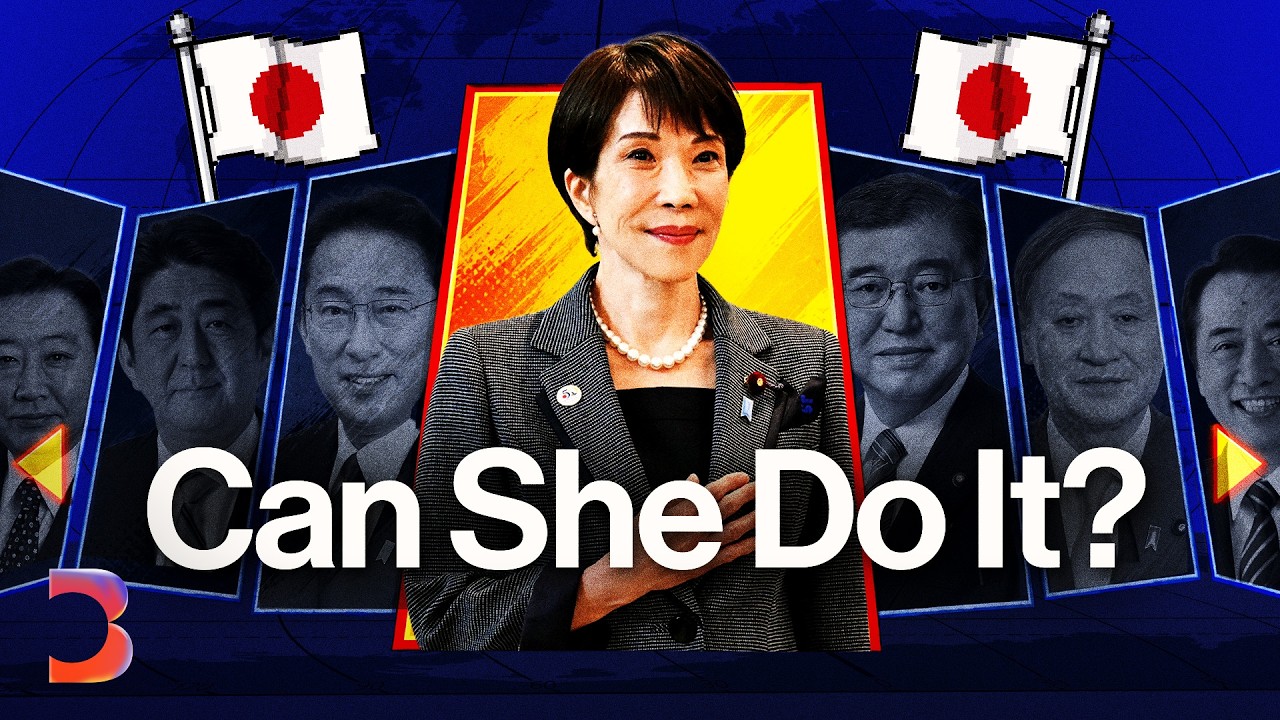
Bloomberg Originals
Takaichi's strategic investment agenda risks compounding Japan's sovereign debt burden if state bond issuance fails to mobilize private capital amid persistent inflation and currency weakness.
AI-assisted summary of Can Japan’s Economy Afford Takaichi’s Big Bet? — original source. Check the original for full context.
Source published:
Key ideas
- Prime Minister Sanae Takaichi is targeting ¥370 trillion ($2.3 trillion) in combined public and private investment by 2040 across 17 strategic sectors, including AI, quantum computing, semiconductors, defense, and manga. (0:01)
- The yen weakened past 160 per US dollar in July 2026, driving broad consumer price inflation and prompting the first coordinated US-Japan currency market intervention in roughly 15 years. (3:54)
- Takaichi plans to temporarily cut the food and beverage consumption tax from 8% to 1% for two years starting in April 2027, raising fiscal concerns among bond market traders. (6:15)
- Japan aims to push defense spending beyond 2% of GDP amid heightened regional security tensions, having labeled a conflict over the Taiwan Strait an existential threat to Japan. (8:11)
Detailed notes
## Background Published on YouTube by Bloomberg Originals on October 23, 2026, this documentary examines Prime Minister Sanae Takaichi’s first year in power and her ambitious ¥370 trillion ($2.3 trillion) public-private investment initiative. According to the video description, the program investigates the political forces that brought Japan's first female prime minister to office and the formidable economic and security risks confronting her agenda, including historic sovereign debt, living-cost inflation, currency weakness, and deteriorating relations with Beijing.
## TL;DR Marking her first year in office, Prime Minister Sanae Takaichi has advanced a sweeping industrial strategy targeting ¥370 trillion in combined public and private investment across 17 strategic sectors by 2040, complemented by temporary consumption tax cuts on food to ease household burdens. However, her ambitious program faces severe structural obstacles, notably the G10's highest debt-to-GDP ratio, an aging and shrinking workforce, and a depreciating yen that drives import-led inflation. In foreign policy, Takaichi has taken an assertive stand by labeling a potential Taiwan conflict an existential threat, resulting in frozen diplomatic relations with China while deepening defense coordination and executing joint currency interventions with the United States. Ultimately, analysts caution that if state-backed venture incentives fail to mobilize private capital, the resulting fiscal burden could destabilize Japan's already stretched public finances.
## Atmosphere & style The presentation carries an analytical, cinematic, and sober tone typical of deep-dive financial journalism. It effectively contrasts colorful cultural details—such as Takaichi’s background as a heavy metal drummer in Nara and the novelty merchandise surrounding her premiership—with stark data highlighting four-decade currency lows, aging demographics, and escalating regional security friction. The viewer experiences a palpable sense of tension between Takaichi's intense, workaholic governing style and the unforgiving macroeconomic math threatening her long-term vision.
## Bulletin - [00:01](https://www.youtube.com/watch?v=HffLUwKl8TY&t=1s) Prime Minister Sanae Takaichi is targeting ¥370 trillion ($2.3 trillion) in combined public and private investment by 2040 across 17 strategic sectors, including AI, quantum computing, semiconductors, defense, and manga. - [03:54](https://www.youtube.com/watch?v=HffLUwKl8TY&t=234s) The yen weakened past 160 per US dollar in July 2026, driving broad consumer price inflation and prompting the first coordinated US-Japan currency market intervention in roughly 15 years. - [06:15](https://www.youtube.com/watch?v=HffLUwKl8TY&t=375s) Takaichi plans to temporarily cut the food and beverage consumption tax from 8% to 1% for two years starting in April 2027, raising fiscal concerns among bond market traders. - [08:11](https://www.youtube.com/watch?v=HffLUwKl8TY&t=491s) Japan aims to push defense spending beyond 2% of GDP amid heightened regional security tensions, having labeled a conflict over the Taiwan Strait an existential threat to Japan.
## Key takeaways - [00:01](https://www.youtube.com/watch?v=HffLUwKl8TY&t=1s) Takaichi entered office with an unconventional, aggressive economic blueprint aiming to position Japan on equal footing with major global economies through a ¥370 trillion public-private investment target by 2040. - [00:01](https://www.youtube.com/watch?v=HffLUwKl8TY&t=1s) Japan's economic restructuring faces severe structural headwinds, including the highest debt-to-GDP ratio among G10 economies and an accelerating demographic decline. - [01:22](https://www.youtube.com/watch?v=HffLUwKl8TY&t=82s) Hailing from Nara and lacking a political dynasty background, Takaichi revitalized the ruling LDP by rallying grassroots conservative support around border control and national sovereignty. - [01:22](https://www.youtube.com/watch?v=HffLUwKl8TY&t=82s) Despite becoming Japan's first female prime minister in a country where women hold just 14% of political seats, Takaichi remains socially conservative, opposing same-sex marriage and separate surnames for married couples. - [03:54](https://www.youtube.com/watch?v=HffLUwKl8TY&t=234s) Decades of stable prices have given way to unfamiliar inflation as the yen's slide past 160 per dollar significantly drove up import costs for food, raw materials, and Middle Eastern energy. - [03:54](https://www.youtube.com/watch?v=HffLUwKl8TY&t=234s) Persistent labor deficits collide with Takaichi's preference for stricter immigration enforcement over liberalized foreign labor channels, even as Japan's centenarian population exceeds 100,000. - [06:15](https://www.youtube.com/watch?v=HffLUwKl8TY&t=375s) Takaichi has disrupted traditional political rituals, meeting far less frequently with career ministry bureaucrats, avoiding faction dinners, and communicating directly through social media. - [06:15](https://www.youtube.com/watch?v=HffLUwKl8TY&t=375s) Immediate relief measures include summer household energy subsidies and a proposed two-year food consumption tax reduction from 8% down to 1% set for April 2027. - [08:11](https://www.youtube.com/watch?v=HffLUwKl8TY&t=491s) Relations with Beijing reached historic lows after Takaichi declared any military conflict over the Taiwan Strait to be an existential threat to Japan and refused to retract the statement. - [08:11](https://www.youtube.com/watch?v=HffLUwKl8TY&t=491s) Takaichi plans to exceed Kishida's defense spending benchmark of 2% of GDP, overhauling security guidelines in response to threats from China, Russia, and North Korea. - [09:12](https://www.youtube.com/watch?v=HffLUwKl8TY&t=552s) Bilateral coordination with US President Donald Trump and Treasury Secretary Scott Bessent culminated in a rare joint foreign exchange intervention to support the depreciated yen. - [10:05](https://www.youtube.com/watch?v=HffLUwKl8TY&t=605s) Because Japan's debt-to-GDP ratio exceeds 200% and sovereign debt service already consumes nearly 20% of the budget, public funding for Takaichi's investment goals risks worsening public finances if private capital fails to match state bets.
## Detailed walkthrough ### [00:01](https://www.youtube.com/watch?v=HffLUwKl8TY&t=1s) Introduction: Sanae Takaichi’s Bold Vision
Sanae Takaichi entered the Japanese premiership with ambitions fundamentally distinct from traditional post-war leaders. She envisions a Japan operating strictly shoulder to shoulder with other major global economies. Rather than incremental stewardship, she is pursuing a radically different plan centered around a massive target of ¥370 trillion ($2.3 trillion) in combined public and private investments by 2040. Her focus spans advanced semiconductors, artificial intelligence, defense systems, energy independence, food technology, and creative industries like manga.
```mermaid flowchart LR accTitle: Takaichi Policy Balance accDescr: Diagram illustrating the clash between Takaichi's ambitious investment strategy and Japan's structural economic obstacles. subgraph Ambition ["Target: ¥370 Trillion by 2040"] direction TB A["Strategic Investments:<br/>AI, Chips, Defense & Content"] end subgraph Headwinds ["Macroeconomic Headwinds"] direction TB B["Demographic Decline"] C["Weak Yen & Inflation"] D["Highest Debt-to-GDP in G10"] end Ambition -.->|"faces"| Headwinds ```
This ambitious program must navigate an exceptionally hostile macroeconomic landscape. Japan carries the highest debt-to-GDP ratio among the G10 economies, alongside chronic demographic decline, an aging society, and plummeting birth rates. Simultaneously, diplomatic ties with Beijing have sunk to historic lows, while Japanese citizens struggle with an unfamiliar surge in living costs. As one commentator underscores regarding the political stakes: “Inflation could be the make-or-break issue.” Having leveraged broad popular support into an electoral landslide for the ruling Liberal Democratic Party (LDP), Takaichi now has the mandate to attempt her restructuring, but failure risks leaving the world's fourth-largest economy with catastrophic debt burdens.
[01:22](https://www.youtube.com/watch?v=HffLUwKl8TY&t=82s) Roots in Nara and Rise to Power
To contextualize Takaichi’s governance, one must travel to Nara, the ancient capital famous for sacred temples and free-roaming deer operating what locals playfully term a "snack-based economy." Nara is Takaichi’s birthplace, and her origins contrast sharply with Tokyo's political establishment. Born into an ordinary middle-income family rather than an entrenched dynastic clan, she exhibited a rebellious streak in her youth, famously playing heavy metal drums. Her outsider identity helped her connect with ordinary voters who felt alienated by career politicians.
When Takaichi launched her bid for the LDP presidency, the long-ruling party was reeling from humiliating electoral setbacks. She effectively revived party enthusiasm by capturing grassroots conservative sentiment, particularly regarding border security and immigration, successfully blunting the momentum of insurgent right-wing factions. Her arrival unleashed an unprecedented merchandising wave in Nagata-cho, including branded keychains, handkerchiefs, official portrait cookies, and novelty tea towels showcasing her alongside the line of all-male predecessors she broke through.
- Takaichi is the first female prime minister in Japan's history. - Japan lags behind global benchmarks in gender representation: women occupy only 14% of political seats in Japan, compared to a global average of roughly 30%. - Despite making history as a female leader, she remains socially conservative, explicitly opposing the legalization of same-sex marriage and rejecting legal reforms that would allow married couples to keep separate surnames.
[03:54](https://www.youtube.com/watch?v=HffLUwKl8TY&t=234s) Inflation, the Yen, and Demographic Realities
Popular political capital erodes quickly under kitchen-table economic distress. For decades, Japanese consumers functioned under flat prices, stagnant wages, and near-zero interest rates. However, a rapid depreciation of the domestic currency fundamentally altered the economy. In 1986, the exchange rate stood near 160 yen per US dollar; by 2011, the yen strengthened to 76 per dollar. By July 2026, the rate slid back beyond 160 yen per dollar, hovering around four-decade lows.
Because Japan relies almost entirely on imports for energy and basic food staples—especially Middle Eastern oil—the weak yen drove up domestic prices across every supply chain. Geopolitical conflict involving the US, Israel, and Iran exacerbated raw material and oil spikes. The squeeze produced bizarre consumer shortages; convenience stores even sold potato chips in plain silver foil bags because unstable packaging ink supplies forced manufacturers to strip graphic branding. As one analyst explains of the public mood: “Japan is just not used to inflation.”
```mermaid flowchart TD accTitle: Macroeconomic Pressures on Japan accDescr: Causal chain from yen depreciation and global turmoil to domestic inflation and demographic strains. Yen["Yen Weakens Past 160/USD"] --> Imports["Surging Import Costs for Energy & Food"] War["Middle East Conflict"] --> Imports Imports --> Inflation["Persistent Consumer Inflation"] Yen --> Inbound["Over-Tourism Pressures"] Ageing["100,000+ Centenarians vs. Shrinking Births"] --> Labor["Labor Shortages vs. Tighter Immigration Rules"] ```
The depreciated yen triggered a surge in foreign tourism, which sparked domestic complaints over viral public misbehavior and overcrowded civic infrastructure. Deeper still is the existential demographic reality: deaths outpace births every year, while Japan's population of centenarians has surpassed six figures. Yet, facing a severe labor deficit, Takaichi has favored tighter immigration controls and strict legal enforcement over liberalizing foreign labor channels.
[06:15](https://www.youtube.com/watch?v=HffLUwKl8TY&t=375s) Governing Style and Domestic Relief Policies
Takaichi quickly established an unconventional executive persona. Immediately upon taking office, her initial policy speech went viral for her relentless pledge of "work-work-work-work-work." In day-to-day operations, she has upended traditional Japanese political rituals. According to a Bloomberg calculation, she meets with career ministry bureaucrats far less often than past prime ministers. She rarely hosts backroom dinners with ruling-party faction chiefs, largely bypasses mainstream press conferences, and relies on social media to address voters directly.
During her first year, she advanced a mix of cost-of-living relief and industrial restructuring: - Subsidized domestic gasoline and household energy rates across peak summer months. - Diversified crude oil import relationships away from single-source vulnerabilities. - Championed a temporary two-year reduction of the consumption sales tax on food and non-alcoholic beverages from 8% down to 1%, slated to take effect in April 2027. - Designated 17 strategic industries for targeted state development under her ¥370 trillion growth agenda, emphasizing AI, quantum systems, microchips, green energy, food production tech, and Japanese cultural exports like anime and manga.
Her consumption tax cut proposal, however, unsettled bond traders who fear that reducing revenue will compound public debt imbalances.
[08:11](https://www.youtube.com/watch?v=HffLUwKl8TY&t=491s) Taiwan, Geopolitics, and Transatlantic Alliance
In foreign policy, Takaichi has discarded the cautious ambiguity typical of past prime ministers. Tensions escalated sharply after she declared that a military conflict across the Taiwan Strait would constitute an "existential threat" to the nation of Japan. Beijing took severe offense, initiating a sustained diplomatic offensive aimed at isolating her internationally and forcing a retraction. As the documentary notes: “And Takaichi has responded to that by saying no.”
```mermaid flowchart LR accTitle: Geopolitical Alignment accDescr: Overview of Takaichi's strategic alignment with the US while facing diplomatic hostility from China. Japan["Japan (PM Takaichi)"] <-->|"Defense Spending >2% GDP<br/>Joint Yen Intervention"| US["United States (Pres. Trump)"] Japan <-.->|"Diplomatic Freeze over Taiwan Stance"| China["China (Pres. Xi Jinping)"] ```
On national defense, Japan historically capped military outlays near 1% of GDP. That convention broke under former Prime Minister Fumio Kishida, who raised outlays toward 2% of GDP in 2022. Takaichi wants to exceed even that threshold, overhauling core defense guidelines amid escalating threats from China, Russia, and North Korea.
Her defense stance aligned well with US President Donald Trump, who has persistently pressured allies to fund their own territorial security. Although domestic critics suggested she appeared overly eager to court Trump, the personal diplomacy yielded economic cooperation. When Trump voiced complaints that an undervalued yen injured American commerce, Tokyo and the US Treasury conducted a historic coordinated intervention in foreign exchange markets to prop up the currency—their first joint action of that nature in roughly 15 years. US Treasury Secretary Scott Bessent signaled absolute readiness to intervene again if exchange markets destabilize. Because Japanese entities hold over $1 trillion in US Treasuries, shifts in Tokyo's financial trajectory create systemic waves globally.
[10:05](https://www.youtube.com/watch?v=HffLUwKl8TY&t=605s) Fiscal Realities and the Road Ahead
The central challenge looming over Takaichi’s ¥370 trillion vision is that it represents an aggregate public-private goal rather than a direct state allocation. Public contributions will necessitate issuing new government bonds, which directly threatens fiscal stability. Japan’s national debt stands at more than double its annual economic output, making it an extreme outlier among advanced nations. While the debt-to-GDP ratio has moderated slightly as post-pandemic stimulus emergency packages wound down, sovereign debt service already consumes nearly 20% of Japan’s regular budget.
Analysts warn that if state-backed venture bets fail to trigger private capital matching, the outcome could prove crippling: “If the entire project is not successful, that will create a huge burden on Japan’s public finance.”
Entering her second year, Takaichi's political survival rests on multiple unresolved variables: - Generating durable market confidence in public bond issuances despite massive debt. - Sparking productivity and wage gains against a shrinking labor demographic. - Restoring diplomatic dialogue with Beijing after President Xi Jinping halted high-level bilateral communication. - Retaining high personal public approval, which remains her sole leverage over an uneasy, faction-driven party machinery that lacks a natural institutional base for her.
The Japanese public remains hopeful toward her economic ambitions compared to past leadership cycles, giving her the space to advance her agenda. Whether her hard-charging focus will ultimately deliver a wealthier and safer Japan remains the central test of her prime ministership.
## Notable quotes > [03:54](https://www.youtube.com/watch?v=HffLUwKl8TY&t=234s) Japan is just not used to inflation.
## Mentioned Sanae Takaichi, Liberal Democratic Party, Fumio Kishida, Donald Trump, Scott Bessent, Xi Jinping, US Department of the Treasury, Bloomberg
## Video description A year after becoming Japan’s prime minister, Sanae Takaichi is pursuing an ambitious plan to build a stronger, richer and more secure country. At the center of her strategy is a target of ¥370 trillion ($2.3 trillion) in public and private investment, spanning artificial intelligence, semiconductors, defense, energy, food technology and even manga.
But as Takaichi enters her second year in power, Japan faces a formidable combination of pressures: a weak yen, rising living costs, a shrinking workforce, enormous government debt and worsening relations with China. Takaichi also wants Japan to spend more on defense as security challenges grow across Asia.
This documentary examines Takaichi’s first year as prime minister, the forces that brought her to power and the risks surrounding her agenda.
Explore these and other related stories in more depth on Bloomberg.com
Japan Has Its First Woman Leader. Just Don’t Ask Her About Feminism: https://www.bloomberg.com/news/articles/2025-10-22/sanae-takaichi-is-japan-s-first-female-leader-but-equality-remains-elusive
Japan’s Takaichi Touts Sweeping Changes in Immigration Rules: https://www.bloomberg.com/news/articles/2026-09-28/japan-s-takaichi-touts-sweeping-changes-in-immigration-rules
Japan’s Takaichi Calls for Food Sales Tax Cut to 1% for Two Years: https://www.bloomberg.com/news/articles/2026-07-30/japan-s-takaichi-calls-for-food-sales-tax-cut-to-1-nhk-says
Takaichi’s Long-Term Vision May Fail to Dispel Inflation Angst: https://www.bloomberg.com/news/articles/2026-07-28/takaichi-s-long-term-vision-may-fail-to-dispel-inflation-angst
Japan’s Investment Targets Include AI, Quantum Computing: https://www.bloomberg.com/news/articles/2026-03-10/japan-s-investment-targets-include-ai-quantum-computing-drones
Japan Confirms Three-Day Yen Intervention in Spring to Lift Yen: https://www.bloomberg.com/news/articles/2026-08-06/japan-confirms-intervention-on-three-days-in-spring-to-buoy-yen
00:00 Introduction 01:18 Takaichi’s background 2:16 Election 3:53 Economic challenges 6:15 Work ethic 6:57 Policies 8:11 China and defense 9:12 Relationship with the US 10:05 Investment plan 11:16 Conclusion
#Japan #Yen #Takaichi -------- Like this video? Subscribe: http://www.youtube.com/Bloomberg?sub_confirmation=1
Get unlimited access to Bloomberg.com for just $1.99 your first month: https://www.bloomberg.com/subscriptions?in_source=YoutubeOriginals Bloomberg Originals offers bold takes for curious minds on today’s biggest topics. Hosted by experts covering stories you haven’t seen and viewpoints you haven’t heard, you’ll discover cinematic, data-led shows that investigate the intersection of business and culture. Exploring every angle of climate change, technology, finance, sports and beyond, Bloomberg Originals is business as you’ve never seen it.
Subscribe for business news, but not as you've known it: exclusive interviews, fascinating profiles, data-driven analysis, and the latest in tech innovation from around the world.
Visit our partner channel Bloomberg News for global news and insight in an instant.
[Source](https://www.youtube.com/watch?v=HffLUwKl8TY)