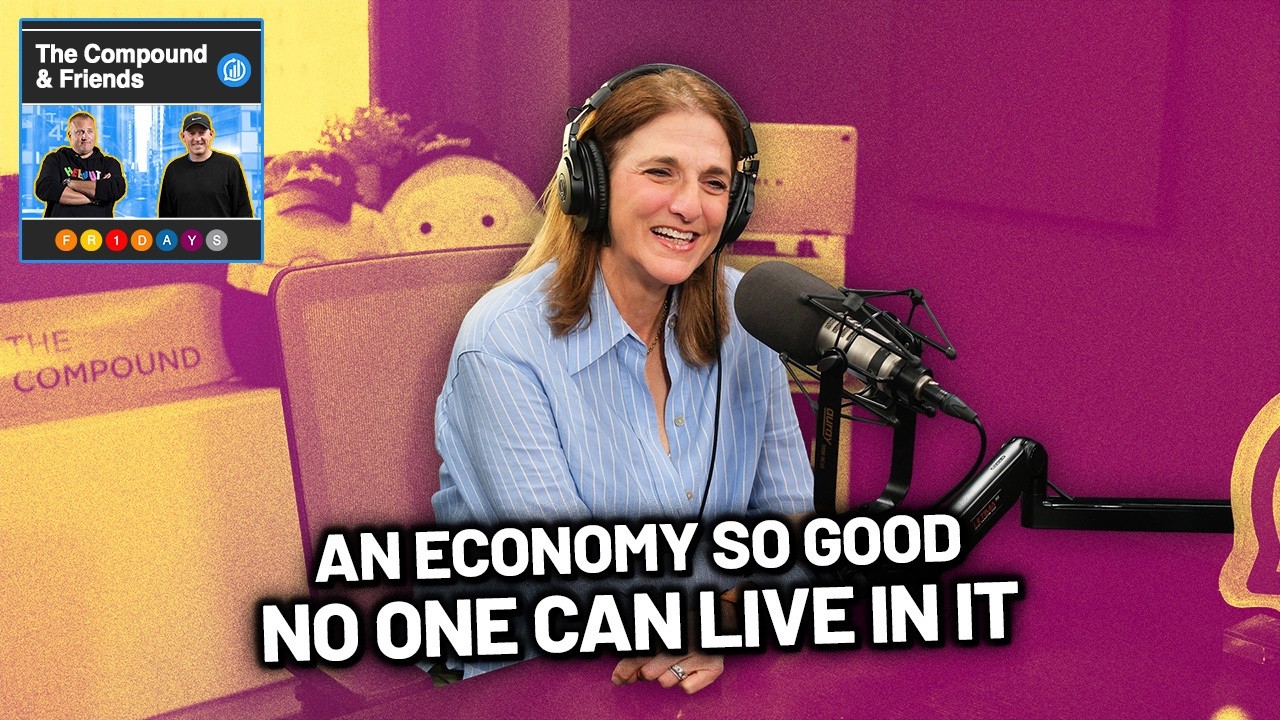
A pronounced disconnect persists between macro data and consumer sentiment, with major U.S. lenders reporting 15 consecutive quarters of solid spending while rising prices keep household anxiety elevated. (22:11)
Meta recorded its first negative quarterly free cash flow since 2012 following aggressive AI capex commitments, sparking volatility despite ad impressions rising 10% year over year. (64:04)
Financial advisors argue AI tools will automate commodity back-office math and commoditize direct-to-consumer advice, but cannot replace personal empathy and emotional reassurance. (57:46)
Without federal legislative action, Social Security faces an estimated statutory benefit cut of roughly 25% by approximately 2032. (70:53)
Detailed notes
## Background
Published by The Compound on YouTube on October 23, 2026, episode 265 of The Compound and Friends features hosts Downtown Josh Brown and Michael Batnick alongside guest Jill Schlesinger, a CBS News business analyst. According to the show description, the episode covers why Americans feel pessimistic despite strong economic data, the growing divide between rich and poor, the housing affordability crisis, media negativity, and the corporate AI spending boom.
## TL;DR
Josh Brown, Michael Batnick, and CBS News analyst Jill Schlesinger examine the stark disconnect between robust macroeconomic indicators—such as low jobless claims and steady consumer spending—and the deep economic resentment felt by everyday households facing soaring living costs. They discuss how social media algorithms amplify financial anxiety and fuel extreme K-shaped pricing across entertainment, dining, and travel. The conversation turns to wealth preservation, urging older generations to distribute inheritances earlier to help adult children overcome homebuying and childcare barriers. Finally, the group evaluates the corporate AI landscape, dissecting Meta's surging capital expenditures, enterprise ROI concerns, and why AI will commoditize back-office financial tasks while leaving human emotional advisory services indispensable.
## Atmosphere & style
The episode is energetic, candid, and banter-heavy, opening with amusing personal grooming anecdotes before diving into serious macroeconomic debates. The hosts and Schlesinger strike a pragmatic balance between acknowledging hard data and empathizing with the emotional reality of strained consumers, consistently puncturing media sensationalism with grounded industry humor. Schlesinger brings a sharp, experienced broadcast perspective, pushing back against prevailing doom and gloom with warmth, frank advice, and comedic timing.
## Bulletin
- [22:11](https://www.youtube.com/watch?v=RF6urLk_JU8&t=1331s) A pronounced disconnect persists between macro data and consumer sentiment, with major U.S. lenders reporting 15 consecutive quarters of solid spending while rising prices keep household anxiety elevated.
- [01:04:04](https://www.youtube.com/watch?v=RF6urLk_JU8&t=3844s) Meta recorded its first negative quarterly free cash flow since 2012 following aggressive AI capex commitments, sparking volatility despite ad impressions rising 10% year over year.
- [57:46](https://www.youtube.com/watch?v=RF6urLk_JU8&t=3466s) Financial advisors argue AI tools will automate commodity back-office math and commoditize direct-to-consumer advice, but cannot replace personal empathy and emotional reassurance.
- [01:10:53](https://www.youtube.com/watch?v=RF6urLk_JU8&t=4253s) Without federal legislative action, Social Security faces an estimated statutory benefit cut of roughly 25% by approximately 2032.
## Key takeaways
- [16:31](https://www.youtube.com/watch?v=RF6urLk_JU8&t=991s) Struggling consumers often dismiss aggregate positive economic data because it conflicts with their everyday affordability pressures.
- [18:12](https://www.youtube.com/watch?v=RF6urLk_JU8&t=1092s) Early academic career-tracking in middle school narrows student exploration and increases pressure on younger generations entering higher education.
- [22:11](https://www.youtube.com/watch?v=RF6urLk_JU8&t=1331s) Commercial bank earnings and declining net charge-offs point to consumer financial resilience, contrasting sharply with persistent doomscrolling narratives.
- [23:44](https://www.youtube.com/watch?v=RF6urLk_JU8&t=1424s) Financial news media leans heavily into negative headlines to drive engagement and compete against algorithmic social feeds.
- [31:36](https://www.youtube.com/watch?v=RF6urLk_JU8&t=1896s) Social media feeds distort financial benchmarks by showcasing extreme luxury lifestyles, inducing anxiety even among households with substantial savings.
- [34:15](https://www.youtube.com/watch?v=RF6urLk_JU8&t=2055s) A bifurcated K-shaped spending pattern permits premium entertainment, travel, and hospitality brands to hike prices without curbing top-tier demand.
- [38:46](https://www.youtube.com/watch?v=RF6urLk_JU8&t=2326s) High-income consumption remains durable because home equity, stock portfolios, and private business valuations have not endured sustained declines.
- [42:28](https://www.youtube.com/watch?v=RF6urLk_JU8&t=2548s) Older generations holding substantial home equity and wealth create incentives for early wealth transfers to help adult children manage down payments and childcare.
- [42:28](https://www.youtube.com/watch?v=RF6urLk_JU8&t=2548s) Low locked-in mortgage rates around 3% and reliance on localized family support networks severely restrict geographic labor mobility across the country.
- [51:53](https://www.youtube.com/watch?v=RF6urLk_JU8&t=3113s) Hypothetical automated AI cash-sweeping tools could introduce liquidity and bank-run risks, but U.S. financial regulation typically remains reactive rather than proactive.
- [01:00:56](https://www.youtube.com/watch?v=RF6urLk_JU8&t=3656s) The competitive AI landscape is shifting away from raw parameter scale toward cost-efficient, low-latency architectures per compute dollar.
- [01:04:04](https://www.youtube.com/watch?v=RF6urLk_JU8&t=3844s) Meta faces heightened Wall Street scrutiny over whether massive AI capital spending can translate into sustainable operating returns.
- [01:13:00](https://www.youtube.com/watch?v=RF6urLk_JU8&t=4380s) Regulatory friction surrounding AI infrastructure and data center construction is concentrated at state and local zoning levels rather than at the federal tier.
- [01:19:10](https://www.youtube.com/watch?v=RF6urLk_JU8&t=4750s) CBS News is broadening its digital audio presence with new shows designed to reach younger audiences and counter personal finance misinformation.
## Detailed walkthrough
### [00:00](https://www.youtube.com/watch?v=RF6urLk_JU8&t=0s) The Five-Barber Rotation and Small-Talk Avoidance
Downtown Josh Brown explains his meticulous system for getting haircuts over the past six years since the pandemic. Because he maintains short hair, he needs a trim every three weeks. However, visiting the same barber every three weeks inevitably builds unwanted familiarity, leading to repetitive conversations, questions about the stock market, or barbers oversharing personal relationship problems. To prevent this, Josh keeps a five-barber geographic rotation across New York City.
```mermaid
flowchart TD
accTitle: Josh Brown Barber Rotation
accDescr: Josh Brown rotates among five distinct barbers across New York City to avoid small talk and repetitive stock questions.
A["Josh's Short Hair Rule<br/>(Cuts every 3 weeks)"] --> B["Avoid Barbershop Small Talk"]
B --> C1["Barber 1: Wall Street Office Lobby<br/>(Secret staircase, Kramer rumor, little English)"]
B --> C2["Barber 2: Venezuelan Shop<br/>(Music blasting, Spanish only)"]
B --> C3["Barber 3: Bedford Ave / Sports Guy<br/>(Off-limits during Knicks season)"]
B --> C4["Barber 4: Silent Professional<br/>(Strictly transactional)"]
B --> C5["Barber 5: Fifth Option<br/>(Keeps rotation fresh)"]
```
His barbers include one in the lobby of an office building on Wall Street right across from the New York Stock Exchange—tucked away up a secret staircase, run by a man who barely speaks English (and whom someone claimed might cut Jim Cramer's hair)—and another shop staffed by Venezuelan barbers where loud Latin music blasts and only Spanish is spoken. Michael Batnick confesses he completely understands the desire to avoid forced intimacy:
> “I totally get it. It's like taking the relationship to a level that is not really what you want. I want to just sit in the chair and close my eyes and just have the haircut happen.” — Michael Batnick
Josh admits that when he visits the dentist, he deliberately takes nitrous oxide with the mask on specifically so no one can attempt small talk with him. Because his hair has grown out slightly, he can stretch his visits and reduce his roster down to three barbers, calling his current hair a "double blessing." Michael mentions taking his sons to a barber on Bedford Avenue where customers casually unload an astonishing amount of deeply personal details. Josh recalls having to drop one barber during basketball season simply because the barber discovered he was a New York Knicks fan.
- **Haircut frequency requirement:** Every three weeks when keeping hair very short.
- **Dentist routine:** Nitrous mask on immediately to eliminate pre-procedure banter.
- **The Knicks rule:** Barbers who discuss basketball cannot be visited during the NBA regular season.
---
[03:43](https://www.youtube.com/watch?v=RF6urLk_JU8&t=223s) Salon Confessions, Street Distractions, and Meeting Bari Weiss
Jill Schlesinger shares her own grooming routines from CBS. She previously had her hair dyed frequently near the CBS Broadcast Center to keep up with television appearances as her roots turned white. Because having network executives walk past while she sat with dye in her hair was awkward, she found a Korean hairdresser named Johnny Bong near the broadcast center who speaks very little English and lets her work quietly on her laptop. The trio laments the worst conversational crutch in daily life—the phrase *"So, what else is going on?"*—which Josh argues is completely unnecessary filler once a natural conversation has concluded. Michael points out that wearing AirPods in public on the Upper West Side fails to stop neighbors from interrupting him, even while he is on calls.
Jill pivots to a story about meeting her new boss at CBS News, Bari Weiss, following the corporate acquisition involving Skydance and The Free Press. With employees on edge over Weiss's appointment to oversee CBS News, Jill decided to bypass standard corporate flattery:
> “Hi, Bari. I'm Jill Schlesinger. I'm the original lesbian Jew here and I cover business and the economy.” — Jill Schlesinger
Weiss paused and responded, *"There's only two."* Jill confirmed, *"You're number two,"* joking that there might only be one other editor working in Edit Bay 7 on a piece for *CBS Sunday Morning*. Jill credits that unfiltered, humorous initial interaction with breaking the ice and helping her get a new show greenlit at the network.
- **Hair colorist:** Johnny Bong, located near the CBS Broadcast Center.
- **Corporate acquisition:** Skydance acquired CBS and brought over Bari Weiss (founder of *The Free Press*) to run CBS News operations.
- **Executive age:** Bari Weiss stepped into leadership at CBS News at age 42.
---
[08:13](https://www.youtube.com/watch?v=RF6urLk_JU8&t=493s) Sponsorship: Year-End Positioning with Nuveen
Josh and Michael transition to the mid-roll partner segment with Nuveen, discussing year-end portfolio positioning. They emphasize that the end of the year is an opportunity to look beyond standard deadlines and evaluate portfolio allocations following a stretch of narrow equity market leadership and evolving tax implications. Nuveen offers customized portfolio insights designed to help investors rebalance risk and improve after-tax results heading into the new year.
[09:16](https://www.youtube.com/watch?v=RF6urLk_JU8&t=556s) Welcome Back Jill Schlesinger
Josh Brown and Michael Batnick welcome CBS News business analyst Jill Schlesinger back to the studio. Schlesinger immediately ribs Batnick about his shifting allegiances, teasing that after her very first appearance he declared her the best guest ever, only to shower subsequent visitors with the exact same praise: “I'm just telling you after that, you got all these other people on. Oh, our favorite guest. Oh, our favorite guest. Oh, like I'm borscht now. I'm nothing.” Brown jumps in to read her extensive credentials as an Emmy and Gracie Award-winning analyst covering markets, investing, and the broader economy for CBS television nationwide. She spent 14 years as co-owner and CIO of an independent investment advisory firm following an early career trading options in New York, authored *Dumb Things Smart People Do With Their Money* and *The Great Money Reset*, hosted the nationally syndicated *Jill on Money* radio show for 15 years, and currently hosts the *Jill on Money* and *Money Moves* podcasts. After a quick joke from Brown asking her how to solve the Israeli-Palestinian conflict, the conversation shifts to Main Street and consumer finance.
[11:47](https://www.youtube.com/watch?v=RF6urLk_JU8&t=707s) The American Consumer and Affordability
Brown points out that national network news like CBS rarely covers daily stock market gyrations unless market events cross over into mainstream panic. When the VIX momentarily blips to 18, nobody rushes a business reporter into the makeup chair; coverage instead focuses on persistent themes like wealth inequality, the K-shaped economy, and emerging AI infrastructure. Schlesinger explains the delicate editorial balance required when reporting on consumer health to a broad television audience. Pitching deep data dives—like the Federal Reserve's Survey of Consumer Finances—often gets rejected by network executives as "too much" detail until framed around wealth disparity and economic anger.
```mermaid
flowchart TD
accTitle: Network News Economic Coverage Tension
accDescr: Diagram illustrating the editorial challenge of covering economic reality versus audience perception.
subgraph Coverage ["Media Balancing Act"]
B & D --> E{"Network News Coverage"}
E -->|"Reports 'Economy is Great'"| F["Aliens Struggling Viewers"]
E -->|"Reports 'Everything Sucks'"| G["Distorts Overall Macro Data"]
E -->|"Down the Middle"| H["Frustrates Network Overlords on Both Sides"]
end
```
Schlesinger observes that reporting must thread an impossible needle between two opposing realities: highlighting that the top 25% of earners and asset owners are doing exceptionally well risks alienating struggling viewers, while focusing solely on affordability crises distorts the aggregate macro picture:
> “So I think affordability is real. When we have people out on the ground or we have polling, you know, you can't ignore the polling even if it's like even if everyone's overly negative, and I get it. Everyone's overly negative and says, 'Everything sucks so badly, even if my life is good.'”
- Schlesinger recounts getting called on a Sunday afternoon to analyze the Russia oil situation, noting regional producers in the Northeast were frantic over heating oil costs.
- Despite regional panic, heating oil fuels heat for only roughly 3% of US households, though energy spikes heavily squeeze truckers and farmers.
- Colleague Jo-Ling Kent has been reporting long-form West Coast pieces on AI, balancing job destruction risks against potential job creation without succumbing to panic.
- Older Americans who own their homes outright and have built lifetime wealth are insulated and thriving.
[16:31](https://www.youtube.com/watch?v=RF6urLk_JU8&t=991s) Economic Resentment and Anxious Parents
The hosts examine the psychological divide driving public frustration. Brown argues that struggling individuals often crave negative coverage because admitting that the wider economy is prospering makes them feel left behind. Hearing that others are getting ahead leads people to dismiss positive economic data as “fake” or conclude that the system is rigged against them. Schlesinger notes that although listeners of her personal finance show tend to be in sound financial shape, a noticeable shift has emerged even among wealthy households: parents are gripped by unprecedented anxiety regarding their adult children's financial futures. Looking back at her own path, Schlesinger reflects on how different the current landscape feels compared to earlier decades:
> “I don't think my parents worried about me and my career. Like you have to be a dumbass to graduate in 1987 and not get a job.”
[18:12](https://www.youtube.com/watch?v=RF6urLk_JU8&t=1092s) College Affordability and the Eighth-Grade Career Track
The conversation turns to the immense pressure parents face regarding their children's financial and professional futures. Josh Brown frames the core anxiety: even if your children go to college and land jobs, basic milestones feel unattainable. If they want to live in a city like New York, they cannot afford rent, and buying a starter home might be out of reach until age thirty or beyond. Josh shares an anecdote about a dinner with friends whose daughter was searching for work. As she detailed the hyper-specific, idealized role she wanted, Josh rolled his eyes and got a sharp kick under the table from his wife, Jackie, signaling him to keep quiet. Josh remembers that when the financial crisis hit and he had already sold his company, he was ready to pivot to anything: “I remember saying, 'Ah, I could sell cars.'”
```mermaid
flowchart TD
accTitle: Evolution of Career Preparation Pathways
accDescr: Diagram comparing the traditional open career exploration model to today's rigid early tracking model.
subgraph Traditional["Traditional Path"]
T1["Liberal Arts Education"] --> T2["Exploration & Broader Skills"]
T2 --> T3["Flexible Post-Grad Job Hunt"]
end
subgraph Modern["Modern High School Track"]
M1["8th Grade Guidance Meeting"] --> M2["Specialized Course Loads"]
M2 --> M3["Early College Credits & Narrow Focus"]
end
Modern -.->|"High barrier to switch tracks"| T3
```
Josh points out that children today are not raised with a "get any job" mentality; instead, modern high schools operate like colleges, forcing kids to map out their paths as early as eighth grade. Students meet with counselors before their freshman year to select narrow coursework aligned with specific professional tracks, such as taking summer college classes for biology credits. While this system rewards teenagers who already know they want a STEM career, it locks out broader exploration. Jill Schlesinger agrees, arguing that this intense pre-professional focus robs young people of the chance to attend liberal arts colleges, take challenging professors, and simply learn how to think:
> “So, we're not we're not training our kids get any job. We're telling them from a very young age, you're on a certain track.” — Josh Brown
- Modern high schools schedule guidance planning in the eighth grade to lock in specialized curricular pathways before ninth grade begins.
- Students who pivot away from early tracks face a competitive disadvantage against peers who specialized early.
---
[22:11](https://www.youtube.com/watch?v=RF6urLk_JU8&t=1331s) The Economic Paradox: Hard Data vs. Household Realities
Michael Batnick steps in to balance the emotional narrative against hard macroeconomic indicators, pulling up a series of economic charts. He readily acknowledges that everyday expenses hit families hard: retail gasoline prices have spiked violently—noting a tweet showing Cleveland gas jumping fifty cents in a single day—and diesel costs are filtering into goods across the broader supply chain. Simultaneously, mortgage rates remain at punishing, unaffordable highs.
Yet underneath the sticker shock, consumer balance sheets tell an entirely different story. Looking at quarterly earnings from Bank of America—a broad proxy for Main Street consumers rather than just affluent spenders—Michael points out that consumer net charge-offs are actively declining. In addition, initial jobless claims dropped to 194,000, representing the fourth-lowest print since the 1960s. Josh notes that on historical charts, the pandemic distortion was so extreme that it barely fits onto standard axes. Michael cites macro strategist Dan Greenhouse, who compiled bank earnings commentary showing that major lenders have reported healthy consumer spending trends for fifteen consecutive quarters without interruption:
> “Consumer charge offs are going down. We also have today we had initial jobless claims down to 194,000 which is the fourth lowest level going back to the 1960s.” — Michael Batnick
- Cleveland retail gasoline jumped roughly 50 cents within a single day.
- Weekly initial jobless claims registered at 194,000, marking one of the lowest prints in six decades.
- Major US banks have reported resilient consumer balance sheets and spending patterns for 15 consecutive quarters.
---
[23:44](https://www.youtube.com/watch?v=RF6urLk_JU8&t=1424s) The Elizabeth Holmes Doc, Media Negativity, and Future Proof
Michael recounts being out until past midnight the prior evening seeing the Elizabeth Holmes documentary, joking along the way about viewers claiming he looks like Holmes. In the film, a major narrative thread involves whether a reporter misquoted Holmes and how media phrasing shaped public perception. Roughly thirty minutes after leaving the theater, Michael received a text regarding a newly published *Wall Street Journal* piece about Future Proof with the headline: *"It looks like a music festival. It's really a sales pitch for private credit."*
Michael expresses deep frustration with the coverage, calling the angle total nonsense because the vast majority of the thousands of attendees are fiduciary Certified Financial Planners (CFPs) offering plain-vanilla financial advice rather than aggressively hawking risky private credit. He connects this headline-chasing behavior to a wider systemic issue: journalists are locked in an all-out battle for eyeball engagement against short-form algorithmic feeds like Meta's Instagram Reels, incentivizing non-stop pessimism around both artificial intelligence and the broader economy. While Josh counters that rigorous investigative reporting on Elizabeth Holmes saved lives by exposing fraudulent blood-testing technology, Michael clarifies that he isn't attacking investigative journalism wholesale—he is critiquing the media's perpetual tilt toward doom:
> “And I think the way that the media rightly or wrongly is reporting on AI, it's all negativity all the time. And the economy, it's all bad all the time.” — Michael Batnick
Jill weighs in from her seat inside legacy broadcast news, explaining the editorial tension behind the camera. She frequently lobbies producers to go on air during all-time market highs to explain wealth creation, rather than only being summoned when the S&P 500 plunges ten percent. When she reminds viewers on television that corporate capital expenditure on AI and enterprise data infrastructure is the engine inflating their 401(k) retirement accounts, she routinely receives angry viewer mail from audiences who prefer to view technology spending purely as a negative bubble.
[27:34](https://www.youtube.com/watch?v=RF6urLk_JU8&t=1654s) Calling Balls and Strikes vs. Pervasive Negativity
Jill Schlesinger reflects on her struggle against the instinct to seek out and scroll through negative news, calling it something she constantly fights in her personal and professional life. While Michael Batnick jokes that fighting doomscrolling is a “losing battle,” Jill explains that her job as an analyst is to maintain balance: “I really think I am calling balls and strikes on the economy.” She admits that her trader background means she is actually more comfortable during downturns, remarking, “I'm much happier by the way in a bare market just as a trader. No, I don't like bull markets. They they freak me out. I'm always waiting for the bottom to fall out like you know.”
Her primary frustration arises when people who are doing remarkably well still feel inadequate. She shares the story of a 37-year-old woman calling into her show with $300,000 saved for retirement, convinced she is hopelessly behind. Jill emphasizes that she had to reassure the caller that she was doing amazing work and was fully on track, pointing out that young adults should not feel pressured to duplicate every milestone their parents achieved at that exact age. She laments how toxic comparisons and negativity create a downward spiral of personal financial anxiety.
---
[28:54](https://www.youtube.com/watch?v=RF6urLk_JU8&t=1734s) Why Financial Media Feeds the Bearish Narrative
Josh Brown explains that the financial media’s default to skepticism and negativity originated from the 2008 Great Financial Crisis, when journalists failed to uncover the brewing disaster. The media was caught flat-footed because it was activist short sellers and hedge fund managers—not reporters—who exposed the subprime mortgage house of cards and rampant housing fraud. Josh notes that Barry Ritholtz made his career during that era by appearing on Larry Kudlow's show as the lone bear warning about mortgage nonsense while panels of commentators laughed in his face. Following that embarrassment, the media vowed never to miss another crisis and spent nearly two decades searching for one under every rock.
Michael Batnick pushes back on the idea that post-2008 PTSD still drives modern news coverage. He argues that the financial media operates strictly on economics and traffic algorithms: “And what they are responding to, I don't blame media for making us angry. It's not like they're doing it on purpose. What they're doing is they're a business and they want to make money. And it is our fault, the consumer's fault, because we want negativity.” Consumers click on negative headlines far more than positive ones, trapping both the press and the public in an endless doom loop driven by profit-seeking models.
- Josh argues that media skepticism has actually helped prolong the economic cycle by preventing irrational exuberance across assets like Tesla, Bitcoin, or AI capital expenditures.
- Michael maintains that while media skepticism was principled in 2013, by 2026 it has simply become algorithmic engagement farming tailored to angry consumers.
---
[31:36](https://www.youtube.com/watch?v=RF6urLk_JU8&t=1896s) The Instagram Economy, $8 Water, and the Housing Reality
Josh and Michael connect modern financial distress directly to Instagram and algorithmic comparison. Social media creates a warped reality where everyday users believe everyone else is summering on a yacht in Italy, skiing in Aspen all winter, or hosting lavish gender-reveal parties at the Ritz-Carlton featuring performances by Usher. This manufactured envy breeds widespread insecurity, leading people with $1 million in the bank to feel like the poorest residents in Manhattan and making viewers vulnerable to get-rich-quick course peddlers. At the same time, Josh points out that real inflation causes legitimate outrage, recounting his experience at a movie theater where a 28-year-old kid asked for the price of a bottled water, laughed when told it was $8, and had to walk to his seat empty-handed.
Jill addresses the common boomer complaint that younger generations are lazy, detailing an argument she had with an old college friend who bragged about living cheaply in Queens when starting his career. Jill researched the historical data for an article and discovered that entry-level wages have remained flat when adjusted for inflation, whereas housing and the basic cost of living have escalated dramatically. She insists older generations need to stop complaining about adult children living at home when the arithmetic makes it nearly impossible for a young professional earning $72,000 to manage alone.
```mermaid
flowchart TD
accTitle: The Instagram Envy and Corporate Pricing Loop
accDescr: How social media envy drives crowd concentration and enables corporate price hikes.
subgraph Social_Media["Social Media Distortion"]
A["Instagram Curated Feeds<br>(Yachts, Aspen, Luxury Events)"] --> B["Perceived Inadequacy & FOMO<br>('Everyone is rich except me')"]
end
subgraph Consumer_Action["Consumer Behavior"]
B --> C["Hyper-Concentration on 'Cool'<br>(Top venues, exclusive shows)"]
end
subgraph Corporate_Pricing["Corporate Exploitation"]
C --> D["K-Shaped Pricing Power<br>($8 water, $700 tickets, rising airfares)"]
D --> E["Middle Class Stretches Budget<br>to Mimic the Wealthy"]
end
```
---
[34:15](https://www.youtube.com/watch?v=RF6urLk_JU8&t=2055s) Hyper-Concentration, $700 Concerts, and K-Shaped Pricing
Josh illustrates how social media drives extreme crowd concentration by sharing a story about his 17-year-old son, who pleaded to go see EDM DJ Calvin Harris at Brooklyn's Barclays Center because “all my friends are going.” After finding out face-value tickets were $600 and sold out immediately, his son reported that three shows were added—only for tickets to reach $700 each on secondary markets. Michael observes that while people have endless entertainment options in major cities like New York or Los Angeles, modern herd mentality forces everyone to converge on the exact same sold-out events and restaurants.
Josh draws a comparison to Las Vegas, noting that the newly opened Fontainebleau was completely empty—to the point where “you could have had a football catch”—while the Wynn and Encore were packed to the rafters simply because social media labeled one property cool and the other irrelevant. Michael highlights how corporate America is capitalizing on this K-shaped economy: brands realize that high-income consumers—and middle-class consumers desperate to emulate them—will pay virtually any price tag to be part of the cultural zeitgeist: “There is no limit to what people will pay.”
- Face-value tickets to Calvin Harris at Barclays Center started at $600, with secondary market additions climbing past $700.
- Foot traffic in Las Vegas was intensely polarized between venues deemed trendy online (Wynn/Encore) versus those ignored by influencers (Fontainebleau).
- Major brands like United Airlines, Delta Air Lines, and Disney are aggressively increasing premium pricing and mileage costs to extract maximum margins from top-tier spenders.
[36:53](https://www.youtube.com/watch?v=RF6urLk_JU8&t=2213s) The $30 Cocktail, Mahjong Nights, and "Many Americas"
The absurdity of modern price points has reached a level where even affluent consumers are balking out of pure principle. Jill Schlesinger observes that while she can certainly afford an expensive drink, spending $30 on a single cocktail at a bar triggers a visceral refusal: “I will say that like there's a part of me that's like I cannot pay $30 for a drink... there's something about like of course I can afford it, but there is like it hurts me.” She points to a *Wall Street Journal* report documenting a cultural shift toward staying home and playing tabletop games—particularly a massive resurgence in mahjong. As the hosts point out, gathering with friends to play mahjong for two hours costs nothing, whereas a casual lunch now easily sets someone back $80.
At the same time, this frugality exists alongside an alternate economic universe. Jill notes that while interviewing people across all income brackets, it becomes starkly clear that there are “many Americas.” In high-demand metropolitan hubs like New York, Miami, San Francisco, and Los Angeles, spending is fueled by global wealth. Businesses in these tier-one cities face a seemingly bottomless well of affluent clientele, creating a dynamic where businesses can continually hike prices without ever running out of paying customers.
[38:46](https://www.youtube.com/watch?v=RF6urLk_JU8&t=2326s) Wishing for a Reset: Why Portfolios and Spending Habits Refuse to Crack
During a CBS editorial morning pitch with 200 staff members listening across nationwide bureaus, Jill blurted out an uncomfortable truth about runaway prices: “God damn it, we need like a good market selloff and a recession to like just stop that.” While a recession would cruelly penalize the people who can least afford it, the panel agrees that consumer psychology cannot meaningfully reset without an external shock. Because the market consistently stages rapid V-shaped recoveries, investors have not endured a prolonged 12-month stretch away from record highs in years.
Without experiencing a sustained year-over-year decline in portfolio balances, home equity, or private business valuations, high-income consumers see no reason to alter their lifestyles. Jill notes that even when Wall Street professionals acknowledge their year-end bonuses will drop compared to two years prior, they explicitly state they have zero intention of curbing their spending. A true spending pullback would require widespread job insecurity, but unemployment remains low. Furthermore, a lack of immigration has tightened the labor pool across multiple sectors, keeping worker demand strong. In healthcare, for instance, a severe shortage of frontline hospital nurses persists as staff migrate away from grueling hospital shifts into easier, higher-paying concierge medical practices. With solid employment and resilient portfolios, high earners continue upgrading to first class and packing airport lounges.
[42:28](https://www.youtube.com/watch?v=RF6urLk_JU8&t=2548s) Early Inheritances, Stealth Subsidies, and the Mobility Trap
The discussion turns to a column by Nick Maggiulli examining the Federal Reserve's Survey of Consumer Finances. Older generations have accumulated enormous wealth, raising the question of when that capital should be transferred. Jill argues that retirees who have properly budgeted for longevity should distribute funds while their adult children are in their 30s and 40s—the exact window when down payments and child-rearing costs peak—rather than holding onto it until death decades later: “I'm kind of of the opinion like if you got it and the kids need it now in their 30s or their 40s and that's the difference being able to help your kid, you know, get a down payment on that house, like it won't do them as much good in 25 years when you pass away.”
This intergenerational support has created an unspoken cultural divide. In expensive markets like Manhattan, peers earning identical salaries often live vastly different lives, with family subsidies funding Hamptons summer shares and upscale apartments while others wonder how it is mathematically possible. Beyond direct cash gifts, family assistance with childcare has become essential. Jill describes a young Arizona couple who abruptly relocated back to the Pacific Northwest after having unexpected twins because they simply could not manage without family help, despite Phoenix housing being far cheaper. This reliance on extended family, combined with homeowners being financially locked into historically low mortgage rates, has sharply reduced geographic mobility. Jill cites historian Joseph Moore’s research on 300 years of financial advice, which highlights how this modern immobility prevents workers from moving to where jobs or cheaper living costs exist.
- **Survey of Consumer Finances**: Older households hold unprecedented asset concentrations, sparking debates between generational self-reliance and pragmatic early gifting.
- **Housing and Childcare Lock-in**: Young families and junior professionals increasingly rely on co-living with relatives or staying geographically bound to grandparents for free childcare.
- **Structural Immobility**: Homeowners sitting on 3% mortgage rates refuse to sell, freezing national labor fluidity.
[46:02](https://www.youtube.com/watch?v=RF6urLk_JU8&t=2762s) Geographic Mobility, Economic Nuance, and Generational Perspectives
The discussion begins with a debate over whether people are genuinely stuck in place or still relocating for economic opportunity. Josh Brown challenges the notion that housing costs prevent people from moving, noting that Ritholtz Wealth Management opened an office in Charlotte, North Carolina, and found the city packed with young transplants. He points out that Austin, Texas, is another example where almost nobody seems to be originally from the area. Jill Schlesinger and Michael Batnick clarify that nuance matters: single young adults can easily pack up and move to cities like Nashville for work—not just for bachelorette parties—whereas families with children are locked down because they rely on nearby relatives for free or affordable childcare. Michael remarks on walking through Nashville three weeks prior and noticing virtually no one on the street over the age of 27.
Transitioning to a high-level view of the current macro environment, Michael observes the paradox of why everything feels so difficult despite strong GDP growth and record stock market highs. He references Jonathan Haidt's *The Coddling of the American Mind*, suggesting that complaining is almost a luxury born of sustained baseline stability. Jill pushes back against dismissing real grievances by comparing them to eras before antibiotics, but admits that pervasive negativity wears on her. She describes her personal outlook as an unusual dichotomy: “I'm very optimistic about each person's personal ability to move ahead and I'm wildly pessimistic about systems.” She illustrates this by pointing out historical inequalities: when older generations praise the post-World War II housing boom of the late 1940s, they overlook that the GI Bill primarily benefited white men, entirely excluding women, Black veterans, and gay service members.
```mermaid
flowchart TD
accTitle: Structural Constraints on Mobility and Sentiment
accDescr: Diagram illustrating how demographic splits and social factors shape economic outcomes and sentiment.
subgraph Demographics["Demographic Reality"]
A["Young, Single Workers"] -->|"High Mobility"| B["Boomtowns (Austin, Charlotte, Nashville)"]
C["Families with Children"] -->|"Low Mobility"| D["Tied to Local Family Childcare Networks"]
end
subgraph Sentiment["Macro vs. Individual Sentiment"]
E["Strong Macro Economy (GDP, Stock Market)"] --> F["Paradoxical Anxiety"]
G["Personal Agency: Optimism"] -.-> H["Systemic Structures: Deep Pessimism"]
end
```
The hosts examine how everyone operates within their own isolated information feed. Reflecting on a point made by Ben Carlson, Michael notes that while critics often accuse wealthy individuals of being out of touch, in reality, everyone is simply in touch with their own curated algorithm. As a 41-year-old, Michael admits his own blind spot regarding Gen Z, citing a Derek Thompson interview that highlighted the psychological toll of smartphones and constant digital surveillance. Young people today carry unprecedented social anxiety: they are terrified to drink at parties or ask someone out on a date because a single mistake can be filmed, posted online, and ruin their entire future. Josh and Jill agree that while alcohol has historically served as social lubricant for group bonding, networking, and breaking bread, the social penalty for slipping up has never been higher. Jill mentions that she attended high school with Jonathan Haidt and recalled running into him in a green room, where he remarked that their generation had no idea how good they had it. Josh and Michael agree that Generation X uniquely recognizes they lived through a golden era, whereas Millennials largely hated their formative period, and Baby Boomers often dismissed subsequent generations despite being handed historic tailwinds in the housing and stock markets.
[51:53](https://www.youtube.com/watch?v=RF6urLk_JU8&t=3113s) AI Media Hysteria, Bank Run Risks, and the Regulatory Vacuum
Josh shifts the conversation 45 minutes into the show to their second major topic: the public discourse surrounding artificial intelligence. He pulls up a collection of mainstream news headlines gathered within a single 24-hour span to demonstrate the relentless media focus on AI-driven anxiety:
- A report claiming AI discovered a security vulnerability placing up to 70% of the world's websites at risk.
- U.S. Senators expressing “grave concerns” and opening inquiries into Google's integration of AI into public schools.
- A Financial Times column by Robert Armstrong asking who will ultimately fund the multi-billion-dollar AI infrastructure buildout (concluding: probably retail consumers and everyday users).
- A *New York Times* cultural essay questioning how society draws boundaries around consuming AI-generated imagery.
Jill remarks that outside of active war zones, reporters have virtually nothing else assigned to them on a daily basis. When regular viewers approached her panicking about the headline claiming 70% of websites were compromised and asking if they should pull their cash out of banks, Jill felt like the Woody Allen character in *Hannah and Her Sisters* whose father responds to questions about the Holocaust by admitting he cannot even fathom how a can opener works. While she does not worry that systems are actively collapsing today, she harbors genuine concern over the utter absence of proactive regulatory guardrails. As a systemic risk example, she hypothesizes a scenario where automated consumer AI agents simultaneously decide to optimize yields by sweeping deposits out of commercial banks and into high-yielding investment accounts on the exact same day, which would inadvertently trigger a catastrophic modern bank run.
The hosts conclude that meaningful government intervention will not materialize in advance. Josh recalls discussing the issue on the show the previous week with Steve Eisman, where both agreed that regulatory inertia is baked into the American ethos: “There's not going to be until something really bad happens.” Josh laments that while the United States is culturally optimistic and media outlets produce endless warning pieces, meaningful regulation is historically reactive rather than preemptive, requiring an actual disaster before lawmakers take action.
[54:47](https://www.youtube.com/watch?v=RF6urLk_JU8&t=3287s) Regulation Cycles and Real-World AI Impact
The conversation centers on the inevitable cycle of government intervention and market overreach. When an emerging industry causes a crisis, the typical sequence follows a predictable script: regulators step in to clean up the aftermath, write rules that swing the pendulum way too far in the direction of restriction, and then watch as the opposing political party takes power and guts those rules until the next disaster strikes. Josh Brown notes that while pop-culture doomsday fears dominate the public imagination, they offer little value for financial planning. As Josh puts it: “We on this show we spend zero time on this concept of like the Terminator 2 scenario.” Jill Schlesinger jokes that if that apocalyptic future actually comes to pass, her plan is simply to stockpile eight-dollar bottled waters, which might end up looking like a bargain.
For investors, the genuine question is not whether sentient machines will take over the world, but how technological upheaval dictates portfolio decisions. Investors must grapple with concrete choices: whether to lean into the boom, avoid specific assets, or hedge against potential bubbles. Rather than entertaining catastrophic sci-fi tropes, the panel stresses evaluating how new tools alter business models and bottom lines in real-time.
[55:39](https://www.youtube.com/watch?v=RF6urLk_JU8&t=3339s) Can AI Chatbots Replace Human Financial Advisors?
Jill recounts a segment she filmed for television—likely for *60 Minutes*, currently sitting in the vault—where producers asked her to test all the prominent artificial intelligence chatbots with basic personal finance queries. She prompted the bots with standard client profiles, such as a 40-year-old with a specific net worth seeking retirement guidance. The resulting outputs were decent and moderately interesting, though largely regurgitated from standard articles indexed on Google rather than demonstrating genuine original wisdom. However, the experiment revealed a broader cultural shift: everyday consumers are actively turning to language models for financial guidance.
Jill argues that wealth management firms must harness these tools to reshape their operating capacity. If integrated effectively into back-office workflows, automation could finally solve a decades-old dilemma in retail finance: allowing certified professionals to profitably service mass-affluent clients who have $100,000 to $500,000 without having to peddle garbage commission products. Josh points out that technology has chased this promise for years, while Michael Batnick dryly jokes about Wall Street's real priority: finding new automated ways to shove clients into private credit and VIX futures.
[57:46](https://www.youtube.com/watch?v=RF6urLk_JU8&t=3466s) The Value of Attention in Wealth Management
Addressing the core function of an advisory firm, Josh emphasizes that algorithmic portfolio management and financial planning software have already been solved for an entire generation. What clients actually write checks for cannot be coded into a prompt. People need a safe space to talk through their anxieties out loud, observe how their thoughts resonate with another person, and feel confident that an experienced professional is personally invested in their success. Ritholtz Wealth Management uses artificial intelligence heavily across its operations to scale workflow and give advisors extra hands, but Josh is adamant that client-facing bots miss the point entirely: “It’s not really going to replace the thing that the people are actually paying us for.”
```mermaid
flowchart TD
accTitle: Human Advisory Value vs Commodity Automation
accDescr: Diagram contrasting automatable financial planning tasks with high-margin human emotional support.
subgraph ScalableTools["Automated Commodities (Zero Margin)"]
A["Financial Planning Math & Cash Flow"]
B["Agentic Chatbots & Auto-Emails"]
C["Portfolio Rebalancing Software"]
end
subgraph CoreHumanValue["Human Advisory Alpha (High Value)"]
D["Active Listening & Sounding Board"]
E["Remembering Personal Nuances"]
F["Shared Stake in Life Outcomes"]
end
Josh dismisses direct-to-consumer AI advisory startups claiming to execute financial plans agentically, predicting they will end up commoditized to zero margin by giants like Vanguard and Charles Schwab because clients place no monetary value on an automated email response. Jill reinforces this dynamic with a story from an offsite workshop she conducted for female investment advisors. While attendees wanted advice on podcasting and marketing reach, Jill told them that survival comes down to client attention. She regularly sees clients jump ship because their legacy wirehouse broker spoke down to them or only maintained contact with their spouse. As Jill bluntly explains: “I hear this from women all the time. Oh, this this broker, this yutsy guy at Wirehouse ABC talks to my husband. My husband’s dead. I’m out of there.”
- Clients readily abandon advisors over unreturned calls, lack of genuine care, or slight yield differentials on cash.
- Algorithmic planning software functions as operational leverage, giving advisors extra capacity rather than eliminating their roles.
- Widows overwhelmingly terminate relationships with legacy brokers who ignored them while managing their late husbands' accounts.
[01:00:56](https://www.youtube.com/watch?v=RF6urLk_JU8&t=3656s) AI Spending ROI and the "Good Enough" Efficiency Shift
Shifting to corporate capital expenditure, Josh cites commentary from IBM's earnings call regarding rising enterprise skepticism over artificial intelligence infrastructure costs. Corporate leadership across major enterprises is moving past blind experimentation and scrutinizing the real return on investment of massive software and compute budgets. As IBM's chief executive pointed out, enterprise clients are becoming terrified that their tech budgets are spiraling out of control without generating tangible financial returns.
Josh suggests that the dominant market theme for the coming years will not be an arms race over raw frontier model capability, but rather computational cost efficiency per dollar. Hyperscalers and research labs are shifting rapidly toward cheaper, smaller architectures. Anthropic rolled out Claude Haiku models with stronger performance at lower costs, while OpenAI introduced mid-range, cost-effective additions to its lineup. Summarizing this structural turning point, Josh argues: “We spent so much the last three years in a model race. Whose is is better? It’s about to tip over. Who’s is good enough and cheaper?”
Jill illustrates this shift with an analogy from a past conversation with a fintech startup executive who bragged that his firm had built the high-speed bullet train of financial technology. Jill countered that most people commuting on the Long Island Rail Road would be perfectly thrilled just riding an Amtrak Northeast Regional train; nobody needs an expensive bullet train when a standard train gets the job done. Similarly, a media company running routine script fact-checks does not need a private-jet-level large language model when a basic, low-cost model works fine. Josh notes that enterprise consultancies like IBM and Accenture sit right at the center of this spending rationalization, helping large corporations rein in excessive compute expenses rather than routing every basic enterprise workload into premium frontier models.
The discussion wraps with a look at immediate market volatility, specifically the dramatic post-earnings swings in Meta. After reporting earnings, the company initially received widespread praise from commentators, causing the stock to rip upward in after-hours trading toward the $750 mark. However, sentiment reversed sharply the following morning, sending the stock down approximately 8% to roughly $650—a violent 14% swing from its overnight peak as investors processed the company's aggressive spending guidance and free cash flow implications. Michael notes that he tuned in directly to the earnings call to dissect what triggered the sudden reversal.
[01:04:19](https://www.youtube.com/watch?v=RF6urLk_JU8&t=3859s) Meta's Massive Spending and the First Negative Free Cash Flow Since 2012
The conversation shifts to Meta's recent earnings call, which Michael describes as essentially a showcase for "Muse," their new AI agent designed for white-collar workers to manage calendars, emails, and shopping. The agent already has 10 million users, and transaction data from Stripe or Plaid reveals an unusually high average ticket size of $200 per purchase, indicating a wealthy user base. To fund this massive AI push, Mark Zuckerberg is planning a new share class to facilitate at-the-market (ATM) offerings. This strategy allows him to raise capital by diluting Class C shareholders while keeping his own voting power relatively secure, dropping only from 60% to 53%.
Michael and Josh examine a chart showing Meta's expenses (the red line) rapidly rising to meet its revenue growth (the blue line), alongside a striking free cash flow chart. This quarter marks Meta's very first negative free cash flow quarter since 2012. Pointing out the sheer scale of their capital expenditure, Michael Batnick remarks, “This was the one of the three most profitable businesses in the history of capitalism,” and notes that they are now spending every dime of it on AI. Despite the heavy spending, the underlying business remains incredibly robust: ad impressions are up 10% year-over-year—a clear sign of AI return on investment in ad targeting—and the average price per ad has increased by 14%. Across its suite of apps, Meta now boasts 3.64 billion active users.
Josh reads a telling quote from the earnings call regarding the company's core revenue drivers: *"There are two primary factors that drive our revenue performance. One, our ability to deliver engaging experiences for our community, and two, our effectiveness at monetizing that engagement."* Josh dryly translates "engaging experiences" as "our ability to addict."
[01:06:28](https://www.youtube.com/watch?v=RF6urLk_JU8&t=3988s) Jill Schlesinger's Social Media Abstinence and Media Diet
Jill surprises the hosts by revealing that she has absolutely no social media apps on her phone. When Josh asks what she could possibly do to pass the time in an elevator, Jill explains that she has "very thin skin" and deleted the apps during the first Trump administration after receiving an overwhelming amount of targeted anti-gay and anti-Semitic abuse. Beyond avoiding the toxicity, she prefers to seek out information actively rather than having it fed to her by an algorithm. “I am not a person who likes being served,” Jill Schlesinger explains. “I like going to get my information.”
Her phone is instead packed with high-quality journalism subscriptions. Her daily reading list includes *The New York Times*, *The Wall Street Journal*, *The Financial Times*, *The New Yorker*, *New York Magazine*, *The Atlantic*, *The Economist*, and *The Athletic* for sports. Josh jokes that this is a "real salt of the earth reading list" but commends her for prioritizing actual journalism over algorithmic feeds, especially given her role at CBS News.
Jill describes how the media landscape has shifted, noting that CBS's 9:00 AM editorial meetings now feature a trending-topics manager who briefs the team on viral internet sensations like "looksmaxing" or "clavicular." She admits she often has to look these terms up afterward. She expresses caution about letting the internet zeitgeist dictate their coverage, emphasizing that broadcast television still has a massive "mothership" audience to serve and monetize. Josh points out that independent media platforms like Substack are locked in the exact same battle for clicks and attention as legacy outlets. “Nobody's a virgin in the media whether you're self-publishing or you work for the man,” Josh says. Jill agrees, mentioning that while she loves reading independent creators like Kyla Scanlon for a fresh economic perspective, many self-publishing writers sorely lack necessary fact-checking.
[01:10:53](https://www.youtube.com/watch?v=RF6urLk_JU8&t=4253s) Midterms, Social Security, and AI Regulatory Risks
The group discusses the upcoming midterm elections and whether they actually matter to anyone outside of political circles. Jill notes that the political team at CBS is incredibly cautious, instructing staff not to use terms like "wave" because the polling remains highly volatile. From an economic and market perspective, however, she does not expect the midterms to be a major market mover, given that the major tax bills have already been passed.
Jill does voice serious concern over the looming Social Security crisis, pointing out that the projected 25% statutory benefit cut is fast approaching. “I do have some concern that like and and that we are getting perilously close to like actually needing a real solution on social security so that we don't have a statutory cut of 25%,” Jill Schlesinger says, noting that 2032 once felt far away but now feels incredibly close.
Josh shares an insight from Wolfe Research analyst Stephanie Roth, who advises investors not to worry about the midterms triggering a correction in the AI sector. According to Roth's research, meaningful regulatory risks for AI are concentrated at the state and local levels rather than the federal level, meaning federal political shifts are unlikely to disrupt the ongoing AI spending boom.
[01:13:00](https://www.youtube.com/watch?v=RF6urLk_JU8&t=4380s) Data Center Politics and Global Financial Resiliency
The conversation turns to the political backlash surrounding the massive infrastructure requirements of AI, specifically the construction of power-hungry data centers. Reading from Wolfe Research's analysis, Josh Brown notes that local restrictions and gubernatorial pushback will not derail the aggregate buildout. As Wolfe's Stephanie Roth summarized: “We think restrictions are mostly just adding to costs and timelines rather than reducing the aggregate scale of investment. Even the most vocal data center critics in the key gubernatorial races are not trying to stop development. They want conditions that ensure local communities benefit.” Even in high-profile arenas like the Texas governor's race, politicians labeled as critics are simply angling for local community concessions rather than blocking projects outright. As Roth concluded: “Even if the election triggers a temporary selloff in the AI trade, we don't expect a material negative impact on its growth.”
```mermaid
flowchart TD
accTitle: Political Backlash vs AI Infrastructure Buildout
accDescr: Diagram illustrating how local political friction impacts AI data center projects without stopping aggregate capital expenditure.
subgraph Politics["Political Pressures"]
A["Local Gubernatorial Races<br/>(e.g., Texas Governor)"]
B["Community Benefit Demands<br/>& Power Grid Scrutiny"]
end
subgraph AggregateOutcome["Core Trajectory"]
F["Aggregate CapEx Continues"]
G["Secular AI Buildout Undeterred"]
end
A --> B
B --> C
B --> D
D --> E
C --> F
D --> F
E -.->|"No material impairment"| G
F --> G
```
Expanding beyond domestic politics, Michael Batnick ponders what could actually trigger a catastrophic market unwind, wondering whether European sovereign debt—such as France facing an internal crisis and requiring an EU bailout—could spark a global cascading contagion. However, the table agrees there is simply too much global liquidity to provoke a systemic meltdown. Josh Brown underscores domestic resilience: “I don't see that in this country right now we don't have big overlevered banks. We might have some companies that are borrowing a lot of money, but like, you know, if any of these companies go broke, we're it it would hurt the economy, but we're not going into a multi-year recession. It's just not going to happen.” Unlike France, where 55% of the sovereign bond market is held by foreign institutions like Japanese and European investors who now have attractive domestic yield alternatives, the US private market is heavily backed by cashed-up professional investors and global chip tycoons searching for dependable places to park capital.
---
[01:16:05](https://www.youtube.com/watch?v=RF6urLk_JU8&t=4565s) South Park, Tech Hubris, and Ranking Billionaires
Jill Schlesinger redirects the conversation toward entertainment, passionately pitching a recent episode of *South Park* titled "Billionaire Weeny Town." The episode ruthlessly mocks the ultra-wealthy for gathering to air self-important grievances, delivering a message Schlesinger whole-heartedly endorses: billionaires should stop pontificating on podcasts and keep their opinions to themselves. She argues that wealth does not confer insight: “And I think that one of the things that struck me as really funny is that like they all think because they have money, they're particularly interesting. They're not. They're really not. Like go do your thing.”
The crew debates whether mega-billionaires are inherently captivating or deeply tedious:
- **Elon Musk:** Josh argues Musk cannot simply be written off as dull, while Jill counters that he is “angry” and “dangerous,” though Michael playfully notes that if Elon bought a billion dollars of their parent network's stock, they might feel differently.
- **Mark Zuckerberg:** Jill dismisses Zuckerberg as “immensely boring.” When Josh defends him by mentioning that Zuckerberg constructed a Bond-villain-style underground compound beneath a Hawaiian volcano, Jill brushes it off as an uninspired, hollow flex that does nothing meaningful for humanity.
- **David Booth:** Asked to name her favorite billionaire, Jill praises Dimensional Fund Advisors co-founder David Booth. Contrasting him with tech moguls chasing space travel or robotics, she recounts visiting Dimensional's Austin headquarters and marveling at his world-class, museum-caliber art collection: “He's sort of this kind, gentle. Yeah, you're right. I get a little boring, but I prefer that over the swagger. He's a good egg.”
- **Jay-Z & Mark Cuban:** Michael floats Mark Cuban, while Josh picks Jay-Z for his authentic, bottom-up business empire.
---
[01:19:10](https://www.youtube.com/watch?v=RF6urLk_JU8&t=4750s) CBS Shifts from Radio to Podcasting: Jill's *Money Moves*
Jill explains the genesis of her newest media endeavor, *Money Moves*, which officially launched on June 30th. For fifteen years, she hosted a syndicated broadcast radio show distributed across 500 affiliate stations via CBS's legacy radio network. Following a long series of corporate divestments dating back to Les Moonves selling off Infinity Broadcasting, CBS finally shut down its radio network completely, prompting executives to ask Jill if she could translate her broadcast concept into digital audio.
While her flagship brand *Jill on Money* remains her primary vehicle—tailored primarily to established, affluent clients aged 50 and up—*Money Moves* was intentionally crafted to serve a younger audience overwhelmed by financial anxiety. Jill explains: “I want to help these young kids. I want to help them feel less bad about themselves. I want to be a force of positivity. I want like my friends to stop saying nasty things about that generation.” Cohosted with her reluctant longtime producer Mark, the show is distributed across major podcast platforms and YouTube, incorporating pre-screened listener call-ins where Jill can directly coach young adults through personal finance dilemmas.
[01:21:30](https://www.youtube.com/watch?v=RF6urLk_JU8&t=4890s) Inside Jill’s New Podcast: *Money Moves* and the TikTok Takedown
Jill Schlesinger explains the creative format behind her new podcast, *Money Moves*, emphasizing that because the show is taped rather than live, it offers plenty of editorial flexibility. Josh Brown points out that the worst possible outcome in an interview format is simply running into someone boring. Jill immediately pushes back, joking about her interview skills: “Well, first of all, no one is boring if I'm interviewing them. I get good stuff out of them.”
Each episode starts with an interesting financial news story before transitioning into listener interactions, where Jill talks to members of her audience, whom she affectionately dubs "Jillionaires." The centerpiece of the format is a recurring segment designed to combat viral misinformation: the "TikTok takedown." Although Jill does not spend much personal time scrolling through social platforms, listeners constantly send her viral clips. She breaks down whether the clip offers legitimate guidance or terrible financial advice. Josh highlights how easily bad guidance spreads online, observing, “you could be unregistered go on TikTok and tell people to do anything,” to which Jill agrees that the volume of online financial "schlock" is staggering.
```mermaid
flowchart TD
accTitle: Money Moves Episode Structure
accDescr: Three core segments of Jill Schlesinger's podcast Money Moves
subgraph ShowStructure["Money Moves Format"]
A["Deep Dive:<br/>Timely Financial Story"] --> B["Listener Call-In:<br/>Advice for 'Jillionaires'"]
B --> C["TikTok Takedown:<br/>Debunking Viral Bad Advice"]
end
```
[01:22:46](https://www.youtube.com/watch?v=RF6urLk_JU8&t=4966s) Corporate Overlords, CBS Podcasts, and Wrapping Up
Jill warmly expresses her admiration for Josh and Michael Batnick, telling them that seeing their growth makes her feel like a proud parent who is genuinely thrilled to be back in their studio. She jokes that *Money Moves* will stay on the air only "for as long as it lasts" before corporate management steps in. The podcast drops twice a week, on Tuesday and Thursday mornings around 7:00 AM. Jill quips that if network executives pull the plug, she always has her existing show, *Jill on Money*, to fall back on: “Listen, if the overlords blow this show out, I always have Jill on Money.”
According to Jill, network brass—which she describes in jest as an "overlord and chief" and a "deputy overlord"—primarily evaluate projects based on whether advertising inventory can be sold against them. Because she is a seasoned broadcaster who could spin up production quickly, her podcast was the first out of the gate in a network-wide audio push. CBS is rolling out an extensive slate across its news talent, including shows hosted by Norah O'Donnell, evening news anchor Tony Dokoupil, and an upcoming joint show featuring anchors Kelly O'Grady and Vladimir Duthiers. Josh jokes that the legacy network is merely following in their footsteps as podcast pioneers before thanking Jill for joining the show and wrapping the episode with a sign-off to the audience.
- *Money Moves* releases new episodes every Tuesday and Thursday morning at 7:00 AM.
- New CBS podcast launches mentioned: Norah O'Donnell, Tony Dokoupil, and a co-anchored show featuring Kelly O'Grady and Vladimir Duthiers.
## Notable quotes
> [51:53](https://www.youtube.com/watch?v=RF6urLk_JU8&t=3113s) I'm very optimistic about each person's personal ability to move ahead and I'm wildly pessimistic about systems. — Jill Schlesinger
> [01:06:28](https://www.youtube.com/watch?v=RF6urLk_JU8&t=3988s) Nobody's a virgin in the media whether you're self-publishing or you work for the man — Josh Brown
> [01:13:00](https://www.youtube.com/watch?v=RF6urLk_JU8&t=4380s) Even if the election triggers a temporary selloff in the AI trade, we don't expect a material negative impact on its growth. — Stephanie Roth
## Mentioned
Downtown Josh Brown, Michael Batnick, Jill Schlesinger, Jim Cramer, Jackie Brown, Johnny Bong, Bari Weiss, Jo-Ling Kent, Dan Greenhouse, Elizabeth Holmes, Barry Ritholtz, Larry Kudlow, Usher, Calvin Harris, Nick Maggiulli, Joseph Moore, Jonathan Haidt, Derek Thompson, Ben Carlson, Robert Armstrong, Steve Eisman, Mark Zuckerberg, Kyla Scanlon, Stephanie Roth, Elon Musk, David Booth, Mark Cuban, Jay-Z, Norah O'Donnell, Tony Dokoupil, Kelly O'Grady, Vladimir Duthiers, Les Moonves, CBS News, CBS Broadcast Center, The Free Press, Skydance, Nuveen, Federal Reserve, Bank of America, Wall Street Journal, Instagram, Meta, Barclays Center, Fontainebleau Las Vegas, Wynn Las Vegas, Encore Las Vegas, United Airlines, Delta Air Lines, Disney, New York Knicks, Future Proof, Vanguard, Charles Schwab, IBM, Anthropic, Claude Haiku, OpenAI, Accenture, Muse, Stripe, Plaid, The New York Times, The Financial Times, The New Yorker, New York Magazine, The Atlantic, The Economist, The Athletic, Wolfe Research, Social Security, Dimensional Fund Advisors, Infinity Broadcasting, Ritholtz Wealth Management, Jill on Money, Money Moves, Dumb Things Smart People Do With Their Money, The Great Money Reset, The Coddling of the American Mind, Survey of Consumer Finances, South Park
## Video description
On episode 265 of The Compound and Friends, Downtown Josh Brown and Michael Batnick are joined by CBS News business analyst Jill Schlesinger to discuss: why Americans feel so pessimistic about the economy, the growing divide between rich and poor, the housing affordability crisis, and how social media is fueling financial anxiety. They also cover the media's obsession with bad news, the AI spending boom, Meta's massive cash burn, whether AI can replace financial advisors, and the risks facing the stock market.
This episode is sponsored by Nuveen.
Visit https://www.nuveen.com/positioning to learn more and to sign up for a custom portfolio analysis.
►00:00 - Cold Open
►09:16 - Welcome back Jill Schlesinger
►11:47 - The American consumer and affordability
►22:11 - Gas, mortgages, jobless claims and bank data
►23:44 - Media negativity and the Elizabeth Holmes doc
►31:36 - Instagram, $8 water and $600 concert tickets
►38:46 - Does it take a recession to reset prices?
►42:28 - Wealth transfer: give your kids money now?
►52:10 - AI headlines, fear and regulation
►55:39 - Can AI replace financial advisors?
►1:00:56 - IBM on AI ROI and cheaper AI models
►1:04:04 - Meta earnings, Muse and negative free cash flow
►1:10:53 - Midterms, data centers and Social Security
►1:16:05 - South Park and the most boring billionaire
►1:19:10 - Jill's new podcast Money Moves
👕 Check out The Compound shop: https://www.idontshop.com
🎙️Listen to our podcasts:
TCAF: https://podcasts.thecompoundnews.com/show/TCAF/
Animal Spirits: https://podcasts.thecompoundnews.com/show/animalspirits/
Ask The Compound: https://podcasts.thecompoundnews.com/show/ATC/
The Compound Newsletter: https://www.thecompoundnews.com/subscribe
Linkedin: https://www.linkedin.com/company/the-compound-media/
Instagram: https://instagram.com/thecompoundnews
Twitter: https://twitter.com/thecompoundnews
Tik Tok: https://www.tiktok.com/@thecompoundnews
Investing involves the risk of loss. This podcast is for informational purposes only and should not be or regarded as personalized investment advice or relied upon for investment decisions. Josh Brown and Michael Batnick are employees of Ritholtz Wealth Management and may maintain positions in the securities discussed in this video. All opinions expressed by them are solely their own opinion and do not reflect the opinion of Ritholtz Wealth Management. See our disclosures here:
https://ritholtzwealth.com/podcast-youtube-disclosures/
The Compound Media, Incorporated, an affiliate of Ritholtz Wealth Management, receives payment from various entities for advertisements in affiliated podcasts, blogs and emails. Inclusion of such advertisements does not constitute or imply endorsement, sponsorship or recommendation thereof, or any affiliation therewith, by the Content Creator or by Ritholtz Wealth Management or any of its employees. For additional advertisement disclaimers see here https://ritholtzwealth.com/advertising-disclaimers.
#thecompound #investing #stockmarket #stocks
Federated Hermes Disclosure:
ETFs are subject to risk and may lose value. Federated Securities Corp., Distributor. Before investing, carefully consider the fund's investment objectives, risks, charges, and expenses. Read this and more information in the prospectus or summary prospectus available at FederatedHermes.com.
In this episode of The Compound, hosts Josh Brown and Michael Batnick, alongside CBS News business analyst Jill Schlesinger, dissect the sharp divide between resilient macroeconomic indicators and widespread consumer distress, arguing that algorithmic social media feeds and media doom loops distort economic perception.
Macro Strength Versus Main Street Affordability (22:11)
A central paradox of the current economic environment is the disconnect between solid aggregate financial data and acute everyday cost pressures. Michael Batnick highlights that corporate balance sheets and credit metrics show notable resilience: Bank of America reported declining consumer net charge-offs, major US banks have logged fifteen consecutive quarters of healthy spending, and initial jobless claims reached 194,000, marking the fourth-lowest print since the 1960s. However, high mortgage rates and sudden retail spikes—such as Cleveland gasoline jumping fifty cents in a single day—reinforce a lived sense of severe affordability strain.
Algorithmic Distortion and K-Shaped Consumer Envy (31:36)
The panel argues that social media platforms like Instagram amplify economic dissatisfaction by generating manufactured envy and crowd concentration. Josh Brown and Batnick explain that exposure to curated luxury leads even affluent individuals to feel financially behind, while herd behavior concentrates discretionary spending on hyper-trendy experiences. Examples include secondary market tickets for DJ Calvin Harris at Brooklyn's Barclays Center topping $700, while legacy luxury venues in Las Vegas stay packed even as newer properties sit empty. Corporations exploit this dynamic with aggressive pricing power across airline seats, entertainment, and everyday venues, leaving ordinary consumers feeling priced out of daily life.
Generational Wealth Transfers and Structural Immobility (42:28)
The discussion addresses how housing affordability barriers are widening the gap between young adults who receive family subsidies and those who do not. Schlesinger notes that although entry-level wages have remained essentially flat when adjusted for inflation, housing and cost of living have escalated dramatically, prompting parents to feel unprecedented anxiety about their adult children's financial stability. Citing the Federal Reserve's Survey of Consumer Finances, Schlesinger advocates for older generations gifting assets while adult children are in their thirties and forties to assist with down payments and childcare expenses. Meanwhile, homeowners locked into 3% mortgages and young parents reliant on nearby family for childcare face reduced geographic mobility, freezing national labor fluidity.
AI Capital Scrutiny and Media Panic (51:53)
The hosts examine how mainstream financial media perpetuates alarmist narratives, particularly around technology and artificial intelligence. While news reports focus on speculative doomsday risks, corporate spending faces practical tests. Meta's recent earnings underscored this dynamic by revealing its first negative quarterly free cash flow since 2012 due to massive AI capital expenditures, alongside rising scrutiny from enterprise leaders at companies like IBM over technology return on investment. Brown and Schlesinger argue that client-facing wealth management will remain fundamentally anchored in human empathy and active listening rather than automated AI agents, even as backend operations embrace cheaper, 'good enough' software models to scale financial planning.
The source suggests that consumer psychology will remain detached from positive macroeconomic data until an external economic shock alters baseline behavior. In the meantime, systemic regulatory inertia means public policy responses to both artificial intelligence risks and looming statutory entitlement cuts, such as the projected 2032 Social Security benefit reduction, are likely to remain reactive rather than preemptive.
[51:53] Jill Schlesinger: I'm very optimistic about each person's personal ability to move ahead and I'm wildly pessimistic about systems.
[66:28] Josh Brown: Nobody's a virgin in the media whether you're self-publishing or you work for the man
[73:00] Stephanie Roth: Even if the election triggers a temporary selloff in the AI trade, we don't expect a material negative impact on its growth.
Original transcript
[0:00] I've had short, very short hair.
[0:02] >> Yeah.
[0:02] >> For probably most of the last six years
[0:04] since the pandemic.
[0:06] >> And I go to barber shops, but I'm so
[0:09] insane that I won't go to one barber
[0:11] shop. So, I have five
[0:14] >> on a rotation.
[0:15] >> On a rotation. Because if you go every
[0:18] when you have short hair, you have to go
[0:19] every 3 weeks.
[0:20] >> Yeah.
[0:20] >> If you go to somebody every 3 weeks,
[0:23] they talk they start talking to you more
[0:25] like it becomes like,
[0:27] >> uh, what do you think about the stock
[0:29] market? Like, you know what I mean?
[0:30] Like, it's it's that it's like it's I
[0:33] used to have a personal trainer and the
[0:34] guy's telling me about his girlfriend
[0:36] problems and No. Okay. So, I can't have
[0:38] people in my life that that um want to
[0:41] just have the same conversation over and
[0:42] over again every time they see me.
[0:44] >> Where they tell me their stocks.
[0:45] >> Yeah.
[0:46] >> Or they whatever. So, I go to five
[0:48] different barber shops.
[0:49] >> Yeah.
[0:50] >> And
[0:50] >> geographically diversification there.
[0:52] >> Yeah. New York. Yes. I There's uh
[0:54] there's a guy down on Wall Street right
[0:56] across from the exchange.
[0:58] >> Great. barely speaks English. Perfect.
[1:01] >> No, no interest in anything that has to
[1:02] do with me.
[1:03] >> Okay, very good.
[1:04] >> I'm not sure. I can't confirm this, but
[1:06] I think he might be he might cut
[1:07] Kramer's hair.
[1:08] >> Either he told me that or somebody told
[1:10] me that.
[1:10] >> Okay.
[1:11] >> It's in a It's in the lobby of an office
[1:13] building on Wall Street. You walk up a a
[1:15] staircase. It's like secret barber shop.
[1:17] >> All right.
[1:17] >> Anyway, um then I have another guy
[1:20] Spanish. The the music is blasting. Like
[1:23] it's five Spanish guys. They only speak
[1:24] Spanish to each other.
[1:26] >> I think they're Venezuelan. They don't
[1:27] care about me. No,
[1:28] >> that's great.
[1:30] >> And then I have guys that I like, but I
[1:32] don't want to go beyond that for more
[1:35] small talk.
[1:36] >> Michael, you could I know you can I know
[1:37] you're staring at me like I'm acid of
[1:39] the earth, but I also know you could
[1:40] totally
[1:41] >> I totally get it.
[1:42] >> Yeah. It's like that making your taking
[1:44] the relationship to a level that is like
[1:46] not really what you watch.
[1:48] >> Want to just sit I want to sit in the
[1:49] chair and close my eyes
[1:52] >> and just have the haircut happen. So,
[1:55] and I'm like this. I when I go to the
[1:57] dentist, I have a mask. I do the the
[2:00] what whatever it is. What is it called?
[2:01] Nitrous. Nitrous.
[2:02] >> I do the nitrous. No. Small. As soon as
[2:05] the small talk. No, no, no. You don't
[2:06] understand. The mask is on.
[2:08] >> Don't talk. This is the thing.
[2:10] >> The least crazy thing that you do.
[2:12] >> Wow.
[2:12] >> Well, I stopped I stopped doing this now
[2:15] because I don't need to get haircuts as
[2:16] often because I don't have short hair
[2:18] anymore.
[2:18] >> Oh, so now it's only you need three
[2:20] guys.
[2:20] >> So, it's like a double blessing. Number
[2:22] one, I have a delicious head of hair.
[2:25] And number two,
[2:26] >> I want to run my fingers through
[2:27] >> I don't have to go somewhere every 3
[2:28] weeks and have the same conversation
[2:30] over and over and over.
[2:30] >> When is the last time a lesbian ran her
[2:32] fingers through your hair?
[2:34] >> Maybe today. We'll see. We'll see how
[2:36] the show
[2:37] >> later.
[2:37] >> We'll see how the show goes.
[2:38] >> So, I take my boys to Bedford Avenue.
[2:40] There's a guy there. Nice. Very nice
[2:42] guy. And
[2:42] >> Oh, they're all nice people. This is not
[2:44] me.
[2:44] >> No, I know. I know. I know.
[2:45] >> Judging anybody.
[2:46] >> You would not believe I mean, you would
[2:48] believe just the the things that people
[2:49] share with their
[2:50] >> barber.
[2:51] He's not like, you know, dragging it
[2:53] out. It's just diarrhea.
[2:55] >> Oh, no. One guy, one guy uh found out
[2:57] I'm into the Knicks. Jesus Christ.
[3:01] >> So during So I can't go to him during
[3:03] basketball season.
[3:04] >> No.
[3:04] >> But there is a sad aspect to this. The
[3:06] fact that people need to do small talk
[3:09] or care to with their barber, it's like
[3:11] a lack of people in their lives.
[3:12] >> Or you could say it's safe. It's safe. I
[3:16] can tell them that. Oh, did you tell did
[3:18] you tell your
[3:19] >> barber standpoint? Why do they want?
[3:21] >> Cuz they cuz some people do want that.
[3:23] They're just not reading what you want.
[3:26] I have a great person who
[3:28] >> guy said, "By the way, if I'm talking
[3:29] too much, just tell me."
[3:30] >> You are talking too much. Let y'all
[3:31] talk.
[3:31] >> I wait. So So I go in my head, I'm like,
[3:35] "This is this is your chance." No,
[3:37] >> cuz he gives a great he gives a great
[3:39] haircut. This is your chance. Tell him
[3:40] he's talking too much. No,
[3:41] >> but then you can never go back.
[3:43] >> All right. I have I mean they used to do
[3:45] your hair at work, so I had to get
[3:47] colored all the time. So I'm so soing
[3:49] old that like I turned like white at my
[3:51] scalp within 3 weeks. And then I found
[3:53] this guy who was near the broadcast
[3:55] center. It's like it's weird to get your
[3:56] hair colored and there's like your
[3:58] bosses are walking. It's weird. So I
[4:00] found this guy. I love him. He is
[4:03] English. Not great. His name is Johnny
[4:05] Bong. He's Korean. He's like this
[4:07] amazing dude.
[4:08] >> Wasn't that your pledge name in college?
[4:10] >> Yeah. Johnny Bong. And I don't talk to
[4:12] him. He just he puts this stuff on my
[4:14] hair. I bring my computer. I do my
[4:16] >> Well, because Johnny has respect. If you
[4:18] want to talk, you'll talk.
[4:19] >> I don't need to talk. I don't I a lot.
[4:22] >> Oh, you know what? The worst the worst
[4:26] thing that ever comes out of anyone's
[4:28] mouth that never needs to come out of
[4:30] anyone's mouth.
[4:31] >> Say it.
[4:32] >> So, what else is going on?
[4:33] >> No.
[4:35] >> Stop. The conversation ended. Nothing
[4:37] else. So, what else is going Oh, I don't
[4:40] know. I got a I got a thing growing on
[4:42] my elbow and my sister-in-law is a pain
[4:44] in the ass. Like, what do we do? Why?
[4:47] >> Um, all right. Let me just switch gears.
[4:50] >> And you can't have AirPods in.
[4:51] >> Never.
[4:53] >> This is my biggest I was just going to
[4:54] say this. I wear AirPods all the time.
[4:56] >> But for a haircut?
[4:58] >> No. When I'm walking around and I walk
[5:00] >> I tried and they kept falling out.
[5:02] >> Oh god. No. You can't do that. Um, but I
[5:04] had my AirPods and and I'm always
[5:06] listening to stuff or I'm on a call or
[5:08] I'm on a Zoom and I don't want to go
[5:10] into the office. I want to like live in
[5:12] my little upper westside and living and
[5:14] people are like I have my and and I'm
[5:16] getting walking around and people are
[5:18] like, "Hey." Yeah.
[5:19] >> Hi. How I'm like I'm And then one guy
[5:21] said to me, "You're always on the
[5:22] phone."
[5:23] >> Yeah.
[5:23] >> I was like,
[5:24] >> "Yeah, I guess I am."
[5:25] >> There's a sign of your Sorry. Yeah. I
[5:27] >> because you're always talking
[5:29] >> or listening,
[5:30] >> right? What do you listen to? I listen
[5:31] to you guys talking about the best.
[5:33] >> Um, can I uh So, can I tell you my story
[5:37] about meeting my new boss? Do it.
[5:39] >> Do you want to do it? Like, are we going
[5:40] to like
[5:40] >> Who is your new boss?
[5:41] >> M. Barry Weiss.
[5:43] >> Heard of her?
[5:43] >> Okay. And um so the new boss,
[5:45] >> she's not like controversial or
[5:47] anything.
[5:47] >> Not at all. No one has anything to say.
[5:49] >> Um so it was like a year ago. Okay.
[5:52] Maybe a little more. She just finished
[5:53] her first year. So for people listening,
[5:56] she is a journalist. She was an op-ed
[5:58] writer, an op-ed editor. She worked at
[6:01] the Wall Street Journal, the New York
[6:02] Times. She started her own gig called
[6:04] the Free Press. It was really
[6:06] successful. She kind of like it was like
[6:08] lightning in a bottle. She came out at
[6:10] the right time. And um and then the
[6:13] organization that ended up buying CBS,
[6:16] Sky Dance, bought the free press, also
[6:19] brought her over and she's the new boss.
[6:21] Everyone's freaking out.
[6:22] >> She runs 60 Minutes.
[6:24] >> She runs everything.
[6:25] >> She runs every entire CBS news
[6:28] >> operation. Okay. So she comes in, she's
[6:31] well also like I mean like she's young.
[6:34] She's 42 years old, right? So which you
[6:37] I don't know if you guys know this about
[6:38] her. I don't know how readin you are,
[6:40] but you know she's a very she's somewhat
[6:42] controversial. People were really
[6:44] freaked out and so I was like how am I
[6:46] going to meet her and like be a normal
[6:48] person, right? Like I'd be just like cuz
[6:51] everyone's like kissing her ass and
[6:52] that's not my thing. I can't do that
[6:54] very well. It's why you know I'm not an
[6:56] employee. I'm a contributor. So, like
[6:59] her fifth or sixth day in the building,
[7:01] friend of mine says, "BW's in the
[7:03] control room." I go walk by the control
[7:06] I walk walk by the control room.
[7:08] >> Yeah.
[7:08] >> Out she comes. And so he comes out and
[7:12] she's got a couple of her people around
[7:13] her
[7:14] >> and I stick my hand out and I said, "Hi,
[7:16] Barry. I'm Jill Slesinger. I'm the
[7:18] original lesbian Jew here and I cover
[7:20] business in the economy."
[7:24] >> Did she ever forget that interaction?
[7:26] No. So, so what did you get from
[7:27] >> Wait, what did she say back?
[7:29] >> She said, "Okay, so what she said was
[7:31] there's only two." I said, "You're
[7:32] number two." She goes, "There's only
[7:33] two." I said, "Yes, there are only two."
[7:35] There may be one woman down at edit base
[7:37] 7 who's editing a piece for Sunday
[7:39] morning right now.
[7:39] >> Two notables.
[7:40] >> Well, all right.
[7:41] >> There it's a very small population of
[7:43] lesbian Jews at CBS News. So, that's it.
[7:46] She's my new boss and she uh So, I think
[7:49] that that interaction allowed me to get
[7:51] this new show that I got green lit. And
[7:53] >> that's all you had to do is make her
[7:54] laugh. Exactly. Have a sense of humor.
[7:57] Don't look like you're scared of her.
[7:58] >> All right. We're gonna We're gonna talk
[7:59] about We're gonna talk about the show at
[8:00] the end. We got to get down to business
[8:02] first.
[8:02] >> Let's do it.
[8:02] >> All right.
[8:03] >> All right. The show started up. I love
[8:05] being back here.
[8:13] >> This message is brought to you by New
[8:15] Year end is more than just a deadline.
[8:17] >> That's right, Michael. It's a time to
[8:19] look forward and prepare for what's
[8:20] next. After a year of market shifts,
[8:23] narrow equity leadership, and changing
[8:25] tax considerations, yesterday's
[8:27] allocations might not be positioned to
[8:30] take advantage of tomorrow's
[8:32] opportunities.
[8:32] >> And that's why New offers insights and
[8:34] strategies to help rebalance risk,
[8:36] improve after tax outcomes, and prepare
[8:38] portfolios for evolving markets. From
[8:41] reassessing concentrated exposures to
[8:43] exploring new sources of
[8:44] diversification, access expert resources
[8:46] designed to help you navigate the year
[8:49] ahead. New positioning portfolios for
[8:51] the year ahead. Visit
[8:52] newven.com/positioning
[8:55] to learn more and to sign up for a
[8:57] custom portfolio analysis.
[9:00] >> Investing involves risk. Principal loss
[9:02] is possible.
[9:16] >> Thank you so much, John. host vlogs here
[9:18] today. Daniel's here, Duncan. Miss
[9:22] Nicole.
[9:23] >> Hey guys, you know we use this term all
[9:26] the time, friend of the show, right
[9:27] Mike? Constantly talking about people
[9:30] that um we have as guests or people that
[9:33] we know. We say friend of the show, but
[9:35] in this case,
[9:37] this is like the friend of the show uh
[9:41] live in studio with us, the return of
[9:44] Miss Jill Slesinger.
[9:46] >> Thank you. I used to be I used to be
[9:48] your favorite guest, Michael.
[9:50] >> If you remember, after my first
[9:52] appearance, Michael said, "This is the
[9:53] best guest ever."
[9:54] >> The inbox lit up
[9:56] >> and and what what happened after that?
[9:58] >> Talking over her own intro.
[9:59] >> I'm just telling you after that,
[10:01] >> you got all these other people on. Oh,
[10:02] our favorite guest. Oh, our favorite
[10:04] guest. Oh, like I'm borched now. I'm
[10:06] nothing.
[10:06] >> I never say
[10:07] >> Yeah, Michael.
[10:09] >> What's up with that? Jill is an Emmy and
[10:12] Gracie award-winning business analyst
[10:13] for CBS News, appearing on CBS
[10:16] television stations nationwide.
[10:19] She covers the economy, markets, and
[10:21] investing. She also hosts the Jill on
[10:24] Money and the recently launched Money
[10:27] Moves podcasts and recently concluded 15
[10:31] years of hosting the nationally
[10:33] syndicated
[10:34] >> Jill on Money radio show.
[10:35] >> So sad. Before moving into media, she
[10:38] spent 14 years as co-owner and chief
[10:40] investment officer of an independent
[10:42] investment advisory firm after starting
[10:45] her career trading options in New York.
[10:50] She's the author of Dumb Things Smart
[10:51] People Do With Their Money and The Great
[10:53] Money Reset. Jill Slesinger, welcome
[10:55] back. We are so excited to see you.
[10:57] Delighted.
[10:58] >> I am so happy to be here.
[10:59] >> You're one of Michael's favorite guests
[11:00] now.
[11:01] >> I know. I've heard that and not many.
[11:04] No, Josh is like, "Well, you're maybe in
[11:06] my top 50." Maybe.
[11:08] >> No, you you you you truly are the best.
[11:10] And longtime compound listeners know and
[11:13] love you and we're so happy to have you
[11:14] here.
[11:15] >> Great to be with you. Love walking here.
[11:17] And and it was so funny like the
[11:18] security guards like haven't seen you in
[11:20] a while. That was very nice.
[11:22] >> I got to see Nicole first. She threw her
[11:23] arms around me. Love her.
[11:25] >> Of course. Love her. Good. Um and and
[11:27] I'll and I'll tell you and I'll tell you
[11:29] something. Uh
[11:31] >> we have a lot to talk about today.
[11:32] >> Let's do it. All right. Uh, you're on
[11:34] the hot seat now. All the hugs are over.
[11:36] >> Done.
[11:37] >> All right. Question one.
[11:38] >> Yes.
[11:39] >> How would you solve Israel Palestine?
[11:43] >> I love this question.
[11:45] >> No, don't answer.
[11:46] >> I love this question.
[11:47] >> Uh, let's talk about consumers. So, you
[11:49] you sit in an interest at an interesting
[11:51] perch. CBS News probably doesn't care
[11:55] about the day-to-day stock market stuff
[11:58] until the rubber meets the road. Yes.
[12:00] like until something's going on that
[12:03] crosses over from a business story to a
[12:05] mainstream story.
[12:06] >> Correct.
[12:07] >> It's been a while since market
[12:09] volatility has been able to do that.
[12:11] Like nobody's rushing you into makeup
[12:13] these days because the VIX gets to 18
[12:15] for 10 minutes,
[12:16] >> right?
[12:16] >> Okay. So, that won't be the thing. But
[12:18] there are market related things that are
[12:21] getting the attention of Main Street.
[12:23] >> Absolutely.
[12:23] >> Obviously, like wealth inequality is a
[12:26] perpetual topic. K-shaped economy, blah
[12:29] blah blah, but then also data center
[12:31] stuff, which we're going to talk about
[12:32] later. Um, so I don't think uh the CBS
[12:35] audience hears about the stock market
[12:39] and and and the consumer and all these
[12:41] topics uh like as loudly as they do when
[12:45] there's a panic or crisis. But I think
[12:47] >> give us like your give us your overview
[12:49] on the the consumer right now. So, um,
[12:52] first of all, it's such a strange time
[12:54] because I think we got that survey of
[12:57] consumer finances from the Fed and I
[12:59] know you guys saw that and I I wanted to
[13:01] pitch it to for a segment on the air and
[13:04] as soon as I said it's the Fed survey,
[13:06] they're like
[13:06] >> too much.
[13:07] >> Oh, too much. Like, what are you talking
[13:08] about? I'm like, oh,
[13:09] >> it's unbelievable. Right.
[13:10] >> Inequality. Oh, okay. Come on the air
[13:12] and talk about that. Right. So, I think
[13:14] what's interesting,
[13:15] >> are you saying the media likes for
[13:17] people to be angry? Uh I think what okay
[13:21] so we have a really interesting we're
[13:23] trying to thread a needle right you if I
[13:25] come on the air and I say hey
[13:27] everything's great for the top 25% of
[13:30] earners and people who have wealth it's
[13:32] great but then you have this whole part
[13:34] of your audience you're alienating but
[13:35] if you only talk to the part that is
[13:37] like really freaked out about
[13:38] affordability you're not giving everyone
[13:40] the whole story right so I think like
[13:43] our little business and economics team I
[13:45] think we really do play it right down
[13:46] the middle and it's been interesting
[13:48] because we kind get from sometimes
[13:50] the the overlords because they're like,
[13:52] "Wow, why are you so negative?" Or, "Oh,
[13:53] you're being too positive." And I'm
[13:55] like, "Okay, we got it." So, I think
[13:57] affordability is real. When we have
[13:59] people out on the ground or we have
[14:00] polling, you know, you can't ignore the
[14:02] polling even if it's like even if
[14:03] everyone's overly negative, and I get
[14:05] it. Everyone's overly negative and says,
[14:07] "Everything sucks so badly, even if my
[14:09] life is good." But we are, we do hear
[14:12] from people. We have real people that we
[14:14] are like polling and talking to that
[14:16] give us information. So, I thought it
[14:18] was funny like I'll give you an example.
[14:20] Like, they called me up on Sunday when
[14:22] the Russia oil deal is happening, right?
[14:25] And I mean, let me just say how not
[14:28] happy I was. It was 4:00. I had just
[14:29] taken a beautiful nap because, you know,
[14:31] the Jets suck and so why watch football
[14:33] anymore? And and so I had to get up and
[14:37] I want to get a read in on this. And I
[14:38] started saying, well, no, heating oil is
[14:41] pretty wild. like in the Northeast where
[14:43] a lot of our producers live, they're
[14:46] like, "My heating oil bill is up going
[14:48] to be up like so much more." And I'm
[14:49] like, "Oh, yeah." And then I start
[14:51] looking up. I'm like, "What percentage
[14:52] of the United States is fired firing
[14:55] their heat with oil versus propane or
[14:58] electricity?" And it is a remarkably
[15:01] small share. It's like 3% of the United
[15:03] States. But people are noticing that if
[15:06] they are truckers, if we have people who
[15:08] are farmers and we have these
[15:09] conversations, we're talking about like,
[15:11] hey, the elevated part of the energy
[15:14] market. So I think that we want to tell
[15:16] people that is a real thing. It's going
[15:18] to impact these certain people. And then
[15:20] we also say that remarkably it's
[15:24] probably not going to help the vast
[15:26] majority of people. It won't matter
[15:28] because thankfully people have jobs and
[15:30] as long as they have jobs and they're
[15:32] making their bills, it's okay. And so I
[15:34] think that what my job is as like the
[15:36] elder stateswoman coming on the air
[15:38] talking about money is to be able to say
[15:40] there's nuance. It's not all good. It's
[15:42] not all bad. There's something in the
[15:43] middle. We have been covering a lot of
[15:46] the AI story because we have a woman out
[15:48] on the West Coast, a colleague of mine.
[15:50] Her name is Jolene Kent. She's so
[15:51] embedded in the whole story. She's been
[15:53] incredible. And she's putting on these
[15:55] long form pieces out on Sunday morning.
[15:57] And so what's good about that is we have
[15:59] a seven or eight minute piece. then she
[16:01] can come on in the morning show or go on
[16:02] evening news and talk about it fast. But
[16:05] you're giving people the information.
[16:07] Yeah, there going to be some jobs
[16:08] created. Not going to be as good as you
[16:09] think. There going to be some jobs that
[16:11] are destroyed. It's not going to be as
[16:12] bad as you think. We don't know yet. And
[16:14] so I think from from my perspective, I'm
[16:17] always pleasantly surprised that the
[16:19] consumer is doing okay overall. And you
[16:22] know who is like these older people who
[16:25] have gathered their wealth and they own
[16:27] their homes. It's amazing. It's like
[16:29] they're doing really well.
[16:31] >> There's a there's a there's a real truth
[16:34] to what you said about like playing it
[16:35] down the middle and not making anyone
[16:37] happy. There are people that want to be
[16:39] fed bad news.
[16:40] >> Yeah.
[16:41] >> I think a lot of those people are
[16:43] themselves struggling
[16:45] >> and they don't want to hear that the
[16:47] economy has left them behind or that
[16:50] what they're experiencing is not like
[16:52] what everyone else is experiencing. And
[16:54] so when they see people prospering or
[16:57] just getting by, doing well, they look
[16:59] at it and say, "Well, that must be fake
[17:02] >> because
[17:02] >> or rigged."
[17:03] >> It's rigged. It's rigged not only in
[17:06] their favor, but against me.
[17:08] >> Yes.
[17:08] >> And there are and if you give that back
[17:10] to people, they enjoy it or it's like
[17:14] what they're It satisfies that. Um and
[17:17] that's not to say that there aren't
[17:18] people struggling, but there are people
[17:20] struggling in every economy.
[17:21] >> Yeah. And I think what's what's
[17:23] interesting today is that when you hear
[17:25] and I and you know I I hear from real
[17:28] people, right? So I have these shows
[17:29] that are people are coming on the air
[17:30] and talking through things and I hear
[17:33] I'm not hearing like obviously there's a
[17:35] the funnel is different. If you're
[17:36] listening to a personal finance podcast
[17:39] who from like a 60-year-old chick from
[17:41] New York, you're going to get a certain
[17:43] kind of person who's listening to that.
[17:45] And we're hearing very good news from
[17:47] those people. They're worried about
[17:48] their kids though. that I will say even
[17:51] people who are wealthy are anxious about
[17:53] their children. And what I am hearing
[17:55] more is
[17:56] >> Are you saying that that's new?
[17:58] >> Well, I think that that's new.
[18:00] >> Uh I don't think my parents worried
[18:02] about me and my career. Like you have to
[18:05] be a dumbass to graduate in 1987 and not
[18:07] get a job. Like really, I don't know. I
[18:09] mean, and I I I certainly graduated with
[18:12] idiots and they're doing
[18:13] >> the affordability thing is the big
[18:15] anxiety for parents with children who
[18:19] are going to go to college, the
[18:20] uncertainty about what jobs will even
[18:22] exist and the the knowledge that it
[18:26] almost doesn't matter what job your kids
[18:27] get. They if they want to live in New
[18:30] York City, they can't pay the rent,
[18:31] >> right? and if they want to own a house
[18:34] that might not be till they're 30 if
[18:36] they're lucky or that's the real So
[18:38] that's the real anxiety that everyone
[18:40] with children is is thinking about. I I
[18:43] agree that that's real but it's not
[18:45] unfounded. And and I think that there's
[18:47] a I don't think I think Michael your
[18:50] kids are too young, but you know, a lot
[18:52] of my friends, their kids, they have
[18:54] younger their youngest is now in their
[18:56] 20s and they'll be like,
[18:58] >> "Oh my god, like she's doing this or
[19:00] he's doing this or it's not quite good."
[19:01] I was just with a friend, right? I have
[19:03] a friend of mine, the daughter was like
[19:06] I I I got the kick under the table from
[19:08] my wife about this because we're out
[19:10] with friends and oh my daughter she's
[19:12] she's looking for a job and she starts
[19:14] describing the job she wants which is I
[19:16] I think I probably rolled my eyes a
[19:18] little bit. Jackie whacks me under the
[19:19] table like keep your mouth shut cuz I'm
[19:21] like get a job. Get any job. I remember
[19:25] when, you know, when the financial
[19:28] crisis was happening and I had sold my
[19:31] company already and I, you know, I'm
[19:33] talking through like what I what are the
[19:35] things I could do? I'm I'm like I'm
[19:37] moving back to New York. What am I going
[19:38] to do? And I remember saying, "Ah, I
[19:41] could sell cars."
[19:42] >> But we don't raise kids now get any job.
[19:44] We raise kids now to think about their
[19:45] career when they're in eighth grade.
[19:47] >> That's ridiculous.
[19:47] >> My my kids high school has become a
[19:49] college. And in eighth grade, you have a
[19:52] meeting with a guidance counselor at the
[19:54] high school you're about to go into
[19:56] after the summer, and it's plotting out
[19:59] what are the things that you're
[20:00] interested in because you have to start
[20:02] creating a a course load that
[20:06] corresponds to that interest. It's not
[20:08] like you're slamming the door shut on
[20:10] anything else, but like there are kids
[20:12] in nth and tth grade who have planned
[20:14] out what they're going to do for the
[20:16] rest of high school and the specificity
[20:19] of which courses. You haven't been
[20:20] through this yet, but you will. So,
[20:22] we're not we're not training our kids
[20:25] get any job. We're telling them from a
[20:27] very young age, you're on a certain
[20:29] track. Now, you could break the track
[20:31] and try new things, but it's less
[20:34] prevalent, I think,
[20:35] >> than in previous generations where it
[20:37] was like, "All right, you can't do A, go
[20:39] do B." Right? If you if you weren't on
[20:42] that track to go do B, it's harder
[20:44] >> because you're competing with kids that
[20:46] were.
[20:46] >> And that's a I think a very big change
[20:48] in the economy.
[20:49] >> Uh, I think so, too. And I think the
[20:52] idea of someone coming into college
[20:56] being forced to start to sort of
[20:58] >> I hate it. It's crazy to me. I And I
[21:01] don't understand like I don't know
[21:02] whatever. Like in college, we were not I
[21:04] didn't go to a very prerofessional kind
[21:07] of college. So, it wasn't like that for
[21:09] us. But I think that like you're robbing
[21:11] the chance of people to just sort of
[21:13] take a breath. If you don't want to be
[21:15] in school, if you want to be in a
[21:16] professional school, that's fine. But if
[21:17] you're going to be in a liberal arts
[21:18] college, like have some fun, find out
[21:20] who the good professors are, learn
[21:21] something, and learn how to think. No
[21:23] way. Does not exist.
[21:24] >> And should they go to college at all?
[21:25] Then then why not go? But then skip it.
[21:27] Well, so I think the system now works.
[21:29] If you're a kid that has decided, I love
[21:32] science.
[21:34] >> I want to I want to study biology, this
[21:36] is great because you are getting piled
[21:40] up with things that are relevant to you
[21:42] at 16, at 17. In many cases, you can
[21:45] spend the summer taking college classes
[21:47] and earning credits that will go toward
[21:50] your eventual degree. But that's not
[21:51] every kid, right?
[21:52] >> All right. I have a few things to say.
[21:54] I'm very tired. I was I was late last
[21:56] night. Um,
[21:57] >> let's go.
[21:58] >> All right. So,
[21:59] >> proud of you.
[22:00] >> There are there's a lot going on.
[22:01] >> Yes.
[22:02] >> And there are legitimate reasons for
[22:04] anxiety, economic anxiety. John, let's
[22:07] skip ahead or Daniel. Chart five.
[22:09] >> Michael's love language is charts.
[22:10] >> I know that.
[22:11] >> All right. So, gasoline is is getting
[22:13] really expensive. Y I saw uh in
[22:15] Cleveland it just I just saw a tweet. It
[22:17] was up like 50 cents in a day. Like it
[22:20] is very expensive. Diesel as well, you
[22:23] know, goes through the entire economy.
[22:25] think things are expensive. Mortgage
[22:27] rates, next one, disgusting.
[22:29] >> The beyond unaffordable. It's a joke.
[22:32] Um, however, there is also like we have
[22:36] sources of truth and forget about the
[22:38] New York Fed. Every quarter we get to
[22:40] hear from these big companies that serve
[22:42] everybody. One of them is Bank of
[22:43] America and that's Main Street, right?
[22:45] That's not like the AMX consumer. Chart
[22:48] four, we have consumer net charge offs
[22:50] and it's going down. Yeah.
[22:52] >> And this is just the hard data. This is
[22:54] Bank of America and take that literally.
[22:58] Consumer charge offs are going down. We
[23:00] also have today we had uh initial
[23:03] jobless claims down to 194,000 which is
[23:07] the fourth lowest level going back to
[23:09] the 1960s.
[23:11] >> And finally,
[23:12] >> look how look how co is ridiculous.
[23:14] >> So off the charts they can't even fit it
[23:16] in the graphic if they want to show you
[23:18] anything.
[23:18] >> All right. So, last thing is that our
[23:20] friend Dan Greenhouse connected au
[23:23] compiled a bunch of quotes from the
[23:24] banks and they're all saying the same
[23:27] thing.
[23:27] >> Friend of the show, Dan Greenhouse,
[23:29] >> whatever. One of our favorite guests,
[23:31] >> uh, our second favorite Jewish guest.
[23:33] And Jill, for for for 15 quarters,
[23:35] they've been saying the same thing.
[23:36] They're not lying to us. Okay, so what's
[23:38] going on? There is a lot of anxiety
[23:40] despite the fact that the economy is
[23:41] generally okay and obviously there's
[23:43] people struggling.
[23:44] >> So, I was thinking about this last
[23:45] night. Why am I tired? I was out till 12
[23:49] past midnight.
[23:50] >> Robin and I went to see the Elizabeth
[23:52] Holmes documentary.
[23:53] >> Oh,
[23:54] >> one of the best movies I've seen in a
[23:56] long time.
[23:57] >> Yeah.
[23:58] >> And I'm uh
[23:59] >> You look a little bit like Elizabeth
[24:01] Holmes.
[24:02] >> Stop it.
[24:03] >> One of our viewers on YouTube said, "Why
[24:05] does Michael look just like Elizabeth
[24:06] Holmes?"
[24:09] So, in the movie,
[24:11] >> I can't stop.
[24:12] >> In the movie, and this is not a spoiler,
[24:14] one of the things that they fixate on is
[24:15] a quote from a reporter
[24:17] >> about what she had to say about a
[24:19] character that I was playing. She was
[24:22] playing, but there was like the language
[24:23] mattered a lot. And it was a f it's not
[24:25] a spoiler. It was a focus of the movie
[24:26] about what the reporter actually said.
[24:29] Did she misquote Elizabeth? And they
[24:31] were talking a lot about that. And about
[24:34] 30 minutes later, I get a text message.
[24:38] Uh I'm like, "Oh."
[24:40] So, there was an article in the Wall
[24:41] Street Journal today.
[24:42] >> Yes.
[24:43] >> It looks like a music festival. It's
[24:45] really a sales pit for private credit.
[24:48] Uh they're talking about future proof.
[24:50] >> Uhhuh.
[24:50] >> And the article is a joke. Like,
[24:54] it is so far from reality, Joel. I can't
[24:57] even begin to tell you. The average
[24:59] adviser there is a fiduciary CFP. If
[25:02] anything, there's six there thousand
[25:04] people. There's thousands of adviserss.
[25:06] If anything, this is like the plain
[25:07] vanilla advisor. They're not there to
[25:09] shove private credit. So, she wrote the
[25:11] story,
[25:12] >> looked for quotes, looked for us as a
[25:14] backdrop. It's nonsense on stilts. And
[25:16] so I'm thinking about this
[25:18] >> and the irony of me being in the movie
[25:22] theater for this this article coming out
[25:24] and all of the headlines around AI
[25:28] everying day from the New York Times and
[25:31] the Wall Street Journal and anybody that
[25:32] covers it.
[25:32] >> Yeah.
[25:33] >> And it is just the world that we live
[25:35] in. And it is
[25:38] >> it's obviously bad in a lot of ways, but
[25:40] every journalist, we're all competing
[25:42] for eyeballs. If you're on the
[25:43] microphone, you want people to listen.
[25:45] And so you're not just competing with
[25:46] other outlets, you're competing with
[25:48] YouTube and reals. And by the way,
[25:49] Facebook reported last night and of
[25:51] course engagement is at an all-time
[25:52] record 55% of reals or whatever like or
[25:55] a day older or less. So it is just
[25:57] nothing but constant attentionseeking
[25:59] behavior. And I think the way that the
[26:02] media rightly or wrongly is reporting on
[26:04] AI, it's all negativity all the time.
[26:07] And the economy, it's all bad all the
[26:09] time. And it's but Elizabeth Holmes and
[26:11] it's driving us insane. Hold on.
[26:14] In the case of Elizabeth Holmes though,
[26:16] if not for the media, people would have
[26:19] died because she was bullshitting. She
[26:22] was claiming she had a technology that
[26:25] would would be able to test your blood
[26:28] for things that people were counting on
[26:29] real results.
[26:30] >> Not the point. No,
[26:31] >> I'm not on all journalists. I'm
[26:34] just saying that's part of the reason
[26:35] why everything feels so weird right now.
[26:37] I mean, I think that it's like um I
[26:39] Okay, so I I think that when we're
[26:44] talking about developing stories and how
[26:45] we cover them, I think that there's a
[26:47] pushpull that that like it's very hard
[26:51] because you get excited. I get excited
[26:53] like I'll say like I want to come on the
[26:55] air, the S&P is at an all-time high. I
[26:57] want to talk about this and I want to
[26:59] talk about like how that happens. I
[27:00] don't want to just be called in when
[27:02] we're down 10%.
[27:03] >> Yeah. Yeah.
[27:04] >> Um and we want to talk about what's
[27:05] behind it. And and when I say something
[27:07] like and I get hate mail all the time
[27:09] and I you uh well what's really been
[27:12] helping the market powering the market
[27:13] is this investment and consumption of
[27:16] AI. It is not everything. There are
[27:19] other places that people are spending
[27:20] money in restaurants people are making
[27:22] money but yes it is absolutely true that
[27:25] that is part of why your 401k is as
[27:28] frothy as it is. So you can still hate
[27:31] your data centers but you got to kind of
[27:32] take both of those messages in. I think
[27:34] that it I think that the negativity that
[27:38] you're scrolling through and that you
[27:40] the the seeking of negativity is is
[27:44] something that I kind of fight against
[27:46] personally because I
[27:49] >> losing battle.
[27:50] >> Uh well, I think I don't I don't know
[27:52] because I think that when I have when I
[27:56] do when I do a show or when I'm on one
[27:58] of our shows and I can sort of say
[28:00] there's these two sides, I can see both
[28:02] sides. I can do that. I I'm not I I
[28:05] really think I am calling balls and
[28:06] strikes on the economy. I don't really
[28:07] think I don't really have I don't care.
[28:09] I'm much happier by the way in a bare
[28:11] market just as a trader. No, I don't
[28:13] like bull markets. They they freak me
[28:15] out. I'm always waiting for the bottom
[28:16] to fall out like you know. But I I do
[28:20] think that the my struggle is when
[28:23] someone comes on the air and I'm talking
[28:25] to a 37y old woman who says to me, you
[28:29] know, I I've got $300,000 saved in my
[28:32] retirement account. and I feel so
[28:33] behind. And I'm like, you're not behind.
[28:36] You're amazing. You're doing a good like
[28:38] I'm not just a cheerleader for
[28:39] cheerleader sake, but like you're on
[28:41] track. You don't have to do every single
[28:43] thing that your parents did at that age.
[28:45] And the I think that the negativity, but
[28:47] also comparing yourself to what others
[28:49] are doing is such a vicious cycle and
[28:53] it's the cycle goes down.
[28:54] >> So there's two so there's two things why
[28:56] that's such a great point. The first
[28:58] thing is the media, the financial media
[29:00] in particular got caught with its pants
[29:02] down in the great financial crisis.
[29:05] >> They were not skeptical enough. They
[29:08] weren't skeptical at all.
[29:09] >> Right.
[29:10] >> Um
[29:11] and they looked so bad in hindsight when
[29:15] it was like whistleblowers and hedge
[29:17] fund managers. That's who discovered
[29:20] that the whole thing was a house of
[29:22] cards and overleveraged and all the
[29:24] fraud and housing. It was like activist
[29:27] short sellers and hedge fun. It was not
[29:29] reporters. There were a couple um Barry
[29:32] Rholz's whole career, right,
[29:34] >> is writing about all the nonsense going
[29:36] on in the housing market and the
[29:37] mortgage market. People were laughing in
[29:39] his face. He would go on Cuddlo
[29:41] >> and there'd be a panel of four people
[29:43] and Larry and the three other people
[29:45] were cheerleading the activity and Barry
[29:48] was quote unquote the the bear
[29:50] >> and that gave him his whole career. But
[29:52] like that was really rare. Most people
[29:54] were aiding in a betting and I think the
[29:57] media did a 180 in the wake of that
[29:59] >> and they said we we will never cover
[30:02] finance that way ever again. We're going
[30:06] to find the next crisis. I mean it's not
[30:08] one person saying this. This is
[30:09] collective. The problem is there wasn't
[30:11] one.
[30:11] >> Yeah.
[30:12] >> So they spent 17 years looking for one.
[30:14] But that's where the instinct comes
[30:16] from. And I don't think it's a negative
[30:18] thing.
[30:19] >> I actually think that's helped prolong
[30:20] the cycle. You don't want everybody to
[30:23] be allin bullet. You want there to be
[30:25] skepticism. It sucks if you're wrong and
[30:28] you're listening to the wrong people and
[30:30] you miss Tesla going up a thousand%. But
[30:32] it's good that there were Tesla bears in
[30:34] the media. Like it's good that there are
[30:36] people that are are bearish on Bitcoin
[30:39] or are looking at this AI capex thing
[30:42] and calling it a bubble. I think that's
[30:44] good. I I think it's the media's role to
[30:46] at least ask the questions, are they
[30:48] 100% bearish all the time? I don't think
[30:51] so.
[30:51] >> I think it's simpler than that. So, I
[30:52] think I think it started as that 100%.
[30:54] Like in 2013, you could credibly say
[30:57] that
[30:57] >> they said we're not gonna miss the next
[30:59] one, right?
[30:59] >> Okay. It's 2026. And so, that world I
[31:02] think is a long way past us. And what
[31:04] they are responding to, I don't blame
[31:07] media for making us angry. It's not like
[31:09] they're doing it on purpose. What
[31:10] they're doing is they're a business and
[31:13] they want to make money. And it is our
[31:15] fault, the consumer's fault, because we
[31:18] want negativity. we don't want to read.
[31:20] It's not interesting. And so they're
[31:22] just profit- seeeking animals like
[31:24] everybody else. And so they're giving us
[31:26] what we want and that is in the data.
[31:29] People are clicking on negative
[31:30] headlines and it's the algorithm and
[31:32] that's why. And so we're stuck in this
[31:34] dune loop until we die. It's never going
[31:36] to be different.
[31:36] >> The comparison part of the economy
[31:39] though is Instagram.
[31:40] >> Yeah.
[31:40] >> So the people that are like, I have a
[31:42] million dollars in the bank. I think I'm
[31:44] the poorest person in Manhattan.
[31:45] >> Yeah. or like why aren't I able to go on
[31:48] the trips that I see other people going
[31:50] on and all the the fraudsters that are
[31:52] capitalizing on that the get-richqu like
[31:55] oh you know why you're not having as
[31:56] much fun as everyone else because you're
[31:58] not invested in blank or you haven't
[32:00] bought my course yet that's an that's a
[32:03] holy Instagram phenomenon that is the
[32:06] algorithm programming us to be thirsty
[32:10] for things oh yeah
[32:11] >> that and they're giving you the
[32:12] impression that everybody's on a boat in
[32:14] Italy in in the summer and everybody is
[32:17] in Aspen skiing in the winter and
[32:19] they're giving you the impression that
[32:21] every time everyone who is about to have
[32:22] a gender re reveal party it's at the
[32:25] Ritz Carlton and uh an usher is
[32:27] performing at it. Obviously it's not
[32:30] that way in real life but they are
[32:32] feeding that and people are responding
[32:35] to it. So the algorithm is going even
[32:37] further.
[32:37] >> And one more thing and then I'll shut up
[32:39] but for real. So, last night, uh, when I
[32:41] was at the movie theater,
[32:43] >> a bottle of water
[32:45] >> was $8. Stop it.
[32:46] >> And a kid asked how much it was
[32:49] >> and he laughed and he put it back on the
[32:50] shelf and he went to his seat without a
[32:52] bottle of water because it was eight
[32:54] dollars for a bottle of water. Like,
[32:55] people aren't making that up. They're
[32:57] really pissed off and they should be.
[32:59] >> Yeah. And and if that kid I don't know
[33:01] how old that kid is, but let's just
[33:02] pretend. 28 years old, right? So, I'm 28
[33:04] years old. I'm commuting to the city at
[33:06] my first job. I'm making $72,000 and I'm
[33:08] living at my parents house. Like, I
[33:10] ain't going to spend that. On the other
[33:12] hand, it does drive me insane when I had
[33:14] a great fight with one of my old college
[33:17] friends and he was like, "These kids are
[33:20] so lazy. They're this. They're that."
[33:22] And so, of course, this turned into an
[33:25] entire blog post that I had to go write
[33:27] and research because I was like, "What's
[33:29] the big difference?" It's like, he's
[33:31] like, "Oh, when I came out of school, I
[33:32] was making this and I lived in Queens
[33:34] and I commuted." All right, fine. So, I
[33:36] went and looked up all the data and the
[33:38] the income's pretty consistent. It's
[33:41] actually pretty much the same
[33:42] >> like adjusting for inflation.
[33:43] >> Yeah, it's really the same,
[33:43] >> right? No, the cost of living is what's
[33:45] >> it's the cost of living. It's the cost
[33:47] of housing. It's the cost of housing.
[33:49] And so, I I I find it like I get annoyed
[33:53] when older people are like, "These kids,
[33:55] I find that really annoying because I
[33:57] think that first of all, they're your
[33:59] kids, so like figure it out. You know,
[34:01] if you're going to enable them, then
[34:02] enable them and stop talking about it.
[34:04] And if it's if it's just everybody
[34:06] else's kids, well then let's look at the
[34:08] reality. What are the numbers telling
[34:10] us? It is harder to make these choices
[34:13] today. And maybe you are going to have
[34:15] to live home for a couple.
[34:15] >> My 17-year-old texted us. Uh he goes,
[34:18] "All my friends are going to Calvin
[34:20] Harris. It's at uh Barclays this
[34:22] spring."
[34:23] >> Like every everyone's going. I have to
[34:24] go.
[34:25] >> What's a Calvin Harris?
[34:27] >> He's like a EDM big like DJ. So he's at
[34:30] Barclays. Um, which no thanks for me
[34:34] right off the bat, but fine. So, uh,
[34:36] it's one, it's a one night. So, I'm
[34:39] like, "All right, so I guess we'll let
[34:40] you like you can go. They could take the
[34:42] Long Island Railroad there. We don't
[34:43] care."
[34:43] >> Yeah.
[34:44] >> Um,
[34:45] he's like, "The tickets are $600."
[34:48] >> Oh my god.
[34:50] >> Wait. So, he's like, he's like, "There,
[34:53] but they're all sold out, so it doesn't
[34:54] even matter." So, now you have to buy in
[34:56] the resale market and they're more. So,
[34:58] he goes, "Oh, wait. Good news. They just
[35:01] added three more shows. I don't know if
[35:04] this is true. This is just what he's
[35:05] like. They added three shows. Oh, okay.
[35:07] So, surely the prices for the other
[35:09] shows will come.
[35:10] >> Nope. They're 700. Because
[35:12] >> there's another phenomena going on,
[35:15] especially with young people. There are
[35:18] a million options for how you could
[35:19] spend a Tuesday night, especially in a
[35:22] city in like LA, New York.
[35:24] >> But everybody wants to do one thing.
[35:28] Everyone wants to be at the one
[35:29] restaurant you can't get into. Everyone
[35:31] wants to be at the one show that's $600
[35:33] a ticket.
[35:34] >> Y
[35:34] >> people now they don't end up doing that,
[35:36] but that's the desire, which again I
[35:39] think is different. I I think there's
[35:42] this crowding effect.
[35:43] >> Yeah.
[35:43] >> That is leading to the pricing of And I
[35:46] I was in Vegas. Uh I walked through some
[35:49] of these hotels, there was nobody there.
[35:51] I walked through the Fountain Blue.
[35:53] >> I swear to God, you could have had a
[35:55] football catch. Really?
[35:56] >> Yeah. my hotel, the win encore. Yeah.
[35:59] There people hanging from the rafters.
[36:01] Wow.
[36:02] >> Because everyone decided on social
[36:04] media, this is cool. That's not cool.
[36:08] >> And people will pay anything to be in
[36:10] the place that's cool.
[36:10] >> Anything. So now corporate America is
[36:12] getting wise to this. And that's why
[36:14] >> inflation has the bottom half of the K,
[36:16] the $8 water.
[36:17] >> But now they're saying, "Hey, wait a
[36:19] minute. There is like literally no limit
[36:21] >> to what rich people will pay,
[36:22] >> right? Let's let's just jack the the
[36:25] dollars on
[36:26] >> the middle class people acting like
[36:27] they're rich. We can like we can use
[36:30] ambition to get them to want the same
[36:33] things
[36:34] >> as the the wealthy people and we can
[36:36] drive them via the algorithm.
[36:37] >> But now the wealthy people are going to
[36:38] start complaining.
[36:39] >> Well, we'll see. They might complain.
[36:41] Let's see if they change
[36:44] their habits.
[36:44] >> But United and Delta are jacking up the
[36:46] miles. Disney is raising prices at the
[36:48] top of the K cuz why wouldn't they?
[36:50] There is no limit to what people will
[36:53] pay for certain events.
[36:55] >> I mean, I sometimes feel like when
[36:57] you're living out in the universe, you
[36:59] you feel it yourself, like something
[37:01] happens, your $8 water, uh, you know,
[37:03] you're at a bar. I I will say that like
[37:05] there's a part of me that's like I I
[37:07] cannot pay $30 for a drink in I just I
[37:12] can't. It's like there's something about
[37:13] like of course I can afford it, but
[37:15] there is like it it hurts me. It's
[37:17] ridiculous. And so I think that there
[37:21] there's also like that like swing back.
[37:23] I'm sure you guys saw this art. I think
[37:24] it was in the Wall Street Journal about
[37:25] like people are staying home and playing
[37:27] games.
[37:28] >> Yeah. I wonder why.
[37:28] >> Yeah. It's just shocking. No. By the
[37:31] way, also huge uptick in the number of
[37:33] people who are playing maong. I don't
[37:35] know what that is about, but that's
[37:37] >> I can't stop. She's adopted.
[37:38] >> Throwback. It's a throwback thing
[37:40] >> cuz you know why? You could sit there
[37:42] for two hours with your friends and it
[37:43] cost you nothing.
[37:44] >> Exactly. And that and that it's that
[37:46] versus uh going out to lunch.
[37:48] >> Yeah. And it's like so
[37:50] >> lunch is $80.
[37:51] >> Yeah. And and I I agree. Go do your ma
[37:53] jang. I I don't know. It's it's been a
[37:55] very interesting time because if you're
[37:57] with wealthy people on one hand and then
[38:00] I'm talking and interviewing people all
[38:03] through the income stream. You do feel
[38:05] like there are many Americas. And maybe
[38:08] that's the, you know, listen, broadcast
[38:09] means broad, right? So that's what we're
[38:11] endeavoring to do. It's also global.
[38:14] Like a lot of the things that we're
[38:15] talking about maybe aren't relevant to
[38:18] somebody that's, you know, living in
[38:19] small town or in the Midwest, but like
[38:21] in the cities, it's a global phenomenon.
[38:25] And this is part of why the prices are
[38:26] what the prices are. If you spend time
[38:28] in Miami or spend time in uh San
[38:31] Francisco, LA, the the potential
[38:34] clientele for for uh businesses to cater
[38:38] to,
[38:40] >> you almost cannot run out of people.
[38:42] Yeah, it feels like I mean
[38:43] >> just raise the price until zero people
[38:45] buy it.
[38:45] >> Do you ever have I I said this once at
[38:48] one of our 9:00 editorial meetings. It
[38:50] did not win me any favors and some we
[38:53] we're getting ready to talk. There's
[38:54] like 200 people on this thing, right? So
[38:56] there's a bunch of people in a room in
[38:57] New York, but then all the bureaus are
[38:58] dialing in and uh so right before the
[39:01] meeting starts, I said, "God damn it, we
[39:03] need like a good market selloff and a
[39:05] recession to like just exactly
[39:07] >> stop that." But it does feel like this
[39:10] does not reset without an external bad
[39:14] reset cuz in a recession the people that
[39:16] could least afford to get hit the
[39:17] hardest.
[39:18] >> I know that's the problem and the market
[39:21] uh all it's all V-shaped recoveries. We
[39:24] >> I don't think we've spent 12 months at
[39:26] any reasonable distance from record
[39:28] highs
[39:29] >> in a really long time. And that's you
[39:31] don't really get a change in psychology
[39:34] until people are looking at a
[39:36] year-over-year decline in their
[39:37] portfolio. And that just has not
[39:39] happened. It could, but like I'm not
[39:42] saying it won't, but it's been a really
[39:44] long time since people had to change
[39:47] their behavior because of their
[39:49] perceived value of their home or their
[39:52] portfolio or their or their private
[39:55] business that they own
[39:56] >> or their job.
[39:57] >> Yeah. Cuz the labor market is also so
[39:59] weird. It's like it's hard to everyone's
[40:02] oh hang on to your job. I mean wages are
[40:04] kind of stagnant but like even like high
[40:07] earners are saying to me like it the
[40:09] stock might be doing great. Wall Street
[40:11] guys are going to do okay but like the
[40:13] bonuses are not going to be as good as
[40:14] they were two years ago. They're just
[40:16] not. And so it's interesting to hear
[40:18] people but I say so if uh you made this
[40:20] last year, you're going to make a little
[40:22] bit less this year or maybe just the
[40:23] same. No increase. You going to change
[40:25] anything? Nope. Nope.
[40:26] >> They're saying that.
[40:27] >> Yeah, they're not changing anything.
[40:28] >> They might. It might it would have to be
[40:30] bad enough.
[40:31] >> I think people need to see their
[40:33] co-workers lose their jobs before they
[40:36] change behavior also. And we're not
[40:38] seeing that. Like as as much complaining
[40:41] as we're all doing about prices and this
[40:43] and that, like part of the part of
[40:46] what's feeding into that is we don't
[40:48] have immigration. So that's a big uh
[40:52] that's a big shift in the the potential
[40:54] labor pool. In a lot of industries, it's
[40:56] the whole labor pool. So we don't have
[40:58] that. So we still have very high demand
[41:00] for workers in most industries. Demand
[41:02] for healthare workers is like off the
[41:05] charts.
[41:05] >> Did you see that article about the um
[41:07] demand for nurses who are like frontline
[41:09] nurses because all these people who were
[41:12] nurses in hospitals and in these places?
[41:14] I mean you just have to watch the pit to
[41:16] become an expert on that. that they're
[41:18] they're it's hard and they're leaving
[41:20] and they're going to these concierge
[41:22] services and I'm the nurse at my
[41:24] concierge doctor or I'm a nurse over
[41:26] here and it's a much better and there's
[41:28] actually a real nursing shortage of like
[41:30] inhosp nurses. Those are awesome jobs.
[41:33] They are incredible jobs. They're hard
[41:35] and we don't have enough people to fill
[41:37] them right now.
[41:37] >> Right. So, so that's that's the other
[41:40] big reason why this doesn't reset
[41:42] because there's still a ton of demand
[41:43] for labor. Yep. 3 years into the age of
[41:46] AI and we we're really not seeing any
[41:49] change like people are holding their
[41:52] employees. Employees are we don't have
[41:55] the same wage growth as we had in 2021
[41:57] which was totally unnatural
[41:59] >> but we still have wage growth and in
[42:01] some industries we have a lot of it. So,
[42:03] if people's portfolios hold up, if um
[42:06] >> they got jobs,
[42:07] >> if they have jobs, and if they're
[42:09] earning money, and if their investments
[42:11] are growing, they're going to keep
[42:13] upgrading to first class, they're going
[42:15] to keep lining up outside the American
[42:16] Express uh lounge at every airport. And
[42:20] it's it seems like it's just going to be
[42:21] business as usual. I don't know that
[42:23] there's like a a stock market correction
[42:26] that will change it. That would have to
[42:27] be something more substantial. I was
[42:29] really interested in the piece that um
[42:31] your colleague Nick Beuli wrote and he
[42:33] was talking about that survey of
[42:34] consumer finances and he was talking
[42:36] about you know it's you know the these
[42:38] older people who are accumulating wealth
[42:40] and he was it was great because he kind
[42:42] of I think he boiled it down to an
[42:44] interesting place which is if you're
[42:45] lucky enough to be that person uh I know
[42:48] longevity is your issue I know you have
[42:50] to think about that but given if you run
[42:52] your numbers if you've worked with your
[42:53] financial planner at Rhold's wealth
[42:55] management and you've worked this
[42:56] through why not give it away now when
[42:59] your kids could actually use it. And so
[43:01] I think there's like that push pull
[43:02] because I think that that a generation
[43:04] of people feels a little bit like oh my
[43:06] god well then am I then what's their
[43:09] incentive and how am I going to m like
[43:11] they can't expect this from me. But I
[43:13] I'm kind of of the opinion like if you
[43:15] got it and the kids need it now in their
[43:18] 30s or their 40s and that's the
[43:19] difference being able to help your kid,
[43:22] you know, get a down payment on that
[43:24] house, like it it won't do them as much
[43:27] good in 25 years when you pass away.
[43:29] It's going to
[43:30] >> There's a selfishness to that, too,
[43:31] which is I think a good selfishness.
[43:34] >> You you want to watch your kids use the
[43:36] money on their grandkids while you're
[43:39] here.
[43:39] >> Yeah.
[43:40] >> And uh I've been very blessed. my um and
[43:43] I I have a lot of friends who like their
[43:45] parents it's not just money the parents
[43:48] are like helping raise the children like
[43:50] drop your kids off go on vacate like
[43:52] really great stuff we like we've been
[43:54] very lucky
[43:55] >> in Manhattan though the amount of the
[43:58] amount of like subsidy from parents and
[44:01] grandparents
[44:03] >> it's become like another cultural
[44:05] dividing line where people who live and
[44:07] work they're like I don't understand you
[44:08] have the same job I have how how are in
[44:11] the Hamptons,
[44:12] >> right?
[44:13] >> Cuz I I would have to work there
[44:15] >> to be that. Like I don't
[44:16] >> they do understand it, but they like
[44:18] almost can't believe it. And
[44:20] >> that would kill me.
[44:21] >> It's a weird thing, right?
[44:24] >> It's a dividing line. And I think New
[44:25] York Magazine did a big thing about it
[44:27] last summer.
[44:28] >> And you know, it's interesting. I had
[44:29] someone come on the show and they were
[44:30] living in Arizona, young couple, and
[44:33] they were moving back to the Pacific
[44:34] Northwest. And I'm like, dude, it's like
[44:36] you could buy a house so cheap in
[44:38] Phoenix. Like, why are you moving? And
[44:41] the woman was very honest. She's like,
[44:43] you know, I got twins, like, whoops,
[44:46] twins, out of the blue, and they're 13
[44:47] months old. I got to move back to my
[44:49] family. Like, I can't do this by myself.
[44:52] And so, I don't, and this is not a big
[44:53] earner. I think that this is one of the
[44:55] weird things. It's like people aren't
[44:57] quite as willing to go somewhere else
[45:00] beyond where their family is because of
[45:02] these needs. Like I I know so many of
[45:05] the young folks at at CBS who are like I
[45:08] live with my grandma, I live with my
[45:09] aunt, I you know because they're working
[45:10] ridiculous hours and they can't afford
[45:12] to go get a fancy apartment or even a
[45:14] crappy apartment. They're living with
[45:16] family and but it's a weird thing. Did
[45:18] you guys um do you know this guy Joseph
[45:21] Moore? He's um he's a great interview.
[45:23] So I'll hook you up with him. But he he
[45:25] wrote a book going back and looking at
[45:27] like financial advice over the last 300
[45:29] years. He's a historian and
[45:31] >> Oh, we we would read that.
[45:32] >> Yeah, it was really interesting. He's
[45:34] very very um interesting guy. And one of
[45:37] the things he talked about was the fact
[45:39] that we are not as mobile a society
[45:42] right now does really hold us back. That
[45:45] people are not willing to go to where a
[45:48] job is or people don't want to leave New
[45:49] York. They don't want to go to a certain
[45:51] place or they are unwilling to say I'm
[45:53] going to move over here because the
[45:55] housing is cheaper. and he goes that
[45:57] lack of mobility and half of it is that
[45:59] like you're you're tied to your low
[46:00] mortgage interest rate with you know
[46:02] homeowners but that that's really
[46:04] holding people back.
[46:05] >> So I don't I don't believe in it and why
[46:08] cuz I we so we opened an office in
[46:11] Charlotte, North Carolina. The entire
[46:12] city is young transplants. Uh Austin,
[46:15] Texas. You uh Austin, Texas is like
[46:18] nobody's from Austin,
[46:19] >> right? Not anymore.
[46:20] >> I I just don't believe that people
[46:21] aren't moving for opportunity. I I think
[46:24] there's like there's probably a ton of
[46:25] nuance in there.
[46:26] >> No, I think you're right. People with
[46:27] kids can't move. Yeah. They need to be
[46:28] in your family for child care.
[46:30] >> Yeah. I think a young single can move. I
[46:32] And I think that
[46:33] >> and they are like they're going to
[46:35] they're going to Nashville for more than
[46:37] just uh uh what's it called? Uh
[46:39] bachelorette party.
[46:40] >> I was walking going there for jobs
[46:42] >> three weeks ago and I I couldn't believe
[46:44] it. Just on the street. It was I don't
[46:45] think I saw anybody over 27 years old.
[46:47] >> Yeah.
[46:48] >> It was wild.
[46:49] >> Where'd you get Did you get barbecue?
[46:50] >> Of course.
[46:51] >> Of course. So good.
[46:51] >> Yeah. So I I I think I think in
[46:54] summation on the econ before we move on.
[46:56] >> I'm not moving on. We're here for two
[46:58] more hours.
[46:59] >> No, no, no. We have more things that we
[47:00] want to do. We have more things that we
[47:01] want to do with you.
[47:02] >> Um insummation though on the economy.
[47:06] >> Yeah. There's all these nuanced and
[47:08] there's winners and losers. There always
[47:09] are.
[47:10] >> I do think that uh it just feels harder
[47:14] than it should be with where the stock
[47:16] market is
[47:17] >> and where the economy is. Just the
[47:19] growth of the economy. Like the economy
[47:20] is still growing. economy shouldn't be
[47:22] this hard.
[47:23] >> It's a paradox because I think the
[47:25] economy has been so okay for so long
[47:27] >> that it's created a lot of things are
[47:30] generally okay. And I'm not saying that
[47:31] people are looking for excuses to
[47:33] complain because there's obviously a lot
[47:34] of pain out there. But Jonathan hate
[47:36] wrote a book years ago called the
[47:37] coddling of the American mind. And it
[47:39] was basically like the same idea like a
[47:41] parallel idea to socio to society versus
[47:44] like where the economy is. We
[47:46] complaining is a luxury. I know that
[47:48] sounds really up and I don't mean
[47:49] it that way, but things are generally
[47:51] okay.
[47:51] >> Yeah, I think that like it's very hard
[47:53] to I mean, you don't want to go back and
[47:55] be like, well, you know, I if before we
[47:57] had antibiotics, people were dying
[47:58] before, you know, like you're not going
[48:00] to do that. And it's like But I do think
[48:02] that I I think that there pervasive
[48:06] negativity. It bums me out to to hear it
[48:08] and to encounter it and I try to kind of
[48:12] fight against it. I I'm I'm weirdly like
[48:15] a a strange combination which I'm very
[48:17] optimistic about each person's personal
[48:19] ability to move ahead and I'm wildly
[48:21] pessimistic about systems. I really am.
[48:24] And so I that makes sense to me. I you
[48:26] know and so I I think I understand like
[48:29] when someone says to me you know well
[48:31] you know we had the greatest housing
[48:32] boom in the late 40s and I'm like yeah
[48:34] not for everyone. You're a white guy
[48:36] coming back from World War II. You got
[48:38] that
[48:38] >> the GI Bill got it.
[48:40] >> You're a woman. No good. You're gay. No
[48:42] good. You're black. No good. You're not
[48:44] getting anything.
[48:44] >> One last thing on this topic. So Ben had
[48:46] a really good point. People like to say
[48:49] when people with money talk about
[48:50] anything, they're out of touch. I think
[48:52] and Ben said, "I think everybody's out
[48:53] of touch."
[48:54] >> And I agree. I think everybody is in
[48:56] touch with their own algorithm. Of
[48:57] course,
[48:57] >> we all have our own economy.
[48:59] >> So I have as as a 41-year-old Edson was
[49:02] on the show a couple of weeks ago
[49:03] complaining about young the state of
[49:04] young people and I heard what he was
[49:06] saying. I'm not I wasn't disagreeing
[49:08] with everything, but part of what I was
[49:10] saying is like it's always been hard to
[49:11] be a young person. Just by definition,
[49:13] it's an uphill struggle. And yeah,
[49:15] challenges are different today. But then
[49:16] a week or two later, I read uh an
[49:18] interview that Derek Thompson did with
[49:20] somebody. And this was my blind spot cuz
[49:22] I'm not 24 years old. The what the
[49:24] camera what the iPhone did to young
[49:27] people and their inhibitions or lack
[49:28] thereof. They're they're afraid to drink
[49:31] because they don't want to up. They
[49:33] don't want to be video camera and have
[49:34] their lives ruined. Like that is a whole
[49:37] sort of anxiety. You can't measure that.
[49:38] That's not in the economic data. But
[49:40] it's really dark.
[49:41] >> Afraid to uh ask a girl on a date
[49:43] because it could get posted online.
[49:46] >> That's that's really dystopian.
[49:47] >> It's really It is strange. When you
[49:49] think about that, like I mean I don't
[49:51] want to go into like Cornell of it all,
[49:54] but it feels like on one hand there's
[49:57] like this great care and curating my
[50:00] life and on the other hand I am a human
[50:03] being. I let loose and happens and
[50:05] and it's like to to
[50:08] >> penalties are higher for the
[50:10] happens part than they've ever been. And
[50:12] the amount of nitpicking about the
[50:15] people who are actually trying to not
[50:17] get in tr. It's almost nothing is good
[50:19] enough.
[50:19] >> But it's impossible because you need
[50:21] young people need alcohol to meet other
[50:23] young people. And I stop relax. I don't
[50:25] they don't need it. But it's it's it
[50:27] takes courage to introduce yourself to
[50:29] somebody.
[50:30] >> Yeah.
[50:30] >> It's more it's more than just the
[50:32] introducing you
[50:35] uh groups bond with alcohol. like not
[50:38] just men and women, groups of people,
[50:40] >> fans of a team, business associate. It's
[50:43] like part of the rich breaking bread.
[50:46] You let your hair down. Yeah. Exactly.
[50:48] But I think that like this generalized
[50:51] anxiety that like is just coming out
[50:53] from even the really young like
[50:55] teenagers. It freaks me out. It's funny.
[50:57] So I went to high school with Jonathan
[50:58] Height and um I saw him in our green
[51:00] room once and so it was funny because I
[51:02] was like, "H, didn't you run track?" And
[51:05] um so we were chit cchatting about it
[51:06] and we were he was like we did not know
[51:09] how good we had it. Now does every
[51:11] generation say that though?
[51:12] >> No.
[51:13] >> No.
[51:14] >> No. This is very unique to the exers.
[51:16] >> The exers know we had the the golden age
[51:20] and we know definitively it's never been
[51:22] as good. The millennials hated
[51:24] >> like if you go by the memes
[51:26] >> Yeah.
[51:26] >> they they hated almost everything about
[51:29] their uh their similar period.
[51:31] >> Yeah. Um, and I don't even know how
[51:33] Jenzie might be turning it around. The
[51:35] Jenz's might be having more fun.
[51:36] >> I would hope so. Although, I met this uh
[51:38] boomer once who said to me, "Oh, stop
[51:41] with your yammering about generations."
[51:44] I had to follow the uh the greatest
[51:46] generation. Like, they're fighting wars
[51:48] and living through the depression.
[51:49] Imagine how we felt. I was like, "Well,
[51:51] you got rewarded with a good housing
[51:52] market and a good stock market."
[51:53] >> Question two,
[51:55] >> only at two. 45 minutes in.
[51:58] >> AI, it's good. good or bad debate.
[52:02] >> Um, I I think it's worth I think it's
[52:05] worth uh just getting into like the uh
[52:07] the public discourse around AI.
[52:09] >> Yeah.
[52:09] >> Um, you want to put this image up? Uh,
[52:11] Chart says,
[52:12] >> "So, I I grabbed I grabbed these
[52:13] headlines yesterday just as here's what
[52:15] we're being fed."
[52:16] >> So, AI just found a bug that puts up to
[52:18] 70% of the world's websites at risk.
[52:19] Next,
[52:20] >> next one. Senators express grave
[52:23] concerns. Launch inquiry into Google's
[52:24] AI push in schools. Awesome.
[52:26] >> Grave concerns. Who's paying for the AI
[52:28] buildout this? Probably you. Robert
[52:31] Armstrong is a great reporter. And then
[52:33] the New York Times, how do we draw lines
[52:34] in a world of watching AI images? Again,
[52:37] I'm not cherry-picking. This is just
[52:38] yesterday.
[52:39] >> Yeah. One day.
[52:40] >> One day.
[52:41] >> Well, there's nothing else to but So,
[52:43] for starters, unless you're covering
[52:46] war, the only other thing to talk about
[52:48] is AI.
[52:49] >> Absolutely.
[52:49] >> Okay. Um on a daily basis, if you're a
[52:53] reporter, this is what you're being
[52:54] assigned.
[52:55] >> Yeah. I mean, I think that we're we're
[52:56] trying to find like how what are new
[52:57] ways to cover this? But like someone
[52:59] said to me, can you explain to me what
[53:01] the 70% thing because it was they saw a
[53:03] bunch of banks. They're like, should I
[53:04] pull my money out of the bank? Okay. So,
[53:07] no, but I said, uh, it reminded me, am I
[53:11] allowed to quote Woody Allen in this day
[53:13] and age or not?
[53:14] >> And here you can. I'll allow it.
[53:15] >> Okay. So, Hannah and her sister is one
[53:17] of my favorite movies. And there's like
[53:18] a funny flashback where Woody Allen is
[53:20] playing some version of himself and he's
[53:22] going back in time talking to his
[53:23] parents and he says to his father, he
[53:25] says like, "How could such terrible
[53:27] things happen in the world? Like things
[53:29] like the Holocaust? Doesn't it bother
[53:31] you?" And his father's like, "How can I
[53:32] think about that? I don't even
[53:34] understand how a can opener works." And
[53:36] that's kind of how I feel sometimes when
[53:38] I see all those headlines. I can't
[53:39] really explain what the hell is going on
[53:42] inside of these systems. But to say that
[53:45] there is this scary premise of oh my god
[53:49] AI could be hasn't been regulated to the
[53:53] point and we've got let it out the barn
[53:55] doors wide open we don't really know
[53:57] forgetting about like attacking a bank.
[54:00] What if you everybody got on board in
[54:02] one day and said like sweep all the
[54:03] money out of my account and put it in my
[54:05] investment account. That would
[54:07] essentially be a run on the bank. Like
[54:09] that could happen. and it and and so I
[54:11] don't think I don't worry about like the
[54:13] idea that these things are happening
[54:16] this second. What I worry about is that
[54:17] there is no commitment to any sort of
[54:19] real regulation around it.
[54:21] >> I I said this on the show last week with
[54:23] Steve Eisman and he agreed with me and
[54:25] that made me feel good because he's
[54:26] smart.
[54:27] >> Yeah.
[54:27] >> There's not going to be until something
[54:30] really bad happens.
[54:31] >> Exactly.
[54:31] >> And so we have to hope it doesn't
[54:32] involve death and dismemberment. So
[54:35] unfortunately, if you look at the
[54:38] history of United States of America,
[54:40] we're a very optimistic society. We
[54:43] might write articles talking about all
[54:44] the threats, but in the end, nobody does
[54:46] a thing about them. Yeah.
[54:47] >> And then something really bad happens
[54:50] and then we clean up the mess and in the
[54:51] wake we write regulations
[54:53] >> and they usually go too far
[54:54] >> and then we and they go way too far and
[54:56] then the other party gets into power and
[54:58] rewrites those regulations and something
[55:00] goes bad again. And this is fine. This
[55:03] this is what it is. Um, we on this show
[55:07] we spend zero time on this concept of
[55:10] like the Terminator 2 scenario. It may
[55:12] it may be valid. That's not what we So I
[55:15] I think for
[55:16] >> I'm going to buy a lot of $8 water if
[55:18] that's the case.
[55:19] >> Those $8 waters might be a bargain. I
[55:21] think I think uh I think the the more
[55:24] important thing um that we talk about on
[55:26] the show is like the impact on our
[55:29] investments and like what do you so like
[55:32] what do you do about it given all the
[55:33] uncertainty? Do you lean into it? Do you
[55:36] avoid it because it's definitely B? Like
[55:38] that's the way that we've covered the
[55:39] show.
[55:39] >> So I did something fun for the one of
[55:42] the shows. Actually it was for 60. It's
[55:44] must be sitting in the can somewhere
[55:45] waiting to be used. But they said to me,
[55:47] "Would you be willing to go on all the
[55:50] different AI chat bots and and
[55:53] >> and try to get them to kill everyone?"
[55:54] >> Exactly. And do some financial planning
[55:57] to see if what kind of advice you get
[56:00] back. And it was it was interesting like
[56:02] I am 40 I am 40 years old. I have this
[56:05] much money. And you know I think what's
[56:07] interesting because I I
[56:09] >> just pulling results from articles it
[56:10] finds on Google. It's not it's not
[56:12] magical. Although it wasn't bad and it
[56:15] was interesting but what is definitely
[56:17] happening and I think for your industry
[56:19] is very important is that people are
[56:21] relying on that and I hope the industry
[56:24] is sort of responding and saying like
[56:26] hey you know what we're doing is I'm
[56:28] sure you guys are doing this already is
[56:29] that like we have something called
[56:31] Rholtz wealth management we have a bunch
[56:33] of people that we can service if we use
[56:35] this the right way we can bring
[56:37] different kinds of people into the
[56:38] organization we can have AI help us
[56:41] manage our workflow
[56:43] That might mean that we finally get some
[56:45] advisers who are willing to take a
[56:47] person who has $500,000 and not sell
[56:50] them some crap product.
[56:51] >> This has been a long-standing thing with
[56:53] technology in the advice industry for
[56:55] years and years and years. The whole
[56:56] question is like how soon will the
[56:58] technology arrive that enables us to
[57:01] treat a $100,000 investor um with the
[57:04] same level of care that we would treat a
[57:07] $10 million investor?
[57:08] >> And how do we let them buy private
[57:09] credit? And how do we sell them? We
[57:10] can't stop thinking about How do we sell
[57:12] them as much private credit as humanly
[57:14] possible futures on the nicks?
[57:15] >> So, we're we're all we're AI up to our
[57:17] uh up to our eyeballs.
[57:18] >> But I think that like as an investing as
[57:20] as like you know you guys I know that
[57:24] like your core investment phil
[57:26] philosophy outside of the shows that you
[57:28] do and your fund stuff is really
[57:31] academic based, right? So you know you
[57:34] believe in your core investment
[57:35] philosophy and then what that means is a
[57:37] lot of the work that's done by a
[57:38] financial planning firm is financial
[57:41] planning which is actually really hard
[57:43] and is face-toface human to human.
[57:46] >> Can I tell you something? The planning
[57:47] part has been solved by software for a
[57:49] generation. The hard part is the
[57:52] attention.
[57:53] >> Exact and the management of the person.
[57:55] >> People
[57:56] they need to be heard. They need to
[57:58] think out loud. They need to say things
[58:01] and see how they land on the person
[58:03] they're saying it to. Um, they need
[58:05] somebody that thinks of them and
[58:07] remembers things that might be important
[58:09] for them. And they need to have the
[58:11] sense that there's somebody else who has
[58:13] a stake in things turning out well. We
[58:17] We're using tons of AI like all over
[58:20] theing place. It's I I'm paying the
[58:22] bills. Okay.
[58:24] >> It's great. It will absolutely enable us
[58:27] to scale up and serve more clients.
[58:29] It'll take our most talented adviserss
[58:31] and give them a third or a fourth hand
[58:34] to work with. It's amazing. We love it.
[58:37] >> It's not really going to replace the
[58:39] thing that the people are actually
[58:40] paying us for.
[58:42] >> It's so simple. It's attention. Is
[58:44] somebody paying attention to me? And I
[58:48] can't say yes and you will get an
[58:50] automated response as soon as you send
[58:52] us an email. That has no value. Nobody
[58:55] could sell that. I see all these BTOC AI
[58:58] startups, oh, we're going to do this
[59:00] agentically. Nobody willing pay you for
[59:03] that. That will be zero dollars and
[59:05] Vanguard will do it and Schwab will do
[59:06] it and there will be no margin and no
[59:10] audience. I was speaking to um a bunch
[59:12] of women investment advisors last year
[59:15] and like sort of an offsite that I was
[59:18] helping them out with and we were
[59:20] talking about like what is you know your
[59:22] business and how you're growing it and
[59:24] they're asking me about like podcasting
[59:26] and this and that. I said pay attention
[59:28] to your clients. Pay attention to your
[59:30] clients and pay attention to your
[59:32] clients number one and and by the way
[59:35] everybody thinks they have the stickiest
[59:37] relationships in the world. I said, "All
[59:38] your clients are coming on my show and
[59:40] asking for a second opinion." Like a lot
[59:42] of people come on the show,
[59:44] >> right? These people's clients will leave
[59:45] them for a higher rate on their cash.
[59:47] >> Yeah. And and or just or or someone who
[59:49] pays attention. Or if you're I mean, I
[59:52] do think like I hear this from women all
[59:54] the time. Oh, this this broker, this
[59:56] yutsy guy at Wirehouse ABC talks to my
[59:59] husband. My husband's dead. I'm out of
[60:01] there.
[60:02] >> Yeah.
[60:02] >> And you think that that woman is
[60:03] sticking around because your husband
[60:05] said, "Oh, stick with Johnny." No. No.
[60:09] So, I think, look, I think that it's fun
[60:12] to use it and to see it real.
[60:14] >> Johnny will get to do the paperwork,
[60:15] though,
[60:17] >> the testiment stuff. And
[60:19] >> Yeah. Well, I mean, there is something
[60:20] to be said for a real relationship. It's
[60:22] attention. It's It's hearing what
[60:25] somebody is saying and valuing. It's
[60:27] like, I see you. I hear you. You know,
[60:29] these people stand on stages and they're
[60:30] like, "Oh, it's going to replace all the
[60:32] Okay, if you give me if you give me a
[60:35] technology where my clients are like,
[60:37] this is this is great. This is better
[60:40] than the people, no problem. That's
[60:42] great. I great for me. No problem. I
[60:45] know it doesn't exist. The this the
[60:48] relationships that people have are so
[60:50] much more important." Um, I want to get
[60:52] into a couple of more things on the
[60:53] stock market before we before we wrap.
[60:56] Uh IBM said this on their uh earnings
[60:59] call. So let me just quote this. IBM is
[61:01] calling attention to a growing trend
[61:03] among companies and their AI spending.
[61:06] They're keeping a closer eye on it.
[61:08] >> Quote, I think that what we are seeing
[61:10] is that at least larger enterprises are
[61:13] becoming a lot more cognizant and a lot
[61:15] more aware of what the true ROI of all
[61:18] of their AI spend is. That's the CEO
[61:21] said this uh yesterday. They are also
[61:24] getting worried if some of the AI
[61:26] spending is completely out of control
[61:28] with no real return. Um now OpenAI and
[61:32] Anthropic are launching more affordable
[61:35] models. OpenAI introduced um lowerc cost
[61:38] mid-range additions to GPT6 in September
[61:42] and this month Anthropic unveiled Haiku
[61:45] 5.5
[61:46] uh for Claude which is better
[61:48] performance at a lower cost.
[61:51] This is to me uh going to be the story
[61:54] of 2027.
[61:56] Efficiencies in AI per dollar spent. We
[61:59] spent so much the last three years in a
[62:01] model race. Whose is is better? It's
[62:05] about to tip over. Who's is good enough
[62:07] and cheaper?
[62:08] >> Well, you had someone on recently who
[62:10] who mentioned this on the show and I
[62:11] can't remember. I'm sorry. I've I've
[62:13] forgotten which guest who
[62:14] >> I believe it was Jensen Wang.
[62:15] >> Uh yeah, exactly. Who's a good dear
[62:17] friend and our favorite guest. good
[62:19] friend friend of the show
[62:20] >> you know I think it there's an
[62:22] interesting um like
[62:25] trend of when it is good enough and when
[62:28] it and for which people right so if
[62:31] you're a big company and you're paying
[62:33] for it and you need certain compute and
[62:35] software expertise and you need that
[62:37] that's one thing but if you're a big
[62:38] media company and all you want is
[62:40] someone is is AI that can like run
[62:42] scripts through the machine and like
[62:44] fact check it
[62:45] >> you don't need a private jet for that
[62:47] >> exactly exactly it's I remember I once
[62:49] talked to um uh someone in the business
[62:53] who was a fintech company and I remember
[62:56] them telling me, well, I just want you
[62:59] to know, you know, we have the best
[63:02] tracks. We have the best systems. It's
[63:04] incredible. It's like we're the bullet
[63:07] chain of financial um technology.
[63:12] I said, "Oh, that's so funny." I said,
[63:14] "Well, maybe you don't realize it, but
[63:16] we've all been on the Long Island
[63:18] Railroad and we're just happy to be on
[63:19] the Amtrak Northeastern. We don't even
[63:22] give a about like it's an Asella.
[63:24] Fantastic." But like we're just an
[63:26] upgrade to that. Like, so it's like you
[63:27] give people more than they need and then
[63:29] you pull back a little bit. And I do
[63:31] think it's going to be interesting to
[63:32] see how companies are going to keep that
[63:35] clamp down. I mean, you guys are doing
[63:37] it.
[63:37] >> So, IBM is sitting in the middle of that
[63:39] decision-m process. If you're an
[63:41] enterprise,
[63:43] you may have a direct conduit to talk to
[63:45] OpenAI and Google about your tech needs,
[63:47] but it's more likely you have somebody
[63:49] from an IBM or an Accenture helping you
[63:52] figure out how to spend your budget.
[63:55] >> It's not an IBM's benefit to say you
[63:57] need to run all your workloads in
[63:59] Sonnet,
[64:00] >> right? So like that's So anyway, I
[64:02] thought that was interesting. Um, is it
[64:04] anything worth saying on Met on Meta? Is
[64:06] the stocks down 8%. Meta after hours
[64:09] last night after the report was getting
[64:12] a lot of pats on the back. The stock
[64:14] traded up to 750 almost.
[64:16] >> It's now 650. It's like a 14% swing. So
[64:18] I listened to the call.
[64:19] >> That is wild.
[64:20] >> I listened to the call and it was
[64:21] basically a uh
[64:24] >> it was a call for Muse. It was It was
[64:26] all about Muse. Yeah. The entire which
[64:27] is their new agent. There's 10 million
[64:29] people using it. Um and it's all for
[64:31] white collar workers. It's all for
[64:33] people that are doing their calendars,
[64:34] their emails, their shopping. Stripe or
[64:36] Plaid has never seen the average ticket
[64:38] size as big. It's $200 per purchase.
[64:40] It's for people with money that
[64:42] whatever.
[64:42] >> Um, how did you feel about the new share
[64:44] class for uh I mean I I thought that
[64:47] that was um uh please everybody.
[64:50] >> No, he has to cuz he's going to be
[64:52] >> he's going to be doing ATM uh offerings
[64:55] at some point and he's got a plan for
[64:59] that and like he's going to have to
[65:01] finance a lot with new capital. Well,
[65:04] >> and it's cheaper to cheaper to dilute C
[65:07] the C shareholders, keep himself from
[65:10] being diluted. So, he's going to do it.
[65:11] >> Well, he would go from 60% to 53% of the
[65:13] voting shares.
[65:14] >> Sure. Look, sorry to cut you off. I
[65:15] forgot to put this into a proper chart,
[65:16] but the red line is expenses and the
[65:18] blue line is uh revenue growth.
[65:20] >> No.
[65:20] >> And the red is going
[65:21] >> Oh, do this one. Do the free do the free
[65:24] cash flow chart. This is really the
[65:25] story.
[65:26] >> I mean, it's just disgusting. Uh this
[65:28] was the one of the three most profitable
[65:30] businesses in the history of capitalism.
[65:33] >> Yes. And now they are go they are
[65:35] spending it all.
[65:37] >> This is their this is their first
[65:38] negative free cash flow quarter since
[65:40] 2012
[65:40] >> and it's and it's not enough. They need
[65:42] more.
[65:43] >> Um some of the good stuff from the call
[65:45] ad impressions up 10% year-over-year.
[65:48] That's AI ROI. Like they get better
[65:51] >> at serving ads. Average price per ad
[65:54] plus 14%.
[65:56] Um 3.64 billion people using their apps.
[66:00] >> Here here's one more here's a quote. Uh
[66:03] getting back to our early dark society
[66:05] kind topic, there are two primary
[66:07] factors that drive our revenue
[66:09] performance.
[66:10] >> One, our ability to deliver engaging
[66:13] experiences for our community,
[66:15] >> our ability to addict,
[66:17] >> and two,
[66:18] >> our effectiveness at monetizing that
[66:20] engagement.
[66:21] >> That's what they're doing.
[66:22] >> And that's and that's the one.
[66:23] >> That's it. And that's and that's the
[66:24] business plan. Um I
[66:26] >> And we're all that's that's everybody.
[66:28] >> Yeah. Okay. I know you guys, you're
[66:31] super duper scrollers all the time. Do
[66:32] you know I have no social media on my
[66:34] phone?
[66:35] >> What do you do all day?
[66:37] >> I mean, how do you
[66:38] >> What do you do on Wait, what do you do
[66:39] on an elevator?
[66:40] >> Okay, so I first of all, you know, I
[66:43] have a very thin skin. So, this started
[66:46] actually in the first Trump
[66:48] administration when I started getting
[66:50] like an insane amount of anti-gay,
[66:55] anti-semitic coming at me. And I
[66:57] was like, I don't want to see that. And
[67:00] um I was like I I'm
[67:01] >> wait but prompted like at you like cuz
[67:04] it was popping up in your feet or at you
[67:06] specifically?
[67:07] >> At me specifically. So I was like this
[67:09] is like such a drag. I don't want to be
[67:11] in this. I don't want to be in the I
[67:12] don't want to be in the gutter and I and
[67:14] I can't do this. I can't do this. And I
[67:16] also I I guess that for me I am not a
[67:21] person who likes being served. I like
[67:23] going to get my information. So when I
[67:25] say like so I think that this is
[67:27] probably bad for my career because I'm
[67:29] people will say like did you see that
[67:30] thing on social media? I'm like yeah you
[67:33] know sort of
[67:33] >> so funny or horrifying.
[67:35] >> Oh that's terrible that oh no yes I want
[67:38] to laugh and die. I mean, if I guess
[67:41] that what I really try to do is I try to
[67:44] engage with people who have really
[67:47] interesting what I think are interesting
[67:50] ways of talking about the economy, but I
[67:52] go to the source. Like I do read a lot
[67:55] of source material. So, I'm on all those
[67:57] deliveries from all the government
[67:58] websites and all that crap. And so, what
[68:00] I do is I read the New York Times, the
[68:02] Wall Street Journal, the Financial
[68:03] Times. I have the New Yorker, New York
[68:06] Magazine, The Atlantic, and The
[68:08] Economist. that's on my phone. That's a
[68:09] lot.
[68:10] >> Real salt to the earth reading list.
[68:12] >> Jesus. I mean,
[68:13] >> use that term, right? Sure.
[68:14] >> And then and also and and you know, of
[68:16] course, the athletic is there for me.
[68:18] And so if I really want to goof off,
[68:20] like I'd much rather read sports media
[68:22] than anything else.
[68:24] >> I think that's good given your your
[68:26] position at CBS News. like you should
[68:30] you should fight against the tendency to
[68:34] get swept up in the algorithm and then
[68:36] have that be what you're saying to the
[68:38] public. I think it's good that you're
[68:40] trying to prioritize actual journalism
[68:43] for whatever people think that's worth
[68:44] these days. But I I think it's I think
[68:46] it's good.
[68:46] >> You know, it's funny. Um like a few
[68:49] years ago, we would talk we go into the
[68:51] 9:00 meeting, we talk. And in the 9:00
[68:53] meeting, we now talk about what's
[68:55] trending on and we have the woman who's
[68:58] manages that and she talks about what's
[68:59] trending and then sometimes I have to go
[69:01] look it up after and we also have like
[69:03] which videos
[69:04] >> she's like, "Oh, it's all about
[69:05] clvicular today. You have to go look it
[69:07] up and you're like
[69:08] >> looks maxing." Okay, I get it. you know,
[69:09] but I but I do think that um it's
[69:12] interesting to see the trend and I think
[69:15] it's very hard for me just um you and I
[69:17] uh texted about this, but that like just
[69:20] cuz something is in the zeitgeist
[69:22] doesn't mean we're monetizing it. And so
[69:24] I get nervous when people are like you
[69:26] should do this or we should put this on
[69:28] video or we should do this. And I'm like
[69:29] but you know we still have the
[69:31] mothership that's called a broadcast and
[69:33] we have to have eyeballs there and we
[69:34] still have to cover the things that
[69:35] people care about there. We could just
[69:37] blow the whole thing up and just go all
[69:39] digital, but we're leaving money on the
[69:41] table, so I don't really want to do
[69:42] that.
[69:43] >> Well, um, the last word on that is
[69:46] there's this assumption that like
[69:48] independence is going to be better than
[69:50] what's in the mainstream or the
[69:51] broadcast media. It's the same
[69:53] It's people fighting for clicks and
[69:55] eyeballs, everybody. Well, you just
[69:58] because you have a Substack, it's not
[69:59] like a badge of honor like, "Oh, I don't
[70:01] I don't write for those those large
[70:03] institutions that are that are
[70:05] >> factecking."
[70:06] >> Yeah. That are busy facteck.
[70:09] >> I think everybody's in this same battle
[70:11] for again attention. Like, I want to be
[70:14] heard and I want my opinions to be out
[70:16] there.
[70:16] >> So, nobody's nobody's a virgin uh in in
[70:20] the media whether you're are
[70:21] self-publishing or you work for the man.
[70:24] You guys introduced me to Kyla Scandlin
[70:26] and I like I do like to read her because
[70:28] I do feel like oh she writes about the
[70:32] economy from a very different viewpoint.
[70:36] I feel like like I could be her mother
[70:38] and a half, right? But I find that
[70:40] really useful for me and whereas I might
[70:43] have just, you know, Joe Schmo guy who
[70:45] I've known forever in media who just
[70:47] went and started Substack and a podcast
[70:49] and you're like whatever, dude. Like you
[70:50] do need some factchecking.
[70:52] >> Yeah. Um, last thing, midterms.
[70:55] How does anyone really care besides
[70:57] political people? I know I know it's a
[70:59] really big The midterms are a really big
[71:01] deal obviously always, but in this
[71:04] particular case
[71:05] >> cuz now you're going to have a lame duck
[71:07] uh in the White House,
[71:09] >> you know,
[71:10] >> and you could have some like you could
[71:11] have a decent size shift this time.
[71:13] >> Yeah. I mean, it could happen. And our
[71:16] politics people are like are very clear
[71:18] like do not say wave, do not say
[71:20] anything. Like we actually don't know.
[71:21] Oh, the polls have been really all over
[71:23] the place and
[71:24] >> you guys have an added responsibility.
[71:26] >> Yeah, totally right.
[71:27] >> But the I think from the in terms of the
[71:30] market or the economy, not I mean they
[71:33] got the tax bill passed.
[71:35] >> That's it. Now I I do have some concern
[71:38] that like and and that we are getting
[71:41] perilously close to like actually
[71:43] needing a real solution on social
[71:45] security so that we don't have a
[71:47] statutory cut of 25%.
[71:49] >> We'll do that later. Yeah, it's it's
[71:50] like 19 I was like it used to seem like
[71:53] 2032 was a long way off and now all of a
[71:55] sudden it feels pretty close. So, um I
[71:58] don't think it's going to be a market
[71:59] mover. I really don't. That's what I'm
[72:00] asking. I really don't think
[72:01] >> I'm not saying it doesn't matter. I'm
[72:02] saying like does it matter to investors?
[72:04] I feel like
[72:05] >> I don't think so.
[72:05] >> This time around this political fatigue
[72:08] I I feel like I maybe that's just me. I
[72:09] mean I never
[72:10] >> I but I think that people um I think
[72:13] people are angry and when you're angry
[72:15] you vote out. But even if you had a a
[72:18] wave election and all the Democrats are
[72:20] in the controlling the House and so what
[72:23] what's that going to do with markets?
[72:24] It's not like you don't get a new head.
[72:26] >> Here's the one thing they're saying.
[72:27] They're saying um the data center
[72:30] >> the politics not not the not necessarily
[72:33] even at a national level.
[72:35] >> Yeah.
[72:35] >> The the politics of So I want to share
[72:38] this from Stephanie Roth at Wolf
[72:40] Research because she's saying you don't
[72:43] have to you don't really don't have to
[72:44] worry about it. Um she's saying a
[72:46] growing concern is that the midterms
[72:48] could trigger a correction in AI.
[72:51] >> We just had it anyway, so it almost
[72:52] doesn't matter.
[72:54] >> Um the regulatory risks are concentrated
[72:56] at the state and local level as
[72:58] meaningful federal restrictions are
[73:00] unlikely as long as Trump is in office.
[73:02] So it's about the the individual races.
[73:05] Um so Wolf is saying quote we think
[73:08] restrictions are mostly just adding to
[73:10] costs and timelines rather than reducing
[73:13] the aggregate scale of investment. Even
[73:15] the most vocal data center critics in
[73:18] the key gubernatorial races are not
[73:21] trying to stop development. They want
[73:23] conditions that ensure local communities
[73:26] benefit. Like nobody is saying no that
[73:29] matters. um the race for Texas governor
[73:33] is the biggest election related risk to
[73:35] sentiment.
[73:36] >> Um but then they're saying like uh even
[73:40] the person who's anti-data center is not
[73:44] a never data center person. So here's
[73:48] the final word from Stephanie. Even if
[73:49] the election triggers a temporary
[73:50] selloff in the AI trade, we don't expect
[73:53] a material negative impact on its
[73:55] growth. We look at the political risks
[73:57] to the data center buildout. why
[73:59] restrictions are more blah blah blah. It
[74:00] doesn't matter. So absent that, I don't
[74:04] think the stock market
[74:06] I mean I don't think it's going to be. I
[74:07] think that like the I I thought to
[74:09] myself like god wouldn't it be crazy if
[74:12] like we're just not considering what the
[74:14] big risk is which is like France is
[74:16] going to barf up and the EU is going to
[74:18] bail him out and there's some sort of
[74:20] like cascading event because of that.
[74:22] But I keep trying to like come up with
[74:23] >> too much money in the world
[74:26] that
[74:26] >> triggers and it's like you can't conjure
[74:28] up the thing that's going to like and
[74:30] maybe that's the point which is it will
[74:33] happen when it happens if it happens but
[74:35] I don't see that in this country right
[74:37] now we don't have big overlevered banks.
[74:41] We might have some companies that are
[74:43] borrowing a lot of money, but like, you
[74:45] know, if any of these companies go
[74:47] broke, we're it it would hurt the
[74:49] economy, but we're not going into a
[74:51] multi-year recession. It's just not
[74:53] going to happen.
[74:53] >> We have companies borrowing a lot of
[74:55] money from professional investors and
[74:57] from overseas billionaires
[74:59] >> who are making so much money from
[75:01] selling AI chips and components. You
[75:04] know,
[75:05] >> they're looking for places to put it
[75:06] where they can earn a yield.
[75:07] >> There's a there's a global conspiracy.
[75:09] people want things to turn out okay.
[75:11] >> Now, now France is not the same. France
[75:13] is 55% of the bond market is owned by
[75:16] like the Japanese and other Europeans.
[75:18] And
[75:19] >> the problem is those bonds have a
[75:22] positive rate of return now in Japan, in
[75:25] in uh in the rest of Europe,
[75:27] >> in the United States. So, people just
[75:29] have more options other than buying
[75:31] French. If I may get back to the point
[75:33] that I would like to make a plug for a
[75:35] really important um TV show. No, a TV
[75:39] show from
[75:40] >> the wonderful folks at Sky Dance. I
[75:44] think everybody needs must
[75:47] >> Yellowstone.
[75:48] >> No.
[75:48] >> Oh, well you going to go ahead. What
[75:51] does Sky Dance make? They make all my
[75:53] shows.
[75:53] >> Land man. We love it.
[75:55] >> King of Mayor of Kingtown. King of Mayor
[75:59] Town. I watch it all. What is our
[76:01] favorite cartoon on our network? Now you
[76:03] can tell.
[76:04] >> South Park.
[76:04] >> Yes. Okay.
[76:05] >> South Park did an episode called
[76:07] Billionaire Weeny Town. It is a must a
[76:11] mustwatch.
[76:11] >> It's this season.
[76:12] >> It's this season. I'll watch it on the
[76:13] way home. And it is you will laugh out
[76:15] loud. I promise. And it's essentially
[76:18] like all the billionaires are getting
[76:20] together. They are all weenies. And the
[76:23] idea is like keep your mouth shut. Don't
[76:26] like give us your opinions. Don't go on
[76:28] podcasts. Don't tell anything. just keep
[76:30] rolling and keep doing this. And I think
[76:33] that one of the things that struck me as
[76:35] really funny is that like they all think
[76:37] because they have money, they're
[76:38] particularly interesting. They're not.
[76:40] They're really not. Like go do your
[76:42] thing. Some of them are not though.
[76:44] >> Okay. Elon Musk is interesting.
[76:47] >> Uh interesting. Hateful.
[76:49] >> No, no, no. You know, angry.
[76:51] >> I'm not saying people should like him.
[76:53] Yeah.
[76:53] >> But would anyone say he's boring?
[76:56] >> No, I wouldn't say boring. Dangerous,
[76:58] maybe. I might say. All right.
[76:59] >> But listen, if he just put a billion
[77:00] dollars into our stock, I wonder like we
[77:02] get paramount.
[77:03] >> Who's a boring billionaire?
[77:05] >> Oh, Zuckerberg is boring. I think he's
[77:08] immensely boring.
[77:08] >> I guess we have to figure out the how
[77:10] we're defining the term boring.
[77:11] >> Respectfully,
[77:12] >> I'm not going to say
[77:13] >> respectfully, he just built a a Bond
[77:16] villain lair under a volcano in Hawaii.
[77:18] >> That's boring. It's not interesting to
[77:20] me. He doesn't like you have all this
[77:22] money. You're not doing anything really
[77:24] interesting for the world.
[77:25] >> Who's your favorite billionaire?
[77:27] >> You.
[77:28] you are.
[77:29] >> No, no, no. I know you have to say uh
[77:32] David Ellison.
[77:33] >> Uh I would not say that. I don't know
[77:35] him. Although I did get a random text.
[77:36] >> You have to know the person. Who do you
[77:38] think is like the Okay.
[77:39] >> Who's the best billionaire? Okay.
[77:40] >> Mark Cuban.
[77:41] >> Wait, who texted you?
[77:42] >> I thought there was a text that said,
[77:44] "Hi, it's David Ellison," which was uh
[77:46] it was a total hysterical like lame
[77:49] thing. Anyway, it was very funny. Um uh
[77:53] you know him, but I think he's really
[77:55] interesting. David Booth.
[77:57] >> All right. I That's who I was gonna say
[77:58] is the most boring billion boring bill.
[78:01] >> I'll tell you why.
[78:02] >> I like David Booth, but I don't think he
[78:04] thinks he's interesting.
[78:05] >> I'll tell you why I think he's
[78:06] interesting. Um,
[78:08] >> so we're talking about your new show.
[78:10] >> No, he's not. He I I went I went out to
[78:13] Dimensional, which is in Austin, and um
[78:17] he has an art collection.
[78:19] >> Yeah.
[78:19] >> That is
[78:21] >> mindboggling.
[78:22] And he's sort of this kind, gentle.
[78:26] Yeah, you're right. I get a little
[78:27] boring, but I prefer that over the
[78:29] swagger. He's a good
[78:30] >> He's like a good egg. And he has
[78:33] assembled an art collection that may be
[78:35] one of the most phenomenal top 10
[78:37] private art collection in the United
[78:39] States. Incredible.
[78:40] >> No rockets.
[78:41] >> No rockets.
[78:42] >> No murder bots.
[78:43] >> No. No. It was
[78:45] >> It was jaw-dropping. It is absolutely
[78:48] jaw-dropping. And I was like, that's
[78:49] kind of a cool thing. So, yeah, that's
[78:51] the kind of billionaire I like. The one
[78:53] who rolls in art and, you know, does
[78:55] stuff.
[78:55] >> I would say Jay-Z for me. Okay.
[78:57] >> That's my favorite billionaire.
[78:58] >> Or Beyonce for me.
[78:59] >> I just love I just like love how he did
[79:01] it.
[79:02] >> Yeah.
[79:02] >> And continues to do it.
[79:03] >> Bottom up.
[79:04] >> Yeah. That's my That's my guy. All
[79:06] right. We're We're going to wrap. Let's
[79:07] tell everybody how they can hear more
[79:09] from Jill Slesinger.
[79:10] >> Wait, you have a new show?
[79:11] >> I have a new show.
[79:12] >> Well, that's Well, first of all, here's
[79:13] what happened. I did a show for you guys
[79:15] and I stole the entire concept and I
[79:18] pitched it to CBS. They said, "We love
[79:20] it."
[79:20] >> They said, "That's great." Um, so CBS
[79:23] shut down the radio division. I don't
[79:25] know if you know that. So, we used to
[79:27] have a radio network
[79:28] >> right after they uh spun off the Morse
[79:30] code business. They they shut they shut
[79:32] down the radio. They shut down radio
[79:34] >> after they were in that buggy whip.
[79:36] >> Something sacred.
[79:36] >> The buggy whip business went south.
[79:39] Okay. So, they shut down the radio. We
[79:41] had a network, right? So, we're a
[79:42] network and we and we used to own radio
[79:44] stations. We had sold them a long time
[79:45] ago.
[79:46] >> That was like the old Infinity
[79:47] broadcast. That was that was big
[79:48] business.
[79:49] >> That was big business. And Moonveves
[79:51] sold that off, but we still had a
[79:52] network that served content to all the
[79:54] 500 affiliates across the country. They
[79:56] say, "Okay, we're going to shut down the
[79:58] radio show." So, I had done a radio show
[80:00] for 15 years. And I was like, "Oh, well,
[80:03] I guess the RA, you know, and I own the
[80:06] show, but I kind of leased it to them."
[80:08] So, they took my content. So, they came
[80:10] to me and they're like, "We're shutting
[80:11] down radio. Do you have any ideas for a
[80:13] podcast?" So, I said, "Let me think
[80:16] about that. It's like radio
[80:19] but you do it in your house
[80:20] >> with pictures. Uh so I wanted to so well
[80:24] you guys know I have Jill on Money which
[80:25] is like my my main squeeze. That's my
[80:28] show. I own it and it does skew older
[80:30] and it skews like to like more of like
[80:32] your guys clients, right? Like 50 and
[80:34] over. They have bucks. It's fine. Okay.
[80:37] But I want to do something younger. So I
[80:39] was just I am so in, you know, very
[80:41] focused on I want to help these young
[80:43] kids. I want to help them feel less bad
[80:45] about themselves. I want to be a force
[80:46] of positivity. I want like my friends to
[80:49] stop saying nasty things about that
[80:51] jour. I just like that's so I pitched it
[80:53] to them and I said here's how we'd lay
[80:54] the show out and um and I made remember
[80:58] my producer Mark I made him be on the
[81:00] air with me which he's very unhappy
[81:01] about and so we launched Money Moves on
[81:05] June 30th and it's fun and it's it's
[81:08] like
[81:09] >> so it's called Money Moves and people
[81:11] can listen to it exactly where they
[81:12] listen to the compound.
[81:13] >> Yep. And you do it YouTube, you can do
[81:14] it on YouTube. You can do it audio only.
[81:17] And um
[81:17] >> Are you guys taking calls?
[81:19] >> Oh, yes. Okay.
[81:20] >> And we are bringing people on the air
[81:21] with you.
[81:22] >> So, you're great at that.
[81:23] >> I love it. It's like my favorite thing
[81:24] in the world.
[81:24] >> You have to pre-screen the people before
[81:26] they get through.
[81:27] >> Yeah, but like you know what's the worst
[81:29] thing that happens, you know?
[81:30] >> Oh my god. Really?
[81:31] >> I mean, it's not live, I guess.
[81:32] >> So, it's not a big deal. But the the
[81:34] other fun thing, so like we talk about a
[81:36] story.
[81:36] >> No, you know what the worst thing that
[81:37] could happen is? Somebody's boring.
[81:39] >> Yeah. Well, then that that's quick.
[81:40] Don't worry.
[81:41] >> So, then you just edit it out. Well,
[81:42] first of all, no one is boring if I'm
[81:44] interviewing them. I get I get good
[81:46] stuff out of them.
[81:47] >> Um, but the other thing that we do, so
[81:49] we talk about a story that we think is
[81:50] interesting and then we go into it. We
[81:52] talk to a listener, a jillionaire, we
[81:55] call them.
[81:55] >> Jillionaires.
[81:56] >> Oh my god. Okay. And then we do
[81:59] something. I came up with a concept
[82:00] which is like, I don't know social
[82:02] media, but I know all the social videos
[82:04] that get sent to me. And I call it the
[82:05] Tik Tok takedown. We watch a video and
[82:08] we're like, is this good advice or bad
[82:09] advice? Is this an interesting is this
[82:11] an idea that you should actually act
[82:13] upon or not. There is so much schlock
[82:15] out there. It is incredible and it's
[82:18] like to your point like
[82:20] >> you could be unregistered go on TikTok
[82:22] and tell people to do anything
[82:23] >> anything. So anyway, that's the show.
[82:26] Money moves. It's a blast. It's almost
[82:28] as fun as being with you guys. Although
[82:30] I have to say I was like I reach out to
[82:33] you guys every so often. I do feel like
[82:35] you're my children. like I'm so proud of
[82:36] you and the show is so great and it's
[82:38] growing and it's really it's um it's
[82:41] really it's great. It's great to be back
[82:43] in the office, but it's like you really
[82:44] have done something awesome here.
[82:46] >> Well, we're thrilled to have you back.
[82:47] Thank you so much for everything. I'm so
[82:48] excited for you and your new show. Um
[82:50] >> for as long as it lasts the Overlords
[82:52] can cancel it.
[82:53] >> When when when does it go up?
[82:55] >> Tuesdays, Thursdays in the morning, like
[82:56] at 7 o'clock in the morning.
[82:58] >> You're not working too hard. You got a
[82:59] good balance.
[83:00] >> You got a good balance for now. Listen,
[83:02] if the overlords blow this show out, I
[83:04] always have Julan Money.
[83:06] >> Yeah.
[83:06] >> But there are overlords. There are
[83:07] overlords and chief that we have an
[83:09] overlord and chief. We have a deputy
[83:11] overlord. And then we have a nice young
[83:12] group.
[83:13] >> What are they? They're they're looking
[83:14] at uh like
[83:15] >> they don't know what can we sell ads
[83:17] against it or not.
[83:18] >> Yeah. Exactly. And they're looking at
[83:20] somebody who's like knows how to do it.
[83:22] So it was easy. I was the first show out
[83:24] of the gate because it was easy to do
[83:26] it. So I have a show. Noronnell has a
[83:29] show. Um, we're launching a new show at
[83:31] the end of this month with Kelly O'Grady
[83:34] and Vladimir Dutier who are two of our
[83:36] anchors. And then we're also gonna and
[83:37] Tony Dopal, our evening news anchor.
[83:39] He's gonna launch a show also.
[83:40] >> So like CBS is making podcasts. Look how
[83:43] full
[83:44] >> they're following you. They're following
[83:46] the whole thing. Pioneers. All right,
[83:48] guys. Thank you so much for listening.
[83:50] Thank you for watching. Huge thanks to
[83:51] our friend Joel Slesinger.
[83:54] >> Don't follow her on social media because
[83:56] she won't be there.
[83:56] >> I'm there. I'm there. I'm just not
[83:58] looking at
[83:58] >> She's there, but she's not paying
[83:59] attention to you the way that I am.
[84:02] >> Check out her new show and uh have a
[84:05] great weekend. We'll talk to you soon.