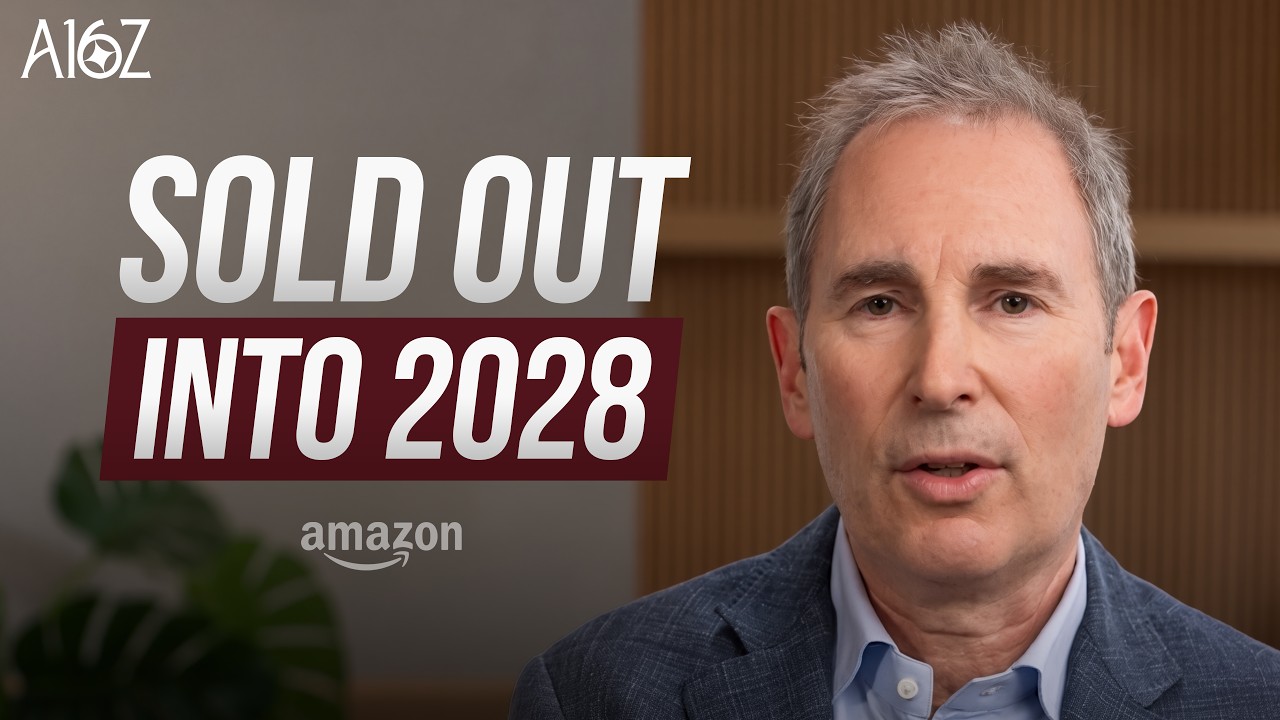
Amazon Sells Out Cloud Capacity Through 2027 in $220B AI Push
a16z
Amazon Chief Executive Officer Andy Jassy says even record capital spending cannot satisfy runaway demand until custom silicon lowers inference costs enough to migrate legacy corporate workloads to AI.
Amazon projects $220 billion in total CapEx for 2026, yet its data center and compute capacity is completely sold out for 2026, largely committed for 2027, and substantially contracted for 2028. (0:00)
AWS generated an annualized AI run rate of $25 billion within its first three years, growing several hundred times faster than the original cloud business did over the same timeframe. (10:00)
Amazon describes AI demand as a barbell: frontier labs burning massive compute sit on one end and narrow enterprise automation on the other, while the vast middle of traditional enterprise workloads waits for lower inference costs to justify migration. (21:40)
Using generative AI, Amazon's Bedrock engineering team overhauled its entire core inference platform with just 6 engineers in 76 days, an effort that historically required 40 engineers over 12 months. (37:14)
Detailed notes
## Background
Published on YouTube by the a16z channel on October 23, 2026, this episode features Amazon CEO Andy Jassy in conversation with a16z co-founder Ben Horowitz and host Erik Torenberg. According to the show description, the discussion explores why Amazon expects to invest roughly $220 billion in CapEx in 2026 while still leaving meaningful AI demand unmet, how AWS could reach a $1 trillion annual run-rate business, and how generative AI is reshaping Amazon's organizational design, custom silicon roadmap, and flagship products like Alexa.
## TL;DR
Andy Jassy explains how staggering demand from frontier AI labs and enterprise cost-reduction tools has outpaced global compute capacity, fully booking AWS infrastructure through 2026 and well into 2027 despite a $220 billion annual CapEx commitment. To make inference economically viable for the vast middle tier of traditional enterprise software, Amazon is ramping up custom chips like Trainium and Graviton alongside strategic partnerships with Anthropic and OpenAI. Internally, generative AI is transforming corporate operations into smaller, high-velocity 'Renaissance builder' squads, prompting full architectural rewires of legacy platforms like Alexa and elevating agentic, real-time cybersecurity into an urgent enterprise necessity. Reflecting on broad bets across robotics, healthcare, and satellite internet, Jassy argues that decentralized single-threaded teams allow Amazon to scale multiple frontier ventures while human critical reasoning remains the ultimate differentiator in the AI era.
## Atmosphere & style
The conversation carries the pragmatic, insider gravitas of two seasoned operators dissecting tectonic shifts in enterprise computing without drifting into empty promotional hype. Ben Horowitz and Andy Jassy share an easy, collegial rapport, punctuating high-stakes infrastructure discussions with dry humor about astronomical compute bills and engineering dogmas. Jassy speaks with deliberate, calm authority, balancing sober realities about power grid bottlenecks and organizational resistance with sweeping conviction about long-horizon platform bets.
## Bulletin
- [00:00](https://www.youtube.com/watch?v=-YMMRQ1qscI&t=0s) Amazon projects $220 billion in total CapEx for 2026, yet its data center and compute capacity is completely sold out for 2026, largely committed for 2027, and substantially contracted for 2028.
- [10:00](https://www.youtube.com/watch?v=-YMMRQ1qscI&t=600s) AWS generated an annualized AI run rate of $25 billion within its first three years, growing several hundred times faster than the original cloud business did over the same timeframe.
- [21:40](https://www.youtube.com/watch?v=-YMMRQ1qscI&t=1300s) Amazon describes AI demand as a barbell: frontier labs burning massive compute sit on one end and narrow enterprise automation on the other, while the vast middle of traditional enterprise workloads waits for lower inference costs to justify migration.
- [37:14](https://www.youtube.com/watch?v=-YMMRQ1qscI&t=2234s) Using generative AI, Amazon's Bedrock engineering team overhauled its entire core inference platform with just 6 engineers in 76 days, an effort that historically required 40 engineers over 12 months.
## Key takeaways
- [00:00](https://www.youtube.com/watch?v=-YMMRQ1qscI&t=0s) Unprecedented demand from frontier AI labs has created multi-year capacity deficits, leaving Amazon sold out through 2026 despite spending roughly $600 million per day on CapEx.
- [10:00](https://www.youtube.com/watch?v=-YMMRQ1qscI&t=600s) AWS's infrastructure investment model separates 30-year physical data center shells, built two years in advance, from modular servers purchased months ahead that break even within three years.
- [15:44](https://www.youtube.com/watch?v=-YMMRQ1qscI&t=944s) Opposition to domestic data center development threatens US technological leadership against competitors like China, while common criticisms regarding water usage and backup generator emissions are largely unfounded.
- [21:40](https://www.youtube.com/watch?v=-YMMRQ1qscI&t=1300s) The vast middle of enterprise workloads has not yet adopted AI inference at scale, but Andy Jassy expects nearly every enterprise software product will run pervasive inference within five to seven years.
- [24:00](https://www.youtube.com/watch?v=-YMMRQ1qscI&t=1440s) Amazon refuses to raise prices or squeeze traditional cloud customers to redirect scarce compute capacity to price-insensitive AI labs.
- [30:00](https://www.youtube.com/watch?v=-YMMRQ1qscI&t=1800s) Acquiring Annapurna Labs in 2015 enabled Amazon to build Nitro offload cards, Graviton CPUs, and Trainium AI chips, the latter offering a 30% to 40% price-performance edge critical for lowering inference costs.
- [33:36](https://www.youtube.com/watch?v=-YMMRQ1qscI&t=2016s) Amazon's multibillion-dollar investments in Anthropic and OpenAI are paired with core technical integrations, including multi-gigawatt Trainium commitments and custom agent runtimes on Bedrock.
- [37:14](https://www.youtube.com/watch?v=-YMMRQ1qscI&t=2234s) Generative AI is shifting software organizations away from hyper-specialized silos back to lean teams of versatile builders capable of delivering production prototypes in days.
- [40:00](https://www.youtube.com/watch?v=-YMMRQ1qscI&t=2400s) The most urgent clear-and-present risk from AI is cybersecurity, requiring automated agentic systems capable of identifying and patching vulnerabilities within minutes rather than weeks.
- [45:00](https://www.youtube.com/watch?v=-YMMRQ1qscI&t=2700s) Treating generative AI as an incremental feature leads to obsolescence; Amazon chose to completely scrap and rewire the underlying architecture of flagship products like Alexa.
- [53:06](https://www.youtube.com/watch?v=-YMMRQ1qscI&t=3186s) Because AI automates baseline research and summarization, human judgment, critical reasoning, and synthesis become the decisive differentiators for young workers.
- [56:36](https://www.youtube.com/watch?v=-YMMRQ1qscI&t=3396s) Amazon scales simultaneous bets across AI, warehouse robotics, and satellite internet without spreading thin by using decentralized, single-threaded leadership teams.
## Detailed walkthrough
### [00:00](https://www.youtube.com/watch?v=-YMMRQ1qscI&t=0s) Massive CapEx and Sold-Out AI Capacity
Opening the conversation, Andy Jassy lays out the staggering scale of the artificial intelligence infrastructure boom and the unprecedented supply constraints confronting the cloud computing sector. Even with capital expenditures reaching an eye-watering $220 billion for the year, Amazon cannot expand its infrastructure fast enough to satisfy enterprise and frontier laboratory appetite. The timeline for capacity allocation has been pushed years into the future, creating a persistent backlog where access to specialized compute, electrical power, and cooling infrastructure has become a scarce commodity. As financial markets raise alarms about whether enough global liquidity exists to underwrite these astronomical infrastructure costs, Jassy underscores that data centers are not an abstract technological luxury but the foundational bedrock supporting critical global systems, from financial exchanges and commercial banking to modern healthcare delivery.
The hyper-competitive dynamics among frontier foundation model developers have intensified these capacity bottlenecks. Frontier labs are demonstrating an almost price-insensitive willingness to bid up costs for power, cooling, and advanced accelerators. Jassy highlights the prevailing market reality:
> “Even spending $220 billion this year, we're leaving a meaningful amount of demand on the table.”
- Capacity for 2026 is completely sold out.
- Infrastructure allocations for 2027 are largely committed, and a significant portion of planned capacity for 2028 is already sold out.
- The company maintains only a disciplined fractional allocation reserved strictly for elastic, on-demand compute workloads.
---
[00:47](https://www.youtube.com/watch?v=-YMMRQ1qscI&t=47s) From Pandemic Fulfillment Surge to the AI Wave
Reflecting on his first five years as CEO since officially taking the helm in 2021, Jassy notes how profoundly the organization has scaled despite navigating continuous macroeconomic and structural turbulence. Over that half-decade window, Amazon’s consolidated top-line revenue expanded by approximately 80%, its high-margin advertising division surged to two and a half times its previous size, and the Amazon Web Services (AWS) business nearly tripled. Yet stepping into the chief executive role on the heels of the COVID-19 pandemic immediately presented an operational trial by fire: Amazon’s retail division found itself facing severe cost-to-serve headwinds after frantic expansion. To keep essential goods moving when physical commerce shut down globally, the company doubled the physical footprint of a fulfillment network that had taken 25 years to build in just 18 months, while simultaneously erecting a last-mile logistics operation the size of UPS in roughly 20 months.
```mermaid
flowchart TD
accTitle: US Fulfillment Network Evolution
accDescr: Diagram showing the shift from Amazon's national fulfillment model to an eight-region decentralized network.
subgraph Legacy["Flat National Network"]
direction TB
F1["Centralized US Fulfillment Hubs"] -->|"Long-Distance Air & Ground Transit"| C1["Consumers Nationwide"]
style Legacy stroke-dasharray: 5 5
end
subgraph Regional["Regionalized Network Architecture"]
direction TB
F2["Regional Fulfillment Centers"] -->|"Short-Haul Local Transportation"| C2["Regional Consumers"]
F3["Localized In-Region Inventory"] -->|"Rapid Last-Mile Delivery"| C2
end
While external observers initially characterized Jassy’s transition into the CEO seat as an unfortunate stroke of bad timing, he views that chaotic period as an indispensable catalyst. The crisis forced management to question foundational dogmas and completely re-architect the logistics apparatus. Rather than operating the United States as a monolithic national network, Amazon divided the country into regionalized operational zones. Storing products closer to the final consumer shortened haul distances, reduced intermediate touches, and drove down transportation unit costs while drastically increasing same-day and next-day delivery speeds—unleashing a renewed wave of retail consumer demand.
Just as the retail network was stabilizing, generative AI erupted across the industry in 2023. AWS, which was already the market leader in cloud infrastructure and targeting a multi-hundred-billion-dollar annual revenue milestone over a ten-year horizon, entered an accelerated growth trajectory driven by customer demand to overhaul workflows through AI inference. Beyond the cloud and retail pillars, Jassy highlights an array of long-horizon enterprise bets: a profitable Prime Video franchise, the Amazon Project Kuiper low Earth orbit (LEO) satellite constellation, Zoox autonomous ride-hailing vehicles, healthcare offerings, and advanced warehouse robotics.
Jassy emphasizes how generative AI is shifting the long-term ceiling of the cloud business:
> “Now we look at what's happening with AI and how, you know, every customer experience we know of is going to be reinvented with inference and AI.”
- AWS recently achieved a 36.7% year-over-year growth rate on an annualized run rate of $169 billion.
- Amazon's overall top-line revenue sits approximately 80% higher than when Jassy assumed the role of CEO in 2021.
- Advertising revenue expanded by 2.5x over the same five-year span.
---
[05:00](https://www.youtube.com/watch?v=-YMMRQ1qscI&t=300s) Leadership Principles in Tension: Speed, Frugality, and Re-Architecting Delivery
Ben Horowitz questions how executive leadership maintains internal standards of operational excellence, frugality, and precision during periods of breakneck expansion when operational messiness and inefficiency are unavoidable. Jassy explains that Amazon’s 16 Leadership Principles are deliberately designed to live in natural tension with one another, mirroring the inescapable trade-offs of the real world. During early 2020, company leadership explicitly weighed "Bias for Action" against "Relentlessly High Standards." With brick-and-mortar storefronts closed worldwide and third-party merchants relying on the platform for their economic survival, Amazon consciously decided to prioritize serving customer and seller demand above near-term unit cost optimization.
Building a distribution network of that magnitude while teams operated remotely introduced inevitable topographical inefficiencies and suboptimal package routing. However, Jassy points to Amazon's data-driven, truth-telling culture as the safeguard that prevents emergency compromises from degrading permanent operational standards. Executives are barred from smoothing over unvarnished metrics or papering over defects. Once physical capacity was placed in the ground, leadership immediately reviewed operational dashboards, separated modest productivity adjustments from deep architectural flaws, and elevated structural initiatives. Regionalization—which had historically languished at eighth or ninth on the engineering backlog—was pushed to the very top priority to simultaneously drive down transportation costs and increase fulfillment velocity.
Jassy explains the explicit calculation leadership made to absorb temporary operational inefficiency to fulfill immediate customer needs:
> “We had to ask ourselves, are we going to build fast and maybe not as optimally as we can with the tradeoff of serving customers and sellers who are trying to, you know, also have businesses that that sustain themselves or not?”
Ben Horowitz observes that this capital-intensive expansion mirrors the early days of AWS, when building speculative infrastructure on a "build it and they will come" basis required immense organizational conviction—except that the current generative AI cycle is playing out at an exponentially larger financial and operational scale.
[10:00](https://www.youtube.com/watch?v=-YMMRQ1qscI&t=600s) How Much AI CapEx Is Too Much?
Ben Horowitz opens the discussion by noting that Amazon is among the very largest players aggressively building out data center and chip capacity. The scale is so massive that financial markets have shown skittishness—evidenced in the debt and equity markets for players like CoreWeave—sparking fears that there may not be enough capital in the world to finance it all. Ben asks how Amazon decides how much capital expenditure is too much when demand is surging so quickly, especially while competing fiercely across supply chains for cooling, power, and chips.
Andy Jassy admits there is no neat formula: “Yeah, it's a very good question, and I wish there was an equation that would make it simple. It would save us a lot of time as a team.” He reflects on the first wave of cloud computing, when Amazon launched AWS without knowing for sure if outside customers would adopt it. Internally, Amazon teams had been moving slower than leadership wanted. An investigation revealed that product teams were spending 70% to 80% of their time reinventing undifferentiated infrastructure—compute, storage, databases, and messaging—and only 20% on the core customer experience. AWS was conceived to solve that internally, giving Amazon's consumer business reusable building blocks. When they realized external enterprises likely faced the exact same problem, customer interest blew past their expectations.
```mermaid
flowchart TD
accTitle: AWS Infrastructure Cash Flow Cycle
accDescr: Two-tier investment timeline comparing long-term physical data center shells to flexible short-term server and networking purchases.
subgraph Phase1["Data Center Shells & Real Estate"]
A["Invest ~2 Years in Advance"] --> B["30-Year Useful Life Asset"]
B --> C["One-Time Investment"]
end
subgraph Phase2["Servers & Networking Gear"]
D["Ordered Months Ahead Based on Demand"] --> E["3-Year Payback / Breakeven"]
E --> F["5–6 Year Useful Asset Life"]
end
C -.->|"Ready for Equipment"| D
```
The scale of the current generative AI wave, however, dwarfs the early cloud era. While previous machine learning cycles grew steadily into a healthy business for AWS, generative AI is moving at unprecedented speed:
- After three years, early AWS reached an annual run-rate of around **$60 million**.
- In the first three years of the generative AI boom, the AWS AI business alone surpassed a **$25 billion** run rate—several hundred times faster.
- In 2026, Amazon projects roughly **$220 billion** in total CapEx, a figure Jassy finds staggering compared to 15 years ago, when leadership marveled at telecom companies spending $50 billion.
- Even at $220 billion in annual CapEx, Jassy emphasizes that Amazon is still “leaving a meaningful amount of demand on the table.”
The AWS CapEx model divides into two primary buckets with distinct cash cycles. First, the physical data center real estate and shells require capital outlays roughly two years in advance of hosting servers; however, these are paid once and have a useful life of around 30 years. Second, servers and networking gear are purchased only a few months before deployment, matched directly to clear customer visibility. If demand softens, Amazon simply does not buy the servers. Server deployments typically break even within three years against useful lives of five to six years, aligning neatly with the typical five-year customer contracts Amazon signs. Consequently, while building dozens of facilities simultaneously creates near-term free cash flow headwinds, those headwinds normalize as the fleet matures and turns cash-flow positive.
---
[15:44](https://www.youtube.com/watch?v=-YMMRQ1qscI&t=944s) The Data Center Backlash: Myths, Grid Realities, and Global Competitiveness
Ben Horowitz shifts to the political friction surrounding infrastructure, observing that data centers—once an invisible technical detail—have surprisingly turned into a hot-button political target, particularly in the United States. He asks whether the anti-data-center sentiment holds any legitimate merit and how that resistance influences Amazon's domestic versus international buildout plans.
Jassy responds by anchoring the conversation in the modern digital reality: virtually everything people rely on daily—equities trading, banking, healthcare, media streaming, e-commerce, education, enterprise software, and ridesharing—runs on data centers. Society cannot renounce data centers without abandoning digital life itself, and generative AI is the single largest platform transformation since the dawn of the internet, cloud, and mobile. Jassy frames the magnitude of this infrastructure expansion directly: “The reality is the type of infrastructure buildout we need to support the rapid growth we were just talking about on the AI side, there hasn't been anything like it in the world and in this country since maybe when we built out the highways and bridges in the 1950s.” Crucially, he warns that if domestic opposition stalls construction, the United States risks ceding strategic and technical dominance to geopolitical competitors: “The country, I think the world in general, but I'd say the US specifically cannot afford not to build data centers, or we will find that another country like China will establish all the leadership and all the norms there.”
While acknowledging that the industry must continually improve its environmental practices, Jassy points out that data centers have become an easy political scapegoat, targeted by myths and mistruths:
- **Water Consumption:** The golf and almond farming industries consume dramatically more water. Jassy notes that golf courses consume 200 times more water than all of Amazon's data centers combined, using more water in two days than Amazon's facilities use over an entire year.
- **Pollution & Backup Generators:** Regulatory filings require operators to register potential emissions assuming emergency backup diesel generators run 24/7 at maximum capacity. In reality, backup generators operate around 0.1% of the year—roughly 10 hours annually, exclusively for periodic maintenance testing.
- **Energy Rates & Electrical Grids:** Local energy rate fluctuations vary by market, but the core issue is that national power grids have suffered from chronic underinvestment for decades. AI demand simply accelerated a modernization reckoning that was already inevitable. Jassy observes that once expanded transmission and generation capacity come online, power rates historically stabilize or fall, as demonstrated in states like Indiana, Georgia, and Mississippi.
[20:00](https://www.youtube.com/watch?v=-YMMRQ1qscI&t=1200s) Public-Private Partnerships and the Economic Impact of Data Centers
Andy Jassy emphasizes that critics often overlook the massive local tax contributions made by hyperscalers in the regions where they build data center infrastructure. Pointing to St. Joseph County, Indiana as a direct example, he highlights that Amazon has paid approximately $3 billion in taxes there, giving the local government funds to address critical municipal needs. In Jassy's view, sustaining this expansion over the next five years requires an ongoing public-private partnership. He draws an analogy to historical infrastructure milestones, noting that failing to build this infrastructure would mirror the missed opportunities had the United States chosen not to invest in national highway systems and bridges.
As Jassy frames the long-term national imperative: “Like imagine if we hadn't built out highways and bridges in what the economic prosperity and the capabilities of the country would be. And we have to kind of keep it in perspective and we have to, you know, be partners in the communities in which we built.”
[21:40](https://www.youtube.com/watch?v=-YMMRQ1qscI&t=1300s) The Barbell Shape of AI Demand
Erik Torenberg contextualizes Amazon's projected $220 billion in annual CapEx by noting it equates to roughly $600 million per day, prompting Jassy to explain how he visualizes current market demand as a "barbell." Jassy notes that AI is expanding hundreds of times faster than cloud computing did in AWS’s earliest days, with AWS generating a $25 billion annualized run-rate in AI revenue within just three years. Despite this velocity, demand remains concentrated on two extreme ends rather than distributed evenly across the economy.
```mermaid
flowchart LR
accTitle: The Barbell Model of AI Demand
accDescr: Shows the current distribution of AI demand with heavy usage at both ends and massive unrealized potential in the middle.
subgraph LeftEnd["Frontier End"]
L1["Frontier Model Labs & Runaway Apps"]
L2["Consuming Gobs of Compute<br>(ChatGPT, Claude Code)"]
L1 --> L2
end
subgraph Middle["The Vast Middle (Untapped)"]
M1["Existing Enterprise Workloads"]
M2["Infrequent Pervasive Inference Today"]
M3["5-7 Year Outlook: Massive Migration to Inference"]
M1 --> M2 --> M3
end
subgraph RightEnd["Pragmatic End"]
R1["Cost Avoidance & Productivity"]
R2["Automating Fraud, Customer Support & Internal Workflows"]
R1 --> R2
end
LeftEnd --- Middle --- RightEnd
```
On one side of the barbell sit frontier AI labs and runaway consumer applications like ChatGPT and Claude Code, which burn through staggering, unprecedented amounts of raw compute. On the opposite side are everyday enterprise workloads focused narrowly on efficiency, cost avoidance, and automation, including fraud detection, business process management, and automated customer support. The thick center of the barbell represents the vast sea of traditional enterprise production workloads running on AWS today. Most of those core applications do not yet leverage inference at scale, but Jassy expects that within the next five to seven years, nearly every meaningful enterprise software application will run inference pervasively.
- AWS reached a $25 billion annual run-rate in AI revenue within its first three years.
- Jassy expects that within five to seven years, most existing enterprise software products will embed pervasive AI inference.
[24:00](https://www.youtube.com/watch?v=-YMMRQ1qscI&t=1440s) Component Shortages and Customer Pricing Pressures
Ben Horowitz brings up the mounting crunch across power, cooling, memory, and specialized silicon facing the industry leading into 2027. He asks whether AWS experiences business pressure to de-prioritize or raise prices on long-standing core enterprise customers in order to reallocate scarce capacity to AI labs that are insatiable and willing to pay almost any premium for immediate compute.
Jassy flatly rejects the idea of exploiting supply scarcity to squeeze established clients. While acknowledging the tough technical trade-offs—such as allocating tight memory supplies between High Bandwidth Memory (HBM) for AI accelerators versus conventional DRAM for standard cloud compute—he insists AWS will not gouge its base. He compares this philosophy to Amazon's conduct during the COVID-19 pandemic, when AWS proactively helped customers right-size and reduce cloud spending, even though it shrank short-term top-line revenue, because building lasting customer trust matters more than maximizing single-quarter profits.
> “They're running all their core applications. We're not gonna squeeze our customers and we're gonna make sure that they can scale.” — Andy Jassy
- 2026 infrastructure capacity is fully sold out across all major footprints.
- 2027 capacity is largely sold out, aside from standard capacity reserved for on-demand services like Amazon Bedrock and Amazon EC2.
- A substantial portion of 2028 capacity has already been contracted and committed.
- Jassy believes infrastructure bottlenecks across memory and power will persist well past 2027 rather than resolving in a single calendar year.
[28:12](https://www.youtube.com/watch?v=-YMMRQ1qscI&t=1692s) Annapurna Labs and the Push for Custom Silicon
Horowitz pivots to Amazon's 2015 acquisition of Annapurna Labs, observing that AWS made the purchase long before the current wave of generative AI demand emerged. Jassy calls Annapurna one of the most talented teams he has worked with and identifies the transaction as perhaps the single best acquisition Amazon has ever executed in its corporate history.
Jassy explains that the acquisition was not originally made with deep learning or AI training accelerators in mind. Instead, it was driven by the operational realities of running EC2 at massive scale. Amazon discovered that its servers were burning a disproportionate share of their native CPU power managing internal virtualization, networking, storage, and security overhead. To reclaim that capacity for customers, AWS worked with Annapurna to engineer specialized network interface cards (NICs) that offloaded background hypervisor and networking duties, allowing AWS to rent nearly 100% of host server compute directly to customers.
> “And it's one of the very best acquisitions we've done at Amazon in the history of the company, if not the best.” — Andy Jassy
[30:00](https://www.youtube.com/watch?v=-YMMRQ1qscI&t=1800s) Annapurna Labs, Graviton, and Lowering Inference Costs with Trainium
Andy Jassy traces the origins of Amazon's custom silicon journey back to the acquisition of Annapurna Labs. The original goal was offloading virtualization and hypervisor tasks to free up as much server hardware as possible for raw customer compute, an effort that evolved into hardware deployed across every single EC2 server. Because the Annapurna team displayed rare engineering talent, Amazon realized they could develop other types of chips. At the time, Intel held virtually all CPU market share. While Amazon maintained a strong relationship with Intel, the reality of market dynamics meant an incumbent with near-total share is rarely motivated to aggressively push price-performance; instead, they focus on higher-margin features, a textbook example of the innovator’s dilemma. Amazon's customers wanted to migrate on-premises workloads to the cloud without prohibitive costs, so Jassy set Annapurna loose on developing a custom CPU. The result was Graviton, which delivers roughly 40% better price-performance than comparable x86 processors and is now used by 99% of Amazon’s top 1,000 EC2 customers.
```mermaid
flowchart TD
accTitle: Evolution of Amazon In-House Silicon
accDescr: Diagram tracing Annapurna acquisition to Nitro, Graviton CPU, and Trainium AI accelerators.
subgraph CoreCompute["Server Foundation"]
A["Annapurna Acquisition"] --> B["Nitro Architecture Offload<br/>(In 100% of EC2 servers)"]
end
subgraph WorkloadEvolution["Custom Workload Silicon"]
B --> C["Graviton CPU<br/>(40% better price-performance vs. x86)"]
C --> D["Trainium AI Accelerator<br/>(30-40% better price-performance vs. dominant GPU)"]
end
subgraph AdoptionImpact["Market Impact"]
D --> E["Drives down inference costs"]
E --> F["Enables enterprise migration of legacy CPU apps to AI"]
end
```
A few years later, Jassy saw the exact same movie play out in generative AI. A single dominant chip provider controlled the market, and while Amazon continues to maintain a deep, ongoing partnership with them, customer demand required far more cost-effective compute. Amazon spun up a dedicated team within Annapurna to design an AI accelerator called Trainium, which similarly provides a 30% to 40% price-performance edge over alternatives. Jassy emphasizes that lowering inference costs is the single most critical lever for unlocking the middle of the enterprise adoption barbell. While skills like fine-tuning and post-training are maturing, high inference costs make the threshold for rewriting existing CPU-based applications into AI-native architectures excessively steep. If the cost delta remains wide, the incremental ROI from adding AI accelerators must be massive to justify an engineering overhaul. Lowering inference pricing lowers that barrier dramatically, making widespread AI adoption viable across all enterprise workloads.
Ben Horowitz chimes in with a humorous personal data point from his own firm, noting that AI infrastructure can spiral out of control fast: one a16z employee managed to spend $2 million on inference in a single month—doing good work, Horowitz jokes, but proving firsthand that running frontier models is far from cheap.
- Annapurna-engineered silicon powers virtually every modern AWS EC2 server.
- Graviton provides ~40% better price-performance compared to standard x86 processors.
- 99% of AWS's top 1,000 EC2 customers currently run workloads on Graviton.
- Trainium AI accelerators achieve a 30% to 40% price-performance advantage over prevailing market processors.
- High inference costs serve as the primary hurdle preventing enterprises from porting standard CPU-based production applications to AI accelerators.
- “So that is a really important part for customers to being able to use AI pervasively is driving the cost of inference down and our chips business is a big piece of that,” Andy Jassy emphasizes regarding Trainium’s role.
---
[33:36](https://www.youtube.com/watch?v=-YMMRQ1qscI&t=2016s) Strategic Partnerships and Investments in Anthropic and OpenAI
Horowitz points out that Amazon has made headline-grabbing investments into leading model providers—such as massive commitments to Anthropic and OpenAI—which initially sent Wall Street into a tizzy reminiscent of circular dot-com era financings because both companies also happen to be major cloud customers. Jassy pushes back by explaining the clear rationale behind the deals. The top-line revenue trajectories of these frontier labs are unprecedented, driven by world-class teams and transformative model architectures. While not every participant in the space will succeed, Amazon made deliberate bets on two entities it expects to be long-term winners.
The partnership with Anthropic runs exceptionally deep: Anthropic’s Claude models are heavily leveraged inside Amazon Bedrock, where customer feedback has been overwhelmingly positive, and Anthropic has been co-developing and training models on top of Amazon's Trainium chips. The mutual optimization between hardware and model architecture benefits both sides.
With OpenAI, customer pull to access their models on AWS had been building for an extended period. That led to collaborative engineering, including the development of an optimized stateful runtime environment on Amazon Bedrock designed specifically for persistent AI agent architectures, accompanied by OpenAI committing to multi-gigawatt deployments on Trainium silicon. Jassy notes that pairing strategic equity investments with core cloud and custom silicon infrastructure commitments was an obvious commercial choice for AWS.
- Wall Street analysts raised skepticism about large cloud-vendor investments echoing dot-com circular funding dynamics.
- Amazon's deeper collaboration with Anthropic centers on Amazon Bedrock managed inference alongside mutual co-development and scaling on Trainium chips.
- Amazon and OpenAI co-developed a stateful runtime environment within Bedrock specifically targeted at orchestrating next-generation AI agents.
- OpenAI has signed on for a multi-gigawatt computing footprint leveraging Amazon Trainium infrastructure.
- “Both of those companies are really impressive teams and really impressive companies, and the rate at which they've grown their businesses, at least in the top line, I don't know if we've ever seen anything like it,” Andy Jassy explains.
---
[37:14](https://www.youtube.com/watch?v=-YMMRQ1qscI&t=2234s) Smashing Organizational Silos: The Return of the Renaissance Builder
Horowitz pivots to organizational velocity, referencing an internal AWS milestone where the Bedrock team rebuilt its core inference engine in just 76 days using only 6 engineers—a task that historically would have required 40 engineers working for an entire year. Horowitz notes that while Amazon made "two-pizza teams" an industry standard, corporate tech over the past two decades splintered into extreme hyperspecialization, with separate designers, product managers, front-end developers, and back-end developers. Suddenly, generative AI tools seem to be turning individual contributors into versatile Renaissance builders.
Jassy confirms the Bedrock achievement was an internal wake-up call that leadership has circulated broadly across Amazon to reset baseline assumptions about software development timelines. Reflecting on his 29 years at the company, Jassy recalls starting as an assistant product manager handling five entire products by himself. As enterprises scale and products swell, organizations naturally create narrow roles where an employee owns just a tiny sliver—like pricing or a specific UI feature—until everyone assumes that bureaucratic fragmentation is mandatory. Generative AI shatters that assumption entirely.
To illustrate how drastically things have shifted, Jassy shares an anecdote from the consumer retail business the week before the interview. On a Thursday, leadership aligned on an experimental consumer agent concept. Instead of drafting multi-month roadmaps across separate divisions, a team of just four or five engineers spent the weekend building. By Sunday, they had an 80% shippable, fully functional production prototype ready to go. Jassy concludes that this operational step-function change will fundamentally reshape corporate structure, leading to significantly leaner teams delivering far more output.
- The Bedrock team completely overhauled Amazon's inference platform using 6 engineers over 76 days, replacing an effort that previously would have taken 40 engineers roughly 12 months.
- When Jassy joined Amazon 29 years ago as an assistant product manager, single individuals managed multiple entire products rather than fragmented sub-components.
- A consumer agent prototype that previously would have required cross-functional staffing was taken from Thursday concept to an 80% shippable implementation by Sunday by a 4-to-5-person team.
- “We had four or five people who over the weekend had a operating in a 80 shippable way by Sunday like that is really those are different worlds that you live in,” Andy Jassy observes.
- “We're going to have fewer humans doing the work that they're doing today in the future than we have today,” Andy Jassy concludes about the future profile of enterprise workforces.
[40:00](https://www.youtube.com/watch?v=-YMMRQ1qscI&t=2400s) Rebuilding Organizations, Smaller Teams, and the Cybersecurity Imperative
Andy Jassy and Ben Horowitz discuss the sweeping operational shifts that artificial intelligence will enforce across every corporate function. Observing the massive scale of coding, customer service, business intelligence, and legal research already transitioning to agentic workflows, Jassy argues that companies will no longer need the massive human headcounts historically added as businesses scaled up. While new disciplines will emerge across robotics, space exploration, and AI, standard existing functions will require far fewer personnel. Instead, organizations will coalesce into much smaller, versatile squads composed of cross-functional operators who are no longer confined to narrow specialized silos. Because AI models handle up to 80% of the baseline execution, every project kicks off from a significantly higher baseline, unlocking rapid experimentation and expansive invention.
```mermaid
flowchart TD
accTitle: Organizational Transformation under Agentic AI
accDescr: Comparison showing legacy corporate scaling versus the modern agentic workflow model.
Jassy warns that while startups are launching agent-native from day one, incumbents face an existential technical challenge: they will have to rewrite nearly their entire codebases to become agentically capable, enabling software agents to push updates while strictly adhering to system constraints. Turning to existential AI debates, Jassy notes that while public discourse obsesses over fantastical, long-term speculative risks like rogue botnets or weaponized robotics, the true clear-and-present danger is enterprise cybersecurity. Today's models uncover latent system vulnerabilities far faster than humans ever could. Traditional vulnerability workflows—manual discovery, triage, and prolonged, dependency-choked patch deployments—leave systems hopelessly exposed. If software cannot dynamically detect, patch, and deploy fixes within minutes via autonomous agents, organizations will be entirely defenseless.
- “I predict that companies will have to rewrite almost all of their code to be agentically capable.” — Andy Jassy
- “The way that applications are going to have to be able to respond to imminent security threats is going to be in minutes.” — Andy Jassy
- “The theoretical, the thought experiment threats are, you know, right. Maybe they'll happen. Maybe they won't. But this is clear and present.” — Ben Horowitz
---
[45:00](https://www.youtube.com/watch?v=-YMMRQ1qscI&t=2700s) The Security Reckoning and Rewiring Flagship Products: Reimagining Alexa
Addressing historical shortcomings in enterprise security, Ben Horowitz observes that the tech industry has spent decades building poor architectures across everything from core enterprise systems to consumer embedded hardware. Specialized security engineers frequently operate as isolated, scarce resources who struggle to collaborate smoothly with frontline product engineers. Jassy agrees, emphasizing that automated red-teaming and AI penetration testing will fundamentally balance the equation by auditing an enterprise's entire surface area rather than relying on sporadic, manual audits. AWS itself has spun up dedicated professional services and an internal offering named Continuum to help enterprise customers automatically spot vulnerabilities and deploy patches.
Horowitz and Jassy then contrast three strategic approaches to generative AI: purely cutting costs (a playbook favored by private equity firms buying legacy companies, which Horowitz dismisses as uninspired), creating entirely novel products the world has never seen, and overhauling existing flagship hits from the ground up. Focusing on the third path, Jassy describes the decision to completely rebuild Alexa. When generative AI reached maturity, it became immediately clear that Alexa's original brain—while groundbreaking in its era—needed to be discarded and rewritten with modern foundation models. Jassy candidly admits that forcing this clean-sheet overhaul was excruciatingly difficult internally. Engineering teams naturally harbor attachment to systems they spent years perfecting, often defending hard-earned architectural rules and protesting that past attempts failed. Overcoming organizational inertia to abandon an entrenched architecture is one of the hardest leadership challenges an enterprise faces, yet Jassy maintains that treating generative AI as a mere incremental add-on guarantees obsolescence within three to five years.
- “If you think about AI as primarily just incrementally improving the experience, they will very likely not have the winning experiences three to five years from now.” — Andy Jassy
- “The brains of Alexa were really inventive for a long period of time, but the possibilities of what the brains could be were so different because of generative AI that you had to rewire the brains of Alexa if you wanted to be, you know, provide great customer experience to be relevant over a long period of time.” — Andy Jassy
[50:00](https://www.youtube.com/watch?v=-YMMRQ1qscI&t=3000s) Reimagining Consumer Experiences and the Hard Truth of Change Management
Andy Jassy turns the discussion to Amazon's core consumer-facing properties—such as retail, Prime Video, Fire TV, and Prime Music. While it might not seem immediately obvious that today's technology demands completely different architectures for those products, Jassy emphasizes that standing still is a fatal mistake: “I actually believe every single one of those businesses, we need to reinvent.” Amazon currently has dedicated teams developing completely reimagined versions of these offerings. He acknowledges that they probably will not get it right immediately and will iterate their way forward, but the exercise is already uncovering compelling new ideas. A fascinating strategic race is now underway: will these reimagined offerings launch as entirely separate, distinct applications, or will their breakthroughs be fast-tracked directly into the existing platforms to transform the legacy experience piece by piece? Regardless of the path, Jassy argues that over the next few years, every consumer surface must evolve dramatically if Amazon expects to maintain market leadership.
Ben Horowitz connects this to an enduring leadership challenge in software engineering, recalling early advice he received as a young engineer: “Everything is up for discussion until the first line of code is written and then it's religious.” Horowitz points out that walking away from years of hard-won knowledge, technical investment, and beloved legacy features—especially when large groups of loyal customers actively prefer the existing workflows—is exceptionally difficult.
Jassy agrees, noting that every major platform shift demands profound change management. He compares the AI revolution directly to the historical migration from on-premises data centers to AWS cloud computing:
- Legacy infrastructure leaders possessed deep domain expertise, had built massive physical architectures they were proud of, and were reluctant to abandon what they knew to learn a completely new paradigm.
- Product teams spend all their waking hours iterating on 100 granular roadmap improvements within an existing product, making the prospect of hitting reset emotionally and intellectually grueling.
- Capturing a transformation requires the core technology, customer value, and business mechanics to be overwhelmingly compelling to justify abandoning legacy code and processes.
As Jassy summarizes the organizational friction: “To think about how do I completely start over is it's intellectually and emotionally hard to do.”
[53:06](https://www.youtube.com/watch?v=-YMMRQ1qscI&t=3186s) Advice for the AI Era: Why Critical Reasoning Outweighs Tool Mastery
Erik Torenberg notes that a16z incubated the Horowitz and Jason Academy to help young people prepare for massive technology shifts, asking Jassy what advice he would give to an 18-year-old entering the workforce in 2026. Jassy references his own children, aged 25 and 22, observing that when generative AI exploded, it became immediately obvious that banning the technology was completely futile: “I learned very quickly that you can't tell them not to use AI in education like that, that, you know, that ship has left the station or that train has left the station.” Educational institutions must embrace AI rather than fight it. Within Amazon's strong writing culture, Jassy observes that leaders can immediately spot documents drafted by AI because the ideas are poorly synthesized and “the pieces aren't put together quite right.” He advises young people never to hide from the tooling, but rather to lean into it heavily across everyday workflows.
```mermaid
flowchart TD
accTitle: The Shifting Baseline of Knowledge Work
accDescr: Flowchart illustrating how AI automates low-level research to establish a higher baseline, while human judgment drives final value creation.
subgraph AI_Baseline ["Automated AI Starting Line"]
A["Dense Reading & Research"] --> B["Data Extraction & Note-Taking"]
B --> C["Advanced Baseline Analysis"]
end
subgraph Human_Ingenuity ["Irreplaceable Human Judgment"]
C --> D["Critical Reasoning & Dot-Connecting"]
D --> E["Strategic Planning & Invention"]
E --> F["Differentiated Products & Experiences"]
end
```
Despite the leverage models provide, Jassy insists that tools can never replace fundamental critical reasoning. Drawing an analogy to his time in business school analyzing three complex case studies a day, he remembers that low-performing students often failed simply because they skipped the background reading, research, and exhibit note-taking. Generative AI fundamentally levels that baseline by doing the raw research and summarization for everyone. However, generating actual value still hinges entirely on human synthesis:
> “I still think you're going to need human judgment, ingenuity, invention and experimentation, and thinking about how all the pieces come together, to end up building amazing experiences and businesses.”
[56:36](https://www.youtube.com/watch?v=-YMMRQ1qscI&t=3396s) The Three Great Eras of Innovation and How Amazon Avoids Spreading Too Thin
As the interview draws toward a close, Torenberg remarks on Amazon's astonishing expansion from an online bookstore into healthcare, robotics, low Earth orbit satellite constellations, and autonomous vehicles. Jassy frames Amazon’s sweeping footprint by identifying three generational macro-transformations occurring simultaneously:
1. **Artificial Intelligence:** Radically transforming software creation, internal developer efficiency, and end-user digital surfaces.
2. **Robotics:** Overhauling industrial fulfillment centers, retail operations, and physical distribution logistics.
3. **Space Development:** Exemplified by Amazon's low Earth orbit (LEO) satellite constellation (Project Kuiper), which aims to deliver high-speed broadband connectivity to 500 million unserved and underserved households globally.
Addressing recurring skepticism about whether Amazon risks spreading itself too thin across autonomous driving (Zoox), grocery, healthcare, and satellite internet, Jassy explains that organizational architecture makes this breadth manageable. Rather than forcing cross-functional executives to oversee multiple disparate units, Amazon deploys decentralized, single-threaded leadership teams:
> “Because we don't try and have the same group of people manage multiple businesses and we organize in this decentralized single-threaded way, if you have the right leaders and the right builders on those teams and you have an experience that if it's big enough could move the needle and you have a differentiated idea in a space that's not being that well served, you have the opportunity to pursue a lot of these things simultaneously.”
While other companies adopt a focused strategy of “sticking to their knitting”—which Jassy acknowledges can be very successful—Amazon deliberately chooses to pursue any massive, underserved customer problem where it holds high conviction and the financial willingness to invest. Torenberg and Horowitz thank Jassy for his time, wrapping up the conversation on an inspiring note centered on Amazon's relentless ambition.
## Notable quotes
> [40:00](https://www.youtube.com/watch?v=-YMMRQ1qscI&t=2400s) I predict that companies will have to rewrite almost all of their code to be agentically capable. — Andy Jassy
> [50:00](https://www.youtube.com/watch?v=-YMMRQ1qscI&t=3000s) Everything is up for discussion until the first line of code is written and then it's religious. — Ben Horowitz
> [37:14](https://www.youtube.com/watch?v=-YMMRQ1qscI&t=2234s) We're going to have fewer humans doing the work that they're doing today in the future than we have today. — Andy Jassy
> [40:00](https://www.youtube.com/watch?v=-YMMRQ1qscI&t=2400s) The way that applications are going to have to be able to respond to imminent security threats is going to be in minutes. — Andy Jassy
> [53:06](https://www.youtube.com/watch?v=-YMMRQ1qscI&t=3186s) I still think you're going to need human judgment, ingenuity, invention and experimentation, and thinking about how all the pieces come together, to end up building amazing experiences and businesses. — Andy Jassy
## Mentioned
Amazon, Andy Jassy, Ben Horowitz, Erik Torenberg, a16z, AWS, Anthropic, OpenAI, Annapurna Labs, Graviton, Trainium, Amazon Bedrock, Amazon EC2, Alexa, Continuum, CoreWeave, Intel, Project Kuiper, Zoox, Prime Video, Fire TV, Prime Music, Claude, ChatGPT, Claude Code
## Video description
Amazon expects to spend roughly $220 billion in CapEx in 2026, yet CEO Andy Jassy says the company is still leaving meaningful AI demand on the table. He believes the buildout could ultimately help make AWS a $1 trillion annual run-rate business.
Andy joins a16z co-founder Ben Horowitz and Erik Torenberg to discuss why AI demand is growing so quickly, how Amazon decides how much infrastructure to build, and why lower inference costs could unlock broader enterprise adoption.
They also discuss how AI is reshaping Amazon itself, from smaller teams building products faster to reimagining Alexa, and why Andy sees cybersecurity, human judgment, and critical thinking as increasingly important in the AI era.
Timestamps:
00:00 Intro
00:47 Five years as CEO: from pandemic overbuild to the AI boom
09:38 How much AI CapEx is too much?
15:44 Is the backlash against data centers fair?
20:56 AI demand as a barbell, and the capacity crunch
28:12 Annapurna Labs and Amazon’s custom chips
33:36 Why Amazon invested in Anthropic and OpenAI
37:14 Smaller teams, faster security: rebuilding orgs for AI
46:29 Rebuilding Alexa and reinventing existing products
53:06 Advice for an 18-year-old
56:36 How Amazon avoids spreading itself too thin
Resources:
Follow Andy Jassy on X: https://x.com/ajassy
Follow Ben Horowitz on X: https://x.com/bhorowitz
Stay Updated:
If you enjoyed this episode, be sure to like, subscribe, and share with your friends!
Find a16z on X: https://twitter.com/a16z
Find a16z on LinkedIn: https://www.linkedin.com/company/a16z
Listen to the a16z Show on Spotify: https://open.spotify.com/show/5bC65RDvs3oxnLyqqvkUYX
Listen to the a16z Show on Apple Podcasts: https://podcasts.apple.com/us/podcast/a16z-podcast/id842818711
Follow our host: https://x.com/eriktorenberg
Please note that the content here is for informational purposes only; should NOT be taken as legal, business, tax, or investment advice or be used to evaluate any investment or security; and is not directed at any investors or potential investors in any a16z fund. a16z and its affiliates may maintain investments in the companies discussed. For more details please see http://a16z.com/disclosures.
Amazon CEO Andy Jassy argues that the generative artificial intelligence boom represents an unprecedented infrastructure buildout that demands massive capital investment, custom silicon, and sweeping corporate reorganizations despite severe supply bottlenecks and political headwinds.
Capital Deployment and Infrastructure Constraints (0:00)
Amazon is projecting approximately $220 billion in annual capital expenditures for 2026, yet Jassy states the company is still unable to meet total market demand. Planned infrastructure allocations are completely booked through 2026, largely committed for 2027, and substantially contracted for 2028, with AWS reserving only a disciplined fraction for on-demand computing. In response to financial market concerns regarding liquidity risks, Jassy outlines a two-tier investment cycle: long-lived physical data center shells require capital two years in advance for a 30-year useful life, whereas servers and networking gear are bought months in advance and break even within three years against five- to six-year operational lives.
Public Scrutiny and Geopolitical Imperatives (15:44)
Addressing domestic political resistance against data centers, Jassy compares the current expansion to the 1950s construction of the US interstate highway system, warning that halting infrastructure growth risks ceding strategic leadership to geopolitical rivals like China. He disputes claims regarding utility strain and pollution, noting that backup diesel generators run merely 0.1% of the year for maintenance and that golf courses consume 200 times more water than Amazon's data centers. Furthermore, Jassy points to significant municipal contributions, such as approximately $3 billion in taxes paid by Amazon in St. Joseph County, Indiana, arguing that hyperscalers provide crucial public-private economic stability.
Custom Silicon and Lowering Inference Costs (30:00)
Jassy models enterprise AI adoption as a barbell, dominated currently by compute-heavy frontier model labs on one end and narrow cost-saving automations on the other, with traditional enterprise workloads remaining largely untouched in the middle. To bridge this gap, AWS relies heavily on custom silicon developed through Annapurna Labs. Just as its Graviton CPU delivered roughly 40% better price-performance over x86 processors, Amazon's Trainium AI accelerators target a 30% to 40% price-performance edge over dominant commercial GPUs. Jassy contends that drastically lowering inference costs is the critical prerequisite for enterprises to justify the return on investment of migrating legacy CPU-based systems to AI models.
Organizational Restructuring and Agent-Native Engineering (40:00)
The rapid ascent of AI tooling is reshaping internal corporate structures, enabling smaller, versatile squads to replace specialized silos. Jassy highlights that the Bedrock team rebuilt its core inference engine in 76 days using only 6 engineers—a project historically requiring 40 engineers over a full year. Because base-level coding, customer operations, and research can be largely delegated to autonomous models, Jassy predicts enterprise headcounts will decline across traditional functions while companies will be forced to rewrite existing codebases to become agentically capable. Operationally, he frames automated red-teaming as a vital response to AI-driven cybersecurity threats that require dynamic vulnerability patching within minutes.
Overcoming Incumbent Inertia and Product Reinvention (50:00)
Jassy stresses that incumbent organizations face existential obsolescence if they merely treat AI as an incremental feature rather than undertaking clean-sheet overhauls. Amazon exemplified this by discarding Alexa's legacy architecture to rebuild its cognitive core around foundation models, despite fierce internal engineering resistance. Similar ground-up transformations are underway across flagship consumer properties such as retail, Prime Video, and Fire TV. To execute wide-ranging bets spanning AI, Project Kuiper satellite broadband, and Zoox autonomous vehicles without losing focus, Amazon relies on decentralized, single-threaded leadership teams dedicated to distinct operational missions.
While Amazon is deploying massive balance-sheet resources to capture secular AI tailwinds, the transition depends heavily on resolving persistent grid and memory supply constraints beyond 2027, convincing enterprises to rewrite legacy software architectures, and successfully managing the cultural friction of abandoning entrenched software systems.
## Background
本期内容由 a16z 官方频道于 2026 年 10 月 23 日发布在 YouTube 平台。根据页面简介,亚马逊 CEO Andy Jassy 预测公司在 2026 年的资本开支将达到约 2,200 亿美元,但他与 a16z 联合创始人 Ben Horowitz 及主持人 Erik Torenberg 深入探讨了为何在如此庞大的基建投入下仍有大量 AI 需求未被满足,以及算力成本、组织重塑与核心产品重构将如何推动 AWS 迈向万亿美元年化营收的新阶段。
## TL;DR
Andy Jassy 全面复盘了接任亚马逊 CEO 五年来的业务跃迁与挑战,拆解了 2026 年规划的 2,200 亿美元 AI 资本开支背后的现金回收周期与“杠铃型”需求结构。他详述了从 Annapurna Labs 自研芯片(Nitro、Graviton 到 Trainium)如何将推理成本打下来以激活中间体量的企业生产工作负载,并坚守不榨取老客户的长期主义。同时,Jassy 深入剖析了 AI Agent 对软件工程团队形态的颠覆、迫在眉睫的网络安全大考,以及为何成熟企业必须打破路径依赖、以从零开始的决心彻底重写 Alexa 与核心消费端业务。
## Atmosphere & style
整场对话展现出极高的思想密度与务实力量,两位对谈者如同科技工业战壕里的老兵,在宏观战略推演与底层工程细节之间无缝切换。Ben Horowitz 的提问直切要害、步步紧逼核心商业抉择与人性弱点,而 Andy Jassy 的回应则沉稳且极度坦率,既有面对万亿级基建棋局的从容自信,也有谈及组织惯性与安全隐患时的清醒警觉。倾听过程如同一场高级管理层的战略闭门研讨会,充满了对技术周期本质的深刻洞察与打破教条的实战张力。
## Bulletin
- [00:00](https://www.youtube.com/watch?v=-YMMRQ1qscI&t=0s) 亚马逊预计 2026 年资本支出(CapEx)将达约 2200 亿美元,但 Andy Jassy 表示这仍无法满足全部市场需求,2026 年算力容量已全额售罄,2027 及 2028 年配额也大部分被锁定。
- [10:00](https://www.youtube.com/watch?v=-YMMRQ1qscI&t=600s) AWS AI 业务起步前三年年化营收已突破 250 亿美元,增长速度比当年早期通用云计算快数百倍,推动 AWS 朝着 1 万亿美元年化营收目标迈进。
- [20:56](https://www.youtube.com/watch?v=-YMMRQ1qscI&t=1256s) 当前 AI 算力需求呈杠铃型分布,两端为疯狂消耗算力的前沿实验室与初级提效降本应用,中间则是体量最大、未来 5-7 年将全面转向常态化深度推理的企业现有核心生产工作负载。
- [30:00](https://www.youtube.com/watch?v=-YMMRQ1qscI&t=1800s) 亚马逊自研芯片在打破高昂推理成本壁垒中发挥关键作用,ARM 架构 CPU Graviton 已覆盖 AWS 前 1000 大 EC2 客户的 99%,AI 加速芯片 Trainium 可提供 30% 至 40% 的性价比优势。
- [37:14](https://www.youtube.com/watch?v=-YMMRQ1qscI&t=2234s) AI 正在颠覆组织形态与研发人效比,例如 Bedrock 团队仅用 6 名工程师在 76 天内便重构了推理引擎,传统模式下同样工作量通常需要 40 人全职开发一年。
## Key takeaways
- [00:00](https://www.youtube.com/watch?v=-YMMRQ1qscI&t=0s) 算力基础设施呈现全面供不应求:即便 2026 年投入 2200 亿美元资本支出,亚马逊仍面临产能紧缺,未来数年的数据中心容量早早被头部企业与实验室锁定。
- [00:47](https://www.youtube.com/watch?v=-YMMRQ1qscI&t=47s) 五年业务跨越式扩张:自 2021 年 Andy Jassy 接棒以来,亚马逊集团总营收增长约 80%,AWS 云业务翻了近三倍,广告业务增长 2.5 倍,Prime Video 步入规模化盈利。
- [02:30](https://www.youtube.com/watch?v=-YMMRQ1qscI&t=150s) 疫情期履约网络重塑:面对激增成本,管理层打破扁平架构将全美重构为八大区域化网络,既缩短了运输里程、压降成本,又显著提速了交付效率。
- [05:00](https://www.youtube.com/watch?v=-YMMRQ1qscI&t=300s) 领导力原则的真实运作是权衡取舍:现实决策永远充满冲突,亚马逊在极致速度与最高标准无法兼顾时坚定倒向客户,并依托求真文化及时纠偏和清理历史包袱。
- [15:00](https://www.youtube.com/watch?v=-YMMRQ1qscI&t=900s) 资本开支具备健康的两阶段现金回收周期:厂房等物理基建使用寿命长达 30 年,而服务器与网络硬件在需求明确前数月才采购,硬件通常 3 年回本并绑定 5 年期客户合同。
- [15:00](https://www.youtube.com/watch?v=-YMMRQ1qscI&t=900s) 反数据中心政治情绪与事实脱节:数据中心的水耗远低于高尔夫球场或农业种植,备用发电机全年仅运转约 0.1% 的时间,其核心推动是倒逼长期投资不足的国家电网进行升级改造。
- [23:44](https://www.youtube.com/watch?v=-YMMRQ1qscI&t=1424s) 坚守长期主义拒绝压榨老客户:面对头部 AI 实验室愿意出的天价,AWS 坚决不牺牲运行了数十年核心业务的老客户配额,并在上游平衡 HBM 与通用 DRAM 的产能分配。
- [28:12](https://www.youtube.com/watch?v=-YMMRQ1qscI&t=1692s) 垂直整合自研硬件战略:从 2015 年收购 Annapurna Labs 研发 Nitro 架构、推出 Graviton CPU 到 Trainium AI 芯片,亚马逊持续通过打破垄断为客户提供 30% 至 40% 的性价比提升。
- [33:36](https://www.youtube.com/watch?v=-YMMRQ1qscI&t=2016s) 巨额注资 Anthropic 与 OpenAI 属于深度战略共生:投资绝非互联网泡沫式的资本腾挪,而是深度绑定 Bedrock 托管生态、有状态运行时系统以及 Trainium 的吉瓦级算力部署。
- [37:14](https://www.youtube.com/watch?v=-YMMRQ1qscI&t=2234s) 告别过度专业化,全能型小团队崛起:AI 模型能替代 80% 的跨部门基础前期工作,未来的团队规模将大幅缩减,依赖具备全栈跨职能能力的“通才”展开极速原型迭代。
- [40:00](https://www.youtube.com/watch?v=-YMMRQ1qscI&t=2400s) 传统技术债与自动化代码重写:老牌企业面临原生 AI 初创团队的敏捷进攻,必须全面重写遗留代码以支持 AI Agent 的自主更新与部署。
- [43:08](https://www.youtube.com/watch?v=-YMMRQ1qscI&t=2588s) 迫在眉睫的现实危机是网络安全:模型使漏洞挖掘呈数十倍激增,防御响应窗口被压缩至数分钟,推动企业必须转向 AWS Continuum 式的全自动化渗透测试与实时修补。
- [47:00](https://www.youtube.com/watch?v=-YMMRQ1qscI&t=2820s) 警惕成熟业务的渐进式改良陷阱:对已有成功体验进行微调容易在三到五年后失去优势,如 Alexa 等核心产品必须破除历史经验包袱,基于基础大模型从白纸状态彻底重构。
- [53:06](https://www.youtube.com/watch?v=-YMMRQ1qscI&t=3186s) 年轻人的核心竞争力在于批判性思维:虽然 AI 抹平了基础信息检索与背景阅读的门槛,但独创性发明、商业战略洞察与跨领域顶层设计依然高度依赖人类自身的高阶判断。
- [56:36](https://www.youtube.com/watch?v=-YMMRQ1qscI&t=3396s) 单线程架构避免战线拉得过长:亚马逊横跨 AI、机器人与太空网络等宏大革命赛道,通过极度去中心化的单线程领导机制(Single-threaded leadership)让独立团队并行深耕新蓝海。
## Detailed walkthrough
### [00:00](https://www.youtube.com/watch?v=-YMMRQ1qscI&t=0s) 算力紧缺与五年 CEO 的业务跃迁
对话在对当前 AI 基础设施建设规模的惊人披露中拉开序幕。Andy Jassy 指出,即使亚马逊在 2026 年预计投入约 2,200 亿美元的资本支出(CapEx),他们依然无法满足全部市场需求:“Even spending $220 billion this year, we're leaving a meaningful amount of demand on the table.” 尽管亚马逊一贯会为按需算力预留一定缓冲,但现实情况是 2026 年的容量已完全售罄,2027 年大部分售罄,甚至 2028 年相当大一部分容量也已被预订一空。面对金融市场关于“全世界是否有足够资金来支撑这些基础设施”的担忧与议论,Andy 强调,当代社会运转的底层——从股票市场、银行业到医疗保健体系——全部依赖数据中心,而 AI 正在将这些需求推向极致。各大头部 AI 实验室甚至愿意为了电力、冷却和芯片付出极高代价,以至于业内甚至出现了调侃式的声音:是否应该把旧客户的合同买断,转手加价卖给那些愿意不惜一切代价买单的新客户。
回顾自 2021 年正式从 Jeff Bezos 手中接任亚马逊 CEO 以来的五年历程,Andy Jassy 感慨 2021 年感觉已像是十年前的遥远过去,世界变化快得惊人。对比接任之初,亚马逊的各项业务实现了跨越式增长:
- 集团整体营业收入(Top line)较 2021 年增长了约 80%。
- AWS 云计算业务体量翻了将近三倍,在上个季度以 1,690 亿美元的年化营收跑率实现了 36.7% 的同比增长。
- 广告业务营收增长了约 2.5 倍。
- 业务版图拓展出多颗战略种子:Prime Video 已转变为大规模且实现盈利的业务,此外还包括 Amazon Leo(低地球轨道卫星网络)、Zoox(自动驾驶叫车服务)、医疗保健服务以及先进机器人技术。
在 Andy Jassy 看来,所有这些业务的演进最终都凝聚在一个核心使命之下:“We have an opportunity to help across so many more customer experiences and make their lives better and easier every day.”
### [02:30](https://www.youtube.com/watch?v=-YMMRQ1qscI&t=150s) 履新之初的履约网络危机与区域化重塑
接任 CEO 之初,Andy Jassy 面临的并不是坦途,而是疫情尾声带来的严峻履约成本危机。为了应对疫情期间激增的在线需求,亚马逊在短短 18 个月内将其历时 25 年建成的履约网络规模直接翻倍,并在大约 20 个月内建成了堪比 UPS 规模的最后一公里运输网络。如此迅猛的扩张不可避免地带来了粗放式运营与效率缺失。当时履约网络的履约服务成本(Cost to serve)大幅偏离预期,引发了公司内部与外界的巨大焦虑。
```mermaid
flowchart TD
accTitle: 亚马逊履约网络架构重构流程
accDescr: 展示亚马逊在疫情期间超速扩张导致成本失控,随后通过区域化重塑实现降本提速的过程。
subgraph EXPANSION["疫情期极速扩张"]
A["18个月翻倍履约网络<br/>20个月自建UPS级干线运输"] --> B["效率未优化与成本飙升<br/>履约服务成本远超预期"]
end
subgraph ARCHITECTURE["网络架构再设计"]
B --> C["打破原有全美统一扁平网络架构"]
C --> D["重构为美国八大区域化履约网络"]
end
subgraph OUTCOME["双重业务收益"]
D --> E["库存更靠近最终消费者"]
E --> F["缩短运输距离<br/>大幅降低履约成本"]
E --> G["前所未有提升配送速度<br/>反哺释放零售海量需求"]
end
```
在接任 CEO 不到一年的时间里,外界纷纷议论他接手的时机有多么糟糕、运气有多么差。但 Andy 坦言,回过头看,这段经历反而是极大的幸运与祝福,因为它迫使管理层重新审视那些过去多年未曾动摇的底层假设。其中最重大的突破,就是将全美原先扁平、统一的履约网络彻底重构为区域化网络(Regionalized network)。通过让商品在物理距离上更靠近消费者,不仅因为缩短了运输里程而显著拉低了履约成本,更极大地提升了配送时效。这次对既有信念的大胆审视,直接引爆了后续零售业务的交付速度和强劲需求。
紧接着到来的 2023 年,生成式 AI 的爆发为原本就已经在快速增长的 AWS 注入了核动力。在生成式 AI 之前,业界虽然经历了多次机器学习和 AI 浪潮,但直到 2023 年才真正迎来质变。Andy 提到,过去大家普遍认为 AWS 在长达十年的周期内有望成为数千亿美元营收的业务,但看到推理和生成式 AI 正在彻底重构每一种客户体验,该业务的天花板被彻底打破。
### [05:00](https://www.youtube.com/watch?v=-YMMRQ1qscI&t=300s) 领导力原则的张力:在速度与高标准之间权衡
针对管理层在超高速扩张过程中如何维持亚马逊一贯以运营效率和节俭(Frugality)著称的文化标准,Ben Horowitz 提出了深度追问:当 CEO 下令以闪电战速度建起一个“UPS”时,内部必然伴随着混乱和焦虑,管理层如何在不降低企业文化标准的前提下推进这种激进举措?
Andy 剖析了亚马逊著名的 16 条领导力原则(Leadership Principles)在实际运作中的本质。他指出,许多人对领导力原则之间存在的内在冲突感到困惑,但这种冲突恰恰反映了现实世界的真实运作规则——现实中从来没有完美无瑕的选择,决策本质上永远是权衡(Trade-offs):
- **客户至上 vs. 极度精细**:在疫情初期所有实体店关闭的关键时刻,亚马逊成了维系全社会运转的生命线。面对“是按部就班追求极致成本控制,还是不惜代价迅速扩容以满足消费者和第三方卖家的生存所需”,亚马逊的原则非常明确:在无法兼顾时,“总是偏向客户这一边”。
- **崇尚行动(Bias for Action)与速度 vs. 最高标准(Relentlessly High Standards)**:在团队分散办公、远程协作的极端环境下追求极致速度,必然会导致局部规划和设计的粗糙与失调。管理层清醒地认识到这种妥协的存在,并做好了事后“收拾残局(Cleanup)”的准备。
保证这种权衡不滑向平庸的核心在于亚马逊严苛的“求真文化”(Truth-telling culture)。Andy 强调:“We get the data on the table, we get the issues on the table, we're direct with one another, we don't allow people to paper over issues.” 只要拥有精准的衡量指标和敢于直面真相的团队,问题就会在数据中暴露无遗。团队随后将原本优先级仅排在第八、第九位的区域化网络重构项目迅速提上日程,通过对核心网络架构的深层再造,最终同时实现了配送速度的大幅跃升与成本的大幅优化。Ben Horowitz 随即感叹,这让人联想到早年间构建 AWS 时“建好基础设施,客户自会涌来(Build it and they will come)”的大胆下注,而如今面对 AI 的基础设施建设,这种模式正在以宏大得多的规模再次上演。
### [10:00](https://www.youtube.com/watch?v=-YMMRQ1qscI&t=600s) 云计算起源与惊人的 AI 资本开支规模
对谈在资本市场对科技巨头巨额基建支出的疑虑中展开。市场和投资者对目前数据中心和芯片的建造速度感到不安,甚至认为全球没有足够的资金来支撑这种扩张,而供应链在电力、散热和芯片供给上也面临极度紧张的争夺。Andy Jassy 直言并没有一个简单的公式来决定“到底建多少算太多”。回顾云计算的第一波浪潮,AWS 最初的诞生其实源于亚马逊内部的困境:在 2000 年代初,亚马逊自身的工程团队行动速度不如预期,调查后发现产品团队竟将 70% 到 80% 的时间浪费在无差异化的底层基础设施上,仅有约 20% 的精力投入在真正能让产品脱颖而出的核心功能上。为了不让每个团队重复造轮子,亚马逊设计了计算、存储、数据库等高度灵活、低成本的基础服务,结果不仅内部团队反响极其强烈,推向外部市场后也迎来了爆炸式增长。
然而,眼下生成式 AI 的增长态势彻底颠覆了以往的任何商业经验。早在生成式 AI 爆发的六七年前,AWS 就上线了诸多机器学习服务并取得了不错的营收,但与现在的体量相比根本不可同日而语。AWS 在推出后的前三年,年化营收达到 6000 万美元,当时团队已经觉得进展神速;而在生成式 AI 爆发的前三年,仅 AWS 的 AI 业务年化营收就突破了 250 亿美元,增长速度快了数百倍。谈及资本开支的决策时,Andy Jassy 表示:“我们预计在 2026 年投入大约 2200 亿美元的资本开支(CapEx)。”他回忆起 15 年前在领导层早餐会上,大家还对电信巨头一年花 500 亿美元资本开支感到难以置信,而如今即便是砸下 2200 亿美元,亚马逊依然面临着“需求无法完全满足”的局面。
- **时间分配的逆转**:AWS 诞生前,亚马逊内部产品团队约 70%~80% 的精力耗费在底层架构上,仅 20% 用于产品差异化创新。
- **增长速度对比**:传统云计算起步前 3 年年化营收约为 6000 万美元;生成式 AI 业务起步前 3 年年化营收已超 250 亿美元。
- **2026 年 CapEx 预期**:亚马逊规划在 2026 年投入约 2200 亿美元资本支出,但仍有大量潜在客户需求未被满足。
```mermaid
flowchart TD
accTitle: AWS 资本开支结构与现金回收周期
accDescr: 展示两阶段的资本开支决策机制及其对应的现金流与回本周期。
subgraph Phase1["阶段一:长期基建投资 (提前 2 年)"]
DC["数据中心物理实体建造"]
Life1["使用寿命:约 30 年<br/>一次性重资产投入"]
DC --- Life1
end
subgraph Phase2["阶段二:短期算力配置 (提前数月)"]
Demand{"基于客户确定性需求评估"}
Server["采购服务器与网络设备"]
Hold["若需求不足:暂停采购"]
Demand -->|"需求明确"| Server
Demand -->|"需求疲软"| Hold
end
subgraph Return["投资回报与回收期"]
Contract["签署典型客户合同:约 5 年期"]
Payback["硬件设备回本周期:约 3 年"]
Life2["硬件设备使用寿命:5 至 6 年"]
Server --> Contract
Contract --> Payback
Payback --> Life2
end
Phase1 --> Phase2
```
### [15:00](https://www.youtube.com/watch?v=-YMMRQ1qscI&t=900s) 现金流周期逻辑与反数据中心政治情绪的真相
Andy Jassy 详细拆解了 AWS 庞大资本开支背后的现金回收周期,说明为何这种巨额投入在当下会压制自由现金流,但长期看逻辑极其扎实。AWS 的资本支出主要分为两部分:第一部分是数据中心厂房等物理基建,需要提前大约两年进行投资,但这笔资产的使用寿命长达 30 年,且只需投入一次;第二部分则是服务器与网络设备,采购周期只需提前几个月,这让亚马逊在真正按下采购开关前,能够对客户的实际需求拥有极其清晰的确定性。“如果事实证明你不需要那么多容量来填满那些数据中心,你就不会去采购那些服务器和网络设备。”Andy Jassy 解释道,这些硬件设备通常在三年左右实现收支平衡,其使用寿命大约为五到六年,而 AWS 与客户签订的合同绝大多数是五年期。因此,在多座数据中心同时高速建设的前期,自由现金流会承受巨大的逆风,但一旦数据中心上线并完成货币化,回报就会迅速释放。
随着数据中心建设的大规模铺开,它在全美范围内竟意外演变成一个政治议题,本土舆论中反数据中心的情绪尤为激烈。对此,Andy Jassy 强调,现代社会的股票交易、银行系统、医疗、娱乐、电商、出行等一切数字化运转都建立在数据中心之上,而在 AI 这一超越互联网、云计算和移动浪潮的技术变革面前,基础设施建设的迫切性堪比上世纪 50 年代美国修建州际高速公路与桥梁的大工程。面对政治上寻找替罪羊的倾向,他以事实反击了针对数据中心的“神话与谎言”:
- **水资源消耗**:高尔夫球场或杏仁种植业消耗的水资源远多于数据中心。“高尔夫球场消耗的水资源是我们所有数据中心的 200 倍,它们两天消耗的水量比我们数据中心一整年还要多。”
- **空气污染与备用发电机**:监管要求注册新站点时申报发电机全负荷运行的理论排放,但现实中备用发电机全年仅在维护测试时运行约 0.1% 的时间(一年约 10 小时)。
- **电价上涨与电网改造**:将电价上涨单纯归咎于数据中心并不公正。真正的问题是国家长期以来对电网基础设施的投资严重不足,而 AI 只是倒逼电网升级的催化剂。在印第安纳州、佐治亚州和密西西比州等已有大规模数据中心入驻并完成容量扩建的地区,电价最终均走向走平或下降。
Andy Jassy 在地缘竞争层面发出明确警告,指出美国若因政治阻力停下基建脚步将承担灾难性后果:“这个国家,我认为从全世界来看都是如此,但尤其是美国,根本承受不起不建数据中心的代价,否则我们将会发现像中国这样的国家会确立起所有的领导地位和全部的技术规范。”
### [20:00](https://www.youtube.com/watch?v=-YMMRQ1qscI&t=1200s) 数据中心与地方社区:税收贡献与国家级基础设施建设
Andy Jassy 进一步回应了外界对数据中心落地的质疑。他指出,许多人忽视了大型数据中心运营商在进驻地区所缴纳的高额税收。以印第安纳州的圣约瑟夫县(St. Joseph County)为例,亚马逊已累计缴纳了约 30 亿美元的税款。这些巨额资金直接进入地方社区的财政,让地方政府能够将其投入到真正关乎民生的关键项目上,使当地居民切实获益。
面对未来五年持续推进的基建布局,Andy Jassy 强调企业必须坚持与社区携手并进,将其视作一种公私合作(Public-Private Partnership)。他从宏观视角将数据中心建设与国家历史上的重大基础设施相类比:“大家试想一下,如果我们当年没有建设州际公路和桥梁,这个国家的经济繁荣与综合实力会变成什么样。”在他看来,当前的数字基建对于国家的未来具有同等重要的战略意义,企业在积极融入当地社区的同时,全社会也需要以这种长远的历史眼光客观看待数据中心的扩展。
- **税收贡献实例**:亚马逊在印第安纳州圣约瑟夫县累计缴纳了约 30 亿美元税款,由地方政府自主支配用于民生基础设施与社区发展。
- **公私合作模式**:数据中心建设不能是企业单方面的扩张,必须与地方政府及居民形成长期的公私合作机制。
- **国家基建类比**:当前的人工智能数据中心建设,其战略与经济意义堪比美国历史上的公路网与桥梁建设。
---
### [20:56](https://www.youtube.com/watch?v=-YMMRQ1qscI&t=1256s) “杠铃型”AI 需求分布与企业级推理的巨大蓝海
主持人 Erik Torenberg 算了一笔账:按 2026 年预估的 2200 亿美元资本支出计算,亚马逊相当于每天要花掉约 6 亿美元。谈及当前的 AI 真实需求,Andy Jassy 用“杠铃结构”来形象描绘当下市场的两极分化态势。首先在规模与增速上,AI 的爆发力完全打破了历史记录——AWS 在 AI 业务上前三年的年化营收运行率(run rate)就达到了 250 亿美元,这一增速比当年 AWS 早期前三年的发展速度快了整整几百倍。
```mermaid
flowchart LR
accTitle: AI 需求的杠铃型分布结构
accDescr: 图表展示了 AI 需求的杠铃型结构,两端分别为前沿实验室与初级降本应用,中间则是尚未普及但体量巨大的现有企业生产工作负载。
subgraph Barbell_Left["杠铃左侧:算力巨兽"]
A["前沿 AI 实验室与爆款应用<br/>(OpenAI、Anthropic、ChatGPT、Claude Code)<br/>消耗海量训练与大规模推理算力"]
end
subgraph Barbell_Center["杠铃中部:最大潜在增长极(5-7年)"]
B["企业现有生产工作负载<br/>(目前绝大多数仍未深度整合 AI)<br/>未来 5-7 年全面转向常态化深度推理"]
end
subgraph Barbell_Right["杠铃右侧:浅层效能应用"]
C["企业级降本与生产力工具<br/>(客服自动化、反欺诈、内部流程自动化)<br/>以成本规避和提效为主"]
end
A --- B
B --- C
```
然而,当前真实的需求分布却呈现典型的杠铃形态:
1. **杠铃的一端**:是少数头部的前沿 AI 实验室(如 OpenAI、Anthropic)以及极少数现象级爆款产品(如 ChatGPT、Claude Code),它们正以史上罕见的速度疯狂吞噬着成堆的算力。
2. **杠铃的另一端**:是大量试水 AI 的传统企业,它们目前主要将技术用于“成本规避”(cost avoidance)与生产力提升,例如客服对话自动化、反欺诈系统以及日常业务流程自动化。
3. **杠铃的中间部分**:则是企业现有的核心生产工作负载。虽然已有相当一部分运行在 AWS 上的系统开始尝试推理,但绝大多数现有生产系统尚未在全局、实质意义上接入 AI。
Andy Jassy 坚信,这块目前尚未被全面激发的中间地带,未来将成为 AI 算力消耗绝对值最大的细分市场。他预测:“如果将时间跨度拉长到五到七年来看,我认为即使不能说是绝大多数,至少也有相当大一部分我们今天使用的企业级应用,都将以极具渗透性的方式使用推理。”尽管这一变革不会在一夕之间完成,而是逐年加速递增,但其蕴含的爆发式增长空间极为庞大。
---
### [23:44](https://www.youtube.com/watch?v=-YMMRQ1qscI&t=1424s) 算力严重短缺下的抉择:拒绝压榨老客户与持续告急的产能
Ben Horowitz 提出了一个犀利而现实的商业拷问:面对 2027 年前后不可避免的数据中心、电力、散热及存储芯片全方位短缺,头部 AI 实验室为了争抢资源几乎愿意支付“任意高价”;与此同时,AWS 拥有大批运行了十几年乃至二十年核心业务、按常规费率付费的老客户。在算力极度供不应求的背景下,亚马逊内部是否面临将资源倒卖给新客户、或逼迫老客户涨价的商业压力?
Andy Jassy 坦言当前的短缺极为严峻,且绝不会在 2027 年画上句号。AWS 在 2026 年的整体容量目前已经售罄,2027 年的大块容量也基本预订一空(除了为 Bedrock 和 EC2 等推理服务预留的少量按需算力),甚至 2028 年的很大一部分产能也已被锁定。在硬件层面,这种短缺带来了直接的取舍冲突——有限的内存晶圆产能究竟是分配给 AI 加速器所需的 HBM(高带宽内存),还是留给核心通用服务器所需的普通 DRAM。
面对巨额利润诱惑,Jassy 明确表态亚马逊绝不走赚取短期暴利的路子。他回顾了疫情期间的战略选择:当时友商都在绞尽脑汁在季度内榨取最大收益,而 AWS 却主动派出团队教客户如何优化架构、减少在 AWS 上的开销以削减成本,哪怕这会在短中期内直接拉低亚马逊的收入。Jassy 指出,这一“以客户为中心”的长期主义在今天同样适用:“我们不会去压榨我们的客户,我们会确保他们能够顺畅扩展。”
- **产能预订现状**:2026 年算力容量全部售罄,2027 年大客户配额基本售罄,2028 年的相当一部分配额也已锁定。
- **供应链硬件抉择**:晶圆与内存资源有限,必须在上游权衡将产能分配给 AI 专用的 HBM 还是核心云业务的 DRAM。
- **坚守客户利益**:许多传统企业将整家公司的命脉建立在 AWS 之上,即便外部客户愿意出数倍天价,AWS 也绝不会牺牲老客户的配额去追逐短期暴利。
- **超大规模投入**:“我们今年大约要投入 2200 亿美元,而且我们就算再多花一大笔钱,也不会是资金的低效使用,即便如此,我认为我们很可能还是无法满足所有的需求。”
---
### [28:12](https://www.youtube.com/watch?v=-YMMRQ1qscI&t=1692s) 提前十年布局:收购 Annapurna Labs 与定制自研芯片的底层逻辑
Ben Horowitz 将话题引向了亚马逊在硬件底层的一项前瞻性决策:亚马逊在 2015 年就收购了以色列芯片初创公司 Annapurna Labs。在 2015 年那个几乎看不到大规模 AI 需求的年代,是什么促使亚马逊做出这项布局,这一决策又如何在今天的 AI 浪潮中迎来巨额回报?
Andy Jassy 给予了 Annapurna 极高的赞誉:“我认为 Annapurna 团队是我有幸共事过的最有才华的团队与人才群体之一,这也是亚马逊历史上最成功的收购案之一,甚至可以说是最棒的一笔。”
Jassy 坦诚表示,2015 年收购时亚马逊确实预见到了某些技术趋势,但初衷绝非为了研发 AI 芯片。这一决策的根本驱动力源自业务规模效应所揭示的系统瓶颈:当 AWS 的体量达到一定规模时,亚马逊能够清晰洞察到大客户在超大规模运行时的行为模式。团队意识到,如果能在关键软硬件层面上实现垂直整合、自研核心组件,不仅能为客户创造更大价值,还能从根本上优化自身的单位经济模型。
这项技术的起点正是 AWS 著名的 Nitro 系统架构。在早期的 EC2 核心服务器架构中,虚拟化、网络传输、系统安全以及存储 I/O 占用了过多的主机 CPU 和系统资源。亚马逊希望将服务器近乎 100% 的算力全部释放出来交由客户的业务使用。为此,AWS 在正式收购前就与 Annapurna 展开了紧密合作,共同研发定制网卡(NIC),成功将虚拟化、安全及存储任务从通用主机 CPU 卸载到专属协处理器上,彻底重构了现代云计算服务器的硬件效率体系。
### [30:00](https://www.youtube.com/watch?v=-YMMRQ1qscI&t=1800s) 从 Nitro、Graviton 到 Trainium:自研芯片与推理成本破局
Andy Jassy 详细回顾了亚马逊收购 Annapurna Labs 的前因后果。最初,亚马逊收购这支团队是为了研发系统级芯片(即后来的 Nitro 架构),目的是将网络、存储和安全等虚拟化开销从服务器 CPU 中卸载出来,把整台物理服务器尽可能多的算力完全留给 EC2 计算本身。那次合作让 Jassy 意识到这项技术将成为亚马逊所有计算能力的基石,如今它确实已经部署在亚马逊的每一台服务器中。由于 Annapurna 团队展现出了极强的芯片工程实力,亚马逊很快决定让他们涉足更核心的芯片领域。
当时在通用 CPU 市场,英特尔(Intel)几乎占据了所有市场份额。尽管两家公司有着长期且深厚的合作关系,但绝对的垄断往往让供应商失去动力:他们更倾向于增加功能以获取更高收入,而非主动提升性价比。正如 Jassy 指出的:“当你拥有一个占据了几乎所有市场份额的合作伙伴时,他们往往不会去考虑如何提高性价比。他们考虑的是其他能让自己获取更多份额、带来更多收入的功能。顺便说一句,这完全可以理解。这是市场运作的机制之一,也是‘创新者的窘境’产生的原因之一。”为了满足企业将本地工作负载迁移至云端并追求极致性价比的强烈诉求,亚马逊放手让 Annapurna 研发 CPU,最终推出了基于 ARM 架构的 Graviton 处理器。今天,AWS 前 1,000 名 EC2 客户中有 99% 都在广泛使用 Graviton,其性价比比其他主流 x86 处理器高出约 40%。
几年前,Jassy 发现同样的剧本在 AI 算力领域重演:市场上存在一家极其优秀且占统治地位的芯片巨头(NVIDIA),亚马逊与他们保持着长期深厚的战略合作,但对方同样面临庞大的市场需求和繁多的业务重心。亚马逊清楚客户迫切需要更具性价比的选择,于是再次抽调 Annapurna 团队专门研发 AI 加速芯片 Trainium。Trainium 相比同类芯片同样带来了 30% 到 40% 的性价比提升。Jassy 强调,要打破 AI 落地“杠铃结构”的中间断层、让主流企业在核心业务中普遍采用 AI 推理,降本是第一驱动力。虽然微调(Fine-tuning)与后训练(Post-training)人才的匮乏以及组织机制不健全也是瓶颈,但最根本的阻碍仍是高昂的推理成本。如果要求企业将现有的 CPU 应用重构为 AI 加速器驱动,而成本差异极其巨大,那么企业对 AI 所需带来的增量商业回报门槛就会被拔得极高;唯有将推理成本彻底打下来,重构应用的门槛才会大幅降低。
```mermaid
flowchart TD
accTitle: 亚马逊芯片创新路径与市场逻辑
accDescr: 展现从Nitro、Graviton到Trainium的演进逻辑,说明其降低客户成本、推动AI落地的机制。
subgraph Hardware_Evolution["芯片研发演进"]
A["收购 Annapurna Labs"] --> B["研发 Nitro 架构<br/>(卸载虚拟化开销,每台EC2标配)"]
B --> C["自研 CPU: Graviton<br/>(打破 x86 垄断,性价比提升 40%)"]
C --> D["自研 AI 芯片: Trainium<br/>(对抗 GPU 高价,性价比提升 30%-40%)"]
end
subgraph Market_Impact["市场与客户效应"]
D --> E["显著压低 AI 推理单位成本"]
E --> F["降低企业应用重构门槛"]
F --> G["打破 AI 杠铃断层,普及生产级应用"]
end
```
- **Graviton 渗透率与表现**:在 AWS 前 1,000 大 EC2 客户中,Graviton 的普及率高达 99%,相比其他 x86 芯片能够提供约 40% 的性价比优势。
- **Trainium 性能优势**:专为 AI 加速设计的 Trainium 芯片,在同等算力表现下比竞品处理器提供 30% 到 40% 的性价比提升。
- **高昂推理成本的现实案例**:主持人 Ben Horowitz 附和称,他们风投公司自身深有体会,仅有一名员工在做正经研究时,最近的推理费用就花掉了 200 万美元,足见目前的推理算力依然极其昂贵。
### [33:36](https://www.youtube.com/watch?v=-YMMRQ1qscI&t=2016s) 巨额投资 Anthropic 与 OpenAI:并非泡沫重演的生态共生
针对外界对亚马逊向 Anthropic 和 OpenAI 注入巨资的疑问——尤其是华尔街部分人士担忧这种云厂商与 AI 独角兽互相注资又采购算力的闭环交易类似“互联网泡沫(dot-com boom)时期的老套路”——Andy Jassy 作出了正面回应。他首先赞叹了这两家公司的顶尖团队与技术成果,并指出两家公司在营收增长(Top line)的速度上创造了科技史上的奇迹,甚至让人前所未见。
Jassy 解释说,亚马逊的核心逻辑在于极度确信生成式 AI 的变革力量,并笃信这两家公司将在长期竞争中胜出。对于 Anthropic,双方不仅有长期合作基础,还有海量客户正在 AWS Bedrock 托管平台上调用 Claude 模型;同时,Anthropic 已经深度适配并基于亚马逊自研芯片 Trainium 进行大规模训练和构建,双方在软硬件一体化上互相受益。至于 OpenAI,大量 AWS 客户长期以来都渴望能在亚马逊生态内无缝调用 OpenAI 的能力。经过数月的深入沟通,双方达成了深度战略合作,不仅让 OpenAI 入驻 Bedrock,还共同打造了针对有状态运行时环境(Stateful Runtime Environment)的独特产品,Jassy 坚信这是“未来所有 AI Agent(智能体)的构建范式”。与此同时,OpenAI 也承诺了数吉瓦(Multi-gigawatt)级别的 Trainium 芯片算力使用。因此,这些投资绝非资本腾挪,而是基于坚实业务需求、技术深度共研和算力绑定的战略长赢。
- **超高速的业务扩张**:Jassy 坦言,就营收规模(Top line)的扩张速度而言,“我不知道我们此前是否见过类似的增长速度”。
- **生态与底层基础设施整合**:客户在 Bedrock 上运行 Anthropic 模型体验最佳;OpenAI 则与亚马逊在 Bedrock 平台合作推出了面向 AI Agent 的有状态运行时系统,并签下了庞大的 Trainium 算力部署协议。
### [37:14](https://www.youtube.com/watch?v=-YMMRQ1qscI&t=2234s) AI 重构组织形态:告别“过度专业化”,全能型小团队崛起
谈及 AI 技术反哺亚马逊内部组织架构的变化,主持人提到 Bedrock 团队仅用 6 名工程师和 76 天时间就彻底重构了底层推理引擎,而若在过去,这通常需要 40 个人耗费整整一年。在以“两个披萨团队(Two-pizza teams)”闻名的亚马逊,AI 的介入彻底颠覆了研发的人效比与团队结构。近几十年来,硅谷的大型科技公司逐渐走向极度细分与过度专业化——产品经理、UI 设计师、前端工程师、后端工程师各司其职,甚至单是一个产品经理可能只负责一个产品的“定价策略”这一微小切片。然而,AI 的爆发让全栈的“通才(Renaissance person)”重新掌握话语权。
Jassy 对此深表赞同,并透露 Bedrock 团队的突破给亚马逊内部带来了极大震撼,管理层以此作为典范案例在全公司宣讲,重新唤醒员工对敏捷创新的认知。Jassy 回顾自己 29 年前加入亚马逊时担任助理产品经理,一人就要同时负责四五个产品;而随着公司规模膨胀,组织日益僵化,大家误以为“极度专业化是做大规模的唯一解法”,但 AI 证明了事实并非如此。他分享了前一周的亲历案例:在亚马逊消费者业务中,团队计划研发全新的 AI Agent 功能,周四敲定思路后,仅由 4 到 5 个人利用周末两天时间,到周日就拿出了一个达到 80% 可交付状态(Shippable)的原型系统。Jassy 直言,我们已经进入了一个完全不同的新世界。展望未来的组织设计,他给出了一个极为直接的断言:“我认为第一点,在未来,我们让更少的人类去完成今天他们正在做的工作,人数将会比今天少得多。”
- **Bedrock 研发人效对比**:6 名工程师在 76 天内重写了整个 AI 推理引擎,传统模式下同样的工作量需要 40 名工程师全职开发一年。
- **Agent 原型极速迭代**:亚马逊消费部门仅靠 4 至 5 名员工,利用一个周末的时间(周四立项、周日成型)就构建出一个完成度高达 80%、具备实际交付水准的 Agent 运行原型。
- **组织结构终局预判**:随着大模型全面赋能编码与设计,企业不再需要庞大臃肿的单职能分工团队,未来执行同等体量的工作,人类员工的数量将显著缩减。
### [40:00](https://www.youtube.com/watch?v=-YMMRQ1qscI&t=2400s) 组织重构:AI Agent 时代的“精简全能团队”与代码重写
在探讨 AI 对劳动力和组织形态的冲击时,Andy Jassy 描绘了一个根本性转变的未来图景。从编程、客服、商业智能到行业研究、电子表格生成甚至法务,Agent 化正在快速接管基础工作。Jassy 认为,这并不意味着未来完全不需要人类,而是企业在规模化扩张时不再需要“堆人”:“我认为未来你的团队不会空无一人,但绝不会像过去企业扩张时那样堆砌那么多员工。”与此同时,伴随 AI、机器人和太空探索等新兴领域的发展,许多已知和未知的新岗位将会涌现,但传统岗位的人力需求将大幅缩减。
```mermaid
flowchart LR
accTitle: 传统团队模式与 AI Agent 时代精简全能团队的对比
accDescr: 对比传统大团队的单一职责切分与未来小型团队借助模型直接完成百分之八十基础工作的跨职能运作方式。
subgraph OLD["传统大团队模式"]
A["专业人员 A<br/>(单一细分职能)"]
B["专业人员 B<br/>(单一细分职能)"]
C["专业人员 C<br/>(单一细分职能)"]
end
subgraph NEW["AI Agent 时代新团队"]
AGENT["基础模型与 Agent<br/>(完成 80% 基础工作)"]
TEAM["小型全能团队<br/>(跨职能作战)"]
START["起跑线前移<br/>更高级别的起点"]
AGENT --> TEAM
TEAM --> START
end
OLD -.->|"组织范式重塑"| NEW
```
在具体的组织运作上,团队规模会变得远比现在更小,且成员必须具备跨职能能力。由于模型能够替团队搞定跨部门 80% 的前期工作,成员不再只守着某一个细分领域,整个团队的起步水平也会比过去高得多,从而实现更宽广、更迅捷的创新。Jassy 进一步指出,今天的初创公司几乎全部是原生 Agent 或原生 AI 起步,而老牌大公司必须设法跟上这种研发节奏。拥有庞大业务和忠诚客户群的大企业如果反应迟缓,面对初创公司的进攻将变得极为脆弱。为了实现这一跨越,企业必须做出彻底的技术改造:“我预测各家公司将不得不重写几乎所有的代码,使其具备 Agent 化能力。你必须允许 Agent 去更新不同的代码片段,并在此过程中建立好约束机制。”
- 未来新兴领域(如机器人、太空探索)将催生全新品类的工作岗位,但传统工作所需的人力基数将显著收窄。
- 团队的专业壁垒将被打破,小团队凭借模型自带的 80% 完成度,可以进行全栈跨职能创新。
- 老牌企业面临技术债威胁,必须全面重写遗留代码以支持 Agent 自动化部署和代码修改。
---
### [43:08](https://www.youtube.com/watch?v=-YMMRQ1qscI&t=2588s) 迫在眉睫的现实危机:从空想威胁到网络安全大考
谈及公众对 AI 安全风险的讨论,Andy Jassy 犀利地指出,过去一两个月内引发行业焦虑的很多议题过于偏向“奇幻式的极端场景”(例如邪恶僵尸网络全面接管世界、机器人被注入恶意意识等)。他并不否认这些可能性的存在,并认为政企合力最终能够解决这些假想威胁,但他强调,当前被严重忽视的是“迫在眉睫的现实风险——网络安全”。
目前的 AI 模型能轻易扫描出人类工程师过去未曾发现的系统漏洞。攻击面和漏洞发现速度被数十倍放大,导致防御窗口期发生质的变化。在过去,企业识别漏洞、评级、编写补丁,再经历漫长的跨系统依赖排查,往往耗费数周甚至数月;但在 AI 时代,系统必须在几分钟之内完成响应与修补。如果底层应用代码没有被重构成可由 Agent 自动更新的架构,企业在新环境中将毫无生存机会。Ben Horowitz 随即补充,过去整个行业无论是大型系统还是嵌入式设备,在安全架构的设计上都做得不够好,如今正是“清算时刻”(day of reckoning)。虽然理论层面的假想威胁值得探讨,但眼前由模型引发的网络攻击危机是清晰且迫切的现实威胁(clear and present danger)。
- 攻击面与漏洞挖掘模式被颠覆:AI 模型能够以远超人类审查员的速度挖出深层隐患。
- 补丁部署节奏骤缩:防御机制必须从过去的“按周/按月推进”升级到“数分钟内通过 Agent 自动化完成修补”。
- 传统企业应用如果无法向 Agent 开放安全的自动修改接口,将在漏洞攻防战中陷入瘫痪。
---
### [45:00](https://www.youtube.com/watch?v=-YMMRQ1qscI&t=2700s) 打破安全孤岛:AWS Continuum 与全自动化渗透测试
针对企业在网络安全层面的焦虑,Andy Jassy 透露,AWS 的大中型客户和合作伙伴几乎普遍对安全隐患感到担忧。为此,AWS 成立了专业服务实践团队协助客户,并开发了名为 Continuum 的内部服务,专门用于主动识别此类代码漏洞并自动生成补丁。然而,落地并非易事,许多企业和工程师在日常工作中往往轻视安全建设,只有等到大祸临头才仓促应对,这种做法在保护关键核心资产时极其危险。
```mermaid
flowchart TD
accTitle: AWS 自动化安全与渗透测试流
accDescr: 展示 AI 与自动化工具如何替代人力瓶颈,实现全系统持续渗透测试与漏洞快速修补。
subgraph OLD_SEC["传统安全防护模式"]
HUMAN["稀缺的安全专家 / 白帽黑客"]
BOTTLENECK["人工渗透测试覆盖受限<br/>排查周期长、易遗漏"]
HUMAN --> BOTTLENECK
end
subgraph NEW_SEC["AWS Continuum 自动化防护流"]
AI_AGENT["AI 模型 + 自动化引擎"]
SCAN["全资产无死角自动化渗透测试"]
PATCH["Continuum 自动生成补丁并部署"]
AI_AGENT --> SCAN
SCAN --> PATCH
end
BOTTLENECK -.->|"全面升级"| AI_AGENT
```
Ben Horowitz 和 Andy Jassy 深入探讨了传统技术团队中安全职能的结构性弊病。Horowitz 指出,传统公司的安全部门往往是“过度专业化”的反面教材:极少数极具深度的安全专家自成一体,不愿与普通业务工程师协同,导致很多软件企业的安全规范形同虚设。Jassy 对此表示认同,并指出 AI 带来的真正转机在于破除人力瓶颈。企业受限于预算和人才供给,能招募的白帽黑客和安全测试人员极为有限,绝大多数应用系统从未经历过真正的压力测试。现在,将前沿模型与自动化系统结合后,企业能够对全部数字资产进行持续、无死角的自动化渗透测试(pen test),把以往只能靠运气发现的边缘隐患提前排查干净。
- AWS 推出 Continuum 服务,致力于实现漏洞识别与补丁构建的自动化闭环。
- 传统团队内部安全壁垒森严、协作脱节,已成为现代软件开发流程中的主要短板。
- 自动化渗透测试打破了专业安全人员短缺的上限,实现了全覆盖的动态安全防护。
---
### [47:00](https://www.youtube.com/watch?v=-YMMRQ1qscI&t=2820s) 拒绝渐进式改良:从零重构 Alexa 的残酷与重生
讨论转向 AI 在企业战略中的不同落地模式。Ben Horowitz 分析了当前行业处理 AI 的三种态度:第一种是纯粹利用 AI 降本裁员(如砍掉法务、会计以榨取利润,许多老牌私募基金正以此做收购,但这毫无想象力);第二种是从零打造世所未见的新物种;第三种则是如亚马逊重构 Alexa 那样,敢于打破已有的成功产品并进行底层重塑。Jassy 对这种三分法表示高度认可,并指出将基础工作交给模型后,团队被释放出的创造力会极大地激励优秀开发者去投身第二类探索。
但在面对第三类“成熟业务重构”时,Jassy 给出了严肃的预警:“对于那些拥有规模化成功客户体验的现有企业而言,如果他们仅仅把 AI 视为对现有体验的渐进式改良,三到五年后他们极有可能失去竞争优势。”他坚信,哪怕是那些看起来最不可能被撼动的成熟应用,未来也必将被彻底颠覆。真正的应对之道是强迫团队回到白纸状态:假设今天面对当下的 AI 新能力,这款应用从零开始该如何设计?
Jassy 以重构 Alexa 为例进行了深度复盘。Alexa 过去的“大脑”依赖高度定制的工程架构与技能规则,在当时极为前沿;但生成式 AI 的爆发让智能大脑的实现路径发生了质的飞跃,如果不彻底重构底层大脑,Alexa 就无法长期保持相关性。尽管逻辑上重构势在必行,但在内部推进却异常艰难。团队成员对自己亲手构建的系统充满自豪,在过去的无数次试错中积累了大量“带血的经验教训”(hard-earned scars)。当被要求推翻重来时,团队本能的阻力往往是“我们过去试过那种方法,根本行不通”或“这不符合我们的一贯流程”。破除这种对既有路径的依恋,是所有成熟企业在 AI 浪潮下必须迈过的生死关卡。
- 渐进式微调是成熟企业的陷阱,只有敢于从零重写体验的公司才能在三至五年后留存下来。
- 彻底重塑产品面临严重的内部文化惯性,工程师对既有系统的情感与历史经验往往会成为变革的阻力。
- Alexa 必须抛弃以往的旧架构,从基座大模型层面重塑“大脑”,以适应多模态和通用生成的时代需求。
> “对于那些拥有规模化成功客户体验的现有企业而言,如果他们仅仅把 AI 视为对现有体验的渐进式改良,三到五年后他们极有可能失去竞争优势。” —— Andy Jassy
### [50:00](https://www.youtube.com/watch?v=-YMMRQ1qscI&t=3000s) 全面重构消费端业务与变革管理的阵痛
Andy Jassy 强调,重构并不止步于 Alexa,亚马逊的各大核心消费业务——包括电商零售、Prime Video、Fire TV 以及 Prime Music——全部需要被彻底重新构想。虽然在这些业务中,AI 是否能立刻提供显著优于现状的解决方案并没有那么一目了然,但亚马逊内部已经组建了专门的团队,致力于打造这些业务的颠覆性版本。Jassy 承认团队不可能一开始就完全做对,必然要经历持续的迭代;但当下这种探索已经催生出大量极具吸引力的全新构想和客户体验。未来将会演变成一场竞速:究竟是直接推出一种截然不同的全新形态(例如打造一个全新的独立 App),还是让这些技术加速成熟,将其逐步嵌回现有产品中,从而一点一滴地对整体客户体验产生质的飞跃。
Ben Horowitz 对此深有感触,指出这触及了领导力中最棘手的问题。他回忆起自己初入职场做工程师时与同事发生争论,当时的老板对他说过一段发人深省的话:“在写下第一行代码之前,一切都可以讨论;一旦第一行代码写下去,它就成了神圣不可侵犯的宗教信条(Everything is up for discussion until the first line of code is written and then it's religious)。”在原有产品中注入了大量经验、心血和知识的工程师们,要主动放弃这一切去拥抱新世界,在心理上极其艰难;更何况还有大量热爱现有体验的忠实用户群体。
Jassy 完全赞同 Horowitz 的观点,并将这一过程类比为早年企业从本地机房(on-premises)向云计算 AWS 的大迁移。很多 IT 基础设施负责人深爱自己一手搭建的架构,对其了如指掌且身处业务中心,因而本能地抗拒重新学习新技能。在重构客户体验时也是同理:过去十年大家倾注心血打造了成熟体验,手上还排着上百项激动人心的改进计划,要求团队全盘推倒重来,在智力与情感上都极度痛苦。
> “要想成为成功的领军者,未来几年里的每一项现有体验都必须变得截然不同。” —— Andy Jassy
> “在写下第一行代码之前,一切都可以讨论;一旦第一行代码写下去,它就成了神圣不可侵犯的宗教信条。” —— Ben Horowitz 援引其早期工程主管的观点
---
### [53:06](https://www.youtube.com/watch?v=-YMMRQ1qscI&t=3186s) 给年轻人的建议:AI 工具普及下的批判性思维与人类判断
面对 AI 带来的巨大行业变革,Erik Torenberg 询问 Jassy,如果回到 18 岁,会对年轻时的自己给出什么建议。Jassy 结合自己两个孩子(分别为 25 岁和 22 岁)的成长经历给出了坦率的回答。他提到小儿子 19 岁上大学时正值生成式 AI 爆发,他很快意识到试图禁止学生使用 AI 是徒劳的,“这趟列车已经离站了”,高校应当学会接纳而非抗拒。不过在亚马逊独特的文字叙述文化(writing culture)中,团队很容易识别出哪些文稿是 AI 代写的——那些文字总会显得“拼凑得不太对劲”。
```mermaid
flowchart TD
accTitle: AI 时代技能层级与人类价值
accDescr: 展示 AI 如何自动化基础准备工作,以及人类高阶思维在最终产出中的决定性作用
subgraph Baseline["基础层:AI 工具赋能(提速起跑线)"]
A["海量阅读与背景检索"]
B["提炼核心问题与做笔记"]
C["数据与附录信息整理"]
end
subgraph Ceiling["天花板:人类专属核心竞争力"]
D["批判性推理与深度思考"]
E["跨领域信息串联与顶层设计"]
F["独创性发明、商业战略与同理心"]
end
Baseline -->|"全员起跑线前移"| Ceiling
Ceiling --> G["打造卓越的客户体验与伟大业务"]
```
Jassy 指出,年轻人绝不能逃避 AI,而是要主动将其作为日常工作和探索应用边界的核心工具。然而,工具无法取代批判性推理与逻辑思考(critical reasoning and thinking)。他以商学院经典的案例教学法做对比:过去学生每天要研读三篇长案例、阅读附录并梳理笔记,很多偷懒的人往往连基础阅读都做不完;AI 的出现抹平了这个门槛,让所有人都能轻松站上高阶起跑线。但将所有碎片信息串联成真正的业务战略、商业计划或产品构想,仍离不开人类的直觉、独创性和试错精神。
- **接受现实**:不要抗拒或幻想 AI 会消失,它是未来工作不可或缺的杠杆。
- **走出舒适区**:在现有工作流和专业应用之外频繁使用并测试 AI 的极限能力。
- **警惕思维外包**:AI 负责拉高信息处理的下限,但决定上限的依然是战略构建中的人类判断力与跨界整合能力。
> “我认为面对年轻人的建议——也是我给我孩子的建议——就是你无法逃避它,你也不可能指望它凭空消失;它将对你生活中的方方面面以及工作中的每一次尝试产生难以置信的影响。” —— Andy Jassy
---
### [56:36](https://www.youtube.com/watch?v=-YMMRQ1qscI&t=3396s) 亚马逊的宏大野心:单线程架构破解“战线过长”困局
访谈尾声,Erik Torenberg 谈及亚马逊从一家在线书店起步,如今已横跨近地轨道卫星星座(Amazon Leo / Project Kuiper)、机器人自动化、智慧医疗、自动驾驶网约车(Zoox)以及杂货零售等庞杂赛道,询问亚马逊如何在跨度如此广阔的业务体系中保持聚焦,避免战线拉得过长(spreading too thin)。
Jassy 剖析称,人类当下正处于有史以来最波澜壮阔的三大技术革命风口:**AI**、**机器人(Robotics)** 以及 **太空开发(Space Development)**。亚马逊同时身处这三大变革的最核心前沿:
- **太空互联**:打造低地球轨道(LEO)卫星星座,旨在为全球 5 亿缺乏宽带接入的家庭提供网络支持。
- **机器人与前沿业务**:将机器人技术全面注入仓储和零售网络,并在自动驾驶出行和医疗服务领域深耕长期价值。
| 战略维度 | 专注单一业务型公司(Stick to Knitting) | 亚马逊的多线并进模式(Single-Threaded) |
|:--- |:--- |:--- |
| **组织架构** | 核心高管与中层跨部门管理多个条线 | 极度去中心化的**单线程领导机制(Single-threaded leadership)** |
| **资源调配** | 聚焦主营业务防线,规避资本分散风险 | 只要市场空间足够大、想法足够差异化,即配备独立团队果断投入 |
| **成长天花板** | 依赖既有成熟市场的精细化运营与深耕 | 现有业务持续做大,同时孵化下一代具有长久生命力的颠覆性业务 |
Jassy 解释说,外部常常质疑亚马逊是否战线过长,但关键取决于**组织模式**与**投入意愿**。亚马逊杜绝用同一拨管理团队去兼顾多项互不相干的业务,而是贯彻去中心化的“单线程团队”运作体系。每个项目都配备专属的独立领军人和构建者;只要目标市场体量庞大足以撼动大局、自身具备差异化方案且行业现状未被很好满足,亚马逊就会多线并进、坚决投资。Jassy 尊重那些守住核心主业(stick to their knitting)的公司,但亚马逊在做强既有业务的同时,永远不会停止探索客户迫切需要解决的宏大难题。
> “由于我们不让同一批人去同时管理多个业务,而是通过去中心化的单线程方式进行组织,只要你在这些团队中拥有正确的领导者与构建者,并且这项业务足够庞大、能够真正改变格局,同时你在一个服务尚未完善的领域拥有差异化的构想,你就有机会在很长的时间周期里同时推进这些事业。” —— Andy Jassy
## Notable quotes
> [50:00](https://www.youtube.com/watch?v=-YMMRQ1qscI&t=3000s) 在写下第一行代码之前,一切都可以讨论;一旦第一行代码写下去,它就成了神圣不可侵犯的宗教信条。 — Ben Horowitz
> [47:00](https://www.youtube.com/watch?v=-YMMRQ1qscI&t=2820s) 对于那些拥有规模化成功客户体验的现有企业而言,如果他们仅仅把 AI 视为对现有体验的渐进式改良,三到五年后他们极有可能失去竞争优势。 — Andy Jassy
> [40:00](https://www.youtube.com/watch?v=-YMMRQ1qscI&t=2400s) 我预测各家公司将不得不重写几乎所有的代码,使其具备 Agent 化能力。你必须允许 Agent 去更新不同的代码片段,并在此过程中建立好约束机制。 — Andy Jassy
> [15:00](https://www.youtube.com/watch?v=-YMMRQ1qscI&t=900s) 尤其是美国,根本承受不起不建数据中心的代价,否则我们将会发现像中国这样的国家会确立起所有的领导地位和全部的技术规范。 — Andy Jassy
## Mentioned
Amazon, Andy Jassy, Ben Horowitz, Erik Torenberg, Jeff Bezos, AWS, EC2, Bedrock, Continuum, Alexa, Prime Video, Fire TV, Prime Music, Amazon Leo, Project Kuiper, Zoox, Annapurna Labs, Nitro, Graviton, Trainium, Anthropic, OpenAI, ChatGPT, Claude Code, NVIDIA, Intel, UPS
## Video description
Amazon expects to spend roughly $220 billion in CapEx in 2026, yet CEO Andy Jassy says the company is still leaving meaningful AI demand on the table. He believes the buildout could ultimately help make AWS a $1 trillion annual run-rate business.
Andy joins a16z co-founder Ben Horowitz and Erik Torenberg to discuss why AI demand is growing so quickly, how Amazon decides how much infrastructure to build, and why lower inference costs could unlock broader enterprise adoption.
They also discuss how AI is reshaping Amazon itself, from smaller teams building products faster to reimagining Alexa, and why Andy sees cybersecurity, human judgment, and critical thinking as increasingly important in the AI era.
Timestamps:
00:00 Intro
00:47 Five years as CEO: from pandemic overbuild to the AI boom
09:38 How much AI CapEx is too much?
15:44 Is the backlash against data centers fair?
20:56 AI demand as a barbell, and the capacity crunch
28:12 Annapurna Labs and Amazon’s custom chips
33:36 Why Amazon invested in Anthropic and OpenAI
37:14 Smaller teams, faster security: rebuilding orgs for AI
46:29 Rebuilding Alexa and reinventing existing products
53:06 Advice for an 18-year-old
56:36 How Amazon avoids spreading itself too thin
Resources:
Follow Andy Jassy on X: https://x.com/ajassy
Follow Ben Horowitz on X: https://x.com/bhorowitz
Stay Updated:
If you enjoyed this episode, be sure to like, subscribe, and share with your friends!
Find a16z on X: https://twitter.com/a16z
Find a16z on LinkedIn: https://www.linkedin.com/company/a16z
Listen to the a16z Show on Spotify: https://open.spotify.com/show/5bC65RDvs3oxnLyqqvkUYX
Listen to the a16z Show on Apple Podcasts: https://podcasts.apple.com/us/podcast/a16z-podcast/id842818711
Follow our host: https://x.com/eriktorenberg
Please note that the content here is for informational purposes only; should NOT be taken as legal, business, tax, or investment advice or be used to evaluate any investment or security; and is not directed at any investors or potential investors in any a16z fund. a16z and its affiliates may maintain investments in the companies discussed. For more details please see http://a16z.com/disclosures.
[Source](https://www.youtube.com/watch?v=-YMMRQ1qscI)
Source quotes
[50:00] Ben Horowitz: 在写下第一行代码之前,一切都可以讨论;一旦第一行代码写下去,它就成了神圣不可侵犯的宗教信条。
[47:00] Andy Jassy: 对于那些拥有规模化成功客户体验的现有企业而言,如果他们仅仅把 AI 视为对现有体验的渐进式改良,三到五年后他们极有可能失去竞争优势。
[40:00] Andy Jassy: 我预测各家公司将不得不重写几乎所有的代码,使其具备 Agent 化能力。你必须允许 Agent 去更新不同的代码片段,并在此过程中建立好约束机制。
[15:00] Andy Jassy: 尤其是美国,根本承受不起不建数据中心的代价,否则我们将会发现像中国这样的国家会确立起所有的领导地位和全部的技术规范。
Source quotes
[40:00] Andy Jassy: I predict that companies will have to rewrite almost all of their code to be agentically capable.
[50:00] Ben Horowitz: Everything is up for discussion until the first line of code is written and then it's religious.
[37:14] Andy Jassy: We're going to have fewer humans doing the work that they're doing today in the future than we have today.
[40:00] Andy Jassy: The way that applications are going to have to be able to respond to imminent security threats is going to be in minutes.
[53:06] Andy Jassy: I still think you're going to need human judgment, ingenuity, invention and experimentation, and thinking about how all the pieces come together, to end up building amazing experiences and businesses.
Original transcript
[0:00] Even spending $220 billion this year, we're leaving a meaningful amount of demand on the table. We always leave a certain amount for on demand, but 26 is obviously sold out. 27 is largely sold out. A good chunk of 28 is sold out. The financial markets are saying, oh, there's not enough money in the world to finance these things. Everything we do in the world today, stock market, banking, health care, they're all using data centers. We have an opportunity to help across so many more customer experiences and make their lives better and easier every day. The big labs being willing to pay almost anything for power cooling chips. Well, maybe we should buy out the old guys and sell them to the new guys because they'll pay us whatever. Andy, welcome to the podcast. It's great to have you. Thanks for having me. So it's you're five years into running Amazon. And you've done a lot since being here and a lot is coming on as CEO. You know, right now, you know, $220 billion in CapEx spend, AWS growing 20, 28 percent. You know, there's a lot that you've you've achieved. How do you think about the ambition in 2026 as it relates to Amazon relative to 2021 when you took over formerly as CEO? 2021 feels so long ago. It feels like a decade ago. But as you know, the world changes fast. And if you compare it to 2021, our overall top lines, about 80% higher. AWS business, about almost three times bigger. Ads revenue is about two and a half times bigger. So the business has just grown quite a bit. things that have really happened. Pretty quickly after I started in the role, which was on the tail end of the pandemic, in our retail business, we ended up with a real cost to serve challenge where we had built, we had basically doubled the size of our fulfillment network that we'd built over 25 years. We doubled the size of it in about 18 months. And then we built the last mile transportation network the size of UPS in about 20 months. And whenever you build that quickly, you end up with all sorts of things that you don't have optimized. We are cost to serve in our fulfillment network. We're not what we wanted and you know It created a lot of challenges and angst in a lot of people at that time I remember it was just a year or so a little less than a year into starting the job people said boy What a terrible time to start and what bad luck and you know, I think in retrospect it was really a great time to start and a real blessing because it allowed us to consider a bunch of things that we probably wouldn't have considered for many years ideas for our customers and for the business. And the biggest of which in our fulfillment network ended up being that we regionalized a flat national network, a fulfillment network in the US. We regionalized it so we got items much closer to customers, which turned out to both lower our cost to serve because we're shorter transportation distances while getting items to customers much more quickly. And that reevaluation of our most closely held beliefs during that time when we unleash speed of delivery and a lot of demand in our retail business and big piece of why we've grown as fast as we have there you know and of course pretty quickly thereafter just how ai exploded further on the scene it's not like ai was new i mean we have been all doing machine learning for a long time and there have been lots of waves of ai that were supposed to be the real tipping points but you know you get to 2023 and you really see with generative ai a huge difference and i was growing really quickly at that point, you know, we have, you know, with the broadest functionality by fair bid and stronger operational performance and security and, you know, I think a type of partner ecosystem that's different, we were the clear leader and we felt like that business could be a few hundred billion dollars of revenue over a long period of time, figure over 10 years. Now we look at what's happening with AI and how, you know, every customer experience we know of is going to be reinvented with inference and AI. We actually think the AWS business, not only is it growing really rapidly, I mean, last quarter we grew 36.7% year over year on $169 billion annual revenue run rate business. Just the opportunities today are really striking. And, you know, I think if you layer on top of that, the seeds that we have of new businesses, whether it's how the team has progressed our prime video business, which is now a large and profitable business, or the low earth orbit satellite we're building with Amazon Leo, or autonomous driving ride hailing service,
[5:00] this was Zoox or our healthcare business or what we're doing in robotics. You know, we just, we have an opportunity, I think, to help so many more customers across so many more customer experiences and make their lives better and easier every day. And, and that mission of trying to make customers' lives better and easier every day really unifies everything we're doing across the company. So a couple of follow-ups on that. So one, you know, you kind of mentioned when you're building out the fulfillment network so fast, that is going to be a little inefficient. It's going to be, you know, when you go that fast, there's some sloppiness to it. How do you, and then you mentioned there was kind of angst around that internally, like from a CEO perspective, like how do you, communicate what you're doing without like lowering the cultural standard of, you know, I mean, Amazon's known for its excellence in operating efficiency, being frugal, all these kinds of things. But here you are going like, we're going to build UPS and like that. And so how do you reconcile those? Well, what's interesting is, you know, we have this set of leadership principles that a lot of people know about. We have 16 leadership principles. to really and they do govern the way we think about operating as a team and culturally but there are several that are in tension with one another and sometimes people are confused about that but the reality is it just reflects the way the real world works and nothing is really perfectly clean you're always making trade-offs so if you go back to that time when we made the decision to build out the fulfillment network in the last mile transportation network that aggressively that We know if we go this fast, it's going to be really hard. It'll probably be more expensive than if we went slower. We will probably not get everything as optimally as we would if we went slower. But customers and sellers really need it. So are we going to actually shade on the side of enabling? Remember back then in the early part of the pandemic, no physical stores were open. I mean, if you look at the role Amazon played in everybody's lives during the pandemic, it was very seminal. We had to ask ourselves, are we going to build fast and maybe not as optimally as we can with the tradeoff of serving customers and sellers who are trying to, you know, also have businesses that that sustain themselves or not? That's the first decision you have to make. And we decided, as we we almost always do, to shade on the side of customers, you know, and then it was. it was fairly obvious uh that as we were building it was obvious that not everything that we were planning was going perfectly we had a lot of you know our fulfillment team was more in the office than most of the rest of the company but still a lot of people that have to participate in a lot of the designing and the planning and the assessing you had people all over the place and remote and bias for action or speed and, you know, relentlessly high standards, which means you deliver at the cost structure and the delivery and the design that, you know, you'd always plan for. And so, again, you have to make trade-offs. We made the trade-off to side with customers and to move quickly to be able to serve sellers and consumers. And we thought there'd be some amount of cleanup. Now, did we know exactly how the topography would work out in the way it did? No. And there were things that we didn't have optimized, that I'm not sure we foresaw wouldn't be optimized. But if you have good metrics, and if you're a culture that's a truth-telling culture, which, you know, that is another really important part of our culture, is that we are, you know, we get the data on the table, we get the issues on the table, we're direct with one another, we don't allow people to paper over issues. If you have that type of culture, it's fairly obvious in the metrics, have to go about figuring out how you want to improve it and which pieces are just kind of small productivity things and which are architectural pieces. We went back and really re-architected key parts of the network after we got that capacity installed. You know, we was probably at the time for that team was was maybe eight or nine on their list of priorities, but became a much higher priority in a way to actually get the combination of speed and cost. Yeah, fascinating. You know, you you kind of like at the beginning, you know, when you started AWS, you like started AWS. The It was kind of build it and they will come and that okay, you're building all this infrastructure and then you're gonna rent it and so they needed to come where you'd be a lot of trouble and But this is that at a much bigger scale
[10:00] in that You and others, but like I would say Primarily you or at least you're you're certainly one of the biggest players are building data center and chip capacity so fast that like the financial markets are saying things like I There's not enough money in the world to finance these things and then you know and we just kind of saw that skittishness in light the core we've debt market and equity markets and so forth and and so how do you know Like how much is too much on that build-out given the demand is so steep and you're growing so fast? And then there's a contention that for that supply chain that you're kind of fighting for to get, you know, your cooling and power and chips and all that? Yeah, it's a very good question, and I wish there was an equation that would make it simple. It would save us a lot of time as a team. Yeah, I would say... in the first wave of cloud you know when we started aws uh it was i mean there was a little bit of uh we didn't know if people would use it um so build it and they will come but but we had very good signals inside the company which at the time you know this was around the years you know the early part of the 2000s we had um teams that were not moving nearly as quickly as we wanted them to even though we felt like relatively we moved quickly but for us we just couldn't understand long. And it just turned out that our product teams were spending 70 to 80% of their time on the infrastructure pieces, which didn't differentiate them, and only about 20% of their time on what differentiated the product pieces. And so we realized every team was doing it and reinventing the wheel. And so we originally conceived of AWS to allow ourselves to move low cost, highly flexible building block services like compute and storage and database and content distribution, messaging, things like that, we would be able to build much quicker in our consumer business. And then we just... said we're pretty good relatively speaking technically probably other companies have the same issues but even before we launched externally we had so many teams internally interested that we we knew we were on the right track i don't think any of us anticipated would grow as fast as it did externally on the ai side there were you know as you know there have been these different waves of people saying this is the time ai is finally here and you know even maybe six seven years before the gender of ai wave people felt like it was ai's time we built a whole bunch of ai services that actually was a pretty good business for us in the aws side but nothing like what we're seeing right now like in the early days of aws we um We felt like we were going really fast and we felt good about it. And we were about a $60 million annual run rate business after three years. In the first three years of this generative AI wave, our business, or just our AI business in AWS is over $25 billion in run rate. So it's several hundred times faster. So it's we just haven't seen anything like it. And then the question becomes, how much CapEx do you want to invest to go after the opportunity? And, you know, what I would tell you is, you know, we've said this year in 2026, we expect to spend about $220 billion of CapEx. By the way, I'll just tell you that I remember being at leadership team breakfast 15 years ago, we couldn't believe the telco company spent $50 billion in CapEx. We're like, I'm really spending that much on CapEx. So these numbers are kind of mind-blowing numbers. And even spending $220 billion in CapEx this year, we're leaving a meaningful amount of demand on the table. The thing that helps us here is that we have really good visibility And so if you think about the capex investments in AWS and the way the cash cycle works, There's two macro areas. There's the investment for data centers, and then there's the investment for servers and networking. The data center piece, you have to invest... about two years in advance of when you can put servers in the data centers and start to monetize them. The good news is you only make that investment once. It's a useful life asset. It's about 30 years. But you make that a couple of years in advance. The server and networking gear, it's only a few, depending on the component, it's only a few months in advance. So you have very good visibility into customer demand before you pull that trigger. And if it turns out you don't actually need the capacity to fill those data centers,
[15:00] You won't buy the server networking gear. That, on average, they tend to break even in about three years. And they have useful lives at this point of about five to six years. And most of the deals we're doing are about five-year deals. And so when you are building as fast as we're building with so many data centers simultaneously, you're going to spend a lot of capital and your free cash flow is going to have headwinds in those years until you get to those later stages, you know, a few years down the road, where all those data centers are online and they're all being monetized and you're making back your money from the server and the network investment. But it has, because of the way the cash cycle works, it has headwinds in the early years when you're growing that fast. So actually on that, you know, data centers, going back when you started AWS, were probably the last thing in the world that you would believe would be a political issue. But here we are. And particularly in the United States, you know, it's funny, and I'm sure you've experienced this, but nobody anywhere in the world is as anti-data center as the kind of US politics for whatever reason So how do you you know how does that end up affecting this I guess is there any merit to the anti center argument And then, you know, how does that kind of inform your strategy of what you built here and what you built in the other regions? Yeah. Well, I mean, I'll just give you some of the context that I have, or at least I believe, which is, you know, if you think about everything we do in the world today, you know, stock market, banking, health care, entertainment, shopping, education, business, you know, ride hailing, everything we do is digitally driven. They're all using data centers in a very similar way. No, everybody is, I'm anti-me. I don't want to use my phone anymore. And they all use data centers. And then that's before AI. And AI is the biggest technology transformation of our time, which I think is saying something since we've lived through the internet and the cloud and mobile. And so, you know, the reality is the type of infrastructure build out we need to support the rapid growth we were just talking about on the AI side there hasn been anything like it in the world and in this country since maybe when we built out the highways and bridges in the 1950s I mean, that's the type of buildout we're going through. And the country, I think the world in general, but I'd say the US specifically cannot afford not to build data centers, or we will find that another country like China will establish all the leadership and all the norms there. And I don't think any of us are going to like that, either domestically or globally. So we have to build data centers. Now, do I think there are ways that we can be doing it better, all of us, as an industry than we have? Of course. You know, I think it's happening quickly, and I think everybody's learning together. But there are a number of what I would consider somewhere between myths and mistruths right now being propagated because it's one of those issues where everybody – you have an easy villain. And politically, and sometimes opportunists like to kind of find that villain to point at, but I'll give you examples. The golf industry or the almond farming industry consume way more water than data centers do. Just as a data point our data centers like golf courses consume 200 times more water than all our data centers and they consume more in two days than we do in a year in our data center so there just a lot of like that a good example or you can talk about you know people talk about pollution what happens is when you when you register new sites and you have backup generators you have to register and show the amount if you ran all of those generators full time at full capacity but of course it never happens, you only run backup generators 0.1% of the year, like 10 hours a year for maintenance. So like, you know, or you talk about the energy rates. You know, if you look in the different geographies in which we have a big data center presence, some of the energy rates have gone up, some of the energy rates have gone down. But the real issue is that as a country, we have not invested in the infrastructure of our grids the way we've needed to, like there's going to be meaningful growth. And so something was going to push it over to investment. And it just turns out that AI, because it's growing so rapidly and so significantly, is the thing to push it over. But building it out, of course, what you're going to find is once you actually get that capacity and most of the geographies, they're going to end up, you know, the rates will flatline or go down as they have in Indiana or in Georgia or Mississippi.
[20:00] There are things that we can do that are better. I mean, the other thing people forget about is in these geographies, the big data center providers are paying a lot of tax. So if you look in St. Joseph County in Indiana, we've paid about $3 billion of tax. The communities get that money and they get to spend it on things that really matter for those communities. So the communities get something out of it, too. presences over the next five years. And so, you know, I think you have to, we have to keep working on it with the communities. It has to be a public and private partnership, but the build out is so important to the future of the country. Like imagine if we hadn't built out highways and bridges in what the economic prosperity and the capabilities of the country would be. And we have to kind of keep it in perspective and we have to, you know, be partners in the communities in which we built. Let's go back to the CapEx for a second. The $220 billion, that's $600 million a day, just to put it in perspective. I'm curious how you think about AI demand right now. Offline, we were talking about how you see it as a barbell. And maybe you can sort of situate or contextualize sort of the state of AI demand at the moment. Well, I mean, the first... you know the first context piece is what i said earlier which is just i can't believe how how big and fast ai has grown you know it's you know a few hundred times faster than the beginning of aws in the first three years 25 billion run rate for us just in in ai revenue in aws in the first three years so it's really large and yet it really is barbelled if you look at how demand is and what consuming gobs and gobs of compute unlike anything i've seen and and then if you know a few runaway apps chat gpt clog code things like that on the other end of the barbell are enterprises who are largely using ai for cost avoidance and productivity so automating customer service or fraud or business process automation in the middle of the barbell are the current production workloads of enterprises. Uh, many of which are using aws and and using inference today but i would say the overwhelming majority of which still aren't in any pervasive way like you know and that i think is going to be the largest absolute segment of ai usage and i think you're going to see that it's hard for me to predict the rate at which that'll happen it's you know it's happening to a greater extent every year but i think if you zoom out five years, five to seven years, and you look at what it'll be like, and I don't think it's going to wait for five to seven years. It never happens in one fell swoop. But if you just zoom out five to seven years, I think that quite a few, if not most, of the enterprise applications that we use and that exist today are going to be using inference in a pervasive way. And so there's just, there is a lot of growth in front of us. And how do you think about it? There's kind of this impending data center... chip, memory, everything shortage that's upon us and really 2027 just because you know everybody's building now but it's not going to be ready necessarily by the end of the year and demand it's not slowing down at all and so when faced with how do you think about it when faced with like um the big labs being willing to pay maybe anything or almost anything for Hmm. power cooling chips, you know, kind of the environment. And then you've got these kind of all been around a long time customers who are paying their regular rates um you know to run their businesses uh Is there any business pressure to go? Well, maybe we should buy out the old guys and sell them to the new guys because they'll pay us whatever. And the old guys, you know, I can't double their prices. That wouldn't be fair. Or like, how do you think about that? Because it's such a weird thing and that you've got people you've had in there for 20 years doing a thing that's, kind of you know as you say probably going to inference and then you've got these new guys who are Like insatiable. They'll buy anything. Yeah, it's a good question. We don't think of it quite the way you're talking about, but I can completely understand. If you think about there's only so much data center and power today, there's only so much memory, and I don't think that that shortage ends in 2027. I believe one of the reasons, coming back to the capital industry.
[25:00] investment why i think we can invest a lot more and it wouldn't be a bad use of of capital is that 26 is obviously at this point sold out. 27 is largely sold out. We always leave a certain amount for on-demand in our inference service bedrock or EC2, but largely sold out, all the big chunks. A good chunk of 28 is sold out. There's so much demand. If you think about the AI business and what we call the core business, which think of core as non-AI, they're both growing at really rapid rates right now. And if you have only a certain amount of memory, you have to decide how much of the memory you want to allocate to... to hbm you know to the to the excel ai accelerators versus um to um dram you know into you know your core so it's uh these are real trade-offs you have to make but i would say that Where we start on this issue, is being customer focused and for us uh we you know we have deep relationships and partnerships with our customers in aws and in the same way during the pandemic unlike our competitors who i think tried to figure out how to optimize within quarters to drive revenue as much as possible in a world where companies were going to cost optimize we took a different approach we you know we how they can cost optimize even though we knew it would diminish our revenue um short and medium term but you know we're going to help our customers be successful because our very strong belief is if we help customers over a long period of time our business will come along with it and that's the same thing here on the core you know i guess you could do calculations and decide that you have customers because of the scarcity and and in their willingness to pay would pay more their businesses on top of AWS. They're running all their core applications. We're not gonna squeeze our customers and we're gonna make sure that they can scale. and then our job is to try to figure out how to have as much capacity as we can to allow not just our core customers but all of our customers who want to use us on the ai side and people want to use us on the ai side um to be able to do so and uh and do so in a way where you know it's it's sustainably economically for us as well and so you know i wish i could tell 2027 issue i think we'll see them in different components for several years we are pro i think that we're probably putting more capacity in than anybody else because we really continue we're we're very passionate about continuing to be the significant leader in the infrastructure and ai space like we've been but as i said it's uh and we're spending 220 billion dollars or so this year and we could spend a lot more and wouldn't be a bad use of of capital and now both you know medium And I think we still probably wouldn't satisfy all the demand. There is just an incredible demand right now. So, kind of speaking of that, you did something back in, 2015 when you bought Annapurna Labs, which was probably before You probably weren't really thinking. I mean, maybe you were what about like giant AI demand in 2015 because there just wasn't much AI demand in 2015. So kind of what drove that decision and then how is it? kind of paid off in this new world. Yeah, I think the Annapurna team is one of the most talented teams and set of people I've ever had a chance to work with. And it's one of the very best acquisitions we've done at Amazon in the history of the company, if not the best. And it was... We foresaw some pieces, but I don't think that we did not make the Annapurna purchase for AI chips, per se. But, you know, when you get to a certain scale, you start to have access and visibility to patterns of customers at very large scale that you realize if you can vertically integrate and you could build certain capabilities yourself, you'd be able to provide more value for customers. and better economics for the business itself. So what Annapurna started as for us, was just on the kind of core EC2 server. We felt like we were using too much of the server for virtualization and for networking and for security and for storage. And we wanted to be able to use nearly 100% of the server for compute for customers. And so we had been working with Annapurna before we acquired them on this NIC that offloaded those components to the NIC to allow us to have as
[30:00] much of the server for compute as possible. And we really liked the team and we really liked the product that we collaborated with them on together. And we realized that was gonna end up being in virtually every EC2 server. And it's turned out to be in every server we have. So we originally bought it, because that was going to be a core capability of our compute capabilities. And because the team was so talented at building chips, we felt like they could probably build other chips too. And we at that time, we had this very deep partnership, which we still have a deep partnership with this company, with Intel, But Intel had virtually all of the CPU share. And when you have a partner who has virtually all the share, they're not often thinking about how to drive price performance. They're trying to think about other features that allow them to get more share and drive more revenue. By the way, it's totally understandable. These are some of the dynamics of how markets work. It's part of how the innovators dilemma, you know, comes up. And so we had tried to push on price performance and it was hard for us to get attention there. But we had customers who wanted to move more and more of their on-premises workloads to the cloud and they wanted better price performance. thing we turned the Annapurna team loose on was to build a CPU chip. And they built Graviton, which 99% of our top 1,000 EC2 customers use it very pervasively today. It's about 40% more price performance than other x86 processors. And so that has been hugely impactful for our customers and for our business. And we just, a few years ago, we saw that same movie in the AI space where you had one dominant provider who's very good, and we had a deep partnership with, we still have a deep partnership with, we will for as long as I can foresee. But they have. giant markets and lots of different products they're building and priorities. And we knew our customers needed better price performance. And that's why we spun out a separate team in Annapurna to build an AI accelerator, which we call Tranium, which is also about 30 to 40% more price performance than the other comparable processors. And I think when you talk about will change that middle of the barbell to have more of those current enterprise production apps using inference a really bit there are a couple things you know some of it is you know some of the talent is comfortable doing post-training and fine-tuning and some of the talent and organizational muscle it knows how to prioritize what to go after and how to do it but a big big chunk of it is the cost of inference the cost of inference has come down quite a bit in the last too expensive, in my opinion, for it to be used as pervasively as possible, because if you're asking enterprises to rewrite their applications that use CPU today with AI accelerators, if the difference in those costs is very significant, the amount of incremental benefit they have to get from having the AI accelerators on there is a much higher bar to want to rewrite those apps. But if you can take the cost of inference down, that bar is much lower, and all applications are accelerators and inference so that is a really important part for customers to being able to use AI pervasively is driving the cost of inference down and our chips business is a big piece of that yeah you know it has I can tell you from a Our own firm that it is it can get very expensive. We have one employee uh spent two million dollars in the last guy doing good work. But yeah, I was like okay, this inference is not that cheap. Um yeah. So, you know, one of the things that you've done is you've made some investments, particularly in Anthropic and OpenAI, like very large investments, I think, like $18 billion in Anthropic and... like 50 billion in open AI or something like that. And so, Um, kind of what Thank you. Got you to want to do that, you know that and that um you know that and kind of similar investments from nvidia and so forth kind of got Wall Street up in a tizzy because it reminded them of the bad old days of the dot-com boom and so forth. How did you think about that, particularly since they are also customers, and why did that make sense? Both of those companies are really impressive teams and really impressive companies. And the rate at which they've grown their businesses, at least in the top line, I don't know if we've ever seen anything like it. And, you know, so to us, it's a combination of people. uh
[35:00] who these teams are, the technology and the models that they've built and some of the applications they've built, our belief in how transformative AI is, the fact that we believe these are going to be two of the most successful companies in the space over a long period of time. And they're going to be lots of they're not going to not everyone's going to be a winner, but they're going to be a lot of very successful companies in this space. But we believe these will be two of them. And then, you know, the fact that we partner so closely. with Anthropic where we've had the longer partnership, you know, we have so many customers that run Anthropic in Bedrock in our inference service. And, you know, I think that it is, I think customers are most successful running Anthropic in Bedrock. We have had a deep partnership with them on chips, you know, where they have been building on top of Tranium for a while. And I think it's been very good for Anthropic. I think it's been very good for our from each other. So we have a deep partnership with them where both our belief in the future of AI, the belief of those companies and the partnership, it made sense for us to make investments as part of those partnerships. And then on the OpenAI side, we just had so many customers who wanted to use OpenAI For a long time, I think the companies had a lot of mutual respect and desire to work together. And so this is another one of those where over a series of conversations and months, the ability to be able to run OpenAI in bedrock, we built a unique product together in the stateful runtime environment, which is how I think all agents are going to be built moving forward. multi-gigawatt commitment to Tranium. And we just believe that that is going to be one of the most successful companies in the space over a long period of time. All those made it make sense for us to have deeper partnerships and investments. Switching over to kind of how you use AI to build a company. So I think you said the Bedrock team rebuilt your inference engine with six engineers in 76 days. and that would have taken 40 people a year so that that's pretty different uh and you know amazon is kind of famous for the two pizza teams um so like what is the org what's your current organizational design thinking um given the technology because it does seem to really change things and it's making you know we got like super super specialized over the years with you know designers and product managers and you know front end engineers and back end engineers and this and that and other and now all of a sudden like everybody's Renaissance person. And so how do you think about that in terms of org design? Yeah, I agree with what you're saying. I think that the bedrock experience that you alluded to was very eye-opening for everybody here. And we spent a bunch of time sharing that story internally to inspire people and remind people what's possible. Because over time, what ends up happening... I mean, I started the company 29 years ago. I started as an assistant product manager. And I was the product manager for i don't know five products today when when companies get successful and they get bigger and the products get bigger you end up where you know a product manager works on one product and they just own one slice of it like they own pricing or they do everybody becomes more specialized and everybody accepts that that's the way you have to do business if you're building something big and successful and it's not and it's definitely not when you look at what's happening with ai and Last week, we were working on some things you know around uh agents in our consumer business uh we have a whole bunch of investments there but we had an idea that we really liked that we agreed on thursday we were going to try and have like a real working prototype for that again we had four or five people who over the weekend had a operating in a 80 um uh shippable way by sunday like that is really those are different worlds that you live in and so i think what it means for the future of organizations um is i i think number one i i think that um uh We're going to have fewer humans doing the work that they're doing today in the future than we have today.
[40:00] you know just if you look at the amount of coding that's being done agentically you look at the amount of customer service and business intelligence and research and um you fast forward to just thinking how spreadsheets are going to be built like the number of lawyers you have like i just think you're going to have you're not going to have no people but you're not going to have as many humans as we've all thrown at scale as businesses have gotten bigger in the future There are going to be different jobs and new jobs, some of which we know about, some of which we don't know about, that will arise as AI and robotics and space development. You know, there are going to be all sorts of new jobs, but we have fewer humans doing what they've done today. I think the teams will be much smaller than they are right now. I think you're going to have smaller teams that have people who can work cross-functionally. They don't only own one sliver because the models are going to be able to get them 80% of the way there on a lot of these different functions. I think that every team will start at a much more advanced stage than we have in the past And so I think you going to be able to invent much more expansively and much more quickly I do think there a bunch of things that have to change I think that the startups starting today, most of them are starting agentically and agent native or AI native right from the start. All the larger companies who've been in business for a while are going to have to figure out how to actually build at that same pace. And I think that some of them will figure it out. And you always like when you have a big business with a lot of capabilities and a loyal customer base. Some of them will move very slowly to figure it out and they will be more vulnerable, in my opinion, as startups. But I predict that companies will have to rewrite almost all of their code to be agentically capable. They're going to have to allow agents to be updating different pieces of code. You're going to have to build constraints there. I think if you just look at security, you know, security is, I mean, it's kind of interesting. If you look at all of the nervousness of the last month or two about models They are focused on the more fantastical scenarios And by the way they possible Like is it possible an evil botnet will take over you know, everything? I mean, I guess it's possible. And it's possible you can infuse robots with, you know, with malicious intent. They're all possible. I personally think we're going to figure that out together, you know, as an industry and private public segment. I think you've got to start by paying attention to some of the things. Yeah, but I mean, the thing that's interesting is that I don't think that there is enough discussion about the more immediate term risks, which are really around cybersecurity. These models are so they find so many more vulnerabilities than you did before. And the humans, you know, weren't finding. And maybe you could argue if they could or couldn't, but they just weren't finding. And so if you fast forward them, I think that the way that applications are going to have to be able to respond to imminent security threats is going to be in minutes. And today, if you think about it, you find vulnerabilities, people classify the vulnerabilities, people develop patches. And then even if you do that part quick most companies take a long time to deploy because there are all these dependencies You going to have to deploy in minutes And so if you don actually have your applications rewritten to be able to be updated by agents you going to have no chance in that new world. And so I just think, you know, all organizations are, they're going to be reinvented. And I think the companies that prioritize are going to be much better shape and those who don't. Yeah. And it seems like we as an industry did not do a great job of architecting everything from the big systems to embedded devices with good security architecture. And the day of reckoning is here. And I mean, I think the good news is that's a big opportunity for new companies, new efforts, people to do things. But yeah, it's from what we're saying, it is the threat. Like the theoretical, the thought experiment threats are, you know, right. Maybe they'll happen. Maybe they won't. But this is clear and present. Yeah. Almost every partner and customer we talk to on the AWS site, every company of any size is worried about the security piece. You know, and, you know, we've got
[45:00] a professional services practice where we're helping a lot of our customers and we've built a service called continuum that identifies a lot of these vulnerabilities and builds patches but it's you know it's it's easier to say than to do and it actually because a lot of companies and a lot of engineers sometimes it isn't exciting sometimes to focus on the security piece it's easy to wait until there are problems and if you protect data that matters it's a bad idea Well, and also I think in most companies, you know, going back to our earlier conversation, specialization has probably been... uh you know the worst case insecurity where you've got these very very esoteric security engineers who don't like working with the other engineers who you know are scarce resource and this and that and the other and you know as a result like, In most companies and most software companies there their security practices just aren't that good? good for writing software and i think you know that obviously has to change and you know the good news is we have tools that will help with that but yeah and the good news part of it to your point is that you're going to be able you know you have to hire pen testers there's only so many security people you're going to hire there's only so many applications they can get to the models coupled with automation are going to allow you to get you know to be able to better uh um pen test your entire surface and you're going to find things that you might not have otherwise found outside of a fluke so one Thank you. interesting and us kind of looking at the market is You can do a lot of things with AI one is you can like cut costs you can reduce the number of accountants you have or lawyers or that kind of thing And there's a lot of there's actually venture capital firms and now are like okay, we're gonna go buy old companies and Cut their costs and I have that that's never been that interesting test because we're like, okay If that's your idea you have very few ideas And then there's like okay, we're gonna go build something the world's never seen before and that's super exciting thing which you've done. with alexa where you've had a product i'm a successful product and you said okay Let's rethink this whole thing from the beginning, because we have this new platform. How do you get to that and where does that make sense? Yeah. Well, I think that's actually an interesting delineation on the three elements. And I think that organizations, as we just talked about, are going to really change and get more streamlined. And if you do it right, it will enable your really good builders and these small teams to build that second bucket you talked about, which are things that people haven't seen before. You're going to be able to do it. percent of the way there it's so inspiring to people that they actually spend more of their free time and free thought cycles thinking about new ideas that is to me it's it's it's one of the most exciting parts of what's happening with ai but i also think that for existing companies who have successful customer experiences at scale, that if they think about AI as primarily just incrementally improving the experience, they will very likely not have the winning experiences three to five years from now. Because I think every single one of these experiences we know, even the ones that seem the most difficult to imagine changing, are going to that if you want to think more than incrementally you have to find a way to get teams to reimagine from scratch what those applications look like if you were building it today with all the new technology available like ai and in some cases it's to me in alexa it was i felt like it was fairly obvious that we had to do that it was you know the brains of alexa were um really inventive of what the brains could be were so different because of generative AI that you had to rewire the brains of Alexa if you wanted to be, you know, provide great customer experience to be relevant over a long period of time. And so that was fairly obvious. By the way, even though it was fairly obvious, it was difficult, actually, with, you know, the teams, you know, are connected to what they've built and proud of what they've built. And, you know, hard-earned scars on the tenets of what work and to try and get get teams to completely start over and reimagine it takes time because teams will say well that's not how we've done it we've tried that and that hasn't worked or you know so but I think what's harder is to take
[50:00] is you know take our other consumer experience take our retail business or take our Prime Video business or Fire TV business or Prime Music. Those experiences, they're not as obvious that the technology has a much better solution today. But I actually believe every single one of those businesses, we need to reinvent. And we have teams of people working on versions of those businesses that are totally reimagined. Now, do I think we'll get it right from the get go? probably not you know we'll find ways to iterate our way into it but it's already yielding all sorts of new ideas and customer experiences that we think are very compelling and then what will be interesting is the race between do you do you want a completely different experience that's like something like a new app almost or do those advance quick enough and you add them into the existing experience where you end up meaningfully changing the overall customer experience bit by as you find elements that work. But I do think every one of these experiences has to be different in the next few years if you want to be the successful leader. yeah that's such a tricky leadership problem you know it reminds me of um When I first began my career as an engineer, I got into some argument with somebody about something. My boss said, look, one thing you have to understand, Ben, is... Everything is up for discussion until the first line of code is written and then it's religious. And I guess you experience that with Alexa. But... You know, it is... It is really interesting because all the knowledge, all the experience, all the things that went into building that original thing, are now you're saying, okay, we're okay giving a lot of that up. and and going to this new world and uh by the way with the customers too you know you're going to have some big set of customers that loves the current experience Right. Every single big transformation, at least my experience, maybe you have some examples that aren't, but almost every big transformation requires, it's a huge change. The technology and the product and the customer experience and the business elements have to be compelling enough to want to change. But then when that's true, it doesn't just happen. It's a huge change management. Moving from on-premises to the cloud, same type of transition where lots of infrastructure leaders were really proud of what they built. And they knew it inside and out. And they were in the middle of the action. And they didn't want to learn something new. It's going to be the same thing. It's the same experience I was just mentioning. It's going to be true for trying to reinvent all your customer experiences. We're all proud of what we've built over the last 10 years and these experiences. And we all have 100 things that can make them better that we're all excited about. And we spend all our waking hours working on. To think about how do I completely start over is it's intellectually and emotionally hard to do. No doubt, no doubt. Andy, we just incubated Horowitz and Jason Academy a few weeks ago to help young people prepare for this transformation we're talking about. You've said how AI makes building easier, but young people still need to learn real expertise. I'm curious, if you were 18 in 2026, what advice might you have for yourself about how to prepare for this transformation that we're entering? Well, I have a 25 and a 22 year old. And so I guess the 22 year old was 19 when this was starting to really take off. And I learned very quickly that you can't tell them not to use AI in education like that, that, you know, that ship has left the station or that train has left the station. And I think universities would be wise not to fight it. I just think it's a tool that people are going to use. And yet at the same time, I think all young people and and you know i would say for us where we have a lot of people who you know we have a writing culture who are using ai to write you can tell when something's been written by ai you know it's it's uh it's not quite right the pieces aren't put together quite right and you know and so the advice i would give somebody young and i gave my kids was you can't run away from it you know and you can't wish it away like you it's um uh it's going to be incredibly impactful in your life in every experience that you that you try and use in your work uh and and it will allow you to invent in ways that you that just weren't possible for us you know before it and so you really you need to learn about it you need to educate yourself about it you need to use it a lot you need to try it try try doing things that are outside of your applications and use it as kind of the focal point of how you operate your day
[55:00] in how you use tools of work. But, i i don't think it replaces critical reasoning and thinking and i i think this is true for um for universities i you know in many ways if i if i think about If I think about business school as an example, you would get these three cases that you had to analyze every day. and you had you had to do a lot of reading and you had to take notes and you had to figure out what the key issues were and then you got all these exhibits and you took notes on those and then you had to kind of put together what you thought the plan should be for that company and you know oftentimes there were a bunch of people just didn't do the work you know they just didn't do the reading or the research or the note-taking and that all that kind of goes away with ai ai is going to be able to kind of get everybody to that starting that advanced starting say that the actual putting the dots and the pieces together, either to build a strategy, or an approach, or a plan, or a new product, or a new customer experience, I don't think AI is going to, you know, do that for most people most of the time. It's not that it'll never happen. I still think you're going to need a human judgment, ingenuity, invention and experimentation, and thinking about how all the pieces come together, to end up building amazing experiences and businesses. And so I think you want to use the tools and they're going to be huge aids, but I still think critical reasoning and thinking is going to be very important in everything we do. Yeah. Yeah, I geared towards closing here. You guys are in businesses as diverse as satellite connectivity, robotics, health care. I mean, the ambition is incredible to think this business started as selling books on the Internet. And here it is now. or how do you make sense of just the vast range? Well, I'd say a few things. First, I think we are living in an era of three of the biggest transformations in our lifetime, and maybe ever, between AI, robotics, and space development and they're all huge and they all are going to completely change a number of customer experiences that we all encounter and we are in the middle of all three of those big transformations if you look at what we're doing in our retail business and you and how we use robotics and what we're doing on the ai side you know both in making it easier for internal and external our consumer experiences. If you think about Amazon Leo, our low Earth orbit satellite constellation that we're building for the 500 million households around the world that don't have broadband connectivity, you know there is there's an incredible set of transformations that are happening that um that we have a chance to um to help customers leverage in a way that makes their lives better and uh you know and and we we do it in a way that help customers but also lead to long-term sustainable businesses for ourselves as well and uh we've you know i think we have a chance to be even mentioning what we're doing in grocery and what we're doing in autonomous driving, ride hailing, and healthcare. The way we organize, we've often had over the years this internal debate. but also a lot of external folks have asked the same type of question which is what's being spread too thin i think some of that depends on a combination of how you organize yourself and what you're willing to invest and so because we don't try and have the same group of people manage multiple businesses and we organize in this decentralized single thread away If you have the right leaders and the right builders on those teams and you have an experience that if it's big enough could move the needle and you have a differentiated idea in a space is not being that well served you have the opportunity to pursue a lot of these things simultaneously and we we have over a long period of time and then it just comes down to how much you're willing to invest you know there are some companies very understandably who say we're going to stick to our knitting you know we're going to stick to be a very successful strategy, and we are very intent on our existing businesses continuing
[60:00] them and build them. I think we've done so pretty successfully, a good clip. But there are so many other customer experiences that we know customers really want us to help solve that we can. They're going to help our customers and change our business long term, and we'll keep pursuing those. That's an inspiring note to end on, sort of endless ambition. Andy, thanks so much for coming to the podcast. Yeah, thank you, Andy. Thank you for having me. I appreciate it, guys.