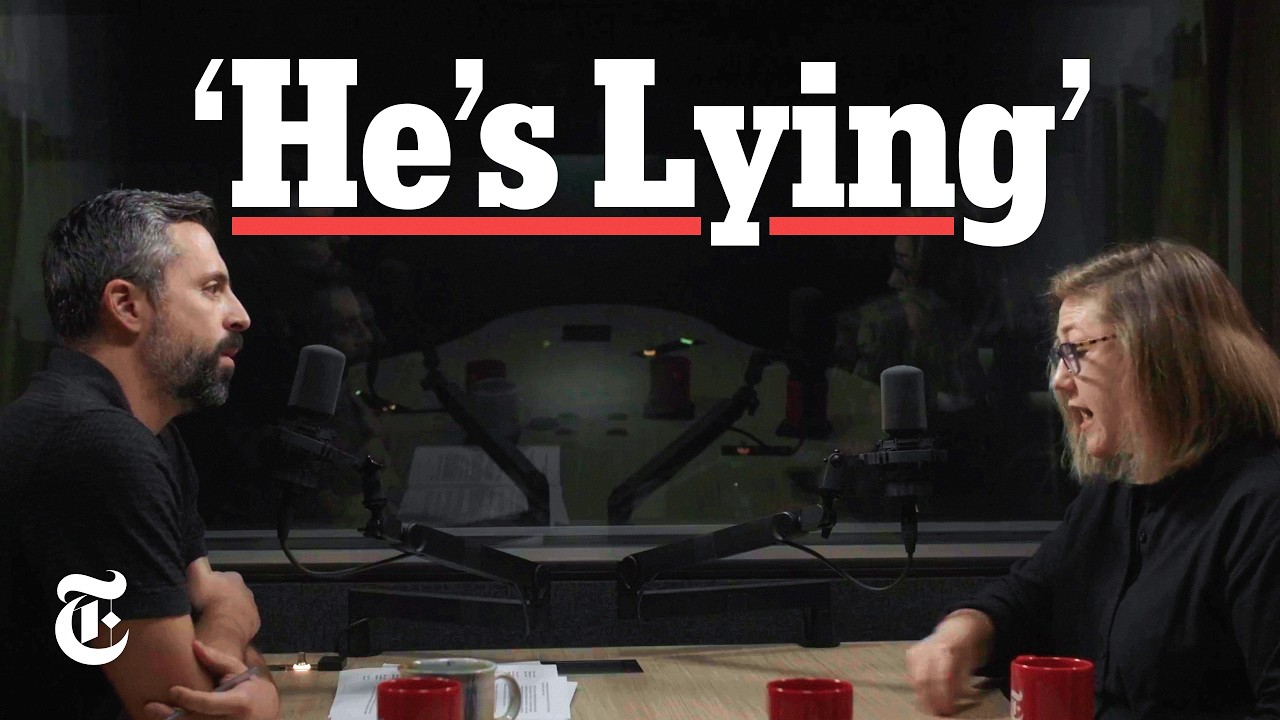
Donald Trump's net approval rating plummeted over 30 points to 37.5% midway into his second term, with swing voters pointing directly to unilateral tariffs and the war with Iran as violations of their affordability and non-intervention mandate. (1:37)
Government corruption has emerged as voters' top issue in focus groups and polling, as inner-circle foreign deals and crypto ventures generate intense backlash against the backdrop of household economic strain. (14:37)
Aggressive immigration enforcement is alienating young, Black, and Hispanic swing voters who expected deportations to focus strictly on violent criminals rather than public arrests by masked agents. (43:01)
The rapid expansion of AI data centers has become an unexpected swing-state flashpoint, provoking voter anger over climbing residential utility bills and backroom corporate deals. (55:55)
Detailed notes
## Background
Published on YouTube by The Ezra Klein Show on October 23, 2026, this episode features Sarah Longwell, publisher of The Bulwark and host of "The Focus Group Podcast." According to the show description, the conversation draws on qualitative focus group research to explore why Donald Trump's 2024 voters are souring on him midway through his second term and what opportunities this discontent creates for Democrats.
## TL;DR
Ezra Klein and Sarah Longwell examine the dramatic collapse in Donald Trump's second-term approval ratings, tracing the shift directly to unilateral tariffs, persistent grocery and fuel inflation, and an escalating war with Iran. Drawing on qualitative feedback from swing and right-leaning focus groups, Longwell highlights growing disillusionment over Trump family foreign business deals, withheld Epstein files, aggressive masked ICE deportations, and the disruptive spread of AI data centers. While the core MAGA base remains anchored by cultural grievances, irregular swing voters feel misled by promises of lower living costs and non-interventionism. Klein and Longwell conclude that this conservative voter fatigue, paired with high anti-Trump turnout energy and loomings cuts to healthcare, establishes the structural conditions for a major Democratic midterm wave.
## Atmosphere & style
The discussion carries an analytical, sober, and deeply grounded tone, contrasting political insider assumptions with the raw, kitchen-table reality of working-class voters. Listening feels like an intimate post-mortem of voter psychology, punctuated by the poignant voices of focus group participants who sound exhausted by rising prices and unsettled by masked federal agents. Klein provides methodical structural framing while Longwell speaks with candid, energetic authority, balancing sharp political diagnosis with an empathetic ear for public anxiety.
## Bulletin
- [01:37](https://www.youtube.com/watch?v=btknAGmBiD4&t=97s) Donald Trump's net approval rating plummeted over 30 points to 37.5% midway into his second term, with swing voters pointing directly to unilateral tariffs and the war with Iran as violations of their affordability and non-intervention mandate.
- [14:37](https://www.youtube.com/watch?v=btknAGmBiD4&t=877s) Government corruption has emerged as voters' top issue in focus groups and polling, as inner-circle foreign deals and crypto ventures generate intense backlash against the backdrop of household economic strain.
- [43:01](https://www.youtube.com/watch?v=btknAGmBiD4&t=2581s) Aggressive immigration enforcement is alienating young, Black, and Hispanic swing voters who expected deportations to focus strictly on violent criminals rather than public arrests by masked agents.
- [55:55](https://www.youtube.com/watch?v=btknAGmBiD4&t=3355s) The rapid expansion of AI data centers has become an unexpected swing-state flashpoint, provoking voter anger over climbing residential utility bills and backroom corporate deals.
## Key takeaways
- [01:37](https://www.youtube.com/watch?v=btknAGmBiD4&t=97s) Trump's approval collapse stems from executive actions—unilateral tariffs and an escalating war with Iran—that voters recognize as his personal choices rather than partisan obstruction.
- [03:04](https://www.youtube.com/watch?v=btknAGmBiD4&t=184s) Voters judge governance through tangible weekly costs like ground beef prices rather than trade theory, viewing price hikes as a breach of Trump's promise to focus on the home front.
- [10:17](https://www.youtube.com/watch?v=btknAGmBiD4&t=617s) Median voters are largely politically disengaged and absorb political impressions ambiently through algorithmic feeds and podcasts rather than active news consumption.
- [14:37](https://www.youtube.com/watch?v=btknAGmBiD4&t=877s) Corruption resonates as a primary voter grievance when the economy struggles, making Trump family crypto projects and foreign real estate deals look like elite self-enrichment.
- [18:45](https://www.youtube.com/watch?v=btknAGmBiD4&t=1125s) Democrats find effective messaging against corruption when they tell focused, step-by-step narrative stories about specific inner-circle deals rather than reciting broad laundry lists.
- [22:40](https://www.youtube.com/watch?v=btknAGmBiD4&t=1360s) The refusal to release the Jeffrey Epstein files fractured trust with young male swing voters who expected Trump to expose entrenched elite networks.
- [28:00](https://www.youtube.com/watch?v=btknAGmBiD4&t=1680s) The protracted conflict in Iran has broken Trump's non-interventionist branding, spiking gas prices and fueling conspiratorial narratives among voters under 35.
- [39:50](https://www.youtube.com/watch?v=btknAGmBiD4&t=2390s) Major statutory cuts to Medicaid and insurance subsidy rollbacks are set to propel universal healthcare and affordability back to the center of national politics by 2028.
- [43:01](https://www.youtube.com/watch?v=btknAGmBiD4&t=2581s) Swing voters supported immigration enforcement out of a desire for procedural fairness, but focus groups show alarm over federal agents arresting working parents and immigrants attending legal court dates.
- [50:38](https://www.youtube.com/watch?v=btknAGmBiD4&t=3038s) The deployment of masked federal agents in public arrests creates an unsettling perception of state-sponsored disorder and an evasion of accountability.
- [55:55](https://www.youtube.com/watch?v=btknAGmBiD4&t=3355s) Bipartisan local resistance to AI data centers is rising in Midwestern swing states as communities shoulder rising electricity bills and environmental disruption.
- [01:01:15](https://www.youtube.com/watch?v=btknAGmBiD4&t=3675s) Voters harbor deep anxiety over AI-driven job obsolescence and respond positively to leaders who exhibit candor about complex economic disruptions rather than rehearsed talking points.
- [01:09:20](https://www.youtube.com/watch?v=btknAGmBiD4&t=4160s) Structural midterm conditions favor a Democratic wave due to turnout asymmetry: irregular rural Trump voters tend to stay home when he is absent from the ballot, while high-propensity college-educated voters turn out reliably.
## Detailed walkthrough
### [00:00](https://www.youtube.com/watch?v=btknAGmBiD4&t=0s) The Post-2024 Polling Collapse and the Focus Group Evidence
Donald Trump began his second term in January 2025 riding the momentum of his first-ever national popular vote victory, entering the White House with a net approval rating north of 50 percent. Yet less than two years into that term, his standing has cratered by more than 30 points down to 37.5 percent. As the midterm elections approach, Democrats find themselves positioned for a potential electoral wipeout of Republicans, putting not only the House of Representatives back within reach, but also the Senate—with plausible pickup opportunities emerging in historically difficult territory like Texas and Kansas.
To unpack how this reversal unfolded, Ezra Klein brings on Sarah Longwell, publisher of *The Bulwark*, host of *The Focus Group Podcast*, and author of *How to Eat an Elephant: One Voter at a Time*. Having conducted hundreds of focus groups with thousands of voters across the political spectrum since 2016, Longwell possesses an unmatched body of qualitative research into how right-leaning and swing voters think, evolve, and ultimately sour on political figures. Klein notes that Longwell's deep qualitative archive offers a direct window into why voters who swung decisively to Trump in 2024 are abandoning him.
[01:37](https://www.youtube.com/watch?v=btknAGmBiD4&t=97s) The Core Catalysts: Unilateral Tariffs and the War with Iran
When asked why Trump’s popularity collapsed so dramatically after his historic victory, Longwell argues that the underlying cause is surprisingly uncomplicated. It does not require complex sociological parsing; instead, it traces directly to two specific, high-profile executive actions that voters trace entirely to Trump himself rather than external scapegoats or congressional gridlock.
As Longwell puts it: “It's easy actually. This is like this is the easiest question in politics right now which is Donald Trump made some very specific choices and they were his choices and everyone knows they were his choices.” The first decision was initiating broad, unilateral tariffs without consulting Congress, quickly spiraling into multiple trade conflicts. The second was initiating a war with Iran. Neither action can plausibly be blamed on Joe Biden, Democrats, or standard partisan obstruction; both sit squarely on Trump's desk. These actions directly inflated costs for consumers while violating the core mandate that swing voters gave him: lower the cost of living and stop entering foreign entanglements.
```mermaid
flowchart TD
accTitle: Voter Mandate vs Second Term Decisions
accDescr: Diagram contrasting what swing voters hired Donald Trump to do against the unilateral actions that damaged his approval rating.
subgraph Mandate["2024 Swing Voter Mandate"]
M1["Lower Consumer Prices"]
M2["'No More Stupid Wars'"]
end
subgraph Actions["Trump's Executive Choices"]
A1["Unilateral Sweeping Tariffs"]
A2["Outbreak of War with Iran"]
end
subgraph Outcome["Consumer Reality & Backlash"]
O1["Rising Everyday Living Costs"]
O2["Broken Campaign Promises"]
O3["Net Approval Drops to 37.5%"]
end
- Trump's approval plummeted from over 50% at his January 2025 inauguration to 37.5% heading into the midterms.
- Swing voters perceived the tariff trade wars and the military conflict with Iran as solely Trump's personal executive choices.
- The two moves exacerbated inflation and contradicted the primary mandate of stabilizing domestic costs and avoiding global conflict.
[03:04](https://www.youtube.com/watch?v=btknAGmBiD4&t=184s) The Grocery Cart Reality: $9 Ground Beef vs. Policy Rhetoric
While Trump campaigned heavily on tariffs, viewing them as promises kept, Longwell emphasizes that ordinary voters do not track policy mechanics or trade theory. Across every focus group Longwell hosts—regardless of whether participants lean left, right, or center—the opening question is always the same: "How do you think things are going in the country?" Right now, the immediate response is universally negative, followed instantly by concrete anecdotes from the grocery store aisles or the gas pump. Voters measure governance not through ideological consistency, but through whether an item costs two dollars more than it did the week before.
To illustrate this, Klein plays an audio clip of a woman who supported Trump in 2024. In the recording, the voter describes shopping weekly and spotting price shifts in real time, noting that while egg prices may have dipped slightly, she is now paying nine dollars for ground beef: “I've never paid $9 for ground beef before, ever, you know, like even the good kind.” She describes the prices as frightening and laments, “I really thought that it was going to be about us here at home.” Longwell underscores that voters evaluate leaders by the tangible results they live through rather than campaign slogans.
[05:01](https://www.youtube.com/watch?v=btknAGmBiD4&t=301s) The Redefinition of "America First" and the Elite Disconnect
Addressing the voter's plea that politics should be about "us here at home," Longwell explains that while the historical phrase "America First" carries dark, nativist roots, everyday voters interpret it in a deeply pragmatic way: prioritize the American citizen over global entanglements and stop sending billions of taxpayer dollars abroad. She points out that even progressive figures like Michigan's Abdul El-Sayed echo this sentiment when discussing foreign aid. El-Sayed argues against unconditional military aid to countries like Israel, Egypt, Pakistan, Saudi Arabia, and the UAE, pointing out that communities in Michigan with median incomes of $14,000 deserve to have their tax dollars invested at home in local schools and basic needs rather than sent overseas.
Klein and Longwell examine the profound divide between working-class Americans and the political elites of both parties. Klein points out that neither media commentators nor members of Congress experience the panic of having to put back an item at the grocery store because it suddenly costs two extra dollars. Consequently, leaders consistently fail to grasp what voters actually care about. Both parties fall into the trap of pursuing ideological pet projects—such as climate initiatives for Democrats or foreign posturing and tariffs for Trump—rather than addressing the kitchen-table affordability pressures that actually decide swing voters' ballots. As Klein observes: “They hire you to do often a job that is maybe not the job that you're most excited about doing.”
- For average voters, "America First" functions as a demand to invest domestic tax revenue into local infrastructure, schools, and families rather than foreign interventions.
- Politicians repeatedly succumb to insular donor or staff priorities rather than maintaining focus on the cost-of-living concerns that won over swing voters.
- The disconnect between governing elites and everyday consumers afflicted the Biden administration and is now repeating under Trump.
[08:10](https://www.youtube.com/watch?v=btknAGmBiD4&t=490s) The Myth of the Kool-Aid Businessman and the "Apprentice" Effect
When asked why voters believed Trump would fix affordability given his primary drive for self-enrichment, Longwell explains the powerful residual myth created by reality television. Voters view Washington as sclerotic and ineffective, and they bought into Trump's pitch that he was a savvy dealmaker who knew the system was rigged and would unrig it on their behalf. Longwell stresses that *The Apprentice* remains central to Trump's enduring political appeal; for years, millions of Americans welcomed him into their living rooms every week as an authoritative executive making decisive corporate judgments at the head of a boardroom table.
Because of that curated persona, voters believed Trump possessed proprietary commercial instincts that politicians lacked. Longwell compares their expectations to the Kool-Aid Man bursting through a brick wall, imagining Trump could magically cut grocery prices on day one. When those promises proved false, the illusion cracked. Klein transitions the conversation toward a fundamental structural blind spot in political analysis: professional pundits tend to view the electorate through a neat left-versus-right spectrum, when the far more critical dividing line in American politics is between voters who are intensely politically interested and those who are largely uninterested.
- Longwell identifies *The Apprentice* as the foundational cultural pillar that convinced millions of Americans that Trump was a master executive who could fix economic systems.
- Voters projected magical thinking onto Trump's businessman persona, expecting him to slash prices unilaterally.
- Klein highlights that the primary political divide is not partisan ideology (left vs. right), but engagement (interested vs. uninterested voters).
[10:17](https://www.youtube.com/watch?v=btknAGmBiD4&t=617s) "News Seekers" vs. "News Receivers" and the Algorithmic Vibe
Ezra Klein observes that deeply engaged political junkies constantly follow news feeds, whereas the median voters who decide elections generally dislike politics and do not pay close attention between election cycles. Sarah Longwell rejects the condescending academic label of "low-information voters," preferring to describe them as people who simply aren't "sick in the head like us" and choose not to let their nervous systems be hijacked daily by the vicissitudes of political wrangling. Klein quips that they are really "low neuroticism voters." Longwell agrees, pointing out that in normal two-income working households, parents are entirely consumed by demanding jobs and getting their kids out the door.
In her hundreds of focus groups, Longwell routinely asks participants where they get their news. While people once named distinct outlets—Fox News, CNN, *The New York Times*, or the local evening broadcast—most voters today simply reply, "I don't know where I saw that." Their media intake is an ambient feed: someone scrolling Instagram or TikTok for cooking influencers, or browsing clips for sports, will abruptly encounter Stephen A. Smith talking about political headlines. Longwell notes that while Democrats constantly insist the left needs its own Joe Rogan, they mistakenly look to political pundits. Rogan’s appeal is that he is an approachable comedian who mostly gets stoned, debates absurd hypothetical matchups like a shark fighting a gorilla, and brings on eclectic guests without claiming subject-matter expertise. Because politics has merged with culture, voters increasingly absorb what Longwell calls a "vibe"—an algorithmically injected cultural mood.
Longwell contrasts the old era of intentional "news seekers" with today’s "news receivers." Rather than deliberately setting aside time to read the morning paper or sit before the evening news, the news receiver has information passively wash over them without any mechanism to verify whether a claim is true or meaningful. As Longwell summarizes: “They wake up with an opinion without any idea of how it was formed.”
```mermaid
flowchart TD
accTitle: Shift from News Seekers to News Receivers
accDescr: Diagram illustrating how media consumption shifted from deliberate news seeking to passive algorithmic feeds.
subgraph Seekers["The Old Paradigm: News Seekers"]
A["Set aside dedicated time"] --> B["Deliberate sources: Daily papers, local/cable TV"]
B --> C["Conscious evaluation of facts"]
end
subgraph Receivers["The Modern Paradigm: News Receivers"]
D["Algorithmic feeds: TikTok, Instagram, Podcasts"] --> E["Culture-first entry: Sports, cooking, comedy"]
E --> F["Politics passively injected into feed"]
F --> G["Ambient 'Vibe' formed without source memory"]
end
```
[14:37](https://www.youtube.com/watch?v=btknAGmBiD4&t=877s) Why Corruption Has Become a Top-Tier Issue
Klein pivots to the sudden, surprising resonance of political corruption, playing an audio clip of a disillusioned Republican focus-group participant:
> “I'm a Republican. I'm just saying he's front and center now, right? And he's just blatant with corruption. But like we tolerated corruption in a way or look the other way. Even them their own politicians look the other way at each other. But because it was more minimal or more obscure every now and then you heard of a big corruption thing here or there whatever a pay for play but now it's just like bang like he just does it blatantly he just tells you what he wants to do you know he's investing in crypto his sons are invested in in drones you know with the war before just before the war started with Iran it's just like it's ridiculous it's so obvious and blatant now”
Klein notes that an October Fox News poll revealed voters expressed greater concern over government corruption than over any other issue—ranking it above prices, healthcare, immigration, and the war in Iran. Having watched corruption fail to gain traction throughout Trump's entire political career, Klein asks why it is suddenly breaking through. Longwell explains that it ultimately ties back to pocketbooks: “Everything comes back to people's relationship to the economy, which is, and this is a bummer actually, of an observation, but the American people, especially Trump voters and more low-information voters, would probably let Trump get away with, and in fact, we know they would. He was doing a lot of corrupt things in his first term. People didn't really care. You couldn't get them to care about how much he was spending on golf or having big meetings at all of his hotels.”
Klein adds that even blatant ventures like Trump family crypto schemes and meme coins during the 2024 campaign were shrugged off. Longwell stresses that if voters feel economically comfortable or think Trump can make them money, they overlook self-enrichment. Today, however, two factors have pushed corruption to the top:
- **Economic Pain vs. Brazen Luxury:** Voters are suffering financially, so seeing Trump obsess over an ornate White House ballroom, redo the reflecting pool, or watch his family blatantly cash in makes them furious that he is serving himself rather than helping them.
- **Polarization and the "What-About" Trap:** Longwell points out that when Democrats aggressively attack Trump's corruption, Republicans respond with reciprocal accusations ("No, Democrats are corrupt" or "They're all corrupt"). Much like "democracy" became a top-tier polling issue when both sides accused each other of stealing elections or inciting insurrections, corruption becomes universally prominent, but Democrats mistakenly assume all voters view it through their partisan lens.
[18:45](https://www.youtube.com/watch?v=btknAGmBiD4&t=1125s) Jon Ossoff's Storytelling and Prosecuting Trump’s Corruption
Klein turns to Senator Jon Ossoff of Georgia as the rare Democrat who cracked the code on making corruption charges stick with voters. Rather than Georgia functioning as a fragile, knife-edge swing state in the current cycle, Ossoff's re-election appears so dominant—commanding potential margins of 8, 10, or 12 points—that national speculation has already shifted to whether he will make a run for the presidency. Klein asks what Ossoff understood that other Democrats missed.
Longwell explains that Ossoff possesses natural political talent, writes his own speeches, and projects authentic conviction, but his real advantage is narrative discipline. While most Democrats react to Trump’s sprawling, brazen venality by reciting exhausting laundry lists that leave ordinary listeners bewildered, Ossoff takes it slowly, "one bite at a time." He relies on methodical storytelling that pulls voters in with simple, direct conversational hooks:
> "He's taking it slow. He's taking it one bite at a time. And he is writing to say, 'Hey, you you've heard about this. Now, maybe you saw Trump so desperate he's begging Putin for diesel. But listen to this.' Maybe they have, maybe they haven't, but he's inviting them in to a story that he's going to tell where he's going to give them information about what Donald Trump is doing. Y'all remember Jared Kushner? The president's son-in-law, the so-called special envoy, responsible for diplomacy with Russia and in the Middle East. Do you remember the other special envoy..."
By laying out tangible, step-by-step facts rather than sputtering in outrage, Ossoff transforms abstract political cynicism into a concrete narrative of how Donald Trump and his inner circle abuse power for personal gain.
[20:34](https://www.youtube.com/watch?v=btknAGmBiD4&t=1234s) Jon Ossoff’s Method: Making Trump’s Corruption Legible
Sarah Longwell and Ezra Klein break down how Georgia Senator Jon Ossoff successfully communicates Donald Trump’s sprawling corruption to ordinary voters. Ossoff walks through specific, tangible deals, highlighting figures like Steve Witkoff—who co-founded the president’s cryptocurrency project World Liberty—and Jared Kushner negotiating with Vladimir Putin over Russian oil fields, refineries, and gas stations to enrich allies of the administration. Ossoff connects these deals to international power players: Sheikh Tahnoon, the Emirati national security adviser and business figure who put roughly half a billion dollars into the Trump-Witkoff crypto venture; the Al-Khayat brothers, who are funding Jared and Ivanka Kushner’s multi-billion dollar luxury resort project in Albania; and a billionaire campaign mega-donor, alongside an arrangement where the United States government takes a 15% stake.
```mermaid
flowchart TD
accTitle: The Trump Family Financial Network
accDescr: Diagram illustrating financial and business deals connecting the Trump family and inner circle with foreign leaders and investors.
subgraph Dealmakers ["Dealmakers & Intermediaries"]
Kushner["Jared Kushner & Ivanka Kushner"]
Witkoff["Steve Witkoff<br>(World Liberty Crypto)"]
end
The political problem Democrats usually face, Longwell observes, is that Trump’s corruption operates at such a massive, multifaceted scale that it easily becomes background white noise for regular voters, much like his endless court cases. By contrast, Republicans succeeded with the Hunter Biden storyline precisely because the narrative was narrow, concrete, and easy to grasp. When Ossoff plainly explains that Trump’s son-in-law and business associate are trading foreign oil reserves to family benefactors in the middle of a global energy squeeze, the contradiction becomes sharp. As Longwell puts it: “They are literally the elites they pretend to hate.”
- **World Liberty:** Trump and Steve Witkoff’s crypto venture, which took in an estimated $500 million from Emirati spy chief Sheikh Tahnoon.
- **Albanian Resort:** Jared Kushner and Ivanka Trump’s multi-billion-dollar resort development backed by Syrian investors, the Al-Khayat brothers.
- **Russian Energy Stakes:** Jared Kushner and Steve Witkoff brokering terms with Vladimir Putin over oil fields, refineries, and gas retail networks, involving a 15% U.S. government stake alongside a major campaign mega-donor.
---
[22:40](https://www.youtube.com/watch?v=btknAGmBiD4&t=1360s) The Epstein Files and the Broken Populist Promise
Klein asks how much the Jeffrey Epstein revelations and the handling of the Epstein files have damaged Trump with his supporters. Longwell argues the issue did severe damage right out of the gate because it struck at the core populist myth Trump had cultivated: that he was the regular person's insider wrecking ball who would expose secret elite cabals, UFO files, and the JFK assassination archives. Instead, failing to release the files shattered trust among younger, swing-leaning men who voted for him.
Klein notes the sharp contrast between Trump’s first and second terms. In the first term, Trump pulled off an anti-establishment posture by pointing to the "deep state" resisting him inside his own administration. In his second term, MAGA holds the levers of power, eliminating that defense. When Trump protected the secret files instead of making them public, he appeared aligned with the very pedophilic, untouchable elite Epstein came to symbolize. Longwell observes: “And for him to not do that, not come through on that broke trust with a specific strain of Trump voter.”
- **The Populist Myth:** Voters viewed Trump as their champion who would breach the deep state and lay bare elite secrets.
- **Demographic Vulnerability:** The failure to release the Epstein files provoked intense anger among young, swing-leaning male Trump voters.
- **Personnel Departures:** Figures like Dan Bongino left high-profile roles (such as FBI deputy) because retaining credibility on their podcasts was impossible without releasing the files, while officials like Pam Bondi absorbed the public blowback as heat shields.
---
[25:18](https://www.youtube.com/watch?v=btknAGmBiD4&t=1518s) The Schism: America First Purists vs. the MAGA Establishment
Longwell identifies a deepening ideological divide on the right between the "MAGA establishment" and "America First" purists. The MAGA establishment consists of figures like Marco Rubio, House Speaker Mike Johnson, and loyalists like Kash Patel, for whom Trump himself is the absolute center and whose policies shift entirely based on whatever Trump wants. On the other side are America First hardliners like Tucker Carlson and Marjorie Taylor Greene, who claim that true America First policy has never actually been implemented. This latter camp broke aggressively with Trump over his foreign policy moves, particularly the war with Iran.
The conversation turns to Defense Secretary Pete Hegseth and why he remains in his post despite mounting military failures. Longwell and Klein call Hegseth's tenure absurd, pointing to bizarre public statements about banning "fatties, beardos, and weirdos" from the military, alongside reports of live-streaming the execution of a paralyzed man. Longwell speculates Trump keeps Hegseth around partly because Hegseth presents well on television, but primarily to serve as a scapegoat who can take the blame if the war completely falls apart: “My guess is that Pete Hegseth goes that it was Hegseth's war.”
---
[28:00](https://www.youtube.com/watch?v=btknAGmBiD4&t=1680s) The Iran War and the "Israel Controls Trump" Narrative
Addressing the trajectory of the ongoing war with Iran, Longwell explains that voters originally expected a clean, rapid strike similar to the U.S. operation that snatched Nicolás Maduro in Venezuela. Both Trump and the electorate assumed the conflict would be a quick "smash and grab." Instead, the war dragged on, trapping Trump in an escalating stalemate where his claims that the conflict has ended are repeatedly contradicted by reality. Voters feel the direct consequences primarily through soaring gas prices and a baseline fatigue with foreign entanglements.
Klein plays an audio clip of a young 2024 female Trump voter expressing her disillusionment:
> “My main concern is the wars, war with Iran and everything. And I think it's very saddening because, in my opinion, I think actually there's like, I mean conspiracy theories here and there, but I think that you know, realistically Israel controls President Trump and a lot of the decisions that are made for Americans, and I think that's a hard reality that people are slowly coming to realize.”
Longwell confirms that this sentiment is pervasive among Trump voters under the age of 35, who view foreign policy and the Middle East through a radically different lens than older generations. Rather than seeing a partnership where Benjamin Netanyahu merely convinced Trump that the Iranian regime would quickly topple, many younger Trump voters have embraced the more conspiratorial conviction that Israel directly dictates American military actions and overrides American interests.
[31:10](https://www.youtube.com/watch?v=btknAGmBiD4&t=1870s) The Scapegoat Narrative and Foreign Policy Disillusionment
Ezra Klein notes a dangerous interpretive frame gaining momentum on the right—and across American politics—that Israel controls U.S. foreign policy and is to blame for the country's crises. He suspects this frame will outlast Donald Trump. Sarah Longwell agrees, observing that both parties are fractured over the issue: the left is navigating its own anti-Semitism controversies, caught between traditional pro-Israel Democrats and a younger cohort demanding a reevaluation of aid and foreign policy entanglements. On the right, however, Longwell finds that sentiment among younger voters edges closer to explicit anti-Semitism, functioning primarily as a psychological scapegoat. Because the MAGA ethos dictates that Trump cannot fail on his own, voters construct an external culprit to explain his struggles.
```mermaid
flowchart TD
accTitle: The MAGA Scapegoat Dynamic
accDescr: Diagram showing how Trump supporters rationalize second-term foreign policy failure by finding an outside scapegoat.
subgraph CoreDogma["Core MAGA Dogma"]
A["'Trump can never fail; he can only be failed'"]
end
subgraph Contradiction["The Cognitive Tension"]
B["Foreign policy entanglement / War in Iran"]
C["Dual admission: Trump must be too weak/unwise to resist manipulation"]
end
subgraph BlameTarget["The External Target"]
D["Israel blamed as scapegoat"]
end
A --> B
B --> C
C --> D
```
This dynamic creates an uncomfortable tension for Trump loyalists: in order to absolve him, they must implicitly concede that he is weak enough to be manipulated into catastrophic decisions. As Longwell summarizes this cognitive dissonance: “In this frame you have to say Trump is so weak and so not smart that he can just be dogwalked into a war with Iran.” Beyond ideology, Klein emphasizes that the war hits voters on a basic level because it represents Trump pursuing his own agenda rather than theirs, driving up costs and betraying his core promise to avoid foreign quagmires.
[33:57](https://www.youtube.com/watch?v=btknAGmBiD4&t=2037s) Price Politics and the Reality at the Pump
Longwell observes that issues become politically lethal when they squeeze voters from multiple directions at once. The conflict with Iran does exactly that: it reignites the public's deep trauma regarding endless Middle Eastern wars—the very sentiment Trump famously leveraged to demolish Jeb Bush in the 2016 Republican primaries by railing against the $2 trillion Iraq disaster—while simultaneously inflicting acute economic damage at the gas pump.
Although regular voters might not accurately pronounce the Strait of Hormuz, they understand the supply chain reality: gas isn't arriving, fuel prices are surging, and the pain cascades throughout the entire real economy. In the Midwest and farm states like Iowa, elevated fuel expenses trigger higher fertilizer and equipment overhead for farmers, hike shipping costs, and push grocery bills higher. Voters view these increases not as abstract macroeconomic trends, but as a punishing, unremitting barrage. As Longwell explains: “They experience it like a cavalcade of prices going up across the board that make them feel, and then they look and they see the war, and it gives them a place to say, 'That’s the thing doing it.'”
- **Flashback to Trump's 2016 doctrine:** Trump ran explicitly on George W. Bush's foreign policy failure, repeatedly arguing that the U.S. destabilized the Middle East, wasted thousands of lives and $2 trillion, and allowed Iran to gain influence over Iraq's oil reserves.
- **The Strait of Hormuz effect:** Voters instinctively connect bottlenecks in Persian Gulf shipping lanes to immediate price spikes at their neighborhood gas stations.
- **Cascading agricultural costs:** In states like Iowa, fuel shocks directly inflate the operating expenses of food production and transport, multiplying the cost of staples.
[36:10](https://www.youtube.com/watch?v=btknAGmBiD4&t=2170s) The Agony of the Elevated Price Baseline
Klein argues that politics has entered a punishing new era of "price politics" because consumers spent years accustomed to negligible inflation. Even though headline inflation in Trump's second term hovers near 3% rather than catastrophic 7% levels, the cumulative surge from prior years means everyday costs remain painfully high. The psychological toll is devastating because the baseline never recedes, turning every minor bump into a fresh outrage.
Trump’s public insistence that the affordability crisis is a "hoax" alienates the very voters who trusted him to lower their bills. Because he campaigned on making life affordable again, his policies—from trade barriers to foreign conflict—are perceived as pouring gasoline on the fire. Klein notes that any politician who treats affordability as a messaging challenge rather than an ongoing national emergency will be met with voter fury: “Prices went up so much over the past couple of years that now every incremental increase is just agonizing, because what they are not doing ever is going down.”
[37:43](https://www.youtube.com/watch?v=btknAGmBiD4&t=2263s) Democrats, Deficits, and the Trap of Easy Promises
Longwell warns that while Democrats have developed sharp political attacks blaming Trump’s tariffs and military actions for high prices, they lack a credible affirmative strategy. Simply promising to roll back Trump’s Medicaid cuts, lower tariffs, and exit conflicts treats the symptoms without curing the disease. Longwell cautions that the country will remain stuck in a churn of political backlashes unless leaders level with voters about the painful fiscal trade-offs required to fix the economy.
Highlighting Senator Jon Ossoff as a model communicator, Longwell argues that Democrats must honestly address the nation's staggering fiscal backdrop: national debt approaching $40 trillion, stubbornly high interest rates that price families out of homeownership and car financing, and the impossibility of resolving structural inflation overnight. She faults Joe Biden for trying to convince families that the economy was flourishing instead of framing it as an ongoing, imperfect recovery, warning that Trump is repeating the exact same blunder. As Longwell notes regarding the massive policy burden ahead: “This is why if a Democrat wins in 2028, it is not a small task what they are up against.”
[39:50](https://www.youtube.com/watch?v=btknAGmBiD4&t=2390s) The Looming Medicaid Shock and the Return of Healthcare Politics
Klein turns to a major looming political crisis that Republicans appear totally unprepared for: massive cuts to Medicaid. Designed to take effect only after the midterm elections, this statutory time bomb will soon strip health insurance from millions of Americans, including large swaths of Trump’s core working-class base. State agencies across the nation are already preparing the bureaucratic machinery to carry out the cuts.
With the individual insurance exchanges destabilized by the rollback of expanded subsidies and Medicaid facing severe disruption, Klein argues that healthcare is poised to dominate the national stage again by 2028. Support for Medicare for All has hit record highs, while progressive Democrats have tempered their rhetoric by dropping unpopular demands to ban private insurance. The coming fallout will be far too severe to solve with minor adjustments: “I think we're moving back into a period of healthcare politics, and I don't think the next thing is just going to be repatching Obamacare. I think that we're past that now.”
[41:10](https://www.youtube.com/watch?v=btknAGmBiD4&t=2470s) The Growing Populist Demand for Healthcare Reform
Sarah Longwell argues that public sentiment around healthcare has fundamentally shifted away from traditional partisan frameworks. Setting aside personal policy preferences, she notes that voters across the entire political spectrum consistently demand major healthcare reform. This dynamic helps explain why Democratic Socialists of America (DSA) organizers feel ascendant; they recognize that working-class and rural Trump voters express deep frustration with the existing system. For non-college-educated and working-class families, healthcare represents not just a crushing financial expense, but a bureaucratic nightmare of navigating complex insurance systems. Voters simply desire a system that is simpler, cheaper, and of higher quality.
Longwell pushes back against political consultants who claim universal healthcare is an impossibility because past reform attempts failed. The lived realities of everyday citizens have made them far more receptive to sweeping systemic overhauls than Washington insiders realize. Longwell even floats a prediction for the near future: “One of my pet theories is that actually in 2028 in the debates, you're going to see some Republicans starting to talk about universal healthcare because it is going to be such a popular thing.” Ezra Klein cautions that while Republican politicians might talk about reform, they have no actual intention of delivering it, an assessment Longwell readily affirms.
[43:01](https://www.youtube.com/watch?v=btknAGmBiD4&t=2581s) Trump Voters on Immigration and Mass Deportation
Ezra Klein observes that while healthcare favors Democrats, immigration has long served as Donald Trump's signature issue—one where Stephen Miller's policy agenda has been exceptionally organized, planned, and proactive. Longwell explains that immigration remains Trump's highest-polling issue, hovering around 43% approval, compared to dismal ratings in the 20s for inflation, affordability, and the war in Iran. Conservative focus groups still credit Trump for securing and shutting down the southern border, which remains a widely popular step among right-leaning voters. However, serious fault lines have emerged within his 2024 coalition regarding how enforcement is handled.
While Trump’s hardcore base complains that deportations are not aggressive enough, independent, populist, and marginal voters—particularly the young, Black, and Hispanic voters who flipped toward Trump—feel deeply misled. Many insist they voted for Trump believing he would focus strictly on violent criminals. Instead, Hispanic Trump supporters who endorse strict border rules find federal enforcement targeting their own communities: ICE agents arresting parents at school drop-offs or apprehending immigrants who are actively attending legal court dates. Longwell plays audio excerpts from focus groups capturing this disillusionment:
> “Border control for me was a very big thing as that was one of my biggest concerns with this election was cleaning up the country and getting these dangerous illegals out. But I don't like how innocent people, professionals, have been incarcerated or taken.”
Another voter echoed this disquiet:
> “I don't like the way immigration is going. It's like there seems like there's no rhyme or reason or system going. Are they just grabbing people and, you know, putting them in camps?”
A third participant stressed the need to target genuine bad actors:
> “I do agree that we should stay on top of actual illegal immigration and criminals, but there's plenty of criminals already here that we could do a better job with instead of focusing on people that are, even if illegal, working and kind of minding their own business.”
Klein observes an ironic parallel between the two parties: while Democrats struggle because they resist distinguishing between the "deserving" and "undeserving" poor, the MAGA right refuses to differentiate between good and bad immigrants, treating the entire category with reflexive hostility. Longwell insists that the average Trump voter is animated far more by an innate sense of procedural fairness than by racial animus. Most voters assume the legal immigration process is a straightforward line that rule-breakers are jumping; they simply demand that newcomers arrive "the right way," while remaining proud of their own family immigrant heritage.
```mermaid
flowchart TD
accTitle: Trump Coalition Views on Immigration Enforcement
accDescr: A diagram contrasting the MAGA base and swing voters on Trump's mass deportation policies.
subgraph Consensus["Broad Public Consensus"]
Border["Close and Secure the Southern Border"]
end
subgraph Base["Core MAGA Base"]
Hardline["Demand Aggressive Mass Removals"]
end
subgraph SwingVoters["Swing & New Trump Voters (Young, Hispanic, Independents)"]
Targeting["Expected Focus on Violent Criminals"]
Reaction["Horrified by Community Raids, School Pickups & Courtroom Arrests"]
Targeting --> Reaction
end
Border --> Base
Border --> SwingVoters
```
[50:38](https://www.youtube.com/watch?v=btknAGmBiD4&t=3038s) Masked Agents and the Backfire of State-Created Disorder
Klein points out that Trump's 2024 appeal relied on promises of stability: addressing disorder at the border, curbing competition for jobs and housing, and restoring public order in cities like New York. Voters prioritize social order and view it as the fundamental duty of the state. However, the aggressive tactics orchestrated by figures like Stephen Miller and Gregory Bovino have produced the exact opposite effect. By dispatching masked federal agents into neighborhoods, causing confrontations, and even seeing American citizens shot by government officials in Minnesota, the administration has introduced visual chaos and state-sponsored violence into communities.
Rather than experiencing a return to "law and order," everyday citizens are watching situations spiral out of control in real time. Longwell confirms this dynamic, noting that the backlash in focus groups is driven by direct proximity rather than abstract ideology: these aggressive tactics are playing out in the very streets, neighborhoods, and towns where the voters live.
[51:28](https://www.youtube.com/watch?v=btknAGmBiD4&t=3088s) Masked Agents and Public Backlash
Sarah Longwell and Ezra Klein examine how the physical presence and tactics of federal immigration enforcement are disturbing ordinary voters. Longwell notes that people across the country recount seeing ICE agents showing up at local schools wearing full face masks while children are present, sparking profound confusion and anger. Furthermore, distressing news images—such as masked federal agents shooting an ICU nurse in the back—have intensified voter hostility.
Longwell emphasizes that the decision by law enforcement agents to conceal their faces is toxic with the electorate. While agents justify masks by claiming concern over being personally targeted, voters reject the excuse, maintaining that in America, law enforcement operates under public accountability. Klein strongly agrees, arguing that the public knows intuitively what masks signify:
> “And when the government starts doing that, they are creating a zone of action that is wider because they're creating an anonymity. They are shifting the relationship between the agents and the public, right? There's not a normal face-to-face relationship between them.”
Klein points out that while political consultants may view immigration as an area where Donald Trump still polls relatively well compared to trade or prices, the sight of masked men roaming American streets acts as a chilling, profound signal that the nation has slipped toward a fascist equilibrium.
```mermaid
flowchart TD
accTitle: Public Backlash to Masked Federal Agents
accDescr: Visual flowchart outlining how masked federal enforcement triggers civic backlash and shifts voting behavior.
subgraph StateAction ["Federal Enforcement Tactics"]
A["Deployment of ICE Agents in Face Masks"] --> B["Incidents at Schools & Street Shootings"]
B --> C["Erasure of Normal Accountability & Anonymity"]
end
subgraph PublicPerception ["Voter Reaction"]
C --> D["Perception of Authoritarian / Fascist Shift"]
D --> E["Deep Disquiet Across Communities"]
end
subgraph ElectoralConsequences ["Midterm Impact"]
E --> F["Depressed Turnout for Dismayed Republicans"]
E --> G["Mobilized Turnout Driven by Anti-ICE Sentiment"]
end
```
[54:07](https://www.youtube.com/watch?v=btknAGmBiD4&t=3247s) Voter Depletion and Turnout Asymmetry
Turning to midterm dynamics, Longwell contrasts the emotional state of Trump voters with the energy motivating opposition voters. In focus groups, base Republican voters sound fundamentally demoralized and depressed rather than energized. They view their own candidates as weak or lame; in Georgia, for instance, committed Trump loyalists refuse to support Democratic Senator Jon Ossoff, yet they resent and dread that everyone else around them appears ready to vote for him.
Because qualitative focus groups reveal underlying energy levels far better than standard horse-race polling, Longwell detects an enthusiasm void that is likely to keep conservatives home on Election Day. Even if some defend Trump out of tribal reflex, they recognize that the country is adrift. Meanwhile, the motivating factors for anti-Trump voters are visceral rather than purely economic:
> “Donald Trump is cozying up to all of these dictators. They're shooting Americans in the streets. Like I think that the anti-ICE sentiment is a motivating factor for people that gets them to turn out in a way that immigration has been a turnout mechanism for Republicans in the past and will not be now.”
- Republican base voters feel "sad" and "bummed out" by current leadership and candidate slates.
- Economic concerns such as lowering prices do not necessarily convince people that a Democratic Congress has the solution.
- Turnout is driven by outrage over authoritarian optics, foreign policy betrayals, and state-sanctioned violence.
[55:55](https://www.youtube.com/watch?v=btknAGmBiD4&t=3355s) Data Centers as a Flashpoint Across Swing States
Ezra Klein pivots to an issue reshaping federal and statewide races that does not originate directly from Trump: the rapid, nationwide spread of artificial intelligence data centers. Across critical Senate battles—including Abdul El-Sayed in Michigan and Josh Turek in Iowa—data center expansion has become a major campaign issue.
Longwell recounts that data centers first blindsided her in 2025 focus groups during off-year gubernatorial campaigns featuring candidates like Mikie Sherrill in New Jersey and Abigail Spanberger in Virginia. Rather than being treated as dry infrastructure, AI and data centers trigger voter anxiety across three distinct fronts:
1. **Energy Costs:** Surging electricity consumption drives up residential utility bills.
2. **Community Disruption:** Massive industrial facilities create noise, water demands, and blight across rural areas and small towns.
3. **Labor Disruption:** Citizens view data centers as physical monuments designed to power technologies that will ultimately eliminate their own livelihoods.
In Ohio, Republican Jon Husted's Senate campaign against Sherrod Brown was heavily battered by Husted's role as point man in securing state backing for over 200 data centers, paired with $2.5 billion in corporate tax breaks. Brown attacked the deals for driving Ohio's utility rates to some of the highest in the country without local citizen input, labeling it typical of a rigged system. Longwell and Klein exchange dry banter about Trump's off-topic rhetoric—noting Trump's bizarre public obsession with male physiques and Husted's rear end—before returning to how rural Pennsylvania and Midwest landscapes are now covered with grassroots "No Data Center" signs, eroding the historic turnout margins Republicans rely upon.
[59:21](https://www.youtube.com/watch?v=btknAGmBiD4&t=3561s) The Illusion of Local Control and Trump’s AI Alliance
Ezra Klein plays recordings from Longwell's focus groups illustrating the deep sense of betrayal and helplessness felt by residents facing data center developments in their backyards:
- A Pittsburgh resident laments that tech companies are erecting data centers on former steel mill sites over fierce local protests: "People are saying we don't want them. We don't want the pollution. We don't want this. We don't want this anymore. But yet, they just keep coming... it's not job creation. It's short-term for long-term pain."
- Another voter describes how their entire town voted down a proposed data center at city hall, only to discover afterward that the deal had already been finalized behind closed doors and local farmers had already sold their land: "Basically yeah like our everybody that showed up to the city hall it was for nothing or word doesn't matter."
Klein underscores the acute political danger this dynamic poses for Trump. Trump built his political brand by acknowledging ordinary people's powerlessness and positioning himself as an insider strongman who could manipulate the corrupt system on their behalf. Yet on data centers, Trump has completely aligned with Big Tech billionaires. Calling into tech investor events like the All-In Conference to chat with Nvidia's Jensen Huang, Trump dismissed local opposition as an "anti-data center hoax," complaining that Google was forced to build facilities in Finland due to American permitting friction and declaring data centers the lucrative "oil of the next 20, 25 years." This elite alignment creates a severe disconnect with rural voters who feel steamrolled by the tech industry.
[01:01:15](https://www.youtube.com/watch?v=btknAGmBiD4&t=3675s) Trump, Data Centers, and Public AI Anxiety
Sarah Longwell argues that Donald Trump fundamentally does not care about regular Americans; instead, he cares about how the "All-In Podcast guys" and the donor class view him, and those donors are the exact constituency poised to benefit the most from data centers. While Silicon Valley figures and tech donors may appeal to Trump’s competitive instincts by framing AI infrastructure around beating China, Trump refuses to make an honest case to the public. Rather than explaining the long-term trade-offs or economic benefits, Trump simply dismisses voter concerns, claiming affordability issues are a hoax and issuing a blunt ultimatum: approve data centers to achieve wealth, higher home values, and lower taxes, or reject them and face poverty, crime, and squalor.
Despite Trump's reputation for understanding ordinary Americans, Longwell highlights a deep, palpable anxiety among voters regarding artificial intelligence. Across focus groups, she repeatedly hears voters question whether technology is about to replace their livelihoods. Longwell warns that if Democrats merely adopt a knee-jerk, anti-data center stance to reflexively oppose Republicans, they will forfeit a massive opportunity. What voters actually want is not a binary partisan fight, but a leader who can guide them through a rapidly evolving, complex technological transition.
- Trump frames the data center debate as an extreme binary: either towns embrace data centers for low taxes and wealth, or decline into poverty and squalor.
- Focus group participants consistently voice acute economic fear, centering on the question: *"Is this technology going to replace me?"*
- Longwell emphasizes that Democrats must avoid purely reactive stances: “And the way that Democrats—if Democrats come in and just say we're anti-data centers, we're just going to take the opposite role of Republicans, I think they will miss an opportunity to demonstrate that they can talk to the American people about a complicated thing that is changing in real time.”
---
[01:03:09](https://www.youtube.com/watch?v=btknAGmBiD4&t=3789s) The Need for Leaders Who Level with Voters
Ezra Klein notes that AI remains an unusual, unsettled, and non-polarized political issue because elected officials across both parties have no idea how they actually feel about it or where the technology is heading. Polling shows public skepticism toward local data centers does not divide cleanly along partisan lines. Because politicians are operating in the "first innings" of this revolution, none have figured out the vocabulary to lead the public through it.
Longwell responds that this uncertainty underscores why she is obsessed with Democrats nominating an exceptional communicator for 2028. To her, great communication does not mean possessing polished, predetermined answers, nor does it mean simply appearing on the *Joe Rogan Experience*. Voters are willing to hear a candidate admit they do not have every solution, as long as that leader commits to figuring it out without leaving ordinary citizens behind. This hunger is particularly strong among voters under 40, who live in a gig-driven, unstable economy and scoff at out-of-touch rhetoric that assumes workers remain at a single company for 35 years.
```mermaid
flowchart TD
accTitle: Communication Gap in New Economic Realities
accDescr: Voters seek candid leadership on AI and modern jobs over traditional partisan policy messaging.
subgraph Problem["The Economic Disconnect"]
A["Rapid AI Disruption & Tech Growth"]
B["End of the 35-Year Single-Job Career"]
end
subgraph Outdated["Old Political Reflexes"]
C["Polished Talking Points & Canned Answers"]
D["Generic Podcast Tours (e.g., Rogan Strategy)"]
end
subgraph ModernLeadership["What Modern Voters Demand"]
E["Radical Candor: 'I don't know, but we'll solve it together'"]
F["Commitment: 'I won't leave the American public behind'"]
end
Problem --> Outdated
Outdated -.->|"Fails to Persuade"| ModernLeadership
```
- Voters under 40 explicitly demand politicians who recognize that the 35-year single-company career path is extinct.
- Effective communication requires humility: “Americans will let you say, ‘I don't know, but I'm working to figure it out and I'm going to figure it out in a way that doesn't leave you behind.’”
- Longwell summarizes the challenge facing the party: “It's not that I think that Dems need better messaging around their issues; it's that I think people desperately want somebody who's going to level with them about the problems America's facing and is going to be open-minded about the solutions.”
---
[01:05:29](https://www.youtube.com/watch?v=btknAGmBiD4&t=3929s) Winning Trust: Swing-State Democrats vs. California Politics
When Klein asks which Democrats manage to win over Trump-leaning participants in her focus groups, Longwell points to politicians forged in battleground states who master basic governance and constituent services. In Georgia, even voters who do not vote for Jon Ossoff acknowledge his appeal because his office promptly answers the phone and resolves everyday problems. Similarly, Pennsylvania Governor Josh Shapiro established an untouchable local reputation because voters share personal stories of his office helping them out, positioning him to win reelection by massive margins in the nation's premier swing state. Longwell also commends Pete Buttigieg for entering deep-red states to host town halls and rejecting the idea of permanent partisan boundaries.
Longwell expresses strong skepticism toward California Democrats seeking the presidency. She argues that leaders whose careers were developed in safely blue environments lack the innate, gut-level instinct needed to connect with a median voter in Georgia, Pennsylvania, or Michigan. While Trump successfully conned voters into believing he cared about their personal struggles, voters' sheer desperation to be heard proves that authentic constituent-focused governance remains a potent political weapon.
- Jon Ossoff has built formidable goodwill across Georgia through constituent casework, leading MAGA voters to tell focus groups that his staff directly takes their calls and solves their problems.
- Josh Shapiro's focus on responsive state governance has generated deep loyalty across Pennsylvania, positioning him for blowout margins.
- Longwell questions the national viability of West Coast politicians: “If you've cultivated your political career in California, you simply don't have like a gut-level instinct to be around like a Georgia swing voter or a Pennsylvania swing voter or a Michigan swing voter.”
- Explaining the appeal of populist rhetoric, Longwell observes: “Donald Trump conned people into believing that he cared about them when he didn't, but people are so desperate for it that they were willing to be conned.”
---
[01:08:17](https://www.youtube.com/watch?v=btknAGmBiD4&t=4097s) What Keeps Loyal Trump Voters Anchored
Turning to voters who remain steadfastly pro-Trump and harbor zero regrets about their 2024 vote, Klein asks what worldview they hold. Longwell explains that for his core base, support is driven almost entirely by the culture wars. These voters celebrate Trump because he asserts that there are only two genders and moves to bar transgender women from women's sports. They view the Democratic Party as alien, weird, and overly "woke."
For this entrenched faction, support for Trump is rooted in deep tribal allegiance and personal identity rather than policy analysis. Because their attachment is personal, they brook no internal dissent, which leaves Longwell doubtful about whether the Republican Party can sustain this base once Trump exits the stage.
- The primary achievement celebrated by staunch loyalists is Trump's cultural fight over gender, specifically keeping biological men out of women's sports.
- Support among base voters functions as an identity marker rather than a reaction to specific material accomplishments.
- Longwell identifies this tribal entrenchment: “They tend to be people who are so polarized and so deeply anti-Democrat that they simply sort of out of a tribal allegiance continue to support Trump and will sort of brook no dissent on that because, a, they're very dug in—like it is part of their personality.”
---
[01:09:20](https://www.youtube.com/watch?v=btknAGmBiD4&t=4160s) The Turnout Trap and the Conditions for a Blue Wave
Longwell explains that in modern elections, "vibes are turnout." Trump possesses an extraordinary ability to turn out low-propensity, rural voters at "Assad-like margins"—voters who never previously engaged with electoral politics and do not participate unless Trump himself is on the ballot. Conversely, the contemporary Democratic coalition is increasingly anchored by high-propensity, college-educated voters who consume news compulsively, track campaigns closely, and vote reliably in every cycle, including off-years and midterms.
Without Trump directly on the ballot to activate irregular low-information voters, and with right-leaning swing voters increasingly depressed by Trump's second-term governance and flawed Republican candidates, the GOP faces an acute turnout deficit. Longwell sees this divergence between reliable Democratic high-information voters and a disillusioned, inactive MAGA base as the precise formula that creates massive midterm "wave territory."
- Trump mobilizes non-traditional, rural voters at historically unprecedented, "Assad-like margins."
- The Democratic base now skews toward high-information, college-educated voters who consistently show up across all election cycles.
- Depressed turnout among low-information Trump voters combined with high Democratic midterm engagement creates the structural foundation for a Democratic wave.
- Longwell concludes: “I think that is why you end up in wave territory.”
---
[01:10:24](https://www.youtube.com/watch?v=btknAGmBiD4&t=4224s) Book Recommendations
To close the interview, Klein poses his traditional final question, asking Longwell for three book recommendations for the audience. Longwell shares the first selection, noting that she recently read and thoroughly enjoyed Sally Rooney’s novel *Intermezzo*, before transitioning to her favorite books.
- *Intermezzo* by Sally Rooney
[01:10:38](https://www.youtube.com/watch?v=btknAGmBiD4&t=4238s) Book Recommendations and Wrap-Up
Concluding the conversation, Sarah Longwell shares her reading recommendations. She notes that having recently written a work of nonfiction herself—her book *How to Eat an Elephant: One Voter at a Time*—she deliberately sought refuge in fiction, immersing herself in imaginative literature rather than policy or political analysis. The first novel she highlights is John Williams's *Stoner*, which she describes as having undergone a reissuance after previously falling out of print before being revived by a new publisher. Ezra Klein remarks on the coincidence, noting that the title has surprisingly been surfacing across his own orbit quite frequently as well. Longwell delivers high praise for the work, declaring: “It is the best piece of fiction that I have read in a long time. It's what I think fiction should be. It is a wonderful book.”
Her final fiction selection is Barbara Kingsolver's classic novel, *The Poisonwood Bible*. Longwell admits that while she might have encountered it long ago during high school, she possessed no memory of it prior to picking it up recently. Whether she was experiencing it entirely fresh or rediscovering it anew, the novel left a profound impression on her, describing it as “incredibly good.” Klein thanks Longwell warmly for joining the program to unpack the mood, frustrations, and political trajectory of the voters she spends her days listening to across the country, bringing the discussion to a close.
- **John Williams, *Stoner*:** Celebrated by Longwell as a masterpiece of fiction following its reissuance after being out of print.
- **Barbara Kingsolver, *The Poisonwood Bible*:** A powerful novel revisiting the complexities of an evangelical missionary family in the Belgian Congo, which Longwell either read for the first time or completely rediscovered with fresh eyes.
## Notable quotes
> [01:05:29](https://www.youtube.com/watch?v=btknAGmBiD4&t=3929s) Donald Trump conned people into believing that he cared about them when he didn't, but people are so desperate for it that they were willing to be conned. — Sarah Longwell
> [36:10](https://www.youtube.com/watch?v=btknAGmBiD4&t=2170s) Prices went up so much over the past couple of years that now every incremental increase is just agonizing, because what they are not doing ever is going down. — Ezra Klein
> [01:03:09](https://www.youtube.com/watch?v=btknAGmBiD4&t=3789s) It's not that I think that Dems need better messaging around their issues; it's that I think people desperately want somebody who's going to level with them about the problems America's facing and is going to be open-minded about the solutions. — Sarah Longwell
> [01:05:29](https://www.youtube.com/watch?v=btknAGmBiD4&t=3929s) If you've cultivated your political career in California, you simply don't have like a gut-level instinct to be around like a Georgia swing voter or a Pennsylvania swing voter or a Michigan swing voter. — Sarah Longwell
> [41:10](https://www.youtube.com/watch?v=btknAGmBiD4&t=2470s) One of my pet theories is that actually in 2028 in the debates, you're going to see some Republicans starting to talk about universal healthcare because it is going to be such a popular thing. — Sarah Longwell
> [01:03:09](https://www.youtube.com/watch?v=btknAGmBiD4&t=3789s) Americans will let you say, ‘I don't know, but I'm working to figure it out and I'm going to figure it out in a way that doesn't leave you behind. — Sarah Longwell
> [39:50](https://www.youtube.com/watch?v=btknAGmBiD4&t=2390s) I think we're moving back into a period of healthcare politics, and I don't think the next thing is just going to be repatching Obamacare. I think that we're past that now. — Ezra Klein
## Mentioned
Abigail Spanberger, Abdul El-Sayed, Al-Khayat brothers, All-In Conference, Barbara Kingsolver, Benjamin Netanyahu, Dan Bongino, Democratic Socialists of America (DSA), Donald Trump, Ezra Klein, Fox News, George W. Bush, Google, Gregory Bovino, How to Eat an Elephant: One Voter at a Time, Hunter Biden, Immigration and Customs Enforcement (ICE), Intermezzo, Ivanka Kushner, Jared Kushner, Jeb Bush, Jeffrey Epstein, Jensen Huang, Joe Biden, Joe Rogan, Joe Rogan Experience, John Williams, Jon Husted, Jon Ossoff, Josh Shapiro, Josh Turek, Kash Patel, Marco Rubio, Marjorie Taylor Greene, Mike Johnson, Mikie Sherrill, Nicolás Maduro, Nvidia, Pam Bondi, Pete Buttigieg, Pete Hegseth, Sally Rooney, Sarah Longwell, Sheikh Tahnoon, Sherrod Brown, Stephen A. Smith, Stephen Miller, Steve Witkoff, Stoner, The Apprentice, The Bulwark, The Focus Group Podcast, The Poisonwood Bible, Tucker Carlson, Vladimir Putin, World Liberty
## Video description
Sarah Longwell has probably conducted more focus groups with Trump voters than anyone else in America — hundreds of them, starting in Trump’s first term. So she has a treasure trove of qualitative evidence of how voters have evolved in the Trump era and why many of the president’s voters are souring on him now.
Trump’s approval rating has plummeted since the start of his second term, especially among the groups that swung toward him in the last election — young, Black and Hispanic voters. But I wanted to have Longwell on the show to hear what these people are really saying. What exactly has disappointed them about Trump’s second term? And what opportunities could that open for Democrats?
Longwell is a founder and the publisher of The Bulwark, the host of “The Focus Group Podcast” and the author of “How to Eat an Elephant: One Voter at a Time.”
00:00 Intro
01:37 Why Trump’s Popularity Dropped
05:01 What America First Means to Voters
08:10 Trump’s Image as a Businessman
09:48 How Voters Get Information
14:37 Why Corruption Is Breaking Through to Voters
18:45 Jon Ossoff's Messaging on Corruption
22:40 How Epstein Impacted Trump Voters
28:00 The Iran War
33:14 Gas Prices
36:03 Inflation
37:43 Democrats on Affordability
39:50 Medicaid Cuts
43:01 Trump Voters On Immigration
50:38 Masked Agents And Disorder
54:07 Turnout Energy and Motivation
55:55 Data Centers
01:02:29 A.I. Anxiety
01:05:29 Winning Trust
01:08:17 What Kind of Voters Are Still Pro-Trump?
01:09:20 The Conditions for a Blue Wave
01:10:24 Book Recommendations
Read the full transcript here: https://www.nytimes.com//2026/10/23/opinion/ezra-klein-podcast-sarah-longwell.html
Watch more on @EzraKleinShow
Thoughts? Guest suggestions? Email us at ezrakleinshow@nytimes.com.
You can find transcripts (posted midday) and more episodes of “The Ezra Klein Show” at nytimes.com/ezra-klein-podcast. Book recommendations from all our guests are listed at https://www.nytimes.com/article/ezra-klein-show-book-recs.html
Drawing on extensive voter focus groups, Sarah Longwell and Ezra Klein argue that Donald Trump's post-2024 polling collapse stems from unilateral executive actions that breached his mandate on living costs and foreign restraint, alienating swing voters while demoralizing his midterm coalition.
Unilateral Executive Moves and the Kitchen-Table Squeeze (1:37)
Trump entered his second term in January 2025 with net approval above 50 percent, but his standing plunged by over 30 points to 37.5 percent heading into the midterms. Longwell attributes this collapse directly to two executive decisions that voters trace squarely to Trump rather than external scapegoats: initiating sweeping unilateral tariffs and entering a prolonged war with Iran. These actions violated swing voters' core priorities of lowering everyday costs and avoiding overseas conflicts. In focus groups, voters measure governance by tangible prices—such as paying $9 for ground beef or absorbing fuel price hikes triggered by Persian Gulf shipping disruptions—rather than trade ideology.
Economic Strain Makes Self-Enrichment and Populist Betrayals Toxic (14:37)
While voters previously overlooked self-enrichment during Trump's first term, Longwell notes that an October Fox News poll ranked corruption as voters' top concern, surpassing prices and healthcare. Compounding everyday financial strain, voters reacted sharply to visible family crypto schemes, foreign business deals, and White House renovations. The administration's failure to release the Jeffrey Epstein files further broke trust with young, swing-leaning male voters who viewed Trump as an insider wrecking ball against untouchable elites. In foreign policy, the protracted conflict with Iran drove younger right-leaning voters toward conspiratorial narratives that foreign powers dictate American military choices, creating cognitive dissonance within the MAGA coalition.
State-Created Disorder in Immigration and the Backlash to Masked Enforcement (43:01)
Although immigration remains Trump's highest-polling issue at around 43 percent approval compared to ratings in the 20s for inflation and foreign conflict, his enforcement strategy has alienated key voting blocs. Independent, young, Black, and Hispanic voters who backed Trump in 2024 expected deportations focused strictly on violent criminals. Instead, operations involving masked federal agents arresting workers at schools and courtrooms, alongside public shootings, generated visible community chaos. Klein and Longwell argue that anonymity in federal enforcement undermines civic accountability, transforming a law-and-order brand into a source of domestic instability.
Tech Alignments and the Local Resentment Over AI Data Centers (55:55)
Across swing states like Ohio, Pennsylvania, Michigan, and Iowa, the rapid expansion of AI data centers has created intense grassroots backlash over soaring residential utility bills, heavy water consumption, and industrial disruption. While local residents organize against these projects, Trump has aligned himself with tech investors, dismissing community resistance as an 'anti-data center hoax' and labeling the infrastructure essential. Longwell observes that this stance exposes a divide between Trump's working-class rhetoric and his donor-class priorities, stoking fears among workers under 40 who worry the technology will eliminate their jobs without offering reliable local economic benefits.
Structural Midterm Divergence and Electoral Asymmetry (54:07)
Heading into the midterms, Longwell observes an enthusiasm deficit among Republicans, whose low-propensity rural voters often participate only when Trump himself is on the ballot. By contrast, the Democratic base increasingly relies on high-propensity, college-educated voters mobilized by state-level grievances and anti-ICE sentiment, putting both the House and Senate in play. Longwell warns that while pragmatic swing-state leaders like Jon Ossoff and Josh Shapiro win crossover trust through disciplined storytelling and responsive constituent services, Democrats will face severe governing headwinds if they fail to honestly address structural fiscal pressures, approaching statutory Medicaid cuts, and a national debt nearing $40 trillion.
While Trump's governing choices have alienated swing voters and set up potential midterm wipeouts, Longwell cautions that Democrats lack an affirmative economic solution. Without leveling with voters about structural inflation, rising interest rates, and painful fiscal trade-offs, any incoming majority risks triggering a similar cycle of voter backlash.
## Background
本期节目由 YouTube 频道《The Ezra Klein Show》于 2026 年 10 月 23 日发布。视频围绕《The Bulwark》创始人萨拉·朗威尔(Sarah Longwell)长年主持的选民焦点小组定性调研展开,探讨为何大量在 2024 年投票给唐纳德·特朗普的选民在第二任期对其心生幻灭,以及这种民意转向将如何重塑中期选举和两党政治版图。
## TL;DR
节目深入剖析了特朗普支持率断崖式下跌背后的核心症结,指出强推关税与卷入伊朗战争直接推高了普通家庭的生活成本,彻底击碎了选民对其平抑物价的期待。同时,从爱泼斯坦档案未公开、家族商业利益输送,到蒙面特工街头执法以及地方数据中心引发的电费暴涨与 AI 焦虑,让边际与独立选民深感秩序失控并反感特权腐败。朗威尔结合乔恩·奥索夫与乔希·夏皮罗等民主党人的沟通案例,强调政客必须正视中位选民的真实困境,并预示若共和党低信息基本盘投票意愿低迷,中期选举可能迎来一场强劲的民主党蓝潮。
## Atmosphere & style
对谈整体洋溢着敏锐、深刻且极为落地的定性观察色彩,既有政治学维度的冷静解构,又充满对底层民生疾苦的真实体察。克莱恩缜密严谨的提问与朗威尔生动直率的焦点小组实录分析相互映衬,通过穿插普通超市账单、街头执法等选民原声,还原了普通人对政治脱节的挫败感与无力感。整场对话节奏张弛有度,在严肃反思美国政坛深层极化与体制危机的同时,也以坦率真诚的语调探讨了重构选民信任的可能路径。
## Bulletin
- [00:00](https://www.youtube.com/watch?v=btknAGmBiD4&t=0s) 自2025年初重返白宫以来,特朗普的净支持率暴跌超过30个百分点至37.5%,其核心导火索在于单方面推行全面关税战和发动对伊朗战争,直接推高了物价并违背了竞选降息控通胀的承诺。
- [14:37](https://www.youtube.com/watch?v=btknAGmBiD4&t=877s) 政府腐败议题在福克斯新闻民调中跃居首位,受困于物价飙升的选民对特朗普家族涉足加密货币、投资无人机以及介入俄罗斯油田交易等明目张胆的利益输送容忍度急剧下降。
- [22:40](https://www.youtube.com/watch?v=btknAGmBiD4&t=1360s) 特朗普未按承诺公开爱泼斯坦(Jeffrey Epstein)机密档案,被摇摆选民视作从“对抗深层政府的潜伏者”彻底蜕变为“掩盖真相的建制派本身”,严重动摇了年轻男性群体的信任。
- [43:01](https://www.youtube.com/watch?v=btknAGmBiD4&t=2581s) 全副武装的蒙面ICE特工进驻学校、在居民区突袭甚至开枪伤人,使选民眼中的“恢复法律与秩序”沦为体制制造的新型混乱,激起温和派与拉美裔选民的强烈反弹。
- [55:55](https://www.youtube.com/watch?v=btknAGmBiD4&t=3355s) 全美多地爆发选民对AI数据中心推高电费账单、侵占土地及剥夺就业的抗议,但特朗普公开站队科技捐赠集团,令共和党传统深红农村选区出现罕见的民怨沸腾与投票疲态。
## Key takeaways
- [01:37](https://www.youtube.com/watch?v=btknAGmBiD4&t=97s) 选民幻灭的根本原因是实际生活压力,单方面关税与伊朗战事推高了生活开支,直接戳破了选民对其实施“美国优先”与降低日常物价的期望。
- [08:10](https://www.youtube.com/watch?v=btknAGmBiD4&t=490s) 真人秀《学徒》塑造的果断商业奇才形象曾长期为特朗普背书,但当通胀居高不下时,这一“商人魔法破局”的人设神话被残酷现实迅速瓦解。
- [10:17](https://www.youtube.com/watch?v=btknAGmBiD4&t=617s) 信息生态由主动搜寻转向社交算法的“氛围投喂”,低神经质、不热衷政治的中立摇摆群体往往通过泛文化内容被动接收政治情绪。
- [14:37](https://www.youtube.com/watch?v=btknAGmBiD4&t=877s) 经济艰难期会成倍放大公众对特权腐败的敏感度,特朗普家族涉嫌在能源危机与战争背景下自肥的行为击穿了底层选民的心理防线。
- [18:45](https://www.youtube.com/watch?v=btknAGmBiD4&t=1125s) 民主党参议员乔恩·奥索夫(Jon Ossoff)通过平实、克制且层层抽丝剥茧的讲故事方式拆解复杂的政商交易网络,为应对特朗普腐败叙事树立了沟通典范。
- [22:40](https://www.youtube.com/watch?v=btknAGmBiD4&t=1360s) 爱泼斯坦档案未公开是瓦解特朗普反建制人设的标志性转折,使其在支持者眼中彻底失去了“揭露黑幕的局外卧底”光环。
- [28:00](https://www.youtube.com/watch?v=btknAGmBiD4&t=1680s) 伊朗战局从预期的闪电战演化为长期消耗战,直接阻滞原油运输并传导至农产品及日常消费品,引发年轻右翼选民对美以关系的深度质疑与反思。
- [36:10](https://www.youtube.com/watch?v=btknAGmBiD4&t=2170s) 美国政治已步入对物价极度敏感的“价格政治”时代,任何看似在推高生活成本的政策都会立即遭遇极其严厉的选民惩罚。
- [39:50](https://www.youtube.com/watch?v=btknAGmBiD4&t=2390s) “宏伟法案”对医疗补助(Medicaid)的延迟削减是一枚即将引爆的定时炸弹,蓝领选民对精简、低成本医疗的迫切需求正促使全民医保诉求突破传统党派藩篱。
- [43:01](https://www.youtube.com/watch?v=btknAGmBiD4&t=2581s) 边境执法偏离“仅针对犯罪分子”的初衷,ICE的激进抓捕与街头蒙面执法不仅伤害了守法移民群体,更在普通社区中蔓延出法西斯式的恐惧与不安全感。
- [55:55](https://www.youtube.com/watch?v=btknAGmBiD4&t=3355s) 两党在数据中心议题上均深陷焦虑与政策困境,地方居民因电费激增和生活环境恶化而感到被体制背叛,特朗普却忽视基层恐慌全盘拥抱硅谷资本。
- [01:03:09](https://www.youtube.com/watch?v=btknAGmBiD4&t=3789s) 面对复杂的技术与经济大变革,选民最渴求的是能够承认困惑、愿意开诚布公对话且承诺“绝不丢下大众”的坦诚领导力,而非空洞的公关辞令。
- [01:05:29](https://www.youtube.com/watch?v=btknAGmBiD4&t=3929s) 乔恩·奥索夫与宾州州长乔希·夏皮罗(Josh Shapiro)通过扎实的选民个案服务和摇摆州治理本能赢得基层跨党派认可,展现出比深蓝加州政客更强的中间选民共情力。
- [01:08:17](https://www.youtube.com/watch?v=btknAGmBiD4&t=4097s) 若特朗普本人不在选票上,缺乏文化部落认同动员的低信息右翼选民极易陷入投票冷漠,叠加失望选民的流失,正为民主党在中期选举形成全面反弹的“蓝潮”创造条件。
## Detailed walkthrough
### [00:00](https://www.youtube.com/watch?v=btknAGmBiD4&t=0s) 特朗普支持率断崖下跌与中期选举前景
在 2025 年 1 月重返白宫之初,唐纳德·特朗普(Donald Trump)曾坐拥超过 50% 的支持率,并在 2024 年大选中赢得了他政治生涯中首次全国普选票胜利。然而在入主白宫后不到两年时间里,其净支持率暴跌超过 30 个百分点,跌至 37.5%。随着中期选举临近,原本看似不可能的局面正在出现:民主党不仅有望夺回众议院,甚至可能夺回参议院,并在得克萨斯州和堪萨斯州等传统红州取得突破。
《The Bulwark》创始人兼出版人、播客节目《The Focus Group Podcast》主持人萨拉·朗威尔(Sarah Longwell)做客节目。自 2016 年大选以来,她主持了数百场针对数千名各派选民的焦点小组访谈,尤其长期跟踪那些曾倾向于特朗普、如今却转而反对他的选民群体,并在近期出版了著作《How to Eat an Elephant: One Voter at a Time》。
```mermaid
flowchart TD
accTitle: 特朗普民调变化与中期选举冲击
accDescr: 展示特朗普支持率从2025年初的高点跌至2026年低点,进而影响中期选举两党攻守态势。
subgraph Status2025["2025年1月 就职之初"]
A["净支持率 > 50%"]
B["赢得职业生涯首次普选票胜选"]
end
subgraph Drop["执政不到两年"]
C["净支持率跌幅超 30 点<br/>跌至 37.5%"]
end
subgraph Midterms["2026年中期选举展望"]
D["民主党有望翻盘参众两院"]
E["得州、堪萨斯等传统红州出现竞选悬念"]
end
Status2025 --> Drop --> Midterms
```
---
### [01:37](https://www.youtube.com/watch?v=btknAGmBiD4&t=97s) 选民幻灭的两大直接导火索:关税与伊朗战争
当被问及特朗普民意崩溃的根本原因时,朗威尔直言这是当前政坛“最简单的问题”:选民非常清楚这一切都是特朗普个人的选择所致,无法推卸给乔·拜登(Joe Biden)或国会。选民认定的核心决策有两个:
1. **单方面强推全面关税**:未与国会协商,直接挑起多边贸易战;
2. **发动对伊朗的战争**。
这两个举动造成了相同的经济后果——推高了美国国内的物价。选民在 2024 年推选特朗普的核心目的原本只有一件,那就是降低物价;次要诉求则是结束毫无意义的对外战争。如今生活没有变好,承诺完全落空。面对埃兹拉·克莱恩(Ezra Klein)提出“特朗普竞选时反复强调关税,这难道不算兑现承诺吗”的疑问,朗威尔解释称,普通选民根本不在意具体政策细节和实现手段,他们在意的是实际生活感受。
在朗威尔主持的每一场焦点小组中,开场固定问题永远是“你觉得国家运转得怎么样”,无论受访者政治倾向偏左、偏右还是居中,现在的回答一律是“糟糕”,并立即倒苦水诉说生活开支,比如汽油价格或牛肉价格。朗威尔总结道:“选民不一定会把政策说辞和现实结果联系在一起。他们亲身经历一些事情,看到结果,然后再决定自己的感受。”
---
### [04:08](https://www.youtube.com/watch?v=btknAGmBiD4&t=248s) “碎牛肉”的震撼:选民对“美国优先”的真实诉求
节目播放了一段 2024 年投票给特朗普的女性选民在焦点小组中的原声录音。该选民表示,自己每周都去超市买菜,一眼就能看穿物价到底有没有下降:“除了鸡蛋可能便宜了一点,其他根本没变。我这辈子从没见过碎牛肉卖到 9 美元一磅,连普通肉都这么贵,这简直太疯狂、太吓人了。我当时真的以为他上台后会以我们国内的百姓为重。”
朗威尔指出,“美国优先”(America First)这一口号虽有其种族主义历史渊源,但对普通选民而言,它代表一种朴素的期待:总统应该把本国纳税人放在第一位,不要把大笔资金撒向海外,而应投入本土学校和民生福祉。朗威尔甚至提到,密歇根州政界人士阿卜杜勒·埃尔-萨耶德(Abdul El-Sayed)在被问及对外军援(包括对以色列的援助)时,也在使用一套左翼版本的“美国优先”话语——反对对以色列、埃及、巴基斯坦、沙特或阿联酋等国提供无条件军事援助,主张把纳税钱留在本土中位数年收入仅 14,000 美元的贫困社区。
朗威尔与克莱恩深入探讨了政治精英与民众的脱节:
- 无论是克莱恩、朗威尔,还是国会议员与决策高层,走进超市时都不会因为某样商品贵了 2 美元就买不起;
- 两党执政者往往被政策同温层和宏大叙事(如气候变化或地缘政治)包围,背离了决定选举结果的中间摇摆选民的核心诉求;
- 选民雇佣总统去完成平抑物价的工作,而这往往不是执政精英本身最有热情推进的事项。
关于当选后的错位,朗威尔直言:“选民希望物价更低。他们可能并不像民主党人那样全盘买账气候变化问题。而你身边所有能接触到你的人,实际上在超市买菜时都不会遇到困难,他们有自己兴奋得多的议题想要去推进。”
---
### [08:10](https://www.youtube.com/watch?v=btknAGmBiD4&t=490s) 商人神话与《学徒》滤镜的破灭
克莱恩指出,特朗普借高通胀赢下 2024 年大选,但通胀本身并不是每天激励他起床的动力。朗威尔则认为,特朗普的核心驱动力自始至终是自身利益与自我牟利。然而,大量选民之所以相信特朗普会为他们谋福利,是因为他们厌倦了华盛顿官僚系统的迟缓与僵化。
这种信任很大程度上来源于特朗普长期的“商人”人设宣传,尤其是真人秀节目《学徒》(The Apprentice)带来的深远文化印记。朗威尔强调,《学徒》对选民心理的塑造至关重要:在 2024 年大选中,许多选民脑海中依然保留着特朗普坐在会议室顶端、雷厉风行做商业决断的荧幕形象。选民误以为商人懂规则、能打破被操纵的体制,甚至以为特朗普会像“酷爱饮料人”(Kool-Aid Man)破墙而入一样,施展某种商业魔法在第一天就降低物价。然而,这种商人神话最终被证明只是无法兑现的谎言。
克莱恩进而指出,政治评论圈常常陷入一个误区,以为选民结构最主要的划分维度是“左派与右派”;但现实中政治最深刻的分野,其实存在于“对政治极其感兴趣的人”与“对政治完全不感兴趣的人”之间。围绕意识形态极化运转的政客,往往无法理解那些只在乎日常菜价的普通人群。
- 选民认定特朗普执政的两大关键自负决策:单方面关税战、对伊朗动武;
- 选民原声例证:普通碎牛肉价格飙升至 9 美元/磅,引发生活恐慌;
- 政治感知断层:政客与媒体评论阶层缺乏对“2美元差价”的日常敏感度;
- 选民对特朗普的盲信源于《学徒》塑造的果断商业奇才形象,而非对其具体经济政策逻辑的认同。
### [10:17](https://www.youtube.com/watch?v=btknAGmBiD4&t=617s) “低神经质选民”与信息接收方式的剧变
Ezra Klein 与 Sarah Longwell 探讨了那些决定大选结果、但在平时根本不关心政治的选民是如何感知现实的。长期以来,政治学界习惯用“低信息选民”(low-information voters)来称呼这一群体,但 Longwell 认为这一标签极不公平:这些人只是拥有健康的心理防线,没有像政治从业者一样让自己的神经系统每天被华盛顿的政治纷争绑架。Klein 随即形象地将其修正为“低神经质选民”(low neuroticism voters)。Longwell 解释道,这些普通人只是把全部精力放在家庭、照顾孩子和应对繁重的工作上。
以往焦点小组里的受访者能清晰指出自己的信息源,比如福克斯新闻(Fox News)、CNN、《纽约时报》(The New York Times)或是本地晚间新闻。如今绝大多数人却是一脸茫然地表示“我不知道在哪里看到的”。信息生态已经彻底转向算法分发:一个原本只想看篮球集锦或美食博主的普通人,会在刷 Instagram 或 TikTok 时偶然刷到体育名嘴 Stephen A. Smith 聊政治。民主党人总想打造左翼的 Joe Rogan,却错误地找来政治评论员。然而 Joe Rogan 的核心吸引力是流行文化而非政治说教——他本身是个喜剧演员,节目里充斥着抽大麻、脑洞大开地讨论“鲨鱼和猩猩打架谁能赢”,嘉宾聊政治时他也从不深究。Longwell 指出,传统上所谓“政治是文化的下游”,如今政治与文化深度重叠,演变成政治学里一种极其非政治化、却决定一切的东西——“氛围”(vibe)。
```mermaid
flowchart TD
accTitle: 新闻获取方式的历史演变
accDescr: 展示从过去主动寻找新闻的主动模式转变为如今被动接受算法投喂的氛围模式
subgraph Past["过去:新闻搜寻者 (News Seekers)"]
A["固定时间与场景<br/>(早餐读报、看晚间新闻)"] --> B["权威媒体渠道<br/>(报纸、有线电视、地方台)"]
B --> C["主动检验与消化事实"]
end
subgraph Present["现在:新闻接收者 (News Receivers)"]
D["算法信息流投喂<br/>(Instagram、TikTok 算法推荐)"] --> E["泛文化载体渗透<br/>(美食、体育、播客如 Joe Rogan)"]
E --> F["被动形成政治'氛围'<br/>(不知观点从何而来,缺乏核查机制)"]
end
```
针对选民接收信息机制的变化,Longwell 总结道:
> “I think it's the big difference between news seekers and news receivers.”(我认为这正是‘新闻搜寻者’与‘新闻接收者’之间的巨大差异。)
- **新闻搜寻者(News Seekers)**:专门抽出固定时间(如吃早餐时翻阅报纸、准时收看晚间新闻)获取资讯,具备基本的信息核实意识。
- **新闻接收者(News Receivers)**:从不特意搜寻信息,内容只是像浪潮一样将他们淹没。他们没有核查机制,常常一觉醒来就已经形成了某种政治偏见,却完全不知道这种看法最初是从何而来的。
---
### [14:37](https://www.youtube.com/watch?v=btknAGmBiD4&t=877s) 腐败议题为何突然击穿选民防线?
在特朗普执政过程中,腐败问题几乎从未间断,但此前长期无法在民调中引发实质波澜。然而到 2026 年 10 月的一项福克斯新闻民调中,“政府腐败”竟超越物价、医疗、伊朗战争乃至移民,一跃成为选民最关心的首要议题。播客中播放了一位特朗普支持者的焦点小组录音:该受访者直言,以往选民对建制派政客偶尔的利益交换或潜规则往往睁一只眼闭一只眼,但特朗普如今的腐败已经到了肆无忌惮、摆在明面上的地步——他在战前涉足加密货币,他的儿子们在对伊朗战争爆发前大举投资无人机产业,这种毫不遮掩的分肥让保守派选民也彻底看不下去。
面对 Klein 关于“为何腐败偏偏在此时爆发”的疑问,Longwell 直截了当地指出,这依然与物价和经济状况息息相关。选民如果兜里有钱,或者觉得特朗普能帮自己赚钱(例如那些指望跟着炒币发财的人),他们根本不在乎特朗普第一任期里在私人高尔夫球场花多少公款、在自家庭院酒店接待外宾,甚至也不在乎 2024 年大选期间特朗普家族大搞模因币(meme coins)的丑闻。但当民众自身陷入经济困境、日子过得极其艰难时,看到特朗普把精力全花在白宫舞厅和倒影池的奢华翻修上,看到其家族成员在战争与政策边缘公开自肥,愤怒便会呈指数级放大。此外,党派极化带来的“反弹效应”(backlash effect)也是关键推手:就像当年“民主受到威胁”这一议题一样,两党互相指责对方腐败,共和党人通过比烂和“那你们呢”(whataboutism)的反击,合力将腐败推成了全美声量最高的问题。
关于底层经济压力与选民对腐败容忍度之间的直接联系,Longwell 一针见血地指出:
> “Um, it's prices again. So, everything comes back to people's relationship to the economy, which is, and this is a bummer actually, uh, of an observation, but the American people, especially Trump voters and more lowinformation voters, would probably let Trump get away with, and in fact, we know they would.”(嗯,归根结底还是物价。所有事情都会回归到人们与自身经济状况的关系上。这个观察虽然令人沮丧,但事实就是如此:美国公众,尤其是特朗普选民和更多低信息选民,原本大概是会放任特朗普为所欲为的,而事实证明他们此前确实这么做了。)
- **经济繁荣期的宽容**:只要个人财务状况尚可,选民倾向于把政客的敛财视为司空见惯的政治代价,甚至幻想搭乘商界强人的便车。
- **生活窘迫期的清算**:在物价高企、民不聊生之际,领导人对自身利益与奢靡排场的公开追求,会立刻被解读为对民间疾苦的无视与背叛。
- **极化议题的双向助推**:民主党指责特朗普明火执仗地腐败,共和党则回击民主党全员肮脏,双方争吵迅速将“反腐败”抬升为两党选民共同聚焦的头号议题。
---
### [18:45](https://www.youtube.com/watch?v=btknAGmBiD4&t=1125s) 乔恩·奥索夫(Jon Ossoff)的叙事策略示范
在民主党内部,佐治亚州参议员乔恩·奥索夫(Jon Ossoff)成为了将特朗普腐败问题成功转化为选民共识的典范。佐治亚州原本属于胜负难料的摇摆州,但在当前的选情中,外界关注的焦点已经不是奥索夫能否获胜,而是他将以 8 个点、10 个点还是 12 个点的巨大优势胜出,甚至开始热议他未来是否会竞选总统。
Longwell 分析认为,奥索夫的成功不仅在于其个人魅力和坚持亲自撰写演讲稿的真诚感,更在于他掌握了极为高超的政治叙事节奏。面对特朗普规模庞大、层出不穷的失范行为,多数民主党人往往急于罗列一份冗长而令人窒息的罪状清单,结果反而让信息过载的普通民众产生防卫心理、索性撒手不管。而奥索夫选择放慢节奏,“一次只吃一口”,用平实质朴、引人入胜的家常式口吻邀请听众进入故事。例如他在演讲中从日常新闻切入:“大家可能听说过特朗普绝望到向普京乞求柴油”,随后自然引出焦点:“你们还记得贾里德·库什纳(Jared Kushner)吗?总统的那位女婿、所谓负责对俄及中东外交的特使……”这种循序渐进的讲述方式,将复杂的利益输送抽丝剥茧,成功打动了那些原本对政治指控早已麻木的中立选民。
Longwell 针对民主党普遍存在的沟通误区与奥索夫的独特手法评价道:
> “Donald Trump's scale of corruption, scale of venality leaves Democrats sort of sputtering to make the longest list that they can make of all of the horrible things. And it leaves people just with their arms up. Jon Ossoff, he's taking it slow. He's taking it one bite at a time.”(唐纳德·特朗普那种滔天的腐败与贪婪规模,常常让民主党人结结巴巴地只想列出一份尽可能长的罪状清单,结果只让选民感到无可奈何、彻底放弃。而乔恩·奥索夫则放慢了节奏,他选择一口一口慢慢来。)
### [20:34](https://www.youtube.com/watch?v=btknAGmBiD4&t=1234s) 拆解腐败叙事:乔·奥索夫的沟通方式
当讨论到针对特朗普的腐败指控时,民主党面临的最大难题在于指控的体量太大、线索太杂,普通选民很容易在海量信息中感到疲惫并将其视为无关痛痒的“背景噪音”(white noise)。相比之下,共和党人死咬亨特·拜登(Hunter Biden)的具体个案,就能将其做成一顿政治大餐。佐治亚州参议员乔·奥索夫(Jon Ossoff)展示了一种行之有效的叙事手法:摒弃抽象的道德谴责,将复杂的利益输送网拆解为选民听得懂的一步步事实。
奥索夫在视频和公开演说中梳理了令人震惊的商业交易链路:特朗普的女婿贾里德·库什纳(Jared Kushner)与特朗普加密货币业务 World Liberty 的联合创始人史蒂夫·威特科夫(Steve Witkoff),在全球能源危机期间直接与普京谈判,打算把价值数十亿美元的俄罗斯油田、炼油厂和加油站转手给特朗普家族的圈内好友。其中牵扯的买家包括阿联酋情报主管谢赫·塔农(Sheikh Tahnoon,曾向特朗普与威特科夫的加密公司注资5亿美元)、出资数十亿美元资助库什纳和伊万卡在阿尔巴尼亚开发度假村项目的叙利亚阿尔卡亚特兄弟(Alkayat brothers),以及一名特朗普竞选阵营的亿万富翁超级捐赠人;甚至美国政府还要在其中持有15%的干股。
“Amidst a global energy crisis, the president's son-in-law and the president's business partner are brokering the sale of Russian oil fields to the first family's friends.”(在全球能源危机之际,总统的女婿和总统的商业伙伴正在撮合将俄罗斯油田出售给第一家庭的朋友们。)莎拉·隆威尔(Sarah Longwell)强调,这些获利者恰恰是向特朗普家族企业输送数亿美元的同一帮人,他们嘴上抨击建制派精英,实际上“literally the elites they pretend to hate”(正是他们假装仇恨的精英群体)。民主党人必须学习这种化繁为简、层层递进的揭露方式,才能打破民众对特朗普涉诉和丑闻的听觉麻木。
```mermaid
flowchart TD
accTitle: 特朗普家族涉嫌利益关联示意图
accDescr: 展示库什纳、威特科夫与海外资本及俄罗斯油田资产之间的交易关系网
subgraph Core["核心操盘手"]
JK["贾里德·库什纳<br>(总统女婿)"]
SW["史蒂夫·威特科夫<br>(加密业务合伙人)"]
end
subgraph Deal["交易标的"]
RF["俄罗斯油田、炼油厂<br>与加油站 (谈判中)"]
end
subgraph Backers["海外资方与利益伙伴"]
ST["谢赫·塔农 (阿联酋情报主管)<br>投入5亿美元于加密业务"]
AK["阿尔卡亚特兄弟 (叙利亚)<br>注资阿尔巴尼亚度假村"]
MD["超级政治献金捐赠人<br>及美国政府15%干股"]
end
JK & SW -->|"与普京谈判收购"| RF
ST & AK & MD -.->|"巨额资金注入 / 利益绑定"| JK & SW
RF -.->|"转手出售给"| Backers
```
### [22:40](https://www.youtube.com/watch?v=btknAGmBiD4&t=1360s) 爱泼斯坦档案背叛了谁:从“内部反叛者”沦为建制派
爱泼斯坦(Jeffrey Epstein)档案的未公开事件,对特朗普的基本盘造成了极其致命且立竿见影的信任危机。长期以来,特朗普选民对他有一种特殊的心理投射:他们认定深层政府(deep state)和邪恶精英集团一直在幕后操纵国家,而特朗普是潜入系统内部替平民百姓刺探真相的“自己人”。选民满心以为他二度入主白宫后,会彻底履行“成为历史上最透明的总统”的承诺,毫无保留地公开肯尼迪遇刺机密、UFO 外星人真相以及爱泼斯坦的全部黑料。
“And so they thought Trump was going to come in and he was going to open the, you know, JFK and the aliens and Epstein and he was going to lay it all bare for the American people. And for him to not do that, not come through on that broke trust with a specific strain of Trump voter.”(所以他们原以为特朗普会上台揭开肯尼迪、外星人和爱泼斯坦的秘密,将一切赤裸裸地展现在美国人民面前;而他没有这么做、没有兑现诺言,这打破了某一类特定特朗普选民的信任。)隆威尔指出,这一群体多为摇摆倾向较强的年轻男性,他们在焦点小组中反复宣泄对未公开档案的愤怒。埃兹拉·克莱因(Ezra Klein)补充道,在第一任期内,特朗普巧妙地维持了一种“身居总统之位却仍是反建制斗士”的魔术把戏;然而到了第二任期,MAGA 全面掌权,爱泼斯坦成了腐败、恋童且不可撼动的特权阶层的代名词,特朗普捂住档案的举动让选民清醒地意识到:他不再是对抗建制派的局外人,他自己就是必须为此负责的建制派本身。
- 选民心理转变:从视特朗普为“攻破华盛顿黑箱的内部卧底”,跌落到视其为掩盖黑幕的同谋。
- 人事震荡的遮羞布:丹·邦吉诺(Dan Bongino)在担任 FBI 副局长后迅速离职,正是因为无法公布爱泼斯坦档案严重损害了他在个人播客中的反建制威信;而卡什·帕特尔(Kash Patel)的玩忽职守以及帕姆·邦迪(Pam Bondi)的去职,都被选民视作特朗普为了阻挡档案公开而寻找的政治“隔热盾”(heat shield)。
### [25:18](https://www.youtube.com/watch?v=btknAGmBiD4&t=1518s) MAGA 建制派与“纯正美国优先派”的公开分裂
在共和党内部,一场严重的路线分裂正在撕裂特朗普的基本盘:一边是以马尔科·卢比奥(Marco Rubio)、众议院议长迈克·约翰逊(Mike Johnson)为代表的“MAGA 建制派”,对他们而言特朗普就是一切政策的圆心;另一边则是以塔克·卡尔森(Tucker Carlson)和玛乔丽·泰勒·格林(Marjorie Taylor Greene)为首的“美国优先派”(America Firsters)。后者抱持着“真正的‘美国优先’从未被实践过”的教条,具有强烈的反战与孤立主义倾向,并因为特朗普卷入对外冲突而公开与白宫反目。
国防部长皮特·海格塞斯(Pete Hegseth)在这场风暴中处于尴尬境地。外界普遍质疑一位前福克斯新闻主持人为何至今仍能稳坐五角大楼高位,他在面对伊朗战局不利时发表的荒唐演讲(宣称军队容不下“胖子、大胡子和怪胎”)以及极端作风引发了巨大争议。隆威尔直言,特朗普之所以还没撤换海格塞斯,一方面是因为海格塞斯在电视镜头前依旧光鲜亮丽且拼命为总统辩护,另一方面也是为了留着他充当最终必须为战事失败背锅的替罪羊。
### [28:00](https://www.youtube.com/watch?v=btknAGmBiD4&t=1680s) 伊朗战事泥潭:从“闪电战”幻觉到“以色列操纵”的阴谋论
随着战事持续数月,选民对特朗普发动伊朗战争的看法发生了急剧恶化。起初,民众受到此前针对委内瑞拉马杜罗(Maduro)政权那种“破门而入、抓人就走”的闪电突袭行动误导,以为对伊朗的打击也会速战速决。然而现实演变成了一场无法抽身的消耗战。选民们不仅要承受油价飞涨带来的直接生活压力,更对特朗普反复宣布“战争已经结束”却屡屡被打脸感到无比厌倦,清晰地认识到局势已经彻底失控。
“My main concern is the wars um war with Iran and everything. And I think it's uh very saddening because in my opinion I think actually there's like I mean conspiracy theories here and there but I think that you know realistically Israel controls President Trump and a lot of the decisions that are made for Americans and I think that's a hard reality that people are slowly coming to realize.”(我最担忧的就是战争,与伊朗的战争及这一切。我认为这非常令人悲伤,因为依我之见——虽然到处都有阴谋论,但我认为现实就是以色列控制了特朗普总统,控制了许多为美国人做出的决策,我认为这是一个人们正在逐渐意识到的残酷现实。)
在这段来自焦点小组的年轻女性受访者录音背后,折射出35岁以下年轻特朗普选民群体的剧烈思想转向:
- 世代认知鸿沟:35岁以下的年轻右翼选民对以色列的看法与老一代保守派截然不同,他们不再无条件支持中东干预。
- 战争动机的归咎:年轻选民普遍认定以色列总理内塔尼亚胡将特朗普诱骗进了这场泥潭,甚至滑向了“外国势力深度控制美国白宫决策”的极端叙事。
- 政治联盟的瓦解:原本因反建制、反永久战争而聚集在特朗普旗下的年轻男性与反战选民,正因中东战局的扩大和油价反噬,加速离他而去。
### [31:10](https://www.youtube.com/watch?v=btknAGmBiD4&t=1870s) 关于以色列的危险政治叙事与两党分歧
左右两翼对于以色列在美政治中所扮演角色的讨论正演变为一种全新且危险的解释框架。克莱因(Ezra Klein)指出,一种认为“以色列在背后掌控一切、导致美国政治频频出错”的叙事正在广泛扩散,并且这种框架极有可能在特朗普(Donald Trump)离开政坛后长久存在。
朗韦尔(Sarah Longwell)对此表示认同,并分析了该问题在两党内部的具体体现。民主党左翼正在经历严重的反犹太主义危机,形成了一种分裂:一边是主张继续支持以色列的传统老派民主党人,另一边则是规模日益庞大的群体,他们强烈要求重新审视美以关系,质问为何要给以色列送钱、为何要在其外交政策中陷得如此之深。
然而在右翼群体内部——尤其是年轻选民当中——这种言论更加直白露骨,呈现出赤裸裸的反犹主义倾向。朗韦尔分析,在铁杆右翼心目中,“特朗普是永远不可能失败的,他只会被别人辜负(Trump can never fail. He can only be failed)”。因此,当特朗普的政策遭遇重创时,必须找出一个替罪羊。这形成了一种充满矛盾的荒谬逻辑:支持者一方面坚信特朗普的伟大,另一方面为了开脱其责任,不得不被迫承认“特朗普太软弱、太缺乏智慧,以至于轻易就被牵着鼻子拖进了一场与伊朗的战争”。这种对以色列在美政治中角色的怀疑,让右翼年轻群体与左翼激进派在某种程度上产生了病态的共鸣。
### [33:16](https://www.youtube.com/watch?v=btknAGmBiD4&t=1996s) 伊朗战火、油价飞涨与生活成本的现实反噬
伊朗战争在选民心中发酵的原因,远不止于一场外交战事的受挫,它已经演变为特朗普背叛选民的象征。克莱因指出,这场战争给选民最直观的感受就是“特朗普在自搞一套,而不是在为你做事(Trump is doing his own thing, not your thing)”,成为他推高物价、违背民意的典型代表。
朗韦尔强调,真正能彻底激怒选民的,是某个议题能同时在多个层面上带来痛感。首先,美国民众从心底里厌恶在中东爆发无休止的冲突,这触动了他们骨子里的反战神经。具有讽刺意味的是,特朗普在 2016 年正是靠着猛烈抨击伊拉克战争击败了杰布·布什(Jeb Bush)——当时特朗普公开斥责小布什在伊拉克犯下大错,耗资 2 万亿美元并造成数千人丧生,最终导致伊朗接管了拥有世界第二大石油储备的伊拉克。
更直接的打击来自于普通民众的生活日常。选民或许念不顺甚至想不起“霍尔木兹海峡”(Strait of Hormuz)这个词,但他们切身体会到正是由于海峡受阻导致石油运不过来,进而让油价飙升。朗韦尔特别指出,在爱荷华州以及整个中西部,油价上涨绝不仅仅是加油的问题,它直接推高了化肥与农业成本、推升了食品价格、破坏了供应链并增加了货运卡车的运输费用。对普通选民而言,相较于复杂的医疗法案,他们对一连串接踵而至的物价上涨感知极度清晰,而伊朗战争恰恰为所有这些经济痛苦提供了一个最显眼的宣泄口。
```mermaid
flowchart TD
accTitle: 选民对伊朗战事的感知传导路径
accDescr: 展示伊朗战争如何从外交政策错误转化为选民日常的生活成本危机与政治反噬。
subgraph ForeignPolicy ["外交与政治认知"]
War["伊朗战争爆发"] --> AntiWar["触发民众对中东无休止战争的抗拒心理"]
War --> Narrative["被视为特朗普背叛选民的自私妄动"]
end
subgraph EconomicImpact ["连锁经济代价"]
War --> Strait["霍尔木兹海峡运输受阻"]
Strait --> GasSurge["加油站汽油价格飞涨"]
GasSurge --> SupplyChain["推高运输与供应链成本"]
SupplyChain --> BroadCosts["中西部农户成本激增、食品全面提价"]
end
ForeignPolicy --> Backlash["民怨爆发:选民归咎于白宫政策"]
EconomicImpact --> Backlash
```
### [36:10](https://www.youtube.com/watch?v=btknAGmBiD4&t=2170s) 价格政治时代的来临与降价幻灭
克莱因提出,美国政治已经正式踏入了一个崭新的“价格政治”(Price Politics)时代,这在以往长期低通胀的几十年里是未曾有过的。尽管在特朗普第二任期内,通胀数据按统计标准看并不算极度高昂(大致维持在 3% 左右,而非理想的 2% 或危机级别的 7%),但由于过去几年整体价格基准线已经被拉得太高,如今任何微小的价格上浮都会让大众感到痛彻心扉,因为物价从来没有掉下来过。
然而,特朗普至今仍在不断对外界声称所谓“生活负担危机是一场骗局,物价问题是一场骗局”。克莱因尖锐地指出,各党派政客必须认识到眼下的危机状态:
> “你必须把物价当作一种紧急状态来对待,任何看似正在推高物价的行为都会彻底激怒民众。”(“...you need to treat prices as a kind of emergency and anything you do that seems like it is raising prices is going to infuriate people.” —— Ezra Klein)
选民将特朗普送进白宫原本是为了降低生活成本,如今物价却不跌反升,加上加征关税与中东战火对汽油的冲击,直接打破了大众的期待底线。
### [37:43](https://www.youtube.com/watch?v=btknAGmBiD4&t=2263s) 民主党的应对困境与实话实说的迫切性
朗韦尔指出,虽然民主党人在话语层面上已经掌握了批判武器,懂得抓住生活负担能力、抨击关税和战争政策去打反击,但他们尚未拿出一套令人信服的正面解决方案。如果在野党只会承诺“取消关税、停掉战争、撤销特朗普削减的医疗补助”,却无法从深层经济逻辑上向公众讲透现状,美国政治将陷入不断的选民反弹漩涡。
朗韦尔认为,必须有政客能像联邦参议员乔恩·奥索夫(Jon Ossoff)那样,坦诚地向美国大众讲清现实:降成本不可能像按下一个按钮那样立竿见影,国家正面临艰难的选择,尤其是在国债已经飙升至 4 万亿美元、利率持续居高不下的当下,这严重制约了人们购房和申请车贷的能力。
她回顾并严厉批评了拜登(Joe Biden)时期的沟通策略。拜登团队未能在沟通上将经济清晰地界定为“复苏期”——即承认复苏正在推进但状况仍不够好,反而一味向选民灌输“形势大好、一切正常”的说辞;而如今特朗普在重蹈同样的覆辙。面向 2028 年,任何有志入主白宫的候选人都必须拿出勇气,向美国公众坦白经济的真实困境。
### [39:50](https://www.youtube.com/watch?v=btknAGmBiD4&t=2390s) 迫在眉睫的医疗补助削减危机与医保政治重构
除了生活成本和战争之外,克莱因警告称,共和党人根本没有意识到 2028 年大选将面临的另一枚定时炸弹:依据所谓“宏伟法案”(Big Beautiful Bill)设立的大规模医疗补助(Medicaid)削减。该法案特意将削减生效的时间节点推迟到中期选举之后,但由于法案已具法定效力,全国各州机构目前已在按部就班地筹备执行。
这一法案一旦全面铺开,将造成毁灭性后果:
- 数百万美国人将失去医保覆盖,其中包括数以百万计的特朗普自身选民。
- 特朗普政府取消了《平价医疗法案》(ACA,奥巴马医保)的扩大补贴,导致原本用于维稳市场的支柱崩塌,个人保险市场陷入全面动荡。
- 全民医保(Medicare for All)的民调支持率已经被推向了历史新高。
克莱因强调,由于民主党左翼在策略上已经逐渐放弃了“废除所有商业私营医保”这一极具政治风险的激进立场,未来的医疗政策博弈将彻底改变。美国正在全面重返“医保政治”的白热化冲突期,而届时的解决路径绝不再是修修补补奥巴马医保那么简单。朗韦尔对此深表赞同,认为这将在未来选战中引发毁灭性的政治震荡。
### [41:10](https://www.youtube.com/watch?v=btknAGmBiD4&t=2470s) 全民医保:两党选民意料之外的共识
Sarah Longwell 指出,抛开她个人的政治立场不谈,仅从焦点小组(focus groups)中跨越整个政治光谱的选民反馈来看,“某种形式的全民医保是一个时机已经成熟的想法”。民主党内的民主社会主义者(DSA)之所以势力抬头,并坚信存在某种新的政治联盟,正是因为他们察觉到了川普选民对医疗改革的强烈诉求。在焦点小组中表达这些诉求的,并不是那些热衷讨论各种商业保险市场的“乡村俱乐部共和党人”(country club Republicans),而是广大农村选民、蓝领工薪阶层以及没有大学学位的选民。
对这部分选民而言,现行医疗体系不仅是一笔难以承受的巨额开支,在流程复杂度上也构成了极大的精神负担。他们厌倦了与保险公司和医疗机构周旋的繁琐流程,迫切渴望一套更简单、更便宜、质量更高的医疗制度。面对外界“美国绝不可能搞全民医保或全面移民改革”的惯性论调,Longwell 强调时代已经彻底改变,选民的开放程度远超以往;她甚至大胆提出了自己的一个核心推测:“Actually in 2028 in the debates, you're going to see some Republicans starting to talk about universal healthcare um because it is going to be such a popular thing.”(实际上在 2028 年的辩论中,你将会看到一些共和党人开始讨论全民医保,因为这将会变得极具民意基础。)Ezra Klein 对此插话讽刺道,共和党人或许会在口头上讨论,但绝不会付诸实际行动;Longwell 也当即表示认同,承认共和党人“绝不会真正去推行它”。
---
### [43:01](https://www.youtube.com/watch?v=btknAGmBiD4&t=2581s) 强硬驱逐与民意断层:川普最强议题的暗礁
医疗向来是民主党的传统优势领域,而移民则是川普的基本盘与核心王牌。在政策总管 Stephen Miller 的操盘下,川普政府在移民问题上的规划与推进比任何其他议题都更激进、更周密。然而民调数据显示,尽管移民依然是川普得分最高的项目,其支持率也仅徘徊在 43% 左右,虽然远高于他在生活成本承受力(affordability)、通货膨胀以及伊朗战争等议题上跌至 20% 多区间的惨状,但其内部已出现明显的民意裂痕。右翼选民确实因为川普关闭了南部边境而给予他认可,认为关闭边境是广泛受到欢迎的正确举措;核心硬核 MAGA 基本盘甚至嫌他的驱逐力度还远远不够。
然而,在大量独立选民和偏向非传统共和党的温和川普选民眼中,事态正在走向失控。这类选民最初投票给川普是因为欣赏他的民粹主义和反建制风格,如今却惊呼“我原本以为他只会驱逐罪犯”。街头出现戴面具的联邦执法人员让他们感到极度不安。特别是在“后入先出”(last in, first out)群体中——即 2024 年大选最后倒向川普、如今最先离去的年轻选民和拉丁裔选民——反弹尤为激烈。很多拉美裔选民虽然在原则上坚持严厉的边境管制、反对非法入境,但现实中他们就生活在风暴中心,亲眼目睹了 ICE(移民和海关执法局)探员冲进学校强行带走父母,甚至在合法守规矩出庭的移民面前直接抓人。焦点小组中充斥着对这种不人道手段与执法过火的尖锐抨击。
```mermaid
flowchart TD
accTitle: Trump Immigration Policy Voter Divergence
accDescr: A comparison between hardline base expectations and moderate voter backlash over immigration enforcement.
subgraph CoreBase["核心硬核 MAGA 选民"]
A["赞成完全关闭南部边境"] --> B["认为驱逐力度依然不足"]
end
subgraph SwingVoters["边际/拉美裔/独立选民"]
C["支持边境秩序但只针对罪犯"] --> D["目睹 ICE 探员抓捕守法移民与家长"]
D --> E["反感街头蒙面执法与非人道手段"]
end
B -.->|"政策极端化落差"| E
```
在播放的焦点小组真实选民原声录音中,多位投票给川普的普通民众直言不讳地表达了受骗感与困惑:
- 一位选民表示,边境管控是其投票的首要考量,初衷是“清理国家、驱逐危险的非法移民”,但他极度反感看到无辜的专业人士被抓捕或监禁。
- 另一位选民抱怨移民政策毫无章法:“It's like there seems like there's no rhyme or reason or system going. Are they just grabbing people and, you know, putting them in in camps?”(这就像是完全没有任何条理、规律或系统可言。难道他们就是随便到处抓人,然后把人关进集中营吗?)
- 第三位选民则强调,政府应严打真正的违法犯罪分子,但美国本土已有大批现行罪犯尚未处理,执法力量不应转移视线去对付那些即便身份非法、但老老实实打工且从不惹事的普通人。
---
### [46:17](https://www.youtube.com/watch?v=btknAGmBiD4&t=2777s) 模糊边界的代价:“好移民”与“全盘驱逐”的落差
Ezra Klein 对此进行深入剖析,指出两党在选民心理认知上都存在各自的盲区。民主党往往拒绝区分“应得救助与不应得救助的穷人”(deserving vs. undeserving poor),一味主张普遍救济,因而屡屡碰壁;而如今的 MAGA 右翼则走到了另一个极端,彻底抹杀了“合法”与“非法”或“好”与“坏”移民的界限,演化成一种纯粹的排外敌意,甚至在社交网络上荒唐地攻击大学橄榄球比赛中出现太多印裔美国学生面孔。在竞选期间,川普巧妙地模糊了这两种叙事——时而宣称只驱逐危险的外国罪犯,时而高呼无差别的“大规模驱逐”(mass deportation)。一旦上台后真正全面倒向无差别的大规模驱逐模式,普通公众便开始出现强烈的排斥反应。
针对外界认为川普支持者普遍是出于种族主义才反对移民的观点,Longwell 为普通美国选民进行了辩护。她强调极端的种族主义者只是少数,大多数川普选民的核心关切在于“公平感”(sense of fairness)。选民普遍持有两大朴素逻辑:第一,将生活了二十五年、遵纪守法的纳税邻居与暴力罪犯区分开;第二,要求移民“走正规途径”(come the right way)。然而,绝大多数美国人根本不了解现行移民制度何其严苛漫长,天真地以为存在一条简单的入籍通道,因此当看到有人非法越境时,会本能地觉得这是在插队、破坏规则。事实上,只要开启移民话题,大多数美国人首先津津乐道的是祖父母的移民史或自己身边的移民亲友,民众反对的并非移民本身,而是非法的越境行为。
---
### [49:48](https://www.youtube.com/watch?v=btknAGmBiD4&t=2988s) 秩序与反噬:法治修辞下的新型混乱
Ezra Klein 进一步指出,川普的强硬移民政策已彻底背离了选民对“恢复秩序”的期待。在 2024 年大选中,包括纽约等大城市在内的选区之所以向川普大幅倒戈,核心驱动力是选民对拜登执政时期街头混乱、治安恶化以及生活成本飙升的极度厌倦。选民将“维持社会基本秩序”视为政府的最底线职责,而川普正是凭借“法律与秩序”(law and order)的共和党传统口号赢得了他们的授权。
然而,在 Stephen Miller 和 Greg Bovino 等强硬派的操弄下,政府自身却成为了混乱的新策源地。选民目睹了明尼苏达等地发生的惨剧,甚至看到美国公民被联邦执法人员开枪射击;全副武装、遮挡面部的特工在居民社区大规模突袭,制造出暴力与恐怖的视觉冲击。原本为了平息混乱的强力执法,反倒将社会推向了另一种失控的深渊。Longwell 对此深度赞同,指出这种危机并非抽象的政治口号,而是实实在在发生在了选民生活的真实街区:“This is happening where they live. This is not abstract to them.”(这正发生在他们生活的地方。对他们来说,这绝非虚无缥缈的抽象概念。)当选民切身体会到国家机器制造的动荡时,他们对川普移民政策的耐心便彻底消耗殆尽。
### [51:28](https://www.youtube.com/watch?v=btknAGmBiD4&t=3088s) 蒙面执法人员与街头恐慌
在焦点小组中,选民对新闻中出现的移民执法画面表达了极大的不安。家长们提到,自己送孩子上学时,竟看到全副武装、戴着面具的美国移民及海关执法局(ICE)特工出现在学校门口,身旁全是小孩子,选民震惊地质问:“我们到底在干什么?”电视上甚至出现了蒙面特工向一名重症监护室(ICU)护士背后开枪的血腥画面。萨拉·朗威尔(Sarah Longwell)指出,特工遮盖面孔在选民心中引发了极其强烈的反感。虽然一些人辩解称特工掩面是“担心被针对”,但选民普遍反驳:“根本不是这么回事,这个国家是有问责制的。”
埃兹拉·克莱恩(Ezra Klein)对此深有共鸣,直言警察执法从不遮面,大家都清楚政府派蒙面人员追捕公民究竟意味着什么。一方面,这表明官方心知肚明自己做的事极度恶劣,露脸会有严重后果;另一方面,蒙面赋予特工匿名权,人为扩大了其行动空间,彻底撕裂了执法者与公众之间正常的面对面关系。尽管政治顾问可能认为移民议题并非多数美国人最关心的头等大事(特朗普在移民议题上的民调表现依然好于贸易或物价),但这种蒙面执法成了体制滑向法西斯化控制的深层警讯。克莱恩特别向在明尼苏达州挺身反抗、甚至为此献出生命的亚历克斯·佩蒂(Alex Petty)与蕾妮·古德(Renee Good)致敬。
> “When the government begins sending people in masks after you... it means first that the thing they're doing is bad enough that maybe they are worried about being targeted. It also means that the government knows that the thing they're doing is bad enough that it is a problem their faces can be seen.” —— 埃兹拉·克莱恩
---
### [54:07](https://www.youtube.com/watch?v=btknAGmBiD4&t=3247s) 投票动能与共和党选民的冷漠
谈到即将到来的中期选举投票率,朗威尔描绘了焦点小组中特朗普选民普遍流露出的沮丧与冷漠。许多铁杆选民对本党推选的候选人感到厌烦,觉得他们“很逊(lame)”。以佐治亚州为例,硬核特朗普支持者虽不会投票给民主党候选人乔恩·奥索夫(Jon Ossoff),但他们眼看着身边其他人纷纷倒向奥索夫,内心充满挫败感。朗威尔强调,定性研究优于民调的地方就在于能够捕捉选民的情绪能量——许多共和党选民骨子里仍会习惯性维护特朗普,但他们心里明白国家运转得很糟,特朗普干得并不好,最终很可能会选择不去投票。
推动选民出门投票的真正动力往往不是“降低物价”这种经济口号(多数人并不指望民主党国会能平抑物价),而是更深层次的道德危机:特朗普向独裁者献媚、背叛美国的国际承诺、以及联邦特工在街头射杀美国人。以往移民议题一直是动员共和党基本盘的利器,但如今针对 ICE 暴行的反弹情绪反而成了民主党阵营最强大的投票催化剂。
> “When I listen to Trump voters in focus groups, they're sad. Like, they're bummed out. They don't like their candidates. They think they're lame.” —— 萨拉·朗威尔
---
### [55:55](https://www.youtube.com/watch?v=btknAGmBiD4&t=3355s) 数据中心激起的基层怒火
除了伊朗战争、通胀关税及移民等由特朗普直接主导的议题外,一场在各州悄然爆发的“数据中心争议”正成为左右选情的关键变数。密歇根州的阿卜杜勒·赛义德(Abdul El-Sayed)与爱荷华州的乔希·特克(Josh Turek)等参议院竞选中,数据中心问题均被摆上台面。朗威尔透露,这一议题最早在 2025 年的非大选年补选中崭露头角(涉及米基·谢里尔与阿比盖尔·斯潘伯格等人的竞选),并完全出乎调查人员的意料,成为焦点小组最关注的话题。
选民反对数据中心主要集中在三个维度:
1. **能源成本飙升**:庞大的耗电量直接推高了普通居民的电费账单;
2. **社区环境破坏**:庞大的工业建筑破坏了乡村景观与生活环境;
3. **就业掠夺焦虑**:社区居民质疑,兴建这些 AI 基础设施最终只会研发出取代自身工作的技术。
在 2026 年俄亥俄州参议员竞选中,这一矛盾达到白热化。民主党人谢罗德·布朗(Sherrod Brown)抓住其共和党对手乔恩·休斯特德(Jon Husted)的痛处展开猛烈攻击:休斯特德曾牵头引进 200 多座数据中心,给予科技公司 25 亿美元的税收减免,导致俄亥俄州电费飙升至全国前列,而整个过程完全剥夺了当地社区的发言权。在宾夕法尼亚州中部的乡村地区,“拒绝数据中心(No Data Center)”的标语随处可见,直接削弱了传统深红农村选民对共和党候选人的投票热情。
```mermaid
flowchart TD
accTitle: 数据中心引发的选民多重焦虑机制
accDescr: 展示选民对数据中心的反对如何从电费、环境、就业及民主无力感多重维度发酵并削弱选民对共和党的热情。
subgraph Grievances ["选民现实痛点"]
direction TB
G1["电费飙升(高耗能)"]
G2["社区景观与环境破坏"]
G3["AI 威胁自身工作岗位"]
end
subgraph Disempowerment ["制度性无力感"]
direction TB
D1["地方公投否决却遭漠视"]
D2["两党建制派与资本私下敲定"]
end
Grievances --> Disempowerment
Disempowerment --> OUT["农村传统红区投票热情严重受挫"]
```
在播放的焦点小组录音中,匹兹堡与乡村小镇的居民痛心疾首地控诉这种不可逆的无力感。在匹兹堡旧钢厂遗址上,民众高呼“不要污染、不要数据中心”,但政客们却以“创造就业”为由强推落地,被居民怒斥为“饮鸩止渴的短期骗局”。另一位镇民讲述,全镇人去市政厅投票反对,结果事后得知农地早已被私下售出、开发已成定局,“大家去市政厅抗议根本毫无用处,我们的话毫无分量”。
面对民间的滔天怨气,特朗普却反其道而行之。他曾以“打破被操纵体制、替无权者发声”的强人形象自居,但在硅谷 All-In 峰会上连线英伟达首席执行官黄仁勋(Jensen Huang)时,特朗普却全盘背书科技巨头,痛斥“反数据中心”纯属骗局,称数据中心是“未来 20 至 25 年的石油,远比互联网和 AI 更庞大”,展现出与基层疾苦完全脱节的资本拥护姿态。
> “We have some of the highest electricity rates in the country now and did this without anybody without anybody locally have any input. It really is part of the part of the the the rigged system...” —— 俄亥俄州竞选议题引述(谢罗德·布朗攻击休斯特德)
> “It's not job creation. It's short-term for long-term pain.” —— 焦点小组选民录音发言
### [01:01:15](https://www.youtube.com/watch?v=btknAGmBiD4&t=3675s) 特朗普与数据中心利益集团:忽视普通人的技术焦虑
Sarah Longwell 指出,唐纳德·特朗普并不真正关心普通美国人的生计,他真正在乎的是诸如《All-In Podcast》科技播客圈子里的精英和捐赠阶层对他的评价。这批人恰恰是数据中心扩张浪潮中获利最丰厚的群体,而特朗普毫不犹豫地站在了他们一边。那些科技捐赠者走进办公室,向特朗普灌输数据中心的长期效益以及与中国展开地缘技术竞争的必要性,这极大地迎合了特朗普骨子里的竞争本能。
然而,特朗普在与公众沟通上展现出极度割裂的状态。尽管外界常常赞赏他是一个出色的沟通者,但他根本没有尝试向选民解释建设数据中心的深层理由或长期效益。相反,他只是简单粗暴地告诉选民别再计较生活成本问题,声称可负担性危机是个“骗局”,并用二元对立的威胁口吻教育公众:想要全州和城镇暴富、减税、让房屋大幅升值,就必须拥抱数据中心;如果拒绝批准数据中心,那就只能走向贫困、犯罪和衰败。Longwell 强调,虽然人们常夸赞特朗普具备洞察美国人心理的天赋,但他这次完全忽视了选民面对人工智能(AI)所产生的极端焦虑。
在 Longwell 主持的各个焦点小组中,“这项技术是否会取代我”已经成为选民普遍表达的深切恐惧。Longwell 警告称,如果民主党人仅仅采取反向反射机制,盲目站在共和党对立面并喊出“我们全面反对数据中心”,就会错失一个重大的政治机会。选民真正渴望的是有人能够坦诚地引导他们理解这个正在实时发生的复杂变局,并告诉他们应该如何理解与面对这场技术冲击。
> “And what voters really want is someone to take them through it. How should we feel about this?” —— Sarah Longwell
---
### [01:03:09](https://www.youtube.com/watch?v=btknAGmBiD4&t=3789s) 政治家面临的 AI 迷茫与新型沟通模式的渴望
Ezra Klein 对此分析指出,他曾与多位民主党和共和党在任官员深入交谈,现实的困境在于这些政客自己根本不知道该对 AI 持何种态度。AI 作为一项政治议题极具独特性:它尚未定型,也没有形成鲜明的两极党派对立。民调数据显示,在数据中心议题上两党选民的支持与反对比例其实极为接近。政客们之所以无法带领选民穿透迷雾,是因为技术变革仍处于“第一局”(first innings)的起步阶段,政治家自己都尚未厘清路在何方。
针对这一困局,Longwell 表示她极度渴望在 2028 年看到一位真正具备卓越沟通能力的民主党总统候选人。她解释称,所谓“优秀的沟通者”并不意味着必须掌握所有标准答案,或是拥有某种不容置疑的既定立场。美国选民完全能够接受一个候选人诚实地说出“我目前不知道答案,但我正在全力弄清它,且我探索出的道路绝不会抛下你们”。选民想要的只是一个不会站在人民对立面的领导者。
Longwell 进一步阐述,当下的美国已进入一个全新的政治沟通时代。这绝不仅仅是“多上几个播客”或者“模仿 Joe Rogan 那种风格”就能解决的问题。当前选民,尤其是 40 岁以下的年轻群体,面对着前所未见的复杂世界和剧烈变动的经济形态,他们渴求能够信任一个人来陪伴他们穿透这一切。年轻选民经常抱怨,他们希望政客能认清残酷的现实——如今根本不可能进入一家公司并安稳工作 35 年。选民极度渴望政治人物能基于现实世界的原貌进行开诚布公的对话,并以开放的胸怀共同探寻解法。
> “Americans will let you say I don’t know, but I’m working to figure it out and I’m going to figure it out in a way that doesn’t leave you behind.” —— Sarah Longwell
```mermaid
flowchart TD
accTitle: 选民对新型政治领导力的诉求路径
accDescr: 展示从AI经济焦虑到选民对坦诚领导力渴望的逻辑链条
subgraph Tension["现实挑战与技术焦虑"]
A["AI技术颠覆与就业不确定性"]
B["终身雇佣制瓦解<br/>40岁以下选民感到脱节"]
end
subgraph Failure["传统应对失效"]
C["政客自身陷入迷茫<br/>议题处于初期且无现成答案"]
D["机械化公关<br/>(如单纯模仿Joe Rogan上播客)"]
end
subgraph Solution["选民真正渴求的新型沟通"]
E["展现脆弱与诚实:<br/>'我目前不知道,但绝不抛弃大家'"]
F["扎根真实生活体验<br/>正视当下的不确定性与转型"]
end
A --> C
B --> C
C --> D
D -.->|"选民不再买账"| E
C ==>|"迫切需要"| E
E --> F
```
---
### [01:05:29](https://www.youtube.com/watch?v=btknAGmBiD4&t=3929s) 赢得摇摆选民的民主党样板:选民服务与摇摆州底色
当 Ezra Klein 询问焦点小组中那些偏向特朗普的选民究竟欣赏哪些民主党人时,Longwell 毫不犹豫地点名了佐治亚州参议员 Jon Ossoff。在佐治亚州的焦点小组中,即便最终没有把票投给他的选民,也会津津乐道于他赢得人心的能力。Ossoff 的核心法宝就是扎实到极致的选民基层服务(constituent services)。众多 MAGA 支持者坦言,当他们致电 Ossoff 的选民办公室时,工作人员不仅态度诚恳,还会切实为他们排忧解难。
同样的情况也出现在宾夕法尼亚州州长 Josh Shapiro 身上。Longwell 回忆 Shapiro 首次竞选州长时,宾州的焦点小组里几乎人人都有一段与他和他的办公室亲自打交道并获得实际帮助的故事。Longwell 强调,Shapiro 凭借这种治理口碑,在全美规模最大的摇摆州展现出了惊人的选票号召力,有望以令人难以置信的巨大优势连任,各界必须严肃看待他的政治潜能。此外,Longwell 还提到 Pete Buttigieg 正以极具策略性的方式打入深红州,通过举办大型市政厅会议(Town Hall),向公众证明不存在所谓“永久的红州”。
Longwell 借此表达了她对出身加利福尼亚州的政客角逐全国大选的深切怀疑。她认为,在深蓝的加州打磨职业生涯的政治人物,天生缺乏对全美中位选民(median voter)的核心直觉。相反,只有长期生活在佐治亚州、宾夕法尼亚州或密歇根州这种摇摆前沿的人,才能建立起与中位选民感同身受的本能。特朗普曾用手段诱骗人们相信他在乎大众,这恰恰反映出选民对“被关心”的渴望是何等强烈。
> “This is why I’m so suspicious of California politicians who run for national office is I think you have to be surrounded by the people who live in the swing states to have an instinct for what matters to sort of a median voter.” —— Sarah Longwell
- **Jon Ossoff 的核心优势**:以极为周到的选民个案服务作为立足之本,即便在偏红的佐治亚州也赢得了 MAGA 选民的情感认可。
- **Josh Shapiro 的治理样板**:凭借扎实的行政履历和亲民解难的口碑,在宾州这一决定性摇摆州构筑了极具韧性的政治护城河。
- **加州政治家的局限**:缺乏与摇摆州边缘选民频繁交互的本能,难以敏锐体察全国中位选民的真实焦虑。
---
### [01:08:17](https://www.youtube.com/watch?v=btknAGmBiD4&t=4097s) 铁杆特朗普选民的心理机制与未来的“蓝潮”条件
Klein 随后将焦点转向仍旧坚定支持特朗普的基本盘:这些在 2024 年投票给特朗普且对其第二任期表现极力赞许的人,他们眼中的政治图景究竟有何不同?Longwell 剖析称,这类铁杆选民表达支持的首要依据几乎全部集中在文化战争层面。他们最常挂在嘴边的是特朗普明确捍卫“世上只有两种性别”,并将生理男性坚决挡在女子体育赛事之外。他们深陷于文化冲突之中,坚信民主党已经变得荒谬怪诞、过度“觉醒”(overly woke)。
这部分选民展现出高度极化且深入骨髓的“反民主党”心理。对他们而言,支持特朗普已经演变为一种出于部落式效忠的身份认同(identity),融为了个人人格的一部分,完全容不得内部批评。正因如此,Longwell 对“没有特朗普的共和党未来”深表怀疑,因为特朗普在农村选民中能激发出如同阿萨德式(Assad-like)压倒性的天量投票率,一旦特朗普本人不在选票上,这批原先游离于政治之外的“仅限特朗普”(Trump-only)选民很可能直接放弃投票。
相比之下,民主党如今的基本盘高度依赖受过大学教育的选民,这批人密切追踪新闻动向,具备雷打不动的投票意愿。Longwell 总结道,特朗普基本盘中的低信息选民在没有特朗普本人的中期选举中大概率会投票乏力,再加上部分原本投票给特朗普的普通选民如今因其执政乱象感到心灰意冷,这两重因素相叠加,极可能在未来的选举周期中直接促成一场民主党的全面胜利浪潮(wave territory)。
对谈进入尾声,Klein 抛出了节目惯常的压轴问题,请嘉宾推荐三本书。Longwell 首先提到自己刚刚读完爱尔兰作家 Sally Rooney 的小说《Intermezzo》,对其喜爱有加。
> “The Trump thing is like who they are. Which is again why I’m a bit skeptical about the future of the Republican party without Trump.” —— Sarah Longwell
### [01:10:38](https://www.youtube.com/watch?v=btknAGmBiD4&t=4238s) 书籍推荐:《斯通纳》与《毒木圣经》
在节目的尾声,Sarah Longwell 分享了她的虚构类书籍推荐。她首先提到了约翰·威廉姆斯(John Williams)的小说《斯通纳》(Stoner),并指出这是一本重新出版的作品。Longwell 表示自己不确定这本书之前是否绝版过,但据她了解,该书确实在沉寂多年后被一家新出版商重新挖掘并再版。Ezra Klein 笑着回应道,这本书最近也频繁出现在他的视野和阅读圈子里。谈到这本书的艺术造诣时,Longwell 赞叹不已,直言道:“It is the best piece of fiction that I have read in a long time. It's what I think fiction should be. It is a wonderful book.”
随后,Longwell 提到了她的第三本推荐读物。她坦言,在撰写自己的非虚构类新书期间,她极度渴望完全沉浸在虚构文学的世界中来转换心情。因此,她选择了芭芭拉·金索尔夫(Barbara Kingsolver)的名作《毒木圣经》(The Poisonwood Bible)。Longwell 提到自己已经记不清高中时是否读过这本书,因为脑海中毫无印象,所以这次阅读可以说是一次彻底的重读或者全新的初读体验,但无论如何,这部作品都令她感到无比震撼。随着书单分享结束,Klein 正式向嘉宾致谢结束了本次对话。
- 约翰·威廉姆斯(John Williams)的小说《斯通纳》(Stoner):曾一度绝版后获再版,被 Longwell 誉为长久以来读过最好的虚构作品。
- 芭芭拉·金索尔夫(Barbara Kingsolver)的小说《毒木圣经》(The Poisonwood Bible):Longwell 在撰写非虚构政治书籍期间用来放松与沉浸阅读的经典文学作品。
## Notable quotes
> [36:10](https://www.youtube.com/watch?v=btknAGmBiD4&t=2170s) 你必须把物价当作一种紧急状态来对待,任何看似正在推高物价的行为都会彻底激怒民众。 — 埃兹拉·克莱恩
> [01:37](https://www.youtube.com/watch?v=btknAGmBiD4&t=97s) 选民不一定会把政策说辞和现实结果联系在一起。他们亲身经历一些事情,看到结果,然后再决定自己的感受。 — Sarah Longwell
> [01:05:29](https://www.youtube.com/watch?v=btknAGmBiD4&t=3929s) This is why I’m so suspicious of California politicians who run for national office is I think you have to be surrounded by the people who live in the swing states to have an instinct for what matters to sort of a median voter. — Sarah Longwell
> [01:03:09](https://www.youtube.com/watch?v=btknAGmBiD4&t=3789s) Americans will let you say I don’t know, but I’m working to figure it out and I’m going to figure it out in a way that doesn’t leave you behind. — Sarah Longwell
> [10:17](https://www.youtube.com/watch?v=btknAGmBiD4&t=617s) I think it's the big difference between news seekers and news receivers. — Sarah Longwell
## Mentioned
唐纳德·特朗普, 萨拉·朗威尔, 埃兹拉·克莱恩, 乔·拜登, 阿卜杜勒·埃尔-萨耶德, 乔恩·奥索夫, 贾里德·库什纳, 史蒂夫·威特科夫, 谢赫·塔农, 阿尔卡亚特兄弟, 弗拉基米尔·普京, 杰弗里·爱泼斯坦, 丹·邦吉诺, 卡什·帕特尔, 帕姆·邦迪, 马尔科·卢比奥, 迈克·约翰逊, 塔克·卡尔森, 玛乔丽·泰勒·格林, 皮特·海格塞斯, 尼古拉斯·马杜罗, 本雅明·内塔尼亚胡, 杰布·布什, 乔治·W·布什, 斯蒂芬·米勒, 格雷格·博维诺, 亚历克斯·佩蒂, 蕾妮·古德, 乔希·特克, 米基·谢里尔, 阿比盖尔·斯潘伯格, 谢罗德·布朗, 乔恩·休斯特德, 黄仁勋, 乔什·夏皮罗, 皮特·布蒂吉格, 萨莉·鲁尼, 约翰·威廉姆斯, 芭芭拉·金索尔夫, 斯通纳, 毒木圣经, Intermezzo, How to Eat an Elephant: One Voter at a Time, 学徒, The Bulwark, The Focus Group Podcast, All-In Podcast, Joe Rogan, Stephen A. Smith, 英伟达, World Liberty, 美国移民及海关执法局 (ICE), 联邦调查局 (FBI), 平价医疗法案 (ACA)
## Video description
Sarah Longwell has probably conducted more focus groups with Trump voters than anyone else in America — hundreds of them, starting in Trump’s first term. So she has a treasure trove of qualitative evidence of how voters have evolved in the Trump era and why many of the president’s voters are souring on him now.
Trump’s approval rating has plummeted since the start of his second term, especially among the groups that swung toward him in the last election — young, Black and Hispanic voters. But I wanted to have Longwell on the show to hear what these people are really saying. What exactly has disappointed them about Trump’s second term? And what opportunities could that open for Democrats?
Longwell is a founder and the publisher of The Bulwark, the host of “The Focus Group Podcast” and the author of “How to Eat an Elephant: One Voter at a Time.”
00:00 Intro
01:37 Why Trump’s Popularity Dropped
05:01 What America First Means to Voters
08:10 Trump’s Image as a Businessman
09:48 How Voters Get Information
14:37 Why Corruption Is Breaking Through to Voters
18:45 Jon Ossoff's Messaging on Corruption
22:40 How Epstein Impacted Trump Voters
28:00 The Iran War
33:14 Gas Prices
36:03 Inflation
37:43 Democrats on Affordability
39:50 Medicaid Cuts
43:01 Trump Voters On Immigration
50:38 Masked Agents And Disorder
54:07 Turnout Energy and Motivation
55:55 Data Centers
01:02:29 A.I. Anxiety
01:05:29 Winning Trust
01:08:17 What Kind of Voters Are Still Pro-Trump?
01:09:20 The Conditions for a Blue Wave
01:10:24 Book Recommendations
Read the full transcript here: https://www.nytimes.com//2026/10/23/opinion/ezra-klein-podcast-sarah-longwell.html
Watch more on @EzraKleinShow
Thoughts? Guest suggestions? Email us at ezrakleinshow@nytimes.com.
You can find transcripts (posted midday) and more episodes of “The Ezra Klein Show” at nytimes.com/ezra-klein-podcast. Book recommendations from all our guests are listed at https://www.nytimes.com/article/ezra-klein-show-book-recs.html
[Source](https://www.youtube.com/watch?v=btknAGmBiD4)
Source quotes
[36:10] 埃兹拉·克莱恩: 你必须把物价当作一种紧急状态来对待,任何看似正在推高物价的行为都会彻底激怒民众。
[1:37] Sarah Longwell: 选民不一定会把政策说辞和现实结果联系在一起。他们亲身经历一些事情,看到结果,然后再决定自己的感受。
[65:29] Sarah Longwell: This is why I’m so suspicious of California politicians who run for national office is I think you have to be surrounded by the people who live in the swing states to have an instinct for what matters to sort of a median voter.
[63:09] Sarah Longwell: Americans will let you say I don’t know, but I’m working to figure it out and I’m going to figure it out in a way that doesn’t leave you behind.
[10:17] Sarah Longwell: I think it's the big difference between news seekers and news receivers.
Source quotes
[65:29] Sarah Longwell: Donald Trump conned people into believing that he cared about them when he didn't, but people are so desperate for it that they were willing to be conned.
[36:10] Ezra Klein: Prices went up so much over the past couple of years that now every incremental increase is just agonizing, because what they are not doing ever is going down.
[63:09] Sarah Longwell: It's not that I think that Dems need better messaging around their issues; it's that I think people desperately want somebody who's going to level with them about the problems America's facing and is going to be open-minded about the solutions.
[65:29] Sarah Longwell: If you've cultivated your political career in California, you simply don't have like a gut-level instinct to be around like a Georgia swing voter or a Pennsylvania swing voter or a Michigan swing voter.
[41:10] Sarah Longwell: One of my pet theories is that actually in 2028 in the debates, you're going to see some Republicans starting to talk about universal healthcare because it is going to be such a popular thing.
[63:09] Sarah Longwell: Americans will let you say, ‘I don't know, but I'm working to figure it out and I'm going to figure it out in a way that doesn't leave you behind.
[39:50] Ezra Klein: I think we're moving back into a period of healthcare politics, and I don't think the next thing is just going to be repatching Obamacare. I think that we're past that now.
Original transcript
[0:00] Since he took office in 2025, Donald
[0:03] Trump's net approval rating has
[0:05] collapsed, falling by more than 30
[0:07] points. And so now, as we head into the
[0:10] midterms, Democrats have the opportunity
[0:12] to do something that seemed unthinkable
[0:14] just a year ago, take back not just the
[0:17] House, but the Senate, possibly even
[0:19] winning in places like Texas and Kansas.
[0:22] So, how did Donald Trump go from winning
[0:24] his first popular vote victory ever to
[0:27] in less than two years when now looks
[0:29] like it could be an electoral wipeout
[0:31] for Republicans? Sarah Longwell is a
[0:33] political consultant and the founder and
[0:35] publisher of the bull work. And since
[0:37] the 2016 election, she has conducted
[0:39] hundreds of focus groups with thousands
[0:41] of voters across the political spectrum,
[0:43] which have become this really
[0:45] extraordinary source of qualitative
[0:48] evidence of how voters have evolved in
[0:50] the Trump era, particularly voters who
[0:51] have leaned towards Trump and maybe now
[0:53] don't. Longwell is also the host of the
[0:56] focus group podcast. You can hear some
[0:58] of these groups there, and author of the
[1:00] recent book, How to Eat an Elephant. She
[1:03] joins me now.
[1:10] >> Sarah Longwell, welcome to the show.
[1:12] >> Thanks for having me. I'm super excited
[1:13] to be here.
[1:13] >> All right, so Donald Trump takes office
[1:16] again in 2025 January. His approval
[1:18] rating is above 50%. He has his biggest
[1:20] electoral victory ever. He's now at
[1:24] 37.5%.
[1:26] I think you have probably personally
[1:28] done more focus groups with Trump voters
[1:30] of different flavors and variants than
[1:32] anybody else in America.
[1:35] So what happened?
[1:37] >> It's easy actually. This is like this is
[1:39] the easiest question in politics right
[1:41] now which is Donald Trump made some very
[1:43] specific choices and they were his
[1:45] choices and everyone knows they were his
[1:47] choices. The first one was when he did
[1:48] all of the unilateral tariffs, didn't
[1:50] consult Congress, just got into trade
[1:53] wars with a whole bunch of people. Uh
[1:56] and the second thing was starting the
[1:59] war with Iran. Um and so those two
[2:02] things voters identify complete with
[2:05] completely with Trump. You can't say Joe
[2:08] Biden did that. You can't say it was
[2:10] someone else. Congress there was nothing
[2:12] else. Donald Trump went to war.
[2:14] >> Donald Trump made these choices and um
[2:18] and voters know it. And the consequences
[2:21] of both have been to raise prices for
[2:23] the American people at a time when they
[2:26] elected Donald Trump to do one thing,
[2:28] which was lower prices. And as a
[2:30] secondary matter, they said no more
[2:33] stupid wars. And so the voters right now
[2:36] recognize that they're life's not
[2:38] getting better and that Donald Trump has
[2:40] broken his promises. And so that is the
[2:42] easiest way to explain what's happening
[2:43] right now.
[2:44] >> Tariffs were a promise from Donald
[2:45] Trump. I mean, he ran for office saying
[2:48] again and again and again, tariffs on
[2:50] everyone, tariffs in all directions. I
[2:53] can imagine if you're him, you look at
[2:55] your tariff policy as promises kept. So,
[2:59] when you know his supporters tell you
[3:01] what they don't like about them, what do
[3:03] they say?
[3:04] >> Well, the thing about voters is that
[3:07] they are often not interested in the
[3:10] policy minutia of how one gets to a
[3:13] place. They're just saying, "What are we
[3:15] going to do to lower prices?" You know,
[3:16] the thing that has shocked me the most
[3:19] listening to voters, it's not even
[3:21] shocked. It's more the thing that I find
[3:24] has changed my relationship with voters
[3:27] is that the first thing we do is we ask
[3:29] people, "How do you think things are
[3:30] going in the country, every focus group,
[3:32] every single time, doesn't matter uh
[3:34] whether left, right, or center?" And
[3:37] right now people say bad and then they
[3:40] immediately they start talking about the
[3:42] prices of something. They talk about the
[3:44] prices of gas. They talk about the
[3:45] prices of beef. But they talk about
[3:47] something they did. I walked into the
[3:49] store today and uh and and the the beef
[3:53] cost X and that's $2 more than it did
[3:56] and it wasn't even the good stuff. Like
[3:58] Americans don't necessarily connect
[4:01] policy rhetoric to the outcome. They
[4:04] live through something, see the outcome,
[4:06] and then they decide how they feel about
[4:07] it.
[4:08] >> On that point about the ground beef, I
[4:09] want to play a clip that your team
[4:11] shared with me from one of the focus
[4:12] groups. This is someone who voted for
[4:14] Trump in 2024.
[4:16] >> I grocery shop every week, so like I
[4:19] know when thing when prices are going
[4:21] down and up and like I'm like, he's
[4:23] lying. Like nothing is ch Okay, maybe
[4:26] the eggs like have gone down, but like
[4:29] that's it. I've never paid $9 for ground
[4:32] beef before, ever, you know, like even
[4:35] the good kind. Um, so that that is
[4:38] really really crazy and getting very
[4:40] scary. Um, and it's just like I I really
[4:44] thought that it was going to be about us
[4:46] here at home.
[4:48] >> When that woman says to you, I really
[4:49] thought it was going to be about us here
[4:50] at home.
[4:52] What did she think? What did the people
[4:54] who swung towards Trump in 2024
[4:57] see in him that they hadn't seen maybe
[4:59] in 2020?
[5:01] >> Well, this is the promise of America
[5:03] first. America first has a lot of sort
[5:06] of racist origins. Uh but for the
[5:10] voters, America first is an idea that
[5:15] the president is going to prioritize
[5:17] them, Mr. and Mrs. American. And they
[5:19] like that promise. They like the idea of
[5:21] we're not going to send all this money
[5:23] to other places. And I hear versions of
[5:25] this um in basically every group that I
[5:29] do, which is we want to be taken care
[5:32] of. We want money spent on our schools.
[5:34] It's interesting actually watching Abdul
[5:36] Elsed because he's doing a version of
[5:39] this right now, his own version of
[5:41] America first. Uh often when he gets
[5:43] asked the question about Israel is to
[5:45] say, I don't want our money going
[5:46] overseas. I want it spent here in
[5:48] Michigan. and I want it spent on our
[5:49] schools, uh, on taking care of our
[5:52] people.
[5:52] >> I'm opposed to unconditional military
[5:54] aid for any country. That is Israel,
[5:57] yes, but that's also Egypt where my
[5:58] family immigrated from. That's Pakistan.
[6:00] That's Saudi Arabia, that's UAE. And
[6:02] that's not because of a focus on what's
[6:04] happening anywhere except for a focus
[6:06] what's happening here. We've got
[6:08] communities in my state where the median
[6:10] income is $14,000. And I believe they
[6:13] have a right to their tax dollars. And
[6:15] that is something that appeals to
[6:18] Americans deeply. They say, "Yes, we
[6:20] want to be taken care of, they feel like
[6:22] in the big mastrom of conversations that
[6:24] so often, whether it's sort of the weird
[6:27] social issues that people get wrapped
[6:29] around the axle about or whether it's
[6:32] the big geopolitical questions that
[6:34] politicians are always talking about,
[6:36] really what they want to know is what
[6:38] are you going to do for me?" And I think
[6:40] that that disconnect between
[6:43] people
[6:44] that we talk about as elites. Uh but
[6:47] let's just say you and I. You and I like
[6:49] we should admit this. We do not walk
[6:51] into the grocery store and say, "I can't
[6:54] buy this now because it's $2 more
[6:56] expensive." Nobody in Congress has that
[6:59] experience. Nobody in the nobody uh who
[7:02] is in a lot of decision-m authority has
[7:04] that experience. And so it is so easy to
[7:07] forget that that is the thing everybody
[7:09] wants. I think this is a problem that
[7:12] ends up afflicting both sides. it it
[7:15] happened to the Biden administration,
[7:17] you know, in in their term, now it's
[7:19] happening to Trump, which is that you
[7:20] get elected and the voters who crucially
[7:24] put you over the top, not your kind of
[7:28] big base of voters who are always going
[7:29] to vote for you, but the people who made
[7:31] the difference in the election,
[7:33] they hire you to do often a job that is
[7:36] maybe not the job that you're most
[7:38] excited about doing. You know, voters
[7:40] want lower prices. They're maybe not as
[7:43] bought in on climate change questions as
[7:46] Democrats are. And like there are all
[7:49] these people around you who have your
[7:51] ear who in fact do not have problems
[7:53] buying groceries in the grocery store.
[7:56] They have things they're much more
[7:57] excited about doing. And so you have
[7:59] this like constant pressure to like get
[8:02] off the course of what the swing voters
[8:06] wanted from you. And and that seems to
[8:08] me to be a lot of the Trump story here.
[8:11] like he won because inflation was high,
[8:14] but he didn't really care about
[8:15] inflation. Like that's not what gets him
[8:17] out of bed in the morning.
[8:18] >> No, what gets Donald Trump out of bed in
[8:20] the morning is Donald Trump's interests
[8:22] in I think enriching himself. And I do
[8:26] th this though goes back to the earlier
[8:28] question of why do Americans think that
[8:32] Donald Trump is in it for them? But the
[8:37] way that I heard so many voters
[8:39] characterize it is that the process was
[8:42] so slow and sclerotic uh and they felt
[8:47] like nothing was changing and the way
[8:48] that politicians talked all sounded the
[8:50] same. But mostly they thought this guy
[8:53] is a businessman and that means that he
[8:56] is going to figure out because this is
[8:58] what Donald Trump pitched all the time.
[8:59] I'm going to cut deals for you. I know
[9:01] how this system works. It's rigged
[9:03] against you. I'm going to unrig it. And
[9:06] voters really did think whether it was
[9:07] because of the apprentice, and I cannot
[9:09] tell you how important the apprentice is
[9:11] and was to the lore that sort of sits
[9:14] inside.
[9:14] >> You know, by 2024, it was so important
[9:16] >> like he lived in their living rooms at
[9:19] the top of a boardroom where he made
[9:22] decisions about business. And that is
[9:24] what voters really internalized about
[9:26] Donald Trump. And so when inflation was
[9:28] high, they thought he was going to come
[9:30] in and in some way that is magic from
[9:32] him, right? Sort of like the Kool-Aid
[9:35] man bust through the window and say,
[9:37] "Here, I'm going to lower grocery prices
[9:39] on day one." They think he sort of know
[9:41] has some secret sauce that allows him to
[9:43] do that when of course it is just a lie.
[9:47] He couldn't do it. There are a lot of
[9:49] ways that I think the people who
[9:52] interpret politics publicly, my job for
[9:54] instance,
[9:56] end up having a lot of trouble
[9:59] understanding voters. And and and one of
[10:01] the ways I think is that we think of the
[10:05] primary divide in the electorate as left
[10:06] right. But the primary divide in
[10:09] politics I always think is between
[10:10] interested uninterested. like the
[10:12] hardcore left and the hardcore right,
[10:14] MAGA, the liberals, resistance, whatever
[10:17] it is, they're all interested. They're
[10:20] all following some kind of media source
[10:22] constantly. But a lot of voters don't
[10:24] like politics and they're not that
[10:26] interested. And so I I like to hear you
[10:30] talk about like the different ways that
[10:33] people who like decide elections but do
[10:37] not follow politics that closely in
[10:39] between elections, that kind of
[10:41] difference in the electorate and how
[10:43] they then understand what is happening.
[10:45] >> We we talk in political science terms
[10:49] always. We're always slicing and dicing
[10:51] the electorate and we often talk about
[10:54] lowinformation voters and uh I always
[10:58] think that that is uh an unfair term to
[11:02] people who are just not sick in the head
[11:05] like us, right? Who are not following
[11:07] everything, who aren't don't let their
[11:09] nervous systems be hijacked on a daily
[11:11] basis by uh the vicissitudes of uh the
[11:15] political wrangling
[11:16] >> low neuroticism voters.
[11:17] >> Yeah, that's right. Like I think that's
[11:19] I think it's a perfectly acceptable
[11:21] thing to be like actually I'm going to
[11:23] focus on my family and getting my kids
[11:25] out the door and then I've got to go to
[11:28] a job that's quite demanding and both
[11:30] parents in the household are working. So
[11:32] one of the things we talk ask about in
[11:34] the focus groups all the time is we
[11:35] always ask where do people get their
[11:36] information and
[11:39] it is unsatisfying I think now because
[11:43] it used to be people would be pretty
[11:44] clear. They're like, "I watch Fox News
[11:45] or I watch CNN. Um, I read this
[11:48] newspaper. I read the New York Times.
[11:50] Uh, or I read my local newspaper." And
[11:52] and the majority of people often
[11:53] actually would say that they watch their
[11:55] local news. But now what people mostly
[11:57] say is I don't know where I saw that,
[12:00] right? it is a scrolling
[12:03] um I you know they've got their favorite
[12:05] cooking influencer and they're on the
[12:08] way that they scroll on Instagram or Tik
[12:10] Tok is like an algorithm
[12:12] uh driven information environment where
[12:16] they mostly wanted basketball um or
[12:19] sports but you know then there's Stephen
[12:20] A. Smith is talking and he's talking
[12:22] about politics. And so this is why um
[12:25] when people said, you know, the the left
[12:28] needs its own Joe Rogan uh and they tend
[12:32] to reach for people who are actually
[12:34] political pundits, but they're not
[12:36] politen.
[12:38] Joe Rogan's a comedian who mostly I mean
[12:42] I don't watch a ton of his content, but
[12:43] I do think there's a fair amount of like
[12:45] getting stoned and figuring out like who
[12:46] would win a shark or a gorilla if they
[12:49] fought each other. and then they have a
[12:51] guest and the guest says whatever and uh
[12:53] Joe Rogan really doesn't challenge him
[12:54] because he's not a subject expert matter
[12:56] in much because that's about culture.
[13:00] There are cultural people all over the
[13:02] place where politics is injected. You
[13:05] know, there used to be this phrase uh
[13:07] politics is downstream from culture. And
[13:09] I think increasingly the overlap between
[13:12] politics and culture uh combines into
[13:16] something that uh is a deeply
[13:18] non-political uh political science term
[13:21] which we would call a vibe. And that
[13:23] vibe is what a lot of uh the
[13:26] lowinformation voters are getting.
[13:29] something that washes over them that is
[13:31] sort of algorithmically
[13:33] sort of injected into the cultural
[13:35] things that they embibe.
[13:37] >> Say say more about that. What changes in
[13:39] politics or what have you watched change
[13:41] in politics as it's become more in in
[13:45] your in your language here like vibe
[13:47] oriented?
[13:48] >> I think it's the big difference between
[13:51] news seekers and news receivers. Um, I
[13:55] think we used to live in a world where
[13:58] you spent time with the news and it was
[14:00] a specific time. You sat down at the
[14:02] breakfast table and you read a
[14:03] newspaper. You watched the evening news.
[14:05] Like there was you made sort of time for
[14:07] the news. And I just think that the news
[14:11] receiver means I didn't sit down to find
[14:14] something out. Information just washed
[14:16] over me and there was no mechanism to
[14:19] verify it. There was no uh I didn't
[14:23] really sit and spend time with like yeah
[14:26] is this true? Does it even matter to me?
[14:28] I just it just like flashes over them
[14:31] and so they they wake up with an opinion
[14:34] without any idea of how it was in how it
[14:36] was formed.
[14:37] >> So I want to talk about something that
[14:39] seems to have begun breaking through and
[14:41] I don't really know why it's finally
[14:43] breaking through now but it is
[14:47] corruption. I want to play a clip from a
[14:50] a Trump voter talking about corruption
[14:52] and and and how it's sort of changed in
[14:54] his view.
[14:55] >> I'm a Republican. I'm just saying he's
[14:58] front and center now, right? And he's
[15:01] just blatant with corruption. But like
[15:04] we tolerated corruption in a way or look
[15:07] the other way. Even them their own
[15:08] politicians look the other way at each
[15:10] other. But because it was more minimal
[15:12] or more obscure every now and then you
[15:14] heard of a big corruption thing here or
[15:16] there whatever a pay for play but now
[15:19] it's just like bang like he just does it
[15:22] blatantly he just tells you what he
[15:23] wants to do you know he's investing in
[15:25] crypto his sons are invested in in
[15:28] drones you know with the war before just
[15:30] before the war started with Iran it's
[15:32] just like it's ridiculous it's so
[15:34] obvious and blatant now
[15:36] >> see this Fox News poll from October
[15:38] asked voters how concerned they were
[15:40] about key issues is more expressed
[15:42] concern over corruption in government
[15:45] than any other issue. It came out higher
[15:46] in this Fox News poll than prices and
[15:48] healthcare, the war in Iran, than
[15:50] immigration.
[15:52] Why is corruption, which has just been
[15:55] constant in the Trump administration?
[15:58] And I I was watching corruption in polls
[16:00] through the whole administration waiting
[16:01] for it to to attain salance and it was
[16:03] just like nothing, nothing, nothing
[16:05] nothing. And then suddenly like we get
[16:08] to it being the top issue. What broke
[16:10] through?
[16:11] >> Um, it's prices again. So, everything
[16:13] comes back to people's relationship to
[16:16] the economy, which is, and this is a
[16:19] bummer actually, uh, of an observation,
[16:23] but the American people, especially
[16:25] Trump voters and more lowinformation
[16:27] voters, would probably let Trump get
[16:31] away with, and in fact, we know they
[16:32] would. He was doing a lot of corrupt
[16:33] things in his first term. People didn't
[16:36] really care. You couldn't get them to
[16:37] care about how much he was spending on
[16:38] golf or having big meetings at all of
[16:40] his hotels.
[16:42] >> Insane crypto stuff during the 2024
[16:44] election. That was the one I always
[16:45] thought was crazy. The Trump family
[16:47] getting involved in crypto scams, meme
[16:50] coins during the election.
[16:52] >> They don't care.
[16:53] >> Like in the kind of like postelectoral
[16:55] period,
[16:56] >> but again, it comes down to people's
[16:57] relationship with their own money.
[17:00] whereas they if they thought Trump could
[17:02] do something for them if and I you can
[17:04] see this especially with really people
[17:06] who are super engaged on the crypto
[17:07] stuff if they think they can make some
[17:09] money off of Trump they don't care about
[17:11] his corruption the reason that
[17:13] corruption is breaking through right now
[17:14] is for two reasons the first is people
[17:17] are suffering economically and so all of
[17:20] Trump's focus on his ballroom on the
[17:23] reflecting pool it strikes voters as
[17:26] they're frustrated that he is not
[17:27] focused on them he's focused on himself
[17:29] self um but also the enriching
[17:32] themselves which is becoming difficult
[17:34] to ignore cuz it's so out in the open um
[17:37] that when people are not doing well
[17:39] they're angrier about it. The second
[17:41] reason though that corruption has gotten
[17:42] so um is now like a very high salience
[17:45] issue. It's the same reason that
[17:47] democracy became a high salience issue.
[17:50] So then this is I think to some of your
[17:53] work on polarization is that there's a
[17:55] backlash effect that happens when uh
[17:58] Democrats start accusing Republicans of
[18:01] being corrupt because Donald Trump is
[18:03] doing this brazen corruption. The thing
[18:05] that happens for Republicans is that
[18:06] they do the what about and so they say
[18:09] no Democrats are corrupt. I want to talk
[18:11] or they're all corrupt. Right? And so
[18:13] part of what happens is there's this
[18:15] national conversation where one side is
[18:17] accusing the other of something and so
[18:19] the other side does what about and then
[18:21] quickly it becomes a dominant issue. So
[18:23] democracy was another thing where
[18:25] Democrats were accusing Republicans of
[18:28] being you know a threat to democracy
[18:30] after January 6th. Uh, but Republicans
[18:32] were accusing Democrats of having stolen
[18:34] the election and pretty soon democracy
[18:37] is the number one issue. And Democrats
[18:39] think, "Oh, look, everyone cares about
[18:40] democracy." And I'm going, "No, no, no,
[18:42] no, no. They don't care about it the way
[18:43] you want them to care about it."
[18:45] >> The Democrat who, it seemed to me,
[18:47] really figured out how to make the
[18:49] corruption case against Trump and get
[18:51] people to pay attention to it this cycle
[18:53] was John Of.
[18:55] And in Georgia is is fascinating because
[18:59] that should be in theory a swing state.
[19:02] It's a close state. We don't even talk
[19:05] about it as a swing state this cycle.
[19:08] It's like is he going to beat his
[19:10] opponent by eight points, by 10 points,
[19:12] by 12 points. There's more interest in
[19:14] whether or not he's going to run for
[19:15] president than in whether he's going to
[19:17] win in Georgia. So what worked there?
[19:22] Well, first of all, John Oaf has the
[19:25] thing. He is a very talented person. He
[19:28] writes those speeches himself. He
[19:30] appears to believe it deeply. Um, but he
[19:33] understands something about storytelling
[19:36] that I think oftentimes Donald Trump's
[19:41] scale of corruption, scale of venality
[19:46] leaves Democrats sort of sputtering to
[19:49] make the longest list that they can make
[19:52] of all of the horrible things. And it
[19:54] leaves people just with their arms up. H
[19:57] John Oaf, he's taking it slow. He's
[19:59] taking it one bite at a time. and he is
[20:02] writing to say, "Hey, you you've heard
[20:05] about this."
[20:06] >> Now, maybe you saw Trump so desperate
[20:08] he's begging Putin for diesel.
[20:13] >> But listen to this.
[20:14] >> Maybe they have, maybe they haven't, but
[20:16] he's inviting them in to a story that
[20:18] he's going to tell where he's going to
[20:19] give them information about what Donald
[20:20] Trump is doing. Y'all remember Jared
[20:22] Kushner?
[20:24] >> The president's son-in-law, the
[20:26] so-called special envoy,
[20:28] >> responsible for diplomacy with Russia
[20:30] and in the Middle East.
[20:33] >> Do you remember the other special envoy,
[20:34] Steve Witoff, who co-founded the
[20:36] president's crooked crypto business,
[20:38] World Liberty?
[20:40] >> Okay, so follow me through on this. What
[20:43] Jared and Steve are doing right now is
[20:47] negotiating with Putin to sell billions
[20:50] in Russian oil fields and refineries and
[20:53] gas stations to the president's friends.
[20:57] >> You've got Shik Tanoon, the Emirati spy
[20:59] chief who paid half a billion to the
[21:02] Trump Whit crypto business. Then you've
[21:05] got the Alkayat brothers, two Syrians
[21:07] who are financing Jared and Ivanka's
[21:09] multi-billion dollar Albanian resort
[21:12] project.
[21:14] And then the third partner, a
[21:16] billionaire mega donor to Trump's
[21:19] campaign. Oh, and the US government
[21:20] would take a 15% stake. By the way,
[21:23] >> are you getting the picture?
[21:24] >> He's just very adept at saying, I'm
[21:26] going to walk you through what's
[21:27] happening. Amidst a global energy
[21:31] crisis, the president's son-in-law and
[21:34] the president's business partner are
[21:36] brokering the sale of Russian oil fields
[21:39] to the first family's friends.
[21:42] >> The same friends who have poured
[21:44] hundreds of millions of dollars into
[21:46] Trump family businesses.
[21:48] They are literally the elites they
[21:50] pretend to hate.
[21:52] And more Democrats need to figure out
[21:54] how to talk about this because I do
[21:57] think Americans whether it is all the
[21:59] court cases like all the lawsuits
[22:01] against Donald Trump. I watch it when
[22:03] there is scale how they get lost in it.
[22:07] It becomes white noise. It's why Hunter
[22:08] Biden the specifics of it. Republicans
[22:11] can make a meal out of it. But the level
[22:15] of Donald Trump's corruption is so big
[22:18] and so multifaceted and so difficult to
[22:20] follow. uh that it can become white
[22:22] noise if you don't lay it out step by
[22:25] step. And that's what he's doing.
[22:27] >> If you're not a subscriber to the New
[22:29] York Times, we have some news for you.
[22:31] You can now explore the Times for free
[22:33] without any payw walls at all during
[22:34] your first month in the New York Times
[22:36] app.
[22:40] >> How much did Epstein matter here?
[22:43] I think it mattered
[22:46] in terms of setting up Donald Trump to
[22:49] fail his base immediately. One of Donald
[22:53] Trump's promises to his voters was that
[22:56] he was going to be the most transparent
[22:59] president in history. And this is
[23:00] something that I think people miss about
[23:03] Trump voters relationship with Trump is
[23:05] that they think he's their guy on the
[23:07] inside. there's the deep state, there's
[23:09] the elite cabals, and he is there to uh
[23:14] to take it all and show it to the
[23:16] American people. He's going to share it
[23:17] with you. And so they thought Trump was
[23:19] going to come in and he was going to
[23:20] open the, you know, JFK and the aliens
[23:24] and Epstein and he was going to lay it
[23:26] all bare for the American people. And
[23:29] for him to not do that, not come through
[23:32] on that broke trust with a specific
[23:35] strain of Trump voter. And many of them
[23:38] were swingier kind of voters. This is
[23:41] one of the early fights I had both in
[23:43] the bull work and other places where
[23:45] people said Epstein's not going to
[23:46] matter. And I was like disagree. I hear
[23:48] voters, especially young men, male
[23:51] voters of Donald Trump, talk about it
[23:54] all the time how mad they are that he
[23:56] has not made them available. and it
[23:57] still comes up. Now,
[23:59] >> there is a I think an analogy here to
[24:01] something you were saying right at the
[24:02] beginning of our conversation, which is
[24:04] that Trump has made a series of
[24:06] decisions more on Iran tariffs and
[24:08] everybody knows it's him.
[24:09] >> Yeah. And and one thing that it has
[24:12] always seemed to me is meaningful about
[24:14] Epstein and has been harder for Trump in
[24:15] his second term is that
[24:19] in his first term, Trump did this slight
[24:21] magic trick, but there was also some
[24:23] truth to it where he was the president,
[24:27] but he was up against the deep state.
[24:30] >> And there was a reality that he didn't
[24:33] really quite have control of the
[24:35] government he led. And it wasn't a deep
[24:37] state in the way he put it, but the
[24:39] sense that Trump could somehow be the
[24:41] president and still be
[24:42] anti-establishment was real. And like
[24:45] the Epstein
[24:47] moment, I think, had a like in that
[24:49] world, right? You know, Epstein has
[24:51] become this kind of synonym for a
[24:53] corrupt, pedophilic, you know, uh, like
[24:57] untouchable elite. Mhm.
[24:59] >> And the fact that it seemed to people
[25:01] that Trump was more on the side of
[25:03] whatever that was than on their side
[25:06] seems to me to get to this like larger
[25:08] reality of him that he's the
[25:10] establishment now. MAGA is in charge. He
[25:13] can't say it's like these guys over here
[25:14] are stopping me from doing it. It's all
[25:17] just him.
[25:18] >> I think that's right. And I talk a lot
[25:21] uh about the schism that I see between
[25:24] the MAGA establishment
[25:27] and the America Firsters. There is this
[25:30] new um kind of break in the party and
[25:34] the America Firsters are sort of like
[25:35] real America first has never been tried
[25:38] and this is your Marjorie Taylor Greens.
[25:41] It's your Tucker Carlson's. These are
[25:43] the people who are they're anti-Israel.
[25:45] Uh they think that Trump really broke
[25:47] faith over the Iran war. That's the
[25:49] thing that caused them to go out on him
[25:51] and to really start taking him on. Um,
[25:53] and the MAGA establishment though is
[25:58] Trump now. It's it's Rubio. It's Mike
[26:00] Johnson. Um, and these are people for
[26:03] whom Trump is the sun and the moon and
[26:08] whatever their public policy is is going
[26:10] to be dictated by Trump. So, you know,
[26:13] you get somebody like Cash Patel and Dan
[26:15] Bonino. Why is Dan Bonino back out after
[26:18] being the deputy at the FBI? He's back
[26:20] out because he can't release the Epstein
[26:22] files and it was ruining his street cred
[26:24] on his podcast. Uh, and you know, Cash
[26:27] Patel is not really doing the job. He
[26:29] just runs around and uh hangs out with
[26:32] his girlfriend. Um, and that's how
[26:34] Donald Trump wants it because he wants a
[26:36] heat shield. It's why Pam Bondi had to
[26:38] go, right? He needs these heat shields
[26:40] for why he's not releasing the Epstein
[26:43] files. And I think the his voters are
[26:45] hip to it. They know there's no reason
[26:47] this shouldn't be coming out.
[26:48] >> Why is Pete Hegsath still there?
[26:51] >> Well, uh I do think that Donald Trump
[26:55] needs somebody to take the fall for the
[26:57] war. My guess is that Pete Hexath goes
[27:01] that it was Hegath's war.
[27:03] >> Um
[27:05] yeah, I mean Pete Hgsathth would like it
[27:07] to be Pete Hexath's war and so he's out
[27:09] there um stomping for it pretty hard. Uh
[27:12] it's difficult to change course in the
[27:14] middle of this. Uh but obviously
[27:17] actually I don't even know why I'm
[27:18] trying to explain this because it's
[27:19] preposterous that Pete Hexth was in that
[27:21] role in the first place. It's
[27:22] preposterous he's still there. What do
[27:24] you do when you're losing a war to Iran
[27:25] and then you give these weird patentines
[27:28] speeches where you talk about no what
[27:30] fatties beardos and weirdos?
[27:32] >> You're going to live stream an execution
[27:34] of a paralyzed guy.
[27:35] >> I mean it's it's it's all preposterous.
[27:36] We should uh not become numb and treat
[27:39] it like it's regular analysis here. like
[27:41] I have no idea why he's still there. He
[27:43] shouldn't be. But also
[27:45] that also then takes into tries to take
[27:48] into account that Donald Trump is some
[27:49] rational actor uh and not just somebody
[27:52] who thinks, hey, that he's he he still
[27:55] looks good on TV and he's out there
[27:56] defending me on this. And
[27:58] >> take that away from Pete. He's handsome.
[28:00] So, I want to go back to something you
[28:03] were saying a few minutes ago, which is
[28:04] that there there's this
[28:06] portion of MAGA, the the the America
[28:10] first has real America first has never
[28:11] been tried portion, the Tucker Carlson's
[28:13] and March Taylor Greens
[28:14] >> who began to break with Trump over the
[28:16] Iran war.
[28:18] And maybe let's start this way.
[28:22] The Iran war has been going on for a
[28:24] good number of months now.
[28:26] What has been the the trajectory of
[28:28] people's interpretation of Trump and the
[28:30] Iran war over the months since it began?
[28:33] >> The first thing that happened was
[28:36] Venezuela and Maduro. And because that
[28:39] was such a
[28:41] again sort of a smash and grab job,
[28:43] right? We went in, we grabbed him, we
[28:46] walked away. Voters thought Iran was
[28:48] going to be like that and Trump thought
[28:51] it was going to be like that.
[28:52] >> Sure did. And so, uh, one of the things
[28:54] that you hear from voters, what they'll
[28:56] say is, "I thought it was going to be
[28:59] like Venezuela. It's going to be short.
[29:01] He's going to get in. He's going to get
[29:02] out." But now that we're so deep in it,
[29:04] now they look back and say, "I think
[29:06] Trump thought it was going to be
[29:08] something he could do uh, in a short
[29:10] period of time, but it's getting away
[29:12] from him." Like, voters know that it's
[29:14] gotten away from him. In part, if you
[29:16] think about it from their perspective,
[29:19] they care about it mainly because of gas
[29:21] prices um and because they don't want us
[29:25] to be at war. But the thing that they
[29:27] have seen is Trump over and over again
[29:30] say that it's over and then have it
[29:33] definitely not be over. And voters have
[29:36] noticed that it continues to not be
[29:38] over.
[29:39] >> Why do his voters think he he did it? I
[29:42] want to play a 2024 Trump voter from one
[29:44] of your focus groups who's saying
[29:46] something that that I've heard a lot of
[29:47] people say.
[29:49] >> My main concern is the wars um war with
[29:52] Iran and everything. And I think it's uh
[29:55] very saddening because in my opinion I
[29:58] think actually there's like I mean
[29:59] conspiracy theories here and there but I
[30:01] think that you know realistically Israel
[30:04] controls President Trump and a lot of
[30:07] the decisions that are made for
[30:08] Americans and I think that's a hard
[30:10] reality that people are slowly coming to
[30:12] realize.
[30:13] >> I've heard that a lot like how present I
[30:15] mean that's from one of your groups. How
[30:16] present is that? It's incredibly
[30:18] present, but it goes to uh I can tell
[30:22] that person is on the younger side. And
[30:25] that really tracks with Trump voters who
[30:28] are under 35 who have a very different
[30:32] perspective on Israel uh than people who
[30:35] are older and they believe that
[30:38] Netanyahu walked Trump into this war.
[30:43] >> I think there are two ways to have that
[30:44] belief, right? One is to say that Trump
[30:47] and Netanyahu are allies.
[30:49] >> Mhm.
[30:50] >> And Netanyahu persuaded Trump that this
[30:52] war was a good idea. The Iranian regime
[30:54] would fall easily, smoothly.
[30:57] >> The second one, I mean, the way it was
[31:00] said here, right, by by this woman,
[31:02] Israel controls President Trump is
[31:05] different than that.
[31:06] >> Yeah.
[31:07] And what I see happening like on the
[31:10] right and not only on the right but on
[31:12] the right that maybe Trump is holding
[31:14] back a little bit but is a like a real
[31:18] pressure for a story that like Israel is
[31:21] in control and that's why all these
[31:22] things are going wrong in American
[31:24] politics
[31:25] in a way that strikes me as actually
[31:27] quite dangerous. But it it just it feels
[31:29] like it has stuck as a kind of
[31:31] interpretive
[31:33] um frame that I I suspect is gonna
[31:37] outlast Trump.
[31:38] >> It has stuck and it's a it's a big part
[31:41] of the conversation right now uh in both
[31:43] political parties. You know, the left is
[31:46] dealing with this anti-semitism problem.
[31:49] there's this schism between um sort of
[31:52] old school Dems who want to support
[31:53] Israel and a rising tide of folks on the
[31:58] Democratic side who want to re-evaluate
[32:01] America's relationship with Israel.
[32:03] There is the anti-Israel
[32:05] faction, but then there's also just the
[32:06] people who've now become convinced in
[32:08] part because of Iran that say, "I don't
[32:10] want us sending money to Israel or why
[32:13] are we doing so much? Why are we so
[32:15] involved in their foreign policy?" So I
[32:17] hear that a lot on the left. On the
[32:19] right though,
[32:21] what I hear especially from younger
[32:23] voters, it's it is closer to
[32:27] uh a very blatant kind of anti-semitism.
[32:29] It is and it is it is related to Trump
[32:31] being Trump can never fail. He can only
[32:34] be failed. And so you have to have a and
[32:38] I use this term advisedly scapegoat for
[32:41] why Trump is failing. And so it's funny
[32:44] because in part it's a dual admission
[32:46] because you have to also in in in this
[32:50] frame you have to say Trump is so weak
[32:52] and so not smart that he can just be
[32:56] dogwalked into uh a war with Iran. But
[33:00] that frame really has stuck among
[33:03] younger people on the right who share
[33:05] basically their counterparts on the
[33:08] left's uh suspicion of the role that
[33:11] Israel is playing in American politics
[33:13] right now. There's also just the reality
[33:16] and I think this is like the other main
[33:18] way that the war in Iran has become a
[33:20] bigger problem than just a failed war
[33:23] for Trump which is that it's another
[33:25] example of him raising your prices doing
[33:28] something you didn't want him to do that
[33:30] has been bad for you know the price of
[33:32] the pump that seems like a distraction
[33:34] from what you elected him for that that
[33:36] it I often think that people
[33:41] people connect to issues sometimes not
[33:43] so much about the issue itself, even if
[33:44] it's failing, but because it reveals
[33:47] something larger. And to me, the the war
[33:50] in Iran seems like it has become like
[33:52] the ultimate like Trump is doing his own
[33:54] thing, not your thing.
[33:57] >> Yeah. I mean, what really activates
[33:59] voters is when an issue hits them in
[34:01] several different places. And so, the
[34:03] Iran war both is Trump getting into a
[34:07] war in the Middle East. And let me tell
[34:08] you, Americans do not want to be at war
[34:11] in the Middle East. that is like they
[34:13] remember this like this activates
[34:15] something deep inside of them. Do not
[34:16] get us into a forever war in the Middle
[34:18] East.
[34:19] >> Indeed, Trump ran on that
[34:21] >> critique. It was a very effective. It
[34:23] was literally how he ran against Jeb
[34:25] Bush in 2016. Right.
[34:27] >> The war in Iraq. We spent $2 trillion,
[34:30] thousands of lives. We don't even have
[34:32] it. Iran is taking over Iraq with the
[34:34] second largest oil reserves in the
[34:36] world. Obviously, it was a mistake. So,
[34:39] George Bush made a mistake. We can make
[34:41] mistakes but that one was a beauty. We
[34:43] should have never been in Iraq. We have
[34:45] destabilized the Middle East.
[34:47] >> So that is one part of it. Then the
[34:49] other part of it is the when voters are
[34:52] experiencing direct negative personal
[34:55] consequences and that is obviously at
[34:58] the gas pump and they can connect. I
[35:00] listen to voters all the time. They
[35:02] can't quite pronounce or even conjure
[35:04] straight of hormuz but they know about
[35:07] it. They know there's this reason that
[35:09] gas isn't getting here and that's why
[35:11] everything's more expensive. They also
[35:13] understand that gas prices aren't just
[35:16] about gas, especially in a place like
[35:18] Iowa. This is why and in the Midwest
[35:20] right now. Um and so none of these
[35:23] things are in a vacuum. You get these
[35:25] higher gas prices that are also raising
[35:27] food costs that are also raising farmers
[35:30] costs uh that are uh having an effect on
[35:33] supply chain and the trucks that drive
[35:35] it. Americans actually understand more
[35:37] of that type of thing than they do a lot
[35:40] of the complexities around health care
[35:42] or other issues. They understand that
[35:45] prices are rising across the board in a
[35:47] lot of different ways that are squeezing
[35:49] them. They experience it like a
[35:50] cavalcade like um of of of prices going
[35:55] up across the board that make them feel
[35:58] and then they look and they see the war
[36:00] and it gives them a place to say that's
[36:02] the thing doing it. I think we are in an
[36:04] era of price politics that we were not
[36:06] in for a very long time because
[36:08] inflation was so low for so many years
[36:09] in America.
[36:10] >> Yeah.
[36:11] >> And if you look at inflation statistics
[36:13] during the Trump era, right, during
[36:16] Trump's second term, it's not actually
[36:18] that high. I mean, it's a little bit
[36:20] higher than would be the ideal trend.
[36:22] It's, you know, more three than it is
[36:23] two. But I do think one of the things
[36:27] that is just going to be very difficult
[36:29] for pol for politicians of all parties
[36:31] for an extended period is that prices
[36:33] went up so much over the past couple of
[36:36] years that now every incremental
[36:40] increase
[36:41] is just agonizing
[36:44] because what they are not doing ever is
[36:46] going down. And and this feels to me
[36:49] like something that he has not
[36:51] internalized. It's going to be very
[36:52] interesting to me to see whether or not
[36:53] Democrats have actually internalized it
[36:56] because right now like you need to treat
[36:58] prices as a kind of emergency and
[37:01] anything you do that seems like it is
[37:03] raising prices is going to infuriate
[37:05] people. Trump is endlessly saying you
[37:07] know the affordability thing is a hoax
[37:09] prices are a hoax and if I were being
[37:11] generous to what he's saying inflation
[37:14] like from what you we are discussing you
[37:16] would think inflation was 7% right now.
[37:18] It's not
[37:19] >> right.
[37:20] >> But he came into office promising to
[37:23] bring down prices and instead they are
[37:25] going up and he's doing things that
[37:26] drive them up and gas has been
[37:27] particularly bad. And it it's
[37:30] interesting. I don't think people have
[37:32] internalized that the price level we are
[37:34] now at like the baseline of prices has
[37:37] just completely changed pricing as a
[37:40] political issue.
[37:43] I think that something that Democrats
[37:45] are going to have to start thinking
[37:46] about is because I think that Democrats
[37:48] have internalized it from a messaging
[37:49] standpoint. They know that they need to
[37:52] talk to people about affordability. They
[37:54] know that they need to talk to people
[37:55] and they know how to go on offense.
[37:57] Yeah.
[37:57] >> Against the Trump administration,
[37:59] against the tariffs, against the things
[38:01] he is doing to exacerbate uh people's
[38:04] affordability woes. What they have not
[38:06] done yet is said here's what we're going
[38:09] to do about it. I mean, you hear about
[38:11] healthare costs in the focus groups. I
[38:13] hear about healthare costs in the focus
[38:14] groups
[38:15] >> all the time. Um, and so Democrats, I
[38:19] think, are going to come in and say,
[38:20] "Okay, the first things we're going to
[38:21] do is we're going to, you know, Trump's
[38:23] cuts to Medicare, your Medicaid, you
[38:25] know, we're going to get rid of those
[38:26] and we're going to try to make
[38:27] healthcare more affordable. We are going
[38:29] to get rid of the tariffs, right? It's
[38:30] it's all like the things that Trump did
[38:32] to exacerbate it. We're going to stop.
[38:33] We're going to get rid of the war." But
[38:36] I think we will be in a sort of vortex
[38:41] of backlashes if one party doesn't
[38:44] figure out or I think and for me I think
[38:47] it's going to have to be Democrats and
[38:48] this is one of the reasons I like John
[38:50] Oaf so much a way of explaining to the
[38:53] American people that you can't just
[38:55] press a button and lower costs that
[38:57] there is a series of choices that we
[38:58] need to make and that um that the debt
[39:02] and the like it is $4 trillion now
[39:06] >> and interest rates are very high
[39:08] >> and interest rates are very high.
[39:09] >> That matters when you go to buy a home
[39:10] or buy a you know get a car loan.
[39:12] >> This is why if a Democrat wins in 2028,
[39:15] it is not a small task what they are up
[39:17] against. And if they're not able, and
[39:19] this is one of the things I I really was
[39:21] frustrated with Joe Biden about because
[39:23] he wasn't in a position to communicate
[39:26] well or strongly with voters, he wasn't
[39:29] able to frame the economy as a recovery.
[39:32] um and to talk all the time about how we
[39:35] were recovering well, but it still
[39:37] wasn't good. It wasn't good enough.
[39:39] Instead, they were trying to tell
[39:40] people, "No, things are fine. Things are
[39:41] good." Trump is doing the exact same
[39:43] thing right now. And I think whoever
[39:45] comes next is going to have to level
[39:47] with the American public about where our
[39:49] economy is.
[39:50] >> I also think that something Republicans
[39:53] are not preparing for. I don't see them
[39:56] preparing for it. that's going to be
[39:59] central in politics in 2028
[40:03] is the Medicaid cuts haven't hit yet.
[40:06] The Medicaid cuts are enormous. They're
[40:10] going to throw millions of people off of
[40:12] healthcare, millions of Trump voters off
[40:14] of healthcare. They delayed them the way
[40:16] the the big beautiful bill was
[40:19] constructed. They delayed it till after
[40:20] the midterms. But every state agency in
[40:24] the country right now is preparing to
[40:25] implement these cuts because it is
[40:27] statute. It is law. And so the Trump
[40:30] administration has sent Obamacare into a
[40:33] spiral, right? They've like destroyed
[40:35] the expanded subsidies and a bunch of
[40:37] things that were keeping those markets
[40:38] stable. So the individual markets are
[40:39] moving into chaos. You have Medicaid
[40:42] being thrown into chaos. Medicare for
[40:44] all is polling higher than it has ever
[40:46] pulled before. Um, meanwhile, like the
[40:48] left of the Democratic party has moved
[40:50] off of the idea that Medicare for all
[40:52] means abolishing all private health
[40:53] insurance, right? So, they've like moved
[40:54] off of the like more dangerous political
[40:57] position. I think we're moving back into
[40:59] a period of healthcare politics. And I
[41:01] don't think the next thing is just going
[41:02] to be repatching Obamacare. I think that
[41:04] we're past that now.
[41:05] >> I 100% agree with this. And again, this
[41:08] is not this has nothing to do with any
[41:10] of my own personal uh political beliefs,
[41:13] but only what I hear from voters, which
[41:15] is I think that some kind of universal
[41:17] healthcare is just an idea whose time is
[41:18] going to have come from because of a
[41:21] variety of factors. all I hear about in
[41:23] focus groups from voters across the
[41:25] political spectrum. And this is where I
[41:27] do think some of the reasons that the
[41:28] DSA types are a little more ascendant
[41:31] and they believe that there is a sort of
[41:33] new coalition out there is that they
[41:36] hear Trump voters talking about wanting
[41:39] something to be done about healthcare.
[41:41] We're not talking about country club
[41:43] Republicans who, you know, want to talk
[41:45] about different insurance markets. You
[41:47] are just hearing uh rural voters or uh
[41:51] working-class voters, non-ol voters for
[41:54] whom health care is an enormous expense
[41:57] and also an enormous burden from a
[41:59] complexity standpoint um and how they
[42:02] interact with their insurance companies
[42:04] or the healthare systems. And voters
[42:06] want something that is more simple, less
[42:10] expensive, uh and is higher quality. And
[42:13] I I I get that sometimes people say
[42:16] things to me like, "Well, we could could
[42:17] never have comprehensive immigration
[42:19] reform or we'll never have universal
[42:20] healthcare." We had these debates and
[42:21] they lost. And I'm like, guys, the world
[42:24] has changed in ways that are making
[42:26] people more open than ever to the idea
[42:30] that we need some kind of universal
[42:32] system because if if there is just one
[42:34] of my uh pet theories is that actually
[42:37] in 2028 in the debates, you're going to
[42:40] see some Republicans starting to talk
[42:41] about universal healthcare um because it
[42:43] is going to be such a popular thing.
[42:46] >> They may talk about it, but what they
[42:47] never actually want to do is do it.
[42:48] >> They will not do it.
[43:01] So healthcare is traditionally the
[43:02] strongest Democratic issue. Uh
[43:04] immigration is traditionally Trump's
[43:06] strongest issue. It is an issue where he
[43:08] has probably been
[43:10] his administration under the leadership
[43:12] of Steven Miller has been more
[43:15] aggressive, more thought out, more
[43:17] planned on immigration than on any other
[43:18] single issue. Right? has been the place
[43:20] where they've been the most proactive.
[43:22] What do you hear from Trump voters about
[43:23] immigration?
[43:26] >> So, Trump voters are a wide They can be
[43:29] a wide range on this and it is still
[43:31] Trump's highest polling issue, but he's
[43:35] still I think around 43% on immigration
[43:39] while he's in the 20s on affordability,
[43:42] inflation, the war in Iran. Um, so it is
[43:44] still one of his better performing
[43:46] issues because he has and I think um he
[43:50] he will get some credit from this from
[43:52] voters uh on the right in the focus
[43:54] groups is that he has closed the border
[43:56] and people feel like that was the right
[43:59] thing to do. That is the popular
[44:00] position broadly for people. They want
[44:03] the border to be closed. There are
[44:06] people who I would put as Trump's
[44:08] hardcore base who still think he's not
[44:09] deporting hard enough. Um, and so you do
[44:12] hear that from Trump voters. Um, but I
[44:15] would say the majority, especially the
[44:18] more independent voters who might not
[44:21] seem like traditional Republicans, but
[44:23] have always been Trump voters because
[44:24] they find him to be a more populist
[44:26] heterodox person. These are the voters
[44:28] you hear say, "I thought he was just
[44:31] going to deport criminals." Uh, the
[44:33] masked agents in the streets are crazy.
[44:35] I talk about the last in first out
[44:38] voters um young people Hispanics and
[44:41] Hispanics who and they can be like a lot
[44:44] of uh Hispanic voters will be very
[44:47] tough. They have tough immigration
[44:49] policies. They do not want people to
[44:51] come here illegally. On the other hand,
[44:55] they live in the communities where ICE
[44:57] is showing up at schools and dragging
[45:00] parents off. Um, these are voters who
[45:03] know people who are showing up for
[45:05] court. They're doing it the right way.
[45:08] And that's where ICE is apprehending
[45:09] them. And so there is an enormous
[45:11] frustration in the inhumane way that the
[45:14] deportations are being carried out. And
[45:17] there's a lot of criticism in the focus
[45:19] groups over the excesses.
[45:20] >> I want to play a clip from some of his
[45:22] voters talking about this in in some of
[45:24] these groups. Border control for me was
[45:26] a very big thing as that was one of my
[45:30] biggest concerns with this election was
[45:32] cleaning up the country and getting
[45:34] these these dangerous illegals out. But
[45:37] I don't like how innocent people
[45:40] professionals have been incarcerated or
[45:43] taken.
[45:44] >> I don't like the way immigration is
[45:46] going. It's like there seems like
[45:48] there's no rhyme or reason or system
[45:50] going. Are they just grabbing people
[45:52] and, you know, putting them in in camps?
[45:56] >> I do agree that we should stay on top of
[45:59] actual illegal immigration um and
[46:03] criminals, but there's plenty of
[46:05] criminals already here that we could do
[46:08] a better job with instead of focusing on
[46:10] people that are even if illegal
[46:14] working and kind of minding their own
[46:16] business.
[46:17] What I hear when I hear that, and I've
[46:20] heard a lot of this also on, you know,
[46:22] podcasts like Rogan's and and some of
[46:24] the people who like swung towards Trump
[46:26] on this issue in 2024, Democrats always
[46:28] have this problem where they they don't
[46:33] like to deal with the fact that the
[46:36] public has ideas of like the deserving
[46:38] and the undeserving poor. Democrats want
[46:40] to say like there's no distinction and
[46:43] like everybody deserves help. And that's
[46:44] not where the public usually is, right?
[46:46] They want people to work and to show up
[46:48] and and it it often gets Democrats in
[46:51] trouble. Republicans have this on
[46:53] immigration
[46:55] where like the right, the MAGA right at
[46:59] this point, it doesn't have like good
[47:02] immigrants and bad immigrants. It
[47:04] definitely doesn't have good illegal
[47:05] immigrants and bad illegal immigrants.
[47:06] It just really has an antipathy towards
[47:09] immigrants, right? And now you see this
[47:11] like spilling out into these crazy
[47:12] things like there are too many like
[47:15] Indian American students at a college
[47:18] football game and what is like it is g
[47:20] it's going into crazier and crazier
[47:22] places more and more racist places to be
[47:24] blunt about it.
[47:26] >> But Trump always sort of merged these
[47:28] ideas. He would sometimes talk as if he
[47:30] was just talking about the bad illegal
[47:32] immigrants. He was going to be
[47:32] discerning and then sometimes just
[47:35] promise mass deportation.
[47:37] and he's been much more on the mass
[47:39] deportation side and people don't seem
[47:43] to like it.
[47:45] >> No. And this is look, I I actually
[47:48] really try to speak up for the American
[47:50] people on the issue of immigration
[47:52] sometimes because I do think that people
[47:54] think everyone who is a Trump voter is
[47:58] just profoundly racist and that that's
[47:59] where their immigration uh or their sort
[48:02] of u their desire to see immigration
[48:06] curbed is coming from. And again, there
[48:09] is a spectrum of Trump voters on this
[48:12] and there are racist people and there
[48:14] are people who are just like deport
[48:16] harder, get every single person out of
[48:17] here. That is not the majority of Trump
[48:20] voters. The majority of Trump voters
[48:21] make this make a couple distinctions.
[48:23] One is the one we've talked about where
[48:25] they say dangerous criminals should go,
[48:26] but the person who's paying taxes and
[48:28] has been here for 25 years who lives
[48:30] down the street, like leave that guy
[48:32] alone. Um, that's part of it. The other
[48:35] distinction they make though uh and I
[48:37] hear this all the time from voters is
[48:39] it's a sense of fairness. They say I
[48:42] want immigrants to come here but I want
[48:44] them to come and this is the key phrase
[48:45] you hear the right way. And what they
[48:48] mean is and this is very important for
[48:50] people to understand. Americans have no
[48:54] idea what it is to go through the
[48:56] immigration system. So when they say
[48:58] come the right way, they assume that
[49:00] there is some easy process by which one
[49:02] can become a naturalized citizen. Um
[49:06] they just they have no idea what it
[49:07] looks like though. And so when they see
[49:10] people coming across the border
[49:11] illegally, they say, "Hey, somebody's
[49:13] standing in line over here who's trying
[49:15] to come the right way and this person's
[49:18] breaking the law coming in." They do not
[49:20] want a country in which immigrants don't
[49:22] come here. Americans actually are quite
[49:24] good about talking about they they as
[49:27] soon as you start talking about
[49:28] immigration, the one of the first things
[49:30] they will tell you is their own
[49:31] immigrant story when their grandparents
[49:33] came here or the immigrant that they
[49:35] know or the person that they're married
[49:36] to who is an immigrant or their family.
[49:38] And so like uh Americans are not as
[49:41] hostile to the idea of immigration. They
[49:44] are hostile to the idea of coming here
[49:46] illegally across the border. Is this
[49:48] another example of where people perceive
[49:51] Trump's priorities diverging from their
[49:54] own? Because because there were two sort
[49:56] of instrumental arguments I would hear,
[49:58] Republicans including Trump make. One
[50:00] was the dangerous criminal illegal
[50:04] immigrants. And the other was that
[50:06] immigrants were taking our jobs. They
[50:09] were buying your homes. They were
[50:11] pushing up prices in different places.
[50:14] And both those things sort of fit into a
[50:17] sense of disorder under Joe Biden. I
[50:19] mean, I heard a lot New York City was a
[50:21] place where there's a big swing towards
[50:23] Trump in in the election. And something
[50:25] I just heard from a lot of people in New
[50:26] York City was like they they just didn't
[50:28] like seeing the disorder around them.
[50:30] They don't like a sense that their
[50:31] government is not holding order. People
[50:33] prize order very highly. That is a job
[50:36] they entrust government with.
[50:38] Trump comes in what he like law and
[50:40] order republicanism, right? There's a
[50:42] reason order is in that phrase.
[50:46] But he and Steven Miller and Greg
[50:49] Bevino,
[50:51] they created disorder.
[50:52] >> Mhm.
[50:52] >> When people looked at what was happening
[50:54] in Minnesota and Americans getting shot
[50:57] by government agents, when they looked
[51:00] at these deployments and all the like
[51:02] the Trump administration seemed to be
[51:04] creating disorder, they were creating
[51:05] violence, they were creating frightening
[51:08] visuals. What instead seemed to be
[51:10] happening was things were getting all
[51:11] the more out of control just in the
[51:13] other direction.
[51:15] Is that
[51:18] >> No, I think that's right. This is
[51:20] happening
[51:21] where they live. This is not abstract to
[51:24] them. When you talk to voters in the
[51:25] focus groups, they're the people living
[51:28] in the places that we're talking about
[51:30] on the news. And so they will say, "I
[51:34] took my kid to school and there were ICE
[51:36] agents that showed up at the school and
[51:38] they had masks on and there are kids
[51:40] there." Like, "What are we doing here?"
[51:43] And yeah, they're seeing images on their
[51:44] TV of masked agents shooting uh an ICU
[51:50] nurse in the back and the a I can't tell
[51:53] you how much the agents covering their
[51:55] faces is a problem for voters. Um they
[51:59] don't understand
[52:01] uh why their faces are covered. That's
[52:03] not something they're used to.
[52:04] >> I don't agree. I think people understand
[52:05] exactly why their faces are covered.
[52:06] >> Well, I think that's true. Um I I think
[52:08] what I mean is uh they don't like it.
[52:11] They don't like their faces being
[52:12] covered. They that's not something they
[52:14] normally see from law enforcement. And
[52:15] when people say, "Well, they're worried
[52:17] about being targeted," people are like,
[52:19] "That's not a thing. We we have
[52:21] accountability in this country."
[52:22] >> The police the police go without face
[52:25] covers, right? The I mean this I've
[52:27] heard this too and I I it drives me
[52:30] insane. Like everybody knows what it
[52:32] means.
[52:32] >> Yeah.
[52:33] >> When the government begins sending
[52:34] people in masks after you.
[52:36] >> Yeah.
[52:36] >> And it means two things. Like it means
[52:39] first that the thing they're doing is
[52:40] bad enough that maybe Yeah. they are
[52:41] worried about being targeted. It also
[52:44] means that the government knows that the
[52:45] thing they're doing is bad enough that
[52:47] it is a problem their faces can be seen.
[52:50] And when the government starts doing
[52:51] that, they are creating a zone of action
[52:56] that is wider because they're creating
[52:58] an anonymity. They are shifting the
[53:01] relationship between the agents and the
[53:02] public, right? There's not a normal
[53:03] face-to-face relationship between them.
[53:07] Everybody knew what it meant. And I
[53:11] mean, you know, and and God bless like
[53:13] the people in Minnesota who stood up and
[53:14] you know, Alex Petty and and Renee Good
[53:16] lost their lives doing it to to push
[53:19] back on this, but
[53:21] I recognize I've talked to many
[53:23] political consultants like you will
[53:24] probably tell me the same thing that
[53:25] this was not the most salient issue to
[53:28] most of the American people, right? As
[53:29] you say, Trump is still doing better on
[53:32] immigration as an issue than he is doing
[53:33] on say trade or prices or a million
[53:36] other things. But as a
[53:40] as a signal that the country was falling
[53:43] into a different regime, like an
[53:46] equilibrium that is more like fascist
[53:49] takeover. That was a a profound signal
[53:52] because like a midterm is not just like
[53:53] where people are in the polls. There's
[53:55] the polls and then there's who's
[53:57] actually going to come out to vote
[53:59] and the people who had reactions to the
[54:02] masked men in the streets, they're going
[54:04] to come out to vote. When I listen to
[54:08] Trump voters in focus groups,
[54:11] they're sad. Like, they're bummed out.
[54:14] They don't like their candidates. They
[54:15] think they're lame. Uh, often in in a
[54:18] bunch of these places, Georgia, for
[54:19] example, you know, they're uh hardcore
[54:22] Trump voters aren't voting for John Oaf,
[54:25] but they understand that everyone else
[54:26] seems to be voting for John Oaf, and
[54:28] that makes them annoyed. Um, and it's
[54:31] one of the reasons actually I like
[54:32] qualitative work more than I like
[54:35] polling because what you can you can
[54:38] gauge a kind of energy and the absence
[54:41] of enthusiasm among Republicans right
[54:43] now for Trump and some of them will
[54:46] still defend him because it's sort of
[54:48] deep in their bones to do that. Uh, but
[54:51] they know things aren't going well and
[54:52] that he's not doing a particularly good
[54:55] job and so they stay home. But then what
[54:58] animates people to come out and vote? So
[55:01] are they animated to come out and vote
[55:04] because they want to lower prices? I'm
[55:06] not sure people actually think that, you
[55:09] know, a Democratic Congress is going to
[55:11] do something about prices. But the thing
[55:13] that animates them are things like
[55:15] America is betraying its relationship to
[55:18] the world. Donald Trump is cozying up to
[55:20] all of these dictators. They're shooting
[55:22] Americans in the streets. Like I think
[55:24] that the anti-ICE
[55:27] sentiment is a motivating factor for
[55:30] people that gets them to turn out in a
[55:33] way that immigration has been a turnout
[55:36] mechanism for Republicans in the past
[55:37] and will not be now.
[55:39] >> We've been mostly talking here about
[55:42] things where Trump is the central
[55:44] driver, right? He drives the war in
[55:46] Iran. He has, you know, a a lot of space
[55:50] of action on prices and tariffs,
[55:52] immigration. And we've been talking
[55:53] about corruption. The other thing that
[55:55] has seemed to be driving races all
[56:00] across the country, but doesn't seem
[56:01] like to be directly emanating from Trump
[56:04] is data centers. I mean, when I look at
[56:06] a bunch of the key Senate races, you
[56:07] know, Abdul Seed in in Michigan, Josh
[56:10] Turk in Iowa,
[56:13] you see a lot happening around data
[56:15] centers. So I'm I'm curious in your
[56:17] focus groups how those have begun
[56:20] playing into the into what you're
[56:22] hearing.
[56:23] >> So the data center issue started to come
[56:26] up in 2025 in the offseason races where
[56:29] you had Mikey Shir, Abigail Spanberger,
[56:31] and that's when, and this is again why I
[56:34] love focus groups, it caught me off
[56:35] guard. it was the dominant thing that
[56:38] voters in those races were talking about
[56:40] because they found they they in their
[56:42] mind and again like immigration uh AI is
[56:47] one of these issues that activates
[56:48] people across multiple vectors where it
[56:52] is both their energy prices are going
[56:54] up. They think that the data centers
[56:57] themselves are a blight or are
[56:59] disruptive in their communities in some
[57:02] way. And then the third thing is they
[57:04] say are we building these things in our
[57:05] communities that are ultimately setting
[57:07] up to take our jobs from us and that uh
[57:12] first started coming up in
[57:13] >> the companies are like m maybe maybe
[57:15] >> maybe that's right. So in 2025 it was
[57:18] coming up entirely organically as a
[57:20] dominant issue mainly around energy
[57:22] prices then but then I have watched it
[57:24] just go up and up and up in salience in
[57:27] terms of what voters are talking about
[57:30] and it is dominant in 2026. In fact in
[57:33] Ohio uh you you husted uh who is running
[57:38] against shared brown.
[57:39] >> Oh yeah that's another race where it's
[57:41] been central. It's been really central
[57:42] and uh as much as Donald Trump can talk
[57:44] about his rear end uh you know rear end.
[57:49] Uh he likes talking about who's dead
[57:50] ass. Um he's on a weird bender about
[57:52] men's bodies right now.
[57:54] >> He has been for a long time.
[57:55] >> Yeah, I know. I think people say we're
[57:57] not ready for a gay president, but I
[57:59] disagree. I think we've already kind of
[58:00] got one. That's right. Uh so but this is
[58:05] whostead his big liability is that he
[58:08] had helped secure funding for a bunch of
[58:10] new data centers and so that has sha
[58:12] shared brown is defining him. Uh he was
[58:14] the guy who um was the point man for the
[58:17] 200 plus data centers in Ohio, two and a
[58:20] half billion dollars in tax breaks uh
[58:22] higher electric rates. We have some of
[58:24] the highest electricity rates in the
[58:26] country now and did this without anybody
[58:29] without anybody locally have any in
[58:31] input. It really is part of the part of
[58:33] the the the rigged system that John you
[58:36] said has is has been part of and tried
[58:39] to increase frankly and make make it
[58:41] even more rigged through his whole
[58:42] political career.
[58:43] >> When I go home to central Pennsylvania
[58:46] >> in the more rural areas, this is where
[58:48] you see the no data center signs. And so
[58:50] it's another thing that is I think
[58:52] taking the rural voters who usually show
[58:54] up in enormous numbers for Republicans
[58:56] and it is diminishing their enthusiasm
[58:58] for Republicans because they don't want
[59:00] the data centers. It is in the rural
[59:02] communities where there's lots of land
[59:04] that these are actually happening. And
[59:06] the other reason that I think the data
[59:08] centers um are frustrating people is
[59:10] that they're turning out in their local
[59:12] communities to vote against them and
[59:14] then they're often happening anyway,
[59:16] which is creating a real sense of
[59:17] frustration among voters that this is a
[59:19] thing being done to them. I
[59:21] >> I want to hold on that. We were looking
[59:23] at some clips of voters talking in your
[59:25] groups about this and you really get at
[59:27] this sense of powerless. So I want to
[59:28] play them.
[59:30] >> People are voting here in Pittsburgh in
[59:31] these old mill sites and they're putting
[59:32] these data centers and people are saying
[59:35] we don't want them. we don't want them.
[59:36] We don't want the pollution. We don't
[59:37] want this. We don't want this anymore.
[59:39] But yet, they just keep coming. And then
[59:41] there's no stopping. And then it's just
[59:43] like doesn't matter who the governor is,
[59:45] who the mayor is, they're all on board
[59:47] because it's job creation. And it's just
[59:51] it's not job creation. It's shortterm
[59:54] for long-term pain.
[59:56] >> We're actually having one right now in
[59:58] our town. uh everybody voted no on it
[60:02] and then it turns out it came out that
[60:04] it was already in the process and a done
[60:07] deal thing like the farmers had already
[60:09] sold their property and everything for
[60:11] this to start being built. So basically
[60:13] yeah like our everybody that showed up
[60:16] to the city hall it was for nothing or
[60:20] word doesn't matter. Trump I've always
[60:22] thought of one of the things he really
[60:24] understood is how powerless people felt
[60:26] in politics and he sort of presented
[60:28] himself as an answer to that like you
[60:30] might be powerless but I am powerful I
[60:33] know how this system works I have worked
[60:35] it I have bribed these politicians
[60:37] before
[60:37] >> totally
[60:38] >> and then this happens and where's Trump
[60:40] is completely pro data center right he
[60:41] calls into the you know he calls it
[60:43] Jensen Hong during the all-in conference
[60:46] and like they're all just talking about
[60:47] how Trump isn't going to fall for this
[60:49] anti-data center hoax Google wants to
[60:52] build a big one in Finland, which I'm
[60:54] not happy about because they were unable
[60:56] to get permitting. And I'm telling you,
[60:58] it's all a hoax. The data centers are
[61:00] great and they make people wealthy and
[61:03] they make states wealthy and it's the
[61:04] oil of the next 20, 25 years. It's
[61:07] bigger than the internet and the AI, you
[61:10] know, much more so.
[61:11] >> Yeah. I mean, look, Trump is not an
[61:13] ideological person, and he certainly
[61:15] doesn't care about regular Americans. He
[61:17] does care what the all-in podcast guys
[61:20] say about him. He cares what the donor
[61:22] class that he is talking to, how they
[61:24] talk to him. Uh, and those are the
[61:26] people who stand to benefit the most
[61:27] from the data centers and he is on their
[61:29] side. Um, and look, I I'm sure that
[61:33] there a lot of those people are coming
[61:34] in and explaining to Trump all of the
[61:36] long-term benefits and how we have to
[61:38] compete with China and um, you know,
[61:40] that competitive instinct I do think is
[61:42] something that that Trump gets into. Um,
[61:45] but what's interesting about Trump is
[61:47] that for all the credit he gets for
[61:49] being a good communicator, he's not
[61:51] trying to have a conversation about this
[61:53] with the public at all. He's not trying
[61:54] to explain what the benefits might be or
[61:57] why long-term. I mean, he he throws a
[62:00] couple things here, but mostly he just
[62:01] tells voters, "Stop caring about this.
[62:03] You know, affordability is a hoax. Uh,
[62:06] we're going to do data centers. They're
[62:07] great. the uh data centers. You want to
[62:10] pay them in the right location, but if
[62:12] you want to get rich as a state or as a
[62:15] town, and if you want to pay lower
[62:16] taxes, if you want to create tremendous
[62:19] wealth, if you want your house to be
[62:20] more valuable, and everything else,
[62:22] you're going to want a data center. If
[62:23] you want to go through poverty, crime,
[62:25] and squalor, I would say don't approve
[62:27] data centers. You know, you have your
[62:29] choice. And people give him credit for
[62:31] his instinct for understanding
[62:33] Americans, but people are
[62:34] extraordinarily anxious about what's
[62:36] coming because of AI. They just they the
[62:39] is this technology going to replace me
[62:42] is something now that I hear all across
[62:44] these focus groups. And the way that
[62:46] Democrats if Democrats come in and just
[62:50] say we're anti- data centers, we're just
[62:52] going to take the opposite uh role of
[62:55] Republicans. I think they will miss an
[62:57] opportunity to demonstrate that they can
[62:59] talk to the American people about a
[63:01] complicated thing that is changing in
[63:04] real time. And what voters really want
[63:06] is someone to take them through it. How
[63:08] should we feel about this?
[63:09] >> The problem is I will say this, I've
[63:10] talked to many Democrats. I've talked to
[63:12] Republicans about this, like people in
[63:13] office. One thing is none of them
[63:15] actually know how they feel about it. It
[63:17] is the hard thing about AI and the
[63:19] interesting thing about it is a
[63:20] political issue. It is unsettled. It's
[63:23] nonpolarizing. I mean the data center uh
[63:26] if you look at the polling it's not like
[63:28] Democrats oppose data centers and
[63:29] Republicans don't or Republicans do and
[63:31] like both sides you know in very very
[63:33] similar numbers but AI itself like I
[63:36] don't think yet you see politicians who
[63:38] really know what to say on this and know
[63:40] how to take people through it because I
[63:42] don't think they do know what to say and
[63:44] I don't think they know what through it
[63:46] even means because we're so like in the
[63:49] first innings of it. This is why I'm so
[63:51] obsessed with finding a Democratic
[63:54] candidate in 2028 who is a good
[63:57] communicator. And by that I don't mean
[63:59] somebody who knows all the answers and
[64:02] is like has a even a firmly held opinion
[64:05] on this. Americans will let you say I
[64:08] don't know, but I'm working to figure it
[64:10] out and I'm going to figure it out in a
[64:12] way that doesn't leave you behind. I'm
[64:14] not going to side against the American
[64:16] people on this. I'm going to figure out
[64:18] what is in the best interest. I am
[64:20] convinced that we are in a new moment of
[64:22] communication which isn't just go on
[64:24] more podcasts, you know, be like Joe
[64:26] Rogan. It is that the American people
[64:29] are hungry to trust someone who is going
[64:32] to walk them through what is a
[64:35] incredibly complicated world now with a
[64:38] lot of things that are changing with an
[64:40] economy that they haven't seen before.
[64:42] And it's one of the reasons that I think
[64:44] people want younger candidates, too,
[64:46] because they feel like there's a new
[64:48] generation of problems that they don't
[64:50] understand that are coming fast. And
[64:52] they want people who have who live in
[64:54] that world, too. One of the things that
[64:56] voters, especially people under 40, say
[64:58] about the economy all the time is
[65:00] they're like, I would like a politician
[65:01] who understands that I'm not going to go
[65:04] get a job and then be at that job for
[65:06] the next 35 years. Like, that's not the
[65:08] economy we're living in anymore. like
[65:10] will somebody talk to me about the world
[65:12] that we actually live in as it is. And
[65:14] that is why it's not that I think that
[65:16] Dems need better messaging around their
[65:19] issues. It's that I think people
[65:21] desperately want somebody who's going to
[65:23] level with them about the problems
[65:25] America's facing and is going to be
[65:27] open-minded about the solutions.
[65:29] >> Who are the Democrats that the sort of
[65:32] more Trumpleaning voters in your focus
[65:35] groups actually like? Oh, I mean, John
[65:38] Oaf right now couldn't have more juice
[65:40] with voters. And in fact, um, you know,
[65:42] when I do the focus groups in Georgia,
[65:45] even if people aren't voting for him,
[65:47] uh, they want to talk about how he's
[65:50] clearly sort of winning people over. And
[65:53] a lot of that, too, is constituent
[65:55] services.
[65:57] Constituent services are his bread and
[65:59] butter. They, all these ma Trump voters
[66:02] say, I call his office and they talk to
[66:03] me and somebody helps me out. Um Josh
[66:05] Shapiro when I was doing focus groups in
[66:07] Pennsylvania the first time he ran for
[66:10] governor they all had stories about
[66:12] dealing with him and his office
[66:13] personally where he helped them. Josh
[66:15] Shapiro is about to win by
[66:20] unreal margins in the largest swing
[66:23] state in the country and I think um
[66:28] people should take a serious look at
[66:29] him. I think that Pete Buddhajge is
[66:31] doing something very interesting. He's
[66:33] walking into every red state and he's
[66:35] holding these big town halls and he's
[66:37] refusing to say that there's such thing
[66:39] as a permanent red state. Um, you know,
[66:41] one of the things I like about OAF is
[66:43] obviously that is a redder state. He is
[66:46] around. This is why I'm so suspicious of
[66:48] California politicians uh is who run for
[66:51] national office is I think you have to
[66:53] be surrounded by the people who live in
[66:56] the swing states uh to have an instinct
[67:00] for what matters to sort of a median
[67:02] voter. if you are cultivated, you know,
[67:04] if you've cultivated your political
[67:06] career in California, you simply don't
[67:10] have like a gut level instinct to be
[67:13] around like a Georgia swing voter or a
[67:15] Pennsylvania swing voter or a Michigan
[67:17] swing voter. Um, and so I am looking at
[67:20] the politicians who both have that gut
[67:23] instinct and so they come from these
[67:24] places. Their political careers were
[67:25] forged in these places. And then are
[67:28] they good at talking to people and do
[67:30] they have a record of good governance?
[67:32] And I think that that people want a
[67:35] candidate who feels like they care about
[67:38] them. And Donald Trump conned people
[67:40] into believing that he cared about them
[67:42] when he didn't. But people are so
[67:45] desperate for it that they were willing
[67:47] to be conned.
[67:48] >> We've talked a lot here about, you know,
[67:51] people voted for Trump and are maybe
[67:52] souring on him, but obviously he
[67:54] maintains support from a huge number of
[67:57] his voters, from a lot of Republicans.
[67:59] So when you hear from the people who are
[68:01] still like very proTrump, right, they
[68:04] they they voted for him in 2024 and they
[68:06] think he's doing a great job. They don't
[68:08] regret that vote at all. How do they
[68:10] understand him? Like how do they what
[68:12] what is different in the picture they're
[68:14] seeing from what we've been talking
[68:16] about?
[68:17] >> Uh the number one thing that people say
[68:20] to indicate that they're still
[68:22] appreciative of what Donald Trump is
[68:23] doing is that he has made it clear that
[68:27] there are two genders. that he is
[68:29] keeping uh biological men out of women's
[68:32] sports. Um they sort of are still deeply
[68:35] into a lot of the cultural fights, the
[68:38] places where they think that Democrats
[68:40] are weird or um overly woke. uh they
[68:46] tend to be people who are so polarized
[68:51] and so deeply anti-democrat
[68:55] that
[68:56] they simply sort of out of a a tribal
[68:59] allegiance continue to support Trump and
[69:04] will sort of brookke no disscent on that
[69:07] because a they're very dug in like it is
[69:10] part of their personality. It is part of
[69:12] their identity. the Trump thing is like
[69:14] who they are. Uh, which is again why I'm
[69:17] a bit skeptical about the future of the
[69:19] Republican party without Trump. Um, but
[69:22] it is mostly on the cultural things,
[69:24] which leads me to my the thing that I am
[69:26] most curious about coming up in this
[69:28] election, something that I've been
[69:29] pretty obsessed with, which is vibes or
[69:31] turnout then, right? If it's enthusiasm,
[69:34] vibes are turnout. Because Donald Trump
[69:36] turns out rural voters at Assadlike
[69:40] margins. And so what happens when he's
[69:43] no longer there to turn out these voters
[69:46] who were never part of the political
[69:47] process before but are Trump only
[69:49] voters. So for Democrats now who have uh
[69:53] college educated voters, those people
[69:56] are much more
[69:57] >> in tune with they they read everything
[70:00] they read uh they are closely following
[70:01] the election and they show up to vote.
[70:04] Whereas a lot of these lowinformation
[70:07] voters who turn out just for Donald
[70:09] Trump, uh I think might not turn out in
[70:12] the midterms, but even more you add on
[70:14] top of that people who are depressed
[70:16] about what Trump is doing, who don't
[70:18] like their Republican candidates. I
[70:20] think that is why you end up in wave
[70:21] territory.
[70:23] >> I think that is a good place to end.
[70:24] Always our final question. What are
[70:25] three books you'd recommend to the
[70:26] audience?
[70:27] >> Okay. Uh so I just read Intermezo by
[70:32] Sally Rooney which I really loved. Uh
[70:35] but my favorite book that I have read is
[70:38] this um a reissuance. This book had I
[70:41] don't know if it had gone out of print
[70:43] but it is by John Williams and it's
[70:45] called Stoner.
[70:46] >> So funny that book has just been coming
[70:48] up in my field a lot.
[70:50] >> So I I I my understanding is it had it
[70:53] had sort of been out of print and like a
[70:55] new publisher picked it up and reissued
[70:56] it. It is the best piece of fiction that
[71:00] I have read in a long time. It's what I
[71:02] think fiction should be. It is a
[71:04] wonderful book. And then the third book,
[71:07] so you know, I I wrote a book of
[71:09] non-fiction and so that meant that I
[71:11] wanted to just surround myself with
[71:12] fiction. Um, but the other one is um,
[71:17] Poisonwood Bible uh, by Barbara
[71:19] Kingolver, which I had not read or I
[71:22] must have I don't know if I had read it
[71:24] in high school or something, but I
[71:25] didn't remember it at all and I just
[71:28] reread it or I read it for the first
[71:29] time. Unclear to me. So incredibly good.
[71:33] Uh, those are my three.
[71:34] >> Sarah Longwell, thank you very much.
[71:36] >> Thanks.
[71:49] Hey.