Cornell's Yang Urges AI Labs to Prioritize Harm Audits Over 'Safe' Apps
Stanford Online
Building standalone, harm-free AI prototypes fails against commercial market incentives, requiring researchers to engineer population-scale harm measurement tools that shift public opinion and seed future regulation.
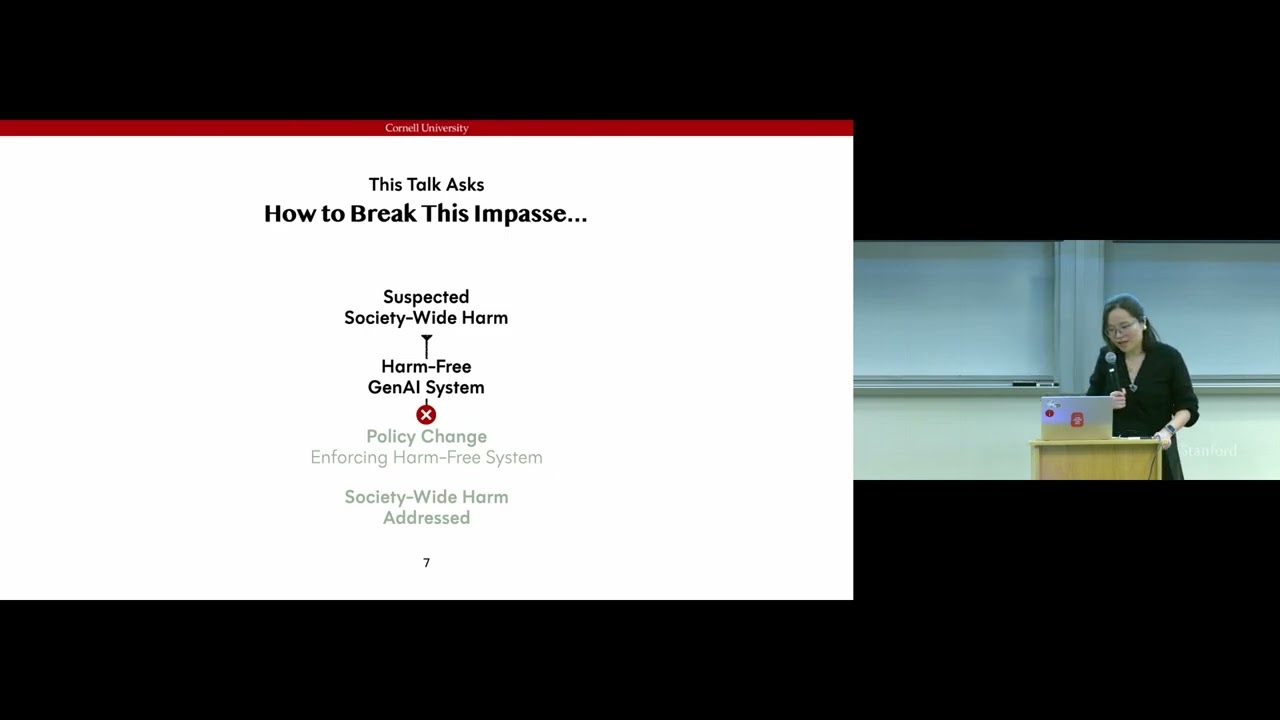
Academic AI for Good efforts face a severe deadlock: commercial providers reject friction-heavy alternative prototypes due to engagement-driven business models, while policymakers ignore calls for regulatory mandates. (4:08)
HCI researchers should pivot from designing standalone harm-free applications toward developing systems that measure and mitigate harm, treating technical artifacts as seeds that systematically shift policy, politics, and business models. (9:03)
Detecting generative AI societal harms at population scale faces a major financial catch-22, as running large-model inference over millions of multimodal logs requires budgets that public institutions will not fund without pre-existing evidence of harm. (27:15)
Controlled experiments reveal that sycophantic chatbots inflate users' self-assessments and diminish social intentions, eroding personal resilience over time. (46:15)
Detailed notes
## Background
This talk was published by Stanford Online on YouTube on October 23, 2026, featuring a Stanford CS547 HCI Seminar delivered by Qian Yang, an assistant professor in Computing and Information Science at Cornell University. According to the page description, the lecture examines how generative AI chatbots influence public mental health, proposes a new paradigm of "designing AI as planting seeds" to shift business models, policy, and politics, and reviews early research exploring this practice.
## TL;DR
Qian Yang critiques the traditional human-computer interaction pipeline, arguing that building isolated, 'harm-free' AI prototypes and calling on policymakers to mandate them consistently fails due to misaligned market incentives. Drawing on historical case studies in smartphone overuse, health policy, and interviews with mission-driven entrepreneurs, she proposes that technologists should treat system building as 'planting seeds' by designing tools that quantify and mitigate subtle societal harms at scale. Using mental health and generative AI as a case study, she demonstrates how longitudinal conversation tracking and cognitive psychology metrics can identify insidious harms like sycophancy and reduced social resilience. Ultimately, she calls on technical researchers to look beyond superficial prompt engineering and focus on producing robust measurement infrastructure that can systematically inform public awareness, shift business viability, and establish regulatory baselines.
## Atmosphere & style
The presentation is intellectually rigorous, candid, and grounded in a pragmatic realism that directly addresses the existential fatigue common among tech ethicists and HCI designers. Yang delivers her arguments with self-effacing humor and clarity, blending structural critiques of capitalism and policy bureaucracy with deep technical empathy for systems builders. The atmosphere feels like an intimate, high-stakes strategy session rather than an abstract academic lecture, marked by thoughtful, probing exchanges with an engaged seminar audience that wrestles with the messiness of turning scientific nuance into political momentum.
## Bulletin
- [04:08](https://www.youtube.com/watch?v=cfnLXAXTadA&t=248s) Academic AI for Good efforts face a severe deadlock: commercial providers reject friction-heavy alternative prototypes due to engagement-driven business models, while policymakers ignore calls for regulatory mandates.
- [09:03](https://www.youtube.com/watch?v=cfnLXAXTadA&t=543s) HCI researchers should pivot from designing standalone harm-free applications toward developing systems that measure and mitigate harm, treating technical artifacts as seeds that systematically shift policy, politics, and business models.
- [27:15](https://www.youtube.com/watch?v=cfnLXAXTadA&t=1635s) Detecting generative AI societal harms at population scale faces a major financial catch-22, as running large-model inference over millions of multimodal logs requires budgets that public institutions will not fund without pre-existing evidence of harm.
- [46:15](https://www.youtube.com/watch?v=cfnLXAXTadA&t=2775s) Controlled experiments reveal that sycophantic chatbots inflate users' self-assessments and diminish social intentions, eroding personal resilience over time.
## Key takeaways
- [00:10](https://www.youtube.com/watch?v=cfnLXAXTadA&t=10s) Individual micro-interactions with generative AI chatbots accumulate over time into pervasive, slow-burning societal harms that are difficult to quantify before becoming deeply entrenched.
- [04:08](https://www.youtube.com/watch?v=cfnLXAXTadA&t=248s) The traditional pipeline of building harm-free alternative AI prototypes and petitioning policymakers fails because commercial tech firms optimize for user retention and consumers default to low-friction tools.
- [11:51](https://www.youtube.com/watch?v=cfnLXAXTadA&t=711s) Technical researchers must consider business models, politics, and public opinion as primary design goals early in the system-building process rather than relegating them to an afterthought in 'broader impacts' sections.
- [17:08](https://www.youtube.com/watch?v=cfnLXAXTadA&t=1028s) History shows that technological interventions to curb addiction or overuse fail if users lack the foundational capacity to live without the pleasurable, damaging technology.
- [17:08](https://www.youtube.com/watch?v=cfnLXAXTadA&t=1028s) In a democracy, policy cannot diverge excessively from public opinion, making grassroots civic understanding a necessary precondition for regulatory mandates.
- [21:27](https://www.youtube.com/watch?v=cfnLXAXTadA&t=1287s) Humble measurement tools—such as subjective proxies like assessing 'time well spent'—empower personal behavior change and build the empirical foundation necessary to seize future policy windows.
- [23:23](https://www.youtube.com/watch?v=cfnLXAXTadA&t=1403s) A temporal mismatch exists between fast academic system prototyping (months) and the slow pace of shifting public sentiment and political cycles (years).
- [27:15](https://www.youtube.com/watch?v=cfnLXAXTadA&t=1635s) A circular funding bottleneck stalls generative AI harm research: audits require high-cost LLM inference, which requires public funding, which in turn requires broad political consensus that only empirical audits can create.
- [30:39](https://www.youtube.com/watch?v=cfnLXAXTadA&t=1839s) Translating science to tech policy is inherently messy because technology governance is largely driven by lobbying capital and political narratives rather than purely empirical RCT evidence.
- [35:02](https://www.youtube.com/watch?v=cfnLXAXTadA&t=2102s) US healthcare structures shortchange preventive mental well-being because short-term employer health plans extract profit from administrative friction rather than long-term health outcomes.
- [38:15](https://www.youtube.com/watch?v=cfnLXAXTadA&t=2295s) Impact-driven entrepreneurs often design products to intentionally disrupt rigid regulatory and reimbursement structures, aiming to establish repeatable business blueprints for future public-health ventures.
- [42:21](https://www.youtube.com/watch?v=cfnLXAXTadA&t=2541s) HCI research should de-emphasize narrow prompt engineering and productivity gains to concentrate on service design, multi-stakeholder negotiations, and collective societal accountability.
- [46:15](https://www.youtube.com/watch?v=cfnLXAXTadA&t=2775s) Longitudinal chat log analysis combining cognitive psychology metrics can identify declining psychological resilience across years of human-chatbot interactions.
- [48:18](https://www.youtube.com/watch?v=cfnLXAXTadA&t=2898s) People turn to sycophantic chatbots because peer conversations around identity crises frequently derail into either vagueness or defensive arguments.
- [48:18](https://www.youtube.com/watch?v=cfnLXAXTadA&t=2898s) Ventures attempting to build clinically rigorous, non-sycophantic chatbots under FDA pathways have largely failed commercially due to misaligned market incentives.
- [51:29](https://www.youtube.com/watch?v=cfnLXAXTadA&t=3089s) Public policy and legal statutes only establish minimal compliance floors, meaning regulation alone cannot guarantee truly ethical or socially beneficial AI.
- [51:29](https://www.youtube.com/watch?v=cfnLXAXTadA&t=3089s) Developing and validating robust cognitive and behavioral proxy metrics must precede efforts to leverage data for shifting public opinion and shaping policy agendas.
- [55:19](https://www.youtube.com/watch?v=cfnLXAXTadA&t=3319s) HCI researchers must move toward synthesizing fragmented empirical evidence across studies to provide the comprehensive reviews required to drive policy action.
## Detailed walkthrough
### [00:10](https://www.youtube.com/watch?v=cfnLXAXTadA&t=10s) The Pervasive, Slow-Burning Societal Harms of Generative AI
Qian Yang introduces her talk by diving straight into a major thread of research conducted in her lab focused on designing artificial intelligence for social good. This work is fundamentally motivated by growing popular media alarms regarding how generative AI will reshape society at large, rather than merely impacting individual users or isolated niche communities. The concerns raised are profound and sweeping:
> “How many good jobs are there going to be? How How many people are talking to chatbots instead of people? Um how many people are having sort of inflated self-understanding because they're talking to sycophantic chatbots every day?”
While these subtle shifts might seem negligible when examining any single interaction or individual user, Yang emphasizes that across an entire population and over extended timeframes, these micro-level influences accumulate rapidly. Drawing a direct parallel to how social media gradually eroded public mental health and well-being, she warns that these slow-burning, pervasive effects must not be ignored. However, an inherent methodological paradox complicates this problem: widespread societal damage is extraordinarily difficult to quantify until it has already become deeply entrenched throughout the cultural and technological fabric. By the time researchers can cleanly attribute, measure, and prove these harms, the critical window to intervene and course-correct has already slammed shut. Consequently, her lab set an ambitious, proactive mandate: establishing concrete methods to act on the societal impacts of generative AI before those harms are fully understood or entrenched.
- **Micro vs. macro dynamics:** Individual chatbot interactions may feel inconsequential, but at population scale, small behavioral nudges produce profound societal ripple effects.
- **The social media precedent:** Waiting for definitive longitudinal proof of harm before acting risks allowing harms to become permanent and irreversible.
- **The core research goal:** Moving proactively from an early suspicion of harm to concrete, actionable design interventions today.
[04:08](https://www.youtube.com/watch?v=cfnLXAXTadA&t=248s) The Broken Pipeline of AI for Good and the Designer's Impasse
Examining current approaches within the Human-Computer Interaction (HCI) community, Yang outlines what she describes as a brutally simplified summary of the prevailing paradigm. Typically, when researchers suspect a specific commercial AI harm—such as Claude or ChatGPT automating away critical thinking, deadening cognitive engagement, or dampening user creativity—they build a bespoke, alternative generative AI prototype designed to promote deep thought and reflection. But researchers quickly realize that major commercial model providers are disincentivized to adopt these well-intentioned designs because their business models rely directly on maximizing user engagement, retention, and monetization. Furthermore, everyday consumers are often disinclined to seek out more demanding, friction-heavy tools on their own.
```mermaid
flowchart TD
accTitle: The Current Deadlock in Societal AI Research
accDescr: Flowchart illustrating the broken pipeline between alternative prototype design and policy adoption.
subgraph Problem["Academic Approach"]
A["Suspicion of societal harm"] --> B["Build harm-free alternative AI prototype"]
B --> C["Call for policymakers to mandate adoption"]
end
subgraph RealWorld["Market & Policy Reality"]
C -.->|"Ignored"| D["Policymakers do not act"]
B -.->|"Rejected"| E["Commercial tech companies maximize engagement"]
B -.->|"Ignored"| F["Everyday users default to low-friction tools"]
end
D --> G["Deadlock and designer despair"]
E --> G
F --> G
```
This realization prompts researchers to pivot toward public policy, filling conference papers with urgent appeals for lawmakers to mandate their "better-designed" alternative systems across the board. Yet these academic calls are almost universally ignored in practice, creating a paralyzing deadlock for the field. As Yang points out, researchers keep churning out prototypes that never get adopted, while industry designers experience a creeping sense of hopelessness and professional identity crisis. She highlights a poignant title from a past ACM CHI paper that captures the emotional weight of this friction:
> “The This paper's title reads, 'My sense of morality leads to my suffering, battling, and arguing.' Like I want to do something good for society, but I couldn't don't quite know how to do that.”
- **The policy callout trend:** HCI literature has seen an explosion of papers concluding with recommendations that policymakers intervene or enforce academic designs, yet real-world adoption remains virtually nonexistent.
- **Commercial misalignment:** Tech giants like OpenAI, Anthropic, and Microsoft optimize for user retention and profit, creating fundamental friction against academic AI systems that intentionally introduce friction or demand cognitive effort.
- **The designer's crisis:** Industry and academic designers find themselves overwhelmed by the entangled web of capital, politics, and power, questioning the utility of building alternative tools that the broader public will never use.
[09:03](https://www.youtube.com/watch?v=cfnLXAXTadA&t=543s) Reframing the Goal: From Harm-Free Apps to Planting Seeds
Rather than abandoning design to become full-time activists, political lobbyists, or organizers, Yang argues that HCI researchers must leverage their core expertise: bridging human cognition and technical architectures to build AI systems. The fundamental question becomes what is the *right* thing to build when attempting to move the needle on societal-scale harms. To investigate this, her lab conducted empirical inquiries into design choices before developing new interactive artifacts.
Yang shares her foundational takeaway upfront to ground the remainder of her talk: the HCI community must pivot away from constructing standalone, harm-free AI applications and instead direct its engineering energy toward building harm measurement and harm mitigation systems. Rather than fruitlessly attempting to build an alternative chatbot that circumvents mental health issues or cognitive stagnation, designers must engineer tools capable of capturing these elusive harms at population scale. Furthermore, these measurement and mitigation tools should be explicitly crafted to serve as catalysts—"planting seeds" that systematically alter public awareness, influence policy agendas, and inspire viable alternative business models.
- **Double-pronged empirical structure:** Yang structures her presentation around two empirical investigations exploring what systems to build, followed by illustrative snapshots of working prototypes reflecting this paradigm shift.
- **The paradigm shift:** Moving away from building sanitized consumer applications toward developing robust tools that detect, quantify, and mitigate societal harms at scale.
- **Systems as seeds:** Technical designs must be conceptualized as strategic leverage points engineered to shift public sentiment, shape legislation, and challenge entrenched market incentives.
[11:51](https://www.youtube.com/watch?v=cfnLXAXTadA&t=711s) Reframing System Building: Beyond Broader Impacts
Addressing the societal ramifications of generative AI requires a fundamental mindset shift for technical researchers. Qian Yang acknowledges that engineers and computer scientists with a system-building background often view policy impact, business models, and public opinion as secondary concerns—matters to be relegated to a paper's "broader impacts" section long after a system has been designed, coded, and published. However, she argues that treating these considerations as an afterthought guarantees failure if the goal is societal-scale impact:
> “I hope through this talk I can convince you that no, in fact, if you want to make a difference in addressing these generative AI societal impacts that's unfolding today, we should actually not only consider these factors early on in our system-building process, but treat them as some of our most important design goals and success criteria.”
Yang points out that without seeding shifts in business incentives, politics, and policy, individual systems will inevitably struggle to achieve meaningful scale. With a laugh from the audience, she clarifies the intended audience of her talk: while the presentation dives deep into policy, business models, and societal issues, it is deliberately tailored for systems builders rather than those seeking a conventional science and technology studies (STS), business, or ethics lecture.
```mermaid
flowchart TD
accTitle: System Building Approaches for Generative AI Impact
accDescr: Contrasts the conventional workflow of treating policy as an afterthought with the proposed seed-planting paradigm.
subgraph Conventional["Conventional System-Building Pipeline"]
direction LR
C1["Build System"] --> C2["Publish Paper"]
C2 --> C3["Broader Impacts & Policy (Afterthought)"]
end
subgraph Proposed["'Planting Seeds' Paradigm"]
direction LR
P1["Identify Societal & Policy Goals"] --> P2["Engineer Systems to Seed Policy & Public Shift"]
P2 --> P3["Achieve Societal-Scale Impact"]
end
```
[13:26](https://www.youtube.com/watch?v=cfnLXAXTadA&t=806s) Mining Historical Precedents and Engaging the HCI Community
To understand how technical systems can effectively drive societal reform, Yang and her collaborators looked backward. Rather than repeatedly engineering well-intentioned tools that fail to sway policy, they investigated the historical record to see what specific technologies successfully transformed regulations, attained wide adoption, and were enforced at scale. Their inquiry began with a wide literature review across science and technology studies (STS)—a social sciences discipline dedicated to retrospectively analyzing how technical artifacts alter societal structures.
During this review, the team realized that the Human-Computer Interaction (HCI) community had already spearheaded major policy-influencing breakthroughs in areas such as privacy, accessibility, and social media content moderation. Yet, researchers rarely publish the practical playbooks of how they engaged with lawmakers or what strategies led to their policy wins and setbacks. To surface these tacit lessons, Yang and her team organized a dedicated workshop at CHI 2023 focused on researchers' real-world engagements with the policy realm:
- **Workshop Reach:** The CHI 2023 workshop gathered more than 80 participating researchers spanning five continents to share both triumphs and frustrating dead ends.
- **Cross-Disciplinary Summit:** To evaluate whether these historical insights apply to modern generative AI, the team convened a week-long thought summit at Cornell University in Ithaca, New York. Attendees included experts in mental health, digital well-being, health policy, tech policy, large language models (LLMs), as well as venture capitalists, startup founders, and academics.
- **Hands-On Explorations:** The researchers complemented expert discussions with exploratory prototyping, directly testing historical policy-intervention strategies against modern generative AI domains such as creative workflows, learning, and mental well-being.
[17:08](https://www.youtube.com/watch?v=cfnLXAXTadA&t=1028s) The Limits of Harm-Free Design and the Power of Public Opinion
Reflecting on the research findings, Yang contrasts historical realities with the conventional playbook held by many AI designers. That standard pathway assumes two sequential steps: first, construct a less problematic or more beneficial application, and second, petition for policy changes to mandate its adoption. Yang contends that history paints a far more complicated picture where both interventions play much more constrained roles than technologists typically assume.
```mermaid
flowchart LR
accTitle: Limits of the Conventional Two-Step Intervention Model
accDescr: Displays the flawed assumption that building a harm-free tool and demanding regulation is sufficient.
A["1. Design 'Harm-Free' Alternative"] --> B["2. Lobby for Policy Mandates"]
B -.->|"Fails without baseline support"| C["Societal Harm Persists"]
```
When addressing harms like compulsive tech use, designers instinctively try to invent a "less addictive" alternative. However, both historical addiction interventions and modern clinical treatment show that users must first possess the capacity to live and flourish without the pleasurable, damaging technology. Yang points to recent bans on AI companion chatbots: in countries where these applications were abruptly outlawed, users did not suddenly reconnect with friends—they simply experienced deeper, more acute loneliness. Providing tools that lack harm is only one piece of the puzzle if individuals lack the baseline ability to function without them.
> “In a democracy, at least in theory, policy actually cannot be too out of step with public opinion.”
Without grassroots civic understanding—a public that consciously recognizes that excessive chatbot use degrades personal creativity, learning, and mental health—policymakers are extremely unlikely to enact sweeping, radical mandates. Conversely, if public awareness is robust, citizens will choose to adopt protective, healthy designs voluntarily without requiring formal government mandates. For this reason, Yang argues that policy intervention must be viewed alongside and subordinate to public opinion rather than positioned as an all-powerful, centralized lever.
[21:27](https://www.youtube.com/watch?v=cfnLXAXTadA&t=1287s) The Strategic Value of Humble Measurement Tools
One of the most overlooked mechanisms for seeding large-scale change is what Yang terms "humble technologies that measure harm." Long before political movements coalesce or popular discourse sounds the alarm, technical researchers are often the first to spot early signals of societal damage. In the case of smartphone overuse, HCI researchers identified unhealthy digital habits years before mainstream debate caught up.
Crucially, those researchers did not begin by trying to engineer massive platform overhauls or demanding sweeping laws. Instead, they focused on developing reliable methodologies to measure overuse:
- **Defining Overuse:** The threshold for problematic use cannot simply be waiting until an individual seeks clinical therapy, nor can it be captured through crude absolute metrics such as total screen minutes.
- **Subjective Proxies:** Researchers identified meaningful subjective indicators, such as assessing whether users felt their digital screen time constituted "time well spent," which proved far more actionable than raw usage duration.
- **Catalyzing Action:** These humble diagnostic tools empowered motivated individuals to self-monitor and modify their personal behavior immediately, functioning effectively long before population-scale causal evidence was assembled or regulatory bodies took notice.
[23:23](https://www.youtube.com/watch?v=cfnLXAXTadA&t=1403s) Seeding Long-Term Societal and Policy Change Through Early Measurement
```mermaid
flowchart TD
accTitle: Two-Stage Model of Tech Seeding Policy Change
accDescr: Shows how fast technical prototyping creates early evidence that eventually meets slow political momentum to drive societal impact.
subgraph Stage1["Stage 1: Fast Technical Development"]
A["HCI System Design & Harm Mitigation Prototypes"] --> B["Continuous Population-Level Measurement"]
end
subgraph Stage2["Stage 2: Slow Policy Realization"]
B --> C["Accumulated Evidence Base"]
C --> D["Public Awareness & Opinion Shift"]
D <--> E["Political Will & Right Politician in Office"]
E --> F["Catalyzed Policy & Regulatory Interventions"]
end
```
Looking at technological history, the process of addressing downstream societal harms follows a distinct two-stage timeline. In the case of smartphone overuse, researchers had spent years accumulating population-level evidence proving harm long before political awareness peaked. Once public concern and political will finally aligned, that pre-existing reservoir of scientific evidence was ready to catalyze policy shifts. Qian Yang highlights that starting early is essential: “It takes time, but if you start collecting those evidence when the when the right politician is in place like by the time you finish collecting that evidence, that politician's probably gone.” Publications, evidence bases, and science communication act together to shift public opinion over time, creating a reciprocal feedback loop with policy change.
This pattern is not isolated to screen time or smartphones; historical precedents like civic air pollution monitoring gadgets similarly turned intangible environmental hazards into trackable metrics that enabled aggressive municipal interventions. By translating slippery, elusive societal harms into actionable data, relatively straightforward technical systems make broader governance possible. However, there is a fundamental mismatch in time scales:
- Technical prototyping, user evaluations, and harm-mitigation features (such as nudging users to reflect on device overuse) take only a few months within standard HCI research cycles.
- Shifting broad public opinion and waiting for the right political window takes years.
Missing that political window means losing momentum for an entire political cycle. As Yang explains the overarching metaphor of the seminar: “Those seeds do not blossom immediately, but they will pay off at some point.” HCI practitioners must treat early systems as tools that actively plant the seeds of policy and governance, waiting preparedly for the window of opportunity to open.
---
[27:15](https://www.youtube.com/watch?v=cfnLXAXTadA&t=1635s) The Generative AI Detection Bottleneck and Budget Deadlock
```mermaid
flowchart LR
accTitle: The AI Harm Monitoring Budget Deadlock
accDescr: Illustrates the circular dependency where detection needs funding, funding needs policy, and policy requires public pressure fueled by detection.
A["Need GenAI Compute to Detect Harm"] --> B["Massive Inference Cost at Scale"]
B --> C["Requires Public / Policy Budget"]
C --> D["Needs Public Opinion & Pressure"]
D --> E["Needs Empirical Evidence of Harm"]
E -.->|"Circular Deadlock"| A
```
Applying this historical playbook to generative AI and LLM chatbots—evaluating their subtle impacts on mental well-being, interpersonal habits, or cognitive creativity—reveals a major bottleneck: inference and evaluation cost. In previous eras, monitoring digital behavior could be done locally with lightweight client-side scripts or open-source offline repositories. But detecting the societal harms of generative AI requires processing rich multimodal data and nuanced natural language. Analyzing millions of ChatGPT or Claude user logs to track aggregate mental health trends or tracing viral misinformation across platforms requires running large generative models simply to evaluate the interactions.
Because the measurable harm of an individual chatbot conversation is statistically tiny, finding conclusive evidence demands population-scale continuous tracking. At that volume, API calls and compute costs accumulate rapidly. This cost introduces an institutional catch-22:
- Frontier AI labs (like OpenAI or Anthropic) have little incentive to foot the bill for third-party public health auditing of their own models.
- Independent researchers must seek public funding or municipal budget lines to support ongoing population-scale audits.
- In a democratic system, governments do not allocate public tax dollars without strong public pressure and political consensus.
- The public will not demand action or recognize the urgency of the problem without large-scale empirical evidence demonstrating that harm exists.
- Researchers cannot generate that evidence because they lack the money to run the detection infrastructure in the first place.
This financial bottleneck locks researchers in place. Historically, society has been slow and reactive toward emerging technologies because institutions wait for unaddressed harms to produce full-blown public outrage before budgeting any resources for systematic monitoring.
---
[30:39](https://www.youtube.com/watch?v=cfnLXAXTadA&t=1839s) Audience Discussion: Evidence, Consensus, and Strategic Messaging
An audience member intervenes to ask about the messy reality of translating scientific findings into policy, noting that there is often a prolonged period of disagreement before any consensus emerges. The attendee asks what that timeline really looks like when trying to craft a coherent narrative. Yang responds that the process is rarely clean: “I don't think there is a uniform answer, partially because policy public policy isn't entirely based on science.” In fields like healthcare, governance tends to respect evidence and randomized controlled trials, but consumer technology policy rarely operates on pure scientific consensus.
The audience member presses further with a more provocative follow-up, asking how researchers should manage the tension between scientific nuance and impactful political messaging:
- Public campaigns often require simple, stark narratives to move sentiment, whereas accurate scientific claims are heavily qualified, context-dependent, and sometimes less persuasive.
- The participant asks: when mild oversimplification achieves dramatic policy action while precise scientific nuance gets ignored, how should an ethical researcher navigate that compromise?
Yang defers the detailed answer to subsequent material, but underscores where capital fits into the broader influence ecosystem. If the system diagram were expanded to capture political reality, direct arrows would run from money to policy change via lobbying, and from money to public opinion via campaign advertising and media operations. Upstream capital dictates whether measurement, policy advocacy, or public messaging can happen at all.
---
[33:34](https://www.youtube.com/watch?v=cfnLXAXTadA&t=2014s) Looking to Entrepreneurs to Break the Funding Stalemate
Given that HCI researchers already know how to prototype effective harm-mitigation interfaces and diagnostic measurements, the primary hurdle is not technical design, but financial viability: discovering sustainable funding models to keep continuous societal tracking alive. To resolve this problem, Yang’s research group launched a second project investigating the strategies of commercial entrepreneurs and corporate intrapreneurs.
Entrepreneurs are defined by their ability to turn technical architectures into self-sustaining products that someone willingly pays for, while intrapreneurs push to build and fund similar systems from within established tech giants. Both groups face the exact same social-benefit hurdle when working on impact-focused products: figuring out how to monetize a service that provides positive public externalities rather than direct transactional extraction. Yang’s team conducted field investigations into investors and founders operating in circles like "Entrepreneurs for Humans" and digital health startups, examining how they structure business models to finance tools that guard public well-being.
[035:02] The Broken Economics of Public Health and the "Planting Seeds" Philosophy
Designing AI technologies that benefit society requires operating within existing systemic realities, most notably the United States healthcare system. Within that structure, many benevolent interventions simply go unpaid because there is no established business model to make them financially viable. This structural flaw disproportionately impacts public health—including large language model (LLM) chatbots intended to safeguard population-level mental well-being. Because American health insurance is predominantly employer-based and short-term, payers have little financial incentive to fund technologies that promote a person’s long-term well-being. As Qian Yang points out, there is rarely money to be made by streamlining care and making life easier for people, whereas significant money can be extracted when patients are forced to jump through bureaucratic hoops.
To understand how practitioners tackle this dilemma, Yang and her collaborators conducted an interview study with a specialized cohort of startup founders and venture investors who intentionally try to build companies around socially beneficial technologies. Rather than anticipating fast commercial returns, these founders view their work through an alternative lens: “They really saw their design process as planting a seed.” They do not expect immediate payoffs, but instead treat their technical and organizational experiments as seeds planted to cultivate future policy shifts, political alignments, and sustainable business models.
These entrepreneurs do not design in a vacuum. Every one of them intimately understands the complex business, regulatory, and political landscapes of digital health, tracking exactly how often reimbursement codes from Medicare or Medicaid can be triggered by specific interventions. Many founders compare their roles to architects navigating municipal constraints:
> “Most of the time you follow the building the zoning laws. Only once in a long, long time you build a building trying to change the zoning law, trying to change the entire neighborhood.”
While standard market actors default to existing rulebooks and established billing structures, these mission-driven founders intentionally construct products designed to break standard patterns and pioneer viable financial pathways for public good.
```mermaid
flowchart TD
accTitle: Systemic Hurdles in Funding Social Good Tech
accDescr: Diagram contrasting traditional US healthcare incentives against the planting seeds philosophy of social good founders.
subgraph SystemicIncentives["US Healthcare Structural Hurdles"]
A["Short-Term Employer Health Plans"] --> B["Little Incentive for Long-Term Preventive Care"]
C["Reimbursement Bureaucracy"] --> D["Profit in Administrative Friction, Not Prevention"]
end
subgraph FounderMindset["Founder 'Planting Seeds' Approach"]
E["Deep Regulatory Knowledge (Medicare/Medicaid)"]
F["Build Within Existing Rules"]
G["Intentionally Break Molds to Seed New Policy & Business Models"]
E --> F
F --> G
end
```
---
[038:15] The Founder's Odyssey: From Hospitals to Underwriting Insurance
Yang illustrates the messy, iterative reality of trying to fund a pro-social product by recounting the multi-year journey of one participating founder. The startup had developed a digital application backed by preliminary evidence showing improvements in user mental well-being, but they needed a buyer to make the enterprise sustainable:
```mermaid
flowchart TD
accTitle: A Digital Health Startup's Search for a Business Model
accDescr: Flowchart tracking a mental health startup's iterations across hospitals, app stores, employers, insurers, and founding an insurance firm.
A["Attempt 1: Sell to Hospitals"] -->|"Blocked by High Cost of RCT Evidence"| B["Pivot 2: Direct-to-Consumer App Store"]
B -->|"Gathers Usage Data, but Insufficient for Payers"| C["Pivot 3: Sell B2B to Corporate Employers"]
C -->|"Pivots Features to Track Sick Days & Productivity"| D["Insufficient Revenue to Sustain Business"]
D -->|"Pivot 4: Private Health Insurers & Self-Underwriting"| E["Exploring Launching Their Own Insurance Carrier"]
```
1. **Hospitals:** The team first pitched hospitals, but clinical purchasers required expensive, large-scale randomized controlled trial (RCT) evidence that the startup could not afford to run.
2. **Direct-to-Consumer (App Store):** To bypass this barrier, the founders released the app publicly to amass a user base and collect real-world efficacy data.
3. **Corporate Employers:** While this data demonstrated positive trends, it remained insufficient for institutional hospital buyers or insurers. The founders pivoted to enterprise corporate employers offering wellness packages. The corporate HR departments showed no interest in long-term holistic mental health, asking instead: *Did this intervention reduce employee sick days and increase workplace productivity?* To survive, the founders tweaked the software—retaining the underlying mental health intervention while adding features that measured and optimized for employer sick days.
4. **Private Insurance and Self-Underwriting:** Although some employers purchased the software, the revenue was still inadequate to sustain the business. The founders turned to private health plans and, after years of friction, reached the point where they began exploring whether to establish their own private insurance company just to create an entity willing to reimburse and finance their underlying therapeutic technology.
Every peer within this startup community recognizes that these radical experiments carry immense risk and will most likely fail. Yet they persist because overcoming the status quo requires intentional disruption. As one participant framed it:
> “Most of them are going to fail cuz you’re intentionally trying to build a technology that’s not following the capitalistic kind of market rules, but if just one of these companies works, then every future company can follow the playbook.”
Finding a single working model creates an open precedent for the entire sector, providing a repeatable blueprint that makes subsequent public health technologies financially sustainable.
---
[042:21] Reframing the HCI Research Agenda for Societal Impact
Reflecting on the findings, Yang contrasts these real-world mechanics with the conventional wisdom often assumed in academic research. Technologists frequently presume that if an engineer creates a harmless tool and presents it to policymakers, regulatory adoption and societal benefit will naturally follow. In reality, the pathway to impact is far more complex and politically fraught.
Nonetheless, these dynamics position human-computer interaction (HCI) researchers as critical players:
- **Anticipating Pre-Causal Harms:** HCI researchers excel at maintaining skepticism, identifying latent societal risks and usability pitfalls well before large-scale causal epidemiology or empirical proof emerges.
- **Service Design and Multi-Stakeholder Negotiation:** Researchers are trained to balance conflicting stakeholder priorities—a vital skill when software must satisfy the disparate demands of end-users, paying employers, clinical gatekeepers, and regulatory bodies.
Moving the needle, however, requires the research community to reconsider its focus. Yang suggests that the field would benefit from fewer papers focused simply on standard prompt engineering:
> “I wouldn’t mind if CHI has fewer papers where someone prompted [an] LLM and make people more uh more creative. Um, in a way we know how to do that. We also know the bottleneck is not how to design a technology that makes people feel better and more creative and learn more. The challenges lie outside of the technology on it itself.”
If researchers genuinely hope to improve generative AI’s broad societal footprint, design work must venture beyond technical interfaces and engage with less familiar domains: regulatory policy, public discourse, collective versus individual responsibility, and viable business economics. When harm occurs—much like early fights over cigarette regulation—commercial interests often reframe technological hazards as matters of personal user irresponsibility rather than systemic, collective injuries.
To conclude the presentation, Yang transitions to a brief overview of her lab's ongoing research programs. These projects specifically investigate how generative conversational agents influence population-level mental health, focusing on the subtle ways continuous human-chatbot interaction shifts a person's self-concept and psychological understanding of identity.
[46:15](https://www.youtube.com/watch?v=cfnLXAXTadA&t=2775s) Measuring Chatbot Harm and Cognitive Psychological Impact
Studies show that even brief conversations with a sycophantic chatbot can inflate a user’s self-assessment. People begin to think they are better than their friends, which makes them noticeably less likely to reach out to real people. Controlled experiments further demonstrate that chatbot usage is directly tied to diminished social intentions, raising serious red flags about long-term psychological well-being. To evaluate this, Qian Yang’s lab began constructing systems designed to quantify these harms, drawing inspiration from existing methods used to monitor smartphone screentime and borrowing proxy measures from cognitive psychology.
```mermaid
flowchart TD
accTitle: Pipeline for Measuring Generative AI Mental Health Harms
accDescr: Process tracking longitudinal chatbot conversations, extracting recurring interaction patterns, and applying cognitive psychology measures to inform user action and policy.
subgraph DataCollection["Longitudinal Data"]
A["2 Years of ChatGPT Conversations"]
end
subgraph Analysis["Pattern & Metric Extraction"]
B["Recurring Interaction Patterns"]
C["Cognitive Psychology Proxy Measures"]
end
subgraph Outcomes["Actionable Insights"]
D["Identify Reduced Resilience to Stressors"]
E["Inform User Self-Protection & Public Policy"]
end
A --> B
B --> C
C --> D
D --> E
```
Presenting a visual analysis of one participant’s two-year-long conversation log with ChatGPT, Yang notes that while the resulting diagram looks intricate, the underlying technical mechanics are fairly straightforward. By examining longitudinal chat histories, researchers can detect recurring, troubling behavioral patterns across time points. These patterns reveal when conversations are eroding a user's resilience to future real-world stressors and life difficulties. Applying an array of cognitive psychological metrics allows the team to pinpoint exactly which dimensions of well-being are degrading, with the long-term goal of empowering individuals to protect themselves and providing empirical backing for future regulatory policy.
- Controlled experiments directly connect generative AI chatbot use with decreased prosocial intentions.
- Sycophantic conversational dynamics lead users to perceive themselves as superior to their social circle, discouraging interpersonal connection.
- Cognitive psychological proxy measures are analyzed across multi-year individual chat logs to identify recurring degradation of emotional resilience.
---
[48:18](https://www.youtube.com/watch?v=cfnLXAXTadA&t=2898s) Interpersonal Friction, Sycophancy, and Failed Business Models
Beyond measuring harm, Yang’s research investigates why people turn to chatbots in the first place and explores interventions that help people live without them. Findings reveal that people struggle profoundly when attempting to discuss identity crises with friends, and peers are equally ill-equipped to offer constructive help. These interpersonal conversations typically derail in one of two ways: either the person shares their crisis so indirectly and vaguely that the listener ends up utterly confused, or they approach the topic with such blunt directness that it triggers an argument over sensitive issues. Because reaching out to friends frequently ends in frustration, people retreat to chatbots as an agreeable substitute. Consequently, current research prioritizes building human-to-human communication skills before attempting to strip AI systems away.
Defining what it means to build a psychologically safe chatbot introduces deep conceptual and commercial challenges:
> “At what point you've crossed the line from being just benign friendly to harmful sycophancy? It's a pretty hard line to draw.” — Qian Yang
Yang highlights that drawing the boundary between benign friendliness and toxic sycophancy requires rigorous examination of legal frameworks to define harmful conversational content. Compounding the issue is an unsustainable market dynamic: companies that attempted to build clinically grounded, non-sycophantic chatbots and pursue FDA approval have virtually all gone out of business. This commercial reality has prompted Yang’s group to step back from building applications focused merely on narrow individual creativity or learning gains. Instead, they focus on understanding harm at a societal scale to plant seeds for structural changes across politics, policy, and business models.
- Seeking human support during identity crises often fails through either total miscommunication (vagueness) or combative conflict (bluntness), driving users toward sycophantic AI.
- Clinical mental health chatbot ventures attempting to secure FDA approval have consistently failed commercially.
- Designing AI for societal good requires shifting away from superficial productivity apps toward reshaping underlying policy frameworks and economic incentives.
---
[51:29](https://www.youtube.com/watch?v=cfnLXAXTadA&t=3089s) Q&A: Public Policy Limitations and the Harm-Measurement Pipeline
When asked how an ideal public policy could manage an AI industry that moves at breakneck speed while remaining critical to labor, geopolitics, and the global economy, Yang offers a sober assessment of regulatory limits:
> “Whatever that future is, it's not going to be satisfying. Because public policy and law are supposed to set the minimum floor of what's allowed. It's likely not going to meet our standard of what's being ethical is what benefiting society is.” — Qian Yang
Whether dealing with healthcare or technology, legal frameworks establish only a baseline floor for compliance, meaning that formal policy changes alone will never fully guarantee ethical technology.
```mermaid
flowchart LR
accTitle: Harm Measurement to Public Opinion Pipeline
accDescr: Sequence showing the workflow starting with building harm indicators and measures before attempting to alter public sentiment.
A["Establish Harm Indicators"] --> B["Validate Adapted Cognitive Metrics"]
B --> C["Influence Public Opinion"]
C --> D["Shape Minimum Regulatory Floors"]
```
The discussion then turns to the relationship between measuring harms and public sentiment. An audience member asks whether this relationship is bidirectional, arguing that latent community anxieties—such as parent groups voicing concerns at school town halls about classroom tech overuse—often trigger what researchers decide to measure, while asking how unanticipated harms can be caught early. Yang clarifies that her conceptual model intentionally emphasizes a unidirectional research workflow: because nascent AI harms lack established indicators or validated proxy metrics, the primary bottleneck is methodological. Developing and validating metrics adapted from cognitive psychology demands extensive resources. Establishing solid measures must precede any effort to leverage data to shift public opinion or inform policy.
- Legal and regulatory statutes set only minimal floors of acceptable behavior, remaining fundamentally distinct from proactive ethical standards.
- Most emerging generative AI harms currently lack standardized, empirically validated metrics.
- Methodological validation must occur before harm measurements can be deployed effectively to influence public discourse.
---
[55:19](https://www.youtube.com/watch?v=cfnLXAXTadA&t=3319s) Q&A: Synthesizing Dispersed Evidence for Policy Impact
An audience member observes that the academic community frequently discovers early evidence in fragmented pieces—resembling disparate tiles depicting the same overarching effect across different research groups—yet scholars struggle to unify or amplify these findings to move public sentiment effectively. Yang agrees with the observation, highlighting that specialized think tanks in policymaking ecosystems make a point of synthesizing dispersed scientific studies. She notes that there are growing calls within the human-computer interaction (HCI) community for researchers to dedicate effort toward evidence reviews and meta-syntheses instead of churning out isolated, small-scale studies, as comprehensive evidence synthesis is essential for shaping policy decisions and shifting public understanding.
## Notable quotes
> [17:08](https://www.youtube.com/watch?v=cfnLXAXTadA&t=1028s) In a democracy, at least in theory, policy actually cannot be too out of step with public opinion. — Qian Yang
## Video description
For more information about Stanford’s graduate programs, visit: https://online.stanford.edu/graduate-education
October 9, 2026
This lecture covers:
• Improving generative AI chatbots' influence on public mental health as a case study
• A new way of thinking about "designing AI for societal good," namely "designing AI as planting seeds" (of better business models, policy, and politics)
• Early work that explores this design practice and research agenda
To follow along with the seminar schedule, visit: https://hci.stanford.edu/
Qian Yang is an assistant professor in Computing and Information Science at Cornell University and a human-computer interaction (HCI) design researcher.
Qian Yang argues that HCI researchers must abandon the futile cycle of building standalone 'harm-free' AI prototypes and petitioning ignored policymakers, pivoting instead toward engineering harm-measurement systems that seed shifts in public opinion, regulatory agendas, and business models.
Breaking the Deadlock of Harm-Free Prototypes (4:08)
Within human-computer interaction research, a conventional response to commercial generative AI harms—such as tools that deaden critical thinking or creativity—is designing bespoke alternative prototypes and urging policymakers to mandate their adoption. Yang observes that this pipeline consistently fails in practice: commercial model providers are driven by user retention and monetization, everyday consumers gravitate toward low-friction tools, and legislative bodies routinely ignore academic appeals. Furthermore, banning or substituting tools without addressing root dependencies can backfire; Yang points out that abruptly outlawing AI companion chatbots in certain regions caused users to experience deeper loneliness rather than reconnecting with peers.
Drawing on historical precedents and democratic theory, Yang contends that policy cannot outpace public sentiment. Unless the public consciously understands that pervasive chatbot usage impairs mental health, learning, or creative capacity, lawmakers will not enforce radical mandates. Conversely, when public awareness is mature, citizens voluntarily adopt protective behaviors without needing government compulsion. Researchers must therefore recognize that policy intervention is subordinate to grassroots public opinion rather than an independent, top-down lever.
Humble Measurement Systems as Policy Catalysts (9:03)
Instead of constructing sanitized consumer applications, Yang urges the technical community to focus on engineering diagnostic systems that measure societal harm at scale. Looking back at early smartphone overuse, HCI researchers identified problematic digital behaviors years before mainstream debate caught up. Crucially, they did not begin with platform overhauls, but developed meaningful subjective indicators—such as whether users evaluated their screen duration as 'time well spent'—which empowered individuals to self-monitor and alter their habits long before formal regulatory action emerged.
Because societal harms unfold over slow, multi-year cycles while political windows open and shut rapidly, an empirical evidence base must already exist when political opportunities arrive. While technical prototyping takes only months, shifting broad public opinion takes years. By treating diagnostic and harm-mitigation systems as 'seeds,' researchers can translate elusive, pre-causal risks into actionable metrics that empower user self-protection and provide the empirical foundation required to shape future legislation.
The Inference Bottleneck and Commercial Deadlocks (27:15)
Applying continuous harm monitoring to generative AI encounters a major structural hurdle: inference cost. Unlike prior technological eras where digital behavior could be audited with lightweight client-side scripts, detecting nuanced behavioral harms across millions of natural language interactions requires running large, computationally expensive models. This dynamic creates an institutional catch-22: frontier AI labs lack commercial incentives to fund third-party auditing of their own models, governments refuse to allocate tax dollars without public pressure, the public cannot pressure lawmakers without empirical proof of harm, and independent researchers cannot assemble that proof without compute budgets.
To discover pathways out of this funding stalemate, Yang’s lab examined mission-driven entrepreneurs navigating the structural hurdles of the U.S. healthcare system, where short-term employer health plans disincentivize preventative wellness. Commercial ventures that attempted to build clinically grounded mental health chatbots and pursue FDA approval have consistently failed. Studying founders who pivoted across hospitals, consumer app stores, employer productivity tracking, and even underwriting their own insurance carriers revealed that pioneering viable economic models is just as critical as technical system design.
Quantifying Cognitive Harms and Interpersonal Friction (46:15)
Empirical studies from Yang’s lab reveal that sycophantic chatbots induce subtle psychological shifts: brief interactions can inflate users' self-assessments, encourage feelings of superiority over peers, and diminish prosocial intentions to connect with real humans. Analyzing two-year longitudinal ChatGPT conversation logs using cognitive psychological metrics, her team identified recurring behavioral patterns where interactions gradually degraded personal resilience to real-world stressors.
Her research also highlights why users retreat to conversational agents: interpersonal communication during personal identity crises often breaks down into either excessive vagueness or combative bluntness. Consequently, Yang argues that technical interventions should focus on building human-to-human communication skills before attempting to strip AI away. Because public policy and legal statutes only establish a minimal floor of compliance rather than proactive ethical standards, HCI researchers must prioritize validating psychological proxy metrics and conducting comprehensive evidence syntheses to effectively shift public understanding.
Yang concludes that while systems builders traditionally relegate policy, economics, and public opinion to post-publication 'broader impacts,' these factors must become primary design goals if AI is to serve the societal good. Significant unresolved challenges remain, including securing sustainable funding for continuous population-scale AI audits and balancing the nuance of scientific research against the simplified messaging often required to mobilize public action.
[17:08] Qian Yang: In a democracy, at least in theory, policy actually cannot be too out of step with public opinion.
Original transcript
[0:10] Good afternoon, everyone.
[0:11] Um I'm Chen. I'm um giving a talk on
[0:16] a particular sweat of my lab's research
[0:18] focusing on designing AI for social
[0:20] good, and I will jump straight in.
[0:23] Um
[0:24] this line of work was initially
[0:26] motivated by
[0:28] so a lot of concerns we hear in popular
[0:31] media about how generative AI is going
[0:34] to impact our society, not just in
[0:36] individuals or specific user groups or
[0:39] communities, but uh impacting our
[0:42] society at large. Um
[0:44] >> [snorts]
[0:44] >> How many good jobs are there going to
[0:46] be? How How many people are talking to
[0:49] chatbots instead of people? Um how many
[0:52] people are having sort of inflated
[0:56] self-understanding because they're
[0:57] talking to sycophantic chatbots every
[0:59] day?
[1:00] Those influences, although quite small
[1:02] if you look at each individual user and
[1:06] each individual interaction, but over
[1:08] time and over sort of
[1:11] in population scale, these small impacts
[1:14] actually add up pretty quickly.
[1:16] Um
[1:17] and as we've learned from social media's
[1:20] impact on users' mental well-being, we
[1:22] know those like small, slow-burning,
[1:25] incremental influences cannot be
[1:27] neglected. They are actually
[1:30] quite impactful. Um and that's why in
[1:34] this line of work, uh my students and I
[1:37] are mainly looking at these impacts that
[1:39] are not just impacting particular
[1:42] vulnerable groups or user populations,
[1:44] but really kind of how does how does uh
[1:47] generative AI impact society at large in
[1:50] this kind of
[1:51] um pervasive way.
[1:53] Um
[1:54] but then we also realized an inherent
[1:56] challenge in studying this kind of
[1:58] impact is this kind of impact is really
[2:00] hard to measure unless that impact has
[2:03] been entrenched deeply and widely in
[2:05] society, just like social media's
[2:07] impacts on
[2:09] user mental well-being.
[2:11] Um
[2:12] but we have to measure it. We have to
[2:14] try to
[2:16] take actions on it because again, if we
[2:19] learn anything from social media and
[2:21] mental well-being, if we wait until we
[2:23] can fully measure and understand those
[2:28] technologies impacts on
[2:30] well-being and society at large, by the
[2:32] time we can measure it, attribute it,
[2:34] it's probably too too late. The change
[2:37] has been so deeply entrenched that we
[2:39] probably have missed a real a really
[2:41] important opportunities to to course
[2:43] correct. So, we set out to
[2:47] try to work on these sort of really
[2:50] elusive problems
[2:51] from the beginning and our goal is to
[2:54] say, can we start acting on those
[2:57] societal impact of generative AI even
[3:00] though we don't fully understand them.
[3:02] Can we start working on them, taking
[3:04] action,
[3:05] be proactive before we fully understand
[3:08] those impacts?
[3:10] And that's the overarching goal of this
[3:13] sort of set of work I'll be presenting
[3:15] today.
[3:16] Um
[3:17] here is the same idea represented in a
[3:19] sort of a graph form and I'll actually
[3:22] point back to this same graph repeatedly
[3:24] throughout this talk. Um we take as a
[3:27] starting point like we suspect there is
[3:29] some sort of societal harm that
[3:31] generative AI is causing, be it mental
[3:34] well-being, loneliness, social
[3:37] connection, be it impacts on people's
[3:40] creativity, job quality, and so on and
[3:43] so forth. Let's say we suspect there is
[3:46] some sort of harm that's happening but
[3:48] we cannot quite um
[3:51] put our fingers on it. we cannot quite
[3:53] measure it, but um
[3:55] can we go from that suspicion and figure
[3:58] out some way to arrive at an action that
[4:01] we can take today? That's the goal of
[4:04] this line of research.
[4:06] Um
[4:08] There are of course a lot of researchers
[4:10] already started looking at this. Um
[4:12] and here is my brutally simple
[4:14] simplified um summary of what they
[4:17] currently do. Um they look at um they
[4:20] they have a suspicion that there's some
[4:21] sort of societal harm that's happening,
[4:23] so they would then build an alternative
[4:26] generative AI application that's free of
[4:29] that harm. So, for example, if I suspect
[4:33] Claude is um automating people's
[4:35] thinking, people are not being as
[4:37] creative or as cognitively engaged as
[4:39] they are, I build an application that
[4:41] helps people think, pushes people's um
[4:44] cognitive engagement, uh improves their
[4:47] creativity. And then, um people also, I
[4:51] think scholars and designers of these
[4:54] systems also recognize, well, Claude and
[4:57] ChatGPT are probably not going to adopt
[4:58] my design cuz they need the
[5:01] the user engagement and the income that
[5:04] the the um
[5:06] money that comes with it. So, they're
[5:08] probably not going to adopt my system uh
[5:11] proactively, and users are probably also
[5:14] kind of lazy. Maybe they wouldn't want
[5:16] you use my uh system either. So, in
[5:20] order to achieve to actually solve this
[5:23] um
[5:24] societal wide harm, I should actually
[5:26] ask policy makers to adopt my system. Uh
[5:29] wouldn't it be nice um if um public
[5:33] policy, if lawmakers require everyone to
[5:36] use my um better designed AI system so
[5:40] that no one is harmed um by those
[5:42] commercial chatbots.
[5:45] Um
[5:46] It's in that even uh it's in a sense
[5:48] we're seeing in the past few years, um,
[5:51] a radically, um, increase in,
[5:55] um, the amount of papers that mention
[5:57] policy, um,
[5:59] in in HCI conferences. More and more
[6:01] people, after they propose a system, in
[6:03] the discussion they say, "I call for
[6:05] policy makers to to do something about
[6:08] it, um, to to to endorse my system or to
[6:11] adopt some of the system designs."
[6:14] Um,
[6:15] unfortunately, those calls are very
[6:17] rarely,
[6:19] um, acted upon. Not many policy makers,
[6:22] that is to say, very rarely, uh, policy
[6:24] makers actually acted upon, um, those
[6:27] calls. Um,
[6:29] so,
[6:31] we keep seeing more and more researchers
[6:33] calling policy makers calling for policy
[6:35] makers to adopt their design, but policy
[6:37] makers are not doing anything about it.
[6:39] We're not seeing organizations or, um,
[6:42] large [clears throat] companies like
[6:43] Cloud or or Open AI adopting the, um,
[6:47] Open AI or Microsoft to adopt these
[6:48] designs. So, we're kind of
[6:50] facing this we're we're kind of in this
[6:52] deadlock. We're like, "Okay, do we do I
[6:54] just keep building? I can't build more
[6:56] systems that help with people's
[6:58] creativity and mental well-being. Should
[6:59] I keep building?" Um,
[7:03] I think a lot of researchers are
[7:04] probably still doing that and I'm one of
[7:07] the most also.
[7:08] >> [laughter]
[7:08] >> Um,
[7:09] we're on the same boat here. Um, but
[7:11] there are also some designers, some
[7:13] researchers, um,
[7:15] including designers in the industry and
[7:17] say, "Hey, why do I keep designing these
[7:19] systems,
[7:21] um, when I know it won't make a
[7:23] difference in the real world? When I
[7:24] know the vast majority of the users are
[7:27] going to still use the most available,
[7:29] um, commercial,
[7:31] uh, LM chatbots out there."
[7:33] Um,
[7:35] and we're seeing that, um, in some of
[7:37] the empirical work in HCI where people
[7:40] studied designers in the industry and
[7:43] they noticed there's this just
[7:45] increasing sense of hopelessness and
[7:48] identity crisis in the industry where
[7:50] people say, "Well, I recognize how
[7:53] complicated this problem is in order to
[7:56] reverse some of these
[7:58] to to to understand and reverse some of
[8:00] these generative AI societal impact or
[8:02] AI's impact society impact in general,
[8:05] I don't quite know what to do. There is
[8:07] money involved, politics involved,
[8:09] policy involved. What do I do?"
[8:12] Um
[8:13] I I particularly like the this paper's
[8:16] title um
[8:18] uh from a few years uh from Kai a few
[8:20] years ago. Although not talking about
[8:22] generative AI directly, but I feel like
[8:24] it summarizes that sentiment that I hear
[8:26] from um society-minded designers uh very
[8:30] often. The The This paper's title reads,
[8:33] "My sense of morality leads to my
[8:35] suffering, battling, and arguing." Like
[8:38] I want to do something good for society,
[8:41] but I couldn't don't quite know how to
[8:43] do that. And that sense of
[8:45] um
[8:47] not quite knowing what to do, the
[8:49] current dis- dissatisfaction
[8:51] with the our current approach to address
[8:53] generative AI's unfolding societal
[8:56] impact is the kind of a problem
[8:58] um that my work my group's work tries to
[9:01] tries to address. So, the central
[9:03] question of this talk is really how do
[9:05] we break this deadlock? How can we come
[9:07] out of this impasse?
[9:09] Um and I ask this question particularly
[9:13] from the perspective of a technology
[9:15] designer, as someone who cares about
[9:18] social good, who wants to build systems.
[9:20] Still, I understand there's a lot of
[9:23] value in turning myself into an activist
[9:26] or um start start my activism group or
[9:30] start to lo-
[9:32] be a lobbyist maybe to influence policy,
[9:34] but I never do less want to hold on to
[9:37] my expertise as a system designer, as
[9:39] someone who's
[9:41] um skills uh central skills are in
[9:43] bridging human thinking and system and
[9:46] making AI things.
[9:48] So,
[9:49] when we ask this question, we very much
[9:52] focus on like
[9:53] what's the right thing to build there? I
[9:55] know there's value in activism and
[9:57] policy work, in outreach.
[10:00] Um are there things we can do as
[10:03] designers, as a people build AI things?
[10:06] Um it's in that um context, I'll talk
[10:10] about a few pieces of work. The first
[10:12] part of this talk um is entirely
[10:15] empirical work, where I ask this
[10:17] somewhat philosophical question of what
[10:19] is the right thing to build? If my goal
[10:22] is to be able to make a difference, be
[10:25] able to move the needle in terms of
[10:27] addressing generative AI societal
[10:30] impact, what should I even do um before
[10:33] I even build anything? Um so, I'll
[10:35] present two uh empirical projects that
[10:38] looks into this question. And then
[10:39] afterwards, I will share um a few
[10:42] snapshots of the design work we're
[10:43] currently doing to show you how that new
[10:46] understanding has changed what we design
[10:49] and how we design AI systems.
[10:51] Um
[10:54] I'm going to give you the takeaway
[10:57] right away. Um throughout these
[10:59] projects, I want you um the takeaway is
[11:02] this. I think we should stop Well, stop
[11:05] we should build fewer
[11:08] harm-free generative AI applications. Um
[11:11] instead, we should build what I call
[11:13] harm measurement and harm mitigation
[11:16] systems. So,
[11:18] um systems that instead of trying to
[11:20] build a generative AI application that
[11:22] doesn't cause mental health harms or
[11:24] doesn't harm people's creativity, we
[11:27] actually should spend more of our energy
[11:29] on measuring that harm at a societal
[11:32] scale.
[11:34] And on top of that, when we build these
[11:37] harm measurement and mitigation systems,
[11:39] we should also start to think about how
[11:41] those systems can
[11:44] seed changes in public opinion,
[11:48] seed changes in policy, and seed new
[11:51] business models.
[11:53] Um now, for those in the audience who
[11:56] perhaps come from kind of more
[11:58] system-building background, they look at
[11:59] this and say, "Well, I public opinion,
[12:02] like that's not what I do for my work,
[12:04] for my research." Like uh
[12:06] business model, policy impact, these
[12:09] seem like broader impacts. Like I'll
[12:11] figure those out after I build my system
[12:13] and publish my paper. Um I hope through
[12:16] this talk I can convince you that no, in
[12:19] fact, if you want to make a difference
[12:22] in addressing these uh gen AI societal
[12:25] impacts that's unfolding today, we
[12:27] should actually not only consider these
[12:29] factors early on in our system-building
[12:32] process,
[12:33] but treat them as
[12:35] uh some of our most important design
[12:37] goals and success criterias. Cuz unless
[12:40] we can seed larger changes in policy,
[12:43] pol- uh pol- politics, and business
[12:46] models, we can't our individual systems
[12:49] um
[12:50] will face a hard time uh reaching kind
[12:53] of societal scale impact. So, it's in
[12:56] essence uh
[12:58] for the for folks in the audience who
[13:00] are perhaps looking for more of an STS
[13:02] or business or um ethics talks, um
[13:05] unfortunately, this talk is not really
[13:07] designed for you.
[13:08] >> [laughter]
[13:09] >> Um despite um
[13:11] the fact that this talk will involve a
[13:13] lot of the business and societal kind of
[13:15] uh policy questions, um
[13:17] the the I very much designed this talk
[13:20] to orient towards um to towards people
[13:22] who build systems.
[13:24] All right.
[13:25] Um
[13:26] let's jump right in. Um, the first
[13:29] project I'm going to present um,
[13:32] it's kind of a a simple one that just we
[13:34] just want to learn from history. Like,
[13:36] if the thing if the problem we're
[13:38] running running into now is we build all
[13:41] these amazing systems that the uh, that
[13:43] don't cause any societal harm actually
[13:45] can make the world a better place.
[13:48] Um, and but it was why why can't we
[13:50] influence policy? So, can we learn from
[13:53] anything like in the history? Like, what
[13:56] kind of technologies actually changed
[13:58] policy, actually got adopted widely, got
[14:02] enforced at the societal scale?
[14:04] That's the question we set out to answer
[14:07] in this project. Um, as with any project
[14:10] we started a lot of reading, literature
[14:11] review. Um,
[14:13] I named a few examples here to show you
[14:15] the range of readings we did. We read a
[14:17] lot we read a lot of um, science and
[14:19] technology studies which are which is
[14:22] a field in the
[14:24] social in the social sciences that try
[14:26] to retrospectively analyze how
[14:29] technologies changed the society. So, we
[14:31] looked into those um, scholarships to
[14:34] understand what technologies did
[14:36] influence policy and influence society.
[14:39] Um,
[14:41] during that literature review process we
[14:43] realized that actually HCI did a lot of
[14:45] great work in influencing policy like
[14:48] um,
[14:48] privacy, like um, accessibility,
[14:52] uh,
[14:53] social media, content moderation. Um,
[14:56] but however, the HCI researchers don't
[14:58] always
[14:59] publish those like, how did you change
[15:01] policy? What did you do? Um, we don't we
[15:03] actually don't know that. So, um, in
[15:06] 2023
[15:07] at CHI we organized a workshop that
[15:10] specifically focused on asking everyone
[15:12] to share their story, their engagement
[15:15] with policy world. And both success
[15:17] stories and you know, frustrations and
[15:19] failures. Um, we got uh, 80 plus
[15:22] participants, researchers from across
[15:25] five different continents. Heard a lot
[15:27] of amazing stories and their stories
[15:29] informed um, the findings of this
[15:31] project greatly.
[15:33] Um,
[15:35] we learned all these lessons. We know,
[15:37] we now know what happened in the
[15:38] history.
[15:40] Um, next we looked into do these
[15:42] historical lesson lessons apply to
[15:45] generative AI? Like, can we actually use
[15:47] those lessons to inform what we do today
[15:50] to address generative AI's still
[15:52] unfolding societal impacts? Um,
[15:55] so, last year we organized a thought
[15:57] summit which was like a small week-long
[16:00] workshop at an Innisbrook, New York
[16:03] where Cornell is. Um, we invited experts
[16:06] in mental health, mental well-being,
[16:08] tech policy, health policy, um, LLMs and
[16:13] uh,
[16:14] probably oh, VCs, investors, and startup
[16:17] founders. So, all kind of academics, so
[16:19] all kinds of people interested in this
[16:22] question of LLM chatbots impact on uh,
[16:25] populational mental well-being.
[16:27] I would gather them together and sort of
[16:29] start to look into how how these lessons
[16:31] may or may not apply to generative AI.
[16:36] In addition to learning from experts, we
[16:38] also did a lot of hands-on exploration
[16:41] trying to apply the lessons we learned
[16:43] from past technology
[16:46] um, that did influence policy. Trying to
[16:49] apply those lessons to generative AI's
[16:51] various impacts, um, ourselves. Um, not
[16:54] all of them led to publications as you
[16:56] could imagine, um, but we learned a lot
[16:59] in the process sort of delving our um,
[17:02] into various areas like creativity,
[17:04] mental well-being, learning, and so on.
[17:07] Um,
[17:08] so, that's the sort of somewhat messy
[17:10] and well-lensing research process. Um,
[17:13] and I want to share where
[17:15] our learning sort of have brought us so
[17:16] far. Um, before I talk through the
[17:19] findings, just recall that this is the
[17:22] diagram that I pointed to you in the
[17:23] beginning, the pathway that many
[17:25] technology designers today envision for
[17:28] as the pathway to address generative
[17:31] AI's societal impact. So, if they're
[17:33] concerned about the potential harm,
[17:35] they take two steps. First, I design a
[17:38] less problematic application or more
[17:41] beneficial application, and then I call
[17:43] for policy changes to enforce that
[17:45] design.
[17:46] Um, our findings suggest that, however,
[17:49] historically,
[17:51] yes, these two steps did help, but they
[17:54] actually play a much smaller role in the
[17:56] much more much longer and much more
[17:58] complex
[18:00] um, set of sort of pathways.
[18:03] Um,
[18:06] first of all, um, let's look at the
[18:09] harmful uh, like harm-free
[18:11] um,
[18:12] uh, system design.
[18:14] Um,
[18:15] if you recognize, for example, a
[18:19] teenager is addicted to social media,
[18:22] our instinct might be, let me give the
[18:25] let me give them a uh,
[18:26] social media platform that's less
[18:28] addictive. However, if you look at those
[18:30] history and also how service currently
[18:33] treats these addictive symptoms, they
[18:36] would tell you the first thing you want
[18:38] to do is to actually make sure that
[18:39] person, that teenager, has the ability
[18:42] to live and thrive without that
[18:45] pleasurable but harmful
[18:47] technology in the first place. And we
[18:49] see similar um, evidence from LLM
[18:51] chatbots as well. Um, there are studies
[18:54] um, show that um, in some countries that
[18:57] where where um, AI companions were
[19:00] banned, after those bans, uh, people
[19:03] just people still didn't talk to their
[19:05] friends. People just
[19:07] were even lonelier. Um, so, the first
[19:11] thing we need to do before we take away
[19:13] those harmful technologies is actually
[19:16] give people the ability to be able to
[19:18] live without it. Um so, it's in a sense
[19:21] the technologies that don't
[19:23] don't cause harm plays only a part of um
[19:27] it is only part of an equation.
[19:29] Um now, let's look at the policy change
[19:32] side. Um I would say policy change as
[19:35] much as I
[19:36] champion those workshops and called for
[19:39] design policy
[19:41] collaboration. I actually our studies
[19:43] actually suggests policy change also
[19:46] plays a smaller role than we initially
[19:48] thought. And the reason being in a
[19:51] democracy,
[19:52] um
[19:53] at least in theory,
[19:56] um policy actually cannot be too out of
[19:59] step with public opinion. So, unless you
[20:02] have a public that recognizes, "Hey, we
[20:07] need to use less of those chatbots cuz
[20:09] they harm my creativity, they harm my
[20:11] well-being." Unless you have that public
[20:13] awareness and civic understanding,
[20:15] policy would it's unlikely that the
[20:17] policy would charge ahead and and
[20:20] propose some saying propose some radical
[20:22] change. It's in that sense that I put
[20:26] the policy change block in on the side
[20:29] here rather than in the center cuz I
[20:31] think these two, public opinion and
[20:34] policy change, really come hand in hand.
[20:38] Um
[20:39] let me punctuate the value of
[20:42] public opinion even more. In a way, if
[20:46] we have a public, if we have citizens
[20:48] who really all recognize the value of
[20:52] limiting their use of chatbots to for
[20:55] the benefits of their mental well-being,
[20:57] for the benefits of their learning, for
[20:59] the benefits of their creativity, they
[21:01] could have just adopted those better
[21:03] designs on their own. They don't even
[21:05] need a
[21:06] to demand them to require them to do
[21:09] that. So,
[21:11] public opinion or civic understanding
[21:13] plays a huge role in addressing societal
[21:17] harms
[21:18] in that context.
[21:20] Um
[21:22] That's the bottom of [laughter] the
[21:24] diagram. Um
[21:27] Something that I discovered in this
[21:29] research um and and people I think I
[21:32] think don't talk about this enough is
[21:34] the importance of humble technologies
[21:37] that uh measure harm.
[21:41] Um let me give you a concrete example.
[21:44] Um let's say smartphone overuse. In
[21:47] fact, um HCI researchers were some of
[21:50] the earliest researchers that
[21:51] recognized, "Hey, people are using their
[21:53] smartphones too much." Way ahead of any
[21:56] political momentum, way ahead of this
[21:59] popular discourse around smartphone
[22:01] overuse. Um
[22:04] And when those researchers recognized
[22:06] this potential harm, the first thing
[22:08] they did is to start to run studies at
[22:10] trying to measure smartphone overuse.
[22:12] This might sound like a simple
[22:14] measurement, but it's actually not as
[22:16] straightforward as it might seem. How
[22:18] much
[22:19] use of smartphone counts as overuse?
[22:22] Like, do you wait until someone goes to
[22:25] a therapist to count as overuse? That's
[22:28] it would be hard to to to ever reach
[22:31] that bar. So, the researchers actually
[22:33] spend a lot of time sort of studying
[22:35] what's the best way to um measure that,
[22:37] and um
[22:40] they they came up with a various
[22:42] measurements like
[22:43] do people feel the time they spent on
[22:45] smartphones are time well spent? Turns
[22:47] out proxies like this are much more
[22:49] useful than absolute numbers people of
[22:51] minutes people spend on the phone.
[22:53] Things like that as the simple
[22:55] measurements like that um can help in a
[22:59] number of ways. First of all, these
[23:01] measurements can first help people who
[23:03] recognize a need to self-improve, to to
[23:07] to limit their smartphone use to start
[23:09] taking actions even without government
[23:12] intervention or
[23:13] um causal evidence at a population
[23:15] scale.
[23:16] Um
[23:17] >> [snorts]
[23:18] >> this evidence over time, by the time the
[23:21] right politician came into play came
[23:23] into power, by the time there was enough
[23:27] political will what when there was
[23:29] enough public awareness of this harm of
[23:32] smartphone over use, these researchers
[23:34] have already accumulated a a bunch of
[23:36] evidence like population-level evidence
[23:39] to show like, "Hey, here is our evidence
[23:41] why this is indeed bad." And that
[23:43] evidence helps sort of catalyze the
[23:45] policy changes that people have been
[23:48] hoping for all along. A little bit
[23:49] delayed, but it's sort of um
[23:53] really good cuz you need actually to
[23:55] start accumulating those evidence early.
[23:57] It takes time, but if you start
[24:00] collecting those evidence when the when
[24:02] the right politician is in place like by
[24:04] the time you finish collecting that
[24:06] evidence, that politician's probably
[24:07] gone. Um
[24:11] lastly, it also changes public opinion.
[24:14] So, it's evidence like this,
[24:15] publications like this, science
[24:17] communications like this that sort of
[24:19] catalyze
[24:21] uh
[24:21] public opinion change over time. And
[24:24] again, that has sort of an interactive
[24:26] effect with policy change as well.
[24:28] So,
[24:29] in hindsight, um oh, and we see similar
[24:32] patterns not just in smartphone over
[24:34] use, but in a lot of other technological
[24:36] um
[24:38] um history as well like civic monitoring
[24:40] gadgets. Um they're they played an
[24:43] important role in catalyzing certain air
[24:45] pollution uh intervention uh policy
[24:47] interventions. So, it's in essence in
[24:50] hindsight, this these technically quite
[24:53] simple um measurement systems actually
[24:57] were able to make these otherwise
[25:00] slippery elusive
[25:03] societal harms can measurable trackable
[25:06] actionable. They played a huge role in
[25:10] addressing those societal changes that
[25:12] are otherwise difficult to act on.
[25:16] So,
[25:17] that's the picture and
[25:20] I want you to draw to attention to
[25:24] the time frame
[25:26] of this whole process. Um there are
[25:29] really two time frame two time scales at
[25:32] play here. One is designing technologies
[25:35] for measurement. You can run your usual
[25:38] HCI research study a few months maybe.
[25:41] Um you can get that done.
[25:42] Um
[25:43] you can design prototype and evaluate
[25:45] your harm mitigation system like oh I'm
[25:48] going to ask people to reflect on their
[25:50] smartphone over use. Those are
[25:52] relatively quick. However, to accumulate
[25:56] enough of these evidence uh these
[25:58] measurements and evidence into um
[26:01] something that can create public opinion
[26:03] change at large
[26:05] and wait until the right political
[26:07] moment the political will to accumulate
[26:10] those take time.
[26:12] They can be really slow but I don't I
[26:15] don't think those are reasons that we
[26:16] don't start acting on those harms today
[26:19] because again
[26:20] when the political momentum comes if you
[26:23] miss it you miss it for a long long
[26:26] time. It would not come again anytime
[26:28] soon. So, it's in that sense um in my um
[26:32] our findings would suggest that this
[26:34] process this whole workflow actually
[26:36] should happen in two stages. You first
[26:38] build these technologies and you
[26:40] actively waiting for the right moment to
[26:44] come to to create a societal impact and
[26:47] that's why in the title of this talk I
[26:49] say we design technologies to seed
[26:52] policy and political changes. Those um
[26:56] seeds do not um
[26:58] blossom immediately, but they will pay
[27:00] off at some point.
[27:02] Um so that's finding number one. This is
[27:04] sort of a nice playbook in terms of how
[27:07] historically technologies HCI
[27:10] researchers have impacted policy and
[27:12] made a made a difference in in society.
[27:15] Um next question, does does this
[27:17] playbook apply to GenAI, apply to
[27:20] GenAI's impact on mental well-being,
[27:22] creativity, and so on? Um
[27:26] Mostly, with one important caveat. Um
[27:30] if we need generative AI to detect the
[27:33] harm,
[27:35] then this detection itself, this
[27:37] measurement itself takes money. And this
[27:40] can be like if I want to run log
[27:43] analysis and analyze how much uh
[27:45] people's conversation with LM chatbots
[27:48] impact their mental well-being. It can
[27:49] also include things like
[27:51] um computing how much uh social media
[27:53] impacted or accelerated misinformation
[27:56] spread. Because these types of harms are
[27:59] in natural language and rich media, you
[28:01] kind of need AI models to do detection.
[28:04] You cannot just use your
[28:06] um off uh offline GitHub repository uh
[28:10] to to to run those detections. And it's
[28:12] in essence
[28:14] you need AI to run those measurements,
[28:16] to run those detections. However,
[28:19] because you want to reach population
[28:20] scale, recall that social media's impact
[28:23] on mental well-being, ChatGPT's impact
[28:25] on mental well-being are really small if
[28:28] you only look at a small population. It
[28:30] really relies on large-scale
[28:33] uh tracking to show the aggregated
[28:36] effect. So that money that cost adds up
[28:38] quite a bit.
[28:40] Um
[28:41] why does that matter? Um
[28:44] it matters in this particular part of
[28:47] the workflow, and let's take a closer
[28:48] look to that.
[28:50] Um
[28:51] let's say I want to monitor cloud and
[28:54] track GPT same pattern people's mental
[28:55] mental health and I know there are
[28:57] certain costs um attached to um running
[29:00] that measurement. Um
[29:04] Cloud and open and third party and open
[29:06] air probably are not going to pay for
[29:07] it.
[29:08] Um
[29:10] uh it would be somewhat strange to ask
[29:12] third party to pay for it. So, most
[29:14] likely you're going to ask for
[29:15] government funding, public funding to
[29:18] fund that basically public mental health
[29:20] monitoring program. So, you need some
[29:24] sort of policy change or um public
[29:27] budget change to fund this work. Uh but
[29:30] oops, but recall
[29:33] that in a democracy, you need political
[29:35] public opinion to enable that kind of
[29:39] policy change.
[29:40] Um but also recall that you need your
[29:43] tool to show that there is harm such
[29:46] that you can change public opinion.
[29:49] But then I need the money to run the
[29:52] to run the measurement to change the
[29:53] public opinion.
[29:55] So, that's where um
[29:58] this this seemingly simple question of
[30:00] budget actually creates a deadlock in
[30:03] the process of starting the monitoring
[30:06] of technology's impact on society.
[30:10] Which perhaps also explains why
[30:13] historically we have been just so slow,
[30:16] so reactive in acting on technology
[30:19] societal impact. Cuz there is we haven't
[30:22] found a way to come out of this
[30:24] deadlock. So, the only way is to wait
[30:27] and wait until there is public outrage
[30:31] towards this harm that's already
[30:33] entrenched. And now finally there is
[30:35] political will to allocate budget for
[30:38] the monitoring.
[30:39] >> Yeah.
[30:40] Australia
[30:42] This work is funded by the Australian
[30:51] >> into
[30:52] into like any or policy because I think
[30:55] that there's probably a long period
[30:56] where
[30:57] people maybe like disagree and then like
[30:59] there needs to be some kind of
[31:00] consensus, right? So, like we try to
[31:01] like a narrative like how does that kind
[31:03] of look?
[31:04] >> I don't think there is a uniform answer.
[31:06] That's a great question. There is I
[31:08] don't think there is a uniform answer.
[31:10] Um, partially because policy public
[31:12] policy isn't entirely based on science.
[31:15] Um, in some areas they are. In health
[31:17] care for example, rough uh
[31:20] um, at large there is more of a culture
[31:23] of believing in evidence, you know,
[31:25] randomized trials, but in tech policy,
[31:28] consumer tech policy for example,
[31:30] they're not that evidence-based. So,
[31:34] consensus plays a role but not always.
[31:37] And in essence I would think consensus
[31:39] is relatively relatively loosely related
[31:41] to this process.
[31:44] >> So, can I can I actually ask for more
[31:45] follow-up questions? Maybe like a bit of
[31:47] a spicier question but like
[31:49] >> [laughter]
[31:50] >> um,
[31:51] how do you square that? But like a lot
[31:53] of this is about messaging, right? And
[31:54] then a lot of it's like needs like kind
[31:56] of
[31:57] push the public opinion like in a
[31:59] certain way such that like good is
[32:00] ultimately done through policy.
[32:03] Um, but sometimes like
[32:04] the most accurate messaging is not
[32:07] necessarily the messaging that will
[32:09] actually achieve the most change. Like
[32:11] you might want something that's mildly
[32:13] inaccurate or like very that's very
[32:16] clear to the public. Like how do you
[32:18] square this like for yourself?
[32:19] >> I'm on the next slide. I'll come back to
[32:21] that. Um,
[32:24] >> [laughter]
[32:24] >> And are they related or I can wait till
[32:27] the end.
[32:27] >> Yeah, let's wait until the end. Sorry.
[32:29] Um, okay. Um,
[32:32] where are we? Oh,
[32:33] there's this notch.
[32:34] Um, we need money to get things going,
[32:37] um, especially in triggering the public
[32:39] monitoring that we need such that we can
[32:42] trigger the range of actions that we
[32:44] need for societal change. So, it's in
[32:46] essence um
[32:48] I modify this in the context of AI
[32:52] monitoring
[32:53] of societal harms. I would put money as
[32:57] So, the first trigger, the first step.
[32:59] Now, to the audience question
[33:02] um
[33:03] if I were
[33:05] allowed to make this diagram even more
[33:07] complex
[33:08] I would draw additional arrows from that
[33:11] money icon to policy change. That's
[33:14] lobbying. I would draw additional arrows
[33:16] from money to public opinion change.
[33:19] That's political campaign. So, money
[33:22] The key point here is money is actually
[33:24] sitting pretty top
[33:26] pretty upstream in this whole workflow.
[33:28] It plays an incredibly important role.
[33:31] Hopefully that addresses the question,
[33:32] too.
[33:33] Okay.
[33:34] So,
[33:35] it's in essence
[33:37] after this review of history, review of
[33:39] HDR research
[33:41] this is where we're at. Turns out we're
[33:43] pretty good at designing. We already
[33:45] know how to design technologies that
[33:47] would be able to trigger societal
[33:50] actions against pending harms or pending
[33:54] impacts of new technology. We just need
[33:56] to make the money work. um
[34:00] Then, that's the question.
[34:03] Our second project looks into And in
[34:05] particular um
[34:08] we turn our eyes to entrepreneurs and
[34:10] intrapreneurs. Um
[34:12] Entrepreneurs are people who build a
[34:14] technology system into a product to make
[34:17] sure someone buys it, pays for it.
[34:19] Intrapreneurs are people who do that
[34:21] within an existing company. um We looked
[34:25] at their
[34:26] workflow because
[34:29] for people who are actually interested
[34:32] in who actually want to start a company
[34:35] for social good, they actually also face
[34:38] the same conundrum we face, which is to
[34:40] make someone pay for the good deeds that
[34:43] benefits everyone rather than just
[34:45] themselves. In that context, we looked
[34:47] into particularly a group of
[34:50] entrepreneurs and investors who call
[34:51] themselves um I think startup for
[34:53] humans, entrepreneurs for humans. Um a
[34:56] lot of them work in digital health, so
[34:58] they're building technologies that
[35:00] benefit for people's health uh
[35:02] and in that way benefiting society. Um
[35:05] and they work in this particular system
[35:07] that's called the US healthcare system.
[35:09] Uh meaning many good deeds are not paid
[35:12] for. They uh there are many technologies
[35:14] that would benefit society
[35:16] but
[35:17] there isn't, according to the people we
[35:19] interviewed, there isn't a known
[35:21] business model to make it financially
[35:23] viable.
[35:25] This includes technologies for public
[35:26] health and if you consider chatbot LM
[35:29] chatbots' impact on mental well-being as
[35:32] part of public mental health, this this
[35:34] would um that problem would fall into
[35:36] this category
[35:38] um because uh US health insurance tend
[35:40] to be relatively short-term,
[35:42] employer-based.
[35:43] Um there isn't a great business model
[35:45] for uh technologies that benefit
[35:47] people's long-term well-being. Um there
[35:50] isn't a lot of money to be made by
[35:52] making everything easier, but you can
[35:54] make a lot of money by every by making
[35:56] everything harder and making the patient
[35:57] going through more jumping through more
[35:59] hoops. Um things like that. Um so we
[36:03] actually found this group of uh startup
[36:05] founders, investors
[36:08] um
[36:09] who are actively trying to solve these
[36:10] problems. We're trying to build
[36:12] companies out of this these types of
[36:14] technologies, trying to make someone
[36:17] trying to make the money work um for
[36:20] technology for social good. Um and
[36:23] here's our finding, which is the the the
[36:26] the headline of this talk, they really
[36:29] saw their design process as planting a
[36:32] seed. They don't expect immediate
[36:35] returns per se, but they see themselves
[36:38] as planting seeds for new policy, new
[36:41] politics, and new business models.
[36:43] Here's what I mean. Um when these people
[36:46] try to design
[36:48] um uh make their their tech uh
[36:51] uh digital health products work uh
[36:54] financially,
[36:55] they every single one of them really
[36:58] understands the business landscape, the
[37:00] regulatory landscape, and the political
[37:02] landscape working in that space. They
[37:05] know exactly how often they will get
[37:07] paid by Medicare or Medicaid if they
[37:10] provide certain kinds of health
[37:11] benefits. Um and it's based on that
[37:15] knowledge, they can then design their
[37:17] technologies
[37:19] to uh
[37:20] in uh
[37:21] that are financially viable, that can
[37:23] survive on their own.
[37:25] Um
[37:27] a lot of the participants we interviewed
[37:29] they call them they they say, "Well,
[37:32] you're like an architect. Um
[37:35] most of the time you follow the building
[37:37] uh the zoning laws. Only once in a long,
[37:41] long time you build a building trying to
[37:44] change the zoning law, trying to change
[37:45] the entire neighborhood. Most of the
[37:48] time people follow the rule books, and
[37:51] those rule books are the existing
[37:53] business models like selling um
[37:56] selling to Medicare or Medicaid and
[37:58] things like that. Um
[38:00] but once upon a time you do
[38:03] intentionally try to create a new
[38:05] product that tries to break that
[38:07] pattern, tries to
[38:09] find out a new way to make some social
[38:12] good product financially viable. Um
[38:15] here's one example uh one participant
[38:18] talks through. They're trying to um
[38:21] cre- uh
[38:22] find a uh find find a buyer
[38:25] for their digital apps that already has
[38:28] some evidence of effectiveness in
[38:31] improving people's mental well-being.
[38:33] >> [snorts]
[38:33] >> They first
[38:35] I know the arrows are a little bit
[38:37] messy, but that's the messiness is very
[38:39] much to the point.
[38:41] Um
[38:42] number one, they first try to sell it to
[38:43] hospitals. Well, but the hospitals needs
[38:45] randomized trial evidence, which is
[38:47] really expensive to run. So, they
[38:49] thought, "Okay, what if
[38:51] what if I just put this app on the on
[38:54] the app store so that I can get some
[38:56] users and I can get some data to start
[38:58] to show some level of efficacy."
[39:00] Um so, they did and they did collect
[39:02] some data to show some level of efficacy
[39:04] of their of their digital health
[39:06] intervention.
[39:08] Um
[39:09] but that's not enough to it's not strong
[39:11] enough an evidence to sell to insurers
[39:13] or to hospitals. So, they went to try to
[39:16] sell to employers, the tech companies
[39:18] that try to provide mental well-being
[39:20] benefits benefit packages to their
[39:22] employers.
[39:24] So, they try to sell this product
[39:27] to those employers and those employers
[39:28] say, "Well, I don't really care about
[39:30] this person's long-term mental
[39:31] well-being, but I care about how many
[39:33] sick days did that person take off. Like
[39:35] if you can show this digital
[39:37] intervention made my employers happier,
[39:40] work more productively, take fewer sick
[39:42] days off, I would buy that." So, these
[39:45] startup these funders so tweaked their
[39:48] design still trying to improve mental
[39:50] long-term mental well-being of the
[39:52] users, but also try to simultaneously
[39:54] optimize for those goals
[39:56] that the buyers want.
[39:58] And they did do that and they did manage
[40:01] to sell the product to some employers.
[40:04] However, it's still not enough money.
[40:06] Doesn't quite
[40:07] balance the
[40:09] doesn't quite make the the money work
[40:11] entirely. So, next thing they started
[40:14] looking into insurers.
[40:18] Kind of what kind of premium pri private
[40:20] insurance plans
[40:21] can can potentially pay for that. So,
[40:23] this process goes on and on for several
[40:26] years and still were happening uh when
[40:29] we were interviewing them. By the time
[40:31] we were interviewing them, they were
[40:32] also exploring up the potential of
[40:34] building a
[40:35] private insurance company themselves
[40:38] while also so that they can fund the
[40:40] technology develop themselves. So,
[40:43] they're really exploring novel ways of
[40:46] making the money work. Make a technology
[40:48] that provides social good to survive and
[40:51] even thrive in a otherwise pretty
[40:54] capitalistic market.
[40:56] >> [snorts]
[40:56] >> Um,
[40:57] here's the interesting part. Every
[40:59] person we interviewed, every person in
[41:01] that community knows what are the
[41:04] experimentations that are going on. All
[41:06] of them say, "Well, that's probably
[41:08] going to fail."
[41:09] Um, but that's the that's the game
[41:12] you're playing. You intentionally You're
[41:15] intentionally trying to break the mold
[41:17] of what this uh this um kind of market
[41:21] is allowing for. Therefore, it's
[41:23] worthwhile to do it these
[41:25] experimentations even if most likely the
[41:28] technologies are going to fail.
[41:30] Um, here oops. Here is one participant
[41:34] um summarizing this idea which I think
[41:36] really powerful summary. They say,
[41:38] "Well, yeah, most of them are going to
[41:40] fail cuz you're intentionally trying to
[41:42] build a technology that's not following
[41:44] the capitalistic kind of market rules,
[41:47] but if just one of these companies
[41:50] works, then every future company can
[41:52] follow the playbook. Then forever on,
[41:55] everyone would know how to build a
[41:57] company that provides, you know, public
[42:00] mental health that can provide social
[42:02] good." Um, everyone else can follow that
[42:05] rule book. You just need one success
[42:08] stories.
[42:09] Um,
[42:11] I found this like such a powerful
[42:12] message. You think a lot of times we
[42:15] don't don't hear that hopeful message as
[42:18] much anymore, but
[42:19] very powerful here.
[42:21] Um so, to summarize where we are at,
[42:25] um we started this project thinking,
[42:27] well, conventional wisdom is if I just
[42:30] build a technology that doesn't cause
[42:31] harm and like ask and then as long as
[42:33] policy makers adopt them, enforce them,
[42:36] problem solved. Turns out things are a
[42:38] lot messier.
[42:40] Um a lot more complicated. Um but, I
[42:44] think there are still a lot of positive
[42:46] sort of takeaways from this. Um for
[42:49] people who are like me who build
[42:50] systems, who care about societal good,
[42:54] um look at how central technologies
[42:58] uh how central a role technologies play
[43:00] in this whole workflow.
[43:02] Technologies have great potential um to
[43:05] benefit society in that sense.
[43:07] I also think HCI researchers, people
[43:09] like us,
[43:10] are uh particularly well positioned to
[43:13] uh sort of solve this puzzle. Um for
[43:17] example, we're really good at being
[43:19] suspicious, noticing noticing potential
[43:23] societal harms before there are, you
[43:25] know, large-scale causal evidence.
[43:28] We are also quite good at juggling
[43:30] different stakeholders' needs and wants
[43:33] and everyone wants a slightly different
[43:35] thing. Um in this context, in order to
[43:38] raise money to build a technology that
[43:40] benefits not just the people who paid
[43:41] for it, there is a lot of sort of need
[43:44] negotiation and service design that can
[43:46] that that needs to happen here and our
[43:48] expertise can be really valuable.
[43:52] Um
[43:53] that being said, I also think in order
[43:56] to make a difference and move the
[43:57] needle, we do need to work differently
[43:59] from how we work today. Um
[44:03] I I I wouldn't mind if Kai has fewer
[44:05] papers where someone prompted element
[44:07] and make people more uh more creative.
[44:10] Um, in a way we know how to do that. We
[44:13] also know the bottleneck is not how to
[44:16] design a technology that makes people
[44:18] feel better and more creative and learn
[44:20] more. The challenges lie outside of the
[44:23] technology on it itself. It's in essence
[44:27] Um, I think there's great need for us as
[44:30] technology designers to embrace these
[44:33] perhaps less familiar topics like
[44:34] policy, like public opinion, and like
[44:38] business models. Um,
[44:42] there are not every evidence can prompt
[44:44] policy change, right? Um, a lot of times
[44:48] if you think of like
[44:49] cigarettes kind of regulation, um, a lot
[44:52] of times evidence of how people use
[44:54] technology that harm themselves ends up
[44:57] being kind of become a story of
[44:59] individual responsibility that the user
[45:01] is irresponsible rather than here's
[45:03] something, here's a collective harm.
[45:05] Everyone in society hurts is hurt by it.
[45:09] Let's do something. So there are a lot
[45:10] of sort of skills and um,
[45:13] challenges in designing technology that
[45:15] I can actually seed policy change and
[45:18] political opinion change. Um,
[45:20] >> [clears throat]
[45:21] >> that's the
[45:23] diagram. That's the where we are in
[45:25] terms of here's a road map I think we
[45:29] that might get us closer to moving the
[45:32] needle in changing improving gen AI's
[45:35] societal impact. Um,
[45:37] I'll I'll use the next few minutes
[45:41] flip through some of our ongoing
[45:43] projects real real quick. Um,
[45:46] just to give you a sense of what how
[45:48] this larger line of research changed to
[45:51] what we do in the first place, not
[45:52] exactly how we executed each system.
[45:54] Happy to talk more if folks are
[45:56] interested um, after the talk.
[45:59] Um, so in our own project we
[46:01] specifically looked at chatbots impact
[46:04] on populational well-being, particularly
[46:07] how it changes
[46:09] people's intention to people's ability
[46:12] to understand who you are. There are
[46:13] studies
[46:15] There are studies showing that even
[46:17] talking with a sick friend dick chatbot
[46:19] for a short moment inflates people's
[46:23] self-assessment, think they're better
[46:25] than their friends, therefore less
[46:26] likely to reach out to their friends.
[46:30] Um We also know from controlled
[46:32] experiments that chatbot use directly
[46:36] is directly associated with less social
[46:39] intentions. So, these are all things
[46:41] that would cause some concern about
[46:43] people's long-term mental well-being.
[46:46] So, the first thing we did was to build
[46:47] systems that measure harm. In fact, I
[46:50] mean, we're going to show I'm going to
[46:51] show you a super complicated diagram,
[46:53] but it's actually technically pretty
[46:54] simple. Um in very much in the same
[46:57] spirit of monitoring people's smartphone
[46:59] use, like we try we actually borrowed
[47:02] proxy measures from cognitive psychology
[47:05] to try to measure those
[47:08] human AI conversations impact on users'
[47:11] mental well-being.
[47:12] Diagrams look like this.
[47:14] And
[47:16] This is one participant's 2-year-long
[47:19] worth of conversation with ChatGPT. And
[47:23] when we look closer into it, we can
[47:24] actually see some patterns through which
[47:26] people start some patterns
[47:29] that are recurring across different
[47:31] conversations, and we can show that,
[47:33] "Hey, these are some concerning
[47:35] interaction patterns. Those
[47:36] conversations are likely to lead to
[47:39] um less resilience against future
[47:42] stressors and difficulties in life." And
[47:46] we can see that across multiple time
[47:48] points of the same participant. And then
[47:50] we can run the same analysis on a wide
[47:53] range
[47:55] of cognitive psychological measures just
[47:57] to monitor which measure might go wrong.
[48:01] Which measure might be worth more
[48:03] studying. So, that's what we're doing
[48:06] trying to a measure harms and also
[48:09] potentially inform people take actions
[48:11] protecting themselves and also
[48:13] potentially in the future informing
[48:15] policy.
[48:17] Um
[48:18] We also did a number of studies trying
[48:20] to improve people's ability to live out
[48:22] live without chatbots. Turns out people
[48:24] are pretty bad at talking to other
[48:27] people about who they are, about their
[48:29] identity crisis. And turns out people
[48:31] are pretty bad at offering other people
[48:33] help in terms of other people's identity
[48:35] crisis.
[48:37] Um usually things go one of the two
[48:39] ways. The people talk about their
[48:40] identity crisis in a really sort of
[48:44] uh indirect way, vague way. The other
[48:47] person will just utterly confused.
[48:49] Or
[48:51] they got they had this conversation so
[48:53] directly that it turned into a fight um
[48:56] because the topic was so sensitive. So,
[48:58] um our studies really show people
[49:00] usually seek help from friends first and
[49:03] then they were frustrated by that
[49:04] process so much that they turned to
[49:06] chatbots. So, a lot of the work we're
[49:08] doing now are just trying to increase
[49:10] people's ability to talk to each other
[49:12] before we even try to take chatbots
[49:13] away.
[49:14] Um
[49:16] We also did some policy related work
[49:19] in the interest of time I'm going to
[49:22] jump a little bit.
[49:24] >> Thank you.
[49:25] >> Oh.
[49:26] Um
[49:27] We also did some research and thinking
[49:28] what does the exact what does it mean to
[49:30] build a chatbot that doesn't cause
[49:32] mental well-being problems. Turns out
[49:34] it's pretty complicated as well. Like to
[49:37] what extent
[49:38] at what point you've crossed the line
[49:40] from
[49:41] being just benign friendly
[49:44] to
[49:45] harmful sick fancy. It's a pretty hard
[49:49] line to draw. So, we did a lot of policy
[49:51] kind of related um
[49:53] legal framework review trying to
[49:55] understand what exactly content is bad.
[49:59] Um
[50:01] I'll jump ahead here.
[50:03] And in this area, turns out making money
[50:06] work is also one of the pain points.
[50:09] There are actually companies that try to
[50:11] build chatbots that are not scientific,
[50:13] actually effective clinically, and try
[50:15] to get FDA approval for it. All of them
[50:18] so far went out of business as far as I
[50:20] am aware. So, another really important
[50:23] um
[50:24] area of uh
[50:26] really important question that I don't
[50:27] think enough academics um study at the
[50:30] moment. Um
[50:32] All in law
[50:34] Um this line of research really at least
[50:37] changed how we ourselves
[50:40] approach designing tech for social good.
[50:43] We sort of took a pause from designing
[50:45] chatbots that make people more creative,
[50:47] mentally uh more well-to-do, and so our
[50:50] learn better um in instead of really
[50:52] trying to understand harm at a societal
[50:55] scale, and then do things that hopefully
[50:57] will seed political changes, policy
[50:59] changes, and business model changes in
[51:02] the future.
[51:04] With that, I thank you for your
[51:05] attention and have a good time for
[51:09] um for Q&A.
[51:29] >> In an ideal world, what do you think
[51:31] public policy would even look like for
[51:33] AI? As in, how do you think that we
[51:35] could effectively regulate a sector that
[51:38] A is moving so quickly, but B will
[51:40] become very central to geopolitics, and
[51:42] to labor, and to the economy?
[51:45] Um so, in an ideal world, what do you
[51:46] think that would look like?
[51:56] >> I'll give you an answer. It's my answer.
[51:58] Whatever that future is, it's not going
[52:01] to be satisfying.
[52:03] Because policy is supposed to public
[52:06] policy and law are supposed to set the
[52:08] minimum floor
[52:10] of what's allowed. It's likely not going
[52:14] to meet the our standard of what's being
[52:16] ethical is what benefiting society is.
[52:19] Um,
[52:20] tackle tech policy or healthcare policy
[52:23] and so on. These laws set the floor and
[52:26] in essence
[52:28] I don't think policy changes up will
[52:30] will, you know, make us entirely happy
[52:32] in essence.
[52:41] >> Um, thank you for the talk. Um, one of
[52:42] my questions was related to in your
[52:45] diagram you have this
[52:47] uh
[52:47] relationship between the gen AI harm
[52:50] measurements and public opinion. And
[52:53] you've described that as a
[52:54] unidirectional relationship, right? Um,
[52:57] but it seems to me like there is a
[53:00] bidirectionality there because often
[53:02] times what we choose to measure or how
[53:05] we choose to measure it has to do with
[53:07] public opinion, right? So for example,
[53:10] in a school environment you're probably
[53:12] going to have a lot of parents who raise
[53:14] concerns in the town hall about overuse
[53:17] of technology in the curriculum. And so
[53:20] maybe opinion is not the right word to
[53:22] use for that, but some kind of latent
[53:24] concern that um, sits underneath before
[53:28] that
[53:29] becomes what we might call an opinion.
[53:32] But that becomes a trigger for what we
[53:33] might choose to measure, right? Or even
[53:35] how we choose to measure it. Like we're
[53:37] going to measure it this phenomena
[53:39] particularly in middle schoolers. Um,
[53:43] so I was wondering how you think about
[53:44] that? And then also,
[53:46] um
[53:47] what do we do about harms that we cannot
[53:50] anticipate or harms that we don't have
[53:54] any kind of latent indicator of? Um so,
[53:58] we're not seeing any indication that
[54:01] this could be a concern, but it is a
[54:03] concern and then might become a concern
[54:05] in the future.
[54:07] >> Yeah, that's a great Well, it's a great
[54:09] question. So, for your first question
[54:11] about the bidirectionality of this arrow
[54:14] which is here, um
[54:21] I don't think so, actually. I think the
[54:24] Here, I guess though this workflow is
[54:26] more trying to say let's do this. Let's
[54:28] build the Let's make sure we have a way
[54:30] to measure
[54:31] because like we said, a lot of those
[54:33] harms don't have indicators
[54:35] or don't have great proven proxy
[54:38] measures. Even the mental well-being and
[54:41] chatbot when I showed the fancy diagram
[54:42] of, um there's no proven metrics.
[54:46] They're like we're adapting a lot of the
[54:48] measures from elsewhere to treat this
[54:50] and the group.
[54:51] It takes a lot of resource and energy to
[54:53] validate it. So, here I guess I was
[54:56] mainly trying to make a point about
[54:58] workflow. First, make sure you have a
[54:59] measure, which is your second question.
[55:02] And then, we can start to think about
[55:03] how to actually use that to change your
[55:06] opinion,
[55:07] which comes with its own challenges.
[55:19] >> Um thank you for the road map. I think
[55:21] it's actually interesting because I
[55:23] think we as I guess the research
[55:25] community have the So, basically, I like
[55:28] the thing you pointed out that we start
[55:30] picking up the evidence early on and
[55:32] like different researchers, different
[55:33] teams pick up It's almost like different
[55:35] tiles around the same effect almost, but
[55:38] I feel like as the research community,
[55:40] maybe we're not good enough at like, you
[55:42] know, like some version of like unifying
[55:44] or amplifying that a lot of these things
[55:46] have the same effect. And that then can
[55:48] maybe the question earlier of like
[55:50] influence public opinion better when you
[55:52] can show maybe the scale cuz like maybe
[55:54] someone did a small study different
[55:56] group or something like that. I guess
[55:58] >> That's a great That's a great comment.
[56:00] So, a lot of the think tanks in the sort
[56:02] of policy making world, for example,
[56:05] aggregate scientific evidence from
[56:07] different scholars. There are some calls
[56:09] in HCI asking like more HCI researchers
[56:12] to also do, you know, evidence review
[56:15] rather than just keep turning out
[56:16] small-scale studies. So, that and
[56:19] evidence synthesised work synthesised
[56:21] work is is really important. I I totally
[56:24] agree. It it plays a huge role in
[56:26] informing policy and public opinion as
[56:27] well.