Factory Deploys Claude Opus to Cut Enterprise Coding Work by 90%
Claude
Reliable long-horizon planning by frontier models eliminates developer micromanagement, forcing software teams to continually scrap custom agent scaffolding as base capabilities advance.
AI-assisted summary of How Factory is building autonomous software with Claude — original source. Check the original for full context.
Source published:
Key ideas
- Factory leverages Claude Opus to conduct long-horizon architecture and planning for autonomous coding agents ('Droids'), enabling enterprise software developers to trust generated plans with minimal oversight. (5:29)
- Deploying Droids into a major bank for enterprise COBOL modernization reduced required human involvement by 90% after the initial onboarding pass. (4:09)
- Factory conceptualizes software autonomy as three concentric circles—frontier model, agent harness, and enterprise workflow—warning that builders must be ready to tear down orchestration layers monthly as models continuously absorb scaffolding functions. (8:12)
- Autonomous agent throughput enables engineering teams to scale quarterly output from 3 to 300 initiatives, forcing organizations to re-evaluate their true core competencies rather than focusing solely on execution volume. (6:31)
Detailed notes
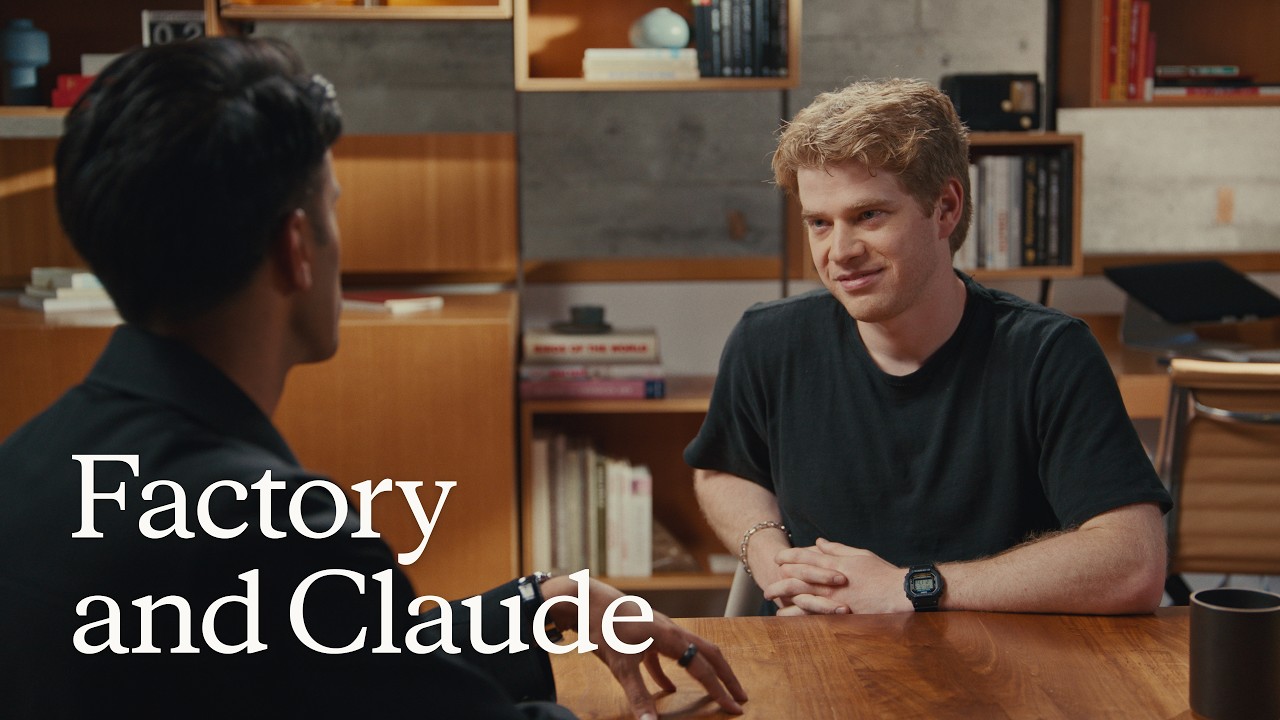
## Background Published on YouTube by the official Claude channel on October 23, 2026, this video features a discussion between Anthropic's Kai Gill and Factory Co-founder and CEO Matan Grinberg. According to the page description, the conversation explores Grinberg's journey founding Factory, how Claude's frontier models enable autonomous AI coding agents ('Droids') to execute long-horizon enterprise tasks with minimal human oversight, and what is required to build a fully autonomous 'dark factory' for software.
## TL;DR Matan Grinberg details Factory's mission to bring full autonomy to software engineering using multi-agent 'Droids' powered by frontier models like Claude Opus. After transitioning from theoretical physics research into enterprise software, Grinberg weathered early market timing hurdles to develop autonomous workflows that dramatically reduce human toil—such as reducing manual effort in enterprise COBOL modernizations by 90%. By assigning top-tier reasoning models to high-level architecture and planning, developers can build trust in agent-generated blueprints without micromanaging every step. Looking forward, Factory envisions a 'dark factory' paradigm where autonomous systems monitor, sandbox, and remediate production code around the clock, freeing engineers to focus on higher-leverage creative challenges.
## Atmosphere & style The conversation has an intellectually curious, candid, and collegial tone, punctuated by dry humor about Grinberg's unconventional pivot from 10-dimensional black holes into messy legacy codebases. The dialogue balances pragmatic engineering realities with an audacious vision, shifting naturally from self-deprecating reflections on early operational naiveite to touching anecdotes of enterprise engineers weeping with relief over automated migrations. It feels less like a polished corporate pitch and more like a thoughtful, philosophical fireside chat between peers navigating the frontier of autonomous systems.
## Bulletin - [05:29](https://www.youtube.com/watch?v=N6FkmdL0Lg0&t=329s) Factory leverages Claude Opus to conduct long-horizon architecture and planning for autonomous coding agents ('Droids'), enabling enterprise software developers to trust generated plans with minimal oversight. - [04:09](https://www.youtube.com/watch?v=N6FkmdL0Lg0&t=249s) Deploying Droids into a major bank for enterprise COBOL modernization reduced required human involvement by 90% after the initial onboarding pass. - [08:12](https://www.youtube.com/watch?v=N6FkmdL0Lg0&t=492s) Factory conceptualizes software autonomy as three concentric circles—frontier model, agent harness, and enterprise workflow—warning that builders must be ready to tear down orchestration layers monthly as models continuously absorb scaffolding functions. - [06:31](https://www.youtube.com/watch?v=N6FkmdL0Lg0&t=391s) Autonomous agent throughput enables engineering teams to scale quarterly output from 3 to 300 initiatives, forcing organizations to re-evaluate their true core competencies rather than focusing solely on execution volume.
## Key takeaways - [00:19](https://www.youtube.com/watch?v=N6FkmdL0Lg0&t=19s) Pivoting from 12 years of theoretical physics studying string theory and 10-dimensional black holes, Matan Grinberg founded Factory in 2023 after recognizing code generation's commercial potential in enterprise environments. - [01:48](https://www.youtube.com/watch?v=N6FkmdL0Lg0&t=108s) Factory's founding mission has remained steadfast: bringing complete autonomy to enterprise software engineering to free developers from low-leverage toil. - [02:22](https://www.youtube.com/watch?v=N6FkmdL0Lg0&t=142s) Operating ahead of underlying model capabilities between 2023 and 2025 gave Factory a critical runway to master operational and enterprise execution before market demand surged. - [02:58](https://www.youtube.com/watch?v=N6FkmdL0Lg0&t=178s) The 'dark factory' paradigm envisions autonomous systems running 24/7 without intervention, detecting production degradations and testing fixes in isolated sandboxes before alerting developers. - [02:58](https://www.youtube.com/watch?v=N6FkmdL0Lg0&t=178s) Real-world autonomous agents must adapt flexibly to the unique workflows and intelligence of enterprise developers rather than imposing rigid, top-down workflows. - [04:09](https://www.youtube.com/watch?v=N6FkmdL0Lg0&t=249s) In a major banking deployment, Droids learned domain-specific modernization rules alongside human engineers, reducing manual overhead on subsequent COBOL passes by 90%. - [04:58](https://www.youtube.com/watch?v=N6FkmdL0Lg0&t=298s) Multi-agent systems require hierarchical intelligence allocation: top-tier models like Claude Opus manage system-wide architecture and planning, while routine code execution is delegated downstream. - [05:29](https://www.youtube.com/watch?v=N6FkmdL0Lg0&t=329s) Opus-class reasoning shifts developer psychology from micromanaging step-by-step plans to defaulting to trust, preventing catastrophic compounding errors across multi-million-token runs. - [06:31](https://www.youtube.com/watch?v=N6FkmdL0Lg0&t=391s) Massive increases in feature deployment capacity compel engineering leaders to shift focus from raw feature delivery to defining and refining core organizational value. - [07:11](https://www.youtube.com/watch?v=N6FkmdL0Lg0&t=431s) Factory and Anthropic prioritize immediate agentic safety, alignment, and sandboxing as critical operational necessities rather than speculative future challenges. - [08:12](https://www.youtube.com/watch?v=N6FkmdL0Lg0&t=492s) Agent builders must stay structurally agile and frequently discard bespoke harness code, as advancing base models continually absorb capabilities once requiring manual scaffolding. - [09:18](https://www.youtube.com/watch?v=N6FkmdL0Lg0&t=558s) Visibility into frontier lab roadmaps allows agent developers to avoid wasting effort on transient reasoning limitations that base models will solve in upcoming iterations. - [09:31](https://www.youtube.com/watch?v=N6FkmdL0Lg0&t=571s) Aspiring founders should be guided purely by consuming intellectual obsession rather than seeking outside validation or permission to launch a startup.
## Detailed walkthrough ### [00:00](https://www.youtube.com/watch?v=N6FkmdL0Lg0&t=0s) Rethinking Human Work with Frontier Models
Matan Grinberg opens by reflecting on how technological leaps reshape human creativity and productivity. Throughout history, the most profoundly human pieces of art and technology have come from completely rethinking previous paradigms and uncovering entirely new angles of approach. With frontier models taking on repetitive, time-draining tasks, builders and creators are finally afforded the mental space and time required to step back, reconsider their methods, and tackle higher-order creative and systemic challenges.
[00:19](https://www.youtube.com/watch?v=N6FkmdL0Lg0&t=19s) From String Theory and 10-Dimensional Black Holes to Founding Factory
Kai Gill introduces Matan Grinberg, pointing out his remarkably non-traditional path into tech entrepreneurship. Until early 2023, Matan was an academic deep in the weeds of theoretical physics, researching the AdS/CFT correspondence in 10-dimensional black holes and string theory. Matan jokes that growing up in the Bay Area, startup culture was omnipresent, leading him to rebel by pursuing the furthest possible extreme: 12 years of theoretical physics. As Gill quips, “As one does,” Matan agrees, noting the realization that precipitated his shift between March and April 2023: theoretical physics and string theory were mathematically gorgeous, but we neither live in 10 dimensions nor anywhere near a black hole.
The turning point came when Matan took a seminar in program synthesis—an academic field now commonly referred to as code generation. The subject completely nerd-sniped him, leaving him head-over-heels obsessed with the potential of automating code. He quickly recognized that academia was not the environment to crack this problem. To build real code generation systems, one had to confront the messy reality of enterprise software: 30-year-old legacy codebases, systems half-written in COBOL and half in Python, and constantly evolving dependencies.
- **Background:** Matan spent roughly 12 years in theoretical physics studying high-energy theory, string theory, and AdS/CFT duality before pivoting to AI. - **The Transition:** The dividing line fell squarely between March and April 2023, when an academic seminar on program synthesis redirected his focus toward industry software engineering.
[01:48](https://www.youtube.com/watch?v=N6FkmdL0Lg0&t=108s) The Mission: Bringing Autonomy to Software Engineering
Factory was founded with a singular objective that has remained unchanged since its inception. Matan emphasizes that the very first pitch deck they created laid out the exact same core thesis they pursue today: bringing true autonomy to software engineering. Software engineers represent some of the most capable problem solvers on the planet, yet within large enterprises, an enormous portion of their daily work is bogged down by low-leverage toil, boilerplate changes, and legacy maintenance rather than high-leverage architectural problem-solving.
When Gill asks about having the conviction to build an autonomous software factory back when underlying foundational models were far from capable of handling it, Matan explains that they bet early on continuous model scaling. They anticipated that models would steadily advance to absorb more complex tasks over time. As Matan reflects on that transition: “Before, we were selling the vision of agents, now it's like everyone knows.”
[02:22](https://www.youtube.com/watch?v=N6FkmdL0Lg0&t=142s) The Journey Through the Desert: Lessons from Being Too Early
The two-year stretch between 2023 and 2025 served as Factory’s grueling “journey through the desert.” Gill observes that being too early in a market is often practically indistinguishable from being flat-out wrong, prompting Matan to share what that period of early isolation taught him. Factory was Matan's first real job; he was entirely obsessed with problem-solving but admitted to knowing virtually nothing about running an actual enterprise—from hiring and product design to sales, marketing, and organizational management.
Matan looks back at the timing mismatch as a critical blessing in disguise. Had the broader market and model capabilities been fully ready in early 2023, the startup would likely have collapsed under his lack of operational experience. As Matan puts it: “If the timing was right and the world was ready, I was the wrong founder in my mind because I didn't know anything.” That desert period provided a two-year training ground where he could learn how to build, operate, and scale a company right as the foundation models matured to match their original product ambitions.
[02:58](https://www.youtube.com/watch?v=N6FkmdL0Lg0&t=178s) Droids and the "Dark Factory" for Software
The conversation turns to Factory’s flagship product—autonomous agents called "Droids"—and the guiding vision of the "dark factory," a concept borrowed from industrial manufacturing where automated plants operate completely unattended with the lights turned off 24/7. Matan explains that achieving this in software requires gradually rewiring developer psychology. When developers first delegate long-horizon tasks that run for days or weeks without direct intervention, they must learn to surrender constant micro-management. As the Droids repeatedly deliver meaningful, correct code, developers begin developing the necessary trust to leave them unattended.
In this dark factory paradigm, an autonomous software factory continuously monitors production health, identifies degradations, tests fixes in isolated sandboxes, and proactively alerts engineers with verified solutions rather than waiting for humans to spot bugs. Matan emphasizes that achieving this requires deep respect for enterprise developers rather than attempting to enforce a rigid, one-size-fits-all workflow. As Matan insists: “I think it's so important to meet our users where they are and respect their intelligence as developers.” The platform must be malleable enough to bend to the silhouette and unique practices of each customer's organization.
```mermaid flowchart TD accTitle: Autonomous Dark Factory Loop accDescr: Flowchart illustrating how Factory Droids continuously monitor, sandbox, verify, and resolve production software issues autonomously.
subgraph Production ["Production Environment"] Deploy["Deployed Service"] Monitor["Continuous Telemetry & Monitoring"] Deploy -->|"metrics drift"| Monitor end
subgraph AutonomousLoop ["Autonomous Droid Remediation"] Detect["Detect Degradation\ne.g., completion rate drop"] Sandbox["Spin Up Test Sandbox"] Diagnose["Isolate Root Cause & Generate Candidate Fix"] Validate["Run Automated Verification"]
Monitor --> Detect Detect --> Sandbox Sandbox --> Diagnose Diagnose --> Validate end
subgraph HumanResolution ["Review & Deployment"] Notify["Ping Developer with Candidate Solution"] Apply["Deploy Validated Patch"]
Validate --> Notify Notify --> Apply Apply --> Deploy end ```
[04:09](https://www.youtube.com/watch?v=N6FkmdL0Lg0&t=249s) Modernizing Legacy COBOL with 90% Less Human Effort
When Gill asks for a standout real-world example of Droids executing complex end-to-end work, Matan points to enterprise banking, where nearly every institution maintains a massive backlog of legacy COBOL migrations that human engineers dread. Being assigned to manual COBOL modernizations is widely viewed by engineers as a grueling year-long sentence of soul-crushing toil. Factory deployed Droids into one major bank to tackle these modernization workflows directly alongside customer teams.
During the initial pass, Factory's engineers sat side-by-side with the bank’s internal developers while the Droid executed the migration, extracting domain-specific patterns and learning organizational rules as it worked. Armed with that learned context, the subsequent modernization pass achieved an astonishing reduction in manual overhead. As Matan recounts: “Then after that, the next one, the amount of human involvement was 90% less.” The breakthrough prompted emotional reactions from staff who had faced endless manual migrations, resulting in genuine tears of joy among engineers relieved of those burdens.
[04:58](https://www.youtube.com/watch?v=N6FkmdL0Lg0&t=298s) Strategic Architecture: When Droids Require Frontier Models
Gill and Matan discuss the structural allocation of intelligence within multi-agent systems and where frontier-class reasoning is essential. Matan draws an analogy to human engineering organizations: having a company's CTO write every single routine line of code is an inefficient waste of executive talent. Instead, engineering hierarchies rely on seasoned architects with deep institutional context to map out high-level system blueprints and coordinate dependencies, while delegating localized implementation to others.
Factory structures Droid workflows similarly, reserving frontier models like Claude Opus for overarching system architecture, long-horizon planning, and complex multi-step orchestration. When managing intricate codebases with dozens of moving parts, utilizing top-tier reasoning engines prevents cascading architectural errors that compound downstream across millions of generated tokens.
[05:29](https://www.youtube.com/watch?v=N6FkmdL0Lg0&t=329s) What Opus Unlocks: High-Trust Planning and Reduced Human Oversight
Discussing the concrete operational shift enabled by Claude Opus, Matan highlights the drastic reduction in human supervision required during complex tasks. In long-horizon agent execution, faulty initial planning is disastrous because a flawed strategy often only surfaces after consuming billions of tokens across downstream tasks. With Opus-grade reasoning, the planning phase is sound enough that human engineers no longer need to scrutinize every step before giving the green light.
Developers transition from tightly auditing every intermediate step to trusting agent blueprints by default. As Matan explains the qualitative shift in engineer trust: “I think there's the gut sense of you can trust the plans a little bit more to the point where you literally might not even look at them, and you're like, yeah, sounds great.” It has reached a state where only rare, bizarre corner cases prompt an engineer to pause and question the underlying plan, reliably clearing the strict thresholds demanded by enterprise environments.
[06:31](https://www.youtube.com/watch?v=N6FkmdL0Lg0&t=391s) From Shipping 3 to 300: Rethinking Core Competencies
Frontier AI removes the execution bottleneck that historically constrained engineering roadmaps. Matan notes that most companies enter a quarter hoping to ship 30 major initiatives, but resource limits restrict them to delivering three. With autonomous agents absorbing the sheer volume of implementation toil, an engineering organization suddenly possesses the capacity to ship 300 things in the same timeframe.
However, this explosive increase in capacity forces a fundamental identity question: does shipping 100 times more features actually move the needle for users and build stronger customer relationships? By taking over routine production burdens, models push human teams to re-evaluate their true leverage. As Matan observes: “I think it shifts the question for the humans to now be like, what really is our core competency? How can we deliver on that better?” Freeing teams from low-level execution creates space to invent completely new angles of attack and craft high-value software experiences.
[07:11](https://www.youtube.com/watch?v=N6FkmdL0Lg0&t=431s) The Anthropic Partnership and Shared Safety Priorities
Matan discusses Factory’s partnership with Anthropic, emphasizing that technical reliability and philosophical alignment are paramount. Both companies share an ambition to dramatically expand human potential while maintaining rigorous safety standards, clear messaging, and robust operational guardrails. Advanced AI capabilities carry immense power, which can naturally feel daunting to developers and enterprise leadership, making it vital to demonstrate concrete, grounded benefits while proving how Droids and Claude strengthen each other.
Matan stresses that agentic safety, alignment, and reliability cannot be treated as speculative future topics. As Matan emphasizes: “It's really important that the people that we partner with take it as seriously as we do, as a today problem.” The complexities of deployment, sandboxing, and autonomous code execution require frontier AI labs and tooling platforms to treat engineering constraints with immediate urgency.
[08:12](https://www.youtube.com/watch?v=N6FkmdL0Lg0&t=492s) The Three Concentric Circles Blocking the Dark Factory
Looking toward the near future, Gill asks what bottlenecks still prevent the full realization of lights-out dark factories in software engineering. Matan conceptualizes the current technical frontier as three rapidly expanding concentric circles: the foundational model at the center, the agent harness surrounding it, and the overarching company workflows on the perimeter.
```mermaid flowchart LR accTitle: The Three Concentric Circles of Software Autonomy accDescr: Diagram showing the inner foundation model, the middle harness orchestration layer, and the outer enterprise workflow layer.
subgraph Outer ["Outer Layer: Enterprise Ecosystem"] direction TB Workflows["Company Workflows & Cultural Silhouettes"] subgraph Middle ["Middle Layer: Agent Architecture"] direction TB Harness["Agent Harness, Tooling & Orchestration"] subgraph Inner ["Core Layer: Intelligence"] Model["Frontier Foundation Model\ne.g., Claude Opus"] end end end ```
The capabilities of standalone models have advanced so rapidly that a modern model can execute single-handedly what required a complex model-plus-harness configuration just two years prior. As frontier models absorb capabilities previously hardcoded into agent scaffolding, tooling builders must constantly re-evaluate their architectures rather than stubbornly defending outdated code. As Matan warns: “We need to always have in one hand a sledgehammer to whatever we thought was the best solution. Every month, we need to rethink.” Builders must continuously rethink whether their orchestration harnesses remain optimal or if rising model intelligence has rendered them obsolete.
[09:18](https://www.youtube.com/watch?v=N6FkmdL0Lg0&t=558s) Riding the Frontier Model Wave
Matan Grinberg explains the strategic value of maintaining a close relationship with Anthropic, emphasizing how visibility into the model roadmap shapes Factory's engineering roadmap. Because Factory can see the specific classes of challenges frontier lab researchers are tackling, the team can anticipate where base model capabilities will land in the near future. Rather than attempting to solve foundational reasoning hurdles that foundational models will soon make obsolete, Factory focuses on building the scaffolding and infrastructure that bridges current gaps. As Matan Grinberg puts it: “Let's make sure we're filling this hole in the meantime, so that we can ride that wave together.”
[09:31](https://www.youtube.com/watch?v=N6FkmdL0Lg0&t=571s) Advice for Would-Be Founders: Obsession and Intellectual Curiosity
Bringing the discussion full circle back to the pivotal moments that launch entrepreneurial journeys, Kai Gill asks what guidance Matan Grinberg would offer to aspiring founders watching the conversation who are standing at the threshold of starting something new. Grinberg responds with an immediate, humorous contrarian rule: “This is a bit funny, but anytime a person asks me if they should start a company, I always say no.” His rationale is straightforward: if an entrepreneur still needs external permission or affirmation to take the leap, they are not yet ready for the grueling realities of company building.
Instead, Grinberg argues that starting a company must be powered by deep, intrinsic fascination with a problem space. When a founder is genuinely absorbed by what they are building, the day-to-day grind transforms into something enjoyable. He encourages founders to pinpoint an obsession so consuming that it dominates their thoughts: “Find the thing that you literally cannot stop thinking about and just keeps you up at night.” Furthermore, Grinberg highlights that the technological landscape has drastically shifted the boundaries of feasibility. Whereas aiming for an extreme ambition like becoming an astronaut fifty years ago might have been practically unreachable, today's environment makes even the most radical concepts unexpectedly achievable. He advises would-be founders that as long as intellectual curiosity pours out naturally, everything else needed to build the company will follow.
- **Founder self-selection:** Anyone seeking outside validation or asking for permission to start a company is likely not ready to endure the journey. - **The modern technological era:** Extremely ambitious, unconventional ideas that were previously deemed impossible are now vastly more achievable. - **Guiding principle:** “Find the thing that you get obsessed about, the intellectual curiosity just pours out of you, and I think the rest will come from that,” Matan Grinberg concludes before wrapping up the conversation with Kai Gill.
## Notable quotes > [08:12](https://www.youtube.com/watch?v=N6FkmdL0Lg0&t=492s) We need to always have in one hand a sledgehammer to whatever we thought was the best solution. Every month, we need to rethink. — Matan Grinberg
> [09:31](https://www.youtube.com/watch?v=N6FkmdL0Lg0&t=571s) Anytime a person asks me if they should start a company, I always say no. — Matan Grinberg
> [02:58](https://www.youtube.com/watch?v=N6FkmdL0Lg0&t=178s) I think it's so important to meet our users where they are and respect their intelligence as developers. — Matan Grinberg
> [09:31](https://www.youtube.com/watch?v=N6FkmdL0Lg0&t=571s) Find the thing that you literally cannot stop thinking about and just keeps you up at night. — Matan Grinberg
## Mentioned Factory, Claude, Claude Opus, Anthropic, Matan Grinberg, Kai Gill, Droids, COBOL, Python
## Video description Factory is bringing autonomy to software engineering with Droids, AI coding agents that handle enterprise work. In this conversation, Co-founder and CEO Matan Grinberg sits down with Anthropic's Kai Gill to talk about his journey founding Factory, how Claude's frontier models handle long-horizon tasks across large codebases so teams can trust agent plans with less oversight, and what it will take to build a fully autonomous "dark factory" for software.
Read the full story: http://claude.com/customers/factory
Chapters: 0:00 Intro 0:19 From string theory to founding Factory 1:48 The mission: autonomy for software engineering 2:22 Lessons from being too early 2:58 Droids and the "dark factory" 4:09 A COBOL modernization with 90% less human effort 4:58 When Droids need frontier models 5:29 What Opus unlocks: less human oversight 6:31 Shipping 300 things and rethinking what matters 7:11 The Anthropic partnership 8:12 What's blocking the dark factory 9:31 Advice for would-be founders
[Source](https://www.youtube.com/watch?v=N6FkmdL0Lg0)