French Budget Crisis Risks Bond Shock as ECB Refuses Blanket Bailout
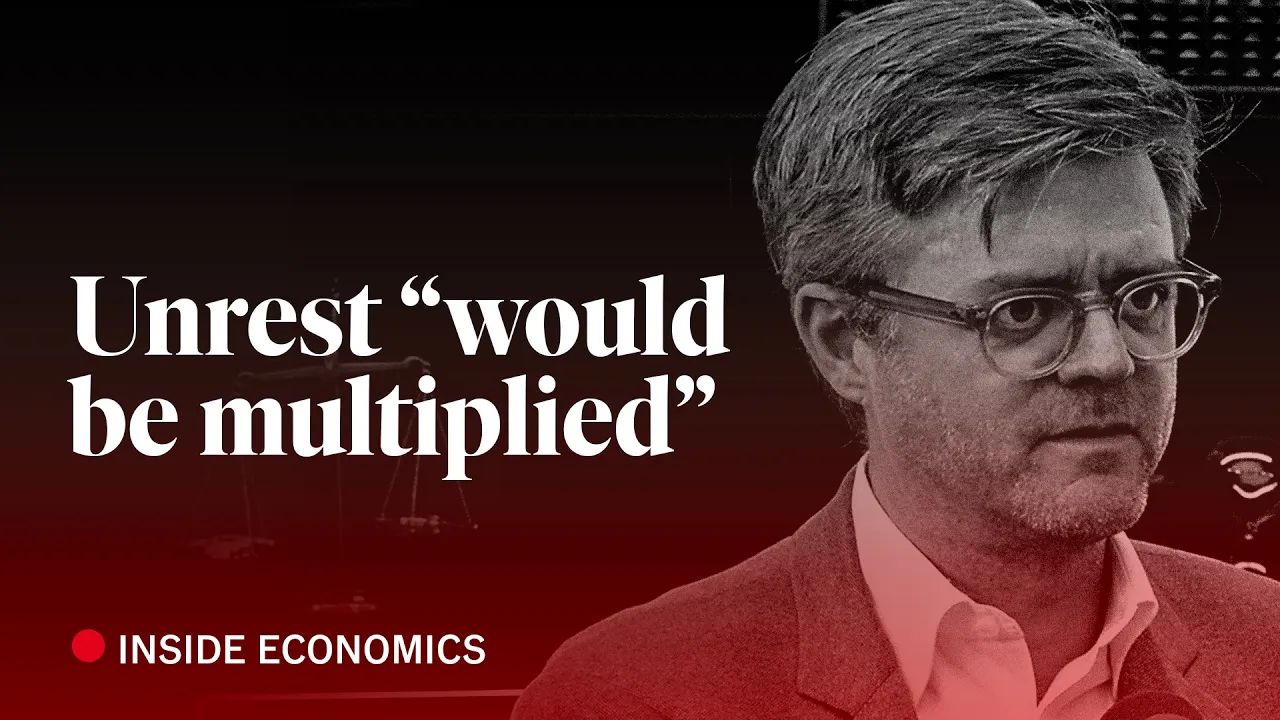
The Economist
Post-crisis institutional firewalls will isolate French sovereign debt turmoil, allowing bond market pressure to force Paris into fiscal discipline rather than triggering a broader euro-zone collapse.
AI-assisted summary of Will France blow up the euro zone? | The Economist — original source. Check the original for full context.
Source published:
Key ideas
- France's national debt servicing costs are on track to surpass its spending on both education and national defense this year amid mounting deficits and bond market strain. (0:00)
- Unlike during the 2010s debt crisis, modern ECB mechanisms are structured to isolate sovereign bond pressures to individual member states rather than triggering bloc-wide contagion. (1:13)
- Unconditional support for French debt is politically impossible in Germany, where the anti-bailout AfD party is polling near 30%, hardening Berlin's resistance to fiscal leniency. (3:24)
- Economists predict France may face Liz Truss-style bond market turbulence, but institutional guardrails and strong public support for the euro will prevent a breakup of the single currency. (7:23)
Detailed notes
## Background Published on YouTube by The Economist on October 23, 2026, this episode features hosts Henry Curr and Mike Bird alongside Sophie Pedder and Christian Odendahl. The program explores France's compounding street unrest and surging borrowing costs, analyzing whether mounting fiscal deficits and political gridlock could ignite another severe euro-zone crisis.
## TL;DR France is caught in an acute fiscal bind as debt servicing costs overtake education and defense spending, while populist political platforms push to lower the retirement age and undo essential pension reforms. The panel explains that unlike during the 2010s crisis, modern European Central Bank mechanisms are engineered to isolate market pressure on Paris and prevent contagion across the euro zone. Unconditional bailouts are politically untenable in northern Europe, particularly in Germany, where the rise of the Alternative for Germany leaves mainstream leaders no latitude to subsidize French deficits. Ultimately, the analysts conclude that while France will likely suffer a Liz Truss-style sovereign bond shock, widespread public support for the euro will compel French policymakers to muddle through rather than trigger a currency breakup.
## Atmosphere & style The discussion carries a sober, intellectually rigorous tone that balances alarming on-the-ground accounts of violent protests with cool-headed macroeconomic analysis. The dynamic between the editors is fluid and collegial, featuring sharp institutional debates and an undercurrent of sentimentality as Mike Bird makes his final appearance on the show. Listening feels like attending a measured, high-level briefing that de-escalates headline panic into an orderly assessment of political and economic constraints.
## Bulletin - [00:00](https://www.youtube.com/watch?v=q2uVRZougS8&t=0s) France's national debt servicing costs are on track to surpass its spending on both education and national defense this year amid mounting deficits and bond market strain. - [01:13](https://www.youtube.com/watch?v=q2uVRZougS8&t=73s) Unlike during the 2010s debt crisis, modern ECB mechanisms are structured to isolate sovereign bond pressures to individual member states rather than triggering bloc-wide contagion. - [03:24](https://www.youtube.com/watch?v=q2uVRZougS8&t=204s) Unconditional support for French debt is politically impossible in Germany, where the anti-bailout AfD party is polling near 30%, hardening Berlin's resistance to fiscal leniency. - [07:23](https://www.youtube.com/watch?v=q2uVRZougS8&t=443s) Economists predict France may face Liz Truss-style bond market turbulence, but institutional guardrails and strong public support for the euro will prevent a breakup of the single currency.
## Key takeaways - [00:00](https://www.youtube.com/watch?v=q2uVRZougS8&t=0s) Violent street demonstrations in France demand expanded public spending even though the state has exhausted its fiscal room for manoeuvre. - [00:00](https://www.youtube.com/watch?v=q2uVRZougS8&t=0s) Pensions constitute the largest single expenditure in the French budget, making pledges by both political extremes to lower the retirement age a severe threat to fiscal stability. - [00:00](https://www.youtube.com/watch?v=q2uVRZougS8&t=0s) France expects to spend more on servicing sovereign debt this year than on either its education or defense budgets. - [01:13](https://www.youtube.com/watch?v=q2uVRZougS8&t=73s) Post-crisis institutional reforms ensure the ECB can ring-fence contagion, meaning bond market pressure will be applied specifically to France rather than spreading across the periphery. - [01:13](https://www.youtube.com/watch?v=q2uVRZougS8&t=73s) ECB backstops remain strictly conditional on member states demonstrating clear macroeconomic reasonability and credible efforts to rein in deficits. - [01:13](https://www.youtube.com/watch?v=q2uVRZougS8&t=73s) Historical standoffs with Greece and Italy demonstrate that individual national governments cannot ultimately prevail against the ECB and sovereign bond markets. - [03:24](https://www.youtube.com/watch?v=q2uVRZougS8&t=204s) France's role as an indispensable EU anchor country makes ECB enforcement stricter rather than more lenient, to prevent a moral hazard crisis at the core of the union. - [03:24](https://www.youtube.com/watch?v=q2uVRZougS8&t=204s) While Greece in 2010 was completely shut out of credit markets, France retains functional bond market access and merely faces slightly elevated risk premiums. - [03:24](https://www.youtube.com/watch?v=q2uVRZougS8&t=204s) Leniency toward French deficits would provoke severe political backlash in fiscally conservative nations like Germany and the Netherlands. - [03:24](https://www.youtube.com/watch?v=q2uVRZougS8&t=204s) The rise of the AfD in Germany, polling around 30%, removes any political room for German leadership to tolerate euro-zone bailouts or fiscal free passes. - [07:23](https://www.youtube.com/watch?v=q2uVRZougS8&t=443s) Analysts anticipate France could endure a bond market shock comparable to the UK's 2022 Liz Truss episode to force political consensus on spending cuts. - [07:23](https://www.youtube.com/watch?v=q2uVRZougS8&t=443s) Broad popular support for the euro across member states is materially higher today than during the 2010–2012 sovereign debt crisis. - [07:23](https://www.youtube.com/watch?v=q2uVRZougS8&t=443s) The capitulation of Greece's Syriza government in 2015 illustrates how European institutions systematically compel populist administrations to accept macroeconomic discipline.
## Detailed walkthrough ### [00:00](https://www.youtube.com/watch?v=q2uVRZougS8&t=0s) Street Protests, Surging Deficits, and the French Budget Trap
The conversation opens with Sophie Pedder recounting firsthand reporting from Bordeaux over the weekend, where she covered violent demonstrations and observed that “the scenes of devastation were really quite shocking.” The unrest compounds an already acute economic dilemma for the French government: while public demonstrators demand substantial new spending on priorities such as education, Paris is operating in an environment where it simply has no money left to spend. The state is under acute pressure to curb budget deficits and push through expenditure cuts, yet it faces deep post-election political instability that obscures the future direction of fiscal policy and makes legislative approval of the budget an uphill struggle.
```mermaid flowchart TD accTitle: French Budget Dilemma Under Political Pressure accDescr: Visual flowchart tracing the structural budget trap in France from street protests and political promises down to debt servicing costs.
subgraph Political_Pressure["Political Pressures"] A["Street Protests in Bordeaux<br/>Demanding Education Spending"] B["Hard-Left & Hard-Right Pledges<br/>(Mélenchon & Le Pen: Lower Pension Age)"] end
subgraph Fiscal_Reality["Fiscal Reality"] C["Pensions = Single Largest Spending Item"] D["Mounting Deficits & Spending Cut Requirements"] end
subgraph Debt_Trap["Bond Market Squeeze"] E["Spooked Sovereign Bond Markets"] F["Debt Servicing Costs Exceed<br/>Education and Defense Budgets"] end
A --> D B --> C C --> D D --> E E --> F ```
The underlying numbers reveal a severe fiscal squeeze: France expects to spend more this year on servicing its national debt than on either education or defense. Sovereign bond markets have been further unnerved by the policy platforms put forward by political extremes on both sides. Both hard-left leader Jean-Luc Mélenchon and hard-right leader Marine Le Pen have campaigned on economic programs pledging to reduce the national retirement age. Because pension expenditure represents the single largest item in the French state budget, lowering the pension age renders any serious deficit reduction virtually impossible.
- France’s debt servicing costs are on track to surpass its spending on defense and its spending on education. - Public spending cuts are heavily constrained because pensions represent the single largest expenditure category in the French budget. - Economic platforms from both Jean-Luc Mélenchon (hard left) and Marine Le Pen (hard right) pledged to lower the retirement age, directly spooking sovereign bond investors.
---
[01:13](https://www.youtube.com/watch?v=q2uVRZougS8&t=73s) The ECB’s Playbook: Conditionality and "Macroeconomic Reasonability"
Turning to the prospect of a severe French fiscal crisis that echoes the European sovereign debt crisis of the 2010s, Henry Curr notes that the European Central Bank (ECB) would be the decisive actor. Christian Odendahl explains that the euro area has evolved fundamentally since the early 2010s. Back then, there were no institutional firewalls or containment mechanisms, meaning doubts about one troubled country quickly cascaded into runs on Italian, Spanish, and Portuguese sovereign debt. Today, the institutional architecture and the ECB are explicitly engineered to ensure contagion is contained and that market discipline is applied specifically to the country responsible.
Christian highlights that while markets recognize the ECB stands behind sovereign debt, that support is strictly conditional. Central bankers demand fiscal responsibility: “One ECB director once called it, the ECB expects macroeconomic reasonability.” This does not demand adherence to every fiscal regulation down to the letter, but it requires unmistakable intent to rein in excessive deficits. Looking at past confrontations involving Greece and Italy, Christian argues that no national government can prevail in an outright clash against the ECB backed by sovereign bond markets. If Paris refuses to demonstrate macroeconomic reasonability, Frankfurt will simply stand back and allow bond market pressures to mount on France alone.
- Unlike during the 2010s debt crisis, post-crisis EU institutions exist to ring-fence contagion and isolate sovereign bond pressures to the offending country. - Precedent from past showdowns with Greece and Italy indicates that individual member states cannot win a protracted standoff against the ECB and market forces.
---
[03:24](https://www.youtube.com/watch?v=q2uVRZougS8&t=204s) Anchor Country Dilemma and the Moral Hazard of a French Bailout
The panel debates whether France’s political weight changes the balance of power. While France is one of the twin engines of Europe alongside Germany, Christian Odendahl argues this status cuts both ways. Because France is an indispensable anchor country of the European Union, the ECB and Germany cannot simply hand it an unconditional bailout without throwing the legitimacy of the entire European project into question. For that very reason, Frankfurt must enforce discipline even more rigorously to avoid putting “a crisis at the heart of the EU.”
Henry Curr and Mike Bird explore the disastrous implications of an ECB surrender: if a game of chicken ensues and Frankfurt blinks by printing money to back French debt without structural adjustment conditions, the monetary union’s fiscal framework effectively collapses. Mike contrasts France's position with Greece in 2010. Greece was completely locked out of sovereign credit markets, leaving zero moral hazard because nobody viewed Greece’s punishing experience as an enticing blueprint. France, by contrast, still enjoys an orderly, functional sovereign bond market, simply paying a modest risk premium.
If France were permitted to run massive deficits and maintain an earlier retirement age while relying on the ECB as a backstop, public consent in fiscally conservative nations like Germany and the Netherlands would disintegrate: “Well, why are we bothering, you know, why why do we uh why do we try and balance our own budgets? Why do we try and apply sensible fiscal rules if everyone just simply gets a free pass from the European Central Bank or from other institutions uh if they don't do any of it?” Politically, German latitude for compromise has vanished. The Alternative for Germany (AfD)—originally founded as an anti-euro bailout movement—is polling near 30%, making it politically suicidal for mainstream German politicians to approve concessions or bailouts for French profligacy.
- Greece in 2010 lost all bond market access, while France currently retains fully functional, orderly bond market access at slightly elevated borrowing costs. - The Alternative for Germany (AfD), founded in opposition to euro bailouts, polls at roughly 30%, eliminating political wiggle room for German leaders to countenance financial rescues.
---
[07:23](https://www.youtube.com/watch?v=q2uVRZougS8&t=443s) Predictions: Truss-Style Turbulence or Euro-Zone Breakup?
Wrapping up the discussion, Henry Curr puts the panel on the spot: will France blow up the euro zone? Christian Odendahl rejects the doomsday scenario, arguing that institutional mechanisms will exert the precise amount of economic pressure required to force Paris into fiscal responsibility over time. Henry Curr offers his own forecast, predicting that France will likely experience a bond market shock reminiscent of the UK's 2022 Liz Truss episode, though it will fall short of destroying the common currency: “I think Europe will find a a way to model muddle through but it will get harder before it gets easier.”
Mike Bird, making his final appearance on *Inside Economics* before departing *The Economist*, agrees that France will not blow up the euro zone. He observes that since the 2010s, European integration has proven remarkably effective at moderating radical populist movements once they assume power. Recalling his reporting from Athens in 2015 when the far-left Syriza government seemed poised to reject bailout terms and risk euro exit, Mike notes that Syriza was ultimately forced into submission by the institutional machinery of the EU. Crucially, broad public support for the single currency across member states is significantly higher today than it was before or during the euro crisis. Ultimately, while bond turbulence and domestic politics will worsen before improving, the overwhelming public desire to stay inside the euro will force French policymakers to retreat from the brink.
- Henry Curr predicts France will face a "Liz Truss-like bond market crisis" that tests French politics without causing a systemic euro-zone collapse. - Public polling reveals that popular backing for the euro across the currency bloc is materially higher today than during the 2010–2012 sovereign debt crisis. - The 2015 Greek precedent—where the radical Syriza administration capitulated rather than exit the single currency—serves as the blueprint for how European institutions compel populist leaders to accept macroeconomic constraints.
## Notable quotes > [07:23](https://www.youtube.com/watch?v=q2uVRZougS8&t=443s) I think Europe will find a a way to model muddle through but it will get harder before it gets easier. — Henry Curr
## Mentioned Henry Curr, Mike Bird, Sophie Pedder, Christian Odendahl, Jean-Luc Mélenchon, Marine Le Pen, Liz Truss, The Economist, Inside Economics, European Central Bank, Alternative for Germany (AfD), Syriza, France, Germany, Greece, Italy, Spain, Portugal, Netherlands, Bordeaux, Paris, Frankfurt, Athens
## Video description France’s streets are on fire—and so are its finances. Soaring borrowing costs mean its debt is becoming more expensive to service. If the prospect of passing even meagre spending cuts in next year’s budget is implausible, the fiscal discipline that is ultimately required feels completely out of reach. Could France’s woes spark another euro-zone crisis?
Henry Curr and Mike Bird are joined by Sophie Pedder, The Economist’s Paris bureau chief, and Christian Odendahl, our European economics editor, to discuss whether France is about to blow up—and whether it could bring the euro zone down with it.
#france #economics #europe #markets #finance
Watch the full show: http://bit.ly/3WEUuss Sign up to the Insider newsletter: https://econ.st/4nOyzIb
Subscribe to The Economist: https://www.economist.com/subscribe Download our app: https://www.economist.com/get-the-app
Follow The Economist on Instagram: https://www.instagram.com/theeconomist/ Follow The Economist on Facebook: https://www.facebook.com/TheEconomist Follow The Economist on X: https://x.com/TheEconomist
[Source](https://www.youtube.com/watch?v=q2uVRZougS8)