The Greek Poet of the 21st Century (with audio descriptions)
University of Michigan
AI-assisted summary of The Greek Poet of the 21st Century (with audio descriptions) — original source. Check the original for full context.
Source published:
Key ideas
- Athina Rossoglou delivered the 3rd Vakalo Family Visiting Artist/Scholar Lecture at the University of Michigan, analyzing 21st-century Greek poetry through an archive of over 450 long-form interviews conducted for 'Reading Greece'. (4:52)
- Contemporary Greek poetry responds to post-2008 economic collapse, austerity, and the political rupture following 2015 by operating between 'melancholic rupture' and 'insurgent utopia'. (7:35)
- Rossoglou argues that the fifteen-year wave of left-wing melancholic political verse has largely concluded, with poetic energies now pivoting toward gender critique and queer poetics. (85:55)
- Modern Greek studies and literary criticism are urged to look beyond century-old canonical figures like Cavafy, Seferis, and Elytis to critically engage with contemporary verse reflecting shared global socioeconomic anxieties. (100:59)
Detailed notes
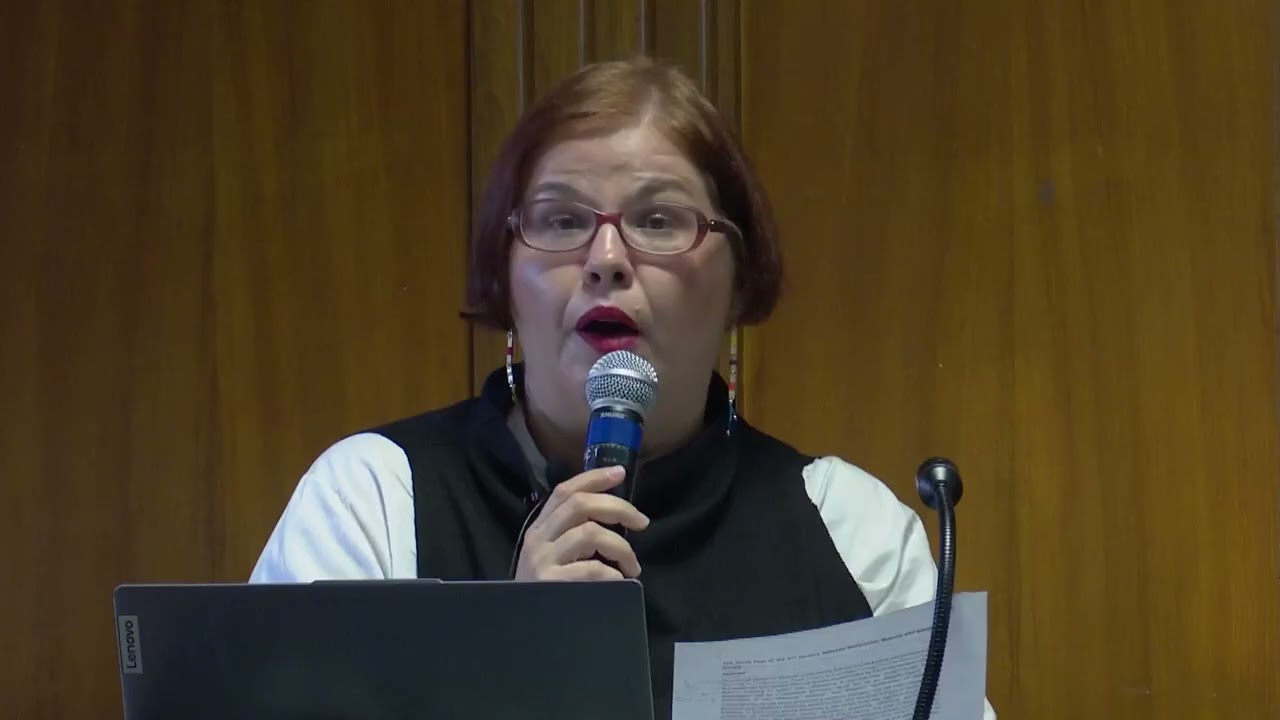
## Background Published by the University of Michigan on YouTube on October 23, 2026, this video documents the 3rd Vakalo Family Visiting Artist/Scholar Lecture delivered by Athina Rossoglou in the Michigan Room at the Michigan League. Titled "The Greek Poet of the 21st Century: Between Melancholic Rupture and Insurgent Utopia," the presentation draws on Rossoglou's extensive work with the 'Reading Greece' archive to explore how contemporary Greek writers respond to crisis, loss, and political upheaval.
## TL;DR Scholar and diplomat Athina Rossoglou analyzes the landscape of 21st-century Greek poetry, demonstrating how severe economic collapse, austerity, and institutional uncertainty transformed poetic practice away from formalist detachment toward urgent sociopolitical critique. Grounded in over 450 interviews conducted for the 'Reading Greece' project, her lecture frames contemporary verse as an alternative archive of trauma and precarious daily life operating between Walter Benjamin's concept of left-wing melancholic rupture and an insurgent utopian impulse. Rossoglou illustrates how poets dismantle commodified national myths, confront urban isolation and femicide, and preserve the fragile human dimension of history while rejecting passive despair. During the concluding Q&A, discussion expands into the political turning point of 2015, the reimagining of the Aegean amid the migration crisis, the emerging turn toward queer poetics, and the necessity for Modern Greek academic studies to engage with living writers beyond the traditional 20th-century canon.
## Atmosphere & style The presentation carries the measured, intellectually rigorous tone of a formal university lecture, yet it is infused with deep emotional gravity and an urgent sense of civic grief. Rossoglou delivers her arguments with scholarly precision and understated passion, weaving theoretical critique with visceral poetic readings, Athenian street culture, and audio-visual protest against violence. The room maintains a contemplative, attentive atmosphere as the dialogue transitions from the somber reckoning of collective defeat and material exhaustion to an earnest, resolute defense of radical imagination and critical possibility.
## Bulletin - [04:52](https://www.youtube.com/watch?v=wgXZYwIPxdg&t=292s) Athina Rossoglou delivered the 3rd Vakalo Family Visiting Artist/Scholar Lecture at the University of Michigan, analyzing 21st-century Greek poetry through an archive of over 450 long-form interviews conducted for 'Reading Greece'. - [07:35](https://www.youtube.com/watch?v=wgXZYwIPxdg&t=455s) Contemporary Greek poetry responds to post-2008 economic collapse, austerity, and the political rupture following 2015 by operating between 'melancholic rupture' and 'insurgent utopia'. - [01:25:55](https://www.youtube.com/watch?v=wgXZYwIPxdg&t=5155s) Rossoglou argues that the fifteen-year wave of left-wing melancholic political verse has largely concluded, with poetic energies now pivoting toward gender critique and queer poetics. - [01:40:59](https://www.youtube.com/watch?v=wgXZYwIPxdg&t=6059s) Modern Greek studies and literary criticism are urged to look beyond century-old canonical figures like Cavafy, Seferis, and Elytis to critically engage with contemporary verse reflecting shared global socioeconomic anxieties.
## Key takeaways - [07:35](https://www.youtube.com/watch?v=wgXZYwIPxdg&t=455s) Contemporary Greek poets reject detached aestheticism, drawing utopian energy directly from experiences of loss, precarity, and historical trauma. - [10:11](https://www.youtube.com/watch?v=wgXZYwIPxdg&t=611s) The long-form interview format in 'Reading Greece' serves as an active dialogic space where poets construct public literary identities and formulate their aesthetic stances. - [18:12](https://www.youtube.com/watch?v=wgXZYwIPxdg&t=1092s) Poetic practice shifts priority from formal technique ('how') to urgent thematic confrontation with reality ('what') during social emergencies. - [21:07](https://www.youtube.com/watch?v=wgXZYwIPxdg&t=1267s) Melancholic rupture is defined not as passive resignation, but as an engine for critique, collective expression, and questioning unresolved historical debts. - [31:08](https://www.youtube.com/watch?v=wgXZYwIPxdg&t=1868s) Poetry acts as an alternative archive that records fragile everyday grief and personal endurance excluded from institutional histories and macroeconomic statistics. - [40:47](https://www.youtube.com/watch?v=wgXZYwIPxdg&t=2447s) Poets counter the exhaustion of public words by revitalizing language and everyday speech to represent the realities of displacement and precarity. - [54:01](https://www.youtube.com/watch?v=wgXZYwIPxdg&t=3241s) Urban poetics frames the city as a palimpsest where personal alienation intersects with macro-level economic violence and gendered vulnerabilities. - [01:01:43](https://www.youtube.com/watch?v=wgXZYwIPxdg&t=3703s) Utopia is reframed not as an escapist blueprint of perfection, but as the cognitive and imaginative refusal to accept existing systems as permanent. - [01:13:10](https://www.youtube.com/watch?v=wgXZYwIPxdg&t=4390s) The poet acts as a guardian of possibility, treating historical disorientation and crisis as open-ended sites for critical renewal rather than finished narratives. - [01:25:55](https://www.youtube.com/watch?v=wgXZYwIPxdg&t=5155s) Contemporary Greek melancholy draws theoretically from Walter Benjamin and Enzo Traverso's 'left-wing melancholy' rather than Freudian individual pathology. - [01:29:13](https://www.youtube.com/watch?v=wgXZYwIPxdg&t=5353s) The Mediterranean migration crisis altered the poetic geography of the Aegean Sea, transforming it from a tourist symbol of Greek identity into an archipelago of tragedy. - [01:43:52](https://www.youtube.com/watch?v=wgXZYwIPxdg&t=6232s) Academic institutions and critics often resist studying living poets due to interpretive risks, hindering contemporary verse from receiving broader scholarly canonization.
## Detailed walkthrough ### [00:07](https://www.youtube.com/watch?v=wgXZYwIPxdg&t=7s) Introduction and the Vakalo Family Legacy
Artemis Leontis, C.P. Cavafy Professor of Classical Studies and Comparative Literature and director of the Modern Greek Program at the University of Michigan, opens the third Vakalo Family Visiting Artist/Scholar Lecture. She begins by thanking events coordinator Elaine Madro and staff member Daisy Freitas, who navigated the increasingly complex administrative steps required to bring an international visitor to campus over the past year. Leontis frames the event around the distinguished legacy of the Vakalo family, whose cultural influence is renowned across Greece. George and Eleni Vakalo made far-reaching contributions to modern poetry, visual arts, art criticism, education, and cultural activism, while their son, Dr. George Emmanuel “Manos” Vakalo, extended that footprint to Ann Arbor as an inspiring professor in the University of Michigan’s A. Alfred Taubman College of Architecture and Urban Planning.
Leontis emphasizes that the memory of George, Eleni, and Manos Vakalo endures in the room through the presence of Dr. Vakalo’s widow, Kathleen Vakalo. Through her establishment of the Vakalo Family Visiting Artist/Scholar endowed fund, Kathleen Vakalo seeks to honor her family’s impact by providing sustained support for visiting residencies that invite emerging scholars, poets, translators, musicians, and visual or performance artists into the Modern Greek program. Leontis points out that this educational and cultural mission deliberately showcases contemporary Greek creative life beyond the traditional international focus on the nation's classical antiquity.
Reviewing the history of the visiting scholar series, Leontis notes that the endowed fund has previously supported two short residencies and public lectures: - **Phoebe Giannisi**: Renowned Greek poet and Professor of Architecture at the University of Thessaly, who delivered a lecture-performance investigating chimeras. - **Marios Chatziprokopiou**: Assistant Professor of Culture, Creative Media, and Industries at the University of Thessaly, whose debut poetry collection *Topikoi Tropikoi* (*Local Tropics*) was shortlisted for the Greek State Literary Award for Best Poetry; his residency explored metamorphosis and translation as transformative acts.
Turning to the present event, Leontis introduces the third visiting fellow, Athina Rossoglou, a scholar and cultural diplomat working within the Greek Ministry of Foreign Affairs, before yielding the podium to colleague Vassilis Lambropoulos.
---
[04:52](https://www.youtube.com/watch?v=wgXZYwIPxdg&t=292s) Vassilis Lambropoulos Introduces Athina Rossoglou
Vassilis Lambropoulos, C.P. Cavafy Professor Emeritus of Classical Studies and Comparative Literature, introduces Athina Rossoglou by outlining her distinguished career as a public scholar, diplomat, and researcher. Rossoglou serves professionally as a press attaché at the Greek Ministry of Foreign Affairs. She completed her undergraduate studies in the Department of Foreign Languages, Translation, and Interpretation at the Ionian University, earned a postgraduate degree in Public History, and is currently pursuing doctoral research at the Ionian University focusing on twenty-first-century Greek poetry and its dynamic engagement with history, nationhood, public space, and identity formation. Alongside Finnish translator Riikka Pulkkinen, she co-edited a bilingual anthology of contemporary Greek poetry that received the 2023 Greek State Literary Prize for Translation of a Work of Greek Literature into a Foreign Language.
Lambropoulos highlights Rossoglou’s decade-long stewardship of *Reading Greece*, a major digital initiative dedicated to the international promotion and dissemination of contemporary Greek literature. Looking forward, he reveals to the audience: “This week she will launch another project, Greek Voices, a sequel of sorts, a website bringing together young writers, artists, scholars, and intellectuals who create an evolving map of contemporary Greek thought and culture.” Lambropoulos explains that the new platform will be officially hosted by the University of Michigan’s Modern Greek Program. Over the course of October, Rossoglou’s residency on campus involves conducting her own research, guest-lecturing in classes, and participating in the academic community before presenting her analysis of modern Greek poets.
---
[07:35](https://www.youtube.com/watch?v=wgXZYwIPxdg&t=455s) The 21st-Century Greek Poet: Crisis, Rupture, and Utopian Energy
Athina Rossoglou takes the podium, expressing her deep gratitude to Artemis Leontis, the Modern Greek Program, and Kathleen Vakalo for enabling her residency to research, teach, and learn in Ann Arbor. She reflects on the special emotional resonance of speaking under the auspices of the Vakalo family, noting that Eleni Vakalo is deeply revered and studied by the contemporary generation of poets under examination today. Rossoglou suggests that Eleni Vakalo—who devoted significant energy throughout her lifetime to encouraging and guiding emerging literary talents—would have felt profound pride knowing her creative impact continues to vibrate in contemporary writing.
Addressing the broader context of her inquiry, Rossoglou clarifies that the shifting posture of the contemporary poet is by no means unique to Greece. Across international literary spaces, contemporary poets increasingly reject the posture of the detached, inward-looking aesthetician, choosing instead to act as engaged agents embedded within the volatile political, historical, and affective landscapes of their communities. However, in the Greek context, this stance arises out of a very specific collective experience: coming of age amidst economic collapse, social rupture, and lingering institutional uncertainty.
Rossoglou presents the core conceptual thesis of her lecture by rejecting the assumption that despair and visionary imagination are mutually exclusive: “Rather, contemporary Greek poetry often finds itself its utopian energy precisely within the experience of loss.”
```mermaid flowchart LR accTitle: Dialectic of Contemporary Greek Poetics accDescr: Diagram illustrating how the historical experience of crisis feeds both melancholic rupture and insurgent utopia. subgraph Context["Historical Experience"] A["Economic Crisis & Institutional Rupture"] end subgraph Impulses["Poetic Impulses"] B["Melancholic Experience of Loss"] C["Insurgent Desire for Utopia"] end A --> B A --> C B <-->|"Generative Tension"| C ```
---
[10:11](https://www.youtube.com/watch?v=wgXZYwIPxdg&t=611s) Reading Greece: The Literary Archive as Self-Representation
Rossoglou details the primary empirical material informing her research: *Reading Greece*, a cultural diplomacy and digital research initiative launched in 2016 through the portal *Greek News Agenda* under the auspices of the Hellenic Ministry of Foreign Affairs. Designed to promote Greek literature globally, the platform developed over nearly a decade into a comprehensive archive of more than 450 long-form interviews with contemporary poets, fiction writers, translators, publishers, and literary critics. Rossoglou clarifies that this repository is not merely an external dataset she later stumbled upon; she personally shaped its editorial parameters, selected the subjects, conducted the dialogues, and translated and edited the texts into English.
This deep, hands-on immersion provided Rossoglou with a vantage point from which to trace shifting perceptions of identity, national history, memory, and transnational circulation over a decade of acute sociopolitical flux. She approaches the interview format not as an unmediated factual questionnaire, but as a rich rhetorical genre: “The interview is not a neutral medium through which poets simply provide information about their work.” Rather, it operates as a dialogic arena wherein authors perform, negotiate, and construct their public literary identities. When writers discuss technical choices, poetic language, or social engagement, they are self-consciously staking claims about what a poet ought to be in the contemporary world.
Rossoglou contrasts this contemporary reality with traditional modern literary thought, which long championed the absolute autonomy of the aesthetic object: - Historically, the poem was treated strictly as a self-contained aesthetic construction, and the poet’s primary obligation was presumed to belong to form, language, and imaginative freedom. - In contrast, the severe material conditions of recent decades—spanning recurring economic crises, political dislocations, war, forced migration, and the fragmentation of shared master narratives—have collapsed the wall separating poetic composition from historical trauma. - The 21st-century poet in Greece actively writes within the wake of these systemic ruptures, transforming poetry into a primary cultural forum where society confronts its deepest internal contradictions.
[15:07](https://www.youtube.com/watch?v=wgXZYwIPxdg&t=907s) The Political Nature of Poetry and the Postcard Homeland
Athina Rossoglou examines how the 21st-century Greek poet functions as a political and historical subject. Making poetry political does not mean turning it into an ideological pamphlet or an instrument of direct activism. Instead, its political power lies in how it intervenes in human perception, unsettling dominant narratives and rescuing fragile memories that are otherwise threatened with oblivion. In the Greek literary tradition, poetry has never stood aloof from historical reality. Rather, it has served as an intimate crucible where the weight of 20th-century upheavals—war, foreign occupation, civil conflict, military dictatorship, waves of migration, and sweeping social dislocation—merges directly with personal consciousness.
Rossoglou shares a biting contemporary poetic excerpt that deconstructs modern Greece through the imagery of neoliberal commodification and debt. The homeland is stripped of classical romanticism and recast as a cheap tourist product, held up by financial restructuring and surveillance:
> “My homeland is a low cost flight. > It lives by sapping of shorelines like goats grazing on salt in postcards. > A bailout loan drags it along. > All sorts of hoists lifting its limbs with snippers at the corners covering the procession. > Doing one takes of it, I recognize it from its bond-like form and investment with a time horizon surely. > I accredited androgynously script-like. > I wear vintage glasses so it can see its own reflection and treat it to mastic liqueur I had stolen from it. > It lights up a fag and looks once again through my glasses, my short film of a homeland, laden in awards at festival abroad's.”
As Rossoglou argues, the poem is not detached from external reality, but constantly wrestles to find an adequate artistic language to confront it: - “Poetry becomes political because it intervenes in the ways reality is perceived.” - “In this tradition, poetry has never existed outside history.” - “Rather, it has functioned as a space where personal experience encounters collective memory.”
---
[18:12](https://www.youtube.com/watch?v=wgXZYwIPxdg&t=1092s) Historical Urgency and the Shift from "How" to "What"
Turning to the mechanics of time, Rossoglou looks at how contemporary authors theorize their own craft. In an interview with *Reading Greece*, poet Giorgos Prevedourakis describes poetry as an intentional engagement with temporality and felt experience. The poem ceases to be an inert aesthetic artifact; it becomes an active intersection where the past, present, and future collide. For the modern Greek writer, this means interrogating how time itself is endured, fractured, and remade under crisis.
This historical urgency demands a shift in artistic priorities. Prevedourakis reflects on the evolution of his writing, noting that when society is thrown into profound distress, formal experimentation alone is no longer sufficient. Yannis Doukas expresses a complementary view, explaining that his own poetry remains deeply occupied with the lingering survivals of the past and the ways human dignity is tested against contemporary crises.
- “Discussing the evolution of his poetic practice, he notes that he moved from an emphasis on the poetic how to the poetic what because, in times of emergency, the message is what matters the most.” - “Formal innovation remains essential.” - “The past is not a closed historical period, but a living presence that continues to shape the present.”
```mermaid flowchart TD accTitle: The Temporal Dialectic of Contemporary Greek Poetry accDescr: Diagram illustrating how historical layers and present crisis converge in poetry to produce an alternative archive.
subgraph HistoricalContext["Historical Pressure"] A["20th-Century Trauma<br/>(War, Dictatorship, Migration)"] B["21st-Century Rupture<br/>(Austerity, Crisis, Debt)"] end
subgraph PoeticIntervention["Poetic Practice"] C["Melancholic Rupture<br/>(Loss, Vulnerability, Defeat)"] D["Shift to 'Poetic What'<br/>(Urgency over Pure Form)"] end
subgraph Horizon["Collective Horizon"] E["Alternative Archive<br/>(Fragile voices & unrecorded pain)"] F["Insurgent Utopia<br/>(Reimagining political reality)"] end
A --> C B --> C C --> D D --> E D --> F ```
---
[21:07](https://www.youtube.com/watch?v=wgXZYwIPxdg&t=1267s) Melancholic Rupture, Defeat, and the Chimera
Rossoglou introduces the concept of "melancholic rupture" to describe the psychological and historical landscape of modern Greek verse. The poet writes from an acute awareness that foundational certainties have cracked, leaving unresolved historical debts and widespread loss in their wake. Far from producing passive resignation or silence, this melancholy operates as an engine for critique and renewal. The tension between private vulnerability and civic responsibility allows the poet to transform personal defeat into collective expression.
Poet Valadis Mastoras illustrates this movement in reflections on his debut collection, which grew out of an explicit attempt to articulate the pain, isolation, and defeat of his generation. Rossoglou reads a searing, vernacular poem capturing this raw atmosphere, balancing cynical urban despair with an obstinate drive toward shared revolt:
> “Don't be so fucking melancholic > Everything around us is shit > Come down let's die for a chimera > Beneath your balcony carrying bags from the street market > Every now and then at least some vagrant passes by > That's what it looks like > Come down let's ring in some nonsense > I'll set off in ten minutes > If I'm late trying to decide which path to choose > From the little we are ever given > Until I make it back to a home that isn't there. > Call me and fucking curse me > Don't be melancholic > We drank from a tap that has run dry > Like so many others and in winter > Dry it will freeze > The iron will burn the tongue and come spring > The rust will show > Don't be melancholic we have fingernails > We'll dig where our dead told us to dig > Places and changing faces and we will find a promise > Probably one no one will keep > But accomplices in this game of immortality we'll take the trip in secret > We are still melancholic > Even when an impossible orange sky wraps itself around us > and we fade into little clouds > A transparent psychic solution. > We breathe ourselves in > Our sober selves envy us this ecstasy > They come and collect us by proxy from the game > With our own voice and we return melancholic > Put them to sleep and come down > If they aren't there > Burn the house.”
Rossoglou synthesizes the philosophical stakes of this generation's poetry: - “Yet melancholy does not necessarily lead to silence.” - “The private experience does not disappear.” - “It becomes the point from which a collective address becomes possible.” - “Between melancholic rupture and insurgent utopia, poetry becomes not only an artistic practice, but also a way of thinking politically about the world we inhabit.”
---
[26:24](https://www.youtube.com/watch?v=wgXZYwIPxdg&t=1584s) Layered Traumas: Polenakis and the Throes of History
Rossoglou emphasizes that the 21st-century poet cannot escape the past because historical events never truly conclude; they persist as silences, inherited obligations, and open wounds. Memory functions not as a passive museum shelf of completed facts, but as an active, critical tool that challenges official historical narratives. The severe economic crisis, harsh austerity measures, and widespread social unraveling of the 2000s and 2010s were not isolated shocks; they formed an agonizing new stratum built directly upon the unresolved traumas of the 20th century.
Rossoglou reads a brief stanza reflecting on inherited collapse: > “The defeat we thought of > As not belonging to us > Since it was greater > From its shadow > Since we were shorter > From our sum > Located us in the map > As this cloud > That dropping the counterweights > Stood above us > And broke two.”
To illuminate this structural layering of historical time, Rossoglou cites poet Stamatis Polenakis and his work *The Roses of Mercedes*. Polenakis views poetry as an arena where historical eras collapse into one another, creating an unending dialogue between catastrophe and endurance.
- “In poetry, memory becomes an active relationship with history.” - “It is a way of questioning what has been forgotten, what has been excluded from official narratives, and what continues to influence the present beneath the surface of everyday life.” - “The past, the present, and the future are all the very same,” observed Polenakis when describing human struggle against historical time. - “Thus poetry becomes a space where historical periods do not simply follow one another, but remain in continuous conversation.”
---
[31:08](https://www.youtube.com/watch?v=wgXZYwIPxdg&t=1868s) Poetry as an Alternative Archive
Rossoglou moves to the role of poetry as a counter-history or "alternative archive." While institutional history records state actions, macroeconomic data, and political milestones, it routinely overlooks the interior lives of those caught in the storm. Poetry preserves what official ledgers discard: intimate grief, uncertainty, small daily acts of endurance, and the textures of private sorrow.
She recites verses illustrating this delicate labor of repairing historical devastation: > “We turned off the lights after all this > You gently leaned on me and said > 'We shall live stitching with a thread > The holes of history—whatever was before this > Can never be restored.' > At least, that before, > As events negated furthermore, > We should reject that too. > What is to be stored on this Earth in the present out of all this rumination, whose remaining breath leads us to our obliteration, at the same time, we turn our backs to what is ever present. > We lay wreaths and weep. > But we are what we burn. > We are what we bury deep.”
The past does not trail behind the contemporary poet like an ended chapter; it envelops the present through language, family memories, and social fractures. This archival dimension of verse restores the human core to events that cold political categories obscure, leading directly into the poetics of writers such as Dimitra Kotoula.
- “The past is not behind us.” - “It surrounds us.” - “Official history often organizes events according to political categories, institutional narratives, and collective explanations.” - “It preserves what is fragile emotions, everyday voices, personal experiences, moments of uncertainty, and forms of suffering that may not enter official records.” - “The poem thus becomes a place where the human dimension of history remains visible.”
[33:08](https://www.youtube.com/watch?v=wgXZYwIPxdg&t=1988s) Poetry as an Arc of Memory and the Narration of Trauma
Contemporary Greek poetry approaches memory not as a static museum archive or a simple return to the past, but as an active intervention into the present. The poet unearths history and rescues collective recollections while interrupting standard narrative conventions, creating intentional gaps, and bridging severed timelines. As the speaker explains, “The task of poetry is not simply to preserve what has disappeared, but to reopen the relationship between the past and the present, and to question the narratives through which that relationship has been constructed.” Drawing on the insights of poet Z.D. Ainalis, poetry functions as an ark of humanity’s vicarious memories and lived experience, preserving communal modes of existence that would otherwise vanish from the historical record.
```mermaid flowchart TD accTitle: The Dynamics of Memory and Trauma in Contemporary Greek Poetry accDescr: Diagram showing how poetic form processes trauma and historical crisis through language. subgraph MemoryTrauma["Encountering History"] A["Collective Trauma & Historical Rupture"] --> B["Intimate / Ordinary Scratches"] B --> C["Visible Suffering (Without Explanatory Closure)"] end subgraph Form["Formal Poetics"] C --> D["Fragmented Form, Broken Lines & Pauses"] D --> E["Resistance to Historical Amnesia"] end subgraph LanguageRegen["Linguistic Transformation"] E --> F["Challenging Saturated & Empty Public Words"] F --> G["Regenerating Language, Imagination & Silence"] end ```
This act of remembering is inherently complicated by trauma. Historical wounds often exceed the boundaries of ordinary speech and resist direct linear narration, remaining perpetually active because they have never been resolved. Rather than staging a direct historical re-enactment of catastrophe, the poet works obliquely. Ariadni Kolokyri notes that by examining a superficial scratch or an intimate wound, one can arrive at the broader architecture of trauma. Poetry does not seek to explain away or neutralize suffering through historical analysis; instead, it establishes an arena where suffering remains visible without being flattened into an easy explanation.
- Contemporary Greek poetry adopts fragmented syntax, broken lines, and abrupt pauses to reflect how collective continuity has been shattered. - Time is treated not as a linear sequence of events, but as a continuous tension among memory, present reality, and anticipation. - Forgetting is recognized as an active political danger rather than a neutral lapse, as historical amnesia systematically erases voices that contest dominant ideologies.
[37:57](https://www.youtube.com/watch?v=wgXZYwIPxdg&t=2277s) Inhabiting the Space Between Mourning and Creation
The lecture moves into a poetic reading that embodies this struggle against fate, emotional suppression, and the wounds of memory:
> “I opened holes in fate > And shoved my sadness in like a piece of clothing. > Memory doesn't know how to use > Its scissors > But time won't bleed again > Which is why I don't scalp the dream > I accept it like a greedy branch in my throat > Dumbly drawing away my water.”
Reflecting on these verses, the speaker emphasizes that contemporary Greek poetry is entirely divorced from nostalgic sentimentality. Memory is reclaimed because the horizon of the future depends directly on how the past is interrogated. Changing poetic language means altering historical understanding; therefore, writing in the wake of rupture demonstrates that history remains an open, unfinished struggle. The speaker summarizes this dual role: “The Greek poet of the 21st century, therefore becomes a figure who inhabits the space between mourning and creation.” The poem takes on an alchemical responsibility, converting absence into presence, silence into articulation, and grief into critical insight.
- Rather than marking an end to historical agency, poetic rupture keeps history open as an ongoing collective process. - Memory operates not as an immobilizing weight or burden, but as the primary catalyst for critical consciousness and future possibilities.
[40:47](https://www.youtube.com/watch?v=wgXZYwIPxdg&t=2447s) The Exhaustion of Public Words and the Political Weight of Language
If memory provides the ground for confronting history, language serves as the arena where that confrontation takes place. Society is flooded with an overabundance of words, yet this linguistic saturation diminishes rather than enriches genuine comprehension. In contemporary public discourse, high-minded terms like freedom, democracy, security, and progress are endlessly repeated until they hollow out into empty signs disconnected from actual human realities. Here, poetry steps in with acute political force: not by adopting partisan jargon, but by subjecting language itself to ruthless interrogation.
In an interview with *Reading Greece*, poet Thanos Gogos argues that poetry wields intense political power precisely because it operates as a medium capable of conveying raw emotion alongside sharp societal critique. Gogos stresses the necessity of unlocking the maximum expressive force of a single word, demonstrating that poetic rebellion lies in how words are reconfigured to produce social meaning. Similarly, poet Thomas Tsalapatis argues that the writer introduces an entirely new way of handling vocabulary, and through that alteration, transforms how reality is perceived. The poet is not an ornamental describer of things, but an active participant in rewriting the frameworks through which human beings make sense of their existence.
- Public political language tends to drain complex concepts of their lived weight, reducing them to slogans that mask structural crises. - Poetic condensation concentrates meaning within individual words, using brevity and intensity to disrupt established cultural assumptions.
[44:02](https://www.youtube.com/watch?v=wgXZYwIPxdg&t=2642s) Everyday Speech, Linguistic Rupture, and Ethical Responsibility
The lecture features another poetic passage centered on the materiality of speech and urban alienation:
> “The first day > In Alba's neighborhood > And he is boiling water, always boiling water > In the curved part of language > Whose words stagnate > The unused ones, the ones on walls, > The non-smoking ones > In the water > In the storm > And he is > Boiling water, always boiling water > Learning that what is scarce is what takes charge > Learning how being tough lose their flat roofs > How zeta and ksi dry up at the roots > How vowels get murdered > How language bubbles up. > And offering of the silent > For those who grew silent.”
This vision of language boiling, corroding, and losing its vowels underscores the poet’s true labor: identifying whether inherited language can still speak to modern conditions of precarity, displacement, and social marginalization. Because human crises outpace the vocabulary designed to capture them, the 21st-century Greek poet must actively work within that expressive void. Inheriting centuries of formal tradition, the writer cannot merely preserve it; they must radically reshape it.
To this point, poet Ioanna Lioutsia articulates her drive to formulate a poetic idiom anchored in the immediacy of modern daily life, producing an everyday language capable of articulating the exact historical moment we inhabit. Poet Efstathia P. similarly centers the communicative ethics of verse, framing poetry as an effort to build common ground from personal perspective. Because words store centuries of historical conflict and memory, treating language becomes an ethical imperative: the poet rescues concrete human experiences from being smoothed over by dominant institutional vocabularies.
- Experiences of contemporary crisis outstrip standard terminology, demanding that poets invent new modes of naming. - Language is treated not merely as a passive cultural inheritance, but as an active terrain of social struggle and formal experimentation.
[47:29](https://www.youtube.com/watch?v=wgXZYwIPxdg&t=2849s) Regenerating Meaning Against Abstraction and Silence
During severe socio-economic crises, public rhetoric retreats into distant abstractions, flattening human struggle into economic indicators, demographic statistics, and administrative jargon. Poetry deliberately reverses this trajectory: it strips away the abstraction to recover the distinct individual voice and insist on the flesh-and-blood presence beneath bureaucratic categories.
Poet Nikos Erinakis frames this task as an urgent intervention against linguistic bankruptcy. When language is completely exhausted, writers must refuse to abandon vital words to hollow distortions, focusing instead on forging new symbolic forms for collective thought and action. For Erinakis, revitalizing the word directly regenerates the radical imagination, empowering people to envision different social realities. Concurrently, poet Evi Liakea shows how this renewal relies equally on restraint. Liakea crafts syntax, pauses, and punctuation to deliberately preserve room for silence, allowing an internal rhythm to surface where the unsaid retains its gravity. By embracing fragments, broken lines, and interruptions, poetry resists dogmatic, closed interpretations. The speaker emphasizes this distinction: “A closed language produces fixed interpretation. An open language allows alternative possibilities.”
The lecture segment closes on an evocative poetic warning against surrendering to an atmosphere flooded with vacuous expressions:
> “That which exists will be destroyed, > Every single clay cast > Every single figure > The soul to expose the vulgarities > To the sudden repetition > Flooding the empty air, empty? > The air full of empty meanings > Don't turn around > Don't believe it”
[50:50](https://www.youtube.com/watch?v=wgXZYwIPxdg&t=3050s) The Poet as Guardian of Language and the Intimate Crisis
Athina Rossoglou emphasizes that contemporary poetry avoids giving comfortable, neat resolutions to social dilemmas. Rather than dispensing dogma or reassuring conclusions, the poet’s role is to unsettle stagnant assumptions: “The poet does not offer final answers.” In a contemporary landscape where institutional and bureaucratic language is routinely deployed to categorize, simplify, and exert control over populations, poetry stands as an insistence on irreducible complexity. Where language drifts away from lived material experience, and where meaning suffocates under the weight of endless repetition and cultural numbness, the poetic voice steps in to restore acute human attention. Rossoglou characterizes the 21st-century Greek poet not as a conservative archivist who treats language like a museum relic to be preserved without change, but as an active guardian who keeps language alive precisely through radical transformation.
This linguistic vigilance directly confronts a historical moment marked by deep structural instability. The present reality in Greece is defined by persistent economic uncertainty, social fragmentation, mass migration, shifting urban spaces, and precarious forms of vulnerability. Rossoglou stresses that these systemic pressures do not remain isolated in macroeconomic charts or geopolitical commentary; instead, they bleed directly into the most intimate spheres of day-to-day existence. They fundamentally alter emotional life, human relationships, self-perception, and the capacity of people to imagine a personal or collective future.
Consequently, 21st-century Greek poetry cannot be treated merely as a sociological mirror or documentary recording of hardship. It functions as an active epistemological inquiry into how social catastrophe is actually endured from within. The crisis is not an external spectacle viewed at a safe distance; it alters subjectivity itself. As Rossoglou underscores the point: “The crisis is not only outside us, it becomes part of the way we inhabit the world.” It lodges itself in the physical body, reshapes private memory, and transforms the very language available to express grief or defiance.
- Contemporary poetry counters linguistic reductionism by insisting on complexity, reconnecting words to lived experience, and renewing public attention. - The 21st-century Greek poet functions as a guardian of living language through creative transformation rather than passive preservation. - Macroeconomic and structural crises penetrate the intimate sphere, shaping emotional bonds, personal identities, and future projections.
[54:01](https://www.youtube.com/watch?v=wgXZYwIPxdg&t=3241s) Urban Poetics and the Embodied Politics of Crisis
Rossoglou turns to the transformation of the city as one of the quintessential battlegrounds of 21st-century life. Modern metropolises exist in an unresolved paradox: they bring heterogeneous crowds together while generating severe social divisions and exclusions. Poetry intervenes by interrogating public space, asking who is granted legitimate visibility, who is rendered invisible, whose narratives are sanctified, and whose lives are discarded. Drawing upon the theoretical and creative work of Konstantina Georganta on urban poetics, Rossoglou illustrates how the city acts as a palimpsest where past and present collide, enabling poetry to uncover the political and historical struggles submerged inside routine streets and squares. She shares an evocative poetic excerpt capturing this urban tension:
> A stray idea for revolution > Fills the square > It is the reign of the summer day > Just before the quarries are hung > On the fingers of devoted vacationers > And the still heat > Sharpens ingestion and speech > Mouths surrender to the range > Open to rocks > And unfold on the surface > The secretion of sweat > Everybody on the streets > Haven't got time to party > Gilts and hopes > With as much love as has been left in pockets > Let us demolish the city.
For many writers, the Greek crisis extends far beyond material joblessness or wage cuts into a fundamental ontological precarity regarding belonging, agency, and historical continuity. Under these pressures, the boundary between the private and public collapses entirely: “For poetry, this meant that the political could no longer be considered separate from the personal.” A poem exploring personal loneliness becomes a diagnosis of societal atomization; an account of private anxiety exposes macro-level economic violence; and a description of an individual body registers the wounds of the broader social fabric.
Turning to the reflections of poet Danae Sioziou, Rossoglou highlights how the gendered and vulnerable body becomes the primary site where structural contradictions manifest. Sioziou’s work centers issues of gender-based violence, economic exploitation, and class antagonism, demonstrating that mundane domestic routines and private physical vulnerabilities intersect relentlessly with institutional mechanisms of power, surveillance, and resistance.
```mermaid flowchart TD accTitle: The Intersecting Dimensions of Urban Poetics and Embodiment accDescr: Diagram illustrating how structural crisis transforms urban public space and the intimate body into sites of resistance.
subgraph Macro["Structural Conditions"] Econ["Economic Uncertainty & Precarity"] Space["Urban Space: Connection vs. Exclusion"] end
subgraph Mediating["Poetic Investigation"] City["Urban Poetics: Uncovering Hidden Histories"] Intimate["The Body: Site of Gender, Class, & Vulnerability"] end
subgraph Outcome["Poetic Articulation"] Collapse["Collapse of Personal vs. Political Boundary"] Resistance["Refusal of Inevitability & Renewed Solidarity"] end
Macro --> Mediating Mediating --> Outcome ```
- Urban space simultaneously concentrates human community and enforces systemic exclusion and invisibility. - Konstantina Georganta’s framework demonstrates how urban poetics excavates suppressed political and historical meanings embedded in everyday cityscapes. - Danae Sioziou’s poetic practice locates structural violence—including gender exploitation and class conflict—directly within the vulnerable, intimate body.
[57:59](https://www.youtube.com/watch?v=wgXZYwIPxdg&t=3479s) Writing from Within Crisis and Refusing Inevitability
Expanding on the theme of embodiment and precarity, Rossoglou references the reflections of poet Lena Kallergi. Kallergi conceives of the poetic voice as an itinerant traveler navigating profound existential and linguistic instability, dwelling in a fractured reality crisscrossed by open-ended paths. In this framing, the poet does not merely report external calamities like a detached correspondent, but unearths the subtle, visceral realities that conventional rhetoric glosses over: “The poet reveals its hidden dimensions.” Poetic speech makes sensible that which ordinary social discourse systematically overlooks or suppresses.
Rossoglou reads a stark poem emphasizing the violent, sensory, and transformative potency of verse:
> There are verses > To kick you > To drag you > To caress your head > To burn your hands > Before they are written > Before they are uttered > There are verses > Not to hear a thing anymore > There are verses > There is silence > Fresh fire.
This raw physicality illustrates why the modern writer cannot view social turmoil from an ivory tower. Rossoglou insists: “The Greek poet of the 21st century does not stand outside crisis.” Yet, writing from the belly of crisis is never synonymous with resignation or defeatism. Instead, the poetic act constitutes a form of active defiance because it stubbornly rejects the dogma that the current order of suffering is immutable. By anchoring itself in concrete human experience against cold statistical abstraction, shielding vulnerable memories from oblivion, and constructing bridges across a fractured society, poetry keeps open the horizon of an alternative collective destiny.
- Lena Kallergi defines the poetic speaker as a traveler negotiating existential and linguistic indeterminacy across multiple unresolved paths. - Poetic language articulates the hidden dimensions of trauma and precarity ignored by mainstream public discourse. - Writing from inside systemic crisis functions as resistance by rejecting the inevitability of the present and defending memory against erasure.
[01:01:43](https://www.youtube.com/watch?v=wgXZYwIPxdg&t=3703s) Melancholic Rupture, Alekos Lountzis, and the Nature of Utopia
Drawing the overarching theoretical strands together, Rossoglou outlines the lecture’s central thesis: the 21st-century Greek poet is forged within a historical condition of rupture. This generation writes in the aftermath of a catastrophic collapse of foundational certainties—the disintegration of long-held political illusions, social compacts, economic assumptions, and cultural myths of perpetual progress that once gave society a linear sense of time and security.
This historical impasse produces what Rossoglou terms "melancholic rupture." Melancholy is fundamentally born from an acute recognition of real bereavement: “Melancholy emerges from the awareness of loss.” It registers the disappearance of a confident relationship to history and the erosion of faith in automatic progress. However, Rossoglou is careful to distinguish this from paralyzing nostalgia. In its generative, creative manifestation, melancholy does not merely pine for an idealized past; it establishes the critical space necessary for rigorous self-reflection. Contemporary Greek verse operates along a dynamic threshold between memory and imagination, mourning what has been stripped away while simultaneously asking what new forms of life might be constructed from the ruins.
To illustrate this generative movement, Rossoglou invokes poet Alekos Lountzis and his collection *The Next Us* (*Οι επόμενοι εμείς*). Lountzis describes a core segment of his work as "poems of projection," which take the raw, painful materials of immediate present reality and project them outward toward potential, unrealized futures. This outward trajectory marks the exact transition from rupture to utopia. Yet, Rossoglou cautions against misunderstanding the utopian impulse as an escapist fantasy or an unattainable blueprint of perfection. In contemporary critical thought, utopia represents the radical cognitive capacity to conceive alternatives against political fatalism: “Utopia begins with a simple but radical possibility: things could be otherwise.”
- Melancholic rupture denotes the grief following the collapse of post-war narratives of economic progress and social continuity. - Creative melancholy looks backward to assess loss while looking forward to generate critical reflection and imaginative possibilities. - Alekos Lountzis’s *The Next Us* exemplifies "poems of projection," extending immediate social realities into alternative futures. - Utopia is redefined not as a naive, otherworldly blueprint, but as the refusal to accept existing systems as permanent, natural, or unalterable.
[01:05:01](https://www.youtube.com/watch?v=wgXZYwIPxdg&t=3901s) Insurgent Language and the Dawning of New Possibility
Rossoglou explores the explosive, insurgent nature of this utopian demand through an intense poetic reading that rejects passive mourning and demands an aggressive re-invention of political language:
> I want no more dirges > I want no more verbs belonging to the non-combatants > I need a new language, not pimping > I'm waiting for a revolution to invent me > Hungering for the language of class war > A language that has tasted insurgency > I shall create it! > Ah, what arrogance! > OK, I'll be off > But take a look-- > in my face the dawn of a new poetry is breaking > No world will be left behind, held hostage. > I'm seeking a new passage.
This poetic stance dismantles the totalitarian assumption that reality admits only a single, authoritative description. By defamiliarizing accepted norms and shifting perception, the poem exposes possibilities buried beneath public discourse. Rossoglou stresses that artistic imagination is not a frivolous distraction from hard political action; it is its vital prerequisite: “A society that cannot imagine alternatives becomes imprisoned within the present.” Without the capacity to envision alternative social relations, a culture remains locked in paralysis.
Returning to Konstantina Georganta’s critical insights, Rossoglou observes that poetic texts operate as living historical, political, and cultural documents. They expand human consciousness by illuminating a world that remains unresolved and insufficiently defined, granting us permission to reconstruct the world anew, word by word. Emerging out of severe historical trauma, economic devastation, and cultural upheaval, contemporary Greek poetry refuses to act as a passive autopsy of national decline. Instead, it maneuvers dialectically between two poles: recognizing the wounds of the present and fiercely articulating what has not yet come into being. This dynamic tension defines the territory between melancholic rupture and insurgent utopia. Rossoglou concludes the segment by reading a final poem that mirrors this journey from suffocating isolation to renewed collective encounter and solidarity:
> I know you have to leave now > There is no more oxygen here for us to breathe. > We have to get away from here. > My eyes are desperately searching among the clouds > The ashes of my hopes are lost on the horizon. > You cannot help me the way I need it. > We need to find new ways to help each other > Find a way to meet each other. > The distances will be annihilated > What we forgot > Will appear as unprecedented experiences > The city will be demolished and built again in that night, > Failures will acquire new meaning > Old friends will be loved again as the first time > The rival camps > Will be stacked one against the other > And they will fight. > Find a way for us to meet > The battle will be victorious, > The winter will be over.
- Poetic imagination functions as a crucial precondition for structural political transformation by puncturing ideological fatalism. - Georganta conceptualizes poems as cultural documents that reveal the world as open-ended and insufficiently defined, allowing it to be reimagined word by word. - The 21st-century Greek poetic consciousness is structured by the dialectical tension between melancholic awareness of destruction and the utopian drive toward collective renewal.
[01:10:02](https://www.youtube.com/watch?v=wgXZYwIPxdg&t=4202s) Poetry as Imaginative Space: Dimitris Gkioulos and Elena Polygeni
Rossoglou continues her reading of contemporary verse, sharing striking lines about how happiness will “cut open your belly like a sharp knife / From side to side” until everything longed for overflows the body and appears before the eyes for the first time. She turns to the poet Dimitris Gkioulos, who articulates the stark friction between future horizons and harsh contemporary political reality with extraordinary clarity. For Gkioulos, a writer cannot simply retreat into a comforting fantasy of tomorrow; one must actively confront the conditions of the present. As Athina Rossoglou argues, “It is a way of remaining intensely present while refusing to accept the present as the final horizon.”
Building on this ethos, Rossoglou explains that poetry performs its primary political role not by laying down an instrumental blueprint or ideological manifesto for social engineering, but by tenaciously guarding the conceptual room required for any change to take root. Before collective action can reshape a society, people must first develop the capacity to envision alternative ways of living. She highlights the evocative metaphor offered by poet Elena Polygeni, who characterizes writing as opening fractures in an otherwise impenetrable glass wall. This motif of the fissure serves as an emblem of melancholic rupture: it functions simultaneously as an injury and an entryway, recording trauma while puncturing isolation.
By refusing to collapse into either sentimental nostalgia or paralyzing hopelessness, contemporary Greek verse resists both idealizing a vanished past and letting grief monopolize the imagination. Instead, poetic practice actively metabolizes crisis, translating lack into critical self-reflection, recollection into civic accountability, and radical doubt into an open inquiry.
- Poetry does not present an explicit programmatic plan for societal change; its value lies in keeping imaginative space alive. - Elena Polygeni conceptualizes verse as introducing fractures in a glass wall, serving as both wound and aperture. - Greek poets reject nostalgia and fatalism, ensuring that the historical experience of loss does not become an absolute dead end.
[01:13:10](https://www.youtube.com/watch?v=wgXZYwIPxdg&t=4390s) The Paradox of the Poet: Dimitra Kationi and the Guardian of Possibility
To illustrate the structural contradiction inherent in modern writing, Rossoglou cites an interview given by poet Dimitra Kationi to the cultural platform *Reading Greece*. Kationi formulated this tension in a singular paradox, which Rossoglou quotes directly: “Poetry is a slave to reality, so much so that every poem is a rebellion against it.” Because verse remains inseparably bound to the linguistic, historical, and material environments of its birth, it cannot escape reality; yet that very embeddedness gives the poem the friction it needs to defy the circumstances it depicts.
The 21st-century Greek poet is caught between conflicting imperatives: mourning what was lost while forging new forms, harboring memory while fostering hope, and hovering between an expired era and an unformed horizon. Rossoglou recites a poem that grounds resistance not in dogma, but in fragile personal experience and shared dreams:
```text I have no more than a life And scattered dreams from previous lives to offer But it is at the altitude of dreams where the battle takes place I am with no one and this means I'm with the majority It's the new symmetry We know nothing, but we will not retreat yet Because nothingness has been uttered And the time for something has come A while has passed but not time Paradise has not yet been defined Perhaps only innocence So many gods we have invented We are bound to find the one And if only death and nothingness are the only things left for us, Then in death and nothingness we shall find hope. ```
Far from serving merely as passive chroniclers of ongoing austerity and crisis, contemporary poets take on the mantle of custodians of the possible. Even when an era appears to have ended, Rossoglou emphasizes that every ending initiates a new hermeneutic act, leaving open the vital question of what will follow.
```mermaid flowchart TD accTitle: The Paradoxical Position of the Contemporary Greek Poet accDescr: Diagram illustrating how the poet is anchored in reality yet rebels against it to open future possibilities.
subgraph Tension["Dialectical Position"] A["Bound to Material Reality<br/>(Historical & Linguistic Context)"] B["Rebellion Through Language<br/>(Refusal to Accept Reality as Final)"] end
subgraph Mediations["The Poet Between Poles"] C["Mourning & Memory<br/>(Melancholic Rupture)"] D["Creation & Hope<br/>(Insurgent Utopia)"] end
subgraph Outcome["Political Role"] E["Guardian of Possibility<br/>(Preserving Transformative Imagination)"] end
A --> B B --> C B --> D C --> E D --> E ```
[01:16:13](https://www.youtube.com/watch?v=wgXZYwIPxdg&t=4573s) The Unfinished World and Protest Song Against Femicide
Summing up her theoretical framework, Rossoglou asserts that during periods of profound historical disorientation, communities do not solely crave ready-made solutions; they require expressive tools capable of formulating more incisive questions. Greek verse supplies precisely this vocabulary—a shared grammar for lamentation, recollection, defiance, and alternative futures. The utopian impulse within this literary movement avoids simplistic daydreams of an idyllic realm. Instead, Athina Rossoglou argues, “It consists in maintaining the belief that the world is unfinished, that history is unfinished, that language is unfinished, that humanity is unfinished.” Because the future remains unsettled, the poem likewise remains deliberately open.
The ultimate political gesture of this literature is neither predicting historical outcomes nor offering easy consolations, but sustaining an inclusive, democratic horizon where justice can be conceptualized anew. Rossoglou notes that the presentation slides paired poetic texts with urban street art, demonstrating how Athenian graffiti mirrors this trajectory from melancholic rupture to insurgent utopia.
To bring her talk to a close, Rossoglou shares a multimedia example: a protest song written in response to the alarming rise of femicides in Greece. She cues the music video, which plays for several minutes, filling the lecture hall with contemporary Greek protest music that blends traditional elements with militant feminist solidarity. As the playback concludes, the audience erupts into warm applause.
[01:22:25](https://www.youtube.com/watch?v=wgXZYwIPxdg&t=4945s) Q&A: Transatlantic Resonances and the Infrastructure of Greek Poetry
Artemis Leontis steps up to thank Rossoglou for a richly illustrated presentation that set visual street culture and poetic texts into continuous dialogue, before opening the floor to questions from the audience. An attendee asks how the 21st-century Greek poet compares to contemporary American poets. Rossoglou responds that writers on both sides of the Atlantic grapple with shared dilemmas. Because modern governments in Greece and the United States share structural and ideological agendas, poetry across both societies functions in a parallel manner, forging counter-narratives to challenge official accounts.
A second audience member poses a two-part inquiry. The first part invites Rossoglou to reflect on the institutional and material infrastructure of Greek verse: how it is published, circulated, consumed, and performed, and what that reveals about its political ontology. The questioner also raises a theoretical issue regarding Sigmund Freud's concepts of mourning and melancholia, noting that Freud views mourning as healthy processing that re-integrates loss into a forward-looking life, while melancholia is seen as an unhealthy fixation on loss. The questioner observes that Rossoglou's paper seems to invert this Freudian framework, treating mourning as passive compliance with the status quo and positioning melancholia as a defiant refusal to conform to linear capitalist notions of progress.
Addressing the infrastructural question first, Rossoglou reports that Greek poetry is experiencing an unexpected renaissance. Small independent presses publish a remarkably high volume of poetry collections each year, fueled by an urgent public appetite to both write and read verse as a direct means of interpreting everyday life. This literature actively spills beyond academic circles and onto the pavement; lines of poetry frequently morph into protest slogans (*synthimata*) chanted during street demonstrations. While establishment literary critics often misunderstand this writing due to its fragmented language and rejection of conventional poetic decorum, Rossoglou stresses that its vibrant public circulation demonstrates a shared, grassroots desire to forge an alternative social reality.
- Independent publishing houses in Greece maintain an unusually high rate of poetry publication despite ongoing economic hardship. - Verses from contemporary poems regularly circulate as slogans painted on walls or shouted at demonstrations. - Mainstream literary criticism struggles to evaluate this poetry because of its political immediacy, social focus, and unconventional syntax.
[01:25:55](https://www.youtube.com/watch?v=wgXZYwIPxdg&t=5155s) Q&A: Left-Wing Melancholy, Freud, and the Rupture of 2015
Turning to the conceptual question on melancholy, Rossoglou clarifies that her theoretical scaffolding relies not on Freudian psychoanalysis, but on the Marxist and critical traditions articulated by Walter Benjamin and Enzo Traverso regarding "left-wing melancholy." In this register, melancholy does not represent a private pathology, but rather a collective political sentiment tied to a specific historical rupture: the election of the left-wing Syriza government in Greece in 2015, which ignited widespread revolutionary hope across the population, followed by its swift and demoralizing collapse.
In the aftermath of 2015, that collective dream of systemic transformation broke down, leaving writers and citizens unable to find viable avenues to enact their vision of revolt. Rossoglou observes that over the subsequent years, crisis became deeply normalized in Greek daily life, dampening the mass street mobilizations that had defined earlier phases of the decade. As that initial wave of left-wing political melancholy ran its course, Greek poetry diversified, making way for emergent movements centered on queer poetics and gender critique. Nonetheless, Rossoglou maintains that the melancholy central to her study remains anchored in the painful reckoning with that failed breakthrough: the profound disorientation that occurs when an entire society's radical hopes are suddenly shattered.
[01:29:13](https://www.youtube.com/watch?v=wgXZYwIPxdg&t=5353s) Migration and the Reimagining of the Aegean
Wrapping up a previous thought on searching for an alternative that has not yet arrived, Athina Rossoglou turns to the audience for questions. An attendee notes that while they are relatively new to twenty-first-century Greek poetry, the link between economic austerity and this new literary wave makes immediate sense, prompting them to ask how the ongoing migration crisis figures into contemporary verse and public perceptions.
Rossoglou explains that migration triggered an immediate, profound rupture in how Greek poetry conceives of its core geography. The Aegean Sea and its islands—long framed as sunny, carefree tourist havens central to traditional archetypes of "Greekness"—have been radically redefined into an archipelago of tragedy and drowning. Contemporary poets capture a deep public consciousness that rejects state-level border fortifications and pushbacks, aligning with the suffering of people crossing the waters rather than government policies.
- The Aegean is no longer idealized as a site of sun, leisure, and happiness, but is represented as a sea holding drowned bodies in its depths. - Contemporary poetic output reflects popular opposition to border fences and upturned boats, expressing grief over deaths occurring directly on the country's doorstep. - As Athina Rossoglou summarizes the human and literary stakes: “So poetry captures this social consciousness of the Greek society-- not of Greek government, but of Greek society, definitely.”
---
[01:32:00](https://www.youtube.com/watch?v=wgXZYwIPxdg&t=5520s) Defining "Crisis" versus "Fragmentation"
An audience member asks about the conceptual framing of "crisis," pointing out that from an anthropological standpoint, crisis functions as an external moral determination (and in Greek, etymologically denotes judgment or *krisis*), asking Rossoglou whether what is happening is better understood as crisis or fragmentation.
Rossoglou responds by examining how the term saturated Greek public discourse during the breakdown of the sociopolitical environment. In her analysis, the term marks a pivotal turn where poetry moved away from private, introspective visions toward an urgent social and political engagement. She distinguishes the structural collapse from its aesthetic manifestation, noting that crisis describes the socioeconomic reality while fragmentation characterizes the linguistic and formal dismantling within the poetry itself.
- The term "crisis" entered poetic verse directly, signifying broken economic models, crushed visions, and an enduring loss of social security. - Rossoglou clarifies her conceptual framework: “So I think it's a crisis in sociopolitical terms and fragmentation as far as the poetic language is concerned.”
---
[01:34:07](https://www.youtube.com/watch?v=wgXZYwIPxdg&t=5647s) Independent Urban Culture and the Rejection of Nostalgia
The discussion shifts to the relationship between academic literary theory and grassroots popular culture. An attendee asks how contemporary poetry translates into urban spaces, and then challenges Rossoglou’s claim that twenty-first-century poetry is devoid of nostalgia by pointing to retro trends, period revivals, and nostalgic productions in popular culture and regional theater.
Rossoglou notes that severe economic and social uncertainty actually stimulated an explosion of independent, grassroots arts across Athens, visible in the rapid multiplication of small art galleries and independent theatrical plays as citizens sought creative ways to navigate and narrate their predicament. Rejecting the idea that contemporary poets yearn for the past, she insists that a definitive historical chapter has shut. Writers understand that past periods of economic prosperity are gone for good, leading them to close the door on classical forebears in favor of historical generations that directly experienced collapse and defeat.
- Independent theater and small exhibition spaces flourished in Athens as vehicles for working through widespread social precarity. - Contemporary writers bypass figures like C. P. Cavafy to engage instead with poets of defeat and disillusionment, specifically Kostas Karyotakis from the 1920s and Manolis Anagnostakis from the post-war 1950s and 1960s. - Explaining this conscious rupture with past prosperity, Athina Rossoglou emphasizes: “We know that this will not happen again.”
---
[01:37:30](https://www.youtube.com/watch?v=wgXZYwIPxdg&t=5850s) Intergenerational Pressures and the End of Left-Wing Melancholy
An audience member follows up on the anti-nostalgic stance, comparing the contemporary poets' engagement with the past to a clinical scalpel: an incisive, double-detached posture of irony and sarcasm rather than a warm embrace. The questioner then highlights the material realities of this cohort, noting that writers who burst onto the scene fifteen years ago are now in their forties and fifties, navigating precarious employment alongside the heavy domestic demands of raising children and caring for aging parents under normalized austerity.
```mermaid flowchart TD accTitle: Evolution of 21st-Century Greek Poetry accDescr: Diagram tracing the 15-year period of political poetry to its current phase of domestic exhaustion and emerging queer and gender writing. subgraph Past["Past 15 Years"] A["Crisis & Rupture"] --> B["Left-Wing Melancholy"] B --> C["Social & Political Verse"] end subgraph Present["Present Reality"] C --> D["Aging Cohort (40s–50s)"] D --> E["Caregiving & Normalized Austerity"] end subgraph Future["Emerging Directions"] E --> F["Time for Reflection"] F --> G["Queer & Gender Poetry"] end ```
Rossoglou agrees with the clinical characterization and frankly observes that after fifteen years of prolific output, the wave of left-wing melancholic political verse has largely reached its conclusion. Far from viewing this as a failure, she argues that every intense artistic movement naturally transitions into a reflective phase. She points out that while a cohesive, formalized syllabus has yet to crystallize, new voices in Greece are beginning to channel creative energy into gender-focused and queer poetry.
- Poets face mounting physical and financial strain from normalized austerity, low-security jobs, eldercare, and childrearing. - Rossoglou does not view the end of the crisis wave as a setback: “I think that after 15 years of very creative writing, it is time to say that this generation, this left-wing melancholy in poetry, this political-social poetry may have come to an end.” - The literary landscape is pivoting toward reflection and fresh inquiries, with nascent developments taking shape around queer and gender identities.
---
[01:40:59](https://www.youtube.com/watch?v=wgXZYwIPxdg&t=6059s) Diasporic Networks, Global Relevance, and Critical Recognition
An attendee brings up the post-2015 brain drain that saw massive numbers of talented young Greeks migrate to North America and Europe, asking about the role of the diaspora in shaping twenty-first-century Greek poetry. Another participant follows up by asking whether any of these contemporary writers might eventually attain the international standing of Greece's Nobel laureates, George Seferis and Odysseas Elytis, or Cavafy.
Rossoglou highlights that many poets residing abroad—often studying or teaching in universities across the United States and Germany—function as cultural ambassadors who bridge contemporary Greek writing with international audiences. She stresses that Modern Greek studies departments worldwide must move beyond repeating century-old canons and embrace contemporary work, which tackles socioeconomic anxieties shared across the globe. Addressing the prospect of high-level international literary prizes, she concludes that recognition depends entirely on serious academic and critical engagement, which current literary gatekeepers still largely withhold.
- Expatriate poets and university instructors serve as vital cross-border mediators, carrying current Greek literary developments into global academia. - Rossoglou advocates for modernizing educational curricula: “We have studied Cavafy, and we have studied Seferis, and we have studied Elytis. And it was very great. It was great. But now, maybe it's time to talk about what happens 100 years later, because I consider that poetry written today is very important, especially put in a socioeconomic framework.” - Global relevance is high because contemporary twenty-first-century verse reflects systemic struggles common to modern societies everywhere. - When asked if these writers could ever be considered for a Nobel Prize, Rossoglou warns that their future visibility is constrained by domestic neglect: “It all depends on whether there is research on them, because nowadays, critics refuse to acknowledge or study them in depth.”
[01:43:52](https://www.youtube.com/watch?v=wgXZYwIPxdg&t=6232s) Academic Canonization and the Future of Contemporary Greek Poetry
Athina Rossoglou addresses the conditions required for contemporary poets to receive lasting recognition, explaining that their enduring legacy depends heavily on being studied more at the university level and having sustained research conducted on their work. While acknowledging that certain modern writers possess an exceptional sense of poetic craft, she points out the hesitation among contemporary scholars: “It's easiest to study something that has already been studied in various ways.” Because it is challenging for critics to contemplate and evaluate an unfolding literary phenomenon in real time, Rossoglou expresses hope that future literary critics and historians will take up the mantle.
An audience member pushes back against passive hope, asking Rossoglou for her direct personal assessment of whether this body of contemporary work is genuinely strong enough to command that critical attention. When Rossoglou responds with conviction that it certainly is, the questioner reacts with mild surprise, characterizing her perspective as strikingly optimistic.
- Athina Rossoglou argues that current critics often shy away from contemporary phenomena because working on pre-established subjects carries fewer interpretive risks. - When pressed for her direct verdict on whether contemporary Greek poets have the literary strength to attract critical scholarship, Athina Rossoglou asserts: “The answer is definitely yes.”
[01:44:48](https://www.youtube.com/watch?v=wgXZYwIPxdg&t=6288s) Historical Perspective on Hardship and Closing Remarks
The same audience member shifts from poetry to an observational critique regarding collective memory in both the United States and Greece. He remarks that contemporary publics often lack an understanding of their own history, failing to appreciate how much worse daily conditions and levels of poverty were fifty, seventy, or a hundred years ago. In his view, this historical amnesia drives constant modern complaints over relatively minor pressures; he points to public sensitivity over fuel costs as a prime example, noting that while diesel and gas prices in the United States are undeniably high, the outrage can border on the comical when viewed against historical suffering.
Before the comment can derail the literary discussion, moderator Artemis Leontis intervenes to ask if there is a concrete question for the speaker. Upon learning that it was strictly a commentary, Leontis gently wraps up the formal portion of the event, suggesting that attendees move their conversations outside the lecture hall setting. She thanks Rossoglou for an inspiring presentation, prompting warm applause from the audience as the lecture concludes.
- The audience member compares public sentiment in Greece and the US, arguing: “They don't understand how bad things were like 50, 70, 100 years ago, how much more poverty there was.” - Artemis Leontis brings the event to an orderly close, inviting the room to transition from the formal Q&A to informal conversation: “I think that maybe we should transition to talking to each other outside of the formal setting.”
## Notable quotes > [01:05:01](https://www.youtube.com/watch?v=wgXZYwIPxdg&t=3901s) A society that cannot imagine alternatives becomes imprisoned within the present. — Athina Rossoglou
> [01:01:43](https://www.youtube.com/watch?v=wgXZYwIPxdg&t=3703s) Utopia begins with a simple but radical possibility: things could be otherwise. — Athina Rossoglou
> [15:07](https://www.youtube.com/watch?v=wgXZYwIPxdg&t=907s) Poetry becomes political because it intervenes in the ways reality is perceived. — Athina Rossoglou
> [33:08](https://www.youtube.com/watch?v=wgXZYwIPxdg&t=1988s) The task of poetry is not simply to preserve what has disappeared, but to reopen the relationship between the past and the present, and to question the narratives through which that relationship has been constructed. — Athina Rossoglou
> [47:29](https://www.youtube.com/watch?v=wgXZYwIPxdg&t=2849s) A closed language produces fixed interpretation. An open language allows alternative possibilities. — Athina Rossoglou
> [18:12](https://www.youtube.com/watch?v=wgXZYwIPxdg&t=1092s) The past is not a closed historical period, but a living presence that continues to shape the present. — Athina Rossoglou
> [57:59](https://www.youtube.com/watch?v=wgXZYwIPxdg&t=3479s) The Greek poet of the 21st century does not stand outside crisis. — Athina Rossoglou
## Mentioned Artemis Leontis, Elaine Madro, Daisy Freitas, George Vakalo, Eleni Vakalo, George Emmanuel 'Manos' Vakalo, Kathleen Vakalo, University of Michigan, Modern Greek Program, A. Alfred Taubman College of Architecture and Urban Planning, Phoebe Giannisi, Marios Chatziprokopiou, Topikoi Tropikoi, Athina Rossoglou, Vassilis Lambropoulos, Greek Ministry of Foreign Affairs, Ionian University, Riikka Pulkkinen, Reading Greece, Greek News Agenda, Greek Voices, Giorgos Prevedourakis, Yannis Doukas, Valadis Mastoras, Stamatis Polenakis, The Roses of Mercedes, Dimitra Kotoula, Z.D. Ainalis, Ariadni Kolokyri, Thanos Gogos, Thomas Tsalapatis, Ioanna Lioutsia, Efstathia P., Nikos Erinakis, Evi Liakea, Konstantina Georganta, Danae Sioziou, Lena Kallergi, Alekos Lountzis, The Next Us (Οι επόμενοι εμείς), Dimitris Gkioulos, Elena Polygeni, Dimitra Kationi, Sigmund Freud, Walter Benjamin, Enzo Traverso, Syriza, Aegean Sea, C. P. Cavafy, Kostas Karyotakis, Manolis Anagnostakis, George Seferis, Odysseas Elytis
## Video description 3rd Vakalo Family Visiting Artist/Scholar Lecture "The Greek Poet of the 21st Century: Between Melancholic Rupture and Insurgent Utopia" Athina Rossoglou
October 12, 2026 Michigan Room, Michigan League
A version of this video without audio descriptions is available here: https://www.youtube.com/watch?v=ACZObUSZHTE
[Source](https://www.youtube.com/watch?v=wgXZYwIPxdg)