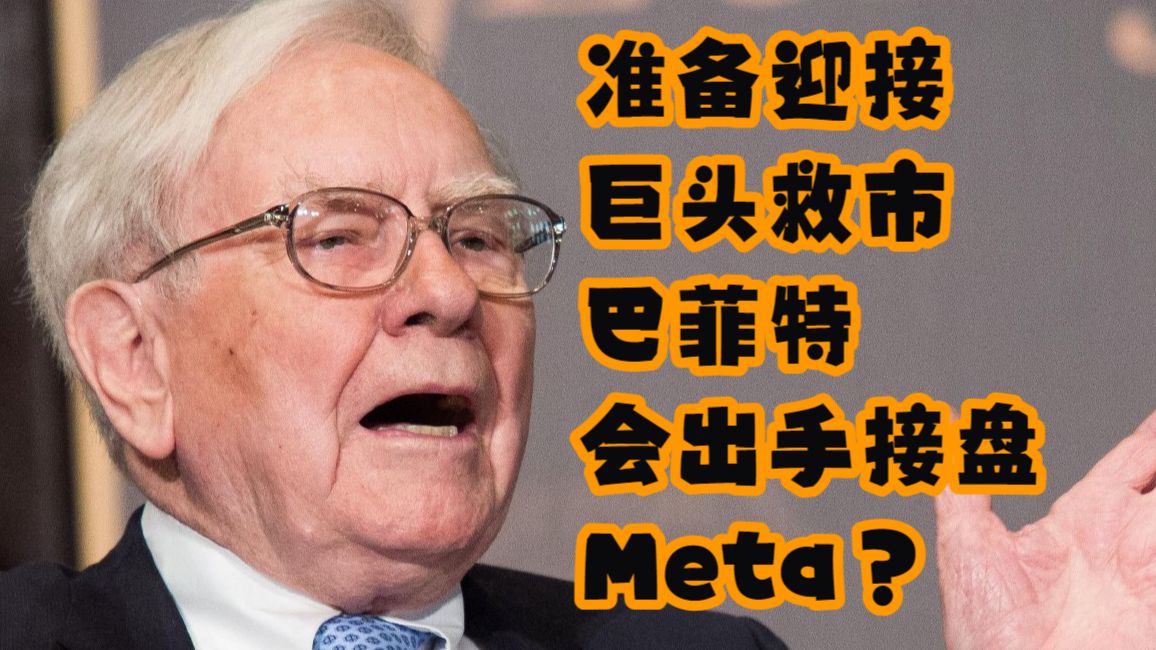
债务承压促Meta谋求优先股融资 伯克希尔或注资接盘
浑水摸鱼清源
面对信贷息差飙升与千亿算力开支压力,Meta效仿谷歌发行强制可转优先股既能大幅降低税负成本,又为坐拥3600亿美元现金的伯克希尔提供了以股权形态锁定核心科技资产的折价入场契机。
AI-assisted summary of 【Meet Kevin】准备迎接巨头救市:巴菲特会出手接盘Meta? — original source. Check the original for full context.
Source published:
Key ideas
- 市场猜测拥有逾3600亿美元现金储备的伯克希尔·哈撒韦可能效仿投资谷歌的模式,通过强制可转换优先股为面临千亿AI基建资金压力的Meta提供股权融资。 (0:00)
- 高盛数据显示华尔街对冲基金净杠杆率已暴跌至五年来的0百分位(仅43.7%),但科技巨头前瞻盈利预期持续上调,形成罕见的估值与基本面背离。 (2:11)
- 强制可转换优先股能享受长期资本利得税率(相比普通债券利息近50%的所得税),可为机构投资者增加约25%的税后实际现金收益,成为Meta规避高企企业债成本的理想工具。 (6:50)
- 布鲁姆能源(Bloom Energy)与业内测算显示,一座1吉瓦AI数据中心的年化产出可达400亿至500亿美元,初期约570亿美元的基建投入有望在1至1.5年内收回成本。 (20:00)
- 标普500指数未来预期盈利增长中,AI核心标的贡献了高达78%的增量,非AI成分股预期同比增速仅为4%左右。 (23:30)
Detailed notes
## Background 本内容由UP主“浑水摸鱼清源”于2026年10月24日发布在哔哩哔哩平台上,时长约为26分45秒。视频简介聚焦于财经博主Meet Kevin探讨巴菲特旗下伯克希尔·哈撒韦是否会出手接盘Meta,重点分析了对冲基金极端去杠杆、强制可转换优先股的税务套利优势,以及千亿AI算力基建投资背后的真实回报率。
## TL;DR 视频深度剖析了Meta在AI军备竞赛中面临的高额资本开支与债务压力,指出其极有可能效仿谷歌向手握逾3600亿美元现金的伯克希尔定向发行强制可转换优先股。主持人Kevin结合高盛与Vanda的数据,指出当前对冲基金净杠杆率已跌至极值的43.7%,呈现基本面盈利上调与估值压缩的严重背离。通过拆解布鲁姆能源与台积电的财务数据,视频论证了1吉瓦数据中心年创收达400亿至500亿美元的高效回报模型,并强调AI巨头驱动了标普500指数78%的盈利增长,呼吁投资者在市场恐慌和技术面支撑位果断逆向布局。
## Atmosphere & style 整体氛围节奏明快、充满实战交易员的紧迫感与果决自信。Kevin在白板推演算力经济学与实时监控盘面异动之间无缝切换,既有穿插突发地缘政治头条的神经紧绷,又有见证大盘触底反弹时“言行一致”的快意。语调兼具激昂的布道感与冷静的数字拆解,带给观众一种在机构恐慌踩踏中抓取非对称阿尔法收益的刺激观感。
## Bulletin - [00:00](https://www.bilibili.com/video/BV1WsHA6uEnr?t=0s) 市场猜测拥有逾3600亿美元现金储备的伯克希尔·哈撒韦可能效仿投资谷歌的模式,通过强制可转换优先股为面临千亿AI基建资金压力的Meta提供股权融资。 - [02:11](https://www.bilibili.com/video/BV1WsHA6uEnr?t=131s) 高盛数据显示华尔街对冲基金净杠杆率已暴跌至五年来的0百分位(仅43.7%),但科技巨头前瞻盈利预期持续上调,形成罕见的估值与基本面背离。 - [06:50](https://www.bilibili.com/video/BV1WsHA6uEnr?t=410s) 强制可转换优先股能享受长期资本利得税率(相比普通债券利息近50%的所得税),可为机构投资者增加约25%的税后实际现金收益,成为Meta规避高企企业债成本的理想工具。 - [20:00](https://www.bilibili.com/video/BV1WsHA6uEnr?t=1200s) 布鲁姆能源(Bloom Energy)与业内测算显示,一座1吉瓦AI数据中心的年化产出可达400亿至500亿美元,初期约570亿美元的基建投入有望在1至1.5年内收回成本。 - [23:30](https://www.bilibili.com/video/BV1WsHA6uEnr?t=1410s) 标普500指数未来预期盈利增长中,AI核心标的贡献了高达78%的增量,非AI成分股预期同比增速仅为4%左右。
## Key takeaways - [00:00](https://www.bilibili.com/video/BV1WsHA6uEnr?t=0s) 苹果成为AI抛售潮中唯一的防御避风港,其与纳斯达克的两个月相关性历史上首次转为负值,占伯克希尔权益组合约22%。 - [02:11](https://www.bilibili.com/video/BV1WsHA6uEnr?t=131s) 机构经历罕见的3个标准差抛售冲击,对冲基金净杠杆率降至43.7%的极值,显示市场恐慌与去杠杆已接近尾声。 - [02:11](https://www.bilibili.com/video/BV1WsHA6uEnr?t=131s) 科技股呈现前瞻市盈率大幅压缩与前瞻盈利预期持续创历史新高的背离,构筑了典型的非对称价值买点。 - [03:45](https://www.bilibili.com/video/BV1WsHA6uEnr?t=225s) 强制可转换优先股兼具高额固定股息收益与到期强制转股特征,使巴菲特既能获取当期现金流,又能作为长期股东参与复利增长。 - [05:00](https://www.bilibili.com/video/BV1WsHA6uEnr?t=300s) 巴菲特偏好可转换结构而非纯债贷款,目前其公开持仓中苹果与谷歌的合计占比已超过31%。 - [06:50](https://www.bilibili.com/video/BV1WsHA6uEnr?t=410s) 税收套利是优先股融资的核心优势:加州税收环境下普通债券利息税后收益仅约3.125%,而优先股税后净收益达4.19%,到手收益提升约25%。 - [07:45](https://www.bilibili.com/video/BV1WsHA6uEnr?t=465s) Meta现有公募债券收益率升至约7%,全球信贷息差创17个月新高且违约互换成本飙升,使得传统借贷渠道融资成本极为沉重。 - [10:00](https://www.bilibili.com/video/BV1WsHA6uEnr?t=600s) Evercore分析师预估Meta在未来3至6个月内需筹措500亿至1000亿美元用于AI军备竞赛,股价回调至200日均线加剧了其融资紧迫性。 - [12:00](https://www.bilibili.com/video/BV1WsHA6uEnr?t=720s) 台积电资本开支占营收比例从44%降至约36%且均由经营现金流覆盖,佐证半导体上游并未出现失控泡沫。 - [15:00](https://www.bilibili.com/video/BV1WsHA6uEnr?t=900s) 摩根大通历史数据表明,自1950年代以来,美股在重大选举尘埃落定后几乎无一例外地迎来强劲的释压性反弹。 - [18:00](https://www.bilibili.com/video/BV1WsHA6uEnr?t=1080s) 布鲁姆能源披露1吉瓦算力集群每推迟一个季度投产将造成100亿美元营收损失,迫使超大规模云厂商不计成本抢建基础设施。 - [18:00](https://www.bilibili.com/video/BV1WsHA6uEnr?t=1080s) OpenAI与Anthropic等一级市场估值回落为健康估值挤泡沫过程,有利于降低未来二级市场上市时的溢价风险。 - [20:00](https://www.bilibili.com/video/BV1WsHA6uEnr?t=1200s) 以GB300或Vera Rubin架构搭建的1吉瓦数据中心成本约570亿美元,按年营收400亿至500亿美元测算,首年回报率高达70%至87%。 - [23:30](https://www.bilibili.com/video/BV1WsHA6uEnr?t=1410s) AI核心公司以20%至30%的年均复合增速推动标普500指数78%的增量利润,决定了整个大盘未来的基本面支撑。
## Detailed walkthrough ### [00:00](https://www.bilibili.com/video/BV1WsHA6uEnr?t=0s) Berkshire Hathaway's Cash Pile and the Apple "Anti-Suck" Safe Haven
The market is buzzing with speculation that Warren Buffett and Berkshire Hathaway could potentially step in to provide a lifeline for Meta. To understand the viability of this move, it helps to examine Berkshire’s existing footprint in mega-cap tech, led overwhelmingly by Apple. Apple remains the crown jewel and largest holding in Berkshire’s portfolio, commanding approximately 22% of its total equity investments. Recently, Apple has turned into what is described as the ultimate "anti-suck" trade. For the first time in history, Apple's two-month correlation with the Nasdaq turned negative, positioning the consumer tech titan as an unexpected flight-to-safety haven within the otherwise turbulent AI landscape.
While other Magnificent Seven peers faced relentless pressure over massive capital expenditure demands, Apple stood out as the sole green outlier on the trading board. The broader tech pack faces a grueling cycle where each firm is expected to constantly raise and spend astronomical sums of money to build out AI capacity. Meanwhile, Berkshire Hathaway is sitting on an unprecedented war chest of over $360 billion in dry powder. Because Apple has traded counter to the broader tech sell-off and held near historic valuations—vying with Nvidia as one of the most valuable corporations on Earth—Berkshire's net asset base and balance-sheet firepower have grown even stronger. This staggering liquidity has led market observers to wonder if Buffett might soon swoop in and back Meta, mirroring an earlier financing structure deployed with Alphabet.
“Apple's two-month correlation with the NASDAQ turned negative for the first time in history, now being seen as a safe haven in the AI trade.”
- Berkshire Hathaway holds roughly 22% of its public equity portfolio in Apple shares. - Berkshire boasts an unencumbered cash pile exceeding $360 billion. - Apple recently traded as the only green component among the Magnificent Seven due to its non-dilutive, safe-haven status.
---
[02:11](https://www.bilibili.com/video/BV1WsHA6uEnr?t=131s) Extreme Hedge Fund De-leveraging and Tech Valuation Compression
The macroeconomic backdrop reveals an acute dislocation between corporate operating strength and Wall Street positioning. Despite anxieties surrounding geopolitical tensions with Iran, Federal Reserve interest-rate path uncertainty, and the looming U.S. presidential election, the current sell-off is fundamentally driven by violent institutional de-risking rather than exogenous shocks. The market just weathered a severe three-standard-deviation selling event. According to Vanda Research, hedge funds have been slashing equity exposure at an aggressive velocity seldom witnessed outside of full-blown market crashes.
Data from Goldman Sachs underscores how washed-out market sentiment has become: institutional net leverage has collapsed to the zeroth percentile on a five-year lookback, plumbed to a modest 43.7%. Curiously, this hedge fund exodus coincides with a dramatic divergence between company fundamentals and valuation multiples. Forward corporate earnings estimates have marched steadily upward month after month, tracking along an unbroken trajectory of upward revisions. Yet outside of a brief relief bounce in April, forward price-to-earnings (P/E) multiples have compressed aggressively through April and May as AI sustainability doubts mounted. This specific pattern—depressed forward multiples against expanding earnings power—is precisely the kind of asymmetric value setup that catches the attention of Berkshire Hathaway.
“Per Vanda hedge funds are cutting exposure at a pace rarely seen outside of major market shocks and net leverage is at the zeroth percentile on a five-year basis for hedge funds right now per Goldman indicating net leverage is sitting at just 43.7% for hedge funds, which is a very interesting time because it aligns with a lot of tech stocks actually getting substantially cheaper on a valuation basis, as earnings forecasts are rising.”
- Hedge fund net leverage dropped to the 0th percentile over five years, reaching 43.7%. - Wall Street endured a rare 3-standard-deviation institutional selling impulse. - Mega-cap forward earnings projections continue setting new highs while forward P/E ratios have cratered since the spring.
---
[03:45](https://www.bilibili.com/video/BV1WsHA6uEnr?t=225s) The Mechanics of Mandatory Convertible Preferred Stock
Reporting from *Barron's* suggests that Meta might address its heavy capital expenditure burdens by pursuing a tailored equity partnership with Berkshire Hathaway, structured after Alphabet’s summer financing model. Over the summer, Alphabet tapped the capital markets using mandatory convertible preferred stock. Under this instrument, the issuing company agrees to disburse an attractive fixed yield as a preferred dividend over a predetermined holding horizon, after which the investment automatically converts into common equity.
In concrete terms, if an investor injected $100 into the Alphabet issuance, the company committed to paying out an annual coupon yield of $6.25 through the summer of 2029. Rather than returning the initial $100 cash principal upon maturity as a traditional corporate bond would, the structure mandates that the principal balance automatically transforms into underlying equity shares. The ultimate number of common shares the investor receives is determined by two pricing thresholds relative to where the stock is trading at the time of conversion, ensuring both guaranteed income upfront and guaranteed equity ownership at the end.
“Google issued a mandatory convertible preferred stock.”
```mermaid flowchart TD accTitle: Structure of Mandatory Convertible Preferred Stock accDescr: Visual diagram showing the progression of capital from initial investment through annual yield to mandatory equity conversion.
subgraph Phase1 ["Investment Stage"] A["Investor injects $100 capital"] end
subgraph Phase2 ["Holding Period (Through Summer 2029)"] B["Annual Preferred Dividend Paid<br/>$6.25 per year (6.25% Yield)"] end
subgraph Phase3 ["Maturity Conversion"] C{"Conversion Calculation"} D["Shares based on Lower Threshold"] E["Shares based on Upper Threshold"] F["Mandatory Common Equity Ownership Delivered"] end
A --> B B --> C C -->|"Stock Below Range"| D C -->|"Stock Above Range"| E D --> F E --> F ```
---
[05:00](https://www.bilibili.com/video/BV1WsHA6uEnr?t=300s) Berkshire's Warren Buffett Playbook and Alphabet's Precedent
The mandatory convertible preferred design aligns directly with Warren Buffett’s time-tested investment playbook. When providing emergency liquidity or anchor financing to blue-chip enterprises, Berkshire Hathaway has historically eschewed plain vanilla corporate debt loans in favor of hybrid convertible instruments that retain equity upside. By avoiding straight debt, Buffett guarantees that Berkshire does not simply receive its original money back after collecting interest; instead, the firm transitions directly into an ongoing equity partner in an asset that can compound over decades.
This framework is particularly relevant because Berkshire has already established a substantial footprint across the modern tech landscape. Alongside its 22% portfolio allocation in Apple, Berkshire has quietly accumulated a position in Alphabet representing roughly 9.4% of its public portfolio. *Barron's* reports that Meta's anticipated equity raise could launch within the coming weeks as Mark Zuckerberg attempts to stay ahead of market liquidity drains—referred to as "the great suckening"—and build out Meta's massive AI war chest. Partnering with Berkshire on an Alphabet-style equity transaction would provide Meta with rapid, high-credibility financing without flooding the public markets with sudden spot dilution.
“Warren Buffett long favors convertibles because Berkshire prefers to get equity exposure rather than making a straight loan.”
“Meta eyes an early equity deal for its AI war chest and Berkshire could be a buyer.”
- Alphabet represents approximately 9.4% of Berkshire Hathaway's public portfolio. - Apple and Alphabet collectively account for over 31% of Berkshire's public stock holdings. - *Barron's* anticipates Meta could seek an early partner-driven equity round within weeks to stay ahead of peer dilution.
---
[06:50](https://www.bilibili.com/video/BV1WsHA6uEnr?t=410s) The Tax Arbitrage: Preferred Equity Yield vs. Ordinary Debt
The strategic brilliance behind Alphabet’s hybrid issuance—and the reason Meta is expected to copy it—lies in tax arbitrage. In traditional loan and corporate bond transactions, the $6.25 annual coupon payout is classified as ordinary debt interest. For wealthy individuals and institutional tax-sensitive structures, that interest is subject to ordinary income tax rates, which can reach roughly 50% in high-tax jurisdictions like California. After factoring in federal and state ordinary income taxes, a 6.25% gross interest yield can shrink to a net after-tax yield of just 3.125%.
In stark contrast, distributions from mandatory preferred shares can be treated as long-term capital gains or qualified corporate dividends. Even factoring in California’s state-level rate of around 13% alongside federal capital gains brackets, the composite effective tax rate drops to approximately 33%. Applying a 33% tax rate to a $6.25 preferred payout leaves an investor with a net after-tax return of approximately 4.19%. By structuring the financing as preferred equity rather than straight corporate borrowing, the issuer hands the backer roughly 25% more net cash in their pocket while ensuring the funding converts smoothly into stock at expiration.
“What Google did by Google calling this a preferred equity round that offers you yield, you're actually getting about 25% more net money in your pocket than you would if you called it debt, and you end up with the stock.”
| Feature | Straight Corporate Loan / Debt | Mandatory Convertible Preferred Equity | |:--- |:--- |:--- | | **Gross Annual Payout** | $6.25 (6.25% on $100) | $6.25 (6.25% on $100) | | **Tax Classification** | Ordinary Income | Long-term Capital Gains / Qualified Dividends | | **Est. California Top Tax Rate** | ~50% | ~33% | | **Net Yield in Pocket** | ~3.125% | ~4.1875% (~4.19%) | | **Net Cash Advantage** | Baseline | **~25% more after-tax cash yield** | | **Maturity Outcome** | Cash principal returned | Converts directly into Common Stock |
---
[07:45](https://www.bilibili.com/video/BV1WsHA6uEnr?t=465s) Meta's Debt Dilemma and Surging Credit Default Swap Spreads
Meta is under mounting pressure to choose preferred equity over traditional bond debt due to escalating stress in the credit markets. Existing corporate bonds issued by Meta are currently yielding around 7%. Because that 7% payout is fully taxable as ordinary income, borrowing through standard credit channels is becoming exceptionally expensive for the enterprise while remaining tax-inefficient for prospective lenders. Furthermore, the cost of insuring Meta's debt via credit default swaps (CDS) has been climbing sharply as bondholders grow uneasy about the pace of hyper-scaler capital spending.
This dynamic reflects a broader retreat across international fixed income. As highlighted on the front page of *Bloomberg*, anxiety over unchecked AI infrastructure outlays has driven global corporate credit spreads to a 17-month high. Key bond metrics across worldwide markets are signaling the most intense risk-off sentiment observed in over a year. Spreads on dollar-denominated bonds for high-grade Asian corporations have blown out to levels not seen since July 2025, moving in lockstep with tightening global financial conditions. With debt markets becoming punitive and risk premiums widening, leaning on Warren Buffett for preferred equity financing represents an increasingly attractive escape valve for Meta.
“AI tech fears push global credit spreads to 17-month high.”
- Meta's existing public debt trades at yields near 7%, carrying onerous ordinary tax liabilities. - Credit default swap (CDS) premiums on major AI infrastructure spenders have spiked markedly. - Global credit spreads surged to a 17-month peak, with high-grade dollar debt spreads widening to levels not seen since July 2025.
[10:00](https://www.bilibili.com/video/BV1WsHA6uEnr?t=600s) Meta’s Looming Capital Raise and the Reinvest Playbook
With global credit default swap spreads surging to their widest levels since May, fundraising for the multi-billion-dollar artificial intelligence buildout is becoming noticeably more expensive for big tech. In the midst of this credit tightening, Evercore analysts highlighted to *Barron’s* that Meta could potentially seek between $50 billion and $100 billion over the next three to six months through a blended financing structure of equity and debt. Kevin notes that Meta’s share price has surrendered nearly all of its recent momentum, landing squarely on its 200-day moving average (DMA). To Kevin, this price technicality signals an urgent window for corporate action. As Kevin puts it: “JP Morgan wrote in a note that an equity deal could come even sooner and that recent weakness in Meta shares could add some urgency to that.”
During the broadcast, Kevin tracks live market price action as the Nasdaq-100 (QQQ) reclaims key levels alongside intraday rallies in Meta and AMD. He reflects on his own strategy, explaining that he sent dip-buying trade alerts to members of his Reinvest One community just the day prior when the index hovered around 702 and 704, followed by an AMD entry that morning. He frames Meta's weakness not as a structural failure of its underlying business, but as an acute liquidity symptom of an unprecedented AI infrastructure race.
Taking a brief commercial detour, Kevin pitches the Reinvest One ecosystem, reminding viewers that a single tier gives members lifetime access to trade alerts, live streams, the Alpha Report, agentic AI blueprints for consumers and businesses, and specialized terminals covering stocks, real estate, and equity research. He underscores that navigating complex corporate funding cycles requires real-time data rather than trailing headlines, which makes tracking these tech giants' debt and equity machinations paramount for retail traders.
- **Meta Funding Needs:** Analysts at Evercore estimate Meta may look to raise $50 billion to $100 billion across debt and equity instruments within three to six months. - **Technical Juncture:** Meta stock has tested its 200-day moving average following a complete retracement of its previous hype-driven breakout. - **Credit Conditions:** Global corporate debt issuance spreads have widened to their highest levels since May, raising the bar on traditional bond offerings.
---
[12:00](https://www.bilibili.com/video/BV1WsHA6uEnr?t=720s) Semiconductor Health, Berkshire’s Cash Pile, and Hedge Fund De-leveraging
Addressing growing concerns that the artificial intelligence trade is on the precipice of an outright crash, Kevin points to a newly published analysis from *The Economist* titled *"Is the semiconductor industry headed for an almighty crash?"* The publication’s thesis answers firmly in the negative by examining upstream manufacturing fundamentals. Rather than runaway, unbacked spending, capital expenditures at primary chipmakers are moderating relative to their top-line growth. Taiwan Semiconductor Manufacturing Company (TSMC), for instance, has seen its CapEx decline from 44% of revenue down to an estimated 36%, with the vast majority of its ongoing expansions funded strictly through internal operating cash flows. While intermediate hardware and fuel cell plays like Bloom Energy have faced sharp intraday declines—dropping 10.5% after posting negative free cash flow—Kevin stresses that underlying disclosures from both Bloom Energy and Western Digital prove that physical computing infrastructure demand remains miles away from a cyclical peak.
The conversation naturally shifts to Berkshire Hathaway's role as a potential liquidity savior. With Berkshire's stock rebounding toward fresh all-time highs—buoyed by its substantial stake in Apple serving as Wall Street's preferred defensive AI anchor—Kevin ponders the sheer psychological impact if Warren Buffett’s firm were to step into Meta’s financing. Berkshire currently sits on an unprecedented war chest of approximately $360 billion in liquid cash. Kevin asserts that if even a fraction of this cash is deployed into AI infrastructure via convertible debt or preferred shares, sentiment would violently reverse course.
Simultaneously, institutional positioning has reached historic extremes. Goldman Sachs and Morgan Stanley desks indicate that hedge fund net leverage has collapsed to multi-year lows, showing an aggressive shedding of semiconductor exposure that is rarely observed outside of systemic liquidity shocks. Although the VIX breached 19.5 for the first time since late July, Kevin views this institutional capitulation as an asymmetric contra-indicator. As Kevin emphasizes: “In my opinion, you inverse that.”
```mermaid flowchart TD accTitle: Big Tech AI Infrastructure Funding Dilemma accDescr: Diagram showing how Big Tech faces expensive corporate bonds, leading to a preferred equity deal with Berkshire Hathaway, funded by its cash hoard, sparking an institutional short squeeze.
subgraph CostOfCapital["1. Capital & Debt Pressures"] A["Meta AI Infrastructure Needs<br/>($50B - $100B Required)"] --> B["Traditional Corporate Debt<br/>(Widest Spreads Since May)"] end
subgraph InstitutionalBackstop["2. Strategic Solution"] B --> C["Convertible Preferred Equity Deal"] D["Berkshire Hathaway<br/>($360B Liquid Cash War Chest)"] --> C end
subgraph MarketReaction["3. Wall Street Sentiment Shift"] C --> E["Hedge Funds at 0th Percentile Leverage"] E --> F["Violent Institutional Short Squeeze"] end ```
- **TSMC Capital Efficiency:** CapEx as a percentage of total revenue at TSMC has compressed from 44% to roughly 36%, indicating sustainable balance sheet governance. - **Berkshire's Powder Keg:** Berkshire Hathaway holds over $360 billion in liquid reserves, providing sufficient capacity to single-handedly underwrite multiple mega-cap tech financings. - **Institutional Drawdown:** AI basket beneficiaries monitored by Goldman Sachs are down 25% from their cycle peaks, while Morgan Stanley's basket shed 16% in a single week. - **Volatility Benchmark:** The Cboe Volatility Index (VIX) registered its first daily close above 19.5 since late July.
---
[15:00](https://www.bilibili.com/video/BV1WsHA6uEnr?t=900s) Historical Post-Election Rallies and Macro Bets on Kalshi
Kevin transitions to the macroeconomic backdrop, arguing that financial markets are quietly coiling for an explosive relief rally once political and geopolitical uncertainties clear out. Citing long-term historical analyses compiled by JPMorgan dating back to the 1950s, post-election periods—especially following contentious midterm and general election cycles—reliably trigger aggressive upside reversals as sidelined cash re-enters risk assets. As Kevin outlines: “I personally think we are setting up for a massive post-election rally because I think what we'll end up having is we'll have more color on what's going on with Iran.”
Turning to prediction markets on Kalshi, Kevin inspects retail and institutional wagering on macro variables, including Federal Reserve interest rate paths, geopolitical agreements, and high-profile domestic elections. He observes mounting betting volume on a potential Iran nuclear framework, noting that implied odds have begun to edge slightly upward. Despite acknowledging that many market participants view a breakthrough as unrealistic, he maintains his conviction that an eventual diplomatic de-escalation will curb energy-driven inflation and leave the Federal Reserve room to deliver only a single rate hike or hold steady.
Kevin openly notes his commercial affiliation with Kalshi as a sponsor of his startup, Reinvest, before evaluating election odds, particularly the heavy wagering surrounding figures like Elon Musk and Ken Paxton, where liquidity has climbed past $39 million. Kevin also jokes about his own near-term prediction timeline—his self-styled "taco trade"—which gives market catalysts until Tuesday or Wednesday to materialize. He quips that while he might end up with "egg on his face" if the timing slips, his broader macroeconomic calls, such as identifying the precise multi-year peak in 10-year Treasury yields and calling the top in spot gold, have proven remarkably accurate.
- **Historical Precedent:** JPMorgan historical datasets demonstrate that US equity markets have systematically staged sharp post-election rallies in nearly every major cycle since the 1950s. - **Federal Reserve Outlook:** Market probabilities on Kalshi continue to reflect an environment where the Fed is largely contained, with high probabilities favoring minimal rate changes if Middle Eastern tensions de-escalate. - **Prediction Market Volume:** Political and geopolitical contract volume on Kalshi has swelled, with isolated betting pools like the Ken Paxton market seeing upwards of $39 million in turnover.
---
[18:00](https://www.bilibili.com/video/BV1WsHA6uEnr?t=1080s) Data Center Economics: Bloom Energy’s $40 Billion Gigawatt Math
Kevin returns to the transformative structural thesis of a potential Berkshire Hathaway entry into Meta's debt stack, emphasizing how institutional validation would immediately rewrite Wall Street's prevailing risk model. If Berkshire agrees to underwrite Meta's convertible preferred equity, it would signal to institutional skeptics that current tech price-to-earnings multiples are deeply discounted rather than overextended.
To demonstrate why hyperscalers are willing to raise capital at almost any cost to keep pace, Kevin shares an excerpt from his morning member livestream reviewing Bloom Energy’s latest earnings disclosures. Bloom Energy's management laid out an astonishing economic metric quantifying the commercial penalty of delayed data center deployment: every single quarter of construction delay on a 1-gigawatt (GW) data center facility equates to an astronomical $10 billion in forfeited top-line enterprise revenue. For smaller 100-megawatt builds, that delay cost equals $1 billion per quarter. Scaled across an entire calendar year, an operational 1-gigawatt AI computing cluster generates upwards of $40 billion in high-margin economic value.
Kevin notes that Bloom Energy’s hard math directly corroborates the ambitious operational calculations previously outlined by Elon Musk. With individual clusters yielding billions in recurring economic output, capital spending cannot be evaluated using traditional, linear corporate budgeting metrics. Finally, addressing the recent cooling of pre-IPO private market valuations for leading foundational model developers like OpenAI and Anthropic, Kevin dismisses the doomsday narrative. He insists that washing out frothy private valuations before these companies list on public exchanges is an exceptionally healthy reset for long-term equity investors. As Kevin summarizes: “It's honestly the best thing possible.”
- **The Gigawatt Revenue Equation:** A 1-gigawatt AI data center generates approximately $10 billion in top-line revenue per quarter, or $40 billion annually. - **Cost of Infrastructure Delays:** A single quarter's delay in bringing a 100-megawatt cluster online forfeits $1 billion in top-line business, justifying massive upfront CapEx by hyperscalers. - **Private Valuation Normalization:** The markdown in pre-IPO valuations for foundational model providers such as OpenAI and Anthropic provides an optimal reset, clearing speculative froth before public market debuts.
[20:00](https://www.bilibili.com/video/BV1WsHA6uEnr?t=1200s) The 1-Year Data Center Payback and Bloom Energy Economics
Kevin steps over to his whiteboard to map out the financial mechanics behind next-generation artificial intelligence infrastructure, linking the discussion to Elon Musk's bold operational claims. Musk has argued that tier-one operators can achieve an astonishing one-year payback period on state-of-the-art AI data centers, a dynamic that Kevin notes also underpins a compelling strategic interplay between Tesla and SpaceX. Wiping down the wet board to run the figures, Kevin lays out the baseline: an advanced gigawatt-scale facility—equipped with cutting-edge hardware like Nvidia’s GB300 or next-gen Vera Rubin architectures—carries an upfront build-out cost of roughly $57 billion. Against that capital outlay, Musk projects that a fully operational gigawatt can generate between $40 billion and $50 billion in annual revenue.
```mermaid flowchart LR accTitle: Gigawatt Data Center Payback Model accDescr: Flowchart illustrating the capital cost of building a gigawatt facility against its projected annual revenue and payback timeline. subgraph BuildCost ["Upfront Capital Cost"] CapEx["Gigawatt Facility (GB300 / Vera Rubin)<br/>~$57 Billion"] end subgraph AnnualReturn ["Annual Revenue Potential"] RevLow["Conservative: $40 Billion / yr<br/>~70% Payback in Year 1"] RevHigh["Optimistic: $50 Billion / yr<br/>~87% Payback in Year 1"] end CapEx --> RevLow CapEx --> RevHigh ```
Running the division, $40 billion against a $57 billion spend yields roughly a 70% payback within twelve months, while the upper-end $50 billion projection delivers an 87% payback. Kevin puts that return profile into perspective for real estate investors: “That's kind of like buying a rental property and then it paying for itself from rent in a year and a third.” While early market skeptics underwrote deals at a much more modest $10 billion to $20 billion per gigawatt—which raised fears that rapidly depreciating silicon would destroy capital—recent earnings commentary from Bloom Energy corroborates the higher-end revenue run rates. That validation drastically derisks the thesis, especially as high-end accelerator chips continue to appreciate in market value rather than decay.
- **Facility Upfront Cost**: ~$57 billion per gigawatt for cutting-edge deployments (GB300 / Vera Rubin). - **Annual Revenue Potential**: $40 billion to $50 billion per gigawatt. - **Payback Velocity**: 70% to 87% of initial CapEx recovered within year one. - **Depreciation Dynamics**: Chip pricing power remains elevated, defying traditional fast-depreciation hardware assumptions.
---
[22:15](https://www.bilibili.com/video/BV1WsHA6uEnr?t=1335s) Breaking Geopolitical Headlines and Meta at the 200-Day Moving Average
Mid-stream, Kevin pauses as breaking geopolitical headlines flash across his terminal. Donald Trump has issued a fresh statement on the Middle East: *"We could end Iran war very quickly. Do we want to finish it or let it wither is the question. We could take all of the oil in Iran."* Kevin flags the news alert for viewers tracking macro volatility on the Meet Kevin app before pivoting back to the broader thesis laid out in *Barron’s* regarding tech-sector valuations and Meta’s balance sheet.
Kevin emphasizes that recent market pullbacks have driven Meta right down to its 200-day moving average (200 DMA). In his view, the sell-off has completely washed out the recent speculative froth surrounding its product launches and initiatives, presenting a rare mispricing for long-term investors. Evaluating Meta's beaten-down valuation multiple, Kevin makes his stance unequivocal: “You are basically buying Meta for free now, or you're buying Muse for free now, buying Meta stocks at this value. I think it is a steal.”
- **Macro Wire**: Breaking geopolitical commentary from Trump regarding rapid intervention scenarios in Iran. - **Technical Benchmark**: Meta testing critical long-term support at its 200-day moving average. - **Valuation Reset**: Near-term sentiment reset provides an attractive entry point, stripping out extraneous hype.
---
[23:30](https://www.bilibili.com/video/BV1WsHA6uEnr?t=1410s) Berkshire’s Playbook and AI as the S&P 500's Growth Engine
Turning to Berkshire Hathaway's potential involvement, Kevin analyzes how Warren Buffett and Greg Abel approach large-scale tech capital injections. *Barron's* floats the possibility that Meta could raise external funding by issuing $20 billion in Class A equity or attractively priced convertible instruments, alongside another $20 billion in non-voting shares. Historically, Berkshire seeks durable earnings growth at a discount—effectively filtering for low PEG ratios and high cash-flow durability. That requirement explains why Berkshire avoids cyclical memory chipmakers prone to boom-and-bust oversupply gluts, but has previously taken massive stakes in Apple and Alphabet when valuations compressed.
```mermaid flowchart TD accTitle: S&P 500 Expected Earnings Growth Split accDescr: Chart illustrating how the vast majority of S&P 500 earnings growth is concentrated in AI names. SP500["S&P 500 Earnings Growth"] --> AI["AI Leaders<br/>78% of Total Growth<br/>(Growing ~20% - 30% YoY)"] SP500 --> NonAI["Non-AI Remainder<br/>Only ~4% YoY Growth"] ```
The health of these AI leaders is make-or-break for the broader stock market. Underscoring the sheer concentration of market earnings, Kevin highlights a critical statistic: “AI names drive 78% of the expected earnings growth for the S&P 500.” Non-AI components of the index are projected to muster a meager 4% earnings growth next year, compared to the 20% to 30% clip projected across the AI complex. As the trading session unfolds, Kevin spots an intraday reversal taking shape on the indexes, noting the bounce on the QQQ as it exits his target buy window. Wrapping up the session, he reminds viewers that executing disciplined trades through periods of peak panic is precisely how long-term alpha is captured: “We put our money where our mouth is.”
- **Berkshire Financing Structure**: Potential combination of convertibles and up to $20 billion in Class A or non-voting equity. - **Historical Precedent**: Berkshire's playbook mirrors its opportunistic entries into Apple a decade ago and Alphabet more recently. - **Index Concentration**: AI names represent 78% of all forward earnings growth across the S&P 500; non-AI names are forecast to expand by only 4%. - **Intraday Execution**: Live dip-buying confirmed as tech indexes rebound off intraday lows, exiting the designated accumulation window.
## Notable quotes > [15:00](https://www.bilibili.com/video/BV1WsHA6uEnr?t=900s) I personally think we are setting up for a massive post-election rally because I think what we'll end up having is we'll have more color on what's going on with Iran. — Kevin
## Mentioned Warren Buffett, Berkshire Hathaway, Meta, Apple, Alphabet, Google, Mark Zuckerberg, Greg Abel, Elon Musk, Donald Trump, Ken Paxton, Nvidia, AMD, TSMC, Bloom Energy, Western Digital, Broadcom, OpenAI, Anthropic, Goldman Sachs, Morgan Stanley, JPMorgan, Evercore, Vanda Research, Barron's, Bloomberg, The Economist, Kalshi, Federal Reserve, QQQ, Cboe Volatility Index (VIX), Reinvest One
## Video description 【Meet Kevin】 准备迎接巨头救市:巴菲特会出手接盘Meta? PREPARE: The Bailout is Coming.
巴菲特与伯克希尔·哈撒韦会成为Meta在AI狂潮中的白衣骑士吗?近期华尔街传出重磅消息,随着Meta为筹措千亿AI基建资金面临巨大的债务压力,市场猜测伯克希尔可能会效仿此前投资谷歌的模式,通过强制可转换优先股的形式对Meta进行巨额股权融资。作为手握超过3600亿美元现金巨头的掌舵者,巴菲特此前已将资产组合的22%重仓苹果,并持有近10%的谷歌股份。若此次再度出手接盘Meta,不仅将彻底缓解科技巨头的资金焦虑,更将为整个AI赛道注入强心剂。
华尔街对冲基金杠杆触底与估值错配 从当前宏观与微观盘面来看,市场情绪正经历极端洗礼。高盛数据显示,对冲基金的净杠杆率已跌至5年来的零百分位,仅为43.7%,创下了除重大市场冲击外的最低水平。与此同时,尽管科技股盈利预期在不断上调,但前瞻市盈率自今年4、5月份以来却一路走低。这种基本面与估值背离的现象表明,市场过度放大了AI泡沫破裂的恐慌情绪。随着华尔街杠杆出清和空头仓位达到极值,市场正在为大选后的强劲反弹积蓄动能。
谷歌式强制可转换优先股的税务密码 为什么说Meta联手伯克希尔并非空穴来风?此前谷歌在夏季曾通过发行强制可转换优先股成功募集资金。这种金融工具对机构投资者极具吸引力,投资者不仅能在持有期间获得每年约6.25%的丰厚收益,最终还能无缝转化为公司股票。更为关键的是,相比于普通企业债券产生的利息需要缴纳高达近50%的最高普通收入税,这类优先股收益可享受长期资本利得税税率,能为大资金节省约25%的实际税负。面对信用违约互换成本攀升和传统债务融资成本的高企,Meta通过股权或可转债形式融资已成必然选择。
算力基建投资回报率与数据中心经济学 外界对AI资本开支的质疑主要集中于投入产出比是否失控。然而,从上游半导体制造商的财务数据来看,行业逻辑依然坚挺。台积电的资本开支占营收比例正从44%逐步回落至36%,现金流支撑力度健康。正如博通和布鲁姆能源在财报交流中所披露的,一座1吉瓦的数据中心每年能够创造40亿至50亿美元的惊人营收,其资本开支的静态投资回报周期甚至不到一年半。只要终端算力代币的需求保持井喷,巨头们砸下的每一分钱都在转化为实打实的长期现金流生产力。
穿越宏观震荡周期的实操指引 把握大选前后的估值修复窗口:鉴于当前对冲基金杠杆率极低且空头情绪见顶,密切关注大选落地后的宏观流动性复苏与潜在的跨月反弹行情。 聚焦具备现金流支撑的AI巨头:在市场无差别杀跌时,优先布局像苹果、Meta等具备极强商业壁垒与资本整合能力的优质标的,切勿盲目跟风恐慌割肉。 动态追踪企业级融资与订单落地:密切关注Meta等巨头后续与大资金的股权合作进展,评估其资本开支对资产负债表的实际优化效果。
简洁时间轴 [00:00] 探讨巴菲特与伯克希尔接盘Meta的可能性 [02:11] 华尔街对冲基金净杠杆率触底与前瞻估值回落 [03:45] 拆解谷歌式强制可转换优先股的税务优势 [06:50] Meta千亿AI军备竞赛与寻找外部融资的迫切性 [12:00] 台积电与布鲁姆能源财报折射的算力回报周期 [14:30] 结合大选周期与VIX波动率展望美股后市反弹
[Source](https://www.bilibili.com/video/BV1WsHA6uEnr)