德国总理对话黄仁勋:AI时代中国的优势,德国补得上吗?
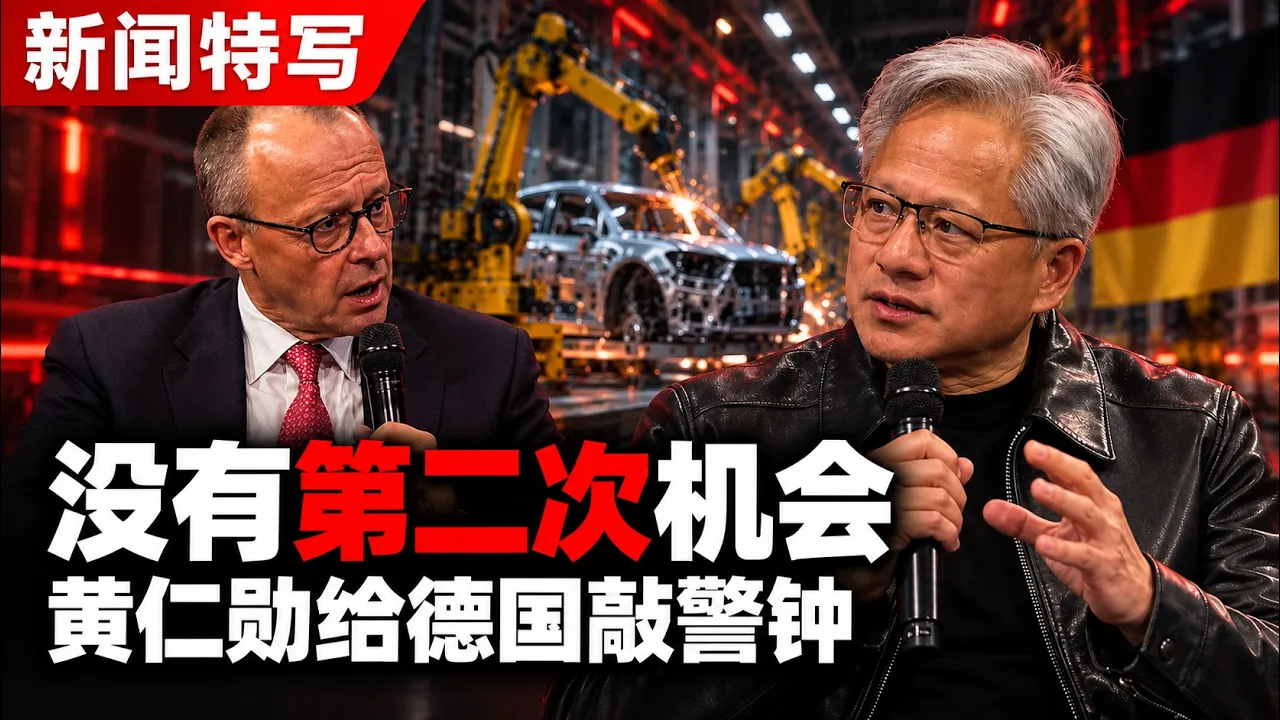
王志安
AI-assisted summary of 德国总理对话黄仁勋:AI时代中国的优势,德国补得上吗? — original source. Check the original for full context.
Source published:
Key ideas
- NVIDIA invested nearly $1 billion in Germany over the past year and is finalizing deals with four additional companies, anchoring its presence with over 1,000 local employees. (15:00)
- Chancellor Olaf Scholz announced that a demonstration Mercedes-Benz S-Class powered by NVIDIA architecture is scheduled to achieve autonomous driving on German roads by year-end. (3:48)
- Jensen Huang identified China as the only global power possessing elite depth in both heavy manufacturing and computer science, contrasting it with the U.S. offshoring of physical craft. (8:22)
- Huang characterized domestic industrial data as a sovereign natural resource, warning Germany not to export its core engineering knowledge abroad only to import back processed intelligence. (6:03)
- The German Chancellor confirmed securing a regulatory carve-out in Brussels for the machinery sector, shielding physical industry from generic EU AI rules to foster innovation. (17:18)
Detailed notes
## Background This video was published on YouTube by the channel 王志安 on October 25, 2026. The description provides chapter timestamps detailing an in-depth dialogue between the German Chancellor and NVIDIA CEO Jensen Huang on AI integration in German industry, digital twins, global manufacturing competition, startup investments, and AI safety regulation.
## TL;DR In an in-depth exchange, NVIDIA CEO Jensen Huang and the German Chancellor discuss the transformative potential of artificial intelligence across Germany's industrial and manufacturing sectors. Huang emphasizes that the frontier of 'Physical AI' and digital twins creates a level playing field, where Germany's electromechanical craftsmanship and deep engineering heritage give it a distinct advantage alongside China and the United States. Both leaders stress the urgent imperative for Germany's Mittelstand to harness domestic sovereign data and utilize AI to preserve institutional knowledge amid demographic aging. The conversation also highlights NVIDIA's expanding direct investments into German startups and calls for balanced, sector-specific application regulation rather than sweeping EU restrictions.
## Atmosphere & style The dialogue is warm, collegial, and spirited, opening with playful banter about swapping jobs and wearing leather jackets before diving into high-stakes economic strategy. Huang brings the dynamic, visionary cadence of a Silicon Valley founder offering candid counsel, while the Chancellor projects pragmatic enthusiasm and political validation for domestic industry. The exchange carries an underlying current of shared urgency, balancing warnings about demographic decline with genuine optimism regarding Germany's engineering prowess.
## Bulletin - [15:00](https://www.youtube.com/watch?v=dIi3X6VJ3v8&t=900s) NVIDIA invested nearly $1 billion in Germany over the past year and is finalizing deals with four additional companies, anchoring its presence with over 1,000 local employees. - [03:48](https://www.youtube.com/watch?v=dIi3X6VJ3v8&t=228s) Chancellor Olaf Scholz announced that a demonstration Mercedes-Benz S-Class powered by NVIDIA architecture is scheduled to achieve autonomous driving on German roads by year-end. - [08:22](https://www.youtube.com/watch?v=dIi3X6VJ3v8&t=502s) Jensen Huang identified China as the only global power possessing elite depth in both heavy manufacturing and computer science, contrasting it with the U.S. offshoring of physical craft. - [06:03](https://www.youtube.com/watch?v=dIi3X6VJ3v8&t=363s) Huang characterized domestic industrial data as a sovereign natural resource, warning Germany not to export its core engineering knowledge abroad only to import back processed intelligence. - [17:18](https://www.youtube.com/watch?v=dIi3X6VJ3v8&t=1038s) The German Chancellor confirmed securing a regulatory carve-out in Brussels for the machinery sector, shielding physical industry from generic EU AI rules to foster innovation.
## Key takeaways - [00:00](https://www.youtube.com/watch?v=dIi3X6VJ3v8&t=0s) German Chancellor Olaf Scholz opened the discussion by joking that if he swapped jobs with Jensen Huang, he would wear a leather jacket to Berlin and invest heavily—a move Huang affirmed he is actively executing. - [00:58](https://www.youtube.com/watch?v=dIi3X6VJ3v8&t=58s) NVIDIA's evolution from a PC gaming graphics firm to an enterprise workstation and automotive leader was catalyzed by its 2000 partnership with Germany's ELSA, followed by landmark alliances with Audi and Mercedes-Benz. - [02:19](https://www.youtube.com/watch?v=dIi3X6VJ3v8&t=139s) Huang outlined a dual-factory paradigm for future industry, where companies operate high-fidelity digital twins to simulate designs and build AI brains before physically assembling autonomous products. - [03:48](https://www.youtube.com/watch?v=dIi3X6VJ3v8&t=228s) Chancellor Scholz made a direct plea to Germany's Mittelstand to unlock their proprietary operational data for AI integration, framing industrial data utilization as crucial for economic resilience. - [06:03](https://www.youtube.com/watch?v=dIi3X6VJ3v8&t=363s) National industrial records and operational histories should be treated as sovereign natural assets, with Huang cautioning against exporting domestic engineering values and importing back processed intelligence. - [06:03](https://www.youtube.com/watch?v=dIi3X6VJ3v8&t=363s) Domain expertise in heavy machinery and electromechanical systems remains irreplaceable by general-purpose AI, positioning 'Physical AI' as an amplifier rather than a substitute for skilled engineers. - [08:22](https://www.youtube.com/watch?v=dIi3X6VJ3v8&t=502s) China represents a unique global competitor because its industrial transformation occurred alongside the rise of computing, granting it world-class depth in both physical manufacturing and software engineering. - [08:22](https://www.youtube.com/watch?v=dIi3X6VJ3v8&t=502s) The generative AI transition resets the software development paradigm, allowing computers to write their own code and reaffirming that digital mastery cannot supplant electromechanical manufacturing. - [11:18](https://www.youtube.com/watch?v=dIi3X6VJ3v8&t=678s) Faced with demographic decline, German manufacturers must urgently deploy AI as an institutional memory bank to capture, codify, and preserve the tacit craftsmanship of aging master workers. - [12:38](https://www.youtube.com/watch?v=dIi3X6VJ3v8&t=758s) Chancellor Scholz asserted that the United States made a fundamental strategic mistake by exporting its manufacturing base, stressing that Germany's economic strength depends on keeping physical production domestic. - [15:00](https://www.youtube.com/watch?v=dIi3X6VJ3v8&t=900s) NVIDIA deployed nearly $1 billion in German tech ventures over the preceding year, backing startups across robotics, aerospace, and foundation models such as Agile Robots and Black Forest Labs. - [17:18](https://www.youtube.com/watch?v=dIi3X6VJ3v8&t=1038s) Huang articulated a three-pillar framework for AI governance comprising technological invention, industrial engineering discipline, and application-specific rather than foundational-level regulation. - [17:18](https://www.youtube.com/watch?v=dIi3X6VJ3v8&t=1038s) Germany successfully negotiated a separate regulatory pathway within the European Union for its mechanical and machinery sectors, protecting traditional manufacturers from blanket AI constraints. - [22:27](https://www.youtube.com/watch?v=dIi3X6VJ3v8&t=1347s) Roughly 50% of German startups founded over the past two years are centered on artificial intelligence, bolstered by government efforts to unlock pension and venture capital reserves.
## Detailed walkthrough ### [00:00](https://www.youtube.com/watch?v=dIi3X6VJ3v8&t=0s) Swapping Jobs and the Berlin Leather Jacket
The conversation opens on a lighthearted note when the moderator asks the German Chancellor what he would do first if he could trade jobs with Jensen Huang for just a single day. The Chancellor immediately leans into Huang’s signature persona, joking that he would throw on a black leather jacket, board a flight to Berlin, meet with the German Chancellor, and announce that he is ready to invest. Huang immediately replies with a smile: “Well, that's exactly what I'm doing.” The Chancellor expresses his gratitude for NVIDIA's commitment, noting that no one has invested more in Germany and calling it a tremendous signal of confidence in the country's economic future.
[00:58](https://www.youtube.com/watch?v=dIi3X6VJ3v8&t=58s) NVIDIA's Deep Roots in German Industry
Jensen Huang reflects on the long, intertwined history between NVIDIA and Germany, emphasizing that German partnerships fundamentally transformed the trajectory of his company. Back in the year 2000, NVIDIA was strictly a consumer-facing graphics company focused exclusively on PC gaming. A pivotal partnership with the German graphics hardware company ELSA opened the door to professional workstations, which subsequently connected NVIDIA to Germany's automotive industry across every phase of vehicle creation—from initial styling and design to simulation, engineering, and manufacturing.
Huang traces the automotive milestones that followed, noting how German automakers continually pushed NVIDIA deeper into the automotive stack. In 2005, Audi became the first automaker to bring NVIDIA's computing architecture directly inside the vehicle. Later, in 2020, Mercedes-Benz Chairman Ola Källenius and Huang formalized a landmark partnership to build next-generation software-defined, autonomous vehicles. Huang underscores that the bond between NVIDIA and German industry is not a recent development, but a deep relationship built over decades.
- **2000**: Partnership with German company ELSA shifts NVIDIA from PC gaming into workstations and automotive styling, design, and simulation. - **2005**: Audi integrates NVIDIA hardware inside the production automobile. - **2020**: Mercedes-Benz and NVIDIA establish an expansive partnership to develop autonomous vehicle platforms.
[02:19](https://www.youtube.com/watch?v=dIi3X6VJ3v8&t=139s) Factories of the Future and Digital Twins
When asked to paint a picture of an engineering office or industrial plant of the future, Huang envisions an industrial landscape centered entirely around dual operations: the physical factory and its digital counterpart. In this coming era, every manufacturing enterprise will operate two parallel facilities. The digital facility—built as a high-fidelity digital twin of the enterprise—will mirror reality with such fidelity that the boundary between the virtual and physical realms dissolves. Most German engineers and industrial workers will spend the bulk of their workdays inside this digital twin, designing virtual cars endowed with digital brains before anything is physically stamped or assembled.
Huang describes an ecosystem where artificial intelligence robots operate inside robotic factories, manufacturing physical cars that are themselves robots. In this software-defined, AI-driven paradigm, the nature of manufacturing shifts from bending metal to generating intelligence. Huang summarizes this structural shift: “So every company will build two things. They will build brains, and the brains that go into the products that they ship.”
```mermaid flowchart LR accTitle: The Dual-Factory Model accDescr: Diagram illustrating how the digital twin and physical factory interact to build intelligent products. subgraph Digital["Digital Twin (Virtual World)"] D1["Digital Engineering & Simulation"] --> D2["Digital Brain Development"] D2 --> D3["Simulated Robotic Assembly"] end subgraph Physical["Physical Factory (Real World)"] P1["Robotic Manufacturing Plant"] --> P2["Physical Autonomous Product"] end Digital -->|"Programs & Validates"| Physical ```
[03:48](https://www.youtube.com/watch?v=dIi3X6VJ3v8&t=228s) Bringing AI to the German Mittelstand and Automotive Sector
The discussion shifts to how the German government intends to translate cutting-edge AI into everyday industrial operations across Germany, from multinational conglomerates to small and medium-sized family businesses. The Chancellor highlights that concrete deployment is already underway, referencing a demonstration model of the new Mercedes-Benz S-Class that was presented to him, which is slated to achieve autonomous driving on German roads by the end of the year as one of the safest and most autonomous production vehicles in the world.
The Chancellor emphasizes that Germany’s ambition extends beyond the European Union; the federal government is fully committed to positioning the country as one of the most advanced hubs in the world for AI integration in physical industry. He identifies Germany's Mittelstand—the vast network of specialized small and medium-sized enterprises—as the nation's foremost competitive asset. Speaking directly to the Mittelstand business leaders in attendance, the Chancellor delivers a passionate plea: “Please. Open your doors for AI to make use of your data.” He stresses that capitalizing on the industrial data already housed within these companies is decisive for Germany's economic resilience, expressing strong optimism that uniting AI pioneers like NVIDIA with the Mittelstand and automotive suppliers will secure Germany's global leadership.
[06:03](https://www.youtube.com/watch?v=dIi3X6VJ3v8&t=363s) Sovereign Data, Domain Knowledge, and Physical AI
Huang strongly endorses the Chancellor’s perspective, framing domestic data as a vital natural resource equivalent to oil or minerals. He argues that a nation's accumulated data embodies its culture, societal values, historical experience, and hard-earned engineering knowledge. While Germany should actively import top-tier global AI tools and infrastructure to harvest this information, it must never surrender its sovereignty by sending its core knowledge abroad only to buy back processed intelligence. Huang states this principle plainly: “And you're absolutely right that you should import the technology to harvest that data and turn it into your national intelligence. But you should not export your culture, export your values, export your knowledge, export your history, and then import German intelligence back.”
Huang then identifies "Physical AI"—artificial intelligence capable of perceiving, reasoning about, and interacting with the physical world—as the next major frontier of technology. He asserts that general-purpose models will never supplant deep domain knowledge in heavy industry, robotics, and electromechanical engineering:
- **Data as a Sovereign Resource**: Domestic industrial records, operational histories, and institutional workflows belong exclusively to the home nation and should be turned into proprietary national intelligence. - **Physical AI vs. Pure Digital AI**: AI is moving into robotics, factory automation, and heavy machinery, domains where software must navigate the laws of physics. - **Inviolability of Domain Expertise**: As Huang puts it, “Artificial general intelligence will never replace domain expertise.” General models cannot intuit the precise physics and design tolerances of specialized electromechanical machinery; therefore, AI serves as an amplifying instrument rather than a replacement for skilled engineers.
[08:22](https://www.youtube.com/watch?v=dIi3X6VJ3v8&t=502s) Global Industrial Revolutions: China's Dual Strength vs. The AI Reset
Addressing Germany's standing in the broader geopolitical race, Huang contextualizes the AI revolution by comparing it to previous technological shifts. The electrification wave established three clear global industrial giants: Germany, the United States, and Japan. However, during the computing and digital revolution of the past fifty years, the United States largely offshored its heavy manufacturing, precision construction, and physical craft, resulting in China emerging alongside Germany and Japan as modern manufacturing titans.
Huang points out that China's unique competitive advantage stems from having undergone its industrial transformation precisely when the computer industry matured. Consequently, China is currently the only major power that possesses world-class depth in heavy manufacturing while simultaneously maintaining world-class depth in computer science and software engineering.
```mermaid flowchart TD accTitle: Evolution of Global Manufacturing Powerhouses accDescr: Flowchart tracing global leaders through electrification, computing, and the current AI reset. subgraph Electrification["First Major Wave: Electrification"] E["Industrial Leaders:<br/>Germany • United States • Japan"] end subgraph Computing["Last 50 Years: Computing Revolution"] C1["United States:<br/>Focus on Software & Digital<br/>Offshored Heavy Craft"] C2["Three Manufacturing Giants:<br/>Germany • Japan • China"] end subgraph Reset["Current AI Revolution: Physical AI Reset"] R["The Software Paradigm Shifts:<br/>Computers Program Themselves<br/>'Electrons will never replace atoms'"] end Electrification --> Computing Computing --> Reset ```
Despite China's head start in combining computing with manufacturing, Huang argues that the generative AI boom creates a clean slate. The prior fifty years required humans to write explicit lines of code, an arena dominated by American software firms. In the new era, computers write their own code based on demonstrated physical requirements, leveling the playing field. Huang stresses that digital mastery alone cannot replicate physical machinery: “All the digital technology in the world will not replace Electromechanical Physical Technology. Electrons will never replace atoms.”
[11:18](https://www.youtube.com/watch?v=dIi3X6VJ3v8&t=678s) Preserving German Craftsmanship and Addressing Aging Labor
Because physical products and electromechanical engineering cannot be replaced by software, Huang urges Germany to seize the current moment with absolute urgency. He warns against complacency, noting: “This industrial revolution is so mighty, is so powerful, you don't have another chance.” The biggest immediate threat confronting the German Mittelstand is not technological obsolescence, but demographic decline. As seasoned master craftspeople and engineers age out of the workforce, decades of tacit knowledge risk vanishing entirely.
Huang urges German business leaders to deploy artificial intelligence as an institutional memory bank. By using AI to capture, teach, and codify the specialized domain skills of veteran workers, Mittelstand companies can preserve their craft domestically and scale it across future generations. Referencing the Chancellor's own terminology, Huang calls on German industry to “re-engineer Germany” around this union of physical craftsmanship and machine intelligence.
[12:38](https://www.youtube.com/watch?v=dIi3X6VJ3v8&t=758s) Bridging Innovation to Implementation and Anchoring Manufacturing
The discussion turns to the critical task of bridging the gap between high-level AI research and practical implementation across factory floors and supply chains. The Chancellor affirms that deep collaboration with technology leaders like NVIDIA is an integral pillar of Germany's strategy. Hearing an American technology leader validate Germany's industrial strategy gives him immense optimism, reinforcing his long-standing political stance that Germany must remain an industrial, manufacturing-driven nation.
The Chancellor contrasts Germany's strategy with that of the United States, arguing that Washington made a fundamental strategic error over recent decades by letting its heavy manufacturing base erode. While the American tech sector is extraordinarily successful, its domestic physical manufacturing footprint has become precariously narrow. The Chancellor concludes that retaining the position of the world's third-largest economy hinges on keeping this broad industrial core intact, asserting: “And I believe and I share your view that the Americans made a big mistake to export their manufacturing.” Huang nods in agreement, opening his response by playfully acknowledging his own vantage point as the leader of a major American corporation.
[15:00](https://www.youtube.com/watch?v=dIi3X6VJ3v8&t=900s) Investing in Germany and the Startup Ecosystem
Jensen Huang traces NVIDIA’s deep entanglement with the German industrial landscape back through a chain of interlocking corporate relationships. He explains that NVIDIA’s initial collaboration with Audi naturally paved the way for its partnership with Mercedes-Benz, which in turn spurred broader investments in robotics and led directly to backing Agile Robots. Beyond robotics, Huang notes that NVIDIA has backed an array of German ventures, including Avelios, Reflex Aerospace, and generative AI pioneer Black Forest Labs. To Huang, these bets are entirely rational: Germany possesses a rare concentration of deep science, engineering, and mathematics that forms the bedrock not only of classical manufacturing, but of modern artificial intelligence. He applauds the government’s explicit commitment to cultivating startup culture, drawing a direct parallel to how the United States continually reinvigorates itself through entrepreneurship.
Putting capital behind that conviction, Huang highlights the scale of NVIDIA’s financial footprint across the country, noting that the company poured nearly a billion dollars into Germany over the past year alone and is closing investments in four additional companies that very week. Joking that NVIDIA has effectively turned into one of the country's most active venture capital firms, Huang playfully taunts the broader financial community: “And so for all of the other venture capitalists, you better hurry, because otherwise I'm going to take all the good deals and I'm going to be rich.” Beyond external investments, NVIDIA employs roughly one thousand people locally, with its Berlin office serving as the birthplace for several foundational corporate inventions, reinforcing Huang’s thesis that German technical and scientific talent is genuinely world-class.
- **Venture portfolio in Germany:** Strategic investments span robotics, health, aerospace, and foundation models, including Agile Robots, Avelios, Reflex Aerospace, and Black Forest Labs. - **Capital deployed:** NVIDIA invested nearly $1 billion in Germany over the preceding year, alongside four new company investments finalized that week. - **Local presence:** Over 1,000 NVIDIA employees are based in Germany, with key foundational architectural inventions originating from the Berlin engineering office.
---
[17:18](https://www.youtube.com/watch?v=dIi3X6VJ3v8&t=1038s) AI Safety, Engineering, and Balanced Regulation
The Chancellor turns the floor to regulatory strategy, noting the fierce ongoing policy debates in Brussels versus the United States over how to govern emerging technologies without stifling them. When asked how to calibrate rules to mitigate damage while avoiding overregulation, Huang insists that safety is not an impediment to capability but its prerequisite: “It is not a choice. You don't choose between safety and capability. They are one.” To illustrate, Huang lays out a three-pillar safety framework. The first pillar is technological invention itself; regulators cannot enforce standards if engineers have not built the underlying safety mechanisms, citing his joint work with Mercedes-Benz Chairman Ola Källenius to pioneer functionally and actively safe autonomous driving systems. Pointing to German engineering rigor, Huang stresses, “Safety is not hopes and dreams. Safety is technology and engineering.”
The second pillar centers on rigorous corporate engineering methodology and established industrial best practices, which fast-growing young startups must adopt rather than repeating avoidable errors. The third pillar is smart, application-level governmental oversight. Huang draws an analogy to the early web: while regulating the abstract infrastructure of the internet is almost impossible, governing specific applications is straightforward. Rather than paralyzing base models with sweeping restrictions, governments should empower existing regulatory authorities to incorporate AI within specific sector products, ensuring the domestic market thrives while operating responsibly. The Chancellor strongly affirms this approach, sharing that he successfully fought in Brussels to exempt the German mechanical and machinery industry from blanket European Union AI constraints, establishing specialized sector-specific rules instead so traditional industrial champions retain room to innovate.
```mermaid flowchart TD accTitle: Jensen Huang's Three Pillars of AI Safety accDescr: A structural breakdown showing the three foundational requirements for effective AI safety and regulation. subgraph Pillars["Framework for AI Safety"] P1["1. Technology Invention<br/>Engineers build active and functional safety into models"] P2["2. Industrial Best Practices<br/>Deep methodology and engineering discipline for startups"] P3["3. Application-Level Regulation<br/>Sector bodies govern specific deployments rather than base tech"] end P1 --> BalancedSafety["Safe, Responsible, and Thriving AI Ecosystem"] P2 --> BalancedSafety P3 --> BalancedSafety ```
- **Safety and performance unity:** High-stakes automated systems (such as autonomous vehicles) cannot exist commercially without provable functional safety. - **Application over infrastructure:** Following the model of the internet, regulatory intervention is most effective when targeted directly at concrete end-use applications rather than abstract foundational tech. - **EU regulatory carve-out:** The Chancellor secured a separate regulatory path within the EU for Germany’s machinery and manufacturing sector, shielding it from generic AI limitations to “give this industry a chance.”
---
[22:27](https://www.youtube.com/watch?v=dIi3X6VJ3v8&t=1347s) Looking Ahead: Hopes for Next Year and Germany’s AI Future
Looking toward future collaboration, the moderator asks the Chancellor what benchmarks he hopes to see when Huang visits Germany again in a year. The Chancellor expresses a desire for regular annual check-ins, joking that his primary goal is to see Huang sitting in his office genuinely thrilled with Germany as an investment destination. Huang enthusiastically agrees, quipping, “Nothing would give me more joy than to see all of my investments in Germany turn into gold.”
Huang commends the Chancellor's political backing for structural reforms that unlock pension fund reserves and venture risk capital for domestic tech companies. He notes that the entrepreneurial momentum is already palpable on the ground, pointing out that approximately half of all new startups founded in Germany over the past two years are centered on artificial intelligence. The session closes on a humorous note from the moderator, who observes that several thriving German startup founders were once interns at NVIDIA, suggesting that when Huang returns next year, he should bring a pen to collect autographs from his former trainees.
- **Venture policy reform:** Government initiatives aim to mobilize domestic institutional capital, particularly pension assets and risk funds, into German tech startups. - **AI startup surge:** Approximately 50% of all newly founded German startups over the last two years are artificial intelligence enterprises. - **Talent pipeline:** Several current German AI founders trace their roots directly back to internship and engineering tenures at NVIDIA.
## Notable quotes > [08:22](https://www.youtube.com/watch?v=dIi3X6VJ3v8&t=502s) All the digital technology in the world will not replace Electromechanical Physical Technology. Electrons will never replace atoms. — Jensen Huang
> [06:03](https://www.youtube.com/watch?v=dIi3X6VJ3v8&t=363s) Artificial general intelligence will never replace domain expertise. — Jensen Huang
> [17:18](https://www.youtube.com/watch?v=dIi3X6VJ3v8&t=1038s) Safety is not hopes and dreams. Safety is technology and engineering. — Jensen Huang
> [17:18](https://www.youtube.com/watch?v=dIi3X6VJ3v8&t=1038s) It is not a choice. You don't choose between safety and capability. They are one. — Jensen Huang
## Mentioned Jensen Huang, German Chancellor, Ola Källenius, NVIDIA, ELSA, Audi, Mercedes-Benz, Mercedes-Benz S-Class, Agile Robots, Avelios, Reflex Aerospace, Black Forest Labs
## Video description 章节 00:00 片头 00:06 交换一天工作 00:58 英伟达与德国的合作 02:19 未来工厂与数字孪生 03:48 让AI走进德国工业 06:03 数据、领域知识与物理AI 08:22 全球制造业与新一轮AI机会 13:25 德国的制造业基础 14:59 投资德国与创业生态 17:18 AI安全与监管 22:27 一年后的期待 24:06 来源与片尾
[Source](https://www.youtube.com/watch?v=dIi3X6VJ3v8)