Blackstone's Schwarzman Dismisses AI Debt Panic, Sees 40-Year Buildout
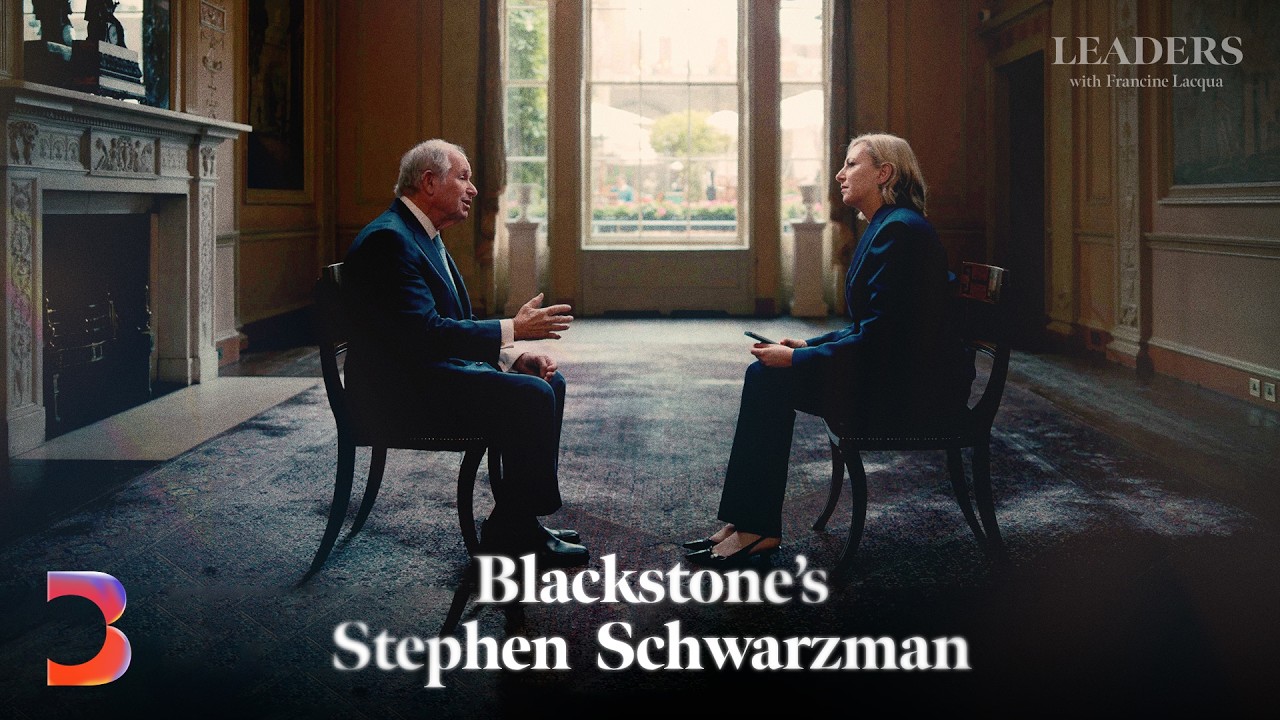
The Man Who Built Blackstone Into a $1.3 Trillion Empire | Leaders with Francine Lacqua — Bloomberg Originals

Bloomberg Originals

Stephen Schwarzman dismisses fears of software insolvencies in private credit and defends soaring infrastructure spend, arguing enterprise vendors will adapt while foundational power and data grids require decades to generate downstream returns.

AI-assisted summary of The Man Who Built Blackstone Into a $1.3 Trillion Empire | Leaders with Francine Lacqua — original source. Check the original for full context.

Source published:

Key ideas

  • Blackstone manages $1.3 trillion across more than 250 portfolio companies and 12,500 real estate properties, using proprietary operational data to identify macroeconomic inflections ahead of government reports. (0:08)
  • A chance 2015 conversation with Alibaba founder Jack Ma sparked Blackstone's digital infrastructure strategy, leading to the 2021 acquisition of QTS for $10 billion and establishing the firm as the world's largest data center owner. (3:25)
  • Stephen Schwarzman dismissed market fears of an AI-driven collapse in the $1.8 trillion private credit software market, citing enterprise software vendors as primary purchasers of AI models and tokens. (7:45)
  • Schwarzman attributes U.S. housing inflation to chronic structural undersupply rather than private equity ownership, noting that 2025 home construction equaled 1960 levels despite the population doubling. (12:44)

Detailed notes

## Background Published by Bloomberg Originals on YouTube on October 25, 2026, this episode of Leaders with Francine Lacqua features Blackstone co-founder, chairman, and CEO Stephen Schwarzman. According to the page description, Schwarzman discusses how he helped transform private equity into a mainstream $1.3 trillion asset management powerhouse, how the firm detects macroeconomic shifts before they register in official data, and where global investments are heading next.

## TL;DR Schwarzman explains Blackstone's institutional approach to hunting for operational anomalies, which alerted the firm early to both the AI revolution—stemming from a 2015 conversation with Jack Ma—and the subsequent critical shortfall in electrical power generation. He pushes back against recent market panic concerning private credit defaults and enterprise software obsolescence, while defending institutional single-family rental ownership by attributing housing affordability challenges to a decades-long nationwide deficit in home construction. Schwarzman also reflects on his early business lessons in his father's retail linen store, his diplomatic back-channel efforts to moderate U.S.-China trade relations, and the disciplined de-risking strategy behind the 2007 Equity Office Properties buyout that reinforces his maxim that there are 'no brave old people in finance.'

## Atmosphere & style The dialogue carries a composed, elder-statesman gravitas, pairing Francine Lacqua's pointed inquiries into industry controversies with Schwarzman's measured, analytical storytelling. The exchanges oscillate seamlessly between high-altitude geopolitical summits and gritty operational details, underscored by Schwarzman's dry wit and understated historical analogies. It feels like an intimate, behind-the-scenes debriefing with one of modern finance's chief architects, conveying both relentless commercial discipline and a relaxed, pragmatic detachment earned across decades of market cycles.

## Bulletin - [00:08](https://www.youtube.com/watch?v=zaeHzTS6Pck&t=8s) Blackstone manages $1.3 trillion across more than 250 portfolio companies and 12,500 real estate properties, using proprietary operational data to identify macroeconomic inflections ahead of government reports. - [03:25](https://www.youtube.com/watch?v=zaeHzTS6Pck&t=205s) A chance 2015 conversation with Alibaba founder Jack Ma sparked Blackstone's digital infrastructure strategy, leading to the 2021 acquisition of QTS for $10 billion and establishing the firm as the world's largest data center owner. - [07:45](https://www.youtube.com/watch?v=zaeHzTS6Pck&t=465s) Stephen Schwarzman dismissed market fears of an AI-driven collapse in the $1.8 trillion private credit software market, citing enterprise software vendors as primary purchasers of AI models and tokens. - [12:44](https://www.youtube.com/watch?v=zaeHzTS6Pck&t=764s) Schwarzman attributes U.S. housing inflation to chronic structural undersupply rather than private equity ownership, noting that 2025 home construction equaled 1960 levels despite the population doubling.

## Key takeaways - [00:08](https://www.youtube.com/watch?v=zaeHzTS6Pck&t=8s) Blackstone leverages controlling stakes across thousands of real-world assets to detect macroeconomic anomalies and interest-rate inflections ahead of lagging official economic data. - [03:25](https://www.youtube.com/watch?v=zaeHzTS6Pck&t=205s) Jack Ma's 2015 insights and subsequent validation from MIT leadership led Blackstone to build high-conviction exposure to data centers and digital infrastructure. - [03:25](https://www.youtube.com/watch?v=zaeHzTS6Pck&t=205s) Expanding data center capacity exposed severe power grid bottlenecks, driving Blackstone to deploy heavy capital into utility and energy generation ahead of broader markets. - [05:46](https://www.youtube.com/watch?v=zaeHzTS6Pck&t=346s) Schwarzman compares the current AI infrastructure buildout to the 40-year construction of the U.S. electrical grid following Thomas Edison's 1882 lightbulb invention. - [07:45](https://www.youtube.com/watch?v=zaeHzTS6Pck&t=465s) Skepticism over the $1.8 trillion private credit market and enterprise software debt is overblown, as established software companies actively modernize their products by purchasing AI compute. - [07:45](https://www.youtube.com/watch?v=zaeHzTS6Pck&t=465s) Private credit funds like BCRED employ structural mechanisms such as 5% quarterly redemption limits to protect long-term portfolio value against sudden liquidity runs. - [11:04](https://www.youtube.com/watch?v=zaeHzTS6Pck&t=664s) Private equity has structurally shifted away from 1980s-era financial leverage and cost-cutting toward revenue growth, platform scaling, and operational reinvestment. - [11:04](https://www.youtube.com/watch?v=zaeHzTS6Pck&t=664s) Blackstone holds approximately 60,000 single-family rental homes in the U.S. after institutionalizing the asset class through Invitation Homes following the 2008 subprime crisis. - [12:44](https://www.youtube.com/watch?v=zaeHzTS6Pck&t=764s) The U.S. housing affordability crisis is fundamentally driven by severe supply deficits, with national home completions in 2025 stagnating at 1960 volume levels. - [14:42](https://www.youtube.com/watch?v=zaeHzTS6Pck&t=882s) Childhood experiences at his father's Huntingdon Valley retail shop taught Schwarzman customer observation and sparked his ambition to build large-scale institutional businesses. - [16:50](https://www.youtube.com/watch?v=zaeHzTS6Pck&t=1010s) Representing roughly 42% of global GDP, the U.S. and China maintain mutual strategic incentives to de-escalate tensions despite reciprocal tariffs, export restrictions, and mineral bans. - [20:32](https://www.youtube.com/watch?v=zaeHzTS6Pck&t=1232s) Effective succession and operational longevity require institutional discipline, deliberate dispute resolution, and measured risk-taking rather than reckless financial bravery. - [20:32](https://www.youtube.com/watch?v=zaeHzTS6Pck&t=1232s) Blackstone mitigated extreme market risk during the 2007 $39 billion Equity Office Properties buyout by immediately flipping $29 billion in assets within a week, securing a 2.2x return on equity.

## Detailed walkthrough ### [00:08](https://www.youtube.com/watch?v=zaeHzTS6Pck&t=8s) The Scale of Blackstone and Reading Market Signals

Stephen Schwarzman opens with a reflection on his diplomatic engagements between superpowers, noting that when navigating bilateral friction, the core task is understanding the counterpart's mindset and working toward de-escalation. As co-founder, chairman, and chief executive of Blackstone, Schwarzman has spent four decades steering private equity from an obscure Wall Street corner into the beating heart of global finance. Blackstone spearheaded the broader structural migration of capital away from open public exchanges and into privately held ownership, operating across private corporate equity, real estate, and direct corporate credit outside the regulated banking sector. Because these privately held holdings do not trade on public exchanges, outside market participants often face limited visibility into asset valuations and underlying health—raising scrutiny as the alternative asset class has scaled into a colossal financial force. Blackstone alone oversees $1.3 trillion in assets under management, comprising over 250 portfolio companies and an excess of 12,500 real estate properties.

When asked by Francine Lacqua how Blackstone sifts through hundreds of thousands of operational data points to guide investment decisions, Schwarzman explains that his entire approach rests on hunting for anomalies in real-time information flow. While conventional market participants tend to disregard anomalous data because it clashes with their existing worldview, Schwarzman treats irregularities as early indicators of macro shifts. Because Blackstone frequently acquires majority and controlling stakes across healthcare, technology, and consumer businesses, its proprietary visibility into top-line demand, hiring, and pricing surfaces macro trends long before they appear in lagging government statistics. Addressing interest rates, Schwarzman dismisses Wall Street's obsession with pinpointing exact Federal Reserve calendar dates, emphasizing instead that the decisive factor is navigating the directional transition into an easing cycle.

> “Most people, when they're presented with something that doesn't make sense, they try to pay no attention to it because it interrupts their understanding of the world.” — Stephen Schwarzman

> “We don't really care when they do it. It's just the fact that we're going to go from a period of rising rates to a period of lowering rates.” — Stephen Schwarzman

- **Assets under management:** $1.3 trillion across Blackstone's global platform. - **Portfolio breadth:** Over 250 portfolio operating companies and 12,500 real estate assets. - **Public listing:** Blackstone completed its initial public offering in 2007.

---

[03:25](https://www.youtube.com/watch?v=zaeHzTS6Pck&t=205s) The Chance Origin of Blackstone's AI Bet

Schwarzman traces Blackstone's dominant footprint in artificial intelligence back to a chance encounter in 2015. While traveling on a bus in China, he struck up an unexpected conversation with Alibaba founder Jack Ma, who began describing an impending technological revolution powered by artificial intelligence. Schwarzman admits he initially had no comprehension of the concepts Ma was describing, yet Ma was emphatic that AI would emerge as the single most consequential technological upheaval in human history. Intrigued, Schwarzman cross-referenced the claim with his close academic contacts, reaching out directly to the president of the Massachusetts Institute of Technology (MIT). The MIT leadership validated Ma’s vision in even starker terms, prompting Blackstone to formulate a high-conviction thematic thesis around digital infrastructure.

That conviction culminated in Blackstone's 2021 acquisition of data center operator QTS Realty Trust for approximately $10 billion. Under Blackstone's stewardship, that data center platform expanded fifteenfold, establishing the firm as the largest owner of data center capacity on Earth. This dominant footprint positioned Blackstone as the essential infrastructure partner to the six major technology hyperscalers. When Lacqua asks whether this windfall was pure luck or calculated execution, Schwarzman credits an institutional feedback loop where intelligence is gathered weekly across all operating divisions, coupled with an intellectual curiosity that acts upon the clues hidden inside outlying facts. That ongoing operational feedback loop quickly exposed another massive structural bottleneck: the modern industrialized world was facing an acute, unforeseen shortfall of electrical power generation, prompting Blackstone to deploy massive capital into energy and utility capacity well before mainstream investors recognized the crunch.

```mermaid flowchart TD accTitle: Blackstone AI Infrastructure Investment Flow accDescr: Diagram illustrating how Jack Ma's insight led to MIT validation, data center acquisitions, and subsequent energy investments. subgraph Discovery["1. Discovery & Validation"] A["2015 Bus Ride with Jack Ma"] -->|"AI as transformative force"| B["Validation by MIT Leadership"] end subgraph Execution["2. Scaled Infrastructure"] B -->|"Institutional thesis"| C["$10B Acquisition of QTS (2021)"] C -->|"Expanded 15x"| D["World's Largest Data Center Owner"] D -->|"Direct service provider"| E["Relationships with 6 Hyperscalers"] end subgraph Derivative["3. Next Bottleneck"] E -->|"Weekly operational data"| F["Developed World Power Shortage"] F -->|"Early-mover capital"| G["Massive Energy & Grid Investments"] end ```

> “And he said, 'Jack's underselling this.' So I said, 'How do you know?' He said, 'Because we invented AI at MIT.'” — Stephen Schwarzman

> “Part of it is having the curiosity because those pieces that don't fit tell you the future and the future is always key to having a successful present.” — Stephen Schwarzman

- **Catalyst:** 2015 bus conversation between Stephen Schwarzman and Jack Ma in China. - **Anchor transaction:** $10 billion acquisition of data center operator QTS in 2021, which expanded 15x under Blackstone ownership. - **Current position:** Largest owner of data centers globally, serving all six leading technology hyperscalers. - **Follow-on thesis:** Aggressive capital deployment into electrical utilities and power generation to solve severe regional grid shortages.

---

[05:46](https://www.youtube.com/watch?v=zaeHzTS6Pck&t=346s) AI Infrastructure and the 40-Year Electric Grid Precedent

The massive capital requirements of the AI buildout have prompted skepticism regarding whether monetization can ever justify the underlying investments. Training advanced models demands astronomical capital expenditures spanning specialized silicon chips, liquid-cooling apparatus, rare minerals, fiber-optic networking, and dedicated power plants. In private funding markets, valuations have soared to unprecedented heights—with OpenAI securing a $122 billion round at an $852 billion valuation, and Silicon Valley competitor Anthropic seeking $30 billion in new capital at an implied $900 billion valuation. Lacqua raises whether these valuations risk outrunning reality, asking if markets are burning capital on systems whose true commercial utility might only arrive years later at dramatically cheaper pricing.

Schwarzman counters these concerns by framing generative AI through the historical lens of industrial infrastructure buildouts. He points back to 1882, when Thomas Edison patented and commercialized the incandescent lightbulb. The bulb itself was virtually useless in isolation; capitalizing on electric light required the physical construction of nationwide municipal power grids, high-voltage transmission lines, and generation stations—a physical deployment that consumed four decades across the United States. During the first forty years of electrifying America, nobody conceived of radio broadcasting or consumer television, let alone modern appliances. In Schwarzman's view, AI stands firmly in those identical "early innings," where vast sums of foundational capital must be sunk upfront to lay the groundwork for downstream innovations that will ultimately generate decades of macroeconomic prosperity, even if short-term investment returns appear uneven and several pioneering players fail to survive.

> “So in 1882, Thomas Edison invented the electric light bulb and to make it useful, you basically had to build a grid. So it took 40 years to build the electric grids.” — Stephen Schwarzman

> “In the interim, they'll have different stages of economic return because if you just looked at the return in the first few years, it wouldn't make any sense.” — Stephen Schwarzman

- **Infrastructure requirements:** Enormous capital requirements for power, advanced cooling, silicon hardware, critical minerals, and high-speed fiber optics. - **Historical parallel:** Thomas Edison’s 1882 incandescent bulb required 40 years of electrical grid expansion before transformative downstream consumer products (like radio and television) emerged. - **Investment lifecycle:** Early infrastructure returns will look depressed, and early capital allocators face substantial attrition, but the resulting structural foundation generates long-term prosperity.

---

[07:45](https://www.youtube.com/watch?v=zaeHzTS6Pck&t=465s) The Evolution of Private Credit and Software Panic

Following the 2008 global financial crisis, stringent bank capital rules curtailed the ability of commercial lenders to issue leveraged debt, paving the way for the direct lending industry known as private credit. This non-bank direct lending sector has surged to a $1.8 trillion market, with projections indicating it could double by 2030. However, the rapid ascent of private credit has stoked fears among institutional investors who worry that illiquid loans, shielded from everyday mark-to-market pricing, conceal mounting credit degradation. These anxieties have centered particularly on enterprise software borrowers, where rapid advances in generative AI threaten to render legacy software platforms obsolete. Compounding investor unease, Blackstone's flagship private credit vehicle, BCRED, experienced an uptick in withdrawal requests that prompted the fund to implement its standard 5% redemption limits to avert forced asset liquidations—a move critics cited as evidence of underlying frailty.

Schwarzman strongly refutes suggestions of structural instability in private credit, pointing out that Blackstone's credit funds continue to generate healthy returns around 9%, accompanied by only modest upticks in default rates. He attributes the recent wave of market anxiety to an alarmist report circulated by a small hedge fund claiming that widespread software insolvencies would wipe out the sector within two to three years. Schwarzman recounts discussing the issue directly with the chief executive of one of the world's three preeminent artificial intelligence developers, who characterized the predicted collapse of the enterprise software sector as completely baseless. Rather than being supplanted overnight, enterprise software firms represent the primary paying customers purchasing AI tokens and machine-learning models to upgrade and defend their software platforms. While Schwarzman concedes that mispositioned software vendors will inevitably fail, he argues the broader panic has been severely overdone and will take a year or two of steady performance to subside.

> “I was with the head of one of the three big AI companies. He said the software industry going bankrupt in two to three years is absolutely absurd.” — Stephen Schwarzman

> “He said, 'We sell AI and tokens to these companies. They're going to be improving their businesses and there'll be a certain percentage of software companies that are mispositioned for this new world.'” — Stephen Schwarzman

> “I think we'll see, it'll take a year or two to play out that this was, like, way overdone. But once you panic people, it's tough to calm them down.” — Stephen Schwarzman

- **Private credit market scale:** Reached $1.8 trillion globally, with projections to double in size by 2030. - **Fund performance:** Blackstone private credit funds continue to generate roughly 9% returns with low overall defaults. - **Liquidity mechanisms:** Blackstone's BCRED fund enforces a 5% quarterly redemption gate to avoid forced fire sales when withdrawal requests spike. - **Software exposure:** AI leaders view enterprise software companies as core corporate customers purchasing AI tokens and application layers, refuting claims of wholesale industry collapse.

---

[11:04](https://www.youtube.com/watch?v=zaeHzTS6Pck&t=664s) From 1980s Cost Cutting to Growth and Single-Family Rentals

Reflecting on the structural transformation of private equity, Schwarzman contrasts the industry's modest origins with its present ubiquity. When Blackstone launched, fewer than ten dedicated private equity partnerships existed globally; today, thousands of firms compete across every industry vertical. Schwarzman emphasizes that the foundational mechanics of the buyout business have undergone a complete paradigm shift. The leveraged buyout models of the 1980s and 1990s relied predominantly on financial engineering, debt leverage, and aggressive operational cost-cutting. In contrast, modern private equity generates outsized returns through top-line revenue expansion, heavy capital reinvestment, operational excellence, and accelerating corporate growth, noting that consumers simply abandon businesses that hollow out product quality in pursuit of short-term expense reductions.

As private capital expanded its reach, it broadened beyond traditional manufacturing firms and corporate carve-outs into daily consumer touchpoints, ranging from veterinary clinics and medical practices to local newspapers—a footprint that has attracted public debate over its social implications. A primary example of this expansion occurred after the 2008 subprime mortgage collapse, when Blackstone entered the single-family housing market. Through its platform company, Invitation Homes, Blackstone acquired thousands of distressed residential properties, renovated them, and converted them into professionally managed rental housing, effectively institutionalizing a brand-new asset class. Invitation Homes completed an initial public offering in 2017, growing into the largest single-family rental operator in the United States with more than 80,000 residences. Although Blackstone eventually fully divested its stake in Invitation Homes, the firm remains a major residential real estate landlord, currently maintaining a portfolio of approximately 60,000 single-family rental homes across the United States.

> “Cost cutting deals were for the 1980s and maybe the 90s. The business has completely changed. The most amount of money can be made with the most growth and people don't patronize places that are cost cutting and don't deliver great value and a great product.” — Stephen Schwarzman

- **Industry expansion:** Grew from approximately 10 specialized firms in the 1980s to thousands of institutional managers today. - **Strategy evolution:** Transitioned from 1980s financial engineering and cost extraction to active operational scaling, corporate investment, and growth. - **Invitation Homes:** Built post-2008 housing crisis, taken public in 2017, and expanded to over 80,000 homes under management before Blackstone's exit. - **Current residential footprint:** Blackstone directly holds approximately 60,000 single-family rental houses across the United States.

[12:44](https://www.youtube.com/watch?v=zaeHzTS6Pck&t=764s) Housing Scarcity and the American Dream

Francine Lacqua brings up the rising public and political scrutiny facing institutional investors, noting that lawmakers blame large investment firms for swallowing up residential supply and pricing ordinary citizens out of buying or renting homes. Asked directly if this criticism upsets him or if the private equity industry needs to clean up its act, Stephen Schwarzman defends the sector by pointing to fundamental macroeconomic imbalances rather than institutional ownership. He argues that housing is an unusual asset class defined primarily by a systemic failure to construct enough units to keep up with demographic growth.

Schwarzman counters the perception that private equity dominates residential neighborhoods, pointing out that institutional investors own merely a tiny fraction of the market, though he acknowledges it can feel concentrated in certain desirable submarkets. To underscore the supply-side bottleneck, Schwarzman highlights that in 2025 the United States produced the same volume of homes as it did back in 1960, despite the national population doubling over that same span. In his view, rising prices are the inevitable outcome of basic math, asserting: “So the solution for this is basically build more stuff. It couldn't be simpler.”

- Last year (2025), home construction in the U.S. matched the volume built in 1960, even though the country's population has more than doubled. - Private institutional investors hold only a few percent of the total residential housing stock. - Moving forward, Blackstone plans to offer loans intended to finance the construction of roughly 50,000 U.S. homes annually to alleviate supply deficits. - Beyond contested housing holdings, private equity capital plays a major role driving growth across capital-intensive fields like life sciences and infrastructure.

---

[14:42](https://www.youtube.com/watch?v=zaeHzTS6Pck&t=882s) Lessons from Huntingdon Valley: Curtains, Linens, and Ambition

Schwarzman reflects on growing up in Huntingdon Valley, a middle-class suburb of Philadelphia, where he worked at his father's curtain and linen shop starting at the age of 10. Lacqua asks what running that retail counter taught him about business. Schwarzman humorously admits that it quickly taught him what he was terrible at—he disliked waiting on customers and lacked the manual dexterity to neatly wrap gifts. However, the store served as his first laboratory for observing human behavior: watching consumers wander through the aisles, weigh options, and ultimately decide to purchase.

The experience also sparked friction over the scale of his ambitions. At 14, frustrated that such a profitable business remained confined to one storefront, Schwarzman pleaded with his father to take the brand national. When his father rejected the idea because he feared remote clerks would steal cash from unattended registers, young Steve proposed expanding across Pennsylvania instead. His father declined that as well, explaining that he already had a comfortable house, two cars, and sufficient funds to put Steve through college. Schwarzman recalls realizing with some annoyance that his father lacked corporate ambition, but the conversation gave him enduring respect for differing life choices: “One of the things I learned is you can't change people, and I realized something else would make me happy.” That happiness, he explains, came from a drive to build and create new institutions.

---

[16:50](https://www.youtube.com/watch?v=zaeHzTS6Pck&t=1010s) Superpower Diplomacy: Navigating Washington and Beijing

Schwarzman's ambition ultimately elevated him to the ranks of the world's wealthiest individuals and leading global philanthropists, granting him informal diplomatic influence with figures such as Barack Obama, Donald Trump, and Xi Jinping. He has positioned himself as a bridge builder between Washington and Beijing, recounting that he cautioned Xi on how globalization devastated U.S. blue-collar employment, while simultaneously warning Trump that an uncoordinated multi-front trade war risked isolating the United States internationally.

Despite escalating friction—including Trump's broad tariffs, Biden-era restrictions on advanced semiconductors, quantum computing, and AI technologies, and retaliatory Chinese bans on rare earth and critical mineral exports—Schwarzman remains optimistic about both powers reaching equilibrium. Drawing on his attendance at high-level bilateral summits in Beijing with Xi and Trump, Schwarzman highlights that both sides are acutely aware that their economies collectively represent roughly 42% of global GDP. Neither country can afford outright confrontation, and he believes their underlying posture is not inherently offensive. Regarding partisan life at home, Schwarzman describes himself as an unwavering centrist who is deeply frustrated that core institutional principles—such as obeying laws and providing effective primary education—have degenerated into polarized shouting matches.

```mermaid flowchart TD accTitle: U.S.-China Strategic Interdependence accDescr: Diagram illustrating the bilateral frictions and high economic stakes between the U.S. and China.

subgraph Bilateral["Economic Superpowers (~42% of Global GDP)"] US["United States"] CN["China"] end

subgraph Frictions["Mutual Pressure Points"] Tariffs["Tariffs & Outbound Tech Controls<br/>(AI, Chips, Quantum)"] Minerals["Critical Mineral Export Bans<br/>(EVs, Phones, Defense Systems)"] end

US -->|"Imposes restrictions"| Tariffs Tariffs -->|"Targets tech access"| CN CN -->|"Curbs exports"| Minerals Minerals -->|"Disrupts supply chains"| US

US <--->|"Shared incentive to stabilize ties"| CN ```

- Combined, the U.S. and China account for roughly 42% of the world economy. - Successive administrations maintained pressure: Trump launched broad baseline tariffs, while the Biden administration imposed strict export controls around microchips, quantum systems, and artificial intelligence. - Beijing responded by choking off key mineral supply chains vital for electric vehicles, smartphones, and guided missile production. - Schwarzman laments the erosion of America's moderate political core: “We've gotten into a place now where people don't listen to each other, and I think this is exceptionally unfortunate and challenges the country, and we need to get back to a balanced center, and that's what I believe in.”

---

[20:32](https://www.youtube.com/watch?v=zaeHzTS6Pck&t=1232s) De-Risking the Mega-Deal and the Myth of Bravery in Finance

Turning to leadership and corporate longevity, Lacqua asks Schwarzman why Blackstone has successfully navigated management succession—highlighting President and COO Jon Gray's bullish outlook for private equity dealmaking and IPOs—while other Wall Street peers have stumbled. Schwarzman dismisses the idea that succession planning came down to good luck. Instead, he explains that running a complex alternative asset manager is an acquired discipline encompassing team dynamics, the pacing of internal dispute resolution, public communications, and regulatory navigation—talents that are rarely innate. Looking back, he identifies the very act of launching Blackstone as his greatest operational risk, simply because he was too inexperienced to realize that the combined M&A advisory and private equity model they envisioned had never been successfully executed before.

```mermaid flowchart LR accTitle: 2007 Office Portfolio De-Risking Flow accDescr: Sequence showing how Blackstone bought and rapidly sold down a 39 billion dollar office portfolio in 2007.

subgraph Purchase["Initial Mega-Acquisition"] A["Acquire Portfolio<br/>$39 Billion"] end

subgraph DeRisking["Aggressive Sell-Downs"] B["Day 1 Sell-Off<br/>Sell 50% at huge gain"] C["Week 1 Sell-Off<br/>Sell another $10 Billion"] end

subgraph Outcome["Final Portfolio"] D["Retain $10 Billion Core<br/>Yields 2.2x Return"] end

A --> B B --> C C --> D ```

When asked about the transactions he enjoyed most, Schwarzman recounts Blackstone's landmark $39 billion acquisition of Equity Office Properties in 2007, executed right at the crest of the pre-crisis property bubble. Because the transaction was four times larger than any previous real estate deal, Schwarzman was terrified by the elevated market valuations. To protect the firm, Blackstone orchestrated a lightning-fast syndication: selling half the assets on the very day the deal closed, and executing another $10 billion sale just one week later at higher valuations. This left the firm holding a de-risked $10 billion portfolio while rival buyers across the industry were wiped out during the subsequent real estate crash, ultimately yielding Blackstone a 2.2x return on equity. Embracing calculated risk while rejecting reckless gambling, Schwarzman sums up his investment philosophy: “I have a saying that there are no brave old people in finance, because if you're brave, you might win once or twice, but you can't win forever.”

## Notable quotes > [20:32](https://www.youtube.com/watch?v=zaeHzTS6Pck&t=1232s) I have a saying that there are no brave old people in finance, because if you're brave, you might win once or twice, but you can't win forever. — Stephen Schwarzman

> [00:08](https://www.youtube.com/watch?v=zaeHzTS6Pck&t=8s) Most people, when they're presented with something that doesn't make sense, they try to pay no attention to it because it interrupts their understanding of the world. — Stephen Schwarzman

> [11:04](https://www.youtube.com/watch?v=zaeHzTS6Pck&t=664s) The most amount of money can be made with the most growth and people don't patronize places that are cost cutting and don't deliver great value and a great product. — Stephen Schwarzman

> [16:50](https://www.youtube.com/watch?v=zaeHzTS6Pck&t=1010s) We've gotten into a place now where people don't listen to each other, and I think this is exceptionally unfortunate and challenges the country, and we need to get back to a balanced center, and that's what I believe in. — Stephen Schwarzman

## Mentioned Stephen Schwarzman, Francine Lacqua, Blackstone, Jack Ma, Alibaba, Massachusetts Institute of Technology (MIT), QTS Realty Trust, Thomas Edison, OpenAI, Anthropic, BCRED, Invitation Homes, Barack Obama, Donald Trump, Xi Jinping, Jon Gray, Equity Office Properties

## Video description As chief executive of Blackstone, Stephen Schwarzman helped transform modern finance by moving private equity into the mainstream. The company is now the world’s largest alternative asset manager with a portfolio worth $1.3 trillion.

On this episode of Leaders, he speaks with Francine Lacqua about spotting economic shifts before they show up in public data, investing early in artificial intelligence and where the world is heading next.

Watch more: https://www.youtube.com/playlist?list=PLqq4LnWs3olXnyY_CJUC2M1NtT_VdXw8i

What drives the world’s most influential minds? In Leaders with Francine Lacqua, Bloomberg’s award-winning anchor sits down with the decision-makers shaping our future to explore the personal stories behind their public personas. Discover what inspires them, how they navigate power and the lessons they offer on defining success. Insightful, cinematic and elegantly crafted, Leaders goes beyond the headlines to reveal the human side of leadership.

#Blackstone #AI #PrivateEquity

-------- Like this video? Subscribe: http://www.youtube.com/Bloomberg?sub_confirmation=1

Get unlimited access to Bloomberg.com for just $1.99 your first month: https://www.bloomberg.com/subscriptions?in_source=YoutubeOriginals Bloomberg Originals offers bold takes for curious minds on today’s biggest topics. Hosted by experts covering stories you haven’t seen and viewpoints you haven’t heard, you’ll discover cinematic, data-led shows that investigate the intersection of business and culture. Exploring every angle of climate change, technology, finance, sports and beyond, Bloomberg Originals is business as you’ve never seen it.

Subscribe for business news, but not as you've known it: exclusive interviews, fascinating profiles, data-driven analysis, and the latest in tech innovation from around the world.

Visit our partner channel Bloomberg News for global news and insight in an instant.

[Source](https://www.youtube.com/watch?v=zaeHzTS6Pck)

中文简报

黑石苏世民驳斥AI债务恐慌,预计基础设施建设周期长达40年 苏世民驳斥了对私人信贷中软件企业破产的担忧,并为激增的基础设施支出进行辩护,认为企业级软件厂商会逐步适应,而基础电力和数据电网则需要数十年时间才能产生下游回报。 苏世民阐释了黑石集团捕捉运营异常的机构化方法,这一机制让黑石早早察觉到了AI革命(源于2015年与马云的一次对话)以及随之而来的严重电力供应缺口。他驳斥了近期市场对私人信贷违约和企业软件过时的恐慌,同时将住房可负担性问题归咎于全美数十年来长期的房屋建设缺口,以此为机构持有单户出租房进行辩护。苏世民还回顾了早年在父亲亚麻布零售店学到的商业经验、为缓和中美贸易关系所做的民间外交斡旋,以及2007年收购权益写字楼投资信托(Equity Office Properties)背后严格的去风险策略,这进一步印证了他的格言:“金融界没有勇敢的老人”。 黑石管理着1.3万亿美元资产,涵盖250多家被投企业和12,500处房地产物业,利用专有的运营数据在政府报告出炉前提早发现宏观经济拐点。 (0:08) 2015年与阿里巴巴创始人马云的一次偶然交谈启发了黑石的数字基础设施战略,促成了2021年以100亿美元收购QTS,并确立了黑石作为全球最大数据中心所有者的地位。 (3:25) 苏世民驳斥了市场对规模达1.8万亿美元的私人信贷软件市场可能因AI走向崩溃的担忧,指出企业级软件厂商正是AI模型和Token的主要采购方。 (7:45) 苏世民将美国住房通胀归咎于长期的结构性供应不足,而非私募股权机构的持有,并指出尽管人口翻倍,2025年的住房建设量仅相当于1960年的水平。 (12:44)

Detailed notes — zh

## Background 本期视频由彭博旗下的 Bloomberg Originals 于 2026 年 10 月 25 日发布在 YouTube 平台。节目属于《Leaders with Francine Lacqua》系列,聚焦黑石集团首席执行官史蒂芬·施瓦茨曼(Stephen Schwarzman),探讨他如何带领这家掌管 1.3 万亿美元资产的另类资管巨头在官方公开数据出炉前洞察宏观经济转变、早期重注人工智能底层基础设施,以及对全球未来走向的研判。 ## TL;DR 黑石集团联合创始人史蒂芬·施瓦茨曼深入剖析了黑石如何依托覆盖全球的庞大被投企业和房地产资产网络,利用非公开的微观运营数据提前预判经济拐点。他回顾了 2015 年与马云交流后敏锐切入 AI 算力与电力基础设施的前瞻布局,并对当前私募信贷及软件行业的恐慌论调予以反驳。此外,施瓦茨曼回应了关于美国住房危机的争议,分享了童年时期父亲的小店对其野心的启蒙,并结合 2007 年经典的地产生死局,阐明了在极端风险面前克制贪婪、“金融界没有勇敢的老人”这一底层风控哲学。 ## Atmosphere & style 整场对话呈现出一种深沉、内敛且极富战略定力的高端访谈质感。施瓦茨曼的谈吐沉着冷静、波澜不惊,举手投足间透露出执掌万亿帝国数十载的从容与洞察力;与主持人 Francine Lacqua 的交流流畅且直击要害,既有对万亿级商业博弈的精妙复盘,亦有回忆少年时代与父亲对话时流露出的温和与自省。观众在聆听过程中能直观感受到顶尖金融家在面对滔天巨浪时的极端避险纪律,以及从微观反常现象中透视宏观大局的敏锐直觉。 ## Bulletin - [00:08](https://www.youtube.com/watch?v=zaeHzTS6Pck&t=8s) 黑石集团(Blackstone)管理资产规模已达 1.3 万亿美元,旗下覆盖逾 12,500 处房地产与 250 多家被投企业,借助海量底层微观运营数据在宏观拐点反映于公开数据数月前完成前瞻布局。 - [03:25](https://www.youtube.com/watch?v=zaeHzTS6Pck&t=205s) 在 2015 年受马云启发后,黑石于 2021 年斥资 100 亿美元收购数据中心巨头 QTS 并扩张 15 倍,当前正将大笔资本重注于面临严重短缺的发达国家电力基础设施。 - [07:45](https://www.youtube.com/watch?v=zaeHzTS6Pck&t=465s) 针对规模达 1.8 万亿美元私人信贷市场的软件业崩盘恐慌,施瓦茨曼援引头部 AI 企业判断予以驳斥,指出该类基金整体收益率维持在约 9%,软件公司并非整体走向破产而是加速融合 AI。 - [12:44](https://www.youtube.com/watch?v=zaeHzTS6Pck&t=764s) 针对全美住房可负担性危机,施瓦茨曼指出核心病灶在于供给严重滞后,黑石计划每年提供贷款支持建设 50,000 套美国住宅以拉动市场开工。 ## Key takeaways - [00:08](https://www.youtube.com/watch?v=zaeHzTS6Pck&t=8s) 黑石的独特投资洞察源于对微观数据中“打破常规的矛盾点”进行深入挖掘,从而先于公开经济数据预判宏观趋势。 - [00:08](https://www.youtube.com/watch?v=zaeHzTS6Pck&t=8s) 施瓦茨曼认为市场过度纠结于美联储降息的具体日期毫无意义,关键宏观逻辑仅在于经济已进入宽松周期通道。 - [03:25](https://www.youtube.com/watch?v=zaeHzTS6Pck&t=205s) 黑石与全球六大超大规模云服务商(Hyperscalers)深度合作,敏锐捕捉到 AI 扩张瓶颈已从算力延伸至电力短缺并提前布局能源基建。 - [03:25](https://www.youtube.com/watch?v=zaeHzTS6Pck&t=205s) 将当下的 AI 估值热潮与 1882 年爱迪生发明电灯泡相类比,施瓦茨曼强调电网铺设耗时四十年,早期看基建回报往往无法立刻显现全部价值。 - [07:45](https://www.youtube.com/watch?v=zaeHzTS6Pck&t=465s) 驳斥了对冲基金关于“软件公司将在两三年内全体破产”的极端做空论调,认为软件行业将在融合 AI 代币与应用中实现重构与升级。 - [11:04](https://www.youtube.com/watch?v=zaeHzTS6Pck&t=664s) 现代私募股权早已淘汰 1980 至 1990 年代靠裁员与削减成本套利的旧模式,转向依靠注入资本与优化运营驱动企业价值跨越式增长。 - [12:44](https://www.youtube.com/watch?v=zaeHzTS6Pck&t=764s) 美国当前住房危机并非源自机构投资者收购,而是建房总量相较 1960 年几乎未增但人口翻倍导致的极端供需失衡,唯一解法是“多建房子”。 - [14:42](https://www.youtube.com/watch?v=zaeHzTS6Pck&t=882s) 早年在父亲窗帘店打工的经历让施瓦茨曼认清自身优势在于宏观观察与创造新商业,也学会了尊重不同人对成功的不同定义。 - [16:50](https://www.youtube.com/watch?v=zaeHzTS6Pck&t=1010s) 中美两国合计占据全球约 42% 的经济总量,施瓦茨曼认为两国领导层深知冲突失控的破坏力,核心诉求仍在寻求双边关系正常化。 - [16:50](https://www.youtube.com/watch?v=zaeHzTS6Pck&t=1010s) 对美国政治两极分化表达深切忧虑,呼吁各方打破激进党派壁垒,回归法治与倾听共识的理性中间温和路线。 - [20:32](https://www.youtube.com/watch?v=zaeHzTS6Pck&t=1232s) 企业接班是一门需要同时平衡内部人际节奏与外部舆论监管风暴的复杂后天技能,黑石在此领域建立了成熟的梯队过渡机制。 - [20:32](https://www.youtube.com/watch?v=zaeHzTS6Pck&t=1232s) 复盘 2007 年斥资 390 亿美元收购 Equity Office Properties 案例,黑石在交割当日及一周后闪电出让大部分资产降杠杆,最终斩获 2.2 倍回报。 - [20:32](https://www.youtube.com/watch?v=zaeHzTS6Pck&t=1232s) 秉持保守的投资哲学,施瓦茨曼提出“金融界没有勇敢的老人”,强调追求胜率与长期生存远重于盲目涉险博取短期单次胜利。 ## Detailed walkthrough ### [00:08](https://www.youtube.com/watch?v=zaeHzTS6Pck&t=8s) 黑石帝国的崛起与“非主流”数据洞察力 史蒂芬·施瓦茨曼(Stephen Schwarzman)是华尔街举足轻重的风云人物,作为全球最大另类资产管理机构黑石集团(Blackstone)的联合创始人,他推动私募股权投资从边缘小众领域走向了金融主流。在过去数十年间,他亲历并引领了资本主义从公开市场向私募所有权的转移。黑石如今已触达私募市场的每个角落,其投资策略主要是将投资者的资金投向非上市企业、房地产以及银行体系之外的贷款,而非传统的公开股票、债券或现金组合。 ```mermaid flowchart TD accTitle: 黑石集团实时经济反馈系统 accDescr: 展示黑石从其覆盖的各个行业获取数据,识别反常模式,进而预测宏观经济转变的过程 subgraph Portfolio["黑石控股与底层资产"] A["12,500+ 处房地产资产"] B["250+ 家投资组合公司"] C["涵盖医疗、科技、消费等全行业"] end subgraph FeedbackEngine["反馈机制与模式识别"] D["每周各业务条线汇报机制"] E["海量非公开数据交互"] F["识别打破常规的矛盾点 (Pieces That Don't Fit)"] end subgraph StrategicShift["前瞻性决策"] G["预判宏观经济拐点<br/>(如利率走势、AI电力短缺)"] H["在公开数据显现前完成战略下注"] end Portfolio --> E E --> D D --> F F --> G G --> H ``` 当被问及黑石坐拥数十万个数据点如何指导下一步投资决策时,施瓦茨曼分享了他独特的逆向思维习惯:“If you give me enough information, I can see something in that pattern that doesn't make sense. Most people, when they're presented with something that doesn't make sense, they try to pay no attention to it because it interrupts their understanding of the world. I just focus on that and it's a keystone to tell you where the world's going to shift.” 通过持有底层企业的大比例甚至控股股权,黑石能够获得实时的微观运营数据,在公开数据发布前几个月就感知到宏观风向的转变。谈到降息时,他显得十分从容,直言市场对具体日期的过度纠结毫无意义,核心逻辑仅在于经济正从加息周期过渡至降息周期。 - **管理规模**:截至目前,黑石集团管理资产规模达到 1.3 万亿美元。 - **资产构成**:截至 2026 年 7 月,其投资组合包含超过 12,500 处房地产资产以及逾 250 家被投企业。 - **上市历程**:黑石集团于 2007 年正式在公开市场上市。 --- ### [03:25](https://www.youtube.com/watch?v=zaeHzTS6Pck&t=205s) 偶遇马云与布局 AI:从数据中心到能源短缺 黑石在人工智能浪潮中的早期卡位,最初始于一场纯属偶然的跨国对话。施瓦茨曼回忆道,2015 年他在中国访问期间,与阿里巴巴创始人马云同坐在一辆大巴车上。当时马云大谈特谈人工智能,施瓦茨曼坦承自己当时“完全不知道他在说什么”,但马云坚信这是将彻底颠覆世界的最重大技术变革。随后,施瓦茨曼向其学术圈好友、当时的麻省理工学院(MIT)校长求证,对方甚至直言“马云其实还说保守了”,并骄傲地指出正是 MIT 发明了 AI。 基于这一预判,黑石开启了庞大的基建布局。2021 年,黑石斥资 100 亿美元收购了大型数据中心公司 QTS,如今该业务规模已扩张了 15 倍,使黑石成为全球最大的数据中心所有者。施瓦茨曼指出,这项业务让黑石直接与全球六大超大规模云服务商(Hyperscalers)展开紧密合作,“so we know what's happening sort of almost everywhere in this ecosystem.” 在运营数据中心的过程中,他们敏锐地发现了当下最关键的异常矛盾:发达国家即将面临严重的电力短缺。黑石随即先人一步,将巨额资本砸向电力基础设施。 针对当前 AI 初创公司惊人估值可能引发的泡沫担忧,施瓦茨曼以 1882 年托马斯·爱迪生发明电灯泡的历史经验作为参照。他强调,电灯发明后,美国足足用了 40 年时间才建好电网;在当初铺设电网时,根本没有人能预见到未来会有收音机或电视机的出现。施瓦茨曼总结道:“There's so much capital infrastructure that needs to be built, and then the new products, and they'll create a lot of prosperity. In the interim, they'll have different stages of economic return because if you just looked at the return in the first few years, it wouldn't make any sense.” - **估值案例**:OpenAI 估值达到 8,520 亿美元,并完成了 1,220 亿美元的融资轮次;Anthropic 亦在洽谈 300 亿美元融资,估值直指 9,000 亿美元。 - **AI 底层要素**:生成式 AI 不仅需要芯片算法,还严重依赖电力、冷却系统、硅、关键矿物以及光纤电缆。 --- ### [07:45](https://www.youtube.com/watch?v=zaeHzTS6Pck&t=465s) 私募信贷的崛起与软件业“破产恐慌” 2008 年金融危机后,监管部门对大银行发放高风险贷款实施了严厉约束,黑石等另类资管机构顺势填补了这一空白,直接向企业提供贷款。这一被称为“私人信贷”(Private Credit)或非银行融资(影子银行)的市场规模如今已达到 1.8 万亿美元,并预计在 2030 年翻倍。然而,近期投资者对该领域的担忧加剧,特别是针对流动性较差、缺乏公开价格参考的软件公司债务敞口。部分基金因赎回请求突破预设上限(例如黑石旗舰基金 BCRED 约 5% 的赎回红线)而触发流动性管控,引发了外界关于资产隐性风险的质疑。 面对市场上对私人信贷风暴的恐慌,施瓦茨曼明确反驳了危险论调。他指出,这类基金目前的收益率仍在 9% 左右,尽管违约率略有上升,但整体基本面非常健康。施瓦茨曼谈到,此前有一家小型对冲基金发布做空报告,惊悚地预言“所有软件公司都将在未来两年内破产”,引发了市场的非理性踩踏。为此,他特意与全球三大 AI 巨头之一的掌门人进行了探讨。 施瓦茨曼引述了该 AI 巨头负责人的核心判断:“He said the software industry going bankrupt in two to three years is absolutely absurd. He said, 'We sell AI and tokens to these companies. They're going to be improving their businesses and there'll be a certain percentage of software companies that are mispositioned for this new world.'” 施瓦茨曼认为,整个市场需要一到两年时间来消化事实,届时人们会发现前期的恐慌完全是过度反应,只是恐慌情绪一旦蔓延,平复它往往需要时间。 --- ### [11:04](https://www.youtube.com/watch?v=zaeHzTS6Pck&t=664s) 私募股权的演化:从削减成本到控股住宅 施瓦茨曼回顾了私募股权行业四十多年来的深刻范式转变。在他初入行时,全行业仅有大约 10 家机构,而如今已有数千家竞争者。他指出,早期通过高杠杆买入资产、靠激进裁员和削减成本实现盈利的模式早已被淘汰:“Cost cutting deals were for the 1980s and maybe the 90s. The business has completely changed. The most amount of money can be made with the most growth and people don't patronize places that are cost cutting and don't deliver great value and a great product.” 现代私募股权的核心逻辑是提供资本、优化运营,帮助优秀企业实现跨越式增长。 随着行业的野蛮生长,私募股权的投资边界从最初被冷落的工业制造与非核心剥离部门,一路渗透到宠物店、私人诊所乃至地方报纸,其对实体经济与日常生活的广泛介入也招致了社会各界的批判与审视。在房地产领域,黑石在 2008 年金融危机后通过其子公司 Invitation Homes 大举抄底法拍房,将其标准化翻新为出租房,开创了单户住宅租赁(Single-Family Rental)这一全新资产类别。 - **租赁巨头崛起**:Invitation Homes 于 2017 年挂牌上市,随后成为美国最大的单户住宅租赁企业,旗下管理房产超过 80,000 套。 - **当前持有规模**:尽管黑石已不再直接持有 Invitation Homes 股权,但其投资组合中仍持有约 60,000 套美国住宅资产。 ### [12:44](https://www.youtube.com/watch?v=zaeHzTS6Pck&t=764s) 住房危机与黑石的应对 随着美国普通家庭的住房可负担性持续下滑,部分立法者和公众将矛头指向大型机构投资者,指责他们抢购住房、推高房价并将普通人挤出市场。被问及读到这些批评是否会感到不安、行业是否需要做得更好时,史蒂芬·施瓦茨曼(Stephen Schwarzman)直言,住房是一个非常特殊的资产类别,但核心问题完全在于供给严重不足。 他指出,2025年全美建造的房屋数量与1960年基本持平,然而在此期间美国人口已经翻了一倍多。施瓦茨曼反问:“国家人口增加了一倍多,而我们建造的房屋数量却和当年一样,大家居然还对房价上涨感到惊讶?”他认为解决住房危机的逻辑极其简单直接:“So the solution for this is basically build more stuff. It couldn't be simpler.”(所以解决这个问题的办法基本上就是多建房子,再简单不过了。) 施瓦茨曼还解释说,私人投资者整体持有的房屋比例其实仅占百分之几,只是在部分优质区域稍显集中。针对住房短缺,黑石集团(Blackstone)正采取行动,计划每年提供贷款以支持建设50,000套美国住宅,以此拉动更多开工建设。虽然私募股权在住宅领域的角色备受争议,但该行业在支持生命科学、基础设施等领域的创新与增长中依然发挥着不可替代的作用。 - 2025年全美建房总量与1960年相当,同期美国人口增长超过一倍。 - 私人机构投资者在整体住宅市场的持有比例仅有几个百分点。 - 黑石计划每年通过贷款支持建造 50,000 套美国房屋,以缓解供应危机。 ### [14:42](https://www.youtube.com/watch?v=zaeHzTS6Pck&t=882s) 父亲的亚麻窗帘店:关于野心与成功的早期启蒙 施瓦茨曼在宾夕法尼亚州亨廷顿谷(Huntingdon Valley)的中产阶级家庭长大。从10岁起,他就在父亲经营的窗帘与亚麻布商店打工。这段经历让他很早就认清了自己的长处与短处:他既不喜欢招呼伺候顾客,也不擅长包装礼品,但他却十分敏锐地观察顾客如何在店里走动、观察他们做出购买决策的过程。 那家店非常赚钱,年仅14岁的施瓦茨曼便按捺不住扩张的野心,建议父亲将业务推向全国。父亲断然拒绝,理由是:“如果我不亲自盯着收银机,别人就会偷钱。”施瓦茨曼退而求其次,提议将业务扩展到全州范围,但父亲依旧反对,表示自己现在的状态就已经非常知足。 少年施瓦茨曼当时急切地劝说道:“爸,我们可以非常成功。”而父亲回答:“史蒂夫,我现在就已经非常成功了。我在郊区有一套好房子,有两辆车,还有足够的钱供你上大学。”施瓦茨曼坦言,当时确实会因为父亲看似缺乏野心而感到恼火,但他也从中领悟到父亲是个聪明人,人是无法被强行改变的。他尊重父亲对成功生活的定义,同时也意识到自己需要完全不同的东西——他渴望开创新事物、创造新天地,而这种创造欲贯穿了他日后在商业及其他诸多领域的探索。 ### [16:50](https://www.youtube.com/watch?v=zaeHzTS6Pck&t=1010s) 中美博弈与华盛顿的极化政治 凭借着宏大的抱负,施瓦茨曼不仅跃升为全球顶尖富豪与知名慈善家,更成为跨国政要的座上宾,先后同贝拉克·奥巴马(Barack Obama)、习近平以及唐纳德·特朗普(Donald Trump)建立直接对话。他曾向中方高层阐述全球化对美国工人和中产阶层就业的冲击,同时也向特朗普直言警告在多条战线挑起贸易战将导致美国陷入孤立的风险。 在多次往返中国之后,施瓦茨曼持续致力于缓和这两个全球最大经济体之间的摩擦。他提到自己近期在北京出席了与两国高层相关的会晤,并对局势给出相对理性的判断:“These are two countries that understand that together they have approximately 42% of the world's economy.”(这两个国家心里清楚,它们合计占据了全球约42%的经济总量。)他认为双方都清楚冲突失控的后果,谁也没有处于进攻姿态,两国的核心诉求都是希望双边关系走向正常化。 谈及国内政治时,作为终身共和党人的施瓦茨曼对眼下的两极分化深感担忧。他指出,现在的政治环境让身处任何党派都变得异常艰难,因为过去那个凝聚国家的大中间派正在式微。在他看来,遵守法律、关注教育质量等原则本该是全社会的共识而非党派议题:“We've gotten into a place now where people don't listen to each other, and I think this is exceptionally unfortunate and challenges the country, and we need to get back to a balanced center, and that's what I believe in.”(我们现在走到了一个大家互不倾听的境地,我认为这极其不幸,也对国家构成了挑战;我们需要重回平衡的中间路线,这就是我的信念。) - 中美两国经济体量合计约占全球经济的 42%。 - 历经多轮贸易战、技术出口限制及关键矿产反制后,施瓦茨曼依然强调双方存在寻求关系正常化的动力。 - 施瓦茨曼呼吁打破党派壁垒,以结果为导向,重归理性的中间温和路线。 ### [20:32](https://www.youtube.com/watch?v=zaeHzTS6Pck&t=1232s) 黑石的接班艺术与2007年地产生死局 黑石集团总裁乔恩·格雷(Jon Gray)对公司前景充满信心,预测随着交易活跃度回升,黑石将迎来史上最佳的IPO年份。在被问及黑石为何能在接班人安排上表现得比大多数同行更成功时,施瓦茨曼表示这绝非运气,管理企业是一项后天习得的复杂技能。它不仅关乎如何与人相处、如何掌握节奏解决内部问题,还要在同一时间应对外部威胁、监管风暴、公众舆论和媒体审视,这些对任何人而言都不是天生的本领。 回顾过往,施瓦茨曼认为自己冒过最大的风险就是创办黑石本身,因为当年他压根没意识到自己构想的业务模式此前从未有人做成过。而在所有交易中,最让他回味的是2007年那场高难度的房地产险胜。当时市场价格处于高位,黑石斥资390亿美元收购了全球最大的写字楼物业组合(Equity Office Properties),而此前同类交易的最高纪录仅为100亿美元左右。 面对极度昂贵的估值,施瓦茨曼内心极度恐惧。为了对冲风险,黑石制定了极其激进的降杠杆计划: ```mermaid flowchart TD accTitle: 2007年黑石390亿美元地产业收购与避险分拆流程 accDescr: 展示黑石收购全球最大写字楼资产包后,通过两次快速分拆出售降低敞口并获得2.2倍回报的避险过程。 subgraph Acquisition["初始并购"] A["斥资 390 亿美元收购顶级写字楼物业包"] end subgraph DeRisking["去风险闪电出让"] B["交割当日:抛售约一半资产锁定高收益"] C["一周之后:再抛售 100 亿美元高位资产"] end subgraph Outcome["最终结果与回报"] D["仅保留 100 亿美元核心资产敞口"] E["市场崩盘:同业巨亏倒闭,黑石斩获 2.2 倍回报"] end A --> B B --> C C --> D D --> E ``` 在交割完成的当天,黑石以高额溢价卖掉了大约一半的资产,立刻降低了母交易的风险敞口;仅一周之后,施瓦茨曼又决定继续出售,再次以更高价格脱手了100亿美元资产,最终仅在手中留下约100亿美元的头寸。随后全球金融危机爆发,商业地产崩盘,几乎所有盲目追高的同行和地产基金经理都遭遇灭顶之灾,而黑石不仅全身而退,最终还斩获了2.2倍的资本回报。 施瓦茨曼最后总结道,自己骨子里是一个极其保守的投资者,热爱挑战但绝不涉足致命危险:“I have a saying that there are no brave old people in finance, because if you're brave, you might win once or twice, but you can't win forever.”(我常说,金融界里没有勇敢的老人;因为如果你一味勇敢,你可能会赢一两次,但你绝不可能永远赢下去。) ## Notable quotes > [20:32](https://www.youtube.com/watch?v=zaeHzTS6Pck&t=1232s) I have a saying that there are no brave old people in finance, because if you're brave, you might win once or twice, but you can't win forever. — 史蒂芬·施瓦茨曼 > [11:04](https://www.youtube.com/watch?v=zaeHzTS6Pck&t=664s) Cost cutting deals were for the 1980s and maybe the 90s. The business has completely changed. The most amount of money can be made with the most growth and people don't patronize places that are cost cutting and don't deliver great value and a great product. — 史蒂芬·施瓦茨曼 > [16:50](https://www.youtube.com/watch?v=zaeHzTS6Pck&t=1010s) We've gotten into a place now where people don't listen to each other, and I think this is exceptionally unfortunate and challenges the country, and we need to get back to a balanced center, and that's what I believe in. — 史蒂芬·施瓦茨曼 ## Mentioned 史蒂芬·施瓦茨曼 (Stephen Schwarzman), 弗朗辛·拉夸 (Francine Lacqua), 黑石集团 (Blackstone), 马云, 麻省理工学院 (MIT), QTS, 托马斯·爱迪生 (Thomas Edison), OpenAI, Anthropic, BCRED, Invitation Homes, 贝拉克·奥巴马 (Barack Obama), 习近平, 唐纳德·特朗普 (Donald Trump), 乔恩·格雷 (Jon Gray), Equity Office Properties ## Video description As chief executive of Blackstone, Stephen Schwarzman helped transform modern finance by moving private equity into the mainstream. The company is now the world’s largest alternative asset manager with a portfolio worth $1.3 trillion. On this episode of Leaders, he speaks with Francine Lacqua about spotting economic shifts before they show up in public data, investing early in artificial intelligence and where the world is heading next. Watch more: https://www.youtube.com/playlist?list=PLqq4LnWs3olXnyY_CJUC2M1NtT_VdXw8i What drives the world’s most influential minds? In Leaders with Francine Lacqua, Bloomberg’s award-winning anchor sits down with the decision-makers shaping our future to explore the personal stories behind their public personas. Discover what inspires them, how they navigate power and the lessons they offer on defining success. Insightful, cinematic and elegantly crafted, Leaders goes beyond the headlines to reveal the human side of leadership. #Blackstone #AI #PrivateEquity -------- Like this video? Subscribe: http://www.youtube.com/Bloomberg?sub_confirmation=1 Get unlimited access to Bloomberg.com for just $1.99 your first month: https://www.bloomberg.com/subscriptions?in_source=YoutubeOriginals Bloomberg Originals offers bold takes for curious minds on today’s biggest topics. Hosted by experts covering stories you haven’t seen and viewpoints you haven’t heard, you’ll discover cinematic, data-led shows that investigate the intersection of business and culture. Exploring every angle of climate change, technology, finance, sports and beyond, Bloomberg Originals is business as you’ve never seen it. Subscribe for business news, but not as you've known it: exclusive interviews, fascinating profiles, data-driven analysis, and the latest in tech innovation from around the world. Visit our partner channel Bloomberg News for global news and insight in an instant. [Source](https://www.youtube.com/watch?v=zaeHzTS6Pck)

Source quotes

[20:32] 史蒂芬·施瓦茨曼: I have a saying that there are no brave old people in finance, because if you're brave, you might win once or twice, but you can't win forever. [11:04] 史蒂芬·施瓦茨曼: Cost cutting deals were for the 1980s and maybe the 90s. The business has completely changed. The most amount of money can be made with the most growth and people don't patronize places that are cost cutting and don't deliver great value and a great product. [16:50] 史蒂芬·施瓦茨曼: We've gotten into a place now where people don't listen to each other, and I think this is exceptionally unfortunate and challenges the country, and we need to get back to a balanced center, and that's what I believe in.

Source quotes

[20:32] Stephen Schwarzman: I have a saying that there are no brave old people in finance, because if you're brave, you might win once or twice, but you can't win forever. [0:08] Stephen Schwarzman: Most people, when they're presented with something that doesn't make sense, they try to pay no attention to it because it interrupts their understanding of the world. [11:04] Stephen Schwarzman: The most amount of money can be made with the most growth and people don't patronize places that are cost cutting and don't deliver great value and a great product. [16:50] Stephen Schwarzman: We've gotten into a place now where people don't listen to each other, and I think this is exceptionally unfortunate and challenges the country, and we need to get back to a balanced center, and that's what I believe in.

Original transcript

[0:08] Most of what people want to know is [0:12] what the other side thinks. [0:14] I've been involved in some issues between [0:17] the two countries [0:18] where the primary objective is deescalation. [0:29] Stephen Schwarzman is a Wall Street heavyweight. [0:32] He co-founded Blackstone, [0:34] the world's largest alternative asset manager. [0:37] He helped private equity go from niche to mainstream. [0:42] He also saw capitalism shift away from the public markets [0:46] and into private ownership. [0:48] And Blackstone was at the front of this trend. [0:51] It pioneered and expanded the alternative assets industry. [0:56] Blackstone is now in every corner of private markets. [1:01] That means Blackstone mostly puts investors' money into [1:04] private companies, real estate [1:06] and loans made outside the banking system [1:09] rather than simple portfolios of public stocks, [1:12] bonds, or cash. [1:14] But since many of these assets don't trade openly, [1:17] it can be harder for outsiders to see what they're worth [1:21] or how they're performing. [1:23] Because of this and the size of private markets as a whole, [1:26] some in markets are now worried. [1:29] As for Blackstone, today it manages $1.3 trillion. [1:34] In July 2026, it held more than 12,500 real estate assets [1:40] and 250 portfolio companies. [1:43] It went public in 2007. [1:45] Schwarzman sits at the center of it all, with a view [1:49] of Wall Street few others can claim. [1:53] Blackstone sits on hundreds of thousands of data points. [1:56] How does that inform your decision on [1:58] what to invest in next? [1:59] So when we started the business, [2:01] I was always interested in having contemporary [2:06] feedback, knowledge. [2:07] If you give me enough information, [2:09] I can see something in [2:11] that pattern that doesn't make sense. [2:14] Most people, when they're presented with something [2:18] that doesn't make sense, they try to pay no attention to it [2:23] because it interrupts their understanding of the world. [2:28] I just focus on that [2:30] and it's a keystone to tell you [2:33] where the world's going to shift. [2:38] Blackstone's portfolio companies give the firm deep [2:41] insight into the broader economy. [2:44] While traditional asset managers [2:45] mostly own small stakes in [2:47] public companies, Blackstone also takes majority [2:51] or controlling stakes in private businesses, [2:53] from healthcare [2:54] and tech, to consumer and more. [2:57] All of this provides companies like Blackstone [2:59] with more ways to see economic shifts [3:01] before they show up in public data. [3:04] I'm quite confident that they'll be lowering rates. [3:09] Some people are like overly [3:10] enthusiastic about when they do it. [3:14] We don't really care when they do it. [3:16] It's just the fact that we're going to go from a period [3:20] of rising rates to a period of lowering rates. [3:25] Sometimes though, a heads up about the next big thing can [3:28] come from a chance exchange. [3:30] We did see the whole AI revolution, [3:35] and that's just because of an accident. [3:39] When I was in China in 2015, I was sitting on a bus [3:43] with Jack Ma, who was the founder of Alibaba, [3:47] and he started talking about that. [3:49] And I literally had no idea what he was talking about [3:53] and he explained that this would be [3:55] the most consequential technological change which [3:59] would change the world. [4:00] So I have a bunch of academic relationships, one [4:05] of whom was the head of MIT. [4:07] And he said, "Jack's underselling this." [4:12] So I said, "How do you know?" He said, [4:15] "Because we invented AI at MIT." [4:19] And we positioned the firm at Blackstone in this unique way [4:24] where we bought a very large data center, [4:27] a company in 2021, for $10 billion. [4:32] It's now 15 times larger. [4:34] We're the largest owner of data centers in the world. [4:39] That puts us in touch with the six hyperscalers [4:44] because we work for all of them, [4:46] so we know what's happening [4:49] sort of almost everywhere in this ecosystem. [4:52] Do you think that's luck that you found out [4:55] or is it that, you know, was it a skill to then be able [4:58] to use it and dig deeper? [5:00] Part is sort of the network you have [5:02] and Blackstone, you know, we have a system [5:08] where we learn information every week from every [5:11] one of our businesses. [5:12] Part of it is having the curiosity [5:16] because those pieces that don't fit tell you the future [5:19] and the future is always key to [5:23] having a successful present. [5:26] So what doesn't fit now? [5:28] During this AI data center thing, we learned that, [5:32] you know, certainly the developed world is going [5:36] to be short electricity. [5:38] Now we've become huge investors in that area [5:42] before other people did it. [5:46] But AI is costly [5:47] and its profit-making potential isn't proven. [5:51] It needs energy, cooling systems, silicon, [5:54] critical minerals, fiber optic cable, and more. [5:58] Investors are flocking to every layer [6:01] and the market exploded. [6:03] OpenAI is now valued at $852 billion. [6:06] The AI company closed a $122 billion funding round intended [6:10] to help with its costly push for more chips, [6:13] data centers, and talent. [6:15] The big story here in the Bay Area, in Silicon [6:18] Valley is Anthropic. [6:20] The AI startup in talks to raise $30 billion. [6:23] That would give it a $900 billion valuation. [6:28] Are you sure that these valuations in AI will come [6:31] to fruition or is there a danger [6:32] that we're spending too much money [6:34] and actually we don't, you know, [6:36] real-time application will come much later [6:38] and it will have to be at a much cheaper price. [6:40] There are a lot of precedents for this. [6:42] So in 1882, Thomas Edison [6:45] invented the electric light bulb [6:48] and to make it useful, you basically had to build a grid. [6:53] So it took 40 years to build the electric grids. [6:58] Certainly in the United States, [7:00] nobody knew about radio. [7:03] Nobody knew about television. [7:05] Nobody ever thought about [7:07] that when they were building out the grid. [7:09] So we're in the early innings. [7:12] There's so much capital infrastructure that needs [7:15] to be built, and then the new products, [7:19] and they'll create a lot of prosperity. [7:22] In the interim, they'll have different stages [7:25] of economic return [7:26] because if you just looked at [7:29] the return in the first few years, [7:31] it wouldn't make any sense. [7:33] But in the longer term, we know that, that it did, [7:36] although the people who invest the money at the beginning, [7:41] some will make it to the end and some won't. [7:45] Blackstone helped supercharge private equity. [7:48] They were one of the first big players to buy companies, [7:50] mostly with borrowed money, remodel their operations [7:53] and finances, and sell them off at a profit. [7:57] It came into the business just as pensions, endowments, [8:00] and corporate funds [8:01] were putting money into private equity. [8:04] Then it boomed. [8:06] And after the 2008 financial crisis, [8:08] Blackstone started lending [8:10] to companies big banks couldn't serve [8:12] because regulators had cracked down on the volume [8:15] of high risk loans those banks could issue. [8:19] That market is known as private credit, loans made [8:22] by non-bank lenders directly to companies. [8:25] It is part of the broader shadow banking system [8:28] or non-bank finance. [8:29] It's ballooned since the crisis. [8:33] Now it's worth $1.8 trillion [8:36] and could double in size by 2030. [8:40] Today, some investors are worried about risks [8:42] building in private credit, [8:45] with software companies a particular focus. [8:48] And because these loans are private [8:50] and rarely trade, [8:52] investors don't have the same visibility they [8:54] otherwise would have on their values in publicly [8:57] traded stocks or bonds. [8:59] As AI develops at breakneck speed, it's harder [9:03] to see which software falls behind or becomes outdated. [9:07] Some investors are already trying [9:09] to pull their money from funds holding big [9:11] software exposures. [9:13] Investors are again seeking exits from [9:15] private credit funds this week. [9:17] - BCRED, the Blackstone flagship fund [9:19] that they had put the [9:20] redemptions in place around 5%, [9:22] having seen a tick up in withdrawals. [9:25] Blackstone and others have limited withdrawals from some [9:28] private credit funds [9:29] after exit requests exceeded preset limits. [9:33] These moves, designed to prevent asset fire sales [9:35] and protect value, led critics [9:37] to declare the asset classes riskier than [9:40] many people realize. [9:42] I mean, is there something dangerous in [9:44] private credit that you're seeing? [9:46] No, there's not. [9:48] These funds are still generating roughly 9% returns [9:52] and defaults have gone up a little bit [9:55] and now people are worried about software [9:58] exposures and- [10:00] That's fair enough. [10:02] - Well, it's interesting. [10:03] There was a small hedge fund that published a report [10:07] that panicked the market [10:09] and said that basically every software company's going [10:12] to go bankrupt in the next two years. [10:14] I was with the head of one of the three big AI companies. [10:18] He said the software industry going bankrupt [10:25] in two to three years is absolutely absurd. [10:30] He said, "We sell AI and tokens to these companies. [10:35] They're going to be improving their businesses [10:39] and there'll be a certain [10:40] percentage of software companies [10:43] that are mispositioned [10:44] for this new world." I think we'll see, it'll take a year [10:49] or two to play out [10:51] that this was, like, way overdone. [10:55] But once you panic people, it's tough to calm them down. [11:04] When I started at this, [11:06] there were probably about 10 firms doing private equity. [11:10] Now there are thousands of companies. [11:14] The way you make money in private equity per se [11:19] is you build great companies, you invest money, [11:23] you have them grow faster. [11:26] Cost cutting deals were for the 1980s and maybe the 90s. [11:32] The business has completely changed. [11:35] The most amount of money can be made with the most growth [11:38] and people don't patronize places that are cost cutting [11:42] and don't deliver great value and a great product. [11:48] In the beginning, private equity mostly backed lower [11:51] profile firms like industrial businesses [11:54] and unloved divisions of bigger companies. [11:57] Now, private equity [11:58] like broader capital markets backs all [12:00] sorts of businesses, including pet shops, [12:03] doctor's practices, [12:04] and newspapers, a growing footprint that some people see [12:08] as harmful to both consumers and society. [12:13] Blackstone started buying houses [12:15] after the 2008 financial crisis, under a subsidiary, [12:19] Invitation Homes. [12:21] They converted them into rentals, [12:23] which they made into an asset you can invest in. [12:26] Invitation Homes went public in 2017 [12:29] and later became [12:30] the largest single family rental company in [12:33] America with more than 80,000 homes. [12:37] Blackstone doesn't own them anymore, [12:39] but currently has about 60,000 US homes in its portfolio. [12:44] Some lawmakers believe big investors are partly to blame [12:47] for reducing the supply of homes available [12:49] to ordinary Americans and tumbling home affordability. [12:57] There's been some, I guess, citizen anger at, for example, [13:00] what's been done around real estate, right? [13:03] So you buy housing and then prices go up [13:06] and it prices people out of their homes or apartments. [13:10] When you read that kind of criticism, [13:12] do you think about it? [13:13] Does it upset you? Do you think actually the [13:15] industry should do better? [13:17] Well, I think housing [13:20] is like a very unusual asset class. [13:26] Last year, 2025, we built the same number [13:30] of houses in the United States as we did in 1960. [13:35] Is that even vaguely possible [13:37] that the country's population has over doubled [13:41] and we're still building the same number of houses [13:43] and people are surprised that the price [13:46] of houses has gone up? [13:48] So the solution for this is basically build more stuff. [13:55] It couldn't be simpler. [13:57] Private investors owned [14:00] a few percent of houses. [14:03] Some of it's a little concentrated in better areas. [14:09] The completed house stands as a witness to the pursuit [14:13] of the American dream. [14:15] Moving forward, Blackstone said it plans to offer loans [14:18] to help build 50,000 US homes annually in order [14:22] to stoke more construction [14:23] and address the country's housing shortage. [14:26] On the whole, private equity delivers different [14:28] outcomes across industries. [14:30] Although its role in housing is contested, [14:33] it has played a vital part in backing innovation [14:35] and growth in sectors like [14:37] life sciences and infrastructure. [14:42] Schwarzman grew up in the middle class Philadelphia [14:45] neighborhood of Huntingdon Valley. [14:47] From age 10, he worked at his dad's shop. [14:51] What did your dad's curtains [14:53] and linens store [14:54] actually teach you about running a business? [14:56] Well, it taught me I don't like waiting on customers [15:00] and I'm not much good at wrapping gifts, [15:04] but I did have a chance to watch people wander [15:08] and how they made buying decisions. [15:12] The frustrating thing for me, it was a very successful store [15:16] and I wanted my father to expand it. [15:18] So when I was 14, I said, "Why don't we go national [15:23] with the store?" And my dad said, [15:28] "Steve, I don't want to do that. [15:30] They'll steal from the cash register [15:32] if I'm not watching it." Then I said, "Okay, if you won't do [15:35] that, let's just expand through the state." [15:38] And he said, [15:39] "I don't want to do that because I'm happy [15:43] just as I am." [15:44] And I said, "Dad, we could be really successful." And he [15:48] said, "Steve, I am really successful. [15:52] I have a nice house in the suburbs [15:55] and I have two cars [15:59] and I have enough money to send you to college." [16:02] And I learned I was different than my dad, [16:07] but I also learned to respect his sense of [16:12] a successful life. [16:14] But did you see that as lack of ambition? [16:16] Were you annoyed by your dad's lack of ambition? [16:19] Of course, but he was a very smart person. [16:24] One of the things I learned is you can't change people, [16:28] and I realized something else would make me happy. [16:32] What makes you happy? [16:34] What did you think at the time made you happy? [16:35] Well, I love doing new things. [16:39] I love building things. I love creating things. [16:42] I do that in all kinds [16:44] of different areas, not just business. [16:50] Schwarzman's ambition landed him a spot [16:51] among the world's richest people [16:53] and one of the biggest philanthropists globally. [16:57] He also has the ear of global leaders, [16:59] including Presidents Barack Obama, [17:01] Xi Jinping, and Donald Trump. [17:04] Schwarzman says he told Xi [17:05] how globalization affected working [17:07] and middle class Americans' jobs, [17:10] and he warned Trump about the risks [17:12] of the US becoming isolated if it were [17:14] to start a trade war on multiple fronts, [17:17] which under Trump, it has. [17:20] Today I will sign an order to impose a 10% [17:23] global tariff under Section 122 over [17:27] and above our normal tariffs already being charged. [17:31] After many trips to China, [17:33] Schwarzman says he's still trying to ease tensions [17:36] between the world's two biggest economies. [17:40] I was at the recent meetings with President Xi [17:44] and President Trump in Beijing, [17:48] so I don't think either of those two countries are [17:53] a risk to each other [17:55] because they're aware of what can happen [17:59] and nobody is in an offensive mode. [18:03] These are two countries that understand [18:05] that together they have approximately 42% [18:10] of the world's economy. [18:11] What do you think is a major trend to come out [18:13] of these two countries? [18:16] I think both countries want [18:18] to normalize their relationship. [18:21] It's a relationship that's been on the rocks for a while. [18:25] First, Trump went after China. [18:27] He launched a trade war in his first term. [18:30] The Biden administration [18:31] after that enacted sweeping export controls [18:34] and outbound investment restrictions [18:36] to hinder China's development [18:38] of crucial technologies like chips, AI systems, [18:41] and quantum computing. [18:44] When Trump was reelected, [18:45] he continued the trade war and China hit back. [19:02] China curbed exports of critical minerals used [19:05] to make everything from electric vehicles [19:07] to smartphones [19:09] to guided missiles. [19:11] The US has sought a truce on rare earth access, [19:14] but tensions remain high and trade restricted. [19:17] When there were difficulties, [19:18] we worked it out. [19:19] I would call you and you would call me [19:21] and we worked that out very quickly. [19:24] Just how much Trump listens [19:25] to Schwarzman on China policy is unknown. [19:28] What is clear is that each nation has shown an ability [19:31] to inflict severe economic damage on the other. [19:36] You've always been a lifelong Republican, right? [19:40] Is it different being a Republican today [19:42] under President [19:42] Trump than it has been in the past? [19:44] I think it's difficult being in any [19:46] of these political parties today [19:48] because there used to be some large center [19:52] of the country and I'm part of that. [19:54] I've never changed. There are certain like elements now [19:58] that everybody used to believe, right? [20:01] Laws are to be followed. [20:03] Why do we send kids to school and they don't learn anything? [20:08] These, to me, should not be partisan issues. [20:11] We should measure outcomes and do what's the best. [20:15] We've gotten into a place now where people don't listen [20:19] to each other, [20:19] and I think this is exceptionally unfortunate [20:23] and challenges the country, [20:25] and we need to get back to a balanced center, [20:30] and that's what I believe in. [20:32] Jon Gray remains bullish, [20:33] predicting Blackstone's best year ever for IPOs [20:37] as dealmaking picks back up. [20:40] Steve, I hear you specifically have [20:43] gotten it right on succession. [20:45] Why? Do you think, [20:46] have you started thinking about it earlier than everyone [20:49] else in your industry or was it luck? [20:51] I don't think it was luck because part of the art [20:56] of learning how to run a company [20:57] is it's an acquired skill. [21:00] This is not innate. [21:02] What do you mean? [21:03] It's just how you deal with people, [21:06] how you understand the right timeframe [21:09] to resolve internal problems. [21:12] At the same time, there are all kinds of external threats, [21:15] there are regulatory issues. [21:17] There's dealing with the public, [21:19] there's dealing with the media. [21:21] These are not, you know, sort [21:23] of native skills for most people. [21:26] The smartest risk you've ever taken, was it on, [21:29] on a company or on a person? [21:31] Biggest risk I took, retrospectively, was starting [21:34] Blackstone because I didn't understand at the time that [21:38] what we conceptualized had never been done. [21:42] You've been in this for such a long time. [21:44] Is there a deal that you enjoyed, [21:45] you know, putting together [21:47] or thinking about more than others? [21:48] We've had so many things in my life. My goodness. [21:53] First was surviving [21:55] and creating a business, that was sort of a kick. [21:58] In 2007, when prices were high [22:01] and we knew they were high, [22:04] we bought the largest real estate [22:07] office complex in the world. [22:09] It was a $39 billion deal. [22:12] The largest deal that had been done [22:14] before was like $10 billion, so it was four times the size. [22:19] And I was so scared of this deal because prices were high. [22:24] We concluded that we wanted to sell half of [22:27] what we bought the day we bought the $39 billion. [22:30] We sold it at a big gain [22:33] and made the existing deal safer. [22:37] We came back a week later [22:39] and we said, "I want to sell half of [22:41] what we got left. "So we sold [22:44] another $10 billion at even higher prices. [22:48] And so we got left with only $10 billion [22:50] In the interim, [22:52] everybody who bought real estate except one [22:55] company went busted. [22:57] Real estate collapsed, [22:59] people managing real estate funds [23:01] basically were devastated [23:03] and we made 2.2 times our money. [23:07] That is fun. [23:09] Do you like a challenge? [23:11] I love challenges [23:12] and I don't like doing anything [23:16] that's dangerous. [23:18] I'm a very conservative person. [23:21] I have a saying that there are no brave old people [23:26] in finance, because if you're brave, [23:31] you might win once or twice, but you can't win forever. [23:35] Steve Schwarzman, thank you so much for joining us.