【Patrick Boyle】谁在真正为AI数据中心买单?
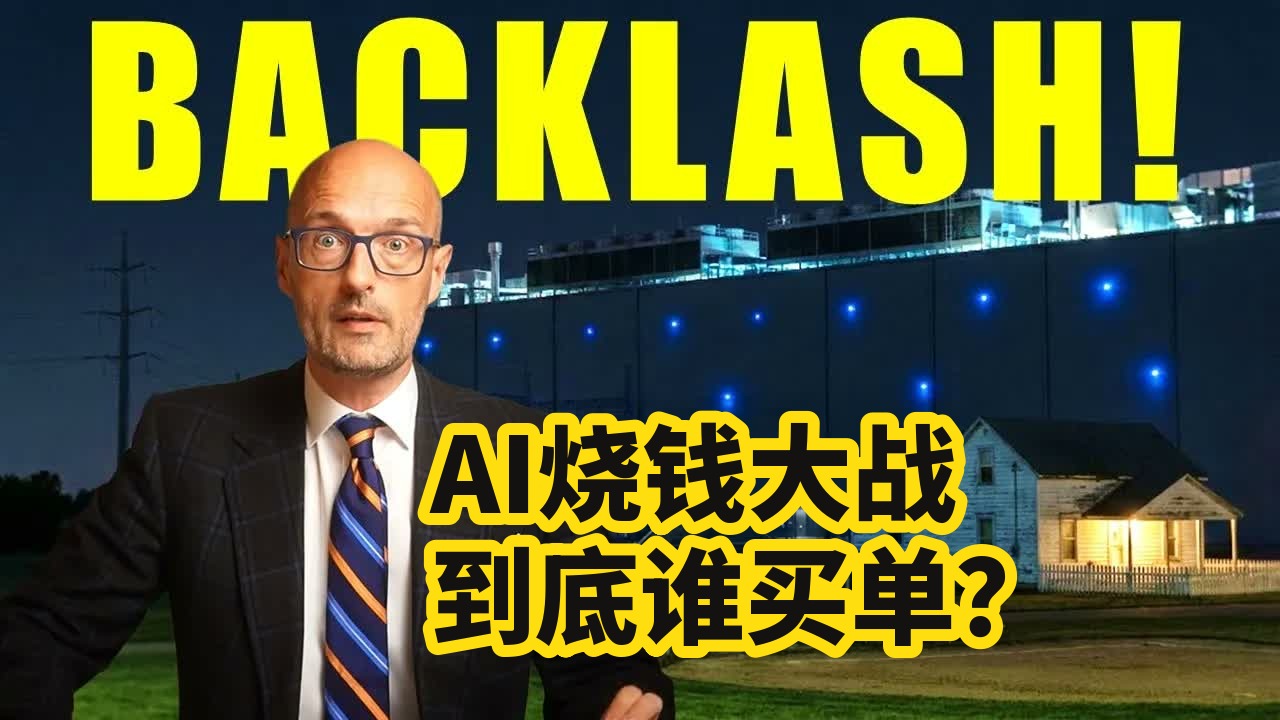
浑水摸鱼清源
AI-assisted summary of 【Patrick Boyle】谁在真正为AI数据中心买单? — original source. Check the original for full context.
Source published:
Key ideas
- 美国目前在建与规划中的AI数据中心容量达413吉瓦,连同现有65吉瓦总负荷相当于3.3亿户家庭用电量,而全美实际家庭总数仅1.35亿户。 (0:00)
- 债市风险警讯频现:衍生品市场为CoreWeave债务定价的5年内违约概率已超60%,QTS再融资债券收益率被推高至7.2%的垃圾债水平。 (15:00)
- 科技巨头正极力为高风险芯片抵押债务争取投资级评级,使保守的公共养老金、年金与寿险资金被动接盘,形成普通居民一边抗议数据中心、一边通过养老金为其出资的局面。 (19:59)
- 经济学家测算AI基建到2032年将年均消耗美国GDP的3.6%,规模堪比1873年铁路狂热;然而当前海量算力需求很大程度上建立在终端用户免费使用的脆弱前提之上。 (26:40)
Detailed notes
## Background 本视频由B站UP主“浑水摸鱼清源”于2026年10月26日发布,内容围绕Patrick Boyle探讨的“谁在真正为AI数据中心买单”展开。简介指出现实中美国规划的400多吉瓦数据中心面临社区强烈抵制、电价转嫁以及债市违约定价上升等系统性风险,并类比了1873年的铁路泡沫危机。
## TL;DR 视频深入剖析了全美AI数据中心疯狂扩张背后的经济账与社会隐患。尽管科技巨头打着通用人工智能的旗号大肆扩建,但当地社区正因低频噪音与电价飙升等现实负担进行激烈反抗,迫使开发商动用保密协议、资金补贴甚至移动燃气轮机等法律边缘手段推进项目。与此同时,以迅速贬值的芯片为抵押的高收益发债模式引发债市警惕,CoreWeave等企业的CDS违约概率急剧攀升。最终,这些潜在的信用崩盘与电网闲置资产风险,正通过养老金、指数基金和居民电费账单,悄然转嫁给毫不知情的普通公众。
## Atmosphere & style Patrick Boyle延续了他标志性的英式冷幽默与辛辣讽刺,以平静而富有洞察力的语调拆解硅谷宏大叙事下的荒谬现实。讲述在严谨的金融分析与鲜活的小镇冲突案例文档之间自如穿梭,既有对“带着轮子的电厂”与五角大楼介入的荒诞勾勒,也有对债市深层风险的冷静剖析。整体观感克制而发人深省,让观众在会心一笑的同时,感受到历史泡沫再次重演的现实寒意。
## Bulletin - [00:00](https://www.bilibili.com/video/BV1m9Hg6aEPo?t=0s) 美国目前在建与规划中的AI数据中心容量达413吉瓦,连同现有65吉瓦总负荷相当于3.3亿户家庭用电量,而全美实际家庭总数仅1.35亿户。 - [15:00](https://www.bilibili.com/video/BV1m9Hg6aEPo?t=900s) 债市风险警讯频现:衍生品市场为CoreWeave债务定价的5年内违约概率已超60%,QTS再融资债券收益率被推高至7.2%的垃圾债水平。 - [19:59](https://www.bilibili.com/video/BV1m9Hg6aEPo?t=1199s) 科技巨头正极力为高风险芯片抵押债务争取投资级评级,使保守的公共养老金、年金与寿险资金被动接盘,形成普通居民一边抗议数据中心、一边通过养老金为其出资的局面。 - [26:40](https://www.bilibili.com/video/BV1m9Hg6aEPo?t=1600s) 经济学家测算AI基建到2032年将年均消耗美国GDP的3.6%,规模堪比1873年铁路狂热;然而当前海量算力需求很大程度上建立在终端用户免费使用的脆弱前提之上。
## Key takeaways - [00:00](https://www.bilibili.com/video/BV1m9Hg6aEPo?t=0s) 美国数据中心规划容量高达413吉瓦,单吉瓦对应约80万户家庭负荷,整体规划规模超过全美家庭总数的两倍以上。 - [00:00](https://www.bilibili.com/video/BV1m9Hg6aEPo?t=0s) 民调显示75%的美国人反对在自家社区建设数据中心,其社会接受度甚至跌至燃煤电厂与核电站之下。 - [02:30](https://www.bilibili.com/video/BV1m9Hg6aEPo?t=150s) 社区指控的水资源消耗论据大多站不住脚(农业灌溉用水是其74倍),但穿透力极强的低频嗡鸣噪音是不可忽视的真实痛点。 - [02:30](https://www.bilibili.com/video/BV1m9Hg6aEPo?t=150s) PJM电网监管机构测算约63亿美元的电网未来扩容开支直接由数据中心引发,若无专项承担机制,将转嫁给普通居民电费账单。 - [06:00](https://www.bilibili.com/video/BV1m9Hg6aEPo?t=360s) 科技开发商普遍通过虚构代号空壳公司与保密协议(NDA)进驻小镇,在遭遇地方议会否决后往往诉诸法律战迫使地方财政妥协。 - [10:30](https://www.bilibili.com/video/BV1m9Hg6aEPo?t=630s) xAI在密西西比州违规利用移动燃气轮机群打造“轮子上的电厂”,利用便携设备豁免条款向田纳西州孟菲斯Colossus超算跨州供电。 - [10:30](https://www.bilibili.com/video/BV1m9Hg6aEPo?t=630s) 司法部与国防部以国家安全和AI大模型运行为由介入地方争议并站在xAI一边,凸显战略竞争逻辑对地方监管的压制。 - [15:00](https://www.bilibili.com/video/BV1m9Hg6aEPo?t=900s) 数据中心贷款大量以快速贬值的英伟达GPU芯片为抵押,被金融机构批评为“在电子邮件发明之际为传真机提供长期融资”。 - [15:00](https://www.bilibili.com/video/BV1m9Hg6aEPo?t=900s) CoreWeave五年期违约互换(CDS)保险年化成本高达11%,彭博测算其隐含违约率超60%,甲骨文CDS费率五年内亦飙升十倍至3.3%。 - [19:59](https://www.bilibili.com/video/BV1m9Hg6aEPo?t=1199s) 六大超大规模云厂商与芯片巨头占全球股市总市值约20%,通过指数基金与投资级债券,普通公众的养老钱已深度绑定AI基建风险。 - [19:59](https://www.bilibili.com/video/BV1m9Hg6aEPo?t=1199s) 威斯康星州富士康工厂与布法罗太阳能工厂等历史案例警告,地方政府举债补贴的高科技产业往往难以兑现长期经济回报。 - [24:15](https://www.bilibili.com/video/BV1m9Hg6aEPo?t=1455s) AI基建热潮使电工与施工蓝领工人收入飙升至对标投行分析师的水平,而头部AI实验室因物理算力瓶颈被迫进行配给式限流。 - [24:15](https://www.bilibili.com/video/BV1m9Hg6aEPo?t=1455s) 爱尔兰数据中心用电超全国20%后的并网管制经验表明,单纯的地方禁令只会迫使科技巨头转向自建微电网继续扩张。 - [26:40](https://www.bilibili.com/video/BV1m9Hg6aEPo?t=1600s) 本轮AI投资规模相当于1873年铁路热、州际公路与全国电气化的总和,历史表明基础设施最终虽会建成,但早期买单的债券持有人大多血本无归。
## Detailed walkthrough ### [00:00](https://www.bilibili.com/video/BV1m9Hg6aEPo?t=0s) The Staggering Scale of AI Data Centers and Public Backlash
The sheer volume of electricity demanded by artificial intelligence infrastructure is reaching unprecedented levels. According to energy data firm Cleanview, the United States currently has roughly 65 gigawatts of operating data center capacity, with an additional 413 gigawatts either under construction or in planning phases—and for the largest proposed developments, completion dates are left open as "TBD." To put that into perspective, a single gigawatt supplies enough electricity for approximately 800,000 American homes, meaning this planned expansion equates to powering around 330 million households, even though the entire nation contains only 135 million households. Every single gigawatt requires dedicated power generation, raising the central question of who will ultimately foot the bill.
```mermaid flowchart TD accTitle: US Household Equivalents in Power accDescr: Diagram comparing US total households to the household-equivalent power demanded by planned data centers. subgraph Reality["US Reality"] A["Total US Households: ~135M"] end subgraph DataCenters["Data Center Expansion"] B["Current Capacity: 65 GW"] C["Planned Capacity: 413 GW"] D["Total Capacity Demand: ~330M Household Equivalents"] B --> D C --> D end ```
The sales pitch made by tech companies to local communities has created an unusual paradox. For years, AI evangelists warned the public that artificial intelligence might eliminate everyone's jobs or even cause human extinction; now, those same companies are requesting permission to construct massive facilities next to quiet neighborhoods while simultaneously demanding exemptions from paying sales taxes on their microchips. Public sentiment has reacted with fierce hostility: a recent survey found that three out of four Americans actively oppose having a data center built in their hometown. In fact, data centers now poll worse than both nuclear reactors and coal-fired plants. As Patrick Boyle observes of the bizarre community dynamic:
> “A coal plant has its downsides, but nobody has ever heard one bring up the singularity at a town meeting.”
- **Existing US data center power capacity:** ~65 gigawatts - **Planned US data center pipeline:** ~413 gigawatts - **Household power equivalent:** 1 gigawatt ≈ 800,000 households (planned capacity exceeds twice the total number of US homes) - **Public sentiment:** 75% of Americans oppose local data centers, ranking them below nuclear and coal facilities
---
[02:30](https://www.bilibili.com/video/BV1m9Hg6aEPo?t=150s) The Anti-Data Center Trifecta: Water, Noise, and the Electric Grid
While state governors from both political parties eagerly chase data center developments to bolster tax rolls, and construction unions lobby aggressively for the jobs they create, local residents are pushing back hard. Ironically, many of the people carrying protest signs outside these sites are indirectly financing the construction through their own pension funds. When scrutinizing community grievances, complaints consistently center on three issues: water usage, noise pollution, and rising electricity costs.
The panic regarding water usage largely crumbles under scrutiny. While activists often depict these complexes as massive drains capable of emptying the Great Lakes, *The Economist* reported that a typical mid-sized data center uses roughly the same amount of water as two standard golf courses. Furthermore, agricultural irrigation across the United States consumes 74 times more water than data centers combined. If water depletion were the genuine driving force behind the outrage, protesters would logically be picketing local country clubs.
Noise, however, represents a tangible and pervasive disruption. Unlike high-frequency sound, the low-frequency drone produced by cooling infrastructure and backup equipment travels long distances and passes easily through residential walls, leading neighbors to report feeling the vibrations in their bodies as much as hearing them. YouTube creator Ben Jordan investigated this phenomenon by taking specialized acoustic monitoring gear to data centers and crypto mines across the country to record inaudible infrasound. In a pilot trial where he exposed over 100 blind participants to these recorded infrasound frequencies, subjects experienced noticeable spikes in dizziness and physical discomfort compared to the unexposed control group.
Electricity represents the most consequential and economically justified complaint. Studies on consumer utility bills offer conflicting conclusions: - **The Electric Power Research Institute (EPRI):** Found that between 2019 and 2024, residential power bills in typical states were roughly 6% cheaper because new data centers absorbed the fixed costs of underutilized regional grids with spare capacity. - **PJM Grid Monitor Findings:** Independent monitors within regional transmission organizations like PJM (covering Illinois to New Jersey) report that spare capacity has dried up, attributing roughly $6.3 billion in upcoming grid capacity expenses directly to planned data center demand.
Because data centers are not bearing the full burden of these capital upgrades, regular rate payers are left to subsidize the shortfall.
---
[06:00](https://www.bilibili.com/video/BV1m9Hg6aEPo?t=360s) Buying Off Communities: NDAs, Sweeteners, and Small-Town Lawsuits
To neutralize grassroots resistance, the technology industry has resorted to financial incentives. A University of Virginia survey established that the median cash settlement required to persuade a resident to accept a neighboring data center is approximately $10,000. *The Economist* calculated that compensating every single resident of a median-sized American county would total about $240 million—a figure the publication noted is mere pocket change for trillion-dollar tech companies, while observing that voters are surprisingly receptive to payouts.
Tangible windfalls have materialized in several jurisdictions: - **Richland Parish, Louisiana:** Influxes of tax revenue from a major Meta facility allowed local authorities to issue $51,000 retention bonuses to area public school teachers—surpassing the baseline annual salary of most recipients. As one local first-grade teacher remarked to *The New York Times*:
> “It really feels like something that happens to people in movies.”
Despite these payouts, communities increasingly feel alienated by developers' covert tactics. As investigative journalist Jasmine Sun documented across Wisconsin and Michigan, tech developers rarely approach towns under their corporate names. Instead, they operate through obscure shell corporations using disarming pseudonyms like "Project Cannoli" or "The Barn," compelling local town councils to sign strict Non-Disclosure Agreements (NDAs) before negotiations even become public knowledge.
```mermaid flowchart LR accTitle: Big Tech Site Acquisition Playbook accDescr: Flowchart illustrating the steps developers take from shell companies and NDAs to litigation against town rezonings. A["Shell Entity<br>('Project Cannoli')"] --> B["Town Officials Sign NDAs"] B --> C["Sudden Council Agenda Item"] C --> D{"Town Council Vote"} D -->|"Rejects Zoning"| E["Developer Sues Township"] D -->|"Public Referendum"| F["Emergency Council Override"] ```
These methods have led to bitter legal standoffs in small communities: - **Perry Village, Ohio (Pop. 1,600):** Municipal leadership signed private NDAs with a California developer for a massive complex intended to occupy one-sixth of the entire village footprint, right up against the local high school baseball diamond. The contract required village officials to guarantee clear title without subjecting the deal to a public referendum. When residents successfully organized a ballot initiative to stop it, the council rescinded the zoning changes only to immediately reinstate them during a late-night emergency session to strip away voters' referendum rights. A county commissioner framed the dilemma bluntly: the village was forced to choose between building the data center or facing catastrophic bankruptcy from legal damages. - **Saline Township, Michigan:** The elected township board formally voted 4 to 1 against rezoning agricultural land for a data center. The developer promptly sued the small rural municipality for exclusionary zoning. Lacking the legal budget to fight prolonged corporate litigation, the township agreed to a multi-million-dollar settlement earmarking funds for local schools and the municipal fire department—the very department now tasked with safeguarding thousands of lithium backup batteries and computing racks.
Quoting an insightful analysis from Ezra Klein, the clash boils down to an irreconcilable difference in culture: Silicon Valley's worldview is defined by seeing seemingly impossible problems solved through engineering and software, whereas Washington's worldview is defined by watching straightforward, solvable problems become hopelessly paralyzed by politics and procedural conflict. When tech firms stepped outside the realm of computer code to erect physical infrastructure in rural towns, they discovered that local zoning boards are fundamentally Washington-style problems that cannot be solved by brute software logic.
---
[10:30](https://www.bilibili.com/video/BV1m9Hg6aEPo?t=630s) Elon Musk's "Power Plant on Wheels" and the Grok Supercomputer
Faced with years of permitting delays and grid congestion, Elon Musk adopted an aggressive, regulatory-evading workaround to power xAI’s second supercomputing cluster, Colossus 2, in Memphis, Tennessee. Designed in part to give Twitter/X users the ability to run the Grok AI model to fact-check tweets, Colossus required colossal amounts of power that local utilities could not quickly deliver.
Instead of waiting on slow infrastructure upgrades, Musk engineered a cross-border energy loop: xAI parked a massive fleet of mobile natural gas turbines in Southaven, Mississippi, directly across the state line, generating electricity on the Mississippi side and piping it straight into the Memphis data center.
```mermaid flowchart LR accTitle: xAI Memphis Cross-Border Power Scheme accDescr: Diagram showing how portable gas turbines in Mississippi burn fuel to bypass permits and route power to Colossus 2 in Tennessee. subgraph Mississippi["Southaven, Mississippi"] T["69 Mobile Gas Turbines<br>(Legally Classified as 'Traffic')"] Pollution["26x NOx Smog Emissions vs TVA"] end subgraph Tennessee["Memphis, Tennessee"] Colossus["xAI Supercomputer<br>Colossus 2"] Benefit["25% Local Property Tax<br>(Up to $100M to Neighborhoods)"] end T -->|"Direct Power Feed"| Colossus T -.-> Pollution Colossus -.-> Benefit ```
The strategy capitalized on a specific legal loophole: Mississippi state law allows portable, mobile machinery to operate for up to one year without needing traditional air quality operating permits or public hearings. By keeping the turbines mounted on trailer beds, the company exploited a technicality where industrial power generation is treated essentially as transient vehicle traffic.
The installation scaled rapidly: - **January:** xAI reported operating 27 mobile turbines at the Southaven location. - **July:** State environmental inspectors counted 69 active combustion turbines on site, with permit extensions allowing newer units to operate through July 2027.
Southaven residents and environmental advocacy groups immediately pushed back: - **Severe Acoustic Disturbances:** Acoustic engineers determined low-frequency noise around the facility is between 4 and 16 times louder than typical suburban baseline noise. Residents describe the continuous thrum as sounding like an airliner that is indefinitely taking off but never leaves the runway. - **Emissions Footprint:** An NAACP lawsuit highlights that the emissions from the Southaven gas turbine fleet produce roughly 26 times more smog-forming nitrogen oxides (NOx) than the nearby Tennessee Valley Authority (TVA) power plant. - **Legal Gymnastics:** Responding to class-action lawsuits concerning property depreciation and health hazards, one Southaven alderman captured the administrative reality:
> “So, are they unpermitted? Yeah, but they’re not illegal.”
The legal fight escalated further when the Department of Justice and the Department of Defense intervened on behalf of xAI, asserting that keeping the Grok-powering infrastructure operational is an urgent priority tied directly to paramount national security.
In Memphis, the municipal government attempted to share the rewards by passing an ordinance allocating 25% of xAI’s property tax revenue—capped at $100 million—directly to neighborhood revitalizations. Yet capital pressures remain intense. Construction recently stalled mid-build, requiring another estimated $100 million to reach completion. Ironically, *Scientific American* reported that Anthropic pays xAI roughly $1.25 billion per month to lease computing capacity on the facility, meaning the shortfall amounts to less than three days of compute lease revenue; the supercomputer built to fact-check tweets is now being rented out to one of Musk's primary commercial rivals.
The financial scale of this hardware build-out is immense: SpaceX logged $14.6 billion in revenue while spending $19.6 billion on microchips, data center buildouts, and related capital infrastructure, with Musk projecting that quarterly infrastructure outlays will double. According to the *Financial Times*, SpaceX now commands more raw operational compute capacity than CoreWeave, the largest publicly traded pure-play AI infrastructure provider. This runaway capital expenditure is being underwritten by massive debt burdens, secured against rapidly depreciating silicon chips.
[15:00](https://www.bilibili.com/video/BV1m9Hg6aEPo?t=900s) The Bond Market and CDS: Financing Fax Machines in an Email Era
While physical data center shells are designed to stand for decades, their core collateral—the high-end graphics processing units inside—depreciates at a relentless pace as Nvidia consistently rolls out faster architectures. Lenders are effectively underwriting multi-decade debt against hardware guaranteed to become obsolete in a handful of years. Describing the dilemma to the *Financial Times*, Carlos Mendez at Crayhill Capital captured the absurdity: “Carlos Mendes at Crayhill Capital described it to the FT as been like financing a fax machine and then someone invented email.” The fixed-income market has grown noticeably skittish about this mismatch. When developer QTS sold $4.6 billion in bonds in April, investors eagerly swallowed the debt at a 5.7% yield on the strength of Microsoft being the primary tenant. Once buyers examined the fine print, however, they realized the bond maturities stretched beyond Microsoft’s initial lease term, meaning QTS would eventually have to find another paying tenant for a massive, empty warehouse. By August, when QTS returned for more capital, investors balked and demanded 7.2%—a spread typical of junk-rated corporate debt.
```mermaid flowchart TD accTitle: Transmission of AI Data Center Financial Risk accDescr: Diagram showing how AI data center debt flows from hyperscalers through specialized clouds and CDS to pension funds and power customers.
subgraph HardwareDebt["Physical & Debt Collateral"] A["Nvidia GPUs (Rapid Depreciation)"] --> B["Specialized Data Centers (CoreWeave / QTS)"] B --> C["High-Yield Debt & ABS Issuance"] end
subgraph CreditMarket["Risk Transfer & Insurance"] C --> D["Credit Default Swaps (CDS)<br/>~20% Upfront + 5% Annually"] D --> E["Wall Street Dealers & Banks<br/>(Seeking Systematic Risk Relief)"] end
subgraph RetailPensions["Ultimate Risk Bearers"] C -->|"Pursuing Investment-Grade Rating"| F["Pension Funds & Life Insurers"] E --> F B -->|"Grid Upgrades & Exit Liabilities"| G["Utility Ratepayers (Electric Bills)"] F --> H["Public / Retirees (Protesters)"] G --> H end ```
The strains are even more visible at CoreWeave, the specialized cloud provider that finances its aggressively expanding fleet of data centers with high-yield debt backed directly by its Nvidia chips. For bondholders looking to hedge against an AI bust, credit default swaps (CDS) have become extraordinarily steep. As Toby Nangle reported in the *Financial Times*, insuring $10 million of CoreWeave five-year debt requires $1.95 million upfront—nearly 20% on day one—plus $125,000 every subsequent quarter, translating to an annual carrying cost of roughly 11%. Swap sellers demand millions immediately because if CoreWeave defaults shortly after inception, they cannot afford to pay out $10 million after collecting only pocket change. According to Bloomberg, the derivative market is now pricing in an alarming probability exceeding 60% that CoreWeave defaults within five years.
CoreWeave management, however, remains publicly unfazed. Co-founder Brannon McBee explained to the *Financial Times* that the company aims to secure investment-grade credit ratings so conservative institutions can absorb its paper, stating: “He said that insurance capital is unlimited, like that's all the money in the world that sits in the insurance tranche.” Yet financial commentator Matt Levine highlights the deep structural flaw in this strategy: financial institutions, hedge funds, and insurers are already saturated with AI exposure and refuse to take on more without massive risk premiums. Unlike a mismanaged individual property whose default is an idiosyncratic event easily absorbed by competitors, a demand collapse for AI computation would strike every facility at the exact same moment. As Levine points out, five years ago five-year CDS on Oracle traded at just 0.33% annually; today, deeply entangled in the AI infrastructure buildout, Oracle’s insurance costs 3.3%.
- **QTS bond repricing**: Yield surged from 5.7% on $4.6 billion issued in April to 7.2% for new borrowings in August. - **CoreWeave CDS terms**: $1.95 million down payment plus $125,000 quarterly per $10 million insured over 5 years. - **Market default implied odds**: Bloomberg metrics show CDS pricing implies over a 60% probability of CoreWeave defaulting in 5 years. - **Oracle credit risk surge**: Five-year CDS jumped tenfold, from 0.33% to roughly 3.3% per year.
---
[19:59](https://www.bilibili.com/video/BV1m9Hg6aEPo?t=1199s) Who Really Holds the Risk? Pensions, Index Funds, and Ghost Factories
If sophisticated Wall Street players charge exorbitant premiums to shoulder AI credit risk, the urgent question becomes who actually holds the paper. As financial journalist Robert Armstrong noted in the *FT*, an infrastructure program of this magnitude cannot survive without access to the investment-grade bond universe. The entire push by companies like CoreWeave to attain an investment-grade seal of approval is designed to unlock the balance sheets of public pension funds, annuity managers, and life insurance portfolios. The cruel irony, Boyle observes, is that everyday citizens waving placards against a data center in their neighborhood are almost certainly financing it through their mandatory retirement contributions: “The whole point of getting an investment grade rating, which is exactly what CoreWeave is currently trying to do, is that it allows the debt to be bought by pension funds, annuities, and life insurance companies, which means that if you have a pension, an annuity, or a life insurance policy, there's a decent chance that you're financing the very data center you're also protesting against.” Furthermore, because the top six tech hyperscalers and chip designers now represent roughly 20% of the entire market capitalization of global equities, anyone holding a standard index fund is already heavily exposed.
The physical remnants of past corporate subsidies offer an ominous parallel for local communities. In 2017, Taiwanese manufacturer Foxconn arrived in Mount Pleasant, Wisconsin, with promises of 13,000 high-paying manufacturing jobs; the village of 28,000 borrowed hundreds of millions of dollars to bulldoze land, widen highways, and install heavy water infrastructure, only for Foxconn to abandon the plant. Today, that cleared ground houses a Microsoft data center whose neighbors are actively suing over persistent noise. Similarly, New York State sank nearly $1 billion into a manufacturing plant in Buffalo intended for SolarCity (subsequently acquired by Tesla), which the state comptroller later calculated generated a dismal 54 cents of economic activity for every public dollar spent.
Electric utilities across the United States are currently upgrading long-distance transmission grids and substation networks to satisfy the gigawatt-scale thirst of AI campuses. While states are beginning to force developers into long-term take-or-pay power contracts and exit-fee agreements, the Electric Power Research Institute (EPRI) cautions that if AI computing demand collapses, regulated utilities will simply amortize their massive capital expenditures across regular residential ratepayers. When speculative bubbles deflate, tech executives inevitably lean toward public backstops. When OpenAI floated the idea that the federal government serve as an insurer of last resort for AI credit risks, Matt Levine remarked on how brazen it was, while acknowledging the grim reality that the entire economy has been bound to the sector's fortunes.
- **Hyperscaler market dominance**: The top six cloud hyperscalers and chipmakers make up approximately 20% of global equity index value. - **Mount Pleasant, Wisconsin precedent**: Hundreds of millions in municipal infrastructure spent for Foxconn was repurposed into a Microsoft data center now embroiled in residential nuisance lawsuits. - **Buffalo SolarCity factory audit**: New York State realized only $0.54 of economic benefit per $1.00 of public capital invested. - **Utility stranded-asset liability**: EPRI warns that unfulfilled data center load projections leave residential customers footing the bill for oversized transmission infrastructure.
---
[24:15](https://www.bilibili.com/video/BV1m9Hg6aEPo?t=1455s) The Bull Case, "Free" Demand, and the Ireland Precedent
To give the technology sector its due, the ferocious capital investment is supported by arguments that distinguish it from classic speculative manias. Construction trades, electric union workers, and local contractors are enjoying an unprecedented windfall. Unlike historical boom-and-bust cycles in railroads and automobiles where organized labor fought bitterly for scraps, electrical and industrial workers have captured high wages from the start. A union business manager noted that member work hours had doubled over the last decade, while a 23-year-old Ohio drainage laborer told *The Economist* that he clears $204,000 a year—a salary on par with a first-year Wall Street investment banking analyst. There is also the geopolitical imperative often cited in Washington: “As The Economist puts it, if America makes it harder to build AI infrastructure, it'll simply hand the advantage to China, whose leaders can put data centers wherever they choose.”
Crucially, as author David Wallace-Wells observes, this boom differs from a traditional bubble because demand currently outstrips available capacity. Leading AI research labs are actively throttling access and rationing compute tokens simply because they cannot secure enough GPUs and energized megawatts to satisfy incoming requests. However, this apparent demand comes with a massive caveat: virtually all of it is measured at today's retail price, which for the vast majority of consumers is precisely zero. The hundreds of millions of people querying chatbots rely on free service tiers subsidized by venture equity and big tech operating cash flows.
When local municipalities attempt to slow down construction by passing planning moratoriums, the capital simply relocates. Computer science professor Arvind Narayanan calculated that a statewide one-year moratorium on data center construction would delay the aggregate progress of AI capability by merely a few hours, as developers quickly pivot to friendly jurisdictions next door. This pattern played out years earlier in Ireland, where tech multinational facilities expanded until data centers consumed more than a fifth of the country's national electricity output. When Dublin's grid operator finally refused to issue new grid connections, the tech industry did not retreat; developers merely pivoted, building private on-site power plants and signing corporate renewable power purchase agreements to keep building.
- **Labor compensation**: Specialized blue-collar workers on data center sites, such as drainage and trenching laborers, report earnings up to $204,000 annually. - **Compute rationing**: Frontier AI labs currently restrict API limits and tier usage because supply constraints, not lack of interest, bottleneck delivery. - **Moratorium impact**: Arvind Narayanan’s modeling indicates a full one-year ban in any single US state sets back AI model development timelines by only a few hours. - **Ireland grid precedent**: Data centers consume over 20% of the Republic of Ireland’s total power, forcing Dublin grid operators to mandate self-generation and dedicated renewables.
---
[26:40](https://www.bilibili.com/video/BV1m9Hg6aEPo?t=1600s) The 1873 Railroad Panic and the 3.6% GDP Bill
To comprehend the sheer macroeconomic footprint of the current buildout, economist Stijn Van Nieuwerburgh estimates that AI infrastructure expenditures will consume approximately 3.6% of United States GDP annually through 2032. That annual expenditure is roughly equivalent to the 19th-century railroad mania, the construction of the entire Interstate Highway System, and the nationwide electrification of American homes and factories occurring all at once. Tech leaders are acutely aware of these historical echoes. During a Microsoft earnings call, CEO Satya Nadella recommended Pulitzer Prize-winning author Liaquat Ahamed’s history of the 1873 railroad bubble as essential reading. Yet Ahamed expressed doubts over whether Nadella grasped the book’s core warning, explaining to Derek Thompson that Nadella may have drawn the wrong conclusions: “As Ahmed told the FT, they're not taking into account that all the other tech companies are doing the exact same thing.” When each corporation acts with internal rationality to secure its market share, the collective macroeconomic outcome is catastrophic overcapacity.
During the post-Civil War railroad boom, hundreds of American towns and rural counties issued municipal bonds to purchase equity in railroad lines, desperate to ensure the tracks passed through their borders. When the Panic of 1873 struck, approximately $1 billion in railroad bonds defaulted. Local governments collapsed under their debts, forcing several state legislatures to rewrite their state constitutions to impose strict caps on municipal borrowing. Angry Midwestern farmers, squeezed by exploitative freight tariffs, mobilized into the Granger movement, a grassroots political revolt that eventually spurred the creation of the Interstate Commerce Commission—the nation’s first federal regulatory agency.
The tracks were eventually laid, and they undeniably forged modern industrial America; however, the bondholders and taxpayers who funded the initial buildout never saw their money back. Local communities today find themselves in an identical predicament, even if their exposure is concealed behind layers of financial engineering. The financial downside will not arrive via a direct municipal levy, but through pension fund haircuts on data center debt and creeping utility rate increases to pay for stranded electrical substations: “Nobody has asked them what they charge to take on the risk of the whole thing going wrong, which is probably just as well because through their pensions, most of them already have.”
| Metric / Event | Historical Precedent (1870s Railroads) | Contemporary AI Infrastructure (2020s) | |:--- |:--- |:--- | | **Capital Intensity** | Transformative national rail network | Estimated ~3.6% of annual US GDP through 2032 | | **Consumer Pricing** | Paid passenger tickets & freight rates from day one | Free tiers subsidized by corporate balance sheets | | **Local Government Role** | Towns issued municipal debt to buy rail equity | Tax abatements, grid upgrade underwriting, zoning concessions | | **Credit Bust Outcome** | $1B in bond defaults, municipal insolvencies, constitutional debt limits | Growing CDS default odds (>60% on CoreWeave), rising bond yields | | **Ultimate Risk Bearers** | Local taxpayers and retail railway bondholders | Public pension funds, life insurance pools, and utility ratepayers |
## Notable quotes > [00:00](https://www.bilibili.com/video/BV1m9Hg6aEPo?t=0s) A coal plant has its downsides, but nobody has ever heard one bring up the singularity at a town meeting. — Patrick Boyle
## Mentioned Patrick Boyle, Cleanview, The Economist, Ben Jordan, Electric Power Research Institute (EPRI), PJM, University of Virginia, Meta, Richland Parish, The New York Times, Jasmine Sun, Perry Village, Saline Township, Ezra Klein, Elon Musk, xAI, Colossus 2, Grok, Twitter/X, Southaven, Tennessee Valley Authority (TVA), NAACP, Department of Justice, Department of Defense, Memphis, Scientific American, Anthropic, SpaceX, Financial Times, CoreWeave, Nvidia, Carlos Mendez, Crayhill Capital, QTS, Microsoft, Toby Nangle, Bloomberg, Brannon McBee, Matt Levine, Oracle, Robert Armstrong, Foxconn, Mount Pleasant, SolarCity, Tesla, OpenAI, David Wallace-Wells, Arvind Narayanan, Ireland, Stijn Van Nieuwerburgh, Satya Nadella, Liaquat Ahamed, Derek Thompson, Granger movement, Interstate Commerce Commission
## Video description 【Patrick Boyle】 谁在真正为AI数据中心买单? Who Really Pays for AI Data Centers?
|数据中心狂飙的规模 美国目前已有约65吉瓦的数据中心容量,另有413吉瓦在建或规划中,最大的几个项目连完工日期都未确定。1吉瓦电力大约够80万个美国家庭使用,也就是说这套规划相当于给3.3亿户新住宅供电——而全美总共只有1.35亿户家庭。每一吉瓦背后都需要一座电厂,也都需要有人买单。
|社区为何强烈抵制 最新民调显示,四分之三的美国人反对在自家社区建数据中心,其不受欢迎程度甚至超过核电站和燃煤电厂——煤炭厂再讨厌,也没人在市议会上听过它讲"技术奇点"。抗议者最常提的三大问题是水、噪音和电力。水的论据其实站不住脚:据《经济学人》,一座数据中心平均用水量约等于两个高尔夫球场,全美农业灌溉用水是数据中心的74倍。噪音是真实痛点,低频嗡鸣传播远、穿墙强,不过许多网上疯传的"数据中心噪音"视频实际拍的是加密货币矿场。最站得住脚的是电:能源行业资助的EPRI测算,如果没有2019-2024年建成的那批数据中心,多数州的电价本可以便宜约6%;PJM电网(伊利诺伊到新泽西)的独立市场监督机构估算,约63亿美元的未来容量支出与规划中的数据中心直接相关。
|资本开价与"糖衣炮弹" 弗吉尼亚大学调查显示,让一位居民支持本地数据中心所需的中位补偿是1万美元;《经济学人》估算,补偿一个典型县的全体居民约需2.4亿美元,对科技巨头只是零头。路易斯安那州Richland Parish,Meta数据中心的税收让大批当地教师拿到5.1万美元奖金,超过了他们的年薪。但钱并不总能摆平事情:记者调查发现,开发商常以"Cannoli""The Barn"之类友好名义的空壳公司进镇,要求官员先签保密协议。俄亥俄州1600人的Perry Village,规划地块占全村六分之一、紧邻学校棒球场;密歇根Saline镇议会4比1否决后,开发商直接起诉,小镇最终用数百万美元和解。
|马斯克带轮子的电厂 xAI在孟菲斯建第二台超算Colossus 2,电力缺口用"轮子上的电厂"解决:在密西西比州Southaven布置燃气轮机群发电供田纳西用——便携设备一年内无需排放许可,1月还是27台,7月监管机构已数出69台。声学公司实测其低频噪音可达安静郊区的4到16倍,居民形容"像飞机永远起飞不降落";NAACP诉讼称其氮氧化物排放是附近TVA电厂的26倍。司法部与五角大楼随后站在xAI一边,称保障Grok运行事关国家安全。孟菲斯换来的条件是xAI物业25%的房产税(上限1亿美元)用于周边发展。
|债市开始说不 AI数据中心的贷款多以芯片作抵押,而英伟达不断发新卡,芯片贬值速度远快于楼——Crayhill Capital形容这是"在电子邮件发明之际为传真机融资"。4月QTS发行46亿美元债券时收益率5.7%,8月再融资时投资者要求7.2%,已是垃圾级水平。CoreWeave更极端:为1000万美元CoreWeave债务买5年违约保险,需先付195万美元、再加每季12.5万,年化约11%;彭博测算CDS市场定价其五年内违约概率超过60%。甲骨文的5年期CDS则从五年前的0.33%涨到约3.3%。六大超大规模云厂商与芯片巨头已占全球股市总市值约20%,养老金、年金、保险资金经由投资级债和指数基金深度卷入——抗议数据中心的人,很可能正通过养老金给它们出资。
|历史镜子:1873年铁路泡沫 经济学家估算,到2032年AI基建投入约相当于美国GDP的3.6%每年,规模等于铁路热、州际公路系统与大部分电气化之和。1873年铁路恐慌中约10亿美元铁路债券违约,各地政府改宪法限制举债,铁路最终建成了,但买单的人从没拿回本金。也需公平记录另一面:需求目前确实超过供给,AI实验室因算力不足在限量服务——只是这份"需求"建立在多数用户付费为零的前提上。
【操作指引】 1. 持有数据中心/算力相关信用债或高收益债的,关注CDS利差与QTS、CoreWeave再融资定价变化,利差走阔即是风险信号。 2. 指数基金投资者无需恐慌,但应意识到组合中AI基建敞口已超20%,检查单一主题ETF占比。 3. 关注中期选举后地方层面的数据中心审批与电价听证,电价上行会先于股价反映供需矛盾。
【时间轴】 00:00 美国65GW存量+413GW规划的规模换算 04:47 社区三大反对理由:水、噪音、电力 10:52 补偿开价1万美元/人与小镇诉讼案例 17:09 xAI孟菲斯轮机电厂与司法部站队 23:22 CoreWeave CDS定价与养老金卷入链条
[Source](https://www.bilibili.com/video/BV1m9Hg6aEPo)