Incat Delivers Record Battery Ferry as Ocean Fleets Rule Out Electric
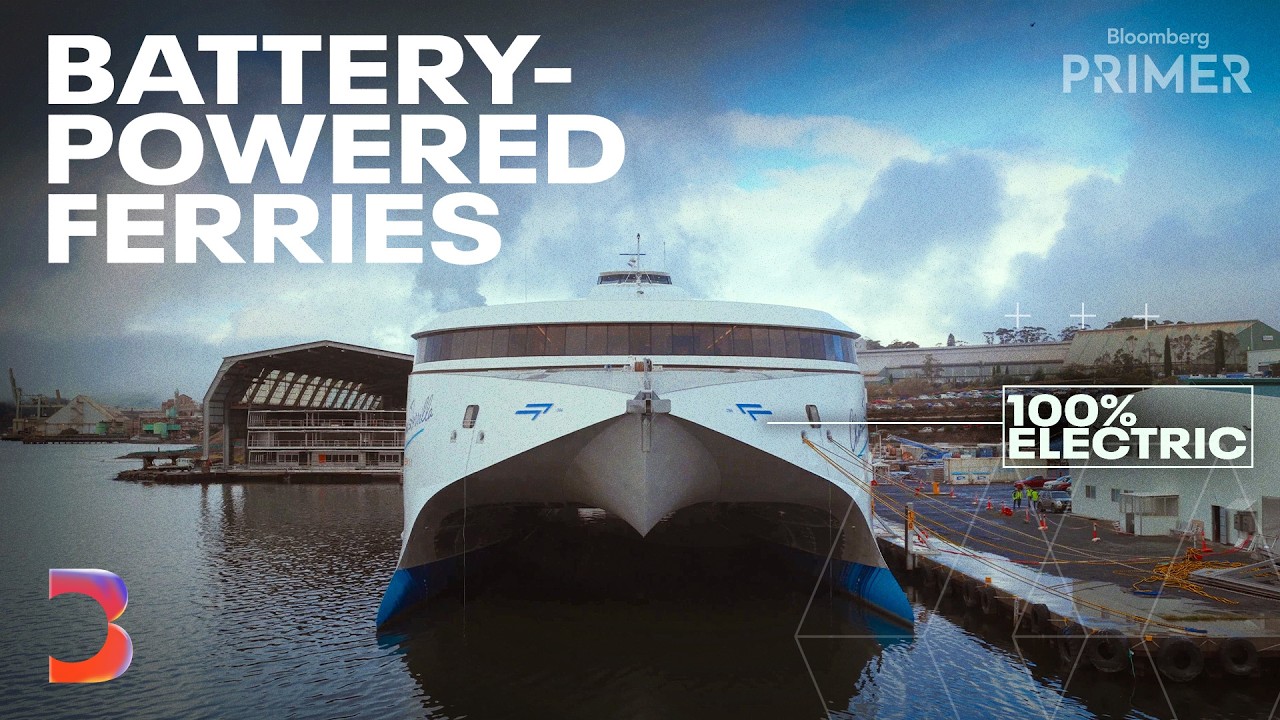
Bloomberg Originals
Predictable schedules allow passenger ferries to pioneer marine battery systems, but severe energy density penalties mean transoceanic vessels will never run on electric power.
AI-assisted summary of How Batteries Power Some of the World’s Biggest Ferries | Bloomberg Primer — original source. Check the original for full context.
Source published:
Key ideas
- Australian shipbuilder Incat completed Hull 096 (China Zorrilla), a 130-meter fully battery-electric passenger catamaran equipped with over 40 MWh of storage capacity across 5,016 lithium-ion modules. (5:07)
- Global shipping generated roughly 740 million metric tons of CO2 equivalent in 2024 (1.4% of global emissions), but fixed routes make passenger ferries prime candidates to pioneer battery-electric propulsion. (2:35)
- Deploying Hull 096 required a $184 million capital investment backed by the IFC and Banco Santander Uruguay, alongside a $20 million government grid enhancement project in Uruguay to enable 60-minute turnaround charging. (9:11)
- Industry leaders project up to 95% of short-distance ferries could transition to battery-electric propulsion, though transoceanic shipping will remain dependent on alternative fuels due to severe battery weight and range limits. (11:20)
Detailed notes
## Background Published by Bloomberg Originals on YouTube on October 26, 2026, this video report examines how advancing battery technology and mounting emissions regulations are driving the maritime sector toward clean energy. The feature focuses on the technical challenges of electrifying large vessels and visits the world's largest battery-electric passenger ferry.
## TL;DR As global shipping confronts its massive carbon footprint, short-haul passenger ferries have emerged as the ideal testbed for electrification due to their predictable routes, fixed schedules, and accessible dockside charging windows. Tasmanian shipbuilder Incat has developed Hull 096 (the China Zorrilla), a 130-meter catamaran equipped with over 40 megawatt-hours of battery storage designed to carry 2,100 passengers across the Río de la Plata at 25 knots. While the vessel balances its 250 tons of battery weight by eliminating heavy combustion engines and exhaust systems, high upfront capital costs and port grid upgrades remain significant hurdles. Ultimately, while physics and energy density limits prevent pure batteries from powering deep-sea, ocean-crossing cargo ships, these pioneer ferries serve as an essential proving ground for maritime decarbonization.
## Atmosphere & style The presentation carries a polished, analytical, and pragmatic tone typical of investigative industrial journalism, blending sweeping shipyard visuals with data-driven engineering breakdowns. Incat founder Robert Clifford injects dry, veteran humor into the discussion, balancing high-tech decarbonization ambitions with candid operational realism about speed and battery weight trade-offs. The resulting experience feels grounded and clear-eyed, exploring a major clean-energy milestone without exaggerating its immediate reach across the broader commercial fleet.
## Bulletin - [05:07](https://www.youtube.com/watch?v=s2AD7DD8_PQ&t=307s) Australian shipbuilder Incat completed Hull 096 (China Zorrilla), a 130-meter fully battery-electric passenger catamaran equipped with over 40 MWh of storage capacity across 5,016 lithium-ion modules. - [02:35](https://www.youtube.com/watch?v=s2AD7DD8_PQ&t=155s) Global shipping generated roughly 740 million metric tons of CO2 equivalent in 2024 (1.4% of global emissions), but fixed routes make passenger ferries prime candidates to pioneer battery-electric propulsion. - [09:11](https://www.youtube.com/watch?v=s2AD7DD8_PQ&t=551s) Deploying Hull 096 required a $184 million capital investment backed by the IFC and Banco Santander Uruguay, alongside a $20 million government grid enhancement project in Uruguay to enable 60-minute turnaround charging. - [11:20](https://www.youtube.com/watch?v=s2AD7DD8_PQ&t=680s) Industry leaders project up to 95% of short-distance ferries could transition to battery-electric propulsion, though transoceanic shipping will remain dependent on alternative fuels due to severe battery weight and range limits.
## Key takeaways - [00:03](https://www.youtube.com/watch?v=s2AD7DD8_PQ&t=3s) Passenger ferries serve as the primary testing ground for maritime electrification due to predictable, fixed routes and scheduled dockside charging windows. - [02:35](https://www.youtube.com/watch?v=s2AD7DD8_PQ&t=155s) Global commercial shipping accounts for roughly 740 million tons of CO2 equivalent annually, an emissions footprint larger than individual nations like Germany or South Korea. - [02:35](https://www.youtube.com/watch?v=s2AD7DD8_PQ&t=155s) Prior to pandemic disruptions, commercial ferries carried over 4 billion passengers annually and supported approximately $60 billion in global GDP. - [05:07](https://www.youtube.com/watch?v=s2AD7DD8_PQ&t=307s) Incat's Hull 096 (China Zorrilla) spans 130 meters and carries up to 2,100 passengers and 225 cars across the Río de la Plata on a 32-nautical-mile route. - [05:07](https://www.youtube.com/watch?v=s2AD7DD8_PQ&t=307s) Hull 096's battery system contains 5,016 interconnected lithium-ion modules delivering over 40 MWh of capacity, equivalent to roughly 550 electric cars. - [07:11](https://www.youtube.com/watch?v=s2AD7DD8_PQ&t=431s) While battery packs contribute 250 tons of displacement, removing internal combustion engines, exhaust systems, and fuel bunkers enables overall weight parity with conventional vessels. - [07:11](https://www.youtube.com/watch?v=s2AD7DD8_PQ&t=431s) Hull 096 is capped at 25 knots using eight 2.4 MW electric motors; higher speed requirements exponentially escalate power, battery mass, and capital expenditure. - [09:11](https://www.youtube.com/watch?v=s2AD7DD8_PQ&t=551s) The financial model of marine electrification trades high upfront capital expenditure for substantially lower ongoing energy operating costs per nautical mile. - [09:11](https://www.youtube.com/watch?v=s2AD7DD8_PQ&t=551s) Widespread electric ferry adoption requires major municipal and port grid infrastructure investments capable of delivering multi-megawatt rapid recharging. - [11:20](https://www.youtube.com/watch?v=s2AD7DD8_PQ&t=680s) Batteries cannot scale to long-haul transoceanic voyages, meaning deep-sea shipping must rely on alternative energy vectors such as synthetic e-fuels, hydrogen, or nuclear propulsion. - [12:45](https://www.youtube.com/watch?v=s2AD7DD8_PQ&t=765s) With less than 1% of the world fleet currently electrified, early battery ferries serve as critical real-world testbeds validating maritime clean energy systems.
## Detailed walkthrough ### [00:03](https://www.youtube.com/watch?v=s2AD7DD8_PQ&t=3s) Incat and the Rise of Battery-Powered Ferries
The maritime world is beginning to turn toward electric power, and while container ships and ocean liners remain daunting to decarbonize, passenger ferries have quietly emerged as the ideal proving ground. Leading this transformation is veteran Australian shipbuilder Robert Clifford, founder of Tasmanian shipbuilder Incat, whose career spans more than half a century. Reflecting on his longevity in an industry he never quite managed to leave behind, Clifford jokes, “Well, I retired 15 years ago, but that hasn’t worked out well.” Starting out as a fisherman in the 1970s before moving into commercial ferry construction during the 1980s, Clifford built Incat into a world leader in high-speed, lightweight aluminium catamarans. Now, the shipyard is pivoting toward one of its most ambitious endeavors yet: engineering a colossal, fully battery-electric passenger ship.
```mermaid flowchart LR accTitle: Hull 096 Electric Propulsion Architecture accDescr: Flow diagram showing energy storage routed to motors and waterjets for propulsion. subgraph Storage["Energy Storage (40+ MWh)"] B["4 Battery Rooms<br/>5,016 Interconnected Modules"] end subgraph Drivetrain["Electric Drivetrain"] M["8 × 2.4 MW Electric Motors"] end subgraph Propulsion["Waterjet Propulsion"] W["8 Steerable Waterjets<br/>25 Knots Operational Speed"] end
B --> M M --> W ```
Incat is far from alone in pursuing marine electrification. Shipbuilders across Europe and Asia are racing to deploy zero-emission vessels on coastal and inland waters. Swedish builder Candela has pioneered foiling electric passenger crafts, while Damen in the Netherlands is expanding its electric vessel line. Scale is moving fastest in Asia: by the end of 2024, the Chinese government reported having nearly 500 electric vessels operating on domestic waterways, the vast majority of which are passenger ferries.
[02:35](https://www.youtube.com/watch?v=s2AD7DD8_PQ&t=155s) Decarbonization Drivers and Why Ferries Fit Electrification
Two primary engines are driving the maritime shift toward batteries: maturing battery chemistry and escalating regulatory pressure on global carbon output. Lithium-ion batteries have undergone roughly thirty-five years of rapid technological refinement. As the battery specialist known as “Doctor for Battery” observes, “In the last three and a half decades, lithium-ion batteries have had a tremendous improvement, both in terms of cost performance, as well as the safety track record.” Concurrently, international governing bodies are tightening mandates across a sector with an enormous carbon footprint. In 2024, international shipping released roughly 740 million metric tons of carbon dioxide equivalent—representing around 1.4% of total worldwide greenhouse gas emissions. That annual footprint exceeds the combined national emissions of major industrialized economies like Germany or South Korea, trailing just behind Canada.
While ferries contribute only a fraction of total marine emissions, their role in global passenger transit is massive. According to pre-pandemic 2019 data compiled by the trade association Interferry, commercial ferries transported over four billion passengers every year and supported approximately $60 billion in global gross domestic product. What makes ferries exceptionally primed for electrification is operational certainty: they run on fixed, predictable timetables over invariant distances. Operators do not need to guess energy reserves because consumption rates and dockside charging windows can be calculated down to the minute. As Doctor for Battery explains, “The distance, the routes are very well planned out, right? So this is always one of the best places to introduce new technologies.”
- **Global shipping emissions (2024):** Approximately 740 million tons of CO₂ equivalent (1.4% of global total). - **Global ferry impact (2019 baseline):** Over 4 billion passengers transported annually; $60 billion supported in global GDP. - **Operational predictability:** Predetermined route lengths and fixed dock times allow precise battery sizing and rapid megawatt-level charging schedules.
[05:07](https://www.youtube.com/watch?v=s2AD7DD8_PQ&t=307s) Inside Hull 096: The China Zorrilla
The flagship showcase of this new era is Incat’s Hull 096, christened *China Zorrilla* after the beloved Uruguayan actress. Commissioned by the South American ferry operator Buquebus, the vessel is engineered to cross the Río de la Plata, connecting Argentina and Uruguay on a 32-nautical-mile journey that takes approximately 90 minutes each way. The scale of the ship is unprecedented for a pure battery-electric vessel: measuring 130 meters in length with a 32-meter beam, the three-deck aluminium catamaran cruises at an operational speed of 25 knots while carrying up to 2,100 passengers, 225 vehicles, and a sprawling on-board duty-free shopping complex.
To propel this immense platform without fossil fuels, the ship houses 5,016 lithium-ion battery modules across four dedicated battery rooms, each containing roughly 1,250 modules. In total, the system delivers more than 40 megawatt-hours of energy storage capacity—equivalent to the battery packs of around 550 standard electric cars. Marine battery design requires stringent protection; packs are heavily sealed to safeguard against corrosive salt spray and seawater ingress. To eliminate structural deadweight, the battery units are engineered to interconnect directly with one another without supplementary support racks or scaffolding.
- **Vessel dimensions:** 130 meters length overall, 32-meter beam. - **Service capacity:** 2,100 passengers, 225 passenger cars, plus commercial cargo and retail areas. - **Operational parameters:** 25 knots cruise speed; 32 nautical miles per leg across the Río de la Plata in ~90 minutes. - **Battery system:** 5,016 interconnected lithium-ion modules delivering over 40 MWh across 4 dedicated battery compartments.
[07:11](https://www.youtube.com/watch?v=s2AD7DD8_PQ&t=431s) The Energy Density Penalty and Propulsion Trade-Offs
The primary engineering challenge in naval electrification is the stark energy density gap between chemical fuels and electrochemical cells. Conventional marine vessels rely on high-energy-density liquid fuels such as marine gas oil, high-speed diesel, or liquefied natural gas (LNG). Because diesel stores vastly more energy per unit of weight than batteries, electric vessels require enormous battery banks to match fuel-burning range, and added weight directly increases drag through the water. Hull 096's battery arrangement alone contributes 250 metric tons to the vessel’s displacement.
However, Incat claims that Hull 096 achieves overall weight parity with a conventional counterpart. Eliminating internal combustion engines, bulky exhaust stacks, cooling auxiliaries, and massive fuel bunkering tanks drastically trims drivetrain weight. The ship's propulsion is driven by eight 2.4-megawatt electric motors connected directly to eight independent steerable waterjets.
```mermaid flowchart TD accTitle: Weight and Power Trade-Off in High-Speed Ferries accDescr: Comparison of Hull 096's 25-knot profile versus high-speed requirements. subgraph Baseline["Hull 096 Profile"] B1["25 Knots Operational Speed"] B2["8 × 2.4 MW Motors (19.2 MW Total)"] B3["250-Ton Battery System (40+ MWh)"] end subgraph HighSpeed["High-Speed Customer Demand (e.g., Denmark)"] H1["38 Knots Operational Speed"] H2["Exponential Power Increase Required"] H3["Significantly Larger Battery Tonnage & Cost"] end
Baseline -.->|"Higher Speed Demands"| HighSpeed ```
The compromise comes down to top speed: capping the design at 25 knots allows the ferry to run on roughly half the horsepower typical of a conventional fast craft. When clients demand greater speed, the physics become unforgiving. Commenting on higher-velocity projects, Clifford highlights the steep trade-offs: “The Danish customer wants 38 knots. So yeah, it is a much more powerful ship, but of course it won’t be anywhere near as economical as this ship.” Every additional knot above moderate transit speeds necessitates an exponential expansion of battery cells, structural reinforcement, and shore-charging capacity.
[09:11](https://www.youtube.com/watch?v=s2AD7DD8_PQ&t=551s) Upfront Capital, Port Infrastructure, and Grid Upgrades
The financial architecture of electric shipping differs fundamentally from fossil-fueled fleets. While operational electricity costs per nautical mile are significantly lower than purchasing bunkered diesel every day, the upfront capital expenditure for high-capacity maritime battery packs is immense. Clifford notes the core economics: “Batteries of course are expensive, but batteries are like fuel. We don’t buy the fuel every day. The electricity’s relatively cheap. The batteries are expensive.” Because commercial profitability is unproven across different route lengths, public subsidies and green financing facilities are essential to launch flagship projects.
Hull 096 represents a $184 million capital investment, backed by Banco Santander Uruguay and the World Bank’s International Finance Corporation (IFC). A significant portion of this capital was not spent on the hull itself, but on the shore-side electrical grid and charging architecture needed to replenish more than 40 megawatt-hours of batteries in an estimated 60-minute turnaround between voyages. The government of Uruguay contributed $20 million toward municipal electrical grid enhancements and specialized marine charging infrastructure at the Port of Colonia. Similar port upgrades are taking shape across northern Europe; as Clifford notes regarding upcoming European builds, “Denmark’s getting close. They’ll have the power available by the time we deliver the ships.”
[11:20](https://www.youtube.com/watch?v=s2AD7DD8_PQ&t=680s) Deployment Realities and Boundaries of Marine Electrification
In August 2026, Hull 096 marked a major milestone by departing its Tasmanian shipyard for South America, loaded aboard the semi-submersible heavy-lift vessel *Black Marlin* in a delicate marine transport operation. Yet industry experts caution that while Hull 096 proves the viability of large electric ferries, batteries cannot decarbonize the entire global commercial fleet. The weight, range, and recharging realities that make battery packs viable on 30-mile urban ferry crossings break down across transoceanic shipping routes.
Clifford is candid about the structural limits of battery technology: “I think 95% of the short distance ferries will go to to electrics at least. The longer distance ships that are crossing the, crossing oceans will never go electric.” Deep-sea container vessels and bulk carriers voyage thousands of miles between remote destinations with no en-route charging opportunities. While Chinese operators are experimenting with automated containerized battery-swapping systems on coastal and river routes, long-haul deep-sea shipping will ultimately depend on alternative zero-carbon energy vectors, including synthetic e-fuels, hydrogen molecule carriers, or onboard nuclear reactors. For now, battery propulsion remains a targeted, high-impact solution tailored for localized ferry links.
[12:45](https://www.youtube.com/watch?v=s2AD7DD8_PQ&t=765s) Proving the Potential of Electric Shipping
While by some estimates far less than 1% of the world's ships have been electrified, focusing solely on that tiny market share overlooks the broader impact of what these vessels are achieving. The transition is not necessarily about electrifying every massive ocean-going vessel overnight; rather, these early battery-powered passenger ferries are serving as a vital proving ground for maritime energy storage systems. They demonstrate that clean propulsion is both technically viable and commercially realistic, charting a clear course forward for smaller vessels operating over short, predictable routes.
Although the sector currently remains small in absolute numbers, its success establishes a template for the broader maritime industry's decarbonization efforts. As the narrator explains: “They're really proving up this technology, you know, and they're showing the way forward, not for every category of ship, but certainly for many categories of ship that are smaller, that are going across shorter distances.” Even if global adoption takes time, these pioneering ferries show the tangible potential of clean battery power on the water.
- **Current Global Adoption:** Less than 1% of the world fleet currently operates on electric power. - **Target Segments:** The primary near-term beneficiaries of battery technology are smaller ships and vessels servicing short-distance maritime routes. - **Industry Role:** High-profile battery ferries act as functional testbeds to de-risk and mature electric propulsion technology for the wider shipping sector.
## Notable quotes > [09:11](https://www.youtube.com/watch?v=s2AD7DD8_PQ&t=551s) Batteries of course are expensive, but batteries are like fuel. We don’t buy the fuel every day. The electricity’s relatively cheap. The batteries are expensive. — Robert Clifford
> [11:20](https://www.youtube.com/watch?v=s2AD7DD8_PQ&t=680s) I think 95% of the short distance ferries will go to to electrics at least. The longer distance ships that are crossing the, crossing oceans will never go electric. — Robert Clifford
## Mentioned Incat, Robert Clifford, Candela, Damen, Doctor for Battery, Interferry, Hull 096, China Zorrilla, Buquebus, Banco Santander Uruguay, International Finance Corporation, Port of Colonia, Black Marlin
## Video description Electric cars have gone mainstream in many parts of the world, but shipping has lagged behind. That may be changing thanks to better battery technology and global pressure to reduce greenhouse gas emissions in the maritime sector.
However, electrifying big ships comes with its own technological challenges, and it might be the humble passenger ferry that’s most primed to take battery-powered boats to open waters. Bloomberg sets out to visit the biggest one yet.
00:00 Intro 00:48 Ship Electrification 05:07 China Zorrilla 06:15 Batteries 07:16 Weight 09:11 Costs 11-18 The Future of Electric Ferries 13:15 Credits
#shipping #ferry #battery #electrical #boat -------- Like this video? Subscribe: http://www.youtube.com/Bloomberg?sub_confirmation=1
Get unlimited access to Bloomberg.com for just $1.99 your first month: https://www.bloomberg.com/subscriptions?in_source=YoutubeOriginals Bloomberg Originals offers bold takes for curious minds on today’s biggest topics. Hosted by experts covering stories you haven’t seen and viewpoints you haven’t heard, you’ll discover cinematic, data-led shows that investigate the intersection of business and culture. Exploring every angle of climate change, technology, finance, sports and beyond, Bloomberg Originals is business as you’ve never seen it.
Subscribe for business news, but not as you've known it: exclusive interviews, fascinating profiles, data-driven analysis, and the latest in tech innovation from around the world.
Visit our partner channel Bloomberg News for global news and insight in an instant.
[Source](https://www.youtube.com/watch?v=s2AD7DD8_PQ)