MTR Borrows HK$140 Billion as Property Slump Tests Transit Model
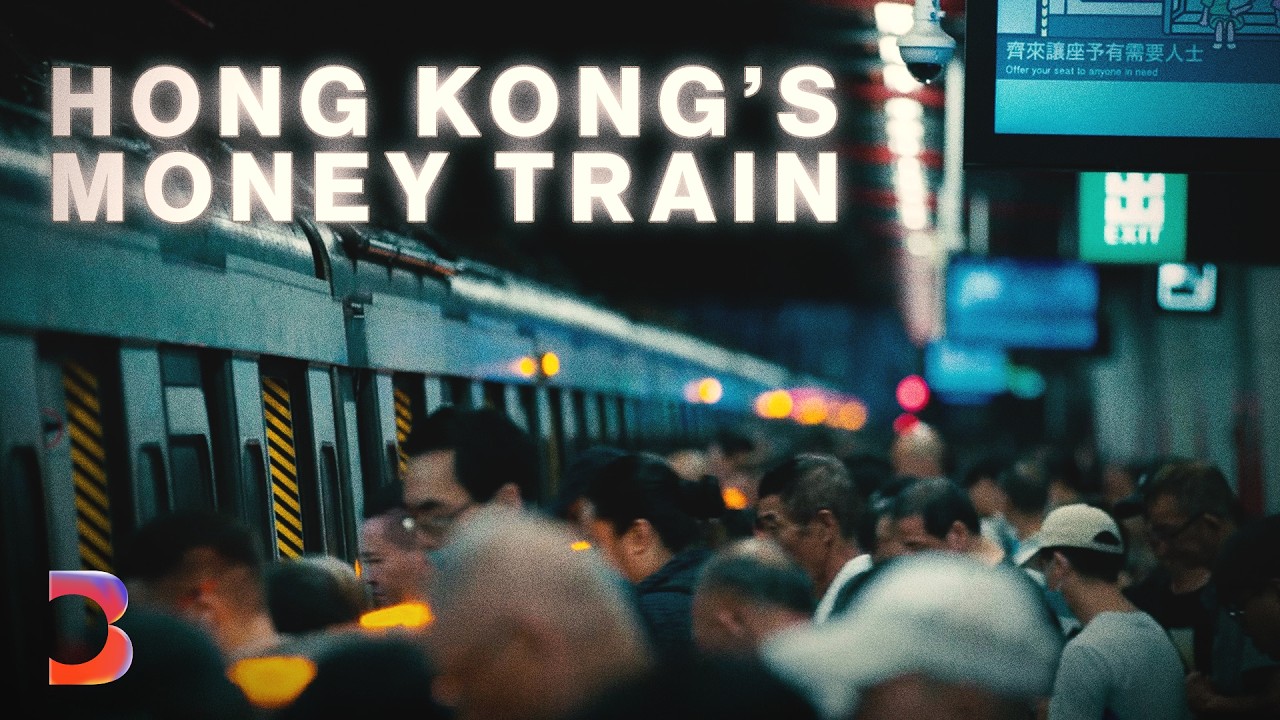
Bloomberg Originals
Hong Kong’s self-funding transit operator is taking on record debt to build the Northern Metropolis line ahead of demand, risking its profitable real estate engine as local property markets cool and residents spend across the border in Shenzhen.
AI-assisted summary of How Hong Kong Built a Subway Money Machine — original source. Check the original for full context.
Source published:
Key ideas
- Hong Kong's MTR operates as the most profitable transit system globally, generating HK$14.6 billion in net profit in 2025, with 75% stemming from commercial property rather than passenger fares. (3:26)
- The railway's self-funding 'land-value capture' model uses government land grants sold to private developers to finance station construction and return roughly HK$6 billion in annual dividends to public coffers. (3:26)
- Hong Kong's extreme density and steep vehicle expenses funnel over 90% of all daily transit trips onto public transportation, supporting a 99.9% on-time record across 5 million daily journeys. (1:58)
- To finance the Northern Metropolis development ahead of population settlement, the MTR has taken on roughly HK$140 billion in debt amid cooling property markets and a cross-border retail drain to Shenzhen. (9:54)
Detailed notes
## Background Published on YouTube by Bloomberg Originals on October 27, 2026, this documentary examines how Hong Kong’s Mass Transit Railway (MTR) established itself as the world’s most profitable transit system through its real estate-driven 'land-value capture' model. It explores the emerging financial strains the MTR faces as it takes on record debt to construct transit for the Northern Metropolis tech hub amid a slowing property market and shifting retail patterns.
## TL;DR Unlike global transit networks that depend on public subsidies, Hong Kong's MTR generates billions in profit and maintains a 99.9% on-time rate by combining extreme urban density with its 'land-value capture' business model. By acquiring station-adjacent land at discounted rates and partnering with private developers to build integrated retail, office, and residential towers, the railway creates a self-funding loop that finances continuous technological innovation and pays dividends back to the government. However, this long-standing formula is being tested by the Northern Metropolis, an ambitious cross-border development requiring infrastructure to be built ahead of population settlement. Facing cooling real estate, cross-border consumer spending shifts toward Shenzhen, and soaring construction costs, the railway has taken on roughly HK$140 billion in debt, marking a risky shift from commercial windfalls to debt-funded expansion.
## Atmosphere & style The piece opens with the nocturnal, high-stakes precision of a two-hour midnight maintenance window, establishing an aura of sleek, hyper-efficient engineering. As the narrative pivots from mechanical marvels to financial balance sheets, the tone shifts into an incisive corporate analysis, contrasting glistening integrated malls with the quiet chill of undeveloped frontier land in the Northern Metropolis. Blending direct commentary from railway engineers and executives with sharp economic reality, it conveys a palpable sense of tension as an iconic, seemingly infallible business model confronts modern economic and geopolitical pressures.
## Bulletin - [03:26](https://www.youtube.com/watch?v=3kGQ7gsrOeA&t=206s) Hong Kong's MTR operates as the most profitable transit system globally, generating HK$14.6 billion in net profit in 2025, with 75% stemming from commercial property rather than passenger fares. - [03:26](https://www.youtube.com/watch?v=3kGQ7gsrOeA&t=206s) The railway's self-funding 'land-value capture' model uses government land grants sold to private developers to finance station construction and return roughly HK$6 billion in annual dividends to public coffers. - [01:58](https://www.youtube.com/watch?v=3kGQ7gsrOeA&t=118s) Hong Kong's extreme density and steep vehicle expenses funnel over 90% of all daily transit trips onto public transportation, supporting a 99.9% on-time record across 5 million daily journeys. - [09:54](https://www.youtube.com/watch?v=3kGQ7gsrOeA&t=594s) To finance the Northern Metropolis development ahead of population settlement, the MTR has taken on roughly HK$140 billion in debt amid cooling property markets and a cross-border retail drain to Shenzhen.
## Key takeaways - [00:04](https://www.youtube.com/watch?v=3kGQ7gsrOeA&t=4s) Every morning at 2:00 a.m., maintenance crews complete all inspections and track repairs in a strict two-hour window to preserve a 99.9% on-time record. - [00:04](https://www.youtube.com/watch?v=3kGQ7gsrOeA&t=4s) The MTR handles approximately 5 million passenger journeys daily, representing a volume equivalent to two-thirds of Hong Kong's total population. - [01:58](https://www.youtube.com/watch?v=3kGQ7gsrOeA&t=118s) Extreme urban density—with 7.5 million people concentrated on 25% of the land—drives over 90% of daily trips onto public transportation. - [01:58](https://www.youtube.com/watch?v=3kGQ7gsrOeA&t=118s) High vehicle taxes and exorbitant costs, including a parking space sold for $1.3 million, limit private car ownership to only one in ten residents. - [03:26](https://www.youtube.com/watch?v=3kGQ7gsrOeA&t=206s) Unlike global transit networks where fares cover only about 75% of operational costs, the MTR pays billions back to the government via its land-value capture model. - [03:26](https://www.youtube.com/watch?v=3kGQ7gsrOeA&t=206s) The government grants pre-development land rights at a discount, allowing the MTR to partner with private developers to build stations, commercial towers, and housing. - [03:26](https://www.youtube.com/watch?v=3kGQ7gsrOeA&t=206s) MTR acts as a massive commercial landlord, operating 16 shopping malls and 1,600 station retail shops that contribute three-quarters of its net profits. - [05:29](https://www.youtube.com/watch?v=3kGQ7gsrOeA&t=329s) Surplus real estate revenues fund advanced operational technology, such as real-time train-car weight sensors, AI predictive maintenance, and augmented-reality project engineering. - [07:32](https://www.youtube.com/watch?v=3kGQ7gsrOeA&t=452s) The Northern Metropolis initiative reverses MTR's traditional playbook by requiring infrastructure to be built first across undeveloped frontier land ahead of population arrival. - [07:32](https://www.youtube.com/watch?v=3kGQ7gsrOeA&t=452s) The transit system faces economic head现winds as residents log over 90 million trips annually to Shenzhen, causing downward rent adjustments in MTR retail spaces. - [07:32](https://www.youtube.com/watch?v=3kGQ7gsrOeA&t=452s) Rapidly inflating construction costs, such as the Kwu Tung station running 70% above original projections, strain the project's economic viability. - [09:54](https://www.youtube.com/watch?v=3kGQ7gsrOeA&t=594s) The MTR has borrowed approximately HK$140 billion in debt, challenging its historic golden rule that 'the land must pay for the train.'
## Detailed walkthrough ### [00:04](https://www.youtube.com/watch?v=3kGQ7gsrOeA&t=4s) 2 A.M. Maintenance and the World's Most Profitable Transit System
Every morning at 2:00 a.m., while Hong Kong sleeps, an army of highly skilled mechanics descends into the subway tunnels for a high-stakes, two-hour race against the clock. Before millions of commuters flood the stations at dawn, every single maintenance routine, track inspection, and component repair must be completed flawlessly. If a single task overruns by even 15 minutes, the disruption can ripple across the entire city and bring transit to an abrupt halt. Despite those extreme time constraints, the system achieves an astonishing 99.9% on-time record, moving a passenger volume equal to two-thirds of Hong Kong’s entire population—roughly five million passenger journeys—every single day.
This world-leading reliability relies on predictive algorithms, automated real-time monitoring, and thousands of sensors that spot mechanical faults long before a train can break down on an active line. As one MTR official explains regarding the automated diagnostic systems, “All is automatic real-time capture. We can understand and identify any potential issue.” Yet the true marvel of the Mass Transit Railway (MTR) is not simply its mechanical efficiency, but its bottom line. While passenger subways around the globe hemorrhage public cash, Hong Kong’s transit operates as the most profitable network on Earth. As one observer reflects on the commuter experience, “When people are riding the MTR or walking to the MTR station, I don't think they realize that they are walking inside a self-funding business model.” Rather than siphoning subsidies from taxpayers, the MTR actually pays billions back to the government.
- **Maintenance window:** 2 hours (starting at 2:00 a.m.) before morning passenger service begins. - **On-time performance:** 99.9% of all passenger trips. - **Daily patronage:** 5 million trips, equivalent to roughly two-thirds of Hong Kong's total population.
---
[01:58](https://www.youtube.com/watch?v=3kGQ7gsrOeA&t=118s) Density, Geography, and Intentional Transit Design
The foundation of the MTR's profitability is inseparable from the geography and urban planning of Hong Kong itself. The territory squeezes roughly 7.5 million residents onto just 25% of its total land area, leaving the remaining three-quarters untouched as steep mountain ridges and protected country parks. This concentration produces extreme urban density: the average resident lives in an apartment measuring only 160 square feet—roughly the dimensions of an ordinary automobile parking spot. Owning a private car is prohibitively expensive due to steep government taxes and exorbitant parking rates, illustrated by a single parking space that once commanded a world-record price of $1.3 million. Consequently, only one in ten residents owns a vehicle.
Because the state retains ownership of virtually all land, Hong Kong has planned its transit infrastructure with deliberate, surgical precision. Transit nodes are deeply woven into neighborhoods, meaning that no matter where an individual stands in the dense urban core, a subway entrance is almost always in sight. Major interchanges like Tsim Sha Tsui (TST) and East Tsim Sha Tsui feature as many as 27 separate exits, directly linking subterranean passages with surrounding commercial and residential blocks. With nearly half of the entire population residing within comfortable walking distance of a station, cramped living spaces, exorbitant vehicle expenses, and state-directed land management drive more than 90% of all daily trips onto public transit.
- **Population and area:** 7.5 million people concentrated on approximately 25% of the land. - **Living space:** Average of 160 square feet per person (equivalent to a single parking stall). - **Car ownership:** Only 10% of residents own a car, driven down by costs like a record $1.3 million parking space. - **Connectivity:** Major hubs like TST and East TST stations provide up to 27 exits, putting nearly 50% of the population within walking distance of an MTR stop. - **Transit share:** Over 90% of all daily trips in Hong Kong are taken via public transportation.
---
[03:26](https://www.youtube.com/watch?v=3kGQ7gsrOeA&t=206s) The Land-Value Capture Engine
Around the world, running passenger rail is notoriously difficult. Mass transit is heavily labor-intensive and requires immense capital outlays for maintenance, track replacements, and rolling stock overhauls. Globally, ticket fares cover only about 75% of basic operational expenses, leaving public subsidies and local taxpayers to bridge the operational deficit and fund capital expansions. The MTR broke out of this financial trap through a mechanism called "land-value capture," also known as the Rail plus Property model. In 2025, the MTR reported a net profit of approximately HK$14.6 billion, with three-quarters of that revenue originating from property developments and commercial real estate rather than passenger fares.
```mermaid flowchart TD accTitle: MTR Land-Value Capture Model accDescr: Diagram illustrating how the government grants discounted land to MTR, which partners with developers to fund rail and capture property revenue. subgraph LandAndRail["Land & Rail Development"] Gov["HK Government"] -->|"Grants discounted land rights"| MTR["MTR Corporation"] MTR -->|"Tenders development rights"| Dev["Private Developers"] Dev -->|"Constructs stations, malls & towers"| Network["Integrated Transit Properties"] end subgraph RevenueLoop["Commercial & Public Returns"] Network -->|"Pedestrian foot traffic"| Retail["16 Malls, Towers & 1,600 Shops"] Retail -->|"Rent, fees & property sales"| MTR MTR -->|"~HK$6B annual dividends"| Gov end ```
The system works through an institutional arrangement with the Hong Kong government. Instead of handing over public tax dollars to build rail lines, the government sells the MTR development rights for the land parcels surrounding planned stations at a pre-rail, discounted valuation. As an MTR representative explains the process, “What the government is doing is to give us land around the station on a pre-development land premium basis, at a discount. After given the land, while we are building the line or station, we'll tender out the land to a private developer. So this is basically how the railway is funded. Instead of cash, government is giving us land.” The MTR then partners with private real estate developers, who pay to construct station infrastructure, office towers, residential estates, and shopping malls.
By capturing the massive surge in property values that occurs the moment a rail line opens, the MTR has transformed into one of the city's largest landlords, managing 16 major shopping centers, corporate skyscrapers, and over 1,600 station retail outlets. The integration is so seamless that everyday activities—from grocery shopping to commuting to walking home—occur entirely within climate-controlled MTR properties. As one resident observed of this daily ease, “I don't even bring an umbrella when it's raining outside. I just need to walk inside the station and directly get home.” In exchange for this development monopoly, the railway generates roughly HK$6 billion in annual dividends paid back into public coffers.
- **Global metro baseline:** Passenger fares globally cover only about 75% of operating costs on average. - **MTR 2025 net profit:** Approximately HK$14.6 billion, with 75% derived from real estate and commercial activities. - **Property portfolio:** 16 shopping malls, numerous office towers, and 1,600 retail units within stations. - **Public dividend:** MTR pays roughly HK$6 billion annually back to the Hong Kong government.
---
[05:29](https://www.youtube.com/watch?v=3kGQ7gsrOeA&t=329s) Tech-Driven Maintenance and Construction Innovation
Because the land-value capture model produces reliable operating surpluses, the MTR can continuously reinvest significant capital into cutting-edge technology. Inside the central Operations Control Center, dispatchers manage train headways, switch track alignments, and oversee electrical power distribution in real time. Across the system, air suspension sensors instantly weigh passenger cars as commuters board, immediately feeding crowding levels onto platform overhead displays so passengers can distribute themselves evenly. During peak commute hours, trains run on headways as short as two minutes.
In the company's dedicated data studio, maintenance has moved away from manual visual checks to algorithm-driven predictive diagnostics. As an MTR engineering specialist recalls of the shift, “In the past, we need an experienced guy to walk along the track to check the condition. Nowadays, we can try to focus on the AI analytics to have more frequent inspection on the rail and to identify any defect.” Automated sensors monitor onboard vibrations, heat signatures, and track alignments, flagging microscopic structural wear before it can cause an interruption. This digital push extends to capital project delivery inside the MTR's Reality Lab, where engineering teams walk through life-sized 3D virtual models to test station layouts before pouring concrete. On job sites, construction crews swap paper blueprints for augmented-reality iPads. As one project lead emphasizes, “Instead of using drawings, it's very intuitive, you know, easy to understand and less mistakes and more efficient in terms of project delivery.” Looking further forward, the railway is testing autonomous tunnel drones and quadruped robotic inspectors to patrol tracks and monitor bottlenecks.
- **Peak frequency:** Trains run at headways as short as two minutes. - **Platform intelligence:** Real-time car crowding displayed via automated train-car weight sensors. - **Digital engineering:** Reality Lab with life-sized 3D testing environments and augmented-reality iPads replacing physical paper blueprints on job sites. - **Advanced robotics:** Field-testing quadruped walking robots and autonomous drones for tunnel and track bed inspections.
---
[07:32](https://www.youtube.com/watch?v=3kGQ7gsrOeA&t=452s) The Northern Metropolis and Shifting Economic Currents
The MTR faces a multi-billion-dollar test that departs from its historical expansion playbook: the Northern Metropolis. This massive government initiative aims to construct a major technology and innovation hub along Hong Kong's northern border to integrate the city with mainland China, including plans for half a million new residential homes. Historically, the railway expanded into established, dense neighborhoods where pent-up demand immediately guaranteed high ridership and lucrative property sales. The Northern Metropolis flips that dynamic upside down. As an MTR representative points out regarding the strategic change, “In the past, some projects, we developed the area and then we built the railway. But moving into Northern Metropolis, we focus on the infrastructure first.”
This infrastructure-first mandate requires the MTR to construct brand-new lines and seven new stations across undeveloped frontier land well ahead of actual population settlement. The dual mandate highlights an inherent tension in the railway's corporate DNA. As an executive explains, “On one hand, we are a publicly listed company, so we will have to ensure that we have enough return to our shareholders. But at the same time, we are a public service provider providing an essential service for the community, for their day-to-day life and for the development of the city as well.”
Compounding this corporate strain is an evolving macroeconomic environment. Local real estate has cooled, leaving private developers hesitant to bid aggressively on Northern Metropolis parcels. Simultaneously, consumer behavior has shifted dramatically: Hong Kong census figures reveal that local residents now log over 90 million trips per year across the border into Shenzhen, taking advantage of cheaper dining, entertainment, and shopping options. This cross-border retail drain has directly hit MTR mall and station tenants. As an MTR commercial manager acknowledges, “Both our station shops and mall shops have rental adjustment downward. That's quite in line with what the whole economy is experiencing.” On top of declining retail rents, construction costs are escalating rapidly; the Metropolis’s first new station at Kwu Tung is running approximately 70% above original cost projections, with little prospect that near-term land sales will offset the overrun.
- **Northern Metropolis scale:** A planned tech hub with 500,000 new housing units and 7 new MTR stations. - **Strategy reversal:** Shifting from building rail into established density to building "infrastructure first" ahead of population demand. - **Cross-border spending:** Hong Kong residents make over 90 million trips annually to Shenzhen, pulling retail revenue away from local station malls. - **Cost escalation:** Kwu Tung station construction costs have surged approximately 70% above initial estimates.
---
[09:54](https://www.youtube.com/watch?v=3kGQ7gsrOeA&t=594s) Breaking the Golden Rule and the Borrowing Binge
For half a century, the MTR flourished on a straightforward financial principle: the land must pay for the train. High urban density, scarce land, and rising real estate values guaranteed that rail construction practically funded itself. Now, as the railway pivots from purely commercial return to advancing national integration and state industrial policy, that foundational model is coming under intense pressure.
To finance its sprawling commitments across the Northern Metropolis without the immediate backstop of high-margin property sales, the MTR is turning to debt. As an executive frankly discloses regarding their current capital strategy, “So far we have borrowed about 140 billion Hong Kong dollars for the coming projects. We believe we will have to keep adjusting, keep changing, keeping agile to adjust to, you can say, the 'new normal'.” By taking on unprecedented leverage to build transit lines ahead of population growth, Hong Kong is testing whether its self-funding railway can survive when commercial property windfalls no longer shoulder the burden.
- **Historical operating rule:** "The land must pay for the train." - **Debt taken on:** Approximately HK$140 billion borrowed to fund upcoming expansion projects. - **Strategic pivot:** Transitioning from a self-funding commercial real estate model to debt-financed infrastructure supporting national cross-border integration.
## Notable quotes > [00:04](https://www.youtube.com/watch?v=3kGQ7gsrOeA&t=4s) When people are riding the MTR or walking to the MTR station, I don't think they realize that they are walking inside a self-funding business model. — Observer
> [07:32](https://www.youtube.com/watch?v=3kGQ7gsrOeA&t=452s) In the past, some projects, we developed the area and then we built the railway. But moving into Northern Metropolis, we focus on the infrastructure first. — MTR representative
## Mentioned Bloomberg Originals, Mass Transit Railway (MTR), MTR Corporation, Northern Metropolis, Kwu Tung, Shenzhen, Tsim Sha Tsui (TST), East Tsim Sha Tsui, Hong Kong Government, Reality Lab, iPad
## Video description Hong Kong’s Mass Transit Railway is the most profitable transit system in the world. While subways tend to lose money everywhere else, the MTR funds its system through a real estate engine known as “land-value capture.” By directly integrating malls, offices and apartments into stations, the railway has created a self-funding loop that pays billions of dollars back to the government.
Now, the MTR is taking on a massive challenge: funding transport for the Northern Metropolis, a new tech hub aimed at better connecting Hong Kong with Mainland China. But as local real estate cools, construction costs soar and residents shift retail spending across the border to Shenzhen, the MTR is taking on record debt to fund the expansion. Will this ambitious project break the very rule that made Hong Kong’s transit a global marvel?
00:00: Introduction 01:57: Hong Kong’s layout 03:23: Hong Kong’s money making machine 05:29: What the money buys 07:30: The multi-billion dollar challenge 09:54: MTR’s business shift
Watch more short documentaries: https://www.youtube.com/playlist?list=PLqq4LnWs3olUDhww8NEcViirkrirzHp27
#HongKong #Transit #Train
-------- Like this video? Subscribe: http://www.youtube.com/Bloomberg?sub_confirmation=1
Get unlimited access to Bloomberg.com for just $1.99 your first month: https://www.bloomberg.com/subscriptions?in_source=YoutubeOriginals Bloomberg Originals offers bold takes for curious minds on today’s biggest topics. Hosted by experts covering stories you haven’t seen and viewpoints you haven’t heard, you’ll discover cinematic, data-led shows that investigate the intersection of business and culture. Exploring every angle of climate change, technology, finance, sports and beyond, Bloomberg Originals is business as you’ve never seen it.
Subscribe for business news, but not as you've known it: exclusive interviews, fascinating profiles, data-driven analysis, and the latest in tech innovation from around the world.
Visit our partner channel Bloomberg News for global news and insight in an instant.
[Source](https://www.youtube.com/watch?v=3kGQ7gsrOeA)