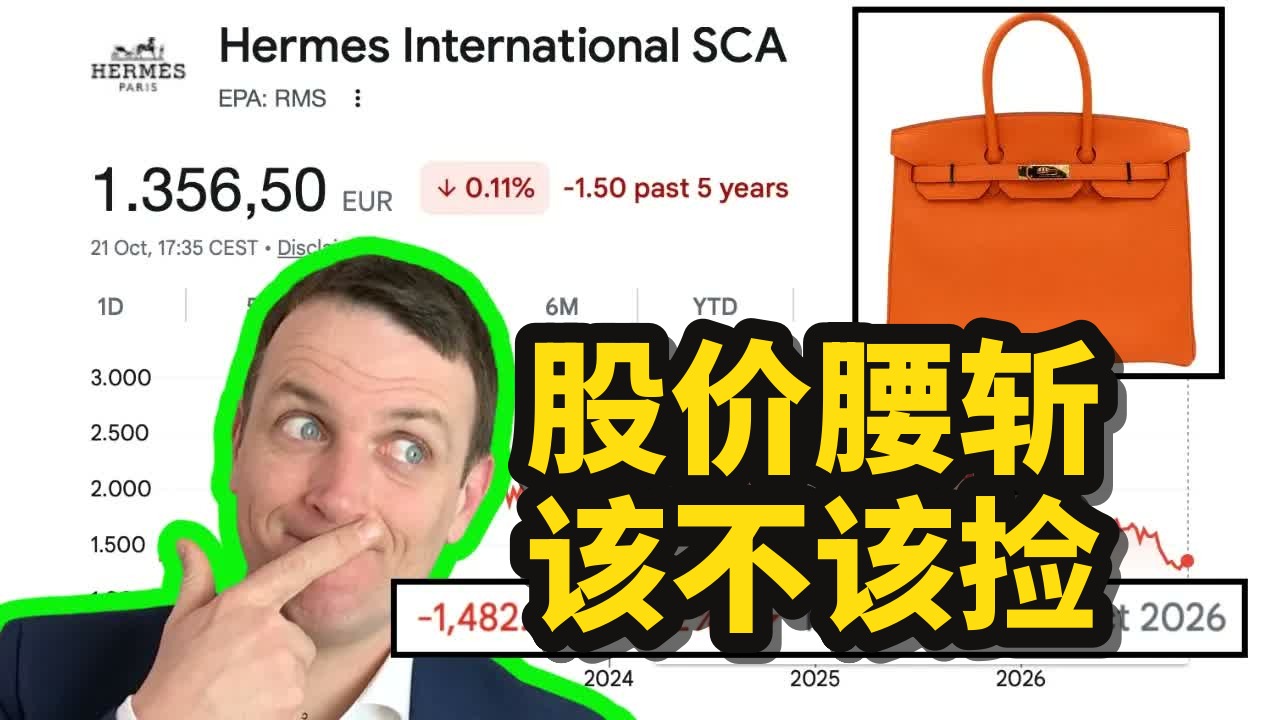
爱马仕市值腰斩后PE仍达30倍 估值过高下行空间或达六成
浑水摸鱼清源
爱马仕基本面虽稳但此前泡沫受指数被动配置放大,在30倍市盈率下仍无安全边际,若按3%股息率回归合理估值股价需再跌六成。
AI-assisted summary of 【Value Investing with Sven Carlin, Ph.D】爱马仕腰斩 是抄底还是接刀 — original source. Check the original for full context.
Source published:
Key ideas
- 爱马仕股价较一年半前高点下跌逾50%,市值从2800亿欧元缩水至1400亿欧元,但最新半年报营收仍保持6%增长,净利润约20亿欧元且资产负债表几无负债。 (0:01)
- 即便股价腰斩,爱马仕当前市盈率仍达30倍,股息率仅由0.65%回升至约1.3%至1.45%,估值仍属昂贵而非具备安全边际。 (3:01)
- 若按价值投资标准将其视为低速增长分红资产,达到3%股息率意味着股价需再跌60%(约至500欧元),达到5%股息率则需再跌80%(约至320欧元)。 (3:20)
- 欧洲指数权重机制在此轮涨跌中起到推波助澜作用,被动资金与养老金的机械化买入和撤退放大了市值的大起大落。 (5:04)
Detailed notes
## Background Published on Bilibili by 浑水摸鱼清源 on October 27, 2026, this video features value investor Sven Carlin analyzing whether Hermès' 50% stock price collapse represents a bargain or a falling knife. According to the page description, while Hermès' business remains fundamentally sound with 6% revenue growth and negligible debt, its valuation had simply become unsustainably inflated by passive index flows, leaving it still expensive at a 30x P/E ratio.
## TL;DR Hermès has seen its share price and market capitalization cut in half from their peak, falling to €140 billion even as revenue grew 6% and net profit held steady around €2 billion. Value investor Sven Carlin examines the company's disciplined capital allocation and growing dividends, concluding that despite pristine balance sheets and strong Asian demand, the stock is still not cheap at a 30x P/E and a 1.3% dividend yield. He demonstrates that if Hermès shifts to mature growth, achieving a standard 3% to 5% dividend yield would require the stock to tumble another 60% to 80%. Ultimately, Carlin attributes the historical run-up and crash to mechanical index fund weighting rather than collapsing consumer appeal, warning investors that the shares have merely transitioned from wildly overpriced to very expensive.
## Atmosphere & style The presentation carries the measured, unhurried, and contrarian clarity characteristic of Sven Carlin's quantitative value investing approach. Carlin cuts through luxury market prestige with dry wit, playfully telling investors that if they want to bet on secondary market handbag premiums, they should flip physical scarves rather than buy overvalued equity. The atmosphere feels like a sober, patient reality check, grounding viewers in mathematical balance-sheet realism while acknowledging—and calmly defying—the prevailing consensus.
## Bulletin - [00:01](https://www.bilibili.com/video/BV1cAHF6oEJM?t=1s) 爱马仕股价较一年半前高点下跌逾50%,市值从2800亿欧元缩水至1400亿欧元,但最新半年报营收仍保持6%增长,净利润约20亿欧元且资产负债表几无负债。 - [03:01](https://www.bilibili.com/video/BV1cAHF6oEJM?t=181s) 即便股价腰斩,爱马仕当前市盈率仍达30倍,股息率仅由0.65%回升至约1.3%至1.45%,估值仍属昂贵而非具备安全边际。 - [03:20](https://www.bilibili.com/video/BV1cAHF6oEJM?t=200s) 若按价值投资标准将其视为低速增长分红资产,达到3%股息率意味着股价需再跌60%(约至500欧元),达到5%股息率则需再跌80%(约至320欧元)。 - [05:04](https://www.bilibili.com/video/BV1cAHF6oEJM?t=304s) 欧洲指数权重机制在此轮涨跌中起到推波助澜作用,被动资金与养老金的机械化买入和撤退放大了市值的大起大落。
## Key takeaways - [00:01](https://www.bilibili.com/video/BV1cAHF6oEJM?t=1s) 爱马仕股价自一年半前高位腰斩超50%,但公司最新上半年营收仍维持6%的稳健增长。 - [00:40](https://www.bilibili.com/video/BV1cAHF6oEJM?t=40s) 除中东地区销售略有下滑外,全球其余市场依然保持增长态势,基本面并未发生结构性损坏。 - [01:01](https://www.bilibili.com/video/BV1cAHF6oEJM?t=61s) 亚洲消费者贡献了主要销售额,买包往往承载着身份象征的需求,但宏观预期转弱可能使这部分客群最先动摇。 - [01:40](https://www.bilibili.com/video/BV1cAHF6oEJM?t=100s) 公司资产负债表极为健康,净利润约20亿欧元且几乎无债务负担,运营引擎完好。 - [02:20](https://www.bilibili.com/video/BV1cAHF6oEJM?t=140s) 资本开支仅占净利润约20%,管理层避免大型并购,家族股东更偏好现金分红而非大规模股票回购。 - [03:01](https://www.bilibili.com/video/BV1cAHF6oEJM?t=181s) 股价暴跌使股息率从极端的0.65%回升至1.3%左右,但这一收益率在全球资产中仍缺乏足够的吸引力。 - [03:20](https://www.bilibili.com/video/BV1cAHF6oEJM?t=200s) 以3%的目标股息率倒推,爱马仕股价还需再跌约60%至500欧元左右,当前价格买的是品牌信仰而非估值折扣。 - [03:40](https://www.bilibili.com/video/BV1cAHF6oEJM?t=220s) 若以5%的保守股息率要求衡量,股价对应跌幅高达80%至320欧元左右。 - [04:20](https://www.bilibili.com/video/BV1cAHF6oEJM?t=260s) 二手市场手袋溢价虽证明了终端定价权,但并不能作为在二级市场高价买入股票的合理解释。 - [05:04](https://www.bilibili.com/video/BV1cAHF6oEJM?t=304s) 指数被动配置机制放大了波动,市值膨胀曾迫使被动资金不断追高,而退潮时被动减仓同样加剧了股价下跌。 - [05:20](https://www.bilibili.com/video/BV1cAHF6oEJM?t=320s) 当前30倍市盈率表明爱马仕只是从“疯狂昂贵”回落到“非常昂贵”,投资者不宜急于抄底接刀。
## Detailed walkthrough ### [00:00](https://www.bilibili.com/video/BV1cAHF6oEJM?t=0s) Stock Price Crash vs. Resilient Fundamentals
Hermès has been one of the most frequently requested tickers among investors trying to figure out whether the broader luxury downturn presents a rare bargain or a falling knife. Sven Carlin notes that the stock price has plunged by over 50% from its all-time high set a year and a half ago. This severe sell-off has unfolded against a backdrop of geopolitical conflict in the Middle East, tariff concerns, and widespread anxiety over global luxury spending. Carlin compares this to his recent analysis of LVMH, concluding that while LVMH remains somewhat too expensive, Hermès demands a rigorous look to see if the severe price cut has created an attractive margin of safety. Looking at the operational reports, the disconnect is immediate: company revenue is still expanding at a 6% growth rate even as the equity has been halved. Pointing out this divergence, Sven Carlin remarks, “We still have growth rates, 6% growth, but the stock is 50% down.”
The underlying sales numbers show virtually no signs of structural decay. Geographically, sales softened slightly across the Middle East, but the rest of the world continues to expand. Carlin highlights that Hermès is fundamentally anchored by Asian luxury consumers. Even when purchases happen in Europe or elsewhere, roughly half of those global sales are driven by traveling Asian shoppers purchasing iconic leather goods as indispensable status markers. As Carlin observes with a touch of irony, these bags serve as proof that someone has "made it" in society, and customers eagerly buy them even if they haven't. Half-year financial results show a slight deceleration compared to the explosive post-pandemic boom, but net income remains formidable at approximately €2 billion (or €2.5 billion before accounting adjustments). The balance sheet remains pristine with negligible debt relative to shareholder equity, demonstrating that the operational engine of Hermès is fully intact despite macroeconomic headwinds.
- Hermès equity declined more than 50% from its peak achieved 18 months prior. - First-half corporate revenue increased by 6%, defying the severe drop in equity valuation. - Net income reached roughly €2.0 billion (up to €2.5 billion prior to exceptional items). - Balance sheet health remains exceptional, characterized by very low leverage relative to shareholder equity. - Asian consumers drive a decisive portion of global sales, both domestically and as tourists buying status symbols abroad.
```mermaid flowchart TD accTitle: Hermès Market Disconnect and Valuation Pressures accDescr: Diagram illustrating how resilient operational metrics contrast with passive index dynamics and valuation compression.
subgraph Operations ["Operational Fundamentals"] REV["H1 Revenue: +6% Growth"] NET["Net Income: ~€2B"] DEBT["Pristine Balance Sheet (Near-Zero Debt)"] end
subgraph ValuationGap ["Market Valuation Realities"] PE["P/E Ratio: 30x"] DIV["Dividend Yield: 1.3% (from 0.65%)"] TARGET3["3% Yield Target: -60% Further Drop"] TARGET5["5% Yield Target: -80% Further Drop"] end
subgraph PassiveMechanics ["Index Weighting Feedback Loop"] CAP_HIGH["Market Cap Peak: €280B"] INDEX_BUY["Pension / Passive Funds Forced to Overweight"] CAP_LOW["Market Cap Plunge: €140B"] OUTFLOW["Forced Index De-allocation Amplifies Crash"] end
Operations --> PE PE --> TARGET3 TARGET3 --> TARGET5 CAP_HIGH --> INDEX_BUY INDEX_BUY --> CAP_LOW CAP_LOW --> OUTFLOW ```
---
[02:16](https://www.bilibili.com/video/BV1cAHF6oEJM?t=136s) Capital Allocation and the Dividend Valuation Reality
When examining capital allocation, Hermès operates with disciplined restraint rather than empire-building. Capital expenditures absorb only about 20% of net income, and management avoids large, speculative acquisitions. Because Hermès is closely held by family shareholders who prioritize cash distributions over aggressive buybacks, the majority of excess cash flow is returned through high regular dividends, accompanied by only modest share repurchases and slight dilution. Carlin stresses that while the brand equity and financial discipline are unassailable, value investing always comes down to the relationship between the price paid and the underlying cash value received. Prior to the crash, Hermès was trading at an ultra-low dividend yield of 0.65% to 0.70%; the 50% drop in stock price has merely dragged the yield back up to 1.3%–1.45%.
Carlin argues that if Hermès is transitioning from hyper-growth into a mid-to-slower growth phase, investors must evaluate it as a dividend asset where tangible cash return dictates fair value. In such an environment, demanding an entry yield of 3% to 5% is standard practice. Working through the quantitative reality, Carlin shows that achieving a 5% dividend yield would imply a share price of roughly €320—representing an additional 80% collapse from current levels. Even adopting a more forgiving requirement of a 3% dividend yield (a price around €500), the stock would still need to plunge another 60%. Anticipating the pushback from enthusiastic retail and luxury investors, Sven Carlin defends his conservative valuation stance: “Call me crazy but I'm used to that I would go crazy if I would be normal okay let me give you some normality 3% dividend yield 16 times 3 500 the stock price still just 60% down.”
- Capital expenditures stand at roughly 20% of net income, leaving major cash flows open for distributions. - Family ownership prioritizes cash dividends over large-scale share repurchase programs. - Dividend yield recovered from an extreme 0.65% at the market peak to approximately 1.30%–1.45% post-crash. - A 3% dividend yield threshold implies an additional 60% share price drop (to roughly €500). - A 5% dividend yield threshold implies an additional 80% share price drop (to roughly €320).
---
[04:01](https://www.bilibili.com/video/BV1cAHF6oEJM?t=241s) Moats, Secondary Market Distortion, and Index Fund Bubbles
Carlin directly addresses the classic arguments made by Hermès bulls: the artisanal hand-stitching, manufactured scarcity, unrivaled pricing power, and the seemingly impenetrable competitive moat. He counters that every brand and industry inevitably faces economic cycles; once a business reaches a massive scale, sustaining explosive compounding becomes an impossibility. Investors frequently point out that second-hand Birkin and Kelly bags sell on the secondary market for more than retail prices as definitive proof of pricing power. Carlin dismisses this as an investment thesis for the public equity, jokingly pointing out that if someone wants to capitalize on that anomaly, they should physically buy a scarf or a handbag and flip it down the road rather than holding overvalued stock. As Sven Carlin quips, “If I had to invest in something then buy a scarf or a bag and then sell it later for more.”
The fundamental problem behind Hermès' boom and bust lies in passive market mechanics rather than the popularity of its leather goods. Over the course of the run-up, Hermès' market capitalization swelled to an astonishing €280 billion before deflating to €140 billion. Carlin explains that as market capitalization climbs, the stock’s weighting in European benchmark indices expands automatically. This forces passive vehicles and pension funds to mechanically pour capital into the stock regardless of valuation, which in turn attracts retail momentum traders and inflates an unsustainable bubble akin to the AI frenzy. When momentum reverses, that exact mechanism operates in reverse, exacerbating the sell-off. Carlin concludes that even after losing half its market value, Hermès still trades at 30 times earnings with a tiny 1.3% dividend yield, meaning the stock has merely moved from outright insanity to being exceedingly expensive.
- Market capitalization dropped from an all-time peak of €280 billion down to €140 billion. - Mechanical European index reweighting forced pension funds and passive ETFs to chase the stock upward, inflating the price bubble. - Secondary market premiums on physical leather goods do not justify paying an excessive premium for the corporate equity. - Valuation multiples post-crash remain stretched at a price-to-earnings (P/E) multiple of 30x alongside a modest 1.3% dividend yield.
## Mentioned Sven Carlin, Hermès, LVMH, Birkin, Kelly
## Video description 【Value Investing with Sven Carlin, Ph.D.】 爱马仕腰斩 是抄底还是接刀 Hermes Stocks is Not Yet Cheap, Despite The Quality!
|半年跌掉一半 生意却没坏 爱马仕股价从一年半前的高点跌超50%,市值从2800亿欧元缩到1400亿欧元,可最新半年报营收还在涨6%,净利润20亿欧元上下,资产负债表几乎没负债。中东销售有点回落,全球其他地区照常增长。生意没出问题,出问题的是价格——市场之前把它捧得太贵,现在只是往回还债。
|30倍市盈率 还不算便宜 跌了一半之后,市盈率仍有30倍,股息率1.3%。按3%股息率倒推,股价还得再跌六成;按5%股息率算,要跌八成。这不是说它一定会跌到那,而是说现在这个价,买的是品牌信仰,不是安全边际。同样做奢侈品,LVMH之前也被嫌贵,爱马仕只是从「疯贵」回到「很贵」。
|分红在涨 但撑不起估值 股息率从0.65%一路升到1.45%,股价越跌分红越显眼,对追求现金回报的资金有吸引力。可1.4%左右的收益率,放在全球资产里并不突出,只有在增长明显放缓的情形下才显得值钱。家族股东看重分红,回购规模很小,资本回报主要靠派息,别指望回购托底。
|中东和关税 只是导火索 中东局势、关税、亚洲买家情绪,这些是触发下跌的故事,不是根本原因。亚洲客群贡献了大量销售,买包买的是身份符号,一旦经济预期转弱,这部分需求最先松动。但半年报里除中东外其他市场仍在增长,说明品牌力还在,跌的是估值不是基本面。
|指数被动买入 涨跌都被放大 市值越大,在欧洲指数里权重越高,养老金等被动资金被迫买得越多,股价被推得越高;散户跟风进场吹大泡沫,然后泡沫破了。这套机制上涨时助涨,下跌时也助跌。爱马仕从2800亿跌到1400亿,一部分就是权重资金撤退的结果,跟包包好不好卖关系不大。
接下来建议的操作指引: 1. 爱马仕(RMS)现价对应市盈率30倍、股息率1.3%,等股息率回到3%再考虑分批建仓,对应股价还有约六成下行空间,别急着接。 2. 若想现在建仓,别一次接满,等股息率向3%靠近时再分批加,中间任何反弹都不追。 3. 盯半年报营收增速,6%是底线,一旦掉到3%以下说明亚洲需求真松了,届时股息率再高也别碰。
[0:01] 爱马仕股价从高点跌超50% [0:20] 营收仍增长6% 市场却疯狂抛售 [0:40] 中东销售小幅下滑 其他地区正常 [1:01] 亚洲买家贡献大量奢侈品销售 [1:20] 半年报营收略降 属疫情后正常回落 [1:40] 净利润约20亿欧元 负债极低 [2:01] 资产负债表漂亮 长期趋势仍在 [2:20] 资本开支占净利润20% 无大并购 [2:40] 高分红 少量回购 家族股东在场 [3:01] 股息率1.3% 股价跌一半后回升 [3:20] 按3%股息率算 股价还要跌六成 [3:40] 按5%股息率算 还要跌八成 [4:02] 品牌护城河再深也有周期尽头 [4:20] 二手包比新包贵 说明定价权仍在 [4:40] 市值从2800亿缩到1400亿欧元 [5:04] 指数权重资金助涨助跌放大波动 [5:20] 市盈率30倍 股息率1.3% 仍然贵
[Source](https://www.bilibili.com/video/BV1cAHF6oEJM)