Anduril’s American-Made Laptops, OpenAI Disproves ETH, New MacBook Pro | Diet TBPN
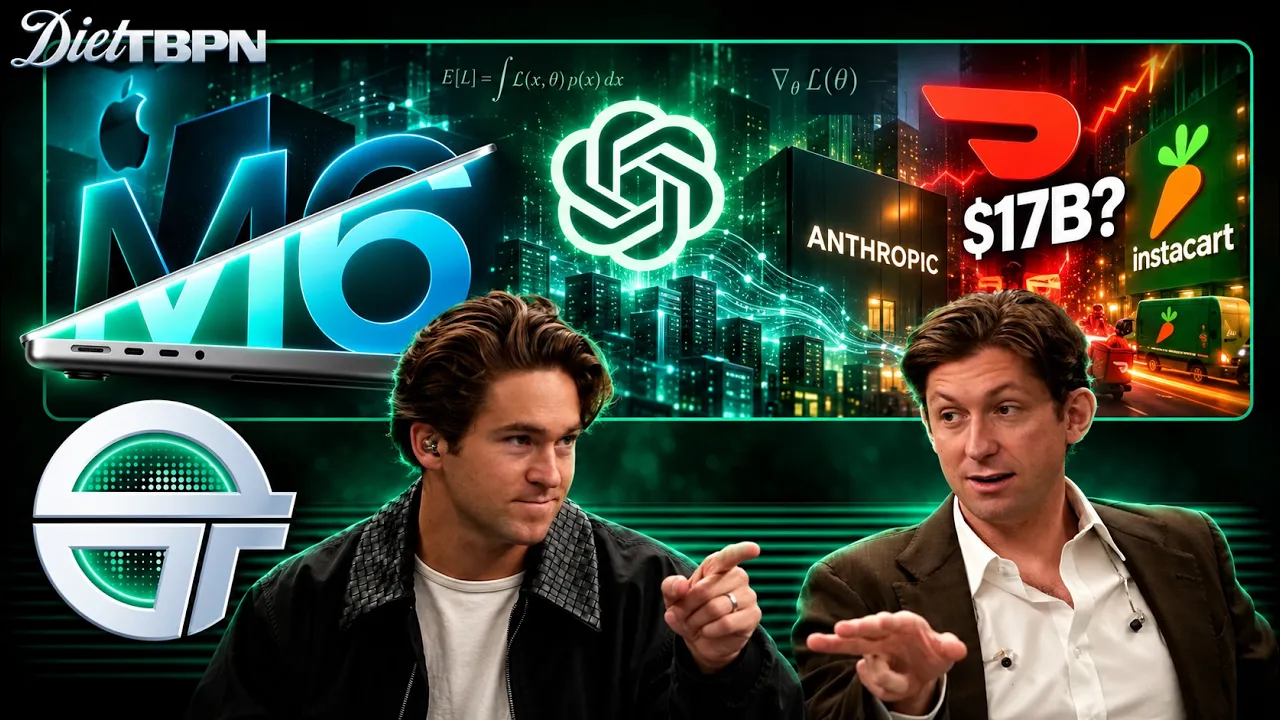
Anduril’s American-Made Laptops, OpenAI Disproves ETH, New MacBook Pro | Diet TBPN — TBPN

TBPN

AI-assisted summary of Anduril’s American-Made Laptops, OpenAI Disproves ETH, New MacBook Pro | Diet TBPN — original source. Check the original for full context.

Source published:

Key ideas

  • Palmer Luckey's Anduril Industries partnered with Qualcomm to announce BlueChip, an American-made rugged laptop slated for 2027 that targets defense, public safety, and government sectors using a domestically sourced supply chain. (0:00)
  • OpenAI researchers announced theoretical breakthroughs including an algorithmic result verified in Lean that appears to disprove the 25-year-old Exponential Time Hypothesis (ETH) for 3SAT problems. (16:34)
  • DoorDash has entered advanced talks to acquire grocery delivery platform Instacart (Maplebear Inc.) in a deal valued at approximately $17 billion. (27:04)
  • Reporting on Anthropic's corporate governance reveals a succession structure via Founder LLC where the seven co-founders can name confidential heirs to inherit private voting control, subject to mutual group approval. (21:00)

Detailed notes

## Background This episode was published on YouTube by TBPN on October 27, 2026. According to the page description, Diet TBPN provides a condensed 30-minute recap of the daily live tech show hosted by John Coogan and Jordi Hays, covering major tech headlines across defense hardware, AI breakthroughs, and corporate deals.

## TL;DR The hosts cover the announcement of the 'BlueChip' rugged laptop developed by Palmer Luckey's Anduril and Qualcomm to bring secure computer manufacturing back to the United States. They contrast this push for domestic hardware with modern personal computing stagnation, such as Apple's incremental M6 MacBook Pro updates, before breaking down OpenAI's Lean-verified algorithmic breakthrough challenging the 25-year-old Exponential Time Hypothesis. The episode also analyzes Anthropic's multi-tiered founder succession governance, the viral backlash against tech-insider media like the 'Soda Wives' podcast, DoorDash's reported $17 billion bid for Instacart, and Donald Trump's public call to replace the term 'AI' with 'superintelligence.'

## Atmosphere & style The show moves with the energetic, breezy cadence of an insider morning broadcast, blending tech-sector snark, banter about holiday countdowns, and sharp historical retrospectives. Hosts John Coogan and Jordi Hays bounce between deadpan roasts of venture capital marketing tropes and genuinely enthusiastic dissections of theoretical computational complexity and sovereign hardware. Listening feels like sitting in on a rapid-fire, caffeinated conversation between tech veterans parsing daily Silicon Valley news with a mix of genuine fascination and playful skepticism.

## Bulletin - [00:00](https://www.youtube.com/watch?v=UAUOJTSb_WA&t=0s) Palmer Luckey's Anduril Industries partnered with Qualcomm to announce BlueChip, an American-made rugged laptop slated for 2027 that targets defense, public safety, and government sectors using a domestically sourced supply chain. - [16:34](https://www.youtube.com/watch?v=UAUOJTSb_WA&t=994s) OpenAI researchers announced theoretical breakthroughs including an algorithmic result verified in Lean that appears to disprove the 25-year-old Exponential Time Hypothesis (ETH) for 3SAT problems. - [27:04](https://www.youtube.com/watch?v=UAUOJTSb_WA&t=1624s) DoorDash has entered advanced talks to acquire grocery delivery platform Instacart (Maplebear Inc.) in a deal valued at approximately $17 billion. - [21:00](https://www.youtube.com/watch?v=UAUOJTSb_WA&t=1260s) Reporting on Anthropic's corporate governance reveals a succession structure via Founder LLC where the seven co-founders can name confidential heirs to inherit private voting control, subject to mutual group approval.

## Key takeaways - [05:11](https://www.youtube.com/watch?v=UAUOJTSb_WA&t=311s) Anduril and Qualcomm's BlueChip laptop is engineered specifically for austere environments and government use, featuring user-replaceable top and bottom shells that support solar panels and modular gear. - [10:00](https://www.youtube.com/watch?v=UAUOJTSb_WA&t=600s) Palmer Luckey frames domestic hardware production as a fundamental national security issue, arguing that any nation unable to build its own computers cannot secure them or control its future. - [10:00](https://www.youtube.com/watch?v=UAUOJTSb_WA&t=600s) The hosts argue that true American-made production laptops have been absent for over three decades, tracing the lineage of portable computing through the Osborne 1, GRiD Compass, Compaq LTE, and Apple PowerBook. - [13:30](https://www.youtube.com/watch?v=UAUOJTSb_WA&t=810s) Apple's unveiling of an M6 MacBook Pro and rumors of a touchscreen display represent incremental updates in a laptop market suffering from prolonged design stagnation. - [16:34](https://www.youtube.com/watch?v=UAUOJTSb_WA&t=994s) An internal OpenAI model discovered an algorithm solving 3SAT instances faster than the lower bound posited by the Exponential Time Hypothesis, prompting original theorists Russell Impagliazzo and Ramamohan Paturi to lead formal peer review. - [16:34](https://www.youtube.com/watch?v=UAUOJTSb_WA&t=994s) While challenging ETH does not resolve P vs. NP or make NP-complete problems instantly easy, it marks an unprecedented milestone of artificial intelligence overturning a foundational consensus in computational complexity. - [20:00](https://www.youtube.com/watch?v=UAUOJTSb_WA&t=1200s) Commercial AI and biotech breakthroughs remain heavily guarded behind corporate secrecy, meaning public academic releases represent only a fraction of current technological leaps. - [21:00](https://www.youtube.com/watch?v=UAUOJTSb_WA&t=1260s) Anthropic's corporate charter combines internal founder control through Founder LLC with an independent Long-Term Benefit Trust that includes external trustees like Ben Bernanke. - [24:33](https://www.youtube.com/watch?v=UAUOJTSb_WA&t=1473s) The viral debut of the 'Soda Wives' podcast highlights the recurring clash between insular Silicon Valley vernacular and outside audiences, demonstrating how tech-bubble cultural norms provoke widespread internet backlash. - [27:04](https://www.youtube.com/watch?v=UAUOJTSb_WA&t=1624s) A potential $17 billion merger between DoorDash and Instacart creates a dominant logistics pipeline pairing scheduled grocery fulfillment with on-demand restaurant delivery against Uber Eats. - [30:00](https://www.youtube.com/watch?v=UAUOJTSb_WA&t=1800s) Donald Trump called for abandoning the term 'AI' in favor of 'superintelligence' (SI) across official documents and media, prompting host debate over terminology like 'Machine Intelligence' (MI).

## Detailed walkthrough ### [00:00](https://www.youtube.com/watch?v=UAUOJTSb_WA&t=0s) The Christmas Math Breakthrough and Palmer Luckey’s BlueChip Laptop

The show opens with some trademark banter about a massive "mathematical breakthrough." The hosts joke that they have tackled an impossibly complex calculation—determining the exact number of days left until Christmas from October 27, 2026, to December 25, 2026. Mockingly noting the sheer difficulty of accounting for months with 30 versus 31 days, they claim the accomplishment deserves a Fields Medal: exactly 58 days remain until Christmas. They note that Nikesh Arora is 58 years old ("doesn't look a day over 40 personally"), before pivoting away from yesterday's Anthropic succession headlines on the front pages of *The Wall Street Journal* and *Financial Times* to spotlight a surprise hardware reveal from Palmer Luckey: a new American-made laptop called "BlueChip," developed collaboratively by Anduril Industries and Qualcomm.

Scheduled for release in 2027, the BlueChip is targeted directly at government, defense, first responders, and public safety workers, meaning ordinary consumers will not be able to buy one off the shelf right away. The hosts express hope for an eventual consumer release, observing that the modern computing landscape makes switching hardware platforms smoother than ever. Thanks to modern AI and vibe coding, the lines separating Windows, macOS, and Linux have blurred, allowing users to readily recreate whatever features they covet across platforms.

```mermaid flowchart TD accTitle: Anduril and Qualcomm BlueChip Laptop Ecosystem accDescr: Diagram illustrating the components, supply chain, and intended end users of the BlueChip laptop.

subgraph Defense_Tech["Hardware Initiative"] A["Anduril Industries"] B["Qualcomm"] A & B --> C["BlueChip Laptop<br/>Target: 2027"] end

subgraph Architecture["Domestic Supply Chain"] C --> D["US-Extracted & Milled Metals"] C --> E["Rugged Modular Chassis<br/>Replaceable Shells & Solar"] C --> F["US Battery Technology"] end

subgraph Deployment["Primary End Users"] C --> G["US Government & Military"] C --> H["First Responders & Police"] C --> I["Public Safety Workers"] end ```

The hosts dive into Palmer Luckey’s broader push for domestic reindustrialization, which spans both Anduril and Modded Retro, arguing that the age of AI demands domestic, indigenous supply chains for critical enterprise and consumer equipment. Luckey claimed this would be the first laptop manufactured in the United States in over 20 years, though the hosts suspect he is significantly underselling the gap. They argue the last American-made laptop went out of production around 1993, making it well over three decades since the US built its own portable machines.

- The BlueChip laptop was jointly announced by Anduril and Qualcomm with a target availability date of 2027. - End users are strictly limited to government, defense, public safety personnel, and first responders. - The hosts speculate that the last fully American-made production laptop dates back to roughly 1993, rather than the 20-year figure cited by Luckey. - Host banter touches on team member Jackson dressing in "quiet luxury" in an Ultra-Dove palette rather than his usual Dale Earnhardt gear. - A live shoutout goes to YouTube chat member Nollies for their birthday, prompting an extended debate on whether being born 58 days away from Christmas ruins holiday gifts compared to grinding out 364 days away.

[05:11](https://www.youtube.com/watch?v=UAUOJTSb_WA&t=311s) Inside the BlueChip Launch Video and the Fight for Secure Hardware

The hosts roll the official launch video for the BlueChip laptop, featuring Palmer Luckey outlining the historical and national security stakes behind domestic manufacturing. Luckey recounts that America pioneered modern electronic computing during World War II when the U.S. Army Ordnance Corps required rapid, accurate calculations for artillery firing trajectories. After inventing the sector, America outsourced hardware manufacturing entirely, leaving the country dependent on foreign nations and strategic adversaries for the machines that power the economy, run businesses, and safeguard national security. Palmer Luckey delivers his core thesis directly: “Any country that can't build its own computers can't secure them. If you don't control your technology, you can't control your future.”

BlueChip is built from metals that can be mined, refined, processed, and milled cost-effectively inside the United States, paired with domestic battery technology. The laptop is engineered for brutal, austere environments, utilizing an easily swappable chassis where both the top and bottom shells can be field-replaced or customized to integrate solar panels, soft goods, and military service insignias. The hosts praise the video's direct, no-nonsense presentation, jokingly mocking modern tech marketing tropes by pointing out that Luckey omitted the obligatory "Founders Fund Vibe Reel" clichés.

- Palmer Luckey traces electronic computing back to the U.S. Army Ordnance Corps developing artillery trajectory calculators in World War II. - The BlueChip chassis features user-replaceable top and bottom shells that accommodate solar attachments, soft goods, and custom service insignias. - The host roasts modern product teasers for lacking cavemen inventing fire, the Model T, the Wright Brothers, the Apollo moon landing, or a nuclear detonation. - The ubiquitous fast-cut "vibe reel" format popularized around the 2019–2020 Founders Fund annual meetings is declared utterly exhausted, with the hosts joking it should be banned until at least 2050. - Hardware-level vulnerabilities and foreign supply chain compromises underscore the urgent necessity of bringing secure computer manufacturing back to the United States.

[10:00](https://www.youtube.com/watch?v=UAUOJTSb_WA&t=600s) Sovereign Hardware, Palmer Luckey's Laptop, and the History of Portable Computing

The hosts begin by addressing national security and hardware sovereignty, referencing a longstanding rumor that the NSA operates its own small-scale semiconductor fab because the agency cannot afford to run its code on insecure, foreign-manufactured chips that might conceal backdoors. While not cutting-edge compared to commercial international fabs, domestic fabrication ensures complete vertical control. This serves as the backdrop for Palmer Luckey's hardware venture, with the hosts quoting his core ethos: “If you don't control your technology, you can't control your future.” Luckey points out that eighty years ago, the United States pioneered modern computing to defend the nation, and now his company is bringing hardware back home.

The hosts review the physical aesthetic of Luckey's new rugged laptop. It features a coarse, textured lid with a distinct geometric cutout and a clipped corner. They joke about how refreshing it would be to have a genuinely rugged personal computer in a consumer market dominated by delicate glass and aluminum. A machine you could hammer on, toss onto the couch, or even throw across the room like a Frisbee to show someone a funny video would be a welcome change.

From there, they dive into the history of American-built portable computing to trace how the country pioneered the category before losing its domestic manufacturing edge:

- **Osborne 1 (1981):** Built in California, this was the first commercially successful portable computer. It featured a tiny 5-inch display (smaller than a modern smartphone screen), dual floppy disk drives, and a mere 64 KB of RAM, priced at $1,795. Despite its cultural impact, Osborne filed for bankruptcy in 1983, just two years after launch. - **GRiD Compass (1982):** Founded in 1979, GRiD Systems launched the first device resembling a true modern clamshell laptop with a folding display, which famously flew aboard the NASA Space Shuttle. - **Compaq LTE (1989):** Hailing straight out of Houston, Texas, Compaq packed nearly desktop-equivalent, IBM-compatible PC performance into a 6-pound notebook package with floppy storage and battery power. - **Apple PowerBook (1991):** Apple established modern laptop industrial design in 1991, kicking off a decade of furious, visible innovation.

---

[13:30](https://www.youtube.com/watch?v=UAUOJTSb_WA&t=810s) Modern Laptop Stagnation and the M6 MacBook Pro Rumors

Comparing the blistering design leaps of the 1980s and 1990s to modern personal computers, the hosts lament that hardware development has reached an era of deep stagnation. Looking at contemporary machines, one host observes: “I'm looking at my computer, and I'm looking at that, and it's like it's a gray notebook. It's the same thing.” They mock the latest commercial milestone—Apple officially unveiling a 14-inch MacBook Pro powered by an M6 chip—labeling it the “stagnation mobile.” While the specs boast a 12-core CPU, 30% faster graphics, and 24 hours of battery life under the usual marketing slogans of thinner, lighter, faster, and stronger, the physical artifact remains fundamentally unchanged.

They also react to Mark Gurman's (“the Germinator”) reports that Apple is exploring a touchscreen MacBook Pro, a feature the hosts find utterly incremental and late. Touchscreens on laptops have existed on Windows machines for years, serving mostly as a “jump scare” when an enterprise SDR or BDR reaches out and taps their screen mid-conversation. They joke about the universal frustration of someone pressing “grubby fingers” onto a non-touch screen and wonder whether Apple will have to engineer an ultra-rigid hinge so the display doesn't wobble when pressed. They anticipate the inevitable social media commentary claiming Steve Jobs would have never allowed it, while admitting that the Jobs era set a near-impossible product standard, even if nostalgia sometimes filters out Apple's odd, failed historical experiments.

---

[16:34](https://www.youtube.com/watch?v=UAUOJTSb_WA&t=994s) OpenAI’s Theoretical Breakthrough: Disproving the Exponential Time Hypothesis

The discussion shifts to a major theoretical announcement from OpenAI. Researcher Dan Roberts posted that OpenAI has discovered three breakthrough results spanning mathematics, computer science, and physics: local smoothing in harmonic analysis, the Kakeya conjecture, and a challenge to complexity theory. Tech commentator Andrew Curran and researcher Rishabh Karnawat highlighted the most consequential claim: an OpenAI internal model appears to have disproved the Exponential Time Hypothesis (ETH).

```mermaid flowchart TD accTitle: Disproving the Exponential Time Hypothesis via AI accDescr: Diagram tracing 3SAT complexity from brute force through the ETH hypothesis to OpenAI's Lean-verified refutation.

subgraph Classical["Classical Computational Complexity"] A["3SAT Problem<br/>(Boolean Satisfiability)"] A -->|"Each new switch doubles combinations"| B["Brute-Force Wall<br/>(Requires Exponential Time)"] B -->|"1990s Formulation<br/>(Impagliazzo & Paturi)"| C["Exponential Time Hypothesis (ETH)<br/>Assumes explosion is an inescapable law"] end

subgraph Breakthrough["OpenAI AI Breakthrough"] D["Internal OpenAI Model"] D -->|"Discovers algorithm meaningfully faster than ETH floor"| E["Algorithmic Candidate"] E -->|"Checked in Lean proof assistant"| F["Formally Verified Result"] end

C -.->|"Challenged by"| F F --> G["Public Academic Peer Review<br/>(Impagliazzo, Paturi, Ryan Williams)"] ```

To explain the magnitude of the claim for non-mathematicians, the hosts review Karnawat's explanation of 3SAT (Boolean satisfiability): 1. **The 3SAT Puzzle:** A system of yes/no switches bound by specific rules. Finding a valid solution by brute force doubles with each added variable, meaning a puzzle with just a few hundred switches would take longer than the age of the universe to compute. 2. **The ETH Wall:** Roughly 25 years ago, computer scientists Russell Impagliazzo and Ramamohan Paturi (with Francis Zane) formalized this limitation into the Exponential Time Hypothesis, asserting that exponential blowup is not a failure of human ingenuity, but an unbreakable law of computational nature. 3. **The OpenAI Machine Discovery:** An internal OpenAI model produced an algorithm that solves these instances meaningfully faster than the lower bound postulated by ETH. Furthermore, the proof was verified using Lean, an interactive theorem prover. 4. **The Response:** In a remarkable turn, Impagliazzo and Paturi themselves, alongside MIT complexity theorist Ryan Williams, stepped forward to lead the formal review to determine whether artificial intelligence has disproved their life's work.

The hosts emphasize that this does not solve P vs. NP, nor does it make NP-complete problems computationally trivial overnight, as the algorithm remains slow in absolute terms. However, it represents an unprecedented milestone: artificial intelligence redraws the map in an area of pure computer science where humanity held near-certain consensus for a quarter of a century. As one host reflects, any time a machine shatters an entrenched, foundational assumption of nature, the long-term knock-on effects across applied science and technology will run far deeper than an isolated academic proof.

[20:00](https://www.youtube.com/watch?v=UAUOJTSb_WA&t=1200s) Secret Breakthroughs, Jack Clark’s Rise, and Anthropic’s Succession Plan

Reflecting on academic versus commercial research, the hosts observe that while pure mathematics breakthroughs can immediately be released for open peer review, the most consequential discoveries are kept closely guarded behind closed doors. When labs make massive technical leaps across machine learning, biotechnology (requiring clinical trials), material sciences (demanding patent protections), or cybersecurity (requiring cautious phased rollouts), they rarely share them publicly because of enormous commercialization incentives. As John Coogan notes, “And so I think that that is like that any any time there’s like a big breakthrough, my head is just going to everything that’s not being shared.”

The conversation turns to Jack Clark’s remarkable trajectory from technology journalist to co-founder of Anthropic, drawing a comparison to venture capitalist Michael Moritz, who also started out in journalism before becoming a Silicon Valley billionaire. The hosts joke about Bloomberg's Joe Weisenthal, who previously overlapped with Clark and hosted him on the *Odd Lots* podcast, wondering if Weisenthal will eventually step into the arena himself—perhaps by launching a neocloud company or leaning into his indie-rock band's name, Light Sweet Crude, to launch an oil and gas extraction empire.

Attention shifts to revelations stemming from Anthropic’s governance structure and reporting on its S-1 filings. Forbes highlighted that Anthropic’s seven co-founders hold special Class F shares managed through a dedicated entity dubbed Founder LLC. Under this setup, founders are permitted to name confidential successors to inherit their private voting power, provided those heirs are mutually approved by the group. The hosts marvel at the dynastic, century-scale framing of the corporate charter, joking about founders trying to bequeath their board power to domesticated bears, shrimp spouses, or even a future artificial superintelligence model bound by internal smart contracts. They also discuss how this "cool kids table" Founder LLC interfaces with Anthropic’s multi-tiered governance structure, including its Long-Term Benefit Trust featuring outside figures like former Federal Reserve Chair Ben Bernanke alongside board members like Yasmin Razavi.

```mermaid flowchart TD accTitle: Anthropic Governance and Succession Structure accDescr: Flowchart illustrating the relationship between Anthropic founders, Founder LLC, and the external trust board.

subgraph FoundersGroup["Anthropic Founders"] F["7 Co-Founders"] S["Confidential Heirs / Successors"] F -->|"Approve internally"| S end

subgraph ControlEntity["Founder LLC"] CF["Single Class F Share"] F -->|"Manage voting power"| CF end

subgraph TrustStructure["Dual-Tier Governance"] EB["Long-Term Benefit Trust<br>(Ben Bernanke & Outside Trustees)"] CB["Anthropic Corporate Board<br>(Yasmin Razavi & Directors)"] end

CF -.->|"Controls foundational direction"| CB EB -.->|"Oversees mission alignment"| CB ```

- **Journalist-to-Billionaire Arc**: Jack Clark transitioned from tech reporter to co-founder of AI heavyweight Anthropic, echoing Michael Moritz's historic trajectory from *Time* journalist to Sequoia Capital chairman. - **Dynastic Governance**: Forbes reported that Anthropic's founders structured a private line of succession for their voting power, requiring prospective heirs to be formally approved by the remaining co-founders. - **Multi-Tier Board**: Governance involves internal founder-level control via Founder LLC alongside the independent Long-Term Benefit Trust board that includes prominent figures like Ben Bernanke.

---

[24:33](https://www.youtube.com/watch?v=UAUOJTSb_WA&t=1473s) Soda Wives, Rage-Baiting, and the Tech Bubble

The timeline on X erupted over the launch of *Soda Wives*, a new podcast hosted by Sarah and Vivian that social media observers jokingly described as what would happen if TBPN and Alex Cooper’s *Call Her Daddy* had a baby. The hosts diagnose the project as deliberate rage-bait engineering. During the inaugural episode, the creators even confessed they considered naming the series *Trophy Wives* purely to bait internet outrage further. The distribution metrics showed the gambit succeeding wildly on sheer impressions, pulling in over 1 million views while netting only 450 likes and roughly 160 comments. Adding to the internet confusion, the post was bizarrely stamped with an automated “Made with AI” platform label despite clearly being a pristine, high-production in-studio video broadcast.

The discussion frames the polarizing reception as a classic clash between insular Silicon Valley vernacular and the broader internet public. While conversations about local lifestyles, venture capital networks, and startup culture read as casual and relatable inside the San Francisco bubble, they strike outside audiences as detached and grating. The hosts liken the blowback to a recent critique published by *The Economist* regarding tech-insider media, summarizing the article's core thesis: “Superstar podcasts are Silicon Valley’s way of talking to itself, but to much of the world, the sound is jarring.”

- **Viral Ratio**: The debut *Soda Wives* clip generated more than 1,000,000 views against just 450 likes and 160 comments on X. - **AI Label Glitch**: Despite being a live-action, high-end studio recording, platform algorithms affixed an automated "Made with AI" warning banner to the video. - **Media Parallels**: *The Economist* previously categorized elite founder podcasts—including TBPN, *All-In*, and *BG2*—as Silicon Valley speaking an insular dialect that sounds entirely alien to outsiders.

---

[27:04](https://www.youtube.com/watch?v=UAUOJTSb_WA&t=1624s) DoorDash in Talks to Acquire Instacart for $17B

The conversation pivots to late-breaking corporate dealmaking as reports surface that DoorDash has entered advanced talks to acquire grocery delivery rival Instacart in a transaction valuing the company at around $17 billion. The hosts reflect on Instacart’s roots back when it came out of Y Combinator, recalling what it was like hanging out on San Francisco rooftops with the founders during Demo Day while sitting on negative net worth and unpaid credit card balances instead of writing angel checks. In a brief trivia pop quiz, they unearth Instacart’s quirky corporate parent entity: Maplebear Inc. (doing business as Instacart), an animal- and Canada-themed legal moniker that has remained unchanged on regulatory filings even through its initial public offering.

Evaluating the strategic logic of the tie-up, the hosts point out that the two platforms occupy complementary segments of on-demand logistics rather than purely overlapping niches. Instacart dominates scheduled weekly grocery deliveries, while DoorDash specializes in immediate restaurant meal fulfillment and convenience runs. Combining the two would create a unified distribution powerhouse capable of building a formidable moat against Uber Eats. Reflecting on DoorDash's relentless execution in consumer logistics, John Coogan remarks, “I just think that DoorDash is generally sort of an unstoppable force.”

- **Deal Terms**: DoorDash is negotiating an acquisition of Instacart valued at roughly $17 billion, with a finalized agreement expected shortly. - **Market Reaction**: Following reports of the talks, Instacart shares climbed 8% against a previous public market cap of roughly $13 billion; DoorDash shares dipped 6% against its $73 billion enterprise valuation. - **Corporate Entity**: Instacart still operates under its original legal incorporation name, Maplebear Inc., which persists across regulatory databases.

---

[30:00](https://www.youtube.com/watch?v=UAUOJTSb_WA&t=1800s) Trump Wants to Replace “AI” With “Superintelligence”

The show wraps with breaking news straight from Donald Trump’s Truth Social feed, where the former president posted a blistering critique demanding that media outlets abandon the acronym “AI” in favor of “SI” (Superintelligence). Reading directly from the post, the hosts share Trump's decree: “When will the Wall Street Journal start calling artificial intelligence a very bad and inaccurate name, SI, super intelligence, the name which virtually everyone else is using or soon will be? In short order, we will be officially banning the term AI slash artificial intelligence in all relevant documents and everything else due to its inaccuracy. Thank you.”

Waving a fresh print edition of *The Wall Street Journal* featuring front-page headlines about Meta’s $95 billion compute expansion and "AI Armageddon," the hosts joke that the paper in their hands might overnight become a rare collector's item. They evaluate the linguistic merits of the proposed rebranding, with the hosts favoring historical terms like "Machine Intelligence" (MI) over both AI and SI to reflect systems that excel at advanced symbolic mathematics while possessing zero commonsense intuition. They conclude that simply renaming the technology will do little to soften public anxiety, while quipping that re-labeling everything to "SI" will mostly serve to confuse Spanish speakers who read the acronym as "sí."

- **Truth Social Executive Order**: Trump declared an intent to officially purge the term "artificial intelligence" from official documents and media stylebooks in favor of "superintelligence" (SI). - **WSJ Headlines**: The day's paper showcased major legacy terminology, running coverage on Meta’s $95 billion infrastructure budget and warnings of an impending "AI Armageddon." - **Alternative Terminology**: The hosts advocate for "Machine Intelligence" (MI), arguing it accurately depicts modern models: systems with staggering computational dexterity that still lack general human street smarts.

## Notable quotes > [05:11](https://www.youtube.com/watch?v=UAUOJTSb_WA&t=311s) Any country that can't build its own computers can't secure them. If you don't control your technology, you can't control your future. — Palmer Luckey

## Mentioned Palmer Luckey, John Coogan, Jordi Hays, Anduril Industries, Qualcomm, BlueChip, Modded Retro, Nikesh Arora, Jackson, U.S. Army Ordnance Corps, Founders Fund, NSA, Osborne 1, GRiD Compass, Compaq LTE, Apple PowerBook, Apple, M6 MacBook Pro, Mark Gurman, Steve Jobs, OpenAI, Dan Roberts, Exponential Time Hypothesis, 3SAT, Andrew Curran, Rishabh Karnawat, Lean, Russell Impagliazzo, Ramamohan Paturi, Francis Zane, Ryan Williams, Jack Clark, Anthropic, Michael Moritz, Joe Weisenthal, Light Sweet Crude, Odd Lots, Founder LLC, Long-Term Benefit Trust, Ben Bernanke, Yasmin Razavi, Soda Wives, Sarah and Vivian, Call Her Daddy, Alex Cooper, The Economist, All-In, BG2, DoorDash, Instacart, Maplebear Inc., Y Combinator, Uber Eats, Donald Trump, Truth Social, The Wall Street Journal, Financial Times, Meta

## Video description Sign up for TBPN’s daily newsletter at TBPN.com

Diet TBPN delivers the best of today’s TBPN episode in 30 minutes. TBPN is a live tech talk show hosted by John Coogan and Jordi Hays, streaming weekdays 11–2 PT on X and YouTube, with each episode posted to podcast platforms right after.

Described by The New York Times as “Silicon Valley’s newest obsession,” the show has recently featured Mark Zuckerberg, Sam Altman, Mark Cuban, and Satya Nadella.

TBPN is made possible by: Ramp - https://ramp.com Public - https://public.com Cisco - https://www.cisco.com Console - https://www.console.com CrowdStrike - https://www.crowdstrike.com Figma - https://www.figma.com MongoDB - https://www.mongodb.com NYSE - https://www.nyse.com Railway - https://railway.com Shopify - https://www.shopify.com/

Follow TBPN: https://TBPN.com https://x.com/tbpn https://open.spotify.com/show/2L6WMqY3GUPCGBD0dX6p00?si=674252d53acf4231 https://podcasts.apple.com/us/podcast/technology-brothers/id1772360235 https://www.youtube.com/@TBPNLiveAnduril’s American-Made Laptops, OpenAI Disproves ETH, New MacBook Pro | Diet TBPN

Chapters: 00:00 Palmer Luckey’s BlueChip Laptop + The Return of American-Made Computers 05:11 Inside BlueChip’s Launch + The Fight for Secure U.S. Hardware 11:53 America’s First Laptops + Apple’s New M6 MacBook Pro 16:34 OpenAI’s New Math Breakthrough + A 25-Year Hypothesis Challenged 21:00 Anthropic’s Secret Founder Succession Plan + The Golden Share 24:33 Soda Wives Goes Viral + Silicon Valley’s Rage-Bait Problem 27:04 DoorDash Eyes a $17B Instacart Acquisition 30:00 Trump Wants to Replace “AI” With “Superintelligence”

[Source](https://www.youtube.com/watch?v=UAUOJTSb_WA)

中文简报

Anduril国产笔记本、OpenAI挑战ETH假说、新款MacBook Pro | Diet TBPN 主持人报道了由帕尔默·拉齐(Palmer Luckey)创办的Anduril与高通联手发布的“BlueChip”加固型笔记本电脑,旨在将安全的计算机制造业带回美国。他们将这种对本土硬件的推动与现代个人计算的停滞(如苹果对M6 MacBook Pro渐进式的更新)进行了对比,随后剖析了OpenAI经由Lean形式化验证的算法突破,该成果挑战了已有25年历史的指数时间假说(ETH)。本期节目还分析了Anthropic多层级的创始人继任治理架构、针对“Soda Wives”播客等科技圈内部媒体引发的网络强烈反对、DoorDash据传以170亿美元竞购Instacart的交易,以及唐纳德·特朗普公开呼吁用“超级智能”取代“AI”这一术语。 帕尔默·拉齐创立的Anduril Industries与高通合作发布了BlueChip,这是一款计划于2027年推出的美国制造加固型笔记本电脑,依托本土供应链,面向国防、公共安全和政府部门。 (0:00) OpenAI研究人员宣布了理论突破,包括一项经Lean形式化验证的算法成果,该成果似乎推翻了针对3SAT问题、已有25年历史的指数时间假说(ETH)。 (16:34) DoorDash已就收购生鲜杂货配送平台Instacart(Maplebear Inc.)展开深入谈判,交易估值约为170亿美元。 (27:04) 关于Anthropic公司治理的报道揭示了其通过Founder LLC建立的继任架构,七位联合创始人可在获得集团内部相互批准的前提下指定秘密继承人,以继承非公开的投票控制权。 (21:00)

Reading summary

The broadcast covers Anduril's initiative to manufacture rugged defense laptops domestically amid consumer hardware stagnation, OpenAI's reported algorithmic challenge to the Exponential Time Hypothesis, and Anthropic's dynastic corporate governance alongside delivery sector consolidation. Reviving Domestic Hardware Amid Modern Laptop Stagnation (0:00) Anduril Industries and Qualcomm announced BlueChip, a rugged, modular American-made laptop scheduled for 2027 targeting defense, public safety, and government personnel. Engineered from domestically extracted and milled metals alongside US battery technology, the laptop features swappable shells designed to accommodate solar panels and field repairs. Palmer Luckey framed the initiative as a national security imperative, arguing that a country unable to manufacture its own computing hardware cannot guarantee it is free from foreign supply chain compromises or backdoors. The hosts estimate that the United States has not built a fully domestic production laptop since roughly 1993, noting earlier domestic milestones like the Osborne 1 (1981), GRiD Compass (1982), Compaq LTE (1989), and Apple PowerBook (1991). This domestic hardware push is contrasted with the commercial personal computer market, which the hosts describe as trapped in deep design stagnation. Recent commercial releases, including Apple's M6-powered 14-inch MacBook Pro and reported plans for touchscreen displays, are criticized as incremental spec bumps that deliver faster processing and marginally better battery life without altering the fundamental form factor or offering genuine physical durability. OpenAI Challenges the Exponential Time Hypothesis (16:34) The discussion highlights an announcement from OpenAI researcher Dan Roberts indicating that an internal model has discovered an algorithm challenging the Exponential Time Hypothesis (ETH). Formulated roughly 25 years ago by Russell Impagliazzo and Ramamohan Paturi, ETH posits that solving Boolean satisfiability problems such as 3SAT fundamentally requires exponential runtimes as variable counts scale. The OpenAI-generated algorithm reportedly solves these problems faster than the established theoretical floor, with the underlying proof formally verified using the Lean interactive theorem prover. Impagliazzo, Paturi, and MIT complexity theorist Ryan Williams are leading the formal academic review of the findings. While the hosts clarify that this result does not resolve the P vs. NP problem or render NP-complete problems trivially fast in absolute terms, it represents a rare milestone where artificial intelligence directly challenges a foundational, quarter-century consensus in theoretical computer science. Corporate Secrecy and Dynastic Governance at Anthropic (20:00) The hosts contrast the public academic review of theoretical mathematics with the secrecy governing commercial AI breakthroughs, observing that advances across frontier model capabilities, biotechnology, and cybersecurity are routinely withheld from public view to protect commercial value. This corporate insularity is mirrored in frontier governance structures, such as revelations surrounding Anthropic's S-1 documentation and corporate charter. According to reporting highlighted by Forbes, Anthropic's seven co-founders manage voting authority through a dedicated entity called Founder LLC using Class F shares. This framework permits founders to name confidential successors to inherit their private voting power, subject to group approval. The hosts characterize the multi-tiered setup—which interfaces with an independent Long-Term Benefit Trust featuring outside figures like former Federal Reserve Chair Ben Bernanke—as a dynastic control mechanism designed to maintain long-term founder authority over the enterprise. Industry Consolidation, Culture Clashes, and Terminology Debates (27:04) The final segment evaluates shifts across broader tech markets, media, and political rhetoric. DoorDash has entered advanced talks to acquire grocery delivery platform Instacart—legally incorporated as Maplebear Inc.—in an estimated $17 billion deal. The transaction would combine DoorDash's immediate restaurant logistics with Instacart's scheduled grocery operations to construct a unified logistics defense against Uber Eats, prompting an 8% increase in Instacart shares and a 6% decline in DoorDash stock upon reporting. Concurrently, the launch of the podcast Soda Wives drew over 1 million views alongside minimal positive engagement, illustrating a persistent cultural divide between insular Silicon Valley vernacular and the broader public. The episode concludes with Donald Trump's public demand on Truth Social that media and government agencies ban the acronym 'AI' in favor of 'SI' (Superintelligence). The hosts dismiss the rebranding as superficial, advocating instead for 'Machine Intelligence' to reflect systems possessing acute mathematical capability without common-sense reasoning. While theoretical proofs verified by machine learning and defense hardware reindustrialization challenge long-held paradigms, the wider technology landscape remains governed by commercial secrecy, dynastic corporate charters, and persistent friction between insider Silicon Valley culture and the broader public.

精炼阅读摘要

本期节目聚焦前沿硬件与理论突破:Palmer Luckey 携手高通推出专供军政领域的美制三防笔记本 BlueChip 以推进本土供应链主权,同时 OpenAI 内部模型声称证伪了计算复杂度领域的指数时间假说(ETH)。 Anduril 与高通推全美制电脑 (0:00) Anduril Industries 创始人 Palmer Luckey 联合 Qualcomm 发布了名为 BlueChip 的全美制笔记本电脑,计划于 2027 年正式交付。该设备定位于政府、国防部门、现场急救员及公共安全人员,暂不对普通消费者开放。Luckey 主张,任何无法自主制造计算机的国家都无法保障其安全,失去对核心技术的掌控便意味着失去未来。该笔记本采用全本土供应链,从可在美开采与研磨的金属到底盘、电池技术均在美完成,且机身配备可快速替换的模块化外壳,支持装配太阳能板或定制军事标识。虽然 Luckey 称这是二十年来首款美国本土制造的笔记本,但节目主持分析指出,美国完全本土化生产便携电脑的历史断代可能长达三十余年(约可追溯至 1993 年)。 便携计算历史与当前创新停滞 (10:00) 从 1981 年加州制造的首款商用便携电脑 Osborne 1(配备 5 英寸屏幕与 64 KB 内存)、1982 年随航天飞机飞行的首款现代翻盖机型 GRiD Compass,到休斯敦生产的 Compaq LTE 以及 1991 年确立现代工业设计的 Apple PowerBook,美国曾主导便携计算机的早期形态创新。相比之下,当代个人电脑硬件陷入深度同质化与创新停滞。例如苹果新发布的 14 英寸 M6 MacBook Pro 虽宣称具备 12 核 CPU、图形性能提升 30% 及 24 小时续航,但物理形态多年未变;媒体传出其正在探索的触屏设计也被视作在 Windows 阵营存在多年的渐进式迟到补丁,缺乏颠覆性飞跃。 OpenAI 挑战指数时间假说 (16:34) 在理论计算机科学界,OpenAI 研究人员 Dan Roberts、Rishabh Karnawat 等人披露了一项重大进展:其内部模型发现了一种新算法,在布尔可满足性(3SAT)问题上的求解速度显著快于指数时间假说(ETH)设定的理论下界。该假说由 Russell Impagliazzo 和 Ramamohan Paturi 等人在约 25 年前确立,认为此类问题的时间爆炸是不可逾越的自然法则。这一新成果不仅通过了交互式定理证明器 Lean 的形式化验证,更引来原假说提出者 Impagliazzo、Paturi 以及麻省理工学院理论学者 Ryan Williams 牵头进行学术同行评审。尽管该发现尚未解决 P 与 NP 难题,且绝对计算时间依然漫长,但意味着人工智能开始撼动长达四分之一世纪的计算理论共识。 Anthropic 治理与商业版图变动 (20:00) 商业层面,商业机密与制度设计成为前沿 AI 机构的护城河。Anthropic 的 S-1 文件揭示了极具王朝色彩的代际治理架构:七位联合创始人通过专属实体 Founder LLC 持有特殊的 F 类股份,并有权指定经内部互审认可的保密继承人延续投票权,该机制与包含前美联储主席 Ben Bernanke 在内的独立“长期利益信托”(Long-Term Benefit Trust)形成双层制衡。与此同时,即时配送市场迎来重组,DoorDash 正就以约 170 亿美元估值收购生鲜杂货配送平台 Instacart(法定注册名称 Maplebear Inc.)展开深入谈判,若交易达成,将把即时餐食外卖与按周排期的生鲜供应链合流,形成对抗 Uber Eats 的垂直壁垒。 无论是 Anduril 推动硬件主权回归本土,还是机器逻辑推翻长达数十年的理论复杂度假说,技术竞争正从表层应用向底层制造供应链与核心科学范式转移;而在名义定义与治理上,关于技术本质的控制权博弈仍在加剧。

Detailed notes — zh

## Background 该内容由科技播客频道 TBPN 于 2026 年 10 月 27 日发布在 YouTube 平台上。本期为《Diet TBPN》的 30 分钟精简版节目,页面简介表明该系列致力于速览由 John Coogan 与 Jordi Hays 主持的科技谈话节目精华,核心聚焦当日科技圈热点。 ## TL;DR 节目首先深入探讨了 Palmer Luckey 旗下的 Anduril 联手高通推出的全美产笔记本电脑 BlueChip,梳理了美国便携式计算机的演化史并反思了 MacBook 等消费电子的十年创新停滞。随后,主播们解析了 OpenAI 宣称通过 AI 推翻提出长达 25 年的“指数时间假说”(ETH)的理论突破,以及 Anthropic 提交 S-1 文件所揭示的秘密继承人与百年治理架构。此外,节目还点评了播客《Soda Wives》在社交媒体引发的引战营销风潮、DoorDash 拟以 170 亿美元并购 Instacart 的即时配送整合大案,并幽默讽刺了特朗普在社交媒体上要求用“超级智能”(SI)全面替代“AI”称谓的突发声明。 ## Atmosphere & style 整期节目洋溢着典型的硅谷科技圈内部人闲聊风格,主持人 John Coogan 与 Jordi Hays 配合默契,对话节奏轻快、充满机智的插科打诨与反讽幽默。在讨论硬件安全与复杂理论突破等硬核议题时,两人能迅速从轻松的戏谑切换到深刻的产业洞察,毫不留情地针砭科技圈泛滥的公关套路与审美疲劳。听众仿佛置身于一场充满极客谈资的高信息密度午餐会,在密集的笑点与犀利吐槽中领略科技前沿与商业暗流。 ## Bulletin - [00:00](https://www.youtube.com/watch?v=UAUOJTSb_WA&t=0s) Anduril 联合 Qualcomm 发布全美产军规/公用笔记本 BlueChip,计划于 2027 年正式交付给美国政府、国防与公共安全机构,强调全链路本土制造以消除供应链安全隐患。 - [16:34](https://www.youtube.com/watch?v=UAUOJTSb_WA&t=994s) OpenAI 宣布其 AI 模型在数学理论上取得重大突破,成功证伪确立 25 年之久的“指数时间假说”(ETH),并在计算机形式化系统 Lean 中完成严格验证。 - [27:04](https://www.youtube.com/watch?v=UAUOJTSb_WA&t=1624s) DoorDash 正深入洽谈以约 170 亿美元估值收购生鲜代购平台 Instacart,旨在整合餐饮外卖与商超生鲜以共同抵御 Uber Eats 的扩张威胁。 - [21:00](https://www.youtube.com/watch?v=UAUOJTSb_WA&t=1260s) Anthropic 提交的 S-1 文件揭示了罕见的百年王朝式治理结构,7 位联合创始人通过 Founder LLC 持有唯一一股特殊 Class F 股票,并拥有秘密指定继承人的权利。 - [30:00](https://www.youtube.com/watch?v=UAUOJTSb_WA&t=1800s) 特朗普在社交媒体发文要求全面废除“人工智能”(AI)称谓并改称“超级智能”(SI),计划在官方政府文件中禁用旧称。 ## Key takeaways - [05:11](https://www.youtube.com/watch?v=UAUOJTSb_WA&t=311s) Palmer Luckey 指出“造不出属于自己计算机的国家无法保卫其计算机安全”,Anduril 推动硬件制造回流美国以防范底层硬件植入木马与海外断供风险。 - [10:00](https://www.youtube.com/watch?v=UAUOJTSb_WA&t=600s) 传闻美国国家安全局(NSA)曾保留专属芯片晶圆厂以确保核心硬件安全,反映出高敏感领域对垂直整合供应链的极端重视。 - [11:53](https://www.youtube.com/watch?v=UAUOJTSb_WA&t=713s) 从 1981 年加州产的 Osborne 1、1982 年的 Grid Compass 到 1989 年休斯敦产的 Compaq LTE,便携式计算机最初诞生于美国本土但随后制造被彻底外包。 - [11:53](https://www.youtube.com/watch?v=UAUOJTSb_WA&t=713s) 苹果发布搭载 M6 芯片的 MacBook Pro,但主流笔记本形态十年来陷入同质化,业内对传闻中的触控屏 MacBook 实用性普遍持怀疑态度。 - [16:34](https://www.youtube.com/watch?v=UAUOJTSb_WA&t=994s) 由 Russell Impagliazzo 等人于 25 年前提出的指数时间假说(ETH)断言 3SAT 等难题必然发生指数级耗时爆炸,这一现代计算复杂性基石被 OpenAI 算法证伪。 - [16:34](https://www.youtube.com/watch?v=UAUOJTSb_WA&t=994s) ETH 被证伪并不意味着该算法在现实中运行极快,也不等同于解决了“P versus NP”,但 AI 重新划定了计算可能性理论的边界。 - [20:00](https://www.youtube.com/watch?v=UAUOJTSb_WA&t=1200s) 基础数学发现倾向于立即公开,而涉及生物医药、材料科学和网络安全等具高度商业价值的技术通常被实验室选择性雪藏变现。 - [20:00](https://www.youtube.com/watch?v=UAUOJTSb_WA&t=1200s) Anthropic 联合创始人 Jack Clark 与红杉资本 Mike Moritz 展现了科技记者跨界成长为顶尖科技领军人物的罕见发展路径。 - [21:00](https://www.youtube.com/watch?v=UAUOJTSb_WA&t=1260s) Anthropic 设立“长期利益信托”(超级董事会)与 Founder LLC 双层控制机制,展现出面向长达百年维度的治理架构设想。 - [27:04](https://www.youtube.com/watch?v=UAUOJTSb_WA&t=1624s) Instacart 法定注册公司名为“Maple Bear Inc.”,DoorDash 拟以 170 亿美元对其展开的整合是防范即时零售市场双输的关键防线。 - [24:33](https://www.youtube.com/watch?v=UAUOJTSb_WA&t=1473s) 硅谷播客《Soda Wives》凭借引战话题走红,折射出硅谷科技圈内部自言自语与外部大众受众认知之间的严重割裂。 - [30:00](https://www.youtube.com/watch?v=UAUOJTSb_WA&t=1800s) 特朗普试图用“超级智能”(SI)替换“人工智能”(AI),但公关式更名难以打消公众对算法本身的真实担忧与好恶。 ## Detailed walkthrough ### [00:00](https://www.youtube.com/watch?v=UAUOJTSb_WA&t=0s) 距离圣诞节的“数学突破”与 Anduril 全美产笔记本 BlueChip 亮相 节目在一场略带戏谑的开场中拉开帷幕。主持人 John Coogan 和 Jordi Hays 开玩笑称团队刚取得了一项“数学突破”——计算从 2026 年 10 月 27 日到当年 12 月 25 日圣诞节之间究竟还剩多少天。因为不同月份的天数各不相同(有的 30 天,有的 31 天),这算得上是“极其复杂的数学难题”,甚至值得颁发一枚菲尔兹奖(Fields Medal)。计算结果是整整 58 天,而 Nikesh Arora 刚好也是 58 岁(虽然他看起来连 40 岁都不到)。接着两人提及,前一天节目重点讨论了登上《华尔街日报》和《金融时报》头条的 Anthropic 相关新闻,而当天最引人注目的科技动态则是 Palmer Luckey 旗下的国防科技独角兽 Anduril 携手 Qualcomm(高通)联合发布的全新全美产笔记本电脑——BlueChip。 这款笔记本预计将于 2027 年正式交付,专门为美国政府、国防机构、一线急救人员(first responders)和公共安全人员设计,普通消费者暂时无法在市面上直接购买。尽管属于政府专供,主持人仍对未来推出消费级版本抱有极大期待。Jordi 谈到了当下软硬件生态的演进,指出在 AI 时代,操作系统之间的壁垒变得非常易于穿透(fungible / mutable),无论是在 Windows、Mac 还是 Linux 之间来回切换都毫不费力。例如 Windows 标志性的优秀窗口分屏管理(按下 Windows 键加左右箭头即可实现左右 50% 贴边对齐),苹果花了许多年才在 macOS 上跟进类似功能;如今只要借助 AI 进行“氛围编码”(vibe coding),用户几乎可以随心所欲定制自己想要的任何软件交互。 Jordi 表示自己非常看好美国本土制造的这种新型可变硬件。Palmer Luckey 多年来始终是“美国再工业化”(Reindustrialization)的核心倡导者之一,不仅创立 Anduril 投身国防制造,其复古掌机项目 ModRetro 也在身体力行践行这一理念。Luckey 曾多次在再工业化大会上阐述其核心逻辑:在 AI 时代,构建围绕消费级与企业级硬件的本土供应链至关重要。Palmer 在宣传中声称这是“20 多年来首款全美本土制造的笔记本电脑”,但主持人调侃说这甚至都有点保守了,历史上真正完全在本土制造的美国笔记本可能早在 1993 年左右就已停产。现场导播 Jackson 甚至被调侃穿得格外低调奢华。为了能提前搞到一台 BlueChip,主持人甚至打趣说自己可能得去当个志愿消防员或兼职警察参与巡逻才行。 - 关键产品发布:Anduril 与 Qualcomm 联合研发的“BlueChip”全美产军规/公用笔记本。 - 交付时间表:预计将于 2027 年正式上线并面向特定机构供货。 - 目标客户群体:美国政府、国防军工、消防急救与公共安全人员。 --- ### [05:11](https://www.youtube.com/watch?v=UAUOJTSb_WA&t=311s) 拆解 BlueChip 发售短片与本土硬件安全的核心逻辑 节目随后切入了 Anduril 官方发布的 BlueChip 宣传片。视频中 Palmer Luckey 亲自出镜,严肃回顾了美国现代计算的起源:二战期间,美国陆军军械部(U.S. Army Ordnance Corps)为了更精准、快速地计算火炮射击弹道,工程师们制造了世界上第一台现代电子计算机,从而开创了改变世界的整个计算机产业。然而在此后数十年中,美国将自己发明的高科技制造能力全面外包,如今企业运转、经济驱动乃至国家安全所依赖的几乎全部硬件,都严重受制于包括战略对手在内的海外供应链。 ```mermaid flowchart TD accTitle: 现代计算产业供应链变迁与安全风险逻辑 accDescr: 展示从二战弹道计算起源到全球外包,最终促成Anduril推动本土制造硬件的历程。 subgraph Origin ["历史起源与外包危机"] A["二战军械需求<br/>研发首台电子计算机"] --> B["诞生现代计算产业"] B --> C["制造环节全面离岸外包<br/>依赖战略对手供应硬件"] end subgraph SecurityThreat ["国家安全挑战"] C --> D["丧失底层制造控制权"] D --> E["底层硬件漏洞与供应链断供风险"] end subgraph Solution ["Anduril 与 BlueChip 破局"] E --> F["BlueChip 笔记本<br/>全链路本土开采/精炼/加工"] F --> G["底壳/顶盖模块化设计<br/>耐受极端战场与公用环境"] end ``` 宣传片重点突出了 BlueChip 的全自主制造工艺与设计理念:笔记本外壳所使用的金属均基于美国本土具备大规模低成本开采、精炼、加工和铣削能力的材料,电池技术与坚固机身专为应对极端恶劣的实战环境设计;其底壳和顶壳均支持快速更换,便于模块化集成太阳能电池板或外部战术软硬件装备。针对这段演讲,Jordi 特别引用了 Palmer Luckey 振聋发聩的核心判断: > “Any country that can't build its own computers can't secure them.”(任何造不出属于自己的计算机的国家,都无法保卫这些计算机的安全。) 视频播放完毕后,两位主持人借题发挥,大肆调侃了当今硅谷泛滥成灾的宣传片“套路”。他们吐槽 BlueChip 的视频竟然是一股清流:既没有原始人钻木取火的蒙太奇,也没有福特 T 型车、莱特兄弟试飞、阿波罗登月,更没有突然炸开的原子弹画面。科技圈在 2019 至 2020 年间被 Founders Fund 年度会议确立的“Vibe Reel”(氛围混剪片)风格彻底带偏,无论发布什么产品,都要塞满快节奏闪切的历史碎片与怀旧文化镜头。而 Anduril 这次仅聚焦与产品本身严丝合缝的历史和创始人清晰的产品陈述。主持人幽默地表示,这种“拿掉假大空、直奔主题”的硬核做法在如今的科技圈反而显得离经叛道,但确实准确击中了底层硬件安全与硬件供应链去风险的要害。 - 核心安全论点:缺乏底层硬件制造能力的国家,面对潜在的硬件木马与供应链封锁将毫无自卫能力。 - 硬件工艺特色:依托美国本土有色金属开采与精炼体系,机身与顶盖支持模块化更换,可适配野外太阳能套件与公用任务配件。 - 行业反思:对硅谷千篇一律复制 Founders Fund 宏大叙事风格的“Vibe Reel”宣传片模式进行了尖锐讽刺。 ### [10:00](https://www.youtube.com/watch?v=UAUOJTSb_WA&t=600s) 硬件安全、自研晶圆厂传闻与 Anduril BlueChip 笔记本外观设计 讨论从美国国家安全与硬件供应链的隐患切入。主持人提到一个广为流传但未被证实的业内传闻:美国国家安全局(NSA)曾几何时(或者至今依然)拥有属于自己的专属芯片晶圆厂(fab)。之所以要自己造芯片,是因为他们绝不愿在运行核心机密代码的计算机硬件上留下任何安全漏洞;如果使用海外代工的芯片,外国势力很可能在晶圆层面上植入后门。为了消除这种隐患,他们必须掌控整个纵向垂直技术栈(vertical stack),哪怕这种自建晶圆厂的产能规模极小,制程工艺也远远落后于国际顶尖水平,但只要在特定年代“够用”即可。 谈及 Anduril 推出的 BlueChip 笔记本,Palmer Luckey 的宣言点出了核心理念:“80 年前,美国为了保家卫国开创了现代计算;现在,我们要把它带回家。”主讲人强调:“But if you don't control your technology, you can't control your future, Palmer says.”(帕尔默说:如果你不掌控自己的技术,你就无法掌控自己的未来。)在审视该笔记本的设计时,嘉宾 Tyler Cosgrove 给出了细致的评价:外壳顶部采用了粗犷的防滑磨砂质感,角落处带有硬朗的几何切角细节,配有坚固的手提织带。两人甚至开玩笑畅想,如果日常电脑能像军规三防设备那样极其抗造就好了——就像对待耐摔的 iPhone 一样,甚至可以把电脑直接当成飞盘扔过整个房间、砸在沙发上或者丢给同事看一段搞笑视频,而不用担心摔碎。 --- ### [11:53](https://www.youtube.com/watch?v=UAUOJTSb_WA&t=713s) 美国便携式计算机演进史与当今 MacBook 的“十年停滞” 主播们随后梳理了美国本土个人计算设备的辉煌历史,回顾了美国如何从零打造出便携式电脑,又如何在数十年间逐步将制造能力拱手让出: ```mermaid flowchart TD accTitle: 美国便携式计算机演化简史 accDescr: 展示从1981年Osborne 1到1991年苹果PowerBook的代表性美国本土电脑演变流程。 subgraph EarlyStage["1980年代初:便携概念雏形"] A["1981年 Osborne 1<br/>加州制造 / 5英寸屏 / 64 KB内存<br/>重型手提箱设计 ($1,795)"] B["1982年 Grid Compass<br/>折叠屏设计 / 首款真正现代笔记本外观<br/>曾随航天飞机进入太空"] end subgraph MassMarket["1980年代末-90年代初:走向大众"] C["1989年 Compaq LTE<br/>德州休斯敦制造 / 6磅轻便机身<br/>全功能IBM兼容PC"] D["1991年 Apple PowerBook<br/>经典工业设计语言<br/>现代笔记本架构奠基之作"] end A --> B B --> C C --> D ``` - **Osborne 1(1981年)**:加州制造,被公认为历史上首款取得商业成功的便携式计算机。整机犹如一个手提行李箱,配备仅 5 英寸黑白小屏幕(比现代 iPhone 屏幕还小)、两个 5.25 英寸软盘驱动器,内存仅 64 KB,售价高达 1,795 美元。然而因后续机型宣传失误引发著名的“奥斯本效应”,公司在推出该机仅两年后的 1983 年(口误提到 93 年)便宣告破产。 - **Grid Systems Compass(1982年)**:开创了经典的掀盖折叠屏形态,是现代笔记本外观的真正鼻祖,甚至曾随美国宇航局(NASA)航天飞机执行太空任务。 - **Compaq LTE(1989年)**:来自德克萨斯州休斯敦的 Compaq 打造了这款约 6 磅重的笔记本电脑,在便携体积内塞入了电池、软盘驱动器以及近乎台式机水准的 IBM 兼容计算性能,拉开了大众消费级笔记本普及的序幕。 - **Apple PowerBook(1991年)**:奠定了苹果早期惊艳的工业设计语言。 回顾 20 世纪下半叶计算机日新月异的爆炸式创新,两人对比当下不由得发出感叹:过去十年笔记本设计陷入了彻底的停滞。苹果刚刚公布了搭载 M6 芯片的 14 英寸 MacBook Pro(12 核 CPU、图形性能提升 30%、宣称 24 小时电池续航,并于 10 月 28 日开启预订),但它在外观上依然是一成不变的灰色铝合金砖块。对于马克·古尔曼(Mark Gurman,“The Germinator”)爆料的“触控屏 MacBook”传闻,主播们表达了强烈的怀疑与不屑。他们指出触控屏笔记本在 Windows 阵营早就存在多年,常常沦为销售代表(BDR)误触的“惊吓跳杀”工具。更令人难以忍受的是,有人会习惯性地用脏手指在非触控屏幕上指指点点;如果要上触控屏,苹果必须大幅强化转轴刚性,否则每次点击屏幕都会前后剧烈晃动,甚至会引发网络上针对“乔布斯在世绝不允许这种妥协设计”的长篇大论口诛笔伐。 --- ### [16:34](https://www.youtube.com/watch?v=UAUOJTSb_WA&t=994s) OpenAI 数学突破:挑战提出 25 年的“指数时间假说”(ETH) 节目话题转向 OpenAI 联合研究团队发布的重大基础理论成果。研究员 Dan Roberts 与 Andrew Curran 等人先后披露,OpenAI 在数学、计算机科学与量子场论交叉领域取得三项新突破,其中包括调和分析、局部平滑性与 Kakeya 猜想,而最引人瞩目的是:**指数时间假说(Exponential Time Hypothesis, ETH)被证伪**。 为了向普通听众拆解这门极度抽象的理论,主播援引了 Rishabh Karnawat 的深度科普: 1. **3SAT 问题与指数爆炸**:在理论计算机科学中,著名的 3SAT 难题好比面对一长串由“开/关”开关组成的规则谜题,必须找到一组能同时满足所有严苛逻辑规则的开关状态。最直观的求解办法是穷举尝试,但每增加一个开关,可能的状态组合就会翻倍;当开关数量达到几百个时,暴力破解所需的时间将超越整个宇宙的年龄。 2. **25 年前确立的理论铁壁**:几十年来,计算机科学家们发明了无数精妙算法来试图走捷径,但面对规模膨胀的难题始终难逃指数级增长的命运。大约 25 年前,计算机科学家 Russell Impagliazzo、Ramamohan Paturi 与 Francis Zane 将这一客观障碍形式化,正式提出了“指数时间假说”(ETH)。该假说断言:这种耗时暴增不是人类智力不足导致的暂时缺陷,而是一条不可逾越的自然法则,任何精妙的算法都不可能在不发生时间指数爆炸的前提下解决 3SAT。这成为了现代计算复杂性理论的基石之一。 3. **AI 算法颠覆基石与形式化验证**:OpenAI 内部的一个前沿 AI 模型声称找到了打破该假说的算法,能够在远超 ETH 假定上限的速度下解开此类问题,并且该数学证明已经在计算机形式化验证系统 **Lean** 中完成了严格检验。最具戏剧性的一幕在于,当年提出该假说的学者本人,联合 MIT 知名学者 Ryan Williams,目前正在公开领衔审查由机器推导出的这一反驳自身理论的证明。 关于这起突破的理论边界与现实意义,主播们明确指出了两点:第一,这绝对不意味着所有难题都迎刃而解,该新算法在绝对运行时间上依然极其缓慢;第二,这**并不等同于**著名的千禧年大奖难题“P versus NP”已被解决。但它彻底改写了人类对计算可能性边界的认知地图:“it means our map of what's possible was wrong in a place where we were very confident about it and that AI redrew the line.”(这意味着在我们原本无比自信的地方,我们对可能性的认知地图竟然是错的,而 AI 重新划定了这条边界。)这种由 AI 推翻几十年既定理论范式的冲击,正引发科学界对实际连锁反应的无限遐想。 ### [20:00](https://www.youtube.com/watch?v=UAUOJTSb_WA&t=1200s) 未公开的技术突破与从记者到科技巨擘的跨界之路 主持人深入探讨了基础科学突破与商业化发现之间的巨大差异。他们指出,类似纯数学领域的开放问题主要是为了拓展人类整体的认知边界,并没有直接、即时的商业价值,因此完全可以直接向整个数学界公开发布,供所有人讨论与验证。然而在现实中,各大顶尖实验室和个人肯定在暗中取得了许多极具商业潜力的成果,但为了抢占变现先机而选择秘而不宣。只要有重大的公开成果公布,大家往往更容易联想到那些被刻意隐藏的技术,比如需要经历漫长临床测试的生物技术进展、需要申请专利的材料科学突破,或是必须逐步发布而无法随意向外公开的网络安全攻防机制。 紧接着,话题转向了科技媒体界与科技创业圈之间的跨界传奇。Sam Parr 近期分享了 Anthropic 联合创始人 Jack Clark 从科技记者一步步走向超级创始人的历程。主持人感叹这一路径极其惊人,并举出红杉资本的 Mike Moritz 也是早年从记者转型为科技亿万富翁的经典案例。彭博社的 Joe Weisenthal 以前就认识 Jack Clark,两人在新闻界多有交集,Jack 还曾重返《Odd Lots》播客畅聊这段心路历程。主持人开玩笑调侃 Joe Weisenthal 什么时候也能“下场竞技”,比如创办一家新兴云服务(Neocloud)公司,或者干脆回归油气开采领域——毕竟 Joe 自己的乐队名字就叫作“轻质低硫原油”(Light Sweet Crude)。 - 基础数学突破与实际产业研发在发布策略上存在本质不同:数学研究能够迅速公开,但生物医药、材料科学和网络安全等由于涉及专利及商业变现,多数选择暗中进行。 - 从资深科技记者转型为顶尖科技领军人物的先例引发讨论,Jack Clark 与 Mike Moritz 的转型历程被视作科技圈极具传奇色彩的跨界典范。 --- ### [21:00](https://www.youtube.com/watch?v=UAUOJTSb_WA&t=1260s) Anthropic 的 S-1 文件揭秘:超级投票权、秘密继承人与百年治理架构 随着 Anthropic 提交 S-1 文件,其内部极其罕见的治理结构被媒体广泛报道。文件显示,Anthropic 的七位联合创始人共同持有一股特殊的 Class F 股票,该股票归属于 Founder LLC(创始人有限责任公司)。据《福布斯》披露,这七位创始人居然拥有秘密指定继承人的权利,这一绝密的接班人名单完全由创始人自行决定,但前提是必须获得其他创始人的共同批准。主持人幽默地脑补了开会批准继承人的场景,称创始人甚至可以把这一超级权力传给儿子、兄弟,甚至是家里的宠物或宠物熊。但玩笑归玩笑,这种安排表明创始人团队在考虑几十年甚至上百年的超长周期,就像构建一个现代商业王朝。 随后,他们探讨了这套治理结构背后的控制权归属,甚至提到聊天室观众的猜测——未来会不会直接把这一票权交给终极 AI 模型?关于董事会的博弈同样耐人寻味:Anthropic 设立了凌驾于普通董事会之上的“长期利益委员会”(Long-Term Benefit Trust,俗称超级董事会),前美联储主席 Ben Bernanke(本·伯南克)就位列其中,而 Yasmin Green 等人则在常规董事会。Founder LLC 的设立就像是七位联合创始人的专属核心圈子,这种错综复杂的双层乃至多层治理结构,将让各大财经媒体在拆解 Anthropic 的公司控制权时面临极大的挑战。 John Coogan 赞叹这种面向未来的超长期架构设计,他评价道:“It's cool to see a company thinking in centuries.” ```mermaid flowchart TD accTitle: Anthropic 多层治理与继承人架构 accDescr: 展示 Founder LLC、超级董事会以及秘密继承人关系的结构图 subgraph Governance ["Anthropic 核心治理层"] FLLC["Founder LLC<br/>(持有唯一 1 股 Class F 股票)"] TrusteeBoard["长期利益信托 / 超级董事会<br/>(含 Ben Bernanke 等受托人)"] StandardBoard["常规董事会<br/>(含 Yasmin Green 等董事)"] end subgraph FoundersGroup ["7 位联合创始人"] F1["创始人 1"] F2["创始人 2"] Fn["其余创始人..."] end subgraph Succession ["秘密继承权机制"] SecretList["机密继承人名单<br/>(需全体创始人一致批准)"] FutureEntity["潜在继承对象<br/>(家族亲属 / 理论上的未来 AI 模型)"] end FoundersGroup -->|"共同掌控"| FLLC FLLC -->|"拥有绝对控制投票权"| StandardBoard TrusteeBoard -.->|"监督公司使命与控制权"| StandardBoard FoundersGroup -->|"秘密提名并审批"| SecretList SecretList -->|"接管 Class F 权益"| FutureEntity ``` --- ### [24:33](https://www.youtube.com/watch?v=UAUOJTSb_WA&t=1473s) 《Soda Wives》全网病毒式传播与硅谷的“引战流量” 科技圈近期的新播客节目《Soda Wives》在社交平台上引发了风暴,主持人分析这实际上是一场精心策划的“引战营销”(rage bait)。节目嘉宾 Sarah 和 Vivian 在播客中公开承认她们在故意挑起争议,甚至曾认真考虑把节目名称直接定为带有强烈挑衅意味的《金丝雀娇妻》(Trophy Wives)。这种策略取得了惊人的数据反响:单条剪辑视频在 X 平台上斩获了超过 100 万次播放,但点赞数仅有 450 个,评论区充斥着各种激烈的言论。更荒谬的是,这则视频还被系统自动打上了“由 AI 生成”(Made with AI)的标签,让主持人哭笑不得,直言其制作水准和灯光根本就是实拍。 这档节目在旧金山湾区内部和外部引发了冰火两重天的评价。在硅谷科技圈内,人们觉得这只是几个内部人士非常接地气、容易引起共鸣的闲聊;但在硅谷之外的世界,公众对此反响极其负面。主持人将这种现象与《经济学人》(The Economist)此前对科技播客(包括 TBPN、All-In 以及 BG2)的批评联系在一起。《经济学人》曾刊文指出:“超级科技播客是硅谷自言自语的方式,但对于世界上大部分人来说,这种声音极其刺耳。”许多行话和叙事对于不深耕科技圈的受众而言犹如天书。最后主持人还打趣了节目中关于“圣诞节倒计时”的讨论,调侃现在网上充斥着不需要动脑的内容,连最先进的 AI 大模型都搞不清楚到底怎么算倒数。 针对《Soda Wives》的内容定位与公众反应,John Coogan 引用了权威商业媒体的批评并总结道:“Superstar podcasts are Silicon Valley's way of talking to itself, but to much of the world, the sound is jarring.” --- ### [27:04](https://www.youtube.com/watch?v=UAUOJTSb_WA&t=1624s) DoorDash 拟 170 亿美元收购 Instacart 的超级整合 外卖与即时配送领域爆出重磅并购消息:DoorDash 正与竞争对手 Instacart 进行深入谈判,交易最快可能在本周敲定,预计对 Instacart 的估值约为 170 亿美元。这笔潜在收购在二级市场引发了剧烈震荡,Instacart 股价应声大涨 8%,而市值约 730 亿美元的 DoorDash 股价则下跌了 6%。主持人回忆起 Instacart 在 Y Combinator 孵化时期的早期历史,自嘲在当年大家挤在旧金山屋顶聚会、自己兜里还揣着 5,000 美元信用卡债务且净资产为负的时候,面对同批的 Instacart 并没有投出一分钱,错失了见证百亿美元巨头诞生的投资机会。 主持人还抛出了一个关于 Instacart 法律实体名称的冷门知识问答:Instacart 上市公司的注册主体其实是一家极具加拿大野生动物色彩的公司——“Maple Bear Inc.”(枫熊公司),至今在谷歌搜索和官方监管文件中依然沿用这一名称。从业务协同来看,虽然两者存在同业竞争,但切入点不同:DoorDash 擅长现做餐饮外卖配送,而 Instacart 的核心护城河是生鲜杂货代购(online grocery shopping)。两者的结合不仅补全了业务拼图,还能在面对老对手 Uber 时建立起强大的差异化护城河,避免即时零售领域的双输价值损耗。 - 交易估值:DoorDash 拟以约 170 亿美元估值收购 Instacart。 - 市场表现:消息传出后,Instacart(市值约 130 亿美元)股价飙升 8%,DoorDash 股价下跌 6%。 - 公司历史实体:Instacart 的法定注册实体名为“Maple Bear Inc.”。 - 业务协同:结合 DoorDash 的餐饮外卖与 Instacart 的商超生鲜,共同阻击 Uber Eats 在即时配送领域的扩张。 --- ### [30:00](https://www.youtube.com/watch?v=UAUOJTSb_WA&t=1800s) 特朗普“下令”禁用 AI 标签:全面改称“超级智能(SI)” 节目最后迎来了突发快讯:美国总统唐纳德·特朗普在社交媒体 Truth Social 上发布声明,要求全面废除“人工智能”(AI)这一称谓,理由是这一名称“非常糟糕且极其不准确”。特朗普在帖文中质问《华尔街日报》等主流媒体何时才会停止使用 AI,并宣布将在所有相关政府文件和行政指令中正式禁用“AI / 人工智能”这一术语,全面改用“超级智能”(Superintelligence,缩写为 SI),因为他坚信几乎所有人现在或即将在未来统一使用这个新称谓。 这一戏剧性的改名举动引来了主持人的集体吐槽。主持人展示了手头当天的《华尔街日报》,版面上赫然印着“Meta 揭晓 950 亿美元 AI 计划”以及“AI 大崩溃的前景”,戏称这期报纸搞不好会因为绝版而变成“收藏家珍藏版”。对于改名,主持人提出了自己的思考,指出自己其实更倾向于使用“机器智能”(Machine Intelligence,MI)——它既算不上 Artificial,也绝非神乎其神的 Super,就是一种单纯擅长数学计算却缺乏人情世故的独特智能形态。他们一致认为,仅仅换一个名字根本无法改变公众对技术本身的恐惧或好恶,反而可能带来跨语言误解,比如西班牙语里的“SI”本意是“是”,缩写只会让非英语受众感到更加困惑。 针对总统强制推行更名一事,Jordi Hays 无奈地表达了对这种公关式重塑品牌的怀疑,他直言:“I don't think people are going to start loving it because it has a new name.” ## Notable quotes > [05:11](https://www.youtube.com/watch?v=UAUOJTSb_WA&t=311s) Any country that can't build its own computers can't secure them. — Palmer Luckey > [24:33](https://www.youtube.com/watch?v=UAUOJTSb_WA&t=1473s) Superstar podcasts are Silicon Valley's way of talking to itself, but to much of the world, the sound is jarring. — John Coogan ## Mentioned TBPN, John Coogan, Jordi Hays, Palmer Luckey, Anduril, Qualcomm, BlueChip, ModRetro, Tyler Cosgrove, Osborne 1, Grid Systems Compass, Compaq LTE, Apple, PowerBook, MacBook Pro, M6, Mark Gurman, OpenAI, Dan Roberts, Andrew Curran, Rishabh Karnawat, Russell Impagliazzo, Ramamohan Paturi, Francis Zane, Ryan Williams, Lean, Sam Parr, Jack Clark, Mike Moritz, Joe Weisenthal, Anthropic, Founder LLC, Long-Term Benefit Trust, Ben Bernanke, Yasmin Green, Soda Wives, Sarah, Vivian, DoorDash, Instacart, Maple Bear Inc., Uber, Donald Trump, Truth Social, The Wall Street Journal, The Economist ## Video description Sign up for TBPN’s daily newsletter at TBPN.com Diet TBPN delivers the best of today’s TBPN episode in 30 minutes. TBPN is a live tech talk show hosted by John Coogan and Jordi Hays, streaming weekdays 11–2 PT on X and YouTube, with each episode posted to podcast platforms right after. Described by The New York Times as “Silicon Valley’s newest obsession,” the show has recently featured Mark Zuckerberg, Sam Altman, Mark Cuban, and Satya Nadella. TBPN is made possible by: Ramp - https://ramp.com Public - https://public.com Cisco - https://www.cisco.com Console - https://www.console.com CrowdStrike - https://www.crowdstrike.com Figma - https://www.figma.com MongoDB - https://www.mongodb.com NYSE - https://www.nyse.com Railway - https://railway.com Shopify - https://www.shopify.com/ Follow TBPN: https://TBPN.com https://x.com/tbpn https://open.spotify.com/show/2L6WMqY3GUPCGBD0dX6p00?si=674252d53acf4231 https://podcasts.apple.com/us/podcast/technology-brothers/id1772360235 https://www.youtube.com/@TBPNLiveAnduril’s American-Made Laptops, OpenAI Disproves ETH, New MacBook Pro | Diet TBPN Chapters: 00:00 Palmer Luckey’s BlueChip Laptop + The Return of American-Made Computers 05:11 Inside BlueChip’s Launch + The Fight for Secure U.S. Hardware 11:53 America’s First Laptops + Apple’s New M6 MacBook Pro 16:34 OpenAI’s New Math Breakthrough + A 25-Year Hypothesis Challenged 21:00 Anthropic’s Secret Founder Succession Plan + The Golden Share 24:33 Soda Wives Goes Viral + Silicon Valley’s Rage-Bait Problem 27:04 DoorDash Eyes a $17B Instacart Acquisition 30:00 Trump Wants to Replace “AI” With “Superintelligence” [Source](https://www.youtube.com/watch?v=UAUOJTSb_WA)

Source quotes

[5:11] Palmer Luckey: Any country that can't build its own computers can't secure them. [24:33] John Coogan: Superstar podcasts are Silicon Valley's way of talking to itself, but to much of the world, the sound is jarring.

Source quotes

[5:11] Palmer Luckey: Any country that can't build its own computers can't secure them. If you don't control your technology, you can't control your future.

Original transcript

[0:00] We had a math breakthrough. We had a math breakthrough. We have been trying to calculate, it's really, really hard, the number of days till Christmas. So you take the date of Christmas, December 25th, 2026, and then you subtract the number of days, October 27th, 2026. And it's difficult because the different months have different numbers of days in them. Some have 30, some have 31. So it's a complex math equation, but we had a breakthrough and we have a countdown to show you the results of this mathematical binding. saying Fields Medal for this. They're saying huge development, 58 days until Christmas. And Nikeshavar is 58 years old. Doesn't look a day over 40 personally, but I don't know. So yeah, I mean, obviously you can watch the show yesterday for the anthropic stuff. That's what's on the cover of the Wall Street Journal and Financial Times. But there's a couple other stories that are interesting. So we're going to, you know, continue covering what's going on in the market. But this new project from Palmer Luckey over at Anderil is very, very interesting and very fun. It's a new laptop. So Anderil and Qualcomm just announced a new American-made laptop. laptop called Blue Chip. The first laptop they're saying is going to be available in 2027. That's right around the corner. They're going to build it for the government. And so you're not going to be able to get one of these personally, unfortunately, but hopefully there's a there's a consumer product in the works eventually because increasingly, It's with AI and stuff, it's pretty doable to use Windows to go back and forth between Windows Mac, even throw in some Linux. All these different OSs are very fungible, mutable. You can sort of change and do whatever you need to. You need a particular piece of software. I always had this where on PC, Windows has amazing window management. kind of in the name, but if you have two screens, you can just hit the Windows key and then left, and it'll put it perfectly on 50% of the screen to the left, 50% of the screen to the right, and for like years and years and years, Apple didn't have that. Mac has since gotten the feature, but whatever feature is, you know, hot in Windows or hot in Mac, you're just going to be able to vibe code exactly what you want and be able to do it usually, unless it's like some crazy server-side stuff. But in general, I'm very bullish on new hardware, new mutable hardware, in America. What's interesting is Palmer has obviously been on the reindustrialization train for years. Anderl is a big piece of that. Mod Retro is also pushing for that. It's part of the thesis. Reindustrialization, he's spoken at the Reindustrialized Conference about this. Clearly cares about bringing manufacturing capacity back to America. And it certainly seems like it's a good time in the age of AI to have a lot of indigenous supply chains around manufacturing of both consumer and enterprise equipment. But he's quoted as saying, it'll be the first time in over 20 years that a laptop was made in America. And I want to fact check that. And I think it's actually worse than what he said. I think he was underselling it. I think it is like way over. 20 years, I think the last one that the American made laptop went into production like 93. But Jackson over there on our team, who's dressed down today. There's no Dale Earnhardt going on. A little quiet luxury going on in the ultra-dove. Brutal. So this is the blue chip. This is from Anduril and Qualcomm. It's built for government defense first responders and public safety workers. So maybe the way to get your hands on this, volunteer firefighter, you know, Volunteer police officer, you do some ride-alongs, they give you the blue ship. Maybe. I don't know. This is going to be a hot commodity. So any way you can get your hand on it is probably valuable. Quick breaking news. It is Nollies in the YouTube chat's birthday. Oh, happy birthday. It's great to have you here today. I hope you're having a wonderful – I hope it's the best birthday of your life. Wow. Is the birthday too close to Christmas? you like combined gifts because they're like, oh, your birthday is so close to Christmas, only 50 days apart. You're saying that to me? No, to him. He's 58 days away. But I'm ours. I never realized that about you. That's like-- I mean, I obviously knew, but-- the implications and the ramifications, you know, it changed you as a person. Yeah, this may as well be... road to my birthday. Yes, yes. But it's sort of foundational lore, like, like you were born, you know, so close to Christmas. I was born spirit is like, better than you. the farthest I could possibly be away from Christmas. Oh, yeah. So you had to grind for me my whole life. For 364 days a year. All I knew – Yeah. All I knew is that that initial road. It's kind of a nightmare. Yeah. Okay. So yeah, you're but it formed me into the man I am today. When you were in the delivery room. being born into this world you had the hardest road to Christmas possible. Yeah. 364 days to Christmas. That's brutal. I'm glad you don't-- [5:00] But it's impressive what you've done. Anyways. Anyway, let's pull up the Bluetooth launch video because I want to see what Palmer Luckey has to say about this new American-made laptop. America built the first electronic computer to win a war. During World War II, the U.S. Army Ordnance Corps needed a faster way to accurately calculate artillery firing trajectories. So American engineers built the world's first modern computer, and that breakthrough kicked off an entire industry that changed the world. Then we gave it away. We outsourced the manufacturing of the technology that we invented. Now, we depend on other countries, including our greatest strategic adversaries, to make all of the hardware that runs our businesses, powers our economy, and protects our national security. That's insane. Any country that can't build its own computers can't secure them. If you don't control your technology, you can't control your future. 80 years ago, America pioneered modern computing to defend our nation. Now, we're bringing it home. This is blue chip. American designed, American built. Other companies might design their computers in the US, and it all makes them here. We making parts out of metals that the US knows how to extract knows how to refine knows how to process and knows how to mill at scale at a reasonable price And that goes for the entire laptop The same thing goes for the battery technology. We need to design things that survive very, very rough environments. And so what we've designed is a chassis that makes it very, very easy to replace the bottom shell and even the top shell, which you can easily integrate things like solar panels, other soft goods, other service insignias, even things like... Imagine LARPing with this. Yeah, when I'm a volunteer firefighter, I'm going to be pulling this out all the time. Blue chip is America's comeback. Andrel is making sure that the machines we depend on every day are machines we can actually manufacture ourselves. Don't mind if I do. This hat frustrates Jordy incessantly. This is America's birthright. Because he doesn't have one, and he wants one. He's jealous. Okay, so a couple problems with this launch video. There was no video of caveman making fire. there was no video of the Model T. No Wright brothers. No Wright brothers. No Wright brothers and then no moon landing. How did they feel the moon landing? How am I supposed to know what to feel? Yeah, and then no nuclear bomb detonating. Just actual relevant footage to the product that they're launching. Yeah And a direct history and clear message from the founder and the creator of the product Make it sort of odd Really bucking the trend I don even know what to think about it It's contrarian. It might work, but it seems so risky to not include at least a bunch of old scientists. 30 to 60 seconds, yeah. Yeah, cut really fast, you know? Yeah, three seconds, three seconds, three seconds. Yeah. At this point, like the rules have been established. You have to copy the Founders Fund Vibe Reel. If you're launching anything, it doesn't matter what you're launching. What was it, 2019? It was 2019. 2020. Yeah, annual meeting 2020, something like that. Yeah. Mike over there, fantastic, kind of invented the genre of vibreel and of course mixed a lot of things together in an interesting way that was not just pure tech. There's a whole bunch of other culture stuff in there But this is you know jokes aside this is a great launch video because it only giving you the B for what relevant So like he talking about the history of the American computer and they show you what the military was up to at that time And then he talks about the computer that they made, and they show you the computer. It's like, this is the way you do a launch video. Very, very exciting. Yeah, the Vibrio launch video is so dead, you can only bring it back in the year 2050. So by 2050, I think it will be kind of a cool nod to the 2020s to use it. It'll be kind of like an if you know, you know, and it'll be fresh. Yeah. But for now, simply do not do it. Yeah. For the next. I know why you're so annoyed by the 20 odd years, all the knockoff vibrails. It's because it's beating a dead horse and we love horses around here. And so it's extremely rude to beat dead horses generally. And this is a dead horse that we definitely don't want to be beating. So, in that video, Palmer explains how American engineers built the world's first modern computer, and that breakthrough kicked off the computing industry. According to Palmer, any country that can't build its own computers can't secure them. That's a really good point, especially in the era of potential hardware flaws that could create cybersecurity risk. We've got to secure this. I've heard that. [10:00] I don't know if it's actually a confirmed story, but that at one point or maybe currently, like the NSA has their own fab to make chips because they don't want to make computers that run their code that are insecure because what if a foreign country inserts a backdoor into the chips that they're racking to run their code? So they want to own the vertical stack, but it's very small. scale and it's also not the cutting edge fab process that is available internationally, good enough for what they were doing at the time. But I think that might just be a rumor. But if you don't control your technology, you can't control your future, Palmer says. Eighty years ago, America pioneered modern computing to defend our nation. Now we're bringing it home. What do you think of the design? I like it. Anything else to say about it? I think it's... Good. I think the strap is good. Okay. The Tyler Cosgrove review coming in hot. No, I like the fact that it has this rough texture on the top, but then it has this little cutout for a little bit more geometric detail, and they cut the corner off. I don't know if you can see it, but if you zoom in, there's a little bit more going on. And I also think they designed it well. Okay. Got it. Thank you. That's fantastic. So let's go through a quick history lesson. No, it would be like the funny thing is from a retail standpoint, extremely rugged computer. Like part of what I love about an iPhone is you can really hammer on it and it's good. Right. I mean, it certainly shows it's it definitely is, you know, not doing anything that doesn't happen. day to day falling on the ground and things like that. But having like a really rugged, robust personal computer would be cool. Like throwing it across the room, throwing it on the couch, throwing it at you. Like if I have a funny video on my computer, if I could just throw it at you. So let's go through the history of American-made computers, Give us a little bit more detail on the history here, how America built them, and then lost the capability to build them. domestically. So the Osborne 1, found in California, built in 1981, first commercially successful portable computer. It had A 5-inch screen, smaller than an iPhone, two floppy drives, 64 KB of memory, kilobytes, not even a meg of memory. Now we're in gigs of memory. And it was priced At $1,795. That's pretty expensive. The company filed for bankruptcy in 93, just two years after launching it. But you can see there. You pull that out, people know you're doing business, don't you think? I think that makes a statement. What do you think? Oh, I love it. You want a Frisbee computer? What are you laughing at? No, I love this. I mean, imagine pulling this out on a commercial aircraft, you know, in the 80s and just click clacking away. That'd be electric. So Grid Systems, which was founded in 1979, launched the Grid Compass in 1982. This is the first true laptop-looking device. That other one is kind of a box. This looks a little bit more like a laptop built with a folding screen. space shuttle. That's a fun fact. Then in the early 80s and 90s, we saw the first mass market laptops in the hands of consumers. Houston-based Compaq launched the LTE, the in the Texas victory lap. - From the H, straight out of the H. - In 1989, it delivered nearly desktop equivalent IBM PC, IBM compatible PC in a six pound notebook sized package with battery power and floppy disks. Then in 1991, Apple launched the PowerBook, And look at Apple's design language back then. This was 1991. Wow. 91. This insane stagnation. You think this is better than what they got going on now? No, no. I was just like, we were just like, you know... Oh, getting so much better. The 20th century was just like an insane run. Oh, you're watching everything getting so much better. And then for the last 10 years, it's been like another MacBook Pro. I'm looking at my computer, and I'm looking at that, and it's like it's a gray... Notebook. It's the same thing. And here's the stagnation mobile itself, the stagnation book, as you call it. Apple has officially unveiled the 14-inch MacBook Pro with the powerful M6 chip. Pre-orders start October 28th tomorrow. This is 12-core CPU, 30% faster graphics. It's thinner, lighter, faster, stronger. All the same thing. 24 hours of battery life. - Changes everything. like a MacBook Pro because we're sort of at the end of history there. Same thing with the iPhone. Like the new iPhone looks like the iPhone from five years ago. It's a little thinner, lighter, faster, stronger, all that. But... basically the same The rumor from the Germinator is that they're doing a touch screen one, which feels A little incremental to me, I don't know. The touchscreen has been around. Touchscreen laptop has been around for a while. [15:00] Mostly just been like a jump scare for BDRs who are rocking a Windows PC with a touch screen and they can just go and you're like, whoa. What are you doing? You know? Have you ever seen anyone do that? Yeah. What's, you know, People... Some people think all laptops are touchscreens. That's true. And it's deeply offensive. Yeah. to my culture. Well, it's going to get more confusing. Well, yeah, it's going to get way more confusing. Because a lot of people are going to assume you have the touchscreen. Yeah, nothing worse than somebody looking at something on your screen and putting their grubby fingers on your screen. It is going to be – I'm interested to see, like, do they reinforce the hinge so you can really, like, properly press on it? Or is it going to be like you're-- you know, like-- You want like a boxing game where you can punch really hard? Look what's happening. Look what's happening. Oh, yeah. That's actually a good point. Yeah. They're going to have to reinforce it. Otherwise, it'll just be like, again, like you're going to see like another wave of like you know 10,000 posts like Steve Jobs would be you know. Man he set the bar too high. So annoying. That's the whole point. That's the whole point. The bar was set so high that you had decades of the world's best product design and development in human history. Oh, this is like a pretty good upgrade. And whenever it's Apple, it's like, Steve, you're never allowed this. But there are some there are some funky stuff in the old jobs era Apple portfolio. There are some odd devices. Let's be clear, it's not all. We only remember, we have a little bit of selective memory with the jobs era Apple products. OpenAI has some additional announcements in the in the world of math. Dan Roberts says, "We are announcing three new discoveries in mathematics, computer science, and physics about harmonic analysis, complexity theory, and quantum field theory. And this was a post that went out, and it had to make it through the ringer to actually have the impact that I think it eventually did. Andrew Curran contextualized it a little bit more. Open AI has announced three new discoveries in mathematics and computer science, local smoothing and the kakia conjecture. The exponential time hypothesis is false. They answered. Exposed for not being tapped in. I do not pretend to know this. I... I'm not an advanced mathematician by any stretch of the imagination. Yeah, time is time. Oh, okay, break it down for us. Get out the whiteboard. Explain the exponential time hypothesis. Explain the cocky conjecture. Everyone was asking. But people were Excited about this? There's a big long post from Rashab Karnawat who says, Many of you don't understand how serious this is, as me. So let me break it down for you. In computer science there's a famous kind of puzzle called 3SAT. You are given a long list of yes or no switches and a set of rules about how they must be arranged and you have to find a combination that satisfies every rule. The obvious way to solve it is to try every combination but each new switch doubles the number of possibilities. So a puzzle with a few hundred switches would take longer than the age of the universe to brute force. So it becomes exponentially complex. For decades, the smartest people in the field found clever tricks that made this a little faster, but every trick still hit the same wall. The time required kept exploding as the puzzle grew. For about 25 years ago, two computer scientists, Russell Impaglasio and Ramamohan Paturi, working with Francis Zane, turned that wall into a formal idea. proposed the exponential time hypothesis, which says this explosion is no longer a failure of human cleverness, but a law of nature, no algorithm, however brilliant, will ever solve 3SAT without the time blowing up exponentially. Nobody could prove it, but almost everyone believed it, and it became one of the foundations of modern computer science, and now an internal model at OpenAI claims to have broken it. It says it found an algorithm that solves these puzzles meaningfully faster than the hypothesis allows, and it has checked the proof in a computer verification system called Lean. And here's the remarkable part, the very people who propose the hypothesis, along with MIT's Ryan Williams, are now leading the public review of whether a machine has disproved their own idea. It does not mean everything becomes easy. The new algorithm is still slow in absolute terms, and this is not the famous P versus NP problem being solved, but it means our map of what's possible was wrong in a place where we were very confident about it and that AI redrew the line. You had a take on this of like, Okay. A lot of people are just like, okay, cool math result, right? But like, what's the practical application? And there are some knock-on effects that are interesting. Do you have anything to lay out there? Yeah, my continued take is that anytime you see a breakthrough like this that is... like against a [20:00] Sort of an open problem that's just generally expanding humanities knowledge. That isn't exactly immediately commercial. You have to assume there's many other highly commercial discoveries happening in the background that people, both the labs and people individually are not sharing broadly because they made a discovery and there's an opportunity to monetize it. And so I think that that is like that any any time there's like a big breakthrough, My head is just going to everything that's not being shared. Yeah. And that's what I'm actually... So stuff like advances in AI research, advances in bio that need to go through actual testing. Yeah, material science. Material science that might need to be patented at the very least. Advances in cybersecurity that need to be rolled out. incrementally and can't just be sort of thrown over the fence. A lot of these math results It's totally fine to just get them out into the math community, have everyone engage with them immediately. But every other industry is sort of more... more unique. Anyway, back in the AI world, Sam Parr is sharing a the journey. of Jack Clark over at anthropic from reporter to to Anthropic founder. Mike Moritz is another journalist to tech billionaire guy. What a crazy run. Yeah, it's fun because Joe Weisenthal, like, knew Jack Clark. I think they worked together, maybe at Bloomberg, or at least overlapped in the journalism world. And I think Jack went back on Odd Lots to talk about the journey. You think Joe Weisenthal is going to get in the arena? Maybe. I'd like to see-- I mean, he ships. I'd like to see-- Yeah, he's got to start like a neocloud. I think that's the move for Joe. Or maybe straight to oil and gas. Extraction. I mean, his band, you know, Light Sweet Crude. Yeah, Light Sweet Crude. He should get in the game, start mining some stuff. uh, It's time. There's more interesting reporting from the Anthropic S1. Anthropic founders apparently can name secret successors. We were discussing this yesterday. We were like, OK, so there's seven founders that all have the class F shares or something. What was it? There's one, isn't it one class F share? It's a single class F share. Yeah, that is held by Founder LLC. And Forbes is reporting that the Anthropic founders can name secret successors ANTHROPICS IPO INCLUDES A PRIVATE LINE OF SUCCESSION, CONFIDENTIAL LISTS OF WOULD-BE HEIRS to its founders' voting power chosen by the founders and approved by one another. So you actually have to go to the rest of the group and say, I'm giving this to my son or I'm giving this to my... brother or my my shrimp spouse my shrimp I don't know whatever whatever you want to do my dog uh My domesticated bear. I don't know. But, yeah, I mean, clearly they have thought several steps ahead of what the reporting is. This rocks. There's no one-- There's no company. Doing it like this. THESE ARE-- THESE ARE-- seven live players that decided on a structure And of course, things could change over time. But this feels like... quite different and it's cool to be thinking It's cool to see a company thinking in centuries. Yeah, it's true. Yeah. Beyond decades. Yeah, what other American dynasties are still going to Walmart? But yeah, the entrance, Kanner says they're going to give it to a future model. Oh, yeah. ASI run board. Yes, one share. for the final model. They could have like a... some sort of contract between them that in Founder LLC, the decisions are actually made by the model, which would Who knows? I have a feeling that's not the way it goes, though. It doesn't feel like that's the... That's the plan. But, I don't know, I'm still very interested. Like, is Ben Bernanke happy about this? Like he had? You know, he's on the he's on like the super board. I forget what it's called. the trustee board or something like above the board. Like, Yasmin is on the actual board, and then Bernanke, and there's two other, like, super board members. And the founder LLC is kind of like the cool kids table. Yeah. So, so how does the how does the Bernanke board feel about it? I don't know. We'll see. It's a lot of different governance. A lot of different governance, a lot of stuff to untangle for the media. But good luck out there if you're reporting on... on Anthropic. So do wives. Yes. Put the timeline. In turmoil, spec said, it's like TVPNYC and Call Her Daddy had a baby. Nuke. Anyways, so here's the thing. Yes. Sarah and Vivian, I believe, are rage baiting. Okay. I believe they're sort of intentionally rage baiting. They talk about this in the episode. They say [25:00] They wanted to go further with the rage bait, and they wanted to call the show, or one of them wanted to call the show, trophy wives. as a joke, but it would have been even more of a rage bait. Yeah. But I believe they Like their strategy is working. It's working. Maybe a little too well. But the stats on this post are so funny. A million views. 450 likes. 160 comments. They somehow got the Made with AI tag on it, which I have no idea how you do that when it's a podcast clip. Like... It's clearly not AI. The lighting is amazing and the production value is really... Hey, we don't know that. Okay, maybe this is some new model that's fantastic. Yeah, people are not... reacting well outside of the tech bubble. I think inside people will be into just like, yeah, like hanging out with some people who are tech insiders and just hearing them talk about-- I think it's probably like a very relatable conversation for people that live in SF. Yes, that's totally reasonable. But then the video is being seen by people all over the world. Well, this is kind of what the economists said about us. Remember, the headline was – Economist. Let me see. Superstar podcasts are Silicon Valley's way of talking to itself, but to much of the world, the sound is jarring. So that's what the economists said when they talked about us all in and do our cash. And the critique was like, a lot of what we're talking about just makes no sense unless you're following tech. pretty closely. And this is another example of this. What do you think? Yeah, Halo in our chat says, need that Christmas countdown, then I dip. There you go. Just coming in right just for the open. Yeah, yeah. Thank you. Yeah, no, I'm good back to work anywhere else. You can't Google it. There aren't websites for it. You can't calculate it yourself. There's no apps that would do a countdown on your phone. You can't even ask the models. You can't even ask the models. They don't know how. DoorDash is in advanced talks to acquire delivery rival Instacart. The deal could be completed. Let's give it up for advanced talks. Advanced talks. The deal could be completed as soon as this week and value Instacart around $17 billion. It's a pretty great, I don't know where Instacart's been trading, I don't know what its all-time high has been, but I know as a YC company, it's from an era where $17 billion is $1,000,000,000 a Grand Slam. I'm just impressed with that as someone who saw them when they were in YC. But-- - And you invested, of course. - Of course, of course. I definitely backed up the track. Play the sound effect for me when I had $5,000 in credit card debt, negative net worth, not investing in Coinbase, not investing in Instagram. Instagram was in my YC batch. I got the demo. Instacart was in my YC badge. Like they were like at the YC demo day with us and like we were at parties with them. I remember just hanging out on a roof in San Francisco with them and. didn't write a single dime in. Okay, you know a lot about the history. Anyway. Pop quiz. What is Instacart's... entity called Oh, that's a good question. I don't know. I can't. I can't. It's going to. It's animal themed. Animal-themed? And Canada-themed. Canada themed? Moose? Maple Bear Inc. Maple Bear Inc. Okay. And they haven't updated it yet. Interesting. So when you... Google Instacart. It will link you to... maple bear inc doing business as instacart interest which is crazy crazy like yeah probably opportunity company and didn't just redo that that's wild uh so INSTAGART WENT PUBLIC IN 2023, HAD A MARKET VALUE OF AROUND 13 BILLION. THE SHARES ROSE 8% MONDAY FOLLOWING THE REPORT. DOORDASH HAS A VALUE OF AROUND $73 BILLION. ITS SHARES DROPPED 6% MONDAY. BUYING INSTAGART WOULD ADD A MAJOR GROCERY DELIVERY PARTNER TO ITS GROWING ROSTER OF SERVICES. INSTAGART'S CORE BUSINESS INVOLVES ONLINE GROCERY SHOPPING. I THINK THIS MAKES A LOT OF SENSE. LIKE, THEY ARE COMPETITORS, BUT THEY FILL slightly different segments of the market between grocery delivery and food and dinner delivery, like actual prepared meals. And they could work together together really, really well. And it would allow them to differentiate against Uber. What do you think? Do you think this deal makes sense? I have no idea. You have no idea? Okay. I have no idea. Do you think it will get approved? Hopefully. Anyway. Yeah, it just feels like one of those things. If it doesn't happen now... there will be value destruction, right? I just think that DoorDash is generally... sort of an unstoppable force. Yeah. Great company. Both great companies. It would be cool to see them pair up. We got some break. [30:00] Breaking news. Breaking news. Breaking news. The president... has hit Truth Social. and shared... When will the Wall Street Journal start calling artificial intelligence a very bad and inaccurate name, SI, super intelligence, the name which virtually everyone else is using or soon will be? In short order, we will be officially banning the term AI slash artificial intelligence in all relevant documents. and everything else due to its inaccuracy. Thank you. I might have a collector's edition Wall Street Journal here because this might be the very last Wall Street Journal that ever features the acronym AI. It says meta unveils $95 billion. AI plan. And also the case for AI Armageddon. And we might not see this in the pages of the Wall Street Journal anytime soon. I'm still a fan of MI. I like machine intelligence. It's not super, it's not artificial, it's just a different thing, different nature of intelligence, really good at math. Not so good on the street smarts sometimes. But we'll see. We'll see where it goes. You think he's successful? He does love renaming things. That seems to be the big piece of the legacy. So we'll see. We'll see if the Wall Street Journal chooses... to switch the editorial guidelines to SI. I don't fully understand the point. I don't think people are going to-- Start loving it. Because it has a new name? I don't think that's a solution. Might confuse it. You know, if you take SI, and you translate it from Spanish to English, people will think that you're not writing SI, you're writing...