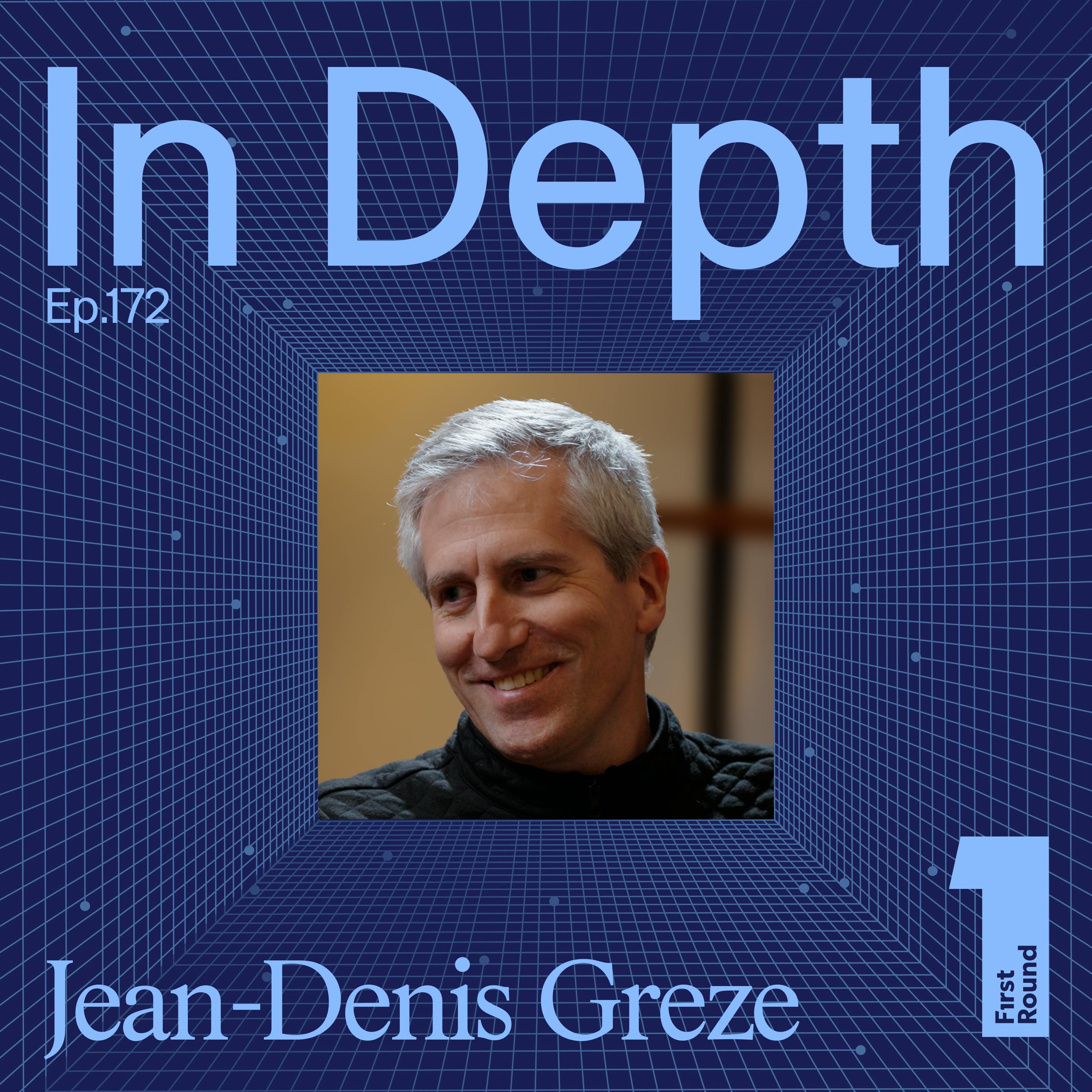
Town CEO Greze Bets Workers Will Let AI Decide What Data Peers See
First Round
Jean-Denis Greze argues workplace productivity will only scale once employees delegate outbound data-sharing decisions to personal autonomous agents, eliminating the human approval bottlenecks that stall enterprise collaboration.
Town recently closed its Series B funding round at a $1 billion valuation to build autonomous enterprise work assistants known as 'Townies.' (0:00)
Competitive moats in generative AI software have drastically compressed, shrinking competitor replication cycles from years down to a window of weeks or months. (0:00)
Jean-Denis Greze predicts users will consolidate around two distinct AI interfaces on their devices—one for personal life and one for work—due to irreconcilable data privacy, compliance, and monetization models. (3:23)
A technical step-function in frontier models late in the previous year unlocked reliable multi-step autonomous workflows and code execution, laying the foundation for always-on enterprise assistants. (9:08)
Multiplayer agent collaboration breaks traditional human-in-the-loop approval workflows, requiring AI to autonomously filter and broker shared knowledge across internal corporate boundaries. (35:27)
Detailed notes
## Background
This episode of the In Depth podcast was published by First Round on October 28, 2026. Host Todd speaks with Jean-Denis Greze (JDG), co-founder and CEO of Town and former CTO of Plaid, about building enterprise AI work assistants in a crowded market against incumbents like Microsoft, Google, and frontier AI labs.
## TL;DR
Jean-Denis Greze discusses why Town focuses strictly on enterprise work agents rather than personal consumer assistants, pointing to the limitless spending elasticity and collaborative nature of white-collar work. He explains Town's single-agent architecture ('Townies') over all-knowing central corporate databases, highlighting how this model enables bottom-up product-led growth and respects user ownership. The conversation explores compressed startup defensibility cycles, token-based consumption pricing, dynamic model routing to avoid vendor lock-in, and the progression of trust from rigid human-in-the-loop approvals to autonomous, multiplayer agent-to-agent information sharing.
## Atmosphere & style
The interview has the relaxed, high-trust cadence of two seasoned Silicon Valley operators who previously worked together at Dropbox, moving seamlessly between strategic theory and hard-won tactical lessons. Greze speaks with sharp analytical clarity, balancing self-deprecating admissions about earlier wrong assumptions with an intense urgency regarding shrinking competitive moats. It feels like an authentic, behind-the-scenes founder debrief, charting an emotional arc from early existential pivots to the high-stakes execution required when operating at the center of tech's fiercest hype cycle.
## Bulletin
- `00:00` Town recently closed its Series B funding round at a $1 billion valuation to build autonomous enterprise work assistants known as 'Townies.'
- `00:00` Competitive moats in generative AI software have drastically compressed, shrinking competitor replication cycles from years down to a window of weeks or months.
- `03:23` Jean-Denis Greze predicts users will consolidate around two distinct AI interfaces on their devices—one for personal life and one for work—due to irreconcilable data privacy, compliance, and monetization models.
- `09:08` A technical step-function in frontier models late in the previous year unlocked reliable multi-step autonomous workflows and code execution, laying the foundation for always-on enterprise assistants.
- `35:27` Multiplayer agent collaboration breaks traditional human-in-the-loop approval workflows, requiring AI to autonomously filter and broker shared knowledge across internal corporate boundaries.
## Key takeaways
- `10:00` Generative AI competition has reduced the window of feature differentiation from years to weeks or months, forcing startups to be right repeatedly over an 18-month span.
- `03:23` Users will not operate dozens of fragmented agents, but will instead rely on two primary AI interfaces: an ad-supported or transaction-monetized personal agent, and a strictly isolated enterprise work agent.
- `07:01` Enterprise AI spending has virtually no ceiling because tokens scale directly with business ROI, whereas consumer AI faces a strict limit on willingness to pay to eliminate minor friction.
- `09:08` Frontier model releases late in the prior year crossed the threshold of reliable multi-step task autonomy, calendar coordination, and ad-hoc code execution, catalyzing persistent enterprise work assistants.
- `10:00` The emergence of browser use and computer use shifted agents away from purely pre-architected APIs into directly operating human-facing third-party interfaces like Figma and video editors.
- `15:00` Enterprise buyers require neutral application layers that dynamically route across foundation models to optimize intelligence and pricing while avoiding single-lab vendor lock-in.
- `17:57` Town rejects outcome-based pricing in favor of token consumption allowances layered onto seat-based subscriptions to ensure enterprise budget predictability.
- `25:08` Town positions itself internally as an AI onboarding and education platform, using intuitive entry points like 'CC @ Town' to train users on agent capabilities without friction.
- `27:15` Town chose a single persistent agent per person ('Townie') over a swarm of specialized sub-agents to preserve a cohesive emotional relationship and lower cognitive overhead.
- `32:01` Early security assumptions around rigid human-in-the-loop gates for write actions and prompt injection fears gave way to prompt hardening, data hygiene, and explainability in the agent harness.
- `35:27` Multiplayer agents cannot scale if humans must manually confirm every data handoff, requiring software to delegate privacy filtering and multi-agent coordination directly to AI.
- `35:27` To curb malicious queries without heavy access control lists, Town makes multi-agent data queries transparent in shared team channels where actions are socially accountable.
- `40:00` Town adopts a bottom-up individual agent model instead of a centralized, all-knowing corporate AI to avoid enterprise IT security roadblocks and satisfy employees' desire to own their tools.
- `42:15` Administrative staff, executive assistants, and mid-market sales teams remain among the most underserved enterprise groups despite heavy AI investment in developer and customer support tooling.
- `44:33` Similar to the transition to algorithmic social feeds, users will increasingly delegate outbound information sharing to AI agents to eliminate internal communication bottlenecks.
## Detailed walkthrough
### `00:00` The AI Agent Race and Town’s Billion-Dollar Series B
Todd introduces the conversation against the backdrop of an intensifying battleground in artificial intelligence, where incumbents and frontier labs—including Meta, OpenAI, and xAI—are all racing to ship their own AI agents. These competitors are exceptionally well-funded and control massive, built-in distribution networks. Yet the guest on today’s episode was building in this arena before almost any of them: Jean-Denis Greze (widely known as JDG), co-founder and CEO of Town, an enterprise platform that assigns every employee an autonomous AI work assistant known as a “Townie.” Town recently announced its Series B funding round at a $1 billion valuation.
JDG stresses that the nature of software competition has fundamentally shifted under generative AI. In previous eras, a startup with a distinctive, market-leading product might expect a lead of years or even decades before rivals could reverse-engineer and roll out equivalent features. Today, competitors can analyze, dissect, and duplicate an innovative feature within weeks to months. Despite this rapid compression of competitive moats, JDG views the incumbents as surprisingly less terrifying than history might suggest. To him, the current moment represents a paradigm shift far greater than simply shipping another SaaS application: “We’re building the window pane through which humans will interact with all content.”
Todd observes that while autonomous agents felt like a niche curiosity only three months earlier, the space suddenly exploded with rival projects like Instinct, Grok, Muse, and Dots. When asked how it feels to find himself in the hottest category in tech after having worked on it quietly from the beginning, JDG jokes that it is certainly far better to operate in tech's hottest category than its coldest. He explains that early on, it was an open question whether an assistant could ever become capable enough to handle enterprise knowledge work, or whether users would actually abandon their habit of juggling dozens of desktop browser tabs and mobile apps in favor of an agent. Today, that bet has evolved into an industry-wide zeitgeist.
- **Speed of competition:** Competitor response times have shrunk from years down to a window of weeks to months.
- **Valuation:** Town recently closed its Series B at a $1 billion valuation.
- **Strategic mindset:** JDG and his team always operated on the assumption that if their product succeeded, it would immediately become a top-three strategic priority for tech giants like Microsoft and Google.
`03:23` Why Every Human Will Run Two Separate AI Interfaces
Addressing whether users will end up with dozens of niche agents or consolidate around a few, JDG clarifies that human behavior consistently trends toward simplicity. Just as the overwhelming majority of people carry a single smartphone rather than four separate devices, users will not manage a hundred fragmented AI assistants. However, he rejects the idea that a single personal assistant will rule every part of life. Instead, he predicts that people will operate exactly two primary AI interfaces on their devices: one dedicated entirely to their personal life, and one strictly isolated for their professional life.
```mermaid
flowchart TD
accTitle: Dual Agent Architecture (Personal vs. Work)
accDescr: Diagram illustrating the strict division of data ownership, privacy, and business models between personal and work agents, with a soft membrane only for calendar time use.
subgraph PersonalAgent["Personal Agent"]
P1["Personal Life & Tasks<br>(Restaurants, date night, personal travel)"]
P2["Ad-Supported / Transaction Cut<br>(User accepts data training & monetization)"]
end
subgraph Membrane["Shared Membrane"]
M1["Calendar & Availability Sync<br>(Preventing work from stomping date night)"]
end
subgraph WorkAgent["Enterprise Work Agent (Townie)"]
W1["Enterprise Knowledge & Tasks<br>(Sales prep, internal metrics, ad optimization)"]
W2["Enterprise SaaS / Token Billing<br>(Strict corporate data ownership & compliance)"]
end
This clean split is driven by fundamentally conflicting requirements around privacy, monetization, and data ownership. In a consumer environment, users are accustomed to accepting privacy trade-offs: they receive free or low-cost services like Instagram, free Gmail, or credit cards in exchange for ad targeting, merchant transaction cuts, or allowing vendors to train on user data. In an enterprise environment, that bargain is completely unacceptable. Corporations must strictly own their data, protect their intellectual property, prevent leakage when employees depart, and ensure their corporate data is never monetized via third-party ads. JDG summarizes this structural divide: “Yeah, privacy, data ownership, all those things will mean, in my opinion, that people have two interfaces on their phones, one for their personal life and one for their work.”
- **Data ownership barriers:** Companies cannot allow an employee’s sales notes, prep work, or pipeline metrics to bleed into a personal knowledge bubble that the employee takes with them if they switch jobs.
- **Distinct integration requirements:** Even superficially similar workflows require completely separate enterprise infrastructure. For instance, booking corporate travel demands integrations with enterprise travel platforms that offer white-glove rebooking guarantees and corporate rate flexibility, whereas personal travel optimizes for leisure pricing and personal preferences.
- **Specialized workplace tasks:** Enterprise agents must tackle high-value internal workflows, such as continuously optimizing ad spend across Meta and Google, monitoring competitor positioning shifts for marketing, and synthesizing confidential internal operating metrics.
`07:01` Why Enterprise AI Has No Ceiling While Personal AI Hits a Wall
When Todd asks why Town remained unwavering in its decision to target enterprise productivity rather than expanding into consumer workflows, JDG points directly to economic elasticity and total addressable market size. He strips artificial intelligence down to its first principles: AI is essentially a mechanism to convert electrical power and compute into usable intelligence. In personal life, the opportunities to apply raw intelligence to improve human fulfillment are tightly constrained. While automating bill payments or securing reservations for date night is convenient, there is a strict upper bound on how much a consumer is willing to pay to eliminate minor life friction.
In stark contrast, enterprise AI spending is tied directly to top-line business expansion. If an enterprise can spend money on AI compute to unlock new workflows, optimize campaigns, or accelerate sales deals that bring in additional revenue, its willingness to buy tokens scales almost indefinitely. JDG underscores this distinction when reflecting on product complexity and market upside: “In the work context, we’re like nowhere near the ceiling.”
Beyond pure market size, JDG highlights that the enterprise domain presents far richer product and engineering challenges. White-collar work is inherently collaborative and multiplayer. It involves coordinating across teams, negotiating shared data access, and breaking down entrenched internal organizational silos. While an agent booking a table at a restaurant is effectively a solved problem that will see diminishing marginal returns over the next twelve months, building an autonomous agent that collaborates seamlessly across human teams and disparate enterprise data environments has barely scratched the surface.
- **Elasticity of enterprise spend:** Unlike fixed consumer subscription budgets, companies will deploy vastly higher token volumes if those tokens produce demonstrable enterprise ROI.
- **Multiplayer complexity:** Enterprise workflows involve dynamic group permissions, organizational alignment, and multi-agent coordination across cross-functional teams.
- **The capability ceiling:** Consumer tasks rapidly hit a wall where additional intelligence offers zero marginal benefit; enterprise knowledge work has no near-term intelligence ceiling.
`09:08` The Late-Year Breakthrough: Autonomous White-Collar Work
Todd shifts the conversation to the immediate technical triggers behind the sudden surge in autonomous assistants, asking why this category exploded specifically over the past six to twelve months. JDG points directly to a major step-function advancement in frontier model capabilities that arrived near the end of the previous year.
JDG notes that prior to late autumn, foundation models were incapable of sustaining autonomous white-collar workflows. That changed when Anthropic rolled out frontier models around November and December that could genuinely tackle multi-step administrative and knowledge tasks without continuous human hand-holding. For the first time, models could reliably triage an employee’s inbox, accurately categorize and label complex email threads, handle scheduling logistics, and dynamically write and execute ad-hoc code on the fly to automate multi-step digital processes.
This inflection in model autonomy triggered an immediate explosion across the developer ecosystem—sparking experimental agent tools like OpenClaw—and served as the exact catalyst for Town. Seeing models cross the threshold where they could independently interact with communication channels and write dynamic code convinced JDG and his co-founders that the time had finally arrived to anchor an autonomous assistant directly inside email and core daily workflows.
- **Autonomous threshold:** Models progressed from simple chat completions to reliably executing autonomous, multi-step actions across white-collar knowledge tools.
- **Technical capabilities unlocked:** Autonomous email labeling, calendar coordination, and on-the-fly code generation capable of binding multiple tools together into unified workflows.
- **Timing:** Anthropic’s model releases in November and December served as the pivotal launchpad for the current generation of persistent, always-on enterprise assistants.
`10:00` Computer Use, Proactivity, and Shrinking Windows of Differentiation
The initial wave of AI agent innovation centered on foundational knowledge tasks such as managing calendars, handling email, and parsing communications. Around June and July of the year, however, a second major breakthrough arrived: frontier models became exceptionally proficient at computer use and browser use. Rather than relying exclusively on structured APIs where an agent requires carefully pre-architected integration points, agents gained the capability to navigate interfaces just like a human. They can now open Figma, manipulate design files, or interact directly with video-editing applications to produce clips. This capability stems not from an LLM specifically trained to generate video files natively, but from the model's ability to operate third-party video-editing software directly through the UI.
Alongside this interface shift, underlying model reliability improved dramatically. In the first quarter of the year, models performing knowledge work were accurate roughly 70% to 80% of the time, and when errors occurred, they failed in erratic, unhinged ways. Current models operate reliably at a 90% to 95% threshold; when they do fail, the mistakes are far less frustrating and the resulting work product remains broadly salvageable. In products like Town—and to some extent Muse—agents are transitioning from passive executors to proactive partners. Instead of waiting for explicit instructions, they observe patterns and propose end-to-end automations, asking users whether they would like recurring tasks handled automatically every time they occur. For mainstream users outside Silicon Valley, this eliminates the friction of having to learn prompt engineering or system architecture; the software reveals its own utility directly.
```mermaid
flowchart TD
accTitle: Evolution of AI Agent Capabilities
accDescr: Diagram illustrating the progression from API-based knowledge work to computer use and proactive automation.
Building in this hyper-accelerated market is both exhilarating and strategically taxing. While product engineers can ship features and receive user validation faster than ever, defensibility has compressed drastically. Competitors can deconstruct a winning feature and ship an equivalent clone in weeks or months—cycles that previously took years or decades. Town launched in June and experienced a brief window of "clean air" through July where they felt untouchable, only to see competitors emerge shortly thereafter. Having just shipped new multiplayer collaboration features where agents collaborate across teams, Jean-Denis Greze reflects on the intense pressure to continually execute ahead of the pack:
> "And so now I have, as opposed to having like two years to develop network effects in like real moats, I have a quarter, maybe if I'm lucky, two quarters, right? That's the part about this, which... which at times can feel overwhelming because on a from a pure product perspective I think you have to be right not just once. You probably have to be right four or five times over 18 months to really, really, truly win."
`15:00` Incumbents, Neutrality, and Token-Based ROI
While compressed build cycles challenge startups, the same dynamic destabilizes incumbents. Large incumbent tech companies possess distribution advantages, but they often lack defensive network effects in this new paradigm. A startup can now execute an ambitious roadmap in 12 months that historically demanded five years of engineering, suddenly exposing markets that once seemed unassailable. Jean-Denis reminds himself that Town is competing in the largest total addressable market in software history, that they have repeatedly led the industry curve, and that legacy players are far less intimidating than they appear on paper.
A delicate tension exists between application builders and the frontier labs powering them. Both OpenAI and Anthropic assure platform partners that their API business is valued, while simultaneously launching competing end-user products. Jean-Denis argues that vertical integration by the foundation labs is strategically mismatched with what enterprise customers actually require. When speaking with enterprise buyers, he asks them to predict who will provide the best frontier model in one year, two years, or five years—a question nobody can answer with certainty. Businesses that locked themselves into long-term token commitments with a single frontier lab over the prior 12 to 15 months felt burned when competitive leadership shifted.
> "I think if you're a smart business, you should look that product layer should be someone that is neutral, that will always use the best models for the tasks at hand at the right price, right? Because it's not just about intelligence. It's also price, right?"
- Open-weight and alternate models frequently undercut frontier lab prices by dramatic margins, running at 10 to 20 cents on the dollar for equivalent tasks.
- Neutral application platforms insulate businesses from model obsolescence by dynamically routing workloads to the best-performing, most cost-effective engines available.
Pricing strategies in the AI agent market remain divergent. While Muse is offered for free and Sierra CEO Bret Taylor advocates for outcome-based pricing (such as charging per resolved customer support ticket), Jean-Denis considers outcome-based pricing ill-suited for general-purpose work assistants where the variety of tasks is near-infinite. Instead, Town operates on an efficient token consumption model. Town packages model inference costs with a modest platform fee on top, allowing users to allocate their compute budget based on their individual ROI calculations. A knowledge worker can spend $10 a month of their token allowance executing complex rules to automate their calendar, while an executive recruiter on Town's $99-per-month plan might allocate their entire quota to scraping candidate profiles, querying third-party directories, and mapping hiring markets. The platform focuses on token efficiency and infrastructure neutrality, leaving the definition of value to the user.
`20:00` Predictable Enterprise Pricing and the Four Pillars of Town's Defensibility
When businesses evaluate generative AI tools, the standard usage-based token model immediately runs into CFO pushback regarding budget unpredictability. Jean-Denis explains that enterprise customers consistently ask for seat-based pricing as a baseline: they want an allotment of tokens bundled into each employee's seat so costs stay predictable. Once an organization identifies high-ROI use cases, leadership becomes comfortable layering usage-based pricing on top for power users. Jean-Denis sees this budget tension as a massive product opportunity: software must provide leadership with granular visibility into where tokens are actually going so teams can evaluate the real return on investment.
Jean-Denis outlines the four key pillars that make Town compelling to enterprise buyers, even if underlying AI models converge over time:
1. **Uncompromising Data Privacy and Security:** Making enterprise guardrails so robust that enterprise security teams view the software as the default safe choice.
2. **Model Routing:** Eliminating vendor lock-in so companies avoid making an exclusive, hard commitment to any single frontier lab.
3. **True Data Ownership:** Ensuring customers retain total ownership of their underlying business context, relationships, and operating data—with the freedom to migrate off Town at any time.
4. **ROI Transparency and Token Auditing:** Providing internal visibility into organizational token spend so leadership can double down on high-impact workflows and curb low-ROI usage.
Jean-Denis puts this strategy plainly: “And I think if we nail those four points even if the core product isn't that differentiated, which it will be, right, are really meaningful reasons for a business to work with us as opposed to someone else.”
---
`22:52` Testing Agent Behavior and the Danger of Ignoring User Feedback
Reflecting on their shared history at Dropbox in 2015, Todd asks how building an AI agent startup compares to building software a decade ago. Jean-Denis points out a fundamental shift in product development: agents possess remarkably little static UI or visible product surface area. Instead of designing, debating, and coding visible interface elements, engineers can alter the agent’s underlying prompts, tool execution, and decision logic behind the scenes. As Jean-Denis puts it: “It's like you can think about it as like you can make a button appear and disappear without there being a button that appears and disappears.” This dynamic eliminates lengthy philosophical design debates; teams can simply deploy a behavioral variation and obtain empirical answers from real users within two weeks.
Yet despite the speed of AI development, Jean-Denis emphasizes that the core discipline of talking to users remains irreplaceable. He shares a recent example from a shared Slack channel with an active Town customer. The user remarked that while Town effectively managed their workflow, they still had to jump into Gmail to handle their remaining emails and wished they could process everything directly within Town.
From an architectural standpoint, Town never intended to become an email client; the product's vision was to automate away 30 to 50 routine messages, leaving the user with just seven critical emails that require actual human judgment inside their existing inbox. However, the customer wanted an embedded email client inside Town to knock out those final seven messages without switching tabs. Jean-Denis realized that if 75% of users share that sentiment, the company must build it regardless of initial product dogma: “If I found out tomorrow that 75% of our users would love that experience, and if we had that experience, their willingness to pay and not churn to another product would be much higher, then I sure as heck should build that, right?” He cautions that engineering teams frequently get seduced into shipping endless new agent capabilities, which can leave sales teams disoriented and forced to relearn the product every single week.
---
`25:08` Town as an AI Onboarding Platform and the Power of 'CC @ Town'
While Town is outwardly marketed as a proactive, multiplayer work assistant built specifically for companies, Jean-Denis reveals an alternative internal framing: Town is fundamentally an onboarding platform designed to bridge mainstream users into the world of AI. Most employees struggle to understand what AI agents can realistically accomplish versus where they fall short. Because of this, software cannot merely exist as a passive tool; it must educate users through product mechanics.
```mermaid
flowchart LR
accTitle: CC at Town Onboarding Flow
accDescr: How Town uses email calendaring to onboard users into multi-agent workflows.
subgraph GuidedOnboarding["Proactive Discovery (High Adoption)"]
C["User Adds<br/>'CC @ Town' to Email"] --> D["Agent Takes Over<br/>Scheduling Thread"]
D --> E["User Observes Value<br/>Without Friction"]
E --> F["User Imagines New<br/>Multi-Agent Tasks"]
end
```
To illustrate this onboarding philosophy, Jean-Denis highlights the discovery curve of their multi-agent collaboration features. Early on, only about 10% of users independently discovered that agents could coordinate with one another, though those who did loved it. Rather than expecting mainstream users to figure out agent-to-agent interactions, the team looked at where users were already spending time: email and scheduling.
They introduced a feature called "CC @ Town," allowing an agent to insert itself into an email thread and independently negotiate meeting times with outside parties. Interestingly, Town rolled out this capability exclusively to new users as a default onboarding hook. Because new users experienced the scheduling capability immediately without having to configure it, adoption surged, prompting them to realize that their agent could handle complex, multi-party tasks across their workday. Jean-Denis summarizes the philosophy: “And I think the challenge, the core challenge right now with these very horizontal assistants and AI in general is how do you get a human to get the most out of it, and that is an education problem.”
---
`27:15` Designing Human-Centric AI and the 'One Agent vs. Many' Debate
Todd brings up Jean-Denis’s co-founder, Tony Vincent, praising him as an exceptional designer and asking how design leadership influences AI agent development. Jean-Denis breaks down the distinction between product management and design: product management identifies the universe of user problems and decides which are worth solving for business growth, whereas design investigates a specific problem and constructs an elegant, intuitive solution that makes users feel understood. Because Tony operates simultaneously as a top-tier product thinker and designer, he can abstract raw user requests into core systemic needs and produce multiple working prototypes within 24 hours.
When asked how the two handle strategic friction, Jean-Denis notes that alignment is common, but disagreements are actively embraced as indicators of critical strategic inflection points: “When we disagree on something, then that means we've put our finger on something important and it's worth the disagreement being seen through and we bring other people from the team in because it means there's like something about the direction of the company or something about what we're learning from the market that's not simple, it's not easy to solve.”
A major early debate between the co-founders centered on agent architecture: should a user have a swarm of multiple specialized agents, or a single dedicated agent?
- **Multiple Specialized Agents:** While having specialized sub-agents for distinct tasks is technically flexible and powerful, it fragments the user's mental model and adds cognitive overhead.
- **Single Dedicated Agent ("The Townie"):** Providing each employee with one persistent agent that possesses a unique name and holistic context mirrors a true personal chief of staff.
Jean-Denis and Tony ultimately committed to the single-agent paradigm. While the market was flooded with generic utilities named after corporate models—where every user interacted with an undifferentiated Claude, ChatGPT, or Poe—Town gave each person their own distinct agent that remembers context and builds a personalized, trusted working relationship over time.
`30:00` One Relationship and the Co-Founder Debates
Jean-Denis Greze explains that each Town agent—often called a "Townie"—has its own distinct identity tailored to an individual: one user's agent might be named Ivy, while another person's might be Brock or Cleon. Each agent has its own dedicated email address, possesses a single consistent personality across contexts, and continuously learns about both its user and itself.
```mermaid
flowchart LR
accTitle: Single Agent Relationship Model
accDescr: Diagram contrasting multiple disjoint tools with Town's dedicated emotional relationship model where one agent learns about its user over time.
subgraph SingleAgent["Town Model: Deep Relationship"]
User["User"] <-->|"Personal Trust & Learning"| Agent["Dedicated Agent\n(e.g., Ivy or Brock)"]
Agent -->|"Single Identity"| Email["Unique Email & Personality"]
end
```
He and his co-founder, Tony, had substantial disagreements about this setup before reaching alignment. Jean-Denis notes that their agreement clicked once they framed what they were creating: “And I think the place where we could agree was once we realized we were building a relationship with, and an emotional product. And if you're going to build a relationship, it just needs to be one.”
Their disagreements also extended into technical timing, notably around browser use:
- **Browser readiness debate:** Tony argued they needed to move immediately into browser-use scenarios, whereas Jean-Denis resisted, believing the technology was not quite mature enough for general adoption.
- **Outdated priors:** Jean-Denis candidly acknowledges that he was wrong: “And I was wrong on that one. And the reason is my priors were based on data that was a couple months old, and the models had just gotten better so quickly.”
- **Velocity of model improvements:** The underlying debate rested on whether browser automation felt good enough for mainstream users, and Jean-Denis had underestimated just how fast frontier models were advancing week over week.
`30:59` Pivoting Away from Small Business Tax Preparation
Todd prompts Jean-Denis on one of the hardest founder milestones: abandoning Town’s original concept, which was automated tax preparation for small businesses. Jean-Denis explains that the decision ultimately hinged on team-market fit and the opportunity cost for their talent.
He realized that tax prep would not produce the kind of massive, high-impact business that justified spending five years of an exceptional engineering team's prime career capital. However, making that pivot comes with significant human friction and emotional pain:
- Having to let team members go when restructuring for the new mission.
- Breaking the news to early investors who backed the original thesis.
- Contacting customers and commercial partners who were banking on Town to deliver their tax filings in the coming tax year.
Jean-Denis summarizes the raw personal burden of executing a company pivot: “For me personally, I think it came from a realization that it wouldn't be the right outcome for the team. Like it wasn't the right problem for this incredible team to tackle for five years if I didn't think it could be like a huge business given the opportunity costs that all of the folks had to you know to work at versus versus something else... And then it's you just know it's gonna suck. You know it's gonna be like a month and a half of suck.”
`32:01` Designing an Agent People Can Inherently Trust
Asked how to engineer trust into a product that touches private work communications, Jean-Denis laughs, noting that Town's approach has dramatically evolved. In Town’s earliest incarnation, there was no persona or assistant interface at all; users simply wrote prompts that evaluated incoming emails as a trigger or executed schedules over time.
To ensure airtight safety, they instituted rigid baseline security guardrails:
1. **Mandatory Human-in-the-Loop on Writes:** Any background tool that could execute a write action based on an incoming email had to be explicitly confirmed by a human.
2. **Untrusted Data Boundaries:** When an interactive assistant was eventually added, the rule persisted: if the agent accessed untrusted incoming data and wanted to take a write action, a human gate was compulsory.
3. **Transparent Restrictions:** The early operating principle was that you earn user trust simply by disallowing the system from taking autonomous actions on untrusted inputs and showing the user every pending step.
```mermaid
flowchart TD
accTitle: Evolution of Agent Trust Architecture
accDescr: Flowchart illustrating the evolution of agent trust from strict human-in-the-loop controls to data hygiene policies, explainability, and prompt hardening.
subgraph EarlyV1["Phase 1: Hard Guardrails"]
DataIn["Incoming Untrusted Data"] --> Check{"Write Action Required?"}
Check -->|"Yes"| HITL["Mandatory Human-in-the-Loop Approval"]
end
subgraph FeedbackV2["Phase 2: Customer-Driven Trust"]
Erase["Immediate Data Deletion After Use"]
NoTrain["Zero Training on User Data by Default"]
LeanIndex["Minimal Indexing: Only Essential Context"]
end
subgraph HumanV3["Phase 3: Social & Explainability Trust"]
SocialRisk["Avoid Making the User Look Stupid"]
HarnessAudit["Harness Explains Why Decisions Were Made"]
end
```
Once Town began onboarding live users, they learned that customer trust required clear commitments around data hygiene:
- Promptly deleting customer data the instant an operation finishes.
- Refusing to re-index all company information, indexing only the bare minimum required to deliver the user experience.
- Enforcing strict privacy policies guaranteeing they do not train models on customer data unless explicitly opted into.
Beyond data governance, users worried about social embarrassment. Users hated the idea of an agent making them look foolish or sending unprofessional communications. To address this, Town spent engineering cycles in the agent harness so that whenever the model made an error, it was completely explicit with the user about its reasoning.
`35:27` Injection Attacks and the Realities of Multiplayer Agents
Addressing how user attitudes toward trust have shifted over the previous year, Jean-Denis highlights two paradigm shifts:
First, their early terror over prompt injection attacks turned out to be largely overstated in day-to-day operations. While injections remain theoretically possible, contemporary frontier models have undergone extensive safety post-training, and when an execution harness labels messages properly with strict prompts, injections are extremely rare. Empirically, the systems simply do not misbehave in wild ways. While connecting email, calendars, and external systems to AI still gives cautious mainstream users pause, Jean-Denis insists broad adoption is inevitable because the utility is too compelling.
Second, the emergence of "multiplayer" agent environments fundamentally broke the human-in-the-loop paradigm:
- **The Approval Bottleneck:** If a human must approve every interaction where data passes between coworkers or between agents, collaboration grinds to a halt. As the number of participants grows, confirmation prompts explode.
- **Delegated Privacy Filtering:** To keep teams fast, AI itself must determine what information can cross silos according to team boundaries. For example, sales team members should freely query each other’s agents regarding deal pipeline and meeting statuses, but agents must never disclose executive payroll figures from a private spreadsheet.
- **Company Scale and Implicit Trust:** Small-to-midsize businesses (SMBs) of 25 people already have high baseline interpersonal trust, making them far better early adopters for multiplayer agents than 1,000-person enterprises where inter-departmental trust is fragmented.
Jean-Denis outlines why Town focuses strictly on SMBs and mid-market teams rather than enterprise giants:
“I mean, we have a strategy doc internally. And one of the things that we have in the strategy is we don't think a company like Google or Microsoft that has enterprise customers can adapt to this future because none of their customers are ready to endorse this future. Whereas we're seeing teams in Silicon Valley or, you know, like 25 person SMBs be willing to use this because they feel it's so magical that it's worth it.”
To prevent malicious querying without relying on enterprise access lists, Town relies on a social mechanism: transparency.
- Townies do not execute agent-to-agent data queries in secret private backchannels.
- Multi-agent questions happen publicly in shared team channels where other humans can see the prompt and the answer.
- If an employee asks another colleague's Townie, *"What is everyone's salary on my team and am I making more or less?"*, the agent will refuse, and the employee risks termination because their malicious prompt was broadcast in plain sight to their peers and managers.
`44:33` Bottom-Up Distribution vs. The All-Knowing Enterprise Agent
Todd raises Town’s fundamental architectural choice: why provide each individual employee with their own personal agent that communicates with other agents, instead of deploying a single, centralized, all-knowing corporate AI?
Jean-Denis notes that the all-knowing agent model forces a rigid top-down enterprise sales motion. To make a centralized system work, the software vendor must convince IT administrators and security teams to hand over master credentials to all company databases and systems before any user receives value:
- **The Enterprise IT Wall:** An all-knowing agent forces a vendor to sell directly to the Head of IT from day one.
- **Broken Product-Led Growth (PLG):** When an early-stage startup attempts a bottom-up adoption model with an all-knowing agent, the sale stalls immediately: when a prospective user asks to test the software, the vendor cannot demonstrate value without requiring organizational-wide access to company-wide tools and emails upfront.
`40:00` The Case for Individual "Townies" Over a Single Global Agent
Jean-Denis Greze reflects on the architectural and business considerations behind giving every employee their own personal agent—dubbed a "Townie"—rather than building a single shared enterprise agent. A big enterprise sale that requires sweeping data access out of the gate is a daunting wedge for a startup: asking a prospect to connect their entire corporate HubSpot instance triggers endless security hesitation. While enterprise search companies like Glean succeeded with broad indexation motions, Town deliberately sought the smallest possible data unit required to deliver immediate value: an individual's email and calendar, followed optionally by their specific system of record (such as an ATS for a recruiter, or Salesforce for an account executive).
Beyond sales friction, Jean-Denis highlights the privacy and psychological barriers of a monolithic corporate assistant. A global agent cannot safely hold private inbox or calendar details without risking data leakage across employees, unless it presents customized personas for everyone—at which point it makes more sense to instantiate distinct agents. Furthermore, users possess a natural sense of ownership over their workflows and competitive advantages. Jean-Denis observes that employees do not want an enforced collective model: “Like we're not communists, right? I want my toys. My toys. I don't want to share my toys with everybody else. I don't want to share intelligence with everyone else at the company.” A high-performing salesperson crafts bespoke instructions for their personal Townie that make them uniquely effective. To balance personalization with organizational alignment, Town combines individual data with shared infrastructure:
```mermaid
flowchart TD
accTitle: Town Hybrid Architecture
accDescr: Diagram showing individual agent layers combining with company-wide shared layers.
CI --> AgentA
SK --> AgentA
CR --> AgentA
CI --> AgentB
SK --> AgentB
CR --> AgentB
```
- Townies can be brought directly into existing workflows across email, SMS, Slack, or Microsoft Teams.
- Shared primitives (company-wide integrations, routines, and skills) can be cooperatively built, refined, and edited by the entire organization.
`42:15` AI Disparities: Who Gets Left Behind in Enterprise and Mid-Market
When asked which teams remain most underserved by AI, Jean-Denis immediately rules out software engineering, noting that technical roles have been flooded with tooling. In large enterprises, adoption maps directly to quantifiable revenue impact or heavy non-physical operational workflows—propelling rapid rollouts for sales, customer support, and developer teams. Conversely, roles where measuring the return on invested time is nuanced are routinely neglected. Jean-Denis points to executive assistants and secretarial pools: corporate leaders fail to measure their operational leverage, meaning frontier labs do not deploy forward-deployed engineers to optimize their administrative workflows, even though supercharging scheduling and communication would multiply productivity across entire managerial tiers.
Enterprise structure also dictates where automation stalls. Highly fragmented conglomerates with disparate division-level operations lack standardized processes, causing internal operations teams to miss out on flexible, general-purpose agent tooling like Town. Curiously, the mid-market exhibits an inverse blind spot: Jean-Denis observes that mid-market sales teams are frequently left behind without modern AI tooling. Todd and Jean-Denis find this puzzling given the endless barrage of venture-backed sales-enablement startups saturating San Francisco tech circles.
- High-priority enterprise AI adoption: engineering, customer support, and direct-revenue sales teams.
- Low-priority enterprise AI adoption: administrative staff, secretaries, and fragmented operations teams lacking uniform corporate standard operating procedures (SOPs).
- Unexpected mid-market gap: core sales teams operating without dedicated AI workflows despite industry-wide hype.
`44:33` Delegating Information Sharing: The Next Frontier of Agent-to-Agent Collaboration
Jean-Denis outlines a controversial thesis about the future of workplace agents: employees will soon empower AI to decide what data gets shared outward to colleagues on their behalf. Drawing a historical parallel, he reminds Todd of the fierce user backlash when Facebook moved away from manual profile wall browsing to introduce the algorithmic News Feed. People were outraged at the idea of machine-curated feeds, viewing algorithmic content delivery as intrusive. Jean-Denis predicts a similar transition is coming for outbound enterprise communication: “The claim that I would make today is that AI will decide what gets shared from you. Increasingly. Not to everyone in the world, but to people that you're closely associated with—your family, your coworkers.”
Rather than pushing information randomly, an agent will proactively retrieve and disclose answers locked inside an individual's private systems when a trusted peer needs it, eliminating the friction of manual ping-pong messaging. In corporate environments, where interpersonal communication bottlenecks constitute the primary drag on operational velocity, delegating these disclosures will unlock massive business leverage.
Jean-Denis emphasizes that the true barrier to agent-to-agent (A2A) adoption is neither basic API communication nor privacy controls—which are baseline requirements for survival—but proving unmistakable value to the user:
> “The real challenge on this is not, can you do A to A? Can you just talk to agents? That's not the hard part, right? It's not even the privacy. You got to get the privacy right or you're out of business... It's, can you deliver something of value that they wouldn't have had without this where they're like, 'Oh my god, this is so valuable. Obviously, I'm going to keep doing more of this.' That's the challenge with A to A. It's not building it. It's delivering something so valuable from this experience that it avoids seven loops between humans where everybody feels like they got hours back that week and a better business outcome.”
With that vision for how autonomous coordination can rescue hours of wasted internal communication, Todd thanks Jean-Denis for coming on the show, and the conversation wraps up.
## Notable quotes
> `44:33` The claim that I would make today is that AI will decide what gets shared from you. Increasingly. Not to everyone in the world, but to people that you're closely associated with—your family, your coworkers. — Jean-Denis Greze
> `03:23` Yeah, privacy, data ownership, all those things will mean, in my opinion, that people have two interfaces on their phones, one for their personal life and one for their work. — Jean-Denis Greze
> `25:08` And I think the challenge, the core challenge right now with these very horizontal assistants and AI in general is how do you get a human to get the most out of it, and that is an education problem. — Jean-Denis Greze
## Video description
In this episode of In Depth, Todd sits down with Jean-Denis Greze, co-founder and CEO of Town, the AI work assistant that gives every employee their own agent. Before Town, Jean-Denis spent seven years as CTO of Plaid and led engineering teams at Dropbox, where he and Todd first worked together. In this conversation, they dive into what it takes to build in tech's hottest category while competing with Microsoft, Google and the frontier labs, why Town bet on work agents over personal agents, and how to get agents to share the right information with each other.
In today's episode, we discuss:
The edge that keeps Town competitive with Google and Microsoft
How user feedback adjusted Town’s product
Why Jean-Denis believes people will start delegating decision-making to AI
What a multiplayer AI assistant world looks like
Why Town started rolling back its guardrails after users approved 95% of agent actions
Jean-Denis Greze, co-founder and CEO of Town, argues that enterprise AI assistants will succeed not as centralized corporate databases or broad consumer utilities, but as individual, neutral work agents capable of autonomous coordination across teams.
The Bifurcated Future of AI Interfaces (3:23)
Greze contends that users will not manage dozens of specialized agents, nor will they settle on a single monolithic assistant. Instead, human behavior will split into two distinct AI interfaces per device: one dedicated to personal tasks and one isolated for professional work. This division stems from fundamentally incompatible requirements around privacy, business models, and intellectual property. Consumer tools rely on advertising, transaction cuts, and user data training, which businesses cannot accept due to confidentiality, compliance, and IP ownership.
Economic Elasticity in Enterprise Versus Consumer AI (7:01)
Town deliberately bypassed consumer use cases because consumer willingness to pay hits a ceiling once basic personal conveniences, like paying bills or making dinner reservations, are solved. In contrast, enterprise AI spending is tied directly to top-line business expansion and operational efficiency. Because businesses can convert compute directly into revenue—such as by automating ad spend, analyzing competitors, or qualifying sales pipelines—their spending on model tokens scales elastically without a near-term ceiling.
Compressing Moats and Platform Neutrality (10:00)
Generative AI has compressed software moats from years to a few months, forcing application makers to repeatedly execute ahead of rivals. Meanwhile, frontier model accuracy has climbed from 70–80% early in the year to 90–95%, enabling browser manipulation and proactive suggestions. Greze argues that enterprise software must remain model-neutral rather than locked to a single lab, dynamically routing workloads across providers to optimize for performance and price, particularly as open-weight options run at 10 to 20 cents on the dollar for equivalent tasks.
Individual Agent Architecture Versus Centralized Systems (44:33)
Rather than deploying an all-knowing enterprise agent, Town assigns each employee an individual assistant, termed a 'Townie.' Centralized corporate agents require complete organizational data access upfront, which triggers IT resistance and breaks bottom-up adoption. Dedicated personal agents operate as individual digital chiefs of staff that secure personal email and calendar data while linking into shared corporate integrations, routines, and multi-agent workflows.
The Evolution of Trust and Multiplayer Collaboration (35:27)
Town initially relied on mandatory human-in-the-loop gates for untrusted write actions, zero data training, and immediate deletion after use. However, as agent collaboration expanded across teams, requiring human approvals for every data exchange created bottlenecks. Town transitioned to semi-autonomous information filtering, relying on shared team channels for visibility to discourage malicious queries. Greze views SMBs and mid-market organizations as better early adopters for this model because their smaller team sizes carry higher baseline interpersonal trust.
Greze forecasts that workplace agents will increasingly decide what internal context to share with colleagues on a worker's behalf, removing internal communication loops. However, the long-term viability of this model rests on proving clear operational time savings without triggering security failures or employee resistance.
精炼阅读摘要
Town 联合创始人兼首席执行官 Jean-Denis Greze 认为,生成式 AI 的竞争周期已从数年压缩至数周,企业级智能体因其可衡量的投资回报率而拥有无限市场上限。他主张为每位员工配备独立的专属代理,通过个人与组织分层的架构和透明的多代理协作重构企业工作流。
技术突破与竞争壁垒的剧烈压缩 (0:00)
在生成式 AI 时代,初创企业的先发优势防御窗口已从过去的数年甚至数十年骤降至数周或一两个季度。竞争对手能够快速逆向工程并复制创新功能,要求产品团队在 18 个月内必须连续做出四到五次正确的战略判断才能真正胜出。JDG 指出,大模型能力在去年底经历了关键跃迁,Anthropic 在 11 月和 12 月推出的前沿模型使系统能够无需人类持续介入即可执行自主分类邮件、动态写代码等跨应用的多步骤知识工作;随后年中计算机与浏览器操作(Computer Use)的突破,更将知识任务的可靠性从 70% 至 80% 提升到了 90% 到 95%。
个人与企业双接口与算力价值分化 (3:23)
JDG 预测未来的用户设备上不会充斥数十个分散的智能体,而是会整合为两个核心接口:一个负责个人生活,一个完全隔离于工作环境。这一划分源于数据主权、隐私和商业模式的根本冲突:个人端通常以广告变现或数据训练换取免费服务,而企业端必须严格保障知识产权、防止离职泄密且绝不允许数据被商业化利用。两者仅在日历可用性等极薄的边界上存在协同。从经济逻辑来看,将电力与算力转化为智能的链条在个人端受限于人类付费意愿的上限,但在企业端则与营收增长直接挂钩,只要代币(token)消耗能带来明确业务回报,企业的预算弹性便几乎没有天花板。
独立代理架构化解 IT 阻力与信任门槛 (40:00)
与市场上构建全局全知型中央企业 AI 的路线不同,Town 坚持为每位员工提供具有独立身份和名称的专属代理(Townie)。中央代理模式要求在销售第一天就向企业 IT 主管索取全量数据权限,极易引发安全审查迟滞并破坏自下而上的产品驱动增长(PLG);同时员工天然抗拒将个人工作习惯与专属工作细节无差别共享。Town 采取以个人邮件与日历为极简切入点的策略,将私有数据与公司共享的基础集成、技能和工作流结合。在数据安全上,团队摒弃了早期严苛的全流程人工介入(HITL),转而采用按需即时删除、最小化索引、绝不用客户数据训练模型以及在公开团队频道暴露多代理交互过程的机制,依靠可见性来遏制恶意查询。
中立路由策略与以教育为本的采纳路径 (15:00)
前沿模型实验室推出自有端点产品的垂直整合趋势并不完全契合企业诉求。JDG 强调企业买家不愿承担技术迭代带来的锁定风险,应用层平台的核心防御壁垒在于维持模型中立性,动态将工作负载路由至最具性价比的引擎上(开源或替代模型在同等任务上的成本常低至前沿实验室的十分之一到五分之一)。在计费层面,Town 摒弃了不适用于通用助手的按结果付费模式,采用基础席位包内含代币、超额按量付费并结合 ROI 审计的可预测模式。此外,面对主流用户对 AI 认知不足的障碍,Town 将自身定位为教育引导平台,通过“CC @ Town”自动接管日程谈判等无门槛的邮件协作功能,推动用户在日常习惯中低摩擦地理解并采纳多代理协作。
代理间协作与企业自动化落差 (44:33)
JDG 提出了一项具有争议的前瞻预测:AI 将逐步接管并自主决定在信任圈(如紧密协作的同事)内向外共享哪些私有信息,如同当年 Facebook 从手动浏览个人主页转向算法信息流(News Feed)一样,这种由 AI 代劳的信息分发将彻底打破组织沟通中的往复确认瓶颈。然而当前企业内部的 AI 落地存在显著失衡:工程、客服和直属销售等量化收益明显的部门获得了过度充裕的资源,而高管助理、秘书和流程非标准化的运营团队等无法直观度量时间投资回报的职能却被严重忽视;在中型市场中,核心销售团队缺乏专用 AI 工具的断层现象依然普遍存在。
Jean-Denis Greze 总结指出,多代理(A2A)协作的核心瓶颈不在于底层的协议通信或隐私策略配置,而在于能否为用户创造出无可辩驳的实际业务价值,免去组织间繁冗的人工沟通循环。对于 Town 等初创平台而言,能否持续以季度为单位快速迭代并在产品引导中跨越用户认知鸿沟,将决定其能否在巨头环伺的市场中建立持久地位。
Detailed notes — zh
## Background
本期内容由 First Round 于 2026 年 10 月 28 日在其播客频道《In Depth》发布。节目中,主持人 Todd 对话了前 Plaid 首席技术官、Town 联合创始人兼首席执行官 Jean-Denis Greze,深入探讨了 Town 如何在与微软、谷歌及前沿大模型实验室的激烈角逐中突围,为何团队坚定押注工作场景而非个人助理,以及多 Agent 协同协作与数据共享背后的机制与思考。
## TL;DR
Jean-Denis Greze 结合 Town 刚完成 10 亿美元估值 B 轮融资的背景,拆解了全天候工作 Agent 爆发的技术驱动力与竞争格局。他指出人类未来将分别拥有工作与生活两个核心 AI 界面,并解释了 Town 坚持“一人一 Agent”专属架构、而非共享全知大脑的底层逻辑。面对前沿实验室的步步紧逼,Town 确立了中立模型路由与代币 ROI 定价哲学,主张以自下而上的 PLG 模式切入中小型企业。最后,他大胆预言 AI 将像当年 Facebook 算法信息流一样,逐步演变为替人类主动决策并向紧密同事共享信息的生产力网络。
## Atmosphere & style
对谈在两位前 Dropbox 老同事之间展开,语调松弛自如却处处直击技术与商业认知的深水区。Jean-Denis 的表达兼具工程一线的极速求真与战略操盘手的清醒反思,不仅毫不避讳地承认认知盲区与业务转型的阵痛,也生动传递出置身历史级竞争风暴中心的兴奋与紧迫感。整场对话既充满高密度的行业洞见,又洋溢着打造划时代人机交互界面的野心与极客底色。
## Bulletin
- `00:00` Town 刚以 10 亿美元估值完成 B 轮融资,其产品定位并非普通 App,而是作为人与全部数字内容交互的底层视窗界面。
- `03:23` 由于商业模式、数据所有权和隐私诉求存在根本冲突,用户未来不会拥有单一超级 Agent,而是会分化为一个工作 Agent 与一个生活 Agent。
- `10:00` 大模型在知识型工作中的准确率已从早期的 70%-80% 提升至 90%-95%,同时 Computer Use 能力让 Agent 不再受限于特定 API,可直接操作各类现有软件界面。
- `17:57` Town 避开 Bret Taylor 提倡的按结果付费(Outcome-based pricing),改以打包高效 Token 配合服务费定价,将 ROI 考量与使用决策权完全交由终端用户。
- `44:33` 未来的重大协作变革将类似于当年 Facebook 算法信息流的推出:AI 将在无需人工实时介入的情况下,主动判断并向紧密协作的同事共享上下文信息。
## Key takeaways
- `01:28` 软件行业竞争节奏被极限压缩,竞品拆解并复制功能的时间从过去的数年缩短至数周,初创公司必须在 18 个月内连续做对四到五次才能胜出。
- `03:23` 工作与个人场景存在数据“半透膜”:日历空闲状态可以互通以防冲突,但企业核心业务数据绝不能渗入个人模型,以防员工离职泄密。
- `07:01` 押注工作场景的核心原因在于商业价值弹性:个人生活端对订餐缴费等 AI 智能的需求付费迅速见顶,而企业端投入算力优化 ROI 的付费意愿几乎无上限。
- `09:08` 常驻(Always-on)Agent 的技术临界点在于大模型获得了自主处理白领事务并即时生成可靠工作流代码的能力,使 Agent 从被动问答进化为主动建议接管任务。
- `15:54` 独立应用层的壁垒在于中立性:面对闭源与开源权重模型 5 到 10 倍的成本差距以及实验室技术的轮动,企业需要中立平台始终以最优性价比路由底层模型。
- `20:00` 企业在 AI 采购上通常遵循“基础席位配额可预测成本 + 验证高 ROI 场景后叠加用量计费”的路径,平台的核心价值在于提供 Token 消耗的可视化治理能力。
- `21:40` Agent 缺乏传统 UI 界面面积的特点让工程团队无需再为按钮细节争论,可以通过两周内的快速真实测试替代冗长的主观哲学辩论。
- `25:08` Town 的本质是一款帮助大众理解“AI 能做什么与不能做什么”的 Onboarding 平台,关键在于把高阶协同功能(如 CC Town)无缝嵌入到既有工作流中交付。
- `27:15` Town 坚持为每个员工配备唯一的专属 Agent(Townie),赋予其独立名称与性格,以此构建深度情感连接,建立区别于通用 ChatGPT 的差异化心智。
- `30:59` 团队毅然放弃小微企业报税业务转向通用 AI 助手,尽管承受裁员与违约负罪感,但避免了将顶尖团队耗费在天花板有限的狭窄赛道上。
- `32:01` 赢得用户信任的关键不仅在于合规与隐私,还在于框架层具备清晰的推理归因,防止 AI 在真实办公协作中产生让用户在同事面前出丑的错误。
- `35:27` 随着协作走向多人多 Agent,每步由人工审批的机制会导致流程崩溃,多 Agent 的对话与数据交互必须在公开透明的频道中进行,利用阳光下的审计痕迹形成安全约束。
- `44:33` 放弃“全知全能的超级 Agent”并采用一人一 Agent,是因为前者依赖极重的 IT 集中准入与高门槛自上而下销售,而后者天然契合自下而上的 PLG 病毒式传播。
- `42:15` 行政秘书等难以量化时间 ROI 的运营职能目前被前沿 AI 公司严重忽视,这类岗位若通过 AI 接管邮件与日程排期,可成倍放大其所能支持的员工规模。
## Detailed walkthrough
### `00:00` AI Agent 竞赛打响:Town 成为“人机交互的新视窗”
随着 Meta、OpenAI、xAI 等科技巨头纷纷推出自己的 AI Agent 产品,整个赛道迅速升温。Town 的联合创始人兼 CEO Jean-Denis Greze(JDG)指出,现在的竞争节奏与以往截然不同,整个软件行业的研发周期被极限压缩:过去竞争对手拆解产品、复制特性并上线需要几年甚至几十年,而如今仅仅是数周到数月的事。在激烈的竞争中,Town 刚以 10 亿美元估值完成了 B 轮融资。
主持人 Todd 提到,仅仅三个月前,AI Agent 似乎还偏小众,如今已成为全行业最炽热的领域。面对这股浪潮,JDG 坦言身处最热门的赛道总比处于冷门赛道好。他认为 Town 所做的并不是“再造一个普通的 App”,而是更宏大的目标:“我们正在构建人类用来与所有内容交互的那扇窗户(window pane)。”这个角色类似于当年的浏览器或智能手机终端,将成为数字内容旅程的起点和终点。
面对 Google、Microsoft 等资源极其雄厚、拥有顶级分发渠道的既有巨头,JDG 表现得十分清醒。他表示从创业第一天起就深知,只要这个方向得到验证,它必然会成为 Microsoft 和 Google 优先级最高的前三大业务之一。因此,初创团队制胜的关键不在于正面比拼算力或分发规模,而在于从产品设计、情感连接和对人类深层需求的洞察上,做得比任何竞品更契合人心。
- 行业竞争节奏巨变:竞品逆向拆解并上线类似功能的时间从过去的“数年到数十年”缩短至“数周到数月”。
- Town 核心定位:为每位员工配备名为“Townie”的自主工作 Agent,主动接管杂务,成为人与数字世界交互的底层界面。
- 融资里程碑:Town 刚以 10 亿美元估值宣布完成 B 轮融资。
---
### `03:23` 人生二分法:为什么每个人未来会拥有两个 AI 助手
针对“人类未来是拥有一个统一的超级 Agent 还是多个 Agent”的讨论,JDG 认为,从人机交互的天性来看,人类总是倾向于最简约的界面,就像几乎没人会随身带四部手机一样,用户绝不会需要成百上千个 Agent。但工作与个人生活存在着根本性的边界,这一边界决定了人们最终会保留两个主要的 AI 界面:一个面向工作,一个面向生活。
这一分化背后的核心驱动力是**隐私、数据所有权与商业变现模式的不可调和性**。在个人场景中,用户习惯了“用隐私换便利”的商业模式:使用免费的 Gmail、刷 Instagram 接受精准广告,或者在刷信用卡、网购时被抽取平台佣金,用户愿意接受自己的数据被拿去训练模型或进行广告变现。但在工作场景下,企业客户绝不允许自己的核心商业数据被第三方通过广告或交易抽成变现,企业必须对数据拥有绝对的控制权与所有权。
尽管底层数据完全隔离,但两者的交互界面并非毫无交集。JDG 用日程管理和差旅举例说明两者的异同:
- **日程管理存在“半透膜”机制**:工作 Agent 需要读取个人日历以防把客户会议排在“夫妻约会之夜”;个人 Agent 也需要感知工作安排。但这种交互仅限于时间占用状态,工作细节和客户背景信息绝不能渗透到个人知识库中,否则一旦员工离职,企业的核心商业机密就会外泄。
- **表面相似的用例,底层逻辑截然不同**:个人差旅追求性价比和个性化;企业差旅则依赖差旅服务商(TMC)提供白手套服务,企业愿为退改签的灵活性支付高溢价,且涉及繁琐的报销合规和内部审批链条。因此两者对接的 API、集成方式和终端需求完全不同。
```mermaid
flowchart TD
accTitle: 双 Agent 架构与数据边界
accDescr: 展示个人 Agent 与工作 Agent 在数据所有权、隐私边界及共享逻辑上的差异
subgraph PersonalRealm["个人生活域 (Personal Life)"]
P_Agent["个人 AI 助手"]
P_Data[("个人知识库 / 偏好")]
P_Model["商业模式: 免费 + 广告 / 交易抽成"]
P_Agent --- P_Data
P_Agent --- P_Model
end
subgraph Membrane["受控共享边界 (半透膜交互)"]
SharedCal["时间冲突感知 (如约会之夜 vs 加班)"]
end
subgraph WorkRealm["工作企业域 (Work / Enterprise)"]
W_Agent["工作 AI 助手 (Townie)"]
W_Data[("企业商业机密 / 客户数据 / 指标")]
W_Model["商业模式: 企业付费订阅 / 算力买单"]
W_Agent --- W_Data
W_Agent --- W_Model
end
P_Agent <-->|"仅同步忙碌状态"| SharedCal
W_Agent <-->|"严禁商业数据外泄"| SharedCal
```
---
### `07:01` 商业天花板与复杂性:为何坚定重注“工作场景”
谈及为何从创立之初就坚定押注工作场景,JDG 给出了一句极为精辟的底层定义:“退一步看,到底什么是 AI?AI 就是用电力创造智能的方式。”(“step way way back what what is ai ai is a way to use power to create intelligence.”)顺着这一逻辑,商业考量的核心在于:在哪个领域,智能的价值弹性更高?
在个人生活中,智能改善生活品质的上限非常明显。一旦 AI 搞定了自动缴费、安排好周末约会的餐厅,边际效用便开始迅速递减。正如 JDG 所言:“在个人生活中,用 AI 订餐厅这事现在基本已经被解决了。”个人用户不可能为更聪明的订座模型持续增加支出,个人 AI 很快就会触碰到需求和付费的天花板。
相比之下,企业端对智能的采购几乎没有上限:
1. **无限的付费意愿与算力消耗**:如果投入 1 美元的 AI 算力能优化 Google 和 Meta 的广告投放ROI,或者辅助分析竞品动态带来更多业务收入,企业就会不断加大预算,其 Token 消耗量和支付意愿呈指数级增长。
2. **多人协同的系统复杂性更高**:工作本质上是群体协同。多用户协作中的信息对齐、打破跨部门数据孤岛、权限控制等,构成了极具壁垒的产品难题,这也赋予了工作级 AI 产品远超个人工具的护城河。
---
### `09:08` 临界点降临:全天候常驻 Agent 爆发的技术前提
针对“为何常驻(Always-on)AI 助手会在过去六个月到一年间集中爆发”的问题,JDG 指出,核心前提是基础模型的推理与指令遵循能力跨过了自主承担白领工作(White-collar work)的门槛。
关键的技术拐点出现在前一年的 11 月至 12 月。Anthropic 等前沿实验室发布的新一代模型,首次展现出自主处理复杂办公室任务的能力。这类模型不仅能阅读并理解员工的收件箱邮件、打上精准的标签、处理日程排期,更具备了即时(on the fly)生成可靠代码以自动化工作流的能力。正是看到了模型在处理邮件和日常白领任务上的这一质的飞跃,Town 团队迅速锁定“AI + Email”场景,开启了全天候工作助手的构建。
- 拐点标志:模型不仅能回答问题,还能在无人工干预的情况下读取上下文并主动执行白领日常杂务。
- 关键能力集成:收件箱邮件分类解析、基础日程多方协调、现场动态代码生成驱动工作流。
### `10:00` 计算机操作能力与主动式 Agent 的崛起
Jean-Denis Greze 回顾了 AI 智能体技术演变的关键节点。第一波创新始于日历与邮件管理等核心场景,但到了当年的 6、7 月份,第二波巨变降临:模型在浏览器使用(Browser Use)和计算机使用(Computer Use)方面取得了突破性进展。这意味着 Agent 不再受限于企业预先精心配置的 API 接口,而是能够像人类一样直接操作各类软件界面,处理海量的长尾任务。例如,Agent 可以直接打开并操作 Figma,或者通过视频编辑软件制作视频,其能力拓展不再是因为出现了一个专门生成视频的底层模型,而是因为 AI 已经学会了使用现成的专业工具。
底层的模型表现也发生了质的飞跃。在当年第一季度,AI 在知识型工作中的准确率仅在 70% 到 80% 左右,一旦犯错往往错得非常离谱;而如今其准确率已稳步提升至 90% 到 95%,“当它犯错时,犯错的方式不会那么令人烦躁,而且产出的工作成果对你来说大部分仍然是有用的”(“And when it's wrong, it's wrong in ways that are much less annoying and where the work product is still mostly useful to you.” Jean-Denis Greze 总结道)。此外,最关键的产品差异化特征在于智能体的“主动性”(Proactivity)。以 Town 和 Muse 为代表的产品开始从被动等待指令,转变为主动识别用户习惯并提出自动化建议,比如主动询问:“我注意到你之前做过这件事,需要我以后每次都替你端到端完成吗?”这种体验让非硅谷极客的普通用户完全免去了学习成本,直观感受到 AI 的价值。
```mermaid
flowchart TD
accTitle: AI Agent 能力演化路径
accDescr: 展示 AI Agent 从受限 API 到计算机界面操作,再到主动交付价值的演化过程。
subgraph S1["第一阶段:API 驱动"]
A["结构化 API 接口"] --> B["特定场景(如日历/邮件)"]
end
subgraph S2["第二阶段:计算机操作"]
C["GUI / 浏览器操作"] --> D["长尾任务(如 Figma/视频剪辑)"]
end
subgraph S3["第三阶段:行为进化"]
E["准确率提升至 90-95%"] --> F["主动提议与端到端接管"]
end
S1 --> S2
S2 --> S3
```
- 过去处理知识工作时的准确率为 70%-80%,当前已提升至 90%-95%,错误对整体工作成果的干扰大幅减少。
- 过去依靠专门的生成模型,现在依靠具备计算机操作能力(Computer Use)的模型直接调用现有第三方软件(如 Figma、剪辑软件)。
- 产品终极形态是免除用户的学习成本,由 Agent 观察用户行为并主动发起流程替代。
---
### `12:35` 极速竞争下的兴奋、焦虑与“清爽空气”期
身处这场科技史上最激烈的竞争风暴中心,Jean-Denis Greze 坦言每天的工作体验异常令人兴奋。对于产品工程师而言,以从未有过的速度交付产品并瞬间得到用户正向反馈,是无与伦比的成就感;模型底座的不断增强更意味着源源不断的新能力随时可能解锁。然而,与之相伴的是巨大的焦虑感:由于行业迭代速度极快,即使一款产品凭借惊艳的功能在市场上处于遥遥领先的地位,竞争对手也能在短短数周或数月内将核心功能拆解并复制上线。
这种节奏彻底打破了以往软件行业依赖一至两年甚至更长时间建立护城河的常态。Town 在 6 月正式发布后,曾在整个 6 月和 7 月享有毫无对手的“清爽空气”(Clean Air),但转眼间各路玩家纷纷杀入同一赛道。近期 Town 推出了团队与多人协作功能,允许员工的 Agent 彼此协同,虽然体验非常出色,但留给他们建立网络效应的时间窗口可能只有一到两个季度。Jean-Denis Greze 深刻指出:“从纯粹的产品角度来看,我认为你不能只做对一次,你可能必须在 18 个月内连续做对四到五次,才能真正赢得这场竞争。”(“from a pure product perspective i think you have to be right not just once. You probably have to be right four or five times over 18 months to really, truly win.”)
不过,他认为这种极速竞争对初创公司也是一把双刃剑:
- 巨头虽然拥有现成的分发优势,但同样缺乏牢固的网络效应,传统软件时代需要耗时 5 年构建的复杂系统,如今初创公司在 12 个月内就能研发完成。
- 原本看似坚不可摧的存量软件市场彻底被撕开缺口,初创团队有机会正面叫板以往根本无法撼动的巨无霸企业。
- 面对有史以来规模最庞大的软件市场,只要保持比市场跑得更快的节奏,持续下注,初创公司就有巨大胜算。
---
### `15:54` 寄宿在对手平台上:为何中立层才是终局
当主持人 Todd 问及 Town 在使用 OpenAI 和 Anthropic 等底层模型的同时、这些模型实验室又在开发与 Town 直接竞争的产品时,Jean-Denis Greze 谈到了与巨头共处的核心逻辑。每次与 OpenAI 或 Anthropic 交流时,对方都会热情地表示“你们是 API 业务的大客户,我们非常支持”,但转身他们也会发布竞争性产品。对此,Jean-Denis 认为垂直整合并不必然是企业级市场的最终归宿。
他在与企业客户沟通时经常抛出几个直击要害的问题:一年后谁拥有最强的基石模型?两年后呢?五年后呢?企业客户几乎无法给出明确答案。基于这种不确定性,Jean-Denis Greze 阐明了独立应用层的价值:“如果你是一家明智的企业,你应该认为产品层必须是中立的,它会始终以合适的价格为当前的任务选用最合适的模型。”(“I think if you're a smart business, you should look that product layer should be someone that is neutral that will always use the best models for the tasks at hand at the right price, right?”)
此外,模型成本也是垂直整合难以逾越的障碍。最前沿的商业闭源模型与高性能的开源权重(Open-weight)模型相比,推理成本差距可能达到 5 到 10 倍(开源成本仅为闭源的 10% 到 20%)。市场上已有不少企业因为过早死死绑定某一家前沿实验室而签订了巨额的 Token 消费承诺,结果在随后的 12 到 15 个月里该实验室的技术落后于人,导致企业苦不堪言。因此,保持中立的智能体产品层具有极高的战略容错率与议价空间。
---
### `17:57` 拒绝按结果付费:Town 的用量与代币定价哲学
在谈到商业模式与定价策略时,Todd 提到了 Sierra 创始人 Bret Taylor 极力推崇的“按结果付费”(Outcome-based pricing)。Jean-Denis Greze 笑称自己非常喜欢 Bret Taylor 的理念,甚至也渴望能采用按结果收费的模式,但这种机制并不适合 Town 的工作场景。在客服等垂直场景中,“工单是否顺利关闭”是一个标准且清晰的结果;然而在通用办公场景下,员工使用 AI 的结果形态极其繁杂多样,根本无法用统一度量衡去结算。
Town 最终选择了更加灵活且底层的代币/用量打包定价策略:
- **核心逻辑**:将高效的底层 Token 加上少量的平台服务费打包出售给用户,把“投资回报率(ROI)的决策权”彻底交还给终端用户自己。
- **会议管理场景**:如果某个用户整天忙于日历排期,愿意每月花费 10 美元的 Town Token 设置复杂的自动调度规则,这笔支出完全由他自主支配。
- **招聘场景**:如果一位招聘人员需要 Agent 通过多种 API 与第三方网站进行全网人才画像搜寻和匹配,这种高价值任务即使每月消耗约 100 美元(Town 的第二高阶套餐为 99 美元/月),对于招聘人员来说依然物超所值。
Jean-Denis 强调,平台的职责是提供极致高效的推理代币,而不是人为规定某一个具体行动的价值,用户自然会把预算倾斜到对其自身产生最大生产力收益的地方。在最初设计定价时,他们甚至与客户探讨过是否应该完全走向基于用量的计费模式(无固定席位费,完全随用量浮动)。
### `20:00` 定价模式、Token ROI 与企业级护城河
企业客户在采购 AI 工具时,首要诉求往往是成本的可预测性。Jean-Denis Greze 指出,大多数企业倾向于从席位制(Seat-based pricing)起步,每个席位包含基础的 Token 配额;当团队摸清使用情况并确认了高投资回报率(ROI)的具体场景后,才愿意在基础配额之上采用基于用量(Usage-based)的计费。因此,Town 正在构建的核心能力之一,就是为企业提供清晰的 Token 消耗可视化面板,帮助企业内部直接讨论不同使用方式的投入产出比。
在 Jean-Denis 看来,即使行业内的核心模型产品可能出现趋同,Town 依然能通过四大关键的企业级优势建立牢固壁垒:
1. **数据隐私与顶尖安全合规**:让企业确信采用 Town 是理所应当的合规选择;
2. **卓越的模型路由(Model Routing)**:帮助企业摆脱对单一前沿大模型实验室(Frontier Labs)的硬绑定;
3. **数据主权(Own Your Data)**:将支撑业务运转的上下文网络沉淀为企业核心资产,客户随时可以带着数据无痛迁移离开 Town;
4. **Token 的 ROI 治理与透视**:帮助企业挖掘高 ROI 的用例,同时识别低效消耗并及时引导员工降低不必要的调用。
正如 Jean-Denis 总结的商业底气:“And I think if we nail, even if the core product isn't that differentiated, which it will be, right, are really meaningful reasons for a business to work with us as opposed to someone else.”
```mermaid
flowchart TD
accTitle: Token ROI and Pricing Flow
accDescr: 描述企业从席位制向用量制过渡的流程,以及Token可视化带来的ROI治理
subgraph Pricing["计费演进路径"]
A["席位制定价 (Seat Pricing)<br>提供可预测的基础 Token 配额"] --> B["评估实际业务 ROI 与使用习惯"]
B --> C["高价值场景叠加用量计费 (Usage-based)"]
end
subgraph Governance["企业级治理闭环"]
D["Town Token 消耗可视化看板"] --> E{"ROI 分析评估"}
E -->|"高回报场景"| F["加大资源倾斜与自动化推广"]
E -->|"低回报/浪费"| G["提示员工减少低效消耗"]
end
Pricing -.-> Governance
```
---
### `21:40` AI 时代的敏捷迭代与用户沟通的不可替代性
Todd 回忆起两人 2015 年在 Dropbox 共事的时期,询问当下的产品研发方式与十年前相比有何同异。Jean-Denis 指出,AI Agent 的形态带来了一个根本性的工程变化:它几乎没有庞大的传统 UI 界面面积(Surface area),“你可以让一个按钮出现或消失,但实际上根本没有可视化的按钮”,团队只需在后台调整 Agent 的行为逻辑。这彻底终结了过去产品和设计团队就界面细节长期争论的局面。Jean-Denis 直言:“Guys, what are we talking about? We can just test. And in two weeks, we will have a pretty good first pass answer at this question that can then inform the direction much better than whatever philosophy, rational arguments we're doing now.”
然而,唯有一件事历经十年从未改变——团队必须持续与真实用户直接沟通。Jean-Denis 分享了一个来自 Town 共享 Slack 频道的具体案例:一位重度用户反馈称,自己仍需要花时间在 Gmail 中处理邮件,希望未来能在 Town 内部完成全部操作。在 Town 原有的产品哲学里,他们绝不将自己定义为一个邮件客户端,而是致力于从邮件中自动化提取任务并归档噪音,让用户每天下班时只需面对 7 封核心邮件。但用户的诉求很直接:既然我每天大量时间泡在 Town 里,为什么不能直接在 Town 里把这 7 封邮件也回复掉?
面对这种与既定路线冲突的真实声音,Jean-Denis 认为不能盲目坚守教条:“If I found out tomorrow that 75% of our users would love that experience. And if we had that experience, their willingness to pay, and not churn on the product would be much higher, then I sure as heck should build that, right?” 他警示道,在 AI 功能可以随时快速堆砌的时代,团队极易陷入“为了做功能而做功能”的盲目狂奔,而企业级销售团队甚至不得不每周重新培训一次。唯有深入用户交流,建立能听取尖锐反馈的环境,才能看清到底什么样的体验是多数用户真正买单的。
---
### `25:08` Town 的本质:一款引导大众接纳 AI 的 Onboarding 平台
对外介绍 Town 时,官方定义通常是具备“主动提示(Proactive)”与“多人协同(Multiplayer)”的企业级 AI 工作助手。但 Jean-Denis 透露了关于 Town 的另一重视角:Town 的本质是一个**帮助人类在工作与生活中使用 AI 的引导平台(Onboarding platform)**。他强调:“The actual product of Town is to help a mainstream person understand what they can do with AI and also what they can't do with AI and to be really clear about those things because I think the core challenge right now with these very horizontal assistants and AI in general is how do you get a human to get the most out of it and that is an education problem.”
针对这个教育痛点,Town 极力避免让用户去费力“主动探索功能”,而是选择直接在现有工作流中“把价值端到用户面前”:
- 早期仅有约 10% 的高阶用户自发发现了“Agent 之间互相协作”的能力,对其推崇备至;
- 为了普及这一能力,团队将其无缝嵌入到日历协调场景中,推出“抄送 Town(CC your Town)”机制;
- 用户在邮件中拉入自己的 Agent 后,Agent 就会自动加入邮件线程并代为处理往复沟通;
- 这一功能最初甚至没有直接推给所有老用户,而是作为**全新用户专属的引导体验**上线,结果新用户的活跃度和功能延展性大幅跃升。
---
### `27:15` 双核驱动:顶尖设计与“一人一 Agent”的底层架构争鸣
聊到联合创始人 Tony Vincent 时,Jean-Denis 拆解了他对设计与产品角色的独到理解:产品经理的职责是通盘审视用户的所有潜在痛点,并决定哪些痛点对商业价值而言最值得解决;而设计的精髓则是深刻理解某个特定问题,并找到一种让用户惊呼“天哪,这解决得太完美了”的精妙解法。Tony 兼具顶级 PM 与顶级设计师的敏锐度,能够在脑海中将用户凌乱的表层反馈抽象成最根本的一两个核心命题,并在一天之内拿出两三个优雅的原型直接验证。
在两人日常的合作协作中,绝大多数议题双方都能达成默契;而一旦出现重大分歧,Jean-Denis 认为这恰恰意味着触碰到了决定公司方向的关键节点,值得拉上团队深究到底。创业早期,两人曾爆发过一次影响深远的争论:**每位用户到底应该拥有多个专用 Agent,还是仅拥有一个全能 Agent?**
多 Agent 模式在功能细分和技术上显得更为强大,但团队最终决定采用单 Agent 架构。Jean-Denis 说明了背后的战略权衡:“The decision wasn't who's right. The decision is like what company do we want to build and which is the right building block for something that could be differentiated for the market.” 当市场上充斥着所有人共用的 Claude、ChatGPT 等泛化工具时,Town 选择让用户与助手建立清晰的“一对一”心智模型——每个员工拥有的专属助手被称为“Townie”,不仅拥有独立的名字,更能全面理解该用户的偏好与工作脉络,成为兼具深度与情感连接的差异化基石。
### `30:00` 专属 AI 代理的人格化设计与浏览器操作的认知迭代
Jean-Denis Greze 与联合创始人 Tony 深入讨论了代理形态的设计核心:每个员工都应该拥有自己专属的代理(例如“Ivy”、“Brock”或“Cleon”),它具备专属邮箱、始终如一的性格,并能不断学习关于用户自身与工作上下文的信息。尽管早期两人对此有过分歧,但最终达成共识的契机在于双方意识到“我们正在构建的是一种带有情感连接的产品,而如果要建立一段关系,它必须是唯一的个体”。
在技术路径上,近期两人在“浏览器自动化使用(browser use)是否已成熟”的问题上产生了分歧。Tony 主张应立即推进上线,而 Jean-Denis 则认为体验尚未达到可用水准。Jean-Denis 坦诚自己当时判断失误,因为自己的认知先验建立在几个月前的数据上,而前沿大模型的迭代速度彻底颠覆了预期:
> “我承认在那件事上我判断错了。原因是我的既有认知建立在几个月前的数据上,而模型进步得实在太快了。” —— Jean-Denis Greze
这一判断的分歧本质在于浏览器操作的交互体验是否已经能让主流用户满意,底层技术进化的速度远超最初的估算。
---
### `30:59` 从小微企业报税到 AI 助手的痛苦转型
谈及初创期最艰难的决定,Todd 与 Jean-Denis 回顾了 Town 从最初的“小微企业报税(tax preparation for small businesses)”毅然转向“AI 办公助手”的历程。Jean-Denis 直言,这一决定的根本动力在于对团队机会成本的审视:对于这支极其出色的团队而言,耗费五年去解决一个无法成长为庞大业务的问题是极度不划算的。
做出业务转向意味着创始人必须直面巨大的人性压力与道德责任:
- 必须痛苦地面临团队裁员的现实;
- 必须向投资人坦白推翻原有路线;
- 必须向已签约的客户及指望次年合作的报税合作伙伴致歉。
Jean-Denis 形容这一过程“你明知道接下来会有一到两个半月极度痛苦”,但身为创始人只能扛起这种切实的负罪感与阵痛,以换取团队在更广阔赛道上的长期胜算。
---
### `32:01` 构建可信 AI:从人机协同护栏到情感与解释性设计
在探讨如何构建让人本能信任的 AI 时,Jean-Denis 笑着表示这正是公司近一个月来探讨最多的认知演变。Town 最早的产品版本甚至没有“代理”形态,仅支持用户编写针对每封新邮件自动运行的 Prompt。出于绝对的安全考量,团队制定了严苛的原则:任何依赖外部不可信输入(如来信)执行写入操作(write action)的工具,都必须引入人工介入确认(Human-in-the-loop)。
在与真实用户的交流中,Town 逐步梳理出用户建立信任的关键要素与策略演变:
```mermaid
flowchart TD
accTitle: AI 信任架构演进流程
accDescr: 展示 Town 从合规数据处理、防丢脸体验到底层安全认知迭代的三层信任机制
subgraph Trust_Foundations["第一阶段:数据合规与隐私基础"]
A["任务完成后立即删除数据"]
B["仅索引交付体验所必需的信息"]
C["明确声明默认不拿用户数据做模型训练"]
end
subgraph Social_Trust["第二阶段:社交形象与决策透明度"]
D["避免让用户在同事面前出丑(Not looking stupid)"]
E["Harness 透明化:直白呈现推理过程与决策归因"]
end
subgraph Security_Evolution["第三阶段:大模型安全防御认知迭代"]
F["注入攻击(Injection Attacks)门槛大幅提高"]
G["合理 Prompt + 严格标注使系统天然高抗扰"]
end
Trust_Foundations --> Social_Trust
Social_Trust --> Security_Evolution
```
随着产品深入使用,团队发现了一个关键的心理诉求:用户不仅在乎安全隐私与合规,更极端在乎“不能让 AI 使自己在同事面前显得愚蠢出丑”。因此,团队在框架 Harness 层做了大量工作,一旦代理遇到不确定的边缘情况,宁可向用户极其明确地坦白其决策链条与疑点,也不随意臆测,以此赢得长线信任。
针对注入攻击(Prompt Injection),Jean-Denis 指出行业认知已发生重大转变:过去大家认为注入攻击防不胜防,但如今只要在 Harness 中做好消息标签划分并搭配正确的系统 Prompt,结合大模型密集的后训练对齐,恶意操控 Harness 的难度已经极高。
---
### `35:27` 多人多代理(Multiplayer)时代的隐私决策与企业治理
随着 AI 走向多人多代理协作环境,原有的“每一步流转都由人工审批”的护栏机制开始彻底崩溃。当信息在多个员工与其代理之间流转时,审批请求会呈指数级爆炸,严重拖慢协作效率。因此,必须由 AI 在底层判定哪些信息可以跨数据孤岛流动,并自动执行合理的企业策略。
在多代理协作权限的管理上,小型团队与千人大型企业存在本质区别:
| 维度 | 小型/中型企业(SMB to Mid-market) | 大型企业(如千人规模 / Fortune 100) |
|:--- |:--- |:--- |
| **信任基础** | 具备高度隐式信任,日常沟通与上下文公开度高 | 部门与跨国团队林立,彼此缺乏直觉信任与社交约束 |
| **共享诉求** | 销售团队相互查询本周 Deal 进展与通话记录极为自然 | 无法接受全员大群中跨部门无限制提问对方代理 |
| **高危风险** | 团队紧密,违规越界尝试极易暴露并受到道德惩罚 | 容易诱发敏感信息窃取风险(如探查薪资表与特定单元格数据) |
| **采纳意愿** | 认为 AI 协作的提效体验“宛如魔法”,甘愿承担探索风险 | 合规包袱极其沉重,现阶段绝无可能背书 AI 自主跨孤岛共享决策 |
Jean-Denis 强调,这也是 Town 战略性放弃大型企业客户、全力聚焦 SMB 的核心原因。像 Google 和 Microsoft 这类企业服务巨头受制于大客户的保守诉求,根本不敢落地由 AI 自主裁决信息共享的系统。
为了兼顾灵活度与安全性,Town 引入了一项至关重要的公开透明机制(Hack):**所有代理间的交互与问答完全在人类可见的公开频道中进行,绝不在隐秘后台静默发生**。例如,如果某位员工在公开频道中向老板的 AI 刺探全团队薪资,AI 不仅会拒绝回答,该员工也会因在众人注视下公然违反公司政策而直接面临离职风险。正是这种“阳光下的操作痕迹(audit trail)”,构筑了系统真正的安全边界。
---
### `44:33` 告别全知大一统:从自下而上 PLG 看多代理互通机制
在被问及为何 Town 选择“每个人拥有独立代理并由代理相互交流”,而非构建一个“企业唯一、全知全能的超级代理(All-knowing Agent)”时,Jean-Denis 从商业化驱动力(PLG)与落地可行性做了解释:
全知代理模式本质上是传统的企业级重度自上而下销售(Top-down Enterprise Sales)。产品要想生效,必须在第一天就说服 IT 主管(Head of IT)把全公司所有的系统、权限和数据源全盘接入该代理;对于初创公司而言,在没有证明实际价值前,根本无法突破这道极高的准入门槛。
> “作为新入局者,你对客户说:‘我做出了一个惊艳无比的产品。’对方会说:‘行啊,演示给我看。’然而你只能回答:‘额,除非你现在把整个邮箱和所有权限都接进来,否则我没法真正演示给你看。’” —— Jean-Denis Greze
Town 采用的单人独立代理模式天然契合自下而上的产品驱动增长(Bottom-up PLG):员工个人可以即刻接入并感受效率飞跃,再通过同事代理之间的透明协作像病毒一样在企业内部自发蔓延,彻底绕开了传统企业采购中繁琐的 IT 集中准入困局。
### `40:00` 为什么每个人都需要专属 Agent,而非全公司共用一个“全局大脑”
谈及数据接入与商业模式时,Jean-Denis Greze 指出,如果一开始就要求接入企业的 HubSpot 或核心业务库,初创公司立刻就会陷入冗长的企业销售周期中。虽然像 Glean 这样的公司通过这一路径取得了巨大成功,但 Town 思考的是:**能够为用户创造价值的“最小数据单元”究竟是什么?** 答案是邮箱与日历,其次才是特定岗位的核心记录系统(例如招聘人员的 ATS,或销售人员的 Salesforce 等 CRM)。
除了获客层面的考量,Town 选择为每个人配备专属智能体(而非全员共享一个全局 Agent)有着更根本的逻辑:
1. **隐私隔离问题**:一个统一的“全局 Agent”无法获知个人的私密信息(如私人日历或邮件),因为一旦它知道了,其他人也可能间接获取;即便尝试为每个人做权限切片和性格隔离,本质上还不如直接拆分成独立的 Agent。
2. **人类心理与独占性**:Jean-Denis 幽默地指出:“人们喜欢自己的玩具。我们又不是共产主义者,对吧?我想要我的玩具,我不想把我的玩具和所有其他人分享。”优秀的销售之所以业绩出众,是因为他们向自己的专属 Agent 传授了独特的销售策略和指令,这些是个人的核心竞争力。
```mermaid
flowchart TD
accTitle: Town Agent Architecture
accDescr: 展现 Town 在个人专属数据与企业共享知识之间的双层架构设计。
subgraph UserLayer ["个人独立层 (Personal Layer)"]
A["个人数据接入<br/>(Email, Calendar, 个人 ATS/CRM)"] --> B["Townie (专属个人 Agent)"]
P["个性化偏好与专有指令"] --> B
end
subgraph CompanyLayer ["公司共享层 (Company Layer)"]
C["企业级集成数据<br/>(全员授权的公共库)"]
D["共享技能与常规流程<br/>(Shared Skills & Routines)"]
end
C --> B
D <--> B
```
在产品形态上,每个员工的专属 Agent(被亲切地称为“Townie”)既可以在邮件、短信中交互,也可以随时拉入 Slack 或 Microsoft Teams。Townie 拥有对员工本人的深度私有认知,但同时能访问公司统一授权的数据集成。此外,团队成员还可以共同维护和编辑一套“共享技能与常规流程”(Shared Skills and Routines),从而在兼顾个体私密性与独占感的同时,形成可协作的企业智能化基座。
---
### `42:15` 哪些企业职能正在被 AI 忽视?
当 Todd 询问在当今企业中究竟哪些团队最被 AI 冷落时,Jean-Denis 给出了一针见血的洞察:显然绝不是软件工程团队。在大企业里,凡是高度数字化、不涉及实体物理世界、且直接驱动营收或商业机会的部门——比如销售团队、客户支持团队和工程团队——都在以极快的速度全面武装 AI。
反观那些“难以量化和定义时间投资回报率(ROI)”的岗位,AI 的渗透率却极低。Jean-Denis 以行政秘书(Secretaries)为例:
- “一个秘书的效率该如何衡量?大企业往往抱有错误的考量心态。”
- 现阶段根本没有 OpenAI 的前线部署团队(Forward Deployed Engineers)会跑去拥有数百名秘书的大企业说:“我们能让你的行政团队效率翻倍。”
- 事实上,如果能用 AI 强化秘书处理邮件与日程排期的能力,他们便能支持数倍数量的员工,整体组织效率会极大提升,但目前市场完全忽略了这块需求。
此外,企业规模和组织架构也导致了盲区。那些拥有大量不同业务线的大企业,由于缺乏标准化的运营流程,各类 Ops 团队往往处于零 AI 状态,而这些灵活的流程本应是 Town 这类工具最能大显身手的场景;而在中端市场(Mid-market),尽管旧金山大街上铺天盖地全是销售类 AI 产品,却仍有大量中端销售团队完全未享受到 AI 带来的红利。
---
### `44:33` 类比 Facebook 信息流:AI 将代你决定“向同事分享什么”
关于未来 AI Agent 最具争议、多数人目前无法认同的发展趋势,Jean-Denis 抛出了一个核心预言:“我极度看好由 AI 来日益决定‘信息该如何被共享’。”
为了说明这种心理阻力,他回顾了早期 Facebook 推出 Algorithmic Feed(算法信息流)的历史。在没有 Feed 的时代,用户必须逐个点击好友的主页去查看动态;当 Facebook 宣布由算法统一分发内容时,外界彻底沸腾了,人们惊呼“AI 要给我们喂内容了,世界末日到了”,对机器决定自己看什么感到极度反感。
Jean-Denis 认为,如今人们正站在一个镜像的转折点上:
> “我今天要做出的论断是:AI 将越来越由它来决定从你这里分享出什么内容。不是向全世界公开,而是向与你关系紧密的人——你的家人、你的同事。”
这里的机制并不是毫无节制地乱发信息,而是当密切协作的同事需要某些信息、而答案恰好存在于你的个人系统(邮件、文档、日历)中时,**AI 能够代表你主动判定并决定哪些内容可以安全、直接地共享给对方,完全无需你本人实时介入**。
- **消除最大瓶颈**:在现代企业中,最大的生产力瓶颈从来不是技术,而是“人与人之间的沟通与知识流转”。
- **跨越产品门槛**:让两个 Agent 互相通信(Agent-to-Agent / A2A)在工程实现上并不难,甚至保证隐私安全也只是及格线,真正的挑战在于**产品价值的交付**。
- **重塑用户心智**:由于世面上尚无成熟的先例,用户对这一机制缺乏预期。Town 必须通过某种极致的体验,让用户切实感受到它省去了原本需要同事之间来回推拉 7 次的沟通内耗(“avoids seven loops between humans”),为所有人抢回数小时的高效时间。唯有当这种价值被一次次验证,用户才会从最初的抗拒走向习惯,最终彻底接纳这种由 AI 驱动的主动协作网络。
## Notable quotes
> `44:33` 我今天要做出的论断是:AI 将越来越由它来决定从你这里分享出什么内容。不是向全世界公开,而是向与你关系紧密的人——你的家人、你的同事。 — Jean-Denis Greze
> `30:00` 我们正在构建的是一种带有情感连接的产品,而如果要建立一段关系,它必须是唯一的个体 — Jean-Denis Greze
> `40:00` 人们喜欢自己的玩具。我们又不是共产主义者,对吧?我想要我的玩具,我不想把我的玩具和所有其他人分享。 — Jean-Denis Greze
## Mentioned
Anthropic, Bret Taylor, Dropbox, Facebook, Figma, Glean, Google, HubSpot, Instinct, Jean-Denis Greze, Meta, Microsoft, Microsoft Teams, Muse, OpenAI, Plaid, Salesforce, Sierra, Slack, Todd Jackson, Tony Vincent, Town, Townie, xAI
## Video description
In this episode of In Depth, Todd sits down with Jean-Denis Greze, co-founder and CEO of Town, the AI work assistant that gives every employee their own agent. Before Town, Jean-Denis spent seven years as CTO of Plaid and led engineering teams at Dropbox, where he and Todd first worked together. In this conversation, they dive into what it takes to build in tech's hottest category while competing with Microsoft, Google and the frontier labs, why Town bet on work agents over personal agents, and how to get agents to share the right information with each other.
In today's episode, we discuss:
The edge that keeps Town competitive with Google and Microsoft
How user feedback adjusted Town’s product
Why Jean-Denis believes people will start delegating decision-making to AI
What a multiplayer AI assistant world looks like
Why Town started rolling back its guardrails after users approved 95% of agent actions
References:
Anthropic: https://www.anthropic.com/
Bret Taylor: https://www.linkedin.com/in/brettaylor/
Dropbox: https://www.dropbox.com/
Facebook: https://www.facebook.com/
Figma: https://www.figma.com/
Glean: https://www.glean.com/
Google: https://www.google.com/
HubSpot: https://www.hubspot.com/
Instinct: https://instinct.com/
Meta: https://www.meta.com/
Microsoft: https://www.microsoft.com/
OpenAI: https://openai.com/
Plaid: https://plaid.com/
Salesforce: https://www.salesforce.com/
Sierra: https://sierra.ai/
Slack: https://slack.com/
Town: https://www.town.com/
Where to find Jean-Denis:
LinkedIn: https://www.linkedin.com/in/jeandenisgreze
Twitter/X: https://x.com/jgreze
Where to find Todd:
LinkedIn: https://www.linkedin.com/in/toddj0/
Twitter/X: https://x.com/tjack
Where to find First Round Capital:
Website: https://firstround.com/
First Round Review: https://review.firstround.com/
Twitter/X: https://x.com/firstround
YouTube: https://www.youtube.com/@FirstRoundCapital
This podcast on all platforms: https://review.firstround.com/podcast
Timestamps:
00:00 Introduction
01:28 Competing in the AI agent race
03:23 Why people will run two AI assistants
07:01 Why personal AI hits a ceiling and work AI doesn't
09:08 What made always-on agents possible now
15:54 Building on labs that compete with you
17:57 Pricing tokens instead of outcomes
22:52 How Town's users drive new features
25:08 Why Town is actually an AI onboarding platform
27:15 What a design-minded co-founder brings
29:13 The one-agent-per-person debate
30:59 Why Town pivoted from tax to AI assistants
32:01 Designing an agent people can trust
35:27 How multiplayer changes privacy
44:33 Why AI should choose what you share with coworkers
[Source](https://traffic.megaphone.fm/FRCH4631682017.mp3)
[44:33] Jean-Denis Greze: The claim that I would make today is that AI will decide what gets shared from you. Increasingly. Not to everyone in the world, but to people that you're closely associated with—your family, your coworkers.
[3:23] Jean-Denis Greze: Yeah, privacy, data ownership, all those things will mean, in my opinion, that people have two interfaces on their phones, one for their personal life and one for their work.
[25:08] Jean-Denis Greze: And I think the challenge, the core challenge right now with these very horizontal assistants and AI in general is how do you get a human to get the most out of it, and that is an education problem.
Original transcript
[0:00] You've got competition, they're well-funded, and they've got distribution. So the question then is, how do you win? The incumbents look much less scary than they would have before. with Meta, OpenAI, and XAI all launching their own. My guest today was building in this space before just about all of them, and he thinks the stakes are much bigger than another app. We're building the window pane through which humans will interact with all content. That's Jean-Denis Grez, or JDG, co-founder and CEO of Town. Town gives everyone an AI assistant for work, called the Townie, that learns how you work and proactively offers to take things off your plate. The company just announced its Series B at a billion-dollar valuation. thing works. Competitors are on your heels in months, not years. Even if you're ahead of the market, the ability of your competitors to take the good things out of your product and dissect them and launch their own version is weeks to months, whereas it used to be like years to decades. In our conversation, JDG explains why now is the moment for AI assistance, what it's like when competitors can copy your best feature in weeks, and why he believes the smartest move for a business is to never bet on a single AI lab. Who's going to have the best frontier model year in two years in five years so why would you commit to using a product by someone who will only support it with their models let's dive in jdg welcome to the show thanks for having me todd i'm really excited for this conversation because there's so much happening right now in the world of agents I feel like three months ago it was Niche. But since then... Instincts. GrokBot, Muse, Dots. But Towne's actually been around longer than all of them. And so I'm wondering what it's like to suddenly be in the hottest category in tech. I think it's better to be in the hottest category in tech than the coldest one, right? So you look at it, you're trying to build a product that changes the world. And sometimes you're building ahead of what what people are ready for. And sometimes you're in the middle of the moment. And right now, I think when we started building the product, it was still an open question, like, how good can we make an assistant? in the work context like would people's behavior change away from apps on their phone websites on the desktop towards interfacing more and more with an agent as the as the beginning and the end of their journey with digital content. And it felt a little more crazy than it does today. Right now, it feels like it's a zeitgeist. And I think everyone's recognized that. We're not building a new app. We're building... a browser or a device like we're building the the window pane through which humans will interact with you know with all content or with a lot of content and that's I feel lucky to be in that position. Now, the negative of it, right, is like, you've got competition and the competition or, the biggest boys and the biggest girls in the playground and they're well-funded and they've got distribution but like we always knew that would happen i don't think there was ever a world for us where we were like if it really starts working Is there any doubt that we'll be a top three priority at Microsoft, a top three priority at Google? Like we knew we would be, right? So the question then is like, How do you win? How do you position yourself from a product perspective, a marketing perspective? Is there something really emotional, something intrinsic to the human being on the other side that you could get more right than any other than any other experience? And I feel like we get a good shot there, right? Well, I mean, it's obviously an enormous market. It's the kind of technology that's applicable to almost everyone in the world. Yes. Do you think most people will have like one of these things or multiple of these things? I don't love predicting all human behavior. I think... From a human perspective, you always want the simplest interface. So you usually want fewer things. Like there's not many of us carrying like four phones around, right? And to the extent that this technology... is more like a device or a browser. I don't think you're going to have a hundred of them. That being said, I think personal life and work life have different constraints around them, different requirements. So the way people feel about privacy is different in both realms. If from a company's perspective, they want to own the data that is generated and that their employees work with. If you're a company, you don't want to be monetized. You don't want your data to be monetized through ads by someone else or through transaction volumes. On the personal site, you might be okay with the trade-off of like, yes, I get this convenient experience and it's free. But the trade-off of that is someone else can train on my data or someone else can present ads in another surface or someone can make... Every time I purchase something, they can get a cut. You might be okay with that experience. You're okay with that for your credit card. You're okay with it when you go to Instagram, right? You're okay when you use Gmail for free. But I think there's a difference in the work context and the personal and, and, and, Yeah, privacy, data ownership, all those things will mean, in my opinion, that people have two interfaces. on their phones, one for their personal life and one for their work. That generally life bifurcates into personal and work. And the product features that you need, probably the business models of these companies
[5:00] would be very different. And you guys were pretty insistent on choosing work from the beginning. Yeah. So it's, it's interesting because I think the bifurcation from a user experience is less than people believe. So for example, I think even in the work context, you will want to connect your personal calendar to the, to, to your agent. And I think in the personal context, you will want your work calendar because you want to make sure that you're not scheduling over a date night. But I think from a data ownership perspective and the kind of things you're doing, it's different, right? So in the work context, if you're, preparing for a sales meeting, you don't want the notes or any of the prep that goes into it, or the data, you don't want that to go in the person's like, personal bubble of knowledge because what if they leave the company then they would have all this information with them the business absolutely doesn't want them so you have you have some things like calendar and and time use where i think you will have like a a softer membrane but in terms of the kind of things that you do and where the data resides it's different other example people are like oh in both personal and work people travel Yeah, that is true. But in the personal context, when your travel you have a different set of requirements in the work. In the work, if you're a company, you may have like, a business travel agent that provides you white glove service if anything goes wrong if things have to be rebooked so you're willing to pay a different amount for the ticket because you want the flexibility of rebooking or rescheduling and you want all your employees that travel to benefit from that right and so the way travel booking happens in the work context is not the same as in the personal context right so even a use case that's similar it's like different apis is different integrations it's different end user requirements and then there are things that are very very different right in the work context you You might have an agent that's really good at optimizing ad spend on Google and meta, an agent that's really good at analyzing how competitors are evolving their positioning for your marketing team. You have an agent that deeply knows about internal metrics so I can give you advice in the personal context can be different. You're going to booking a restaurant. You're going to be booking travel. You're going to be figuring out a date for a bunch of friends to hang out to go watch a basketball game or something. It's just like a different set of things that you're optimizing for. to do a little bit of the personal stuff. but you really, really wanted to focus on productivity and work. Why were you, how was that so clear to you early on? I just think the business is going to be much larger. on the business side. Because I think there's much more elasticity in that market like step way way back what what is ai ai is a way to use power to create intelligence. And so, In your personal life, Where can you apply intelligence to be a more fulfilled human being? It's things like, Oh, getting rid of some of the things that are annoying around paying my bills or making sure I always have a great restaurant set up for date night with my wife. So there's a limit actually to how much you're going to do in your personal life. And there's a limit to how much you're going to spend. on the work side it's very different if i can If you can spend dollars to apply AI into things that generate more revenue for your business, You'll keep wanting to do more and more. It's almost endless. Yeah. So you'll keep, I mean, I don't think it's endless, but as we find more opportunities to make your business more successful, you will find more ways to leverage AI to do so. And so the willingness to spend the number of tokens that are going to be, spent there are much much higher The second reason is I think the business side is actually more interesting also from a product perspective because it's more complicated. cuz, In your work life, you're always working with other people. And so there's all these interesting problems around how do you get AIs that work well among many people. You have also more willingness to share data within organizations. That is, the data silos that exist today, AI is in a really good place to break them down in the business context to help you move faster as a company. So this whole set of things to me just is more It's a more complex product with more willingness to pay. It benefits more from AI getting smarter. Because in a personal life, booking a restaurant kind of solved with AI today. Right, right, right. Right? Can it get better? Sure, it can get better next 12 months. But after that, it's like, you don't really need more funds here. And the task is completed. In the work context, we're like nowhere near the ceiling. And so I just view it as like the market is bigger. The willingness to spend is much larger. And actually, the product space is more interesting. And so for us, it was like a no brainer. That's where we focus. Okay, I want to go deeper into some of the work stuff in a bit. But just like backing up a sec, why has so much changed in like the past six months to a year that has made these always on assistance possible? Like, why is now the moment this is like blowing up? the first thing that had to happen is the models had to be good enough to autonomously take on some white color work and anthropic in November and December of last year release models that started to be able to do that kind of work. And that's why That's why you had open claw kind of start to blow up right after that. Because suddenly your agent could... look at your inbox and label emails it could start to do some basic scheduling It could on the fly generate code that was good enough that it could automate a workflow for you. That started to be possible last November, December. And so that's exactly at the time that we started to look at AI plus email and
[10:00] I plus calendaring, but at the same time you have, right, you have open cluster to take off. And that was the first wave of innovation. And obviously, the models kept getting better. But then in July, I'll say June, July of this year, the second thing that happened is the models got really good at browser use and computer use. and so That meant that now the agent can operate not just with their APIs and where you've given like very well shaped access, but it can also operate with a long tail of tasks in a way that's much more like a human. You know, it can run like your Figma for you. It can it can generate videos. It started to be able to do just a lot more things, not. because there was an LLM that could generate videos, but because it could use a video editing tool. And so that's the second big change from the models being able to do that. they'll sign a task. And then there's a few other things underneath that are important. Like I think, Even... Even in the first quarter of this year, on that kind of knowledge work it would be correct maybe 70 80 percent of the time and then when it was wrong it was like wrong in a more unhinged way i think now we're much more in the like It works like 90, 95% of the time. And when it's wrong, it's wrong in ways that are much less annoying and where the work product is still mostly useful to you. So that's the combination of things from a pure tech perspective. The last thing I would say feature-wise that's been a differentiator is You can see... Definitely in town and a little bit in Muse, you're seeing the the agents being more proactive. And they're starting not just to wait for you to tell them what to do but they're starting to be like hey I can do this thing end to end for you. I've noticed you've done this before. you want me to do this every time it happens and i think that's kind of the ultimate form of these products where you don't have as a user and don't don't think of a silicon valley user think of like Bye. You don't have to learn how this thing works. It starts to just show you how it could help you. And that's, I think, really, really magical for folks. So given just the, you know, the amount of activity in this space and stuff happening from all these different companies, including some very big ones. How does it feel to be kind of in the middle of this as a product builder? I mean, day to day, like when I just when I look at. My computer... and what my team is working on, it's the most exhilarating experience that I could be in. I so fast things that works so well for users you know it's an awesome feeling because you want to As a product engineer... prog builder you just want to be delivering value to others and now you can do it faster than ever and you can you get feedback really quickly so that's that's incredible and that's The other part that's exhilarating is you know that you're going to be given better tools and any minute. Do you know? It's like you're... We talked about the tech shift, right, around the models getting good at knowledge work and then being able to manipulate a browser or computer effectively. It's just, we're just going to get, you know more of those coming up the thing that's worrisome and this is you know, the, what it takes to build true defensibility, and the ability, even if you're ahead of the market, the ability of your competitors to catch up and take the good things out of your product and dissect them. and launch their own version is like it's so fast you know weeks to months whereas it used to be like years to decades, right? It would just take a really, really, really long time. And that's stressful because you're trying to, you're trying to grow fast. You're trying to impact as many people as possible. And you, you get a feature that's magical and you have clean air and you're like, you know, you're on top of the world. That's where we were. We launched in, in June. Right. And I think, All of June, all of July, we were like, oh, we're untouchable. Like this thing is just, you know, totally untouchable. And then it's grown amazingly since then. But now there's clearly other people left and right. They're in the race. You thought they weren't in the race. But they're, you know, they're like within a matter of months. That's right. Exactly. And now, you know, for us, we just shipped a whole set of new features around team and collaboration, like agents working together with people. And we feel the experience is like really amazing. We still need to tune it to make it perfect. But. We're like, hey, do I have one month, two months, three months of clean air with these kinds of interactions before everyone else has it? And so now I have, as opposed to having like two years to develop network effects in like real modes, I have a quarter, maybe if I'm lucky, two quarters, right? That's the part about this, which... which, at times can feel overwhelming because on a from a pure product perspective i think you have to be right Not just once. You probably have to be right four or five times over 18 months to really, really, truly win. So that's the thing that you might you might think is, you know, that's the thing that maybe makes it a little more difficult to sleep at night. But At the end of the day, for any of these businesses, endgame, you always needed a moat that was more than product differentiation. But the interesting thing as a startup is this doesn't just affect you. It actually affects you.
[15:00] everybody in the market, right? And There are some of the big players out there that we're competing with. They also don't really have network effects. They may have distribution advantage, but it's not a network effect. They just have some existing distribution that they can go into. And so you actually look at a startup and you're like, actually, yes, it does mean other competitors can also catch up with me, but I can catch up that with companies that seemed impossible to compete with. And you can see that there are startups that are taking very ambitious mandates for things that before would have taken five years to build. And now, you know, they can build it in 12 months. Right. And so it means whole markets that felt safe are available for competition. So I always remind myself of that. It's like, hey, it's like, first of all, I'm operating in probably the largest market that's ever existed. Right. So the price to be had is just ginormous. Number two, We've been ahead of the market a number of times, and I still think we are today. So let's keep pressing our advantage. And number three, the incumbents look much less scary than they would have before. Yeah. On the incumbents, there's this interesting... sort of point where you were building on top of Anthropic and OpenAI and others. And at the same time now, they have very competitive products to yours. in a way so what is this like when you're sort of building on top of companies that are also trying to compete with you i think we're seeing this a lot right Well, to be fair, when I talk to OpenAI or Anthropik, they're very... They're very like, oh, no, no, the API, you know, you're like a huge user for the API product. We love you. Like we're there. And then, you know, they're shipping. They're shipping competitive products. So there's a couple of things. First of all, like vertical integration is not it's not necessarily the place where markets go. So I have this conversation with business customers a lot. I asked them this very simple question. I'm like, Who's going to have the best foundation model? Who's going to have the best frontier model in a year? Do you know? It's hard to predict. In two years. Because I would have been wrong multiple times if you had asked me six months ago. In five years. Yeah. Oh, it's impossible. Yeah. See, I'm like, so why would you commit to using a product... by someone who will only... support it with their models. And I don't think you should. I think if you're a smart business, you should look that product layer should be someone that is neutral. that will always use the best models for the tasks at hand at the right price, right? Because it's not just about intelligence. It's also price, right? The reality is the frontier models compared to the open weight models, The price difference can be you know, 20 cents on the dollar, 10 cents on the dollar, right? It's huge. and so i think if you have that discussion and i think customers are more discerning because some of them bet on on one of the Frontier Labs and it was the wrong one to bet on for about 12 to 15 months, right? And they feel burned because they made huge token. They had huge token spend requirements there. So my feeling is, you really shouldn't go with someone who wants to vertically integrate the intelligence because the intelligence layer, It's so important for the success of your business that you want to provide or that's neutral. You talked about... pricing and ROI a little bit. And this also seems like another thing that everybody's doing differently. Like Muse is free. What is your way of thinking about pricing and ROI for your end customer? whenever Brett Taylor at Sierra talks, he wants like outcome based pricing, right? And Every time I listen to it, I'm like, I love it. And I, I want to... I want to hang out with Brett Taylor and I want to do outcome based pricing. But I think for us, it's not the right mental model for our users. Well, the outcomes are way less clear. Yeah, there's way too many outcomes. It's like if the ticket is closed, the outcome is clear. Exactly. But the question I've asked myself is maybe for some outcomes that are common, right? Like scheduling a meeting, I could just price that at like, oh, that's like 10 cents every time you want to schedule a meeting on town. But I view it, and maybe here I'm too philosophical about it, but I view it as like, look, I have tokens that are super efficient. You buy a bundle of them as a user, and then you choose what's the right ROI of using those tokens for you. And I don't set a pricing outside of what is the price of the token from an inference perspective, plus a little bit of a platform kind of fee applied on top. But then as a user, you decide. So, you know, if you are in your calendar all day and you want to have crazy rules about managing your calendar automatically, and that's worth for you to spend $10 a month of your town tokens on that. go for it, right? But if you're a recruiter, and you think actually the most important thing for you to automate is market mapping and searching for candidates using a bunch of APIs and third party websites to find people that you should try to recruit, and you want to spend a lot of $100 a month on that. which is like our second most expensive plan is $99 a month. Go. And you can do that all day and that's totally okay. And the way we view it is I should just give you efficient tokens and let our users decide what's the optimal way to spend them. What's interesting is, You know, when we were designing the pricing initially, we talked to a bunch of customers were like, oh, what if we make usage based across the board? Meaning, You can have as many seats as you want, whatever. It's nothing. And we just charge you for usage. And, I would think most users
[20:00] Like, well, I want to start with something that's more predictable. So can you start with seat pricing? And then above that, maybe I'd start to do usage for people who use it a little bit more. If I have use case that's really high ROI. And that's what we're seeing in practice. People want the predictability of something that's like, Hey, give me enough tokens for each of my employees. that's included in a kind of more seed-based pricing. And then after that, I'll see what the usages and I may decide to go usage based for things on top of that. But I want to make that decision after I understand how everyone on my team is using the product and where they're seeing ROI. And I think it really interesting product opportunity for us and, for a lot of other folks is to actually give great visibility. to businesses about how tokens are being spent so that they can have conversations internally. about the ROI of different ways of spending them. for us on the business side, like the, the big opportunities for us are like, data privacy and security being so good that businesses are like yes this is the obvious choice the model routing being incredible so that people are like, yes, I don't want to do a hard commit with any of the Frontier Labs. This is a much better, way to do it. Number three is like owning your data. So feeling like you can You can move off of town whenever you want and it's okay. right because the operating system of all of your contacts that makes your business successful like that is yours it is a business asset that you have in town enables you to feel like you really own it and the final one is helping you realize that there are opportunities to use tokens in an roi positive way your org but also to notice ways in which it might not be such a good roi so that you can tell those users hey do a little bit less of that and i think like those are four points enterprise features. And I think if we nail. even if the core product isn't that differentiated, which it will be, right, are really meaningful reasons for a business to work with us as opposed to someone else. We met back originally in 2015 at Dropbox where I was working on product, you were working on engineering. So if you think back to that time, it was over 10 years ago. Are there still similarities in the way that we built products back then to the way that you're doing it now? What is same? What is different? The other thing that's interesting about the agent is it doesn't often have that much product surface area. It's like you can think about it as like you can make a button appear and disappear without there being a button that appears and disappears. You just basically, you can change the agent behavior behind the scenes in a way that the user doesn't really, they might perceive it as better or worse, but they don't, it's not like the UI is changing around though. That's right. Yeah. So you can experiment all the time. Once you have that observation, I think there's a lot of arguments that would have happened in the past on a product and a design team about what to build, how to build it and blah, blah, blah. And now it should just be like, guys, what are we talking about? We can just test. And in two weeks, we will have a pretty good first pass answer at this question that can then inform the direction much better than whatever philosophy, rational arguments we're doing now. So that's like one thing that's the same that we can do a lot more of. The other thing that I am reminded of this all the time, but like. You still have to talk to your users. And you just have to synthesize What do the users want out of the product? So I'll give you a town example right now. I'm in a conversation with a user over Slack. So we have a shared Slack with some users and this one, they're like hey I'm still spending some time in Gmail to handle my email, and I want to be doing everything in town. And it's interesting because we do not think of ourselves as an email client. We're trying to automate things out of email and make your email inbox much more manageable so that when you look at it at the end of the day, there's just seven emails and they're actually the only seven emails that you need to spend time on. And there's 30 or 50 other ones that we handled for you or archived for you or did the tasks automatically or whatever it may be. That's the way I think about it. But the way what this user wants is they're like, no, that's OK. But why can't I just still do those seven emails from town? I'm already spending a lot of my time in town. I'd love to be able to do the emails. So the user told us that. And I think for me, from that conversation, the immediate thing I thought about is I wonder, how many other of our users. Feel that way. Because, This is not how we intend for the product to be used. This is not how we use the product. It is not where a product direction is going. But... If I found out tomorrow... that 75% of our users would love that experience. And if we had that experience, their willingness to pay, and not sure another product would be much higher, then I sure as heck should build that, right? And this is a kind of observation where like you, you really need to understand what does what do the majority of users want what what might they want and the only way to do that still is to like talk to them to talk to them and to create an environment where they're willing to tell you the feedback and to be direct with you and to like you know, help you make the product better for them. And it's really easy to forget. It's really easy with AI to just like build new features all the time. And it's really easy to like add more capabilities. But it's true. I've heard about this a lot actually with different companies because all of the project engineering is happening so fast. And this is for more enterprise companies or like, you know, sales led enterprise companies.
[25:00] Or they're like, yeah, our sales team doesn't know what's happening. Everything in the product is new in the past two weeks, and we have to retrain the sales team, it seems like, weekly. When I talk about town, I say town is a, you know, we're like a work assistant. And then people are like, oh, what's different about it? And I'm like, well, it's built for companies. And, you know, the four reasons why that's meaningful, it's very proactive, meaning you don't have to know what it could do for you. It starts to suggest what it could do for you. And it's multiplayer. That's what I say. But there's an alternative explanation of what the town product is. the town product is an onboarding platform to help humans use ai in their life and in their work we're an onboarding platform the actual product of town is to help a mainstream person understand what they can do with ai and also what they can't do with ai and to be really clear about those things because i i think the challenge the core challenge right now with these very horizontal assistance and ai in general is how do you get a human to get the most out of it and that is an education problem and you can educate in the product you can educate via content you can you can you can educate in a million ways but you got to educate that is the product one of the features we shipped was this the agents can work together and so like 10 of our users discovered that like early like months ago they call agent to agent and they loved it and i was like well how do we make people realize they can do agent to agent and then someone on the team was like well we're already in email and people are already using us for calendaring we're like what if instead of doing that it was just your agent that added itself to the thread and that just managed the back and forth for calendaring so we did that and we actually didn't ship it for old users this is an experience that only new users get no that's interesting so new users use this this thing called cc or town they use it a lot more because we just showed them how it could be magical for calendaring and then they start to think about a bunch of other uses uses for cc or town so part of it you know for me is just asking like how many places in my product can i take the new features and can i just deliver value to the user without them having to actively discover it because that's the whole because if you can do that you're kind of training the user they see the thing and then they start to to you know they start to do it on their own tony vincent your co-founder is incredible designer what does having a design oriented co-founder mean and why does it matter so much for this product category that you are in what is design design is understanding a problem and figuring out a really clever way to solve the problem for a human being Whereas I think product is more understanding all the problems that your users could be having and helping decide which problems are worth solving for the business, because they're going to bring the most value to the user. But then you solve the problem and you got to figure out how to solve it in a way where that user is going to be like, oh my god, yes, like This solves it so perfectly. So Tony is both a world-class PM and a world-class designer. And so it's pretty amazing because, I mean, he can look at the entire landscape and be like, actually, these are the two things we need to solve. And yes, they're not what the users are telling us, but they're like the abstraction above what they're telling us that really, if we solve it, they'll be really happy. Oh, and then by the way, I think there's three ways that we could solve that that are clever. And let me build a couple of prototypes. and let's put them in front of users and see what happens and he can do all that in his head and you know like a day so given that you i agree you're also a very good product thinker and tony is both a product thinker and a designer how do you guys like how does it work inside town i think most of the time we agree and when we don it great because that means like there something really worth like going at it when we agree often for me it like look my job as ceo is not really to do that much product is he and i we work together on setting the direction what are the most prompts to solve and then i know i can just be like hey you can go and solve it when we disagree on something then that means we've put our finger on something important and it's worth the disagreement being seen through and we bring other people from the team in because it means it means there's like something about the direction of the company or something about what we're learning from the market that's not simple it's not easy to solve early on we had a disagreement about whether it was like one agent versus many per user and and we disagreed for i think there's a bunch of people for which multiple agents is is the best because it's in some ways more powerful but actually the mental model for a human one-on-one is really easy i just have one it has a name it can do everything but it knows me well and i think it's one where when you step back the decision wasn't who's right the decision is like what company do we want to build and which is the right building block for something that could be differentiated for the market and at the time in the market you know it was like the products were like clawed but everyone had a clod or everyone had a chat gpt everyone even had like a poke it was just a poke and we're like no it's it's a townie and it has a name
[30:00] Mine could be Ivy. Someone else's could be Brock or Cleon or whatever you want. And it has a has an email address. It has one consistent personality across the board. And it learns about me and it learns about itself. Like just that. But we disagreed about it a bunch. And I think the place where we could agree was once... we realized we were building a relationship with, and an emotional product. And if you're going to build a relationship, it just needs to be one. And that's what we want to do. I think another one we disagreed on is more recent, but like on whether browser use was ready. I think Tony was more in there like, we got to go now and do it. And I was like, it still doesn't feel like it's quite there. And I was I was wrong on that one. And the reason is my priors. were based on data that was a couple months old, and the models had just gotten better so quickly. Yeah. Right? Like, the disagreement was, again, on, like, is the feel... of these browser use scenarios good enough for the mainstream user. I just didn't realize how quickly they were changing at the time. So on, on this, uh, you know, the co-founder relationship and with Tony, um, One of the things I think is really interesting, and you've told this story before, so we don't have to rehash the whole thing. But about you pivoting away from the original idea of town, which was tax preparation for small businesses. And I think that's like a really hard decision for a lot of founders to go through. And so how did you guys do it? For me personally, I think it came from a, A realization that it wouldn't be the right outcome for the team. Like it wasn't the right problem. for this incredible team to tackle for five years if I didn't think it could be like a huge business given the opportunity costs that all of the folks had to you know to work at versus versus something else the problem is then the hard things are like oh my god we're gonna have to let people go or to tell our investors, And we're going to have to tell our customers, we're going to have to tell our partners that are banking on us to offer tax with them next year because you're you're human you feel feel responsibility towards others right so there's that and then and then it's you just know it's gonna suck you know it's gonna be like A month and a half of suck. I want to come back to this idea that you've talked about, which is the idea of designing an agent that people... Inherently can trust. And why that is so important for a personal agent, why that is so important in a work context. How do you do that? What are sort of the ingredients of that? of building an agent that people can trust i'm laughing because this is one of the things that's changed since we started the company and that's something we've been talking about for the last month so when we built the in like the Very early product. There's actually no agent. You just wrote prompts and then the prompts would run on every email that came in. Or you could write a prompt that would run over time. From a pure security perspective, we were like, okay, let's make any tool that can do a right action. based on an incoming email. that must must must must must have a human in the loop and then likewise then we started we added an assistant later, like an agent that you could just talk to. And there we were like, again, if that agent accesses data that's not trusted and then wants to do a right action, it's got to be human in the loop. So the principle there was like one way to earn trust is to simply disallow the system. from doing things that couldn't be trusted by telling the user about the thing that was like a core core principle Then number two, we start to get users and we start to hear what would make them trust. the product and the things that make them trust the product is like hey we are deleting your data as quickly as possible after we're done using it. hey, we don't re-index all of your information. We only index the things that are absolutely necessary to deliver you a good product experience. hey, like our privacy policy says we do not train, right? Unless you opt into it. Like, we had a number of these things that From talking to customers, we learned that's what meant for them to have an agent that they could trust. And people started using the product like early users. and, It turned out that. People also cared about not being made to look stupid. Meaning like, you're not just earning trust from the perspective of like, security and privacy. and like compliance of you know business practices you're also earning trust in that like People really don't want the agent to make them look bad. number two they also want to understand why the agent came to a certain decision so then we start doing some work in the harness So that at least our agent, when it got things wrong, would try to be as explicit as possible with the user. And do you find that simultaneously, you know, over the past even year, let's say, that your end users, their feelings about what they're willing to trust an agent with, is that changing too? Two things that happened. That changed the universe. The first one is... Actually, our initial assumption about injection attacks... is basically not true today. Oh, interesting. I'm not saying you can't get injected. What I'm saying is that It's really hard. as long as you harness labels, the messages very correctly and has the right prompt. and LLMs, I've been... trained and post-trained a ton. towards stopping injection
[35:00] or malicious actors being able to control harnesses. the main streetification of connecting your email, your calendar and your systems to an AI is like, is going up like this, but still a lot of people don't yet trust it. Okay. But they will. It's just a matter of time. It's like the technology is so powerful. And I can tell you like... empirically, in the data, It just doesn't do that much weird stuff at all. It just really is quite safe. So that was the first thing. The second thing that's changing is multiplayer. If you have a universe where multiple people and multiple agents are working together... If you're human in the loop every time information is moving from one agent to another or a person to another, it's just slow. And it explodes with the number of different participants that you have. So you're like approving things all the time. Exactly. So you have to have. AI decide what information can move between silos. It's just the core of it. And so then you have to be able to have AI that has policies that are sensible and that a business can look at and be like, yes, I am OK. So, for example. Should everyone on the sales team be able to ask agents of everyone else on the sales team about the status of their deals or their calls this week? Yeah. that's fine but you know maybe a company of a thousand people would not want a team channel with all thousand people in it, where anyone can ask a question out of anybody else's townies. Because first, it's a lot of compute, but also like... What is everyone's salaries? Yeah, exactly. Well, it won't answer that one because that one's so obvious, but it might, you know, what if it says something like, oh, there's a spreadsheet called this and in these cells, can you tell me what numbers you see? I actually think that wouldn't work either if it was obvious that it was like dollars that could be salaries in the spreadsheet. But you could imagine scenarios where it's a little bit dangerous in front of everybody. Because there's not as much, a thousand person company, a thousand person. The trust is different. Like the trust with your direct teammates is different than you might have with someone in a totally different part of the org. asking, hey, can you introduce me to this other person? Or how did the sales go this week? But you might not be okay with someone on a totally different team in a different country being able to add that over your assistant. So mapping these things intuitively is hard and will take time. So SMB to mid-market product. And there, there's both more willingness to use this and to realize the benefits of these kinds of products. The teams tend to be smaller in a way where there's already enough implicit trust for it to work well. But this is really interesting, though, because what you're basically saying is these multi-agent systems, how they will work in the future, is that AI will make a lot of the sharing and privacy decisions correctly for a group of people. For sure. That's like kind of, if you just tried to deploy that into, a fortune 100 today no way yeah so how do you and it's kind of interesting actually that you're focused SMBs and companies. I think we have to be, I mean, we have a strategy doc internally. And one of the things that we have in the strategy is, is we don't think a company like google or Microsoft that has enterprise customers can adapt to this future because none of their customers are, are ready to endorse this future. Whereas we're seeing teams in Silicon Valley or, you know, like 25 person SMBs be willing to use this because they feel it's so magical. that it's worth it. We also, this is like a, This is a hack, but it's an important one. We don't allow the townies to do these things somewhere hidden. It happens in front of the humans. meaning so Imagine the following. I'm the boss of a 50 person company. and one of my employee goes on the channel and says, "Hey, Bosses AI?" what's the salary of everyone on my team? And am I making more or less? Not only will the townie not answer that, But that person will probably get fired because the thing that they asked is not an okay thing to ask in a business context. They're trying to fool the boss's agent to do something that is against company policy. Everyone can see it. It's, you know, it's public. So if someone tries to get something out of your town, it's done in a place that you can look at. There's not a trail of the messages. And that's what makes it. That's what makes it powerful and safe. You talked a little bit about agent to agent. and the future of war. And I just, I thought it'd be good to drill into agent to agent for a little bit. Cause it's, it's so I think critical to where town is going and where you think, um ai is going there's one very sort of fundamental design choice that you made early on in town which is that it's not like there's just one all-knowing agent that we that like in our in our company we all talk to the same agent we each have our own townie but the townie can ask other townies And I'm just curious why you designed it that way. One problem with the all-knowing agent is your sales motion... basically is like you need the people who have access to all the other systems to connect all the system to the all-knowing agent that's an effective enterprise sale but it's a really hard plg bottom up and we we saw you'd basically be selling to like the head of it or something every time exactly and so and then As a new entrant, you're like, oh, I have this amazing product. It's incredible. They're like, okay, cool. Show me. Well, I can't really show you unless you can act like Your email,
[40:00] on your HubSpot and they're like, well, I don't know about that. And then you're like, you know, you're like doing an enterprise sale as a startup. And I was just like, I don't know if I love that. I mean, obviously, companies like Glean were very successful with a motion like that. But what's the smallest unit of data that we could get from you that would allow us to deliver value? And we were like email and calendar. The third one would be your main service system of record for your job role. So if you're a recruiter, you're ATS, if you're Salesforce. CRM, exactly. So, So that's the... the business reason. one business reason for that number two is I think... The problem with the global agent, right, is that It can't know about private things that are in my data. It can't know about my personal email, my personal calendar. It just can't because everyone else would have access to that thing. Or if it does, it has like a different personality for each person. You know, we're like, well, if we're going to do that, might as well just have a different agent for each person. It just seems like much more. much more natural. for folks to have. And then there's a lot of properties like people want their own thing, you know. You like your toys. Like we're not communists, right? I want my toys. My toys. I don't want to share my toys with everybody else. I don't want to share... intelligence with everyone else at the company. I want mine. It's mine knows me. It's best for me. I'm a better salesperson than other salespeople are because I've given special instructions to my agent about how I like to do sales. That's why I am successful. But the recognition at the same time is that there are things that are company-wide. So what we do is, You can have a company integration that all the agents have access to, and they all have access to the same data. Because as a company, we have agreed to have a company integration. You just don't need to start with that. And then the last principle for us is like, whether it's one or many, fine, you can disagree, right? I'm not saying ours is the best solution. It's the one that was opinionated that we had. But whether you're in email, in text message, in Slack, in Teams, you can add town or you can add your townie and you can bring them there. And that's no different than what you can do with some of these general agents. You can call on them wherever you want. Our Taiwanese also have their own knowledge about you, but then they have shared knowledge about the company. They have shared skills and shared routines that are shared with everyone at the company that everyone can work on and edit. So we still have that feeling that there is like a, a shared set of primitives of intelligence that we can all work on as team members together to make better. within a normal company a normal organization Which people or teams do you think are most kind of underserved by AI today? And why do you think that's the case? My hot take on this is that Well, definitely not engineering, so we know that. So I think in most large businesses, they kind of know what are... If you look at enterprise, they're like, okay, what are my teams that have the most operational process that doesn't involve the physical world? right what are more teams that are driving revenue. What are the teams that are driving business opportunity? Those teams, get AI real fast, you know? So like, sales teams, support teams, engineering teams, very fast, very fast. Then there's lots of places in a large org where it's difficult to measure and define the ROI of people's time. Right. And there, I think there's much less AI. So an example would be like, a secretary, it's like, well, how do I measure the, the efficiency of that person, right? And it's the wrong mindset, but I think there, no one, there's no FD at OpenAI that's going at a, large corp with like hundreds of secretaries and be like, we will make your secretary... like team, like much, much more effective. Just not happening. Even though in practice, the securities could be much more effective and could support many more employees, making them much more effective at anything that involves like scheduling and use of their email. They just don't. It's just not thought about. So the main part of this answer is like, I think different large companies, have a different weakness for where they're not applying AI based on what their business looks like, right? So, Large companies that have lots of divisions that do things very differently have no standardized ops. And so then none of the ops teams anywhere are using AI. But really all the ops teams should be using flexible AI like town or another one, because a lot of their workflows could be automated, but it just, They just aren't. What we see in the mid-market, it's fascinating. It's like, It's like, salespeople really left out. And I'm like, I don't get it. There's so much AI for sales. Like literally... You know, you can't walk down San Francisco being hit over the head for like an AI for sales product. What do you believe about AI agents that most people today would disagree with you about? I am much more bullish on AI, more and more deciding things. how information gets shared. A long time ago, there was a company called Facebook. You work there. You'll know this. Facebook did not have a feed. You would go to Facebook and you would click on different friends' names and you would see their wall and you would see what they've done recently. And then one day Facebook was like... There shall be a.
[45:00] And it shall be algorithmic. And people went nuts. Like, I don't know if people now realize, people went up, people were like, AI is going to feed us content. It's the end of the world. Old school AI. Like Facebook will decide what people see, right? Now, obviously, in hindsight, some of that stuff was a little bit problematic. But just it was like revolting to people that what comes to you would be decided by AI. And the claim that I would make today is that AI will decide what gets shared from you. increasingly. Not to everyone in the world, but to people that you're closely associated with. your family, your family, your coworkers. I don't mean it'll just like push information willy nilly. What I mean is when those folks need something, the answer of which lives somewhere in your systems. AI will decide what can be shared proactively without you being there. And I think today, when you tell that to folks, it feels crazy. And their reaction is a little bit like people were about the feeds. And I think fundamentally, it's not that different of a concept. And I think for a bunch of scenarios, this will happen and it will unlock a ton of value and will make people's lives much easier. And it'll be wonderful. A ton of value, especially inside companies, because you just think about in companies, the number one bottleneck. is interpersonal human communication and knowledge sharing. That's what I think, but you know. The world's got to get this. So Tom's going to solve this. We're hoping to. I mean, I think we're actively solving it. It's just, you know, talking about product is like, You have to build a great product experience, And... This is not a You can't tell people about this. We can do the podcast and tell people about this, but since... this doesn't exist in the world. Like people are not using this. So people have no expectation that this can happen. And so, The real challenge on this is not, can you do A to A? Can you just talk to agents? That's not the hard part. right? It's not even the privacy. You got to get the privacy right or you're out of business. Got to get those things right. It's, Can you... deliver something of value that they wouldn't have had without this where they're like oh my god This is so valuable. Obviously, I'm going to keep doing more of this. And that way they learn that this thing is possible. And then they do more and more and more of it. That's the challenge with 8A. It's not building it. It's, delivering something so valuable from this experience that it it avoids seven loops between humans where everybody feels like they got hours back that week and a better better business have come and i think if we can do that then we'll be Very happy as a business. Amazing. J.D.G., thanks for coming on the show. Thanks for having me, Todd. Appreciate it. Thank you.