The rural healthcare blame game
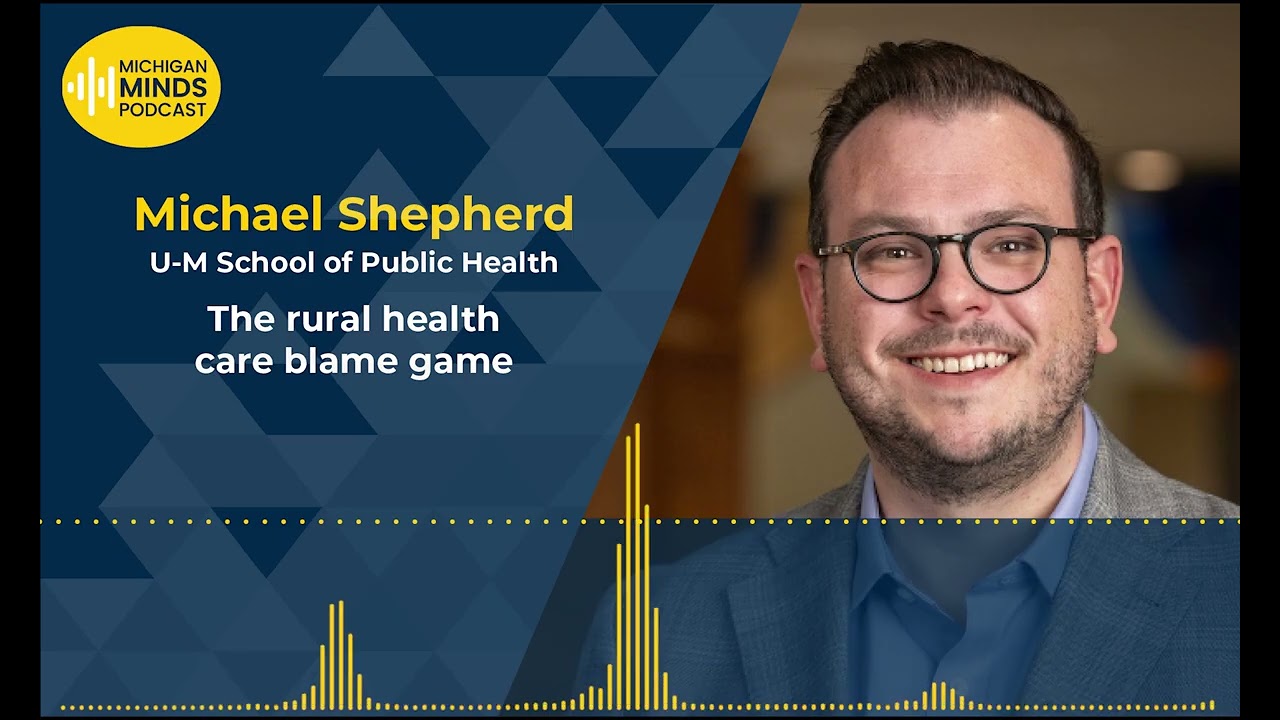
University of Michigan
AI-assisted summary of The rural healthcare blame game — original source. Check the original for full context.
Source published:
Key ideas
- Roughly 25% to 30% of rural Americans rely on Medicaid compared to 15% to 20% in urban areas, leaving rural healthcare facilities uniquely vulnerable to program cuts due to a lack of commercially insured patients to offset losses. (15:50)
- Rural hospital closures typically add 20 to 40 minutes to emergency driving times, escalating up to two hours in remote areas or for specialized services like labor and delivery. (18:29)
- Federal policy delays and the inclusion of an insufficient $50 billion Rural Health Transformation Program allow congressional lawmakers to deflect blame for facility closures onto state executives and local hospital administrators. (25:00)
- Despite 80% of rural hospital closures occurring in Republican-controlled states that rejected Medicaid expansion, complex policy environments lead rural voters to penalize Democrats or adopt anti-establishment viewpoints. (8:22)
Detailed notes
## Background Published on YouTube by the University of Michigan on October 28, 2026, this episode of the Michigan Minds podcast features Dr. Michael Shepherd, an assistant professor of health management and policy at the University of Michigan School of Public Health. According to the description, the program examines how healthcare has evolved into a primary voter priority, focusing on the intersection of rural hospital closures, Medicaid alterations, and partisan identity.
## TL;DR Dr. Michael Shepherd breaks down how collapsing rural healthcare infrastructure—from shuttering maternity wards to increased emergency drive times—becomes filtered through local news deserts and polarized media into a cycle of partisan scapegoating. Because healthcare functions as a complex 'hard issue,' voters frequently rely on party heuristics and racialized narratives, penalizing Democrats for local hospital failures even in states where Republican officials resisted Medicaid expansion. Shepherd details how Medicaid reductions jeopardize entire rural facilities regardless of an individual's private insurance status, while long policy implementation lags and federal funding loopholes effectively insulate legislative authors from electoral accountability. Ultimately, the discussion illustrates how calcified political identities and voter turnout shifts sustain a self-reinforcing rural health spiral heading into upcoming election cycles.
## Atmosphere & style The discussion carries an analytical, measured tone driven by Juan Ochoa's structured inquiries and Dr. Shepherd's systematic, policy-oriented explanations. Rather than leaning into partisan heat, the dialogue feels diagnostic and sober, patiently unpacking complex political science models and communication vacuums. Even as the conversation touches on life-or-death emergencies like strokes and remote hospital deserts, the delivery remains steady, objective, and deeply rooted in institutional critique.
## Bulletin - [15:50](https://www.youtube.com/watch?v=6N78CNuC-1c&t=950s) Roughly 25% to 30% of rural Americans rely on Medicaid compared to 15% to 20% in urban areas, leaving rural healthcare facilities uniquely vulnerable to program cuts due to a lack of commercially insured patients to offset losses. - [18:29](https://www.youtube.com/watch?v=6N78CNuC-1c&t=1109s) Rural hospital closures typically add 20 to 40 minutes to emergency driving times, escalating up to two hours in remote areas or for specialized services like labor and delivery. - [25:00](https://www.youtube.com/watch?v=6N78CNuC-1c&t=1500s) Federal policy delays and the inclusion of an insufficient $50 billion Rural Health Transformation Program allow congressional lawmakers to deflect blame for facility closures onto state executives and local hospital administrators. - [08:22](https://www.youtube.com/watch?v=6N78CNuC-1c&t=502s) Despite 80% of rural hospital closures occurring in Republican-controlled states that rejected Medicaid expansion, complex policy environments lead rural voters to penalize Democrats or adopt anti-establishment viewpoints.
## Key takeaways - [00:04](https://www.youtube.com/watch?v=6N78CNuC-1c&t=4s) Healthcare policy in rural areas is heavily racialized through political rhetoric, leading white voters to view resource distribution through a zero-sum, 'us versus them' lens. - [03:10](https://www.youtube.com/watch?v=6N78CNuC-1c&t=190s) Rural white voters experiencing local healthcare deterioration often rely on political scapegoats, assuming urban and minority populations are benefiting at their expense despite empirical evidence. - [05:12](https://www.youtube.com/watch?v=6N78CNuC-1c&t=312s) The rapid collapse of local newspapers over the last 15 to 20 years has created news deserts, forcing rural residents to interpret local crises through high-conflict national media frames. - [08:22](https://www.youtube.com/watch?v=6N78CNuC-1c&t=502s) Informal information networks, such as unmoderated local Facebook community pages, fill journalistic voids with conspiratorial, anti-establishment narratives that steer voters toward the Republican Party. - [11:00](https://www.youtube.com/watch?v=6N78CNuC-1c&t=660s) Because healthcare is an inherently complex 'hard issue,' voters rely on partisan heuristics, often blaming Democrats for bad outcomes because they are perceived as the national 'healthcare party.' - [11:00](https://www.youtube.com/watch?v=6N78CNuC-1c&t=660s) The 'rural health spiral' describes how worsening local healthcare outcomes fuel anti-government sentiment that ultimately consolidates electoral support for Republicans. - [13:40](https://www.youtube.com/watch?v=6N78CNuC-1c&t=820s) Pervasive nationalization of politics across all ballot tiers prevents down-ballot candidates from building distinct local identities separated from their national party brand. - [15:50](https://www.youtube.com/watch?v=6N78CNuC-1c&t=950s) Rural hospital shutdowns cause negative regional spillover effects, overwhelming regional urban emergency departments and medical staff with displaced patients. - [18:29](https://www.youtube.com/watch?v=6N78CNuC-1c&t=1109s) Incremental service line reductions, particularly the closure of labor and delivery units, force pregnant rural patients to drive up to two hours for delivery care. - [21:20](https://www.youtube.com/watch?v=6N78CNuC-1c&t=1280s) Calcified political identities suggest rural healthcare distress will manifest electorally as depressed voter turnout rather than large-scale ideological ticket-splitting. - [22:45](https://www.youtube.com/watch?v=6N78CNuC-1c&t=1365s) Because voters possess short political memory horizons, implementation lags on Medicaid cuts mean future incumbent administrations may absorb the blame for past legislative rollbacks. - [26:28](https://www.youtube.com/watch?v=6N78CNuC-1c&t=1588s) Medicaid reductions directly jeopardize privately insured rural residents, as the collapse of Medicaid funding threatens the solvency of entire community hospitals.
## Detailed walkthrough ### [00:04](https://www.youtube.com/watch?v=6N78CNuC-1c&t=4s) Introduction and the Racialization of Rural Healthcare Policy
Host Juan Ochoa introduces the *Michigan Minds* podcast and welcomes Dr. Michael Shepherd, an assistant professor of health management and policy at the University of Michigan School of Public Health. Dr. Shepherd’s research centers on United States health politics and policy, rural health disparities, and the mechanisms by which political parties, race, and mass media influence public attitudes and health-related behaviors. Setting up the discussion ahead of the midterm elections, Ochoa points out that healthcare has become a paramount issue for voters nationwide, yet in rural America, the subject extends far beyond routine insurance coverage or primary care appointments—it is inextricably bound to the physical survival of small towns, partisan alignment, and grievances over institutional fairness. Ochoa asks how race and racism operate within health policy and how this dynamic reaches rural voters who might not consciously view healthcare through a racial lens.
Dr. Shepherd explains that scholars view the relationship between race, racism, and rural healthcare access as a twofold process. On one level, race and ethnicity play an objective, direct role in determining healthcare access; in the American South especially, rural Black and Latino communities endure the most severe structural deprivations and restricted access to services. However, a secondary dynamic operates through political rhetoric and media framing, where specific health issues and policies—most notably the Affordable Care Act—become deliberately racialized. When political elites fuse race with policy discussions, rural white voters are primed to evaluate policy through a lens of racial grievance and zero-sum competition, assuming that government initiatives will funnel resources away from their own communities to benefit racial and ethnic minorities elsewhere, even when empirical data disproves that assumption.
As Dr. Shepherd observes regarding this psychological and political framing:
> “And and that leads rural white voters to view their healthcare access or or view healthcare policy um in terms of us versus them.”
***
[03:10](https://www.youtube.com/watch?v=6N78CNuC-1c&t=190s) The Scapegoating Mechanism and Perceived Relative Deprivation
Addressing Ochoa’s question about what rural white voters are observing when they perceive others receiving benefits they are denied, Dr. Shepherd clarifies that these viewpoints are grounded far more in rhetoric than in verifiable empirical conditions. The lived reality for many rural residents is undeniably strained: local hospitals shutter, private or public health insurance is scarce or unaffordable, and out-of-pocket medical costs continue to mount. Yet in the absence of clear institutional accountability, individuals become highly susceptible to political rhetoric that offers convenient scapegoats and status cues.
This rhetorical framing leads struggling white residents to infer that if local healthcare infrastructure is crumbling, residents in urban areas—specifically racial and ethnic minorities living elsewhere—must be thriving at their expense. This dynamic operates not as an evidence-based assessment of urban healthcare, but as an abstract narrative that gives emotional coherence to their distress. By framing systemic hospital closures or underfunded rural clinics as the result of external favoritism, political actors provide rural communities with a narrative where their neglect is someone else's fault.
Dr. Shepherd crystallizes how this dynamic hardens into a broader political grievance:
> “It's not only bad because of policy decisions or because of where um these folks happen to live. It's it's because it's someone else's fault and someone else is getting ahead uh while the rural white voter and the rural white community um perceives that they are are falling behind or being neglected.”
```mermaid flowchart TD accTitle: Rural Healthcare Blame Mechanism accDescr: Flowchart showing how local healthcare hardship is filtered through media vacuums and rhetoric into political scapegoating.
subgraph Hardship["1. Local Material Conditions"] A["Hospital Closures & Rising Costs"] B["Lack of Health Insurance"] end
subgraph Channel["2. Information Ecosystem"] C["Local News Deserts & Nationalized Media"] D["Partisan & Conspiratorial Facebook Pages"] end
subgraph Blame["3. Grievance Attribution"] E["Racialized 'Us vs. Them' Scapegoating"] F["Anti-Establishment & Anti-Democratic Blame"] end
Hardship --> Channel Channel --> Blame ```
***
[05:12](https://www.youtube.com/watch?v=6N78CNuC-1c&t=312s) The Collapse of Local News and Nationalization of the Media Ecosystem
When Ochoa asks whether urban voters are equally vulnerable to faulty information and what citizens can do to verify what they consume, Dr. Shepherd concedes that informational vulnerabilities are not unique to rural populations, even if they manifest differently along demographic and geographic lines. Dr. Shepherd identifies the rapid transformation of the American media landscape over the past 15 to 20 years as the core structural driver of this misunderstanding. While public commentary often fixates on social media algorithms, the deeper crisis lies in the decay of traditional local journalism.
In many rural towns, local newspapers have shuttered entirely, leaving vast news deserts. Television stations are typically centered in distant metropolitan media markets and rarely deploy reporters to cover rural civic affairs. Even in urban centers, surviving local stations frequently air syndicated, nationalized packages produced by media conglomerates. Consequently, coverage of hyper-local realities has been supplanted by high-conflict national political theater—pitting the president against Congress and focusing on partisan warfare or macroeconomic shifts. Without reliable local investigative reporting to explain why a nearby municipal facility or hospital closed, citizens naturally use the broad national political frames fed to them by national broadcasts and social feeds to explain local problems, even before outright digital misinformation enters the equation.
Explaining how this structural absence distorts civic understanding, Dr. Shepherd points out:
> “And so in a world where we have perhaps not hyper local focused news coverage, we don't even really need misinformation to lead people to react to the wrong sets of things or to lead people to consider some factors that are maybe less relevant for them personally or locally.”
- Local news deserts have expanded rapidly over the preceding 15 years as local print newspapers closed across rural America. - Regional television newsrooms are overwhelmingly based in urban centers, offering virtually no sustained on-the-ground coverage of rural civic affairs. - Corporate media conglomerates increasingly distribute standardized, syndicated national content across local broadcast stations, accelerating the nationalization of political discourse.
***
[08:22](https://www.youtube.com/watch?v=6N78CNuC-1c&t=502s) Informal Information Networks, Anti-Establishment Sentiments, and Partisan Realignment
Ochoa asks whether this skewed information environment explains why rural communities vote overwhelmingly Republican while urban areas lean Democratic, and whether this divide stems more from identity or policy preferences. Dr. Shepherd pushes back against attributing the trend solely to explicit misinformation, emphasizing instead the sheer scarcity of reliable local facts and the informal conduits that emerge to fill that void. When a rural hospital shuts down without local newspaper coverage, the void is filled by word of mouth—typically dominated by the most vocal, politically active conservative community members—and informal social media operations.
Dr. Shepherd refers to these informal operations as small-town "news gazettes": independently run Facebook community pages that cover local town affairs without journalistic standards. These pages often adopt anti-establishment, conspiratorial, or explicitly conservative stances. Rather than leaving residents in the dark, these informal networks actively direct community outrage toward national Democrats, federal healthcare legislation, and a nebulous government "establishment." Because major societal institutions—such as legacy news organizations and federal agencies—are perceived as remote and dismissive of rural life, the resulting disillusionment creates an asymmetric push that drives rural voters away from mainstream institutions and directly toward the Republican Party.
Dr. Shepherd summarizes this institutional backlash:
> “Um and that contributes I I think to a mixture of both partisan blame tendencies uh as well as more of a um anti-establishment anti-government reaction which is um broadly the mainstream forces in American society that is the news media uh formal news media um the national government the national political parties are letting down people um in these communities or they feel like their communities are unrepresented by those institutions.”
As the segment concludes, Ochoa challenges this blame attribution, citing Dr. Shepherd’s previous observation that rural residents routinely penalize Democrats for hospital closures even though 80% of these closures occurred in Republican-controlled states that actively refused to expand Medicaid. Ochoa presses him on where this fundamental disconnect originates and why voters fail to hold their own state leaders accountable.
[11:00](https://www.youtube.com/watch?v=6N78CNuC-1c&t=660s) Healthcare as a "Hard Issue" and the Rural Health Spiral
Healthcare policy ranks among the most complex policy domains in any nation, making it exceptionally difficult for everyday citizens to decipher why a particular health outcome has occurred—whether that means losing coverage or watching a hospital bill increase by a confusing margin. Because political scientists categorize these as “hard issues,” individuals do not parse technical policy details; instead, they rely on partisan cues, party narratives, and pre-existing political identities to interpret their experiences. When Republican voters suffer a negative outcome, they interpret that setback through Republican-aligned frames and stories. Conversely, because the Democratic Party has long cultivated a reputation as the “healthcare party,” good healthcare outcomes offer them strong political credit, while negative outcomes expose them to outsized blame. Michael Shepherd observes: “Uh, but when things are bad, that can become a vulnerability for them, which is that um, Democrats are blamed for these bad healthcare outcomes because they're perceived as being the party that did the healthcare things.”
Partisan affiliation also functions as a perceptual filter that prevents people from updating their beliefs based on objective reality. An individual asked about economic performance will assess the economy substantially worse if the opposing party occupies the White House and substantially better if their own party is in power. That same dynamic applies directly to healthcare sentiment, where baseline perceptions swing wildly based on whether a voter’s preferred party holds the presidency. When these rigid partisan lenses collide with skewed media framing and the asymmetric fallout of policy failures, rural communities become trapped in a self-reinforcing political cycle. As Shepherd summarizes: “When you pair all of those things with what I just talked about regarding media coverage or the asymmetric effects of these bad outcomes, you sort of get into what I call the rural health spiral, which is that the bad outcomes become either part of a partisan blame game uh or an asymmetric anti-government um form of resistance that benefits the Republican party down the line.”
```mermaid flowchart TD accTitle: The Rural Health Spiral accDescr: A flowchart mapping how complex healthcare issues trigger partisan blame and reinforce anti-government resistance in rural communities. subgraph IssueComplexity ["Issue Environment"] A["Complex Healthcare Shocks<br>(Coverage losses, billing spikes)"] --> B["Voters Rely on Partisan Cues<br>('Hard Issue' heuristic)"] end
subgraph PerceptualFilters ["Partisan Framing"] B --> C["Democrats Blamed as the<br>'Healthcare Party'"] B --> D["In-Party Justifications &<br>Partisan Media Frames"] end
subgraph PoliticalSpiral ["The Rural Health Spiral"] C --> E["Anti-Government Backlash"] D --> E E --> F["Electoral Support Tilts<br>Toward Republican Party"] end ```
[13:40](https://www.youtube.com/watch?v=6N78CNuC-1c&t=820s) Nationalized Partisanship and Down-Ballot Polarization
When asked why voters consistently direct their anger at whole political parties rather than holding specific individual politicians accountable for how they voted, Shepherd traces the pattern to the nationalization of American politics over the last twenty to thirty years. Voters increasingly process the political universe strictly through a binary Democrats-versus-Republicans lens from the top of the ballot down to the very bottom. As Shepherd explains: “We think that that sort of nationalized partisanship keeps people from viewing individual politicians as doing things different than their political party.”
This nationalized perspective is continually amplified by political advertising and news coverage, which typically center on broad party labels or the president rather than local policy specifics. Even in down-ballot contests—such as elections for mayor, city council, or state legislature—campaign commercials routinely invoke hot-button national party disputes. This drowns out local records and prevents candidates from establishing distinctive, locally tailored profiles. While local elections still retain slightly more candidate-centered evaluation than congressional or presidential races, extreme political polarization makes it nearly impossible for individual politicians to shed the overarching brand of their national party.
- Voters evaluate candidates across all ballot levels primarily through national party identity rather than personal legislative voting records. - Campaign ads for local municipal and state legislative offices increasingly highlight polarizing national party themes rather than localized achievements. - While municipal races (city councils and mayors) display more individual candidate evaluation than presidential contests, candidate-level differentiation has markedly eroded compared to historical baselines.
[15:50](https://www.youtube.com/watch?v=6N78CNuC-1c&t=950s) Medicaid Reliance and the Urban-Rural Hospital Ripple Effect
Addressing whether rural hospital closures stem from entire rural populations being on Medicaid, Shepherd notes that although a universal majority is rare, extreme concentrations do exist. In select regions—such as specific congressional districts in Appalachian Kentucky and parts of California—a clear majority of adults depend directly on Medicaid for health coverage, making any alterations to the program economically seismic for regional providers. Across the broader nation, rural populations are disproportionately enrolled in Medicaid relative to their urban and suburban peers: roughly 25% to 30% of rural residents receive Medicaid coverage, compared to approximately 15% to 20% in urban and suburban areas.
Although urban providers also face substantial financial headwinds from Medicaid policy shifts, urban healthcare markets possess a numerical buffer because a far larger gross volume of commercially insured patients helps offset Medicaid losses. Rural hospitals lack that diversified commercial revenue cushion. Furthermore, when a rural facility shuts down, displaced patients are forced to seek treatment at the nearest surviving facility, whether that is a neighboring rural hospital or a regional urban center. While this migration can bring urban hospitals an influx of revenue, it frequently creates acute operational crises in the short term, overwhelming emergency rooms and intensifying severe staffing pressures. As Shepherd points out: “That degree is a function not only of the um disproportionate share of rural residents being enrolled in Medicaid um but is also um a function of more urban areas having more people with private insurance just numerically.”
[18:29](https://www.youtube.com/watch?v=6N78CNuC-1c&t=1109s) Surging Drive Times and Life-or-Death Emergency Care
The physical disruption caused by a hospital closure depends heavily on state geography and local infrastructure, but it consistently imposes steep increases in travel time. Across the country, losing a community hospital typically adds 20 to 40 minutes of driving time to reach the next facility. In geographically isolated regions, however, that figure expands dramatically. In parts of Michigan—particularly across northern Lower Michigan and throughout the Upper Peninsula—residents may be forced to drive well over an hour to reach the closest open hospital.
The erosion of care also occurs incrementally through service line closures even when the physical building remains open. The shuttering of obstetrics and labor and delivery units represents a widespread and devastating trend, frequently forcing expectant mothers to travel an hour and a half to two hours to deliver safely. In time-sensitive medical emergencies, added travel distance turns clinical delays into catastrophic outcomes. Emphasizing the life-or-death stakes, Shepherd notes: “I think it's important to highlight that um for a variety of different health situations, strokes, car crashes, heart attacks, snake bites, gunshot wounds, every additional minute can be consequential for the status of one's health uh after they leave.”
- Typical rural hospital closures increase patient driving times by 20 to 40 minutes, with remote areas facing additional drives of an hour or more. - The closure of dedicated labor and delivery units can force pregnant patients to travel 1.5 to 2 hours to find an operational maternity ward. - Extended drive times pose immediate mortality and disability risks for acute medical emergencies, including strokes, myocardial infarctions, traumatic motor vehicle collisions, venomous snakebites, and gunshot wounds.
[20:39](https://www.youtube.com/watch?v=6N78CNuC-1c&t=1239s) 2026 Midterm Outlook and Rural Backlash
Looking ahead to how rural voters will cast their ballots in the 2026 midterms, Shepherd views the electoral outcome as an open question that depends on specific demographic and regional cohorts, but one governed by well-established historical fundamentals. Historically, midterm elections act as a referendum on the White House, generating an almost universal backlash against the sitting president’s party. When voters confront deteriorating conditions—specifically worsening economic stability and degraded healthcare access under the incumbent administration—that historical penalty becomes significantly more pronounced. As Shepherd evaluates the upcoming electoral climate: “Typically, that's what we observe, the midterm of a president, um, there's almost always some backlash against the president's party.” Under the prevailing conditions where healthcare and economic indicators have eroded, overall dynamics point toward an electoral backlash against the governing Republican Party.
[21:20](https://www.youtube.com/watch?v=6N78CNuC-1c&t=1280s) Calcified Partisanship and Voter Turnout in Rural Communities
Evaluating how rural hospital closures translate into election results remains a complex, open question. Because Republican party identification is deeply entrenched across rural regions, observers are unlikely to see these voters cross the aisle en masse. Instead, the more probable consequence of healthcare disruption is a sharp decline in voter turnout among individuals who have suffered negative healthcare impacts. A change in who shows up at the polls can alter election margins without requiring a fundamental shift in political ideology.
Partisanship across the nation has become increasingly rigid, meaning major swings primarily reflect turnout variance rather than persuaded voters. However, certain demographic subsets—particularly younger voters and Latino voters—exhibit more fluid political preferences. These cohorts could break sharply against the Republican Party, while older or more established rural voters may stick to their partisan loyalties and merely register their frustration through dampened enthusiasm on Election Day.
As Michael Shepherd observes: > “Partisanship has really calcified in lots of parts of the country.”
[22:45](https://www.youtube.com/watch?v=6N78CNuC-1c&t=1365s) The Timeline of Medicaid Cuts and Shifting Political Blame
When assessing whether the impact of Medicaid cuts will register immediately or peak around 2027, the rollout is already in motion. Healthcare providers and insurance carriers have actively adjusted their behaviors in anticipation of these changes, and the expiration of Affordable Care Act (ACA) premium subsidies has already raised costs and reshuffled coverage. Meanwhile, state-level implementations of Medicaid work requirements and structural financing reforms are unfolding in a staggered cadence. Although initial shocks are visible now, the full operational brunt will likely land around 2027, making the 2028 and 2030 election cycles the primary moments of political reckoning.
This protracted implementation timeline often insulates the politicians who authored the legislation. Voters possess relatively short time horizons and tend to hold whoever currently occupies office accountable for their immediate economic and healthcare hardships, irrespective of historical policy origins. If Democrats capture Congress in 2027 or win the White House in 2028, they may end up absorbing the political fallout for rural hospital strain engineered by earlier Republican measures.
```mermaid flowchart TD accTitle: Policy Lag and Voter Blame Cycle accDescr: Flowchart illustrating how legislative policy delays shift voter blame away from policy authors to the incumbent party.
subgraph Legis["Policy Enactment"] A["Legislation Passed<br/>(Medicaid Cuts & Subsidy Lapses)"] end
subgraph Delay["Implementation Lag"] B["Provider & Insurer Preemptive Shifts"] C["Staggered State Rollouts<br/>(Work Requirements & Financing)"] D["Full Public Impact Felt<br/>(2027–2030)"] end
subgraph Response["Electoral Fallout"] E["Voters Focus on Present Hardships"] F["Current Incumbent Party Blamed<br/>Regardless of Origin"] end
A --> B B --> C C --> D D --> E E --> F ```
As Michael Shepherd explains regarding voter perception: > “In general, what we see is like the longer a time horizon between when a policy is passed and when those effects are felt, that the harder it is for voters to connect the outcomes to a specific policy and instead they tend to assign blame to whoever's in charge at that moment.”
[25:00](https://www.youtube.com/watch?v=6N78CNuC-1c&t=1500s) Federalism, the $50 Billion Fund, and the Rural Blame Game
The dynamics of federalism further obscure legislative accountability. As part of major federal legislation—framed colloquially as the "one big beautiful bill act"—lawmakers established a Rural Health Transformation Program. This initiative allocated a $50 billion injection of federal funds designated to assist struggling rural hospitals. Yet, the funding is mathematically insufficient to cover the aggregate losses triggered by the broader Medicaid rollbacks. Crucially, statutory language within the policy expressly prohibits states from using these transformation funds to offset their direct Medicaid shortfalls.
Despite this limitation, the program serves as an effective political shield. Republican lawmakers in Washington can deflect accusations of neglect by highlighting the massive headline figure and shifting culpability to state officials and hospital administrators. In a state like Michigan, for example, congressional representatives can conveniently question how Governor Gretchen Whitmer’s administration managed to "goof" the disbursement of those funds, effectively redirecting public outrage away from Capitol Hill and onto state executive offices and local healthcare boards.
As Michael Shepherd puts it: > “Republicans in Congress have some way to not only avoid blame due to the longer time horizon of the effects of the policy, but they can point to this major injection of resources and say, ‘Well, what happened? That's not our fault. That must be the fault of those rural hospital providers or the Whitmer administration.’”
[26:28](https://www.youtube.com/watch?v=6N78CNuC-1c&t=1588s) The Spillover Effects of Medicaid Reductions on Private Insurance
The fallout from Medicaid retrenchment reaches far beyond low-income or publicly insured individuals. The expiration of ACA premium tax subsidies pushed healthcare costs higher across the board, affecting policyholders of all tiers. More critically, rural hospitals rely directly on Medicaid reimbursements to sustain their baseline operating margins. When Medicaid funding collapses, the financial solvency of the entire institution is compromised.
If a community hospital shuts down, everyone living within that service area suffers an identical loss of access. Patients carrying private commercial health coverage are forced onto the same long, hazardous rural highways to reach distant emergency rooms. While uninsured or dropped Medicaid patients face both the loss of insurance coverage and the loss of local facilities, privately insured residents still incur the physical danger and degraded health outcomes that accompany medical deserts.
As Michael Shepherd emphasizes: > “The thing that I like to drive home to folks is your if you're in a rural area, your hospital depends on Medicaid dollars.”
- Premium costs increase across the board when subsidies lapse, irrespective of public coverage status. - Rural hospitals rely on a blended payer pool; removing the Medicaid foundation destabilizes the entire facility. - Hospital closures force identical transport burdens and delayed treatment on all community residents.
[27:39](https://www.youtube.com/watch?v=6N78CNuC-1c&t=1659s) The Value of Political Engagement in Local Communities
When asked to identify the single most critical piece of evidence a rural voter should weigh at the ballot box, Shepherd demurs from prescribing an exact priority. Every rural community possesses unique economic realities, cultural values, and local challenges, making sweeping generalizations inadequate. Academic political science even features formal models arguing that the effort required to stay informed outweighs the statistical impact of a single ballot.
Nevertheless, Shepherd firmly rejects political disengagement. Electoral outcomes generate real, tangible ripples throughout everyday life: from the stability of local hospital networks and community employment to fluctuating consumer fuel prices. Navigating and mapping personal values onto ballot choices demands dedication, making civic literacy and active engagement essential for protecting the viability of rural towns. The episode concludes with a sign-off noting that *Michigan Minds* is produced by Michigan News, a division of the University of Michigan's Office of the Vice President for Communications.
As Michael Shepherd reflects on the broader stakes of governance: > “Elections have severe consequences, in a variety of ways, or at least they can.”
## Notable quotes > [26:28](https://www.youtube.com/watch?v=6N78CNuC-1c&t=1588s) if you're in a rural area, your hospital depends on Medicaid dollars. — Michael Shepherd
> [21:20](https://www.youtube.com/watch?v=6N78CNuC-1c&t=1280s) Partisanship has really calcified in lots of parts of the country. — Michael Shepherd
## Mentioned Juan Ochoa, Michael Shepherd, University of Michigan School of Public Health, Affordable Care Act, Facebook, Gretchen Whitmer, Rural Health Transformation Program, Democratic Party, Republican Party, Michigan Minds, University of Michigan
## Video description Michael Shepherd is an assistant professor of health management and policy at the University of Michigan School of Public Health. He discusses how healthcare has become one of voters' top priorities, especially in rural America, where hospital closures, Medicaid changes and partisan identity intersect.
Listen to the full episode: https://news.umich.edu/michigan-minds-the-rural-healthcare-blame-game/
[Source](https://www.youtube.com/watch?v=6N78CNuC-1c)