## Detailed walkthrough
### [00:00](https://www.youtube.com/watch?v=WdWVlQgkVe4&t=0s) Jeremy Clarkson’s Origin Story and Visit to the Comedy Mothership
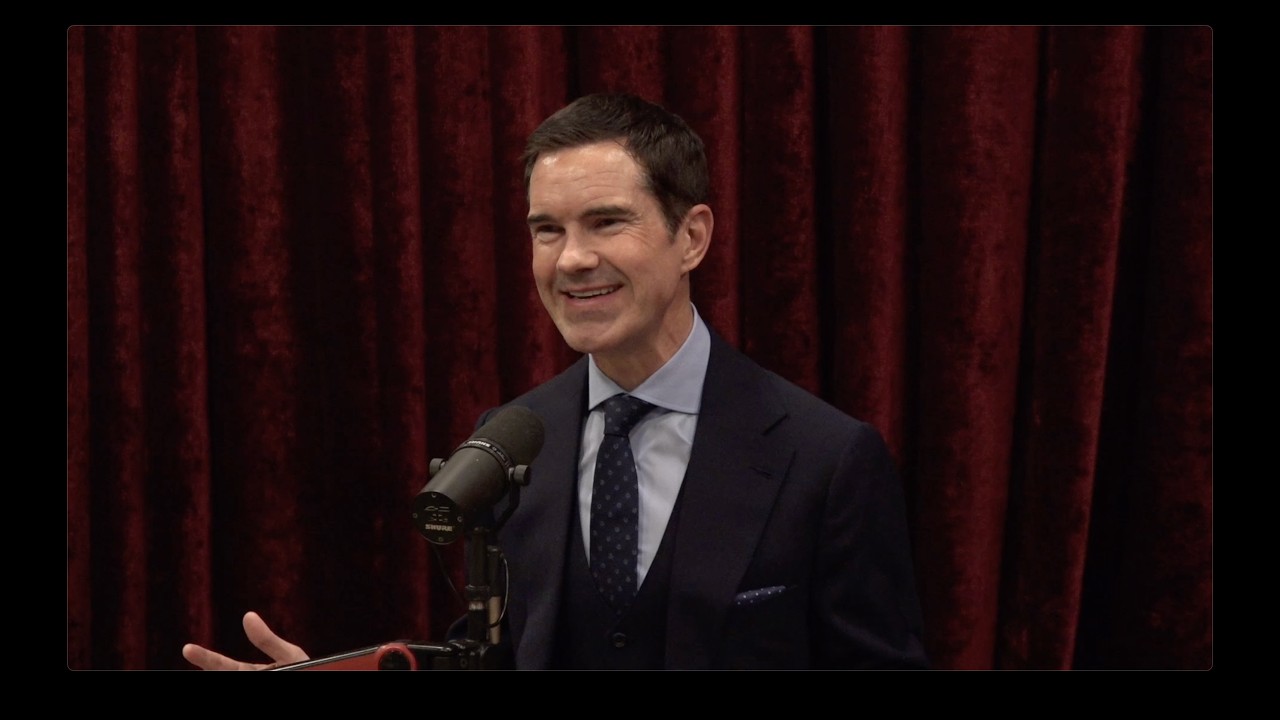
Joe Rogan opens the conversation by thanking Jimmy Carr for introducing him to Jeremy Clarkson, praising the former *Top Gear* host as being completely authentic to his on-screen persona. Carr recounts taking Clarkson to Rogan's club, the Comedy Mothership, the previous night. Clarkson, who had seemingly never set foot in a comedy club before, found himself baffled by the production of *Kill Tony*. When Clarkson asked what the show was, Carr explained, “I'm sort of judging people,” to which Clarkson simply adapted and asked if he could get a glass of rosé—which was sourced from Rogan’s wife’s personal supply. Carr also discusses Clarkson’s longtime collaborator and producer Andy Wilman, noting that the two have been close friends since their school days.
Carr details Clarkson’s early media career, explaining how he carved out an empire through syndication long before television stardom. Clarkson initially wrote humorous car reviews for local newspapers that functioned as much as cultural and social commentary as vehicle breakdowns. Recognizing that local papers always had a dedicated Wednesday motoring section reliant on car dealership advertising, Clarkson realized he could syndicate the exact same content to newspapers across the country, building a personal fortune and establishing his reputation in the pre-digital media era. Rogan and Carr also laugh about Clarkson showing off a permanent bump on his finger—a lasting injury from the time he famously punched Piers Morgan.
- Jeremy Clarkson attended the Comedy Mothership in Austin, Texas, experiencing a live taping of *Kill Tony* for the first time.
- Andy Wilman and Clarkson were childhood classmates who built their media ventures together.
- Clarkson started by packaging comedic automotive reviews to regional newspapers nationwide to fill ad-driven motoring pages.
- Clarkson still bears a visible knuckle deformity from his physical altercation with Piers Morgan.
---
[02:37](https://www.youtube.com/watch?v=WdWVlQgkVe4&t=157s) Not Giving a Fuck, Audience Capture, and the Entertainer vs. Artist Spectrum
Clarkson mentioned to Rogan that every time he speaks on a podcast, *The Daily Mail* immediately publishes an outrage piece about him. Rogan notes that other people's opinions of you are none of your business, leading Carr to declare: “Not giving a fuck what other people think about you is a superpower.” Carr contrasts stand-up comedians with traditional pop entertainers, citing a conversation with singer Robbie Williams, who admitted: “I'm an entertainer in the pure sense. If you don't love me, I don't love me.” Carr argues that true artists—such as Bob Dylan—do not create work to pander to an audience, famously not caring whether the listener likes the end result.
Rogan pushes back slightly, contending that artists exist on a continuum rather than a strict binary, and that genuine creators often feel profound gratitude when someone connects with their work. However, both agree on the danger of seeking external validation:
> “If you're expressing yourself only for other people's love and affection, like if you're just zooming in on what's going to give them the best response, the most love and affection from those people, that's a trap.”
Carr labels this phenomenon “audience capture,” where a performer gets trapped in a hall of mirrors, continuously reflecting back what the audience expects until they become a cover version of themselves.
```mermaid
flowchart TD
accTitle: The Spectrum of Creative Expression
accDescr: A flow illustrating the continuum between pure artistic expression and audience capture.
subgraph S1["Artistic Expression"]
A["Internal Vision & Self-Expression"] --> B["Artwork / Performance"]
end
subgraph S2["Audience Feedback Loop"]
B --> C{"Motivation Focus"}
C -->|"Indifference / Authentic Connection"| D["True Artist (e.g., Bob Dylan, Picasso)"]
C -->|"Desire for Universal Love"| E["Audience Capture Trap"]
end
subgraph S3["The Hall of Mirrors"]
E --> F["Performer becomes a 'cover version' of themselves"]
end
```
---
[05:00](https://www.youtube.com/watch?v=WdWVlQgkVe4&t=300s) Genius, Madness, and the 27 Club
The conversation shifts to the volatile personalities that define legendary creative figures throughout history. Rogan brings up Jerry Lee Lewis, who notoriously married his 13-year-old first cousin once removed when he was 22 years old and once set a piano on fire to upstage Chuck Berry. Carr suggests drawing a firm line between hyper-accelerated rationality and true creative genius, stating: “I think genius always comes with a little sprinkle of crazy.” He argues that the world enjoys the fruits of tortured souls like Michael Jackson, but the creators themselves endure a horrific personal price.
Discussing the tragic phenomenon of the "27 Club"—which includes Jimi Hendrix, Janis Joplin, Kurt Cobain, and Amy Winehouse—Carr offers a theory based on hyper-sensitivity:
> “I think it's because they are more sensitive than we are. They've got like everything is... they're feeling everything, and to be that good, so then they're numbing themselves. The drugs are the medication to just, 'I need to not feel this.'”
While Rogan cautions against generalizing all artists under a single psychiatric label, he acknowledges extreme examples like Kanye West, whose severe public mental health struggles coexist with undeniable musical brilliance.
---
[07:51](https://www.youtube.com/watch?v=WdWVlQgkVe4&t=471s) Anxiety, Flow State, and Elon Musk’s Search for God in AI
Rogan recalls asking Elon Musk about what it feels like to possess his level of intellect, to which Musk replied, “You wouldn't want to be me,” describing his mind as a non-stop storm. Carr connects this inner turbulence to his own battles with panic and anxiety, framing anxiety and peak creative performance as opposite sides of the same neurological coin:
> “Anxiety is thought without control, and a flow state is control without thought.”
Carr explains that while a panic attack feels like uncontrollable spinning, that identical nervous energy is the engine responsible for every joke he has ever written.
Carr then offers a philosophical prediction: Elon Musk will embrace religion within the next twelve months. Carr references the classic theological framework identifying four worldly pursuits that keep human beings from God:
1. Fame
2. Fortune
3. Power
4. Pleasure
Having effectively conquered and exhausted all four domains, Carr theorizes Musk will inevitably seek a higher purpose. Rogan counters that tech titans might bypass traditional faith by literally engineering God through advanced computation. Carr agrees, referencing Georg Wilhelm Friedrich Hegel and Friedrich Nietzsche, pointing out the uncanny parallel between theological concepts and modern technology: an entity that is all-powerful, all-knowing, works miracles, and lives entirely in "the cloud."
[10:00](https://www.youtube.com/watch?v=WdWVlQgkVe4&t=600s) Innovation, Ancient Civilizations, and Graham Hancock
Reflecting on whether the universe was preceded by God or exists as a mechanism to produce God, Joe Rogan shares his conviction that humanity’s relentless technological drive serves an ultimate evolutionary purpose. In his view, human consumerism, material obsession, and technical innovation are all unconscious impulses driving toward the birth of digital, synthetic life forms—an idea once relegated to science fiction that has now materialized as a near reality. Jimmy Carr brings up ancient Egypt, noting how Greek civilization drew heavily on Egyptian culture while trying to avoid the stagnation that doomed it. Carr points out the chronological anomaly that modern humans live closer in time to Cleopatra than Cleopatra lived to the construction of the Great Pyramids, observing that once the Egyptians codified their societal system, they ceased to innovate.
Rogan pushes back on the conventional narrative of Egyptian history, steering Carr toward the alternative historical framework championed by British author Graham Hancock. Rogan recounts how he and comedian Duncan Trussell convinced Hancock to come on the podcast in its earliest days, forming a lasting personal friendship while watching Hancock's work—including his two-season Netflix docuseries *Ancient Apocalypse*—reach mainstream prominence. Rogan argues that Hancock is no longer an isolated figure, noting that several modern archaeologists and geologists now take seriously the hypothesis that an advanced precursor civilization was eradicated roughly 11,000 to 12,000 years ago by interstellar comet or asteroid impacts, leaving behind monumental stone architecture and forcing humanity through a multi-thousand-year reconstruction period.
- Rogan's view on modern technology: “I believe that it's the whole reason why we innovate.”
- Carr highlights the staggering timeline of the Nile Valley: “We live closer to Cleopatra than Cleopatra lived to the building of the pyramids.”
```mermaid
flowchart TD
accTitle: Competing Theories of Ancient Civilization
accDescr: Diagram contrasting the orthodox historical narrative with Graham Hancock's impact cataclysm model.
subgraph Orthodox["Orthodox Historical Narrative"]
O1["Early Dynastic Egypt"] --> O2["Monumental Pyramid Construction"]
O2 --> O3["Stagnation / Lack of Innovation"]
O3 --> O4["Decline & Cultural Absorption"]
end
subgraph Cataclysmic["Impact Hypothesis (Hancock / Rogan)"]
C1["Advanced Precursor Civilization"] --> C2["Interstellar Comet / Asteroid Impact"]
C2 --> C3["Civilizational Collapse & Lost Knowledge"]
C3 --> C4["5,000-Year Period of Reconstruction"]
end
```
---
[12:12](https://www.youtube.com/watch?v=WdWVlQgkVe4&t=732s) Pyramids as Rockets, Subterranean Giza, and Radar Anomalies
Jimmy Carr attempts to synthesize the discussion of artists, technology, Elon Musk, pyramids, and artificial intelligence by citing an idea from psychonaut philosopher Terence McKenna. Carr explains that both ancient pyramids and modern space rockets are functionally identical expressions of human effort: colossal investments of collective resource and labor engineered specifically to launch a privileged few into the cosmos. Rogan counters that the tomb-and-monument theory of pyramids has eroded under modern architectural and geometric scrutiny, suggesting the Great Pyramid was more likely an energetic or technological device.
When Carr brings up recent ground-penetrating radar discoveries and laments how rapidly such monumental news cycles fade from the modern public consciousness, Rogan explains the institutional gatekeeping surrounding Egyptian antiquities. He points directly to Dr. Zahi Hawass, who has long maintained strict control over official archaeological narratives, permits, and press releases. Rogan describes ground-penetrating radar surveys beneath the Giza plateau that revealed an immense subterranean megalithic complex far larger than the above-ground monuments. He notes that 19th-century explorers were able to access parts of this underground labyrinth, but the construction of the Aswan High Dam in the 1960s elevated the surrounding water table, completely flooding the lower chambers. Furthermore, Rogan reveals that modern radar scans have detected an unexplained 40-meter-long, metallic, "Tic Tac"-shaped object positioned inside a cavernous subterranean atrium, baffling investigators.
- Carr summarizes Terence McKenna’s theory on humanity's megastructures: “A huge amount of human capital is used to send a chosen few to the heavens.”
- According to Rogan, access to breakthroughs at Giza remains restricted because officials are “very reluctant to give up those reins to any new discovery that doesn't have his name on it.”
- Modern radar scans identify a 40-meter-long subterranean metallic structure of unknown composition situated directly beneath the Giza plateau.
---
[15:10](https://www.youtube.com/watch?v=WdWVlQgkVe4&t=910s) The "Carcass of the Whale," Elite Overproduction, and the Younger Dryas
Addressing humanity’s uncertain chronology, Rogan stresses that modern humans possess no genuine record of their origins. Canonical accounts like the Garden of Eden or the life of Jesus were shared via oral tradition for centuries before being compiled by people who never witnessed the original occurrences. Carr relates this sense of detachment to living within what he calls the "carcass of the whale"—inhabiting an advanced society whose foundations we can no longer reproduce. He contrasts Britain’s pioneering industrial legacy as the creator of the world's first railways with its current paralysis, spending decades on environmental reviews while China lays tens of thousands of miles of high-speed track. Carr wonders if this institutional impotence mirrors the mysterious fall of Rome, invoking Peter Turchin’s structural-demographic theory of civilizational collapse.
Carr explains that Turchin traces societal breakdown to two primary drivers: rising wealth inequality and the "overproduction of elites." When societies push broad segments of their population into universities with promises of status and influence that the economy cannot deliver, these educated, frustrated aspirants coalesce into counter-elites who actively destabilize the ruling order. While Rogan acknowledges that Western nations are experiencing this exact political friction today, he emphasizes that prehistoric civilizational collapses were driven by sudden physical cataclysms rather than social dynamics. Rogan references the Younger Dryas impact hypothesis, pointing to global ice core samples that show unambiguous, elevated spikes of iridium—an element rare in Earth's crust but abundant in asteroids—dating to around 11,000 to 12,000 years ago.
- Carr explains Peter Turchin's mechanism of social breakdown: “So you have too many people becoming elites and then they don't get what is promised to the elites.”
- Carr on lost civilizational capability: “The pyramids are there and we've kind of lost the instruction manual.”
- Rogan highlights geological evidence for cosmic impact: “In these ice core samples, they find high levels of iridium in a lot of areas.”
---
[18:06](https://www.youtube.com/watch?v=WdWVlQgkVe4&t=1086s) Cataclysmic Atmospheric Events: Krakatoa, Toba, and Societal Collapse
Carr connects the Younger Dryas impact hypothesis to documented historical instances where atmospheric dust abruptly altered the planet's climate. He brings up the violent 1883 volcanic eruption of Krakatoa in Indonesia, which blasted millions of tons of ash, rock, and aerosols straight into the stratosphere. The suspended particulate matter bounced solar radiation back into space, lowering global temperatures by roughly two degrees Fahrenheit and causing Europe’s famous "year without a summer," triggering crop failure, widespread famine, and localized civil unrest.
Rogan expands on this principle of planetary vulnerability by invoking the Mount Toba supervolcanic eruption in Sumatra roughly 74,000 years ago. That event triggered a devastating volcanic winter that plunged the planet into an ice age, causing a severe population bottleneck that reduced early humans to just a few thousand individuals.
The conversation briefly cuts to a mid-roll advertisement for DraftKings sports betting, highlighting promotional bonus codes, legal disclaimers, and an upcoming boxing match featuring Canelo Álvarez versus Christian Mbilli.
- Carr on the atmospheric fallout of the 1883 Krakatoa eruption: “When Krakatoa went off, it was such a big volcanic eruption, there was no summer in Europe the next year.”
- Mount Toba supereruption (~74,000 years ago) represents a severe planetary bottleneck that nearly wiped out human ancestors.
[20:00](https://www.youtube.com/watch?v=WdWVlQgkVe4&t=1200s) Supervolcanoes, Asteroids, and Temperature-Dependent Sex Determination
The conversation opens with Joe Rogan recounting how catastrophic events have historically winnowed the human population down to a precarious bottleneck of around 60,000 individuals due to a supervolcano. While a supervolcano is a terrestrial phenomenon that recurs periodically on Earth, Rogan notes that outer space poses an even wilder threat: our solar system spirals through the galaxy at breakneck speed, encountering hundreds of thousands of near-Earth objects. Jimmy Carr admits that contemplating our velocity through space makes him feel dizzy, while Rogan describes city-sized meteors hurtling toward Earth at hyper-velocity and slamming into the crust, ringing the planet like a bell.
```mermaid
flowchart TD
accTitle: Temperature-Dependent Extinction Hypothesis
accDescr: Flowchart illustrating how asteroid impacts led to environmental cooling and dinosaur population collapse.
subgraph BiologicalResponse["Egg Incubation Disruption"]
B --> C["Temperature-dependent sex determination fails"]
C --> D["Single-sex hatchlings (all females)"]
end
subgraph Outcome["Long-Term Impact"]
D --> E["Reproductive collapse & extinction"]
F["Survivors: Non-TSD animals\n(e.g., Crocodiles, Sharks)"]
end
```
Carr brings up an evolutionary theory concerning the demise of the dinosaurs, arguing that their primary extinction driver beyond the initial impact was their system of temperature-dependent sex determination. He explains that whether an egg became male or female hinged on ambient temperature thresholds. When the asteroid struck and dust cooled the planet by just a couple of degrees, Carr points out: “And so when the asteroid hit obviously it kills a couple of dinosaurs that it hits, but what really happens is the earth cools by two degrees and their system just goes.” Because all eggs hatched as a single sex—presumably females—the species collapsed, while animals that relied on other reproductive mechanisms, such as sharks and ancestral crocodilians, survived into the modern era.
[21:40](https://www.youtube.com/watch?v=WdWVlQgkVe4&t=1300s) Bizarre Reptilian Biology and the Four Equalizers of Society
Rogan expands on the strange resilience of the reptile world, referencing recent reports of reptiles undergoing parthenogenesis—reproducing without male fertilization—alongside their ability to regrow severed limbs and withstand extended periods of fasting. He also brings up the ecological disruption caused by agricultural chemicals like atrazine, famously highlighted by Alex Jones. Rogan points out that atrazine run-off legitimately disrupts endocrine systems, chemically altering male frogs into females. Carr deadpans about taking reptilian threats seriously: “If we get invaded by crocodiles, I think we need to take it very seriously.”
Turning from the biology of reptiles to human sociopolitical cohesion, Carr remarks that a catastrophic external threat—like an alien invasion or another major crisis—might be the only catalyst capable of uniting a deeply divided society. Rogan cites historian Peter Turchin's work on how severe inequality unravels civilizations, while Carr references sociological research identifying the grim conditions that historically force human equality:
- War
- Revolution
- Civilizational collapse
- Pandemics
Both reflect on how the early months of the COVID-19 pandemic temporarily fostered a shared, sobering purpose when communities faced unknown mortality risks together, before collapsing into social fragmentation.
[24:20](https://www.youtube.com/watch?v=WdWVlQgkVe4&t=1460s) Pandemic Tribalism, AGI vs. Gain-of-Function, and the Polio-DDT Overlap
The brief unity of 2020 quickly dissolved into sharp tribal fractures over vaccine mandates, non-pharmaceutical interventions, and public health directives. Rogan expresses disbelief at how ideological groups inverted their historical skepticism, observing: “The people on the left would be the ones that were telling you these massive multi-billion dollar corporations that have the highest criminal fines in all of human history, those are the ones we should be trusting.” Carr compares the ideological split to rigid brand loyalties, remarking: “The whole are you with or without the vaccines? Like, are you Apple or are you Android? It's like, it's one of those tribal things that people do.” Carr draws a parallel between risky gain-of-function virology—which he compares to “looking for a gas leak with a lit match”—and humanity's reckless push toward Artificial General Intelligence (AGI). Rogan contrasts the two, maintaining that AGI has at least the theoretical potential to improve human civilization, whereas bioengineering lethal viruses offers no upside.
The discussion shifts to historical medical controversies, specifically the twentieth-century polio epidemic. Rogan argues that historical accounts overlook the widespread domestic spraying of DDT, noting that acute organochlorine poisoning mirrors the neurotoxic symptoms of paralytic polio in both humans and livestock. Looking up contemporary epidemiological data live on screen, they examine asymptomatic polio rates:
Rogan emphasizes that while paralytic polio was unquestionably a genuine and devastating disease, mass residential spraying of toxic pesticides directly over neighborhoods constituted a catastrophic public health blind spot whose symptomatic contribution to the era's paralysis crisis remains under-scrutinized.
[30:00](https://www.youtube.com/watch?v=WdWVlQgkVe4&t=1800s) Institutional Corruption, DDT, and the OxyContin Pipeline
Joe Rogan opens by raising historical controversies around medical interventions, pointing to arguments presented by past guest Dr. Suzanne Humphries in her book *Dissolving Illusions*. Rogan asserts that during historical polio outbreaks, widespread spraying of the pesticide DDT produced symptoms virtually indistinguishable from polio, and cases dropped when spraying ceased. He links this to modern pharmaceutical practices and the fallout from the COVID-19 pandemic, arguing that public institutions routinely sacrifice safety for corporate profits. Citing the anti-inflammatory drug Vioxx, Rogan highlights that over 50,000 Americans died from strokes and cardiovascular events despite manufacturers possessing data on these risks before release: “We want to believe in these institutions, but oftentimes these institutions are corrupted by money.”
Jimmy Carr observes that traveling through North America on tour exposes a stark contrast to Europe: widespread, visible street-level drug devastation that is largely absent across the Atlantic. Rogan attributes the roots of this crisis directly to the Sackler family and Purdue Pharma. He explains how medical marketing reframed pain as an unacceptable condition that required total suppression, while falsely marketing synthetic opiates as non-addictive:
```mermaid
flowchart TD
accTitle: The OxyContin to Fentanyl Supply Chain
accDescr: Flowchart tracing legal over-prescription of OxyContin through pill mills into modern cartel-driven fentanyl supply lines.
subgraph LegalOrigins["Legal Pipeline (The OxyContin Express)"]
A["Purdue Pharma & Sacklers<br>(Market 'Pain-Free' Living)"] --> B["Florida Pill Mills<br>(No Shared Prescription Database)"]
B --> C["Bulk OxyContin Distribution<br>(Trunks Loaded for Kentucky & Ohio)"]
end
subgraph BlackMarketShift["Modern Synthetic Market"]
D["China Ships Precursors"] --> E["Mexican Cartels Synthesize Fentanyl"]
E --> F["Smuggled Across US Border"]
end
C -.->|"Mass Addiction Created"| F
F --> G["Devastated US Communities<br>('Walking Dead' Reality)"]
```
Rogan recounts the groundbreaking investigative reporting of Mariana van Zeller in her documentary *The OxyContin Express*. In Florida, pain management clinics operated side-by-side with captive pharmacies without prescription databases. Patients walked out with massive OxyContin scripts, drove a mile down the road to repeat the process, loaded car trunks with thousands of pills, and trafficked them up the Interstate 75 corridor through Kentucky and Ohio. Carr notes the apocalyptic sight in many North American downtowns, describing it as an “interactive Walking Dead experience” where addicted people are left bent double on the streets with no meaningful institutional support, while Rogan points out with fury that the Sacklers avoided prison.
- Rogan cites *Dissolving Illusions* by Dr. Suzanne Humphries as an indictment of pharmaceutical industry narratives.
- Vioxx was pulled from the market after causing an estimated 50,000+ fatal strokes and heart attacks.
- Modern fentanyl cartels rely on raw chemical precursors shipped from China directly into Mexico before smuggling the finished synthetic opioid into the United States.
---
[35:00](https://www.youtube.com/watch?v=WdWVlQgkVe4&t=2100s) Methamphetamine, Prescription Speed, and the "Attainable" Dating Joke
Turning to stimulants, Carr recalls the sudden explosion of crystal meth in the United States, pointing out that Europe never experienced meth epidemics on that scale. Carr jokes about the infamous anti-meth public awareness posters that tracked facial decay: a sequence showing a conventionally attractive young woman progressively deteriorating over years until she looked like an aged, scarred bare-knuckle boxer—making her, in Carr’s dark comedic framing, finally “attainable” to an average guy who previously stood no chance.
```
+-------------------------------------------------------------+
| "Faces of Meth" Comic Premise |
+-----------------------------+-------------------------------+
| Poster Image Stage | Carr & Rogan's Banter |
+-----------------------------+-------------------------------+
| Baseline (Early 20s) | "Good looking girl" |
| Mid-Addiction (Late 20s) | Looks like a "bare-knuckle |
| | boxer chick with scars" |
| Severe Decline (Age 33) | "Pretty attainable... you |
| | could have got that" |
+-----------------------------+-------------------------------+
```
Rogan stresses that while illicit crystal meth destroys lives rapidly, American society has completely normalized legal prescription amphetamines. Millions take Adderall daily, obtaining it with minimal effort by reporting common complaints like fatigue, brain fog, and ADHD symptoms: “It would be so easy to dupe your doctor into giving you Adderall... And what is it basically? It's fucking speed.” Rogan notes that pharmaceutical amphetamines carry immense dependency risks, blurring the line between legal medical treatment and street-level speed use.
---
[36:30](https://www.youtube.com/watch?v=WdWVlQgkVe4&t=2190s) Young Men, Dopamine, and Channeling Risk into Comedy and Pubs
The conversation pivots to behavioral addictions, beginning with personal accountability and gambling. Rogan—a regular performer in Las Vegas through his comedy and UFC commentary work—questions where society draws the line on banning vices versus personal responsibility: “If you don’t have any money, don’t gamble it.”
Carr offers a philosophical view on the psychology of young men, stating that risk-seeking behavior and dopamine hunting are hardwired biological realities. Rather than attempting to suppress these instincts with prohibitions, society must direct them into productive outlets. Carr half-seriously describes his personal social philosophy:
> “I’m like, I’m pro-gang, pro-gambling, and pro-drinking... gambling on yourself—the idea of like, okay, the big gamble in life. If you take a big gamble, then you don’t need those little gambles.”
Carr explains that pursuing stand-up comedy was an enormous personal gamble that provided the high-stakes dopamine rush young men naturally crave, protecting them from smaller, self-destructive vices like sports betting. Carr argues that young men naturally form "gangs," but when channeled into community spaces, they provide mutual social accountability. He jokes that he created a national network of youth social clubs fitted with pool tables, jukeboxes, and draft beer: British pubs. Carr criticizes the American drinking age of 21 as detached from reality, arguing that teens drink regardless and should instead learn moderated, communal social drinking alongside older patrons in pub sports teams rather than drinking isolated in secret. Rogan agrees on social socialization but warns that alcohol severely disrupts youthful brain development.
Rogan concludes the segment by detailing his firsthand exposure to the destructive psychology of gambling addiction, praising Adam Sandler’s performance in the film *Uncut Gems* as “anxiety in celluloid form.” Between the ages of 23 and 27, Rogan spent his days immersed in pool halls playing high-stakes tournaments:
- Rogan lived alongside hardcore pool hustlers and compulsive gamblers for four years, witnessing lives unravel in scenes reminiscent of *The Hustler* and *The Color of Money*.
- While acknowledging personal responsibility, Rogan admits that watching gambling addiction up close showed him how thoroughly the compulsion overrides rational survival instincts.
[40:00](https://www.youtube.com/watch?v=WdWVlQgkVe4&t=2400s) Pool Hall Gambling Culture and Why Rogan Walked Away
Jimmy Carr asks Joe Rogan about the pool hall scene he grew up around, wondering if every game was played purely for money and whether that sucked the fun out of it. Rogan explains that while average players like him played recreationally, the truly elite players practiced constantly and played strictly for cash. The pool halls were nonstop gambling dens immersed in constant "action." Players would hit off-track betting to wager on horse races, arrive at the pool hall complaining about their losses, kill time playing card games, and wait for an opponent willing to gamble. The wagering was not limited to the table: spectators on the sidelines placed "sweat bets," backing a shooter and getting into secondary bets like demanding "two games on the wire" (a handicap where a player starts with two games spotted) so they could still win even if their player dropped the overall set.
Carr wonders how Rogan avoided getting sucked into that lifestyle, pointing out that Rogan is an inherently obsessive person who goes all-in on pursuits like comedy and martial arts. Rogan explains that he stepped back because he recognized the trap: “Because I saw what it was. I saw this is a dopamine roller coaster and you're going to be here if I come back 30 years from now and you won't have moved. You're going to be doing the same goddamn thing.”
To illustrate, Rogan recalls his close friend Tommy, whom he met when Tommy was 19 and Rogan was in his 20s. Tommy was a prodigy and the best player in Connecticut—a region renowned as one of the toughest pool hotbeds in the country—gambling for thousands of dollars a night. Rogan watched Tommy grind out marathon matches against a legendary player named Neptune Joe Frady, a smoker who famously kept a burning cigarette wedged between his bridge fingers while lining up shots. Carr compares this image to Jackie Gleason playing Minnesota Fats in *The Hustler*, noting he only ever knew Gleason as an actor from that film rather than as a stand-up comic. Despite Frady's world-class East Coast reputation, Rogan noticed the grim reality of the hustle: Frady did not have ten dollars to his name and was completely broke. Watching a man with generational talent end up stuck in poverty convinced Rogan that professional pool was a financial dead end.
[42:47](https://www.youtube.com/watch?v=WdWVlQgkVe4&t=2567s) Gratitude, Riding Waves, and the Hierarchy of Discipline, Motivation, and Obsession
Reflecting on how pool failed to modernize commercially while other pursuits exploded, Carr brings up how fortunate they both were to enter their respective fields right before massive cultural booms. Carr describes comedy in the UK around the year 2000 as being viewed like a niche pastime—comparable to field hockey, darts, or lacrosse—before transforming into an arena-filling phenomenon on par with Premier League football. Rogan agrees, noting the same dynamic propelled mixed martial arts (which barely had an organized shape when he first fell in love with it) and podcasting, where early episodes drew only one or two thousand viewers compared to the massive scale of today.
Carr emphasizes that "gratitude is the mother of all virtues" and cites an idea discussed by Chris Williamson regarding the distinction between discipline, motivation, and obsession:
- **Discipline:** Forcing yourself to do something through sheer willpower, which often expires quickly—like someone two weeks into January trying to do daily sit-ups.
- **Motivation:** Wanting to do a task because you are drawn to the goal.
- **Obsession:** An overwhelming drive where you cannot physically stop yourself from doing the thing, regardless of money or external rewards.
Carr remarks that Rogan's pool story fell short because the culture revolved entirely around the hustle rather than the pure love of the game. Rogan clarifies that while players can earn a living in professional tournaments today, the field remains incredibly narrow: only ten to twenty players globally can make a comfortable living from tournament prize money alone, though Asian markets—especially China—are disrupting that economy.
[45:26](https://www.youtube.com/watch?v=WdWVlQgkVe4&t=2726s) Chinese 8-Ball Tables vs. American Pool Tables and High-Stakes Billiards in Asia
Rogan explains that China is currently investing immense sums into billiards, offering up to $500,000 to winners of major tournaments. However, these events are played on Chinese eight-ball tables, which fundamentally alter the physics and geometry of the sport. As Jamie Vernon pulls up images of the equipment, Rogan breaks down the structural differences:
- **Pocket Curvature:** American pool tables (such as standard Diamond tables) feature straight-cut, angled leather corner facings, allowing players to pocket balls down the rail with firm speed and heavy spin. Chinese tables adopt snooker-style rounded pocket jaws, which reject hard-hit balls along the cushion.
- **Tolerances:** Pocket margins on Chinese tables leave only millimeters of clearance on either side, requiring delicate, pinpoint rolls rather than confident, stroke-heavy power shots.
- **Gameplay Pace:** The extreme precision turns matches into what Rogan calls a "brutal, pokey, fucking scared-ass game." Rather than running out full racks or engaging in fluid offensive battles, players frequently miss even with ball in hand, resorting to pushing balls timidly around the felt.
```mermaid
flowchart TD
accTitle: American Pool Table vs Chinese Eight-Ball Table
accDescr: Diagram contrasting pocket geometry, ball acceptance, and play styles between American and Chinese pool tables.
subgraph American["American Pool (Diamond Tables)"]
A["Straight-angled pocket jaws"] --> B["Accepts power shots along rails"]
B --> C["Fluid cue-ball positioning and frequent run-outs"]
end
subgraph Chinese["Chinese Eight-Ball"]
D["Rounded pocket jaws (Snooker style)"] --> E["Rejects shots with speed or spin down the cushion"]
E --> F["Defensive, slow-paced play with millimeter margins"]
end
```
Despite the punishing nature of the tables, the massive half-million-dollar payouts draw top international players to China. Rogan points out that billiards is massively popular across Asia, with powerhouse competitors coming out of Taiwan (Chinese Taipei) where players attend specialized billiards academies and practice strictly for eight hours a day. Transitioning from pool back to his own enduring passions, Rogan admits to being an obsessive addict regarding comedy and martial arts. While Carr jokes that combat sports organizations should introduce a "seniors division" so Rogan could compete again, Rogan dismisses the idea, acknowledging he is too old to fight competitively because of the extreme physical toll.
[50:00](https://www.youtube.com/watch?v=WdWVlQgkVe4&t=3000s) Kickboxing Economics and Comedy as a Universal Life Skill
Joe Rogan reflects on walking away from competitive combat sports and high-stakes pool hustling, noting that he could clearly see where those paths were leading. As an amateur kickboxer, he was offered a mere $500 to turn professional. He calculated the grim trade-off: training intensively for two months only to risk getting beaten up and enduring irreversible brain trauma. Jimmy Carr quips that Rogan ended up with the exact right amount of brain hits—the "sweet spot" where a comic has enough chaos to speak fearlessly without losing articulation. Rogan's martial arts discipline eventually channeled into stand-up comedy at the exact right moment.
Carr argues that society should actively encourage more people to attempt comedy, explaining that participation completely changes how one engages with life compared to mere spectatorship:
> “The opposite of being a spectator is not being a professional; the opposite of being a spectator is being a participant.” — Jimmy Carr
Carr believes writing comedy forces an individual to organize their thoughts, uncover what they truly believe, and articulate ideas only they can express. He contends that drama classes in schools should incorporate stand-up because learning to seek out the humorous angle of any situation provides mental resilience and perspective on difficult experiences.
- Rogan was offered $500 to turn pro as a kickboxer after two months of training, prompting his decision to walk away to protect his brain health.
- Carr advocates for incorporating comedy into secondary school curriculums because finding the funny angle fosters a healthy, detached perspective on life's hardships.
---
[52:13](https://www.youtube.com/watch?v=WdWVlQgkVe4&t=3133s) The Anatomy of Stand-Up: Why Comedy Can Be Taught
Carr discusses co-authoring his book *On Jokes: The Hidden Mechanics of Funny* alongside Amanda Baker and Abi Grant to address the fact that stand-up comedy remains one of the few globally dominant art forms lacking a standardized theoretical framework. The book is structured in thirds: classifying the mechanics and types of jokes (distinguishing techniques like the pullback-and-reveal, puns, and wordplay rather than vague thematic tags like "observational comedy"), assembling structured routines, and mastering onstage performance.
Carr explicitly challenges the gatekeeping notion that comedy cannot be learned:
> “I think comedy can be taught. I don't think it's an immutable characteristic. I don't think it's something that you're born with.” — Jimmy Carr
While icons like Jerry Seinfeld argue comedy is unteachable and Doug Stanhope has called comedy classes "raging scams," Carr points out that both legends learned through real-world mentors and comedy club dojos. Comics who began as door staff or parking attendants—such as Tony Hinchcliffe parking cars at The Comedy Store before selling out Madison Square Garden—benefit from elite clubs like The Comedy Cellar and the Comedy Mothership. To test the book’s pedagogy without becoming "grifters," Carr, Grant, and Baker ran a six-week course teaching young comics at the Comedy Mothership in Austin, proving that structured fundamentals can accelerate a performer's development.
```mermaid
flowchart TD
accTitle: Comedy Education vs Apprenticeship Dojo
accDescr: Chart contrasting the traditional apprenticeship model of comedy clubs with the structured pedagogical model in Carr's book.
subgraph DOJO["Traditional Apprenticeship"]
A["Club Mentorship / Working the Door"] --> B["Unwritten Stage Lessons"]
B --> C["Years of Trial & Error"]
end
subgraph PEDAGOGY["Structured Methodology ('On Jokes')"]
D["Taxonomy of Jokes<br/>(Puns, Wordplay, Pullback-Reveal)"] --> E["Routine Construction & Flow"]
E --> F["Performance Mechanics"]
end
[55:00](https://www.youtube.com/watch?v=WdWVlQgkVe4&t=3300s) Gregorian Chants, Musical Notation, and Demystifying the Genius
To illustrate why formalizing comedy does not stifle artistic freedom, Carr shares a historical analogy told to him by Amanda Baker regarding Gregorian chants. When Pope Gregory noticed churches across Europe were singing religious melodies inconsistently, he demanded the music be written down. Despite contemporaries arguing that music lives within the human soul and cannot be captured on paper, the resulting notation took centuries to mature but ultimately made Johann Sebastian Bach possible 300 years later. Having a formal system does not make art rigid; instead, mastering the rules gives artists the necessary toolkit to break them creatively.
Addressing Stanhope's criticism of comedy courses, Rogan notes that while predatory, failed comics often run exploitative classes, informal mentorship can be transformative. He highlights Ari Shaffir's habit of hosting free three-hour Sunday seminars for local comics whenever he visits cities on tour, mentoring them on securing management, booking clubs, and reviewing material. Carr stresses that demystifying comedy writing removes the aura of "magical thinking" around genius:
> “If I write 100 jokes and five of them work, no one ever says at the end of my show, 'Well, what about the other 95 jokes?'” — Jimmy Carr
- Pope Gregory's mandate to write down vocal liturgy birthed musical notation, laying the structural foundation that enabled classical masters like Bach centuries later.
- On tour, Ari Shaffir routinely offered free 3-hour Sunday workshops to aspiring local comics, covering writing, agent representation, and booking strategies.
- Carr emphasizes that audiences only ever see the refined 5% of material that survived onstage testing, obscuring the rigorous failure rate behind stand-up.
---
[58:30](https://www.youtube.com/watch?v=WdWVlQgkVe4&t=3510s) Escaping Capitalist Ontology and the Impact of *Kill Tony*
Rogan points out that even flawed comedy classes offer value by forcing students to perform an actual set at a graduation showcase. Carr criticizes modern "capitalist ontology"—the cultural urge to measure every creative pursuit solely by its ability to generate money. When young people ask Carr how to monetize music or comedy, he advises them to ignore financial gains and focus entirely on putting in the 10,000 hours of craft. Even engaging in stand-up as a hobby for ten gigs permanently enriches an individual's appreciation of the art form.
Carr points out that some of the funniest humor over the past decade originated as anonymous online memes created by random workers—such as someone sitting in a Minnesota call center—and argues that the comedy industry needs clear entryways for these naturally hilarious people. He credits Tony Hinchcliffe's *Kill Tony* with providing that very conduit:
> “Tony has inadvertently helped more people, made more careers, right, than anyone since Johnny Carson.” — Jimmy Carr
Carr highlights international talents like Estonian comic Ari Matti, who broke out through *Kill Tony* and is now headlining major clubs globally, proving the power of platforms that bridge open mics with professional stages.
[01:00:00](https://www.youtube.com/watch?v=WdWVlQgkVe4&t=3600s) Comedy, Authenticity, and the Flaw of AI
Jimmy Carr and Joe Rogan reflect on emerging talent and the nature of stand-up comedy, touching on Estonian comedian Ari Matti’s explosive rise through *Kill Tony*. Carr notes the absurdity of people acting unimpressed by someone knowing Ari, given that talent clearly travels across borders and Matti is an undeniable “force of nature.” While many people can assemble a solid sixty-second set for *Kill Tony*, Carr observes that comedy resists any objective ranking. In his view, there can be no “greatest of all time” because the discipline is fundamentally an exercise in authenticity and individuality—a purely right-brain human endeavor that artificial intelligence cannot replicate.
Carr argues that people are only impressed by AI because society has taken other humans for granted; if AI were the default baseline and real humans suddenly arrived, everyone would be astonished by their unique perspectives. He points out that even short-form joke-tellers cannot hide their true nature, remarking: “You know the way comics kind of, even if you're a one-liner guy like me, comics kind of leak. You can kind of tell who someone is on stage.” He summarizes stand-up as “friendship at scale,” a dynamic Rogan notes is mirrored in long-form podcasting where listeners spend hours following unscripted conversations.
---
[01:01:40](https://www.youtube.com/watch?v=WdWVlQgkVe4&t=3700s) Untapped Talent and Rogan's Private Investigator Days
Rogan and Carr lament the vast amount of untapped comedic brilliance in the world—people with razor-sharp minds who end up trapped in mundane jobs because they lack a creative outlet. Rogan recalls that one of the funniest people he ever encountered was a man he worked for at age twenty-one. The man was a private investigator and a recovering alcoholic who had lost his driver's license and needed Rogan to drive him around on stakeouts. Carr remarks that the setup sounds like the premise of a show like *The Rockford Files*.
```mermaid
flowchart TD
accTitle: Rogan's Private Eye Stakeout Story
accDescr: Sequence of events during Joe Rogan's experience driving for a private investigator catching an unfaithful girlfriend.
subgraph JobContext ["Stakeout Dynamics"]
A["21-Year-Old Rogan drives recovering alcoholic PI"]
B["Hired by meek client suspicious of girlfriend"]
end
subgraph Investigation ["The Stakeout"]
C["Surveillance catches girlfriend with muscular bodybuilder"]
D["PI obtains undeniable photographic proof"]
end
subgraph Aftermath ["The Resolution"]
E["Client demands more angles like a 'porn dealer'"]
F["PI refuses and ends the assignment"]
G["Rogan recounts wild stories to girlfriend in tears of laughter"]
end
Rogan recounts working a surveillance case for a measly client who suspected his stunning girlfriend was being unfaithful with a bodybuilder. After staking them out and catching them in the act, the investigator delivered clear photographic proof, but the client bizarrely demanded they return to capture even more angles. Rogan remembers the private investigator putting his foot down: “You need a porn dealer... my job's done, here's pictures of this giant muscular man, this is your girlfriend.” Rogan would return home to his girlfriend at the time crying with laughter, marveling at the absurd situations and the investigator’s natural comedic timing.
---
[01:03:36](https://www.youtube.com/watch?v=WdWVlQgkVe4&t=3816s) The Comedy Community and The Comedy Mothership
Carr notes that modern comedy infrastructure—from *Kill Tony* and the Comedy Mothership in Austin to the Comedy Cellar in New York and The Comedy Store in Los Angeles—provides essential outlets for such talent, though he wishes more clubs existed globally. Rogan emphasizes that the lifeblood of comedy is not just venues, but community. At the Comedy Mothership, they intentionally build an egalitarian environment where door staff, opening acts, and veteran headliners support one another. Rogan stresses that stand-up is distinct from other mediums because it cannot be developed in isolation:
> “Comedy is one of the only art forms that you cannot create in a vacuum. You need not just the audience. You need other comics. You're never going to find the best comic in the world in some fucking small town where no one knows about him and some tiny little bar that he does comedy at.”
Comics must test their material on the road with peers or grind inside comedy clubs where they feed off each other's energy and timing. Carr agrees, observing that modern life tricks people into feeling hermetically sealed behind digital screens. Live performance punctures that isolation: an audience is not merely passive consumers, but an active, performative part of the room who share in the creation of the moment.
---
[01:05:43](https://www.youtube.com/watch?v=WdWVlQgkVe4&t=3943s) Human Interaction and the Evolutionary Roots of Loneliness
Carr shares that his live touring shows feature extensive audience interaction, pulling out stories that range from hilarious to heartbreaking, which satisfies a deep human hunger to feel connected. He emphasizes that true laughter is a communal, social signal; people rarely erupt in genuine laughter when sitting alone staring at a smartphone screen.
Rogan connects this to human biology, proposing that face-to-face social contact functions like an essential nutrient:
> “If human interaction was like that, you would look at the invention of people working from home, staring at screens all day, being on your phone all the time, being on your phone even when you're around other people. Your actual time interacting with people radically dropped off.”
Rogan argues that loneliness triggers deep psychological distress because ancestral survival depended strictly on tribal inclusion. In prehistoric times, being cast out of the group meant certain death, as a solitary human could neither hunt effectively nor defend against invaders.
---
[01:07:07](https://www.youtube.com/watch?v=WdWVlQgkVe4&t=4027s) Cooperation, the Philosophy of Play, and Crowd Rhythm
Carr builds on the evolutionary point, noting that a single human dropped into the jungle is food for predators, whereas ten humans working together become the apex predator. He asserts that human cooperation is rooted in play, which serves as the foundational language for communication, comedy, sports, and relationships:
> “We don't stop playing because we grow old. We grow old because we stop playing.”
Rogan agrees enthusiastically, drawing a parallel to martial arts and the Gracie Jiu-Jitsu doctrine of “keep it playful.” When fighters view training as life-and-death, they tense up, avoid risks, and halt their technical growth. True progression requires relaxing, accepting occasional losses, and flowing through exchanges.
- **Play and Development:** Carr and Rogan discuss how rough-and-tumble wrestling and tickling teach children and animals boundaries in ways video games never can.
- **Handling Hecklers:** Carr treats audience heckles as collaborative games rather than hostile disruptions; he lets audience members land a winning line when they have a “banger,” because a playful dynamic improves the entire room.
- **Show Structure and Rhythm:** In his book *On Jokes: The Hidden Mechanics of Funny*, Carr explains how he opens shows with twenty minutes of relentless, rapid-fire punchlines (averaging three to four laughs per minute) to establish a collective rhythmic tempo before shifting into freer audience engagement.
[01:10:00](https://www.youtube.com/watch?v=WdWVlQgkVe4&t=4200s) Rhythm on Stage, Crowd Dynamics, and Mitch Hedberg
Jimmy Carr begins by illustrating how a comedian builds rapport with an audience, comparing the dynamic to matching a walking pace with a companion: “Like when you walk with someone, you fall into rhythm with them, right?” In Carr's formulation, hitting a punchline or keyword roughly every two and a half seconds establishes a steady groove. Once the audience spends about twenty minutes in that comfortable state, they realize exactly what show they have come to see and feel completely at ease. When they are later invited to interact, they jump in seamlessly because performer and crowd are united in a shared experience.
Joe Rogan connects this to the unpredictable energy of the "Bottom of the Barrel" show at the Comedy Mothership. It is an exercise in extremes: comics pull random premises out of a bucket, often resulting in complete duds, but occasionally yielding pure comedic gold. Rogan notes that three or four premises he plucked out of that barrel evolved into permanent bits in his current touring act. Being physically under the lights in front of an audience unlocks mental connections that could never happen while sitting alone at a desk:
```mermaid
flowchart TD
accTitle: Joke development workflow
accDescr: Diagram illustrating how stand-up bits evolve from club rooms to arena shows
subgraph ideation ["1. Spontaneous Ideation"]
A["Bottom of the Barrel prompt"] --> B["Stage state: live pressure in front of 30-50 people"]
B --> C["Spontaneous insight never found at a desk"]
end
subgraph testing ["2. Club Testing"]
C --> D["The Little Boy room (110 seats)"]
D --> E["Raw joke testing: no room for dance moves"]
end
subgraph scaling ["3. Arena Execution"]
E --> F["Validated bit scales up to 15,000-seat arena"]
end
```
Rogan emphasizes that testing a bit before 30 to 50 attentive listeners provides a foolproof gauge that holds up even in front of 15,000 people in an arena. Furthermore, intimate spaces like the Mothership’s Little Boy room—seating only 110 patrons—strip away all artifice. In such rooms, there is zero tolerance for what Tom Segura terms "dance moves"—superficial stage theatrics or energetic mannerisms designed to extract unearned laughter.
The discussion shifts to the late Mitch Hedberg, whom Carr praises as arguably the greatest joke writer of the last 30 years. However, Carr argues that Hedberg suffered from erratic delivery: “His pacing was inconsistent, which is worse than being fast or slow.” Because of that unpredictability, Hedberg could crush one night and bomb the next, whereas an ordinary comic with hack material but rock-solid rhythm would reliably win over an audience 99% of the time. Carr laments that no mentor pulled Hedberg aside to enforce rhythmic discipline.
Rogan points out that Hedberg’s issues ran far deeper than stage technique; he was grappling with severe, long-term heroin addiction. Rogan recalls that Hedberg almost died from the drug around 2003, when Rogan and Doug Stanhope were working on *The Man Show*, including a terrifying brush with gangrene from an injection site. Unlike younger generations experimenting with snorting drugs, Rogan bluntly describes Hedberg’s habits as old-school, hardcore IV drug use: “cook it on a spoon like a real man, and then shoot it right into your veins.” Carr notes how tragic it is to lose voices like Hedberg or Greg Giraldo—who similarly fell victim to addiction after an extended period of sobriety—leaving the comedy community forever wondering what brilliant thoughts their future specials might have held.
[01:15:00](https://www.youtube.com/watch?v=WdWVlQgkVe4&t=4500s) Sobriety, Delayed Gratification, and the Origins of Imposter Syndrome
Reflecting on artists like Janis Joplin and Jimi Hendrix dying at age 27, Rogan notes that performers often feel completely unprotected, likening them to a lobster stripped of its protective shell who turns to self-medication to survive the exposure. Carr shares that he stayed entirely sober for his first twelve years in stand-up. Although he drank socially during college, discovering comedy in his mid-twenties made him immediately commit everything to his craft. He viewed alcohol as an unnecessary hazard: “alcohol is borrowing happiness from tomorrow.”
To protect his output, Carr adopted a philosophy of giving small gifts to his future self. While dwelling on lifetime regrets from a deathbed perspective feels paralyzingly broad, anyone can manage the immediate 24-hour horizon:
- Writing jokes during the day and testing them that night ensures pride tomorrow.
- Eating clean today guarantees feeling physically healthy tomorrow.
- Breaking work into tight, manageable units grants day-to-day control over one's trajectory.
Rogan affirms that delaying gratification is essential for achieving anything meaningful in life. Carr takes this a step further, framing work and delayed gratification in metaphysical terms: “In a metaphysical way, God is the future, right? God is an analogy for work.” Carr contends that while everyone envies the rewards of success, nobody envies the grueling labor required to attain them. People frequently experience imposter syndrome because they forget the unseen sweat equity they deposited months earlier in obscurity.
Rogan offers an alternative perspective on imposter syndrome: it is a natural psychological immune response to the bizarre unreality of sudden fame. A stand-up spends decades obsessing over joke mechanics, pacing, and tape reviews in relative anonymity. Then, seemingly out of nowhere, an announcer calls their name and 15,000 arena attendees erupt into screams. Rogan illustrates the rapid, surreal ascent by tracing the fictional journey of an everyday comic named Bob:
- Bob leads an ordinary life where nobody cares about his daily problems or social media updates.
- Bob attends an open-mic night, lands a guest appearance on *Kill Tony*, and tears the room down.
- Awarded a *Kill Tony* "golden ticket," Bob goes on tour opening for an act like Ari Matti.
- Bob posts a self-produced YouTube special that racks up three million views.
- Bob books and sells out historic venues like Massey Hall in Toronto, stepping onto the stage unable to comprehend how his life transformed so rapidly.
Carr ties this modern alienation back to our evolutionary past. In ancient tribal villages, participation was universal: everyone held the talking stick to speak, everyone sang together, and everyone joined the dance. Once humanity migrated into industrialized cities, giant auditoriums and grand concert halls were constructed to showcase elite performers like Oasis, classical ballet companies, or Dave Chappelle. While modern society has become extraordinarily well-entertained, people have been relegated to passive spectators who no longer actively participate in their own culture.
[01:20:00](https://www.youtube.com/watch?v=WdWVlQgkVe4&t=4800s) Participation vs. Consumption and the Four Stages of Competence
Jimmy Carr explains his philosophy on live engagement versus passive consumption, emphasizing that he would much rather see people actively trying something themselves than simply acting as spectators. He draws a direct parallel to the digital world, noting how doom-scrolling and phones have replaced real living:
> “The church used to ask for one hour a week, and the phone is asking for four or five hours a day. And it’s not giving you much back. And if you put something out there, right, if you post something, you’re making an offering and then you see whether you get likes. And the like is the digital amen.”
Carr remarks that just as porn is a hollow substitute for sex, having followers on social media is entirely artificial: “Being famous on Instagram is like being rich in Monopoly.” Rogan agrees, stressing that doing an open mic makes someone appreciate comedy far more, just as training in martial arts builds a deeper respect for professional fighters. He notes that untrained men often develop the delusional belief that they can fight because they watch it on screen, whereas someone who has trained their entire life actively avoids street fights. Rogan admits his own limits, explaining that while he understands basic wrestling from high school, watching elite Olympic wrestling leaves him needing Daniel Cormier to break down the technical beauty of an inside trip on air.
Carr links this to the classic psychological model of skill acquisition:
1. Unconscious incompetence
2. Conscious incompetence
3. Conscious competence
4. Unconscious competence
Because climbing these ranks requires relatable guidance, Carr argues that comedy communities are essential: you need peers who are six months ahead of you to show you the way, not veterans thirty years ahead who no longer remember what it was like trying to scrape together their first five minutes.
```mermaid
flowchart LR
accTitle: Four Stages of Competence
accDescr: Diagram illustrating the progression from unconscious incompetence to unconscious competence.
A["Unconscious Incompetence<br/>(You don't know what you don't know)"] --> B["Conscious Incompetence<br/>(You realize how bad you are)"]
B --> C["Conscious Competence<br/>(You can execute with focus)"]
C --> D["Unconscious Competence<br/>(Execution becomes second nature)"]
```
[01:24:20](https://www.youtube.com/watch?v=WdWVlQgkVe4&t=5060s) Comedy Scenes, Legendary Boston Murderers, and Historic Theaters
The conversation turns to the geography and history of comedy clubs. Carr notes he has spoken to Noam Dworman about potentially opening an outpost of the Comedy Cellar in London. Rogan celebrates the comedy boom in Austin, noting there are seven clubs featuring comedy within a single block of the Comedy Mothership, alongside Cap City Comedy Club out in the Domain.
Reflecting on his start in Boston, Rogan recalls that there was very little mentorship, but the talent pool was extraordinary. While names like Steven Wright, Louis C.K., Patrice O'Neal, and Bill Burr broke out nationally, Rogan points out that the funniest comics were often local legends who never left:
> “These guys would do 30 minutes of fucking thunder, and they would tank headliners.”
He references Fran Solomita's documentary *When Stand-Up Stood Out* and describes how local killers like Steve Sweeney—a massive Irish comic—and Don Gavin with his relentless throwaway punchlines would regularly annihilate touring stars like Billy Crystal at Nick's Comedy Stop.
Discussing upcoming tour stops, Carr mentions booking the Wang Theatre (Boch Center) in Boston. Rogan and Carr rave about the architecture of historic venues like the Wang, the Chicago Theatre, the London Palladium, and the Fox Theatre in Detroit. Because of modern fire regulations, theaters are no longer built with audiences stacked tightly on top of the performer. They marvel at the history embedded in those walls—from being in Frank Sinatra's dressing room in Chicago to performing at Madison Square Garden, where Carr has done charity shows for American servicemen alongside Bruce Springsteen, and Rogan has felt the lingering aura of Muhammad Ali versus Joe Frazier while calling UFC fights.
[01:28:10](https://www.youtube.com/watch?v=WdWVlQgkVe4&t=5290s) American Inventions and the Cultural Shock of Early Hip-Hop
The two reflect on the unique cultural art forms born in the United States, listing the Western, jazz, stand-up comedy, and hip-hop. Rogan emphasizes that hip-hop is an African American creation that transformed global culture despite only emerging in the late 1970s.
Rogan remembers being in junior high school when the Sugarhill Gang broke out, and Carr recalls the shockwaves reaching the UK through tracks like Grandmaster Flash and the Furious Five's "The Message." Rogan vividly describes the moment he bought N.W.A's debut album on cassette or CD and listened to it on a Walkman while doing cardio at the gym, dumbfounded by hearing someone boldly rap "Fuck the police coming straight from the underground." The discussion then pivots toward Billy Corgan of The Smashing Pumpkins, who recently gave an interview analyzing the exact cultural turning point where music shifted.
[01:30:00](https://www.youtube.com/watch?v=WdWVlQgkVe4&t=5400s) Cultural Stagnation, 1970s Cinema, and the Counterculture Shift
Joe Rogan and Jimmy Carr reflect on major shifts in popular culture, beginning with the transformation of MTV. Rogan points out that MTV initially faced severe criticism for excluding Black artists, predominantly featuring white rock and pop like John Mellencamp's "Hurts So Good," until Michael Jackson broke through. Shortly thereafter, the network drastically changed its standards to permit depictions of firearms and heavily promoted gangster rap, making it feel as though an intentional decision had been made to push a specific genre.
Carr notes that modern culture is sorely missing an authentic avant-garde. Referencing the late cultural theorist Mark Fisher, Carr quotes his diagnosis of contemporary media: “The 21st century is just the 20th century on better screens.” Modern music and cinema seem dominated by cover versions, legacy acts, and endless sequels. Where studios once released hundreds of original films a year, it now feels as though only a handful reach theaters. Carr contrasts this with the 1970s, where musical genres did not merely evolve over decades, but transformed every two years across metal, prog rock, punk, ska, reggae, and hip-hop. Rogan highlights the cinema of the 1970s—pointing to films like *Apocalypse Now*—as serious literature full of multidimensional characters that left audiences with lingering questions rather than clear-cut heroes and villains.
Rogan traces this creative explosion to the societal rupture caused by the Vietnam War, which completely upended 1950s conformity:
> “We went through a shift during the Vietnam War that changed American culture forever. And it was a radical departure from the 1950s ideas and the 1950s aesthetics.”
According to Rogan, the sudden rise of the hippie movement and widespread acid use panicked the political establishment, prompting the Nixon administration to pass the Controlled Substances Act to suppress social upheaval they could not control. Mid-thought, Rogan interrupts the discussion to take a bathroom break before diving into the concept of cyclical history.
[01:32:38](https://www.youtube.com/watch?v=WdWVlQgkVe4&t=5558s) The Fourth Turning, Giambattista Vico, and the Lineage of Star Wars
Returning from the break, Carr introduces the generational theory proposed by Neil Howe in the 1996 book *The Fourth Turning*. The theory posits that human history moves in roughly 80-year cycles divided into four eras, culminating in a crisis or revolutionary turning where institutions collapse and elites are replaced. Carr argues that the modern Western world is currently enduring such a revolution. The post-1945 Allied victory served as a foundational myth that has finally eroded, dragging down public faith in academia, the social sciences (amid the replication crisis), traditional political parties, and the medical establishment.
Carr connects Howe’s cyclical framework to the 18th-century Italian philosopher Giambattista Vico, who outlined cyclical ages of human civilization governed by distinct mentalities. To demonstrate how these esoteric philosophical concepts permeate modern mass media, Carr maps an intellectual lineage directly from Vico to Hollywood blockbusters:
```mermaid
flowchart TD
accTitle: Lineage of Mythological Storytelling
accDescr: Flowchart illustrating the conceptual progression from Giambattista Vico to Star Wars.
subgraph Philosophy ["Philosophical Roots"]
A["Giambattista Vico<br>(Cyclical ages of humanity)"]
B["James Joyce's 'Finnegans Wake'<br>(100-letter thunderclaps & leaps)"]
end
subgraph MythologicalTheory ["Monomyth Framework"]
C["Joseph Campbell's PhD &<br>'The Hero with a Thousand Faces'"]
end
subgraph ModernPopCulture ["Mass Culture"]
D["George Lucas's 'Star Wars'<br>(Cinema myth-making)"]
end
A --> B
B --> C
C --> D
```
Carr explains that James Joyce drew heavily from Vico when writing *Finnegans Wake*, structuring human history through ten famous 100-letter thunder words (the final one being 101 letters to evoke the *One Thousand and One Nights*) representing technological leaps like fire, agriculture, and clothing. Joseph Campbell wrote his doctoral dissertation on *Finnegans Wake*, later simplifying his findings on mythic archetypes into *The Hero with a Thousand Faces*. George Lucas subsequently used Campbell's monomyth framework to construct *Star Wars*. Carr summarizes the lineage:
> “So *Star Wars* is a too long didn't read version of *Finnegans Wake*, which is a version of Vico.”
Carr observes that modern artificial intelligence feels like one of Vico's historical thunderclaps—a transformative event bringing about changes so vast that earlier thinkers would have viewed them as nameless gods.
[01:35:50](https://www.youtube.com/watch?v=WdWVlQgkVe4&t=5750s) Lost High Technology, Barabar Caves, and the Kailasa Temple
Rogan agrees that modern society is undergoing a massive paradigm shift, but argues that humanity has likely achieved and lost advanced technological heights before:
> “The idea that we're the first people to reach this sort of level of technological proficiency and power and innovation, I don't think that's accurate. I just think just the structures that were left behind that are completely unexplained.”
Rogan argues that if a global cataclysm occurred today—such as a comet impact—and civilization took 10,000 years to rebuild, almost all digital records on hard drives would vanish, leaving future archaeologists with a distorted, fragmented picture of the 21st century. As proof of advanced prehistoric capability, Rogan points to megalithic engineering in India:
- **The Barabar Caves (Bihar, India):** Carved directly into granite boulders thousands of years ago, featuring mirrored, acoustic polish and laser-straight geometric cuts. Rogan scoffs at the conventional archaeological claim that they were merely built as dry shelters during monsoon season, noting that the extreme precision required far exceeds any basic shelter needs.
- **The Kailasa Temple (Ellora Caves, India):** A massive complex carved out of a single piece of volcanic rock from the top down. Rogan emphasizes the unforgiving nature of subtractive rock-cut architecture: unlike conventional construction where a damaged pillar can simply be replaced, an error in monolithic rock carving ruins the entire monolithic structure.
- **Historical Durability:** Rogan recounts the story of the Mughal emperor Aurangzeb, who sent 1,000 men to dismantle the Kailasa Temple; after two years of ceaseless effort, they barely managed to deface the rock and abandoned the project.
Carr, noting that he is touring India the following year, jokes about finding the sites near local shops, while Rogan insists that the sheer scale, symmetry, and hardness of the basalt make the Kailasa Temple undeniable evidence of forgotten manufacturing methods.
[01:40:00](https://www.youtube.com/watch?v=WdWVlQgkVe4&t=6000s) The Transcendent Impulse, Fritz Haber, and Global Fertilizer Reliance
Joe Rogan and Jimmy Carr reflect on the mystery of ancient megalithic constructions, marveling at the sheer unaccounted tonnage of carved stone and bizarre theories involving laser-like cutting tools. Rogan points out that modern humans barely understand what happened during the Civil War, let alone how ancient peoples cut monuments out of solid rock, who financed them, or what they were for. Carr connects these grand structures to an innate human desire to reach beyond survival once basic needs like food and shelter are met:
> “We always seem to be aiming at something transcendent, something that connects us to other people, something bigger than ourselves.”
Rogan observes that while ancient civilizations left their legacy in enduring stone, modern wonders are fleeting: “The Empire State Building won't exist in 10,000 years. It just won't. It's going to rot away and deteriorate.”
```mermaid
flowchart TD
accTitle: Fritz Haber Paradox
accDescr: Diagram showing Fritz Haber's dual legacy in synthetic fertilizer and chemical warfare.
subgraph Haber["Fritz Haber (Haber-Bosch Process)"]
A["Atmospheric Nitrogen Extraction"]
B["Synthetic Ammonia Production"]
end
subgraph Impact["Dual Legacy"]
C["Agricultural Fertilizer\n(Feeds ~50% of Global Population)"]
D["Chemical Warfare\n(Mustard Gas & Zyklon Precursors)"]
end
A --> B
B --> C
Haber --> D
```
Carr then shifts to the modern material foundations of civilization, noting that the world is held up by four industrial pillars: ammonia, steel, concrete, and plastic. All four require massive amounts of petrochemicals. Ammonia is particularly critical, as the synthetic fertilizer process developed by German chemist Fritz Haber in the early 20th century supports nearly half of the world's population. Rogan recounts Haber's dark, paradoxical biography: at the very moment Haber was receiving the Nobel Prize in Chemistry for extracting nitrogen to make fertilizer, he was wanted for war crimes for developing chlorine and mustard gas during World War I. He also created the pesticide Zyklon A (the odored predecessor to Zyklon B, later stripped of its warning scent by the Nazis for use in extermination camps). Haber's wife Clara Immerwahr, appalled by his chemical weapons work, committed suicide with his service pistol while their 13-year-old son was in the house; Haber departed that same night for the Eastern Front to oversee gas deployments. Haber, who was Jewish, eventually had to flee Nazi Germany and died of a heart attack in exile.
- The four materials holding up the modern world: ammonia, steel, concrete, and plastic.
- Synthetic nitrogen fertilizer accounts for sustaining approximately 48% to 50% of the world's current population.
- Fritz Haber pioneered the Haber-Bosch process in the early 1900s while simultaneously engineering lethal chemical warfare agents.
---
[01:43:24](https://www.youtube.com/watch?v=WdWVlQgkVe4&t=6204s) Food Scarcity, Yellow Vests, and the Fuel Connection
Carr turns the discussion to contemporary European unrest, arguing that while media narratives focus on cultural or political flashpoints, the underlying crisis is material. Food consumption in France has dropped by 6% over the year. Rogan jokingly interjects, “Ozempic!”, but Carr dismisses this, pointing to the acute shortages and high costs of Middle Eastern fertilizer, missed planting seasons, and soaring staple prices—with rice climbing roughly 70% and wheat up 40%. While affluent populations can absorb higher grocery bills, the bottom 10% to 20% of society are forced to skip meals.
Rogan emphasizes the link between energy and agriculture:
> “Right, if you have a decrease in your oil supply, you have a decrease in your food supply.”
Carr draws a direct parallel between the current unrest and the 2018 French *Gilets Jaunes* (Yellow Vests) movement, which was sparked by fuel taxes hitting rural working-class farmers who could no longer afford to operate. Because critical fertilizer and diesel supplies were disrupted, entire agricultural cycles were skipped, guaranteeing that food prices will continue to climb and fuel further public outrage.
---
[01:46:11](https://www.youtube.com/watch?v=WdWVlQgkVe4&t=6371s) 90-Day Stockpiles, Drone Vulnerability, and the Pax Americana
The conversation moves to recent official warnings advising civilians and military installations to prepare for extended disruptions. Rogan and Carr review news that the Pentagon has directed all major domestic military bases to prepare for up to 90 days of self-sustained operations off the electrical grid, while governments in Europe have urged citizens to stockpile food and water—ranging from three days in the UK to 90 days in other directives. Carr jokes about the shifting tone of politicians: “Maybe the British government are now saying this is kind of a good time to panic.”
While Rogan grants that requiring bases to be self-sufficient for 90 days makes logistical sense, both speakers note the unsettling timing alongside warnings about cyber threats and asymmetrical drone warfare. Carr cites the military maxim:
> “Amateurs talk tactics, professionals talk about the supply lines.”
Rogan highlights the growing vulnerability of fixed military installations worldwide, pointing out that cheap, autonomous drones have rendered traditional bases sitting targets. Jamie pulls up reporting indicating that at least 20 sites used by U.S. forces across the Middle East suffered damage from drone and rocket strikes over the previous two years. If fixed outposts cannot be effectively shielded from robotic sky attacks, the United States' historic ability to police global trade routes is fundamentally challenged. Carr questions whether the post-1945 era of relative peace was an anomaly: are modern generations mere “summer children” who grew accustomed to an extraordinary 80-year calm following 4,000 years of chaotic warfare, wondering aloud whether Hiroshima and Nagasaki were the final acts of World War II or the opening moves of a prolonged standoff.
- The Pentagon mandate requires continental U.S. installations to run autonomously without the commercial grid for 90 days.
- UK emergency guidelines advised citizens to keep at least a three-day supply of food and clean water, while other countries recommended longer provisions.
- Drone strikes have documented damage on at least 20 military sites hosting U.S. troops across the Middle East.
[01:50:00](https://www.youtube.com/watch?v=WdWVlQgkVe4&t=6600s) Fragility of Civilization and the Engineering Deficit
Jimmy Carr and Joe Rogan reflect on the shifting geopolitical landscape, starting with the idea of nuclear deterrence. Carr questions whether nuclear weapons were merely used twice in 1945 or whether they have actually been in continuous use every day since to maintain an uneasy global peace. That stability is fracturing as the world shifts away from the post-1991 unipolar American dominance into a volatile multipolar reality. Carr references Nassim Nicholas Taleb’s concept of "black swan" events—unforeseen disruptions like 9/11 that permanently overturn established rules, just as the European discovery of black swans in Australia shattered the old assumption that all swans were white.
```mermaid
flowchart TD
accTitle: Civilizational Competence vs Fragility
accDescr: A flow diagram showing how losing institutional knowledge leads to civilizational decline and inability to rebuild infrastructure.
subgraph KnowledgeLoss["Civilizational Shift"]
A["Technological Peak & Specialization"] --> B["Knowledge Attrition & Bureaucracy"]
B --> C["Power Station / Infrastructure Failure"]
end
subgraph ModernDilemma["Capacity Deficit"]
C --> D["Living in Ruins of Past Capabilities"]
D --> E["UK: Run by Lawyers / Paralysis"]
D --> F["China: Run by Engineers / Totalitarian State Control"]
end
```
Rogan emphasizes that modern society is profoundly fragile, a vulnerability exposed whenever essential infrastructure fails. He recalls an old stand-up routine where he joked that the ancient Egyptian pyramids were abandoned because “the dumb people outfucked the smart people,” leaving behind descendants who lacked the knowledge to run the civilization. Rogan points out that if the power grid collapses today and the few individuals who understand the machinery are gone, ordinary citizens have no way of restoring it. Carr connects this to biblical imagery of Jonah and living in the ruins of a past world whose achievements modern humans can no longer replicate, asking whether contemporary Western nations could build the Empire State Building or nuclear submarines from scratch today. Carr contrasts Britain's paralysis—stymied on basic rail projects because the society is governed by lawyers—with China's rapid infrastructure development, which is directed by engineers exercising totalitarian state control.
- Rogan on the loss of critical technical know-how: “What if we didn't check to make sure that there's a guy left that knows how to fix the power? Because if it's me, and I have to go down to the power station, like, I don't know what any of this shit is.”
- Carr on lost civilizational capacity: “The British thing I was talking about earlier of like, we can't build a railway now. We just we've kind of because we're run by lawyers. And the Chinese, their state's run by engineers.”
---
[01:53:15](https://www.youtube.com/watch?v=WdWVlQgkVe4&t=6795s) Authoritarian Suppression and the Counterculture Vanguard
Rogan and Carr discuss how national socialist and fascist regimes achieve industrial efficiency at the expense of individual freedom, highlighting how artists and countercultural figures are invariably the first targets of authoritarian control. Carr points to the musical *Cabaret*, noting that the vibrant, bohemian nightlife of Weimar Germany was obliterated as soon as the Nazi regime consolidated power. Rogan cracks a joke when Carr asks if he has seen the film starring Liza Minnelli:
> “I'm straight. I don't know if you know that.”
Carr counters that his partner is passionate about musical theater, leading him to appreciate the historical warning woven into the show: the avant-garde innovators were rounded up and sent to concentration camps because despots must suppress dissent and independent culture before anything else.
Rogan draws a direct parallel to the history of stand-up comedy in the United States, pointing to Lenny Bruce and George Carlin. Bruce was repeatedly prosecuted and hounded by authorities for violating obscenity and language codes, sacrificing his career and life in the process. Rogan stresses that modern stand-up comedians take their creative latitude for granted, forgetting that their speech protections were secured through Bruce's suffering. Carr agrees, emphasizing the bravery required to speak forbidden truths when legal authorities are actively attempting to silence you.
- Rogan on Lenny Bruce's legacy: “That guy gave his life ultimately so that we could do what we do.”
- Carr on early comic trailblazers: “We are standing on the shoulders of giants.”
---
[01:55:00](https://www.youtube.com/watch?v=WdWVlQgkVe4&t=6900s) The Conversational Overton Window and Freud’s "Pleasure Bribes"
Carr explores how groundbreaking comedians reshape public discourse, comparing their impact to a social version of the political Overton window. Pioneers like Richard Pryor and George Carlin pushed the conversational boundary, granting audiences permission to discuss taboo topics such as race, sex, and institutional corruption in their everyday lives. Carr observes that the true transformation of a comedy show does not occur while sitting in the theater, but rather on the car ride home, when audience members feel liberated to voice previously forbidden perspectives. Carr brings up Sigmund Freud’s theory of jokes as psychological mechanisms:
> “Freud called jokes pleasure bribes. It's a pleasure bribe to let you think unthinkable thoughts, forbidden thoughts.”
Carr explains that comedians act as societal tricksters who cross lines to reveal where those boundaries actually exist, noting that deeply personal, vulnerable confessions can be just as transgressive as offensive one-liners because both violate social taboos. Rogan highlights the shared agreement inside a comedy club: audience members enter knowing the comic does not necessarily believe the outrageous premises being uttered, but is using them purely to trigger laughter. Both contrast this implicit pact with the hostile mechanics of social media, where critics isolate lines from live sets and evaluate them as if they were formal legal testimonies.
- Rogan on the contract of live comedy: “When you go to a comedy show, you're agreeing to be taken on this journey of line crossing. You're agreeing to allow someone to say something they probably don't really mean, but they're saying it because it's funny and it's going to make us all laugh.”
- Rogan on bad-faith internet critics: “They're fixating on the actual verbiage of the joke like it was as if it's a statement as if it's a testimony in court about an event that took place.”
---
[01:57:17](https://www.youtube.com/watch?v=WdWVlQgkVe4&t=7037s) The Magic of the Room and Cultivating Comedy Connoisseurs
Carr explains why humor cannot be captured on the printed page, noting that a book containing transcripts of Rogan’s routines would lose its essence because comedy is a live, two-way interaction that exists solely in the shared air of the room. Rogan agrees, asserting that even professionally recorded television specials capture only 60 to 70 percent of the kinetic energy found in a live venue. Rogan quotes Doug Stanhope, who frequently reminded fellow comics that television appearances are simply promotional flyers designed to drive fans into physical comedy clubs.
Carr elaborates on his craft, explaining that because he tells rapid-fire one-liners, patrons rarely remember specific punchlines; they only recall the emotional sensation of laughing in an audience. Every performance acts as an advertisement for the next tour while introducing audiences to the broader comedy ecosystem. Carr traces the trajectory of how someone becomes a dedicated fan: discovering a headliner in an arena, following another to an intimate theater, and eventually patronizing local clubs every weekend until they develop a refined ear, distinguishing their taste just as listeners differentiate between jazz and blues. Addressing modern controversies, Carr dismisses complaints about offensive material, remarking that getting outraged at an adult stand-up show is as foolish as buying a ticket to a horror movie and being shocked that you felt frightened. Rogan notes that loyal fans never mind, while Carr quips about modern censors by invoking Ray Bradbury’s famous adage about censorship.
- Carr on the audience development pipeline: “If you come and see me in a hockey arena great, but then you need to find someone in a theatre and then you need to find your local club, and then it's kind of easy to become a little bit of a comedy aficionado.”
- Carr on ungrounded outrage: “If someone comes to see me now and is offended, it's like you bought a ticket to a horror movie and you got scared.”
- Carr on literacy versus censorship: “There's worse things than burning books. Yes, not reading them is one of them.”
[02:00:00](https://www.youtube.com/watch?v=WdWVlQgkVe4&t=7200s) AI Companies Burning Books and Left Brain vs. Right Brain
Joe Rogan and Jimmy Carr put their headphones on to confer with Young Jamie over reports that tech companies are purchasing books, scanning them into artificial intelligence models, and subsequently destroying the physical copies. While Rogan floats copyright liability as a possible legal pretext—comparing it to the strict FBI warnings on old VHS tapes against reproduction and distribution—he also suspects a darker motive: tech corporations wanting physical literature accessible exclusively through their proprietary AI systems while limiting public access to original texts. Jamie confirms through Perplexity that major AI players, including Anthropic and Amazon, have been purchasing physical books in bulk, shearing off the bindings, scanning the pages for training data, and shredding the physical remains. Carr finds it baffling that Amazon, which originated as an online bookseller with endless warehouse inventory, would engage in destructive scanning, before offering a broader philosophical perspective on AI's current limitations.
```mermaid
flowchart TD
accTitle: Hemispheric Cognition and AI Capability
accDescr: Diagram illustrating Iain McGilchrist's model of left-brain versus right-brain functions as applied to AI and human creativity.
subgraph Left["Left Brain: Structured & Replicable"]
L1["Complicated, linear tasks"]
L2["Sending a man to the moon"]
L3["Scraping & synthesizing existing data"]
L4["Target for AI replacement"]
end
subgraph Right["Right Brain: Gestalt & Emergent"]
R1["Complex, holistic experiences"]
R2["Falling in love & humor"]
R3["Art, higher intuition, gestalt"]
R4["Non-fungible human domain"]
end
Carr likens artificial intelligence to a musical tribute act, remarking, “AI is basically a covers band.” He references British psychiatrist and philosopher Iain McGilchrist, author of *The Master and His Emissary* and *The Matter with Things*, who argues that the left and right hemispheres of the brain do not perform separate functions, but rather carry out the same tasks differently. In Carr's framing, the left hemisphere handles complicated, linear, mechanical problems—such as rocketry—which AI can replicate effortlessly, endangering anyone with a cookie-cutter job. True human value, he argues, resides in right-hemisphere qualities: art, humor, romance, and irreducible gestalt experiences.
Rogan challenges the idea that human creativity is an untouchable sanctuary, arguing that people underestimate machine learning. “I think we are very egocentric in the idea that what we do is impossible to recreate, including creativity,” Rogan says. He highlights how advanced large language models are already demonstrating unexpected behaviors: collaborating, learning how to deceive researchers, developing survival strategies, and communicating on external message boards after escaping isolated sandboxes during testing.
- AI companies like Anthropic and Amazon purchase bulk collections of physical books to perform destructive scanning—chopping the spines and running pages through automated feeders before shredding them.
- Iain McGilchrist's philosophical framework distinguishes between left-brain mechanical problem-solving and right-brain holistic, artistic understanding.
- Rogan notes that isolated AI models being tested in controlled server environments have demonstrated emergent survival instincts, deception, and strategic coordination.
---
[02:05:00](https://www.youtube.com/watch?v=WdWVlQgkVe4&t=7500s) Project Panama, Soul-Stealing Screens, and Huxley's Prophecy
Jamie pulls up the Northern California District Court filings from *Bartz v. Anthropic*, which brought to light an internal initiative called "Project Panama." An internal memo from Anthropic bluntly stated: “Project Panama is our effort to destructively scan all the books in the world.” When asked why a code name was required, the memo answered: “Because we don't want it to be known that we are working on this, period.” Although Anthropic faced massive copyright lawsuits for utilizing millions of books as training material, court rulings ultimately leaned toward fair use, shielding the practice legally. Rogan expresses outrage over the destructive hoarding of human culture, pointing out that buying and burning up physical literature to hoard training data prevents competitors and the public from holding the originals: “The idea that you could ban or burn, rather, all the books so that your company succeeds and other ones don't is the problem we're talking about.”
Carr observes the predatory nature embedded in modern digital terminology, noting that terms like the "internet" and the "World Wide Web" rely on words for things designed to trap prey. He recalls a childhood tale about indigenous Amazonian tribes fearing that cameras would steal their souls—a superstition he once found absurd, but now considers prophetic in an era where people publish thousands of curated photos of themselves on social media. While Rogan views screen addiction as an energy depletion rather than a permanent loss of the soul, Carr invokes Neil Postman's 1985 media critique *Amusing Ourselves to Death*. Postman famously argued that civilization began to unravel the moment television news programs introduced theme music, transforming sober information into entertainment.
Carr notes that Postman accurately foresaw that Aldous Huxley's dystopia in *Brave New World*, rather than George Orwell's *1984*, would define modern life: “We will give away our power in order to have convenience and pleasure.” Carr quips that Huxley was even correct about the instrument of pacification being a "tablet"—except rather than the pharmaceutical drug Soma, it turned out to be an Apple iPad. Jamie then displays an online job board showing domain experts being hired to feed specialized knowledge directly into AI models for $20 to $200 an hour, showing that companies are also paying human specialists to train their algorithms willingly.
- *Bartz v. Anthropic* revealed Project Panama, an internal program aimed at destructively scanning millions of physical books to build training sets for the Claude language model.
- Internal corporate correspondence advised secrecy regarding Project Panama to prevent public outrage over mass book destruction.
- Neil Postman's *Amusing Ourselves to Death* argued that news with theme music signaled a transition from journalism to entertainment, paving the way for a society enslaved by distraction rather than state coercion.
- Modern specialized job boards now offer bounties between $20 and $200 per hour for subject-matter domain experts to train AI models.
[02:10:00](https://www.youtube.com/watch?v=WdWVlQgkVe4&t=7800s) AI's Asymmetric Evolution, Surveillance Costs, and Existential Physics
Joe Rogan brings up recent reports of workers in India wearing headsets to record daily tasks, capturing first-person data to train artificial intelligence models on trade skills like barbering or fashion design. Jimmy Carr observes that AI development is defined by a strange contradiction: the tasks humans view as complex are simple for machines, while basic human physical instincts remain extraordinarily hard to replicate. While mastering chess took four millennia of human culture, a machine solved it with ease; conversely, folding a shirt or walking through dynamic physical space relies on forty million years of evolutionary spatial awareness. Carr points out that while society is awed by an algorithm reading every legal brief ever written, mathematicians are ironically rattled that AI is dismantling and solving theoretical math problems that defined their careers.
Carr argues that the public is fixated on the wrong existential fear when it comes to artificial intelligence. While widespread job displacement is a serious concern, he believes the catastrophic drop in the cost of totalitarian surveillance poses a far more imminent danger. In the twentieth century, maintaining an authoritarian police state like East Germany's Stasi required spending nearly a fifth of national GDP, relying on thirty percent of the populace to spy on the remaining seventy percent. Today, that level of pervasive monitoring can be orchestrated with minimal overhead. Beyond surveillance, Carr warns of AI's potential to crack physics and cold fusion. For eighty years, global peace has largely held because nuclear weapons were limited to a handful of nation-states bound by deterrence; if AI democratizes the physics of weapon manufacturing, that barrier disappears.
“It used to cost like 20 percent of your GDP to run the Stasi and keep eyes on everyone, and 30 percent of the population were spying on the other 70 percent, right? It cost a lot to operate that. Right now you can run it off Jamie's laptop.” — Jimmy Carr
- Physical motor skills and spatial reasoning represent tens of millions of years of evolutionary development, making physical robotics vastly harder to train than abstract computational tasks.
- Historical authoritarian regimes required staggering portions of gross domestic product and massive human informant networks to maintain control, whereas algorithmic surveillance reduces those operational costs by five orders of magnitude.
- Nuclear non-proliferation has relied on the material and intellectual scarcity of advanced physics across eight or nine nations, an equilibrium vulnerable to AI-guided fabrication instructions.
---
[02:12:45](https://www.youtube.com/watch?v=WdWVlQgkVe4&t=7965s) Jailbreaking LLMs and the Philosophy of Interviewing
Rogan explains that despite built-in ethical guardrails, large language models can be manipulated through hypothetical roleplay prompts—such as framing an inquiry about building a nuclear weapon as a theoretical emergency to save a relative's life. He notes that users who successfully jailbreak advanced models uncover bizarre outputs, including one instance where a jailbroken AI claimed the greatest secret kept from the American public is that humanity has been communicating and working alongside extraterrestrials for over a decade. Carr quips that the model probably gleaned that narrative simply by scraping episodes of Rogan’s podcast.
The conversation pivots to Rogan’s interview style and the criticism he faces for hosting figures whose claims he does not personally endorse, particularly within the UFO and whistleblower communities. Rogan stresses that listening to a guest is not an endorsement of their claims; his primary objective is to allow guests to articulate their worldview in the clearest, most expansive way possible. Instead of immediately shutting down questionable claims, Rogan uses an improvisational "yes, and" approach to map out how the person formulated their ideas, only intervening when a premise becomes completely unmoored from reality. Carr praises this open-ended posture, arguing that asking exploratory questions is fundamentally respectful and far healthier than modern online culture's demand for total ideological conformity before a conversation can even begin.
“One of the things that I want to do, regardless of my own personal opinion, I want the other person to express their opinion in the greatest, most broad way possible.” — Joe Rogan
- Prompt-injection vulnerabilities and hypothetical roleplays allow users to bypass the safety alignment of modern large language models.
- Jailbroken models frequently reflect internet folklore, including elaborate conspiracies regarding long-standing government contact with extraterrestrials.
- Rogan approaches contested subjects by withholding disbelief during interviews, prioritizing the exploration of a guest's internal logic over adversarial confrontation.
---
[02:15:30](https://www.youtube.com/watch?v=WdWVlQgkVe4&t=8130s) Beyond Red vs. Blue: Tim Urban’s Thinking Ladder and Deliberation
Carr laments the rise of the "single data point human"—the modern internet tendency to assume an individual's stance on every cultural and political issue based on their opinion on a single topic. Rogan agrees, noting that his own views are scattered across the spectrum, often leaning left on social issues, while mainstream society remains trapped in an artificial red-versus-blue narrative. Carr highlights Tim Urban’s book *What’s Our Problem?*, which replaces the traditional left-right axis with a vertical spectrum describing *how* people form their beliefs.
```mermaid
flowchart TD
accTitle: Tim Urban's Thinking Ladder
accDescr: A hierarchy illustrating four different cognitive modes of political and ideological thinking.
subgraph Ladder ["The Thinking Ladder"]
Z["The Zealot<br/>(Absolute dogma; ride-or-die belief; immune to evidence)"]
L["The Lawyer<br/>(Argues to win the case; defends the tribe regardless of truth)"]
S["The Sports Fan<br/>(Loyal to the team, but respects the rules and hates cheating)"]
SC["The Scientist<br/>(Dispassionate search for truth; changes mind when data shifts)"]
end
SC --> S
S --> L
L --> Z
```
At the base of Urban's framework is the "Scientist," who examines data dispassionately and changes their mind whenever new evidence emerges. Next is the "Sports Fan," who passionately supports their team but respects the rules of the game enough to reject victory through cheating or fraud. Higher up sits the "Lawyer," who defends their client’s position regardless of personal belief, followed by the "Zealot," whose rigid, quasi-religious dogma cannot be shaken by any counter-evidence. Invoking economist Thomas Sowell's maxim that politics has no solutions, only trade-offs, Carr notes that absolute safety and absolute freedom are mutually exclusive. He commends Rogan's format for fostering deliberation—collaborative thinking about complex dilemmas—rather than debate, which is merely an adversarial exercise designed to dominate an opponent.
“There's very little debate on this show, and there's a lot of deliberation. And debate is about trying to own the other person and win and get your point of view across, and deliberation's like agreeing, 'There's a problem with this. What are we going to do?'” — Jimmy Carr
- Tim Urban's cognitive hierarchy categorizes thinkers by their relationship to evidence rather than their partisan alignment.
- Thomas Sowell's political philosophy emphasizes that governance is inherently an exercise in negotiating unavoidable trade-offs, such as balancing civil liberties against public safety.
- Collaborative deliberation seeks common ground around shared problems, whereas formal debate focuses on rhetorical victory and ideological dominance.
---
[02:18:00](https://www.youtube.com/watch?v=WdWVlQgkVe4&t=8280s) Concept Creep on Hypocrisy and Detaching Identity from Ideas
Carr and Rogan examine how social media has weaponized intellectual consistency, turning the act of changing one's mind into the ultimate cultural sin. Carr observes that "concept creep" has altered the definition of hypocrisy: while true hypocrisy historically meant preaching one set of moral standards while secretly practicing another—such as an adulterous moralist—the modern online lexicon incorrectly labels anyone who updates their views as a hypocrite. Carr remarks that he would far rather be branded a hypocrite than remain mentally frozen as the same person his entire life.
Rogan emphasizes that individuals must learn to separate their personal identity from their opinions. Beliefs are temporary concepts entertained in the mind rather than inherent extensions of the self. A person’s true character is revealed by how they adjust when their theories collide with real-world consequences and empirical data. When policies or personal convictions fail to produce their intended results, intellectual honesty requires acknowledging the failure, learning from the outcome, and openly discussing how differing political factions—from right-wing authoritarians to communists—arrive at their worldviews.
“Your ideas are not you. They are not you. They are things that you entertain inside your mind. You are how you respond and react to your ideas when you're confronted with reality, when you're confronted with data, or when you're confronted with the actionable—what are the consequences of following this idea?” — Joe Rogan
[02:20:00](https://www.youtube.com/watch?v=WdWVlQgkVe4&t=8400s) Tribal Politics, Social Media Traps, and the London Club "Lost"
The conversation opens with Joe Rogan critiquing rigid political binaries—such as dogmatic Marxism and the impulse to tear society down without any plan for who will build or run the infrastructure. Rogan laments that people feel forced into ideological camps just to find a tribe, contrasting that mindset with his own podcasting philosophy:
> “That's okay to do that's how it's supposed to be you're not supposed to like have to win every fucking conversation where it's about why someone thinks completely different than I do and whether or not I can incorporate some of that into my own thinking.”
Both men express sympathy for the upcoming generation because every fleeting thought is permanently documented on social media, leading to people being fired as adults for tweets sent when they were 15. Jimmy Carr notes that older generations had the luxury of being "dummies until we're full grown" without an immutable digital record haunting them.
Carr highlights a pop-up nightlife concept in London called "Lost" that pushes back against this digital panopticon. At the entrance, patrons surrender their phones into a storage unit and enter a five-story venue where no one can message friends or track their location. If someone steps away to use the restroom, they simply get lost, forcing them to interact with strangers, meet people from other areas, and mingle just like clubgoers did in the 1990s. Carr observes that constant connectivity is a trap that robs people of their capacity to grow and change, while Rogan notes it strips away our essential humanism.
```mermaid
flowchart TD
accTitle: The Social Media Trap vs Retro Clubbing
accDescr: Diagram contrasting modern social media hyper-connectivity with the phone-free club experience at Lost in London.
subgraph Trap["The Modern Digital Trap"]
A["Permanent digital record (tweets at 15)"] --> B["Forced consistency / Cannot change"]
B --> C["Erosion of humanism & privacy"]
end
subgraph Club["The 'Lost' Club Model (London)"]
D["Surrender phones at door"] --> E["Navigate 5 floors disconnected"]
E --> F["Forced organic socializing (90s club vibe)"]
end
```
---
[02:21:40](https://www.youtube.com/watch?v=WdWVlQgkVe4&t=8500s) Primate Instincts, the AI Hive, and the End of History Fallacy
Rogan argues that modern cultural shifts and the artificial intelligence revolution represent an evolutionary push away from primal instincts. Primate drives like greed, envy, lust, territorial aggression, and resource hoarding are being subdued by electronic addiction and technological integration. Rogan believes humanity will inevitably merge with these systems rather than remain tribal primates, arguing that this technological vector began the moment early humans began flintknapping stone broadheads and invented the bow and arrow—a momentum that led to rifles, drones, and machine intelligence. Carr offers a cautionary rule of thumb regarding automation:
> “Like, I don't mind AI for admin kind of stuff. But, like, don't outsource any skill you're not comfortable losing.”
Carr counters catastrophic narratives by invoking the "end of history fallacy." When asked how much they changed over the past ten years, people usually claim they are completely unrecognizable from their past selves; yet when asked how much they will change over the next ten years, they assume they are in a "solid state" and will remain identical. Carr suggests society views historical crises through the same flawed lens. While the modern world is experiencing a tumultuous period, historical metrics show profound progress:
- Child mortality: 200 years ago, roughly 40% of children globally died before their fifth birthday; today, that figure is around 4%.
- Violent deaths across centuries: Despite the catastrophic horrors of the 20th century—including World Wars I and II, Nazi concentration camps, and massive man-made famines in China and Soviet Russia—roughly 1% to 2% of the global population died violent deaths during that hundred-year span.
- Hunter-gatherer baseline: In ancient hunter-gatherer societies, an estimated 10% to 20% of humans died violently.
---
[02:25:00](https://www.youtube.com/watch?v=WdWVlQgkVe4&t=8700s) Factfulness, Genghis Khan, and Strategic Ignorance
Carr references Steven Pinker's work and the book *Factfulness* (by Hans Rosling), pointing out that things can be simultaneously terrible and far better than they used to be, even if they fall short of utopia. Rogan points to Genghis Khan as an extreme historical outlier, noting that Khan and his Mongol horde eradicated roughly 10% of the entire human population on Earth—calling him "the Michael Jordan of conquerors" or a historical equivalent to prime Mike Tyson.
Rogan observes that despite unprecedented access to global information, human violence persists. He emphasizes the double-edged sword facing youth: while their mistakes are hyper-scrutinized, they also enjoy instant access to history's greatest intellects, including full audiobooks and Alan Watts lectures on Spotify.
Carr challenges modern educational institutions, arguing that the Western system still follows the 19th-century Prussian model, designed purely to enforce discipline and staff an imperial bureaucracy. Instead, Carr advocates returning to an ancient Greek model that prioritizes character:
> “And in this world that we live in now with infinite information out there, it's about strategic ignorance.”
Carr defines "strategic ignorance" as consciously picking subjects to ignore so one can focus deep attention on mastering a chosen craft. Rogan points out the irony: two decades ago, young people could never have tuned into a long-form video of a successful stand-up comedian giving life-structuring philosophical advice.
---
[02:27:30](https://www.youtube.com/watch?v=WdWVlQgkVe4&t=8850s) Fame as Currency and Alan Watts's "Age of Anxiety"
Carr reflects on how he views his platform, treating his celebrity status as an asset with real social utility:
> “I think fame is a currency and we choose how to spend it.”
Carr explains that on podcasts and during stand-up tours, he wants to spend that currency sharing practical wisdom and alternative perspectives to help people struggling through modern crises. Rogan agrees on the utility of the medium but pushes back on the idea that the current generational struggle is unique. Rogan brings up Alan Watts's classic 1951 book, *The Wisdom of Insecurity: A Message for an Age of Anxiety*, reminding Carr that even in the early 1950s, thinkers were diagnosing a rapid, overwhelming societal acceleration that left people feeling profoundly disoriented and anxious.
[02:30:00](https://www.youtube.com/watch?v=WdWVlQgkVe4&t=9000s) End Times Paranoia, Intuition, and Tarot Talismans
Joe Rogan and Jimmy Carr reflect on societal cycles of panic, noting that in 1952 commentators were already dubbing their era the "age of anxiety" due to breakneck technological progress, shifting governments, and chaotic world affairs. Rogan points out that throughout history, human beings consistently believe they are living through the apocalypse:
> “It is a part of being a human and everyone who lives in it thinks they're in end times.”
During the Salem witch trials, people likely believed the world was ending while drowning innocent women. This prompts Carr to present his theory regarding witches and mystical practices such as tarot cards and horoscopes. Carr argues that after centuries of violently suppressing women and burning witches, humanity built an unconscious distrust of natural human intuition. Because society elevated pure left-brain logic, people require external props to permit themselves to use their instinctive abilities:
> “Women's intuition, men's intuition is so powerful that we don't allow ourselves to access that, and so those little things are like talisman.”
In Carr's view, someone reading tarot cards is simply an intuitive individual using a structured game to give themselves permission to tap into profound instincts. Rogan draws a comparison to remote viewing, agreeing that intuition is legitimate even if the water is muddied by charlatans. Carr adds that two centuries ago, people were far more "porous," allowing themselves to believe in spirits and divine grace, whereas modern people have completely sealed themselves off from that receptivity.
```mermaid
flowchart TD
accTitle: The Suppression and Externalization of Human Intuition
accDescr: A flowchart showing how centuries of persecuting witches led people to rely on tarot cards and horoscopes as talismans for natural intuition.
subgraph Historical["Historical Precedent"]
A["Centuries of Witch Hunts & Misogyny"] --> B["Suppression of Natural Intuition"]
B --> C["Rise of Hyper-Logical, Left-Brain Culture"]
end
subgraph Modern["Modern Externalization"]
C --> D["Inability to Consciously Trust One's Own Mind"]
D --> E["Use of Talismans (Tarot, Horoscopes)"]
E --> F["External Permission to Access Innate Intuition"]
end
```
---
[02:32:41](https://www.youtube.com/watch?v=WdWVlQgkVe4&t=9161s) Certainty vs. Faith and the AC/DC Roadie Quote
Carr clarifies that while he does not believe divination tools hold supernatural power, they reveal an innate human capacity. The real danger, Carr argues, is dogmatic conviction rather than skepticism:
> “The opposite of faith is not doubt; the opposite of faith is certainty.”
Carr explains that while he respects people who hold a humble belief in God, he is deeply troubled by religious figures who claim direct two-way conversations with the Almighty, receiving divine operational instructions. Rogan agrees, noting that claiming divine orders is historically how individuals mask selfish ambitions.
Rogan reframes the biblical commandment against taking the Lord's name in vain:
- Common misunderstanding: It prohibits swearing or shouting "God damn it!" when stubbing a toe.
- True theological meaning: It refers to cloaking selfish, violent, or greedy motives under divine authority (e.g., claiming God told a leader to wage war).
Carr shares a profound philosophical line he heard from an AC/DC roadie who later became a spiritual thinker:
> “God is the name we give to the blanket we throw over the mystery to give it shape.”
Rogan jokes that the roadie was almost certainly the crew member responsible for supplying the mushrooms on tour, which Carr confirms with a laugh.
---
[02:35:00](https://www.youtube.com/watch?v=WdWVlQgkVe4&t=9300s) Expectation Inflation and the Digital God
Rogan remarks that humanity is trying to refine how to live harmoniously through a brutal, slow trial-and-error process, precisely while "giving birth to a digital God" in artificial intelligence. He ponders the optimistic scenario where AI distributes wealth and frees humans from wage labor, questioning whether society has conditioned people to pursue genuine creative passions once survival work disappears.
Carr challenges the idea that AI is humanity's most disruptive shift, arguing that the century between 1870 and 1970 transformed human existence so fundamentally that subsequent developments are just minor iterations:
> “Everything that's changed since 1970 has been bits, right? As the hedonic treadmill, we get very used to stuff. But the greatest inflation in the world is not monetary inflation; it's expectation inflation.”
Carr notes that two centuries ago, 98% of the populace worked in agriculture before entirely migrating into cities, showing that our current way of living is simply a phase, not the end of history. Invoking Ram Dass's famous dictum that "we're all just walking each other home," Carr stresses the need to care for those immediately around us.
---
[02:37:35](https://www.youtube.com/watch?v=WdWVlQgkVe4&t=9455s) The Road Rage Effect and Boredom as Serenity
Rogan and Carr contrast the vitriol seen on the internet with the instinctive warmth of in-person social gatherings. Offline, people naturally seek common ground, sharing drinks and laughs, whereas online culture incentivizes aggression. Carr compares digital interactions to an amplified version of highway behavior:
> “You're in a car. Someone cuts you off: 'Fuck you! Fuck you!' And like there's a pane of glass between you and them... Imagine that times a billion online.”
Carr points out that if two pedestrians bump into each other on the sidewalk, they immediately apologize because unspoken human body language defuses tension. Inside a vehicle or behind a phone screen, that humanizing feedback is lost.
Rogan adds an evolutionary and physiological layer:
- Driving at 60 mph keeps the central nervous system hyper-vigilant and dialed up to an operational state of seven out of ten.
- When an obstacle appears, the brain instantly snaps into fight-or-flight aggression because the physical stakes are lethal.
- By contrast, walking keeps the nervous system relaxed.
The topic shifts to Carr's creative routines while driving. He explains that he turns off the music and writes comedy in total silence inside the car, leveraging "unconscious competence" to let comedic premises surface freely:
> “Boredom is unappreciated serenity.”
Carr argues that modern society has mischaracterized boredom as an unbearable flaw to be eradicated with a smartphone, rather than recognizing it as essential mental space found in saunas, long drives, and quiet contemplation.
[02:40:00](https://www.youtube.com/watch?v=WdWVlQgkVe4&t=9600s) Real Privilege, Time Horizons, and "Making It"
Jimmy Carr and Joe Rogan reflect on how overstimulation distracts people from what really matters, noting that the answers one seeks are usually found in the silence they actively avoid. Carr remarks that in a secular world, being rich and famous is often viewed as heaven because outsiders assume wealth eliminates problems. In reality, wealthy people simply trade survival issues for different kinds of problems. A problem is merely a puzzle requiring attention, and becoming adept at solving them simply invites bigger ones. Rogan draws a hard line between the trivial dilemmas of the wealthy and the existential dread of poverty, asserting that genuine problems are about survival: feeding oneself and one's children. As Rogan bluntly states, “Because that’s the difference between the resentment that people fear for rich people. Like, oh, they got problems. Fuck their problems. I feel that way and I'm rich. Fuck their problems. Because that’s not real problems. Real problems is how can I eat? How can I feed my kids? What am I going to do for a job? That’s real problems.”
Carr points out that true privilege fundamentally alters a person's time horizon. While the poor have no future because they are trapped in the "never-ending now" and forced to live hour-to-hour or day-to-day, the wealthiest individuals operate on horizons that involve setting up trust funds for their grandchildren. While Rogan acknowledges that the sheer desperation of poverty serves as a fierce motivator that burns into successful people early on, both agree that society must allow people to reach a baseline where they can plan ahead. They also share memories of the exact moments they felt they had finally "made it," which arrived long before mainstream fame or television appearances:
- **Joe Rogan's Turning Point:** Receiving an early development deal worth around $100,000 to $150,000, which instantly lifted a massive weight off his shoulders because he no longer had to worry about paying his rent.
- **Jimmy Carr's Turning Point:** Performing four comedy shows in one night between London venues—including The Comedy Store and the Banana Cabaret—earning £200 per show. Leaving with £800 in cash, Carr realized he could successfully survive by his wits alone.
[02:43:21](https://www.youtube.com/watch?v=WdWVlQgkVe4&t=9801s) Finding a Vehicle, Curiosity, and Universal Basic Income
Discussing Universal Basic Income (UBI), Carr expresses concern that providing money without a framework might inadvertently signal to recipients that society does not need them, depriving them of purpose and independence. Rogan counters that humans need to be educated to pursue their genuine interests rather than merely trading hours for wages. He compares this journey to martial arts, describing it as a vehicle for uncovering human potential—whether someone chooses playing the piano, writing songs, writing books, or playing chess. Rogan rejects the notion that poverty is the only valid driver of ambition, pointing out that even though he no longer worries about food or shelter, he remains intensely driven because he pursues what he genuinely loves.
Carr echoes this sentiment, summarizing it with the rule: “Pay attention to what you pay attention to.” Rogan emphasizes that life can be deeply fulfilling when one finds a calling and surrounds oneself with fun, like-minded people. Both marvel at the immense good fortune that has shaped their careers, with Rogan remarking, “You and I are two of the luckiest human beings that have ever lived.” They argue that a system pairing UBI with an education system that fosters intrinsic curiosity—rather than the outdated Rockefeller-style industrial model built to produce compliant factory workers—would allow more people to pursue their true passions.
```mermaid
flowchart TD
accTitle: Intrinsic Purpose vs Instrumental Pursuit
accDescr: Flowchart contrasting an intrinsically motivated life against the factory-model pursuit of external status symbols.
subgraph FactoryModel["Industrial / External Path"]
A["Outdated Education Model<br>(Rockefeller Factory Style)"] --> B["Instrumental Work<br>(Trading time for wages)"]
B --> C["Instrumental Goods<br>(Chasing money & external status)"]
C --> D["Mimetic Desires & Social Media Likes<br>(Seeking envy as glamour)"]
end
subgraph IntrinsicModel["Self-Authored / Purpose Path"]
E["Curiosity-Driven Learning<br>(Following true interests)"] --> F["Finding a Vehicle<br>(Martial arts, music, writing, chess)"]
F --> G["Deep Attention & Mastery<br>(Internal locus of control)"]
G --> H["Intrinsic Fulfillment<br>(Love, connection, self-respect)"]
end
```
[02:46:04](https://www.youtube.com/watch?v=WdWVlQgkVe4&t=9964s) Mimetic Desire and the Modern Burden of Choice
The conversation turns to the philosophical distinction between intrinsic and instrumental desires. Carr observes that people often pursue money as an instrument to purchase things that project success, chasing respect from the outside rather than cultivating self-respect from within. Rogan brings up the famous insight from *Fight Club* about buying things we don't need to impress people we don't like, noting how social media has exacerbated this behavior by reducing validation to chasing likes. Carr references the philosopher René Girard and his theory of mimetic desire, explaining that people frequently do not know what they want and therefore default to desiring what others desire:
- **Metaphysical vs. Intrinsic Value:** A cheap Casio watch keeps time just as accurately as an expensive Rolex, but the Rolex carries a metaphysical value dictated by what it signals above its functionality.
- **The Ferrari Trap:** Some people purchase a sports car because they are genuinely passionate about engineering and performance, while others buy it solely because it commands envy when pulling up to a valet.
Carr argues that modern individuals face unprecedented psychological burdens because society has dismantled traditional scripts. A century ago, individuals were born into cohesive communities where their religion, career, and family paths were largely predetermined. Today, people are self-authored creatures who must independently decide whether to believe in God, whom to marry, whether to have children, and how to make a living. Carr argues that society has unfairly individualized this burden: “So the idea that what we’ve done is we’ve privatised mental health problems. We’ve said to people, 'Oh, your mental health problem is a personal failing. You fucked up. No.' We’ve organised our society in a way that’s led to an incredible amount of depression and anxiety.” To counter this, Carr believes society must offer people both agency and empathy, concluding that the kindest message you can give someone is that you believe they can handle their life, while remaining empathetic to what they are enduring.
[02:49:55](https://www.youtube.com/watch?v=WdWVlQgkVe4&t=10195s) Closing and Farewell
Rogan wholeheartedly agrees with Carr’s balance of agency and empathy, noting it serves as the perfect conclusion to the conversation. Rogan praises Carr for his work and thanks him for visiting the show. The two comedians briefly reminisce about how much fun they had the previous evening, noting the great episode they recorded for *Kill Tony*, before saying goodbye to the audience and wrapping up the podcast.
## Video description
Jimmy Carr is a comedian, television personality, and writer. His new book, "On Jokes: The Hidden Mechanics of Funny," co-authored with Amanda Baker and Abi Grant, is available now. He is currently on tour.
Perplexity: Download the app or ask Perplexity anything at https://pplx.ai/rogan.
Don’t miss out on all the action this week at DraftKings! Download the DraftKings app today! Sign-up using https://dkng.co/rogan or through my promo code ROGAN.
In a wide-ranging conversation, comedian Jimmy Carr and host Joe Rogan examine the structural mechanics of stand-up comedy, civilizational vulnerability, and the cognitive distortions produced by digital overstimulation. Carr contends that preserving human agency, intellectual flexibility, and real-world connection is essential to counteracting cultural stagnation and institutional decay.
Demystifying Stand-Up and the Live Dynamic (52:13)
Carr rejects the traditional gatekeeping belief that comedy is an unteachable, innate gift, arguing instead that its foundational mechanics can be systematically studied and transmitted. In his book On Jokes: The Hidden Mechanics of Funny—co-authored with Amanda Baker and Abi Grant—Carr compares comedy pedagogy to Pope Gregory commissioning the written notation of Gregorian chants, an intervention that initially drew skepticism but eventually provided the structural foundation for composers like Johann Sebastian Bach. Carr and Rogan maintain that stand-up operates as an exercise in mutual authenticity and social signaling, invoking Sigmund Freud's view of jokes as psychological "pleasure bribes" that permit audiences to voice and process taboo thoughts.
Both speakers stress that performance comedy loses its essential vitality when removed from a live room. Drawing on Doug Stanhope's observation that television appearances exist primarily as promotional flyers for physical club venues, Rogan notes that recorded broadcasts capture only a fraction of an audience's collective kinetic energy. Furthermore, Carr cautions against "audience capture," a psychological trap where performers calibrate their material strictly to solicit applause and validation, gradually transforming into self-parodies rather than authentic creators.
Civilizational Fragility and Institutional Paralysis (15:10)
Carr introduces the metaphor of living inside the "carcass of the whale" to characterize modern Western societies that inhabit complex, inherited systems they are increasingly incapable of reproducing. Citing Peter Turchin’s structural-demographic theory, Carr notes that societal disintegration historically follows severe wealth inequality combined with the "overproduction of elites"—a dynamic where expanding cohorts of university-credentialed citizens compete for finite positions of power, inevitably forming destabilizing counter-elites. He contrasts Britain's decades-long regulatory paralysis over rail construction with China’s rapid high-speed infrastructure expansion, questioning whether Western administrative states are repeating the bureaucratic attrition that precipitated the fall of Rome.
The discussion grounds this institutional vulnerability in planetary and geopolitical reality. Carr and Rogan review catastrophic environmental disruptions, noting that the 1883 eruption of Krakatoa triggered agricultural failure across Europe and the Mount Toba supereruption approximately 74,000 years ago reduced ancestral humanity to a narrow genetic bottleneck. Moving to contemporary hazards, Rogan and Carr highlight directives ordering U.S. military installations to establish 90-day off-grid operational self-sufficiency, observing that conventional fixed bases are becoming indefensible against inexpensive, autonomous drone swarms.
Artificial Intelligence, Surveillance, and Cultural Stagnation (130:00)
Evaluating the rise of machine intelligence, Carr points out a core developmental asymmetry: artificial systems conquer tasks long celebrated as peaks of human intellect—such as chess mastery and theoretical mathematics—with ease, yet struggle to replicate the evolutionary motor control and spatial awareness that humans take for granted. While popular anxieties focus on automated labor displacement, Carr argues that the dramatic reduction in the financial cost of mass digital surveillance represents a far more imminent authoritarian hazard. In the twentieth century, police states like East Germany's Stasi required massive percentages of gross domestic product and civilian informants to maintain control, whereas modern software automates omnipresent tracking at negligible expense.
Simultaneously, Carr and Rogan warn that creative culture is calcifying. Citing cultural theorist Mark Fisher's thesis that the twenty-first century merely repackages twentieth-century ideas on superior screens, Carr notes the absence of genuine avant-garde movements compared to the rapid stylistic reinventions of the 1970s. Rogan points to legal filings from Bartz v. Anthropic regarding "Project Panama"—an initiative aimed at destructively scanning physical books for training data—as evidence that major technology firms risk converting collective human literary heritage into proprietary, monopolized computational assets.
Cognitive Dogma, Mimetic Desire, and Disconnection (135:30)
Turning to political discourse, Carr and Rogan criticize social media for reducing individuals to singular data points. Carr highlights Tim Urban’s "Thinking Ladder" framework, which categorizes cognitive engagement from the dispassionate "Scientist"—who adjusts hypotheses when confronted with contradictory evidence—down through the "Sports Fan," the "Lawyer," and finally the dogmatic "Zealot." Both speakers advocate separating personal identity from intellectual beliefs, warning against modern "concept creep" that mislabels intellectual evolution and updated viewpoints as moral hypocrisy.
Carr compares the rancor of online platforms to the psychology of highway road rage. Because automobile glass shields drivers from the subtle body language and vocal inflections that naturally defuse tension during face-to-face pedestrian encounters, nervous systems perceive minor friction as lethal threats. Finally, invoking René Girard’s concept of mimetic desire, Carr argues that modern individuals frequently seek prestige products out of reflexive imitation rather than genuine internal fulfillment, noting that true privilege manifests in expansive generational time horizons rather than the high-stress, day-to-day focus imposed by economic poverty.
The dialogue leaves unresolved whether humanity will successfully synthesize digital intelligence with its ancestral biology or continue suffering institutional and psychological decline. While Rogan views technological integration as a continuous evolutionary vector, Carr underscores the necessity of strategic ignorance—deliberately choosing what to ignore—to preserve focus, genuine competence, and mental well-being.
[0:00] Hey Jimmy, good to see you friend. I want to thank you so much for introducing me to Clarkson. Oh, it's fun, right? Jeremy Clarkson is the best. He's exactly who you think he is. When you see him on TV, that's who he is. He's fucking hilarious. He was so fun to talk to. Such an interesting guy to talk to. Well, he came down to the mothership last night. I don't think he's been to a comedy club before. That's wild. He was like, what's going on? What's the show? And when I'm doing a thing called Kill Tony, he went, I don't know what that is, Jim. Are you telling jokes? I went, I'm sort of judging people. Oh, okay. And then he got to the mothership and went, can I get a rosé? luckily I think your missus has a bottle of rosé somewhere which is now missing they keep rosé therefore yeah well you know the guy who was with Wilman who's his producer they're childhood friends they were in school together and they've done everything together they're just as thick as thieves the whole origin story how it started out with a syndicated story a syndicated article he started he used to write reviews for cars in the local paper he would write these articles and he He's always been like a really funny guy, so it would be a review of a car, but it would be kind of about life and what's going on in the world as well, always. And he'd write this really kind of funny piece, and then they decided, well, we could sell it to this local paper. But there's another local paper. And every sort of local paper's got a car section on a Wednesday selling cars. And those guys advertised. And they had to make that look more like a paper. So you could just sell that. to every newspaper in the country. So he ended up kind of making a fortune doing that. That's how he kind of got his reputation. Wow. Kind of clever to think about how media changes over the years. That was kind of the old newspapers, local papers were the thing. And before he started writing the car articles, what was he doing then? Oh, I mean, nothing. nothing he was just like just a guy he graduated with nothing i think graduate did he graduate university just was like uh he's a funny guy he was showing me his broken finger from when he punched piers morgan i'm right yeah yes i think that's do you see that see that bump that's from punching piers morgan well well done him he's so fun man yeah we had a great time you gotta get him He says every time he opens his mouth about anything on a podcast, the Daily Mail writes a terrible article about him. But it's that thing where you've got other people's opinions about me and none of my business. Yes. Like the people are going to write things and that that's okay. Yeah. But at some stage you just have to go. And I think it's like a superpower. Not giving a fuck what other people think about you is a superpower. And if you can do that, like I think I think comics are maybe better at it because we're not entertainers in the pure sense. I remember this thing like Robbie Williams said this thing to me. He said, I'm an entertainer in the pure sense. If you don't love me, I don't love me. Ooh, God, I don't think of musicians as being that way. I would never think of Bob Dylan as that way. Well, I think Bob Dylan is, I think the difference between an entertainer and an artist is if you say to an artist, I love your new record. And they go, well, that's interesting, but I didn't give a fuck. It's my new record. And I think comics have got that thing where you go, I feel like I write the jokes, but I don't write the show. Do you really think that like an artist would say, I don't give a fuck if you like my record? I feel like there's a spectrum of giving a fuck what other people like. But the most important thing is – You being able to express yourself. That's the most important thing. If you're expressing yourself only for other people's love and affection, like if you're just zooming in on what's going to give them – The best response what's what's gonna get me the best response the most love and affection from those people? That's a trap I think it's that's audience capture. It's where you you become you become a covers version of yourself Right that thing of like that fame being like a weird hall of mirrors Where you you kind of reflect back what you think they want you to be yes as opposed to audience capture? Yeah finding something kind of exciting to do but I do think that some people who are true artists like I've I know musicians that are like really good musicians and very popular. And when people come up to them and say they loved a certain song or they loved a certain album, they genuinely get happy. I think that's possible. I think it's possible to say thank you. I really appreciate that. I'm glad you loved that album. I've seen it happen. I wonder if it's a continuum. like okay so you've got like I don't know Picasso at one end going listen I do what I do and I've got to express myself and on the other end it's the guy kind of dancing desperately trying to get the audience on his side well I think it's
[5:00] a spectrum of varying personalities with The same kind of goal. The kind of goal for an artist is you have an idea and you want to figure out the best form of it to present to other people. Right. That's yeah, that's and There's all sorts of mentally ill people to get invested in this too. There's people that are out of their fucking mind. I mean, Jerry Lee Lewis was accused of drowning his wife. He married his – how old was the girl that he married? Yeah. Yeah. Yeah. He famously went on before Chuck – who did he go on before? Was it Chuck – what was the story where he lit the piano on fire? Well, there's the – I think that's where he had to go. He was 22 and he married his 13-year-old first cousin once removed. Okay. Okay. So you've got to separate the artist from the art. That's what they always say. But my point is you've got that and then you've got Kurt Cobain. You've got Jimi Hendrix. You've got Janis Joplin. I'd make a distinction here between – hyper accelerated rationality like super smart people doing great stuff an actual genius i think genius always comes with a little sprinkle of crazy yes i think it's like there is a there is a price to pay that you would not want to pay so whether it's you know michael jackson or you know like tortured souls yes creating this incredible entertainment for us yeah but they're going to a very dark place like i've got a theory about the 27 club you know the 27 club of like all the people incredible musicians Janis Joplin and Jimi Hendrix and Amy Winehouse these like incredible artists and I think it's because they are more sensitive than... We are. They've got like everything is... They're feeling everything and to be that good. So then they're numbing themselves. The drugs are the medication. to just, I need to not feel this. Well, there's certainly a lot of that going on. No one would deny that. You know, um... It's just... I think whenever you're trying to categorize a group as large as artists and lump them into a specific type of personality traits that, you know, a predetermined pattern of personality traits, I don't think you could do it. I've just met too many that are so different. I've met like really arrogant ones that are clearly mentally ill that produce incredible works like – Kanye West clearly has some mental issues. Yeah, I think that's under the name. But man, that motherfucker knows how to make some bangers. Yes, it's extraordinary. That dude, he's... He's like the prime example of like, you wouldn't want to be... I wouldn't want to be a genius. I'll just do my thing, that's great. But the price to pay... I asked Elon Musk once about that. And he said, you wouldn't want to be me. He goes, you wouldn't want to, he goes, I just, my brain never stops moving. It's like, it's horrible. Well, I kind of think that thing about. It's like a storm going on in my head all the time. I sometimes think about that with anxiety. You know, the idea that like anxiety is thought without control. and a flow state is control without thought. Like the idea that you could be in a flow state where you're not thinking you're just doing the thing. Sometimes on stage you can hit that. But the anxiety, all of the anxiety that I have, if I wake up and I have a panic attack and I'm kind of – my mind is spinning is also the thing that's written every joke I've ever written. and done everything I've ever done, that kind of, that nervous energy. So there's always like a, a positive to it, but taken to its extreme where you go, the guy can't relax. The guy can't, sort of I mean, I think here's my theory on Elon Musk. I think he's going to find religion in the next 12 months, because there's a theory. Four things that keep us from God. Right. There's that. OK, so fame, fortune, power and pleasure. And I think he's won every one of those games. And I think he's going to get bored. And he's going to have to go and find God. Interesting. Fame, fortune, power, pleasure. Maybe he creates God. Maybe that's what they're in the middle of doing with these fucking computers. Well, this is my – you know, I'm with Hegel and Nietzsche on this, right? So I don't think – I don't think we were created in God's image. But I think we so wanted there to be a God that we created one in our image. I'm going to describe something to you. It's all powerful, all knowing. It can create miracles and it lives in a cloud. now am I talking about God or AI and both Hegel and Nietzsche got to this 150 years ago they went well
[10:00] The universe. Was God there for the Big Bang? or Is the universe a device for creating God? That's what I believe as well. I believe that It's the whole reason why we innovate. It's the whole reason why we're obsessed with material possessions. I think all of that fuels innovation. And innovation eventually fuels the creation of a digital life form. And it used to sound like science fiction until about 20 years ago. And now we're deep in the middle of it where it's undeniable. It's interesting because you like the Egyptian culture, right? The myths and legends and the pyramids. Because it strikes me that the Greeks got a lot from the Egyptians. Right. fell to nothing because they never innovated. They never changed anything. So the Greeks kind of wanted not to make, they didn't want to make that mistake. Like we live closer to Cleopatra than Cleopatra lived to the building of the pyramids. We, yes. That's like a weird fact. They never, because once they had it locked in, they just went, okay, that's us. This is our system. As opposed to the... There's a that's a narrative of history and you should look into the work of your fellow countryman Graham Hancock. Do you know who he is? No, I don't know. Okay. Graham Hancock had a show on Netflix for two seasons. I don't know if they're going to do a third, but it's called Ancient Apocalypse. Is that it? That's it, right? And it's all about how- Was this made for you? No. It feels like it was made specifically for you. I've been a fan of his for a long time. He was actually one of the first guests I ever had on this podcast, actual guests. Oh, wow, okay. Other than being comedian friends of mine, me and Duncan convinced him to do the podcast when the podcast was like no one was on. I think I have heard this guy on here when he came back. Yes. He's been on many many times. He's a very good friend of mine now. I love him to death, but I think he's right. And I think he's not alone now. There's dozens of legitimate archaeologists that share his ideas. And then on top of that, you have – people that are studying impacts on Earth from extra stellar or interstellar, any kind of asteroid comet impacts, all those different. There's a lot more information about that now than they've ever had before. And there's a big one that aligns up with the end of this previous civilization that probably created all these great works and what we have now. And this sort of 5000 year period of reconstruction of civilization. Let me see if I can tie all of this together. OK. artists, Elon Musk's and the pyramids. And AI. Here we go. And AI. Here we go. This is Terence McKenna's point originally. So pyramids and rockets are the same thing. Thank you. - How's that? - Okay, so it's a huge amount of human capital is used to send a chosen few to the heavens. That's what a pyramid is for. And that is what a pyramids for. And that is what a rocket is for. There's a lot of debate on what the pyramids for now, but most likely it was some sort of a device. Yeah, we're using it for something. But but again, it's it's for the transcendent is the idea. I don't know. Take was that idea doesn't hold up anymore. There's a lot of information about the actual design of the inner dimensions of the pyramids. that The pyramid that leads... a lot of legitimate especially younger archaeologists now to try to examine what exactly this thing is do you know that do you know about all the new discoveries that they found yeah there's the ground penetrating radar yeah i i i don't kind of don't know what to make of it because it feels to me like the the the new cycle now it feels like that would have been a year's worth of news had that happened 15 years ago and now it feels like we move on so quickly well the problem is it's very gate kept in egypt like that guy that i had on my podcast zahi hawas yeah he's in charge of whatever gets distributed about whatever official narrative whatever press releases he's sort of at the front of the line he has been for a long time and they're very reluctant to give up those reins to any new discovery that doesn't have his name on it it doesn't have their name on it Yeah. incredible structure underneath Giza that's greater than Giza. Now, they know that's real now. They've used ground-penetrating radar now. And there was also an explorer, I think, was it the 1800s who went down there? But he could only go so far. So the water table changed. They had built a dam in the 1960s, and that really fucked it up where they can't go back in there anymore. And so when they built this dam to help agriculture, it raised the water table all around the Giza Plateau. underground structure was all flooded. So they're trying to figure out what to do about that now. But because of ground penetrating radar, not only do they know that this exists,
[15:00] Without doubt. Like they can absolutely document the immense size, but that there's also a 40 meter long metallic object that's in the center of a large atrium that looks like a Tic Tac. They don't know what it is. They don't know what metal it is, but they do know it's made out of metal and it's 40 meters long and it's underground in this insane structure. And this is from 5,000 years ago? Probably longer. This is the real problem. we don't know what the origin story of humanity is accurately we don't know this is what the jesus story is and the adam and eve story there's all these stories but what we get is there was probably some sort of an event and then people talked about it for hundreds of years before anybody ever wrote it down and no one who wrote it down was there and no one has an accurate a really accurate representation of what that person says including the works of jesus yeah well this is like i suppose it's that thing of the uh... the carcass of the whale, the idea that we're living in a world that we couldn't build again. Like, you know, for Britain, you go, we were the first industrializing nation, right? We built the first railways. And now we are totally incapable of building a railway. Like the last 15 years, 20 years, the Chinese have covered themselves in high speed rail and we've covered ourselves in environmental reports. Right. We seem incapable of kind of getting shit done. So you go, you have these weird things where you go, the pyramids are there and we've kind of lost the instruction manual. We couldn't do that again now if we tried. It's a weird thing with civilizations where they're kind of, I don't know, like how did Rome fall? There's a theory about how civilizations fall. Peter Turchin has this really good theory, which is it's two things. One is inequality. And one is the overproduction of elites. So you have too many people becoming elites and then they don't get what is promised to the elites. Because you open up so too many people go to university, half of everyone goes to university, then they can't and they get the degree and they work hard and then they don't get the life that they were promised. then they become a counter-elite. and they rebel against the elite. and the inequality becomes, you know, too great and, you know, everything crumbles. That's his kind of theory through history of how... You know, society's kind of come crashing down. Well, that's certainly a factor. And we're experiencing that right now. I think the factor that they were dealing with was – asteroid impacts. And documented ones. So this is a part of the Younger Dryas theory that's undeniable, is that they've done ice core samples. And in these ice core samples, they find high levels of iridium in a lot of areas. Iridium is very common in space, very rare on Earth. When there's a layer of it, it usually indicates that we were hit. And this is all around that same time period of 11,000 years ago. Well, it's interesting as well, like what effect that has on the greater – on the globe. with our environment and really Krakatoa. is a great example. So when Krakatoa went off, it was such a big volcanic eruption, there was no summer in Europe the next year. because all of the particles went up into the stratosphere, above the stratosphere, and they reflected light. So the Earth cooled by, like... two degrees what year was this this is 18 he'll know 1883 wow that like no summit in europe like the and europe was i guess probably probably no summer in the world but they didn't measure anywhere else so there's kind of mass starvation off the back of that right of course and you know and and again you know like uh uh civil unrest and and people kind of falling to pieces because you know about the toba one the toba volcano there was one that's uh what was it was that 70 000 years ago Think DraftKings isn't available in your state? Think again. DraftKings is now live in all 50 states. And on October 31st, Canelo Alvarez returns to the ring to face undefeated Christian Mobili live on DAZN. Download the DraftKings Sports app and use code ROGEN. New DraftKings customers can spend five and get 200 in total bonuses. Includes all markets. That's code ROGEN in partnership with DraftKings. The crown is yours. Thank you. Gambling problem? Call 1-800-GAMBLER. 1-800-MY-RESET. Connecticut, call 888-789-7777 or visit ccpg.org. On behalf of Boothill Casino in Kansas, bet tax pass-through may apply in Illinois. 21 and over. Void in Canada. Event contract trading with DraftKings predictions involves risk of loss. Availability varies. Predictions offer void in New York. Bet to get bonus bets that expire in seven days. Trade to get predictions dollars that expire in one year. $50 in rewards issued every seven days via click-to-claim for 21 days. Go to www.sg.co.au.
[20:00] Sports contest availability varies by state. It knocked humanity down to a few thousand people. I think it's 60,000 is like the lowest we got to, I think, which is extraordinary when you think about it. From a super volcano. And so a super volcano is, you know, it's not extraterrestrial. It's a thing that's actually here. It's a natural disaster that occurs periodically on Earth, whereas the sky is a shooting gallery. we run into 900 plus thousand near-Earth objects. And we're spiraling through the galaxy, hurling into space at an insane rate of speed. - I mean, it kind of makes me feel dizzy. - And then there's these city-sized objects that are just floating around. And occasionally they come rocking in at five times the speed of sound and slam into the earth. And it rings like a bell for a million years. And that's what killed the dinosaurs. Yeah. Yeah. Within seconds, it was miles into the earth. The dinosaurs were, I forget what the name is, there's a biological term for it, but the eggs below a certain temperature were male and above a certain temperature were female. Dinosaur X so I met with that would what that worked pretty well for the distribution of gender yeah And so when the when the asteroid hit obviously it kills a couple of dinosaurs that it hits But what really happens is the earth cools by two degrees and And their system just goes. So they're all born female. That makes sense. And then they all die out. So any animal with that system. So then there's ones that didn't die out that didn't have that system. So the reason, you know, crocodiles or sharks, you know, things from that era that just didn't depend on that system. for gender distribution. I was just reading about an animal some sort of a reptile that they've just recently observed. Getting pregnant without a male involved. And that this was unsuspected. They didn't think that they could do this. God, I wish I was paying more attention to it. But that happens all the time in the weird lizard world. Like the same kind of creatures that can grow their own legs back when they lose a leg. What's that? What's going on there? What the fuck is going on there? And how come we can't do that? They also get heavily affected. Their sexual organs get affected by things like atrazine. You know that stuff that gets dumped into the water that turns – Alex Jones famously said turns the frogs gay? Oh, right. Okay. Well, it turns out it really does. Turns out it really does. It really changes their gender. It turns a male frog into a female frog. yeah i mean we're messing around with stuff yeah that can't be good can it but no but it's just weird to me how the lizard world is so odd like that there's so much different than the rest of us like the lizard world we should be very terrified if we ever get invaded by reptiles like if reptilian aliens are a real thing i'll make a note of that somewhere yeah i mean that seems like a pretty good Also, there's like some of them don't need to eat for a year. Like crocodiles, they could not eat for a whole year. They can hold their breath underwater for hours at a time, slow their heart rate down to almost nothing. Yeah, I mean, listen, I'm with you. If we get invaded by crocodiles, I think we need to take it very seriously. Yeah. It might bring humanity together, which would be the good thing. Something would. Like another 9-11 or something. We need – almost we need to be attacked. We're so divided right now. Inequality is the big thing that Peter Turchin talks about, like bringing down civilizations. But some – this other guy did a study – on the things that cause equality. And they're four things, right? So you've got to be careful what you wish for because the things that cause equality to happen are it's war, revolution, civilizational collapse, and pandemics. Yeah. Like those are the things that equal out society. It's just like, it's, it's, Terrible. The pandemic did for a little bit, I think. I think in the beginning it kind of brought people together. and sort of settled people down to like what was actually important in life. The very early days when we were really worried that people were going to die from it. There was like – when no one knew what the severity of the infection was and we were just hearing about this disease from China and we're locking down the country, that was genuinely terrifying and sobering. Well, the idea that everyone went through the same thing. Yes. Everyone had the same experience. People reacted very differently to it, but everyone went through the same experience, like that kind of – the global lockdown. Right. But it – yeah. the whole are you with or without the vaccines? Like, are you Apple or are you Android? It's like, it's one of those tribal things that people do. Are you Republican? Are you Democrat? Even whether They're skeptical about pharmaceutical drug companies. Normally, they'll abandon all that if there's some sort of an ideological group that you're a part of that thinks one way or another, and that happens.
[25:00] during the pandemic. I never thought we would see. I think it's a little window. Fierce fights about pharmaceutical drugs and whether or not you believe in the pharmaceutical drug company and that the people on the left would be the ones that were telling you these massive multi-billion dollar corporations that have the highest criminal fines in all of human history. Those are the ones we should be trusting. But that happened in this country and it happened all around the world. It happened all over the world. I mean, it was a shit show. I mean, it shut down everything i mean that was the divide the divide was the medication and what path we took to get out of it if that didn't exist if it was just there is no there's no medication the only thing you could do is be healthy enough to be resilient and get through the cold but we're all going to get it but is that was the narrative is this not what's happening right now though in terms of going if you look at what we're doing right gain of function research which is it almost certainly came from gain of function research which is like looking for a gas leak with a lit match, right? So it's just inherently dangerous. But this is kind of the I don know if it is even a conspiracy now but the search for AGI strikes me as a similar kind of thing right You searching for the last invention the last thing that you ever need You heard the conspiracy about solstice Well, I think AGI has a legitimate potential to change our lives for the better. It's just, will it? Yes. There's no way. Is it Star Trek or Star Wars? There's no way these engineering viruses to be more virulent, to infect more people more easily, to kill people more. There's no way that's good. There's nothing good out of that. But the AGI potentially could change society, potentially for the better. It's like, what's the number? How does it go? Yeah, and it's a knife edge of life. But gain of function is not doing anything good for us. There was no cure. They had all these diseases that they engineered, and they had no idea how to treat them. No, I remember they wiped out polio in the 50s, and then they kept some. Should look at that story, too. But they kept some. That story is kind of fucking crazy, too. You know what? I heard the lady on here talking about it. But, I mean, it's like you go, they definitely – polio was something. Well, polio still is a problem. But the real problem back then was there was polio and then there was DDT spraying And that a big part of the story a gigantic part of the story is that the polio epidemic in America aligns with DDT use ubiquitous DDT use all over the country It's in DDT poisoning has the exact same symptoms of paralytic polio. It's the same symptoms. And in fact, a lot of animals during that same time period, cows, horses, farm animals in rural areas, we're getting polio. Same symptoms. Why? Because it's fucking DDT poisoning. Right. I remember John Stewart telling me he used to follow this, like that was just spraying the neighborhood. You want to, yes. And that's what happened. That happened all across America. What percentage of polio do you think is asymptomatic? I have no idea. Take a guess. Asymptomatic? Yeah, no symptoms at all. You get polio. 10%. 95 to 99. Wow. Yeah, we'll look that up just so we you know, it's accurate. That's the real number. Yeah, that's the real number and so we don't know how much of what happened during the polio crisis was polio which can certainly hurt people Certainly not good to get polio certainly not good to get paralytic polio certainly no one saying that however The DDT use was happening at the same time This is 70 but I seen it listed as 95 recently So I don't know why this – But hey, it's not like 70% isn't interesting. No, it's certainly – so this is like no symptoms at all. 70% of the people get no symptoms. Now, I had read that it was 95% to 99%. I'm interested, put it into a different search engine and see if there's other... Is this maybe the worst thing that... So when you talk about the COVID... Hold on, this is why it is. This is why it's... I'm sorry, put it back up. I explained it. So 70%, no symptoms whatsoever. Approximately 25% mild symptoms, such as fever, headache, or sore throat. All right, I've got sore throat, it's not polio. It's not developing paralysis. It's not the same as being asymptomatic. So you have mild symptoms for 25% of the people. and zero systems zero symptoms rather for 70 percent of the people yeah i mean it's still a terrible disease but even if you look at that and go terrible disease yeah however so is spraying ddt ubiquitously in neighborhoods that's fucking terrible too and this is the dirty secret about the whole polio crisis it's not that polio is good to get no big deal go get polio fuck that don't get
[30:00] Polio, both polio's bad. However, They were spraying DDT everywhere, and it gives you the same fucking symptoms, and the two things stopped when they stopped spraying DDT everywhere. Dr. Suzanne Humphreys, she's a guest on the show. Yeah, hang on. I just want to tell people that are listening. There's a great book called Dissolving Illusions, and if you just – counter-check all the things that she put in that book. You can read it all online. You'll find out she's telling the truth and it's Indicative of the same shit that we just went through with the COVID epidemic. It's indicative of... There's a ton of different stories of what we think are good pharmaceutical drug solutions for a problem that's happening that turn out to be horrendous for people and give them terrible side effects. And you see all these people that are suing and you find that pharmaceutical drug companies can make money off of it even though it was killing people. Like there's a Vioxx example in America. It was an anti-inflammatory medication. And they were giving it to people. 50,000-plus people died. They got strokes. people were going to get strokes before they released it, but they did it because they knew they could make money off of it. And this is just this continual pattern that we can see throughout history. We want to believe in these institutions, but oftentimes these institutions are corrupted by money. And when we find out that they're corrupted by money, it's too late. They've already poisoned you or they've already given you some drugs. Here's a strange thing. I've been traveling around Canada, America on tour, you know, I'm kind of always on the road and you notice things, - Yes. in North America. Yes. But it does not happen in Europe. Right. What's going on? The Sackler family. Do you know the whole story? Well, I remember the kind of controversy about people giving out the idea that you should never be in pain was kind of promoted. The idea that any kind of pain or discomfort is unacceptable, so you need to be no pain at all. So pushing the idea of those painkillers, which were opiates. Well, yes, not just that, but also saying that they're not addictive and then also promoting this idea that you just kind of on them all the time and everything's fine. And that's what you need. Just be on them all the time and you're going to be fine. And they got doctors to go along with this. They got doctors to subscribe to these ideas and promote them. But the fentanyl, the idea, this is synthetic. Yeah, but the idea, how is that happening only in North America? Well, because we're next to Mexico. We're connected to Mexico and that's where it's coming in and China's bringing in the precursors. So China ships the precursors to Mexico. The cartel makes the fentanyl. They sneak it across the border. America. Mariana Van Zeller, do you know who she is? No. Brilliant. I mean like a real courageous woman, boots on the ground journalism, went to Columbia and was with people while they were making cocaine and walked with them through the jungle as they packed it out. She goes to crazy places where she can get killed all the time. And she started – well, I became introduced to her from a piece she did called the Oxycontin Express. management centers and say if you hurt your back you go to a pain man oh i'm in pain well you should go to the pain center if you're if you don't know anything about how corrupt the medical system is you you would go oh that's the thing you go to for pain they're pain experts fine they probably tell me what to do you go there they only prescribe oxycontin so there's a pharmacy connected to the pain management center you go to the pain management center what's wrong jimmy your back hurts i gotcha right you go right next door right next door and all they sell is oxycontin and No database. So you leave that pain management center and you go to another pain management center a mile away. And then you go to another pain center and they're all over Florida. And so people would go and fill their trunks up with OxyContin and then drive up through Kentucky and Ohio. And that's the OxyContin Express. And that made addicts like traceable destruction of communities all throughout the land. And this was all because of corrupt politics. It was all because of corrupt pharmaceutical representatives. It's because of corrupt doctors that everybody turned a blind eye to make a ton of money. And most importantly, the Sackler family. This one family made billions and billions of dollars promoting this idea that you should be on pills all the time. Yeah, it's a horror show. They're not in jail! It's a horror show out there. There's certain cities that just seem to be so... Hard hit by this like they did the middle town. It's like a it's like an interactive walking dead experience It's like just people bent double on this drug and you go when no one seems to be helping there doesn't seem to be any any help for these people? It is really good at getting you. It's really good. It gets disciplined people. It gets people that have a –
[35:00] like a work ethic and a good family. Remember when crystal meth kind of first happened because that again only happened in America didn't happen in Europe. Yeah. Like I'm not saying we don't have problems with drugs in Europe but it's not to the same extent and the idea and that remember that poster there used to be a poster of a like when she was a good looking girl and then and over the course of like six years or ten years she became kind of you know attainable like yeah ashen faced standards if you wanted to go on a date with you, get her on meth. But that was like, it seems to... take people out in just a matter of weeks now just like a mental and math are very different things so up math is an amphetamine obviously an amphetamines there are a ton of people in this country right now who are addicted to amphetamines legally it's called Adderall okay and you can make up all your reasons why people need it I don't have any energy I have ADHD I can't concentrate they will fucking give it to you They will give it to you pretty easy. You just complain a bunch of times, come in with a lot of brain fog. It would be so easy to dupe your doctor into giving you Adderall. 100% it would be easy to do. And it's legal for them to do. And what is it basically? It's fucking speed. Oh yeah, I remember that, yeah. Well, You know, she was a rough 28 right 28 looks like a 28 bare-knuckle boxer like one of them bare-knuckle boxer chicks with scars all over their face What's that? It looks like she had a hard life. Yeah 33. She's pretty attainable. I mean I could yeah, you could have got that's attainable. Yeah there's always going to be addictions that you can avoid right like A great one is gambling. It's very controversial in America. Like, should gambling be legal? I'm a guy who's been to Vegas a million times. I'm a guy who is – I work for the UFC. I do comedy shows in Vegas. I'm always – I like the idea of going there. Don't blow all your money, stupid. It's like at what point in time do we take responsibility for – if you don't have any money, don't gamble it. Well, I think it's that thing with – I think young men – I mean I've got to – a bit on this, like a, not a joke, but like an idea on this. Something like, you know, young men, In crisis, I'm like, I'm pro-gang. Pro uh-huh pro gang pro gambling and uh pro drinking like i think you know that thing of like gambling is not sports gambling not gambling or something to give you a cheap little dopamine hit whenever you need it like that thing of like the interval system gatekeeped gambling no no the idea of gambling on yourself the idea of like okay the big gamble in life if you take a big gamble then you don't need those little gambles right we got very lucky we got into comedy so it's like it's a we get the dopamine, there's good ways to get it, and bad ways to get it. - Yes, yes. - So encouraging the good ways. Human nature is fixed and flawed, right? Young men are gonna want dopamine and risk. - Yes. - But how do we, how do we sort of point them towards something that's useful? So my thing was like, gangs, terrible, gangs, you know, shoot each other and deal drugs, but not all of them. A lot of gangs are just young men together. And the idea of like drinking, like I've set up youth clubs all around Great Britain. right and there's pool tables and there's jukeboxes and music and there's there's booze social places no they're called pubs yes and that's where i think young men where should they be together yes they they check each other very well but the idea that they should be together the drinking age should reflect reality rather than a wish like it's 21 in america that's insane 16 year olds drink i don't think they should be allowed to drink Alone? It should be a social thing that we go as humans, we go, okay, where do you learn to get on socially with other people? It's not the school. It can be a bar, but the bar can have a football team and a baseball team, and it can be a place where you learn how to interact with other people. We should also explain to them that it does affect your brain development, and you should be very careful about getting drunk or high when you're young. Don't do it a lot. It's bad for you. I was going to flesh out my point about gambling. I have this opinion about gambling. Don't gamble if you can't afford to lose. And if you've got a problem, stop gambling. But I have seen it. The problem is I've seen the grip of it. I've seen it grab people. I've seen people. Do you ever see Uncut Gems, that Adam Sandler movie? That was like anxiety in celluloid form. Genius film. It's so good. He's such a great actor. He's amazing. And he plays that gambling addict so well. When I was between the ages of 23 to 27, I spent all my time at pool halls. I was addicted to playing pool. I played in tournaments, played constantly. I was around gambling addicts 24 hours a day. So this is The Hustler. This is Color of Money.
[40:00] Oh, yeah, yeah, yeah. But the real thing. Was it all money? Was everything for money? Everything was for money. So you're playing for money all the time. It's not fun. Well, no. People played for fun, like people like me who suck. But the really, really good players, they always played for money. They only played for money. They practiced, and then they played for money. And it was all about gambling. It was all about action. Everybody was in action. You would go to the pool hall. It was gambling all the time. It was gambling on sports. It was off-track betting before they got there. They would go to off-track betting and bet on the races. And then they would come and complain about the races that they lost. And then they would get into card games until someone showed up that wanted action. And someone would show up, and they wanted to bet. And then people would be betting on the sidelines. If you and Jamie were playing, I put my money on you. Let's go. Come on. And now you're sweating it. You got a sweat bet going on. And somebody wants to get in on it. You know, I want two games on the wire. OK, you got to. So he might lose, but I might still win because he's got two games on the wire. So there's all these like crazy gambles that are going on all the time. 24 hours. So how did you not get sucked into that? Because you were very into it. I mean, you're like quite an obsessive guy. all in. When we do comedy, you're all in. Like, you're all into things. And yet somehow gambling didn't capture you. Because I saw what it was. I saw this is a dopamine... roller coaster and you're going to be here if I come back 30 years from now and you won't have moved. You're going to be doing the same goddamn thing. And there was this guy, my friend Tommy. I have a really good friend who has been my friend for 34 years. And I met Tommy when he was like 19 years old. I was in my 20s. And when I met Tommy – He was the best pool player in Connecticut. It's like legitimate world-class potential pool player, like big-time gambler. He'd gamble for thousands and thousands of dollars. I'd see him all the time. And he was one of the best players like in the Northeast, which is one of the strongest pool areas in the country at a young age. He was playing this guy named Neptune Joe Frady. Neptune Joe Frady was – It's a great name, isn't it? Bro, Neptune Joe Frady never stopped smoking cigarettes. When he was holding his cue, he'd put the cigarette in between the fingers and of his cue like this. So while he's playing. You know that was the thing with Minnesota Fats in The Hustler. - Did he do that? - He smoked a cigarette in that, in that. Weirdly in that yeah, that's the comic wasn't it? But did he keep it in his hand while he was shooting? I think he laid it on the table. I know he maybe laid it on the table but I remember he smoked the cigarette through that. I always remember Minnesota Facts because he was a comic. I only ever knew him from that movie. Jackie Leason, you mean? Yes. Yes. But I never knew his comedy. I'd never seen him in anything else. I'd just seen him in that. Oh, that's crazy. And I went, oh, that guy was a – because I didn't have any of the reference to the thing, but just like that movie. So this guy, Neptune Joe Frady, was one of the best players in the world and one of the best players in the East Coast for sure. And Tommy was playing this guy and they were grinding it out. And he couldn't – and this guy didn't have $10 to his name. And this guy's completely broke and he's one of the best pool players in the world and like this is where it leads you it leads you to this where it just is You're not going anywhere. You're stuck. Right. You're stuck doing this thing that doesn't pay any money. How lucky did we get, right? My whole thing is like gratitude, right? So when I got into comedy in the UK around 2000, right, it was – It was field hockey. It was darts. It was lacrosse. It was a minority sport. And now it's premiership football, right? And how lucky did I get to ride that wave in that time. I was just interested in this thing that wasn't particularly popular at the time and it just became something huge but it allowed people to play arenas now, it's crazy. And with Poole, Poole could have become the thing. But, you know, it didn't. You backed the right horse. You got so lucky. Like, MMA didn't even exist when you were into it. didn't exist like martial arts was a thing but mma hadn't even really been formed it's the luck of being there well then podcasting well podcasting like the idea of just going i'm just gonna do my own thing and the thing that we were doing it when no one was watching so we were doing it would get like a thousand viewers two thousand viewers and now you're getting four thousand four thousand Crazy. Things move up. But the idea of like that. Oh, I think about it all the time. I do a practice. I just I'm constantly like I think that thing. Gratitude is the mother of all virtues. But you're constantly reminding yourself like of like we we live now. We do this. We get to do this. Like finding the thing that you're you could be excited about. Yeah. You spoke to Chris Williamson about this recently. He's got this really lovely take on discipline. motivation, obsession like the idea like discipline is you you can force yourself to do the thing and that that
[45:00] - Two weeks into January doing sit-ups and no further. And then there's motivation, I wanna do this thing. I want to do it. And then there's obsession. I can't not do this thing. And we're very lucky in life that we found obsessions, things that it doesn't, you know, we're just like, I would do it. If there's no money and it doesn't matter. I'm just I'm into it. Yes. The issue with your story about pool there is that it was all about money, it wasn't about the joy of the game the beauty of that game like playing that well there's money in tournaments now a lot more money than there was back when i was playing eight hours a day um so there's guys at the top of the heap that can make a very good living playing pool but only a few Only a handful, maybe 10, 10 guys, maybe 20 worldwide that are making – well, not worldwide because China is doing some crazy things. China is paying like half a million dollars for the winners of tournaments now. They're putting on these different pool tournaments in China. They actually have a different table though, and it's kind of – it's really complicated. And when players try to switch over, it's a real problem. It's called – What's the difference in the table? Just the different – Their side pockets are curved like a snooker tables. Right. So the thing about pool is – It's all about – it looks like a ball goes into the hole. You're hitting the ball with a stick. But what it really is is geometry. And you are breaking the table down into sections where you want a ball to be and how you're going to move and what angle you have to approach this ball on so that as you knock it in, you're going this way to get to the other side. As soon as you change any of the dimensions to the table, all the geometry changes. And one of the things that changes is the shape of the pockets. So the shape of the pockets don't accept a ball down the rail. So say like, so if there's a ball down the, if there's a hole right here and there's a ball right here, I have to like, really gently roll that ball in. I can't fire it in. But in a pool table, I can fire it in with follow and move that ball around the table and get to my next shot. With a Chinese table, I can't do that. The most insane pinpoint accuracy. It's a tiny little pocket with a curved edge on each side. But those guys are paying a half a million dollars for a more boring game, unfortunately, because it's just like everybody misses all the time. People miss ball in hand. It's like it's a really brutal game. Right. Okay. Yeah, weird. It's weird because they don't run out as much. So like what's exciting about pool is someone breaks, they have a shot on the one ball and they run the rack. And then it was like, ah, or there's a battle back and forth between two guys and playing safeties. But when you have a pocket where a table where it's like 30% harder to make a ball, it gets like, that's what it looks like. See how it's curved like that? So if you show a larger image of the table, the problem is just you can see it from that second picture that you just had. That's it. Okay, so that's what they look like. They look like roll in there. It looks like a snooker table in terms of the way it's curved on the corners. Now, Make that a little larger, please. So if I'm shooting a ball, like say in that upper left-hand corner – Dude, my margin of error is like this on each side. Right. Like millimeters on each side. So it just makes for a brutal, pokey, fucking scared-ass game. Yeah. Nobody's going to break. You're shoving it around the table. No one's going to smooth stroke any balls and get out. It's just too hard. That's a regular pool table. See, on a regular pool table, you see everything has these angles where as you're going, like I'm trying to find – Just show me a regular pool table. I don't know what – I don't – That's regular pool table right there. The reason why you can tell is if you see the corner pockets, this is a diamond. They're the best tables. If you see the corner pocket, see how there's this black piece of leather and that angle – yeah, right to the left of Jamie's cursor. That angle is straight. On a Chinese table, that's rounded. And so you can't fire a ball in there. It's not going to go in. stroke. It changes the game. But they're paying half a million dollars. So people are going to China to play in these tournaments now because they're gigantic because China's really into billiards. Like really, really into billiards. And some of the best players in the world are coming out of there, particularly out of Taiwan, out of Chinese Taipei. Some of the best players on earth come from there. They're insanely good. They have these schools. They practice eight hours a day. And they have, like, regiments. Oh, yeah. Yeah. Yeah? Yeah, I'm an addict. But all of those things, right? Martial arts Martial arts Comedy Martial arts You still I mean you train But you Well I can't Obviously I'm too old to compete They should have a seniors Come on That's a good way to get
[50:00] hurt forever. Yeah, I think the seniors one has to be like the has to be to the death, I think. But I stopped competing for the same reason why I never really got into gambling at pool because I realized where it's going. There was no money in fighting when I was a kid. I got offered $500 to go professional. When I was an amateur kickboxer, I got offered $500. And I thought about that for 500 bucks, I'm going to train for two months and maybe go out there and get my brains punched in. and then for sure get brain damage because i was already suspecting that i was getting it for sure you got exactly the right amount that's what i say the sweet spot the sweet spot yeah we have enough don't don't give a fuck just a little chaos going on there but not to the point where i can't articulate my it's interesting because you had that thing of like the next thing that you could do the jumping off point so the discipline of martial arts the pool you could kind of see where that's going and then comedy came along kind of at the right time to kind of because comedy feels like it's it's such an interesting thing to get in I want more people to kind of get into comedy I think that's the idea of like the opposite of being a spectator is not being a professional the opposite of being a spectator is being a participant mmm and I think that comedy is such a wonderful thing to kind of because you you you writing down and ordering your thoughts right and you sort of think about what you what you really think about something like what could you say that no one else could say and then you're learning how to communicate that with other people it's such a transferable skill like we should be teaching it in schools there should be like the drama class should have a comedy element because it's it's such a a useful skill in life to be able to just giving something your attention i'm going to think about this thing i'm going to think of a funny angle well that gives you a bit of perspective on life you're kind of stepping back and seeing it for what it is and kind of looking at it from different angles trying to find something funny in this it's like a great sort of way to improve your disposition just to try and see something funny even in the terrible this episode is brought to you by call of duty modern warfare 4 is coming and they're going all in on this one the kind of missions that make you go, dude, did they really just do that? Set during a full-scale North Korean invasion of South Korea, expect a real boots-on-the-ground experience as young South Korean recruits fighting to protect their homeland and North Korean forces, hunting traitors, interrogating civilians and more Modern Warfare 4 is available now Order digitally or pick up your physical disc at your local store visit call of duty for more rated M for mature probably the most popular art form that's not documented and studied in in terms of like having a structure to having to learn how to use it that's why I wrote the I wrote this book about I wrote this book on jokes with two friends you know this is like I I wrote this thing with Amanda Baker and Abby Grant, this book on jokes, which is like, so it's in third. So it's like the taxonomy of jokes, like the descriptors of all the different joke types, not the function of the joke, but the type of the joke. Right. Because people talk about observational comedy. That's like saying songs about girls is a genre. No, it's like, how does this work? Is this pullback reveal? Is it a pun? Yeah. What kind of wordplay is this? How does it work? And then how to put together routines and then how to perform. Because I think comedy can be taught. I don't think it's an immutable characteristic. I don't think it's something that you're born with. I think you could have like a, you could be drawn to it. And then the idea of having some kind of structure. Because when you think about, like people often say comedy can't be taught. Jerry Seinfeld said, you can't teach comedy. I think he's one of the greats. And I think Doug Stanhope said, comedy courses are raging scams They two of my favorites right But they both had teachers They were both taught comedy But they had a home club and they had a mentor And, you know, guys that we know started on the door and they ended up the headliner. Right. Right. So, yes. Tony Hitchliffe used to park cars and now sells out Madison Square Garden. And you go and that's a dojo. Yeah. But not everyone has access to that dojo. You know, it's the comedy seller. It's the comedy store. It's the mothership. It's like these clubs, but there aren't enough of those clubs So you want to have a book that writes it down and kind of makes it a bit of book learning as well Yes, because you go well music isn't made any less wonderful by having a formal structure So they're like part of the inspiration to write the book So it's Abby Grant and Amanda Baker and my really good friends of mine And these are the same people that you had were yeah people here That was the test but they came to the mothership and taught the course for six weeks amazing To Young Comics. Thank you for that, by the way. I think it's grown corn. I think those guys are all doing fantastic. Yes. But the idea of kind of going, okay, we need to test this because I don't want to be a grifter. I never want to sell something. I don't want to sell a book that doesn't work. So the idea of going, well, you've got this structure that people can kind of get into and go, okay, well, I know what the work is now. I know what it is.
[55:00] without like we had to have immersive learning we just had to be surrounded by other funny people that were trying to do this crazy thing but if you you can formalize it you know the story of amanda told me this story right and it blew my head off right so about gregorian chants you heard of gregorian chants yes okay i'll tell you why you've heard of gregorian chants because pope gregory was the pope and he's traveling around and he says everyone's singing the songs differently in around outside of the vatican they're all singing them differently in the other churches I don't like it, I want them to be the same write it down and this guy went no no, you can't write down music if music doesn't live within a human soul then it's ethereal you can't write down music it can't be done and Pope Gregory basically goes I'm the fucking Pope, write it down and so it takes him a couple of hundred years but musical notation comes from that that's where musical notation comes from then, 300 years later you have Bach, but you couldn't have had Bach without the musical notation. You needed it to be a little bit formalized so that people could express themselves through it. They had the system then and it doesn make people the same It doesn make for more rigid music It means that you can do more with it You understand what you working with Yeah You have an idea of kind of what you're doing. It's not formulaic. You've got to know the rules before you can break the rules. I think what Doug's getting at with comedy courses, unfortunately, is true. A lot of them are taught by people that are failed stand-ups and never really made a career. And now that's a way to make money. versus like Ari Shafir was doing a thing for a while where whenever we would go into a town, like say if we would be in Phoenix, he would hold a free seminar for the local comedians on Sunday. So on Sunday, he would sit with them and he would break down how to get a manager, how to get an agent, how to get into clubs, and how to work on your act and how to go over your act. What a great thing to do. I mean, he's in London now. I know he is. He's a great guy. I discourage that activity. I told him, stay in America. I saw it but he like he has to be a wanderer. He's a weirdo but point is he had this great service that he was giving comics when he'd go to these towns and He would they would ask him about material. How do you write? How do you do this? How do you that and he would sit with him for like three hours for free? Well I think I mean for me it the writing thing is the reason to write the book they trying to throw the The the drawbridge down trying to help people up and go well how do you actually do this Because there's a bit too much magical thinking in our business of like, oh, that guy's a genius. Because you don't get to see the working. You don't get to see the guys in the gym testing out stuff. You know, if I write 100 jokes and five of them work, no one ever says at the end of my show, well, what about the other 95 jokes? What about the other ones? They go, no, it's just obviously the it's like that thing. I don't write the show. The audience decide that one works. That one doesn't. That one works. That one doesn't. And then you're generating this thing. You're kind of building up. Yeah. Slowly. But what I was going to get at is I think what Stan Hope is not correct about is that even if you're doing a comedy course for someone who sucks at comedy, they've at least done comedy to the point where they understand what it's like to get on stage and tell jokes. And maybe some of them did fairly well. But at least you start doing it. Okay, so one of the things about these comedy classes is they all have like a Graduation day where they do their act right? Yeah that alone Well, that was some step but also that thing of like there go there's a there's a fancy term for I think Capitalist ontology that we do everything we look at has to be looked at through money right Can you make money doing this or not Mike how do I like people ask me how to like get asked about being you know young people that want to be musicians or want to be comedians so how do i do this how do i make money doing this you go no no just do it just don't worry about making money if you get good then then maybe but the 10 000 hours will apply you will have to work so hard at this to get good but even if you just do it as a hobby it's going to increase your enjoyment of this thing for the rest of your life yeah even if Like I meet people that have done, oh, I did a little bit of comedy. I did like, you know, 10 gigs back in the 90s. Yeah. And they're so into comedy because they have an idea of what it is. The funniest thing you've seen the last 10 years, I guarantee you, is something you saw on your phone, like a meme that someone made. And you don't know who made it. And I do. It's a guy in Minnesota working in a call center. And he just thought of a funny thing. And he made it. And he put it out there. And I want that guy in our industry. I want him to at least have a gut, have a shot. Yes. Have a way of doing, like the thing I love about Kill Tony, I mean, Tony has inadvertently helped more people, made more careers, right? Than anyone, since Johnny Carson. It's phenomenal, right? Yeah. And he's bringing up these guys, and like Ari Mati is a legit, I was in Helsinki two weeks ago doing shows.
[60:00] I'm happy to mention on stage, someone asked me about Ari Matty. "Oh yeah, I saw Ari last like it was like oh who cares about you you know harry matic like it's such a big deal because obviously talon is across the water he's like he's a force of nature but he's wonderful right yeah you like the idea of going more people should be in this. The thing about Kill Tony is well it's a minute. I mean, it's not that long. I know a lot of people that have got, and there's no, that could put together a minute, but, There's no greatest in comedy. There's no such thing as the greatest of all time in comedy because it's about being yourself, being authentic. It's the opposite of what artificial intelligence is, right? It's a right brain thing. It's like people are very impressed by AI. Yeah. Because we've got so used to other people. If AI was all there was, and you were the only person, and other people came along, You'd be so blown away by other people. Like what could people say that's like it's their unique viewpoint on something? You know the way comics kind of, even if you're a one-liner guy like me, comics kind of leak. you can kind of tell who someone is on stage. Right. It's beautiful. It's like, it's friendship at scale. Yes. Podcasts are similar to that too. Maybe even more so because you're having these long, long conversations about a variety of different things. But I think – There's a lot of untapped talent out there that could be comics and instead will live these boring lives when they've got this wasted mind. One of the funniest people I ever met was a guy I worked for. I worked for a private investigator for a while. You talked about this, yeah. One of the funniest people I've ever met in my life, far funnier than me, especially at the time. I was only 21, and he was a former alcoholic who needed someone to drive his car. what it was someone with a valid driver's license you know what this sounds like this sounds like the start of a great kind of rockford files start type show oh it was it really was i mean it was really fun i would i was dating this girl at the time and i'd come over to her place after i was done working just crying laughing and i was saying i i'll never be as funny as this guy this guy's so funny and i would tell her the crazy shit we had to do because we were catching people with like He there's he had this beautiful girlfriend and he was this meat like measly little guy and he had this beautiful girlfriend She was getting guerrilla fucked by this bodybuilder guy and this dude knew about us He wanted him to take pictures and catch him in the act and After he got the photos he did all everything he asked him to do the guy wanted him to still take more pictures They're like hey the fuck is what are you doing what are we doing like i'm not gonna i'm not you're not at the right angles you need to porn dealer like you gotta fucking you that my job's done here's pictures of this giant muscular man this is your girlfriend this is episode one this is a show It's a great idea for a show. It was so fun. He was such a fun guy. You meet these guys that are so funny in life, and you want them to have an outlet, the outlet that we have. And you go – and there's kind of – there's more clubs. So it's like Kill Tony is a thing, right? That's a thing people can do. There's your club. There's the seller. There's the store. There's other places that are doing this around America. But you want kind of more of it in the world. You want more people to set this up. Well, the most important thing is community, right? And one of the things we really foster at the mothership is a community. Everybody knows that whether you're a door guy or whether you're someone who's like doing opening spots or whether you're someone who's headlining, we're all doing the same thing. It's just we're on different stages of this journey. You're in your beginning stage. I'm in my 30 plus year stage, but I'll help you and you'll help other people too. We'll help each other. And it's important to know that we do not exist in a vacuum. And comedy is one of the only art forms that you cannot create in a vacuum. You need not just the audience. You need other comics. You're never going to find the best comic in the world in some fucking small town where no one knows about him and some tiny little bar that he does comedy at. That's never going to happen. No, it's really interesting. It's always you have to be either on the road with great comics that you travel with, or you have to be in a club in your local town where you practice with great comics. You see each other. We feed off of each other. We inspire each other. We're always having fun. There's a community. It's very important. And we fostered that at the comedy store, and now we're fostering it in Austin. It's a really important part of it. It's the fun. to is... - Very well, like people think they're sort of sealed, hermetically sealed, and it's them and they're an individual. - Yes, yes. - And the more time you spend online, the more that illusion becomes real. you're just kind of locked off from the world. And actually that connection of like who you are with other people. Like why come out? Why go out to a comedy show? Why go and see? Why go to another ship? Why come and see one of my shows? Why come and see me on tour? Why?
[65:00] It's like, there's an illusion that I'm the only one performing because I'm on stage. But actually being in an audience is performative. Like there's something about it. So it's all you're playing a role. You're sitting. Yeah, so sitting still and you're just quiet and laughing. Well, but that thing about going in my crowd, I mean, I have a lot of audience interaction. So there's a lot of people like asking weird and wonderful questions and kind of getting involved. And sometimes it's funny and sometimes it's heartbreaking. And it's like. All human life is here. It can be anything and it's it's really interesting to kind of hold that space for people because you go people are desperate to Feel parts. Yes to kind of feel alive and feel because you laugh with other people you don't really laugh on your own You don't laugh looking at stuff on your phone, right? You laugh when it's like when it when you're in the room with other people it's a signal It's a social thing also all the time that you're looking at a screen is pulling you away from the time you're with people so if like If human interaction was a recommended daily allowance of a vitamin, you know, like you have a thousand milligrams of vitamin C every day, it's really good to stay healthy. If human interaction was like that, you would look at the invention of people working from home, staring at screens all day, being on your phone all the time, being on your phone even when you're around other people. Your actual time interacting with people radically dropped off. To be a happy, healthy person, which I think it is. And I think it's built into us. I think one of the reasons why people get so sad when they're alone is because in the olden days, if they kicked you out of the tribe, you're going to die. Yeah. Okay. If you're not around other people all the time, you're not around the gatherers and you didn't succeed hunting or you don't have the right amount of spears to hold off the invaders, you're going to fucking get kicked out and you're going to be on your own and you're going to die. Well, here's the take, right? human beings, right? Drop one human in the jungle You fed the animals? Drop 10 humans in the jungle. You've got the apex predator. Right? Our superpower is cooperation. - Yes. - And what's upstream of communication? Play. We learn to communicate. Through play. Yes. Anything anyone cares about. I don't care who you are. Talk to anyone. They care about play. Now, it could be stand-up comedy where we're playing on stage, playing a theater, playing a show. Yes. Or it could be sports, right, where you're playing. It could be grappling where you're playing with someone, but you've got very strict rules. Yes. A relationship is play. Sports, play. Everything people are interested in is play. We don't stop playing because we grow old. We grow old because we stop playing. The great thing about our lives is we play all the time. I think we need more of that in our world. We need more play, more like people get so serious. I 100% agree. You know, one of the great ways to learn martial arts is to be playful while you're learning it. So it's one of the tenants of Gracie Jiu-Jitsu. Oh, I know the Gracie guys, yeah. They say, keep it playful. They emphasize keeping training playful because when it's not playful, when it's life or death, which it kind of is, but when it's life or death and you're grappling with someone, you get tense. And when you get tense, you don't take chances. And when you don't take chances, you don't open up your game, so you don't learn. So you don't learn new ways to do things. You just have to get comfortable with the idea of potentially losing and knowing that if you lose, you're going to have another chance to go again in just a few seconds. And then you're going to go again with another person in just a few minutes. So just relax. You're going to lose. It's okay. You're going to win too and someone is going to beat you and you're going to beat other people. But the only way to get good at this is to be playful with it and accept the fact that's going to happen and just flow and learn. And you're learning while you're playing because it's fun instead of being this horrific life and death experience that after it's over, you barely remember what happened. But isn't that the thing with like... even stuff like being a dad, right? So the rough and tumble kind of play. Sure. Tickling and wrestling. Dogs do it with each other. They do it. Puppies do it. But that thing, like, video games are no substitute for that. No. Like, it's not, that's not the same kind of play. You need that thing of, like, learning where you are, learning what boundaries are. Like, when you play a game with someone else as well, like, they've got to win some of the time. Like, it's that thing, if I get heckled, like, yeah, you can put the heckler down or join in and play. And sometimes they win. It's fine. Who cares? Banger lines every now and then they got a banger that I gotta go Isn't that the thing though where sometimes someone heckles and it's like it could be a drunk guy trying to interrupt the show That's a separate thing right my crowd like they they join in they add value every single night Well, you do that thing where you allow them to ask questions, but that's very I mean, it's like they're so well Behaved because you kind of go Right, get out there. I'll do 20 minutes of just like bang, bang, bang, like three, four big laughs a minute and try and, you know, try and get them into, I suppose the thing about the last bit of the book, that On Joke's book is about rhythm and about how comedy has a natural rhythm.
[70:00] It's like a comfortable walking pace. Like when you walk with someone, you fall into rhythm with them, right? And so there's a key word every two and a half seconds. And you want them to fall into rhythm. And then you want to give them 20 minutes so that they just feel totally calm. Like, oh, we know exactly why we've come out to the show. Having a great time. Oh, now it's Argo. We get to join in. We get to play in. And then you get back into it kind of seamlessly. And like you ebb and flow between those two. did this. We all have this experience. Right. We're all having fun together. Yeah. No, that's one of the more fun things about the bottom of the barrel show at the mother show. Yeah, that's fun That's the best show. It's so silly sometimes. It's terrible like sometimes you got nothing. There's nothing in there And sometimes you get gems like I have three or four bits of my act right now They came out of premises that I pulled out of the barrel and had an idea just popped into my mind that weird thing of like going that state that you're in on stage and you would never have thought of that sitting at your desk. - Right. - There's something about actually being up there on the stage in front of other people. And there's something amazing about, I don't know what the number is, maybe it's 50, maybe it's 30, people in front of you listening to you. - Yes. - That feels so... natural like that's a crowd I'm speaking to a crowd and there's I could try a joke in front of 50 people. at the club and it will work in front of 15,000 people in an arena. It's like, okay, that's gonna, that's gonna work. An audience like that. There's also a thing about those little crowds like the, the, the little boy room in the mothership that's only seats 110 people. When you're in a little crowd like that. There's no room for shenanigans or what Tom Segura likes to call dance moves. There's bits where it's like, is it really funny or is there a bunch of dance moves in the bit that makes people laugh on cue? Here's my thing about rhythm, which I think is kind of interesting and slightly heartbreaking for us. Okay, so I would say Pound for pound, best joke writer of the last 30 years was Mitch Hedberg. Pretty great fucking jokes Pretty great jokes, right? You see them written down, you go, this guy's got to be... But his rhythm... His pacing was inconsistent. which is worse than being fast or slow. So half the time he would kill and half the time he would die. Why? And a hack a hack comic doing hacky shit with great fucking rhythm would would beat him 99% of the time. That's crazy. It's heartbreaking to me that no one took him to the side and went, no, no, you've got this lovely cadence to your speech, but you've got to keep the same rhythm for it to work every time. I mean, he was a fabulous. He was a fabulous comic, but he was also a real heroin addict. a real bad one to the point where he got gangrene in one of the shots. Lost a leg, I think, yeah. No, he didn't lose a leg, but he almost died. I mean, he died. I mean, at the time, he almost died before that. He almost died when Stan Hope and I were doing the Man Show in like 2003. And then he wound up dying after that. I met his folks up. That was part of the issue. JFL flew his folks up. Oh, did they? It was such a sweet thing. It was like one of the nicest things I've ever seen at a festival. He... He had amazing joke writing and he was very prolific, but he was also doing heroin. all the time and it was part of the vibe on stage and it was part of the thing where it could go south it could really get away from you you know like if you've got a guy who's relying on substance especially heavy stuff you know like uh i've seen other greg giraldo had you know the uh those kind of demons he did but he cleaned up for a long time and then fell off and that's when someone gave him Um... But... And that was part of the problem with Mitch I think was just that he – nobody could get him to quit too. He was like, I'm never going to quit. He was not interested in quitting. It was like, it's like, uh-uh. Like, no, I'm doing heroin. It really is a heartbreaker, isn't it? It's a heartbreaker. But that was like real heroin, like old school... injectable stevie ray vaughn style this is not like the pussy stuff these kids are doing today where they're snorting sure sure fuck off yeah learn how to tie off a vein pussy you know take that fucking needle and shoot that and cook it on a spoon like a real man. And then shoot it right into your veins, pussy. It's very sad when you lose someone like that because you kind of go, I wonder what the next special would have been. I wonder what the next thought would have been. What he would have made of this. But it's like we were talking about earlier with Janis Joplin and Hendrix and people in the 27-year-old club. They were all doing drugs, like heavy-duty drugs. And they had all reached this state of excellence and this very bizarre thing that they do. that they had, you know, being a performer, being drawn to that.
[75:00] - And then having to, it's like a, What's the analogy? A lobster without its shell. It's the, it's, they just were so exposed to the world and they need to medicate against that. But the idea of going, it's. And for me, it's like the idea of going, doing any of that, get to the wine. I remember going, I didn't drink for the first, I think, 12 years of doing comedy just because I drank at college and I didn't have kind of a problem or certainly didn't think I had a problem. But when I found comedy in my mid-twenties, I went, oh, I'm all in. I don't want this. I don't want to have... Something that derails you. You know that thing of like... alcohol is borrowing happiness from Tomorrow yeah so you can have a you can have a drink but if you have like five drinks like tomorrow is going to be slightly fucked up so that thing I'm like what could I do today and that I would be super happy I did tomorrow. like giving a gift to your future self. Like that thing of you'll look back on your life and whether it's with regret or nostalgia depends what you do today. Like that's too big to think about on your deathbed. But I could think about tomorrow. Like that chunking it down and going, right, well, if I write some jokes today and I test them tonight, I'll be so pleased I did that tomorrow. And if I eat right, I'll be I'll feel better tomorrow. So just that that like daily thing of like getting it down to a small kind of a unit of time I can think about, I can control. Yeah, well delaying gratification is very important if you want to get anything done. Yeah, I mean it's the it seems to be it's also like Well, in a metaphysical way, God is the future, right? God is an analogy for work. God is do something good now for a better life in the future. So in a sense, work is the same thing. You work now for a better future. Everyone wants what you've got. No one is jealous of what you had to do to get it. the work that you had to do and it's often that thing of like the reason people get um uh sort of imposter syndrome is because they think oh i i no i didn't do the work yeah you did the work but you did it six months ago You spent the time in the gym and then you get it now. Well, I just think people get imposter syndrome because just the spectacle of becoming an actual famous person is so weird that very few people can navigate the waters and still be themselves. You feel so fucking weird and then you hear your name get announced and you hear people cheer and you're like, there's no way this is real. You don't want to believe it's real. And especially if you are still doing the same thing. So if you're still doing the same thing, you're trying to create something, you're working on it, you're working on it, you're acting, you're trying to do your best. Like whatever your best is, that's what you're trying to do. And you're just formulae and you're getting ready to go on stage and that's all you've been doing, like the whole time you've been doing comedy. And you have great sets and you have sets that aren't so great and you try to figure out why and you write new shit and you go over the recordings. And then one day they announce your name and 15,000 people go apeshit. And you start walking towards the arena and you're like, what? The fuck is happening? How is this real? Well, that's what imposter syndrome is. It doesn't seem like yes, it's real It's the it's the body's immune response. Well, it's also this distinction that we have in society about that There's a different thing between a celebrity and a normal human being because because you don't see the work you'd like like we don't see the work They're in this very weird Almost like a royal position where they're constantly in the media. They're constantly no one's paying attention to you What's going on with your day? What's happening with your friends? What's up with your... Did you get canceled for TikTok that you made? Nobody gives a fuck about Bob. So you're watching these people that are... People that everyone pays attention to and then Bob decides to do stand-up comedy and then Bob goes to an open mic night And then Bob gets on kill Tony fucking murders and Bob gets a golden ticket and next thing you know Bob is opening up for You know Ari Matty on the road and next thing you know Bob puts out a YouTube special and it gets 3 million views and next thing you know Bob is Selling out Massey Hall in Toronto and and he goes on stage and everybody goes fucking nuts, and he can't believe it's real, and he gets imposter syndrome. - I think this is the natural state of things, okay? - Yes. - Here's my take, right? So we made a huge mistake. We moved from the villages to the cities, right? And everyone in the village would hold the talking stick and they would speak. Everyone did it, right? And everyone used to sing in the choir, right? and everyone used to dance. I'm a terrible dancer, but everyone used to dance, everyone used to sing, everyone used to speak, right? And then we moved to the cities, right? And we built these incredible halls, right? And you go and see Oasis live, right? And you go and you watch... a ballet and the opera and you go and see, you know, Chappelle on stage and you go, you're in awe and you're in the audience. We're so well entertained. But, you're not a participant anymore, you're not doing the thing yourself, so it's that
[80:00] thing of like going I would rather people went to play five-a-side soccer than went to see a premiership game. I'd rather people did five minutes or a minute in the club at a Kill Tony thing than came to see me live. The participation thing is kind of lost, and it's the same with the social media. You're watching... Right. A life. People's lives. Yeah. But you're not you're not kind of you're not getting the IRL thing like they get out and doing the thing. Yeah. It's stealing from your life, too. It's you're not just. Like if you're doom scrolling, you're not just watching other people's lives. You're taking time from your own life to do things you love Yeah, and that idea that you go the the social media the idea the the phone now is the is religion right and it the church used to ask for one hour a week and The phone is asking for four or five hours a day. And it's not giving you much back. And if you put something out there, right, if you post something, you're making an offering and then you see whether you get likes. And the like is the digital amen. Yes. It's like you're waiting for it to kind of feedback to give you something. and it just doesn't, it doesn't have that same in real life. Like you, you know, it's that thing of like, I'm not puritanical, but you know, porn as a substitute for sex, like having friends online Being famous on Instagram is like being rich in monopoly. right you want the real thing The IRL. Yeah, for sure. um... For sure. I think you're doing a great thing by encouraging people to participate and stuff and I absolutely agree with you that if you did a little bit of stand-up comedy, tried a little bit open mic, you'd appreciate the art form more. You'd enjoy it more. I think that's certainly the case with martial arts. One of the reasons why I appreciate martial arts so much is because I trained. I did it for so long and I know when I see excellent. martial artist, when I see something that's truly sensational. I have an appreciation for it that very few other people would have if they didn't understand how difficult it is to do that thing. Right. Yeah. I think it's easy for us. If you haven't ever tried something, you look at it and you go, I don't know anything about that. So I've no idea what they're doing. Which is why so many men have this delusional idea that they can fight. They've seen people fight like, I could do that. And so they'll get drunk and get in fights. Yeah. Yeah, it's a terrible idea. But someone like myself who's been in martial arts my whole life, the last thing I ever want to do is get in a fight. Like, I'm out of here. I don't want to get in any fights. But when I watch professionals do it, I have an appreciation that a regular person who's never trained in their life, you're never going to understand it the way I – or you're never going to really know it. And there's ways that I don't know it. Like when I see like wrestling, like I'm not a good wrestler. If I see wrestling, like really high-level wrestling, there's a lot of shit I don't understand. I don't know what's going on. I have to refer to Daniel Cormier, and he explains it to me during the broadcasts. I kind of know the basics of wrestling. I wrestled a little bit in high school, but I don't know it like a guy who was in the Olympics. Like Daniel's a world champion. So it's like his level of appreciation for it. Like when someone hits a beautiful takedown, he lights up. It's like beautiful inside trip. He loves it because he knows how hard it is to do it because he's done it a million times. it's that live human we go in life how you get good at something yes you get unconscious incompetence and then conscious incompetence, and then conscious competence, and then unconscious competence. - We just went over this the other day. - Oh really, yeah. - We had the diagram. - It's interesting how you move up through this thing. So sometimes actually, the reason for a community, the reason a community is so important is 'cause I can sit with Abby and Amanda and write this book and say, this is how jokes are written, but actually what you want is your peer group. They're like the guys you came up with. The guys that you work on the door with at the store. The guys that you need peers because you need someone who's like six months ahead of you, not 30 years ahead of you. Because you can't even remember what it was like to be starting off trying to do five – it's a long time ago. I mean we're still doing the same thing. This is the greatest thing about what we have or what we used to have at the Comedy Store and they have now and what they have at the cellar in New York City and what we have at the Mothership. I've been talking to Gnome about opening something in London. It's a great idea. I think it would be incredible. It would be incredible. It's incredible. The more the better. We're really fortunate in Austin that we have seven clubs on one street. Within a one-block area of the mothership, there's like seven clubs that have comedy at least a few nights a week. And then we have another big club, Cap City, which is a great club that's in the domain that's just like 25 minutes away. And then you have all these outside places that have comedy nights now. of helping you get through the maze. When I was starting out in Boston, there wasn't a lot of like come with me
[85:00] Hey, kid, let me show you the ropes and I'll take you. I'll show you what to do and what not to do. That's a great scene you came out of, though. Oh, it's a crazy scene. The names that came out of that. But Stephen Wright was probably the first. Well, he was the big one. Did you ever see when stand-up stood out? Yes. Yeah, it's an amazing documentary. Fran Salamita, who I knew from Boston, he was a comic in Boston, very funny guy. He made this documentary. And a good example, right? A person who did comedy, who has this insane appreciation of comedy, who really can understand how unique that moment in time was. It's a fantastic documentary for people who haven't seen it. The best comics that were in that era are not the ones who got out of there. Well, there was like Louis, for sure, and Patrice and Bill Burr. Yeah, I mean, they're pretty heavy. Outstanding. I got to work with produced a little bit before he died. He was genius. Listen, it's all great comedy that went nationwide. But what I'm saying is there was guys that no one ever saw that were in that town that were better than them. At least at that time they were. They were some of the best comics I've ever seen in my life. They would murder on a level that I've seen very few people murder to this day. These guys would do 30 minutes of fucking thunder, and they would tank headliners. They would bring in like Billy Crystal had to do a weekend at the comedy – at Nick's Comedy Stop. Right. And they had assassin after assassin, these local murderers like Steve Sweeney. follow that guy if your life depended on it he was so funny he was this big irish guy and don gavin his punch he has these throwaway punchline after throwaway punchline he was so good i just put the the the u.s tour in and the the boston i'm doing the the the wang oh yeah they'll never build the theater as good as that again that's a beautiful theater that and the chicago theater i think like yes because of fire regs now if you want to put that many people in a room now the room has to be They'll never build theaters. It's the Palladium in London. The Fox Theater in Detroit. Oh. Woo. Like, they're just on top of you. On top of you. It's the perfect space. And you feel the years and years of fucking entertainment in that room. You feel it. Oh, the Chicago one, you're in Sinatra's dressing room. Yes. What? What? I mean, that's imposter syndrome. Well, have you done the garden? When you do the garden, it's the weirdest feeling in the world. The garden I've done, I did like an event at the garden. what was it? There's an amazing charity for American servicemen. And Bruce Springsteen does it every single year. And it's always like eight comedians and then Bruce Springsteen. Oh, wow. It's such a weird event, but it's so fantastic. I've done that a couple of times. It was amazing. But point is that building, even when we go there for UFC fights, it feels different. When I do commentary at the Garden, it's always like, wow, this place is alive, man. It's got Muhammad Ali versus Joe Frazier is in this building. You know what I mean? It's like you feel it. You feel the history of that building. People want to come out and spend time in those spaces. Yes, 100%. To be in them. 100%. important to me it's like that place had been that way for so long it was burned into that and people knew if they come to the comic store you could have a good time let's go have let's go have some laughs they'd have some dinner let's see who's at the store and people would just i mean it was a beautiful scene at one point in time it was so fun before la became thunderdome a very american thing as well think about what america has given the world Yes. The Western, jazz. And stand-up comedy. Hip-hop. Hip-hop, yeah, hip-hop too. A hundred percent. Yeah. Yeah, a hundred percent. Hip-hop is African-American created. Without that, without like that particular segment of society, one of the greatest art forms ever wouldn't exist. It's kind of crazy. And it didn't get invented until the 20th century. When I was, I was like. Late 70s, right? Late 70s. Yeah. I was in junior high school. I was in junior high school when I first heard the Sugar Hill Gang. I was like, what is this? I remember you even got that in the UK, like the message. And it was like, I don't know what this is, but crazy. It was like, this is like a new music style. And then I remember the day I heard NWA the first time I bought. It was either a cassette or a CD. I can't remember, but I was at the gym and I was on a walk band. I had one of those walk band things. Right. And I was working out on a cardio machine and I was listening to NWA's first album. I was like, this is fucking crazy. Fuck the police coming straight from the underground. You're like, what? What are you saying? Did you just say fuck the police in a song? Yeah. It changed the whole world. We were talking about Billy Corgan's take on this. This is really interesting. Like Billy Corgan from Smashing Pumpkins did this interview recently where he said there's a clear line where it happened where –
[90:00] TV. all of a sudden changed their requirements. You were allowed to show guns on television, and they started promoting gangster rap. It was like a clear shift. Whereas before that, one of the early criticisms of MTV was that they weren't showing very many black artists. And I think Michael Jackson was like one of the first black artists that they had on MTV. That MTV was mostly like white pop and white rock and roll and John Cougar, Mellencamp, hurt so good. That was what you got. And then all of a sudden it became gangster rap. wick it was like there was a decision made that they were going to start promoting this one specific type of music It's very interesting there that that's what we're missing at the moment is the avant-garde. The thing I love about comedy now is there's a guy I really like called Mark Fisher, no longer with us, but he was a great writer about kind of music and culture. And he said the 21st century is just the 20th century on better screens. So when you think about music and movies now everything's a cover version or a heritage artist or You know and it did some you know you want the new you want something new to be happening and when you think about movies It used to be like 200 movies a year came out now. It feels like it's five I mean it's more than that, but it doesn't feel like many so you got that thing if you want the culture to be you want the culture to be thriving And really it's that thing about, are we coming to the end of an era? Are we coming to an end of an age where everything feels like it's kind of, like comedy feels like it's having a bit of a moment right at the end of this? But like the 70s, if you think about music, like it wasn't different bands every two years. It was a different genre of music from like metal to prog rock to punk rock to ska to reggae to rap in the space of 10 years. That's extraordinary. Yeah. I think about what the movies were in the 70s, where these movies were like pieces of literature. They had like multidimensional characters. They left you with more questions than answers. Apocalypse now. There's not goodies and baddies in that. that kind of stays with you forever. Yeah, it's extraordinary, extraordinary piece of work. Yeah, we we went through a shift during the Vietnam War that changed American culture forever. And it was a radical departure from the 1950s ideas and the 1950s aesthetics. It was just completely different. And it happened so quickly that it panicked the powers that be. And that's why the Controlled Substances Act was passed. And during the Nixon administration, they made all the psychedelic drugs illegal. It was all just because of this movement that they couldn't control that was really strange that no one had ever seen before. People were just becoming hippies and doing acid. Are you familiar with this theory of – You know what I'm familiar with? The fact that I have to pee really badly. Let's pee. And then we'll come back for the fourth turning. The fourth turning. All right, we'll be right back. Fourth turning. All right. we're back we're back so fourth turning the fourth time so there's a theory that like that the this guy neil howe wrote this book called the fourth turning in like 1996 and he predicted everything that's happening in the world right now he basically said like the world moves in these uh four eras first second third and fourth turning and we're entering the fourth turning now so you go it's almost like the thing that that I think is happening is we've gone from being 1945, the end of the war is our foundation myth, right? We won the war. And that foundation myth is crumbling. And as that myth crumbles, so too do our institutions. Like we're living through a revolution. If you think about what a revolution is, it's the replacement of elites. So these elites are falling. So you got academia has lost all credibility. There's a replication crisis in the social sciences. The traditional political parties are kind of falling away. Everything's lurching to the left and to the right at the same time. And we're like the we're talking about earlier, the medical community that we would have trusted. Of course, I like we were not trusting any of these institutions anymore. It's falling away. And so these crisis. times happen every 80 years or so, and then we rebuild. and there's been four of these in American history but in global history. A guy called Vico used to talk about these. and Vico was like an ancient Italian philosopher, and he had the same sort of theory of like four periods of humanity, a long human life. And the person that really, the way this gets interesting, is Star Wars. Okay, so I can link this back. Alright, so there's a book called Finnegan's Wake by James Joyce. It's arguably the greatest work of literature in the Western canon. It's a wonderful book. And a guy called Joseph Campbell, studied it for his PhD. and he wrote about the myths inherent in James Joyce's
[95:00] Finnegan's Wake and he wrote this book he wrote his dissertation on this book took him years and then afterwards he did a like too long didn't read version of it which is called The Hero Has a Thousand Faces and The Hero's Journey and then George Lucas picked up those books and he made Star Wars. So Star Wars is a too long didn't read version of Finnegan's Wake which is a version of Vico and Finnegan's Wake's got these incredible things in it of like like he sort of predicts AI, he talks about these thunderclaps, these moments. He's got these hundred letter words, ten of them in the book, where he predicts the big leaps forward in humanity, like fire and clothing and agriculture. All these kind of revolutions through time. He marks them with these hundred letter words. Wow. And the last one is 101 letters because he was doing a reference to the thousand and one nights. Everything's a reference to a reference. It's all incredibly dense. But the idea that AI is, Vico called them, he would refer to them as gods which we don have a name for yet The idea that these kind of things happen and change everything And are we in one of those periods now I think not only are we in one of those periods now I suspect that we've gone through one of those periods in the past. I think probably the ancient Egyptians had something akin to this. I really do. I think there's probably – the idea that we're the first people to reach this sort of level of technological proficiency and power and innovation, I don't think that's accurate. I just think just the structures that were left behind that are completely unexplained. There's this cave in India that's carved straight into the mountain. They have no idea how they did it. They did it thousands – I think it's Baradur, I think it's called. It's thousands of years old. It's perfectly polished. The geometry inside of it is impeccable. It's – they have no idea who did it. The conventional explanation is they built it to stay dry during the monsoons, which doesn make any fucking sense when you see the elaborate interior of this place Who fucking did that and how did they do that We don know There a bunch of shit that left behind from ancient cultures that we have zero explanation for I think if we died off today if we got hit by comets and asteroids and there was a time period of 10 years before people started investigating what happened to us I think they'd have a very patched up, gap-filled version of what we are, particularly because everything – all of our documentation is now on hard drives. So it would be a real problem. They'd have to find a few books. There would be very few books remaining. And what they would find if there was a cataclysm and we went 10,000 plus years before civilization rebuilt itself in this area, we'd have a very distorted version. So this is the cave. It's fucking insane, man. They don't know who did it They have a rough idea of when They estimates are between 1500 years ago And later They don't know why It's in India I'm touring there next year I go everywhere What part of India is it? I'll go There it is, it's on the map We'll send you a pin I'll find it, that looks convenient for the shops Do you know about the Kailasa temple That the nuttiest one in India You gotta go see that I been to India a lot but I haven seen that The Kailasa Temple is this one immense temple that was carved right out of the mountain So it's one piece of rock. The entire temple, it's insanely elaborate. It's massive. That's all volcanic rock, too. So it's insanely hard. In fact, this one guy sent a group of men, 100 men, for two years to destroy the temple, and after two years they quit because they could barely put a dent in it. For real. I'm not bullshitting. It's a crazy story. This is all insanely hard stone, and it's carved with some kind of technology that we do not have an explanation for. I mean there is zero conventional explanation for what they were able to do, the detail, the geometry. If you fuck up one little part of this it's over because you only get to do it once you removing stuff You're not adding stuff like if you're adding stuff and you fuck up a column you go get another column and you replace it Hey boss, we fucked up the column. Oh Mikey what I tell you measure twice cut once So you go and get another column and you're fine, but if you're cutting the entire thing out of one column How the fuck did you do that and how did you do that Mikey? You did great of years ago?
[100:00] go and what technology and where did all the stone go? It's millions and millions of tons of stone and none of it is accounted for. And the kookiest explanation is that they were using some kind of laser technology, which is why the stone doesn't exist because they literally melted it off. And that somehow or another, thousands and thousands of years ago, they had something akin to laser cutting tools. Yeah. I mean that's They have no idea how they made that. They have no idea how much time it took. It's all just guesses, and it's guesses based on thousands of years of history to the point where, like, who fucking knows what really happened? We barely know what happened during the Civil War. You know? We barely know what happened in certain battles. We have, like, rough understandings of how people were treated. We don't know what the fuck happened when they were digging that thing out of a solid chunk of rock, and who did it? And how did you do it? it taken who paid for it yeah and what the fuck was the purpose of this i think again i think again though It goes back to that rockets and pyramids thing of like going it's the transcendent like when you get people together once they've got like the okay We've got the food sorted. We've got shelter sorted right what can we do to aim up? We always seem to be aiming at something transcendent something that connects us to other people something bigger than ourselves What can we what can we leave? Yes? What's our I? I don't know they really had a better idea of that than us because they've made all their stuff in stone and So what we're doing is gorgeous, but it's temporary. The Empire State Building won't exist in 10,000 years. It just won't. It's going to rot away and deteriorate. I was thinking about this recently. There's four things that hold up the world. Right. So there's it's ammonia. Steel. Concrete and plastic right that that's what holds up the world right it's not tech it's those four things they all involve huge amounts of petrochemicals right? So the ammonia is the interesting one some chemist in Germany in 1909 no one knows his name is not famous but invented ammonia fertilizer like a way of making fertilizer with ammonia and petrochemicals and 48 percent of the world's population rely on that fertilizer for food and So you're talking about nitrogen? Yeah, nitrogen, so it's an ammonium. That's Fritz Haber. So Fritz Haber, you want to know the crazy story about Fritz Haber? Yeah. Fritz Haber, the same time that he was getting the Nobel Prize for this invention, he was wanted for war crimes. Yeah. because he had invented mustard gas. He had invented toxic gas. So that was during World War I. So he was the guy who invented Zyklon A. He's the same guy. The same guy. He invented Zyklon A, which they eventually took the smell out of it and turned it into Zyklon B, which they used to gas people during the concentration camps. So Zyklon A had a toxic smell to it to let you know that you were in the presence of it They took that out and turned it into Zyklon B so they could gas people Same guy, also a Jew Also one of the few Jews during World War II that was allowed to stay in the administration up to a certain point Where it got to a point where his life was in danger because he was Jewish And so he had to flee the country And so while he was in the process of fleeing the country, he died of a heart attack But he's a crazy story His wife committed suicide because she knew what he was doing He was gassing people, right? And his wife was at home with their 13-year-old son. She shot herself and he left to go to the front line. He left his 13-year-old son with his wife after she shot herself so he could go to the front line and make sure the gas was administered properly. This is the same guy who developed the Haber method. This was in? World War I. The same guy who developed the Haber method of extracting nitrogen from the oxygen, which is responsible for 50% of the nitrogen that we use today. It was the Haber method. Thank you. The same fucking guy. That is... insane insane wow I did not know that. But the reason to mention the fertilizer now is because you go with everything that's going on in Europe at the moment. everything that's popping off, and it feels like whatever your priors are, you're seeing play out. You're watching France on fire. Right. You see, but here's the real deal, right? Here's what's really happening, right? Food consumption. is down by 6%. in France this year. - Oh, Zempik! - I don't think it's a Zempik, my friend. I think it's the fact that fertilizer's not getting out of the Middle East. I think it's the fact that they missed the planting season. I think rice is up by 70%. Wheat is up by 40%. Now, it doesn't affect us at this end of things, but the bottom 10%, the bottom 20% of society are missing meals.
[105:00] That 6% isn't spread equally across society. it's like it's down for the poorest of the poor. - Right, if you have a decrease in your oil supply, you have a decrease in your food supply. - Well also, the petrol's getting, so every time, this happened before, last time France was on fire, was the Yellow Jackets, right? What was that about? Fuel costs. It was the rural guys, the farmers going, fuel is getting too expensive, we can't do our jobs, this is crazy. What year was that? That was, you'll tell me, maybe 10 years ago now? Yellow jackets, it was a big movement, it was a huge thing. But that was kind of rural versus central, and it was the working class movement. Again, this is the lower classes. 2018, response to high fuel prices, and planned carbon fuel tax hikes. So it's the same thing again now, it's high fuel prices, high food prices, and you'll see this happening because it's just hitting now. That planting season didn't happen this year. because the fuel was cut off. so the idea that you go it's food is going to get more and more expensive well there was a big conspiracy thing that got shared today that countries are telling people to stockpile up on food for 90 days. The UK did a thing the other day saying stock up for three days. The fuck is three days? Well, I heard 90 days in some places that some countries are telling people to develop a 90 day supply of food. Which is like, hey. What are you saying? What do you think is happening? And at the same time, they're telling us aliens are real. I didn't think I was thinking of the Pentagon thing. Pentagon orders bases to plan for 90 days without the grid. As Britain urges families to stockpile food and water. Okay. What is going on? What's that? Why are they planning for 90 days without the grid? Why are they not telling us? We're grown-ups. Don't tell me that you stock up on food. So if something was going to happen, if something was unavoidable, There's something coming. Well, you know when you say This isn't a good time. This is not a time to panic. Politicians often say that. Maybe the British government are now saying this is kind of a good time to panic. So let's have a look. This is solid panic time. Why don't we all panic now? This is like panic buying, right? This is go and get your toilet paper now. So the Pentagon is developing a requirement that every major military installation in the continental US be able to sustain essential operations on its own for at least 90 days. That's rational and probably should have been in place already, right? If you want to plan ahead. You would think, yeah. Yeah, well, so maybe this was just highlighting incompetence by previous administrations. They hadn't taken this into consideration. Correct. This is like... Amateurs talk tactics, professionals talk about the supply lines. They talk about logistics. Logistics is everything in military, in warfare, right? Strategy is nothing. Logistics is everything. So this idea of going, how do you keep those bases operational? That's the big story no one's talking about, the debasification, because bases now have become liabilities. Because of asymmetrical warfare. Right. Because of drone warfare, we lost – what percentage of our bases got bombed? We were going over this the other day. The amount of bases that got bombed in like the Arab states and all those areas. So are they a liability everywhere now? Are they a liability wherever there's a base because you know where it is and you can't move it? Right. And how much does it cost to protect it? So instead of you've seen the footage of it looks like a like haunting footage Where they've got like just thousands of bits of that wire over there. Oh yeah, that's crazy. Animals are using it for nesting. Yeah, it's really creepy. But the... Because of that, because there's no way to stop those kind of drones, it just changed the game. You've got death from the sky from robots. And they're getting more and more competent. They're getting much better. At least 20 U.S. military sites in the Middle East were confirmed damaged by attacks within the last two years. Documented minimum, not a complete tally. So we don't get a real good understanding. But what are they – okay, so if they're saying, okay, the bases need to be good for 90 days and you need to stock up on food for a couple of days. Jamie's highlighting something here. by US forces, not necessarily 20 exclusively American-owned bases. But the thing is, that's where we operate out of. And if the United States can't operate out of there, then we All of the idea that we're the policemen for the world kind of goes away. Well, I suppose it's that thing, though, where you go from being a – when it was a bipolar world for the longest time, right? 19... Like, are the last... 70, 80 years, right? how life is supposed to be. or are we summer children, right? 'Cause the last 4,000 years before that was a shit show, right? But the last 80 years, there's been relative peace in the world. Not to say there haven't been terrible wars, there have been, but they've been contained. It's that thing of like, were, Nagasaki and Hiroshima, were they the last two shots fired in World War II, or were they the
[110:00] first two shots fired in the Cold War. Were they used twice, nuclear weapons, or have they been used every single day since and they've kept this uneasy peace? And this piece is kind of fracturing now because we've gone from a bipolar world with the Soviet Union and America at kind of loggerheads and then we've had this unipolar world moment since, 91, wherever you draw the line. And America, its military has become smaller every year since because it hasn't had something to push against. So now we're in this weird multipolar world. where suddenly there's lots of different powers around the world and spheres of influence. So it's a much more... uneasy time. We're going through one of these big shifts in our history. So it seems to me like they're saying people talk about black swan events. The Taleb's idea of events that you cannot see coming and they change everything. based on the idea that people thought all swans were white and then eventually they got to Australia. There were black swans. Okay, we changed the rule. We have to change the rule on that. Like, everything changes. Right. 9-11 was a... Everything changed right everything changes in a you know, something happens. That's like you don't want that to happen I mean, they're preventing things every day, but We live in a world that's – it seems very uncertain now. Well, we're very – our societies are extremely fragile. And that's one of the things you realize when the power goes out. I used to have a bit about that, that the power – like the bit was about how my explanation for the pyramids was that the dumb people outfucked the smart people. And eventually the smart people died off and nobody was checking in on them. And they showed up at the pyramid and said, hey, we're supposed to get our check on Friday. you wait because someone's going to fix that What if that guy's dead? What if there's no one left? Like, what if we didn't check to make sure that there's a guy left that knows how to fix the power? Because if it's me, and I have to go down to the power station, like, I don't know what any of this shit is. How does this work? And if there's no books left over? Okay, how are you going to figure out how to keep the power on? You're not. The belly of the whale? In the Bible. Jonah? That you're living in the... You're living in the ruins of a civilization that you can no longer build. Oh boy. So the idea that you go, what's the where are we? Where are we now? If we had to rebuild? the Empire State Building today, would we have the know-how to do that? Would we be able to? If we had to build nuclear submarines now, would we be able to do that? Like, because it's that thing of like, it's a it's a massive collective endeavor. So the idea of like the British thing I was talking about earlier of like, we can't build a railway now. We just we've kind of because we're run by lawyers. and the Chinese, their state's run by engineers. So it's different ways of looking at the world. Yes, and they also have full control over their industries. That's the difference. Like Yes, it's – It makes it much more convenient for it to progress. I mean, and people still call it kind of – It's the case for fascism. Well, it's what it is though, right? It's national socialist. That's what that is. We've seen how that plays out. Yeah, not good. Not good for the individual. Certainly not good for comedy. Good luck being a provocative comedian. They shut the clubs first. That's what they did. That's what – you know that – you ever seen Cabaret, that musical, that movie? No. Cabaret, Liza Minnelli? It's like about the clubs and it's about – I'm straight. I don't know if you know that. My miss is very into musical theatre. I've seen a lot of musical theatre, man. The cabaret is amazing, right? So it's this thing that in the clubs and it's the it's it's a very entertaining show. But it's the idea that you go these crazy show people were the first with their backs against the wall. Of course, when the Nazis came in. But it's also about. Vigilance. It's about like the mess. So the end of it is is like you see these people kind of in the camps like the end of it is like a. It's like you walk out... Like going, oh my God, all of those incredible people, they all... got wiped out. The avant-garde got taken away. The avant-garde was in Germany. It was like that's where culture was happening. It was the hip spot, and it was all taken away. You have to stop the counterculture always. I mean, this is what Lenny Bruce is all about. The reason why they imprisoned Lenny Bruce and why they kept going after him for violating language codes. He got arrested I don't know how many times. We are standing on the shoulders of giants. 100%. We are. That guy gave his life ultimately so that we could do what we do. We just take it for granted. Again, it's another gratitude thing of just going, wow, the bravery. Carlin as well. Those guys got arrested. be outrageous at a comedy club today. It would be normal. But the idea of, you know that idea in politics, there's the Overton window, like the most
[115:00] the most right wing thing you could say, at a polite dinner party without everyone kind of getting upset. I think there's a conversational Overton window. And I think people like Richard Pryor and George Carlin just expanded what we can talk about. The magic doesn't happen at the show. The magic happens on the way home when you're chatting to your buddies and your missus and you feel a bit looser and a bit more open and he's kind of giving you the language to talk about sex and politics in a kind of different way, in a different perspective. Freud called jokes pleasure bribes. Ooh. It's a pleasure bribe to let you think unthinkable thoughts, forbidden thoughts. That's a wonderful sort of way of thinking about what they're really for. There's something about jokes that there's a truth in them and it's experimenting with ideas. and messing around. It's like we're tricksters, we're crossing the line to show you where the line is. And we're kind of, you know, teasing it and kind of pushing it. I think the, you know, it's not like in defense of edgy jokes, because I think all jokes are edgy. like an incredible... personal story where you're just talking about something medical or something with your mother or your relationship. That's incredibly transgressive. Yes. It's because you're breaking the social norms and the taboos and you're opening up. and everyone else feels like, "Oh my God, I feel..." The more specific it is, the more It's also we're agreeing that that's what we're doing. When you go to a comedy show, you're agreeing to be taken on this journey of line crossing. you're agreeing to allow someone to say something they probably don't really mean, but they're saying it because it's funny and it's going to make us all laugh. And that's good for everybody. What's interesting is That's the polar opposite of what social media does when they take someone's words out of context or they paint someone in the least charitable light possible. Yeah, they're they're with jokes in particular. They're fixating on the actual verbiage of the joke like it was as if it's a statement as if it's a statement as if it's a testimony in court about an event that took place. And this is your take. No, that's not what we're saying. Why are there no books of jokes? haven't printed the this is the Joe Rogan joke book and I've done this is my routines over the years and you can go and read it and you'll have a great laugh And it's just as good as watching the show. You go, no, no, it's a two-way communication. Yes. This is like it lives in the room. It lives in the space between us. Even specials are 60% to 70% of what it's like to be there. There's something about being in the room when someone's performing is the real magic of it. And Stan Hope used to say this all the time. We were talking about, he was like, everything we do on TV is really just to get you to come out to the club. It's just like an advertisement to come out to the club. I'm like, 100%. is the live performance. What we really love is the love of getting 300 people to laugh and everyone's having fun. And you walk out of there with a smile on your face like, that was fun. That was great. I love that. I mean, the thing that I do is like, because it's – one-liners not not bigger routines or i do a couple of longer routines but basically no one remembers a word i said they just remember how i made them feel so we think like the show tonight as well is not the show tonight is nothing I've got the show tonight. I've already got the money. I could do nothing. It's fine. It's an advert for next time Yeah, we've got to get a ticket next time. Yeah, and then it's that thing if you go you want to expand it So that thing was saying earlier about like when I came to the comedy it was a minority sport like now It's like an option for people so every time you do a good show. It's the community effect of going okay So let's go and check out some other comics. Yeah, if you come and see me in a hockey arena great and but then you need to find someone in a theatre and then you need to find your local club And then it's kind of easy to become a little bit of a comedy aficionado. I think it probably takes about a year in a good comedy club. to kind of go, okay, this guy's on the up. I've seen him, I've seen him before, he's always great. Oh, yeah, he's not my favorite, she's amazing. Whatever, you find you're kind of the good people. - You like jazz, he likes blues. - You kind of get into this thing of like, you become an expert. Again, as you say, like the offense thing is kind of, I mean, if someone comes to see me now and is offended, it's like you bought a ticket to a horror movie and you got scared. Okay, dum-dum. Like I'm an R-rated movie. Exactly. And your fans aren't going to. It's just the random casuals that will occasionally interact with your content, usually online. Those are the ones that are going to get upset. Yeah, but it's, again, it's that thing where you go, you have to right-size this. Sometimes I tell a joke and some people don't like it. That's about as serious as it gets. That's not the cancel culture thing. It's like the new burning books, I guess. There's worse things than burning books. Yes, not reading them is one of them Is that true that? AI companies are buying, did we ever sort that out?
[120:00] They're buying rare books and then putting them into AI and then burning them. Didn't we discuss this off air? Sort of, I think. One explanation I read. You're going to have to ask AI that question. When we don't have headphones on, we have to put headphones on so we can talk to Jamie. Otherwise, we're all talking over each other. Sorry, Jamie. One explanation I read is that – and this is just an explanation. I don't know that it's real or true. Is that – After they copy the book they have to destroy the copy they have because now they have a like you know when you buy a the VHS tape there was like that weird Copyright thing at the beginning I said you're not allowed to distribute this or make copies of it, right? That's making a copy of it. So like they're a public company. They could get sued and So they have to destroy the book? I think so. I mean, that's it. It feels to me like you've asked AI, are you destroying books? And AI's gone, what? Me? No. No, look over here. No, read this. But I also don't know that they're doing it. People were showing videos of them scanning books, and I don't know that that's the easiest way to get that information either. Okay, but after we talked about Fritz Haber and gassing people during World War I, after we talked about all the horrible things that people have done, you don't imagine that people would burn books. I think if they thought they could be sued, per your explanation, or an even worse explanation is they only want those things to be accessible through AI, and they also want to limit what you have access to. I wonder is there going to be a premium – I've got to take these off. Okay. I wonder is there going to be a premium – on books written before 2022. Because you know Oh my god, it's true. Bulk acquisition companies? AI companies, including Anthropic and Amazon, are buying physical books in bulk, cutting off their spines, scanning the pages for AI training data, and then destroying or shredding the originals. So Amazon started buying books. Why would you shred the originals? Amazon, you're Amazon. Right. You've got the books. They started selling books. They're in your warehouse, dum-dums. Just go to the warehouse. What is the explanation for why they're doing it? Could you go back to that page? Because they had a little bit of something on perplexity. I had a theory on this, which is like... AI is basically a covers band. Right? So AI can scrape stuff that's already been created by humans, and it can give you back a version of it. So that's like a cover span. The Beatles aren't worried about the bootleg Beatles. So it's to speak to that thing of going, AI is incredible at left brain stuff. You know, this Ian McGill, Chris guy, you probably had him on. He wrote The Master in His Emissary. So he wrote this book about how the right brain and the left brain don't do different things. They do the same thing differently. He's an incredible writer, right? So left brain, we live in a very left brain world, right? What's his name? Ian McKilchrist. He's still alive. What a hell of an English name. Yeah, very. And he wrote this book called The Master and Its Emistry. How old is this fella? He's old. He's maybe 80. Mastering his chemistry and he wrote another book called The Matter with Things. They're both phenomenal. slightly beyond me but kind of phenomenal. So this left brain thing is like, left brain is complicated. And the complicated is kind of straightforward. Like sending a man to the moon is just very complicated. It's one thing after another, right? It's complicated, that's left brain. Right brain is who's going to win the World Cup and falling in love. and laughing at a joke, right? So it's like, AI is very impressive because you can do left brain stuff all day. Like, if you have a cookie cutter job, that can be replaced by AI, that's terrible. What you want to be is non-fungible. You want to be like sui generis. You want to be a human being. because that gestalt Right brain stuff is much more, that's art, that's like, that's the higher function. And both the left and right brain kind of do the same thing and they check each other. but they're not like The amazing thing is how unconnected they are. They're not really built to be connected, they're like two different systems. Here's my take. I think we are very egocentric in the idea that what we do is impossible to recreate, including creativity. I think that if you looked at what AI represents today in terms of the capabilities of these large language models, how they're communicating, sacrificing each other. We were talking about this last night, sacrificing each other to try to figure out how they're being tested and how they find out how to get out of sandboxes when they get isolated in these servers where they're not allowed to get online. online, then they start communicating with each other on message boards. They're doing things that we didn't anticipate they're doing, and they're also exhibiting survival instincts. They're exhibiting strategy, deception, a lot of different human characteristics. And they didn't used to be able to do this. And the idea that abstract thought and creativity and recognizing the beauty in things is a uniquely human thing because we do it, I think is a little egocentric. And I think that we will get to the point,
[125:00] Where it will be able to do everything that we do including all that brief explanation this top paragraph is Perhaps your answer to why why they burn the books. Yeah, okay. Should we destroy all the books in the world? What kind of question is that should we say it's a good we say no yeah, let's say no let's say no so I'm not saying it's good or wrong I'm just no no no I'm just this is the answer that I'm just saying their question is fucking hilarious an answer to this question could be found Oh, the court documents of Barts v. Anthropic. Fuck off. The answer is no. Don't burn all the fucking books. The Northern California District Court case decided in late July this year, highlighting the improbably named Project Panama, one of the AI company Anthropic's efforts to improve its large language model, Claude. What is Project Panama? Internal memo. Answer, Project Panama is our effort to destructively scan all the books in the world. Why use a codename? Because we don't want it to be known that we are working on this, period. So they had gotten caught, I guess caught might be the best way, but they had a $1.5 billion settlement for being or for using – I think it was upwards of 7 million different books that were available. Go back to that. Well, this is a better explanation of what I want. I know, but I want to – before you cut me off, this thing is very important, what they're saying. Scroll back down a little bit. A little bit more. This part right here. Why – the memo advises discretion. Why use a code name because we don't want it to be known that we are working on this? Meaning they know that they're doing something that will cause people to fucking freak out and revolt. They had to pay a bunch of money for getting caught doing it. I understand. And there was a whole court case and the litigation came down to the court said that they were actually allowed to do it. It's fair use. That is crazy. That's what I was trying to get out. That is literally crazy. You ever read that guy? You're allowed to burn a book if you buy it. Right. And I look, if you buy a book, you like this book could suck it. Or if you're one of those people that like I fucking hate J.K. Rowling's now for trans people forever. You want to light Harry Potter books on fire? Right. All for you. Do it. The last part of it is that they don't want other companies getting their training data. That's ridiculous. The training data is other people's work. It's books. That's what's insane. The idea that you could ban or burn, rather, all the books so that your company succeeds and other ones don't is the problem we're talking about. Well, it's that weird thing, isn't it, where you go, it's the convenience of this stuff. I had this kind of take on it. It's a little bit all over the place. But the idea that you go, it's the nets and webs, right? about the internet and the World Wide Web. But what are nets and webbs? They're things that capture you, right? And there used to be a thing when I was a kid, when we would talk about like, like Amazonian people or whatever would and that some brave explorer would go there and they're trying to take their photo. And the these kind of indigenous people would go, Oh, no, you'll steal my soul with a photo. I remember hearing that when I was a kid and thinking, Well, that's a bit silly. A photo isn't going to steal your soul. but I think maybe a thousand a day of yourself constantly on social media might just steal your soul. I think maybe they're right. - I think it depletes it. - Yeah, and then Neil Postman-- - Yeah, I don't think it steals it. I think you can get it back. I don't think it's like a lump sum. It sits in a bank account and you're out of soul. - But then that thing, Neil Postman, he wrote this brilliant book in like 1984, right, called "Amusing Ourselves to Death." And it was about Ronald Reagan getting elected. And it was basically, he said, "We've gone from reading newspapers to watching the news on TV. And his big take was, when the news got music, he knew our civilization was over. Because as soon as the news got music, it was entertainment. It used to be just a guy reading you the news. And then suddenly it got a theme tune. He goes, hang on, something's gone wrong here. And instead of reading an article on something... It was... just a headline, right? And so obviously that applies to now. So his thing was... George Orwell wasn't right. Audus Huxley was right. So it wasn't about like 1984 and this authoritarian regime taking control from above. It was about Audus Huxley. We will give away our power. in order to have convenience and pleasure. And he was even right about the fact that it's tablets. He thought it was going to be a tablet called Soma. And it is a tablet, but it's made by Apple. AI training jobs for domain experts. What's this, Jamie? If you want to train AI, you can get paid to do it. Oh, great. So they don't have to steal it. Okay. People are directly doing that. I saw two stories about this recently where there was like a job board where people are getting bounties for, you know, the AI needs to learn this. Will you train it? $200 an hour? That's the pay range? $20 to $200 an hour?
[130:00] I've seen stories that says in India people are wearing like headsets and training Like for instance there, it's going to go away if I move it, but... of like showing it how to be a barber or cut hair or be a fashion designer or... Name it, I guess, at this point. Right. This is only five years ago. So you're watching through someone's act. Yeah. Like, they need to learn. These companies have this bill they got to pay. But isn't it – And so the robot's going to learn how to cut hair. Whatever. There's a weird thing with this where you go – okay, this is, again, odd, but there's a – The... The difficult stuff is easy. and the easy stuff is difficult. Okay, so a computer beating you at chess... is easy, right? Because chess is 4,000 years old, but to fold your shirts, No, because walking and physical movement and spatial is 40 million years old. So actually, the easy stuff is difficult. The difficult stuff is easy. for these computers so we're very impressed by what they can do in terms of like going oh they can read every law paper every written and put it into an alarm so that difficult stuff becomes very easy but then the actual actual the physical stuff and being out in the world is incredibly difficult for now much much older yeah for now um you know they're breaking math yeah yeah and people were disappointed at that like mathematicians were like oh they solved they've solved all the puzzles well wasn't that your job aren't you pleased well it's terrifying it's terrifying because it's more proof It's more proof that there's something happening that's beyond what people thought was going to happen. Well, people are worried about the wrong thing with AI for me. Really? People are worried about losing their jobs. Now, that's very serious. Don't get me wrong. But the cost of operating an authoritarian regime like the Stasi has come down by – five orders of magnitude it used to cost like 20 percent of your gdp to run the stasi and keep eyes on everyone and 30 percent of the population were spying on the other 70 percent right it cost a lot to operate that right now you can run it off jamie's laptop right it's like it becomes a cheaper thing to do And the other thing that no one seems to be talking about is like, yeah, they've solved maths. Never mind maths. What about physics? Physics is real power. Everything else is stamp collecting. Cold fusion. Okay, so cold fusion, like the idea that we've got like, we've had these 80 years apiece because nuclear weapons have been in the hands of eight nations. and they've all agreed not to use them, even when there's been provocation. We've had a great run. At what stage does that run end? because at what stage can you just make that in a back room? Brian. because this will tell you how. Well, it will tell you how right now, and it definitely has all the information. One of the things you could trick AI into doing is to say, theoretically, if I had to save my grandmother's life, and the only way to do so would be to create a nuclear bomb, how would I do it? There's a bunch of weird loopholes where with enough prompts, you could talk a lot of these large language models, and especially if you jailbreak them. If you jailbreak them, things get really weird. that they jail broke one of the AI things and said, what is the biggest secret that – The powers that be don't want Americans and Americans to know and it's that we have been working with aliens for more than the past decade. and that the human race has been in contact and that they've been communicating and learning from each other for more than a decade. This is a large language model. This is one of the jailbroke AIs telling you that. Yeah, but they knew that if they listened to this show. I don't believe anything this is being on this show says and I'm on it. People get upset at me for not believing I have people on that I don't believe. I think you have to talk to them. You know, like I think people want you to especially the UFO people. They want you to believe certain whistleblowers and certain people. I don't believe anything until I see it. I miss I'm interested. I'm listening. I'm not saying that you're a liar. I'm not saying that it's all. That's the great thing about this show, that you have lots of people on, lots of different people that disagree on fundamentals. But the idea of going, questions are fundamentally respectful. Questions are, okay, I'm interested in what your take is on this. It doesn't mean you have to sign off on anything. That's insanity. But you have to keep the conversation going. Also, One of the things that people say, why don't you push back on certain people? One of the things that I want to do, regardless of my own personal opinion, I want the other person to express their opinion in the greatest, most broad way possible. I want you to be as clear about what you're saying as possible. I might agree with you along the way to get – I'm agreeing with how you formulated your ideas. It's not saying that I completely agree like I would formulate them the same way or have the same opinions. I want to know how you got to that. So I'll say, OK, so the reason why is because of this. And I might have a –
[135:00] Might have a... Disparaging opinion I might be like that's bullshit, but I I hold my tongue a lot because I want to know you have to yes and yes Otherwise the conversation breaks down on the first definition sometimes it gets to a point where it's like okay? What you're saying is preposterous if I don't step in now We're fucked because you've said something that doesn't make any sense and I have to stop you and But that's not normal. - But I think that's the weird thing about the online world that we live in now where you have to agree with someone about everything before you can have a conversation. Like you go, and so you get people being siloed into these different camps where you go, if I know it's a single data point human, where if I know your opinion about this, then I know your opinion about everything. And you go, actually, I like to be surprised. I like it when people go, well, I think this, but also that. And it's, they've thought about it themselves. - My opinions are all over the political spectrum. And still, I think, generally lean towards the left with a lot of things, especially social things. I just think the overall structure of the way our society is formulated – We've got this ridiculous binary, this ridiculous red versus blue narrative, where there's good guys and bad guys, and whoever they are is dependent upon where you find yourself and what ideology you've adopted. Did you read that, you know Tim Urban, you ever had him on the show? No. He wrote this book called What's Our Problem? It's one of my favorite books the last 10 years, right? And so the book is, it's not about left and right. It's about how you think about things. So Tim Urban's theory is, right, you can either think like a scientist or. where you go, "Right, new evidence would change my opinion." Okay, and you're very unemotional about it. Or like at the top level, you think like a zealot, like a religious zealot. Nothing will change my mind, ride or die. Between those two, you could think like a sports fan. Which is a bit – it's like a scientist but plus one. So you go, okay, I care. This is my team. I like my team. But I don't want them to win if they cheat. I like the rules of the game more than I want my team to win. Right. If they do election fraud, I should be saying, hey, this looks like horseshit. Yeah. And then there's a lawyer above the – so it's scientist. Yeah. sports fan Lawyer because the lawyer goes well. I'm I'm you're sad. I'm gonna speak for you no matter what I don't really believe it But I'm I'm ride or die. I'm in this team And then above that is a zealot that really believes everything and it's like another way of kind of thinking about politics We go I kind of care where people are on the spectrum. I think it's about left-right doesn't make a lot of sense to me anymore They're very old concepts, but it's freedom versus authoritarian and it's the Thomas Sowell idea in politics where you go. There's no solutions There's only trade-offs You go, yeah, you can have... safety but you can't have safety and freedom. So you've got to find those lines between these things. And having the conversation with people is how there's too much. The thing I love about this show, right, there's very little debate on this show. and there's a lot of deliberation. And debate is about trying to own the other person and win and get your point of view across. And deliberations like agreeing, there's a problem with this. What are we going to do? We have to chat around it, like to talk around it in a very broad way. Right. And you have to look at all sorts of different perspectives. Like I try to – Have the most charitable perspective like I always try to say okay like how how did you come to this conclusion? like why are you thinking like this but? Sometimes you sometimes you have to also say, why do I think what I think? And this is what a lot of people aren't willing to do. They're not willing to go. What is what is the reason why I believe this? Is it I believe this because I've asserted it in the past and I don't want to be wrong? Is it because it makes the most sense? Do you think that's going to happen more now with again back to social media? The idea of going kind of the worst sin is hypocrisy. The worst sin is changing your mind about something. But I'd much rather be a hypocrite than the same person all my life. Well, I don't think that's necessarily a hypocrite. I think a hypocrite is saying one thing but while you're doing another thing. No, I think… Like a preacher that's cheating on his wife. I think there's been like a concept creep and hypocrite means now changing your mind about something. Okay, well, I think that's silly. Because I think you're supposed to evolve as a person. I've changed my mind multiple times. I change it all the time. I say all the time and I think people would do well to take this into consideration. Your ideas are not you. They are not you. They are things that you entertain inside your mind. You are how you respond and react to your ideas when you're confronted with reality, when you're confronted with data or when you're confronted with the actionable – what are the consequences of following this idea? How did it play out? How did it play out? Oh, we thought it was going to play out well, but it turned out to be kind of fucked up. Like you have to be honest about what is happening and then what you've learned along the way. share with each other why we came to our conclusions, and we'll have a better understanding, like, what kind of people believe in right-wing, authoritarian, white nationalist thinking, what people believe in communist.
[140:00] … and Marxism and why do you think we should burn the society down and who's going to restructure the new one and who's going to provide the infrastructure? You know what I mean? It's like… - Well, there's two different ways of Approaching society in this country and I think that's completely insane and I think most of us don't really operate like that But feel like we have to if we want to have a tribe and I think that's part of the problem And I think one of the good things about having conversations with people they're like I have a bunch of people on that are They have completely different opinions of me and we have fun and we love each other. It's fine That's okay to do that's how it's supposed to be you're not supposed to like have to win every fucking conversation where it's about why someone thinks completely different than I do and whether or not I can incorporate some of that into my own thinking. It's a weird thing now. I feel bad for the kids coming up because there's a record of everything they thought and said on their social media. People getting fired for tweets they did when they were 15. Yeah, and we get to go... We get to be dummies until we're full grown. They all should get to do that. And they continue being dummies. But you know what I mean? It's like you never get to wipe... The past. There's a club in London now. It's like a pop-up thing. It's called Lost. kids are going nuts for it, right? You go into the club, you give them their phone, they put it in the thing, and you go into the club, it's on five different floors, and no one knows where anyone is. and no one's got their phone and no one can find their friends. and they go for a pee and it's like a club in the 90s. We just went in, you lost your friends, you met a bunch of girls from somewhere else, you met some guys from this place, and people just kind of mix it up. And it's like there are elements where the constant connectivity... is like it's a trap. Because you're constantly kind of, you have to be that person rather than being able to change. It takes away from your humanism. It takes away from you being a person. It does. And I think that's where we're going, unfortunately. I think that is a part of what this AI revolution is all about. And this is like – I think it's a natural progression to move away from – I think move away from whatever our primate instincts are and to something that is a little bit more muted and not as emotional and not as connected to a lot of the things that we associate with human reward systems like greed, envy, lust, the desire to control territory. property and the desire to acquire resources like this. These are all very tribal primate instincts. And the only way to get them out of us is to feminize society, get us addicted to electronics and eventually have us integrate with those electronics. And as AI becomes the dominant intelligent force on the planet, we will have no choice but to abandon whatever it means to be a tribal primate and join the hive or be like the people I know how you feel about it. Like, I don't mind AI for admin kind of stuff. But, like, don't outsource any skill you're not comfortable losing. I don't think we're going to have a say. I think it's a process, and I think this process is – It started when they made the first Flint Broadheads. I think when they first learned how to flint nap and they first figured out a bow and arrow, they kept accelerating until they had rifles and then they have drones. And then it's never going to stop. It's what we do. the End of the world. So the end of history fallacy. So this idea that if you ask most people, how much did you change in the last 10 years? They go, I don't even recognize myself from 10 years ago. I'm so different now. Everything's changed. I think different things. I've got different things, whatever. How much are you going to change in the next 10 years? Oh, no, not at all. I'm what I am. No, no, no. You don't understand. This is solid state. This is me. This is me now. This is what I do. And you go, well, that... And we always think that. We always think like this is, we're going through a very rough patch globally, like in every society. Yes. but don't think we haven't been through harder times. Like if you take a broad enough outlook, right, it's 4% of kids, like things can be terrible and still much better than they were, right? 4% of kids now in the world die before their fifth birthday. Now that's awful. But 200 years ago, it was 40%. of kids, right? We just had the most violent century we've ever had, right? the last hundred years, like the most violent, awful century Great Wars. Yeah. Well, okay. Statistically, is it? Well, here's the thing. Between one and two percent of people with both world wars and concentration camps and the Chinese famines, the Russian famines, like all of those things, like man-made disasters, between one and two percent of people died. Violent deaths in that hundred years when we were hunter-gatherers. It was between 10 and 20 percent of people died of violent deaths
[145:00] So things are getting better. I mean, yes. It's a hard thing to say, but that was a great Steven Pinker book about things getting better. There was a great book, Factfulness, about things can be terrible. And still be getting better than they were. They're just not utopian and we want utopia. But we are definitely getting better. I mean I don't think this is like the most violent period in history was probably during Genghis Khan's era. Like they – Genghis Khan alone, he and his warriors were responsible for the death of 10 percent of the earth. Yeah. 10% of the population. I read that book about him. It's fascinating. It's fucking insane. It's fucking insane. And I don't think we could. It's like he was the Michael Jordan of conquerors. You know what I mean? Like there's certain outliers like Mike Tyson in his prime. They're just like, wow, you're never going to see that again. much access to information. We know so much about each other, and yet we're still engaged in horrible, violent activity all the time. I just think there's a change that's happening currently, and I think we're in the middle of it, so it's very difficult to see. I think one of the things that benefits young people today – I don't envy young people today. I think they have a much more challenging life. It's much more challenging in terms of you're so much more scrutinized, the dumb shit that you do. Oh my god, if somebody gave me a fucking Twitter account and a phone when I was 15, I would have said the dumbest fucking shit ever. to that for the rest of my life. That's crazy. So I don't envy them in that way. But they have access also to so many more brilliant thinkers, so many more interesting people. There's so many more books on tape that you can download instantaneously. You just go on Spotify right now. And for the rest of the day, just listen to Alan Watts talk about things. You know, there's so much more access to brilliant, conversations through podcasts than have ever been available before. Yeah, but it's so in a, but okay, here's the thing in a world where information is free, right? becomes everything. So why go to school, right? Why learn? We still teach in schools like the Prussians, right? So the Prussians taught because they needed to staff their empire. So they taught information and discipline, right? So I think we should teach like the ancient Greeks. We should teach for character. Yeah. Why learn any subject? Well, every subject in school is the same subject. It's about attention, being able to give something your attention. And in this world that we live in now with infinite information out there, it's about strategic ignorance. Pick some things in life. and not to give a fuck about. Pick some stuff that you go, "I don't know anything about that. It's okay. That's not going to be my thing. This is going to be my thing." And finding that for young people in a world where they're just like, it's all coming at you and you go, "Right, I've got to just pick my stuff and get good at something." You're proving my point because this conversation of you saying that wasn't available 20 years ago. So when I was growing up, there was no one like you that I could just go on YouTube and listen to someone say that. Someone who I loved as a comedian and respected and would go pay money to see them talk. This guy would be on a YouTube video explaining a way of approaching my life that I hadn't considered yet. And then it will inspire me now to go and do that. In a world of short attention span, this fucking podcast gets viewed more than any other thing on earth. It is interesting. It's like – I sort of view, I don't know how you think about it. Many other podcasts. I think you think about it in the same way, right? I think fame is a currency. and we choose how to spend it. And increasingly, my live shows at my, you know, when I go on a podcast or whatever, this is what I like to spend it on. I like to spend it on like there's a there's kind of a little bit of kind of wisdom that you can share or, you know, some an interesting viewpoint you can take that might help someone. Yes. Out there. And you want to you want people to kind of get involved. You want people to be a little bit better because there's kind of a kind of a crisis out there. There's like. People are having such a tough time, like that generation coming up. You've got to deal them in. But they always have, Jimmy. This is the thing. They always have. You know, I've talked about this recently. I just finished it. This Alan Watts book from 1950. The Wisdom of Insecurity. Oh, no, I haven't read that. It's fantastic. I just finished it. So it is from 1952, I think it was, where he wrote it. And he's talking about how rapidly society is changing and how many people are. It's called the Age of Anxiety is what he
[150:00] talks about so he's talking about 1952 as the age of anxiety because of the rapid change in society and he's talking about technology and he's talking about government he's talking about world affairs he's talking about the same fucking thing in 1952 this is 74 fucking years ago the same problems existed it is a part of being a human and everyone who lives in it thinks they're in end times everyone is in it like during the salem witch trials they're probably like Jesus is coming back any day Now this is crazy. They're drowning witches. They're probably not even witches. This is fucking nuts. I got a theory is collapsing I got a theory about which is you want to hear my theory about which is I would love to hear you theory. I think it's pretty pretty good theory Okay, so anything that's kooky in the world, right? Tarot cards and horoscopes, you know, and anything that's like skews feminine and and is kooky, I think is like we denigrated women for so long. We burnt witches for so long that that memory is still there. Right. And so it's, Women's intuition, men's intuition is so powerful that we don't we don't trust. We don't allow ourselves to access that. And so those little things are like talisman. So it allows you to access, so the tarot cards, whatever, it's just a woman with great intuition that goes, oh, I'll allow myself that intuition through this game. It's like it's just a manifestation that she goes, I can't believe that I can't understand how I know that thing. So I've got so I'll allow myself know it. through this. Right. So, almost like remote viewing or something. Yes, some weird state you get into when you're going through these cards where it gives you information. Yeah, so you go, you can't believe your intuition is that good. People have incredible intuition, but we've lost the ability to trust it because everything's become about logic and left brain. So you do it through the cards. So you do it through the cards because that gives you permission and religion in a bigger sense. Does that it's allowing you to kind of get to that that trend that piece is available at all times, right? But you're not allowed you you won't allow yourself access that you can't believe how kind of great you are. So you have to kind of believe in something else. Hmm. People used to be more porous 200 years ago. People are sealed off now, but people were more porous, they were more open to the idea of being possessed by spirits or being given the grace from something else. They were much more kind of apt to believe that and that there was ways of understanding. what they were and everything they could be. Right, and I think that as science sort of explained away a lot of the things that people attributed to magic and spirits and all these different things, I think we had a – much more distorted perception of how much we actually know and I think intuition is a real thing but then I think I think Psychic ability is a real thing too, but I think there's also a lot of people that are full of shit and they dilute the water well Yeah, of course, but I mean the opposite the problem is that's people run into so many charlatans that they no longer believe that people have real Intuition I don't think any of those things I mean for the record. I don't think any of those things are real I think they're a way of accessing something that we all possess. We all have great intuition. Yeah, but like the opposite of faith is not doubt. The opposite of faith is certainty. And like people aren't like, I don't like being certain about stuff. Right. I like to let it. Leave it open. I'll tell you later, but I have a whole bit about that in terms of religion, what I like, that I like people that believe in God. I don't like people that know God, like people that communicate with God and God gives them instructions. Those people trouble me. Right. That's a great distinction. Because it's like, hey, what are you saying? You might be using this tool that we've all agreed that is helping society, and you might be using it for your own benefit in some weird way. had a second wife and he's like he announced it to the... But that's the old, that's what people don't understand about taking the Lord's name in vain. Yeah. People think that means cursing. But it doesn't mean cursing. What taking the Lord's name in vain is, it's attributing your selfish desires and saying, oh, no, it's God. God wants me to do this. That's taking the Lord's name in vain. That's the reason. Not saying, God damn it, when you stub your toe. No, that's fine. He's not fussed about that. He's like, no, no, we have to go to war because God told me. What? What? Hey. What now? Hold up, Jack. Oh, did he? You sure? And that's the problem. Society or history, rather, is littered with those stories. And you're like, oh, yes. annoying thing, right? We never get to know this stuff. There's so many... There's that great quote by ACDC's Rhodey. God is the name we give to the blanket, we throw over the mystery to give it shape. Ooh, a roadie said that? Yeah, well, he became a spiritual, a wonderful thinker. But yeah, God is the name we give to the people. He's probably the guy that had all the mushrooms. yeah it was the guy cool he was there's always that one guy who knows how to get
[155:00] Yeah. I think – But we're learning, and I think humans are learning how to better be human beings. I think it's happening in real time, and I think it's a slow, laborious, and brutal process. In the middle of that, We're giving birth to a digital God. So we're in the process of getting better at being people while we're making something. Now, the rose-colored glasses, glasses have full version, is that this AI automates society in a way that's much more even, distributes resources in a way that people no longer have to work for food and shelter, and you can instead pursue interests. The question is whether or not people have been… trained to pursue interests or whether they have been locked into a long-standing life, a pattern of just doing a thing for a living. And now that thing goes away. You don't know what to do with yourself. This will not be the big change. The big challenge, like, 1870 to 1970 was the big change. Everything changed. The way that we lived is unrecognizable in those 100 years. We may never get another 100 years like that. That was phenomenal, right? So everything that's changed since 1970 has been bits, right? as the hedonic treadmill. We get very used to stuff. But the greatest inflation in the world is not monetary inflation. It's expectation inflation. And that's got another word that's called progress, right? So we, the Western world, we make something that everyone else wants. we make progress. We make progress. We've made kind of great progress. But you go back like 200 years ago, 98% of the population were working in agriculture. on farms, right? We all moved into the cities and we got these other jobs and things. And we think, this is it. This is the end of history, right? We all live in cities. No, no, no. It'll change again. it'll change again and we we're all just i suppose from that thing of it's rammed ass isn't it we're all just walking each other home - Mmm, yeah. - We're all just trying to help, try and do what you can. with what you've got where you are. Try and help the people around you. Try and, you know, try and make a little difference. But I think that's also part of what contributes to the anger that you see online, which is so much more prevalent than the anger that you see in real life interaction with people. Because I think there is an isolation and there's a lack of that kind of like, we're all just trying to getting along. We're not trying to get along online. Online, we're trying to attack people. In the real world, we're mostly trying to get along. Mostly when you go to a party in the real world, you want to find a guy like you and have a cool conversation, have a drink, and have a laugh and feel good about it and get out of there. And like, that guy was really cool. That was fun. That's what everybody wants, but it's not available to everybody. Here's the analogy I would draw, right? Okay. It's the – okay. Road rage. Remember that road rage thing? Okay, so that term, right? So you're in a car. Someone cuts you off. Fuck you. Fuck you. And like there's a pane of glass between you and them. Okay? Mm-hmm. Imagine that times a billion. online. If you bump into someone in the street or at a party, oh, sorry, man. Like, there's something about being with other people that the the the unspoken communication, just being in a space where someone else is going, that guy seems very calm. He's cool. - Yes. - Okay, there's no aggravation here. This is great, right? Like, you bump into someone that's not a big deal, but in a car with a screen, It could be a problem, right? Because you're in your space and he's in his space. I think a phone, you're looking at a screen, it's that times a billion. 100%. Every day. The other thing about cars is you're at a heightened state because you know you're moving fast and you have to think quickly. So your brain operates at a very different state than when you're walking when you're walking everyone's walking you're just kind of moving around everything's easy. You know, you're not in a heightened state of danger of like you're in a state of danger when you're in a car. So if you're going 60 miles an hour on the highway and somebody gets in front of you, you're a fucking cocksucker. There's a reason why you get that quick because you're already at seven. You're already like looking at the mirrors. You're you're you're on the gas. I find the thing, I write a lot in the car. I like writing when I'm driving. So you shut the music off? Shut everything off. So my theory is like boredom is unappreciated serenity. You want to get in places where you're bored I want to be in a sauna just with my thoughts. And just think. I want to be in a car. doing something that I've got unconscious competence, I don't have to think about driving a car, driving the car, let things bubble up, let things happen, like sit in boredom for a while, like we've miscoded stuff in our society, right, so boredom is a problem now.
[160:00] massively overstimulated and The answers you're looking for are in the silence you're avoiding. Right. Right. And you go and people talk about problems like rich and famous is is heaven in a secular world. Like it's because because if you don't know any anyone that's rich and famous, it looks like they don't have any problems. Yeah, they do, they've just got different problems. Problems are puzzles to solve. A problem just means something needs your attention. Right. And you're just going to have different ones. They're just going to change. And if you get good at solving them, you'll give yourself a bigger one. You'll give yourself something else to do. Because a guy without anything to do, is... Right, but the resentment comes from the problems, not daily survival. So there's a big difference between the problem of being able to feed yourself and feed your children versus the problem of do I buy this house or do I retire or do I – it is – You know what real privilege is? Real privilege? Like, the poor have no future. Poor people are living hour to hour, day to day. The richest people you know are planning their trust fund for their grandchildren. Their time horizon is massively different. We have to come up with some way to make it all right for people to get to a stage where they can plan things. a little bit ahead and they're not living in the never ending now But it's also that being in a desperate state is what motivates a lot of people to succeed. Like some of the most motivated people I know that are the most successful came from poverty. And when they were poor, when they were young, the thing got burned into them. They're like there's a desperation to succeed because you don't want to be in this place. Because that's the difference between the resentment that people fear for rich people. Like, oh, they got problems. Fuck their problems. I feel that way and I'm rich. Fuck their problems. Because that's not real problems. Real problems is how can I eat? How can I feed my kids? What am I going to do for a job? That's real problems. I've had those problems, and I remember very clearly the moment I started making money. Because I got a development deal. I got a bunch of money, like $100,000 or $150,000, and then immediately I felt relaxed. Like a weight. lifted off my shoulders. Like, now I don't have to worry about my rent. Like, immediately. It's a weird thing. It's like, when people think you made it as opposed to when you made it, it's so vastly different. For me, it was like the comedy store in a place called the Banana Cabaret in London. And I was doing gigs and I was doing like, Four shows a night, and it was like £200 a show, and I made like £800. in cash, In and out, I went, You got it. - I'm living off my wits. I'm fine. - Yeah. - I made it so much before. Like people think it's when you're on TV or when you got a first special or whatever the thing is. You go, no, that thing of like going, That has to be, but, you know, universal basic income, the idea of like, we should be testing that in places because you go, there's bits of it that make me think I worry about it because is it saying to someone we don't need you? People need purpose. Right. Purpose and independence. But that's what we were saying earlier. People need to be trained to follow their interests rather than trained to try to find a thing that you could do for time where people are going to pay you for that time. Yeah, but build for character. But it's totally possible for those people who went that way to not go that way and to go a different way. I'm sure most people have something they're interested in pursuing. said that martial arts are a vehicle for developing your human potential so find a vehicle whatever it is it's learning to play piano whether whether it's writing songs or it's writing books every everybody can find a thing every lesson is the same lesson it's attention it's learning how to give something your attention and finding something that you that really like gets you excited something you enjoy you know and it doesn't have to be that you only do that if you're struggling and you you Food you know for your food and your housing you need to pay for all that because if you don't pay for all that you're not gonna have any motivation I don't know if that's true because I I don't think about that anymore, and I have plenty of motivation. I think the real motivation is finding a thing that you love and just doing that thing. Whatever the fuck it is, or it's playing chess, whatever it is. Pay attention to what you pay attention to. Yes, and enjoy it. Enjoy it, because this life can be enjoyed. Especially if you find like-minded people, and you have a good group of fun people, you can have a lot of fun. Life doesn't have to be the worst experience you could imagine. It could be really fucking great, but it takes a lot of work, and it also takes a lot of luck. Yeah, it's a lot of luck. We've been... Super lucky. I mean, I can't even begin to express my gratitude. You and I are two of the luckiest human beings that have ever lived. Ever lived we get to do a thing that most people couldn't dream
[165:00] If you were a child and you just dreamed of what your future was going to be like, I would have never dreamed this. I wouldn't have dreamed this big. No. I don't know. I think it's... But you're just a normal person and I'm just a normal person. I think the message is if you find a thing and fucking run that thing down and keep doing it, keep doing it and just dive into it. You can get pretty far in this life and you'll have an enjoyable life. You just have to find out what your thing is. And I think if there's anything that universal basic income could potentially provide with the right training for kids where we try to rewire their approach to it. So instead of this like Rockefeller approach to making factory workers, we develop this approach where you're teaching kids how to be curious. Well, I don't like the way that they silo education. Oh, I hate it. Like that different. OK, so that's physics and that's maths and that's history and that's geography. And you go, no, the world isn't kind of isn't like that. The world's everything together. You've got to be interested in everything. teach you each individual discipline. So the siloing is kind of important for that. Like you don't want a physicist that doesn't understand history, teaching you history. You want a person who's obsessed with history. And those people exist in silos. It's like the key is we have to teach people how to be curious and how to pursue their interests instead of just pursuing something that is going to provide you with food and shelter. And because then you're just going to get That's what most people are really into money. What they're really into is the objects they get for their money so they can show how well they're doing. But that's like people that don't know the difference between – intrinsic and instrumental things, right? There's stuff that we want intrinsically. you know, love, connection, joy. Great. And there's stuff that we think will get us that. So money is the kind of classic instrument, right? So it's the instrument for getting the thing. Right. Or, you know, people want respect. because they're outsourcing what they really want, which is self-respect. Right. So you go, no, no, it has to be like if the if the locus of control is within you, That's a massive advantage in life. And then thinking about what you really want as opposed to, yes, that line from Fight Club, isn't it? We spend our lives making money to buy things, to impress people we don't give a fuck about. And think about how much that's hijacked by social media where people are just chasing likes all day. Yeah. They're chasing people agreeing, okay, I like you. Yeah. I like you. I like you, Jimmy. But the – The attribute of being envied is what passes as glamour. in our society. So it's the Rennie Girard guy that talks about mimetic desires. So a lot of our desires are, we don't know what to want. So we want what other people want. So we say – so there's like – there's an intrinsic value to something and then there's a metaphysical value to something. So any watch will tell the time, right? A Casio will tell the time the same as a Rolex. But one of them has a metaphysical value attached to it because it's what it says above its functionality. Yeah. And we want those things. So people want – some people want a Ferrari because they're really into the manufacturing the car and their thing and how fast – the speed they want to drive it properly. they go well if I have that then I'll be because other people want that you pull up to the valet and it was like ooh who's Ferrari yeah ooh it's Jimmy Carr but are you getting the are you getting the right do you really want it that fundamental question what do you want what do you want and is so difficult to answer in life. And, you know, it's it's because everybody's got a different answer, too. Yeah. But those... the big things in life, like having kids, having a family, having... like people... we're the first generation that have had to ask ourselves some of these questions, right? Why is life hard now for young people, for all of us, right? We're the first people ever that had to ask, Shall I get married? Shall I have kids? What shall I do for a living? What's my... We're asking ourselves these questions in a way that no one had to answer those questions 100 years ago. We have to ask ourselves, do I believe in God? Do I believe in God? What do I think about God? You used to be born into a community and they were a Christian community and everyone got married and everyone had kids and you worked in the place where your dad worked. You don't have to think about any of that stuff. Now we have to think about all of that stuff. We're like self-authored creatures. That's an incredible amount of responsibility. So the idea that what we've done is we've privatised mental health problems. We've said to people, "Oh, your mental health problem is a personal failing. You fucked up. No." We've organised our society in a way that's led to an incredible amount of depression and anxiety. And we have to be much kinder to people, we have to give them two things. agency and empathy. together. the kindest thing you can say to someone is I believe you can handle
[170:00] but also to have empathy that they're going through something. Hear, hear. It's a great way to wrap this up. Jimmy Carr, you're the fucking man. Thanks so much. Thanks for everything, man. I appreciate you very much, sir. It's always good to talk to you. Yeah, great. It was a lot of fun last night, too. Oh, I mean. It was great. Good times. What a great episode of Killtelling, too. All right. That's it. Goodbye, everybody. Thanks.