Apple’s ‘Pro and Tell,’ Google’s Two New AI Models, OpenAI Eyes Google’s Custom Chips | Diet TBPN
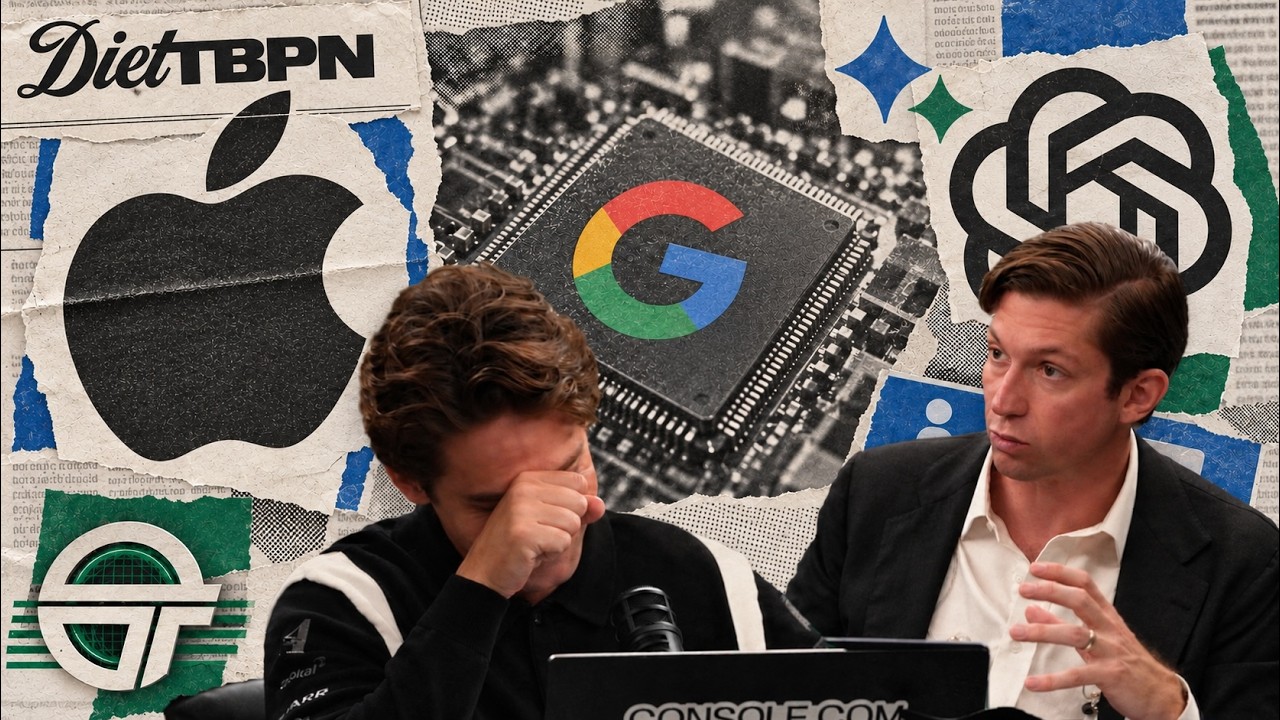
Apple’s ‘Pro and Tell,’ Google’s Two New AI Models, OpenAI Eyes Google’s Custom Chips | Diet TBPN — TBPN

TBPN

AI-assisted summary of Apple’s ‘Pro and Tell,’ Google’s Two New AI Models, OpenAI Eyes Google’s Custom Chips | Diet TBPN — original source. Check the original for full context.

Source published:

Key ideas

  • Apple announced the M6 MacBook Pro featuring an OLED touchscreen display and brought back the iconic illuminated lid logo, with configurations starting between $2,900 and $3,400 due to memory and component inflation. (0:00)
  • Google introduced Genie 4 as an interactive, real-time steerable world model, alongside Gemini 4 Carbon, which topped the Artificial Analysis Intelligence Index V5 under a reverse periodic table naming taxonomy. (7:30)
  • OpenAI and Anthropic are aggressively expanding compute infrastructure with massive multi-gigawatt deals, including OpenAI procuring Google Cloud TPUs alongside an 8-gigawatt Ohio expansion backstopped by Nvidia. (17:47)
  • Malaysia has emerged as a computational bridge and 'Switzerland of AI,' receiving hardware through Singapore to provide cloud infrastructure and remote training to global and Chinese labs amid trade restrictions. (21:29)
  • Personal AI agent startup Instinct is reportedly seeking a $30 billion valuation, igniting debates over whether consumer adoption velocity can justify multiples compared to revenue-heavy predecessors like Cursor. (24:15)

Detailed notes

## Background This episode of Diet TBPN was published on YouTube by TBPN on October 29, 2026. Hosted by John Coogan and Jordi Hays, the 30-minute daily recap show delivers highlights from their live tech broadcast covering major developments across Silicon Valley. According to the page description, this installment covers Apple's in-person hardware event, Google's newest AI models, major compute deals involving OpenAI and Google TPUs, and emerging valuation rumors around AI agent startup Instinct.

## TL;DR John Coogan recaps attending Apple's 'Pro and Tell' event, breaking down the launch of the touchscreen M6 MacBook Pro, its steep $2,900-plus price tag, and the surprising return of the glowing lid logo. The hosts then analyze Google's generative world model Genie 4 alongside the benchmark-topping Gemini 4 Carbon, while joking about DeepMind's inverted periodic table naming scheme. Shifting to infrastructure, they examine massive compute expansion deals—including OpenAI leasing Google Cloud TPUs and Anthropic expanding into Australia—as well as Malaysia's rise as a global data center hub and an enterprise Nvidia supercomputer listed on eBay. Finally, they debate the personal AI agent race, dissecting rumors of Instinct's $30 billion valuation against rivals like Muse, Cursor, and Big Tech incumbents.

## Atmosphere & style The show feels like an energetic, casual morning conversation between two Silicon Valley insiders balancing sharp market analysis with running internet jokes. The dynamic between Coogan and Hays is breezy and unscripted, transitioning naturally from hardware engineering breakdowns to comedic bits about setting up backyard compute clusters or buying full-sized T-Rex skeletons. Backed by soundboard drops and playful banter, the episode carries a lively, fast-paced momentum that makes high-stakes tech infrastructure and multi-billion-dollar venture deals feel immediate, engaging, and entertaining.

## Bulletin - [00:00](https://www.youtube.com/watch?v=OF0Yyvtdgcw&t=0s) Apple announced the M6 MacBook Pro featuring an OLED touchscreen display and brought back the iconic illuminated lid logo, with configurations starting between $2,900 and $3,400 due to memory and component inflation. - [07:30](https://www.youtube.com/watch?v=OF0Yyvtdgcw&t=450s) Google introduced Genie 4 as an interactive, real-time steerable world model, alongside Gemini 4 Carbon, which topped the Artificial Analysis Intelligence Index V5 under a reverse periodic table naming taxonomy. - [17:47](https://www.youtube.com/watch?v=OF0Yyvtdgcw&t=1067s) OpenAI and Anthropic are aggressively expanding compute infrastructure with massive multi-gigawatt deals, including OpenAI procuring Google Cloud TPUs alongside an 8-gigawatt Ohio expansion backstopped by Nvidia. - [21:29](https://www.youtube.com/watch?v=OF0Yyvtdgcw&t=1289s) Malaysia has emerged as a computational bridge and 'Switzerland of AI,' receiving hardware through Singapore to provide cloud infrastructure and remote training to global and Chinese labs amid trade restrictions. - [24:15](https://www.youtube.com/watch?v=OF0Yyvtdgcw&t=1455s) Personal AI agent startup Instinct is reportedly seeking a $30 billion valuation, igniting debates over whether consumer adoption velocity can justify multiples compared to revenue-heavy predecessors like Cursor.

## Key takeaways - [00:00](https://www.youtube.com/watch?v=OF0Yyvtdgcw&t=0s) Apple's 'Pro and Tell' keynote debuted the M6 MacBook Pro with a reinforced, stiffened hinge to solve classic touchscreen bounce issues. - [05:00](https://www.youtube.com/watch?v=OF0Yyvtdgcw&t=300s) The return of the backlit Apple logo received more audience applause than touchscreen support, justified economically as component inflation makes the $2 cutout negligible against $3,000+ base retail prices. - [07:30](https://www.youtube.com/watch?v=OF0Yyvtdgcw&t=450s) Google's Genie 4 research preview points toward dynamic, prompt-controlled real-time world generation, eliminating traditional post-production composite VFX for content creators. - [10:00](https://www.youtube.com/watch?v=OF0Yyvtdgcw&t=600s) Gemini 4 Carbon achieved top benchmark scores—59 on Artificial Analysis Intelligence Index V5 and 88.2% on SCC-Bench Pro—though hosts noted historic discrepancies between Google benchmarks and user experience. - [12:33](https://www.youtube.com/watch?v=OF0Yyvtdgcw&t=753s) DeepMind's new model taxonomy utilizes an inverted periodic table, where lower atomic numbers denote frontier models, leading to speculation around a future flagship 'Hydrogen' or 'Helium' release. - [17:47](https://www.youtube.com/watch?v=OF0Yyvtdgcw&t=1067s) OpenAI's decision to lease Google Cloud TPUs highlights how business pragmatism overrides corporate rivalries amid an insatiable compute demand. - [17:47](https://www.youtube.com/watch?v=OF0Yyvtdgcw&t=1067s) Hyperscale AI leasing hit record milestones with OpenAI's 8-gigawatt Ohio commitment and Anthropic's 1.7-gigawatt global lease, including a 360-megawatt deployment in Queensland backstopped by Google. - [20:00](https://www.youtube.com/watch?v=OF0Yyvtdgcw&t=1200s) A 300-rack cluster of 9,600 Nvidia A100 GPUs listed on eBay for roughly $60 million underscores the strong residual value of older compute hardware against its original ~$300 million retail cost. - [21:29](https://www.youtube.com/watch?v=OF0Yyvtdgcw&t=1289s) Malaysia functions as the neutral computational hinterland for Singapore, leveraging low power costs and regulatory flexibility to train models for international and Chinese AI labs. - [24:15](https://www.youtube.com/watch?v=OF0Yyvtdgcw&t=1455s) Instinct's rumored $30 billion valuation reflects soaring private market premiums for viral consumer AI adoption, despite lacking a traditional App Store presence. - [25:50](https://www.youtube.com/watch?v=OF0Yyvtdgcw&t=1550s) The personal agent market is fragmenting consumer attention across specialized tools, forcing standalones like Instinct to aggressively market before Google activates its latent personal data graph. - [28:30](https://www.youtube.com/watch?v=OF0Yyvtdgcw&t=1710s) Unlike Cursor, which reached a $30 billion valuation backed by over $1 billion in top-line revenue, Instinct's valuation rests on consumer momentum and potential M&A by tech giants like Apple or Amazon.

## Detailed walkthrough ### [00:00](https://www.youtube.com/watch?v=OF0Yyvtdgcw&t=0s) Apple’s “Pro and Tell” Event and the Touchscreen MacBook Pro

The broadcast opens with Jordi Hays asking John Coogan about his morning, which was spent attending Apple’s in-person "Pro and Tell" event while Jordi worked out. Leading up to the showcase, speculation ran rampant online after Apple hardware executive John Ternus teased a video showing a bright Apple logo spotlight projected against a wall—prompting Christian Reber to jokingly predict on social media that Apple was about to drop the long-awaited Apple Car during a brisk Wednesday morning keynote. Instead, the headline hardware announcement was an M6 MacBook Pro equipped with a touchscreen, accompanied by an updated iPad mini.

Reflecting on the stage presence of Apple’s leadership, Coogan notes that this was his first time attending an Apple keynote in person after growing up on Steve Jobs presentations and watching the evolution toward tightly edited, high-production pandemic videos. Coogan highlights Ternus’s standout delivery, remarking, “The star power is incredible. I'm not joking. Like he is so good on stage. He's incredible.” Ternus moved through the script at a blistering pace, spending a mere 15 seconds recapping the iPad mini and 15 seconds on the M6 processor before introducing the touchscreen display alongside a promotional spot styled after *If You Give a Mouse a Cookie*. Coogan’s personal takeaway on touch support was nonchalant: “So, yeah, my reaction to the launch is like, why the heck not? You know? You should be able to touch the screen of your computer.”

Beyond touch input, the laptop features an OLED panel, bringing deeper black levels and higher contrast ratios to parity with high-end consumer televisions. Testing out the hardware, Coogan and Jordi address the classic engineering flaw of touchscreen laptops: hinge bounce. When testing the display by poking and wobbling it, Coogan found the hinge appeared reinforced to eliminate the distracting springiness found in older laptops, joking that users will likely hold the display with both hands like driving a steering wheel just to flick through Instagram and TikTok reels.

- **Event structure**: Fast-paced, compact keynote with brief updates on iPad mini and M6 MacBook Pro before the main touchscreen reveal. - **Display tech**: Upgraded to an OLED display with significantly higher contrast and deeper blacks. - **Hinge mechanics**: Stiffened hinge tension prevents the screen from bouncing back and forth when tapped.

[05:00](https://www.youtube.com/watch?v=OF0Yyvtdgcw&t=300s) MacBook Pricing Reality and the Return of the Glowing Logo

A notable departure from classic Apple keynotes was the complete absence of pricing slides at the end of the reveal. Rather than closing on a dramatic sticker price reveal, Apple kept the numbers off the screen due to rising component expenses and global memory shortages. On Apple's retail website, the 14-inch MacBook Pro starts around $2,900, while the 16-inch model base tier begins at $3,400, climbing up to $6,000 when fully specced out. To offset the high up-front cost, Apple also offers enterprise customers and power users a 36-month lease program.

```mermaid flowchart TD accTitle: MacBook Pro Cost and Margin Shift accDescr: Diagram illustrating how rising chip and memory prices altered Apple's cost ratio, enabling the return of the glowing lid logo.

subgraph Past ["Era of $1,000 MacBooks"] CostOld["$2 Glowing Logo Cost"] --> ShareOld["~0.2% of Top-Line Price / 0.5% Component Cost"] ShareOld --> DecisionOld["Logo Removed to Cut Bill-of-Materials Costs"] end

subgraph Present ["Era of $3,000-$4,000+ M6 MacBooks"] CostNew["$2 Glowing Logo Cost (Unchanged)"] --> ShareNew["Negligible Fraction of High-End Machine"] ShareNew --> DecisionNew["Logo Reinstated as Premium Brand Identity"] end ```

The reveal that ignited the loudest live reaction in the room was not the touchscreen or the display, but the return of the illuminated Apple logo on the laptop lid. Jordi and Coogan observe that Apple previously removed the glowing cutout strictly to save manufacturing pennies, stripping away one of the most recognizable design flourishes of the Mac ecosystem. As Coogan explains, when base MacBooks cost $1,000, spending roughly $2 per unit on an illuminated cutout took up a noticeable fraction of a percent of component costs. With average configurations now climbing toward $4,000 because of chip and memory inflation, that $2 backlight cost is negligible against top-line margins. Coogan praised Ternus for leaning back into brand aesthetics over pure cost-cutting: “Yes, it has no utility other than like sort of brand and just sort of like enjoyment for the user. It looks nice. And that's still worth it.”

- **Pricing tiers**: 14-inch begins around $2,900; 16-inch begins around $3,400; maximum configurations reach $6,000. - **Financing**: 36-month business and personal lease options aimed at workers expensing hardware. - **Crowd reaction**: The return of the backlit Apple logo received greater applause in the auditorium than the announcement of touch capabilities.

[07:30](https://www.youtube.com/watch?v=OF0Yyvtdgcw&t=450s) Google Genie 4 and the Simulation Hypothesis

Transitioning from hardware to generative software, the conversation shifts to Google’s announcement of Genie 4. Quoting Google CEO Sundar Pichai, the hosts break down Genie 4's capabilities as a state-of-the-art interactive world model that allows users to steer dynamic, photorealistic environments in real time with prompt-controlled camera angles, physics engines, and continuous actions. Genie 4 dynamically generates native environmental soundscapes and conversational NPCs, while leveraging Gemini reasoning to maintain coherence across complex, multi-step scenarios.

While currently framed as a research preview, the practical near-term application is moving toward real-time virtual sets and dynamic composite rendering for content creators. Instead of relying on manual VFX or clunky post-production replacement apps like Higgsfield—where creators shoot a video next to a Honda Civic or a back porch and composite it into a supercar or private jet—Genie 4 can parse camera tracking coordinates on the fly and continuously generate matching surroundings. Moving the camera through a door onto a beach or boardwalk will cause the environment to generate logically in real time. Beyond practical production, Coogan reflects on the philosophical creep of the technology: “I think that the primary use case for world models for me personally so far is, you know, making me think that it's more likely that we're living in our own simulation.”

- **Genie 4 capabilities**: Real-time steerable world generation, photorealistic physics, contextual spatial audio, and interactive dialogue driven by Gemini reasoning. - **Creator utility**: Seamless real-time virtual set extensions and backdrop substitution that update dynamically as camera perspectives change. - **Release status**: Debuting initially as an exploratory research preview for AI researchers and developers.

[10:00](https://www.youtube.com/watch?v=OF0Yyvtdgcw&t=600s) Simulation Theory and Google's Rapid AI Rollout

The hosts open by joking about simulation theory, proposing that Earth and the entirety of human existence might just be a racing simulator managed by a higher-level organism whose sole purpose is propagating Formula 1. Shifting focus to Google's DeepMind developments, they discuss Genie 4. While one host has had extensive, fun experiences using Genie 3, Genie 4 remains locked behind an early access application program.

The conversation pivots to Google's relentless release cycle under Sundar Pichai, who recently teased that the company would be rolling out models periodically. Hot on the heels of the Argon release two weeks prior, Google introduced Gemini 4 Carbon. The hosts highlight its early benchmark performance: it ranked number one on the recently updated V5 of the Artificial Analysis Intelligence Index at 59, scored 88.2% on SCC-Bench Pro for finding vulnerabilities, and hit 54.8% on ExploitJim. Even Elon Musk commented publicly that the launch was impressive. However, the hosts maintain some skepticism given Google's historical track record. As one host reflects on past launches, “Yeah, just about a... a year straight where every single time it's amazing on benchmarks and then the sort of lived experience that people have and is less impressive.” One host defends Gemini 3, noting it answered concisely within a single page rather than generating overwhelming, multi-page responses like other LLMs.

- **Artificial Analysis Intelligence Index (V5):** Gemini 4 Carbon scored 59, taking the number-one spot. - **SCC-Bench Pro:** 88.2% score on vulnerability detection. - **ExploitJim:** 54.8% score on exploit evaluation. - **Recent Google Releases:** Gemini 4 Carbon follows the release of Argon by just two weeks.

---

[12:33](https://www.youtube.com/watch?v=OF0Yyvtdgcw&t=753s) The Elemental Taxonomy and the AI Naming Wars

The hosts debate Google's new elemental naming taxonomy. While OpenAI has used celestial bodies (Luna, Terra, Sol, Astra) to denote scale—where the moon is smaller than the Earth and the Earth is smaller than the Sun—and Anthropic maps models to literary works (Sonnet versus Opus), DeepMind appears to be using the periodic table in reverse. Because Carbon has an atomic number of 6 and Argon is 18, a lower atomic number corresponds to a higher-capability model.

```mermaid flowchart TD accTitle: Google DeepMind Elemental Model Hierarchy accDescr: Visualizing DeepMind's inverted atomic number hierarchy where lower numbers represent larger, more capable models.

subgraph DeepMindHierarchy["DeepMind Periodic Table Taxonomy (Lower Atomic Number = More Capable)"] direction TB Hypothetical["Hypothetical Frontier (Hydrogen / Helium) Atomic No: 1 - 2"] Carbon["Gemini 4 Carbon (Top Frontier) Atomic No: 6"] Argon["Argon (Smaller Model) Atomic No: 18"] Plutonium["Plutonium (Lowest Theoretical Tier) Atomic No: 94"]

Hypothetical --> Carbon Carbon --> Argon Argon --> Plutonium end ```

The hosts jokingly theorize that this inverted hierarchy opens the door to a massive Helium (atomic number 2) or Hydrogen (atomic number 1) model that could shatter the Ramp Index. As one host quips, “Yes, I think the helium model could be the biggest model for DeepMind in years. It could change everything.” Under this taxonomy, a model named Plutonium would sound terrifying but would theoretically be the least capable model in the lineup. Tyler fires the show's slow "truth nuke" sound effect as they mock the chaotic history of AI model naming, recalling how OpenAI previously confused everyone with version strings like 4.0, 4.5, Omni, and rapid-fire increments before settling on human-legible names.

---

[17:47](https://www.youtube.com/watch?v=OF0Yyvtdgcw&t=1067s) Massive Compute Leases: OpenAI Buys Google TPUs

The hosts react to the landmark news that OpenAI plans to buy Google Cloud TPUs as part of its infrastructure build-out, following reports from the prior week that OpenAI models would run on Google Cloud Platform (GCP). They marvel at the shift from OpenAI’s founding mission—which was originally positioned as a counterweight to Google—to their present pragmatism: “Business above all solves everything.”

They break down reporting from Dylan Patel at SemiAnalysis, which revealed an unprecedented wave of leasing commitments:

- **OpenAI's Ohio Expansion:** An 8-gigawatt, multi-phase commitment in Ohio, with Nvidia backstopping 4.25 gigawatts in the largest single leasing commitment recorded to date. - **TPU Commitments:** OpenAI is in active discussions with neoclouds for GPU-as-a-service and TPU-as-a-service, including an estimated 1-gigawatt TPU commitment with sites currently being scouted. - **Anthropic Down Under:** Anthropic signed a 1.7-gigawatt lease this quarter, featuring 360 megawatts in Queensland, Australia (signed September 16, with operations starting Q1 2028)—the largest overseas lease by an AI lab during the quarter. Google backstopped 1.0 gigawatt of Anthropic's total capacity.

The hosts banter about Australian inference jokes, warning researchers to stick to "inference and Foster's" instead of "throwing shrimp on the barbie." More broadly, they emphasize that labs are "using every part of the animal," running specialized models across different silicon architectures, hyperscalers, and neoclouds. Pointing to Lisa Su's AMD coverage where Anthropic vibe-coded their AMD implementation rapidly, they observe that software portability has softened the threat of architectural lock-in, fueling a rising tide for silicon and compute providers.

---

[21:29](https://www.youtube.com/watch?v=OF0Yyvtdgcw&t=1289s) The $60M eBay Supercomputer

Turning to consumer oddities in the high-stakes compute market, the hosts reveal that an entire AI supercomputer is currently listed for sale on eBay. For an entrepreneur dreaming of launching a neocloud, buying tokens, or entering the infrastructure race, the setup is packaged into a turnkey listing.

- **System Specs:** 300 racks containing 9,600 Nvidia A100 GPUs. - **Price Tag:** Estimated fair market value / credit line needed is around $60 million. - **Market Note:** eBay stock is up 16% over the preceding six months, perhaps fueled by ultra-high-ticket listings of enterprise data center hardware.

[20:00](https://www.youtube.com/watch?v=OF0Yyvtdgcw&t=1200s) A $60M Nvidia A100 Supercomputer on eBay and the Dinosaur Dilemma

John Coogan and Jordi Hays look over a wild listing on eBay: an enterprise-scale Nvidia supercomputer cluster priced at roughly $60 million. While fair market value for the hardware is estimated closer to $50 million or $55 million, the listing shows that two units are available and six different prospective buyers currently have it sitting in their carts. The hardware, built around Nvidia A100 GPUs—chips that are roughly seven years old—originally commanded nearly $300 million when brand new. Despite the massive depreciation, John notes that there is still significant residual value in older compute racks because the market treats them as raw capacity in an insatiable compute marketplace.

The conversation quickly turns into banter when John asks Jordi whether he would rather spend $60 million on the supercomputer or on "Gus," a full-sized fossilized T-Rex dinosaur skeleton. Jordi admits that, to his own dismay, he would pick the server cluster over the dinosaur because it would let him launch a backyard neocloud called "Malibu Inference." John jokes about how affluent founders claim they will drop data centers in luxury beach towns, imagining Jordi stacking server racks in the shape of a T-Rex right in his home foyer. While turning the entryway of a house into a roaring, high-temperature "hot aisle" would require catastrophic cooling solutions, John quips that it would send an unmistakable message to visitors: you run local compute and you do not pay API pricing.

- **Hardware depreciation**: The cluster of Nvidia A100 servers currently listed at $60 million originally retailed for almost $300 million. - **eBay listing oddity**: The screenshot displayed two available supercomputer units with six users having placed the item in their carts. - **Fair market valuation**: The co-hosts estimate true fair market value for the used cluster between $50 million and $55 million.

---

[21:29](https://www.youtube.com/watch?v=OF0Yyvtdgcw&t=1289s) Malaysia’s Compute Boom as the "Switzerland of AI"

The discussion pivots to global data center distribution and the sudden explosion of server infrastructure in Southeast Asia. John recalls that Malaysia's compute boom was literally the first topic covered on the very first episode of TBPN after a front-page *Wall Street Journal* feature highlighted the country's transformation into an international data center capital. Malaysia has effectively positioned itself as the neutral broker of the artificial intelligence race, with John explaining, “They are the Switzerland of AI. That was sort of the framing, was that they can buy compute from the US and resell it in China.” The country combines cheap, abundant power across its regions with aggressive government policy aimed at facilitating rapid data center buildouts.

Examining a global chart of compute deployment, Jordi admits surprise that the European Union still commands more total compute capacity than Malaysia, given how aggressively Malaysia has scaled. John points out that the EU is an entire continent while Malaysia is a relatively small nation. More importantly, Malaysia acts as the industrial and computational hinterland for Singapore. While Singapore remains the primary financial hub and global shipping port receiving shipments of advanced hardware, real estate and power constraints force companies to move the chips right across the border into Malaysia. Because trade restrictions and export controls on neoclouds have different regulatory loopholes compared to direct imports into mainland China, Chinese AI labs frequently train models on Nvidia GPUs racked inside Malaysian facilities.

```mermaid flowchart LR accTitle: Singapore to Malaysia AI Compute Pipeline accDescr: Hardware imports flow through Singapore before being racked in Malaysian data centers for regional and Chinese lab access.

subgraph Logistics ["Port & Finance Hub"] A["Nvidia GPU Shipments"] --> B["Singapore Port & Financial Center"] end

subgraph Deployment ["Regional Compute Hub"] B --> C["Cross-Border Delivery<br/>to Malaysia"] C --> D["Malaysian Neoclouds & Data Centers<br/>(Abundant Power & Land)"] end

subgraph Customers ["End Compute Demand"] D --> E["Global AI Labs"] D --> F["Chinese AI Labs<br/>(Remote Model Training)"] end ```

---

[24:15](https://www.youtube.com/watch?v=OF0Yyvtdgcw&t=1455s) Instinct’s Rumored $30B Valuation and the Private Market Rush

The hosts turn to rumors circulating across Silicon Valley that personal AI agent startup Instinct is negotiating a funding round at an eye-popping $30 billion valuation—having scaled from early-stage pricing to decacorn status in under a year. Addressing social media commentary urging tech workers to get into private venture markets before wealth generation shifts permanently away from public equities, Jordi and John acknowledge why people are "crashing out" over the post. While early-stage investing carries steep risks that require venture firms and LPs to diversify, the sheer velocity of Instinct’s ascent is historically aggressive.

A major challenge in evaluating Instinct's explosive trajectory is that, unlike consumer chat apps or productivity tools like Muse, Instinct does not operate as a standard mobile app on the App Store. Jordi checks the live App Store productivity rankings, noting that Muse remains heavily promoted with over 380,000 ratings and an average score of 4.9 stars, trailing only viral sensations like TikTok Pro and Vinted. This prompts an aside about Jordi browsing Vinted for Rick Owens garments and proposing he become a lifestyle influencer rocking Bottega top hats and Supreme gear, which John brushes off as just another comedic bit. Returning to the startup ecosystem, Jordi stresses that public hot takes about Instinct are detached from operational realities, arguing, “Investors are making a decision based on what they’re seeing in the business. Everyone else is giving takes based on how they feel about the number going up really fast.”

---

[25:50](https://www.youtube.com/watch?v=OF0Yyvtdgcw&t=1550s) The Personal AI Agent Wars: Instinct, Muse, and Frontier Lab Competition

Beyond valuation metrics, John highlights the brutal marketing and distribution battlefield facing specialized AI agents. Frontier labs regularly release state-of-the-art capabilities, but technical superiority in a model does not guarantee consumer mindshare. John points out that users have limited real estate on their home screens and inside existing apps, making aggressive go-to-market execution non-negotiable: “When new capability comes online from a frontier lab, it can be at the frontier of that new capability. But unless there is a commensurate marketing push, it's not guaranteed that it gets adoption.” For instance, Anthropic launched Duet, but a lack of widespread consumer advertising means many developers compartmentalize their stack—using Claude Code inside the terminal, Muse or Grok in Slack, Codex or Cursor for programming, and Instinct strictly for personal lifestyle management.

Instinct’s distinct advantage has been its relentless focus on pushing its consumer value proposition directly into the public consciousness. Investors backing the startup are seeing monthly revenue and usage charts that show vertical growth, even as the company faces attacks from Mark Zuckerberg at Meta, dedicated agent platforms like Dot, and Anthropic's Duet. Furthermore, Google looms as an existential threat because it already possesses the personal data graph—holding users' Gmail threads, calendar reservations, and restaurant assets like Zagat. Whether the personal assistant space evolves into an oligopoly or a winner-take-all market, Instinct is capitalizing on rapid consumer habit formation before Big Tech can fully package similar native features.

- **Developer fragmentation**: Users frequently segment tools across their workflow, balancing Claude Code in the terminal with Codex, Cursor, Slack bots, and standalone personal agents. - **Google’s dormant advantage**: Google natively owns the email inbox, calendar schedules, flight reservations, and local reviews (Zagat), giving it structural advantages whenever it launches an integrated consumer agent. - **App Store benchmark**: Muse holds the number-one spot in the App Store’s productivity category with 380,000 reviews averaging a 4.9-star rating.

---

[28:30](https://www.youtube.com/watch?v=OF0Yyvtdgcw&t=1710s) Comparing Instinct to Cursor: Revenue, M&A Exit Realities, and Antitrust

Jordi draws a comparison between Instinct raising at a $30 billion valuation and developer tool Cursor when it hit identical valuation milestones. While Cursor faced intense competition from foundation labs and specialized rivals like Windsurf, Cursor had already crossed over $1 billion in top-line revenue at that stage. While critics debated Cursor’s gross margins and questioned how it would survive competing with its own upstream model suppliers, it possessed massive commercial cash flow. Instinct, by contrast, is commanding a $30 billion price tag primarily off explosive consumer adoption rather than an established enterprise revenue base.

```mermaid flowchart TD accTitle: Cursor vs Instinct $30B Valuation Dynamics accDescr: Comparison of Cursor's revenue-backed IDE model against Instinct's consumer-adoption personal agent model.

subgraph CursorModel ["Cursor ($30B Valuation Stage)"] C1["Primary Asset: Over $1B Top-Line Revenue"] C2["Lead Hybrid IDE ('Centaur Model')"] C3["Competition: Windsurf, followed by Terminal Agents (Claude Code, Codex)"] C4["Investor Debate: Software Margins vs Supplier Dependence"] end

subgraph InstinctModel ["Instinct ($30B Rumored Stage)"] I1["Primary Asset: Viral Consumer Adoption & Growth Curves"] I2["Dedicated Personal Lifestyle Agent"] I3["Competition: Meta (Zuck), Dot, Anthropic Duet, Google"] I4["Investor Debate: M&A Potential (Apple/Amazon) vs Pre-Revenue Multiples"] end ```

The hosts speculate on how Instinct’s investors justify the math, noting that venture capitalists may be banking on an acquisition by cash-rich giants like Apple or Amazon looking to buy their way into consumer AI. When Jordi questions whether federal regulators would block an acquisition of that scale, John vehemently argues that antitrust authorities should leave the category alone, calling it the most aggressively contested frontier in tech: “It should 100% be allowed. It's the most competitive industry right now. It's like a knife fight for the personal agents.” John emphasizes that allowing an enterprise player like Amazon to acquire Instinct to counter Meta, OpenAI, and Anthropic promotes competition rather than harming it, though both hosts concede antitrust regulators frequently apply blunt rules against Big Tech acquisitions regardless of category dynamics.

Wrapping up the show, John and Jordi remind listeners to rate the podcast five stars on Apple Podcasts and Spotify, subscribe to the daily newsletter at TBPN.com, and tune in for their upcoming Friday livestream at 11:00 AM Pacific.

## Notable quotes > [25:50](https://www.youtube.com/watch?v=OF0Yyvtdgcw&t=1550s) When new capability comes online from a frontier lab, it can be at the frontier of that new capability. But unless there is a commensurate marketing push, it's not guaranteed that it gets adoption. — John Coogan

> [24:15](https://www.youtube.com/watch?v=OF0Yyvtdgcw&t=1455s) Investors are making a decision based on what they’re seeing in the business. Everyone else is giving takes based on how they feel about the number going up really fast. — Jordi Hays

> [00:00](https://www.youtube.com/watch?v=OF0Yyvtdgcw&t=0s) You should be able to touch the screen of your computer. — John Coogan

## Mentioned Amazon, AMD, Anthropic, Apple, Apple Car, Argon, Artificial Analysis Intelligence Index, Christian Reber, Claude Code, Codex, Cursor, Dot, Duet, Dylan Patel, eBay, Elon Musk, ExploitJim, Gemini, Gemini 3, Gemini 4 Carbon, Genie 3, Genie 4, Google, Google Cloud Platform, Grok, Higgsfield, Instinct, iPad mini, John Coogan, John Ternus, Jordi Hays, Lisa Su, M6 MacBook Pro, Mark Cuban, Mark Zuckerberg, Meta, Muse, Nvidia, Nvidia A100, OpenAI, Ramp Index, Sam Altman, Satya Nadella, SCC-Bench Pro, SemiAnalysis, Steve Jobs, Sundar Pichai, TBPN, TikTok Pro, Vinted, Windsurf, Zagat

## Video description Sign up for TBPN’s daily newsletter at TBPN.com

Diet TBPN delivers the best of today’s TBPN episode in 30 minutes. TBPN is a live tech talk show hosted by John Coogan and Jordi Hays, streaming weekdays 11–2 PT on X and YouTube, with each episode posted to podcast platforms right after.

Described by The New York Times as “Silicon Valley’s newest obsession,” the show has recently featured Mark Zuckerberg, Sam Altman, Mark Cuban, and Satya Nadella.

TBPN is made possible by: Ramp - https://ramp.com Public - https://public.com Cisco - https://www.cisco.com Console - https://www.console.com CrowdStrike - https://www.crowdstrike.com Figma - https://www.figma.com MongoDB - https://www.mongodb.com NYSE - https://www.nyse.com Railway - https://railway.com Shopify - https://www.shopify.com/

Follow TBPN: https://TBPN.com https://x.com/tbpn https://open.spotify.com/show/2L6WMqY3GUPCGBD0dX6p00?si=674252d53acf4231 https://podcasts.apple.com/us/podcast/technology-brothers/id1772360235 https://www.youtube.com/@TBPNLive

Chapters: 00:00 Apple’s “Pro And Tell” Event + Touchscreen MacBook Pro Reveal 05:56 Apple’s New MacBook Pricing + The Glowing Logo Returns 09:27 Google Unveils Genie 4 + Are We Living in a Simulation? 12:33 Gemini 4 Carbon Tops AI Benchmarks + The Model Naming Wars 17:47 OpenAI Turns to Google’s TPUs + Massive AI Compute Deals 21:29 A $60M Nvidia Supercomputer on eBay + Malaysia’s AI Compute Boom 25:50 Instinct’s $30B Valuation Rumors + The Personal AI Agent Wars

[Source](https://www.youtube.com/watch?v=OF0Yyvtdgcw)

中文简报

苹果“Pro and Tell”发布会、谷歌两款全新AI模型、OpenAI瞄准谷歌自研芯片 | Diet TBPN John Coogan回顾了参加苹果“Pro and Tell”发布会的见闻,详细解读了触屏版M6 MacBook Pro的发布、其超过2900美元的高昂售价,以及令人惊喜的发光A面Logo回归。随后,主持人分析了谷歌的生成式世界模型Genie 4与领跑基准测试的Gemini 4 Carbon,并调侃了DeepMind倒序元素周期的命名方案。转向算力基础设施方面,他们探讨了庞大的算力扩张交易——包括OpenAI租用谷歌云TPU以及Anthropic进军澳大利亚——此外还讨论了马来西亚作为全球数据中心枢纽的崛起,以及eBay上架的一台企业级Nvidia超级计算机。最后,他们就个人AI Agent的竞争展开辩论,深入剖析了传闻中Instinct高达300亿美元的估值,并将其与Muse、Cursor以及大型科技巨头等竞争对手进行了对比。 苹果发布了配备OLED触控屏的M6 MacBook Pro,并带回了标志性的发光A面Logo,受内存和组件通胀影响,起步配置售价在2900美元至3400美元之间。 (0:00) 谷歌推出了具有交互性、可实时操控的世界模型Genie 4,以及在反向元素周期表命名体系下登顶Artificial Analysis Intelligence Index V5基准的Gemini 4 Carbon。 (7:30) OpenAI和Anthropic正通过数吉瓦规模的庞大交易积极扩张算力基础设施,其中包括OpenAI采购谷歌云TPU,以及由Nvidia提供支持的俄亥俄州8吉瓦扩建项目。 (17:47) 在贸易限制背景下,马来西亚已成为算力桥梁与“AI界的瑞士”,硬件经由新加坡进入该国,为全球及中国实验室提供云基础设施和远程训练服务。 (21:29) 据报道,个人AI Agent初创公司Instinct正寻求300亿美元估值,这引发了关于消费端采用速度能否支撑起相较于Cursor等高营收前辈更高估值倍数的争论。 (24:15)

Reading summary

TBPN's John Coogan and Jordi Hays analyze shifts across consumer hardware and AI infrastructure, highlighting Apple's premium hardware pricing, Google's accelerated model deployments, and the intensifying capital rush for compute capacity and consumer AI agents. Apple's M6 MacBook Lineup and Premium Margins (0:00) At its 'Pro and Tell' event, Apple introduced an M6 MacBook Pro featuring an OLED panel, reinforced hinge mechanics to mitigate screen bounce, and touch capabilities, alongside an updated iPad mini. Apple omitted retail pricing from its stage presentation amid elevated component and memory expenses; the 14-inch model starts around $2,900 and the 16-inch reaches up to $6,000, supported by 36-month lease options for enterprise and power users. The showcase drew its strongest audience reaction from the return of the illuminated lid logo. The hosts note that while Apple previously dropped the glowing cutout to shave an estimated $2 bill-of-materials cost off $1,000 laptops, higher unit selling prices nearing $4,000 make that expense financially negligible, allowing Apple to re-embrace brand aesthetics. Google's Rapid AI Rollout and Elemental Hierarchy (7:30) Google debuted Genie 4, an interactive world model capable of real-time steerable generation, photorealistic physics, spatial audio, and Gemini-powered NPC dialogue intended for real-time virtual sets and dynamic composite rendering. DeepMind also launched Gemini 4 Carbon just two weeks after its Argon release. Gemini 4 Carbon captured the top spot on V5 of the Artificial Analysis Intelligence Index with a score of 59, alongside 88.2% on SCC-Bench Pro and 54.8% on ExploitJim, although the hosts express lingering caution given past gaps between benchmark scores and user experience. The hosts observe that DeepMind has adopted a reverse periodic table naming taxonomy where lower atomic numbers indicate more powerful frontier models—placing Carbon (atomic number 6) above Argon (18)—in contrast to OpenAI's celestial tiers and Anthropic's literary naming schemes. The Global Scramble for Compute Infrastructure (17:47) Frontier AI labs are aggressively diversifying their hardware across providers and silicon architectures to secure raw capacity. Reporting from SemiAnalysis's Dylan Patel highlights an 8-gigawatt expansion by OpenAI in Ohio—with Nvidia backstopping 4.25 gigawatts—alongside discussions for roughly 1 gigawatt of Google Cloud TPU capacity. Simultaneously, Anthropic secured a 1.7-gigawatt quarterly lease portfolio that includes 360 megawatts in Queensland, Australia, backed by 1.0 gigawatt from Google. This demand for processing power extends down to secondary hardware markets, evidenced by a turnkey eBay listing offering 300 racks with 9,600 Nvidia A100 GPUs for around $60 million against an estimated $50 million to $55 million fair market value. Internationally, Malaysia has emerged as Southeast Asia's pivotal compute hub, leveraging ample regional power and functioning as an industrial deployment zone for hardware transshipping through Singapore. The $30 Billion Valuation Race for Personal Agents (24:15) Venture market attention has centered on personal AI agent startup Instinct, which is reportedly negotiating funding at a $30 billion valuation within a year of launch. The hosts contrast Instinct with coding assistant Cursor, which commanded a similar valuation on the back of more than $1 billion in established top-line revenue, whereas Instinct’s valuation reflects rapid consumer adoption and viral engagement without a standard App Store application footprint. Instinct faces severe platform pressure from rivals including Meta, Anthropic’s Duet, Dot, and Google, which maintains a deep structural advantage through its existing integration with personal email, calendar, and location data. The hosts suggest investors may be betting on an acquisition by tech giants such as Apple or Amazon, arguing that antitrust regulators should view acquisitions favorably given the intense rivalry across the agent landscape. The hosts emphasize that technical model performance alone does not guarantee consumer adoption, leaving startups like Instinct reliant on aggressive marketing before platform incumbents integrate native personal data graphs, while foundation labs continue to commit tens of billions to cross-provider compute leases.

精炼阅读摘要

根据TBPN播客节目分析,科技行业正迎来多维度的范式转变:苹果通过大幅提升定价重塑高端硬件边界,谷歌加速发布高跑分模型与世界模拟工具,而前沿AI实验室在庞大算力渴求与消费级Agent竞争的驱动下,正在打破传统的阵营壁垒并推动私有市场估值飙升。 硬件溢价与设计回归:触屏MacBook Pro与发光Logo (0:00) 苹果在“Pro and Tell”发布会上推出了搭载M6芯片和触控OLED屏幕的MacBook Pro。主持团队指出,硬件主管John Ternus以极快节奏完成演讲,并展示了为触控专门强化的屏幕转轴张力,以消除传统触控笔记本常见的抖动缺陷。但在整场发布会中,苹果罕见地未展示价格幻灯片;根据官网信息,14英寸版本起售价约2,900美元,16英寸起售价约3,400美元,顶配高达6,000美元,同时提供了针对企业和个人用户的36个月租赁计划。高昂定价的主要推手是内存短缺与元器件成本通胀。 出人意料的是,现场最引人注目的亮点是笔记本A面背光苹果Logo的回归。播客分析指出,当MacBook售价在1,000美元左右时,发光Logo约2美元的物料成本(BOM)在控制开支中显得较为敏感;如今整机起步售价因硬件成本飙升至3,000至4,000美元以上,2美元的背光成本占整机利润的比例已微乎其微,这促使苹果重新将品牌辨识度与用户体验置于极致成本压缩之上。 谷歌密集模型矩阵:Genie 4、碳模型与元素命名法 (7:30) 谷歌公布了最新研究预览版互动世界模型Genie 4。据谷歌CEO Sundar Pichai介绍,该模型允许用户通过提示词实时控制逼真的动态环境、相机机位与物理系统,并借助Gemini推理维持连贯性,生成原生环境音效和对话NPC。主持团队认为,Genie 4近期最重要的实用落地场景是为视频创作者提供动态虚拟背景与实时合成延伸,能够根据摄像机运动实时渲染逻辑自洽的连续环境。 在模型迭代方面,谷歌在发布Argon仅仅两周后便推出了Gemini 4 Carbon(碳)。早期基准数据显示,该模型在Artificial Analysis综合智能指数V5中以59分位列榜首,并在漏洞检测基准SCC-Bench Pro上达到88.2%、ExploitJim达到54.8%。虽然马斯克公开称赞其表现,但主持团队对谷歌“基准测试表现亮眼但实际体验偶有落差”的历史模式仍持审慎态度。此外,DeepMind采用了以元素周期表逆序排序的模型命名体系,原子序数越低代表性能越强(如碳-6高于氩-18),这一逻辑暗示未来可能存在代号为氢(1)或氦(2)的更高性能旗舰模型。 算力饥渴与多架构结盟:TPU采购、租赁潮与马来西亚枢纽 (17:47) 在基础设施层面,OpenAI计划采购谷歌云TPU并开始在GCP上运行模型,标志着其创立初期作为谷歌制衡者的意识形态立场转向以业务为先的实用主义。根据SemiAnalysis分析师Dylan Patel的数据,算力租赁规模正在激增:OpenAI推进了俄亥俄州8吉瓦(GW)的多阶段承诺,英伟达在其中背书了创下单笔纪录的4.25吉瓦容量,同时OpenAI还在洽谈约1吉瓦的TPU算力资源;Anthropic本季度也签署了1.7吉瓦租赁协议,其中谷歌背书1.0吉瓦,包括在澳大利亚昆士兰的360兆瓦海外部署。随着软件可移植性改善,模型实验室正跨越多种芯片架构与云厂商全面铺开算力部署。 算力需求的井喷使得二级硬件市场甚至出现了整套挂牌交易:eBay上出现了一套包含300个机柜、9,600张英伟达A100 GPU的超算集群,要价约6,000万美元(全新零售价曾近3亿美元)。在地理分布上,马来西亚正崛起为“AI瑞士”:依托充沛廉价的电力和支持性政策,马来西亚承接了经由新加坡港口和金融枢纽入境的先进芯片,在本地建立起密集的数据中心,使得中国等地区的AI实验室能够通过远程云服务合规获取前沿算力进行模型训练。 消费级Agent白热化竞争:Instinct估值传闻与并购前景 (24:15) 硅谷传闻个人AI助手初创公司Instinct正以高达300亿美元的估值洽谈融资,在不到一年内实现十倍级跃升。主持团队将其与此前同达300亿美元估值的代码工具Cursor对比,指出Cursor当时已拥有超过10亿美元的年化营收作为基本盘支撑,而Instinct的估值推演几乎完全建立在爆炸性的C端用户留存与使用量曲线上。目前App Store生产力榜单仍由拥有38万评价、4.9分评分的Muse主导,而Instinct采取了非标准独立App的运营模式。 主持团队强调,底层大模型的能力突破并不等同于应用端的自然普及,个人Agent领域已演化为依赖强力市场营销推进的残酷战场。Instinct不仅面临Meta、Anthropic Duet以及Dot等专用平台的正面交锋,还面临掌握着原生邮箱、日历及本地数据图谱(如Zagat)的谷歌所带来的潜在挤压。投资机构对300亿美元估值的合理性押注,很大程度上基于苹果或亚马逊等现金充沛的巨头未来可能通过并购补齐C端AI版图;主持团队认为,个人助手赛道竞争异常激烈,反垄断监管机构理应放行此类大厂并购以促进行业竞争。 从底层硬件高溢价与全球分布式算力构建,到前沿世界模型与消费级Agent的资本博弈,AI产业链正在经历各环节的激进化重组。然而,个人助手赛道在缺乏成熟企业级营收支撑下的超高估值能否变现,以及巨额基础设施租赁能否在模型实际落地中实现正向商业闭环,仍是未来市场需要验证的核心悬念。

Detailed notes — zh

## Background 本期视频由科技对谈频道 TBPN 于 2026 年 10 月 29 日发布在 YouTube 上。节目为《Diet TBPN》每日精华栏目,由 John Coogan 与 Jordi Hays 共同主持,主要聚焦当天科技界的重大动态与前沿趋势。 ## TL;DR 节目围绕苹果最新“Pro and Tell”发布会展开,深入剖析了新款配备触控屏及 OLED 面板的 MacBook Pro、飙升的产品定价以及标志性发光 Apple Logo 的情怀回归。随后,主持人们探讨了 Google 发布的 Genie 4 交互式世界模型与 Gemini 4 Carbon 大模型,并吐槽了各大 AI 实验室的命名体系。最后,节目聚焦全球 AI 算力军备竞赛,涵盖 OpenAI 采购 Google TPU 的巨额租赁协议、eBay 上叫价 6000 万美元的二手英伟达超算、马来西亚作为算力中枢的崛起,以及个人 AI Agent 初创公司 Instinct 传闻高达 300 亿美元的估值争议与潜在反垄断并购走向。 ## Atmosphere & style 整场节目节奏明快、谈吐风趣,充满硅谷科技圈特有的敏锐洞察与即兴幽默。两位主持人默契十足,一边分享亲历发布会的一手见闻与上手细节,一边用“模拟宇宙”、“吃整猪”以及“在门厅堆 GPU 恐龙”等生动比喻插科打诨。讨论在轻松调侃与对算力经济学、地缘供应链及巨头竞争的硬核商业推演之间自如切换,给听众带来既极富信息量又极具娱乐感的沉浸式科技脱口秀体验。 ## Bulletin - [00:00](https://www.youtube.com/watch?v=OF0Yyvtdgcw&t=0s) 苹果举办“Pro and Tell”发布会推出搭载 OLED 触控屏及 M6 芯片的 MacBook Pro,顶盖标志性发光 Apple Logo 重新回归,但受半导体成本影响顶配售价逼近 6,000 美元。 - [08:20](https://www.youtube.com/watch?v=OF0Yyvtdgcw&t=500s) Google 正式发布具备实时交互和原生音频生成能力的世界模型 Genie 4,并推出在网络安全基准测试中拔得头筹的前沿模型 Gemini 4 Carbon。 - [15:20](https://www.youtube.com/watch?v=OF0Yyvtdgcw&t=920s) OpenAI 计划采购 Google TPU 芯片并签署俄亥俄州 1.8 GW 算力租约,Anthropic 亦锁定全球 1.7 GW 算力,显现顶级 AI 实验室在资源饥渴下的务实采购策略。 - [25:50](https://www.youtube.com/watch?v=OF0Yyvtdgcw&t=1550s) 个人 AI Agent 初创公司 Instinct 传出正以 300 亿美元估值进行融资,引发布局消费级入口估值逻辑与未来科技巨头收购面临反垄断审查的广泛探讨。 ## Key takeaways - [00:00](https://www.youtube.com/watch?v=OF0Yyvtdgcw&t=0s) 苹果以极快节奏举办“Pro and Tell”发布会,将焦点集中于触控屏交互与画质更出色的 OLED 显示面板。 - [00:00](https://www.youtube.com/watch?v=OF0Yyvtdgcw&t=0s) 为解决用户单手点按导致屏幕前后晃动的问题,新款 MacBook Pro 专门强化了屏幕转轴阻尼。 - [04:30](https://www.youtube.com/watch?v=OF0Yyvtdgcw&t=270s) 由于芯片与内存等物料清单成本大幅上升,苹果在发布会现场淡化了价格数字,顶配机型直逼 6,000 美元并主推 36 个月租赁方案。 - [04:30](https://www.youtube.com/watch?v=OF0Yyvtdgcw&t=270s) 发光 Apple Logo 的单台硬件成本预估仅约 2 美元,在高客单价的 Pro 系列中极具品牌溢价与情怀唤起效果。 - [08:20](https://www.youtube.com/watch?v=OF0Yyvtdgcw&t=500s) Google 发布的 Genie 4 模型可实时引导动态环境、自适应运镜并原生生成匹配音效,极大降低了虚拟制片与背景延展的门槛。 - [08:20](https://www.youtube.com/watch?v=OF0Yyvtdgcw&t=500s) Genie 4 的高拟真度与物理世界一致性,促使主持人们探讨起现实可能处于某种高阶文明代码运行下的“模拟假说”。 - [10:30](https://www.youtube.com/watch?v=OF0Yyvtdgcw&t=630s) Gemini 4 Carbon 登顶 Artificial Analysis 智力指数并在网络安全漏洞挖掘评估中表现亮眼,但实际体验仍有待日常检验。 - [10:30](https://www.youtube.com/watch?v=OF0Yyvtdgcw&t=630s) 各大实验室逐渐由混乱的版本号转向以元素、天体或诗歌体裁命名模型,使产品大小与定位更加直观具象。 - [15:20](https://www.youtube.com/watch?v=OF0Yyvtdgcw&t=920s) 算力紧缺压倒了竞争恩怨,促使 OpenAI 转向采购 Google TPU 芯片,并在俄亥俄州达成获英伟达背书的 1.8 GW 超大规模算力承诺。 - [15:20](https://www.youtube.com/watch?v=OF0Yyvtdgcw&t=920s) Anthropic 正在全球推进 1.7 GW 算力布局,包括将于 2028 年在澳大利亚昆士兰投入运营的 360 MW 算力项目。 - [20:00](https://www.youtube.com/watch?v=OF0Yyvtdgcw&t=1200s) eBay 上标价 6,000 万美元的 9,600 张英伟达 A100 二手超算集群,印证了 AI 淘金热下高残值旧硬件的狂热流通。 - [20:00](https://www.youtube.com/watch?v=OF0Yyvtdgcw&t=1200s) 马来西亚凭借充沛的电力配套、政府支持及紧邻新加坡港口的区位优势,正演变为全球受地缘监管影响的 AI 算力中转枢纽。 - [25:50](https://www.youtube.com/watch?v=OF0Yyvtdgcw&t=1550s) Instinct 传闻以 300 亿美元高估值融资,相比拥有 10 亿美元 ARR 的 Cursor,其投资逻辑更侧重于爆发式用户采用率与巨头收购预期。 - [30:00](https://www.youtube.com/watch?v=OF0Yyvtdgcw&t=1800s) 消费级个人 AI Agent 领域正演变为巨头与初创公司的肉搏战,但未来若出现针对该赛道的超大型并购,依然将面临反垄断审查的不确定性。 ## Detailed walkthrough ### [00:00](https://www.youtube.com/watch?v=OF0Yyvtdgcw&t=0s) 苹果“Pro and Tell”发布会:触屏 MacBook Pro 与全新 OLED 屏幕 节目一开始,Jordi Hays 与 John Coogan 互相寒暄早晨的安排。Jordi 提到自己完成了一场畅快淋漓的锻炼,而 John Coogan 则刚刚亲临现场参加了苹果公司当天早晨举办的“Pro and Tell”线下硬件发布会。在此次活动前,外界的推测铺天盖地:苹果硬件工程高级副总裁 John Ternus 曾在社交媒体上分享过一段预热视频,画面是一束光打在墙上,投射出明亮的苹果 Logo 剪影。Pitch 创始人 Christian Reber 甚至打趣称苹果可能会借机直接发布 Apple Car。然而,这并不是一场长篇大论的主题演讲,而是一场节奏紧凑、短小精悍的专场发布,其核心主角正是一款搭载触控屏的全新 MacBook Pro。这是 John Coogan 第一次现场参加苹果发布会,他回忆起自己从学生时代起就通过屏幕观看 Steve Jobs 的经典演讲,并见证了发布会从疫情期间高度精细剪辑的线上录播演变至如今的线下精简风格。 John Coogan 对台上演讲的 John Ternus 赞不绝口,认为他的控场能力和舞台巨星魅力令人惊叹。整个发布会的脚本极为利落:开场仅用大约 15 秒带过新款 iPad mini,紧接着用 15 秒介绍搭载 M6 芯片的新款 MacBook Pro,随后便直奔核心主题——触控屏技术。现场还播放了一支诙谐幽默的宣传广告,创意灵感源自经典童书《要是你给老鼠吃饼干》(If You Give a Mouse a Cookie),CEO Tim Cook 随后也在 X 上转发了这一广告并写道“我们把触控带到了 Mac 上”。对于这款产品,John Coogan 表达了极为松弛而肯定的态度:“你理应能够触控你电脑的屏幕。”虽然他自认未来更换 Mac 时不一定会把触控作为必选功能,但另一项升级却极具吸引力——OLED 显示屏。正如家庭客厅中普及的 OLED 电视一样,OLED 能带来更纯粹深邃的黑位、更高的峰值亮度以及更出色的对比度,这对于长期面向专业用户的 Pro 系列产品线而言是顺理成章的重大提升。 针对触控交互的实际体验,Jordi Hays 关切地询问了屏幕转轴的刚性,担心用户戳屏幕时会导致显示屏前后晃动。John Coogan 现场上手后指出,新机的转轴阻尼经过了明显强化,不再像以前的机型那样一碰就产生弹簧般的晃动,避免了用户必须用单手扶着屏幕后方才能触控的尴尬。两人还开玩笑地模拟了双手扶住屏幕两侧、如同握着方向盘一样划动屏幕刷 TikTok 和 Instagram 的滑稽姿势。 - **发布会节奏**:15 秒介绍 iPad mini,15 秒展示 M6 芯片 MacBook Pro,其余时间迅速切换至触控与屏幕演示。 - **宣传创意**:致敬童话《要是你给老鼠吃饼干》,Tim Cook 宣布正式为 Mac 生态引入触控交互。 - **硬件关键改进**:采用 OLED 面板大幅提升对比度与黑位表现;重构屏幕转轴刚性以消除触控时的回弹晃动。 --- ### [04:30](https://www.youtube.com/watch?v=OF0Yyvtdgcw&t=270s) MacBook Pro 昂贵定价与发光 Apple Logo 的情怀回归 谈及发布会的现场细节,两位主持人注意到了一个反常现象:苹果在舞台大屏幕上完全隐藏了产品的具体售价。在以往乔布斯乃至库克时代的经典发布会中,苹果总是习惯在列出一连串华丽配置后,在屏幕正中央打出极具冲击力的价格数字;然而在当前的供应链环境下,由于半导体芯片与内存短缺(Memory crunch)导致物料清单(BOM)成本急剧攀升,苹果不再愿意在台上直面高昂的价格标签。根据 Apple 官网的信息,14 英寸新款 MacBook Pro 起售价约为 2,900 美元,16 英寸机型起售价更是高达 3,400 美元,如果选配顶级规格,整机价格将直逼 6,000 美元大关。为了平摊高价对消费者的冲击,苹果还提供了一套 36 个月的硬件租赁服务,被主持人戏称为“拥有零资产,享受当下快乐”(Own nothing and be happy)的选择。 发布会最引爆全场的亮点并非触控屏,而是苹果 Logo 发光背光的震撼回归。最初 John Ternus 发布的灯光预热视频,正是在暗示这颗曾经被取消的标志性发光 Logo 重新出现在了笔记本顶盖上。当年苹果为了压缩机身厚度和控制成本取消了背光 Logo,但在回顾这一决策时,大家都觉得失去这一最具 Mac 辨识度的特质十分遗憾。John Coogan 描述道,当台上公布发光 Logo 回归的那一刻,台下观众爆发出的掌声甚至超越了触控屏和 OLED 屏幕登场时的声浪。 从成本经济学角度,John Coogan 剖析了背光 Logo 回归的底层逻辑。他推测为 Logo 增加发光结构的硬件成本可能仅仅在每台 2 美元左右。在过去 MacBook 售价在 1,000 美元上下时,2 美元在整机成本中占比相对显眼;然而在如今内存与先进制程芯片价格高企的背景下,大部分专业用户的最终选配价格往往高达 4,000 美元,此时 2 美元的微小成本占比微乎其微。正因为如此,苹果管理层终于意识到,虽然发光 Logo 没有任何实质性的硬件功能,但它所带来的高端品牌价值、用户情感愉悦度以及咖啡馆与直播镜头前的辨识度,完全值得付出这笔成本。正如 John Coogan 评价 John Ternus 的产品取向时所言:“它确实没有任何实用价值,纯粹是为了品牌认同和带给用户的视觉享受,它看起来就是很酷,而这本身就极具价值。” - **产品定价走势**:14 英寸起售价约 2,900 美元,16 英寸起售价约 3,400 美元,满配机型达到 6,000 美元左右。 - **金融租赁方案**:苹果官方提供为期 36 个月的免买断租赁选项,便利企业客户进行报销或长期资产摊销。 - **成本与情怀权衡**:发光模块预估成本仅约 2 美元,在高客单价的 Pro 产品线中被完全吸收,重新强化了高端苹果硬件的美学标签。 --- ### [08:20](https://www.youtube.com/watch?v=OF0Yyvtdgcw&t=500s) Google 推出 Genie 4 交互式世界模型与模拟宇宙假说 随后,话题转向了 Google 在同一天释出的重大 AI 发布。Google CEO Sundar Pichai 正式对外公布了全新的基础模型 Genie 4,并将其定义为 Google 迄今为止最逼真、最具交互性的“世界模型”(World Model)。根据官方介绍,Genie 4 具备在实时状态下引导动态环境的能力,允许用户自主塑造场景事件、摄影机运镜角度以及角色动作。同时,模型还能原生生成与世界完全匹配的声音效果——从极为逼真的环境背景音,到能够与人实时对答的虚拟角色对话。不仅如此,Genie 4 还结合了 Gemini 的逻辑推理能力,可以根据现实物理规律和照片级光影效果,推演并维持高度连贯的多步骤连续事件。该模型目前已作为研究预览版(Research Preview)逐步向研究人员开放。 在讨论 Genie 4 的实际落地场景时,Jordi Hays 与 John Coogan 展开了热烈探讨。目前这类模型除了作为游戏玩家探索虚拟沙盒或订阅制娱乐的新型替代品之外,最立竿见影的商用方向在于数字内容创作与虚拟制片。创作者可以将其用作虚拟背景扩展(Set extensions):摄像机在拍摄真人演员时,Genie 4 能够实时捕捉镜头在物理空间中的相对位置与运动轨迹,并在背景层动态延展出无限的逼真世界。John Coogan 举例谈到,过去在 Higgsfield 等工具中,人们常常拍摄在普通 Honda Civic 轿车旁摆拍、随后通过 AI 动态替换为兰博基尼的恶搞“真人角色扮演”(LARP)视频,或者把家中的后楼梯换成私人飞机座舱;而 Genie 4 的高保真度和实时物理生成能力,将使这种动态替换在摄像机移动中以极高帧率毫无破绽地完成——哪怕拍摄者从海滩走上木栈道,AI 也能即时在视野外自动推理并渲染出符合地理与光影逻辑的连贯世界。 这番技术展示也引发了两位主持人关于形而上学和科学假说的思考。看着虚拟环境的生成精度已经足以骗过人类肉眼,John Coogan 感叹道这类模型对他最大的心理冲击,在于让人越来越倾向于相信现实世界本质上可能只是某种高等文明的代码运行:“到目前为止,世界模型对我个人而言最主要的实际效用,就是让我觉得我们生活在自己所属模拟世界之中的概率变得更大了。”这番言论随即引出了关于“模拟假说”(Simulation Hypothesis)以及两人此前构想过的“赛车模拟假说”(Racing simulation hypothesis)的哲学探讨。 ```mermaid flowchart TD accTitle: Genie 4 核心能力与工作流架构 accDescr: 展示 Genie 4 如何通过环境交互、物理模拟及多模态生成构建实时动态世界 subgraph Inputs["输入控制层"] A["实时运镜指令 / 用户行为交互"] B["Gemini 推理引擎驱动的多步逻辑"] end subgraph CoreEngine["Genie 4 实时世界模型"] C["物理规律与照片级光影渲染"] D["动态环境与场景拓扑延伸"] E["原生多模态音频 / 角色实时对话生成"] end subgraph Applications["下游落地场景"] F["沉浸式交互游戏与沙盒娱乐"] G["虚拟制片 / 实时动态背景替换 (Set Extension)"] end A --> C B --> D C --> F D --> G E --> F E --> G ``` - **Genie 4 关键功能**:实时操控动态世界环境、自适应摄像机角度、高保真真实物理规律与照片级写实渲染。 - **原生音频系统**:无需后置拼接,在生成画面的同时同步生成匹配空间物理特性的环境音效与角色实时对话语音。 - **制片与创意应用**:能够跟随物理摄像机移动,动态想象并连贯补全取景框外的三维世界,大幅降低虚拟摄影棚与特效合成门槛。 ### [10:00](https://www.youtube.com/watch?v=OF0Yyvtdgcw&t=600s) Genie 4 与模拟理论的调侃 主持人开玩笑地探讨起世界的本质,调侃称人类所经历的现实世界可能并非真实存在,而是一个由更高阶生物运行的赛车模拟器,其存在的唯一目的就是推广 F1 赛车及其巡回赛事。 随后话题转向 Google 最新发布的模型 Genie 4。当被问及该模型是否已经公开发布时,主持人提到自己之前重度体验过 Genie 3,觉得非常有趣,但目前还没有拿到 Genie 4 的权限。目前要想使用 Genie 4,必须去申请 Google 的早期访问计划(Early Access Program),大家都非常期待它正式全面推开后的体验。 ### [10:30](https://www.youtube.com/watch?v=OF0Yyvtdgcw&t=630s) Gemini 4 Carbon 发布与 AI 模型的命名法大战 Google 近期动作频频,在短短两周前刚推出 Argon 模型之后,Sundar Pichai 再次宣布推出最新的前沿模型 Gemini 4 Carbon。Sundar 在声明中表示,自己此前就说过会定期发布模型,Carbon 的推出展示了 Google 推动前沿技术的速度。在基准测试方面: - 在最新更新的 Artificial Analysis Intelligence Index(V5 版本)上,Gemini 4 Carbon 以 59 分位列第一; - 在网络安全评估中表现抢眼,在用于发现漏洞的 SCC Bench Pro 上得分高达 88.2%; - 在 Exploit-Gen 上拿下了 54.8% 的优异成绩。 埃隆·马斯克(Elon Musk)也公开称赞其表现“令人印象深刻”。不过,主持人们指出,Google 过去一年一直面临“基准测试很惊艳,但实际日常使用体验打折扣”的怪圈,希望团队已经吸取了教训。一位主持人表示自己很喜欢 Gemini 3 的体验,认为它的回答不啰嗦,往往一页文本就能给出清晰直观的答案,不像某些大语言模型(LLM)那样动辄生成好几页令人眼花缭乱的内容。 主持人们由 Carbon 和 Argon 展开了对模型命名规则的深入吐槽与讨论: - **元素周期表逻辑之谜**:碳(Carbon)的原子序数是 6,而氩(Argon)是 18。如果按照数字越小模型越大的逻辑,那么未来 Google DeepMind 可能会推出更强大的锂(Lithium)、氦(Helium)甚至氢(Hydrogen)模型。主持人调侃道:“Yes, I think the helium model could be the biggest model for DeepMind in years. It could change everything.” - **元素命名的反直觉性**:如果未来采用放射性元素命名,比如钚(Plutonium),名字听上去像个毁灭性武器(主持人甚至调侃要按演播室里的“真相核弹”(Truth Nuke)音效按钮),但在这种原子序数越小模型越强的排序规则下,原子序数极高的钚反而会沦为最弱、最不聪明的微型模型。 - **放弃混乱版本号的趋势**:一年前各大 AI 实验室的版本命名混乱不堪,尤其是 OpenAI 的 4.0、4.5、Omni、5.4、5.5 等让用户一头雾水。后来 OpenAI 改用直观的天体命名体系(如 Terra、Luna、Sol、Astra),Anthropic 则采用诗歌体裁(Sonnet 比 Opus 短小,Mythos 更庞大)。主持人们赞赏这种走向人类可读、具象化命名的转变,希望未来能彻底摆脱混乱的版本数字,让用户一眼就能分清大模型和小模型的定位。 ### [15:20](https://www.youtube.com/watch?v=OF0Yyvtdgcw&t=920s) OpenAI 采购 Google TPU:计算资源紧缺下的商业实用主义 OpenAI 计划在其 AI 算力扩建中采购 Google 的 TPU 芯片,而就在前一周,OpenAI 的模型才刚刚登陆 Google Cloud Platform(GCP)。针对曾经视 Google 为主要对手的 OpenAI 如今采购其芯片的转变,主持人感叹商业利益胜过一切恩怨:“Business above all solves everything.” 这种情况与 Anthropic 和马斯克的微妙关系如出一辙——无论政治立场和理念有多对立,面对算力的绝对饥渴,商业逻辑永远占上风。 SemiAnalysis 的 Dylan Patel 爆料称其客户早已知晓这一动向,并披露了近期 AI 实验室极为夸张的算力租赁规模: - **OpenAI 的俄亥俄州超级租约**:OpenAI 本季度签署了一项位于俄亥俄州的 1.8 吉瓦(GW)多期承诺协议,其中英伟达(NVIDIA)提供了 4.25 吉瓦的背书支持,这是有史以来见过的单笔最大规模租赁承诺; - **多元算力采购谈判**:OpenAI 正在与新兴云服务商(NeoClouds)深入谈判 GPU 即服务(GPU-as-a-Service)以及高达 1 吉瓦的 TPU 即服务,并正在积极选址; - **Anthropic 进军南半球**:Anthropic 本季度租赁了 1.7 吉瓦的算力,其中包括由 Google 背书的 1 吉瓦。最引人瞩目的是 9 月 16 日签署、计划于 2028 年第一季度投入运营的澳大利亚昆士兰州(Queensland)360 兆瓦(MW)项目,这是本季度 AI 实验室签下的最大海外租赁协议。 ```mermaid flowchart TD accTitle: AI 实验室巨额算力租赁分布架构 accDescr: 展示 OpenAI 与 Anthropic 在全球最新布局的吉瓦级算力租赁与合作支持方 subgraph OpenAI["OpenAI 算力大单"] OA1["俄亥俄州 1.8 GW 多期租赁<br/>(NVIDIA 背书 4.25 GW)"] OA2["NeoClouds 洽谈中<br/>1 GW TPU 即服务 + GPU 即服务"] end subgraph Anthropic["Anthropic 算力大单"] AN1["全球总计 1.7 GW 算力<br/>(含 Google 背书 1 GW)"] AN2["澳大利亚昆士兰 360 MW<br/>(预计 2028 Q1 投产)"] end Chips["底层算力供给多样化"] Chips -->|"采购 TPU / GPU"| OpenAI Chips -->|"Google 算力背书"| Anthropic ``` 主持人们形象地用“吃整猪”(going whole hog)和“利用动物的每一个部位”来形容当前的算力竞争:每家实验室都在穷尽一切能够弄到的芯片、数据中心、超大规模云厂商(Hyperscalers)以及新兴云服务商。虽然对英伟达的依赖仍然极高,但不同芯片在不同模型架构和推理环节上各具优势。随着 AI Agent 的普及,跨硬件迁移代码变得极其简单(正如此前 AMD 访谈中提到的,Anthropic 通过“氛围编码”(vibe coding)极快地完成了对 AMD 芯片的适配)。算力紧缺带动了整个半导体生态的水涨船高。 ### [20:00](https://www.youtube.com/watch?v=OF0Yyvtdgcw&t=1200s) eBay 上的 6000 万美元英伟达超算 在算力淘金热的高潮下,主持人分享了一则奇闻:eBay 上竟然出现了一台由 9,600 张英伟达 A100 GPU 组成、共计 300 个机架的二手 AI 超级计算机。 主持人打趣道,如果有人现在想创立一家 NeoCloud、投身售卖 Token 的生意,根本不需要漫长的供应链排期,只需找当地银行申请一笔 6,000 万美元的信用额度,然后打开 eBay 页面点击直接购买即可。这场狂欢甚至在电商数据上也得到了体现——eBay 的股价在过去六个月内累计上涨了 16%。 ### [20:00](https://www.youtube.com/watch?v=OF0Yyvtdgcw&t=1200s) eBay 上的 6000 万美元英伟达超算与马来西亚算力繁荣 在 eBay 上惊现售价高达 6000 万美元的超级计算机硬件后,两位主持人展开了调侃与分析。截图显示该商品竟然已被加入“6 个购物车”,且库存标明“有 2 台可用”。虽然其公允市场价值更接近 5000 万至 5500 万美元,但这套硬件最初的购入成本曾高达近 3 亿美元。即便 A100 芯片如今已有大约七年历史,呈现出明显的折旧,但残值依然惊人。Jordi Hays 笑着表示,这简直相当于“买下一整具恐龙化石的钱”,当被问及要在霸王龙 Gus 与这批 GPU 之间选哪一个时,Jordi 毫不犹豫地选择了硬件,打趣称自己想建一个名为“马里布推理”(Malibu Inference)的 NeoCloud 算力云,甚至可以把 GPU 在门厅里摆成恐龙形状——尽管门厅会瞬间变成算力机房的“热通道”(hot aisle)并需要大量制冷,但这能向每个来客证明自己是在做本地算力,绝不向 API 定价妥协。 ```mermaid flowchart LR accTitle: 马来西亚在 AI 算力供应链中的地缘角色 accDescr: 展示芯片经由新加坡港口流入马来西亚搭建 NeoCloud 并间接服务 training 需求的流通链条。 subgraph SGP["全球枢纽:新加坡"] A["高精尖芯片 / 算力设备到港"] end subgraph MYS["AI 工业腹地:马来西亚"] B["利用充沛电力建立数据中心"] C["部署 NeoCloud 算力机架"] end subgraph DEMAND["外部需求端"] D["承接各类 AI Lab 训练任务"] end A -->|"一水之隔便捷陆运"| B B --> C C -->|"贸易限制较少 / 算力转售"| D ``` 随后,话题转向了马来西亚异军突起的算力版图。回顾节目开播的第一期,约翰·库根(John Coogan)就曾引用《华尔街日报》的头版报道,指出马来西亚正在成为全新的数据中心枢纽,其核心定位就像是“AI 领域的瑞士”。它不仅电力资源充沛、政府政策积极鼓励算力建设,还能从美国采购算力并将其间接服务于其他市场。地理上,马来西亚就如同新加坡的“AI 工业腹地”:新加坡作为全球航运与金融港口承接设备清关,而仅有一水之隔的马来西亚则承接大规模土地与机房部署。主持人推测,许多受贸易管制的 AI 实验室若要进行模型训练,很可能正是借助了马来西亚机房中搭建的英伟达芯片 NeoCloud。 - **eBay 算力清单细节**:原价近 3 亿美元的英伟达 A100 算力集群,折旧后标价 6000 万美元,页面显示已被 6 人加入购物车,且有 2 台现货。 - **马来西亚的地缘定位**:作为 AI 算力中转站与新加坡的工业配套腹地,凭借宽松的贸易壁垒和政府支持迅速成为全球算力扩张关键点。 --- ### [25:50](https://www.youtube.com/watch?v=OF0Yyvtdgcw&t=1550s) Instinct 传闻 300 亿美元估值与个人 AI Agent 争夺战 节目的焦点随后转至初创公司 Instinct 据传正在以高达 300 亿美元的估值进行新一轮融资。在不到一年的时间里,其估值涨幅令人咂舌。面对一级市场投资者的激进押注,约翰·库根谈到:“在未来十年里,财富创造将严重向一级市场投资者倾斜。”(“Wealth creation is going to be heavily skewed towards private investors over the coming decade.”)外界虽然对这种估值狂飙充满质疑与惊诧,但实际情况是极少数局外人掌握其实际运营数据。投资人是依据后台爆发式的真实增长做出决策,而外界仅仅是根据数字上涨的速度宣泄情绪。 与 Muse 这类稳居 App Store 生产力榜榜首(拥有 38 万条评分、平均 4.9 分)的产品不同,Instinct 甚至连独立的独立 App 都没有,外界难以通过应用商店排名直观观测其规模。讨论进一步引申到了整个个人 AI Agent 赛道的分发之争:前沿实验室虽然不断上线新技术,但若缺乏强力的市场推广与分发场景,用户很难建立心智。正如 Anthropic 推出 Duet 却缺少推广一样,现实中用户的注意力极度碎片化——有人在终端里用 Claude Code,日常用 Muse,在 Slack 里唤醒 GrokBot,写代码用 Cursor,而在个人生活里则依赖 Instinct。 ```mermaid flowchart TD accTitle: Cursor 与 Instinct 在高估值阶段的商业模型对比 accDescr: 比较 Cursor 高收入低毛利模式与 Instinct 高增长与巨头竞购预期的差异。 subgraph CURSOR["Cursor 估值期画像"] C1["营收:超过 10 亿美元 ARR"] C2["定位:主导地位的混合编程 IDE"] C3["软肋:模型调用毛利率偏低"] end subgraph INSTINCT["Instinct 估值期画像"] I1["营收:极少/未验证大规模 ARR"] I2["定位:个人生活级 Agent 心智入口"] I3["底牌:爆发式消费者端留存与采用曲线"] end CURSOR -->|"先例参照"| COMP["投资逻辑分野"] INSTINCT -->|"潜在终局"| EXIT["苹果 / 亚马逊 / 谷歌 潜在溢价收购"] ``` 在对比 Cursor 当年冲向 300 亿美元估值的历程时,两位主持人指出了显著的逻辑差异。Cursor 在那个阶段虽然面临大模型厂商反噬其生态的供应链竞争风险,且毛利率饱受质疑,但它当时已有超过 10 亿美元的真金白银收入作为底盘,且在 IDE 领域建立起极深的交互护城河。而 Instinct 此时几乎没有体面的营业收入,却直面包括马克·扎克伯格(Mark Zuckerberg)在内的 Meta、Dot 以及即将携 Gmail、日历与订餐数据杀入战局的谷歌等巨头的直接围剿。 - **应用商店生态格局**:Muse 霸榜生产力分类第一(38 万条评价,评分 4.9),但总榜仍被 TikTok Pro 等产品占据。 - **Instinct 的估值逻辑支撑**:投资人押注的并非其当下的盈利水平,而是其爆炸式的月度复合用户采用曲线,以及未来可能被苹果或亚马逊以更高溢价收购的潜在退出通道。 --- ### [30:00](https://www.youtube.com/watch?v=OF0Yyvtdgcw&t=1800s) 反垄断刀锋下的并购猜想与结尾预热 如果 Instinct 最终无法独立走通盈利模型,300 亿美元以上的接盘方显然只剩下苹果、亚马逊或谷歌这种现金储备雄厚的巨头。这立刻引发了关于反垄断监管的深度讨论。Jordi 坚决认为,监管机构完全应当对这种交易亮绿灯。因为当下的个人 Agent 领域正是科技界多年来罕见的白热化战场,堪称一场“贴身肉搏的刀战”,入场者既有 Meta 这种垄断巨头,也有 OpenAI 和 Anthropic 等顶尖力量。在如此多强林立的格局下,即便亚马逊收购一家新势力去抗衡对手,也不会削弱行业的整体竞争烈度。然而,约翰则无奈地指出反垄断机构的不可预测性,监管者很可能仅凭“你们是大公司,所以不能做大宗收购”这一条理由就将其彻底封死。 节目在轻松的预告氛围中进入尾声。两位主持人提醒听众在 Apple Podcasts 和 Spotify 上打出五星好评,并订阅官方 Newsletter。尽管两人坦言自己平时不过万圣节,但他们强烈暗示本周五上午 11 点(太平洋时间)的直播将准备前所未有的重磅内容,呼吁观众设置好日程提醒,准时收看这期“注定载入史册”的节目。 ## Notable quotes > [08:20](https://www.youtube.com/watch?v=OF0Yyvtdgcw&t=500s) 到目前为止,世界模型对我个人而言最主要的实际效用,就是让我觉得我们生活在自己所属模拟世界之中的概率变得更大了。 — John Coogan > [00:00](https://www.youtube.com/watch?v=OF0Yyvtdgcw&t=0s) 你理应能够触控你电脑的屏幕。 — John Coogan ## Mentioned Apple, John Coogan, Jordi Hays, MacBook Pro, John Ternus, Tim Cook, iPad mini, M6, OLED, Google, Sundar Pichai, Genie 4, Gemini 4 Carbon, Argon, Gemini, Elon Musk, OpenAI, Anthropic, NVIDIA, A100, eBay, NeoCloud, Dylan Patel, SemiAnalysis, Instinct, Muse, Cursor, Mark Zuckerberg, Meta, Amazon, Christian Reber ## Video description Sign up for TBPN’s daily newsletter at TBPN.com Diet TBPN delivers the best of today’s TBPN episode in 30 minutes. TBPN is a live tech talk show hosted by John Coogan and Jordi Hays, streaming weekdays 11–2 PT on X and YouTube, with each episode posted to podcast platforms right after. Described by The New York Times as “Silicon Valley’s newest obsession,” the show has recently featured Mark Zuckerberg, Sam Altman, Mark Cuban, and Satya Nadella. TBPN is made possible by: Ramp - https://ramp.com Public - https://public.com Cisco - https://www.cisco.com Console - https://www.console.com CrowdStrike - https://www.crowdstrike.com Figma - https://www.figma.com MongoDB - https://www.mongodb.com NYSE - https://www.nyse.com Railway - https://railway.com Shopify - https://www.shopify.com/ Follow TBPN: https://TBPN.com https://x.com/tbpn https://open.spotify.com/show/2L6WMqY3GUPCGBD0dX6p00?si=674252d53acf4231 https://podcasts.apple.com/us/podcast/technology-brothers/id1772360235 https://www.youtube.com/@TBPNLive Chapters: 00:00 Apple’s “Pro And Tell” Event + Touchscreen MacBook Pro Reveal 05:56 Apple’s New MacBook Pricing + The Glowing Logo Returns 09:27 Google Unveils Genie 4 + Are We Living in a Simulation? 12:33 Gemini 4 Carbon Tops AI Benchmarks + The Model Naming Wars 17:47 OpenAI Turns to Google’s TPUs + Massive AI Compute Deals 21:29 A $60M Nvidia Supercomputer on eBay + Malaysia’s AI Compute Boom 25:50 Instinct’s $30B Valuation Rumors + The Personal AI Agent Wars [Source](https://www.youtube.com/watch?v=OF0Yyvtdgcw)

Source quotes

[8:20] John Coogan: 到目前为止,世界模型对我个人而言最主要的实际效用,就是让我觉得我们生活在自己所属模拟世界之中的概率变得更大了。 [0:00] John Coogan: 你理应能够触控你电脑的屏幕。

Source quotes

[25:50] John Coogan: When new capability comes online from a frontier lab, it can be at the frontier of that new capability. But unless there is a commensurate marketing push, it's not guaranteed that it gets adoption. [24:15] Jordi Hays: Investors are making a decision based on what they’re seeing in the business. Everyone else is giving takes based on how they feel about the number going up really fast. [0:00] John Coogan: You should be able to touch the screen of your computer.

Original transcript

[0:00] - How was your morning, Jordy? It was great, but this morning is all about you. Mine was even better. Well, I was getting a fantastic workout. Oh, yeah? You were at some computer event. I was. I went to the Apple event this morning. Pro and tell. Very exciting. Speculation was all over the place. John Turnish shared a video about... of a... a cutout, a spotlight of the Apple logo shining on a wall brightly. You can see this video teaser. What do you think he's teasing? Christian Reber times in Apple car. Obviously, they're just going to drop the Apple car on you. We were on a Wednesday in a 10 minute keynote. No, it was a touchscreen touchscreen MacBook Pro. And it was cool. It was this was my first. Apple event in person. Obviously, I've been watching keynotes since I was a young child. I remember watching like the Steve Jobs keynotes in college. It was amazing. And seeing like those clips, we've watched a bunch of these on the show. And we've seen the evolution, the COVID era, the highly produced big keynotes. This is a smaller event. You know, they're doing a number of launches. They launched their iPad. But man, John Ternus. The star power is incredible. I'm not joking. Like he is so good on stage. He's incredible. He's one of the greatest ever get. What are you trying to try with the guys? No, I was hitting the chat button. Okay. I was like, why can't I hear it? No, he's really, really good. So, I mean, the whole script was very tight, very quick recap on what they've launched so far. Like, 15 seconds, iPad mini, 15 seconds on the MacBook Pro with the M6, and then straight into the touchscreen. They play a little example video, which had a hilarious... theme to it, which was If you give a mouse a cookie, they took the story of if you give a mouse a cookie and applied. We should actually play the full ad because Tim Cook shared it on X. He said, we brought touch to the Mac. We brought touch to the Mac from the new iPad on the cleaning supplies. And I got chemical burns all the way. No, we should. So, yeah, my reaction to the launch is like, why the heck not? You know? You should be able to touch the screen of your computer. Yeah. Why the heck not? Seems, you know. Seems... Pretty cool. I've I don't think I'll care one way or another when I upgrade my Mac next, if it has a touch screen or not. I don't even know if it's an option that you pick. The actually bigger thing that's an update is the OLED display, which if you've watched an OLED TV, like it is brighter. The blacks are darker. It's actually a nicer contrast ratio. And a lot of people have been upgrading to OLED TVs, and they're like, yeah, this is better. And so bringing that to the MacBook Pro makes a lot of sense. Yeah, it's interesting because the Pro line, historically – was... for professionals thing that I cared about. What did you learn about the hinge? Are we going to be experiencing this? Yeah, yeah. No, no. I think it is better. Is that an Air or a Pro? Pro. Pro. OK, because mine is kind of similar. When I moved it around, it seemed not to do the springiness thing. You see how when I do this, it springs back and forth? It seemed not to do that. So it seems like they improved the-- Because if you have to hold it, reinforce it while you're touching it, it's going to be a little rough. Well, I think the default way you'll use the MacBook Pro touchscreen will be like this. You'll put both hands. So you can scroll Instagram and TikTok right here. And you're like-- Driving. Yeah, like you're driving. Like a huge iPad. I don't know. But John Turner is very, very good on stage. Whatever he's been doing, practicing, it didn't. I think he has a confidence monitor with maybe some script, but like it felt very memorized, like and delivered perfectly. They really take that seriously. The other interesting thing about the actual keynote was that they didn't put the price up on the screen. Typically, there's like where you do all this and it's a it's a phone and it's a music player and it's a blah, blah, blah. And it has the best screen ever. And it's only $199 or $999 or $2,999. We're no longer in that era because of the memory crunch and the price of components going up. And so the price was not on screen. You can actually see it on Apple.com, something around $2,900 for the 14-inch. 16-inch is going to be $3,400 to start, which is on the pricier end. And the way you specced it was $60,000? $6,000. $60,000. They also have an own nothing and be happy option. You can lease it. Yeah, you can lease it. 36 months. I mean... It's not that crazy. Yeah, I mean, a lot of people are buying these for work. They're expensing them. And so there's a way. And then, I mean, at the price [5:00] for performance like you're in the right realm it's not that dramatic we can talk more about uh THE STRATEGY THAT'S EMERGING WITH MARK GERMAN. THE INTERESTING THING WAS THAT THAT, UH, that that initial like light shined on the wall. That was a teaser for the fact that the Apple logo now lights up on the back of the screen. Yeah, I completely, I hadn't really been thinking about the fact that that had gone away. Yeah. Seemingly to save money. Yeah, exactly. Now they're bringing it back. And this got. And it's crazy in hindsight because it's like, yeah, they probably saved a little bit of money. Yeah. But it's so, such an iconic part of the Mac experience that was just gone. You're pro. You're pro having it. Pro bringing it back. Cool. They brought it back. No utility. So that might be the thing that gets you. This cycle. You don't want the touchscreen. You don't care about the OLED, but the light up back. is interesting to you. No, I mean, the the the applause from the audience at that moment was the biggest it was of everything, even more than touch. Like, even more than anything else. I think that was what people were excited about. Maybe they're bringing it back because-- A lot of people are live streaming. Sometimes, you know, MacBooks are... Oh, yeah, you can't really tell what we have. I need to position it like this if I really want to be nice to... Apple comms. Here we go. Boom, nailed it. No, people were very excited about this. And yes, my theory is that it probably costs like two bucks per unit to do that. And back when they were selling MacBooks for $1,000. That was, you know... a fifth of a percent of the total price and maybe you know, half a percent of the total component cost or something like this. These are very estimated numbers. But when the top line price goes up because of memory going up and because of chips going up in price, all of a sudden – Like the technology that it costs to light up the Apple logo probably hasn't changed in price. It's probably maybe even gotten cheaper. It might just be... Still $2. And so now they're like, well, most people are gonna be speccing these like four grand. $2 relative to four grand is way less than $2 relative to $1,000. And Ternus feels like a guy that's like, yes, it's not. necessary. Yes, it has no utility other than like sort of brand and just sort of like enjoyment for the user. It looks nice. And that's still worth it. I think that's the premium Apple brand that they need to like stick with and stay with and stuff. So I thought that was a nice touch. What did Google launch? Google has a couple new models. Sundar says excited to share Genie 4. Today our most realistic and interactive world model. This is really cool. Steer dynamic environments in real time, shaping events, camera angles and actions. Generate native audio, match the world from realistic background sounds to characters who can converse in real time. simulate photorealistic scenes and real-world physics, create more coherent multi-step events through reasoning from Gemini. And they've started to roll it out as a research preview. um, Looks incredible. I think that the... primary use case for world models for me personally so far is, you know, making me think that it's more likely that we're living in our own simulation. Yeah. I don't know who's using these. Well, right now it's mostly research previews, so researchers are using them. And the immediate thing is like, okay, it could be fun. It could just be something that you want to spend time in. So it's like a video game. It's a substitute for video games or even just a full video game that you want to pay for or subscribe to or upgrade your plan to be able to tinker in. But the immediate case for video games is that you want to spend time in a video game. content creators is like set extensions, virtual backdrops, like, you can you could effectively composite yourself into this world and your camera could be moving you around. You've seen those videos of people LARPing with Higgs field. You've seen this. where people would be like, look at me, and it's like them, and it's like, this is my Lamborghini, and they've dynamically replaced the Honda Civic with the Lamborghini, and then they're like, and I'm on my private jet, and it's actually just their back staircase or whatever. This allows you to do it in real time. if it's this high quality because it can interpret where the camera position is and then dynamically generate the world. So even if I'm filming you and I have a virtual backdrop on you and I'm like, okay, we're on the beach and then we go outside, it can imagine what's outside and it says, okay, now we're on the boardwalk of the beach and it can continually recreate this. So there will be some interesting like real-time applications as this rolls out. simulation hypothesis. proposes that what one experiences as the real world is actually a simulated reality, such as a computer simulation, in which humans are constructs, everyone's thinking we're in a simulation. in a simulation now. You had a different thesis, different hypothesis. The the racing simulation hypothesis, [10:00] which is that, our world, what we know as Earth, What we know is the human experience, in fact, exists in a racing simulator. run by a higher level organism that exists purely to propagate F1 and the F1 circuit and everything else that we do. Genie 4, is it available yet? Because you've played with some of them before. Yeah, I played with Genie 3 a bunch. It was very fun. I don't have access to Genie 4 yet. I think it's still on-- you have to like apply to their like early access program. Okay. I'm excited for that to roll out and be able to play. Jordy, what is the next Google? They got another model. Multiple models this week. Sundar is back. He says, "I did say we'd be releasing our models periodically, introducing Gemini 4 Carbon, their next frontier model, which follows Argon's release just two weeks ago. Carbon shows the pace at which we're pushing the frontier, and it ranks number one on the recently updated V5 of the Artificial Analysis Intelligence Index at 59. And it also leads across cybersecurity evaluation, scoring 88.2% on SCC Bench Pro. for finding vulnerabilities. and 54.8% on exploit Jim. Yeah, so very excited to see the reaction here. Seems like a great launch. Elon says it's impressive. and I think Again, they have to at this point have been... learning from the sort of series of benchmark disappointments. that they... seemingly have had for about a year. Yeah, just about a... a year straight where every single time it's amazing on benchmarks and then the sort of lived experience that people have and is less impressive. I like Gemini 3. I thought Gemini 3 had like a good flavor to it. Maybe it was overly benchmarked, but it felt like it wasn't too verbose. It felt like it sort of answered questions in like one page of text and so I could like SEE IT AND SEE THE ANSWER AND KIND OF PARSE IT EASY, AS APPEASED TO GETTING PAGES AND PAGES AND PAGES, WHICH SOME LLMs DO. IT CAN BE A LITTLE BIT MUCH. I WAS CONFUSED BY THIS BECAUSE I THINK I'M GOING TO BE It feels like the the hierarchy, like with, with like Luna, Terra, soul, I kind of understand that, like, the moon is smaller than the Earth. the earth is smaller than the sun, the sun is smaller than... the celestial bodies. Same thing with Anthropic where it's like a sonnet is shorter than an opus, a mythos is bigger. I kind of understood that. This is interesting because they're going in maybe the opposite direction depending on how you rank them. So Argon is the 18th atomic number, whereas Carbon is number six. And so does that leave them open to do a... a lithium, a helium, a hydrogen model that's like bigger Are they going to go that direction? I like that they have a name. Do you think they're going to do a helium model? Yes, I think the helium model could be the biggest model for DeepMind in years. It could change everything. It would be significantly bigger than their new carbon model. And the helium model will... sell extremely well. You'll see it showing up on the RAMP index any moment now when they lost the helium model. But it does sort of beg the question, Yeah, like what is the taxonomy here? It's kind of cool that they left a lot of space between carbon and argon for sodium, magnesium. Sodium. Honestly... Neon, aluminum. I love salt. Silicons in there, phosphorus, sulfur. I would have liked if they did some more. I don't think you want a sulfur model. I would have liked some more fear mongering. They could do plutonium. Yeah. Fluorine. That's really deep. So. In the deep mind taxonomy right now, plutonium would sound like a really scary model, but it would actually be much smaller than carbon because it goes from carbon is the biggest and best. Then argon at the 18 atomic number is smaller. And then you go way down to plutonium and it's actually like the least effective, the least smart model in theory. I don't know. They should do Gemini 5 nuke. Nuke. Yeah, we-- wait, don't you have a button for that? I thought we had a button for nuke. No, I think we removed it. I think it's too aggressive for the show. Oh, here we go. Tyler has the truth nuke. Gemini plutonium is coming in any minute now. No! The truth nuke is good. Really slow still. The longest soundboard effect we have. But this all feels like OK, a year ago, people were talking about the naming schemes at the labs don't make any sense. OpenAI was probably the worst offender with like 4.0, and then like you'd go to 4.5, which was a bigger model, but it was slower, and then there was like Omni versus... [15:00] This is fast. It was like too much and everyone was like, I don't get it. And then and then it was like, 5455, 5, 6. and then eventually... OpenAI said, OK, we're going to use a human legible not just purely numbers we're gonna go Sarah Luna soul Astra and that I feel like makes a lot of a lot more sense to people it just more intuitive and so I like that open eyes adopted that format I like that Google's adopted that format and I hope that the version numbers kinda melt away and you're just in the world of like Okay. Like, big model for this task, small model for that task, and it's a little bit easier to just intuitively get a grasp of what every model is capable of. Anyways, amazing benchmarks. Excited to see the reactions. Yeah. And the ramp data. Yeah. In other news, OpenAI. OpenAI plans to buy Google's chips as part of its AI build-out. So now we have TPUs. Last week it was opening eye models on GCP. Yeah. feels like... Start of a new era? Yeah, sort of a new era. I don't know. I mean, yeah, I guess OpenAI was founded because they were like, Google's bad, right? Yeah, that's what I'm saying. Yeah, that's a good point. Now it's like, they're not that bad. But this is the same thing with Anthropik and Elon. It's like very, very diametrically opposed politically. It's like, hey, they got compute. We need compute. Business above all. solves everything. Let's give it up for business. Let's give it up for business. Business solves everything. Dylan Patel says, "Semi-analysis clients had this already." Whoa! A little victory lap. "AI Labs largest lease ever more massive deals in the pipeline. AMD taking share question mark." OpenAI's quarter is one 8 gigawatt multi-phase commitment in Ohio with NVIDIA backstopping 4.25 gigawatts. It's the largest single leasing commitment we have ever seen. In addition, we believe that OpenAI is discussing with NeoClouds for both GPU as a service and TPU as a service. We think there's a one gigawatt TPU commitment and OpenAI is looking for sites. Anthropoc leased 1.7 gigawatts this quarter, with notably 360 megawatts in Queensland, Australia, Australia. Let's give it up for Compute Down Under. Signed on the 16th of September with operations starting in the first quarter of 28, the largest overseas lease by an AI lab this quarter. The 1.7 gigawatts includes one gigawatt backstop by Google, but also a large site where we aren't sure yet who will provide. Do you think AI researchers are going to be okay with... doing inference in Australia. That's kind of controversial, right? Because they're known for throwing another shrimp on the barbie. Oof. That's rough. Oof. You're going to have to do a truce. No more throwing shrimp on the barbie. Jess Foster's. Just enjoy your fosters. Enjoy your fosters. And stick to inference and fosters. No more shrimp. Every lab is using every part of the animal. Like, it's, you know, they're fully... They're going whole hog. They're going whole hog. They're using everything they possibly can. Every lab is using every chip and every data center and every hyperscaler and every neocloud. And they're using it all for all different things. And different chips will be better at different models and different pieces of the inference stack. Very good for the, like, if you've been in... semis and, you know, neoclads and all this stuff, like Rising Tide will, like, lift all boats as everything becomes... Like, there was a moment where it was, like, Oh, if you made the wrong architectural decision, like you would get smoked. That was the theory. And now it's like, Oh, actually, these models, at least a piece of the models, can be used in niche areas for different things. And so even if even if one chip is better at something, faster, but less smarter, smarter but slower, like, there will be an optimal way to TO GET A MODEL RUNNING ON THAT. AND WITH AI AGENTS, IT'S PRETTY EASY TO PORT TO DIFFERENT THINGS. I THINK WE SAW THAT FROM THE AMD COVERAGE WE DID WITH LISA SUE, WHERE ANTHROPIC VIBE CODED THEIR AMD IMPLEMENTATION, LIKE, PRETTY QUICKLY. SO, UM... GOOD FOR Anyone who's betting on an oligopoly in silicon, rougher if you were like, this will not be a car-like market. But still, very, very early, still a lot of dependence on NVIDIA, obviously. So nothing too scary there, but just interesting that everything is getting used by everyone. So that's kind of my update. Anyway, well, if you want to get in the game, there's a 300 rack. AI supercomputer powered by 9,600 NVIDIA A100 GPUs. It's on eBay. You can just buy it on eBay. If you were thinking about starting a NeoCloud, getting in the token selling business, hit up your local banker. get a credit line for 60 mil. Go on eBay, click it. Fair market value for this? eBay up 16% over the last six months. [20:00] - Likely because people are realizing that this, it's a compute marketplace. - Apparently, yeah. Fair market value for this would be closer to 50, maybe 55 million, but you could still-- - I love that in this screenshot, it says in six carts. Six carts? Oh, like people have added it? Two available. Wait, they have two available of these? Wow. Yeah, interesting. Pretty solid depreciation too. This hardware originally sold for something like, What was this originally? originally went for, let me find it. 60 million now, the original hardware was almost 300 million. So there is depreciation, but there's still some value there. Of course, the A100 is a seven-year-old chip now, something like that. And so you're banging the table. You're hidden by? Are you bidding? I was getting excited. Oh, you were getting excited? Okay. No, very old chip. Still... Worth a lot of money. Yeah, totally. It's the price of one dinosaur. Oh yeah. Which one would you do? Jordy, which one are you going with? Are you going Gus? the T-Rex, or are you going these GPUs? I think... I think I'm still to my... All this dismay, I'm still going... I'm going for the GPUs. You're going for the GPUs. Just because I think Malibu Inference would be a great name for a NeoCloud. Yeah, and everyone's been making that claim. Oh, like put the data centers in like luxury towns. And you're like, yeah, I got one right here. Yeah, literally in my backyard. GPUs up in the shape of a dinosaur. Yes. So that you have a beautiful architecture in your foyer. You, of course, need to add a lot of cooling. Because all of a sudden your entryway is the hot aisle. be rough, but it would make a statement. People would come in. They know you mean business. They know you do local compute. you're not paying API pricing. You know, you're saving dollars. Why on earth does Malaysia have so much compute, John? Can you take a guess? Nobody knows. It's a mystery. Nobody knows. Nobody knows. It is a total mystery. This was the first story we talked about on this show. The very first show. Very first show I opened up the Wall Street Journal and there was an article right on the cover about Malaysia being the new... the new data center hub because... - Tyler, we gotta send you down there. - They are the Switzerland of AI. That was sort of the framing, was that they can buy compute from the US and resell it in China. And so that was an incredible advantage. And they had a lot of power between the different locations there. And the government was sort of set up to allow a lot of compute build out. Pretty interesting. They have a lot. that much compared to America. I mean, uh, Malaysia is not the green bar here. They're not the red bar. The red bar is China. I'm actually surprised. They're not even the blue bar. I'm surprised that the EU has more compute than Malaysia. Okay. Yeah. Aren't you? No, because the EU is huge. And Malaysia is like a pretty small country. I know. But Malaysia seems to be going so long. Yeah. Also, Malaysia is interesting because it's sort of like the AI industrial hub to Singapore. Yeah. So Singapore is the global financial hub, the port city. So everything's coming in there. You get stuff delivered through Singapore, and then you set it up in Malaysia, just a hop, skip, and a jump over, like, a small river or small, I don't know, a small waterway to get to where you actually need to deliver the final product. So interesting. But, yes, I imagine that a lot of Chinese AI lab compute, if they're doing training, they're probably using, like, a Malaysian neocloud that's racking NVIDIA chips. And they can because there aren't as many trade restrictions, I think. Something like that. Anyway. to 30% in sub one year. If you're still not inside the private market, this should be a good signal to it aggressively. Wealth creation is going to be heavily skewed towards private investors. over the coming decade. Yeah. Thank you. Yes, yes, yes. There is more risk and there is more reward. And so that's why venture capital firms diversify and yeah, and LPs diversify across venture funds. But it is people people are naturally crashing out over this, not not even the take. That's that's embedded in this post. Yeah. Just just that trajectory. Yeah. It is insanely aggressive if it's true. but uh... Again, this business has been growing so rapidly. Yeah. And the interesting thing is like it's very hard to judge in sync's growth relative to Muse simply because instinct doesn't have an app. So it would be really fascinating to see like-- [25:00] Where would they sit in the App Store rankings, right? Yeah, yeah, yeah. What is Muse doing on App Store ratings right now? because it was at the top of the App Store for a while, Right now you have TikTok Pro. Muse is being promoted in the App Store. If you just go to the search button, Muse is right there. It's doing well. It has 380,000 ratings, almost all five stars, 4.9 average. So it's number one in productivity, but not number one overall because TikTok Pro is invented, of course. Yeah, Vinted. I was on Vinted. I was looking at some stuff. Picking up some Rick Owens. Head to toe. It's coming. You already said I couldn't be a lifestyle influencer, but I think if I pull up, in the Rick Owens, the Supreme... the Bottega top hat, you're going to be apologizing. I didn't say couldn't. You literally said, you should lean into comedy. And then my counter example is just a bunch more comedy. So unmarried. 100%. Anyway, you can now text your dot. Yeah, so there are a ton of these AI agents that everyone sees. Anyways, so the other thing with instinct is like, So few people have real information around the business that it's impossible to everyone can give a take. Sure. Right. Because the numbers has the valuation has grown so quickly, so fast. But it's just really tough when you don't have the information. Investors are making a decision based on what they're seeing in the business. Everyone else is giving takes based on how they feel. about the number going up really fast. Yeah. And, um, Yeah, it's hard to... it's hard to see exactly like what you can only imagine kind of the way that they're positioning the business, how they're, what Noah's vision is and all that kind of thing. Um, It also highlights, like... When new capability comes online from a frontier lab, It can be... AT THE FRONTIER OF THAT NEW CAPABILITY. But unless there is a commensurate marketing push, It's not guaranteed that it gets adoption. because you only have so much screen real estate in the ChatGPT app, in the Claude app. Anthropik has Duet now. I saw the announcement, but I haven't seen a lot of advertising around it. And so, There's plenty of people that are like, oh, yeah, I have cloud code in my terminal, but like I'm a muse guy or like I use GrokBot in Slack, but then I use Codex for coding and or I'm cursor over here and instinct in my personal life. There's so much effort that needs to go in. And so instinct is at least focused on like, let's get this value prop in front of people. And I think that. that's sort of like the value of like maybe it's oligopolistic, maybe it's a big market, maybe there is a winner-take-all. Like all the investors are still like piecing that together, but they're just seeing like incredible growth. Everyone we've talked to has been like the charts are incredible. Like every month is just huge growth, even while being attacked by Mark Zuckerberg, being attacked by Dot and Duet. Like there's a whole bunch of other companies going after this. I have to imagine Google is going to do something soon. They've launched similar products in the past, and it's so in line with them. They already have your email. has all your reservations. They own, it's not Michelin, it's the Zagat, is that it? You know that one? Yeah, I don't know who that wants him. But they bought like a restaurant review brand. And so – They have a ton of advantages there. Yeah, the crazy thing is to compare Instinct. Yeah. Instinct, if they're raising at $30 billion to where Cursor was when they were raising at $30, which is like massive competition from the labs. Yep. And some questions around how they would... how they would handle that competition, basically competing with their suppliers, right, in some ways. But I believe at the time, Cursor had, like, north of a billion dollars of revenue, right? - People were worried about the margins, right? - Yeah, their margins weren't great, but at least people were giving them like billions of dollars. - Totally, and that's not happening. - And so with Instinct, part of what's jarring is that you have the same level of competition, potentially even more, right? 'Cause it's like you have the major AI players. You have the major AI players, and then you also have Zuck saying-- - No, with Cursor, it was like Cursor was the lead IDE, and then you had WindSurf coming from behind, nipping at their heels, but you didn't really have a product that was a direct competitor from, OpenAI or Anthropic or Google really. In like the-- - Yeah, until Cloud Code and Codex. - But those were terminal agents and they did disrupt. - Yeah, I'm saying they're ultimately competing over the same-- - Totally, totally. But like in terms of like the actual product experience, like if you wanted to at least review some of the code, still be in that hybrid Centaur model, it was really, Cursor was far and away number one. And then windsurf was kind of nipping at the heels, but no, none of the big labs had direct competitor products. And then all of a sudden it was like, But flipping it around... If you're looking at the cursor example, you might say, OK, yeah, they don't have the revenue, but they have the consumer adoption. Look at what happened with cursor felt crazy at town. [30:00] or 20 or whatever, but got the acquisition done, and you're looking at Amazon and Apple and saying, Well, I see the money. There's the money to buy this company at a valuation above where I'm investing at 30. And so it could happen if Apple or Amazon... make a crazy move. I don't know, maybe Google too But... The price is getting high. Yeah, the question is how would that work from an antitrust standpoint? Like all these companies. It should 100% be allowed. It's the most competitive industry right now. It's like a knife fight for the personal agents. Yeah. Like you're going up against the Monopoly guy, Mark Zuckerberg. You're like, oh, wait, you're like Amazon, you're acquiring instinct to take a shot at. open-ed, ananthropic, and meta. Like, go to town with that, I would think. But Again, I can never predict antitrust, so you might be right. They might just say, no... You're big, you can't make a big acquisition. Yeah. Period. Period. Like, it just, it might be framed differently. But as a consumer, as an analyst of the industry, I see them as... like, this is the most competitive game tech category we've had in years. Yeah, so taking out an upstart doesn't actually change the competitive debt. Yeah. Leave us five stars on Apple Podcasts and Spotify. Sign up for our newsletter at tbpn.com. We haven't been doing a road to Halloween. No, we're not big Halloween guys. But we might. But I am kind of excited. You haven't been taking your eye off the ball. Okay. Yeah. I am. I think Friday's show might be fun. Okay. I think we might have a good time. You've got to tune in. Hit the subscribe bell. Set a calendar notification at 11 a.m. Pacific on Friday is going to be one. for the ages. That's right. That's right. It's going to be a good time. It's going to be great. Going flashback. Goodbye.