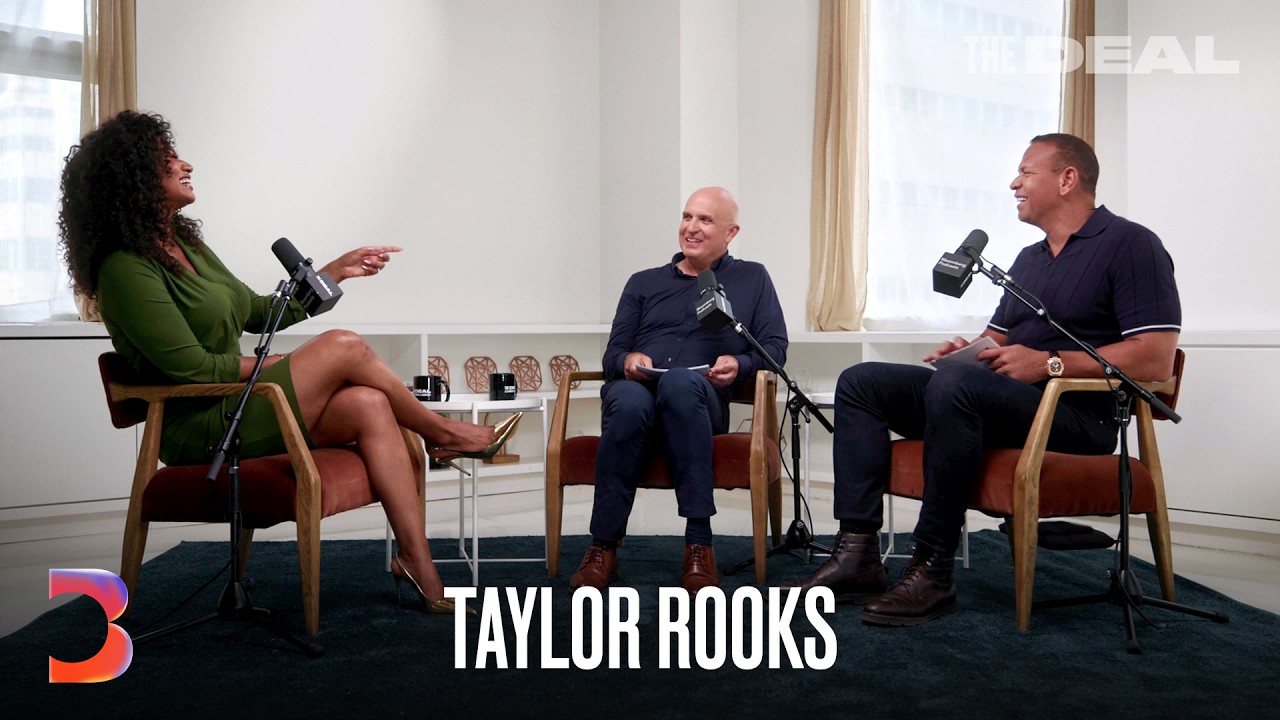
Taylor Rooks transitioned from long-form feature reporter to main studio host for Prime Video's NBA coverage, managing an analyst desk featuring Dirk Nowitzki, Blake Griffin, Steve Nash, and Udonis Haslem. (2:51)
Rooks anchors her commercial endorsements in financial literacy partnerships with Invesco and Experian, using mandatory contract carve-outs to fund her philanthropic initiatives. (13:34)
Through her charitable foundation and a partnership with Undue Medical Debt, Rooks eliminated $2 million in medical debt for residents in Gwinnett County, Georgia. (16:58)
Expanding beyond sports media, Rooks is developing a consumer conversation card game and a scripted television series aimed at growing her female audience and household brand recognition. (16:58)
Detailed notes
## Background
Published on YouTube by Bloomberg Originals on October 29, 2026, this episode of The Deal features sports broadcaster Taylor Rooks in conversation with hosts Alex Rodriguez and Jason Kelly. According to the show's description, the interview explores Rooks's breakout year—including hosting Prime Video's NBA studio show, reporting for Thursday Night Football, and starring in a Wingstop commercial—while examining the interview techniques and business strategies she uses to build her personal brand.
## TL;DR
Taylor Rooks details her progression from a long-form interviewer to hosting Prime Video's live NBA on Prime studio show, framing the anchor role as an unselfish point guard responsible for elevating the entire analyst desk. She outlines her philosophy of treating interviews like a dynamic tennis match rather than an interrogation to break through athletes' rehearsed public relations scripts. Rooks also unpacks her broader business framework, which connects brand partnerships with financial literacy and contractual charitable carve-outs, such as wiping out $2 million in medical debt in Georgia. Finally, she and the hosts discuss her deliberate expansion beyond traditional male sports demographics into consumer products, scripted television, and female consumer markets.
## Atmosphere & style
The conversation carries an energetic, insider boardroom tone characterized by mutual respect, professional shop talk, and collegiate rapport between media veterans. Rodriguez brings playful, lived athlete-broadcaster camaraderie—joking about avoiding Rooks's disarming interview style—while Kelly steers the discussion with precise business inquiries. Rooks speaks with poised, measured clarity, creating an engaging and aspirational rhythm as she reflects on ego suppression, philanthropic responsibility, and scaling an authentic brand across diverse entertainment verticals.
## Bulletin
- [02:51](https://www.youtube.com/watch?v=gqBsXazKqx0&t=171s) Taylor Rooks transitioned from long-form feature reporter to main studio host for Prime Video's NBA coverage, managing an analyst desk featuring Dirk Nowitzki, Blake Griffin, Steve Nash, and Udonis Haslem.
- [13:34](https://www.youtube.com/watch?v=gqBsXazKqx0&t=814s) Rooks anchors her commercial endorsements in financial literacy partnerships with Invesco and Experian, using mandatory contract carve-outs to fund her philanthropic initiatives.
- [16:58](https://www.youtube.com/watch?v=gqBsXazKqx0&t=1018s) Through her charitable foundation and a partnership with Undue Medical Debt, Rooks eliminated $2 million in medical debt for residents in Gwinnett County, Georgia.
- [16:58](https://www.youtube.com/watch?v=gqBsXazKqx0&t=1018s) Expanding beyond sports media, Rooks is developing a consumer conversation card game and a scripted television series aimed at growing her female audience and household brand recognition.
## Key takeaways
- [00:00](https://www.youtube.com/watch?v=gqBsXazKqx0&t=0s) Rooks avoids rigid career milestones because past achievements quickly exceeded her initial self-imposed boundaries.
- [00:45](https://www.youtube.com/watch?v=gqBsXazKqx0&t=45s) Anchoring a live studio broadcast requires a selfless mindset distinct from interviewing, as the host's primary duty is directing traffic so analysts shine.
- [02:51](https://www.youtube.com/watch?v=gqBsXazKqx0&t=171s) The Prime Video NBA studio desk was designed to break conventional broadcast molds by integrating interactive on-court demonstrations with former players.
- [03:55](https://www.youtube.com/watch?v=gqBsXazKqx0&t=235s) Rooks initially hesitated to host the NBA desk because she had narrowly defined herself as an interviewer, highlighting how self-perception can limit career possibilities.
- [05:21](https://www.youtube.com/watch?v=gqBsXazKqx0&t=321s) NFL coverage often centers the corporate franchise shield, prompting Rooks to import an NBA-style narrative approach that humanizes the individual athlete first.
- [07:24](https://www.youtube.com/watch?v=gqBsXazKqx0&t=444s) Studying Ernie Johnson taught Rooks that master studio hosts suppress their own egos and rely on off-camera relationships to read live body language instinctively.
- [10:20](https://www.youtube.com/watch?v=gqBsXazKqx0&t=620s) Great interviews function like tennis matches rather than interrogations, demanding active listening and real-time volleys instead of rigidly serving pre-planned questions.
- [11:20](https://www.youtube.com/watch?v=gqBsXazKqx0&t=680s) Effective interview preparation involves analyzing an athlete's prior media appearances to avoid worn PR talk tracks and probe what was previously deflected.
- [14:10](https://www.youtube.com/watch?v=gqBsXazKqx0&t=850s) Brand partnerships with Invesco and Experian were built around financial education and NIL guidance for young student-athletes.
- [16:10](https://www.youtube.com/watch?v=gqBsXazKqx0&t=970s) Rooks structures commercial contracts with mandatory financial carve-outs dedicated directly to funding her foundation's community relief efforts.
- [16:58](https://www.youtube.com/watch?v=gqBsXazKqx0&t=1018s) Direct philanthropic relief initiatives include erasing $2 million in medical debt, distributing college scholarships with Saquon Barkley, and providing basic needs assistance.
- [18:55](https://www.youtube.com/watch?v=gqBsXazKqx0&t=1135s) To build an enduring business beyond sports media, Rooks is intentionally courting female consumers who control the vast majority of household purchasing power.
- [20:49](https://www.youtube.com/watch?v=gqBsXazKqx0&t=1249s) Alex Rodriguez points to a market arbitrage opportunity in funding female-led businesses, noting women drive over 50% of household consumption despite receiving only ~1% of venture capital.
## Detailed walkthrough
### [00:00](https://www.youtube.com/watch?v=gqBsXazKqx0&t=0s) The Rocket Ship Trajectory and Stepping up to the Desk
Taylor Rooks frames her career philosophy around never restricting herself to rigid milestones, pointing out that every time she envisioned a concrete goal, the ultimate reality turned out vastly bigger. Co-hosts Jason Kelly and Alex Rodriguez introduce Rooks as one of the busiest, fastest-rising forces in media. Rodriguez compares her multifaceted skill set to a rare blend of three cultural giants: interviewing with the depth of Oprah Winfrey, hosting with the steady command of Ernie Johnson, and curating sports, media, and culture like Martha Stewart.
Rodriguez, noting he has had a front-row seat to her ascent, asks Rooks whether she feels the intensity of her breakout year. Rooks confirms that while it feels strange to identify the present as her major breakthrough, taking the main host chair represents a decisive shift. She explains that while interviewing remains her first love because of the raw curiosity it demands, anchoring a live studio broadcast requires a selfless mindset. As host, her responsibility is directing traffic so that every analyst shines and the home viewer enjoys an effortless broadcast.
“And interviewing is probably my favorite aspect of the job. I always want to be doing that. I enjoy having the conversations. I enjoy being curious and getting to know somebody else. But this idea of having a job that in many ways is very selfless because my job is to make sure everybody on the desk has a good show.” — Taylor Rooks
- Rooks serves as host for Prime Video’s *NBA on Prime* studio coverage.
- She concurrently works as the headline features reporter on Amazon’s *Thursday Night Football*.
- She describes anchoring the live NBA desk as her “most big girl job” to date, providing an authoritative, well-rounded media footprint.
---
[02:51](https://www.youtube.com/watch?v=gqBsXazKqx0&t=171s) Launching *NBA on Prime* and Shifting from Interviewer to Host
When Prime Video built its NBA coverage, sports media was undergoing broad disruption as networks searched for modern formats. Rooks approached the studio desk determined to reject the notion that a show must mimic traditional broadcasts simply because that was how things had always been done. She designed an energetic, informative, and authentic format where analysts Blake Griffin, Dirk Nowitzki, Udonis Haslem (UD), and Steve Nash use an on-set basketball court for live breakdowns and demonstrations. Her objective was to balance serious player critiques without letting them devolve into personal attacks, all while maintaining an unpretentious atmosphere.
When Rodriguez asks how the high-profile assignment originated, Rooks explains that her four years working on *Thursday Night Football* naturally positioned her within Amazon when rumors surfaced that the company was bidding for NBA media rights. When executive conversations turned toward her potentially anchoring the basketball desk, she initially hesitated because she had pigeonholed herself strictly as a long-form interviewer. Overcoming that mental barrier taught her not to let narrow self-perception limit her career trajectory, just as she had earlier pushed past being known exclusively as a basketball reporter to cover the NFL.
“And Amazon started having these conversations with me about hosting the show and what that would look like and if I had considered it. And by the way, the truth is I had not considered myself as a host. I considered myself as an interviewer and I had to reach a point where I realized my thought about myself was limiting my possibilities.” — Taylor Rooks
```mermaid
flowchart TD
accTitle: Evolution of Taylor Rooks at Amazon Prime Video
accDescr: Diagram illustrating Taylor Rooks progression from Thursday Night Football features reporter to hosting the NBA on Prime studio desk.
subgraph NFL ["Thursday Night Football Role"]
A["Joined TNF Coverage"] --> B["Conducted Star Feature Interviews"]
B --> C["Established On-Air Footprint with Amazon"]
end
subgraph Expansion ["Mindset & Rights Expansion"]
C --> D["Amazon Pursues NBA Broadcast Rights"]
D --> E["Internal Push: Reframe from Interviewer to Host"]
end
subgraph NBA ["NBA on Prime Studio Desk"]
E --> F["Anchors New Interactive Studio Show"]
F --> G["Integrates Court Demos: Dirk, Blake, UD, Nash"]
end
```
---
[05:21](https://www.youtube.com/watch?v=gqBsXazKqx0&t=321s) *Thursday Night Football* and Humanizing the Player
Kelly asks Rooks how working on the startup years of *Thursday Night Football* informed her basketball hosting style. Rooks credits lead host Charissa Thompson with establishing the tone for Amazon's sports productions, noting that Thompson excelled at mentoring former athletes on how to translate their knowledge into polished television talent. In her own lane conducting marquee weekly feature sit-downs for the pregame show and reporting for *Nightcap*, Rooks consciously imported an NBA-style narrative approach into the NFL ecosystem.
Rooks cites an insight shared with her by analyst Richard Sherman: the NFL’s logo is a corporate shield, whereas the NBA’s logo is a person. In football culture, interviews almost universally default to team dynamics, execution, and outcomes. Rooks deliberately centers the individual rather than the institution. By uncovering who the player is as a human being first, she finds that discussions about team performance and game results naturally follow, preventing individual identity from being swallowed by the franchise.
“Richard Sherman once said this to me and it's so true, it's that the NFL logo is a shield. The NBA logo is a person, but that shows in also how they speak about themselves and what they decide to speak about.” — Taylor Rooks
---
[07:24](https://www.youtube.com/watch?v=gqBsXazKqx0&t=444s) The Host as Point Guard: Lessons from Burkhardt and Ernie Johnson
Rodriguez links top studio shows to having an elite point guard at the desk, comparing the role to Magic Johnson, Kevin Burkhardt on Fox's MLB coverage, Charissa Thompson on the NFL, and Ernie Johnson on *Inside the NBA*. Rooks agrees, recalling that she reached out to Burkhardt for advice when she first started at SportsNet New York (SNY) covering the Mets. Burkhardt was immediately generous with his guidance despite not knowing her previously.
Having observed Ernie Johnson up close during her tenure at Turner Sports (TNT), Rooks identifies Johnson’s defining genius: complete ego suppression. Johnson understands the broadcast is never about him. He tracks his personnel intimately, orchestrating chaotic debates between Charles Barkley and Shaquille O'Neal with the precision of a master traffic cop. He knows precisely when to let the set run wild and when to pull back. Rodriguez and Rooks note that this chemistry is forged off-camera—such as the three-hour dinners Rodriguez shares with Burkhardt, David Ortiz (Big Papi), and Derek Jeter—enabling a host to read body language and eye contact instantly during live television.
“It's because he knows that it is not about him. And he always knows who is the person to tap in. It's like he knows his guys, he knows his personnel, he knows when to be quiet.” — Taylor Rooks
- Rooks and Burkhardt both developed early on at regional network SNY in New York.
- Great hosts act as unselfish point guards whose primary function is elevating their analyst panel.
- Chemistry relies heavily on off-air rapport, giving hosts the intuitive ability to read eye movements and know instantly when an analyst wants the floor.
[10:20](https://www.youtube.com/watch?v=gqBsXazKqx0&t=620s) The Art of the Interview as a Tennis Match
Taylor Rooks and Jason Kelly discuss the mechanics of hosting and interviewing elite talent. Rooks explains that on set, she is constantly monitoring her co-hosts for subtle cues; for instance, if Blake Griffin raises a finger, she knows immediately to let him take the floor. Kelly points out that interviewing reaches its pinnacle when a subject reveals something so candid that they blurt out, “I can't believe I'm telling you this.” Alex Rodriguez jokes that as an athlete who spent years deliberately avoiding those exact moments, he would never want to sit across from Rooks because “she'll take my arteries out and do it with a smile.”
Rooks describes her interviewing philosophy as entering every session with the explicit objective of finding something entirely unmined. She emphasizes that athletes often walk into rooms preceded by fixed media narratives, turning standard press interactions into self-fulfilling prophecies. To bypass the rehearsed PR talk track, she studies prior profiles and video footage to observe what athletes engage with and, crucially, what they deflect. She likens the interview to a tennis match rather than an interrogation:
> “To me, interviews are like, it's like a tennis match. And I think that sometimes the interviewer thinks that their only role in the tennis match is to serve, when really your role is to also hit the ball back.”
- Rooks monitors non-verbal cues from co-panelists (e.g., Blake Griffin raising a finger) to keep live television fluid.
- Preparation involves charting prior interviews to avoid repeat questions and identify dead-end talk tracks.
- Effective follow-ups are often disarmingly simple, such as asking “why?” or “what do you mean?”
- Her personal benchmark for success is whether the subject discloses something entirely new; otherwise, she views the session as a missed opportunity.
---
[13:34](https://www.youtube.com/watch?v=gqBsXazKqx0&t=814s) Building the Business of Taylor Rooks
Kelly shifts the conversation from broadcasting craft to the commercial architecture of "the business of Taylor," noting that approaching sports media as an overarching brand from the outset is rare. Rooks explains that while being a premier journalist, host, and interviewer remains the core engine, she refuses to let narrow dreams set arbitrary boundaries. Early in her career, she set a goal to host her own show, but once she attained it quickly, she realized that predefined milestones can become self-imposed ceilings.
Rodriguez asks whether her corporate partnerships are driven proactively by an internal marketing roadmap or reactively based on incoming inbound interest. Rooks notes that it is a hybrid model anchored in thematic alignment. For example, she prioritized financial literacy to help young athletes navigate their finances and the newly emerged NIL (Name, Image, and Likeness) environment. This intentional focus guided her to an initial four-year partnership with Invesco, followed by a collaborative deal with Experian.
```mermaid
flowchart TD
accTitle: Value-Aligned Business Partnership Framework
accDescr: Taylor Rooks' strategic partnership model linking brand alliances to core values and charitable carve-outs.
subgraph CoreEngine["Core Brand Engine"]
Host["Host / Journalist / Interviewer"]
end
- Early career goals were reached so fast that she abandoned static milestones to avoid capping her own growth potential.
- She worked with Invesco for four years traveling to college campuses to educate student-athletes on handling NIL compensation.
- She partners with Experian to continue promoting consumer financial education.
- Modern endorsement contracts negotiated by her team routinely include mandatory carve-outs that directly fund her charitable foundation.
---
[16:58](https://www.youtube.com/watch?v=gqBsXazKqx0&t=1018s) Philanthropic Relief and Expanding Beyond Sports
Rodriguez highlights Rooks' recent major charitable contributions. Rooks shares that her foundation joined forces with the nonprofit Undue Medical Debt to wipe out $2 million in medical debt for residents in her hometown of Gwinnett County, Georgia. She notes that medical debt places an undue burden on families and should not exist in America. Beyond systemic debt relief, the foundation targets immediate basic human needs, ranging from utility and rent relief during the holidays to stocking classrooms for educators, as well as joint collegiate scholarships with NFL star Saquon Barkley ($10,000 to a student at her alma mater, the University of Illinois, and $10,000 to a student at his alma mater, Penn State).
When asked about her future trajectory, Rooks references the scene in *The Lion King* where Mufasa shows Simba the vast kingdom, expressing that she feels boundless potential ahead. She reveals she is currently developing a consumer conversation card game intended for homes, alongside developing a scripted television series. Rooks outlines her commercial strategy: while any sports fan at Madison Square Garden might recognize her, her goal is to achieve household recognition in everyday spaces like the local supermarket. Central to this strategy is intentionally building a larger female audience, recognizing that while sports broadcasting skews male, women drive the overwhelming majority of consumer spending.
> “And the honest aspect of what I do as a woman working in sports is your fan base is mostly male. I think that where the real actual business is, is with women, and it is important to me to have a larger base of women because it is what's the most true to me.”
- **Medical Debt Relief:** Abolished $2,000,000 in local medical debt for families across Gwinnett County, Georgia.
- **Academic Grants:** Partnered with Saquon Barkley to distribute two $10,000 scholarships split between the University of Illinois and Penn State University.
- **Direct Aid:** Provided emergency utility, phone, and rent relief during the holidays and funded school supply drives for teachers.
- **Product & IP Development:** Actively developing both a home conversation card game and a scripted television project.
- **Audience Diversification:** Expanding deliberately from a predominantly male sports demographic into the female consumer space that commands broader household spending.
[20:49](https://www.youtube.com/watch?v=gqBsXazKqx0&t=1249s) Embracing Multitudes and the Venture Capital Arbitrage for Women
Taylor Rooks explains that she welcomes reaching different audiences across distinct verticals, whether someone connects with her through sports reporting, lifestyle and fashion, or gaming. As she puts it, people are complex and do not need to be confined to a single lane: “All of that is fine because you are full of multitudes and people can know you for different things.” She embraces having diverse impacts and meeting audiences wherever their interests lie.
Alex Rodriguez then steps in, picking up on a tennis metaphor that Jason Kelly had started earlier, joking that while they have been volleying back and forth, he is stepping up to swing the bat with one final serve. He links back to Kelly's observation that to truly reach consumers in the home, one must engage the woman of the house, who effectively manages the household checkbook. Rodriguez frames this consumer reality against the stark imbalance in fundraising:
> “99% of institutional capital goes to the boys, right? About 1% goes to women, especially in tech up in the Bay Area.”
Rodriguez argues that this disparity creates a massive arbitrage opportunity. Because women control and make purchasing decisions for more than half of household consumption, the capital allocated to female founders should drastically exceed the current one percent benchmark. He tells Rooks that this glaring delta represents both her leverage point and her biggest market opening as she scales her brand. The hosts wrap up the conversation by celebrating Rooks's ambition to see her own branded products in supermarkets, wishing her continued success on her rapid rise across media and business.
- **Venture capital distribution**: Rodriguez highlights that roughly 99% of institutional capital flows to male-led ventures, with only about 1% directed toward female entrepreneurs, especially within the Bay Area tech ecosystem.
- **Consumer influence vs. capital allocation**: Despite women controlling more than 50% of household spending and consumption, they receive a tiny fraction of venture backing, creating a significant commercial and investment upside for builders like Rooks.
## Notable quotes
> [10:20](https://www.youtube.com/watch?v=gqBsXazKqx0&t=620s) To me, interviews are like, it's like a tennis match. And I think that sometimes the interviewer thinks that their only role in the tennis match is to serve, when really your role is to also hit the ball back. — Taylor Rooks
## Mentioned
Taylor Rooks, Alex Rodriguez, Jason Kelly, Prime Video, NBA on Prime, Thursday Night Football, Wingstop, Oprah Winfrey, Ernie Johnson, Martha Stewart, Blake Griffin, Dirk Nowitzki, Udonis Haslem, Steve Nash, Charissa Thompson, Richard Sherman, Kevin Burkhardt, Magic Johnson, Inside the NBA, SNY, Turner Sports, Charles Barkley, Shaquille O'Neal, David Ortiz, Derek Jeter, Invesco, Experian, Undue Medical Debt, Saquon Barkley, University of Illinois, Penn State University, The Lion King
## Video description
Taylor Rooks became the host of Prime Video’s NBA studio show, broke news for NFL Thursday Night on Prime and even starred in a Wingstop commercial – and all just this year. In this episode of The Deal, Rooks tells Alex Rodriguez and Jason Kelly what she’s learned from interviewing some of the biggest-name athletes and how she wants to keep building her brand.
--------
Like this video? Subscribe: http://www.youtube.com/Bloomberg?sub_confirmation=1
Get unlimited access to Bloomberg.com for just $1.99 your first month: https://www.bloomberg.com/subscriptions?in_source=YoutubeOriginals
Bloomberg Originals offers bold takes for curious minds on today’s biggest topics. Hosted by experts covering stories you haven’t seen and viewpoints you haven’t heard, you’ll discover cinematic, data-led shows that investigate the intersection of business and culture. Exploring every angle of climate change, technology, finance, sports and beyond, Bloomberg Originals is business as you’ve never seen it.
Subscribe for business news, but not as you've known it: exclusive interviews, fascinating profiles, data-driven analysis, and the latest in tech innovation from around the world.
Visit our partner channel Bloomberg News for global news and insight in an instant.
泰勒·鲁克斯如何将个人姓名打造成品牌 | The Deal
Taylor Rooks详细讲述了自己从深度访谈记者到担任Prime Video旗下“NBA on Prime”直播演播室主持人的进阶历程,并将主播角色比作无私的控球后卫,肩负着带动整个分析师团队的责任。她阐述了自己的理念,即将采访视为充满变化的网球比赛而非盘问,以此打破运动员预先排练好的公关话术套路。此外,Rooks还剖析了她更广泛的商业架构,该架构将品牌合作与金融素养以及合同中载明的慈善条款相结合,例如免除佐治亚州200万美元的医疗债务。最后,她与主持人们讨论了自己如何有意识地突破传统男性体育受众群体,向消费品、电视剧集和女性消费市场拓展。
Taylor Rooks已从深度专题记者转型为Prime Video NBA赛事报道的主演播室主持人,负责掌控包括Dirk Nowitzki、Blake Griffin、Steve Nash和Udonis Haslem在内的分析师团队。 (2:51)
Rooks将商业代言建立在与Invesco和Experian合作推广金融素养的基础之上,并利用强制性的合同特别条款来资助其慈善计划。 (13:34)
通过其慈善基金会以及与Undue Medical Debt的合作,Rooks为佐治亚州格威内特县的居民免除了200万美元的医疗债务。 (16:58)
在体育媒体之外,Rooks正拓展业务,开发一款面向大众消费者的对话卡牌游戏以及一部电视剧集,旨在扩大女性受众群并提升家喻户晓的品牌知名度。 (16:58)
Reading summary
Broadcaster Taylor Rooks is leveraging high-profile studio anchoring and feature interviewing across the NBA and NFL into a diversified enterprise spanning consumer products, corporate partnerships, and targeted philanthropy.
Pivoting from Interviewer to Live Studio Host (2:51)
Rooks's expansion within Amazon began as a marquee feature reporter on Thursday Night Football, where she imported NBA-style human-interest narratives into an NFL culture she notes is historically dominated by team-first institutional branding. When Amazon pursued NBA rights, Rooks initially hesitated about anchoring because she viewed herself strictly as a long-form interviewer. Overcoming that mental constraint led her to host NBA on Prime, directing an interactive desk featuring Blake Griffin, Dirk Nowitzki, Udonis Haslem, and Steve Nash.
Rooks treats live hosting like playing point guard, drawing on lessons from Ernie Johnson and Kevin Burkhardt. Rather than centering herself, her primary function on set is ego suppression and traffic direction, monitoring non-verbal cues—such as a panelist raising a finger—to set up analysts for success. In contrast, she approaches one-on-one interviews like a tennis match, studying past profiles to avoid repetitive PR answers and actively hitting the conversational ball back to prompt unmined, authentic disclosures.
Corporate Partnerships and Contractual Philanthropy (13:34)
Rather than relying on static milestones, Rooks scales her business by aligning corporate endorsements with personal focus areas. She prioritized financial literacy around collegiate Name, Image, and Likeness (NIL) rules, leading to a four-year engagement with Invesco and a subsequent partnership with Experian. Modern commercial deals negotiated by her team routinely mandate carve-outs that directly finance her philanthropic foundation.
Through this foundation, Rooks partnered with the nonprofit Undue Medical Debt to abolish $2 million in medical debt for families across Gwinnett County, Georgia. Her charitable footprint also includes emergency holiday utility and rent relief, classroom supplies for teachers, and joint $10,000 academic scholarships with NFL running back Saquon Barkley for students at the University of Illinois and Penn State.
Expanding Beyond Sports into Female Consumer Spaces (16:58)
To build a brand recognizable outside traditional sports venues, Rooks is expanding into entertainment and consumer IP, developing both a scripted television project and a home conversation card game. She intentionally focuses on cultivating a female audience, noting that while sports journalism defaults to a predominantly male following, women drive the majority of domestic purchasing decisions.
Co-host Alex Rodriguez frames this strategic pivot as a massive market arbitrage. Pointing out that female founders receive only around 1% of institutional venture capital despite women controlling over half of household spending, Rodriguez argues that targeting this undercapitalized demographic positions Rooks for outsized commercial scale as her enterprise reaches mainstream retail environments.
Rooks's growth model demonstrates how sports media figures can transcend the anchor desk, though scaling beyond a core male sports following into broader consumer retail and media production tests whether cross-vertical audience conversion can match traditional sports engagement.
精炼阅读摘要
体育媒体人Taylor Rooks通过从深度专访转向演播室主控主持,不仅确立了其在跨联盟体育转播中的核心地位,更依托契合个人价值观的商业合作与慈善架构,将个人影响力拓展至大众消费市场与更广泛的女性受众群体。
演播室主持的角色重塑与控场哲学 (0:00)
在执掌Prime Video的《NBA on Prime》演播室期间,Rooks经历了从传统长篇专访特写向演播室主控主持的认知转变。她坦言,专访源于对个体的纯粹好奇心,而担任直播演播室主持则是一项高度“无私”的工作,其核心职责在于调配节奏、引导话题流动,确保Blake Griffin、Dirk Nowitzki、Udonis Haslem和Steve Nash等前职业球员解说嘉宾能够展现专业见解。为此,节目打破了传统转播的固定模版,引入演播室内真实球场进行战术拆解与动作演示,在严肃技术分析与避免人身攻击之间寻找平衡。
在主持技巧上,Rooks借鉴了Ernie Johnson和Kevin Burkhardt等资深主播的经验,将主持人比作篮球场上的组织后卫(控卫),其关键在于抑制个人表现欲,精准识别人事动态并洞悉何时保持沉默。她通过场下与解说嘉宾建立日常默契,从而在直播中敏锐捕捉非语言信号(例如嘉宾举起手指表示意发言),维持多方对话的自然衔接与张力。
突破公关话术的网球式专访方法论 (5:21)
在兼任Amazon《Thursday Night Football》赛事特写记者与演播室工作期间,Rooks将专访定义为来回击球的“网球赛”,而非单向发问的审讯。她指出,许多专访者误以为自身任务仅是“发球”,但真正的高水准对谈取决于接球反击与跟进深度。由于职业运动员常带着预设的公关口径和固化媒体形象进入采访间,她会预先研判受访者过往的采访视频,标记出对方主动投入的领域以及刻意回避的话题。
Rooks设定专访成功的基准是受访者能否吐露此前从未公开过的新信息。她常通过“为什么?”或“你具体指什么?”等极简但具有穿透力的追问打破受访者的心理防御。此外,她将NBA以人为核心的叙事风格移植到更强调球队整体执行力的NFL报道中,落实分析师Richard Sherman提出的“NFL标志是盾牌,而NBA标志是人”的观察,坚持先探究球员作为真实个体的内心世界,再延伸探讨团队比赛与技战术成果。
以价值观契合为锚点的商业与慈善体系 (13:34)
在拓展个人商业品牌过程中,Rooks放弃了设定具体职业阶段目标的做法,认为过早达成的静态目标容易变成限制长期发展的隐形天花板。她的商业代言采取混合驱动模式,优先选择与个人理念相契合的主题。围绕帮助年轻运动员与学生群体适应NIL(姓名、形象及肖像权)新规以及普及财务素养的诉求,她先后与Invesco开展为期四年的校园巡回宣讲,并与Experian建立消费者财务教育合作。
商业回报被系统性地反哺于公共福祉。Rooks的团队在所有商业赞助谈判中,常规化地纳入向其个人慈善基金会注资的强制性条款。在具体行动上,其基金会联合非营利机构Undue Medical Debt,为其家乡佐治亚州格威内特县(Gwinnett County)居民免除了200万美元的医疗债务;同时,她还与NFL球星Saquon Barkley合作设立学术奖学金,分别向伊利诺伊大学和宾夕法尼亚州立大学的学生提供各1万美元资助,并持续提供假日水电租金援助和教师物资支持。
跨界破圈与女性消费市场的商业套利空间 (20:49)
Rooks将个人品牌目标设定为超越传统体育场馆的知名度,力求在普通超市等日常消费场景中建立广泛认知。她正在开发面向家庭场景的对话卡牌游戏以及一部有剧本的电视系列剧。她指出,尽管体育转播受众长期以男性为主,但现实中家庭消费的大部分支出决策由女性主导,因此有意识地拓展女性粉丝群体是构筑长远商业版图的核心基石。
针对这种市场结构,播客联合主持人Alex Rodriguez指出,当前风投资本配置与实际消费影响力之间存在严重错位。Rodriguez提出,约99%的机构资本流向了男性主导的项目,而女性创业者(尤其在旧金山湾区科技生态中)仅获得约1%的资本;与此同时,女性掌控着超过半数的家庭消费支出。这种极端不对称创造了巨大的市场套利机会,为能够深度触达并连接女性消费群体的商业构建者提供了极具潜力的溢价空间。
Taylor Rooks展示了一条从专业体育出镜记者向综合型商业IP跨越的路径。然而,其从男性主导的体育媒介生态跨界至大众消费品与影视IP开发的探索,能否顺利打破固有受众画像壁垒并在家庭消费级市场实现持续变现,仍有待未来具体产品落地后的市场检验。
Detailed notes — zh
## Background
本期节目由彭博原创频道(Bloomberg Originals)于 2026 年 10 月 29 日在 YouTube 平台发布。节目简介指出,体育主持人泰勒·鲁克斯(Taylor Rooks)在这一年中兼任了 Prime Video 的 NBA 演播室主播与《周四橄榄球之夜》(TNF)记者,本期《The Deal》由亚历克斯·罗德里格斯(Alex Rodriguez)与杰森·凯利(Jason Kelly)主持,深入探讨她对顶尖运动员的采访哲学以及打造个人商业品牌的野心。
## TL;DR
在访谈中,泰勒·鲁克斯复盘了自己从一对一深度记者转型为主播台控场核心的职业跃升,并分享了如同网球对攻般避开公关套话、逼出受访者内心启示的采访技巧。随后,她详细阐述了以自身价值观为导向的商业代言逻辑,包括推动年轻群体财商素养教育,并在所有商业赞助中硬性绑定慈善捐款。面对未来,她公布了正在研发的家庭互动卡牌和影视编剧项目,旨在通过“超级市场测试”走出单一体育圈层,在女性掌握多数家庭支出但机构资本分配悬殊的现实中把握巨大商业套利空间。
## Atmosphere & style
对谈整体充满干货且极具启发性,既有老友重聚般轻松风趣的行内调侃,又洋溢着对传媒商业运作的严密洞察。两位主持人对鲁克斯报以极高赞誉,从类比 Oprah 与 Ernie Johnson 到精准剖析“微笑着直击痛处”的采访风格,现场互动默契十足、节奏张弛有度。在探讨慈善免除医疗债务以及开拓女性商业市场时,鲁克斯展现出兼具人文关怀与宏大野心的成熟从容,带给观众极强的专业感召力。
## Bulletin
- [01:05](https://www.youtube.com/watch?v=gqBsXazKqx0&t=65s) Taylor Rooks 实现了从深度采访记者到 Prime Video NBA 演播室主播的转型,并继续兼顾《周四橄榄球之夜》(TNF)的赛事报道。
- [13:34](https://www.youtube.com/watch?v=gqBsXazKqx0&t=814s) 在品牌代言合作中,Rooks 坚持设立硬性条款,要求合作品牌将赞助资金的一部分直接注入其个人慈善基金会。
- [16:59](https://www.youtube.com/watch?v=gqBsXazKqx0&t=1019s) Rooks 慈善基金会与非营利机构合作,全额免除了其家乡佐治亚州格威内特县高达 200 万美元的民众医疗债务。
- [18:25](https://www.youtube.com/watch?v=gqBsXazKqx0&t=1105s) 面向更广泛大众市场破圈,Rooks 宣布正拓展一款家庭互动对话卡牌游戏以及一部编剧类虚构剧集项目。
- [21:10](https://www.youtube.com/watch?v=gqBsXazKqx0&t=1270s) Alex Rodriguez 指出,目前仅约 1% 的机构资本流向女性创始人,而女性掌控超 50% 的家庭消费,这种巨大落差构成了极具潜力的商业套利空间。
## Key takeaways
- [00:00](https://www.youtube.com/watch?v=gqBsXazKqx0&t=0s) Alex Rodriguez 将 Taylor Rooks 的特质归结为三位标杆的结合:Oprah 的访谈深度、Ernie Johnson 的控场沉稳感以及 Martha Stewart 的跨界聚合力。
- [01:05](https://www.youtube.com/watch?v=gqBsXazKqx0&t=65s) Rooks 将演播室主播定义为一份“无私”的工作,其核心职责并非突出自我,而是调动嘉宾并为观众呈现极致体验。
- [02:51](https://www.youtube.com/watch?v=gqBsXazKqx0&t=171s) 《NBA on Prime》打破传统转播桎梏,通过 Dirk Nowitzki、Blake Griffin、Steve Nash 等退役球星的实战战术演练提供真实且非人身攻击的专业解构。
- [05:21](https://www.youtube.com/watch?v=gqBsXazKqx0&t=321s) 跨界报道 NFL 时,Rooks 突破橄榄球以“盾牌与团队”为核心的传统视角,坚持引入 NBA 式深挖个体人格与故事的采访路径。
- [07:24](https://www.youtube.com/watch?v=gqBsXazKqx0&t=444s) 顶级演播室主持人宛如场上的控球后卫,需掌握在疯狂节奏中保持静默与串联的艺术,并通过细微肢体语言和眼神与搭档实现无缝配合。
- [10:20](https://www.youtube.com/watch?v=gqBsXazKqx0&t=620s) 好的深度访谈如同网球对攻,采访者不能只顾强力发球,而应耐心倾听并追问“为什么”,以此撕掉受访者的常规公关套话。
- [10:20](https://www.youtube.com/watch?v=gqBsXazKqx0&t=620s) Rooks 的专访哲学追求“启示(revelation)”,坚决避开外界先入为主的刻板标签,若无法引导受访者说出新东西即视为未达预期。
- [13:34](https://www.youtube.com/watch?v=gqBsXazKqx0&t=814s) “Taylor 商业版图”的核心是以本职媒体工作为发动机,不设具体天花板,主动围绕财商教育等个人价值观展开品牌绑定。
- [16:59](https://www.youtube.com/watch?v=gqBsXazKqx0&t=1019s) Rooks 旗下慈善基金会专注于精准帮扶,涵盖医疗债务清零、高校奖学金、困难家庭基础账单代缴及基层教师教学物资采买。
- [18:25](https://www.youtube.com/watch?v=gqBsXazKqx0&t=1105s) Rooks 提出“超级市场测试”来衡量破圈成效,战略目标是从体育垂直圈层渗透到普通大众生活场景中。
- [18:25](https://www.youtube.com/watch?v=gqBsXazKqx0&t=1105s) 鉴于电视从业生涯的保质期以及女性在家庭消费中的主导权,Rooks 在稳固男性体育迷基盘的同时,积极布局能与女性群体深度链接的多元业务。
- [20:49](https://www.youtube.com/watch?v=gqBsXazKqx0&t=1249s) Rooks 拥抱个人品牌的多面性,认为一个人本就包含无数可能,乐于被公众从体育解说、时尚穿搭等多重维度来认知。
- [21:10](https://www.youtube.com/watch?v=gqBsXazKqx0&t=1270s) 机构资本与实际消费决策力存在极端不对称:女性掌握超过半数的家庭开支决策,但仅获取约 1% 的机构风投资本,蕴含巨大的商业机遇。
## Detailed walkthrough
### [00:00](https://www.youtube.com/watch?v=gqBsXazKqx0&t=0s) 职业发展与多重身份的融合
节目一开始,Taylor Rooks 分享了自己对于职业目标的宏观思考。她直言自己的目标从来不是一个具体刻板的框架,因为以往每当她去构想一个具体终点时,最后现实的发展都远远超越了当期的设想。在商业与职业规划上,具体的本职工作固然重要,但真正塑造一整段辉煌职业生涯的,往往是那些围绕核心业务展开的各种多元拓展。
主持人 Jason Kelly 与 Alex Rodriguez 随后登场,对 Taylor Rooks 给予了极高的评价。Alex Rodriguez 直言,看到 Taylor Rooks 就会联想到三位标杆人物:她的采访风格有着 Oprah 的细腻与深刻,控场主持时有着 Ernie Johnson 的沉稳与穿透力,而在体育、媒体与流行文化的融合交汇上,她又像是一个体育传媒界的 Martha Stewart,能够把所有人凝聚在一起。
### [01:05](https://www.youtube.com/watch?v=gqBsXazKqx0&t=65s) 主持主播台的蜕变:“这感觉像是我真正意义上的大人工作”
面对 Alex Rodriguez 提及她近年来如火箭升空般的爆红势头,Taylor Rooks 坦言,当最近有人问起她的转折点(big break)在哪里时,她由衷觉得就是眼下的这一刻。坐镇演播室的主播台(desk)参与比赛直播,带给她一种前所未有的权威感与踏实感。虽然一对一采访始终是她最喜爱的核心技能——她享受那种保持好奇心、深入探寻他人的过程——但坐上主持台则是一份极其“无私”的工作。
作为主持人,她的职责不是凸显自己,而是确保主播台上的每一位嘉宾都能呈现出精彩的表现,并让屏幕前的观众获得极致的观看体验。Taylor Rooks 总结道:“And just being at that desk and being such a pivotal part of the actual game experience feels like my most big girl job that I've had.” 能够同时统筹 Prime Video 的 NBA 演播室以及继续承担《周四橄榄球之夜》(Thursday Night Football, TNF)的重任,使她感受到了职业生涯前所未有的全方位与宏大。
### [02:51](https://www.youtube.com/watch?v=gqBsXazKqx0&t=171s) 打造《NBA on Prime》的独特风格与主持契机
谈及 Prime Video 打造的全新 NBA 演播室节目,Taylor Rooks 阐述了她的核心创作理念:“传统如此并不代表未来必须墨守成规”。她希望节目既有趣、充满干货、具有娱乐性,同时又保持真实与接地气。在节目设计中,团队充分利用球场,让嘉宾阵容——Dirk Nowitzki、Blake Griffin、Udonis Haslem(UD)以及 Steve Nash——亲自下场进行实战战术演练,直观拆解给观众看;同时节目要求成员不端架子,学会以非人身攻击的方式去专业点评球员。
谈到获得这个主播席位的过程,Taylor Rooks 透露自己此前已经在 Prime Video 参与了大约四年的《周四橄榄球之夜》报道。当亚马逊传出即将拿下 NBA 版权的风声时,团队开始与她接洽,探讨由她担纲主持的可能性。这一提议最初令她感到意外,因为她一直将自己定义为一名“采访记者”(interviewer)而非“主持人”(host)。她意识到是过去的自我认知限制了发展的可能性,最终选择跳出舒适圈,兼纳两者。
### [05:21](https://www.youtube.com/watch?v=gqBsXazKqx0&t=321s) 从 NFL 盾牌到个人故事:将个人视角注入橄榄球报道
转战橄榄球报道的过程也打破了 Taylor Rooks 自身的心理边界。过去她一直认为自己是专注于篮球的记者,常年深耕 NBA 与 WNBA。在进入 TNF 团队后,她对主持人 Charissa Thompson 的控场与带领退役球星适应电视直播的能力极为钦佩。而在她自己负责的深度专题采访(feature interviews)中,Taylor Rooks 决意将 NBA 式的个性化采访风格带入 NFL。
她援引了 Richard Sherman 曾对她说过的经典比喻:NFL 的标志是一面盾牌,而 NBA 的标志则是一个具体的人。这导致 NFL 球员面对话筒时,往往习惯于把话题收缩至球队、比赛以及胜负的宏观层面上。但在 Taylor Rooks 看来,个体才是最核心的切入点:“I have always been exponentially more interested in the person because if the person is talking, you ultimately get to the team, you get to the game, you get to the wins or the loss.” 只有挖掘出球员有血有肉的人格魅力,故事才会真正立起来,而不是让鲜活的个体湮没在庞大的团队机器中。
### [07:24](https://www.youtube.com/watch?v=gqBsXazKqx0&t=444s) 控球后卫的艺术:从 Ernie Johnson 与 Kevin Burkhardt 看顶尖控场
Alex Rodriguez 将演播室主持人的角色比喻为场上的控球后卫(就像 Magic Johnson),需要调动所有人的潜能。谈及主持的标杆,Taylor Rooks 与嘉宾们分析了 Kevin Burkhardt 与 Ernie Johnson 之所以成为传奇的核心原因。Taylor Rooks 曾与 Kevin Burkhardt 同在纽约的 SNY 电视台共事起步,她盛赞 Burkhardt 乐于分享与助人;而此前在 TNT 工作的经历,更让她近距离领略了 Ernie Johnson 在《Inside the NBA》的掌控力。
在 Taylor Rooks 看来,Ernie Johnson 能够统驭 Charles Barkley 和 Shaquille O'Neal 等巨星的关键,在于他始终明白演播室的焦点不在于他自己。他就像疯狂交通中的交警,既有无限的知识储备与极高的专业敬业度,又精通什么时候该保持沉默、什么时候该切入串联。Alex Rodriguez 也分享了自己在 Fox 演播室与 Kevin Burkhardt、David Ortiz(Big Papi)和 Derek Jeter 的合作默契——他们会通过长达三小时的私下晚宴来培养化学反应,主持人仅凭观察嘉宾的眼神和肢体语言,就能精准把控节目的脉搏。Taylor Rooks 对此深表赞同,表示自己现在只要看搭档的眼神,就能立刻心领神会。
```mermaid
flowchart TD
accTitle: 演播室主持人角色定位与协作流程
accDescr: 展示主持人如何像控球后卫一样调动退役球星,协调节目节奏并传递给受众
subgraph HostRole ["主持人核心素养(以 Ernie Johnson 为范式)"]
A["无私定位:意识到舞台中心不是自己"]
B["精准节奏:知晓何时发问、何时静默"]
C["敏锐洞察:读取眼神与肢体语言"]
end
subgraph StudioCrew ["演播室嘉宾与专家团队"]
D["退役巨星 / 战术分析嘉宾"]
E["球场实战演示与现场互动"]
end
subgraph AudienceImpact ["受众体验"]
F["娱乐性与专业战术解构"]
G["真实不造作的视觉体验"]
end
HostRole -->|"调配话题与节奏"| StudioCrew
StudioCrew -->|"碰撞化学反应"| HostRole
HostRole -->|"输出优质内容"| AudienceImpact
StudioCrew -->|"呈现赛场真实视角"| AudienceImpact
```
### [10:20](https://www.youtube.com/watch?v=gqBsXazKqx0&t=620s) 访谈的艺术:从“常规套话”中逼出真实启示
在演播室主持过程中,主持人与嘉宾之间微妙的肢体语言至关重要。泰勒·鲁克斯(Taylor Rooks)提到,通过长期磨合建立起的默契能让节目完成从优秀到卓越的蜕变。例如在演播室里,只要搭档布莱克·格里芬(Blake Griffin)竖起一根手指,她就知道该把话语权交给他。
谈及鲁克斯标志性的深度专访能力,主持人杰森·凯利(Jason Kelly)指出,鲁克斯身上最令人着迷的地方在于她总能将受访者带入访谈的“极乐境界”——让受访者情不自禁地说出“我简直不敢相信自己居然会对你说这些”。亚历克斯·罗德里格斯(Alex Rodriguez,A-Rod)随即风趣地表示,自己作为曾经接受过无数采访的运动员,最害怕面对的就是鲁克斯这种采访者,并调侃称:“不,绝对不行,她能微笑着把你的动脉抽走,而你甚至都没意识到它们已经没了。”
面对两人的赞叹,鲁克斯剖析了自己的专访哲学。她透露,每次坐到运动员对面时,自己的首要目标就是获得一次“启示(revelation)”。由于公众对运动员的既定印象往往在他们本人进门之前就已笼罩全场,很多采访很容易沦为预设剧本的自我应验,记者总在重复外界已有的刻板叙事。鲁克斯在做案头准备时,不仅是搜集信息,更是在观察受访者对哪些话题有真实反应,从而坚决避开那些千篇一律的官方套话(talk track)。
鲁克斯将一场好的访谈比作网球比赛:“对我来说,采访就像一场网球比赛;我认为有时候采访者会以为自己在比赛中的唯一角色就是发球,但实际上你的角色还包括把球打回去。”如果采访者永远只想快速发出下一记重炮,受访者就无法放松;只有保持耐心的来回对攻(volley)并辅以“为什么”或“你具体指什么”的自然追问,才能挖出未曾公开的真实故事。
```mermaid
flowchart TD
accTitle: 泰勒·鲁克斯的深度访谈流程
accDescr: 展示从避免刻板印象、抛弃常规套话到网球式对攻互动的深度专访逻辑。
subgraph 准备阶段
A["打破既定刻板印象<br/>不让预设标签主导对话"] --> B["研判既往受访表现<br/>剔除重复的常规套话"]
end
subgraph 互动阶段
B --> C["网球式动态对攻<br/>不执着于单向发球"]
C --> D["精准追问与倾听<br/>探寻'为什么'与核心意图"]
end
subgraph 最终目标
D --> E["达成真情流露与启示<br/>挖掘从未公开的故事"]
end
```
- 鲁克斯强调,如果一场专访没有让对方说出全新的东西,她在内心就会觉得自己这次采访失败了。
- 优秀专访的核心在于撕掉外界预设的故事外衣,直抵受访者最真实的内心根源。
---
### [13:34](https://www.youtube.com/watch?v=gqBsXazKqx0&t=814s) 打造“泰勒品牌”与价值驱动的商业布局
当话题转向“泰勒商业版图”(The Business of Taylor)的构建时,鲁克斯坦言自己从职业生涯早期就意识到自己在玩一场“不同的游戏”。尽管主持人、记者和采访者的本职工作始终是核心基石,但这一核心也是驱动其他一切商业机遇的发动机。她谈到,年轻时人们常问她的梦想是什么,她回答是拥有自己的节目;然而当几年后真正拥有了自己的节目时,她反而反思自己是否把梦想定得太小了。因此,她不再将职业目标局限在某个具体节点,而是追求无上限的可能性。
在商业合作模式上,A-Rod 询问她究竟是主动出击列出心仪企业名单,还是被动接听商业邀约电话。鲁克斯表示二者兼有,但最核心的逻辑是“围绕自身价值观进行主动绑定”。例如,她对提升年轻群体的财商素养(financial literacy)极具热情,希望能赋能年轻群体尽早掌握金钱管理与实现财务自由。
为此,她的经纪团队主动接洽并促成了与景顺(Invesco)长达四年的合作,期间她深入多所高校向年轻运动员普及大学生 NIL(姓名、形象及肖像权)商业收入的管理方法。在与景顺的合作告一段落后,她又与益博睿(Experian)建立了深度合作伙伴关系,共同推动大众财务健康与金融信用教育。
在谈到如今签署所有商业赞助协议的原则时,鲁克斯分享了一条硬性标准,她明确对合作品牌提出:“是的,你当然可以签我作为代言合作伙伴,但对我来说同样重要的是,协议中必须设立专门条款,将合作资金的一部分直接注入我的慈善基金会。”这种将商业诉求与个人公益使命深度绑定的机制,成为了她品牌运营的关键标志。
---
### [16:59](https://www.youtube.com/watch?v=gqBsXazKqx0&t=1019s) 扎根家乡的慈善回馈:医疗债务免除与精准救助
谈及名下的慈善基金会,鲁克斯近期完成了一笔极具社会影响力的捐赠。她的基金会与非营利机构 Undue Medical Debt 合作,全额免除了佐治亚州格威内特县(Gwinnett County,也是她的家乡)高达 200 万美元的民众医疗债务。鲁克斯动情地表示,自己亲眼目睹过人们如何在巨额医疗债务中苦苦挣扎;在她看来,医疗债务本不该存在于当今社会,因此她决心直击这一现实痛点。
鲁克斯解释说,她的基金会并不拘泥于单一议题,而是紧盯社区民众最紧迫的实际需求展开精准救助:
- **医疗债务清零**:为家乡格威内特县的家庭消除 200 万美元的医疗负债压力。
- **联合设立大学奖学金**:与 NFL 球星赛昆·巴克利(Saquon Barkley)携手,分别向鲁克斯的母校伊利诺伊大学(University of Illinois)和巴克利的母校宾夕法尼亚州立大学(Penn State)各捐赠 1 万美元的学生奖学金。
- **节日基础账单代缴**:在节假日期间推出公共事业帮扶项目,专门为生活困难的家庭代付房租、电话费及电费账单。
- **资助基层教育**:基金会开展的首个公益项目就是为基层学校教师采购并补给急需的课堂教学物资。
鲁克斯总结道,基金会的宗旨极其纯粹,就是找到那些真正身处困境、亟待援助的人群,并直接提供切实的资金支持。
---
### [18:25](https://www.youtube.com/watch?v=gqBsXazKqx0&t=1105s) 迈向“超级市场”认知度:跨界扩张与女性商业市场
对于未来的展望,鲁克斯借用了动画电影《狮子王》的经典隐喻:就如同木法沙将辛巴高高举起、眺望无垠的大地并告诉它“整个世界都是你的”一样,她对自己未来的发展空间充满了这种宏大信念。在此次对谈中,鲁克斯首次公开了两个正在推进的全新项目:
1. **家庭互动卡牌游戏**:鲁克斯目前正在研发一款对话类卡牌产品,旨在帮助朋友与家人在家庭聚会场景中加深情感交流与深度互动。
2. **编剧类影视剧项目**:她正在开发一部有剧本的虚构电视剧集(scripted television show),迈出进军影视制作的重要一步。
鲁克斯提出了一个生动的“超级市场测试”(Supermarket Test)来衡量自己的破圈目标。她分析道,如果走进麦迪逊广场花园看一场纽约尼克斯队的比赛,看台上的体育迷大概率都知道她是谁、看过她的节目;但如果随便走进一家普通超级市场大声报出她的名字,普通大众很可能根本不认识她。而她接下来的所有战略选择,正是为了拿下这个代表更广泛大众人群的“超级市场”。
在商业扩张策略上,鲁克斯强调必须保持清醒并正视现实。作为一名常年在体育传媒领域打拼的女性,她清醒地认识到自己的核心粉丝群体绝大多数是男性;然而,真正的长期商业价值高地其实在于女性消费群体。
针对这一商业现实,鲁克斯剖析了开拓女性受众的根本逻辑:“而且这本身也是现实,你身处电视行业,电视生涯往往有其保质期,你必须涉足其他领域。”凯利对此深表赞同,补充指出数据和经验早已证明女性掌控着社会绝大多数的消费支出决策。鲁克斯强调,自己的核心战略是在稳固男性体育迷受众盘的同时,打造能够真正服务女性、与女性建立深度链接的多元业务,进而实现更具持续生命力的商业增长。
### [20:49](https://www.youtube.com/watch?v=gqBsXazKqx0&t=1249s) 拥抱多元标签与多面性
Taylor Rooks 谈到了公众认知与个人品牌塑造之间的关系。她认为一个人不必被单一的身份所局限,完全可以在不同领域产生影响,并因不同的特质而被大众熟知。无论观众是因为体育解说认识她,还是因为穿搭品味、时尚风格,亦或是因为某场特定的比赛关注她,她都非常坦然并乐于接受。在她看来,现代人本身就是丰富而多维的,外界从哪一个侧面切入来认识自己并不重要,重要的是能够自如地展现这些不同维度的影响力。
对于这种多元化带来的认知差异,Taylor Rooks 直言:“All of that is fine because you are full of multitudes and people can know you for different things.”(这一切都很好,因为人本身就包含着无数的可能性,大家也可以因为不同的事情来认识你。)她欣然欢迎这种多维度的关注,并将其视为打造个人品牌与拓展商业版图的坚实资产。
### [21:10](https://www.youtube.com/watch?v=gqBsXazKqx0&t=1270s) 机构资本落差与女性商业的套利空间
Alex Rodriguez 随后顺着前面对话的逻辑切入讨论,用体育中的“对攻抽球”(volley)和“挥棒”(swinging the bat)作为比喻,给出了一记极具分量的商业收尾。他提到 Jason Kelly 先前提出的一个精辟观点:如果一个品牌想要真正走进千家万户并扎下根基,就必须打动家里的女性,因为从现实来看,家庭的支票簿和实际财务支出往往掌握在女性手中。紧接着,Alex Rodriguez 对比了严酷的资本市场现状:
Alex Rodriguez 严肃地指出了资本分配上的巨大失衡:“99% of institutional capital goes to the boys, right?”(99% 的机构资本都流向了男性,对吧?)他补充道,目前只有大约 1% 的机构资本投向了女性创立的企业,尤其是在旧金山湾区的科技投资圈中,这种现象尤为刺眼。随后他犀利地指出,这种极端的资本分配不公恰恰蕴藏着巨大的商业机遇:“So if you think about what you're trying to do, the arb here is a massive delta between men and women.”(因此,考虑到你正在努力做的事情,男女之间的这种巨大差距其实构成了绝佳的套利机会。)家庭中超过 50% 的消费支出由女性决策与控制,然而分配给女性创业者的机构资本却仅有 1% 左右,这种悬殊的差距正是 Taylor Rooks 等女性创业者的希望与破局点所在。
在访谈的尾声,主持人团队对 Taylor Rooks 寄予了厚望与祝福。Jason Kelly 和 Alex Rodriguez 纷纷表示非常期待未来能在超市货架上看到她打造的品牌与消费品,并由衷赞叹她目前所取得的跃升与成就。Taylor Rooks 也对两人的支持表达了真挚的感谢,整个对谈在融洽而充满信心的氛围中圆满结束。
- **家庭消费话语权**:女性在家庭中扮演着首席财务官的角色,掌握着支票簿,控制着超过 50% 的家庭日常消费与采购决策。
- **资本分配悬殊**:目前约 99% 的机构风投资本仍流向男性创业者,女性创业团队获得的机构资本仅占约 1%(在硅谷科技投资领域尤为显著)。
- **品牌商业潜力**:正是消费控制力(超 50%)与资本供给(约 1%)之间的巨大落差,为瞄准家庭与女性市场的女性创始人创造了极具想象空间的商业套利与增长机会。
## Notable quotes
> [10:20](https://www.youtube.com/watch?v=gqBsXazKqx0&t=620s) 对我来说,采访就像一场网球比赛;我认为有时候采访者会以为自己在比赛中的唯一角色就是发球,但实际上你的角色还包括把球打回去。 — Taylor Rooks
> [18:25](https://www.youtube.com/watch?v=gqBsXazKqx0&t=1105s) 你身处电视行业,电视生涯往往有其保质期,你必须涉足其他领域。 — Taylor Rooks
## Mentioned
Taylor Rooks, Alex Rodriguez, Jason Kelly, Prime Video, NFL, NBA, WNBA, Wingstop, Oprah Winfrey, Ernie Johnson, Martha Stewart, Thursday Night Football, Dirk Nowitzki, Blake Griffin, Udonis Haslem, Steve Nash, Charissa Thompson, Richard Sherman, Kevin Burkhardt, Magic Johnson, SNY, TNT, Inside the NBA, Charles Barkley, Shaquille O'Neal, David Ortiz, Derek Jeter, Fox, Invesco, Experian, Undue Medical Debt, Saquon Barkley, University of Illinois, Penn State, 麦迪逊广场花园, New York Knicks
## Video description
Taylor Rooks became the host of Prime Video’s NBA studio show, broke news for NFL Thursday Night on Prime and even starred in a Wingstop commercial – and all just this year. In this episode of The Deal, Rooks tells Alex Rodriguez and Jason Kelly what she’s learned from interviewing some of the biggest-name athletes and how she wants to keep building her brand.
--------
Like this video? Subscribe: http://www.youtube.com/Bloomberg?sub_confirmation=1
Get unlimited access to Bloomberg.com for just $1.99 your first month: https://www.bloomberg.com/subscriptions?in_source=YoutubeOriginals
Bloomberg Originals offers bold takes for curious minds on today’s biggest topics. Hosted by experts covering stories you haven’t seen and viewpoints you haven’t heard, you’ll discover cinematic, data-led shows that investigate the intersection of business and culture. Exploring every angle of climate change, technology, finance, sports and beyond, Bloomberg Originals is business as you’ve never seen it.
Subscribe for business news, but not as you've known it: exclusive interviews, fascinating profiles, data-driven analysis, and the latest in tech innovation from around the world.
Visit our partner channel Bloomberg News for global news and insight in an instant.
[Source](https://www.youtube.com/watch?v=gqBsXazKqx0)
Source quotes
[10:20] Taylor Rooks: 对我来说,采访就像一场网球比赛;我认为有时候采访者会以为自己在比赛中的唯一角色就是发球,但实际上你的角色还包括把球打回去。
[18:25] Taylor Rooks: 你身处电视行业,电视生涯往往有其保质期,你必须涉足其他领域。
Source quotes
[10:20] Taylor Rooks: To me, interviews are like, it's like a tennis match. And I think that sometimes the interviewer thinks that their only role in the tennis match is to serve, when really your role is to also hit the ball back.
Original transcript
[0:00] - My goal isn't like this concrete thing
[0:03] because every time I have
thought about it, it was smaller
[0:07] than like what it actually ended up being.
[0:09] And I feel that way about business too.
[0:12] It's like what you do is like your work,
[0:15] but it's all of these other things
[0:17] that really make the career.
[0:23] - Welcome back to The
Deal. I'm Jason Kelly.
[0:25] - And I'm Alex Rodriguez.
- All right.
[0:26] Coming up, Alex,
[0:28] there is someone who's even busier
than you and that's Taylor Rooks.
[0:31] She's the host of NBA on Prime.
[0:33] She's also the features reporter
[0:34] for Thursday Night Football.
[0:37] She is a rockstar.
[0:39] - She is a rockstar and a
rising rockstar even more.
[0:42] But when I think about Taylor Rooks,
[0:43] I think about three people.
[0:45] She interviews a little bit like Oprah.
[0:47] She hosts a little bit like Ernie Johnson.
[0:50] And then she's a little
bit like Martha Stewarts
[0:52] of sports, media and culture.
[0:53] She kind of brings everyone together.
[0:55] - Obviously she's a big name in sports,
[0:57] but we know her ambition is much more.
[1:00] She wants to be a global
superstar. Coming up, Taylor Rooks.
[1:05] Taylor Rooks, we are so excited
to have you here, especially
[1:09] because I love the fact
[1:11] that you guys have this
existing relationship,
[1:13] you've known each other,
so I'm going to defer
[1:15] to Alex for the first question.
[1:17] - Yes. Thank you.
[1:18] And Taylor Rooks, so
nice to have you here.
[1:20] - So nice to see you.
- I've been fortunate to
[1:24] have a front row seat at this rocket
[1:26] ship your career's been on.
[1:27] But this year in particular,
[1:30] it feels like it's just on
a fire. Do you feel that?
[1:34] - Yeah, I do. I do.
[1:36] Someone asked me a few weeks ago
[1:39] what I feel like my big break is,
[1:41] and it feels weird to say right now,
[1:44] but it does feel like it's
right now in this moment.
[1:47] I think there is
something so authoritative
[1:51] and real about being at the desk
[1:54] and being a part of the game.
[1:56] And interviewing is probably
my favorite aspect of the job.
[1:59] I always want to be doing that.
[2:01] I enjoy having the conversations.
[2:03] I enjoy being curious and
getting to know somebody else.
[2:07] But this idea of having a job
[2:10] that in many ways is very selfless
[2:12] because my job is to make
sure everybody on the desk
[2:14] has a good show.
[2:16] And my job is to make sure
that the viewer enjoys
[2:18] their viewing experience.
[2:20] And just being at that desk
[2:22] and being such a pivotal part
of the actual game experience
[2:26] feels like my most big
girl job that I've had.
[2:30] And I, of course, am just so
thankful to Amazon for the fact
[2:32] that not only do I get
to be on the NBA desk,
[2:34] I also still get to do
Thursday Night Football.
[2:37] So I just have this very well-rounded
[2:41] experience with work
right now that makes me
[2:44] really makes it feel just grand in a way
[2:47] that it probably hasn't
[2:48] until I had the first show on the desk.
[2:51] - And so let's talk about NBA on Prime
[2:52] because it comes at a time
when there's so much going on
[2:58] in the media space,
everybody's sort of trying
[3:01] to figure out the lane.
[3:03] So walk us through how
this show comes about
[3:06] or it comes to you and how do
you go about shaping something
[3:11] that's authentic to you and
as you sort of alluded to
[3:16] your team for whom you're
sort of the point guard?
[3:18] - Yeah. Well, my rule just
generally with everything is just
[3:23] because something has
been away does not mean
[3:25] that it has to be that way.
[3:27] It could be exactly our
image, fun and informative
[3:32] and entertaining, but real.
[3:34] And so we wanted to
really make the show an
[3:37] experience for the viewer.
[3:39] How can we use the court
for Dirk and Blake and UD
[3:43] and Steve to do demos
[3:44] and really teach the audience about
[3:46] what they are seeing on the screen?
[3:48] How can we always be having fun
[3:49] and not taking ourselves too seriously?
[3:52] How can you critique a player without
[3:53] making it feel personal?
[3:55] But we just wanted ours to
have a very distinct voice.
[3:58] And I think in year one, we
were really able to do that.
[4:01] - Yeah. So how does, going back
to where Jason started here
[4:06] with the Prime Show, how does
a gig like that come to you?
[4:08] Does your agent call you? Is it like a two
[4:10] or three year recruiting process?
[4:12] - Yeah. So I had been doing
Thursday Night Football
[4:15] for three or four years.
[4:17] I lose track. I think
that was my fourth year.
[4:19] And I'd been doing it
since it first started.
[4:22] And there were these rumblings
[4:23] that Amazon might get the NBA rights.
[4:26] And so of course you're
thinking, what is that show going
[4:28] to look like if they get these rights?
[4:30] And then Amazon started
having these conversations
[4:32] with me about hosting the show
and what that would look like
[4:36] and if I had considered it.
[4:38] And by the way, the truth
is I had not considered
[4:40] myself as a host.
[4:42] I considered myself as an interviewer
[4:45] and I had to reach a point
[4:46] where I realized my
thought about myself was
[4:49] limiting my possibilities.
[4:51] So I said, "You can be an interviewer
[4:54] and you can be a host." But being a part
[4:57] of Thursday Night Football
is what ultimately led me
[4:59] to be the host for NBA on
Prime, which by the way,
[5:03] even going into football was not a thing
[5:05] that I was always seeing myself as
[5:07] because I was the basketball girl.
[5:09] I covered the NBA,
sometimes I covered the W.
[5:12] But again, it was not
letting my imagination be
[5:15] the thing that limited me.
[5:16] And obviously I'm so
happy I ultimately did TNF
[5:18] because it ultimately
led to me being a host.
[5:21] - And what I find interesting
about Thursday Night Football
[5:23] is when you came onto that,
that was a new concept.
[5:27] It's like, is it going to work?
[5:28] And it's like, yes, it's going to work
[5:29] because football swallows the world.
[5:30] - Yeah.
- What was shaping that show like?
[5:33] Because I would imagine that
process helps inform then
[5:36] what you do in basketball.
[5:38] - Yeah. So of course, I know
[5:41] for them they wanted
Thursday Night Football
[5:42] to be innovative and that when it comes
[5:45] to talent begins and ends with Charissa.
[5:47] She is such an incredible host
[5:50] and she in so many ways
brought the guys along to
[5:53] what it means to be a television talent.
[5:57] And I think that that has really guided
[6:00] Amazon when it comes to
their sports coverage.
[6:02] And then for me, when I wanted
[6:03] to build the feature interviews,
[6:05] because that's my role
on the show is I will
[6:08] interview the star of that week
[6:09] and it will be on the pregame show
[6:11] and then sometimes I'll
do reports on Nightcap.
[6:13] But I wanted to bring my sort of NBA style
[6:17] of interviewing to the NFL. Ah,
[6:20] - Interesting.
[6:21] - Where Richard Sherman
once said this to me
[6:23] and it's so true, it's that
the NFL logo is a shield.
[6:27] The NBA logo is a person,
[6:30] but that shows in also how
they speak about themselves
[6:35] and what they decide to speak about.
[6:37] So sometimes when you are
interviewing an NFL player,
[6:40] it almost always goes back to the team.
[6:42] It almost always goes back to the game.
[6:44] It goes back to the win or the loss, which
[6:46] of course is important.
[6:47] But I have always been
[6:49] exponentially more
interested in the person
[6:53] because if the person is
talking, you ultimately get
[6:56] to the team, you get to the game,
[6:57] you get to the wins or the loss.
[6:58] So when I think about how
I'm doing these interviews,
[7:02] I want the person to be the story.
[7:05] And that's how I try
[7:06] to build my role on Thursday
Nigh Football, which I mean,
[7:09] I'm sure you get it is
important to talk about the team
[7:14] and winning is the most paramount.
[7:17] But I do think sometimes
individuality can get lost if
[7:20] people are only talking
about the grander organism.
[7:24] - Any show that has real
[7:28] long-term success has a great host.
[7:31] I mean, we'll start with mine
[7:32] and Fox with Kevin Burkhardt,
who's an absolute -
[7:34] - Incredible.
[7:35] - He is one of one. You
have Charissa, you mentioned
[7:40] Ernie Johnson and the Chris
Fowler for the college game.
[7:43] That host is like the point
guard, like Magic Johnson.
[7:46] But I would think that with
your experience of interviewing,
[7:49] you're doing a high level
interviewing of everybody,
[7:51] you're bringing everybody to the table.
[7:53] And then in the post-games, you guys,
[7:54] I love those interviews because
[7:55] they're so casual, they're so fun.
[7:56] They're in the big screen.
They're in your living
[7:58] room with a fireplace. It's great.
[8:00] - Yeah.
- Yeah. It's so fun.
[8:02] And to your point, I mean, everybody
[8:05] that you listed is incredible.
[8:06] I love Kevin Burkhardt as well.
[8:08] We actually both were starting
at SNY here in New York
[8:11] covering the Mets and
doing all this stuff.
[8:12] So he's great. I remember
when I first got the job at
[8:15] SNY and I was learning about it.
[8:16] I had never met him, but I
asked if I could have his number
[8:19] and talk to him and he was so helpful.
[8:21] He's just a great person from
[8:24] the limited conversations
I've had with him.
[8:27] He is a giver in a lot of ways.
[8:30] I was working at TNT before
Amazon, so I so up close
[8:33] and personal just saw the
magic of Ernie Johnson.
[8:37] And Ernie has one of the
hardest jobs in show business.
[8:42] - What makes him so good?
- It's
[8:44] because he knows that it is not about him.
[8:47] - Yeah. - And he always knows
who is the person to tap in.
[8:52] It's like he knows his guys,
he knows his personnel,
[8:56] he knows when to be quiet.
[8:58] He knows when Chuck is
going to say something
[9:00] and Shaq is going to say,
"What'd you say Chuck?
[9:02] What do you say, Chuck?"
He knows them so well.
[9:05] And of course he has infinite knowledge
[9:06] and he is so prepared and he cares.
[9:10] You have to care so much
about what you're doing.
[9:13] And Ernie just does, and he
has just this way about him
[9:18] that just makes him the absolute best.
[9:19] He is like a traffic
cop in the craziest way,
[9:24] but he elevates them.
[9:28] And so yeah, they're incredible.
[9:30] It's such an organized chaos.
[9:32] So many of those people that
you mentioned are just those
[9:34] that you really look at to understand how
[9:37] to do it at the highest level.
[9:39] - But that's a nuance that
only comes with experience.
[9:41] - Yeah. - Well, we get a lot
of that with the Fox crew,
[9:44] with Kevin Burkhardt, Big
Papi and Derek Jeter.
[9:47] And we recently did this is
we'll have a three-hour dinner.
[9:50] And in those dinners is
when the best material comes
[9:52] out for the next day.
[9:54] But knowing each other,
[9:55] I've heard Kevin Burkhardt
say, "I read body language.
[9:59] I know if Jason's really good
at something. I know Taylor.
[10:01] I know Papi. I know if Alex
is passionate about something."
[10:04] And then that flow and that
chemistry makes it hum.
[10:08] - It's awesome. Totally. It makes it hum.
[10:10] That's such a good way to put
it. And yeah, Kevin's right.
[10:13] It's like I can tell by their eyes
[10:15] if they have something to say.
[10:17] So I'll always go and I'll
look. And it just is -
[10:20] - And you're constantly
looking at all of them?
[10:21] - Constantly, constantly.
[10:23] And some of us will have a little...
[10:24] I know if Blake puts a
finger up, I know that,
[10:27] okay, I'm going to let him go.
[10:29] And so you get to know them more
[10:31] and it makes the show better.
[10:33] And so it's those little things
[10:35] that I think turn you from
good to great, for sure.
[10:37] - I'm fascinated by you as an
[10:39] interviewer, and I'll tell you why.
[10:41] As someone who also
does this for a living,
[10:44] you have an ability to
really get people to
[10:49] that moment, which is our
nirvana, which is someone says,
[10:54] "I can't believe I'm telling you this."
[10:56] - It's the best.
[10:57] - When someone says
that - Yeah, just think
[10:58] - About it right
- Now. Light you up.
[11:00] - It's incredible.
- How do you do that?
[11:02] And I ask that in part because
this guy's been on the other
[11:05] end of a lot of those interviews
[11:06] and trying desperately not to do that.
[11:09] Yeah. And yet you have such
a track record of doing that.
[11:12] What's your secret there?
[11:15] - Yeah.
- And specifically not to sit
[11:17] with anyone like Taylor Rooks.
[11:19] I'm like, "Heck no, no way.
[11:21] She'll take my arteries out
and do it with a smile."
[11:26] - Exactly. And you won't even know they're
[11:27] - Gone.
[11:28] And I have way too many phones
in the car. I want to just...
[11:30] Okay, let's stay away from that.
[11:31] - That's incredible. I
think it's a few things.
[11:36] Number one is that that is my goal.
[11:39] I go into the interviews saying,
[11:41] "I would like a revelation."
To me, that is the point
[11:44] of sitting with the athlete is like,
[11:46] "What have you not said yet?
[11:48] What have you not explored?
What story have you not told?
[11:50] What do people not understand about you?"
[11:53] Because I always say with athletes,
[11:55] their perception walks into
the room before they do.
[11:58] And so sometimes our interviews
[12:00] with them become like
self-fulfilling prophecies
[12:03] because we are only asking them the things
[12:05] that exist out there about them,
[12:07] but those things that exist
out there about them are
[12:09] because that is a story
that we're all telling.
[12:12] So I always am trying to get
to the real root of them,
[12:15] and I think that that's
where the stories come from.
[12:18] So I start with that for sure.
[12:21] But when I am watching their interviews
[12:24] or reading their articles,
I'm not just watching it
[12:27] to get information about them.
[12:28] I'm seeing the things that they
[12:30] respond to and that they don't.
[12:32] I am doing it so that I don't
ask them the same question
[12:35] that they have been asked
[12:36] because I don't want it to be like a
[12:38] regurgitation of anything.
[12:39] - The talk track. You don't want the
[12:41] - Talk Track.
[12:42] Yes, I do not want the talk track.
[12:43] But then also it's, as
you know, it's follow-ups.
[12:45] And sometimes the follow-up is
just why or what do you mean?
[12:50] To me, interviews are like,
it's like a tennis match.
[12:53] And I think that sometimes
the interviewer thinks
[12:56] that their only role in the
tennis match is to serve,
[12:59] when really your role is
to also hit the ball back.
[13:02] And so if everything is a
serve, everything is a serve,
[13:04] you're not getting that
right exchange to get them
[13:07] to feel comfortable.
[13:10] You don't always want to
be ready for the serve,
[13:11] you just want to be ready to volley.
[13:14] And so I'm always trying to
consider it in that way too.
[13:17] But my honest answer is I
[13:20] sometimes will feel
like in the interviews,
[13:22] if they didn't say something
new, I feel like I failed
[13:24] inside the interview
because that was my goal.
[13:27] I want to be the person where you go
[13:28] and somebody says, "I never
knew this about this person,
[13:32] but I learned something."
[13:33] - All right.
[13:34] So then let's get into
some revelations about you.
[13:38] So I mean, one of the things
we do love comparing notes on,
[13:43] and I know it's a passion point
for Alex, is this notion of
[13:49] the business of Taylor, which
[13:51] is not in the same way it wasn't natural
[13:54] for every athlete to do it.
[13:55] It's not natural for everyone
in our business to think about
[13:59] that way, again, from the get-go.
[14:02] Why did you think about
that from the get-go?
[14:04] - Yeah. I've always felt like
[14:09] I was playing a different game.
[14:13] Obviously the main thing is the main thing
[14:16] and being the best
journalist, host, interviewer
[14:20] that I can be is always
my number one thing.
[14:24] But I also know that it's being that
[14:26] that can feed the engine
for all of this other stuff.
[14:30] I just didn't want... I don't know.
[14:32] I think sometimes our dreams can be
[14:37] limits and I didn't want
my dream to be a limit.
[14:41] When I was really young,
people would say, "What is it
[14:43] that you want to do?" And I'm like, "Okay,
[14:45] I want my own show." But
then a few years later,
[14:47] I got my own show and I'm like,
"Did I sell myself short by
[14:49] that being what my dream was?"You're like,
[14:51] - "Check, what's next?"
- Yeah, exactly what's next.
[14:53] So now I more so just say, "I
want to do whatever I can do."
[14:59] My goal isn't this concrete thing
[15:02] because every time I have
thought about it, it was smaller
[15:06] than what it actually ended up being.
[15:07] And I feel that way about business too.
[15:10] It's like what you do is your work,
[15:14] but it's all of these other things
[15:15] that really make the career.
[15:18] And so that's always
in the back of my mind.
[15:21] - And when you think about
your business strategy
[15:23] and your vision, are you
thinking about, boy, these are
[15:27] sit down with your
chief marketing officer,
[15:29] your marketing team and
say, "I want to do business
[15:33] with these 10 businesses if we can,"
[15:36] or is it more like a
more reactive, "I'm going
[15:39] to receive calls and
take the best of those,"
[15:42] or do you go out and seek them?
[15:44] - Yeah, I would say it's a bit of both.
[15:46] A lot of times it'll be like,
okay, there is a category
[15:49] that I know means a lot to
me and I want to be in that.
[15:53] For example, financial
literacy is something
[15:55] that means a lot to me.
[15:56] I think that we should
empower young people
[15:59] to know about money, to care
about their money, to try
[16:03] to build better financial futures
[16:05] and freedoms for themselves.
[16:07] And my agent knew that, so we went out
[16:09] and got a deal with Invesco,
and I did that for four years.
[16:12] And I would go to colleges
[16:13] and I would talk to the
young athletes about how
[16:16] to handle NIL money.
[16:17] That meant a lot to me.
[16:18] And then when that deal was
done, now we have this deal
[16:21] with Experian, who they have
been incredible partners
[16:25] because their entire goal is wanting
[16:28] to make sure people feel equipped when it
[16:29] comes to their finances.
[16:31] So when there are things
that I care about,
[16:33] I seek out places that
care about that same thing.
[16:37] Whereas now, whenever I do
these deals, I say, "Yes,
[16:40] of course, you can have me as a partner,
[16:42] but it is important to me as
well that we have a carve out
[16:44] that this money also goes
[16:46] to my foundation." So
it's aligning your values
[16:49] and your goals with these places.
[16:51] But it is a lot of conversations
with the team about this is
[16:54] what I want to accomplish
[16:56] and this is what I think
it could look like.
[16:58] - Speaking of your foundation,
[16:59] you recently made a really
nice sizable donation.
[17:02] You want to tell us a
little bit about that?
[17:04] - Yes, absolutely. So we
partnered with Undue Medical Debt
[17:09] and we were able to wipe out
$2 million of medical debt in
[17:14] Gwinnett County, Georgia, where I'm from.
[17:16] That was really incredible.
[17:18] I know just firsthand
[17:20] how much people can drown in medical debt.
[17:23] Really, medical debt
should not even be a thing
[17:25] that exists in America,
[17:26] but obviously it does, so we
wanted to tackle that problem.
[17:29] And with the foundation, it's not
[17:32] that we focus on one
thing as much as we try
[17:35] to help people's needs.
[17:37] So medical debt is a need.
[17:40] Saquon Barkley and I, we just
teamed up to do a scholarship.
[17:43] We gave $10,000 to a student
from U of I where I went
[17:45] to school, then $10,000 to
a student at Penn State or -
[17:49] - University of Illinois, just to -
[17:50] - Yes, University of Illinois.
[17:51] Yep. Then during the holidays,
we did a utility giveback
[17:55] where we paid for people's
rent or phone bills
[17:58] or light bills if they were
struggling and unable to.
[18:02] Our very first give
back was we supplied the
[18:04] classrooms for teachers.
[18:05] We want to help people that need help
[18:08] and we want to provide the
money to do those things.
[18:11] - So at this moment, you've achieved a lot
[18:15] and we've talked a lot about that,
[18:16] but what's around the corner for you?
[18:21] What do you think about when
you really start to look out?
[18:25] - I see so much.
[18:26] You know in Lion King
where he lifts up Simba
[18:29] and he looks in the vast
and he's like, "This world,
[18:31] it's yours." I really feel that way.
[18:34] And here's something I have not said.
[18:36] I am wanting to expand in
a lot of different ways.
[18:40] I'm currently working on a product.
[18:42] It's a conversation card game
for people to play at home
[18:45] with their friends and their families.
[18:47] I'm also working on a
scripted television show
[18:49] that I am really thrilled about.
[18:52] And all of these have to do
with what my overall vision
[18:56] of being Taylor Rooks is.
[18:59] One thing I would always say is
[19:04] if you go into Madison
Square Garden during a game,
[19:07] and if you ask somebody watching
the Knicks, if they know
[19:11] who I am, assuming they're a sports fan,
[19:13] I would say there's a good chance
[19:14] that they have seen the
show or they know me.
[19:16] But if you go into a supermarket
[19:18] and you say my name, they
probably won't know me.
[19:21] And it's like now I want the supermarket.
[19:25] All of these choices that I am making are
[19:28] to expand my audience.
[19:30] And one thing about business
is I think you have to be
[19:35] honest and you have to live in reality.
[19:38] And the honest aspect of what I do
[19:41] as a woman working in sports is
[19:44] your fan base is mostly male.
[19:45] I think that where the real
[19:49] actual business is, is with women,
[19:53] and it is important to me to
have a larger base of women
[19:57] because it is what's the most true to me.
[19:59] And it's also just reality.
[20:01] You're on TV where sometimes
television has this bit
[20:03] of a shelf life, you
have to do other things.
[20:06] And so I just try my best to
be honest about the reality
[20:10] of the business that I'm into.
[20:11] - We also know, I mean, it's statistically
[20:14] and empirically true that women control
[20:17] the vast, vast majority
of spending. - Everything.
[20:19] - Yes, they do. They do.
[20:20] And so it's like, how
can you have something
[20:23] that serves women or
women are your audience?
[20:26] And to me, that is the key
[20:28] to very real lasting staying growth.
[20:32] And everything that I'm
doing, I'm looking to
[20:35] continue to keep the male fan base.
[20:37] Sports is what I do, but
there's another world
[20:41] and I think that I can
live in a lot of worlds.
[20:43] And so right now my business strategy is
[20:46] how can we get in front of
more people, different people,
[20:49] and have different sort of impacts
[20:50] and be known for different things.
[20:53] I'm fine if one person
knows me because of sports
[20:55] and if one person knows
me because, I don't know,
[20:58] they like my clothes and like the fashion
[20:59] or if one person knows me
because they like the game.
[21:02] All of that is fine because
you are full of multitudes
[21:06] and people can know you
for different things.
[21:08] And so I welcome that.
[21:10] - So you guys have been playing a little
[21:12] volley and I'm going to volley here.
[21:16] I guess I'm actually going
to hit a ball.
[21:17] - Swinging the bat.
[21:19] - Hopefully it is a good and last serve.
[21:22] But Jason, you mentioned
something fantastic, right?
[21:24] That if you really want
to own the home, you have
[21:27] to talk to the woman in the house.
[21:28] She runs the checkbook essentially, right?
[21:31] - Yeah.
- And Taylor,
[21:33] you've been talking about
building your business,
[21:35] but here are the facts and
[21:37] here's what's important to remember.
[21:38] 99% of institutional capital
goes to the boys, right?
[21:44] About 1% goes to women,
[21:45] especially in tech up in the Bay Area.
[21:47] - For sure.
- So if you think about what you're trying
[21:49] to do, the arb here is a massive
[21:52] delta between men and women.
[21:55] And if over 50% of the home is consumed
[21:58] and controlled by the woman,
[22:00] you should think it should be more than 1%
[22:03] - It should.
- Ways of institutional capital.
[22:04] So there's your opportunity
and there's your hope.
[22:06] - Thank you. I appreciate
you. I appreciate
[22:08] - You.
[22:09] Well, we really enjoyed
this time together.
[22:10] We can't wait to see you
in the supermarket. Yeah.
[22:12] It's going to be, I love that goal.
[22:14] I love that goal and best
of luck. We love the rise.
[22:17] - Yes. No, this has been my pleasure.
[22:19] I appreciate you all so much.
[22:20] - Thanks. - Thank you.