Walmart CEO Furner Breaks 58-Year Rules to Clear Supply Bottlenecks
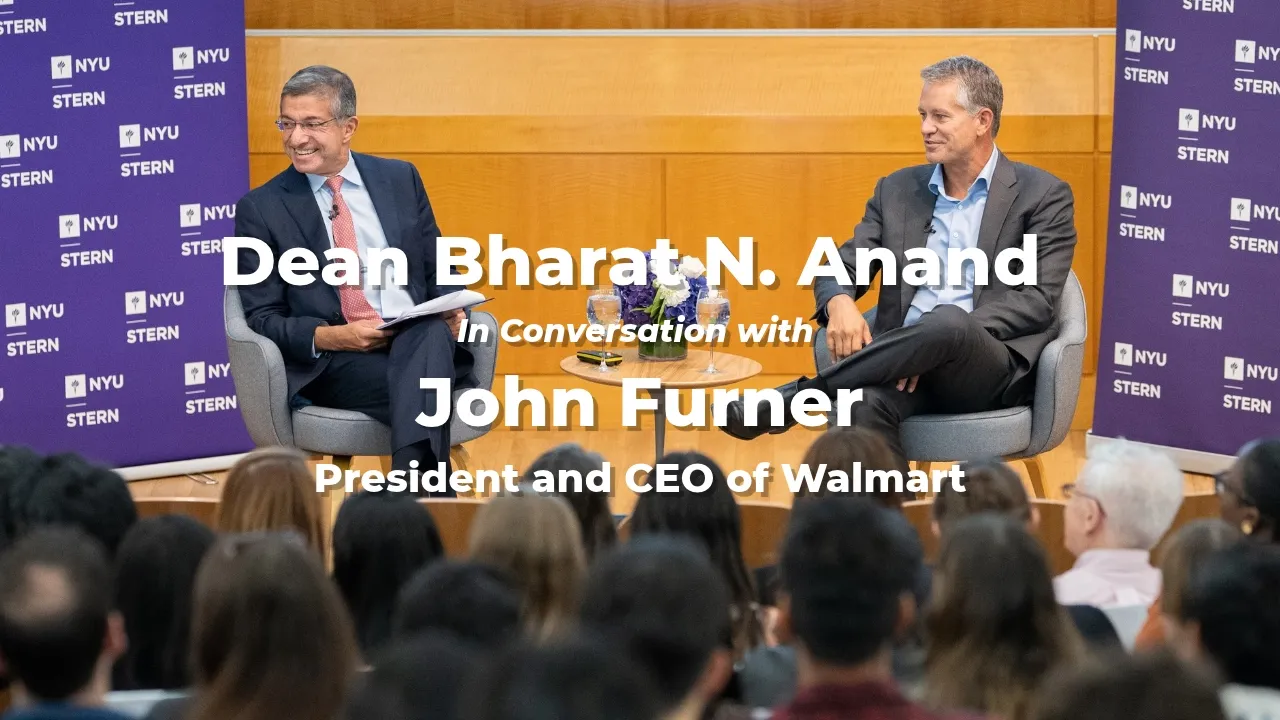
NYU Stern
Retail customer loyalty is merely the absence of something better, requiring executives to dismantle legacy operating rules as delivery speed and artificial intelligence transform commerce.
AI-assisted summary of NYU Stern Dean Bharat Anand In Conversation with John Furner, President & CEO of Walmart — original source. Check the original for full context.
Source published:
Key ideas
- Walmart President and CEO John Furner visited NYU Stern for his first campus appearance since taking office, highlighting the company's turnaround from being considered obsolete to briefly reaching a $1 trillion market cap. (0:02)
- During a massive supply chain bottleneck involving 100,000 stranded shipping containers, Furner personally inspected distribution centers and challenged legacy capacity rules, unlocking 280,000 pallet spots within a week. (1:38)
- Furner addressed rapid delivery shifts and artificial intelligence, warning that 'loyalty in retail is the absence of something better' and urging retailers to continually outpace external change. (3:26)
- Highlighting Walmart's talent pipeline, Furner noted that approximately 115 former Walmart employees have become Fortune 500 CEOs, with around 86 currently active. (0:02)
Detailed notes
## Background Published by NYU Stern on YouTube on October 29, 2026, this video features an interactive campus conversation between NYU Stern Dean Bharat Anand and Walmart President and CEO John Furner. According to the description, the session gives business students an inside look at leadership, retail transformation, and high-stakes decision-making through a candid exchange and a real-world business case.
## TL;DR In his first university campus visit as CEO, John Furner traces his 33-year trajectory from an hourly garden center associate to leading the world's largest private employer with 2.1 million associates. Through an interactive case study, Furner details how he broke through a 58-year-old operating rule book to resolve a 100,000-container supply chain gridlock by personally inspecting distribution center space. He also discusses how Walmart achieved sub-30-minute delivery, the disruptive influence of artificial intelligence, and why retailers must constantly adapt because customer loyalty merely reflects the absence of a better alternative. Concluding with advice for Stern students, Furner urges future leaders to embrace difficult assignments, stay authentic, and treat leadership as a privilege rather than an isolated burden.
## Atmosphere & style The conversation carries an energetic, participatory academic tone, blending Dean Anand's structured case-method facilitation with Furner's grounded, candid executive storytelling. Despite addressing complex operational crises and massive corporate scale, Furner speaks with self-deprecating warmth, unpretentious humility, and sharp clarity. The atmosphere feels interactive and intimate, drawing the student audience directly into high-stakes leadership dilemmas while demystifying the path to the C-suite.
## Bulletin - [00:02](https://www.youtube.com/watch?v=7RICi70KsmU&t=2s) Walmart President and CEO John Furner visited NYU Stern for his first campus appearance since taking office, highlighting the company's turnaround from being considered obsolete to briefly reaching a $1 trillion market cap. - [01:38](https://www.youtube.com/watch?v=7RICi70KsmU&t=98s) During a massive supply chain bottleneck involving 100,000 stranded shipping containers, Furner personally inspected distribution centers and challenged legacy capacity rules, unlocking 280,000 pallet spots within a week. - [03:26](https://www.youtube.com/watch?v=7RICi70KsmU&t=206s) Furner addressed rapid delivery shifts and artificial intelligence, warning that 'loyalty in retail is the absence of something better' and urging retailers to continually outpace external change. - [00:02](https://www.youtube.com/watch?v=7RICi70KsmU&t=2s) Highlighting Walmart's talent pipeline, Furner noted that approximately 115 former Walmart employees have become Fortune 500 CEOs, with around 86 currently active.
## Key takeaways - [00:02](https://www.youtube.com/watch?v=7RICi70KsmU&t=2s) Walmart has expanded into the world's largest private employer with 2.1 million associates, defying earlier market predictions of retail obsolescence. - [00:02](https://www.youtube.com/watch?v=7RICi70KsmU&t=2s) John Furner spent 33 years at Walmart, beginning as an hourly garden associate after struggling to gain traction as a musician. - [00:02](https://www.youtube.com/watch?v=7RICi70KsmU&t=2s) Walmart functions as a major executive talent engine, having produced around 115 Fortune 500 CEOs, with about 86 currently serving in chief executive roles. - [01:38](https://www.youtube.com/watch?v=7RICi70KsmU&t=98s) A severe supply chain backlog stranded an estimated 100,000 containers, prompting Furner to intervene after spotting Walmart containers lining Los Angeles highway medians. - [01:38](https://www.youtube.com/watch?v=7RICi70KsmU&t=98s) Logistics managers insisted distribution centers were at capacity due to strict adherence to a 58-year-old operating rule book rather than physical limitations. - [01:38](https://www.youtube.com/watch?v=7RICi70KsmU&t=98s) Walking the floor directly revealed underutilized space, including open concrete and paper record storage, leading to 280,000 new pallet spots and 28,000 containers cleared in one week. - [01:38](https://www.youtube.com/watch?v=7RICi70KsmU&t=98s) In unprecedented crises, historical precedents offer no guidance, making decisive action essential because not making a call is itself a decision. - [01:38](https://www.youtube.com/watch?v=7RICi70KsmU&t=98s) While frontline associates often generate the best ideas, senior leaders must take active ownership to push innovations through institutional inertia. - [03:26](https://www.youtube.com/watch?v=7RICi70KsmU&t=206s) Assumptions regarding the feasibility and financial losses of delivering goods in under 30 minutes proved completely inaccurate as store-based fulfillment evolved. - [03:26](https://www.youtube.com/watch?v=7RICi70KsmU&t=206s) Customer loyalty in retail is defined as 'the absence of something better,' meaning businesses must reinvent themselves before competitors do. - [03:26](https://www.youtube.com/watch?v=7RICi70KsmU&t=206s) Artificial intelligence will transform both associate work and consumer behavior, requiring retailers to adapt continuously to avoid falling behind. - [04:07](https://www.youtube.com/watch?v=7RICi70KsmU&t=247s) Overseas leadership assignments, such as working in Shenzhen, China, train executives to assess core physical and organizational assets from first principles. - [04:07](https://www.youtube.com/watch?v=7RICi70KsmU&t=247s) Career success depends on doing the hard assignments that others avoid, while maintaining personal integrity and authenticity throughout leadership roles. - [04:07](https://www.youtube.com/watch?v=7RICi70KsmU&t=247s) Furner refutes the idea that senior leadership is lonely at the top, characterizing executive service as an enjoyable privilege.
## Detailed walkthrough ### [00:02](https://www.youtube.com/watch?v=7RICi70KsmU&t=2s) Introduction and John Furner’s Path from Garden Center to CEO
Dean Bharat Anand opens by welcoming John Furner to the NYU Stern School of Business, marking Furner’s first campus visit to any university since stepping into his role as President and CEO of Walmart nine months earlier. Anand reflects on the sheer turnaround and magnitude of the company: while retail analysts a decade ago believed Walmart was obsolete and incapable of navigating the shift to digital commerce, the company's market valuation briefly eclipsed $1 trillion in February, supported by a global workforce of 2.1 million associates—making it the largest private employer in the world.
When Anand asks Furner about his 33-year tenure, Furner reveals that his career began humbly as a part-time garden associate out of financial necessity. He explains that he was, and remains, a musician, but because his musical career was not gaining traction, he took the retail job looking for summer work. Within a few weeks, he realized he genuinely loved working with people, a passion that carried him through more than three decades at the company. Highlighting Walmart's identity as a leadership engine, Furner notes that around 115 people who spent time at Walmart have gone on to become Fortune 500 CEOs, with approximately 86 currently serving in active chief executive roles.
- Walmart's global associate count: 2.1 million people worldwide. - Market capitalization benchmark: briefly surpassed $1 trillion in February. - Career path: 32–33 years at Walmart, starting as an hourly associate in the garden department. - Executive development pipeline: ~115 Fortune 500 CEOs previously worked at Walmart, with ~86 actively leading Fortune 500 companies today.
[01:38](https://www.youtube.com/watch?v=7RICi70KsmU&t=98s) Solving the Supply Chain Bottleneck and Breaking the 58-Year Rule Book
Transitioning to an interactive business case, Dean Anand asks the audience of Stern students to break traditional classroom etiquette and pull out their mobile phones to vote on a real-world leadership crisis. Anand calls out individual students from the live dashboard—including Bruno, Charles, and Rachel Gindy—noting that ten respondents voted to “walk out the door,” which Furner says mirrored what he actually had to do. The crisis involved an estimated 100,000 shipping containers backlogged with nowhere to go. Furner realized the full severity of the situation while driving down Interstate 405 in Los Angeles and seeing highway medians packed solid with stranded Walmart containers.
When the head of logistics and distribution claimed the distribution centers (DCs) were completely full and insisted that nothing could be done, Furner traveled directly to a DC to inspect the space in person. Walking the floor, Furner pointed to bare patches of concrete and asked why pallets could not be stacked there. When told other areas were consumed by boxes of paper records awaiting transfer to storage, he directed the team to clear and move the records immediately. By the end of that week, the team unlocked 280,000 new pallet spots, enabling the immediate ingestion of 28,000 backlogged containers.
Reflecting on why leadership faced such pushback, Furner explains that employees were simply operating under a 58-year-old operating rule book designed to cap inbound freight at historical thresholds. Under the rules they had been taught, the logistics leader was telling what he genuinely believed to be the truth. In unprecedented moments, however, adherence to the past breaks down. As Furner puts it: “There's nothing in the past that tells you how to behave, how to what to do, how to act in situations.” Emphasizing that indecision is itself an active decision, he states: “You have to make a call, and not making a call is making a call.” He notes that while the best tactical ideas come from associates closest to customers, senior leadership must actively push those innovations through organizational inertia.
```mermaid flowchart TD accTitle: Distribution Center Capacity Resolution Flow accDescr: Flowchart showing how Walmart resolved its massive shipping container backlog by bypassing standard operating rules.
subgraph Problem["Supply Chain Crisis"] A["100,000 Containers Backlogged"] B["I-405 Medians Staging Containers"] C["Logistics Team Cites 58-Year-Old Rule Book:\nNo DC Capacity Remaining"] A --> B B --> C end
subgraph Inspection["On-Site DC Inspection"] D["Furner & Team Walk the Distribution Center"] E["Unused Concrete Identified"] F["Archival Paper Records Identified"] D --> E D --> F end
subgraph Solution["Rapid Capacity Unlock"] G["Stage Pallets on Open Concrete"] H["Relocate Paper Records Offsite"] I["280,000 Pallet Slots Unlocked"] J["28,000 Containers Ingested in One Week"] E --> G F --> H G & H --> I I --> J end
C -->|"Leadership Intervention"| D ```
[03:26](https://www.youtube.com/watch?v=7RICi70KsmU&t=206s) Delivery Velocity, Artificial Intelligence, and Customer Loyalty
Turning to competition with Amazon and changing retail expectations, Dean Anand asks how Walmart adapted to rapid delivery demands. Furner admits that five years earlier, had anyone asked whether Walmart could reliably deliver orders to doorsteps in under 30 minutes, he would have answered no; if asked how much capital the company would bleed attempting it, he would have projected astronomical losses. In reality, both assumptions proved entirely wrong as fulfillment systems and neighborhood store networks evolved.
Furner views artificial intelligence through the same lens of structural transformation. He argues that AI will alter every facet of Walmart's business, with the critical challenges centering on how technology reshapes consumer shopping behavior and associate work patterns. Retailers cannot afford to defend legacy models, because consumer loyalty is inherently fragile. Defining customer sentiment in retail, Furner observes: “Loyalty in retail is the absence of something better.” He cautions that if an organization fails to innovate at the pace of the outside world, it is already falling behind.
[04:07](https://www.youtube.com/watch?v=7RICi70KsmU&t=247s) International Perspective, Leadership Anchors, and Student Advice
Anand asks how international assignments alter executive perspective, citing Furner’s relocation from Bentonville, Arkansas, to Shenzhen, China. Furner explains that operating outside one's home environment forces an executive to reassess an enterprise from first principles: waking up each morning, taking stock of current physical and organizational assets, and asking what changes would make the business most competitive in that immediate environment.
Closing with counsel for business students, Furner shares core principles he has relied on throughout his career:
- **Authenticity:** “Be yourself. Everybody else is taken.” - **Personal consistency:** Passing along advice from Walmart CEO Doug McMillon, Furner notes: “When you come out of the role, the win will be if you're the same person when you come out of the role as you were when you went into the role, that's a win, too.” - **Embracing difficulty:** Furner attributes his advancement to an instinct to accept tough assignments, urging students to step up when challenges arise: “I'd encourage you to do hard things. Do things that other people don't run to.”
When Anand suggests that executive leadership is commonly described as lonely at the top, Furner dismisses the notion, expressing gratitude for his career: “No, it's a pleasure to serve. It really is. I love what I do.” He considers himself fortunate to have stumbled into an hourly retail job decades ago and fallen in love with the work.
## Notable quotes > [03:26](https://www.youtube.com/watch?v=7RICi70KsmU&t=206s) Loyalty in retail is the absence of something better. — John Furner
> [01:38](https://www.youtube.com/watch?v=7RICi70KsmU&t=98s) You have to make a call, and not making a call is making a call. — John Furner
> [04:07](https://www.youtube.com/watch?v=7RICi70KsmU&t=247s) I'd encourage you to do hard things. Do things that other people don't run to. — John Furner
## Mentioned Bharat Anand, John Furner, Doug McMillon, NYU Stern School of Business, Walmart, Amazon, Fortune 500, Interstate 405, Bentonville, Arkansas, Shenzhen, China, Bruno, Charles, Rachel Gindy
## Video description What can business students learn from the transformation of one of the largest companies in the world?
#NYUStern students got an inside look at leadership, high-stakes decision-making, and retail transformation during a candid exchange and interactive business case with Dean Bharat Anand and Walmart President & CEO John Furner.
#OnlyAtStern
[Source](https://www.youtube.com/watch?v=7RICi70KsmU)