Alphabet Sheds $500B as Search Slowdown and AI Capex Burn Cash Flow
Joseph Carlson After Hours
Google's search deceleration stems from foreign exchange pressure and a managed shift toward early-stage AI queries rather than structural market loss to rivals.
AI-assisted summary of Google Stock Is In Trouble — original source. Check the original for full context.
Source published:
Key ideas
- Alphabet shares tumbled roughly 12% following earnings, erasing around $500 billion in market value as Google Search growth slowed to 12% and free cash flow turned negative at -$9 billion. (0:00)
- Management attributed Search deceleration primarily to foreign exchange headwinds, EU regulatory shifts on cross-border retail, and difficult comps against the prior quarter's World Cup, alongside intentional migration toward early-stage AI overviews. (14:15)
- Google Cloud delivered massive outperformance, surging 103% year-over-year to $30 billion in quarterly revenue while maintaining a strong 36% operating margin. (20:24)
- DoorDash announced an ambitious $17 billion bid to acquire Instacart to expand into omnichannel grocery delivery, though the transaction faces major antitrust hurdles depending on regulatory market definitions. (27:32)
Detailed notes
## Background Published on YouTube by Joseph Carlson After Hours on October 29, 2026, this episode analyzes Google's sharp post-earnings market selloff and its impact on the host's investment portfolio. According to the video description, the breakdown addresses Google's valuation, capital spending, and AI search monetization, alongside broader portfolio earnings updates covering Mastercard, Microsoft, and DoorDash's proposed acquisition of Instacart.
## TL;DR Joseph Carlson examines Alphabet's 12% single-day stock plunge, dissecting Wall Street's fear that generative AI is actively cannibalizing the core search business. He contextualizes the slowdown in search growth by pointing out temporary foreign exchange headwinds and difficult prior-year comparisons, while emphasizing that Google Cloud's hypergrowth of over 100% year-over-year at 36% margins demonstrates underlying operational strength. After normalizing for distorted one-time gains from an early SpaceX investment, Carlson highlights Google's attractive forward valuation despite near-term negative free cash flow from infrastructure spending. The episode wraps with updates on Mastercard hitting all-time highs, Microsoft's resilient enterprise cloud margins, and DoorDash's potential $17 billion takeover of Instacart.
## Atmosphere & style The presentation is grounded, methodical, and reassuring, offering a calm counterweight to sensationalized financial television headlines and market panic. Carlson speaks in an approachable yet rigorous conversational style, patiently guiding viewers through corporate balance sheets, Qualtrim metrics, and earnings call transcripts with the steady perspective of an iterative long-term investor. Watching the episode feels like a transparent, behind-the-scenes portfolio review that demystifies accounting anomalies and tempers emotional market swings with disciplined fundamental analysis.
## Bulletin - [00:00](https://www.youtube.com/watch?v=hpr1U8WmhLs&t=0s) Alphabet shares tumbled roughly 12% following earnings, erasing around $500 billion in market value as Google Search growth slowed to 12% and free cash flow turned negative at -$9 billion. - [14:15](https://www.youtube.com/watch?v=hpr1U8WmhLs&t=855s) Management attributed Search deceleration primarily to foreign exchange headwinds, EU regulatory shifts on cross-border retail, and difficult comps against the prior quarter's World Cup, alongside intentional migration toward early-stage AI overviews. - [20:24](https://www.youtube.com/watch?v=hpr1U8WmhLs&t=1224s) Google Cloud delivered massive outperformance, surging 103% year-over-year to $30 billion in quarterly revenue while maintaining a strong 36% operating margin. - [27:32](https://www.youtube.com/watch?v=hpr1U8WmhLs&t=1652s) DoorDash announced an ambitious $17 billion bid to acquire Instacart to expand into omnichannel grocery delivery, though the transaction faces major antitrust hurdles depending on regulatory market definitions.
## Key takeaways - [00:00](https://www.youtube.com/watch?v=hpr1U8WmhLs&t=0s) Google suffered a 12% single-day decline, dropping roughly $40 per share to around $283-$285 and wiping out roughly $500 billion in market capitalization. - [00:00](https://www.youtube.com/watch?v=hpr1U8WmhLs&t=0s) The steep sell-off was triggered by a renewed narrative that generative AI search alternatives and chat agents are cannibalizing Google's core advertising franchise. - [04:20](https://www.youtube.com/watch?v=hpr1U8WmhLs&t=260s) Despite short-term volatility, Google continues to operate at a $500 billion annualized run rate with TTM top-line revenue compounding comfortably above 20%. - [06:00](https://www.youtube.com/watch?v=hpr1U8WmhLs&t=360s) Trailing P/E figures are distorted by an unadjusted ~$100 billion accounting gain on Google's early SpaceX equity stake following its IPO; normalized 2027 and 2028 P/E ratios sit at 18.6x and 15.5x respectively. - [09:11](https://www.youtube.com/watch?v=hpr1U8WmhLs&t=551s) Massive capital expenditure into cloud infrastructure compressed quarterly free cash flow into negative territory at -$9 billion, resulting in a -7% FCF margin. - [11:14](https://www.youtube.com/watch?v=hpr1U8WmhLs&t=674s) Search revenue deceleration from 16% in Q2 to 12% in Q3 ignited Wall Street anxiety, even though 12% growth remains substantial at Alphabet's scale. - [14:15](https://www.youtube.com/watch?v=hpr1U8WmhLs&t=855s) Management clarified that foreign exchange was the single largest driver of search deceleration, followed by the elimination of the EU de minimis exemption and sports-driven Q2 comps. - [16:45](https://www.youtube.com/watch?v=hpr1U8WmhLs&t=1005s) The monetization of AI-assisted queries and conversational overviews is currently lower than traditional ten-blue-link search, creating a near-term revenue drag as Google deliberately evolves its format. - [20:24](https://www.youtube.com/watch?v=hpr1U8WmhLs&t=1224s) Google Cloud surged 103% year-over-year to $30 billion in quarterly revenue with a 36% operating margin, highlighting structural expansion outside pure ad search. - [24:14](https://www.youtube.com/watch?v=hpr1U8WmhLs&t=1454s) Mastercard reached fresh all-time highs, showing persistent transaction strength and proving resilient against local real-time payment network alternatives. - [25:15](https://www.youtube.com/watch?v=hpr1U8WmhLs&t=1515s) Microsoft delivered 19% revenue growth and 50% operating margins, retaining positive free cash flow throughout its AI capital expenditure cycle. - [26:15](https://www.youtube.com/watch?v=hpr1U8WmhLs&t=1575s) DoorDash reported 28% order volume growth to 993 million quarterly orders and launched a $17 billion takeover bid for Instacart. - [27:32](https://www.youtube.com/watch?v=hpr1U8WmhLs&t=1652s) The antitrust outcome of the DoorDash-Instacart acquisition hinges on whether regulators define the sector narrowly around food delivery apps or broadly across all omnichannel retail.
## Detailed walkthrough ### [00:00](https://www.youtube.com/watch?v=hpr1U8WmhLs&t=0s) Google's Post-Earnings Selloff and Portfolio Impact
Google reported its latest earnings, triggering an immediate and severe market reaction: the stock dropped roughly 12% in a single day, falling by nearly $40 per share to trade around $283 to $285, well below the $300 mark. That single-day decline erased approximately $500 billion in market capitalization. Up to this point, Google had been regarded as one of the market's premier performers, delivering strong quarterly earnings reports. The sharp reversal was driven by a renewal of earlier market fears that generative artificial intelligence will disrupt or cannibalize Google's core search advertising franchise. Analysts and commentators immediately seized on the narrative, with Gene Munster stating on television:
> “They're saying that AI search queries had an impact on search revenue.”
A television commentator reinforced this takeaway by adding:
> “That's their core business and it is back to that narrative that their core business is being cannibalized by AI.”
While online discussions and Discord channels were quick to treat this narrative as fact, the reality is far more nuanced. Google's core search revenue experienced a sharp deceleration quarter-over-quarter, which rattled investors, but this headline figure does not tell the whole story. Despite the drop from an all-time high of roughly $399–$400 down to $283, Google still maintains a 14% compound annual growth rate (CAGR) since 2021, comfortably outperforming both the S&P 500 and the Invesco QQQ over the past five years. Over that five-year span, the stock has traded as low as $83, with a median price of $156, demonstrating that the business has expanded substantially over the past two years despite the recent pullback.
The 12% drop in Google stock represented a 1.5% drag on Joseph Carlson's overall portfolio, wiping out roughly $23,400 from the position. However, broader diversification softened the blow: Carlson's total portfolio was down only 0.6% on the day, outperforming the broader market. That resilience was supported by gains in other core holdings:
- **Meta Platforms**: Up $5,000 on the day. - **Mastercard**: Carlson's largest position, up 4% (a gain of $8,700). - **Other holdings**: Texas Roadhouse, Moody's, DoorDash, and Uber all traded slightly higher. - **Amazon**: Traded down on the day, adding to losses alongside Google.
Carlson noted that such swings are an inescapable reality of owning individual equities, emphasizing that investors frequently reprice companies on shifting news and narratives:
> “The important thing is to buy into great companies at good deals and hold them long-term.”
---
[04:20](https://www.youtube.com/watch?v=hpr1U8WmhLs&t=260s) Top-Line Acceleration and the Cloud Engine
Looking beyond the stock price volatility, Google's top-line revenue metrics continue to show significant strength. On a trailing 12-month (TTM) basis, Google's revenue growth rate has remained comfortably above 20% year-over-year. Projections indicate that revenue growth will reach approximately 25% before gently moderating to around 23%. This durable top-line expansion is largely powered by Google Cloud, which is currently compounding at an annual rate exceeding 100%. Cloud is not an unprofitable, speculative endeavor; it operates at attractive and expanding operating margins, which justifies the company's aggressive capital expenditures in the segment.
```mermaid flowchart LR accTitle: Google Long-Term Revenue Trajectory accDescr: Visual flowchart tracing Google's trailing twelve month revenue growth through projected 2028 milestones. subgraph RevenueGrowth["Revenue Expansion & Milestones"] A["TTM Revenue Growth > 20%"] --> B["Run Rate Reaches $500B"] B --> C["Projected Q3 2028 Revenue: $727B-$730B"] end subgraph Drivers["Core Driver"] D["Google Cloud Growth > 100% YoY"] --> B end ```
On an absolute basis, Google's TTM revenue is expanding at approximately a 14.5% CAGR. Analysts project that by the third quarter of 2028, Alphabet's annualized revenue will reach approximately $727 billion to $730 billion. Alphabet management has already noted that the company is operating at a half-trillion-dollar ($500 billion) annualized run rate. As Carlson pointed out:
> “These are staggering numbers and this is not what an unhealthy company looks like.”
---
[06:00](https://www.youtube.com/watch?v=hpr1U8WmhLs&t=360s) Understanding EPS Distortions and Normalized Valuation
Evaluating Google's valuation using standard trailing 12-month metrics creates substantial confusion. A cursory look at Google's historical earnings per share (EPS) growth shows an apparent spike of roughly 120% year-over-year. That figure is distorted by non-operating accounting gains: Google held an early equity stake in SpaceX, and following SpaceX's initial public offering, Google booked a one-time gain of roughly $100 billion into net income, which flowed directly through GAAP earnings per share.
Because of that one-time windfall, unadjusted trailing P/E multiples on financial analysis sites like Qualtrim are misleading. Conversely, unadjusted year-over-year comparisons against that inflated base make forward EPS growth appear to contract. To understand Google's true operating performance, investors must look at non-GAAP normalized forward earnings estimates, which strip out the SpaceX gain and other irregular investment sales.
| Year / Metric Base | Normalized Forward P/E (at ~$285/share) | Normalized EPS Growth Rate | |:--- |:--- |:--- | | **2025** | 30.0x | — | | **2026** | 24.0x | ~25% | | **2027** | 18.6x | ~32% | | **2028** | 15.5x | ~20% |
Stripping out non-operating distortions reveals that Google is not an expensive business at its current price:
> “Google's no longer an expensive company based on the earnings.”
Factoring out one-time windfalls, Google is valued at approximately 19 times 2027 earnings and just 15.5 times 2028 earnings, while projecting normalized annual EPS growth between 20% and 32% over the coming three years. Yet despite these constructive valuation and revenue numbers, market participants remain skeptical, shifting their focus away from the P/E ratio to scrutinize Google's deteriorating free cash flow and ballooning capital expenditure.
[09:11](https://www.youtube.com/watch?v=hpr1U8WmhLs&t=551s) Free Cash Flow Contraction and Segment Revenue
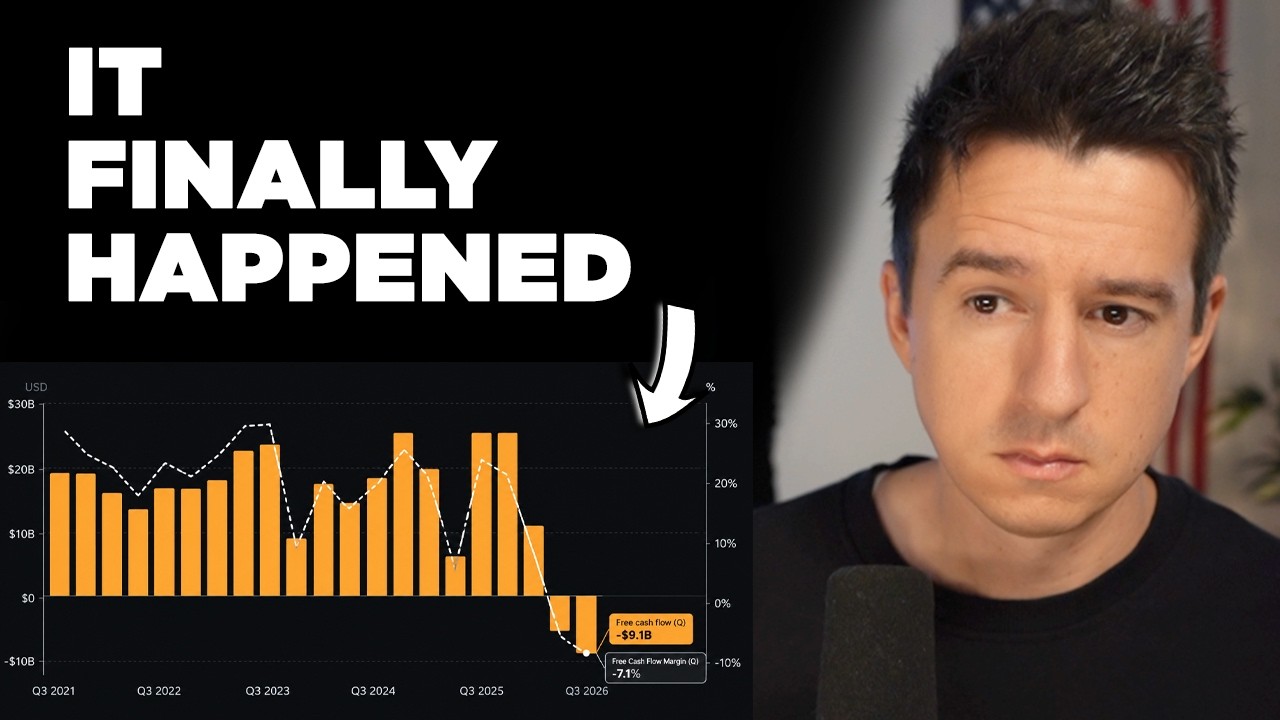
Google has been pouring cash into building out an unprecedented infrastructure footprint, and those massive investments are consuming all of the company's operating cash generation. Historically regarded as one of the single most profitable businesses in the world with free cash flow margins reliably hovering between 20% and 30%, Google has experienced a dramatic reversal over the past two quarters. Free cash flow has turned outright negative, posting an unprecedented -$9 billion and a -7% free cash flow margin in the most recent quarter.
```mermaid flowchart LR accTitle: Google Cash Flow and Capex Dynamics accDescr: Shows operating cash flow being offset by massive capital expenditures into cloud infrastructure, resulting in negative quarterly free cash flow. subgraph CashIn["Operating Inflows"] direction TB Rev["Growing Revenue & EPS"] OCF["Strong Core Cash Generation"] end subgraph CapexSpend["Reinvestment"] direction TB Cap["Record Infrastructure Capex"] Cloud["Cloud Capacity Expansion"] end subgraph Outcome["Net FCF Result"] direction TB NegFCF["FCF Flips to -$9B (-7% Margin)"] Div["Early Cloud Revenue Payoffs"] end Rev --> OCF OCF --> Cap Cap --> Cloud Cap --> NegFCF Cloud --> Div ```
On a trailing twelve-month (TTM) basis, where the company used to comfortably churn out between $60 billion and $70 billion in free cash flow, the total has fallen off a cliff to just $19 billion—a razor-thin 4.2% margin. It could plausibly dip into negative territory on a TTM basis depending on the next two quarters. Despite this cash burn, the underlying operational picture does not warrant panic on its own: revenue and earnings per share are growing briskly even when backing out one-time gains such as investments in SpaceX, and the capital expenditure is already paying tangible dividends in Google Cloud. Consequently, cash flow alone does not explain the steep 12% drop in the stock price; the true anxiety centers entirely on segment revenues, specifically Google Search, which accounts for roughly half of the company's overall business.
- Free cash flow in the most recent quarter dropped to -$9 billion, representing a -7% free cash flow margin. - Historical free cash flow margins typically hovered between 20% and 30%, with trailing twelve-month free cash flow regularly reaching $60 billion to $70 billion. - Trailing twelve-month free cash flow plummeted to $19 billion, shrinking the TTM free cash flow margin down to 4.2%. - Google Search accounts for roughly half (just shy of 50%) of Google's total consolidated revenue.
[11:14](https://www.youtube.com/watch?v=hpr1U8WmhLs&t=674s) The Search Deceleration and the Bear Narrative
The root cause of Wall Street's panic is a pronounced deceleration in Google's core engine: Google Search. Over a trailing twelve-month period, search revenue expanded by 16%, but the quarterly view reveals a sharp downshift from 16% year-over-year growth in Q2 down to 12% in Q3. While a 12% growth rate remains healthy for a business of this scale, it represents a visible miss against consensus expectations. This shortfall opened Pandora's box, unleashing speculative fears about whether alternative discovery tools, such as Grok, new AI chat agents, or Google's own AI overviews, are permanently breaking the search model.
Up until this report, Google Search seemed completely immune to competitive pressure, consistently accelerating quarter after quarter while bears could only watch in frustration as queries and revenue climbed. A slowdown was mathematically inevitable at some point, and this deceleration from 16% to 12% gave bears the opening they had been waiting for. On television networks like CNBC, commentators such as Gene Munster seized on the narrative, arguing that something fundamental is failing at Google and dismissing management's stated reasons as mere "excuses." Munster pointed directly to management's comments about December's slower growth rate and the lower monetization of AI queries as clear evidence that alternative platforms like Anthropic, ChatGPT, and other on-the-ground search tools are finally siphoning away Google's core franchise.
> “So we knew this moment was coming. We knew that Google search would eventually show some sign of weakness and it's finally arrived with this week's report.” — Joseph Carlson
[14:15](https://www.youtube.com/watch?v=hpr1U8WmhLs&t=855s) Management's Explanation vs. "Excuses"
Dismissing corporate earnings commentary as simple excuses overlooks critical operational facts. When an analyst on television brushes off management's explanations without evaluating their substance, it ignores the primary catalysts behind the quarterly numbers. A direct examination of the earnings call reveals three clear, non-structural drivers that accounted for the bulk of the deceleration before any AI cannibalization is factored in.
First and foremost, foreign exchange (FX) fluctuations were identified by leadership as the single largest contributor to the deceleration from Q2 to Q3—an entirely macro-driven headwind having nothing to do with competitive erosion. Second, vertical-specific retail dynamics in the Asia-Pacific region softened after the European Union eliminated a *de minimis* customs exemption, dampening ad spend from cross-border merchants. Third, media and entertainment spending faced an impossibly difficult comparison against an unusually strong second quarter driven by the FIFA World Cup, which had pulled massive advertising budgets forward into June rather than July.
> “First, there was FX, foreign exchange. It was the single largest driver of search deceleration relative to Q2. So, right off the bat, we know the biggest driver of deceleration, the biggest single factor was foreign exchange, meaning nothing intrinsic to the business at all.” — Joseph Carlson
- **Foreign Exchange (FX):** Stated explicitly by management as the single largest individual factor driving the search deceleration between Q2 and Q3. - **Regulatory Changes:** The elimination of an EU *de minimis* customs exemption pressured Asia-Pacific retail advertisers who market into Europe. - **Tough Comps:** Media and entertainment ad spend had surged during Q2 due to the FIFA World Cup, pulling ad dollars forward into June and creating a difficult baseline for Q3.
[16:45](https://www.youtube.com/watch?v=hpr1U8WmhLs&t=1005s) The Reality of AI Search Cannibalization
Beyond foreign exchange and tough sports comparisons, management acknowledged an authentic operational headwind: the rapid rise of AI mode queries is currently pressuring revenue due to lower monetization rates relative to traditional search. This admission confirms the bear thesis around cannibalization, but it reflects a planned transition rather than an involuntary collapse.
Traditional Google search—the familiar list of "ten blue links"—is a mature, finely tuned profit engine refined over more than a decade of commercial optimization. Management recognizes that maintaining the legacy blue-link model indefinitely is impossible in an AI-driven environment. Consequently, Google is deliberately moving users toward conversational answers, AI overviews, and multi-turn query flows, even though the monetization architecture for these new formats is still in its infancy. Leadership reported encouraging progress in early ad experiments across AI overviews and indicated that ad coverage is actively scaling into more queries, international markets, and conversational multi-turn sessions in the United States. While the transition temporarily depresses monetization margins because the new AI experience is not yet as streamlined or lucrative, the shift represents an intentional migration to protect and evolve the franchise over the long run.
[18:28](https://www.youtube.com/watch?v=hpr1U8WmhLs&t=1108s) Monetizing AI Search and the Near-Term Narrative
Google is currently navigating a structural transition from traditional search to contextual AI search. While bears argue that shifts in search patterns mean Google will make less money per click or query, Carlson views this as a standard transitional hurdle rather than an existential crisis. Google is still in the early stages of its monetization roadmap for AI-driven query experiences, but historical precedents show they mastered monetizing traditional search and will likely refine AI search monetization in the same manner. Indicators provided by management suggest that, over time, AI-augmented search could achieve higher overall monetization rates than legacy search.
```mermaid flowchart TD accTitle: Google Search Transition and Market Reaction accDescr: A visual representation of how Google's transition to AI search impacts quarterly performance and investor sentiment.
subgraph TRANSITION["The AI Transition"] A["Legacy Search"] -->|"Intentional Cannibalization"| B["Contextual AI Search"] B -->|"Early Monetization Stage"| C["Lower Near-Term Monetization Per Query"] end
subgraph DRIVERS["Compounding Market Headwinds"] D["Search Deceleration"] E["Negative Free Cash Flow"] F["Missed Operating Metrics"] end
subgraph OUTCOME["Market Reaction"] C & D & E & F --> G["Investor Fear & Heavy Sell-Off"] G --> H["Continued Narrative Overhang (Next 2-4 Quarters)"] end ```
Despite this long-term potential, Google faces sharp, immediate headwinds. Search revenue deceleration, paired with management openly acknowledging some intentional cannibalization, has reignited the market narrative that AI competitors are devouring Google’s core franchise. The stock experienced a steep sell-off because this slowing momentum collided with a quarter where operating metrics missed expectations and free cash flow turned negative. When weak prints meet an already skittish investor base, sharp repricings occur. As Joseph Carlson summarizes:
> “So, we could have a couple quarters, maybe a year of continued pain in Google stock.”
He emphasizes that he sees zero empirical evidence that search is entering a structural decline. Instead, it is undergoing an intentional, managed evolution that nearly all information platforms—including ChatGPT and Perplexity—must eventually monetize.
---
[20:24](https://www.youtube.com/watch?v=hpr1U8WmhLs&t=1224s) Google Cloud Growth, YouTube Dominance, and Long-Term Outlook
Lost beneath the negative headlines regarding search is the standout performance of Google Cloud, which surged by 103% year-over-year to generate $30 billion in the single quarter alone. Crucially, this hypergrowth did not come at the expense of profitability: Cloud margins remained resilient at 36%. While some investors fretted that the Cloud backlog slowed its sequential expansion—moving from $513 billion to $560 billion—Carlson considers this criticism misguided. Backlog simply represents promised, unearned revenue. Accelerating growth naturally burns through existing commitments faster, which is the preferred operational outcome over an ever-inflating, unconsumed order book.
Beyond enterprise cloud services, Alphabet boasts a diverse array of market-leading assets. YouTube and its associated subscriptions (driven heavily by YouTube Premium) grew around 10% year-over-year. Although this represented a minor deceleration, YouTube remains exceptionally dominant, capturing more television viewing time than streaming competitors like Netflix. Alphabet is also advancing frontier artificial intelligence with its Gemini and Argon model releases, scaling its autonomous driving unit Waymo, and expanding into commercial silicon by selling its custom-designed chips. Notably, the head of Google Cloud was featured directly on the earnings call for the first time, signaling an intentional shift in corporate identity:
> “Google is wanting to transition from being known primarily as a search business to being known as a search information business plus cloud.”
Carlson concludes that while investors do not need to rush in immediately—given that multiple quarters of debate over search growth may suppress share prices—he has no intention of trimming his massive stake. In his view, Alphabet trades at a modest valuation considering its high-margin revenue drivers across cloud, video, and machine intelligence.
- **Google Cloud quarterly revenue:** $30 billion (up 103% year-over-year). - **Google Cloud operating margin:** 36%. - **Google Cloud backlog:** Increased from $513 billion to $560 billion. - **YouTube and subscription revenue growth:** ~10% year-over-year. - **Key emerging growth vectors:** In-house chip commercialization, Waymo autonomous ride-hailing, and advanced Gemini/Argon AI models.
---
[24:14](https://www.youtube.com/watch?v=hpr1U8WmhLs&t=1454s) Mastercard Earnings: Steady Compounding at All-Time Highs
Turning to the broader market, Carlson reviews Mastercard, characterizing it as his quintessential "boring" holding that quietly outperforms high-profile names. Despite frequent bear theses claiming that regional real-time payment rails—such as Pix in Brazil or various sovereign digital initiatives—will dismantle credit card payment networks, incumbents continue their uninterrupted expansion.
Mastercard's financial performance once again validated its pricing power and global transaction volume, sending the stock to fresh all-time highs. It has appreciated 13% year-to-date and 91% over the past five years. Carlson notes the position represents his single largest portfolio holding:
> “We have Mastercard here, my most boring holding that's now my largest position, $212,000 position, $65,000 in the green, and the stock is doing fantastic.”
- **Mastercard portfolio stake:** Valued at $212,000 (showing an unrealized gain of $65,000). - **Stock performance:** Up 13% year-to-date; up 91% over the trailing 5-year period. - **Competitive landscape:** Visa, Mastercard, and American Express continue to maintain steady volume growth without material disruption from state-backed payment rails.
---
[25:15](https://www.youtube.com/watch?v=hpr1U8WmhLs&t=1515s) Microsoft Earnings and Disciplined Capital Allocation
Microsoft reported robust financial numbers that initially boosted the stock before overall index weakness, led by the heavy sell-off in Alphabet shares, dragged Microsoft down 1.2%. Total company revenue climbed 19% year-over-year, while operating income advanced 21%, lifting overall operating margins to a round 50%. The Microsoft Cloud division reached $63 billion in quarterly revenue, an increase of 30% year-over-year (and 31% on a constant-currency basis), illustrating durable demand across its enterprise footprint even at massive absolute scale.
A critical point of differentiation between Microsoft and Google this quarter was free cash flow profile and capital spending discipline. Microsoft came in with lower-than-anticipated capital expenditures, demonstrating that management is scaling AI infrastructure deliberately without overspending ahead of actual demand. As a result, Microsoft is slated to remain comfortably free cash flow positive throughout fiscal 2027 while paying for its massive data center buildout organically out of operating profits.
- **Microsoft total revenue growth:** Up 19% year-over-year. - **Operating income and margin:** Operating income rose 21%, bringing operating margin to 50%. - **Microsoft Cloud revenue:** $63 billion (up 30% nominal, 31% constant currency). - **Free cash flow guidance:** Projected to remain consistently positive across fiscal 2027 while internally funding all capital expenditures.
---
[26:15](https://www.youtube.com/watch?v=hpr1U8WmhLs&t=1575s) DoorDash: Volume Expansion and the Proposed Instacart Acquisition
Addressing another portfolio constituent, DoorDash posted an operating report that exceeded consumer sentiment expectations. Despite frequent comments from frugal retail investors who claim they would never pay third-party delivery fees, DoorDash continues to see aggressive transaction growth across wider consumer demographics. Total order volume surged 28% year-over-year to 993 million orders completed in the single 90-day period.
To build upon its dominant footprint in prepared restaurant food delivery across the United States, DoorDash announced its formal intention to acquire Instacart. While DoorDash has established uncontested leadership in restaurant deliveries, Instacart holds established supply-chain infrastructure and partner networks with major grocery and big-box retail chains, such as Costco and Target. Buying Instacart represents an immediate acceleration of DoorDash’s stated long-term ambition: evolving from a purely restaurant-focused delivery network into an all-encompassing local commerce platform.
- **Quarterly order volume:** 993 million orders completed in 90 days. - **Order volume expansion:** Up 28% year-over-year (boosted in part by acquisition-driven growth). - **Strategic acquisition:** Formal bid to acquire Instacart to capture market share in retail, supermarket, and enterprise grocery distribution.
[27:32](https://www.youtube.com/watch?v=hpr1U8WmhLs&t=1652s) DoorDash’s Proposed $17 Billion Acquisition of Instacart and Regulatory Hurdles
DoorDash is making an aggressive push to expand far beyond its core restaurant delivery roots into broad-based local retail. The long-term vision is for customers to open the DoorDash app and have the ability to purchase anything locally within their immediate geographic area. To rapidly accelerate this transition, DoorDash is looking to acquire grocery delivery giant Instacart in a massive transaction valued at approximately $17 billion. Joseph Carlson notes that while DoorDash would be paying a substantial premium for Instacart, that is simply the unavoidable cost of capturing market share. Companies facing this hurdle have only two real choices: pay up front for an acquisition, or burn capital running massive advertising campaigns and operating unprofitable business units over a protracted timeframe to peel away customers organically. Buying Instacart represents the far faster route.
```mermaid flowchart TD accTitle: DoorDash Market Definition and Regulatory Scrutiny accDescr: A flowchart depicting the regulatory hurdle DoorDash faces depending on whether the market is defined narrowly or broadly. subgraph MarketScope["Antitrust Market Definition"] Narrow["Narrow Definition:<br/>Delivery Apps (DoorDash, Instacart, Uber)"] Broad["Broad Definition:<br/>Omnichannel Retail (Amazon, Walmart, Delivery Services)"] end
subgraph Outcome["Regulatory Viability"] Block["Deemed Anti-Competitive / Blocked"] Pass["Easier to Justify Scale / Approved"] end
Narrow -->|"Too Much Market Power"| Block Broad -->|"Competitive Against Giants"| Pass ```
While DoorDash shares rose 4% on the news and shareholders are broadly enthusiastic, the deal faces severe regulatory uncertainty. Because DoorDash is already an enormous player in the space, swallowing Instacart would create an even more dominant giant. The ultimate legal battle will hinge entirely on how regulators define the addressable market. If the regulatory authorities classify the market strictly as third-party on-demand delivery apps alongside competitors like Uber, DoorDash would almost certainly be judged too large to acquire Instacart. Conversely, if corporate lawyers can convince regulators that the competitive set includes omnichannel retail behemoths like Amazon and Walmart, the combined entity becomes far easier to defend. As a DoorDash investor, Carlson hopes the deal clears these antitrust hurdles: “I think that this scale is necessary and even though it comes at an expensive price, this would give them an enduring advantage and growth path for many years to come.”
- **Acquisition Valuation:** DoorDash is reportedly offering roughly $17 billion to acquire Instacart, representing a noticeable premium over its standalone market valuation. - **Stock Reaction:** DoorDash stock jumped 4% following reports of the potential buyout. - **Strategic Alternative:** Acquiring Instacart bypasses years of expensive ad spend, customer acquisition costs, and margin degradation required to build grocery market share from scratch. - **Antitrust Roadblock:** Approval hinges on whether antitrust regulators define the space narrowly around food delivery apps (DoorDash, Uber Eats, Instacart) or broadly around local and e-commerce retail logistics (including Walmart and Amazon).
## Notable quotes > [20:24](https://www.youtube.com/watch?v=hpr1U8WmhLs&t=1224s) Google is wanting to transition from being known primarily as a search business to being known as a search information business plus cloud. — Joseph Carlson
> [06:00](https://www.youtube.com/watch?v=hpr1U8WmhLs&t=360s) Google's no longer an expensive company based on the earnings. — Joseph Carlson
> [00:00](https://www.youtube.com/watch?v=hpr1U8WmhLs&t=0s) The important thing is to buy into great companies at good deals and hold them long-term. — Joseph Carlson
## Mentioned Google, Alphabet, Joseph Carlson, Gene Munster, Google Cloud, Google Search, YouTube, YouTube Premium, Meta Platforms, Mastercard, Texas Roadhouse, Moody's, DoorDash, Uber, Amazon, SpaceX, Qualtrim, Grok, ChatGPT, Anthropic, Perplexity, Gemini, Argon, Waymo, Microsoft, Microsoft Cloud, Instacart, Visa, American Express, Costco, Target, Walmart, Netflix, Pix
## Video description Join Qualtrim, the stock analysis platform I built and use, and join over 13,000 other paying members: https://www.qualtrim.com/
00:00 Google’s Selloff & My Portfolio 04:20 Google’s Revenue Growth 06:00 Understanding Google’s Earnings & Valuation 09:03 Free Cash Flow & Capital Spending 10:49 Is AI Hurting Google Search? 14:15 Management’s Explanation & AI Monetization 20:24 Google Cloud, YouTube & My Outlook 24:14 Mastercard Earnings 25:15 Microsoft Earnings 26:15 DoorDash’s Proposed Instacart Acquisition
-Disclaimer Some of the links below are affiliate links, I can earn money from them at no cost to you.
This content is not a solicitation, is not endorsed by M1, and was not reviewed by M1; the opinions expressed are solely those of the authors and do not reflect M1's views. Information presented is accurate as of the video posting date; for the most up-to-date information, please refer to m1.com. Before making any investment decisions, consult your personal investment, legal, and tax advisors, as this content is for informational purposes only and not intended as investment recommendations.
▀▀▀▀▀▀▀▀▀▀▀▀▀▀▀▀▀▀▀▀▀▀▀▀▀▀ Join Here: https://www.qualtrim.com/
📚 My favorite Investing Books: https://amzn.to/3KwyIhG 📷 All the tech I use to record videos: https://www.amazon.com/shop/josephcarlson/list/2L5YMP4DFYA8O?ref_=cm_sw_r_cp_ud_aipsflist_aipsfjosephcarlson_FAKKKMYKF486ZR6H2DSQ
🚀 Growth Portfolio: https://click.linksynergy.com/deeplink?id=5mNcifgFllM&mid=50362&murl=https://dashboard.m1.com/share?token=39d17ae6-4a4a-3fc4-bb15-d86abe3fbb67 💵 Dividend Portfolio: https://click.linksynergy.com/deeplink?id=5mNcifgFllM&mid=50362&murl=https://dashboard.m1.com/share?token=3b283352-1bff-31d9-8576-f5770c2bfdfd
SOCIAL MEDIA ▀▀▀▀▀▀▀▀▀▀▀▀▀▀▀▀▀▀▀▀▀▀▀▀▀▀ 🎥 More free content: https://www.youtube.com/channel/UCbta0n8i6Rljh0obO7HzG9A 🐦 I post random thoughts on Twitter too: https://twitter.com/joecarlsonshow
DISCLAIMER ▀▀▀▀▀▀▀▀▀▀▀▀▀▀▀▀▀▀▀▀▀▀▀▀▀▀ I am not a professional investor and have never claimed to be. I'm an amateur investor sharing my experience of what I've learned, where I have had success, and where I've had failures. I share my thoughts on investing and performance with transparency. My approach and goal to investing is to buy high-quality long-term investments in world-class businesses that I call "compounders". I view my investments as businesses, not as stocks. Before creating content on YouTube full time I worked as a senior-level programmer for 8 years. Over the years as a programmer, I compounded my knowledge of development. I take the same iterative learning approach to my study of investing. I study investing as a craft in the continual pursuit of being better. I will make mistakes in investment decisions from time to time. Results are not guaranteed. Please do not blindly follow me into any investments, and make sure your portfolio and investments are built around your specific income, risk tolerance, personality, timeline, and overall circumstances.
[Source](https://www.youtube.com/watch?v=hpr1U8WmhLs)