Whoop Retains 50-Billion-Hour Biometric Cache to Train Own Health AI
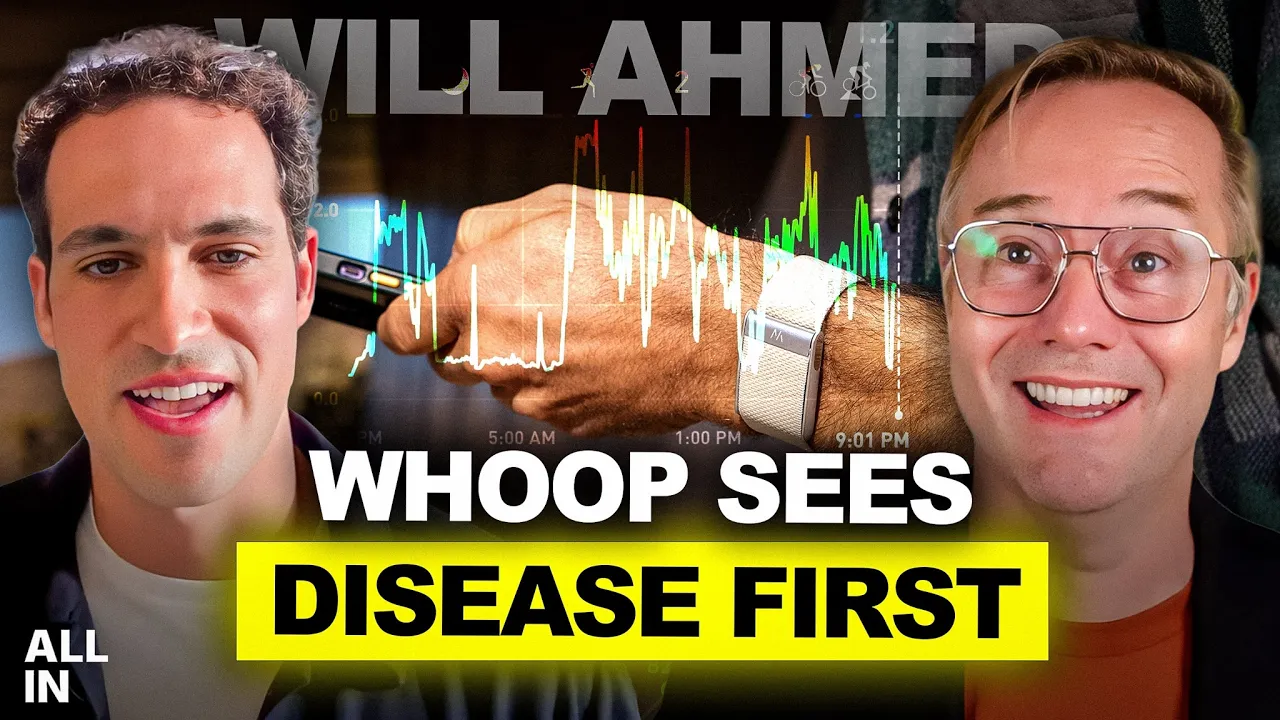
WHOOP CEO, Will Ahmed: 50B Hours of Health Data, a 4 Million Member Data Moat, & the FDA Fight — All-In Podcast

All-In Podcast

Continuous physiological tracking combined with behavioral journaling allows wearables to infer clinical biomarkers without invasive lab tests, creating a proprietary moat traditional consumer electronics cannot match.

AI-assisted summary of WHOOP CEO, Will Ahmed: 50B Hours of Health Data, a 4 Million Member Data Moat, & the FDA Fight — original source. Check the original for full context.

Source published:

Key ideas

  • WHOOP has reached over 4 million members wearing the device an average of 23.6 hours per day, accumulating a longitudinal data moat of over 50 billion continuous hours of physiological data. (0:00)
  • Rather than licensing aggregate biometrics to external frontier AI labs, WHOOP is building proprietary foundational health models combining multi-modal inputs from wearable telemetry, user journals, and uploaded clinical blood work. (17:22)
  • Following a warning letter from the FDA over Blood Pressure Insights, WHOOP maintained its product position until the agency updated its general wellness guidance, enabling wrist-based monitoring without classification as a medical device. (40:00)
  • LeBron James has officially joined WHOOP as a global ambassador after wearing the device organically for 11 years, joining athletes like Cristiano Ronaldo and Patrick Mahomes who originally came in as organic users and investors. (48:06)

Detailed notes

## Background Published on YouTube by the All-In Podcast channel on October 29, 2026, this interview features WHOOP founder and CEO Will Ahmed in conversation with host Jason Calacanis. According to the page description, the episode covers WHOOP's pivot away from a $500 hardware model to a recurring subscription, its 50-billion-hour health data moat, AI coaching and GLP-1 tracking, regulatory disputes with the FDA, and LeBron James becoming a global ambassador.

## TL;DR Will Ahmed chronicles WHOOP's evolution from a niche, $500 performance device for elite athletes into a multi-million-member biometric subscription platform collecting over 50 billion hours of continuous physiological data. Calacanis and Ahmed explore how core metrics like heart rate variability, sleep stages, and respiratory rates serve as early warning signals for acute illnesses, inflammation, and undetected cancers. The conversation details WHOOP's proprietary AI Coach, behavioral tracking around sleep and GLP-1 medications, and the regulatory challenges of navigating FDA boundaries between wellness insights and medical devices. Finally, they cover commercial sports league pushback, organic athlete-investor partnerships culminating in LeBron James's ambassadorship, and venture market dynamics surrounding secondary share transactions.

## Atmosphere & style The conversation carries the relaxed, candid cadence of two longtime tech acquaintances dissecting the intersection of startup mechanics and personal health optimization. Calacanis approaches the interview with enthusiastic, hands-on user curiosity—frequently comparing live biometrics, app dashboards, and personal medical scares—while Ahmed delivers measured, data-dense insights with calm executive polish. The dialogue balances rigorous physiological deep dives with sharp, humorous industry banter about sports marketing shakedowns, venture secondary madness, and modern biohacking routines.

## Bulletin - [00:00](https://www.youtube.com/watch?v=Uc6xXNBWjfc&t=0s) WHOOP has reached over 4 million members wearing the device an average of 23.6 hours per day, accumulating a longitudinal data moat of over 50 billion continuous hours of physiological data. - [17:22](https://www.youtube.com/watch?v=Uc6xXNBWjfc&t=1042s) Rather than licensing aggregate biometrics to external frontier AI labs, WHOOP is building proprietary foundational health models combining multi-modal inputs from wearable telemetry, user journals, and uploaded clinical blood work. - [40:00](https://www.youtube.com/watch?v=Uc6xXNBWjfc&t=2400s) Following a warning letter from the FDA over Blood Pressure Insights, WHOOP maintained its product position until the agency updated its general wellness guidance, enabling wrist-based monitoring without classification as a medical device. - [48:06](https://www.youtube.com/watch?v=Uc6xXNBWjfc&t=2886s) LeBron James has officially joined WHOOP as a global ambassador after wearing the device organically for 11 years, joining athletes like Cristiano Ronaldo and Patrick Mahomes who originally came in as organic users and investors.

## Key takeaways - [01:48](https://www.youtube.com/watch?v=Uc6xXNBWjfc&t=108s) Transitioning in 2018–2019 from a $500 luxury hardware purchase to a $15–$30 recurring subscription solved early acquisition friction and decoupled WHOOP from arbitrary 12-month hardware refresh cycles. - [04:55](https://www.youtube.com/watch?v=Uc6xXNBWjfc&t=295s) Continuous over-the-air software updates enable existing hardware to gain clinical-grade capabilities like ECG, AFib detection, biological 'WHOOP Age' estimation, and Blood Pressure Insights. - [06:58](https://www.youtube.com/watch?v=Uc6xXNBWjfc&t=418s) WHOOP's core experience balances three pillars—Sleep, Recovery, and Strain—with Recovery heavily anchored on autonomic nervous system balance captured via Heart Rate Variability (HRV). - [10:00](https://www.youtube.com/watch?v=Uc6xXNBWjfc&t=600s) Subtle, multi-day biometric anomalies in respiratory rate, resting heart rate, and HRV can serve as preemptive indicators of acute infections like COVID-19 or underlying inflammation before severe symptoms surface. - [13:21](https://www.youtube.com/watch?v=Uc6xXNBWjfc&t=801s) Longitudinal baseline anomalies—such as overnight heart rate spikes or halving baseline HRV—have prompted early clinical investigations that identified cancers such as Hodgkin lymphoma and testicular cancer. - [14:40](https://www.youtube.com/watch?v=Uc6xXNBWjfc&t=880s) Higher Heart Rate Variability indicates dynamic balance between sympathetic and parasympathetic systems, serving as a primary non-invasive proxy for cardiovascular fitness, recovery capacity, and healthspan longevity. - [17:22](https://www.youtube.com/watch?v=Uc6xXNBWjfc&t=1042s) The slide-on charging pack and screenless design facilitate 23.6 hours of daily wear time, giving WHOOP an uninterrupted data lake unmatched by notification-heavy smartwatches. - [20:00](https://www.youtube.com/watch?v=Uc6xXNBWjfc&t=1200s) By correlating wearable sensor data with clinical blood panels, WHOOP aims to predict out-of-range biomarkers, such as elevated cortisol, without requiring invasive lab tests. - [23:05](https://www.youtube.com/watch?v=Uc6xXNBWjfc&t=1385s) Over 50% of active members complete daily journal entries across 100+ variables, enabling WHOOP's Behavioral Insights engine to statistically measure the personal recovery impact of specific lifestyle habits. - [25:12](https://www.youtube.com/watch?v=Uc6xXNBWjfc&t=1512s) Across the member population, alcohol and late meals consumed within three hours of bedtime consistently emerge as the most damaging behavioral inputs to overnight sleep architecture and recovery. - [32:00](https://www.youtube.com/watch?v=Uc6xXNBWjfc&t=1920s) To counter the 50% lean muscle mass loss commonly associated with GLP-1 weight loss treatments, WHOOP introduced specialized tracking protocols emphasizing strength training, hydration, and protein intake. - [40:00](https://www.youtube.com/watch?v=Uc6xXNBWjfc&t=2400s) WHOOP navigates a dual regulatory strategy: pursuing formal FDA 510(k) medical clearances for diagnostic tools like ECG while defending general wellness applications for lifestyle features like Blood Pressure Insights. - [40:00](https://www.youtube.com/watch?v=Uc6xXNBWjfc&t=2400s) Ahmed views peripheral medical accessories like standard blood pressure cuffs as commoditized calibration tools that optical wearable sensors will eventually make obsolete. - [40:00](https://www.youtube.com/watch?v=Uc6xXNBWjfc&t=2400s) Unlike big tech advertising platforms, WHOOP refuses to monetize user data, ensuring that the paid subscription remains the sole commercial product. - [48:06](https://www.youtube.com/watch?v=Uc6xXNBWjfc&t=2886s) Early-stage consumer and wearable startups should avoid paying athletic influencers upfront, relying instead on organic product-market fit to turn genuine power users into cap table investors and brand ambassadors. - [52:12](https://www.youtube.com/watch?v=Uc6xXNBWjfc&t=3132s) Unsanctioned secondary brokers floating phantom share allocations create severe governance headaches for private growth companies, underscoring the need for strict board- and CFO-level clearance on equity transfers.

## Detailed walkthrough ### [00:00](https://www.youtube.com/watch?v=Uc6xXNBWjfc&t=0s) The Scale of WHOOP: From 14-Year Journey to 4 Million Members

The interview opens with staggering metrics highlighting WHOOP's massive health footprint: an average member wears the device 23.6 hours a day, amounting to just over 50 billion hours of continuous physiological data. Host Jason Calacanis welcomes WHOOP CEO Will Ahmed to the All-In interview series, stepping away from the weekly news cycle to explore the deep intersection of health and technology. Jason reflects on following Will’s journey across multiple appearances on *This Week in Startups* over the years, prompting Will to reflect on how WHOOP’s footprint has expanded since he founded the company in 2012.

Ahmed emphasizes that WHOOP's current status as an apparent overnight success actually took well over a decade of grinding. The company required 12 full years to reach its first 1 million members, but network effects and momentum soon took over: scaling from 1 million to 2 million members took only 18 months, another six months brought them to 3 million, and they are projected to cross 4 million members by the end of the year. Calacanis observes that while a price tag of $15 to $30 a month might give some consumers pause initially, it comes down to a dollar a day or less for something transformative: “For a dollar a day, I think this is like one of the best things you could spend on your health.”

- **Wear time:** 23.6 hours per day on average per member. - **Data volume:** Over 50 billion hours of continuous physiological data collected. - **Founding year:** 2012 (14 years of development). - **Growth trajectory:** 12 years to reach 1M members; 18 months to reach 2M; ~6 months to reach 3M; projected to reach ~4M members by year-end.

---

[01:48](https://www.youtube.com/watch?v=Uc6xXNBWjfc&t=108s) The $500 Hardware Problem and the Pivot to Subscriptions

Calacanis explores the deliberate business model choice to forgo upfront device pricing in favor of a recurring subscription, removing the friction and anxiety associated with expensive, easily misplaced hardware. Ahmed explains that when WHOOP first launched to consumers in 2017, it operated as a luxury performance brand tailored to elite athletes and pro sports teams, carrying a steep one-time price tag of $500. After twelve months in the consumer market, Ahmed and his team analyzed their telemetry and confronted a glaring contradiction: the people who bought WHOOP wore it almost constantly, yet very few people were actually buying it.

To overcome the customer acquisition barrier without cheapening the technology, WHOOP pivoted completely in 2018 and 2019 by introducing a subscription model priced between $15 and $30 per month, bundling the hardware into the membership fee. Lowering the initial barrier to entry allowed prospective users to test the experience risk-free, while strong engagement turned them into highly profitable, long-term subscribers. Ahmed reflects on how this shift radically overhauled the company's internal priorities: “Because when you're a subscription business, you become really obsessed with your existing members, arguably more so even the new members.”

```mermaid flowchart LR accTitle: WHOOP Business Model Evolution accDescr: Diagram tracing the pivot from a 500-dollar hardware device to a recurring subscription model. subgraph S1["2017: Hardware Sales Model"] A["$500 Upfront Cost"] --> B["High Retention"] A --> C["Low Sales Volume"] end subgraph S2["2018-2019: Subscription Pivot"] D["$15–$30/Month Membership"] --> E["Zero Upfront Hardware Cost"] E --> F["Rapid Member Growth"] F --> G["Focus on Retention & Software"] end C -->|"Pivoted to Solve Acquisition"| D ```

---

[04:55](https://www.youtube.com/watch?v=Uc6xXNBWjfc&t=295s) Subscription DNA vs. The Annual Hardware Treadmill

Calacanis points out that transitioning from selling discrete "widgets" to running a subscription service fundamentally changes a founder’s core metrics, shifting attention away from pure top-of-funnel marketing toward retention, engagement, and churn reduction. Ahmed agrees, noting that recurring revenue fundamentally decoupled WHOOP from the trap of shipping annual hardware refreshes. Traditional consumer electronics brands, like Apple with the iPhone, are trapped on a treadmill where they must release new hardware every 12 months—regardless of whether meaningful technological leaps occurred—purely to trigger cash register upgrades from their existing customer base.

In contrast, WHOOP only releases hardware when a step-function breakthrough in form factor or sensing technology is achieved. Because members continuously pay for their subscription, WHOOP's engineering focus stays trained on shipping major new software and clinical capabilities to the hardware members already wear on their wrists. Ahmed lists a wave of advanced health features deployed directly over the air to existing units, including ECG monitoring, atrial fibrillation (AFib) detection, blood pressure insights, an Advanced Labs feature integrating regular blood work, and Healthspan, a longevity feature that calculates a user's biological "WHOOP Age."

- **Hardware philosophy:** Launch physical hardware only when there is a true step-function leap, not on an arbitrary 12-month calendar. - **Over-the-air features delivered to existing members:** - Continuous ECG monitoring and AFib detection - Advanced Labs (in-app biomarker blood work tracking) - Healthspan and biological "WHOOP Age" scoring - Daily blood pressure insights

---

[06:58](https://www.youtube.com/watch?v=Uc6xXNBWjfc&t=418s) The Core Pillars: Sleep, Recovery, and Strain

Calacanis shares his personal journey across the wearable landscape, explaining that after rotating through Fitbit (now Google Health) and the Apple Watch, he committed fully to WHOOP. While WHOOP's interface initially felt complex due to its deep analytics and daily journal tracking, he discovered that logging his habits delivered far greater actionable insight into his physical state than rival trackers. Ahmed explains that the entire user experience is built around three interrelated daily pillars: Sleep, Recovery, and Strain. A user's day typically begins with an analysis of sleep duration, sleep consistency (going to bed and waking up at identical times), and the proportion of restorative slow-wave (deep) sleep and REM sleep against total time spent in bed.

This sleep architecture feeds directly into the Recovery score, an intuitive 0-to-100% metric color-coded red, yellow, and green that quantifies how prepared the body is to take on cardiovascular or cognitive stress. Calacanis and Ahmed compare their live scores on the spot: Ahmed reveals he is primed at a 93% green recovery, while Calacanis checks his app to find an 83% sleep score paired with a 67% green recovery, joking that his strain is near zero because he has spent the morning sitting down. Calacanis emphasizes that for high-stress executives constantly managing international travel across time zones—such as his recent trips to Japan, Saudi Arabia, and the World Economic Forum in Davos—having immediate biological feedback is no longer a luxury: “I travel... I'm all over the globe, and I'm trying to regulate my sleep... It's just essential for me. I can't live without it.”

- **Three Core Pillars:** - **Sleep:** Measures hours in bed vs. actual sleep, sleep consistency, and restorative cycles (slow-wave sleep and REM). - **Recovery:** Scored from 0% to 100% across red (under-recovered), yellow (moderately recovered), and green (fully recovered) zones, heavily driven by heart rate variability (HRV). - **Strain:** Real-time tracking of cardiovascular and muscular exertion throughout the day.

[10:00](https://www.youtube.com/watch?v=Uc6xXNBWjfc&t=600s) Early Warning Signals: ER Scares, Inflammation, and COVID Detection

Jason Calacanis walks through his recent personal health scare to illustrate how continuous biometrics can serve as an early warning detection system. While his WHOOP Health Monitor metrics—respiratory rate, resting heart rate, skin temperature, blood oxygen, and heart rate variability (HRV)—are currently in the green, just weeks earlier he woke up to subtle physiological anomalies after family members caught a respiratory bug. Although he felt asymptomatic, his respiratory rate crept up by two full breaths per minute (jumping from his baseline of 15–16 up to 17–18), while his skin temperature rose by two degrees Fahrenheit. Because respiratory rate is typically an exceptionally stable, flat metric, seeing elevated readings two days in a row put him on high alert. He attempted to manage it with warm baths and electrolytes, but by the weekend, acute chest pains set in. Drawing on his past experience working on an ambulance, Jason knew that chest pain in a 55-year-old male cannot be ignored.

At 1:00 AM, Jason put his Tesla into Full Self-Driving mode and rode directly to a dedicated heart center in Austin. Between 1:00 AM and 7:00 AM, doctors ran extensive diagnostics, including continuous EKGs and a cardiac CT scan. The testing revealed that he was not suffering a heart attack; rather, acute lung inflammation was constricting his chest cavity and placing pressure on his heart. Reflecting on the timeline, Jason realized WHOOP had flagged the underlying physiological stress two full days before the pain manifested. A similar dynamic had occurred three years prior in New York City: an anomalous spike in skin temperature and an HRV crash prompted him to take a COVID-19 test at Duane Reade before typical symptoms took hold, enabling him to start Paxlovid on day one. Jason asks Will Ahmed how these predictive capabilities are evolving across WHOOP's four-million-member user base as the company begins to interface with preemptive clinical care.

- Jason's typical respiratory baseline of 15–16 breaths per minute spiked to 17–18 breaths per minute alongside a two-degree increase in skin temperature. - “I put the Tesla at 1am in self-driving and I go to the emergency room because I used to work on an ambulance,” Jason explained regarding his decision to seek immediate emergency care. - Diagnostic scans confirmed chest wall and pulmonary inflammation constricting the heart rather than myocardial infarction. - Early biometric alerts previously allowed Jason to detect COVID-19 within hours of onset and access time-sensitive Paxlovid treatment.

---

[13:21](https://www.youtube.com/watch?v=Uc6xXNBWjfc&t=801s) Detecting Hidden Cancers: High Nighttime Heart Rates and Plummeting HRV

Will Ahmed validates Jason's experience, noting that anecdotes of members catching acute or chronic illnesses through unexpected biometric shifts reach his inbox weekly. He highlights the case of a professional baseball player who appeared exceptionally fit and typically logged a resting heart rate around 50 beats per minute. Suddenly, the athlete's WHOOP data revealed abnormal nocturnal spikes, with his heart rate surging between 120 and 130 beats per minute while he was asleep. Spurred by the data, the player visited a physician for blood work and scans, which led to a diagnosis of Hodgkin lymphoma; because the disease was detected early, he underwent successful treatment and made a full recovery.

Ahmed shares a second case involving a user who had worn WHOOP continuously for nearly a decade, building an exceptionally robust, stable biometric baseline. Out of nowhere, the member's HRV plummeted from his long-term baseline of approximately 100 milliseconds down to 50 milliseconds and remained depressed. Concerned by the sustained drop, the user sought medical testing and was diagnosed with testicular cancer. When Jason asks whether medicine previously recognized depressed HRV as a leading indicator for testicular cancer, Ahmed explains that clinical literature lacked the continuous longitudinal data required to observe such correlations in real time.

- A professional baseball player with a 50 bpm resting heart rate experienced sleeping heart rates of 120–130 bpm, leading to an early Hodgkin lymphoma diagnosis. - A ten-year member with an HRV baseline near 100 ms saw his metrics drop by 50% to roughly 50 ms, prompting an early diagnosis of testicular cancer. - “I mean, I don't think so. You know, that's what's so fascinating about this moment in time is we've never had this much data on the human body continuously,” Ahmed remarked regarding whether oncology had previously established HRV as an early cancer signal.

---

[14:40](https://www.youtube.com/watch?v=Uc6xXNBWjfc&t=880s) The Science of Heart Rate Variability and Autonomic Balance

Ahmed unpacks the physiology of Heart Rate Variability (HRV), explaining that it represents the variation in time intervals between consecutive heartbeats. While intuition might suggest that a perfectly metronomic heartbeat is ideal, the physiological reality is the opposite: higher variability indicates a resilient, responsive autonomic nervous system. The autonomic nervous system consists of two competing branches: the sympathetic nervous system (“fight or flight,” activated by exercise, psychological stress, or sudden threats, which drives up heart rate, blood pressure, and respiration) and the parasympathetic nervous system (“rest and digest,” activated by prolonged exhalations, sleep, and recovery, which dampens heart rate and blood pressure). When these two systems are properly coupled and dynamically competing to regulate the body, the resulting inter-beat intervals vary significantly from beat to beat.

```mermaid flowchart TD accTitle: Autonomic Nervous System Dynamic on HRV accDescr: Diagram illustrating how sympathetic and parasympathetic inputs balance to create high or low Heart Rate Variability.

subgraph ANS["Autonomic Nervous System"] SNS["Sympathetic ('Fight or Flight')<br/>Elevates HR, BP, Respiration"] PNS["Parasympathetic ('Rest & Digest')<br/>Lowers HR, Promotes Sleep & Recovery"] end

ANS -->|"Dynamic Coupling & Balance"| HighHRV["High HRV (Healthy System)<br/>Adaptable to Stress & Environmental Shifts"] ANS -->|"Systemic Stress, Illness, or Aging"| LowHRV["Low HRV (Compromised System)<br/>Signals Infection, Overtraining, or Disease"] ```

Ahmed recalls that while studying at Harvard, he combed through medical literature searching for a non-invasive indicator of systemic strain and athletic overtraining. HRV immediately jumped out as the most promising metric, yet at the time, clinical tools could not track it outside of brief, wired laboratory assessments. That limitation became the founding thesis behind WHOOP: creating an untethered sensor capable of establishing a continuous, 24/7 personal baseline. Ahmed notes that HRV functions as both a core component of WHOOP's daily Recovery and Stress Monitor algorithms and an essential biomarker for longevity. Because population-level HRV predictably declines across decades, resisting that downward slope through training and sleep is a strong indicator of extended healthspan.

- “And it's a little counterintuitive, but the more variability in time between successive beats of the heart, the healthier your overall system is operating,” Ahmed explained. - Average HRV benchmarks by age cohort: - 20s: 80 to 100 ms - 30s: Drops toward ~70 ms - 40s: Drops toward ~50 ms - 50s and 60s: Declines into the 30s and below. - Keeping personal HRV flat against the chronological aging curve reflects superior cardiovascular fitness and longevity.

---

[17:22](https://www.youtube.com/watch?v=Uc6xXNBWjfc&t=1042s) 24/7 Continuous Wear and the 50-Billion-Hour Health Data Moat

To deliver accurate baseline tracking, continuous data collection is non-negotiable. Ahmed details how WHOOP's hardware choices directly stem from this principle, most notably the slide-on battery pack that enables users to recharge the sensor while wearing it, paired with full water resistance so it stays on in the shower or bath. Jason contrasts this with his experience wearing an Apple Watch, which he abandoned due to disruptive screen notifications from forgotten apps, social awkwardness when checking his wrist in meetings, and short 24-to-48-hour battery limits. Jason points out that WHOOP's screenless form factor and charging architecture allowed him to maintain multi-year tracking streaks without interruption, keeping extra chargers at his desk, nightstand, and travel bag.

Ahmed reveals that the average WHOOP member wears their device 23.6 hours per day. That near-total adherence has allowed the company to amass over 50 billion hours of continuous physiological data, creating what is likely one of the largest longitudinal biometrics datasets in existence. When Jason inquires whether major artificial intelligence companies training frontier foundation models are attempting to license this proprietary data lake, Ahmed explains that WHOOP has chosen to retain the data internally. Instead of selling aggregate data to third parties, the company is training its own proprietary foundational health models directly on top of its multi-billion-hour repository.

- WHOOP members wear the device an average of 23.6 hours per day. - The company has gathered over 50 billion hours of continuous physiological monitoring. - “On average, a Whoop member wears Whoop 23.6 hours a day. And as a consequence, we have just over 50 billion hours of continuous physiological data,” Ahmed stated. - Rather than licensing biometric sets to outside frontier AI labs, WHOOP is developing internal foundation models specifically trained on this longitudinal data.

[20:00](https://www.youtube.com/watch?v=Uc6xXNBWjfc&t=1200s) Multi-Modal Health Datasets, Predicting Biomarkers, and the AI Coach

WHOOP is expanding far beyond simple wrist-sensor telemetry by combining multiple distinct layers of health data. In addition to collecting continuous physiological readings from their wearable devices, users are actively uploading medical records, blood tests, and advanced lab results directly into the platform. By cross-referencing continuous wearable signals with definitive clinical results, WHOOP is discovering that it can infer medical abnormalities without an invasive test. As Will Ahmed explains:

> “And so as an example, we're now starting to see indications that through physiological signals, we might be able to predict that a biomarker is out of range without actually measuring the biomarker itself.”

This unlocks targeted interventions—such as detecting patterns consistent with elevated cortisol and advising a user to take a single, specific blood panel rather than a broad, expensive battery of tests.

```mermaid flowchart TD accTitle: WHOOP Multi-Modal Data Engine accDescr: Diagram illustrating how wearable telemetry, clinical records, and self-reported journal entries feed WHOOP AI to generate predictive health alerts.

subgraph Inputs["Data Ingestion"] A["Sensor Telemetry<br>(HR, HRV, Skin Temp)"] B["Clinical Records<br>& Lab Work"] C["User Journal<br>(100+ Behaviors)"] end

subgraph Processing["WHOOP Intelligence"] D["Multi-Modal AI & Machine Learning"] end

subgraph Outputs["Actionable Guidance"] E["Targeted Diagnostic Alerts<br>(e.g., High Cortisol)"] F["Personalized Coaching<br>& Travel Protocols"] end

A --> D B --> D C --> D D --> E D --> F ```

The conversational AI Coach has quickly become central to the user experience. While it initially gave generic, basic replies to simple metric queries, rapid reinforcement learning and direct feedback from WHOOP’s 4 million members have turned it into a sophisticated analytical partner. The hosts discuss their practical usage, noting how the assistant now resolves complex edge cases like overseas travel. When planning a trip to Japan, the coach can analyze flight times, determine optimal sleep and caffeine cutoffs, and ensure the sleep tracker does not misread radical timezone shifts. Ahmed reveals that travel friction is such a common issue for their member base that WHOOP created an internal team dedicated exclusively to travel optimization.

- **Expanding Demographics:** While WHOOP originally targeted elite athletes, its demographic has broadened to "the aspiring"—professionals, parents wanting more energy, and people pursuing longevity. - **Engagement Depth:** Roughly 80% of WHOOP members interact directly with the AI Coach, with users opening the app an average of eight times per day. - **Maturity Rating:** The AI Coach is currently rated around a "seven and a half out of 10," with substantial upside remaining as more contextual datasets converge.

---

[23:05](https://www.youtube.com/watch?v=Uc6xXNBWjfc&t=1385s) The WHOOP Journal: Crowdsourcing 100+ Daily Behaviors

Beyond passive physiological sensing and lab results, WHOOP relies heavily on self-reported subjective inputs collected via the WHOOP Journal. Over 50% of the active member base completes a journal entry every single day. The journal allows users to log over 100 different lifestyle variables, environmental factors, supplements, and emotional states—including hydration, alcohol intake, meditation, stress, sadness, happiness, and specific travel routines.

Ahmed points out that subjective anecdotal data is indispensable if an algorithm is ever to understand or predict subjective well-being:

> “If you wanted to come up with an algorithm for predicting whether someone would be happy, you would actually need a fair amount of data from someone on, you know, what makes them happy.”

By synthesizing continuous biometric streams with explicit behavioral logs and medical records, WHOOP believes it possesses a moat that conventional consumer tech companies cannot easily replicate.

---

[25:12](https://www.youtube.com/watch?v=Uc6xXNBWjfc&t=1512s) Behavioral Insights: Warm Baths, Alcohol, Late Meals, and Stress Scores

The real payoff of the WHOOP Journal emerges through its Behavioral Insights engine. Once a user logs an action at least ten times (typically five days with the behavior and five days without), the platform calculates the statistical percentage impact of that behavior on their next-day recovery score. WHOOP now employs roughly 1,200 people to support this expanding infrastructure.

The host shares his personal dashboard discoveries, highlighting the surprising impact of taking a warm bath with bath salts: despite initial skepticism, the routine yielded a +7% increase in recovery score. Ahmed confirms that a 7% jump is an extraordinarily high positive response. Conversely, the data shows severe penalties for other common habits:

> “Second to alcohol for being the most negative for me is a late meal. So eating within three hours of bedtime, we've now seen across the entire population, is really detrimental to your sleep and your recovery.”

Digesting food during the early hours of sleep elevates metabolic strain and disrupts restorative stages, keeping the body in a prolonged high-stress state.

- **Alcohol:** Widely recognized across the platform as "poison" for physiological recovery; Ahmed notes that drinking reduces his personal recovery score by -9%. - **Contrast Therapy:** Cold plunges and steam rooms produce relatively neutral numerical recovery swings for Ahmed, but provide experiential benefits and documented longevity mechanisms. - **Correlation Diagnostics:** When a behavior returns an unexpected impact—such as the host's vitamin D supplementation showing a -3% recovery impact—the AI Coach can contextualize confounding variables (e.g., whether vitamin D was taken primarily on stressful travel days). - **Physical Exertion Trade-offs:** Adding +5 strain points produces an expected -5% dip in immediate recovery, reflecting normal fatigue. - **Stress Score Mechanics:** Spending an additional 1% of the day in a high-stress state creates an average -9% drop in recovery; Ahmed explains that the proprietary stress score is calculated primarily from heart rate variability (HRV) alongside secondary sensors, built on peer-reviewed physiological research translated to large-scale consumer data.

[30:00](https://www.youtube.com/watch?v=Uc6xXNBWjfc&t=1800s) Design, Habits, and the AI Health Coach

Will Ahmed explains that turning complex physiological data into actionable guidance requires pairing rigorous science with intentional design. A wearable has to present metrics in a format people actively want to check every day. As Ahmed points out:

> “And so there's a lot of science to it, but there's also art to it. And I think it's something WHOOP has been very good at, the recovery score and now our healthspan score is the most screenshotted page in the app.”

The host illustrates how this works in his daily routine by walking through his WHOOP journal entries and third-party app integrations. His tracked behaviors generate tangible score impacts: a consistent bedtime (+4), caffeine (+4), creatine (+4), and morning sunlight (+3). While he still forgets to log his meditation from the Calm and Waking Up apps, WHOOP automatically pulls in his activity data from the Slopes ski tracking app. The host jokes about his "CEO skiing" lifestyle—hitting the slopes for two hours a day, 30 to 40 days a year, split between his ski house and 5 to 10 days in Japan (joking that Ahmed should join him and Tucker Carlson on their trips). Because the system captures his skiing, long city walks, rucking, and farmer's walks, the built-in AI coach tailors training plans around his specific goals: avoiding injury and improving ski performance. Gamification elements, like fitness badges, also drive retention—the host notes he is currently in the top 1% for rucking and farmer's walks on a 300-day streak.

```mermaid flowchart LR accTitle: WHOOP Personalized Coaching Data Flow accDescr: Diagram showing how wearable sensor data and lifestyle habits feed into WHOOP AI to produce customized recovery guidance.

subgraph Inputs ["User Inputs & Integrations"] A["Journal Habits<br/>(Caffeine, Sunlight, Creatine)"] B["Third-Party Activity<br/>(Slopes Skiing, Walks)"] C["User Intentions<br/>(Prevent Injury, Ski Better)"] end

subgraph Platform ["WHOOP AI Platform"] D["Context Engine & Algorithmic Scoring"] end

subgraph Outputs ["Personalized Guidance"] E["Recovery & Healthspan Scores"] F["Targeted Exercise Plans"] G["Milestones & Gamified Badges"] end

A --> D B --> D C --> D D --> E D --> F D --> G ```

---

[32:00](https://www.youtube.com/watch?v=Uc6xXNBWjfc&t=1920s) GLP-1 Weight Loss Tracking and Muscle Mass Preservation

The conversation shifts to the widespread adoption of GLP-1 medications and how wearable technology must evolve to manage their physiological side effects. The host shares that he personally dropped from 213 pounds down to 170 pounds—a 43-pound weight loss—on a light GLP-1 dose, which radically improved his skiing and sleep, though he laments not wearing his WHOOP through the full downward trajectory to watch his resting heart rate drop.

Now on a maintenance dose, the host highlights WHOOP’s newly launched GLP-1 tracker. Ahmed explains the core physiological challenge that prompted WHOOP to build dedicated features for GLP-1 users:

> “Well, in general, I think in line with this theme of we want to have a lot of data under the WHOOP umbrella so that we can actually give you the right insights. If you're taking a GLP-1, that's a pretty meaningful shift to what's going to happen to your body. One of the big things that happens with GLP-1s is that typically speaking about 50% of the weight that someone loses is fat and 50% muscle. And, you know, so that's how sometimes people can end up getting quite frail, even though they've lost a considerable amount of weight.”

To counter lean tissue loss, WHOOP's conversational setup logs medication cadence and configures a protective regimen: - Recommending daily targets such as hitting 9,800 steps. - Scheduling at least two strength or bodyweight training sessions per week. - Enforcing hydration tracking 7 days a week. - Monitoring high-protein dietary intake alongside emerging protocols like creatine supplementation.

---

[35:00](https://www.youtube.com/watch?v=Uc6xXNBWjfc&t=2100s) Navigating the FDA: Blood Pressure Monitoring and Wellness vs. Medical Devices

The discussion moves to regulatory scrutiny and the tension between fast-moving digital health hardware and federal oversight. The host brings up WHOOP’s Blood Pressure Insights (BPI) feature and asks Ahmed to unpack the regulatory pushback across shifting political administrations—from Donald Trump's pro-business, deregulatory approach to Joe Biden's tighter oversight posture. Ahmed reflects on the inevitable friction when introducing breakthrough biometric tools:

> “And, you know, the history of very innovative technology with, you know, somewhat dated regulatory policies is a history that has controversy from time to time. So I'm not surprised that we've had some challenges or disagreements along the way. But I'm actually really happy with our relationship with the FDA today.”

Ahmed explains that measuring blood pressure accurately from the wrist without an inflatable cuff had long been considered an unsolved signal-processing problem. To tackle it, WHOOP partnered with its user base: - Enrolled 70,000 active members in a rapid large-scale clinical study on stress, sleep, and recovery. - Had participants log daily cuff-based blood pressure readings over several weeks to cross-train WHOOP's optical wrist algorithms against real clinical data.

The core regulatory clash stems from how the FDA draws the line between "wellness" and "medical devices." While fitness-oriented heart rate tracking during exercise and sleep falls safely under the unregulated wellness umbrella, tracking heart rate for conditions like AFib or heart attack prediction requires medical clearance. Historically, the FDA classified *all* blood pressure measurement as inherently medical. WHOOP challenged that binary view, arguing that blood pressure directly reflects everyday stress, sleep quality, and lifestyle choices. When WHOOP launched Blood Pressure Insights to provide consumer visibility into these dynamics, the FDA intervened, maintaining that the feature belonged in the regulated medical device domain.

[40:00](https://www.youtube.com/watch?v=Uc6xXNBWjfc&t=2400s) Navigating the FDA, Hardware Integrations, and Data Privacy

Will Ahmed explains that WHOOP has experienced both conflict and collaboration with the FDA. At one point, the agency sent WHOOP a warning letter concerning its features, leading to a public disagreement. Ahmed emphasizes that the company stood its ground because it believed strongly in its regulatory approach. Ultimately, through extensive discussions, the FDA updated its guidance around general wellness applications. Consequently, WHOOP’s blood pressure insights feature remains accessible to consumers. In parallel, WHOOP operates within traditional regulatory pathways when necessary: its wrist-based ECG feature—which allows users to record an electrocardiogram simply by placing their fingers on the device—received FDA 510(k) clearance after clinical trials. Ahmed outlines this dual philosophy: “In some cases, we're going through a process of clinical trials to get FDA approval. In other cases, we want to bring a product to market faster. And we also believe it's a wellness application.”

```mermaid flowchart LR accTitle: WHOOP Dual Regulatory Strategy accDescr: Diagram contrasting WHOOP wellness features against FDA-cleared clinical features. subgraph Wellness["Wellness Application Pathway"] W1["Blood Pressure Insights"] --> W2["Non-diagnostic wellness tracking"] W2 --> W3["Faster market rollout"] end subgraph Clinical["FDA 510(k) Cleared Pathway"] C1["Wrist-based ECG Feature"] --> C2["Clinical trials & validation"] C2 --> C3["Medical-grade clearance"] end ```

The conversation pivots to peripheral hardware integrations when Jason Calacanis questions why WHOOP integrates with third-party devices, like the Omron blood pressure cuff, instead of manufacturing its own cuffs or smart scales. Calacanis argues that with an estimated $10 billion valuation, 4 million members, and roughly $1 billion in revenue, WHOOP should simply acquire Omron or build a first-party ecosystem so users do not have to route measurements through Apple Health or Fitbit. Ahmed responds that while WHOOP typically defaults to building or acquiring rather than partnering, standard blood pressure cuffs are commoditized hardware. WHOOP prefers using an external cuff merely as an occasional calibration tool, with the ultimate ambition of rendering physical cuffs obsolete through wrist-based sensing.

Ahmed also underlines the core business model as a key differentiator from big tech competitors: WHOOP does not monetize member data. “The membership is the product,” Ahmed states, pointing out that members pay for subscriptions rather than serving as ad inventory. Calacanis concurs, highlighting that while Apple protects user privacy reasonably well, their primary driver remains selling expensive hardware with what he views as clunky native health software.

- **Regulatory Clearances**: WHOOP received an FDA 510(k) clearance for its ECG feature, enabling on-demand ECG readings directly from the wrist sensor. - **Guideline Revisions**: Following regulatory friction over blood pressure insights, the FDA updated wellness guidelines, allowing WHOOP to keep the feature active. - **Hardware Integration Stance**: Ahmed views third-party blood pressure cuffs like Omron as commoditized calibration devices that WHOOP hopes to eventually replace via wearable sensors. - **Privacy Model**: Unlike advertising-driven tech conglomerates, WHOOP maintains strict data protection policies and refuses to sell user data.

---

[42:47](https://www.youtube.com/watch?v=Uc6xXNBWjfc&t=2567s) Competing Against Apple and Wearable Market Consolidation

When asked whether an impending Apple wearable keeps him awake at night, Ahmed acknowledges Apple’s hardware and software execution but contrasts the Apple Watch's multi-purpose utility with WHOOP’s focused, screenless form factor. The Apple Watch dominates the smartwatch category for users seeking notifications, emails, and ride-hailing integrations. However, building an unobtrusive, 24/7 screenless wearable poses distinct engineering and behavioral hurdles that have thwarted many competitors over the previous decade.

Ahmed and Calacanis reflect on the history of the wearable landscape, observing that the market was actually far more crowded ten years ago than it is today. Major tech and athletic apparel brands—including Jawbone, Fitbit, Nike, Adidas, and Under Armour—all launched competing hardware initiatives. Most eventually folded or sold off their intellectual property, such as Nike abandoning the FuelBand and exiting the direct hardware space, which Calacanis characterizes as an obvious strategic misstep.

---

[44:33](https://www.youtube.com/watch?v=Uc6xXNBWjfc&t=2673s) The Biohacking and Fitness Lightning Round

Calacanis runs Ahmed through a rapid-fire series of health, recovery, and lifestyle choices:

- **Bryan Johnson vs. Andrew Huberman**: Ahmed splits his vote depending on the metric. For reach and podcasting impact, he selects Huberman, but he credits Bryan Johnson with expanding public imagination about biomarker tracking. - **Cold Plunge vs. Cold Shower**: Ahmed selects the cold shower, citing accessibility and the practical, daily energizing benefits of a simple 30- to 60-second blast of cold water. - **Red Light Therapy vs. Traditional Hot Sauna**: Ahmed firmly chooses the traditional hot sauna because of the higher heat intensity, while Calacanis dismisses red light therapy as marketing hype. - **Zone 2 Cardio vs. Strength Training**: Considering longevity and muscle preservation, Ahmed strongly advocates for lifting weights over spending an hour on an elliptical trainer. - **WHOOP Wake-Up Alarms (Recovery-Based, Sleep-Score-Based, or Hard Alarm)**: Ahmed recommends sleep- or recovery-based smart alarms while on vacation, but cautions: “If you're on vacation, you can go with recovery or sleep. But if you're trying to run a tech company, you better pick an exact time.” - **Coffee Timing (Immediate vs. Delaying 90 Minutes)**: Rather than following protocol-driven delays, Ahmed prefers drinking coffee immediately upon waking. - **Strain vs. Sleep vs. Recovery**: When forced to choose among WHOOP's primary metrics, Ahmed names Recovery as the one he obsesses over most, noting that he checks the color of his dial every morning.

---

[48:06](https://www.youtube.com/watch?v=Uc6xXNBWjfc&t=2886s) LeBron James Becomes a Global Ambassador

Ahmed reveals that NBA superstar LeBron James has officially joined WHOOP as a global ambassador. Notably, James has worn a WHOOP strap for 11 years—dating back to when he was among the first 100 people to ever put on the device—without any prior contractual or financial agreement. Ahmed describes how meaningful it was in the company's early days when an elite athlete voluntarily tested an unproven device from an unknown startup, giving the founding team confidence that their physiological tracking offered genuine utility.

James joins an international ambassador roster that includes Cristiano Ronaldo, Patrick Mahomes, Lewis Hamilton, Aryna Sabalenka, and Nelly Korda. Calacanis asks whether this formal partnership signals a shift away from WHOOP's historical rule against paying professional athletes to wear their hardware. Ahmed clarifies that the core philosophy remains unchanged for early-stage companies: paying influencers before achieving organic product-market fit is dangerous. Professional athletes were WHOOP's ideal customer profile, and authentic adoption was mandatory because no athlete will tolerate wearing an uncomfortable device 24/7 purely for an endorsement fee. “You know, you want people to love your product authentically,” Ahmed notes, explaining that once a product demonstrably improves an athlete's sleep, recovery, and on-court performance, formal business relationships can develop naturally from that organic foundation.

[50:00](https://www.youtube.com/watch?v=Uc6xXNBWjfc&t=3000s) Athlete Investors, In-Game Wearable Bans, and the League Shakedown

Will Ahmed reflects on how WHOOP’s early philosophy around professional athlete partnerships evolved over time. Rather than paying for standard endorsements upfront, the company focused on building an authentic product that elite, best-in-class performers across global sports genuinely loved and used. Many of these athletes loved the tracker so much that they actively approached WHOOP wanting to invest capital into the business. From those organic investor relationships, WHOOP negotiated name, image, and likeness (NIL) arrangements, granting the company valuable advertising rights.

Jason Calacanis then asks whether athletes are actually allowed to wear WHOOP bands on the court during live games, noting strict league rules against wearing jewelry due to injury risks. Ahmed explains that the NBA is still evaluating in-game use, though players can easily wear the device concealed under an armband or embedded in athletic apparel. This prompts Ahmed to bring up a high-profile controversy at the Australian Open, where multiple tennis players were instructed by tournament officials to remove their WHOOP bands while competing on court. Ahmed clarifies that the tournament organizers were unfamiliar with what the players had strapped under their armbands, even though the International Tennis Federation (ITF) had already officially sanctioned and approved WHOOP for match play. Following that incident, other Grand Slam majors stepped forward to explicitly permit wearable tech.

Jason reacts cynically to the regulatory resistance from sports organizations, viewing safety arguments as a thin veil for commercial negotiations. Calacanis argues that league officials and tournament organizers are not genuinely concerned about a lightweight, 1.2-ounce sensor wrapped securely under an armband, but are instead angling for lucrative sponsorship deals. “I'll tell you what's going on in the background,” Jason remarks. “Your marketing department's probably getting shaken down.” He jokes that tournament organizers will claim an athlete might be injured by wearing 1.2 ounces, but would instantly change their tune if WHOOP paid ten million dollars to put a promotional logo on the court wall. Ahmed laughs in agreement, noting that Jason knows the ins and outs of the sports marketing landscape.

- **Apparel Integration:** WHOOP can be worn on armbands, bicep sleeves, or embedded into compression gear, bypassing traditional wrist jewelry restrictions. - **Tennis Governing Bodies:** The International Tennis Federation (ITF) had approved WHOOP for tournament matches prior to the Australian Open’s temporary intervention. - **Hardware Weight:** The sensor hardware weighs roughly 1.2 ounces.

---

[52:12](https://www.youtube.com/watch?v=Uc6xXNBWjfc&t=3132s) Early-Stage Investing, Secondary Broker Madness, and Masa Son’s Uber Play

Turning the conversation to venture capital, Ahmed asks Jason about the current state of early-stage investing, wondering whether he is competing to lead massive billion-dollar seed rounds or remaining committed to the foundational accelerator model. Jason explains that he deliberately leans into the difficult, unglamorous “year zero” incubation and seed work because very few firms are willing to put in the effort at that stage. However, as the 4,000 members of his investment syndicate kept clamoring for access to late-stage private market leaders—asking whether he could get them allocations into Zipline, WHOOP, SpaceX, or Anthropic—Jason’s team launched a dedicated late-stage practice. They have since syndicated secondary transactions into multi-billion-dollar companies like Zipline and ICON (the 3D-printed home builder), strictly executing deals only when the founders and corporate CFOs provide explicit blessings.

This leads into a discussion about the chaotic mechanics of secondary transactions, Special Purpose Vehicles (SPVs), and unauthorized secondary brokers. Ahmed admits that managing private share transfers is a perpetual headache regardless of company performance: “I'll say this. It's complicated when your business is failing and it's complicated when your business is winning.” Ahmed advises investors never to operate behind a company’s back, stressing that buyers should build a direct relationship with the CFO and respect their decision if the company refuses to approve a transfer.

Jason strongly concurs, warning founders and investors to watch out for rogue secondary brokers who float phantom share blocks at arbitrary valuations just to manufacture demand. Calacanis recounts being contacted by brokers claiming to have shares in a multi-billion-dollar company where he sits on the board; when he asks for the seller’s identity so he can loop in the CFO, the brokers immediately vanish. Jason recalls that this phenomenon barely existed 10 to 15 years ago outside of Facebook. He shares an anecdote from Uber’s secondary tender, when SoftBank’s Masayoshi Son leveraged the competitive threat of funding Lyft to force early investors to sell him their equity. Jason happily sold 10% of his Uber position off the top to appease Masa and secure the investment.

```mermaid flowchart TD accTitle: Venture Capital Syndicate and Secondary Process accDescr: Workflow showing Jason Calacanis's syndicate operations from Year Zero investing to late-stage SPVs and secondary compliance.

subgraph EarlyStage ["Foundational VC"] A["Year Zero / Accelerator Work"] --> B["4,000-Member Syndicate Allocation"] end

subgraph LateStage ["Late-Stage Practice"] B --> C["Member Demand: Zipline, SpaceX, WHOOP, Anthropic"] C --> D["Targeted Late-Stage SPVs (e.g., Zipline, ICON)"] end

subgraph SecondaryHygiene ["Governance & Secondary Hygiene"] D --> E["CFO Approval & Direct Corporate Blessing"] F["Rogue Secondary Brokers Fishing for Supply"] -.->|"Block / Reject"| E end ```

---

[54:48](https://www.youtube.com/watch?v=Uc6xXNBWjfc&t=3288s) The Anti-AI Trade Disconnect and Closing Wrap-Up

In the final moments of the interview, Jason reflects on the broader macroeconomic and public market landscape. He points out the strange market dynamics affecting major tech and platform companies like Uber, DoorDash, and Figma, where strong operational surges and historically compressed price-to-earnings (P/E) multiples are clashing with market sentiment that lumps them into an “anti-AI” trade. Jason notes that while some businesses are unfairly punished or misunderstood as AI reshapes the tech landscape, the transition will ultimately create massive investment opportunities.

Bringing the interview to a close, Jason encourages viewers to pick up a WHOOP band as a holiday gift and praises Will Ahmed for building an exceptional health product. Ahmed expresses his gratitude, thanking Jason for having him on the program.

## Notable quotes > [52:12](https://www.youtube.com/watch?v=Uc6xXNBWjfc&t=3132s) It's complicated when your business is failing and it's complicated when your business is winning. — Will Ahmed

> [01:48](https://www.youtube.com/watch?v=Uc6xXNBWjfc&t=108s) when you're a subscription business, you become really obsessed with your existing members, arguably more so even the new members. — Will Ahmed

> [25:12](https://www.youtube.com/watch?v=Uc6xXNBWjfc&t=1512s) eating within three hours of bedtime, we've now seen across the entire population, is really detrimental to your sleep and your recovery. — Will Ahmed

> [14:40](https://www.youtube.com/watch?v=Uc6xXNBWjfc&t=880s) it's a little counterintuitive, but the more variability in time between successive beats of the heart, the healthier your overall system is operating — Will Ahmed

## Mentioned Adidas, All-In Podcast, Andrew Huberman, Anthropic, Apple, Apple Health, Apple Watch, Aryna Sabalenka, Australian Open, Bryan Johnson, Calm, Cristiano Ronaldo, David Sacks, Donald Trump, DoorDash, Duane Reade, Facebook, FDA, Figma, Fitbit, Google Health, Harvard, ICON, International Tennis Federation (ITF), Jason Calacanis, Jawbone, Joe Biden, LeBron James, Lewis Hamilton, Lyft, Masayoshi Son, NBA, Nelly Korda, Nike, Nike FuelBand, Omron, Patrick Mahomes, Paxlovid, Slopes, SoftBank, SpaceX, Tesla, This Week in Startups, Tucker Carlson, Uber, Under Armour, Waking Up, WHOOP, Will Ahmed, Zipline

## Video description (0:00) Welcome Will Ahmed, CEO of WHOOP (0:59) WHOOP's $500 Hardware Problem & the Subscription Pivot (6:59) Inside 50 Billion Hours of 24/7 Health Data (19:31) WHOOP's AI Coach, Journal Insights & GLP-1 Tracking (34:57) WHOOP vs. the FDA & Competitor Wearables (44:33) Lightning Round & LeBron James becomes a WHOOP Ambassador

Thanks to our partners for making this possible!

As wealth grows, complexity compounds. Between investments, tax strategy and estate planning, coordinating it all can feel like a full-time job. Creative Planning can help with the heavy lifting. Learn more at https://CreativePlanning.com/AllIn

Starting a business? Northwest Registered Agent gives you everything you need to build a complete Business Identity including free tools and built-in privacy. Get more at https://www.northwestregisteredagent.com/ALLINFREE

Follow Will: https://x.com/willahmed

Follow the besties: https://x.com/chamath https://x.com/Jason https://x.com/DavidSacks https://x.com/friedberg

Follow on X: https://x.com/theallinpod

Follow on Instagram: https://www.instagram.com/theallinpod

Follow on TikTok: https://www.tiktok.com/@allin

Follow on LinkedIn: https://www.linkedin.com/company/allinpod

Intro Music Credit: https://rb.gy/tppkzl https://x.com/yung_spielburg

Intro Video Credit: https://x.com/TheZachEffect

#allin #tech #news

[Source](https://www.youtube.com/watch?v=Uc6xXNBWjfc)

中文简报

Whoop保留500亿小时生物识别数据储备以训练专属健康AI 持续的生理追踪结合行为日志记录,使可穿戴设备能够在无需侵入性实验室检测的情况下推断临床生物标志物,建立起传统消费电子产品无法企及的专有壁垒。 Will Ahmed讲述了WHOOP如何从面向精英运动员、售价500美元的小众运动表现设备,演变为拥有数百万会员、收集了超过500亿小时连续生理数据的生物识别订阅平台。Calacanis和Ahmed探讨了心率变异性、睡眠阶段和呼吸率等核心指标如何作为急性疾病、炎症以及未检出癌症的早期预警信号。对话详细介绍了WHOOP的专属AI教练、针对睡眠和GLP-1药物的行为追踪,以及在健康洞察与医疗器械之间应对FDA监管边界的挑战。最后,他们谈及了商业体育联盟的阻力、最终促成勒布朗·詹姆斯担任大使的有机运动员投资者合作,以及围绕二级市场股票交易的风险投资市场动态。 WHOOP的会员人数已超过400万,用户平均每天佩戴设备23.6小时,累计形成了超过500亿小时连续生理数据的纵向数据壁垒。 (0:00) WHOOP并未将汇总的生物识别数据授权给外部前沿AI实验室,而是在构建专有的健康基础模型,结合来自可穿戴遥测数据、用户日志以及上传的临床血液检测报告的多模态输入。 (17:22) 在收到FDA针对血压洞察(Blood Pressure Insights)发出的警告信后,WHOOP维持了其产品定位,直到该机构更新了其一般健康指导方针,从而允许基于手腕的监测而不被归类为医疗器械。 (40:00) 勒布朗·詹姆斯在自主佩戴该设备11年后正式加入WHOOP担任全球大使,此前克里斯蒂亚诺·罗纳尔多和帕特里克·马霍姆斯等运动员也均以自然用户和投资者的身份加入。 (48:06)

Reading summary

WHOOP CEO Will Ahmed argues that continuous physiological monitoring paired with a subscription model creates a longitudinal data moat that shifts healthcare from reactive treatment to preemptive, biomarker-driven wellness. By decoupling hardware iteration from annual consumer sales cycles, the platform leverages over 50 billion hours of biometric data to provide early health warnings, behavioral insights, and customized coaching. The Subscription Pivot and Hardware Philosophy (1:48) Founded in 2012, WHOOP initially launched to consumers in 2017 as a $500 luxury performance device tailored to elite athletes. While telemetry confirmed near-constant wear among buyers, high upfront costs severely limited adoption. In 2018 and 2019, the company pivoted to a $15-to-$30 monthly subscription bundling the hardware into membership fees, realigning operational incentives around retention, software updates, and over-the-air feature releases rather than annual hardware upgrade cycles. The hardware form factor—screenless, water-resistant, and rechargeable via an on-wrist slide-on battery pack—supports an average wear time of 23.6 hours per day. This consistency enabled WHOOP to amass over 50 billion hours of continuous physiological data, scaling from taking 12 years to hit its first million members to projecting approximately four million subscribers by year-end. Continuous Biometrics as Early-Warning Diagnostics (10:00) WHOOP structures daily biometric monitoring around sleep, strain, and recovery, relying heavily on Heart Rate Variability (HRV) as an indicator of autonomic nervous system balance between sympathetic stress and parasympathetic recovery. Because population HRV typically declines from 80–100 ms in a person's twenties to under 40 ms in older cohorts, Ahmed notes that maintaining baseline stability serves as a key indicator of cardiovascular healthspan and resilience. Ahmed and host Jason Calacanis contend that 24/7 longitudinal tracking reveals acute physiological anomalies before clinical symptoms manifest. Calacanis detailed how a subtle respiratory rate spike from 15 to 18 breaths per minute and an elevated skin temperature signaled chest cavity inflammation two days before severe pain required emergency diagnostics. Ahmed cited medical discoveries prompted by continuous tracking across WHOOP's user base, including an athlete whose unexplained nocturnal resting heart rate spikes to 120–130 bpm led to an early diagnosis of Hodgkin lymphoma, and a member whose sustained 50% drop in baseline HRV prompted early detection of testicular cancer. Multi-Modal Ingestion, Behavioral Insights, and GLP-1s (20:00) WHOOP is integrating continuous sensor feeds with outside health inputs, including clinical lab results and self-reported behavioral tracking via the WHOOP Journal, which is completed daily by over half of its active members across more than 100 lifestyle variables. By combining physiological signals with medical lab work, Ahmed states the platform is training internal foundation models to predict when biomarkers like cortisol are out of range without requiring immediate invasive testing. Platform telemetry also isolates lifestyle impacts on recovery, showing negative effects from late meals within three hours of bedtime and alcohol consumption (reducing recovery scores by roughly 9%), while routines like warm baths produced measured recovery increases. To address emerging healthcare trends, WHOOP deployed dedicated monitoring for members on GLP-1 weight-loss medications. Because roughly 50% of weight lost on GLP-1 regimens can consist of lean muscle mass rather than fat, the platform's AI coach prescribes preventative targets—such as daily step thresholds, resistance training sessions, and hydration logging—to mitigate muscle wasting and frailty. Regulatory Disputes and Wearable Market Consolidation (35:00) Deploying clinical-adjacent tools has caused regulatory friction. When WHOOP developed its Blood Pressure Insights feature using optical wrist sensing calibrated against a 70,000-member cuff study, the FDA issued a warning letter based on its traditional classification of all blood pressure monitoring as medical device functionality. Ahmed noted that following extensive dialogue, the FDA revised its wellness application guidance, allowing the non-diagnostic tracking feature to remain accessible to consumers alongside separate FDA 510(k)-cleared medical tools like wrist-based ECG monitoring. Ahmed attributes WHOOP’s survival in a consolidated wearable market—which saw exits or retrenchments from Nike, Jawbone, and Under Armour—to its privacy posture and pure subscription focus, asserting that the company does not monetize member data for advertising. The firm also relies on organic athletic adoption rather than upfront endorsement sponsorships; athletes like LeBron James used the strap for 11 years before entering formal commercial agreements, even as governing bodies like the Australian Open briefly challenged on-court wearable usage over apparel and commercial rules. While WHOOP argues its 50-billion-hour dataset provides an unmatched foundation for predictive health modeling, the company faces ongoing operational challenges in balancing rapid wellness software releases against shifting FDA medical boundaries, alongside managing the governance complexities of late-stage private market equity transfers.

精炼阅读摘要

WHOOP首席执行官Will Ahmed与主持人Jason Calacanis深入探讨了该公司的发展历程,阐述其如何通过硬件免费的订阅制商业模式、无屏幕24小时佩戴设计以及超500亿小时的生理数据积累,将可穿戴设备从单纯的运动追踪器演进为结合多模态AI的主动健康与疾病预警平台。 商业模式转型与摆脱年度硬件换代周期 (1:48) WHOOP在2017年进入消费者市场时最初定价为500美元的高端硬件,但团队在分析遥测数据后发现,尽管购买者的佩戴粘性极高,高昂的前期成本却严重限制了用户规模。为此,公司在2018至2019年果断转向每月15至30美元的订阅制模式,将硬件成本直接打包进会员费中。这一转变促使公司内部指标从单纯的获客漏斗彻底转向留存率与软件体验。用户规模从创立后历经12年突破100万,随后仅用18个月达到200万,约6个月增至300万,并在年底预计跨越400万大关。 Ahmed指出,订阅制使得WHOOP不必像Apple等传统消费电子巨头那样,为了刺激线下销售而被迫陷入每12个月发布一款新硬件的“跑步机困境”。WHOOP坚持仅在传感器技术或形态出现跨代技术飞跃时才推出新硬件,平日则集中工程力量通过OTA向现有设备推送临床级功能。现有用户已陆续获得包括持续心电图(ECG)监测、房颤(AFib)检测、日常血压洞察、整合血液生化指标的Advanced Labs以及测算生物学年龄的Healthspan等多项高级健康功能。 心率变异性与全天候佩戴构建的数据壁垒 (14:40) WHOOP的核心体验围绕睡眠、恢复和劳损(Strain)三大支柱展开,其中0%至100%的恢复评分主要由心率变异性(HRV)驱动。Ahmed解释称,HRV反映连续心跳之间的时间间隔变化,高HRV代表交感神经系统(战斗或逃跑)与副交感神经系统(休息与消化)之间具备出色的动态平衡与适应能力。尽管人群的HRV基准线会随年龄从20多岁的80至100毫秒逐渐下滑至50至60岁时的30毫秒以下,但通过睡眠与训练维持HRV平稳是衡量长寿健康期的关键指标。 为了确保基线追踪的连续性,WHOOP采用了滑扣式外接充电宝与全防水设计,使用户在洗澡和充电时无需摘下设备。这种设计让会员平均每天佩戴时间达到23.6小时,已累计收集超过500亿小时的连续生理数据。面对大型前沿AI实验室的数据授权需求,Ahmed表示WHOOP拒绝出售或对外授权这一底层资产,而是选择基于自身庞大的纵向健康数据库,在内部训练专属的专有健康基础大模型。 多模态数据整合与早期疾病隐患预警 (10:00) 连续生理监测正在从单纯的运动记录转变为早期临床异常的警报系统。Calacanis分享了自己的真实经历:在感到身体不适的两天前,其WHOOP呼吸率指标从常规的15至16次/分钟异常升高至17至18次/分钟,伴随皮温上升2华氏度,随后的急诊检查证实其肺部与胸壁出现急性炎症并压迫心脏;此前该指标异常也曾助其在症状显现前确诊COVID-19并及时服用Paxlovid。Ahmed补充指出,平台上已有专业棒球运动员因睡眠心率从50次/分钟飙升至120至130次/分钟而筛查出霍奇金淋巴瘤,亦有佩戴十年的老会员因HRV长期基线骤降50%而早期确诊睾丸癌。 除了被动传感器监测,WHOOP还整合了临床血液化验报告以及覆盖100多种生活行为的每日日志(超过50%活跃会员每日记录)。系统通过交叉分析发现,某些生理信号的变化可以直接推断特定生物标志物失衡,从而建议用户进行针对性检查。行为数据挖掘还显示出明确的生活方式影响,例如睡前3小时内进食和饮酒会对隔日恢复评分产生显著负面冲击,而温水盐浴等习惯则带来了明显的正向恢复收益。内置的AI教练结合这些多模态数据,为约80%的用户提供包括跨时区旅行适应及防伤训练在内的个性化指导。 FDA监管博弈与反向赞助的体育生态 (40:00) 在推动前沿生物监测技术落地的过程中,WHOOP与监管机构经历了复杂的互动。针对手腕无袖带血压监测这一长期未解的信号处理难题,WHOOP动员了70,000名活跃会员进行临床对比训练。尽管FDA最初认为所有血压测量均属受管制的医疗设备范畴并曾发出警告信,但WHOOP坚持其属于非诊断性健康应用。最终通过深入磋商,FDA更新了通用健康指南,允许血压洞察功能继续向消费者开放;同时其手腕ECG功能则通过传统临床试验获得了FDA 510(k)医疗器械许可。Ahmed重申公司不靠广告变现,订阅本身即是产品,因此坚决不出售用户隐私数据。 在品牌建设上,WHOOP长期坚持不付费邀请运动员代言的策略,主张早期阶段付费推广会导致产品失去真实的PMF验证。包括勒布朗·詹姆斯在内的顶级运动员在佩戴长达11年、确信设备对比赛表现和睡眠有切身帮助后,才正式达成全球大使与肖像权合作,许多顶尖运动员甚至主动投资成为股东。尽管轻量级手腕与手臂设备在赛事佩戴上面临部分传统赛事机构的合规质疑,但国际网球联合会(ITF)等组织已相继批准其在正式比赛中使用。 WHOOP通过软硬件一体化的订阅服务确立了健康监测领域的护城河,并在健康管理与医疗级监管之间开辟了双轨路径。随着公司将GLP-1药物反应追踪、无创生物标志物预测等复杂场景纳入生态,如何在保持非医疗级快速迭代优势的同时持续满足医疗监管标准,仍是其长期扩张中需要平衡的核心挑战。

Detailed notes — zh

## Background 本期内容由知名科技与商业播客频道 All-In Podcast 于 2026 年 10 月 29 日在 YouTube 平台发布。节目页面介绍显示,主持人 Jason Calacanis 深度专访了 WHOOP 创始人兼 CEO Will Ahmed,重点探讨了从 500 美元硬件到订阅制的转型历程、500 亿小时 24/7 健康数据构筑的护城河、AI Coach 与 GLP-1 追踪功能、与 FDA 的监管拉锯战,以及勒布朗·詹姆斯(LeBron James)正式成为品牌大使等前沿议题。 ## TL;DR 在长达 14 年的发展中,WHOOP 实现了从早期 500 美元精英硬件买断制向纯订阅制 SaaS 模式的战略重塑,如今坐拥 400 万活跃会员和超过 500 亿小时连续生理数据。访谈深入剖析了平台如何借助心率变异性(HRV)等细微生理信号早期预警霍奇金淋巴瘤与睾丸癌等隐匿病症,以及如何利用多模态自研大模型推动 AI Coach 和 GLP-1 肌肉流失防护机制的演化。Will Ahmed 还回顾了围绕血压洞察功能与 FDA 展开的监管博弈、巨头可穿戴设备潮起潮落的竞争格局,并首次官宣佩戴 11 年的老用户勒布朗·詹姆斯正式成为全球品牌大使,最后两人还对一级市场 SPV 乱象与二级市场“反 AI 交易”发表了深刻见解。 ## Atmosphere & style 整场对话在两位硅谷老友亲切熟稔的氛围中展开,兼具创业老兵的硬核干货与生动的即兴调侃。主持人 Jason 毫不掩饰自己作为 WHOOP 重度用户的狂热,不仅现场投屏“攀比”彼此的恢复评分与睡眠数据,还深情分享了手环帮自己排查心前区胸痛急诊的惊险经历;Will Ahmed 则表现得极其沉稳、理性且充满信念,在面对医疗监管争端与巨头竞争时条理清晰。节目的极速问答环节节奏紧凑明快、笑料不断,而在切入一级市场股权套利与资本霸权时,又瞬间流露出硅谷顶级玩家才有的老辣与透彻。 ## Bulletin - [00:00](https://www.youtube.com/watch?v=Uc6xXNBWjfc&t=0s) WHOOP 历经 14 年深耕,累计沉淀超 500 亿小时连续生理数据,用户日均佩戴时长达 23.6 小时,正基于自研专有数据训练基础健康大模型而非直接出售数据。 - [00:59](https://www.youtube.com/watch?v=Uc6xXNBWjfc&t=59s) 商业模式在 2018 至 2019 年完成关键转型,由 500 美元硬件买断制彻底切换为纯软件订阅制,避免了硬件厂商被迫逐年“挤牙膏”发新品的财务陷阱。 - [32:15](https://www.youtube.com/watch?v=Uc6xXNBWjfc&t=1935s) 针对 GLP-1 减重人群减重成分中约 50% 为肌肉的风险,WHOOP 推出了专属追踪管理功能,通过强制力量训练与补水打卡防止用户陷入肌肉虚弱状态。 - [40:00](https://www.youtube.com/watch?v=Uc6xXNBWjfc&t=2400s) 在经历 FDA 针对血压洞察功能的审查与警告后,WHOOP 推动了监管机构更新健康管理应用(Wellness)指引,并坚守绝不出售用户数据的纯会员商业模式。 - [49:00](https://www.youtube.com/watch?v=Uc6xXNBWjfc&t=2940s) 勒布朗·詹姆斯(LeBron James)自初创期便作为前 100 名用户无商业赞助佩戴长达 11 年,如今正式签约成为 WHOOP 全球品牌大使。 ## Key takeaways - [00:00](https://www.youtube.com/watch?v=Uc6xXNBWjfc&t=0s) WHOOP 会员增长呈现典型的后程指数级加速特征:耗时 12 年才突破首个 100 万用户,随后仅用约两年时间便逼近 400 万活跃会员大关。 - [00:59](https://www.youtube.com/watch?v=Uc6xXNBWjfc&t=59s) 订阅制商业模式从根本上重塑了硬件研发逻辑,让团队从追求一次性硬件换代周期的压力中解脱,转向以软件算法推送(如 ECG、健康寿命、血压洞察)为核心的高留存 SaaS 模式。 - [10:00](https://www.youtube.com/watch?v=Uc6xXNBWjfc&t=600s) WHOOP Health Monitor 监测的呼吸率指标平时波动极小,一旦异常上升 2 次/分即具备高度临床预警价值,曾协助多名用户及早识别肺部炎症及早期感染。 - [15:00](https://www.youtube.com/watch?v=Uc6xXNBWjfc&t=900s) 心率变异性(HRV)由自主神经系统的交感与副交感神经协调调控,不仅随年龄增长呈现下滑趋势,其不可逆的骤降甚至曾作为线索协助早期筛查出睾丸癌与淋巴瘤。 - [20:00](https://www.youtube.com/watch?v=Uc6xXNBWjfc&t=1200s) 基于日均 23.6 小时佩戴沉淀的 500 亿小时连续生理数据,WHOOP 正在实现无需直接验血即可通过生理特征推测皮质醇等生物标志物是否超标的预测能力。 - [20:00](https://www.youtube.com/watch?v=Uc6xXNBWjfc&t=1200s) AI Coach(AI 助手)在超过 50% 用户的日常日志与跨时区数据反馈下持续进行强化学习,约 80% 的会员已形成与其高频交互的习惯。 - [25:00](https://www.youtube.com/watch?v=Uc6xXNBWjfc&t=1500s) 行为洞察数据表明,睡前 3 小时内进食由于持续占用消化系统机能,与酒精摄入类似,是人群中对夜间恢复和睡眠质量破坏最严重的负面生活习惯之一。 - [32:15](https://www.youtube.com/watch?v=Uc6xXNBWjfc&t=1935s) GLP-1 类减重药物减掉的体重中约半数为骨骼肌,WHOOP 借由每日步数、定期抗阻力量训练和蛋白质补水监控建立防肌肉流失的干预闭环。 - [35:00](https://www.youtube.com/watch?v=Uc6xXNBWjfc&t=2100s) WHOOP 与 FDA 针对血压洞察功能展开长期博弈,最终推动了日常健康管理(Wellness)与受监管医疗器械(Medical Device)边界在监管指导方针中的明确厘定。 - [43:00](https://www.youtube.com/watch?v=Uc6xXNBWjfc&t=2580s) 面对 Apple 等科技巨头和传统运动品牌的竞争退潮,WHOOP 坚持专注于无屏幕、长续航且不打扰用户的 24/7 纯粹生理恢复监测设备定位。 - [44:33](https://www.youtube.com/watch?v=Uc6xXNBWjfc&t=2673s) 在运动与长寿选择上,CEO Will Ahmed 坚定倡导中年群体增加举重等力量抗阻训练以维持肌肉量,其重要性优于单纯依靠椭圆机等长时间低效有氧训练。 - [50:00](https://www.youtube.com/watch?v=Uc6xXNBWjfc&t=3000s) 体育联盟对新型穿戴设备普遍经历抵触、安全审查到常态化放行的过程,国际网球联合会(ITF)及大满贯赛事已相继批准在正式比赛中佩戴 WHOOP。 - [52:32](https://www.youtube.com/watch?v=Uc6xXNBWjfc&t=3152s) 未上市独角兽股权的二级市场充斥着无实际额度的假中介(Secondary Brokers),进行 SPV 交易的投资人务必直接穿透并获取标的企业官方 CFO 的正式许可。 ## Detailed walkthrough ### [00:00](https://www.youtube.com/watch?v=Uc6xXNBWjfc&t=0s) 经历14年长跑的“一夜成名”与全天候生理数据积累 主持人 Jason Calacanis 开启本期深度访谈,表示不同于周五常规的即时新闻盘点,这次专访旨在深入探讨健康与科技交叉领域的底层逻辑。受访嘉宾是连续创业者、WHOOP 创始人兼 CEO Will Ahmed。回顾双方在《This Week in Startups》播客上相识交流超过五六年的历程,Jason 询问 WHOOP 如今的业务体量与数据积累规模。 Will Ahmed 指出,WHOOP 成立于 2012 年,至今已深耕 14 年之久。外界眼中的所谓“一夜成名”,其背后其实经历了极其漫长的冷启动:团队足足花了 12 年时间才突破最初的 100 万会员门槛;随后在约 18 个月内跨过 200 万大关;接着仅用了约 6 个月时间便达到 300 万;预计今年年底将达到约 400 万活跃会员。 - 佩戴时长与数据规模:平均每位会员每天佩戴 WHOOP 的时间长达 23.6 小时,平台累计采集了超过 500 亿小时的 24/7 连续生理数据,构建起全球最大的健康数据集之一。 - 早期信徒:勒布朗·詹姆斯(LeBron James)早在 WHOOP 发展初期便是前 100 名佩戴者之一,如今已正式成为其全球品牌大使。 - 医疗洞察的前瞻性:庞大的连续数据集使得 WHOOP 能够早于传统医学界发现人体规律,甚至实现不直接检测特定生物标志物即可精准预测该生物标志物是否超标。 ```mermaid flowchart LR accTitle: WHOOP 会员增长里程碑 accDescr: 展示 WHOOP 从成立到达到 400 万会员的各阶段增长耗时。 subgraph Growth["会员规模扩张历程"] A["2012年创立\n耗时12年"] --> B["100万会员\n耗时18个月"] B --> C["200万会员\n耗时6个月"] C --> D["300万会员\n年末目标"] D --> E["400万会员"] end ``` --- ### [00:59](https://www.youtube.com/watch?v=Uc6xXNBWjfc&t=59s) 抛弃500美元硬件买断制,全面转型订阅模式 针对产品的定价,Jason 坦言乍看之下每月 30 到 40 美元(约合每年 300 美元)似乎有些昂贵,但折算下来每天只需 1 美元甚至更低,对个人健康管理而言堪称极高性价比的投资。Will Ahmed 澄清目前的会员方案按不同档位每月介于 15 至 30 美元之间,并回溯了商业模式发生戏剧性转折的 2017 年。 在 2017 年之前,WHOOP 走的是典型的精英运动表现路线,凭借在顶级职业运动员和各大运动队中的声誉进军大众消费市场,采取 500 美元一次性硬件买断的定价。投放市场 12 个月后,团队发现了两极分化的现象:一方面,凡是买下设备的人黏性极高,佩戴周期极长,彻底克服了可穿戴行业普遍存在的用户迅速流失问题;但另一方面,过高的门槛导致销量受限。为了消除硬件买断的心理负担与丢弃焦虑,WHOOP 在 2018 至 2019 年间大胆转向订阅制——硬件免费提供,仅按月或按年收取会员服务费,从而成功将公司重塑为高经常性收入(ARR)的 SaaS 模式。 > “Because when you're a subscription business, you become really obsessed with your existing members, arguably more so even than the new members.” —— Will Ahmed 这种转变从根本上重塑了团队的基因。Will Ahmed 强调,订阅制迫使企业将重心从一次性的分销与营销,转移到老客户的留存、活跃度以及是否真正推动了健康行为的改变上。 --- ### [05:00](https://www.youtube.com/watch?v=Uc6xXNBWjfc&t=300s) 告别硬件“挤牙膏”陷阱与核心健康三大支柱 从硬件买断转向订阅制彻底改变了研发迭代的底层动力。传统的硬件厂商(如苹果每年迭代 iPhone)受制于财务压力,无论技术是否有实质突破,都必须每隔 12 个月强推新款硬件来赚取销售额,这甚至会抑制他们在现有老设备上更新软件体验的动力。而 WHOOP 则走向了相反的激励机制:只要现有硬件运行良好,团队就全力通过软件算法更新来交付全新价值;只有当底层传感器出现断代式的质的飞跃时,才会推出下一代硬件。 在既有硬件无需更换的前提下,WHOOP 近年来通过纯软件订阅推送了多项突破性功能: - **心电图监测与房颤检测(ECG & AFib Detection)**:实时监测心脏节律异常。 - **高级实验室检测指标(Advanced Labs)**:将血液生化检测数据深度集成至 App 中。 - **健康寿命评估(Healthspan & WHOOP Age)**:结合长寿医学,评估身体的生理实际年龄。 - **每日血压洞察(Blood Pressure Insights)**:提供日常心血管压力与血压趋势分析。 聊到日常使用,Jason 分享了自己从 Fitbit(现 Google 旗下)和 Apple Watch 转向 WHOOP 的亲身经历。他起初觉得 WHOOP 的数据系统偏复杂,但一旦养成每日填写日记(Journal)的习惯后便无法自拔。Will Ahmed 顺势拆解了产品的三大核心支柱:**睡眠(Sleep)**、**恢复(Recovery)**与**劳损(Strain)**。 每日清晨,系统会通过多维度数据复盘前夜睡眠——从基础的睡眠得分、作息一致性(Sleep Consistency,是否按时入睡和起床),到区分卧床时间与有效睡眠时间,再到深度慢波睡眠(Slow Wave Sleep)与快速眼动期(REM Sleep)的比例,精准映射昼夜节律。随后,算法会生成以红、黄、绿三色标示、介于 0 到 100% 的恢复得分。 现场出现了一段有趣的即兴攀比:Will Ahmed 骄傲地亮出自己当天高达 93% 的绿色恢复分,宣称自己“状态拉满”;Jason 看了眼自己的屏幕则有些尴尬,仅有 67%(勉强处于绿区边缘),睡眠得分为 83%,且因整天静坐录播客,劳损值极低。但 Jason 强调,面对常年前往日本、沙特以及达沃斯世界经济论坛的高强度跨时区飞行,正是 WHOOP 的睡眠与恢复监控系统,确保了他能在关键演讲与节目录制中时刻保持顶尖状态。除三大支柱外,底层的健康监测器(Health Monitor)更是提供了连续监测的基石。 ### [10:00](https://www.youtube.com/watch?v=Uc6xXNBWjfc&t=600s) 异常生理信号与早期重疾警报 主持人分享了自己在过去一年中两三次因 WHOOP 的 Health Monitor(健康监测仪)异常而躲过险情的亲身经历。Health Monitor 持续追踪呼吸率(respiratory rate)、静息心率(resting heart rate)、皮肤温度、血氧和心率变异性(HRV)。就在前几周,他遭遇了一次严重的胸痛急诊事件。起初家里有人出现呼吸道感染,他自以为并未被传染,但某天醒来发现呼吸率突然比平时高出两次(从正常的 15-16 次/分升至 17-18 次/分),且皮肤温度升高了整整两华氏度。 由于呼吸率平时是一项“极其枯燥”、波动极小的数据,连续两天反常升高让他警惕起来。到了周六深夜凌晨 1 点,他胸痛发作,立刻开启 Tesla 全自动驾驶赶往奥斯汀的心脏中心。作为曾经当过救护车急救人员的 55 岁男性,他深知胸痛非同小可。在急诊室完成 CT 扫描和心电图等全套检查直到早上 7 点,医生确诊为肺部与胸部周围发生炎症、压迫到了心脏,虽然并非心肌梗死,但情况确实十分危急。正是因为此前两天 WHOOP 的连续预警,让他对身体异样保持了极高戒备。类似的情况三年前也发生过:他的皮肤温度和 HRV 突发异常,他立刻前往 Duane Reade 药房进行检测,确诊 COVID-19 并在极早期便服用了辉瑞特效药 Paxlovid。主持人感慨道:“I understand now you're becoming a contributor to the preemptive delivery of medical services and or, you know, you're starting to understand things before, let's say, the rest of the medical community is learning them.” Will Ahmed 随后分享了平台上其他 400 万用户中更为震撼的救命案例。上周一位身体强健的棒球运动员在 WHOOP 上看到夜间心率异常飙升——平时仅 50 次/分的静息心率,在睡眠中竟然多次冲到了 120 至 130 次/分。去医院全面筛查后,该运动员被确诊患有霍奇金淋巴瘤(Hodgkin lymphoma)。所幸发现极早,目前已完成治疗并顺利康复。 - WHOOP Health Monitor 追踪五大生理基线指标:呼吸率、静息心率、皮肤温度、血氧饱和度与心率变异性(HRV)。 - 呼吸率平素极为恒定,单日升高 2 次/分即具备高度临床预警价值。 - 棒球运动员案例中,睡眠心率由 50 bpm 异常激增至 120-130 bpm,成为霍奇金淋巴瘤早期发现的关键线索。 ### [15:00](https://www.youtube.com/watch?v=Uc6xXNBWjfc&t=900s) 解码 HRV:长寿关键指标与癌症隐形先兆 面对主持人的追问,Will Ahmed 详细拆解了心率变异性(HRV)的核心生物学原理。HRV 是指连续两次心跳之间微小时间差的变化。虽然直觉上心跳稳定似乎更好,但从生理机制来看,HRV 越高,代表整个自主神经系统越健康、调节适应能力越强。交感神经(sympathetic)负责“战或逃”(心率上升、血压升高、应对猛兽或剧烈运动),而副交感神经(parasympathetic)负责“休息与消化”(心率下降、血压降低、漫长呼气入睡)。当交感与副交感神经协调耦合、实时动态调节内环境时,HRV 就会处在较高水平。 Ahmed 在哈佛求学期间查阅大量医学文献时,敏锐地发现了 HRV 的巨大价值,但当时医学界根本无法做到 24 小时全天候连续测量,这也是 WHOOP 诞生的初心。在 WHOOP 体系中,HRV 被深度整合到压力监测(stress monitoring)和恢复评分(recovery score)中。HRV 更是关键的衰老与长寿风向标:20 多岁人群的基线平均在 80-100 ms 之间,30 多岁降至约 70 ms,40 多岁下滑到 50 ms,而到了 50-60 岁往往会掉到 30 ms 或以下。“And so if you can fight that trend, those averages, and keep your heart rate variability even just flat over years, that's actually a sign of good fitness, good longevity.” Ahmed 随后透露了另一个令医学界震惊的病例:一位使用 WHOOP 接近十年的忠实老用户,其日常 HRV 一直稳定维持在 100 ms 左右的优异水平,某段时间却毫无征兆地暴跌并长期徘徊在 50 ms。该用户察觉异常后前往医院进行深度排查,最终查出了睾丸癌(testicular cancer)。这种此前从未被医学文献记载的“HRV 骤降预警睾丸癌”现象,正是持续大规模生理数据所揭示出的全新前沿医学视野。 ```mermaid flowchart TD accTitle: HRV自主神经调节机制 accDescr: 展示交感神经与副交感神经如何共同调控HRV并反映人体健康与疾病状态 subgraph ANS["自主神经系统协调调控"] SNS["交感神经 (战或逃)<br/>心率升 / 血压升"] PNS["副交感神经 (休息/消化)<br/>心率降 / 血压降"] end subgraph Metric["指标呈现: HRV (心跳间期变异)"] HighHRV["高 HRV<br/>自适应调节强 / 恢复佳 / 长寿标志"] LowHRV["低 HRV / 异常暴跌<br/>慢性疲劳 / 潜在病变警报"] end subgraph Diagnosis["临床应用与早期发现案例"] CaseA["日常压力与身体恢复基线评估"] CaseB["十年老用户基线由 100 骤降至 50<br/>早期筛查确诊睾丸癌"] end SNS <-->|"动态平衡"| PNS SNS & PNS --> HighHRV HighHRV --> CaseA Metric -.-> LowHRV LowHRV --> CaseB ``` ### [17:00](https://www.youtube.com/watch?v=Uc6xXNBWjfc&t=1020s) 500 亿小时数据壁垒与专用 AI 大模型 WHOOP 之所以能捕捉到这些前所未见的隐匿病症,核心根基在于其极致的 24/7 不间断佩戴体验。Ahmed 强调,人类历史上从未有过如此庞大且连续的人体生物数据。为了实现完全不间断,WHOOP 打造了长达 14 天的电池续航,并专门研发了可以“滑扣在手环上直接充电”的外挂电池包。主持人深有共鸣地表示,以前用 Apple Watch 简直是噩梦:不仅频繁弹出两年前下载的无效通知,看表还经常被身边人误以为不礼貌,而且电池最多撑 24 至 48 小时;相比之下,WHOOP 可以洗澡、泡澡时全程佩戴,自己特地买了三个充电滑块随处放置,长达数年几乎从未中断佩戴。 Ahmed 透露了 WHOOP 极其罕见的用户黏性与数据规模:“On average, a Whoop member wears Whoop 23.6 hours a day. And as a consequence, we have just over 50 billion hours of continuous physiological data. So it's one of the largest health data sets in the world.” 面对主持人关于“前沿大模型公司是否正争相向 WHOOP 采购数据”的提问,Ahmed 明确表示,WHOOP 目前并未单纯售卖数据,而是直接在 500 亿小时的自有底层生理数据之上训练自研的基础大模型(foundation models),全面探索生成式 AI 与个性化健康管理的前沿边界。 - WHOOP 用户平均每日佩戴时长达 23.6 小时,构筑起无法复制的用户习惯壁垒。 - 全平台已沉淀超过 500 亿小时的 24/7 连续生理监测数据,成为全球最大的健康数据集之一。 - 商业与技术路径:WHOOP 选择在海量自有生理数据上直接训练自研基础健康模型,而非将高净值数据批发给第三方通用模型厂商。 ### [20:00](https://www.youtube.com/watch?v=Uc6xXNBWjfc&t=1200s) 多模态数据融合与 WHOOP AI Coach 的进化 WHOOP 正在利用庞大的生理数据集以及用户上传的血液检测、进阶实验室数据(Advanced Labs)和医疗记录,推动健康预测能力的飞跃。Will Ahmed 透露,他们开始观察到一些明确迹象:“例如,我们现在开始看到一些迹象表明,通过生理信号,我们或许能够在不实际测量生物标志物本身的情况下,预测该生物标志物已经超标。”这意味着 AI 可以识别微弱的身体生理变化,并在未来给出极度精准的定向健康建议(例如推断用户可能皮质醇偏高,并建议进行针对性单项检查)。 谈及产品新增的 AI Assistant(AI Coach),主持人和 Ahmed 展开了热烈探讨。主持人坦言刚上线时它还相当迟钝,经常只会干瘪地重复数据,但随着持续的强化学习(Reinforcement Learning)以及 400 万会员不断在边界场景中提供真实反馈,这个 AI 助手正变得越来越聪明。主持人分享了自己去日本跨时区旅行时的生动案例:AI 不仅准确识别出了飞行和睡眠记录的异常,还主动给出定制化作息建议,告诉他前段航班先睡、落地后别立刻入睡、在特定时段严禁摄入咖啡因等。Ahmed 证实,WHOOP 专门成立了一个团队攻关差旅场景:“我们专门组建了一个针对旅行的团队,因为这对运动员来说是一个非常核心的痛点,但现在我们面对的是广大积极进取的人群。” 据 Ahmed 透露,目前大约有 80% 的活跃会员在与 AI 互动,用户平均每天打开应用多达 8 次。主持人给目前的 AI Coach 打出“7.5分(满分10分)”,Ahmed 则充满信心地表示,只要产品体验已经达到让用户愿意持续交互的门槛,随着海量反馈的输入,它的进化速度只会越来越快。除了硬件传感器捕获的连续心率、心率变异性(HRV)等数据,用户的主观记录同样是支撑 AI 学习的关键支柱,超过 50% 的会员每天都会坚持在日志(Journal)中打卡。 ```mermaid flowchart TD accTitle: WHOOP 多模态数据流与 AI 洞察引擎架构 accDescr: 展示传感器数据、临床数据与用户日志如何汇入统一引擎并由 AI Coach 输出个性化建议 subgraph DataInputs ["多源健康数据输入"] A["连续生理传感器<br/>(HRV、心率、皮温)"] B["医疗与实验室数据<br/>(血液检查、病历记录)"] C["用户日志行为打卡<br/>(100+ 种习惯/补剂/心情)"] end subgraph Engine ["WHOOP 专有分析系统"] D["多模态健康数据库<br/>(500 亿小时 24/7 数据)"] E["AI Coach 与推断模型<br/>(强化学习 + 跨场景关联)"] end subgraph Insights ["精准输出与指导"] F["生物标志物异常预警<br/>(例如未测即预测皮质醇)"] G["个性化行为指导<br/>(跨时区睡眠方案、恢复洞察)"] end A --> D B --> D C --> D D --> E E --> F E --> G ``` ### [25:00](https://www.youtube.com/watch?v=Uc6xXNBWjfc&t=1500s) 日志行为洞见(Behavioral Insights)与生活习惯的影响 WHOOP 的日志功能允许用户追踪超过 100 种日常行为,涵盖酒精摄入、补水、冥想、情绪状态、药物与各类补剂。只要用户对某项行为累计记录满 10 次(例如 5 次记录“是”,5 次记录“否”),系统算法就会生成“行为洞见(Behavioral Insights)”,精确量化该行为对次日恢复评分(Recovery Score)的百分比提升或抑制。随着 WHOOP 员工团队规模壮大至 1,200 人,其软件在行为归因的精细度上实现了大幅跃升。 在两人的轻松调侃中,主持人分享了自己意想不到的数据发现:作为一个来自布鲁克林、平时讨厌泡澡的硬汉,他最近尝试了在浴缸里加浴盐的温水浴,结果 WHOOP 行为洞见显示这竟然为他的恢复评分带来了整整 +7% 的显著提升。Ahmed 直言这种幅度的正向反馈在人群中非常罕见。 相反,酒精对恢复指标的打击是普遍且毁灭性的。Ahmed 直言,酒精是绝大多数人看到数据后警醒的“当头一棒”;即便自认为与酒精保持良好关系,一次饮酒也会让他的恢复评分骤降 9%。排在酒精之后、对睡眠质量破坏第二大的隐形杀手是睡前 3 小时内进食。Ahmed 严肃解释道:“因此,在睡前三小时内进食——我们现在已经在整个人群中看到——对你的睡眠和恢复极为不利。这是因为当你躺在床上时,身体在最初几个小时仍处于消化状态,结果导致你无法获得高质量的睡眠。”未消化的食物会直接拉高睡眠期间的压力指标。 在深入查看个人报告时,主持人还抛出了一些有意思的细节与探讨: - **维生素 D 的异常关联**:数据提示维生素 D 与 -3% 恢复相关,经 AI 助手即时分析,这属于典型相关性而非因果性误判,极有可能是因为补充维生素 D 的日子恰好碰上了出差或高强度作息。 - **运动负荷与恢复代价**:日间压力(Strain)每额外增加 5 点,次日恢复分大约下降 5%,完全符合运动生理学中超量负荷后身体需要修整的常理。 - **高压力状态的代偿**:全天只要处于高压力区间的时间占比多增加 1%,恢复分就会被扣减 9%。 - **专有 Stress Score 算法**:谈及日间压力评分的核心壁垒,Ahmed 指出该系统由 WHOOP 自主发明,底层算法主要基于心率变异性(HRV),同时结合了多传感器数据与扎实的医学机理,解决了如何将严谨的临床研究转化为海量消费级连续数据模型的核心技术挑战。 ### [30:00](https://www.youtube.com/watch?v=Uc6xXNBWjfc&t=1800s) 设计、行为追踪与个性化 AI 教练 硬件与算法固然关键,但如何将复杂的数据转化成用户真正渴望查看并愿意分享的指标,核心在于优秀的设计。Will Ahmed 指出,构建这些评分既是一门严谨的科学,也是一门精妙的艺术。在整个应用中,“恢复得分(Recovery Score)”以及新推出的“健康寿命得分(Healthspan Score)”已经成为用户截屏分享频率最高的页面。用户在日常生活中记录微小的生活习惯对恢复产生的影响——例如保持规律就寝时间(+4%)、摄入咖啡因(+4%)、补充肌酸(+4%)以及清晨晒太阳(+3%),都能直观呈现在数据看板中。 ```mermaid flowchart LR accTitle: WHOOP 行为数据整合与 AI 训练闭环 accDescr: 展示第三方应用与日志数据如何输入 WHOOP AI 并输出个性化训练计划 subgraph Inputs ["外部数据与日常日志"] A["第三方 App 数据 (Slopes 滑雪等)"] B["生活习惯 (就寝/日照/肌酸/冥想)"] end subgraph Engine ["WHOOP 算法与 AI Coach"] C["生理数据分析 (心率/恢复度)"] D["AI Coach 目标对齐 (防伤/特定运动)"] end subgraph Outputs ["个性化闭环"] E["定制训练方案 (步数/力量/负重步行)"] end A --> C B --> C C --> D D --> E ``` 主持人展示了自己的使用习惯:除了使用 Calm 和 Waking Up 记录冥想外,他还将第三方滑雪应用 Slopes 的数据同步接入 WHOOP 作为独立活动。主持人笑谈自己每年要在日本和自己的滑雪木屋滑上 30 到 40 天,戏称为“CEO 式高管滑雪(Executive Skiing)”。WHOOP 能够完整抓取长距离步行(Rucking)和农夫行走(Farmer’s Walk)等活动。更重要的是,内置的 AI 教练会主动询问用户的具体目标;当主持人提出“避免受伤并提高滑雪水平”时,AI 便据此为其定制了包含专项力量训练的针对性计划。 - **生活习惯对恢复得分的具体提升**:规律就寝时间 +4%、摄入咖啡因 +4%、摄入肌酸 +4%、清晨接触阳光 +3%。 - **长寿训练偏好**:主持人重点进行长距离步行、负重步行(Rucking)与农夫行走(Farmer's Walk),认为这是维持长寿和防止受伤的核心。 - **关于数据与体验的设计哲学**:Will Ahmed 强调:“归根结底,你必须设计出一种人们最终想要去查看的评分。这里面蕴含着大量的科学,但同时也包含着艺术。”(“Because at the end of the day, you have to design something to ultimately have a score that people want to look at. And so there's a lot of science to it, but there's also art to it.”) --- ### [32:15](https://www.youtube.com/watch?v=Uc6xXNBWjfc&t=1935s) GLP-1 追踪功能与肌肉流失防护机制 主持人谈到自己通过使用低剂量的 GLP-1 类药物,体重从 213 磅骤降到 170 磅(成功减重 43 磅),不仅滑雪和睡眠品质大幅改善,目前也已进入维持剂量阶段。为了应对市场上庞大的减重人群需求,WHOOP 最新上线了专门的 GLP-1 追踪模块。Will Ahmed 解释了开发该功能的初衷:服用 GLP-1 会引发人体生理机能的剧烈变化,医学统计显示,此类药物减掉的体重中大约有 50% 是脂肪,另外 50% 则是肌肉。如果缺乏干预,用户极易陷入虚弱无力(Frail)的病态状态。 ```mermaid flowchart TD accTitle: GLP-1 监测管理逻辑 accDescr: 展示针对 GLP-1 服药用户的多维度追踪与保护机制 G["用户标记服用 GLP-1"] --> P["肌肉流失风险预警 (50% 减重为肌肉)"] P --> T1["强制力量训练 (每周 2 次)"] P --> T2["活动量与步数监控 (9,800 步/天)"] P --> T3["营养干预 (足量蛋白质摄入 + 肌酸补充)"] P --> T4["水分补充机制 (每周 7 天达标)"] ``` 为了防止骨骼肌过度流失,WHOOP 在监测到用户处于 GLP-1 疗程中后,会通过算法和 AI Coach 主动推送特定的干预目标。主持人在屏幕上实时投屏展示了自己的 WHOOP 界面:系统为其设定了每天 9,800 步的目标、每周 2 次抗阻/自重力量训练、每周 7 天严格补充水分与蛋白质,并在服药当天进行打卡确认。此外,系统还加入了类似 Peloton 的徽章激励体系,主持人透露自己已连续打卡 300 天,在负重行走排行榜上跻身前 1%。 - **GLP-1 减重成分比例**:通常减掉的体重中约 50% 为脂肪,约 50% 为肌肉组织。 - **界面设定的具体目标**:每日 9,800 步、每周 2 次力量活动、每周 7 天水分与足量蛋白质监测,以及定期的服药记录。 - **关于肌肉流失的健康警示**:Will Ahmed 解释道:“在服用 GLP-1 时通常会出现的情况是,减掉的体重中大约 50% 是脂肪,50% 是肌肉。这也是为什么有些人虽然减掉了大量体重,最终却可能变得十分虚弱。”(“Typically speaking about 50% of the weight that someone loses is fat and 50% muscle. And, you know, so that's how sometimes people can end up getting quite frail, even though they've lost a considerable amount of weight.”) --- ### [35:00](https://www.youtube.com/watch?v=Uc6xXNBWjfc&t=2100s) WHOOP 与 FDA 的博弈:健康监测还是医疗诊断? 主持人将话题引向了行业最具争议的核心——可穿戴设备与美国食品药品监督管理局(FDA)之间的拉锯战,特别是 WHOOP 推出血压洞察功能(Blood Pressure Insights, BPI)后遭遇的监管阻力。历经两届监管风格迥异的政府,消费级硬件厂商普遍行走在“健康消费品(Wellness)”与“医疗器械(Medical Device)”的模糊边界上。设备商往往附带免责声明以强调自己不做医疗诊断,但这无法完全化解与联邦机构之间的摩擦。 Will Ahmed 回顾了攻克腕部血压监测的技术历程。传统上测量血压必须依赖充气袖带,从手腕处精准捕捉微弱信号是一个极其复杂的信号处理工程。为了验证算法,WHOOP 发起了一项关于压力、睡眠与血压的协同研究,短短数周内便有 70,000 名真实会员自愿入组,通过每天主动上传自己的物理血压袖带读数,协助 WHOOP 在极短时间内构建起一个庞大的临床级对照数据库,并据此研发出了高精度测量模型。 | 监管分类 | 核心定义与标准 | 心率监测应用示例 | 血压监测争议焦点 | |:--- |:--- |:--- |:--- | | **健康/日常管理 (Wellness)** | 不涉及针对疾病的具体医疗诊断,用于日常健康、作息与生活指导 | 运动训练监测、睡眠质量评估 | WHOOP 认为血压与压力、睡眠及日常身心恢复强相关,属于健康管理范畴 | | **受监管医疗器械 (Medical Device)** | 具有明确的临床病理诊断、预测或治疗属性 | 房颤(AFib)检测、心脏病发作预警 | FDA 历史上将所有血压测量一律归类为必须获得审批的医疗器械 | 争议的爆发点在于监管标准的界定逻辑。从法律上讲,FDA 仅对具有“医疗诊断”功能的产品进行审查;然而在历史沿革中,FDA 曾硬性规定“凡是测量血压的数据就必须按医疗器械监管”,这与大量证实血压动态与日常压力、睡眠紧密相关的科学研究相脱节。Will Ahmed 指出,心率监测早已成功区隔了健康与医疗属性,血压监测也理应拥有同样的演进路径。尽管新功能推出后收到了 FDA 的质疑与审查反馈,但双方正就如何在合规框架下释放前沿传感器的价值持续展开深度沟通。 - **众包临床数据规模**:共有 70,000 名 WHOOP 会员参与了为期数周的血压数据采集研究,为算法开发提供了海量训练样本。 - **关于创新技术与过时法规的冲突**:Will Ahmed 直言:“极具创新性的技术与相对过时的监管政策交织在一起的历史,注定是一部不时伴随争议的历史。因此,我们一路上遇到一些挑战或分歧,我一点也不感到意外。”(“The history of very innovative technology with, you know, somewhat dated regulatory policies is a history that has controversy from time to time. So I'm not surprised that we've had some challenges or disagreements along the way.”) ### [40:00](https://www.youtube.com/watch?v=Uc6xXNBWjfc&t=2400s) 与 FDA 的博弈、硬件拓展考量与商业模式的区别 Will Ahmed 回顾了 WHOOP 围绕血压洞察(Blood Pressure Insights)功能与美国食品药品监督管理局(FDA)之间的拉锯战。当时 FDA 认为该功能涉及医疗监管并向 WHOOP 发出了警告信,引发了一场受到广泛关注的公开分歧。然而,WHOOP 顶住压力坚持自己的立场:“We stuck to our guns. And I ultimately really believe in the way that we approached it.” Ahmed 表示,经过漫长的沟通和博弈,FDA 最终结合 WHOOP 的实际案例以及整个行业的反馈更新了指导方针,明确了健康管理类应用(Wellness Applications)的边界,使得 WHOOP 的血压洞察功能得以合法保留并面向消费者开放。与此同时,WHOOP 并非排斥医疗认证;其手腕 ECG(心电图)功能就是一款通过了 FDA 510(k) 许可的医疗级产品,用户只需将手指按在手环上即可完成检测。对于创新型科技公司而言,这种根据产品属性在临床试验审批与快速推向市场的健康应用之间取得平衡,是一种非常健康的良性互动。 谈及周边硬件时,Jason Calacanis 追问为什么 WHOOP 不直接做自己的血压计甚至体重秤,而是去集成欧姆龙(Omron)等第三方硬件。Jason 直言,WHOOP 估值已达 100 亿美元,拥有 400 万名年费约 250 美元的订阅会员,年营收可达 10 亿美元量级,完全有实力收购欧姆龙或自主研发 WHOOP 品牌的血压计和体脂秤,免得用户还得通过 Apple Health 绕后门同步 Fitbit 秤的数据。Ahmed 回应称,公司在考虑新硬件时通常在自研、收购与合作三者间权衡,大多倾向于自研或收购。然而血压计已经高度商品化(Commoditized),且涉及现成的医疗有效性;WHOOP 的终极目标实际上是希望未来彻底取代充气袖带,因此当下先让用户使用袖带校准算法是合理的过渡路径。此外,Ahmed 强调 WHOOP 拥有极度严格的数据隐私政策,绝不出售用户数据:“The membership is the product.” 用户支付的是会员服务费,而不是把用户本身当作数据产品卖给广告商。Jason 对此表示高度认可,并指出 Google 依赖广告变现,而 Apple 依赖极其昂贵的硬件销售,WHOOP 纯粹靠会员制立足的商业模式在行业中非常独特。 ```mermaid flowchart TD accTitle: WHOOP regulatory path accDescr: WHOOP dual track regulatory path showing medical vs wellness devices subgraph Regulatory_Strategy["WHOOP 监管与产品路径"] A["创新健康功能研发"] --> B{"功能定位与风险分类"} B -->|"临床医疗诊断"| C["FDA 510(k) 医疗许可<br/>(例如: 腕上 ECG 手指测心电)"] B -->|"日常健康洞察"| D["健康管理应用 (Wellness Application)<br/>(例如: 血压洞察功能)"] D --> E["推动 FDA 行业新指南更新,保持上架"] end ``` --- ### [43:00](https://www.youtube.com/watch?v=Uc6xXNBWjfc&t=2580s) 巨头竞争格局与早期可穿戴设备的退潮 对于 Apple 是否会推出针对 WHOOP 的竞品这一问题,Ahmed 展现出务实且尊重的态度。Jason 吐槽 Apple Health 软件难用,并追问 Ahmed 是否会为 Apple 潜在的无屏幕竞品而夜不能寐。Ahmed 回应,Apple Watch 是全世界最成功的智能手表,如果用户需要接收短信、查看邮件或叫 Uber,它表现极其出色。对于整个智能穿戴行业,无屏幕手环看似门槛不高,但很多巨头入局后都遭遇了巨大的软硬件挑战。 Ahmed 指出,比起现在,其实 10 年前市场上的竞争对手要多得多。Jason 也深表赞同,感叹人们似乎已经遗忘了曾经的 Jawbone 和 Fitbit 鼎盛时期,以及 Nike、Adidas、Under Armour 纷纷下场做硬件的时代。Jason 尤其感叹 Nike 当年放弃 FuelBand 业务是多么愚蠢的决策,认为他们明明拥有极好的先发优势,最终却把市场拱手让给 Fitbit,自己彻底退出了可穿戴硬件战场。 - **10年前的竞争潮**:Nike(FuelBand)、Adidas、Under Armour、Jawbone 等传统运动巨头与先锋硬件品牌都曾全力押注可穿戴设备,随后纷纷受挫离场。 - **品类定位差异**:Apple Watch 主打全功能交互(信息、邮件、打车),而 WHOOP 始终专注于 24/7 无屏幕、重在恢复与生理数据监测的纯粹健康设备。 --- ### [44:33](https://www.youtube.com/watch?v=Uc6xXNBWjfc&t=2673s) 极速问答环节(Lightning Round) Jason 随后发起了节奏明快的“极速问答(Lightning Round)”,要求 Ahmed 在一系列长寿、健康和生活方式的热门争论中不加修饰地二选一: - **Bryan Johnson 还是 Andrew Huberman?** Ahmed 评判道:如果是做播客,选 Huberman;从对科技与科学的贡献来看,Huberman 影响的受众面更广,而 Bryan Johnson 则极大地拓宽了人们对于“究竟该测量哪些身体指标”的想象力,两者都有积极贡献。 - **冷水浸泡(Cold Plunge)还是冷水澡(Cold Shower)?** Ahmed 选择冷水澡。理由是门槛低、极易获取且人人每天都可以做到,哪怕只冲 30 到 60 秒也能瞬间让人清醒。 - **红光疗法(Red Light Therapy)还是传统干蒸桑拿(Hot Sauna)?** Ahmed 毫不犹豫选择老派传统桑拿,直言桑拿升温更实在,而红光疗法在他看来充斥着营销炒作。 - **Zone 2 二区有氧还是力量抗阻训练(Lifting)?** 针对中年群体的健身选择(Jason 开玩笑将 37 岁的 Ahmed 算作 40 岁,把自己算作 50 岁),Ahmed 明确表态:“Everyone should be lifting more weights and probably doing, you know, if they have an hour to exercise, they should spend more time lifting and less time on an elliptical.” 力量训练增加肌肉量,对长寿而言是至关重要的指标。 - **WHOOP 智能闹钟如何设置:基于恢复分、基于睡眠分,还是定死早上 6 点?** Ahmed 给出非常务实的答案:如果在度假,可以按恢复或睡眠达标自动唤醒;但如果是要运营一家科技公司的创业者,最好设定死精准时间起床。 - **早起立刻喝咖啡还是等待 90 分钟?** Ahmed 选择直接喝咖啡,不纠结 Huberman 倡导的延后 90 分钟理论。 - **三大核心数据最痴迷哪一个:压力负荷(Strain)、睡眠(Sleep)还是恢复(Recovery)?** Ahmed 坦言自己最痴迷恢复分(Recovery),每天早晨醒来第一件事就是急切地看圆环显示的是红、黄还是绿。 --- ### [49:00](https://www.youtube.com/watch?v=Uc6xXNBWjfc&t=2940s) 勒布朗·詹姆斯正式成为全球大使与运动员背书逻辑 节目现场迎来了重磅商业合作宣布:勒布朗·詹姆斯(LeBron James)正式成为 WHOOP 的全球品牌大使。Ahmed 透露了一个鲜为人知的内幕:勒布朗·詹姆斯实际上已经佩戴 WHOOP 长达 11 年之久。在 WHOOP 刚起步、几乎无人知晓的最早阶段,勒布朗就是最初试用手环的前 100 名种子用户之一。在长达 11 年的时间里,双方没有任何商业合同或正式赞助协议,勒布朗完全是出于自愿每天佩戴。Ahmed 感慨,在公司初创期,这样一位顶级运动员愿意信任未知品牌的技术,给了团队巨大的信念和希望。如今,经历了 20 多年的职业巅峰生涯,勒布朗已成为运动表现与身体长寿的终极象征,他将与克里斯蒂亚诺·罗纳尔多(Cristiano Ronaldo)、帕特里克·马霍姆斯(Patrick Mahomes)、刘易斯·汉密尔顿(Lewis Hamilton)、阿丽娜·萨巴伦卡(Aryna Sabalenka)和内莉·科达(Nelly Korda)一同组成 WHOOP 的全明星大使阵容。 Jason 借此探讨了 WHOOP 赞助运动员哲学的转变,询问这是否意味着公司打破了“绝不花钱求运动员戴手环”的原有信条。Ahmed 解释称,对于处于前期营销阶段(Pre-marketing)的初创企业,切忌花钱买人使用产品,核心是产品必须经受得住理想客户画像(ICP)的自然检验:“You want people to love your product authentically.” 尤其是职业运动员,如果一款设备戴着不舒服或者没有价值,给多少钱他们也不可能忍受 24 小时贴身佩戴;反之,如果手环能精准测量睡眠与恢复状况并切实提升赛场表现,运动员本身就非常乐意自费使用。如今签约勒布朗,是因为双方已经建立了长达 11 年的深厚使用信任,是在公司进入全球规模化扩张阶段后水到渠成的深度商业合作。 ### [50:00](https://www.youtube.com/watch?v=Uc6xXNBWjfc&t=3000s) 顶级运动员投资、赛场佩戴禁令与大满贯的规则演进 在与顶级运动员的合作上,WHOOP 长期保持着一种独特的姿态。Will Ahmed 解释道,许多在其运动领域处于世界顶级水平的国际巨星,因为自身极度热爱这款产品,主动提出希望投资 WHOOP。在此基础上,WHOOP 与他们建立了商业合作关系,获得了使用其姓名、肖像与形象权利(NIL, Name, Image, and Likeness)来进行市场推广的授权。 随后讨论转向运动员在正式比赛中佩戴设备的合规性问题。Jason Calacanis 追问 NBA 球员是否可以在比赛中佩戴 WHOOP,Will Ahmed 回应称 NBA 目前仍在对此进行审查与评估。双方提到,传统体育联盟通常严禁佩戴任何珠宝饰品以防止划伤或伤病,但 WHOOP 并不限于戴在手腕上,运动员可以将其固定在护臂或绷带内。谈及网球领域,Will Ahmed 提到了澳大利亚网球公开赛(Australian Open)的插曲:当时有多名球员被裁判要求在比赛中摘下 WHOOP,主要是因为澳网组委会起初并不清楚那是什么装置;而实际上,国际网球联合会(ITF)早已批准了在比赛中佩戴 WHOOP。随后其他大满贯赛事也纷纷跟进,公开表态允许佩戴此类可穿戴设备。Will Ahmed 指出,联盟在面对新技术时经历了一个从最初的抵触、进行安全审查,到最终逐步接纳的自然演变过程。Jason 调侃道,这背后免不了商业利益的博弈:“我来告诉你幕后在发生什么。你们的市场部门可能正在被敲竹杠。他们大概会说:‘嘿,我们很想让 WHOOP 参与进来,但如果运动员戴着一个 1.2 盎司的东西出了意外可就不妙了。不过,要是你们愿意掏 1000 万美元把 Logo 印在他们背后的广告板上,那我们的看法可就不一样了。’” ```mermaid flowchart TD accTitle: 体育联盟对可穿戴设备的接纳演进 accDescr: 展示可穿戴设备从最初遭遇禁令到最终在顶级职业赛事中获批的演变流程 subgraph Phase1 ["初始接触与阻力"] A["运动员自发佩戴<br/>(隐藏在护臂/绷带内)"] --> B["赛事组委会干预<br/>(如澳网要求摘除设备)"] end subgraph Phase2 ["审查与商业博弈"] B --> C["安全与规则审查<br/>(防受伤、无通信隐患)"] B --> D["商业与赞助权益博弈<br/>(赛事品牌敲竹杠/赞助考量)"] end subgraph Phase3 ["官方批准与常态化"] C --> E["管理机构认证批准<br/>(ITF 官方许可)"] D --> E E --> F["各大满贯及其它联盟开放佩戴<br/>(技术演进常态化)"] end ``` --- ### [52:32](https://www.youtube.com/watch?v=Uc6xXNBWjfc&t=3152s) 一级市场与二级市场乱象:SPV、假中介与孙正义的往事 随后,Will Ahmed 询问 Jason Calacanis 在早期风险投资(Early Stage Venture)方面的近况,是否开始领投那些估值高达数十亿美元的种子轮,还是坚持孵化器模式。Jason 表示,当前几乎“没有人愿意去干第 0 年(Year Zero)的苦活累活”,因此他持续深耕早期阶段;与此同时,他的投资辛迪加(The Syndicate)已经拥有约 4000 名出资成员。起初该平台主要做早期跟投,例如他个人出资 10 万美元,成员可以跟投 5000 美元。但后来投资人不断询问是否能参与像 Zipline、WHOOP、SpaceX 或 Anthropic 这类明星项目的晚期投资,因此他们今年新设立了针对独角兽的晚期投资业务,参与了送货无人机公司 Zipline 和 3D 打印建筑公司 ICON 等 10 亿至 50 亿美元估值的项目。 针对目前一级市场普遍存在的非公开交易、特殊目的载体(SPV)以及买断早期员工或老股东股份的乱象,Will Ahmed 坦言: > “当你的业务在走下坡路时,事情很复杂;而当你的业务蒸蒸日上时,事情同样很复杂。所以局面永远是复杂的。” Will Ahmed 给所有通过 SPV 进行场外交易的投资人提出了明确建议:“去跟这家公司的 CFO 建立联系,获得他们的正式许可,让他们清楚你在做什么。如果他们确实不希望你这么做,那你必须接受,因为那是人家的公司。我不喜欢背着公司私下操作的做法。” Jason 随即补充提醒,市场上充斥着大量虚假的二级市场中介(Secondary Brokers)。这些人到处宣称自己掌握了某家公司特定价格的老股份额,但实际上手里根本没有额度,只是在“空手套白狼”试探行情(Fishing Expedition)。Jason 举例称,自己在一家估值数十亿美元的公司担任董事,常有中介找上门报价,当他回答“太好了,这是哪位股东的股份?我是这家公司的董事,需要去跟 CFO 对接来协助你推进”时,对方立刻鸦雀无声。Jason 感慨这种中介套利在 10 到 15 年前除了 Facebook 案例外极少发生。他回忆起当年软银孙正义(Masayoshi Son)投资 Uber 时的场景:孙正义直接向 Uber 早期股东发出通牒,要求他们出售部分老股套现,否则他就会转头去重仓竞争对手 Lyft。为了阻止孙正义投资竞对,Jason 当时交出了自己持有的 10% 股份变现。 --- ### [54:48](https://www.youtube.com/watch?v=Uc6xXNBWjfc&t=3288s) 反 AI 交易浪潮与尾声 在对话的尾声,两人讨论了当前二级市场公开股票的定价扭曲现象。Jason 指出,DoorDash、Uber 以及即将上市或刚上市的 Figma 等企业,正在经历所谓的“反 AI 交易(Anti-AI Trade)”惩罚,部分成熟企业的市盈率(P/E)被打到了历史极低水平,许多科技股仿佛被拉到“柴房挨打”(taken to the woodshed)。尽管市场对某些不受影响的成熟业务反应过度,但两人一致认同,AI 终将彻底改变一切,其中蕴藏着海量的巨大投资机会。 节目在轻松的商业互捧中收尾。Jason 向观众热情推荐 WHOOP 作为绝佳的圣诞节日礼物,Will Ahmed 也对受邀交流表达了感谢。 - 关键见解与轶事: - **规则与技术碰撞**:网球选手在澳网曾因佩戴 WHOOP 被阻拦,但随后 ITF 证实该设备完全符合比赛安全规范,促使各大满贯相继亮起绿灯。 - **场外老股风险**:许多宣称持有独角兽额度的二级市场黄牛中介只是在进行钓鱼测试(Fishing Expedition),投资人应直接穿透并获取目标企业 CFO 的官方背书。 - **巨头资本霸权**:孙正义当年曾以“不卖老股就去重投 Lyft”为筹码,逼迫 Uber 包括 Jason 在内的早期股东出让部分股权。 ## Notable quotes > [00:59](https://www.youtube.com/watch?v=Uc6xXNBWjfc&t=59s) Because when you're a subscription business, you become really obsessed with your existing members, arguably more so even than the new members. — Will Ahmed > [15:00](https://www.youtube.com/watch?v=Uc6xXNBWjfc&t=900s) And so if you can fight that trend, those averages, and keep your heart rate variability even just flat over years, that's actually a sign of good fitness, good longevity. — Will Ahmed > [30:00](https://www.youtube.com/watch?v=Uc6xXNBWjfc&t=1800s) Because at the end of the day, you have to design something to ultimately have a score that people want to look at. And so there's a lot of science to it, but there's also art to it. — Will Ahmed > [32:15](https://www.youtube.com/watch?v=Uc6xXNBWjfc&t=1935s) Typically speaking about 50% of the weight that someone loses is fat and 50% muscle. And, you know, so that's how sometimes people can end up getting quite frail, even though they've lost a considerable amount of weight. — Will Ahmed > [35:00](https://www.youtube.com/watch?v=Uc6xXNBWjfc&t=2100s) The history of very innovative technology with, you know, somewhat dated regulatory policies is a history that has controversy from time to time. So I'm not surprised that we've had some challenges or disagreements along the way. — Will Ahmed > [44:33](https://www.youtube.com/watch?v=Uc6xXNBWjfc&t=2673s) Everyone should be lifting more weights and probably doing, you know, if they have an hour to exercise, they should spend more time lifting and less time on an elliptical. — Will Ahmed > [49:00](https://www.youtube.com/watch?v=Uc6xXNBWjfc&t=2940s) You want people to love your product authentically. — Will Ahmed > [52:32](https://www.youtube.com/watch?v=Uc6xXNBWjfc&t=3152s) 当你的业务在走下坡路时,事情很复杂;而当你的业务蒸蒸日上时,事情同样很复杂。所以局面永远是复杂的。 — Will Ahmed ## Mentioned Will Ahmed, Jason Calacanis, WHOOP, Apple, Apple Watch, Fitbit, Google, FDA, LeBron James, Cristiano Ronaldo, Patrick Mahomes, Lewis Hamilton, Aryna Sabalenka, Nelly Korda, Bryan Johnson, Andrew Huberman, Masayoshi Son, Uber, Lyft, Zipline, SpaceX, Anthropic, ICON, DoorDash, Figma, Nike, FuelBand, Jawbone, Adidas, Under Armour, Omron, Tesla, Calm, Waking Up, Slopes, Peloton, ITF ## Video description (0:00) Welcome Will Ahmed, CEO of WHOOP (0:59) WHOOP's $500 Hardware Problem & the Subscription Pivot (6:59) Inside 50 Billion Hours of 24/7 Health Data (19:31) WHOOP's AI Coach, Journal Insights & GLP-1 Tracking (34:57) WHOOP vs. the FDA & Competitor Wearables (44:33) Lightning Round & LeBron James becomes a WHOOP Ambassador Thanks to our partners for making this possible! As wealth grows, complexity compounds. Between investments, tax strategy and estate planning, coordinating it all can feel like a full-time job. Creative Planning can help with the heavy lifting. Learn more at https://CreativePlanning.com/AllIn Starting a business? Northwest Registered Agent gives you everything you need to build a complete Business Identity including free tools and built-in privacy. Get more at https://www.northwestregisteredagent.com/ALLINFREE Follow Will: https://x.com/willahmed Follow the besties: https://x.com/chamath https://x.com/Jason https://x.com/DavidSacks https://x.com/friedberg Follow on X: https://x.com/theallinpod Follow on Instagram: https://www.instagram.com/theallinpod Follow on TikTok: https://www.tiktok.com/@allin Follow on LinkedIn: https://www.linkedin.com/company/allinpod Intro Music Credit: https://rb.gy/tppkzl https://x.com/yung_spielburg Intro Video Credit: https://x.com/TheZachEffect #allin #tech #news [Source](https://www.youtube.com/watch?v=Uc6xXNBWjfc)

Source quotes

[0:59] Will Ahmed: Because when you're a subscription business, you become really obsessed with your existing members, arguably more so even than the new members. [15:00] Will Ahmed: And so if you can fight that trend, those averages, and keep your heart rate variability even just flat over years, that's actually a sign of good fitness, good longevity. [30:00] Will Ahmed: Because at the end of the day, you have to design something to ultimately have a score that people want to look at. And so there's a lot of science to it, but there's also art to it. [32:15] Will Ahmed: Typically speaking about 50% of the weight that someone loses is fat and 50% muscle. And, you know, so that's how sometimes people can end up getting quite frail, even though they've lost a considerable amount of weight. [35:00] Will Ahmed: The history of very innovative technology with, you know, somewhat dated regulatory policies is a history that has controversy from time to time. So I'm not surprised that we've had some challenges or disagreements along the way. [44:33] Will Ahmed: Everyone should be lifting more weights and probably doing, you know, if they have an hour to exercise, they should spend more time lifting and less time on an elliptical. [49:00] Will Ahmed: You want people to love your product authentically. [52:32] Will Ahmed: 当你的业务在走下坡路时,事情很复杂;而当你的业务蒸蒸日上时,事情同样很复杂。所以局面永远是复杂的。

Source quotes

[52:12] Will Ahmed: It's complicated when your business is failing and it's complicated when your business is winning. [1:48] Will Ahmed: when you're a subscription business, you become really obsessed with your existing members, arguably more so even the new members. [25:12] Will Ahmed: eating within three hours of bedtime, we've now seen across the entire population, is really detrimental to your sleep and your recovery. [14:40] Will Ahmed: it's a little counterintuitive, but the more variability in time between successive beats of the heart, the healthier your overall system is operating

Original transcript

[0:00] On average, a Whoop member wears Whoop 23.6 hours a day. We have just over 50 billion hours of continuous physiological data. So it's one of the largest health data sets in the world. For a dollar a day, I think this is like one of the best things you could spend on your health. You want people to love your product authentically. LeBron James is now a global ambassador for Whoop. He was one of the first hundred people to ever wear it. You're starting to understand things before the rest of the medical community is learning them. I'd be able to predict that a biomarker is out of range without actually measuring the biomarker itself. Wealth works together. Go to creativeplanning.com slash all in. All right, guys, welcome back to the All In interview program. Yeah, this is where guests we want to unpack for an hour or so, not talk about the news like we do every Friday. We want to go deep. And health and technology is one of those areas that's super interesting to all the besties. And I was really excited that my friend Will Ahmed from Whoop decided he would carve out in audience. You and I have spoken, I think, two or three times on the OG podcast this week in startups that I've been doing for over 15 years there in the journey for Whoop. But let's start with just the footprint of Whoop as an organization now, because I've known you for well over five years, six years of this journey. How many members, ballparkish, how many people are using the Whoop and how much data have you collected? Yeah. So at Whoop, we build wearable technology and health. I've been building this company now for 14 years. It was founded in 2012. And I think like a lot of maybe overnight success stories, it took a very long time to be an overnight success. You know, it took about 12 years for us to get to a million members and then another 18 months or so to 2 million, about six months to 3 million and expect to end the year around 4 million members. 4 million members. And hey, listen, I'll tell people right out the service at first seems expensive because I think it's like 40 bucks a month, 30 bucks a month. Am I in the approximate range? What do I spend? 300 a year on this? Depending on what plan you're on, it's anywhere from 15 to $30 a month. I'm on the top, top plan with the top, top sensor. But you took a very thoughtful approach to saying, we're going to go for subscriptions. and we're going to take out the cost of the device. So you don't have this... cost, losing the device, anxiety. So take me to that decision. And to be totally honest, for a dollar a day, I think this is like one of the best things you could spend on your health, or even less than a dollar a day. But take me through that decision as a business to go with 30 bucks a month. Yeah, thank you. It's a unique business model. And in 2017, we had launched to consumers, it was a one time fee 500 bucks. At that point in the company's history, we had really built Whoop as like a performance brand. You know, it was known amongst the best athletes in the world. And we worked with all these sports teams. And we said, okay, we're going to go to consumers and target, you know, an athletic and fitness enthusiast audience. And over the course of the next 12 months of having that product in market, we really observed that. two things. The first is that people who bought Whoop would wear it for a long time. And that's always been a challenge in the wearables industry around drop-off rates and engagement. And fortunately for Whoop, that's been a strength of our product. But then the other thing we observed was that not that many people were buying the product. So we still had a sales problem. And because the engagement was so high, we asked ourselves, well, is there a business model here can get introduced to Whoop. And if they fall in love with the product, then over time, it can be a good business for Whoop too. And I think that immediately created all kinds of growth for Whoop back in 2018 and 19. And we quickly became a recurring revenue business versus a hardware business, which of course is more attractive to investors. And then what I underestimate is how much it changed our DNA. Because when you're a subscription business, you become really obsessed your existing members, arguably more so even the new members. And so it's all about innovation cycles and continuing to rapidly improve the product and obsess over the member experience. See, this is, I think, a critical observation for founders who might be watching. when you're selling widgets, you [5:00] You know, it's about distribution and, you know, marketing. But once you get a subscriber, hey, they're your customer next month and the following month and the following year. So you start obsessing about churn. and engagement, right? The metrics kind of shift, right? Yeah, totally. You get very focused on... user engagement, how often people are using your product, you get focused on how effective it is, are you actually driving behavior change and health improvement? It changed our hardware cycles as well. So when you're a hardware business, you're incentivized to ship new hardware every 12 months, whether or not it's actually innovative, because you always need that next dollar from a innovating on top of that existing product, right? Because you want to convince people to buy the next thing. And for us, we're actually with the opposite incentives. We want to launch hardware when it's really innovative and it's a step function better. And then we're really focused on trying to continue to update the membership and the subscription. So, you know, someone who joined, I don't know, 18 months ago may not have known they were going to have ECG monitoring or AFib detection or advanced labs, which is now the blood work feature that we have in the app or health span, which tells you your whoop age and is a whole longevity feature. Blood pressure insights, which is a new capability that allows people to to look at their blood pressure every day. So these are all examples of new features that we've brought to market with hardware that's in market. Yeah. And what that does is you get over the issue we have with Apple products, which is like you're taking on as whoop the responsibility for telling me when to upgrade and why I should upgrade. But it's not like some high pressure thing like your iPhone cycle where they're constantly changing. you know, pressuring you to upgrade so they can make the money on the hardware. Now, let's talk about the innovation inside the software. And, you know, I've used everything Fitbit, which is, I guess, Google Health. Now Apple Watch. I've had all of it or over many, many years. And I settled on whoop. Why did I settle on whoop? Well, I bought your software actually, which was hard for me to get my head around at first, because you have this recovery score, you have the sleep score, you have stress, you And then there's this journal feature. It was a little complex for me compared to the other products, but ultimately what I found was it gave me more value once I committed to the product. So what does committing to the product mean? I think if you put in and you fill out the journal every day or just a couple times a week, you get much more out of it. Heart rate variability, the recovery score, high stress sleep. etc. And then work me into some of the features around journaling and why that's important. Yeah. The three main pillars on Whoop are around sleep, recovery, and strain. And so most people start their day by looking at how well they slept last night. And that'll be everything from our sleep score to their sleep consistency. They go to bed and wake up at the same time, your hours of sleep. So how many of those hours were quality sleep versus the time that you just spent in bed to sleep, how much was restorative, slow wave sleep, REM sleep, a pretty deep understanding of your body's overall circadian rhythm and how well you're sleeping. And then ultimately, your recovery score, which is red, yellow, green, zero to 100%. By the way, I'm pretty pumped about mine today. I want you to know I'm ready for you. Oh, man. 93%. Hold on a second. I just had to show For me, not so good. I'm on a 67. Okay, but you got a green dial. I got green and my sleep was 83%. Yeah. And my strain today is incredibly low because all I've done is sit and do no work. But, you know, this is like, Super critical for me to have these numbers now. I travel. I go to Japan. I go to Saudi. I go to Davos, World Economic Forum. I'm all over the globe, and I'm trying to regulate my sleep. I'm trying to figure out, should I be on this sleep schedule or the other one? And I'm just trying to make sure I'm fresh for when I'm doing performative stuff, like on podcasts or speaking gigs. And it's essential for me now. It's just essential for me. I can't live without it. You also have under those three most important metrics there. A health monitor. You have the health monitor. [10:00] Now this is critical for me because, twice now in the past year. Yeah, I think it's two or three times now I have had under health monitor, which has your respiratory rate, your resting heart rate, skin temperature, blood oxygen and HRV heart rate variability. Right now, I'm all in green. However, The other week, I'm going to tell you this story. It involves me going to the emergency room with chest pains. Oh, wow. This is serious. Some people in the house, the kids or whatever had a respiratory infection. I didn't get it. But I wake up one day and my respiratory rate is two breaths higher than normal. Instead of 16, it was like 18 or 15. It was 17. And then my skin temperature was like... two degrees hotter, right? And just for people listening, when your respiratory rate is elevated by two breaths like that, that's actually pretty meaningful because respiratory rate is normally a very boring statistic. It normally doesn't change at all. So it's like, hey, what's going on? Then it does it a second day in a row. So then I do the warm bath. I got me sure I got my electrolytes. I'm thinking maybe I'm coming down with something. Anyway, I recover on Saturday, chains. I put the Tesla at 1am in self-driving and I go to the emergency room because I used to work on an ambulance. I know, hey, you know, when you have chest pains and you're a 55-year-old male, this could be serious or it could be indigestion. I go, I do every possible test. I go right to the heart center. in Austin here, and they do the CT scan. I think that's the big scan of your heart. EKGs, everything. I'm there from 1am until 7am. Turns out I had inflammation. in my lungs, around my chest, and my heart was being constricted. So I was experiencing chest pain. I was not having a heart attack, but there was something going on. And I was alerted to it for two days in a row without having any other symptoms. Very strange, right? And it was the whoop those two days earlier, that Thursday, Friday, that on Sunday, I was on high alert. I was like, something's going wrong with my system. It had done that. And the reason is three years ago, The same thing happened. My skin temperature is going crazy. And then in that case, I think it was my HRV. What's going on? I got covered. Yeah. So I have two bad scores. I'm in New York with one of my daughters and I I was able to take that Pax Lovid, which you can only take if you get to it early. So I'm like, F this. Two days of like heat. I go, my wife goes, maybe you got COVID. I'm like, wow, that's so retro. I go right to Duane Reade. I take the test. I got it. I get Paxlobin all in the same day because the whoop told me. So you anticipated two acute situations for me. What other acute things are you starting to learn here now that you have 4 million people in the system? I understand now you're becoming a contributor to the preemptive delivery of medical services and or, you know, you're starting to understand things before, let's say, the rest of the medical community is learning them. Well, thanks for sharing that. I mean, that's an amazing story. And I'm grateful you're feeling all right and grateful that Whoop could play a small role helping. have an experience like the one you described. I got a message last week from a fit, healthy baseball player who all of a sudden saw he had these elevated heart rates while he was sleeping that looked very abnormal. Someone with a resting heart rate of 50 beats per minute getting a heart rate of 120, 130 while he's sleeping. And he goes in to see the doctor and they do some tests. And for hydrogen lymphoma. Whoa. Yeah. And and he was able to get treated for it and he's recovered from it. And and then, you know, another similar story where a member. With their HRV, they'd been on whoop actually for I think close to a decade. So they had this incredible baseline and an HRV for for people who are less. Unpack that because you're the one who introduced me to this whole concept. And I have since gone down the rabbit hole. So HRV stands for heart rate variability. It's the amount of time between successive beats of the heart. And it's a little counterintuitive, but the more variability in time between successive beats of the heart, the healthier your overall system is operating. there's a lion in the room or when you start to exercise or you're thinking about something [15:00] um conversely uh parasympathetic is all the opposite heart rate down blood pressure down respiration down uh it's what helps you fall asleep if you um exhale for a long period of time that's parasympathetic and what you want is for for sympathetic activity and parasympathetic activity be coupled and so your body's kind of constantly regulating its environment and when that's the case it it means you have a higher heart rate variability that the measurement will be higher And it was really one of the key innovations in founding the company. I did all this medical research when I was a student at Harvard. And heart rate variability was the thing that jumped off the page to me because there was really interesting research on it. But it couldn't be measured 24-7. And so that's where, you know, part of where Whoop was born out of. Anyway, heart rate variability is something that we use for stress monitoring. It's something we use for our recovery score. And we baseline everyone on WHOOP. And then we're able to show you every day, are you within your baseline? Are you a little higher? Are you a little lower? And when you look at trends of this over years, you start to get a sense for, is someone getting healthier over time or less healthy? It's a really important longevity indicator. Typically speaking, as you get older, your heart rate variability will drop. So, People who are in their 20s, their heart rate variability will be anywhere between 80 and 100 on average. 30s, you start to drop to 70. 40s, you start dropping to 50. 50s, 60s, all of a sudden you're in 30s and below. And so if you can fight that trend, those averages, and keep your heart rate variability even just flat over years, that's actually a sign of good fitness, good longevity. you They had a very steady heart rate variability that was within a specific range, and all of a sudden it plummeted. So it was a healthy person. They had a heart rate variability of about 100, and then it was 50 all of a sudden for a period of time. Again, goes in, gets all these tests. He turned out to have testicular cancer. Oh, wow. And so now was that known previously that HRV would in some way be a lead indicator for testicular cancer? I mean, I don't think so. You know, that's what's so fascinating about this moment in time is we've never had this much data on the human body continuously. One of the principles to founding Whoop was 24-7 data. And it's why we have a 14-day battery life now. It's why we invented a charger that you slide on to your Whoop. sense and you were like, "Trust me, Jago, there's a reason for this." And now that I've used it, it turns out you're absolutely right. The reason I have had so many long streaks, the only time I really stopped using this for the past couple of years is when I lost it and had to order a new one. So I broke my streak, which was a bummer, but it is what it is. It's just a number. Because You can wear it in the shower, you can wear it in the bath, and you should. It turns out a warm bath is, when we get to journals in a minute, super great for my recovery for whatever reason and my sleep. You never have to take it off. And you can slide on the battery charger. So you can have... essentially the opposite experience that I had with my Apple Watch. The Apple Watch was annoying because I'm getting alerts and I'm getting alerts for things that I app I installed two years ago. And it's just constantly bothering you. People think you're rude when you look at the watch. And then the battery dies, you know, whatever for the Apple Watch. I think I might have gotten to 24 hours, 36 hours, 48 hours, a couple of times. But it's a terrible experience. With this, I mean, I've made it 10 days, you know, 14 days, no problem. And I carry, I bought three battery chargers. I keep one in my desk, I keep one on the bedside, one in my travel bag. These things aren't expensive. And that's a key to it, I think, as well, yeah, is the... the amount people wear these? On average, a Whoop member wears Whoop 23.6 hours a day. And as a consequence, we have just over 50 billion hours of continuous physiological data. So it's one of the largest health data sets in the world. And now with the advent of AI and what you can do with large data sets, it's just like a really exciting time to be working in this space. Do all the AI companies like the frontier models want to buy this data from you in aggregate? Is that like a huge business for you guys eventually? How do you think about that or building your own models? Yeah, today we're building our own models, you know, foundational models within the company that are essentially training on top of this data. So using... [20:00] Open source models or you're developing our own models. You've got open source models. And what's amazing is you've got this huge physiological data set. But then you also now have other data sets. Right. So people are uploading their blood tests or they're doing advanced labs through whoop. They're uploading medical records. And so as an example, we're now starting to see indications that through physiological signals, we might be able to predict that a biomarker is out of range without actually measuring the biomarker itself. Wow. And so then, you know, you could give someone a very targeted, hey, we think you're We think you have high cortisol. You should get this one test. And it gets super targeted, which is exciting. Which the AI would be able to figure out. The AI is going to look at all this data and say, hey, maybe there's a cortisol issue or here's the possibilities, which is super fascinating. So you see your business in the future as this AI assistant. And you added an AI assistant, I think, to the product less than six months ago. I'm addicted to it now. It logs the conversations. And so now it was, I'll be candid, pretty dumb at the start. It would be like, you could talk to it and be like, yes, you had this rate. Okay, thanks for that rate. But now it's gotten a bit more sophisticated because now when I tell it I'm in Japan, I'm You didn't record my sleep. It's like, oh, okay, here's what's happening. And it actually is understanding the product. And I guess you're doing some reinforcement learning. Yeah. And it's got to be that these four million members, including myself, are now telling it where the product breaks down, because when you. or where the opportunities are to add more features, however you want to look at it. But there's this constant struggle I was having with, changing time zones and was my um what was my sleep getting recorded properly so then i could get my recovery and then i started asking And then it prompted me and said, hey, by the way, I'm going to go. when are you leaving for japan or whatever and i was like here's my flight this is when i land and it was like you should sleep at the first half and then not go to bed when you get to japan don't have caffeine at this time so somebody in the company i think explicitly started doing a time zone change or did it just learn that and infer it what did you did you get specific about that and how are you using the ai coach we spun up a team on travel specifically because it's such a with athletes, but now we've got this wide audience of aspiring people. If you think about who's whoop targeting, it's the aspiring. That could be a great athlete. That could be someone who's fit, but it could also just be someone who wants to have more energy for their family and their job and their lives, obviously. That's amazing. And wants to live longer, right? Yeah, live longer. But the AI coach is a big part of that, and it's a big part of our future. We've been working on And about 80% of our- I'd say it's like a seven and a half right now. Seven and a half out of 10. I think there's so much potential for it, yeah. As long as it's good enough for you to be engaging with it, it's just going to keep getting better with time. And we're getting better at that too. And so- One thing that's really interesting, again, back to these data sets, physiological data we talked about, that's from the sensor. Then you've got the advanced labs and the blood testing. You've got the medical records coming in. But actually, this is another very important piece of data, which is all sorts of user feedback. Right. The journal itself, so about just over 50% of our members journal every day. This is a good point to explain what the journal is. Yeah. I'm sorry that I keep explaining your features, but I'm so passionate about the product that you can hear. No, you're doing great. So the Whoop journal is essentially 100 plus different behaviors, lifestyle decisions, supplements, drugs, you name it, that someone might want to log. or like, did I drink alcohol last night? Was I hydrated? Did I travel? You know, did I meditate? Was I happy? Was I sad? You know, was I stressed? And all of this anecdotal information also builds on these data sets where, you know, if you wanted to come up with an algorithm for predicting whether someone would be happy, you would actually need a fair amount of data from someone on, you know, I'm excited about bringing all these different types of data sets together. And it's one thing that we feel uniquely positioned to do because not that many companies, you know, have people opening their app eight times a day and 80 percent of their member base interacting with the AI. I'm going all in. [25:00] Starting a business usually means juggling a bunch of different services just to look legit. Not anymore. With Northwest Registered Agent, you get a complete business identity all in one place. A business address, domain, website, phone number, and more. With privacy protection built in from day one. Don't spend hundreds or thousands on services you can get from Northwest for free. free and start using free resources to build your business today. The journal was a major unlock for me. Here's from a user perspective, since we're doing a whole like user, you're a session here what's really interesting about it is you get these behavioral insights and i think you get into behavioral insight When you've used it 10 times, five yeses, five noes, as an example. If you're doing creatine, So somebody is paying attention at Whoop, and I guess you got a lot of – how many people working over there now? 1,200. 1,200. Whoa, that's, that's grown significantly. Yeah, we grew. Yeah. Wow. So when you pull up your behavioral insights, and in the morning, it will ask you and prompt you because in the mornings when everybody opens us to check their sleep scar recovery, it prompts you, you can start to figure out. After this five and five, what impact that behavior has on recovery. So it turns out for a warm bath. Which was never my thing. I hate bats. Not my thing. Like I'm a guy like going in a bath, hanging out in a bath. I have no interest. I'm like a guy from Brooklyn. Kind of feels weird to be in a bath with the candles. Any salts in the bath? Are you adding fragrance? I did add the, yes, you got me. I'm adding salts to the bath, yes. And that's now also tracked. It helps. It helps. Warm baths. Plus 7% on my recovery. Have you ever heard of something like that? That's very high as a response. So for folks who are trying to figure out what we're talking about, essentially when you log these things, Whoop then will tell you what's positively or negatively affecting your recovery score. So a big wake-up call for a lot of people ends up being alcohol, because it'll show you that alcohol has this hugely negative effect on, disastrous on your recovery it's poison i don't drink so i never even log it but i'm you have a couple of beverages now and again will And then what impact does it have on your superstore? I feel like I've got a good relationship with alcohol, although it's got a negative 9% for me. So I'm now looking at my behavior insights. Here's a sneaky one for everyone. Wait, have you considered having that drink while you're in the warm bath? Yeah, right. Maybe I should start adding more baths. But I do steam room. I do cold plunge. Oh, yeah? How's that working out? Those are more neutral, but I like the way they make me feel. And there's a lot of longevity research on saunaing and contrast therapy. Second to alcohol for being the most negative for me is a late meal. So eating within three hours of bedtime, we've now seen across the entire population, is really detrimental to your sleep and your recovery. And it's because your body's still digesting for those first few hours that you're in bed. And as a consequence, you're not getting quality sleep. so you get high stress during the sleep i would assume yeah yeah that whole high stress thing here's mine For some reason, vitamin D minus three. I don't know if that's accurate or not, but I was putting a little vitamin D in. Maybe that's a false positive. It could be that the days you took it were days that you were traveling or there could be something else going on. Yeah, there's a correlation here that we're not seeing yet. Plus five strains. You can ask Whoop that. You can say, hey, I'm seeing vitamin D minus three. Does that make sense? What could be going on? And maybe it'll look at your travel alongside that. difference. And it's a correlation, not evidence that vitamin D caused the change. Your recent recovery has ranged 27% to 87%, but you haven't logged vitamin D in this 14-day stretch. So there's no re-syncing percentage. You're giving your thoughtful across the bathroom. Okay. So I got a little more work to do on that one. But plus 5 strain is minus 5 on recovery. That makes total sense. Yeah. So when you work out, your body needs to recover. Plus 1% of the day in high stress patients. zone. minus 9% on recovery. So you know through my temp, the stress score comes from what? Temperature, heart rate, HRV? Primarily HRV, but it's also using other sensing. God. Is that your special sauce there, proprietariness in the stress score? The stress score itself is something that we invented. Of course, we based it on physiological research. I would say that's one of the hard things about this space, which is how do you take medical research that's credible and then a lot of data, because you're going to be getting data from consumers, [30:00] Yes. and then great design. Right. Because at the end of the day, you have to design something to ultimately have a score that people want to look at. And so there's a lot of science to it, but there's also art to it. And I think it's something Whoop has been very good at, the recovery score and now our health span score is the most screenshotted page in the app. Makes total sense. Yeah, when you share that. Consistent bedtime, plus four, caffeine, plus four, creatine, plus four. Morning sunlight plus three. So now that I have this, I also do some meditation with the calm app and with waking up or on my own. That also I don't have enough data in there yet because I keep forgetting to log it. But it does log my skiing. So I use slopes. And so slow, you're a skier, Will, or no? I ski, but I'm not using an app for skiing, so my sense is you ski more than I do. I mean, I try to get to 30, 40 days a year. Okay, there you go. But two hours a day, so it's like executive skiing, CEO skiing, if you catch my drift. Do a podcast before. And you're doing it in Japan. I do five, 10 days in Japan is the goal. The rest are at my ski house. That's elite skiing. Yes, yes. So you can come with me and Tucker Carlson if you're into it. It's a really weird trip. Great. The other nice thing is it pulls in my slopes data. and puts it as an activity. So you have an activity tracker, The activity tracker is really great. You get to, you know, I do these long walks in Japan or when I'm in New York. I love to do long walks my age, long walks and rocking and farmer's walks are like the key to longevity, I'm told. But the great thing is now it knows that and it's making a training program for me around that. And it asked me the AI, what's my goal? I said, my goal is to not get injured and ski better. And these are the exercises I know are going to help. It's now the AI understands my goals, kind of coaching me and setting up plans and then Lo and behold, one of the things I think I had asked you for, maybe on DM somewhere on Twitter or something, you know, I take a GLP. So I started tracking it. I take a light GLP, lost 43 pounds on my… Wow, congrats, man. That's awesome. Well, yeah. And I mean, let me tell you, that makes a difference. When you're 213, you get to 170, skiing, sleeping, everything. I wish I had whooped during that journey. Did your resting heart rate go down a lot? I wasn't fully on Whoop for the majority of that. That would have been so cool to have. You know what? I'll gain the 40 pounds back and then lose it. But now I'm on a maintenance dose and you just released a GLP tracker that has in it all the cohorts of things you want to make sure you're doing when you're taking GLP, including protein consumption. So maybe you could talk a little bit about that and how GLPs are kind of making their way into the ecosystem here. Well, in general, I think in line with this theme of we want to have a lot of data under the WHOOP umbrella so that we can actually give you the right insights. If you're taking a GLP-1, that's a pretty meaningful shift to what's going to happen ones is that typically speaking about 50% of the weight that someone loses is fat and 50% muscle. And, you know, so that's how sometimes people can end up getting quite frail, even though they've lost a considerable amount of weight. And, and so it's good for whoop to know that you're on a GLP one. And then in turn, it's really going to push you to get some activity and hopefully a little bit of strength training, even if it's just body weight in so that you don't end that's also where the appropriate diet with protein and, you know, we've heard some anecdotal success around people taking creatine while they're on GLP-1s, I think is super important. And, you know, just to say, like, we have all this data and we take it very seriously and we want it to be secure and private. We've actually gone through the, oh, here we go. Yeah, I'm just, you know, I mirrored my phone. Here's my actual whoop. You can see my resting heart rate, all there. And it said, you know, you got to get to 9,800 steps now. You got to do two strength activities a week, hydration seven days a week, protein, and then just check off that you took your GLP. And it took me through a little script to say, um, you know, I'm You know, how often do you take it, et cetera? And there would have been a process here, I imagine, where the AI was asking you about some of this and you ultimately confirmed you wanted to do these things and have a plan, right? Yeah, absolutely. And I'm at 300 days on my shrink here. What's the other thing you added? You added, I guess, badges a little bit more, kind of like Peloton has like insane number of badges. And so you get to see where you're at and like, I am a rucking machine. I'm in the top 1% of people doing rucking and farmers. So that's like a little competitive thing. Yeah, there you go. You got to maintain that now. You got to keep rucking every day. [35:00] Okay, so let's talk about you and your relationship with the FDA. A little controversy here. It's been covered over and over again. All these devices, I guess... are not under medical devices. And maybe you could explain to us how this FDA looks at you versus other medical devices and how that's changed over time. But you have Blood Pressure Insights, BPI, and you launch it. The FDA was a little bit like, hey, we're not happy here. And that's medically cleared. You always get this disclaimer, hey, listen, we're not in the heart attack business. So when I had those things, it's up to me to interpret that or a doctor. But talk to me about the tension and how it's been going across the two administrations, because now you've lived through. Trump, go, go, rah, rah, President Trump is all in on Trump. disrupting and he put a Kennedy in there to do that. And he's a bit of a disruptor himself. He's very pro-business. And then Biden, obviously, maybe a little more regulation, less pro business, definitively less pro business. But I don't know in the medical space how that happens. So talk to me. It's not a politics show, but you're all running into regulation now. Well, just to say it, like it's been a certainly a long process for whoop and working with the FDA. And we've worked with them in a lot of different contexts, which I'll talk about here in a second. And, you know, the history of very innovative technology with, you know, somewhat dated regulatory policies is a history that has controversy from time to time. So I'm not surprised that we've had some challenges or disagreements along the way. But I'm actually really happy with with our relationship with the FDA today. push. I really wanted to be able to do blood pressure monitoring. And historically, you needed a cuff for that. And it was really a pretty difficult signal processing problem. There was no product on the market that could measure blood pressure accurately from the wrist. And so we set out to see if we could do it. And one of the ways that we collected a huge data set on it was in collaboration with our members where we asked members if they wanted to participate in a stress, sleep, and study. And as part of that, we actually had 70,000 people enroll. So think about the ability to generate studies at a huge scale fast. And so people were actually uploading their blood pressure readings every single day for a number of weeks. And what that allowed us to do was to build out a pretty powerful data set on blood pressure monitoring, and also to be able to collecting. Anyway, fast forward, we get to a period where all of a sudden we've got a very powerful algorithm for measuring blood pressure. And that's one of the things that we do, I think, very well at WHOOP is, you know, we pick a hard physiological signal and then we say we want to be able to measure it as accurately or within a similar accuracy as a medical device. And then we look to bring that to consumers. And there was controversy around blood pressure monitoring before we launched because prior to launching it, historically, blood pressure had been under the category of physiological signals that needed to be a, quote, unquote, medical device. And just as some, you know, background for our listeners, the FDA is really supposed to evaluate products that have a medical diagnosis. And then if you're not providing a medical diagnosis, then it falls under a category called wellness. And and there's like a pretty good history for this with with heart rate monitoring, for example, where if you do heart rate monitoring for exercise, that's wellness. If you do heart rate monitoring for sleep, that's wellness. If you do heart rate monitoring for sleep. you know, AFib detection or heart attack prediction. Okay, that needs to be regulated. So the FDA in the past had a pretty clear distinction for heart rate. This is wellness. This is medical, right? With blood pressure, they said that if you're measuring blood pressure, it has to be medical. But the problem with that is there's an avalanche of research that supports that, not surprisingly, blood pressure affects your stress. It affects your sleep. It affects your overall well-being. And we felt like there was a pretty clear lane for us to introduce a future. And so we launched the feature. The FDA, you know, came back and said that they felt like it needed to be [40:00] regulated. They actually sent us a warning letter. There was a big disagreement that played out that was quite public about it. But we, you know, we stuck to our guns. And I ultimately really believe in the way that we approached it. And through a long process, the FDA actually has since updated their guidelines, I think based on our case, but also based on feedback from the industry have wellness applications. And so, you know, our blood pressure insights feature is still available for consumers. And just to say it, we have these conversations with the FDA across a lot of different categories. Whoop also has medical clearances from the FDA. So our ECG feature, where you can literally do an ECG from your wrist by just putting your fingers on the Whoop, That's an FDA cleared product, 510K. And so in some cases, we're going through a process of clinical trials to get FDA approval. In other cases, we want to bring a product to market faster. And we also believe it's a wellness application. And so that's kind of a healthy, I think, process for innovative companies. like Whoop to be pursuing with the FDA. Why don't you guys, I know you guys have some sort of integration with this Omron blood pressure cuff. I saw it like I was looking it up. Why don't you guys just make your own blood pressure cuff? Listen, we're at a $10 billion valuation here. We got 4 million members, 250 on average a year, let's say. We've got a billion in revenue. Let's just buy this company Omron or let's get in the blood pressure cuff business I just want the whoop scale. I want you to be the person who puts the features in. I want you to control it. I want it to work. I don't want to have to go through Apple Health and the back door to get my fit. bit scale uploaded. And I just want, I want a whoop branded blood pressure cuff and a whoop branded scale. Well, I appreciate you saying that. I mean, in a lot of categories, we are debating, do we want to build this ourselves? We want to partner with someone or are we going to make an acquisition? And often we've defaulted to either building or acquiring versus partnering. In the case of blood pressure cuffs, we felt like that was a fairly commoditized technology and there is, you know, medical efficacy there. So, you know, if people want to do a calibration with a cuff without the cuff, because at the end of the day, we kind of want to replace the cuff. That feels like a fairly healthy system. And it's also worth saying that we feel like we've earned the right to accumulate all this data because we have very strong data policies. So we do not sell data. You are not the product, Jason. You're not. The membership is the product. I love it. And that's a huge, I think, distinction in this space, especially when you have, you know, big technology companies. Google and Apple, yeah, let's just call it what it is. You may not want to say it, but I can. They make their money advertising, and Apple is a pretty good steward of data. I'll give them that. But, you know, they make it on really expensive hardware. So you are unique in both cases in terms of business model. You're in our corner, which I love. Yeah. Apple is going to make a competitor, huh? and their software sucks. Apple Health is terrible. The Apple Watch is the most successful smartwatch in the world. And so I think in terms of the category that they built to own, I think they've been successful. I think it's an important product for them. It's a product that does a lot of things. And so if you want text messages and emails and to be able to call Uber... You worry to keep you up at night that they're going to make a whoop competitor? Well, I have enormous respect for Apple. I think they're one of the best in the world at hardware and software. I think a lot of companies have entered our space and had challenges with the screenless wearable or other wearable products. It's interesting, 10 years ago... there were more competitive products in the market than there are today. That's true, actually. Yeah, you had a lot of people trying this. People forget the whole Jawbone, kind of Fitbit era. There was a whole class of Nike and Adidas and Under Armour. Yeah. dumb was it for Nike to stop pursuing that? My God, that was such an obvious, smart thing for them to do. They had a good start, and then they gave the business to Fitbit, I believe, and then they just got out of it. All right, listen, it's time for lightning round. Oh, wow. Right around with Will. Yeah. You got to be honest here. Here we go. Brian Johnson or Andrew Huberman? Pick one. For podcasting, Huberman. Who's making a bigger contribution to the science and technology? I think Huberman has a wider audience. I think Brian has pushed people's imagination. [45:00] of what they should be measuring. And I think both of those are really helpful. Cold plunge, cold shower. Call Plans or call Chow. make a difference? I'll say cold shower because it's very accessible and it's something that people can do every day. And you do it for even 30 seconds, 60 seconds, you're just going to feel a Yeah, wakes you up. Red light therapy or just the classic hot sauna? I like the hot sauna. Old school. It gets hotter. I think the red light thing is just marketing nonsense. Yeah. Yeah. Okay. Zone two cardio. This is for our age. I think you're 40 now, Will. Are you 40 yet? 37. 37. All right. So I'll round you up to 40. I'll round myself down to 50. Zone two cardio or lifting? What do you think? You've got to pick one for my age and for your age. I think this depends a lot on what someone's goals are. But in general, I think that everyone should be lifting more weights and probably doing, you know, if they have an hour to exercise, they should spend more time lifting and less time on an elliptical. Love it. Yeah, because your muscle mass is such an important test for longevity. The alarm in Whoop is quite sophisticated, Will. You can wake up based on recovery. Sleep score, so the recovery score, the sleep score, or with a hard 6 a.m., Should you go recovery? Sleep score. Or with a hard alarm so you get your sleep consistency? Which one? Pick one of the three. If you're on vacation, you can go with recovery or sleep. But if you're trying to run a tech company, you better pick an exact time. Okay. All right. Coffee first thing in the morning. Wait 90 minutes. Which one? Wait 90 minutes for your coffee or just drink the damn coffee and live your life? I personally drink the coffee. Yeah, let's go. All right. Strange score. Sleep score, recovery score. Which one do you obsess over most of the big three? Which one do you obsess over? You can't say they're all your children. You love them all equally. Recovery. I mean, I wake up every morning... waiting to see that that color of that dial i love it all right listen there's your hour with will from whoop great product i uh give it my highest endorsement eight sleep i'm an investor in i love that product too those are my two favorite health uh products and uh hey at the time of this recording you have a little announcement About the king. No, not President Trump. Gotcha. Not King Trump. But LeBron James now playing for the Philadelphia 76ers. Big announcement, yeah? Well, we're announcing today LeBron James is now a global ambassador for Whoop. So he's been on Whoop, interestingly, for 11 years. And we never had any formal relationship with him. We loved that he wore the product. Frankly, it was really important in the early days that he did wear the product because he was one of the first hundred people to ever wear it. Thank you. incredible athlete was willing to try a technology from an unknown company called whoop And it gave us a lot of hope that we were on to something. But it's been extraordinary to see his career over two decades plus. And he's really the pinnacle of performance and longevity. And so he joins a roster of ambassadors like Cristiano Ronaldo and Patrick Mahomes and Lewis Hamilton and Rina Sabalenka and Nelly Korda and so on. So it's a great group. Early on, we talked about this in our previous discussions that like you're not going to pay athletes to wear it, you know, and you're not going to beg them to wear it because they're the customers. They're the ICP, the ideal customer profile. So is this like maybe a change in thinking or is this like a unique one of one case? Hey, he's been on the product for 11 years without a former relationship. And, you know, he's in that era now. where he gets in deep into business. So what's the thinking here? And how do you think about athletes writ large? I think in general, if your business is pre-marketing, so to speak, like you're not in a stage where you're doing big television advertisements and so on and so forth, you should be really careful paying anyone to use your product. You know, you want people to love your product authentically. And in our case, it just so happened that early on our target market was these professional athletes. And so we needed them to organically love the product. pay an athlete to wear something 24/7 if they don't like it. So on the flip side, it was like, well, if it actually works and it's measuring their sleep and recovery and they play better, you know, they should want to pay for it. [50:00] for it. So that was our attitude for a long time. And You know, we had a number of these individuals who are best in class of their sport and global people that wanted to invest in the company because they loved it so much. Amazing. And from there, we also developed relationships where we could use their name, image, and likeness, which has a value associated with it. Heck yes. That we recognize to be able to do advertising. And so, you know, they've been processor. Wait, are the players allowed to wear these during games? That's something the NBA is still looking at. Got it. Yeah, because they're not allowed to wear jewelry. They've got to take all that off because of injuries. But they could put it... Because you can wear it on your armband. They could embed it in like a wrapper. So maybe some of them have snuck it on the cord. Who knows? Well, you probably saw the Australian Open stuff. No, I didn't. Tell me. Well, at the Australian Open, the tennis tournament, a number of players were asked to take their whoop off while they were playing. And it was, I think, in part because the Australian Open didn't know what they were wearing. But they were just wearing it under their armbands and everything else. And the ITF, which is the International Tennis Federation, actually had approved whoop to be worn in matches. was kind of out of line. And then next thing you know, the other majors have come forward saying that wearables can be worn. So I think there's this sort of natural evolution of, you resisting it, safety checks. And by the way, they're right to want to be restrictive about what can be worn. It's not. I don't think it's a safety thing if you're wrapping it around your armband or something like that. I mean, obviously, I agree. I'll tell you what's going on in the background. Your marketing department's probably getting shaken down. They're probably like, hey, you know, we'd love to have whoop involved. It'd be terrible if something happened to an athlete wearing 1.2 ounces. But if you were to put a logo behind them for $10 million, well, we might have a different opinion. You know, all the ins and outs. It's not my first time at this rodeo. I know the shakedown when I hear it. How are things for you in early stage venture? Are you starting to lead these billion dollar seed rounds or you're staying true to the accelerator model? You know, it's... Nobody wants to do year zero work. So I have leaned into that. But then, you know, at the end, we have the syndicate and we have 4000 members of it and we would syndicate our early stage deals. Hey, if you want to get involved in this, you know, Jake, I was putting in 100K, you might want to put in 5K. They kept asking me, can you get me into Zipline? Can you get me into Whoop? Can you get me into SpaceX, Anthropoc, whatever it is? So we started a late stage practice that we just started this year at the syndicate. Thanks for asking. And we did Zipline. We did Icon Homes, the 3D printed homes. These are all billion-dollar companies, $5 billion companies in vast space. So when I know the founder, the CFO gives its approval, because you have to deal with this, right? People doing off-the-books transactions and SPVs and buying out early employees and other early investors. have to deal with some of this SPV madness? I'll say this. It's complicated when your business is failing and it's complicated when your business is winning. So it's always complicated. I think just my advice to everybody with these SPVs off the books, whatever, is just Build a relationship with the CFO of the company and just get their blessing for it and let them know what you're doing. And if they really don't want you to do it, then you're going to have to accept that, right? Like it's their company. I don't like this idea of going behind the back of the company. The other thing to be wary of are these secondary brokers who claim they've got shares from someone at a price. Yes. And they go around saying that, but they're really just trying to create a market. Happens to me all the time. Yeah. Because I literally, I'm on the board of a company that's worth a couple billion dollars, and they come to me and I say, okay, great. Who is it with? Because I'm on the board of the company. I've got to talk to the CFO, and I can help coordinate with you. then crickets and I'm like hmm. They're fishing. It's always a fishing expedition. This thing didn't really exist 10, 15 years ago. The only time I ever saw it was Facebook. And then Uber, when Masayoshi-san came in, he was like, hey, guys, I need you to sell some of these or I'm going to invest in Lyft. And we were like, okay. I gave him 10% of my shares at the time. I was like, sure, I'll take a little... 10% off the top just to keep Masa from investing. I want to run that business this ad, but congrats. Yeah, I mean, and right now, like trading at an all-time low PE and they're surging and they have, yeah, it's really weird to watch what's happening. Like the anti-AI trade, DoorDash. Uber, Figma, you know, a lot of these companies [55:00] getting taken to the woodshed a bit. And some of them are just like not impacted by it. But AI is going to change everything. Lots of great investment opportunities. We'll see you all next time on the All In Interview Program. Go get a whoop. Get yourself a whoop. Perfect Christmas gift. Thank you, Jason. Appreciate you doing it, Will. Love the product.