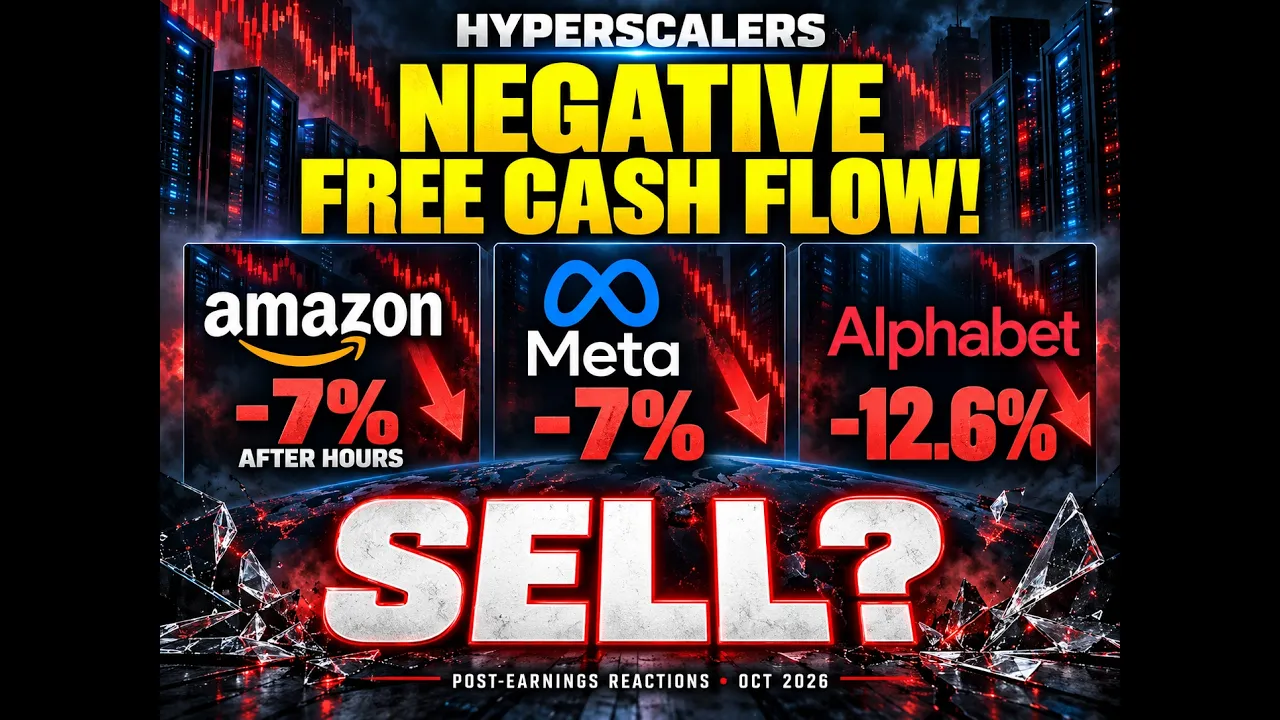
Alphabet, Meta Slump as AI Data Center Spending Erases Free Cash Flow
Adam Khoo
Hyperscaler cash deficits reflect front-loaded growth capital expenditures and non-recurring charges rather than operational decay, leaving Alphabet, Meta, and Amazon trading at deep discounts to intrinsic value.
Hyperscalers experienced sharp post-earnings sell-offs—Alphabet down 13%, Meta down 7%, and Amazon down 7.8%—driven primarily by panic over reported negative free cash flow. (0:00)
Underlying operational growth remains robust, with revenues growing 25% for Alphabet, 26% for Meta, and 13% for Amazon (ex-FX), while cash flow drops were heavily distorted by one-off legal charges, inventory buildup, and front-loaded growth CapEx. (1:43)
Using normalized free cash flow models to adjust for peak AI infrastructure spending, Adam Khoo values Alphabet at roughly $370–$377, Meta at $900–$1,200, and Amazon at $233, placing all three at substantial discounts to current prices. (19:17)
Under Khoo's three-phase AI framework, the market is currently in Phase 1 (hardware enablers capturing margins while hyperscalers absorb heavy CapEx), set to transition by 2027 into Phase 2 where hyperscaler CapEx slows and recurring AI revenues compound. (31:50)
Detailed notes
## Background
This video was published on YouTube by Adam Khoo on October 30, 2026. According to the page description, Khoo breaks down the Q3 2026 earnings reports of Alphabet, Meta, and Amazon following sharp market sell-offs sparked by negative free cash flow, explaining why Wall Street is overreacting and providing his intrinsic valuation framework for each hyperscaler.
## TL;DR
Adam Khoo analyzes the recent post-earnings plunge across Alphabet, Meta, and Amazon, arguing that the market's panic over negative free cash flow stems from a failure to distinguish between destructive maintenance CapEx and high-return growth CapEx. By looking past one-off accounting noise—such as legal settlements, mark-to-market paper losses, and inventory timing—he demonstrates that core operating profits and revenue growth remain remarkably strong. Using normalized cash flow calculations, Khoo determines that all three tech giants trade at steep discounts to their intrinsic values, outlining technical support levels to buy in tranches while framing their investments within a larger three-phase AI revolution.
## Atmosphere & style
The presentation carries Khoo's trademark blend of energetic defiance, pragmatic financial pedagogy, and high-conviction value investing. He moves briskly between analytical rigor—calculating normalized cash flows and technical support zones—and relatable, humorous anecdotes about his early dating life and self-investment. The dynamic feels like an empowering masterclass aimed at calming retail investor panic, transforming an atmosphere of market doom into a calculated opportunity for disciplined accumulation.
## Bulletin
- [00:00](https://www.youtube.com/watch?v=tKygzktysRk&t=0s) Hyperscalers experienced sharp post-earnings sell-offs—Alphabet down 13%, Meta down 7%, and Amazon down 7.8%—driven primarily by panic over reported negative free cash flow.
- [01:43](https://www.youtube.com/watch?v=tKygzktysRk&t=103s) Underlying operational growth remains robust, with revenues growing 25% for Alphabet, 26% for Meta, and 13% for Amazon (ex-FX), while cash flow drops were heavily distorted by one-off legal charges, inventory buildup, and front-loaded growth CapEx.
- [19:17](https://www.youtube.com/watch?v=tKygzktysRk&t=1157s) Using normalized free cash flow models to adjust for peak AI infrastructure spending, Adam Khoo values Alphabet at roughly $370–$377, Meta at $900–$1,200, and Amazon at $233, placing all three at substantial discounts to current prices.
- [31:50](https://www.youtube.com/watch?v=tKygzktysRk&t=1910s) Under Khoo's three-phase AI framework, the market is currently in Phase 1 (hardware enablers capturing margins while hyperscalers absorb heavy CapEx), set to transition by 2027 into Phase 2 where hyperscaler CapEx slows and recurring AI revenues compound.
## Key takeaways
- [04:38](https://www.youtube.com/watch?v=tKygzktysRk&t=278s) Negative free cash flow is not inherently dangerous if operating cash flow is expanding and the deficit is driven by productive growth CapEx rather than maintenance drag.
- [04:38](https://www.youtube.com/watch?v=tKygzktysRk&t=278s) Growth CapEx expands a company's economic moat and future earnings power, whereas maintenance CapEx simply sustains baseline operations without incremental return.
- [10:45](https://www.youtube.com/watch?v=tKygzktysRk&t=645s) Alphabet's 26% EPS decline was driven by a temporary non-operational mark-to-market write-down on its SpaceX equity investment, while core operating income grew 30%.
- [10:45](https://www.youtube.com/watch?v=tKygzktysRk&t=645s) Alphabet's operating cash flow dip resulted from an EU antitrust fine settlement and working capital tied up in proprietary TPU AI chip inventory ahead of commercial rollout.
- [12:04](https://www.youtube.com/watch?v=tKygzktysRk&t=724s) Google Search growth decelerating to 12% is within historical norms and reflects an AI monetization transition similar to the desktop-to-mobile shift, rather than terminal cannibalization.
- [15:25](https://www.youtube.com/watch?v=tKygzktysRk&t=925s) Normalized free cash flow (operating cash flow minus 5-year average CapEx) for Alphabet sits at $117.65B, yielding a fair intrinsic value around $370 to $377 per share.
- [22:48](https://www.youtube.com/watch?v=tKygzktysRk&t=1368s) Meta's reported 37% drop in operating income was an accounting distortion caused by a $9.89B social media addiction lawsuit settlement; adjusted operating income actually rose 11%.
- [24:22](https://www.youtube.com/watch?v=tKygzktysRk&t=1462s) Meta's $37.5B equity and debt capital raise creates only a 2.4% dilution to shareholders, making the stock's 12% intraday drop an emotional overreaction.
- [24:22](https://www.youtube.com/watch?v=tKygzktysRk&t=1462s) Normalized free cash flow for Meta sits near $79B, producing an intrinsic value range of $900 to $1,200 per share against current trading levels.
- [28:13](https://www.youtube.com/watch?v=tKygzktysRk&t=1693s) Amazon's headline EPS decline was distorted by a tough prior-year comp involving a $9B pre-IPO valuation gain on Anthropic; underlying operating income grew 61%.
- [28:13](https://www.youtube.com/watch?v=tKygzktysRk&t=1693s) Amazon's revenue miss stemmed from shifting Prime Day into Q2 alongside $900M in foreign exchange headwinds, while AWS growth accelerated to 39%.
- [28:13](https://www.youtube.com/watch?v=tKygzktysRk&t=1693s) Amazon achieved a record corporate operating margin of 13.9% and has an estimated Oracle intrinsic value of $233 per share.
- [31:50](https://www.youtube.com/watch?v=tKygzktysRk&t=1910s) The AI market cycle spans Phase 1 (hardware enablers like Nvidia), Phase 2 (hyperscalers compounding infrastructure returns), and Phase 3 (broad enterprise margin expansion).
## Detailed walkthrough
### [00:00](https://www.youtube.com/watch?v=tKygzktysRk&t=0s) Hyperscalers Post Negative Free Cash Flow and Market Panic
The latest earnings season has unleashed a wave of panic across Wall Street as tech giants report negative free cash flow. Longtime hyperscaler holdings have taken an immediate beating: Alphabet dropped 13% in what marked one of its worst single-day drops following earnings, Meta Platforms shed 7% (after tumbling as much as 12% intraday before recovering slightly), and Amazon plunged 7.8% in post-earnings trading. The abrupt sell-off has retail and institutional investors convinced that the sky is falling. As Adam Khoo observes of the sudden panic, “And some investors are freaking out and say, 'Oh my god, they're going to die.' and selling them off.”
The primary catalyst spooking the market is that free cash flow across these mega-cap tech companies turned negative. Free cash flow is simply cash generated from core business operations (operating cash flow) minus capital expenditures (CapEx). While conventional investing wisdom dictates that market leaders should deliver strong, expanding free cash flow, Khoo contends that context is everything. Evaluating whether a negative print is hazardous requires examining the underlying health of top-line revenue, core operating profits, and where that capital is actually being directed.
- **Alphabet ($GOOGL):** Down 13% post-earnings.
- **Meta Platforms ($META):** Down 7% post-earnings after rebounding from an intraday trough of −12%.
- **Amazon ($AMZN):** Down 7.8% in post-earnings trading.
[01:43](https://www.youtube.com/watch?v=tKygzktysRk&t=103s) Strong Revenue, Operating Income, and One-Off Cash Flow Headwinds
A closer inspection of fundamental operational metrics reveals robust business health rather than operational distress. Revenue growth remains exceptionally strong: Alphabet grew revenue by 25%, Meta surged 26%, and Amazon expanded 13% excluding foreign exchange fluctuations. Operating income tells a similarly strong story. Alphabet’s operating income expanded by 30%, while Amazon delivered a 61% surge. Meta’s reported operating income appeared to collapse by 37%, but Khoo emphasizes that this was purely distorted by a one-off legal settlement resolving lawsuits regarding social media addiction; stripping out that one-time charge, Meta's operating income actually grew 11%. Khoo prefers operating income over bottom-line net income specifically because net income is often skewed by non-operating noise, mergers, and acquisitions.
```mermaid
flowchart TD
accTitle: Free Cash Flow Drivers and Distortion Breakdown
accDescr: Diagram illustrating how operating cash flow and CapEx interact to create negative free cash flow alongside one-off inventory and legal distortions.
subgraph Operations["Core Operations"]
Rev["Strong Revenue Growth<br/>(GOOGL +25%, META +26%, AMZN +13%)"]
OpInc["Operating Income Growth<br/>(GOOGL +30%, AMZN +61%, META +11% adjusted)"]
OCF["Operating Cash Flow (LTM)<br/>(GOOGL +19%, META +24%, AMZN +29%)"]
end
subgraph Headwinds["Temporary Q3 Cash Distortions"]
Fine["One-Off Legal Fines<br/>(EU fine & Meta settlement)"]
Inv["Inventory Buildup<br/>(Google TPU AI chips)"]
end
subgraph Capital["Capital Deployment"]
CapEx["Growth CapEx Surge<br/>(AI Data Centers & Infrastructure)"]
end
Cash generation over the trailing twelve months (LTM) also shows sustained strength: operating cash flow rose 19% for Google, 24% for Meta, and 29% for Amazon. Year-over-year Q3 figures saw Meta up 9% and Amazon up 19%. Alphabet’s third-quarter operating cash flow did slip 13%, but Khoo dismisses this as the result of two transient events: an upfront regulatory fine paid to the European Union and working capital tied up in inventory ahead of commercial Tensor Processing Unit (TPU) rollouts. Because Google and Amazon design and sell their own custom AI silicon to compete with Nvidia, the chips must be manufactured and stored in inventory before revenue and cash collection arrive in 2027. Dismissing the market's overreaction to these accounting distortions, Adam Khoo stresses, “Business is doing very well because of inventory timing and that stupid fine, it turned negative.”
- **Revenue Growth:** Alphabet +25%, Meta +26%, Amazon +13% (ex-FX).
- **Operating Income Growth:** Alphabet +30%, Meta +11% (normalized; −37% unadjusted due to addiction lawsuit settlement), Amazon +61%.
- **Operating Cash Flow (LTM):** Alphabet +19%, Meta +24%, Amazon +29%.
- **Quarterly Operating Cash Flow (Q3 YoY):** Meta +9%, Amazon +19%, Alphabet −13% (impacted by the EU fine and TPU semiconductor inventory accumulation).
[04:38](https://www.youtube.com/watch?v=tKygzktysRk&t=278s) Maintenance CapEx vs. Growth CapEx
To demystify negative free cash flow, Khoo breaks down the fundamental formula: operating cash flow minus capital expenditures. Free cash flow turns negative under two radically different scenarios. If it turns negative because operating cash flow is shrinking, the core business is decaying and investors should run. However, when operating cash flow is expanding while free cash flow dips solely because capital expenditure is accelerating, the dynamics are entirely different. Hyperscalers are deliberately funneling tens of billions into cutting-edge data centers to cement their dominance in artificial intelligence.
Crucially, an investor must distinguish between maintenance CapEx and growth CapEx. Maintenance CapEx—such as airlines constantly spending vast sums to service or replace aging aircraft just to keep their baseline business running—is a cash drain that yields no expanding economic returns. Growth CapEx, by contrast, finances new infrastructure, new markets, and proprietary data centers that will drive future operating cash flow and expand competitive advantages. Khoo underscores this strategic reality: “Growth CAPEX allows a company to increase its economic moat, its revenue, its income, and its cash flow in the future.”
| Metric / Attribute | Maintenance CapEx | Growth CapEx (Hyperscalers) |
|:--- |:--- |:--- |
| **Primary Purpose** | Repairing and replacing existing assets (e.g., maintaining an airline fleet) | Building entirely new capacity (e.g., AI data centers, custom silicon) |
| **Impact on Core Moat** | Keeps the business afloat; does not expand competitive advantage | Widens the economic moat against competitors |
| **Future Cash Impact** | Sucks up cash flow with little to no incremental return | Drives substantial increases in future operating and free cash flow |
| **Investor Mindset** | Unfavorable capital drag; avoid capital-intensive legacy businesses | High-return investment; view short-term volatility as an accumulation window |
[07:25](https://www.youtube.com/watch?v=tKygzktysRk&t=445s) The Upgrading Analogy and Cyclical vs. Structural Issues
To make the dynamic intuitive, Khoo offers an analogy of an ambitious individual earning $5,000 a month with living expenses of $4,000, leaving $1,000 in personal "free cash flow." Wanting to eventually earn $10,000, $100,000, or $1,000,000 a month, the person decides to invest in self-upgrade CapEx—taking high-level courses in investing, options trading, leadership, AI, or advanced degrees. If he spends $2,000 a month on education funded partly by bank loans, his monthly free cash flow turns negative $1,000. A short-sighted partner might complain that he has no spending money left for luxury dinners, call him broke, and leave—only to miss out when his earning power explodes to millions down the road. Khoo relates this directly to his own life: early girlfriends dumped him for spending his money on NLP certifications, investing courses, and stacks of books instead of entertaining them, yet today he earns $6 to $7 million a year, with his wife reaping the rewards because she understood long-term investment.
Khoo cautions that whenever a company experiences fundamental pressures or market declines, investors must isolate the root cause. The core question is whether the setback is a temporary, cyclical blip or an irreversible, structural decline. In the case of hyperscalers pouring capital into AI infrastructure, the decline in free cash flow is deliberate and temporary. Framing the right mindset for market volatility, Adam Khoo concludes: “So, if it's a temporary cyclical issue, then no need to panic. Hold the shares and in fact, buy more at a bigger” discount.
[10:45](https://www.youtube.com/watch?v=tKygzktysRk&t=645s) Cyclical vs. Structural Moats and Alphabet's Earnings Fears
When evaluating market sell-offs, investors must distinguish whether an issue is temporary and cyclical or permanent and structural. An economic moat that is deteriorating long term justifies selling a stock, whereas a cyclical drawdown simply creates a discount. Turning to Alphabet (Google), Khoo addresses the market's first major concern: earnings per share fell 26% and missed Wall Street estimates. Khoo emphasizes that this was completely a one-off temporary accounting issue caused by an unrealized mark-to-market loss on Alphabet's equity investment in SpaceX. Excluding that non-operational write-down, operating income actually expanded by 30%.
The second concern—a 13% decline in quarterly operating cash flow—was likewise driven by temporary factors. Khoo points out that the cash flow dip was caused by paying an EU antitrust fine alongside a deliberate inventory build-up of Alphabet's proprietary TPU AI chips, which occurs ahead of customer deployment and cash collection. Because both of these factors are non-recurring, Khoo dismisses them as cyclical noise rather than signs of structural decay.
- EPS dropped 26% (missed analyst consensus), entirely due to unrealized mark-to-market losses on SpaceX holdings.
- Core operating income rose 30% year-over-year when adjusting for the SpaceX valuation hit.
- Operating cash flow dropped 13% due to the EU fine settlement and pre-sales TPU inventory build-up.
[12:04](https://www.youtube.com/watch?v=tKygzktysRk&t=724s) Search Growth Deceleration: Cyclical Fluctuations vs. AI Cannibalization
The third major fear gripping the market is that Alphabet’s core search business—its primary profit engine fueled by sponsored link clicks—is losing steam. Search advertising revenue growth decelerated from 17% in previous quarters to 12% in the reported quarter, causing investors to panic that AI search summaries are cannibalizing high-margin ad links. Khoo mocks the panic:
> “So, there's a deceleration in their search growth, and people are freaking out. They're like, 'Oh my god, that means that their search business is dying, is being cannibalized by their AI results, which are not being monetized as well.' And that's why, 'Oh my god, they're going to die. They're going to get killed.' And they're selling them off, right?”
Khoo contextualizes the numbers historically. Prior to the generative AI wave, Alphabet’s search growth routinely fluctuated between −2% and 13%. When Google introduced AI Overviews and AI Mode, search growth accelerated to 17% in Q4 of the prior year, 19% in Q1, and 17% in Q2 before settling at 12% in Q3. Consequently, 12% search growth sits right at the upper bound of Google's historical pre-AI performance range. Khoo identifies three specific catalysts behind the quarter's deceleration:
```mermaid
flowchart TD
accTitle: Catalysts for Google Search Deceleration
accDescr: Three main drivers behind Alphabet's search revenue slowdown to 12 percent.
subgraph MacroFactors["Macro & One-Offs"]
FX["US Dollar Rebound<br/>(FX headwind converting EUR & GBP)"]
AdPullback["APAC Retail Pullback & Media Normalization<br/>(EU import exemption end; post-World Cup comp)"]
end
subgraph ProductShift["Product Dynamics"]
AIMon["AI Mode Monetization Lag<br/>(Rapid query growth; lower initial ad rate)"]
end
FX --> Decel["Q3 Search Deceleration to 12%"]
AdPullback --> Decel
AIMon --> Decel
```
Khoo draws a direct parallel between the current monetization lag in AI queries and Google’s historical transition from desktop to mobile advertising, which initially depressed ad rates before re-accelerating earnings. Far from a declining business, Google's fundamentals remain robust across divisions: total revenue grew 25% (its 13th consecutive quarter of double-digit expansion), Google Cloud surged 103% with operating margins widening from 23% to 36%, and the 12% search pace represents the fastest five-year stretch of sustained growth.
[15:25](https://www.youtube.com/watch?v=tKygzktysRk&t=925s) The Artificially Depressed FCF and Normalization Framework
Examining Alphabet's cash flow charts, Khoo highlights that while revenues, operating income, and operating cash flow have all trended upwards, reported free cash flow took a steep, sudden plunge. This drop is the direct culprit driving investor anxiety. The plunge is not caused by weak operations, but rather by massive, front-loaded growth capital expenditures (CAPEX) dedicated to AI infrastructure.
Because conventional discounted cash flow (DCF) models project the current year’s free cash flow 20 years into the future, plugging in an artificially depressed free cash flow figure yields an inaccurately low intrinsic value. To determine what the company is truly worth, an investor must calculate "normalized free cash flow" by stripping out peak CAPEX distortion:
Looking at Alphabet's trailing five-year CAPEX figures of $31 billion, $32 billion, $52 billion, $91 billion, and $132 billion, Khoo calculates the five-year average capital outlay and subtracts it from operating cash flow. This math yields a normalized free cash flow of **$117.651 billion** for Alphabet, providing a clean baseline for fair valuation.
[19:17](https://www.youtube.com/watch?v=tKygzktysRk&t=1157s) Alphabet Intrinsic Value and Technical Support Levels
Khoo inputs the $117.651 billion normalized free cash flow into an intrinsic value calculator. Wall Street consensus estimates from FactSet forecast 18% growth over the next five years and 16% long-term growth for years 6 through 10. Opting for conservatism, Khoo caps the year 6–10 growth rate at 15%. Running the model outputs an intrinsic value of approximately **$370 per share**. For investors seeking a simpler approach, the platform's proprietary "Oracle value" similarly normalizes cash flows and growth assumptions, arriving at **$377 per share**. Against a market price of $283, the stock trades at roughly a 24% discount.
Khoo cautions that reaching fair value is never immediate, noting that the market is steered by short-term fear and technical swings:
> “Does it mean that the share price will go up tomorrow the moment Adam announces this, the price will go up to 370 and beyond? Of course not.”
Khoo highlights that while the business is intrinsically worth $370 and will drift higher over the long run, short-term price action depends on market sentiment and institutional manipulation. Examining the technical chart, Khoo traces a series of oscillating wave rallies and pullbacks, pinpointing a major technical support level around **$274 per share** as the key zone to watch as the stock retreats.
[22:48](https://www.youtube.com/watch?v=tKygzktysRk&t=1368s) Tranche Buying and Meta's Earnings Reaction
Adam Khoo outlines his strategy for adding shares around key technical support levels, emphasizing disciplined execution over attempting to pick market bottoms. A support level marks an area where demand has historically overwhelmed supply to reverse prices upward. If the primary support gives way, a secondary support level sits at $243. Rather than risking full capital at a single price point, he scales in gradually through dollar-cost averaging until reaching a targeted allocation.
Turning to Meta Platforms, the stock plunged as much as 12% following earnings before staging an intraday recovery to close down roughly 7%. Beyond broader anxieties regarding negative free cash flow, investors panicked over a 37% year-over-year decline in operating income and missed earnings-per-share (EPS) guidance. However, Adam Khoo explains that this earnings hit was an artificial, non-recurring event driven by a $9.89 billion charge tied to a lawsuit settlement regarding teen mental health addiction trials. Stripping out this one-time legal cost, Meta's operating income actually climbed 11%.
- Support strategy: Buy incrementally in tranches across support levels (such as $243) rather than going all-in at once.
- Reported operating income dropped 37% due to the $9.89 billion legal settlement charge.
- Adjusted operating income grew 11% when excluding the one-off litigation settlement.
> “And that's why when I add shares I never go all in at one level because you can never pick the absolute bottom, but I add in tranches.” — Adam Khoo
---
[24:22](https://www.youtube.com/watch?v=tKygzktysRk&t=1462s) Meta’s Capital Raise, Core Fundamentals, and Intrinsic Value
The second major panic surrounding Meta centers on its decision to raise $37.5 billion through equity offerings alongside debt to fund its aggressive capital expenditures. While the market treated the dilution as disastrous, basic mathematics shows that this capital raise dilutes current shareholders by only 2.4%. The market’s 12% sell-off represents a massive emotional overreaction. Adam Khoo notes that Meta's core business metrics remain robust: third-quarter revenue surged 26% (marking the third consecutive quarter above 25%), ad revenue rose 25%, ad impressions increased 10%, and the average price per ad climbed 14%, demonstrating exceptional pricing power. Daily active people across Facebook, Instagram, and WhatsApp hit 3.64 billion (up 3%), and its standalone AI app became the most downloaded app in the United States.
To calculate Meta's true worth, Adam Khoo normalizes free cash flow by subtracting the 5-year average CapEx from current operating cash flow, arriving at roughly $79 billion in normalized free cash flow. When plugged into a discounted valuation model using conservative assumptions, Meta yields an intrinsic value between $1,000 and $1,200 per share, while his proprietary Oracle value projects a more conservative baseline of $900. At current trading levels, the stock trades at roughly a 31% discount to fair value. On the weekly chart, Meta holds strong support along its 150-period moving average.
- Equity raise: $37.5 billion raised to fund CapEx growth, creating a minor 2.4% dilution against a 12% market drop.
- Q4 2026 revenue guidance: Projected between $73 billion and $76 billion.
- Engagement metrics: 3.64 billion daily active users across the family of apps.
- Intrinsic value: $900 (conservative Oracle baseline) up to $1,000–$1,200 per share, making Meta 31% undervalued.
> “And so, if you take advantage of the overreaction, that's how you get good deals in the market, all right?” — Adam Khoo
---
[28:13](https://www.youtube.com/watch?v=tKygzktysRk&t=1693s) Amazon’s Earnings Distortions and Underlying Strength
Amazon experienced post-earnings pressure driven by headline fears: year-over-year EPS declines, a slight revenue miss, and an advertising growth deceleration to 12%. Adam Khoo deconstructs these issues as cyclical and accounting-driven rather than structural damage. The apparent drop in year-over-year EPS occurred because Q3 2025 net income was artificially inflated by a $9 billion non-cash gain on Amazon's equity stake in Anthropic ahead of its planned public offering. Without that distortion, Amazon's operating income jumped 61% year over year.
The top-line revenue miss was similarly a timing distortion caused by shifting Amazon Prime Day from Q3 into Q2, combined with a $900 million foreign exchange headwind from the strong US dollar. Normalized for the Prime Day shift, top-line growth was 4% higher. Underlying enterprise demand remains strong: Amazon Web Services (AWS) accelerated to 39% growth—its fastest expansion in five years—with management guiding for over 40% growth across 2027 and 2028. Amazon logged an operating margin of 13.9% (the highest in company history) and guided Q4 sales up 12% to 16% alongside $28.5 billion to $33.5 billion in operating income.
| Metric / Driver | Reported / Headline Worry | Adjusted / True Reality |
|:--- |:--- |:--- |
| **Year-over-Year Profitability** | EPS dropped year-over-year | Adjusted operating income grew **+61%**; prior-year comp was distorted by a **$9B Anthropic gain** |
| **Revenue Growth** | Missed consensus targets | Prime Day shifted from Q3 to Q2 (costing ~4% growth) + **$900M FX headwind** |
| **AWS Cloud Performance** | Perceived cloud slowdown | Grew **+39%** (fastest in 5 years); guided to **>40%** in 2027–2028 |
| **Operating Margin** | Cash flow compression fears | Expanded to **13.9%**, the highest level in Amazon's corporate history |
Adam Khoo calculates Amazon’s Oracle intrinsic value at $233. With the market pricing in a 6.8% post-earnings dip toward the $226 support level, the stock is dipping into undervalued territory ahead of an anticipated year-end rally.
> “So, again, to me, this is not a declining business. It's in fact a business that that's getting even more profitable and even more dominant.” — Adam Khoo
---
[31:50](https://www.youtube.com/watch?v=tKygzktysRk&t=1910s) The Three Phases of the AI Revolution
To contextualize the heavy CapEx spending and free cash flow compression hitting hyperscalers, Adam Khoo introduces a three-phase macro framework of the AI revolution, which he plans to cover in detail at his upcoming Black Market X live event in November. In Phase 1, hardware enablers capture the vast majority of industry profits, while hyperscalers incur heavy upfront depreciation and CapEx drag. In Phase 2, hyperscaler capital outlays moderate, enabling them to aggressively compound recurring cloud and AI revenues across a vast installed infrastructure. Finally, Phase 3 sees non-tech corporate adopters leverage this compute power to achieve broad margin expansion.
```mermaid
flowchart LR
accTitle: Three Phases of the AI Revolution
accDescr: Flowchart tracking AI investment progression from hardware enablers to hyperscalers and corporate adopters.
subgraph P1["Phase 1: Enablers"]
direction TB
E1["Semiconductors & Power<br/>(NVIDIA, AMD)"]
E2["Highest Profit Share;<br/>Hyperscalers Squeezed by CapEx"]
E1 --- E2
end
subgraph P2["Phase 2: Hyperscalers"]
direction TB
H1["Cloud Giants<br/>(AMZN, GOOGL, META)"]
H2["CapEx Decelerates;<br/>AI Revenue Compounds on Base"]
H1 --- H2
end
subgraph P3["Phase 3: Adopters"]
direction TB
A1["Real-World Sectors<br/>(Healthcare, Industrials, Discretionary)"]
A2["Broad Adoption Drives<br/>Massive Margin Expansion"]
A1 --- A2
end
P1 -->|"CapEx deceleration"| P2
P2 -->|"2029 and beyond"| P3
```
- **Phase 1 (Current):** Semiconductor designers and power producers capture maximum profits, while hyperscalers absorb severe CapEx and depreciation headwinds.
- **Phase 2 (Starting 2027):** Hyperscaler CapEx growth decelerates; cloud and enterprise AI platforms compound cash flow on top of their massive installed infrastructure.
- **Phase 3 (2029+):** Enterprise adopters across healthcare, consumer discretionary, and industrial sectors capture wide margin expansion by operationalizing mature AI tools.
> “It's all about knowing how to position your portfolio to capture the highest value in all three phases.” — Adam Khoo
[33:45](https://www.youtube.com/watch?v=tKygzktysRk&t=2025s) Course Resources and Closing Sign-Off
Wrapping up the analysis, Adam Khoo encourages viewers to subscribe to the channel and enable the notification bell so they never miss any of his upcoming market breakdown videos. For those seeking structured education on mastering the financial markets, he points viewers toward his dedicated online training platforms where students can study investing and trading strategies designed to generate income from anywhere across the globe. He also highlights his interactive Wealth Academy program, which provides real-time online instruction for traders and investors looking to elevate their practical skills alongside him.
Before signing off, Khoo delivers his signature closing motto to inspire confidence in his audience as they navigate market volatility. As Adam Khoo signs off: “This is Adam Khoo, and may the markets be with you.”
- **Educational Platforms**: Viewers can explore comprehensive investing and trading courses at `piranhaprofits.com` to learn how to create global income streams.
- **Live Training**: Live online coaching and interactive sessions are hosted through the Wealth Academy program at `wealthacademylive.com`.
## Notable quotes
> [04:38](https://www.youtube.com/watch?v=tKygzktysRk&t=278s) Growth CAPEX allows a company to increase its economic moat, its revenue, its income, and its cash flow in the future. — Adam Khoo
## Mentioned
Adam Khoo, Alphabet, Amazon, AMD, Anthropic, AWS, Black Market X, European Union, Facebook, FactSet, Google, Google Cloud, Instagram, Meta Platforms, Nvidia, Piranha Profits, SpaceX, Wealth Academy, WhatsApp
## Video description
Alphabet ($GOOGL) just had its worst day ever (−13%), Meta ($META) fell 7% and Amazon ($AMZN) dropped after hours. Many investors are panicking that their Free Cash Flow turned negative. Should you?
In this video I break down the Q3 2026 results of Alphabet, Meta and Amazon
You will learn:
- The good vs bad negative free cash flow framework
- The positives and negatives from each earnings report, and why the market is overreacting to the negatives
- What AMZN, META and GOOGL are really worth
========================
Stock Investing & Trading insights by Adam Khoo will show you profitable trading and investment opportunities in today's stock markets.
=====================
Sign up for our courses/mentorship programs
📗 Value Momentum Investing: http://bit.ly/4mqrEVP
📙 Options Waverider™: http://bit.ly/4c5xyrR
📘 Price Action Manipulation™ (Trading): http://bit.ly/48FUAmQ
📕 Income Investing™ (Dividends): http://bit.ly/3Ow8CRj
Grab our Playbook Subscriptions
Ultimate Investors Playbook™: http://bit.ly/3QiN6zT
Options Tactics Playbook™: http://bit.ly/4tCQFPL
PAM™ Trader Playbook: http://bit.ly/4mmYnv0
=====================
💻 Join Our Wealth Academy Live Seminars
https://www.wealthacademyglobal.com
=====================
🧑🏫 Visit Adam Khoo Learning Technologies Group
https://www.akltg.com
=====================
Follow Me On Social Media
🌟 Facebook: https://facebook.com/adamkhoosuccess
🌟 Instagram: https://www.instagram.com/adamkhoosuccess/
=====================
Follow Piranha Profits On Social Media
🐟 Facebook: https://www.facebook.com/piranhaprofits
🐟 Instagram: https://www.instagram.com/piranhaprofits
🐟 Telegram: https://t.me/piranhaprofits
🐟 Discord: https://discord.gg/piranhaprofits
=====================
👉 If you've found this video helpful, please LIKE, SHARE, & COMMENT
👉 SUBSCRIBE to my Channel for more Market Analyses & Investing Strategies
👉 Click on the NOTIFICATION BELL to get notified whenever I upload a new video
=====================
💸 MAY THE MARKETS BE WITH YOU! 💸
Adam Khoo argues that recent post-earnings sell-offs in Alphabet, Meta, and Amazon are market overreactions to negative free cash flow caused by heavy growth capital expenditures rather than operational deterioration. He contends that underlying revenues and operating profits remain robust, creating buying opportunities for long-term investors.
Accounting Noise Behind Negative Free Cash Flow (1:43)
The headline panic that triggered drops of 13% for Alphabet, 7% for Meta, and 7.8% for Amazon stems from quarterly free cash flow turning negative. However, Khoo highlights that core operations are intact: revenue grew 25% for Alphabet, 26% for Meta, and 13% for Amazon (excluding foreign exchange). Over the trailing twelve months, operating cash flow expanded 19% at Alphabet, 24% at Meta, and 29% at Amazon. Reported earnings and cash flow suffered from non-operational, transient headwinds rather than core business decay.
Specific distortions impacted each company's quarterly results. Alphabet’s 26% EPS contraction stemmed from an unrealized mark-to-market loss on its SpaceX investment, while a 13% drop in operating cash flow reflected an EU antitrust fine and upfront inventory accumulation of proprietary Tensor Processing Unit (TPU) AI chips. Meta’s reported 37% plunge in operating income was skewed by a $9.89 billion settlement resolving teen addiction lawsuits; adjusted for this charge, operating income rose 11%. Amazon's year-over-year EPS decline faced a difficult comparison against a prior $9 billion valuation gain on Anthropic, while its operating income jumped 61%.
Maintenance Versus Growth Capital Expenditures (4:38)
Khoo distinguishes between maintenance capital expenditures (CapEx) and growth CapEx to explain why negative free cash flow is not inherently dangerous. Maintenance CapEx, such as an airline repairing aging planes, consumes cash merely to sustain existing operations without expanding returns. Conversely, hyperscalers are directing tens of billions into growth CapEx—primarily artificial intelligence data centers and proprietary silicon—to widen their competitive moats and generate future cash flow.
Because standard discounted cash flow models project current depressed free cash flow decades ahead, they produce artificially low valuations during heavy investment cycles. Khoo advocates using normalized free cash flow, calculated by subtracting a company's 5-year average CapEx from current operating cash flow. This adjustment yields a normalized cash flow of $117.651 billion for Alphabet and roughly $79 billion for Meta, reflecting their ongoing earnings power once peak infrastructure spending tapers.
Company Valuations and Support Levels (19:17)
Applying normalized cash flow metrics indicates that mega-cap tech stocks trade at substantial discounts to their intrinsic values. For Alphabet, Khoo calculates an intrinsic value of approximately $370 to $377 per share against a market price of $283 (a roughly 24% discount), identifying major technical support at $274. Meta’s intrinsic value is estimated between $900 and $1,200 per share—a 31% discount from current levels—with support at its 150-period moving average. Khoo notes that Meta's $37.5 billion equity and debt raise resulted in only a minor 2.4% shareholder dilution, far less than the market's initial 12% intraday drop.
Amazon is similarly undervalued, with an estimated intrinsic value of $233 against support at $226. Its apparent revenue miss was driven by shifting Prime Day into the second quarter and absorbing a $900 million currency headwind. Meanwhile, Amazon Web Services accelerated growth to 39%, operating margins expanded to a record 13.9%, and management guided for AWS expansion exceeding 40% in 2027 and 2028. Rather than attempting to pinpoint market bottoms, Khoo advocates scaling into positions across defined support levels in tranches.
The Three Phases of AI Value Capture (31:50)
To frame the timing of current hyperscaler capital expenditures, Khoo presents a three-phase macro model of the AI revolution. In Phase 1, semiconductor enablers and power producers capture peak industry profits while hyperscalers absorb heavy depreciation and cash flow drag. Starting around 2027, Phase 2 begins as hyperscaler CapEx growth decelerates, enabling cloud providers to compound high-margin software and compute services on their installed infrastructure. Phase 3, projected for 2029 and beyond, occurs when non-tech enterprise adopters across healthcare and industrials leverage these AI platforms to expand corporate profit margins.
Khoo views the current free cash flow compression among hyperscalers as a temporary, cyclical byproduct of Phase 1 AI infrastructure investments rather than structural decline. While his discounted cash flow models project upside across Alphabet, Meta, and Amazon, the timing of share price appreciation remains dependent on market sentiment, technical support levels, and the transition toward monetization in future phases.
精炼阅读摘要
Adam Khoo认为,近期科技巨头因自由现金流转负引发的市场抛售属于过度恐慌;这并非核心业务恶化,而是由激进的AI增长型资本支出及一次性财务扰动所致,反而为长期投资者创造了估值折价的买入机会。
自由现金流转负与增长型资本支出 (4:38)
Alphabet、Meta和Amazon在财报发布后股价分别下跌13%、7%及7.8%,主要诱因是自由现金流出现负值。Adam Khoo解释,自由现金流等于经营现金流减去资本支出(CapEx)。当前超大规模云服务商的现金流转负,并非核心业务现金流萎缩所致,而是因为企业主动投入数百亿美元建设AI数据中心等基础设施。投资者必须区分维护型资本支出(仅维持现有运营、不产生增量收益,如航空公司维护机队)与增长型资本支出(构建全新产能并扩大护城河)。当前科技巨头的支出属于后者,目的是巩固在AI领域的长期主导地位并驱动未来的经营现金流。
财报表象扭曲与核心营运指标韧性 (1:43)
分析显示三家公司的核心基本面依然稳健。Alphabet营收同比增长25%,经营利润增长30%;其三季度经营现金流下滑13%,主要受支付欧盟反垄断罚款及自研TPU芯片前期库存积压的影响。Meta营收增长26%,广告单价上升14%,尽管账面经营利润因98.9亿美元的青少年社交成瘾诉讼和解金同比下滑37%,但在剔除该一次性费用后实际增长11%;其通过股权和债务融资375亿美元支持资本开支,仅导致现有股东权益稀释2.4%,却引发股价一度下跌12%。Amazon经营利润大涨61%,AWS云业务增速达39%,创下13.9%的历史最高经营利润率;其财报中的每股收益同比下滑主要是由于前一年同期计入了Anthropic持股90亿美元的非现金未实现收益,属于基数效应。
标准化现金流模型与内在价值估算 (15:25)
针对激进资本开支导致折现现金流(DCF)模型估值失真的问题,Adam Khoo提出使用“标准化自由现金流”框架,即以最新经营现金流减去过去5年的平均资本支出。按此方法,Alphabet的标准化自由现金流为1176.51亿美元,测算出内在价值约为每股370美元(其平台Oracle估值为377美元),较283美元的市场价存在约24%的折价,关键技术支撑位在274美元和243美元。Meta的标准化自由现金流约为790亿美元,对应内在价值在每股1000至1200美元之间(Oracle基准估值为900美元),折价率约31%。Amazon的Oracle估值为233美元,回调至226美元支撑位附近同样进入低估区间。Khoo建议投资者避免一次性重仓摸底,应采取分批定投(Tranche Buying)策略在关键技术支撑位逐步建仓。
AI革命三阶段与巨头发展定位 (31:50)
Adam Khoo提出了AI革命的宏观三阶段演进框架,用于解释超大规模企业当前的资本压力。在第一阶段(当前阶段),硬件赋能者(如Nvidia、AMD等半导体厂商及电力供应商)获取行业绝大部分利润,而云巨头则承担高昂的资本支出与前期折旧压力。进入第二阶段(预计2027年起),超大规模企业的资本支出增速将放缓,转而在已建成的庞大基础设施之上,通过云平台和企业AI工具实现高复利现金流回报。在第三阶段(2029年及以后),医疗、消费品和工业等非科技行业的大范围企业采纳者将借助成熟的算力工具实现全面的利润率扩张。
Adam Khoo总结指出,只要巨头的经济护城河未发生结构性损坏,周期性与会计层面的短期扰动就不应引发恐慌。然而,该投资逻辑高度依赖于科技巨头未来能否将巨额AI资本开支成功变现,以及AI第二阶段盈利加速能否按期兑现。
Source quotes
[4:38] Adam Khoo: Growth CAPEX allows a company to increase its economic moat, its revenue, its income, and its cash flow in the future.
Original transcript
[0:00] The most recent earnings report,
[0:01] hyperscalers like your Amazon, your Meta
[0:04] Platforms, and your Alphabet or Google
[0:06] reported negative free cash flow. And
[0:09] some investors are freaking out and say,
[0:10] "Oh my god, they're going to die." and
[0:12] selling them off. So, what should we do
[0:14] as intelligent investors? How do we
[0:16] value these companies? And are they
[0:18] still worth investing in? Let's find out
[0:20] more in this video.
[0:31] We are currently in the middle of the
[0:33] quarter three earnings season, and so
[0:34] far it hasn't been kind to many of the
[0:37] hyperscalers that I own. So, for
[0:39] example, Alphabet that owns Google and
[0:41] YouTube down 13%after it reported
[0:45] earnings. Meta Platforms that reported a
[0:47] few days ago down 7%after earnings.
[0:51] Uh in fact, it was down 12%and then it
[0:52] rebounded, but it's still down 7%, and
[0:55] Amazon down 7.8%uh yesterday after
[0:58] earnings. So, why are they all selling
[1:01] off? Well, there are many reasons which
[1:03] I'm going to cover in this video, but
[1:05] the main reason
[1:07] that's freaking investors out is that
[1:09] their free cash flow
[1:11] is negative, as you can see over here.
[1:15] So, what does that mean? So, free cash
[1:17] flow basically means how much cash they
[1:20] are generating from their business
[1:21] called cash from operations minus the
[1:23] capital expenditure, CapEx. What's left?
[1:27] That's the free cash flow. So,
[1:29] ordinarily, we want a great business to
[1:31] have positive free cash flow that's
[1:33] growing, right? But the free cash flow
[1:35] is negative. So, is it something to be
[1:37] to be worried about? Well, the answer to
[1:39] me is no, and I'll explain why in a
[1:41] short while. But let's look at what's
[1:43] great about these companies. Number one,
[1:45] top line growth. I look at revenue
[1:47] growth, and it's growing very well. You
[1:48] can see uh Alphabet, Google up 25%
[1:52] revenue growth, Meta up 26%, Amazon ex
[1:55] foreign exchange uh changes is up 13%.
[1:59] Next, operating income growth. So, I
[2:01] like to look at operating income uh not
[2:03] net income because net income can be
[2:05] distorted by non-operating expenses and
[2:09] income. Like, for example, mergers,
[2:11] acquisitions, and so and so forth. I
[2:13] like to look at operating income, right?
[2:15] So, operating income was also doing very
[2:17] well. Google uh growing 30%. Now, you
[2:20] may see, "Hey, Meta Meta's down 37%.
[2:23] Why?"
[2:24] That is a one-off issue because they
[2:26] paid a big Well, not a big uh actually a
[2:28] small fine to settle their
[2:31] uh social media addiction lawsuit, if
[2:33] you recall, right? So, if you remove
[2:35] that, they actually grew 11%in terms of
[2:37] operating income.
[2:39] Amazon growing 61%in terms of operating
[2:42] income.
[2:43] Now, what's more important is the
[2:46] operating cash flow growth.
[2:48] So, you can see Google's operating cash
[2:50] flow grew at 19%uh year-on-year. Uh
[2:54] sorry, last 12 months. Meta grew 24%
[2:57] last 12 months. Amazon grew 29%last 12
[3:00] months.
[3:02] In terms of Q3 year-on-year, Meta is up
[3:04] 9%, Amazon up 19%. So, some people are
[3:08] concerned that, "Hey, Google's operating
[3:11] cash flow in Q3 is down 13%." Again, I'm
[3:15] not concerned because this negative
[3:17] number came for for from two one-off
[3:21] reasons. Number one, because of the EU
[3:23] fine. You know, they these these
[3:25] companies get get fined all the time,
[3:27] right? So, they they paid the fine in
[3:29] Q3.
[3:31] And their cash from operations turned
[3:33] negative for this quarter because of
[3:35] inventory buildup before their TPU
[3:38] sales. Now, what's TPU? As you guys
[3:41] know, Amazon and Google are now selling
[3:45] semiconductors. In a way, they're
[3:47] competing with Nvidia, right? So,
[3:49] Google's
[3:50] AI chips they're selling are called
[3:52] TPUs. Now, before they sell the TPU,
[3:56] uh they have to put it in their
[3:57] inventory. And inventory causes a
[3:59] negative to the cash flow because cash
[4:02] is stuck in the inventory.
[4:03] Later, when they sell it to the
[4:05] customers, the cash will come in in
[4:07] 2027. So, because of this inventory
[4:10] build-up and the EU fine, it caused
[4:13] their operating cash flow to go negative
[4:16] for this quarter. And it's something I'm
[4:18] totally not concerned about, because
[4:20] it's not that the business is not doing
[4:21] well. Business is doing very well
[4:22] because of inventory timing and that
[4:25] stupid fine, it turned negative. Now,
[4:28] let me talk about the main concern that
[4:30] investors have, which is the free cash
[4:32] flow turned negative. Now, why am I not
[4:34] concerned at all? Let me explain it with
[4:37] uh some drawings. So, first of all, free
[4:39] [snorts] cash flow
[4:41] is equal to the operating cash flow,
[4:44] operating
[4:46] cash flow
[4:47] minus capital expenditure, right? So,
[4:51] this is the formula for free cash flow.
[4:54] Now,
[4:55] when a free cash flow turns negative,
[4:57] there are two reasons why.
[4:59] If free cash flow turns negative because
[5:02] the operating cash flow is declining,
[5:04] that is bad. That's a bad thing. So,
[5:07] those are companies where they are
[5:09] generating less and less cash for their
[5:11] businesses. We don't want to invest in
[5:13] [clears throat] them. We want to get out
[5:14] of them, right? However, in the case of
[5:16] Amazon and Meta and Microsoft and
[5:19] Google,
[5:20] their operating cash flow is growing
[5:23] very well. So, they are generating more
[5:25] cash from their business, right?
[5:30] So, this is going up. But, why is their
[5:32] free cash flow going down? It's because
[5:35] their CapEx has gone up recently. Why
[5:39] has their CapEx gone up? Because they
[5:40] are investing billions and billions
[5:42] building these data centers
[5:45] to solidify their leadership in the AI
[5:48] revolution. So, because this has gone
[5:50] up, it caused this to go down
[5:53] temporarily. Now, is it a good or bad
[5:56] thing for a company to invest a lot in
[5:59] CapEx? It depends. There are two kinds
[6:01] of CapEx. The first is called
[6:03] maintenance CapEx
[6:05] and the second is what we call growth
[6:07] CAPEX.
[6:08] So, if a company has to spend more and
[6:11] more on maintenance CAPEX, like for
[6:13] example, an airline business, they have
[6:15] to spend a lot of money to repair the
[6:17] airplanes, to replace the old airplanes
[6:19] with new airplanes. That's called
[6:21] maintenance CAPEX. That sucks up the
[6:23] cash flow. That is bad. That's why I
[6:26] don't invest in airlines because they
[6:27] keep spending so much money just to
[6:29] maintain their current business. But, if
[6:32] a company spends on growth CAPEX, which
[6:34] means they invest in data centers or
[6:37] they invest in
[6:38] new factories, new markets, that's a
[6:41] good thing because growth CAPEX will
[6:43] cause what? Will cause their operating
[6:46] cash flow to increase even more in the
[6:49] future. And that will cause the free
[6:51] cash flow to increase even more in the
[6:54] future. So, in the case of the
[6:55] hyperscalers, it is not maintenance
[6:57] CAPEX.
[6:58] It is growth CAPEX. Growth CAPEX allows
[7:01] a company to increase its economic moat,
[7:04] its revenue, its income, and its cash
[7:05] flow in the future. So, people who are
[7:08] short-term minded, "Oh my god, they're
[7:09] spending so much money. Sell. Get out."
[7:11] Right? But, if you're long-term minded
[7:13] like me, we see it as an opportunity to
[7:16] take advantage of the short-term
[7:17] volatility to accumulate these
[7:20] businesses to generate significant more
[7:22] profits in the future. So, let me give
[7:25] you an an analogy. So, let's imagine
[7:27] there's a guy who, let's say, he earns a
[7:31] salary of um $5,000 a month. So, that's
[7:35] his cash inflow. And let's say he has to
[7:37] spend on stuff, his um
[7:40] monthly expenses. And he spends, let's
[7:43] say, 4,000 on transportation, on food,
[7:46] on entertainment. So, he's able to save
[7:50] $1,000 a month.
[7:53] What is this? This is, in a way, his
[7:55] free cash flow. Now, imagine this guy is
[7:59] very ambitious. He said, "I'm not happy
[8:01] earning 5,000 a month. I want to
[8:03] eventually earn 10,000, 20,000, 100,000,
[8:07] you know, a million a month. What would
[8:09] he do? He would have to invest in
[8:11] himself. He would have to
[8:14] uh spend on capex, right? So, he'll take
[8:16] lots of courses. He'll He'll take an
[8:18] investing course to learn to invest into
[8:20] trade options, for example. He would uh
[8:23] take a leadership course. He'll take an
[8:24] AI course. He may get a a master's
[8:27] degree, whatever it is, right? So, he
[8:28] spends all this money upgrading himself.
[8:31] That's called capex. So, let's imagine
[8:33] that he spends
[8:36] uh you know, $2,000 on himself upgrading
[8:41] every month, and to uh finance it, he
[8:44] takes some loans from the bank to in
[8:46] order to finance all these courses. What
[8:48] happens to his free cash flow? His free
[8:50] cash flow will now become
[8:53] uh minus $1,000. And you may say,"Oh my
[8:56] god, he's now losing a thousand dollars
[8:57] a month, right?"So, again, question, is
[9:00] this a good thing or bad thing? It
[9:01] depends on how you see it. If you're his
[9:03] girlfriend and you say,"Oh, he can't
[9:05] spend his money on me anymore. He can't
[9:06] bring me to nice places. He's a broke
[9:08] mother
[9:09] right? I'm going to leave him, right?"
[9:11] So, you leave the guy and find a guy who
[9:13] can spend on you, and you miss out on
[9:16] his future gains or his his future
[9:19] increase in income. But then he gets a
[9:21] new girlfriend who understands that he
[9:24] is investing in himself, and in the
[9:25] future he makes what, you know, a
[9:27] million dollars a year, 10 million
[9:29] dollars a year,
[9:30] uh and then she would the second
[9:32] girlfriend would benefit from it. Now,
[9:33] of course, if you're a lady listening to
[9:36] this, switch it around, okay? Turn
[9:38] around the the genders, okay? Now, this
[9:39] what happened to me. So, when I was
[9:42] younger, my girlfriends were
[9:44] complaining,"Oh, I don't spend enough
[9:45] time with them. I don't spend so much
[9:47] money on them."because I was investing
[9:48] in myself. I took lots of courses on
[9:50] NLP, on investing. I read lots of books.
[9:53] I spent more money on books and courses
[9:55] that I that I did on my earlier
[9:56] girlfriends, and they left me. They
[9:58] called me a broke mother right? But
[10:01] today I make what, six, seven million
[10:03] dollars a year, and who benefits? My
[10:05] wife, because she's an intelligent
[10:07] investor. Now, of course, the negative
[10:09] free cash flow is not the only concern
[10:12] that caused investors to sell off these
[10:14] hyperscalers. There are a few other
[10:15] concerns that I'd like to address right
[10:17] now. Now, remember, when you own a a
[10:20] stock, a business, and the share price
[10:22] falls because certain fundamentals have
[10:25] declined,
[10:26] the question you're going to ask is is
[10:28] the decline cyclical? Is it a short-term
[10:31] temporary issue, or is it a long-term
[10:34] structural issue that will persist? So,
[10:37] if it's a temporary cyclical issue,
[10:40] then no need to panic. Hold the shares
[10:43] and in fact, buy more at a bigger
[10:45] discount.
[10:46] But, if it's a long-term structural
[10:48] issue, which means the economic moat is
[10:51] deteriorating, then that's a reason to
[10:53] sell the stock. Okay? So, that's an
[10:56] important question ask, cyclical or
[10:58] structural? So, let's look at what are
[11:00] the concerns and fears.
[11:02] So, let's start with Alphabet, or
[11:04] Google. So, there are again some other
[11:06] concerns. First concern was that
[11:08] earnings per share fell 26%and missed
[11:12] the analyst estimates. So, what
[11:15] happened? Was it temporary, or something
[11:18] that's affecting the long-term business
[11:21] performance, right? And the answer it is
[11:23] totally a one-off temporary issue.
[11:28] The reason their earnings per share fell
[11:30] is because of unrealized mark-to-market
[11:32] loss on Google's investment in SpaceX.
[11:36] If you exclude that, their operating
[11:39] income actually rose 30%. Okay? So,
[11:43] that's not a concern.
[11:44] Number two, their operating cash flow
[11:47] fell 13%for the quarter. I already
[11:49] explained it earlier on because of the
[11:51] EU fine,
[11:53] and because the of the inventory
[11:54] build-up of their TPU AI chips before
[11:58] they sell them and the cash comes in.
[11:59] Again, this is a one-off cyclical issue.
[12:02] No concern at all.
[12:04] Now, the third issue is that
[12:07] their search, as you know, Google uh
[12:11] traditionally they make money on
[12:13] search advertising. When you search for
[12:14] things online and you get all those um
[12:17] search results and you click on the
[12:19] sponsored links,
[12:21] that's how Google makes money, right?
[12:23] So, their search growth was initially
[12:26] growing at 17%.
[12:29] And in this quarter, they reported 12%.
[12:32] So, there's a deceleration in their
[12:34] search growth, and people are freaking
[12:36] out. They're like,"Oh my god, that means
[12:38] that their search business is dying, is
[12:41] being cannibalized by their AI
[12:45] results, which are not being monetized
[12:47] as well."And that's why,"Oh my god,
[12:48] they're going to die. They're going to
[12:50] get killed."And they're selling them
[12:51] off, right? So,
[12:54] here's the fact. The fact is that before
[12:56] AI started,
[12:58] their search growth was actually between
[13:01] -2%on certain quarters to 13%on certain
[13:06] quarters. That's the range before AI
[13:09] started, right? Now, when AI began,
[13:13] and Google launched their AI overviews
[13:16] and their AI mode, which we all use
[13:19] today, their search growth grew from -2
[13:23] to 13%range, grew to 17%in Q4 last year,
[13:27] 19%Q1 this year, and 17%Q2
[13:32] this year.
[13:34] And Q3, it slowed back to 12%. Now, is
[13:39] that a bad thing? No, because at 12%, it
[13:43] is still at the upper range of where it
[13:47] was before AI started.
[13:49] Okay? So, the sell-off doesn't make any
[13:52] sense.
[13:54] And the reason why their search growth
[13:57] decelerated uh to 12%this quarter, there
[14:01] are three reasons.
[14:03] The main reason is because of the the
[14:06] rebound in the US dollar, causing them
[14:08] to earn less when they convert euros and
[14:11] pounds back to US dollars. So, it was an
[14:13] FX
[14:14] uh
[14:15] short-term issue, right? The second
[14:17] issue is because some of the APAC retail
[14:20] advertisers pulled back after the EU
[14:22] scrapped their import exemption.
[14:26] And media spend normalized after an
[14:28] unusually strong June loaded with World
[14:30] Cup matches.
[14:33] The third reason, which is the smallest
[14:35] reason, is because AI mode queries are
[14:38] growing fast and currently monetizes at
[14:41] a lower rate than classical search
[14:43] results. So, it's a monetization lag,
[14:46] and it's the same thing that happened
[14:47] when Google shifted from uh desktop to
[14:51] mobile many years ago.
[14:53] So, if you really scrutinize all these
[14:55] issues, you can see that there are no
[14:57] signs of a declining business. The
[14:58] business is growing, doing very well.
[15:01] Revenue up 25%, their 13th straight
[15:04] quarter of double-digit growth, Google
[15:06] Cloud up 103%where their margins are up
[15:09] 23%to 36%, and their search at 12%
[15:13] growth is the highest in 5 years.
[15:16] So,
[15:18] uh is it a dying business? Is it a
[15:19] declining business? Well, you make your
[15:21] decision. To me, no, there's nothing
[15:24] wrong with this business at all. Now,
[15:25] next question is, what are the shares
[15:27] worth? What's the intrinsic value? Let
[15:29] me show you how I calculate the
[15:31] intrinsic value of uh Google and then
[15:34] later Meta and then Amazon, okay? So,
[15:37] before I show you the intrinsic value
[15:39] calculation, let me show you once again
[15:41] uh the uh operating cash flow and the
[15:45] free cash flow. So, over here you can
[15:47] see that for Google or Alphabet, what's
[15:49] happening? Revenue is growing very, very
[15:52] nicely, right? So, that's revenue,
[15:54] operating income growing very, very
[15:56] nicely as well.
[15:57] And operating cash flow in orange is
[16:00] growing very nicely as well.
[16:03] The thing that has dropped is the free
[16:05] cash flow. Can you see the free cash
[16:08] flow over here? Let me use a different
[16:09] color.
[16:11] Yeah. So, the one in dark black, you can
[16:14] see that is growing, and then it dropped
[16:17] here. So, this is freaking people out,
[16:20] the drop in the
[16:21] um
[16:22] in the free cash flow. So, like I
[16:24] explained, the reason the free cash flow
[16:26] drop is not because the operating cash
[16:29] flow drop. Operating cash flow doing
[16:31] very well, it's because the capital
[16:33] expenditure has gone up significantly
[16:36] because of growth CAPEX. Okay? Now, how
[16:39] do we calculate the intrinsic value of
[16:43] of this stock? So, normally to calculate
[16:45] intrinsic value, we have to project
[16:49] the current free cash flow over the next
[16:52] 20 years.
[16:54] And then we discount it to present
[16:56] value, right? But, if you do that with
[16:59] the current free cash flow, you get a
[17:01] very low number
[17:03] because the current free cash flow is
[17:06] artificially depressed by the high
[17:08] CAPEX. So, to calculate a fair intrinsic
[17:11] value, what must we do?
[17:13] We cannot use the latest free cash flow.
[17:16] We have We have to use what is called a
[17:18] normalized free cash flow. So, let me
[17:20] explain what that means, and you can
[17:23] actually do this yourself once you
[17:24] understand this.
[17:25] Uh so, let me just show you the numbers
[17:28] here. Let's go to the cash flow
[17:29] statement.
[17:31] Okay, there we are.
[17:33] So, over here you can see
[17:36] that this is the operating cash flow.
[17:39] And you can see it's been growing,
[17:41] growing, growing, growing, growing,
[17:43] growing, right? And the CAPEX
[17:46] capital expenditure here,
[17:48] you can see it has been growing as well.
[17:51] Okay? So, if you take the operating cash
[17:53] flow, this minus this, you will get the
[17:57] free cash flow.
[18:00] Which is now very low because of the
[18:03] high CAPEX.
[18:04] So, to calculate the normalized free
[18:07] cash flow, what I do is this. I take the
[18:09] latest cash from operations, which is
[18:11] this one. This is the cash
[18:13] flow from operations. I take this, and I
[18:16] minus the average CAPEX of the last 5
[18:20] years. So, 1 2 3 4 5. This is the last 5
[18:24] years, right?
[18:26] 31 billion, 32 billion, 52 billion, 91
[18:29] billion, and 132 billion. So, I take
[18:31] these five numbers,
[18:33] add it together, divide by five to get
[18:35] the average
[18:38] capex of the last 5 years.
[18:41] So, when I take the current cash from
[18:43] operations minus the 5-year average, I
[18:46] get the normalized free cash flow.
[18:49] So, this is the number that I use to
[18:52] value the business. Now, I've already
[18:54] done the calculation, and what's the
[18:57] answer? The answer is the normalized
[18:59] free cash flow.
[19:01] The normalized
[19:03] free cash flow
[19:06] is
[19:07] for Google is 117.
[19:12] 651 million, 117 billion dollars. So, we
[19:15] will use this in the intrinsic value
[19:17] calculator. So, to do that, let me show
[19:19] you where it is. Go to the intrinsic
[19:22] value calculator here.
[19:27] And again, you can see if you scroll
[19:31] down, and we're going to use free cash
[19:34] flow. Oops, not this one. Free cash
[19:36] flow.
[19:37] You can see that if you project the
[19:39] latest free cash flow,
[19:42] which is artificially low,
[19:45] you get a very
[19:47] low intrinsic value, which is
[19:49] unrealistic, right? We need to normalize
[19:52] the free cash flow. So, we will put in
[19:55] the normalized free cash flow,
[19:57] which is 117.651.
[20:01] This will be more realistic, okay? And
[20:04] you can see the growth rate that is used
[20:06] to project the business is based on the
[20:09] consensus
[20:11] analyst estimates provided by FactSet,
[20:13] which is 18%growth the next 5 years,
[20:17] and then long-term 16%growth over here.
[20:20] Now, you can take those numbers,
[20:23] but for me,
[20:24] uh I'm usually more conservative.
[20:27] Where in growth
[20:29] year 6 to 10, I do not take anything
[20:31] more than 15%. I will cap it at 15%. So,
[20:34] I'm going to cap it at 15%here.
[20:38] And then I'm going to calculate based on
[20:41] this normalized free cash flow and this
[20:43] lower growth rate. Calculate. Ta-da!
[20:46] What do I get? I get an intrinsic value
[20:49] of about $370. There you go. Now, if
[20:53] this is too much work for you, you say,
[20:55] "I just want a shortcut."Very simple,
[20:58] you can just look at the Oracle value
[21:00] that comes up with a very similar number
[21:03] by normalizing the free cash flow and
[21:05] adjusting the growth rates. Which is
[21:07] over here. There we are. There.
[21:09] So, the Oracle value is 377, which is
[21:12] roughly about 370, roughly about there.
[21:14] And at current share price of 283, it is
[21:17] about 24%undervalued. So, a great
[21:21] company, undervalued. Does it mean that
[21:23] the share price will go up tomorrow the
[21:25] moment Adam announces this, the price
[21:27] will go up to 370 and beyond? Of course
[21:30] not. All right. So, this tells you what
[21:32] the shares are worth. It doesn't mean
[21:35] the price will get there tomorrow. The
[21:37] price can still go lower because in the
[21:39] short term the price is driven by not
[21:42] logic, not fundamentals, but driven by
[21:45] emotions and manipulation and all kinds
[21:48] of things that happen in the market. But
[21:50] what it does tell me is that in the long
[21:52] run,
[21:53] uh Google will continue growing and
[21:55] growing and growing, and it's worth 370,
[21:57] which means it's going to go back to 370
[21:59] and higher over time. When that will
[22:02] happen, I've got no idea. Could be next
[22:04] week, could be next month, could be next
[22:06] year. I don't know, right? But in the
[22:08] short term, the price is going down
[22:11] because of manipulation and fear, and of
[22:14] course it could go lower, all right? So,
[22:16] that's why what's important is to
[22:17] identify support levels. If you look at
[22:20] a chart of Google here, you can notice
[22:22] I've identified these are the
[22:24] um
[22:26] these are the uh technical support
[22:28] levels and recently you can see the
[22:31] price
[22:32] you know wave up wave down wave up wave
[22:35] down wave up wave down wave up wave down
[22:38] wave up wave down wave up wave down. So
[22:41] it's currently approaching this support
[22:43] level over here.
[22:44] 274 is a strong support. So if it hits
[22:48] here, this could be a level to add
[22:50] shares because a support level basically
[22:53] means that historically
[22:55] uh there has been more demand and supply
[22:59] to reverse the price up at this support
[23:01] level. So it could bounce back up here,
[23:03] but if it breaks this support then of
[23:05] course you have another very strong
[23:06] support at 243. Okay? And that's why
[23:10] when I add shares I never go all in at
[23:12] one level because you can never pick the
[23:13] absolute bottom, but I add in tranches.
[23:17] I add slowly in tranches over time I
[23:19] dollar cost average in until I've got a
[23:21] full position and then I don't add
[23:23] anymore. Let's very quickly look at the
[23:25] other two stocks. They're the two
[23:26] hyperscalers, right? So Meta. So Meta
[23:28] dropped as well, dropped 12%but it since
[23:30] rebounded but it's down 7%from earnings.
[23:33] Again, what's the fear?
[23:35] Uh again, besides the negative free cash
[23:37] flow which I've addressed the other fear
[23:39] is that operating income fell 37%and
[23:42] they missed their earnings per share
[23:44] guidance if you will, right? But why?
[23:47] Why did it happen? Okay, it's because of
[23:50] the uh
[23:52] lawsuit settlement. They were sued for
[23:54] the uh teen mental health
[23:57] uh addiction trial if you guys recall
[24:00] and they were supposed to be fined like
[24:01] a billion dollars, but in the end they
[24:03] paid a small amount small slap on the
[24:06] wrist of uh about 9.89 billion charge.
[24:10] So if you take that away, then the
[24:13] operating income actually went up 11%.
[24:16] So again, is this cyclical or is it
[24:18] structural? It's cyclical. It's a
[24:20] one-off thing that will not recur.
[24:22] Okay? The other concern is that Meta is
[24:25] raising money by selling shares. So
[24:28] people think"Oh my god, this is going to
[24:30] dilute my shares."So, they panic and
[24:32] they sell. Okay?
[24:34] Now, why are they raising money? Again,
[24:36] to finance their capex growth. So,
[24:39] they're financing it using debt and some
[24:43] equity. So, how much are they raising?
[24:45] They are raising 37.5 billion in equity.
[24:49] So, when a company sells shares to raise
[24:52] money, does it dilute the shareholders?
[24:55] It does. But, the question is how much
[24:57] does it dilute it by? And number two, in
[25:00] the long run, will this capital grow the
[25:03] pie even more? The answer is I think it
[25:06] will grow the pie even more. So, I'm not
[25:08] too concerned. But, the actual dilution,
[25:10] if you do the mathematics, is a 2.4%
[25:13] share dilution of current shareholders.
[25:17] So, logically, the share price should
[25:19] drop 2.4%, right?
[25:22] But, it dropped 12%. All right, so the
[25:23] market tends to overreact to bad news.
[25:27] And so, if you take advantage of the
[25:29] overreaction, that's how you get good
[25:31] deals in the market, all right?
[25:34] If you look at the underlying business,
[25:35] you can see it's doing very well, just
[25:37] like Alphabet. Revenue up 26%, third
[25:40] straight quarter
[25:42] uh above 25%ad revenue growth 25%and
[25:46] they are guiding their quarter four
[25:48] revenue at 73 to 76 billion dollars. Ad
[25:52] impressions grew 10%, price per ad grew
[25:54] 14%, which is a
[25:56] sign of very strong pricing power and a
[25:59] very strong economic moat. And the daily
[26:02] active people, which means 3.64 billion
[26:05] people
[26:06] use Facebook, Instagram, or WhatsApp
[26:09] daily, up 3%. So, again, is it a dying
[26:14] business? Is it a declining business?
[26:17] You make your decision. To me, it's a
[26:19] business that's getting stronger and
[26:21] more and more dominant, especially now
[26:23] that they've launched their recent news
[26:25] AI agent that has become very, very
[26:27] popular. The number one downloaded app
[26:29] in the US and now just came to Singapore
[26:32] and playing with it now. So again, you
[26:34] can calculate the intrinsic value by
[26:36] doing the same thing I showed you
[26:37] earlier on
[26:39] uh calculating the normalized free cash
[26:41] flow, taking the current cash from
[26:43] operations minus the five-year average
[26:45] cap backs. That should give you a
[26:47] normalized free cash flow of of $79
[26:49] billion. So if you put
[26:51] So if you put in $79 billion
[26:53] into the intrinsic value calculator and
[26:54] you project it at the
[26:57] uh growth rates,
[26:58] you get roughly about $1,000 to about
[27:02] $1,200 intrinsic value.
[27:06] That's right. But you can see that the
[27:07] Oracle value actually is more
[27:09] conservative and shows a valuation of
[27:12] $900. So this is actually very very
[27:15] conservative, using a much lower growth
[27:18] rate than what people are using. And
[27:20] even at the very conservative valuation,
[27:23] uh Google I'm sorry, not Google, Meta is
[27:25] 31%undervalued. Again, like I said, does
[27:29] it mean that uh Meta will shoot to $900
[27:33] and $1,000 tomorrow? Of course not,
[27:35] right? Short term, it can still go
[27:36] lower. You can never predict the short
[27:38] term, but long run, you know it's going
[27:40] to keep growing and growing and growing
[27:41] and it's worth at least 900
[27:44] to a thousand plus dollars, right? And
[27:46] if you look at the chart again, you can
[27:48] see
[27:50] it's been chopping around over here.
[27:52] Very strong support at the 150 green
[27:55] line, 150 on the weekly time frame.
[27:58] Right? As you can see, uh wave up,
[28:00] bounce, bounce, bounce. It looks like it
[28:03] could be bouncing here, but if not, it
[28:04] could bounce here and then likely it's
[28:06] going to go back higher by the end of
[28:08] the year. I can't predict 100%, but
[28:11] that's just my guess. Finally, let's
[28:13] take a look at Amazon. Again, besides
[28:15] the negative free cash flow, which I've
[28:17] explained earlier on, the other two
[28:20] fears people have about Amazon that
[28:22] caused a sell-off was that their
[28:24] earnings per share fell year on year and
[28:27] their revenue missed expectations and
[28:29] their ad revenue slowed to 12%. So
[28:32] again, what actually happened? Is it a
[28:34] cyclical issue or a structural long-term
[28:37] issue that is affecting the business
[28:40] economic mode? First, the reason the
[28:42] earnings per share fell uh
[28:45] from last year to this year is because
[28:46] last year, 2025 quarter three, the
[28:49] profit was unusually, artificially
[28:53] propped up by a 9%Sorry, a $9 billion
[28:57] gain on Amazon's stake in Anthropic,
[28:59] which you know owns Claude, which is
[29:01] going IPO this year. So, last year,
[29:03] there was a one-time gain of $9 billion.
[29:06] This year, there's no gain, so it caused
[29:08] that drop.
[29:09] Again, if you take that out of the
[29:11] equation, this year, Amazon's operating
[29:14] income is actually up 61%. So, it was
[29:17] distorted because of their stake in
[29:19] Anthropic. So, again, it's a one-time
[29:22] issue that is not nothing to do with the
[29:25] actual business of Amazon, okay? Second,
[29:28] why did their revenue miss expectations?
[29:30] Because their Prime Day, which they sell
[29:32] the most,
[29:33] uh moved from quarter three this year
[29:36] uh to quarter two.
[29:38] And if you don't include the shift,
[29:40] their growth would have been 4%higher,
[29:42] in fact. And there was also an FX cost
[29:46] of $0.9 billion because of the stronger
[29:48] US dollar in the last 3 months. So,
[29:51] again, is it a cyclical issue? Yes, it's
[29:53] a timing issue, and their forward
[29:54] guidance already shows a strong rebound
[29:57] in revenue and earnings per share.
[30:00] Uh if you look at the underlying
[30:01] business metrics, their Amazon Web
[30:04] Services grew 39%, the fastest in 5
[30:08] years.
[30:09] And management is guiding over 40%
[30:12] growth in 2027 and 2028. The backlog is
[30:15] growing, their operating income up 61%,
[30:19] operating margin 13.9%, the highest in
[30:22] Amazon's history. And for quarter four,
[30:24] they're guiding sales growth of 12 to
[30:26] 16%and operating income of 28.5 to 33.5
[30:31] billion, which is much higher than what
[30:33] was expected. So, again, to me, this is
[30:35] not a declining business. It's in fact a
[30:37] business that that's getting even more
[30:39] profitable and even more dominant. Now,
[30:42] if you calculate Amazon's intrinsic
[30:44] value, and again, I've shown you how to
[30:45] do it, uh it is about $233 intrinsic
[30:50] value. There we are. Oracle value 233,
[30:52] exactly uh over here, as you can see.
[30:56] So, um it announced yesterday. So, the
[31:00] market is pricing in a 6.8%drop today.
[31:05] Uh whether it will drop, I don't know.
[31:07] But, if it drops to 226,
[31:10] uh that will be at the first support
[31:12] level. You can see there's a pretty
[31:13] strong support level 226, and that would
[31:15] make it slightly undervalued. All right?
[31:17] You can see again,
[31:18] um you know, wave up, wave down, wave
[31:20] up, wave down, wave up, wave down. These
[31:23] are small waves, and wave up, big wave
[31:25] down, wave up, wave down, wave up, wave
[31:27] down, wave up, big wave down, wave up,
[31:28] wave down. You can see these waves are
[31:30] very, very
[31:32] uh predictable, right? So, wave up, wave
[31:33] down. So, if you ask me to guess, it
[31:37] would probably uh wave down to the first
[31:40] support level and bounce all the way
[31:42] back up. Again, you know, I can't 100%
[31:45] predict, but I'm just guessing that this
[31:47] would be a pretty strong support before
[31:49] the year-end rally. Remember, we are
[31:51] currently in phase one of the AI
[31:54] revolution. We're going to We are going
[31:57] to go into phase two next year, and
[32:00] subsequently phase three. I'll talk a
[32:02] lot more about this during the Black
[32:04] Market X event coming up in November.
[32:07] But, to give you a bit of an idea what
[32:10] I'll be talking about, of the many
[32:12] things I'll talk about, is in phase one,
[32:14] the enablers are the ones that are going
[32:18] to have the highest profit. So, enablers
[32:20] are like your AMD, your Nvidia. Uh in
[32:23] other words, your semiconductors and AI
[32:25] power producers. They will capture most
[32:27] of the profits. But, in phase one, it is
[32:30] the hyperscalers that are spending on
[32:32] CapEx. They will be squeezed by lower
[32:35] free cash flow, squeezed by
[32:37] depreciation. But, in phase two,
[32:40] once the capex growth decelerates, which
[32:44] means the hyperscalers spend less on
[32:45] capex, you will see that the
[32:47] semiconductors
[32:49] and the AI power producers, they may
[32:52] decelerate from there, but then the
[32:55] hyperscaler cloud and AI revenue will
[32:57] compound on a bigger install base.
[33:00] And then finally in phase three, which
[33:02] is 2029 beyond, you find that the
[33:05] companies in health care, consumer
[33:07] discretionary and industrials, which are
[33:10] called the adopters, will have the
[33:11] highest margin expansion. So, it's all
[33:14] about knowing how to position your
[33:15] portfolio to capture the highest value
[33:18] in all three phases. I'll go into
[33:21] greater detail in the upcoming live
[33:24] Black Market X webinars in November, and
[33:28] I look forward to seeing you there.
[33:29] We'll give you more details in a while
[33:30] how you can enroll in these live
[33:33] webinars called Black Market X. So, with
[33:35] that, thank you for listening to this
[33:37] pretty long webinar. I hope it's been
[33:39] useful, and as always, may the markets
[33:41] be with you. And let's get ready for the
[33:43] year-end rally. If you want to catch my
[33:45] latest videos, click on the subscribe
[33:47] button right now. Click on the bell, so
[33:49] you get instant notifications once I
[33:51] upload my latest video. If you want to
[33:53] check out my online courses, go to
[33:56] piranaprofits.com, where you're going to
[33:58] learn how to invest and how to trade the
[34:00] financial markets and create an income
[34:02] from all around the world.
[34:04] If you want to join my live Wealth
[34:06] Academy program, go on to
[34:08] wealthacademylive.com and find out more
[34:10] about how you can learn investing and
[34:12] trading live online. This is Adam Khoo,
[34:14] and may the markets be with you.