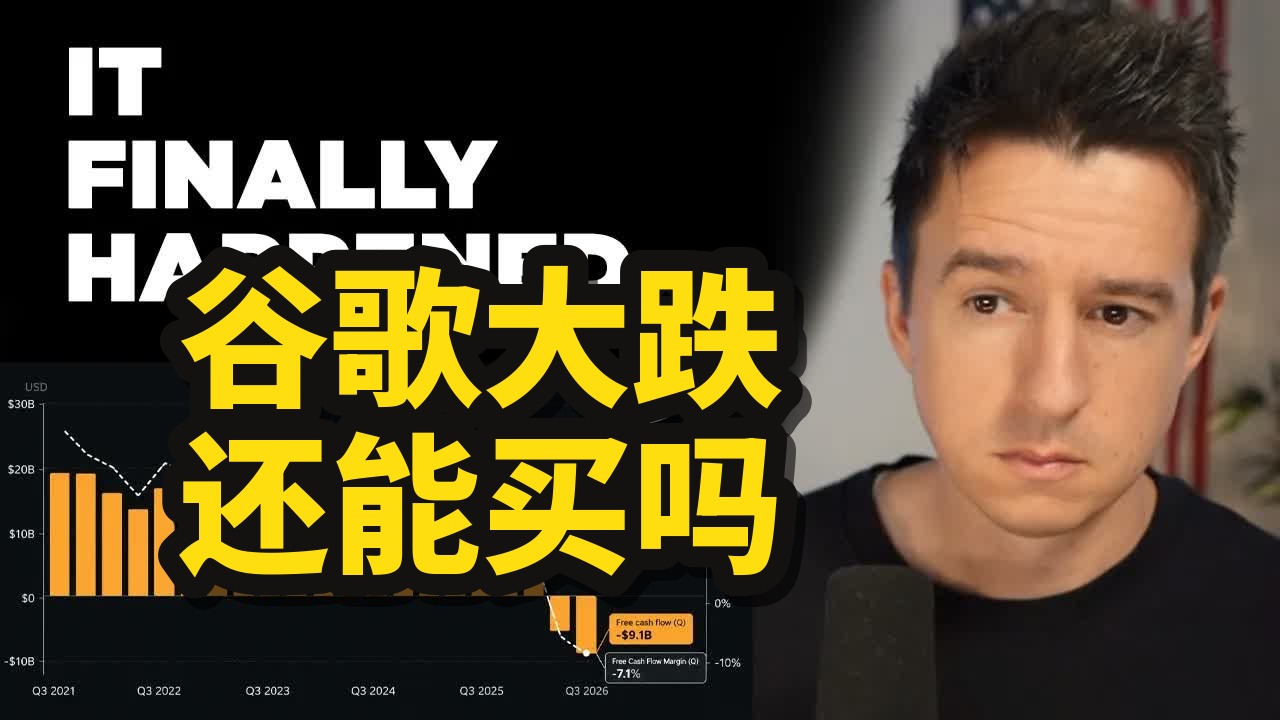
谷歌公布最新季度财报后,股价单日重挫 12%,单日市值蒸发约 5000 亿美元,每股价格暴跌近 39 美元,直接落至 300 美元以下。在这之前,谷歌一直是美股市场中表现最出色的公司之一,季度业绩屡屡超出预期。引发本次大规模抛售的核心,是市场对 AI 蚕食搜索业务的担忧卷土重来。此前市场曾对 ChatGPT 摧毁谷歌搜索产生过恐慌,如今类似的悲观叙事再度抬头,华尔街认为 AI 搜索查询的兴起正在侵蚀核心的搜索广告收入。
然而,网络论坛与 Discord 社群中的大量言论充斥着过度解读与事实扭曲。面对季度环比的急剧减速,不能简单地将其归咎于 AI 蚕食,必须厘清其财务全貌,包括估值水平、利润上升与自由现金流下滑之间的背离,以及激增的资本支出(CapEx)。正如 Joseph Carlson 所言:“What I hope to do in this episode is clarify the real situation of Google.”
```mermaid
flowchart TD
accTitle: Google Growth Engine Breakdown
accDescr: A breakdown showing how Google's total business is driven by cloud acceleration despite search deceleration.
subgraph RevenueDrivers["Core Growth Engines"]
A["Google Cloud Engine<br/>>100% YoY Growth<br/>High Operating Margins"]
B["Core Search & Ad Business<br/>Decelerating but High Base"]
end
subgraph Trajectory["Financial Projection (to 2028)"]
C["Trailing 12M Revenue Growth<br/>20% to 25% Range"]
D["Long-Term Revenue Outlook<br/>~14.5% CAGR to ~$727B Run Rate"]
end
真正触动华尔街敏感神经的是业务分部表现,特别是占据谷歌营收近半壁江山的命脉——谷歌搜索(Google Search)。按过去 12 个月的累计数据看,搜索业务依然保持着 16% 的增长,看似相当平稳;但一旦切换到单季度视角,矛盾便彻底爆发:在刚刚过去的这个季度,搜索业务增速直接放缓至 12%,相比前一季度的 16% 出现了显著减速。这种远逊于华尔街预期的失速,瞬间打开了潘多拉魔盒,引得市场疑神疑鬼:究竟是因为 GrokBot、各类 AI 搜索助手,还是 AI Overviews 正在分流流量?长期以来,谷歌搜索业务不仅表现优异,而且增速屡屡超出市场预期,导致空头一直无从下手,只能苦苦等待裂痕出现。正如主讲人所言:“Deceleration has to happen at some point.” 这次从 16% 到 12% 的剧烈减速,正好给了蓄势已久的空头绝佳的借题发挥空间。
```mermaid
flowchart LR
accTitle: 华尔街恐慌传导链路
accDescr: 展示从搜索增速放缓到市场情绪暴跌的逻辑传导过程
随着股价急跌,知名科技分析师 Gene Munster 登上 CNBC 公开唱衰谷歌,直言这不仅仅是一次财报未达预期,而是反映出底层业务运转出现了根本性问题。Gene Munster 在电视节目中犀利地指出:“AI search queries had an impact on search revenue. So that's not good.” 他认为管理层在财报电话会议中列举的种种客观原因不过是粉饰太平的“借口”(excuses),核心症结在于管理层明确预警 12 月季度的增速将进一步放缓,且高增长的 AI 搜索查询模式正在直接侵蚀传统搜索的广告变现。
除了外汇因素,多个垂直行业的非正常周期波动也叠加造成了增长错觉。在零售垂直领域,欧盟取消小额货物免税(de minimis exemption)直接冲击了部分亚太地区跨境广告主的投放意愿;在媒体与娱乐垂直领域,二季度的广告支出曾因四年一度的重磅赛事——国际足联世界杯(FIFA World Cup)而出现“异乎寻常的爆发”,广告预算集中在 6 月疯狂消耗,到了 7 月及第三季度自然迅速回归常态。拿一个包含全球顶级体育赛事的超高基数季度去和随后的平淡季度强行对比,得出“谷歌搜索不行了”的结论,显然脱离了商业常识;这些均属于外部环境波动,根本不是企业内部竞争力瓦解的体现。
- 汇率变动(Foreign Exchange):被管理层确认为导致三季度搜索减速的“单一最大因素”(single largest driver)。
- 政策变动冲击:欧盟取消小额豁免政策(de minimis exemption),直接压制了亚太广告主的投放预算。
- 季节性高基数回落:二季度受 FIFA 世界杯催化,广告预算异常高涨并在 6 月大量消耗,三季度娱乐媒体类广告自然回归正常化。
---
[17:15](https://www.bilibili.com/video/BV1Drxv6HEmZ?t=1035s) 传统蓝链转向 AI 模式:刻意为之的阵痛与长期变现路线图
在剔除外汇与高基数等外部噪音后,管理层坦承的最后一个原因,正是令市场陷入恐慌的核心焦点:AI 模式查询(AI mode queries)的爆发式增长,确实对搜索营收产生了拖累,因为 AI 模式目前的货币化水平显著低于传统搜索。主讲人对此客观指出,这正是空头目前唯一站得住脚的论据:“AI is kind of cannibalizing some of their business. And that part is true.” 传统的经典“蓝色链接”搜索模式,是谷歌历经十几年反复打磨、极度精细化的高利润印钞机;而全新的 AI 搜索形态目前无论在广告位展示、用户交互还是计费机制上,都尚未经过深度优化,单位点击带来的收入自然不及传统页面。
然而,将这种短期的变现落差视作谷歌的灭顶之灾同样是一种短视。谷歌并非被动挨打,这种“自相残杀”(cannibalization)完全是公司主动推进行业代际转型的战略选择,旨在将庞大的用户群平滑迁移至下一代 AI 界面。谷歌已经在向更多国际市场推广 AI Overviews,并于美国本土上线了多轮对话广告(multi-turn ads)。正如当年的移动端转型一样,AI 变现目前尚处于生命周期早期,长期的货币化空间甚至有望超过传统网页。不过,眼下市场充斥着极端恐惧的情绪,叠加经营指标不及预期与自由现金流骤降,“搜索正在被 AI 吃掉”的看空叙事短时间内难以消散;在搜索增速重新拐头向上之前,谷歌股价很可能还需要在长达几个季度甚至一年的拉锯中承受估值重构的阵痛。
对于部分投资者担忧云业务未履行业务积压(backlog)从上一季度的 5130 亿美元仅增至 5600 亿美元、环比增速放缓的问题,主播直言市场又一次理解错了逻辑:“You don't want the backlog to just grow forever. Because a backlog is promised revenue. What you really want is revenue growth, and you want them to consume their backlog at an increased rate, which is exactly what Google's doing.” 积压订单没有暴增的原因正是因为云业务以超过 100% 的增速在高效消耗它。此外,YouTube 广告与订阅(以 YouTube Premium 为主)同比增长约 10%,虽然增速同样有所放缓,但 YouTube 在电视屏幕端的统治力极强,用户在电视上看 YouTube 的时长已经大幅甩开 Netflix。结合 Gemini 和 Argon 大模型、自动驾驶业务 Waymo 以及自研芯片布局,谷歌在财报电话会议上首次让云业务主管亮相,表明公司正积极将叙事重心从“传统搜索公司”全面过渡到“搜索信息+云业务”。尽管未来几个季度关于 AI 蚕食搜索的争议还会持续压制股价、短期难有报复性反弹,但主播表示绝不会卖出自己的重仓份额。
在市场焦点之外,反而是那些被认为“枯燥”的公司在持续创造新高。万事达卡(MasterCard)是主播投资组合中最无趣但规模最大的第一重仓股,持仓价值约 21.2 万美元,浮盈达 6.5 万美元。万事达卡股价近期创下历史新高,年内上涨 13%,过去五年累计涨幅达 91%。此前空头坚信巴西的政府即时支付系统 Pix 或其他国家的主权支付网络将彻底抹杀信用卡,但事实证明这一悲观论调并未成真,“And they just aren't. MasterCard continues to grow along with Visa and American Express. These companies are doing fantastic.” 信用卡巨头依然与维萨、美国运通一同保持稳健增长。
为了打破仅局限于餐饮外卖的边界,DoorDash 宣布计划以约 170 亿美元的溢价收购主要面向 Target、Costco 等零售商配送的 Instacart。主播认为,要想将平台拓展至全品类本地即时零售,企业要么通过疯狂打广告、打价格战承受长期亏损来抢份额,要么直接通过并购买下既有网络,DoorDash 选择的是最快路径。该交易目前面临的最大不确定性是监管机构的反垄断审查:“And it really comes down to how you define a market. If the market is simply just delivery services like DoorDash, Instacart and Uber, then DoorDash is obviously too big to buy Instacart. But if you start saying that Amazon delivery is part of the market, that Walmart delivery is part of the market, then it becomes more easy to justify that DoorDash should be able to buy Instacart.” 如果能把亚马逊和沃尔玛纳入竞争池,合并就具有合理性;虽然价格昂贵,但若能获批,将为 DoorDash 锁定长期的护城河与增长空间。
## Notable quotes
> [06:07](https://www.bilibili.com/video/BV1Drxv6HEmZ?t=367s) Google's no longer an expensive company based on the earnings. — Joseph Carlson
[6:07] Joseph Carlson: Google's no longer an expensive company based on the earnings.
Original transcript
[0:00] Google stock just reported earnings, and the stock today is down 12% as a result. That's around $500 billion of market cap wiped away from this company. A massive amount of value loss. In fact, that is a $39 decline. in the stock price, bringing it well below $300 per share. And up until now, Google has been one of the best stocks in the market. Their earnings report quarter after quarter have been great. So what happened in yesterday's report that's causing this big sell-off? Well, we have renewed fares. Remember when everybody was concerned about ChachiBT destroying Google search? Well, those same fares are starting to renew. Alphabet's earnings misreflect the first real sign that AI is They're saying that AI search queries had an impact on search revenue. So that's not good. Yeah, exactly. That's their core business. And it is back to that narrative that their core business is being cannibalized by AI. Google search is now being cannibalized by AI. It's not good. Now, is that true? How much of this is really because of AI? Is the search business going down? We had a sharp deceleration quarter over quarter, and that's really what investors are concerned about today. And I want to go over this and give some clarity, because I feel like a lot of the things that people are saying online, a lot of the posts, a lot of the Discord conversations, are just not accurate. They're not accurate. What I hope to do in this episode is clarify the real situation of Google. What's actually going on with this company? Not just with the search and cannibalization situation. but also with the valuation of the stock. With Google's financial situation, with them having their earnings go up while their free cash flow goes down, while their CapEx is explosive, it makes the whole situation more difficult to understand. And I think it's important to go over and clarify what's really happening with Google. So we're going to be diving into it deep. We'll be going over the entire situation and trying to make sense of it. Now, we also have Microsoft that reported earnings, MasterCard, huge holding of mine, reported earnings, to buy Instacart. So I'll be going over those as well. Now to start things off, I want to first look at some charts about Google's situation. For example, we'll just start with the price chart. Google stock dropped almost $40 per share down to $283 a share. Even after this drop, Google still has a 14% kegger since 2021, meaning that it's widely outperformed the QQQ and the S&P 500 over the past five years. That is including with the recent drop just today. Now, Google historically got up to $399 per share. got over the past five years is $83, and the median is $156. So right now, Google is still a good performing stock, even with this drop. It brings it down and it takes away a lot of the excess performance, but the median over the past five years being 156 shows that this thing has really surged up over the past two years. Now we can look at how this price change affects my portfolio because Google was one of my largest positions and it did hit it hard. The impact of Google's drop on my portfolio was equivalent to 1.5%. Now, when I look at the one day, I'm actually only down 0.6%. That's because Google's gone down a lot while a lot of other companies have gone up. We look at Google and it's down 12%. That's $23,400. But then we have Meta that's up $5,000 today. We have MasterCard up 4%. It's my largest holding, so it's up $8,700. Amazon is down today, adding to the losses. But other companies like Texas Roadhouse, Smoothies, DoorDash, Uber, they're up slightly. So overall, my portfolio is down a little less than the market today. largest holdings just got crushed. But one thing worth repeating is that investing in individual stocks brings along a lot of volatility. These companies go up a lot. They drop quickly. Investors reprice them with any additional narrative or news. I've seen it with Google. I've seen it with Netflix. I saw S&P Global go from a low to a big high over the past month. Mastercard mid this year was super low. Now it's at an all-time high. Stocks trade around like crazy. The important Now let's go ahead and take a look at Google's financial picture here. We can start off with the revenue of the company. Now it's important to highlight that this is the revenue rate of growth year over year on a trailing 12 month basis. So this isn't their total revenue. It's not like it's going to be flat and then decline. This is the rate of growth. The revenue has been growing on a trailing 12 month basis above 20%. That's super fast. Google is still a super fast growing company and it's going to continue to grow faster in the future, even with search deceleration. the cloud business is so massive and the cloud business is growing above 100% year over year. But we look at it and it's going to get up to around 25% revenue growth. That's the estimates.
[5:00] And then it will taper off and go down to 23%. What I see here is very encouraging. This is one of the best revenue growth lines I've seen for a large company. So I don't see any concerns here. In fact, if I flip over and look at the total revenue growth, this is what it looks like. This is the TTM revenue over time. You can see it's growing around... 14.5% CAGR. In Q3 of 2028, Google's expected to have $727 billion of revenue by analyst estimates. This is massive continued growth in revenue. And this is also growth in revenue in a really good product line. Cloud is not some unprofitable business. It has high operating margins. That's the reason that they're investing in it so aggressively. This is what that continued revenue growth at a fast pace looks like over time. It actually is going to be accelerating $30 billion in revenue in 2028. which is just incredible. Google already said that they're at a half trillion dollar run rate in revenue. These are staggering numbers, and this is not what an unhealthy company looks like. Now, as we look at these metrics, before getting to the debate of whether or not AI is disrupting Google search, I want to take a look at the earnings per share, because this is probably the most confusing part of Google's financials. If you're just looking at the EPS growth over time, or even if you're looking at the P.E. ratios, That doesn't really show you what's going on, and it also doesn't even show you the valuation of Google clearly. It's one of these cases where the numbers are technically accurate, but without proper context, they're incredibly misleading. And that's what we see here. This chart shows the earnings per share rate of growth year over year on a trailing 12-month basis. So every one of these bars is a quarter going back 12 months in the earnings per share growth. Now, did Google really grow their earnings per share by 120%? No, they didn't. When SpaceX IPO'd, Google made like $100 billion, and that was counted as net income, which is counted as earnings per share. So the huge majority of this big EPS spike is just from SpaceX investment. So with that big SpaceX sale, that also means that the forward-looking earnings per share growth is also misleading. Google is not going to actually shrink in earnings per share over time. It's still going to continue growing at a fast pace. It just isn't represented here. want to use the trailing 12 months PE ratio for Google because that includes the SpaceX investment and any other investments they're selling. On the Ford PEs, those are typically non-GAAP, meaning if the analysts already rule out SpaceX. So the Ford PE should be accurate. And when we see the normalized PE comparison, this is what it looks like. This shows the valuation on a Ford PE basis based on Google trading at a $285 share price, which is the price it's at right now. P.E. based on 2025 is 30 times. So that's 2025. If we look at this year's estimates, 2026, it's trading at 24 times. If we price Google based off of 2027's estimates and we normalize out SpaceX, that trades at around an 18.6 times. We go out one more year, we're looking at 2028's normalized estimates, and it trades at 15.5 times. So a basic way to think about it is right now, factoring out around 19 times forward earnings. And based on 2028, it's trading around 15 times. Google's no longer an expensive company based on the earnings. And if we visualize these one-time sales and how they affect the EPS, this gives you a more clear picture. It basically had a one-time massive earnings spike, and then it will come back down. But over time, Google's really steadily growing their earnings per share. And in fact, Google's growing their earnings per share quite fast. If 2027, that's 32%. And again, that's not counting investment gains. This is normalized with that out of the mix. In 2028, they're expected to grow around 20%. So right now, over the next couple of years, Google is actually a really fast EPS grower. Now that's good for the Google shareholder, but most investors are ignoring this and it's not their primary concern. A lot of investors are looking at the free cash flow and the free cash flow has been going down steadily. As Google invests in their massive infrastructure, they're using all of their cash flows. We can see that most recent two quarters it's flipped into the negative and it's brought the free cash flow margin the amount of cash flow converted from revenue, from around its typical range of like 20 to 30%. Google was historically one of the most profitable companies literally in the world. In fact, I think it was the most profitable. And now it's not profitable at all on a cash flow basis. Minus 7% free cash flow margin in the most recent quarter, minus $9 billion of free cash flow. We look at this on a trailing 12-month basis, and you see the trend here. It's going along, earning great free cash flow for years, putting up like $60 to $70 billion in free cash flow over the trailing 12 months. Very healthy patients.
[10:00] business Then we see it just plummet. The past two quarters, the free cash flow has fallen off a cliff. It went from the 20% to 25% range now to 4.2%. The free cash flow over the trailing 12 months is $19 billion. It might actually go negative on a trailing 12-month basis, but we'll have to see over the next two quarters. So far, this doesn't look too bad for Google. The revenue is growing really fast. The earnings are holding up, and even factoring out the one-time SpaceX gains and that type of stuff, the next couple of years. We also have a company that is investing heavily into CapEx to fund future growth in cloud. And the cloud has been not just promising, it's already paying off. We're already seeing the dividends from the cloud growth. So in and of itself, I don't see anything here that should warrant a 12% price reduction in the stock. When we look at what investors are concerned about, we can dive into the revenue buy segment. This is where investors really get THE FAMILY IS ABLE TO BE ABLE TO In fact, it's just shy of half over the most recent quarter, and that is Google search. When I look at Google search, this is what it looks like. Okay, what I see is that it's growing 16% over the trailing 12 months. On a TTM basis, it doesn't look too bad, but you'll notice that just over the past quarter, it decelerated. In fact, when we switch this, To a quarterly basis, it paints a clear picture here. In the most recent quarter, Google search grew by 12%. Now that's decent growth, generally speaking. The issue is, is that last quarter it grew by 16%. So it decelerated from 16 to 12. And that's quite a deceleration. Investors were expecting, and Wall Street was expecting, for Google search to grow much faster. So they missed on this Google search growth. And that, of course, raises Pandora's box of all the questions. because of this. What if it's because of that? Is it because of Muse? Is it because of GrokBot? Is it because of AI overviews? What's causing the massive deceleration in Google search? And this is the moment the bears have been waiting for. See, up until now, Google search wasn't only doing well, it just kept accelerating. It kept doing better. Revenue kept growing faster than expected. And so the bears are left there saying, ah, I don't know what I can say. I mean, Google searches is going but they've been waiting for their moment. And the moment is... when Google search shows any signs of weakness, anything at all. And the sign of weakness that it will show eventually is deceleration. Deceleration has to happen at some point. So we knew this moment was coming. We knew that Google search would eventually show some sign of weakness. And it's finally arrived with this week's report. The deceleration from 16% to 12% is rather dramatic. So this gave an entry point for the bears to make their case for imaginations Gene Munster going on to CNBC, explaining how this is a big problem for Google. Listen to him make this argument. But it is does kind of set up for something's not quite working right. They gave excuses. You talked about them. What matters is what they said about the December quarter. And they said that it's going to be a slower growth rate. On the call, strong growth in AI mode queries affected search revenue. So on top of them saying that FX was an impact, second quarter to third quarter and fourth quarter would be greater. AI search queries had an impact on search revenue. So that's not good. Yeah, exactly. That's their core business. It seems as though Gene has turned bearish on Google as the stock drops, which is not a huge surprise. But some of what he says has merit. It is the truth today that there are more ways to find information than just Google search. That is, it's completely apparent to anyone that you can go on Muse, you can go on ChatGPT, you can go on Anthropic. And now they don't just work as general information or Wikipedias, they work as Google. on-the-ground searches. You can search for basically anything. And the fact that there's all these different ways to find information, all these different users using all these different platforms has given fresh concerns for Google. So here we are with the first real big test for Google, the stock dropping 12% and investors having the renewed fear. Now, when Gene Munster goes on there and he says, Google gave excuses. Thank you. That's a little bit of a brushing off something that I think is important. He says excuses. When a company comes out and they say, hey, this revenue line went down, and we have specific explanations of why it went down, for an analyst to just come on to TV and say, ah, those are just excuses, he didn't even address them. He didn't bring up what the excuses were. He just said they're excuses, and the real reason it's dropping is because of bots or agents. But Gene, isn't it worth actually looking at those excuses the management gave? their explanations of why the stock dropped so much, isn't that relevant to the conversation? Isn't it worth mentioning here? Because I looked at what management data
[15:00] actually said, and it seemed highly relevant and highly explanatory of why Google search decelerated at the rate that it did. On the earnings call, we had management address this issue specifically. They said search grew 12% year over year. Now, the previous quarter was 16%. When you look at the change from growth rate from Q2 to Q3, there were a few drivers here. First, there was FX, foreign exchange. It was the single largest driver of search deceleration relative to Q2. So right off the bat, we know the biggest driver of deceleration. to the business at all. Google search Google. decelerated primarily because of fluctuations in exchange rates. And then they outline a few other reasons that decelerated sharply. It was a single largest driver search deceleration relative to Q2. Then there were vertical specific dynamics. In retail, some of our Asia-Pacific advertisers were impacted by the EU, eliminating a de minimis exemption. So we have another exemption, something that is environmental. It doesn't have anything to do with Google's core business or competitive dynamics. In media and entertainment, spend normalized after an unreasonably strong Q2 driven by the FIFA World Cup. So you're comparing this quarter to a quarter where we had the biggest global event in four years. They said unreasonably high advertising spend for the World Cup. Again, this is nothing intrinsic to Google's business. These aren't factors that you should outline as problems of competitive nature. These are things that are just happening in the world that happen to impact their business. They say more advertising budgets allocated in June than actually in July. Also, To the next part of your question, it's worth noting that strong growth in AI mode queries had an impact because the lower monetization we're seeing in AI mode. This is where investors are becoming concerned. They're saying that we're growing in AI mode and that monetizes at a lower rate than our traditional search. So that is the whole conversation of cannibalization. But he gives more context here as well. We feel very good about the trajectory here. AI overviews and AI modes to more users and more queries, including as mentioned, international markets, multi-turn ads in the US. So there we have the excuses for management, the things that they didn't think was worth telling you on the television. That the primary reason that Google Search decelerated was because of foreign exchange. On top of that, we had the comparisons to the World Cup, which obviously is super hard to compete with for an advertising business. And then they mentioned the last reason there, which is the one that everybody's going to focus on, which is that AI is kind of cannibalizing some of their business. And that part is true. This is where we actually get into some true bear points. What's happening right now is the traditional search was a highly optimized money-making machine. So the blue links, just searching through them, looking at businesses, that has already gone through a decade of optimization. So it's a very streamlined, highly optimized for profits product. And Google knows that they can't stay on that. into that. But that business that they're migrating people over to is not as streamlined or optimized. So it's not quite making the amount of money that the previous business was. So the more people that shift over to it, the less they're making per click or whatever way that they measure it. When I look at that, I also don't think it's as much of a problem as people think, because Google's early in their trajectory of monetizing contextual AI search. And they'll get search. And there's lots of indicators that they give that they believe the AI search over time will be better at monetization overall than the previous one. So if you look at this, it's a transition period. Sure, there is cannibalization that is intentional, that will shift people over from one historical product to a new one. But the roadmap is very clear. There's already monetization happening. They're rolling it out to more people. And so I see a couple things working the continued narrative of search being eaten by AI. We're not going to get past that narrative. It's just going to exist until search continues to accelerate again. So we could have a couple quarters, maybe a year, continued pain in Google stock and this is in combination with a couple other factors compounding it the reason the stock is down so much this quarter is because Google not only missed on their operating metrics they also have free cash flow flipping negative and they admitted that there's some degree of cannibalization when you have that type of storyline with the already very very fearful group of investors that causes massive sell-offs so there are bare arguments to be made some investors really are
[20:00] concerned that Google search will continue to decelerate and ultimately get cannibalized and start to decline into a struggling business. But I don't see that happening. And I don't really see evidence of that yet. What I see is a slight deceleration for very valid reasons, and them working on monetizing a new way of information gathering, which everybody will. Both ChatGPT, Muse, all of them are going to monetize new ways of information. And when we look at this, paid to the fact that Google Cloud grew by 100% year over year. In fact, 103%. Insane growth. Google Cloud did $30 billion in the last quarter alone, and the margins are still holding up. So this isn't a situation where we're sacrificing margins for growth. The cloud margins were 36%, excellent margins for an incredibly fast-growing business. Some investors were concerned that the cloud backlog, although it continued to gain, its rate of growth decelerated quarter over quarter. And it is true, it went up only from $513 billion to $560 billion. But this is where I think investors get this wrong as well. You don't want the backlog to just grow forever. Because a backlog is promised revenue. What you really want is revenue growth, and you want them to consume their backlog at an increased rate, which is exactly what Google's doing. The reason that this backlog isn't growing faster is because Google Cloud's growing 100% year over year. It's consuming the backlog. You want a healthy backlog, but you also want them to grow their revenue and consume that backlog faster. That's exactly what Google's doing. So I don't see this as a problem at all. I would want the backlog to stay around this range. I don't want it growing to a trillion dollars. I'd rather have Google Cloud continuing to grow fast. When we pair up YouTube and subscriptions, which a large part of their subscriptions is from YouTube, there's some other stuff included as well, but a huge part of it is YouTube Premium. That's growing around 10% year over year. So this is another part that wasn't super impressive by Google. YouTube decelerated as well. Now, is that a problem? Not really. We have YouTube dominating the TV. Everybody's seen the metrics that engagement is crazy on YouTube. People are watching YouTube on the television more than they are Netflix by a lot. So YouTube has basically won the TV so far. They're also winning in subscriptions. This is a massive crown jewel of a business. I really think that YouTube is one of the best businesses in the world. Then you have Google owning the Gemini models, which Sundar has pushed out for a long period of time. But we finally have Argon, their new models, which are very impressive. We have Waymo, which is doing exceptional. their own chips. That's a great business that they can get into. So there's a lot of ways for them to continue growing. In fact, one of the things that I noticed on this earnings call was that for the first time, They had the person over cloud on the call. Google is wanting to transition from being known primarily as a search business to being known as a search information business plus cloud. They're making cloud a bigger part of the story of the narrative. It's where they believe the future is. Cloud over time is eclipsing Google searches revenue. It's going to be the main driver of growth going forward. So my prediction is we'll continue to have this debate over the next couple of quarters. Is AI eroding search? How do the search numbers look like? Is it still decelerating? And that's going to cause pressure on Google stock. So I don't necessarily believe you need to rush out and buy Google stock today. At least I don't see a big recovery or a big rebound anytime soon. I think that will take time. But Google is still a stock that I'm going to continue to own. I don't plan on selling any of it. I already have a massive position. And I'll continue to hang on to it because I think that Google is still just one of the best companies in the world. And now it's trading at a relatively low valuation based on any type of short-term metrics. winning in cloud. I see YouTube continuing to grow. I see Waymo taking more market share. Gemini still competing as a flagship model. I see a lot of good things for this company. And I also see search transitioning to AI monetization over time. I think Google still remains one of the best options in the market. Now, we also had more companies report their earnings. Microsoft also reported it, MasterCard and DoorDash with an announcement that they want to buy Instacart. So we'll be looking at those. I want to start off with the boring one. MasterCard. It's always the boring companies, the ones that really don't get as much media attention, that really crush it in the market. They're the ones that go up a ton. We have MasterCard here. my most boring holding that's now my largest position. $212,000 position, $65,000 in the green, and the stock is doing fantastic. In fact, MasterCard is now at an all-time high. It's up... 13% this year. In the past five years, it's up 91%. Now right to an all-time high today. So they crushed their earnings like usual. MasterCard has done fantastic. There's not too much to say here other than the fact that it's just more business as usual. and the bear case really hasn't come to fruition. The bear case
[25:00] But there's PICS in Brazil, or there's all these different payment systems from different governments, and investors have convinced themselves that those are going to erase credit cards. And they just aren't. MasterCard continues to grow along with Visa and American Express. These companies are doing fantastic. Microsoft also reported this one was up initially a little bit. Now it's down 1.2 percent. And this is partially caused by Google. Honestly, Google's dragging down a lot of the market today. So a part of the reason that the S&P 500 and NASDAQ is down is simply because of Google's report. But I look at Microsoft and this is another strong report. Microsoft grew revenue 19 percent, operating income up 21 percent, increased slightly to 50%. These are great numbers for Microsoft. Microsoft cloud revenue reached $63 billion, up 30% year over year, 31% on a constant currency. So they're still growing their cloud above 30%, which is incredible at their size. One important thing about Microsoft is that they're expected to be free cash flow positive throughout fiscal 2027. So basically, throughout the year, they're remaining free cash flow positive. They're funding their CapEx build out with their own money, and CapEx came in less than expected. So Microsoft is being a bit more conservative with their CapEx expenditures. Investors typically like that. Now, we also have DoorDash, a smaller position of mine that also reported earnings. And I know a lot of you, in fact, all of you are very responsible. You would never order DoorDash. those fees? Well, a lot of people do. DoorDash is incredibly popular. And outside of the bubble of everything. They order stuff from restaurants, they order drinks, they order even stuff from the grocery store. It's a very big business. In fact, their order volume grew by 28%. Now, part of this is acquisition growth, but it's now at 993 million orders in just the past quarter. This is not the trailing 12 months. This is in a single 90-day period. So it's insanely popular. DoorDash continues to grow at a high rate of speed, and we have the company now announcing Instacart. Instacart's the company that's more focused on retailers. So if you're ordering from like Target or you're ordering from Costco, Instacart's the network that typically will handle those type of deliveries. And this is a clear move by DoorDash to get into the retail category. Right now, DoorDash is the biggest in the United States when it comes to delivering food. So they have restaurants down, they're very strong in restaurants, and they've been trying to expand to say, "Hey, we're not just in restaurants, "we're also just in anything local. "We want all the retailers on board." So our customers have a ton more options when they shop. The idea is that when they open up DoorDash, they can just shop anywhere locally around them. And so this would be a massive acquisition. They'd be paying around $17 billion for it. They'd be paying a pretty good premium for Instacart, but that's the price it costs to gain market share. You either buy it by acquisition, like DoorDash is trying to do, or you pay a premium by acquiring customers and paying for advertising and launching big campaigns, running an unprofitable business for a long period of time until you gain the market share. This is just a faster way to do it. And right now, I agree with the DoorDash shareholder that this is a positive thing. would be excited about this, but it's still a big unknown. It's very unknown whether or not this will pass regulators because DoorDash is already massive. Buying Instacart would make them even bigger. And it really comes down to how you define a market. If the market is simply just delivery services like DoorDash, Instacart and Uber, then DoorDash is obviously too big to buy Instacart. But if you start saying that Amazon delivery is part of the market, that Walmart delivery is part of the market, then it becomes more more easy to justify that DoorDash should be able to buy Instacart. to try to push this deal through. But I hope it goes through as a DoorDash investor. I think that the scale is necessary. And even though it comes at an expensive price, this would give them an enduring advantage and growth path for many years to come. Now that's gonna be it for this episode. Hope you enjoyed. See you in the next one.