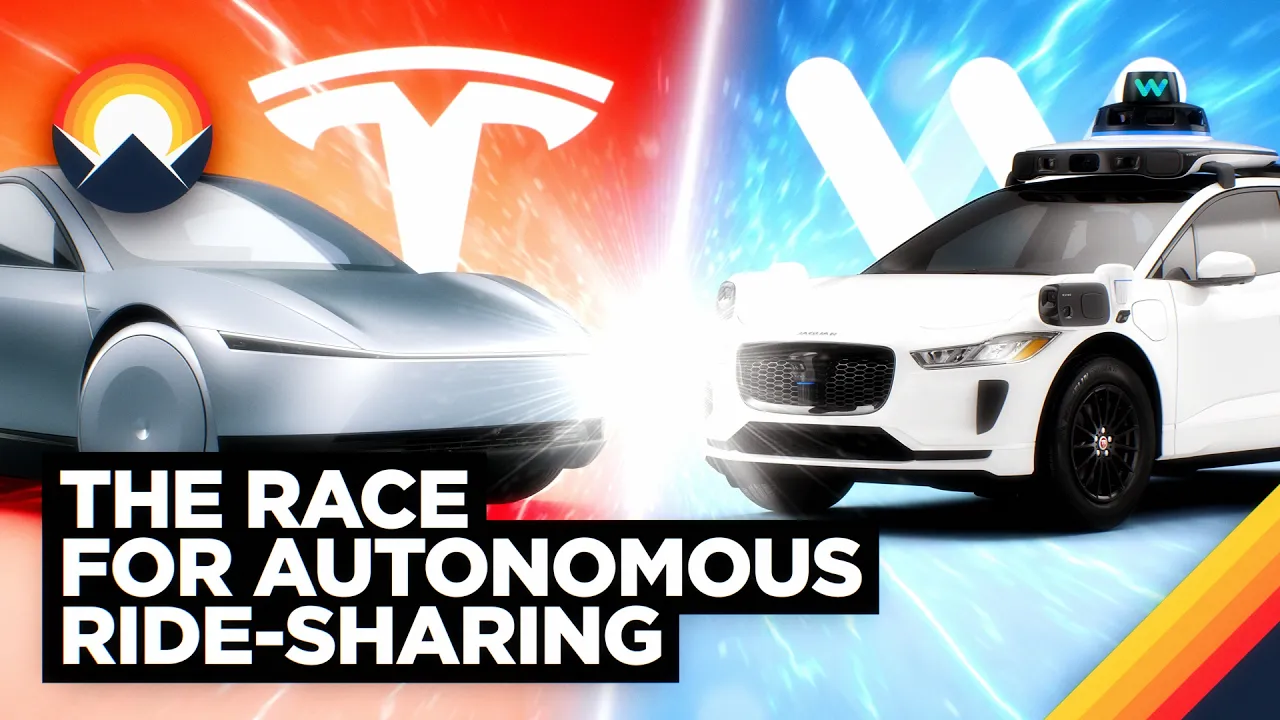
Waymo vs Tesla

Waymo vs Tesla — Wendover Productions

Wendover Productions

AI-assisted summary of Waymo vs Tesla — original source. Check the original for full context.

Source published:

Key ideas

  • Austin, Texas became the primary testing ground for autonomous ride-hailing in early 2026, serving as the first city offering consumers direct choices between competing driverless robotaxis via Waymo on Uber and Tesla's Cybercab app. (0:00)
  • Waymo and Tesla represent fundamentally opposite engineering philosophies: Waymo relies on a redundant suite of 29 cameras, 4 lidars, and 6 radars within mapped geofences, while Tesla utilizes an eight-camera vision-only setup powered by end-to-end neural networks. (3:29)
  • High vehicle build costs remain an operational hurdle for Waymo, prompting a transition away from $150,000–$200,000 Jaguar I-Pace builds toward purpose-built electric vans from Zeekr and 50,000 Hyundai Ioniqs. (7:39)
  • Tesla's commercial footprint in Texas remains restricted to around 140 vehicles with daytime-only operating limits and an active NHTSA regulatory audit into its pedal-less, steering-wheel-free Cybercab certification. (10:06)
  • Legacy ride-hailing platforms are restructuring to survive autonomy: Uber is balancing a temporary Waymo partnership set to conclude in 2028 with new alliances alongside Rivian and Baidu, while Lyft partners with Nvidia and Tensor. (14:55)

Detailed notes

## Background "Waymo vs Tesla" was published on YouTube by Wendover Productions on October 30, 2026. The video description highlights a promotional discount for the creator streaming platform Nebula and links to the original series Day Pass, alongside channel contact information and full production credits.

## TL;DR The video analyzes the commercial robotaxi rivalry between Waymo and Tesla, framing Austin, Texas as the primary battleground where their opposing strategies directly collide. It contrasts Waymo’s cautious, capital-intensive approach—relying on geofenced Level 4 mapping and redundant lidar, radar, and camera suites—against Tesla’s high-risk, vision-only neural network bet designed to scale through existing consumer electric vehicles. Along the way, the breakdown evaluates unit economics, hardware cost deflation, regulatory scrutiny such as NHTSA audits, and the challenge of winning over public trust. Finally, it surveys the broader autonomous transit landscape, illustrating how platforms like Uber and Lyft are maneuvering to survive the driverless transition.

## Atmosphere & style Delivered in Wendover's signature analytical and articulate documentary style, the video maintains a measured, objective tone that constantly weighs bold tech industry claims against economic and engineering realities. The narration feels steady and methodically paced, balancing Alphabet’s cautious corporate rigor against Elon Musk’s volatile, narrative-driven promises. Crisp conceptual diagrams and strategic comparisons give the presentation an intellectual, essayistic weight, making the unfolding corporate battle feel both immediate and historically consequential.

## Bulletin - [00:00](https://www.youtube.com/watch?v=2hx9r7JE6mg&t=0s) Austin, Texas became the primary testing ground for autonomous ride-hailing in early 2026, serving as the first city offering consumers direct choices between competing driverless robotaxis via Waymo on Uber and Tesla's Cybercab app. - [03:29](https://www.youtube.com/watch?v=2hx9r7JE6mg&t=209s) Waymo and Tesla represent fundamentally opposite engineering philosophies: Waymo relies on a redundant suite of 29 cameras, 4 lidars, and 6 radars within mapped geofences, while Tesla utilizes an eight-camera vision-only setup powered by end-to-end neural networks. - [07:39](https://www.youtube.com/watch?v=2hx9r7JE6mg&t=459s) High vehicle build costs remain an operational hurdle for Waymo, prompting a transition away from $150,000–$200,000 Jaguar I-Pace builds toward purpose-built electric vans from Zeekr and 50,000 Hyundai Ioniqs. - [10:06](https://www.youtube.com/watch?v=2hx9r7JE6mg&t=606s) Tesla's commercial footprint in Texas remains restricted to around 140 vehicles with daytime-only operating limits and an active NHTSA regulatory audit into its pedal-less, steering-wheel-free Cybercab certification. - [14:55](https://www.youtube.com/watch?v=2hx9r7JE6mg&t=895s) Legacy ride-hailing platforms are restructuring to survive autonomy: Uber is balancing a temporary Waymo partnership set to conclude in 2028 with new alliances alongside Rivian and Baidu, while Lyft partners with Nvidia and Tensor.

## Key takeaways - [00:00](https://www.youtube.com/watch?v=2hx9r7JE6mg&t=0s) Austin, Texas emerged as the front line of the commercial robotaxi race by offering head-to-head driverless rides from both Waymo and Tesla. - [01:18](https://www.youtube.com/watch?v=2hx9r7JE6mg&t=78s) Legacy automakers failed to deliver on 2010s promises of achieving Level 4 and Level 5 autonomy by the early 2020s, scaling back ambitions to driver-assist features. - [03:29](https://www.youtube.com/watch?v=2hx9r7JE6mg&t=209s) Originating from Google X, Waymo prioritized safety redundancies over immediate cost limits, retrofitting passenger vehicles with a multi-sensor hardware stack. - [03:29](https://www.youtube.com/watch?v=2hx9r7JE6mg&t=209s) Waymo's standard Jaguar I-Pace utilizes 29 cameras, 4 lidar sensors, and 6 radar units to navigate independently of environmental constraints. - [05:53](https://www.youtube.com/watch?v=2hx9r7JE6mg&t=353s) Despite safety data showing an 80% decrease in injury-causing crashes for Waymo, consumer skepticism persists, requiring human remote assistance to manage edge cases. - [07:39](https://www.youtube.com/watch?v=2hx9r7JE6mg&t=459s) Waymo's early vehicle conversions cost between $150,000 and $200,000 each, forcing a fleet pivot toward cheaper modular Zeekr and Hyundai platforms. - [08:57](https://www.youtube.com/watch?v=2hx9r7JE6mg&t=537s) Tesla's autonomous strategy stems from its 2016 Master Plan Part Deux, which envisions activating millions of customer-owned consumer EVs into a decentralized taxi network. - [10:06](https://www.youtube.com/watch?v=2hx9r7JE6mg&t=606s) Tesla launched Cybercab operations in Texas in September 2026, prompting an immediate NHTSA audit over self-certification without manual controls. - [11:41](https://www.youtube.com/watch?v=2hx9r7JE6mg&t=701s) Tesla rejects lidar and radar, deploying an end-to-end neural network running exclusively on eight optical cameras to mirror biological human driving vision. - [13:23](https://www.youtube.com/watch?v=2hx9r7JE6mg&t=803s) Tesla's robotaxi service operates under stringent constraints, including daytime-only operating hours and avoidance of strict California DMV and CPUC commercial permits. - [13:23](https://www.youtube.com/watch?v=2hx9r7JE6mg&t=803s) Tesla's competitive upside lies in the latent scale of 4 to 5 million customer vehicles that could theoretically join the commercial fleet through over-the-air updates. - [14:55](https://www.youtube.com/watch?v=2hx9r7JE6mg&t=895s) Waymo is pursuing international Level 4 commercial expansion, mapping streets and negotiating regulatory approvals in London, Tokyo, and Singapore. - [14:55](https://www.youtube.com/watch?v=2hx9r7JE6mg&t=895s) Uber and Lyft are pivoting to become aggregation platforms for autonomous hardware, anticipating the expiration of Uber's core Waymo agreement in 2028. - [16:43](https://www.youtube.com/watch?v=2hx9r7JE6mg&t=1003s) Fully automated transit is not historically unprecedented, having operated commercially on fixed guideways since Kobe, Japan opened its Port Liner in 1981.

## Detailed walkthrough ### [00:00](https://www.youtube.com/watch?v=2hx9r7JE6mg&t=0s) Austin and the Front Lines of the Robotaxi Race

Within a geofenced perimeter of the Austin, Texas metropolitan area, autonomous driving transitioned from a distant promise into an everyday consumer reality. For years, commercial-scale driverless ride-hailing across major US markets like Phoenix, Los Angeles, and San Francisco had been almost exclusively dominated by Waymo. By early 2026, however, passengers seeking an autonomous trip within Austin’s operational boundary faced a novel choice: open Uber to request a Waymo vehicle, or launch the dedicated Tesla app to summon a Cybercab.

This head-to-head dynamic marked Austin as the premier proving ground for driverless commercial transit. As the narrator explains, “It was the first city where there were multiple options for driverless, unsupervised, fully autonomous rides, making Austin the front lines of the robotaxi race.” The arrival of direct competition in Texas's tech hub shifted the broader autonomous driving narrative away from purely solving base engineering problems toward overcoming regulatory approval hurdles, driving consumer adoption, and proving that autonomous fleets can function as viable, profitable businesses.

- **Key Launch Markets**: Waymo had previously established commercial footprints in Phoenix, Los Angeles, and San Francisco before expanding into Austin. - **Rival Platforms in Austin**: Waymo rides dispatched via the Uber partnership versus Tesla’s native robotaxi app.

---

[01:18](https://www.youtube.com/watch?v=2hx9r7JE6mg&t=78s) The SAE Autonomy Levels and the Broken Promises of the 2010s

During the 2010s, autonomous driving was treated across the automotive industry as both an inspiring moonshot and a near-term certainty. Between 2013 and 2014, legacy automakers including Nissan, Mercedes-Benz, Toyota, Volvo, Audi, BMW, and supplier Bosch made splashy public demonstrations or aggressive timeline commitments. In response, the Society of Automotive Engineers (SAE) published a framework in 2014 defining six levels of driving automation, which was promptly integrated into federal automated vehicle policy by the National Highway Traffic Safety Administration (NHTSA):

- **Levels 0–2**: Driver support features (such as lane assist and adaptive cruise control) requiring continuous human monitoring. - **Level 3**: Conditional automation where the vehicle handles driving tasks under specific triggers, but the human driver must remain ready to intervene. - **Levels 4 & 5**: Fully driverless tiers requiring zero human intervention; Level 4 operates within defined operational design domains, while Level 5 represents the unconstrained moonshot capable of driving anywhere, anytime, under any condition.

With those definitions codified, automakers announced bold targets. Ford aimed for Level 4 autonomy by 2021, BMW targeted Level 5 by 2021, and Toyota projected widespread Level 4 availability before 2027. Yet these projected deadlines arrived without commercial driverless products, prompting legacy carmakers to dial back their ambitions to consumer driver-assist tools like dynamic cruise control and lane centering. As the narrator emphasizes, “Creating a system that can account for every factor of driving from weather conditions to human decision-making the lean over without making a single mistake is an absurdly high bar to cross.” Beyond raw technological complexity, companies were forced to confront an equally daunting second question: how to build a commercially sustainable business model out of autonomous driving.

---

[03:29](https://www.youtube.com/watch?v=2hx9r7JE6mg&t=209s) Waymo's Origins and the Redundant Sensor Stack

While both Waymo and Tesla initially converged on geofenced urban ride-hailing as their commercial entry point, their engineering philosophies and business roadmaps diverged entirely. The narrator frames the rivalry by observing, “In this race, on every front from business strategy and underlying technology to lobbying efforts and city-by-city rollouts, Waymo is your talismanic tortoise.” Waymo achieved its lead across total driverless miles, operational regions, and registered autonomous fleets through methodical, incremental engineering, all without ever building its own consumer passenger vehicle from scratch.

Waymo originated in 2009 inside Google X, the tech giant's secretive moonshot incubator, where the core mandate was simply determining whether automated driving was fundamentally possible rather than whether it was immediately profitable. That research orientation established a culture that placed safety above cost constraints. In its 2016 corporate spin-out announcement under Alphabet, Waymo explicitly grounded its mission in eliminating the 1.2 million annual global road deaths caused by distracted, drunk, or fatigued human drivers.

To achieve maximum safety and redundancy, Waymo retrofitted existing vehicle platforms—progressing from early Toyota Priuses to modern Jaguar I-Pace electric crossovers—with a distinctive "top hat" hardware array. This comprehensive perception suite blends multiple independent sensor types to construct an extraordinarily detailed digital view of the surrounding world:

```mermaid flowchart TD accTitle: Waymo Hardware Sensor Suite accDescr: Diagram illustrating the three primary sensor modalities mounted across a Waymo autonomous vehicle.

subgraph Roof ["Roof-Mounted 'Top Hat' Assembly"] LidarTop["Top Lidar Sensor\n(Fires laser pulses for 3D mapping)"] CamTop["Vision Cameras\n(Pedestrians, road signs, traffic lights)"] RadarTop["Radar Sensor\n(Radio wave tracking of moving objects)"] end

subgraph TotalStack ["Total Vehicle Hardware Suite (Jaguar I-Pace)"] Sensors["29 Cameras\n4 Lidar Sensors\n6 Radar Units"] end

Roof --> TotalStack ```

- **Top Lidar**: Emits continuous laser pulses in 360 degrees to generate high-resolution 3D point-cloud representations of the environment. - **Vision Cameras**: Track visual cues including pedestrians, painted street markings, and traffic light colors. - **Radar Units**: Bounce radio waves to monitor the relative velocity and trajectory of moving objects regardless of poor lighting. - **Total Fleet Hardware**: A standard Waymo Jaguar I-Pace is equipped with 29 cameras, 4 separate lidar pucks, and 6 radar sensors.

---

[05:53](https://www.youtube.com/watch?v=2hx9r7JE6mg&t=353s) Geofenced Operations, Consumer Trust, and Fleet Disengagements

Because Level 5 universal autonomy remains out of reach, Waymo confines its commercial services to strict geofenced territories within designated metropolitan areas. Prior to carrying passengers, Waymo field teams meticulously create high-definition 3D maps of local roadways, programming system calibrations for unique regional traffic laws, street geometries, and typical weather behaviors. This ensures every vehicle navigates with an exhaustive pre-loaded blueprint of its operational territory.

Public perception, however, moves slower than technical benchmarks. The narrator points out that “For Waymo or any other company to make it in this field, it needs consumer trust.” Safety metrics demonstrate substantial improvements over human motorists: Waymo operations across California and Arizona achieved an 80% decrease in injury-causing crashes and a 55% decrease in police-reported accidents relative to standard human driving benchmarks. Even so, skepticism remains widespread:

- **2024 Consumer Survey**: Approximately 25% of respondents maintained that autonomous cars should always be required to have a licensed human driver behind the wheel. - **2025 Consumer Survey**: A plurality of respondents continued to rank fully human-operated vehicles as the safest method of road transit.

Because even a minor collision or unresolved driving standoff can damage consumer confidence, simple disengagements—situations requiring human intervention—must be tightly managed. Whenever a Waymo vehicle encounters an edge case it cannot solve with high confidence, it immediately alerts remote human fleet support agents who provide guidance to navigate past obstructions and complex roadway scenarios.

---

[07:39](https://www.youtube.com/watch?v=2hx9r7JE6mg&t=459s) Unit Economics: From Costly Jaguars to Zeekr Platforms

Waymo’s decision to focus on ride-hailing allowed it to generate continuous, recurring utilization out of vehicles restricted to geofenced zones. However, the service remains unprofitable due to aggressive ongoing network rollouts, operational pauses caused by software edge cases (such as vehicles navigating into localized floodwaters), and high vehicle manufacturing costs. As the narrator notes, “In the pursuit of safe, reliable, redundant technology, Waymo produced a prohibitively expensive vehicle.” Equipping a Jaguar I-Pace with Waymo's redundant computer and sensor suite pushes the vehicle's estimated build cost to between $150,000 and $200,000 per unit.

For Waymo to transition from an Alphabet-subsidized venture into a self-sustaining commercial business, its capital expenditure per vehicle must decline dramatically. That transition is already underway due to hardware industrialization and modular vehicle sourcing:

- **Lidar Cost Deflation**: Mirroring Wright’s Law, high-volume manufacturing pushed automotive lidar from over $75,000 per unit in 2014 down into the hundreds of dollars for modern sensors. - **Custom Zeekr Platform**: To curb fleet expenditures, Waymo imported 3,200 purpose-built electric vans from Chinese automaker Zeekr to be outfitted in Arizona, replacing the expensive Jaguar platforms at a fraction of their prior unit capital cost.

[08:57](https://www.youtube.com/watch?v=2hx9r7JE6mg&t=537s) The Tortoise vs. The Hare: Scaling Fleets and Master Plan Part Deux

Waymo continues to lower its hardware expenditures, driving hardware costs down toward $32,000 per unit while securing a multi-year deal with Hyundai for roughly 50,000 Ioniq electric vehicles at an estimated $50,000 per unit for the autonomous-capable platform. In a completely isolated vacuum, Waymo’s slow, deliberate pacing would easily secure victory: by taking time to let sensor suites become cheaper, building consumer trust among an otherwise hesitant riding public, scaling a cost-effective operational footprint, and undercutting traditional Uber and Lyft fares because no human driver needs to be compensated.

However, an agile challenger enters the fold. As the narrator explains: “In a vacuum, slow and steady would win the race for Waymo.” But Tesla plays the role of the energetic hare, running behind on pure autonomy metrics yet possessing the unique manufacturing capacity to bridge vast operational gaps in rapid bursts.

The roots of Tesla's self-driving ambitions stretch back to 2016—the very same year Waymo was spun out of Google—when Elon Musk published Master Plan Part Deux. Rather than perfecting full autonomy on a tiny test fleet, Musk's concept flipped the sequence on its head: mass-produce consumer electric cars at scale, distribute millions of units worldwide, and subsequently unlock autonomous ride-sharing via remote hail updates to convert existing customer cars into a decentralized, revenue-generating taxi network.

```mermaid flowchart TD accTitle: Waymo vs Tesla Strategic Philosophies accDescr: Comparison of Waymo's methodical hardware-first deployment versus Tesla's fleet-first software-driven rollout. subgraph WAYMO["Waymo: The Methodical Tortoise"] W1["Solve Full Autonomy First"] --> W2["Layered Redundant Sensors"] W2 --> W3["Build Geofenced Commercial Fleets"] end subgraph TESLA["Tesla: The Fast-Scaling Hare"] T1["Mass-Produce Consumer EVs"] --> T2["Equip Fleet with Cameras & FSD"] T2 --> T3["Solve Autonomy via AI & Fleet Data"] end ```

- Waymo unit hardware target: ~$32,000 per unit - Hyundai partnership: 50,000 Ioniqs at a reported cost of ~$50,000 per unit - Master Plan Part Deux core premise: Convert consumer-owned electric vehicles into an autonomous, hailable shared fleet ("effectively, a self-driving Uber")

---

[10:06](https://www.youtube.com/watch?v=2hx9r7JE6mg&t=606s) Tesla’s Rocky Commercial Rollout and the Cybercab Audit

Translating Master Plan Part Deux into functional urban operations has proven far tougher in practice than on paper. Tesla’s commercial robotaxi footprint remains tiny: across Texas—concentrated primarily in Austin—the company operates a commercial pilot of only around 140 vehicles, split between standard Model Y crossovers and purpose-built Cybercabs. Launched in 2025, passenger ride reports describe the vehicle behavior as notably stiffer and more mechanical than Waymo’s polished journeys, albeit delivered at cheaper prices.

Tesla launched its Cybercab in Texas in September 2026, only to be hit immediately with an audit by the National Highway Traffic Safety Administration (NHTSA). Regulators raised serious concerns regarding Tesla’s self-certification procedures for a platform completely stripped of standard manual steering wheels and floor pedals. Yet despite the regulatory friction, markets remain reluctant to dismiss Musk’s ambitions, given his history of defying automotive skeptics.

```mermaid flowchart LR accTitle: Tesla Cybercab Regulatory Hurdles accDescr: Flowchart illustrating the launch of Tesla Cybercabs and subsequent NHTSA regulatory audits. A["Cybercab Launch<br>(Texas, Sept 2026)"] --> B["Cabin Design:<br>No Pedals or Steering Wheel"] B --> C["NHTSA Regulatory Audit:<br>Self-Certification Scrutiny"] C --> D["Daytime-Only Operations<br>& Pre-Mapped Geofencing"] ```

- Austin/Texas commercial fleet: ~140 vehicles (mix of Model Ys and Cybercabs) - Tesla Robotaxi launch date: 2025; Cybercab rollout: September 2026 - Regulatory friction: NHTSA audit launched over pedal- and steering-wheel-free self-certification

---

[11:41](https://www.youtube.com/watch?v=2hx9r7JE6mg&t=701s) Vision vs. Redundancy: Tesla's Camera-Only AI Bet

Tesla’s technical foundation represents an ideological rejection of Waymo’s sensor-heavy approach. Instead of lidar, radar, and layered physical redundancies, Tesla relies strictly on an eight-camera visual suite. In 2022, the company went so far as to strip ultrasonic sensors from newly built vehicles, arguing that autonomous driving is ultimately an artificial intelligence and software problem rather than a hardware limitation. The underlying philosophy asks: if human beings navigate chaotic roadways relying solely on biological eyes and neural processing, why shouldn't a car achieve identical or superior results relying exclusively on cameras and neural networks?

That camera-only bet has solidified with recent iterations of Full Self-Driving (FSD). Previously, driving software compartmentalized tasks—running perception, predictive route planning, and mechanical vehicle actuators through isolated code stacks. Modern FSD builds combine these stages into a unified end-to-end neural network, processing high-resolution visual feeds directly into drive commands. This creates an accelerating data flywheel: expanding real-world customer usage produces billions of diverse real-world road miles to train and optimize the AI models. Tesla points to its internal safety metrics claiming FSD logs seven times fewer minor and major accidents and five times fewer off-highway collisions compared to human baselines, using this confidence to enter Texas and Florida markets with commercial robotaxis.

The narrator neatly distills the company’s engineering logic: “If humans can do it by vision alone, why can't a car do it with just cameras?”

```mermaid flowchart TD accTitle: Tesla Vision-Only Architecture Evolution accDescr: Diagram contrasting traditional modular autonomous vehicle pipelines with Tesla's end-to-end neural network approach. subgraph OLD["Legacy Modular Autonomy"] O1["Camera Feeds"] --> O2["Separate Perception Stack"] O2 --> O3["Rule-Based Path Planner"] O3 --> O4["Actuator Control"] end subgraph NEW["Tesla Unified Vision Pipeline"] N1["8 High-Resolution Cameras"] --> N2["End-to-End Neural Network"] N2 --> N3["Direct Vehicle Control Output"] end ```

- Sensor package: Exactly eight optical cameras; zero lidar; ultrasonic sensors stripped in 2022 - Architecture: Unified end-to-end neural network integrating perception, planning, and controls into a single framework - Tesla safety claims: Seven times fewer major/minor collisions; five times fewer off-highway crashes relative to human drivers - Geographic coverage: Initial commercial robotaxi programs deployed across Texas and Florida

---

[13:23](https://www.youtube.com/watch?v=2hx9r7JE6mg&t=803s) Operational Constraints and the Fleet Scale Dilemma

Despite optimistic safety claims, Tesla operates its nascent commercial robotaxi network with heavy training wheels. The service restricts operations during evening and nighttime hours due to visual limitations, and social media regularly captures erratic driving maneuvers. Furthermore, Tesla has avoided initiating Level 4 commercial permitting with the stringent California Public Utilities Commission and DMV, concentrating its deployments in states with lax self-certification frameworks.

The commercial stakes between the two philosophies remain astronomical. If Tesla successfully trains its end-to-end neural network to achieve true Level 4 or Level 5 capability through over-the-air updates, bespoke robotaxi fleets like Waymo's could be rendered obsolete overnight. Musk has between four to five million camera-equipped customer vehicles on global roadways that could instantly moonlight as an autonomous hailable fleet without new manufacturing overhead.

The central problem remains the unpredictable timeline of artificial intelligence. Critics argue that the Texas Cybercab launch was primarily a calculated media spectacle designed to manufacture investor excitement, highlighting the tiny pilot footprint and daytime-only limits as evidence that the technology is far from mature.

Regarding the volatile nature of the company’s milestones, the narrator observes: “As with most Musk ventures, it's difficult to separate what's feasible, what he says is feasible, and what he believes is feasible.”

- Operating restrictions: Daytime-only service; rides suspended during dusk and night - Target fleet potential: 4 to 5 million customer vehicles already manufactured with compatible autonomous-capable hardware - Regulatory avoidance: Still uncertified for commercial Level 4 driverless deployment in California

---

[14:55](https://www.youtube.com/watch?v=2hx9r7JE6mg&t=895s) Global Expansion, Uber’s Pivot, and the Battle for Level 4

Waymo has bypassed unvalidated nationwide generalized autonomy in favor of aggressively scaling its proven, geofenced Level 4 infrastructure worldwide. The company is actively conducting road-mapping initiatives and negotiating local regulatory frameworks in high-density international hubs, including London, Tokyo, and Singapore.

```mermaid flowchart LR accTitle: Global Autonomous Ride-Hailing Ecosystem accDescr: Breakdown of partnerships and autonomous vehicle competitors navigating the Level 4 commercial landscape. subgraph AGGREGATORS["Platform Aggregators"] UBER["Uber Platform"] LYFT["Lyft Platform"] end subgraph HARDWARE_FLEETS["AV Hardware & Platform Fleets"] WAYMO["Waymo (Independent by 2028)"] RIV["Rivian"] BAI["Baidu"] ZOOX["Amazon Zoox (Las Vegas)"] NVI["Nvidia / Tensor"] end UBER -.->|"Transitional Partner"| WAYMO UBER --> RIV UBER --> BAI LYFT --> NVI ```

This gold rush has fundamentally restructured the legacy ride-hailing giants. Uber recognized early on that automated fleets would define the industry's economic survival, launching an in-house AV program with Volvo until a fatal testing crash in Arizona forced the company to shutter internal vehicle development. Uber shifted its approach to building distribution partnerships, offering Waymo rides inside its consumer app in cities like Phoenix, Austin, and Atlanta. However, with Waymo preparing to pull back into its own proprietary ride-hailing app when their contract wraps up in 2028, Uber has aggressively diversified, forging self-driving partnerships with manufacturers ranging from Rivian to China's Baidu. Lyft is pursuing a parallel survival strategy, collaborating with Nvidia and Tensor to establish a multi-tier hybrid network combining human gig workers and autonomous fleets.

At the same time, specialized AV competitors are expanding their own ground footprints, with Amazon-backed Zoox running driverless passenger operations on public streets in Las Vegas. While generalized Level 5 autonomy remains a distant, speculative prize, the real economic war is being waged right now by companies deploying functional Level 4 networks.

As the narrator emphasizes: “On the road towards what may someday be a truly revolutionary technology, the company set to lead into the future is perhaps the one that first figures out how to offer and run what's effectively an automated taxi service.”

- Waymo international test and mapping markets: London, Tokyo, and Singapore - Uber AV relationship: Current distribution partner in Phoenix, Austin, and Atlanta; partnership set to conclude in 2028 - Uber external ecosystem: Forging alliances with Rivian and Baidu - Lyft strategic posture: Partnering with Tensor and Nvidia to assemble a "hybrid network" - Additional market entrant: Amazon-backed Zoox operating commercial services in Las Vegas

---

[16:43](https://www.youtube.com/watch?v=2hx9r7JE6mg&t=1003s) Historical Perspective: Kobe's Port Liner and Nebula's *Day Pass*

Automated urban transport is far from a 21st-century invention. While autonomous personal passenger cars remain an active engineering challenge, fully automated, driverless fixed-guideway transit has been running commercially since 1981, when the Port Liner automated people mover system opened to the public in Kobe, Japan.

The narrator shares that this historical insight came from watching fellow creator Jason Slaughter of *Not Just Bikes* on the streaming service Nebula. In his original episodic travel series *Day Pass*, Jason tours municipal transit networks across six Asian cities, dedicating an installment to analyzing Kobe's pioneering automated metro and discussing how urban mass transit interfaces with everyday civil infrastructure.

[17:24](https://www.youtube.com/watch?v=2hx9r7JE6mg&t=1044s) Supporting Creator Ambition on Nebula

The video concludes with a showcase for the streaming service Nebula, highlighting Jason's transit-oriented travel series *Day Pass*. The show heavily aligns with Wendover's audience interests, following Jason across far-flung transit systems. As Sam explains, *Day Pass* is now in its second season—a milestone that required extensive development meetings, a pilot season, and years of steady iteration to finally secure the production budget and audience demand needed for a full six-episode run abroad. He notes that such a series simply could not exist under conventional platform dynamics, representing the core value proposition of Nebula: giving creators the direct backing to undertake ambitious, higher-budget, and conceptually risky projects like long-form documentary and comedy series. As Sam puts it, “The idea is that for a pretty minimal fee, you the viewer and fan of our content can help us build a service with more and more creative content that follows our interests, but without the pressure to go viral and push views each and every release.”

Beyond platform originals like *Day Pass*, *Jet Lag: The Game*, and *Beyond the Bleachers*, Nebula offers features like Nebula First, which delivers ad-free releases on the platform before they appear anywhere else. Viewers can support this independent creator ecosystem through a promotional discount offering 50% off an annual subscription.

- **Nebula Pricing Promotion**: Available at `nebula.tv/wendover` for 50% off, bringing an annual membership down to $30 a year, or approximately $2.50 per month. - **Featured Original Shows**: *Day Pass* (Season 2, 6 episodes exploring international transit networks), *Jet Lag: The Game*, and *Beyond the Bleachers*. - **Platform Features**: Nebula Originals, Nebula First early releases, and completely ad-free streaming.

## Notable quotes > [13:23](https://www.youtube.com/watch?v=2hx9r7JE6mg&t=803s) As with most Musk ventures, it's difficult to separate what's feasible, what he says is feasible, and what he believes is feasible. — Wendover Productions

> [07:39](https://www.youtube.com/watch?v=2hx9r7JE6mg&t=459s) In the pursuit of safe, reliable, redundant technology, Waymo produced a prohibitively expensive vehicle. — Wendover Productions

> [14:55](https://www.youtube.com/watch?v=2hx9r7JE6mg&t=895s) On the road towards what may someday be a truly revolutionary technology, the company set to lead into the future is perhaps the one that first figures out how to offer and run what's effectively an automated taxi service. — Wendover Productions

## Mentioned Alexander Williard, Amazon Zoox, Audi, Austin, Texas, Baidu, Beyond the Bleachers, BMW, Bosch, California DMV, California Public Utilities Commission, Cybercab, Day Pass, Dony Bullen, Elon Musk, Ford, Gabriel Ferreras, Google X, Hyundai Ioniq, Jaguar I-Pace, Jason Slaughter, Jet Lag: The Game, Kate Ermolenkko, Kobe Port Liner, Lyft, Manni Simon, Mercedes-Benz, Nebula, NHTSA, Nissan, Not Just Bikes, Nvidia, Rivian, Sara Stoltman, Simon Buckmaster, Society of Automotive Engineers (SAE), Tensor, Tesla, Tesla Full Self-Driving (FSD), Tesla Model Y, Toyota, Toyota Prius, Tristan Purdy, Uber, Volvo, Waymo, Wendover Productions, Zeekr

## Video description Get Nebula using my link for 50% off an annual subscription: https://go.nebula.tv/wendover Watch Day Pass: https://nebula.tv/daypass?ref=wendover

Youtube: http://www.YouTube.com/WendoverProductions Instagram: http://Instagram.com/sam.from.wendover Twitter: http://www.Twitter.com/WendoverPro Sponsorship Enquiries: wendover@standard.tv Other emails: sam@wendover.productions Reddit: http://Reddit.com/r/WendoverProductions

Writing by Tristan Purdy Editing by Alexander Williard Animation by Sara Stoltman, Gabriel Ferreras, Austin Glass, and Kate Ermolenkko Sound by Manni Simon and Dony Bullen Thumbnail by Simon Buckmaster

[Source](https://www.youtube.com/watch?v=2hx9r7JE6mg)

中文简报

Waymo 对决特斯拉 该视频分析了 Waymo 与特斯拉在商业化自动驾驶出租车(robotaxi)领域的竞争,并将德克萨斯州奥斯汀视作双方截然相反的战略发生直接碰撞的主战场。视频将 Waymo 谨慎且资本密集型的路径——依赖地理围栏内的 L4 级高精地图以及由激光雷达、雷达和摄像头构成的冗余传感器套件——与特斯拉高风险、纯视觉神经网络的押注进行了对比,后者旨在通过现有的消费级电动汽车实现规模扩张。在此过程中,该解析评估了单车经济模型、硬件成本下降趋势、如美国国家公路交通安全管理局(NHTSA)审查等监管挑战,以及赢得公众信任的难题。最后,视频审视了更广泛的自动驾驶交通格局,展示了 Uber 和 Lyft 等平台为在无人驾驶转型期生存而展开的布局。 德克萨斯州奥斯汀在2026年初成为自动驾驶网约车的主要试验场,成为首个通过 Uber 上的 Waymo 以及特斯拉 Cybercab 应用,让消费者能直接在相互竞争的无人驾驶出租车之间做出选择的城市。 (0:00) Waymo 与特斯拉代表了截然相反的工程理念:Waymo 在具有高精地图的地理围栏内依赖由29个摄像头、4个激光雷达和6个雷达组成的冗余套件;而特斯拉则采用由端到端神经网络驱动的8摄像头纯视觉方案。 (3:29) 高昂的单车制造成本仍是 Waymo 面临的运营障碍,促使其逐步放弃造价15万至20万美元的捷豹 I-Pace 改装车型,转向极氪的定制电动货车以及5万辆现代 Ioniq。 (7:39) 特斯拉在德克萨斯州的商业化规模仍受限于约140辆车,且仅限白天运营,同时 NHTSA 正在对其无踏板、无方向盘的 Cybercab 认证展开积极的监管审查。 (10:06) 传统网约车平台正通过重组以在自动驾驶时代求存:Uber 在维持与 Waymo 将于2028年结束的临时合作的同时,正与 Rivian 和百度建立新联盟;而 Lyft 则选择与英伟达和 Tensor 展开合作。 (14:55)

Reading summary

The commercial robotaxi competition has shifted from abstract engineering goals to practical deployment, pitting Waymo's methodical, hardware-heavy Level 4 model against Tesla's vision-only, fleet-scaling strategy. Waymo's Redundant Sensor Stack and Safety Benchmarks (3:29) Originating in 2009 inside Google X, Waymo prioritized safety over vehicle build costs, developing an autonomous platform grounded in sensor redundancy. A standard Waymo Jaguar I-Pace relies on a comprehensive perception suite of 29 cameras, 4 lidar sensors, and 6 radar units to construct a continuous 3D digital model of its surroundings. To operate reliably without unconstrained Level 5 autonomy, the service uses strict geofencing supported by high-definition 3D mapping and remote human fleet support agents to resolve edge-case disengagements. In California and Arizona operations, Waymo reported an 80% drop in injury crashes and a 55% reduction in police-reported accidents compared to human drivers, though public surveys from 2024 and 2025 indicated ongoing consumer skepticism toward fully driverless transit. Capital Costs and Hardware Deflation (7:39) Waymo's focus on hardware safety made its initial vehicles prohibitively expensive, pushing retrofitted Jaguar I-Pace builds to an estimated $150,000 to $200,000 per unit and keeping operations unprofitable. To reach financial sustainability, the company has benefited from lidar cost deflation, which dropped sensor prices from over $75,000 in 2014 down into the hundreds of dollars, while driving target hardware kit costs down toward $32,000. Additionally, Waymo diversified vehicle sourcing by importing 3,200 purpose-built electric vans from China's Zeekr and entering a multi-year partnership with Hyundai for approximately 50,000 Ioniq electric vehicles at roughly $50,000 per autonomous-capable unit. Tesla's Vision-Only Bet and Scaling Model (11:41) Tesla's self-driving strategy, outlined in Elon Musk's 2016 Master Plan Part Deux, rejects lidar, radar, and physical redundancies in favor of an eight-camera visual suite and end-to-end neural networks. Tesla asserts that because humans drive using biological vision, neural networks trained on billions of real-world fleet miles can achieve full autonomy without costly sensor hardware. Internal Tesla metrics claim its Full Self-Driving (FSD) system results in seven times fewer major and minor crashes and five times fewer off-highway accidents relative to human drivers. If successful, Tesla could instantly activate an autonomous fleet across 4 to 5 million customer-owned vehicles already on the road via over-the-air updates, avoiding the massive capital expenditures required to manufacture dedicated fleets. Operational Bottlenecks and Early Head-to-Head Testing (0:00) Direct commercial competition materialized in Austin, Texas, where users could hail Waymo rides via Uber or summon Tesla vehicles through a dedicated app. However, Tesla's commercial deployment remains constrained, operating roughly 140 vehicles across Texas split between Model Ys and Cybercabs. Following the September 2026 Cybercab launch in Texas, the National Highway Traffic Safety Administration (NHTSA) initiated an audit into Tesla's self-certification of vehicles built without steering wheels or pedals. Tesla also restricted passenger operations to daytime hours due to camera limitations, avoided commercial Level 4 permitting in California, and drew criticism that early launches served primarily to sustain investor confidence. Ride-Hailing Realignments and Global Level 4 Expansion (14:55) Waymo has focused on scaling its proven Level 4 service globally, mapping streets and engaging regulators in London, Tokyo, and Singapore. The commercial rollout of autonomous fleets has simultaneously disrupted legacy ride-hailing networks. After shuttering its internal autonomous vehicle project following a fatal Arizona testing crash, Uber partnered with Waymo in Phoenix, Austin, and Atlanta. With that agreement scheduled to conclude in 2028 and Waymo planning an independent app ecosystem, Uber has diversified by partnering with Rivian and Baidu, while Lyft collaborates with Nvidia and Tensor. Other competitors, such as Amazon-backed Zoox in Las Vegas, are also securing operational footholds. While generalized Level 5 autonomy capable of driving anywhere without conditions remains distant, the practical commercial race centers on who can first operate a safe, cost-efficient, and regulatory-approved Level 4 robotaxi service at scale.

精炼阅读摘要

Wendover Productions指出,随着奥斯汀成为首个提供多家无监督全自动驾驶出行的城市,自动驾驶竞争已从早期的理论工程探索转向法规审批、商业化落地与单位经济效益的角逐;Waymo凭借稳健的冗余多传感器与地理围栏策略占据先发优势,而特斯拉则押注纯视觉端到端AI与庞大存量车队的快速规模化,两者的路线抉择将决定自动出租车行业的未来格局。 行业早期承诺落空与商业化现实 (0:00) 在2010年代,传统汽车制造商如日产、丰田、沃尔沃及宝马等纷纷提出激进的无人驾驶时间表,例如福特和宝马曾计划在2021年分别实现Level 4与Level 5自动化,丰田也曾预计2027年前普及Level 4。然而,由于消除驾驶过程中的所有错误极其复杂,且缺乏可持续的商业模式,车企随后大多退守至自适应巡航和车道居中等驾驶辅助功能。与此同时,全自动驾驶行业将竞争焦点转向受限区域的商业化试运营,并在德克萨斯州奥斯汀迎来了真正的正面交锋。到2026年初,奥斯汀乘客不仅可以通过Uber呼叫Waymo,还能使用特斯拉专属应用呼叫Cybercab,使该市成为检验多方无人车队盈利能力与公众接纳度的首要试验场。 Waymo的冗余传感器策略与高昂成本 (3:29) 源自2009年Google X实验室的Waymo采取了“乌龟式”的稳步渐进策略,将消除交通事故死亡置于成本之上。Waymo通过在量产车上加装集成感知设备,构建由29个摄像头、4个激光雷达和6个毫米波雷达组成的冗余硬件系统,并在提供服务前对运营区域进行高精度三维地图测绘与交通法规标定。尽管在加利福尼亚州和亚利桑那州的运营数据显示其致伤碰撞事故减少了80%、警方报告事故减少了55%,但2024至2025年的消费者调查显示公众疑虑依然普遍,且其需要依赖远程支持人员处理偶发的接管场景。这种重硬件方案导致单辆改装捷豹I-Pace成本高达15万至20万美元。为此,Waymo正依托激光雷达的规模化降本趋势,计划通过进口3200辆极氪定制纯电厢式车及与现代达成的5万辆Ioniq采购协议,力争将硬件成本降至约3.2万美元。 特斯拉的纯视觉AI路线与落地瓶颈 (8:57) 与Waymo不同,特斯拉践行其2016年《宏图计划第二篇章》的构想,即先通过量产消费级电动车铺开硬件,再通过OTA远程升级将存量车转化为去中心化的无人共享车队。特斯拉在技术上坚决摒弃激光雷达并于2022年移除超声波传感器,仅依靠8个摄像头以及整合了感知、规划与控制的端到端神经网络,主张汽车应像人类驾驶员一样仅凭视觉和神经网络进行决策。特斯拉声称其全自动驾驶系统使重大及轻微事故减少了七倍,但其商业化落地充满挑战:特斯拉在德州仅运营约140辆由Model Y和Cybercab组成的测试车队,且服务受限于白天时段;其无方向盘和踏板的Cybercab于2026年9月推出后立即遭到美国国家公路交通安全管理局的自我认证合规审查,并避开了加州更为严苛的Level 4商用牌照申请。 出行平台重组与全球Level 4扩张 (14:55) 在完全通用的Level 5自动化依然遥不可及的背景下,真正的商业决战集中在限定场景的Level 4网络。特斯拉若能凭借端到端软件打通全自动驾驶,其全球400万至500万辆已售出的存量硬件即可在一夜之间组建庞大车队,对定制重资产模式构成巨大冲击;然而,业内批评者质疑其目前的试运营规模与日间限制更偏向于制造宣传效应。与此同时,Waymo正加快国际化步伐,在伦敦、东京和新加坡展开道路测绘与合规谈判。传统网约车巨头亦在重组定位:曾因致命测试事故关停自研项目的Uber,目前在菲尼克斯、奥斯汀等地分发Waymo行程,但由于合作将于2028年到期且Waymo倾向推广自有应用,Uber已转向与Rivian、百度结盟;Lyft则联合英伟达与Tensor构建混合派单网络,亚马逊旗下的Zoox也在拉斯维加斯开辟了无人驾驶载客业务。 自动驾驶汽车的竞争本质上是一场在保障绝对安全与实现规模化低成本运营之间的权衡。通用Level 5技术依然处于理论探索期,率先攻克限定场景Level 4运营、建立公众信任并跑通自动出租车盈利模型的公司,将在未来的城市出行变革中占据主导地位。

Detailed notes — zh

## Background 该视频由知名知识科普频道 Wendover Productions 于 2026 年 10 月 30 日在 YouTube 平台发布。页面简介提供了主创制作团队名单、频道官方社交媒体链接,以及创作者自主发起的流媒体平台 Nebula 和原创节目《Day Pass》的五折专属订阅推广。 ## TL;DR 视频以得克萨斯州奥斯汀成为首个多方商业化 Robotaxi 战场的现实切入,深度剖析了自动驾驶行业从早期的宏大蓝图退守至限定区域运营的演变历程。内容重点对比了领跑者 Waymo 与挑战者 Tesla 之间截然相反的技术路线与商业哲学:Waymo 秉持“龟兔赛跑”中乌龟般的稳健策略,依赖高冗余传感器、激光雷达和高精地图实现极高安全性,却背负着高昂的单车成本;而 Tesla 则像爆发力极强的兔子,押注于廉价的纯视觉方案与端到端神经网络,试图借助数百万量产车通过软件 OTA 实现降维颠覆。最后,视频展现了 Uber、Lyft 和 Zoox 等巨头在产业链重组中的焦虑与博弈,指出胜出者未必是最早攻克 L5 级全场景无人驾驶的玩家,而是最先将无人网约车商业闭环彻底跑通的企业。 ## Atmosphere & style 全片贯穿着 Wendover Productions 标志性的沉着、严谨与深度纪实风格,叙事逻辑层层递进,剖析鞭辟入里。主讲人语调平静客观而又带有理性的批判审视,在拆解科幻滤镜破灭的残酷现实时毫不避讳,面对马斯克的宏大叙事与行业宣传时展现出清醒的解构力。整部片子带给观众一种在宏观商业战争与前沿硬核技术之间穿梭的智性快感,既有对技术复杂性的敬畏,也充满对产业利益博弈的透彻洞察。 ## Bulletin - [00:00](https://www.youtube.com/watch?v=2hx9r7JE6mg&t=0s) 得州奥斯汀在2026年初成为全球首座并存两家全无人Robotaxi商业化服务的城市,Waymo(通过Uber合作)与特斯拉Cybercab在此正面交锋,标志着行业重心从纯技术验证转向合规许可与商业盈利模式攻坚。 - [05:05](https://www.youtube.com/watch?v=2hx9r7JE6mg&t=305s) Waymo坚持多重硬件冗余(激光雷达+29颗摄像头+毫米波雷达)与高精地图限定区域L4路线,目前正通过采购极氪与现代汽车等低成本车型力争将单车制造成本从早期高达20万美元大幅压缩。 - [11:05](https://www.youtube.com/watch?v=2hx9r7JE6mg&t=665s) 特斯拉押注极简纯视觉路线与端到端神经网络,尽管在得州仅投放约140辆车且受夜间停运和NHTSA审查限制,但其全球已售出的400万至500万辆具备硬件支持的车辆拥有通过OTA升级颠覆市场的理论潜力。 - [14:55](https://www.youtube.com/watch?v=2hx9r7JE6mg&t=895s) 出行巨头竞争格局深度洗牌:Waymo与Uber的合作将于2028年到期并逐步回归自营App,迫使Uber转向接触Rivian与百度,而Lyft与Zoox也在加速布局以避免被边缘化。 ## Key takeaways - [00:00](https://www.youtube.com/watch?v=2hx9r7JE6mg&t=0s) 奥斯汀成为自动驾驶竞争拐点,终结了Waymo长期在旧金山、菲尼克斯等地的独家垄断局面。 - [01:18](https://www.youtube.com/watch?v=2hx9r7JE6mg&t=78s) 2010年代主流车企激进的L4/L5时间表普遍落空,绝大多数厂商退守至L0-L2辅助驾驶,无人赛道收缩至极少数头部玩家。 - [03:00](https://www.youtube.com/watch?v=2hx9r7JE6mg&t=180s) 自动驾驶商业化核心难题在于如何将极高门槛的技术落地为具备自生盈利能力的运营服务。 - [03:29](https://www.youtube.com/watch?v=2hx9r7JE6mg&t=209s) Waymo依托稳健小步慢跑的“神龟策略”,在不自主造车的前提下通过改装车建立了里程与合规规模的先发优势。 - [05:05](https://www.youtube.com/watch?v=2hx9r7JE6mg&t=305s) 高冗余硬件虽带来显著优于人类驾驶员的安全数据,但15万至20万美元的单车改造成本严重制约了盈利节奏。 - [08:57](https://www.youtube.com/watch?v=2hx9r7JE6mg&t=537s) Waymo通过引入单车3.2万美元的极氪定制厢式车及5万辆现代Ioniq订单,借助行业降本效应推动单位经济效益转正。 - [09:33](https://www.youtube.com/watch?v=2hx9r7JE6mg&t=573s) 特斯拉奉行“先铺开规模再攻关技术”的兔子路线,但得州落地初期的Cybercab和Model Y车队仅约140辆且乘坐体验偏生硬。 - [10:15](https://www.youtube.com/watch?v=2hx9r7JE6mg&t=615s) Cybercab取消传统踏板与方向盘的设计遭遇NHTSA严格审查,给特斯拉的扩张带来了合规不确定性。 - [11:05](https://www.youtube.com/watch?v=2hx9r7JE6mg&t=665s) 特斯拉坚持8颗高清摄像头的纯视觉与端到端大模型架构,豪赌AI软件能力足以匹敌人类双眼与大脑。 - [13:23](https://www.youtube.com/watch?v=2hx9r7JE6mg&t=803s) 特斯拉受限于纯视觉在夜间和恶劣工况的表现,暂时维持夜间不接单限制且未在监管严格的加州申请L4许可。 - [13:50](https://www.youtube.com/watch?v=2hx9r7JE6mg&t=830s) 特斯拉庞大的存量交付基数(400万至500万辆)是其最大杀手锏,一旦全无人算法突破即可凭借OTA实现指数级扩张。 - [14:55](https://www.youtube.com/watch?v=2hx9r7JE6mg&t=895s) 无人驾驶赢家未必是最早达成通用L5的企业,而是首个在限定场景下跑通规模化商业闭环的平台。 - [15:30](https://www.youtube.com/watch?v=2hx9r7JE6mg&t=930s) 全球出行巨头加速站队与重组:Waymo收紧原生平台控制权,Uber、Lyft及亚马逊Zoox各自展开防御性联盟构建。 ## Detailed walkthrough ### [00:00](https://www.youtube.com/watch?v=2hx9r7JE6mg&t=0s) 奥斯汀:Robotaxi 竞争的新战场 在得克萨斯州奥斯汀大都会区划定的地理围栏区域内,自动驾驶的未来悄然演变为了现实。多年以来,在菲尼克斯、洛杉矶和旧金山等城市,向大众开放的商业化无人驾驶网约车服务几乎完全由 Waymo 独家垄断。然而到了 2026 年初,当地乘客迎来了前所未有的选择。当居民掏出手机想要叫一辆全自动驾驶汽车时,他们面临着一个全新的抉择:是打开与 Waymo 合作提供无人驾驶服务的 Uber 应用,还是打开 Tesla 的 Robotaxi 应用呼叫一辆 Cybercab?奥斯汀由此成为全球首座拥有多家提供完全无人、无监管全自动驾驶出行服务选项的城市,一跃站上了 Robotaxi 竞赛的最前线。 这一竞争标志着长达数十年的自动驾驶探索进入了关键拐点。过去,企业主要是在技术可行性层面上进行攻坚;而现在,行业领跑者 Waymo 与最具实力的挑战者 Tesla 之间展开的较量,已经转移到了监管审批、大众接受度,以及这种模式究竟能否成为一项成功且能持续盈利的商业模式上。回顾二三十年前,这种如今真实落地的竞争图景是出人意料的,甚至在某些人眼里显得略微低于最初的科幻预期。 - 长期垄断商业化无人驾驶网约车的城市包括菲尼克斯、洛杉矶和旧金山。 - 奥斯汀成为首个在同一地理围栏区域内并存两家及以上无人监管 Robotaxi 服务的城市。 - 竞争核心从单纯的技术研发,转向监管许可获取、消费者采纳度以及商业盈利模式的验证。 ### [01:18](https://www.youtube.com/watch?v=2hx9r7JE6mg&t=78s) 宏大蓝图的退潮与自动驾驶的重重阻碍 在 2010 年代,自动驾驶主要是一个关于前沿科技的叙事,它既被描绘成未来的宏伟梦想,又被当作技术发展的必然。2013 年,日产(Nissan)、梅赛德斯-奔驰(Mercedes-Benz)、丰田(Toyota)和沃尔沃(Volvo)相继公布了自动驾驶计划或展示了原型能力;2014 年,奥迪(Audi)、宝马(BMW)和博世(Bosch)也纷纷加入战局。面对铺天盖地的媒体宣传与行业热情,监管机构不得不紧急介入,以确立治理框架。2014 年,国际汽车工程师学会(SAE)发布了一份开创性报告,将自动驾驶划分为六个等级(L0 至 L5):L3 到 L5 具备自动驾驶能力,L4 和 L5 则彻底无需人类驾驶员干预,而终极目标 L5 级别更是要求车辆在任何时间、任何地点、任何天气条件下都能完全独立运行。美国国家公路交通安全管理局(NHTSA)随即采纳了这套分级体系,并将其融入联邦自动驾驶汽车政策中。 随着标准明确和监管通道初步成形,各大主流车企纷纷开出极为激进的时间表:福特(Ford)声称要在 2021 年实现 L4 级自动驾驶,宝马(BMW)的目标是到 2021 年实现 L5 级,丰田也曾公开表示许多制造商将在 2027 年前推出 L4 级车型。 ```mermaid flowchart TD accTitle: 汽车自动化分级与落地演进 accDescr: 展示从低级别辅助驾驶到高阶自动驾驶的分化路线 subgraph LowAutomation["主流车企退守区间"] L0L2["L0 - L2 辅助驾驶<br/>(车道保持 / 自适应巡航)"] end subgraph HighAutomation["无人驾驶竞技场"] L3["L3 条件自动驾驶"] L4["L4 高度自动驾驶<br/>(特定区域内无人类司机)"] L5["L5 完全自动驾驶<br/>(全场景/全天候终极目标)"] end LowAutomation -->|"技术门槛过高,车企目标延后"| L3 L3 -->|"Waymo 与 Tesla 当前竞争焦点"| L4 L4 -.->|"尚无企业攻克"| L5 ``` 然而,这些宏伟的时间节点相继落空。绝大多数汽车制造商不得不推迟规划,并将精力全面收缩至低阶的辅助驾驶功能,例如车道保持辅助(Lane Assist)与动态自适应巡航(Dynamic Cruise Control),最终在高端无人驾驶赛道上只剩下了 Waymo 和 Tesla 等极少数玩家。导致这一领域推进缓慢的原因主要有两点: 1. **技术极其复杂**:打造一个能够全面应对极端天气、复杂路况以及不可预测的人类驾驶行为,且绝不出任何差错的系统,其难度门槛高得不可思议。 2. **商业化落地难题**:“How do you make a business out of the technology?”(你如何把这项技术做成一门生意?)正如讲述者所强调的,尽管 Waymo 和 Tesla 现阶段都选择在严格设定的地理围栏城市区域内提供网约车服务,但它们在后续扩张规模以及对未来商业模式成熟形态的构想上,却截然不同。 ### [03:29](https://www.youtube.com/watch?v=2hx9r7JE6mg&t=209s) Waymo 的“龟兔赛跑”策略与安全至上基因 在这场全方位的较量中——无论是商业策略、底层技术架构、政府游说,还是逐座城市的渐进推广——Waymo 始终扮演着那只稳健踏实的“引路神龟”。依靠稳扎稳打的小步慢跑,Waymo 在累计行驶里程、服务覆盖区域面积以及合规登记的无人驾驶车辆数量上均建立了巨大的先发优势,在自己不生产任何一辆车的前提下领跑了整整十年。 Waymo 起步于 2009 年的 Google X(即谷歌的“登月工厂”),最初的核心命题仅仅是验证“无人驾驶在技术上是否可行”,而非“商业上是否有利可图”。这种纯粹的技术驱动与安全优先基因深深烙印在它的发展历程中。从 2009 年改装的第一批丰田普锐斯(Toyota Prius),到当下的捷豹(Jaguar I-Pace),再到未来的极氪(Zeekr),Waymo 车辆始终带有一套极具辨识度的“礼帽(Top Hat)”传感器外观。在 2016 年独立拆分为 Alphabet 旗下子公司的公告中,Waymo 强调其最高愿景是终结每年因疲劳驾驶、酒驾或分心驾驶导致 120 万人丧生的惨剧。对于未来的商业应用形式,Waymo 当时保持开放,将个人车辆、物流干线与最后一公里配送都列为了潜在赛道。 - 2009 年在 Google X 秘密立项,以探索可行性为起点。 - 2016 年正式分拆为 Alphabet 独立子公司,明确将安全作为绝对核心目标。 - 发展至今未自主制造一辆整车,全部采用改装传统及现有电动汽车的模式。 ### [05:05](https://www.youtube.com/watch?v=2hx9r7JE6mg&t=305s) 冗余传感器架构、公众信任与高昂的硬件代价 为了确保绝对安全并将商业变现压力后置,Waymo 采取了极其复杂的多重技术冗余方案。以其主力车型捷豹 I-Pace 为例,整车装备了一套异常庞大且昂贵的传感阵列: - 车顶主激光雷达(LiDAR):向各个方向发射激光脉冲,实时构建周边环境的完整 3D 点云图。 - 全车共计 29 颗摄像头:识别行人、障碍物、车道线以及交通信号灯色彩等视觉信息。 - 全车共计 6 颗毫米波雷达与 4 颗独立激光雷达:通过无线电波及激光测距追踪动态目标,抵御极端光线干扰。 即便硬件能力强大,Waymo 仍未达到 L5 级,因此每进入一个新城市,团队必须进行极其精密的高精地图(HD Mapping)采集,针对当地独特的气候和交通法规校准算法,严格在划定的地理围栏内运营。 这种对安全近乎偏执的冗余设计,很大程度上是为了争取极其脆弱的公众信任。虽然数据显示,Waymo 在亚利桑那州和加利福尼亚州的运营使致伤事故率比人类司机降低了 80%,警方报告事故率降低了 55%,但大众的顾虑依然根深蒂固。2024 年的一项民调显示,25% 的受访者认为自动驾驶汽车必须保留人类驾驶员;2025 年的调查更显示,多数人依然坚信纯人类驾驶才是最安全的出行方式。对于完全无安全员的车辆,轻微的系统脱落(Disengagement,即需要人工介入接管)都可能带来毁灭性的舆论后果。因此,Waymo 配备了庞大的后台远程人工支持团队,以便在车辆遇困时进行人工脱困调度。 然而,这种安全优先的策略带来了一个致命的商业副作用:极高的单位车辆成本与难以快速规模化。一辆加装全套 Waymo 系统的捷豹 I-Pace 造价普遍估计高达 15 万至 20 万美元。再加上激进的早期扩张投入、偶发的极端天气软件故障(如误入积水区),Waymo 的 Robotaxi 业务距离整体盈利仍有相当大的距离。为了摆脱对母公司多轮融资输血的依赖,降低硬件成本势在必行: - **赖特定律(Wright's Law)发挥效能**:激光雷达成本经历了断崖式下跌,早期在 2014 年单个系统动辄超过 7.5 万美元,如今部分激光雷达套件成本已下降至数百美元区间。 - **引入新一代低成本车型**:Waymo 已从中国进口了 3,200 辆极氪(Zeekr)纯电厢式车,并在亚利桑那州进行改装,其综合硬件成本大幅低于老款捷豹车队。 ### [08:57](https://www.youtube.com/watch?v=2hx9r7JE6mg&t=537s) Waymo 的龟兔赛跑策略与现代汽车合作 Waymo 在硬件降本与规模扩张上持续推进,除了单台约 32,000 美元的极氪(Zeekr)定制车辆外,还与现代汽车(Hyundai)达成了一项为期数年的合作协议,计划引入约 50,000 辆具备自动驾驶能力的 Ioniq 车型,据报道每台车辆成本约为 50,000 美元。如果是在理想的真空环境中,“慢而稳”的乌龟策略无疑会让 Waymo 稳操胜券:持续投资的技术随着时间推移成本逐渐下降;曾经心存疑虑的公众在自动驾驶车辆日常化后逐渐接受;车队规模以更高的性价比稳步建立;由于无需支付人类司机的报酬,其打车价格也能持续压低以击穿 Uber 和 Lyft 的费率底线。 然而,这场比赛中还存在着另一只“兔子”——一家目前落后但具备极强短跑爆发力、能够迅速缩小差距的竞争对手。讲述者用寓言形象地概括了这场对决:“In a vacuum, slow and steady would win the race for Waymo.” 但特斯拉的存在让结局充满变数。 - 现代汽车合作:采购约 50,000 辆 Ioniq,具备自动驾驶能力,单台成本据报道约为 50,000 美元。 - 商业优势:无司机成本,随着技术降本和普及,能够长期压低价格对抗传统网约车。 --- ### [09:33](https://www.youtube.com/watch?v=2hx9r7JE6mg&t=573s) 特斯拉的“第二篇章”宏图与得州的初始试水 特斯拉的自动驾驶构想最早可追溯至 2016 年——恰好也是 Waymo 脱离 Google 独立建司的同一年。埃隆·马斯克(Elon Musk)在《宏图第二篇章》(Master Plan Part Deux)中提出了一个非常简单的概念:利用已经大规模量产、成本相对可控的电动车,将其转化为全自动驾驶车辆,允许用户远程叫车并在一天中共享使用,本质上就是打造一个自动驾驶版 Uber。这种模式走的是与 Waymo 针锋相对的路线——“先铺开规模庞大的车队,至于技术细节随后再逐步攻关攻破”。 但实践证明这一设想极为棘手。在整个得克萨斯州(主要集中在奥斯汀),特斯拉目前投入商业运营的 Robotaxi 仅有约 140 辆,其中一部分是专为无人驾驶设计的 Cybercab,其余则是量产的 Model Y。该服务于 2025 年才刚推出,乘客体验报告显示,其乘坐感受比竞争对手更为机械生硬,不过单价更便宜。正如叙述所总结的那样:“In every way, Tesla is less proven, less polished, less certain to succeed.” 2026 年 9 月,特斯拉在得州发布了 Cybercab,但随即遭到美国国家公路交通安全管理局(NHTSA)的审查,原因是该车彻底取消了方向盘和刹车踏板等人工控制装置,其车辆自我认证的合法性引发了监管不确定性。然而,马斯克拥有多次出人意料完成看似不可能承诺的记录,让分析人士和调查机构不敢轻易看空。 - 运营现状:得州全境仅约 140 辆商业化运营车队(奥斯汀为主),车型涵盖 Cybercab 和 Model Y。 - 监管阻力:2026 年 9 月发布的 Cybercab 因缺失踏板、方向盘等传统手动控制机构,立即面临 NHTSA 审查。 --- ### [11:05](https://www.youtube.com/watch?v=2hx9r7JE6mg&t=665s) 纯视觉路线:极端简化硬件与端到端神经网络赌局 马斯克在过去二十年里屡次预言距离真正的 L5 级完全自动驾驶“仅剩几年”,但现实中甚至迈向限定区域、高精地图依赖的 L4 级都困难重重。特斯拉在 2020 年向部分测试车主推送了 FSD 软件,2022 年向北美全量车主推送,但不久后因 NHTSA 的召回要求进行了软件修正。随后特斯拉频繁迭代软件、更换算力更强的车载硬件,并在 2025 年开始尝试在得州试水无监督叫车服务。 特斯拉在技术底座上与 Waymo 截然相反:Waymo 追求高冗余与多传感器层层堆叠,而特斯拉崇尚极简,全车仅依靠 8 颗摄像头。2022 年特斯拉更激进地移除了超声波雷达,全面转向纯视觉(Vision-only)方案,坚信自动驾驶的瓶颈在于软件而非硬件。特斯拉背后的核心论点极为直白:既然人类仅靠双眼就能开车,为什么配备摄像头的汽车不能? ```mermaid flowchart TD accTitle: Tesla End-to-End Neural Network Pipeline accDescr: 特斯拉纯视觉方案由摄像头采集画面,输入统一的端到端神经网络,直接输出感知、规划与控制信号。 subgraph Input["传感采集"] CAM["8 颗高清摄像头"] end subgraph Core["端到端大模型"] NN["单一深度神经网络<br/>(端到端融合模型)"] PERC["高分辨率视觉感知"] PLAN["动态路径规划"] CTRL["车辆线控执行"] end CAM --> NN NN --- PERC NN --- PLAN NN --- CTRL ``` 近年来,FSD 软件逐步将以往相互隔离的感知、规划和车辆控制模块整合进单一的端到端神经网络中,并提升了对摄像头输入图像的分辨率解析能力。随着软件表现趋于稳定,形成了一个正向循环:用户信任度提高带来行驶里程激增,积累的海量现实数据又反哺模型迭代。特斯拉宣称,其官方数据显示 FSD 参与的重特大与微小事故率比人类驾驶低 7 倍,非高速公路碰撞事故率低 5 倍。凭借这些数据,特斯拉在 2026 年将限定区域运营扩展到了得州和佛罗里达州等对 L4 自我认证宽松的市场,试图用低成本自产车辆打一场低运价突围战。 特斯拉的核心技术假设被叙述者清晰指出:“If humans can do it by vision alone, why can't a car do it with just cameras?” 这完全是一场押注于机器学习和人工智能能力的豪赌。 - 硬件配置:移除超声波雷达,全车仅依赖 8 颗摄像头,无激光雷达。 - 架构演进:废除模块化分立系统,改用集成感知、规划、控制的一体化端到端神经网络。 - 安全数据:官方宣称 FSD 大小事故率低 7 倍,非高速碰撞低 5 倍。 --- ### [13:23](https://www.youtube.com/watch?v=2hx9r7JE6mg&t=803s) 现实短板与四五百万量产车的潜在颠覆力 尽管愿景宏大,特斯拉的 Robotaxi 仍面临严重现实制约。车辆偶尔也会发生事故,或是出现被拍下发到社交媒体上的尴尬失误。出于对纯视觉夜间表现信心的不足,特斯拉在运营中保留了“辅助轮”限制——夜间和深夜不提供载客服务;同时由于加利福尼亚州监管极为严苛,特斯拉至今尚未在该州启动 L4 牌照的认证程序。 然而,这依然是一场胜负未卜的竞逐。一旦 AI 算力与算法突破了 L4 甚至 L5 的门槛,特斯拉已经售出的 400 万至 500 万辆具备相应硬件能力的车辆即可通过软件OTA升级,摇身一变成为随时上路接单的 Robotaxi 舰队。届时,Waymo 的自建重资产车队与 Cybercab 甚至可能直接沦为过时方案。但由于完全无人驾驶软件至今没有明确的时间表,外界对特斯拉究竟是“真有底气”还是“制造热点”争议巨大。叙述者尖锐地指出其背后的虚实难辨:“As with most Musk ventures, it's difficult to separate what's feasible, what he says is feasible, and what he believes is feasible.” 许多行业观察家认为得州的 Cybercab 发布不过是一场为了挽救声势而人为制造的媒体公关秀。 - 运营限制:夜间不接单,未在监管严格的加州申请 L4 准入。 - 潜在颠覆规模:全球已有 400 万至 500 万辆搭载适配硬件的特斯拉售出车辆待命。 --- ### [14:55](https://www.youtube.com/watch?v=2hx9r7JE6mg&t=895s) 自动驾驶格局重组与多方混战 相较于特斯拉的激进赌局,Waymo 则继续深化其经过验证的限定区域 L4 网约车模式,并向国际市场进军,正在伦敦、东京和新加坡等地开展高精地图测绘与监管合规沟通。虽然眼前的形态不如 15 年前人们幻想的无拘无束全自动驾驶那般充满科幻色彩,但其重塑出行产业的商业价值已经引发了全球移动出行巨头的集体焦虑。 回顾历史,Uber 早在 2010 年代就意识到自动驾驶是网约车不可避免的终局,曾联手沃尔沃(Volvo)大举研发,但在经历致命测试事故后叫停了自研,转而退守与 Waymo 在菲尼克斯、奥斯汀和亚特兰大等地展开商业合作。然而,随着双方合作协议将于 2028 年到期,Waymo 正全面转向通过自有的原生 App 承接全部订单,迫使 Uber 紧急寻找新的自动驾驶合作伙伴,范围横跨从美国电动车企 Rivian 到中国科技巨头百度。与此同时,另一出行巨头 Lyft 也在与 Tensor、英伟达(Nvidia)联手构建其 CEO 所称的“未来混合叫车网络”;亚马逊旗下的 Zoox 也已在拉斯维加斯正式落地并持续扩张。 叙述者对当前无人驾驶产业的角逐做出了阶段性评述:“On the road towards what may someday be a truly revolutionary technology, the company set to lead into the future is perhaps the one that first figures out how to offer and run what's effectively an automated taxi service.” 胜出者未必是最早攻克不可捉摸的 L5 的企业,而是最先将限定场景的无人化出租车真正跑通商业运营的玩家。 | 参与方 | 核心战略与路线 | 合作伙伴 / 关键动态 | 区域 / 时间节点 | |:--- |:--- |:--- |:--- | | **Waymo** | 激光雷达高冗余 + 高精地图 L4 | 现代汽车、极氪;逐步收回自有出行平台控制权 | 拓展至伦敦、东京、新加坡;与 Uber 协议 2028 年到期 | | **Tesla** | 8 摄像头纯视觉 + 端到端神经网络 | 依靠自有庞大保有量车队与自研 Cybercab | 2025 年得州试水,2026 年扩至佛州 | | **Uber** | 平台聚合运营,对冲被自研车队架空风险 | 早期自研(因致命事故终止);后与 Waymo 合作;现接洽 Rivian、百度 | 全球出行网络布局 | | **Lyft** | 建设人类与无人驾驶混合承运网络 | 与 Tensor、Nvidia 展开软硬件生态合作 | 北美核心出行市场 | | **Zoox (Amazon)** | 专用双向对称乘用车纯无人运营 | 依托亚马逊资本与基础设施支持 | 拉斯维加斯已上线运营并向外扩张 | - 历史渊源:早在 1980 年代,日本神户的港湾人工岛线(Port Liner)就已实现了全自动化的轨道交通,自动化运输在封闭轨道已有数十年先例。 - 知识出处与推荐:叙事者提到该历史知识来源于流媒体平台 Nebula 上的创作者 Jason(Not Just Bikes)主持的节目《Day Pass》,本季聚焦包括神户在内的六座亚洲城市的公共交通系统。 ### [17:24](https://www.youtube.com/watch?v=2hx9r7JE6mg&t=1044s) Nebula 平台与《Day Pass》第二季推荐 视频进入赞助介绍环节,主讲人推荐了流媒体平台 Nebula 上的原创节目《Day Pass》。主讲人提到,这是一档非常有趣的节目,内容与 Wendover 观众的兴趣高度重合,因此有充分的信心大家会喜欢。Nebula 是 Wendover 团队以及大量创作者倾注了诸多心血共同打造的流媒体平台,旨在推出长篇纪录片系列、喜剧系列等多样化内容,为创作者提供尝试更高预算、在传统平台上风险过大项目的空间。 主讲人认为,《Day Pass》完美体现了 Nebula 的核心价值。该节目目前已经推出第二季;如果没有 Nebula 这样的平台支撑,它根本不可能问世。为了塑造出这档节目的雏形,团队经历了多次开发会议,随后推出了试播季,而在几年后的今天,它已经拥有了充足的预算和关注度,让主持人 Jason 能够在长达六集的节目中尽情发挥所长,深入探索世界各地遥远的公共交通系统。主讲人指出,这实现了双赢:观众得以欣赏到绝佳的内容,而 Jason 也获得了前往更遥远海外追求其热爱领域的支持。 这种机制正是 Nebula 作为流媒体平台的核心意义所在,无论是通过《Day Pass》这样的独家原创作品,还是通过“Nebula First”机制(即在其他任何平台之前抢先上线且全程无广告的视频)。其理念在于,观众只需支付极低的费用,就能帮助创作者建立一个承载更多创意内容的平台,让创作者能够顺应自身的兴趣进行探索,而无需在每次发布时都承受“必须爆火”和“狂刷播放量”的流量压力。如果观众希望支持更多像《Day Pass》、《Jet Lag: The Game》或 Mapify 的《Beyond the Bleachers》等富有创意的项目,可以通过专属链接订阅,享受年费 50% 的折扣优惠。 > “The idea is that for a pretty minimal fee, you the viewer and fan of our content can help us build a service with more and more creative content that follows our interests, but without the pressure to go viral and push views each and every release.” —— Wendover 主讲人 - **节目看点**:《Day Pass》现已进入第二季,共包含六集,聚焦主持人 Jason 前往遥远地区探索公共交通系统。 - **代表项目**:Nebula 汇聚了多档知名独立内容与团队作品,包括《Day Pass》、《Jet Lag: The Game》以及 Mapify 的《Beyond the Bleachers》。 - **订阅优惠**:通过专属链接(nebula.tv/wendover)可享年费五折优惠,折后价格为每年 30 美元(约合每月仅需 2.50 美元),低于一杯咖啡的价钱。 ## Notable quotes > [13:23](https://www.youtube.com/watch?v=2hx9r7JE6mg&t=803s) As with most Musk ventures, it's difficult to separate what's feasible, what he says is feasible, and what he believes is feasible. — Wendover 主讲人 > [09:33](https://www.youtube.com/watch?v=2hx9r7JE6mg&t=573s) In every way, Tesla is less proven, less polished, less certain to succeed. — Wendover 主讲人 > [14:55](https://www.youtube.com/watch?v=2hx9r7JE6mg&t=895s) On the road towards what may someday be a truly revolutionary technology, the company set to lead into the future is perhaps the one that first figures out how to offer and run what's effectively an automated taxi service. — Wendover 主讲人 ## Mentioned Waymo, Tesla, Cybercab, Elon Musk, Uber, Lyft, Zoox, Amazon, Alphabet, Google X, NHTSA, SAE, Nissan, Mercedes-Benz, Toyota, Volvo, Audi, BMW, Bosch, Ford, Jaguar I-Pace, Zeekr, Hyundai, Model Y, Rivian, 百度, Nvidia, Tensor, Nebula, Day Pass, Jason (Not Just Bikes), Jet Lag: The Game, Mapify ## Video description Get Nebula using my link for 50% off an annual subscription: https://go.nebula.tv/wendover Watch Day Pass: https://nebula.tv/daypass?ref=wendover Youtube: http://www.YouTube.com/WendoverProductions Instagram: http://Instagram.com/sam.from.wendover Twitter: http://www.Twitter.com/WendoverPro Sponsorship Enquiries: wendover@standard.tv Other emails: sam@wendover.productions Reddit: http://Reddit.com/r/WendoverProductions Writing by Tristan Purdy Editing by Alexander Williard Animation by Sara Stoltman, Gabriel Ferreras, Austin Glass, and Kate Ermolenkko Sound by Manni Simon and Dony Bullen Thumbnail by Simon Buckmaster [Source](https://www.youtube.com/watch?v=2hx9r7JE6mg)

Source quotes

[13:23] Wendover 主讲人: As with most Musk ventures, it's difficult to separate what's feasible, what he says is feasible, and what he believes is feasible. [9:33] Wendover 主讲人: In every way, Tesla is less proven, less polished, less certain to succeed. [14:55] Wendover 主讲人: On the road towards what may someday be a truly revolutionary technology, the company set to lead into the future is perhaps the one that first figures out how to offer and run what's effectively an automated taxi service.

Source quotes

[13:23] Wendover Productions: As with most Musk ventures, it's difficult to separate what's feasible, what he says is feasible, and what he believes is feasible. [7:39] Wendover Productions: In the pursuit of safe, reliable, redundant technology, Waymo produced a prohibitively expensive vehicle. [14:55] Wendover Productions: On the road towards what may someday be a truly revolutionary technology, the company set to lead into the future is perhaps the one that first figures out how to offer and run what's effectively an automated taxi service.

Original transcript

[0:00] Within this geofenced swath of the [0:02] Austin, Texas metro area, the future of [0:04] autonomous driving has recently become [0:06] the present. For years now, commercial [0:09] scale and commercially available [0:10] ride-sharing via driverless cars across [0:12] metro areas like Phoenix, Los Angeles, [0:14] and San Francisco has been largely [0:16] available through Waymo. But in early [0:18] 2026, the autonomous ride-hailing public [0:20] had, for the first time, a choice. [0:22] Should someone want to hop on their [0:24] phone and hail a driverless car service [0:25] that stays within this perimeter, they'd [0:27] have to consider which app to open. Do [0:29] they go Uber, which is partnered with [0:31] Waymo providing driverless rides around [0:33] the city, or do they open their Tesla [0:35] robotaxi app and hail a cybercab? The [0:38] choice was truly novel. It was the first [0:40] city where there were multiple options [0:42] for driverless, unsupervised, fully [0:44] autonomous rides, making Austin the [0:46] front lines of the robotaxi race. This [0:50] emerging competition within Texas's tech [0:52] hub signals an important turning point [0:54] in the decades-long push. Rather than [0:56] battling with the technological hurdle [0:58] as they've done in the past, Waymo, the [1:00] leader in the space, and Tesla, [music] [1:01] the most promising contender, are now [1:03] battling for regulatory approval, [1:05] consumer adoption, and against one [1:07] another to answer whether it can be done [1:09] as a successful, profitable business. [1:11] It's a present reality that would have [1:13] seemed an unexpected, perhaps [1:14] underwhelming outcome just a couple [1:16] decades [music] ago. [1:18] In the 2010s, autonomous driving was [1:20] very much a technology story, seen as [1:22] simultaneously a futuristic dream and an [1:25] inevitability. Nissan, Mercedes-Benz, [1:28] Toyota, Volvo all announced an [1:30] autonomous driving goal or outright [1:32] demonstrated some autonomous [1:33] capabilities in 2013. Audi, BMW, and [1:36] Bosch did the same in 2014. With all the [1:39] exciting press, regulatory bodies [1:41] scrambled to figure out how they'd [1:42] govern this seemingly oncoming [1:44] driverless driving revolution. That [1:46] began with definitions. In 2014, the [1:49] Society of Automotive Engineers [1:51] published this report, which basically [1:53] boiled down to this chart, breaking [1:55] automation into six levels. Levels three [1:57] through five being capable of autonomous [1:59] driving, four and five not requiring a [2:01] driver at all, and level five, the [2:03] ultimate moonshot, being able to drive [2:05] anywhere, [music] anytime, under any [2:07] condition without a human. The National [2:10] Highway Traffic Safety Administration [2:11] soon adopted these classifications and [2:13] folded them into their federal automated [2:15] vehicles policy. With more specific [2:17] language now available and a regulatory [2:19] pathway cleared, car manufacturers got [2:21] more specific in their goals, and they [2:23] went lofty. Ford was aiming for level [2:26] four autonomy by 2021, BMW was aiming [2:28] for level five by 2021, while Toyota [2:31] believed a number of manufacturers would [2:32] have level four autonomous vehicles [2:34] before 2027. [2:36] But those anticipated dates largely came [2:38] and went, and most manufacturers pushed [2:40] their dates out further and heavily [2:42] limited the scope of their automation [2:43] efforts to low-level features like lane [2:45] assist and dynamic cruise control, [2:47] leaving few beyond Waymo and Tesla. What [2:50] is slow development to the point of it [2:51] industry leaders are just now beginning [2:53] to confidently tackle level four [2:54] automation is twofold. One is obvious, [2:57] the technology is extremely complicated. [3:00] Creating a system that can account for [3:01] every factor of driving from weather [3:03] conditions to human decision-making the [3:05] lean over without making a single [3:06] mistake is an absurdly high bar to [3:09] cross. The second is easy to overlook. [3:12] How do you make a business out of the [3:13] technology? Right now, Waymo and Tesla [3:16] are approaching the business side the [3:17] same way, offering their tech in [3:19] vehicles as ride-sharing services in [3:21] strictly geofenced urban areas. But how [3:24] they're going about scaling and how they [3:25] see the business model maturing in the [3:27] future couldn't be more different. [3:29] In this race, on every front from [3:31] business strategy and underlying [3:33] technology to lobbying efforts and [3:35] city-by-city rollouts, Waymo is your [3:37] talismanic tortoise. It's ahead, and [3:39] it's gotten ahead through ever so [3:41] incremental steps. With a massive lead [3:44] on total miles serviced, areas served, [3:46] and registered autonomous vehicles, [3:48] Waymo has paved the way for a decade now [3:50] without manufacturing a single vehicle. [3:54] Waymo is a tech company that existed [3:55] first within Google before spinning out [3:57] into a larger Alphabet company. Its [3:59] roots are important. [4:01] >> [music] [4:01] >> The company began in what's now Google X [4:03] or the moonshot factory, a fairly [4:05] secretive big idea incubator in 2009, [4:08] where the defining question was whether [4:09] or not automated driving was possible [4:11] and not whether it was commercially [4:13] viable. From the beginning then, the [4:15] focus at Waymo has always been the [4:17] capability of the technology and whether [4:19] it [music] can scale to the point of [4:21] truly viable autonomous vehicles. This [4:24] has meant a commonality across all the [4:26] vehicles Waymo has retrofitted over the [4:27] years. From the first Toyota Priuses in [4:30] 2009 to the Jaguars of today and Zeekrs [4:32] of tomorrow, there's always been a [4:34] distinct Waymo look starting with the [4:37] top hat. In the press release announcing [4:39] Waymo becoming an Alphabet business in [4:41] 2016, [music] the company's top line [4:42] view of the future was one without [4:44] tired, drunk, or distracted driving [4:46] contributing to 1.2 million lives lost a [4:49] year. From the jump, Waymo would be [4:51] about safety first then. [4:54] But as for exact application of this [4:55] tech, well, that much wasn't certain yet [4:58] as the release mentioned a list of [4:59] potential applications from personal [5:01] vehicles to logistics and last mile [5:03] transit. Establishing the technology [5:05] with the focus on safety over all else [5:07] and pushing the business model concern [5:09] down the road has resulted in heavy [5:11] technological complexity and redundancy, [5:13] explaining the sensor stack atop each [5:15] vehicle. The top is a lidar sensor that [5:18] fires laser pulses in each direction to [5:20] create [music] a 3D picture of the [5:21] vehicle's surroundings. Below it are [5:23] cameras tracking everything from [5:25] pedestrians to the color of the street [5:26] light and below those is a radar sensor [5:29] tracking objects in motion by radio [5:31] waves. Across the rest of a typical [5:33] Waymo I-Pace Jaguar, [music] there are [5:34] 29 total cameras, four separate lidar [5:37] sensors, and six radar sensors. It's a [5:40] vast and expensive array that compiles [5:42] and computes an absurd amount of data. [5:45] But it is core to the vehicle perceiving [5:46] the surrounding environment not just as [5:48] well as a human does, but far better [5:51] than a human does. [5:52] Even with such a robust sensor and [5:54] camera stack, Waymo still only operates [5:56] within these metro areas as the [5:58] technology is yet to reach level five [6:00] autonomy. And within each, their exact [6:03] service area [music] is strictly [6:04] confined to a geofenced zone as the [6:06] company goes in and carefully 3D maps [6:08] out the area and calibrates the fleet to [6:09] the local particularities like weather [6:11] and unique traffic laws so that their [6:13] vehicles have a detailed blueprint of [6:14] the service area at all times. [6:17] Together, the sensors, cameras, and [6:19] pre-mapping offer a lot of expensive and [6:21] overlapping safety features which for [6:24] both business and a popular adoption of [6:26] the technology is important. For Waymo [6:28] or any other company to make it in this [6:30] field, it needs consumer trust. And [6:32] consumer trust is hard earned. As a [6:35] technology that upends more than a [6:37] century of conventional driving, it's [6:39] understandable that public trust lags [6:41] behind autonomous driving safety record. [6:43] While studies have shown that Waymo's [6:45] operating in Arizona and California saw [6:47] an 80% injury reported crash reduction [6:49] from human drivers and 55% reduction in [6:52] police reported crashes, consumers can [6:54] still be wary. In one 2024 survey, a [6:56] quarter of respondents believed that [6:58] autonomous vehicles should still require [7:00] a driver while a 2025 survey showed that [7:02] the plurality of respondents believed [7:04] that fully human drivers still [7:06] represented the safest means of [7:07] operating a vehicle. Founded on the idea [7:10] of safety, Waymo's uncompromising [7:12] approach to the tech is further [7:13] justified by the fact that not only are [7:15] crashes unacceptable, but that without a [7:17] supervisor, simple disengagements, the [7:19] term for the need of a manual takeover [7:21] of the driving controls, aren't [7:22] acceptable either. So, should a Waymo [7:25] run into a problem it's not sure how to [7:26] handle, it connects with human staff to [7:28] help navigate it out of a tough spot. [7:30] Together, Waymo's uncompromising [7:32] approach and layers of safety nets are [7:34] apt, but from a future business [7:35] perspective, it's all difficult to [7:37] scale. [7:39] As Waymo's grappled with the tech for [7:40] the last 10 years, it also picked a lane [7:43] as a business, ride sharing. It [7:45] complements the technology that's [7:47] capable within confined parameters and [7:48] it makes pretty constant revenue [7:50] generating use out of its vehicles. But [7:52] the service is still far from profitable [7:54] for a host of reasons. Aggressive [7:56] expansion, which is temporary, service [7:58] halts on account of tech glitches like [8:00] driving into floodwaters, which should [8:02] be temporary, and extremely high [8:03] production costs, which the company is [8:05] banking on being temporary. In the [8:07] pursuit of safe, reliable, redundant [8:10] technology, Waymo produced a [8:11] prohibitively expensive vehicle. With [8:14] the common estimate on the Jaguar I-Pace [8:15] equipped with Waymo sitting at somewhere [8:17] around 150 to 200,000 dollars a unit. [8:21] For Waymo to mature from a company [8:23] relying on funding rounds to one capable [8:25] of holding its own, this number simply [8:27] needs to come down. [music] [8:28] And it is doing so already. Lidar, for [8:31] instance, is affected by a Wright's Law [8:33] type curve where the increase in [8:34] production of technology has resulted in [8:36] a massive price drop. Where early [8:38] systems were upwards of 75,000 dollars [8:40] in 2014, some of today's systems have [8:43] now dropped into the hundreds. On top of [8:45] the sensor price plummeting, Waymo has [8:47] imported 3200 Zeekr electric vans from [8:50] China and retrofitted them to the [8:51] company's purposes in Arizona for a [8:53] fraction of the cost of the Jaguar [8:55] fleet, estimated in the range of just [8:57] 32,000 dollars a unit. The company has [9:00] also entered a multi-year deal with [9:01] Hyundai for some 50,000 Ioniqs at a [9:04] reported 50,000 dollars per unit cost [9:06] for the autonomous capable vehicle. [9:08] In a vacuum, slow and steady would win [9:10] the race for Waymo. The company [9:12] continues to invest in the tech that [9:13] gets cheaper as time goes on. They [9:15] become more popular with a hesitant [9:17] customer base as they become [9:18] commonplace. They slowly build out a [9:20] more cost-effective fleet and undercut [9:22] Uber and Lyft rates because they don't [9:23] have to pay for a driver. [9:25] But then, there's the hare in this [9:27] story. The company that's behind in the [9:29] race, but capable of making up a lot of [9:31] ground quickly. [music] [9:33] The vision dates back to 2016, the same [9:35] year that Waymo spun out of Google into [9:36] its own company with this press release. [9:39] >> [music] [9:39] >> Elon Musk's Master Plan Part Deux was [9:42] pretty simple in concept. Take the [9:44] mass-produced and now comparatively [9:46] affordable electric cars and turn them [9:48] into autonomous driving vehicles that [9:50] can be hailed remotely and can be shared [9:52] throughout the day. Effectively, a [9:53] self-driving Uber. It represents the [9:56] exact opposite approach to that of [9:57] Waymo. They'd scale the fleet up to size [10:00] and the tech [music] would come along [10:01] and get figured out after. So far, it's [10:03] proved trickier in practice. [10:06] Across all of Texas, mostly focused in [10:08] Austin, Tesla is reporting only running [10:10] around 140 commercial robotaxis, a [10:13] portion of which are purpose-built [10:15] cybercabs, while the rest are Model Ys. [10:18] The service launched only in 2025, and [10:20] reports state [music] that the rides are [10:21] a bit more mechanical than that of the [10:23] competitors, but are offered at a [10:25] cheaper price point. In every way, Tesla [10:27] is less proven, less polished, less [10:30] certain to succeed. In classic Tesla [10:32] fashion, the company released its [10:33] cybercabs in September 2026 in Texas, [10:36] only to have them immediately made the [10:38] subject of an NHTSA audit, as there's [10:40] uncertainty over the brand's [10:41] self-certification of the vehicle when [10:43] it doesn't seem to have manual controls [10:44] like pedals or steering wheel. But Tesla [10:47] has Musk [music] and a track record of [10:49] unexpected and unconventional deliveries [10:51] on promises that experts and [10:52] investigators are wary to bet against. [10:55] [music] And beyond Musk, the company's [10:56] approach to automation, along with the [10:58] fact that it already has an established [11:00] fleet of vehicles and controlled means [11:01] of production, may well prove the more [11:03] future-proof in the long run. As Elon [11:05] Musk has again and again predicted [11:07] full-level five autonomy just a few [11:09] years out for two decades now, the road [11:11] to just geofenced, pre-mapped level four [11:13] autonomy has been bumpy. In 2020, the [11:16] company released the full self-driving [11:18] software to a group of test drivers. [11:19] [music] In 2022, the software was made [11:21] available to all North American Tesla [11:23] owners before the NHTSA ordered a recall [11:26] that required software fixes. Plugging [11:28] along, the company overhauled the [11:29] software again and again and launched a [11:31] new and more capable hardware set [11:33] accompanying the vehicles, reaching such [11:35] confidence that the company began to [11:36] play with the idea of an unsupervised [11:38] ride-hailing service in Texas in 2025. [11:41] Undergirding it all is a fundamentally [11:43] different approach to the technology. [11:45] Where Waymo is layered and redundant, [11:47] Tesla is sleek, relying on just eight [11:50] cameras. [11:50] >> [music] [11:50] >> And rather than adding systems, they've [11:52] doubled down, in 2022 removing [11:55] ultrasonic sensors and articulating a [11:56] vision that they believe automation is [11:58] capable through a camera-only approach, [12:01] >> [music] [12:01] >> viewing it as less a hardware limitation [12:03] and more so a software limitation. The [12:06] logic is simple, perhaps unnervingly [12:08] simple. If humans can do it by vision [12:10] alone, why can't a car do it with just [12:12] cameras? It's a bet on machine learning [12:15] and AI capabilities that hasn't been [12:16] settled yet, but it seems one that's [12:18] getting closer as recent versions of [12:20] full self-driving software has [12:21] integrated perception, route planning, [12:23] and vehicle controls into a single [12:25] neural network rather than being siloed [12:26] from one another as in the past. Recent [12:29] updates have also allowed the end-to-end [12:30] neural network higher resolution [12:32] processing of what the camera's [12:33] capturing. As the software gets better, [12:35] the performance is getting steadier in [12:37] the real world, creating a virtual [12:38] cycle. An uptick in consumer trust and [12:41] application is compiling more miles [12:42] driven and more data for Tesla's models [12:44] to learn and refine from. Emboldened by [12:46] its own data that full self-driving is [12:48] involved in seven times fewer major and [12:50] minor crashes and five times fewer [12:52] off-highway collisions, after announcing [12:54] the cybercab, a purpose-built driverless [12:56] ride-sharing vehicle, Tesla launched [12:58] itself into the autonomous taxi [12:59] competition in 2025 and expanded its [13:02] service area across Texas and Florida in [13:04] 2026. [13:05] >> [music] [13:05] >> In states where self-certification for [13:07] level four autonomous driving is fairly [13:08] permissive and in markets where Tesla [13:10] can carefully map out and geofence the [13:12] service area, the company is now betting [13:14] it can offer a safe, reliable [13:16] ride-sharing service at cheaper rates [13:17] [music] with vehicles that they [13:18] themselves are able to produce at [13:20] generally lower costs. [13:23] The jury is still out on the robotaxis. [13:25] As with Waymo's, there are accidents on [13:27] occasion and there are embarrassing [13:29] mistakes that make their way onto social [13:31] media. [13:32] >> [music] [13:32] >> Tesla has also kept training wheels on [13:33] the product, not providing services [13:35] during evening and night hours on [13:37] account of a lack of full confidence in [13:38] the camera-only automation. And the [13:40] company has yet to begin the process of [13:42] getting certified as a level four [13:43] autonomous provider in the state of [13:45] California, where the regulatory [13:46] environment is more rigorous. So, for [13:48] now, Tesla is dipping into the same or [13:50] similar markets Waymo has already [13:52] launched in and seeing how they stack [13:54] up. While undoubtedly behind, who wins [13:56] out in the end is still very much up for [13:58] grabs. Should AI processing get to the [14:01] point that Tesla's able to confidently [14:02] pursue level four and even five [14:04] autonomy, Waymo and cybercams may well [14:06] be things of the past as Musk's vision [14:08] for all Tesla vehicles moonlighting as [14:10] hailable ride-shares could become a [14:12] reality. With about four to five million [14:15] vehicles delivered with a capable [14:16] hardware should the software get across [14:18] the finish [music] line, the fleet is [14:20] already scaled. But there's no timetable [14:22] for level five automation, and there's [14:24] really no way to predict when the blend [14:26] of hardware and software will get there. [14:28] As with most Musk ventures, it's [14:30] difficult to separate what's feasible, [14:32] what he says is feasible, and what he [14:34] believes is feasible. Some have called [14:36] the Texas launch of the Cybercab little [14:38] more than a media move. The company [14:40] needed a moment and manufactured one. [14:42] Others cite the scale of the robotaxi [14:44] service and its limited vehicles and [14:46] limited markets, along with the still [14:48] limited confidence in Tesla's full [14:49] self-driving as critical qualifiers that [14:52] frame the project as an inherently [14:54] limited one. [14:55] Perhaps it's easier to project forward [14:56] to the future these companies are [14:58] looking towards with Waymo then. Waymo [15:00] has doubled down on the geofenced level [15:02] four ride-share model, and they're [15:04] taking it global, working on mapping and [15:06] navigating regulations in places like [15:08] London, Tokyo, and Singapore. And while [15:10] neither the technology nor the business [15:12] quite capture the glamorous driverless [15:14] future that seemed so near just 15 years [15:16] ago, the impact of driverless [15:18] ride-sharing is a massive. In the 2010s, [15:21] Uber too launched its own autonomous [15:23] driving project as [music] it saw the [15:25] writing on the wall. Automation was the [15:27] future, and ride-sharing was the [15:29] clearest scalable path to turning [15:31] limited automated driving [music] into a [15:32] business. Uber worked with Volvo to [15:34] begin, but after a fatal accident during [15:36] [music] testing, the company halted the [15:38] project. But they stayed involved in the [15:40] automation race, going ahead and [15:41] partnering with Waymo in select cities [15:43] like Phoenix, Austin, and Atlanta. But [15:45] Waymo is moving towards offering the [15:47] same services under its own umbrella and [15:49] app once the partnership ends in 2028. [15:52] Uber has moved proactively to find new [15:54] autonomous partners across the landscape [15:55] that range as far as Rivian to Chinese [15:57] manufacturer Baidu. Lyft is finding [15:59] partners across the field too, working [16:01] with Tensor and Nvidia and preparing for [16:03] what its CEO has called the oncoming [16:05] hybrid network of ride-sharing. It's not [16:08] just Tesla and Waymo making moves into [16:09] the space, either. Amazon-backed Zoox [16:12] has gone live in Las Vegas and is [16:13] expanding. It remains to be seen when [16:16] the world sees level five automation. In [16:18] some ways it feels inevitable, in others [16:20] it feels so impossibly far away. But in [16:22] the meantime, those believing they [16:24] figured out level four are looking to [16:26] turn the ability into a business and [16:28] racing to beat out the other. On the [16:30] road towards what may someday be a truly [16:32] revolutionary technology, the company [16:34] set to lead into the future is perhaps [16:36] the one that first figures out how to [16:38] offer and run what's effectively an [16:40] automated taxi service. [16:43] Of course, the first automated cars [16:45] won't be the first automated [16:46] transportation system. Full-scale [16:48] automation of a rail line dates as far [16:50] back as the 1980s in Kobe, Japan with [16:52] the Port Liner. And this is not [16:54] something I knew off the top of my head [16:55] or learned through background research, [16:57] but instead something I gathered from [16:58] one of my favorite creators to watch, [17:00] Jason from Not Just Bikes, on my [17:02] favorite streaming platform, Nebula. [17:04] >> [music] [17:04] >> In this season of Day Pass, Jason [17:06] explores public transit systems across [17:07] six Asian cities, including Kobe, Japan [17:10] with its first-of-its-kind automated [17:11] metro. If you're interested in urban [17:13] transportation infrastructure mixed with [17:15] travel and an on-the-ground experience, [17:17] I can't recommend Day Pass enough, as [17:19] Jason tours and offloads his opinions [17:21] about some of the most unique transit [17:22] systems the world has to offer, city by [17:24] city. It's a fun show that really [17:26] overlaps with our audience interests, so [17:28] I'm confident you'll enjoy it. And it's [17:30] available through the streaming service [17:31] that's sponsoring this video, Nebula. [17:34] You've probably heard of Nebula from ad [17:35] reads in the past. It's a streaming [17:36] service that the Wendover team and a ton [17:38] of other creators have put a lot of work [17:40] into to establish some long-form [17:41] documentary series, comedy series, and a [17:44] host of other things that allow us to [17:45] try things that are a bit higher budget [17:47] and risky for other platforms. But I [17:49] think Day Pass is a great example of [17:51] what the value proposition of Nebula [17:52] really is. Now in its second season, Day [17:54] Pass just wouldn't be possible without [17:56] something like Nebula, as it took a [17:57] whole bunch of development meetings to [17:59] shape the vision for the show, then a [18:01] pilot season, and now a couple years [18:02] down the road, it's grown to the point [18:04] that there's the budget and interest to [18:06] let Jason do what Jason does best across [18:08] six episodes of him exploring far away [18:10] transit systems. It's a win for [18:11] everyone, as we the viewers get amazing [18:13] content, and Jason gets the backing to [18:15] pursue his interests further abroad. And [18:17] that's really the point of Nebula as a [18:18] streaming service, whether it's through [18:20] originals like Day Pass or it's Nebula [18:22] First, videos that release first on the [18:23] platform without ads before anywhere [18:26] else. The idea is that for a pretty [18:28] minimal fee, you the viewer and fan of [18:30] our content can help us build a service [18:31] with more and more creative content that [18:33] follows our interests, but without the [18:35] pressure to go viral and push views each [18:37] and every release. So, if you'd like to [18:39] help build out more fun projects like [18:40] Day Pass or Jetlag the Game or Mapify's [18:43] Beyond the Bleachers or a host of other [18:45] creative undertakings, give Nebula a [18:47] try. Follow my link and you can get 50% [18:49] off of Nebula making it just $30 a year [18:52] or $2.50 a month, cheaper than buying a [18:54] cup of coffee at nebula.tv/wendover.