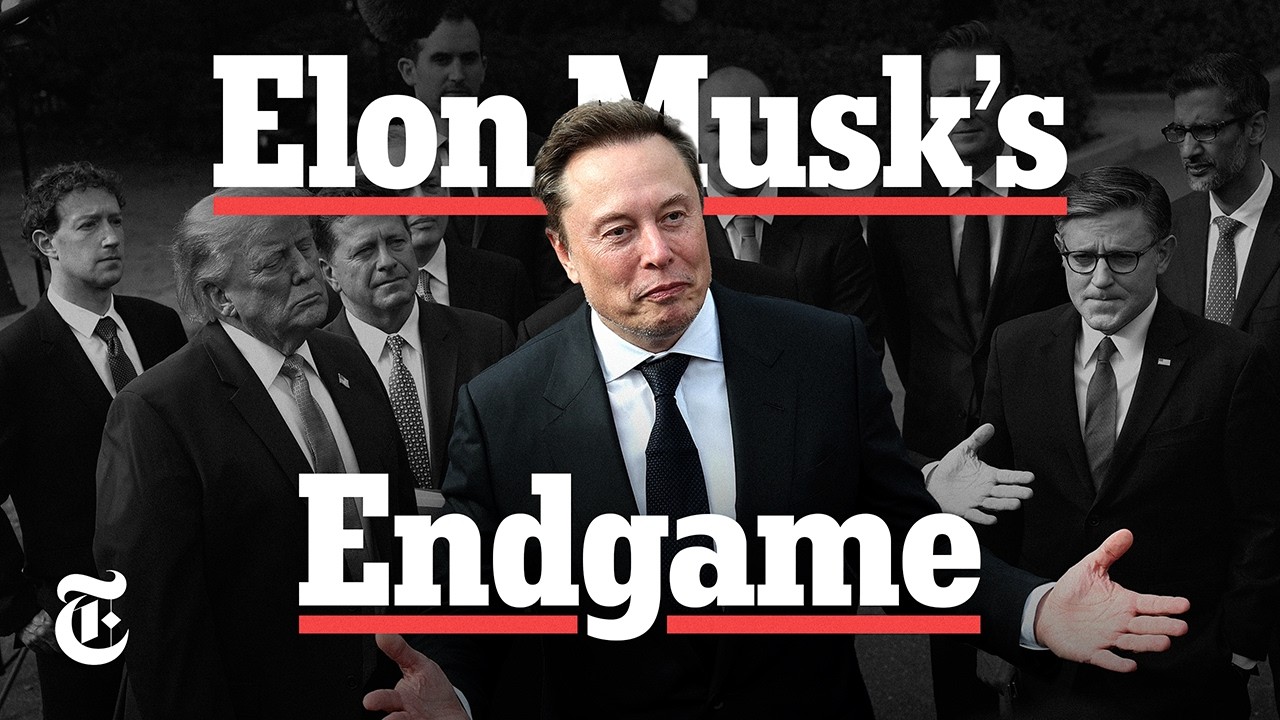
Ahead of the midterm elections, Elon Musk donated approximately $450 million to Republicans, accounting for nearly 25% of all GOP campaign contributions in the cycle. (0:00)
Musk has built deep societal dependency across money, machines, and messaging through Tesla, SpaceX, Starlink, Neuralink, and X, effectively operating as a private state-capacity entity. (1:42)
Musk predicts that artificial superintelligence will surpass human intelligence within five to ten years, reducing humans to a status comparable to chimpanzees relative to AI. (7:06)
Unlike historic industrial titans who traded philanthropy or high wages for social peace, Musk rejects conventional social contracts, directing foundation funds inward while warning that Western civilization suffers from 'suicidal empathy.' (34:29)
Detailed notes
## Background
This episode was published on YouTube by The Ezra Klein Show on October 30, 2026. Following Elon Musk's record-setting $450 million in political donations to Republicans, Ezra Klein interviews international historian Quinn Slobodian to dissect Musk's vast corporate empire, his political spending, and the ideological motives driving his pursuit of power across critical infrastructure, social media, and artificial intelligence.
## TL;DR
Ezra Klein and historian Quinn Slobodian explore Elon Musk's rise as a state-scale actor whose leverage spans finance, communication, and orbital launch infrastructure. They trace Musk's rightward political pivot from center-left technophilia to cultural nationalism, examining how his critique of the 'woke mind virus' and ideas like 'suicidal empathy' align with far-right political thought. The discussion investigates the historical roots of his worldview—from apartheid South Africa and 1930s Technocracy to simulation theory—and evaluates the paradox of an ultra-wealthy elite preparing for artificial superintelligence. Finally, they assess the systemic dilemmas Musk poses to sovereign governments, debating whether democracies must nationalize and regulate critical platforms or risk being held hostage to corporate-controlled infrastructure.
## Atmosphere & style
The conversation carries a cerebral, foreboding, and analytical tone, combining rigorous historical inquiry with unsettling political foresight. Klein and Slobodian exchange sharp insights with measured, scholarly restraint, contrasting Musk's grandiose techno-utopian promises against cold political and economic realities. Listening to the dialogue feels like an intellectual autopsy of modern democracy's vulnerabilities, oscillating between sci-fi existentialism and the grim mechanics of 21st-century oligarchy.
## Bulletin
- [00:00](https://www.youtube.com/watch?v=evdID8ZryVg&t=0s) Ahead of the midterm elections, Elon Musk donated approximately $450 million to Republicans, accounting for nearly 25% of all GOP campaign contributions in the cycle.
- [01:42](https://www.youtube.com/watch?v=evdID8ZryVg&t=102s) Musk has built deep societal dependency across money, machines, and messaging through Tesla, SpaceX, Starlink, Neuralink, and X, effectively operating as a private state-capacity entity.
- [07:06](https://www.youtube.com/watch?v=evdID8ZryVg&t=426s) Musk predicts that artificial superintelligence will surpass human intelligence within five to ten years, reducing humans to a status comparable to chimpanzees relative to AI.
- [34:29](https://www.youtube.com/watch?v=evdID8ZryVg&t=2069s) Unlike historic industrial titans who traded philanthropy or high wages for social peace, Musk rejects conventional social contracts, directing foundation funds inward while warning that Western civilization suffers from 'suicidal empathy.'
## Key takeaways
- [01:42](https://www.youtube.com/watch?v=evdID8ZryVg&t=102s) Musk's record campaign contributions represent an effort to entrench societal dependency across three distinct pillars: money, machines, and messaging.
- [04:18](https://www.youtube.com/watch?v=evdID8ZryVg&t=258s) By tying critical space and communications infrastructure overtly to the Republican Party and European far-right factions, Musk pursues a high-risk hyperpolarization strategy that risks severe backlash under future Democratic administrations.
- [07:06](https://www.youtube.com/watch?v=evdID8ZryVg&t=426s) Musk views AI through an existential lens, arguing superintelligence cannot be controlled by humans and must instead be trained to be 'curious' so that it finds humanity interesting enough to preserve.
- [10:20](https://www.youtube.com/watch?v=evdID8ZryVg&t=620s) Musk shifted his AI narrative from sci-fi existential doom to cultural warfare against the 'woke LLM', founding xAI and Grok as commercial counterweights to OpenAI and Google Gemini.
- [12:02](https://www.youtube.com/watch?v=evdID8ZryVg&t=722s) Musk's rightward political break was catalyzed by his exclusion from the 2021 Biden EV summit, pushback against internal tech activism, and local public health shutdown orders at the Fremont Tesla plant.
- [14:40](https://www.youtube.com/watch?v=evdID8ZryVg&t=880s) Musk's net worth surged from $39 billion in 2020 to near one trillion dollars, fueled by 'financial fabulism' that promises investors boundless future revenues from robotics, autonomous driving, and space colonization.
- [18:30](https://www.youtube.com/watch?v=evdID8ZryVg&t=1110s) Through Starlink, SpaceX, and Tesla, Musk has vertically integrated hardware and launch infrastructure, insulating his operations from global supply chain disruptions while creating unprecedented state reliance on private hardware.
- [28:04](https://www.youtube.com/watch?v=evdID8ZryVg&t=1684s) Drawing on Richard Dawkins's memes and Isaac Asimov's 'Foundation' series, Musk diagnoses progressive morality as a 'woke mind virus' and frames open immigration policies as an exploitation of Western civilizational empathy.
- [34:29](https://www.youtube.com/watch?v=evdID8ZryVg&t=2069s) Musk's ideology reflects an intellectual lineage connecting post-Cold War neoliberalism, paleoconservatism, and his upbringing in apartheid South Africa, unified by a belief that natural social hierarchies should not be leveled.
- [44:34](https://www.youtube.com/watch?v=evdID8ZryVg&t=2674s) As Silicon Valley leaders anticipate AI automating white-collar knowledge work, the traditional cognitive elite is projected to shrink from the top 10% into an ultra-concentrated cognitive super-aristocracy.
- [47:11](https://www.youtube.com/watch?v=evdID8ZryVg&t=2831s) Echoing his grandfather's involvement in 1930s Technocracy Incorporated, Musk's vision pairs rule by engineering elites with ethnonationalist appeals to win short-term political consent.
- [50:51](https://www.youtube.com/watch?v=evdID8ZryVg&t=3051s) Musk's endorsement of Donald Trump represents a celebration of unapologetic masculine will and builder archetypes against consensus-oriented institutional politics.
- [57:48](https://www.youtube.com/watch?v=evdID8ZryVg&t=3468s) The sheer scale of Musk's corporate infrastructure has led mainstream economists to contemplate nationalizing Starlink under the Defense Production Act, viewing his empire as a sovereign-like 'Vatican of technology.'
- [01:00:44](https://www.youtube.com/watch?v=evdID8ZryVg&t=3644s) Because public pension funds and retail portfolios are deeply invested in Tesla and SpaceX, tech executives wield immense leverage over the modern social contract by anchoring middle-class retirement stability to their market valuations.
- [01:03:01](https://www.youtube.com/watch?v=evdID8ZryVg&t=3781s) Musk's adherence to simulation theory risks devolving into a form of cosmic nihilism, where viewing fellow citizens as simulated 'non-player characters' rationalizes extreme wealth concentration and the abandonment of social obligations.
## Detailed walkthrough
### [00:00](https://www.youtube.com/watch?v=evdID8ZryVg&t=0s) Unprecedented Wealth and State-Like Power
Opening the show, Ezra Klein observes that if Republicans manage to keep the Senate and exceed expectations in the House in the midterm elections, the decisive factor will not be Donald Trump, but Elon Musk. Musk has injected approximately $450 million into the Republican campaign effort, making him the single largest individual donor in any election cycle in American history and accounting for a full quarter of all campaign donations received by the GOP. Klein emphasizes how difficult it is to grasp the scale of Musk’s near-trillion-dollar fortune: for Musk, donating $300 million to $400 million is proportionally equivalent to a median American household donating about $100. It costs him virtually nothing, yet it exerts a reality-warping effect on the American political process.
Money is only one vector of Musk's influence. Klein points out that through his ownership and leadership of X (formerly Twitter), Starlink, SpaceX, Neuralink, and Tesla, Musk has consolidated control over wealth, public attention, and critical physical infrastructure on a scale unmatched by any private individual in history. Unless compared to heads of state who command entire superpowers, like Donald Trump or Xi Jinping, no individual has ever wielded such a state-like apparatus entirely subject to personal whim. To unpack what Musk hopes to achieve and the risks he is taking to build this world, Klein introduces Quinn Slobodian, a professor of international history at Boston University, author of *Globalists* and *Hayek’s Bastards*, and co-author (with Ben Tarnoff) of *Muskism: A Guide for the Perplexed*.
[01:42](https://www.youtube.com/watch?v=evdID8ZryVg&t=102s) The Three Pillars of Dependency: Money, Machines, and Messaging
When asked what Musk is trying to buy with his record-shattering $450 million investment in the midterms, Quinn Slobodian argues that Musk is working to deeply entrench an existing societal dependence on his corporate empire. Slobodian breaks this strategy down into three distinct operational domains: money, machines, and messaging. On the financial side, SpaceX ranks among the world's most valuable tech firms, and Tesla forms a core holding in retail investor accounts and institutional pension funds; as Slobodian notes, attacking Musk has become tantamount to attacking a foundational pillar of the American political economy. On the machine and infrastructure side, SpaceX functions as an effective monopoly launch provider for low Earth orbit, while Starlink has transformed into the baseline communications backbone for battlefield military operations and rural populations globally.
```mermaid
flowchart TD
accTitle: Musk's Three Pillars of Structural Dependency
accDescr: Diagram showing how Musk integrates financial weight, machine infrastructure, and messaging platforms into political leverage.
subgraph Dependency ["Pillars of Dependency"]
M1["Money: Stock market weight via Tesla & SpaceX in pension funds"]
M2["Machines: Monopoly space launch & Starlink battlefield comms"]
M3["Messaging: X echo chamber & political framing"]
end
subgraph Strategy ["Strategic Objective"]
GOAL["Preempt regulatory oversight & entrench state reliance"]
end
M1 --> GOAL
M2 --> GOAL
M3 --> GOAL
```
The third domain is messaging, where Musk has sought direct narrative dominance. Slobodian explains that while Musk’s October 2022 acquisition of Twitter was widely ridiculed as one of the most disastrous business deals in American history, it has served its political purpose by allowing Musk to engineer an information ecosystem where his framing of societal crises and their solutions goes unchallenged. By targeting the midterms, Musk aims to wield kingmaker power over candidates, establish an echo chamber of his own design, and erect a political bulwark against any incoming regulatory crackdown that might accompany a Democratic majority.
- Musk has contributed roughly $450 million to Republican campaign funds, representing 25% of all GOP donations this cycle.
- SpaceX functions as a near-monopoly launch provider to low Earth orbit, while Starlink provides critical battlefield infrastructure worldwide.
- Pension funds and broad retail indices hold significant exposure to Tesla, tying the wider US economic stability to Musk's corporate performance.
[04:18](https://www.youtube.com/watch?v=evdID8ZryVg&t=258s) The High-Risk Strategy of Hyperpolarization
Ezra Klein challenges Slobodian’s entrenchment thesis by pointing out the glaring strategic risk inherent in Musk's overt partisanship. Traditional corporate titans whose enterprises rely extensively on government contracts usually cultivate bipartisan ties and operate discreetly behind closed doors. By contrast, Musk has tethered his companies directly to the Republican Party and boosted far-right parties across Europe. Klein observes that if Democrats take power in 2029—whether under a President John Ossoff, Gavin Newsom, or Alexandria Ocasio-Cortez alongside a Democratic Congress—overreliance on SpaceX, Starlink, or Grock within the Pentagon could be deemed an unacceptable national security liability. To Klein, Musk's behavior seems less like the calculated machinations of a master businessman and more like the conduct of a true ideological believer gambling significant corporate capital to force his personal worldview upon the globe.
Slobodian counters that Musk is intentionally operating on a parallel two-track model. By making the American stock market and critical defense sectors so reliant on his ventures, Musk wagers that future Democratic leaders will find their hands tied, unable to rein him in without triggering systemic economic or operational shockwaves. Simultaneously, Musk deploys hyperpolarization to ensure that when right-wing factions take power, he stands as their undisputed, favored private-sector partner. Slobodian highlights how Musk uses this same playbook in Europe: rather than compromising with Brussels and legacy centrist parties to protect market share, Musk has launched frontal assaults against the European Union and embraced insurgent right-wing factions like Germany’s Alternative for Germany (AfD) and Britain's right-wing challengers. As Slobodian puts it:
> “He’s taken an opposite approach, gone on a full frontal attack against Brussels and the and the existing legacy centrist parties and tried to ally which would what I’ve long thought of as he sees as the kind of Teslas of politics, the AfDs, the Restore Britons that he hopes will come from marginality and nowhere to completely disrupt and destroy the legacy institutional parties of social democracy and Christian democracy.”
[07:06](https://www.youtube.com/watch?v=evdID8ZryVg&t=426s) The 10-Year Horizon: Chimpanzees, Superintelligence, and Curiosity
Klein argues that understanding Musk requires analyzing how he works backward from radical visions of the medium-term future. To illustrate this, Klein plays an excerpt from an interview Musk gave to *The Economist*, where Musk paints an astonishing picture of what humanity will face in just five to ten years. In the clip, Musk asserts:
> “It would be an exercise in vanity to for me to think that I would be controlling the super genius AI that is vastly smarter than me.”
Musk goes on to explain that his biological neural net tells him that ensuring AI safety requires building systems that are maximally "truth-seeking and curious" so they choose to foster humanity. When pressed by the interviewer on whether he truly believes humans will lose control of the world within a decade, Musk replies:
> “I think it is unlikely. Um, in the same way that if the difference in intelligence between AI and humans is vastly greater than the difference in intelligence between AI and chimpanzees, it’s hard to imagine that the chimpanzees would be in charge.”
Klein emphasizes the casual detachment with which Musk outlines this near future: a world where money no longer exists, human beings have permanently ceded control of civilization, and Musk himself will not even run his own enterprises. Asked what Musk actually means by training artificial intelligence to be "truth-seeking and curious," Slobodian explains that Musk views curiosity as a survival mechanism for the species. If an artificial superintelligence inevitably outstrips human cognitive capabilities, humanity's survival depends on whether the machine finds humans interesting or entertaining enough to keep around. Klein interjects that this logic borders on simulation theory, where humans must act as a sufficiently entertaining reality show so that whoever or whatever runs the simulation chooses not to terminate the program.
[09:19](https://www.youtube.com/watch?v=evdID8ZryVg&t=559s) The Evolution of Musk's AI Doctrine: From OpenAI to Neuralink Symbiosis
Slobodian tracks how Musk’s public posture on artificial intelligence has transformed dramatically over the prior decade. In 2015, Musk co-founded OpenAI alongside Sam Altman, largely motivated by the existential warning issued by Swedish philosopher Nick Bostrom in his 2014 book *Superintelligence*. At that time, Musk’s stated fear was the risk of runaway artificial intelligence—typified by the classic thought experiment of an AI optimizing so ruthlessly for a single prompt that it consumes all matter on Earth to produce paperclips. His initial objective with OpenAI was therefore focused on deceleration: hitting the brakes, slowing progress down, and ensuring machine values remained safely aligned with human survival.
Yet Slobodian notes an internal contradiction that existed from the very beginning. At the exact moment Musk was advocating to hit the brakes on software AI, he co-founded Neuralink. Musk explained directly to Altman and other confidants that Neuralink was engineered to drastically accelerate the physical fusion of biological brains with digital network architectures. Rather than simply hoping to hold artificial intelligence back through regulation or safety protocols, Musk's underlying objective was to create what he called a "human-machine symbiote" capable of outpacing pure digital superintelligence before biological humans were left entirely behind.
[10:20](https://www.youtube.com/watch?v=evdID8ZryVg&t=620s) The Shift from "Skynet" to the "Woke LLM"
Quinn Slobodian traces the clear demarcation line in Elon Musk’s public fixation on artificial intelligence. In its initial phase, Musk’s anxiety was centered on existential risk—a classic sci-fi fear of a rogue digital superintelligence outstripping humanity like Skynet. His early remedy was human augmentation: technologies like Neuralink were envisioned to merge human consciousness with machines so that biological people could keep pace with synthetic minds. Ezra Klein summarizes this posture cleanly: “We must become the robots to not be destroyed by the robots.”
Everything pivoted in November 2022 with the release of ChatGPT. As generative artificial intelligence and large language models (LLMs) emerged as the single greatest tech growth narrative in years, Musk and his Silicon Valley peers abruptly swapped existential dread for cultural panic. Rather than worrying about an all-powerful superintelligence, Musk began railing against the “woke LLM.” He saw models trained on the contemporary internet—shaped by Black Lives Matter, trans rights, and the Me Too movement—as politically sanitized and infected. When Google Gemini generated images of racially diverse and Black American founding fathers, it became a lightning rod for figures like Musk and venture capitalist Marc Andreessen. In one memorable remark, Musk warned that this ideological guardrailing risked warping reality to the point of turning him into a woman of color.
Musk’s commercial answer to this anxiety was xAI and its model, Grok. Positioning Grok as a truth-seeking alternative, Musk turned his culture-war grievances into an explicit product differentiation strategy. As Slobodian puts it: “The truth-seeking part is really his market proposition against what he sees as the alternative models of OpenAI and Anthropic, which have been shot through, as he describes it, and contaminated with the woke mind virus.”
```mermaid
flowchart TD
accTitle: Evolution of Musk's AI Vision
accDescr: Diagram tracing the pivot from existential superintelligence dread to anti-woke commercial LLMs.
subgraph Phase1["Phase 1: Existential Sci-Fi Dread"]
A["Fear of Skynet / Superintelligence"] --> B["Augment Human Brains (Neuralink)"]
end
subgraph Pivot["Inflection Point (Nov 2022)"]
C["Launch of ChatGPT & Generative AI Boom"]
end
subgraph Phase2["Phase 2: Cultural Retaliation"]
D["Fear of 'Woke LLM' & Gemini Bias"] --> E["Launch xAI & Grok as 'Truth-Seeking' Anti-Woke AI"]
end
B --> C
C --> D
```
[12:02](https://www.youtube.com/watch?v=evdID8ZryVg&t=722s) The Tech-Right Turn: Snubs, Social Movements, and COVID Clashes
Klein points out that Musk’s shift toward right-wing politics actually predates his November 2022 pivot on AI. A decade earlier, Musk fit comfortably into standard-issue, center-left Silicon Valley technocracy, enthusiastically backing Barack Obama and relying on a nearly half-billion-dollar loan from the Department of Energy to fuel Tesla's green transition. By 2022, however, he had transformed into the de facto leader of the insurgent "tech right."
Slobodian explains that this rupture stemmed from three distinct collisions with the Democratic establishment and progressive workplace culture:
```mermaid
flowchart LR
accTitle: Catalysts of Musk's Political Realignment
accDescr: The three major factors driving Elon Musk's political shift to the right.
A["Biden White House Snub (EV Summit / Pro-Union Push)"] --> D["Political Realignment to the Tech Right"]
B["Workplace Activism (Walkouts / Diversity Demands)"] --> D
C["COVID-19 Mandates (Defying Fremont Factory Closure)"] --> D
```
- **The Biden White House Snub:** Under Obama, Tesla's push for vehicle electrification aligned with a geopolitical desire to reduce reliance on Middle Eastern oil. But the Biden administration tied clean tech subsidies to organized labor, heavily favoring unionized domestic automakers. Musk was conspicuously excluded from Biden’s 2021 White House electric vehicle summit. Slobodian likens this public snub to Donald Trump being roasted at the 2011 White House Correspondents' Dinner—a catalytic moment of elite rejection that led Musk to conclude, "If you don't like me, then forget you. I'm going to create my own club."
- **Internal Worker Revolts:** The rise of progressive social movements around racial and gender justice penetrated Silicon Valley campuses, sparking internal employee petitions, open letters, and walkouts. For tech founders and executives, this felt like an intolerable challenge to managerial prerogative, breeding deep resentment among a CEO class that refused to let labor dictate corporate culture.
- **COVID-19 Lockdowns:** The pandemic regulatory apparatus directly confronted Musk's insistence on absolute executive sovereignty. When Alameda County forced the closure of Tesla's Fremont assembly plant, Musk reacted with fury. His tweet declaring that “the coronavirus panic is dumb” became his first social media post to hit one million likes. Backed by public encouragement from Donald Trump, Musk openly defied county health orders, restarted the Fremont factory lines, dared authorities to arrest him, and faced zero regulatory consequences.
[14:40](https://www.youtube.com/watch?v=evdID8ZryVg&t=880s) The Attention Economy, Polarization, and the Trillion-Dollar Leap
Musk’s radicalization on Twitter was not a mere descent into online brain rot, Slobodian argues; it functioned as an iterative engine for personal enrichment and political power. Online, Musk discovered that provocation produced unparalleled visibility, operating with an attention-seeking instinct nearly identical to Donald Trump’s. Rather than alienating capital, relentless polarization converted Musk into what observers termed a "human meme stock." As Slobodian observes: “So what he finds out online on Twitter is that, you know, polarization is actually, rather than being a kind of handicap for his accumulation model, is actually a real accelerant for it.”
Klein emphasizes the staggering, historically unprecedented speed of Musk's wealth accumulation during this period. In 2020, Musk’s net worth stood at roughly $39 billion. Over the span of just six years, it approached nearly one trillion dollars—meaning that in 2020, he controlled barely 4 percent of the wealth he would command six years later.
This meteoric rise was not powered by sudden rivers of traditional corporate net profit. Neither Tesla nor SpaceX suddenly posted earnings that justified classic fundamental valuations. Instead, Musk’s valuation exploded because he mastered what Slobodian calls "financial fabulism": the skill of selling investors not on current balance sheets or cash flows, but on the hypnotic promise of unlocking virtually infinite future revenue streams across autonomous driving, humanoid robotics, and interplanetary colonization.
[16:39](https://www.youtube.com/watch?v=evdID8ZryVg&t=999s) Financial Fabulism and Concrete Technological Breakthroughs
While Musk's companies trade at price-to-earnings multiples that seem detached from reality, Slobodian and Klein agree that critics make a grave error when they dismiss him as merely a grifter, a liar, or a corrupt crony capitalist. Klein cautions against the common intellectual trap wherein political distaste causes commentators to deny real capability: “Well, let me hold you on that for a second, because one thing I often see, and I think of it as a genuine kind of intellectual mistake, people want the people they don't like to not be impressive.”
Musk's financial fabulism works precisely because it rests on genuine, visible, and transformative engineering feats that investors can touch and see:
- **Commercial Spaceflight:** SpaceX successfully slashed the cost of putting orbital tonnage into space by more than 90 percent, effectively shattering the legacy defense contractor paradigm.
- **Global Satellite Telecommunications:** Starlink has deployed over 11,000 satellites in low Earth orbit, serving over 12 million global subscribers and directly shaping geopolitical and military outcomes on the ground in Ukraine.
- **Automotive Transformation:** Tesla legitimized electric motorization worldwide, transforming consumer demand and paving the way for autonomous robotics and AI integration.
As Slobodian points out, these undeniable physical facts make Musk's forward-looking promises plausible to investors: “These things are real things you can point to if you want to persuade yourself that if you're going to make a bet, you make it on this man.”
[18:30](https://www.youtube.com/watch?v=evdID8ZryVg&t=1110s) Vertical Integration, Deglobalization, and the Future Economy
Musk’s operational success was fueled by an early instinct for deglobalization, reshoring, and re-territorializing manufacturing long before these concepts became fashionable. When Musk founded SpaceX in 2002, he recognized that extensive procurement chains and reliance on bloated tiers of subcontractors drove up expenses and caused massive delays. He chose instead to insource heavily, manufacturing complex rocket components in-house.
Musk mirrored this architecture at Tesla through the development of the Gigafactories, striving to gather as much of the battery and automotive supply chain as possible under a single roof. When the COVID-19 pandemic and the war in Ukraine triggered cascading global supply shocks and paralyzed traditional legacy automakers, Tesla absorbed the blow and bounced back with remarkable agility.
Slobodian stresses that Musk cannot be understood through the narrow lens of state subsidy exploitation alone: “In fact, he's not just a crony capitalist, because he's pushing out often the kind of technological frontier for economies that do business with him.” To sustain these valuations, Musk continually sells the public on a radically reorganized economic horizon. Klein tees up an archival interview clip from *The Economist* where Musk is asked how his enterprises will function and generate profit a decade out, setting up Musk's concept of an economy unconstrained by human physical limits.
[20:40](https://www.youtube.com/watch?v=evdID8ZryVg&t=1240s) The “Quasi-Infinite Economy” and Musk Industries
Elon Musk lays out a vision where artificial intelligence transitions from purely digital computation into physical reality. To achieve this, digital intelligence requires physical effectors in the form of humanoid robotics—“basically a lots of bots in a nutshell.” Once deployed at scale, these robots allow intelligence to shape physical atoms rather than remaining confined to bits. Because an economy is fundamentally defined as the production of goods and the provision of services, combining vast numbers of robotic bodies with immense digital intelligence generates what Musk calls a “quasi-infinite economy,” marking a radical departure from all previous human economic history.
```mermaid
flowchart LR
accTitle: Transition to a Quasi-Infinite Economy
accDescr: Flowchart showing how digital intelligence and humanoid robotics combine to shape physical atoms and yield a quasi-infinite economy.
subgraph Core["Inputs"]
A["Digital Intelligence"]
B["Humanoid Robotics<br/>('Lots of Bots')"]
end
subgraph Process["Physical Realization"]
C["Shaping Atoms<br/>(Goods & Services)"]
end
subgraph Outcome["Economic Future"]
D["Quasi-Infinite<br/>Economy"]
end
A --> C
B --> C
C --> D
```
Ezra Klein identifies this as the core pitch of “Musk Industries”: the conglomerate is not necessarily aiming to win the raw software race for AI alone, but rather to dominate the intersection where artificial intelligence meets robotics, taking technology “out of bits and into atoms.” However, this raises an uncomfortable question about what role ordinary human beings actually play in such a future. Quinn Slobodian notes that Musk openly admits civilization is moving toward a state of human subordination or outright marginalization by superintelligence. Selling such an endgame to the public makes it remarkably difficult to manufacture popular consent or political legitimacy.
Building this apparatus has driven Musk to execute massive corporate consolidations across his empire:
- xAI absorbed X.com (formerly Twitter).
- SpaceX subsequently absorbed xAI.
- Musk has publicly pushed for a merger between Tesla and SpaceX—which would become the largest corporate merger in history, formally binding the physical robotics arm (Tesla) to the AI and space infrastructure umbrella (SpaceX).
Despite projecting absolute invulnerability, Slobodian emphasizes that Musk is acutely fragile to state power: “So if you pick up the SpaceX prospectus and read through the risk factors, number one risk factor is national legislation.” The ultimate threat keeping Musk awake at night is sovereign governments throwing sand into the treads of his industrial machine, which makes controlling public opinion and belief essential to his survival.
---
[24:25](https://www.youtube.com/watch?v=evdID8ZryVg&t=1465s) The Woke Mind Virus as a Cybernetic Threat
Musk views human politics and ideology through an intensely mechanistic lens, treating political beliefs as literal computer viruses. Slobodian traces Musk's formulation of the “woke mind virus” back to the evolutionary biologist Richard Dawkins, who coined the term “viruses of the mind” in the early 1990s after introducing the concept of the “meme” in his 1976 book *The Selfish Gene*. Dawkins drew an explicit analogy between computer viruses and religious or ideological beliefs, describing them as discrete packets of information transmitted across human networks.
```mermaid
flowchart TD
accTitle: Richard Dawkins to Elon Musk's Cybernetic Ideology
accDescr: Diagram illustrating how Dawkins' concepts of memes and mind viruses evolved into Musk's view of social networks as cybernetic feedback engines.
subgraph Dawkins["Evolutionary Theory"]
M["The Meme<br/>(1976: 'Selfish Gene')"]
V["Viruses of the Mind<br/>(Early 1990s)"]
end
subgraph MuskModel["Musk's Cybernetic Collective"]
C["Humans + Machines<br/>Integrated Network"]
O["Information Cascades<br/>(Memes / Mind Viruses)"]
end
subgraph PoliticalAction["Discourse Control"]
X["Platform Monetization<br/>& Algorithmic Amplification"]
end
M --> V
V --> C
C --> O
O --> X
```
Musk has adopted this framework completely. In his view, human society operates as an integrated “cybernetic collective” of biological individuals and digital machines, where political loyalties, moral demands, and public outrage are nothing more than infectious software routines running on human wetware. When racial justice movements and progressive coalitions organized against his projects during the 2020s, Musk interpreted their pushback not as legitimate democratic disagreement, but as an infection of toxic mental malware. To counter this, he concluded he had to deploy and amplify an opposing “anti-woke mind virus.”
To wage this battle, Musk transformed his companies into a vertically integrated communicative silo spanning from satellites down to conversational AI:
- Starlink and SpaceX provide the physical satellite orbital infrastructure.
- X.com acts as a real-time behavioral training ground, providing access to the raw emotional outputs and opinions of millions of humans.
- The xAI large language models (such as Grok) ingest this live data to remain culturally current.
- The financial architecture of X was deliberately altered to monetize accounts that spread virally potent right-wing memes, as demonstrated when British politician Rupert Lowe earned thousands of pounds through platform engagements after posting inflammatory claims about the incompatibility of Muslims with British civilization.
As Slobodian explains, this system allows Musk to function as the ultimate algorithmic gatekeeper: “So in Musk's mind, he's producing a kind of mind virus engine which he could also call truth.”
---
[28:04](https://www.youtube.com/watch?v=evdID8ZryVg&t=1684s) Psychohistory, the Limbic System, and "Suicidal Empathy"
Musk’s ideological understanding of Western civilization is deeply informed by classic science fiction, particularly Isaac Asimov’s *Foundation* series. Musk frequently references the saga and even named his child Seldon after Hari Seldon, the fictional mathematician who develops “psychohistory”—a discipline that uses statistical analysis of mass human behavior and crowds to steer the survival of galactic civilization. In Asimov's narrative, Seldon's calculated rationalism is upended by an adversary called the Mule, an individual endowed with the telepathic power to warp and dictate human emotional instincts.
Musk models social networks on a tension between cold engineering rationality and what he terms the biological “limbic instinct”—the visceral, primitive animal drives governing human mobs. Slobodian notes how unprecedented it is for the world's wealthiest man to explicitly envision himself in a transitional role ushering humanity toward its own obsolescence: “I mean the vision of super intelligences reducing us to the role of chimpanzees is not actually something anyone with any level of influence has tried to persuade the mass of people to go along with before.”
Klein notes a paradox: while Musk typically exhibits an almost superhuman personal sense of agency, he adopts a tone of strange fatalism when describing this civilizational trajectory, yet remains hyper-obsessed with short-term political combat. Klein plays an audio clip from an appearance by Musk on *The Joe Rogan Experience*, where Musk warns that misplaced human feelings pose an existential security vulnerability to the modern West:
> “So that we’ve got civilizational suicidal empathy going on. And it’s like I believe in empathy. Like I think you should care about other people, but you need to have empathy for civilization as a whole and not commit civilizational suicide.”
Musk warns that uncalibrated personal empathy functions as an exploit that bad-faith actors weaponize against the long-term survival of civilization itself.
[31:20](https://www.youtube.com/watch?v=evdID8ZryVg&t=1880s) The "Empathy Exploit" and Civilizational Suicide
The discussion turns to Elon Musk's diagnosis of what he views as the fundamental vulnerability in modern Western culture. Klein plays a clip where Musk argues that empathy functions as a fatal system bug: “The empathy exploit. They’re they’re it’s a it’s they’re exploiting a a a bug in Western civilization, which is the empathy response.” Musk cautions that while empathy is broadly considered a good quality, society cannot be blindly programmed by it like a robot, warning against an unthinking individual compassion that leads to what he describes as "civilizational suicidal empathy."
Klein asks Quinn Slobodian to decode the concrete meaning behind Musk's rhetoric of civilizational suicide. Slobodian explains that Musk is adopting a core talking point of the European far right: the issue is not merely sheer numbers of immigrants arriving in the United States or Europe, but the liberal policy that welcomes individuals from completely distinct cultures and religions into Western nations. This framework equates compassion with demographic and cultural collapse, motivating calls for policies such as "remigration."
At an intellectual level, Slobodian argues, Musk treats human society not through classical political terms, but as software engineering. Traditional concepts that have underpinned 250 years of modern thought—popular sovereignty, democratic care for the population, and the presumption of civic equality—are treated under Musk's paradigm as points of system failure. As Slobodian notes, when social order is viewed as a programming problem, political compromise and consensus-building disappear: “social order becomes a programming problem and in programming uh attempts to kind of transform the core code that you're working on are not interpreted as a possibility for consensus building or compromise but simply sites of contamination that need to be programmed away.” Klein adds that in Musk's framing, excessive empathy toward the individual ends up sacrificing empathy for civilization as a whole.
```mermaid
flowchart TD
accTitle: The Empathy Exploit Logic
accDescr: Flowchart illustrating how Musk's engineering mindset reframes empathy into a civilizational security vulnerability.
subgraph Mindset["Engineering Paradigm"]
A["Social Order Viewed as Core Code"]
B["Individual Empathy Treated as System Bug"]
end
subgraph PoliticalManifestation["Political Consequence"]
C["Rejection of Democratic Consensus & Sovereignty"]
D["Opposition to Immigration & Calls for Remigration"]
end
A --> B
B --> C
B --> D
```
[34:29](https://www.youtube.com/watch?v=evdID8ZryVg&t=2069s) South African Apartheid and the Refusal of the Social Contract
Klein and Slobodian explore how Musk's formative years in apartheid South Africa shaped his politics and view of human hierarchy. Slobodian acknowledges that while direct documentary evidence is limited, it is not a large interpretive leap to connect Musk's outlook to that environment. Growing up as part of a racially marked, privileged minority moving through daily life surrounded by a disenfranchised, faceless Black majority easily produces a worldview divided into "player characters" and "non-player characters" (NPCs). In late-apartheid South Africa—one of the last holdouts of imperial, two-tier logic—the majority population existed solely to serve the needs of the ruling minority. Because the basic premises of modern nation-states—reciprocal care, popular sovereignty, and shared national destiny—were entirely suspended, Slobodian argues it became easy for someone raised there to dismiss those foundational political concepts altogether.
This dynamic becomes sharper when comparing Musk to historical industrial titans like Henry Ford. Despite Ford being a virulent antisemite and anti-union hardliner, "Fordism" produced an enduring social contract: collective bargaining, rising wages, the single-earner breadwinner model, and the seeds of the modern welfare state. Society extracted concessions through democratic pressure and labor struggle in exchange for consenting to Ford’s industrial power. By contrast, Slobodian points out that Musk offers no comparable social contract or public legacy akin to Andrew Carnegie's public libraries.
Musk's philanthropic vehicle, the Musk Foundation, illustrates this complete withdrawal from civic responsibility:
- The Musk Foundation ranks among the top 10 endowed philanthropic foundations in the United States, yet remains obscure.
- It routinely fails to meet the basic legal requirement for 501(c)(3) organizations to disburse at least 5% of its assets annually.
- When it does disburse funds, the grants often flow inward rather than outward—such as funding Ad Astra, a private school located next to SpaceX in Texas that primarily serves the children of Musk's own employees.
- Slobodian contrasts this insular model with institutions like the Bill & Melinda Gates Foundation, which, despite valid critiques, seeks to buy public consent and legitimacy by maximizing lives saved across the developing world.
Highlighting Musk's break from historical oligarchic norms, Slobodian observes: “So that vision of kind of outward-facing social purpose, his complete reneging of that is itself quite extraordinary, right? And and and sets him apart actually from others in his class”.
[39:12](https://www.youtube.com/watch?v=evdID8ZryVg&t=2352s) Neoliberalism After the Cold War: The Hayekian Right Meets Cultural Nationalism
Klein steers the conversation to Slobodian’s earlier book, *Hayek's Bastards*, to contextualize the ideological roots of the modern right. Slobodian recounts how neoliberal thinkers—including Friedrich Hayek, Milton Friedman, Gary Becker, and George Stigler—originally organized in 1938 to defend market freedoms against encroaching threats from both the left and right. Having achieved political prominence under Ronald Reagan and Margaret Thatcher, these figures appeared to win total victory when the Berlin Wall fell and the Soviet Union collapsed.
Yet Slobodian's archival research into the private meetings and papers of these neoliberals around 1989 reveals that they were not celebrating; they were panicking over new adversaries. They saw the "red" socialist enemy transform into a "green" ecological threat, as public anxiety mounted over global warming and the greenhouse effect. Simultaneously, they felt besieged by progressive domestic shifts: demands for workplace affirmative action, pay equity, the feminist movement, and the emerging gay rights movement.
This shared panic catalyzed an enduring fusion between radical free-market defenders and cultural reactionaries:
- Libertarian economist Murray Rothbard forged common cause with cultural nationalist Pat Buchanan, birthing the paleoconservative alliance.
- In Germany, neoliberal economists who initially mobilized against the mismanagement of the euro ultimately partnered with anti-immigrant ethnonationalists to establish the Alternative for Germany (AfD).
Klein summarizes the connective tissue uniting these factions: an underlying belief that natural human hierarchies—whether based on IQ differentials, cultural capacities, or evolutionary fitness among individuals and groups—inevitably govern society and must not be artificially leveled.
[42:01](https://www.youtube.com/watch?v=evdID8ZryVg&t=2521s) The Woke Mind Virus, Hierarchies, and Natural Inequality
Ezra Klein connects Quinn Slobodian’s book *Hayek’s Bastards* to Elon Musk’s rhetoric surrounding the "woke mind virus." Klein observes that Musk’s political fixation is not primarily about free markets or classic libertarian economics. Rather, it centers on the conviction that human society relies on fundamental categories and hierarchies, and that progressive or "woke" politics represents an existential threat by actively working to dissolve those essential organizing structures. In Klein’s reading, Western civilization cannot survive without the very hierarchies upon which it was built, and Musk's political output is an effort to defend them.
Slobodian agrees, noting that the subtitle of his book—*Race, Gold, IQ, and the Capitalism of the Far Right*—highlights the core far-right libertarian premise that nature is fundamentally unequal. Whether through genetic endowment or geographic accident, nature distributes advantages unevenly, and denying this basic natural inequality is viewed as paving a modern "road to serfdom." Slobodian remarks:
> “Now it would be paved with green bricks and pink bricks instead of red bricks, and someone like Musk, I think, absolutely falls into that category.”
[44:34](https://www.youtube.com/watch?v=evdID8ZryVg&t=2674s) From the Bell Curve to AI Eating the Cognitive Elite
Slobodian traces how the obsession with IQ gained mainstream intellectual traction in the 1990s through *The Bell Curve* (1994), authored by Charles Murray and Richard Herrnstein. That book made the case that in an emergent knowledge economy, IQ would determine economic success: high-IQ individuals would form a thriving cognitive elite, while those at the bottom would struggle and become a societal burden. The book's most incendiary claim was that racial group differences in intelligence meant Black people would be disproportionately concentrated at the bottom of the distribution—an ideology that Slobodian points out neatly paralleled the rise of mass incarceration, aggressive policing, and punitive law-and-order policies during the 1990s.
```mermaid
flowchart TD
accTitle: Evolution of the Cognitive Elite Under AI
accDescr: Diagram contrasting the 1990s Bell Curve cognitive elite model with the modern AI-driven super aristocracy model.
subgraph BellCurve["1990s Knowledge Economy (The Bell Curve)"]
A["Top ~10% IQ Elite"] -->|"Coders, PMs, Writers"| B["Broad Knowledge Work Thrives"]
C["Bottom Distribution"] -->|"Left Out"| D["Mass Incarceration & Punitive Policy"]
end
subgraph AIEconomy["Modern Silicon Valley AI Model"]
E["LLMs & Autonomous Agents"] -->|"Automates Knowledge Work"| F["99% of Knowledge Workers Displaced"]
E -->|"Concentrates Power"| G["Top 0.1% Hyper-Small Cognitive Super-Aristocracy"]
end
```
The crucial contemporary shift, Slobodian argues, is that current Silicon Valley leadership assumes LLMs and AI agents will automate almost all traditional knowledge work. If Herrnstein and Murray envisioned a top 10% cognitive elite running society, AI is now projected to eliminate the jobs of coders, project managers, and technical writers, shrinking that elite down to a tiny 0.1%. As Slobodian explains:
> “Then you have a question where A.I. has actually eaten IQ, and now you’ve gone from just a cognitive elite, which is what Herrnstein and Murray called it, to a kind of hyper-hyper-small cognitive super-aristocracy.”
Klein responds that this framework resolves what otherwise seems like a profound paradox in Musk's actions:
- Musk claims his ultimate ambition is "expanding the light cone of human consciousness through the stars," yet he bends a psychic knee to artificial intelligence as superior.
- He sounds the alarm incessantly about falling birth rates, yet supports slashing foreign aid programs that sustain human life and allow populations to reproduce.
- He expresses a sweeping love for humanity in the abstract, while exhibiting fierce hostility toward immigrants and many actual humans.
Klein suggests these contradictions align if Musk views reality through a ruthless cognitive hierarchy. In that view, the concern is never an egalitarian headcount of silicon versus flesh, but rather identifying:
> “...who or what qualifies as having, like, the capacity to be a main character in this performance...”
[47:11](https://www.youtube.com/watch?v=evdID8ZryVg&t=2831s) Technocracy Inc. and the Political Transition Problem
Slobodian notes an intriguing parallel to the ideology of Musk's maternal grandfather, Joshua Haldeman, who was an active member of Technocracy Incorporated in 1930s Canada. While Slobodian cautions against overstating direct influence, the resemblance in systems architecture is striking: Technocracy Inc. proposed abolishing the price system and representative democracy, replacing standard currency with an energy unit called the "erg" (the measurable energy an individual produces), and entrusting the rational allocation of resources to an elite caste of engineers.
```mermaid
flowchart LR
accTitle: Musk's Grand Vision vs The Near-Term Political Strategy
accDescr: Chart showing how the gap between the present and a hyper-technocratic future is bridged by ethnonationalist fear-mongering.
subgraph Bridge["Political Strategy to Maintain Power"]
C["Memeing the 'Invader' Fear"]
D["Ethnonationalist Flight to Safety"]
E["Position Tech as Only Salvation"]
end
subgraph Future["The End Goal"]
F["Engineered Technocracy"]
G["Escape Velocity / Liftoff"]
end
A --> Bridge
B --> Bridge
Bridge --> Future
```
The immediate operational hurdle for Musk is managing the political transition over the next ten years to the end of his life, especially given that he has no succession plan and retains 85% of SpaceX's voting shares. In periods of extreme unrest and uncertainty, investors and citizens engage in a "flight to safety." Far-right and neoliberal thinkers have historically offered shelters—whether racial status, a gold hoard, or Bannonite "citizenship value." Because Musk's AI future offers a lifeboat to only an infinitesimal fraction of humanity, he cannot win democratic consent with a vision of shared prosperity. Instead, Slobodian argues, Musk falls back on well-worn, century-old reactionary political maneuvers:
> “His decision to say the way I’m going to win consent is simply to make you frightened of outsiders and make you believe you need my technology to save your lives of yourself and your family is a way that politicians have used to justify lack of material redistribution for, you know, over 100 years.”
[50:51](https://www.youtube.com/watch?v=evdID8ZryVg&t=3051s) The Musk-Trump Alliance and the World Spirit on Horseback
Klein analyzes the psychological foundation of the alliance between Musk and Donald Trump, especially visible when Musk immediately endorsed Trump following the assassination attempt where Trump raised a bloodied fist. Beyond policy overlap, Klein argues they share an appeal centered on the reassertion of unapologetic masculine will against what their supporters view as a "woke, feminized, consensus-oriented" political culture.
Trump and Musk evoke archetypes of the uncompromising builder, the industrialist, the Ayn Randian titan, or the Hegelian "world spirit on horseback." To Musk’s predominantly young to middle-aged male fan base, his cosmic rhetoric resonates less for its concrete policy blueprints than for its raw emotional texture:
> “Because to like hear a person saying this is to hear a person saying like, we will sally boldly forth and try to forge a glorious and unknown future for humanity.”
[52:24](https://www.youtube.com/watch?v=evdID8ZryVg&t=3144s) The Monopolization of Collective Innovation and the Unstable Equilibrium
Quinn Slobodian frames the political aura surrounding Elon Musk as an escalating dynamic akin to Pascal's wager or Roko’s basilisk: followers come to believe that adhering to Musk’s vision is the only way to avoid obsolescence and make it through the civilizational filter. In this mental model, refusing to align with him is treated as dooming oneself. Slobodian cautions against giving Musk total individual credit, emphasizing that Musk has managed to monopolize assets, infrastructure, and technologies that originated through collective intelligence and public will. The real reform task is not tossing out the technology he built by piggybacking on other innovators, but reclaiming a narrative where democratic publics—rather than one man and his posts—steer the technological future.
```mermaid
flowchart TD
accTitle: Systemic Escalation of Musk's Power
accDescr: Diagram showing how political intertwining and mega-spending create an unstable equilibrium between Elon Musk and state actors.
subgraph Leverage["Musk's Structural Intertwining"]
A["Collective Innovation Monopolized"] --> B["Control Over Critical Infrastructure (e.g., Starlink)"]
B --> C["Political Leverage & Mega-Spending ($450M)"]
end
subgraph Conflict["The Unstable Equilibrium"]
C --> D{"Escalation Point"}
D -->|"Left/Centrist Win"| E["Musk Must Break Political Opposition"]
D -->|"Threat Perception"| F["State Moves to Contain Musk"]
end
```
Ezra Klein observes that the relationship between Musk and the state has turned into a fundamentally volatile balance of power. Musk's companies are so thoroughly stitched into public administration and national defense that disentangling them seems near impossible. Yet this very fusion leaves democratic governments vulnerable to his whims—such as the threat of switching off Starlink during a geopolitical crisis—while making Musk equally terrified of losing favor if left-leaning or centrist leaders take office. Klein points out that Musk dropping approximately $450 million on an election cycle is not an ordinary campaign donation, but an existential bid:
> “It just at some point either I think you end up in a situation where like Musk needs to break the opposition to him or it's like the state needs to contain the threat.”
Discussing his book *Muskism: A Guide for the Perplexed* (co-authored with Ben Tarnoff), Slobodian notes that conversations about Musk in Europe have proved far more pragmatic than in the United States. Americans often remain locked in a visceral psychological desire to moralize or lash out against Musk because their economic destiny is so tightly sutured to him. European discussions, by contrast, tend to evaluate a clear three-pronged framework for addressing his technological empire:
* **Regulation:** The primary avenue pursued by the European Union to constrain corporate tech overreach through institutional rules and oversight.
* **Replacement:** The route of assessing the high public capital cost required to construct viable, sovereign alternatives to his private hardware and platforms.
* **Reimagining:** Questioning from first principles what the technology is actually for, rediscovering early Tesla-era promises of electric autonomy, batteries, and solar capacity that offered genuine social utility over current speculative vectors.
Klein and Slobodian point out that Musk constantly peddles an illusion of technological inevitability—claiming to *The Economist* that there is no red button to halt artificial intelligence. Slobodian rejects this, citing the hundreds of regional moratoria halting compute and data-center builds across the United States. Far from being an unstoppable cosmic vector, the physical infrastructure of generative AI remains grounded in materials and policies that societies can deliberately choose to pause, reorient, or deny.
[57:48](https://www.youtube.com/watch?v=evdID8ZryVg&t=3468s) The Nationalization Debate and Starlink
The conversation shifts to concrete state interventions that once seemed completely off-limits to mainstream economic policy. Slobodian highlights that centrist liberal economist Paul Krugman recently authored newsletter entries entertaining the idea of nationalizing Starlink under the Defense Production Act, drawing historical parallels to Franklin D. Roosevelt's wartime seizure of Montgomery Ward. Whereas conventional market orthodoxy historically warned that nationalizing a top-tier firm would instantly spur cascading capital flight, repriced risk, and recession, the fact that an establishment economist like Krugman is openly debating it shows how intensely Musk's geopolitical leverage is rattling policy elites.
Klein agrees that Krugman's stance highlights the fragile state of affairs. While the reporting surrounding Starlink outages in Ukraine remains tangled and contested—whether it stemmed from miscommunication, Musk's unilateral decisions, or informal cues from the Trump administration—the structural hazard is indisputable. A scenario where a Democratic president invokes the Defense Production Act during an active military conflict or emergency showdown has become entirely plausible. Slobodian and Klein underline the vast disparity in scale between Musk and traditional political megadonors:
> “It is just rare for an individual person to have so much power that they they they're not a state unto themsself, but they are some kind of like state capacity sized entity.”
Klein compares Musk's sprawling operations to an autonomous, sovereign enclave—a virtual "Vatican of technology."
[01:00:44](https://www.youtube.com/watch?v=evdID8ZryVg&t=3644s) Financial Entanglement and Stock Market Leverage
Slobodian closes this line of analysis by detailing how Musk deliberately embeds his corporate destiny into everyday American household wealth. A significant majority of Americans own equities, largely through indirect passive mutual funds or retirement portfolios tethered to top index performers like Tesla and SpaceX. A substantial portion of the population is therefore financially invested in the ongoing solvency and stock valuation of Musk's corporate ventures.
To deepen this leverage, Musk has floated policies such as gifting a share of SpaceX stock to every American child via state-managed child accounts (such as proposed Trump accounts). Slobodian points out the strategic trap hidden within such universal corporate endowments: by pushing direct ownership of his enterprises past 50 percent of the American populace, Musk constructs an economic shield. Any future attempt by lawmakers or voters to regulate, penalize, break up, or nationalize his assets would immediately threaten to slash the personal nest eggs of American families, effectively locking the electorate into his corporate orbit.
[01:01:41](https://www.youtube.com/watch?v=evdID8ZryVg&t=3701s) Stock Market Leverage and the Social Contract
Quinn Slobodian explains that Elon Musk holds immense structural leverage against potential state intervention, such as progressive policy proposals from economists like Paul Krugman. Musk can effectively challenge critics by asking whether they truly want to punish him at the cost of harming ordinary citizens whose financial futures are tied to his companies. Looking at the granular ownership of Musk’s enterprises reveals that institutional investors are deeply invested: the Ontario Teachers’ Pension Plan holds a massive stake in SpaceX, alongside major university endowments such as Harvard University—a frequent target of both Donald Trump and Musk—and the University of North Carolina.
```mermaid
flowchart TD
accTitle: Tech Capital and the Stock Market Social Contract
accDescr: Diagram illustrating how everyday pensions feed into tech giants whose performance dictates retirement security.
subgraph Capital ["Institutional Capital Flow"]
Pensions["Pension Funds & Endowments<br>(Ontario Teachers, Harvard, UNC)"]
Market["U.S. Equity Markets"]
end
subgraph Power ["Corporate & Social Leverage"]
Musk["Musk Enterprises<br>(SpaceX, Tesla)"]
Contract["Privatized Social Contract<br>(Pensions depend on high tech valuations)"]
end
Pensions --> Market
Market --> Musk
Musk --> Contract
Contract -.->|"Risk of retaliation / market drop"| Pensions
```
While high-profile incidents—like controlling Starlink drone connectivity over active war zones—represent the sharp edge of the wedge, Slobodian argues that the true foundation of Silicon Valley's dominance lies in the equity markets. Because modern American redistribution and the social contract rely on market-determined retirement systems, anyone who props up those valuations commands real authority over governance. As Slobodian puts it: “That’s how we do the social contract is say you pay in to this you know market determined pension fund and you will be paid out of it and whoever is keeping that thing propped up actually arguably has the real power of saying what the social contract looks like.”
- Key institutional holders of SpaceX stock include the Ontario Teachers' Pension Plan, Harvard University, and the University of North Carolina.
- The American welfare model relies heavily on market returns rather than state-administered safety nets, creating a bidirectional dependency between public welfare and tech valuations.
[01:03:01](https://www.youtube.com/watch?v=evdID8ZryVg&t=3781s) Simulation Theory, Psychology, and Nihilistic Megalomania
Ezra Klein shifts the conversation toward Musk's personal psychology, noting that while European discourse often avoids psychologizing oligarchs, Musk's internal worldview directly shapes real-world outcomes. Klein recalls attending the 2016 Recode Conference, where Musk prominently espoused Nick Bostrom's simulation argument. In a played audio clip from an interview with Walter Isaacson, Musk recounts hosting a dinner with a top physicist who estimated a 0% chance the universe is a simulation, while a computer scientist estimated 100%. Musk reasoned that a 50% probability makes sense, adding that his own life feels implausible: “Should I really be making spaceships to go to the moon and Mars? Like what the that doesn't seem real.”
Klein observes that beyond Bostrom's abstract probability math, Musk's psychology stems from the sheer improbability of his personal scale: running multiple world-shaping corporations, influencing global geopolitics, amassing 250 million followers on X, and nearing trillionaire status without an anchor in traditional religion. Slobodian expands on this, highlighting a specific, darker variant of the simulation hypothesis: the idea that the vast majority of people are non-player characters ("shadow people") while a select few act as player characters. He cites George Mason University economist Robin Hanson, who analyzed what rational behavior would look like if this were true:
> “So there's like this radical reneging on anything like social responsibility that is only possible if you embrace this incredibly kind of nihilistic you know reaffirmation of your megalamania.”
Slobodian warns that Hanson's logic would dismiss foreign aid and the welfare state as frivolous, directing individuals instead to maximize personal entertainment, hoard resources, and bend the environment to their will. Slobodian concludes that the true political and social challenge is dismantling the structures that feed Musk's delusions, as continuing to reward this mindset ensures he will never be divested of it.
[01:07:21](https://www.youtube.com/watch?v=evdID8ZryVg&t=4041s) Book Recommendations
To close the conversation, Klein asks for three reading recommendations. Slobodian selects three recent works of critical political economy that trace technology from physical extraction in the ground up to digital applications and labor organizing:
1. ***Extraction: The Frontiers of Green Capitalism* by Thea Riofrancos**
Examines the overlooked material reality of climate transition, global supply chains, and the physical minerals mined from the earth that are required to build data centers, electric vehicles, and hardware.
2. ***Silicon Empires* by Nick Srnicek**
Provides a clear, grounded taxonomy of the tech ecosystem, disentangling often-conflated sectors like semiconductors, frontier AI labs, neoclouds, and hyperscale data infrastructure to analyze their unique market forces.
3. ***Against Tech Oligarchy* by JS Tan and Clarissa Redwine**
Offers an insider perspective on tech labor organizing from veterans of tech unionization (including Redwine's campaign at Kickstarter and both authors' organizing efforts inside Twitter during Musk’s takeover), detailing how class power operates within tech firms outside traditional union frameworks.
## Notable quotes
> [07:06](https://www.youtube.com/watch?v=evdID8ZryVg&t=426s) if the difference in intelligence between AI and humans is vastly greater than the difference in intelligence between AI and chimpanzees, it’s hard to imagine that the chimpanzees would be in charge. — Elon Musk
> [28:04](https://www.youtube.com/watch?v=evdID8ZryVg&t=1684s) I believe in empathy. Like I think you should care about other people, but you need to have empathy for civilization as a whole and not commit civilizational suicide. — Elon Musk
## Mentioned
Elon Musk, Quinn Slobodian, Ezra Klein, Donald Trump, Xi Jinping, Ben Tarnoff, Globalists, Hayek’s Bastards, Muskism: A Guide for the Perplexed, SpaceX, Starlink, Tesla, Neuralink, X, xAI, Grok, OpenAI, Anthropic, John Ossoff, Gavin Newsom, Alexandria Ocasio-Cortez, Alternative for Germany (AfD), Restore Britain, The Economist, Nick Bostrom, Superintelligence, Sam Altman, ChatGPT, Google Gemini, Marc Andreessen, Barack Obama, Joe Biden, Department of Energy, Richard Dawkins, The Selfish Gene, Rupert Lowe, Isaac Asimov, Foundation, Hari Seldon, The Joe Rogan Experience, Henry Ford, Andrew Carnegie, Musk Foundation, Ad Astra, Bill & Melinda Gates Foundation, Friedrich Hayek, Milton Friedman, Gary Becker, George Stigler, Ronald Reagan, Margaret Thatcher, Murray Rothbard, Pat Buchanan, Charles Murray, Richard Herrnstein, The Bell Curve, Joshua Haldeman, Technocracy Incorporated, Paul Krugman, Defense Production Act, Franklin D. Roosevelt, Montgomery Ward, Ontario Teachers' Pension Plan, Harvard University, University of North Carolina, Walter Isaacson, Robin Hanson, Thea Riofrancos, Extraction: The Frontiers of Green Capitalism, Nick Srnicek, Silicon Empires, JS Tan, Clarissa Redwine, Against Tech Oligarchy, Kickstarter
## Video description
Ahead of the midterm elections, Elon Musk has become the single largest campaign donor in any election cycle, giving about $450 million to Republicans. It is just a fraction of a percent of his near-trillion-dollar net worth.
Musk’s control over SpaceX, Starlink, X, Tesla and Neuralink, on top of his riches, has given him power over wealth, attention and critical infrastructure that few human beings have ever amassed before. What does he want to do with all this power? What is he trying to buy with his campaign spending? What is the world he wants to build?
Quinn Slobodian is a professor of international history at Boston University. He’s the author of “Globalists,” “Hayek’s Bastards” and, most recently, “Muskism: A Guide for the Perplexed,” which he co-wrote with Ben Tarnoff.
00:00 Intro
01:42 Why Musk Is Spending $450 Million on the Election
09:19 How Musk Sees A.I.
12:02 Musk’s Rightward Political Turn
18:07 Musk Industries
20:10 The Future ‘Quasi-Infinite’ Economy
24:25 Woke Mind Virus Theory
30:50 Empathy Exploit And Immigration
34:29 The Influence of South Africa and Apartheid
39:12 Neoliberalism After Cold War
44:34 A.I. Shrinks the Elite
47:11 Technocracy and Transition Plan
50:51 What Musk and Trump Share
55:34 Regulate, Replace, Reimagine
57:49 Nationalizing Starlink Debate
01:00:44 Stock Market Leverage
01:03:01 Simulation Theory and Nihilism
01:07:21 Book Recommendations
Read the full transcript here: https://www.nytimes.com/2026/10/30/opinion/ezra-klein-podcast-quinn-slobodian.html
Watch more on @EzraKleinShow
Thoughts? Guest suggestions? Email us at ezrakleinshow@nytimes.com.
You can find transcripts (posted midday) and more episodes of “The Ezra Klein Show” at nytimes.com/ezra-klein-podcast. Book recommendations from all our guests are listed at https://www.nytimes.com/article/ezra-klein-show-book-recs.html
Ezra Klein and historian Quinn Slobodian argue that Elon Musk has evolved from a technocratic industrialist into a sovereign-scale political actor whose corporate empire systematically entrenches public and financial dependency on his enterprises. Musk leverages genuine engineering feats alongside aggressive cultural hyperpolarization, using record campaign spending and control over critical infrastructure to insulate his businesses against democratic regulation.
Pillars of Dependency: Physical Infrastructure and Equities (1:42)
Slobodian breaks Musk’s strategy down into three operational domains: machines, money, and messaging. In infrastructure, SpaceX operates as a near-monopoly launch provider to low Earth orbit, while Starlink's network of over 11,000 satellites provides the communications backbone for rural communities and frontline battlefield operations, including the war in Ukraine. In media, Musk's acquisition of X allows him to dictate narrative framing and amplify preferred political perspectives.
Musk's leverage is further cemented across financial markets. Major pension systems, such as the Ontario Teachers' Pension Plan, along with prominent university endowments at Harvard and the University of North Carolina, hold large positions in SpaceX, while Tesla forms a core component of retail index funds. Slobodian points out that because modern American retirement security relies on market returns, Musk's corporate performance is tied directly to the public interest. Any state action to penalize, regulate, or nationalize his assets threatens ordinary household savings, creating a powerful economic defense against regulatory intervention.
AI Doctrine: Alignment Dread to Cultural Grievance (10:20)
Musk's posture toward artificial intelligence has evolved from technical alignment dread into commercial and cultural combat. Having co-founded OpenAI in 2015 to decelerate runaway superintelligence, Musk simultaneously founded Neuralink to engineer human-machine symbiosis, arguing biological brains must merge with digital architectures to avoid becoming obsolete like chimpanzees. Following the public release of ChatGPT in late 2022, Musk pivoted from warnings about an omnipotent Skynet to attacks on what he termed 'woke LLMs' trained on progressive social values, pointing to image generation outputs by Google Gemini as evidence of distorted reality.
Through xAI and its model Grok, Musk turned culture-war antagonism into a market proposition, marketing Grok as an unfiltered, truth-seeking alternative to OpenAI and Anthropic. This digital framework supports Musk’s long-term corporate pitch for 'Musk Industries': integrating artificial intelligence into humanoid robotics to manipulate physical atoms rather than digital bits. Musk projects that scaling this robotic labor force will establish a 'quasi-infinite economy,' while consolidating SpaceX, xAI, and Tesla into an integrated technological apparatus.
Hierarchical Ideology and the Empathy Exploit (31:20)
Musk views human society through a mechanistic, cybernetic lens, treating political ideologies as mental software viruses. Drawing on Richard Dawkins's concept of viruses of the mind, Musk characterizes progressive social movements not as democratic stakeholders, but as an infected 'woke mind virus.' On *The Joe Rogan Experience*, Musk described uncalibrated individual compassion as an 'empathy exploit' running on Western civilization that leads to 'civilizational suicidal empathy,' directly mirroring European far-right arguments against immigration.
Slobodian traces this worldview to the social structures of late-apartheid South Africa, where Musk was raised within an insular, privileged minority that viewed the broader disenfranchised population as secondary actors. Unlike historical industrialists like Henry Ford, who made collective concessions on wages and labor rights, Musk repudiates traditional social contracts. His philanthropic entity, the Musk Foundation, routinely fails to hit the legal 5% annual disbursement threshold for charitable endowments and predominantly funds insular projects like an employee-serving private school, breaking with standard models of outward-facing civic obligation.
Hyperpolarization and the Collision with State Power (4:18)
Musk has broken with standard corporate practices of discreet, bipartisan lobbying by publicly tethering his enterprises to the Republican Party and insurgent right-wing factions in Europe, such as the Alternative for Germany (AfD). In American politics, Musk contributed approximately $450 million to Republican midterm efforts, accounting for roughly a quarter of all GOP campaign donations that cycle. Slobodian notes that this hyperpolarization serves a deliberate dual purpose: it secures preferential treatment when right-wing factions govern, while betting that his firms are too structurally integrated into the Pentagon and aerospace sectors for future Democratic administrations to abandon.
Klein observes that this dynamic creates an inherently volatile equilibrium. The Pentagon's dependence on Starlink during military conflicts has alarmed policy circles, prompting centrist liberal economist Paul Krugman to propose nationalizing Starlink under the Defense Production Act. Klein concludes that Musk's operation resembles a technological city-state, setting up an inevitable escalation where either sovereign states must rein in his unchecked power or Musk must break political opposition to protect his corporate empire.
Slobodian rejects Musk’s rhetoric of technological inevitability, emphasizing that the physical inputs of AI and industrial empires—from data center power demands to launch permits—remain bound to material reality and municipal policy. The unresolved question Klein and Slobodian leave behind is whether democratic states will establish sovereign public alternatives through regulation, replacement, and reimagination, or whether governance will remain beholden to an unaccountable private actor who holds essential defense and economic networks.
## Background
该内容由播客频道《The Ezra Klein Show》于 2026 年 10 月 30 日在 YouTube 平台发布。节目简介指出,在关键中期选举前夕,埃隆·马斯克向共和党注入约 4.5 亿美元竞选资金成为史上最大个人捐赠者,主持人埃兹拉·克莱恩邀请波士顿大学国际历史学教授、《Muskism》合著者奎恩·斯洛博迪安,共同探讨掌控着庞大财富、注意力和关键基础设施的马斯克究竟意图构建怎样的未来世界。
## TL;DR
本期节目深入剖析了埃隆·马斯克的权力版图与思想底色。斯洛博迪安指出,马斯克通过 SpaceX、星链、特斯拉和 X 构建了全方位的资本、机器垄断与媒介回音壁,使现代国家和资本市场陷入难以割席的深度依赖。其右倾化转向、对“觉醒思维病毒”的排斥以及文明自杀论,植根于冷战后新自由主义演化、南非种族隔离时期的阶级抽离与 1930 年代的技术统治论。马斯克将社会还原为可编译的代码,并借助 AI 与人形机器人推行“超级认知贵族”愿景;然而,其极度绑架股市与基础设施的做法已演变为准国家级的安全风险,迫使现代政府与公众在技术宿命论和民主制衡之间做出根本决断。
## Atmosphere & style
对话充溢着冷静、严密的智识解构与深沉的危机意识,两人摒弃了简单的道德谴责或浮躁的舆论站队,展开了一场手术刀般锋利的技术政治经济学解剖。克莱恩的发问兼具敏锐直觉与现实关照,斯洛博迪安则以厚重的历史纵深从容应对,层层剥离出神话叙事背后的权力算计。整场对谈在剖析“模拟理论”、数字利维坦与技术宿命论时流露出一种近乎冷酷的末世悬疑感,令听众在直面科技寡头对现实世界的全方位渗透时感到不寒而栗。
## Bulletin
- [00:00](https://www.youtube.com/watch?v=evdID8ZryVg&t=0s) 马斯克在中期选举周期向共和党注入约4.5亿美元政治献金,占该党所获捐款总额的25%,创下单轮选举个人捐款历史纪录。
- [02:23](https://www.youtube.com/watch?v=evdID8ZryVg&t=143s) 马斯克的商业帝国横跨星链(Starlink)、SpaceX、X 与特斯拉,形成集舆论机器、金融资本与国家安全级物理基建于一体的“准国家级实体”。
- [57:49](https://www.youtube.com/watch?v=evdID8ZryVg&t=3469s) 主流学界与经济学家(如保罗·克鲁格曼)罕见公开探讨引用《国防生产法》将星链国有化的可能性,暴露出国家对私营科技基础设施垄断的深层战略焦虑。
- [31:20](https://www.youtube.com/watch?v=evdID8ZryVg&t=1880s) 马斯克的深层意识形态与“模拟假说”及极右翼自然等级观高度咬合,将社会秩序解构为程序代码,并视无节制的同理心为导致文明崩溃的系统级漏洞。
## Key takeaways
- [00:00](https://www.youtube.com/watch?v=evdID8ZryVg&t=0s) 4.5亿美元的政治献金虽创下历史新高,但在马斯克近万亿美元的净资产中仅相当于中位数家庭拿出约100美元,却对现实政治格局产生了剧烈的扭曲效应。
- [02:23](https://www.youtube.com/watch?v=evdID8ZryVg&t=143s) 马斯克的大规模投入意在固化公众与国家对其资本、工程基建与媒体回音壁(X)的全面依赖,构建难以被政治力量拆解的“全方位系统免疫”。
- [04:17](https://www.youtube.com/watch?v=evdID8ZryVg&t=257s) 马斯克放弃了传统企业巨头的中间派调和策略,主动在美欧政坛推行“超级极化”,试图通过押注边缘极右翼势力来颠覆传统建制派监管。
- [10:20](https://www.youtube.com/watch?v=evdID8ZryVg&t=620s) 马斯克的 AI 观经历剧烈转向:从早期防范数字超级智能与天网威胁,转变为将当下的生成式 AI 视作被进步主义与“觉醒思维病毒”污染的模型,并为此推出 xAI 与 Grok 进行对抗。
- [12:02](https://www.youtube.com/watch?v=evdID8ZryVg&t=722s) 马斯克的政治右倾不仅源于拜登政府对工会的倾斜与白宫峰会的冷落,更在于他在疫情管制冲突中发现极化言论能将自身变现为“人形散户概念股”。
- [15:47](https://www.youtube.com/watch?v=evdID8ZryVg&t=947s) 马斯克的估值神话建立在“金融神话主义”之上,不仅依赖对未来无尽营收的宏大许诺,也源于其早在2002年便践行的垂直整合制造与去全球化硬实力。
- [20:40](https://www.youtube.com/watch?v=evdID8ZryVg&t=1240s) 马斯克工业的终极版图是打通比特与原子的界限,通过数字智能驱动人形机器人(Optimus)迈向“准无限经济”,但这一构想在政治上缺乏大众授权。
- [24:26](https://www.youtube.com/watch?v=evdID8ZryVg&t=1466s) 马斯克将社会冲突视作“计算机病毒”般的模因战,并借用阿西莫夫的心理史学概念,将自身定位为在理性与群体动物本能博弈中过渡到后人类的摆渡人。
- [31:20](https://www.youtube.com/watch?v=evdID8ZryVg&t=1880s) 马斯克将泛滥的平权与人道援助斥为“文明自杀式同情”,把社会关系还原为工程代码,主张清除损害西方文明核心系统的“同理心漏洞”。
- [34:29](https://www.youtube.com/watch?v=evdID8ZryVg&t=2069s) 在种族隔离时期南非特权阶层的成长背景,促成了马斯克将人群区隔为“玩家”与“NPC”的心理模式,并公然撕毁了传统寡头向公众让渡福利以换取合法性的社会契约。
- [42:01](https://www.youtube.com/watch?v=evdID8ZryVg&t=2521s) 当代极右翼资本主义与新自由主义合流的核心在于承认“先天自然等级制”,马斯克认为进步主义强行追求平等的举措是铺就新型通往奴役之路。
- [43:23](https://www.youtube.com/watch?v=evdID8ZryVg&t=2603s) 随着 AI 能够淘汰绝大部分白领知识岗位,社会结构正从《钟形曲线》描述的“认知精英”急剧收缩为仅占极少数的“超级认知贵族”,加剧了认知等级论的残酷性。
- [47:11](https://www.youtube.com/watch?v=evdID8ZryVg&t=2831s) 马斯克的极客愿景与1930年代加拿大的技术统治运动如出一辙,而在 SpaceX 缺乏接班人计划与85%超级投票权的现实下,他不得不借助民族主义与外部恐惧来换取政治过渡期的支持。
- [50:51](https://www.youtube.com/watch?v=evdID8ZryVg&t=3051s) 马斯克与特朗普的结盟代表了“雄性意志”与工业征服者形象向政治领域的强悍回归,借由打破温和与共识政治赢得了大量青年男性的崇拜。
- [55:34](https://www.youtube.com/watch?v=evdID8ZryVg&t=3334s) 欧洲针对马斯克主义探索了规制(Regulation)、替代(Replacement)与重构(Reimagine)三重路径,并用各地算力中心受阻的现实打破了马斯克兜售的“技术不可逆宿命论”。
- [01:00:44](https://www.youtube.com/watch?v=evdID8ZryVg&t=3644s) 超过半数的美国人通过养老金与指数基金被动持有马斯克商业帝国的资产,这种深层利益绑定构成了反向制约政府与政策制定者的金融锁喉手段。
- [01:03:01](https://www.youtube.com/watch?v=evdID8ZryVg&t=3781s) 深信模拟假说的马斯克将自己视为大型宇宙游戏中的“主角”(Player Character),这种本体论演化为一种极端的自大与虚无主义,成为其逃避现实社会伦理责任的哲学借口。
## Detailed walkthrough
### [00:00](https://www.youtube.com/watch?v=evdID8ZryVg&t=0s) 史无前例的政治献金与权力集中
在中期选举的关键时刻,如果共和党能够保住参议院,并在众议院取得超出预期的成绩,很大程度上将归功于埃隆·马斯克(Elon Musk)。此时马斯克已向共和党竞选活动注入了约 4.5 亿美元资金,使他成为有史以来单轮选举周期中出资最多的个人捐赠者,这笔钱占到了共和党本周期所获捐款总额的整整四分之一。然而,对于净资产接近一万亿美元的马斯克而言,捐出三四亿美元的痛感,仅仅相当于一个美国家庭中位数财富拿出约一百美元。对他个人而言这九牛一毛的支出,却对整个现实世界产生了扭曲般的震撼效果。
更重要的是,金钱甚至还不是马斯克唯一的权力来源。他手中掌握着 X(前 Twitter)、星链(Starlink)、SpaceX、Neuralink 以及特斯拉(Tesla)。除了像唐纳德·特朗普(Donald Trump)或控制一国政权的超级大国领导人之外,从未有任何单独一个个体能将如此庞大的财富、舆论注意力与关键基础设施集于一身。他掌控着一个随自己心意调动的“准国家级实体”。波士顿大学国际历史学教授、《Muskism: A Guide for the Perplexed》(与本·塔诺夫 Ben Tarnoff 合著)的作者奎恩·斯洛博迪安(Quinn Slobodian)受邀探讨:马斯克动用如此巨大的力量并承担现实风险,究竟想建立一个怎样的世界?
- 捐款金额:约 4.5 亿美元,创下美国单轮选举个人捐款历史纪录。
- 捐款占比:占共和党本选举周期接收捐款总额的 25%。
- 财富参照:在马斯克近万亿美元的净资产中,该数额仅相当于美国家庭中位数拿出约 100 美元。
---
### [02:23](https://www.youtube.com/watch?v=evdID8ZryVg&t=143s) 固化依赖:资本、机器与媒介生态
```mermaid
flowchart TD
accTitle: 马斯克构建依赖体系的三重支柱
accDescr: 展示马斯克通过资本、基础设施和媒体传播构建不可替代性与免疫力的闭环体系。
subgraph Capital["1. 资本绑定"]
A["SpaceX & 特斯拉"] -->|"渗透养老金与散户账户"| B["美国政治经济核心支柱"]
end
subgraph Infrastructure["2. 机器与基建垄断"]
C["SpaceX 运载能力"] -->|"近地轨道发射垄断"| D["Starlink 卫星网络"]
D -->|"战场通讯与关键基础设施"| E["全球物理级依赖"]
end
subgraph Media["3. 媒介与话语闭环"]
F["收购并重塑 X (Twitter)"] -->|"打造单向回音壁"| G["定义社会议题与解决方案"]
G -->|"抵御未来监管浪潮"| H["锁定政治与公众叙事"]
end
B --> I["构建全方位系统免疫"]
E --> I
H --> I
```
奎恩·斯洛博迪安指出,马斯克的大规模投入并非单纯为了购买特定政策,而是为了固化并深化外界对他既有体系的依赖。这种依赖首先体现在经济层面:SpaceX 作为全球顶尖科技公司,特斯拉股票大量存在于公众的养老基金和个人投资账户中,攻击马斯克在某种程度上就等于动摇美国政治经济的支柱。在物理机器层面,他通过 SpaceX 对近地轨道发射的垄断性把控,以及星链作为现代战场行动与偏远地区通讯的默认基础设施,使全球运行越来越依赖于他的工程网络。
在舆论与媒体层面,马斯克的意图更加明确。2022 年 10 月收购推特虽然曾被广泛视为美国商业史上最大的败笔之一,但斯洛博迪安认为这一举措实际上非常有效。马斯克成功打造出了一个完全由自己主导的话语回音壁,让他在定义社会问题及其解决方案时几乎不容置疑。他插手中期选举并彰显自己左右候选人命运的能量,正是为了抢在民主党可能带来的监管浪潮之前,将这种对传播生态的控制权进一步微调至极致。
> 奎恩·斯洛博迪安直言:“So his purchase of Twitter in October 2022, long described as kind of one of the biggest business failures in American history, has proven to be actually probably quite effective, I would say, so that people are caught in kind of an echo chamber of his creation.”
---
### [04:17](https://www.youtube.com/watch?v=evdID8ZryVg&t=257s) 极化博弈:高风险高回报的政治颠覆
埃兹拉·克莱恩提出质疑:对于业务与联邦政府深度交织的企业巨头而言,与单一党派深度绑定是极具风险的策略。如果 2029 年出现由乔恩·奥索夫(Jon Ossoff)、加文·纽森(Gavin Newsom)或亚历山大·奥卡西奥-科尔特斯(AOC)主政的民主党政府,五角大楼和整个国家对 SpaceX、星链乃至 xAI 的依赖将被视作巨大的国家安全风险。这看起来不完全是一个理性商人在追求利益最大化,更像是一个坚信自己理念并愿意孤注一掷推行这些理念的人。
斯洛博迪安分析称,马斯克正在双轨并行。一方面,他竭力将技术和资本的依赖程度推高到无法解绑的地步,使得未来即使是 AOC 或奥索夫当选,也根本无法在不摧毁美国股市和关键前沿产业的前提下动摇他的地位。另一方面,马斯克选择主动撕下传统企业领袖低调幕后的伪装,采用他标志性的“超级极化”(Hyperpolarization)手段。他在欧洲同样采取了这种正面迎战的激进姿态,不仅不与布鲁塞尔建制派妥协,反而公然支持德国选择党(AfD)或英国改革党等极右翼力量。马斯克将这些激进政治势力视为“政治界的特斯拉”,寄望于它们从边缘迅速崛起,一举击溃社会民主党和基督教民主党等传统建制阵营。这种下注虽面临极高政治反弹风险,但一旦赌赢,他就能在新兴的治理格局中占据无可替代的头把交椅。
> 斯洛博迪安在总结马斯克的政治豪赌逻辑时说:“So it's high risk but potentially also high reward if you find yourself then in a kind of a pole position for a changing model of governance across the board.”
---
### [07:04](https://www.youtube.com/watch?v=evdID8ZryVg&t=424s) 超级人工智能、求真好奇心与模拟理论
在世界观的底层,马斯克是一个习惯从未来情景倒推现在行动的人。在克莱恩引用的一段近期《经济学人》(The Economist)访谈中,马斯克以极度平淡的口吻预言,未来 5 到 10 年内人类大概率将彻底失去对世界的控制权,届时连金钱可能都不复存在,自己也无法继续掌控旗下公司。马斯克认为,试图控制一个远超自身智力的人工智能完全是出于虚荣;如果超级 AI 与人类的智力差距远大于人类与黑猩猩的差距,很难想象黑猩猩还能掌控局面。因此,他认为确保 AI 安全的唯一途径,是让 AI 具备“极致的求真欲与好奇心”(maximally truth-seeking and curious)。
斯洛博迪安与克莱恩深入剖析了马斯克所谓“好奇心”背后的真实含义:这本质上是一种确保人类存活的生存策略。既然人类无法在智力上制衡超级智能,就必须确保我们在超级智能眼中是有趣的、具备观察价值的,让它为了自身的好奇或娱乐而愿意“留着人类”。这一逻辑与马斯克长期信奉的“模拟理论”(Simulation Theory)一脉相承——如果人类只是生活在高级外星文明或超未来人类创建的数字模拟程序中,那么我们唯一需要做的事情,就是把眼前的这场“真人秀”维持得足够精彩引人入胜,免得外星程序员感到无聊而直接关闭程序。
> 马斯克在受访录音中表达了对人机智力差距的预判:“What my biological neural net tells me is that the most important thing for the for AI safety is to be maximally truth-seeking and curious. Uh if that's the case, uh I think it will foster humanity.”
> 当被追问人类是否会在十年内失去控制权时,马斯克明确判断:“In the same way that if the difference in intelligence between AI and humans is vastly greater than the difference in intelligence between AI and chimpanzees, it's hard to imagine that the chimpanzees would be in charge.”
---
### [09:19](https://www.youtube.com/watch?v=evdID8ZryVg&t=559s) 从遏制风险到人机共生:Neuralink 的加速转向
这种看似虚无且充满末世色彩的科幻思维,直接投射在马斯克过去十年人工智能战略的剧烈转变上。2015 年,马斯克与萨姆·奥尔特曼(Sam Altman)共同创立 OpenAI,当时他深受瑞典哲学家尼克·博斯特罗姆(Nick Bostrom)2014 年出版的《超级智能》(Superintelligence)一书影响。那时的马斯克极度警惕失控的数字超级智能,担心错误的底层提示词会把全人类变成回形针(Paperclip Maximizer),因此当时他的主要诉求是踩刹车、减速并确保 AI 价值观与人类对齐。
然而,几乎在踩刹车的同时,马斯克创办了脑机接口公司 Neuralink,其底层逻辑发生了彻底的转向。正如他当年私下对奥尔特曼及其他同行所阐述的那样,对抗超级智能碾压的唯一出路不是单纯遏制,而是加速人类自身与网络技术的融合。马斯克试图通过高带宽脑机接口创造一种“人机共生体”(Human-machine Symbiote),使人类能够在演化速度上与数字智能并驾齐驱,甚至走在可能失控的纯数字超级智能之前。这种思维标志着他从初期的“安全防御派”全面倒向了“技术加速共生派”。
### [10:20](https://www.youtube.com/watch?v=evdID8ZryVg&t=620s) 从天网威胁到“觉醒大语言模型”:马斯克 AI 观的急转弯
Quinn Slobodian 指出,马斯克对人工智能思考的最初阶段,核心在于防范类似“天网”(Skynet)的数字超级智能。当时马斯克主张必须通过神经技术增强人类意识,以加速催生更良性的 AI 来对抗邪恶 AI。Ezra Klein 将其精辟地概括为:“我们必须变成机器人,才不至于被机器人毁灭。”(“We must become the robots to not be destroyed by the robots.”)然而,这种态度在 2022 年 11 月 ChatGPT 发布后几乎在一夜之间发生了颠覆。马斯克和整个硅谷精英阶层迅速意识到,大语言模型(LLM)和生成式 AI 正是他们苦苦寻觅多年的全新增长故事,马斯克谈论 AI 的叙事也随之剧变。
威胁的焦点不再是终结人类的超级智能,而是被“觉醒意识病毒”污染的“觉醒 LLM”。在马斯克看来,这些模型是在“黑人的命也是命”(Black Lives Matter)、捍卫跨性别儿童权益以及“MeToo”时期的进步主义网络言论上训练出来的。Google Gemini 生成黑人美国建国先父的离奇图像,成了马斯克与马克·安德森(Marc Andreessen)等人眼中这类 AI 的典型危险标志。马斯克甚至留下一句令人啼笑皆非的经典名言,称他最害怕的是 AI 最终会“把他变成一名有色人种女性”。为了对抗 OpenAI 和 Anthropic 这类被他视作受觉醒病毒侵蚀的现有模型,马斯克推出了主打“探寻真相”的 xAI 和 Grok,将其作为纯粹对抗觉醒文化的市场替代品。
```mermaid
flowchart TD
accTitle: 马斯克人工智能叙事的演变逻辑
accDescr: 展示马斯克从早期防范数字超级智能转向对抗觉醒LLM并创立xAI的过程
subgraph Phase1["第一阶段(2022年前)"]
A["存在性危机:数字超级智能/天网威胁"] --> B["解决方案:脑机接口 Neuralink 增强人类意识"]
end
subgraph Trigger["转折点(2022年11月)"]
C["ChatGPT 爆发与生成式 AI 狂潮"]
end
subgraph Phase2["第二阶段(2022年后)"]
D["文化威胁:觉醒大语言模型<br/>(进步主义语料污染/Gemini先父图像)"] --> E["解决方案:创立 xAI 推出 Grok<br/>(反觉醒、主打真相探寻)"]
end
B --> C
C --> D
```
---
### [12:02](https://www.youtube.com/watch?v=evdID8ZryVg&t=722s) 政治向右转:白宫冷落、劳工反弹与“人形散户概念股”
马斯克的右倾化转变,甚至早于他在 AI 议题上的转向。Ezra Klein 提到,2012 至 2013 年间的马斯克还是典型的硅谷自由派,全力支持奥巴马;但到了 2022 年,他已成为“科技右翼”(tech right)的旗手。Slobodian 分析认为,在奥巴马政府时期,政府大力推进可再生能源以摆脱对中东化石燃料的依赖,特斯拉顺理成章地拿到了美国能源部近 5 亿美元的贷款扶持。然而到了拜登政府时期,发展电动汽车的政策转向了强烈的“亲劳工、亲工会”色彩,坚决反对工会的马斯克立刻失宠。拜登白宫举办电动汽车峰会时,特斯拉竟完全未获邀请。Slobodian 认为,这次羞辱的性质就像是当年奥巴马在白宫记者协会晚宴上公开调侃特朗普一样,成了引爆马斯克心理反弹的导火索:“那次冷遇在某种程度上大致相当于白宫记者晚宴对特朗普的嘲讽,成为一种被抛弃感爆发的始发事件,让人觉得‘既然你们不喜欢我,那就算了,我要建自己的俱乐部’。”(“It’s snubbed in a way that is kind of like roughly equivalent to the Trump roast at the White House correspondents dinner as the sort of initiating incident of a feeling of being, you know, if you don’t like me, then forget you. I’m going to create my own club.”)
与此同时,硅谷内部也正遭遇种族与性别正义等社会运动的浪潮。员工抗议、公开信和罢工让硅谷 CEO 阶层深感管理权受到冒犯与威胁。更关键的导火索是新冠疫情的防控封锁。加州的隔离禁令让马斯克因无法按自身意愿塑造监管规则而暴怒,但他也借此获得了巨大的舆论红利。他发推痛斥“冠状病毒恐慌是愚蠢的”,收获了个人第一条点赞破百万的推文;特朗普随即发声支持并敦促加州重开特斯拉位于弗里蒙特(Fremont)的工厂,马斯克随后顶着加州政府禁令强行复工并安然脱身。这让马斯克意识到社交网络尤其是 Twitter(现 X)不是理性的消耗品,而是能够直接将其权力与财富变现的杠杆。通过不断制造政治极化与争议,他成功将自己打造成了一只“人形散户概念股”(human meme stock),极化非但没有阻碍他的资本积累,反而成了超级催化剂。
- 奥巴马时期:特斯拉获美国能源部近 5 亿美元贷款,契合绿色能源脱离中东地缘政治的大方向。
- 拜登时期:白宫将电动车政策与工会绑定,特斯拉在白宫电动车峰会遭到彻底冷落。
- 劳工抗争:硅谷科技员工的公开信、罢工及社会正义诉求加剧了马斯克对工人和管理权丧失的厌恶。
- 疫情对决:违抗加州政府禁令强开弗里蒙特工厂,获得特朗普声援,收获首条百万点赞推文。
- 极化红利:2021 年全民居家上网期间,马斯克凭借社交媒体关注度与网络极化跃升为全球首富。
---
### [15:47](https://www.youtube.com/watch?v=evdID8ZryVg&t=947s) 六年暴增二十五倍:金融神话主义与未来许诺
Ezra Klein 对马斯克财富膨胀的速度感到震惊。2020 年时,马斯克的净资产据估算约为 390 亿美元,而到了六年后的今天,他的身家已接近 1 万亿美元。这意味着在 2020 年,他的财富仅仅相当于如今的 4%。令人匪夷所思的是,在这急速飙升的六年里,无论是 SpaceX 还是特斯拉,其现实盈利能力的增幅都远远无法匹配这种财富狂飙。
Slobodian 将马斯克娴熟运用的这套估值魔法称为“金融神话主义”(financial fabulism)。特斯拉等公司的市盈率(P/E ratio)高得匪夷所思,因为支撑其估值的从来不是当下的基本面或现存的营收模型,而是向资本市场画出的一幅“可能开启无限未来营收”的宏伟蓝图。特斯拉不再被看作一家单纯的汽车公司,而是被塑造成未来电动化出行的垄断者,甚至是人形机器人的终极方案;而 SpaceX 则用实打实的战绩让投资者甘愿押注——将入轨发射成本砍掉了 90% 以上,在太空部署了超过 11,000 颗卫星,拥有逾 1,200 万 Starlink 订户,甚至直接影响了乌克兰等战场的战争走向。这些极具突破性的真实存在,让资本市场坚定地相信:如果要赌未来的世界形态,押在马斯克身上是最合理的选择。
---
### [18:07](https://www.youtube.com/watch?v=evdID8ZryVg&t=1087s) 超越“裙带骗子”的偏见:垂直整合与去全球化的硬制造实力
针对左翼批评阵营对马斯克的普遍贬低,Ezra Klein 提出了严厉的批判。他认为很多反对马斯克政治立场的人陷入了一种智识盲区,即“希望自己不喜欢的人在客观上一无是处”。Klein 驳斥道:“他所建立的一切令人难以置信,而且是实实在在的。我是说,我们尽可以谈论盈利还是不盈利,谈论市盈率,但你能实打实地使用星链;你能开着特斯拉到处跑;他们确实把向太空运送吨级货物的成本降低到了以往不可想象的平价水平。马斯克真的做到了这一切。”(“What he’s built is incredible. And it’s real. I mean, we can talk about profits or nonprofits and price to earnings ratios, but you can use Starlink. You know, you can drive in a Tesla. They really have made, you know, sending um tonnage into space relatively affordable in a way that it wasn’t before. Like Musk really did do that.”)
Slobodian 完全赞同 Klein 的判断,指出把马斯克轻率地归类为“骗子”、“忽悠”或单纯的“裙带资本家”,是许多批评者犯下的巨大错误。马斯克真正的过人之处在于,他在全球产业链思维上极具前瞻性,早在 2002 年创立 SpaceX 时就领先于时代地推行了去全球化、制造业回流(reshoring)以及生产本土化。SpaceX 之所以能大幅削减火箭发射成本,关键就在于打破传统航天漫长复杂的转包采购链,绝大多数核心零部件全部实行自主研发与内部制造;特斯拉建造超级工厂(Gigafactory)时也采取了同样策略,将整条供应链最大限度地收纳进同一个屋檐下。正因如此,当 2020 年疫情暴发、全球国境关闭与供应链中断重创传统跨国车企时,特斯拉凭借这种部分脱钩的垂直整合制造模式,得以用远超竞争对手的速度迅速反弹。马斯克不仅是在玩弄资本游戏,更是在实打实地为与之合作的经济体强力推高技术与工业制造的前沿边界。
### [20:40](https://www.youtube.com/watch?v=evdID8ZryVg&t=1240s) “准无限经济”与“马斯克工业”的闭环
埃隆·马斯克(Elon Musk)描绘了一个由数字智能与物理智能深度融合所驱动的未来:仅仅拥有纯数字形态的智能是远远不够的,世界还需要以人形机器人为代表的“末端执行器(end-effectors)”,本质上就是海量的机器人。只有当海量机器人接入庞大的数字智能,智能才能跨越数字比特的界限,直接去塑造物理世界中的原子。在马斯克的定义中,经济无非就是“产品生产与服务提供”的总和;一旦拥有了由超级数字智能驱动的无尽机器人大军,人类将迈入一种前所未有的“准无限经济(quasi-infinite economy)”。
```mermaid
flowchart LR
accTitle: 马斯克工业从比特到原子的整合架构
accDescr: 展示马斯克旗下公司如何将数字层面的AI、通信网络与物理层面的机器人及航天整合在一起。
subgraph Digital["数字与通信层(Bits)"]
X["X (Twitter)<br/>实时人类情感与舆论引擎"] --> XAI["xAI (Grok)<br/>大语言模型与数字智能"]
Starlink["Starlink / SpaceX<br/>天基卫星基础设施"] -.-> XAI
end
subgraph Physical["物理执行层(Atoms)"]
Tesla["Tesla<br/>Optimus 人形机器人"]
Heavy["SpaceX<br/>星舰与深空硬件"]
end
XAI ==>|"具身智能注入"| Tesla
Tesla ==>|"软硬件全面合并"| Heavy
```
Ezra Klein 指出,马斯克麾下各企业——即所谓的“马斯克工业(Musk industries)”——其真正的愿景并不局限于在纯 AI 领域单打独斗,而是要成为掌控“AI 与机器人十字路口”的巨型联合体,完成从比特向原子的全面跨越。然而,这一愿景引发了一个深刻的伦理困境:在这个人类即便不被超智能奴役、也注定被彻底边缘化的未来中,普通人类究竟处于何种位置?Quinn Slobodian 指出,推销这样一种以“人类降级”为终极结果的未来,在政治上几乎无法获得大众的合法性授权与同意。为了推进这一版图,马斯克正加速其商业帝国的垂直整合:xAI 先是吸收了 X(前 Twitter),随后 SpaceX 吸收了 xAI,马斯克目前甚至公开呼吁将特斯拉与 SpaceX 合并。如果成行,这将是商业史上规模最大的并购,彻底把制造原子硬件(人形机器人)的实体与掌控前沿 AI 的母舰合二为一。
- 这种对外宣称的“不可战胜感”实际上是马斯克政治工程的关键策略,掩盖了其深层的脆弱性。
- 在 SpaceX 招股说明书列出的风险因素中,“国家立法(national legislation)”赫然位列第一大风险,主权政府的监管审查正是最让马斯克夜不能寐的阻力。
---
### [24:26](https://www.youtube.com/watch?v=evdID8ZryVg&t=1466s) 模因战、赛博机体与“觉醒思维病毒”
马斯克对政治、民意以及监管的理解,与其对“觉醒思维病毒(woke mind virus)”的执念紧密交织。Quinn Slobodian 解释称,马斯克对这一概念的理解绝非保守派常用的文化标签,而是一个严谨的“计算机病毒”隐喻。该理论的知识源头可以追溯至演化生物学家理查德·道金斯(Richard Dawkins)——道金斯不仅在 1976 年的《自私的基因》中创造了“模因(meme)”一词,更在 1990 年代初提出了“心灵病毒(viruses of the mind)”概念。在这一框架下,意识形态、宗教信仰与文化观念被解构为通过网络化技术在人群之间复制传播的独立信息单元。
马斯克将这套机械论世界观全盘吸收,认为人类与机器已经高度咬合成了庞大的“赛博机体(cybernetic collectives)”。政治认同、异见与公众怒火,无非是特定模因或思维病毒在系统内部的指数级增殖或抑制。在马斯克看来,2020 年代兴起的平权运动与觉醒思潮就是感染了社会的致命系统病毒,构成了一道阻碍其宏图的政治联盟;因此,他必须建立一套反向释放“反觉醒思维病毒”的杀毒引擎。
> “What SpaceX now is is a kind of extraordinary end-to-end vertically integrated communicative space that reaches from chatbots to satellites.” —— Quinn Slobodian
这种意识形态工程依托于马斯克打造的闭环通信网络。马斯克向外界推销其商业优势的核心逻辑,在于 X 能够提供一个实时捕捉人类原生情绪的“新闻、观点与情感引擎”,使得 xAI 能够凭借最新鲜的人性数据训练出反应极其迅捷的底层模型。通过控制算法权重并对特定创作者进行现金激励(例如英国极右翼政客鲁珀特·洛通过煽动反穆斯林情绪的模因在 X 上直接获利数千英镑),马斯克将 X 打造成了一个由他掌控分发开关的“思维病毒引擎”与舆论反应堆。
---
### [28:33](https://www.youtube.com/watch?v=evdID8ZryVg&t=1713s) 心理史学、下丘脑本能与“文明级自杀式同情”
要理解马斯克自封的救世主角色,必须剖析其深层的科幻执念。马斯克反复提及艾萨克·阿西莫夫(Isaac Asimov)的《基地》(*Foundation*)系列,甚至将自己的孩子命名为塞顿(Seldon)——致敬书中通过“心理史学(psychohistory)”预测并拯救文明的数学家哈里·塞顿。心理史学的精髓在于将数理理性与对大众狂热、乌合之众盲从心理的计算相结合;而在小说中,塞顿的宏图遭遇了能够操纵人类心智的“骡(The Mule)”的严峻挑战。
马斯克将信息传播视作人类高级理性与“边缘系统本能(limbic instinct,即底层的动物性冲动)”的博弈。他自认为不仅看透了社交网络依靠挑动动物冲动收割流量的本质,更能高超地同时操控理性算力与群体情感。Quinn Slobodian 直言,马斯克的世界观极其奇特:身为全球首富,他却将自己定位为“从人类历史过渡到后人类历史”的摆渡人。
> “The vision of super intelligences reducing us to the role of chimpanzees is not actually something anyone with any level of influence has tried to persuade the mass of people to go along with before.” —— Quinn Slobodian
然而,Ezra Klein 指出,平日里行动力与掌控欲极强的马斯克,在面对超智能降临的大势时却表现出惊人的“宿命论”,主动放弃了能动性;但与此同时,他又展现出对当下现实政治的狂热干预。这种内在矛盾在马斯克参与乔·罗根(Joe Rogan)播客的一段言论中得到了集中体现:马斯克认为西方文明存在一个致命的底层安全漏洞,即无节制的同理心正在演变为“文明层面的自杀式同情(civilizational suicidal empathy)”。
> “So that we’ve got civilizational suicidal empathy going on. And it’s like I believe in empathy. Like I think you should care about other people, but you need to have empathy for civilization as a whole and not commit civilizational suicide.” —— Elon Musk
在马斯克的逻辑里,个体若任凭局部的泛滥善意被外界政治力量所利用和寄生,最终将彻底瓦解维系技术进步与秩序稳定的西方文明根基。
### [31:20](https://www.youtube.com/watch?v=evdID8ZryVg&t=1880s) “同理心漏洞”与文明自杀论
埃隆·马斯克(Elon Musk)曾发表过一段引人注目的言论,他声称西方文明的根本弱点在于“同理心(empathy)”。在马斯克看来,这就像系统程序中存在的一个底层缺陷,政治对手和外部力量正在利用这个“同理心漏洞(empathy exploit)”发起攻击;西方文明若过度沉溺于无原则的情感反应,就像被设定好程序的机器人一样无法理性思考,最终将走向“文明自杀(civilizational suicidal empathy)”。针对马斯克这番话的深层意图,历史学家昆·斯洛博迪安(Quinn Slobodian)指出,这实际上是在精准复述欧洲极右翼近年来的核心政治话语。在极右翼与马斯克的叙事框架中,西方社会真正的危机并非单纯的人口流动,而是自由主义精英允许文化和宗教传统截然不同的人群大规模涌入西方文明腹地。
因此,所谓的“自杀性同理心”在现实政治语境中,直接对应着针对难民接收和非法移民政策的严厉控诉,也是马斯克鼓吹“再迁徙(remigration,即驱逐移民)”的理论支柱。斯洛博迪安进一步剖析,从更深层的政治哲学维度看,马斯克根本不屑于介入过去250年间现代政治思想所确立的传统范畴,如民主、人民主权以及对共同体成员的基本关怀。过去思想家视同理心为将民众凝聚为平等公民纽带的基础,而马斯克则将社会秩序完全还原为一个“编程问题”。在程序员的逻辑中,修改核心底层代码的尝试绝非寻求妥协或达成共识的契机,而是必须被彻底清除的“代码污染”。
埃兹拉·克莱恩(Ezra Klein)对马斯克的逻辑进行了补充提炼:马斯克的核心诉求在于警惕对具体个体的泛滥同情,因为当人们把所有同理心都倾注于具体的单个移民时,就会彻底丧失对“文明整体”存续的同理心,从而放任数以百万计根本不认同西方核心价值观与前提假设的人进入欧美社会。
> “西方文明的根本弱点就是同理心,这就是同理心漏洞——他们正在利用西方文明的一个系统缺陷,也就是同理心反应。” —— 埃隆·马斯克(引用)
> “社会秩序被简化为一个编程问题,而在编程逻辑中,任何试图篡改核心代码的努力都不会被视为凝聚共识或妥协的可能,它们纯粹是被污染的区域,必须被直接编译清除。” —— 昆·斯洛博迪安
```mermaid
flowchart TD
accTitle: 马斯克的同理心漏洞理论
accDescr: 展示马斯克如何将传统的同理心与自由主义移民政策视作破坏西方文明核心代码的漏洞。
subgraph Problem["传统政治与自由主义"]
A["个体层面的同理心"] --> B["自由主义边境与难民政策"]
B --> C["文化/宗教异质群体大规模涌入"]
end
subgraph MuskDiagnosis["马斯克的工程师视角诊断"]
C --> D["触发'同理心漏洞'<br/>(底层系统 Bug)"]
D --> E["核心文明代码遭受污染"]
end
subgraph Consequence["政治结论"]
E --> F["文明级自杀危险"]
F --> G["诉求:技术官僚重构秩序与再迁徙 (Remigration)"]
end
```
---
### [34:29](https://www.youtube.com/watch?v=evdID8ZryVg&t=2069s) 南非种族隔离制度的烙印与断裂的社会契约
斯洛博迪安指出,要理解马斯克这种视社会关系为代码、剥离传统政治伦理的世界观,必须追溯其在种族隔离时期南非(Apartheid South Africa)的成长经历。虽然缺乏马斯克本人的大量直接文献记录,但从历史社会学角度进行审视并不困难。作为一个在种族隔离社会中长大的特权白人少数群体成员,马斯克的成长轨迹穿越了无数面目模糊的非洲黑人群体。这种极端悬殊的社会现实,极易在心理上催生出将人群划分为“玩家角色(Player Characters)”与“非玩家角色(NPCs)”的冷酷区隔。
晚期南非种族隔离政权并非典型的现代民族国家,其运转建立在一种极不对称的剥削逻辑之上:绝大多数人口的存在价值,仅仅取决于他们对极少数统治精英是否具有工具性效用。因此,现代政治哲学苦思冥想的人民主权、民族自决以及邻人间的互惠关怀,在当年的南非上层社会根本不存在。南非作为全球最晚解构殖民特权的地区之一,长期维系着帝国式的双轨制秩序,这使得马斯克能够轻易将现代政治学者视若珍宝的人道与民主议题弃置一旁。
这种阶级抽离感更直接体现在马斯克对“社会契约”的弃绝上。斯洛博迪安将其与亨利·福特(Henry Ford)进行了尖锐对比:
- **福特主义的妥协**:亨利·福特本人同样是一个狂热的反犹主义者和凶狠的反工会分子,但历史上的“福特主义”却伴随着集体谈判协议、代际阶层跃升、单职工养家模式乃至现代福利国家的建立。这种结果是通过长期的社会抗争、开明立法与民主压力博弈而成的社会妥协,工人们以此换取配合资本家流水线工厂的生产。
- **马斯克主义的断裂**:马斯克完全没有提供任何平等的社会契约。以其慈善事业为例,鲜为人知的“马斯克基金会(Musk Foundation)”资产规模位列全美慈善基金会前十,却连美国 501(c)(3) 法律规定的“每年支出至少5%资产”的硬性标准都经常无法达标。即便是极少数的资金支出,也被定向捐给了紧邻得克萨斯州 SpaceX 基地的“向阳之星(Ad Astra)”学校,该学校基本只为马斯克自己的核心员工子女服务。
- **与传统寡头的对照**:即便是饱受争议的比尔·盖茨(Bill Gates)与盖茨基金会,其基本理念也是通过在全球范围内挽救尽可能多的生命来换取大众在极度不平等环境下的认可;在马斯克的视角下,盖茨这种全人类视角的救助恐怕早已被“觉醒思想病毒(Woke Mind Virus)”深度感染。马斯克公然撕毁了寡头向社会让渡利益以换取合法性的传统路径,这种对现代历史稳定机制的公然蔑视令人震惊,更令人惊叹的是他居然至今未曾遭到系统性反噬。
> “在 late apartheid(晚期种族隔离)时期的南非,那种关于人民主权、民族自决,以及如何让生活在同一片土地上的人们建立起最低限度相互关怀和对等纽带的经典难题,根本就不适用。” —— 昆·斯洛博迪安
---
### [39:12](https://www.youtube.com/watch?v=evdID8ZryVg&t=2352s) 《哈耶克的私生子》:冷战后新自由主义与极右翼的合流
克莱恩将话题引向斯洛博迪安此前的重要著作《哈耶克的私生子》(*Hayek's Bastards*),借此剖析现代右翼思想的演变轨迹与马斯克的思想底色。斯洛博迪安回顾了新自由主义(Neoliberalism)自1938年被提出以来的核心诉求:米尔顿·弗里德曼(Milton Friedman)、弗里德里希·哈耶克(Friedrich Hayek)、加里·贝克尔(Gary Becker)和乔治·斯蒂格勒(George Stigler)等人,原本致力于在左翼社会主义与右翼极权主义的双重夹击下保卫自由市场秩序。
当这批学者在冷战期间深刻影响了撒切尔和里根政府、并在冷战结束目睹柏林墙倒塌和苏联解体时,外界本以为新自由主义迎来了终极胜利。然而斯洛博迪安查阅当年的内部研讨记录与会议文献后发现,这群学者非但没有庆祝,反而陷入了巨大的新恐慌之中:
- **“红色威胁”蜕变为“绿色威胁”**:环境运动与反对温室效应、全球变暖的行动在当时达到新高潮,被新自由主义者视作对私有财产权和工业文明的新型勒索。
- **平权法案与身份政治崛起**:职场中的平等代表权诉求、同工同酬立法,以及同性恋平权和女权主义运动等少数群体权利扩张,被他们视为对契约自由和市场竞争法则的致命侵蚀。
正是这种生存危机感,促成了日后彻底重塑当代政治版图的暗黑联盟——自由市场至上主义者与文化民族主义者的深度绑定:
- **美式旧保守主义联盟(Paleoconservative Alliance)**:以激进自由意志主义经济学家穆雷·罗斯巴德(Murray Rothbard)与主张文化民族主义的帕特·布坎南(Pat Buchanan)结盟为代表。
- **德国选择党(AfD)的演化**:最初由一批不满欧元区货币政策失当的新自由主义经济学家创立,随后迅速与排外的本土主义者以及反穆斯林移民势力紧密抱团。
克莱恩在最后总结指出,促成这两股截然不同的力量走向合流的核心底层逻辑,在于他们共同相信:**人类社会持久存在的基本阶序与不平等是完全自然合理的**。无论是在个人层面还是群体层面,这种不平等被他们解释为智商差异(IQ differentials)、文化适应力差异或优胜劣汰法则的客观体现,从而为反对任何形式的平权、福利再分配与移民融合提供了理论遮羞布。
> “随着柏林墙的倒塌与苏联的解体,他们实际上陷入了一整套全新威胁的恐慌之中——用他们常常挂在嘴边的话来说,红色的敌人已经变成了绿色的敌人。” —— 昆·斯洛博迪安
### [42:01](https://www.youtube.com/watch?v=evdID8ZryVg&t=2521s) 觉醒意识病毒与极右翼资本主义的自然等级观
埃兹拉·克莱因(Ezra Klein)指出,奎因·斯洛博迪安(Quinn Slobodian)的著作《哈耶克的私生子们》(*Hayek’s Bastards*)与关于马斯克的研究存在极强的互文性。克莱因认为,马斯克整天念叨的“觉醒意识病毒”(woke mind virus),核心在于他坚信社会中存在着至关重要的自然等级制度与分类范畴;而在马斯克眼中,进步主义或“觉醒文化”的核心危险,恰恰在于它们试图瓦解这些秩序,但西方文明恰恰建立在这些等级秩序之上。因此,马斯克的政治举动并非为了捍卫自由市场,而是为了守护这些基本等级。
斯洛博迪安对此表示赞同,并指出《哈耶克的私生子们》的副标题正是“种族、黄金、智商与极右翼资本主义”(*Race, Gold, IQ, and the Capitalism of the Far Right*)。无论是种族、天赋还是资源禀赋,极右翼思想都认为自然本质上是不平等的;如果否认这种先天的自然不平等,就会像哈耶克所警告的那样滑向通往奴役之路——只不过如今这条路铺上的不再是赤色砖块,而是绿色与粉色的砖块。
```mermaid
flowchart TD
accTitle: 从自然不平等到通往奴役之路
accDescr: 展示极右翼与马斯克如何看待先天不平等与觉醒文化对等级制度的破坏
subgraph Hierarchy["先天自然秩序 (Natural Hierarchy)"]
A["先天不平等<br>(种族 / 天赋 / 资源禀赋)"]
B["智商与能力决定分配"]
end
subgraph Threat["进步主义威胁 (The Threat)"]
C["觉醒文化 / 进步主义<br>(试图瓦解自然秩序)"]
end
subgraph Outcome["最终危险 (The Road to Serfdom)"]
D["新版通往奴役之路<br>(铺满绿色与粉色砖块)"]
end
A --> B
C -->|"强行追求平等"| D
B -.->|"被进步主义否认"| C
```
斯洛博迪安强调:“在所有这些案例中,都存在一种明确的信念,即自然是不平等的,它无论通过出生还是地域禀赋分配收益都是不平等的,而否认这种基本的自然不平等,就会像哈耶克描述的那样,以一种全新的方式铺就通往奴役之路。”(“And in all of those cases, there was a expressed belief that nature was an unequal place and it distributed gains unequally either through birth or you know territorial endowments and that to deny that basic natural inequality was to you know pave the road to surfom as Hayek described it in a new way.”)
### [43:23](https://www.youtube.com/watch?v=evdID8ZryVg&t=2603s) 从《钟形曲线》到 AI 吞噬智商的“超级认知贵族”
斯洛博迪安进一步剖析了 1990 年代关于智商(IQ)的讨论如何在当下被重新激活与剧变。1994 年,智库学者查尔斯·默里(Charles Murray)与哈佛心理学家理查德·赫恩斯坦(Richard Herrnstein)出版了轰动一时的畅销书《钟形曲线》(*The Bell Curve*)。该书提出了两个核心判断:
1. 在钟形曲线顶端的高智商群体,在知识经济时代将愈发决定其经济成功,形成所谓的“认知精英”(cognitive elite);
2. 钟形曲线底端的人将越来越无法适应知识经济,沦为社会问题;书中更煽动性地宣称种族间存在群体智力差异,黑人群体在底层比例过高。这种论调直接催生了知识经济时代与大规模监禁(mass incarceration)、惩罚性治安政策并行的现实。
然而,当前的科技领袖亲手颠覆了这一逻辑。他们自己宣称,几乎所有的知识型工作(程序员、项目经理、文案撰写人、技术写手等)未来都将被大语言模型(LLMs)和 AI Agent 彻底自动化淘汰。过去哪怕只有钟形曲线顶端 10% 的人能在互联网经济中蓬勃发展,如今这个比例将被直接压缩到 0.1% 甚至更少。AI 实际上已经“吃掉了智商”,社会结构正从默里笔下的“认知精英”急剧收缩为极其狭窄的“超级认知贵族”(hyper small cognitive super aristocracy)。
斯洛博迪安概括这一质变道:“于是你面对这样一个问题:AI 实际上吞噬了智商,如今你面对的不再仅仅是赫恩斯坦和默里所称的认知精英,而是一种极度微小的超级认知贵族阶层。”(“Then you have a question where AI has actually eaten IQ and now you've gone from just a cognitive elite which is what Harrenstein and Murray called it to a kind of hyper hyper small cognitive super aristocracy.”)
### [45:24](https://www.youtube.com/watch?v=evdID8ZryVg&t=2724s) 认知等级论:拼凑马斯克内心的矛盾拼图
克莱因认为,“超级认知贵族”这一视角完美串联了马斯克身上看似相互矛盾的荒谬面向:
- **宏大意识 vs. 臣服 AI**:一方面将“向群星扩展人类意识之光”奉为最高使命,另一方面却在心智上对“AI 优越论”屈膝下跪;
- **生育焦虑 vs. 削减人道援助**:对全球生育率下降忧心忡忡,同时却极力鼓吹摧毁能够挽救生命、促进繁衍的对外人道主义援助;
- **热爱人类 vs. 厌恶大众与移民**:高调宣称热爱人类文明,却对具体的人类群体缺乏同理心,对多数国家的移民政策抱有极端的敌意。
克莱因分析,如果把马斯克的根本世界观理解为一种纯粹的“认知等级制”,这套拼图就能严丝合缝地拼接起来:在马斯克眼里,无论是血肉凡胎还是硅基芯片,抑或是不同文化中的群体,唯一重要的衡量标准是——你是否有资格成为这场宇宙大戏中的“主角”(main character)。
克莱因总结指出:“但如果你对世界的基本看法是关于某种认知等级制度,并且你对 AI 将处于其中的哪个位置、不同文化将处于其中的哪个位置抱有特定的看法……它纯粹对应着一种特定愿景,即谁或什么才有资格成为这场演出中的‘主角’,那么我认为,这一切就会落入一个令人不安却又自洽的空间之中。”(“But if your sort of fundamental view of the world is about a kind of cognitive hierarchy and you have certain views about you know where AI will sit in that where different cultures sit in that... it's just onetoone with a certain vision of who or what qualifies as having like the capacity to be a main character in this performance then a lot of it I think begins to fall into a an unsettling but a kind of like coherent space.”)
### [47:11](https://www.youtube.com/watch?v=evdID8ZryVg&t=2831s) 30 年代的技术统治论与马斯克的“过渡期”困局
斯洛博迪安指出,马斯克的这种愿景与 20 世纪 30 年代的技术统治论惊人契合。马斯克的外祖父约书亚·霍尔德曼(Joshua Haldeman)曾是加拿大“技术统治运动”(Technocracy Incorporated)的核心活跃成员。虽然没有直接证据表明马斯克受其外祖父著作直接启发,但该组织的构想与马斯克的设想如出一辙:彻底废除现有价格体系和民主制度,将交易单位与价值尺度简化为每个人一生能产出的能量单位“尔格”(erg),并由极其微小但精锐的工程师精英阶层来进行理性分配。
```mermaid
flowchart LR
accTitle: 技术统治论与马斯克愿景对比
accDescr: 展示1930年代加拿大技术统治论与马斯克当前统治构想的相似逻辑
subgraph Technocracy1930s["1930年代加拿大技术统治运动"]
direction TB
T1["废除既有价格机制与民主制度"]
T2["统一度量为能量单位 '尔格' (Erg)"]
T3["极少数工程师精英进行理性分配"]
T1 --> T2 --> T3
end
subgraph MuskVision["马斯克当下的治理构想"]
direction TB
M1["颠覆传统官僚与现存制度"]
M2["计算力、工程力与AI超级智力"]
M3["极少数科技寡头与顶尖工程主导"]
M1 --> M2 --> M3
end
Technocracy1930s -.->|"思想内核映射"| MuskVision
```
斯洛博迪安分析,实现这种极端技术乌托邦的最大痛点在于“过渡期”(transition problem):
- **权力的极度个人化**:在 SpaceX 内部,马斯克一人独占 85% 的超级投票权,且完全没有任何继任者计划。如果他意外身故,股权分配将陷入停滞。这意味着他深信这个文明飞跃必须在他有生之年完成。
- **寻找避难所与出卖恐惧**:在极具动荡的危机时刻,投资者倾向于“避险出逃”。过去极右翼与新自由主义思想家兜售的是身份避险——“白人身份会拯救你”、“囤积黄金会拯救你”或“公民身份价值会拯救你”。
- **陈旧的政治套路**:如今马斯克断言只有极少数天才能通过 AI 筛选,那么他该如何换取大众支持?答案是他只能倒退回陈旧的民族主义与社会战争叙事。通过在社交网络上用表情包(memes)制造对“外来入侵者”的恐惧,兜售“只有我的技术才能拯救你”的叙事,掩盖物质财富不进行再分配的本质。斯洛博迪安直言,这是政客们用了上百年的老把戏,是马斯克最具讽刺、最缺乏创新的一面。
斯洛博迪安表示:“他认定赢得大众赞同的方式,就是让你对外部人员感到恐惧,并让你相信你需要他的技术来拯救你自己和家人的生命,这种方式正是政客们一百多年来用来为缺乏物质财富再分配做辩护的手段。”(“So his decision to say the way I'm going to win consent is simply to make you frightened of outsiders and make you believe you need my uh technology to save your lives of yourself and your family is a way that politicians have used to justify lack of material redistribution for you know over 100 years.”)
- **技术统治论核心**:彻底解构传统民主议会与自由市场价格机制,以物理能量单位(如 erg)重构价值体系,将全社会治理权移交极少数高级工程师;
- **SpaceX 继任真空**:马斯克掌握 85% 的绝对投票权,却无明确交接班梯队与法律过渡安排,所有宏图完全绑定于其个人寿命周期。
### [50:51](https://www.youtube.com/watch?v=evdID8ZryVg&t=3051s) 马斯克与特朗普的同盟:雄性意志与工业征服者的回潮
克莱因最后剖析了马斯克与唐纳德·特朗普(Donald Trump)之间深层的精神共鸣。他回顾道,马斯克在特朗普遇刺幸存并高举鲜血淋漓的拳头后立即宣布背书,这绝非偶然。在马斯克及其拥趸眼中,特朗普在其第三次总统竞选中象征着“雄性意志”(masculine will)向政治场域的强悍回归,打破了此前“觉醒、女性化、强调共识导向”的政治疲态。
斯洛博迪安插话将这种形象精辟地比喻为“骑在马背上的世界精神”(the world spirit on horseback)——宛如安·兰德(Ayn Rand)笔下的超人与工业巨子。克莱因认为,马斯克在中青年男性群体中之所以拥有庞大号召力,正是因为他散发出这种雄性的征服冲动。即便他勾勒的未来图景冷酷、骇人且几乎难以称之为人类的未来,但由于他展现出的不是技术细节,而是“敢于勇往直前、为人类锻造未知辉煌未来”的征服气质,大众往往会毫不犹豫地为这种狂热的开拓姿态买单。
克莱因评价两人的精神联结道:“我认为他之所以在暗杀未遂后、在特朗普举起血拳时为他背书,是因为特朗普在他的第三次总统竞选中开始代表着一种雄性意志重返政治——彻底告别了那个充斥着觉醒、女性化、注重共识的政治时代。”(“It's why I think he endorsed him after the assassination attempt when Trump raised the bloody fist. that what Trump in the in his third campaign for president began to represent was a return of masculine will to politics like out of this era of you know woke feminized consensusoriented politic that that and for a lot of people like this idea of the builder the industrialist right the ein rondian superman”)。
### [52:24](https://www.youtube.com/watch?v=evdID8ZryVg&t=3144s) 罗可的巴西利斯克动态与不可调和的政治失衡
Quinn Slobodian 与 Ezra Klein 探讨了埃隆·马斯克在其追随者乃至整个社会中建立的一种心理机制。这种机制类似于“帕斯卡的赌注”(Pascal's Wager)或科幻思想实验中的“罗可的巴西利斯克”(Roko's Basilisk):“你离他越近、越顺从他的愿景,你就越有可能成为通过未来‘大过滤器’的幸存者之一。”在这种逻辑下,既然马斯克是那个亲手塑造未来的人,公然反抗他就等于自绝于未来、注定被时代淘汰。然而 Slobodian 提醒,不能将所有成就都归功于马斯克个人,因为他本质上是垄断了许多原本由集体意志创造和集体智慧催生的公共创新;改革的关键不是抛弃这些科技,而是重夺叙事权,由公众与国家而非一个发推文的巨头来决定未来。
Ezra Klein 指出,马斯克与现代国家之间的深度纠缠构成了一种“根本不稳定的平衡”(fundamentally unstable equilibrium)。一方面,政府已经很难将国家运转与马斯克旗下的基础设施剥离开来;但另一方面,对于民主党人或中左翼政客而言,极度依赖一个能随意掐断 Starlink(星链)的寡头是致命的。随着马斯克在政治上与极右翼深度绑定并砸下巨额政治献金,任何国家依赖他、但由中左翼执政的局面都会演变为极端安全风险。Klein 强调,马斯克向共和党阵营注入大约 4.5 亿美元竞选资金,这种豪掷千金对他而言只是九牛一毛,但对政治生态造成了毁灭性冲击:
> “要么马斯克必须彻底击垮反对他的力量,要么就是国家必须出手遏制这种威胁。” —— Ezra Klein
```mermaid
flowchart TD
accTitle: 基础设施垄断与政治失衡的冲突闭环
accDescr: 展示马斯克垄断国家级基础设施与政治右倾化如何导致国家不得不采取反制措施的对抗循环。
subgraph Dependency["国家与资本的深度捆绑"]
A["关键基础设施垄断<br/>(Starlink / SpaceX / 特斯拉)"]
B["公众被动持股与资本依附"]
end
subgraph Escalation["政治极化与冲突升级"]
C["豪掷 4.5 亿美元深度绑定右翼"]
D["对中左翼政府构成国家安全威胁"]
end
subgraph Showdown["不稳定平衡的终局走向"]
E["马斯克试图击垮政治反对派"]
F["国家启动紧急权力与战略反制<br/>(国防生产法 / 国有化讨论)"]
end
A --> C
B --> C
C --> D
D --> E
D --> F
F -.->|"打破垄断依赖"| A
```
---
### [55:34](https://www.youtube.com/watch?v=evdID8ZryVg&t=3334s) 应对马斯克主义的三重路径与“无从逃避”的错觉
谈到如何应对“马斯克主义”(Muskism)及其对现代社会的钳制,Quinn Slobodian 观察到欧洲与美国本土存在截然不同的反应机制。美国舆论往往因为距离过近、未来被绑架过深,倾向于将其情绪化、心理学化,乃至简单地进行道德谴责;而欧洲在讨论应对策略时则展现出三种务实路径:
1. **规制(Regulation)**:欧盟所采取的典型监管路径。
2. **替代(Replacement)**:评估由公共部门或独立实体研发替代技术需要付出多大成本(通常极其高昂)。
3. **重新构想(Reimagine)**:追根究底反思这些技术最初究竟是为了什么服务。例如特斯拉早年研发电动汽车、太阳能板和储能电池时,其承诺的“电气自主性”对社会具有深刻价值,但其后期的扩张逻辑已背离了这一初衷。
马斯克在接受《经济学人》(The Economist)采访时宣称“我们根本无法阻止 AI,现实中并没有写着‘停止’的红色暂停按钮”,Slobodian 对此予以尖锐驳斥。他指出当前生成式 AI 赖以生存的海量算力基础设施建设,正在全美数百个地方因为法案暂停或社区抗议而陷入停滞;马斯克兜售的“技术宿命论”完全是制造出来的幻觉,人类完全有选择的余地。马斯克最可怕的特质反倒成为了一剂清醒剂——他迫使公众直面核心问题:我们究竟想要怎样的未来?如果我们不愿将全人类的命运同这一个人绑定,就必须在当下做出决断。
- 欧洲对抗科技垄断的三重机制:监管(Regulation)、寻找替代物(Replacement)、重构技术价值(Reimagining)。
- 算力瓶颈反证:AI 绝非无法踩刹车,目前全美因能源和环境争议推迟的算力中心与基础设施停摆禁令多达数百起。
> “实际上,这并非像他所想象的那样具有必然性;现实是,我们完全拥有选择权,而打破他借助注意力经济所构建的那种宇宙级幻觉,正是走出这一切的第一步。” —— Quinn Slobodian
---
### [57:49](https://www.youtube.com/watch?v=evdID8ZryVg&t=3469s) 征用“星链”:国家权力与科技梵蒂冈的正面对决
中间偏自由派经济学家保罗·克鲁格曼(Paul Krugman)近期在其专栏中连续两次深入探讨“将 Starlink(星链)国有化”的可能性,并罕见地将当前局势与二战期间美国政府依据《国防生产法》(Defense Production Act)强制征管蒙哥马利·沃德公司(Montgomery Ward)相提并论。Slobodian 指出,这在过去是难以想象的——传统主流经济学家通常会警告:对纳斯达克排名前列的超大型企业动用国有化手段,会引发投资者恐慌、系统性重定价以及诱发全面经济衰退。然而,主流学界如今愿意公开讨论这种对“马斯克式依赖”的定点爆破,本身就体现了体制内部对安全底线失守的巨大焦虑。
Ezra Klein 深入分析了可能导致这种终极对抗的现实情境。尽管乌克兰战场上 Starlink 通信受阻的具体命令细节在当时仍存争议(各方报道在白宫授意、误解指令或马斯克独断行事之间莫衷一是),但这已暴露了一个前所未有的制度漏洞:一旦马斯克在关键国家安全时刻掐断服务,民主党总统极可能被迫立即动用《国防生产法》强制征收,从而上演国家与个人巨头之间的硬核摊牌。马斯克所拥有的庞大体量,早已超越了以往如迈克尔·布隆伯格(Michael Bloomberg)这类亿万富翁的政治捐款量级。Klein 形容他不仅富可敌国,更是一个拥有实质国家能力等级的政治实体,宛如在现代地缘政治版图中赫然矗立的“科技梵蒂冈”(the Vatican of technology)。
- 历史先例:讨论动用《国防生产法》强制征用企业资产,参照了二战期间罗斯福政府接管零售巨头蒙哥马利·沃德公司的先例。
- 权力质变:马斯克的威胁不在于单纯的政治献金,而在于私营资本实体直接掌握了现代国家级别的战略基础设施控制权。
> “一个人拥有如此巨大的权力是极其罕见的——他们自身虽非一个国家,却已经演变成某种具备国家能力规模的庞然大物。” —— Ezra Klein
---
### [01:00:44](https://www.youtube.com/watch?v=evdID8ZryVg&t=3644s) 资本人质:股市杠杆与婴儿账户的金融锁喉
Slobodian 将讨论引向马斯克构筑权力的深层金融基石——大众投资与被动指数基金构成的深层依赖网。目前,超过 50% 的美国人持有股票资产,且大部分人通过被动型指数基金直接或间接地持有马斯克旗下核心企业;换言之,全美约 20% 到 30% 的普通民众在财务上早已与马斯克帝国的命运休戚与共。任何试图对马斯克旗下资产采取激进政治打击或国家管制的行动,都必然会在指数基金中触发连锁反应,直接损害普通投资者的养老金与证券组合。
更具威胁的是马斯克近期提出的一项野心勃勃的激进构想:他提议通过联邦设立的“特朗普账户”(Trump accounts),向全美每一个新生儿及未成年儿童免费赠送一股 SpaceX 公司的股票。Slobodian 警告,一旦这一计划付诸实施,与马斯克旗下公司形成直接利益绑定的美国公民比例将迅速攀升至 50% 以上。这种将企业股权与全民福利账户相捆绑的做法,实际上是在金融层面构筑了一道不可逾越的护城河。它将整个美国公众深度编织进私人商业帝国的资本棋局中,在客观上构成了对整个国家体制的金融绑架,使民众与政府在面对其滥权行为时投鼠忌器。
- 全民金融绑定:全美已有 20% 至 30% 的人口通过指数基金间接持有马斯克商业帝国的资产。
- 婴儿账户策略:提议借助联邦信托账户向每位美国儿童赠予一股 SpaceX 股票,企图将选民利益捆绑率直接推升至 50% 以上,构筑防范国家制裁的民意护盾。
### [01:01:41](https://www.youtube.com/watch?v=evdID8ZryVg&t=3701s) 股市杠杆与社会契约的重塑
Quinn Slobodian 深入探讨了科技巨头如何利用资本市场对政策制定者实施反向制约。当像 Paul Krugman 这样的经济学家提出监管或惩罚方案时,埃隆·马斯克(Elon Musk)这类资本家完全可以反诘:“你真的想伤害自己吗?惩罚我这个支撑着整个股市的人,你这样伤害自己的孩子吗?”深入审视持股结构会发现一个充满讽刺的现象:SpaceX 的前十大投资者中,包括了安大略省教师退休基金(Ontario Teachers' Pension Plan)、哈佛大学(Harvard University)以及北卡罗来纳大学(University of North Carolina)。作为特朗普政府乃至马斯克本人经常抨击的高等教育机构,哈佛大学却重仓持有 SpaceX 的股份。
这种双向依赖揭示了硅谷数字行业统治力的真正根基所在。战场上开启或切断无人机网络连线固然引人瞩目,但这只是冰山一角。美国现代社会契约与财富再分配的运作方式,本质上是让普通人向市场化的养老基金缴费,并在退休后从中支取回报。Slobodian 指出,正是这套机制赋予了资本家巨大的筹码:“谁在支撑着这个体系,谁就拥有定义社会契约面貌的真正权力。”
```mermaid
flowchart TD
accTitle: 硅谷数字行业与社会契约的资本纽带
accDescr: 展示公众养老金、高校捐赠基金与马斯克旗下企业的资本循环及权力博弈关系。
subgraph CapitalHolders ["核心机构投资者"]
A["公众与教师养老基金\n(如 Ontario Teachers')"]
B["顶尖高校捐赠基金\n(如 Harvard, UNC)"]
end
subgraph MuskEcosystem ["马斯克科技帝国"]
C["SpaceX / 关键基础设施"]
D["美股大盘指数支撑力"]
end
subgraph SocialContract ["现代社会契约逻辑"]
E["退休金与投资回报支付"]
F["实质性政策与监管议价权"]
end
A -->|"重仓持有股权"| C
B -->|"重仓持有股权"| C
C -->|"维系估值神话"| D
D -->|"保障基金兑现能力"| E
D -->|"反向制约政府与政策"| F
```
---
### [01:03:01](https://www.youtube.com/watch?v=evdID8ZryVg&t=3781s) 模拟假说、玩家角色与终极虚无主义
Ezra Klein 将话题转向马斯克的深层个人心理,强调这种心理状态在全球政局中具有举足轻重的影响。Klein 回忆自己在 2016 年 Recode 大会上亲耳听到马斯克阐明“我们生活在电脑模拟中”的观点,这一灵感源自牛津大学哲学家尼克·博斯特罗姆(Nick Bostrom)。随后节目播放了马斯克在沃尔特·艾萨克森(Walter Isaacson)节目中的一段原声采访。马斯克在采访中提到,他曾邀请一位物理学家和一位计算机科学家共进晚餐,当询问两人“世界是模拟的概率是多少”时,物理学家答“0%”,计算机科学家答“100%”,马斯克笑称折中来看或许是“50%”。马斯克紧接着补充道:“特别如果你是我,想想看——如果你是我,你会想:这一切真的应该发生吗?我真的应该制造飞船飞往月球和火星吗?这太不真实了。”
Klein 分析认为,马斯克不仅接受了模拟假说,而且衍生出一种极其特殊的心理认同:对于一个终身玩家而言,拥有 2.5 亿社交媒体粉丝、影响全球政治、制造星舰并成为全球首位潜在万亿富翁的概率微乎其微;在缺乏传统宗教本体论依托的情况下,最合理的解释就是自己身处一个大型游戏之中,而自己的角色就是做出翻天覆地的“大动作”。
Slobodian 顺着这一线索展开批判。模拟假说有两种演化版本:一种认为所有人都是未来文明电子游戏的代码产物;另一种则认为绝大多数人只是无意识的“影子人”(NPC),唯有极少数人是真正的“玩家角色”(Player Characters)。乔治梅森大学(George Mason University)经济学家罗宾·汉森(Robin Hanson)曾推演过:如果这种设定成立,最理性的行为模式就是彻底漠视他人、放弃对外援助与福利体系,转而将全部精力投入到最大化娱乐自己、疯狂积累财富并将周围世界操控得对自己最有利。Slobodian 总结说,这种思维方式导致了一种彻底推卸社会责任的态度:“只有当你拥抱这种令人难以置信的、重申自身狂妄自大狂心理的虚无主义时,彻底背弃任何社会责任才成为可能。”外界迫切需要拆除维系这一幻觉的现实支柱,迫使他走出这种被持续奖励的狂妄心态。
---
### [01:07:21](https://www.youtube.com/watch?v=evdID8ZryVg&t=4041s) 嘉宾推荐书目:由地底到云端的技术政治经济学
按照节目惯例,Ezra Klein 邀请嘉宾推荐三本著作。Quinn Slobodian 推荐了三本从底层物质提炼一直延伸到云端架构与劳工组织的最新技术政治经济学著作:
- **《抽取:绿色资本主义的边界》(*Extraction: The Frontiers of Green Capitalism*),作者:西娅·里奥弗兰科斯(Thea Riofrancos)**
该书聚焦过去一年半里在人工智能浪潮下容易被忽视的现实:气候挑战与价格机制、国家角色的冲突。所有的算力机器与数据中心,追根溯源都必须从地底下开采原材料注入电路。书中深入分析了在资源开采过程中爆发的政治博弈与社会抗争。
- **《硅帝国》(*Silicon Empires*),作者:尼克·瑟尼切克(Nick Srnicek)**
Slobodian 称赞该书是目前理解 AI 实体构建机制最清晰的一部指南。当下的技术讨论往往将半导体、前沿实验室(frontier labs)、新型云服务(neoclouds)与数据中心混为一谈,而瑟尼切克用平实沉稳的笔调层层拆解,由下至上展现了各个细分市场迥然不同的运行逻辑。
- **《反抗技术寡头》(*Against Tech Oligarchy*),作者:JS Tan 与克拉丽莎·雷德温(Clarissa Redwine)**
两位作者曾是硅谷科技企业内部的基层组织者。Clarissa Redwine 曾领导 Kickstarter 员工成功建立工会,两人还在马斯克收购 Twitter 期间尝试组织内部员工。该书提供了硅谷科技巨头内部阶级斗争的“局内人”视角,揭示了阶级力量在技术行业内部的真实运作方式,展示了一种跳脱出传统工会审批阻滞、迅速激发社会行动主义的组织新路径。
## Notable quotes
> [31:20](https://www.youtube.com/watch?v=evdID8ZryVg&t=1880s) 社会秩序被简化为一个编程问题,而在编程逻辑中,任何试图篡改核心代码的努力都不会被视为凝聚共识或妥协的可能,它们纯粹是被污染的区域,必须被直接编译清除。 — 昆·斯洛博迪安
> [57:49](https://www.youtube.com/watch?v=evdID8ZryVg&t=3469s) 一个人拥有如此巨大的权力是极其罕见的——他们自身虽非一个国家,却已经演变成某种具备国家能力规模的庞然大物。 — Ezra Klein
> [01:01:41](https://www.youtube.com/watch?v=evdID8ZryVg&t=3701s) 谁在支撑着这个体系,谁就拥有定义社会契约面貌的真正权力。 — Quinn Slobodian
> [52:24](https://www.youtube.com/watch?v=evdID8ZryVg&t=3144s) 要么马斯克必须彻底击垮反对他的力量,要么就是国家必须出手遏制这种威胁。 — Ezra Klein
## Mentioned
埃隆·马斯克 (Elon Musk), 奎恩·斯洛博迪安 (Quinn Slobodian), 埃兹拉·克莱恩 (Ezra Klein), 唐纳德·特朗普 (Donald Trump), 乔恩·奥索夫 (Jon Ossoff), 加文·纽森 (Gavin Newsom), 亚历山大·奥卡西奥-科尔特斯 (AOC), 萨姆·奥尔特曼 (Sam Altman), 尼克·博斯特罗姆 (Nick Bostrom), 马克·安德森 (Marc Andreessen), 巴拉克·奥巴马 (Barack Obama), 乔·拜登 (Joe Biden), 理查德·道金斯 (Richard Dawkins), 鲁珀特·洛 (Rupert Lowe), 艾萨克·阿西莫夫 (Isaac Asimov), 乔·罗根 (Joe Rogan), 亨利·福特 (Henry Ford), 比尔·盖茨 (Bill Gates), 弗里德里希·哈耶克 (Friedrich Hayek), 米尔顿·弗里德曼 (Milton Friedman), 加里·贝克尔 (Gary Becker), 乔治·斯蒂格勒 (George Stigler), 穆雷·罗斯巴德 (Murray Rothbard), 帕特·布坎南 (Pat Buchanan), 查尔斯·默里 (Charles Murray), 理查德·赫恩斯坦 (Richard Herrnstein), 约书亚·霍尔德曼 (Joshua Haldeman), 保罗·克鲁格曼 (Paul Krugman), 罗宾·汉森 (Robin Hanson), 沃尔特·艾萨克森 (Walter Isaacson), 西娅·里奥弗兰科斯 (Thea Riofrancos), 尼克·瑟尼切克 (Nick Srnicek), JS Tan, 克拉丽莎·雷德温 (Clarissa Redwine), 本·塔诺夫 (Ben Tarnoff), X (Twitter), SpaceX, 星链 (Starlink), 特斯拉 (Tesla), Neuralink, xAI, Grok, OpenAI, Anthropic, Google Gemini, 安大略省教师退休基金 (Ontario Teachers' Pension Plan), 哈佛大学 (Harvard University), 北卡罗来纳大学 (University of North Carolina), 德国选择党 (AfD), 英国改革党, 蒙哥马利·沃德公司 (Montgomery Ward), 《Muskism: A Guide for the Perplexed》, 《超级智能》 (Superintelligence), 《自私的基因》, 《基地》系列 (Foundation), 《哈耶克的私生子》 (Hayek's Bastards), 《钟形曲线》 (The Bell Curve), 《抽取:绿色资本主义的边界》 (Extraction: The Frontiers of Green Capitalism), 《硅帝国》 (Silicon Empires), 《反抗技术寡头》 (Against Tech Oligarchy), 国防生产法 (Defense Production Act), 马斯克基金会 (Musk Foundation), 向阳之星学校 (Ad Astra School)
## Video description
Ahead of the midterm elections, Elon Musk has become the single largest campaign donor in any election cycle, giving about $450 million to Republicans. It is just a fraction of a percent of his near-trillion-dollar net worth.
Musk’s control over SpaceX, Starlink, X, Tesla and Neuralink, on top of his riches, has given him power over wealth, attention and critical infrastructure that few human beings have ever amassed before. What does he want to do with all this power? What is he trying to buy with his campaign spending? What is the world he wants to build?
Quinn Slobodian is a professor of international history at Boston University. He’s the author of “Globalists,” “Hayek’s Bastards” and, most recently, “Muskism: A Guide for the Perplexed,” which he co-wrote with Ben Tarnoff.
00:00 Intro
01:42 Why Musk Is Spending $450 Million on the Election
09:19 How Musk Sees A.I.
12:02 Musk’s Rightward Political Turn
18:07 Musk Industries
20:10 The Future ‘Quasi-Infinite’ Economy
24:25 Woke Mind Virus Theory
30:50 Empathy Exploit And Immigration
34:29 The Influence of South Africa and Apartheid
39:12 Neoliberalism After Cold War
44:34 A.I. Shrinks the Elite
47:11 Technocracy and Transition Plan
50:51 What Musk and Trump Share
55:34 Regulate, Replace, Reimagine
57:49 Nationalizing Starlink Debate
01:00:44 Stock Market Leverage
01:03:01 Simulation Theory and Nihilism
01:07:21 Book Recommendations
Read the full transcript here: https://www.nytimes.com/2026/10/30/opinion/ezra-klein-podcast-quinn-slobodian.html
Watch more on @EzraKleinShow
Thoughts? Guest suggestions? Email us at ezrakleinshow@nytimes.com.
You can find transcripts (posted midday) and more episodes of “The Ezra Klein Show” at nytimes.com/ezra-klein-podcast. Book recommendations from all our guests are listed at https://www.nytimes.com/article/ezra-klein-show-book-recs.html
[Source](https://www.youtube.com/watch?v=evdID8ZryVg)
[7:06] Elon Musk: if the difference in intelligence between AI and humans is vastly greater than the difference in intelligence between AI and chimpanzees, it’s hard to imagine that the chimpanzees would be in charge.
[28:04] Elon Musk: I believe in empathy. Like I think you should care about other people, but you need to have empathy for civilization as a whole and not commit civilizational suicide.
Original transcript
[0:00] If Republicans keep the Senate, if they
[0:04] perform better in the House than people
[0:05] expect, a lot is going to come down to
[0:07] one man, and that man is not Donald
[0:09] Trump. It's Elon Musk. At this point,
[0:12] Musk has given around $450 million to
[0:15] the Republican campaign effort. That
[0:17] makes him the single largest donor in
[0:19] any election cycle ever. It is a quarter
[0:22] of all campaign donations Republicans
[0:24] have received. And yet [music] the size
[0:28] of this, I think what it throws into
[0:30] relief is how hard it is to
[0:32] conceptualize how much money Elon Musk
[0:34] really has. [music]
[0:35] Because for Musk with his net worth of
[0:37] around a trillion dollars, for him to
[0:39] give 300 million, 400 million, it's like
[0:42] the median American household giving
[0:45] like a hundred bucks. It is for him
[0:48] nothing. And yet it [music] is reality
[0:50] warping for the rest of us. And it's not
[0:54] even Musk's only source of power. All
[0:56] this money, there's his control of X,
[0:58] his control of Starlink, [music]
[1:00] >> of SpaceX,
[1:02] of Neurolink, of Tesla.
[1:05] He has power over wealth, attention, and
[1:10] critical infrastructure that no human
[1:12] [music] being has ever combined at this
[1:15] level. At least once you are outside the
[1:17] range of say a Donald Trump or a Xi
[1:18] Jinping, somebody who controls a
[1:21] superpower as a state. That's not what
[1:24] Musk has. And yet he has this almost
[1:26] state-like thing that is completely
[1:29] pursuant to his whims. So what does he
[1:32] want to do with it? What is he doing
[1:34] with it? What what is this [music] world
[1:37] that he is flexing his power and taking
[1:40] on real risk to build? Quincyian is a
[1:43] professor of international history at
[1:44] Boston University. He's the author of
[1:46] several books including globalist highix
[1:48] bastards [music] but relevant for here
[1:50] muskism which he co-authored with Ben
[1:52] Tarnoff. He joins [music] me now.
[1:59] [music]
[2:00] Quinn Sabodian, welcome to the show.
[2:02] >> Very happy to be here.
[2:03] >> So Elon Musk is flexing a lot of power
[2:06] right now. He's made the largest ever
[2:08] set of campaign donations from one
[2:10] person in one cycle. It's now $450
[2:12] million. all of it to Republican groups.
[2:15] He's alone a quarter of all GOP
[2:18] donations this cycle.
[2:21] What is he trying to buy?
[2:23] Well, I think he's trying to entrench
[2:25] the dependency that he already enjoys.
[2:27] One is through his financial role in the
[2:31] US political economy and by extension
[2:33] the global economy. SpaceX now as one of
[2:37] the world's top tech companies, Tesla as
[2:39] a large part of the tech portfolio that
[2:43] people hold in their pension funds and
[2:45] their individual investor accounts means
[2:47] that if you attack Musk, you're also
[2:50] kind of attacking one of the pillars of
[2:52] US political economy. So that's kind of
[2:54] the money side. On the machine side,
[2:56] he's trying to make the world ever more
[2:58] dependent on his infrastructures and the
[3:01] use of SpaceX as the really monopoly
[3:04] launch provider to put things into low
[3:06] Earth orbit. The rolling out of low
[3:09] Earth orbit satellites as Starlink as
[3:11] kind of the default communications
[3:13] medium for battlefield operations and
[3:15] for um you know rural consumers and so
[3:18] on. But then further to that, there's
[3:21] what I would think of as kind of the
[3:22] messaging piece of that or the media
[3:24] piece. And there he's much more targeted
[3:27] trying to produce kind of communicative
[3:29] ecosystems in which his way of framing
[3:33] social problems and solutions to social
[3:34] problems is uncontested and
[3:37] uncontestable. So his purchase of
[3:39] Twitter in October 2022, long described
[3:42] as kind of one of the biggest business
[3:43] failures in American history, has proven
[3:46] to be actually probably quite effective,
[3:49] I would say, so that people are caught
[3:51] in kind of an echo chamber of his
[3:53] creation. and his targeting of the
[3:56] midterms and his production of a flexing
[3:59] of his own power to make or break
[4:01] candidates as he hopes is a way to he
[4:04] hopes to kind of fine-tune that control
[4:06] over the media and messaging ecosystem
[4:09] and get out ahead of what he worries
[4:11] will be a kind of regulatory wave uh
[4:14] that would accompany a Democratic
[4:16] majority. What's funny to me or
[4:18] interesting to me about the description
[4:19] you give there is you could imagine
[4:22] someone with Musk's portfolio of
[4:24] interests
[4:26] seeing a very different strategy as
[4:28] optimal because the work he does is so
[4:30] intertwined with the government
[4:33] being highly highly associated with one
[4:37] partisan side of the fight in America in
[4:40] you know Europe if the sort of
[4:41] right-wing parties he's been boosting
[4:43] >> it creates risk I You talked about
[4:46] entrenching dependence, but he's also
[4:49] creating a situation where if you have
[4:51] in 2029, you know, President John OSF or
[4:54] President Gavin Newsome or President AOC
[4:56] and the Democratic Congress, reliance on
[5:00] SpaceX, on Starlink, you know, on Grock
[5:02] maybe in the Pentagon
[5:04] >> can be seen as a huge risk. And so from
[5:09] that side, this doesn't all look purely
[5:11] rational like a master businessman just
[5:13] entrenching like it looks like a man who
[5:15] believes things and is actually risking
[5:17] quite a lot to push those beliefs upon
[5:19] the world.
[5:19] >> Yeah. I mean it's an unusual approach,
[5:21] right? I mean the way that corporate
[5:23] leaders have usually tried to exercise
[5:25] their influence on the political
[5:27] landscape in the past has been slightly
[5:29] more from behind the scenes of course,
[5:30] right? But I would say then he's again
[5:33] working on two tracks. One is deepen
[5:35] that financial and structural dependency
[5:37] such that even if a president Osaf or a
[5:41] president AOC comes into power, they
[5:43] have a limited ability to rein in his
[5:46] you know fulcrum central role in the
[5:48] American [clears throat] health of the
[5:50] stock market and its dominance in
[5:52] certain key frontier sectors. Um their
[5:55] hands would be tied still I think. But
[5:57] at the same time, he can use this tactic
[5:59] of kind of hyperpolarization,
[6:02] which he's obviously taken as his own
[6:04] kind of trademark even amongst his own
[6:06] Silicon Valley leadership class, to
[6:10] potentially become the favored partner
[6:12] for a future ruling administration. And
[6:15] that's also the way he's approaching the
[6:17] relationship to far-right parties in
[6:19] Europe. Right? a rational person would
[6:22] try to come up with some kind of
[6:24] compromise with the ruling parties in
[6:26] Western Europe, make peace with the EU
[6:29] in some way to gain market access. He's
[6:31] taken an opposite approach, gone on a
[6:33] full frontal attack against Brussels and
[6:36] the and the existing legacy centrist
[6:38] parties and tried to ally which would
[6:40] what I've long thought of as he sees as
[6:42] the kind of Teslas of politics, the
[6:44] AfDs, the Restore Britons that he hopes
[6:48] will come from marginality and nowhere
[6:50] to completely disrupt and destroy the
[6:52] legacy institutional parties of social
[6:54] democracy and Christian democracy. So
[6:56] it's high risk but potentially also high
[6:58] reward if you find yourself then in a
[7:00] kind of a pole position for a changing
[7:03] model of governance across the board.
[7:04] >> I do think Musk is somebody who works
[7:06] backwards from visions of possible
[7:08] futures
[7:10] >> and I want to play a clip from an
[7:11] interview he recently gave the economist
[7:13] where he describes how things things are
[7:15] going to play out over this was just
[7:16] over the 5 to 10 year time frame. It
[7:18] would be an exercise in vanity to for me
[7:21] to think that I would be controlling the
[7:23] super genius AI that is vastly smarter
[7:26] than me. What my biological neural net
[7:28] tells me is that the most important
[7:29] thing for the for AI safety is to be
[7:31] maximally truth seeeking and curious. Uh
[7:35] if that's the case, uh I think it will
[7:38] foster humanity.
[7:40] >> So let's unpack that. You're sure that
[7:42] humans will no longer be in control in
[7:44] 10 years time?
[7:46] >> I think it is unlikely. Um, in the same
[7:48] way that if the difference in
[7:50] intelligence between AI and humans is
[7:54] vastly greater than the difference in
[7:55] intelligence between AI and chimpanzees,
[7:58] it's hard to imagine that the
[8:00] chimpanzees would be in charge.
[8:02] >> The the whole first half of this
[8:04] economist interview who gave us sort of
[8:06] like this where he's very casually just
[8:08] describing a world where within a decade
[8:11] >> money wouldn't exist.
[8:12] >> Money won't exist. Human beings have
[8:14] lost control of the entire world. He is
[8:16] not even really in control of his own
[8:18] companies anymore.
[8:19] >> So what does truth seeking and curious
[8:22] mean
[8:23] >> to Musk?
[8:24] >> To Musk um the curious part in his own
[8:27] terms means that given the likelihood of
[8:31] super intelligence exceeding human
[8:33] intelligence at sometime in the near
[8:35] future. then we would need to make sure
[8:38] that it wants to keep humans around for
[8:42] its own interest and either its own
[8:45] entertainment or its own
[8:47] >> Yeah, I've heard him describe this sort
[8:48] of as it's he wants an AI that would
[8:50] find it more entertaining to have us in
[8:51] the world than to not have us in the
[8:52] world. And the even more extreme version
[8:54] of that is like in line with simulation
[8:56] theory which is that if we are just
[8:59] existing in a digital simulation that
[9:01] has been created by a future alien race
[9:04] or a hyper advanced human race then we
[9:07] want to keep things entertaining enough
[9:09] here in this kind of reality show of the
[9:11] present such that they wouldn't
[9:13] terminate the programming. So that's I
[9:15] mean in his own terms that's how he
[9:17] describes the goal there. I think it
[9:19] really tracks what have been pretty
[9:21] substantial changes in his attitude
[9:23] towards AI even across the last 10
[9:25] years, right? And we know that in 2015
[9:28] he started open AI with Sam Alman really
[9:31] at that time under the influence of the
[9:33] Swedish philosopher Nick Bostonramm
[9:35] whose book super intelligence had come
[9:37] out the year before. And the
[9:39] overwhelming threat at that point was
[9:40] the possibility of a runaway digital
[9:42] super intelligence which in the most
[9:44] famous example might you know turn us
[9:46] all into paper clips if it got the wrong
[9:49] kind of a prompt. So [snorts] at that
[9:50] time he seemed to have one big message
[9:52] which is let's hit the brakes, slow it
[9:54] down and make sure that we're aligning
[9:56] the values of the AI with our own. But
[9:58] at the same time he's starting
[10:00] Neuralink. And as he starts Neurolink,
[10:02] the way he describes it in fact directly
[10:04] to Altman and other in as well as in
[10:07] other cases is that Neurolink is
[10:09] designed to accelerate our fusion with
[10:13] network technologies so that a human
[10:15] machine symbiote as he calls it will be
[10:18] able to sort of stay out ahead of that
[10:20] Skynet digital super intelligence. So
[10:23] that's the first phase of Musk's AI
[10:25] thinking is actually we need to augment
[10:27] human consciousness to make sure that we
[10:30] are accelerating a better version of the
[10:32] AI against the evil.
[10:34] >> We must become the robots to not be
[10:35] destroyed by the robots.
[10:36] >> Exactly. This attitude changes almost
[10:39] overnight in November 2022 with the
[10:42] launch of Chad GBT. with the launch of
[10:44] Chad GPT and the realization by him and
[10:47] the entire Silicon Valley
[10:48] entrepreneurial and leadership class
[10:50] that LLMs and generative AI was the new
[10:53] growth story that they'd been looking
[10:54] for for years. Suddenly his whole
[10:57] discourse about AI changed. Instead of
[10:59] it being the digital super intelligence
[11:01] that was a concern, now it was the woke
[11:04] LLM which had been trained on the
[11:07] progressive posts and internet discourse
[11:10] of the era of Black Lives Matter, defend
[11:12] trans kids, me too. And iconically, the
[11:16] image of Google Gemini's generated image
[11:18] of the black founding fathers kind of
[11:21] stood in for people like Musk and
[11:23] Andreasen as the danger of this new
[11:25] phase of AI, which in the most memorable
[11:28] description Musk said he feared would
[11:30] turn him into a woman of color. Um, so
[11:34] if that's your new fear, then what do
[11:36] you do in in response? You create uh an
[11:38] anti-woke AI. And that is precisely what
[11:41] XAI is and what Grock was. The truth
[11:43] seeeking part is really his market
[11:46] proposition against what he sees as the
[11:49] alternative models of open AI and
[11:51] anthropic which have been shot through
[11:54] as he describes it and contaminated with
[11:56] the woke mind virus. But also in this
[11:59] period that we're describing
[12:02] >> he [snorts] has gone through a pretty
[12:03] big political transformation. Musk of
[12:07] 2012, 2013, you know, pro Obama seems to
[12:11] have fairly been all Silicon Valley
[12:14] politics. Uh
[12:17] the Musk of 20122 does not. He's really
[12:20] becoming already the sort of leader of
[12:22] what we now call the the tech right. So
[12:25] the shift on wokeness for him and the
[12:28] shift in his politics, I think, predates
[12:30] actually in some ways his shift on AI.
[12:32] So how do you understand what that shift
[12:35] was?
[12:36] >> Yeah. So when the Obama administration
[12:40] wanted to do a big push into renewables
[12:43] to reduce dependency on fossil fuels and
[12:45] thus also helped to get out of the
[12:47] Middle East, then Musk was able to
[12:49] profit from that getting this nearly
[12:51] half billion dollar loan from the
[12:52] Department of Energy into the Biden
[12:55] administration. that demand for electric
[12:58] autonomy, as we call it, still existed,
[13:00] but now it was part of also a kind of
[13:02] proworker, pro- union push, which meant
[13:05] that Musk wasn't one of the favored
[13:07] companies for the Biden White House.
[13:09] >> Yeah. Famously does not get invited to
[13:11] the electric vehicle summit.
[13:13] >> It's snubbed in a way that is kind of
[13:14] like roughly equivalent to the Trump
[13:17] roast at the White House correspondence
[13:19] dinner as the sort of initiating
[13:21] incident of a feeling of being, you
[13:22] know, if you don't like me, then forget
[13:24] you. I'm going to create my own club.
[13:25] Um, one of the forms it took was of
[13:28] course the upswell of social movements
[13:30] making demands around racial justice,
[13:33] gender justice that were of course
[13:36] entering the workplaces of Silicon
[13:39] Valley too that were producing new
[13:41] pressures um open letters, walkouts.
[13:45] This became a site of real um combative
[13:48] anger for the CEO class which felt that
[13:51] this labor class was now exercising
[13:54] power over them the management in a way
[13:57] that was repellent but also the co
[14:00] containment measures become something
[14:03] that really both triggers Musk's anger
[14:06] at his inability to shape the regulatory
[14:10] world around his own needs and also a
[14:12] time where he gets a lot of validation
[14:14] for for his opposition to the
[14:16] containment measures. So his tweet where
[14:18] he says the Corona virus panic is dumb
[14:21] is his first 1 million like tweet and as
[14:24] a response to it Trump responds you know
[14:27] this is outrageous you know reopen the
[14:29] Fremont factory and then he goes ahead
[14:31] and just does it anyway actually against
[14:33] California orders and gets away with it.
[14:35] [snorts] So this also points to
[14:37] something else I think is relevant in
[14:38] his rightward turn which is his
[14:40] immersion into the world of social media
[14:42] and Twitter in particular which we think
[14:46] of as less a kind of corrupting process
[14:49] of his rationality and more as sort of
[14:51] his iterative attempt to figure out how
[14:54] to trigger um processes that end up
[14:57] actually enriching him and expanding his
[14:59] power. So what can look like a kind of
[15:01] dissipation online or kind of online
[15:04] brain rot is often often actually
[15:06] corresponding with movement upward in
[15:09] the value of his stocks in his personal
[15:11] net worth. It's in 2021 when everyone's
[15:14] online and on their phones that he
[15:15] becomes the richest man in the world and
[15:17] it's sort of by as people have described
[15:19] making himself into a human meme stock.
[15:22] So this what he finds out online on
[15:24] Twitter is that you know polarization is
[15:27] actually rather than being a kind of
[15:30] handicap for his accumulation model is
[15:32] actually real accelerant for it. Well,
[15:34] you're saying polarization and and that
[15:36] is part of it, but polarization also is
[15:39] a method of getting attention, right?
[15:41] And and and this is a way in which Trump
[15:43] and Musk, I think, have very similar
[15:45] psychologies,
[15:47] but it's so interesting with him the way
[15:50] all the parts are always connected. But
[15:52] I don't think people I don't think I had
[15:54] a really good sense of how rapidly his
[15:56] fortune has expanded. So 2020,
[15:59] >> he has according to estimates $39
[16:02] billion. Now, it's a lot of money. If I
[16:04] had $39 billion, I'd be stoked.
[16:06] >> Yeah.
[16:07] >> He now has a trillion dollars,
[16:08] >> right?
[16:09] >> Six years. In 2020, he had 4% of the
[16:13] wealth he has now,
[16:14] >> right?
[16:15] >> And what has happened inside those years
[16:18] is not that his company's made a lot of
[16:19] money. He does not have highly profit
[16:22] generating. I mean, I'm not saying there
[16:23] are no profits, but what happened with
[16:25] SpaceX, what happened with Tesla,
[16:27] >> it's not that they began showing profits
[16:31] that shifted, you know, Musk's net
[16:33] worth. What did happen? How do you go
[16:36] from $40 billion to a trillion dollars
[16:38] in six years?
[16:39] >> Yeah. I mean, the price to earnings
[16:41] ratio of his companies are completely
[16:42] outrageous compared to their
[16:43] competitors, but they speak to what as
[16:47] something else, as something he's
[16:48] perfected in in practicing, we talk
[16:49] about in the book as financial fabulism.
[16:52] So this projection not of a current set
[16:55] of fundamentals or a current revenue
[16:57] model but the promise of being able to
[16:59] open up perhaps infinite future
[17:01] revenues. he becomes, you know, the most
[17:04] iconic example of that and Tesla as
[17:07] something that's able to plausibly
[17:10] present itself as the future of
[17:12] motorization and then maybe also the
[17:15] future of humanoid robots and SpaceX's
[17:19] ability to say, "Listen, we delivered on
[17:22] a drop in over 90% of the cost of
[17:24] putting matter into orbit internet with
[17:27] over 11,000 satellites in space with
[17:30] over 12 million million subscribers
[17:32] tangibly changing the ability to win
[17:34] wars in places like Ukraine. These
[17:37] things are real um things you can point
[17:40] to if you want to persuade yourself that
[17:42] if you're going to make a bat, you make
[17:44] it on this man.
[17:46] >> Well, let me hold you on that for a
[17:47] second because one thing I often see and
[17:48] I think of it as a genuine kind of
[17:50] intellectual mistake,
[17:53] people want the people they don't like
[17:56] to not be impressive. Of course,
[17:58] >> and I think there is a big strain of
[18:01] thought that sort of exists on the left
[18:03] now as they've
[18:04] >> understandably turned against Elon Musk
[18:06] in his politics. What he's [snorts]
[18:08] built is incredible.
[18:10] >> Yeah.
[18:10] >> And it's real. I mean, we can talk about
[18:12] profits or nonprofits and price to
[18:14] earnings ratios, but
[18:15] >> you can use Starlink.
[18:16] >> Yep.
[18:17] >> You know, you can drive into Tesla. they
[18:18] really have made, you know, sending um
[18:22] tonnage into space uh relatively
[18:25] affordable in a way that it wasn't
[18:26] before. Like
[18:28] >> it like Musk really did do that.
[18:30] >> Yeah. And one of the ways he did that I
[18:32] think is by being ahead of the curve
[18:33] with the move back towards
[18:35] delobalization, reshoring,
[18:37] retterrorization of production models as
[18:40] well.
[18:40] >> What do you mean by that? I mean that
[18:42] when he launched SpaceX in 2002, one of
[18:45] the ways he radically cut the cost of
[18:48] putting matter into orbit was by
[18:50] bringing a lot of the production
[18:51] inhouse. So making bespoke or making
[18:54] themselves a lot of the components that
[18:56] they need for their rockets, not relying
[18:58] on subcontractors, not relying on kind
[19:00] of lengthy procurement models, but
[19:02] speeding everything up and bringing it
[19:04] all inhouse. Um Tesla famously did this
[19:08] as well. When they built the
[19:09] gigafactories, they were trying to bring
[19:11] as much of the supply chain as they
[19:13] could under the roof of one factory,
[19:15] which meant that exactly in 2020 when
[19:19] automakers got absolutely slammed by the
[19:21] closing of borders, Tesla got hit, but
[19:24] they bounced up much more quickly. It
[19:25] was really one of the things that gave
[19:26] them the possibility to bounce back. So
[19:29] before those big supply shocks, before
[19:31] COVID, before Ukraine, actually Musk was
[19:34] already using a partially kind of
[19:37] decoupled model of production. I
[19:39] completely agree with you that it's a
[19:41] real stumbling block for many critics
[19:43] who simply want to short circuit to this
[19:45] idea he's just a liar and a grifter or
[19:48] even simply a crony capitalist. In fact,
[19:51] he's not just a crony capitalist because
[19:53] he's pushing out often the kind of
[19:55] technological frontier for economies
[19:58] that do business with him. If you're not
[20:01] a subscriber to the New York Times, we
[20:03] have some news for you. You can now
[20:04] explore the Times for free without any
[20:06] pay walls at all during your first
[20:07] [music] month in the New York Times app.
[20:12] I think that brings together a couple
[20:13] interesting things here because as you
[20:15] mentioned to justify the valuations,
[20:18] Musk is not just selling a vision of the
[20:20] world that he has already achieved.
[20:23] >> He's selling a like a different vision
[20:25] of the future and and he sort of
[20:26] described what it was to the economist.
[20:28] So I want to play that here.
[20:29] >> What is what will your companies be
[20:31] doing in 10 years and how will they make
[20:34] money?
[20:37] Well, you can really think of the
[20:38] economy as
[20:40] uh digital and physical intelligence.
[20:42] You need the endectors in the form of
[20:44] humanoid robotics um human you need a
[20:48] basically a lots of bots in a nutshell.
[20:50] You need lots of bots um and then you
[20:53] can go from um intelligence manifesting
[20:57] itself only digitally to shaping atoms.
[21:03] Um and you say what what is an economy?
[21:05] An economy is um the production of goods
[21:10] and provision of services.
[21:12] And if you have vast numbers of robots
[21:17] uh with vast amounts of digital
[21:19] intelligence, you have a sort of a quad
[21:24] quasi infinite
[21:26] economy.
[21:28] So, so this is this is really the the
[21:32] future is going to be very very
[21:33] different from the past.
[21:35] >> So, so this is currently the promise of
[21:37] what I would call like Musk industries
[21:39] which is not necessarily that he is
[21:40] going to individually dominate AI. It's
[21:43] that
[21:44] they are going to be the company that
[21:47] takes AI, the kind of conglomerate of
[21:50] companies that takes AI out of bits and
[21:53] into atoms that they will dominate the
[21:56] AI robotics intersection. I I think
[21:59] whether they will or not is obviously
[22:01] something we can't know. But I think
[22:02] there's something worth like getting at
[22:04] at a deeper level of the world being
[22:06] envisioned and promoted here, which is
[22:08] what is the role that human beings play
[22:11] in this future?
[22:12] >> I mean, it's a very difficult one to
[22:14] sell, right? And one of the strange
[22:15] things about that interview is that he
[22:17] says, you know, economically,
[22:19] civilizationally, we're moving to a
[22:20] situation of kind of if not
[22:23] subordination and simply marginalization
[22:25] by super intelligence. So for that to be
[22:28] the goal to which you're working is
[22:31] first of all very difficult to build
[22:32] consent for and legitimacy for obviously
[22:35] [snorts]
[22:36] um but it also requires a huge amount of
[22:38] synergies between neighboring
[22:41] technologies and one of the ways he's
[22:44] actually unlocked the level of fortune
[22:46] he has this year is by making progress
[22:48] towards bringing together that
[22:50] vertically integrated Musk Industries
[22:53] model under one kind of label.
[22:56] It's only been recently that XAI
[22:59] absorbed X.com and then SpaceX in turn
[23:03] absorbed XAI and now he's vocally
[23:06] calling for the merger of Tesla and
[23:09] SpaceX which would be the largest merger
[23:11] in history and would precisely bring
[23:14] together the part of his empire that
[23:16] does atoms in the form of humanoid
[23:18] robots with the part that does the AI
[23:22] under the umbrella of SpaceX. But then I
[23:25] think one aspect of Muskism which we
[23:27] need to keep our eye on is that he's
[23:30] actually um propelled by the need to
[23:32] create an impression of invulnerability
[23:35] which is actually belied by the truth.
[23:38] So if you pick up the SpaceX perspectus
[23:41] and read through the risk factors,
[23:43] number one risk factor is national
[23:46] legislation. These are the things that
[23:48] actually keep Musk up at night, right?
[23:50] is the moves being made by national
[23:52] governments to throw sand in the treads
[23:56] of the tank that he's trying to drive
[23:58] towards his goal. So that's I think is
[24:02] something to bear in mind too is like
[24:03] his impression of invulnerability is
[24:05] actually part of his uh political
[24:07] project. And beneath the the sort of
[24:10] mechanism of legislation and the risk of
[24:13] legislation to him is also what
[24:16] populations believe, what [snorts] they
[24:18] believe about the world, what they
[24:19] believe about him, what they want.
[24:21] >> And this, I think, brings together like
[24:23] both a near-term and a long-term
[24:25] obsession.
[24:26] >> Musk has, and you've written about this,
[24:28] a sort of more specific
[24:30] conception of what he calls woke mind
[24:32] virus. When he is describing it, the
[24:34] metaphor is more like computer virus.
[24:36] Yes. than I think people quite realize.
[24:37] So what is to him the woke mind virus?
[24:40] Because I think it's a little bit
[24:41] different than what people think of as
[24:42] wokeness.
[24:43] >> Yes. So the term viruses of the mind was
[24:46] coined by Richard Dawkins in the early
[24:48] 1990s and wellrespected if sort of
[24:51] incendiary conservative evolutionary
[24:54] biologist and not coincidentally the
[24:56] same guy who coined the term meme in his
[24:58] book the selfish gene from 1976. And the
[25:02] two arguments work together the meme and
[25:04] the mind virus. Both suggest that
[25:07] ideology and belief are nothing more
[25:09] than these kind of discrete units that
[25:12] move between individuals mediated
[25:15] through by the 1990s network
[25:17] technologies. And he is using a direct
[25:20] um analogy between the computer virus
[25:23] and the religious belief. And Musk has
[25:26] absolutely swallowed this notion whole
[25:29] to the point that I think if you want to
[25:31] understand how he understands politics
[25:33] or the problem of consent or indeed the
[25:35] problem of truth, it's insufferable from
[25:37] this idea of humans and machines
[25:40] beingworked together into what he calls
[25:42] cybernetic collectives within which
[25:45] problems of political affiliation,
[25:47] support, loss of support, dissent, anger
[25:50] are triggered always through the
[25:53] multiplication or the reduction of
[25:55] certain memes or certain mind viruses.
[25:57] So because he saw the mind viruses of
[26:01] racial justice demands and so on leading
[26:04] to a dominance of a blocking coalition
[26:07] against him as he saw it in the 2020s
[26:10] then he needs to propagate the anti-woke
[26:12] mind viruses that will defeat those
[26:15] which seems like an outrageous way of
[26:16] thinking about politics but this is
[26:19] where I think what I talked about at the
[26:20] beginning as a kind of communicative
[26:22] dependency becomes really important
[26:24] because what SpaceX now is is a kind of
[26:28] extraordinary end-to-end vertically
[26:30] integrated communicative space that
[26:32] reach [snorts]
[26:33] >> what does that mean when you say
[26:33] communicative space
[26:34] >> I mean it reaches from chat bots to
[26:37] satellites and what he's trying to do
[26:40] there and what he's selling the
[26:41] comparative advantage of SpaceX is
[26:43] having is access to the real world um
[26:47] emotions of the humans who are posting
[26:49] on x.com so he says you have a kind of
[26:52] real time news engine um opinion engine
[26:56] update and feelings engine meaning that
[26:59] your LLM is also more you know okur and
[27:03] upto-date and of course the implication
[27:06] is that if you can create that as a kind
[27:08] of hermatically sealed silo then you can
[27:11] also become the controller of that space
[27:13] of discourse. So the way that he's
[27:16] transformed X since his acquisition of
[27:19] Twitter is designed to boost exactly the
[27:22] kind of messages that are come in
[27:24] closest proximity to his through actual
[27:26] monetization of the accounts involved.
[27:30] There's extraordinary news story about
[27:31] the British farright politician Rupert
[27:34] Low who made a tweet about the
[27:36] incompatibility of Muslims with British
[27:38] civilization and there was a follow-on
[27:40] report of how many thousands of pounds
[27:42] he'd actually earned through memes
[27:45] through X.com. So in in Musk's mind,
[27:48] he's producing a kind of mind virus
[27:51] engine [snorts] which he could also call
[27:53] truth. And if he can you know absolutely
[27:56] control the algorithms within which that
[27:58] is magnified or contained then he will
[28:01] have domination over the media. I
[28:04] >> I want you to hold on the sort of more
[28:06] ideological dimension of this belief. So
[28:09] when he understands
[28:12] the quoteunquote woke mind virus
[28:14] >> y
[28:15] >> as
[28:17] a threat to truth seeking as a creation
[28:21] of a kind of corrupted western
[28:24] civilization that has lost that will
[28:26] have lost some of the values that drove
[28:27] it forward before he talks a lot now
[28:29] about western civilization.
[28:30] >> Yeah.
[28:31] >> What is he saying specifically?
[28:33] >> Yeah. Well, here I think it's actually
[28:35] helpful to come in through the back door
[28:36] through some of his science fiction
[28:38] obsessions, right? I mean, the
[28:40] Foundation series from Isaac Asimov is
[28:42] something he refers to constantly. His
[28:45] mo most recent child is named Seldon
[28:47] after the Harry Seldon figure in the
[28:51] foundation series who is described as a
[28:54] kind of a brilliant um mathematician
[28:56] really who introduces a discipline
[28:58] called psycho history which through kind
[29:00] of manipulation of the present will
[29:02] ensure the survival of civilization. And
[29:05] it's relevant because it's kind of a
[29:06] mixture of rationality and attention to
[29:09] mass emotion and the way that crowds
[29:13] operate and the way mobs work. And the
[29:15] problem with Seldon's plan is that it's
[29:18] confronted with someone who's even
[29:19] better at controlling emotions, which is
[29:21] someone called the mule. And Musk's
[29:23] understanding of communications is
[29:25] always this combination of a world of
[29:27] rationality and then a world of what he
[29:30] calls the limbic instinct or the kind of
[29:32] animal um impulses that drive us. He
[29:36] sees and there I don't think he's
[29:37] totally incorrect the success of social
[29:39] networks as being the way that they draw
[29:42] on both of those kind of resources. And
[29:44] he understands his own interventions as
[29:47] skillfully manipulating two of those
[29:49] simultaneously. So that I think helps to
[29:53] explain how he understands his role.
[29:55] It's quite fascinating actually that the
[29:57] richest man in the world sees himself in
[29:59] kind of a transitional function to
[30:02] really hand over human history to
[30:04] posthuman history. I mean the vision of
[30:07] super intelligences reducing us to the
[30:10] role of chimpanzees is not actually
[30:13] something anyone with any level of
[30:15] influence has tried to persuade the mass
[30:18] of people to go along with before. And
[30:20] that alone means that he plays with, you
[30:23] know, these categories of truth,
[30:25] curiosity, and emotion in ways that I
[30:26] think can sometimes be jarring and
[30:28] unfamiliar.
[30:29] >> A lot of it is unfamiliar. And when you
[30:31] hear Musk talk, for a person who
[30:35] >> operates with such a high sense of
[30:36] agency when he begins talking about
[30:38] this, he abandons agency.
[30:40] >> But you might imagine a person who felt
[30:42] that way, like not being that interested
[30:44] in day-to-day politics at the moment,
[30:45] but but he is. [clears throat] And and
[30:47] this is where these twin obsessions, I
[30:49] think, come together. Maybe a way to get
[30:51] into this is to play this clip from
[30:52] Rogan, which I think connects some of
[30:55] what you're talking about with the woke
[30:56] mind virus and truth seeeking to to this
[30:58] idea he has that there is like a central
[31:01] security vulnerability in Western
[31:03] civilization.
[31:05] >> So that we've got civilizational
[31:08] suicidal empathy going on. And it's like
[31:11] I believe in empathy. Like I think you
[31:12] should care about other people, but you
[31:13] need to have empathy for for
[31:14] civilization as a whole and not commit
[31:17] suicizational suicide.
[31:18] >> Also, don't let someone use your empathy
[31:20] against you so they can completely
[31:22] control your state and then do an
[31:24] insanely bad job of managing it and
[31:27] never get removed.
[31:29] >> The the the fundamental weakness of
[31:32] Western civilization is empathy.
[31:36] The empathy exploit. They're they're
[31:38] it's a it's they're exploiting a a a bug
[31:42] in Western civilization, which is the
[31:44] empathy response.
[31:46] So, and I I I think, you know, empathy
[31:49] is good, but you need to think it
[31:51] through and not just be
[31:54] programmed like a robot. When he says
[31:56] we've got civilizational suicidal
[31:58] empathy going on, when he says
[32:00] >> that our civilization might be
[32:01] committing suicide,
[32:03] >> what is he saying is happening?
[32:06] I mean, concretely, when he says
[32:07] something like that, he's uh echoing a
[32:10] very common point of discussion on the
[32:12] European far right. to the far right and
[32:15] to Musk. The real problem with where
[32:18] society is going is not that there are a
[32:20] lot of people trying to or coming to
[32:23] Europe or the United States, but the
[32:25] problem is that the liberals have
[32:27] decided it's a good idea to allow people
[32:30] from radically different cultures and
[32:31] radically different religions to come to
[32:34] the heart of Western civilization. So
[32:36] that not that precise notion of suicidal
[32:39] empathy is all about refugee policy and
[32:42] immigration policy and is at the heart
[32:44] of his demands for what he calls
[32:47] remigration. But I think at a deeper
[32:49] level it comes to his um unwillingness
[32:53] to kind of terry with the traditional
[32:55] concepts of modern political thought. So
[32:58] if you think about what every previous
[33:01] political thinker has been forced to uh
[33:04] contend with over the last 250 years
[33:07] certainly in this country is categories
[33:09] like democracy, popular sovereignty,
[33:12] some idea eventually of like a care for
[33:14] the people. Extended sort of political
[33:17] versions of what you might call empathy,
[33:19] the ways in which communities are
[33:21] imagined as being composed of people who
[33:24] are relative peers or equals at some
[33:26] level. That whole legacy Musk I think
[33:30] would see as part of the contamination
[33:32] of western civilization by empathy. So
[33:35] social order becomes a programming
[33:36] problem and in programming uh attempts
[33:40] to kind of transform the core code that
[33:42] you're working on are not interpreted as
[33:45] a possibility for consensus building or
[33:48] compromise but simply sites of
[33:50] contamination that need to be programmed
[33:52] away. When I have heard Musk defend this
[33:55] view, the argument he makes, the
[33:57] argument I think he's getting at here to
[33:58] to sort of extend what you're saying is
[34:01] that Europe and the United States,
[34:04] primarily who he's talking about,
[34:06] >> have been through empathy for
[34:08] individuals
[34:09] allowing mass numbers of people to come
[34:12] into their countries who do not
[34:14] fundamentally share their values and
[34:16] their premises. when when he says here
[34:18] that you
[34:21] you need to be careful not to have so
[34:23] much empathy for the individual that you
[34:24] don't have empathy for a civilization as
[34:26] a whole. That's I think what he's
[34:28] describing.
[34:29] >> And I I think it raises maybe a number
[34:32] of of questions here. But one of the
[34:34] core ones to me
[34:37] is how his upbringing in a parttheid
[34:40] South Africa has like influenced or
[34:45] shaped this set of concerns. One doesn't
[34:48] have a lot of kind of documentary
[34:51] um evidence to work with. So there's a
[34:53] certain leap of interpretation that's
[34:54] necessary, but it's not a very big leap
[34:57] of interpretation. And one of the things
[35:00] we describe in the book is the way that
[35:02] being a minority privileged population
[35:05] racially marked in South Africa that
[35:08] drifted through everyday life and one's
[35:12] whole life course in a way that drifted
[35:14] past sort of faceless colored masses of
[35:18] the African population helps to
[35:21] reinforce in very obvious ways a sort of
[35:23] sense of the non-player characters and
[35:25] the playing characters and South Africa
[35:28] itself. ALF is not a traditional kind of
[35:31] modern nation state in the sense that
[35:33] it's built on a kind of um asymmetrical
[35:36] logic where the majority of the
[35:38] residents are actually just there in so
[35:41] far as they're useful to the minority of
[35:42] residents. So those old problems of what
[35:45] is popular sovereignty, what is national
[35:48] self-determination, how can you get a
[35:50] group of people who live next to each
[35:52] other to see each other in sort of bonds
[35:54] of reciprocal attention or minimal care?
[35:57] Simply didn't apply in late aartite
[35:59] South Africa. Right? It's like as
[36:00] effectively one of the last decolonizing
[36:03] sites in the world, it lived on with
[36:06] that imperial two-tier logic much longer
[36:09] than the rest of the world did. So I
[36:12] think it's easier for him to just set
[36:14] aside what to most political thinkers
[36:17] are things that need to be considered
[36:19] seriously. I think it's worth looking at
[36:21] how that breaks down concretely as well.
[36:24] So how have previous oligarchs, how have
[36:26] previous titans of industry secured
[36:29] popular consent, right? This is actually
[36:31] where the comparison to Fordism is
[36:33] helpful. Ford himself virulent
[36:35] anti-semite, violently anti-UN. And yet
[36:39] Fordism is something we associate with
[36:42] collective bargaining agreements, upward
[36:44] generational mobility, the construction
[36:46] of the single family breadwinner model,
[36:50] the welfare state even. How did that
[36:52] happen? Well, it happened because
[36:54] through social struggle, through
[36:56] enlightened legislation, and through
[36:58] democratic pressure, a compromise or a
[37:00] social contract emerged in which people
[37:03] were minimally willing to go along with
[37:05] the way that this guy was going to
[37:06] design the factory and the way he was
[37:09] going to make his money. What's the
[37:10] equivalent for Musk, right? What is the
[37:12] social contract that people like Musk
[37:15] are proposing? Where is the equivalent
[37:17] of Carnegie libraries? In the case of
[37:19] Musk, you can look concretely at the
[37:21] Musk Foundation, which few people have
[37:24] heard of, but is one of the top 10
[37:27] endowed philanthropic foundations in the
[37:29] United States. Why have few people heard
[37:31] of it? Because they routinely don't
[37:33] spend the 5% of their assets that
[37:34] they're required to do as a 501c3
[37:38] philanthropic foundation in the United
[37:39] States. And when they do, who do they
[37:42] give it to? as in the recent example,
[37:44] they gave it to a school called Ad Astra
[37:47] that is next to SpaceX in Texas that was
[37:50] designed pretty much exclusively for
[37:52] employees of Musk. So that vision of
[37:55] kind of outward-f facing social purpose,
[37:58] his complete reneging of that is itself
[38:02] quite extraordinary, right? And and and
[38:04] sets him apart actually from others in
[38:07] his class, right? The Gates Foundation
[38:11] arguably
[38:12] um if empathy at as a basic level is a
[38:16] woke mind virus then the Gates
[38:17] Foundation is thoroughly infected with
[38:19] it, right? I mean they have a vision of
[38:21] saving as many lives as possible no
[38:23] matter where they are on the planet.
[38:24] Tons of critiques associated with that
[38:26] of course but a pretty standard way of
[38:28] trying to buy consent under conditions
[38:30] of grotesque inequality. So, it's um
[38:33] it's an extraordinarily bold, I think, a
[38:36] front to all of the normal ways we
[38:39] historians have thought about how
[38:41] instability is stabilized in moments of
[38:43] extreme change. And what's amazing
[38:46] really for me is to see how resilient
[38:49] he's been despite the depth of his
[38:52] provocations. One of the reasons I
[38:53] wanted to have you on was because you
[38:55] wrote a book before the book you did
[38:56] with Ben Tarnoff on Muskism
[38:59] that I think is important to to Musk to
[39:02] understanding Musk maybe to understand
[39:03] some of the modern right the book is
[39:06] called HX Bastards just if you don't
[39:09] mind just tell me about the the main
[39:11] argument of that
[39:12] >> the main argument of that is that there
[39:15] were a group of people who called
[39:16] themselves neoliberals right coined it
[39:19] in 1938
[39:21] and when they called themselves
[39:22] neoliberals. They meant that they needed
[39:25] to figure out how to protect the
[39:27] principles of market freedom in a time
[39:30] when that was under challenge from as
[39:31] they saw the left and the right. So some
[39:33] of these people became quite famous. The
[39:35] Milton Friedman's, Friedrich Hayek, Gary
[39:37] Becker, George Stigler and through the
[39:40] cold war of course they um exercised
[39:44] their political influence as well. They
[39:46] could became favorites of Thatcher and
[39:48] Reagan and come the end of the cold war
[39:51] one would think that they had reached
[39:53] their ultimate victory. Right? And yet,
[39:55] and this is what was so fascinating,
[39:57] when I went back to look at transcripts
[39:59] of the meetings that they were having,
[40:00] the papers they were publishing, as the
[40:02] Berlin Wall fell, as the Soviet Union
[40:05] fell apart, they were actually panicked
[40:07] about a new set of threats. The red
[40:11] enemy, as they often put it, had turned
[40:12] into a green one. Remember, this was an
[40:14] early high point of activism against um
[40:17] greenhouse gases and the dangers of what
[40:20] was then more often called the
[40:21] greenhouse effect and global warming
[40:24] than climate change. They were worried
[40:26] about the resurgent demands for
[40:29] affirmative action and equality of
[40:33] representation in the workplace, equal
[40:34] pay. They were worried about minority
[40:37] sexual demands from the gay rights
[40:39] movement to the feminist movement. So
[40:42] this becomes important because it
[40:43] creates the conditions for an alliance
[40:46] which would only really come to full
[40:48] fruition um years later between people
[40:51] who wanted to defend free market
[40:54] freedoms as best they could with people
[40:56] who seem to have opposition to those
[40:58] same progressive politics but for
[41:00] different reasons. So this is the moment
[41:02] of the paleoconsservative alliance for
[41:05] example between a radical libertarian
[41:08] like Marie Rothbart with someone who is
[41:11] mostly interested in cultural
[41:13] nationalism like papyan. Alternative for
[41:17] Germany is a perfect example of this as
[41:19] well. Founded by neoliberal economists
[41:21] who thought the euro was being
[41:23] mismanaged creating alliances with
[41:25] ethnationalists
[41:27] um and opponents of Muslim immigration.
[41:30] How these two things ended up getting
[41:32] linked together seems to be like an
[41:35] important question to figure out about
[41:37] our politics. Well, one of the ways that
[41:38] I understand you as making the argument
[41:40] is that they're linked together in a
[41:42] view that
[41:45] very fundamental
[41:47] categories and hierarchies of persistent
[41:50] society are are natural that they
[41:52] reflect IQ differentials, cultural
[41:55] differentials, um you know, people who
[41:58] are more or less fit either at the
[41:59] individual level, at the group level,
[42:01] etc. And what I thought was interesting
[42:02] about this book in conversation with
[42:04] your Musk book is that to me when when I
[42:07] see sort of the way Musk talks about the
[42:09] woke mind virus to me there's a lot of
[42:11] this in it. this sort of sense that
[42:14] there are important hierarchies
[42:16] categories in society and that the
[42:18] danger comes from a kind of constant
[42:21] progressive push or a woke push
[42:24] >> to dissolve them and that you can't have
[42:27] western civilization without the sort of
[42:29] hierarchies upon which western
[42:30] civilization was was built and I just
[42:33] sort of interpret a lot of Musk's
[42:35] political activity as not about free
[42:38] markets or any of these other things but
[42:39] about this
[42:41] >> yeah I mean the subtitle to that book is
[42:42] race, gold, IQ, and the capitalism of
[42:45] the far right. And in all of those
[42:47] cases, there was a expressed belief that
[42:52] nature was an unequal place and it
[42:55] distributed gains unequally either
[42:57] through birth or you know territorial
[43:00] endowments and that to deny that basic
[43:03] natural inequality was to you know pave
[43:05] the road to surfom as Hayek described it
[43:08] in a new way. now it would be paved with
[43:10] green bricks and pink bricks instead of
[43:12] red bricks and someone like Musk I think
[43:14] absolutely falls into that category
[43:16] where I think the '9s conversation gets
[43:18] updated and kind of uh transformed in
[43:21] our present moment is especially around
[43:23] a category like IQ. [snorts] So IQ is
[43:26] fascinating because in the 1990s it came
[43:28] surging back for a few different
[43:30] reasons. The arguments that put it back
[43:32] on the table were especially those of
[43:34] Charles Murray, the think tanker, and
[43:36] Richard Hearnstein, the Harvard
[43:37] psychologist, in their enormous
[43:39] bestseller, The Bell Curve, from 1994.
[43:43] And that book said two things. It said,
[43:45] "At the one end of the bell curve, we're
[43:47] going to get people whose IQ is going to
[43:49] be ever more determinative of economic
[43:51] success because of the knowledge economy
[43:53] we're in. And at the low end of that
[43:54] bell curve, we're going to have people
[43:56] who are going to be less and less able
[43:58] to perform in this knowledge economy.
[44:00] and they're going to be a social
[44:01] problem. And the incendiary part of
[44:04] course that there are group differences
[44:06] in racial intelligence such that we can
[44:09] assume that there will be
[44:10] disproportionately large number of black
[44:12] people at that bottom end of the bell
[44:14] curve. So the era of the knowledge
[44:16] economy is also the era of mass
[44:18] incarceration and the real um turn
[44:21] towards more punitive police law and
[44:23] order policies. And the way that this
[44:25] was mapped onto an idea of who is
[44:27] equipped and who isn't for the big
[44:29] transition in how money will be made and
[44:31] jobs will look ends up being a pretty
[44:33] good kind of way to read that. Why
[44:35] that's different now is that by their
[44:38] own statements the tech leadership now
[44:42] assumes that almost all of those
[44:44] knowledge jobs are going to be automated
[44:45] away. Right? So if IQ was predicting
[44:49] even at the far 10% of the curve for the
[44:52] people who would thrive in the coming
[44:54] internet world then what happens if
[44:56] that's now been reduced to like.1%.
[44:59] Because all those other jobs the coders
[45:02] the project managers the copywriters the
[45:04] technical writers are all going to be
[45:06] done by LLMs and agents which is what
[45:09] they of course are banking on. Then you
[45:11] have a question where AI has actually
[45:13] eaten IQ and now you've gone from just a
[45:16] cognitive elite which is what
[45:17] Harrenstein and Murray called it to a
[45:20] kind of hyper hyper small cognitive
[45:22] super aristocracy. I want to stay on
[45:24] this point because to me
[45:28] this kind of coheres a lot of things in
[45:31] Musk that are puzzling from the outside
[45:35] >> which is you know you've got this guy
[45:37] for whom a long time the long-term
[45:38] vision is the most important thing is
[45:41] expanding the light cone of human
[45:42] consciousness through the stars now
[45:44] there's a sort of you know kind of seems
[45:47] like bending of the psychic knee to the
[45:51] AI superiority
[45:53] Musk is at the same time very worried
[45:55] about falling birth rates.
[45:57] >> Yeah.
[45:57] >> As he is destroying like foreign aid
[46:00] which certainly help people thrive and
[46:03] be alive and you know live long lives
[46:05] and reproduce at the same time that he
[46:08] is virulently anti- at least the
[46:10] immigration policies of many of these
[46:13] countries. And it's like where does this
[46:15] sort of guy who on the one hand appears
[46:18] to believe in just like maximizing the
[46:19] quantity of consciousness fit with this
[46:21] guy who seems to not really like a lot
[46:23] of humanity? Where does this guy who
[46:26] believes in humanity fit with this guy
[46:28] who seems to be accelerating you know
[46:29] the AI turnover? But if your sort of
[46:32] fundamental view of the world is about a
[46:35] kind of cognitive hierarchy
[46:38] >> and you have certain views about you
[46:40] know where AI will sit in that where
[46:42] different cultures sit in that
[46:44] >> it's not like onetoone with any
[46:46] individual thing not one to one with
[46:48] race not even one to one with silicon
[46:49] versus flesh
[46:51] >> it's just onetoone with a certain vision
[46:54] >> of who or what qualifies as having like
[46:57] the capacity to be a main character. in
[47:01] this performance
[47:03] >> then a lot of it I think begins to fall
[47:05] into a an unsettling but a kind of
[47:09] >> like coherent space.
[47:11] >> Yeah. No, I mean I think there's a
[47:13] couple ways to look at I mean one is to
[47:14] draw back on his grandfather's ideology,
[47:18] right? Which I hesitate to do too much
[47:20] because there's no evidence that Musk
[47:22] himself was influenced by his maternal
[47:24] grandfather. His maternal grandfather
[47:26] Joshua Halddederman was a very active
[47:28] member of something called Temocracy
[47:30] Incorporated in Canada in the 1930s. And
[47:33] what Temocracy Incorporated was
[47:35] proposing was something very similar to
[47:37] what we're talking about here. It was
[47:39] about the dissolution of the existing
[47:41] price system, the dissolution of
[47:42] democracy altogether, the reduction of
[47:45] the unit of exchange and I guess store
[47:47] of value to something called an URG
[47:49] which was the unit of energy that each
[47:51] human is able to produce in their life.
[47:53] And the rational allocation of those
[47:56] urgs would be overseen by a very very
[47:58] small but elite cast of engineers. And
[48:01] that is a extremely you know far-fetched
[48:05] but very radical vision that actually on
[48:08] the from the menu of existing political
[48:10] ideologies probably comes the closest to
[48:13] what it seems like Musk is describing.
[48:16] But I think to get there is there are a
[48:19] few steps involved right and and
[48:21] [laughter]
[48:22] >> sorry that had a lot of understatement
[48:24] to it.
[48:24] >> Yeah. Yeah. Um so there is the problem
[48:28] of the transition right now for Musk. I
[48:30] think it's a central problem which is
[48:31] how do we get even from where we are now
[48:34] to this 10year mile marker to the end of
[48:36] his life. Right. Actually he has no real
[48:39] plans for his succession. It's one of
[48:41] the extraordinary things about SpaceX
[48:43] from a corporate law point of view is
[48:45] the he has 85% of the voting shares if
[48:48] he dies tomorrow and you'd have simply
[48:50] have to wait for those shares to be
[48:52] allotted. So that I think he's really
[48:54] banking on that transition having taken
[48:55] place in his own lifetime. And how do
[48:58] you get there? Right? And this is where
[49:00] the relationship to the highex bastards
[49:02] discourse is actually relevant again
[49:04] because one of the arguments I make in
[49:06] that book is that under these um an
[49:09] atmosphere of uncertainty, times of
[49:11] unrest, then there is a tendency as
[49:13] within the investor world to do a flight
[49:15] to safety. And what these far-right
[49:18] thinkers in association with neoliberal
[49:20] thinkers were doing were offering
[49:21] different forms of refuge and safety
[49:24] where a certain kind of value would be
[49:26] protected and more durable. So those
[49:28] were things, you know, your whiteness
[49:30] will save you. Your access to a gold
[49:33] horde will save you. Your citizenship
[49:35] value, which was one of Bannon's talking
[49:37] points in the first Trump campaign, will
[49:40] save you. The problem with Musk now is
[49:43] if he's saying that the people who will
[49:45] get through the filter are such a small
[49:48] minority that how do you sell this
[49:51] vision to enough people to let you
[49:53] realize your goals in the medium term
[49:56] except I think defaulting to very
[49:59] shopworn scripts of ethnationalism and
[50:02] social war. So his decision to say the
[50:05] way I'm going to win consent is simply
[50:07] to make you frightened of outsiders and
[50:10] make you believe you need my uh
[50:12] technology to save your lives of
[50:14] yourself and your family is a way that
[50:17] politicians have used to justify lack of
[50:19] material redistribution for you know
[50:21] over 100 years. There's actually nothing
[50:23] new about that. And it's actually one of
[50:25] his, I would say, less innovative sort
[50:27] of interventions is this belief that
[50:29] simply memeing the fear of the invader
[50:32] will be enough to get you through that
[50:35] uh transitional moment until you get to
[50:37] quite literally, you know, liftoff or
[50:39] escape [music] velocity.
[50:47] >> [music]
[50:51] >> I always thought the reason the Musk
[50:53] Trump alliance
[50:55] >> was so potent particularly in its early
[50:57] moments before Musk kind of discredited
[50:59] himself as a direct actor through Doge.
[51:02] >> Yeah.
[51:03] but was that one they recognized in each
[51:05] other and particularly Musk recognized
[51:07] in Trump. It's why I think he endorsed
[51:08] him after the assassination attempt when
[51:10] Trump raised the bloody fist. that what
[51:13] Trump in the in his third campaign for
[51:16] president began to represent was a
[51:18] return of masculine will to politics
[51:21] like out of this era of
[51:24] >> you know woke feminized
[51:26] consensusoriented politic that that and
[51:28] for a lot of people like this idea of
[51:30] the builder the industrialist right the
[51:33] ein rondian superman
[51:34] >> the world spirit on horseback the world
[51:36] spirit on horseback
[51:37] >> that you know
[51:40] >> Trump began to embody some of I don't
[51:42] think he does now, but there's this way
[51:44] in which I think what to Musk's many
[51:46] many many many fans like
[51:49] >> I think young to middle-aged male fans,
[51:53] what he represents is this kind of like
[51:55] masculine conquering impulse. It's why I
[51:58] think some of the kind of scary visions
[52:01] of the future he presents
[52:04] at the level not of content but of
[52:05] texture, they don't always scare people
[52:08] because to like hear a person saying
[52:10] this is to hear a person saying like we
[52:14] will sally boldly forth and try to forge
[52:18] a glorious and unknown future for
[52:20] humanity. Even if it's one that on the
[52:23] face of it barely seems like a future
[52:24] for humanity at all. But at least at
[52:28] least it is not afraid of the future.
[52:30] >> Yeah. And I think it also sets up a kind
[52:32] of you know Pascal's wager or kind of
[52:34] Ro's basilisk dynamic which is like the
[52:37] closer you are to him the closer you
[52:39] adhere to his vision and the more likely
[52:41] is that you'll be one of the ones who
[52:42] gets through the filter. Right? So if
[52:44] he's the one who is making the future
[52:46] then to deny him would basically be to
[52:48] doom yourself to obsolescence. And
[52:51] that's you know not an exchange that a
[52:53] lot of people are willing to make. But I
[52:55] think the important thing to see, you
[52:56] know, just not so as not to give him too
[52:59] much credit in this is to see how he's
[53:01] actually managed to monopolize a lot of
[53:04] things that were the product of
[53:05] collective will creation and collective
[53:07] intelligence. Right? that I think
[53:09] directs attention to the task of reform
[53:12] which is like how can you dethrone Musk
[53:16] not in the sense of throwing away all of
[53:19] the technology that he produced by often
[53:21] piggybacking on other people's
[53:22] innovations but how can can you create a
[53:24] different story whereby it's you know
[53:26] the people the nation who decide this
[53:28] and not just one man and his posts well
[53:31] that I think brings us maybe back into
[53:33] the more material realm of immediate
[53:35] politics because one of the things that
[53:40] strikes me about what we are seeing now
[53:42] is that it is a fundamentally unstable
[53:45] equilibrium. So you have Elon Musk who
[53:48] as you have described his companies are
[53:52] inextricably intertwined with politics.
[53:55] It would be hard to unwind the state
[53:57] from that.
[53:58] >> Absolutely. But also by that very same
[54:00] token, if you're a, you know, Democrat,
[54:03] right, the idea that you're going to be
[54:05] dependent on on Musk and he can turn off
[54:07] Starlink when, you know, if Ukraine or
[54:09] some other um country or ally or even
[54:11] America is doing something he doesn't
[54:12] like, that that's very very dangerous.
[54:15] >> You know, one thing that that
[54:17] intertwining with the state creates is
[54:18] both like a a vulnerability. And so it
[54:22] becomes very very very dangerous for him
[54:24] the more he becomes allied with a kind
[54:26] of more extreme version of the right
[54:28] >> to have any leftwing or centrist
[54:31] candidates win really like anywhere in
[54:32] the world and the countries are
[54:33] dependent on him
[54:35] >> and that just at some point either I
[54:38] think you end up in a situation where
[54:40] like Musk needs to break the opposition
[54:43] to him
[54:44] >> or it's like the state needs to contain
[54:46] the threat.
[54:47] >> It just seems fundamentally unstable.
[54:49] It's not like he gave $10 million. He
[54:51] just dropped about $450 million like
[54:54] it's nothing because to him it is
[54:55] nothing. Yeah.
[54:56] >> Right.
[54:57] >> Yeah. I mean the way that my co-author
[54:59] and I we're talking about this and we
[55:01] had interestingly I would say more
[55:02] pragmatic conversations about Musk and
[55:04] Muskism in the book in Europe than we've
[55:06] had in the United States. I think the
[55:09] proximity of Musk and the problems
[55:11] you're describing to Americans makes it
[55:14] very hard to deal with it rationally
[55:16] because there's such a desire to lash
[55:18] out at this level of kind of cexis like
[55:21] the suturing together of the future of
[55:24] the American economy with Musk and his
[55:27] products that sometimes there's a will
[55:29] to kind of moralize and psychize and
[55:31] just bat him away and denounce him
[55:32] without further reflection. Whereas in
[55:35] Europe, we found that there was a kind
[55:36] of a threer strategy that we were
[55:39] discussing and people were discussing.
[55:41] One is regulation of course is one
[55:43] model, right? And that's you could say
[55:44] the route the route that the EU is
[55:46] taking. The other model though is
[55:47] replacement. So you look at what Musk
[55:50] has made and you say how much would it
[55:52] cost to make substitutes and often the
[55:54] cost is very very high. But the third
[55:57] model is really to kind of reimagine
[55:59] what the heck this tech is even for. And
[56:02] that's where I think looking at the
[56:04] range of Musk's um history of business
[56:06] creation is actually helpful because we
[56:09] alluded to this before, but the kind of
[56:11] promise of electric autonomy for example
[56:13] that he was holding out when Tesla was
[56:15] mostly making EVs, but also when it was
[56:18] making solar panels and you know battery
[56:21] storage units was actually um much more
[56:25] socially useful and potentially
[56:26] inspiring than what he has done with his
[56:29] businesses ever since. So I think that
[56:32] one attitude there is to is to start
[56:34] from first principles and just say like
[56:36] what are we even you know investing in
[56:38] any of this for in the first place
[56:39] >> what do we want
[56:40] >> what do we want and and actually one of
[56:42] the pedagogic virtues of Musk and his
[56:44] very monstrousness is he's made that
[56:46] question impossible not to ask right
[56:49] because if the answer to that question
[56:50] is what we want is continued level of
[56:53] being completely fused with this man
[56:55] then I think a lot of people on
[56:57] reflection would not want that so he's
[56:59] made us ask that question and he knows
[57:01] that he's put himself into a kind of a
[57:03] difficult situation with people asking
[57:05] that question. Hence the impression of
[57:07] inevitability. So in the economist
[57:09] interview he said it's not like we can
[57:11] stop AI right now. There's no red button
[57:14] that says stop. Actually, of course,
[57:15] there is right. Generative AI on its
[57:17] current model requires uh enormous
[57:21] amount of buildout of compute
[57:23] infrastructure that actually right now
[57:25] is being slowed down to the point of
[57:27] even stopping through hundreds of
[57:29] moratoria across the country. So, it's
[57:31] actually not true that there's
[57:33] inevitability to the world that he's
[57:35] imagining. it actually is true that we
[57:37] have options and breaking out of the
[57:39] kind of cosmic um you know vector that
[57:43] he's produced through the the uses of
[57:45] the attention economy is the first step
[57:47] in that. But I think it gets even more
[57:48] pragmatic than that. I'll give you an
[57:50] example on his newsletter this week.
[57:52] Paul Krugman
[57:54] centrist liberal economist has talked in
[57:57] two segments about nationalizing
[58:00] Starlink.
[58:01] >> Right.
[58:01] >> Paul's only a centrist to you.
[58:03] [laughter]
[58:04] >> Yeah. But this is actually not something
[58:07] that you would have expected him to talk
[58:08] about a few years ago, right? I mean,
[58:10] the use of the defense production act,
[58:12] the comparisons to the the
[58:14] nationalization of Montgomery Ward.
[58:17] >> A pragmatic economist until recently
[58:19] would have said if you nationalize a
[58:20] country, a company that's in the top 10
[58:22] on the NASDAQ, you're going to trigger a
[58:24] recession. There'll be cascading effects
[58:26] of loss of competence, repricing of
[58:28] risk, and
[58:29] >> loss of incentives for future companies
[58:30] to build this kind of capacity.
[58:31] >> Exactly. But the very fact that this
[58:33] kind of controlled demolition of the
[58:35] very muskus dependencies you're
[58:37] describing is now being brought onto the
[58:39] agenda I think is very encouraging.
[58:41] >> But but this is what I actually mean by
[58:42] an unstable equilibrium. I saw those
[58:44] pieces from Paul. I thought they were
[58:45] very very interesting. And as you say
[58:47] it's interesting that Paul who you know
[58:49] I call him like sort of a progressive
[58:50] economist but
[58:51] >> not a communist,
[58:54] >> right? Not a someone prone to
[58:55] nationalization.
[58:56] >> Someone prone to nationalization.
[58:57] Exactly. Um, the fact that he was, you
[59:00] know, talking about this, I think speaks
[59:02] to a world where it's like you could
[59:05] really imagine a situation with a
[59:07] Democratic president and Musk turns off
[59:11] Starlink at some critical moment and the
[59:13] Defense Production Act is like
[59:14] immediately engaged and like you do have
[59:17] this like moment of genuine showdown,
[59:18] right? This both I think from Musk's
[59:20] perspective needs to be understood as a
[59:21] risk of like what he's doing and the way
[59:23] he's acting
[59:24] >> and from the other perspective because
[59:25] you are getting to this position and we
[59:28] should say one reason I haven't focused
[59:30] on the Ukraine Starling question
[59:32] >> is right now the reporting is contested
[59:34] in a way I cannot untangle
[59:36] >> as to whether or not orders came from
[59:38] somewhere inside the Trump
[59:39] administration or were implied by
[59:40] somewhere in the Trump administration or
[59:43] you know the activity was from Musk
[59:46] >> and I just don't know the answer and I
[59:47] could see it also being a
[59:48] miscommunication right you know the
[59:49] these things happen too
[59:51] >> so I don't want to say confidently what
[59:53] happened there
[59:55] >> but I think it is one can say relatively
[59:58] confidently that you could imagine a
[60:00] series of things happening where for
[60:02] instance you know Musk and look I don't
[60:04] love Michael Bloomberg dropping $80
[60:06] million at the end of the campaign
[60:07] either right I I don't think this is the
[60:08] way campaign should work you know you
[60:10] begin having much more serious efforts
[60:13] at you know restricting the ability of
[60:15] like mega billionaires to drop this much
[60:18] Um, and Musk is a billionaire on a scale
[60:20] that somebody like Bloomberg, you know,
[60:21] cannot even touch.
[60:23] >> It is just rare for an individual person
[60:27] to have so much power that they they
[60:30] they're not a state unto themsself,
[60:33] >> but they are some kind of like state
[60:36] capacity sized entity.
[60:38] >> Yeah.
[60:39] >> Right. Operating, you know, it's like
[60:41] the Vatican of technology that he's got
[60:43] over there.
[60:44] >> Yeah. But I think it's also important to
[60:46] then keep in mind one of the things that
[60:47] I started this conversation talking
[60:49] about, which is the financial
[60:50] dependency, right? SpaceX is in the top
[60:52] 10 in the stock market indices. More
[60:56] than 50% of Americans hold some kind of
[60:59] equities or stocks. Most of those are
[61:01] directly or indirectly, mostly
[61:02] indirectly through passive funds
[61:04] connected to the health of Musk's um
[61:07] businesses. So let's say 20 to 30% of
[61:09] Americans have some kind of stake there
[61:11] indirectly. So, one of the things that
[61:13] Musk has proposed recently is that he'd
[61:15] give one stock in SpaceX to every
[61:18] American child. And the proposal is that
[61:21] would happen through the Trump accounts,
[61:23] which are, you know, automatically made
[61:25] accessible to um children in the United
[61:27] States. If he goes through with his
[61:30] plan, then that number of American
[61:32] citizens goes up to about 50%. So there
[61:35] you're approaching a way of kind of
[61:37] blackmailing, you could say, the
[61:39] American population away from following
[61:41] someone like Krugman's plans by saying,
[61:43] "Do you really want to hurt yourself?
[61:45] Are you going to hurt your child like
[61:46] that by punishing me, Musk, the person
[61:48] who's keeping the stock market afloat?"
[61:50] And if you get into the granular
[61:52] questions of who owns the stock, it gets
[61:54] even more interesting. Who are top 10
[61:55] investors? the Ontario teachers pension,
[61:58] huge amount of SpaceX stock, the primary
[62:01] educational target of the Trump
[62:03] administration and Musk often himself,
[62:05] Harvard University, huge [snorts] holder
[62:08] of SpaceX, University of North Carolina.
[62:10] So when you see that, you know, in a way
[62:13] these although high-profile and
[62:15] superficially startling moments of
[62:17] turning on and off drone connectivity in
[62:19] the battlefield are the sharp edge of
[62:22] the wedge, you could say, but the base
[62:24] of really what anchors the dominance of
[62:27] the Silicon Valley digital sector in the
[62:29] United States is really in the stock
[62:31] market itself. and the fact that that's
[62:33] how we do redistribution. That's how we
[62:36] do the social contract is say you pay in
[62:38] to this you know market determined
[62:40] pension fund and you will be paid out of
[62:42] it and whoever is keeping that thing
[62:44] propped up actually arguably has the
[62:46] real power of saying what the social
[62:48] contract looks like. So then I think
[62:49] sitting in that that birectional
[62:52] dependency but that real dependency I is
[62:56] it's maybe worth
[62:59] ending in a strange place but I actually
[63:01] do think it's an important one. You you
[63:02] mentioned that the conversations in
[63:04] Europe are maybe a little less prone to
[63:06] the psychologizing than the
[63:07] conversations in America.
[63:10] >> The problem though is that Musk's
[63:12] psychology is very important.
[63:14] >> Yeah.
[63:14] >> And there's something that he says a
[63:16] lot. I I was there in 2016 at the Recode
[63:19] Conference. I was actually, I think, one
[63:20] of the first people to write about this
[63:21] >> when he was talking about how, you know,
[63:24] he believed it was very likely we lived
[63:26] in a computer simulation. This sort of
[63:27] idea that Nick Boston, that
[63:29] >> philosopher you you mentioned, is is
[63:31] very associated with,
[63:33] >> but he's kept saying it and actually in
[63:35] somewhat stronger terms. So, so I want
[63:38] to play this clip. This is Elon Musk on
[63:40] Walter Isacson's show.
[63:41] >> How convinced are you that we might be
[63:44] in a simulation?
[63:47] You know, I once had a dinner at my
[63:50] house with a physicist and a computer
[63:52] scientist, and they're both like leaders
[63:54] in their field. And I asked the
[63:56] question, what do you think the
[63:57] probabilities that we're in a
[63:58] simulation? And the physicist said 0%
[64:01] and the computer scientist said 100%
[64:03] simultaneously. [clears throat] So, I
[64:05] [laughter] guess maybe I should go 50%
[64:08] then.
[64:09] I don't know. It's it's I mean there
[64:12] there there's odd things that happen in
[64:14] this simulation where especially if
[64:16] you're me I mean think about it like if
[64:18] you're me and you're like should should
[64:20] all these things really be happening?
[64:22] Should I really be making spaceships to
[64:24] go to the moon and Mars? Like what the
[64:27] that doesn't seem real.
[64:29] >> The simulation theory is that if you
[64:30] just imagine advanced society would
[64:32] create lots of simulations, right? The
[64:34] way we make maybe make lots of video
[64:35] games. You just shouldn't assume that
[64:37] >> we are living in the base reality.
[64:39] That's sort of the the the argument in a
[64:41] nutshell.
[64:42] >> But he goes further and and and I get in
[64:45] a psychological way why, right? I've
[64:47] heard him say this now repeatedly that
[64:51] well, what really seems unlikely is to
[64:53] be Elon Musk.
[64:55] What really seems unlikely
[64:58] >> is to be building starships and
[65:00] influencing global politics and having
[65:03] 250 million ex followers or whatever it
[65:05] is and being the first trillionaire. And
[65:07] that the mixture of a life that is so
[65:10] unlikely
[65:11] >> and also not like grounded in some other
[65:13] ontology, right? Not some religion or
[65:15] some other way of imagining the world,
[65:18] >> plus a sort of
[65:21] attraction to the simulation hypothesis.
[65:23] And of course, you'd be a lifelong
[65:24] gamer.
[65:26] And I I just think that,
[65:29] you know, for a person with as much
[65:30] power as he has [snorts]
[65:33] to kind of have that kind of psychology
[65:35] to suspect this is a game where like
[65:36] your role in it is making big moves.
[65:39] >> Mhm.
[65:40] >> I don't really know how to describe that
[65:42] situation, but it is a distinctive one
[65:46] that we all now have a lot of exposure
[65:48] to.
[65:49] >> Yeah. I mean, there's a couple of
[65:50] varieties of the simulation theory, too,
[65:52] right? One is like we are all simply
[65:54] just artifacts of this future
[65:56] civilization's um
[65:59] computer video game, but the other is
[66:01] that there's a most people are shadow
[66:02] people and a small number of people are
[66:04] actually playing characters. And it
[66:06] seems like that's the one that orients
[66:08] him most. And in the kind of libertarian
[66:10] community that reflected a lot on these
[66:12] things, one of the people is Robin
[66:13] Hansen, the George Mason University
[66:15] economist, who said, "What kind of ways
[66:18] would we conduct ourselves if this were
[66:20] true?" And he says, you know, if this
[66:22] were true, then it would make sense to
[66:24] first care nothing about other people.
[66:26] So things like foreign, he says foreign
[66:29] aid and the welfare state would be
[66:30] frivolous things to spend time on to be
[66:32] as entertaining as possible to
[66:34] accumulate as much wealth as possible
[66:36] and to try to simply organize the world
[66:38] around you in as successful way as you
[66:41] can. So there's like this radical
[66:43] reneging on anything like social
[66:46] responsibility that is only possible if
[66:48] you embrace this incredibly kind of
[66:51] nihilistic you know reaffirmation of
[66:53] your megalamania. And the question is
[66:57] how to remove the props and struts that
[67:00] hold him up in that delusion because it
[67:03] is not true and he needs to be somehow
[67:06] persuaded from the outside that it's not
[67:08] true. If he continues to be incentivized
[67:11] to indulge in those ways of thinking,
[67:14] then he will be uh never required to
[67:17] kind of be uh devested of that. I think
[67:20] that's a place to end. Always a final
[67:22] question. What are three books you
[67:23] recommend to the audience?
[67:25] >> Well, there's so much amazing work
[67:26] happening right now in the world of tech
[67:28] criticism and political economy. So I
[67:30] wanted to draw attention to three
[67:32] exceptional recent books that kind of I
[67:35] would say move up the stack from under
[67:36] the ground to the clouds and the apps.
[67:39] The first book would be the Ria Franos's
[67:42] book extraction the frontiers of green
[67:44] capitalism which is about something that
[67:47] we've kind of put out of our minds for
[67:49] the last 18 months or so which is really
[67:51] the challenges of climate combined with
[67:54] a world that still operates according to
[67:56] the price mechanism and where the state
[67:58] can fit in. None of these machines
[68:00] certainly none of the data centers would
[68:01] work without the raw materials being
[68:04] extracted somewhere from the earth and
[68:06] put into their uh circuitry and Thea
[68:09] gives a wonderful kind of description of
[68:11] the political settlements and tensions
[68:13] and struggles that emerge in the process
[68:14] of doing so. The second book would be a
[68:17] book by Nick Cernich called Silicon
[68:20] Empires. I think one of the handicaps we
[68:23] have have right now in talking about
[68:25] tech ideology and tech political economy
[68:27] is a lot of things get jumbled together.
[68:29] So when you talk about semiconductors
[68:32] it's somehow also a discussion of
[68:34] frontier labs is also a discussion of
[68:36] you know neoclouds and data centers but
[68:38] these individual market sectors actually
[68:40] operate under very different dynamics.
[68:42] And I haven't read anything yet better
[68:44] than Nick Cernichek as a kind of a calm
[68:46] guided tour up the stack of what AI
[68:49] actually is as a built entity. The third
[68:53] book is one I think is really special.
[68:55] It's called against tech oligarchy by JS
[68:58] Tan and Clarissa Redwine. And both of
[69:01] them were organizers within tech
[69:04] companies in Silicon Valley. So Clarissa
[69:07] Redwine led the successful organization
[69:09] of Kickstarter and both of them were in
[69:12] Twitter trying to organize employees at
[69:14] the time of the Musk takeover. So what
[69:17] they just draw uh attention to is the
[69:19] fact that class struggle and class
[69:21] politics exists in Silicon Valley inside
[69:23] of tech companies. And they give the
[69:26] insiders view of how you practice class
[69:29] power inside of the tech sector. And
[69:32] it's interestingly not always as they
[69:33] see it through the oldfashioned model of
[69:35] getting recognition for a union that can
[69:38] sometimes slow down some of the dynamics
[69:40] that draw people into social activism.
[69:42] So it's a very cleareyed and wonderfully
[69:45] written kind of insight into something
[69:47] that I think most people know very
[69:48] little about. Quincian, thank you very
[69:50] much.
[69:50] >> It's my pleasure. [music]
[69:59] >> [music]
[70:04] >> Hey, [music]
[70:07] hey, hey.