The Future is Products That Grow Themselves! | Jubin Chheda from Meta
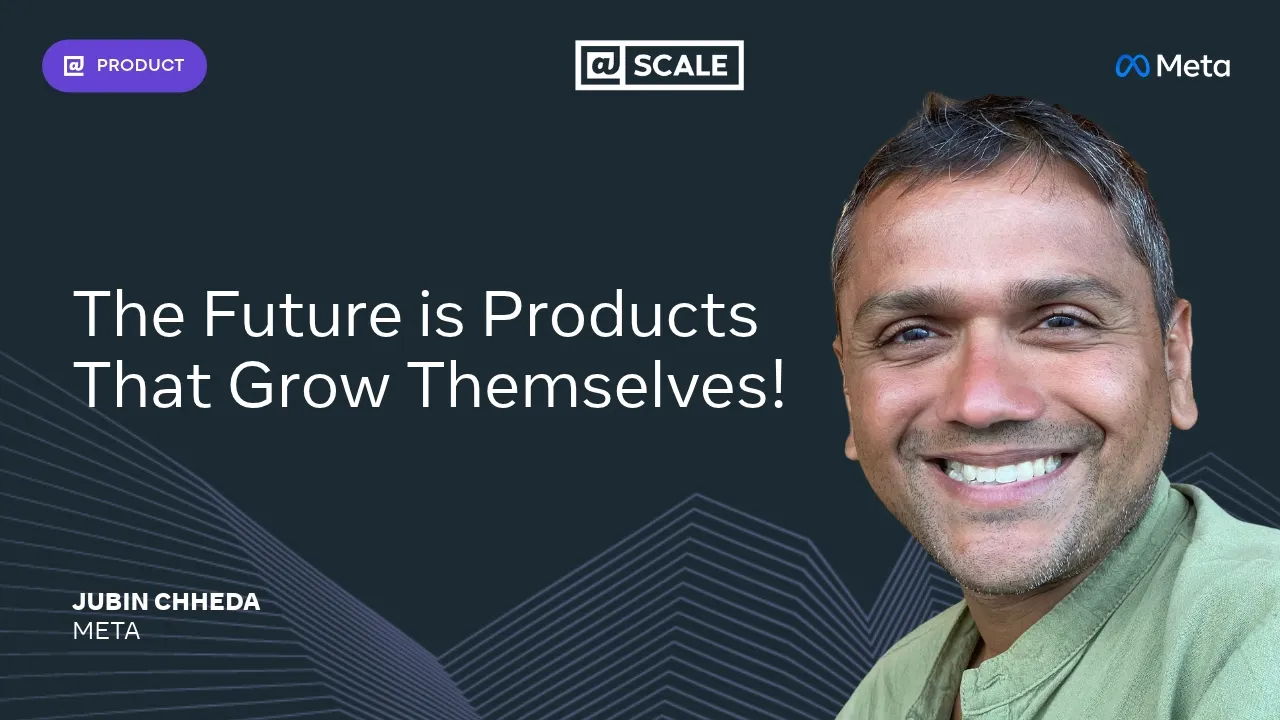
@Scale
AI-assisted summary of The Future is Products That Grow Themselves! | Jubin Chheda from Meta — original source. Check the original for full context.
Source published:
Key ideas
- Code generation has been largely democratized by AI, shifting the primary bottlenecks in the software lifecycle to verification, hardware capacity, and human product judgment. (0:00)
- Meta's autonomous optimization platform Volley achieves a higher experiment win rate than human baselines, delivering hundreds of millions in realized infrastructure savings and billions in identified potential savings. (11:50)
- Project Ouroboros uses SFT, RFT, and GRPO to distill frontier model trajectories into compact specialist models (like Muse Glimmer), cutting inference costs up to 100x while maintaining quality parity. (14:01)
- In recursive self-improving loops, the offline verifier must be powered by a significantly more capable model than the optimizer to prevent the entire loop from collapsing. (9:51)
Detailed notes
## Background This talk by Jubin Chheda from Meta was published on YouTube by @Scale on October 30, 2026. No accompanying video description or show notes were provided in the original upload.
## TL;DR Jubin Chheda explains that while code generation has become trivialized by AI, downstream verification, infrastructure capacity, and product judgment remain critical bottlenecks in software delivery. He outlines Meta's architecture for closed recursively self-improving loops—exemplified by Project WALL-E and the Volley platform—which pair optimizers with multi-tier verifiers and decision engines to autonomously optimize codebase capacity, generating hundreds of millions of dollars in realized infrastructure savings. Chheda further shows how cold-starting verifiers allows engineering teams to transition from human-in-the-loop review to human-on-the-loop oversight. Finally, he presents Project Ouroboros, a method for capturing frontier model trajectories to distill lightweight specialist models using SFT and reinforcement learning, drastically cutting inference latency and cost.
## Atmosphere & style The presentation strikes an authoritative, fast-paced, and pragmatic tone, anchoring futuristic concepts of recursive self-improvement in the hard realities of hyperscale infrastructure. Chheda weaves evocative imagery—swarms scaling hills, Pixar's WALL-E, and the mythic Ouroboros—directly into rigorous system architecture diagrams, mathematical trade-offs, and bottom-line dollar impacts. The talk feels like a technical, insider briefing that demystifies agentic autonomy, moving from the friction of modern engineering bottlenecks to an inspiring blueprint for self-evolving software systems.
## Bulletin - [00:00](https://www.youtube.com/watch?v=ZNL2ir1EoIY&t=0s) Code generation has been largely democratized by AI, shifting the primary bottlenecks in the software lifecycle to verification, hardware capacity, and human product judgment. - [11:50](https://www.youtube.com/watch?v=ZNL2ir1EoIY&t=710s) Meta's autonomous optimization platform Volley achieves a higher experiment win rate than human baselines, delivering hundreds of millions in realized infrastructure savings and billions in identified potential savings. - [14:01](https://www.youtube.com/watch?v=ZNL2ir1EoIY&t=841s) Project Ouroboros uses SFT, RFT, and GRPO to distill frontier model trajectories into compact specialist models (like Muse Glimmer), cutting inference costs up to 100x while maintaining quality parity. - [09:51](https://www.youtube.com/watch?v=ZNL2ir1EoIY&t=591s) In recursive self-improving loops, the offline verifier must be powered by a significantly more capable model than the optimizer to prevent the entire loop from collapsing.
## Key takeaways - [00:00](https://www.youtube.com/watch?v=ZNL2ir1EoIY&t=0s) Recursive self-improvement mirrors a swarm of agents climbing a hill: successful paths are distilled so the next generation can tackle taller hills in parallel. - [00:00](https://www.youtube.com/watch?v=ZNL2ir1EoIY&t=0s) Downstream stages of software delivery—ideation, roadmapping, verification, and experimentation—remain at human-level speeds, creating operational logjams as code generation accelerates. - [02:29](https://www.youtube.com/watch?v=ZNL2ir1EoIY&t=149s) Because generative diffs are virtually free to produce, product taste and filtering judgment have replaced generation as the scarce operational asset. - [02:29](https://www.youtube.com/watch?v=ZNL2ir1EoIY&t=149s) Even a 1% defect leakage in verification can lead to an untenable volume of defective code reaching production at modern automated scale. - [04:14](https://www.youtube.com/watch?v=ZNL2ir1EoIY&t=254s) A closed recursive self-improvement loop requires four discrete stages: an optimizer, a multi-gate verifier, an experimentation decision-maker, and a recursive meta-learner. - [04:14](https://www.youtube.com/watch?v=ZNL2ir1EoIY&t=254s) Verification must span three distinct tiers: offline formal semantic verification, predictive risk and outage assessment, and live online A/A or A/B testing. - [07:03](https://www.youtube.com/watch?v=ZNL2ir1EoIY&t=423s) Project WALL-E targets latent infrastructure inefficiencies—such as dead feature flags, deprecated logging, and unbatched queries—using a catalog of roughly 50 canonical capacity patterns. - [09:51](https://www.youtube.com/watch?v=ZNL2ir1EoIY&t=591s) Cold-starting automated verification begins with human code reviews, distilling acceptance and rejection rationales into automated rule sets over 10 to 50 diffs. - [09:51](https://www.youtube.com/watch?v=ZNL2ir1EoIY&t=591s) Engineering teams must shift from a 'human-in-the-loop' operational model to a 'human-on-the-loop' supervisory posture, intervening only on novel edge cases. - [09:51](https://www.youtube.com/watch?v=ZNL2ir1EoIY&t=591s) The offline verifier must be substantially more powerful than the proposing optimizer; using a weaker verifier causes the self-improvement loop to collapse. - [11:50](https://www.youtube.com/watch?v=ZNL2ir1EoIY&t=710s) Meta's Volley platform leverages historical experiment telemetry to build a trade-off calculus, allowing agents to accurately forecast experiment success before deployment. - [14:01](https://www.youtube.com/watch?v=ZNL2ir1EoIY&t=841s) Relying strictly on frontier models introduces cost and compute scaling ceilings, necessitating distillation of execution trajectories into lightweight specialist architectures. - [14:01](https://www.youtube.com/watch?v=ZNL2ir1EoIY&t=841s) Applying RFT and GRPO to compact models achieves domain-specific parity with frontier models while slashing inference costs by 8x to 100x and drastically accelerating iteration cycles. - [16:39](https://www.youtube.com/watch?v=ZNL2ir1EoIY&t=999s) Autonomous systems increase rather than diminish the value of human leadership, elevating human intent and strategic boundary-setting as the ultimate steering mechanism.
## Detailed walkthrough ### [00:00](https://www.youtube.com/watch?v=ZNL2ir1EoIY&t=0s) The Promise of Recursive Self-Improvement in Product Development
Jubin Chheda opens with a striking mental model: an entire swarm of autonomous agents attempting to scale a hill. While many paths fail and many attempts fall short, some inevitably reach the summit. The breakthrough occurs when those agents distill their learnings and replicate into a superior generation of agents tasked with climbing an even taller hill—executed not once or twice, but hundreds, thousands, and millions of times simultaneously in parallel. As Chheda frames it, this is recursive self-improvement in practice: “In this talk, we have a dragon that eats its tail, we have a beloved character, and we have billions of dollars of savings to be had.”
While coding itself has been roughly 100% democratized—to the point where nearly all code diffs today are generated by artificial intelligence—the rest of the software delivery lifecycle has lagged dramatically behind. Across product ideation, roadmapping, verification, experimentation, and finding product-market fit, non-coding disciplines still progress at human-level speeds. Because coding velocity has exploded, the traditional downstream stages have been squeezed into severe operational bottlenecks: - **Verification Bottleneck:** Ensuring that generated code behaves precisely as intended without introducing security flaws or operational vulnerabilities has become an all-time red-hot crisis. - **Hardware Capacity Bottleneck:** Hardware constraints, including industry-wide chip, memory, GPU, and CPU shortages, strictly cap how many speculative product changes an engineering organization can physically evaluate simultaneously. - **Decision-Making Bottleneck:** The raw volume of generated diffs overwhelms human capacity to arbitrate what to build, test, and ship.
---
[02:29](https://www.youtube.com/watch?v=ZNL2ir1EoIY&t=149s) The Core Bottlenecks: Judgment, Product Taste, and Verification
Because modern generative models can produce candidate code changes at the nominal cost of tokens, the universe of what could theoretically be built has effectively become infinite. The central operational challenge has shifted from generation to filtering and taste. As Chheda observes: “The bottleneck now becomes the judgment around which of those ideas are worth pursuing for your organization.”
Developing that judgment requires nuanced product taste, which functions like an acquired culinary palate: an engineer or system must sample and evaluate thousands of dishes before internalizing true refinement. Compounding the challenge is the harsh arithmetic of verification leakage. If an automated gate allows even a 1% defect rate through thousands of iterations, the sheer throughput of modern automated tooling ensures that an untenable amount of low-quality, high-risk code enters production. Resolving this requires architecting a tightly verified closed loop capable of running millions of autonomous public A/B tests.
---
[04:14](https://www.youtube.com/watch?v=ZNL2ir1EoIY&t=254s) Anatomy of a Closed Recursively Self-Improving Loop
To automate product iteration safely, organizations must assemble a closed system comprising four discrete components: an optimizer, a verifier, an experimentation decision-maker, and a meta-learning recursive engine.
```mermaid flowchart TD accTitle: Closed Recursively Self-Improving Loop accDescr: An architecture diagram illustrating the four-stage cycle of an Optimizer, Verifier, Decision Maker, and Learner.
subgraph Generation ["1. Code Generation"] A["Optimizer / Proposer"] end
subgraph Verification ["2. Verification Stage"] B["Formal Verification (Offline)"] C["Risk & Safety Assessment (Offline)"] D["A/A & A/B Live User Testing (Online)"] end
subgraph Evaluation ["3. Decision & Feedback"] E["Decision Maker (Launch / No-Launch)"] F["Learner (RSI Engine)"] end
A -->|"proposes code diffs"| B B -->|"semantic check passed"| C C -->|"risk check passed"| D D -->|"experiment telemetry"| E E -->|"experiment outcomes"| F F -.->|"updates & refines"| A F -.->|"updates & refines"| B F -.->|"updates & refines"| E ```
The loop progresses across specific stages: 1. **The Optimizer:** Proposes and writes code changes calibrated toward concrete product key performance indicators (KPIs), such as daily active users (DAU), session duration, platform stability, or compute infrastructure cost recovery. 2. **The Verifier:** An agentic gatekeeper tasked with confirming that code reliably advances the target objective without introducing operational or regulatory debt. Verification happens across three distinct gates: - *Formal Verification (Offline):* Semantically guarantees that the diff accomplishes the explicit objective. - *Risk Assessment (Offline):* Uses predictive models to quantify the probability of an outage, privacy regression, policy violation, or regulatory breach. - *Online Verification:* Deploys the change to a small slice of live traffic in an A/A or A/B test to validate empirical real-world impact. 3. **The Decision Maker:** Ingests post-experiment statistical telemetry across DAU, sessions, latency, reliability, and quality metrics to render an automated launch or no-launch verdict. 4. **The Recursive Learner:** Ingests telemetry, approvals, and post-mortems from every phase—especially the decision-making stage—to continually retrain and fine-tune the optimizer, the verifiers, and the decision engine itself.
---
[07:03](https://www.youtube.com/watch?v=ZNL2ir1EoIY&t=423s) Project WALL-E: Autonomous Capacity Optimization
Meta implemented this architecture through an initiative named WALL-E, inspired by the Pixar film where a solitary robot continuously repairs a deserted planet while upgrading its own components. In an infrastructure setting, recursive optimization targets CPU cycles, GPU utilization, and memory footprints, unlocking hundreds of millions of dollars in annualized savings by rooting out subtle code smells that accumulate across large codebases: - **Dead Gates:** Conditional feature flags introduced for rollouts that were either fully shipped or abandoned; though defaulting permanently to `true` or `false`, they still consume CPU cycles during evaluation. - **Dead Logging:** Diagnostic logging originally injected to monitor a rollout or debug an incident, whose downstream data pipelines or dashboards have long been deprecated, turning log emission into pure capacity waste. - **Suboptimal Query Batching:** Missed opportunities to batch database requests or convert latency-sensitive RPC paths into high-throughput asynchronous batch operations.
Meta consolidated these recurring inefficiencies into a library of approximately 50 canonical capacity patterns mined from years of engineering history. To target them, an autonomous optimizer needs only three fundamental tools: - **Code Smell Scanner:** A fast search engine (often as straightforward as tailored regex patterns over repositories) targeting database queries or dead code paths to generate candidate targets. - **Code Editor & Navigator:** Standardized developer tooling allowing an agent to traverse symbols, read dependencies, and apply diffs cleanly. - **Fleet Cost Profiler:** Telemetry tooling that attributes overall CPU, GPU, and memory utilization back to specific function calls as a percentage of the entire fleet, enabling agents to prioritize optimizations by financial impact.
---
[09:51](https://www.youtube.com/watch?v=ZNL2ir1EoIY&t=591s) Cold-Starting WALL-E and Transitioning from Human-in-the-Loop to Human-on-the-Loop
Cold-starting a self-improving infrastructure loop begins with human-in-the-loop oversight. In the opening phase, human engineers manually review every diff generated by the optimizer. However, every time an engineer accepts or rejects a proposal, their review rationale is distilled into automated rule sets and prompts within an agentic offline verifier. After processing 10 to 50 diffs in this manner, the offline verifier becomes sufficiently robust that human engineers can step away from manual code review.
Chheda highlights a non-negotiable architectural requirement: “The key step here is to make sure the offline verifier uses a model that is much more powerful than the model that powers the optimizer. If the verifier is weaker than the optimizer, the loop collapses.”
Once offline validation is stable, the system orchestrates online experiments and automates metric readouts, independently deciding whether an experiment should launch to 100%, iterate, or abort. The overarching operational objective is shifting engineers from a *human-in-the-loop* model—where humans are required for routine steps—to a *human-on-the-loop* posture, where humans act purely as supervisors who intervene only when edge-case exceptions arise. Freeing humans from the critical path allows organizations to scale agentic generation and optimization to unprecedented volume.
[11:50](https://www.youtube.com/watch?v=ZNL2ir1EoIY&t=710s) Building the Optimizer, Cold-Starting Verifiers, and Volley's Financial Impact
To generate step-function value for an organization, an automated system cannot simply produce tens, hundreds, or thousands of code edits; it must be designed to churn out millions of changes on an hourly, daily, or weekly cadence. Jubin Chheda breaks down the mechanical anatomy of constructing the system's core optimizer (or oracle). The foundation requires a rich historical repository of successful optimization experiments run against the codebase, combined with detailed treatment semantics and comprehensive readouts. Analyzing these thousands of historical runs allows the system to extract patterns, assemble a formal pattern catalog, and construct an explicit mathematical calculus governing the domain's operational trade-offs. Equipped with this calculus, an AI agent can ideate new optimization levers or sample existing levers more aggressively, projecting with high statistical confidence whether a proposed intervention will succeed before deploying it.
```mermaid flowchart TD accTitle: Closed-Loop Optimization and Verification Architecture accDescr: Diagram showing how historical experiments inform an optimizer to generate candidate changes, which are verified by a feedback-trained verifier before deploying at scale.
subgraph Optimization["Optimizer (Oracle)"] A["Historical Experiments & Semantics"] --> B["Pattern Catalog & Trade-off Calculus"] B --> C["AI Optimizer Agent"] C --> D["Candidate Code Changes"] end
subgraph Verification["Verification Harness"] D --> E["Verifier Engine"] F["Human Review & Feedback"] -->|"Cold Start & Novel Rules"| E E --> G{"Passes Verification?"} G -->|"Yes"| H["Production Launch"] G -->|"No"| C end ```
The verification harness follows an evolutionary trajectory that starts with human engineering knowledge. Incoming candidates from the optimizer are initially routed to human reviewers, whose feedback and failure analyses are collated to cold-start the automated verifier. Each time an engineer catches an edge case or supplies a novel critique, that reasoning is codified into the verifier’s test suite, expanding its domain competence. Chheda notes that this flywheel rapidly outpaces manual review boards: “Once you have that, very quickly you will have a verifier that is much more reliable than any particular human team of reviewers you would be able to have.”
At Meta, this architecture powers Volley, an autonomous optimization platform that has delivered massive infrastructure efficiency gains. Volley's experiment success rate now significantly eclipses human engineering baselines. In production, Volley has directly generated hundreds of millions of dollars in realized infrastructure savings, while its optimizer models have identified efficiency pipelines representing billions of dollars in potential savings across Meta's footprint.
- The optimizer relies on past experiment histories, treatment semantics, and comprehensive telemetry to form a pattern catalog and trade-off calculus. - Human review feedback is used to cold-start the verifier, integrating every novel human intervention into subsequent automated verification cycles. - Volley’s win rate for deployed experiments is demonstrably higher than the human baseline. - Realized infrastructure savings from Volley stand in the hundreds of millions of dollars, with identified potential savings reaching into the billions.
---
[14:01](https://www.youtube.com/watch?v=ZNL2ir1EoIY&t=841s) Project Ouroboros: Distilling Frontier Trajectories into Specialist Models
Even with Volley's financial returns, relying solely on massive frontier models creates a scaling ceiling. Chheda introduces Meta's Ouroboros concept—named after the ancient symbol of a dragon eating its own tail—to describe a recursive distillation architecture. Rather than routing all inference calls to massive state-of-the-art systems, Ouroboros creates compact, highly specialized models tailored specifically for capacity optimization tasks.
```mermaid flowchart LR accTitle: Ouroboros Recursive Distillation Pipeline accDescr: Shows the pipeline distilling large frontier model trajectories into smaller specialized models using fine-tuning and reinforcement learning.
subgraph Distillation["Trajectory Harvesting"] A["Frontier Model (e.g., Llama / Muse Series)"] -->|"Generates Trajectories"| B["Optimization Trajectory Dataset"] end
subgraph Training["Specialist Optimization"] B --> C["Small Model (e.g., Muse Glimmer)"] C --> D["SFT (Supervised Fine-Tuning)"] D --> E["RL: RFT & GRPO"] E --> F["High-Velocity Specialist Agent"] end ```
The process begins by deploying a state-of-the-art frontier model (such as Meta's internal large models from the Muse series) to generate optimization attempts and trajectories over several months. Meta captures the end-to-end execution trajectories produced by these large models and uses them as synthetic training data to distill smaller open architectures, such as Muse Glimmer. The team applies Supervised Fine-Tuning (SFT) alongside advanced reinforcement learning paradigms—specifically Rejection Sampling Fine-Tuning (RFT) and Group Relative Policy Optimization (GRPO)—enabling the smaller network to hill-climb aggressively on capacity optimization tasks.
This specialized training narrows the performance delta between model tiers. The compact specialist matches and occasionally outperforms the larger frontier model, which, while more novel, carries excess generalist baggage. Distillation also unlocks a “triple whammy” advantage across cost, speed, and transferability: 1. **Quality parity:** The specialist hones in on the target domain without distraction. 2. **Drastic cost reductions:** Inference costs plummet to 1/8th, 1/20th, or even 1/100th of the cost of running frontier models. 3. **Latency and iteration speed:** Lower inference latency accelerates the cycle time of the recursive self-improvement (RSI) loop, allowing significantly more candidate evaluations per hour. 4. **Domain transfer:** Techniques and models fine-tuned on capacity optimization transfer effectively to adjacent engineering constraints, including service reliability and latency tuning.
---
[16:39](https://www.youtube.com/watch?v=ZNL2ir1EoIY&t=999s) The Strategic Imperatives of Recursive Self-Improvement
Chheda concludes by outlining three strategic lessons for engineering leaders navigating agentic software development:
First, automation does not render human judgment obsolete; rather, human intent becomes the ultimate steering mechanism. As Chheda states: “The role of human decision making is now at an all-time high with recursively self-improving agents.” While autonomous loops dramatically accelerate shipping velocity, human engineers must still decide what product bets to fund, what organizational outcomes matter, and which boundaries the agents must respect.
Second, the closed verification loop serves as the critical bottleneck. Recursive self-improvement cannot begin without a deterministic or highly reliable automated harness to evaluate outputs. Once an organization makes the foundational investment to close this loop, the agents can independently improve the codebase, optimize product behavior, and streamline company operations.
Third, system architectures must adopt specialist models to navigate compute constraints. With mounting pressure on GPU allocations, CPU capacity, and memory bandwidth, running every step through heavyweight frontier models is economically unsustainable. Deploying fast, inexpensive specialist agents preserves the latency and economic headroom needed to maximize the velocity of self-improving systems.
Chheda ends with an open invitation to collaborate and leaves the audience with a guiding mantra for the agentic era: “Define the loop. Let the agents climb.”
## Notable quotes > [16:39](https://www.youtube.com/watch?v=ZNL2ir1EoIY&t=999s) The role of human decision making is now at an all-time high with recursively self-improving agents. — Jubin Chheda
> [09:51](https://www.youtube.com/watch?v=ZNL2ir1EoIY&t=591s) The key step here is to make sure the offline verifier uses a model that is much more powerful than the model that powers the optimizer. If the verifier is weaker than the optimizer, the loop collapses. — Jubin Chheda
## Mentioned Jubin Chheda, Meta, Pixar, WALL-E, Volley, Ouroboros, Llama, Muse, Muse Glimmer
[Source](https://www.youtube.com/watch?v=ZNL2ir1EoIY)