Gangs Seize 11 Mexico City Homes a Day as Property Prices Surge
Bloomberg Originals
Collusion among corrupt officials and criminal rings exploits informal property records and rapid gentrification, locking rightful owners out of their homes for years in paralyzed courts.
AI-assisted summary of Inside Mexico City’s Housing Theft Crisis — original source. Check the original for full context.
Source published:
Key ideas
- Mexico City averages 11 home thefts per day, with cumulative dispossessions approaching 100,000 cases across the capital and the State of Mexico since standardized tracking began in 2015. (0:01)
- Rising property values and gentrification have pushed home invasions into upscale neighborhoods, where organized rings stake out vacant properties, forge deeds, and initiate fast renovations to assert claims of legitimate occupancy. (1:38)
- Legal battles to reclaim dispossessed homes drag on from eight months to over five years, bogged down by civil and criminal appeals as well as widespread title informality. (1:38)
- Systemic corruption among notaries, public registry officials, and judges facilitates title fraud, while fear of retaliation often deters rightful owners from returning even after winning court restitution. (6:05)
Detailed notes
## Background Published by Bloomberg Originals on YouTube on October 31, 2026, this documentary examines the pervasive crisis of property theft and dispossession across Mexico City. The video's description details how criminal gangs exploit owner absences and gentrification to seize homes an average of 11 times per day through title fraud and official complicity, presenting severe security and affordability challenges for President Claudia Sheinbaum.
## TL;DR In Mexico City, organized criminal syndicates systematically orchestrate home takeovers—legally classified as dispossession or despojo—by breaking into temporarily vacant residences, swapping locks, and forging deed documents to establish fraudulent occupancy. With nearly 100,000 cases recorded across the capital and State of Mexico since 2015, the racket has increasingly expanded into wealthy, gentrifying neighborhoods where rising property values promise lucrative payouts. Because both invaders and homeowners present competing paperwork, authorities routinely seal contested properties under judicial custody, locking out rightful owners for years while disputes drag through backlogged civil and criminal courts. Despite recent government measures like deploying 100 pro bono attorneys, the crisis remains fueled by rampant informal real estate transactions, corrupt collusion among notaries and judges, and deep fear of syndicate retaliation among victims.
## Atmosphere & style The presentation carries an urgent, unsettling investigative tone that couples stark statistical graphics with the raw anxiety of homeowners locked out of their own lives. It conveys the grinding, Kafkaesque frustration of dealing with an overwhelmed bureaucracy where victims find their residences cordoned off under police tape alongside their illicit occupants. The narrative evokes a quiet dread, highlighting how ordinary citizens face sophisticated legal manipulation, corrupt institutional hurdles, and lingering terror long after their homes are targeted.
## Bulletin - [00:01](https://www.youtube.com/watch?v=1nBjb9VBuvc&t=1s) Mexico City averages 11 home thefts per day, with cumulative dispossessions approaching 100,000 cases across the capital and the State of Mexico since standardized tracking began in 2015. - [01:38](https://www.youtube.com/watch?v=1nBjb9VBuvc&t=98s) Rising property values and gentrification have pushed home invasions into upscale neighborhoods, where organized rings stake out vacant properties, forge deeds, and initiate fast renovations to assert claims of legitimate occupancy. - [01:38](https://www.youtube.com/watch?v=1nBjb9VBuvc&t=98s) Legal battles to reclaim dispossessed homes drag on from eight months to over five years, bogged down by civil and criminal appeals as well as widespread title informality. - [06:05](https://www.youtube.com/watch?v=1nBjb9VBuvc&t=365s) Systemic corruption among notaries, public registry officials, and judges facilitates title fraud, while fear of retaliation often deters rightful owners from returning even after winning court restitution.
## Key takeaways - [00:01](https://www.youtube.com/watch?v=1nBjb9VBuvc&t=1s) An average of 11 residential properties are dispossessed daily in Mexico City, creating an invasion volume that police struggle to contain. - [00:01](https://www.youtube.com/watch?v=1nBjb9VBuvc&t=1s) Unlike standard burglary, dispossession involves criminal actors seizing physical possession of the real estate itself rather than just stealing contents. - [00:01](https://www.youtube.com/watch?v=1nBjb9VBuvc&t=1s) Invasion rings monitor properties to identify extended owner absences, break in, replace the locks, forge titles, and rapidly start renovations to simulate lawful occupancy. - [00:01](https://www.youtube.com/watch?v=1nBjb9VBuvc&t=1s) Because both squatters and legitimate owners present paperwork, authorities routinely evict all parties and seal the property under judicial tape while investigations proceed. - [01:38](https://www.youtube.com/watch?v=1nBjb9VBuvc&t=98s) Nearly 100,000 dispossession cases have been logged across Mexico City and the State of Mexico since standardized data collection began in 2015. - [01:38](https://www.youtube.com/watch?v=1nBjb9VBuvc&t=98s) Between one-third and one-half of reported dispossessions involve intrafamily or inheritance feuds, while the remaining half are orchestrated by external criminal syndicates. - [01:38](https://www.youtube.com/watch?v=1nBjb9VBuvc&t=98s) Gentrification and escalating real estate prices have incentivized criminal groups to target affluent neighborhoods where property seizures yield massive profits. - [01:38](https://www.youtube.com/watch?v=1nBjb9VBuvc&t=98s) Reclaiming an invaded property takes eight months to two years when deeds are clean, but exceeds five years when records are irregular or contested by skilled defense lawyers. - [06:05](https://www.youtube.com/watch?v=1nBjb9VBuvc&t=365s) The Mexico City government under Clara Brugada has deployed targeted police interventions and assigned 100 pro bono attorneys to assist dispossession victims. - [06:05](https://www.youtube.com/watch?v=1nBjb9VBuvc&t=365s) Widespread real estate informality, such as handwritten contracts and unregistered deeds, leaves millions of homes defenseless against fraudulent transfers. - [06:05](https://www.youtube.com/watch?v=1nBjb9VBuvc&t=365s) Collusion among crooked public officials, judges, and notaries creates an ecosystem that enables counterfeit paperwork and stalls eviction orders. - [06:05](https://www.youtube.com/watch?v=1nBjb9VBuvc&t=365s) Severe psychological trauma and fear of syndicate retribution prevent many owners from ever reoccupying their homes even after securing formal legal restitution.
## Detailed walkthrough ### [00:01](https://www.youtube.com/watch?v=1nBjb9VBuvc&t=1s) The Mechanics of Home Theft and Dispossession
In Mexico City, property theft has evolved into a daily crisis that is front of mind for residents across the capital. Every single day, an average of 11 homes are effectively stolen, creating a volume of invasions that law enforcement is utterly unable to contain. Legally classified as “dispossession” (*despojo*), the crime differs from typical burglary because the perpetrators do not simply rob the premises; they seize physical possession of the real estate itself, although they rarely secure legitimate legal ownership.
```mermaid flowchart TD accTitle: The Mechanics of Home Dispossession accDescr: Flowchart outlining how criminal groups monitor, seize, and legally contest residential properties in Mexico City.
subgraph Seizure ["1. Physical Seizure"] A["Stake out vacant home"] --> B["Forcible entry during owner absence"] B --> C["Change locks & start renovations"] B --> D["Forge deed & title paperwork"] end
subgraph Standoff ["2. Legal Dispute"] C & D --> E["Owner discovers lockout & files police report"] E --> F["Both parties claim victimhood"] F --> G["Authorities tape & seal property"] end
subgraph Resolution ["3. Judicial Proceedings"] G --> H["Criminal or Civil Court proceedings"] H --> I["Resolves in 8 mos - 2 yrs (clean title)"] H --> J["Drags out over 5+ yrs (irregular records)"] end ```
The operation follows a calculated blueprint. Criminal groups stake out target properties, closely monitoring routines to identify houses or apartments that will remain unoccupied for an extended period, such as when owners depart on vacation. Once the residence is empty, the invaders break in by force, immediately swap out the door locks, fabricate fraudulent deeds, and in many instances swiftly launch renovations to present a veneer of legitimate occupancy. When the real homeowners return, they find themselves locked out of their own residences, initiating a grueling battle with the legal system. As the reporting highlights the systemic gridlock:
> “The police can't keep up with the sheer number of home invasions.”
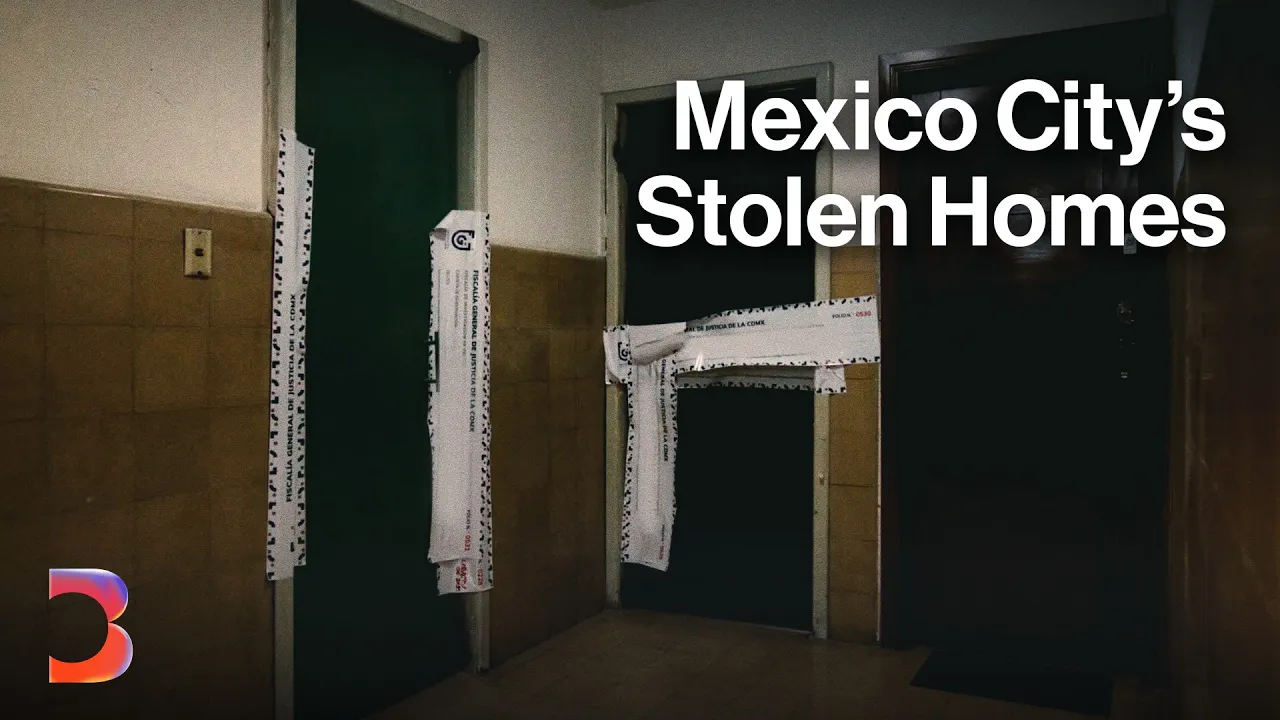
Untangling these crimes frequently paralyzes local law enforcement because both the authentic owners and the squatters assert that they are the genuine victims armed with documentation. Unable to determine the rightful titleholder on the spot, authorities routinely intervene by evicting all occupants and taping up the entrance. The building is placed under judicial custody and sealed off completely, barring everyone from entering while police conduct inquiries and the matter crawls through the courts.
- An average of 11 homes are invaded and stolen every day in Mexico City. - Criminal rings forge deeds and initiate construction work to cement claims of lawful possession. - Sealed properties remain vacant and cordoned off under police tape while ownership investigations proceed.
---
[01:38](https://www.youtube.com/watch?v=1nBjb9VBuvc&t=98s) Widespread Scale, Gentrification, and Enrique Amezcua’s Plight
Over the past decade, cumulative cases of property dispossession across Mexico City and the adjacent State of Mexico have climbed to nearly 100,000. Public data tracking these offenses dates back to 2015, when federal and local authorities standardized their reporting methodologies. Officials estimate that between one-third and one-half of these complaints stem from inheritance and intrafamily conflicts. The remaining half, however, represents calculated home invasions organized by external bad actors. While previously confined to lower-income districts, dispossessions have aggressively expanded into upscale, gentrifying neighborhoods where property values have skyrocketed in recent years, making land grabs enormously lucrative.
The personal toll of this crisis is exemplified by Enrique Amezcua, whose family home was invaded and seized. Although intense media exposure pressured the authorities into rapidly expelling the squatters from his apartment, the ordeal did not end with their eviction. Instead, the family remains barred from stepping foot inside their own residence because the legal investigation remains open, leaving the property frozen under state control.
The legal journey to reclaim property is notoriously tortuous, split unpredictably between civil courts and criminal tribunals where hearings drag on for years. Organized land-grabbing groups retain skilled attorneys who tie up rulings in exhaustive appeals. Legal experts point out that the speed of recovery hinges entirely on the health of the paperwork:
> “If everything is in order, it usually takes, in our experience, from eight months to two years. However, that's not the case in many of the cases that we see, and that might take more than five years.”
- Nearly 100,000 dispossession cases have been logged across Mexico City and the State of Mexico since 2015. - Intrafamily disputes account for one-third to one-half of reported cases, while organized invasions make up the remainder. - Rapid gentrification and soaring real estate values have pushed home invasions into wealthier neighborhoods. - Disputed homes with irregular paperwork frequently languish in civil or criminal litigation for more than five years.
---
[06:05](https://www.youtube.com/watch?v=1nBjb9VBuvc&t=365s) Government Interventions and Entrenched Root Causes
Mounting public outrage and high-profile victim campaigns have forced both local and national leaders to treat property theft as a political priority. Mexico City Mayor Clara Brugada has stepped up municipal enforcement, directing police to catch invasion crews in the act of breaking into homes and establishing a team of 100 pro bono lawyers dedicated to assisting victims navigate the court system. The issue has even reached the national stage, prompting reporters to press President Claudia Sheinbaum on the matter during her daily morning press conferences.
Yet targeted enforcement and pro bono representation address only the symptoms of a much deeper, structural breakdown. The market forces of gentrification continue to escalate housing costs, creating powerful economic incentives for crime rings. Furthermore, a widespread informal real estate culture—characterized by unregistered holdings, handwritten contracts, and unnotarized private transactions—leaves millions of properties vulnerable to fraudulent takeover. This informality is compounded by deep-seated institutional corruption, where crooked public officials, public notaries, and judges coordinate with criminal groups to forge paperwork and stall litigation:
> “There is also corruption between public officials, notaries, judges that can all come in together to make the environment ripe for these types of crimes to happen, and to not get solved quickly.”
Even in scenarios where the legal system functions and the real estate is officially restituted to its legal owner, the trauma often lingers. Many victims refuse to ever move back into their homes out of terror that the criminal syndicates will retaliate against them. With underlying institutional flaws left unaddressed, the wave of dispossessions shows no sign of slowing down, and court backlogs continue to expand.
- Mexico City’s administration assigned 100 pro bono attorneys to assist dispossession victims with complex litigation. - Informality persists as a primary vulnerability due to widespread non-notarized private sales and unregistered deeds. - Collusion among corrupt notaries, registry officials, and judges facilitates the fabrication of authentic-looking property titles. - Fear of retaliation frequently deters owners from moving back into their properties even after winning judicial restitution.
## Notable quotes > [00:01](https://www.youtube.com/watch?v=1nBjb9VBuvc&t=1s) The police can't keep up with the sheer number of home invasions.
## Mentioned Bloomberg Originals, Claudia Sheinbaum, Clara Brugada, Enrique Amezcua, Mexico City, State of Mexico
## Video description In Mexico City, housing theft happens on average 11 times a day, often when homeowners are on vacation or have died, leaving properties vacant. In many cases criminal gangs move in, claiming ownership in an effort to profit from a gentrification wave that’s boosted home prices.
Many such “dispossessions” can involve title fraud and even complicit public officials. Mexico City recorded 2,676 cases this year through August, according to public records, bringing the total over the past decade to nearly 41,000.
The sheer number of incidents lays bare two key problems for President Claudia Sheinbaum: security and the cost of living. While homicides have plunged under her watch, reports of extortion are at their highest in more than a decade. She also has made expanding access to affordable homes a national priority, yet nowhere is the challenge more stark than the capital, where protests frequently break out over evictions and rising foreign demand.
Watch more short documentaries from Bloomberg Originals: https://www.youtube.com/playlist?list=PLqq4LnWs3olUDhww8NEcViirkrirzHp27
Visually compelling, access driven and character rich features born out of the Bloomberg newsroom, extended to documentary video.
#MexicoCity #Theft #Crime
-------- Like this video? Subscribe: http://www.youtube.com/Bloomberg?sub_confirmation=1
Get unlimited access to Bloomberg.com for just $1.99 your first month: https://www.bloomberg.com/subscriptions?in_source=YoutubeOriginals Bloomberg Originals offers bold takes for curious minds on today’s biggest topics. Hosted by experts covering stories you haven’t seen and viewpoints you haven’t heard, you’ll discover cinematic, data-led shows that investigate the intersection of business and culture. Exploring every angle of climate change, technology, finance, sports and beyond, Bloomberg Originals is business as you’ve never seen it.
Subscribe for business news, but not as you've known it: exclusive interviews, fascinating profiles, data-driven analysis, and the latest in tech innovation from around the world.
Visit our partner channel Bloomberg News for global news and insight in an instant.
[Source](https://www.youtube.com/watch?v=1nBjb9VBuvc)