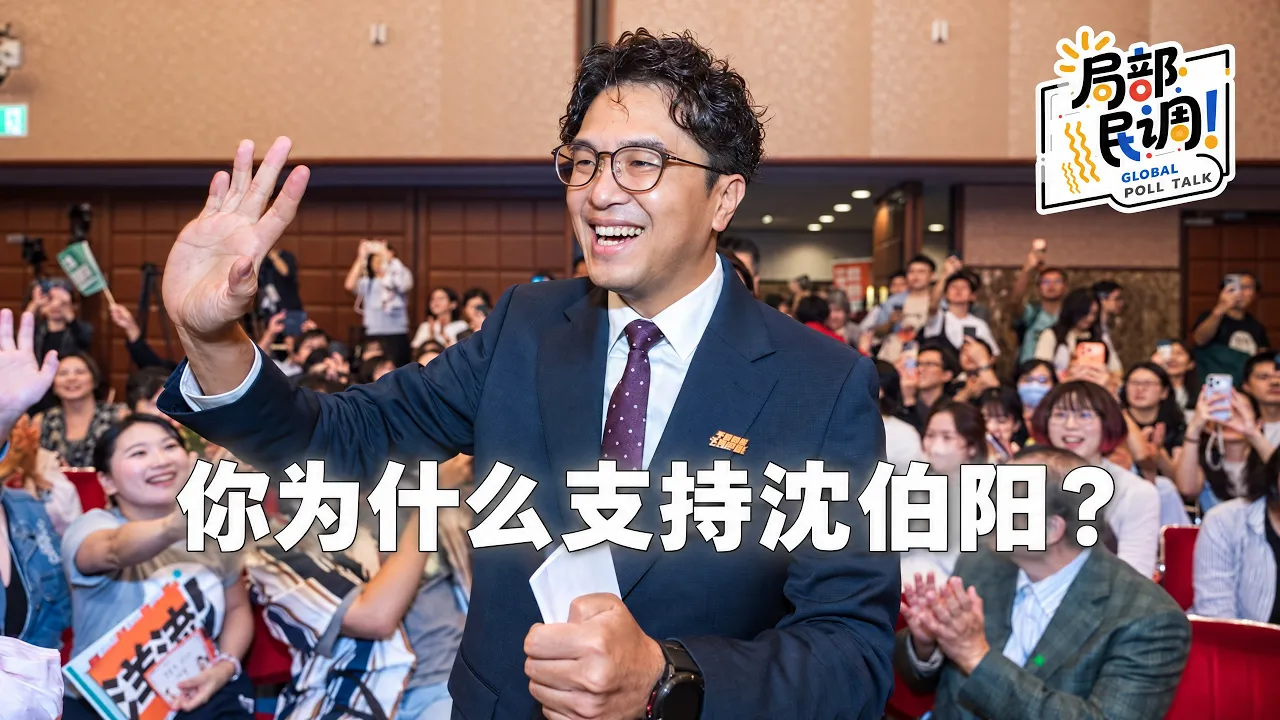
The street vox pop opens with enthusiastic declarations from supporters, with one voter remarking that mainland China recognized Shen Po-yang's significance even before citizens in Taiwan did, and another promising that if Shen gets elected, they will immediately transfer their household registration back to Taipei. Interviewing a steadfast supporter about why she backs Shen, the voter explains that her allegiance is rooted in deep generational party loyalty: her entire family has been "Deep Green" since birth and will vote strictly for the Democratic Progressive Party (DPP) regardless of who the Kuomintang (KMT) or Taiwan People's Party (TPP) field. When the interviewer presses whether even attractive policies from opposing parties could sway her, she makes her uncompromising stance clear: “No, that has never changed.”
When asked which of Shen Po-yang's proposed platforms resonate with her, the voter highlights his urban forestation initiative and plans to expand greenery to curb pollution. She explains that Taipei suffers from severe air quality issues that directly affect her daily life, pointing out that poor air aggravates her skin, triggers constant acne breakouts, and leaves her face covered in a thick layer of grime every evening. Asked if she would support the same afforestation policy if introduced by incumbent Taipei Mayor Chiang Wan-an, she admits she would endorse that specific measure but refuses to back his broader administration, criticizing Chiang for focusing on trivial matters while failing to resolve pressing municipal crises and school bullying issues. Regarding mainland China placing Shen Po-yang on a wanted list, the supporter dismisses the threat entirely, observing that other politicians like Wang Shih-chien are also targeted. She recalls her father's practical advice that the world is large and there is no need to travel to mainland China, noting that it is far from the only powerful country on the globe.
- Deep-green partisan identification overrides rival policy proposals; votes remain locked to the DPP over the KMT or TPP.
- Urban policy concerns center on air quality, with city pollution blamed for dermatological problems like persistent acne and grime buildup.
- Beijing's sanctions and wanted lists are treated with indifference by supporters, who view staying away from the mainland as an easy and natural choice.
---
[01:43](https://www.youtube.com/watch?v=wdpqI5lfwD4&t=103s) Articulate Logic, Personal Morality, and Modern Political Style
Other supporters trace their backing to Shen Po-yang’s analytical background and personal character. One mother recounts that she was previously consumed by daily life and politically detached until her daughter urged her to visit Shen's campaign office before its formal opening. She was instantly won over by Shen’s articulate debate delivery and systematic thinking, observing that his structured, analytical mindset was evident from his time leading Doublethink Lab (Democratic Lab) through his work establishing the Kuma Academy (Black Bear Academy). At a gathering, the atmosphere turns lively as an emcee rallies the crowd with chants and playfully points out their glowing skin after using a facial mask recommended by Shen. Beyond municipal ideas, voters express deep respect for Shen's private integrity, especially his decision to adopt children, describing it as an exceptionally noble choice.
Voters also contrast Shen’s demeanor with stereotypical political theater. Rather than resorting to screaming, mudslinging, or the hardline rhetoric of earlier DPP figures who routinely labeled rivals as Chinese Communist Party (CCP) pawns, supporters view Shen as sophisticated, measured, and approachable. A former student activist who participated in the Sunflower Movement twelve years earlier recalls first noticing Shen’s summary guide on the Cross-Strait Service Trade Agreement (CSSTA), later tracking his journey through his party nomination shifts and Beijing's sanctions. While the activist notes that Shen connects with younger demographics by weaving anime references into discussions, they admit when pressed that they cannot name a specific reference on command: “That's where I go blank.” Nonetheless, supporters appreciate his sincerity in discussing national identity. An alumnus who recognized Shen as a school junior adds that launching the Kuma Academy took immense personal fortitude: “I think that in his situation at the time, doing something like the Kuma Academy, I find that to be a very brave thing.”
- Shen’s career trajectory is cited from civil society research at Doublethink Lab to civil defense education at Kuma Academy.
- Supporters distinguish Shen’s calm, intellectual discourse from traditional partisan screaming matches and reflexive fifth-column accusations.
- His public persona blends serious national security awareness with pop-culture accessibility, alongside personal life choices such as adopting children.
---
[05:03](https://www.youtube.com/watch?v=wdpqI5lfwD4&t=303s) From Political Apathy to Engagement: Human-Centric Urban Policy
A newly energized supporter describes becoming involved only recently after encountering Shen's street-level campaigning in Shilin, dubbed "Mayor, listen to me." She explains that his open-air soapbox style felt entirely novel compared to scripted political events. Watching more of his appearances convinced her that Shen articulates complex ideas in plain, accessible language and approaches governance from a human-centered perspective. The voter reveals that she had spent her life entirely indifferent to politics, never exercising her right to vote and viewing elections as completely detached from her reality. In fact, she preferred working as an administrative poll clerk on election days rather than casting a ballot herself, operating under the assumption that whoever won would govern identically. Shen's candidacy changed that calculation, prompting her to cast her vote for the first time to see how the capital city might transform under his direction.
When comparing Shen’s platform against Mayor Chiang Wan-an’s agenda, the voter highlights Shen's focus on urban loneliness as the defining differentiator. While mainstream mayoral campaigns typically revolve around hard civil infrastructure projects or traditional underprivileged welfare subsidies, she found Shen’s direct acknowledgment of modern emotional and social isolation deeply moving: “I think I was struck by Shen Po-yang talking about the issue of loneliness.” Addressing Beijing’s wanted notice, she interprets the threat as evidence of Shen's moral courage, arguing that he knowingly accepted personal risk to stand up for his beliefs. She firmly dismisses critics who claim electing Shen would inflame cross-strait instability: “If they get worse just because of him, then he’d be way too powerful, wouldn't he?” She points out that Shen is running for municipal mayor, not the national presidency, and questions whether electing someone else would offer any real guarantee of protecting Taiwan from potential conflict.
- The Shilin street soapbox campaign format effectively converted lifelong non-voters into active participants.
- Shen's urban platform distinguishes itself by treating social loneliness and emotional alienation as legitimate municipal policy issues alongside traditional infrastructure.
- Beijing's hostility is reframed by supporters as a badge of bravery rather than a disqualifying geopolitical liability.
---
[08:06](https://www.youtube.com/watch?v=wdpqI5lfwD4&t=486s) Cross-Strait Relations and the Scope of Mayoral Power
Moving through the dense crowd, the discussion turns to the geopolitical ramifications of Shen's candidacy. When asked how they view Beijing placing Shen on a wanted list, an interviewee responds with a common sentiment among the base: “I think that if someone is wanted by China, they must have done something right to be wanted by them.” Supporters largely reject the argument that electing Shen as Taipei mayor would trigger a crisis across the Taiwan Strait. They point out that a mayoral mandate is strictly focused on local urban administration rather than defense, diplomacy, or cross-strait policy, making it illogical to blame a city leader for broader regional friction.
```mermaid
flowchart TD
accTitle: Mayoral Scope and Cross-Strait Geopolitics
accDescr: Diagram illustrating how supporters separate municipal mayoral governance from national cross-strait dynamics driven by US-China relations.
subgraph Municipal ["Taipei Municipal Scope"]
M1["Taipei Mayor (Shen Po-yang)"]
M2["Local Governance & City Infrastructure"]
M1 --> M2
end
subgraph Geopolitics ["Macro Geopolitical Dynamics"]
G1["Cross-Strait Status Quo"]
G2["United States Foreign Policy"]
G3["Beijing Cross-Strait Strategy"]
G2 --> G1
G3 --> G1
end
M1 -.->|"Negligible Direct Impact"| G1
```
A voter who regularly traveled to mainland China for work shares a pragmatic perspective on cross-strait tension. She explains that in her firsthand experience, everyday mainland citizens do not mirror the aggressive rhetoric seen in sensationalized media reports, but are instead quite friendly. Consequently, she harbors no anxiety that electing Shen will destabilize daily life. She emphasizes that even Taiwan's head of state has limited autonomy against systemic superpowers, concluding that regional security ultimately hinges on Washington's posture: “Exactly, fundamentally, whatever China wants to do to us, it basically depends on the US.” Because macro cross-strait equilibrium is anchored by the United States rather than local city halls, supporters remain confident that electing Shen will preserve the existing status quo.
- Supporters interpret Chinese sanctions as external validation of a politician's loyalty and effective advocacy for Taiwan.
- Voters maintain a strict separation between city-level municipal governance and presidential-level foreign policy.
- Firsthand cross-strait business travelers draw a distinction between aggressive state propaganda and ordinary, friendly mainland citizens.
- Macro cross-strait stability is seen as fundamentally dictated by US-China geopolitical strategy rather than municipal elections.
一位理性選民指出,沈伯洋選情的重大轉折點正是王偉忠的那場專訪,專訪之後越來越多人意識到沈伯洋是有備而來、腹有詩書的候選人。沈伯洋隨後展開的「市民肥皂箱」以及「市長,問我吧(Mayor, Ask Me Anything)」等街頭直球對決活動,獲得了極高的評價。受訪者認為,這種願意走到街頭面對面接受民眾質詢的形式成本極低但效益極高,同時冒著極大的風險——如果沒有足夠的內涵、準備和口才,候選人很容易在現場被當場問倒;即使遇到不懂的問題,沈伯洋也能展現出誠懇解決的決心。
[0:00] Mainland China saw that Shen Po-yang was
[0:02] extraordinary even earlier than we
[0:04] citizens in Taiwan.
[0:06] If he gets elected, I’ll move my
[0:08] household registration back immediately
[0:10] .
[0:13] >> He has solutions for all the problems
[0:14] currently happening in Taipei.
[0:19] >> I’d like to ask, why do you support Shen
[0:21] Po-yang?
[0:22] >> Well, my whole family has probably been
[0:25] "Deep Green" since birth. No matter what
[0:27] , it’s definitely "Deep Green."
[0:29] Regardless of the TPP or the KMT, we
[0:31] won’t vote for them; it has to be the
[0:33] DPP.
[0:34] >> So even if they had good policies, you
[0:35] wouldn’t vote for them?
[0:37] >> No, that has never changed.
[0:38] >> What policies of Shen Po-yang really
[0:40] resonate with you?
[0:42] >> The forestation project, I guess, and
[0:44] the greenery to reduce pollution; I
[0:45] think those are nice.
[0:46] >> Mm-hmm.
[0:47] >> And also, Taipei City actually has a
[0:49] severe air pollution problem. My skin
[0:51] isn't great, I keep getting acne, and I
[0:53] feel like every time I get home and wash
[0:55] my face, there’s a thick layer of grime
[0:57] .
[1:00] Curious—if this forestation policy was
[1:02] proposed by Chiang Wan-an, would you
[1:04] support him?
[1:07] >> I would support that, but I wouldn't
[1:09] support the other trivial, unnecessary
[1:11] stuff.
[1:13] I don't think he’ll actually do it; look
[1:15] at how he and......
[1:16] >> and the situation is severe, he hasn't
[1:18] solved anything at all. And there's the
[1:19] bullying issue.
[1:20] >> Are you aware that Shen Po-yang is
[1:22] wanted by Mainland China?
[1:23] >> Oh, I know.
[1:24] >> Mm-hmm.
[1:25] >> I hope they saw that. Mm-hmm.
[1:26] >> Yeah, it’s not just him, there are many
[1:28] others—isn't Wang Shi-chien also on the
[1:30] list?
[1:30] >> Right.
[1:31] >> So, do you have any thoughts on that?
[1:33] >> I have no thoughts. My dad also said we
[1:35] just shouldn't go to the Mainland; you
[1:37] can go anywhere else, why do you have to
[1:39] go to the Mainland?
[1:39] >> Mm-hmm.
[1:40] >> It’s not like they are the only country
[1:42] that is the strongest.
[1:43] >> When did you start supporting Shen
[1:44] Po-yang?
[1:45] >> Uh, probably before his campaign
[1:47] headquarters was established, because I
[1:49] was busy before and didn't really care
[1:51] about politics. Mm-hmm.
[1:53] >> Then, before his headquarters opened, my
[1:55] daughter told me, "Mom, you should go
[1:57] take a look," and that’s when I started
[1:59] .
[2:00] >> I'm curious, what specific point about
[2:02] Shen Po-yang attracts you the most?
[2:04] >> Uh, his eloquence and sharp debating
[2:06] skills.
[2:06] >> Mm-hmm.
[2:07] >> His thinking is clear, and he has a very
[2:09] logical approach to doing things.
[2:16] Everything is already structured in his
[2:17] mind, whether from his time as a
[2:19] researcher at the Democratic Lab to the
[2:21] Black Bear Academy, it's always been the
[2:23] same.
[2:29] Let me see your hands...
[2:31] >> Let’s all cheer for Shen Po-yang
[2:33] together.
[2:34] I even used the facial mask recommended
[2:36] by Shen Po-yang, so is my face brighter
[2:38] today?
[2:39] Everyone can come try it later.
[2:43] What moved us about him is his kids,
[2:46] >> because his kids are adopted.
[2:48] >> Right.
[2:49] >> Yeah.
[2:50] >> That part is just
[2:51] >> Hmm,
[2:52] >> quite noble, really.
[2:54] >> He's not like the typical mudslinging
[2:56] politics, where they just yell and
[2:57] constantly attack you, or frankly, like
[3:00] the earlier DPP members who might have
[3:02] been more extreme, using radical
[3:03] language like accusing others of being
[3:05] CCP pawns.
[3:07] >> But his style isn't like the old-school
[3:09] DPP.
[3:11] >> Hmm. He's more steady, more
[3:12] sophisticated.
[3:14] >> I've supported him since he decided to
[3:16] run, and I started looking up his info,
[3:18] and I realized I had participated in the
[3:21] student movement 12 years ago.
[3:23] >> Hmm.
[3:24] >> During the Sunflower Movement, he made a
[3:26] summary guide on the CSSTA, though I
[3:27] didn't know him back then. Before he ran
[3:30] for office, he was a candidate for the
[3:32] Hualien legislator-at-large seat, right
[3:34] , and then he was dropped, and with the
[3:36] news of him being wanted by the CCP,
[3:38] that's when I learned about him.
[3:40] He is very close to our everyday lives.
[3:43] >> Hmm.
[3:44] >> Like the anime references he uses or
[3:46] whatever, it all resonates with us.
[3:49] >> Hmm.
[3:49] >> Yeah.
[3:50] >> So, which reference left the deepest
[3:52] impression on you?
[3:53] >> That's where I go blank.
[3:55] >> Oh.
[3:58] >> So I'm actually not very sure.
[4:00] >> Hmm.
[4:01] >> Because I'm not a super fan, but I do
[4:03] appreciate his sincerity.
[4:05] >> Very sincere.
[4:06] >> Hmm.
[4:09] And how do I put it, his knowledge and
[4:11] such—you can learn so much from him
[4:13] about national identity and many other
[4:15] things, but if you ask me to name them,
[4:17] I can't quite put my finger on it.
[4:21] >> I started supporting him once I knew he
[4:23] was my junior in school. Back when he
[4:25] was in the Kuma Academy,
[4:26] >> that was when I first knew someone like
[4:28] him existed.
[4:29] >> We tend to feel like we want to support
[4:30] things that are difficult for the
[4:32] average person to do.
[4:33] >> Hmm. I usually support those who do the
[4:36] things I can't do myself, if someone
[4:38] like that exists.
[4:40] >> For example, what did he do that moved
[4:42] you so much?
[4:44] >> I think that in his situation at the
[4:46] time, doing something like the Kuma
[4:48] Academy, I find that to be a
[4:51] >> very brave thing.
[4:52] >> Hmm.
[4:53] >> Yeah, as intellectuals, we have many
[4:55] concerns; maybe we think about many
[4:57] different situations, like our families
[4:59] or other factors.
[5:00] >> Hmm.
[5:01] >> I think this is very brave.
[5:03] I actually wanted to get a ribbon,
[5:07] >> but it seemed they ran out, and a kind
[5:08] supporter shared their ribbon with me.
[5:12] >> Wow.
[5:12] >> I was so touched.
[5:14] >> Oh.
[5:14] >> So when did you start supporting Shen
[5:16] Po-yang?
[5:17] >> Probably this October, that's when I
[5:18] started noticing him.
[5:19] >> That’s very recent.
[5:20] >> Yeah.
[5:21] >> What made you notice him?
[5:22] >> It was probably that "Soapbox in Shilin
[5:25] " thing, the "Mayor, listen to me" part
[5:27] . Mhm.
[5:28] >> And what was the specific point?
[5:29] >> I felt like I’d never seen anyone
[5:31] campaign that way, and it was really
[5:32] interesting. Mhm.
[5:35] >> Then I watched more of his videos, and I
[5:37] felt he was different from the
[5:38] politicians I remembered.
[5:41] >> Mhm.
[5:41] >> He speaks in a way that people can
[5:43] actually understand.
[5:44] >> Mhm.
[5:44] >> And I think he really is human-centric
[5:46] when thinking about municipal issues.
[5:49] >> Mhm.
[5:49] >> Right, so did you lean toward anyone
[5:52] before?
[5:53] >> No, I was, I should say I was someone
[5:55] completely indifferent to politics.
[5:58] I just felt it had nothing to do with me
[6:00] , so I never felt voting was my duty.
[6:02] Mhm.
[6:04] >> I’d rather, for example, work as a poll
[6:06] worker every year,
[6:09] >> but I wouldn't be the person casting a
[6:10] vote.
[6:11] >> I just felt it was none of my business;
[6:13] whoever was in charge felt the same to
[6:15] me, so I just lived my life like that.
[6:19] So what makes you want to cast your vote
[6:20] this time?
[6:23] >> I think he’s a candidate worth
[6:25] supporting.
[6:26] Mhm.
[6:27] I want to see how Taipei City can grow
[6:29] under his leadership.
[6:31] Mhm. Then what do you think is the
[6:33] biggest gap
[6:34] >> Mhm
[6:35] >> between Shen Po-yang’s and Chiang
[6:36] Wan-an’s platforms?
[6:38] >> Mhm, I think I was struck by Shen
[6:40] Po-yang talking about the issue of
[6:41] loneliness.
[6:43] Mhm.
[6:44] >> I feel it's a relatively rare policy
[6:46] point.
[6:48] Most policies focus on things like city
[6:50] infrastructure,
[6:53] >> mhm, or maybe caring for underprivileged
[6:55] groups.
[6:57] But I think this loneliness issue...
[7:00] >> I feel like it really hit home for me.
[7:01] >> Do you know that Shen Po-yang is wanted
[7:03] by mainland China?
[7:04] >> I know.
[7:05] >> Mhm.
[7:06] And what are your thoughts on that?
[7:08] >> It just shows he’s a very brave person.
[7:12] >> Given his environment, he must have
[7:14] known he would face some danger by
[7:16] standing up.
[7:18] But he still chose to step forward.
[7:20] He is a brave person.
[7:22] >> So does this make you want to support
[7:24] him even more?
[7:24] >> Yes.
[7:26] If he gets elected, do you think
[7:27] cross-strait relations will get worse?
[7:30] >> If they get worse just because of him,
[7:31] then he’d be way too powerful, wouldn't
[7:33] he? Mhm.
[7:34] >> He’s just a mayor, not the president.
[7:37] >> If his influence is truly that
[7:38] significant, then I find that quite
[7:40] incredible.
[7:42] Naturally, I worry about war, but does
[7:44] that mean Taiwan would definitely be
[7:46] peaceful if it weren't him?
[7:48] I feel the same.
[7:49] >> I also have a lot of questions, because
[7:51] I don't believe that if someone else
[7:52] were in charge, they would necessarily
[7:54] have the ability to protect Taiwan well
[7:56] .
[7:56] >> Yeah.
[7:56] >> Right.
[8:06] We're moving forward, and look, the
[8:08] crowd here at this corner is really
[8:10] quite...
[8:21] >> Do you know about any friends who are
[8:23] wanted by the mainland?
[8:24] >> I do.
[8:27] What are your thoughts on that?
[8:29] >> I think that if someone is wanted by
[8:31] China, they must have done something
[8:33] right to be wanted by them.
[8:34] >> Exactly.
[8:36] >> So, if he gets elected, do you think
[8:38] cross-strait relations will get worse?
[8:40] >> I don't think so.
[8:41] >> Hmm.
[8:41] >> Did cross-strait relations get worse
[8:43] when he was elected mayor?
[8:44] >> Hmm.
[8:45] >> Right, so why would relations get worse
[8:47] just because a mayor gets elected? A
[8:49] mayor's most important issues are
[8:50] municipal, not issues regarding the
[8:52] presidency. So, do you think
[8:54] cross-strait relations will worsen after
[8:56] he is elected?
[8:58] >> Cross-strait relations are actually—
[9:00] well, I should say that because of my
[9:03] previous work, I often traveled there,
[9:05] yes.
[9:08] >> But because their...
[9:11] >> Their thoughts about our Taiwan aren't
[9:12] actually like what they...
[9:15] >> What they report.
[9:16] >> They aren't as aggressive as reported;
[9:18] actually, everyone is quite friendly.
[9:20] >> Right, so you're not worried that...
[9:23] >> No, not at all.
[9:25] >> Right, are you worried, for example,
[9:27] that if he is elected, it will make
[9:29] cross-strait relations bad?
[9:32] >> No.
[9:32] >> No.
[9:33] >> Right.
[9:33] >> You're not worried at all.
[9:34] >> Not worried. Why?
[9:36] >> Because he is just a Taipei mayor; even
[9:38] if he were to be elected, he is just a
[9:40] Taipei mayor.
[9:42] >> His influence isn't that great.
[9:45] >> True, even our president can't really do
[9:47] much either.
[9:49] >> Exactly, fundamentally, whatever China
[9:52] wants to do to us, it basically depends
[9:54] on the US.
[9:56] >> Hmm.
[9:59] >> Right, so fundamentally I think even if
[10:00] he becomes president, there won't be
[10:02] many changes in the future.
[10:06] >> Maintaining the status quo.
[10:08] >> I'm 74 years old this year.
[10:10] >> Hmm.
[10:11] >> My observation of politics—I started
[10:13] observing politics when I was eight.
[10:15] >> Eight years old.
[10:16] >> 1960.
[10:17] >> I was born in 1952. Oh.
[10:20] >> I saw vote-buying in 1960. Back then, I
[10:23] saw it; in 1960, a vote was 20 NT
[10:26] dollars.
[10:28] >> So from that time on, you really
[10:29] disliked those bad habits.
[10:32] >> Since then, I have understood the
[10:34] ecology of these political parties.
[10:37] From the time I could start voting, I
[10:40] always voted for non-KMT candidates.
[10:43] Of course, after 1986, I voted for the
[10:46] DPP. This time was an exception, in 2014
[10:49] I voted for Ko Wen-je.
[10:51] >> Hmm.
[10:51] >> Except for that one time, I have always
[10:53] voted for the DPP.
[10:54] >> Hmm. So, this time, is there any policy
[10:57] of Shen Po-yang's that really attracts
[10:59] you?
[11:01] >> Have you watched the 2022 interview
[11:03] where Wang Wei-chung interviewed Chiang
[11:05] Wan-an?
[11:06] >> Yeah.
[11:07] >> That video.
[11:07] >> Yeah.
[11:08] >> And the one from September 10th, 2025.
[11:11] >> Yeah.
[11:11] >> Wang Wei-chung interviewing Shen Po-yang
[11:14] .
[11:14] >> Yeah.
[11:15] >> That segment.
[11:16] >> Yeah.
[11:18] You just have to look at Wang
[11:19] Wei-chung's expression; it clearly tells
[11:21] the audience that he's just an
[11:23] intellectual.
[11:25] >> Yeah.
[11:26] >> That's how I feel about it.
[11:27] >> Do you know that Shen Po-yang is wanted
[11:29] by the mainland?
[11:30] >> I know.
[11:31] What is your take on this?
[11:36] >> This just shows that the mainland
[11:38] recognized Shen Po-yang's merits and
[11:39] characteristics long before many of us
[11:41] here, the citizens of Taiwan, the
[11:43] citizens of the Republic of China,
[11:45] realizing that he's someone
[11:46] extraordinary.
[11:52] Otherwise, look at how many people have
[11:54] been wanted by them over the decades;
[11:56] there are some, like Lee Teng-hui or
[11:58] former presidents, all top-tier figures
[12:00] in our Taiwanese political scene.
[12:04] >> Yeah.
[12:07] >> This means that the CCP knows this
[12:09] person will pose a major threat to the
[12:11] Chinese Communist Party.
[12:15] Well, do you think that if he comes to
[12:17] power, it will cause cross-strait
[12:19] relations to deteriorate?
[12:22] >> Every election in Taiwan from 2000 until
[12:25] now.
[12:26] >> Yeah.
[12:27] >> Starting from the 2000 election, do you
[12:30] guys know the CCP Premier Zhu Rongji?
[12:34] He always spoke in that tone, as if Chen
[12:36] Shui-bian coming to power was some kind
[12:38] of threat, implying they would attack
[12:40] Taiwan—it had that vibe.
[12:44] >> Yeah, it started back then.
[12:47] >> And given the current international
[12:49] situation.
[12:49] >> Yeah.
[12:53] >> My feeling is that the CCP won't
[12:54] actually attack, because the cost of
[12:56] doing so would be too high.
[13:00] I.
[13:01] >> I have been supporting them since the
[13:03] Bluebird movement.
[13:04] >> Oh, that's been a long time.
[13:05] >> Yeah. Oh, because I saw online that your
[13:08] bento shop initiated this action, giving
[13:11] people those, uh, tote bags. Can I see
[13:14] it? That.
[13:14] >> A "sheep" ticket?
[13:16] >> Yes, this sheep design is super awesome
[13:18] .
[13:18] >> I was delivering bentos during the
[13:20] Bluebird movement.
[13:21] >> Delivering bentos.
[13:24] >> You went to support them, holding those
[13:26] signs and such.
[13:28] Yeah.
[13:30] >> What is it about him that attracts you
[13:32] so much?
[13:34] >> Just that he loves Taiwan.
[13:36] >> Loves Taiwan.
[13:37] >> Yeah.
[13:38] >> Back then, they were constantly trying
[13:40] to block those bad laws.
[13:43] >> Are there any of his policies this time
[13:44] that really attract you?
[13:46] >> All of them.
[13:47] >> Really?
[13:49] >> Because he has solutions for all the
[13:50] problems currently happening in Taipei,
[13:52] like child abuse.
[13:55] >> Yeah.
[13:55] >> And like what Chiang Wan-an keeps
[13:57] talking about regarding the Taipei Dome
[13:59] ; well, how do you think his policies
[14:00] differ from Chiang Wan-an's?
[14:02] >> Chiang Wan-an hasn’t achieved anything.
[14:05] Things he talks about like Nvidia, the
[14:07] milk or the Dome—Nvidia was already
[14:09] coming, that milk is available elsewhere
[14:11] , and the Dome was already there.
[14:13] >> Does that even count as his doing?
[14:16] >> I’m curious, when you used your shop to
[14:18] support the "Bluebird" movement back
[14:20] then, were you worried about being
[14:21] cyberbullied?
[14:23] >> I was. From the Bluebird movement until
[14:26] now, I am what you see—I am truly "deep
[14:29] green" to the core.
[14:32] Yes, we have actually been attacked
[14:34] online by the "Little Grass" supporters
[14:36] .
[14:39] >> Hmm.
[14:40] >> Like doxxing and things like that.
[14:42] >> Has that happened to you?
[14:43] >> It has.
[14:44] >> Do you know that Shen is wanted by
[14:46] mainland China?
[14:47] >> I know, I actually wish for that too.
[14:49] >> Hmm.
[14:51] >> You really hope that you, too, could be
[14:53] labeled as...
[14:55] >> To be a staunch supporter of Taiwan
[14:56] independence, I think that’s pretty cool
[14:58] .
[14:59] >> I think the major turning point was
[15:01] probably after the Wang Wei-chung
[15:02] interview.
[15:04] >> Oh.
[15:05] >> After that interview, more people felt
[15:07] that he was truly well-prepared.
[15:09] >> Hmm.
[15:09] >> And I think the subsequent events like
[15:12] the "Citizens 'Soapbox" or "Mayor, Ask
[15:14] Me Anything"—I think they were very
[15:16] well-received.
[15:17] Plus, I think this is really a low-cost
[15:20] , high-benefit endeavor.
[15:21] >> Because when we elect someone, we really
[15:23] hope they can listen to the voices of
[15:25] the citizens.
[15:25] >> Regardless of whether he can achieve
[15:27] everything, the fact that he is willing
[15:29] to listen to the people is truly
[15:30] impressive.
[15:31] >> Hmm.
[15:32] >> And he takes questions face-to-face,
[15:34] which is a huge risk.
[15:36] If you don't have any substance,
[15:37] preparation, or decent eloquence, you'd
[15:40] be finished immediately.
[15:41] >> Hmm. Exactly. Even when it’s something
[15:44] he doesn't understand, he still answers
[15:46] in a way that makes people feel he is
[15:47] genuinely determined to solve the
[15:49] problem.
[15:49] >> Hmm. I think through these activities,
[15:51] you get to know him and realize that he
[15:53] is truly well-suited to be mayor. I used
[15:55] to work in Zhongshan District, so I was
[15:57] already observing Chiang Wan-an when he
[15:59] first ran for legislator. The version of
[16:01] him when he first started and the
[16:02] version of him now are like two
[16:03] different people; he was very sincere
[16:05] back then.
[16:05] >> Because he was a blank slate. Even
[16:07] though his name was Chiang, he acted
[16:09] like a newcomer. He was polite to
[16:10] everyone and very willing to hear
[16:12] people's thoughts.
[16:13] >> But I feel like it's the opposite now;
[16:15] he has shut himself away in the ivory
[16:17] tower of the city government.
[16:19] Hmm.
[16:20] >> He listens to the people he trusts
[16:21] around him and can no longer hear the
[16:23] voices of the citizens, so whether he
[16:25] speaks or not isn't the biggest key.
[16:27] I think it's because he’s been in that
[16:29] position for too long and has lost his
[16:30] original intentions.
[16:32] >> So I think a person like this needs to
[16:34] be taught a lesson to actually improve;
[16:36] he really must be defeated this time.
[16:39] >> Only then will he become a better person
[16:41] afterward,
[16:42] >> like the Chiang Wan-an who first ran in
[16:43] the legislative primary against Lo
[16:45] Shu-lei.
[16:46] >> Mm.
[16:46] >> That is the Chiang Wan-an the citizens
[16:48] truly expected.
[16:49] >> I’m curious, regarding that early Chiang
[16:51] Wan-an you mentioned, do you also think
[16:52] he was "white"(a political outsider/
[16:54] neutral)? Mm.
[16:55] >> Are you worried that after the election
[16:57] , the choices might end up like this?
[17:00] >> To be honest, there is a risk, but
[17:01] because Taipei City, after all,
[17:04] >> hasn't changed for so long, I feel that
[17:06] if we switch mayors and are truly
[17:08] deceived, the voters will immediately
[17:10] abandon him in four years. Especially
[17:12] since Taipei citizens are very heartless
[17:15] and very realistic; if there is too big
[17:17] a gap between what you say and what you
[17:19] do—never mind being perfect—you at least
[17:21] need to achieve 50%or 60%. Voters
[17:23] already have a question mark about
[17:24] politicians, so if there really is too
[17:26] big a gap, I don't think he will be able
[17:28] to get re-elected in four years.
[17:29] >> Mm.
[17:30] >> Yes, it might even affect the
[17:32] presidential election in two years.