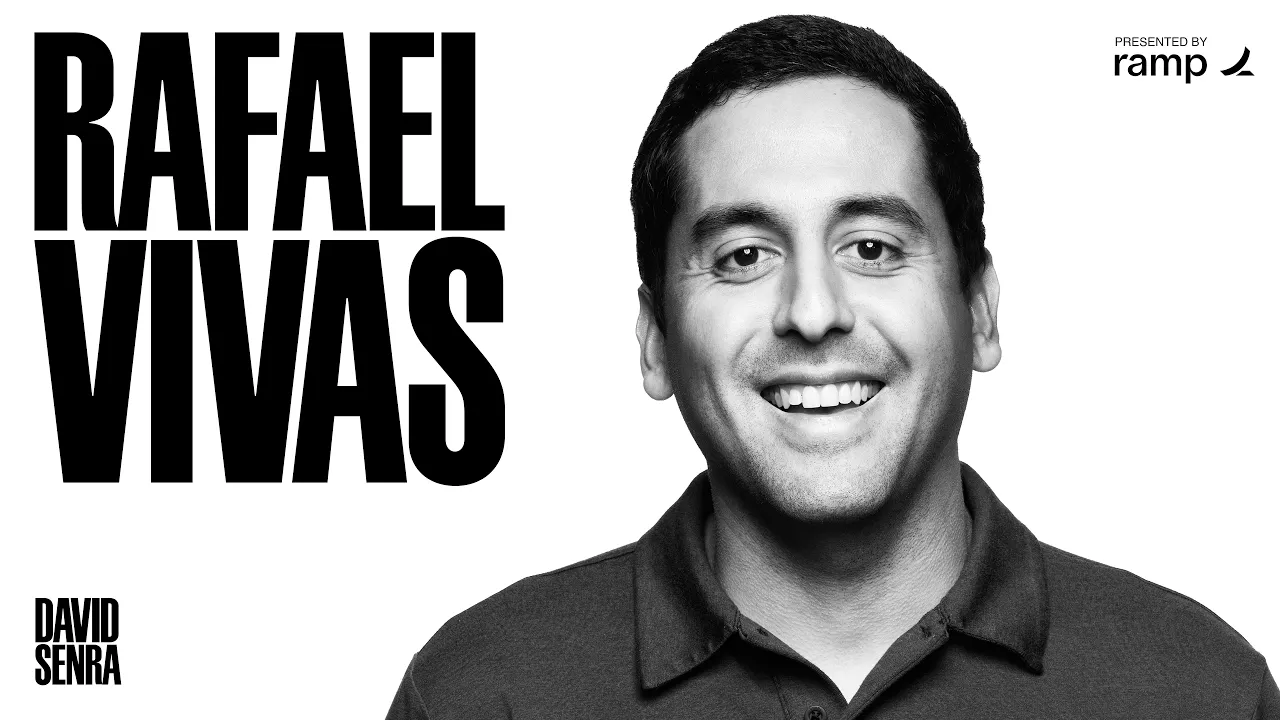
AppLovin Founding Hire Vivas Details $50 Billion Buyback, Tech Edge
David Senra
AppLovin beat venture-backed ad networks and captured a $50 billion buyback windfall by banning executive delegation and replacing manual sales operations with proprietary algorithmic models.
Rafael Vivas dropped out of high school at 16, founded the mobile ad network Appenda at 17, and became AppLovin's first business hire after demanding to live in the office on bunk beds. (0:02)
Despite early profitability, AppLovin was rejected by top venture firms including Sequoia and Benchmark, ultimately beating VC-backed competitors through algorithmic ad matching and regression models over manual sales forces. (16:18)
To counter partner squeeze from Cheetah Mobile, Vivas founded Lion Studios internally, scaling it to over $250 million in profitable revenue within two years across more than 3 billion downloads. (31:42)
After AppLovin's post-IPO market cap collapsed from $28 billion to $3.8 billion, the company repurchased heavily discounted shares out of free cash flow, yielding an estimated $50 billion windfall. (45:44)
Detailed notes
## Background
Published by David Senra on YouTube on November 1, 2026, this episode features an in-depth conversation with Rafael “Raf” Vivas, an early founding team member of AppLovin and co-founder of Lion Studios. The discussion traces Vivas's journey from dropping out of high school and building an ad network as a teenager to living in AppLovin's first office, launching Lion Studios, leaving the business, and returning after its post-IPO stock collapse to help drive its massive rebound.
## TL;DR
Rafael Vivas breaks down his unconventional path into performance marketing, beginning at age 14 and dropping out of high school before partnering with Adam Foroughi as AppLovin's first business hire on the condition that he live in the office. He details how AppLovin outmaneuvered VC-backed rivals through algorithmic advertising technology and strict anti-delegation, and how he founded Lion Studios to counter Cheetah Mobile, scaling it to over $250 million in revenue. After stepping away at age 28 and experiencing boredom in early retirement, Vivas returned to AppLovin following its post-IPO market plunge to help steer a massive stock buyback and ongoing operational scale. Throughout the interview, Vivas highlights foundational lessons in rigorous detail, endurance, and contract negotiation instilled by mentors like Adam Foroughi and Mark Rosner.
## Atmosphere & style
The conversation carries an intense, gritty, and relentlessly pragmatic energy, reminiscent of a high-stakes locker room debrief between two obsessive students of business history. Vivas speaks with candid, unvarnished directness about guerrilla hustle, sleeping on office bunk beds, and enduring punishing workloads, while Senra eagerly connects Vivas's lived experience to legendary biographies and coaching philosophies. The emotional arc moves from scrappy underdog survival to extreme operational discipline, leaving the listener with a visceral sense of what it takes to grind through pain and compete at the highest level.
## Bulletin
- [00:02](https://www.youtube.com/watch?v=IdvsD61Rmmk&t=2s) Rafael Vivas dropped out of high school at 16, founded the mobile ad network Appenda at 17, and became AppLovin's first business hire after demanding to live in the office on bunk beds.
- [16:18](https://www.youtube.com/watch?v=IdvsD61Rmmk&t=978s) Despite early profitability, AppLovin was rejected by top venture firms including Sequoia and Benchmark, ultimately beating VC-backed competitors through algorithmic ad matching and regression models over manual sales forces.
- [31:42](https://www.youtube.com/watch?v=IdvsD61Rmmk&t=1902s) To counter partner squeeze from Cheetah Mobile, Vivas founded Lion Studios internally, scaling it to over $250 million in profitable revenue within two years across more than 3 billion downloads.
- [45:44](https://www.youtube.com/watch?v=IdvsD61Rmmk&t=2744s) After AppLovin's post-IPO market cap collapsed from $28 billion to $3.8 billion, the company repurchased heavily discounted shares out of free cash flow, yielding an estimated $50 billion windfall.
## Key takeaways
- [00:02](https://www.youtube.com/watch?v=IdvsD61Rmmk&t=2s) Rafael Vivas prioritized digital performance marketing over traditional schooling after observing that top media buyers earned $20,000 to $30,000 daily.
- [03:34](https://www.youtube.com/watch?v=IdvsD61Rmmk&t=214s) Meritocratic online gaming and performance marketing mirror tribal survival, where delivering tangible value matters far more than corporate seniority or credentials.
- [05:12](https://www.youtube.com/watch?v=IdvsD61Rmmk&t=312s) Vivas launched his own mobile ad platform Appenda at 17, counting future AppLovin co-founder Adam Foroughi among his primary clients before being recruited as AppLovin's first business employee.
- [11:06](https://www.youtube.com/watch?v=IdvsD61Rmmk&t=666s) AppLovin adopted an asymmetrical guerrilla warfare approach, bootstrapped after VCs rejected a 25% stake for $1 million, while Vivas lived directly inside the office.
- [17:48](https://www.youtube.com/watch?v=IdvsD61Rmmk&t=1068s) Algorithmic regression models allowed AppLovin to outmonetize heavily funded rivals and offer written revenue guarantees to publishers.
- [19:21](https://www.youtube.com/watch?v=IdvsD61Rmmk&t=1161s) AppLovin enforces an anti-delegation philosophy, requiring leaders to remain active hands-on practitioners who directly build campaigns, analyze data, and write code.
- [23:57](https://www.youtube.com/watch?v=IdvsD61Rmmk&t=1437s) Persistent value delivery, such as providing two years of product and retention optimizations without transactional pressure, wins major enterprise partners.
- [30:05](https://www.youtube.com/watch?v=IdvsD61Rmmk&t=1805s) Commercial vulnerability to Cheetah Mobile drove the creation of Lion Studios, vertically integrating hyper-casual mobile game publishing to secure proprietary data and traffic.
- [34:16](https://www.youtube.com/watch?v=IdvsD61Rmmk&t=2056s) Hungry, lean overseas developer teams consistently outperformed bloated domestic studios, exemplified by a three-person team generating nearly $100 million with Happy Glass.
- [44:13](https://www.youtube.com/watch?v=IdvsD61Rmmk&t=2653s) After retiring at 28, Vivas found passive wealth unfulfilling and rejoined AppLovin during its post-IPO market collapse, viewing the turnaround as his defining arena.
- [45:44](https://www.youtube.com/watch?v=IdvsD61Rmmk&t=2744s) AppLovin generated an estimated $50 billion in value by aggressively buying back deeply discounted shares funded by cash flow during its 90% stock decline.
- [47:35](https://www.youtube.com/watch?v=IdvsD61Rmmk&t=2855s) Maintaining an ROI and ROAS mindset in personal and corporate expenses prevents lifestyle creep and eliminates corporate bloat.
- [01:00:53](https://www.youtube.com/watch?v=IdvsD61Rmmk&t=3653s) AppLovin CRO Mark Rosner instilled extreme contractual precision, teaching Vivas to pursue every percent of value rather than settling early.
- [01:05:00](https://www.youtube.com/watch?v=IdvsD61Rmmk&t=3900s) Adopting Bill Walsh's standard of performance means obsessing over daily execution and microscopic details so the eventual score takes care of itself.
- [01:05:46](https://www.youtube.com/watch?v=IdvsD61Rmmk&t=3946s) Enduring the painful desire to quit during difficult career phases is the fundamental indicator of professional growth and compound success.
## Detailed walkthrough
### [00:02](https://www.youtube.com/watch?v=IdvsD61Rmmk&t=2s) Kicked Out at 16 and Leaving High School Behind
David Senra opens the conversation by highlighting the sheer improbability of Rafael Vivas's trajectory: a high school dropout who was kicked out of his home as a teenager, slept on an office floor, and ultimately became a multi-billionaire. When asked how he managed to get kicked out of his house in the first place, Raf explains that from an early age, his mind was entirely consumed by driving tangible value rather than conforming to formal education. Traditional schooling was an abysmal fit—he suffered from terrible grades, could not pay attention, and had zero interest in the curriculum. What did seize his attention completely was performance-based internet advertising. Once he tasted the momentum of the digital ad business, he began ditching classes, skipping school entirely, and working around the clock.
This obsessive work schedule quickly brought household tensions to a breaking point with his father, who viewed his teenage son's newfound swagger with deep skepticism. His father issued a direct challenge: “All right, you think you're this big guy, you think you're this hotshot making all this money online, then just move out of the house.” Rather than backing down, Raf packed his belongings just twenty-four hours later and headed straight for his best friend's house. Arriving at the doorstep, he pitched his friend's mother a pragmatic arrangement: in exchange for letting him move in, he would clean the house and hire her son as an intern at his burgeoning online business.
Senra presses Raf on the decision to drop out of high school altogether—an extreme move even among tech founders, who typically leave college rather than secondary school. Raf explains that by age fourteen, while doing performance media buying for his older brother's operation, the raw economics of the internet had already dismantled any faith he had in a conventional academic path. The contrast in earning potential was impossible to ignore: “So, it was a no-brainer to me really quickly that school, the upside was nowhere as high as compared to if I were to put all my efforts into performance marketing.”
- **Age at departure:** Raf moved out of his parents' home at approximately 16 years old.
- **Economic reality check:** While his high school teachers were earning roughly $25,000 a year, top media buyers in his brother's orbit were generating between $20,000 and $30,000 a day in pure profit running campaigns online.
---
[02:00](https://www.youtube.com/watch?v=IdvsD61Rmmk&t=120s) Starting at 14 as the "Below the Water Boy"
Raf's entry into technology started through sheer personal curiosity. Raised in a blended household of six boys—four brothers and two stepbrothers—following his parents' early divorce, he spent his youth glued to computers, teaching himself to code websites and running game servers. By the time he was in middle school, he was pulling in roughly $1,000 a month from selling digital items and hosting servers, an extraordinary sum for a fourteen-year-old. When his oldest brother visited their father and mentioned his work in performance marketing, their father proposed that Raf spend the summer interning for him. Raf resisted the idea initially, hesitant to give up his existing, lucrative side hustles for a low-level internship.
Once convinced to join his brother's shop, Raf found himself placed at the very bottom of the corporate hierarchy—jokingly describing his status as being “below the water boy.” Any chore the senior media buyers found tedious or beneath them was pawned off on him, from drafting obscure terms of service agreements to formatting privacy policy pages on landing pages.
Despite the menial nature of the tasks, the experience proved to be an invaluable apprentice ground. By constantly managing the back-end plumbing of web campaigns, he observed firsthand which commercial offers resonated with consumers, what creative angles captured immediate attention, and how traffic was brokered, measured, and monetized at scale.
---
[03:34](https://www.youtube.com/watch?v=IdvsD61Rmmk&t=214s) The Meritocracy of Video Games and Tribal Value Creation
Senra points out the unusual nature of a teenager becoming fixated on digital marketing, noting that Raf’s other major passion was competitive video gaming. Raf draws a direct philosophical line between gaming mechanics and the marketplace. Having played soccer and baseball as a kid without showing any real athletic aptitude, he was drawn to multiplayer and single-player games precisely because they operated as pure, unadulterated meritocracies: success was determined strictly by outplaying the opponent on a level playing field.
He applied that same mental model to commercial enterprise, drawing an analogy to ancient tribal survival: when hunters left the village, the tribe did not care about seniority, pedigree, or process; they only cared about who actually brought back the meat. Raf discarded traditional corporate milestones—like climbing through analyst ranks to manager and senior manager—viewing them as artificial bottlenecks that constrain personal development and restrict the impact an individual can have on an organization.
```mermaid
flowchart LR
accTitle: Linear Career Ladder vs Value Creation Mindset
accDescr: A comparison between a slow traditional career progression and an aggressive, value-driven entrepreneurship approach.
subgraph Traditional["Linear Corporate Track"]
direction TB
A1["Entry-Level Analyst"] --> A2["Manager"]
A2 --> A3["Senior Manager"]
A3 --> A4["Bureaucratic Bottlenecks"]
end
subgraph Merit["Merit-Based Value Track"]
direction TB
B1["Identify Critical Need"] --> B2["Deliver Outsized Output"]
B2 --> B3["Expand Surface Area of Luck"]
B3 --> B4["Rapid Non-Linear Growth"]
end
```
He remains vehemently opposed to organizational bureaucracy, arguing that results are the only currency that truly matters: “I think titles and uh you know, seniority, I think it's all [bullshit]. I think it in in business, similar to sports and similar to video games, it's just about delivering the most value possible.” Focusing on the single most vital problem facing a business and relentlessly executing against it, he explains, bypasses the standard ladder and exposes an operator to massive opportunities years ahead of schedule.
---
[05:12](https://www.youtube.com/watch?v=IdvsD61Rmmk&t=312s) Meeting Adam Foroughi and Founding Appenda at 17
Raf's signature bias for action defined how he operated from his early teens. Rather than waiting for permission or formal instruction, he taught himself Photoshop to design ad banners, figured out how to set up and run campaigns on MySpace, and began cold-outreaching directly to brands to secure advertising inventory. It was in this hyper-competitive environment that he first encountered Adam Foroughi, the future co-founder and CEO of AppLovin. At age fifteen, Raf was literally fetching water for Foroughi when Foroughi visited his brother's office; Foroughi was sitting at the very top of the company's internal affiliate leaderboard, with Raf chasing close behind him.
By age seventeen, Raf realized that relying on third-party ad networks was capping their growth, especially when one major partner platform banned his team simply because their performance campaigns were outcompeting the platform's own internal offers. Incensed by the ban, Raf went home in tears of rage, determined to exact revenge. He marched into his brother’s office the next morning announcing he was quitting to launch a rival ad network to crush the firm that cut them off. His brother burst out laughing at the teen’s bravado, countering: “You're not going anywhere. I'll give you a few engineers. Go build what you want.” That internal green light became Appenda, Raf’s mobile ad network.
Around the same time, Foroughi had departed the performance media world to develop consumer mobile applications—ranging from dating to fashion apps—which served as the initial precursor to AppLovin. Foroughi needed user acquisition traffic, and Raf’s new ad network had inventory to sell. Raf became Foroughi's dedicated account manager, spending hours bantering back and forth on AOL Instant Messenger (AIM). Despite Foroughi being more than a decade older, the teenage Raf gave him no deference, routinely trash-talking over chat: “Hey, I'll teach you a lot about making money online. You know, I'll teach you how to run a real business.”
- **The genesis of Appenda:** Founded when Raf was just 17 years old, born out of spite after a competitive network deplatformed their campaigns.
- **Early AppLovin experiments:** Before becoming an enterprise adtech powerhouse, Foroughi's early mobile venture focused on direct-to-consumer software, including dating and fashion applications.
- **Communication channel:** The foundational business relationship between Raf and Foroughi was forged primarily over AIM chat windows, brokering traffic bids and campaign tracking.
[08:13](https://www.youtube.com/watch?v=IdvsD61Rmmk&t=493s) “Don't Be Mad, but I'm Going to Compete with You”
Rafael Vivas reflects on the sharp contrast between his raw, youthful audacity and Adam Foroughi’s calculated brilliance. Adam was twelve years older and, as Raf puts it, “a walking calculator.” Yet Raf was fueled by the blissful ignorance of youth and an enormous chip on his shoulder, convinced he could take on the world. As the two continued to talk, Adam made a cold, rational calculation: if an uneducated kid working around the clock could build a functional, lucrative ad network in an open market, then Adam could build a vastly superior mobile ad platform himself.
```mermaid
flowchart LR
accTitle: Adam Foroughi Decision Loop
accDescr: Flowchart showing how Adam analyzed Raf's early success and decided to build AppLovin.
subgraph Signal ["Market Signal"]
A["Raf's solo network succeeds<br/>in open mobile space"]
end
subgraph Decision ["Adam's Calculation"]
B["Recognizes PC-to-mobile shift"]
C["Decides to build competing<br/>mobile ad network"]
end
subgraph Action ["Recruitment"]
D["Reverses Raf's plan<br/>to join YC startup"]
E["Hires Raf as AppLovin's<br/>first business employee"]
end
A --> B --> C --> D --> E
```
David Senra pauses the narrative to emphasize the sheer stature of Adam Foroughi. Looking back on his previous interview with Adam, Senra considers it one of his proudest episodes, describing him as “the best entrepreneur you've never heard of.” At the time, AppLovin was commanding a massive valuation on track to print billions of dollars in cash flow with a remarkably lean team of only around 400 employees. Senra recalls that high-profile figures like MrBeast and Micky Malka immediately reached out after hearing that episode, desperate for an introduction to this intense, unfiltered operator.
Returning to the confrontation, Raf describes spotting Adam pacing the office wearing an unmistakable “shit-eating grin like on his face. Like like somebody who had just like eaten your food.” Instead of Adam cornering him, Raf actually shoved Adam into a private room to demand what he was smiling about. Adam casually confessed: “Hey, don't be mad. I'm building a competing ad platform.” At that moment, Raf did not care about the competition; he was an avid gamer and was preparing to join a friend's Y Combinator mobile gaming startup. But Adam immediately outmaneuvered him mentally, challenging his plans directly: “Whoa, whoa, whoa, wait. What do you mean you're going to go join somebody else's company? You should come work for me. You know, you you know how to work your ass off. You know everyone in the space here in in mobile gaming, but you know nothing about building a real business.” Intrigued and respecting Adam's intellect despite their playful online banter, Raf traveled to Palo Alto to meet the rest of the founding engineers.
[11:06](https://www.youtube.com/watch?v=IdvsD61Rmmk&t=666s) Living in the Office: The IKEA Bunk Bed Condition
Meeting the Palo Alto engineering crew sealed the deal for Raf. Blown away by their technical horsepower, he realized joining them was an absolute no-brainer. During compensation negotiations, the teenage Raf boldly demanded half of the entire company. Adam laughed it off, noting that someone coming into his specific business development role typically received around a quarter of a percent. While Raf managed to negotiate a higher stake than that baseline, he gave up on getting 50%, attaching one non-negotiable term instead: he demanded to live directly inside the office.
When Adam asked why he wanted to sleep where he worked, Raf framed the startup as asymmetrical guerrilla warfare: “Think of this as like the Vietnam War, right? Like we have this goofy name called AppLovin. We have no VC funding, right? You're going to have some 5'8" chubby kid go out there and go sell, you know, to game developers and advertisers. The only way that we're going to win is we're going to have to out-hustle everybody else, which means I have to live here, right? Like this is the only way this will work.” Delighted by that level of raw commitment, Adam and an engineer named Furqan went straight to IKEA, bought bunk beds, and assembled them in the office with their own hands. Raf had even convinced another engineer to move in with him, but the moment that recruit laid eyes on the IKEA bunk beds, he flatly refused. Raf, however, looked at the setup and thought, “Home sweet home, you know. I'm time to get started.”
[14:46](https://www.youtube.com/watch?v=IdvsD61Rmmk&t=886s) The Animal House Era and VC Skepticism
When Raf moved in, AppLovin was entirely pre-revenue. The office operated like a chaotic “animal house,” packed with engineers prototyping different applications in an attempt to pinpoint product-market fit before landing on the AppLovin ad network. Adam brought deep institutional knowledge to the table, having previously founded Social Hour, a successful ad network built on Facebook, alongside other prior advertising ventures. Recognizing early that user attention was permanently migrating from desktop PCs to mobile devices, Adam paired his deep technical and domain expertise with Raf’s industry rolodex to kickstart advertiser and publisher adoption.
Despite their early momentum, outside capital was nonexistent. Adam had pitched venture capitalists, offering 25% of AppLovin for just $1 million, only to be rejected across the board. The venture community dismissed both gaming and advertising as low-margin, hit-driven, or structurally unappealing businesses. Shortly after passing on AppLovin, those same venture capital firms poured millions into competing ad networks.
- AppLovin was completely bootstrapped and pre-revenue during the bunk bed era, running on internal experiments rather than venture capital.
- Adam Foroughi offered investors a 25% equity stake for $1,000,000 (a $4 million post-money valuation), which VCs universally declined.
- Rather than deterring the founding team, the rejection and subsequent VC funding of rival startups galvanized AppLovin into adopting a ruthless, explicit operational mandate to drive those venture-backed competitors entirely out of business.
[16:18](https://www.youtube.com/watch?v=IdvsD61Rmmk&t=978s) Turned Down by Top-Tier VCs While Already Profitable
When Adam Foroughi went out to pitch the premier venture capital firms of the era—including Sequoia Capital and Benchmark—the mobile advertising space already appeared saturated and mature. Heavyweights with deep pockets and established footprints dominated the landscape, making the prospect of a scrappy team operating out of Palo Alto with a teenager running sales look wildly uncompetitive on paper. Remarkably, AppLovin was already profitable when Foroughi pitched these firms. He handed them an exceptional opportunity on a silver platter: surging month-over-month revenue traction, hypergrowth, and world-class profit margins far exceeding those of their competitors. Yet every top-tier VC passed.
```mermaid
flowchart TD
accTitle: AppLovin VC Pitch Rejection Factors
accDescr: Comparison between standard VC-backed founders and AppLovin's profile that led to fundraising rejections.
subgraph Established["VC Preferred Profile"]
E1["Elite Pedigree: Ex-Google, Ex-Facebook, AdMob"]
E2["Traditional Mobile Game Publishers"]
E3["Standard VC Playbook & Sales-Driven Models"]
end
subgraph AppLovin["AppLovin Reality"]
A1["Performance Marketing & Arbitrage Background"]
A2["Profitable Month-over-Month Growth"]
A3["Tech & Algorithmic Focus with No Prior Network Exit"]
end
Established -->|"VCs heavily favored pedigree"| Rejection["Top VCs Pass on AppLovin"]
AppLovin -->|"Viewed as non-traditional outsiders"| Rejection
```
Vivas attributes these rejections to their non-traditional background. The founders who successfully raised capital came with pristine corporate pedigrees, having worked at Google, Facebook, or early category winners like AdMob, or they had run prominent gaming studios. By contrast, Vivas and Foroughi were performance marketers who cut their teeth running direct-response arbitrage operations rather than institutionally funded ad networks. Investors failed to appreciate the durability of the engine they had engineered because the founders did not look the part.
- Top venture firms like Sequoia Capital and Benchmark passed on AppLovin despite its strong profitability and steep month-over-month growth.
- Entrenched competitors had significant market share, large sales forces, and VC backing, leading investors to dismiss AppLovin's unconventional team.
---
[17:48](https://www.youtube.com/watch?v=IdvsD61Rmmk&t=1068s) Beating Well-Funded Rivals with Technology and Guaranteed Returns
AppLovin was outmanned and outfunded, but Foroughi possessed an edge that rival networks ignored: he prioritized the underlying technology above everything else. While competing platforms poured resources into sprawling sales organizations to sign premium publishers and brand advertisers, their monetization matching was brittle. Many competitors relied on humans manually tweaking campaign parameters behind the scenes. AppLovin did not yet have modern large-scale machine learning, but it implemented regression models and rigorous algorithmic rules to automate and optimize ad serving.
This algorithmic foundation allowed AppLovin to dramatically outperform competitors in head-to-head testing. Even with inferior ad demand and lower-tier publisher inventory at the start, AppLovin regularly monetized publisher traffic at twice the rate of entrenched networks. Vivas turned this performance gap into an irresistible sales pitch: he guaranteed prospective publishers that AppLovin would generate more revenue than whoever they were currently running. When publishers balked that the offer sounded too good to be true, Vivas put the guarantee in writing. As Vivas explains: “I would really say it was like Adam's vision in going all in on the tech is what allowed us to succeed.”
---
[19:21](https://www.youtube.com/watch?v=IdvsD61Rmmk&t=1161s) The High-Performance Culture: Operationally Obsessed and Anti-Delegation
AppLovin's internal culture operates with the relentless, uncompromising intensity of the championship Chicago Bulls teams featured in *The Last Dance*. Operating under an “always on” ethos, the company considers itself an operational extension of its clients' teams rather than an aloof third-party service provider. When hiring from legacy ad platforms, Vivas is routinely stunned by candidate resistance to frontline labor:
> “And one of the questions I'll simply ask them is that, 'Hey, would you set up a campaign? Would you, you know, upload ads? Would you come up with creative ideas?' And a lot of times they're like, 'Whoa, like I haven't done that. Like why would you do that?' And for us, we do all of these things.”
This obsession with execution makes AppLovin polarize its clients. While advertisers appreciate the superior return on ad spend, some view the team as pushy or arrogant because AppLovin refuses to indulge client ideas that contradict the data. Rather than adhering to the traditional mantra that the customer is always right, the team insists on data-driven optimization that generates profitable customer acquisition.
```mermaid
flowchart LR
accTitle: AppLovin Direct Operational Approach vs Traditional Delegation
accDescr: Visual contrast of AppLovin's direct hands-on involvement versus traditional corporate delegation layers.
subgraph Traditional["Traditional Delegative Model"]
T1["Executives / Managers"] -->|"Hands off"| T2["Hired Middle Layers"]
T2 -->|"Focus on low-impact tasks"| T3["Disconnected Execution"]
end
subgraph AppLovinModel["AppLovin Operational Model"]
A1["Leaders in the Weeds"] -->|"Upload ads, write copy, tune campaigns"| A2["Direct Client Performance"]
A2 -->|"Relentless data iteration"| A3["High ROAS & Scaled Growth"]
end
```
This mindset fuels Vivas's staunch anti-delegation stance. Rejecting popular business advice that urges founders to hire fast and step away from daily tasks, Vivas argues that delegation detaches leadership from customer realities and breeds useless busywork that creates bloat without moving the needle. Comparing leadership to elite sports and video games, he insists leaders must earn their spot by taking the critical shots themselves:
> “If you think about it in a sports analogy, right? Like, why did Michael Jordan always get the ball? You know, or why was he, you know, effectively like, considered the captain of the team? It wasn't cuz he was like, the oldest person there, the most senior there. It's cuz when they gave him the fucking ball, he made the shot, right?”
Vivas adds that delegating the hardest problems strips the fun out of building a company: “Going back to like video games, it's like, imagine like you play all these levels and then you get to like a boss, like the final boss. Like, you going to hand the control to your friend? Fuck no. You're going to like go and do it yourself.”
---
[22:21](https://www.youtube.com/watch?v=IdvsD61Rmmk&t=1341s) High-Leverage Deals and the "Everything Matters" Philosophy
With a remarkably lean headcount relative to its enterprise value and profitability, AppLovin directs its senior talent toward maximum-leverage transactions. Vivas concentrates his time on structuring major advertiser relationships and strategic partnerships that funnel thousands of new businesses onto the platform at scale.
At the same time, the company remains hyper-focused on expanding revenue from existing accounts. Senra recalls Foroughi sharing stories of calling clients directly to extract incremental spend, prompting clients to ask why a multi-billionaire CEO was personally badgering them over an extra $5,000 a day. Foroughi's response captures AppLovin's core ethos: “It matters to us. Everything matters.” Vivas reinforces the logic behind this relentlessness:
> “If you can't do the small things right, how can you be expected to do the big things right?”
Even with AppLovin pacing toward $20 billion in annual advertiser spend, Vivas emphasizes that the business is still in its infancy when measured against digital advertising's incumbents:
- Google and Meta together process roughly $500 billion (half a trillion dollars) in ad spend, leaving massive runway for AppLovin to capture share.
- AppLovin maintains a lean headcount to avoid bureaucratic layers and keep senior operators close to the data and customers.
- Advertisers frequently under-allocate capital initially even after AppLovin proves superior returns, requiring persistent, hands-on pressure from leadership to force budget reallocations.
[23:57](https://www.youtube.com/watch?v=IdvsD61Rmmk&t=1437s) Persistence with Value: Landing Nadeer Khan
David and Raf discuss what it takes to actually break through to clients, contrasting annoying outreach with high-conviction persistence. Raf explains that his personal superpower is reaching out directly to accounts: “What the hell is this billionaire reaching out to me for an extra $5,000?” Clients immediately recognize that AppLovin is genuinely serious about their business and does not view them as a mere row on a spreadsheet. In response, David brings up Ari Emanuel’s new book, noting that people constantly spam his inbox vowing to email him every single day until he replies—tactics that lead him to block them on the spot.
Raf points out that endlessly bombarding someone with useless noise simply gets you tuned out or blocked; real persistence must be anchored in continuous value creation. To illustrate, he recounts chasing Nadeer Khan, who ran an app business based in Miami before selling it for a few hundred million dollars. It took Raf two full years to finally get hold of him. Every single touchpoint was a tangible suggestion for making more money:
- Pointing out specific game levels that could be optimized to retain users.
- Recommending precise placements where ads should be served.
- Flagging underperforming geographic markets where the app was dropping the ball.
Inside Khan’s company, employees joked that they wished they had a Rafael Vivas on their own team because he was relentlessly working to improve their product. When Khan finally answered, he told Raf: “You are one of the most persistent folks that I've ever encountered in my whole entire life.” That two-year pursuit unlocked a massive working relationship that dramatically accelerated the company's growth. As Raf reflects, prospective clients rarely ignore messages because an idea is bad; they are simply busy, lacking resources, or managing wrong timing, which makes delivering consistent value over time the ultimate sales strategy.
[26:02](https://www.youtube.com/watch?v=IdvsD61Rmmk&t=1562s) Internal Culture: Leading with Bad News and Stock Immunity
David asks what sets AppLovin’s internal culture apart from typical tech companies. Raf explains that leadership remains obsessively hands-on, with Adam Foroughi frequently diving in to personally configure ad campaigns and review tiny accounts. More importantly, the company rejects cheerleading in favor of ruthless self-critique: “I would say that we lead with bad news internally.” While other corporate environments rally around superficial victories, AppLovin’s constant internal dialogue fixates on what sucks, breaking problems down one by one to systematically fix them.
subgraph Culture["Internal Operating Culture"]
A["Hands-On Leadership<br/>(Founders running campaigns)"] --> B["Lead with Bad News<br/>('This sucks, let's fix it')"]
B --> C["Deliver Direct Client Value"]
end
subgraph Mindset["Long-Term Resilience"]
D["Stock Volatility Disregarded<br/>(90% drop to $4B valuation)"] --> E["Obsession with Durability"]
E --> F["Economic Stimulus Engine"]
end
C --> D
```
This discipline translates into total immunity toward Wall Street volatility. David recalls a day when AppLovin stock tumbled roughly 20%, yet during an impromptu phone call right after, Adam was relaxed, laughing, and cracking jokes without showing the slightest stress. Raf explains that wild swings are routine when you have lived through the stock collapsing over 90% down to a $4 billion valuation: “So like being cut by 20% or being cut by half is just like another day in the NFL for us.” Rather than fixating on the short term, the team operates on the conviction that executing the right operational fundamentals will naturally cause the stock to take care of itself.
- Leadership leads conversations by diagnosing systemic flaws rather than celebrating superficial wins.
- The company previously watched its market capitalization plunge more than 90% down to $4 billion, inoculating leadership against standard market downturns.
- Daily decisions are decoupled from quarterly investor sentiment in favor of multi-decade durability.
[28:03](https://www.youtube.com/watch?v=IdvsD61Rmmk&t=1683s) Playing a Bigger Game: Why Raf Stays
David asks where Raf’s ambition to build an enterprise that outlives him comes from, contrasting his drive with founders who cash out for billions to build mansions and write angel checks from the beach. Raf reflects on personal purpose, acknowledging that while he is not going to cure cancer or invent bleeding-edge robotics, he possesses the capability to construct an enduring platform that powers global commerce for decades past his lifetime.
Raf dismisses the idea of retiring at this stage of AppLovin's trajectory, emphasizing that walking away now would be abandoning the mission before it properly begins: “I didn't work 14 years of my life to like leave before the game even got started.” To him, true satisfaction comes from enabling thousands of businesses to grow profitably, generating hundreds of billions of dollars of downstream value, spurring consumer demand, and funding job creation across the real economy.
[30:05](https://www.youtube.com/watch?v=IdvsD61Rmmk&t=1805s) The Cheetah Mobile Squeeze and Vertical Integration
When David prompts him about his subsequent burnout and the decision to take a year off, Raf retraces the origins of Lion Studios. AppLovin did enormous volumes of business in Asia, particularly China, where Raf admired the founders for their extreme intensity, rapid decision-making, and no-nonsense execution. However, one of AppLovin's largest publishers at the time, Cheetah Mobile, continuously weaponized its leverage:
- Cheetah routinely squeezed AppLovin on commercial terms and disregarded signed contracts.
- Raf had to stay awake until 4:00 or 5:00 a.m. in the United States to manage account issues before boarding long flights to negotiate with executive leadership in Asia.
- The punishing power dynamic exposed the dangerous vulnerability of relying on third-party publisher traffic.
Drawing inspiration from Netflix’s shift from licensing into original content, Raf and Adam decided to vertically integrate by creating their own mobile gaming division. By owning the underlying intellectual property and combining it with AppLovin's ad-tech distribution network, the business could secure superior unit economics and build durable enterprise value. Raf highlights that this vertical model had already been proven by Asian digital powerhouses like Tencent and NetEase, setting the stage for AppLovin's aggressive expansion into proprietary games.
[31:42](https://www.youtube.com/watch?v=IdvsD61Rmmk&t=1902s) Lion Studios: Built to Kill a Cheetah
AppLovin entered the gaming space after discovering that partners who held non-gaming assets were leveraging those assets to distribute their own games. However, a major partner—Cheetah Mobile—pushed Rafael Vivas past his breaking point. Raf recounts that just as a partner screwing them over had driven them to launch the ad platform in the first place, this betrayal provoked pure rage. He walked into Adam Foroughi’s office and gave him an ultimatum: “I'm going to leave to go and build this competitor against Cheetah Mobile or I'm going to do it here.” David Senra asks why leaving seemed so simple, and Raf clarifies that it had nothing to do with money. Raf describes himself as a simple guy who stays in $200 hotels and flies commercial airlines without caring about mansions or wealth; his work is driven strictly by purpose. When Cheetah Mobile pushed him, his entire purpose crystallized around destroying them.
```mermaid
flowchart TD
accTitle: The Genesis and Flywheel of Lion Studios
accDescr: Diagram illustrating how Cheetah Mobile's betrayal led to the creation of Lion Studios and fueled AppLovin's growth.
subgraph Catalyst["Catalyst for Creation"]
A["Cheetah Mobile betrays AppLovin"] --> B["Rafael Vivas's Ultimatum: Build competitor inside or outside"]
B --> C["Lion Studios Founded<br/>('A lion is the only animal that can kill a cheetah')"]
end
subgraph Engine["The Publishing Engine"]
C --> D["Partner with underdog global developers"]
D --> E["Distribute games via AppLovin platform"]
E --> F["Hit #1 chart positions & generate ad inventory"]
end
subgraph Flywheel["AppLovin Ecosystem Impact"]
F --> G["Rich data refines machine learning models"]
G --> H["More efficient traffic driving for advertisers"]
H --> I["$0 to $250M+ profitable revenue in 2 years"]
end
```
That vengeful resolve became Lion Studios. Raf named it deliberately: a lion is the only animal in the wild that can kill a cheetah. The business model functioned like a record label such as Universal Music Group: AppLovin possessed one of the largest distribution platforms in the world and partnered with top external developers to market and distribute their mobile games. Within two years, Lion Studios skyrocketed from zero to over $250 million in revenue, fully profitable. Yet the operational grind was intense. Because AppLovin was simultaneously an ad network for game publishers, customers immediately viewed Lion Studios as a hostile in-house competitor. Despite their suspicion, partners still had to work with AppLovin because of the sheer value delivered: the games produced massive new ad inventory and generated rich data that upgraded AppLovin's machine learning models, making user acquisition dramatically more efficient.
- **Lion Studios Revenue:** Grew from $0 to over $250 million in profitable revenue within 2 years.
- **Naming Origin:** Named "Lion Studios" because the lion is the only animal capable of killing a cheetah (targeting Cheetah Mobile).
- **Core Synergies:** Created internal ad inventory and supplied fresh behavioral data to improve AppLovin's machine learning and traffic targeting algorithms.
---
[34:16](https://www.youtube.com/watch?v=IdvsD61Rmmk&t=2056s) Why Underdog Global Studios Crushed Bloated US Teams
The mobile titles Lion Studios specialized in were "hyper-casual" games—mechanics-driven games screened through rigorous testing methodologies to measure raw marketability. When David asks why their premier developer partners lived overseas across Europe and Asia rather than in the United States, Raf points to two distinct factors: labor costs and raw hunger. Building hyper-casual hits did not demand the world's most elite pedigreed engineers; it required churning through rapid repetitions. American game studios suffered from high salaries, bloated team sizes, and a rigid "9-to-5" corporate mentality where employees only managed narrow slices of a project.
By contrast, overseas founders worked with life-or-death intensity. Raf highlights Game 5 Mobile, the team behind their massive hit *Happy Glass*, which generated close to $100 million in revenue. The studio was composed of just three people: a husband, a wife, and a younger brother. They had quit their jobs at HP to gamble everything on game development. They were so impoverished that they operated out of a tiny shared house and all slept in the same bed. Raf explains that they had about a month left before going broke and being forced back into traditional corporate jobs: “So when you come from that, right? Like you can't compete against somebody like that, right? They will die before they fail, right?” Seeing underdogs with their backs against the wall motivated Raf to match their relentless work ethic and make them millionaires.
- **Game 5 Mobile / *Happy Glass*:** A 3-person team (husband, wife, younger brother) who bet their life savings after leaving HP, worked and lived in one house, and scaled *Happy Glass* to nearly $100 million in revenue with Lion Studios.
- **Hyper-Casual Advantage:** Global teams moved significantly faster, executed more iterations, and operated without the costly overhead and bloated payrolls typical of US studios.
---
[37:13](https://www.youtube.com/watch?v=IdvsD61Rmmk&t=2233s) The "Black Mamba" Grind and Walking Away at 28
David draws a parallel between Raf's underdog partners and Raf's own history: kicked out of his home as a teenager, sleeping on the floor of the AppLovin office, and adopting a mindset akin to 50 Cent’s *Get Rich or Die Tryin'*. Raf agrees, noting that during this high-stakes stretch, he had warned his girlfriend that he was going into full "Black Mamba" mode. To maintain razor-sharp intensity, he listened to motivational videos non-stop throughout the working day. Senra shares that he experienced the same psychological pressure during the first five and a half years of hosting the *Founders* podcast, waking up every morning and brainwashing himself with motivational material while wondering why the show had not yet broken through.
At AppLovin, Adam pushed Raf relentlessly because the entire strategic weight of the company rested on Lion Studios succeeding. Having burned their ships with industry competitors, failure was not an option. Between the ages of 26 and 28, with no children and total dedication to his career, Raf woke up at 4:00 AM and worked until midnight every single day. Lion Studios went on to propel more than 20 games to the #1 spot on the app store charts and generated over 3 billion total downloads. Yet around the two-year mark, Raf took a step back and recognized a surprising reality: between the infrastructure he had built and strategic acquisitions of other gaming studios, Lion Studios no longer needed him to run day-to-day operations. Realizing he was no longer mission-critical, and wanting to start a family, 28-year-old Raf decided to step away from AppLovin.
- **Work Routine:** Slept four hours a night, waking up at 4:00 AM and grinding until midnight throughout his mid-to-late twenties.
- **Lion Studios Milestone:** Propelled over 20 distinct games to the #1 ranking on the app stores, driving upwards of 3 billion total downloads.
- **Departure at 28:** Stepped down after realizing the operational machinery was self-sustaining and that he wanted to prioritize fatherhood and starting a family.
[39:44](https://www.youtube.com/watch?v=IdvsD61Rmmk&t=2384s) The Depressing Reality of Early Retirement
After stepping back from AppLovin, Rafael Vivas relocated to Miami during the height of the COVID-19 pandemic. San Francisco had become profoundly depressing with widespread shutdowns, whereas a planned weekend getaway to Miami revealed a city where life remained vibrant and open. There, he laid down roots, met his wife, and started a family. David Senra recalls being in Miami during that exact window, noticing long lines form at Lucali in Sunset Harbour filled with phone numbers bearing 415 and 212 area codes as tech workers and New Yorkers fled their locked-down cities.
When it came to leaving AppLovin, Raf had been quietly preparing for about a year by keeping a diary tracking his operational dependencies. He systematically worked to eliminate every bottleneck so that new games could launch and revenue could grow without his involvement. Once the business could thrive without him, he waited until his birthday to call CEO Adam Foroughi, stating bluntly: “I want to take some time off from the business.” Adam, characteristically unperturbed and non-emotional, simply asked if he was sure and told him he respected his choice. Colleagues like Chad and his brother quickly called him in disbelief, offering retention packages to get him to stay, but Raf insisted his decision had nothing to do with money. Although intended as a six-month transition, he was gone within three months, fully believing he would ride off into the sunset and never work again.
Retirement, however, proved deeply unfulfilling. Raf found playing video games all day completely empty, observing: “What you realize is like on a Wednesday afternoon, you have no one to play games with. None of your friends are around. They're all fucking productive. They're doing things, right?” Without a compelling purpose, life turned bleak. In his downtime, he spun up low-conviction side ventures with an engineering team purely based on promising metrics, even briefly launching a mobile dating show called *Love or Fame*. Watching twelve hours of dating content a day made him want to jump out of a window. More importantly, he lacked any real emotional connection to those products or the people he was building them with, reinforcing that his deepest drive required working alongside teammates whose success he cared about unconditionally.
- Raf systematically eliminated himself as a bottleneck over a full year before resigning.
- His departure transition was scheduled for six months but completed in three.
- Side projects during his time off included an ill-fated mobile reality project called *Love or Fame*.
[44:13](https://www.youtube.com/watch?v=IdvsD61Rmmk&t=2653s) The IPO Drop and Returning to the Battle
Raf remained outside AppLovin until the day the company went public on the New York Stock Exchange. He attended the bell-ringing ceremony in great physical shape, expecting a triumphant milestone, but the stock immediately tumbled on its opening day. Celebrating quickly devolved into drinking their sorrows away. Observing the company from within the room, Raf could see structural flaws in the business despite ongoing top-line growth. It hit him immediately that he belonged in the fight, declaring to himself: “This is my company.”
Later that evening, Adam approached him and mentioned hearing rumors that Raf was considering a comeback. Raf answered on the spot: “I'm fucking in.” He notes that had AppLovin debuted smoothly with its share price soaring, he would have remained on the sidelines because there would have been no unique value for him to add. He returned precisely because the company was in distress and needed his grit.
```mermaid
flowchart TD
accTitle: Rafael Vivas Decision to Return to AppLovin
accDescr: Diagram illustrating Raf's path from leaving AppLovin to his sudden return following the post-IPO stock drop.
subgraph Sabbatical["Time Away from AppLovin"]
A["Step away at age 28"] --> B["Boredom & unfulfilling side projects"]
B --> C["Attends NYSE bell ringing as guest"]
end
subgraph IPOEvent["The Turning Point"]
C --> D["Stock immediately drops on Day 1"]
D --> E["Identifies internal flaws in the business"]
end
subgraph Return["Rejoining"]
E --> F["Adam asks if Raf wants to return"]
F --> G["Raf commits: 'I'm fucking in'"]
end
```
[45:44](https://www.youtube.com/watch?v=IdvsD61Rmmk&t=2744s) The $50 Billion Stock Buyback and Immunity to Lifestyle Creep
Following the IPO at an approximate $28 billion valuation, the stock endured a brutal slide for nearly 200 consecutive trading days, ultimately bottoming out around a $3.8 billion market capitalization. Even as public market sentiment plummeted, AppLovin's actual business fundamentals remained exceptionally strong, producing around $1 billion in free cash flow. In response to Wall Street's skepticism, Adam made the contrarian decision to lever up the company, redirecting its immense cash flow into aggressively repurchasing discounted AppLovin shares—a move that eventually yielded an estimated $50 billion windfall.
Raf notes that leadership held a firm backup plan if the market refused to correct its valuation: they planned to take the company private outright, mirroring Michael Dell's playbook with Dell. Raf himself experienced zero panic during the market crash, attributing his calm to an ingrained immunity to lifestyle creep. His personal hobbies cost practically nothing, mostly limited to a $15-a-month *World of Warcraft* subscription, wearing inexpensive clothes, and socializing with the same circle of high school and workplace friends. Because his spending habits never scaled with his net worth, he never feared financial volatility and could focus entirely on executing the core business.
- AppLovin’s market capitalization dropped from roughly $28 billion down to $3.8 billion while generating about $1 billion in annual cash flow.
- The company's aggressive stock repurchase program created roughly $50 billion in shareholder value.
- Management actively contemplated taking AppLovin private if the public market continued to undervalue the business.
- Raf kept his personal burn rate virtually identical to his teenage years, centered around a $15-a-month gaming subscription.
[47:35](https://www.youtube.com/watch?v=IdvsD61Rmmk&t=2855s) ROAS Mindset and Extreme Headcount Discipline
David Senra opens by recalling how striking it was to see Adam Foroughi's grounded habits after the company went public. AppLovin was worth roughly $20 billion on paper, yet Adam was routinely spotted flying on JetBlue, and when introduced to Patrick O'Shaughnessy during investor meetings, he was flying Southwest or another standard budget carrier. Rafael Vivas explains that outsiders often label this behavior as mere frugality, but inside AppLovin, it is viewed purely through the lens of performance marketing. When you spend all day analyzing marketing dashboards where the primary key performance indicator is return on ad spend (ROAS), you begin evaluating your entire life that way: if two options arrive at the exact same destination at the exact same time, but one costs a tenth of the other, paying the premium offers zero incremental return on investment.
```mermaid
flowchart TD
accTitle: Headcount Discipline and Leverage
accDescr: How keeping headcounts minimal drives focus, automation, and outsized performance.
subgraph Culture["Operational Philosophy"]
A["Focus on Core KPI:<br/>ROAS Thinking Applied to Everything"]
B["Keep Headcount Minimal"]
end
subgraph Tactics["Execution Without Layers"]
C["Eliminate C-Players & Distractions"]
D["Automate Low-Value Work"]
E["Empower Autonomous Doers<br/>(Even CTO Pushes Code)"]
end
subgraph Outcome["Performance"]
F["Massive Operating Leverage & Output"]
end
A --> B
B --> C
B --> D
B --> E
C --> F
D --> F
E --> F
```
This same calculation informs AppLovin's ruthless discipline around employee headcount. While standard corporate logic assumes scaling revenue requires adding armies of workers, Raf views operating with a lean team as the true test of entrepreneurial skill: having fewer employees forces extreme clarity and eliminates distractions. Managing mediocre personnel wastes valuable executive bandwidth on trivial matters. Because AppLovin is founder-led, leadership treats company capital as if it were coming out of their own personal pockets. Decisions are guided entirely by spreadsheets and data, making it immediately apparent which initiatives deserve doubling down on and which should be killed.
- AppLovin founders treat corporate expenditures with the same rigor as marketing spend, rejecting travel luxuries because the marginal return simply does not justify the 10x cost difference.
- Management keeps organizational layers nearly nonexistent; outside of complex machine learning systems that specialized engineering teams construct, founders and leaders maintain the capability to execute campaigns, design creatives, and run everyday operations themselves.
[49:58](https://www.youtube.com/watch?v=IdvsD61Rmmk&t=2998s) Saturating Capacity and "Torturing Into Greatness"
AppLovin maintains virtually zero red tape, operating under the conviction that hiring high-caliber people who respect the value of money eliminates the need for bureaucratic approval layers. Rather than hiring more staff when workloads surge, the company pushes individuals to take full ownership and asks two fundamental operational questions: what workflows can be automated, and what unnecessary tasks are eating up time that should simply be scrapped? Every leader remains an active practitioner—the CTO directly pushes production code despite running a 100-person engineering organization. As Raf summarizes their straightforward philosophy: “There is no special magic, David. It's like fucking work on the things that matter and do it over a long period of time, success will come.”
Senra links this philosophy to Bending Spoons CEO Luca Ferrari, who intentionally seeks out young, hungry talent with minimal pedigree and deliberately saturates their operational capacity. Raf agrees, explaining that early on, AppLovin lacked the capital and brand prestige to hire elite, established veterans; instead, they had to take the raw talent available and, echoing Nvidia CEO Jensen Huang's famous phrase, torture them into greatness. Raf shares that Adam applied that exact relentless pressure to him for years through constant confrontation and high expectations. Adam possesses an innate knack for reading psychology: if an operator harbors insecurities, he presses on them until the person resolves to prove him wrong, whereas with others he uses encouragement or subtle doubt to elicit peak output. Referencing Andre Agassi’s memoir *Open*, where Agassi realized he no longer needed his demanding father to push him because he had internalized the pressure himself, Raf notes that after enduring Adam's standard for years, he now pushes himself with that identical intensity.
[53:17](https://www.youtube.com/watch?v=IdvsD61Rmmk&t=3197s) Brand Misconceptions and the Power of Compounding Details
Addressing outside perceptions, Senra points out that AppLovin's external public brand has historically appeared softer and friendlier than the ruthless, high-intensity reality inside the office—where scheduled calls are bypassed in favor of spontaneous 11:00 p.m. problem-solving sessions. Raf outlines how AppLovin is revamping its messaging: the company plans to spotlight the journeys of founders and brand partners who started small and scaled into massive global enterprises using AppLovin's technology stack.
Raf directly confronts the skepticism that has trailed the company in public markets, where Wall Street analysts and short-sellers have sometimes assumed that an advertising engine outperforming industry peers so dramatically must be relying on smoke and mirrors. He argues that critics fail to do the deep investigative work required to see how meticulous AppLovin is behind the scenes:
> “I think where a lot of people get wrong about AppLovin is they say, 'Oh, they see this ad platform and it's outperforming its peers. It must be a scam or a fraud.' And what they don't take the time is really peel back the fruit and say, 'Oh, wow. Look at these guys. They have the perfect edges. They hatch everything in great.' Like if you really take time to look into the details of our business, we care about every single detail and you notice these little things they add up and that's what sets us apart from our peers.”
Drawing a parallel to both Luca Ferrari's operation and firms like Long Lake, Raf notes that surface-level observers mistakenly reduce operational turnarounds to simple headcount cuts. The reality is that competitive superiority comes from superior proprietary technology architectures and systematically maximizing individual employee leverage so that every operational detail compounds into massive outperformance.
[55:06](https://www.youtube.com/watch?v=IdvsD61Rmmk&t=3306s) Backing the Person Behind the Business
David Senra and Rafael Vivas discuss how highlighting the individual founders behind partner businesses and AppLovin itself creates an undeniable advantage. Senra recalls having dinner with Raf and one of the founders of Long Lake, after which Raf called Senra in genuine awe, joking that the founder was so remarkably sharp he felt like part of the Illuminati. Senra points out that once you connect exceptional performance back to a specific individual, everything falls into place. Drawing a comparison to James Dyson from his podcast studies, Senra emphasizes that when potential customers learn about the personal struggles and relentless care an entrepreneur pours into their craft, it converts them into loyal believers.
Raf agrees wholeheartedly as Senra notes that modern consumers and partners do not fall in love with faceless corporations; they back human beings, much like the public rallies behind Elon Musk or Steve Jobs during product unveilings. Senra admits he had to push Raf out of his comfort zone to record podcasts and share his personal journey. Raf, who initially hesitated and took an earlier interview as informal media training, found himself thrown directly into the deep end to explain how a high school dropout ended up living in AppLovin’s office and building an enterprise across fourteen years.
- David Senra captures the core principle of founder-led marketing: “The people want to back people, not companies. They don't have a love of companies. They have a love of people.”
- Raf explains that despite AppLovin's massive commercial impact over fifteen years, mainstream recognition is still in its infancy: “I think my journey will be over when like I walk like if I walk down the street and everybody's oh, I know that AppLovin brand, right? But today you walk down the street and nine out of 100 people or 99.9 out of 100 people would be like Apple who? What is AppLovin, right?”
---
[58:20](https://www.youtube.com/watch?v=IdvsD61Rmmk&t=3500s) The Colombian Immigrant Drive and Growing Up with Five Shirts
Turning to Raf's family history, Senra asks about Raf's father, who initially dismissed the internet as a scam, pushed Raf to pursue medicine, and never bought a single share of AppLovin stock. Raf explains that he harbors no resentment toward his father because he understands the extreme hardship that shaped him. Raf’s father was born in Ibagué, Colombia. When his own father passed away when he was only fifteen, he was forced to step up and support his four siblings and a mother who spoke no English after they immigrated to West Palm Beach, Florida. He went to medical school not out of passion, but out of sheer economic survival.
That severe environment translated into a strict, demanding parenting style. Raf grew up attending a good school in an affluent area, but he describes himself as the poorest kid in class, wearing a rotation of just five shirts and five pairs of pants for an entire school year. Whenever Raf complained about classmates receiving brand-new Nike sneakers or designer clothing, his father offered zero sympathy, ordering him to stop complaining and hustle for whatever he wanted. That upbringing instilled in Raf a permanent chip on his shoulder and an overwhelming fear of sliding backward. As a high school dropout who felt completely unhirable on paper, returning to live with his parents or retreating to work under his brother were outcomes he treated as total failure.
- Raf describes his father's blunt reaction to childhood complaints about material things: “My dad's like, 'I don't give a fuck. You want stuff? Go out there and go work for it. Like go out there and hustle.'”
- Reflecting on his absolute refusal to fail after leaving home, Raf cites Richard Branson: “Richard Branson says like the only thing worse than being poor is like becoming rich and going poor again.”
---
[01:00:53](https://www.youtube.com/watch?v=IdvsD61Rmmk&t=3653s) Mark Rosner and the Redlined NDA
When Senra asks where Raf developed his obsessive attention to detail, Raf credits Mark Rosner, who joined AppLovin as Chief Revenue Officer and effectively acted as their in-house counsel before they hired actual lawyers. Raf first encountered Rosner through his blog *Applied Revenue*, which Rosner wrote after stepping down as CEO of Zedge, an early mobile wallpaper and ringtone platform. Raf urged Adam Foroughi to contact Rosner about a potential partnership or advisory role.
During their initial introductory meeting, Foroughi handed Rosner a standard AppLovin non-disclosure agreement. Instead of casually signing it like most executives, Rosner asked for fifteen minutes alone. When Foroughi and Raf returned to the room, the document was covered in red ink, with Rosner systematically refusing multiple clauses. While Raf immediately viewed the intense scrutiny with suspicion and urged Foroughi not to trust him, Foroughi recognized Rosner's extreme rigor as a rare asset. AppLovin hired Rosner as CRO, pairing his supply-side monetization expertise with Raf's aggressive demand generation, although the two intensely clashed during their early days working together.
```mermaid
flowchart TD
accTitle: Mark Rosner Hiring Process at AppLovin
accDescr: Flowchart illustrating how Mark Rosner's blog post led to an interview, a redlined NDA, and Adam Foroughi's decision to hire him as CRO.
subgraph Discovery ["Talent Discovery"]
A["Mark Rosner writes<br/>'Applied Revenue' Blog"] --> B["Raf identifies Rosner<br/>and alerts Adam Foroughi"]
end
subgraph SitDown ["The Sit-Down"]
B --> C["Meeting at AppLovin:<br/>Foroughi presents standard NDA"]
C --> D["Rosner asks for 15 minutes<br/>and heavily redlines agreement"]
end
subgraph DifferingReactions ["Divergent Reactions"]
D --> E["Raf Vivas:<br/>'We can't trust this guy'"]
D --> F["Adam Foroughi:<br/>Diligence proves he is exceptional"]
end
F --> G["Hired as CRO & early de facto legal counsel"]
```
- Adam Foroughi explained to Raf why Rosner’s meticulous redline was a reason to hire him rather than dismiss him: “This guy, if he was this diligent to take the time to redline the agreement and go over detail, this is somebody that we want to work with.”
[01:02:40](https://www.youtube.com/watch?v=IdvsD61Rmmk&t=3760s) Mark Rosner’s Mentorship and Obsession with Details
Rafael Vivas reflects on moving onto Mark Rosner’s team at AppLovin—humorously clarifying that he calls it a “team” even though at the time it consisted solely of Mark himself. Their working dynamic started out rough before transforming into a foundational mentorship. Mark recognized in Raf a raw talent brimming with boundless energy and innate skill, but someone whose execution had not yet been sharpened. Mark relentlessly pushed him to scrutinize every fine detail, particularly when drafting and executing commercial agreements, emphasizing that precision in language and terms was non-negotiable.
Before AppLovin brought in dedicated legal counsel, Mark handled more than 200 contracts entirely by himself, and across all those transactions, the company only ever got burned on a single agreement. His operational precision was so exacting that once AppLovin finally hired its first in-house lawyer, Mark would routinely redline the agreements drafted by the company’s own attorney. Illustrating Mark’s unforgiving memory and relentless attention to detail, Raf jokes that Mark will probably hate being brought up publicly, adding: “Mark doesn’t hate anybody besides the one guy that he lent 20 bucks to when he was in fifth grade.” Every detail, no matter how minute, carried significant weight in Mark’s eyes.
[01:03:46](https://www.youtube.com/watch?v=IdvsD61Rmmk&t=3826s) “Do You Want to Be Michael Jordan or Tiger Woods?”
To illustrate just how uncompromising Mark's standards were, Raf shares an intense personal story from a particularly stressful period in his life. His grandmother had been hospitalized with breast cancer, and while sitting beside her in the hospital room, Raf was grinding away to close a critical partnership deal with a company based just outside Los Angeles that had taken months of grueling negotiation. Once the contract was finalized and signed by both parties, Raf felt an enormous sense of relief and accomplishment.
Moments later, Mark called him. Raf assumed Mark was checking in on his personal well-being and asking about his grandmother's condition, but Mark immediately cut straight to business: “Raf, you screwed up big time on this deal.” Mark pointed out that Raf had left terms on the table that were off by roughly 1% to 2%. When Raf pushed back in disbelief, pleading that the deal had consumed months of work and that he could not possibly go back to an already-committed partner to demand changes over a tiny discrepancy, Mark cut him off cold with an ultimatum: “Do you want to be Michael Jordan or Tiger Woods?” and immediately hung up the phone.
Faced with that challenge, Raf had no choice but to call the client back and reopen the agreement. The client was predictably furious, but Raf managed to successfully renegotiate and secure the corrected terms. When Mark followed up afterward, he simply offered an approving “good job.” That experience permanently reshaped how Raf operated, ingraining in him the principle that settling for “good enough” is unacceptable when absolute perfection is attainable.
[01:05:00](https://www.youtube.com/watch?v=IdvsD61Rmmk&t=3900s) Bill Walsh’s Standard and the Best Advice: Stay in the Game
David Senra notes that among elite performers who treat excellence as their north star, the prevailing philosophy is always that there are no small details and that how you do one thing is how you do everything. Raf strongly agrees, citing Bill Walsh’s leadership philosophy outlined in *The Score Takes Care of Itself*. When Walsh took over the San Francisco 49ers, the franchise was mired in losing; under his leadership, they won three Super Bowls by obsessing over the standard of performance down to the smallest operational habits—from requiring players to show up on time and maintain spotless locker rooms to dictating the professional manner in which staff answered office phones. Raf explains that obsessing over daily actions matters far more than constantly staring at the scoreboard, because when every small detail is executed correctly, the final score naturally takes care of itself.
When asked to name the single best piece of advice he has ever received in his life, Raf credits his older brother with teaching him the power of sheer endurance during moments of pain. Whenever the burden became exhausting and Raf contemplated walking away—asking himself why he was continuing to push so hard when he had already achieved massive financial success and won the game—his brother would give him blunt, tough love:
> “The best advice I ever received is staying in the game when it hurts, when you want to quit—that’s when you know you’re having growth in your career.”
His brother would tell him to toughen up, work his ass off, and understand that the suffering was merely the physical and mental sensation of personal growth. David echoes this sentiment, remarking that simply refusing to quit and choosing to stay in the game is perhaps the most powerful advice any builder can receive. David concludes the interview by thanking Raf for exceeding his expectations and trusting him enough to do the long-form conversation, before closing with a brief sign-off encouraging listeners to explore his biography podcast, *Founders*.
## Notable quotes
> [01:05:46](https://www.youtube.com/watch?v=IdvsD61Rmmk&t=3946s) The best advice I ever received is staying in the game when it hurts, when you want to quit—that’s when you know you’re having growth in your career. — Rafael Vivas
> [49:58](https://www.youtube.com/watch?v=IdvsD61Rmmk&t=2998s) There is no special magic, David. It's like fucking work on the things that matter and do it over a long period of time, success will come. — Rafael Vivas
> [55:06](https://www.youtube.com/watch?v=IdvsD61Rmmk&t=3306s) The people want to back people, not companies. They don't have a love of companies. They have a love of people. — David Senra
## Mentioned
Rafael Vivas, David Senra, Adam Foroughi, Furqan, Nadeer Khan, Mark Rosner, Ari Emanuel, MrBeast, Micky Malka, AppLovin, Appenda, Lion Studios, Social Hour, Cheetah Mobile, Sequoia Capital, Benchmark, Google, Meta, AdMob, Facebook, MySpace, AOL Instant Messenger (AIM), Y Combinator, IKEA, The Last Dance, Chicago Bulls, Netflix, Tencent, NetEase, Universal Music Group, Game 5 Mobile, Happy Glass, HP, 50 Cent, Love or Fame, New York Stock Exchange, Patrick O'Shaughnessy, JetBlue, Southwest Airlines, Michael Dell, Dell, World of Warcraft, Luca Ferrari, Bending Spoons, Jensen Huang, Nvidia, Andre Agassi, Long Lake, James Dyson, Elon Musk, Steve Jobs, Richard Branson, Zedge, Applied Revenue, Michael Jordan, Tiger Woods, Bill Walsh, The Score Takes Care of Itself, San Francisco 49ers, Founders
## Video description
Rafael “Raf” Vivas is a founding team member of AppLovin, the digital advertising and marketing company led by Adam Foroughi, where he has worked since 2011 in roles spanning business development, eCommerce and growth marketing, and co-founded the game publisher Lion Studios. He started in performance marketing at 14 working for his older brother, dropped out of high school, and at 17 built his own mobile ad platform, where Adam was one of his customers. When Adam decided to build a competing ad network, he recruited Raf as his first business hire in 2011, and Raf's one condition was that he live in the office. Raf explains how a small, unfunded team beat VC-backed rivals by going all in on technology, why he started Lion Studios to beat one of AppLovin's own partners and grew it to over $250 million in revenue in two years, and why he walked away at 28 and came back after the IPO as the stock collapsed. He also shares why AppLovin is against delegation and keeps its team small, how his mentor Mark Rosner taught him that every detail matters, and the best advice he ever received.
Show notes: https://www.davidsenra.com/episode/rafael-vivas
Made possible by
Ramp: https://ramp.com
Deel: https://deel.com/senra
AppLovin: https://applovin.com/senra
David Senra
X: https://x.com/davidsenra
Instagram: https://www.instagram.com/davidsenra
LinkedIn: https://www.linkedin.com/in/davidsenra
Facebook: https://www.linkedin.com/company/senrashow
Threads: https://www.threads.com/@davidsenra
Spotify: https://spti.fi/TVrr557
Apple Podcasts: https://apple.co/4msoZtb
Website: https://www.davidsenra.com
Rafael Vivas
X: https://x.com/rfvivas
LinkedIn: https://www.linkedin.com/in/rafaelvivas
Chapters
00:00:00 Kicked out of his house at 16
00:06:42 Starting his own ad platform at 17
00:09:58 “Don't be mad, but I'm going to compete with you”
00:11:06 His one condition: living in the office
00:15:40 Turned down by VCs while already profitable
00:21:00 Why he's against delegation
00:24:15 Two years of persistence to land one customer
00:30:42 Lion Studios: built to kill a Cheetah
00:38:41 Walking away from AppLovin at 28
00:44:13 The IPO that brought him back
00:45:44 The stock buyback that made $50 billion
01:01:01 The mentor who redlined the NDA
01:03:54 “Do you want to be Michael Jordan or Tiger Woods?”
01:05:46 The best advice he ever received: stay in the game
AppLovin创始期核心员工Vivas详解500亿美元股票回购与技术优势
AppLovin通过禁止高管层层分派工作,并以专有算法模型取代人工销售运营,击败了有风投支持的广告网络,斩获了500亿美元的回购红利。
Rafael Vivas回顾了他进入效果营销领域的非寻常历程:14岁起步,从高中辍学,随后以住进办公室为条件,作为首位业务端员工加入AppLovin并与Adam Foroughi共事。他详细阐述了AppLovin如何依靠算法广告技术和严防层层分派工作的机制战胜风投支持的竞争对手,以及他如何为了抗衡猎豹移动而创办Lion Studios,并将其年收入规模提升至超2.5亿美元。在28岁离职并经历了提前退休的枯燥期后,Vivas在AppLovin上市后遭遇市值暴跌之际回归,协助主导了巨额股票回购及后续的规模化运营。在整个访谈中,Vivas强调了从Adam Foroughi和Mark Rosner等导师那里汲取的核心经验,包括对细节的严苛把控、耐力以及合同谈判技巧。
Rafael Vivas在16岁时从高中辍学,17岁创办移动广告网络Appenda,并在提出睡在办公室上下铺的条件后,成为AppLovin的首位业务端员工。 (0:02)
尽管早期就实现了盈利,AppLovin仍遭到红杉资本和Benchmark等顶级风投机构的拒绝,但它最终凭借算法广告匹配和回归模型击败了依靠人工销售团队的风投系竞争对手。 (16:18)
为应对猎豹移动等合作伙伴的挤压,Vivas在内部创办了Lion Studios,在两年内实现了超2.5亿美元的盈利性收入,下载量累计突破30亿次。 (31:42)
在AppLovin上市后市值从280亿美元暴跌至38亿美元后,该公司利用自由现金流以极具吸引力的折价大量回购股份,带来了约500亿美元的意外收益。 (45:44)
Reading summary
Rafael Vivas recounts how an obsessive focus on performance marketing and operational execution propelled his career from a teenage high school dropout to an early leader at AppLovin. In conversation with David Senra, Vivas argues that enduring enterprise value is built through technical precision, lean operational leverage, and a refusal to delegate core tasks.
Meritocracy, Video Games, and Early Hustle (3:34)
Vivas attributes his operational mindset to his early immersion in performance advertising and competitive gaming. Finding traditional schooling ill-suited to his disposition, he dropped out after moving out at age sixteen, having already earned roughly $1,000 monthly in middle school hosting servers and selling digital goods. Treating commercial enterprise like an unadulterated meritocracy, he analogizes value creation to hunters bringing back meat for a tribe: output matters far more than corporate seniority, credentials, or administrative hierarchy.
AppLovin's Lean Origins and Technical Wedge (17:48)
When Vivas partnered with Adam Foroughi to scale AppLovin, venture capital firms universally rejected an offer of 25% equity for $1 million, despite the business operating profitably. Competitors relied on bloated sales organizations and human campaign managers, whereas AppLovin focused resources on regression models and automated algorithmic matching. This algorithmic advantage allowed Vivas to sign publishers by guaranteeing superior revenue in writing, ultimately outperforming venture-backed rivals.
Extreme Headcount Discipline and Hands-On Leadership (47:35)
AppLovin maintains a strict anti-delegation culture modeled around return on ad spend (ROAS) and minimal headcount. Rather than expanding layers of management as revenue grew toward tens of billions in advertiser spend, leaders remain active practitioners—such as the Chief Technology Officer pushing production code for an engineering unit of 100 people. Vivas argues that keeping teams lean forces clarity, prevents executive distraction caused by managing mediocre performers, and demands operational solutions through workflow automation rather than hiring sprees.
Vertical Integration and Countering Partner Leverage (30:05)
AppLovin established its proprietary gaming division, Lion Studios, after publisher Cheetah Mobile squeezed commercial terms and ignored contracts. Inspired by Netflix's transition to original content, Vivas launched the initiative to secure direct traffic and intellectual property. By partnering with small, hungry international developers—such as the three-person studio behind the hit game Happy Glass, which scaled to nearly $100 million in revenue—Lion Studios delivered more than 20 top-ranking app store games and generated over 3 billion downloads.
Attention to Detail and Market Resilience (45:44)
Under the mentorship of Chief Revenue Officer Mark Rosner, Vivas adopted an unforgiving standard for contract terms and execution, operating under the philosophy that failing to master minute details undermines larger outcomes. This operational discipline supported the company through market turmoil, including a post-IPO drawdown from a $28 billion valuation to $3.8 billion. Confident in AppLovin's underlying cash generation of roughly $1 billion, management deployed aggressive share buybacks totaling an estimated $50 billion windfall, remaining indifferent to public market sentiment while executing daily fundamentals.
Vivas rejects the concept of early retirement, arguing that true fulfillment comes from expanding AppLovin's platform to power global commerce. The discussion leaves open how successfully the company will maintain its lean, high-intensity operational culture as it increasingly challenges incumbent digital advertising giants like Google and Meta.
精炼阅读摘要
AppLovin 核心高管 Rafael Vivas 在对话中阐述,其从高中辍学生成长为亿万富翁的历程,源于对实际商业价值的极致渴望、算法技术对传统销售模式的替代,以及对细节和极简人员配置近乎苛刻的运营哲学。
摒弃传统阶梯与结果至上的行动力 (0:02)
Rafael Vivas 从 14 岁起便在兄长的效果营销公司从底层做起,通过处理服务条款和落地页格式等杂务,第一手观察到流量转化与商业变现的底层逻辑。他将商业世界视同竞技游戏和古老部落的狩猎法则,认为资历、头衔与层级晋升只是人为设立的瓶颈,唯一的评价标准是能否带回猎物。16 岁被父亲赶出家门后,他彻底放弃传统高中教育,凭借自学的广告设计与冷启动拓展能力,在 17 岁时创办移动广告网络 Appenda。这种强烈的行动力使他结识了 Adam Foroughi,并在加入 AppLovin 早期坚持住在办公室的宜家双层床上,以非对称游击战的姿态全天候投入业务竞争。
以算法技术与直接执行击败传统巨头 (17:48)
在移动广告初期,AppLovin 虽实现月度盈利且具备高利润率,但因创始团队缺乏顶级科技名企背景,遭到了红杉和 Benchmark 等顶级风险投资机构的普遍拒绝。面对拥有充裕资本和庞大销售团队的竞争对手,首席执行官 Adam Foroughi 押注底层技术,利用回归模型与自动化规则实现广告匹配,其流量变现效率达到行业对手的两倍,使 Vivas 能够向客户提供书面的收入保障承诺。公司推崇深入一线的运营文化,彻底排斥层级委托,高管亲自搭建广告活动、编写文案、调整参数。这种以数据为准绳而非迎合客户意见的作风虽然极具争议,却带来了远超同行的广告支出回报率(ROAS)。
纵向整合与打造爆款的战斗哲学 (30:05)
当主要发行商 Cheetah Mobile 利用流量优势单方面施压并违反合同时,Vivas 与 Foroughi 决定效仿 Netflix 转向原创内容的模式,成立自有游戏发行部门 Lion Studios 以实现纵向整合。Lion Studios 专注于超休闲游戏,避开团队臃肿且成本高昂的美国本土开发团队,转而与欧洲及亚洲处于生存绝境的小型团队合作。例如仅由三人组成的 Game 5 Mobile 团队在资金即将耗尽之际推出《Happy Glass》,最终实现近 1 亿美元营收。在 26 至 28 岁期间,Vivas 每天清晨 4 点工作至半夜,推动超过 20 款游戏登上应用商店榜首,累计产生超 30 亿次下载,在两年内构建起自给自足的业务体系。
资本逆风中的抗干扰力与极简人员结构 (45:44)
AppLovin 在公开上市后市值曾从约 280 亿美元一路深跌逾 90% 至 38 亿美元,但管理层对华尔街的短期情绪表现出完全的免疫力。基于公司每年产生约 10 亿美元自由现金流的稳固基本面,公司采取激进的杠杆回购策略,最终为股东创造了约 500 亿美元的价值,甚至一度做好了直接私有化的准备。Vivas 指出,这种抗压能力与管理层对生活方式膨胀的天然免疫直接相关。公司在估值数百亿美元时仍维持极其精炼的员工规模,将衡量广告的 ROAS 思维延伸至日常运营与个人开销中,强制推行流程自动化并砍掉多余任务,CTO 等高级领导层依然持续编写生产代码。
细节偏执与坚守战局的长期主义 (62:40)
Vivas 的执行标准深受首席营收官 Mark Rosner 的严格训练影响。Rosner 曾因合同中 1% 至 2% 的条款偏差要求 Vivas 在医院看护重病家属期间重新与客户谈判,强行灌输追求极致的职业标准。这一原则与传奇橄榄球教练 Bill Walsh“比分自会照顾自己”的哲学高度契合,即把关注点从外部股价和结果转移到日常每一个动作的标准上。Vivas 认为,他在实现财富自由后放弃早期退休重新回归战场,是因为 AppLovin 仍有巨大的市场空间尚未开拓,而兄长传授的“在痛苦和想要放弃时留在比赛中”的信念,构成了驱动其长期创造经济价值的核心动力。
Rafael Vivas 的经历展示了效果营销思维、算法壁垒与极端工作伦理如何重塑数字广告格局。然而,这种高度依赖个人极端透支与强对抗文化的组织模式,在更广泛的企业环境中是否具有可复制性,以及在离开特定核心操盘手后能否保持同样的细节严密性,仍有待更长周期的检验。
Source quotes
[65:46] Rafael Vivas: The best advice I ever received is staying in the game when it hurts, when you want to quit—that’s when you know you’re having growth in your career.
[49:58] Rafael Vivas: There is no special magic, David. It's like fucking work on the things that matter and do it over a long period of time, success will come.
[55:06] David Senra: The people want to back people, not companies. They don't have a love of companies. They have a love of people.
Original transcript
[0:02] You have a very interesting story, one
[0:04] of the most interesting entrepreneur
[0:05] stories I've ever come across. You're a
[0:06] high school dropout, you got kicked out
[0:08] of your house, you lived in an office,
[0:11] and now you're a multi-billionaire. So,
[0:13] I want to start with how did you manage
[0:15] to get yourself kicked out of your
[0:16] house?
[0:17] >> I always focused on
[0:19] driving as much value as I could. And
[0:22] so, I realized, you know, when I was in
[0:25] school, I wasn't really good at it.
[0:26] Horrible grades, couldn't pay attention,
[0:28] didn't really care about anything the
[0:29] teachers were talking about. But
[0:31] internet advertising was something that
[0:32] I gravitated to and kind of grabbed
[0:34] onto. And so, for me,
[0:36] once I got into the business, I stopped
[0:38] going to classes, I was skipping school,
[0:40] I was working 24/7, and it came to the
[0:42] point where my dad was like, "All right,
[0:43] you think you're this big guy, you think
[0:44] you're this hotshot making all this
[0:45] money online, then just move out of the
[0:47] house." And literally it was like a day
[0:50] later, got my stuff, moved to my best
[0:52] friend's house, and it was kind of funny
[0:54] because at that time it was, you know, I
[0:56] go ship to my best friend's house, his
[0:57] mom was really sweet lady,
[0:59] and she was like, uh, you know, "Hey,
[1:01] like good to see you." I was like, "Oh,
[1:02] can I, uh,
[1:03] live in your house?" And I was like,
[1:05] "But I've got a great deal for you. I
[1:07] will employ your son as as an intern at
[1:10] this business, I'll help clean the
[1:11] house." That was pretty much it. And,
[1:13] uh, so that that was, you know, I would
[1:15] say the first foray of me moving out of
[1:17] the house.
[1:17] >> But you were how old when this happened?
[1:19] >> I was around 16 years old.
[1:20] >> Okay, but why drop out of high school?
[1:22] Why did you Like how did you A lot A lot
[1:24] of people drop out of college, but like
[1:25] you dropped out of high school. Why did
[1:26] that?
[1:27] >> so to take a step back, I started
[1:28] working online around 14 years old doing
[1:31] performance media buying.
[1:32] And what I saw at during that period was
[1:35] really eye-opening. I saw, at the time I
[1:38] was working for my brother, you know,
[1:39] these guys were making 20, 30,000
[1:42] dollars a day in profit advertising
[1:43] different products. My teacher would
[1:45] make 25,000 dollars a year. So, it was a
[1:47] no-brainer to me really quickly that
[1:49] school, the upside was nowhere as high
[1:53] as compared to if I were to put all my
[1:54] efforts into performance marketing.
[1:56] >> And so, your older brother was kind of
[1:59] teaching you the trade?
[2:00] >> Yeah.
[2:00] >> Is that how it worked?
[2:01] >> Yeah, so
[2:02] you know, kind of back story. I come
[2:04] from a family, it's four brothers, two
[2:06] step brothers. All boys, but my parents
[2:08] got divorced very early.
[2:10] I
[2:12] was, you know, not growing up with my
[2:14] oldest brother, but I was always online,
[2:16] always on the computer, I was building
[2:17] websites, I did game servers business
[2:20] for a little bit. And at one point, my
[2:23] brother came to go visit my dad, and you
[2:25] know, he was telling my dad that he was
[2:26] doing performance marketing, and my dad
[2:28] had this brilliant idea that I would go
[2:29] and intern for him.
[2:30] I go and intern for him for a summer,
[2:33] which initially I was against, because I
[2:34] was like, I'm making a thousand dollars
[2:36] a month, you know, selling stuff online
[2:38] and doing game servers, and you know, as
[2:40] at that time, you know, 14-year-old kid,
[2:42] that's a lot of money.
[2:43] >> Mhm.
[2:43] >> You know, and and in middle school. So,
[2:45] you know, what ends up happening is he
[2:47] convinced me to go and join him.
[2:50] I start working there, and I start doing
[2:53] like, I would say like, I'm below the
[2:55] water boy. I'm like, you know, I'm like,
[2:58] the boring terms of service and privacy
[3:00] policy, like, I'm the guy adding that
[3:01] onto the site. Whatever work that those
[3:03] guys didn't want to do, you know, it was
[3:04] pretty much forced onto me.
[3:06] But through that, I got to learn a lot
[3:08] about the industry. So, I learned about,
[3:10] you know, what types of products people
[3:12] are interested in, what types of ads get
[3:14] people's attention, how money is made
[3:16] online just in general. And so, that was
[3:18] kind of my big foray into it.
[3:20] >> And at the time, you were essentially
[3:21] you became obsessed with online
[3:23] advertising, which is a funny
[3:25] um like obsession for like a teenage
[3:26] young teenager to have. But your other
[3:28] obsession was video games, right?
[3:29] >> Yes.
[3:30] >> Was there um like parallels that you
[3:32] that you drew between the two
[3:33] activities?
[3:34] >> I was never really good at sports. I
[3:36] played soccer and and baseball as a kid,
[3:38] but I wasn't good at any of them. The
[3:39] thing that I loved about video games for
[3:41] me was that it was all about based on
[3:43] merit. If you're competing in a
[3:45] multiplayer game or a single-player
[3:47] game, ultimately it's just to outcompete
[3:50] the people that you're competing
[3:51] against, effectively. And that was
[3:54] something that I loved. So, taking it to
[3:55] business for me, I always had this
[3:57] analogy in my head of
[3:59] when they sent the warriors out, you
[4:01] know, back in the days to go get food
[4:02] for the tribe, the only thing that they
[4:05] that people would care about back in the
[4:06] tribe was
[4:07] who brought back the food? Who killed
[4:09] the animal?
[4:10] In business for me is I always just
[4:11] focus on being the most valuable person
[4:13] in the room. Doing what I could to drive
[4:15] the most value for everybody.
[4:16] >> Say more about this.
[4:17] >> I think titles and
[4:20] uh you know, seniority, I think it's all
[4:21] [ __ ] I think it in in business,
[4:23] similar to sports and similar to video
[4:25] games, it's just about delivering the
[4:27] most value possible. And that was
[4:29] something that I realized early on is
[4:31] that
[4:32] if you go kind of down the same route as
[4:34] everybody else where it's like, okay,
[4:35] I'm going to go start a company, I'm
[4:36] going to be an analyst for a few years,
[4:38] you know, then I'm going to go and uh
[4:40] try to get to the next level of a
[4:41] manager and then a senior manager and so
[4:43] on, it's this linear and very boring
[4:46] path where actually you limit your
[4:48] ability
[4:49] to grow personally and then also the
[4:51] ability to deliver value to a company
[4:53] versus if you take this other approach
[4:55] of
[4:56] what is the most important thing to the
[4:57] business and in my skill set, what can I
[4:59] do to deliver as much value as possible?
[5:02] If you take that mindset, very quickly,
[5:04] it may not be a linear route, but very
[5:05] quickly you will be exposed to
[5:07] opportunities that you wouldn't be
[5:08] otherwise. And so that is kind of the
[5:10] approach I've always taken.
[5:12] >> is one of the most fascinating things
[5:13] about you. When I tell other people
[5:14] about you and Adam Ferrari is you had
[5:16] that trait when you were like a kid.
[5:18] You've been working with Adam since you
[5:19] were 17 17 or 19, something like that?
[5:22] >> My brother and Adam had worked together.
[5:24] So I'd known of Adam
[5:27] since, you know, I was 14. I met him at
[5:29] 15. And when I told you I was the water
[5:31] boy, he came to the office and my
[5:32] brother was like, go get Adam a water.
[5:34] But I knew who he was before because
[5:36] there was kind of this leaderboard in my
[5:38] brother's performance marketing company
[5:39] and you know, Adam was at the top of the
[5:41] leaderboard at the time and and I was
[5:43] the guy behind him. You know, I
[5:44] initially started building websites, I
[5:46] started building ads and then building
[5:47] campaigns. And so I know already knew
[5:49] who he was. So that's how I got
[5:51] connected with Adam. And and then from
[5:53] there, we didn't really communicate that
[5:55] much in the beginning. I would say when
[5:56] I was around 17, 18 is when we got
[5:58] closer. And that was because
[6:01] you know, my my road was very uh
[6:05] was not was not linear at all. I didn't
[6:07] wait to be given opportunities, right?
[6:09] For example, like when I started
[6:10] building websites, that was one thing,
[6:12] but I was curious about okay, like
[6:15] how you know, are ads made? So, I just I
[6:17] was starting to get on Photoshop making
[6:19] ads. And then at the time somebody
[6:21] showed me how to put up a It was like a
[6:22] MySpace campaign and I did that. And
[6:25] then from there, you know, it was like,
[6:26] "Okay, I want more traffic." And I just
[6:27] started reaching out to brands on my
[6:29] own, right? And nobody gave me the
[6:30] permission to do it. I just started
[6:31] doing it.
[6:32] Fast forward, I was like, "Hey, we
[6:34] started our own ad platform, right? Why
[6:36] are we buying from all these other ad
[6:37] platforms when we can just go and reach
[6:39] out to the publishers ourselves and we
[6:40] have demand."
[6:41] >> Wait, wait. So, when you got this idea
[6:43] we're going to start our own ad
[6:43] platform, you're how old?
[6:45] >> At that time I was about 17 years old.
[6:46] >> Okay. That's a very unusual idea for a
[6:48] 17-year-old.
[6:49] >> Yeah, I I It was The reason I started
[6:51] the ad platform is at the time this
[6:54] advertising platform that we were
[6:55] working with
[6:56] uh
[6:57] they had their own advertisements, their
[7:00] own offers. And they banned us off of it
[7:02] because we were competitive. And I got
[7:04] so angry
[7:06] that night that I was like I remember I
[7:08] went home, like pretty much cried, and I
[7:10] was like, "We're going to bury these
[7:12] guys." And I went to my brother and I
[7:14] was like, "Hey, I'm going to leave your
[7:16] company to go start my own ad platform.
[7:18] I'm going to go head-to-head with this
[7:19] company." And he started laughing so
[7:21] hard and he was like, "You're not going
[7:22] anywhere. I'll give you a few engineers.
[7:24] Go build what you want." And you know,
[7:26] that was the idea at the time of
[7:28] Appenda. Appenda was a mobile ad
[7:30] platform.
[7:31] Around this time, uh Adam had already
[7:33] left my brother's company and he was
[7:34] actually done with ads.
[7:36] And wanted to start building consumer
[7:37] products. And so, you know, the
[7:39] beginning of AppLovin actually was at
[7:41] first it was uh a dating app. Uh and
[7:44] then there was a fashion app. Uh and
[7:46] then there was all these other products
[7:48] that they kind of built.
[7:49] Adam was buying traffic from me.
[7:51] >> Adam was buying traffic from your ad
[7:52] network for his apps that he was
[7:54] developing.
[7:54] >> Exactly. Exactly. So,
[7:57] at during this time, you know, Adam and
[7:59] I would talk a lot over AIM because I
[8:00] was effectively his account manager. Uh
[8:03] but I would screw with him a lot, you
[8:04] know, I I be like, "Hey, I'll teach you
[8:06] a lot about making money online. You
[8:08] know, I'll teach you how to run a real
[8:09] business."
[8:10] >> Which is also another crazy thing cuz
[8:11] he's like 10 or 12 years older than you.
[8:13] >> 12 years older than me, way smarter than
[8:15] me. The guy's a walking calculator. But
[8:18] ignorance is bliss, and I just had this
[8:20] chip on my shoulder, right? That I feel
[8:21] like I I I could take on the world. And
[8:23] as we spend more time, you know,
[8:25] talking, what ended up happening, very
[8:27] intelligently, Adam was like, "Okay,
[8:29] this kid who works around the clock but
[8:32] isn't that intelligent
[8:34] has built this ad platform in the kind
[8:35] of this this wide-open blue space and
[8:38] that's seeing success. I'm going to go
[8:39] build a mobile ad platform."
[8:41] >> So he's going to compete with you.
[8:42] >> Yes.
[8:43] >> This is where he like pulls you in the
[8:44] room. He's like, "Don't get I I He came
[8:46] on the show." Let me Let me Let me back
[8:47] up before we get to this cuz some people
[8:48] are listening they haven't seen the
[8:49] episode. And the Adam Farrugia episode,
[8:52] when people are like,
[8:54] uh I I think that is one of the episodes
[8:55] I'm most proud of because I think I
[8:56] titled it like the best entrepreneur
[8:58] you've never heard of. And, you know,
[9:00] it's the fact that like at the time it's
[9:02] like, "Whatever. Apple was a $150
[9:04] billion
[9:05] uh market company. Uh they're going to
[9:06] print $6 billion in cash this this year
[9:09] and they're doing it like 400
[9:10] employees." And the reason I'm proud of
[9:12] that episode is because it goes out and
[9:15] all of the like almost like I think the
[9:17] next like five or six guests that we had
[9:20] on the show
[9:21] that came on, this happened over and
[9:23] over again. We did a show um this
[9:24] episode is going to be out in December
[9:25] with Mr. Beast, right? And I've known
[9:27] Mr. Beast for a while. Um
[9:29] he listens to my other podcast,
[9:30] Founders. Like he'll send me his Spotify
[9:31] Wrapped every year, and it's like
[9:32] Founders at the top. As soon as we stop
[9:34] recording, he leaned forward and goes,
[9:35] "Hey, can you introduce me to Adam?"
[9:37] Mickey Malka, overnight like I Over and
[9:38] over again like, "Who is this guy, and
[9:40] can you introduce me to him?" He was
[9:41] like such an unusual like unfiltered
[9:43] like hardcore person. So this is the
[9:45] person that we're talking about. This is
[9:46] the person you've been working with for
[9:47] like half your life.
[9:48] >> Yeah.
[9:49] >> So now this guy is like this [ __ ] kid
[9:51] is making all this money with this ad
[9:53] network. Don't he He I think he told the
[9:55] story. He's like pulled you in the room.
[9:55] He's like, "Don't be mad, but I'm going
[9:57] to compete with you."
[9:58] >> Yeah, you know, it's funny. He was in
[9:59] the office and he had this just this
[10:00] shit-eating grin like on his face. Like
[10:03] like somebody who had just like eaten
[10:05] your food. [laughter]
[10:06] And And it was actually not that he
[10:08] pulled me in. I pushed him into a room
[10:09] because I saw this smile on him. I was
[10:11] like, "What the hell like why are you so
[10:13] happy? What are you smiling about?" And
[10:14] that's when he goes, "Hey, don't be mad.
[10:16] I'm building a competing ad platform."
[10:18] And at the time I didn't care because I
[10:19] was, you know, like I you mentioned me
[10:21] earlier, I'm a massive gamer. I love
[10:23] playing video games. I was actually
[10:24] going to go join my friend's company in
[10:26] Y Combinator that built mobile games.
[10:28] And then Adam reversed engineered me. He
[10:30] said, "Whoa, whoa, whoa, wait. What do
[10:31] you mean you're going to go join
[10:33] somebody else's company? You should come
[10:35] work for me. You know, you you know how
[10:36] to work your ass off. You know everyone
[10:38] in the space here in in mobile gaming,
[10:40] but you know nothing about building a
[10:41] real business."
[10:42] And out of respect for Adam because even
[10:44] though I talked a lot of [ __ ] to him
[10:45] online and, you know, I always knew he
[10:47] was a really intelligent guy. I decided
[10:49] to come down to Palo Alto and meet the
[10:50] rest of the team.
[10:51] >> Is this when you move into the office?
[10:54] >> Yes.
[10:54] >> So, a lot of people are like, "Oh, I'm
[10:55] here 24/7 or you know, I work 996." Like
[10:59] Raff moved into the office and then it
[11:02] speaks to the unique culture that you
[11:03] guys have. Adam built the bed.
[11:06] >> He did. He did. Him and another
[11:08] engineer. So, so double click into it.
[11:09] So,
[11:10] what happened was this. So, interviews
[11:13] went great. I was like, "These are the
[11:13] smartest guys I've ever, you know,
[11:15] really spoken to in my life." It's a
[11:17] no-brainer. I'm going to join.
[11:19] You know, we negotiate. I'm like, "I
[11:20] want half the company." He's like, "Oh,
[11:21] somebody in your role gets a quarter of
[11:22] a percent typically."
[11:24] >> [laughter]
[11:25] >> Uh you know, I I got a little bit more
[11:27] than that. I didn't get half the company
[11:28] though, obviously. And so, I was like,
[11:31] "Under but there's one circumstance I
[11:32] have." He was like, "What is it?"
[11:34] And I was like, "I have to live inside
[11:36] of the office."
[11:38] And he was like, like, "Sure, but why?"
[11:40] And I was like, "Think of this as like
[11:42] the Vietnam War, right? Like we have
[11:45] this goofy name called AppLovin. We have
[11:47] no VC funding, right? You're going to
[11:49] have some 5'8" chubby kid go out there
[11:52] and go sell, you know, to game
[11:54] developers and advertisers. The only way
[11:56] that we're going to win is we're going
[11:57] to have to out-hustle everybody else,
[11:59] which means I have to live here, right?
[12:01] Like this is the only way this will
[12:02] work."
[12:03] And you know, obviously he was very
[12:05] happy. He's like, "Your first business
[12:06] hire the guy that's going to [ __ ]
[12:07] live in the office." Like you couldn't
[12:09] ask more of out of an employee. So,
[12:10] yeah, him and this guy called Furqan at
[12:12] the time they went to IKEA and they
[12:13] built my built me and this other guy uh
[12:16] who's I I brought over another engineer
[12:18] to come live inside the office uh our
[12:20] bunk beds.
[12:21] Uh I can tell you the other engineer,
[12:22] the second he saw the bunk beds, he was
[12:23] like, "Screw that. I'm definitely not
[12:24] living here." When I saw that, I was
[12:26] like, "Home sweet home, you know. I'm
[12:28] time to get started."
[12:29] I want to tell you about the presenting
[12:30] sponsor of this podcast, Ramp. I have
[12:32] been reading a lot about SpaceX lately.
[12:34] SpaceX is one of the most valuable
[12:36] businesses in the world, and one of the
[12:37] main themes in the history of SpaceX is
[12:39] constantly attacking and questioning
[12:42] your costs. Ramp helps many of the most
[12:44] innovative businesses in the world do
[12:45] exactly that. The median company running
[12:47] on Ramp cuts their expenses by 5%, and
[12:50] one thing SpaceX has demonstrated is
[12:53] that a religious dedication to
[12:54] controlling costs can help actually
[12:56] increase revenue because you can pursue
[12:58] opportunities you couldn't otherwise,
[13:01] and we see that in the Ramp data, too.
[13:03] The median company running on Ramp also
[13:05] grows their revenue by 16%.
[13:08] So, when you're running your business on
[13:10] Ramp and your competitors are not, you
[13:11] have a massive competitive advantage
[13:14] that compounds over time. Ramp is the
[13:16] only platform designed to make your
[13:17] finance team faster and happier. Many of
[13:20] the top founders and CEOs I know run
[13:22] their business on Ramp. I run my
[13:23] business on Ramp, and you should, too.
[13:25] Go to ramp.com to learn how they can
[13:27] help your business save time, save
[13:29] money, and grow revenue. That is
[13:31] ramp.com.
[13:33] Deel is how the best founders turn the
[13:35] world into their talent pool. I've been
[13:37] studying how history's greatest founders
[13:38] operate for a decade, and one thing they
[13:41] all have in common is they understand
[13:42] that recruiting and hiring the very best
[13:44] talent is your most important priority.
[13:46] A players recognize other A players,
[13:48] which is why top companies like Ramp,
[13:50] Shopify, 11 Labs, Uber, and DoorDash all
[13:53] use Deel. Many of the top founders I
[13:55] know have personally invested in Deel
[13:57] after using their product. And what they
[13:59] discovered is that Deel is the best
[14:00] company in the world at building
[14:01] infrastructure for global hiring. Deel
[14:03] will help your business hire, pay, and
[14:05] manage any worker anywhere in the world
[14:07] so you can retain the best talent
[14:09] anywhere and spend the rest of your time
[14:11] focusing on what you do best, delivering
[14:13] value to your customers. The founder of
[14:15] 11 Labs has a great description of the
[14:17] value Deal can give your company. He
[14:19] said, "We built 11 Labs to break down
[14:21] language and communication barriers.
[14:23] With Deal enabling us to hire and
[14:25] support exceptional talent anywhere, we
[14:28] can accelerate our innovation and bring
[14:30] more voices, stories, and ideas to every
[14:32] corner of the world." Deal is trusted by
[14:35] over 40,000 companies and growing fast.
[14:38] Learn how they can help your business by
[14:39] going to deal.com/sendbird.
[14:42] That is deal.com/sendbird.
[14:46] >> What is the state of the business at the
[14:47] time you move into the office?
[14:49] >> State of the business is pre-revenue.
[14:51] It was like an animal house. Adam had a
[14:53] bunch of engineers
[14:55] and just working on different apps. Um
[14:57] and they were just trying to find
[14:58] product market fit. Their next idea was
[15:01] to build Apple of the Eye network. And
[15:04] you know, for context on Adam as well is
[15:05] that Adam before had ran a very
[15:07] successful ad platform called Social
[15:09] Hour. Um that was an ad network on
[15:11] Facebook. And then before that, you
[15:12] know, he'd been doing advertising as
[15:14] well. So, he he was very, very familiar
[15:16] with the space. And I some of that he
[15:18] mentioned in your last episode, he
[15:19] already saw a lot of the user activity
[15:21] switching from PC to mobile. So, it was
[15:25] kind of like
[15:26] he was the perfect person to to tackle
[15:28] the space because he understood the
[15:29] problem. It was an right a wide open
[15:31] field. And then also me coming on board,
[15:34] I was able to connect, you know, us at
[15:36] that time to the right advertisers and
[15:37] publishers. And the rest is history.
[15:40] >> He also told the story, too, where um he
[15:41] tried to sell 25% of the company to VCs
[15:45] for a million dollars.
[15:46] >> Yep.
[15:46] >> He's like, you know, you can buy 25% of
[15:48] the company
[15:49] >> You should back this. You guys got in
[15:50] really early in this where you just had
[15:52] this transition from desktop to mobile.
[15:54] >> Yep.
[15:55] >> And he was turned down because they
[15:56] thought they're like gaming and ads.
[15:58] Like these are terrible businesses. They
[16:00] didn't understand that. And then a few
[16:01] years later they go and fund a bunch of
[16:04] other competitors to you. And he said
[16:06] you guys made it a company principle to
[16:08] put those to drive those other
[16:09] competitors out of business.
[16:10] >> so take us back here. So,
[16:13] there was actually plenty of other
[16:14] companies in the space that were very
[16:15] well funded.
[16:17] Uh and you know, they were backed by the
[16:18] top tier VCs of the time. So, Benchmark,
[16:20] Sequoia,
[16:22] uh and so on. Some of them were very
[16:24] very successful already. It felt like
[16:25] the market actually at the time was very
[16:27] mature. It was like
[16:28] how are these
[16:30] you know, at the time it was like this
[16:31] one kid that's doing sales and a few
[16:33] people in Palo Alto going to succeed
[16:34] against these behemoths that already had
[16:36] a at that time it looked like a lot of
[16:37] the market.
[16:38] And also when Adam went to go try and
[16:40] raise this money, we were already
[16:41] profitable. It's funny because he was
[16:44] giving them a deal on a silver platter.
[16:46] Revenue traction, company's growing like
[16:48] crazy month over month, very profitable,
[16:50] you know, world-class margins compared
[16:52] to everyone else in the space, and he
[16:53] still got turned down.
[16:54] >> Why do you think that is?
[16:56] >> I think what it came down to was that we
[16:58] have a very untraditional
[17:01] story and background. A lot of people
[17:05] that, you know, had raised money before,
[17:07] you know, like they were doing these
[17:08] mobile game ad platforms, they were game
[17:10] publishers, or they were part of these
[17:12] big corporate companies, and so on
[17:14] paper, you know, they worked at
[17:15] Facebook, or they worked at Google, they
[17:18] were on the AdMob team, which was one of
[17:19] the biggest ad platforms at the time.
[17:21] You know, they worked for all these
[17:22] businesses. So, so on paper they looked
[17:24] great.
[17:25] Um versus us, we were performance
[17:26] marketers who we always ran arbitrage
[17:29] businesses. We'd never run an ad network
[17:31] that had kind of seen its way to a it's
[17:32] like a very profitable asset. So, I I
[17:34] think that's probably what it was.
[17:35] >> How do you start like you guys are uh
[17:39] smaller team, no funding, you're such a
[17:41] bootstrap, competing against already
[17:44] established players that have more money
[17:45] and have more people. So, how do you
[17:46] guys start building a company? How do
[17:48] you start winning?
[17:48] >> What Adam understood
[17:50] better than anybody else in the space
[17:52] was that the tech is the most important
[17:54] part. Everyone else focused on sales,
[17:56] right? So, they had you know, hundreds
[17:58] of advertisers, and they had, you know,
[18:00] these premium publishers, but their
[18:02] algorithms were [ __ ] A lot of these
[18:03] algorithms were people just like
[18:05] manually optimizing things in the
[18:06] background.
[18:08] Now, we didn't have like a
[18:09] state-of-the-art machine learning model.
[18:10] That's not what existed back then. But
[18:12] we had rules in place and and we did
[18:15] regression uh learning around, you know,
[18:17] kind of deciding what to serve. And that
[18:19] in itself
[18:20] allowed us to outcompete our competitors
[18:22] even though we didn't have as much
[18:23] demand and even though our publishers at
[18:26] that time weren't as high quality as
[18:27] some of the other ad platforms. And so,
[18:29] when we would go and we'd actually see
[18:31] our monetization, let's say we go
[18:33] head-to-head with another ad platform,
[18:34] and a lot of times we would monetize at,
[18:36] you know, double the clip of somebody
[18:38] else. So, the conversation of when I
[18:40] would run into when I'd walk into a room
[18:42] or I'd reach out to a publisher was, I'd
[18:44] guarantee you more money than you're
[18:45] making elsewhere. It was a no-brainer,
[18:47] right? A lot of people would they
[18:48] believed it was too good to be true,
[18:49] actually. So, they make us put it in
[18:51] writing. We had no issue doing that. I
[18:52] would really say it was like Adam's
[18:53] vision in going all in on the tech is
[18:56] what allowed us to succeed.
[18:57] >> Okay. We were talking before we started
[18:58] recording. You're like, I think our
[19:00] brand is like too soft and it doesn't
[19:02] represent like the insane performance
[19:05] culture that we have inside the company.
[19:07] Okay, I want to skip ahead way ahead in
[19:08] the story cuz this is So, I spent a ton
[19:10] of time with you. So, I spent a ton of
[19:11] time with Adam. And it does kind of
[19:13] remind me of like the Chicago Bulls
[19:15] being led by Jordan that you see in like
[19:17] The Last Dance. So, just talk about like
[19:19] what it's like working inside of
[19:20] AppLovin.
[19:21] >> AppLovin is a company where we're always
[19:24] on and our goal is to make sure that any
[19:27] dollar that is given to us that we're
[19:29] driving a profitable return. And so, the
[19:31] businesses that we partner with and we
[19:32] work with, we treat ourselves as an
[19:34] extension of their team.
[19:36] And that is really different than a lot
[19:38] of these other ad platforms where they
[19:40] are looked at as they're just providing
[19:41] a service. You know, so I'll give you an
[19:42] example like
[19:44] we've interviewed a lot of people from
[19:45] some of these bigger ad platforms and
[19:46] they try to come get a job at AppLovin.
[19:48] And one of the questions I'll simply ask
[19:49] them is that, "Hey, would you set up a
[19:51] campaign? Would you, you know, upload
[19:53] ads? Would you come up with creative
[19:54] ideas?" And a lot of times they're like,
[19:55] "Whoa, like I haven't done that. Like
[19:58] why would you do that?"
[19:59] And for us, we do all of these things.
[20:02] And this is a part of like our
[20:03] operational excellence is that
[20:05] it's
[20:06] we feel like all of these little things,
[20:08] they all add up to delivering incredible
[20:10] returns for our advertisers. And so,
[20:13] that I would say is one big thing that's
[20:15] different. We are so focused on
[20:17] performance. That is actually like the
[20:19] cornerstone of our company. So, a A of
[20:21] people may say to us like the in
[20:22] customers they love and hate us for it.
[20:23] Some customers say like, "Well, I say a
[20:25] lot of customers would say, we're very
[20:27] competent, we're great, we're you know,
[20:28] we deliver great results for them.
[20:30] But, they would say like, you guys are
[20:32] pretty arrogant and always aren't always
[20:34] the nicest people." But, it's not that,
[20:36] you know, we're trying to be arrogant,
[20:36] it's that we just ultimately are trying
[20:38] to deliver the best returns for them.
[20:39] And so, we are very opinionated on what
[20:41] they could be doing better and always
[20:42] pushing them.
[20:44] Um versus other companies out there,
[20:46] they would say, "Well, whatever the
[20:47] customer wants is the customer's always
[20:48] right." It's like, if our goal is to
[20:50] deliver more customers profitably for
[20:52] you,
[20:53] then like, there is data that you can
[20:55] look at and there is right and wrong
[20:56] decisions. And for us, like, we're
[20:57] always trying to push towards the right
[20:59] decision.
[21:00] >> So, say more about this like
[21:01] anti-delegation take that you have.
[21:03] >> Yeah, so like, we talked about this
[21:04] before the show, like, a lot of leaders
[21:06] like, you know, and you hear about it in
[21:07] podcasts, it's like, "Hire people,
[21:08] delegate, delegate." That's not a
[21:11] cloth we're cut from at at 11. And the
[21:13] reason why is kind of like, to be a
[21:16] great leader, you have to be in the
[21:18] weeds. If you think about it in a sports
[21:19] analogy, right? Like, why did Michael
[21:21] Jordan always get the ball? You know, Or
[21:22] why was he, you know, effectively like,
[21:24] considered the captain of the team? It
[21:25] wasn't cuz he was like, the oldest
[21:26] person there, the most senior there.
[21:28] It's cuz when they gave him the [ __ ]
[21:29] ball, he made the shot, right? And so,
[21:31] for us, we look at it as in like, if
[21:33] you're in the weeds, you understand what
[21:35] the customers want, you understand what
[21:36] the customers need for them to succeed,
[21:38] and you understand what's also
[21:39] important. Like, when you when you
[21:41] delegate and you hire all these people,
[21:43] you focus all on a lot of things that
[21:44] are not important for your business.
[21:46] But, you've hired these people, so they
[21:47] need something to do, right? So, you
[21:48] just go and have them work on these
[21:49] tasks that don't really move the needle.
[21:51] >> Did you watch the Todd Graves interview
[21:53] that I did?
[21:54] >> I did.
[21:54] >> Where he says that he hates delegate.
[21:56] He's like, "What does that word even
[21:57] mean?" He had like this this nasty look
[21:59] on his face. He's like, he's completely
[22:00] anti- There's a lot of great founders
[22:02] that are kind of like anti-delegation.
[22:04] >> Yeah, I I also think it's like, it's
[22:06] what makes the game fun, right? Like,
[22:08] going back to like video games, it's
[22:09] like, imagine like you play all these
[22:11] levels and then you get to like a boss,
[22:12] like the final boss. Like, you going to
[22:14] hand the control to your friend? [ __ ]
[22:15] no. You're going to like go and do it
[22:17] yourself. Like, that's a new challenge,
[22:18] right? Um and that's what keeps the the
[22:20] the job exciting for me personally.
[22:21] >> What do you spend most of your time on?
[22:23] Cuz Adam told me he thinks like you're
[22:24] one of the best deal guys the world.
[22:26] >> I focus on doing the highest leverage
[22:28] deals that we can that's possible for
[22:29] the business, right? So like we have a
[22:31] very small team. Luckily, we're a
[22:33] business that's very profitable and
[22:34] growing very quickly. And so we try to
[22:36] do deals with
[22:38] whether it's you know, companies and
[22:40] they're advertisers or doing
[22:42] partnerships with other companies that
[22:43] can bring us thousands of advertisers.
[22:45] That's my goal is to to generate or to
[22:48] bring as many customers on to AppLovin
[22:50] as possible so we can build the best
[22:52] business possible. And one of the
[22:53] biggest ad platforms in the world.
[22:54] >> And then you try to expand the existing
[22:57] customers, too. Adam told us a great
[22:58] story on this podcast where he's just
[23:00] like, "Yeah, we're after like an
[23:01] animal." And he's just like, "I get
[23:02] calls from customers all the time." He's
[23:04] like, "What's up with this guy? This
[23:05] guy's a multi-billionaire and he's
[23:06] harassing me to spend an extra $5,000 a
[23:08] day."
[23:09] >> [laughter]
[23:09] >> And he's he's like, "This shouldn't
[23:10] matter to you." And he goes, "It matters
[23:11] to us. Everything matters."
[23:13] >> [ __ ] matters, right? It's like if you
[23:15] can't do the small things right, how can
[23:16] you be expected to do the big things
[23:17] right? And like, you know, I I've said
[23:19] this online before, but like we're just
[23:21] getting started. Like
[23:23] you know, Adam talked about this. We're
[23:25] on pace for $20 billion of advertiser
[23:26] spend. When you look at the like the two
[23:28] behemoths in the room, combined they do
[23:30] half a trillion dollars of ad spend on
[23:32] the platform, right? Or across their ad
[23:34] platforms. So like there is so much room
[23:36] for us to grow. And when you're able to
[23:39] get into the weeds, make sure that
[23:41] you're you're succeeding for your
[23:42] advertisers. And And by the way, a lot
[23:45] of times like we do deliver better
[23:46] results for advertisers, but
[23:49] they may not move budget at in the in
[23:51] the beginning because like they're not
[23:52] focused on us or they're focused on
[23:54] other things. It's important that you
[23:57] get in there and you make them care
[23:58] about your business, right? And And
[24:00] that's actually one of the I'd say one
[24:02] of the superpowers I have is that when I
[24:03] reach out to these customers, they're
[24:05] like, "What the hell is this billionaire
[24:06] reaching out to me for an extra $5,000?"
[24:08] It's like goes to show like we're very
[24:10] serious about your business. Like we
[24:11] really care about working with you.
[24:13] You're not just a number on a
[24:13] spreadsheet to us.
[24:15] >> Is this just like a persistence thing?
[24:16] Like I just read Ari Emanuel's new book
[24:18] and his whole thing I he's going to come
[24:19] on the show and one of the things I want
[24:20] to ask him is just like does literally
[24:23] just calling people over and over again
[24:24] actually work? Cuz people do this with
[24:25] me. They're they're "Hey, I want to get
[24:27] in touch with you." And they're like,
[24:28] "I'm just going to email you every day
[24:29] till you respond." I was like, "You're
[24:30] getting blocked immediately. Like,
[24:31] that's not going to work with me."
[24:33] >> If you just email people like non-stop,
[24:35] right? And just send them useless stuff,
[24:37] like they're just going to tune you out.
[24:38] And as you said, you'll block them. I
[24:39] think what matters is like you're
[24:41] persistent, but you're always figuring
[24:42] out ways to deliver value for the
[24:43] customer, right? So, like
[24:45] >> So, give me an example of that.
[24:46] >> So, it's a really funny story. So, you
[24:47] know, we're going to Miami after this.
[24:49] And there is this guy called Nadeer
[24:52] Khan. He ran He ran a business, an apps
[24:54] business out of out of Miami. Sold it
[24:57] for a few hundred million dollars.
[24:59] And it took me 2 years to get a hold of
[25:01] him.
[25:02] And every single time I had reached out
[25:03] to him, it was about ways that they
[25:05] could make more revenue, right? Whether
[25:06] it was like, "Hey, this level could be
[25:08] optimized, or you should be showing ads
[25:10] here, or like, hey, in this market,
[25:12] you're like you're dropping the ball
[25:14] here."
[25:15] And there was this inside joke
[25:17] within their company, which was, "We
[25:19] wish we had a Rafael Vivas on our you
[25:21] know, on our team." Because this guy is
[25:23] always like on top of things trying to
[25:25] help us become better. And eventually,
[25:27] he like responded back to me. He goes,
[25:28] "You are one of the most persistent
[25:30] folks that I've ever encountered in my
[25:31] whole entire life." And then after that,
[25:33] we started doing a lot of business
[25:34] together, and we helped them grow
[25:35] dramatically.
[25:36] >> Okay, so you're it's not like, "Hey, I'm
[25:37] going to keep bothering you, calling
[25:39] you, emailing you cuz I want something
[25:40] from you. I'm going to keep getting in
[25:42] contact with you and delivering you
[25:43] value, and you'll just realize after I
[25:44] tell you six good ideas, hey, maybe I
[25:46] should take this call."
[25:47] >> Exactly, right? And And also, it's not
[25:48] like a lot of times like these people
[25:50] don't think that your ideas are good.
[25:51] It's just like they have other things
[25:52] going on, right? It may not be the right
[25:53] time. They may not have the right
[25:54] people. It's important to always stay in
[25:56] their ear. Like you said, right? If
[25:58] you're delivering value, like these
[26:00] people will eventually want to work with
[26:01] you.
[26:02] >> What do you think are some of the other
[26:03] parts of Apple Eleven culture that's
[26:04] very different from the inside that you
[26:08] that you would compare to like some of
[26:09] the other companies that you may see?
[26:11] >> The really big difference about us is
[26:12] like we are
[26:15] very, very hands-on. That's what I
[26:17] touched on before, but like
[26:20] even Adam sometimes will set up
[26:21] campaigns, or like we'll be checking in
[26:23] on these small clients, and I would say
[26:26] like
[26:27] really just like giving a [ __ ] like
[26:29] really caring is one of the biggest
[26:30] things for us.
[26:32] And then also like um
[26:34] I would say that we lead with bad news
[26:36] internally. You like you know, a lot of
[26:38] companies like you know, they're like,
[26:39] "Hoorah! Like, you know, we have this
[26:41] you know, we we did this thing and it's
[26:42] great for our business." And like but a
[26:44] lot of the internal AppLovin like
[26:45] monologue is like this sucks, this
[26:47] sucks, this sucks, this sucks. Like like
[26:48] and then like we just tackle it one by
[26:50] one to go and improve it, right? I would
[26:52] say those are really the two big things.
[26:54] >> You guys seem to be like immune to the
[26:56] like your stock price volatility, too.
[26:59] Like I remember something happened
[27:01] recently and I didn't I don't pay
[27:02] attention to the news so I don't even
[27:04] see this, but I think it dropped by like
[27:06] quite a bit for some reason. And I had
[27:08] called Adam
[27:10] and he called me back like right away
[27:12] and I just had like a joke for him. It
[27:13] had nothing to do with anything. And
[27:14] like he was like laughing and he was in
[27:16] a good mood. And then I found out after
[27:18] the fact, in fact, we were flying back
[27:19] from where we were recording and then
[27:21] somebody on the plane had told me
[27:22] they're like, "Dude, their stock dropped
[27:23] by like I don't know, 20% today." I was
[27:25] like, "You would never know talking to
[27:26] him." He just did not give a [ __ ]
[27:28] >> We don't care about the short term,
[27:29] right? And we don't care about the short
[27:31] term because ultimately, if we feel like
[27:33] we're doing the right things
[27:35] for our business
[27:36] and and growing, ultimately the stock
[27:38] price will reflect that, right? And you
[27:41] know, you saw the company and
[27:44] went to one point worth $3 billion.
[27:47] Yeah, or actually sorry, $4 billion. So
[27:49] like the stock dropped over 90%. So like
[27:52] being cut by 20% or being cut by half is
[27:54] just like another day in the NFL for us.
[27:55] Like it it doesn't doesn't faze us. As
[27:59] long as we know we're doing the right
[28:00] things and helping our customers grow,
[28:02] the stock will take care of itself.
[28:03] >> Yeah, I've heard you say in other
[28:04] places, too, that like you one of your
[28:06] goals is like to to build AppLovin into
[28:08] a durable business where it actually
[28:09] outlives you.
[28:10] >> Yes.
[28:10] >> Where'd you get that idea?
[28:12] >> Purpose is extremely important in life.
[28:14] And for me, you know, I I'm probably not
[28:16] going to be the guy who cures cancer and
[28:18] um you know,
[28:19] I or I'm not going to you know, build AI
[28:21] or robots or anything like that.
[28:23] But what I'm very confident that we can
[28:24] build is a business that will be able to
[28:27] help
[28:28] uh companies grow
[28:31] many many many years past you know, our
[28:33] lifetime.
[28:34] Uh and that to me, if I can do that
[28:37] successfully, I would say I have
[28:38] succeeded in my lifetime, personally.
[28:41] >> So, is that what why you're still
[28:43] working? Is that what keeps you going?
[28:44] Cuz like there's some people I was just
[28:46] at this event in in England and one guy
[28:49] sold his company
[28:51] for like 13 billion dollars and he's
[28:53] kind of like chomping at the bit to get
[28:55] back in the game, you know? He doesn't
[28:56] regret the sale, but he's just like I
[28:57] can't be an employee. I have to have a
[29:00] company. I have to have a some kind of
[29:01] vehicle for all my creativity, my
[29:03] energy. And he but he says other
[29:04] co-founders are just fine. They made,
[29:06] you know, a billion dollars each,
[29:07] whatever the case was. And he's just
[29:08] like they're like building houses and
[29:09] they're like writing angel checks and
[29:11] they're hanging out on the beach.
[29:12] >> So, there's a few things. One, like I
[29:14] say like we're still early in the game
[29:15] like
[29:16] I didn't work 14 years of my life to
[29:18] like
[29:19] leave before the game even got started.
[29:22] Like what are we talking about? The
[29:23] job's not done yet, right? Like we are
[29:25] so
[29:27] early in our life like as a business and
[29:30] like our impact. Like it makes no sense
[29:33] to me. I'm like
[29:34] why would leave this early?
[29:36] I have to be a part of something bigger
[29:38] than me, right? And bigger than me is
[29:42] helping businesses grow, delivering tens
[29:44] of billions of dollars, hopefully, you
[29:45] know, someday hundreds of billions of
[29:46] dollars of of value back into the
[29:48] economy. Um I think that's one of the
[29:50] great things that we do, right? Is that
[29:52] as we help these businesses grow
[29:53] profitably, they can hire employees,
[29:56] they can invest in better products, and
[29:58] ultimately that gets consumers
[30:00] purchasing their products more and
[30:02] stimulates the economy. And I think
[30:03] that's something great that I can do for
[30:04] society.
[30:05] >> What happened where you had to like take
[30:07] a year off though? You were Were you
[30:09] just like completely burned out? Like
[30:11] tell me the story again.
[30:11] >> Yeah, so
[30:14] I It tastes the back so we started a
[30:16] games business. Um and the reason of
[30:18] starting games
[30:19] >> sold the ad platform first, then the
[30:21] games business because what was the
[30:23] reason for the just starting the games
[30:24] business after that platform?
[30:26] >> You know, we did a lot of business in
[30:28] Asia. China's like one of my favorite
[30:29] places to do business because the
[30:31] founders are are so intense. They move
[30:33] very quickly. They're intelligent. Just
[30:35] like everything you'd want in a business
[30:36] partner. It's no [ __ ] One of our
[30:39] partners at the time is this company
[30:40] called Cheetah Mobile.
[30:42] And they were one of our biggest
[30:43] publishers. And what they would do is
[30:45] they would they would just squeeze us,
[30:47] right? Squeeze us in every way possible
[30:49] you can imagine. And like we had an
[30:51] agreement signed with them and they were
[30:53] like screw the agreement, we don't care
[30:54] about it. Like, you know, and they would
[30:55] just break it all the time.
[30:56] You know, I there were so many nights
[30:57] I'd stay up when I was staying in the
[30:58] States till 4:00 or 5:00 a.m. to like go
[31:00] and manage them and then, you know, I'd
[31:01] spend a lot of time in Asia with the
[31:02] leadership over there, too. But
[31:04] throughout this journey, you know, I was
[31:05] thinking to ourselves like we will never
[31:07] be in a position where like we are so
[31:09] dependent on like one of these partners.
[31:10] And and we'd also seen what Netflix had
[31:12] done at the time.
[31:14] And
[31:15] we thought like there's this great
[31:16] opportunity, you know, for, you know,
[31:18] owning the the vertical really. Like,
[31:20] you know, it would be great we have that
[31:22] platform, but also having our own
[31:24] content as well. You know, you have
[31:25] better economics, you have a
[31:26] distribution advantage, and like that
[31:28] overall you build more and more
[31:29] enterprise value. And by the way, this
[31:31] is like not an uncommon business tactic
[31:33] in Asia. Like, the biggest gaming
[31:34] companies in the world are all also
[31:36] distribution companies. Like Tencent
[31:38] being a perfect example, NetEase being a
[31:40] perfect example. These are companies
[31:42] that have other things outside of the
[31:43] games and they use that to distribute
[31:44] their games. So, that's how we we got
[31:47] into the games business. But but
[31:49] Cheetah, you know, really pissed me off
[31:51] so bad. It kind of like I told you the
[31:53] story earlier about how we started the
[31:55] ad platform because one of our partners
[31:57] [ __ ] us.
[31:58] It came back to
[32:00] this partner had pushed to the ends meet
[32:01] and I went to Adam and I said it's it's
[32:03] very simple. I'm going to leave to go
[32:05] and build this competitor against
[32:07] Cheetah Mobile or I'm going to do it
[32:08] here. And I I really want to do it here
[32:09] because
[32:10] >> Wait, wait, pause there. Why is that
[32:12] simple to you? Why would you leave to go
[32:14] build a competitor? It's Cheetah, the
[32:15] animal?
[32:16] >> Yes.
[32:16] >> Okay. The cheetah.
[32:18] >> Because I had so much rage in my heart
[32:20] that I wanted nothing but to like
[32:22] dominate those guys. It wasn't about
[32:24] like, you know, I'm a very simple guy,
[32:26] David, you know, and we talked I I I
[32:28] stay in the $200 hotel. I'll take the,
[32:31] you know, the shitty, you know,
[32:32] commercial airline flight. Um so like
[32:35] money to me like of course like it's
[32:36] important, but like I don't you know,
[32:39] some people like hey, I want to more
[32:40] money and buy a big house. I don't care
[32:41] about any of that, right? Like for me
[32:42] what I work like it's it's for purpose.
[32:45] And that company
[32:47] would push me to a point where I was
[32:48] like my purpose at this point was to
[32:51] destroy these guys.
[32:52] >> [laughter]
[32:53] >> And so that was really the start of at
[32:55] the time Lion Studios. And why did I
[32:58] call Lion Studios? Because a lion is the
[32:59] only animal that can kill a cheetah. And
[33:02] our thesis was let's go work with the
[33:04] best developers in the world. We have
[33:06] one of the largest distribution
[33:06] platforms in the world and we'll help
[33:08] distribute their games. And within 2
[33:10] years we built that from zero to over
[33:12] 250 million revenue and profitably. It
[33:14] was a great business, but throughout
[33:16] that it was it was really [ __ ] tough.
[33:19] For two reasons.
[33:21] One, as you can imagine, when you start
[33:23] building games, all of our customers
[33:26] started looking at us as competitors,
[33:27] right? Because at the time
[33:30] >> the Apple event is essentially it's
[33:32] advertising in games, but it's at this
[33:34] point you're still just doing game
[33:35] installs?
[33:35] >> Exactly.
[33:36] >> Okay.
[33:36] >> Exactly.
[33:38] So, we're the new kid on the block doing
[33:40] games. And our partners didn't like that
[33:42] obviously, right? They looked at us as
[33:43] hostile and in reality, you know, there
[33:46] was more benefit, right? We were
[33:48] we were creating more inventory for the
[33:49] market. This data was helping improve
[33:51] our machine learning model. And so we're
[33:53] able to be more efficient at effectively
[33:55] driving uh traffic for them. And so
[33:58] they worked with like even though these
[33:59] partners didn't like us, they worked
[34:00] with us cuz the value we delivered, but
[34:02] there was still a lot of internal
[34:03] stress. And then also the games business
[34:05] is a very hit-driven. You're working
[34:06] around the clock. And our our best
[34:08] partners that we publish games with,
[34:10] they were not sitting in America, they
[34:11] were sitting in uh Europe, they were
[34:13] sitting in Asia, you know, all around
[34:15] the world.
[34:16] >> Why do you think they weren't in
[34:17] America?
[34:18] >> I think they weren't in America
[34:21] really for two reasons. One, the the
[34:22] cost of labor is a lot higher here. And
[34:25] games and like the games that we were
[34:27] building at the time, you didn't need
[34:28] the best of the best, right? It was just
[34:30] about getting the most amount of reps as
[34:32] possible. And a lot of the games that we
[34:34] built they're the these games called
[34:35] hyper-casual.
[34:37] There were these methodologies we would
[34:38] use to determine what would be a hit
[34:40] game. And a lot of it was just based on
[34:41] like how marketable was the game. What
[34:44] we saw was like you could get more
[34:46] cost-efficient employees over there. And
[34:47] then also like they would just work.
[34:50] They would out-hustle the hell out of
[34:52] the American studios. So like, you know,
[34:55] we'd interview these people at some of
[34:56] these game studios and you know, they'd
[34:58] be like, "Yeah, I work 9:00 to 5:00. I I
[35:00] handle this like really small part of
[35:01] the equation at at this you know, for
[35:03] this game studio." They have these
[35:04] bloated teams.
[35:06] Versus like I would go meet like it is
[35:07] actually a perfect example. There was
[35:08] this team called Game 5 Mobile.
[35:11] We released a game that did you know,
[35:12] close to $100 million in revenue
[35:13] together called Happy Glass.
[35:15] It was a husband, wife, and little
[35:17] brother. And they were so poor that they
[35:19] all lived in the same house. And their
[35:22] house was also their office. And I think
[35:24] at one point and I you know, I may be
[35:26] wrong or right here. I'm pretty sure
[35:27] they all slept in the same bed. I think
[35:29] this is literally how how poor these
[35:31] guys were. So So when you come from
[35:32] that, right? Like you can't compete
[35:34] against somebody like that, right? They
[35:35] will die before they fail, right? And I
[35:38] think you know,
[35:39] two things. One, those like partners
[35:41] like they're incredible to work with.
[35:42] But also drove me to work harder, right?
[35:45] Because I saw what they came from and I
[35:47] know this was their big shot. I loved
[35:50] making people like that successful. They
[35:51] were the underdog. Nobody had believed
[35:53] in them. And And actually it was funny
[35:55] this company Game 5, these three people,
[35:57] they worked at like at HP. They took
[35:59] this bet on this game studio. And for
[36:01] them like if it didn't work in like the
[36:03] next month, they were going to have to
[36:04] go get jobs again. So it was like make
[36:06] or break for them.
[36:07] >> I found one of my all-time favorite
[36:09] quotes when I was reading the book Zero
[36:10] to One. The quote says, "The single most
[36:12] powerful pattern I have noticed is that
[36:14] successful people find value in
[36:16] unexpected places. And they do this by
[36:19] thinking about business from first
[36:20] principles instead of formulas." That is
[36:23] exactly what AppLovin has done with
[36:25] their advertising platform. AppLovin
[36:27] connects you with over a billion
[36:28] potential new customers in mobile games.
[36:30] AppLovin allows you to capture undivided
[36:32] attention. AppLovin ads are full-screen
[36:35] videos that are watched for an average
[36:37] of 35 seconds. That is retention
[36:39] that blows other ad platforms out of the
[36:41] water. And you can launch on AppLovin in
[36:44] minutes. You set the goal and AppLovin
[36:46] achieves it. No complex setup, no
[36:48] expertise needed. And AppLovin scales
[36:51] quickly. They can put your ads in front
[36:53] of over a billion potential customers.
[36:55] Other businesses have seen immediate
[36:57] results, scale to hundreds of thousands
[36:59] of dollars of spend per day, and
[37:01] increase their revenue by millions. So,
[37:03] you want to get started quickly before
[37:04] all of your competitors are on AppLovin.
[37:07] And you can do that by going to
[37:08] applovin.com. That's applovin.com.
[37:13] >> Your story is similar uh where you've
[37:14] told me in the past where it's just like
[37:16] you're the kind of person that's like, I
[37:18] couldn't go back. I got kicked out of my
[37:19] house. I'm moving into the office. Like
[37:21] this either works or I die.
[37:23] >> Yes.
[37:23] >> That was literally what you said.
[37:24] >> Yep.
[37:25] >> Like there is no turning back. Like I'm
[37:27] going to die. I'm going to succeed. It's
[37:29] like 50 Cent. It's like get rich or die
[37:30] trying. I'm going to succeed or die
[37:31] trying.
[37:32] >> Yeah, I mean I would It's funny. The
[37:34] girl I dated a girl at the time and and
[37:36] I told her I'm going to complete black
[37:37] mamba. And when I would work, I would
[37:39] listen to like these motivational I was
[37:41] kind of a psychopath. I listened to
[37:42] these like motivational videos all day
[37:44] while working.
[37:45] >> this every morning. When I was sure like
[37:47] because I you know, cuz like you're a
[37:48] fan of Founders. That's how we met. And
[37:51] um five first five and a half years, I
[37:52] was just like, I don't get it. Like this
[37:54] is a better podcast than like I'm
[37:55] obsessed with podcasts. I know what a
[37:57] good podcast is. This is better. No
[37:58] one's listening to it. And I'd have to
[38:00] wake up every day and brainwash myself
[38:01] with this stuff.
[38:02] >> Right. Just continue doing work.
[38:03] >> Yeah, yeah, yeah.
[38:04] And and like it especially cuz like it
[38:06] was such an intense environment
[38:08] internally, right? Adam is like pressing
[38:10] really hard on me. I understand that the
[38:11] future of the company is on my back.
[38:13] Because at this point like all guns are
[38:15] pointed at us. We we've burned the
[38:17] ships, right? Like we are there to like
[38:19] win. There's no other option. So, I
[38:21] would wake up, you know, at like 4:00
[38:23] a.m. and I would stay up until like
[38:25] midnight.
[38:26] >> And you're in your early 20s?
[38:27] >> I was Yeah, I was at the time, let's say
[38:30] like 26 to 28. So, I you know, I was
[38:32] doing this
[38:33] >> kids.
[38:34] >> No kids.
[38:35] >> relationship. Basically just work.
[38:37] >> Yeah, just work. Nothing else mattered
[38:38] to me besides work. It was the most
[38:39] important thing.
[38:41] So, I did that for 2 years.
[38:44] And I kind of
[38:45] 2 years in, I kind of put my way my
[38:47] laptop again like from the frame I
[38:48] realized like, oh [ __ ] this business
[38:50] does like not need me anymore actually.
[38:52] >> This is the game studio or the
[38:53] >> the game studio. It was a game
[38:54] publishing business. So like the the way
[38:56] that I would I would have to compare it
[38:57] to like Universal Music Group, right?
[38:58] Like we had the distribution, we'd go
[39:00] find talented game developers and like
[39:02] bring their games to the masses and by
[39:03] the way we drove over 20 games to number
[39:05] one over 3 billion downloads. Like this
[39:06] was an incredible business and we were
[39:08] one of the biggest at the time. I got
[39:10] into the business to a point where I was
[39:11] no longer mission critical. And at that
[39:13] same time I started like reflecting on
[39:14] myself and I was like Okay, so like the
[39:17] business no longer needs you to succeed,
[39:19] right? And we also done other
[39:20] acquisitions that helped lead up of
[39:21] other game studios.
[39:23] So like
[39:24] what do I really want to focus on? And
[39:25] for me like making a family was really
[39:26] important to me.
[39:28] Right? Like I was 28 when I took a step
[39:30] away from the business and I was like
[39:32] I need to start thinking about like
[39:34] having children. This was something that
[39:35] was always really important to me. I
[39:36] always knew I wanted to be a father.
[39:38] And so I took some time off from the
[39:40] business.
[39:42] That's funny. You say a year, but I
[39:43] wasn't really good at taking time off
[39:44] cuz three year three months in I started
[39:46] going crazy and started building
[39:47] products for fun. But yeah, I moved to
[39:49] Miami at the time because San Francisco
[39:51] was so depressing. Covid everything was
[39:53] shut down.
[39:54] I went to Miami it was supposed to be
[39:55] just like a a vacation for like a
[39:57] weekend. And I was like, oh my god,
[39:59] Covid doesn't exist here. Like
[40:01] everything's open. And then you know,
[40:03] and then planning my roots there and
[40:05] meeting the love of my life and having a
[40:06] family.
[40:07] >> Yeah, I was there during that time too.
[40:09] >> Yeah.
[40:09] >> I remember cuz like one of my favorite
[40:11] pizza spots is Lucali in Sunset Harbor.
[40:14] And at the time you used to go up first
[40:15] of all there would be like never a wait
[40:17] and then there started being a wait
[40:17] during Covid and you put your phone
[40:19] number and I kept seeing all these like
[40:21] 415 and 212 area codes cuz everybody
[40:24] from San Francisco and New York came to
[40:26] Miami at that point. So wait,
[40:27] you take
[40:28] a sabbatical like how how did you frame
[40:30] this with Adam? Was it a sabbatical?
[40:31] Like what do you what did you say? I'm
[40:32] I'm [ __ ] done forever?
[40:34] >> Yeah, so this was
[40:35] I'm not really good at breaking the news
[40:37] to him, right? This is like, you know,
[40:38] Adam's like a bigger bro a big brother
[40:40] to me and so we waited for my birthday.
[40:41] You know, I I actually been like
[40:43] dairying it for a while of kind of like
[40:45] what
[40:47] indirectly I was actually just kind of I
[40:49] kind of knew I wanted to take time off.
[40:50] I'd say about a year before
[40:53] I was I was just writing about like,
[40:54] "What are the things that the business
[40:56] like, where am I the bottleneck? And
[40:58] where does the business need to be in a
[41:00] place where I don't exist like here for
[41:01] it?" So, I I kind of just started
[41:04] marking things off the list and before I
[41:05] knew it like everything had been
[41:06] accomplished and like, you know, I could
[41:08] not be around and new games are being
[41:10] released and revenue was growing.
[41:13] And so, I called Adam and uh I was like,
[41:15] "Hey, like
[41:17] you [snorts] know,
[41:18] uh it's my birthday." He was like,
[41:19] "Happy birthday, of course." I was like,
[41:20] "I want to take some time off from the
[41:21] business." And Adam is not a very
[41:25] emotional guy. He was just like,
[41:28] "Are you sure?" I was like, "Yeah."
[41:30] He was like, "Well, I respect whatever
[41:31] you want to do."
[41:32] And then we kind of like ended the
[41:33] conversation.
[41:34] And then what happened after that was
[41:36] like a lot of people calling me being
[41:37] like, "What the hell are you thinking?
[41:38] What are you doing?"
[41:40] My brother, this guy here called Chad,
[41:42] all these guys they're trying to
[41:43] convince me to stay. They're trying to
[41:44] offer all me all these different
[41:45] packages. And I was like, "It has
[41:47] nothing to do with the money. It's like
[41:48] the business needs to immediately
[41:49] succeed and there's other things in my
[41:50] life I want to go and accomplish." And
[41:52] so, I took a step away from the
[41:53] business. I would say like from that
[41:55] conversation probably it was supposed to
[41:57] be like a 6-month transition, but within
[41:59] 3 months I was I was kind of out.
[42:00] >> At the time though, did you think I'm
[42:02] out of AppLovin for good?
[42:03] >> Oh, yeah. I thought I was going to go
[42:04] off to the sunset and enjoy my life and
[42:07] chill on a beach and never work again.
[42:09] Um but you realize very quickly that
[42:11] it's a very [ __ ] depressing life.
[42:12] Like there's no purpose.
[42:14] >> We should have a [ __ ] ad in every one
[42:16] of our episodes about this. It's like,
[42:19] go these post-exit founders that have
[42:21] never found something else to work on is
[42:23] like the most miserable souls to be
[42:25] around.
[42:25] >> Yeah, and and to double click on it, you
[42:27] know, I so, I like I took you you know I
[42:30] love playing video games. What you
[42:31] realize is like on a Wednesday
[42:32] afternoon, you have no one to play games
[42:34] with. None of your friends are around.
[42:35] They're all [ __ ] productive. They're
[42:36] doing things, right? So, you have no one
[42:38] to hang out with. It gets lonely. But
[42:39] then I started, you know, I started
[42:40] working on these businesses and and
[42:42] actually this double clicks into like
[42:43] what drives me.
[42:44] What I realized is like, you know, I
[42:46] found this great tech team and we were
[42:48] working together working on these
[42:49] products. I didn't What I didn't care
[42:51] about the products we were building
[42:52] with. I had no connection with them. For
[42:53] me, it was just like
[42:54] >> You're talking about the ones you're
[42:55] doing in your spare time.
[42:56] >> Yeah, my my spare time at Apple was
[42:57] like, "Oh, I just like opportunistically
[42:59] like, hey, I think this vertical's
[43:00] right. The KPIs look good. Let's let's
[43:02] go and build into it." So, that was like
[43:04] one thing.
[43:05] One funny thing is I ran a dating show
[43:06] for a little bit.
[43:08] Don't recommend that. That business is
[43:09] dead.
[43:09] >> a dating show?
[43:10] >> Yeah, it was uh Love or Fame. My idea
[43:12] was that you come and you it it was on a
[43:15] mobile phone and you would compete for
[43:17] love or fame. Uh
[43:19] but imagine watching 12 hours a day of
[43:21] dating shows. You want to jump out of
[43:23] out of a window. So, so that wasn't for
[43:25] me. Uh and then the second thing is like
[43:27] I don't
[43:27] >> So, you you take time off to go on a
[43:28] beach or not even on a beach.
[43:30] >> Yeah, not on a beach. Low-quality work.
[43:32] >> Yeah, and that it was just horrible. And
[43:34] then the second thing was um
[43:35] I
[43:37] like did not truly care about the people
[43:41] I was working with when I started the
[43:42] second the new company. So,
[43:45] I would say like one of the things
[43:46] that's kept me here at
[43:47] outside of the helping helping our
[43:49] customers succeed is like I really
[43:51] deeply care about the success of Adam
[43:55] and the rest of our team. For me, if
[43:58] they don't do well, it doesn't sit well
[44:00] with me. I will I will die.
[44:03] I will I will run myself into the ground
[44:05] till I make those around me like
[44:06] succeed.
[44:07] And I didn't have either of those
[44:08] things.
[44:10] And so like my journey back to AppLovin
[44:11] was
[44:13] we're New York Stock Exchange ringing
[44:15] the bell.
[44:17] We're all hanging out.
[44:18] And
[44:19] >> go public, you're still outside of the
[44:20] company.
[44:21] >> Still outside of the company.
[44:22] >> Okay.
[44:22] >> Great shape, by the way.
[44:24] So, yeah. So, go you know, go there.
[44:28] Uh we ring the bell and like
[44:30] first day out, stock drops, right? And
[44:34] um you know, I'm talking to people there
[44:36] and you know, things they were the
[44:39] company's still growing, but like there
[44:40] was definitely some flaws within the
[44:41] business.
[44:43] And it was like very clear to me that
[44:45] like I need to be here. Like this is my
[44:49] company.
[44:50] This is my company.
[44:52] >> And you know, we were drinking our
[44:55] sorrows away. I wouldn't say partying
[44:56] because it wasn't like a super happy
[44:58] moment, you know, you your IPO happens
[45:00] and your stock immediately drops after.
[45:02] And Adam, you know, he looked at me and
[45:04] he was like, "Hey, I'm hearing from
[45:06] people you're thinking about coming."
[45:07] And I was like, "I'm [ __ ] in." And
[45:09] then I've been here ever since. I got
[45:12] drawn back in through the purpose of the
[45:13] business and I knew there was a lot more
[45:14] I could be doing here.
[45:15] >> Do you think you would have made that
[45:16] decision if
[45:18] the business was ripping in a good spot
[45:20] and the stock price was going up?
[45:22] >> I think I would have because at that
[45:24] point there would have been nothing else
[45:25] for me to offer to the company or no
[45:26] value that I could deliver. I mean, if
[45:28] >> So, you would have stayed out of it.
[45:29] >> have stayed out of it and I would have
[45:30] had to figure something else out. But, I
[45:32] felt like at that point the business
[45:34] needed me.
[45:34] >> And this is where I think you guys go
[45:36] public something like 28 billion market
[45:38] cap or something like that and it goes
[45:39] down. I think like almost like every day
[45:40] for like 200 days or something like
[45:41] this. This is the legendary stock
[45:43] buyback, which we should we tell the
[45:45] story now because it's incredible.
[45:46] >> The company's crashing. It's funny, it's
[45:48] like it's inverse, right? Stock is
[45:49] crashing, revenue's going up. And so,
[45:51] like Adam tells the story about not
[45:52] anybody, but, you know, he just doubled
[45:53] down on on buying up Living stock and uh
[45:56] levered up the company and it was one of
[45:58] the greatest returns of all time, right?
[46:00] >> Yeah, cuz I think at the time you I
[46:01] think you went down to 3.8 billion
[46:02] dollar market cap, right? Something like
[46:04] that.
[46:05] >> Yep.
[46:05] >> But, I think you guys were doing like a
[46:06] billion in cash flow or something,
[46:08] right?
[46:08] >> Yeah. Yeah.
[46:08] >> And so, the idea is like let's take if
[46:10] no one else is going to buy the our
[46:11] stock, let's let's take this billion
[46:13] cash flow, start buying back our stock,
[46:14] and then at one point the company reaps
[46:16] like a 50 billion dollar windfall on
[46:18] that decision to buy back the stock.
[46:20] >> Yes. Yes.
[46:21] Um and it was funny because at the time
[46:23] we uh
[46:24] you know, we were thinking if the stock
[46:25] continues dropping, we're just going to
[46:27] buy the company and take it private,
[46:28] kind of like Michael Dell did with his
[46:29] own company, right? So, that was that
[46:31] was kind of uh one of the directories we
[46:33] were going to go if if it didn't keep
[46:35] free falling because we thought it was
[46:35] such an incredible business and we knew
[46:37] we wanted to continue running it.
[46:38] >> Well, that was going to be my next
[46:39] question to you. Like, when this is
[46:41] happening, you're like, "Okay, we went
[46:42] public 28, now we're down to 3.8."
[46:45] You're not like stressed?
[46:46] >> No, because
[46:48] you're talking to a guy who who
[46:52] my hobby's are like 15 dollars a month.
[46:54] You know, like I play like a game of
[46:56] World Warcraft, right? It's like a
[46:57] subscription. I, you know, I hang out
[47:00] with the same friends I did in high
[47:01] school or people I work with.
[47:04] You know, I wear clothing that's like a,
[47:07] you know, pretty cheap. I don't have
[47:09] like these extravagant tastes. Like I I
[47:11] think what ends up happening with a lot
[47:13] of these people is that their lifestyle
[47:15] creeps a lot more than what they end up,
[47:17] you know, having. That was something
[47:19] that that never had happened to me. And
[47:20] so I was never concerned about cash
[47:22] flow. I knew we had a great business and
[47:23] and, you know, they were still growing.
[47:25] So, I was just like, you know, let's
[47:27] let's double down on what we have.
[47:28] >> Is like frugality like a company uh like
[47:32] is that something you guys talk about
[47:33] inside the company cuz like I remember
[47:34] talking to Adam and at the time the
[47:35] stock price was amazing at the on paper
[47:38] it's worth like 20 billion. And he's
[47:40] like taking JetBlue.
[47:41] >> Yeah.
[47:41] >> And then I introduced him to my friend
[47:42] Patrick and he was like I think doing
[47:45] like investor meetings. He's like flying
[47:48] like Southwest or something. He was like
[47:50] a normal like budget airline. It's like
[47:53] what is this guy doing?
[47:54] >> Yeah, so I I think it's less about like,
[47:56] you know, we're we're talking about
[47:57] frugality, but you know, if you look at
[47:59] dashboards all day and the main KPI
[48:01] we're looking at is return on ad spend.
[48:03] Like we think about life like that. Like
[48:05] how much return am I going to get for my
[48:06] investment, right? If I can get to the
[48:08] same place the same time, but, you know,
[48:11] one is 10x cheaper, why wouldn't I take
[48:13] that every time? I think if that was
[48:15] really kind of the mindset of it. So, it
[48:16] was less about frugality, but like the
[48:18] return wasn't there for it.
[48:19] >> What is this relentless focus you you
[48:21] guys have on the amount of employees you
[48:23] have in the business?
[48:24] >> Yeah, so like the thing for us is like
[48:27] >> or same situation like we can hit this
[48:30] much revenue with half the it's like a
[48:32] almost like a demonstration of like an
[48:33] actual skill set of an entrepreneur.
[48:34] It's like I can do twice as more with
[48:37] half of what you
[48:37] >> Exactly, [snorts] right? Cuz it's a
[48:38] distraction, right? You're you're
[48:40] managing C players that are just wasting
[48:41] your time or you're focused on things
[48:43] that don't matter at all, right? And so
[48:46] it's actually great when you have less
[48:47] people. It forces you to be very
[48:49] focused.
[48:50] >> Is this like something that's like
[48:51] talked about inside the company or is
[48:53] this just happens naturally is this your
[48:54] guys
[48:55] >> just who we are.
[48:55] >> Because this goes back to your insane
[48:57] like performance culture.
[48:58] >> Yeah, I'd say like, you know, Amazon was
[49:00] maybe one of these companies where they
[49:01] really focused on like being frugal. But
[49:03] for us, and also because the company is
[49:05] founder-led, like we spend the money
[49:06] like it's ours, right? We're also very
[49:09] data-driven, right? Very analytical. We
[49:10] look at everything that we do, right?
[49:12] Like when you look at it
[49:14] from a spreadsheet perspective, it's
[49:15] just very obvious the things that make
[49:17] sense to double double down on and other
[49:19] things that don't.
[49:19] >> So, is there not like lots of You
[49:21] mentioned earlier like we can do we can
[49:23] do every single job in the company. We
[49:25] can do the campaign. We can make the
[49:26] their creative like there's not many
[49:28] layers of management inside of it then?
[49:30] >> No, not really. I mean, obviously the
[49:32] algorithms like we we obviously can't do
[49:34] that. And luckily we have like an
[49:35] incredible team that has
[49:37] that's able to like
[49:39] build those systems that Adam and I and
[49:41] others can't. Like for us like like this
[49:44] goes to like the controls of our company
[49:45] like there's not much red tape, right?
[49:47] Like our belief is like we're hiring
[49:49] smart people, right? They understand the
[49:51] value of a dollar. And we let them go
[49:53] out there and do what we feel like is
[49:55] best for the company. It's not like
[49:56] there's these layers of approval to go
[49:57] get things done.
[49:58] >> But is there anything else that that you
[50:00] think is rare or unique in the approach
[50:04] the way you guys run your company that
[50:05] you don't see outside the company in
[50:07] other businesses?
[50:08] >> We try
[50:09] to give people as much ownership and as
[50:11] much work as possible.
[50:13] And versus like you know, a lot of
[50:14] companies are like, "Oh, you're
[50:15] overworked? Like we're going to go hire
[50:17] a bunch more people." Our our approach
[50:18] from it is like
[50:20] "Okay, what can we build to like
[50:20] automate like your work at certain parts
[50:23] of your work to make it a lot more
[50:23] efficient? What things like are not
[50:26] important that like you're wasting time
[50:27] on that we just shouldn't be doing at
[50:28] all? There's no like pure managers in
[50:30] that level. Like everyone is a doer.
[50:32] Like even our CTO is pushing code
[50:34] himself, right? And he manages like a
[50:36] 100-person engineering work.
[50:38] Really just like being relentless on
[50:40] like prioritizing what we work on. And
[50:42] then also being very hands-on are really
[50:43] the two two like
[50:45] difference makers. There is no special
[50:47] magic, David. It's like
[50:49] [ __ ] work on the things that matter
[50:51] and do it over a long period of time,
[50:52] success will come.
[50:53] >> You and I were talking about the Luca
[50:55] Ferrari episode that I just did. A lot
[50:57] of what you just said is very similar to
[50:58] like Luca. He has this idea. He's like,
[50:59] "Hey, I don't really give a [ __ ] about
[51:01] pedigree.
[51:02] But when I hire young people, he loves
[51:04] people that have no no experience. And
[51:05] he goes, and then you find somebody
[51:07] who's young, talented, and hungry, and
[51:08] you saturate their capacity. Which is
[51:10] exactly what you just said. It's like
[51:11] we're all working. Like I'm going to
[51:12] give you more than you can handle. Why
[51:14] do you think you and Adam and Luca
[51:17] arrived at the same conclusion? And why
[51:19] is that so important?
[51:20] >> I think it's because we weren't able we
[51:21] didn't have the cash to go and hire out
[51:23] these massive teams. And at the time we
[51:25] didn't have kind of the pedigree or kind
[51:27] of background to be able to hire the
[51:29] best talent out there, right? So, we had
[51:31] to go get the people we could. And we
[51:33] had to torture them into greatness. It's
[51:34] kind of like Jensen Huang talks about.
[51:36] >> I love that idea. He's like, I don't
[51:37] like giving up in in this biography
[51:39] called the Nvidia way. Jensen has a line
[51:41] like, I don't like giving up on people.
[51:42] I'd rather torture them into greatness.
[51:44] And you get to the end of your book and
[51:45] he's talking about he wakes up every day
[51:46] and looks in the mirror and he's like,
[51:47] why do I suck so much? And this is even
[51:49] after I think he has the most valuable
[51:50] company in the world. It's like, oh, he
[51:51] tortured himself into greatness, too.
[51:53] >> Yeah, and and I would say Adam did that
[51:55] to me, right? So, like and
[51:56] I would say
[51:58] to this day it's like
[52:00] it's always conflict. It's always
[52:01] confrontation. Like he's always pushing.
[52:03] And that just like it starts at the top
[52:06] and like it boils its way down
[52:07] throughout the organization.
[52:08] >> So, you you described him before as like
[52:10] a an incredible taskmaster.
[52:11] >> Yes.
[52:12] >> Like for somebody that's on the outside,
[52:13] explain what that feels like.
[52:14] >> He understands the right buttons to push
[52:16] for everybody, right? So, if you're
[52:17] insecure, he's going to double click on
[52:19] that, right? Say, "Oh, you're stupid.
[52:20] You're not that good. You can't do it."
[52:22] And you're like, "Well, I'm going to
[52:22] show this guy I can do it, right?" And
[52:24] for other people, you know, it's like he
[52:26] will, you know, will be really nice to
[52:28] them. And like that's how you get more
[52:30] out of them. Or like other people, it's
[52:31] like they would just be like, "Oh, well,
[52:34] that's interesting what that you think
[52:35] about it this way." And then that person
[52:36] senses doubt and then, you know, they go
[52:38] and execute on it.
[52:39] Adam is just he's he's hyper
[52:42] competitive. And he's and that's what
[52:43] also makes him a great leader is that he
[52:44] understands
[52:46] the things that make people tick and
[52:47] really pushes them to do their best
[52:48] work.
[52:48] >> Does he push you further than you think
[52:50] you can go?
[52:51] >> I think there's this great quote
[52:53] uh in Andre Agassi's biography where he
[52:56] says
[52:57] uh his dad tortured him. And at a
[52:58] certain point he goes
[53:00] uh I no longer need my dad did I'm
[53:02] probably butchering this, but I no
[53:03] longer need my dad did uh to torture me.
[53:06] I'm old enough to do it myself, right?
[53:09] And that's you know, that's how you
[53:10] know, I I am with him now. It's like I
[53:12] went through so many years of it. I
[53:13] don't need him to do it, right? It's
[53:16] It's ingrained in me.
[53:17] >> Yeah, this is what I love about you guys
[53:18] and I want to The next question I'm
[53:19] going to ask you is like what do you
[53:20] think
[53:21] people from the outside get wrong about
[53:23] this performance culture? It goes back
[53:24] to this idea it's like, "Hey, maybe we
[53:26] should like our brand's a little too
[53:28] friendly and too soft and doesn't like
[53:29] represent like this this ruthless
[53:31] culture inside." I think I mentioned on
[53:34] the episode I did with him it's like
[53:35] what I love about Ralph is I can call
[53:36] him at like 11:00 p.m. And like he picks
[53:38] up. You You mentioned earlier it's like,
[53:40] "Dude, you don't believe in scheduled
[53:41] phone calls." It's like, "No, I just
[53:42] call you like and that's it. Like we
[53:44] just like talk now." What do you think
[53:46] like you should update in terms of like
[53:49] the new brand of AppLovin and like the
[53:51] communication you guys are going to
[53:52] start doing externally. Like what's
[53:54] going to be different than what you were
[53:55] doing?
[53:55] >> I think what's going to be different is
[53:56] that we're really going to focus on
[53:58] telling the story of the founders that
[54:00] we work with and the brands and kind of
[54:02] showing them from when they were this
[54:03] small business to how we helped them
[54:05] grow into these massive companies and
[54:07] the journey throughout it. I think where
[54:09] a lot of people get wrong about AppLovin
[54:10] is they say, "Oh, they see this ad
[54:13] platform and it's outperforming its
[54:15] peers. It must be a scam or a fraud."
[54:18] And what they don't take the time is
[54:20] really peel back the fruit and say, "Oh,
[54:21] wow.
[54:22] Look at these guys. They have the
[54:24] perfect edges. They hatch everything in
[54:26] great." Like if you really take time to
[54:28] like
[54:30] look into the details of our business,
[54:32] we care about every single detail and
[54:33] you notice these little things they add
[54:35] up and that's what sets us apart from
[54:36] our peers. This is what Lucas Ferrari
[54:38] talks about as well, right? Is that
[54:40] you know, if you compare if you look at
[54:41] his business or also like Long Lake as
[54:43] well, he'd say, "Oh, it's just PE shop.
[54:45] What do they do? They just go and they
[54:47] fire a bunch of people and they make
[54:48] them more efficient." It's like, "No,
[54:49] it's way more than that, right?" It's
[54:51] they have better technology stacks,
[54:52] right?
[54:53] >> They're actually hiring more people.
[54:54] >> Well, that's Long Lake specifically,
[54:56] right? Like they're hiring more people,
[54:57] right? They're They're They're able to
[54:58] make their employees more efficient to
[54:59] get more output, right? And that's one
[55:01] of the things for us is that
[55:02] the way that we approach things are
[55:03] different than everybody else. We
[55:05] optimize on the
[55:06] of these other businesses and those
[55:08] combined allow us to set ourselves
[55:10] apart.
[55:10] >> I think telling the story of the found
[55:12] the founders of the companies you work
[55:13] with is really smart. I think obviously
[55:14] telling the story of the founders of
[55:16] Appleven 2 and the important people in
[55:18] that play a role in the companies is
[55:19] super important. You just mentioned Long
[55:21] Lake. Me and you had a dinner with one
[55:23] of the Long Lake founders and the first
[55:25] dinner you're like, oh, no [ __ ] This is
[55:26] like like if that guy's involved, you
[55:29] remember you called me after this?
[55:30] >> Yeah. Yeah, yeah. I was like this I was
[55:31] honestly there's not many times I walk
[55:33] away from dinner and I'm like this human
[55:34] is so impressive. I thought he was part
[55:36] of the Illuminati.
[55:37] >> [laughter]
[55:38] >> Yeah, you're like, I don't understand it
[55:39] and then then like how come I never
[55:41] heard of him too?
[55:41] >> It's not going you never heard of him
[55:42] and then you see, oh, of course. Like
[55:44] then you see the other companies
[55:45] involved and it's like, oh, they're all
[55:46] performing. Well, it makes sense. It
[55:47] ties back to this person. This is
[55:49] something that, you know, you and I have
[55:50] talked about um
[55:51] you know, going over a lot of the
[55:52] biographies same biographies I do on
[55:54] Founders Podcast. It's like
[55:56] people don't understand how important
[55:57] and like this really is a superpower. If
[55:59] you know, like this this is James Dyson
[56:01] who both me and you are a fan of. If you
[56:03] know all the struggle that he went
[56:05] through to make his products and you
[56:07] read the book on him or you listen to
[56:09] the podcast on him or you watch an
[56:10] interview with him. What are you going
[56:11] to do at the end of that? You're going
[56:12] to be like, hey, this guy cares so much.
[56:14] I'm buying his products. And this is
[56:16] what what has happened to me where like
[56:18] a lot of people didn't know who the hell
[56:19] what they didn't know what Appleven was.
[56:20] They never heard about him before they
[56:22] listened and I like I have to like if
[56:24] that's the guy running it, I'm going to
[56:26] at least try to use this tool for my
[56:28] business. It's super valuable.
[56:30] >> 100%.
[56:31] >> Why is Elon out there doing all the
[56:32] product demonstrations? Why does Steve
[56:33] Jobs? It's like the the people want to
[56:36] back people, not companies. They don't
[56:38] have a love of companies. They have a
[56:39] love of people.
[56:40] >> Yep. 100%.
[56:41] >> Yeah, so the more you guys can do that
[56:42] the more
[56:43] even this. I don't remember, did you
[56:44] when I first
[56:46] floated this idea to do this, did you
[56:47] tell me no?
[56:49] >> I I didn't want to do it, you know.
[56:51] >> [laughter]
[56:51] >> But you pushed me. You're like, you got
[56:52] to go out here and get on the podcast
[56:54] and and you know, I did another podcast
[56:55] before this as well. It's kind of like
[56:56] my my media training into it and you're
[56:59] like, no, we're going to throw you right
[57:00] in the deep end.
[57:00] >> Yeah, I mean cuz we've had a million
[57:02] conversations. Your story like how did I
[57:04] start it? It's like, wait a minute. This
[57:06] this kid dropped out of high school?
[57:07] What? He lived in the office? This isn't
[57:09] a joke. He did this. He's working for
[57:10] this company for 14 of these 14 years of
[57:12] these he's in his early 30s. Like how
[57:13] did this happen? Again, like
[57:15] understanding the personality like that
[57:17] develops the ideas and makes sense why,
[57:20] you know, I you have a bunch of older
[57:22] brothers. You have a dad that like, you
[57:24] know, kind of
[57:25] talk [ __ ] about your your I think he
[57:27] wanted you to be a doctor or something,
[57:28] right?
[57:29] >> Well, he wanted me to be a doctor and
[57:30] you know, it's funny so my dad, you
[57:32] know, he doesn't doesn't own the stock
[57:34] of Apple Eleven, right? So like you have
[57:36] a man By the way, he thought the
[57:37] internet was a scam. That's what I
[57:39] mean. Thought the internet was a scam
[57:42] and he was like he's didn't take the
[57:43] time to like care about our business and
[57:44] I don't hold that against him, but like
[57:46] yeah, like I have it in in me. Like I
[57:49] hook in me to like prove everybody
[57:51] wrong, right? And and the beauty is like
[57:54] we've done a good job over 15 years, but
[57:57] we still have so much more room to go.
[57:59] But like I think my journey will be over
[58:01] when like I walk like if I walk down the
[58:03] street and everybody's oh, I know that
[58:05] Apple Eleven brand, right? Um but today
[58:07] you walk down the street and nine out of
[58:09] 100 people or 99.9 out of 100 people
[58:11] would be like Apple who? What is Apple
[58:13] Eleven, right? Like we we obviously even
[58:16] though we make a big impact in these
[58:17] businesses' lives like we're very early
[58:19] in our journey.
[58:20] >> What's your relationship with your dad
[58:21] like today?
[58:22] >> It's good. You know, I never hold it
[58:24] against him because I always think about
[58:26] like how was he raised? You know, my
[58:27] father
[58:29] his dad died when he was 15 years old.
[58:31] He had four other siblings that he had
[58:33] to go and take care of and a mom that
[58:35] couldn't speak English, right? So they
[58:36] came from Colombia. My dad's from
[58:38] Ibagué. Came from Colombia to West Palm
[58:41] Beach and the United United States.
[58:43] And his dad was a lawyer. He grew up in
[58:45] a house where like didn't have anything
[58:48] to fall back on.
[58:49] Dad was a hard ass.
[58:51] And like he became a doctor not because
[58:55] he wanted to because he needed to.
[58:58] Right? It was the only way to make a lot
[58:59] of money to help support the family.
[59:01] And so now like when I think about that,
[59:03] I'm like oh, of course it makes sense
[59:04] and who he is, right? Like that's why he
[59:06] was so hard on me. Right? So like one of
[59:08] the things that we talked about
[59:09] before this podcast is like
[59:11] you know, I grew up in a nice
[59:12] neighborhood. I
[59:14] went to a nice school, but like I was
[59:16] the poorest kid amongst all the rich
[59:17] kids. Like I had five pants, five shirts
[59:20] for the whole entire school year, and
[59:21] that was it. And when I would come home
[59:23] and complain about like, "Oh, my friends
[59:24] got Nikes or he's got this nice shirt."
[59:26] My dad's like, "I don't give a [ __ ] You
[59:27] want stuff? Go out there and go work for
[59:28] it. Like go out there and hustle." And
[59:31] that's like what pushed me to become a
[59:32] better version of myself.
[59:33] >> I know like you have this chip on your
[59:34] shoulder. I would say you have like a
[59:36] boulder on your shoulder is the way to
[59:37] put it. I don't think it's a chip. It's
[59:38] a giant rock. I know Adam pushed you
[59:42] in your professional career. Did your
[59:43] dad push you at all? And I know he's
[59:45] like skeptical on the internet and
[59:46] everything else, but like is there
[59:47] something about your relationship where
[59:48] it's like you can draw back
[59:50] that like some of your drive comes from
[59:51] him?
[59:52] >> Leading up to the point that I got that
[59:54] I left his house,
[59:56] uh was was kind of when that impact
[59:57] ended, right? He kind of like set me off
[60:00] to go free and the most indirect was
[60:02] like what I say, this couldn't fail.
[60:04] There was no way I could ever move back
[60:06] into my parents' house, right? Like uh
[60:09] Richard Branson says like the only thing
[60:11] worse than being uh poor is like
[60:12] becoming rich and going poor again. Like
[60:14] I had moved out of my parents' house. I
[60:16] was living in San Francisco. I was
[60:17] working for my brother, and then I was
[60:18] doing the startup. I was like, "There's
[60:19] no [ __ ] way
[60:21] that I'm going to go move back with my
[60:22] parents, right?" Remember, I I dropped
[60:24] out of high school. So like, you know,
[60:26] it's not like I could have, you know,
[60:27] gone into a any good college. I'm pretty
[60:29] much unhirable, by the way, like on
[60:31] paper, right? Like who's going to hire
[60:33] this like high school dropout? And like
[60:35] the idea of like going to work back for
[60:36] my brother as well would also been like
[60:37] equal failure to me. Like I love my
[60:39] brother. Like he gave me the tools I
[60:42] needed to succeed and ultimately I
[60:43] chipped my own my own stone and, you
[60:45] know, paved my own way.
[60:47] So like those things all combined, you
[60:49] know,
[60:50] helped me become the best version of
[60:51] myself and and really pushed me forward.
[60:53] >> Where do you get this like attention to
[60:55] detail that you have from? Did like that
[60:57] is that innate? Did somebody in like
[60:59] mentor you inside of Apple Maven?
[61:01] >> Yeah, so there's this guy called Mark
[61:02] Rosner, and he was my mentor. And before
[61:05] we had a lawyer,
[61:07] he was our in-house counsel.
[61:08] >> What was his position at Apple Maven?
[61:09] >> So he was our CRO, and how we got a I of
[61:13] Mark was uh he ran He was at the point
[61:16] he was the CEO of this company called
[61:17] Zedge which did ringtones and wallpapers
[61:20] and he like broke off on his own and he
[61:21] had this blog called Applied Revenue and
[61:23] it was just talking about like ways to
[61:25] make more revenue on apps and just
[61:27] within the mobile app ecosystem and
[61:29] I told Adam, "Hey, like we want to work
[61:32] with Zedge and like this guy seems
[61:33] pretty intelligent. You should reach out
[61:34] to him."
[61:36] What turned into like potentially was
[61:37] going to be a consultant, we decided he
[61:38] would come in as a CRO.
[61:40] What was hilarious that when Mark first
[61:42] met Adam
[61:43] and they were doing like the sit-down
[61:44] Adam put an NDA in front of him
[61:46] and you know most people just sign the
[61:48] NDA.
[61:49] And Mark says, "Hey, can I get like 15
[61:51] minutes?" Adam steps out of the room.
[61:54] And like Adam comes back to the room and
[61:57] Adam calls me in with him and like the
[61:59] whole thing is like marked up.
[62:01] And he's like, "I can't agree to this. I
[62:03] can't agree to that. I can't agree
[62:04] here." And immediately I was like, you
[62:05] know, I pull Adam to the side and I
[62:07] whisper to him like, "We can't trust
[62:08] this guy. Like there's no way we can
[62:10] work with this guy. If like what type of
[62:12] [ __ ] human being is going to like
[62:14] redline a like
[62:16] for a company they're going to do what
[62:17] are they going to do? They're going to
[62:18] share trade secrets?" Adam had a
[62:20] different perspective. He goes, "This
[62:22] guy, if he was this diligent to take the
[62:25] time to redline the agreement and go
[62:26] over detail, this is somebody that we
[62:27] want to work with." Mark came on board,
[62:29] we ended up hiring him and initially we
[62:31] did not get along well at all actually.
[62:33] So he was managing the the supply side,
[62:35] I was focused on the demand side. I
[62:37] brought in tons of demand, he was
[62:38] working on publishers and what ended up
[62:40] happening was over time I ended up
[62:42] working uh on his
[62:45] team. I'd say team cuz he was only one
[62:46] person. So I ended up working under him
[62:49] and initially, you know, it wasn't a
[62:51] great relationship, turned into like a
[62:53] great mentorship because what Mark saw
[62:55] was this raw kid who had a ton of
[62:59] energy, who had a ton of skill but it
[63:02] wasn't honed yet.
[63:03] He always pushed me
[63:05] to like really
[63:07] dig into the details. Like when we would
[63:10] do contracts, make sure that we're very
[63:11] specific about what we do. Um and going
[63:13] back to like I told you like we didn't
[63:14] have an in-house counsel, like Mark
[63:16] probably did over 200 agreements
[63:18] himself. And we only got screwed on one
[63:21] of them. Like his his hit record is
[63:23] incredible. When we hired our first
[63:26] lawyer and he started redlining
[63:28] agreements, he would redline our
[63:29] lawyer's agreement.
[63:30] >> [laughter]
[63:30] >> Like also the best Mark Rosner story and
[63:33] and by the way he's going to hate that
[63:34] I'm bringing him up.
[63:35] Mark doesn't hate anybody besides the
[63:37] one guy that he lent 20 bucks to when he
[63:39] was in fifth grade. He still sees a
[63:40] double today. So like you're talking
[63:42] about a guy that like every detail
[63:44] matters to him.
[63:46] And actually to kind of like go like
[63:47] further into the story. So one point you
[63:50] know my grandmother she had breast
[63:51] cancer and had to go to the hospital.
[63:53] And there was this deal that we were
[63:55] working on that took months. It was with
[63:57] company
[63:59] actually out of
[64:00] little outside of LA.
[64:02] And we were so happy we got the deal
[64:03] done and like you know was working on
[64:05] the agreement while in the hospital and
[64:06] I sent it out and they signed it and I
[64:07] signed it.
[64:09] And
[64:10] Mark calls me and you know I was I was
[64:12] expecting to be like oh how's your
[64:13] grandmother doing? He's like Ralph You
[64:16] screwed up big time on this deal.
[64:18] Um there's like this you know one one
[64:20] point that you're off effectively is off
[64:22] by like 1% or 2%.
[64:26] And I was like Mark like are you kidding
[64:28] me? We spent months. I can't go back to
[64:29] the client. I can't have this
[64:30] conversation with them.
[64:32] And he was just like
[64:34] Do you want to be Michael Jordan or
[64:36] Tiger Woods? And just hung up the phone.
[64:39] And it was followed up with me following
[64:40] up with the client renegotiating the
[64:42] deal. The as you can imagine the
[64:43] client's very irate. And uh you know we
[64:46] got the deal done and then he called me
[64:47] back and he was like good job, you know?
[64:49] Like he he like that was the type of guy
[64:51] who mentored me. And so that's why I
[64:53] cared so much about every single detail
[64:55] because
[64:57] for him it it wasn't good enough unless
[64:59] it was perfect.
[65:00] >> Yeah I think what you the very common
[65:01] trait of people that like where
[65:03] excellence is their north star that gets
[65:04] you to the top of their profession is
[65:05] just like you'll hear them say the same
[65:07] axiom over and over again. It's like how
[65:08] you do one thing is how you do
[65:09] everything. There are no small details.
[65:11] >> Yep. And the score will take care of
[65:13] itself is just a book about Bill Walsh
[65:15] and you know the 49ers. When he took
[65:16] over the team it was a losing team and
[65:17] then he'd won he'd won over three Super
[65:19] Bowls under his um management was about
[65:24] every little detail every little thing
[65:26] between now like how they showed up on
[65:27] practice on time how they answered the
[65:29] phones how the locker rooms were
[65:31] everything it was it was focused on like
[65:33] every detail all the actions that you do
[65:36] are more important than focusing on the
[65:38] scoreboard because if you do all the
[65:39] little things right then the score will
[65:41] take care of itself.
[65:42] >> So that's great advice that Mark gave
[65:43] you. What's the best advice that you've
[65:45] ever received?
[65:46] >> The best advice I ever received
[65:49] is staying in the game when it
[65:52] when it hurts when you want to quit
[65:55] that's that's when you know you're
[65:56] having growth in your career and there's
[65:59] been many times in my career where and
[66:01] this has come from my brother where I've
[66:02] wanted to throw the towel and it's I've
[66:04] already won you know why why am I doing
[66:06] this
[66:07] you know I don't need to be working this
[66:08] hard and he's just like sack up you know
[66:11] work your ass off and like if you're
[66:13] feeling this pain that's because you're
[66:14] growing and so I think that was the best
[66:16] advice I ever got in my career.
[66:17] >> I think it's some of the best advice
[66:18] anybody could ever get just stay in the
[66:20] game.
[66:21] It's awesome. Graf this is awesome man.
[66:23] I had high expectations for this
[66:24] conversation you exceeded them. I really
[66:26] appreciate you trusting me and actually
[66:27] letting me twist your arm and making you
[66:29] do the podcast. I hope we can run this
[66:31] back again in the future. Thanks.
[66:32] >> Thanks Sam.
[66:33] >> I hope you enjoyed this episode. Please
[66:34] remember to subscribe wherever you're
[66:36] listening and leave a review and make
[66:38] sure you listen to my other podcast
[66:39] founders for almost a decade I've
[66:41] obsessively read over 400 biographies of
[66:44] history's greatest entrepreneurs
[66:45] searching for ideas that you can use in
[66:47] your work. Most of the guests you hear
[66:49] on this show first found me through
[66:51] founders.