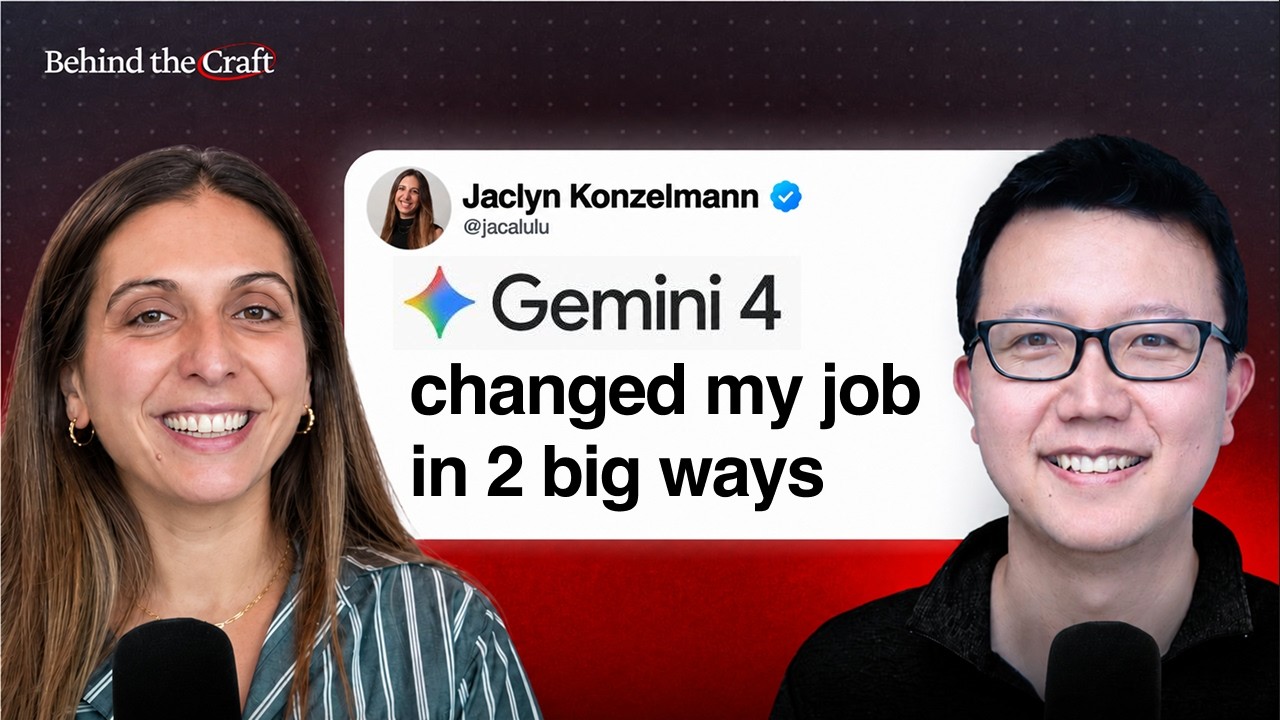
Google Labs Reshapes Product Playbook as AI Code Erases Software Moats
Peter Yang
Because frontier AI models make code virtually free and easily replicated by agents over a weekend, product durability now depends on proprietary user context and network effects rather than standalone software interfaces.
Gemini 4 has shifted the core product question at Google Labs from whether an idea is technically buildable to whether it genuinely deserves to exist. (0:00)
Google Labs enforces a strict rule against AI-generated document slop: authors are barred from producing materials that take readers longer to consume than the author spent drafting them. (7:48)
Because raw code is effectively free and easily replicated by weekend AI agent scaffolding, long-term software durability must rely on proprietary context and network effects rather than standalone UIs. (17:43)
Experimental projects in Google Labs are sunset without being branded as failures; code, infrastructure, and extracted lessons are shared across the team at Labs Live to seed future iterations. (12:53)
Detailed notes
## Background
Published on YouTube by Peter Yang on November 1, 2026, this interview features Jaclyn Konzelmann, Product Director at Google Labs. According to the page description, the discussion covers how Gemini 4 transformed Jaclyn's product management role, how she keeps low-quality AI slop out of her team's documentation and products, and how she leverages AI to foster creativity while raising her three children.
## TL;DR
Jaclyn Konzelmann details how frontier models like Gemini 4 have fundamentally altered product development at Google Labs, moving teams away from traditional 40-page PRDs toward rapid prototyping, concise strategy docs, and deep co-creation with end users. She outlines the Labs culture of treating killed experiments as learning assets rather than failures, with successful capabilities graduating into core services like the Gemini app. The discussion examines product defensibility in a world where code is practically free, arguing that true durability rests on context, network effects, and eliminating user toil while preserving joy in creative agency. Finally, Jaclyn shares how she integrates AI at home to turn screen time from passive consumption into active creation, co-producing original podcasts, games, and music with her young children.
## Atmosphere & style
The conversation carries an energetic, pragmatic, and collegial tone, feeling like an authentic hallway brainstorm between two seasoned tech veterans rather than a rehearsed corporate PR segment. Peter Yang's curious, relatable questioning pairs naturally with Jaclyn's grounded, candid reflections on organizational culture, unvarnished rules against AI bloat, and the reality of modern product leadership. The narrative seamlessly transitions from high-level frontier AI strategy to warm, humorous domestic anecdotes—such as debugging Strava GPS glitches on family hikes and producing banana slug songs—giving the dialogue an inspiring, thoughtful, and human-centric atmosphere.
## Bulletin
- [00:00](https://www.youtube.com/watch?v=eJ2XC9-9-rU&t=0s) Gemini 4 has shifted the core product question at Google Labs from whether an idea is technically buildable to whether it genuinely deserves to exist.
- [07:48](https://www.youtube.com/watch?v=eJ2XC9-9-rU&t=468s) Google Labs enforces a strict rule against AI-generated document slop: authors are barred from producing materials that take readers longer to consume than the author spent drafting them.
- [17:43](https://www.youtube.com/watch?v=eJ2XC9-9-rU&t=1063s) Because raw code is effectively free and easily replicated by weekend AI agent scaffolding, long-term software durability must rely on proprietary context and network effects rather than standalone UIs.
- [12:53](https://www.youtube.com/watch?v=eJ2XC9-9-rU&t=773s) Experimental projects in Google Labs are sunset without being branded as failures; code, infrastructure, and extracted lessons are shared across the team at Labs Live to seed future iterations.
## Key takeaways
- [00:00](https://www.youtube.com/watch?v=eJ2XC9-9-rU&t=0s) Product management at Google Labs has replaced 40-page PRDs with concise strategy documents, presentation decks for casual alignment, and rapid interactive prototypes.
- [02:11](https://www.youtube.com/watch?v=eJ2XC9-9-rU&t=131s) Google Labs evaluates product bets through a strict hierarchy championed by Josh Woodward: users first, Google second, and Labs third.
- [04:02](https://www.youtube.com/watch?v=eJ2XC9-9-rU&t=242s) Building AI tools for small businesses requires translating complex prompt engineering into accessible, repeatable interfaces through co-creation workshops with real owners.
- [07:48](https://www.youtube.com/watch?v=eJ2XC9-9-rU&t=468s) Effective strategy documents average about one and a half pages; length beyond that typically indicates an author has not honed the core narrative enough to communicate clearly.
- [10:45](https://www.youtube.com/watch?v=eJ2XC9-9-rU&t=645s) Google maintains a distinct charter for Google Labs to invent the future, while regularly graduating successful experiments like NotebookLM and CC into mainstream Gemini app features.
- [12:53](https://www.youtube.com/watch?v=eJ2XC9-9-rU&t=773s) The cultural mantra 'keep the lessons, not the prototype' allows teams to sunset experiments without fear of failure and share findings across the organization at Labs Live.
- [15:42](https://www.youtube.com/watch?v=eJ2XC9-9-rU&t=942s) Internal recurring forums like M&Ms (Methods and Metrics) ensure builders continuously cross-pollinate learnings, pairing AI brainstorming with direct human peer reviews.
- [20:00](https://www.youtube.com/watch?v=eJ2XC9-9-rU&t=1200s) As software consumers increasingly become autonomous agents rather than humans operating visual interfaces, products must eliminate toil behind the scenes without stripping away joyful touchpoints.
- [21:42](https://www.youtube.com/watch?v=eJ2XC9-9-rU&t=1302s) Voice dictation during outdoor walks has largely replaced desk-bound typing as Jaclyn's primary modality for structuring thoughts and drafting strategy docs.
- [24:00](https://www.youtube.com/watch?v=eJ2XC9-9-rU&t=1440s) In parenting, Jaclyn balances intentional real-world friction and boredom with AI tools that empower her young children to act as creative directors of original podcasts and games.
- [25:01](https://www.youtube.com/watch?v=eJ2XC9-9-rU&t=1501s) For children growing up with generative tools, digital creations only feel authentic when they can be published and shared socially with peers rather than kept private.
- [31:29](https://www.youtube.com/watch?v=eJ2XC9-9-rU&t=1889s) Frontier models are shifting user expectations from delegating single discrete prompts to 'hiring' end-to-end autonomous agents that handle entire workflows.
- [32:23](https://www.youtube.com/watch?v=eJ2XC9-9-rU&t=1943s) The biggest friction point for mainstream users remains the blank prompt box, placing the burden on product teams to design interfaces that proactively guide and reveal model capabilities.
## Detailed walkthrough
### [00:00](https://www.youtube.com/watch?v=eJ2XC9-9-rU&t=0s) How Gemini 4 Changed the PM Role at Google Labs
Peter Yang introduces Jaclyn Konzelmann, Product Director at Google Labs, highlighting the group as “arguably one of the fastest moving teams inside Google.” Following the recent launch of Gemini 4, Jaclyn explains that the model has reshaped her product management role and team operations in two fundamental dimensions. First, it has vastly widened the surface area of what can be built, prompting the team to step back, recalibrate, and determine which concepts are actually worth pursuing. Second, it has transformed daily tactical workflows: because model power has reached a threshold where technical feasibility is largely assumed, the primary challenge is no longer about technical execution, but whether a product genuinely deserves to exist.
```mermaid
flowchart TD
accTitle: Evolution of the Google Labs PM Starting Point
accDescr: Shift from traditional long-form PRDs to a three-pronged workflow of strategy docs, presentations, and interactive prototypes.
subgraph Traditional["Old Workflow"]
A["40-page PRD"]
end
subgraph Modern["Gemini 4 Era Workflow"]
B["High-Level Strategy Doc<br/>(What, Why, Importance)"]
C["Presentation Deck<br/>(Reviews & Casual Hallway Alignment)"]
D["Interactive Prototype<br/>(Fast Gauge of User Excitement)"]
end
A -.->|"Replaced By"| Modern
```
Instead of drafting the dense, 40-page Product Requirement Documents (PRDs) common earlier in her career, Jaclyn now anchors early product initiatives around three lighter, faster artifacts:
- **A high-level strategy document**: Centers on the big-picture questions—what the team is building, why they are building it, why it matters now, and aligning everyone on the total opportunity space.
- **A presentation deck**: Serves both structured product reviews and spontaneous discussions, such as running into colleagues at the microkitchen (MK) or in the hallways to bounce concepts around.
- **An interactive prototype**: Deployed prior to any production-grade engineering to gauge real excitement and test assumptions quickly.
As Jaclyn Konzelmann observes: “Number one, with a model like this and as the models get more powerful, it's really no longer a question of can the models do it or can we build it. It's a question of is it worth existing? Should we build it?”
---
[02:11](https://www.youtube.com/watch?v=eJ2XC9-9-rU&t=131s) The Triad Philosophy and Idea Generation at Labs
Google Labs operates across a wide spectrum, launching products for small and medium-sized businesses (SMBs) as well as everyday consumers. Jaclyn outlines the team's internal philosophy, heavily championed by VP of Product Josh Woodward:
1. **Users first**
2. **Google second**
3. **Labs third**
Under this framework, ideas are evaluated through two primary lenses. The first lens looks at emerging model capabilities to determine whether a brand-new product category is unlocked or if a previously unviable idea is now feasible. The second lens monitors shifting human behaviors: as individuals integrate generative AI into everyday life, new habits emerge, creating fresh white space for tailored solutions. Rather than merely documenting what people do today, the team aims to predict where behaviors are heading and place deliberate bets on that trajectory.
---
[04:02](https://www.youtube.com/watch?v=eJ2XC9-9-rU&t=242s) Co-Creation and Grounding AI for SMBs: The Pomelli Case
Peter and Jaclyn discuss the origin of Pomelli, a Labs project aimed at SMBs. While technical feeds on X were saturated with highly complex, multi-step prompt engineering to produce branded visuals, Jaclyn recognized that typical small business owners—drawing on the experience of her own parents who ran small businesses—simply do not have the time to learn advanced prompting or start from scratch every session. The challenge was translating raw image model capabilities into a repeatable, accessible product shape that captures a company's specific brand identity without demanding heavy technical effort.
Peter cautions against the tendency of Silicon Valley product managers to build from “ivory towers,” assuming every customer will comfortably navigate complex terminal or agent interfaces. Jaclyn emphasizes that Labs counters this bias through deep co-creation with end users:
- The team pairs directly with marketing professionals, business owners, and trusted tester cohorts throughout development.
- Product launches almost always feature a partner brand that was actively involved in shaping the tool.
- For team on-sites (such as when the Mountain View and New York teams assemble), Labs organizes hands-on workshops where local SMB owners test raw builds live in front of engineers and PMs.
Jaclyn notes that while customer input is foundational, PMs must interpret requests carefully rather than implementing surface-level feature asks. As Jaclyn Konzelmann points out: “I think it's interesting because that is so important and then the hard part now is also you hear everything they want but don't just give them exactly what they want like think about what the root problem is they're trying to solve and then solve it in a way that they probably wouldn't have thought to solve it and that's when you get that like delight factor the second somebody uses it you kind of walk away being like, 'Oh, I didn't think that this was possible, but this is actually exactly what I wanted.'”
[07:48](https://www.youtube.com/watch?v=eJ2XC9-9-rU&t=468s) The Doc Rule: Keeping AI Slop Out of Strategy Documents
When Peter asks whether writing strategy documents involves checking bureaucratic boxes or if Google Labs operates in a nimbler way under leadership like Josh Woodward, who loves moving fast, Jaclyn clarifies that moving fast does not mean being careless with writing. Crafting a real strategy document still demands deep time and contemplation. The author must sit with the ideas to ensure they are genuinely worth someone else’s time to read. Because AI makes it trivial to churn out ten-page strategy docs instantly, the hard work now lies in honing thoughts down, trimming excess, and discovering the core narrative that resonates. Once that clarity is unlocked, building alignment across the team becomes effortless.
Peter shares the frustration of reading halfway through a document and realizing it is hollow AI-generated text. Jaclyn acknowledges that this was widespread in the early days of generative tools, prompting her to establish strict personal rules. Quoting a sharp rule she heard at a recent San Francisco tech event, she stresses:
> “And one of these actually I got from talking to somebody during an SF tech event last week, but I just love the way they summarized it, so I’m going to requote them, which was basically if it takes somebody longer to read the thing you produced than it took you to produce it, not allowed.”
She flags unearned length as an immediate indicator that the author did not bother reading their own writing. Authors must be able to defend every single word and carry on an active conversation about the substance. Whenever a document feels flabby or sprawling, she sends it back with instructions to take another pass. While Peter advocates for crisp one-pagers, Jaclyn jokes that her documents average about one and a half pages these days—and anything beyond that signals the idea has not yet been refined enough to communicate clearly.
- AI tools should serve as intellectual thought partners rather than substitutes for an author's own thinking.
- High-quality strategy documents at Google Labs must be defendable line by line in discussion.
- If a document runs beyond one and a half pages, the core idea typically needs further sharpening.
---
[10:45](https://www.youtube.com/watch?v=eJ2XC9-9-rU&t=645s) How Google Labs Feeds the Gemini App
Peter poses a harder question about product focus: with so much experimentation happening in Labs, why doesn't the team just concentrate directly on improving the Gemini app, or let experiments serve only that goal? Jaclyn explains that Google intentionally separates responsibilities so distinct teams can excel. An autonomous Gemini app team focuses on that core surface, while Google Labs is explicitly chartered to invent and build for the future.
Even so, Labs frequently feeds the Gemini app in tangible ways, whether through raw learning, shared cultural frameworks, or direct feature graduations:
```mermaid
flowchart TD
accTitle: Labs to Gemini App Pipeline
accDescr: Diagram illustrating how Labs experiments influence the Gemini app through learnings, code, and direct feature graduations.
subgraph LABS["Google Labs (Inventing the Future)"]
EXP["Experimental Prototypes<br/>(NotebookLM, CC)"]
LRN["Insights, Learnings & Mindset"]
end
subgraph APP["Gemini App"]
NOTEBOOKS["Gemini Notebooks<br/>(Powered by NotebookLM)"]
BRIEFING["Daily Briefing<br/>(Derived from CC)"]
FAMCC["Family CC Integration"]
end
Jaclyn highlights several examples where Labs projects transitioned directly into mainstream products:
- **NotebookLM**: Graduated capabilities into the Gemini app as Gemini Notebooks.
- **CC**: An experiment launched the previous year that helped shape the Daily Briefing feature in the Gemini app.
- **Family CC**: A recent follow-up iteration expanding the original concept into family-focused workflows.
Deciding whether an experiment should graduate, pivot, or be sunsetted is handled on a case-by-case basis. Rather than relying on top-down directives, Google Labs places the decision in the hands of the project team itself. Because those builders are deeply immersed in the problem space, they have the contextual awareness to know whether to scale the project, graduate it, or harvest its components for the next iteration.
---
[12:53](https://www.youtube.com/watch?v=eJ2XC9-9-rU&t=773s) “Keep the Lessons, Not the Prototype”: The Psychology of Killing Experiments
Killing a product is notoriously difficult for product managers, who naturally develop emotional attachments to their work. Jaclyn explains that navigating this requires building a specific muscle reinforced by Google Labs' culture. The team relies on shared mantras to guide their work, notably “build to learn” and one of her personal favorites:
> “We also another favorite saying of mine is keep the lessons not the prototype.”
Ending an experiment is never viewed as an institutional failure. Instead, teams conduct retrospective deep-dives to extract their learnings and present them at **Labs Live**, the all-hands gathering held periodically across the organization. During these sessions, teams whose experiments have ended share what they discovered with colleagues tackling similar spaces from new angles. Furthermore, the underlying infrastructure, code, and insights are frequently harvested and repurposed across other Labs efforts.
```mermaid
flowchart LR
accTitle: Lifecycle of a Concluded Experiment
accDescr: How Google Labs treats killed experiments by extracting insights and repurposing assets instead of declaring failure.
subgraph END["Experiment Concludes"]
A["Sunsetting Prototype"]
end
subgraph HARVEST["Value Extraction"]
B["Labs Live Presentations"]
C["Reusable Infrastructure & Code"]
D["Strategic Lessons"]
end
subgraph FUTURE["Next Generation"]
E["New Labs Initiatives"]
F["Informed Product Bets"]
end
A --> B
A --> C
A --> D
B --> E
C --> E
D --> F
```
Peter and Jaclyn discuss the alignment between organizational culture and individual career incentives. Peter notes that when product managers stop worrying about performance politics and simply obsess over product quality and learning, career progression takes care of itself—a mindset Jaclyn endorses. She credits Vice President Josh Woodward for establishing an environment of natural curiosity that attracts people who thrive in open-ended, autonomous settings.
When Peter asks how Josh handles disappointment or whether he gets angry when projects fall short, Jaclyn describes him as relentlessly positive. Rather than chastising teams, he focuses on empowering them: when team members genuinely care about their products, they hold themselves to a much higher standard than any top-down reprimand could enforce.
[15:42](https://www.youtube.com/watch?v=eJ2XC9-9-rU&t=942s) Building a Safe, Collaborative Culture at Google Labs
Jaclyn describes the internal culture they strive to cultivate inside Google Labs—one where people are encouraged to ship boldly without fear of failure. Reflecting on her own mindset, she admits she tends to be her own harshest critic. Because of that, she approaches product building with the perspective that when an initiative takes an unexpected turn, the team simply learns, discusses the roadblocks openly, and course-corrects together. Peter agrees, emphasizing that building consumer tech is not life-or-death; everyone is ultimately working toward the shared goal of delivering great user experiences.
To ensure teammates never feel isolated or blocked, Google Labs relies heavily on peer knowledge-sharing. Jaclyn highlights an internal recurring forum they run called “M&Ms” (Methods and Metrics), where teams present what they have built, share key learnings, and cross-pollinate ideas across the organization. While she strongly endorses turning to AI models for early-stage brainstorming, she stresses that it cannot replace connecting with smart colleagues. Peter relates, noting that as helpful as AI models can be, bouncing ideas off actual human beings offers a depth of insight that technology alone still cannot match—prompting Jaclyn to add that she regularly attends industry events beyond Google just to bounce ideas off outside builders.
> “I think there's always a positive way to look at situations because at the end of the day we're all here to try to build great things for the users.” — Jaclyn Konzelmann
- **M&Ms (Methods and Metrics):** Internal knowledge-sharing sessions where Google Labs teams showcase current experiments, exchange methodology, and unblock one another.
- **Brainstorming Stack:** Jaclyn recommends using AI for initial brainstorming passes, but pairing it heavily with teammates and external industry peers.
---
[17:43](https://www.youtube.com/watch?v=eJ2XC9-9-rU&t=1063s) Moving Past Disposable Code: What Makes a Durable Product?
Peter points out an emerging bottleneck in engineering: developers are pushing so much AI-generated code—and relying on AI to review it—that it becomes difficult to track what is actually happening. He asks whether product management is facing a similar shift. Jaclyn confirms that the PM bottleneck has evolved fundamentally: because code is virtually free and teams can spin up dozens of experiments in days, the central challenge is no longer *how* to build, but *what* product categories are even worth building.
In an agent-first paradigm, products must be durable rather than disposable. Jaclyn warns that many things historically sold as standalone products can now be easily replicated by throwing a couple of AI agents at the problem over a weekend. True product durability cannot rest on the code itself, which is quickly becoming a cheap abstraction. Instead, builders must look toward structural advantages like data context and network effects. Furthermore, as software consumers increasingly turn out to be autonomous agents operating on behalf of people—rather than people staring directly at a graphical user interface—teams must radically reconsider whether their offering even requires a front-end UI.
```mermaid
flowchart TD
accTitle: The Shifting Nature of Product Durability
accDescr: Diagram illustrating how cheap code lowers the barrier to build features, shifting true durability toward context and network effects in an agent-first world.
> “And I think a lot of things that used to be products before could be easily reproducible throw a couple agents at it over a weekend. So, that's not a durable product.” — Jaclyn Konzelmann
> “And then you can figure out products that might fit in there but also figure out what is the durability of them and the code itself is not the durability of them.” — Jaclyn Konzelmann
---
[20:00](https://www.youtube.com/watch?v=eJ2XC9-9-rU&t=1200s) Rethinking Interfaces: Creative Agency vs. Everyday Toil
As Peter observes users in tech hubs bypassing apps and websites altogether in favor of direct API agent interactions, Jaclyn outlines a clear heuristic for where traditional user interfaces still matter versus where they should vanish. Humans will continue to demand rich, interactive UI when engaging in activities they genuinely enjoy: creative projects with their children, learning new skills, or being entertained. Conversely, users will gladly hand off tedious, administrative chores—such as tax filings, PDFs, and small-business paperwork—to autonomous agents.
At the same time, shifting user behavior introduces delicate social boundaries. Peter laughs about an awkward experience where he gave product feedback to an AI research lab, only to receive an automated response from an agent instead of a human founder, leaving him feeling slightly dismissed. Jaclyn points out that these social norms are actively evolving in real time as consumers figure out where they want synthetic delegation versus authentic human connection.
> “Anything that involves me creating something, I have a lot of fun doing creativity projects with my kids. Anything where I want to learn something, there might be a reason for me to interact. Anything I want to or anytime I want to be entertained or consume something, I'm still the one using the product.” — Jaclyn Konzelmann
---
[21:42](https://www.youtube.com/watch?v=eJ2XC9-9-rU&t=1302s) Agent-Assisted Workflows and Voice-First Living
Jaclyn shares a personal anecdote illustrating the boundary between joyful usage and administrative friction. While hiking near Yosemite with her daughters—including her three-and-a-half-year-olds completing the trek on foot for the first time—she recorded the journey on Strava. When an errant GPS glitch distorted the route map, fixing it required downloading the raw GPX file, manually slicing out corrupted coordinates, re-stitching the tracks, and re-uploading the clean file. Rather than wading through the tedious repair, she tasked an agent to execute the entire fix over the raw file. Yet, she still values opening the Strava app directly to check her friends' athletic activity feed. Products must learn to absorb user toil behind the scenes without stripping away the joyful touchpoints.
Peter and Jaclyn close this part of the conversation discussing how this division of labor frees up daily life. Peter notes that both of their young daughters love drawing and painting; in an agent-powered future, a parent can spend uninterrupted hours painting with their kid, occasionally dictating work tasks to background agents via audio. Jaclyn agrees wholeheartedly, revealing that voice dictation has completely overtaken typing as her primary modality for thinking and working. Rather than remaining glued to a desk, she captures overflowing voice memos and directs projects while walking laps around the Google campus.
> “And full disclosure, I absolutely did throw my agent at it. It fixed everything. But I do still like seeing a feed of what my friends have accomplished. So it's not that I don't want to use Strava. It's just I didn't want to use it in that particular case.” — Jaclyn Konzelmann
> “I am such a big fan of voice. Like that has become my primary way of getting thoughts out of my head and into whatever I happen to be using.” — Jaclyn Konzelmann
[23:29](https://www.youtube.com/watch?v=eJ2XC9-9-rU&t=1409s) Walking, Yapping, and Drafting Strategy Docs
Jaclyn Konzelmann explains how stepping outside and speaking aloud helps unblock her thinking when shaping product direction. She walks and talks freely into her voice recorder to offload raw thoughts, returning to her desk only afterward to massage the transcript into a finished work product. Most of her strategy documents actually originate this way. Peter Yang agrees that being outdoors clears the mind for unrestrained rambling or "yapping," though he jokes that passersby might find it strange to see someone walking alone and talking animatedly to themselves.
Jaclyn points out that society has already normalized hands-free phone conversations, making it easy to blend in: “So now I just assume they think I'm talking to somebody on the other side right now.”
[24:00](https://www.youtube.com/watch?v=eJ2XC9-9-rU&t=1440s) Raising Kids with AI: Manufacturing Friction vs. Limitless Imagination
Turning the conversation toward parenting, Peter asks Jaclyn—who is raising a five-year-old daughter and three-and-a-half-year-old twins—how she navigates parenting in an era saturated with technology and artificial intelligence. Jaclyn explains that she balances two distinct philosophies. On one hand, she intentionally forces her kids outdoors, lets them experience boredom, and manufactures friction so they build emotional resilience in a world where software makes everything effortless. On the other hand, she uses AI as an engine to show them that whatever they imagine can be realized.
As Jaclyn puts it: “In a world where things are easier and easier to do, I want to make sure that my kids still have that muscle to endure friction because there will still be frictional points that occur in your life. But then when it comes to how I incorporate AI into my day-to-day with them... I want them to grow up in a world where they think anything is possible.”
```mermaid
flowchart TD
accTitle: Dual Parenting Philosophy with AI
accDescr: Diagram illustrating Jaclyn's split approach between physical-world friction and AI-enabled creative agency.
subgraph Friction["Real-World Foundation"]
A["Outdoor Play & Boredom"] --> B["Manufactured Friction"]
B --> C["Resilience & Enduring Frustration"]
end
subgraph Imagination["AI Creative Studio"]
D["Child's Raw Imagination"] --> E["Voice & Image Generation Models"]
E --> F["Interactive Games, Podcasts & Music"]
F --> G["Shared Real-World Artifacts"]
end
```
[25:01](https://www.youtube.com/watch?v=eJ2XC9-9-rU&t=1501s) The 5-Year-Old Podcast Director and Making Banana Slug Songs "Real"
To keep her eldest daughter engaged when they exhausted their usual podcast lineup, Jaclyn invited her to produce an original scary stories podcast. Her five-year-old acts as the creative director: selecting voices using ElevenLabs (and experimenting with Gemini's new text-to-speech model), naming characters, refining visuals generated through image models, and shaping storylines. Once a draft is compiled, her daughter listens to the cut, offers feedback, and Jaclyn passes the revision requests to an AI agent to remix the audio. The completed episodes are published straight to Spotify.
Publishing publicly stemmed from an earlier project making music with Google's MusicFX (formerly MusicLM / Flow Music). After a family camping trip to Redwood National Park, they composed a humorous song about banana slugs. Her daughter surprised her by asking if the song was "real." When Jaclyn assured her it was real because they were listening to it in the car, her daughter countered: "No, but like, can my friends listen to it?" Jaclyn realized that for the next generation, digital artifacts feel authentic only when they can be distributed and shared socially with peers.
- **Podcast production workflow:** Child conceives plot and characters $\rightarrow$ Voice design in ElevenLabs / Gemini TTS $\rightarrow$ Character artwork via image generation $\rightarrow$ Review audio cut $\rightarrow$ Agentic audio remixing based on critique $\rightarrow$ Spotify distribution.
- **Inspiration source:** A family camping trip to Redwood National Park sparked their first track about banana slugs.
[26:30](https://www.youtube.com/watch?v=eJ2XC9-9-rU&t=1590s) One-Shot Marble Runs, Petting Zoos, and Creation over Consumption
Jaclyn describes recent experiments using Gemini Argon to whip up interactive software on a whim. Because her children love marble run videos—which her physics-minded husband encourages as an intuitive lesson in mechanics—she used Argon to one-shot an entire marble run video, with plans to let the kids customize track colors. Later that morning, waking up early before work, she used a few natural-language prompts to build an interactive 3D petting zoo game featuring six unusual animals that recite educational facts when approached.
Peter and Jaclyn emphasize that screen time shifts entirely when children become builders rather than passive consumers of algorithmically delivered short-form video:
> “Honestly, I think it just connects different parts of your brain when you're actively involved in the creation point. And like 100% agree with like if you're being productive and you're learning and you're challenging yourself, like that's what I want to see them using AI for, not just like as a way to make their life easier right now.” — Jaclyn Konzelmann
Peter reflects on how he coded basic games on the Apple II in his youth but dismissed it as an unrealistic career path, assuming he needed a conventional job in investment banking. Today, he encourages his children to publish their work online and see if they can earn money from their ideas. Jaclyn agrees that connecting early curiosity to real-world agency helps children recognize that they can intentionally design the life they want to lead.
[29:50](https://www.youtube.com/watch?v=eJ2XC9-9-rU&t=1790s) The Next Class of Gemini Models at Google Labs
Peter asks Jaclyn what excites her most looking ahead, referencing Gemini Argon and Google's internal development of next-generation Gemini models. On the family side, Jaclyn notes that her only bottleneck is time; she has a continuous stream of ideas and looks forward to her children becoming full collaborators as they grow older.
On the Google Labs side, Jaclyn feels a distinct phase shift in capabilities with current frontier models: “This next class of models that feels different. The possibilities are so much bigger. And I'm really excited that we get to be in a place where we can think about what that future is and start working towards it.” She highlights that the strongest product breakthroughs occur when an unexpected technical affordance intersects directly with genuine human need, yielding experiences that make users stop and reconsider what software can do.
[31:29](https://www.youtube.com/watch?v=eJ2XC9-9-rU&t=1889s) Shifting Expectations: From Task Automation to Hiring Agents
Peter Yang reflects on the dramatic evolution in how people relate to frontier AI models, observing that the technology has advanced to the stage where interacting with an AI feels less like automating a single discrete task and more like bringing on a full team member. He explains that his personal mental model has transformed: rather than prompting a model to draft a quick reply for a specific customer support ticket, he now approaches it as hiring an entire customer support agent tasked with managing the whole workflow from end to end.
Jaclyn Konzelmann agrees, noting that this highlights a profound behavioral shift compared to how either of them talked about artificial intelligence just twelve months earlier. She points out that user expectations are rapidly advancing as people reimagine how AI can integrate into their day-to-day lives. While different customer segments still hold diverse preferences and technical appetites, keeping pace with these fast-moving behaviors requires constant recalibration when evaluating what Google Labs should build next.
- “I think it's an interesting behavior shift even in the way you're talking about it right now versus what likely were talking about AI a year ago, even myself.” — Jaclyn Konzelmann
- “And you're right, I think like us as users are we're changing our expectations. They're rapidly shifting and the way we're thinking about how we want to apply it into our lives is changing.” — Jaclyn Konzelmann
[32:23](https://www.youtube.com/watch?v=eJ2XC9-9-rU&t=1943s) Solving the Blank Prompt Box and Wrapping Up
Turning toward the responsibilities of product teams, Peter suggests that an essential part of Google Labs' mission is educating mainstream, less tech-savvy users so they realize how capable current models are and feel empowered to delegate ambitious tasks. Jaclyn refines the point, emphasizing that simply telling users they can request more is rarely enough. The primary barrier for most everyday users remains the dreaded blank prompt box: confronted with an empty text field, people freeze because they do not know what questions to pose or what capabilities exist. For Jaclyn, the real product challenge is designing intuitive, delightful interfaces and scaffolded experiences that proactively reveal value rather than leaving users stranded at an empty cursor.
Wrapping up the conversation, Peter asks where listeners can follow Jaclyn's work online. She directs people to her presence on LinkedIn, Substack, and her handle on X (@jacalulu), jokingly warning listeners not to ask about the handle because “there's a backstory behind that one.”
- “How do you solve that in a delightful way so that people are getting the most out of them cuz there's so much value that can be gotten out of them.” — Jaclyn Konzelmann
- Jaclyn can be found online writing on Substack, networking on LinkedIn, and posting on X under the handle `@jacalulu`.
## Notable quotes
> [00:00](https://www.youtube.com/watch?v=eJ2XC9-9-rU&t=0s) as the models get more powerful, it's really no longer a question of can the models do it or can we build it. It's a question of is it worth existing? Should we build it? — Jaclyn Konzelmann
> [24:00](https://www.youtube.com/watch?v=eJ2XC9-9-rU&t=1440s) In a world where things are easier and easier to do, I want to make sure that my kids still have that muscle to endure friction because there will still be frictional points that occur in your life. — Jaclyn Konzelmann
## Mentioned
Google, Google Labs, Peter Yang, Jaclyn Konzelmann, Josh Woodward, Gemini 4, Gemini 4 Carbon, Gemini Argon, NotebookLM, Gemini Notebooks, CC, Family CC, Daily Briefing, Pomelli, Spotify, ElevenLabs, MusicFX, MusicLM, Flow Music, Strava, Apple II, Wispr Flow, Riverside, X, Substack, LinkedIn, Redwood National Park, Yosemite
## Video description
Jaclyn is a product director at Google Labs and we had a great chat about how Gemini 4 changed her product job, how she keeps AI slop out of her team's docs and products, and how she's raising three kids with AI's help. Gemini 4 Carbon is currently the best model in the world based on benchmarks, and it was fun to get a sneak peek into how Google's own product leaders use it internally.
Jaclyn and I talked about:
(00:00) How Gemini 4 changed the PM job at Google
(02:11) Should it even exist? How Google Labs picks what to build
(09:16) The doc rule that keeps AI slop out of Google Labs
(10:45) Which Labs experiments graduated into the Gemini app
(12:53) Why Google Labs never treats a killed experiment as failure
(17:43) Code is free, so what's actually worth building?
(24:00) Her 5-year-old is the creative director of their AI podcast
(26:30) Best screen time for kids: Creation, not consumption
Thanks to our sponsors:
Wispr Flow: 4x faster than typing with your voice https://ref.wisprflow.ai/peteryang
Riverside: All-in-one AI studio for podcasts and video https://creators.riverside.com/PeterYang
📌 Get the takeaways: https://creatoreconomy.so/p/gemini-4-changed-how-google-builds-products-jaclyn-konzelmann
AI编码消除软件护城河,Google Labs重塑产品策略
由于前沿AI模型使代码几乎零成本,且容易被智能体在周末快速复刻,产品的持久竞争力如今取决于专有的用户情境与网络效应,而非孤立的软件界面。
Jaclyn Konzelmann详细介绍了像Gemini 4这样的前沿模型如何从根本上改变了Google Labs的产品开发模式,促使团队告别传统的40页PRD,转向快速原型制作、简明战略文档以及与最终用户的深度共创。她概述了Labs将叫停的实验视为学习资产而非失败的文化,其中成功孵化的能力会整合进Gemini应用等核心服务。讨论还探讨了在代码几乎完全免费的世界中产品的防御壁垒,认为真正的持久力在于上下文情境、网络效应,以及在消除用户繁琐操作的同时保留创作自主权带来的乐趣。最后,Jaclyn分享了她在家庭中如何利用AI将屏幕时间从被动消费转变为主动创造,与年幼的孩子共同制作原创播客、游戏和音乐。
Gemini 4已将Google Labs的核心产品考量,从某个想法在技术上是否可行,转变为它是否真正值得存在。 (0:00)
Google Labs对AI生成的劣质文档执行严格规定:作者被禁止产出需要读者花费比作者撰写还要多时间去阅读的材料。 (7:48)
由于原始代码实际上已经免费且极易在周末被AI智能体搭建复刻,软件的长期持久力必须依托专有情境和网络效应,而非独立的UI。 (17:43)
Google Labs的实验性项目在关停时不会被贴上失败的标签;代码、基础设施以及吸取的经验教训都会在Labs Live上向全团队共享,以此为未来的迭代奠定基础。 (12:53)
Reading summary
Jaclyn Konzelmann, Product Director at Google Labs, argues that advanced models like Gemini 4 have shifted product management from asking whether something is technically buildable to questioning whether it genuinely deserves to exist.
Replacing 40-Page PRDs with Lightweight Artifacts (0:00)
Because model capabilities now allow technical feasibility to be largely assumed, Google Labs has abandoned traditional 40-page Product Requirement Documents (PRDs). Instead, PMs anchor early initiatives around three concise artifacts: a strategy document averaging about one and a half pages that clarifies the core narrative, a presentation deck for formal reviews and casual hallway alignment, and an interactive prototype built to test real user excitement before committing production engineering resources.
Filtering AI Slop and Cultivating Team Learning (7:48)
To counter low-effort AI writing, Konzelmann enforces a strict standard: any document that takes longer to read than it took to produce is disallowed, and authors must be able to defend every line. Strategy documents originate via outdoor walking and voice memos rather than desktop typing, focusing on clarity over volume. Internal reviews demand iterative trimming, treating excessive length as a failure to refine the underlying idea.
Experimentation, Feature Graduation, and Retiring Prototypes (10:45)
Operating under a hierarchy of 'users first, Google second, Labs third,' Google Labs functions as an autonomous exploratory unit distinct from the core Gemini app team. Experiments regularly feed into core products—such as NotebookLM graduating into Gemini Notebooks, and the CC experiment evolving into the Daily Briefing. Projects are discontinued without stigma under the operational mantra 'keep the lessons, not the prototype,' sharing findings across regular forums like Labs Live and internal 'Methods and Metrics' (M&Ms) sessions.
Defining Product Durability in an Agent-First World (17:43)
With code becoming virtually free and easily replicable over a weekend, Konzelmann contends that software durability can no longer stem from the codebase itself. Instead, long-term defensibility relies on structural assets like data context and network effects. Furthermore, while automated agents can absorb administrative toil—such as repairing corrupted GPX files or handling routine forms—human users will still demand direct interfaces for creative exploration, learning, and entertainment.
Eliminating the Blank Prompt Box for End Users (32:23)
As user expectations shift from prompting individual tasks to managing end-to-end autonomous agents, the primary friction point remains the empty prompt cursor. For non-technical audiences, including small business owners, Labs aims to co-create specialized workflows rather than expecting users to master complex prompt engineering. The challenge for builders is designing scaffolded, intuitive interfaces that reveal agent capabilities without forcing users to navigate an unguided blank text field.
While advanced models lower the cost of software creation to near zero, product durability hinges on identifying genuine human problems rather than shipping easily duplicated agent wrappers. Builders must navigate evolving social norms around synthetic delegation while replacing blank prompt boxes with intuitive, scaffolded user experiences.
精炼阅读摘要
Google Labs 产品总监 Jaclyn Konzelmann 指出,随着 Gemini 4 等前沿模型大幅降低编码和技术实现门槛,产品管理的核心挑战已从“能否做出来”转向“该产品是否值得存在”,团队工作流正全面转向更轻量、重体验的原型迭代与真实共创。
淘汰长篇PRD与抵制空洞AI文本 (0:00)
在 Gemini 4 时代,Jaclyn Konzelmann 放弃了早年长达40页的产品需求文档(PRD),改为由高阶战略文档、演示文稿和交互原型组成的三轨工作流。高阶战略文档聚焦于产品是什么、为何要建以及为何当前重要;演示文稿用于正式评审及茶水间或走廊中的即兴探讨;可交互原型则在正式工程投入前快速验证用户兴奋度与假设。由于生成式 AI 能在瞬间产出长达十页的内容,团队的难点反而转变为精简思考、提炼核心叙事。
为防止战略文档充斥空洞的 AI 拼凑内容,Konzelmann 践行一项明确规则:如果读者阅读产出物所花费的时间超过作者制作它所花费的时间,该文档便不被允许存在。作者必须能为文档中的每一个词进行辩护并展开实质探讨。目前她的战略文档通常控制在一页半左右,超出这一篇幅往往意味着核心思考尚未打磨透彻,文档会被退回重写。此外,语音转录已取代打字成为她理清思路的主要手段,她常在园区散步时通过语音记录想法,再整理成战略初稿。
用户共创与破解空白提示词陷阱 (4:02)
Google Labs 秉持“用户第一、Google 第二、Labs 第三”的三元理念,从新模型能力与人类新兴行为模式两个维度评估产品构想。Konzelmann 强调产品经理必须走出“象牙塔”,避免预设中小企业(SMB)或大众用户懂得复杂的提示词工程或终端交互。以面向 SMB 的 Pomelli 项目为例,许多小商户没有时间从零调试复杂 Prompt,团队直接与营销人员、商户及受信任测试群体合作,甚至在 Mountain View 与纽约团队的线下活动中邀请本地商户进行实时测试,以发掘底层痛点。
针对当前大模型产品的落地瓶颈,Konzelmann 认为单纯告知用户模型功能强大远远不够,核心痛点在于“空白提示词输入框”(blank prompt box)。面对空无一物的光标,普通用户往往不知从何问起。产品设计的真正职责不是单纯给用户他们口头索要的表层功能,而是通过直观且富有巧思的交互界面,主动显性化模型价值,实现意料之外的惊喜。
代码贬值下的持久护城河与界面重构 (17:43)
随着 AI 生成代码令软件编写成本趋近于零,周末套用几个 Agent 就能复现的功能性产品正变得极易被淘汰。Konzelmann 提出,真正的产品持久性不再依赖代码本身,而取决于私有数据上下文与网络效应等结构性优势。在 Agent 优先的时代,甚至需要重新审视产品是否还需要图形前端(UI)。
对于传统用户界面的存续,Konzelmann 给出了清晰的判断标准:人类只有在享受创造、学习和娱乐过程时,才会持续需要丰富的交互界面;而在处理报税、PDF 整理或修复 GPS 轨迹等日常琐事(toil)时,用户会极乐意将其全权交给后台 Agent。产品设计应当在后台吸收这些摩擦力,同时保留带给用户乐趣和社交连接的触点。
保留经验而非原型与组织反哺 (10:45)
Google Labs 与负责主界面的 Gemini App 团队保持分工:独立团队专注核心应用,Labs 则承担面向未来的探索与发明。Labs 的实验成果通过多种路径反哺核心产品,例如 NotebookLM 衍生为 Gemini App 内的 Gemini Notebooks,先前的 CC 实验演化为每日简报功能(Daily Briefing)并进一步拓展为 Family CC。由深耕该领域的项目团队自主决定实验是毕业晋升、转向还是关停。
为了克服产品经理对项目的心理依恋,Labs 建立了“保留经验,而非原型”(keep the lessons, not the prototype)的文化认同。关闭实验不被视作失败,团队会在名为“Labs Live”的全员会上复盘分享发现,或在定期的“M&Ms”(Methods and Metrics)研讨会上交流方法,其沉淀的底层架构、代码和洞察会被后续项目重新利用。产品副总裁 Josh Woodward 倡导正向与自主的探索氛围,促使成员将精力聚焦于用户价值与产品学习,而非内部考核政治。
AI家庭教育实践与制造必要摩擦 (24:00)
在家庭教育中,面对一个由 AI 抹平所有难度的世界,Konzelmann 对年幼的孩子采取了双轨教育策略。一方面,她刻意让孩子体验户外无聊并制造摩擦(manufactured friction),以锻炼他们应对现实挫折的情绪韧性;另一方面,她将 AI 作为实现无限想象力的引擎,让孩子从被动的屏幕内容消费者转变为主动的创作者。
具体实践中,她让五岁的女儿担任原创故事播客的“创意总监”,由孩子构思角色与剧情,利用 ElevenLabs 及 Gemini 语音模型挑选声音,并通过图像生成模型设计视觉,最后交由 Agent 混音并发布至 Spotify。此外,她还利用 Gemini Argon 通过自然语言提示词单次生成弹珠轨迹视频及互动式 3D 动物园小游戏。这些实践表明,当数字内容能够被真正公开发布并与同龄人分享时,AI 工具便能有效建立起下一代的主体创造意识与现实行动力。
当前用户对 AI 的预期正从单点任务自动化转向端到端雇佣完整 Agent,然而在大模型能力急剧膨胀的背景下,如何帮助主流用户跨越空白光标的门槛、在消除琐碎事务的同时保留人性化的体验,仍是产品团队在下一代前沿模型演进中需要持续探索的课题。
Source quotes
[0:00] Jaclyn Konzelmann: as the models get more powerful, it's really no longer a question of can the models do it or can we build it. It's a question of is it worth existing? Should we build it?
[24:00] Jaclyn Konzelmann: In a world where things are easier and easier to do, I want to make sure that my kids still have that muscle to endure friction because there will still be frictional points that occur in your life.
Original transcript
[0:00] Jacine, thanks so much for joining me
[0:01] today. Really excited to talk to you.
[0:02] And for those of you who don't know,
[0:04] Jacqueline is a product director at
[0:06] Google Labs, arguably one of the fastest
[0:08] moving teams inside Google. Is that is
[0:09] that fair to say or?
[0:11] >> We do value our ability to move fast and
[0:13] get things into users hands.
[0:15] >> Awesome. Awesome. So, let's talk about
[0:16] Gemini 4 is is a big launch that
[0:18] happened, you know, a week or so ago.
[0:20] And how has it kind of changed your
[0:22] workflow as a PM and as a team?
[0:25] >> Yeah,
[0:25] >> you know, I would I would say it's kind
[0:27] of changed it in two big fundamental
[0:28] ways. The first is just expanding the
[0:31] surface area of what's possible to build
[0:33] and what's possible to exist and what's
[0:35] worth existing these days. And I think
[0:37] that's taken a moment for us to really
[0:40] recalibrate as a product team and just
[0:42] think about what are the things that are
[0:43] worth building. So there's a lot of time
[0:45] we've been spending around just the
[0:46] ideation phase and trying to plan out
[0:48] what's next and figure out what can we
[0:50] now achieve in this space. And then the
[0:52] other is the actual day-to-day tactical
[0:54] parts of the how do we do our actual
[0:56] job. And on that front, a couple things
[0:58] that we've kind of shifted towards I've
[1:00] noticed. Number one, with a model like
[1:02] this and as the models get more
[1:04] powerful, it's really no longer a
[1:06] question of can the models do it or can
[1:08] we build it. It's a question of is it
[1:10] worth existing? Should we build it?
[1:12] >> And so instead of starting with what I
[1:14] often refer to as the 40page PRD, of
[1:17] which I have written many of those early
[1:18] in my days as a PM, what I'm often times
[1:21] finding is better to start with is more
[1:23] of a highle strategy doc. something that
[1:25] really asks the question on what are we
[1:27] building, why are we building it, why is
[1:29] it important, ask the bigger questions
[1:30] and gets everybody aligned on the
[1:32] opportunity space. In addition to that,
[1:34] I find it helpful to create a
[1:36] presentation cuz sometimes you want a
[1:37] document for offline reading. Other
[1:39] times you're actually presenting in
[1:40] front of a small group and that could be
[1:42] in an actual product review or it could
[1:44] just be like bumping into somebody in
[1:46] the MK or in the hallways. I know we had
[1:48] lunch earlier and like you just see the
[1:50] people that are walking around the
[1:51] office and sometimes I like pulling open
[1:53] a presentation and like bouncing ideas
[1:54] off of folks that way. And then the last
[1:57] one is a prototype before you actually
[1:59] want to go seriously in depth and build
[2:01] a production grade anything. Building a
[2:03] prototype is just the fastest way to
[2:05] gauge excitement. So those are kind of
[2:07] like the three things I'm finding are
[2:09] where the product journey starts these
[2:10] days.
[2:11] >> Awesome. And labs is like kind of the
[2:13] experimental group in Google, right?
[2:14] trying to prove our ideas and you have
[2:16] products for SMBs, you have products for
[2:18] consumers and all kinds of crazy
[2:19] products. Like how do you just how Yeah.
[2:21] Like you're totally right. It's not
[2:22] about building, it's about deciding what
[2:24] to build. So do you guys have some sort
[2:25] of methodology to decide what to build
[2:27] or is just kind of like, [laughter] you
[2:29] know, what's the most inspiring idea?
[2:31] Yeah,
[2:31] >> I think it's kind of, you know, both an
[2:33] art and a science. I would say we have a
[2:36] couple great internal documents that
[2:38] Josh has talked about many times as
[2:40] well. We have some labs guiding
[2:42] principles. We also just have this
[2:43] general philosophy that we want to build
[2:45] users first,
[2:46] >> Google second, labs third. And so we
[2:49] look out in the world and we say what is
[2:50] worth existing at this point? What do
[2:52] users want or what do we think that
[2:54] they're going to want?
[2:55] >> And then we figure out is this something
[2:56] that makes sense for Google to be
[2:58] building and then is it something that
[2:59] labs should be actively contributing to?
[3:02] But I think when it comes to new ideas,
[3:04] there's usually like two lenses I look
[3:06] at them at. One is what is this emerging
[3:09] model capability that we're starting to
[3:11] see and does that open up a new type of
[3:13] product that we should be building as a
[3:15] result of that or does it cause us to
[3:17] revisit old ideas that didn't make sense
[3:19] before that are now viable and then the
[3:21] other is what are the new user trends
[3:23] we're sensing in the world. I think as
[3:25] we're all adapting to how AI is changing
[3:27] our day-to-day life, it actually causes
[3:29] new habits for people to create and that
[3:33] can open up new surface area or new
[3:35] white space for products or solutions to
[3:37] exist. And so like good oldfashioned
[3:39] userdriven product development, but with
[3:41] the lens of not trying to see what
[3:44] people are necessarily all doing today
[3:46] and more about predicting where you
[3:48] think things are going and taking a few
[3:49] bets on that line. Maybe we could talk
[3:52] about like a specific project maybe like
[3:54] Pomet or whatever project you want to
[3:55] talk about and talk about you know how
[3:57] did you decide to build for this group
[3:59] of people and what kind of problems you
[4:00] were solving for them.
[4:02] >> Yeah, I think that one was definitely
[4:04] more it was a combination of both of
[4:06] things coming together. We saw that
[4:07] these image generation models were just
[4:09] getting a lot better at being able to
[4:12] create onbrand content. I remember
[4:14] seeing even just like on my ex feed all
[4:16] of these crazy elaborate prompts to get
[4:18] image models to do things, but it
[4:19] resulted in something super cool. But
[4:21] you also know that like your average SMB
[4:24] owner, of which my parents both ran
[4:25] their own small businesses while I was
[4:27] growing up, they don't have the time to
[4:29] be constantly tracking everything that's
[4:30] happening and figuring out how to use AI
[4:33] and prompt the models in these specific
[4:35] ways and, you know, every time starting
[4:36] from a blank slate. And so in that case,
[4:38] it was definitely about, hey, this
[4:40] model's capable of doing these things.
[4:42] you know,
[4:42] >> we know there's a group of users that
[4:44] could really benefit from that and we
[4:46] think that there's a different product
[4:47] shape that we can form around it. And
[4:49] then you start to go a little bit deeper
[4:50] and you realize, hey, to generalize this
[4:53] capability and apply it to any user is
[4:55] very different than just like a one-off
[4:56] prompt that somebody spent a lot of time
[4:58] curating. And so then that gets you into
[5:00] the whole idea of, well, what if we
[5:01] really understood your business so that
[5:03] when we did want to generate things for
[5:04] you, it was a lot easier for the user
[5:06] and they could kind of be involved as
[5:08] much or as little as they wanted into
[5:09] those workflows. Yeah, that was kind of
[5:11] the genesis of a lot of thinking on that
[5:13] one.
[5:13] >> And yeah, like I feel like the number
[5:15] one mistake that I think Bay Area PMs
[5:17] make is just like wearing our ivory
[5:18] towers here. It's very nice here. And
[5:20] then you know, we just think everyone's
[5:22] going to use these terminal interfaces
[5:23] and like these like complex agent
[5:25] interfaces to prompt like a huge prompt.
[5:27] And I think what I really love about
[5:28] Pomei is like how it makes it really
[5:30] accessible to people who are less
[5:31] techsavvy and people who actually have
[5:33] other things going on. Right.
[5:35] >> Yes. I'm I'm curious. How much do you go
[5:36] off and talk to a bunch of SSMBs and
[5:38] local restaurants or how did you how did
[5:40] you decide like you know how did you
[5:41] kind of put yourself into their shoes?
[5:42] >> Yeah. No, we were very big on
[5:44] co-creation.
[5:45] >> Okay.
[5:45] >> In labs and in this case we talked to
[5:48] both people that worked in the marketing
[5:50] sector as well as businesses.
[5:52] Absolutely. We work with a small group
[5:54] of them. If you look back on all the
[5:55] launches we've had we almost always
[5:57] feature a brand and that's somebody that
[5:59] we've worked closely with. But we also
[6:00] have groups of trusted testers and
[6:02] before we launch anything we do a
[6:04] certain amount of user research and
[6:06] bring in actually one of my favorite
[6:07] stories is we'll occasionally have
[6:10] on-sites with the team and this team
[6:12] happens to be split between Mountain
[6:13] View and New York and the team's
[6:15] actually going to New York next week to
[6:17] do a like group onsite there and part of
[6:20] that workshop is going to be bringing in
[6:22] a few small businesses and actually
[6:24] sitting with them and using the tools
[6:26] and showing them the stuff that we're
[6:27] building and getting feedback directly
[6:29] from them because we think it's super
[6:30] important that it's not just our opinion
[6:32] that's impacting the product. Like we
[6:34] want the users who are using it.
[6:35] >> Yeah.
[6:36] >> Helping us co-create and figure out what
[6:37] to build and what's working and doing
[6:39] that iterative loop to make sure that
[6:40] what we're throwing out there isn't just
[6:42] a reflection of what's technically
[6:43] possible, but is presented in a way
[6:45] that's actually accessible to the users
[6:47] that we're going after.
[6:48] >> Yeah, I really believe that's probably
[6:49] my number one calling as a PM just to
[6:51] the co-creation thing. [laughter]
[6:53] and like you know getting them into the
[6:54] community and like just talking to them
[6:55] every day showing all the designs and
[6:57] stuff and just like you know just like
[6:59] it's kind of unfair you just get the
[7:00] best ideas from the actual customer like
[7:02] you know why why not
[7:04] >> I think it's interesting because that is
[7:06] so important and then the hard part now
[7:08] is also you hear everything they want
[7:10] >> but don't just give them exactly what
[7:12] they want like think about what the root
[7:13] problem is they're trying to solve and
[7:15] then solve it in a way that they
[7:16] probably wouldn't have thought to solve
[7:18] it and that's when you get that like
[7:19] delight factor the second somebody uses
[7:21] it you kind of walk away being like,
[7:22] "Oh, I didn't think that this was
[7:24] possible,
[7:25] >> but this is actually exactly what I
[7:26] wanted." Like, I think that's what we're
[7:27] always trying to strive for.
[7:28] >> That's right. That's why you need both.
[7:29] You need both your input and also like
[7:31] kind of your understanding of what the
[7:32] model's going and all that kind of
[7:33] stuff, right?
[7:34] >> Exactly.
[7:35] >> I'm curious with Gemini 4 and everything
[7:36] else. You talk about not writing 40page
[7:39] PRDs and thank God, but like is there
[7:42] still like a lot of like, you know,
[7:44] strategy documents or what whatever. Is
[7:45] there still like a lot of reviews and
[7:47] approvals and like you know let's check
[7:48] the boxes and everything or is it like
[7:50] you know a little bit more nimble now? I
[7:52] know Josh is very into like moving fast.
[7:54] >> Yeah,
[7:55] >> definitely into moving fast. I would say
[7:58] it's less about having to check the
[7:59] boxes, but I do want to be careful here
[8:02] because writing those strategy docs I
[8:03] think still does take a lot of time.
[8:05] >> In fact, I think the person writing it
[8:07] should sit with it for a while and make
[8:08] sure that what they're actually coming
[8:10] up with is worth other people's time to
[8:12] read.
[8:12] >> That's right. That's right. And so I
[8:13] think a lot of the work that happens is
[8:15] now just on that initial phase of like
[8:18] honing your thoughts and making sure
[8:19] that your strategy doc is not, you know,
[8:21] 10 pages cuz it's so easy to write 10
[8:24] page documents these days. Like trim it
[8:26] down. Figure out what the narrative is.
[8:27] Figure out how to position it in a way
[8:29] that resonates with folks. And then once
[8:31] you get that going, like once you've
[8:32] really unlocked a good idea, it's easy
[8:34] to get people on board and build.
[8:37] >> This episode is brought to you by
[8:38] Whisper Flow. Whisper Flow saves me at
[8:40] least three hours a week and is one of
[8:42] my favorite AI apps by far. It's just
[8:44] [music] so much faster to dictate to AI
[8:46] using your voice than to type. You just
[8:48] talk naturally and it outputs clean,
[8:51] ready to send text. [music]
[8:52] Whisper Flow even removes filler words
[8:54] and formats your sentences for you. I
[8:56] use Whisper Flow for everything
[8:57] including drafting newsletter posts,
[8:59] writing product specs, replying on
[9:01] Slack, and more. It works on Mac,
[9:03] Windows, iPhone, and Android across all
[9:05] of your favorite apps. Try a free at
[9:07] whisperflow.com and use my code
[9:10] peterwisperflow to get six months free.
[9:13] That's peter whisperflow. Now back to
[9:15] our episode. Have you like come across
[9:18] we don't have to name any names but have
[9:19] you come across like these dogs where
[9:20] like you read halfway through and it's
[9:22] like oh this is written by AI like this
[9:23] like [laughter] do you have like a you
[9:26] know principle on that? Like you have to
[9:27] be able to maybe it's written by AI but
[9:28] you got to be able to defend the idea.
[9:30] >> Yeah I would say in the early days this
[9:32] was definitely more common. I think
[9:33] people are starting to adjust adjust and
[9:35] adapt, but I have a few rules at this
[9:38] point. And one of these actually I got
[9:40] from talking to somebody during an SF
[9:41] tech event last week, but I just love
[9:43] the way they summarized it, so I'm going
[9:45] to recote them, which was basically if
[9:47] it takes somebody longer to read the
[9:50] thing you produced than it took you to
[9:51] produce it,
[9:52] >> not allowed.
[9:53] >> Like a I think that just shows you
[9:55] didn't even take the time to read it
[9:56] yourself. And so that's like a big red
[9:57] flag in my books. But then the other
[9:59] thing I would say is you should be able
[10:00] to actually defend every single word
[10:02] that you've written out. And you should
[10:04] be able to have an active conversation
[10:06] about the idea. And if somebody reads a
[10:08] doc and they get frustrated because it
[10:10] feels like it's too lengthy or not like
[10:12] compact enough, I would push it back on
[10:14] them and say, "Hey, can you take another
[10:15] try at writing this?" And I think it
[10:18] just it takes a bit of a muscle to learn
[10:20] how to do that and to not rely on AI,
[10:22] but like to use it as a thought partner,
[10:24] but you really want your thoughts coming
[10:26] out in what you produce at the end of
[10:28] the day.
[10:28] >> Yeah. Like you should be able to you
[10:29] should get the message across in like,
[10:31] you know, like one page basically,
[10:33] right? You don't have to write like six
[10:34] pages or anything like you know.
[10:35] >> Yeah. I keep calling it a one pager. I
[10:37] feel like mine average one and a half
[10:38] these days, but like if it's getting
[10:39] beyond that, then you probably haven't
[10:41] honed the idea enough to effectively
[10:43] communicate it.
[10:44] >> Got it. Okay. All right. All right.
[10:45] Well, let me ask you maybe some harder
[10:47] questions. Let me ask you for labs.
[10:49] There's a lot of experimentation going
[10:50] on. One argument you can make is like,
[10:53] you know, it's great there's also
[10:55] experimentation, but why does the team
[10:57] just focus on making the Gemini app
[10:59] better or something like that? Or maybe
[11:00] let the experimentation actually lead
[11:01] the way to make the Gemini app better.
[11:03] >> You know, I think one of the great parts
[11:05] of Google is that we have a lot of
[11:07] amazing teams that are working on
[11:08] different products. And so we have an
[11:10] awesome Gemini app team that is working
[11:12] on that product. And then we have a
[11:14] bunch of people in labs whose goal is to
[11:16] try to
[11:17] >> invent and build for the future. And
[11:19] sometimes it is actually a great story
[11:21] that's something that we've been working
[11:23] on helps make the Gemini app better. And
[11:25] that could be the actual product or
[11:27] experiment that makes its way into it.
[11:29] It could be just the learnings that
[11:31] we've had that help influence how the
[11:32] rest of us are thinking. So you see a
[11:34] lot of stories like that where something
[11:36] from labs might help influence the
[11:37] Gemini app, but also just the way we're
[11:40] trying to, you know, carve out the space
[11:42] in the future, I think generally helps
[11:44] overall with just the mindset and the
[11:45] culture and making sure we're all
[11:47] thinking with that that point of view.
[11:48] >> Yeah, I think notebook LM is now part of
[11:50] the Gemini app, right?
[11:51] >> Yeah, you have Gemini notebooks in the
[11:53] Gemini app. You have CC was an
[11:55] experiment we launched last year
[11:57] initially and that kind of helped turn
[11:59] into the daily briefing that's in the
[12:01] Gemini app. And then that's actually a
[12:03] great story because I recently launched
[12:04] a family CC as well. So that kind of
[12:06] shows
[12:07] >> there's many paths to success for what a
[12:09] lab's experiment is and I could probably
[12:11] list out like five or seven other ones
[12:12] at this point too.
[12:14] >> How do you guys decide whether a lab
[12:15] experiment, you know, should be wound
[12:17] down or like mix it into Gemin
[12:20] case by case?
[12:21] >> I think it always ends up being case by
[12:23] case what makes the most sense. But more
[12:25] often than not, it's the team itself
[12:27] that's building it that happens to know
[12:29] what the right path is for that. And
[12:31] that comes down to we want the people
[12:33] working on these so deeply embedded in
[12:35] the problem space that they're trying to
[12:36] solve. And it's it's them that kind of
[12:39] help us figure out, all right, like
[12:41] where is this going? Does it grow? Does
[12:43] it graduate? Does it, you know, reh
[12:45] harvest into the next great thing? But a
[12:47] lot of just autonomy and relying on the
[12:49] fact that these teams know what's best
[12:51] for the products and experiments they're
[12:52] working on.
[12:53] >> I see. Interesting. But like I feel like
[12:54] as a PM it's kind of hard to kill your
[12:55] own product, right? Or like you know
[12:56] like I don't want to give up on it. Like
[12:59] do you guys have some lab principles or
[13:00] like to kind of encourage you know
[13:02] objective thinking around this stuff?
[13:04] >> Yeah, I mean I think it's definitely a
[13:05] muscle that grows with you
[13:07] >> the more you're in labs and that is part
[13:10] of the culture that we really try to
[13:12] curate here. We have a few fun sayings
[13:14] that are helpful to point back to. I
[13:16] think I've said one already like build
[13:17] to learn. We just very much believe in
[13:19] building to learn. We also another
[13:22] favorite saying of mine is keep the
[13:25] lessons not the prototype.
[13:26] >> Like you learn so much as you're
[13:28] building things. And I think a key thing
[13:30] is never look at an experiment ending as
[13:34] a failure.
[13:35] >> Like you always take something away from
[13:37] it and it's helpful for the teams to do
[13:39] a reflective piece on like what are all
[13:40] the lessons learned? How can we share
[13:42] that out with the rest of labs? So we've
[13:44] also done things like we have our labs
[13:47] live which is our whole team meeting
[13:49] that happens periodically and during
[13:51] some of these we'll invite the
[13:53] experiments up that have since moved on
[13:55] to come and talk about all of the things
[13:57] that they learned and also invite other
[13:59] people in labs who might now be
[14:01] exploring a similar area but with a
[14:03] different lens or a different like point
[14:04] of view on how it might be worth solving
[14:06] it to talk to the team like how do we
[14:08] continue to pass on the learnings as
[14:10] well as sometimes it's just the
[14:11] infrastructure and like the actual code
[14:13] that was created. is still able to be
[14:14] reused in other areas. But I think just
[14:17] celebrating learning is a really key
[14:19] part of it.
[14:20] >> Yeah, I think that's like really
[14:21] important like the culture and the
[14:22] incentives like because people want to
[14:24] build their careers and stuff. You got
[14:25] to make sure that
[14:27] >> like I always believe that if you want
[14:28] to build a career idea you you don't
[14:30] have to think about all the career
[14:30] performance stuff. You just focus on the
[14:32] product and make it good
[14:33] >> or or like you know learn something and
[14:35] then you build a career naturally,
[14:37] right?
[14:37] >> I very much agree with that.
[14:39] >> Yeah. But I think as big companies it's
[14:40] kind of hard to like just refocus on
[14:42] that. you kind of have to encourage
[14:43] that, you know, behavior.
[14:44] >> Yeah, you definitely have to encourage
[14:45] it. I think, you know, a lot of credit
[14:47] to our VP Josh who has just done such a
[14:49] great job helping to create this culture
[14:51] and this, you know, natural curiosity.
[14:54] And then what I found is like you tend
[14:55] to attract the types of people that do
[14:58] actually thrive
[14:59] >> in these areas. And so like the more
[15:01] culture and the more you prioritize
[15:03] building for that team like the more
[15:06] you'll be able to continue to like
[15:07] recruit and the right people tend to
[15:09] find you which then helps like in a
[15:10] positive way to continue on those
[15:12] traditions.
[15:13] >> Yeah. He kind kind of sets the example
[15:14] to a certain extent, right? I think he
[15:16] started here as an intern or something,
[15:17] right?
[15:17] >> I think so. Yeah, he's been here a
[15:19] while. [laughter]
[15:20] >> Yeah. Yeah. Let me ask you a question
[15:22] about Josh. Like he seems like such a
[15:24] nice guy. What happens when he actually
[15:25] gets a little bit disappointed in you?
[15:27] like does he like get mad or what? Give
[15:29] them some feedback or
[15:30] >> he's just such a positive person. I
[15:32] think
[15:32] >> what he does is he tries to empower the
[15:34] team.
[15:35] >> And I mean like I think if you love the
[15:37] products that you're building like
[15:38] you're going to be the ones that hold
[15:40] yourself to the bar that you want to
[15:42] ship at and that's kind of the culture
[15:44] we've tried to create. So I've
[15:46] >> Yeah. like it's I don't know how else to
[15:49] describe it except that I sometimes find
[15:51] like I'm my own harshest critic
[15:54] >> and that as a result means that like I'm
[15:56] always going to try to do things and if
[15:58] things don't go or if things take a
[16:01] different turn you learn something and
[16:02] you're like oh this thing I thought was
[16:03] going to work out actually there's a
[16:04] whole bunch of challenges it's a safe
[16:06] place to talk about it and then like
[16:08] we're all we're all in this together so
[16:10] like how do we course correct like how
[16:12] do we move on to something different I
[16:14] think there's always a positive way to
[16:16] look at situations because at the end of
[16:18] the day we're all here to try to build
[16:19] great things for the users.
[16:21] >> Yeah. And then it's not like you know
[16:22] it's not like life or death or anything.
[16:23] It's like we're trying to you know
[16:25] >> we're building Yeah. We're building
[16:26] great products, great experiences and
[16:28] everybody is motivated to make that
[16:31] happen. So
[16:32] >> if anybody ever like similarly is
[16:35] >> has a question or like feels stuck on a
[16:37] team, there's always people in labs that
[16:40] are there to help and you know share
[16:43] what they've learned about a space or
[16:44] like provide input on like how they
[16:46] might think about it. And actually it
[16:48] was great earlier today. We do a lot of
[16:50] these also internal uh meetings within
[16:54] the team to try and just knowledge share
[16:56] cuz there's so many of us building so
[16:57] many interesting things. So we call one
[16:59] of them M&M's which are I think methods
[17:01] and metrics and you'll have a team that
[17:03] will come and present something that
[17:04] they've done and it's a great way to
[17:05] just knowledge share out and a great
[17:07] chance for them to also let other people
[17:09] see what it is they're building. So
[17:11] that's one example of you should never
[17:13] feel like you're stuck or you don't know
[17:15] how to solve a problem. Like I always
[17:17] say go to AI to help brainstorm in that
[17:18] but also go to the people that you're
[17:20] surrounded with and that's something
[17:21] that we really tried to cultivate in
[17:22] labs.
[17:23] >> Yeah, that's what I actually really miss
[17:24] after doing my job. Like it's it's fine
[17:26] brainstorming with different models, but
[17:28] it's not the same as brainstorming with
[17:29] actual smart humans. It's just not the
[17:30] same, you know?
[17:31] >> I know. Well, that's why that's why I
[17:32] wanted to hang out with you today also,
[17:34] and that's why I try to make it a point
[17:36] to not just talk with people at Google,
[17:38] but also just like continuously go to
[17:39] different industry events and just like
[17:41] bounce ideas. I think there's a lot to
[17:42] be said about that.
[17:43] >> Have you with all this like I'm I'm
[17:45] assuming everyone's like, you know,
[17:46] using anti-gravity or using AI like all
[17:48] the time. I know in the engineering side
[17:50] like the problem becomes the bottl net
[17:52] becomes like people are almost pushing
[17:54] too much code and then like you know you
[17:56] get AI to do all the code reviews and
[17:58] then you don't even know what the hell's
[17:59] going on anymore if you're not careful
[18:00] like I'm curious on the prod side is
[18:02] there something similar like that is
[18:03] there like a lot of has a bottleneck
[18:05] shifted
[18:06] or
[18:07] >> I think
[18:09] >> what it's really shown is we need to
[18:11] think about what types of products to
[18:13] build
[18:13] >> okay
[18:14] >> differently
[18:14] >> you can just build 100 different things
[18:16] >> yeah like it's so like you can just
[18:17] build it doesn't I mean you should be
[18:18] building but it's also what is the value
[18:20] of a product I think is shifting
[18:22] especially as we're moving towards this
[18:24] agent first world where now you have
[18:26] users that aren't just people but
[18:27] they're agents and is it the agent that
[18:29] belongs in the product is it a consumer
[18:31] agent that's using a product on behalf
[18:32] of a user all of that is in flux at the
[18:35] moment and it really just makes you want
[18:38] to realize that you should be building
[18:40] as we say like you want to build
[18:42] products not features and I think a lot
[18:44] of things that used to be products
[18:45] before could be easily reproducible
[18:47] throw a couple agents at it over a
[18:49] weekend. So, that's not a durable
[18:50] product.
[18:52] >> What is that's the question that we're,
[18:54] you know, bringing up more and more
[18:55] these days.
[18:56] >> Do you have any do you have any initial
[18:58] thoughts around that or
[18:59] >> I mean, I think there's some good
[19:00] frameworks to look at. You know, network
[19:03] effects and, you know, context is
[19:05] interesting to think about. So, I think
[19:06] there's like a few common ways to slice
[19:10] the problem. But I also think just a lot
[19:13] of that is changing in real time. And
[19:14] that's why I mentioned around like what
[19:16] are new user patterns that are emerging
[19:18] and like if you play that out and assume
[19:21] a future that you know executes on that
[19:24] like what new problem spaces open up and
[19:26] then you can figure out products that
[19:27] might fit in there but also figure out
[19:30] what is the durability of them and the
[19:32] code itself is not the durability of
[19:34] them. Yeah, code is going to be like
[19:35] kind of just abstraction, right? Like I
[19:37] think I don't know. I feel like as a
[19:39] I've I've also been a PM for a long time
[19:41] and I've always prided myself in like
[19:43] you know caring about the UI and like
[19:45] making the user experience great and
[19:47] kind of stuff and now we're moving to a
[19:49] world where I think San Francisco and
[19:51] the Bay Are these people are just using
[19:52] their agents like they're even looking
[19:54] at UI anymore. They're not they're not
[19:56] going to your website or download your
[19:57] app. They're just like using some API or
[19:59] something. I think it really makes you
[20:00] question why do you want a person
[20:02] >> in your product? Like is your product
[20:05] something that needs a UI? And I do
[20:07] think in some cases it absolutely is. I
[20:09] think there's a lot of things that
[20:10] people will want to still be involved
[20:11] in. Anything that involves me creating
[20:14] something, I have a lot of fun doing
[20:15] creativity projects with my kids.
[20:17] Anything where I want to learn
[20:18] something, there might be a reason for
[20:20] me to interact. Anything I want to or
[20:22] anytime I want to be entertained or
[20:23] consume something, I'm still the one
[20:25] using the product. But you're right,
[20:26] there are definitely products that I use
[20:28] today that I would be more than happy to
[20:30] not use or at least not be the main
[20:32] person interacting with the interface,
[20:34] but perhaps the underlying capability or
[20:36] what that product or service offers is
[20:39] something I would still want.
[20:40] >> But that's what I mean where I'm like
[20:41] there's a lot to be thinking about
[20:43] differently when it comes to building
[20:45] products.
[20:45] >> There's definitely like a ton of like
[20:47] just like manual like just filling out
[20:48] an online form or like do some PDF or
[20:51] tax document or something that's that's
[20:53] like just stuff that we don't want to
[20:54] do, right? So I think agents can help a
[20:56] lot of that and especially like SMBs
[20:58] that you were building for Pomei, they
[20:59] have a lot of paperwork.
[21:00] >> Yeah.
[21:01] >> All the toils and tasks as we like to
[21:03] say.
[21:03] >> Yeah. So I definitely use AI to handle
[21:05] all that stuff. But then at the same
[21:06] time sometimes when I like give feedback
[21:08] to someone like I won't mention what the
[21:10] lab is but like the lab and then their
[21:12] agent respond to me instead of the human
[21:14] and then I get a little bit offended.
[21:16] I'm like hey why did you respond to me
[21:17] yourself? Why do you get your agent to
[21:19] respond to [laughter] me? So it's kind
[21:21] of like a double-edged sword cuz I'm
[21:22] using the stuff myself too you know. I
[21:24] mean, I think that's a great example of
[21:25] user behavior is shifting
[21:27] >> right now. And I think we're right in
[21:28] the thick of it at the moment. And it's
[21:30] interesting to think about how this all
[21:32] plays out and what are the products and
[21:34] experiences that should exist once we've
[21:36] all kind of gotten used to this whole
[21:37] new set of capabilities and how we want
[21:39] to integrate them into our lives.
[21:41] >> That's right. Yeah.
[21:42] >> Yeah. I'll give you another like quick
[21:43] silly example. I I were chatting
[21:46] earlier. So, I have three kids and we
[21:48] love hiking in the mountains and I took
[21:50] my daughters up hiking near Yusede and I
[21:53] recorded it on Straa and my three and a
[21:56] half-year-olds, this is the first time
[21:57] they did this Yusede hike all on their
[21:59] own and it was like a pretty lengthy
[22:00] hike and at the end of it I was really
[22:02] frustrated because although it was all
[22:04] stored nicely in Strava, there was this
[22:05] like weird jut out on the GPS that was
[22:07] just like a glitch. Okay.
[22:08] >> And in order to fix it, I did look into
[22:11] it like you have to download the actual
[22:13] GPS like upload. You have to like splice
[22:15] the section that doesn't work. You have
[22:16] to like stitch it back together. You
[22:18] have to reupload. It's like this huge
[22:19] manual process. And like that's the
[22:21] perfect thing where it's toilome. I want
[22:23] to just throw my agent at it. And full
[22:25] disclosure, I absolutely did throw my
[22:26] agent at it. It fixed everything.
[22:28] >> But I do still like seeing a feed of
[22:30] what my friends have accomplished.
[22:31] >> So it's not that I don't want to use
[22:32] Strava. It's just I didn't want to use
[22:34] it in that particular case. And as I
[22:36] look at products and what you're
[22:37] building, there's questions around like
[22:38] what are the toilsome things that users
[22:40] might need to do? How do you make them
[22:42] not have to do that? And then how do you
[22:43] play into more of what they might want
[22:45] to be spending their time doing in your
[22:46] product?
[22:47] >> Yeah, we were just talking about during
[22:48] lunch about how I think both our
[22:50] daughters like to paint and draw.
[22:52] >> Yeah.
[22:52] >> And like you can easily imagine a future
[22:54] like even like a year from now where you
[22:57] mostly focus on her painting and you
[22:58] just fire some commands to the agent to
[23:00] do your work. [laughter] You go back to
[23:01] painting or like you know DD these days
[23:03] when I work a lot of times I'm like
[23:04] actually outside just talking to the
[23:06] agent and I I think it's like a big
[23:08] quality of life improvement to just like
[23:09] stare on my screen the the whole time. I
[23:12] am such a big fan of voice. Like that
[23:14] has become my primary way of getting
[23:16] thoughts out of my head and into
[23:18] whatever I happen to be using. Like you
[23:20] should see my voice memos at this point.
[23:22] It is just and I love going for walks
[23:24] too cuz you're right, it is a quality of
[23:26] life improvement where I can literally
[23:27] like do laps around the building and
[23:29] just like talk to offload my thoughts
[23:31] and then I get back and I'm like, "Okay,
[23:32] now I can massage this into exactly what
[23:34] I want to turn it into." Most my
[23:36] strategy docs start off this way
[23:37] actually.
[23:38] >> Yeah. Cuz your mind's clear when you're
[23:39] outside and just ram blank, right? just
[23:41] yapping. This is
[23:42] >> scary.
[23:42] >> 100% 100%.
[23:44] >> But then maybe our neighbors are like,
[23:45] "Who heard these weird people just like
[23:46] yapping to their like talking to
[23:48] themselves?"
[23:48] >> You know, I've had that thought more
[23:49] than once. But it's okay cuz I feel like
[23:51] people have always talked into their,
[23:53] you know, headphones when they're on
[23:55] phone calls.
[23:55] >> So now I just assume they think I'm
[23:57] talking to somebody [laughter] on the
[23:58] other side right now.
[23:59] >> That's so funny. That's funny. Yeah.
[24:00] Well, I guess now let's move to like the
[24:02] family side of the interview. So, you
[24:04] know, that's pretty like techsavvy, I
[24:06] guess. Parents, like how are you
[24:07] thinking about raising your girls, you
[24:09] know? Yeah, that's a great question. I
[24:11] know it's it's on a lot of parents'
[24:12] minds these days.
[24:14] >> There's a couple things I'm trying to be
[24:15] really deliberate with.
[24:16] >> Okay,
[24:17] >> first, as much as I love AI and lean
[24:19] into it, and we'll talk a bunch about
[24:21] that, I do think it's still incredibly
[24:23] important that my kids get outside and
[24:25] that they learn how to be bored. I talk
[24:26] a lot about trying to also manufacture
[24:28] friction for them because I think it
[24:30] just teaches you skills that are
[24:32] necessary in life and that will be
[24:34] helpful in life. And in a world where
[24:36] things are easier and easier to do, I
[24:38] want to make sure that my kids still
[24:39] have that muscle to endure friction
[24:42] because there will still be frictional
[24:43] points that occur in your life.
[24:45] >> But then when it comes to how I
[24:47] incorporate AI into my day-to-day with
[24:49] them, for context, my eldest just turned
[24:51] five and my twins are three and a half.
[24:53] I want them to grow up in a world where
[24:55] they think anything is possible.
[24:57] >> Like I want to use AI to make their
[24:59] wildest imaginations come to life. Mh.
[25:01] >> So, a couple side projects I started
[25:03] with my eldest. We started a scary
[25:06] stories podcast because she loves scary
[25:08] stories and we started running out of
[25:10] interesting podcasts to listen to on
[25:11] this. So, I was like, well, why not try
[25:12] to make one with her? So, she helped me
[25:14] literally choose out all of the voices.
[25:16] We had some fun doing like voice design.
[25:18] I was using 11 Labs for this one.
[25:20] Although the new Gemini TTS model, I've
[25:22] been using that also. And like voice
[25:23] design is fun to play around with. But
[25:25] she chooses all the voices. She names
[25:27] the characters. I then use an image
[25:29] genen model to generate different images
[25:31] of the characters and like she gets to
[25:32] help me refine them. She gets to help me
[25:34] come up with the story lines for each
[25:36] episode. And then once we get the first
[25:38] version of the podcast done, she listens
[25:40] to it and she tells me what she likes
[25:41] and if there's any changes she wants to
[25:43] have made and so then I'll send it off
[25:45] to my agent. It'll remix everything and
[25:48] once her and I are happy with it, it's,
[25:50] you know, now posted and live on Spotify
[25:52] for others to listen to.
[25:53] >> Spotify.
[25:54] >> Oh, you want to know why I did that?
[25:55] because initially I was starting to make
[25:57] music with her using flow music and we
[26:00] made this really funny song about banana
[26:02] slugs after going camping in Redwood
[26:03] National Park
[26:04] >> and one of the first things she asked me
[26:06] was it real?
[26:08] >> I was like what do you mean it is it
[26:09] real? Like we're sitting here in the car
[26:10] listening to a song we just made like
[26:11] yes it's real. She's like no but like
[26:13] can my friends listen to it?
[26:15] >> And I was like to her real is a shared
[26:17] experience with her friends.
[26:19] Spotify
[26:24] and she'll grow up in a world where
[26:25] stuff's
[26:27] also sharable and shared with people.
[26:29] >> That's super cool. Yeah.
[26:30] >> Yeah. So, that's been one fun one. And
[26:32] then I've been having a bunch of fun
[26:33] with Argon over the past few days. Also,
[26:36] we built my kids love marble runs, the
[26:39] videos of them. And my husband likes it
[26:41] cuz intuitively he's like they're
[26:42] learning physics and he's really big
[26:44] into physics. And so I had Argon
[26:47] literally oneshot a marble run video for
[26:50] them that they got to see. And next I'm
[26:52] going to like customize it with them so
[26:53] they can choose the colors they want and
[26:55] feel like they're shaping it. And then
[26:56] this morning I because I'm a mother of
[26:59] three young kids, I wake up randomly
[27:01] early. And so as I was getting ready to
[27:03] come to work today, I was like, "Oh,
[27:04] what would be really cool is if I could
[27:06] build an interactive like petting zoo
[27:09] game for my kids." And so in a couple
[27:11] prompts, I ended up building this like
[27:14] whole interactive kind of game that you
[27:16] can walk around. It has six different
[27:18] animals and they're very like esoteric
[27:20] animals that the model decided to put in
[27:22] this petting zoo, but you can walk
[27:24] around and as you approach them, it
[27:26] tells you a fun interesting fact about
[27:27] them.
[27:27] >> Oh, that's really cool. Yeah.
[27:28] >> And so then that gets you into, well,
[27:29] how are my kids going to learn as they
[27:31] get older? And like, can we create these
[27:33] bespoke experiences for them? Yeah.
[27:35] >> And it's just really fun to see them
[27:36] grow up like with this being a normal
[27:39] thing for them.
[27:40] >> Yeah. Kids are kind of spoiled these
[27:41] days, right? Cuz like when we have to
[27:42] learn, we have to read like dry texts.
[27:44] But now you can just make like, you
[27:45] know, clips and videos and games of
[27:47] everything. You can learn everything
[27:48] through that.
[27:49] >> I mean, any way that gets my kids
[27:51] excited about learning, I am more than
[27:54] more than happy to indulge that side of
[27:56] them.
[27:57] >> Yeah. I think all your stories share a
[27:58] commonality and like I think it's
[28:00] important to try to get the kids to go
[28:02] to creation as opposed to consumption.
[28:04] >> Yes. You know, like like when my kids
[28:06] watch like these like shorts, I'm like
[28:08] it's like very brainwashing. But like
[28:10] when they actually make their own games
[28:11] and actually you don't actually need to
[28:13] type to make games, right? You just like
[28:15] speak to a phone or speak to the
[28:16] computer and they'll make a game for
[28:17] you.
[28:18] >> And when you do that kind of stuff, I'm
[28:19] like if you make your game and you make
[28:20] it good, you can have like unlimited
[28:22] screen time in like making it good. You
[28:23] know, you can just do whatever you want.
[28:25] >> Honestly, I think it just connects
[28:26] different parts of your brain when
[28:27] you're actively involved in the creation
[28:29] point. And like 100% agree with like if
[28:32] you're being productive and you're
[28:34] learning and you're challenging
[28:35] yourself, like that's what I want to see
[28:37] them using AI for, not just like as a
[28:39] way to make their life easier right now.
[28:41] There will be plenty of time to smooth
[28:43] those things out later. For now, I'm
[28:44] like I want you actively learning and
[28:47] being curious about it. And then also
[28:48] expanding your mind cuz if you're
[28:50] growing up thinking that all of this is
[28:52] just normal and natural, like you said,
[28:53] we grew up in a very different era. like
[28:55] I can't wait to see what the next
[28:57] generation comes up with and like what
[28:59] they bring into the world.
[29:00] >> Mhm. I also think like it's very
[29:02] important to yeah to pursue your
[29:03] curiosity and also show that you can
[29:05] turn your curiosity into like a real
[29:06] career you know like when I was younger
[29:09] like I I make games on like Apple 2 or
[29:11] whatever like the old Apple games
[29:12] [snorts] but I always thought like it
[29:14] was like not a real career. I was like
[29:15] okay you know I have to go get a real
[29:17] job. I have to go become like a
[29:18] investment banker or something. But I
[29:20] actually want my kids to like not only
[29:21] explore their creativity but also like
[29:23] you know we're talking about like
[29:24] actually make some money online and see
[29:26] how it goes so that they can actually be
[29:28] ambitious and pursue whatever they want
[29:29] to do you know.
[29:30] >> Yeah. I think it's important for them to
[29:32] connect the dots on right now your kids
[29:34] are a little older than mine. So I'm
[29:35] like curiosity is the main thing that
[29:36] I'm pushing them to think into. But
[29:39] absolutely how does that tie into the
[29:40] real world and like where do they want
[29:42] to spend their time? What do they want?
[29:44] And how do they help create the life
[29:46] that they want to live at the end of the
[29:48] day? um is it's important lessons.
[29:50] >> Let me wrap up with this. Now that we
[29:52] have, you know, Gemini Argon and I'm
[29:54] sure have a bunch of like Gemini 5,
[29:55] Gemini 6 internal models going on, what
[29:57] are you most excited about, you know,
[30:00] building labs or with your kids or what
[30:03] are you really excited about? Yeah.
[30:05] >> Okay, I'll start with the kids side
[30:07] because that's easy and then I'll answer
[30:08] the lab side. With my kids, I'm just
[30:10] like I am a neverending faucet of ideas
[30:12] of things I want to be building with
[30:14] them. And I'm really excited as they get
[30:16] a little bit older for them to be even
[30:18] more active participants in the ideas
[30:20] that we're making. And I just like
[30:22] there's so many things I want to run
[30:23] home and just start building with them
[30:25] right now. Time is like my limiting
[30:26] factor these days.
[30:28] >> And then in labs, I just this next class
[30:31] of models that feels different. The
[30:34] possibilities are so much bigger. And
[30:36] I'm really excited that we get to be in
[30:38] a place where we can think about what
[30:41] that future is and start working towards
[30:44] it.
[30:45] >> Yeah.
[30:46] >> And I'm just so grateful that like this
[30:47] is my job and I have an awesome team
[30:50] that's also thinking about these really
[30:52] interesting hard problems and coming up
[30:55] with like some really creative
[30:56] solutions. like the best solutions and
[30:58] the best ideas I find somehow connect
[31:01] the technical capability with that user
[31:03] need but come at it from an angle that
[31:04] you wouldn't expect and kind of make you
[31:07] go huh that's interesting
[31:08] >> interesting
[31:09] >> I kind of like it and I'm seeing more of
[31:12] that coming out these days. So yeah,
[31:14] just generally I think it feels
[31:16] different right now and I'm excited for
[31:18] all the new stuff that we have cooking.
[31:19] >> Okay, we're going to keep it competition
[31:21] until it's actually
[31:22] >> Yes. [laughter]
[31:23] >> Okay, got it. Yeah, I think I think
[31:25] almost like any kind of persona you have
[31:28] like any kind of customer you're
[31:29] building for I almost feel like these
[31:30] models at a point where they can almost
[31:33] kind of you hire a person, you just like
[31:34] solve your entire problem for for you,
[31:36] right? It's not like it's not like doing
[31:37] a task anymore. It's just like you just
[31:38] hire a person to just take care of this,
[31:40] you know? I just that's the way I'm
[31:42] treating a these days. I'm like instead
[31:44] of like doing a customer support task,
[31:46] I'm hiring a customer support agent just
[31:49] take care of everything. Yeah, I think
[31:50] it's it's an interesting behavior shift
[31:53] even in the way you're talking about it
[31:55] right now versus what likely were
[31:58] talking about AI a year ago, even
[31:59] myself. And you're right, I think like
[32:02] us
[32:03] >> as users are we're changing our
[32:05] expectations. They're rapidly shifting
[32:06] and the way we're thinking about how we
[32:08] want to apply it into our lives is
[32:10] changing. I will say I think there's
[32:12] different users and they all have like a
[32:13] diversity of what it is they want but
[32:16] user behaviors are definitely shifting
[32:18] and that's been something to calibrate
[32:20] against constantly as we're thinking
[32:22] about those new ideas.
[32:23] >> Awesome. Yeah. And I think just to wrap
[32:25] up I feel like part of our job or like
[32:27] part of part of like maybe labs in my
[32:29] opinion is like just teaching users who
[32:31] are less techsavvy that they can
[32:32] actually ask a lot from these models.
[32:34] Like you can actually ask a lot and they
[32:36] will just do it for you.
[32:37] >> Yeah. And I think it's more than just
[32:38] asking a lot. It's like how do we show
[32:40] them? How do we give them the
[32:41] experiences that they want? Cuz when you
[32:43] ask, that's exactly where people get
[32:44] stuck is they don't know. Yes, the blank
[32:47] prompt box problem basically. How do you
[32:49] solve that in a delightful way so that
[32:50] people are getting the most out of them
[32:52] cuz there's so much value that can be
[32:54] gotten out of them.
[32:54] >> Awesome. Awesome. Well, where can people
[32:56] find you online or you know?
[32:58] >> Yeah, absolutely. You can find me on X
[33:00] at Jackalu. Don't ask. There's a
[33:02] backstory behind that [laughter] one or
[33:04] on LinkedIn as well and Substack for
[33:06] that matter.
[33:06] >> Awesome. Thanks so much for your time.
[33:08] Yeah,
[33:08] >> thank you. Blessed and pray.