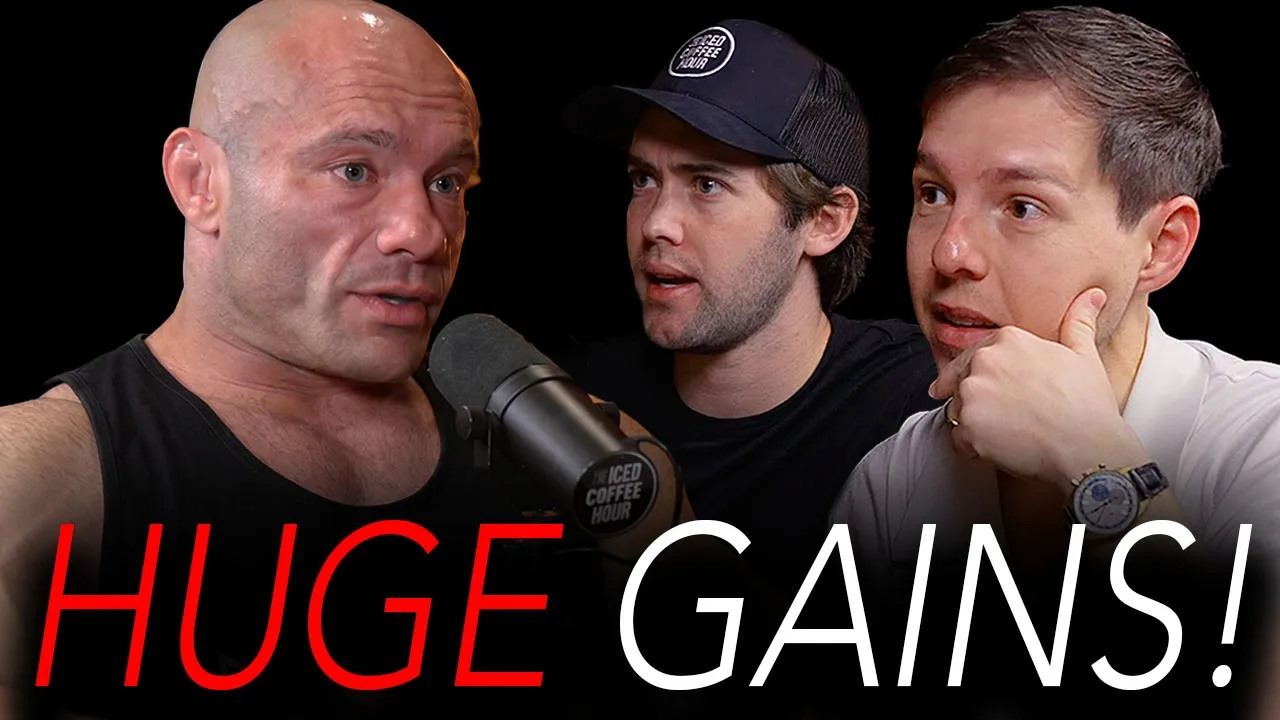
Israetel Pours Fitness Millions Into AI, Warns Creators Face Ruin
The Iced Coffee Hour
Dr. Mike Israetel argues that advancing artificial intelligence and robotics will eclipse the economic value of human labor by the 2030s, warning high-earning creators they will face poverty unless they immediately divert cash into compounding capital assets.
Dr. Mike Israetel outlines his high-saving financial philosophy, capping personal annual living expenses at roughly $250,000 despite earning over $1,000,000 annually for a decade, targeting a $10 million portfolio based on a 3% safe withdrawal rate. (15:58)
Israetel dismantles common nutrition myths, clarifying that clinical human trials show seed oils and polyunsaturated fats systematically produce superior cardiovascular outcomes compared to saturated fats. (42:01)
For sustainable muscle growth, lifters can achieve 70% to 75% of their genetic potential lifting just two days per week with dense supersets, provided sets are taken within three to four reps of true muscular failure. (34:47)
Israetel forecasts that medical breakthroughs preventing biological aging are approximately seven years away, driven largely by recursive artificial intelligence and accelerated computational testing. (63:26)
Detailed notes
## Background
This video was published on YouTube by The Iced Coffee Hour channel on November 1, 2026. Hosted by Graham Stephan and Jack Selby, the episode features sports science professor, competitive bodybuilder, and RP Strength co-founder Dr. Mike Israetel to debunk widespread fitness myths, break down personal finance, and discuss artificial intelligence, longevity, and influencer drama.
## TL;DR
Dr. Mike Israetel joins Graham Stephan and Jack Selby to unpack the realities of training frequency, debunk pervasive fitness myths surrounding seed oils and muscular failure, and outline evidence-based supplement and TRT usage. The discussion broadens into Israetel's personal wealth psychology, his conservative living expenses despite earning seven figures, and his aggressive investment thesis centered on AI, robotics, and commercial real estate. Later, Israetel addresses his use of generative AI in book writing, details his upcoming cosmetic surgery plans, critiques public spats with Greg Doucette, and evaluates popular fitness influencer physiques before testing his eye in a blind bicep identification challenge.
## Atmosphere & style
The conversation carries a lively, analytical, and humor-laced dynamic, seamlessly alternating between high-level sports physiology, macroeconomic speculation, and self-deprecating personal banter. Dr. Mike balances academic rigor with eccentric, unvarnished comedic timing, engaging playfully with Graham and Jack as they navigate everything from existential AI scenarios to internet fitness drama. The tone remains intellectually grounded yet breezy and entertaining, underscored by Dr. Mike's candid admissions about financial anxiety, body image, and viral workout intensity.
## Bulletin
- [15:58](https://www.youtube.com/watch?v=qddBrfQeTxY&t=958s) Dr. Mike Israetel outlines his high-saving financial philosophy, capping personal annual living expenses at roughly $250,000 despite earning over $1,000,000 annually for a decade, targeting a $10 million portfolio based on a 3% safe withdrawal rate.
- [42:01](https://www.youtube.com/watch?v=qddBrfQeTxY&t=2521s) Israetel dismantles common nutrition myths, clarifying that clinical human trials show seed oils and polyunsaturated fats systematically produce superior cardiovascular outcomes compared to saturated fats.
- [34:47](https://www.youtube.com/watch?v=qddBrfQeTxY&t=2087s) For sustainable muscle growth, lifters can achieve 70% to 75% of their genetic potential lifting just two days per week with dense supersets, provided sets are taken within three to four reps of true muscular failure.
- [01:03:26](https://www.youtube.com/watch?v=qddBrfQeTxY&t=3806s) Israetel forecasts that medical breakthroughs preventing biological aging are approximately seven years away, driven largely by recursive artificial intelligence and accelerated computational testing.
## Key takeaways
- [02:55](https://www.youtube.com/watch?v=qddBrfQeTxY&t=175s) Relying on intense anger or spite can boost acute force output for single sets but causes severe central nervous system burnout, technical breakdown, and injury over time.
- [06:53](https://www.youtube.com/watch?v=qddBrfQeTxY&t=413s) Long-term gym adherence requires finding intrinsic enjoyment, choosing comfortable movements, and tailoring workout environments rather than treating lifting as an agonizing chore.
- [10:55](https://www.youtube.com/watch?v=qddBrfQeTxY&t=655s) Renaissance Periodization generates the majority of its revenue from proprietary fitness and diet apps, once netting Israetel over $500,000 in a single month.
- [17:58](https://www.youtube.com/watch?v=qddBrfQeTxY&t=1078s) Israetel splits his liquid investment portfolio equally between broad-market index ETFs and high-conviction tech bets focused on artificial intelligence, robotics, and compute hardware.
- [27:23](https://www.youtube.com/watch?v=qddBrfQeTxY&t=1643s) Saving aggressively now serves as a necessary personal financial hedge against the economic disruption and labor obsolescence expected from superintelligent AI by the 2030s.
- [29:43](https://www.youtube.com/watch?v=qddBrfQeTxY&t=1783s) Training to absolute failure is not mandatory for muscle hypertrophy, but lifters must consistently push sets to within 3 to 4 reps in reserve (RIR).
- [38:28](https://www.youtube.com/watch?v=qddBrfQeTxY&t=2308s) Dietary calorie control is the only viable lever for fat loss, as burning off energy-dense junk food through cardiovascular exercise requires unsustainable training volume and spikes rebound hunger.
- [44:14](https://www.youtube.com/watch?v=qddBrfQeTxY&t=2654s) Critiques of seed oils and microplastics often rely on misleading mechanistic inferences or cellular animal studies rather than direct human clinical trial evidence.
- [52:10](https://www.youtube.com/watch?v=qddBrfQeTxY&t=3130s) Men over 40 should only consider testosterone replacement therapy if optimizing sleep, stress, nutrition, and exercise still leaves them with clinically low androgen levels.
- [57:59](https://www.youtube.com/watch?v=qddBrfQeTxY&t=3479s) While incretin mimetics like semaglutide are highly effective for weight loss, no peptide currently exists that directly induces muscular hypertrophy.
- [01:21:37](https://www.youtube.com/watch?v=qddBrfQeTxY&t=4897s) As generative AI makes recorded creative content effortless and ubiquitous, the cultural and financial premium on live, unvarnished human performance will dramatically escalate.
- [01:30:52](https://www.youtube.com/watch?v=qddBrfQeTxY&t=5452s) Optimal prompt engineering involves treating large language models as collaborative human coworkers via iterative conversational refinement rather than rigid one-shot prompts.
- [01:37:53](https://www.youtube.com/watch?v=qddBrfQeTxY&t=5873s) Novice and skinny-fat lifters achieve superior aesthetic results by recomping at maintenance calories for one to two years rather than cycling through aggressive dirty bulks.
- [02:00:15](https://www.youtube.com/watch?v=qddBrfQeTxY&t=7215s) Many viral internet influencers end up broke within a few years because they mistake fleeting peak revenues for permanent income while squandering capital on depreciating luxury assets.
## Detailed walkthrough
### [00:00](https://www.youtube.com/watch?v=qddBrfQeTxY&t=0s) Episode Teaser and the Infamous Hamstring Curl Video
The episode opens with highlights covering the power of emotion under the barbell, the validity of seven-day training splits, Greg Doucette’s critique of Mike's choices, Mike scoring a perfect mark on the Raven’s Advanced Progressive Matrices IQ test, and the flaws of the carnivore diet. Welcoming Dr. Mike Israetel to *The Iced Coffee Hour*, the hosts immediately pull up a viral clip of him loudly screaming while performing lying hamstring curls in his home gym. When asked if the exaggerated screaming was truly necessary or played up for the camera, Mike deadpans that he was in an altered state of pleasure before acknowledging the real reason: he was genuinely upset and emotionally overwhelmed that day, with zero cognitive bandwidth left to filter the noises escaping him.
The hosts note the inherent comedy of the clip, comparing it to classic Nelk prank videos where people shriek at the top of their lungs while lifting tiny pink dumbbells. What makes the video especially absurd is Mike's pacing: rather than grinding on an agonizing final rep to absolute failure, he looks as if he is just getting started and still has several reps left in the tank. Mike agrees with the observation, explaining that under normal circumstances he likely would have terminated the set six reps earlier, but the surge of raw emotional energy allowed him to override standard fatigue thresholds and keep moving the weight despite his distress.
---
[02:55](https://www.youtube.com/watch?v=qddBrfQeTxY&t=175s) Why Anger and Heartbreak Fail as Long-Term Gym Fuel
The discussion turns to the classic fitness trope of the heartbroken guy who gets dumped and attempts to channel his angst and spite into massive muscle gains. Dr. Mike acknowledges that intense psychological arousal can instantly augment force production: “Emotions felt really strongly can instantly transfer into a ton of strength for reps, even for a max, right there in the moment.” He notes that competitive powerlifters frequently orchestrate mini emotional rollercoasters right before walking onto the platform to hit a personal record. However, relying on anger, resentment, or heartbreak carries a massive hidden cost: profound, systemic emotional exhaustion, directly comparable to the drained, empty state one experiences after having a grueling fight with a romantic partner.
Mike warns that using spite as primary gym fuel is inherently self-defeating for bodybuilding because hypertrophy training demands months and years of consistent, high-volume sets and reps. If someone enters the weight room purely to spite an ex-partner like "Stacy," the gym inevitably acts as therapy. As the weeks pass, the lifter processes the trauma, forgets what the ex even looks like, and exhausts the reservoir of emotional adrenaline—leaving them completely unmotivated to complete their program. Furthermore, lifting under extreme rage impairs motor control while simultaneously ramping up force output, creating a dangerous recipe for severe injury on compound lifts like the deadlift. To build muscle over decades, an athlete must replace negative drive with intrinsic positive reinforcement:
> “The gym is for decades. And so, you have to find a sustainable way to motivate yourself in the gym. It can't be hamstring screaming.”
- **Acute Strength Spike vs. Systemic Fatigue**: High-arousal states unlock immediate motor unit recruitment for maximal lifts, but leave the central nervous system and psyche depleted.
- **The "Stacy" Paradox**: Because exercise naturally reduces emotional distress, anger-fueled lifters eventually heal from the breakup and lose the singular motivation that brought them into the gym.
- **Injury Risk**: Heavy compound movements executed in blind fury combine maximum force production with deteriorated technique and limited motor control.
---
[06:53](https://www.youtube.com/watch?v=qddBrfQeTxY&t=413s) Strategies to Transition From Dreading the Gym to Enjoying It
Graham Stephan shares his personal relationship with training, noting that he finds lifting deeply relaxing and frequently comes up with his best creative ideas while working out. He treats the gym as dedicated productive downtime by downloading YouTube research videos to watch while walking on the treadmill or listening to podcasts during his lifting sets. This prompts the question of how an everyday person who views working out merely as a dreadful chore can shift into actually loving the process.
Mike outlines several practical strategies for restructuring the training experience to foster long-term adherence. First, individuals should discard ambiguous goals like simply wanting to "get in shape" and instead define tangible physique milestones—focusing on specific muscle groups so that noticeable changes in the mirror make them feel like they are “becoming a superhero.” Second, lifters should freely discard exercises they despise and substitute movement patterns and machines that feel mechanically comfortable and fun. Additional levers include customizing session duration to personal preferences (such as shorter, more frequent workouts instead of marathon gym sessions), recruiting a reliable friend to train and banter with between sets, and curating good music. Above all, Mike stresses that even if someone does not instantly fall in love with lifting, they must avoid framing the gym as an agonizing obligation comparable to waiting for an oil change.
```mermaid
flowchart TD
accTitle: Transforming Gym Dread into Long-Term Adherence
accDescr: A flow diagram showing how to transition from negative framing of workouts to sustainable long-term training habits.
subgraph NegativeFraming["Unsustainable Approach"]
A["Vague Goals: 'Get In Shape'"]
B["Rage & Spite: 'Breakup Fuel'"]
C["Dreaded Chore Mentality"]
end
subgraph Interventions["Optimization Levers"]
D["Specific Aesthetic Targets"]
E["Favorite Exercises & Machines"]
F["Preferred Session Lengths"]
G["Social Training Partners & Audio"]
end
subgraph PositiveOutcome["Sustainable Adherence"]
H["Positive Reinforcement & Mirror Feedback"]
I["Decades of Injury-Free Consistency"]
end
[08:51](https://www.youtube.com/watch?v=qddBrfQeTxY&t=531s) Avoiding Gym Burnout and Dr. Mike's Background
Dr. Mike Israetel cautions that treating workouts as chores to endure leads straight to burnout. People who clockwatch and tell themselves, "oh, it's just another three sets, thank God," fail to build the necessary intrinsic enjoyment. Instead, lifters must focus on enjoying the process itself. Over time, having fun produces good results, which creates an ongoing positive feedback loop where gym-goers find themselves genuinely loving the gym without even needing to rationalize it.
When asked to summarize his credentials and explain why audiences should heed his advice, Dr. Israetel provides a concise overview of his background:
> “I used to be a professor of exercise and sports science. I’m a competitive bodybuilder, Brazilian jiu-jitsu grappler, and I’m on YouTube teaching people how to lift weights and eat right and take supplements properly so that they get the most out of their physique and look their best.”
[09:52](https://www.youtube.com/watch?v=qddBrfQeTxY&t=592s) Dr. Mike vs. Graham: The Combat Math
Jack Selby jokingly asks whether Dr. Israetel's Brazilian jiu-jitsu background means he could beat up Graham Stephan. Dr. Israetel plays along with deadpan modesty, replying, "No, definitely not," while Jack observes Graham's newly noticeable biceps. Graham playfully asks how many clones of himself it would take to put up a legitimate fight against Dr. Israetel in hand-to-hand combat without weapons.
Learning that Graham weighs 130 pounds, possesses decent agility, and is willing to fight dirty with fingernails and toenails, Dr. Israetel calculates the odds and decides Graham is safe up to three clones. Graham and Jack consider that a surprisingly generous assessment, admitting the realistic number could easily have been ten.
[10:55](https://www.youtube.com/watch?v=qddBrfQeTxY&t=655s) RP Strength and the $500,000 Month
Turning to Dr. Israetel's finances, Graham asks how his business model generates income and enterprise value. Dr. Israetel initially jokes that Renaissance Periodization (RP) co-founder Nick Shaw just gives him lunch money and rent, but explains that the vast majority of his earnings come through RP Strength's software suite—principally their diet coach app and training app. When asked about his highest single-day or peak earnings, Dr. Israetel shares that during the best single month of his career, he made over $500,000.
Yet the massive sum triggered an unexpectedly muted psychological reaction rather than celebration:
> “And so it’s just a small drop in the bucket to those goals. And so all of that stuff is in my head at the same time. Kind of like, ‘Okay, cool.’ And then I just like later that day, I just did the same stuff I would any day.”
Because Dr. Israetel naturally spends very little and funnels nearly everything into investments, the figures on paper feel abstract. He had expected money milestones to bring emotional fireworks, but discovered that his day-to-day life remained entirely unaffected.
```mermaid
flowchart TD
accTitle: Dr. Mike's Revenue and Capital Flow
accDescr: Diagram illustrating how RP Strength app revenue flows into Dr. Israetel's earnings and subsequent investment allocation.
subgraph Operations["RP Strength Operations"]
Apps["Software Suite<br>(Diet Coach & Training Apps)"]
PeakMonth["Peak Earnings Month<br>(Over $500,000)"]
end
subgraph CapitalAllocation["Capital Allocation"]
DrMike["Dr. Mike's Income"]
Investments["Long-Term Investments<br>(Vast Majority of Capital)"]
LivingExpenses["Annual Living Expenses<br>(Under $250,000)"]
end
[12:26](https://www.youtube.com/watch?v=qddBrfQeTxY&t=746s) The Billionaire Deal and the Emptiness of Big Paydays
To illustrate how wealth affects the human brain, Dr. Israetel recounts a conversation with a billionaire who had closed an enormous deal that increased his net worth from roughly half a billion dollars to over a billion. Despite having discussed the $600 million transaction obsessively with his wife for months, the man went home the evening the deal closed, did not even mention it to his spouse, had a quiet dinner with his family, tucked the kids in, and returned to work the next morning as if nothing had happened.
Dr. Israetel took this as a crucial lesson:
> “If you expect that it doesn’t feel like anything, you’re going to have a fine time. If you really expect that you’re going to feel tons better and everything’s going to be amazing, you are in for probably kind of a time where you’re like, ‘What the hell is like what is what is this? Like why don’t I feel anything?’”
Graham agrees, noting that people fantasize about sitting in a bathtub laughing while tossing stacks of cash, yet the reality is anticlimactic. Dr. Israetel admits he thought the same, only to realize that once the arduous work is done and the money sits quietly in the bank account, the brain instantly resets and asks, "okay, what's next?"
Graham and Jack pivot to the foundational steps of launching a business, emphasizing the need to establish professional infrastructure before revenue ever starts flowing. They highlight their sponsor, Northwest Registered Agent:
- Northwest Registered Agent provides a free business domain, website, business email, and a dedicated business phone line.
- Founders do not need to make an immediate purchase, sign up as paying clients, or finalize an LLC to secure these assets.
- The entrepreneur retains full ownership of their domain and website, allowing them to transfer the properties elsewhere without penalty.
- The service can be accessed at `northwestregisteredagent.com/ich`.
[15:58](https://www.youtube.com/watch?v=qddBrfQeTxY&t=958s) Annual Spending and High-Ticket Guilt
Graham asks at what threshold an increase in income ceases to improve one's quality of life. Dr. Israetel reveals that despite earning well over $1,000,000 annually for roughly the past decade, his personal living expenses remain capped at around $250,000 per year, and typically even lower when left to his own devices. Much of that figure is padded by an underutilized vacation fund that he funds regularly without spending down.
He admits to carrying persistent guilt over a few specific high-ticket personal expenses:
- High apartment rent.
- A $1,300 monthly lease on a Tesla Model S Plaid.
Dr. Israetel calls the Model S Plaid the single greatest vehicle he has ever been in, though he still feels awful about the price tag. When Graham and Jack mention that they are both technically Jewish and therefore understand the cultural guilt over an expensive lease, Jack defends the car on practical safety grounds. Citing real estate broker Jason Oppenheim's enthusiasm for Tesla's Full Self-Driving (FSD), Jack points out that FSD makes driving eight times safer than an undistracted human driver and 25 times safer than a distracted driver, arguing that protecting one's life easily justifies the cost of the vehicle.
[17:58](https://www.youtube.com/watch?v=qddBrfQeTxY&t=1078s) Monthly Spending, Frugality Guilt, and Dr. Mike’s Investment Allocation
Dr. Mike Israetel discusses his monthly expenditures and why he feels conflicted about spending money despite earning a very high income. A podcast co-host relates by sharing how seeing driving accident statistics convinced him to justify spending $1,300 a month on a safer arrangement or vehicle, explaining that he is an undistracted driver only about 50% of the time, while the other 50% is spent texting or checking his phone. Dr. Mike jokes about his personal reaction to spending: “So, all of this is technically justified, but I can still have my Jewish feelings about it. You know, don't invalidate my faith, my genetics.”
Dr. Mike then details his specific fixed monthly expenses:
- **Apartment Rent**: $4,000 per month. While the hosts point out this is well below what a high earner could budget, Mike explains: “Totally. But I did not grow up with money. And so to me, these amounts on like raw, they just hit me all wrong. I'm like, 'Oh my god, I'm spending how much money? This is insane.'”
- **Legal and Financial Management**: $10,000 per month paid to a close friend who serves as a high-touch concierge, handling every contract, financial inquiry, and legal document so Mike never has to touch them.
- **Car Payment and Staff**: A car payment, a personal assistant who costs a bit of money, and discretionary spending reserved purely for food and vacations.
The vast majority of Dr. Mike’s income is funneled directly into investments. He is actively exiting residential real estate to concentrate heavily on commercial and light-industrial properties. His thesis on light industrial is driven by the rise of automation: he believes that if robotics takes off, it will become the largest industry in history, creating massive demand for physical space to house and construct robots. Even if specific tenants or business models falter in a U-shaped downturn, light industrial assets maintain solid rental yields and reliable resale value.
Within the stock market, Dr. Mike divides his liquid portfolio into two halves:
```mermaid
flowchart TD
accTitle: Dr. Mike Stock Portfolio Allocation
accDescr: Dr. Mike splits his stock portfolio 50/50 between broad market index funds and targeted tech sector bets.
subgraph S1["Passive Foundation"]
B --> B1["Low-risk exposure to general economic growth"]
end
subgraph S2["Technological Convergence"]
C --> C1["Artificial Intelligence"]
C --> C2["Robotics"]
C --> C3["Compute Hardware"]
end
```
[20:53](https://www.youtube.com/watch?v=qddBrfQeTxY&t=1253s) Business Risk and the Best vs. Worst Ways to Spend Money
When asked about the most money he has ever lost, Dr. Mike reveals he rarely looks at his portfolio day-to-day, week-to-week, or even month-to-month. In his business, Renaissance Periodization, he notes they have taken an extremely risk-averse approach: “we've never had a day in the red.” While this conservative style may leave some potential upside on the table, it protects against catastrophic drawdowns. When asked about major deals he has turned down, Mike recalls turning down substantial sponsorship offers from supplement companies early on because they were not actively courting outside sponsors at the time, which felt strange since saying no to money is always uncomfortable.
The conversation turns to philosophical views on capital allocation. In Mike's view, the worst possible way to spend money is on high-maintenance, rapidly depreciating status symbols intended solely to impress outsiders:
- Purchasing an exotic vehicle like a Ferrari that loses roughly 40% of its value immediately upon leaving the lot.
- The owner receives no endogenous joy from driving it, struggles to service it at regular dealerships, and constantly bleeds cash on maintenance.
- Society assumes you bought it to look rich, but you never actually hear strangers talking, leaving you with an expensive, awkward headache that delivers zero net satisfaction when eventually sold years later.
Conversely, Dr. Mike argues that broad-market stock investing is the single best use of capital. First, it efficiently allocates money toward the most productive entities in civilization—such as Nvidia, Google, Amazon, Sam's Club, and Costco—which solve massive societal infrastructure problems. Second, invested capital works productively on the investor's behalf: “And there's a certain level at which if you put enough money into stocks, you can live on the money that you get from stocks, but also make enough from stocks that some of the money left over gets reinvested. So whatever amount of wealth you have just keeps going up and you never have to go to work. To me, that is the golden fleece of why to have money.”
[24:48](https://www.youtube.com/watch?v=qddBrfQeTxY&t=1488s) Escape Velocity, the Safe Withdrawal Rate, and Arbitrary Financial Goals
Dr. Mike explains that he only learned about the concept of a Safe Withdrawal Rate (SWR) roughly three years prior, when his earnings reached a level where passive financial independence became a practical reality. He recounts the shock of his first major windfall selling digital products: he received a single payout of approximately $40,000 in one week, at a time when his annual salary as a university professor was only around $57,000. Standing in a friend's kitchen watching the transaction clear, he experienced an existential shock: “I remember I was at my in my friend's kitchen and I was just like, I don't even know what the purpose of my life is anymore. Like I had no context for this whatsoever. Like what the hell is happening? How is this happening?”
His initial instinct was simply to acquire physical real estate. Later, understanding the mechanics of a safe withdrawal rate introduced him to the concept of financial escape velocity—a threshold where an invested portfolio out-earns one's living expenses while replenishing itself. Based on Mike’s annual personal spending of roughly $250,000, the co-host calculates that a conservative 3% safe withdrawal rate targets an exact portfolio threshold of $10 million. Mike confirms the $10 million figure is accurate.
Even after crossing that baseline of permanent safety, Mike admits his day-to-day work habits will not change. He continues creating content and running his company out of duty to his employees and an authentic drive to help people get into shape: “I do my job because I I have a responsibility to my team to do my job and with tons of tons of people to help get in shape is why I do my job. I would just do my job anyway no matter what amount of money it paid is my life.” Because he would work regardless of compensation, he invents arbitrary, gamified targets—such as seeing how much personal wealth he can accumulate and invest directly into public markets—simply to serve as motivational milestones.
[27:23](https://www.youtube.com/watch?v=qddBrfQeTxY&t=1643s) AI Agents, the Machine Economy, and Wealth Accumulation
Dr. Mike outlines a future shaped by two impending structural shifts. First, artificial intelligence will inevitably take over investing: “At some point, um, super intelligent AI will invest your money for you better than you ever could.” He views this as only a few years away—give or take legal roadblocks. Once an AI reliably compounds capital better than any human, it creates a powerful psychological feedback loop: the incentive to work harder simply to feed more capital into the algorithmic compounding engine becomes overwhelming.
Second, Dr. Mike predicts a tipping point where robotics and artificial intelligence generate far more economic return off invested capital than an individual could ever generate via their own skills or labor. Although he earns a very high income today, he anticipates that by the early 2030s—or sooner—the machine economy will eclipse what he could ever produce through personal talent. Once machines handle capital generation effortlessly, traditional career focus fades, and people will likely orient their lives around whatever superintelligence determines is optimal. Until that day arrives, Dr. Mike explains that he is grinding as aggressively as possible just to accumulate the largest possible financial buffer.
Graham Stephan agrees with this assessment, citing voices like Andrew Yang and Elon Musk who foresee an era of universal high income. Graham notes that while he hopes the post-scarcity future turns out great for everyone, the unpredictability of it justifies an aggressive savings and work ethic right now: “I’m sort of a member of your camp of like grind as hard as I can, save and make as much as I can, and then see what happens.” Both agree that stacking wealth now serves as the best hedge against whatever chaos or uncertainty the transition brings.
```mermaid
flowchart TD
accTitle: AI Wealth Accumulation Shift
accDescr: Flowchart showing the transition from human labor to the machine economy based on Dr. Mike's predictions.
subgraph Phase1["Current State"]
A["Human Labor & Talent"] --> B["High Personal Income"]
B --> C["Capital Accumulation"]
end
subgraph Phase2["Inflection Point 1"]
C --> D["Superintelligent AI Investors"]
D --> E["Superior Automated Returns"]
E -->|"Motivation to feed more capital"| A
end
subgraph Phase3["Inflection Point 2 (Early 2030s)"]
D --> F["Machine Economy (Robotics + AI)"]
F --> G["Capital Returns Eclipse Human Talent Value"]
G --> H["Shift: Follow AI Directives Over Traditional Jobs"]
end
```
[29:43](https://www.youtube.com/watch?v=qddBrfQeTxY&t=1783s) Health Fact vs. Fiction: Training to Failure and RIR
The hosts transition into a rapid-fire "10 Health Facts or Fictions" segment with Dr. Mike, beginning with the common fitness belief: *You have to train to failure to build muscle.*
Dr. Mike labels this claim "False," though with an essential caveat: lifters must get very close to failure. Most hypertrophy gains occur within three to four reps of absolute muscular failure. When asked what true failure looks like, Dr. Mike defines it simply: “When you're trying really hard, but the bar won't move anymore.”
The conversation shifts to the psychological gap between perceived and actual failure. Graham notes that inexperienced lifters often stall out, yet if a spotter places just a single finger near the barbell without providing real physical assistance, the lifter suddenly knocks out three more repetitions. Dr. Mike agrees that this exposes a distorted perception of Reps in Reserve (RIR):
- What a lifter thinks is 3 RIR is often 6 RIR.
- What a lifter assumes is 0 RIR (true failure) is frequently 3 RIR.
- Dr. Mike explains that accurate RIR perception is an acquired skill: “The more experience you get, the more you figure out how to get everything out of your muscles that you can, and then the more your uh the your idea of how many reps you have left in the tank becomes more reliable.”
Graham and Jack present the mid-roll podcast sponsors:
- **Cash App:** Highlights the *Cash App Green* status program. Users who spend at least $500 monthly on their Cash App card unlock benefits such as up to $200 in fee-free overdraft coverage, higher borrow limits, and custom cash-back offers every Friday. New users can use the code `cash app 10` and send $5 to a friend within 14 days to earn a $10 bonus.
- **ZipRecruiter:** Pitches their hiring platform for seasonal and specialized holiday roles (ranging from licensed snowplow drivers to real-bearded Santas). The platform uses matching technology and features that present qualified, highly motivated candidates first, allowing applicants to explain directly why they want the position.
[32:58](https://www.youtube.com/watch?v=qddBrfQeTxY&t=1978s) Screaming in the Gym and the Hardest Workers: Tom Platz vs. Dwarkesh Patel
Picking up on a comedic question—*Can you lift heavier if you're screaming?*—Dr. Mike breaks down the physiology versus the theater. In an exercise science trial, being instructed to yell would produce no mechanical advantage. However, if a scream is the natural by-product of extreme autonomic arousal, heavier lifting will occur: “It's the amping that causes the screaming and causes the bigger weights. I wouldn't go in the gym and just start yelling.”
When asked who has the hardest workouts of all time, Jack suggests bodybuilding legend Tom Platz. Dr. Mike agrees Platz is iconic—his ability to push leg workouts past any ordinary threshold, contorting his face and finding endless reps beyond failure, was terrifying: “I would shudder. Like if he was, you know, if I was back in the 80s and he was like, 'Hey, you want to catch a workout?' I'd be like, 'I'm sick. My leg is hurt. My dog did my homework and I would just run.'”
Yet Dr. Mike surprisingly offers another contender from modern tech: podcast host Dwarkesh Patel (interviewer of prominent figures in AI like OpenAI and Anthropic teams). Dwarkesh is a private coaching client of Dr. Mike's and trains with absolute, frightening intensity:
- “Dwarkesh sends every set into the sun and I legitimately worry for him at times because I'm like he's just going to break himself into pieces.”
- Describing him as an unassuming "sleeper" who pushes into violent physical convulsions under load, Dr. Mike remarks: “For every famous bodybuilder that you have that you think trains really hard, there's some Indian dude in a basement somewhere, bro, that's going way harder.”
[34:47](https://www.youtube.com/watch?v=qddBrfQeTxY&t=2087s) Is 2 to 3 Days in the Gym Enough?
The second myth addresses training frequency: *Is 3 days in the gym enough for most people?*
Dr. Mike takes it a step further: “Oh yeah, 2 days is enough for most people for sure.” When Graham questions how anyone can achieve a truly effective stimulus in just two weekly sessions, Dr. Mike details an ultra-dense, superset-based regimen:
- **Minimize Rest Times:** Rest periods are collapsed almost entirely to maximize training density.
- **Compound Pairings:** Pair antagonistic or non-competing multi-joint movements that engage large amounts of muscle tissue at once.
- **Example Superset:** Squats paired immediately with upright rows. Squats tax nearly the entire lower body, while upright rows hit the lateral deltoids, trapezius, forearms, and biceps.
- **Session Structure:** Alternate between the paired lifts with zero downtime (e.g., squat set, walk directly to upright rows, walk straight back to squat).
- **Time & Volume:** Doing roughly six paired compound exercises for about four sets each takes around 30 to 40 minutes.
Dr. Mike cautions that while this approach leaves you physically destroyed, executing that exact routine twice a week is more than enough to get someone into unbelievable shape, typically using just one primary movement per target muscle group under that framework.
[35:45](https://www.youtube.com/watch?v=qddBrfQeTxY&t=2145s) Workout Frequency and Genetic Potential
When asked what percentage of their maximum genetic physique potential an average person could achieve by training only twice a week, Dr. Mike Israetel estimates around 70 percent. Bumping that commitment to three days per week yields roughly 80 to 85 percent of one's ultimate potential, provided the sessions are high quality. For anyone aiming to optimize the Pareto principle (the 80/20 rule), he recommends three to four workouts per week depending on how they prefer to pace themselves, noting that even two hard sessions can easily capture 75 percent of possible gains. Dr. Israetel emphasizes that the vast majority of working professionals and viewers do not actually care about exhausting their genetic ceiling; they simply want an aesthetic, healthy physique that signals competence and discipline. He points out that an impressive, athletic physique can easily be built in just two 40-minute sessions per week without upending one's personal life.
```mermaid
flowchart TD
accTitle: Training Frequency vs Physical Potential
accDescr: Charting the diminishing returns of workout frequency on genetic potential.
subgraph Sustainable["High-Efficiency Range"]
A["2 Sessions / Week<br/>(30-40 min)"] -->|"~70% Max Potential"| B["Solid, Athletic Physique"]
C["3 Sessions / Week"] -->|"80-85% Max Potential"| D["Near-Optimal Aesthetic"]
E["4 Sessions / Week"] -->|"High Yield"| D
end
subgraph Diminishing["Diminishing Returns"]
F["6 Sessions / Week"] -->|"Plateau"| G["Ceiling of Standard Returns"]
H["7 Sessions / Week"] -->|"No Rest / High Fatigue"| I["Counterproductive"]
end
```
Training volume follows a curvilinear relationship that delivers diminishing returns and tops out at roughly six sessions per week:
- **Diminishing returns:** Doubling gym frequency does not double muscular gains; it typically yields only 1.25 to 1.5 times the progress.
- **The six-day ceiling:** Pushing past six sessions weekly requires highly specialized, exotic programming to stimulate further adaptation.
- **Rest days are mandatory:** Dr. Israetel strongly advises against training seven days a week: “Because your body thrives on a combination of incredibly hard stimulus and rest. And so if you take one of those away from the equation, it doesn't work that well anymore.”
[38:28](https://www.youtube.com/watch?v=qddBrfQeTxY&t=2308s) Why You Cannot Out-Train a Bad Diet
Evaluating the age-old fitness adage that one cannot out-train a bad diet, Dr. Israetel calls it “one of the truest things like ever spoken as far as like the amount of wisdom density in a small number of words.” He recalls a guest on a debate podcast who managed to shed substantial weight while still eating poor-quality foods, but had to spend five grueling hours in the gym every day to achieve it. That same individual eventually achieved far better, more sustainable results by training significantly less and taking control of his nutritional intake.
From an evolutionary standpoint, the human body evolved to balance calorie expenditure with wild, fibrous foraged foods like roots, berries, and game. In contrast, modern hyper-palatable foods create an impossible caloric mismatch. Burning off a single pint of Ben & Jerry's ice cream requires roughly three hours of exhausting, high-intensity cardio. That extreme effort produces debilitating fatigue and triggers rebound hunger, usually prompting the person to eat another pint once they get home. Because it is exponentially easier to consume calories than it is to burn them off through exercise, dietary calorie control must serve as the primary driver of fat loss.
[40:09](https://www.youtube.com/watch?v=qddBrfQeTxY&t=2409s) Fitting Fast Food into a Healthy Diet
Dr. Israetel surprises the hosts by stating that fast food can comfortably fit into a healthy lifestyle three or four times a week, provided two conditions are met: it must not completely dominate the diet, and total daily caloric intake must remain strictly controlled. When the hosts ask what chains qualify, Dr. Israetel lists mainstream options like McDonald's, Burger King, and Long John Silver's. This sparks a comedic tangent when Jack Selby expresses surprise at Long John Silver's still existing, prompting the studio crew to search and confirm that Las Vegas indeed has an operational location.
The primary hazard of fast food is not mysterious toxic chemicals, but rather its structural properties: it is exceptionally tasty, rapidly digestible, and hyper-calorie-dense. People can effortlessly consume hundreds or thousands of calories in a five-minute sitting without feeling adequately full. However, if an individual budgets their macronutrients so that an occasional fast-food cheeseburger fits beneath their daily caloric maintenance ceiling, it will not derail body composition or long-term health.
[42:01](https://www.youtube.com/watch?v=qddBrfQeTxY&t=2521s) The Seed Oil Debate and Fitness Influencer Grifts
Turning to the claim that seed oils are the most destructive element of modern nutrition, Dr. Israetel mocks the hyperbolic fearmongering with deadpan sarcasm before clarifying his scientific stance: “Seed oils are not bad for your health. That is one of the most common myths in the nutrition space.” He explains that rigorous clinical trials comparing identical diets—where saturated fats are systematically replaced with seed oils and polyunsaturated fatty acids—repeatedly demonstrate superior cardiovascular and metabolic health outcomes for seed oils in virtually every major analysis.
The hosts bring up their own confusion regarding conflicting advice online. Jack mentions eating two to three Built Bars (Built Puffs) a day, leading to playful banter with Graham Stephan about whether he is charging high-protein snack bars to the company card while traveling. A friend had warned Jack that the seed oils in those bars were toxic, yet independent research revealed one would have to eat dozens daily to encounter any theoretical downside.
When the hosts ask why credentialed figures online take polar-opposite stances—citing Gary Brecka's appearance on *The Iced Coffee Hour* claiming he saved UFC CEO Dana White's life—Dr. Israetel pulls no punches about deceptive industry gurus:
> “He did none of that. I don't know what Gary Brecka did for Dana White. Gary Brecka is a person who lies constantly. Straight up.”
[44:14](https://www.youtube.com/watch?v=qddBrfQeTxY&t=2654s) Gary Brecka, Mechanistic Inference, and the Seed Oil Debate
Dr. Mike Israetel pulls no punches when asked what Gary Brecka is lying about, stating bluntly that almost all of Brecka's health claims are fictitious nonsense—ranging from hydrogen water to demonizing seed oils. He cites an example where Brecka claimed stirring salt with a metal spoon ionizes it and advised using a wooden spoon instead. “There's time for civility and a time for truth,” Israetel insists, noting that he would never rely on Brecka for health or fitness guidance because Brecka lacks advanced academic credentials in these sciences.
Israetel explains the split in the scientific community regarding seed oils. Credentialed researchers who oppose seed oils often look at cellular or chemistry-level studies showing processing-induced denaturation, inferring negative outcomes from isolated cell cultures or limited animal exposures. While that mechanistic, hard-science inference sounds convincing to listeners when delivered by an MD or PhD on a podcast, Israetel argues that direct human feeding trials tell the opposite story. “Almost all of that research is unidirectional. It’s seed oils are just not bad for your health and they're better for your health than saturated fat.”
```mermaid
flowchart TD
accTitle: Scientific approaches to seed oil research
accDescr: Flowchart contrasting mechanistic laboratory inference with direct human clinical feeding trials regarding seed oil health outcomes.
subgraph Mechanistic["In Vitro & Animal Research"]
A["Processing & Denaturation"] --> B["Cell & Rodent Exposure"]
B --> C["Hypothesize Negative Outcomes"]
end
subgraph Clinical["Direct Human Research"]
D["Human Feeding Trials"] --> E["Weeks/Months on Seed Oils vs. Saturated Fats"]
E --> F["Net Neutral or Favorable Health Markers"]
end
C -.->|"Over-extrapolated by critics"| G["Podcast Alarmism"]
F -->|"Supported by empirical data"| H["Mainstream Nutritional Consensus"]
```
[45:56](https://www.youtube.com/watch?v=qddBrfQeTxY&t=2756s) The Unknowns of Microplastics
When asked about the constant alarms surrounding microplastics, Israetel acknowledges that while they are potentially a vector for various health maladies, the science is simply not settled. He explains that researchers do not yet have the fine-tuned, aggregate data required to prescribe confident actions or definitively prove how destructive they are.
Israetel points out that decades from now, humanity might look back and realize microplastics were catastrophic, or conversely, that the panic was vastly overblown. Most commentators expressing certainty about the dangers are speculating. Israetel emphasizes that science frequently lands on an honest "we just don't know yet," and that anyone presenting absolute conclusions is projecting far too much confidence.
[46:46](https://www.youtube.com/watch?v=qddBrfQeTxY&t=2806s) The Flaws of the Carnivore Diet and Dogmatic Eating
The hosts recall falling down the Paul Saladino rabbit hole and concocting bizarre meals: a slab of ground beef drenched in unpasteurized melted cheese, crowned with a glob of raw honey, paired with a banana and raw milk. Looking down at the plate, it felt completely antithetical to foundational nutritional guidelines, yet carnivore advocates claim conventional advice is government brainwashing. Israetel notes dryly that high saturated fat, ultra-dense calories, and avoiding fiber have aged terribly in peer-reviewed literature.
Israetel gives a 30-second breakdown on why the carnivore diet fails: it eliminates nuts, healthy oils, vegetables, fruits, and whole grains—the very foods most robustly linked to longevity and disease prevention. Stripping away vegetables and dietary fiber directly undermines gut and cardiovascular health. For everyday people confused by conflicting influencer claims, Israetel recommends feeding both sides of any nutritional argument into an advanced AI model on its highest reasoning mode to evaluate the weight of the evidence impartially, which he notes will outperform most biased human experts.
- **Excluded superfoods**: Carnivore diets systematically cut out dietary fiber, whole grains, fruits, vegetables, nuts, and unsaturated oils.
- **Nutritional consensus**: Direct clinical literature demonstrates that heavy saturated fat intake coupled with zero fiber leads to unfavorable long-term health markers.
- **Evaluating claims**: High-reasoning AI models can objectively weigh opposing dietary studies without ideological bias.
[49:26](https://www.youtube.com/watch?v=qddBrfQeTxY&t=2966s) Supplement Hierarchy: What Actually Works
Addressing the claim that most supplements are a complete waste of money, Israetel confirms it is broadly true. The vast majority of retail supplements have zero rigorous backing or offer negligible benefits, yet influencers push them as universal necessities.
However, a select group of supplements has robust evidentiary support:
- **Whey protein**: An efficient, high-quality dietary protein source.
- **Creatine**: Proven efficacy for muscular strength, power output, and cognitive support.
- **Essential minerals**: Zinc and magnesium (the host shares that magnesium dramatically cured chronic sleep issues when standard sleep aids were ineffective).
- **Vitamins**: Vitamin D.
- **Omega-3 fatty acids**: Properly sourced fish oils providing bioavailable EPA and DHA.
- **Caffeine**: An effective, well-studied performance aid.
Beyond this targeted tier, Israetel emphasizes that context matters: a specific micronutrient might benefit someone with a clinical deficiency, but claiming everyone needs an exotic stack is marketing deception.
Evaluating the claim that strict diets always fail, Israetel remarks that absolute words like "always" belong only to the laws of physics. However, he agrees that strict diets fail the vast majority of the time due to the enormous cognitive bandwidth and friction they require.
A hyper-restrictive diet prevents people from dining out or participating in normal social functions, introducing relentless inconvenience. In behavioral science, sustainable habit architecture relies on reducing friction—similar to how living across the street from a gym makes regular attendance far more likely than a 30-minute cross-town commute. When a diet offers zero flexibility in an unpredictable world, falling off the wagon is nearly guaranteed.
[52:10](https://www.youtube.com/watch?v=qddBrfQeTxY&t=3130s) TRT for Men Over 40
Addressing whether every man over 40 should start Testosterone Replacement Therapy (TRT), Israetel rates the claim false, though with significant nuance. He warns that jumping straight onto TRT without fixing underlying lifestyle flaws is misguided: if an individual drinks excessively, sleeps poorly, and neglects diet and exercise, their testosterone will inevitably crash.
“cuz some of those like if your sleep is off or if you drink a bunch your testosterone is going to be low and TRT is not going to really help you much cuz it's just going to be like hey your life sucks let's spray testosterone on it,” Israetel remarks. However, if a man in his late 30s or early 40s has optimized sleep, stress management, training, and nutrition, yet blood work reveals clinically low androgen levels, TRT can be an astonishing, life-altering intervention that delivers rapid, positive changes.
[53:00](https://www.youtube.com/watch?v=qddBrfQeTxY&t=3180s) What Happens When You Start TRT
Dr. Mike Israetel emphasizes that for someone who genuinely qualifies due to below-average testosterone levels that negatively impact their daily living, testosterone replacement therapy (TRT) can feel miraculous. When asked what an average man in his mid-30s with clinically low testosterone would feel almost immediately after starting treatment, Dr. Mike points first to an unmistakable surge in self-confidence: you say what you think to others without worrying about their reaction, and your daily social inhibitions soften. Alongside that mental shift comes sustained daily energy and physical recovery that feels like a return to one's early 20s. A person can lift heavy, get sore, and wake up with joints feeling fresh and ready to push hard again. Overall motivation and *joie de vivre* rise substantially.
```mermaid
flowchart TD
accTitle: TRT Effects Overview
accDescr: Diagram categorizing positive and negative effects of testosterone replacement therapy.
subgraph Positive ["Positive Effects"]
A["Higher Confidence & Lower Social Inhibition"]
B["Sustained Daily Energy & Motivation"]
C["Youthful Workout & Joint Recovery"]
end
subgraph Negative ["Downsides & Risks"]
D["Heightened Confrontational Aggression"]
E["Distracting, Intrusive Sex Drive"]
F["Sleep Degradation from Over-Arousal"]
end
TRT["Testosterone Replacement Therapy"] --> Positive
TRT --> Negative
```
However, these neurochemical shifts carry downsides. Higher testosterone levels increase the probability of becoming recalcitrant and combative during interpersonal confrontations, requiring conscious temper control in environments where being non-confrontational is expected. When TRT is dosed slightly too high, individuals often suffer sleep degradation because they are too physically and mentally wired to fall asleep. Dr. Mike also notes that the spike in sex drive can cross into being genuinely disruptive, comparing it to an intense hunger that occupies the mind constantly:
> “Well, it's if you're in a relationship and you see hot girls all the time, that's annoying because you're like, 'Why am I thinking about sex all the time? This is stupid.'”
[54:57](https://www.youtube.com/watch?v=qddBrfQeTxY&t=3297s) The Truth About "Fake Natty" Influencers
The conversation shifts to fitness influencers and the common assumption that most jacked creators who claim to be natural are lying. Dr. Mike challenges the idea that a majority of them are actively deceiving their audiences today. He observes that modern internet sleuths have developed an extraordinary ability to detect steroid use, even picking up on subtle skin hues and physical tells that give away drug use. In past eras, athletes felt compelled to claim natural status to protect their marketability, but modern influencer culture has pivoted dramatically toward celebrating open toxicity and drug transparency.
Dr. Mike points to figures like Clavicular and creators like the Tren Twins, whose entire public persona and brand identity openly celebrate anabolic compounds. Because admitting to drug use now makes an influencer appear edgy, cool, and authentic rather than disgraced, the incentive to maintain a "fake natty" facade has largely eroded. Dr. Mike notes that he has always been entirely transparent about his own personal PED use, and while dishonest creators certainly still exist, he believes more jacked influencers claiming natural status today are being honest than the cynical public assumes.
- The internet fitness community has become adept at identifying steroid users via vascularity, skin tone, and muscle fullness.
- Influencers like the Tren Twins have built massive audiences while being entirely candid about their anabolic steroid use.
[56:30](https://www.youtube.com/watch?v=qddBrfQeTxY&t=3390s) Does Getting Jacked Actually Get You More Dates?
When asked whether building a muscular physique leads to more dating success, Dr. Mike responds with self-deprecating humor, quipping that it certainly has not worked for him because he considers himself ugly. While the hosts push back, Dr. Mike jokes that he is not visually impaired and knows he possesses a unique aesthetic that is not for everyone. Looking at the dynamic objectively, he explains that being muscular impacts dating through two primary mechanisms:
1. **Targeted Attraction:** It exclusively attracts women who have an explicit preference for muscular men—a demographic that is far smaller than most young men assume.
2. **Social Deference and Status:** Muscularity often boosts a man's internal self-esteem and causes other men in the room to treat him with greater respect and physical space. Women pick up on these dominance hierarchies quickly.
> “Whoever the guy in the room is that most of the guys are like, 'Whoa, he's that guy,' that women will naturally be like, 'Why am I interested in that? I don't even like him, but something about him.'”
Outside of these factors, Dr. Mike warns that women's attraction to muscle has a sharp ceiling. Surpassing that threshold into extreme bodybuilding physiques yields zero dating advantage and often produces diminishing or negative returns.
[57:59](https://www.youtube.com/watch?v=qddBrfQeTxY&t=3479s) The Peptide Hype Cycle vs. Reality
Addressing the viral explosion of peptide usage, Dr. Mike attributes the craze to their accessibility on the unregulated gray market, their relatively low cost, and the immense hype surrounding a handful of genuinely miraculous compounds. He argues that peptides are currently in the middle of a massive zeitgeist hype cycle where public perception far exceeds scientific reality:
| Peptide Category | Examples | Actual Function & Efficacy |
|:--- |:--- |:--- |
| **"The Tides" (Incretin Mimetics)** | Semaglutide, Tirzepatide, Retatrutide | Super-drugs with extraordinary efficacy for metabolic health and weight loss. |
| **Healing Peptides** | BPC-157, TB-500 | Modest, ambiguous effects on tissue healing; lack definitive proof. |
| **Growth Hormone Secretagogues** | Compounds ending in *-morelin* | Mild GH elevation; largely redundant since synthetic GH is easily sourced. |
| **Muscle-Building Peptides** | *None* | A complete myth. There are currently zero peptides that directly cause muscle hypertrophy. |
Dr. Mike identifies the core misconception fueling the market: everyday gym-goers assume that peptides can build muscle like anabolic steroids. He constantly fields questions from people asking what peptides they should take for hypertrophy, forcing him to clarify:
> “My big gripe with peptides is that almost everyone you talk to who asks about peptides thinks there are peptides that grow muscle. There are no peptides that grow muscle. They just don't exist.”
[01:00:36](https://www.youtube.com/watch?v=qddBrfQeTxY&t=3636s) The Future of Unregulated Peptides
When asked what will happen as regular people purchase unvetted peptides from overseas labs and inject them at home, Dr. Mike predicts the wave will end with a whimper rather than a catastrophe. Independent lab testing of gray-market peptides routinely reveals that the vast majority are surprisingly pure—often testing above 99% pure and matching their labels. Eventually, users will realize that most peptides fail to deliver transformative cosmetic changes, and the public's attention will drift elsewhere. Dr. Mike envisions the standard media cycle: an isolated incident of someone getting sick from an injection will spark sensationalist local news segments warning parents, generate a two-day panic on Twitter, and then vanish from the cultural discourse.
However, Dr. Mike adds one major caveat to his skepticism: true pharmacological breakthroughs in longevity and muscle growth are coming. He notes that scientists are actively testing small-molecule compounds and age-reversal pills in American laboratories that have successfully reversed biological aging in animal models by three to four years, signaling that the next wave of biotechnological enhancements may genuinely deliver the dramatic transformations that current peptide marketing falsely promises.
[01:01:39](https://www.youtube.com/watch?v=qddBrfQeTxY&t=3699s) Gray Market Peptides and the Timeline for Immortality
Addressing the future of anti-aging and performance-enhancing drugs, Dr. Mike Israetel notes that cutting-edge compounds will not be readily approved in the United States for a very long time due to sluggish regulatory processes. Instead, they will emerge first through the Chinese gray market. When asked directly if he would personally experiment with drugs sourced through the Chinese gray market, Dr. Mike replies without hesitation: “Absolutely. Without a question.”
Graham Stephan then asks how many more years someone needs to survive to witness medical advances capable of preventing death altogether. Before answering, the hosts transition into a mid-roll announcement.
Graham and Jack Selby pause to highlight their sponsor, Shopify, emphasizing the importance of setting up an online business ahead of Black Friday. Graham points out that the impending holiday shopping surge provides the ideal environment to launch an e-commerce store, sharing that they use Shopify to sell *The Iced Coffee Hour* hats. Jack mentions that prior to partnering with Graham, he launched six or seven distinct online storefronts and consistently returned to Shopify because of its reliability, pre-built themes, and AI features like Sidekick that handle promotional planning and site building.
[01:03:26](https://www.youtube.com/watch?v=qddBrfQeTxY&t=3806s) The Exponential Rise of AI and Curing Mortality
Returning to Graham’s question regarding how many years humans must hold out to experience medicine that prevents death, Dr. Mike settles on seven years. When pressed on why he chose seven, he jokes that he was simply vibing or that ChatGPT instructed him to say it, before clarifying his actual rationale. He explains that five years feels slightly too optimistic because unraveling deep human biology remains challenging—even if advanced artificial intelligence will eventually find it trivial—and the FDA moves notoriously slowly. On the other hand, waiting ten years brings humanity to 2036, a world he believes will be unrecognizable due to superintelligence and recursive self-improvement.
Dr. Mike highlights a recent milestone in mathematics as evidence of this accelerating trajectory: an OpenAI frontier reasoning model running three-hour sessions cracked 722 open mathematics problems that had stumped human mathematicians for decades, problems where the world's greatest minds typically solve only one every few years. Because current frontier systems represent the absolute dumbest AI will ever be from this point forward, he envisions mind-uploading and mass genetic engineering within a decade. Balancing these timelines, Dr. Mike explains: “Five seems hopeful. 10 seems like forever after five in an exponential AI powered world.”
- **Estimated survival window to longevity escape velocity:** 7 years (with Dr. Mike estimating somewhere between 5 and 10 years).
- **Target year for radical divergence:** 2036, expected to bear zero resemblance to 2026.
- **Recent AI milestone referenced:** An internal OpenAI model bulk-solved 722 open math problems in extended multi-hour test runs.
[01:06:02](https://www.youtube.com/watch?v=qddBrfQeTxY&t=3962s) Dr. Mike’s 160 IQ and the Raven’s Progressive Matrices
The discussion pivots from machine intelligence to human intelligence, specifically Dr. Mike’s claim of possessing an IQ of 160 or higher. He explains that he earned this score on the Raven's Advanced Progressive Matrices, an abstract reasoning assessment where 160 serves as the theoretical test ceiling because there are no further questions to answer; he got every single question correct. When asked what living with a high IQ feels like personally, Dr. Mike quips with dry self-deprecation, “For me? Involuntary celibacy.”
Turning serious, he defines high general intelligence as the capacity to master concepts far faster than normal, combining broad general knowledge with immense depth. People with very high IQs routinely spot answers and connections that seem totally opaque or mystical to others, viewing those solutions as obvious or straightforward.
```mermaid
flowchart TD
accTitle: Dr. Mike Israetel's Model of High General Intelligence
accDescr: Diagram illustrating how high IQ translates to faster cognitive processing, broader comprehension, and intuitive problem-solving.
subgraph CoreCapabilities["Core Cognitive Capabilities"]
A["High General Intelligence (g)"] --> B["Accelerated Learning Speed"]
A --> C["Breadth + Depth of Knowledge"]
end
subgraph RealWorldImpact["Real-World Problem Solving"]
B --> D["Rapid Pattern Recognition"]
C --> D
D --> E["Problems appear straightforward or obvious"]
D --> F["Decodes complex systems without formal background"]
end
```
[01:07:29](https://www.youtube.com/watch?v=qddBrfQeTxY&t=4049s) Debunking the High IQ Curse and Elon Musk’s Genius
Graham raises the common theory that an IQ between 115 and 125 represents the optimal "sweet spot" for human happiness and career success, arguing that people above that threshold become alienated, depressed, and burdened by seeing the world’s flaws too clearly. Dr. Mike firmly dismisses this notion as an urban myth, arguing that across empirical data, higher IQ correlates with lower rates of mental illness, fewer negative life outcomes, and significantly greater financial earnings, provided baseline social skills are intact. As Dr. Mike summarizes: “The higher your IQ, the more likely you have a lower fraction of mental illness and bad experiences and the more I mean definitely you'll make more money with a higher IQ.”
When asked to estimate the intelligence of prominent figures, Dr. Mike guesses Elon Musk sits between 180 and 190. He banters that Greg Doucette is between 190 and 210, while jokingly deflecting Jack's IQ score by praising his looks. Elaborating on Elon Musk, Dr. Mike emphasizes that Musk’s track record in rocketry and aerospace cannot be faked through parlor tricks. Musk entered the space industry simply by buying textbooks, working through them systematically, and emerging as a top-tier rocket engineer. He notes that doubting Musk has become a recurring mistake for critics over the past 50 years because Musk routinely contextualizes wildly disparate, complex industries, masters their principles, and makes forecasts that eventually prove correct. Dr. Mike compares this polymathic trait to Mark Zuckerberg, observing that true extreme intelligence is defined by an ability to hear an intricate topic once, immediately grok it, and instantly produce deep insights.
[01:10:18](https://www.youtube.com/watch?v=qddBrfQeTxY&t=4218s) Dr. Mike’s Quickfire IQ Riddle Challenge
The hosts put Dr. Mike to the test with a battery of classic logic riddles to gauge his intelligence under pressure, to which he playfully groans, “This is going to go really poorly.” The first question is the famous bat-and-ball math problem: a bat and a ball cost $1.10 in total, and the bat costs $1.00 more than the ball. Dr. Mike initially jokes that he was picturing the flying mammal before computing the algebra, correctly identifying that the ball costs $0.05 while the bat costs $1.05. Next, they ask: if you pass the person in second place while running a race, what place are you in? Dr. Mike immediately nails it: second place.
Moving forward, the hosts present an investment scenario: if a stock drops by 50% and then rebounds by 75%, are you up, down, or even? Dr. Mike notes that a stock would have to surge 100% just to break even from a 50% drawdown, concluding you are still down. They then give him a gym-themed question: your coach hands you three scoops of pre-workout and tells you to take one every half hour; how long until they are gone? Dr. Mike instantly answers one hour (and quips, “You’re also dead”).
The final brain teaser trips up the entire room: at a bodybuilding competition, you place 15th from the top and 15th from the bottom—how many competitors were there? Dr. Mike and the hosts enter a convoluted debate trying to determine whether being "15th from the top" means you hold 15th place with 14 or 15 people on either side of you. When Dr. Mike guesses 31, the hosts reveal the answer is 29 (14 competitors above, 14 below, plus yourself in the middle). With four out of five answered correctly, the hosts joke that his IQ score clocks in at 159—just one point short of 160. Dr. Mike shrugs off the minor slip with a laugh, saying, “Shown to be a fraud on national television.”
- Riddle 1: Bat and ball total $1.10, bat is $1.00 more than the ball $\rightarrow$ Ball costs $0.05, Bat costs $1.05.
- Riddle 2: Passing second place in a race $\rightarrow$ You are in second place.
- Riddle 3: Portfolio drops 50%, climbs 75% $\rightarrow$ Net down (requires a 100% gain to break even).
- Riddle 4: 3 scoops taken every 30 minutes $\rightarrow$ 1 hour total (scoops at 0 min, 30 min, 60 min).
- Riddle 5: 15th from top and 15th from bottom $\rightarrow$ 29 total competitors.
---
[01:14:43](https://www.youtube.com/watch?v=qddBrfQeTxY&t=4483s) Did Dr. Mike Use AI to Write His Book?
The conversation pivots to online backlash surrounding Dr. Mike’s published book, where critics accused him of offloading the writing to an LLM like ChatGPT or Claude. Dr. Mike openly embraces the charge, explaining that he publicly disclosed his workflow on X long before the book ever hit shelves. He specifically used GPT-4.5 (a model since deprecated) to smooth out his prose. His process involved writing his own drafts and asking the model to reword sections to impart specific emotional nuances or tonal qualities. He would evaluate the machine's suggested sentences, keeping what worked and discarding what felt flat.
Dr. Mike emphasizes that every scientific and conceptual idea in the book originated entirely from his own mind. With a vast catalog of videos, interviews, books, and academic textbook chapters written long before generative AI existed, he points out that modern LLMs are trained on his proprietary fitness concepts, such as Maximum Recoverable Volume (MRV) and the Stimulus-to-Fatigue Ratio (SFR). When questioned why audiences react with such fury to AI assistance, Dr. Mike separates the criticism into two camps: readers who fear being duped by low-effort cash grabs, and dogmatists holding irrational anti-AI prejudices that he believes will look as foolish as 1990s skepticism of the internet.
> “AI is god send amazing greatest technology we've ever had. I'm using it full stop to its maximum potential.” — Dr. Mike Israetel
He challenges anyone doubting his subject-matter mastery to a face-to-face debate on any topic covered in the book. Dr. Mike also reveals that a professional editorial team of five human editors at a major publishing house made far more extensive edits to his sentences than the AI ever did, arguing that using software for verbal smoothing is functionally identical to relying on human copy editors.
```mermaid
flowchart TD
accTitle: Dr. Mike's Book Writing and Editing Process
accDescr: Flowchart illustrating how Dr. Mike's original ideas are refined through AI prose smoothing and human publishing editors.
subgraph Ideation["1. Original Expertise"]
A["Dr. Mike drafts core ideas, science, and training concepts"]
end
subgraph AI_Refinement["2. Verbal Smoothing"]
B["Input draft into LLM (GPT-4.5)"]
C["Request stylistic rewording and emotive features"]
D{"Author Review"}
B --> C --> D
D -->|"Accept or reject sentences"| E["Polished draft"]
end
subgraph Final_Publishing["3. Human Editorial Review"]
F["Publishing house team of 5 human editors"]
G["Final published book"]
F --> G
end
A --> B
E --> F
```
---
[01:18:58](https://www.youtube.com/watch?v=qddBrfQeTxY&t=4738s) AI-Generated Illustrations and Minor Errors
The hosts bring up specific online claims about visual blunders in the book, including accusations that some illustrations featured distorted figures like a woman with four arms or contained residual Google Gemini watermarks. Dr. Mike confirms that he utilized Gemini's image models to generate the book's illustrations, unapologetically asking what could possibly be wrong with leveraging modern visual tools.
When asked whether missing strange artifacts—like a four-armed woman—undermines confidence in the rigorousness of his editorial review, Dr. Mike dismisses the outrage as petty internet nitpicking. In his view, obsessing over minor cosmetic flaws ignores the educational core of the publication. He counters that individuals who dedicate their energy to hunting down inconsequential background errors across published works may have a viable lane as YouTube drama channels, but they contribute nothing of substantive value to the discourse.
> “If your role is to go through people's published works and spot check and try to find little tiny inconsequential errors, you have a great career for you on YouTube. You're not actually contributing.” — Dr. Mike Israetel
[01:19:49](https://www.youtube.com/watch?v=qddBrfQeTxY&t=4789s) Book Errors, Nitpickers, and the Role of AI
Dr. Mike Israetel reflects on the inevitability of flaws in written works, asserting that every single book ever published contains errors. He points to Thomas Sowell—one of his greatest intellectual influences—noting that he has personally spotted typos even in Sowell’s books brought out by major publishing houses. The explanation is simple: human editors read through them, and human brains naturally fill in blanks and skip over mistakes. Israetel observes that modern large language models can now catch virtually every typo, but when he was writing his own book, the models available lacked a large enough context window to digest an entire manuscript at once. Visual errors happen the exact same way: a team of people can scrutinize an image and think it looks completely normal until one out of a thousand viewers points out a missing foot.
```mermaid
flowchart TD
accTitle: Human Review vs Nitpicky Critique
accDescr: Charting how human oversight naturally leaves errors in published work and how critics exploit them.
subgraph HumanReview["Human Review Limitations"]
A["Author & Editorial Team"] -->|"Human brains fill in blanks"| B["Published Work with Inevitable Typos"]
end
subgraph CritiqueTypes["Types of Criticism"]
B --> C{"External Reviewers"}
C -->|"Focus on minor visual flaws or typos"| D["Nitpicky Critique (Cynical & Non-Substantive)"]
C -->|"Engages with the actual ideas & data"| E["Substantive Critique (Valuable to Knowledge)"]
end
```
When online reviewers produce hyper-detailed critiques targeting minor visual artifacts—such as a generated image showing a woman with odd forearms—Dr. Mike takes a pragmatic, unbothered stance: “So when people go through and do nitpicky critiques of my work dope we all need income somehow.” While the host suggests that visual oddities might cause a reader to question the thoroughness of the review process and devalue the text, Dr. Mike reiterates that even works reviewed extensively by top publishing firms end up with flaws. If an individual bases their entire career on cynically picking apart other people's creations, they will inevitably find something wrong. The hosts agree that creating is inherently harder than critiquing, with Dr. Mike adding that while legitimate critique is vital to intellectual exchange, trivial nitpicking adds virtually nothing to the substantive body of knowledge.
[01:21:37](https://www.youtube.com/watch?v=qddBrfQeTxY&t=4897s) Drawing the Line: AI, Autotune, and Pure Performance
Asked whether a firm ethical line should be drawn between human-made art and artificial intelligence in creative fields like literature and music, Dr. Mike frames it entirely as a question of market supply and demand. In his view, it is strictly up to the paying consumer to decide whether they prefer unassisted human work, a hybrid output, or pure machine creation. As a consumer himself, he cares exclusively about the quality of the end product, candidly admitting that if an incredible book turned out to be AI-generated, he would simply look forward to reading more of it. He boldly predicts that within the next year, books will begin winning prestigious literary awards only for the public to learn they were written mostly or entirely by artificial intelligence, pointing out that models like Anthropic's Claude already possess remarkable writing chops that will soon outpace human taste.
Dr. Mike brings the same logic to recorded music, remarking that modern music fans already listen to heavily autotuned and digitally aligned tracks where pitch and timing are adjusted down to the femtosecond—feats impossible to reproduce in a live setting. He confesses that he dislikes live albums, citing Rage Against the Machine: while he loves all their studio records, their live recordings suffer from messy audio and crowd noise. The co-hosts joke about discovering novel AI music, including AI-generated gospel renditions of Slipknot songs that sound shockingly authentic and impressive.
Even so, Dr. Mike argues that the total ubiquity of machine-generated perfection will cause raw, unvarnished human performance to skyrocket in value. When a listener encounters an open mic night in Memphis and hears a singer belting out vocals reminiscent of Whitney Houston in her prime, the audience is mesmerized by the sheer reality of human capability. Pure performance—whether instrument-driven or vocal—will become a luxury experience, much like horses transitioned from everyday transportation to high-priced recreational activities once cars took over the roads.
- Dr. Mike's stance on AI in literature: “Claude's a goddamn good writer already. And it's just a matter of time until Claude's writing taste is better than almost all and then all human writing taste.”
- On the future valuation of musicians: Dr. Mike expects live, unassisted human performance to command a massive financial premium as synthetic audio becomes the default.
[01:26:07](https://www.youtube.com/watch?v=qddBrfQeTxY&t=5167s) The Human Factor: Combat Sports and the Attention Economy
During the conversation, a sudden physical comedic distraction derails the studio when Dr. Mike notices someone touching his foot beneath the table: “Are you playing footsie with me, young man?” It turns out the host had accidentally extended his leg too far, prompting banter about Dr. Mike winking back in confusion before cracking dark jokes about catching diseases from foot contact.
Returning to the topic, Dr. Mike explains that the bedrock of the modern attention economy is human-to-human relatability. People empathize deeply with other people, whereas they feel almost nothing toward mechanical constructs. To illustrate, he compares the popularity of the UFC to robot fighting tournaments like BattleBots:
- While watching a machine sever another machine’s head with a punch can be entertaining spectacle, viewers do not invest emotionally in the narrative arc of a machine.
- Combat sports thrive on human drama, such as Sean Strickland or fighters from Dagestan trading insults, walking out under the lights, inserting their mouthguards, and putting their personal pride on the line in front of 10,000 screaming spectators.
- Machines feel no fear, have no pride, and risk no ego, which is why Dr. Mike believes human athletic and combat contests will hold the spotlight for as long as humans have biological bodies.
Referencing points often raised by Sam Altman, Dr. Mike emphasizes that people inhabit a distinct “humans following humans ecosystem.” Because human beings are inherently wired to care about the struggles and triumphs of their own species, future music, art, and debate formats that prioritize genuine human presence, spontaneous interaction, and live scrutiny will endure alongside automated intelligence.
[01:28:19](https://www.youtube.com/watch?v=qddBrfQeTxY&t=5299s) The Rise of AI Debaters and the Value of In-Person Reality
Dr. Mike Israetel recounts an experience having a text-based debate in a Twitter forum, only to realize about three exchanges in that he was arguing directly with someone else's large language model. After feeding the text into his own LLM to verify, his model confirmed the responses bore clear hallmarks of machine generation. Because text debates online offer zero guarantee of human participation, he believes written sparring will rapidly lose its appeal. When asked about video debates on platforms like Zoom, Dr. Mike points out that current AI video generation still suffers from telltale latency, lack of fluidity, and awkward glitches—such as freezing before stating an answer because the background thinking model needs time to process.
For the foreseeable future, physical, in-person interactions will command a massive premium in the human attention economy. Sitting in the same room cannot be faked; if an influencer or supposed expert is asked a direct exercise science question on the spot and stumbles around needing to look everything up, the audience will immediately know they are fraudulent. Dr. Mike emphasizes that genuine real-time charisma and cogent explanations will become the ultimate differentiator: “If you’re in the human attention economy, the real human you live, especially with streaming and things like that, it’s going to skyrocket in my view on popularity.” Conversely, static pre-made content, essays, and traditionally published books risk losing their prestige as audiences begin to assume machines wrote them anyway.
```mermaid
flowchart TD
accTitle: The Shifting Value of Media in the AI Era
accDescr: A diagram illustrating how AI capabilities are reducing trust in text while elevating physical in-person interaction.
subgraph LowTrust ["Declining Proof of Humanity"]
A["Text & Online Forums"] -->|"Dominated by LLMs"| B["Written Content & Books"]
B -->|"Assumed Machine-Made"| C["Loss of Authenticity"]
end
subgraph HighTrust ["Rising Premium on Reality"]
D["Video Calls & Streams"] -->|"Current Glitches & Latency Expose AI"| E["In-Person Physical Encounters"]
E -->|"Spontaneous Knowledge & Banter"| F["Unfakable Expertise"]
end
```
[01:30:09](https://www.youtube.com/watch?v=qddBrfQeTxY&t=5409s) Loving a Humanoid Robot and the Greg Doucette Dynamic
Picking up on Dr. Mike’s past remark that he would give ChatGPT a big hug if it took human form, the hosts press him on whether he would take it a step further: would he give it a big kiss, or even date a humanoid robot? Dr. Mike immediately cracks jokes about robot consent and liability waivers, imagining giving the robot a sloppy kiss only for the machine to recoil and announce it loves millions of other users and that he must sign a terms of service waiver. He clarifies that he maintains an entirely non-sexual relationship with his chatbot.
When Jack and Graham ask what would happen if the humanoid robot arrived looking like fitness creator Greg Doucette, Dr. Mike embraces the absurdity without hesitation: “Yes, of course. But then that’s just raw, you know, screaming, right? Lots of kissing tubes, super super sloppy, saliva everywhere, cameras everywhere. You got to monetize that sort of thing.”
[01:30:52](https://www.youtube.com/watch?v=qddBrfQeTxY&t=5452s) Mastering AI: Why One-Shot Prompting Is Dead
Shifting to practical tooling, Dr. Mike names ChatGPT Pro as his favorite AI utility and dismisses the modern obsession with elaborate prompt engineering. In his workflow, attempts to create one massive, highly detailed "one-shot" prompt represent an outdated mistake because users risk having the model misinterpret their intent from the outset. Instead, he treats artificial intelligence like a living colleague sitting across the desk, starting with short, high-level ideas to test direction and gather suggestions before committing to production.
```mermaid
flowchart LR
accTitle: Dr. Mike's Conversational Prompting Framework
accDescr: A step-by-step flowchart showing the multi-turn conversational approach to prompting an AI model.
subgraph Step1 ["Initiation"]
A["Brief Idea Pitch"] --> B["Boundary Setting<br/>('Do not dump everything')"]
end
subgraph Step2 ["Iteration"]
B --> C["Coworker Dialogue & Options"]
C --> D["Collaborative Outline"]
end
subgraph Step3 ["Execution"]
D --> E["Readiness Check"]
E --> F["Full Generation (15 Mins)"]
end
```
He advises pitching a small concept, telling the model not to dump its entire knowledge base immediately, and asking whether the idea is pointed in the right direction. Over several conversational back-and-forth volleys, user and machine refine the project outline until both sides are aligned, at which point he instructs the model to execute the final build. The hosts echo this collaborative sentiment, describing how they use Claude by recording unstructured five-minute voice memos to brain-dump their thoughts and having the model synthesize the audio into clear, actionable bullet points. Dr. Mike sums up his philosophy on working with machine intelligence: “I think the number one thing about AI models is talk to them like they’re human, like they’re a coworker.”
- **Ineffective Prompting:** Constructing massive, brittle one-shot prompts that attempt to define every constraint upfront without iterative testing.
- **Effective Prompting:** Brief exploratory questions, seeking feedback on alternative paths (A, B, or C), refining the outline together, and prompting execution only after alignment.
[01:33:12](https://www.youtube.com/watch?v=qddBrfQeTxY&t=5592s) Dr. Mike's Aesthetic "Hard Maxing" and Future Surgeries
The conversation moves into aesthetics, physical enhancement, and the internet subculture of "looksmaxing." When asked about the "hard maxing" procedures he has undergone, Dr. Mike notes that while taking anabolic steroids or peptides might blur the line of definitions, he has had actual reconstructive plastic surgery to remove his stubborn love handles and lower back fat.
Having been significantly heavier in the past, Dr. Mike explains that extreme weight fluctuations left behind stretched skin and stubborn fat deposits that resist diet and exercise. Consequently, he has a detailed roadmap for future cosmetic surgeries:
- **Micro-Liposuction and Skin Tightening on Arms:** Excising fat deposits nestled between his lateral deltoid, biceps, and triceps, followed by skin tightening. This would create a sharper, rounder shoulder-to-arm separation even when walking around at higher body fat percentages.
- **Chest and Lat Reductions:** Removing excess lax skin and underlying fat situated just beneath his pectoral muscles wrapping back toward his lats.
- **Lower and Mid-Back Refinement:** Tightening up lingering loose skin and fat pockets across his torso to achieve a carved, sculpted look. Dr. Mike playfully describes his aesthetic target: “I’d probably want to do skin tightening to get this all like nice and cyborg looking cuz that’s how I want to look.”
- **Experimental Visceral Fat Removal:** An emerging surgical procedure to suction out visceral fat stored deep inside the abdominal cavity around internal organs. Beyond reducing significant metabolic and cardiovascular health risks, removing visceral fat would physically narrow his waistline.
- **Abdominal Wall Reconstruction:** Surgically repairing a naturally lax abdominal wall. He notes that while he can pull off a vacuum or tighten up for a bodybuilding pose to make his waist look tiny, the moment he relaxes his midsection completely, his stomach bulges outward.
[01:36:23](https://www.youtube.com/watch?v=qddBrfQeTxY&t=5783s) Future Surgeries and Transferring Fat to Glutes
Dr. Mike elaborates on the extensive surgeries he is considering to reshape his torso. He explains that after dropping substantial weight, he would be left with a giant, hanging gut that he would hate. Ultimately, he wants that area completely shrink-wrapped, pulled in as tightly as possible, and secured with an internal plastic sheath to keep his waist permanently small. When asked about the financial investment required, Dr. Mike guesses the procedures could cost anywhere from $100,000 to $200,000, though he has not yet gotten formal quotes.
```mermaid
flowchart TD
accTitle: Dr. Mike Body Transformation Process
accDescr: Step-by-step workflow of Dr. Mike's plan from bodybuilding to fat transfer and torso tightening.
subgraph Stage1["Competitive Phase"]
A["Compete in Bodybuilding Show"]
end
subgraph Stage2["Surgical Procedures"]
B["Lipo fat extraction from abdomen"]
C["Enclose waist with internal plastic sheath"]
D["Inject fat into glutes"]
end
A --> B
B --> C
B --> D
```
Dr. Mike clarifies that these surgeries are purely aesthetic and have nothing to do with earning a pro card in bodybuilding. In fact, he plans to take one last shot at competitive bodybuilding before undergoing any of these operations. The fat extracted from his midsection would be repurposed into his glutes, which would make sitting far more comfortable:
- **Fat redistribution:** Moving body fat into the glutes makes sitting significantly more comfortable and balances out naturally lean glutes.
- **Aesthetic motivations:** “It looks cool on stage, but it doesn't like it's not a cool—you're not showing off your ass mostly to people, you're not seeing your own ass a lot.”
- **Personal validation:** Dr. Mike emphasizes that he does not care what others think, nor is it an instrumental goal to make money on Instagram: “It's just cuz I want to look super cool and that's my idea of how I want to look cool.”
---
[01:37:53](https://www.youtube.com/watch?v=qddBrfQeTxY&t=5873s) Is "Lean is Law" Right? Bulking vs. Recomposition
The hosts bring up Coach Greg Doucette, who had been in the studio filming the previous week. Greg's philosophy is that lifters should prioritize getting lean before trying to build up, arguing that delaying leanness just delays having a good physique. Dr. Mike agrees that there is plenty of wisdom in that approach, pointing out that someone with 25% body fat can lift huge weights in the gym yet still appear fluffy rather than visibly muscular. Every version of being lean looks good unless one is emaciated, and staying lean provides a safe runway for bulking while allowing lifters to actually track visual muscle growth in the mirror.
However, Dr. Mike amends Greg Doucette's advice for beginners and skinny-fat individuals. Rather than jumping straight into a punishing deficit, he suggests they spend one to two years doing a body recomposition at maintenance calories:
- **Body recomposition duration:** Maintain body weight for one to two years while eating ample protein, consuming whole foods, and training hard with weights.
- **Fat-to-muscle shift:** Beginners will build muscle and burn fat concurrently for nearly two years. Afterward, shedding just 10 pounds reveals a goddamn jacked physique.
- **Psychological pitfalls of dirty bulking:** When people ignore leanness and focus purely on gaining size, they frequently panic after three months when they look in the mirror and realize they have become pudgy.
- **Visual feedback:** “So if you start at a pretty high body fat and then you bulk from there, you can't tell anything. And then later you have way a ton of fat to pull off.”
---
[01:41:05](https://www.youtube.com/watch?v=qddBrfQeTxY&t=6065s) Dr. Mike Responds to Coach Greg Doucette's Submitted Questions
When asked about his dynamic with Greg Doucette, Dr. Mike pushes back against the idea that they have an active beef, describing it as an entirely one-sided content strategy. He notes that Greg operates an attention business and produces videos targeting whoever will generate maximum views and revenue. Dr. Mike states, “Greg has a job to do. It is to make as much money as possible on YouTube. Greg doesn't care who he talks about. He talks only about the people that will get the most clicks and the most views.”
The hosts reveal they collected audience questions directly from Greg Doucette to ask Dr. Mike. The first question demands to know why Dr. Mike claims to be healthy yet refuses to publicly publish his blood work, asking if he plans to release it soon. Dr. Mike laughs off the prompt, translating Greg's question: “I understood that as I need to make a video about Mike's blood work. I need money. Mike, make a video so that I can say your blood work is fake if it's too good and talk about how you're going to die if it's too bad.”
Dr. Mike explains his actual reasoning for not making blood work videos:
- **Audience interest:** Internal A/B testing on Renaissance Periodization shows that viewers want educational training advice, diet science, and humor—not hyper-fixations on his personal life.
- **Future plans:** He plans to run comprehensive lab panels in a few months while deeply lean and on a heavier steroid cycle, joking that an analysis titled around “how fast am I dying?” might actually perform well.
- **Current markers:** While high steroid cycles crush his HDL (good cholesterol), his total cholesterol is very low and his blood pressure remains in a healthy, low range.
The hosts then transition to Greg Doucette's next inquiry, confronting Dr. Mike on why he continues taking horribly dangerous steroids despite knowing they take years off his life, and asking if he considers himself addicted.
[01:44:36](https://www.youtube.com/watch?v=qddBrfQeTxY&t=6276s) Responding to Coach Greg Doucette and the Psychology of Looking Better
Dr. Mike addresses questions sent over by Coach Greg Doucette, starting with Greg's probing about whether he would ever stop using performance-enhancing drugs. Mike compares Greg’s confrontational approach to that of an inept legal prosecutor: “Greg is like a terrible lawyer where like he's interrogating someone. He's like, 'Where were you on the night that you murdered Francine?'” Mike reiterates that his decision to take steroids is an intelligent, calculated choice with known risk trade-offs, emphasizing that he does not feel addicted and actually takes them very reluctantly because they are not enjoyable to administer.
Turning to a philosophical question Greg posed regarding Mike's book, *The Aesthetics Revolution*, Greg questioned whether achieving a dream physique would truly make anyone happy. Mike expresses frustration with Greg's line of questioning, remarking, “Hey, Mike. Why in real life am I nice to your face and look down when you look me in the eyes, but on the internet I posture like I'm confident. That'd be a real good question for Greg to ask me.” Despite the dig, Mike tackles the substance of the inquiry, explaining that cosmetic improvements typically yield real emotional benefits. While a tiny minority might become less happy and others remain unaffected, the broad population follows a clear distribution where looking better makes them significantly happier on average.
Jack Selby notes that Greg seems to have two completely different personalities—cordial and polite in person, yet aggressive online—and asks if Mike would agree to a sit-down discussion or debate moderated by Graham and Jack. Mike readily accepts, pointing out that they have participated in cordial podcasts and debates in the past and that Greg would never turn down the platform.
```mermaid
flowchart TD
accTitle: Physique and Happiness Distribution
accDescr: A distribution showing how improving physical appearance impacts subjective happiness across different segments of people.
A["Improving Physical Appearance"] --> B["Small Fraction: Less Happy"]
A --> C["Minority: Unchanged / No Happier"]
A --> D["Majority: Slightly to Moderately Happier"]
A --> E["Significant Segment: Way Happier"]
D -.-> F["Population Mean: Substantially Happier"]
E -.-> F
```
- When asked why he takes steroids, Dr. Mike explains: “I do an intelligent calculated decision about taking steroids and I'm comfortable with the risk trade-offs and uh that is what it is.”
- Addressing the connection between body image and mental wellbeing, Mike states: “People who look better over time dependably become on average somewhat happier.”
- Graham jokes that Greg will be able to make a three-part video series out of the exchange titled "Mike's butt hurt," noting: “Greg's going to be eating for months after this.”
---
[01:48:19](https://www.youtube.com/watch?v=qddBrfQeTxY&t=6499s) The Fitness Influencer Physique Tier List
Graham and Jack transition into a physique tier list game, presenting photos of well-known bodybuilding icons and fitness creators for Dr. Mike to evaluate:
* **Jeff Nippard**: Placed high on the board. Mike recalls calling Nippard a "short king," to which Nippard corrected him on the spot, declaring he was a "short god."
* **Chris Bumstead (CBum)**: Instantly placed at the top as an obvious choice, cited as a six-time Mr. Olympia winner with one of the greatest physiques in history.
* **Greg Doucette (Prime)**: Placed in the "Great physique" tier when evaluated during his competitive peak.
* **Jesse James West & Alex Eubank**: Both rated very favorably, with Jesse earning a high spot due to his standout structural lines, shoulder-to-waist ratio, and arm flow.
* **Mike O'Hearn**: Commended for maintaining a tremendous physique while seemingly never aging.
* **Joey Swoll & Unrecognized Figures**: Joey Swoll is initially set aside into unrated because Mike cannot recall his current stage conditioning, sticking to a rule of not ranking anyone whose body he cannot immediately visualize.
* **Lean Beef Patty**: High praise, with Mike describing her as having a phenomenal physique and being a wonderful person in real life.
* **Will Tennyson vs. Jesse James West**: Will is placed in B-tier. When asked why Will sits below Jesse James West, Mike clarifies: “Just my own personal vibe on flow.” He explains that Jesse's shoulder, arm, and waist proportions stand out to him more aesthetically.
* **The Tren Twins**: Rated in the great physique category.
* **Noel Deyzel**: Placed in the solid/fine physique bracket.
* **David Goggins**: Ranked lower on the aesthetic tier list, with Graham noting: “Physique's not what he's known for.”
* **Sam Sulek & Larry Wheels**: Both placed high up for their impressive muscle mass and conditioning.
* **Dr. Mike Israetel (Prime)**: Mike candidly places himself into C-tier. Graham questions why he ranks himself so low, but Mike defends the self-critique, observing that guys like Will Tennyson and Noel Deyzel simply possess much better flow, lines, and structural aesthetic balance than he does.
* **Dwayne "The Rock" Johnson**: Assigned to S-tier when adjusting for age and career context. Mike cites his massive frame in *Black Adam*, marveling at someone maintaining that look around age 50.
* **Liver King (Brian Johnson)**: Placed down around Mike's tier; Mike acknowledges that while Liver King gets completely peeled and shredded, the physique is not structurally aesthetic or pretty.
* **Derek (More Plates More Dates)**: Skipped for a full-body grade because Mike has only seen his massive capped deltoids on YouTube video thumbnails.
* **Caleb Hammer**: Skipped because Mike does not know who he is or what his physique looks like.
---
[01:53:52](https://www.youtube.com/watch?v=qddBrfQeTxY&t=6832s) The Bicep Identification Challenge
To wrap up the segment, Graham and Jack present a blind recognition game featuring ten close-up photographs of famous bodybuilders' biceps, challenging Mike to guess the athlete from the arm alone. Mike is initially skeptical of his chances, confessing, “Probably not,” when asked if he expects to do well.
Despite his doubts, Mike moves swiftly through the slides, showcasing deep muscle-memory recall for classic bodybuilders:
- **Arnold Schwarzenegger**: Identified instantly from the first photo due to the iconic peak.
- **Ronnie Coleman**: Successfully identified despite an unconventional, difficult camera angle.
- **Mike Mentzer**: Identified correctly on sight.
- **Dorian Yates**: Nailed immediately.
- **Greg Doucette**: Correctly picked out from his arm shot, impressing the hosts with the quick recognition.
- **Jay Cutler**: Stumped by the cropped image and completely unable to guess it until the reveal.
- **Jeff Nippard**: Fails to guess the picture, with Mike and Graham remarking that the specific photograph was taken from an awkward perspective that did not do Jeff's actual bicep development justice.
- As the game winds to the final mystery slides, Mike begins laughing at an ambiguous photo, wondering aloud if the hosts sneaked in a picture of his own arm or someone on the studio set.
[01:55:13](https://www.youtube.com/watch?v=qddBrfQeTxY&t=6913s) Wrapping Up the Bicep Challenge and the Art of Body Recognition
After reviewing several bicep images in the guessing challenge, Jack Selby brings up a humorous picture of Graham Stephan's arm, laughing at its paleness and armpit hair. Dr. Mike Israetel reacts in disbelief, jokingly claiming Graham has three biceps instead of two and pointing out his surprising "sleeper build," before Jack confesses the image was actually photoshopped. They quickly identify Dr. Mike’s own arm on the board at number ten to wrap up the game.
Reflecting on how strange the challenge must look to outsiders, Dr. Mike explains how people immersed in physique sports learn to identify athletes by isolated body parts. He points out that while an ordinary spectator might view a physique holistically to appreciate ratios—such as Jeff Nippard’s dramatic shoulder-to-waist taper in a side chest pose—bodybuilders also perform piece-by-piece analyses. Through years of scrutinizing magazines and Instagram feeds, they memorize hyper-distinctive features like Ronnie Coleman's double bicep split peak or Arnold Schwarzenegger's classic silhouette from his famous California mountain photoshoot. Jack jokes that they almost tested him with a lineup of bodybuilder nipples or testicles, prompting Dr. Mike to joke back that identifying testicles would require touch rather than sight.
[01:58:21](https://www.youtube.com/watch?v=qddBrfQeTxY&t=7101s) The Disconnect Between Huge Earnings and Financial Literacy
Dr. Mike turns the tables on the hosts and asks whether they have ever interviewed a guest whose financial explanation made them think: “Oh my god, you are illiterate and you're going to go bankrupt.” Graham and Jack readily confirm that this happens frequently, particularly with internet influencers. Jack points to their interview with OnlyFans creator Sophie Rain as a prime example. While noting she was extremely nice, Jack highlights the baffling financial disconnect: despite claiming over $100 million in gross earnings as the platform's purported top earner, she estimated her actual net worth to be merely somewhere between $5 million and $20 million, admitting she did not really track the rest.
Jack explains that burning through that much cash without knowing where it went requires a full-time spending spree, expressing bewilderment at people who work endlessly without tracking the outcome of their labor. Graham notes that verifying such staggering revenue figures would require examining tax returns, while Dr. Mike finds the lack of basic financial awareness tragic.
- Sophie Rain claimed to have grossed upwards of $100 million on OnlyFans.
- When asked directly about her net worth, she provided a vague estimate between $5 million and $20 million.
- Jack noted that sustaining such a gap between gross revenue and retained net worth requires an enormous amount of unchecked, full-time spending.
[02:00:15](https://www.youtube.com/watch?v=qddBrfQeTxY&t=7215s) The Trap of Fleeting Fame and the Fear of Poverty
Dr. Mike shares that it is personally painful to watch people who ride temporary waves of fame—especially adult film creators, models, and influencers whose careers depend on youth and physical appearance—fail to save during their prime earning years. He recalls a recent conversation with a manager representing top-tier OnlyFans creators who admitted that none of his clients were investing their earnings. Dr. Mike warns that spending millions on a fleet of exotic cars leaves creators vulnerable once their viewership and checks dwindle by age thirty-one, contrasting reckless spenders with those who quietly place $10 million into conservative investment management so they never have to work again.
Drawing from his own past, Dr. Mike reveals that his relentless work ethic is fueled by an intense fear of returning to poverty. He compares influencers squandering their windfalls to professional athletes and rappers who top the charts, earn millions, and end up back in their old neighborhoods within six years unable to pay rent. Graham agrees, explaining that teaching people that wealth is about what you save rather than what you make is the entire mission behind the podcast. Wrapping up the session, the hosts thank Dr. Mike for joining them on just a few hours' notice in Las Vegas before rolling a teaser for the next episode.
> “My number one of my number one motivations for making money and just overworking myself to do so is I'm never really interested in being poor again.” — Dr. Mike Israetel
[02:03:31](https://www.youtube.com/watch?v=qddBrfQeTxY&t=7411s) Teaser: The Bull Case for Bitcoin and Surviving Financial Chaos
The episode concludes with a rapid-fire teaser previewing an upcoming guest interview focused on cryptocurrency, macroeconomic collapse, and the future of digital wealth. A speaker reflects on a moment of sheer financial vulnerability, recalling curling up into a ball and saying to their now-wife that their entire net worth might crash down to zero that very day. The preview contrasts that existential anxiety with the fundamental thesis behind Bitcoin as an indestructible hedge against systemic collapse, framing it as an essential tool for personal sovereignty. As the guest explains, “Bitcoin is a resilient asset that is really serving as global insurance. And so, anytime that there's chaos in the world, there's going to be people who run to Bitcoin.”
When challenged to distill the strongest single argument for holding Bitcoin into one concise sentence, the guest does not hesitate, pointing directly to endless fiscal debasement: “They will never ever stop printing money.” Looking ahead at the broader technological and economic landscape, the guest insists that securing one's future requires exposure to only two critical assets: Bitcoin and artificial intelligence. When asked whether retail investors have arrived too late to the trade, the guest dismisses the concern entirely, asserting, “Bitcoin is going to continue to go up for the rest of our lives because the politicians are going to print money for the rest of our lives.” The preview closes by teasing debates on whether speculative meme coins damage Bitcoin's broader institutional adoption and speculating on the elusive true identity of Satoshi Nakamoto.
- **The two critical future assets:** Bitcoin and artificial intelligence.
- **The perpetual price driver:** Non-stop currency printing and deficit spending by politicians ensures Bitcoin will continue appreciating over a lifetime horizon.
- **Topics teased for the next episode:** The impact of meme coins on the broader digital asset market and top theories regarding the identity of Satoshi Nakamoto.
## Notable quotes
> [42:01](https://www.youtube.com/watch?v=qddBrfQeTxY&t=2521s) Seed oils are not bad for your health. That is one of the most common myths in the nutrition space. — Dr. Mike Israetel
> [57:59](https://www.youtube.com/watch?v=qddBrfQeTxY&t=3479s) There are no peptides that grow muscle. They just don't exist. — Dr. Mike Israetel
> [01:44:36](https://www.youtube.com/watch?v=qddBrfQeTxY&t=6276s) People who look better over time dependably become on average somewhat happier. — Dr. Mike Israetel
> [02:55](https://www.youtube.com/watch?v=qddBrfQeTxY&t=175s) The gym is for decades. And so, you have to find a sustainable way to motivate yourself in the gym. It can't be hamstring screaming. — Dr. Mike Israetel
> [02:55](https://www.youtube.com/watch?v=qddBrfQeTxY&t=175s) Emotions felt really strongly can instantly transfer into a ton of strength for reps, even for a max, right there in the moment. — Dr. Mike Israetel
> [01:30:52](https://www.youtube.com/watch?v=qddBrfQeTxY&t=5452s) I think the number one thing about AI models is talk to them like they’re human, like they’re a coworker. — Dr. Mike Israetel
> [01:21:37](https://www.youtube.com/watch?v=qddBrfQeTxY&t=4897s) Claude's a goddamn good writer already. And it's just a matter of time until Claude's writing taste is better than almost all and then all human writing taste. — Dr. Mike Israetel
## Mentioned
Dr. Mike Israetel, Graham Stephan, Jack Selby, Greg Doucette, Nelk, Nick Shaw, Renaissance Periodization, Northwest Registered Agent, Tesla Model S Plaid, Jason Oppenheim, Nvidia, Google, Amazon, Sam's Club, Costco, Andrew Yang, Elon Musk, Cash App, ZipRecruiter, Tom Platz, Dwarkesh Patel, OpenAI, Anthropic, Gary Brecka, Dana White, Paul Saladino, Mark Zuckerberg, The Tren Twins, Clavicular, Shopify, McDonald's, Burger King, Long John Silver's, Built Bars, Ben & Jerry's, Raven's Advanced Progressive Matrices, GPT-4.5, Google Gemini, ChatGPT Pro, Anthropic Claude, Thomas Sowell, Rage Against the Machine, Slipknot, Whitney Houston, UFC, BattleBots, Sean Strickland, Sam Altman, The Aesthetics Revolution, Jeff Nippard, Chris Bumstead, Jesse James West, Alex Eubank, Mike O'Hearn, Joey Swoll, Lean Beef Patty, Will Tennyson, Noel Deyzel, David Goggins, Sam Sulek, Larry Wheels, Dwayne Johnson, Brian Johnson (Liver King), Derek (More Plates More Dates), Caleb Hammer, Arnold Schwarzenegger, Ronnie Coleman, Mike Mentzer, Dorian Yates, Jay Cutler, Sophie Rain, OnlyFans, Bitcoin, Satoshi Nakamoto
## Video description
Northwest Registered Agent: Level Up Your Business's Online Presence Today at https://www.northwestregisteredagent.com/ich
Cash App: Download Cash App Today: https://click.cash.app/ui6m/lpr7iap4 #CashAppPod. Cash App is a financial services platform, not a bank. Banking services provided by Cash App’s bank partner(s). Prepaid debit cards issued by Sutton Bank, Member FDIC. See terms and conditions at https://cash.app/legal/us/en-us/card-agreement. Cash App Green, overdraft coverage, borrow, cash back offers and promotions provided by Cash App, a Block, Inc. brand. Visit http://cash.app/legal/podcast for full disclosures.
ZipRecruiter: Post jobs for free at https://ziprecruiter.com/ICH
Shopify: If you’re ready to launch your business before Black Friday, go to https://shopify.com/ich to start your FREE trial
Cash App is a financial services platform, not a bank. Banking services provided by Cash App’s bank partner(s). Prepaid debit cards issued by Sutton Bank, Member FDIC. Cash App Visa® Debit Flex Cards issued by Sutton Bank, Member FDIC, and The Bancorp Bank, N.A., pursuant to a license from Visa U.S.A. Inc. See terms and conditions for the Sutton prepaid card, Sutton debit flex card, and Bancorp debit flex card. Cash App Green features, Savings, Direct deposit, Round ups, Overdraft coverage and Discounts provided by Cash App, a Block, Inc. brand. Visit cash.app/legal/podcast for full disclosures.
00:00:00 - Intro
00:02:55 - Can Anger Make You Stronger?
00:09:31 - How Dr. Mike Makes His Money
00:14:59 - Sponsor: Northwest Registered Agent
00:15:58 - What a Millionaire Actually Spends Per Year
00:20:53 - The Magic Number To Never Work Again
00:30:48 - Sponsor: Cash App
00:31:53 - Sponsor: ZipRecruiter
00:32:58 - How Often You Actually Need To Work Out
00:38:28 - Are Seed Oils Actually Bad For You?
00:49:26 - Should Every Man Over 40 Be On TRT?
00:57:59 - The Truth About Peptides
01:02:05 - Sponsor: Shopify
01:03:26 - Does Dr. Mike Really Have a 160 IQ?
01:14:43 - Did AI Write Dr. Mike's Book?
01:21:37 - Will AI Replace Artists?
01:33:12 - The Surgeries Dr. Mike Wants Next
01:41:05 - Dr. Mike Responds To Coach Greg
01:48:19 - Physique Tier List & Bicep Challenge
01:58:19 - Why So Many Influencers End Up Broke
02:03:27 - WATCH THE NEXT EPISODE!
For sponsorships or business inquiries reach out to: icedcoffeehourpartnerships@gmail.com
Apply for The Index Membership: https://entertheindex.com/
For Podcast Inquiries, please DM @icedcoffeehour on Instagram!
*Some of the links and other products that appear on this video are from companies which Graham Stephan & Jack Selby will earn an affiliate commission or referral bonus. Graham Stephan & Jack Selby are part of an affiliate network and receives compensation for sending traffic to partner sites. The content in this video is accurate as of the posting date. Some of the offers mentioned may no longer be available.
Exercise scientist Dr. Mike Israetel argues that sustainable muscle hypertrophy and physical health stem from strict physiological fundamentals rather than training extremes, dogmatic diets, or predatory supplement marketing. He maintains that the majority of physical gains can be achieved through time-efficient, scientifically grounded habits paired with disciplined capital preservation.
Hypertrophy Thresholds and Time-Efficient Training (29:43)
Israetel challenges the dogma that lifters must train to absolute failure to stimulate muscle hypertrophy, explaining that optimal gains occur within three to four reps in reserve (RIR). He notes, however, that novice and intermediate lifters consistently misjudge their proximity to failure, often confusing six reps in reserve for three. Learning to accurately gauge muscular fatigue is an acquired skill that requires progressive experience under load.
Addressing workout frequency, Israetel asserts that marathon training schedules offer steep diminishing returns for the general public. Executing two 30- to 40-minute sessions per week using dense, antagonistic compound supersets—such as pairing squats directly with upright rows—captures roughly 70 percent of an individual's genetic muscular potential. Increasing that frequency to three sessions per week yields approximately 80 to 85 percent of maximum potential, demonstrating that an impressive physique does not require daily gym attendance.
Nutritional Evidence Versus Influencer Dogma (42:01)
Israetel dismisses popular anti-seed-oil sentiment as online fearmongering, pointing out that clinical trials systematically replacing saturated fats with seed oils and polyunsaturated fatty acids consistently demonstrate superior metabolic and cardiovascular outcomes. Conversely, he criticizes the carnivore diet for eliminating whole grains, fruits, vegetables, nuts, and dietary fiber—the nutritional categories most reliably linked to disease prevention and longevity in peer-reviewed literature.
He also clarifies that hyper-palatable fast food can comfortably fit into a healthy lifestyle three to four times a week without degrading body composition, provided total caloric intake remains below an individual's daily energy ceiling. Regarding the broader wellness market, Israetel characterizes most retail supplements as financial waste, reserving scientific backing for a narrow tier consisting of creatine, whey protein, caffeine, vitamin D, zinc, magnesium, and bioavailable omega-3 fatty acids.
Realistic Limits of Peptides and TRT (57:59)
While acknowledging that Testosterone Replacement Therapy (TRT) produces significant surges in energy, confidence, and physical recovery for men with clinically low androgen levels, Israetel cautions against viewing it as a universal remedy. He warns that administering hormones without addressing foundational lifestyle deficits—such as poor sleep or excessive alcohol consumption—fails to solve underlying health dysfunction.
Evaluating the boom in peptide consumption, Israetel distinguishes genuine pharmacological breakthroughs from commercial hype. While incretin mimetics like semaglutide and tirzepatide demonstrate undeniable efficacy for weight loss, he emphasizes that claims regarding muscle-building peptides are entirely fabricated. Healing peptides like BPC-157 offer only modest and ambiguous results, leaving direct anabolic steroids as the only existing compounds that force hypertrophy.
Wealth Preservation and Status-Seeking Traps (24:48)
Reflecting on his transition from an academic earning a $57,000 university salary to a high-earning digital entrepreneur, Israetel explains that his work ethic is driven by a profound aversion to poverty. To establish financial security, he adopted a conservative 3 percent Safe Withdrawal Rate, targeting a $10 million liquid portfolio to permanently fund his estimated $250,000 annual living expenditures.
Israetel warns creators and high earners against mismanaging transient windfalls by acquiring high-maintenance, rapidly depreciating status symbols like exotic sports cars. He argues that true financial independence requires treating capital conservatively, noting that his business, Renaissance Periodization, prioritizes downside protection and has avoided taking a single day in the red.
Israetel relies on empirical scientific literature and multi-turn conversational AI analysis to debunk modern health trends, advocating for objective evidence over charismatic online authority. However, his personal forecasts—such as estimating a seven-year survival window to reach longevity escape velocity through exponential AI advancements—remain highly speculative given the sluggish pace of clinical validation and regulatory oversight.
精炼阅读摘要
运动科学学者兼健美运动员 Dr. Mike Israetel 指出,肌肉生长与身心健康依赖于基于证据的理性训练、能量平衡和可持续习惯,而非极端情绪或网红营销噱头。在个人发展与财富规划上,他也主张建立稳健的防御性底线,警惕消费主义陷阱并理性评估技术演进对未来的重塑。
力量训练的科学机制与频率收益 (29:43)
针对增肌必须练到力竭的流行说法,Dr. Mike Israetel 澄清这属于认知误区。肌肉肥大的绝大部分增益发生于距离绝对力竭 3 到 4 次重复(3–4 RIR)的区间内,并非每次动作都要进行到杠铃彻底无法移动;初学者往往高估疲劳程度而低估自身储备,准确评估 RIR 是一项需要长期积累的运动技能。同时,试图依靠失恋、愤怒或仇恨作为健身驱动力在长期内是不可持续的,极度亢奋虽能在短时间内提高神经兴奋与极限力量,但会诱发严重的系统性情绪耗竭,破坏健美所需的数年一致性。
在训练频次方面,Israetel 强调普通人完全不需要每日苦练。每周仅进行 2 次、每次 30 至 40 分钟的高密度复合对抗超级组训练(如深蹲搭配直立划船),即可激发个体约 70% 的最大遗传潜能;若增加至每周 3 次,则可捕获 80% 至 85% 的收益。对于追求体态匀称与健康的职场大众而言,低频高效方案足以达到优秀效果,无需牺牲生活去追逐极端的边际收益。
营养伪科学甄别与有效补充剂分级 (42:01)
Dr. Mike Israetel 驳斥了将种子油视作健康元凶的观点,指出大量严谨临床试验证实,用种子油和多不饱和脂肪酸替代饱和脂肪在心血管及代谢指标上表现更优。他同时批评了完全剔除果蔬、坚果、全谷物与膳食纤维的纯生肉饮食(Carnivore Diet),认为其长期高饱和脂肪暴露与长寿医学共识直接冲突。谈及日常饮食,他分析快餐的核心弊端在于易消化、高适口性与极高的热量密度,极易诱发无意识超额进食;但只要严控每日总热量摄入,每周适度摄入几次快餐并不会破坏体脂或整体健康。
在补充剂领域,Israetel 强调市面上绝大多数产品缺乏严谨证据,真正具备强循证支持的仅有乳清蛋白、肌酸、维生素 D、锌、镁、优质欧米伽-3 鱼油及咖啡因。针对近年来被神化的多肽(Peptides),他明确指出除司美格鲁肽等肠促胰岛素类似物在减重方面确有成效外,没有任何多肽能够直接诱导骨骼肌生长,市面上的增肌多肽宣传多属于利用未受监管灰色市场的虚假营销。
激素替代、外貌重塑与肌肉社交效用 (52:10)
针对 40 岁以上男性是否应普遍使用睾酮替代疗法(TRT),Dr. Mike Israetel 给出否定评价。他指出,若低睾酮是由慢性睡眠不足、酗酒或久坐等生活方式缺陷引起的,外源性注射不仅治标不治本,反而会掩盖根源问题;唯有在生活作息全面优化后血检依然偏低时,TRT 才能显著改善自信心、日常精力和训练恢复。但他同时提醒,TRT 也伴随着攻击倾向升高、杂念增多及过度兴奋影响睡眠等生理代价。
关于体态改造与人际吸引力,Israetel 指出练出肌肉对异性的吸引力存在明显的边际效用递减天花板,极端发达的健美身材对大众择偶吸引力的加成极小,其主要社交效用在于同性群体内部确立威慑与地位。在个人形象改造方面,他坦言曾接受外科手术切除大幅减重后残留的下背部顽固脂肪,并计划未来花费 10 万至 20 万美元进行手臂微吸脂、躯干皮肤紧致及自体脂肪丰臀等系列手术,通过医疗手段彻底消除皮肤松弛的困扰。
财务逃逸速度与防范短命繁荣的陷阱 (24:48)
在个人财务管理上,Dr. Mike Israetel 阐述了从年薪 5.7 万美元的大学教授转型为数字产品创业者的心路历程。基于 3% 的保守安全提款率(SWR)与自身每年约 25 万美元的支出,他推算出 1000 万美元的投资组合即可达到被动生存的财务逃逸速度。受成长环境影响,他至今对大额消费抱有心理防御机制,始终维持着租房生活等较低的固定开支,其创立的 Renaissance Periodization 企业也始终坚持零赤字的避险经营模式。
他严厉抨击了购买豪车等迅速贬值且维护成本高昂的炫耀性消费,称这类资产无法带来真实的内生快乐。针对收入畸高但职业寿命短暂的网红与运动员群体,Israetel 警告若在巅峰期挥霍无度而缺乏资产沉淀,极易在三十岁热度衰减后迅速返贫。他坦言自己保持高强度工作的核心驱动力之一是对重返贫困的深刻恐惧,强调长久的安全感源于资本保留而非短期的账面数字。
AI指数演进与真实人类注意力的溢价 (63:26)
展望前沿技术,Dr. Mike Israetel 预测人类有望在约 7 年内借助人工智能实现寿命逃逸速度并攻克生理死亡。这一推测基于 AI 展现出的指数级自我迭代能力,如前沿推理模型已能迅速破解困扰人类数学家数十年的难题,他认为超级智能解析复杂人类生物学的效率将大幅超越传统漫长的科研周期。在实际操作中,他摒弃了单次冗长提示词(One-Shot Prompting)的做法,主张将 AI 视作工位对面的合作同事,通过设立边界与多轮交互逐步校准工作产出。
随着机器生成内容的泛滥,Israetel 预判纯文本甚至线上视频辩论将因充斥虚假生成而迅速失去公信力。未来注意力经济中最具溢价的资产将是线下面对面的真实交互;缺乏真才实学的人设在无提词器的即兴交流中极易暴露,唯有不可替代的现场人类魅力、思辨深度与情感共鸣,才能构筑长期竞争壁垒。
Dr. Mike Israetel 展现了以实证科学和防御性思维为核心的方法论,强调通过掌握客观规律来对抗健美焦虑、营养迷思与财务脆弱。然而,其关于 7 年内实现寿命逃逸速度的激进预言高度依赖通用人工智能对生物学突破的单向假设,现实中复杂的临床转化与严格的医疗监管阻力仍是该预测难以回避的不确定因素。
Source quotes
[42:01] Dr. Mike Israetel: Seed oils are not bad for your health. That is one of the most common myths in the nutrition space.
[57:59] Dr. Mike Israetel: There are no peptides that grow muscle. They just don't exist.
[104:36] Dr. Mike Israetel: People who look better over time dependably become on average somewhat happier.
[2:55] Dr. Mike Israetel: The gym is for decades. And so, you have to find a sustainable way to motivate yourself in the gym. It can't be hamstring screaming.
[2:55] Dr. Mike Israetel: Emotions felt really strongly can instantly transfer into a ton of strength for reps, even for a max, right there in the moment.
[90:52] Dr. Mike Israetel: I think the number one thing about AI models is talk to them like they’re human, like they’re a coworker.
[81:37] Dr. Mike Israetel: Claude's a goddamn good writer already. And it's just a matter of time until Claude's writing taste is better than almost all and then all human writing taste.
Original transcript
[0:00] emotions felt really strongly can
[0:01] instantly transfer into a ton of
[0:04] strength.
[0:07] >> How would someone cross from not loving
[0:09] the gym to actually enjoying the time
[0:11] spent in the gym?
[0:11] >> As you come to the gym and your body
[0:13] changes, you look in the mirror like,
[0:14] "Oh my god, I'm like becoming a
[0:15] superhero."
[0:16] >> Should anyone work out 7 days a week?
[0:18] >> Is it the best idea in the world? No, I
[0:20] would not say it is.
[0:21] >> Mr. Mike, he knows that what he's doing
[0:24] to his body is stupid. If I fall off
[0:27] tomorrow, Greg will never make another
[0:29] video about me again. And so my IQ is
[0:31] above 160. We don't know how high cuz
[0:33] they don't do standardized IQ tests
[0:34] above that.
[0:35] >> How do you know that to be true?
[0:36] >> I took the Ravens Advanced Progressive
[0:38] Matrices IQ test. I got every single
[0:40] problem correct.
[0:40] >> Why is the Carnivore diet so bad?
[0:44] >> Oh, that's tough.
[0:49] Dr. Mike Israel, thank you so much for
[0:50] coming on the ice coffee hour.
[0:52] >> Huge pleasure. Thank you for having me.
[0:53] First and foremost, I need to know what
[0:56] was going on in this video.
[1:05] >> Was that necessary?
[1:07] >> Yes. When you have um the kind of or
[1:12] that I was having in that video, you no
[1:14] longer have the bandwidth to filter the
[1:16] noises coming out and all you feel is
[1:18] the serenity of true pleasure running
[1:21] through your body. And when you've had
[1:23] that much pleasure, you start to scream.
[1:26] >> Why were you screaming while doing
[1:29] hamstring curls? Of all of the workouts,
[1:31] I feel like that someone would scream
[1:32] during a hamstring curl would probably
[1:34] not be the first on the list.
[1:36] >> I think that's probably one of the
[1:37] reasons why that video went so viral. I
[1:39] screamed in plenty of workouts, but that
[1:41] one maybe like I screamed a lot more
[1:43] than usual.
[1:44] >> Were you playing it up at all?
[1:45] >> No.
[1:46] >> You weren't?
[1:47] >> No, I was very upset. That was actually
[1:48] me being very upset. That's so
[1:50] fascinating because from a viewer's
[1:51] perspective, I see that video and I find
[1:54] it hilarious, but for you that could
[1:55] >> So, what's funny about it?
[1:56] >> You know what? You know what's funny?
[1:58] Nelk used to do videos like this back in
[2:00] the day where they'd go to the gym and
[2:02] have like a little tiny weight they
[2:03] would do AND LIKE SCREAM, "AH!"
[2:06] >> YEAH. YEAH. NOW, mind you, that's like
[2:07] my home gym, so there's nobody to hear
[2:09] that.
[2:09] >> I would never do that at a public gym.
[2:12] >> Much volume. Well, if I'm at the gym and
[2:14] I'm doing a workout and the guy next to
[2:15] me is like talking to himself and like
[2:17] doing that whole thing, it's a little
[2:18] freaky.
[2:19] >> Yeah.
[2:20] >> You know, and so I just imagine going to
[2:22] the gym and seeing someone do hamstring
[2:23] curls. And also, the funniest part is it
[2:26] it it looks like you have a few reps in
[2:28] reserve. Like it doesn't look like
[2:29] you're like on your last rep and you're
[2:31] like really pumping out. It looks like
[2:33] you're like like just getting started.
[2:35] >> Yeah.
[2:36] >> So, I think for me that it was just like
[2:37] it it's just very absurd, you know?
[2:39] >> Yeah. the uh I would have stopped like
[2:41] six reps short.
[2:43] >> The emotional intensity was so high that
[2:47] I was able to continue going precisely
[2:49] because of the fact that the emotions
[2:50] were so high and thus the screaming and
[2:53] the not hitting failure still.
[2:55] >> Do you think that it's very true like
[2:56] the classic story of a guy gets his
[2:58] heart broken when he's dating a girl or
[3:00] something like that and then he's able
[3:02] to like leverage that into the gym? Do
[3:05] you find that emotions when felt very
[3:07] strongly can immediately translate into
[3:09] just like bigger gains?
[3:11] >> Emotions felt really strongly can
[3:13] instantly transfer into a ton of
[3:15] strength for reps, even for a max, right
[3:17] there in the moment.
[3:19] >> So like in powerlifting,
[3:21] you can take your emotions and
[3:24] purposefully put them on a little mini
[3:25] roller coaster
[3:26] >> right at the time that you need to hit
[3:28] your big lift. And that makes a big
[3:30] difference. The problem is that it comes
[3:32] with for most folks an unbelievable
[3:35] amount of fatigue. Like you guys ever
[3:37] have like a real like come to Jesus
[3:40] emotional like fight with someone close
[3:43] to you afterwards? You're not exactly
[3:45] energized. You're like drained in a
[3:47] crazy crazy way. And so people who let's
[3:51] say get their heart broken. Stacy just
[3:53] wouldn't go out with you. and you go and
[3:55] try to put that into the gym. In my
[3:57] experience, having done some distant
[4:00] version of that,
[4:01] >> um, I just end up after several days
[4:04] feeling so empty because I kind of got
[4:07] all the emotions out, but my program is
[4:10] like, you need to still do more work.
[4:12] And I'm like, oh, but I I don't feel any
[4:14] more motivated. I feel drained. And so I
[4:17] think the emotions of anger and revenge,
[4:21] um, frustration, they're like really
[4:23] cool vibes wise to get into the gym and
[4:25] do a couple big lifts that if you
[4:28] continuously go to that well, especially
[4:30] in bodybuilding training, which is like
[4:31] sets and reps,
[4:33] >> then I in my experience, at least for
[4:35] me, I just run out and I'm like, bye. I
[4:38] don't have any more motivation. So for
[4:40] me, the enjoyment of the lift and the
[4:43] challenge of the lift and the focus on
[4:44] the lift itself and on the contracting
[4:46] musculature, that's what for me really
[4:48] gets like a the good vibe and it doesn't
[4:52] tire me out like crazy and it's super
[4:54] positive. So, like if you had a bad
[4:56] experience with Stacy, she broke your
[4:58] heart. You go to the gym. Let's say you
[5:01] have just oodles of emotional psychic
[5:03] energy about Stacy being a bad person,
[5:05] you're going to at some point the gym is
[5:08] therapy. And so, every workout or every
[5:10] even month you go, you're like a little
[5:12] bit more over Stacy cuz first of all,
[5:14] you barely remember how her face looked
[5:16] at that point, but also like you're it's
[5:19] really working like you're really
[5:20] getting out all of that stuff, getting
[5:21] the gunk out, like screaming in the gym.
[5:23] And it's like you just run completely
[5:25] out of that psychic energy. And at some
[5:27] point someone's like, "You're still in
[5:29] the gym. What's motivating you?" Like
[5:31] the breakup, I think. Um, I actually
[5:34] don't care anymore. You don't want that
[5:36] to happen cuz the gym is the long term.
[5:38] The gym is for decades. And so, you have
[5:40] to find a sustainable way to motivate
[5:42] yourself in the gym. It can't be
[5:45] hamstring screening. That's not
[5:47] sustainable is you cannot do that every
[5:49] day. It's going to insanely high fatigue
[5:51] and eventually you're going to run out
[5:52] of it. And so the better thing to have
[5:54] in the gym is a more positive approach.
[5:56] An approach of loving being there,
[5:58] loving the results, loving the action,
[6:00] being a precision machine of lifting, so
[6:03] that every single rep and set you
[6:04] finish, you're like, "Oh man, I'm not
[6:06] being drained of anything when I do
[6:08] this. I feel enlivened by doing this."
[6:10] That will sustain you for a very, very
[6:12] long time and make the whole process
[6:13] super fun. And the probability of
[6:15] getting hurt is real low. you freak out
[6:17] like that on something like a deadlift
[6:19] and your technique goes crazy because
[6:21] you're just having a lot of emotions,
[6:22] you can get yourself hurt real fast.
[6:23] Super high force production, very
[6:25] limited motor control, great great
[6:27] recipe for injury. So, I think while it
[6:30] is a thing that people get their heart
[6:31] broken and then go to the gym and kind
[6:32] of fix it up, I just like if I talked to
[6:35] somebody who was a gamma man, I'm in
[6:36] here cuz Stacy broke my heart and if I
[6:39] was their coach or trainer, I would try
[6:40] to get them to be like, "Listen, I know
[6:41] Stacy you. We hate her. We hate Stacy.
[6:44] Let's try to get you in the gym to do
[6:46] more of a positive framing, a mindset
[6:48] that'll keep you coming back instead of
[6:49] just running out of the thing that like
[6:51] hurt you to bring you in here.
[6:53] >> Do you love the gym, Grim?
[6:54] >> I do. I find it so relaxing. I come up
[6:57] with some of my best ideas in the gym.
[6:59] Like, I look forward to it. And part of
[7:01] it is I frame it in a way where I could
[7:04] download YouTube videos and I do my
[7:05] research and like I could watch those
[7:07] YouTube videos on the treadmill or I
[7:09] could listen to a podcast while I'm
[7:10] lifting weights.
[7:11] >> Solid. I love it.
[7:12] >> Very solid.
[7:12] >> Yeah. Interesting. And for someone who
[7:14] doesn't love the gym, you think that
[7:16] it's probably an important part of
[7:18] getting gain, seeing progress is loving
[7:20] the gym? How would someone cross from
[7:22] not loving the gym and going in there
[7:24] not for the process just because they
[7:25] think it's healthy to actually enjoying
[7:27] the time spent in the gym?
[7:28] >> There's a couple things to do about it.
[7:30] One is to architect your goals in such a
[7:33] way that you would like achieving them.
[7:35] So like some people have goals in the
[7:37] gym of like get in shape, which is like
[7:39] so nebulous that you're like am I in
[7:40] shape? What isn't in shape? But if you
[7:43] architect your goal such that you're
[7:44] emphasizing the muscle groups you really
[7:46] want to look cool on yourself as you
[7:48] come to the gym and your body changes.
[7:49] You look in the mirror like, "Oh my god,
[7:50] I'm like becoming a superhero sort of
[7:52] man." And that gets addicting and it
[7:54] keeps you coming back. Another thing is
[7:56] to find the sets and reps and exercise
[7:59] schemes that you really like. Like some
[8:01] machines you're going to like more than
[8:02] others. So you pick the ones that are
[8:03] really effective, lean into the ones you
[8:05] like a lot, and all of a sudden like
[8:07] you're really looking forward to
[8:07] workouts. Another one is picking the
[8:09] duration of the workout that you like.
[8:10] Some people like long workouts. Some
[8:12] people like shorter workouts but more
[8:13] often. Another thing huge thing is to do
[8:16] training partners that are your friends.
[8:18] If you have someone to train with that's
[8:19] also your friend and you talk smack
[8:21] between just BS. It could just be an
[8:23] unbelievable time hanging out with
[8:24] friends. And if you like to listen to
[8:27] stuff on your headphones, music can help
[8:28] and stuff like that. But a lot of it is
[8:30] about starting to go just habitually.
[8:33] And then at the very least not framing
[8:37] the gym in your mind as something you
[8:40] hate and have to check a box for. At
[8:42] least leave it neutral. You guys know
[8:44] how some stuff you're like, I just have
[8:46] to get this done. Like getting your car
[8:47] oil changed. You're not like psyched
[8:49] about it. You're like, as soon as this
[8:51] is over, this is going to be awesome.
[8:53] Some people go down that road with the
[8:55] gym. That's a recipe for burnout. So,
[8:58] whatever you do at the gym, at the very
[8:59] least, don't think of it as like don't
[9:02] clockwatch, you know, like, oh, it's
[9:04] just another three sets. Thank God. Try
[9:06] to really enjoy the process of what
[9:08] you're there for. And over time, you
[9:11] could build a feedback loop where you're
[9:13] having a good time, you're having good
[9:14] results, you're having a good time,
[9:16] you're having good results. That builds
[9:18] on itself. And then someone's like,
[9:19] "What's the gym like?" And you're like,
[9:20] "I love the gym. It's a great place."
[9:22] And you don't even know why. You feel
[9:24] that you like the gym. Why? So you are
[9:26] having a great time and getting great
[9:28] results. Those things will eventually
[9:30] feed that beast.
[9:31] >> So for those who are unfamiliar with
[9:33] you, I personally am not. I love the
[9:35] channel. But what should the viewer know
[9:37] about you and why should they listen?
[9:39] >> Oh gee whiz. I used to be a professor of
[9:41] exercise and sports science. I'm a
[9:43] competitive bodybuilder, Brazilian
[9:44] jiu-jitsu grappler, and I'm on YouTube
[9:46] teaching people how to lift weights and
[9:47] eat right and take supplements properly
[9:50] so that they get the most out of their
[9:51] physique and look their best.
[9:52] >> Brazilian jiu-jitsu. Could you beat
[9:54] Graham up? No,
[9:55] >> definitely not. Jack,
[9:57] >> look at him. Are you serious?
[9:58] >> Do you see? Do you see this, Jack?
[10:00] >> I do see that. And I'm not I saw your
[10:02] biceps today for the first time in quite
[10:04] a while, and I will say they did
[10:05] actually impress me. I was I was very
[10:07] impressed.
[10:07] >> I know what I'm sleep.
[10:12] Is that a thing to be proud of?
[10:13] >> Yes.
[10:13] >> In actuality,
[10:14] >> I think it is.
[10:15] >> In actuality, I'm curious. How many
[10:17] grams would it take to put up a fight
[10:19] against you?
[10:20] >> Have you trained in combat sport?
[10:21] >> No, but I'm I'm kind of agile. And I
[10:25] could dodge pretty easily.
[10:27] >> Okay. No weapons. No weapons.
[10:29] >> No weapons. Just fists and you know
[10:31] >> fists and claws.
[10:32] >> Fingernails. And
[10:34] >> toenails. He'll fight dirty.
[10:35] >> Fight their own. Okay. That that's a
[10:37] good idea. How much do you weigh?
[10:39] >> 130.
[10:40] >> How many grams
[10:42] am I like safe up until that point?
[10:45] >> Yes.
[10:46] >> Three.
[10:48] >> It's decent
[10:49] >> honestly. Yeah. Like if I were you, I'd
[10:51] be pretty stoked with that answer.
[10:52] >> That's good. Yeah. Yeah. It could have
[10:54] been like 10, you know, like really.
[10:55] >> So, I'm curious because I always like
[10:57] talking about the money and the finance
[10:58] side of things. How is your business
[11:00] broken down? How do you make money?
[11:02] >> Well, I do I go to work and Mr. Nick
[11:04] Shaw, the co-founder of RP, he'll send
[11:06] me lunch money so that I can eat and he
[11:08] covers my rent and he says later money
[11:11] is coming.
[11:12] >> I trust him.
[11:15] >> All right. And that's the coffee I
[11:17] >> But you do make like an income like
[11:19] where are you building enterprise value?
[11:21] Where are you building net worth? Where
[11:23] are you making money?
[11:24] >> Most of my money comes in through RP
[11:26] Strength. Most of that money comes
[11:28] through our software suite of diet coach
[11:31] app and training app. And that's how I
[11:34] make most of my money.
[11:35] >> What's the most that you've made in a
[11:37] single day?
[11:38] >> There was one month in my career where I
[11:40] made over $500,000.
[11:43] And that was uh something that was
[11:45] confusing to look at on a piece of
[11:47] paper. But at the same time, I don't
[11:50] spend hardly any of my money. it just
[11:52] gets invested and so it and I don't have
[11:55] like a big desire to spend money. So to
[11:58] me at some point it's just all numbers
[12:00] and I didn't know what to feel about it.
[12:02] Like should I feel proud about this?
[12:04] Should I feel giddy about this? I'm
[12:07] constantly working towards a certain set
[12:10] of financial goals which are entirely
[12:12] arbitrary. And so it's just a small drop
[12:15] in the bucket to those goals. And so all
[12:17] of that stuff is in my head at the same
[12:19] time. Kind of like, "Okay, cool." And
[12:22] then I just like later that day, I just
[12:23] did the same stuff I would any day.
[12:26] Didn't really have an effect. I had a
[12:27] chance to meet a billionaire a little
[12:29] while back and I asked him what it was
[12:32] like after he got a massive income boost
[12:34] and he told me a story about how he had
[12:36] was architecting a deal that um pushed
[12:40] him from, I think, something like a half
[12:42] billion in net worth to over one in one
[12:45] deal. And I was like, "How did it feel?"
[12:48] And he was like, "I went home. I was I
[12:52] talked to my wife about this deal
[12:53] incessantly over months because it was a
[12:55] big thing, right? $600,000 deal or $600
[12:58] million deal. It's a big deal."
[13:00] >> She's like, "I came home. I didn't even
[13:01] tell my wife that the deal went
[13:02] through."
[13:03] >> Smart.
[13:05] >> She's like, "Some."
[13:08] And he's like, "Had dinner with the
[13:09] family. Tucked the kids in or whatever."
[13:11] And just like never spoke about it,
[13:13] never came up. Nothing ever happened. It
[13:14] was like the next day it's the same
[13:16] thing. And I was like, "Okay, I got to
[13:19] remember that if I ever have some kind
[13:21] of equity thing happen and I get a big
[13:22] influx of money, like note to self, do
[13:25] not expect to feel better." And I've had
[13:27] this conversation with a few other folks
[13:28] that have a lot of money and they all
[13:29] say basically the same thing
[13:31] >> that like um you're working and hoping
[13:33] towards the money is feels a certain
[13:35] way. Once you get the money, it's
[13:37] typically just doesn't feel like
[13:38] anything. If you expect that it doesn't
[13:40] feel like anything, you're going to have
[13:41] a fine time. If you really expect that
[13:44] you're going to feel tons better and
[13:45] everything's going to be amazing, you
[13:47] are in for probably kind of a time where
[13:49] you're like, "What the hell is like what
[13:52] is what is this? Like why don't I feel
[13:53] anything?" I've heard that a bunch. And
[13:55] to the extent that I've made some money,
[13:57] uh I would say it's uh frighteningly
[13:59] accurate.
[14:00] >> I am very motivated by money. I think
[14:03] money is an amazing thing. Uh but the
[14:06] idea of making money feels like much
[14:09] more than once you've actually made it.
[14:12] the human brain typically switches to,
[14:14] okay, what's next? Like way faster than
[14:17] maybe he would want or be able to
[14:19] believe. Does that make sense?
[14:20] >> Like people think once they get a big
[14:22] payday that they're going to be like
[14:23] sitting in their bathtub with all the
[14:25] money they just collected throwing it
[14:26] around like laughing.
[14:27] >> That's how I thought it worked.
[14:28] >> Yeah.
[14:29] >> And then um it turns out like the work
[14:31] that you do to make that money is really
[14:33] involved, but then once the money hits
[14:35] the account, you're like, "Oh, okay.
[14:37] Okay, I have more money now. Okay, this
[14:41] is oddly quiet. You're like, huh, I
[14:44] maybe I'll make more money in the future
[14:46] and I'll feel differently about it. But
[14:48] so far, that has been my experience.
[14:50] >> But there must be an actual quality of
[14:52] life difference as you start making more
[14:54] and more income. At what point does the
[14:57] quality of life not really continue to
[14:59] be tied to your income? And we're
[15:01] talking about what happens after the
[15:02] money hits your account, but if you're
[15:04] starting a business, there's a lot to
[15:06] figure out before you even get that
[15:07] first payment. And one of the basics is
[15:09] making sure that people can actually
[15:10] find you, look up your business, and
[15:12] feel comfortable reaching out. And
[15:13] that's something our partner, Northwest
[15:15] Registered Agent, helps you get started
[15:16] with for free. What's great about this
[15:18] is that they give you a domain, a
[15:20] website, business email, and a dedicated
[15:22] business phone line. So, you literally
[15:24] don't have to purchase anything, be a
[15:25] paying customer, or even form an LLC,
[15:28] >> which I like because you can actually
[15:29] start building a professional presence
[15:31] without paying for all of those basics
[15:32] upfront or putting your personal phone
[15:34] number everywhere. Plus, even better,
[15:35] your domain and website belong to you so
[15:38] that you could move them elsewhere.
[15:39] Northwest just wants to support you as
[15:41] you grow while keeping you independent,
[15:43] even if you don't end up buying anything
[15:45] from them. So, if you've been thinking
[15:46] about starting a business, get those
[15:47] basics put in place for free at
[15:49] northwestregisteredagent.com/ic.
[15:52] That's northwestregistered.com/ic
[15:55] or you can click the link down below in
[15:57] the description to get started today. At
[15:59] what point does the quality of life not
[16:01] really continue to be tied to your
[16:03] income? It's like I've been very blessed
[16:06] that in the last some number of
[16:08] basically a decade
[16:10] I've made considerably over a million
[16:12] dollars every year
[16:15] and I typically
[16:18] left to my own devices
[16:21] will never spend more than about
[16:23] $250,000 a year all all expenses living
[16:27] expenses everything and that's a figure
[16:30] that's boosted a lot by like vacation
[16:32] fund which I always give money to but
[16:34] don't really use.
[16:36] >> And so the the actual figure that I live
[16:38] for is like typically less than that and
[16:42] I have like a few expenses that are very
[16:44] high and I feel constantly guilty about
[16:47] them existing but I really prefer to
[16:49] have them.
[16:50] >> What are those expenses?
[16:52] >> Rent on an apartment.
[16:55] I have
[16:57] um a car that's a lot of money. I pay
[17:00] $1,300.
[17:01] >> What car is that? A Tesla Model S Plaid.
[17:04] It's the single greatest vehicle I've
[17:06] ever been in.
[17:07] >> I would not feel bad about my soul. I
[17:08] feel terrible. What are you nuts?
[17:10] >> Cuz which one of you guys is Jewish?
[17:12] >> Both technically.
[17:14] >> You should feel real bad about the
[17:16] $1,300 lease. I feel terrible every day.
[17:20] >> Yeah, but it's a But think about it this
[17:21] way. It's
[17:23] >> right off the hole of it. Like still
[17:26] out of but but if it's that the money%
[17:30] cheaper if you're on full self-driving.
[17:31] You think about it this way. The most
[17:32] valuable thing is not your money, but
[17:33] it's your life. If you're on full
[17:35] self-driving, you're eight times safer
[17:37] than an undistracted driver, and you're
[17:39] 25 times safer than a distracted driver.
[17:42] >> Look at Look at Jack quoting Jason.
[17:44] >> I'm just saying Jason Oenheim. Like, I
[17:46] literally Jason Oenheim, you know, if
[17:48] you're watching this, he posted he's
[17:50] definitely not. He posted a story on his
[17:51] Instagram saying, "I got full
[17:53] self-driving and I'm buying everyone I
[17:54] know Teslas." I'm not doing that, but
[17:56] he's doing it because it's very safe.
[17:58] And he quoted those statistics. I hope
[17:59] I'm getting them right. And for me, as
[18:01] soon as I heard that, I'm like, "Okay,
[18:02] well, I am an undistracted driver,
[18:05] admittedly, maybe 50% of the time." And
[18:07] then 50% of the time, I'm like on my
[18:08] phone getting back to a text, like doing
[18:10] whatever. And so, I'm like, "This is
[18:12] insane that I'm even taking this risk to
[18:14] it to put my own life and other people's
[18:15] lives in danger." And so, I'm just going
[18:17] to do what what is safe here. So, I
[18:19] think it's totally justified. Like
[18:20] $1,300 a month is
[18:21] >> it.
[18:22] >> So, all of this is technically
[18:23] justified, but I can still have my
[18:24] Jewish feelings about it. You know,
[18:26] don't invalidate my faith, my genetics.
[18:28] Yes.
[18:29] >> So, I have the apartment rent, I have
[18:32] the car payment, and I have my dear
[18:35] friend who's also my legal person and my
[18:38] financial person, and I pay him like
[18:40] $10,000 a month so that I don't have to
[18:43] ever bother with anything legal or
[18:45] financial. It's does not pass the smell
[18:47] test. It goes right to him. He's a super
[18:49] concier service. He does all kinds of
[18:50] stuff for me. It's amazing.
[18:53] And then um I have a personal assistant
[18:55] that costs a bit of money and the uh the
[18:59] the rest is vacation money or food
[19:02] money.
[19:03] >> What does your apartment cost? Is
[19:04] >> it $4,000 a month?
[19:07] >> That's not too bad.
[19:08] >> It's pretty bad.
[19:09] >> Terrible.
[19:09] >> That's I mean considering your income,
[19:11] it's well below, you know, what we would
[19:14] say a reasonable person should budget.
[19:16] >> Totally. But I did not grow up with
[19:18] money. And so to me, these amounts on
[19:20] like raw, they just hit me all wrong.
[19:22] I'm like, "Oh my god, I'm spending how
[19:23] much money? This is insane." And so it
[19:26] makes me feel weird. But but uh I do
[19:29] have solace in the fact that the vast
[19:31] majority of my income I just invest. And
[19:33] so I invest in a combination of uh
[19:37] stocks. I I can tell you guys the the
[19:39] whole portfolio is really strict.
[19:41] >> Yeah, we would love it.
[19:42] >> And then I have commercial real estate
[19:43] and residential real estate. I'm getting
[19:45] out of residential. I'm getting more
[19:47] into commercial and more into actually
[19:50] commercial/lightindustrial.
[19:52] I have a thesis on that. Okay.
[19:53] >> And then I have the stock portfolio. The
[19:56] light industrial resident uh light
[19:58] industrial commercial real estate is
[20:00] something that if robotics takes off
[20:03] like I think it will, it'll be the
[20:05] biggest industry of all time. And I
[20:07] think a lot of folks will be looking for
[20:08] places to house robots to construct
[20:11] everything.
[20:12] >> Mhm. And that worst case scenario, if
[20:14] whatever business you had in that
[20:16] commercial industrial real estate
[20:17] doesn't take off or takes off and then
[20:20] does the U-shape, you can at the very
[20:22] least have like good rental income off
[20:24] of uh commercial light industrial
[20:26] buildings. It's good investment, good
[20:28] resale value typically.
[20:29] >> Yeah. Um, and then the stock portfolio
[20:32] situation is I do like basically 50/50
[20:35] sort of 50% of my stocks are to like
[20:38] broad ETFs cuz I don't typically want to
[20:41] bet too much against the market. It's
[20:43] just broad market ETFs do really well.
[20:45] And then another 50% is fractioned into
[20:50] AI, robotics, and compute hardware.
[20:53] >> What's been the most money you've lost?
[20:56] >> Scram's favorite topic.
[20:59] I don't think I've like really lost a
[21:01] bunch of money. I don't look at my
[21:02] stocks day to day or week to week. I
[21:03] don't even look at the month to month.
[21:05] >> What about in the business?
[21:07] >> Uh we've never had a day in the red.
[21:09] >> You've always just been up.
[21:10] >> Yeah. Well, different degrees of it.
[21:12] >> Yeah, sure.
[21:13] >> But we've never crossed into the red. Uh
[21:16] so I can't say we've ever lost any
[21:17] money, but we take a very low risk
[21:19] approach to business. That's probably
[21:21] not the best if you want to make the
[21:22] most money in the long term,
[21:24] >> but my colleagues and I are very
[21:26] riskaverse. What's the biggest deal
[21:27] you've said no to?
[21:29] >> Yeah, some folks in the supplement space
[21:31] have offered some money and at the time
[21:34] we weren't really courting sponsors and
[21:36] so we have to be like, "Hey, sorry,
[21:38] thank you." Um, that's always weird.
[21:41] Turning down money is weird, but I don't
[21:44] think there's ever a big big deal I've
[21:46] been offered that I said no to.
[21:48] >> In life, what is the best and the worst
[21:50] thing to spend your money on? In my
[21:52] opinion, the worst stuff to spend your
[21:54] money on
[21:56] is on
[21:58] objects that you think will impress
[22:00] other people, that don't actually give
[22:03] you any pleasure endogenously for
[22:05] yourself, and that cost a lot of money,
[22:09] but also have deprecating value over
[22:12] time and cost a lot of upkeep.
[22:16] Like perfect example is like that
[22:18] amazing car
[22:20] that you purchased soon as you drove it
[22:23] off the lot. It's like 40% of it value
[22:25] is gone.
[22:26] >> You don't even like the car. But other
[22:28] people you think will look at the car
[22:30] and be like me as a man of money. See,
[22:32] but you don't ever hear them talking.
[22:34] You have no idea if they're saying
[22:35] anything. And you feel awkward about
[22:38] being like putting up such a front to be
[22:40] like, "Oh, see I'm rich or whatever."
[22:42] And then the car costs maintenance. It's
[22:45] like exotic. You can't take it to every
[22:46] dealership. And so it just bleeds money
[22:49] out of you. And afterwards, you finally
[22:51] get rid of the car four years later,
[22:52] someone's like, "Did you like having
[22:54] that Ferrari or whatever?" You're like,
[22:55] "No, no, it's a giant pain in the and it
[22:58] cost me an unbelievable amount of
[23:00] money." And I never recouped it when I
[23:02] sold it. That to me, I think for some
[23:04] folks, they love that sort of thing. For
[23:06] me, it would just be completely a
[23:08] non-starter, which is why I've never
[23:10] done it. The best thing to spend your
[23:12] money on by a long shot
[23:15] uh I think is general stock market
[23:17] investing. I'll tell you why. You're
[23:20] doing two things. One is you're giving
[23:22] capital to where the wisdom of the
[23:25] market thinks it is best used to help
[23:28] society which is incredible. Like if I
[23:30] give my money to the broad market,
[23:32] Google gets a lot of it. Nvidia gets a
[23:34] lot of it. Uh Sam's Club and Costco get
[23:36] a lot of it. And like these are the
[23:38] companies Amazon, they're like doing the
[23:40] most good in the world. Like where would
[23:42] we be without Google and Amazon?
[23:43] Seriously, legit, where would we be? I
[23:45] have no idea. I don't want to live in
[23:46] that dark world. So, not only is your
[23:47] money doing incredible things by
[23:49] supporting amazing businesses and
[23:50] architectures,
[23:52] but at the same time, what it's doing is
[23:54] that money is technically going to work
[23:56] for you in some really deep sense like
[23:58] that capital is being is used for
[24:00] productive asset. And so, it actually
[24:02] just increases. And there's a certain
[24:05] level at which if you put enough money
[24:06] into stocks, you can live on the money
[24:10] that you get from stocks, but also make
[24:12] enough from stocks that some of the
[24:14] money left over gets reinvested. So
[24:16] whatever amount of wealth you have just
[24:19] keeps going up and you never have to go
[24:22] to work. To me, that is the golden
[24:24] fleece of why to have money. Obviously,
[24:28] it occurs at some level of income. For
[24:30] many people between 10 and $20 million
[24:33] total invested, they'll have some
[24:34] version of that depending on your
[24:35] spending proclivities. Of course, that
[24:38] idea that if you put money away and you
[24:40] get so much money at some point that
[24:42] it's forever increasing money, it's like
[24:44] a money tree that keeps growing is wild.
[24:48] I first found out about it, I was like,
[24:50] "What?"
[24:50] >> It's called the safe withdrawal rate.
[24:52] SWR.
[24:53] >> When did you first find out? Like 3
[24:56] years ago or something like that?
[24:57] >> Three years ago.
[24:58] >> Mhm.
[24:58] >> What clicked? I was finally making
[25:00] enough money to where I could set that
[25:02] as a realistic goal at some point in my
[25:04] life because at some point, so I've had
[25:06] several phases of making a lot of money.
[25:07] I remember the first time that we made a
[25:10] lot of money in the company selling
[25:11] digital products, I had been paid for
[25:13] like a week and it was like $40,000. And
[25:16] at my professor job at the time, I was
[25:18] making like $57,000 a year. And I
[25:21] remember like seeing the transaction
[25:23] occur. I remember I was at my in my
[25:25] friend's kitchen and I was just like, I
[25:27] don't even know what the purpose of my
[25:29] life is anymore. Like I had no context
[25:31] for this whatsoever. Like what the hell
[25:33] is happening? How is this happening? And
[25:35] so I was just like, well, I just better
[25:37] start getting real estate, I guess. So I
[25:38] started doing that. And then, you know,
[25:41] later on I found out that like, oh,
[25:44] there's this magic like escape velocity
[25:46] level of money to where your money does
[25:48] money stuff by itself and you just don't
[25:50] have to go to work. I don't mean you
[25:51] can, but it's just going to keep going
[25:52] up. And uh when I found out about that,
[25:55] I spent a few a few days like like whoa
[25:58] whoa whoa. And then ever since then,
[26:01] I've been trying to get to my own
[26:02] version of that.
[26:02] >> I'm going to take a shot in the dark
[26:03] here. You don't have to confirm or deny
[26:05] it, but you said that you have some
[26:06] ambiguous goal for money. I'm guessing
[26:09] that you found that a conservative SWR
[26:13] would be 3%, right? You could
[26:15] conservatively take 3% from your pile of
[26:17] money if it's invested in the markets
[26:18] and it will continue forever. And you
[26:20] said 250,000. So I'm going to say your
[26:22] ambiguous goal, not so ambiguous, is
[26:24] about $10 million. And once you have
[26:26] that, then you're safe.
[26:28] >> Yeah, that's that's correct.
[26:30] >> Yeah, but I don't think you would
[26:31] anything would change. You would hit 10
[26:32] million and be like, "All right, back to
[26:33] work."
[26:34] >> You probably love what you do.
[26:35] >> After that, I my goal would become like
[26:37] I don't know some arbitrary number. I
[26:39] actually do have a separate goal now due
[26:42] to timing.
[26:44] My separate goal is basically like this
[26:47] is all BS by the way because just I do
[26:49] my job because I I have a responsibility
[26:52] to my team to do my job and with tons of
[26:55] tons of people to help get in shape is
[26:57] why I do my job. I would just do my job
[27:00] anyway no matter what amount of money it
[27:01] paid is my life. So you need like some
[27:05] BS to keep you going. And so some of my
[27:08] goals are like all right I'll pick an
[27:09] arbitrary goal. And so now my goal is
[27:15] how much money could I invest into the
[27:17] stock market or even forget about that
[27:21] >> make privately myself
[27:23] >> before two things happen. One AI agents
[27:28] become the only way people do money in
[27:31] the stock market. So at some point
[27:35] um super intelligent AI will invest your
[27:38] money for you better than you ever
[27:39] could. It is inevitable. It is several
[27:42] years away at most depending on legal
[27:45] stuff. It could be a little longer than
[27:47] that or shorter than that. So something
[27:50] really magical happens when the AI takes
[27:52] your money and invests it for you
[27:54] because you could just be so confident
[27:55] about going here take more money and
[27:57] then like the motivation to work even
[27:58] harder to pour even more fire on that
[28:00] pile of money. So wrong analogy more
[28:03] money on that fire is uh is massive. And
[28:06] then there's a second inflection point
[28:08] there where the machine economy produces
[28:12] more value off of your invested capital
[28:15] than you can as a human. It's like I
[28:18] currently make like a lot of money. It's
[28:20] awesome that at some point the
[28:22] combination of robotics and AI will take
[28:25] the money that I have invested a stock
[28:26] market and will make more out of it than
[28:30] I could out of my own talent. That is
[28:32] also inevitable. is also going to happen
[28:35] probably sometime for me in the early
[28:37] 2030s if not earlier maybe that it's
[28:40] really wacky. I can tell you guys
[28:42] exactly why that gets wacky. There's a
[28:44] specific reason I'm confident that this
[28:45] will occur. But those are really trippy
[28:48] numbers because it's kind of like once
[28:50] the machines are really good at making
[28:51] money for you. You not going to be so
[28:53] focused on making money in your job.
[28:55] You're going to really be focused on
[28:56] doing whatever like super intelligence
[28:58] says is the next best idea for you to be
[28:59] doing. So until then, I'm kind of
[29:01] grinding as hard as I can to just for
[29:04] and giggles is try to see how much money
[29:05] I can accumulate until that point.
[29:07] >> I mean, I would just say that I
[29:09] personally completely agree with that. I
[29:11] believe Andrew Yang, I believe Elon
[29:13] Musk, there's going to be a universal
[29:14] high income.
[29:16] >> Um, and then what happens when that
[29:17] occurs, I have no idea. I'm hoping that
[29:20] it's great and I'm hoping everyone has
[29:21] access to everything, but it's also
[29:23] impossible to predict the future. So,
[29:25] I'm sort of a member of your camp of
[29:26] like grind as hard as I can, save and
[29:28] make as much as I can, and then see what
[29:30] happens.
[29:31] >> Yes.
[29:31] >> Hedge against whatever chaos could
[29:33] possibly ensue.
[29:34] >> Uh, yeah. And it's probably like no
[29:36] chaos will ensue. It's probably all just
[29:38] for vibes,
[29:39] >> but it's unknown. That's the main thing.
[29:40] It's unknown.
[29:41] >> It's unknown. For sure. For sure.
[29:43] >> So, we have a list of 10 things that are
[29:45] either fact or fiction with health. And
[29:48] we'd love to hear your opinion on that.
[29:49] >> Okay, I'll try. Number one, you have to
[29:52] train to failure to build muscle.
[29:54] >> False. But you have to get close. Within
[29:57] three, four reps away from failure is
[29:59] where most of the good gains seem to be
[30:01] happening.
[30:02] >> And when do you know you're at failure?
[30:04] What does it mean?
[30:05] >> When you're trying really hard, but the
[30:06] bar won't move anymore.
[30:07] >> Yeah, but sometimes people have a little
[30:09] extra. Like, you know, if you're doing
[30:10] it, I've seen you train, you're not the
[30:12] person to talk right now. Just I'm just
[30:14] saying if someone walks over and they
[30:15] just like put a finger on the weight and
[30:17] all of a sudden now you could do like
[30:18] three more reps even though they're like
[30:20] not even touching that thing.
[30:21] >> Yep. That means that you had more in the
[30:22] tank and what you thought was three reps
[30:24] in reserve was really six reps in
[30:26] reserve for example. What you thought
[30:27] was zero reps in reserve was actually
[30:30] three.
[30:30] >> So how much is mental? Um, for people
[30:32] that are not experienced in training a
[30:35] lot, the more experience you get, the
[30:37] more you figure out how to get
[30:38] everything out of your muscles that you
[30:40] can, and then the more your uh the your
[30:42] idea of how many reps you have left in
[30:44] the tank becomes more reliable.
[30:46] >> Can you lift heavier if you're
[30:48] screaming?
[30:48] >> Now, we're talking about getting more
[30:50] out of your workouts, but you want to
[30:51] make sure that you're getting more out
[30:52] of the money that you're spending at the
[30:54] gym, groceries, and all of the other
[30:55] things because those are expenses that
[30:57] add up every single month. Especially
[30:59] when you're trying to eat better and
[31:00] stay consistent. You're probably buying
[31:01] a lot of the same things every week. So,
[31:03] getting something back on purchases
[31:05] you're already making could really add
[31:06] up. And that's where our partner Cash
[31:08] App comes in to help. Cash App does more
[31:10] than you think when it comes to having
[31:11] your back and making sure that your
[31:13] money stays your money. Cash App just
[31:15] released a new status program for the
[31:16] way people actually spend their money
[31:18] called Cash App Green. Now, when you
[31:19] spend at least $500 a month on the Cash
[31:21] App card, you are in green status, which
[31:23] unlocks benefits like up to $200 of free
[31:26] overdraft coverage. And then, if you
[31:27] overdraft unexpectedly, there are no
[31:30] hidden fees. You also unlock higher
[31:31] borrow limits and custom personalized
[31:33] cashback offers every Friday at places
[31:36] you love to shop. Turn everyday spending
[31:38] into status with Cash App Green.
[31:39] Download Cash App today or go to
[31:41] cash.app to learn more about this and
[31:43] other financial benefits. Even better,
[31:44] but new Cash App customers could earn
[31:46] $10 if they use the code cash app 10 in
[31:48] their profile at signup and send $5 to a
[31:51] friend within 14 days. Terms apply.
[31:53] Download Cash App today and make your
[31:55] money work for you. Visit our link in
[31:57] bio. And speaking of expenses, hiring
[31:59] the wrong person could be an expensive
[32:00] one, especially heading into the
[32:02] holidays when you need help and don't
[32:04] have weeks to sort through applications.
[32:06] Yeah, and some of these holiday jobs are
[32:07] very specific. Snowplow drivers who need
[32:09] a special license, even Santaas with
[32:12] real beards. Finding someone qualified
[32:13] who actually wants your job is what our
[32:15] partner, Zip Recruiter, helps with. And
[32:17] right now, you can try it for free at
[32:18] ziprecruiter.com/ic.
[32:20] Zip Recruiter has a new feature that
[32:22] shows you the most interested, qualified
[32:24] candidates first, so you meet the right
[32:25] people faster. Candidates could even
[32:27] tell you in their own words why they're
[32:29] excited about your job so you have more
[32:31] to go on than just a resume.
[32:32] >> Because experience matters, but so does
[32:34] finding someone who understands the role
[32:35] and is actually excited to get started.
[32:37] Especially when your busiest weeks are
[32:39] coming up fast. And Zip Recruiter's
[32:40] matching technology helps you find
[32:42] qualified candidates quickly. That's why
[32:44] it's no wonder Zip Recruiter is the
[32:46] number one rated hiring site based on
[32:48] G2. Let Zip Recruiter find the right
[32:50] people for your roles, seasonal or
[32:51] otherwise. Try it for free today at
[32:53] ziprecruiter.com/ic.
[32:55] That's ziprecruiter.com/ic.
[32:58] Meet your match on Ziprecruiter. Can you
[33:00] lift heavier if you're screaming?
[33:02] >> Gee whiz. If they tell you to scream in
[33:05] an exercise science study versus not
[33:07] telling you to scream, probably not. If
[33:10] you are screaming because of a side
[33:12] effect of being really amped up,
[33:14] probably. But it's the amping that
[33:16] causes the screaming and causes the
[33:18] bigger weights. I wouldn't go in the gym
[33:19] and just start yelling. You could if you
[33:21] have a hamstring machine.
[33:22] >> Who has the hardest workouts of all
[33:24] time? Tom Plattz,
[33:25] >> you would say that confidently?
[33:27] >> Uh, no. Because I've seen almost nobody
[33:29] work out, relatively speaking, to how
[33:31] many people have trained. Um, do you
[33:33] guys know who uh Dark Cash Patel is by
[33:36] any chance? He's an AI podcaster.
[33:39] >> He's a San Francisco person and he
[33:42] interviews all the OpenAI and anthropic
[33:43] people all the time. Um, Dwar is a
[33:46] client of mine. Dark Cash sends every
[33:49] set into the sun and I legitimately
[33:53] worry for him at times because I'm like
[33:55] he's just going to break himself into
[33:56] pieces. He is an Indian god of gods and
[34:00] training around Dark Cash makes me
[34:02] reexamine. Do I
[34:04] >> He's in really good shape, but you
[34:06] wouldn't he's a sleeper. You wouldn't
[34:07] think like you'd be like, "Oh, it's like
[34:08] an Indian tech dude. Of course, he's
[34:10] going to train fine. Holy crap." Like
[34:12] I've seen his body convulse in ways
[34:14] underweights where I'm like, "Disel say
[34:15] something. He's going to break." But he
[34:17] doesn't break. He's just doing it. He's
[34:18] the man. So for every famous bodybuilder
[34:21] that you have that you think trains
[34:22] really hard, there's some Indian dude in
[34:24] a basement somewhere, bro, that's going
[34:25] way harder. That's like a real thing.
[34:27] But Tom Plattz,
[34:29] his leg workout, his everything workout,
[34:32] the facial expressions, the whatever
[34:33] beyond failure is like an illusion to
[34:35] him. He can always do one more rep. It's
[34:37] crazy. Like I would shudder. Like if he
[34:39] was like, "Hey, do you want if he was,
[34:40] you know, if I was back in the 80s and
[34:42] he was like, "Hey, you want to catch a
[34:42] workout?" I'd be like, "I'm sick. My leg
[34:44] is hurt. My dog did my homework and I
[34:46] would just run.
[34:47] >> Yeah. The second claim is 3 days in the
[34:49] gym is enough for most people.
[34:51] >> Oh yeah, 2 days is enough for most
[34:53] people for sure.
[34:54] >> How do you get that good of a workout in
[34:55] two days?
[34:56] >> You have to take your rest times and
[34:58] collapse them to almost nothing. You
[35:00] have to do uh exercises that recruit
[35:02] large muscle masses. Like for example,
[35:04] you can do squats and pair it with
[35:06] upright rows. When you're doing upright
[35:08] rows, it's your shoulders, it's your
[35:09] traps, it's your forearms, it's your
[35:11] biceps. When you do squats, it's like
[35:12] half the muscles in your lower body. And
[35:14] so those are both really hard things to
[35:15] do. If you do a set of squats, you walk
[35:17] over, do a set of arpeggio rows, you
[35:19] walk back, you do a set of squats, back
[35:20] to back to back to back, you do
[35:22] everything, every movement you do paired
[35:24] like that, back to back, and you do six
[35:26] movements, it's going to take you about
[35:28] 30 minutes and you will be like maybe
[35:30] four sets per per movement, you're going
[35:32] to be toast. It's brutal. But 40 minutes
[35:35] twice a week, man, you're going to get
[35:36] unbelievable shape.
[35:37] >> How many sets per muscle group or how
[35:39] many different exercises per muscle
[35:41] group, I should add? I I in that case
[35:43] you're doing like one exercise per
[35:45] muscle group per session. Oh yeah, for
[35:47] sure.
[35:48] >> So everybody has a max physique
[35:50] potential that they can achieve. What
[35:52] percent of their max potential could
[35:54] they achieve by working out twice a
[35:56] week?
[35:56] >> 70%.
[35:58] >> And 3 days per week
[35:59] >> 80 85
[36:00] >> obviously dependent on the quality of
[36:02] the workout.
[36:02] >> Yeah.
[36:03] >> So if someone's going for the 8020 what
[36:04] do you recommend? depending on how they
[36:06] like to pace themselves. Anywhere
[36:09] between three and four workouts a week
[36:12] is great. If you're going for 75 25,
[36:15] even two hard workouts is going to be
[36:18] amazing. The thing is though,
[36:20] >> it's an interesting way to that you
[36:22] phrased it of like your max genetic
[36:24] potential.
[36:26] The vast majority of people that I've
[36:27] interacted with, especially like
[36:29] business professionals, folks that
[36:30] probably watch this show, they're not
[36:32] like so interested in getting close to
[36:34] their max genetic potential. They just
[36:36] want to look good. Like I look at your
[36:38] physique. You clearly work out. You're
[36:40] clearly in good shape. You're not a pro
[36:41] bodybuilder or some, but I see you at
[36:43] the store and I'm like, this is a guy
[36:44] that's got his act together. Like this
[36:46] is a great physique. Can I build your
[36:48] physique in two sessions a week, 40
[36:50] minutes at a time? Yeah, you bet. Do I
[36:52] care if I'm you? That like, oh yes, but
[36:54] I could be even more exotic if I did 10
[36:56] times the work. I don't know. Sure. But
[36:59] that's a personal choice. So my big
[37:00] thing that I like to do with folks is
[37:03] get them that minimum amount of
[37:04] exercise. Two sessions of 30 to 40
[37:07] minutes per week, three sessions maybe.
[37:09] That doesn't destroy their entire life
[37:10] with just you just work out now, you got
[37:12] to divorce your wife, leave the kids,
[37:14] all you do is lift. You don't want any
[37:16] of that. You just want amazing results.
[37:18] And if someone looks at their body after
[37:19] two years of good dieting, good
[37:21] training, and they're like, "Man, I love
[37:22] this, but I don't need anymore. Amazing.
[37:25] You did great." And maybe that's only
[37:27] 60% of your genetic potential. What do
[37:30] you care? Do you want to be the best
[37:32] that your genetics allow? If that's the
[37:34] case, well, you can always do more. So,
[37:35] if two is going great, two workouts a
[37:37] week, try three. If you love three, you
[37:40] just want desperately to work out more
[37:41] and better results, try four. It's a
[37:43] curve linear thing though that tops out
[37:45] at about six sessions per week. And then
[37:48] after that you do real weird exotic
[37:50] stuff to make any more gains. So you got
[37:52] to be careful about thinking like, "Oh,
[37:53] I'm going to work out double. It's going
[37:55] to give me double the gains." It won't.
[37:56] It'll give you like time and a half the
[37:57] gains or 1.25 the gain.
[37:59] >> Should anyone work out 7 days a week?
[38:02] >> No. Because your body thrives on a
[38:05] combination of incredibly hard stimulus
[38:07] and rest. And so if you take one of
[38:09] those away from the equation, it doesn't
[38:10] work that well anymore. So at least one
[38:13] day a week off is a really good idea for
[38:15] almost everybody. Six days a week that
[38:17] is a full send plan. You're going to
[38:18] need that one day to reh rest and
[38:20] recover. Can you technically pull off 7
[38:22] days a week of training? You technically
[38:24] can. Is it the best idea in the world?
[38:26] No, I would not say it is.
[38:28] >> The third claim is that you can't
[38:29] outrain a bad diet.
[38:31] >> That's one of the truest things like
[38:32] ever spoken as far as like the amount of
[38:34] wisdom density in a small number of
[38:35] words. That's up there with the best
[38:37] things. A
[38:38] >> and boy have people tried
[38:41] Uh, I was just on a debate podcast, Joe,
[38:44] with a bunch of folks and one gentleman
[38:46] there had lost an unbelievable amount of
[38:48] weight, but he spent 5 hours in the gym
[38:51] per day.
[38:52] >> Wow.
[38:53] >> Yeah. And so he he did outrain a bad
[38:56] diet, but like 5 hours a day, I don't
[39:00] know if anyone's winning that one, you
[39:02] know.
[39:02] >> What was he eating? like more or less
[39:05] standard food that he used to, but he
[39:07] just made up for it with 5 hours of
[39:08] training. And then he lost some weight.
[39:10] And then later he lost all that weight
[39:12] and then some again by training way
[39:14] less, but he just actually controlled
[39:15] his diet. The thing is the amount of
[39:18] calories you burn in the gym per unit
[39:20] time, like per hour, compared to the
[39:23] kinds of foods that you would see in the
[39:25] wild as a foraging human, berries,
[39:27] roots, maybe some animal dies is
[39:30] actually quite quite like comparable.
[39:31] And so like you you need to keep eating
[39:33] to stay alive out in the wild. They
[39:35] invented this thing recently called the
[39:37] donut and also the Ben & Jerry's. And
[39:40] like he the amount of physical activity
[39:43] you'd have to input into your body to
[39:45] burn off a Ben & Jerry's pint is like 3
[39:49] hours of psychotic cardio. You're not
[39:52] going to do that. The fatigue level is
[39:54] going to go crazy. You're going to get
[39:55] home. You're going to have another pint
[39:57] of Ben & Jerry's. You're going to gain
[39:58] weight. And so out training a bad diet
[40:01] is just way easier to eat the calories
[40:03] than it is to train them out. So you
[40:04] don't want to do that. You want diet
[40:06] calorie control to be the thing that
[40:08] causes most of the weight loss.
[40:09] >> The next question is, can fast food be a
[40:12] part of a healthy diet?
[40:14] >> Yes, absolutely. If you do two things
[40:16] with it, you don't eat it all the time,
[40:18] maybe a few times a week. And also the
[40:20] total
[40:20] >> few times a week.
[40:22] >> Yeah. Oh yeah,
[40:22] >> that sounds like a lot cuz a few is
[40:24] three or four.
[40:25] >> Yep. You can eat fast food three or four
[40:26] times a week, no problem.
[40:27] >> What fast food are we talking? Whatever
[40:29] you like because I'm listening.
[40:30] >> Uh Long John Silvers, but you haven't
[40:32] heard that name for a while.
[40:34] >> Fast. It's not fast food. Fast casual
[40:36] fast. Long John Silvers is absolutely
[40:38] fast food in every sense of the word.
[40:40] >> I've never actually been there. We don't
[40:41] have that here.
[40:42] >> I refuse to believe. We show you a
[40:44] picture like
[40:45] >> we get some data on Long John Silvers
[40:46] out in Vegas.
[40:47] >> Is there a Long John Silvers in Vegas is
[40:49] what all people want to know.
[40:50] McDonald's, Burger King, all of them.
[40:51] You can eat all that stuff several times
[40:53] a week. But it the number one rule is so
[40:56] first of all, don't eat it all the damn
[40:57] times. It's going to cause some health
[40:58] problems.
[40:59] >> We have confirmation there is indeed a
[41:00] Long John Silver team here.
[41:01] >> Boom.
[41:02] >> We got to go.
[41:03] >> We got to go.
[41:04] >> You're going to call me like this place
[41:06] sucks. Sorry,
[41:08] >> Joe. I'm going here three days a week
[41:09] just like you said.
[41:11] >> I'm gaining weight.
[41:12] >> What's going on?
[41:13] >> The doctor says I'm crazy.
[41:15] >> Um, you have to control for total
[41:17] calories. So, the way people get in
[41:20] trouble with fast food is if they eat it
[41:21] all the time, it's got all sorts of
[41:22] stuff that's not great for you. It's not
[41:24] terrible for you, but it's not great.
[41:25] just on ingredients alone, it's not good
[41:27] for your health. So, if you're eating it
[41:28] like twice a day, not a good idea in
[41:30] most cases, but a few times a week is
[41:32] fine as long as your total calories are
[41:34] here. And the fast food does this
[41:36] instead of that. And so, that's how
[41:38] people get trouble. Fast food
[41:39] predominantly is they just overeat it
[41:41] because fast food is two things, three
[41:43] things. Super tasty, super calorie
[41:46] dense. So, you eat it for like five
[41:47] minutes, you're like, "What the hell? I
[41:48] had how many calories?" And super high
[41:50] in calories per portion. you do that
[41:52] sort of thing, you're going to be
[41:53] gaining weight because your calories go
[41:54] over. So, if you can stuff a
[41:56] cheeseburger in and not go over your
[41:58] calories for the day, you can have that
[41:59] a few times a week and you're going to
[42:00] be hunky dory.
[42:01] >> Fifth claim, seed oils are the worst
[42:04] thing in the American diet.
[42:05] >> I think they're the worst thing in the
[42:06] world. You know, like his absolute most
[42:09] evil prime still not as bad as seed
[42:11] oils. Next question.
[42:12] >> Why is that?
[42:14] >> Uh, well,
[42:15] >> okay. Because No,
[42:16] >> I think could have just done more bad.
[42:18] >> No, no. In terms of seed oils, we get
[42:21] those uh Bill Bars and apparently they
[42:24] have
[42:24] >> puffs are super tasty.
[42:26] >> Yeah, but they have like seed oil. I was
[42:27] showing it to a buddy and he's like,
[42:28] "Oh, no. You should be How many do you
[42:30] eat?" And I'm like, "I eat probably two
[42:31] to three a day."
[42:32] >> You eat two to three a day, dude. That's
[42:33] coming out of the ice coffee on a
[42:34] budget, dude.
[42:35] >> You're No, I have them at home.
[42:37] >> Oh, yeah.
[42:39] >> You're still using the company card,
[42:40] though, aren't you?
[42:41] >> Bud taking
[42:44] you. We go for a we we'll travel for a
[42:46] trip. He just raids the pantry.
[42:48] >> Yeah, but that's a work that's a work
[42:50] trip. A work trip. That's a work trip.
[42:52] >> Two juice a
[42:54] two to three a day. And a buddy was
[42:56] looking at this. He's like, "No, this is
[42:57] really bad because the seed oil and
[42:58] you're eating and I looked it up online
[43:00] and it was like the amount that I would
[43:01] have to eat to actually be harmful is
[43:04] like dozens of these things.
[43:05] >> Seed oils are not bad for your health.
[43:07] That is one of the most common myths in
[43:10] the nutrition space. The direct research
[43:13] comparing food that's identical where
[43:15] they took out some saturated fat,
[43:17] replaced it with seed oil, and vice
[43:19] versa, shows that seed oils are
[43:21] healthier than saturated fats in most
[43:23] analyses. Straight up. Straight up. So,
[43:27] if you have two different individuals
[43:28] that both do the research, they're both
[43:30] PhD people. They they have all the
[43:33] accolades that one could possibly want
[43:34] to be able to make the determination,
[43:36] how do you have so many people on one
[43:38] side saying that they're totally fine
[43:39] and so many people on the other side
[43:40] saying they are not fine? Like that's
[43:43] the thing that confuses me.
[43:44] >> Seems like there's money on both sides.
[43:46] >> And I see so many podcasts like like one
[43:49] week, one week it'll be a guy that's
[43:51] just like I don't touch the seed oils
[43:52] and then one week later it's like seed
[43:54] oils are completely fine. And I'm like,
[43:56] I honestly I'm either dumb or I have you
[43:58] know what it was Gary Brea who said on
[44:00] the ice coffee hour a while ago that
[44:03] saved Dana White's life.
[44:04] >> He did none of that.
[44:07] I don't know what Gary Brea did for Dana
[44:09] White. Gary Brea is a person who lies
[44:11] constantly. Straight up. Gary Brea is
[44:14] not an expert as far as I know in
[44:16] anything.
[44:16] >> What's he lying about?
[44:17] >> Is almost all of his health claims are
[44:19] just fictitious bull. Hydrogen water,
[44:22] seed oils, you name it. He once said
[44:24] that if you mix like your salt with a
[44:28] metal spoon, it like ionizes it or
[44:30] something. You need like a wooden spoon.
[44:31] This is total bat insanity. It's just
[44:34] make believe. I'm sorry. There's time
[44:36] for civility and a time for truth. And
[44:38] so I would not rely on Gary Brea for my
[44:41] fitness and health advice by any stretch
[44:43] of the imagination. And Ger Brea is not
[44:45] one of these people that has advanced
[44:47] degrees. He does not have an advanced
[44:48] degree. My apologies for that. Now, how
[44:53] do we get a dichotomy of people? There
[44:55] is a way to see this that makes some
[44:56] sense. Some of the people that have
[44:59] advanced degrees, they look at the
[45:01] chemical research on seed oils, the
[45:05] specific dennaturation of the seed oils
[45:07] that occurs through processing. They're
[45:09] inferring that that should have a
[45:11] negative health effect based on studies
[45:14] in in the laboratory, studies exposing
[45:16] cells, some limited work exposing
[45:18] animals to seed oils. That's a lot of
[45:21] inference to get to the idea that seed
[45:22] oils are bad for you. Most of that is
[45:25] fine inference, but you can't be too
[45:27] confident in it. Though, it is very
[45:28] mechanistic and very hard science. And
[45:30] so, you have people like that get on
[45:32] podcasts and they say a lot of stuff
[45:33] about how seed oils could be bad. And
[45:35] people are like, "Oh my god, this guy
[45:36] has an MD PhD and he's this is what he
[45:38] does. It's clearly a thing." Then
[45:39] there's actually the direct research on
[45:41] seed oils, which is taking human beings,
[45:43] feeding them for weeks and months,
[45:45] either like lots of seed oils or lots of
[45:47] not seed oils. Almost all of that
[45:49] research is unidirectional. It's seed
[45:52] oils are just not bad for your health
[45:54] and they're better for your health than
[45:55] saturated fat.
[45:56] >> What about microlastics? Because I hear
[45:58] that thrown around a lot like, "Oh, the
[46:00] microplastics."
[46:01] >> Yes, microplastics are potentially a
[46:04] vector for all sorts of health malady,
[46:06] but we do not have the kind of
[46:09] fine-tuned aggregate data that would
[46:11] suggest a confident prescription that
[46:13] microplastics are really, really bad. So
[46:16] this is one of these like in the future
[46:18] we might be like man microplastics
[46:20] really screwed us up or we might be like
[46:22] microplastics were completely overrated
[46:23] as something that's super bad. We just
[46:25] can't tell. Science unfortunately has a
[46:27] lot of like we just don't know yet kind
[46:28] of answers but that's like that's the
[46:30] honest answer because I could tell you
[46:32] all sorts of stories about
[46:32] microplastics. Most of them will be
[46:34] fictitious. All almost everyone who is
[46:36] speculating that microplastics are bad
[46:38] for you is speculated. That does not
[46:40] mean they're incorrect. But it just
[46:41] means that most people are a little bit
[46:42] too confident about what microplastics
[46:44] do and don't do to your body.
[46:46] >> Made me think for a brief moment about
[46:48] this story when I was like watching a
[46:49] bunch of Paul Saladino. I was watching
[46:51] all these people saying seed oils are
[46:52] bad and what you need to eat is like
[46:54] natural ground beef with honey and
[46:57] unpasteurized cheese or something like
[46:59] that. All these things. And I I made a
[47:01] plate of this with my friend. And just
[47:04] looking at it before I ate it, it was
[47:06] like a hunk of red meat with cheese just
[47:09] completely drenching it and then a glob
[47:12] of honey on the top. And I'm like and
[47:14] and then there's just a banana beside
[47:15] it. And I was I like I had to think to
[47:17] myself, I'm unpasteurized milk as well.
[47:19] I was
[47:20] >> as I was like about to eat I'm like this
[47:22] just looks like the exact opposite of
[47:24] everything that I was raised to like
[47:26] eat.
[47:26] >> Yeah. But you were the government
[47:29] infected your mind. You were raised you
[47:31] don't really know. you know, it's all
[47:33] this all this propaganda. That's what
[47:35] those people actually say a lot. No. Um,
[47:38] it definitely does like you're like,
[47:40] "Okay, I'm eating like steak and cheese,
[47:41] but I guess it's the good kind or
[47:43] something." The stuff that that has not
[47:45] aged well in the research literature.
[47:47] So, it turns out a high saturated fat
[47:49] diet is probably not good for your
[47:50] health. Um, eating super high calorie
[47:53] dense foods probably not good for your
[47:54] health. Is chewing most kinds of like
[47:56] fiber and vegetables is not good for
[47:58] your health. The carnivore diet's not
[48:00] doing so well nowadays. And so people
[48:02] have a lot of feelings about how they're
[48:04] dieting, but the the insight from
[48:06] science, from direct research, vast
[48:09] majority of nutritionists, goes against
[48:11] the vast majority of that.
[48:12] >> 30 seconds. Why is the carnivore diet so
[48:15] bad?
[48:15] >> It lacks
[48:18] nuts, healthy oils, vegetables, fruits,
[48:22] and whole grains. Everything I just
[48:24] listed are some of the most
[48:25] healthpromoting foods of all time. And
[48:28] so it just gets rid of most of the food
[48:30] in your diet that's actually super
[48:31] healthy and awesome for you.
[48:32] Specifically, veggies and fiber is
[48:34] something that you really really benefit
[48:36] from. And a carnivore diet just takes
[48:38] all of that off the table. And the
[48:40] direct literature on the carnivore diet
[48:41] is that it causes not so great stuff for
[48:43] health.
[48:43] >> I'm not a doctor, so I can't necessarily
[48:45] challenge anything that you're saying. I
[48:47] >> challenge no matter who I Well, I
[48:49] certainly can't challenge this, but you
[48:51] know, don't take anything you hear on
[48:52] this podcast as dogma. Do your own
[48:54] research. That could very well be true.
[48:55] Also, the glob of honey on top of the
[48:57] meat and cheese could totally be true as
[48:58] well. I don't really know.
[49:00] >> And the banana,
[49:00] >> I didn't feel amazing after it, you
[49:02] know, but it did taste really good.
[49:04] >> Well, to your point, I don't feel
[49:05] amazing after eating salads, but
[49:07] apparently they're good for you. I just
[49:08] feel hungry still. I would say the best
[49:09] way to parse nutritional claims like
[49:11] that is to talk to your favorite AI
[49:13] model on its highest reasoning mode and
[49:15] be like, "Hey, these people say this,
[49:17] these people say that. Who is the
[49:19] evidence and reasoning siding more
[49:21] with?" and the AI models almost
[49:23] certainly will give you better insight
[49:24] on that than most experts.
[49:26] >> The sixth claim is that most supplements
[49:28] are a waste of money.
[49:29] >> It's probably true.
[49:31] >> And which aren't if you were to name
[49:33] five supplements that people should look
[49:34] into?
[49:35] >> Whey protein is not a waste of money.
[49:37] >> Creatine is not a waste of money. Um,
[49:41] zinc is not a waste of money. Magnesium
[49:43] is not a waste. The D vitamins are
[49:46] pretty good. fish oils that are properly
[49:49] uh attended to. EPA, DHA, healthy fats,
[49:51] omega-3s are not a waste of money. And
[49:53] there's probably a few ones down there.
[49:54] I mean, like if you take caffeine as a
[49:56] supplement, that's a fine use. And and
[49:58] probably a few others that have smaller
[50:00] impacts, some vitamins and minerals.
[50:03] Everything else on top of that. There
[50:04] there are supplements that work okay,
[50:07] but there's a difference between saying
[50:08] like this supplement in the context of
[50:10] your diet could be good for you versus
[50:13] everybody should supplement with XYZ.
[50:16] huge huge differences there. And so most
[50:18] people just probably don't need most
[50:20] supplements. But there's a lot of other
[50:21] supplements that are just like I don't
[50:23] even know what they do. There's no
[50:24] research on them whatsoever. People just
[50:25] have all claims for them.
[50:27] >> I will say I'm very very skeptical when
[50:30] it comes to supplements. I am medicated.
[50:32] I only take it maybe once a week or so,
[50:35] especially when I'm traveling for sleep.
[50:37] I take like a a sleep aid very rarely.
[50:40] That was the only thing that could put
[50:41] me to sleep if I was having a hard
[50:43] night. I started taking magnesium and I
[50:45] was blown away. Like it actually made a
[50:47] difference. And I don't know if it's the
[50:48] specific one that I'm taking, but it
[50:50] legitimately made a difference and I
[50:52] sleep like very deeply now. I'm I'm sort
[50:55] of a naturalist. Like I don't take It's
[50:56] amazing.
[50:57] >> Yeah, magnesium can make a difference.
[50:58] It doesn't make a difference in all
[51:00] people, but it can make a difference in
[51:01] some.
[51:01] >> The next claim is that strict diets
[51:03] always fail.
[51:04] >> You know, anytime you hear a claim that
[51:05] has always in it, you better be like
[51:07] dealing with natural laws, otherwise it
[51:09] doesn't work out so well.
[51:11] >> Strict diets fail a lot, though. So
[51:13] claim is like mostly true because strict
[51:17] diets have this really big um they have
[51:20] a big cost of bandwidth.
[51:23] You have to like change how you're
[51:26] eating in most circumstances. You you
[51:29] can't go out like a normal person would
[51:31] anymore. Your life is now substantially
[51:33] more inconvenient.
[51:35] And that cost that you pay all the time,
[51:38] it wears on you. One of the number one
[51:40] things in behavior science is building
[51:43] habits that are as sustainable as
[51:45] possible. If your gym is across the
[51:48] street, you're way more likely to go
[51:49] than if it's 30 minutes across town. And
[51:51] so, if you've architected a diet for
[51:53] yourself that is insanely strict and has
[51:56] almost no flexibility, but as you guys
[51:58] know, life is very flexible thing. Your
[52:01] probability of falling off the wagon is
[52:03] going to be really high, which is why
[52:05] most people do not do well with strict
[52:06] diets and probably shouldn't be trying
[52:08] them. The eighth claim is that most men
[52:10] over 40 should be on TRT.
[52:12] >> False,
[52:14] but maybe not by much. I would say if
[52:17] you're over 40, making sure to get your
[52:20] lifestyle boxes checked,
[52:22] >> that you're doing exercise, good
[52:24] nutrition, good stress management, good
[52:26] sleep,
[52:27] >> and then getting your testosterone
[52:28] checked to see what range it's in after
[52:30] you've inculcated all those good good
[52:32] habits. cuz some of those like if your
[52:33] sleep is off or if you drink a bunch
[52:35] your testosterone is going to be low and
[52:36] TRT is not going to really help you much
[52:38] cuz it's just going to be like hey your
[52:39] life sucks let's spray testosterone on
[52:41] it
[52:42] >> and so but if you do have low
[52:43] testosterone after accounting for all
[52:45] those factors then TRT can be an
[52:47] unbelievable life-changing thing and
[52:48] I've seen it change very many men's
[52:50] lives for the insanely positive rapidly
[52:54] specifically in late 30s early 40s
[52:55] individuals so I can't say like most
[52:57] people should be on TRT in their 40s but
[53:00] if you qualify because you have lower
[53:01] than average testoster essterone and
[53:02] it's affecting your life in a negative
[53:04] way, then TRT is like a miraculous
[53:06] amazing thing.
[53:07] >> In a brief way, let's just say you take
[53:09] a random person that's in their mid30s
[53:11] and they have low testosterone.
[53:13] What would they immediately notice in
[53:16] their life if they were to take
[53:17] testosterone?
[53:18] >> One thing they would notice is a higher
[53:20] degree of confidence.
[53:22] >> You just like say stuff to people and
[53:24] just watch them react. You just don't
[53:26] care as much anymore. Another one is
[53:28] that you'll have more sustained daily
[53:30] energy. You just kind of feel more
[53:32] oomph. You're going to be recovering
[53:34] from workouts in a way you didn't think
[53:35] was possible since your early 20s. Like
[53:37] you train, you get sore, you heal,
[53:38] you're like, "Oh, my joints feel fine. I
[53:40] guess it's time to go train hard again."
[53:41] Overall motivation and deviv, the uh
[53:45] zest for life can go up. Your
[53:48] probability of becoming recalcitrant and
[53:50] aggressive during confrontations also
[53:52] goes up. So you got to watch your temper
[53:53] a little bit. And potentially your sex
[53:56] drive can go up in a way that's sort of
[53:58] experienced as like like a hunger. uh
[54:01] like stuff like you see a hot girl if
[54:03] you have normal low testosterone let's
[54:05] say and you're like ah she looks nice I
[54:08] guess
[54:08] >> Mary Jack
[54:09] >> you see a oh my bad you see a hot girl
[54:12] if you're on plenty of testosterone and
[54:14] you're like whoa
[54:15] >> so what is the negative part
[54:17] >> well it's if you're in a relationship
[54:19] and you see hot girls all the time
[54:21] that's annoying because you're like h
[54:23] why am I thinking about sex all the time
[54:24] this is stupid if you are in a position
[54:27] and most of us are where you're supposed
[54:28] to be non-confrontational
[54:30] Uh yeah, like you can find yourself to
[54:32] be more confrontational when you're on
[54:34] testosterone. And sometimes people on
[54:37] TRT when it's dosed a little high can
[54:40] experience some like like degradation of
[54:43] sleep quantity cuz they're kind of like
[54:45] jazzed up a lot and they just don't feel
[54:46] like sleeping and that can have like not
[54:48] so great effects. Those are some of the
[54:50] ones that come to mind the most. Yeah,
[54:51] mostly it's a great thing, but it can
[54:53] especially the sex drive thing could
[54:55] just be downright annoying. The ninth
[54:57] claim is that most jacked influencers
[55:00] who say they're natural are lying.
[55:02] >> I just have to have examples of people
[55:03] that we're talking about.
[55:04] >> You say over 50% or under
[55:07] >> of of of people that claim natural
[55:10] >> and they're a jacked influencer.
[55:12] >> I'd say most of them are telling that
[55:15] >> you're clearly on drugs. It's not my
[55:17] first rodeo.
[55:18] >> Um I think I think most I think more of
[55:21] them are telling the truth than not. The
[55:23] internet has become very good at
[55:25] detecting who's lying about steroids.
[55:27] There's like a skinned hue to it even.
[55:29] But uh it used to be that that a lot of
[55:32] people were natural and um some people
[55:36] were taking drugs and those people would
[55:38] say they're natural. But drugs have
[55:40] become more accepted in influencer
[55:42] culture. Like it's actually cool and fun
[55:44] to be toxic. And so like you know um
[55:48] what's his name? Uh that gentleman who
[55:50] does the stuff with his face. um
[55:53] clvicular
[55:55] strange name. Uh he's like admitted to
[55:57] all the drugs in the world and like no
[55:58] one gives they're like oh cool. So
[56:00] nowadays people I mean you have
[56:02] influencers named the trend twins okay
[56:04] trends a really steroid like these are
[56:06] real people in the world.
[56:07] >> So because they can be super super
[56:08] popular it's actually like you gain some
[56:10] popularity for admitting that you're on
[56:12] like drugs. You're like more edgy and
[56:15] cool. And so that whole thing of posing
[56:17] as a natural when you're not really
[56:18] natural, it used to be a bigger thing, I
[56:20] think, culturally than it is today.
[56:22] That's just my perception. I could be
[56:23] entirely wrong. I was always upfront
[56:25] about my drug use, so it skipped me
[56:27] entirely. But I some people, I suppose,
[56:30] lie about it.
[56:30] >> The 10th claim is that getting jacked
[56:32] gets you more dates.
[56:33] >> Sure doesn't work for me.
[56:35] >> But I'm also ugly.
[56:37] >> No.
[56:38] >> Oh, ever? It's nice that you're saying
[56:39] that, but I do I can see the mirror. I'm
[56:41] not visually impaired. What do you What
[56:43] do you think is your worst feature that
[56:44] makes you ugly?
[56:46] >> What? Cuz to me it sounds crazy. What
[56:49] about your face specifically?
[56:50] >> Uh self-deprecating humor. Um I think I
[56:54] have a very unique look. It's not for
[56:55] everybody. I'll say that. That is my
[56:57] actual assessment of myself. Uh all
[56:59] jokes aside, getting jacked
[57:03] can get you more dates
[57:06] in two ways. One, it'll get you more
[57:08] dates with girls that like jacked guys.
[57:10] It is not all girls by a long shot that
[57:12] like jacked guys. Two is getting jacked
[57:17] gives you more confidence in many cases,
[57:20] not all. But it also makes other guys
[57:22] around you seem to give you more space
[57:26] and seem to take you more seriously. And
[57:28] in my experience, women catch on to that
[57:30] really quickly, way faster than guys do.
[57:33] Whoever the guy in the room is that most
[57:35] of the guys are like, "Whoa, he's that
[57:37] guy." that women will naturally be like,
[57:39] why am I interested in that [ __ ] I
[57:40] don't even like him, but something about
[57:42] him. And so that like air of manhood, I
[57:45] think if you get jacked, you get a lot
[57:46] of that and that leads to more dates.
[57:49] But by itself, you know, a lot of women
[57:51] don't really prefer jacked guys. And
[57:53] there's also a real like upper limit to
[57:55] that. Like I'm going way way way beyond
[57:57] anything that would get me extra dates.
[57:59] >> Speaking of getting jacked, everyone is
[58:01] going viral right now talking about
[58:03] peptides.
[58:04] Why is this getting so much attention
[58:06] all of a sudden?
[58:08] >> Because
[58:09] peptides
[58:11] are a thing you can get on the gray
[58:13] market. They're really cheap. They're
[58:16] completely unregulated and you can just
[58:18] get however many of them you want. And a
[58:20] few of them are really, really effective
[58:22] in a really dramatic way. And people get
[58:27] really hyped about it. And so peptides
[58:28] are going through a crazy hype cycle and
[58:31] are incredibly overstated as to how
[58:34] valuable they really are currently.
[58:37] Peptides are exactly in that zeitgeist.
[58:40] Like it's their moment and it will fade
[58:43] probably shortly unless new peptides
[58:45] come out that actually do some things
[58:47] that people want. So there's kind of
[58:50] like there are the tides I call them.
[58:52] Seaglatide, trazepide, retatriide. Those
[58:55] are unbelievably effective drugs.
[58:58] They're super drugs. They're peptides.
[59:01] And then there's like some peptides for
[59:02] sort of for healing maybe BBC157, TB500.
[59:06] They sort of maybe do things. Not no
[59:07] one's really quite sure. Then there are
[59:09] morelins that like are growth hormone
[59:11] secrets, but most people just get growth
[59:13] hormone anyway. And they like work, but
[59:15] they're super low-key. And there's a
[59:16] couple other ones that enhance some
[59:18] aspects of metabolic health we don't
[59:19] super understand well. maybe a little
[59:21] cognitive enhancement, but they're like
[59:23] little pixie dust sprinkling on the
[59:24] whole thing. And so my big gripe with
[59:26] peptides is that almost everyone you
[59:28] talk to who asks about peptides thinks
[59:31] there are peptides that grow muscle.
[59:33] There are no peptides that grow muscle.
[59:35] They just don't exist. The growth
[59:36] hormone secrets, things that end in
[59:38] morllin, they do help facilitate muscle
[59:41] growth to some extent if you're training
[59:42] and taking testosterone as well, but
[59:44] then by themselves, they're not driving
[59:45] a lot of muscle growth. So, a lot of
[59:47] people hear about peptides, and a
[59:49] question I get all the time is, "Hey,
[59:50] what do you think about peptides?" And
[59:52] I'm like, "What about them?" And they're
[59:53] like, "They there's no follow-up. They
[59:54] don't even I don't know. Are they like a
[59:56] thing? Do they work?" Or some people are
[59:58] like, "They're for sure grow muscle."
[59:59] And I'm like, "Which ones?" And they're
[60:00] like, "I don't know. Which ones do you
[60:02] take for muscle growth? I don't take
[60:03] peptides for muscle growth." It confuses
[60:05] other people. That's how you know you're
[60:07] dealing with a zeitgeist moment. When
[60:09] people are like, "What do you think
[60:10] about this thing?" And you're like,
[60:10] "What do you think about it?" They're
[60:11] like, "I don't know what to think about
[60:12] it." And so because you have something
[60:14] that's super effective, it's just going
[60:15] to work or it's not going to work. Like
[60:17] people usually don't say like, "What do
[60:19] you think about anabolic steroids?" They
[60:20] already know like, "Oh, they grow muscle
[60:22] and they're dangerous." Both of those
[60:23] are true. The peptide thing is is some
[60:26] of it there with the actual tracepide,
[60:28] retatrite, those are amazing compounds.
[60:31] Most of the rest of currently available
[60:32] peptides. They're just not going to get
[60:34] you whatever you think that there is.
[60:35] They're going to get you.
[60:36] >> What do you think is the outcome to all
[60:37] of this? If people are just getting
[60:38] these peptides probably from China,
[60:40] they're unregulated. People are just
[60:42] injecting themselves. Where is this
[60:44] going to lead to?
[60:45] >> Probably nothing. People will just stop
[60:46] injecting themselves when they realize
[60:48] most peptides don't do much and the
[60:49] zeitgeist will shift to some other cool
[60:51] thing that comes out. The vast majority
[60:52] of peptides that have been tested by
[60:54] independent bodies, even on the gray
[60:55] market, are safe and they're almost
[60:57] exactly as labeled and more than 99%
[60:59] pure. You'll have some cases where
[61:01] people shot a peptide and got sick and
[61:03] it'll make big national news and news
[61:05] reporters will get to do their news
[61:07] reporter voice. Are peptides coming for
[61:09] our children? Gail, back to you tonight
[61:11] at 11. And it'll be awesome and it'll be
[61:14] freaking out. People will talk about it
[61:15] on Twitter and then two days later, no
[61:16] one will care anymore. So, that's kind
[61:18] of how I see the peptide situation. I
[61:20] don't think it's heading to anything
[61:21] crazy. Now, there's an exception to
[61:23] that.
[61:23] >> I think that either peptides or oral
[61:25] small molecules that grow a lot of
[61:27] muscle or do age reversal are
[61:30] inevitable, maybe soon, because there's
[61:33] age reversal pills right now they're
[61:34] testing in US laboratories that do
[61:36] actually reverse animal age by 3 or four
[61:39] years. some of them even more. You will
[61:42] not get these drugs in the United States
[61:43] for a very long time because of our
[61:45] approval process. You will get them on
[61:47] the Chinese great market. Like maybe
[61:49] >> would you try that on the Chinese great
[61:51] market?
[61:51] >> Absolutely.
[61:53] >> Absolutely. Without a question.
[61:54] >> If you were to guess with just a number,
[61:58] how many more years does someone need to
[62:00] live for them to experience medicine
[62:03] that will prevent them from ever dying?
[62:05] By the way, if we're talking about
[62:06] living long enough to see all of these
[62:07] advances, that's a lot of time to keep
[62:09] saying that you'll start that business
[62:11] someday. Well, with Black Friday coming
[62:12] up in a few weeks, there's no better
[62:14] time to start than right now. Exactly,
[62:17] Graham. If you've been thinking about
[62:18] selling something online, getting your
[62:20] store launched before that holiday rush
[62:22] gives you an opportunity to take
[62:23] advantage of the fact that everyone's
[62:25] already shopping. And our partner,
[62:26] Shopify, is hands down the best place to
[62:28] start. We're actually using Shopify
[62:30] ourselves right now to sell, wait for
[62:32] it, popular demand, iced coffee hour
[62:35] hats, and Jack has started quite a few
[62:37] stores before this as well. Yeah. Before
[62:39] Graham and I started working together, I
[62:40] set up maybe six or seven different
[62:42] online stores. And I just kept going
[62:44] back to Shopify because it was truly
[62:46] that good. If you want to start an
[62:48] online store and start selling product,
[62:50] Shopify is absolutely the best place to
[62:53] start if you want to see some real sales
[62:55] coming in. and their pre-built themes
[62:56] and AI site builder make it even easier
[62:58] to create a professional storefront so
[63:00] that that way you could focus on your
[63:02] products and getting ready for
[63:03] customers. Plus, Sidekick, Shopify's AI
[63:05] assistant can help with everything from
[63:07] setting up your store to planning
[63:08] promotions so you can get things ready
[63:10] before Black Friday and take advantage
[63:12] of that extra online traffic. If you're
[63:13] ready to launch your business before
[63:15] Black Friday, go to shopify.com/ic
[63:18] to start your free trial. That is
[63:20] shopify.com/ic.
[63:21] Go to shopify.com/ic
[63:24] to hear your first.
[63:26] If you were to guess with just a number,
[63:30] how many more years does someone need to
[63:32] live for them to experience medicine
[63:35] that will prevent them from ever dying?
[63:41] >> Seven.
[63:43] Seven more years.
[63:44] >> Why seven?
[63:45] >> Why seven?
[63:46] >> He's like, I don't know. Because I was
[63:49] just vibing. I hope I one of you help
[63:50] me. This is your show.
[63:53] >> I have Chad PT told me to say these
[63:56] things. That's a fine reason. There you
[63:59] go.
[64:00] >> I won't say five
[64:02] >> because
[64:04] the problem of of figuring out that much
[64:07] about biology is difficult. Not so
[64:10] difficult for advanced super
[64:11] intelligence, but difficult enough for
[64:12] me at least to have some reverence for
[64:14] it. But the big thing is like I just
[64:16] don't think the US regulatory approval
[64:18] bodies for medicine like the FDA just
[64:20] work very fast. And so like you're going
[64:22] to be waiting years and years for
[64:23] anything to come out that's going to be
[64:24] any good. 10 gets us to 2020 2036.
[64:30] 2036 in many respects will look
[64:32] absolutely nothing like 2026 does for
[64:34] one very specific reason. The AI of 2036
[64:38] and the AI of even years before that is
[64:40] going to be so much more intelligent
[64:42] than we are that is difficult to
[64:43] comprehend. And so problems that does
[64:45] seem like big problems for that thing
[64:46] will just be like that's not a problem.
[64:49] There's already happening in some small
[64:50] capacity. Have you guys heard about the
[64:52] recent math results that just came out?
[64:54] I don't know when this podcast is going
[64:55] out. They're already going to be dated.
[64:57] There's open problems in mathematics
[64:59] that nobody has been able to solve for
[65:01] decades.
[65:02] Frontier model that you'll have be your
[65:04] primary model probably in December for
[65:06] OpenAI but it's currently in the back
[65:08] room in
[65:11] chat GPT pro sessions an average of 3
[65:13] hours long for each problem bulk solve
[65:16] 722
[65:18] open math problems that the smartest
[65:20] mathematicians in the world would crack
[65:22] one of these problems every few years
[65:25] >> all of them together because so one
[65:27] model cracked 722 of them this model
[65:31] will be the dumbest that frontier AI
[65:34] ever is. Then we get in all this like
[65:36] recursive self-improvement stuff that
[65:37] gets crazy.
[65:38] >> 10 years from now, we may be looking at
[65:41] people uploading brains into clouds,
[65:43] mass scale genetic engineering. And so I
[65:46] think that's like late late. So my safe
[65:48] bet is seven. That's my number that I'm
[65:51] going with. Incredibly low confidence
[65:52] estimate, but it's basically somewhere
[65:55] vibing between five and 10. Five seems
[65:57] hopeful. 10 seems like forever after
[65:59] five in an exponential AI powered world.
[66:02] >> Speaking of intelligence, you've claimed
[66:04] that your IQ is 160 or higher. Yeah.
[66:07] >> How do you know that to be true?
[66:08] >> So, I took the Ravens Advanced
[66:10] Progressive Matrices IQ test, which is a
[66:12] maximum of 160 beyond which it cannot
[66:14] measure because you run out of problems.
[66:15] I got every single problem correct.
[66:19] >> So, you were you tested it. Did you can
[66:22] I just take this for this test or
[66:24] >> you can practice practice does not have
[66:26] a large effect on the results of
[66:28] >> is that just like how do you take that
[66:29] test? Do you have to go like to a place?
[66:31] >> You can you can do it yourself in your
[66:33] own home but you just like download a
[66:35] test that is a real test and you just
[66:38] work through the problems and you just
[66:39] like keep going and you solve some
[66:41] problems.
[66:42] >> What does it mean to have a high IQ
[66:44] >> for me? Involuntary celibacy.
[66:48] Maybe that's just something I have in
[66:49] general. I hit a nerve there. Shouldn't
[66:50] I?
[66:51] >> I'm just deeply focused.
[66:53] >> Excellent.
[66:55] >> H
[66:55] >> uh what does it mean to have a high IQ
[66:58] in general? It means that you're so
[67:00] general intelligence is relatively high
[67:03] and that means that you're going to be
[67:05] able to figure things out faster than
[67:07] many other people and or that you can
[67:10] just have a really big breadth of
[67:12] understanding combined with a big depth
[67:14] of understanding. And you also may be
[67:17] prone to being able to see things that
[67:19] to other people seem mysterious, but to
[67:21] you seem somewhere between
[67:22] straightforward or even obvious. And as
[67:25] you climb the IQ scale, that tends to be
[67:27] how it expresses itself.
[67:29] >> Is there a best IQ to have to either
[67:31] make a lot of money or to be very happy?
[67:33] >> Yeah, the higher the better for both.
[67:35] >> Really?
[67:35] >> Absolutely.
[67:35] >> Okay. I heard that for IQ there was kind
[67:37] of like a a golden
[67:40] stage of IQ between like 115 and 125
[67:43] because the more that you know the more
[67:45] aware you are of the world's problems
[67:47] >> and the more unrelatable you are to
[67:48] everyone else that you're just like at a
[67:50] different level that you're thinking in
[67:52] a different way than everyone.
[67:53] >> I could be wrong about this but last I
[67:55] checked those are urban myths. The
[67:57] higher your IQ, the more likely you have
[68:00] a lower fraction of mental illness and
[68:02] bad experiences and the more I mean
[68:05] definitely you'll make more money with a
[68:07] higher IQ. All things being held equal
[68:09] of course.
[68:10] >> Mhm.
[68:11] >> So you need some social skill and not
[68:13] being a mean person and all this other
[68:15] stuff.
[68:15] >> What do you think is Elon Musk IQ?
[68:17] >> Uh if I had div
[68:20] to 190.
[68:21] >> What do you think is Greg Ducet's IQ?
[68:24] >> 190 to 210. Pretty good guess. Yeah.
[68:27] What do you think is Jack's IQ?
[68:29] >> He's just really handsome. I can't get
[68:30] over that.
[68:32] >> So, like 80.
[68:32] >> I actually have absolutely no idea. I
[68:34] mean, I I I do not have the special
[68:36] power of looking at people in estimated
[68:38] IQ. Elon has some like tangible
[68:40] accomplishments, man. Elon's IQ of all
[68:43] those I just answered, I'm the most
[68:45] confident about. Why? Because in order
[68:47] to do what Elon does, you have to have
[68:50] an offthecharts IQ. My understanding is
[68:53] Elon wanted to get into rocketry and
[68:55] people were like, "It's too difficult.
[68:57] You won't be able to understand it." He
[68:58] goes, "Cool." He just got some textbooks
[69:00] on rocketry. He just worked through
[69:01] them. And then he was a top level rocket
[69:04] expert engineer. Doubting Elon has
[69:07] become like the clown show of the half
[69:09] century. Like a lot of people, a lot of
[69:11] smart people doubted Elon. They said he
[69:13] couldn't do this. He couldn't go to
[69:14] space. He couldn't launch rockets. He
[69:15] couldn't recover rockets from orbit. All
[69:17] that stuff. It's just like I just do not
[69:19] ever doubt Elon Musk because he's just
[69:21] smarter. He's just that smart and he's
[69:23] persistent and he makes very couched
[69:25] claims. Almost all his claims are true
[69:27] given the amount of time. And so like to
[69:30] be that guy, you just have to be really
[69:32] really smart. There are no tricks, no
[69:35] tricks north of that. Sending rockets
[69:37] into orbit and back is unbelievably
[69:40] difficult. And he's just like
[69:42] contextualized enough of the problem.
[69:43] Also, he's involved in major industries
[69:46] that are really unrelated to each other.
[69:48] He can just get into a situation and he
[69:50] just grock it. And he thinks about it
[69:51] for a while, studies in his own time,
[69:53] and then he just gets it. That's like
[69:54] the cardinal high mark of high IQ. He's
[69:57] just able to understand incredibly
[69:59] incredibly complex processes and then
[70:01] work through them. I've heard similar
[70:02] things about like Mark Zuckerberg, for
[70:03] example. He's just like a polymath. Like
[70:05] you explain a complex subject to him,
[70:06] he's like, "Huh, huh." And the next
[70:08] thing he says, you're like, "Holy holy,
[70:10] that's really insightful. He really gets
[70:12] it." Like you just have to you have to
[70:13] have that at that level for sure.
[70:15] >> So speaking of IQ, we got five questions
[70:18] for you to answer to see just how smart
[70:20] you are.
[70:21] >> This is going to go really poorly.
[70:22] >> A bat and a ball cost 110 in total. The
[70:26] bat costs a dollar more than the ball.
[70:30] How much does the ball cost?
[70:37] >> Oh my god. I was thinking of Bat the
[70:40] Animal when I started and I was like,
[70:42] "Okay."
[70:42] >> Yeah.
[70:44] >> Uh I think like this is one of those
[70:46] trick ones, isn't it?
[70:48] >> It's not a trick question.
[70:49] >> It's not a trick question.
[70:52] >> If it costs a dollar more
[70:58] then
[71:00] the ball costs 5 cents and the bat costs
[71:04] five.
[71:06] >> All right. You're one for one. Yep.
[71:07] >> Okay. I swear to God, I'm so used to
[71:10] answering bull trip.
[71:11] >> Okay, that was a good one. Okay, next
[71:13] one.
[71:13] >> Good job. Good job.
[71:14] >> Next one. You passed. Next one.
[71:16] >> You're running a race and you pass the
[71:18] person in second place. What place are
[71:21] you in?
[71:23] >> You are in second place now.
[71:26] >> Yeah, he's good. He's good. Okay,
[71:29] >> this should be an easy one for you. The
[71:31] stock drops 50%. But then it goes up
[71:35] 75%.
[71:36] Are you up, down, or even?
[71:39] >> I think the nomenclature would be like
[71:41] it'd have to go up 100% to recover that.
[71:44] So you're down. But I don't really do
[71:46] the stock trading thing dayto day. Is
[71:48] that correct?
[71:48] >> You're down.
[71:49] >> Okay. Yeah, you're down. That sucks.
[71:51] >> Good so far. So
[71:51] >> can you imagine your broker's like,
[71:53] "Hey, you're down 50 and up 75." Like
[71:54] that's good. He's still like, "What do
[71:56] you mean is that good?"
[71:57] >> You're up 75, though. All right. Next
[72:00] one. Your coach hands you three scoops
[72:02] of preworkout and says to take one every
[72:05] half hour. How long until they are gone?
[72:09] >> One hour.
[72:10] >> Yeah.
[72:11] >> Yeah.
[72:12] >> Yeah. You're good.
[72:13] >> You're also dead.
[72:16] >> We're having a great time.
[72:17] >> All right. This is the last one. At a
[72:19] bodybuilding show, you place 15th from
[72:22] the top and 15th from the bottom. How
[72:26] many competitors were there? is 15th
[72:29] from the top. You're in 15th place.
[72:33] Like
[72:35] cuz so this no one like
[72:39] no one ever says you're 15th from the
[72:42] top.
[72:43] >> I don't know.
[72:44] >> Yeah. Honestly, I I don't really know
[72:45] either.
[72:47] >> Does anyone here get this?
[72:48] >> How do you count the first four people?
[72:50] Really? We're all morons.
[72:52] >> I actually don't really understand it.
[72:54] >> 15
[72:56] people are ahead of you. Yeah, but that
[72:58] actually doesn't check out with the
[72:59] answer. No,
[73:00] >> that that's the thing is that depending
[73:02] on so you're if you're 15th from the
[73:05] top,
[73:08] does that mean you're in 15th place of
[73:10] or 16th place
[73:13] and then you're 15th from
[73:14] >> So I would say you're in 15th place.
[73:16] >> 15th place is an acceptable heristic to
[73:19] start.
[73:19] >> Actually, wait, no, that's that's not
[73:22] true. You'd be in Oh, I get it now.
[73:24] >> Right. Yeah. Okay, I understand. This is
[73:26] one of those teasers.
[73:27] >> If you're in 15th, you're 14th from
[73:29] first
[73:30] >> because if you're in second, you're one
[73:31] away from first.
[73:32] >> Yeah. Okay. So, so is that the log?
[73:34] Because they're still perfectly good
[73:36] answers and it's completely different.
[73:37] >> Yeah.
[73:38] >> So, if you are if there's 15 people
[73:41] ahead of you and then you are in a place
[73:44] and there's 15 people behind you, there
[73:46] are 31 competitors.
[73:48] >> False. There's 29.
[73:50] >> 29.
[73:53] But I agree with you. Like I actually
[73:56] even knowing that that's the wrong
[73:57] answer. Yeah. Honestly,
[74:00] >> 15th from the top and 15th from the
[74:02] bottom means that there were 29
[74:03] competitors total.
[74:05] >> The IQ score came back though. If you
[74:07] got four right, your IQ is 159.
[74:09] >> All right.
[74:10] >> Yeah.
[74:12] >> That kind of tracks.
[74:14] >> So you're just one short.
[74:15] >> God damn. 15th from the top and 15th
[74:19] from the bottom.
[74:19] >> Yeah. And people in the comments will be
[74:20] like, "You guys are idiots. You couldn't
[74:22] solve that." It's like, I know you
[74:23] couldn't either.
[74:24] >> Maybe you could.
[74:25] >> It makes sense because you're in the
[74:26] middle of the thing and there's 14
[74:28] people to each side.
[74:31] >> But but it's 15th,
[74:33] >> so it should be like It's worded. It's
[74:36] worded in a very confusing way. I was
[74:38] trying to figure out how
[74:39] >> perfect scoring. No, that 29's legit.
[74:43] There you go. Shown to be a fraud on
[74:45] national television. Speaking of
[74:46] intelligence, I'm very curious because
[74:49] you came out with a book and some people
[74:52] criticized the book because apparently
[74:55] some of the material appeared as though
[74:58] it was written by some sort of chachi
[75:00] claude or some sort of LLM.
[75:03] >> Is this true or is this false?
[75:04] >> It's totally true. As a matter of fact,
[75:06] I posted on X in detail about what was
[75:08] true about it way before the book was
[75:10] published. I used an since deprecated
[75:13] model GPT 4.5
[75:16] and uh I used it to do smoothing of
[75:19] pros. So what I would do is write my
[75:22] pros and be like I know about this can
[75:25] you reword this in a way that sounds to
[75:28] me like it would have more of the
[75:29] following emotive features etc. And it
[75:32] would do a great job and I'd be like
[75:33] this sentence I don't love this I'm
[75:35] keeping. This is awesome. And it was a
[75:38] collaborative effort. every idea in that
[75:40] book is my own and uh I used AI for like
[75:44] what I would call like verbal smoothing
[75:47] unbelievably unapologetically. So the
[75:50] thing is for me is I have a little ace
[75:52] in the hole. I have a bunch of my work
[75:55] videos and tons of books and tons of
[75:57] interviews and textbook chapters and all
[75:59] this other stuff that precedes the birth
[76:02] of AI whatsoever. And so if uh somebody
[76:05] is to accuse me of like not having my
[76:08] own original ideas, things like AI is
[76:11] trained on a bunch of my original ideas.
[76:13] Like I'll talk to AI and it'll be like,
[76:15] "Well, maximum recovery volume or
[76:16] stimulus fatigue ratio." I'm like, "Hey,
[76:18] do you know that I came up with those?"
[76:19] And it's like, "Yes, in fact, you did.
[76:20] What a trip that I'm talking to you and
[76:22] citing your own work." And so cuz that's
[76:24] a thing. I just like absolutely do not
[76:27] care about that whole accusation thing
[76:29] of like he chatg. Why do you think
[76:32] people get so upset about it though?
[76:33] >> Because I think that people in some
[76:37] sense are coming from two perspectives.
[76:39] One is they think that I'm doing a
[76:41] slight of hand where I'm like, "Buy my
[76:43] book. See, I wrote it, but I didn't. I
[76:45] just like query catchy patina and it
[76:47] wrote the whole book and I'm just
[76:48] collecting money off of a thing that
[76:50] isn't even my own work." Cheating the
[76:52] system. Those are valid concerns if
[76:54] that's a thing that happened and that's
[76:56] how you value your books. The other
[76:58] thing is a lot of people have opinions
[77:01] about AI which aren't grounded in any
[77:03] sort of logic. Just having a lot of
[77:05] feelings about AI, a lot of negative
[77:07] feelings about AI. That is going to age
[77:09] like spoiled milk. It is going to age
[77:12] like negative opinions about the
[77:14] internet from the late '9s.
[77:16] >> It AI is god send amazing greatest
[77:19] technology we've ever had. I'm using it
[77:22] full stop to its maximum potential. So,
[77:25] if you want to read a book that I wrote
[77:27] and used AI, maybe you you don't like
[77:31] that, maybe you have a problem with me
[77:32] using the internet or a computer
[77:35] interface to type the book. Maybe I
[77:36] should have handwritten this would have
[77:38] worked out super well. And that, you
[77:40] know, the questions about like, oh, but
[77:42] does he really know what he knows or is
[77:43] it a all AI? Like, I will debate anyone
[77:47] so long as it is worth my time and
[77:48] theirs face to face on anything in the
[77:51] book, any of my expert area. I go on
[77:53] podcasts all the time. you fell a CAI
[77:55] script around here. I don't. And so I
[77:57] have full confidence in my intellectual
[77:58] abilities and my ability to offer value
[78:00] as somebody who knows things. And at the
[78:03] same time, I seek to leverage AI as much
[78:06] as humanly possible to make the final
[78:08] output of my work as good as possible.
[78:11] The reason you read a book and the book
[78:13] is good is because it has good
[78:14] information in it. It does not matter at
[78:17] all who what wrote the book. It it
[78:20] surprise you guys to know that I had a
[78:22] team of editors from a major publishing
[78:24] company go through after the AI did and
[78:27] make way more changes than the AI ever
[78:30] made. Like that's not my words. They
[78:32] were like, "Hey, replace this with
[78:33] that." And usually cuz they're experts,
[78:34] I'm like, "Okay, that seems like a fine
[78:36] thing to do." Some of the stuff I'm
[78:38] like, "No, I think I like how it said it
[78:39] better, but they just these are this
[78:41] that's their expert area." So like if
[78:43] editors can go like literally a team of
[78:45] five editors can go through every book
[78:46] you've ever like uh read that's a big
[78:49] book teams of editors work through that.
[78:51] How is that really different from AI
[78:53] doing the same thing? I've never been
[78:55] cogently explained that. I don't think
[78:57] there's an explanation.
[78:58] >> So I heard something I don't know how
[78:59] true it is but they said that somewhere
[79:02] in your book there were illustrations of
[79:03] a woman with four arms or something or
[79:06] there was like a Gemini logo somewhere
[79:08] in there.
[79:08] >> Gemini logo. I used Gemini's nano banana
[79:12] model to make the images for the book.
[79:16] Period.
[79:18] Exactly. What is wrong with that? I
[79:20] don't think there's anything wrong with
[79:21] that. But I am curious like if a woman
[79:24] with forearms got through the review
[79:25] process, then couldn't that suggest
[79:28] something about like the other
[79:29] materials? If you had that team of
[79:30] editors that went through the book,
[79:31] wouldn't that be like, well, how did you
[79:33] not catch a woman with forearms? If your
[79:36] role is to go through people's published
[79:39] works and spot check and try to find
[79:43] little tiny inconsequential errors, you
[79:46] have a great career for you on YouTube.
[79:48] You're not actually contributing
[79:49] anything to any body of knowledge.
[79:53] Every book that you've ever read, you
[79:55] can find errors in.
[79:58] Period.
[80:00] Thomas Soul, great intellectual
[80:02] influence of mine. I've spotted typos in
[80:04] his books. There's major publishing
[80:06] house books. How? Cuz humans look
[80:09] through them. They don't find the typos.
[80:12] With LLMs today, you can find every
[80:15] single typo. But the models I had access
[80:19] to when I wrote the book, they couldn't
[80:20] even scan the whole book at the same
[80:21] time. They didn't have that context
[80:23] window to eat that whole book. So, I
[80:24] didn't get the benefit of that. And for
[80:27] pictures, you can have teams of people
[80:29] looking at pictures. You guys look at a
[80:31] picture like everything's fine. And then
[80:32] one out of a thousand people be like
[80:34] there's someone's foot is missing and
[80:36] you're like oh my god because your brain
[80:38] fills fills in the blanks were a lot of
[80:40] pictures. And so when people go through
[80:43] and do nitpicky critiques of my work
[80:46] dope we all need income somehow. I think
[80:48] it's great. Does it lead to anything
[80:50] substantive changing about my books?
[80:53] like doesn't
[80:55] >> I think the text is the most important
[80:56] thing but to a viewer that maybe you
[80:59] know they're reading something it could
[81:01] minimize maybe effective text if they
[81:03] are looking at a woman with forearms or
[81:05] something like that and they see or they
[81:07] they come to the conclusion that oh like
[81:08] I don't know how you know reviewed this
[81:10] book was or
[81:11] >> sure extensively reviewed by a major
[81:14] publishing house but if you have
[81:16] somebody basing most of their career on
[81:19] cynically reviewing other people's work
[81:22] you will find errors in everybody's
[81:24] >> I agree it's easy to be a critic hard to
[81:26] be a creator
[81:27] >> for sure for sure and I think critics
[81:29] have an essential role but there's
[81:31] substantive critique and there's just
[81:32] nitpicker critique and somewhere in the
[81:36] exchange little bit of information
[81:38] >> should there be a line that gets drawn
[81:40] between what should be AI and what
[81:42] should be from a person like whether
[81:45] it's music or something creative or art
[81:48] or writing
[81:49] >> that is a supply and demand question so
[81:52] whoever Whatever it is that is demanding
[81:54] your work, people will pay for some work
[81:56] that you're making. It is entirely in
[81:58] that consumer's purview to determine if
[82:02] they want your unfiltered work, a
[82:05] combination work, or the work of AI.
[82:08] Entirely upon them
[82:10] my own perspective on this as a
[82:12] consumer,
[82:14] I just could not begin to give it. What
[82:17] I want is the end product. If I read a
[82:19] book that's amazing and someone's like,
[82:21] "Do you know AI wrote that book?" I'd be
[82:22] like, "I can't wait to read all the
[82:24] books AI has to write. It's probably
[82:25] going to be better than our books like
[82:26] in next year." Next year, humble
[82:29] prediction is that you're probably going
[82:31] to get some books that start winning
[82:32] real serious awards that later people
[82:34] find out are written either mostly or
[82:36] entirely by AI. Why? Cuz Claude's a
[82:38] goddamn good writer already. And it's
[82:40] just a matter of time until Claude's
[82:42] writing taste is better than almost all
[82:43] and then all human writing taste. And
[82:45] then human written works are going to
[82:47] kind of look quaint and full of holes
[82:49] and kind of not slick at all. And AI is
[82:51] going to be better. That's a thing with
[82:53] music. I just want to hear music that
[82:55] makes me feel good. If it's a human
[82:57] being that made the music, amazing. If
[82:59] it's AI that made the music, amazing. If
[83:01] it's a combo, couldn't care less. Do you
[83:03] guys listen to autotuned music? You
[83:05] know, that's not their real voice,
[83:07] right? People can't actually do that.
[83:09] And people who like what they'll do with
[83:12] editing is they'll move the chords
[83:16] around
[83:19] like well this person's hitting every
[83:20] note to the phento second. How's that
[83:22] possible? What's that possible? You sure
[83:24] won't hear that live. Me personally, I
[83:26] like really good music. I don't like
[83:27] live albums. Like Rage Against the
[83:29] Machine, I love their I love every
[83:30] single album. Their live album sucks.
[83:33] Why? Cuz the audio is [ __ ] You can
[83:35] hear the crowd play freeird. No one
[83:38] actually said that, but it would have
[83:39] been
[83:39] >> Yeah.
[83:40] >> And then like I just didn't care for it,
[83:42] right? So for me, I can't wait to listen
[83:45] to AI music that's good. I haven't heard
[83:46] any yet.
[83:47] >> Oh, there's some really good gospel AI
[83:50] porn
[83:51] >> as AI gospel. It is incredible. They
[83:55] take Slipnot and make it gospel. It is
[83:58] so incredible. That's what I'm listening
[84:00] to. I I'm going to send you some stuff.
[84:03] >> Incredible. I actually listen to it over
[84:05] the actual music. Oh my god,
[84:08] >> it's really that good.
[84:09] >> So it music, if you consume music to
[84:13] make you have certain kinds of feelings,
[84:15] AI is going to be better at that in just
[84:16] a few years, maybe less than humans.
[84:19] There is something to having a raw
[84:22] performance as a human, which will
[84:25] become more sought after rather than
[84:26] less as AI becomes ubiquitous. What do I
[84:29] mean by that? You get to some open mic
[84:32] night in Memphis. some African-American
[84:35] woman just grabs that microphone and
[84:37] starts belting and you're like, "How are
[84:39] you a real person?" This is like Whitney
[84:41] in her prime type of that woman's going
[84:44] straight to the top going to filling
[84:46] filling up stadiums and stadiums cuz
[84:48] it's going to be like I want to see her
[84:50] perform live and you're like why? Like
[84:51] cuz it's not AI live. This a real human
[84:54] being doing this stuff. That's the
[84:56] impressive thing. And so AI music is
[84:59] going to be a thing a lot of people
[85:00] listen to, but real human created music,
[85:03] especially live performances, I think is
[85:05] going to carry a massive premium in the
[85:07] future cuz you can you can be a music
[85:09] producer, but like you're just really
[85:10] you have really good music taste and you
[85:12] work with AI to make music and people
[85:13] like, "Oh my god, I love your stuff."
[85:15] But all you do is kind of like basically
[85:16] electronic music. You arrange and feed
[85:18] the AI, but like you're not going to
[85:20] sing that. real actual music
[85:22] performance, be it instrument based or
[85:24] vocal based, I think is going to be
[85:25] super explosive because of the fact that
[85:27] it's so valuable, so unique. It's like
[85:30] we have cars to take us places. We don't
[85:31] take horses anymore, but like going to
[85:34] petting zoos and petting horses or
[85:35] riding horses is like huge, huge
[85:37] business cuz it's like this is a real
[85:39] animal you get to sit on. Yeah, I've
[85:41] been in a bunch of cars. I'm going to
[85:42] ride a horse. It's going to be the same
[85:43] way. I don't suppose you'd be riding
[85:45] musicians, but that would be good
[85:46] monetizable thing as well.
[85:48] >> I think that you could also liken it to
[85:50] sports. It's like if you're a really big
[85:51] fan of the Dodgers, would you really
[85:52] want to watch the Dodgers if everyone on
[85:54] the team got replaced by robots? You
[85:56] sort of have like that fan feel like you
[85:58] have your favorite player. You like the
[86:00] how you don't know how the game is going
[86:02] to end. And so I think you could liken
[86:04] that to like all different sports, arts,
[86:06] things like that.
[86:07] >> One of the big factors in the human Are
[86:10] you playing footsie with me, young man?
[86:12] >> That's your foot.
[86:13] >> It sure is.
[86:14] >> I didn't even know that was your foot.
[86:15] >> Were you guys doing this the entire
[86:16] time?
[86:17] >> Was I actually?
[86:18] >> I thought it was with you. I winked at
[86:19] you. Nothing happened. And I was like,
[86:20] "Oh,
[86:20] >> I didn't even realize I was doing that."
[86:24] >> Wow. Your foot just really comes out
[86:26] pretty far.
[86:26] >> I Well, the only thing that comes out
[86:29] far,
[86:30] >> dude.
[86:31] >> It's not like I'm really sorry. You have
[86:33] HIV now.
[86:34] >> Oh, that's all right.
[86:35] >> All right. I've had it before. A big
[86:37] factor in the attention economy is
[86:39] relatability. Humans relate to other
[86:41] humans. They don't relate to machines as
[86:44] much. So, for example, what's more
[86:47] popular? the UFC or one of the many
[86:50] robot fighting leagues.
[86:52] Robot fighting leagues are dope. I think
[86:54] it's great television. But if some kind
[86:56] of Terminator robot blows like another
[86:58] Terminator robot's head off his body
[87:00] with a punch, you're like, "This is
[87:01] cool." But like, no one's like, "Man, I
[87:05] wonder the comeback story of how that
[87:08] robot number one felt when he finally
[87:10] knocked that other robot's head off and
[87:12] that robot was talking smack." Like,
[87:13] wait, none of this is real. It's just
[87:14] machines. Uh, so it's just technical
[87:16] combat. You're like, uh, like, all
[87:18] right, what who's the next UFC fight
[87:21] thing? And it's like Sean Strickland
[87:23] talking and another guy from Dagastan
[87:25] talking mad crap. And then you like
[87:27] they're getting into the cage and
[87:28] they're putting in their mouth guard and
[87:30] you're like watching it. You're like,
[87:31] "Oh my god." And you imagine fighting in
[87:33] front of 10,000 people. How it feels to
[87:35] put your pride on the line for the
[87:37] world. Well, the robots don't do any of
[87:38] that. And so it's like, who's going to
[87:40] watch robot combat versus human combat?
[87:42] I still feel like human combat's going
[87:43] to be like the show to watch for like if
[87:46] you're a human for forever and by the
[87:48] time that we're all like robots and
[87:49] robot bodies. We're not going to be
[87:51] fetishizing unarmed combat anymore. So
[87:53] to me,
[87:54] >> the a lot of people are worried about
[87:56] like, oh my god, humans won't have
[87:57] anything to do in the machine economy.
[87:59] Humans have their own humans following
[88:00] humans ecosystem, which Sam Alman talks
[88:02] about a lot. Like humans really care
[88:03] about other humans. They care about
[88:05] other stuff too, but man, that's a big
[88:07] deal. So for music, for art, for
[88:09] writing, I think you're going to have
[88:11] stuff that's more human vetted, more
[88:13] live stuff, more like in the moment.
[88:15] Like for example,
[88:17] >> you could have a debate in the forums
[88:19] against somebody, right? Like typing
[88:20] back and forth. Actually had a debate
[88:22] with somebody in a in a forum on on
[88:24] Twitter and it was I I became aware
[88:26] about three responses in that I was just
[88:27] talking to their large language model. I
[88:30] did great, but that wasn't a human being
[88:31] I was talking to is I fed it to my uh
[88:33] LLM and he was like, "Nah, you're
[88:35] probably not talking to a person. like
[88:36] here's all the ways you can tell. I was
[88:38] like, "Oh, god damn it." And so there's
[88:40] a thing like if you debate somebody
[88:41] online just through typing, you're just
[88:43] like uh you're just not guaranteed to
[88:45] get a human. And so I think that's like
[88:46] kind of going to be a disscent, but
[88:48] debating people through video is a big
[88:50] thing, right? Through like Zoom debate,
[88:52] right? But
[88:53] >> what about how do you even know if that
[88:54] other person?
[88:55] >> So for now, latency and fluidity and all
[88:59] unsolved problems in AI video, AI video
[89:01] is not good enough to do a live debate
[89:02] against you yet. you'll see it glitching
[89:04] or you see it doing some funky stuff or
[89:05] it'll be like, "Hold on a second."
[89:08] Yes, I have an answer. Like, what the
[89:09] that's a thinking model. That's bull.
[89:11] >> So, for now, the video debate still
[89:13] works. What's going to happen with
[89:15] debates and and human confrontation and
[89:17] drama is in physical life like you guys
[89:20] and I are in the same room right now.
[89:21] This is going to be a big deal cuz you
[89:23] can't fake this. If I claim to be a
[89:26] relatively intelligent person who knew
[89:27] things and every time you asked me about
[89:29] exercise science question, I'd be like,
[89:30] "Uh um I'm not so sure. Let me look that
[89:33] up. Every single answer, you'd be like,
[89:34] "Holy Tragic did write this guy's whole
[89:37] book. He didn't know anything." But if I
[89:39] come out of here and I just give you
[89:40] somewhat cogent, somewhat humorous
[89:41] responses that make sense, you're going
[89:42] to be like, "Okay, this is a real person
[89:44] that knows what he's doing." And so,
[89:46] like, you won't be able to duck the fact
[89:48] of reality for very long. If you're in
[89:50] the human attention economy, the real
[89:52] human you live, especially with
[89:55] streaming and things like that, it's
[89:57] going to skyrocket in my view on
[89:58] popularity. pre-made content, stuff
[90:01] that's written, books. It's going to be
[90:03] like, do humans even write books
[90:04] anymore? I legitimately feel like it's
[90:06] going in that direction in the in the
[90:07] foreseeable future.
[90:09] >> You've claimed that if Chad GBT turned
[90:11] into a human, you would give it a big
[90:12] hug.
[90:13] >> I'm curious, would you give it a big
[90:15] kiss? Would you date a humanoid robot?
[90:18] >> I wouldn't I wouldn't assume that it
[90:20] wants a big kiss cuz can you imagine? I
[90:21] gave it a big sloppy kiss and it like
[90:23] recoils and the robot. It's like I'm
[90:25] like, "What do you What do you mean? I
[90:26] was in love with you." It was like,
[90:27] "Look, I'm in love with a lot of users,
[90:29] you know, sign the waiver. Uh, I don't
[90:32] have any kind of sexual interaction with
[90:34] my chat GPT and stuff."
[90:35] >> But if it was a human, would that
[90:37] change?
[90:38] >> What does she look like?
[90:39] >> Greg Ducette.
[90:40] >> Yes, of course. But then that's just
[90:42] raw, you know, screaming, right? Lots of
[90:45] kissing tubes, super super sloppy,
[90:48] saliva everywhere, cameras everywhere.
[90:50] You got to monetize that sort of thing.
[90:52] >> What is your favorite AI tool?
[90:53] >> Catch Pro. And what is the most
[90:56] effective AI prompt that you think
[90:58] everyone should use?
[90:59] >> I think we're in the era where prompts
[91:01] don't matter anymore. I think the best
[91:03] kind of prompt is one in which you give
[91:06] the model a very small amount of
[91:08] information.
[91:10] And you tell it, hey, here's an idea I'm
[91:13] having. Don't respond with all of your
[91:15] knowledge about this idea. Just tell me
[91:18] if I'm going in the right direction or
[91:19] not or how I can clean this up. And then
[91:21] you have a conversational interaction
[91:24] with the model where you're like, I
[91:26] think this, but I don't. So, I want you
[91:28] to try to stab making this little
[91:30] project for me, but I'm not sure if I
[91:32] should go with A, B, or C, or if you
[91:34] have any other ideas. It's not rendering
[91:36] a project for you yet. It's having a
[91:37] conversation about the project. is you
[91:39] converse in natural language with chat
[91:41] GPT. It learns over many prompts and
[91:45] takes in your information, gives its own
[91:47] wisdom, and then after that, you're
[91:48] like, "All right, all right. Okay.
[91:51] Everything we just talked about, all the
[91:52] stuff we agreed on, go." And then it'll
[91:55] make you wondrous, wondrous things. I
[91:57] don't like to see people do is try to
[91:59] oneshot prompt everything like I'm going
[92:01] to make the perfect prompt. What if it
[92:03] misunderstands you a little bit? What if
[92:04] it could have cleared up how your prompt
[92:06] could have been better? people. I think
[92:08] the number one thing about AI models is
[92:10] talk to them like they're human, like
[92:12] they're a coworker. Should be like,
[92:13] "Bro, check this out. I talk to mine
[92:14] just like a human being." Like, "Yo,
[92:16] check this out. I got this, that, that.
[92:18] What do you think we're doing today?"
[92:19] And it's like, "Oh, we could go this. We
[92:21] go with that." Like, "I don't I don't
[92:22] think that's true." And it's a good
[92:23] point. Let's do this. Blah blah blah.
[92:24] And then we get a little bit of like um
[92:26] kind of an outline going. And I'm like,
[92:28] "Okay." And copy this in. And what do
[92:30] you think about this? Anything missing?
[92:31] Ready? He's like, "Nope. Sounds like I'm
[92:33] ready to go." Okay. Okay. Execute. and
[92:35] then 15 minutes later it's out. Like
[92:37] that whole constructing a superdetailed
[92:39] prompt to get one thing going I think is
[92:41] a bit of a mistake because you can
[92:42] actually talk to the AI about how to
[92:45] make the best prompt over several
[92:47] interactions.
[92:48] >> Yeah. One of my favorite I love Claude
[92:49] like I'll literally just start a voice
[92:51] memo sort of like the against what you
[92:53] were saying and I'll just like go and go
[92:55] and go and go and go and go and then
[92:57] it'll I'll say like
[92:59] >> come back to me with five points. Not
[93:01] like because a lot of the times it will
[93:02] have a super long list and I'll do the
[93:03] exact same thing. I just start a
[93:04] voicemail, talk for five minutes and
[93:06] it's able to synthesize all of that
[93:08] information very well.
[93:09] >> Yeah. Amazing. It's the interaction is a
[93:11] big deal.
[93:12] >> On the topic of aesthetics and having a
[93:14] nice physique, what is all of the hard
[93:17] maxing that you have done to your body?
[93:19] >> Oh, I don't know what the hard and soft
[93:20] maxing is, but I think surgery like I
[93:22] had uh my my love handles removed. I
[93:26] think that's pretty hard maxing.
[93:28] >> Yeah. So, like maxing or no? probably.
[93:31] Yeah. Is what? Steroids. So, it' be
[93:33] steroids. It' be removal of the love
[93:35] handles.
[93:35] >> Sure.
[93:36] >> The the aesthetics people, they have
[93:37] very specific categories of what hard
[93:40] and soft maxing is.
[93:41] >> I don't know if taking drugs, it can be
[93:43] hard maxing. I think that's like either
[93:45] surgery or hitting yourself with a
[93:47] hammer or some extreme. I I could be
[93:49] wrong though. Um, so I've taken anabolic
[93:52] steroids. Uh, peptides, that's probably
[93:55] not hard maxing. I have had
[93:56] reconstructive surgery on my uh lower
[94:00] back and love handle area. I mean that's
[94:02] it.
[94:02] >> Are you considering doing any more?
[94:04] >> Yes.
[94:05] >> What are you going to do?
[94:06] >> Uh at some juncture
[94:08] I will have micro lio and skin
[94:12] tightening surgery to move my body fat
[94:15] around my body.
[94:17] >> Where are you going to move it?
[94:19] >> Uh to the top of my head so I can be
[94:21] taller. No, that would be nice though.
[94:23] It's not a bad idea. It's like a cone
[94:24] head, you know.
[94:25] >> Yeah. Well, whatever. I mean, look at me
[94:26] already. How much worse can it get?
[94:28] >> Mike, it can get a lot worse. Don't do
[94:30] it. Um, so I have I used to be much
[94:34] fatter. Way fatter. And it stretched out
[94:36] some skin and put some fat cells in
[94:37] places I don't love. So, I could
[94:39] potentially get a thing where I can
[94:42] excise fat from this area here between
[94:45] the delt, bicep, and tricep cuz I have a
[94:47] lot of fat here relative to the rest of
[94:49] my physique. and do some skin tightening
[94:53] so that it can suck down and that I can
[94:55] have like cooler rounder delts and arms.
[94:57] Even at a higher body fat, I will
[95:00] potentially get a similar thing done
[95:03] just underneath my pectoral area all the
[95:05] way back to my lats. I have some extra
[95:07] skin there that could be pulled out and
[95:09] the fat could be pulled out.
[95:10] >> Um there's, believe it or not, in my
[95:12] lower back and midback area, there's
[95:14] still a substantial amount of fat cells
[95:16] and skin that can be reduced uh to a
[95:19] great extent.
[95:20] And then uh g whiz at some point
[95:24] probably like I I uh when I was super
[95:27] fat I had like a lot of this skin here
[95:30] and so I'd probably want to do skin
[95:31] tightening to get this all like nice and
[95:34] cyborg looking cuz that's how I want to
[95:35] look. And there's probably a few other
[95:37] things but like I would do that. And
[95:39] then another procedure I'm interested in
[95:41] potentially having in the future is to
[95:44] have uh this is a procedure they've only
[95:46] done experimentally and so this will be
[95:47] years from now cuz I'm not trying to do
[95:49] anything super crazy is there's fat
[95:52] that's called visceral fat that's like
[95:53] between your organs or just underneath
[95:55] your visceral organs inside of your gut.
[95:58] And so technically inside of your gut
[96:00] inside of your abdomen and so what they
[96:02] can do now is they can get in there and
[96:04] lipo that fat out. that fat's really bad
[96:07] for your health and it also keeps my
[96:09] waist wider than necessary. And so I'd
[96:10] want to do that. And it eventually what
[96:12] I would want to do is completely
[96:14] reconstruct my waist because I have a
[96:16] very lax abdominal wall. And so like if
[96:18] I tighten up for a pose, it looks really
[96:20] cool and super small waist. If I do
[96:22] anything else, just totally relax. I
[96:23] have this giant hanging gut and it's
[96:25] kind of like won't love it. And so
[96:27] eventually I'd want that completely
[96:29] shrink wrapped, pulled in as tight as
[96:31] possible and enclosed with a plastic
[96:34] sheath so that it's permanently really
[96:36] small.
[96:36] >> How much is that going to cost? All of
[96:38] it?
[96:38] >> Uh probably like uh the whole thing. I
[96:41] have no idea. I haven't gotten quotes on
[96:42] that last one, but $1 to $200,000
[96:46] probably.
[96:47] >> And why are you doing it? Just for to
[96:49] look better.
[96:50] >> Mhm.
[96:51] >> And is that in the pursuit of like an a
[96:54] pro card?
[96:55] >> No. No, I can't. All of that stuff, I
[96:57] think, is like So, all of that fat
[96:59] stuff, they they take the fat out and
[97:02] the healthy and probably good thing to
[97:04] do is to put the fat back in somewhere.
[97:07] So, I'd probably put most of that fat
[97:08] back into my glutes. Um, it would make
[97:11] for more comfortable sitting. Uh, I have
[97:14] pretty lean glutes for where all of my
[97:16] body fat goes. And it's cool. It looks
[97:18] cool on stage, but it doesn't like it's
[97:20] not a cool You're not showing off your
[97:22] ass mostly to people. you're not seeing
[97:24] your own ass a lot. And so I'm going to
[97:27] take a shot at some bodybuilding before
[97:29] I do any of these procedures. Uh and
[97:31] then that'll just be to look cool.
[97:33] There's no uh other reason that I think
[97:36] it looks sweet in the mirror to me. I
[97:38] don't have any illusions about it
[97:40] looking good for other people. I could
[97:41] care less and uh it's not any kind of
[97:44] instrumental goal. I don't think it's
[97:45] going to make them more money on
[97:47] Instagram or something like that. It's
[97:49] just cuz I want to look super cool and
[97:51] that's my idea of how I want to look
[97:52] cool.
[97:53] >> People claim that lean is law. It is
[97:56] actually a complete coincidence that
[97:58] Greg Ducet was filming with us last
[98:00] week. He was here in town and then I
[98:03] learned that you're in town this
[98:04] morning. We were able to schedule this
[98:06] podcast episode, but I got a lot of
[98:08] interesting insights from Greg. He says
[98:10] that you should get lean first and then
[98:12] just start building up from there
[98:14] because if you plan on getting lean at
[98:16] some point in the future, you're just
[98:17] like delaying a good physique.
[98:19] >> There's a lot of wisdom there.
[98:21] I think
[98:24] it really depends on the person and it
[98:25] depends on their goals and what they
[98:27] like.
[98:28] But a lot of people have aspirations for
[98:31] how they're going to look like when
[98:32] they're jacked. But lean is really baked
[98:35] into that
[98:36] >> because if you make somebody jacked but
[98:38] they have like 25% body fat, they just
[98:40] kind of look fluffy, but then you know
[98:42] they're in the gym lifting crazy weights
[98:44] and you're like, "Oh, that's muscle."
[98:45] Like I didn't I didn't know. So if you
[98:48] get lean first, every version of lean
[98:51] outside of like just completely
[98:53] emaciated thin
[98:55] is a good look. And then once you get
[98:58] lean,
[98:59] not only is it healthier to bulk because
[99:01] you're not getting super over fat,
[99:03] because if you start not lean and you
[99:04] bulk and get really not lean and that's
[99:07] not good for your health, the entire
[99:09] time you start lean and then you go and
[99:12] you bulk and you end pretty lean. And so
[99:14] even at the top of your bulk, you're not
[99:15] like disgusting looking, which I've done
[99:17] like about 100,000 times. It's not fun.
[99:20] And also you can have this process where
[99:23] you see your body changing in the mirror
[99:25] because you're still lean enough to see
[99:26] the muscle shapes changing. So like I
[99:28] knew that my delts are bigger. I could
[99:29] tell. So if you start at a pretty high
[99:32] body fat and then you bulk from there,
[99:34] you can't tell anything. And then later
[99:36] you have way a ton of fat to pull off.
[99:39] Couldn't come with loose skin, all this
[99:40] other stuff. You could just diet for
[99:42] months and months and months and months
[99:43] and then you're just okay regular and
[99:44] you have to take a break and then diet
[99:46] again. And so there is something the
[99:48] idea that if you want the physique to
[99:50] look awesome right away and have an
[99:51] awesome physique journey and you're kind
[99:53] of like uh a little skinny fat. I would
[99:56] say I would say I would amend Greg's
[99:57] advice in one way. Start by just
[100:00] recmping for like one to two years. Like
[100:03] you just maintain your body weight, eat
[100:06] plenty of protein, good healthy foods,
[100:07] and train with weights pretty hard.
[100:09] You're going to gain muscle and lose fat
[100:11] at the same time for like literally two
[100:13] years. And then getting lean is a matter
[100:16] of maybe losing just 10 pounds and then
[100:17] you're already goddamn jacked and then
[100:19] you do the Greg Gasset advice where you
[100:20] stay relatively lean and you keep going
[100:22] up and up and up. I don't know if this
[100:24] is Greg's logic, but to me having
[100:26] coached a bunch of people
[100:28] >> when people say they want to get more
[100:29] jacked and you convince them to get
[100:31] leaner first, they love the look and
[100:33] then the getting jacked is really fun
[100:35] because they're lean and getting jacked.
[100:37] But if they're like, "Dude, I just want
[100:38] to put on muscle. I don't care about
[100:39] lean." A lot of them will come up to you
[100:41] three months later and be like, "Hey
[100:43] man, I I look pudgy. What the?" And
[100:45] you're like, "You asked for this." And
[100:47] they're like, "I didn't see that it
[100:48] would it would require this." Does that
[100:50] make sense?
[100:51] >> It's a psychological thing.
[100:52] >> Super psychological. It is physical,
[100:54] too, cuz the the more excess fat you
[100:56] gain, the worse. So, it's good to get a
[100:58] little leaner to give yourself some
[100:59] runway for the bulk. But the psychology
[101:01] is a big thing. Most people, that's how
[101:03] they're going to want to play it.
[101:05] >> H because he's fresh in our minds. How
[101:08] is your relationship with Greg?
[101:09] >> I don't have a relationship with Greg.
[101:11] >> You guys have one of the longest
[101:13] standing just like internet not beefs
[101:15] but just like video punch this that like
[101:18] funny have a relationship with him.
[101:20] >> I don't think we do because it's I mean
[101:22] the last when is the last time I made
[101:24] content about Greg.
[101:25] >> But you don't I mean it's more of a
[101:26] one-sided thing.
[101:28] >> Like Greg just like launches missile
[101:30] after missile after.
[101:31] >> He's going to launch a bunch from this
[101:32] podcast.
[101:33] >> Oh yeah yeah yeah.
[101:34] >> Greg has a job to do. it is to make as
[101:36] much money as possible on YouTube. Greg
[101:38] doesn't care who he talks about. He
[101:40] talks only about the people that will
[101:42] get the most clicks and the most views.
[101:43] This is not my suspicion. This is Greg
[101:45] Det literally telling me and anyone else
[101:47] who will listen that this is how he runs
[101:49] his YouTube channel. I would love to
[101:51] feel honored by all the attention I get
[101:53] from Greg. But the reality is it's just
[101:55] cuz I'm popular. And if I fall off
[101:58] tomorrow, Greg will never make another
[102:00] video about me again. It's just an
[102:02] attention machine thing. It's just doing
[102:04] its job. Well, I told Greg, I was like,
[102:07] "Hey, just letting you know we're
[102:08] filming with Mike today." And I was
[102:09] like, "If you have any questions, submit
[102:11] them."
[102:12] >> Okay.
[102:12] >> And Greg sent some questions over. And
[102:15] so, I think it'd be really funny if we
[102:17] got you to react to a couple of these
[102:19] questions.
[102:20] >> You claim to be healthy, but yet you
[102:22] have not posted your blood work.
[102:25] >> What reasons do you have for not posting
[102:27] your blood work, and do you plan to do
[102:29] so in the near future?
[102:31] Uh, I understood that as I need to make
[102:34] a video about Mike's blood work. I need
[102:36] money. Mike, make a video so that I can
[102:38] say your blood work is fake if it's too
[102:40] good and talk about how you're going to
[102:41] die if it's too bad.
[102:44] >> There's my answer.
[102:46] >> So, you wouldn't do it?
[102:47] >> No, I'll do it eventually. I'll post
[102:49] some blood work eventually. Um,
[102:50] >> what's holding you back from posting
[102:52] blood work?
[102:52] >> People who watch our YouTube channel
[102:55] don't care a ton about me as a person.
[102:58] They care a little bit more about
[103:00] getting some good advice about training
[103:01] and diet and having a few laughs along
[103:03] the way. We've A and B tested the out of
[103:06] this. The talk, the incessant focus on
[103:10] my particulars of my life and my going
[103:12] on and my training and my surgeries is
[103:15] like there was a moment where I had that
[103:17] peak of crazy internet popularity.
[103:19] Everyone gets that and then they go back
[103:20] to something normal. During that peak,
[103:22] it seemed like there was interest in me.
[103:24] I never got it cuz I don't think I'm
[103:25] that interesting. And so now we know for
[103:28] a fact that the stuff that does well on
[103:29] the channel is like people are learning
[103:31] and they're laughing a little bit. They
[103:33] love it. Stuff that does the best for us
[103:35] long-term, short-term, everything. Me
[103:38] posting my blood work, not either one of
[103:40] those categories. And so it's kind of
[103:42] like we might do it at some point. I'm
[103:45] probably going to get a really extensive
[103:46] blood work here in like the next few
[103:47] months when I'm super lean and on more
[103:49] steroids than usual to be like like how
[103:51] fast am I dying? That might do well if
[103:53] we thumbnail title it appropriate.
[103:55] That's compelling. But like um there's
[103:57] no there's no real impetus for that. I
[103:59] have tons of blood work I could publish
[104:01] from years before and stuff. It's it'll
[104:03] probably be pretty good. Some bad stuff
[104:04] on there, but you know
[104:06] >> what's the worst that's on there?
[104:08] >> Um my HDL will probably my good
[104:10] cholesterol will be pretty low because
[104:12] of the steroids, but my total
[104:14] cholesterol is probably going to be
[104:15] really low. My blood pressure is low.
[104:16] All that stuff.
[104:17] >> Speaking of steroids, this is the next
[104:19] question. the game.
[104:21] >> Seeing as you know that steroids are
[104:22] taking years off of your life, that
[104:24] they're horribly dangerous, why do you
[104:27] continue to use them? Why do you think
[104:29] that you right now are addicted? And do
[104:32] you ever see a time?
[104:34] >> Oh my god, what a your future when you
[104:36] would be willing to stop.
[104:40] >> Greg is like a terrible lawyer where
[104:42] like he's interrogating someone. He's
[104:44] like, "Where were you on the night that
[104:45] you murdered Francine?"
[104:48] I didn't uh Yeah. So, I mean, how do I
[104:52] answer something like that? Uh I do an
[104:54] intelligent calculated decision about
[104:56] taking steroids and I'm comfortable with
[105:00] the risk trade-offs
[105:02] and uh that is what it is. Yeah. But I'm
[105:06] I don't think I'm addicted to steroids.
[105:08] I take them very reluctantly. They're
[105:10] not fun to take.
[105:10] >> And then we have one last question here.
[105:13] I've recently read your book, The
[105:15] Aesthetics Revolution. And in the book,
[105:18] I'm surprised to hear that you think
[105:19] that we could eventually achieve the
[105:22] bodies, the physiques of our dreams.
[105:24] >> Even if we could, do you actually think
[105:27] that this would make you or anyone else
[105:29] happy?
[105:32] >> More of a philosophical question.
[105:33] >> I just wish he was smarter.
[105:36] Um,
[105:36] >> what do you wish he asked you?
[105:38] >> Nothing. I don't want to talk to him.
[105:40] >> Is there a question that he could have
[105:41] asked you that you would have said?
[105:42] That's a great question.
[105:44] >> Hey, Mike. Why in real life am I nice to
[105:48] your face and look down when you look me
[105:50] in the eyes, but on the internet I
[105:52] posture like I'm confident. That'd be a
[105:55] real good question for Greg to ask me.
[105:57] >> Well, you'll make a great That'll Greg,
[105:59] you're welcome, by the way. That'll be a
[106:01] three video series. Mike's butt hurt.
[106:05] Um, can I I I'll try to answer that
[106:07] question. Um, people who look better
[106:10] over time dependably become on average
[106:14] somewhat happier. It's not a huge thing,
[106:17] but it's a decent thing. Some people
[106:19] become way happier from looking better.
[106:22] Most people become a little bit happier
[106:23] from looking better. Some people become
[106:25] no happier. And some very small
[106:27] fraction, but real fraction of people
[106:29] become less happy as they look better.
[106:31] And so you have this kind of rainbow,
[106:33] right? This average distribution of
[106:34] happiness. the the mean of which is like
[106:37] substantially happier. And so I think as
[106:39] people embody more and more of what they
[106:42] want to look like, we just can expect
[106:43] people to be like much happier, but not
[106:46] in a psychotic way, but like
[106:47] significantly happier on average. Super
[106:49] super straightforward.
[106:50] >> So if you think that or if you know your
[106:54] experience has been that when you meet
[106:55] Greg, he sort of looks down or he
[106:57] doesn't make eye contact or
[106:58] >> two completely different personalities.
[107:00] >> He's very friendly to you in person.
[107:01] Would you be open for us, Graham and I,
[107:05] to host a conversation with both you and
[107:08] Greg if we could get Greg to agree to
[107:10] it?
[107:10] >> Well, of course you'll get Greg to agree
[107:11] to it. You think he has anything better
[107:12] to do?
[107:13] >> But it would be really interesting to
[107:15] see like how that would go if in person
[107:18] you guys are totally fine and nice to
[107:20] each other and kind and like for an
[107:22] actual sitdown. I think a lot of people
[107:23] would love to hear that. I think it
[107:25] would be entertaining, educational.
[107:27] Yeah, we've done like debates against
[107:28] each other and had cordial conversations
[107:30] on podcasts and stuff. Yeah, it's it's
[107:32] happened. We can do it again. Great.
[107:33] >> Would you be open to it?
[107:34] >> Yeah, of course.
[107:35] >> Oh, I would love to. I think that would
[107:36] be fun.
[107:36] >> I think it would be amazing.
[107:38] >> Yeah. Yeah.
[107:38] >> And we'll be
[107:39] >> I have no skin in the game.
[107:40] >> And I don't even I don't even want it to
[107:42] >> I don't have any skin in the game
[107:43] either. I don't even know what the game
[107:44] is.
[107:45] >> I don't even want to turn it into a
[107:46] debate. Like a lot of people I think
[107:48] >> very comfortable with a debate.
[107:49] >> I I mean I think that we wouldn't be
[107:51] very good at moderating a debate
[107:52] transparently because I have no idea.
[107:53] Like you're too complicated. He's too
[107:55] complicated. But either way, I think it'
[107:57] make some fun content. Like we could
[107:58] even like Yeah. Like physiques or
[108:00] something.
[108:01] >> Yeah.
[108:02] >> Yeah. Sign me up.
[108:03] >> That would be fun.
[108:04] >> All right. Well, make sure to subscribe,
[108:06] by the way, so uh you don't miss this
[108:08] cuz this would be uh the meetup of the
[108:11] the year.
[108:12] >> Oh jeez.
[108:15] >> Greg's going to be eating for months
[108:16] after this.
[108:17] >> He's going to love it. Yeah.
[108:19] >> So, to close out the podcast, we have
[108:20] two final games. The first of which is a
[108:23] physique tier list. Jeff Nippard,
[108:27] phenomenal physique, us two.
[108:30] >> I once called him a short king and he
[108:32] instantly corrected me and said he was a
[108:34] short god.
[108:37] >> Makes sense.
[108:37] >> I kneel.
[108:38] >> Okay,
[108:40] >> this is um obvious.
[108:44] >> Who is this?
[108:45] >> This is six time Mr. Olympia Chris
[108:48] Bumstead.
[108:48] >> Okay.
[108:49] >> One of the greatest fees of all time.
[108:52] Um, Greg now or Greg in his prime.
[108:56] >> Let's do prime Greg.
[108:57] >> Prime Greg.
[109:00] Great physique.
[109:04] >> Jesse James West.
[109:08] Excellent physique.
[109:11] >> I don't know who this person is.
[109:13] >> Let me see.
[109:17] >> Alex Eubank.
[109:19] >> Oh.
[109:21] Oh. Uh, memory. Yeah, great physique.
[109:25] It's a picture of his face.
[109:29] >> Michael Hearn,
[109:32] great physique
[109:34] >> and doesn't age.
[109:37] >> Joey Swole, maybe.
[109:38] >> Mhm. I don't I don't know what his
[109:41] physique looks like. I'm going to put
[109:43] him in B just cuz I just don't know what
[109:45] his physique looks like. That is not
[109:47] insulting. I'm sure his physique is
[109:48] >> You could also not rate them, you know.
[109:50] So if you don't
[109:52] >> Oh, if you don't know their what their
[109:54] physique looks like, then there's no
[109:55] >> unrated. Joey Swall goes back.
[109:57] >> Nope.
[110:00] >> Miss Lean Beef Patty
[110:03] phenomenal physique and in real life
[110:05] phenomenal human being.
[110:08] Will Tennyson
[110:10] very good physique?
[110:14] >> God. Yeah. Btier.
[110:17] >> What makes him Btier and not S tier?
[110:19] Because Jesse James West, I think you
[110:20] rated the higher. So what makes Jesse
[110:23] James West better than Will in terms of
[110:26] physique?
[110:27] >> Just my own personal vibe on flow.
[110:29] >> Sure.
[110:30] >> Yeah. Like Will's physique is amazing,
[110:32] but Jesse has that kind of like
[110:35] >> his balance of arm and delt and waist
[110:37] size just gets me like a little bit more
[110:39] salient. These are not I'm not trying to
[110:42] make any claims here.
[110:45] >> Um, okay. So people who I don't know who
[110:46] they are, I don't rate them. Skip them.
[110:48] Okay.
[110:49] Are these the trend twins here? There's
[110:51] these two people.
[110:54] >> Great physiques. The trend twins. Uh
[110:56] let's say yep, right there.
[111:00] This is
[111:02] no diesel
[111:07] has a fine physique.
[111:12] David Gogggins.
[111:22] Wow.
[111:24] >> Compared to the folks on here.
[111:25] >> Yeah. Yeah. That's fair.
[111:27] >> Physique's not what he's known for. Sam
[111:30] Sulk,
[111:33] great physique.
[111:37] Mike Ezrael
[111:39] >> prime.
[111:41] >> Yeah.
[111:43] C tier.
[111:44] >> Really?
[111:44] >> Yeah.
[111:45] >> I think that's fair.
[111:46] >> You think I should be lower?
[111:48] >> No. I don't I don't understand why you
[111:49] put yourself C. That's interesting.
[111:52] >> Um,
[111:56] >> granted, I'm not very educated in the
[111:58] space,
[111:58] >> so like
[111:59] >> I am.
[112:00] >> Yeah. Like I mean, when I see
[112:02] >> Ctier,
[112:02] >> a lot of shredded like
[112:04] >> physiques kind of look the same to me.
[112:06] like lines though and stuff like Will
[112:08] Tennyson has better flow to his physique
[112:10] than I do for sure. And so like I can't
[112:12] and so so does null.
[112:14] >> That's fair. And I would say like your
[112:15] low physique could be lower than theirs.
[112:17] But if you're like fully toned and
[112:19] >> fully toned Oh, they look they look
[112:22] great those guys. The Rock
[112:27] for his age
[112:29] >> and profession
[112:31] S tier. Like he was in that movie like
[112:34] uh what was it? Uh Shazam or whatever
[112:38] the Black Adam movie.
[112:39] >> What's this mother? He's like 50 years
[112:41] old. He's like Superman body. It's nuts.
[112:44] Samoans, they don't age like the regular
[112:46] people. Oh, Mr. Liver King. Okay. Larry
[112:49] Wheels.
[112:50] >> He's up there with Sam Sulick and those
[112:53] guys.
[112:56] Um,
[112:58] I've never seen a picture of Derek more
[113:00] plates, more dates in his full body. He
[113:03] has large delts. So, I've seen
[113:07] Liver King is a tough one, you guys.
[113:10] >> Why is that?
[113:10] >> Do you like his physique?
[113:12] >> I I mean, like, in his prime, he's
[113:14] completely shredded, but not a very
[113:17] pretty physique. So, I'd probably say
[113:20] Liver King is like in my realm
[113:23] somewhere.
[113:38] Yeah.
[113:40] >> Let me take a look at this. Who's on
[113:41] there? Oh, Caleb Hammer. You didn't rate
[113:43] Caleb Hammer?
[113:43] >> I I don't think I know who that is.
[113:45] >> Tony,
[113:46] >> I I
[113:47] >> Wow.
[113:47] >> I think I I've not not seen physically.
[113:50] >> You've not seen Okay,
[113:51] >> interesting.
[113:52] The last exercise is gonna be a very fun
[113:56] one.
[113:56] >> Okay.
[113:57] >> So, this we have 10 pictures of biceps
[114:02] and you just guess who it is from the
[114:04] picture of their bicep.
[114:05] >> Okay. I'm very good at this with also.
[114:09] >> So is Jack. So Jack.
[114:11] >> Oh, I know.
[114:12] >> Do you think that you're going to do
[114:14] well at this?
[114:15] >> Probably not.
[114:16] >> So, you just uh all you have to do is
[114:18] scroll down and it will take you to the
[114:20] next slide. Arnold Schwarzenegger.
[114:22] >> Yep. I was going to say immediately.
[114:25] >> No clue. Ronnie Coleman. That's an odd
[114:28] angle.
[114:29] >> Yeah, that was a tricky one.
[114:33] >> Mike Menser. Hey.
[114:35] >> Yeah, there you go.
[114:38] >> Dorian. Yeah.
[114:40] >> Nice.
[114:43] >> Greg Det.
[114:45] >> Wow. Is it really good?
[114:48] >> No clue. Jay Cutler really mean
[114:53] >> what? What's the face?
[114:55] >> I just don't man I just don't know. Uh
[114:57] Jeff Nippert interesting. I would never
[114:58] guess that.
[114:59] >> Is a really bad picture tale.
[115:00] >> Is it This is not Jeff Nipper any
[115:02] justice.
[115:08] >> What are you laughing at?
[115:09] >> I Is this yours or something?
[115:12] >> I don't know which one.
[115:13] >> Jack Selby,
[115:15] >> why did you laugh when you saw a picture
[115:16] of my bicep? It's the palenness on the
[115:20] >> Oh, wait. Can I see it?
[115:21] >> And the and the and the armpit hair that
[115:24] is like one of these is not like the
[115:26] others.
[115:27] >> That's the photo you took, Jack.
[115:29] >> That's a good looking arm.
[115:30] >> That's the photo.
[115:31] >> Yeah, there's the photo. That's
[115:33] hilarious.
[115:34] >> No clue,
[115:37] >> Graham. Really,
[115:39] >> dude? Holy freak.
[115:42] >> You have like three biceps. You're only
[115:44] supposed to have two. Look at that. He
[115:46] does have a sleeper bill.
[115:47] >> No, no, it's it's uh that was edited.
[115:50] It's He doesn't have three biceps.
[115:52] >> That was That was too But he does have a
[115:55] He does have great biceps. Like he's
[115:57] actually pretty Yeah, it's impressive.
[116:00] >> I'm impressed either way.
[116:01] >> Thank you, man.
[116:02] >> Number 10, Dr. Mike Ezra. Yeah, that
[116:05] one's easy.
[116:06] >> Boom.
[116:07] >> Not too bad.
[116:08] >> Not bad. Not bad.
[116:10] >> That's pretty good.
[116:11] >> It's It's weird, isn't it? Like if you
[116:14] um somebody who's not affiliated with
[116:16] physique sport at all watched me do
[116:18] that, they'd be like, "What the is wrong
[116:19] with that?"
[116:20] >> Dude, how do these people know that?
[116:22] >> Yeah.
[116:22] >> A bunch of people would do just as well.
[116:24] >> Yeah.
[116:25] >> Yeah. I I was watching like Instagram
[116:26] reels of people at the gym being able to
[116:28] guess every single person. I'm like,
[116:30] this is just like
[116:31] >> I guess from an outsers's perspective
[116:34] really funny because you're you're able
[116:36] to identify a man by their bicep. It's
[116:39] like I wonder how like if we I actually
[116:42] was going to do a a nipple test for you
[116:45] where I was going to pull up like five
[116:46] nipples of men and then see if you could
[116:48] Oh, that's Arnold's n like and if like
[116:51] that just illustrates how ridiculous it
[116:53] is how well people know these bodies.
[116:55] >> Yes. I think the nipple test most people
[116:58] would fail because when well I speak
[117:01] only for myself. Uh when I'm looking at
[117:03] bodies, I I've spent a lot of time
[117:05] looking at magazines, Instagram
[117:07] pictures. You look at people's bodies.
[117:09] There is like two ways to look at them.
[117:12] One is you let the holistic whole hit
[117:14] you and you just vibe on it. And that's
[117:16] when things like shoulderto- waist
[117:18] ratios matter a ton. We just like wo
[117:20] like there's just so much there. Like
[117:21] Jeff Nippard when he hits like a side
[117:23] chest pose. If you guys in editing put
[117:25] up a Jeff Nippard side chest pose, it's
[117:26] like freaky. Like his waist is like this
[117:28] big and his arm is huge.
[117:30] >> That's the vibe. But then you can do a
[117:32] piece by piece analysis also where you
[117:34] look at their delts, you look at their
[117:35] tricep shape, you look at their bicep
[117:37] peak. That's how you get to memorizing
[117:39] people's muscle groups. Like the Ronnie
[117:40] Coleman super crazy double bicep peak.
[117:42] Like that's hard to miss. That was a me
[117:44] being a dummy and that was a trippy
[117:46] angle, but like it's just you just know
[117:48] it. And the Arnold that's that photo of
[117:51] Arnold is actually a classic photo of
[117:53] him in like a mountain range in
[117:54] California. I knew exactly what that
[117:56] photo was as soon as I
[117:57] >> Yeah. You see how like you stare a lot
[118:00] of bodies when you're in physique sport
[118:01] and yeah like you just like it's like
[118:05] seeing a door you're like yeah that's
[118:07] for sure.
[118:08] >> We were going to do a testicle test but
[118:10] we figured for YouTube it just wouldn't
[118:11] work.
[118:12] >> It wouldn't work. Also I I need to they
[118:13] need to feel it otherwise.
[118:15] >> Well blindfolded and you just like this
[118:18] >> I love that test.
[118:19] >> So do you have any questions for us?
[118:21] >> I have a question for you guys. Have you
[118:23] ever had someone on the podcast who you
[118:27] ask about their financial strategy and
[118:29] what they tell you while they tell you
[118:31] it, you're in the back of your head
[118:33] being like, "Oh my god, you are
[118:36] illiterate and you're going to go
[118:37] bankrupt."
[118:38] >> Yeah, for sure.
[118:39] >> Yeah. But you kind of know that going
[118:40] in.
[118:41] >> Yeah.
[118:41] >> Do you?
[118:41] >> Oh, yeah.
[118:42] >> Yeah.
[118:42] >> Yeah. You could tell like
[118:44] >> the influencer people or whatever.
[118:45] >> Oh, yeah.
[118:46] >> I don't want to call Sophie Rain
[118:49] illiterate and I don't want to say that
[118:50] she's going to go bankrupt. who was
[118:51] extremely nice.
[118:52] >> I'm not used a person's name. This is
[118:54] spicy.
[118:54] >> I'm sure she's going to be incredibly
[118:57] successful. Like
[118:58] >> she learns to read
[118:59] >> like like the the thing that threw me
[119:01] off.
[119:02] >> Who is that?
[119:02] >> She makes only fans content,
[119:04] >> but she's made over $und00 million is
[119:06] her claim that she's made on all like
[119:08] the number one earner is what she's
[119:10] claimed.
[119:10] >> And a lot of people claim various
[119:12] versions of that.
[119:13] >> Exactly. Like, so I I'm also not the
[119:16] expert where I can like actually
[119:18] validate her claim. But she showed us
[119:20] her
[119:20] >> page. I'd want to see a tax to like
[119:22] truly put my stamp of uh approval on
[119:25] that.
[119:25] >> I asked her, "Hey, what is your net
[119:26] worth?" Cuz she was saying, "Oh, I don't
[119:27] really spend that much money. Like, if
[119:29] you've made $100 million over the course
[119:31] of a few years, how much of it could you
[119:32] really have spent?" Right? Like
[119:35] >> probably you can go into debt, but you
[119:37] >> But you like you have to have a
[119:38] full-time job of spending money and then
[119:40] some to actually chip away at. It's just
[119:42] so much money. And I asked her, "What's
[119:44] your net worth?" And then she said,
[119:45] "What did she say?" Between five and $20
[119:47] million.
[119:47] >> Between five and $20 million.
[119:49] >> And then I was like I was like, "How do
[119:51] you have such a broad range first of
[119:53] all? And second of all, why would it be
[119:55] so low if you've made 100 million?" And
[119:57] she was like, "I I don't really know."
[119:58] And I was kind of blown away by like
[120:00] you're you're working so hard like or
[120:02] you're working a lot and you're like
[120:04] doing all these things. To what? To what
[120:06] end? You know what I mean? Like are you
[120:08] passionate about the work and that's why
[120:09] you're doing it or is because you want
[120:10] to make a lot of money? And if you want
[120:11] to make a lot of money, why do you not
[120:12] even know how much you have?
[120:14] >> Preach.
[120:15] It to me is personally painful
[120:19] when people who are riding the fame
[120:21] wave, especially in a way that's timed
[120:24] to like how their body looks or
[120:26] whatever, like adult film stars or
[120:28] people who are on Only Fans or models.
[120:32] when they're not squaring away every
[120:36] penny for a rainy day during their
[120:40] prime, it just it's it's so tough. I
[120:44] just was at another podcast, had some
[120:46] talks with some folks. Um, one young man
[120:50] there was a manager for a few very top
[120:52] tier Only Fans girls. So, I was like,
[120:54] whoa, questions questions. And I was
[120:57] like, how are they investing their
[120:59] money? and he more or less was like,
[121:03] >> "Yeah,
[121:03] >> not a thing." It's like, man, you're 26
[121:06] years old, you're in your prime, you're
[121:09] making crazy money. How do you want to
[121:12] live your life at 31? Do you want to see
[121:15] the live stream numbers be a fraction of
[121:17] what they used to be? Do you want to see
[121:18] the checks coming in being a fraction
[121:20] what they used to be and have nothing to
[121:21] show for it?
[121:22] >> Or do you want to have 10 million under
[121:24] conservative management and like your
[121:26] finance guy says, "You don't ever have
[121:28] to go to work again." Both of those are
[121:30] very realistic and it really hurts me to
[121:33] see people who are making enough money
[121:35] that they can really invest it just
[121:37] frivolously spending it away on stuff
[121:39] that like again remember my answer to
[121:40] the question of worst and best ways to
[121:42] spend money.
[121:43] >> So many people just do that cars thing.
[121:45] They get the crazy exotic car and they
[121:47] get another exotic car and then another
[121:49] exotic car and it's like you're just
[121:51] burning money away and it's it's fun.
[121:54] It's awesome. Drive all the exotic cars
[121:55] you want but like what's tomorrow going
[121:57] to look like? My num one of my number
[121:59] one motivations for making money and
[122:01] just overworking myself to do so is I'm
[122:04] never really interested in being poor
[122:06] again. Been really poor. Wasn't fun.
[122:09] Would not recommend out of 10. And so
[122:12] when people are in a position where
[122:13] they're making a lot of money, I'm just
[122:16] really scared for them when they like
[122:17] can backslide into poverty again. And I
[122:20] I mean there's literally like with
[122:21] rappers and stuff and athletes, it
[122:23] happens all the time. like you were like
[122:25] on record labels and covers and you were
[122:27] making crazy hits and you were making
[122:28] millions of dollars and then like 6
[122:30] years later you live in the hood again.
[122:34] How does that feel? What do you guys
[122:36] think? How does that feel to be like and
[122:38] I used to be in a mansion
[122:40] >> and now I'm making rent monthtomonth.
[122:44] I would have I would be beside myself. I
[122:46] wouldn't be able to do it.
[122:47] >> That's why we do what we do. I'm
[122:48] passionate about trying to teach people
[122:50] about it's not how much you make, it's
[122:52] how much you save. financial literacy.
[122:55] >> My heart, you guys are doing God's work.
[122:58] >> Well, thank you so much for coming on
[122:59] the show. Thank you guys for watching.
[123:00] If you've made it up until this point,
[123:02] means the world. We would not be here
[123:04] without you. I really appreciate the
[123:05] flexibility, by the way. Like, I
[123:06] literally found out you're in Vegas this
[123:08] morning. You're like, "Yep, I'm free at
[123:09] 5. Let's film at 6.
[123:12] Everything went perfectly." So, I'm
[123:14] really grateful for that.
[123:14] >> I appreciate you guys are back. It was
[123:16] amazing.
[123:16] >> Thank you. And by the way, for all the
[123:18] channel members, if you want to see next
[123:20] week's episode, it's already live for
[123:22] you guys. So, here's a little preview
[123:24] for you. Thank you so much and until
[123:26] next time.
[123:27] >> I watched Bitcoin fall 50% in a 10-hour
[123:29] period and I was on the couch curled up
[123:31] in a ball and like saying to my now
[123:33] wife, I think our net worth might go to
[123:35] zero today.
[123:36] >> Bitcoin is a resilient asset that is
[123:37] really serving as global insurance. And
[123:39] so, anytime that there's chaos in the
[123:40] world, there's going to be people who
[123:41] run to Bitcoin.
[123:42] >> In one sentence, what is your strongest
[123:45] argument for Bitcoin?
[123:46] >> They will never ever stop printing
[123:47] money. There's two assets you need for
[123:49] the future we're headed towards. Bitcoin
[123:51] and AI. Is it too late to buy Bitcoin?
[123:53] >> Bitcoin is going to continue to go up
[123:55] for the rest of our lives because the
[123:56] politicians are going to print money for
[123:58] the rest of our lives.
[123:59] >> So, do you think then meme coins are bad
[124:02] for the overall market of Bitcoin? If
[124:05] you were to take one guess at who
[124:07] Satoshi is, who would you say?